The BLADE Blog w/Steve Shackleford

Knives, knife people, knife news, knife use, knife collecting, knifemakers, knife events, the BLADE Show, BLADE Magazine, and more.

What’s Hot In Knife Mechanisms

Designed by Flavio Ikoma and using the IKBS (Ikoma Korth Bearing System) Flavio helped create, Columbia River Knife & Tool’s Sampa line is an example of the non-assisted-opening flipper folder purveyor Duane Weikum said seems very popular at the moment. (CRKT photo)

User needs and refined design/construction rule the hottest knife mechanisms

By Dave Rhea


Mechanisms are everywhere on the knife market. There are so many different ways to open, shut and lock a knife it seems there could never be anything new under the sun. Invariably, though, advanced, creative minds push the boundaries of what is out there. Sure enough, along comes something that revolutionizes the cutlery culture.

     So what is going on in the sphere of knife mechanisms? Owner of New Graham Knives retail knife store, Michael Dye said it is difficult to have a really fresh, new idea, and pointed to a visit he had with Blade Magazine Cutlery Hall-Of-Fame© member Ken Warner a few years ago.

     “He showed me drawings in a bound notebook that were dated back to the ’70s,” Dye recalled. “Ken said, ‘Recognize these?’ and they looked the same as the handles that are on [a line of leading field knives now].” Dye was not alluding to any sort of theft or malicious intent, but to the fact so many people have so many ideas, and over the years the ideas start to overlap.

     Which is a roundabout way of saying what is hot today in knife mechanisms is not necessarily new but a combination of consumer preference and a refinement of existing mechanisms.


Get Your Tweak On

“I think you’re seeing a lot of refining, where the changes are in movement improvements and [modifying] existing mechanisms,” he said. “The devil is often in the details. Also, like putting mechanisms such as the IKBS [Ikoma Korth Bearing System] in affordable production knives.”

     He used the Taylor Cutlery/Smith & Wesson knives as an example of the benefits of tweaking a design. “Their third-generation flippers really hit the mark,” Dye explained. “When people put that little knife in their hand, they really are impressed with how the assisted opening works. Refining and tweaking of the geometry to make flippers open more easily—that’s what I have been seeing more than anything in the last year.”

     Owner of EDC Knives, purveyor Duane Weikum cited the venerable non-assisted-opening flipper folder popularized by Kit Carson as probably the most-sought-after mechanism this year. “A flipper tab on the knife, along with a strong detent and a smooth pivot, makes for an impressive-opening knife,” he said. “I prefer a straight flipper to an assisted knife myself—fewer chances of it opening in my pocket.”

     Weikum is also a big fan of Flavio Ikoma and the IKBS bearing pivot system (page 50, June BLADE®). “There are other bearing systems coming online, people tweaking things so they can call it something other than IKBS,” he opined, “but Ikoma and Korth were putting it into practice long before these other systems came along. Some guys were even using IKBS before they knocked it off—sad but true.”

     He added that Columbia River Knife & Tool (CRKT) has licensed the IKBS for Ikoma’s and Cutlery Hall-Of-Famer Ken Onion’s CRKT designs (the Sampa and Ripple, respectively), which he said speaks well for the mechanism’s performance.

     Another hot existing mechanism Dye singled out is the one on the Blade Magazine 2010 Overall Knife Of The Year®, the Chris Reeve Knives Ti-Lock. “You definitely have some people who are pushing the envelope, like Gavin and Grant Hawk with the Ti-Lock,” Dye pointed out. “That is, without a doubt, a very unusual locking mechanism.”

     The Ti-Lock lock bar is mounted along the back of the blade toward the pivot. When the blade is opened, the handle edge of the lock bar, which has a cross bar with thumb-stud-like grips, is forced down into a slot through spring pressure, locking the knife securely open.

     The Ti-Lock folder by Chris Reeve Knives is a collaboration between the father-and-son Hawk team and Chris Reeve. According to Dye, it is a design that, initially, was almost complete but shy of actual fruition. “I think Gavin and Grant got it about 90 percent figured out,” Dye noted. From there, he said Reeve took the lock and made it economically feasible to build on the larger manufacturing scale of Chris Reeve Knives. “It works very well and it adds a different look to the knife, to say the least, with the [lock’s] anodized titanium bars,” Dye observed.

     Another hot mechanism is Benchmade’s Paul Axial system, according to Trevor Darby, owner of BladeOps LLC. “I think the [Benchmade version of the] Paul Axial system that has just been hitting the market is very interesting,” he said. “It’s a smooth-opening one-handed mechanism that seems to be generating quite a bit of buzz, as well as demand.”

     Developed by Paul Poehlmann in the 1970s (page 50, November BLADE), the Paul Lock has a spring-loaded interlock key that can be depressed and rotated. It is simple and strong. “Along the same lines,” Darby added, “even though it is a mechanism that has been around for a while, the Tri-Ad lock that Cold Steel makes is always in huge demand.” Darby also points to the Spyderco Ball Bearing Lock (page 24, February BLADE) as something that has been gaining interest with his customers.


Hard To Put Down

Sometimes it is the mechanism itself that pushes a buyer into purchasing a knife. The “gadget factor” has a strong allure, and, when someone puts a knife in his hand and starts toying with it and it is hard to put it down, that is an almost certain sale. For many of BladeOps’ clientele, Darby said there is often a specific mechanism that drives them to buy.

     “We have a lot of customers who have seen something somewhere and want that particular mechanism,” he related. “I would say there’s about a 50/50 split between buyers looking for a specific mechanism and those looking more along a size, brand and price range.”

     A great example of a company that excels in the marketing of interesting mechanisms is CRKT. It has led the way by offering an incredible array of opening and locking mechanisms to the point that, each year, this writer cannot wait to see what is in its new catalog.

     “Things like what Ed Van Hoy did with the Snap Fire with the anodized wheels and stuff,” Dye pointed out. “We have a lot of people who come in and really get mesmerized by the glitzy opening systems that you see in some designs.” (Editor’s note: Though CRKT offers at least one other Van Hoy design, the Snap Fire has been discontinued.)

     Dye mused that sometimes the mechanism itself outweighs the knife’s actual usefulness. “In such cases, the knife is not utilitarian by any means,” he said. “But what sells the knife to every customer that puts it in his hand is the way it opens and closes. It becomes a gizmo at that point—it just happens to have a sharp blade on it.”

For more on the latest knives, knife legislation, knifemaking instruction, knife trends, knifemakers, what knives to buy and where and much more, subscribe to BLADE® Magazine, the World’s No. 1 Knife Publication. For subscription information click on http://www.shopblade.com/product/blade-magazine-one-year-subscripti…?r+ssfb020512#BL1SU

ABS Great Smoky Mountain Bladesmithing Symposium


5th Great Smoky Mountain Bladesmithing Symposium

Offered by the American Bladesmith Society

Hosted by Haywood Community College Posted Image

March 9, 10, and 11, 2012

Location:

Haywood Community College 185 Freelander Drive Clyde, North Carolina

For more information Contact: 

Bill Wiggins, ABS Coordinator at (828) 226-2551 or Email Bill

Registration:

$65 Registration fee can be paid at the event, or contact Cindy Sheely, ABS Office Manager at (419) 832-0400 or Email Cindy

Demonstrators:

Jerry Fisk, MS – Arkansas………….Forging, heat treating, and grinding

Greg Neely, MS – Texas…………….Hand finishing blades, finishing Damascus, and ABS Judging Standards

Burt Foster, MS – Virginia………….Knife Photography and Laminated blades

Schedule:

Thursday, March 8       ………………..3 to 6pm           Check in and Registration

                                       ………………..6:30 pm            Demonstrators Dinner (All invited)

Friday, March 9             ………………..8AM to 5pm     Blade Forging & Demonstrations                                        ………………..7 to 9pm           Battle of the Bladesmiths  

Saturday, March 10       …………………8am to 12am   Blade Forging & Demonstrations 

                                       ………………..1 to 3pm           Knife Show (Free to the public)

                                       ………………..3 to 5pm           Auction (bring items for auction)

                                       ………………..5 to 7pm           Dinner (pay at site)

                                       ………………..7 to 9pm           Cutting Demonstration  

 Sunday, March 11          ………………..8 to 12am         Blade Forging & Demonstrations

Ivory Ban Meeting June 24: Act NOW!

Act now to contact members of a House Subcommittee hearing that will meet June 24 to help decide the fate of the sale of all items containing elephant and other ivories.

“This is our best chance to stop the ivory ban without mega-money lawsuits,” observed scrimshander Linda Karst Stone. Though Stone and others worked on BLADE Show auction knives that should bring a “decent amount of money” to fight the anti-ivory mania in Washington, D.C., she fears it will be nowhere near enough. “It does not feel like we have deep enough pockets to fight an expensive lawsuit,” which is what it will take if the ban is not stopped before it is fully enacted, she noted.

As a result, she encourages those who value their elephant ivory knives to contact their representatives who will be sitting on the June 24 House Subcommittee hearing.

“I caution everyone not to be too optimistic, but the oversight hearing of June 24 could put a stop to this if they think there is enough support and hear from enough of us,” Stone noted.

Those on the House Subcommittee are Chairman John Flemming (Louisiana); Don Young (Alaska); Rob Wittman (Virginia); Glenn “GT” Thompson (Pennsylvania); Jeff Duncan (South Carolina); Steve Southerland II (Florida); Bill  Flores (Texas); Jon Runyan (New Jersey); Vance McAllister (Louisiana); Bradley Byrne (Alabama); Doc Hastings (Washington); Gregorio Kilili Camacho Sablan (North Mariana Islands); Eni F.H. Faleomavaega (American Samoa); Frank Pallone Jr. (New Jersey); Madeleine Z. Bordallo (Guam); Pedro Pierluisi (Puerto Rico); Carol Shea-Porter (New Hampshire); Alan Lowenthal (California); Joe Garcia (Florida); and Peter A. DeFazio (Oregon).

For the full subcommittee membership, complete with links to contact each member, visit http://naturalresources.house.gov/subcommittees/subcommittee/?SubcommitteeID=5063. The best strategy is to focus on  members with whom you have a connection, you are one of their constituents, you have a business in the official’s district, etc.

Classic elephant ivory knives are on the endangered list.
Such classic elephant ivory knives as those by George Herron and others will be barred from sale under the proposed ban. (Herron knives from the Duncan Rutherford display at the 2014 BLADE Show)

Strange Blade Brews

Darrel Ralph outfits his assisted-opening DDR Gun Hammer 3-D Alpha in a 3.95-inch blade of stainless damascus with a Stellite 6K core by Chad Nichols. The frame is Nichols 3-D-carved Moku-Ti titanium damascus. Ralph’s list price: $3,500. (knife photo courtesy of Darrel Ralph)

Some of today’s alternative blade materials may change the way you look at knives

By Pat Covert

TO MOST KNIFE ENTHUSIASTS, THE WORD STEELis so closely associated with blades it would be hard to describe a knife without it. After all, since its earliest known production about 4,000 years ago, in one form or another steel has ruled the roost not only in cutlery but so many other things that pervade our lives.

Simply put, steel is everywhere. Unfortunately, most versions of it rust.

Progressive thinking in the knife arena has led to a boom in the technological aspects of blades, which includes those of materials that do not rust or rust very little in comparison to stainless steel. (Stainless steel resists corrosion but is not impervious to it.) In the process, cobalt-based alloys such as Stellite®, Talonite and Cobalt Dendritic have received attention. Other materials such as laminates using titanium and carbon fiber, as well as ceramics, also have been used to good effect.

Frost on a Windowpane

Not a common metal, most of the world’s cobalt is mined in the Republic of the Congo. Today, most cobalt is used in corrosion-resistant “super alloys,” which are particularly suited for gas turbine and jet aircraft engines.

David Boye has been making knives for over 40 years. He offers fixed blades and folders for use around saltwater and other rust-inducing environments. He has used dendritic material exclusively since 1980 because he says he prefers its strength, cutting performance, ease of sharpening, and ability to cast roughly to shape.

(Editor’s Note: For a better understanding of forging various metals into blades, check out The Complete Bladesmith: Forging Your Way to Perfection, pictured at left.)

“Dendritic is the kind of pattern [damask] which naturally forms when a carbon alloy cools after smeltering,” Boye explains. “It looks like frost on a windowpane.”

According to many knifemakers, the finer the blade’s grain structure, the better it cuts. Boye supports the opposite view.

“These relatively large, rooted and fully bonded carbides produce microscopic teeth along the cutting edge, and this is what actually does the cutting,” he notes. The combined attributes of extreme cutting performance, no rusting in seawater and being non-magnetic so it does not affect a compass or electronics make the material ideal for the ocean environment. “We have used dendritic cobalt for over 15 years and have received virtually zero chips, broken blades or complaints,” Boye says, “and many customers have raved to me about the blade performance.”

He states that the material’s downside is each knife design requires a set of porcelain molds which are challenging and/or expensive to make, the mold created for each individual blade has to be discarded after only one use, the casting alloy is costly, and the waiting time for blades from the foundry can be lengthy.

Damascus Hybrid

Chad Nichols is a large supplier of damascus to the cutlery industry and has pioneered a new blend of patterned steel using cobalt 6K, commonly known as Stellite, and stainless steel—particularly AEB-L and 304. “The interesting thing about the 6K cored steel is that the cobalt alloy itself does not have to be heat treated to retain edge-hold abilities,” he observes. “The only reason the material needs to be heat treated is for corrosion resistance [for the stainless steels in the damascus] and for etching purposes.”

Nichols outlined several attributes of the hybrid damascus, “The addition of the cobalt-based alloy increases its durability and oxidation resistance,” he states. “The cutting performance of the 6K damascus is great. It’s a workhorse of a steel for cutting and can retain a razor edge even under the most vigorous conditions.” As for the disadvantages of the material, there are two. “The blade material is expensive. You already have a relatively high cost for the damascus and then you add the 6K which, pound for pound, costs more than the handmade damascus,” Nichols says, adding, “It’s not a lot of fun to make, either!”

“Won’t Crack Under Flex”

The book on modern laminate blades using metal bonded to synthetics was co-authored by knifemaker Warren Thomas (also, see page 114, August 2011 BLADE®). He indicates he began making laminate blades in 1991 using stainless steel and carbon fiber. Shortly thereafter he substituted titanium for steel, creating a lightweight, zero-magnetic knife. Thomas says he uses a “trade-secret” chemical bond that positively adheres the two materials.

“My laminates have half the weight of a steel blade, absolute zero corrosion, won’t crack under flex, and don’t micro-fracture under heavy stress along the cutting edge like steel blades do,” he explains. “To improve the performance of the blade, I weld tungsten carbide along the cutting surface to enhance the edge retention. This gives it a toothy edge that improves the cutting performance.

“There is no chance of corrosion using carbon fiber and titanium. Both materials are impervious to common destructive forces like sea salts, body sweat, and other elements that wreak havoc on steel,” he notes. “Steel knives have a very hard time cutting some synthetics, such as Kevlar™. My knives actually cut these materials quite well due to their ability to saw through them.”

Laminated blades do have their disadvantages. “In very rare circumstances, the blade can delaminate. I’ve had this happen approximately a dozen times in 20 years and have always corrected the problem for the customer,” he says. “Due to the direct cost of the state-of-the-art materials involved and the time spent fabricating the laminates, there is a higher cost for my blade over steel. However, you get what you pay for.”

That’s Edge Retention!

Ceramic blades are made by taking zirconium oxide—also known as zirconia—powder, compacting it under intense pressure, and heating it in blanks at high temperatures in the 1,400° Celsius range. The blades are much more common among kitchen knives, and for good reason. For straightforward slicing and dicing they are extremely effective, but for lateral blade movement with torque, such as for prying, they tend to snap or shatter.

Boker Knives has never shied away from thinking outside the box, and its ceramic knife line not only includes kitchen knives but tactical and everyday carries as well. “If used as intended, ceramic blades will outperform steel,” Boker USA CEO Dan Weidner says. “In an independent lab test performed comparing ceramic to steel, technicians measured the amount of pressure required to cut through a standard piece of cardboard. After 1200 cuts the pressure required to cut using the ceramic blade was the same as the first cut, while the identical task using a steel blade showed decline after 400 cuts.” Now that’sedge retention!

Ceramic blades also have other benefits over stainless steel, including corrosion resistance. “This is one of the prime advantages of ceramic,” Weidner opines. “It cannot rust, which is why it’s used so often in maritime and military saltwater environments.”

There is also good news on the economic front. “Initially the cost of ceramics was on the high side, but now there are sufficient manufacturers producing the material to put the price point in the same range as good, quality steel,” Weidner says. Moreover, ceramic blades are non-magnetic.

Is One For You?

The strange brews in blade technology are not for everyone, but they offer a wide range of features, including either no rust or a huge reduction of same, zero magnetism, weight reduction and enhanced edge holding. Granted, there are downsides in some instances, though apparently not enough to discourage enough buyers of the blade brews outlined herein.

Is there an alternative blade in your future?

For more on alternative blade materials such as Spyderco’s H1, Strider Knives’ Nitinol, and Bohler-Uddeholm’s Vanax 35 and 75, see page 68 of the April 2011 BLADE®.


Also be sure to check out BLADE’s Guide to Making Knives.


For more on the latest knives, knife legislation, knifemaking instruction, knife trends, knifemakers, what knives to buy and where and much more, subscribe to BLADE Magazine, the World’s No. 1 Knife Publication. Subscribe to BLADE magazine.

Knife History Made In Kansas City

Bump wins Best of Show.
Bruce Bump won Best Of Show at the International Custom Cutlery Exposition for his cut ‘n shoot model.

Modern custom knife history was made this past weekend in the first-ever International Custom Cutlery Exposition (ICCE) held at the Marriott Downtown in Kansas City.

It was the first time the Knifemakers’ Guild and the American Bladesmith Society, the world’s two oldest and best-known knifemaker organizations, combined forces to hold a joint knife show.

And from all indications, things went about as smoothly as anyone could have hoped.

Over 120 makers exhibited their knives at the show. A number of exhibitors commented on how nice it was to see makers from both organizations displaying side-by-side and getting along so well. Of course, that was a far cry from the old days when the two groups competed openly and did not get along so well, to say the least. However, those days seemed to be forgotten over the weekend as both organizations came together and voted on the best knives of the show, with members of each group often voting for knives by makers in the other. Among the winners of the awards were Bruce Bump for Best In Show for his cut ‘n shoot knife, Paul LeBatard won an award for his stag hunter, Adam DesRosiers for Best Combat Knife and Best Hunter, Jerry Moen for Best Tactical Folder, Johnny Stout for Best Folder, Charles Vestal for Best Fighter, and J.W. Randall for Best Damascus. Other honors included Betty Dowell being presented with the Nate Posner Award and Dianna Casteel winning the Red Watson Award.

There was a lot of history at the show, as it was held in the very same showroom as the one where BLADE Magazine Cutlery Hall-Of-Fame© member Bill Moran introduced his revolutionary damascus knives at the 1973 Knifemakers’ Guild Show. In honor of that monumental event, the ICCE presented a special Bill Moran Memorial Damascus Knife Award, with the winner being Bill Burke.

A complete rundown of other of the show’s knifemaking awards and other highlights will be in a future issue of BLADE®.


The latest issue of BLADE is on newsstands now!Recommended:

Stay abreast of the latest developments on this and many more knife rights issues with a subscription to BLADE.

Do’s & Don’ts of Knives

DO ask a maker's permission before picking up a knife from his table at a knife show.
DO attend as many knife shows as possible—such as here at the BLADE Show (www.bladeshow.com)—to handle knives and meet the makers.

The do’s and don’ts of knives are many. Knowing them will make your knife experience much more rewarding and satisfying. Here are but a few:

DO use a sharpener to touch up the edge of your knife after each use or at the end of each day of use.

DON’T use your knife as a pry bar (unless it has a pry tip and is designed for such use).

DO rinse off and dry your non-stainless carbon steel knife after each extended use or at the  end of day of each use (it’s probably not a bad idea to do the same no matter what the blade material is).

DON’T store your knife in a leather sheath for extended periods.

DO cut away from other people/your body when cutting rope, cardboard boxes open, etc.

DON’T show off flipping your folding knife open and closed at knife shows in crowds of people or around any area crowded with people, for that matter.

DO ask a maker’s permission to pick up a knife from his table at a knife show.

DON’T open more than one blade at a time on a multi-blade folder (it puts unnecessary pressure on the backsprings; besides, it’s a good way to get accidentally cut).

DO carry a knife whenever possible where it is legal to do so (and when the knife meets local legal requirements).

DON’T pull out a loupe/magnifying glass to closely inspect a new custom or handmade knife at a knife show (it’s just not considered good form; besides, unless you’re legally blind, if you can’t see what’s right or wrong with a knife with the naked eye, then it’s not worth worrying about).

DO attend as many knife shows as you can and view knives up close and personal and meet the makers who build them.

DON’T interrupt a conversation between a maker and someone he or she is talking to at his or her table at a knife show. It’s rude.

DO read as much as you can about knives, their history and their makers.

DON’T take everything you read about knives as gospel. Always look for at least one additional opinion on the subject.

One final DO is to check out these knife deals BLADE‘s lined up for you at ShopBlade.com.

Ivory Ban Targets Possession & Ancient Varieties

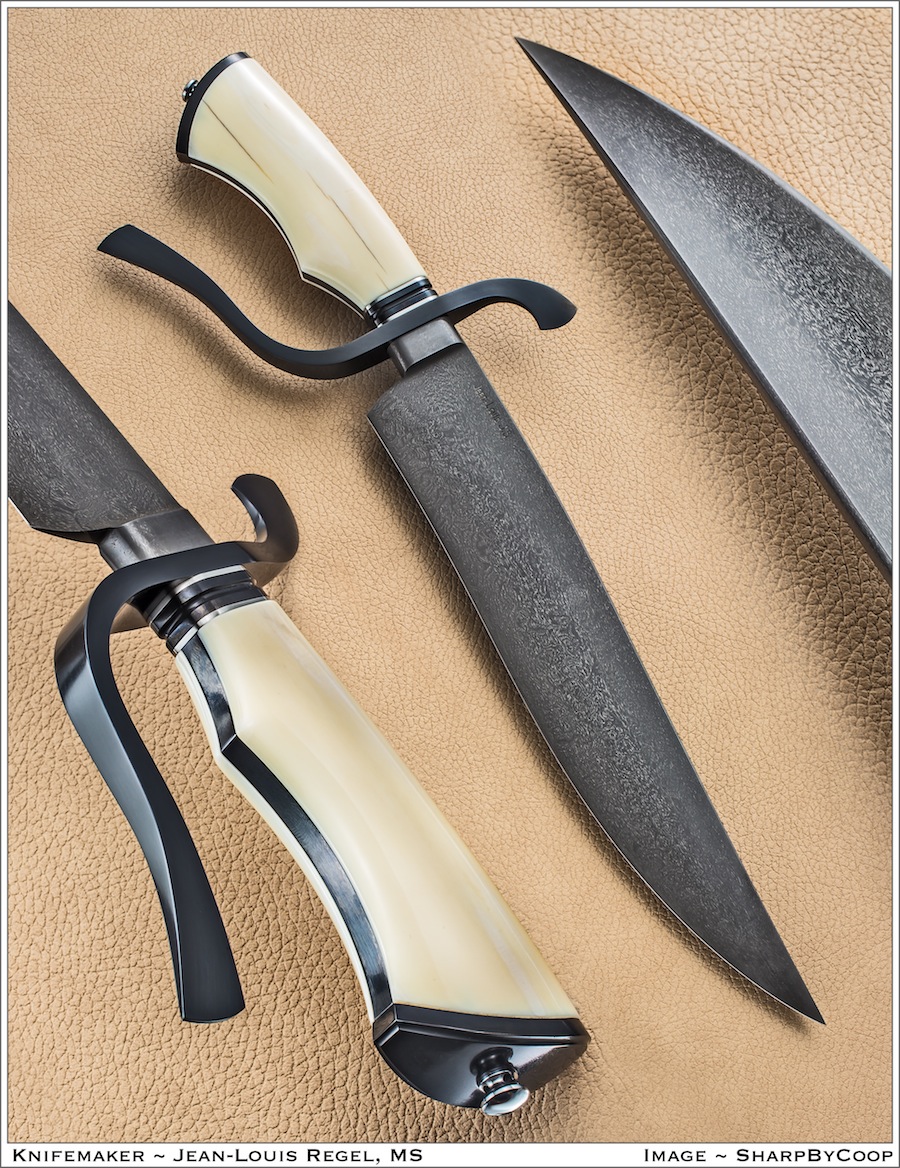
New Jersey targets fossil ivory. (SharpByCoop.com image)
Draconian New Jersey ivory ban includes the ancient ivory of animals that have been extinct for millennia. (SharpByCoop.com image)

New Jersey Gov. Chris Christie signed the nation’s most draconian ivory ban into law yesterday, one that targets not only elephant ivory but also the ancient ivory of animals extinct for over 10,000 years!

The ban also contains wording that appears to make it possible for the mere possession of any ivory to be an offense punishable by law.

According to Knife Rights, the measure bans the “import, sale, purchase, barter or possession with intent to sell” ivory from any species, including ancient ivory from mastodons and mammals, with no exceptions whatsoever.

The part of the measure that reads “possession with intent to sell” is especially disturbing as those with any experience with the law know that such language is open to any number of interpretations by law enforcement and prosecutors.

In other words, the language of this ban could make mere possession of ivory an illegal act. At the very least, it could make those wrongfully charged with possession with intent to sell have to spend the money and time to hire a lawyer, miss time from work, etc., that fighting such a charge can require.

Of course, as has been noted elsewhere, the banning of ancient ivory—that is, of animals that have long been extinct—flies in the face of the purpose behind other such bans. The stated purpose of those bans is to save living animals. A ban against extinct animals can have no effect on those animals because they have been dead for millennia. Of course, some may argue that ancient ivory may be mistaken for elephant ivory and thus should be banned, but that is a specious argument because there are scientifically proven ways of telling ancient ivory from elephant ivory.

The ban will go into effect in six months, during which time those in the Garden State who own ivory items must sell them or face fines of $1,000 on the first offense and $5,000 on the second.

For more information on how you can help fight draconian ivory bans and, at the same time, help save the elephant, visit elephantprotection.org.

For the latest knives, knife news and more, stay tuned to blademag.com.

Advertisement

Must Read Articles

Read this before you make a knife

Knifemaking 101 – Read This Before You Make a Knife

  by Wayne Goddard My experience has taught me that there's nothing like digging in and getting started. I've often said the hardest part of the...
how to forge damascus steel

How to Forge Damascus

Advertisement
Advertisement