The BLADE Blog w/Steve Shackleford

Knives, knife people, knife news, knife use, knife collecting, knifemakers, knife events, the BLADE Show, BLADE Magazine, and more.

1.4 Million Watch Forged In Fire

Forged In Fire on The History Channel.
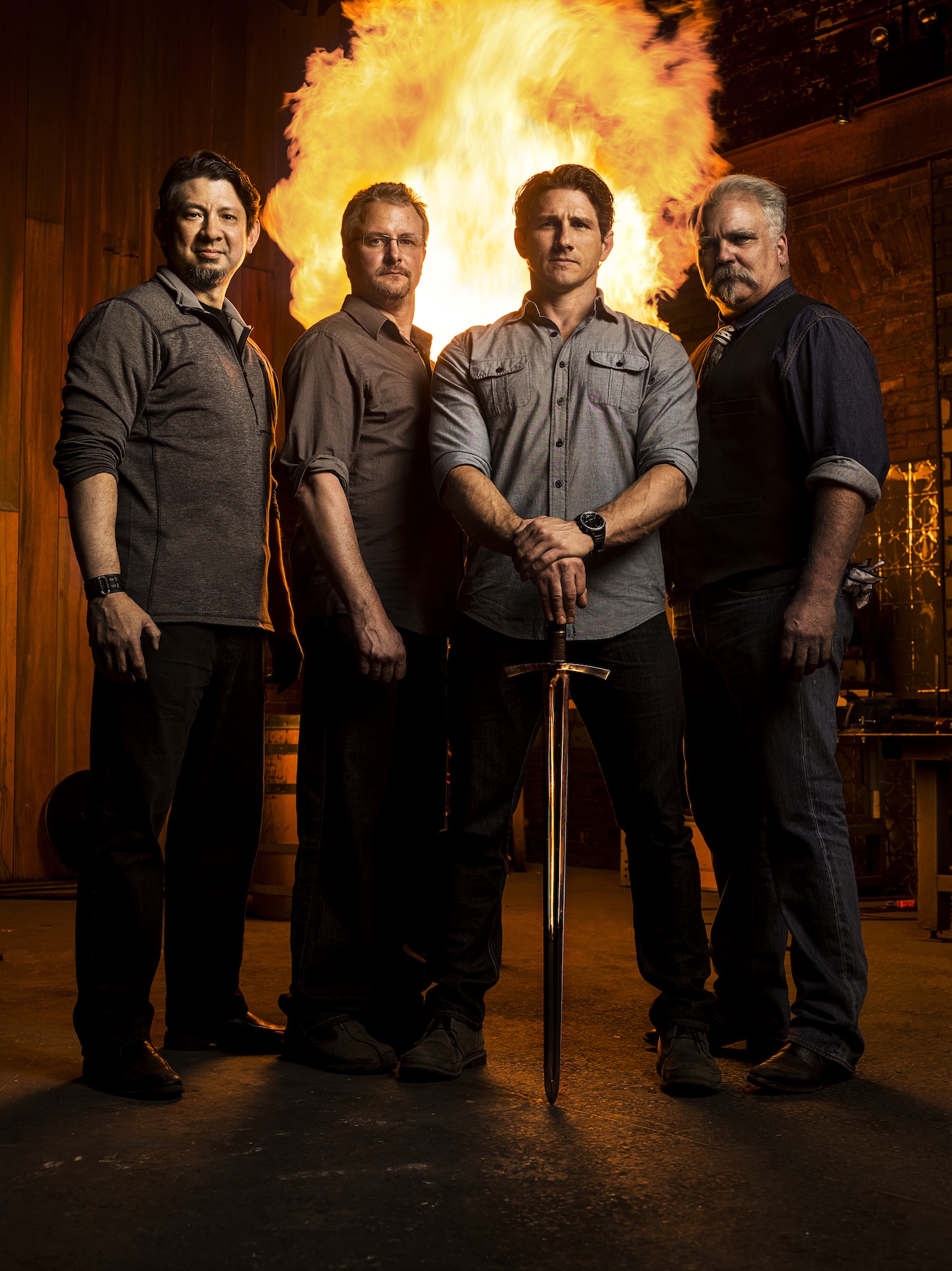
From left, Forged In Fire’s Doug Marcaida, ABS master smith J. Neilson, host Wil Willis and Dave Baker.

Forged In Fire, a new reality TV show pitting bladesmiths against each other in an attempt to see who can make the best knife, is attracting more viewers—1.4 million—than any knife-related media entry in history, and those numbers are climbing.

After five weeks on The History Channel, FIF has gained double-digit growth across all key demographics compared to its premiere episode. According to a History Channel news release, ratings are up a whopping 74 percent in the 25-54 age group, 73 percent in the 18 to 49 age range and 32 percent in all viewers. That’s 595,000 viewers aged 25-54 and 552,000 aged 18 to 49. In all, FIF is attracting 1.4 million viewers, an unprecedented number for a knife-related media endeavor of any kind.

In last night’s fifth installment in the series, bladesmith Guy Harris won the $10,000 cash prize offered to the winner in each episode. He won for making what was judged the best version of an Elizabethan rapier.

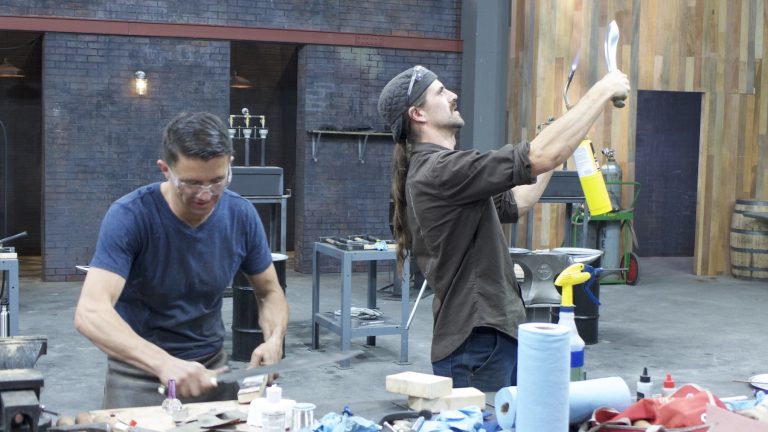
Hosted by Wil Willis, the show originates from a building that has been transformed into a giant forge of sorts containing a number of individual forges, grinders, power hammers, drill presses, hand tools, knifemaking materials and more. In each episode, four different bladesmiths compete against each other in a preliminary round in which they build a rough knife from materials and to specs provided by Willis and the three judges: ABS master smith J. Neilson, ancient weapons authority David Baker and martial artist/weapons authority Doug Marcaida. The four smiths are whittled down to three after the rough knife segment and to two after the finished-knife segment. The two finalists are assigned a special knife, sword, axe or other edged tool that they have five days to complete at their home forge. They then return and the judges put the resulting pieces through the cutting paces and decide which one wins the $10,000 prize.

Watch a Preview:

Waki Talk: What’s Hot in Wakizashis

The wakizashi may be the most sensible and useful Japanese sword. Between a katana and tanto in length, the “waki” is long enough for any number of heavy-duty jobs but also short enough to use in confined spaces. And, for those into collecting/displaying Japanese swords, the waki offers all the traditional accouterments of high-end pieces, too.

    “The CAS Hanwei Tactical Wakizashi crosses over to the machete market to a large extent but still has the mystique of the traditional wakizashi, which a lot of people know about, so it’s a pretty good combination of a machete and an old-time weapon,” CAS Hanwei’s Barry Ross noted. “A lot of our customers use it as a brush-cutting sword. Those hiking in the backwoods carry one for cutting brush for paths and to make shelter, and [some other of our customers] use it as a defensive weapon.”

    With a manufacturer’s suggested retail price of $209, it is a lot less expensive than traditional wakis that have more expensive fittings and cost much more to build, Ross added. Sporting a checkered Kraton handle for a sure grip in slippery conditions, the CAS Tactical Wakizashi has a 20-inch blade of 5160 carbon steel plasma coated for corrosion resistance.

    For the plasma coat, CAS Hanwei has a process that applies a thin layer of nickel to the blade. It is a very tough coating that forms a physical bond with the steel, one Ross said will not wear off. “5160 will rust easily if left to its own devices and since these things will see a lot of work, we needed to do something for that”—thus the plasma coat, he reasoned. The weatherproofed, glass-filled-resin scabbard is equipped with a drain hole so it will not hold water.


THE G2 TEST

ABS master smith Wally Hayes offers tactical, traditional and high-end wakis. “I make tactical wakis for Larry Brahms of Bladeart.com,” Hayes said. “Brent Beshara tested one at the [Usual Suspect Network] G2 Show. We had to make something that was the biggest bang for the buck, something to take into battle and not cost an arm and a leg, so we came up with the tactical waki.” It has a 14-inch blade of 1084 carbon steel and an 8-inch handle with a Turk’s head knot and a ray-skin nylon wrap resin coated to waterproof it. Hayes indicated he has since switched to W2 tool steel for the blade because W2 produces “cooler temper lines and stays straight in the heat treat.” His list price: $1,200. He also offers the double-edge/double-temper-line Hayabusa that he lists for $1,800. It has a 15-inch blade and an 8-inch handle of black ray skin and purple silk.

    While Hayes said his waki production is about half tactical/half traditional, which breaks things up and makes them more fun for him, he indicated he is learning more toward the more expensive models to “push his limits.”

    “As I move up the food chain, so does the demand for my higher-end stuff, more engraving and gold,” etc., he said. “I’m attracting higher-end collectors” from such places as Cypress, Germany, China and Australia, to name a few. “And Axl [Axl Rose of Guns ‘n Roses fame] loves my stuff—traditional and tactical,” he added. “He’s got my wakis hanging in his kitchen.”

    An example of Wally’s higher-end waki would include one with 1600 layers of three different carbon steels—1050, W2 and 15N20. “I put in some of Alfred Pendray‘s carburized electrolytic iron; that way I can get the brightness and tool up to between a thousand and 1600 layers,” Wally noted. All the handles are traditional. He carves and engraves them and embellishes them in gold and silver, depending on the price, which starts at $3,500.


BACKYARD CUTTERS

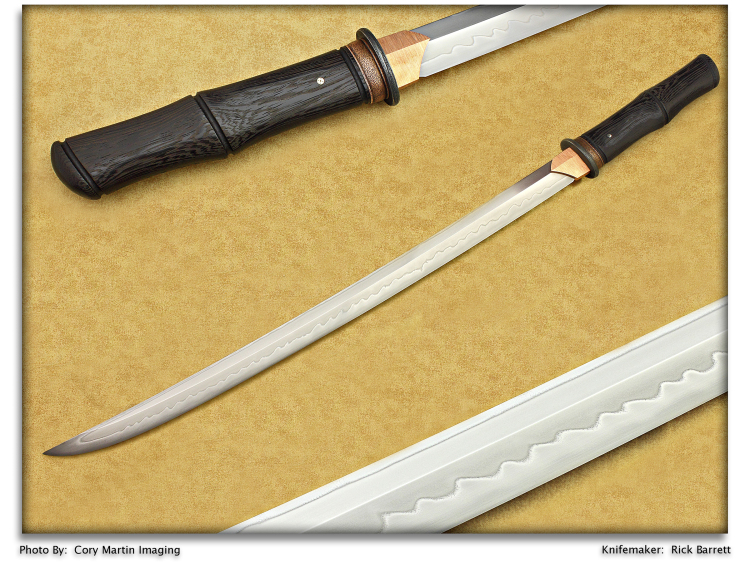
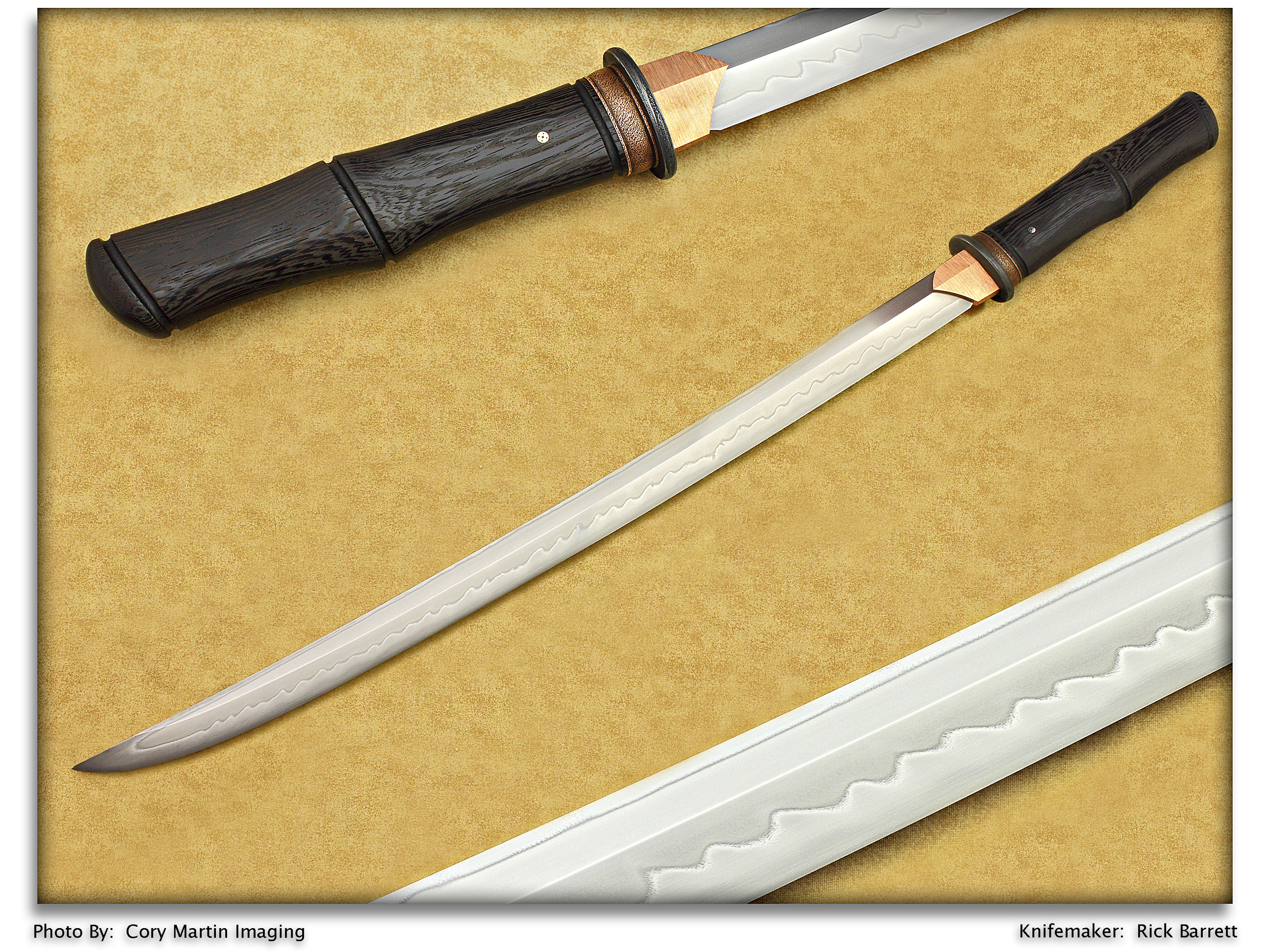
Rick Barrett, who also goes by the Japanese name of Toshi Hisa, said he prefers to make his wakis with semi-traditional-type blades. “I like the longer or oh wakizashi in the 23-to-25-inch blade range, so it’s almost a short katana,” he said. “It makes a great tactical blade; it’s not so long you can’t use it in confined spaces.” Rick uses 1075, W1 and W2, modern carbon steels heat treated traditionally for a hamon.

    He indicated many of his customers include martial artists and “backyard cutters,” the latter whom cut rolled-up straw mats and bamboo in their backyards. “In my opinion, cutting things is similar to shooting firearms. You go out and practice to improve your technique; it is a bit of a hobby in itself,” he opined. “It’s like people who don’t shoot; they don’t know the pleasure people get hitting a target. Those who don’t cut don’t get it either, but [those who do] get a thrill from cutting targets.” Rick said he also has military customers who order anything from a long tanto to a short waki for use in Afghanistan as a backpack piece, as well as collectors who “just put the swords on the mantle.”

    Rick sells most of his wakis—and swords in general—without handles. “I usually do the blade alone and let the customer decide if he wants the rest done traditionally or contemporary. That’s the way the Japanese makers do swords [without handles]. A lot of Westerners look at it as not finished, whereas the Japanese look at it as finished; the rest is ancillary. I get questions all the time: ‘When are you going to finish it?’ For years I would finish it and people would say they wanted something different. You can’t just change it easily. It requires redoing a lot of things. I spend $200 on getting the handle wrapped and if I have to rewrap, I will have to undo the handle, which costs $200, and rewrap, which is another $200.”

    When he offers a waki with traditional mounts, he hands it over to a traditional mounter. “[Traditional mounters provide] a more accurate wrap than I could ever get,” he observed. “[Traditional mounting] takes years in itself to perfect. I don’t want to offer something sub-par for a sole-authorship piece. It is far better to have a tighter handle wrap, diamonds lined up perfectly, and so on. The contemporary handles I do all myself.”


3V WAKIS

Dan Keffeler makes tough, functional user wakis. He said he was invited to a dojo in 2004 and watched a participant’s sword bend during a cut. “He wound up taking it to a polisher to straighten the blade and the bill was $900,” Dan recalled. “I was working with CPM 3V and wondered why can’t I make a [sword] blade out of 3V? It has a lot of impact and chip resistance and though it’s not as tough as S7 it’s still tough, so I started making Japanese swords from 3V, testing, dialing in heat treat for a balance of all the properties we’re looking for, one that would not take a set [bend] and would chop through a 4×4.”

    Since then Dan said 3V has developed a durable reputation for both knives and swords, including his wakis. “I am one of the first if not the first to use 3V for swords, and I hope my work with it over the last eight years has helped contribute to that,” he noted. “I think 3V has the best combination of toughness and edge retention for a sword blade of any steel I’ve tested. I compete in BladeSports International cutting competitions and hold the world record [1.21 seconds] for the fastest 2×4 cut, so I have spent a lot of time on what makes things cut.

    “With a sword, toughness is primary; with a knife, edge retention is primary. For swords, I have not seen another steel that can put those two attributes together like 3V can. When heat treated properly, it’s semi-stainless like D2. You have to care for it but not like for steels like O1. 3V is abrasive resistant so it doesn’t scratch up like other sword steels. It’s harder to sharpen and grind but because it’s so tough and chip resistant, I can grind it to a thinner edge, and a thinner edge is easier to sharpen.”

    For handles for his user pieces he uses a material called Tero-Tuf. “Brian Wagner and Jeff Crownover turned me onto it,” he said. “It’s synthetic like Micarta® or G-10 but is tougher than both. It’s laminated and has a resin like canvas Micarta to make it stronger.

    “I was testing different glues on G-10, Micarta and Tero-Tuf and trying to break the glue and hitting the handle with a hammer. The G-10 would break and crumble in chunks. The Micarta took more hits but would shatter. The Tero-Tuf would throw the hammer back at me. It’s hard to get it to fracture.

    “I sent a knife [with a Tero-Tuf handle] into Knifetest.com and [the tester] hit the handle with a sledgehammer 50 times and couldn’t break the scales. It’s really a high-impact material. Another benefit is it has a really good grip when wet.”


EQUAL PARTS HOT & COOL

Useful, traditional, contemporary and collectible, today’s wakizashis have everything going for them that enthusiasts look for in a Japanese sword. If buying such a sword is on your list, consider the wakizashi, especially one of those described herein. Equal parts hot and cool, wakis are hard to beat.—by Steve Shackleford

How Long The Waki Blade?


How long is the blade of a wakizashi? According to Rick Barrett, since the waki is more of a short carry sword, the blade normally is in the 14-to-22-inch range. As for the oh wakizashi—translated as long wakizashi—he said the range is 23 to 25 inches.

    Barry Ross put the waki blade-length range at 18 to 21 inches. Dan Keffeler said waki blades generally span from 16 to 24 inches. His assessment gibes with the description by the late Bob Engnath in his “Basic Blade Shapes of Ancient Japan.” After 25 inches, Keffeler noted, the blade falls into the short katana range, with the standard katana blade at least 27 to 28 inches long.

    According to information supplied by swordsmith David Goldberg, a wakizashi is “a medium-sized blade over one shaku but less than two shaku in length.” Wikipedia indicates the Japanese shaku has been defined to equal 11.93 inches. Two shaku equal 23.86 inches.—by Steve Shackleford


For more on the latest knives, knife legislation, knifemaking instruction, knife trends, knifemakers, what knives to buy and where and much more, subscribe to BLADE® Magazine, the World’s No. 1 Knife Publication. Click on http://www.shopblade.com/blade-magazine-one-year-subscription-us/?r+ssfb072512 for more information.


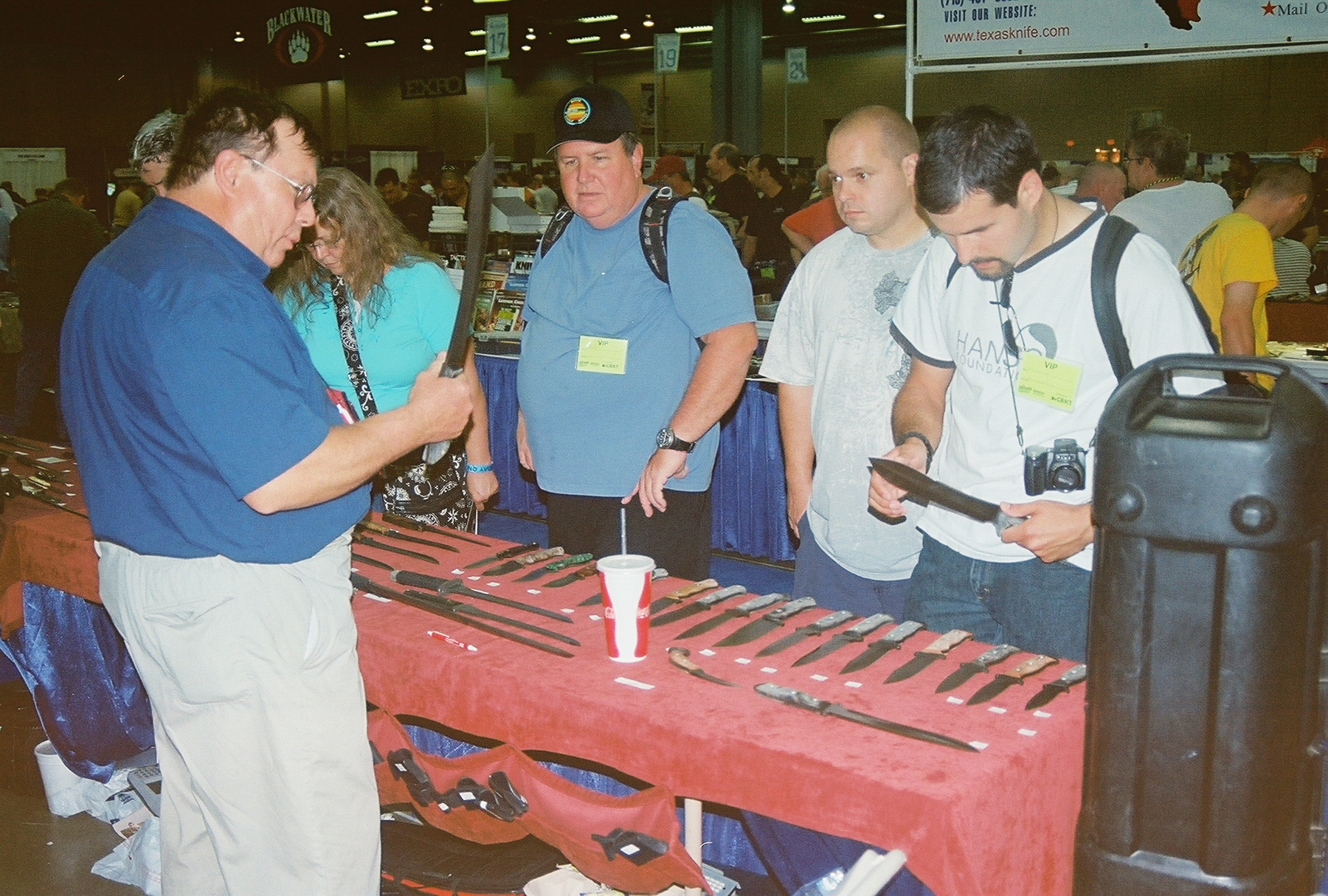
10 Tips for Proper Knife Show Etiquette

Ask Permission

Always ask an exhibitor’s permission before picking up a knife from his table. Nothing’s worse than some ya-hoo barging up, grabbing a knife and launching into a spiel on how much he knows about knives. Treat the exhibitor like you would any decent human being and ask permission to pick up the knife first.

Considerations for Folders

If it’s a folding knife, after asking the exhibitor if you can pick it up, if it’s closed and you want to open it, ask if you can do so (though most every folder maker will expect you to open it, check the action, etc). And if it’s a multi-blade, NEVER open more than one blade at a time. It puts too much pressure on the backsprings and can cause undue wear and tear. If you’ve bought the knife, then open all the blades you want (though it will still cause undue wear on the backsprings). And if you open the blade(s), close it/them before handing the knife back to the maker.

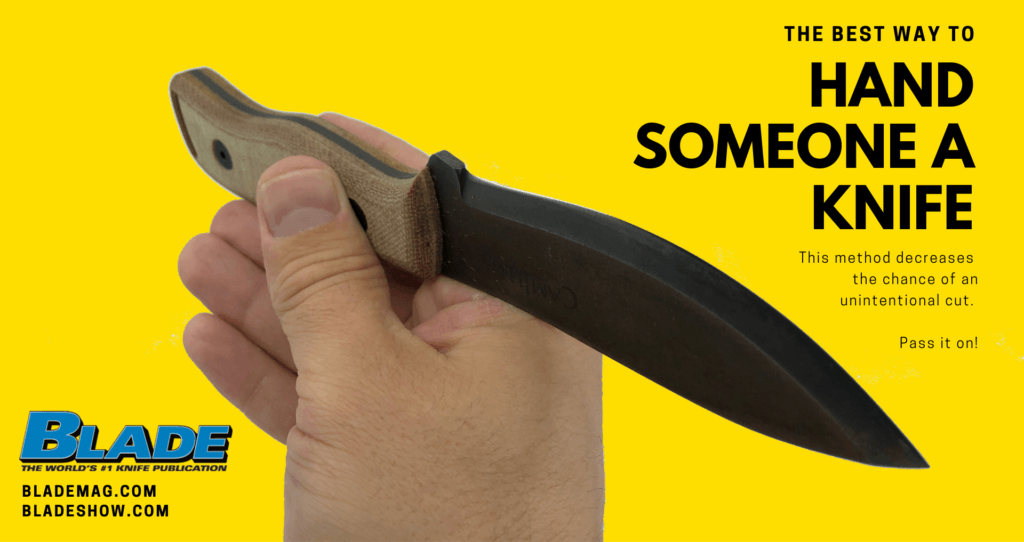
Hand Someone a Knife Safely

how to give someone a knife

Mind Your Edges & Tips

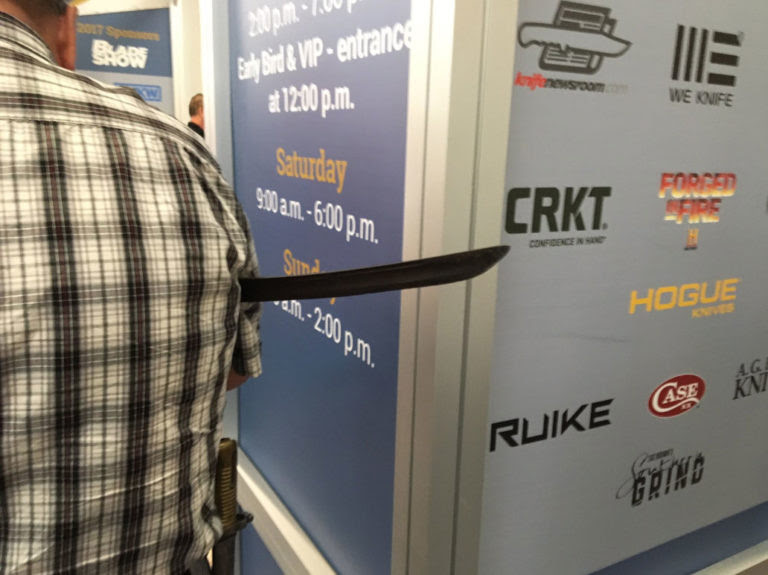
Your blades are your responsibility! Mind those edges and tips. Nothing is ruder than gouging someone on your 6 because you’re strolling around with a sword under your armpit like some 18th-century field marshal.

Say It, Don’t Spray It

Be careful when you are examining an exhibitor’s knife not to spray spittle on the knife. Some people tend to “spray it instead of say it,” and spittle, if not wiped off, can cause “spit pits,” or tiny rust spots.

Wait Your Turn

Never interrupt an ongoing conversation at an exhibitor’s table. The exhibitor might be in the process of selling a knife and if you barge in and start blabbing away, it may chase the buying customer off. Besides that, it’s rude.

Make Way for Business

If you’re talking to an exhibitor and have no intention of buying a knife and see someone next to you who obviously is intent on buying a knife from the exhibitor, politely bow out and give way to the potential buyer.

Leave “I’ll Be Back” to Arnold

Before leaving his/her table, unless you are really going to do it, never tell the exhibitor, “I’ll be back.” Don’t be labeled an “I’ll Be Backer”! 😉

Haggling

Don’t haggle over price with custom knifemakers. They know how much time, effort and materials they put into a knife. If you don’t like the price, move on.

Getting in Close

Using a loupe to examine an antique knife is one thing but don’t use one to examine the custom maker’s knife at the maker’s table. It’s just not very good form. Now, if it’s a custom knife sold by a purveyor, that’s different. After all, if you have a question about the knife’s authenticity, it is possible that the purveyor made a mistake in buying the knife. We all err at times, right?

These are a few of the rules of knife show etiquette. There are others. Practice proper knife show etiquette and your entire show experience will benefit as a result.

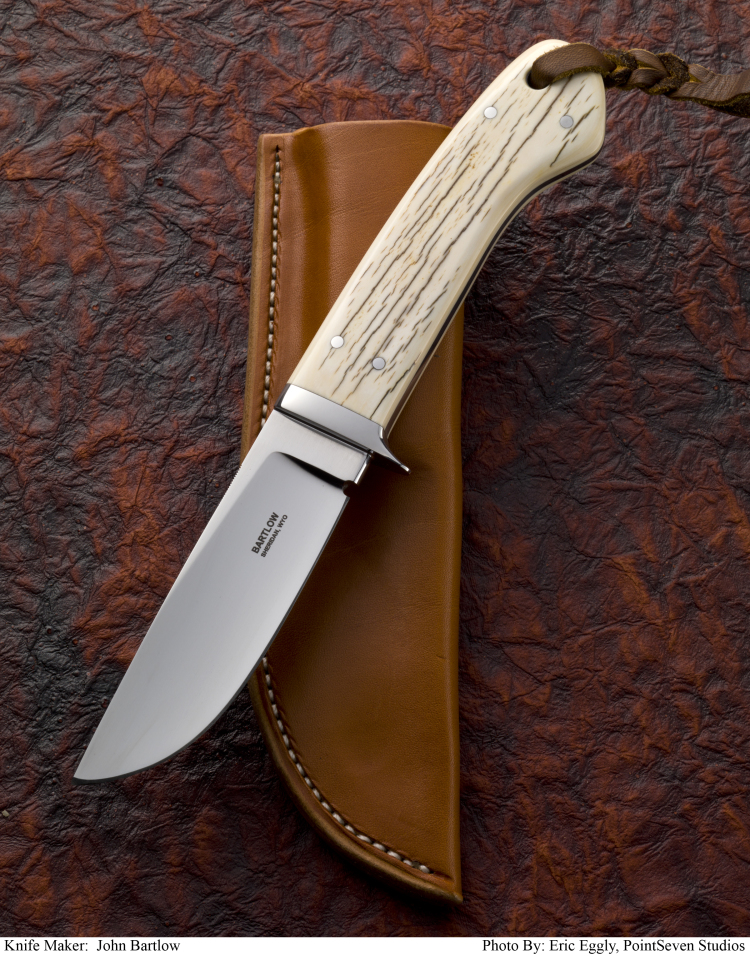
Knife Of The Day: Bartlow Award Winner

Our Knife Of The Day for Feb. 22 is John Bartlow’s utility hunter in a 4-inch blade of ATS-34 stainless steel and a handle of bark elephant ivory.

    Winner of “Judge’s Choice, Hunting/Utility Knife” at last year’s Professional Knifemakers Association Show in Denver, the knife is 8 5/8 inches overall and boasts Bartlow’s trademark line cutter/choil where the edge of the blade begins.

    For more information e-mail John at [email protected].

For more on the latest knives, knife legislation, knifemaking instruction, knife trends, knifemakers, what knives to buy and where and much more, subscribe to BLADE® Magazine, the World’s No. 1 Knife Publication. For subscription information click on http://www.shopblade.com/product/blade-magazine-one-year-subscripti…?r+ssfb022212#BL1SU

Fox News Analyst Knows Knives And Uses Them, Too

Fox News analyst S.E. Cupp (at right in accompanying photo), who will appear on the Don Imus Show tomorrow morning on the Fox Business Channel, is a huge supporter of veterans and wounded veterans. She recently attended a hunting trip for wounded veterans coordinated by Blade Magazine Cutlery Hall-Of-Fame© member Ken Onion (left in accompanying photo) and others. In the process, Cupp got elbow deep dressing out a bear and also learned how to throw knives made by Bobby Branton.

“I donated a set of throwing knives to Ken Onion to keep them busy between hunts,” Branton stated. “Ken said that they threw them 15 hours a day for three days. He sent a picture of S.E. Cupp throwing and he has video, too. He said she caught on quick and turned out to be a good thrower. I’m proud everyone enjoyed my knives.”

Thanks to Onion, Branton and others, the wounded vets had a great time, and Cupp was exposed to the world of custom knives—good news on all fronts.

17th Annual Arkansas Custom Knife Show This Weekend

ABS master smith Jerry Fisk will be one of several makers exhibiting at this weekend’s Arkansas Custom Knife Show. Fisk’s “Sendero” hunter features the maker’s dog-star-pattern damascus blade steel and a mammoth ivory handle. The engraving is by the maker. (Chuck Ward photo)

    Some of the world’s top bladesmiths and knifemakers will descend on Little Rock, Arkansas, this Saturday and Sunday for the 17th Annual Arkansas Custom Knife Show.

    The show will be held in the Robinson Center Exhibit Hall at Markham & Broadway in downtown Little Rock. There will be 150 tables, of which 102 will have various styles and sizes of custom knives. The balance of tables will have knifemaking supplies, leather products, and knife-related books.

    Among makers slated to exhibit are Russ Andrews, Jim Batson, Tim Britton, Bruce Bump, Joel Chamblin, Jim Crowell, Jerry Fisk, Don Hanson III, Jerry Lairson, Shawn McIntyre, Ron Newton, Cliff Parker, Lin Rhea, Kyle Royer, Brian Thie, Brion Tomberlin, Jim Walker, John White, Mike Williams and many more.

    Show hours are 10 a.m. to 5 p.m. Saturday and 10 a.m. to 3 p.m. Sunday. Admission is $5, which is good for both days.

For more on the latest knives, knife legislation, knifemaking instruction, knife trends, knifemakers, what knives to buy and where and much more, subscribe to BLADE® Magazine, the World’s No. 1 Knife Publication. For subscription information click on http://www.shopblade.com/product/blade-magazine-one-year-subscripti…?r+ssfb021612#BL1SU

New Forged in Fire Debuts Aug. 23

Forged In Fire, season three premiere.
Bladesmiths Ben Abbott (left) and Salem Straub (right) work on their kukris during the premiere third-season episode of Forged In Fire. (HISTORY image)

Four past champions will do bladesmithing battle under the watchful gaze of a panel of judges enhanced by the addition of yet another ABS master smith in the third-season premiere of HISTORY’s hottest competition series, Forged in Fire.

Scheduled for broadcast on HISTORY at 9 p.m. Tuesday, Aug. 23, the episode will pit former champs against each other. Those champs will include ABS journeyman smith Matthew Parkinson from season one and ABS master smith Burt Foster, bladesmith Ben Abbott and bladesmith Salem Straub from season two. All will put their skills on the line in forging a blade style under a strict time limit. They will compete over three rounds of elimination until only one remains. Rounds one and two occur in the Forged in Fire shop, while round three takes place in the home shops of the remaining two smiths. The work completed during each round is evaluated and tested to decide who will be eliminated from the competition, and who will advance. The final round winner is crowned champion for the episode and earns $10,000.

Joining the panel of judges that includes ABS master smith J. Neilson, antique weapons specialist David Baker and martial arts/weapons user Doug Marcaida is award-winning ABS master smith Jason Knight. Knight is a highly talented smith with a sharp wit who is sure to bring both keen insight and his own brand of South Carolina humor to Forged in FIre. Weapons authority and U.S. Army and Air Force veteran Wil Willis hosts the show.

Forged in Fire is the first television show about bladesmithing of its kind and attracted over 1.5 millions viewers last year. It was presented the BLADE Magazine 2016 Publisher’s Award at this year’s BLADE Show for demonstrating “not only how tough it can be to make a quality knife under a tight deadline but also to entertain”—and doing it before more people than ever before. For more on the latter honor and other BLADE Magazine 2016 Knife-Of-The-Year® Awards, see the November BLADE®, on newsstands now, subscribe to the digital and or print editions or buy the digital edition of the November BLADE.


Save

Save

Save

Save

Save

Save

Save

Save

Save

Save

Save

Save

Save

Advertisement

Must Read Articles

Read this before you make a knife

Knifemaking 101 – Read This Before You Make a Knife

  by Wayne Goddard My experience has taught me that there's nothing like digging in and getting started. I've often said the hardest part of the...
how to forge damascus steel

How to Forge Damascus

Advertisement
Advertisement