The BLADE Blog w/Steve Shackleford

Knives, knife people, knife news, knife use, knife collecting, knifemakers, knife events, the BLADE Show, BLADE Magazine, and more.

Hot Straight Razors Highlight New BLADEĀ®

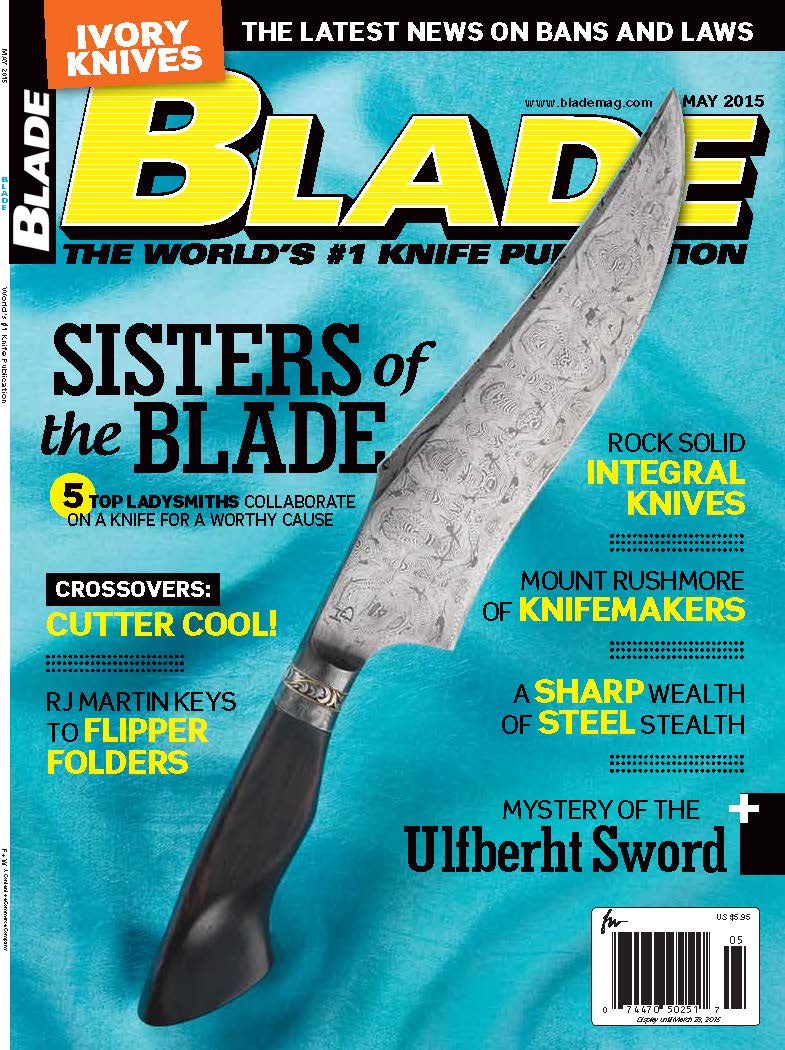
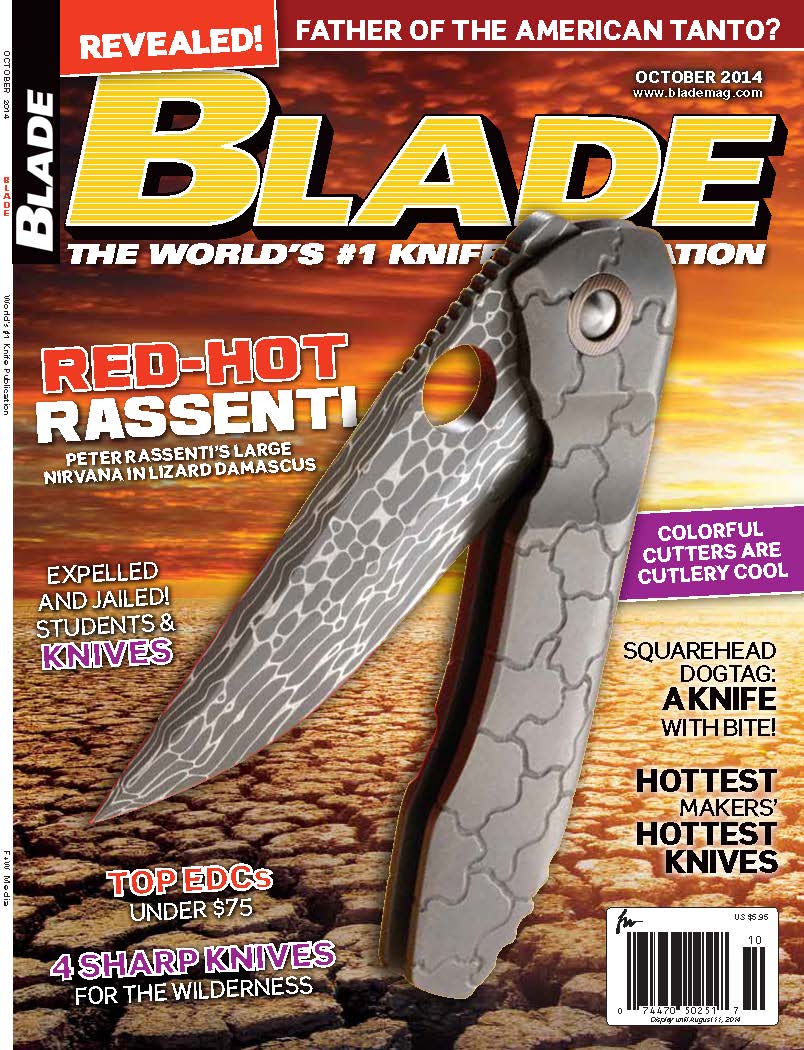
Stubble is no trouble with Kirby Lambert's straight razor, on the cover of the latest BLADEĀ® and on newsstands NOW!
Kirby Lambert’s straight razor graces the cover of the latest BLADEĀ®, on newsstands NOW!

Stubble is in trouble thanks to the hottest straight razors—one of which, the newest model by Kirby Lambert, is the cover piece for the latest BLADEĀ®, on newsstands NOW!

Known for his custom tactical folders, Lambert is one of several makers who offer custom razors, the others highlighted in the story on page 12 being Sal Manaro, Rick Barrett, Wally Hayes, Neels van den Berg and Bill Ellis. There’s also a factory version from Boker that made the cut. Speaking of Hayes, he wrote a story outlining his approach to making straight razors on page 20.

Is a tactical knife a fixed blade or a folder? The answer depends a lot on who you ask. While knife-o-philes continue to ply the age-old question, we provide nine of the best factory buys in the genre—both folding and fixed—on page 28.

Heroes are important in any walk of life, including those of knifemakers of all stripes, from the legends to the up-and-comers. We asked four makers—BLADE Magazine Cutlery Hall-Of-FameĀ© member D’ Holder, Tom Krein, Larry “The Hammer” Harley and Joey Cordova—to share their knifemaking heroes with you. We think you’ll find their answers both interesting and relevant to you and your knives.

Knife kits have some a long way from the days when they consisted of a blade blank, a couple of handle slabs and several screws. Now they offer folders in a number of configurations, including one for a butterfly knife. Check out the latest versions on page 40.

You’ve already read on blademag.com about the first-ever knife show that will combine members of both the Knifemakers’ Guild and the American Bladesmith Society set for Sept. 18-20 in Kansas City. However, BLADE gets more of the inside info—including the fact that the old Muehlebach Hotel, site where Cutlery Hall-Of-Famer Bill Moran reintroduced damascus at the 1973 Guild Show, is in one of the wings of the new venue—for you on page 46.

Spyderco long has been a world leader in factory knives and it continues that role with its Ethnic Series of knives that include designs by such international makers as Pekka Tuominen, the late Eduard Bradichansky and Gabor Szakonyi, as well as accomplished American maker Ed Schempp. Go global with the Spydie guys on page 50.

There’s something about a super-thin custom folder that bespeaks of elegance. And some are so thin and delicate you’d think they might not be able to do their cutting jobs—though such is not the case. Check out some of the leanest of the keen by Richard Rogers, Cliff Parker, Bill Ruple, Scott Sawby and Ken Erickson on page 74.

There’s much more, including Ed Fowler’s “12 Keys to Great Knife Promotion”; a look back at the many contributions of the late, great Cutlery Hall-Of-Famer, Kit Carson; a test of two big fixed blades in MSG Kim Breed’s “Spec Sheet”; E.C. Loerchner’s masterful “Autumn Knife”; and much more, all in the latest issue of BLADE.

Do You Know Your Knife Terminology?

Bob Loveless called his famous outdoor knife a dropped hunter, not a drop point.
Knife terminology can change with the times. Known by many as the drop point, the knife at top by Bob Loveless originally was called the dropped hunter by Loveless himself. (PointSeven image)

Do you know your knife terminology? Yes, I agree that it probably doesn’t matter much if you do or not as long as you’re into knives and love to use them, collect them and otherwise celebrate your favorite sharp tool. On the other hand, there’s a certain satisfaction in knowing your knife terminology. In other words, it’s nice to be secure in the knowledge that your understanding of knife speak is current and that you can hold your own in conversation with knife aficionados.

For instance, a relatively new term introduced by BLADE Magazine Cutlery Hall-Of-FameĀ© member Ken Onion is gentical. One of the world’s foremost custom knifemakers and factory knife designers, Ken has designed knives for Kershaw/Shun, CRKT and Chef Works, to name three. He’s even designed a motorized sharpener for Work Sharp! His cutlery designs have ranged from hunting to tactical to kitchen knives and beyond. In the process, he came up with the gentical name for a knife that boasts features of both a gentleman’s knife—small in size, blades 3 inches or shorter, lightweight, etc.—and a tactical knife—bigger, bolder designs, the latest blade steels, non-glare/matte blade finishes, etc. Gentleman’s plus tactical equals gentical—get it? (For more on genticals, see BLADE’s Complete Knife Guide Spring 2015, on newsstands Dec. 2.)

Of course gentical is a newer entry in knife speak. There are others, some of which go back years, even decades.

For instance, Cutlery Hall-Of-Famer Bob Loveless is famous for a hunting knife that many call a drop-point hunter or simply a drop point. However, drop point is a misnomer—at least it is in regard to the name Loveless originally gave the design, which was dropped hunter. Both drop point and dropped refer to the point of the blade in the design, which drops or rests below the midpoint of the blade’s plane. Somewhere along the line someone called it a drop point instead of a dropped hunter and the name stuck. In my opinion, drop point is more descriptive of the blade design than dropped—besides, dropped hunter sounds like a knife you dropped and/or lost in the woods somewhere. But I digress.

Then there’s finger choil. Finger guard is another one. The word finger in either is superfluous—in other words, it’s not needed. It’s a guard or it’s a choil, period. Finger groove or grooves is correct, but not finger guard or finger choil.

The guard is the cross/double guard with two quillons and/or single guard with one quillon—quillon is another entry in knife speak covered below—at the juncture of blade and handle that keeps your fingers/hand from sliding forward onto the blade from the grip.

Knife-Terminology-Knife-Throwing
New from BLADE! Check out the best articles on knife throwing, from the pages of BLADE magazine.

A choil is a small cutout at the base of the edge of the blade. Cutlery Hall-Of-Famer A.G. Russell once said the choil’s original purpose was to indicate where to stop the stroke with the sharpener on the blade during the sharpening process. Some knives have larger cutouts at that juncture for placement of a finger for more detailed-type cuts. However, even then the cutouts are still choils, not finger choils. In addition, some companies and makers put a single groove in the handle just before the guard. Though they may call it a finger choil, it is really nothing more than a finger groove.

Now, for the quillon. According to Websters, a quillon is “either of two transverse projecting members forming the cross guard of the sword.” In other words, a cross or double guard consists of two quillons and a single guard consists of one quillon. The cutlery community uses the term for knife guards as well.

Moreover, you will often hear quillon incorrectly pronounced quill-yun. How the word obtained that pronunciation I do not know, though I suspect it came from someone who saw the word, did not know how to pronounce it, and simply did what many do in such circumstances—took a “stab” (forgive the pun) at saying it and arrived at quill-yun. The correct pronunciation is key-yun (or a reasonable facsimilie. Hey, I’m a writer, not a pronunciation expert). However, many, including a large number in the bladesmithing community, continue to refer to it as a quill-yun. Hence, if you hear that pronunciation, you’ll know what it means. (By the way, I don’t recommend trying to correct bladesmiths on their pronunciation of quill-yun. Trust me on this one.)

There are many knife terminology concepts you might want to know. I will cover them sometime in the future here at blademag.com.


Hones for the Sharpening Challenged

The CCKS 2-Step Knife Sharpener from Smith’s offers coarse tungsten carbide rods on top and extra-fine (1,000 grit) ceramic rods on bottom—both at pre-set angles for easy pull-through use—for sharpening and edge touch-ups/refinement, respectively. MSRP: $3.99. (Smith’s photo)

If sharpening stumps you, try one or more of these simple yet effective sharpeners

By Dave Rhea

A good working edge on a blade is one of the knife owner’s most important considerations, but sharpening is not always as easy as it seems. How do you hold the knife to the sharpener/which angle should you use? Do you use ceramic, stone or diamonds? How much sharpening is too much? How much is too little?

    Here is a better question: Since even thinking about sharpening can get complicated, why not idiot proof the subject?

Quick and Easy

Chris Fire is a sharpening expert. As the marketing manager for Lansky Sharpeners, Fire lives and breathes by the sharpening industry. His suggestion for the quickest and easiest sharpener is Lansky’s Quick Fix Pocket Sharpener.

    The Quick Fix has all the elements of an easy sharpener: Low price (MSRP: $5.99), small—about the size of a money clip—and fast results. A half-dozen or less strokes through one of the two slots clears up a problem blade edge in a hurry. One side holds a slight segment of tungsten carbide rod to return the edge to a proper geometry, and the other side holds a like-sized span of ceramic rod to deburr it.

    Fire drew a distinction between the quick-and-easy and something less expedient but perhaps wiser.

    ā€œTungsten-carbide sharpeners sharpen by tearing steel off the blade rather than slowly honing,ā€ he warned. ā€œThey remove a lot of metal. Use them in a pinch, but for everyday edge maintenance you probably want to use something less aggressive like Lansky’s Turn Box Ceramic Sharpener.ā€

    The 4 Rod Ceramic Turn Box (MSRP: $21.99) offers a higher-grade sharpening experience but is also uncomplicated. It uses two pair of 5-inch alumina ceramic rods that are set at pre-determined angles: 20 and 25 degrees. Holding the knife upright vertically, you draw the blade down along the rods of the V-shaped sharpener. With internal rod storage, it also breaks down into a compact kit for stowing in a drawer or tool/tackle box.

    Fire added that perhaps as important as having a good sharpener is the knowledge that different tasks call for different knives. In other words, a chopping knife is not going to make a great slicing knife no matter what kind of edge it has.

    ā€œChopping knives have a more durable edge, but they’re not as sharp,ā€ he professed. ā€œChopping potatoes with such knives is great. Achieving paper-thin tomatoes slices? Not so much. So keep a knife for slicing, a knife for chopping, a multi-purpose knife and maybe a fillet knife, and use each to its strengths.ā€

Hassle Free

Marketing manager for Smith’s, Russ Cowen adds that a seemingly insurmountable task is convincing the consumer on-going edge maintenance is the key to keeping a perpetually useful edged tool.

    ā€œThe best way to keep a knife sharp is to never let it get dull,ā€ he explained. ā€œIf the consumer would just take a few minutes either before or after using a knife, and especially during use if doing lots of cuts for a longer time period, to touch up or freshen the cutting edge, he or she would see that not only would the knife cut better, but it would also take them half the time to accomplish the task.ā€

    For such hassle-free edge maintenance, he recommends Smith’s 2-Step Knife Sharpener, a small plastic-framed sharpener with an insanely low MSRP of $3.99. The two sharpening slots—in carbide and ceramic—offer two stages of edge work: 1) coarse ā€œfor re-setting the edge on very dull or damaged blades,ā€ and 2) fine for finishing work that will bring a blade closer to the hair-popping sharpness so many knife users crave.

    ā€œThe 2-Step Knife Sharpener will sharpen any blade style with a flat grind on both sides of the blade as long as the blade will fit inside the sharpening slots. It works well on Euro/American style kitchen knives, everyday pocketknives, folding or fixed-blade hunting knives, fillet knives, outdoor sport knives, custom knives, and tactical/LE knives with little to no maintenance,ā€ he said. ā€œAt most, the user may have to rinse it off or clean the ceramic rods after extended use.ā€

    For knives that suffer from the usual treatment—letting them go pretty much dull—Cowen offers this advice: ā€œThe best way to put a new, sharp cutting edge on a very dull or damaged knife blade is to use an abrasive surface that is aggressive enough to remove large amounts of metal from the blade quickly.ā€

    He suggests a sharpener with carbide blades or a low-grit diamond-coated surface. Such abrasive components are quite aggressive and remove metal from the blade very quickly—sometimes so fast you can see the metal shavings falling off the blade, he added.

Simplest Is Best

Pre-set angles and guides are all designed to make the obligatory task of sharpening a knife easier. However, according to Mark Brandon, president of Diamond Machining Technology (DMT), it does not get any simpler than the old-fashioned bench stone.

    ā€œThere’s a myth out there that sharpening is difficult,ā€ Brandon began. ā€œI don’t think the sharpening industry has done itself any favors—we’ve done our part to help convince people that it’s difficult by coming out with all these ā€˜we’ll-hold-your-edge-for-you’ kind of products.ā€

    He said the reality is that via its training videos available at www.dmtsharp.com, DMT has taught scores of folks to sharpen on a stone in less than five minutes.

    ā€œWe think it’s kind of idiot proof to begin with,ā€ he stated. ā€œSometimes the simplest approach can be the best, and there is really nothing simpler than a 6-inch-by-2-inch stone.ā€

    Brandon’s two bench-stone suggestions start with the DMT Diamond Whetstone, which comes in 6- and 8-inch models. They have MSRPs of between $47.16 and $95.26, depending on the length and choice of either plastic or hardwood case. A diamond abrasive is the best and simplest material to put a great edge on a blade, he said.

    His other suggestion is the DuoSharp 8-inch model, another diamond stone that is double sided in fine and extra-fine grits to address both sharpening and refining the edge. The 8-inch DuoSharp has an MSRP of $105.03 for the stone alone and $114.58 with the stabilizing base accessory.

    ā€œIt’s all a matter of how much time are you willing to spend on it,ā€ Brandon said. ā€œIf you have a fine stone, depending on how much time you want to take, you can get a dull knife sharp. But if you don’t have that much time, you may want to have a coarse stone available to get it to a certain level and a fine stone to get a good working edge, and if you really want to make it hair-popping sharp, go to an extra fine.ā€

Rule Of Thumb

No matter your preference, there are plenty of choices available. The key is to find your comfort zone and touch up the edge at least once for every three or four times you use a knife. The basic rule of thumb is do not let your knife go dull and it will be easier to keep a crisp, high-performing edge.

For more on the latest knives, knife legislation, knifemaking instruction, knife trends, knifemakers, what knives to buy and where and much more, subscribe to BLADE Magazine, the World’s No. 1 Knife Publication.

Buck Knives, Inc. Announces Partnership with Haley Heath

Buck Knives Inc. is pleased to announce the signing of Haley Heath and ā€œFamily Traditions with Haley Heathā€ to a multi-year license agreement which includes a signature line of hunting knives designed for female hunters. 

This unprecedented partnership in the cutlery industry will enable Buck Knives and Haley Heath the opportunity to fulfill a long overdue need in the cutlery marketplace.  ā€œI am incredibly excited to be the first female featured with her own line of hunting knives from the number one brand in hunting, Buck Knives,ā€ stated Heath.  ā€œWe have a great opportunity to create a new line of female specific products.  From my travels and interactions with people around the country, I know this is a need and I am happy to work with Buck Knives to provide knives to all the other ladies who enjoy the outdoors as much as I do. Buck Knives has been producing quality USA made knives since 1902 and to work with them is awesome.ā€

 Chuck Buck, Chairman of Buck Knives stated, ā€œWe are all so pleased to be able to work with Haley, G.O., and the entire Heath family.  They represent everything we believe in when it comes to family, outdoors and hunter safety.  I have no doubt that Haley and G.O. will be great ambassadors for Buck Knives.ā€ 

ā€œFamily Traditions with Haley Heathā€ is a popular program on the Sportsman Channel that epitomizes today’s generation of hunters and shows first-hand how family traditions can be passed down in powerful ways. Haley, a 5th-generation hunter, ā€œUltimate Outdoorsman Finalistā€ and the first woman to receive The Sportsman Channel’s ā€œViewer-Favoriteā€ award, hosts the show.  She hosts the show with her husband G.O. and their son Gunner and daughter Dakota for the true ā€œFamily Traditionsā€ experience. 

How The Nov. 4 Vote Affects the Ivory Ban

The pending ivory ban will be impacted by the Nov. 4 elections.
The Nov. 4 elections will impact the pending ivory ban, though to what extent depends on several factors. Meanwhile, even legal ancient ivory has been banned in New Jersey! Robert Appleby uses legal mammoth ivory on his fixed blades. (Chuck Ward photo)

While some might think Republicans taking control of Congress as a result of the Nov. 4 elections will be good for those fighting a pending legal ivory ban, such may not be the case.

Rob Mitchell of the Elephant Protection Association indicated that though the election results would seem to make a Republican majority in Congress more effective at challenging “out-of-control administrative agencies” that want to ban all legal ivory, including knives with handles of legal ivory, it could also have the opposite effect.

Since President Obama has indicated he will do what he thinks necessary to deal with aliens in the country illegally through executive order or administrative action by the end of the year at the latest, it also may mean he will take a similar approach to such issues as the ivory ban. “If so,” Mitchell writes, the U.S. Fish and Wildlife Service (USFWS) “may become more aggressive with regulations putting politics ahead of science-based conservation.”

Moreover, he added, such non-governmental organizations (NGOs) as the World Wildlife Fund, Africa Wildlife Foundation, Wildlife Conservation Society, international and American humane societies and others will “continue to spread misinformation in Congress to confuse issues and push an animal rights agenda in spite of the harm it will cause to legitimate conservation efforts and people who own legal ivory.”

As a result, Mitchell urges all those against the ban on legal ivory to either contact or to continue to contact their legislators and see where the legislators stand on House Resolution 5052 and Senate Bill 2587. In a nutshell, if approved, both measures would roll back the attempt by USFWS to ban legal ivory to the status quo of February 2014, “while allowing the government to pursue other means to combat elephant poaching and other wildlife trafficking.”

For more information on the ivory ban and related issues, visit elephantprotection.org.


GROUP-T1346-T1348Recommended for You:

KNIVES 2015

See the latest knives, swords, and edges of all types, and explore the latest trends in blades, steels, styles, and materials. Gaze upon a ā€œState of the Artā€ section parading engraved, scrimshawed, jewel-inlaid, carved, etched, sculpted and forge-welded, and Damascus and mosaic-damascus knives. Click here.

HallMark To Launch Bad Blood Line

Ā Ā Ā Ā  HallMark Cutlery will launch a new brand, Bad Blood, at the 2012 SHOT Show in Las Vegas. The line will consist of a mid-priced offering of tactical folders, fixed blades, and utility pieces.

Ā Ā Ā Ā  The new brand will also include a custom collaboration series from custom maker, Sean Kendrick. His line for HallMark Cutlery will include three folding knife patterns and three fixed blade models, and are expected to be available in the first quarter of 2012.

Ā Ā Ā Ā  Kendrick has been crafting knives professionally since 1998, but knives have been a passion since he was a child. Craft and design come naturally to the self-taught Kendrick. His mother is a talented artist and his father is a master electrician, plumber and mechanic. Sean’s great-grandfather was a blacksmith.

Ā Ā Ā Ā  Kendrick’s style and designs have been inspired by many elements, including music. Sean credits his friends and mentors, knifemakers David Mosier and Mike Franklin, for showing him the “ins and outs” of folding knives. Sean is also a member of the Usual Suspect Network. Kendrick won the award for “Best Tactical Knife” at the 2010 Spirit of Steel Show for his fixed blade “Partisan Hybrid.” His fixed blade version of the “Spiraling Demise” won “Best Tactical / Fighting Knife” at the 2004 Greater Ohio Valley Knife Show.

Ā Ā Ā Ā  For more information contact HallMark Cutlery, PO Box 220, Kodak, Tennessee 37764 866-583-3912 www.hallmarkcutlery.com.

Ā Ā Ā Ā 

Ā Ā Ā Ā  To read similar stories and all about the latest knives, knife trends, knifemakers and much more, subscribe to BLADEĀ® Magazine. For information on how to subscribe, click on http://www.shopblade.com/product/blade-magazine-one-year-subscription-us/?r+ssfb211211#BL1SU

Ā Ā Ā Ā 

Knives Of Summer: Keep Those Puppies Sharp!

When you use one of our “Knives Of Summer,” you will need to sharpen that puppy. In fact, a little edge maintenance after each use—when feasible—is the best way to keep your knife sharp for the next time you need it.

    GATCO’s Natural Arkansas Sharpening Kit is a great way to keep your edges keen at all times. Designed for sporting, kitchen and other knives, it features a novaculite stone mined from Arkansas. The kit includes a block-mounted 5-inch stone for sharpening, a 3-inch stone for final touch-ups, honing oil and a storage case.

For more info click on http://www.shopblade.com/gatco-natural-arkansas-sharpening-kit-80005/?r+ssfb070912.

Advertisement

Must Read Articles

Read this before you make a knife

Knifemaking 101 – Read This Before You Make a Knife

  by Wayne Goddard My experience has taught me that there's nothing like digging in and getting started. I've often said the hardest part of the...
how to forge damascus steel

How to Forge Damascus

Advertisement
Advertisement