The BLADE Blog w/Steve Shackleford

Knives, knife people, knife news, knife use, knife collecting, knifemakers, knife events, the BLADE Show, BLADE Magazine, and more.

Another First for Forged In Fire

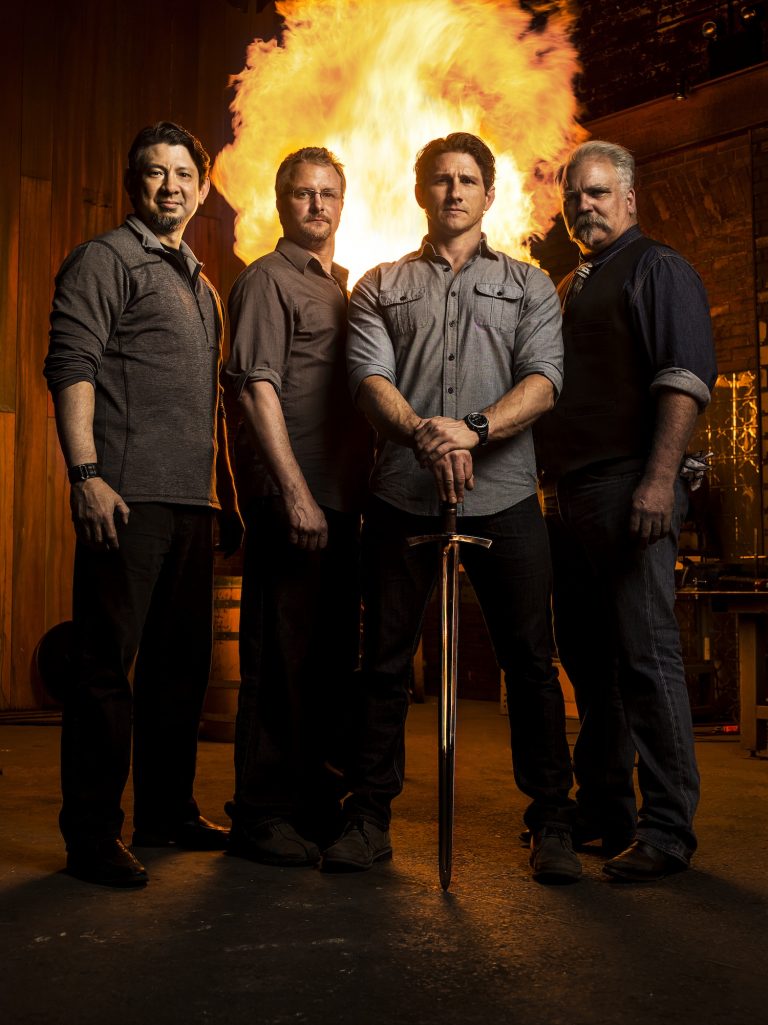
Forged In Fire and the BLADE Magazine Publisher's Award.
Forged In Fire made a different kind of history when it won the BLADE Magazine 2016 Publisher’s Award. (Miller Mobley/HISTORY)

When Forged In Fire won the BLADE Magazine 2016 Publisher’s Award during this year’s BLADE Show, it was the first time a television program of any kind was recognized by BLADE® Magazine in such a manner. Selected by the BLADE staff, the Publisher’s Award honors a person or organization that has furthered the knife community in a fashion that bodes well for the future of that community, both inside and out. Forged In Fire on History answers that requirement—and then some.

It’s rare that knifemaking of any type is given the high-profile exposure of television coverage, much less a weekly program of its own. However, Forged in Fire has done just that and much more. Those who watch it are familiar with the group of bladesmiths it gathers each week, each group different from the last, with the bladesmith in each charged with forging a knife—often in a very exotic style—in a stated time limit under the watchful gaze of a panel of judges and millions of TV viewers. Meanwhile, the winner of each episode earns a grand prize of $10,000.

As with most high-profile endeavors, there are those who criticize the program for portraying knives in a so-called negative way and creating an atmosphere that is not conducive to making the best knife possible—but then making the best knife possible is not necessarily the goal. The goals include to demonstrate not only how tough it can be to make a quality knife under a short deadline but also to entertain—and Forged in Fire does that quite well. Meanwhile, bladesmiths, knifemakers and the knife industry in general are getting more exposure before more people than ever before. And that is a great thing.

Now on the cusp of entering its third season, Forged In Fire will have a different look with ABS master smith Jason Knight filling in for ABS master smith J. Neilson. We fully expect the show to enjoy yet another banner season, and for bladesmithing and the knife community in general to continue to benefit from the unprecedented exposure such a TV show brings to knives the world over.


Want to Get Started in Knifemaking?

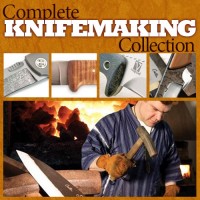
Best books for beginner knifemakersFor those new to knifemaking, BLADE put together a special collection just for those starting out. The Complete Knifemaking Collection gathers great knifemaking books and tutorials to get you up to speed in no time. The price is unbeatable, too.

Order the Complete Knifemaking Collection from ShopBlade.com.

Knives of The Expendables 2

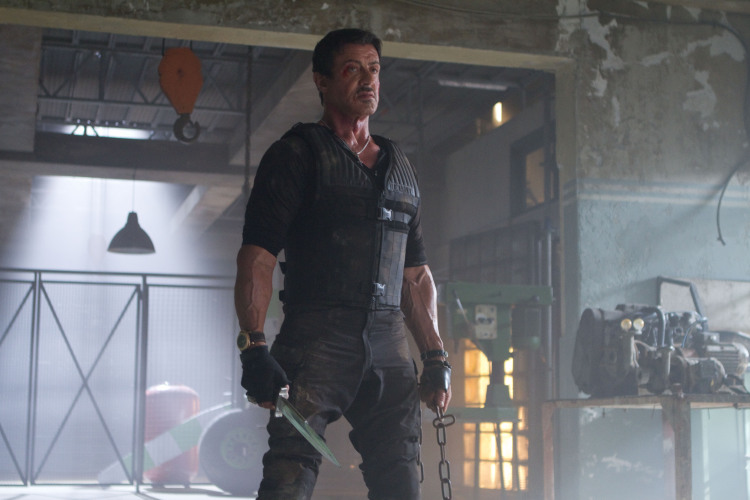
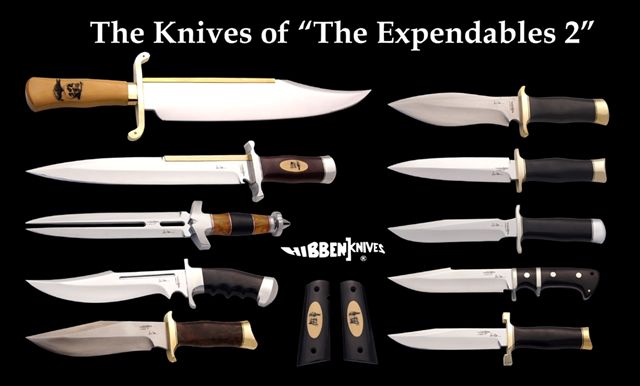
Sylvester Stallone (top) holds the Gil Hibben Toothpick (second from top left, above) in a scene from The Expendables 2. Along with the modified version of Gil’s Alamo Bowie (top left, above), it is a carryover from the first film in the series, The Expendables. The Legion Fighter (fourth from top left, above) is the knife Hibben made expressly for Stallone for the sequel. (photo from The Expendables 3 by Frank Masi; photo of Hibben knives by Mike Carter)

    The longest-running custom knifemaker/movie star connection of all time will have another go soon with the imminent worldwide release of the action blockbuster, The Expendables 2.

    Blade Magazine Cutlery Hall-Of-Fame© member Gil Hibben has a rich history with writer, producer and actor Sylvester Stallone. It began at Dan and Pam Delavan’s 1985 California Custom Knife Show when Stallone visited Gil’s table and walked away with several of Gil’s custom knives. That encounter led to Stallone calling on Gil to make the famous survival knife (cover inset, August 1988 BLADE®) that Stallone wielded in Rambo III and later the massive machete (cover, February 2008 BLADE®) in the fourth movie in the series, Rambo.

    In 2010, The Expendables, co-written, directed by and starring Stallone, along with an all-star cast of action-film heroes, again employed Gil’s knives. Stallone’s character, team leader Barney Ross, carried a custom Hibben 17.5-inch “Toothpick” model (cover, November 2010 BLADE). Meanwhile, Gunnar Jensen, played by Dolph Lundgren, and Lee Christmas, played by Jason Statham, took turns using a huge, 19-inch custom Hibben bowie.

    All of the original Expendables except Mickey Rourke return for The Expendables 2, which at press time was due to open in theaters Aug. 17. The all-star cast has grown with the addition of Chuck Norris and Liam Hemsworth to the Expendables team. Action star Jean-Claude Van Damme joins the cast as the leader of an opposing team of mercenaries, along with his right-hand man, Hector, played by Scott Adkins. Both Bruce Willis and Arnold Schwarzenegger return with more substantial parts in the new film. The $100 million sequel was filmed in Bulgaria in late 2011.

SLY ON LINE 1

Gil received the call from Stallone early last year to discuss the knives Stallone wanted for the sequel. Two of Gil’s knives from The Expendables will return to the big screen in The Expendables 2. His big custom bowie again will be carried by Lundgren, and both Stallone and Van Damme will be seen with the Toothpick. But Stallone said he wanted more—a lot more.

    The amazing 76-year-old Gil set to work and delivered at least 10 different models, including multiple copies of some and a few prop knives with half blades to give the appearance of being embedded into something or someone. As before, some of the knives have the Expendables skull-and-raven logo scrimshawed on the handles by scrimshander Richard “HutcH” Hutchings, who does nearly all of Gil’s scrimshaw work. HutcH also scrimmed the logo on several sets of black Micarta Colt .45 pistol grips Gil provided for the film.

    Some of the knives Gil made for the movie were based on previous models he has made during his 55-year career, though some are new designs he made especially for the film. Among those expected to be prominently seen is his Legion Fighter, this issue’s cover knife, a recurve fighter with a 9.5-inch blade of quarter-inch 440C stainless steel. The Micarta handle is sandwiched between a hefty stainless steel guard and buttcap.

    One of the new, never-before-seen models is a split-blade fighter, somewhat reminiscent of Gil’s “Double Shadow” knife (second photo from top, third knife down from top left), with a stainless steel guard and buttcap and a handle of black Micarta and amber.

    Stallone chose the big bowie that appears in both the original movie and the soon-to-be-released sequel after seeing a similar model, Gil’s Alamo Bowie, on the Hibben Knives website (www.hibbenknives.com). The decision was made to modify it with a different handle of ivory Micarta® that could be scrimshawed with the skull-and-raven Expendables logo seen throughout the original film on tattoos, motorcycles, clubhouse doors and the knives. The long, slender Toothpick carried by Stallone in both movies was an entirely new design Gil developed for The Expendables.

    I have seen some stills from the sequel and a couple of preview trailers that show some of the knives very prominently displayed, but it remains to be seen what makes the final cut. “We never know what will actually end up in the movie,” Gil notes. “Sometimes scenes are filmed using the knives and then those scenes get cut in editing. I guess we will find out when everyone else does at the theater.” (Editor’s note: From reports at press time, the Legion Fighter cover knife gets its best movie air time when actor Randy Couture, who plays the role of Toll Road, uses it.)

IMPROVISE AND REVISE

As is usually the case when making knives that will be featured in a film, designs are revised and changed along the way to satisfy the producers, directors, prop masters and actors involved. Once the designs are finalized and approved, Gil has to scramble to get several copies made and delivered to remote filming locations such as Burma for The Expendables and Bulgaria for The Expendables 2. The knives he makes for the films are fully functional and sharpened. In some cases the prop department will make dull replicas that can be safely used in close-up fight scenes.

    The Expendables featured an impressive lineup of stars that, in addition to Stallone, Lundgren, Statham, Willis, Couture, Schwarzenegger and Rourke, included Jet Li, Steve Austin and Terry Crews as a team of elite mercenaries. Eric Roberts played the bad-guy/corrupt CIA agent.

    The Expendables was No. 1 at the box office in its opening weekend in August 2010. The film’s budget was reportedly $70 million. It grossed over $274 million worldwide by the end of the year, and that is not counting DVD sales. That was certainly enough success to entice movie officials to make a sequel.

REEL STEEL BY THE DOZENS

Gil has made knives for dozens of movies and television shows, including designing and making Klingon swords and knives for assorted Star Trek TV shows and movies, throwing knives in Steven Seagal’s Under Siege, and knives in The Perfect Weapon starring Jeff Speakman. He also has enjoyed a following among Hollywood celebrity collectors, among them Elvis Presley, John Wayne, Steve McQueen and Shelley Berman.

    Stallone long has been a collector of custom knives and a fan of Gil’s work. In fact, Stallone ordered some large custom lockback folders based on the Rambo III knife design he had personalized as gifts to Willis and Schwarzenegger during the filming of The Expendables.

    The Expendables 2 will be the fourth Stallone film for which Gil has made custom knives. There are Hollywood rumors of further Rambo and Expendables sequels, so you may be seeing more of the Stallone-Hibben connection.

    The Expendables 2 is produced by Nu Image and Millenium Films, and is distributed by Lionsgate. It is written by Sylvester Stallone and Richard Wenk and directed by Simon West.

Hank Rummell: He Will Be Missed

Long-time custom knife purveyor Herman “Hank” Rummell of New York Custom Knives (www.newyorkcustomknives.com), who was killed Jan. 29 in a tragic accident when he was struck by a car while walking his dog, is remembered fondly by those who knew him.

    “I considered Hank like a brother and our relationship grew over the years from customer/client to one of great friendship,” noted Irv Lehman, one of Hank’s many long-time customers. “He will be missed greatly and the knife shows will never be the same.”

    “Hank was at almost every single knife show I attended,  going all the way back to 1991,” knifemaker Phil Booth recalled. “I used to hang around to look at the quality knives he kept on his table until I was brave enough to ask to start picking them up and looking closely. Through the years, I showed him my most recent knives to see if they were getting better, and he would critique them and give me hints on how to better my work. Then the day came when he bought a Minnow [one of Booth’s knife models] and set it on his table! He sold that knife and many more. Had it not been for Hank’s watchful eye,  my knifemaking would not be where it is today.”

    According to Lehman, in lieu of flowers, Mrs. Helen Rummell requests that you make a donation to honor Hank to an animal rescue in your local area. “Helen and Hank were very much dedicated to their dogs and Hank lost his life in keeping his dog safe,” Lehman observed. “That was the ultimate sacrifice for the love of his dog and, knowing Hank, he would do it again.”


Strange Blade Brews

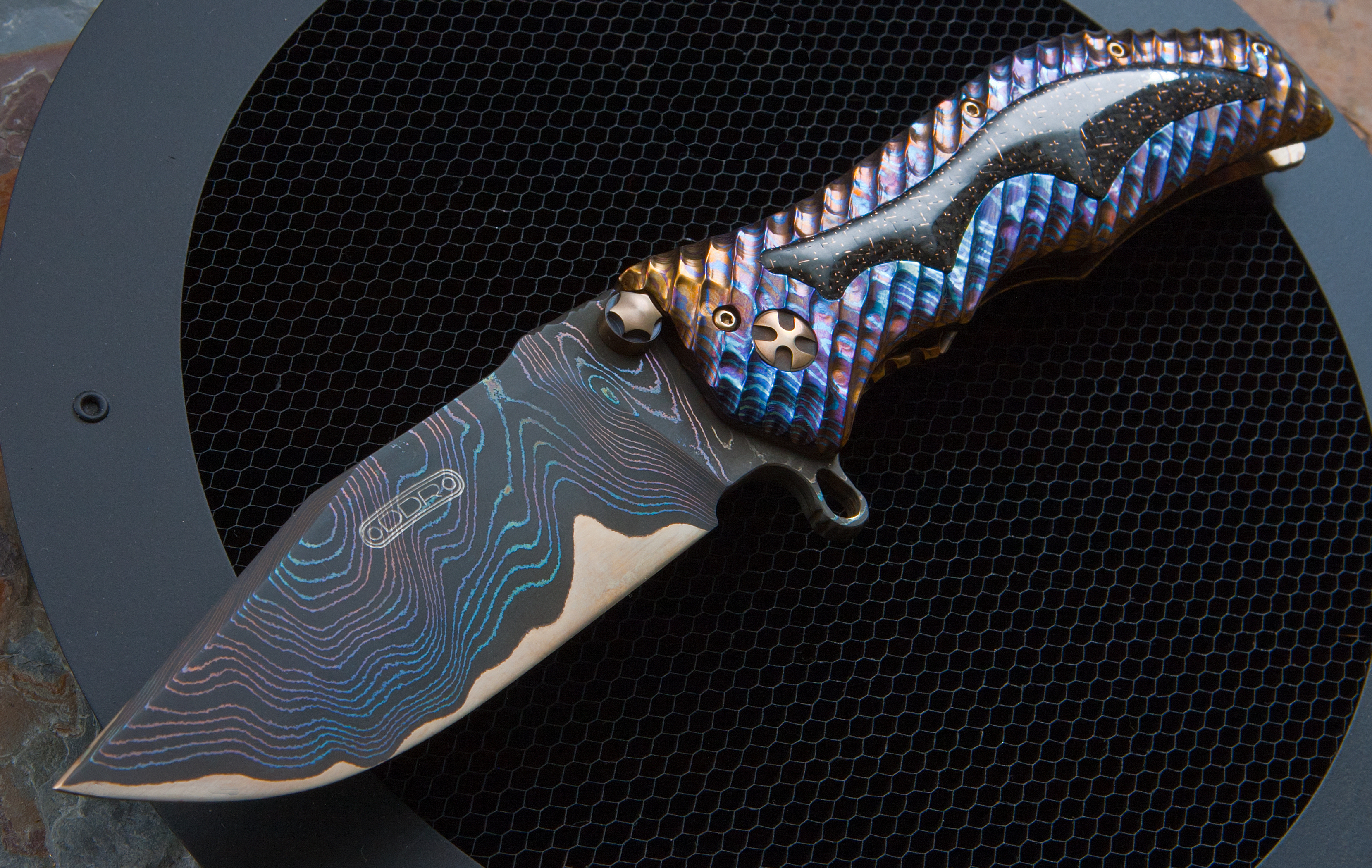
Darrel Ralph outfits his assisted-opening DDR Gun Hammer 3-D Alpha in a 3.95-inch blade of stainless damascus with a Stellite 6K core by Chad Nichols. The frame is Nichols 3-D-carved Moku-Ti titanium damascus. Ralph’s list price: $3,500. (knife photo courtesy of Darrel Ralph)

Some of today’s alternative blade materials may change the way you look at knives

By Pat Covert

TO MOST KNIFE ENTHUSIASTS, THE WORD STEELis so closely associated with blades it would be hard to describe a knife without it. After all, since its earliest known production about 4,000 years ago, in one form or another steel has ruled the roost not only in cutlery but so many other things that pervade our lives.

Simply put, steel is everywhere. Unfortunately, most versions of it rust.

Progressive thinking in the knife arena has led to a boom in the technological aspects of blades, which includes those of materials that do not rust or rust very little in comparison to stainless steel. (Stainless steel resists corrosion but is not impervious to it.) In the process, cobalt-based alloys such as Stellite®, Talonite and Cobalt Dendritic have received attention. Other materials such as laminates using titanium and carbon fiber, as well as ceramics, also have been used to good effect.

Frost on a Windowpane
Not a common metal, most of the world’s cobalt is mined in the Republic of the Congo. Today, most cobalt is used in corrosion-resistant “super alloys,” which are particularly suited for gas turbine and jet aircraft engines.

David Boye has been making knives for over 40 years. He offers fixed blades and folders for use around saltwater and other rust-inducing environments. He has used dendritic material exclusively since 1980 because he says he prefers its strength, cutting performance, ease of sharpening, and ability to cast roughly to shape.

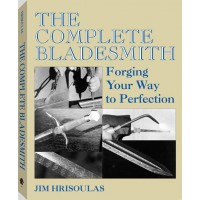
(Editor’s Note: For a better understanding of forging various metals into blades, check out The Complete Bladesmith: Forging Your Way to Perfection, pictured at left.)

“Dendritic is the kind of pattern [damask] which naturally forms when a carbon alloy cools after smeltering,” Boye explains. “It looks like frost on a windowpane.”

According to many knifemakers, the finer the blade’s grain structure, the better it cuts. Boye supports the opposite view.

“These relatively large, rooted and fully bonded carbides produce microscopic teeth along the cutting edge, and this is what actually does the cutting,” he notes. The combined attributes of extreme cutting performance, no rusting in seawater and being non-magnetic so it does not affect a compass or electronics make the material ideal for the ocean environment. “We have used dendritic cobalt for over 15 years and have received virtually zero chips, broken blades or complaints,” Boye says, “and many customers have raved to me about the blade performance.”

He states that the material’s downside is each knife design requires a set of porcelain molds which are challenging and/or expensive to make, the mold created for each individual blade has to be discarded after only one use, the casting alloy is costly, and the waiting time for blades from the foundry can be lengthy.

Damascus Hybrid

Chad Nichols is a large supplier of damascus to the cutlery industry and has pioneered a new blend of patterned steel using cobalt 6K, commonly known as Stellite, and stainless steel—particularly AEB-L and 304. “The interesting thing about the 6K cored steel is that the cobalt alloy itself does not have to be heat treated to retain edge-hold abilities,” he observes. “The only reason the material needs to be heat treated is for corrosion resistance [for the stainless steels in the damascus] and for etching purposes.”

Nichols outlined several attributes of the hybrid damascus, “The addition of the cobalt-based alloy increases its durability and oxidation resistance,” he states. “The cutting performance of the 6K damascus is great. It’s a workhorse of a steel for cutting and can retain a razor edge even under the most vigorous conditions.” As for the disadvantages of the material, there are two. “The blade material is expensive. You already have a relatively high cost for the damascus and then you add the 6K which, pound for pound, costs more than the handmade damascus,” Nichols says, adding, “It’s not a lot of fun to make, either!”

“Won’t Crack Under Flex”

The book on modern laminate blades using metal bonded to synthetics was co-authored by knifemaker Warren Thomas (also, see page 114, August 2011 BLADE®). He indicates he began making laminate blades in 1991 using stainless steel and carbon fiber. Shortly thereafter he substituted titanium for steel, creating a lightweight, zero-magnetic knife. Thomas says he uses a “trade-secret” chemical bond that positively adheres the two materials.

“My laminates have half the weight of a steel blade, absolute zero corrosion, won’t crack under flex, and don’t micro-fracture under heavy stress along the cutting edge like steel blades do,” he explains. “To improve the performance of the blade, I weld tungsten carbide along the cutting surface to enhance the edge retention. This gives it a toothy edge that improves the cutting performance.

“There is no chance of corrosion using carbon fiber and titanium. Both materials are impervious to common destructive forces like sea salts, body sweat, and other elements that wreak havoc on steel,” he notes. “Steel knives have a very hard time cutting some synthetics, such as Kevlar™. My knives actually cut these materials quite well due to their ability to saw through them.”

Laminated blades do have their disadvantages. “In very rare circumstances, the blade can delaminate. I’ve had this happen approximately a dozen times in 20 years and have always corrected the problem for the customer,” he says. “Due to the direct cost of the state-of-the-art materials involved and the time spent fabricating the laminates, there is a higher cost for my blade over steel. However, you get what you pay for.”

That’s Edge Retention!
Ceramic blades are made by taking zirconium oxide—also known as zirconia—powder, compacting it under intense pressure, and heating it in blanks at high temperatures in the 1,400° Celsius range. The blades are much more common among kitchen knives, and for good reason. For straightforward slicing and dicing they are extremely effective, but for lateral blade movement with torque, such as for prying, they tend to snap or shatter.

Boker Knives has never shied away from thinking outside the box, and its ceramic knife line not only includes kitchen knives but tactical and everyday carries as well. “If used as intended, ceramic blades will outperform steel,” Boker USA CEO Dan Weidner says. “In an independent lab test performed comparing ceramic to steel, technicians measured the amount of pressure required to cut through a standard piece of cardboard. After 1200 cuts the pressure required to cut using the ceramic blade was the same as the first cut, while the identical task using a steel blade showed decline after 400 cuts.” Now that’sedge retention!

Ceramic blades also have other benefits over stainless steel, including corrosion resistance. “This is one of the prime advantages of ceramic,” Weidner opines. “It cannot rust, which is why it’s used so often in maritime and military saltwater environments.”

There is also good news on the economic front. “Initially the cost of ceramics was on the high side, but now there are sufficient manufacturers producing the material to put the price point in the same range as good, quality steel,” Weidner says. Moreover, ceramic blades are non-magnetic.

Is One For You?

The strange brews in blade technology are not for everyone, but they offer a wide range of features, including either no rust or a huge reduction of same, zero magnetism, weight reduction and enhanced edge holding. Granted, there are downsides in some instances, though apparently not enough to discourage enough buyers of the blade brews outlined herein.

Is there an alternative blade in your future?

For more on alternative blade materials such as Spyderco’s H1, Strider Knives’ Nitinol, and Bohler-Uddeholm’s Vanax 35 and 75, see page 68 of the April 2011 BLADE®.


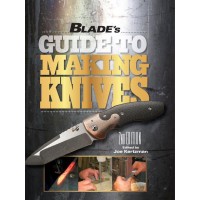
Also be sure to check out BLADE’s Guide to Making Knives.


For more on the latest knives, knife legislation, knifemaking instruction, knife trends, knifemakers, what knives to buy and where and much more, subscribe to BLADE Magazine, the World’s No. 1 Knife Publication. Subscribe to BLADE magazine.


World’s Top Makers Converge at ECCKS Friday Through Sunday

Brian Tighe, maker of the “Twist Tighe” in all Damasteel damascus steel, is slated to be among the world’s top custom makers exhibiting their knives at the 23rd Annual East Coast Custom Knife Show Friday through Sunday, March 2-4.


Produced by Steve D’lack of Hawthorn Galleries, the show will be held at the Westin Hotel-Jersey City Newport in Jersey City, New Jersey.


Among the makers scheduled to exhibit are Van Barnett, Tim Britton, Thad Buchanan, Joel Chamblin, Pat Crawford, Dellana, Bob Dozier, Allen Elishewitz, Antonio and Tore Fogarizzu, Larry Fuegen, Rick Hinderer, Des Horn, Steve Johnson, Joe Kious, D.F. Kressler, Blade Magazine Cutlery Hall-Of-Fame© member Ron Lake, Kirby Lambert, Wolfgang Loerchner, R.J. Martin, Warren Osborne, T.R. Overeynder, Darrel Ralph, Pierre Reverdy, Bill Ruple, John W. Smith, Jurgen Steinau, Strider Knives, Bob Terzuola, Cutlery Hall-Of-Famer Michael Walker, John Young and many more, including top engravers, suppliers and purveyors.


For more information click on http://www.ecckshow.com/.


For more on the latest knives, knife legislation, knifemaking instruction, knife trends, knifemakers, what knives to buy and where and much more, subscribe to BLADE Magazine, the World’s No. 1 Knife Publication. For subscription information click on http://www.shopblade.com/product/blade-magazine-one-year-subscripti…?r+ssfb030112#BL1SU

M16 & the K.I.S.S.: 2 Knives For The Ages

The K.I.S.S. and the Delilah's P.E.C.K.
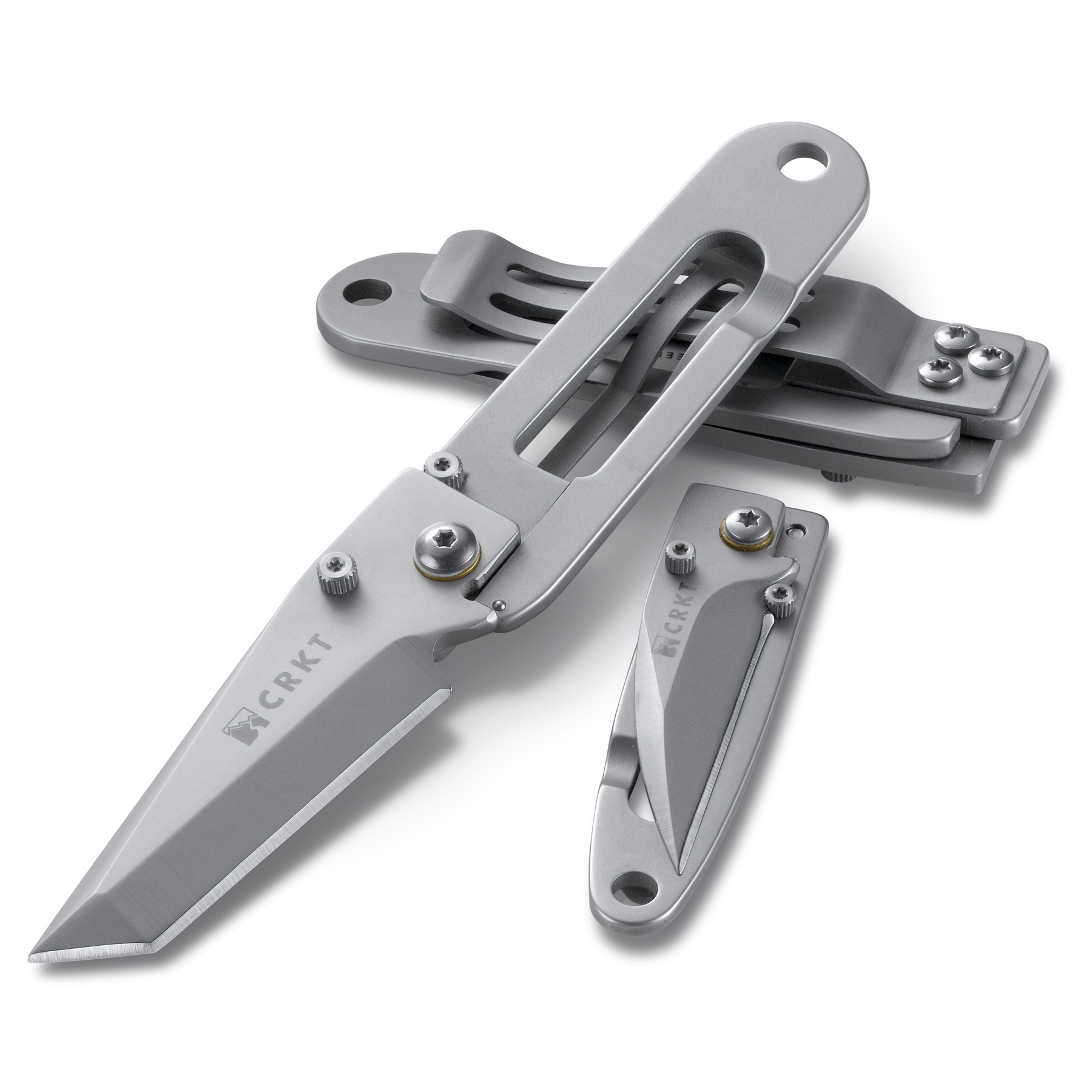
Ed Halligan’s K.I.S.S. design (left) revolutionized factory folding knives. At right is his Delilah’s P.E.C.K. design. Both knives are reproduced by CRKT. (CRKT image)

An unusually high number of knifemakers have died recently, all of whom left more than their fair share of lifelong marks on family, friends and the knife industry. In terms of influence on knife design, though, the two that probably had the largest impact were Ed Halligan and Kit Carson.

Ironically, both men designed wildly popular folding knives for CRKT, and it is those folders that have been so influential on the knife industry.

A member of the BLADE Magazine Cutlery Hall Of Fame©, Carson passed away Sept. 5. Halligan passed away Nov. 8. Though both made many great knives, each will be remembered most for their industry standards: Carson for the M16 and Halligan for the K.I.S.S.

The K.I.S.S. is a simple yet ingenious folding knife. In the closed position, its two-piece frame-lock construction and safe, user-friendly design “seals” the cutting edge of the chisel-ground blade against the handle. As Halligan once explained, “With the K.I.S.S., the frame and the lock are all one piece … I made the original knife with the blade chisel ground on one side only so it would slide against the frame when folded and make a seal so you wouldn’t cut yourself.”

Kit Carson's knife for the ages.
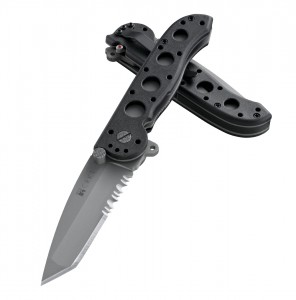
Kit Carson’s M16 design remains one for the ages. This is the M16-12Z CRKT repro. The flipper is the extension with the hole in it seen here acting as a guard just below the handle pivot. (CRKT image)

In fact, when it first came out, I recall talking to one long-time industry observer who thought the K.I.S.S. was a lawsuit waiting to happen because he thought consumers would cut themselves on the blade edge despite the blade’s seal against the handle in the closed position. However, Halligan’s version of the design works so well that such accidental cuts never happen. One of the main reasons the design is safe is that Halligan tested it in real-life conditions to be sure that such accidents never occur. “Safety is a big reason why I carried the knife around so much to make sure it worked properly,” Halligan said.

In 1997, Halligan signed a deal with CRKT for the company to reproduce the K.I.S.S., and CRKT launched the repro of the knife at the 1998 SHOT Show. Only four years old at the time, CRKT was struggling to find a knife that would help “drag the rest of the product lines along,” as CRKT’s Rod Bremer put it. The K.I.S.S. was that knife. Unfortunately, a number of unscrupulous companies blatantly knocked the K.I.S.S. off so much that it eventually became one of the most copied sporting knives worldwide. CRKT and Halligan weathered that storm, though, and Ed designed a series of K.I.S.S. iterations and spinoffs for CRKT that included the Delilah’s P.E.C.K. (for Precision Engineered Compact Knife), Samson’s K.I.S.S., the H.U.G. (Halligan’s Ultimate Gadget), the Slip K.I.S.S., the Neck P.E.C.K., the blackened K.I.S.S. In The Dark, even a fixed-blade version called the Stiff K.I.S.S. and others.

Just as they were linked in their passing, Halligan and Carson were also linked in their CRKT collaboration deals. CRKT must have been living right back in those days because it was just a year after signing the deal with Halligan to reproduce the K.I.S.S. that it signed the deal with Carson to reproduce Carson’s M16 folder. Even though Carson did not invent the flipper, his M16 is universally credited as the model that popularized flipper folders—folding knives with one-hand-opening “flippers” that double as guards when the blade is opened. “The M16 with the Carson Flipper was a huge improvement on non-assisted blade opening, making a manual knife open almost as fast as an auto without a secondary thumb stud or hole mechanism,” observed long-time knife writer Mac Overton. “Because it had less moving parts and its opening relied on inertia rather than a spring or torsion bar, the mechanism was inherently stable and reliable.”

The M16 and its military look—Carson was a U.S. Army career man—soon became not only immensely popular with consumers but with service personnel as well. In fact, by many accounts, the M16 was the most popular knife among active duty service personnel in the wars in both Iraq and Afghanistan.

Meanwhile, as with the Halligan/CRKT K.I.S.S., Carson’s M16 begat a number of CRKT iterations and spinoffs, including the M16-10KZ, M16-13Z, M16-12Z, M16-14ZSF, M16-13ZM, M16-14SFG, M21-14SFG, M21-02G, M16-13FSG and others. And, most fittingly, the K.I.S.S. and M16 were ranked third and fourth, respectively, in a BLADE® Magazine poll of veteran industry observers of the top factory knives from 1989-2000.


T7354Recommended for You:

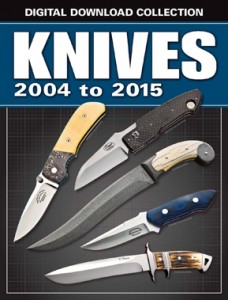
Turn back the clock with BLADE‘s digital collection of annual KNIVES books. Get every KNIVES book from 2004 to 2015 in one PDF download for just $79.99.

Click here to get the best knife books in one spot.

Hones for the Sharpening Challenged

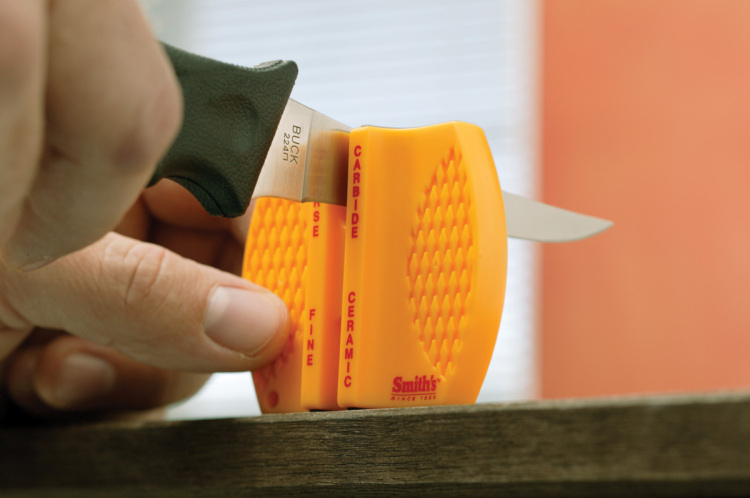
The CCKS 2-Step Knife Sharpener from Smith’s offers coarse tungsten carbide rods on top and extra-fine (1,000 grit) ceramic rods on bottom—both at pre-set angles for easy pull-through use—for sharpening and edge touch-ups/refinement, respectively. MSRP: $3.99. (Smith’s photo)

If sharpening stumps you, try one or more of these simple yet effective sharpeners

By Dave Rhea

A good working edge on a blade is one of the knife owner’s most important considerations, but sharpening is not always as easy as it seems. How do you hold the knife to the sharpener/which angle should you use? Do you use ceramic, stone or diamonds? How much sharpening is too much? How much is too little?

    Here is a better question: Since even thinking about sharpening can get complicated, why not idiot proof the subject?

Quick and Easy

Chris Fire is a sharpening expert. As the marketing manager for Lansky Sharpeners, Fire lives and breathes by the sharpening industry. His suggestion for the quickest and easiest sharpener is Lansky’s Quick Fix Pocket Sharpener.

    The Quick Fix has all the elements of an easy sharpener: Low price (MSRP: $5.99), small—about the size of a money clip—and fast results. A half-dozen or less strokes through one of the two slots clears up a problem blade edge in a hurry. One side holds a slight segment of tungsten carbide rod to return the edge to a proper geometry, and the other side holds a like-sized span of ceramic rod to deburr it.

    Fire drew a distinction between the quick-and-easy and something less expedient but perhaps wiser.

    “Tungsten-carbide sharpeners sharpen by tearing steel off the blade rather than slowly honing,” he warned. “They remove a lot of metal. Use them in a pinch, but for everyday edge maintenance you probably want to use something less aggressive like Lansky’s Turn Box Ceramic Sharpener.”

    The 4 Rod Ceramic Turn Box (MSRP: $21.99) offers a higher-grade sharpening experience but is also uncomplicated. It uses two pair of 5-inch alumina ceramic rods that are set at pre-determined angles: 20 and 25 degrees. Holding the knife upright vertically, you draw the blade down along the rods of the V-shaped sharpener. With internal rod storage, it also breaks down into a compact kit for stowing in a drawer or tool/tackle box.

    Fire added that perhaps as important as having a good sharpener is the knowledge that different tasks call for different knives. In other words, a chopping knife is not going to make a great slicing knife no matter what kind of edge it has.

    “Chopping knives have a more durable edge, but they’re not as sharp,” he professed. “Chopping potatoes with such knives is great. Achieving paper-thin tomatoes slices? Not so much. So keep a knife for slicing, a knife for chopping, a multi-purpose knife and maybe a fillet knife, and use each to its strengths.”

Hassle Free

Marketing manager for Smith’s, Russ Cowen adds that a seemingly insurmountable task is convincing the consumer on-going edge maintenance is the key to keeping a perpetually useful edged tool.

    “The best way to keep a knife sharp is to never let it get dull,” he explained. “If the consumer would just take a few minutes either before or after using a knife, and especially during use if doing lots of cuts for a longer time period, to touch up or freshen the cutting edge, he or she would see that not only would the knife cut better, but it would also take them half the time to accomplish the task.”

    For such hassle-free edge maintenance, he recommends Smith’s 2-Step Knife Sharpener, a small plastic-framed sharpener with an insanely low MSRP of $3.99. The two sharpening slots—in carbide and ceramic—offer two stages of edge work: 1) coarse “for re-setting the edge on very dull or damaged blades,” and 2) fine for finishing work that will bring a blade closer to the hair-popping sharpness so many knife users crave.

    “The 2-Step Knife Sharpener will sharpen any blade style with a flat grind on both sides of the blade as long as the blade will fit inside the sharpening slots. It works well on Euro/American style kitchen knives, everyday pocketknives, folding or fixed-blade hunting knives, fillet knives, outdoor sport knives, custom knives, and tactical/LE knives with little to no maintenance,” he said. “At most, the user may have to rinse it off or clean the ceramic rods after extended use.”

    For knives that suffer from the usual treatment—letting them go pretty much dull—Cowen offers this advice: “The best way to put a new, sharp cutting edge on a very dull or damaged knife blade is to use an abrasive surface that is aggressive enough to remove large amounts of metal from the blade quickly.”

    He suggests a sharpener with carbide blades or a low-grit diamond-coated surface. Such abrasive components are quite aggressive and remove metal from the blade very quickly—sometimes so fast you can see the metal shavings falling off the blade, he added.

Simplest Is Best

Pre-set angles and guides are all designed to make the obligatory task of sharpening a knife easier. However, according to Mark Brandon, president of Diamond Machining Technology (DMT), it does not get any simpler than the old-fashioned bench stone.

    “There’s a myth out there that sharpening is difficult,” Brandon began. “I don’t think the sharpening industry has done itself any favors—we’ve done our part to help convince people that it’s difficult by coming out with all these ‘we’ll-hold-your-edge-for-you’ kind of products.”

    He said the reality is that via its training videos available at www.dmtsharp.com, DMT has taught scores of folks to sharpen on a stone in less than five minutes.

    “We think it’s kind of idiot proof to begin with,” he stated. “Sometimes the simplest approach can be the best, and there is really nothing simpler than a 6-inch-by-2-inch stone.”

    Brandon’s two bench-stone suggestions start with the DMT Diamond Whetstone, which comes in 6- and 8-inch models. They have MSRPs of between $47.16 and $95.26, depending on the length and choice of either plastic or hardwood case. A diamond abrasive is the best and simplest material to put a great edge on a blade, he said.

    His other suggestion is the DuoSharp 8-inch model, another diamond stone that is double sided in fine and extra-fine grits to address both sharpening and refining the edge. The 8-inch DuoSharp has an MSRP of $105.03 for the stone alone and $114.58 with the stabilizing base accessory.

    “It’s all a matter of how much time are you willing to spend on it,” Brandon said. “If you have a fine stone, depending on how much time you want to take, you can get a dull knife sharp. But if you don’t have that much time, you may want to have a coarse stone available to get it to a certain level and a fine stone to get a good working edge, and if you really want to make it hair-popping sharp, go to an extra fine.”

Rule Of Thumb

No matter your preference, there are plenty of choices available. The key is to find your comfort zone and touch up the edge at least once for every three or four times you use a knife. The basic rule of thumb is do not let your knife go dull and it will be easier to keep a crisp, high-performing edge.

For more on the latest knives, knife legislation, knifemaking instruction, knife trends, knifemakers, what knives to buy and where and much more, subscribe to BLADE Magazine, the World’s No. 1 Knife Publication.

Advertisement

Must Read Articles

Read this before you make a knife

Knifemaking 101 – Read This Before You Make a Knife

  by Wayne Goddard My experience has taught me that there's nothing like digging in and getting started. I've often said the hardest part of the...
how to forge damascus steel

How to Forge Damascus

Advertisement
Advertisement