Buyer's Guides

You’re looking for a new knife in a certain style – we’ve got recommendations on the best blades for every price point.

Oknife Beagle Review: Does This Folder Pass Muster?

High-Quality Folder Or Cheap Piece Of Metal? The Beagle From Oknife Gets Put Through Its Paces To Figure It Out.

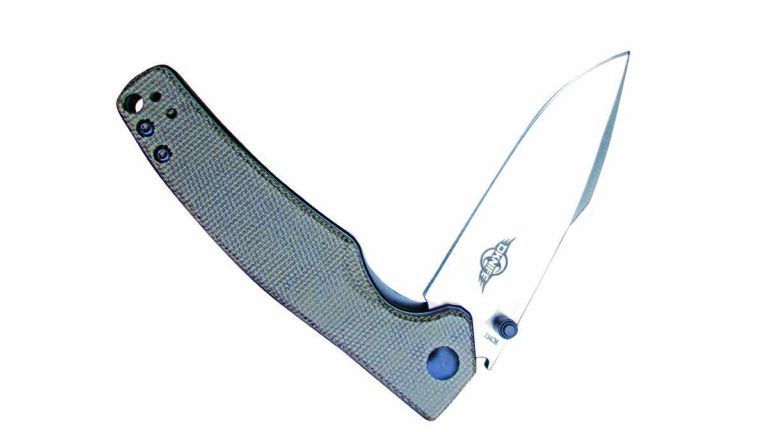
The Beagle linerlock folder from Oknife feels good in the hand and rides quite well in a pants pocket. Action is very smooth with a positive lockup. When you close the knife, the detent ball grabs the harpoon-pattern blade securely. Balance is excellent. As for cutting performance, let’s see.

Edge Test

OKNIFE BEAGLE cutting bone
The Beagle whacked 22 times into the bone before breaking it. Afterward, the author detected a very small nick in the edge. Not bad at all!

First up: a check of the factory edge with a slice of 20-pound bond copy paper. Via a pull cut, the Beagle sliced very clean with no snagging. Cuts were controllable and smooth. 

Double-walled cardboard provided the next test medium. The blade cut neat and fluidly with a minimum of grab by the cardboard. The Beagle worked better using a push rather than a pull cut. I felt no snagging in the process. Control was a tad wobbly as more pressure was needed to part the thick cardboard.

Heavy-Duty Cutting With The Oknife Beagle

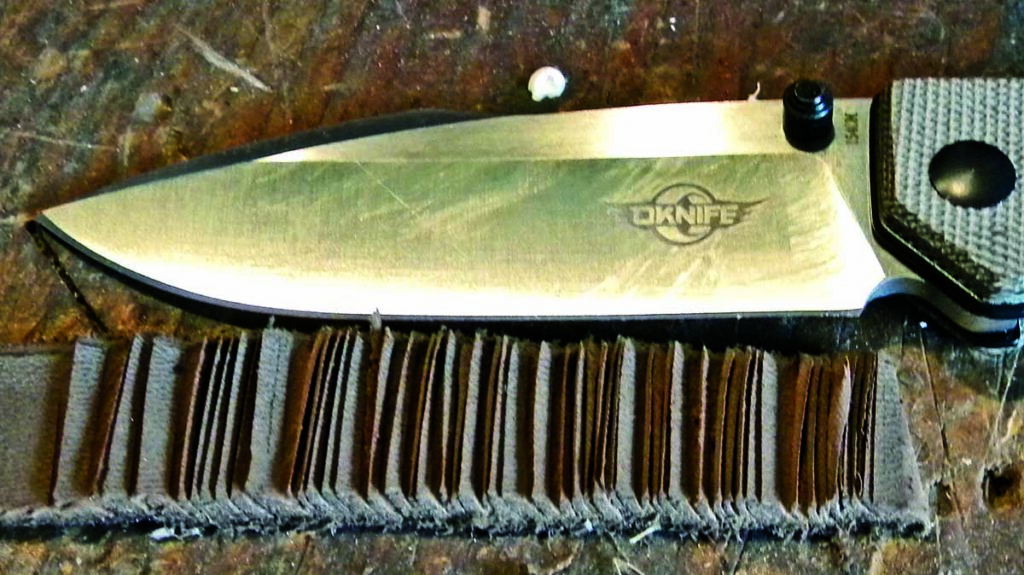
OKNIFE BEAGLE skiving leather
The folder made very fine slices and emitted a nice crunching sound during the skiving. The author used the blade belly mostly to keep the leather together instead of in a pile of pieces.

Plastic board was next. The Beagle cut effortlessly with hardly any wobble. The folder was controllable during the test with only a few zigs in the plastic board. I exerted medium pressure with a push cut.

I used quick, short push cuts in a strip of 8-ounce leather. The Beagle made extremely fine slices and emitted a nice crunching sound. It was very manageable during the skiving. I skived with the belly of the blade mostly to keep the leather together instead of in a pile of pieces.

Beagle Takes On Wood And Sisal Rope

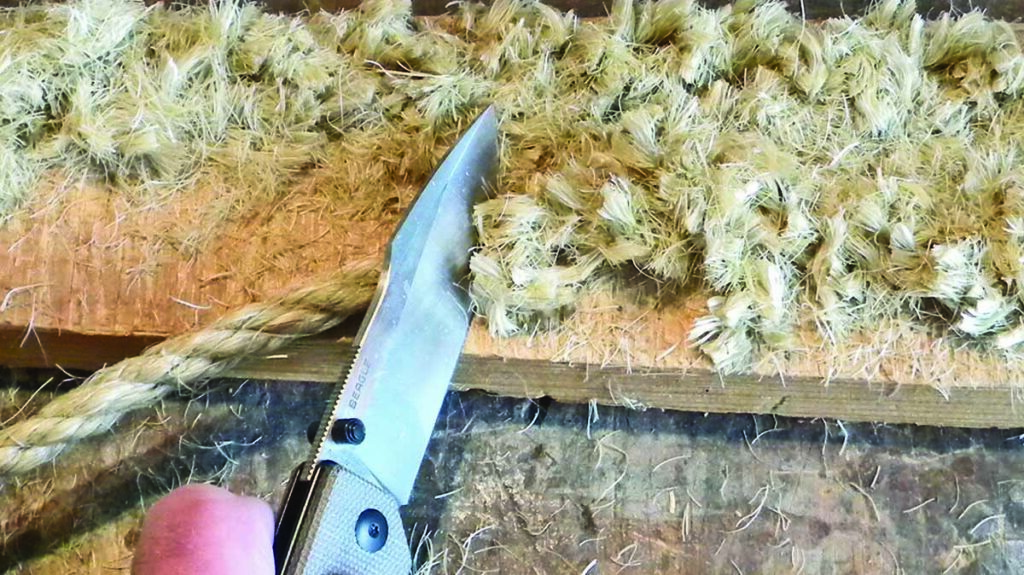
OKNIFE BEAGLE  cutting rope
Working on 3/8-inch sisal rope for the final medium, the edge made it to 98 clean crunching cuts. The author suffered no hotspots or pinches of his hand during all 98 cuts.

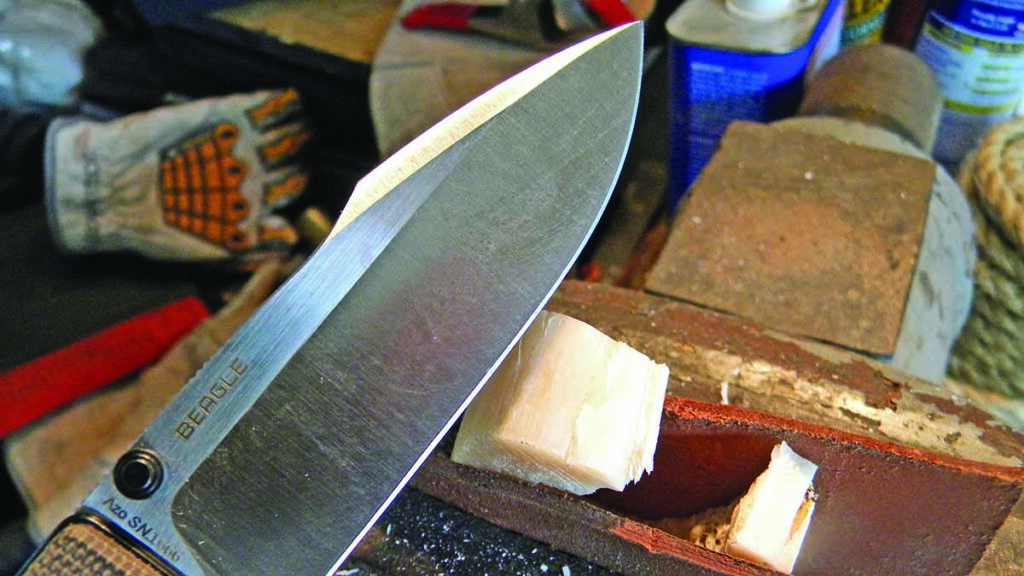
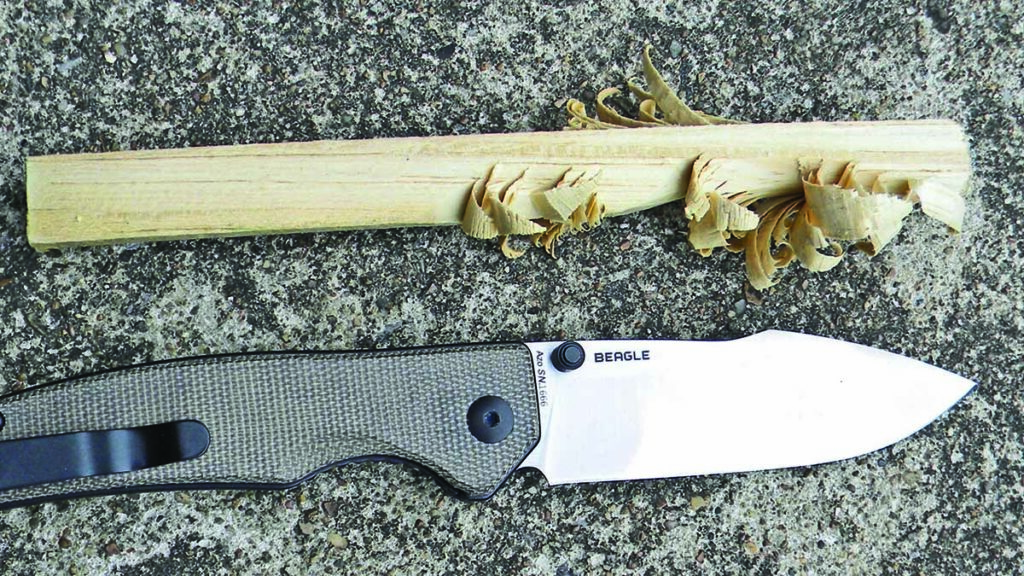
Grabbing some pine leftover from my fencing, I commenced to whittle. The 154CM stainless steel blade made some very nice curly-cues. It was controllable for the thin curly-cues and for the deeper bites, too. 

The handle felt good in my hand with no pinch spots during the heavier cuts. The Beagle finished four fire sticks with no issues. Whittling with it was a pleasure.

Next, the edge made it to 98 clean crunching cuts in 3/8-inch sisal rope. After that, the edge slowed down and crunching was not achieved throughout the full cut. My hand suffered no hotspots or pinches during all 98 cuts. The Beagle exhibits outstanding handle contouring.

Oknife Beagle Vs Bone

OKNIFE BEAGLE wood curly-qs
The 154CM stainless steel blade was manageable for the thin curly-cues and the deeper bites, too

For a possible destructive test, I clamped a piece of cow bone in the vise and slammed the edge into it repeatedly. The Beagle whacked 22 times into the bone before breaking it. I detected a very small nick by running a fingernail along the edge. Not bad at all!

Recommendations

I know that for production purposes the liners extend past the handle material. I prefer them to be flush. (Editor’s note: The action is very smooth and fast upon closing—so fast, in fact, take care when closing the blade one-handed that the edge does not nick the skin just below your thumbnail.)

Final Assessment Of The Oknife Beagle

The Beagle is a nice mid-size linerlock with a great handle and excellent edge retention. I would put this one in my pocket for daily carry anytime.

Oknife Beagle Knife Specs

BLADE LENGTH: 3.25 inches
BLADE STEEL: 154CM stainless
BLADE PATTERN: Harpoon
HANDLE: G-10
LOCK: Linerlock
LINERS: Stainless steel
WEIGHT: 3.25 ounces
CLOSED LENGTH: 4 ⅜ inches
EXTRAS: Includes a pouch w/fabric closure that contains a collector coin in a small pocket
MSRP: $79.95

More Knife Reviews

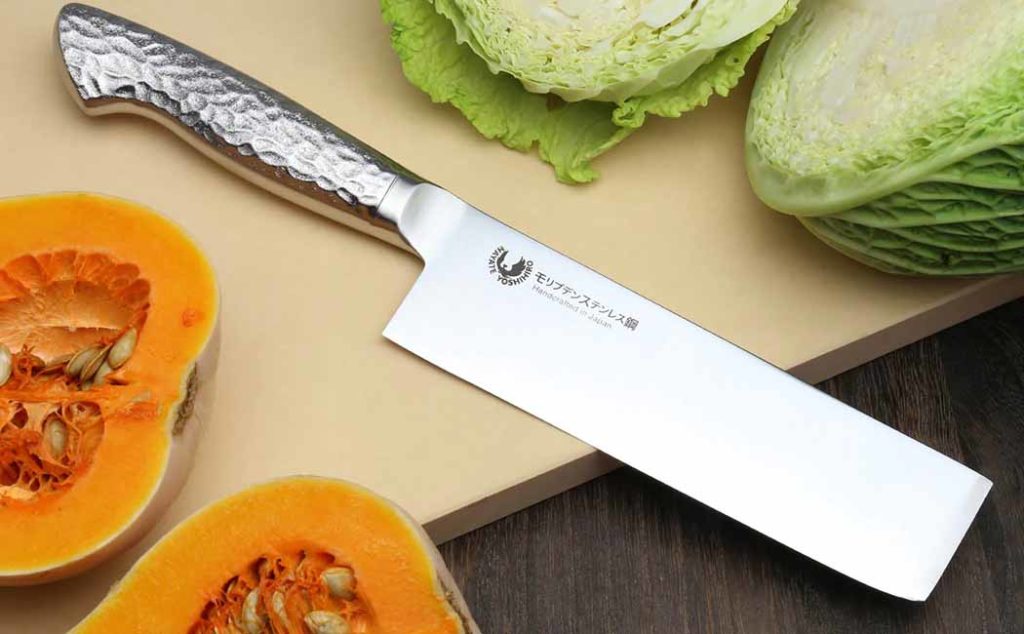
Best Nakiri Knife: What To Know About This Japanese Kitchen Classic

Have vegetables that need knocked down to size? Get chopping with the Nakiri.

The Japanese people have historically produced excellent knives specialized for dedicated tasks. The culture of the region did not put a heavy emphasis on speed and slop, but rather precision and the utmost perfection of a given craft. Following this ethos came a specialized knife dedicated to culinary artistry.

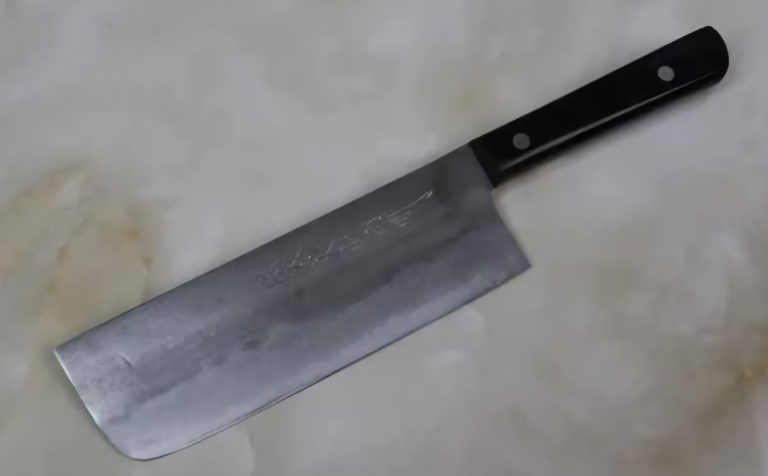
The Nakiri (also Nakiri Bōchō) was developed specially for cutting vegetable and not much of anything else. The blades on these knives are thin, sharp and, surprisingly, not as ancient as we understand many Japanese blades.

In this article, we’ll explore the history of this dedicated tool, its modern uses and look as some of the best nakiri available. So, chop, chop… let’s get cooking.

History Of The Nakiri

Many blade styles we associate with Feudal Japan came into use after Western contact was established. The Nakiri was one such product and it came at a time of significant modernization in the country.

Traditional feudal culture in Japan would come to an end over the course of the 1800s, culminating in a tremendous shift from a medieval society to a completely industrialized nation. These culinary tools became a feature of Japanese blade makers, and eventually, they arrived at a point of heavy specialization.

The Nakiri is a vegetable knife, plain and simple, in fact, the name translates to ‘knife for cutting greens’. It was made over time to excel at this one task. As a result, it isn’t ideal for much else.

Despite its round, tipless shape it is not a cleaver. The blades on these knives are very thin, sometimes to the point of being fragile. They should not be used against bone or even used on meat for the most part. The entire concept is that the Nakiri makes clean cuts in veggies, as opposed to the more coarse, crushing cuts found on chef knives.

Nakiri Vs Western Chef’s Knife

Looking at the Nakiri next to common Western chef knives isn’t exactly a fair comparison. The chef knife is meant as a multipurpose blade that cuts virtually anything in a kitchen without missing a beat.

Most Western chef knives are derived from our own historical camp knives, seax blades, and Central European ‘messer’ knives. These are structurally far more robust and usually taper down to a fine tip with a thicker spine at the handle. Not so with the Nakiri.

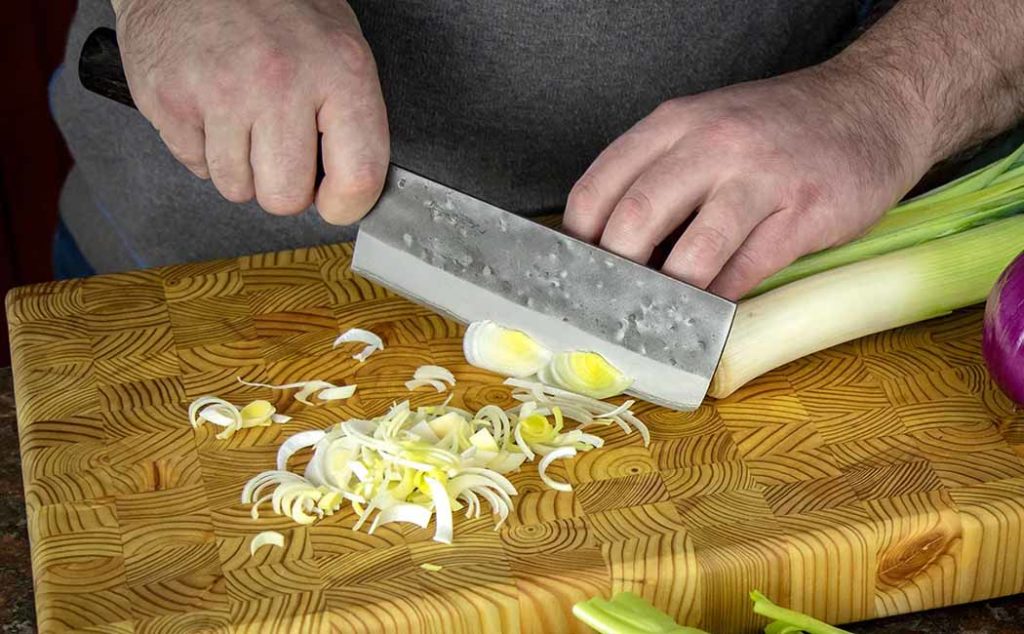
Its shape is slim and has a straight edge, meaning in one motion it can be made flat against the cutting board. The height of the blade from the spine to the edge is also greater, enabling the hand to come to rest above the cutting surface. Contrast this to the Western chef knife, which works in a back-and-forth rocking motion. The Western chef knife is in theory not as efficient for motion, but how much this matters is subjective to the user.

The Nakiri Edge

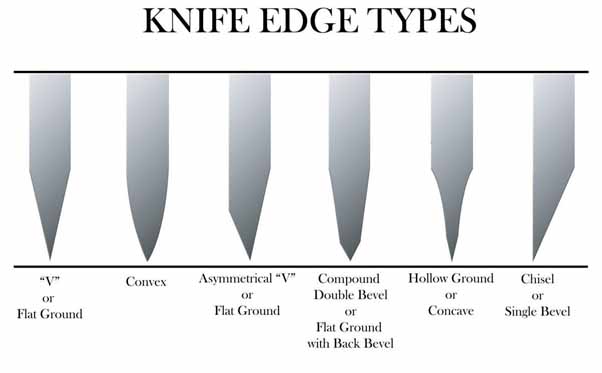
While the knife is commonly available on the commercial market with a standard, double-beveled edge, many traditional Nakiri boast a chisel-beveled. In short, as previously mentioned, one side of the blade is completely flat. Depending on if you are right- or left-handed determines which side your blade is beveled. Advanced users can take advantage of this feature for enhanced cosmetic presentation of food, such as spiral peeling, ornamental julienned strips, and more.

Advantages Of The Nakiri

Honestly, one-on-one against a standard chef knife in your own kitchen you may not notice the difference at of an Nakiri. The exception being, in the overall style of your food presentation. Furthermore, if cooking is part of your livelihood, you will like the shape, style, and ease of use of the Nakiri. It is a tool that can be used to step up the cosmetic end of delicacies

In short, if you spend time with this knife style in a professional setting, where aesthetics are equal to edibility, you might find the Nakiri an excellent companion. Home chef’s, on the other hand, might discover there cuisine doesn’t gain much with one at hand.

Disadvantages Of The Nakiri

The elephant in the room, you need more knives to accomplish a given task if you use a Nakiri for its intended role. This doesn’t jib with many pro or amateur chefs in the west.

Most Western cooks appreciate the flexibility and ease of the Western-style chef’s knife, a dedicated vegetable chopper seems redundant. In turn, it’s a great leap to investing in a specialized tool such as a Nakiri.

Best Nakiri Options At Every Price Point

Toshu Hammer Finished

Toshu Hammer Forged

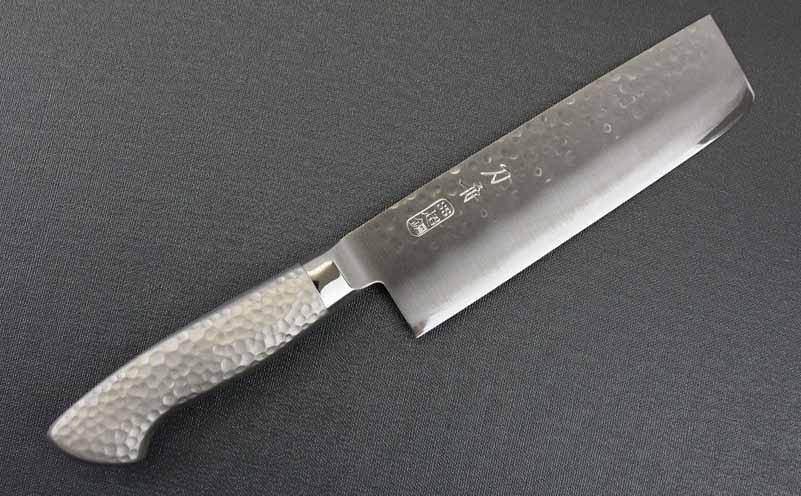
Made in Japan, the Toshu knife is made to work without compromise. The knife is not traditionally constructed, rather it is made of all stainless steel and is dishwasher safe. This is an important consideration for the home chef short on time. The knife features the beveled “Edo-Togi” grind, meaning that it isn’t double-beveled like most Western knives. It is very easy to keep clean, and sharp choice for everyday vegetable chopping vegetables duty.

MSRP: $213

Hinokuni Shirogami #1 Tall

Hinokuni Shirogami #1 Tall

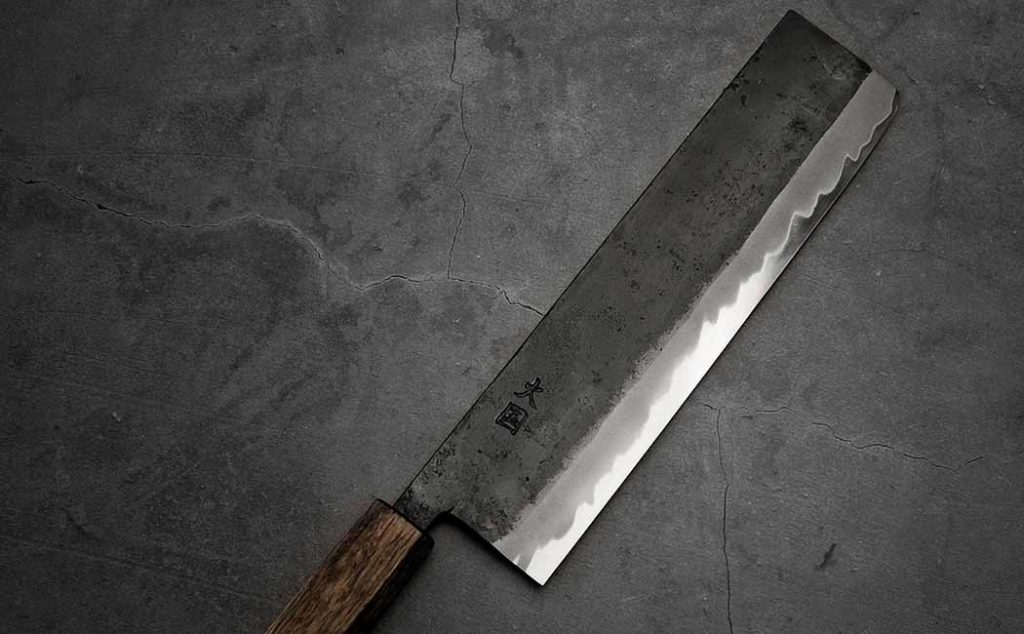
A custom Nakiri from a smaller maker, the Tall Nakiri might be the perfect large-format vegetable knife. If you are making salads, working on squash or melons, or trying to dice up a large quantity of veggies, this knife will knock them down to size. The knife is a labor of love, the maker of this brand is a young blacksmith that is well-versed in traditional methods. Interestingly, the knife is made of an uncommon (in America) type of carbon steel, Shirogami #1. This is a blade steel favored by the best Japanese smiths. However, neglected it can easily corrode. Like many traditional items, regular care is necessary to maintained it, but do so and the blade should last a lifetime.

MSRP: $180

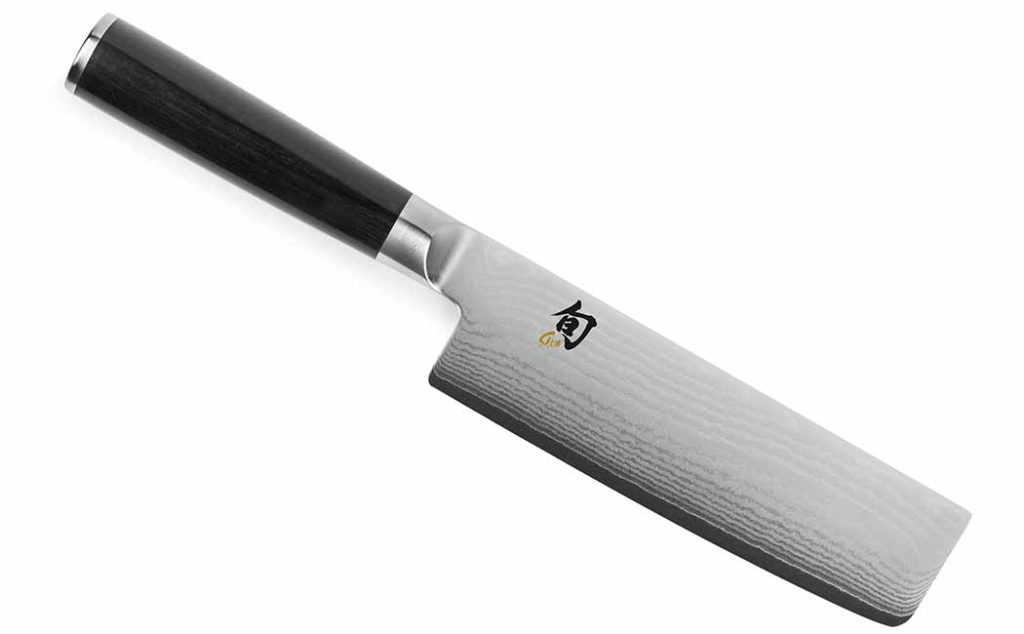
Shun Cutlery Classic

Shun Cutlery Classic

This Japanese knife is popular, well-constructed, and made in… China? No surprise, the broad Western market sees just about everything made in China these days. While not exactly up to the quality or authenticity of a true Japanese Nakiri, Shun Cutlery does a great job with this knife for the price. Chef among these assets includs using a novel layering method. The blade itself is not entirely Damascus, rather it is a stainless core sandwiched in layer of Damascus. It is a great starting point for getting into Nakiri but is priced in such a way that it may be your only one for years.

MSRP: $170

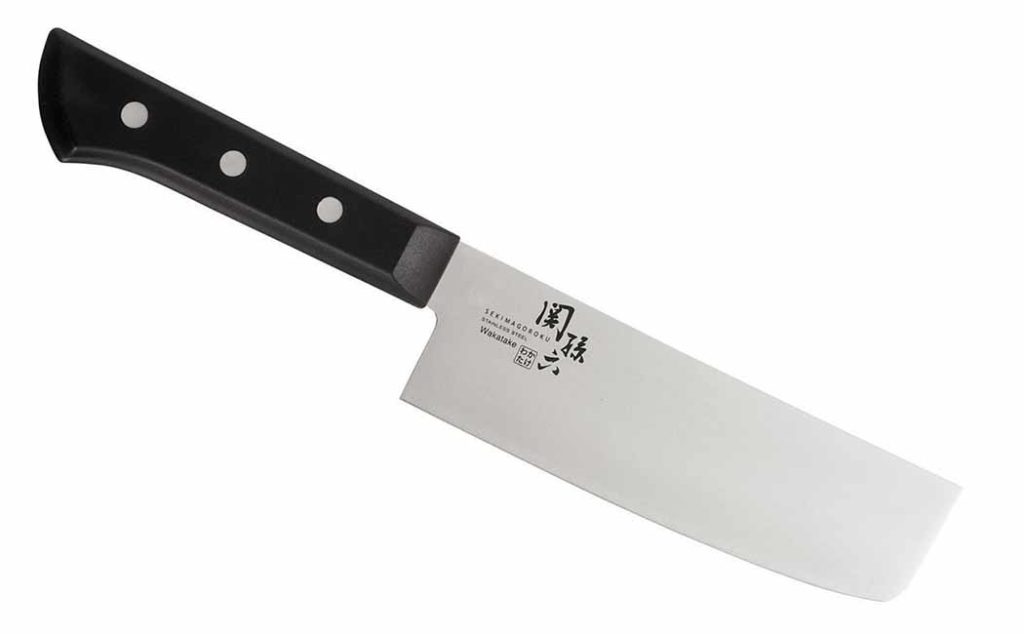
Kai Seki Magoroku Watakake

Kai Seki Magoroku Watakake

This Kai knife is a genuine Japanese-made Nakiri, fully sized in every way but price. Retailing at under $20, this is a great knife to add to your drawer if you want the function of a Nakiri but don’t do enough dedicated veggie chopping to warrant a several hundred-dollar in expense. Many people are just casual cooks and can certainly appreciate the utility a Nakiri brings, though just not enough to make a hobby of fleshing out an entire Japanese kitchen set. This knife is not of the same quality as the others on this list in terms of the overall construction but is certainly capable of most uses. Considering chopping veggies are the end use, you should do just fine, except perhaps in some of the most advanced techniques that require the features of a custom knife.

MSRP: $20

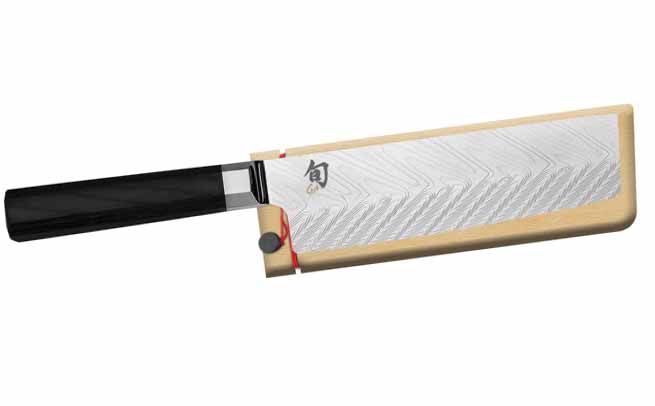
Shun Cutlery Dual Core

Shun Cutlery Dual Core

Another great product from Shun, the Dual Core Nakiri is a dull Damascus blade of 72 layers of VG10 and VG2 steels. As far as production Nakiri knives go, this is probably as good as it gets before you start to look at custom options. The knife here is priced higher, more than double that of the other Shun listing in this article. The manufacturing process results in a blade holds its edge longer and remain in service for extended periods of time, especially in a high-production restaurant setting. As a production knife, this product is great for showy use in a hibachi, but also easily replaced should it become damaged. The styling on this knife isn’t quite traditional Japanese, though patrons and guests will likely not notice that minor detail.

MSRP: $330

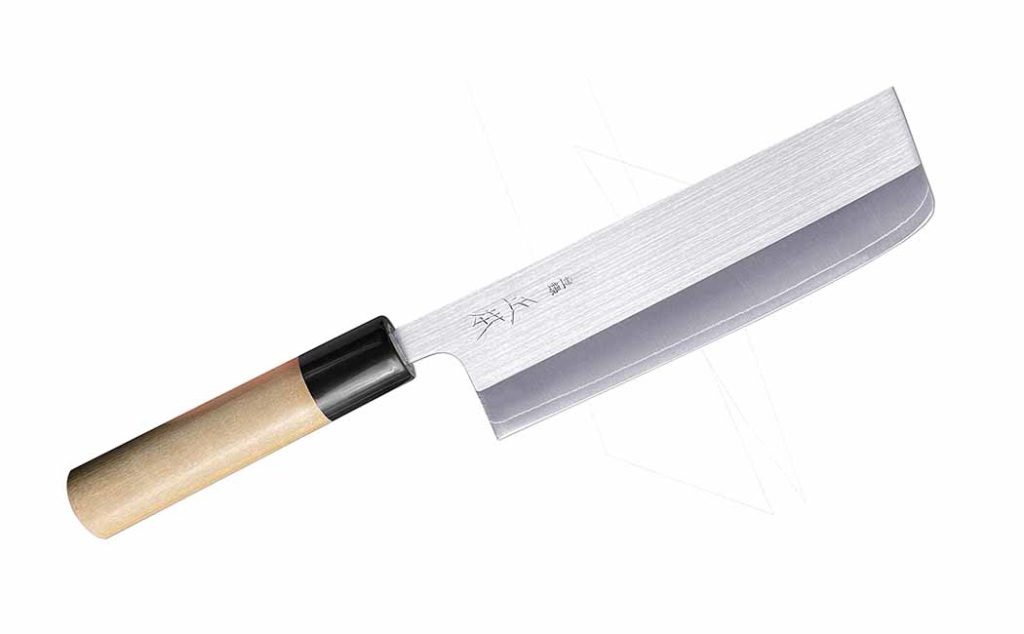
Masamoto FH Japanese

Masamoto FH Japanese

Masamoto’s product is a reasonably priced, high-performance traditional Nakiri made in Japan. This knife is just about as good as it gets from the standpoint of function and traditional appearance. Made of modern steel and reasonably corrosion-resistant, it’s a forgiving knife. But you still need to care for it after every use. The handle is made in traditional style out of buffalo horn and magnolia wood, both of which add to its already incredible appearance. It is not the most costly Nakiri here by far, though when combined with the extra maintenance needed to keep it ship-shape, isn’t for someone who will just throw it in the dishwasher.

MSRP: $229

Yoshihiro Hayate

Yoshihiro Hayate

Last on this list is certainly not the least. The Yoshihiro Hayate is a handcrafted, high-end Nakiri that is for use by the most discerning culinary aficionado. The knife is made of extremely hard and difficult-to-work with ZDP-189 steel. Not only is it beautiful, but the knife is also NSF-approved for use in commercial kitchens, making it one of the most expensive single-use products in a restaurant. However, thanks to its superior steel and impressive edge retention, the knife will ultimately save the chef effort on high-volume cutting and other laborious tasks. This Nakiri is made with excellent materials in the handle as well, including premium ebony with a sterling silver ring. Completing this knife is a lacquered cover for storage. Of note, this knife is double-beveled, making it great for use with both hands as opposed to specializing to left or right. If you decided to spend the money on something like this, you will never need to seek out a replacement. Short of a completely custom knife made to your hand and style of cutting, this is as good as it gets.

MSRP: $700

More Kitchen Knives:

Ahoy Matey: Rigging Knife Buyer’s Guide

1

Battened down the hatches, we’re going full-speed ahead talking about the sailor’s rigging knife!

Rigging knives are a particular type of cutting tool developed in conjunction with sailing ships. There is not a particularly well-documented history on the use of these knives, but by the Age of Exploration, the tool was quite common aboard virtually every vessel.

Bear bones, the rigging knife was designed to cut line. Together with the equally common marlinspike, it could be used to manage lines by cutting, splicing, and freeing knots. The simplicity of these tools has given them long life, and as a result, the knives are available in modern versions suited to our uses today.

The knife has not changed much in hundreds of years, a testament to how it was perfected before it became miniaturized and able to fit in a pocket.

Use And Evolution Of The Rigging Knife

The rigging knife is a similar case. You are almost always better served by a heavy fixed-blade knife than by a small, delicate folder. But, as time has gone on, the need for chopping through lines thicker than your arm has declined for most nautical enthusiasts. In turn, as line material changed from Manila and natural materials to nylon, large-blade rigging knives went the way of the tri mast. In its place, a smaller folding version became the norm.

The rigging knife has, like the penknife, been a multitool of sorts for generations. The earliest examples were of course dedicated to their task. As times changed, it was combined with similar tools that were also at one point their own thing. Let’s take a look at some of the tools likely found on a modern rigging knife.

Sheepsfoot Blade

A sturdy sheepsfoot blade tackles cutting and chopping tasks with easy, while protecting the user from perforating him or herself.

Long before this profile was in fashion for EDC knives, the sheepsfoot profile was used for cutting rigging. The blade shape was perfected over time and was considered the best way to cut heavy lines. The cleaver-like abilities of this profile, when combined with a thick spine, allows it to chop through thick line as well as be pounded through with a mallet if need be. The lack of a defined tip reduced the chances of injury as it couldn’t really be used to stab or otherwise harm by thrusting.

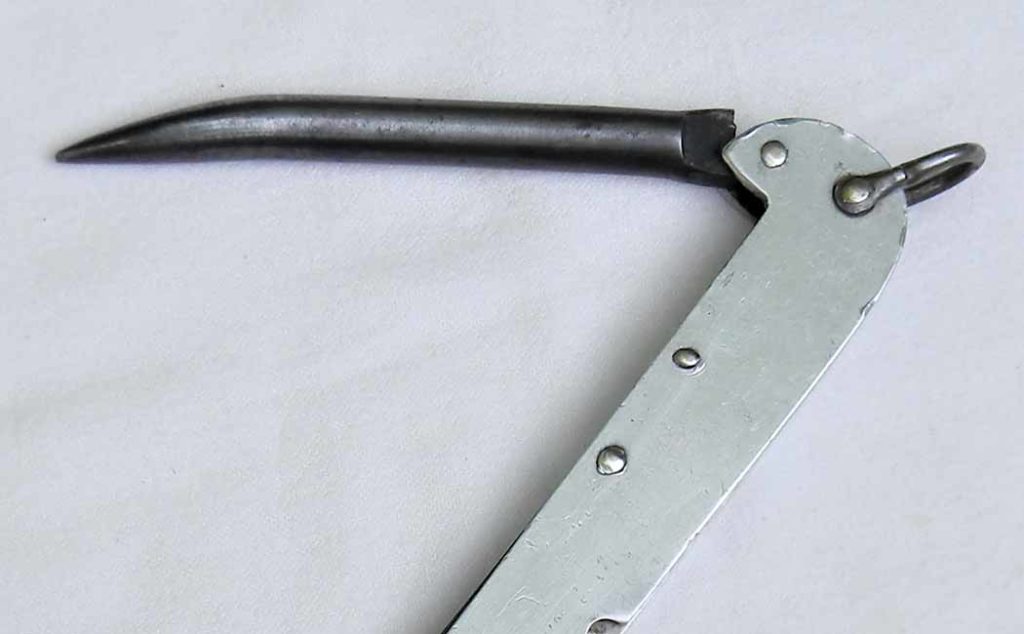
Marlinspike

Need to loosen a mooring line? The marlinspike is your tool.

The marlinspike is a linework tool and it is quite simple in terms of how it’s used. It is like a large needle of sorts, meant to work in between tightly tied ropes in order to loosen knots. That is just about all it does. This less-than-glamorous job is of the highest importance on any vessel from canoes to warships and the lack of it can cause serious issues.

Historically these tools were not small, some even exceeding 20-plus inches. Heavy rope, 5 inches or thicker, was common for mooring lines and these massive marlinspikes could move even the largest lines. Today most people use much thinner lines, usually 1-inch or so, on recreational vessels. Half-inch is common for duck boats and other flat-bottom craft. Kayaks and canoes usually work with a 1/4-inch line. Most of the work a modern marlinspike encounters is going to be on a relatively thin nylon line, making huge spikes unnecessary.

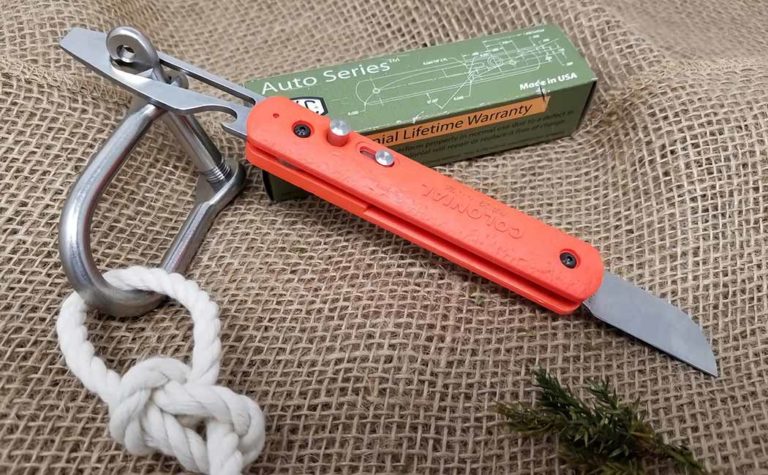
Shackle Key

The shackely key is a must to break open a problematic shackel on deck.

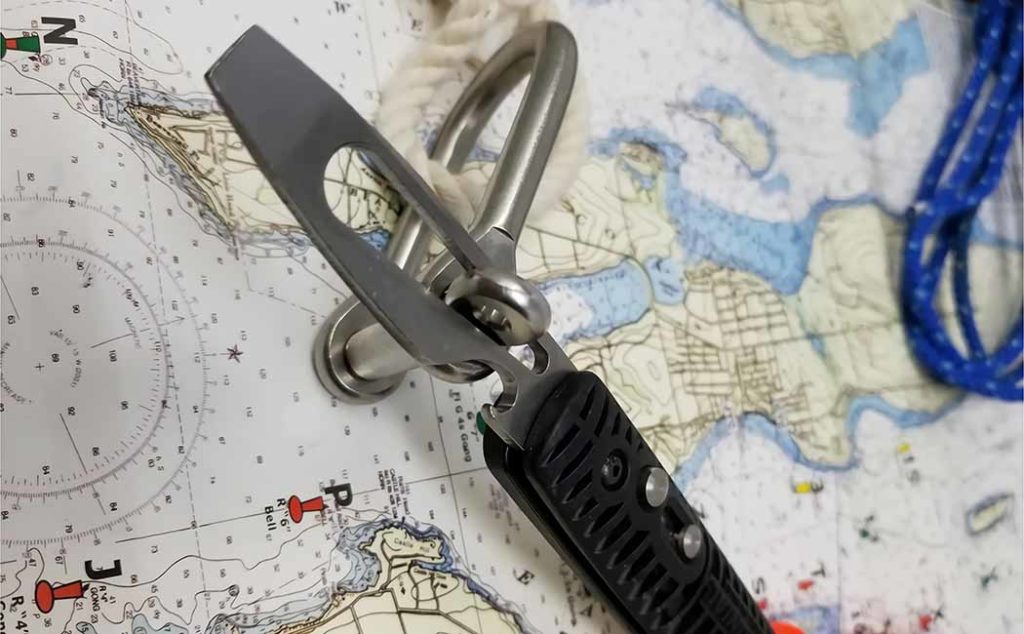
The shackle key is just that, a key for unlocking shackles. Shackles are a D-shaped clip used to attach various parts of the rigging together. These devices are usually tightened down beyond what can be accomplished with bare hands, so the key is applied and used to open it. There isn’t a high degree of utility for this accessory on most small, single-person watercraft. Many people, however, still find the tool useful for other duties. If not, it’s prized for its connection to sailing’s golden age.

Top Rigging Knives Available Today

Davis Instruments Deluxe Rigging Knife

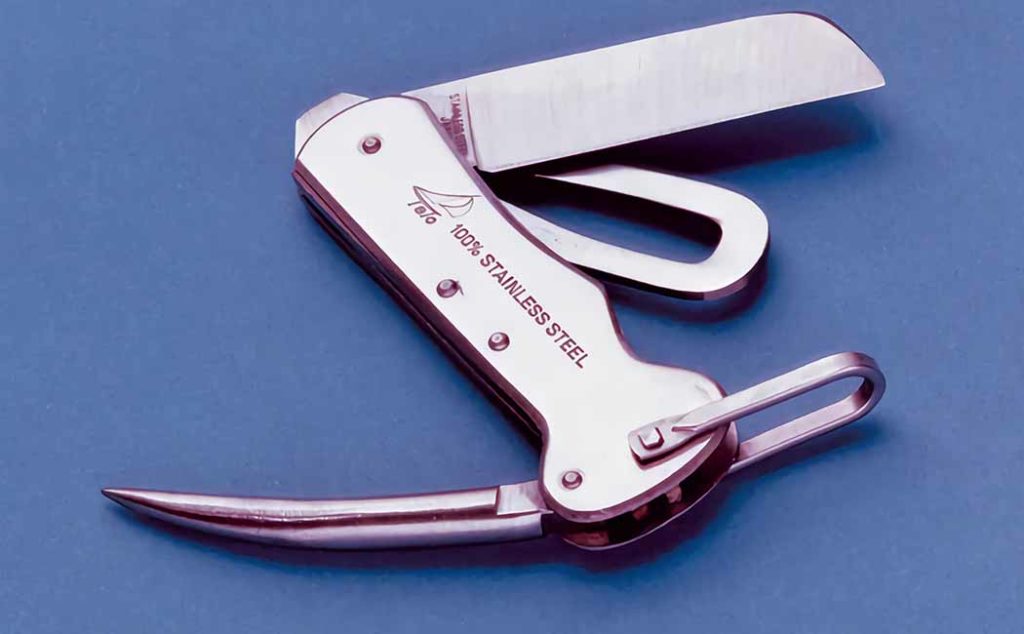
Inexpensive, rugged and handy, Davis' rigging knife has all based covered.
Inexpensive, rugged and handy, Davis’ rigging knife has all based covered.

This is among the most baseline functional rigging knives on the market today. Davis‘s knife is inexpensive, under $30 retail, and has every single tool you want in a rigger. Because of salt water’s corrosiveness, the knife is constructed completely out of stainless steel and is easily kept clean and in service. If it ever gets to the point rusting out it won’t break the bank to replace. Functional knives like this lack glamor, but for what it is used for you will have a hard time finding something that truly exceeds it in utility. The folding knife features a marlinspike, shackle key, screwdriver, and blade.

MSRP: $27

Gill Marine Multitool

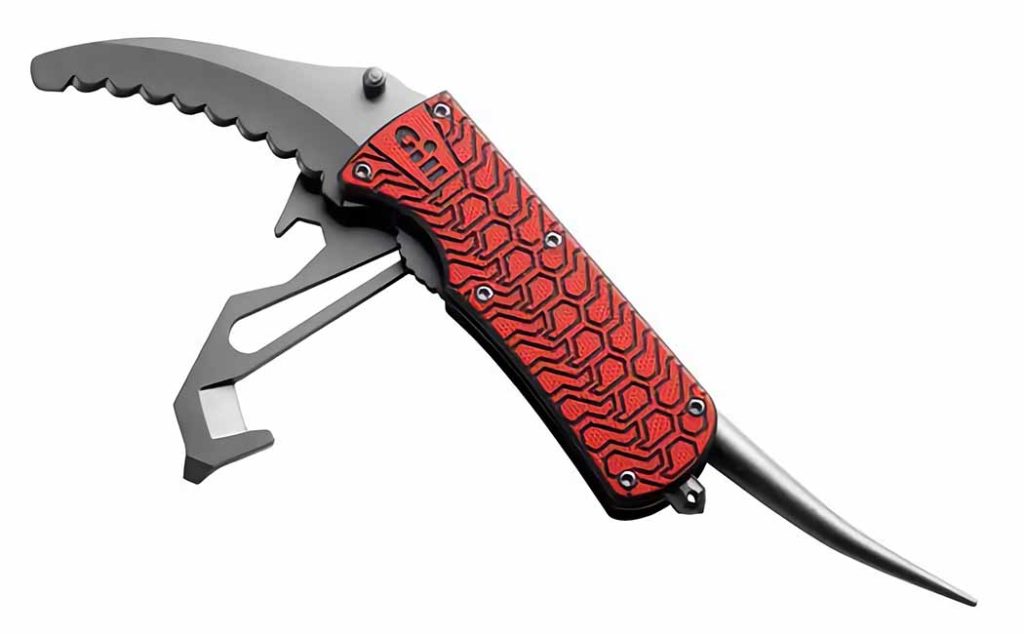
A modern iteration of the classic rigging knife, <a href=
Gills’ option offer a nice update to the design—particularly the G10 handles.” width=”696″ height=”431″> A modern iteration of the classic rigging knife, Gills’ option offer a nice update to the design—particularly the G10 handles.

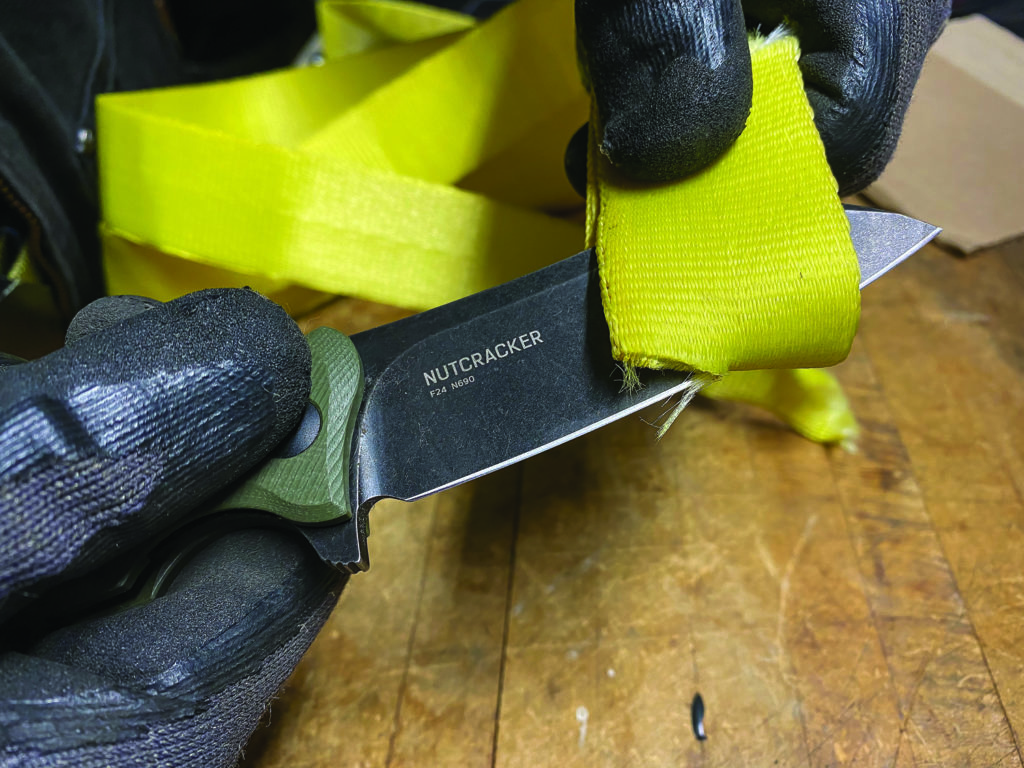
This tool retains many of the necessary, time-honored features common to rigging knives but adds some much-need advancements. Taking a hint from automotive rescue tools, the Gill tool a glass breaker and strap cutter to deal with tie-downs and hard-surface obstacles. The blade locks open, which is more than can be said of most rigging knives. The edge of the blade has deep, scalloped serrations that won’t hang up in nylon rope. To increase grip in wet conditions the knife has a machined G10 handle in bright orange. Lastly, the knife has an integrated screwdriver and shackle key. It does not come with a lanyard but has a pouch that can be worn. Interestingly, the knife has a titanium coating, something not usually found on tools at this price point.

MSRP: $45

Old Timer Mariner

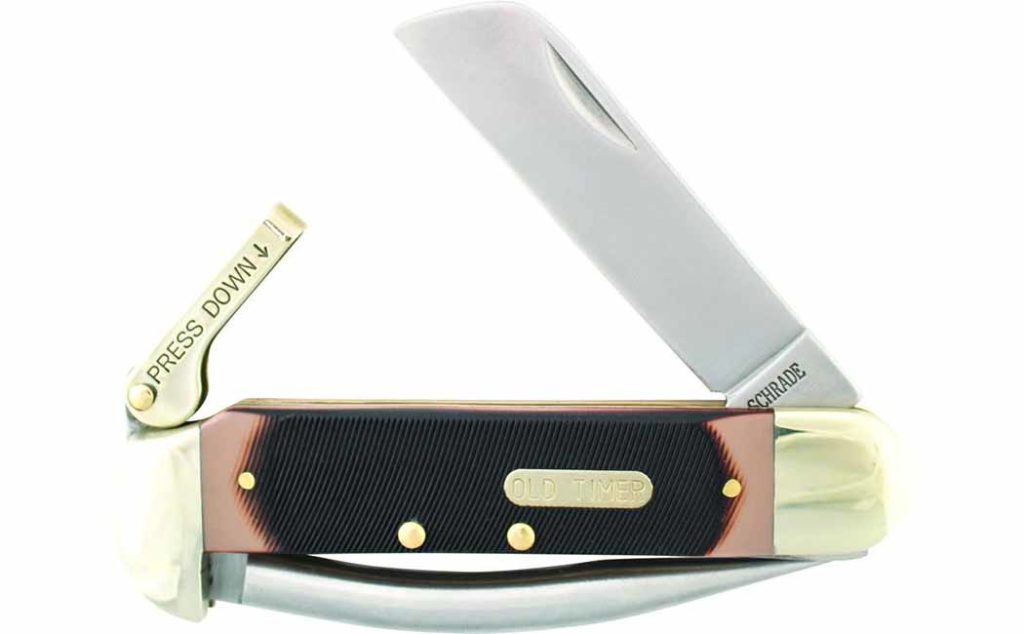
The materials that make up the Old Timer Mariner might not endure hard salt-water usuage. However, the knife more than looks the part and is capable of lighter duty.

In terms of classic appearance at a very low price, the Old Timer Mariner is just the ticket. The knife is relatively simple, it has a classic sheepsfoot blade and a functionally tapered marlinspike. The knife is of traditional construction and isn’t made of materials that are particularly resistant to salt water. That said, this style has been in use for decades and is just about what you think of when you imagine what your granddad or great-granddad may have used in the early part of the 20th century. As is common in traditional designs, the blade is nonlocking. Taking into account that many modern versions of this knife incorporate this safety feature, it is up to you to decide if you want the added liability in wet conditions.

MSRP: $27

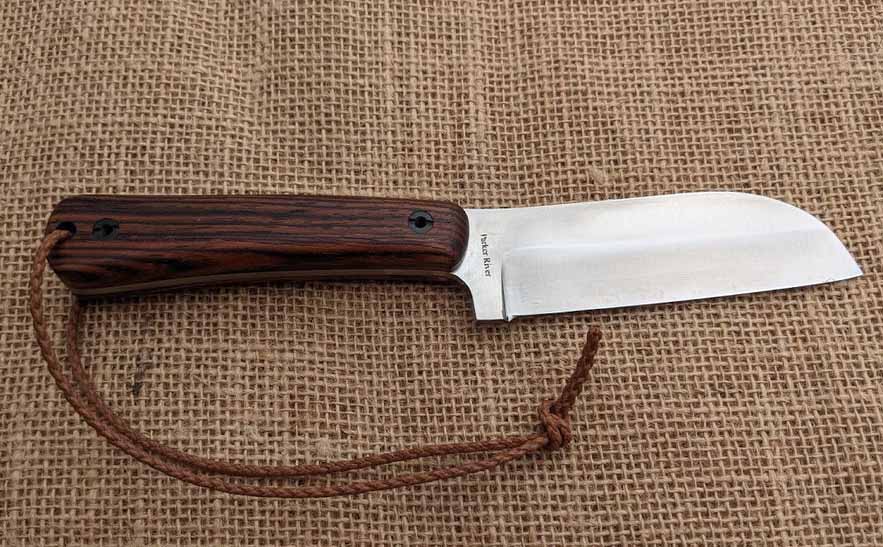
Parker River Bosun Knife

Parker's River Bosun Knife harkens back to the earliest versions of the rigging knife. Expensive, it more than speaks to your maritime cred.
Parker’s River Bosun Knife harkens back to the earliest versions of the rigging knife. Expensive, it more than speaks to your maritime cred.

If you find that you are in the market for the luxe version of a rigging knife, look no further than the Parker River Bosun Knife. This one isn’t at all on the cheap side, you could easily buy every other knife on this list and still have money left over. But, for the discerning mariner, a tool like this is not just a status symbol but a nod to a long-past way of doing things.

This knife is made in the original bosun knife style, fixed blade and all. It lacks any other adornments, including a marlinspike. However, just like in the old days, you can of course buy a separate marlinspike and tie it on with a lanyard. The interesting part of this knife is it really has not lost function over a multi-tool in that the blade aspect. Having a separate knife and marlinspike allows larger models of, thus makes them easier to use and not hinder you with a folding mechanisms. The knife comes with a leather sheath and is available with custom engraving.

MSRP: $315

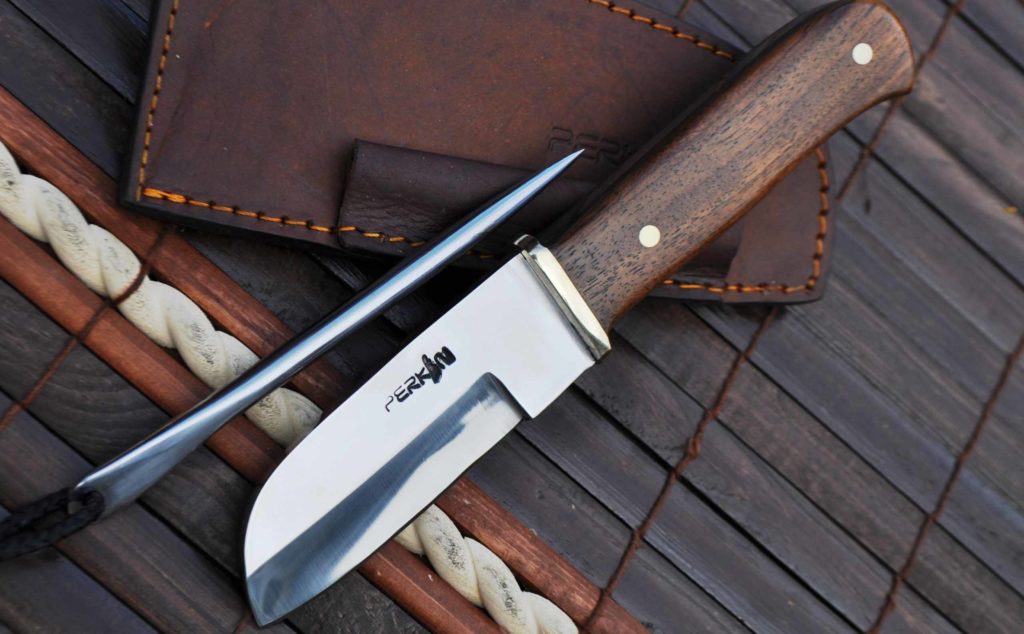
Perkin Handcrafted Rigging Knife

Traditional in design, Perkin's rigging knife is built for heavy usage, but offers throwback appeal.
Traditional in design, Perkin’s rigging knife is built for heavy usage, but offers throwback appeal.

Another traditional fixed-blade design is the Perkin Handcrafted Rigging Knife. It has many of the same features as the Parker River example and even comes with a leather sheath with an integrated marlinspike loop.

The knife is heavily constructed and bears a thick, heavy spine. It is substantial enough it can be pounded through rope much in the way these knives were originally used. The physical construction is simple, a pinned scales and a bolster. Overall this is a good entry-level kit if you want a classic setup for your boating adventures.

MSRP: $64

More Knife Buyer’s Guides:

Hawk Creek Blade E-VAC Review: Cutting-Edge Karambit?

Cutting-Edge Karambit-Style Knife? Or Dull Player? The author searches for his cutting mojo with the Hawk Creek Blade E-VAC.

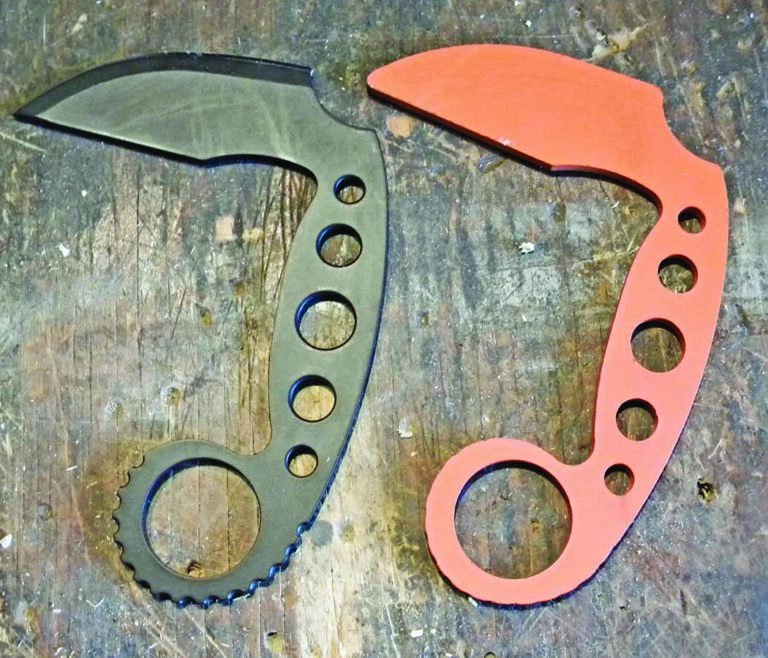
Though karambits/ringed knives are popular, I am not a fan. New from an equally new knife company—Hawk Creek Blade E-VAC is such a special-use knife, and it requires practice to use it to its full potential.

Normal cutting situations just don’t feel right to me with this knife pattern. I’m sure that with enough repetitions—that’s why they provide a mild steel training blade with the standard version—it would feel normal during most cutting chores.

Hawk Creek Blade E-VAC Edge Test

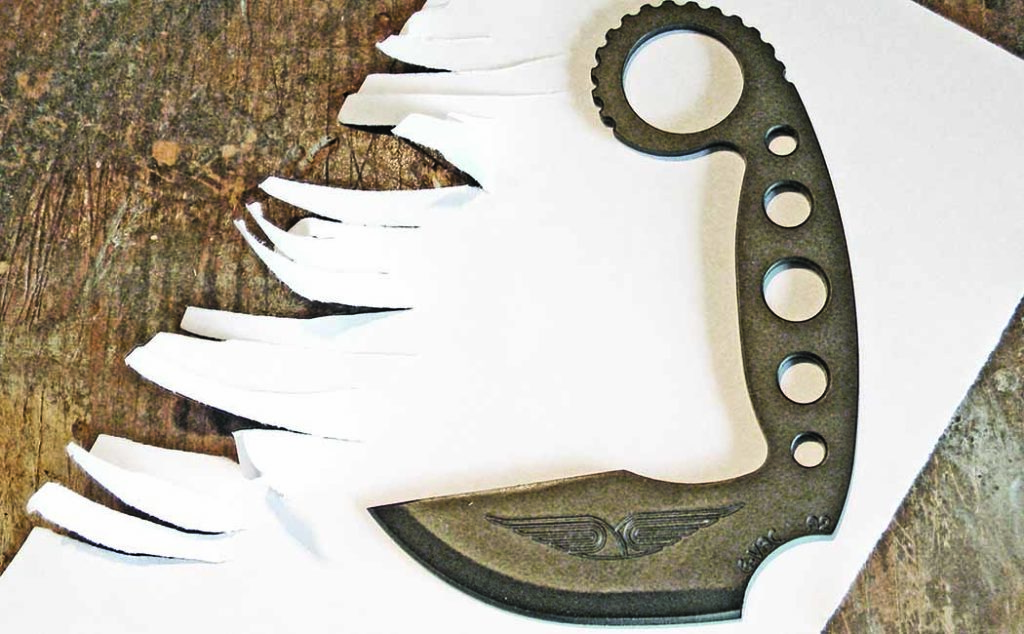
In slicing 20-pound bond copy paper, when the author got the cutting angle correct he was rewarded with an aggressive slice. When he got the angle wrong, the result was more of a torn slice.

In slicing 20-pound bond copy paper, when I got the cutting angle correct I was rewarded with an aggressive slice. When I got the angle wrong, the result was more of a torn slice. I need more practice with the E-VAC to get the hang of it.

E-Vac Heavy-Duty Cutting

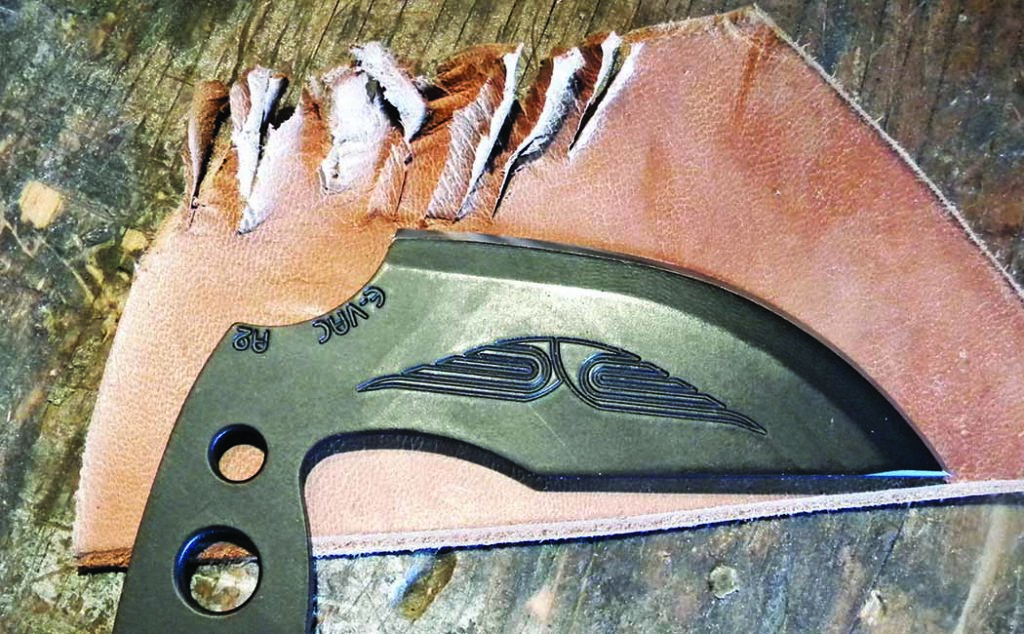
The E-VAC worked great skiving 8-ounce leather. The size of the cuts was controllable both in width and depth. Again, using the ulu style of rolling into the medium worked great.

On single-walled cardboard I did better with a push cut than a pull cut. Again, when I got it right, the knife cut aggressively. On the cardboard, I rolled into the push cut like cutting with an ulu. Using more of the wrist than the hand seemed to work best.

Moving on to some 8-ounce leather, I tried my luck at skiving. The E-VAC worked great. The size of the cuts was controllable both in width and depth. Using the ulu style of rolling into the medium worked great for me.

Batonning The E-Vac

The author batonned the E-VAC through some left-over fencing 1/2-inch thick by 6 inches wide.

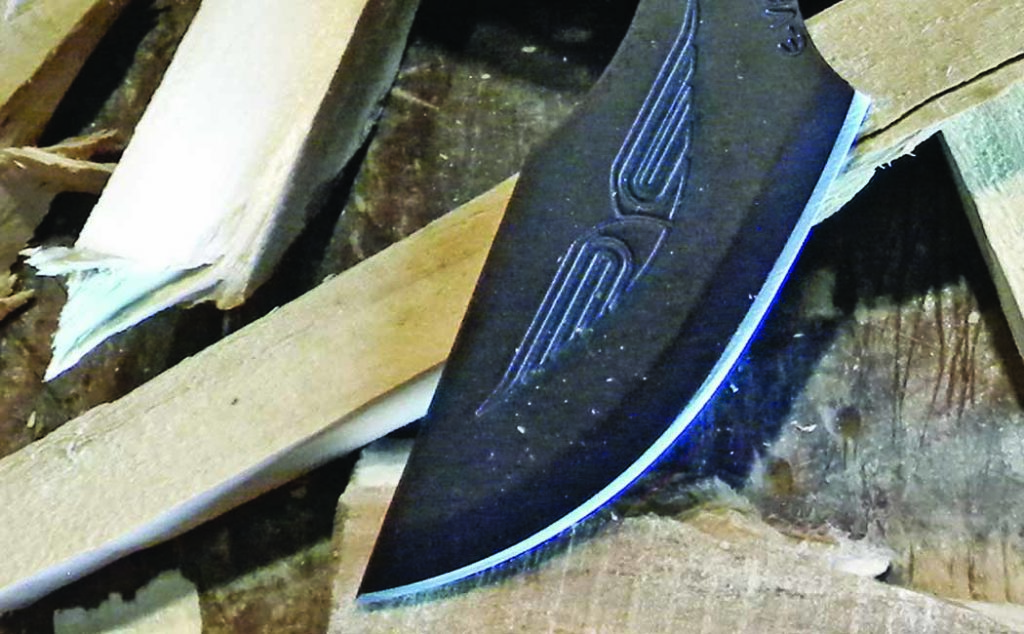
I batonned the E-VAC through some left-over fencing 1/2 inch thick by 6 inches wide. It was somewhat of a challenge to keep my knuckles out of the path of the dead blow hammer. However, once I got a rhythm going, the knife made short work of the scrap wood. The thin blade split deep on each blow.

E-Vac Smaller Wood Cuts

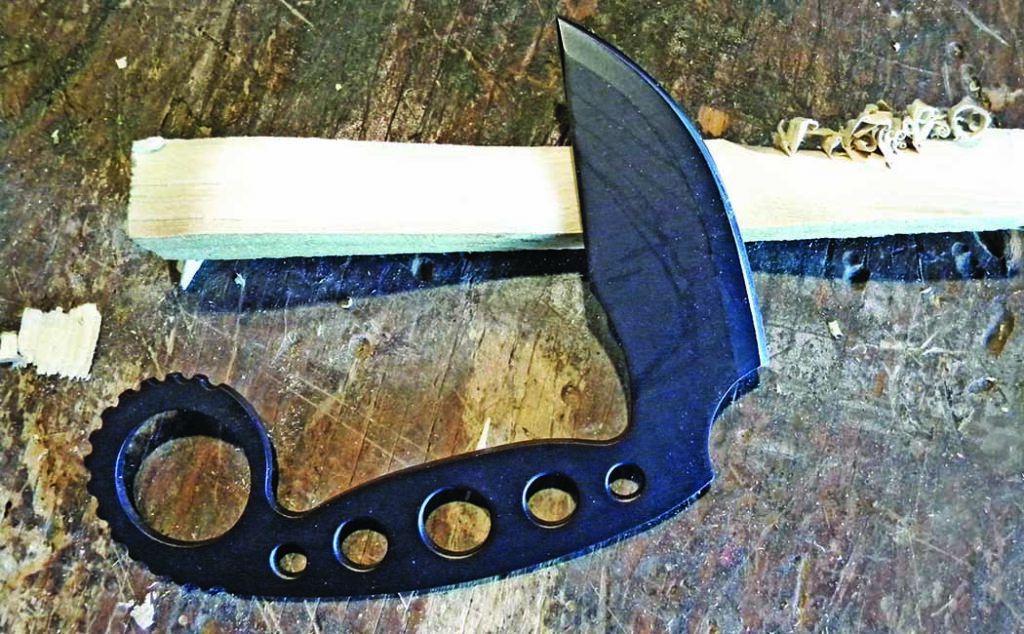
The E-VAC gave the author some decent curly-cues on the wood pieces left over from the batonning. Depth of cut was quite controllable.

Since I had a bunch of smaller pieces of wood, whittling was next. The knife gave me some very nice curly-cues. Depth of cut was quite controllable. Some thin scales or a 550 cord wrap would have given me a better grip for power cuts.

E-Vac Vs Sisal Rope

Once he got a rhythm going, the knife made short work of the scrap wood.

I did not do a sisal rope cut as I did not have the time to work on my rope-cutting technique with the E-VAC. Nonetheless, the edge feels plenty sharp enough to work well on rope.

As noted, Hawk Creek Blade provides a non-sharpened, coated mild steel trainer blade to practice your twirls and swirls without cutting yourself. It’s a very good addition to the overall package.

Assessment Of The Hawk Creek Blade E-VAC

The E-VAC works great for its designed purpose. Thinness and lightweight add to its usability.

Recommendations…

A somewhat thicker handle would give a more comfortable grip for stronger cuts.

Hawk Creek Blade warrants its knives against defects in material and workmanship. For more information contact Hawk Creek Blade Co., www.hawkcreekbladeco.com.

Hawk Creek Blade E-VAC
Knife: E-VAC
Company: Hawk Creek Blade
Knife Pattern: Karambit
Blade Length: 27/8 inches
Blade Material: A2 tool steel
Extras: Includes a coated mild steel trainer for training purposes
Weight: 3 ounces (7 ounces w/sheath)
Overall Length: 5 inches
Sheath: Kydex
MSRP: $135

More Knife Reviews:

Bone Handle Knife: Tips For Picking The Best One

0

There’s something primal about a bone handle knife. We break down this eye-catching natural material, show what to look for and give you some top picks.

Bone has been around as a handle material just about as long as we have. It is safe to say that ancient cultures across the world have used bone as a handle material for as many as 100,000 years. Perhaps longer. Nobody knows for certain because these materials don’t last forever, even if perfectly preserved.

Bone Handle Knives History

Antler and bone have been used across the world and by virtually all peoples. We see, however, a distinct trend around 12,000 to 10,000 BC where they became the choice handle material for stone or volcanic glass blades. These handles were often carved to allow the instillation of replacement blades, given the brittle nature of the material.

These types of blades were state-of-the-art technology for millennia, with their traditional means of construction still in common use with many cultures at the time Europeans began exploring the world. The stone blades were extremely sharp and could last for months or even years if properly maintained.

Ancient people were experts at shaping these stone blades, and they could do so with great precision. Many of them were not small either, some stone spear points rival modern Bowie’s in length. The strength of these knives is largely dependent on the skill of the craftsman, and some of these blades and their handles still exist today.

Fast forward to the early modern era around 500-1000 years ago, we see that bone is purely a decorative choice on most knives. While functional, there is more of a challenge to working with it than there is wood. Wood in most cases is easily shaped while bone is a much more finicky medium. Bone is substantially more brittle, and it is harder to seal and finish. While it may seem like a durable material, it is quite porous and can shatter if struck.

In a way, bone went from being the material of choice to the choice of those who perhaps wanted to show off. Today this is the same story. It is hard to find individuals who carry around knives with ancient mammoth ivory grips, but they do exist. Will that same individual use that knife for camp work like ancient man? Again maybe, but not likely at the cost of that material.

Common Types Of Bone Used In Handles

Bone

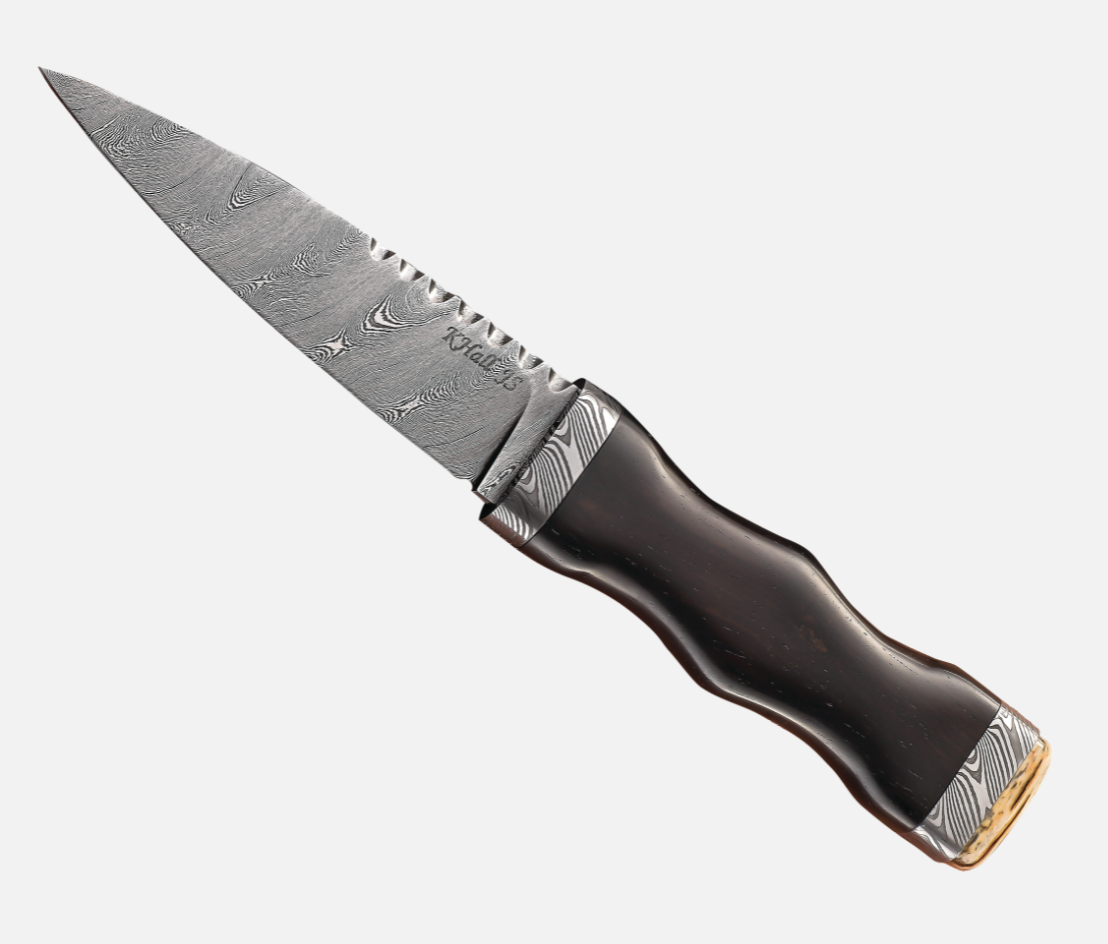
Ken Hall’s sgian dubh features a 4.25-inch blade of twist damascus in a blend of 1075 spring and 15N20 nickel alloy steels. The pommel is formed from stone and giraffe bone. The African blackwood handle not only is ideal for its carvability but also in keeping with the sgian dubh’s name, which is Scottish for black knife.

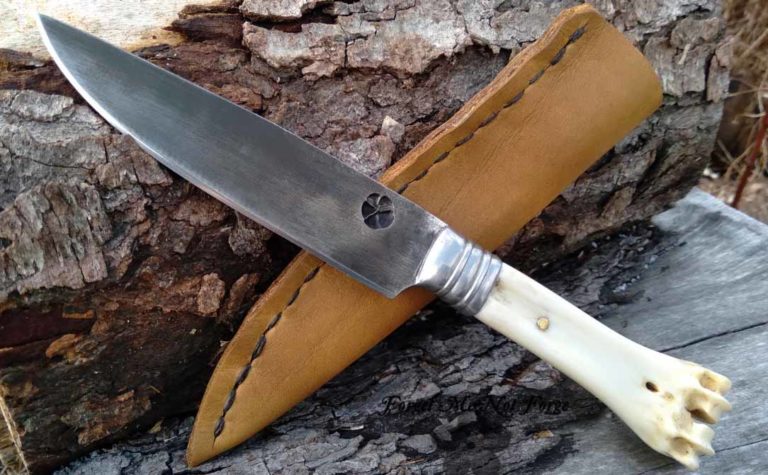
For the most part, bone handles were typically made from whatever animal was available in the region. In ancient times, this could be any type of bone that was easily hollowed out or shaped. The femur bone (thigh bone) was quite common. Equally popular were the bones of the arm, and even the jawbone, depending on the animal.

Antler

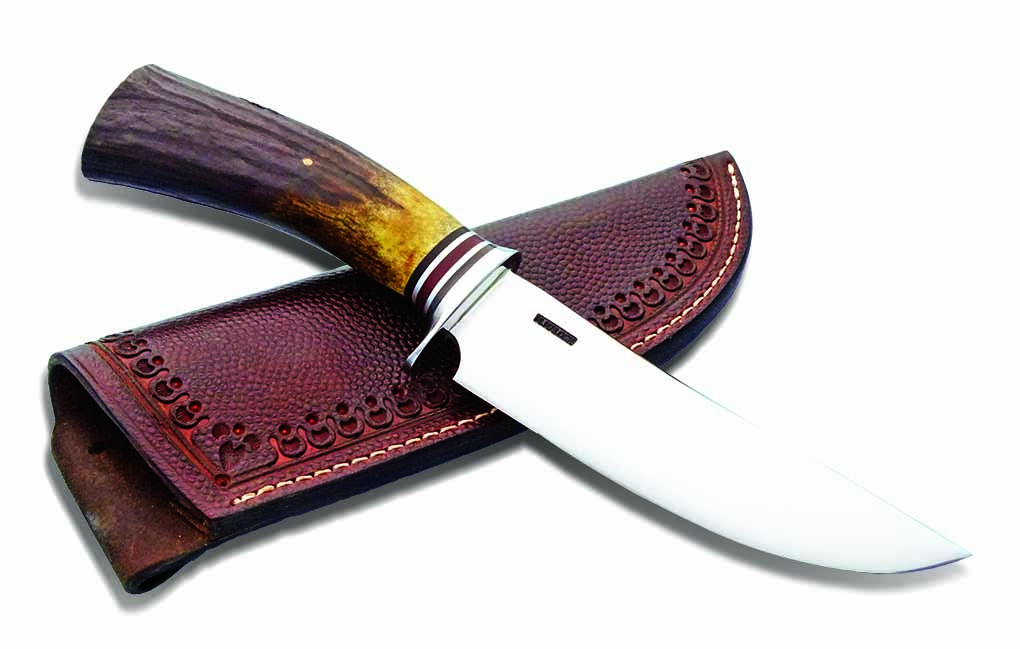
Mike Malosh opts for elk antler with black and maroon Micarta® and stainless steel spacers for the handle of his utility hunter. The 6-inch blade is W2 tool steel and the guard is stainless steel. Overall length: 10.75 inches. The knife comes with a leather sheath by Malosh. The maker’s price: $390. (Impress By Design image)

Antler is and always has been a better alternative than skeletal bone. Antlers grow on members of the deer family only, from the skull and are semi-vascular. This means they have blood flow and skin while they grow. What makes them appealing then and now are they are shed by the animals yearly. This makes them easier to source, not requiring a kill to obtain. Furthermore, antler is extremely strong and dense, much more so than skeletal bone. In turn, it is less prone to shatter and is substantially less porous, meaning it is easier to finish and maintain.

Ivory

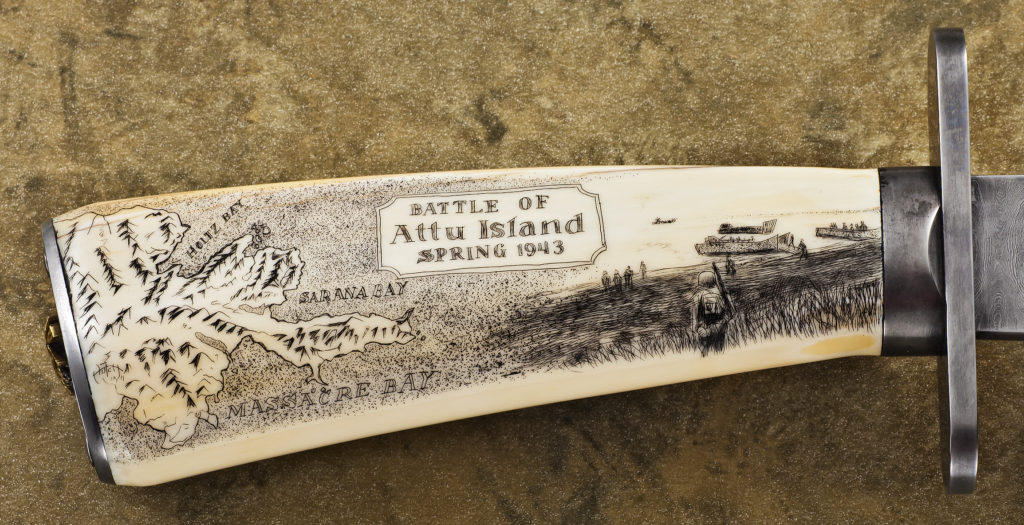
Sharpe used an ancient walrus ivory tusk he already had on hand. Richard (Hutch) Hutchings volunteered to scrimshaw the handle.

Ivory is another material that falls into the bone category. Elephant ivory has been strictly regulated for years. As a result, the material is exceedingly rare and possession of an unaccounted-for sample can land you in trouble. The ivory trade has been bad for the elephant population worldwide, but the animals are largely out of danger now, though this has not lessened ivory restrictions. It is a semi-grainless material that is not only strong but also easily shaped—lending to its popularity.

Mammoth Tusk

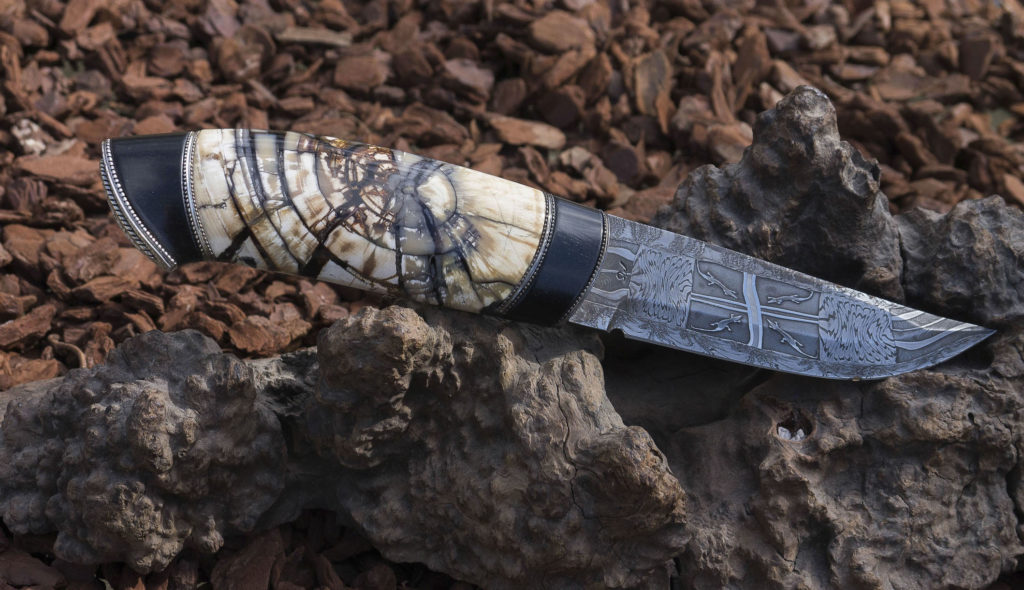
Raffir fossil mammoth
Raffir fossil mammoth ivory comprises the handle of Danish knifemaker Tommy Astrup’s mosaic damascus fixed blade.

While there are regional laws pertaining to mammoth tusk— California, New Jersey, and New York you can’t transfer it—this ancient material is generally legal to sell and possess. (Always check your local laws to make sure this holds true for you.) Given restrictions on ivory, this material has become more common in recent year, sparking a rush to collect it on the Siberian tundra. The permafrost makes it so that these tusks are almost like new. Working with it is no more challenging than working with modern ivory, given the state of preservation is usually excellent. Other ancient materials that are suitable for use on knives include the tusks of walruses and narwhals, but these too are regulated in some states.

Most Desirable Bone Handle Knives

Beauty is truly in the eye of the beholder. While bone handles are certainly attractive, they are not always the best choice for daily use.

The main reason, aside from antlers, most bone material gets very expensive very quickly. Mammoth ivory can run well into the thousands of dollars for enough to make a couple of handles. For this reason, you typically see it as thinner scales as opposed to a full carved grip. If you go that latter route, the finished knife cost can skyrocket into the thousands, perhaps even over $10,000 on a nicely executed custom knife.

Pros And Cons Of Bone Handles

In the world of Micarta and G10 there is little advantage in bone or antler, particularly in durability and longevity. Like any naturally occurring material, there is the presence of unseen flaws that may become liabilities during use. These materials aren’t weatherproof in a true sense and can take on moisture and pull in oils. The mineral structure is different on each bone or antler and as a result, there is no true gauge for strength across the board. The ergonomics are also a challenge as most of these bones and antlers are shaped in a preexisting manner by the animal they came from.

This is not to say that they are useless, rather it is a matter of personal preference. Some people truly prefer how these materials look and feel and that is their right. That does come with accepting that they may be restricted to certain uses as opposed to other handle materials. For instance, hard chopping work and batoning are difficult on handles due to flex and vibration, and bone or antler may simply crack at the pins if a strike is not performed perfectly. The nature of these materials is sentimental, not just to the individual but to mankind as a whole being that they have been with us since the beginning.

Top Bone Handle Knives

Wess Barnhil Gentleman’s Hunter

Wess Barnhil Gentleman’s Hunter
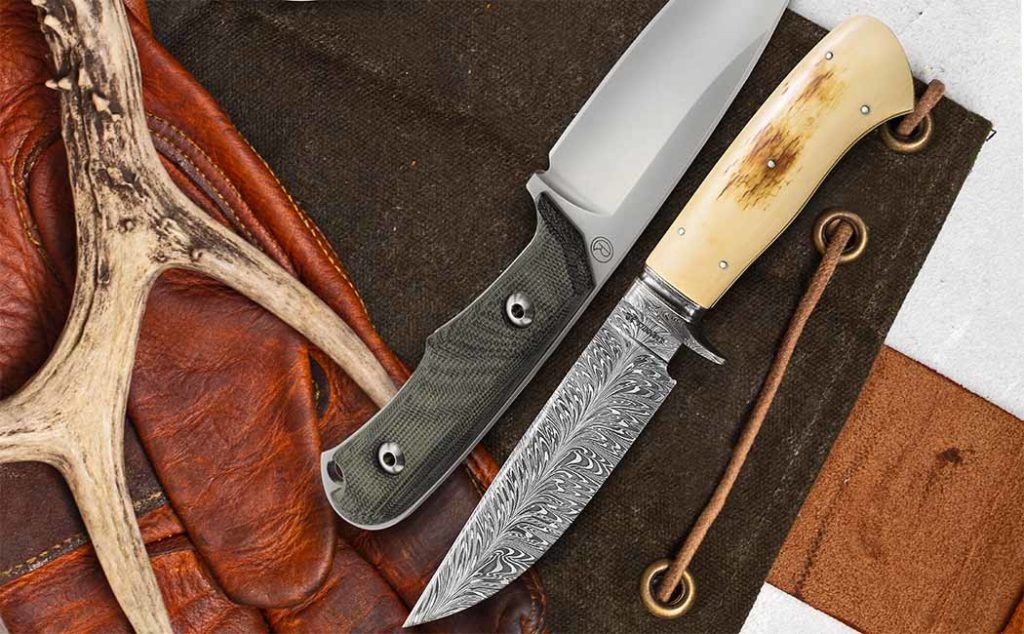
Wess Barnhil Gentleman’s Hunter (bottom)

A custom offering by Wess Barnhill, the Gentleman’s Hunter was featured in the November 2022 print issue of Blade alongside some other fantastic bone or antler-handled knives. Modestly priced for a Damascus steel blade, Barnhill’s knife displays an excellent profile and layout for real-world use but is so damn beautiful you’ll probably want to keep it safe from blood and guts! Barnhill’s portfolio features several knives with natural material handles, each a work of art.

MSRP: $1400

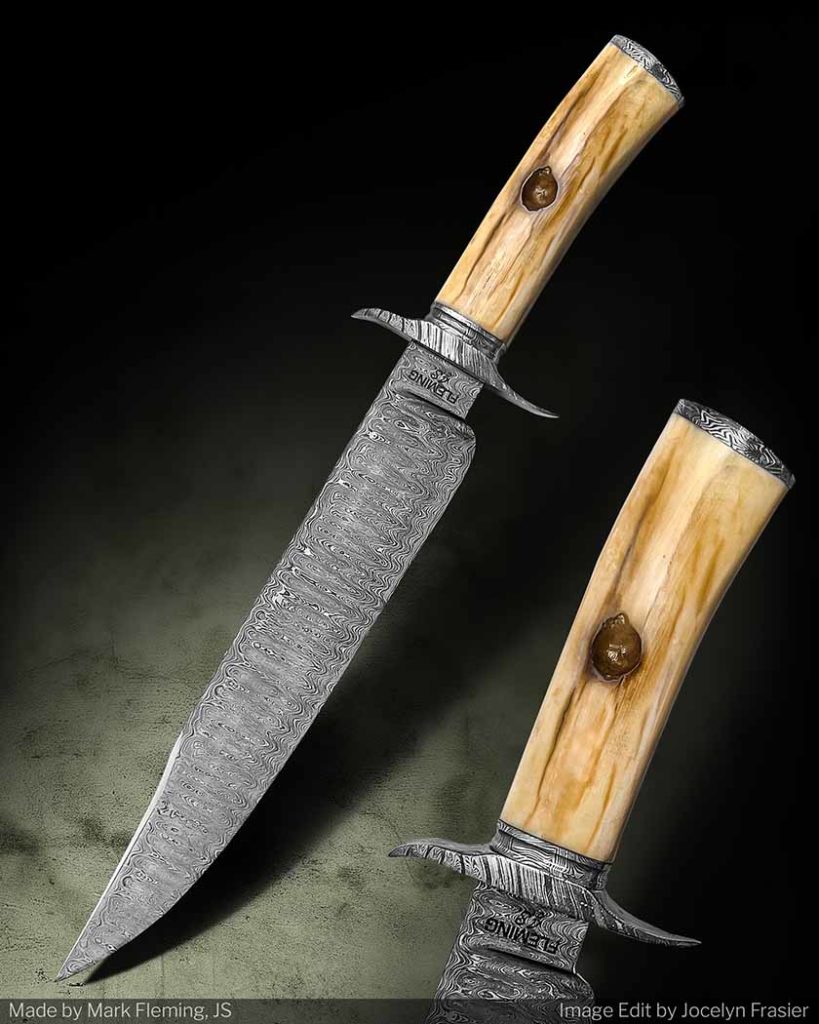
Mark Fleming Forged Southwest Trail Bowie

Mark Fleming Forged Southwest Trail Bowie

This knife was featured in the December 2022 print edition of Blade Magazine. Mark Fleming is an ABS journeyman smith, but his work looks exceedingly masterful at this point in his career. While this particular knife is custom, a similar piece will run you about $1,900, which is quite reasonable for such a complex execution. The knife as featured included an awesome-looking ancient walrus ivory grip, itself a relic.The grip material was salvaged from a native fire spindle that was used to start friction fires. Interestingly, you probably could still use this in that manner and you wouldn’t be outside the times. Grip indentations for starting friction fires are common on many knives today.

MSRP: $1,900 (for a similar design)

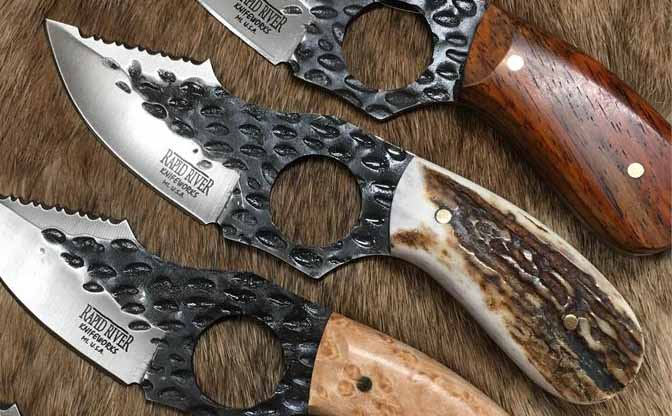
Rapid River Knifeworks Kodiak

Rapid River Knifeworks Kodiak

Rapid River Knifeworks offers a tremendous number of custom services and a wide range of knife products. Located in Michigan’s upper peninsula, the company has excelled in adding traditional flair to its lineup and the products stand out from others across the board. The Kodiak is a hammer-forged knife that is offered in a dizzying number of configurations, not even including custom engraving. The variant we’re concerned with here comes with elk antler as a grip material, and it sure does look great! Unlike many knife companies, Rapid River has a showroom you can visit in person.

MSRP: $175

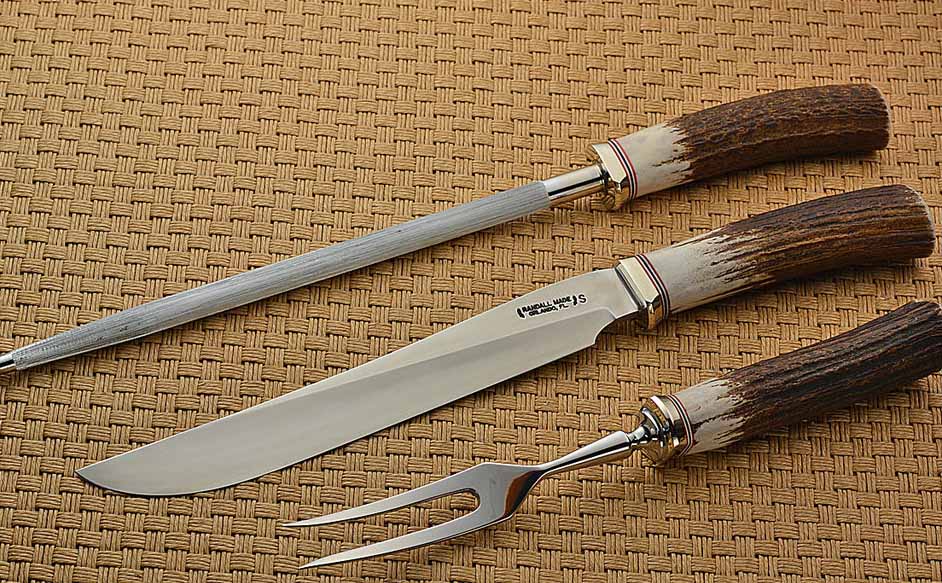
Randall Knives 3-Piece Carving Set

Randall Knives 3-Piece Carving Set

Randall Knives needs no introduction here, however, we are pleased to take a look at a less-prominent product from their standard lineup—its 3-Piece Carving Set. The set comes with a 9-inch carbine knife, serving fork, and sharpening steel, all of which are finished with stag handles. The set includes a storage box and the company notes that you should not put them through the dishwasher. Randall Knives, of course, offers some very well-known classics in natural material handles, many of them available in their standard lineup. If you so desire, you can also take a look at having something custom-built, but you had best get your orders in now. The company website is currently taking orders for delivery in four years!

MSRP: $680

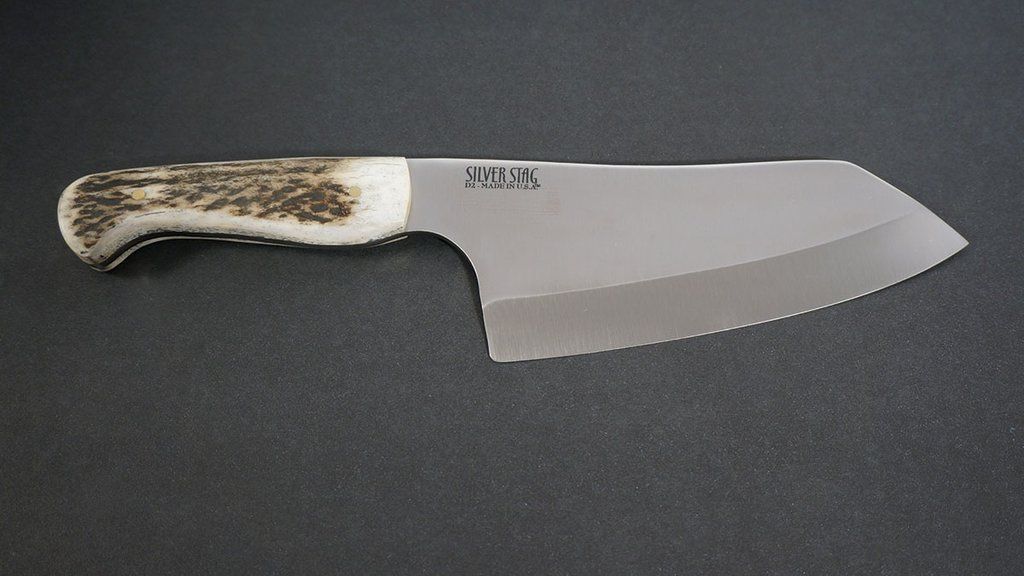
Silver Stag Universal Chef Pro

Silver Stag Universal Chef Pro

Silver Stag makes a great number of products that feature natural handle materials, but a standout example is the antler-handled Universal Chef Pro. This is an all-use kitchen knife that is at home in just about any setting—be it your home or base camp. The knife is ruggedly constructed and has a unique shape with a curved belly and sheep’s foot tip that allows it to be deftly handled for large tasks like carving down to fine dicing. Silver Stag offers a full line of antler-handled kitchen knives, as well as many other outdoor knives from filet knives to custom scrimshawed skinners.

MSRP: $218

More On Knife Handles:

Choosing The Best Throwing Knife Buyer’s Guide

Want to know what steel to fling and what at? We break down how to choose the best throwing knife and targets for high-flying fun.

Simply put, a throwing knife is an object that is either a true knife (capable of cutting and other work) or a pointed/tipped/edged object that is solely designed to be thrown with no other intended capability.

Any knife in theory can be thrown, however, most all knives are not intended to be thrown. There are several reasons for this, among them the fact that knives are edged tools and are reliant on their edge profile, blade shape, and handle style to be functional in their intended role. For instance, a chef’s knife isn’t designed to be batoned through wood. A knife it is, but it is not *that* type of knife.

Likewise with throwers—a throwing knife is purpose-made for the role and is usually stripped down to a point where it is not functional in most other roles.

Selecting A Throwing Knife

In selecting a throwing knife, you need to first look at what you want to throw it at and what type of throwing interests you.

Steel

The first criterion here is important because you want to choose steel of a high enough grade that throwing it doesn’t damage it. Knives break all the time and even the strongest edge can chip or even snap if it hits a hard surface with sufficient speed and force.

If you are a recreational thrower who likes to have some fun at your weekend cookout, you really can’t go wrong across the board. Lower-cost knives in sets mean you can get more of your friends involved and the good times can be made that much better. These knives are usually made of lower-quality steel, and it is not uncommon to see broken tips. These knives are usually inexpensive and are only made to maintain a tip, not an edge.

The medium-skill thrower is probably going to graduate to some better steels and more common profiles. It is in this category you start seeing true blade steels like 1055 and 1095 come up as opposed to just generic ‘stainless steel’. The knives at this stage are still affordable but are typically sold as individual pieces, meaning building a set gets pricey. At this level, you start to see real effort put into blade profiles and balance points, as well as an emphasis on the ability to throw repeatably.

Advanced throwing knives start to get expensive, sometimes into the hundreds of dollars—some even custom-made. These are the knives you see the most serious competition throwers using. The average recreational thrower would benefit from them, but unless you’re throwing every day the expense is not going to aid you. That said, an expert’s knives are going to be balanced perfectly as well as featured tailored grip style, tip and body to provide the most consistent performance. These are also nearly identical in weight and in the distribution of that weight along the blade and handle.

Designs

Some knives are tip-heavy, others handle-heavy. Others are slotted or have holes drilled to allow the addition of weight where necessary. The weight distribution of a knife largely depends on how you grip it—a topic too large to cover here. The abridged version is balance points vary depending on your throwing method, and as you learn you may gravitate to one or another depending on what works best. Typically, it is advisable to start with a perfectly balanced knife and then, once you have that skill, learn what style your body and throwing performs best.

Throwing Styles

Throwing styles vary depending on what you are trying to do and what style of knife you’re throwing. There are many methods to do this, not just the classic ‘hold by the tip and hope for the best’. There are two main types of throwing, rotational and non-rotational, and certain types of knives are balanced better for each.

Rotational throwing is where you throw the knife, and it rotates in the air before contacting the target. You’ll need to know or be able to estimate the number of rotations needed to arrive at the target with the tip. This is harder, but the more common type you see practiced in backyards everywhere.

The next is non-rotational, where the knife is launched straight on without spinning. This is usually for shorter ranges inside 15 feet.

Throwing Knife Targets

Throwing knife targets are wide-ranging. There are dedicated throwing targets that exist, but you should know examples made of foam or modern composite usually do not hold up for the long run.

Archery targets are commonly misused as knife targets, which is fine if you like wasting your money. Archery targets made of rubber foam are meant to stop target point arrows, in a sense, it catches them by means of friction. A knife can cut through these layers and ruin them and increase the danger of a rebound back at the thrower.
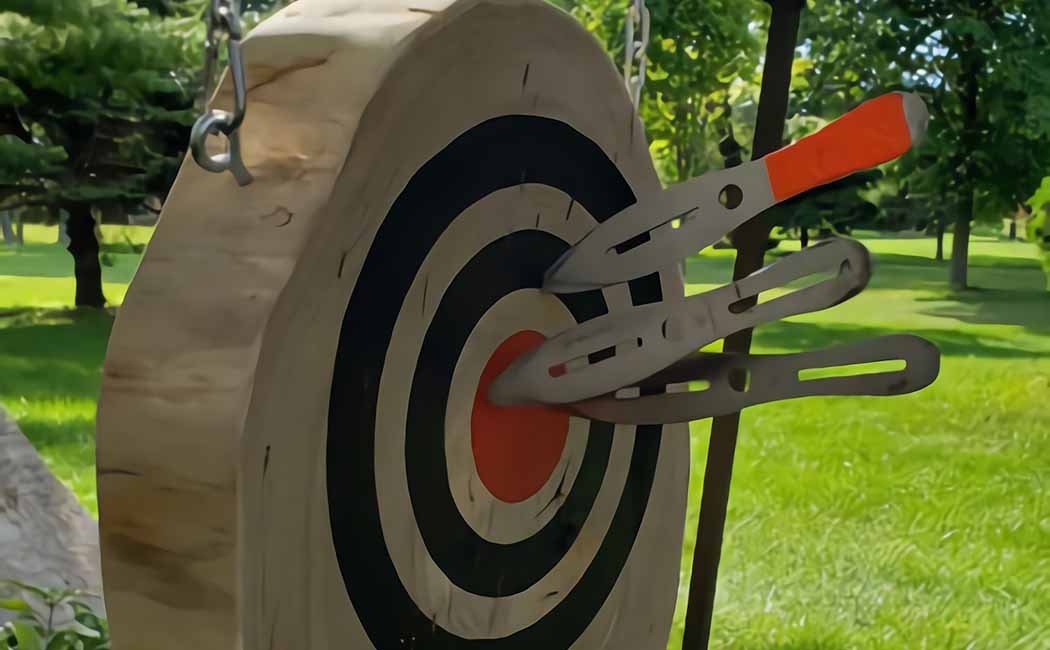
The best material for throwing knives is wood, especially slices of a tree trunk. It is not good to throw at living trees, as while the knives themselves won’t kill the tree, they can allow insects in which will destroy it.

Log slices have been used as throwing targets for time immemorial and there is hardly a substitute. They last for years, can be painted over again and again, and are cheap to replace. Most people make a stand to mount them on that can be folded up and moved.

If you are handy and like woodworking, you can make a wood block target using 4×4 posts cut into sections and glued together with the grain facing the thrower. This simulates a log slice but is more uniform in shape. The author has made this type of target and found it cosmetically nice, but not more functional than a log slice.

why Throw Knives?

To ask this question you need to understand that there is a very serious and well-researched answer… because it’s a hell of a good time!

Knife throwing has very little to do with self-defense these days, and while not out of the realm of possibility, it is just not a highly relevant skill. Today it is now common to find establishments called ‘axe bars’, where throwing blades and tossing back a few cold ones are the name of the game.

There are pro-level competitions out there, just like there are in any game or sport. There is some money in it if you’re good enough, but most people just like to do this because it is a good way to spend time together and win bragging rights.

Some Of The Best Throwing Knife Options

Cold Steel Perfect Balance Thrower
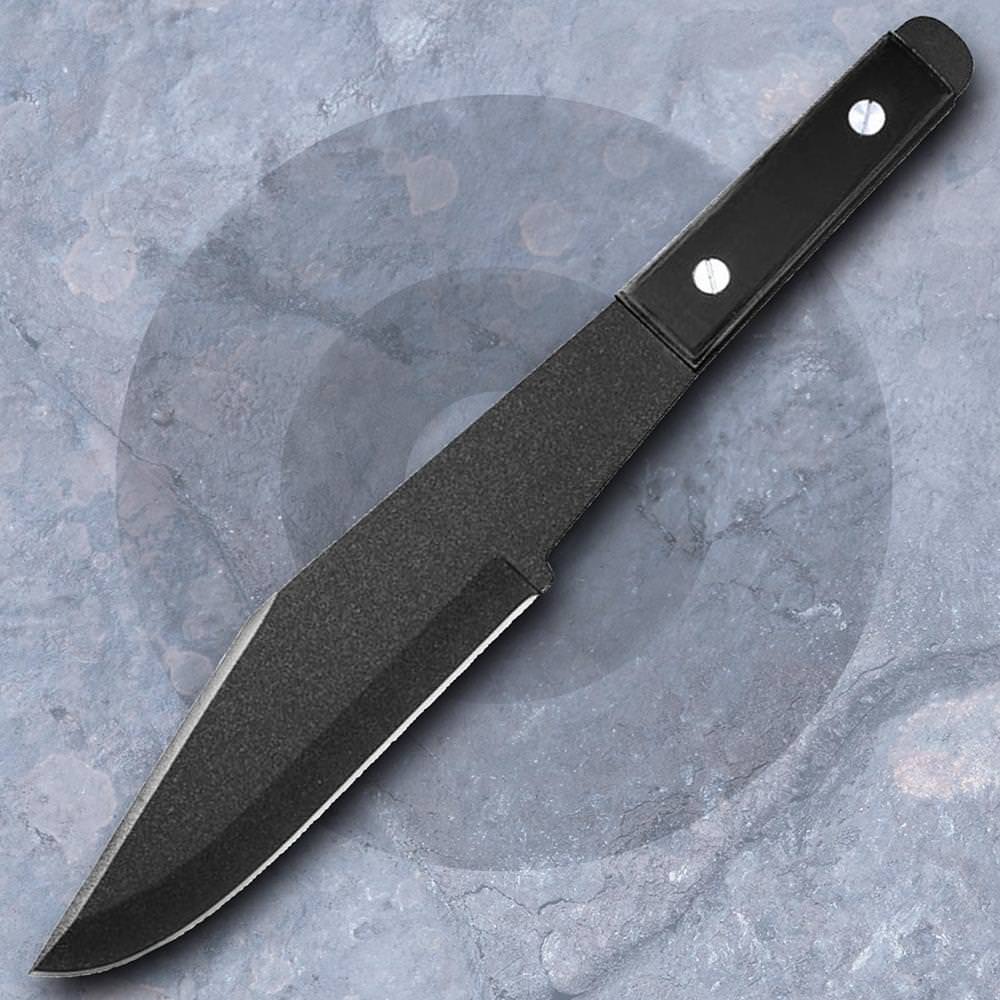
Cold Steel Perfect Balance Thrower

Resembling the company’s tough, powerful bowie knives, the Cold Steel Perfect Balance Thrower is every bit as rugged as its fellow products. But it is designed for the purpose of throwing, not necessarily day-to-day tasks. Though it is one of the few on this list with handle scales, it isn’t held up by this feature at all. This knife was designed to offer repeatable accuracy thanks to its well-managed profile, tip shape, and handle layout. A large thrower at 13.5-inches long and almost 1 pound in weight, it has no problem carrying enough energy to punch in and stick. The knife is not sold as a set, the price is for one without any carrying system.

MSRP: $38

Cold Steel Torpedo
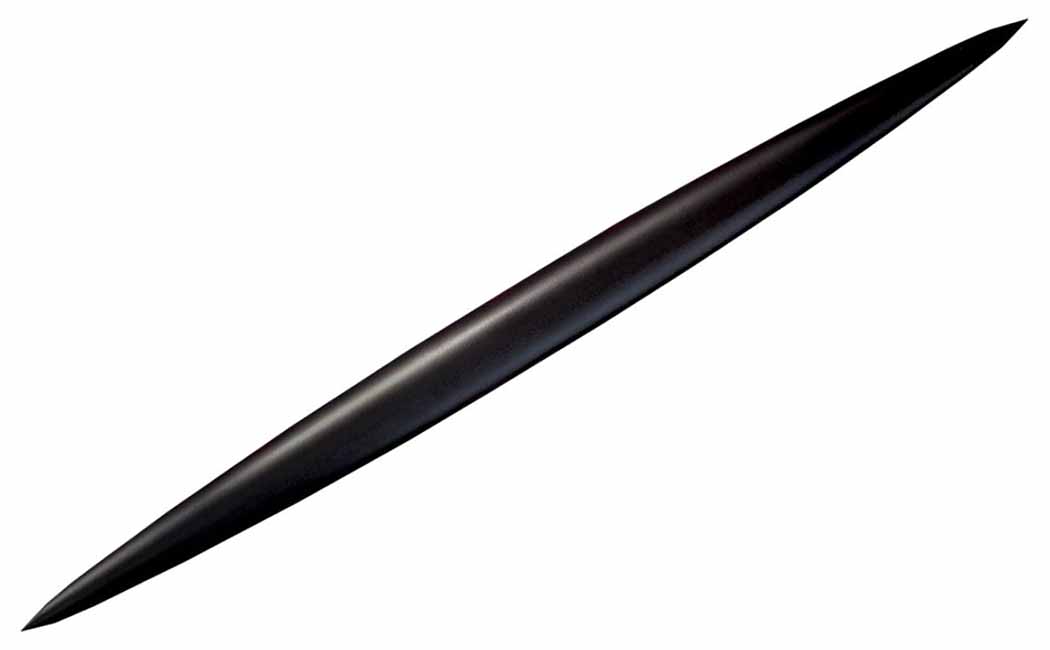
Cold Steel Torpedo

Probably the most unique thrower on this list, Cold Steel’s Torpedo is deceptively simple, yet extremely effective. The Torpedo isn’t necessarily a knife. However, most throwing knives aren’t knives in the true sense either. They are in the same shape as a knife but aren’t meant for cutting or really anything else other than throwing.

The Torpedo is a 15-inch long, 1-inch thick, 32-ounce piece of steel sharpened into conical points at each end. It carries a tremendous amount of mass and is large enough it can be used for self-defense and even some types of hunting at close distances on small game. This thrower is a design that exceeds its simplicity and crosses into the practical for ownership.

Survival schools teach throwing for hunting, and many native and indigenous cultures have used similar methods for millennia. The fact that a direct hit from this massive steel cylinder results in a huge, deep wound is enough to convince even the most dedicated primitive survivalist of its utility.

MSRP: $38 each

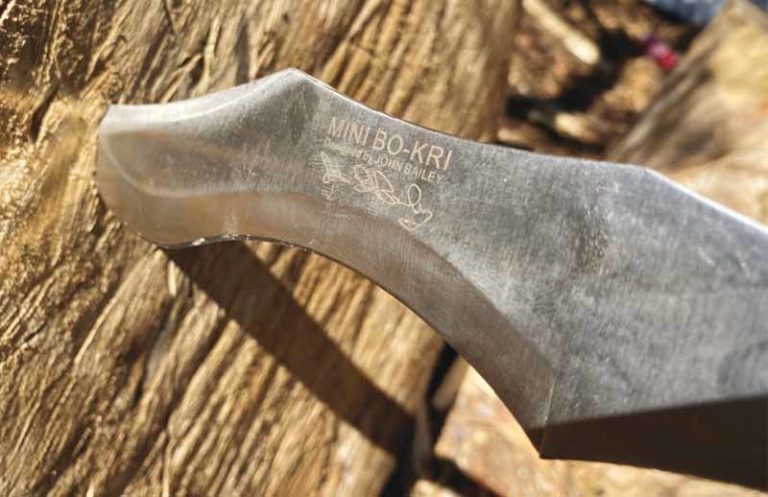
Boker Magnum Mini Bo-Kri
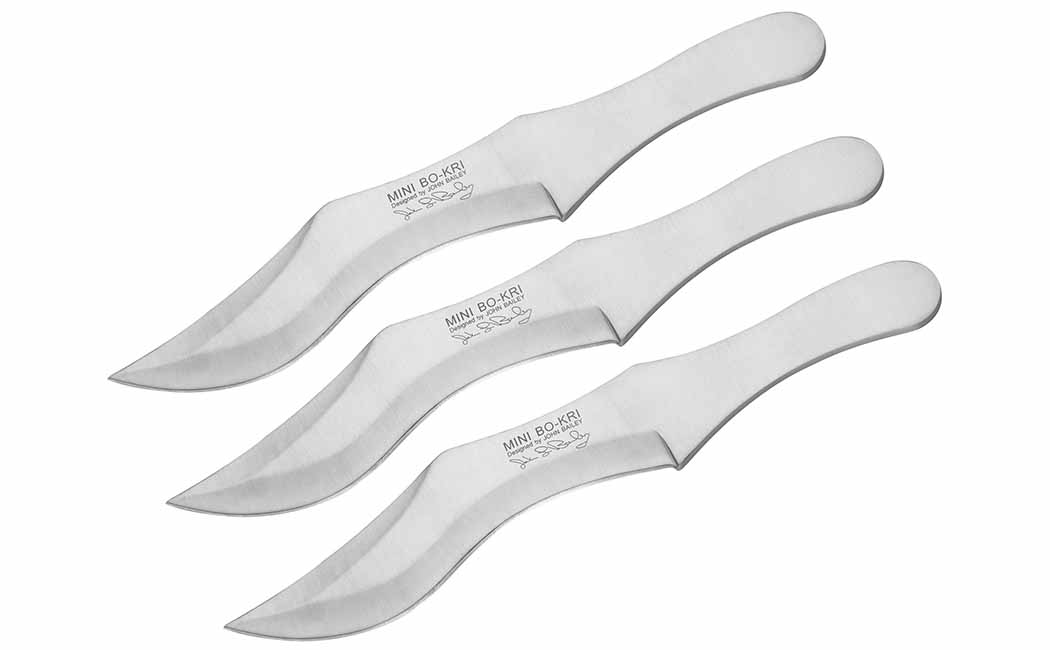
Boker Magnum Mini Bo-Kri

Boker makes excellent knives and is known the world over for their quality. The Mini Bo-Kri is an example of this, as not only a well-balanced thrower, but unique in appearance and functionality. The knife comes with a dedicated leather sheath, which is an interesting addition considering most knives of this type aren’t carried in anything, but nylon covers. The shape is a hybrid profile featuring a Bowie tip profile and a Kukri blade curvature. This shape brings the tip to the centerline and allows for very accurate throwing using a few different styles.

MSRP: $43 each

Ka-Bar Thunderhorse Thrower
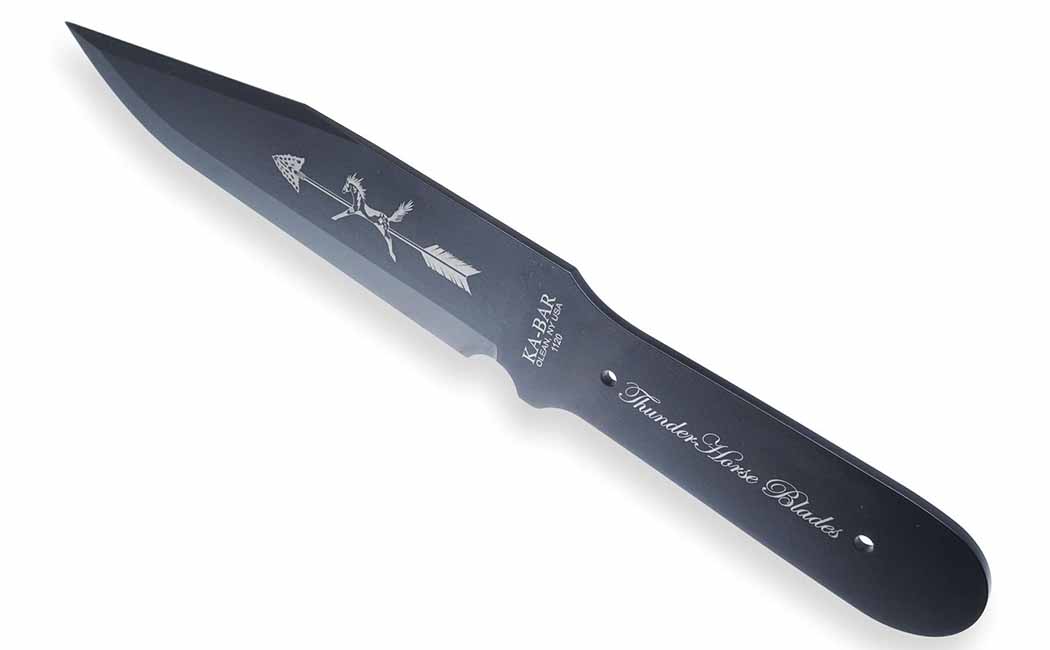
Ka-Bar Thunderhorse Thrower

The only dedicated throwing knife to carry the Ka-Bar name, the ThunderHorse is a big knife at 15.6 inches in overall length and is made in the USA out of 1095 stainless steel. There are some important things to take note of when looking to purchase this knife.

The first is that it is relatively expensive for what it is, however, it is one of the better-rated throwers out there. It is very well-balanced and has a rugged surface finish. It is made of heavy-duty steel that can sharpened to hold an edge. Of note is that the handle has pinholes, so if you need to change the point of balance you can add weights or scales.

The ThunderHorse does not come with either a sheath or as part of a set, the price is per each. If you want the best in American quality from a well-known name, you should seriously consider looking at buying a few of these to complete a competition set for your next backyard BBQ or serious game at a local match.

MSRP: $70

Thrower Supply Traditional Mountain Man Knife
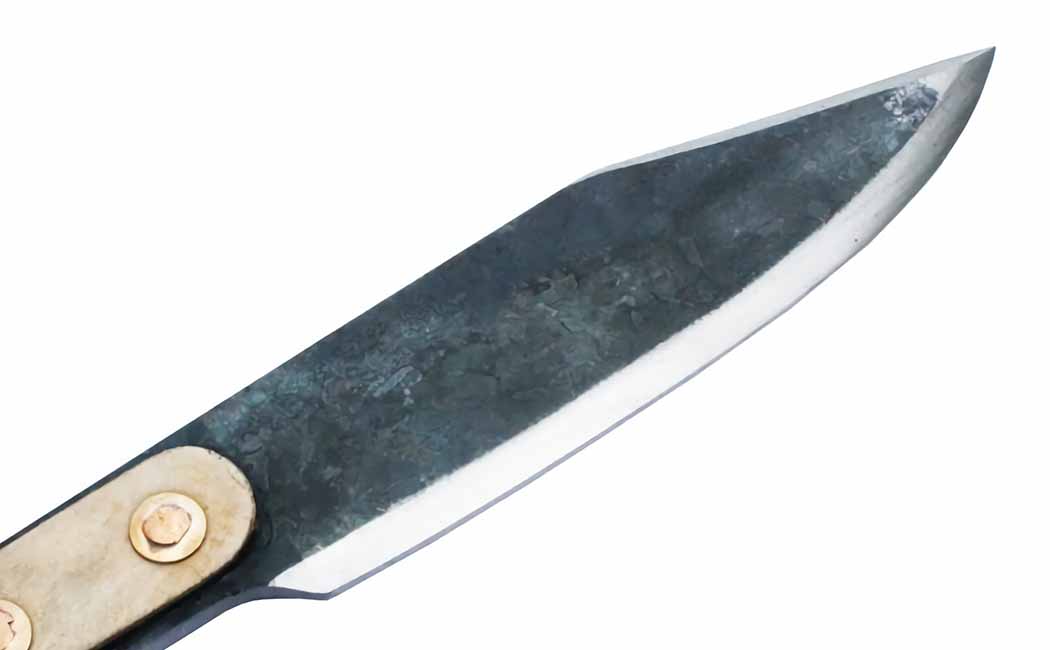
Thrower Supply Traditional Mountain Man Knife

Any time you gather a bunch of guys together in the middle of nowhere with guns, knives, axes, and a plentiful supply of liquor you inevitably end up with a competition. Marksmanship has been the hallmark of these frontier gatherings, often called Rendezvous, for the past couple of centuries. This is not where knife throwing started, but it could be argued that it became a true sport.

The Traditional Mountain Man thrower considers not just how the original throwing knives looked, but also design features that are very close to what was used in history. The first camp throwers were just that, hunting and skinning knives that were thrown for accuracy. Over time, people inevitably realized that handles were easy to break, so stripped-down elements were added, and blades became heavier and stouter.

In historical fashion, the Mountain Man thrower has leather handle scales held in place with copper rivets. This is easily replaced in camp with basic tools if need be. The knife we see here comes with a matching, historical-themed sheath. It is sold per each, which is a bonus if you want to show off wearing your set at your buddy’s house. Nothing says you like throwing knives like three of these bad boys on your belt in matching scabbards.

MSRP: $47 each

SOG Fling Set
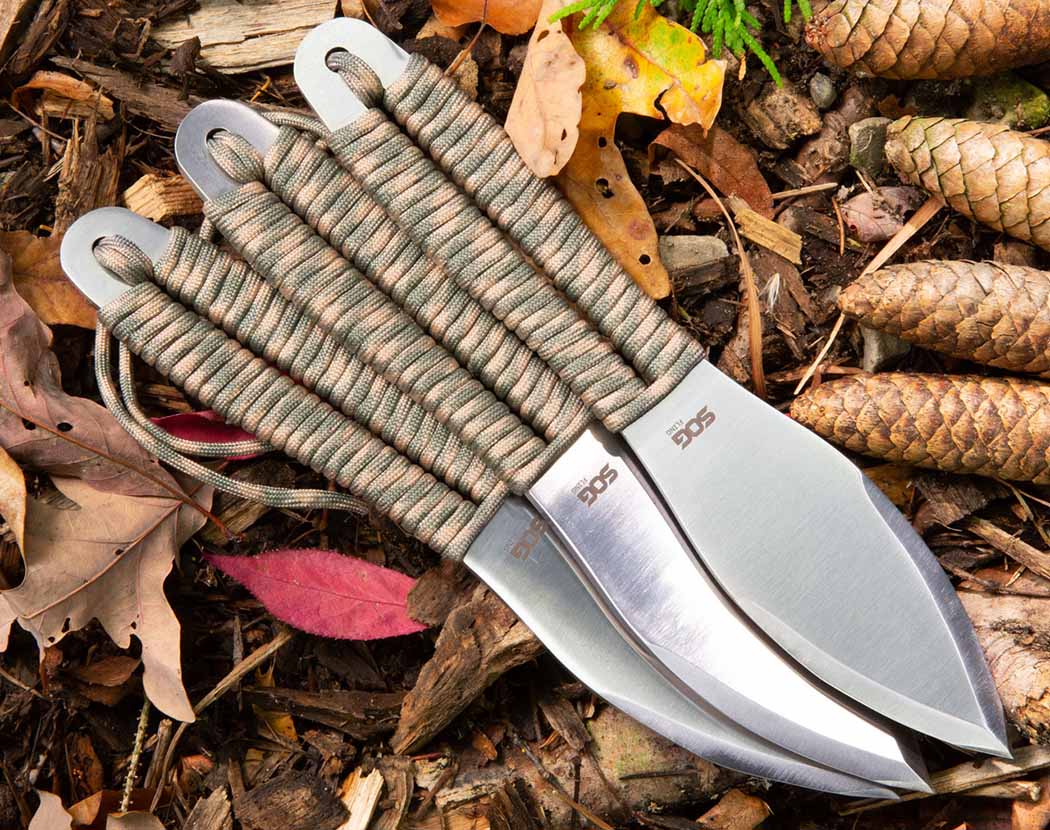
SOG Fling Set

SOG is well-known for making affordable and rugged tools to cover all uses. The Fling knives are meant for the recreation end of the spectrum, and they sure are fun!

The knives come as a set of three, which is what you need for low-cost backyard fun. The blades are spade-shaped, making them strong and stout, ideal for common backyard targets that are less than professional in construction.

It should be noted that these knives are not what you’d call a ‘professional’ set. They come wrapped in 21 feet of paracord each—not something that cuts air easily and facilitates superior balance. However, these are fun knives and enjoy a far greater range of ownership than higher-end throwers.

For a person interested in getting into throwing or if you just want a fun day in the yard, these are an excellent choice at a very modest price.

MSRP: $47 set of three

Condor Dismissal Set
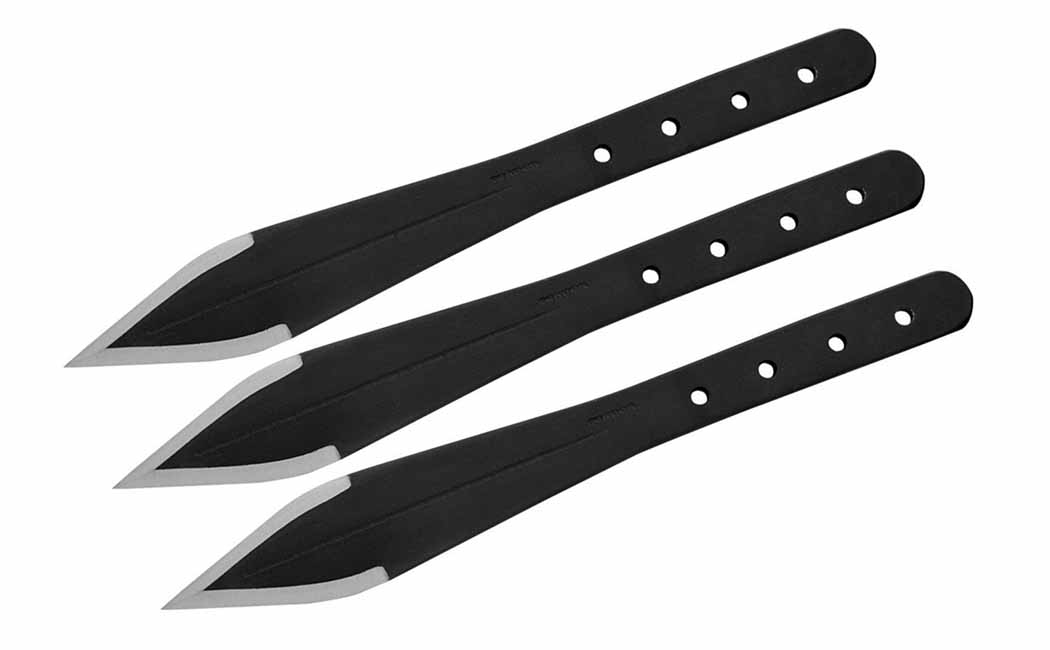
Condor Dismissal Set

Condor makes a huge range of affordable weapons and tools for just about any use. Despite being an El Salvadorian company, it makes functional versions of just about any historical sword, including Japanese style, huge German Messers, right on down to survival knives and recreational items like the Dismissal set.

These knives are highly refined for the price and have a set of features that make them suitable for backyard use as well as for serious competition. The knives have four holes in the handle area, allowing the user to add weights or scales should they wish to adjust balance. The tip profile of this knife is aggressively pointed and can punch into most regular materials but is also obtuse enough to not to get damaged in the process.

If you are just entering the knife-throwing sports, this set is inexpensive enough to get you started but also feature-rich enough to let you hone your skills and truly improve.

MSRP: $102

United Cutlery Expendables Kunai Set
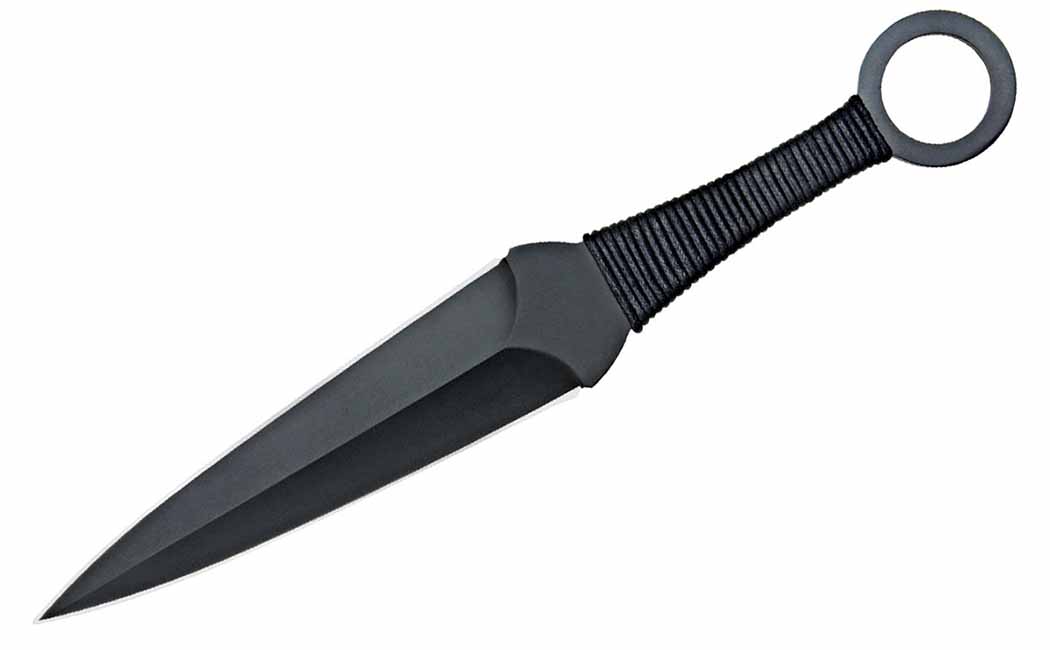
United Cutlery Expendables Kunai Set

The Expendables movie series has been out for a while now, and it is always fun to watch. Many of the actors have a history with the knife industry, arguably none more iconic than Sylvester Stallone, who also happens to be the chief character in the series. While better known for Rambo and that character’s famous knives, Stallone’s crew in the films uses a wide range of knives and this set of throwers are replicas of the screen.

Anytime you get movie prop replicas you are reminded that most prop designers have no idea how they work, but this is not the case. These throwers are functional and feature unique ring pommels that can function in the same way as a karambit in the hand. This adds security for stabbing or slashing and also making it harder to get out of the hand in a fight. A word of caution, as much fun as these would be to spin on your finger, be aware that they are sharp enough to do some damage! The knives come as a set of three in a sheath.

MSPR: $55 set of three

Check out More of Our Buyer’s Guides

Best Benchmade Knife: What Are The Company’s Classics

An iconic knifemaker, Benchmade had earned the respect of discerning knife aficionados. Here are some of the best of what it has to offer.

The Benchmade company as we know it today began in 1980 as Bali-Song, Inc., later Pacific Cutlery Corp. Before its knives got popular on the national scene, the company went through a couple of initial changes in how they produced knives and where, ultimately settling on the ‘Benchmade’ name in 1987.

The hallmark of Benchmade knives has always been extreme quality. When the company began, they were making knives one at a time. While that is not always the case today, the same spirit of persistence and dedication to the end-user remains. Benchmade has made a name for itself across the board with hunters, military, and law enforcement.

Why Benchmade Gets Props

There is an obvious and easy way to explain why Benchmade dominates the production knife market. Their stuff just works. If you buy a Benchmade, it will not necessarily be the cheapest knife on the shelf, but for damn sure, it will do exactly what it was designed to do. Unfortunately, this isn’t the case with a wide swath of the knife industry, where quantity over quality reigns supreme.

The overall quality of Benchmade knives is something that the consumer should be aware of when purchasing blades. In the author’s experience, Benchmade knives have typically outperformed, or at least equally matched any competing model, regardless of price. That is not something that can be said for most other knife companies.

What Benchmade knives offer is something akin to an investment, a lifetime of use should you take care of it.

Great Benchmade Knives

There is no disparity in quality in the Benchmade lineup. But, for this article, the author selected 10 models that best represent what is good about Benchmade, ranging from specialized hunting knives to out-the-front pocketknives. Not all of Benchmade’s lineup is being produced today, and some of the most well-respected versions have been retired, though their descendants are equally as good if not better.

535 Bugout

If there had to be a standard issue pocketknife for across-the-board use today, you would be hard-pressed to argue against the Bugout. It is not the most expensive knife in the lineup, but it is well over the cost of today’s average pocketknife. The Bugout is a well-respected, reliable design, that is both lightweight and has a very reliable, folding and locking mechanism. Designed to stand out, it is available in bright colors, in this case blue. The knife features a blade designed for optimal use in regular situations. It is not exactly an outdoor knife, although it would be at home for small games and fishing.

MSRP: $180

539GY Anonimus

An interesting knife with an interesting name. This one is a hybrid field knife and every day carry fixed blade. The author received an early example of this knife from Benchmade and it has held up extremely well throughout use. The knife is low profile and has a relatively thin spine, making it unsuitable for some of the heavier camp chores and tasks. What it is great for is skinning deer size animals and smaller. To top it off, it has a wide degree of self-defense function. The knife has a notable choil to protect the finger—it makes for ample protection while thrusting hard or holding the knife tip down. Overall, this is a knife that meets a lot of needs and checks a lot of boxes while not being particularly flamboyant.

MSRP: $310

162 Bushcrafter

Out of all the knives on this list, the Bushcrafter is the model that the author has the most extensive experience. The author received this knife for an article in the print edition of Blade Magazine, where he put it through quite a bit of use. The knife has been a constant companion for outdoor chores and is an incredible product. A great deal of the author’s experience comes from fire making and working with bushcrafting materials, and while this knife certainly meets that task with flying colors, some criticisms can be had given the amount of time the author has spent with it.

The first of these is that this is a relatively small chore knife. The blade is not long enough for heavy work and wood splitting. It is a knife that is usable at the end stage after most of the splitting has been done, meaning you will need to carry additional tools. If you were trying to get a fire started with this knife it is great for striking a rod, which is sadly not included in the price. Many competing designs that have performed equally well if not better have come with striker rods in the same MSRP range. Why Benchmade included the loop but no striker is a mystery.

The handle ergonomics are a little bit more angular than is needed, competing knives that have smoother and more contoured handles are better for extended periods of work and generate fewer hot spots. For the casual camper, this is an exceptional knife. The author tends to fall into the category of outdoorsman that believes you need a 6-inch or 7-inch blade to get stuff done. Smaller blades are the favorite of many people, the author finds them to be fatiguing to use and many times difficult to dislodge from pieces of wood or harder to use when skinning large game on the ground. That said, this is a fantastic knife, the author wishes that Benchmade will come out with a slightly larger version with a thicker spine.

MSRP: $300

317-1 Weekender

If you are casually out and about with your friends on your party barge, this knife is an exceptional comrade. It is something of a modern pen knife in that it features two blades as well as a bottle opener. It is an excellent knife for daily use and covers just about all regular cutting chores you may encounter in your day-to-day existence, barring of course any heavy-duty uses. The knife is beautifully finished and has excellent accent work, it is surely something you will want to show to your friends.

MSRP: $275

15000OR-2 Meatcrafter

This is another knife that the author reviewed for the print edition of Blade Magazine. The author received one of the first initial prototypes for testing. The Meatcrafter knife is an excellent tool, something of a hybrid between a fillet knife, a kitchen knife, and a hunting knife. It is relatively thin in the spine and cannot be used for tasks such as splitting wood, or really anything above cutting soft material.

Benchmade has a series of these knives now, available in a variety of colors and blade finishes. The knife is very well adapted to its specific role. The author butchered a deer with the prototype, and it proved to be an exceptionally sharp cutting tool, so much so that it simply glided through the meat with almost no effort. Because of its thin blade and very fine tip, it can be used for boning out meat at just about any angle. The blade is flexible enough that it can be used to get into some nooks and crannies that thicker and stiffer blades would have a hard time with. The knife does have limitations, though, and one should take care to not drop it on its tip or put it through use that results in extreme bending or pressure on the tip, an example of this would be cutting into the ball joint on the pelvis of a large game animal. There is arguably no finer game knife on the market today than this one. It is quite expensive, but it is something that will last you a lifetime with care.

MSRP: $450

Station Knife

The Station Kinfe is available as a custom order option from Benchmade. The website has a configuration selector where you can pick out every detail of this knife. It is an all-purpose kitchen tool, able to do just about anything that you could imagine a knife could do, from slicing to dicing to breaking down meat and vegetables, as well as carving and serving. If you are a professional in the food service industry, this knife is something of the Holy Grail. Because of its unique shape, it can be used for a variety of cooking styles, not just traditional American cooking, but also different Asian, South American, and European styles. The use of the knife in these culinary arts tends to vary, and you’ll be prepared for all of them with the station knife.

MSRP: Starting at $280

945-221 Mini Osbourne

If you are looking for a pocketknife that truly sets you apart as a gentleman, the mini Osborne is one that you will certainly want to take a look at. The author has carried a version of this knife for a couple of years, it is not a heavy-duty, knife whatsoever, the blade is relatively thin, and the frame is lightly constructed. However, it is excellent at his job, which is a dedicated pocket knife. There are several variations of this knife available from Benchmade, it is a very popular design thanks to its lightweight and ease of use. The version shown here is at the top end of their design range, made of incredible materials, which will surely catch the eye.

MSRP: $700

34000BK-1 Autocrat

This is arguably the king of out-the-front knives. Bench made has truly made a name for itself in this category of knives, while it is quite expensive, it has probably the most reliable mechanism of any OTF knife currently on the market and is constructed with durability in mind. The handle is, not gimmicky, rather, it is simple in overall appearance. Critics of the knife would like to see more embellishment, but the author is just the opposite, OTF knives are not an inherently strong or reliable design. In general, simplicity is king, and reliability stands above that.

MSRP: $500

15060-2 Grizzly Creek

The Grizzly Creek is an excellent, professional-level field knife that can fit just about anywhere. It is not a camp knife in the sense that it can be used for a large amount of splitting or heavy chores, however, it is excellent for breaking down game, regardless of size. Because it is a folder, the blade is not especially long, making it not as good for big game. For all general hunting, it will work, though, you may have some struggles with large deer and above. The knife features a folding gut hook that can also be used to cut fishing line and a variety of other outdoor tasks. The price is right for a working knife; it is not the most embellished or interesting-looking product from Benchmade, but it will certainly do well given its features and intended use.

MSRP: $250

176BK SOCP

The last knife on our list is the discrete SOCP. This is a little dagger with a ring pommel designed to be used as a last-ditch item integrated into your gear. The knife can be used on just about any finger depending on what you’re trying to manipulate. At $130. It may seem a little bit overpriced for a small dagger, but it is a well-made tool that can get you out of some very sticky situations. It is worth noting, that not every municipality allows the carrying of a fixed-blade dagger, you’ll have to check your local laws if you plan to carry this knife.

MSRP: $230

Check out More of Our Buyer’s Guides
Advertisement

Must Read Articles
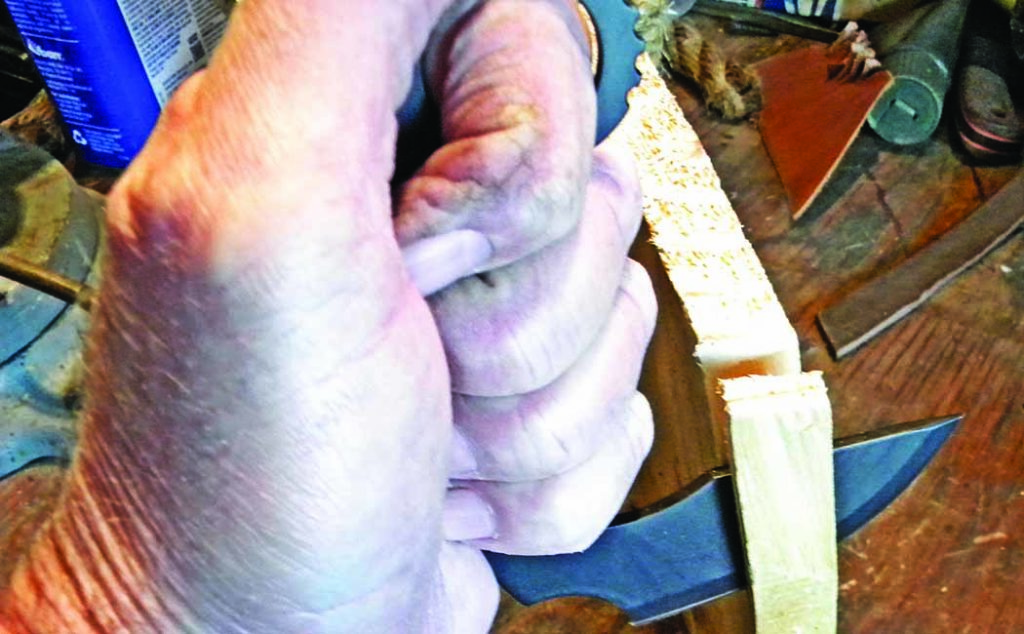
Read this before you make a knife
Knifemaking 101 – Read This Before You Make a Knife

  by Wayne Goddard My experience has taught me that there's nothing like digging in and getting started. I've often said the hardest part of the...
how to forge damascus steel

How to Forge Damascus

Advertisement
Advertisement