
Home Buyer's Guides

Buyer's Guides

You’re looking for a new knife in a certain style – we’ve got recommendations on the best blades for every price point.

Best Gentleman Knife: Top Lookers And Doers (2023)

Today’s gent’s knives are what they are instead of what they used to be. 

In years past, there was a genre of knife small, fancy and unobtrusive. It went by gent’s knife or Sunday-go-to-meeting knife, the latter where the hard-working sodbuster was laid down on the day of rest for something to better match the formal Sunday duds. Loosely defined, that knife consisted of fancier materials and a blade less than 3 inches long

However, the argument can be made that today’s gent’s knives are exclusively gent’s knives no more. According to officials of the knife companies that make them, all kinds of people spring for the knives popularly known as gent’s knives. There are sub genres, and their popularity is growing.

Take, for instance, A.G. Russell Knives, whose customers tend to gravitate not toward EDCs or tactical knives but smaller gent’s-type knives.

“In the past year or so, we are seeing an increase in interest in these smaller knives that can be carried unobtrusively, both with pocket clips and without,” the team at A.G. Russell wrote in an e-mail. The knives worn with the Sunday best tend to be more traditional, according to the company’s spokespeople. It’s a subcategory of small knives that sport a sharp appearance that includes premium handle materials. Added the Russell team, “A great gent’s knife is not too large, has an elegance about it, but still performs well.”

A.G. Russell Knives Vest Pocket Semi-Skinner
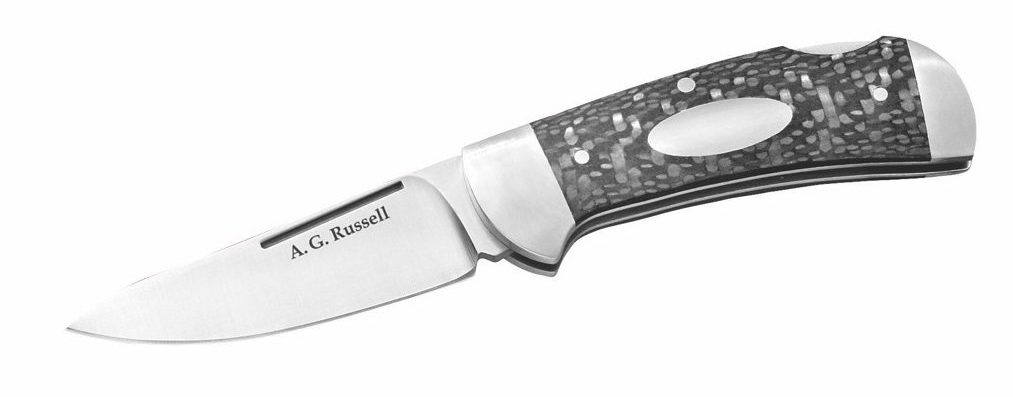
Bob Loveless introduced A.G. Russell to the semi-skinner blade shape and Russell fell in love with it, pairing it with a sparkling carbon-fiber handle in the Vest Pocket Semi-Skinner.

For an example of a piece that represents the new generation of gent’s knife, look no further than the A.G. Russell Vest PocketSemi-Skinner. Designed by the late company founder and BLADE Magazine Cutlery Hall-Of-Fame member® A.G. Russell, the knife is a mix between classic design and contemporary materials—the latter being a carbon-fiber handle and premium CPM S35VN stainless blade steel.

The heart of the knife is the bigger-than-it-should-be semi-skinner blade. As the company website noted, A.G. loved the semi-skinner blade, a pattern he credited Cutlery Hall-Of-Famer Bob Loveless for introducing to him. “A.G. saw the need for a small, lightweight pocket knife that would sit comfortable in any pocket, especially vest pockets, and the opportunity to create one with the blade he liked so much,” the site explains.

It is a blade shape that excels with work done at the tip, which is critical for a smaller knife.

“A good gent’s knife is really good at detail work,” the site notes,“in which blade and tip control are very important.” As a result, the Vest Pocket’s blade is at ground and boasts a thin edge geometry ideal for slicing cuts.

The stainless steel bolster is also critical to the design, as it covers the squared-off heel of the blade that connects with the lockbar. Unprotected, the heel could wear away at the fine fabrics of a vest pocket, for instance.

A.G.’s sketch of the knife (pictured below) was scanned into a CAD program in March 2018. Un-fortunately, he didn’t get to see the knife in production, as the iconic knife entrepreneur passed away in October of the same year before the design could be fully realized.

A.G. Russell Knives Vest Pocket Semi-Skinner Specs:
Designer: A.G. Russell
Blade Length: 2.53”
Blade Steel: CPM S35VN stainless
Blade Grind: Flat
Handle Material: Carbon fiber
Pocket Clip: None
Bolsters: Stainless steel
Lock: Lockback
Weight: 2.5 ozs.
Closed Length: 3.125”
Country Of Origin: China
MSRP: $100

Maserin Knives Turtle
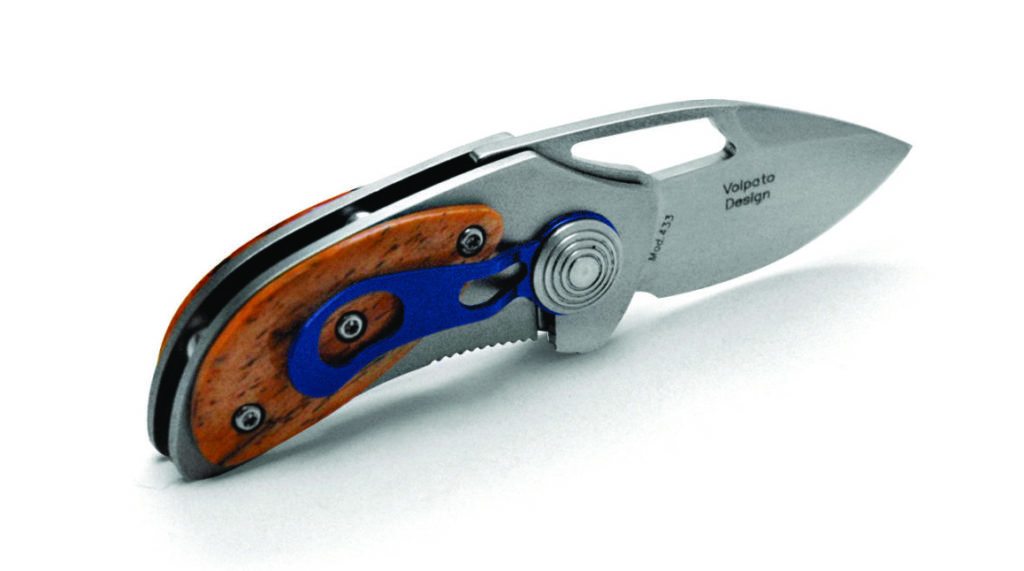
Some of the more notable features of the Turtle by Maserin Knives are the pivot pin with its concentric lines and the skeletonized titanium clip anodized blue. 

No discussion of gent’s knives would be complete without mentioning the classic designs that hail from all over the globe. Take for example the Turtle, a timeless design Maserin injected with traditional materials and refinement throughout.

In 2006, Italian knifemaker Claudio Volpato designed a small knife with a blade under 2 inches and sent the prototype to Maserin. “We industrialized it,” recalled Claudia Maserin, along with her two brothers owner of Maserin, and the Turtle was born. “ The knife is still popular considering we first showed it long ago. The best handles are ebony and briarwood, and the damascus blade version is still very appreciated.”

Some of the small knife’s more notable features are the pivot pin with its concentric lines, and the skeletonized titanium clip anodized blue. Part of the goal was to take classic materials and transform them “We looked for elegant and traditional materials,” Claudia explained, “wooden handles like ebony and olive.” 

Realizing that some women were gravitating to the Turtle because of its small size, Maserin officials handled the knife in pink giraffe bone several years ago. “We don’t design a knife  thinking of final users in terms of gender but in projecting elegant knives,” Claudia stated. “We know they can be perfect both for women and men.”

Early versions of the blade were at ground of 440C stainless steel. Now, they are N690 stainless. The result is a knifes mall enough to slip into the small pocket of a pair of jeans and that opens easily one-handed.

“Our gent’s knife is good for everyday carry,” Claudia maintained. “You can open an envelope, a parcel, cut a fruit. It is the knife you need when you find yourself saying ‘If I had a knife …’

Maserin Knives Turtle Specs:
Designer: Claudio Volpato
Blade Length: 1.56”
Blade Steel: N690 stainless or stainless damascus
Blade Grind: Flat
Handle Material: Woods of bocote, briar, ebony, olive or walnut
Pocket Clip: Skeletonized titanium anodized blue
Lock: Linerlock
Weight: 2.05 ozs.
Closed Length: 2.5”
Country Of Origin: Italy
MSRP: Depending on options, from about $77 to $19

Spyderco Pochi
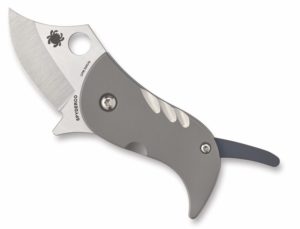
Like many small Spyderco knives, the Pochi is designed to offer large cutting power in a small package. “The dog tail rotates out to create a pinky shelf,” Joyce Laituri noted of the extension on the butt, “adding length to the handle for a better grip.”

Rigid definitions of a gent’s knife don’t quite cut it in Joyce Laituri’s book. The Spyderco spokesperson met a knife enthusiast at a knife show out to acquire some knives. The man towered well over 6 feet and was “built like an NFL linebacker, with paws like a bear,” she recounted. Though he appeared gentle-manly, a blade under 3 inches would be too small for him.

“In today’s industry,” Laituri began,“there is a broader view of what constitutes a dress knife. Is it its size, cost, function, materials, appearance? That definition is unique to each knife carrier.”

For some, a gent’s knife may be a small, elegant knife. Others, Laituri points out, decide that the most gentlemanly knife they can carry on their wedding day is a 5-inch folder or even a Spyderco Military model. The company eschews the term gent’s knives for prestige knives, Laituri said, in order to better describe the breadth of people who carry such edged tools. Meanwhile, a Spyderco knife that has attracted knife carriers for a whole slew of reasons is the Pochi, a flipper-folder collaboration with Japanese custom knifemaker Kazuyuki Sakurai.

“There is a market for anyone look-ing for the non-traditional,” Laituri said,“and the Pochi has been well received—surprisingly so—because it is so different from traditional pocketknives.

Some Pochi users, she added, like the design because they find it both charming and functional. Others are attracted to its upswept blade hollow ground from high-end CPM S45VN stainless steel. Some, attracted to the zoomorphism of the design, carry it because they like dogs, Laituri said.

Pochi, which roughly translates to the most common name for a dog in Japanese, has all the essential canine elements, resembling something like a pug on the go. Like many small Spyderco knives, Laituri said the Pochi is designed to bring large cutting power in a small package. “ The dog tail rotates out to create a pinky shelf,” Laituri noted, “adding length to the handle for a better grip.”

Spyderco Pochi Specs:
Designer: Kazuyuki Sakurai
Blade Length: 1.58”
Blade Steel: CPM S45VN stainless
Blade Grind: Hollow
Handle Material: Titanium
Pocket Clip: Titanium anodized blue;closed knife carries blade tip up
Lock: R.I.L. (Reeve Integral Lock)WEIGHT:1.7 ozs.
Closed Length: 2.6”
Country Of Origin: Taiwan
MSRP: $270

Bear & Son’s Bold Action
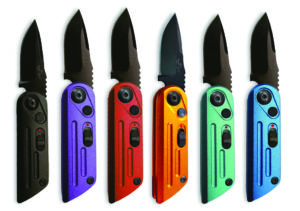
The Bear OPS Bold Action 14 comes in a wealth of different colors thanks to the anodization of its aluminum handle.

According to Matt Griffey of Bear &Son Cutlery, the world of gent’s knives has been changing and part of that has been due to the evolving nature of the workplace.

“We see less manufacturing professionals and more office setting careers,” he said. “Gentleman’s knives t the workforce movement and the lifestyles that come with it—accounting, computer techs, engineers and so on—with the knife having a small or slim physique and constructed from higher quality materials.”

At the same time, Griffey notes some of the slim knives are growing in size, and in the forefront of that change has been the increase in autos.

“Automatic knives have always intrigued both the traditional and modern knife enthusiast,” Griffey wrote, “and to-day more states are approving the daily carry and ownership of these types of knives.”

Trying to comply with many of the new auto laws, Bear & Son introduced the BearOPS Bold Action 14. The result is a knife available in a selection of color choices with its anodized aluminum handles and also the Sandvik 14C28N stainless steel blade, all made at Bear’s plant in Alabama.

Aluminum is a lightweight, low-maintenance material and 14C28 has a reputation of being corrosion resistant, durable and “an awesome performance steel”—essential features on a knife with a smaller blade and plenty of tasks to do.

“The Bold Action 14’s typical use would be common cutting chores around the office/home like opening small packages, cutting cordage and opening envelopes,”Griffey said, noting the knife can handle bigger tasks, too.

Meanwhile, expect more gent’s knives—or whatever you want to call the small fancy folders—in the future

“There is a market space for gentleman’s knives,” Griffey said. “Today, there are a lot of different choices and we’re lucky to and so many knife designers pushing the limits with materials, sizes and overall de-sign in the category.

Bear & Son’s Bold Action Specs:
Designer: N/A
Blade Length: 1.75″
Blade Steel: 14C28N Sandvik
Blade Grind: Hollow
Handle Material: Stainless Steel
Pocket Clip: Reversable
Bolsters: N/A
Lock: Auto
Weight: .14 oz
Closed Length: 2.50″
Country Of Origin: USA
MSRP: $140

CRKT Pilar
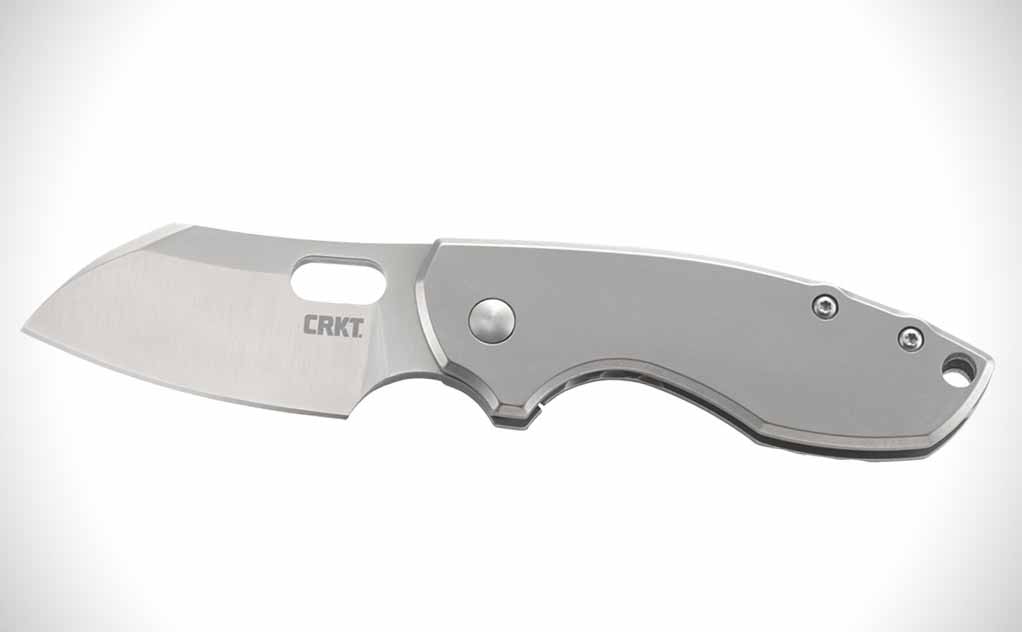
CRKT-Pilar Gent Knife

Designed by Danish knifemaker Jesper Voxnaes of Vox Knives, the size and blade shape of the CRKT Pilar are well matched for heavy cutting jobs. The handle is very comfortable and secure in the hand.

How could CRKT and Voxnaes make the knife even better? The answer is to offer a new larger version for 2019. The Pilar II offers the same performance and ergonomic advantages as the original, including robust framelock construction with an all-steel handle. The 2.6-inch blade is 8Cr13MoV stainless steel and offers a great balance of edge holding and maintenance ease. It is the Chinese equivalent of the Japanese-made AUS- 8. Due to the increase in size and blade mass, the Pilar II features a flipper, something the Pilar lacks.

Voxnaes is known internationally for his straightforward designs with a nod to utility and outdoor applications. Originally he made prototypes of the Pilar in two versions: one with a flipper tab and one without. “With lots of people asking for a flipper version, it was an easy fix,” Jesper notes. The blade rides on Teflon washers and flips open nicely without the use of pivot bearings. It also sports an oblong hole for ambidextrous opening.

The stainless steel handle supplies heft and a solid backbone. The grip’s edges are chamfered, offering comfort and eliminating hot spots or general discomfort. A solid steel spacer adds handle strength. A steel pocket clip carries the knife tip up or down for right-hand carry only. If you prefer half-and-half-type handle construction with your framelock folder—that is, each handle side comes in a different material, in this case stainless steel and lightweight G-10—the Pilar II is so equipped. The G-10 offers a bit more weight savings plus a nice grippy texture. The all-steel-handle version has weight-saving pocket reliefs milled into the inside of the scale.

“At first it may seem we simply upscaled the original Pilar design, but the knife was actually redesigned from scratch to make the ergonomics feel perfect,” Jesper concludes.
Don’t let the gent’s knife label for the large Pilar fool you. It’s a knife that isn’t afraid to get down and dirty with its rugged build and utility-friendly blade shape. Like its little brother, the large Pilar is easy to carry and rides securely in a pocket. The choil indexes your grip and the rest of your fingers fall naturally around the handle. Due to the handle shape and size, those with larger hands may find the knife too small.

However, for those whose hands are filled nicely by the grip, the large Pilar is very comfortable to hold.

CRKT Pilar Specs:
Designer: Jesper Voxnaes
Blade Length: 2.40″
Blade Steel: 8Cr13MoV
Blade Grind: Plain
Handle Material: Stainless Steel
Pocket Clip: Stainless Steel
Bolsters: N/A
Lock: Frame Lock
Weight: 4.20 oz.
Closed Length: 3.53″
Country Of Origin: China
MSRP: $39

Fallkniven FH9 MOP
Fallkniven Gent Knife

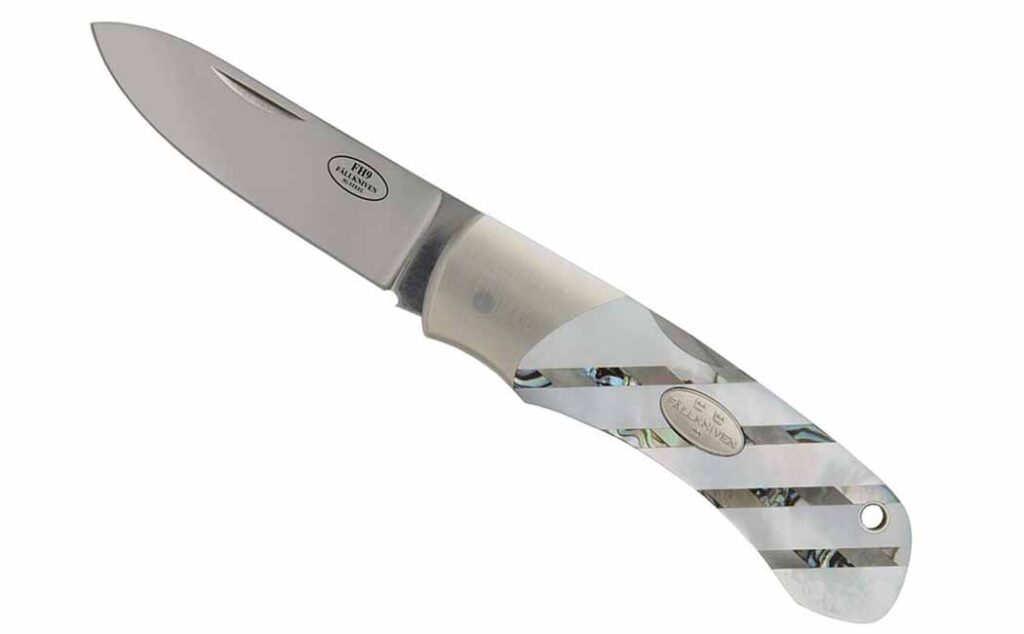
The Fallkniven FH9MOP is dressed to the nines with a mother-of-pearl handle accented by abalone and a mirror-polished blade. This is the knife you want to carry to dressy social functions, as the handle treatment sets the tone for an upscale outing or maybe even church on Sundays. According to Peter Hjortberger, Fallkniven president, the design is based on a folding hunter and a traditional lockback system.

Employing Fallkniven’s best blade material, a laminated 3G powder steel with a Super Gold steel core with a Rockwell hardness of 62 HRC, the FH9MOP is built for use. The 2.5-inch drop-point blade is neither too small nor too large. The knife is by far the best looking of the test bunch. The pearl handle and abalone accents create a stunning visual effect.

Structurally, the FH9MOP is built quite solid with dual stainless steel liners, steel bolsters and a steel handle spacer. Inlaid Fallkniven logo shields in the handle cap things off, and the blade sports a nail nick on each side for easy ambidextrous opening. A nice suede slip sheath protects the knife from rubbing up against keys, coins, etc., in your pocket.

The blade came out of the box razor sharp. I had no problem using it to open mail, cut stray threads, or any other similar gent’s knife duty. It is too beautiful a knife for the same jobs as a tactical folder, so use would be limited.

It sure is an eye-catcher, though. For a model more suited for general utility needs, step down to the standard FH9, which gives you the same blade steel but with the more work-friendly Micarta® handle material. Either way, the knives are sharpened pocket jewelry at its best.

Fallkniven FH9 MOP Specs:
Designer: N/A
Blade Length: 2.6″
Blade Steel: 3G
Blade Grind: Plain
Handle Material: Mother Of Pearl
Pocket Clip: None
Bolsters: Steel
Lock: Lockback
Weight: 3.35 oz.
Closed Length: 3.625″
Country Of Origin: Sweden
MSRP: $540

GiantMouse ACE Nibbler
GiantMouse Gent Knife
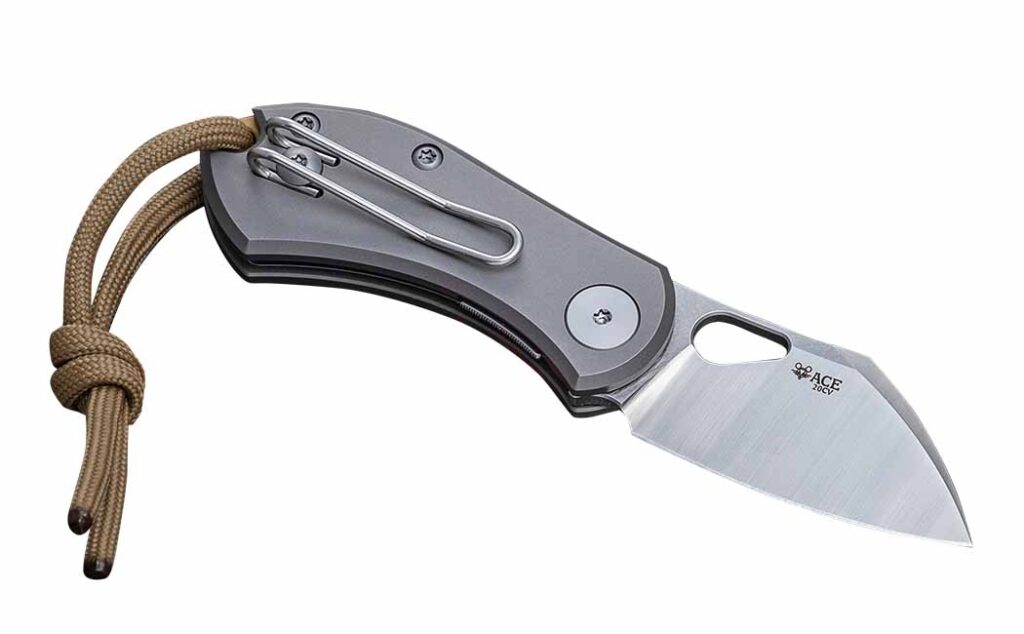
Designed by custom knifemakers Jesper Vox and Jens Anso, the Nibbler holds fast via a reversible wire clip.

“A great gent’s knife is a fully functioning tool that stands strong in the ‘looks and class’ department,” explained Jim Wirth of GiantMouse. “It’s a knife that is capable of cutting tasks but also for social events, Sunday church or a Thursday evening cocktail.”

GiantMouse makes a bold statement among gent’s knives with the Nibbler, a compact, efficient folder that Wirth says works as a great EDC in areas and situations where size matters. “Although the Nibbler is small, it packs a serious punch,” he pointed out. “Our definition of a gentleman’s knife is a knife that you can EDC in almost any environment, from the church to the office so to speak, a knife that does not raise eyebrows but will be welcomed when put to use. This could very well be the modern definition of this type of knife.”

The Nibbler is bound to fill the bill for that light-cutting job and to exude a positive image. “It’s inspired by the fictional character Nibbles ‘Tuffy’ Mouse from the hit cartoon series Tom and Jerry,” Jim explained. “Nibbles may be small but he sure is mighty, just like our new ACE Nibbler, a petite folder that packs a serious punch and doesn’t lack in the fun department, either.”

Wirth concludes that both men and women will find the Nibbler a great choice for EDC. “We don’t think that making a pink handle on a knife will make it more suitable for women,” he reasoned. “We don’t believe in designing specifically for a gender; all our knives are equally suited for men or women.”

GiantMouse ACE Nibbler Specs:
Designer: Jens Anso, Jesper Voxnaes
Blade Length: 2″
Blade Steel: N690
Blade Grind: Plain
Handle Material: Alunimum
Pocket Clip: Wire
Bolsters: N/A
Lock: Liner Lock
Weight: 2 oz.
Closed Length: 2.76″
Country Of Origin: China
MSRP: $95

Pro-Tech Newport
ProTech Gent Knife
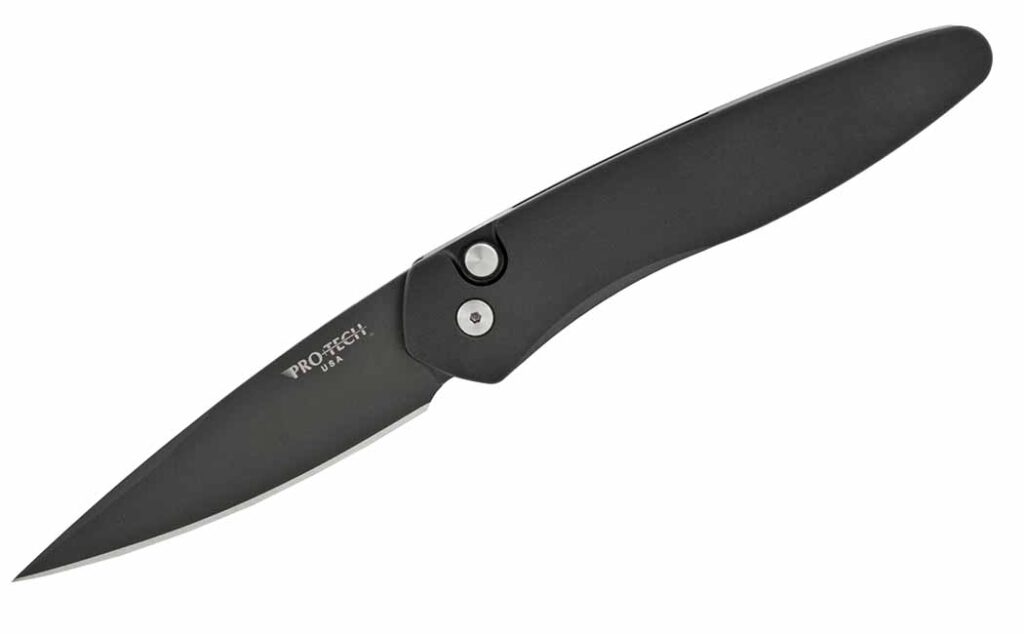
The thoughtfully designed deep carry clip and the thin, lightweight nature of the Pro-Tech Newport 3405 make it a good choice for wearing dress slacks, as it won’t tear up the pocket or be heavy enough to make it sag.

At Pro-Tech, Dave Wattenberg takes pride in the Newport, a gent’s knife that exudes personality. “It’s our thinnest and lightest full-size auto,” he commented. “It packs three inches of S35VN steel for all your EDC tasks into a precision-machined aircraft-aluminum frame that is only .38 inch thick.

The thoughtfully designed deep carry clip and the thin, light carry of the Newport make it a great choice for someone wearing a nice trouser or dress slacks, as it won’t tear up the pocket or be heavy enough to make it sag.”

Dave is excited about the versatility of the Newport, its swift deployment, unobtrusive profile, and variety when it comes to materials while running the gamut from EDC to investor/collector-grade presentations.

“From solid aluminum handle/stonewash base models all the way to investor customs, there’s a Newport model to suit just about any taste and budget,” he remarked. “Pro-Tech is well known, of course, for superior coil-spring-action auto knives, and while the Newport is no exception to this, users will find the action controlled, smooth and satisfying—not the huge snap of one of the tactical response series, but a more gentlemanly switchblade action.”

Pro-Tech Newport Specs:
Designer: N/A
Blade Length: 3″
Blade Steel: S35-VN
Blade Grind: Plain
Handle Material: Aluminum
Pocket Clip: Tip-Up
Bolsters: N/A
Lock: Auto
Weight: 2 oz.
Closed Length: 4.125″
Country Of Origin: USA
MSRP: $240

Sandrin Torino
Sandrin Gent Knife
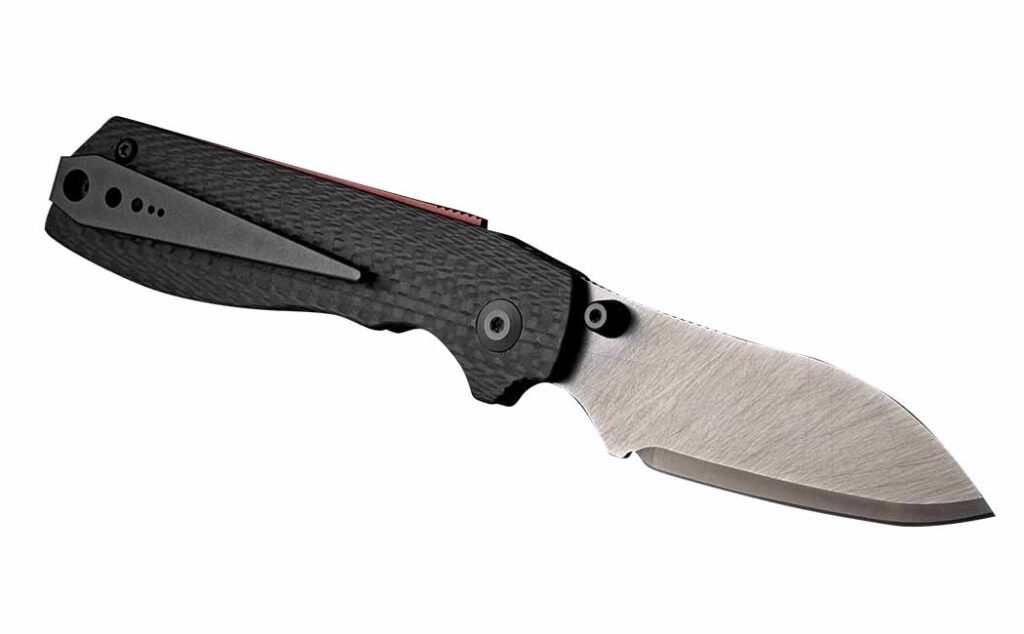
The polyhedral tungsten carbide blade of the Sandrin Torino is designed to retain its razor-sharp edge far beyond that of steel blades in Sandrin’s “StaySharp Technology.”

The Sandrin Torino exemplifies the ideals of the gent’s knife, and Sandrin’s Rob Bianchin says he knows why. “The Torino is exceptionally lightweight at only 2.29 ounces,” he remarked. “It’s pretty easy to forget that you have it in your pocket. The lightweight characteristics are deceiving as the blade performance exceeds that of a steel knife for edge retention. For anyone who can appreciate metallurgy, the polyhedral tungsten carbide blade is a state-of-the-art super metal and was not thought possible just a few years ago.”

According to Rob, the entire Sandrin knife experience is centered around the blade material. Polyhedral tungsten carbide is not steel. Instead, according to Sandrin, it is an engineered “super metal” invented and patented for blades by Sandrin director Alessandro Colombatto. “Tungsten carbide can be used for cutting steel or for wear parts that undergo extraordinary stress and corrosion,” Bianchin added. “Polyhedral tungsten carbide has advantages over steel, such as consistent molecular structure. It cannot rust and typically is in the 71 [HRC] Rockwell hardness range* or higher.”

The polyhedral tungsten carbide blade lends itself nicely to the Torino gent’s knife presentation, and Rob sees a natural fit. “In my view, the definition of a gent’s knife has evolved with the times and includes knives of quality that are also effective cutting instruments and not just for show. The Torino can be carried and used daily but is also a point of conversation as it is still exceedingly rare to own a knife made from new metal.”

The appeal of the Torino once again embraces the spectrum of potential users—both men and women, factory or office workers. “Gender is not a design consideration,” Rob said. “The Torino is suited for men or women. Men are the predominant consumers of pocketknives, but I suppose in today’s world the industry should call such knives a ladies’ or gentlemen’s folder.”

Sandrin Torino Specs:
Designer: N/A
Blade Length: 2.95″
Blade Steel: HRC71
Blade Grind: Plain
Handle Material: G-10
Pocket Clip: Titanium
Bolsters: N/A
Lock: Recoil
Weight: 2.29 oz
Closed Length: 4″
Country Of Origin: Italy
MSRP: $260

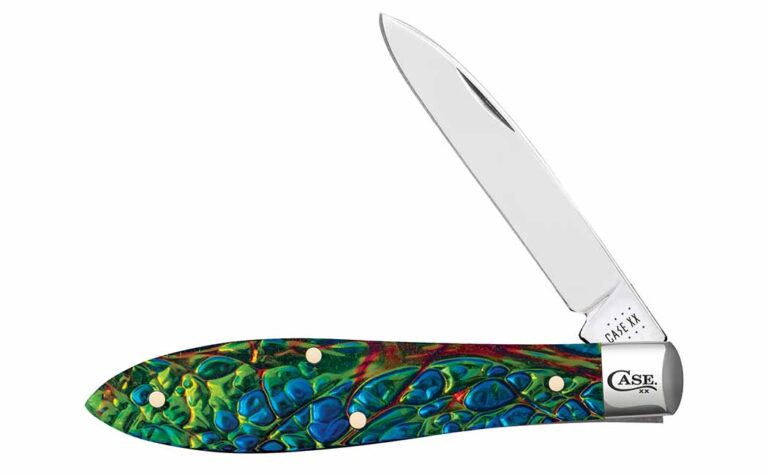
Case Black Sea Dichrolam Tear Drop
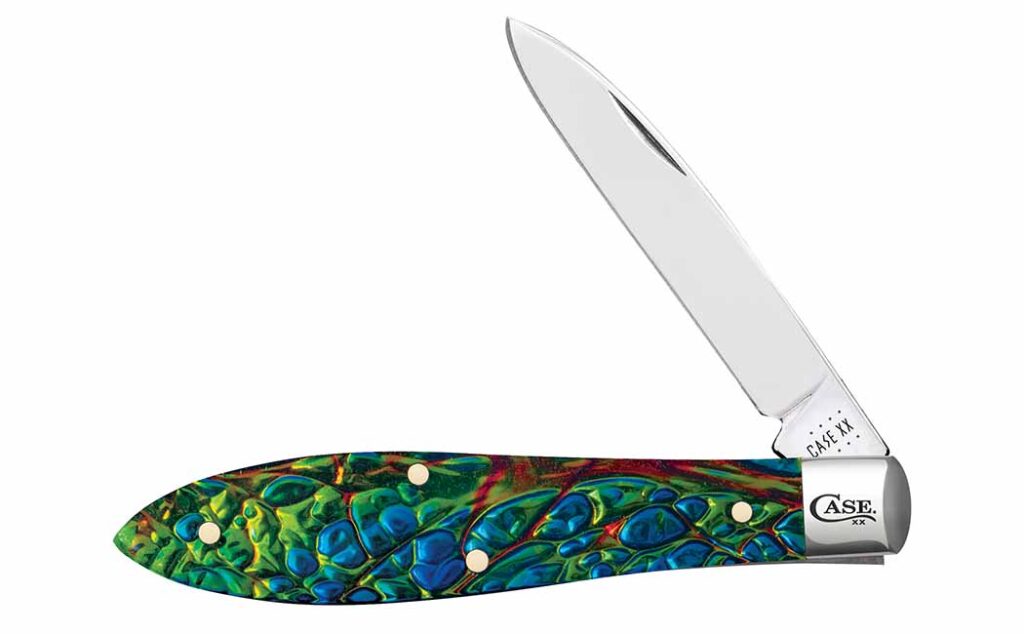
Case Gent Knife
The Case Tear Drop Black Sea Dichrolam spear-point blade is designed with a strong tip for piercing, which comes in handy for such gent’s knife jobs as opening mail, packages and the like.

Case has long been a star performer in the manufacture and presentation of gent’s knives, and the company continues the tradition with the Black Sea Dichrolam Tear Drop, a beauty with a composite handle material that mimics the luster of an opal gemstone. Fitting nicely within the spectrum of gent’s knives, the Black Sea Dichrolam Tear Drop brings excitement to the Case fan base.

“Based on our interactions with knife enthusiasts at consumer events, our Classic Case folding patterns like the tear drop are considered by many as a ‘Sunday-go-to-meeting knife,’” commented Fred Feightner, Case director of marketing communications. “But more modern knives are more and more often carried and considered to be a ‘gentleman’s knife.’ The definition lies in the eye of the beholder.”

With the new tear drop entry, Case has bridged any perceived gap between men and women as far as carrying a dressy, functional knife. “We’ve definitely seen an uptick in people carrying Case pocketknives over recent years,” Fred continued, “and they realize that a good, sharp knife is handy to have on your person for all kinds of reasons, from hiking and camping to doing detail work that’s done by hand. Whether kept in a pocket, purse or hanging on a carabiner, a pocketknife is a must have for most any person.”

For occasions when an unobtrusive EDC knife is in the mix, Case fashioned the Black Sea Dichrolam Tear Drop. “Our tear drop pattern has a single spear-shaped blade,” Fred related. “The long, sharp edge can cover everything from cutting threads on clothing to gathering fruit or nuts outdoors. The tip adds functionality for tasks like piercing through a clam shell package or scoring leather to fashion a sheath.”

Case’s tear drops, particularly the Black Sea Dichrolam, perform as excellent light-duty tools, according to Fred. The slim design and small “form factor” make them great for close-up and close-in work, handy little EDC knives that are not only up to the tasks a gent’s knife is meant to perform, but easy on the eyes as well.

Case Black Sea Dichrolam Tear Drop Specs:
Designer: John Blazy
Blade Length: 2.44″
Blade Steel: Trusharp Surgical Steel
Blade Grind: Plain
Handle Material: Dichrolam Composite Laminate
Pocket Clip: None
Bolsters: N/A
Lock: Slip Joint
Weight: 1.4 oz.
Closed Length: 3.63″
Country Of Origin: USA
MSRP: $106

Editor’s Note: Dainel Jackson, Dexture and Mike Haskew contributed to this post.

Check Out More Buyer’s Guides:

Best Multi-Tools: Multitasker Marvels

A Good Multi-Tool Can Help You In A Pinch In Numerous Ways. This Quartet Of Tools Are Up To The Task Of Getting You Out Of A Bind.

Right off the bat, anyone who needs a multi-tool on a daily basis will face one huge question when making a purchase: How much multi-tool do I need? Options abound on the multi-faceted workhorses. Blades, pliers, shears, screwdrivers, wrenches, wire strippers/snips, files, cap lifters, can openers and the like are great to have when you need them. 

The dilemma is weeding out what you do and don’t need, plus what size multi-tool you’re willing to carry. Alternatively, if you just need a multi-tool for the tool or glove box, the world is your oyster. Let’s test four diverse multi-tools that offer a wide variety of talents to help make your choice easier.

Boker Plus Specialist II

Boker Plus Specialist II

The Boker Plus Specialist II is a full-blown multi-tool with a load of tools. Like many of its type, it centers the workload around a beefy set of pliers. At the pliers’ base are a wire stripper and cutter. Tucked in the butterfly handles are a host of other tools including a knife, hex wrenches, bit driver with storage, glass breaker, file, ruler, wood saw, can opener, and bottle opener. At 10.13 ounces it’s the heaviest of the review multis, but then it also has the most extensive tool kit.

The Specialist II has a full-size pair of spring-loaded pliers with special cutting blades built into the base of the jaws—a sign that it’s serious about cutting wire and cord. I honed in on this feature by giving the cutters a go on some multi-strand computer cable, snipping off half-inch lengths. 

The blades handled cutting the cable with ease as if it were an afterthought. The assortment of tools is admirable, especially the knife and saw blades that are large enough to do some serious work, a trait not always found on multis. The nylon belt sheath is a must-have on a multi-tool of the Specialist II’s weight. Kudos to Boker for including it.

MSRP: $89.95

Paul Chen Professional Multi-Tool

Paul Chen Professional Multi-Tool

The Paul Chen Professional Multi-Tool from CAS Iberia is a large multi that, unlike many, centers around a stout pair of spring-loaded carbon steel shears that slide out on rails by pressing locking buttons on each side of the handle. 

Once the shears are out the handles separate, giving easy access to the Professional’s other tools: knife and saw blades, fold-out pliers, small flat-head screwdriver/can opener combo, Phillips head screwdriver, and removable sharpening file. There’s a pocket clip on the back side.

The Professional surprised me with how stout it is considering its low price tag. The main feature is shears that have 1.5-inch blades of carbon steel. I gave these a run through various materials such as canvas and cardboard and they cut like a walk in the park, so I upped the ante with some quarter-inch lasso rope. 

This is a very stiff, wax-impregnated rope that some blades aren’t particularly fond of. The hungry shears took off nice, clean lengths with little effort. This multi-tool is limited in scope with its tool selection—not surprising at its cost—but there are enough implements to get you by. The knife blade opens via a thumb stud and a linerlock secures it open. At 15 bucks you could buy several of these and sprinkle them in such places as the glovebox, tool drawer, and/or backpack.

MSRP: $15

CRKT Septimo

CRKT Septimo
CRKT Septimo

CRKT has never followed the pack with its multi-tool designs and the Septimo is no different. Based on a flat, compact 4.84 x 1.25 x .4-inch somewhat rectangular platform and at 4.4 ounces, the black-oxide-coated Septimo is roughly half the load of the larger test multis. 

Notable is an adjustable wrench for tightening and loosening nuts and bolts. The tanto blade has a deep Veff serration at the base and secures open via a linerlock. Other tools include Phillips and flat-head screwdrivers, a glass breaker, and a bottle opener. It has a pocket clip for easy carry.

The Septimo is a very pocketable multi-tool with an inch of its total length dedicated to the adjustable wrench/glass breaker on one end. Though the Septimo’s handle is not as comfortable as that of a typical knife, the multi’s blade did the trick slicing two-layer corrugated cardboard, paracord, and even 3/8-inch rappelling rope. 

I would have chosen a more utilitarian blade pattern like a sheepsfoot or drop point, but that’s me, and the tanto did more than enough to impress. The adjustable wrench can accept up to a half-inch bolt head. I gave it a twirl tightening and loosening a 3/8-inch bolt on a rock clamp I use doing lapidary work. The wrench did an excellent job. All in all, you’ll like the unorthodox yet effective Septimo.

MSRP: $56

SOG Flash MT

SOG Flash MT
SOG Flash MT

The SOG Flash MT multi-tool is a great companion to your SOG Flash AT folder, but don’t let that stop you should you prefer a different knife.

The Flash MT is a barebones seven-tool multi with an assisted-opening clip-point blade, full-size pliers, a wire cutter and stripper, a large combo flat-head screwdriver/bottle opener, and a small double-ended Phillips/flat-head screwdriver with a bit drive in the base. It is the only test multi-tool in which the main body is designed specifically as a conventional knife handle.

The Flash MT has an asymmetrical handle design in that one half of the butterfly grip is slim, holding only the small bits in a foldout cyan holder, while the other grip is packed with tools. The blade did a good job cutting paracord and rappelling rope. 

The wire cutter/stripper handled its chores well—not a surprise as SOG is well known for making some serious multi-tools. Using the main body of the handle with just the blade for cutting was very comfortable, with only the pocket clip feeling a tad out of place if you’re right-handed like me. 

That said, the back-side clip is right at home; in fact, it’s no different from carrying a mid-sized EDC folder. This is a well-designed multi that deserves your consideration.

MSRP: $69.95

The review multi-tools provide many choices in size and tool selection. You can go big with the Boker Plus and Paul Chen multis or lighten the load with the CRKT and SOG models. Pick prudently and you’ll have a workmate worthy of your daily workload.

Read More

10 Best Kershaw Knives Available Today

There Are Few Factory Makers As Well-Known As Kershaw. The Oregon-Based Company Continues To Innovate And Create Top-Tier Knives.

Kershaw is a beloved knife brand set to celebrate its 50th year in business in 2024. In the years since the company was founded a half-century ago, it has delivered some incredible products that continue to set industry standards today. 

Kershaw has become a staple of the knife industry at large and they represent a significant percentage of what is being regularly carried in pockets all over the country. Pete Kershaw began the company to create excellent outdoor knives and eventually partnered with  Japanese company Kai to bring more high-quality products to market. 

The modern Kershaw knife is a truly high-quality tool, and lucky for us, the company has a dizzying number of options that can fit just about any niche you may have. 

Kershaw’s Top Ten

Kershaw has a large fanbase because the company is incredibly consistent at making quality knives at quality prices. These 10 have stood out as some of the company’s best.

Kershaw Leek

kershaw leek

The Kershaw Leek is arguably the most prominent product that the company has released in recent years. This knife is the epitome of what you would consider being an everyday carry tool: it is light, sleek, and has an extremely reliable mechanism. 

The lines of the product are immediately recognizable and it has achieved iconic status among knife enthusiasts. At the time of this writing, Kershaw offers over a dozen variations of the Leek, and, while the internal mechanism is the same, you get your choice as far as cosmetic features go. Currently, handle materials range from plain aluminum or color-anodized aluminum to exciting options like copper. 

The actual copper handle material will patina over time, giving your individual knife a unique look as you carry and use it. Despite the fact that copper weighs a little bit more than aluminum and this knife costs a bit more than the other products in the Leek line, it isn’t for everyone. The Leek’s mechanism is an assisted-open type, and it is one of the more reliable and energetic on the market. In carrying Leek knives over time, the author has never had a failure to open or to remain closed. 

Leek Knife Specs

Overall Length: 7 inches

Blade Length: 3 inches

Blade Steel: 14C28N

Weight: 3 ounces

Handle Material: 410 Stainless/Copper/Carbon Fiber

MSRP: $99.99-$174.99 depending on materials

Kershaw Skyline

kershaw skyline

The Skyline was one of Kershaw’s most recognizable products. The simple, black-handled knife

was one of the more popular carry options of years past and it earned a reputation for being strong and reliable at a good price. 

There are, of course, other products that now fill its niche, but the Skyline will not soon be forgotten. Its status as a common, affordable, and reliable knife helps it make this list even though it is no longer available. 

Many Kershaw fans have lamented the decision to axe this otherwise popular knife, and it has achieved a moderate collector interest since early 2021 alongside the Shallot and Camber, themselves very well-received by fans of their respective styles.

Skyline Knife Specs

Overall Length: 7.4 inches

Blade Length: 3.1 inches

Blade Steel: 14C28N

Weight: 2.5 ounces

Handle Material: G-10

Kershaw Lucha Carbon Fiber

lucha carbon fiber

At a hefty $500 retail the Lucha in carbon fiber is one of the more unique and interesting offerings currently had by Kershaw. This balisong is arguably one of the highest quality production blades of its type. Even custom options available on the market may not be able to match the Lucha in terms of overall fit and finish at the price. 

For fans of this type of knife, this is certainly a holy grail item, and it boasts some very nice features. The blade rides on KVT ball bearings for exceptionally smooth handling. At a full ounce lighter than the original model, the carbon fiber Lucha features striking handles that are composed of blued titanium and overlaid carbon fiber. 

The price is quite hefty for an EDC knife, though it’s without a doubt worth it to the person who loves flipping and twirling. While the fidget spinner craze ended a few years ago, you’ll probably find yourself playing with this knife in your hand more than you will end up performing cutting tasks with it. 

Lucha Carbon Fiber Specs

Overall Length: 10.25 inches

Blade Length: 4.6 inches

Blade Steel: CPM 20CV

Weight: 4.9 ounces

Handle Material: titanium with Carbon Fiber Overlay

MSRP: $499.99

Kershaw Federalist

federalist

Taking a departure from today’s tactical and overbuilt blades, the Kershaw Federalist is a rugged gentleman’s knife that has a number of interesting and tasteful features. While the company does make a number of traditional styles of gentlemen’s knives, the Federalist is geared for that man of taste that still has to get some work done throughout the day. 

This knife has a more traditional closing and opening mechanism reminiscent of the knives of yesteryear. It has a nail nick for opening and lacks any assist mechanism. In fact, the company lists this blade as a non-locking slipjoint with a dual-detent system. You’ll likely want to save this knife for general tasks and leave the heavy lifting to a more substantial tool. 

In place of polished wood and silver inlay, the Federalist features green Micarta grip panels and a matte finish. Seeing as how assisted opening and larger, tactical-style blades have the majority of market share, it is refreshing to see that Kershaw is still catering to people who view knives as simple, everyday objects.

Federalist Knife Specs

Overall Length: 7.5 inches

Blade Length: 3.25 inches

Blade Material: CPM 154

Weight: 2.1 ounces

Handle Material: Micarta

MSRP: $169.99

Kershaw Launch 14

Launch 14

The Launch 14 is a large, automatic opening, cleaver-bladed knife. This is a hard-use tool that has the looks of a collector’s piece. Not all automatic-opening knives are meant for daily use, but this one breaks the mold and is geared for any task you may find on the job site or in your daily adventures. 

The cleaver blade is not for everyone. Some people prefer to have a distinct drop point while others definitely prefer the more adaptable Wharncliffe style. The knife lacks a true puncturing tip, which to some could be considered a detriment. The steep tip angle on these cleaver-type blades is actually excellent for true cutting tasks where spear point or drop point blades may be too fragile. 

Using a cleaver-style knife for puncturing can be achieved, although the stout angle of the tip may be too coarse for fine work. When it comes to cutting things like straps and heavy tubing, the type of knife we see here definitely excels. The Launch 14 is elegant in its execution and has very functional, subtle features, such as a recessed opening button and carbon fiber panels.

Launch 14 Knife Specs

Overall Length: 7.75 inches

Blade Length: 3.375 inches

Blade Steel: CPM 154

Weight: 3.2 ounces

Handle Material: 6061-T6 Aluminum, Carbon Fiber Scale Front

MSRP: $239.99

Kershaw Reverb XL

Reverb XL

Borrowing the same features as its smaller namesake, the Reverb XL is a daily carry knife that has a wide range of uses for the outdoors. The knife has a long, upswept blade, reminiscent of fillet knives. Because of its size and light weight, it makes an excellent companion for the fisherman who enjoys working out of a canoe or kayak. 

The knife doesn’t take up much space and doesn’t require an additional sheath. Not only that, at under $50, it won’t cause you financial issues if it accidentally falls overboard. The knife is very simple in terms of operation, it is a manually opening blade with a liner lock. 

Although it lacks a fast opening blade, the discerning outdoorsman or angler shouldn’t find this to be an issue, considering that once the blade is out, it is likely going to get used for quite some time. If you find yourself in coastal towns, or perhaps going for a cold one after a fishing trip, this knife will not stand out like a fixed blade will.

Reverb XL Knife Specs

Overall Length: 7.4 inches

Blade Length: 3 inches

Blade Steel: 8Cr13MoV

Weight: 2.2 ounces

Handle Material: G10 with Carbon Fiber Overlay Front

MSRP: $53.99

Kershaw Lonerock RBK2

Lonerock RBK2

Knives with replaceable blades are something that have been around for quite some time. In the last 10 years, we’ve seen a greater interest in this style of knife, if you can even call it a knife in the first place. 

The Lonerock RBK2 is a kit that includes a main, folding handle assembly, and a non-folding ‘buddy’ handle. The ‘buddy’ is simple and non-folding, but takes the same blades as the folding assembly. The basis of this system is meant for hunters as a means to keep sharp blades at the ready with no additional maintenance. 

Keeping a good edge on the blade is no easy task in less than ideal conditions. Many people think that sharpening is as simple as pulling the blade through an off-the-shelf sharpener, but inevitably every knife needs to be professionally re-edged at a certain point. If your blade is replaceable, you shouldn’t have to worry about that latter part of the process. If the knife goes dull, simply pop in a new blade and keep working.

Lonerock RBK2 Knife Specs

Overall Length: 7.2 ounces

Blade Length: 2.8 ounces

Blade Steel: #60A

Weight: 1.4 ounces

Handle Material: Glass-Filled Nylon, Rubber Overlay

MSRP: $59.99

Kershaw Interstellar

Interstellar

At just under $60 retail, the Interstellar is a mean looking knife that has function at its heart. While it appears to be an out-the-front automatic, the Interstellar is instead a manual knife that opens in the same way as a standard box cutter. The blade features a serrated tanto point and has an affordable price to match its rugged looks. 

Kershaw lists this knife under their work knife category, and while it looks tactical, this knife is perfect for the job site. It is easy to use with heavy gloves on, and is excellent for controlled, one-handed operation. The tanto point is excellent for getting into those tight spaces and it is serrated for cutting through various types of cord and material. 

People that work with materials like drywall will enjoy its ability to score easily before cutting. If basic folders and box cutters aren’t your style, you should really consider the Interstellar for your daily use. After a long day, you may want to break open some cold ones, and the Interstellar comes with an integrated bottle opener in its frame. 

Interstellar Knife Specs

Overall Length: 6.9 inches

Blade Length: 2.7 inches

Blade Steel: 8Cr13MoV

Weight: 3.1 ounces

Handle Material: Glass-Filled Nylon

MSRP: $71.99

Kershaw Blur With Glassbreaker

Blur Glassbreaker

The Blur is a rugged and popular design from Kershaw. Not only is it a suitable knife for daily carry, the glass breaker version is a simple-to-use and affordable rescue tool. Similar to Kershaw’s other assisted opening knives, the Blur can open with one hand and is ready to go into action. The glass breaker can be used with blade open or closed. 

Additionally, the particular model we are talking about here also has a deep, swept belly with aggressive, scalloped serrations. This type of situation should make quick work of seatbelts or other types of common materials found in vehicles if someone needs to be removed quickly after an accident. 

This knife features a pointed tip, so unlike other types of rescue tools that are designed to be completely blunt, you will need to take care not to accidentally stabbed or cut someone you were trying to free with this tool.

Blur Knife Specs

Overall Length: 7.9 inches

Blade Length: 3.4 inches

Blade Steel: 14C28N

Weight: 3.9 ounces

Handle Material: 6061-T6 Aluminum, Trac-Tec Inserts

Kershaw/Emerson CQC-10K

CQC-10K

Emerson is well known for producing some exceptional tactical knives. The company needs no introduction here, and luckily, for us, they have collaborated extensively with Kershaw. 

This particular knife, the CQC-10K, is striking to look at with its green scale handles and aggressive, Bowie tip. The knife features the patented Emerson Wave Feature that allows for an otherwise unassisted knife to open instantly upon draw. With practice, this knife can be drawn and opened in a fraction of a second, even faster than can be attained with an assisted opening mechanism. 

This knife is not just for self-defense situations, it is ruggedly built, and should be an excellent friend for the field and trail. Thanks to its fine point, it can also be used for tasks such as fishing or skinning small game.

CQC-10K Knife Specs

Overall Length: 8.5 inches

Blade Length: 3.5 inches

Blade Steel: 8Cr14MoV

Weight: 5.1 ounces

Handle Material: G10 Front, 410 Stainless Steel Back

MSRP: $74.99

Read More

Best Ulu Knife: Background And Buyer’s Guide

The Ulu knife has grown in popularity in recent times. We cover the origin of this traditional knife of the north, how it’s used and some of the best modern options.

The Ulu knife has become increasingly popular in recent years among chefs, ardent home cooks, homesteaders and more. Traditionally a food preparation knife, this unique blade has come to be used for various household, hunting, cooking, and survival tasks.

Today we’re going to take a close look at this incredibly versatile tool, including its fascinating history among the native peoples of Alaska, how it is used, and how it stacks up against other similar knives. Then we’ll take a deep dive into the top 8 best Ulu knives currently on the market.

Let’s get started.

History of the Ulu Knife

The Ulu knife has its origins as a traditional tool used by the Inuit, Iñupiat, Yupik, and Aleut people of Alaska, Canada, Greenland and far Western Russia. Throughout history, these knives were used primarily as tools around the home, including for sewing, food preparation, and butchery—depending on the size of the knife.

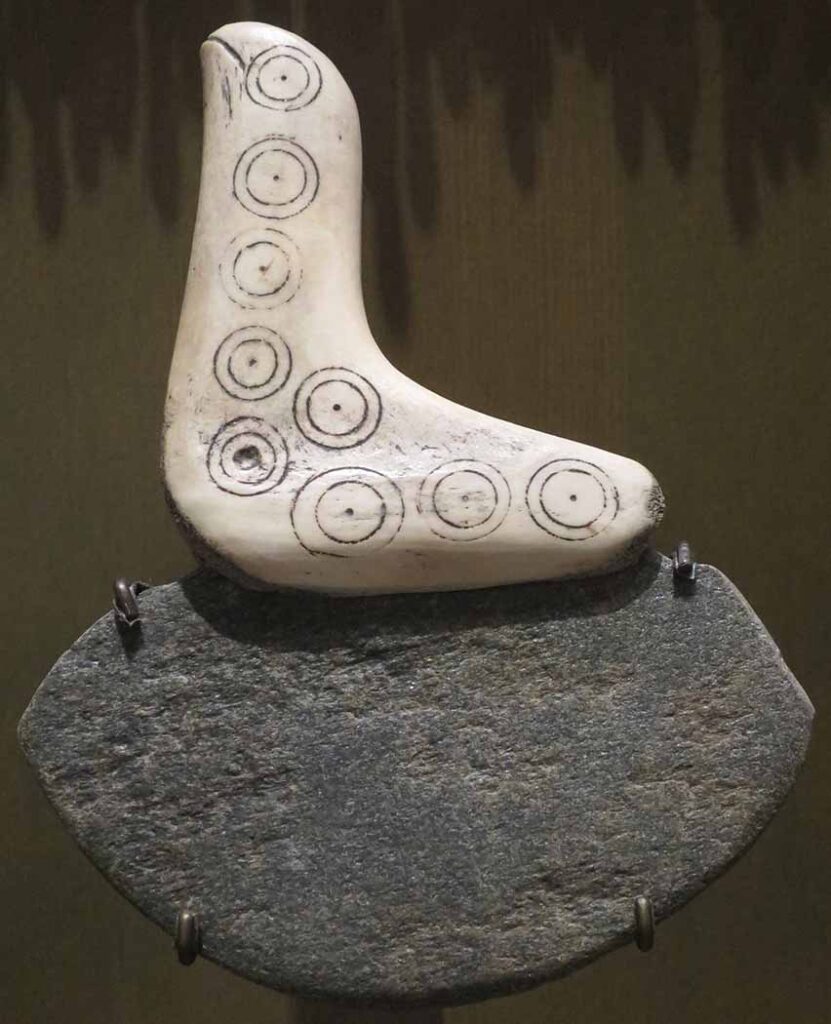
Originally made with a walrus ivory, muskox horn, or caribou antler handle with a slate blade, modern Ulu is typically made with a wooden handle and steel blade, often reforged from a bartered saw or spade blade in traditional communities.

Alaska Slate Ulu
Photo: Wikipedia

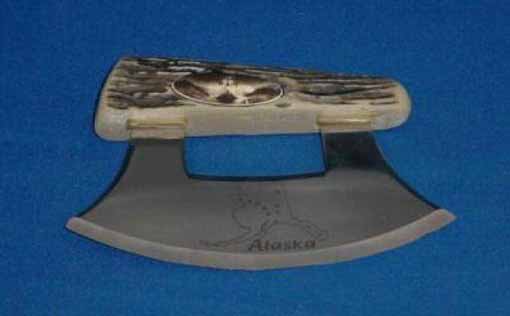
While materials have changed, the design has remained much the same, with a wide, curved-edge blade mounted in front of where your knuckles when gripping the handle. It’s almost like a push dagger but with a wide, single-edged blade on the same axis as the handle.

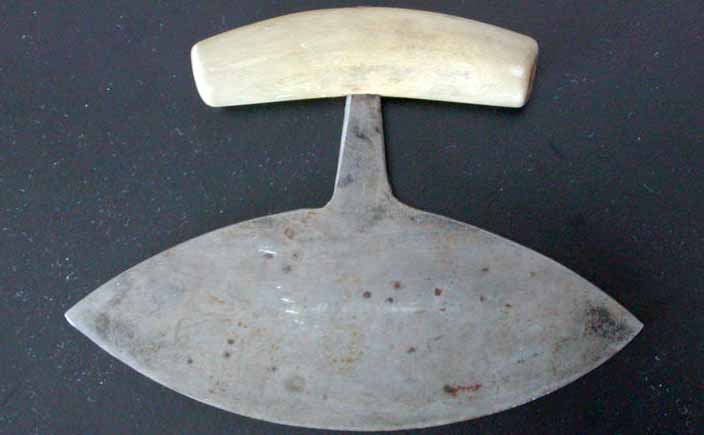
There are a few regional variations where the blade is attached by a central stem to the handle, but in most versions, the handle is attached at each end of a curved blade.

Today, the knife is growing in popularity all over the world for food preparation, while still being used every day in the indigenous communities where it was first brought into the world. The Alaskan style is most prevalent, with a wide, crescent-shaped blade attached at one or both ends to the handle, but there are definitely other versions out there as well.

Using the Ulu Knife

The Ulu knife has a curved blade designed primarily for either a scraping or in a rocking motion, but it can also effectively chop and slice much like a Western-style chef’s knife.

It is very similar to a sharpened bench scraper in some ways, and can easily be used to gather up chopped ingredients. It can also be used to break down a carcass and is very efficient at chopping through bones, much like a heavy cleaver.

Alaska Style Ulu
Photo: Wikipedia

Smaller versions are also traditionally used for household tasks like sewing, working with hides or leather and even wood carving. Larger versions with blades up to 12 inches are also sometimes used as everything from a cleaver to a draw knife.

For most people though, the Ulu is a kitchen tool, something to make prepping meats, fruits, vegetables, and herbs easier when getting lunch or dinner ready. It has a variety of uses beyond that, but for most, it has earned its reputation as a stellar kitchen tool.

Pros and Cons of the Ulu Knife

The Ulu knife is an extremely useful knife, and very versatile, but it can’t quite do everything. Here are some pros and cons of this awesome traditional tool.

Ulu Pros

Kitchen Prep: First and foremost, it’s great for most kitchen prep tasks. Fileting a fish or carefully deboning a chicken might be a struggle, but for everything else, it is a very fast and effective way of taking big chunks of ingredients and making them smaller.

I personally love using one to chop herbs and leafy vegetables where the wide blade and curved profile make long rocking and slicing motions feel very nice. If you frequently find yourself chopping up fresh herbs from the garden, this is a great tool to have on hand.

Game/Meat Processing: It also does a great job of breaking down animal carcasses, as well as dealing with large chunks of meat like a rack of ribs or a whole chicken. That wide cleaver-like blade may not be ideal for chopping through something like beef neck, but for smaller bones you can easily press the blade against, you’ll have no trouble at all.

It’s also very good for scraping meat off of a bone, quickly chopping up root vegetables, halving large fruits or vegetables like navel oranges when you’re making juice and things of this nature. It also makes a phenomenal pizza cutter (which is one of the primary uses mine sees).

Bushcraft: Outside of the kitchen, it is of course still a sharp piece of metal with a handle, so its use is limited only by your own creativity. They work great for a variety of camp tasks, so if you’re looking for one knife that can really do it all in the backcountry, you could certainly do worse.

Splitting small pieces of wood, making feathersticks, carving a quick replacement tent stake, cutting cordage, and other similar tasks are all well within the Ulu’s abilities.

Photo: WikiCommons

Ulu Cons

Cutting-Style Adjustment: The biggest problem with the Ulu knife is that using it requires a bit of a different motion than your typical Western-style chef knife, or even something like a Santoku because of the handle’s placement.

The chopping or slicing motions you’re used to are going to take some adjusting if you want to use an Ulu effectively. It’s not a huge change for most people, but if you have a lot of muscle memory and knife skill with more common kitchen knives, it is definitely an adjustment.

Somewhat Limited Scope: The other big issue is that the size and shape of the knife make it unsuited for some tasks, but you can say the same thing about any knife really. Still, you’re going to have a rough time filleting a small fish with this knife.

Other than that, the handle design of the Ulu makes things like slicing through very thick material or produce difficult if not impossible, so reach for something else when carving through something like a large watermelon or what have you.

Buyers Guide: 7 Best Ulu Knives on the Market Today

Now, let’s take a look at the best Ulu knives on the market today. These are the knives that offer something beyond the competition in terms of value, features, design, or workmanship.

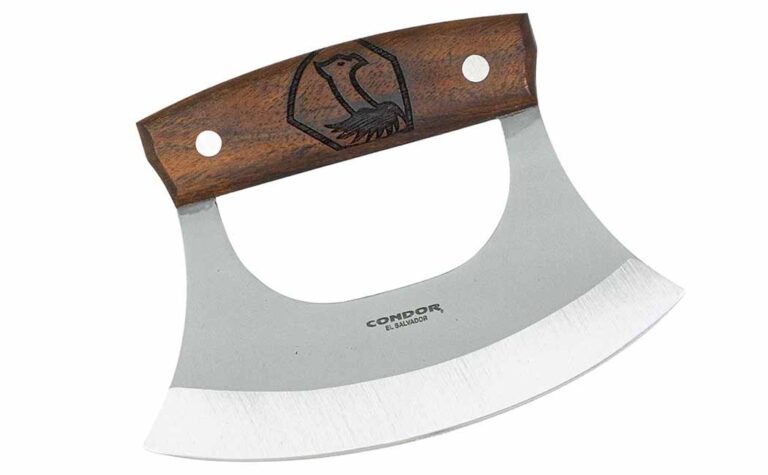
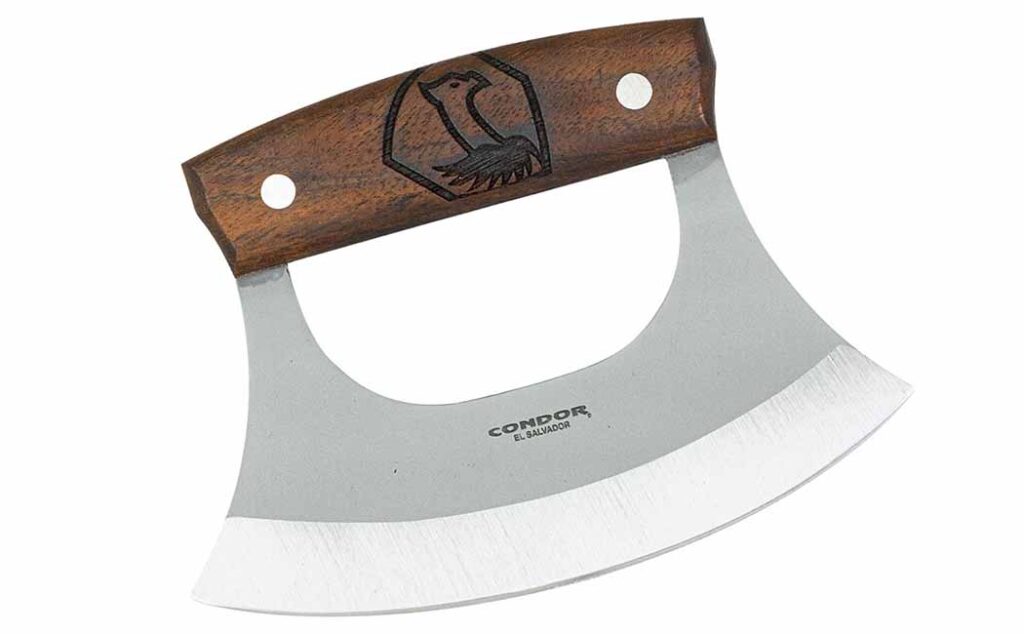
Condor Ulu Fixed Blade Knife Walnut Wood

Condor Ula

Condor Tool & Knife has made a name for itself across the knife world by providing high-quality knives to meet a variety of needs (and budgets). Their take on the Ulu is made in a very traditionally-Alaskan way, with a curved blade attached to a handle at both ends.

The beautiful walnut handle is engraved with Condor’s logo and features stainless pins attaching it to the blade. The handle is very comfortable and shaped well for most hand sizes. This may not be the knife to hand your kid when teaching them to chop veggies for the first time, but beyond that, it should work well for just about everyone.

The blade itself is 6-inches long and is made of high-carbon 1075 steel, and is hollow ground with a thin edge to facilitate chopping, slicing, dicing, and other kitchen tasks. The knife also comes with a welted leather pouch that is made by hand.

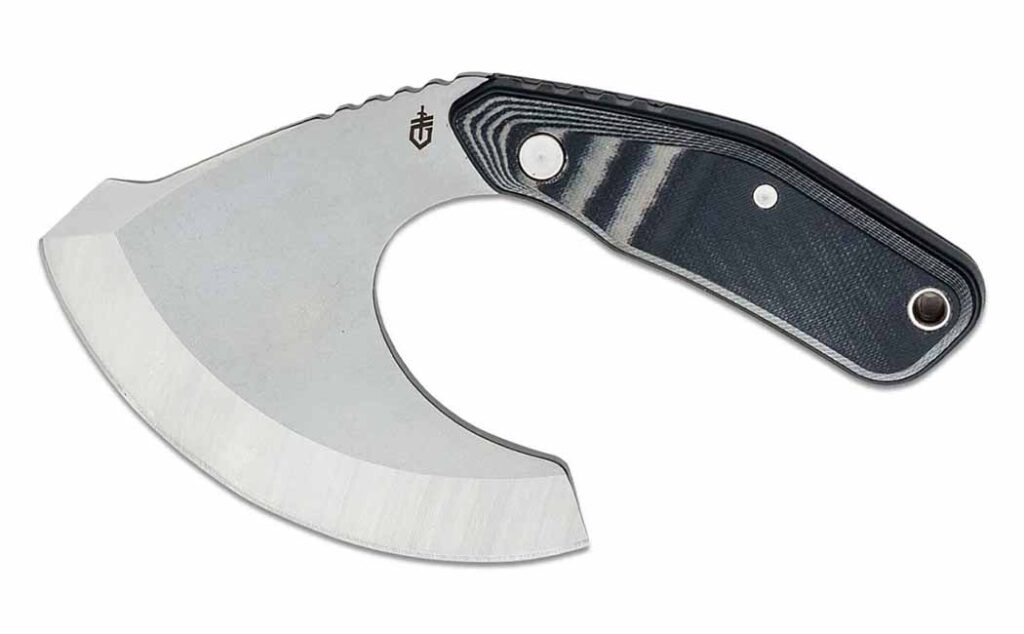
Gerber Downwind Ulu

Gerber Ulu

Gerber’s budget-friendly knives often offer great value for the money, and their Downwind Ulu is a great example of this.

Made of high-chromium stainless steel like many mid-range survival knives, the Downwind Ulu is a great camp knife for folks who like cooking more involved meals in the backwoods, and it can still be used for other camp tasks.

It uses a more modern design, with a handle that is more like a cleaver or a small hatchet really, but the overall ergonomics are still very much in line with the traditional Ulu. If you’re looking for a hybrid between your typical chef’s knife and an Ulu, this is a great option.

The handle is a very grippy G10 that is comfortable in the hand, even if you have wet hands, and there is considerable jimping on the spine of the blade to give you extra grip when doing detailed work like skinning game or gutting a fish.

The blade is 3.5 inches long and made of 7Cr17MoV steel.

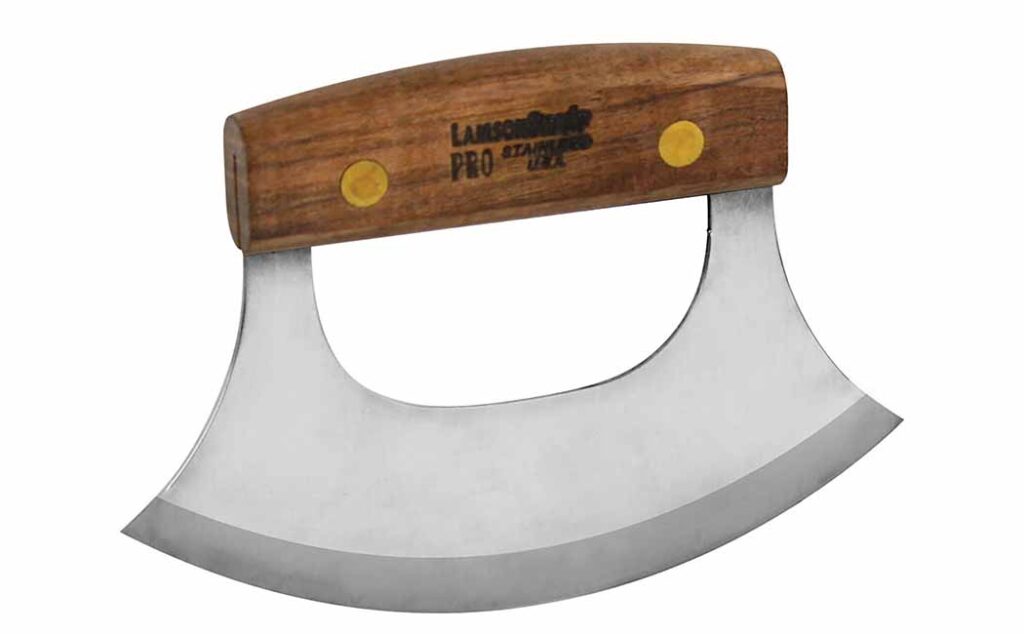
Lamson Ulu Knife

Lamson Knife

The Lamson Ulu knife is another take on the classic Alaskan Ulu and is made in America. It features a natural walnut handle that is affixed with brass rivets and uses a half-tang construction.

This particular Ulu is made in Massachusetts and is hand finished and sharpened to give it that extra bit of polish. The blade is a high-carbon stainless tempered to a 58 Rockwell hardness so it holds an edge well without being brittle or prone to rolling when cutting something tough.
It also comes with Lamson’s lifetime warranty, which covers any manufacturing defects in perpetuity, and also includes a lifetime of professional sharpening so when you do need to give the edge a touchup, you can send it to them if you don’t feel like doing it yourself.

If you’re looking for a budget-friendly Ulu to use for processing vegetables, slicing pizza, and dealing with other food-prep tasks, this is a great option that will look sharp (pun intended) in any kitchen.

The blade is 3 inches wide (on this version, there are several) and made of 420-HC LAM S/S steel.

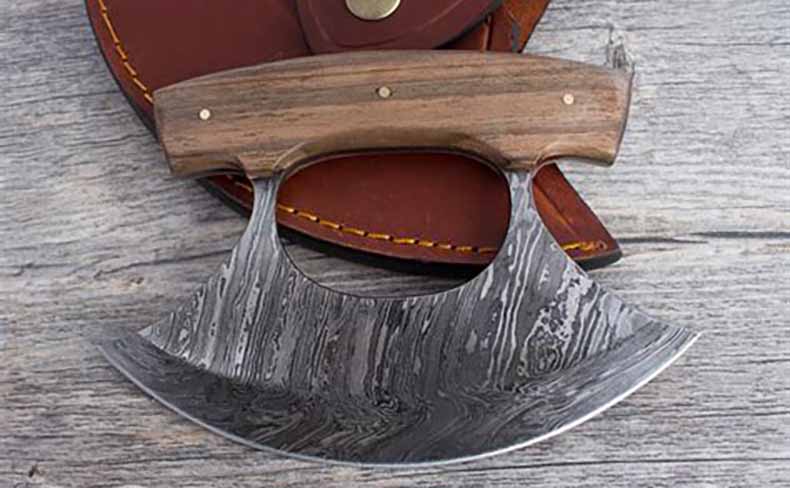
Ezina Designs Walnut Inupiak

Ezina Knife

This knife by Ezina Designs is made by North Star Knife & Ulu Company and is handcrafted to be rugged and durable in real-world use. This knife is made in Alaska, and the beautiful damascus blade is made of 1074 and 15N20 carbon steel and features a high nickel content.

This high nickel percentage contracts the grain of the metal and helps it resist corrosion so it can stand up to some heavy use and abuse in the field. The gorgeous walnut scales hide a full-tang construction, and the whole handle is set together with three brass through-pins.

It also comes with a handmade leather pouch sheath that Ezina Designs will custom engrave for you with three characters of your choosing, making this a phenomenal gift for the chef or foodie in your life, especially if they also love the outdoors.

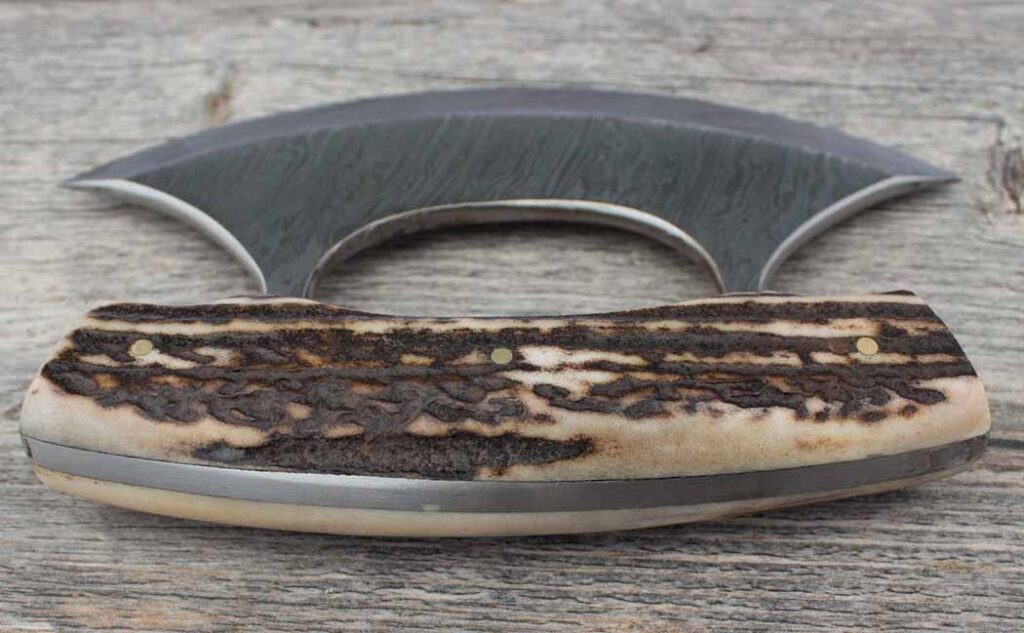
Ezina Designs Antler Mini Ulu

Ezina Antler Handle

Another North Star Knife & Ulu product, this smaller Ulu has a 4” blade that makes it a bit more portable, or perfect for storing out of sight and out of mind with a small cutting board in something like a camper or boat.

It features a gorgeous antler handle, and the same awesome damascus steel featured in the above offering. Because it has such a small blade (relatively speaking at least) it utilizes the more Western style of Ulu more common in Greenland with a thick singular stem connecting the blade to the handle, as opposed to the handle being connected to both ends of the blade.

Overall, if you like the traditional aesthetic and want a small vegetable chopper or camp knife, this is a great option.

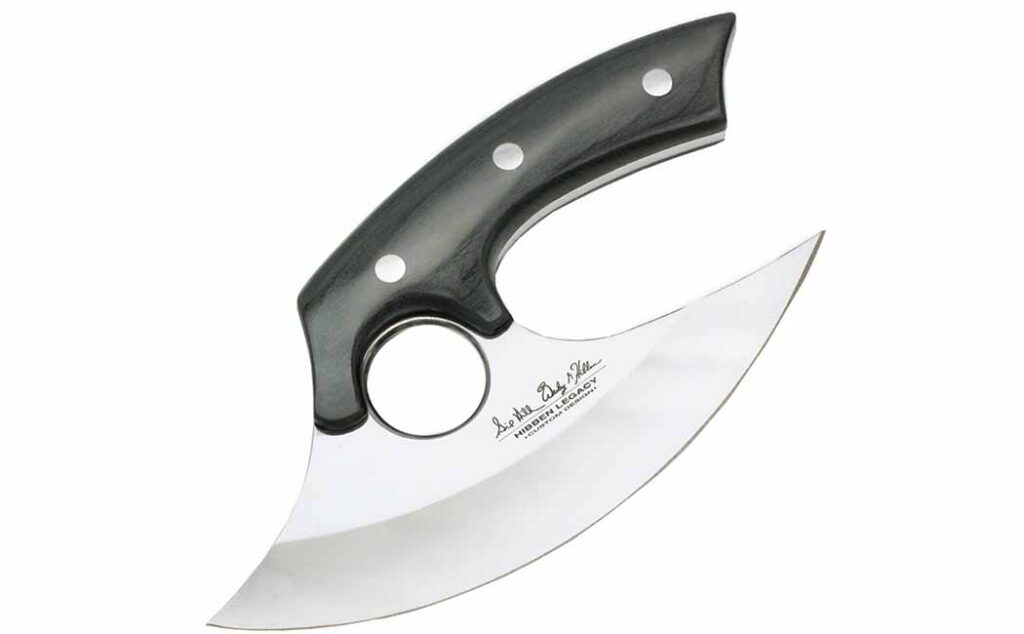
Hibben Legacy Ulu Knife

Hibben Ulu

Gil and Wes Hibben are both legends in the knife world, so it’s probably no surprise that they’ve turned their attention to the Ulu. Their take on this traditional knife has a modern design, which you probably expect if you’re familiar with their work.

The stainless steel blade is attached to one end of the handle in the updated hatchet-like fashion we see with some modern Ulus and is 6.5” in length so it’s perfect for kitchen and camp tasks. The stainless doesn’t hold an edge as well as some of the carbon steel options on this list, but of course, will be more resistant to corrosion and rust.

The blade on this thing is beefy so if you’re looking for something to really hack into thick pieces of meat or chop through bones, this is a great option. It’s also durable enough for some tasks around camp, making this a great one for the backcountry cooks out there.

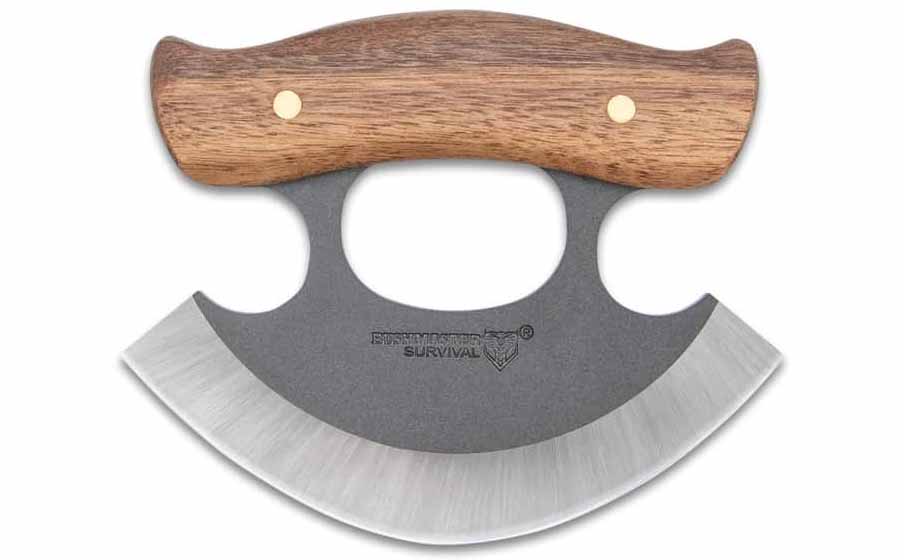
Bushmaster Survival Ulu

Bushmaster Survival Ulu

Lastly, we have the Bushmaster Survival Wilderness Ulu, which moves away from the kitchen knife style and more into a true survival or camp knife. It has a very beefy blade made of 1095 high-carbon steel.

If you’re looking to process large game, hack up a rack of ribs, or split some decent-sized logs for the fire, this is the option for you. The hardwood handles are curved to fit most hand sizes, and secured with brass pins.

This Ulu is just under 4.5-inches overall, which makes it a great choice for a variety of camp chores as it’s not too big or too small for most of what you’re likely to have to do out in the woods. At home, it still chops vegetables just as well as any other option we’ve got.

Final Thoughts on the Ulu Knife

The Ulu knife is a great example of traditional wisdom and design that still very much has a place in our modern world. The old saying “If it ain’t broke, don’t fix it” very much applies here, with this knife that is just as at home in our modern world of hustle and bustle as it was in the native communities it originated in thousands of years ago.

Check Out More Buyer’s Guides:

Benchmade Bugout Review: Getting A Handle On The EDC Icon

Is there a perfect EDC knife? If not, the Benchmade Bugout will do until perfect shows up.

When it comes to EDC folders, without a doubt the Benchmade Bugout is the king of the hill.

Its compact profile and just-right length make this model a popular hit with knife guys. It is all made in the USA with excellent fit, finish, and—perhaps key to EDC—Benchmade has cut its weight to the bone. Furthermore, the blade steel is premium level. In short, the Bugout is geared to go the distance.

So, if you haven’t yet checked out this icon, it’s high time you did. Because, if you take your everyday carry seriously, you owe it to yourself. We’ll lay a foundation for the knife in this article.

Bugout Blade

The Bugout is offered in two sizes—the Model 535, the company’s standard-sized version boasting a 3.2-inch blade, and 533 Mini, which pars the blade down to a very manageable 2.8 inches.

Benchmade Bugout Open
Standard-model Bugouts sport CPM S30V steel blades, however, S90V and M390 are available on higher-grade models. Photo: Marty Stanfield

The base models Bugouts use premium CPM S30V steel, a steel that is used widely for high-end factory knives. This is mainly due to its ability to hold an edge for an extended period, longer than most blade steels. Additionally, it is highly resistant to stains and corrosion.

As for the blade profile, the Bugout is a modified drop point and is highly adaptable to many tasks. Nicely, Benchmade outfits the knives with thumbstuds on either side of the blade, permitting ease of opening with either hand.  

Getting A Handle On The Bugout

The handle of the base Bugout is made from molded Grivory, making the Bugout a very lightweight folder. The standard size tips the scales at 1.85 ounces and the Mini at 1.5 ounces. Benchmade offers other handle material options, including anodized aluminum, carbon fiber, and CF Elite (a glass-reinforced nylon synthetic material that is lightweight and stiff).

Benchmade Bugout Spines
Given there is a thriving aftermarket for Bugout scales, the sky is the limit on the knife’s handle. Photo: Marty Stanfield

And if you have to have custom, there are aftermarket scales for the knife in a host of materials—titanium, copper, brass, bronze, G-10, and Micarta. In turn, you can truly have a one-of-a-kind feel and look to your Bugout.

Bugout Action

The Bugout uses Benchmade’s critically acclaimed Axis Lock crossbar lock, hailed by many as ultra-strong yet extremely safe because you don’t put any fingers in the path of blade travel. Add on to this, it’s easy to unlock with either hand, and you have a naturally ambidextrous across the board. The lock is simple, just pull back on one of the exposed lock bar ends at the back of the handle and then rotate your blade closed. Internally, two Omega-shaped springs provide constant tension for the lock bar on the blade tang to ensure positive lock engagement.

Benchmade Bugout Axis Lock
The Bugout is outfitted with Benchmade’s rock-solid Axis Lock crossbar lock, which has the added benefit of being ambidextrous. Photo: Marty Stanfield

As for other odds and ends, the handle’s checkering does a great job of preventing your hand from slipping. A deep carry, fold-over pocket clip carries the Bugout deep in your pocket and can also be switched to provide easy carry for left-handers. Integrated lanyard hole permits the use of Paracord for a lanyard if you are into that sort of thing.  

Using The Bugout

In use, the Bugout hits hard in spite of its ultra-lightweight stature. The flat ground blade bites in and is very effective. Opening mail, opening packages, peeling an apple, cutting up hose, cutting cardboard, or stripping wire—the Bugout won’t break a sweat. Perhaps the best way of thinking about the knife is as a minimalist working folder.

The higher grades of the Bugout have carbon fiber handles and milled aluminum handles, paired with S90V and M390 blades respectively. These upgraded blade steels offer high-performance cutting with excellent edge holding. The higher-grade handle materials give a bit more heft to the Bugout as well as an enhanced, high-tech appearance. It only makes sense to have upgraded blade steel with upgraded handle material. 

Benchmade Bugout Closed
Overall, the knife is lightweight, rugged and more than capable of tackling most task. In short, it’s dang near the perfect EDC option. Photo: Marty Stanfield

Even with the base model’s S30V, you still pack plenty of muscle for those long-cutting jobs. I like how thin the Bugout’s blade stock is combined with the flat ground blade bevel giving it plenty of bite to it. 

Some knife folks favor not a high performance without the bulk. I get it, it all makes for a comfortable everyday carry folder. For those of you who favor these kinds of knives, the Benchmade Bugout is for you. You have a high-end blade steel with a proven and popular blade lock, with a no-frills handle design. 

MSRP for the full-size Bugout starts at $180 and varies up from there depending on handle material and blade steel. There is also a Mini Bugout which scales the size down some to an even more pocket-friendly size.

Go here for more information on the Benchmade Bugout.

Bugout Model 535 Specs
Blade length: 3.2″
Blade thickness: 0.090″
Overall length: 7.4″
Weight: 1.85oz
Blade material: S30V
Handle material: Grivory

Mini Bugout Model 533 Specs
Blade length: 2.8″
Blade thickness: 0.090″
Overall length: 6.5″
Weight: 1.5oz
Blade material: S30V
Handle material: Grivory

More Knife Reviews:

Keychain Knives: Unlocking The Secrets To The Convenience Blade

Handy keychain knives are pocket pards ready to sever and serve.

As competitive as today’s cutlery market is, it behooves a factory knife company to fill as many categories as it can—including the keychain knife. In fact, keychain knives offer a number of the same utilitarian functions as many contemporary tacticals and EDCs. Whether you need a small knife to handle daily chores or a back-up to your back-up in an emergency, a keychain knife can answer the call.

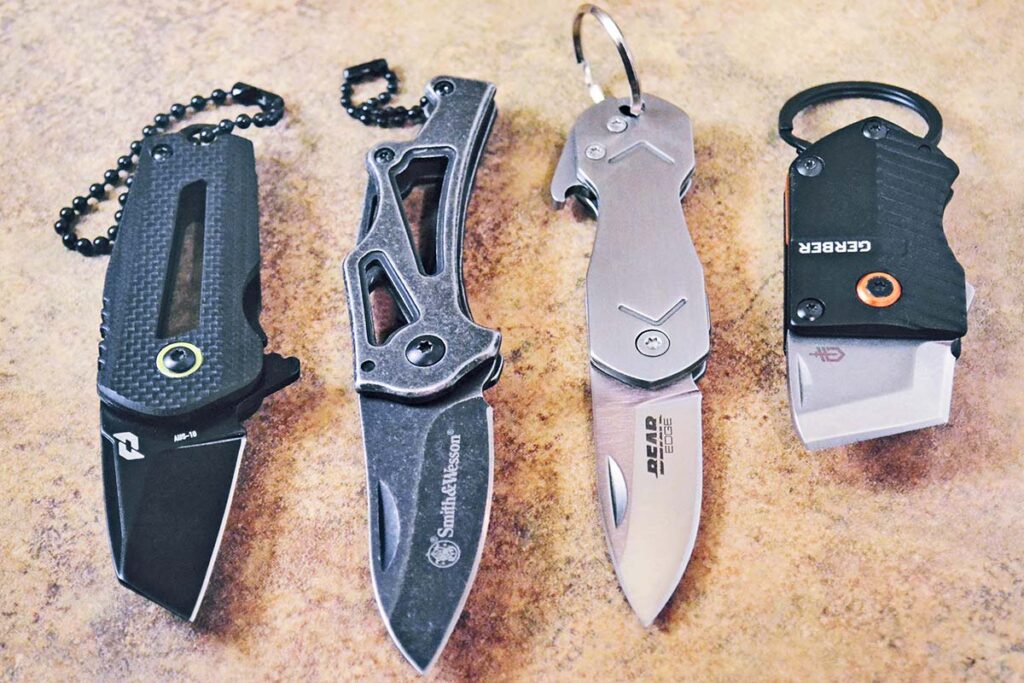
Keychain Knives
The test bunch, from left with manufacturer’s suggested retail prices in parentheses: Schrade Roadie ($25.99), Smith & Wesson Stonewash ($17.99), Bear & Son 3-inch Keychain Knife ($22.99) and Gerber Keynote ($27). All are made in China.

Bear & Son 3-inch Keychain Knife

Bear & Son 3-inch Keychain Knife
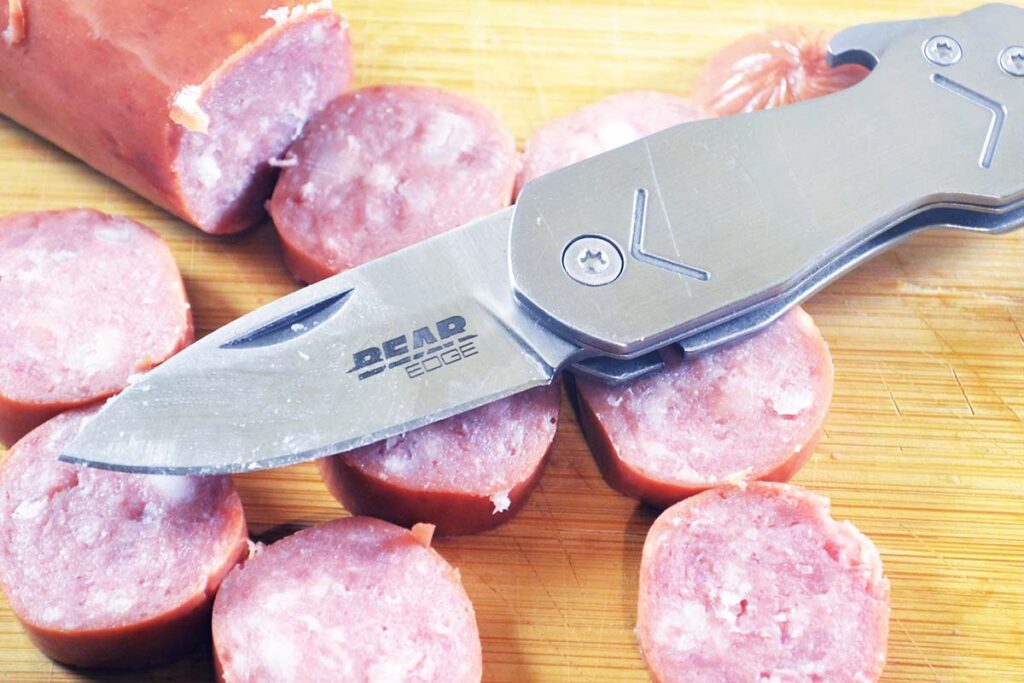
The Bear & Son’s 2-inch drop-point blade of 440 stainless steel in a brushed finish took off slices of 1-inch-diameter smoked sausage with no problem. Note the cap lifter on the rear of the handle spine. Weight: 2.3 ounces. Closed length: 2.8 inches.

The Bear & Son 3-inch Keychain Knife is a study in curves and its all-silver frame and blade add a classy touch. The blade sports a brushed finish and rolls out via a nail nick. Key hauling is handled by a 1-inch flat split ring on the base, very adequate unless you carry a large number of keys. In that case you can always add a larger split ring. A cap lifter is on the lower backside of the handle.

I sliced 1-inch-diameter smoked sausage and the blade performed admirably—not that you’d typically grab your keychain knife to perform such a task but it’s there if you need it. The cap lifter is handy. There is no pocket clip but the Bear & Son is not overburdening for loose pocket carry. This is a stout keychain knife well worth the money.

Schrade Roadie

Schrade Roadie
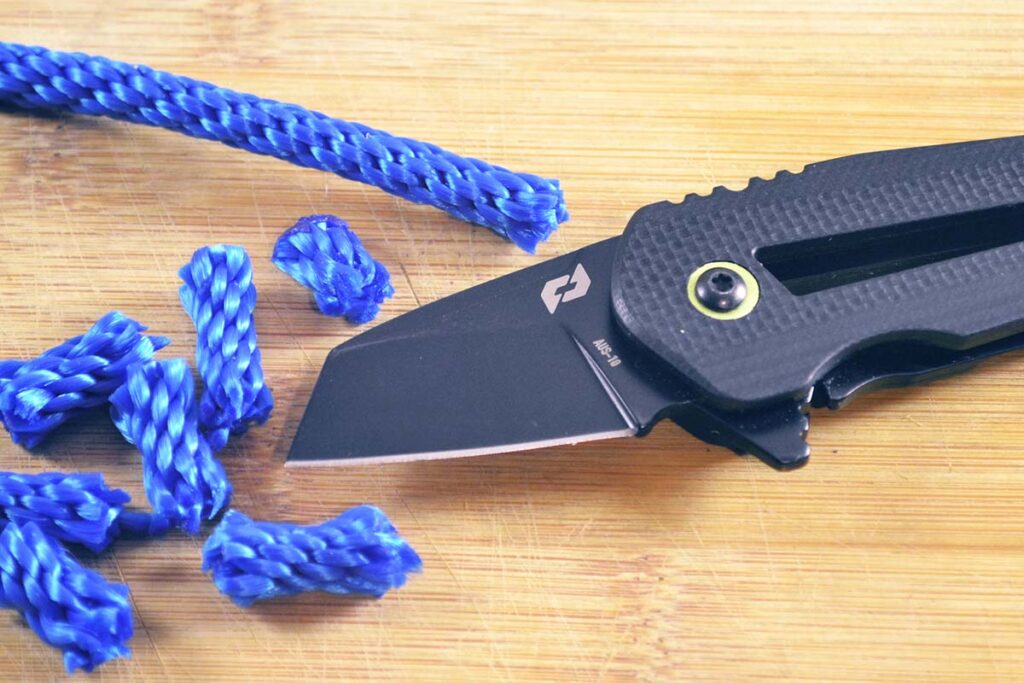
The Schrade Roadie is a little bulldog. The 1.5-inch blade of black-oxide-coated AUS-10 stainless steel bit through round after round of rappelling rope like a walk in the park. It’s a no-frills cutter meant for cutting. Weight: 2 ounces. Closed length: 3 inches.

The Schrade Roadie is a little bulldog of a keychain knife that doesn’t pretend to be anything else—it’s strictly a knife. In fact, it looks like a squeezed tactical folder. The blade opens via a flipper tab. The handle is black G-10 over black-coated stainless liners, with the rear liner serving as an unusual exposed locking leaf. Keys carry via a 4-inch black ball chain that dangles approximately 2 inches off a hole in the base.

I tested the blade on 3/8-inch synthetic rappelling rope to see how the reverse tanto pattern—a cousin to a modified wharncliffe—performed. It had no problem taking 3/8-to-1/2-inch slices in a single pass. The grip is excellent, aided even more by gimping on the upper rear handle close to the blade spine. This is a heck of a small knife and I only had one beef with it—the ball-chain key dangler. With the weight of keys tugging on the chain both sloshing around inside the pocket and while in use, you are asking for it to break. By the nature of ball-chain construction there are simply too many points along the way it can fail. I’ve got a remedy for that I’ll discuss later.

Smith & Wesson Stonewash Keychain

Smith & Wesson keychain knife
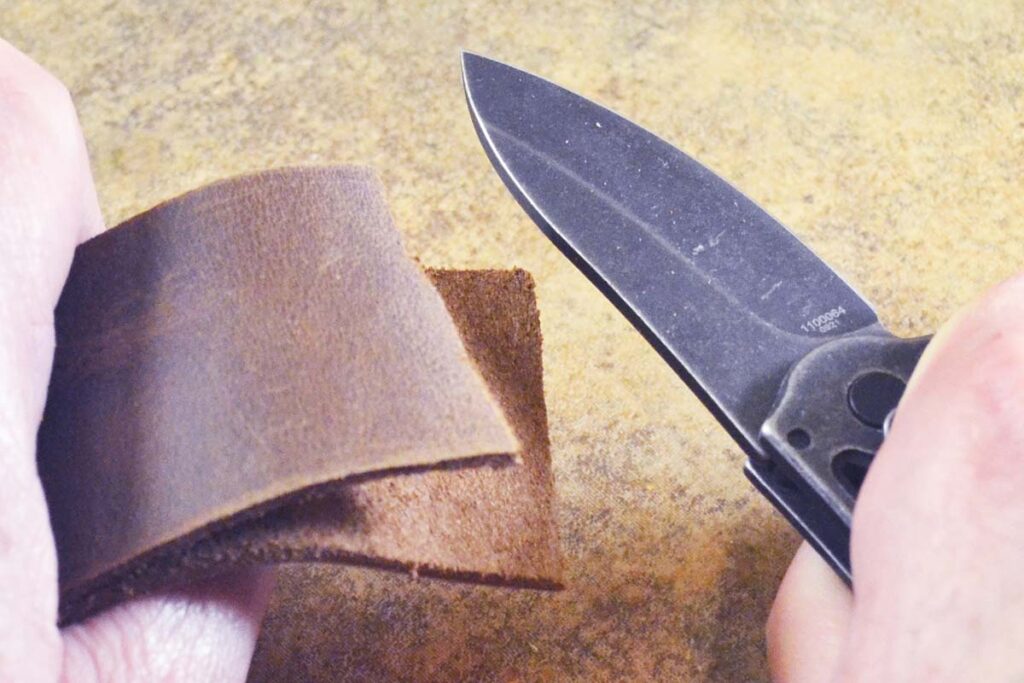
The Smith & Wesson’s 2.1-inch drop-point blade of ti-nitride-coated 8Cr13MoV stainless steel sliced its way through 1/8-inch harness leather, something the author indicated the other knives would have more trouble doing. Weight: 2 ounces. Closed length: 3.2 inches.

The Smith & Wesson Stonewash Keychain is the largest of the test bunch and it, too, resembles a scaled-down tactical folder. There’s a cap-lifter cut-out on the back frame slab. Keys mount at the base using a 3-inch ball-chain loop. This is the first of two review knives with a convenient pocket clip. The keys must be removed before using it because the clip is mounted for tip-up carry only, and if you use the keys they will hang out the top of your pocket. If this is acceptable to you, go for it.

I tested the blade on 2-inch-wide harness leather. Looping the leather strip over I did pull-throughs and found the little cutter more than up to the task. The framelock knife is built like a tank with the exception of a ball-chain key carrier which, as stated, I believe will give you issues down the road. That said, if you’re comfortable with it, go for it. I like this otherwise sturdy knife and it’s worth every penny of the price tag.

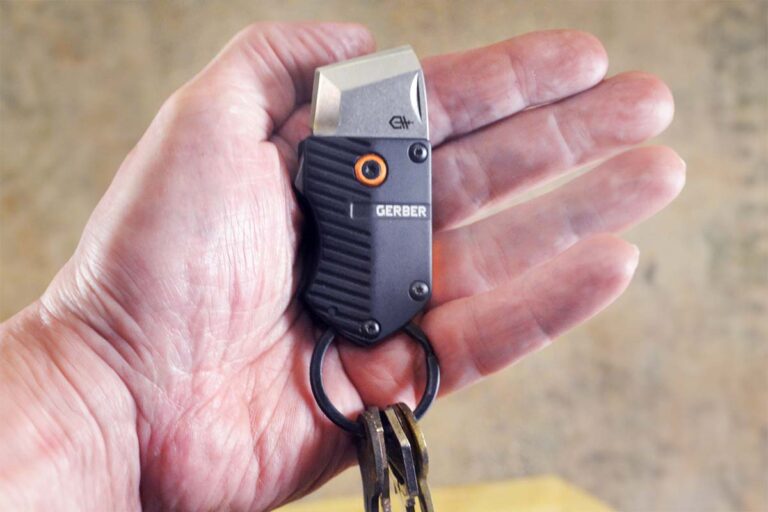
Gerber Key Note

Key Note cutting leather
The Key Note’s satin-finished 5Cr stainless blade is too short for slicing but the tip scores quite well.

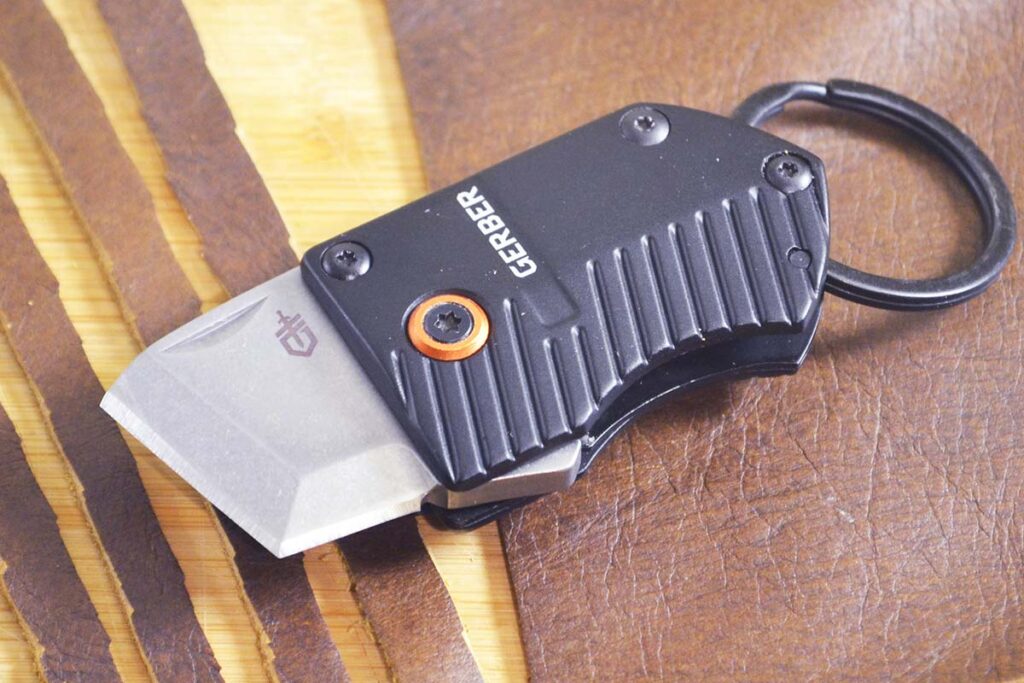
The Gerber Key Note wins the Keychain Outside The Box Award for its sheer imaginative design. With a stubby tanto blade, this offering radically differs from the pack. Both praised and panned on YouTube, the Key Note’s stubby .8-inch double-ground blade is certainly different. The frame has black-anodized aluminum rails with black stainless steel liners, the front which houses a linerlock. A flipper on the back side of the tang gets the blade rolling but only deploys it halfway, after which you pinch it for full deployment. You can also use the nail nick. Two nice touches are a wide tip-down pocket clip and a healthy 1.25-inch-diameter split ring for holding keys.

The blade is limited by its small size but I found it useful in scoring mode taking off strips of suede leather, and it is a heck of a box cutter. It will also push-cut paracord on a flat surface. The beefy tip-down pocket clip can be used with keys attached. The amply sized split ring is the best of the test knives, providing plenty of room for key-a-holics.

Is the Gerber Key Note different? Yes, but it may do just what you need a keychain knife to do.

Keychain Knife Carry Options

keychain knife carriers
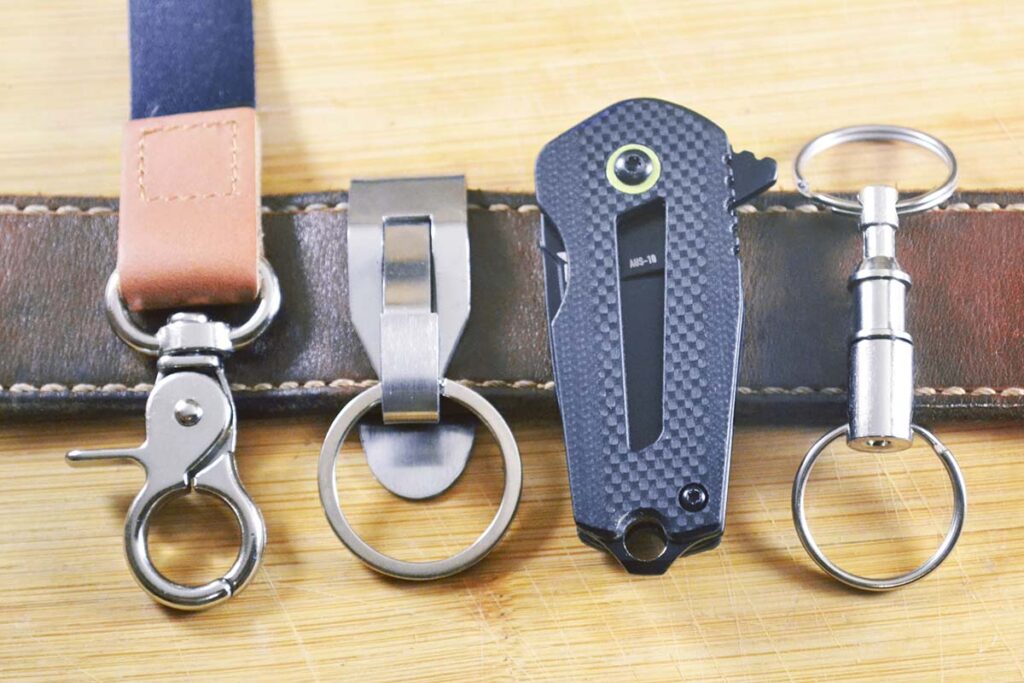
Modifying a keychain knife to suit your preferred carry can be done any number of ways. Examples include, from left: lanyard mini-carabiner for neck carry, a belt clip with split ring, the Roadie with ball chain removed, ready to modify, and a quick-release carrier that allows you to easily separate the knife from the keys.

There are other ways to carry these diminutive cutters than in or on the pocket. Accessories and findings (jewelry making parts) can be had by a various number of sources such as hobby stores, online at eBay and Etsy, or by doing an internet jewelry search such as Rio Grande Jewelry Making Supplies. Neck lanyards, belt clips, split rings large and small, breakaway connectors, small carabiners, and more are all available to modify your keychain carry to suit you. Any one of our candidates may suit your tastes as is, but if you want to mod it to suit your needs, there are plenty of options!

Check Out More Buyer’s Guides:

Spartan Blades Poros Review [Tested]

The Poros takes a beating and keeps on cutting.

The Poros by Spartan Blades is a great feeling folder. The flipper design is spot-on for hand placement.

Company co-founders Curtis Iovito and Mark Carey are excellent to work with and built Spartan from scratch. Both are retired from Special Forces and have a lot of pride in workmanship. The Poros is their field-grade-version linerlock. It might not have the fancy material and looks but the performance is top shelf.

Poros Light Cutting Duties

Initial slicing of 20-pound copy paper was excellent. The Poros was very smooth and aggressive. The blade shape really helped slicing paper, especially when I employed a roll cut. The flat-ground blade sliced straight with no curling of the paper.

Poros Cutting Leather
The 154CM stainless steel blade was exceptionally aggressive in the 8-ounce leather slice.

The Poros easily devoured single-walled cardboard. As with the copy paper, the blade sliced it both forcefully and effortlessly, resulting in nice, straight cuts. The slices were extremely quick with no resistance felt.

The folder was quite aggressive again in the 8-ounce leather slice. It was very easy to control the thickness of the skiving—I just needed to move my fingers faster. I had two fingernail nicks after the skiving. The edge remained sharp.

Poros Medium Cutting Duties

It was time to do a fire stick. The flat grind produced excellent curlicues. It sliced the wood incredibly fast and I had to slow down for more control to keep the curlicues on the stick. The handle was comfortable while making the deeper cuts. It was awfully simple to whittle with the knife.

Spartan Blades Poros cutting curlicues
The flat grind produced excellent curlicues. It sliced the wood awfully fast and the author had to slow down for more control to keep the curlicues on the stick.

For the next exercise I used 1-inch manila rope. The Poros crunched to 197 cuts before I ran out of rope. The edge was still good. The handle was very comfortable during heavy use. There were no issues with the blade lock. Nicely done, Spartan.

Poros Heavy Cutting Duties

I split kindling into smaller pieces to check lockup by doing baton work. There continued to be no issues with lockup or edge retention. The knife can handle a beating for sure. It’s not that I recommend baton work with a folder but if you have to it can be done with the Poros.

Poros splitting wood
The author split kindling into smaller pieces to check lockup via some baton work. There were no issues with lockup or edge retention.

To push the knife a bit further, I grabbed my trusty whitetail deer antler. After 30 hard whacks on it, the edge was still sharp with no rolling or chips, indicating spot-on heat treatment.

The last test was back to the copy paper slice. The Poros continued cutting smoothly and my arm was tired. Outstanding job, guys!

Final Cut

The Poros folder is worthy of riding in anyone’s pocket. It’s well designed, sharp and easy on—and comfortable in—the hand. I really don’t know what I’d change on this one, though I would love to see an A-2 tool steel version.

Poros Specs
Maker: Spartan Blades
Knife type: Flipper folder
Blade length: 3 7/8”
Blade steel: 154CM stainless
Rockwell hardness: 58-60 HRC
Blade finish: Black PVD
Handle: Carbon-fiber-patterned G-10
Lock: Linerlock
Closed length: 5 1/8”
Country of origin: USA
MSRP: $190

Check Out More Knife Reviews:

Advertisement

Must Read Articles

Read this before you make a knife

Knifemaking 101 – Read This Before You Make a Knife

  by Wayne Goddard My experience has taught me that there's nothing like digging in and getting started. I've often said the hardest part of the...
how to forge damascus steel

How to Forge Damascus

Advertisement
Advertisement