A whole passel of knew knives that will set you wish list to overflow.
Eyes always peeled, we’re on the look out for the latest and the greatest. We think we’ve found a bevvy of them this February. So, with out further adieu, here’s our latest round of new knives.
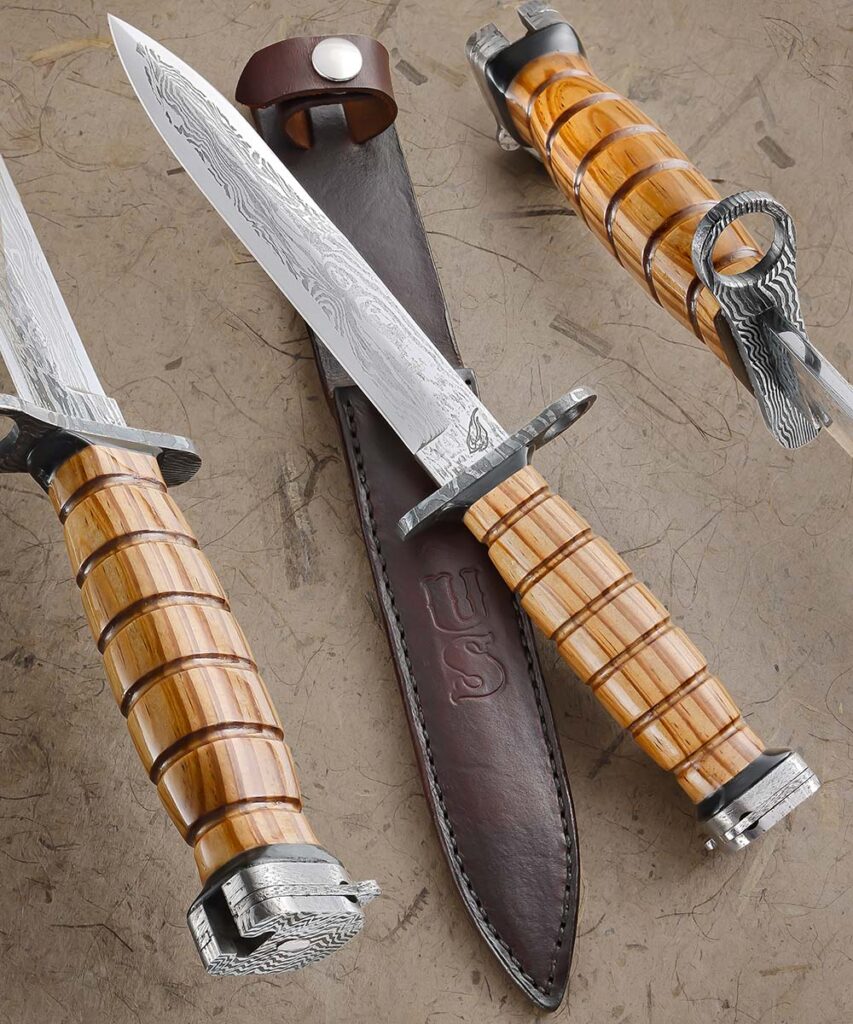
Cowboy Szymanski M4 bayonet
Blade length: 6.75” Blade material: Battleship blister-plated 15N20 nickel alloy steel Blade grind: Flat double edge Scales: Turned deck wood (long leaf pine) from the USS Texas BB-35 World War I dreadnought class battleship Bolster: Same material as blade Overall length: 11.75” Sheath: Standard leather Knife to know: Cowboy Szymanski donated the knife to the Battleship Texas Foundation through the Battleship Texas Artisans project to raise funds to refurbish the USS Texas. Maker’s price for a similar knife and sheath: $1,997 Maker: Cowboy Szymanski (SharpByCoop image)
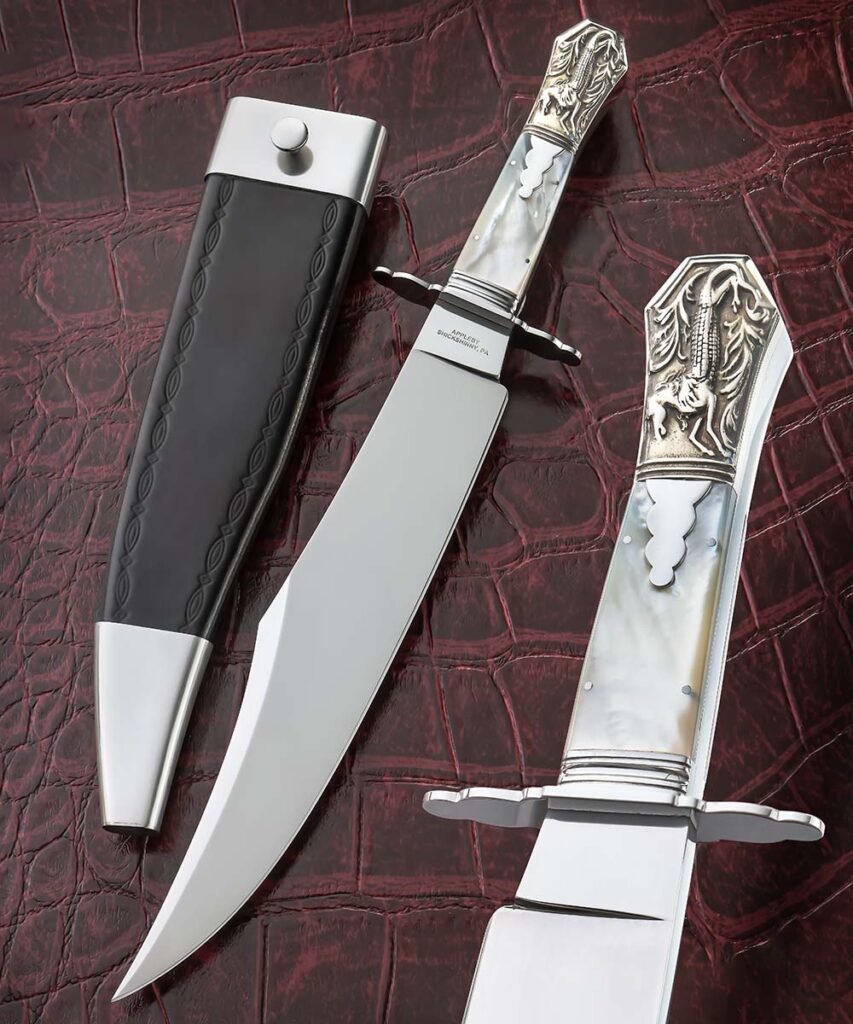
Robert Appleby Tillotson-Inspired Sheffield Bowie
Blade length: 10” Blade steel: CPM 154 stainless Blade grind: Hollow (36” radius) Blade finish: 2,000-grit satin Blade pattern: Clip point Scales: Mother-of-pearl Handle frame, guard & front bolster: 410 stainless Overall length: 14.5” Sheath (not shown): Wet-molded leather w/410 stainless throat and tip Knife to know: The half-horse/half-alligator rear bolster cast in white bronze is in a style made famous on classic 19th-century bowies; Robert Appleby is no longer accepting custom orders Maker’s price for a similar knife and sheath: $3,200 Maker: Robert Appleby, applebyknives.com (SharpByCoop image)
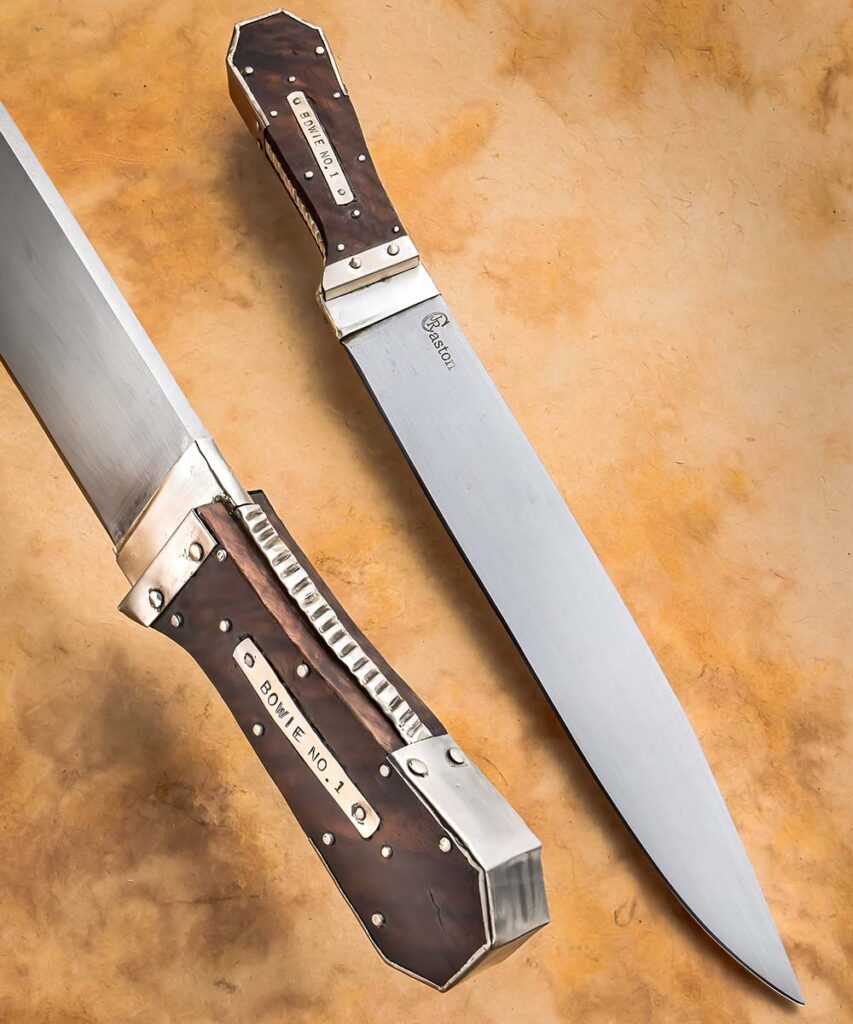
Randy Caston Bowie No. 1
Blade length: 13.5” Blade material: 1075 carbon steel Scales: Walnut burl Furniture: Sterling silver Overall length: 19” Knife to know: Randy Caston’s Bowie No. 1 is a reproduction of a 19th-century bowie some believe was made by James Black; Randy is a past Forged in Fire champ (season six, episode 16) Maker’s price for a similar knife: $1,750 Maker: Randy Caston (SharpByCoop image)
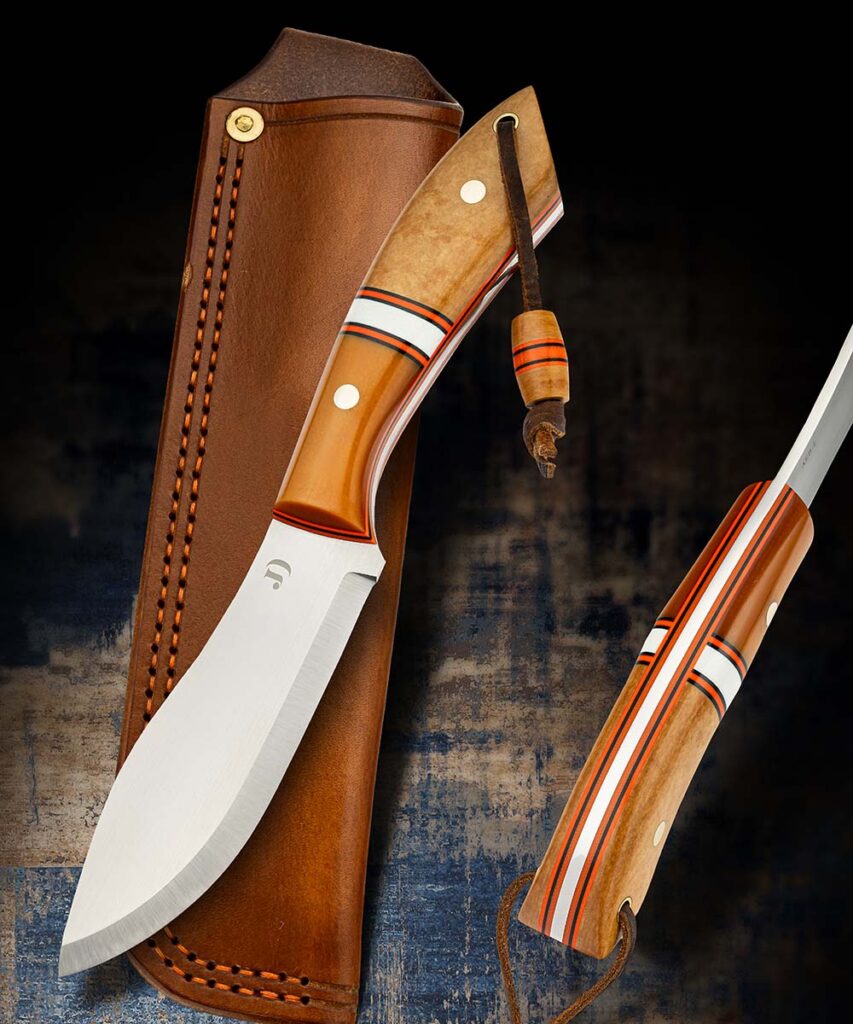
Jordan Danz Nessmuk
Blade length: 4.5” Blade steel: AEB-L stainless Blade grind: Scandi Scales: Butterscotch Micarta® w/Maple Valley Richlite Spacers: G-10 Lanyard: Leather w/bead of butterscotch maple and G-10 spacer Overall length: 9.75” Sheath: Leather w/belt loop Maker’s price for a similar knife and sheath: $400 Maker: Jordan Danz, jdcustomknives.com (Jocelyn Frasier image)
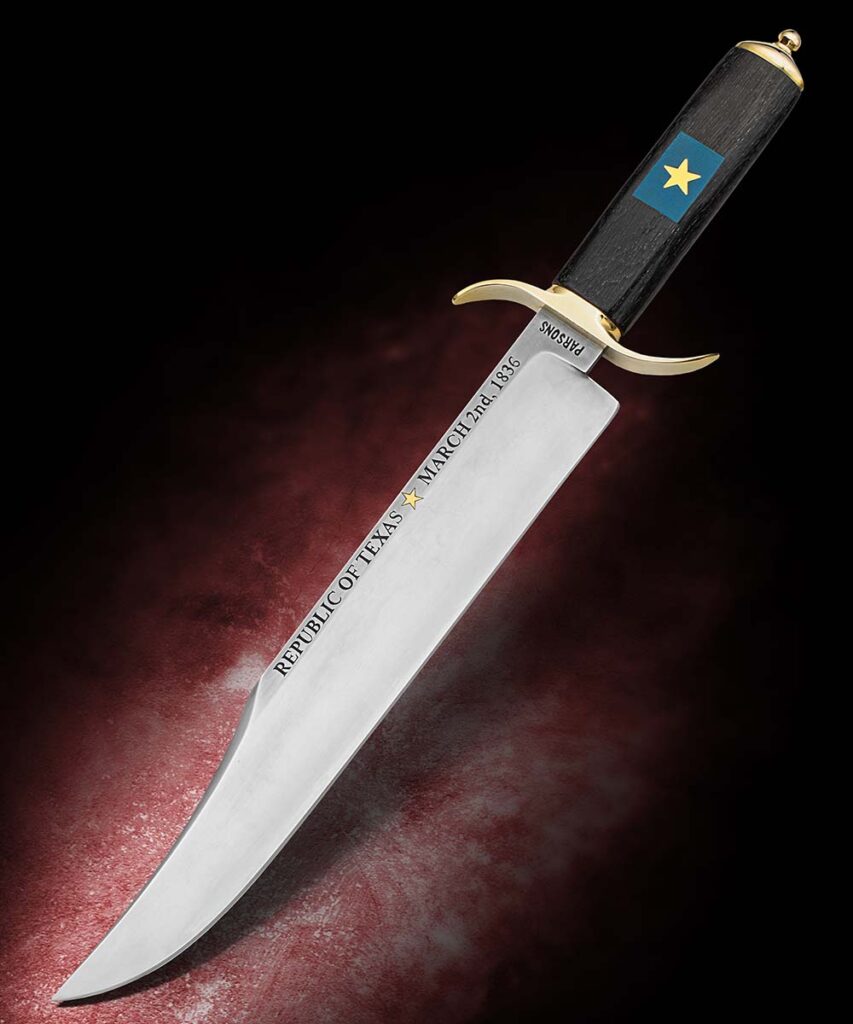
Lee Parsons Texas Republic Bowie
Blade length: 12” Blade material: 1095 carbon steel w/hamon made via the clay method Blade grind: Flat Blade finish: Hand sanded to mirror polish Blade pattern: Clip point Scales: Bog oak w/blue and yellow Micarta® Fittings: Brass Overall length: 17.5” Maker’s price for a similar knife: $2,500 Knife to know: The knife was made for a collector who is a huge fan of Texas; lettering is hand engraved and the hand-inlaid Republic star is 24k gold; March 2, 1836, is the date Texas formally declared its independence from Mexico; Lee Parsons is an ABS apprentice smith Maker: Lee Parsons, skmoknives.com (Jocelyn Frasier image)
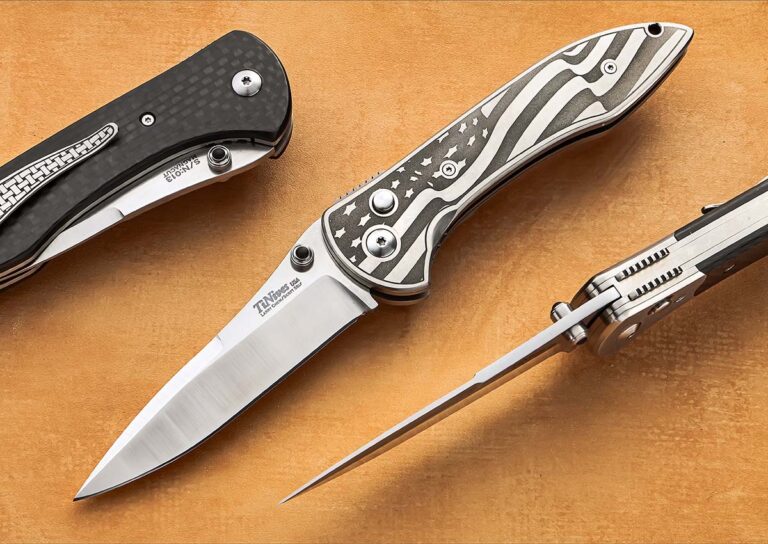
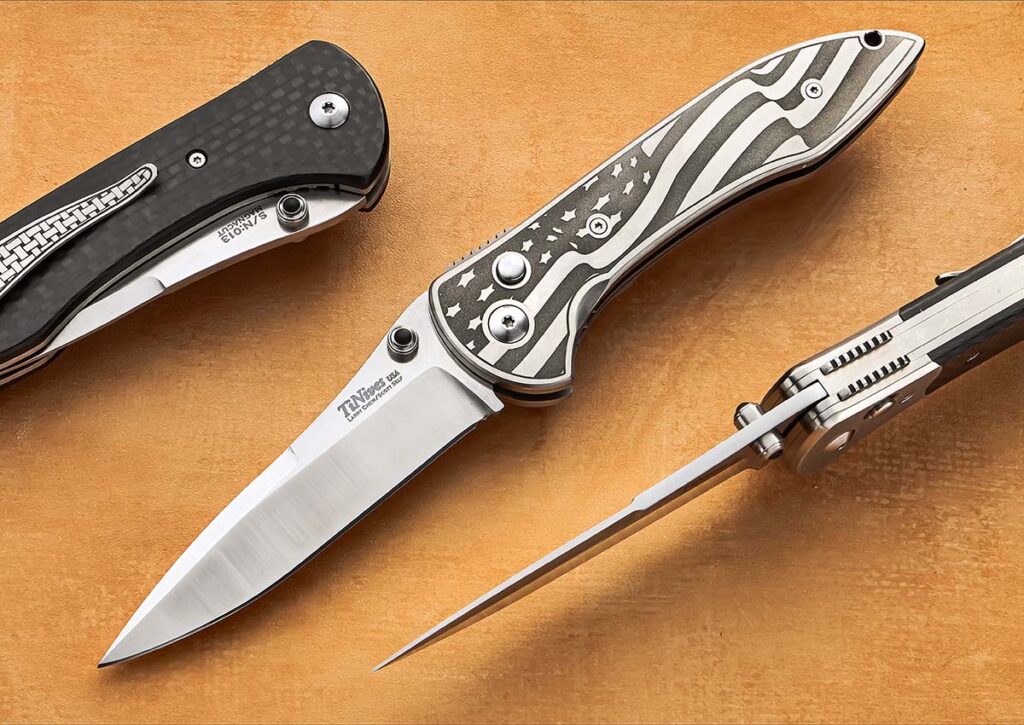
Larry Chew/TiKnives Covert Dual Action
Blade length: 3.5” Blade steel: CPM MagnaCut stainless Blade grind: Hollow on first run Blade finish: Satin or bead blasted Scales: Laser-engraved titanium & carbon fiber Handle frame: Titanium Pocket clip: Laser-engraved titanium & carbon fiber Closed length: 4.5” Makers’ price for a similar knife: $975 and up Knife to know: Features the Covert Lockout mechanism in which the upper left-hand gimping slides forward to release the spring-loaded release button; dual thumb studs; options include Chad Nichols damascus blade steel and titanium, Timascus™ and ironwood scales, and a 3D-machined damascus clip (check w/makers for pricing on options); a collaboration between Larry Chew and Scott Self of TiKnives Makers: Larry Chew/TiKnives, tinivesoriginal.com (SharpByCoop image)
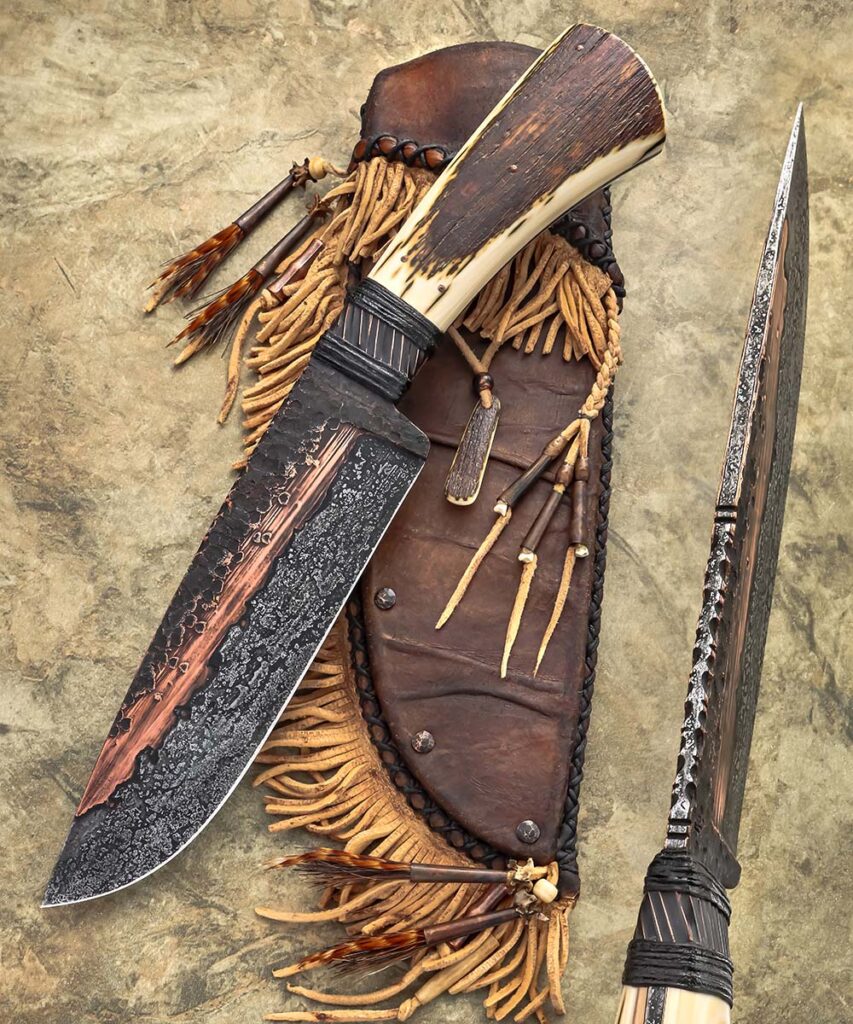
Levi Graham Ancient Woolly Frontier Field Knife
Pattern: Camp knife Blade length: 6” Blade material: 1084 carbon steel w/copper cladding forged by Adam Deville Blade grind: High flat Scales: Mammoth ivory Construction: Full-tapered tang Bolster: Copper textured wrap and rawhide Overall length: 11.25” Sheath: Deer rawhide w/braintan fringe, mammoth bark center dangler w/copper tacks, cones, beads, rattlesnake vertebrae and horsehair Maker: Levi Graham, levigrahamknives.com (SharpByCoop image)
Tanner Couch Saddlehorn Trapper
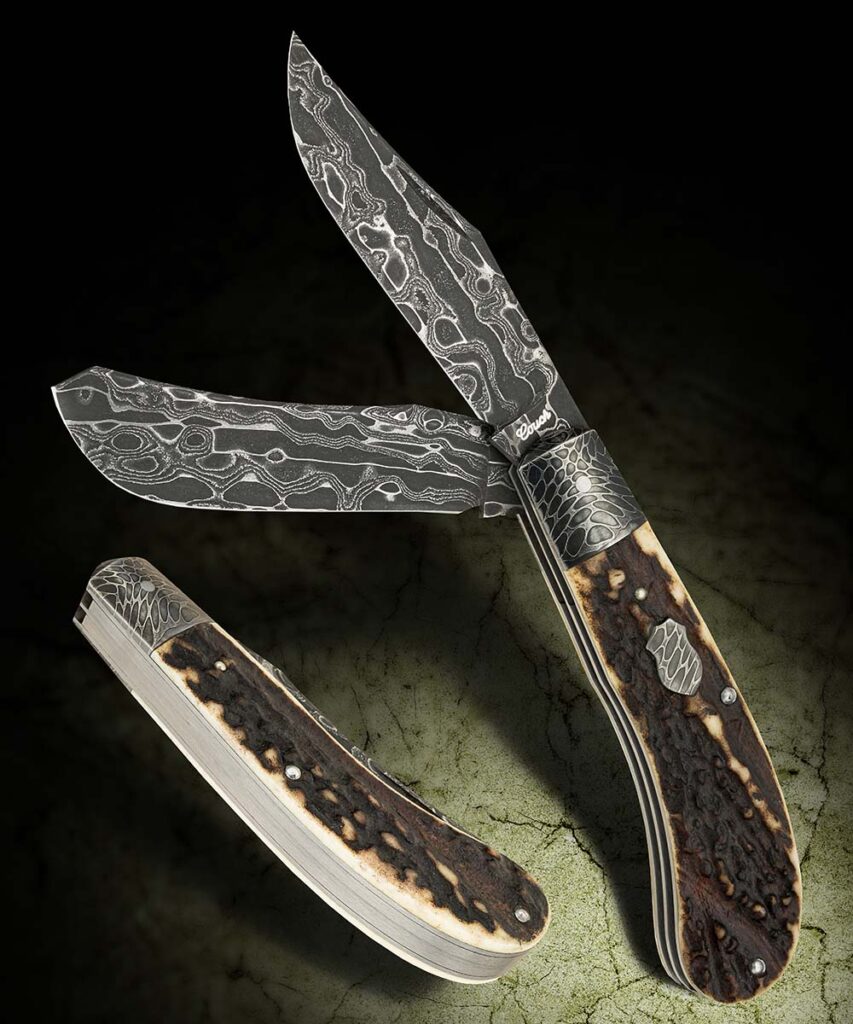
Blade length: 2 7/8” Blade material: Vegas Forge stainless steel Virus damascus Blade grind: Hollow Scales: Stag Bolster: Chad Nichols Wasp Nest damascus Maker’s price for a similar knife: $3,000 Knife to know: The saddlehorn trapper was one of the favorite patterns of BLADE Magazine Cutlery Hall-of-Fame® member Tony Bose, iconic American custom knifemaker Maker: Tanner Couch, Tilden, (Jocelyn Frasier image)
Marc Josef Knives Pizza Cutter
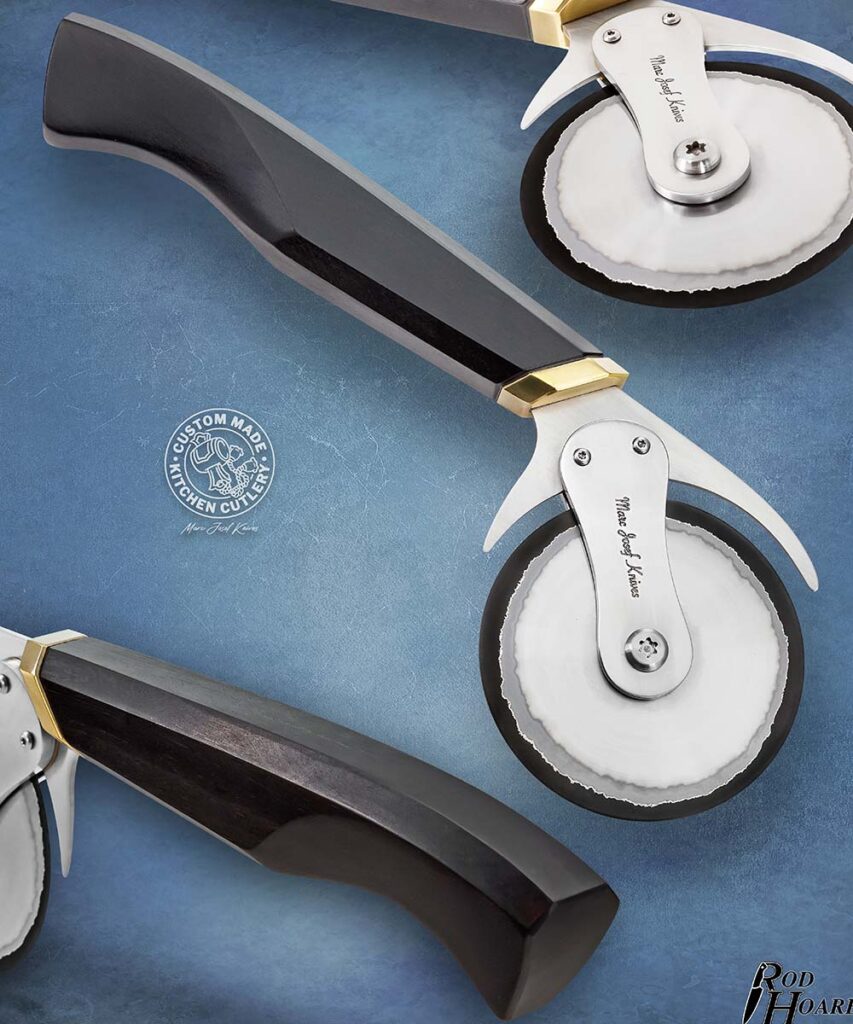
Blade diameter: 2.76” Blade material: 52100 carbon and 410 stainless nickel alloy steels forged in a san-mai construction by Brook Turner Scales: Ebony Overall length: 9.1” Maker’s price for a similar piece: $750 at press-time exchange rate Maker: Marc Josef Knives, marcjosefknives.com.au (Rod Hoare image)
Nicholas Orr Coffin-Handle Bowie
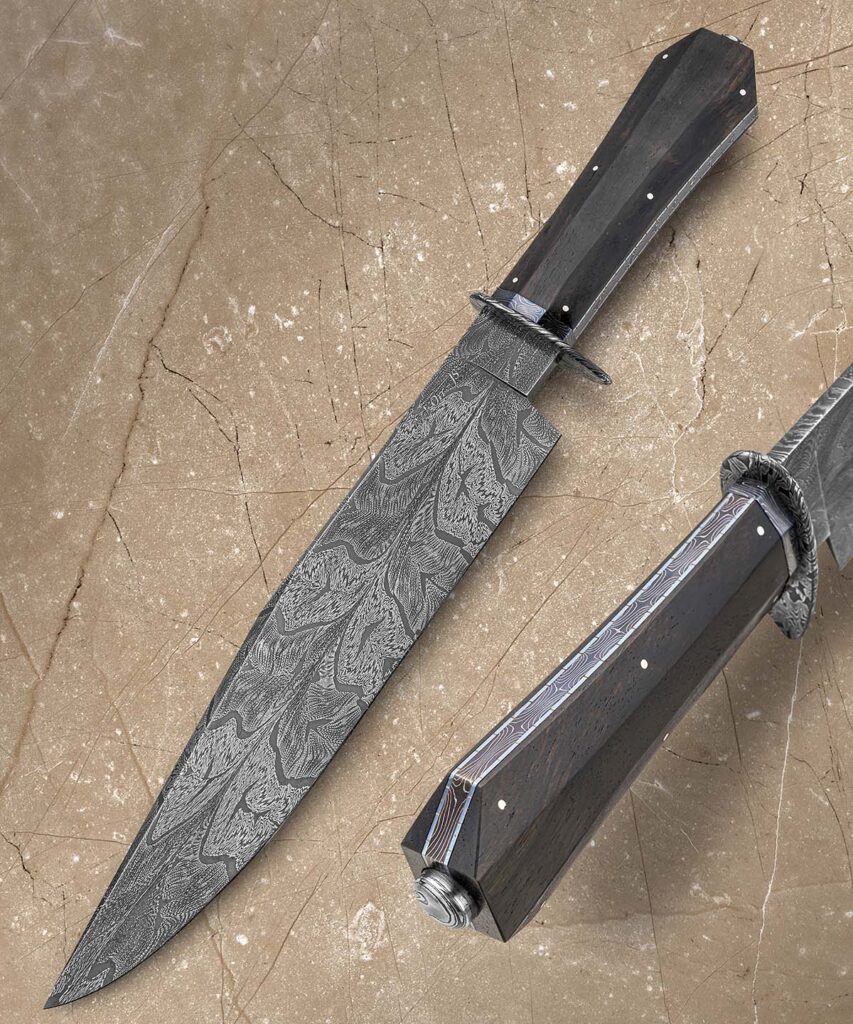
Blade length: 8.5” Blade material: Feather-pattern mosaic damascus Blade grind: Full flat w/a double clip Blade pattern: Clip point Scales: African blackwood Handle frame & spacer: Twisted & blued mosaic damascus Guard & pommel: Mosaic damascus Construction: Full tang Overall length: 13.5” Maker’s price for a similar knife: $4,000 Knife to know: Nicholas Orr is an ABS journeyman smith Maker: Nicholas Orr, (Jocelyn Frasier image)
Sam Roddy Bowie
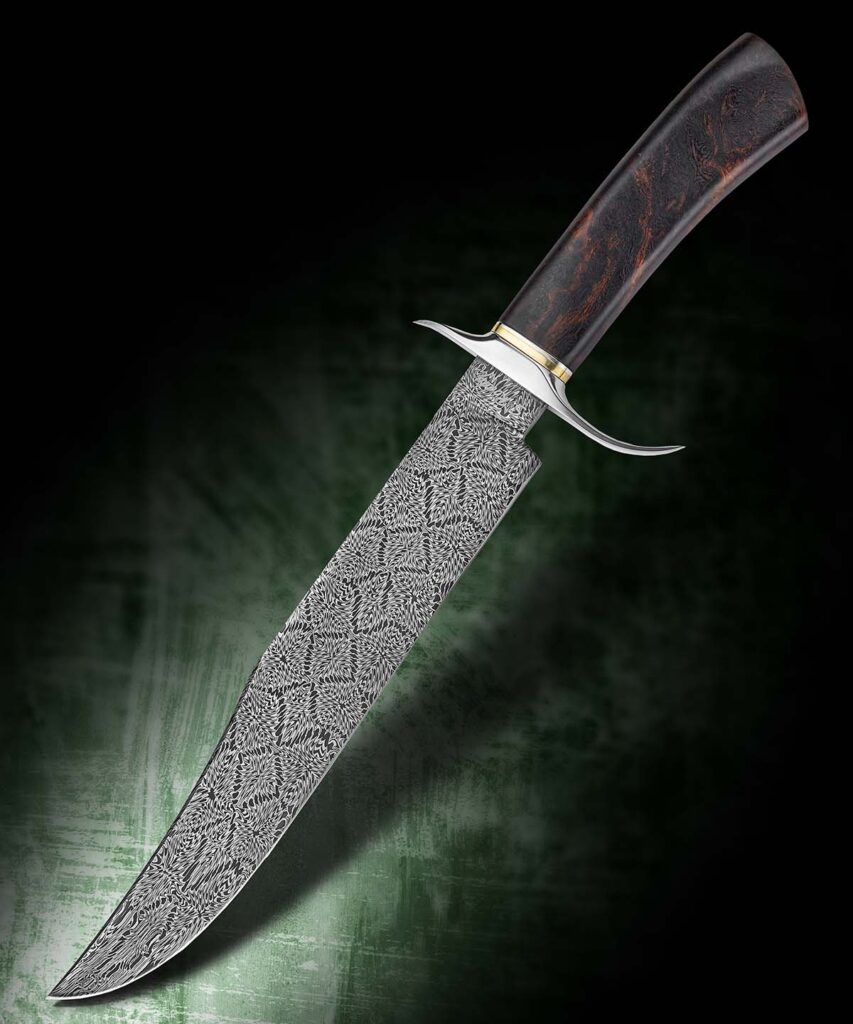
Blade length: 10” Blade material: Mosaic damascus of 1084 carbon and 15N20 nickel-alloy steels Blade grind: Flat Blade pattern: Clip point Scales: Ironwood w/nickel silver and brass spacers Guard: Stainless steel Overall length: 15.5” Maker’s price for a similar knife: $2,400 Knife to know: Sam Roddy is an ABS apprentice smith Maker: Sam Roddy (Jocelyn Frasier image)
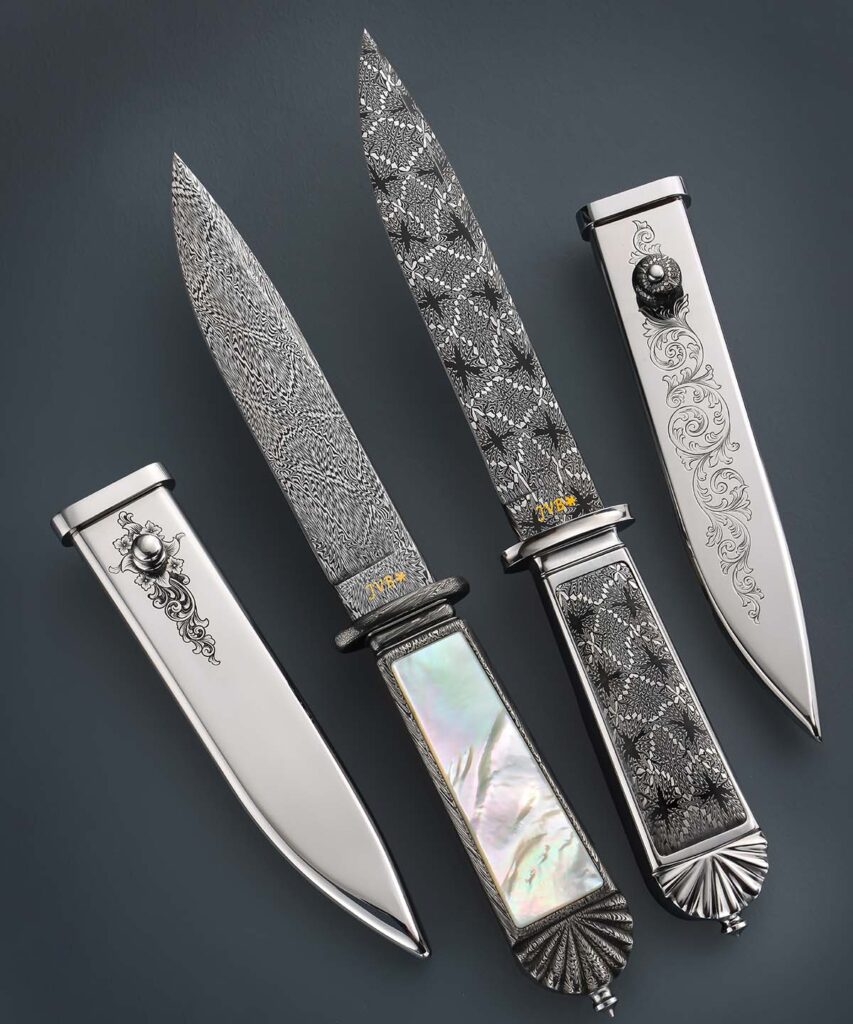
Jacco VandeBruinhorst San Francisco Gentleman’s Knife
Knife type: 19th-century dress bowie Blade length: 5.5” Blade material: Mosaic damascus Blade grind: Flat Scales: Mother-of-pearl Handle frame: Mosaic damascus Overall length: 12” Knife to know: Full takedown construction; engraving by Wolfgang Loerchner Maker: Jacco VandeBruinhorst, jvbknives.ca (SharpByCoop image)
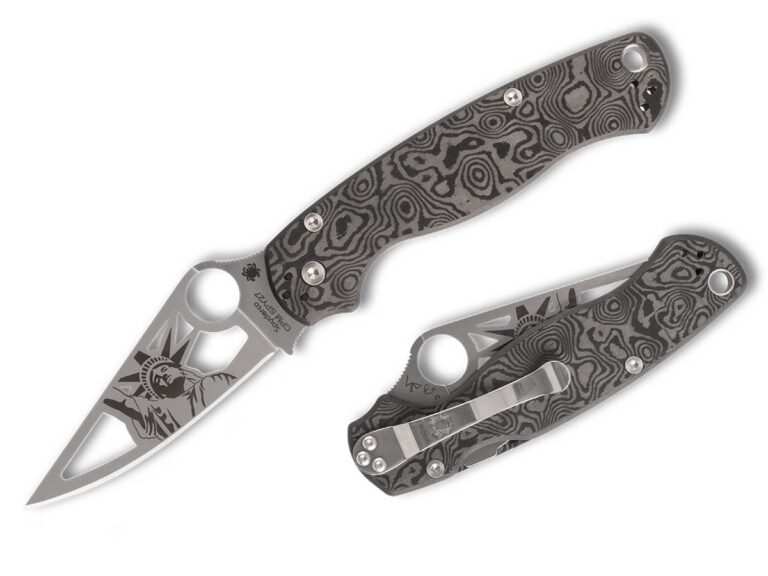
Spyderco unveils a limited-edition Para Military 2 with a cut-through Statue of Liberty blade to honor H.L. Dalis Inc.’s 100th anniversary. Just 1,200 knives available—collectors take note.
Spyderco has made its first “cut-through” blade design since its highly collectible Q, R and S series from roughly a quarter century ago to celebrate the 100th anniversary of H.L. Dalis Inc.
The cut-through graces the blade of a Para Military 2, including perforations both of and flanking an engraving of the Statue of Liberty. “As a New York company, we thought the Statue of Liberty cut through was appropriate,” stated Jon Blumenfeld, president of H.L. Dalis Inc., “as it is the most universal symbol of what the USA stands for.”
There will be 1,200 units in all, with delivery expected in the late third quarter of this year. As an added special feature, Spyderco has agreed to have its design team sign one box for every 50 units, and H.L. Dalis will include one signed boxed unit at standard volume cost with every 51 units—50 plus one signed boxed unit—ordered by its dealers.
Para Military 2 Specs Blade length: 3.45” Blade steel: SPY27 stainless Blade grind: Full flat Edge configuration: PlainEdge Lock: Compression Lock Hardware configuration: Stainless steel pocket clip, standoffs and liners Weight: 3.8 ozs. Closed length: 4.82” Knife to know: Made in a limited edition of 1200 MSRPs: $340
Bear Edge unveils a trio of American-made EDC options at SHOT Show.
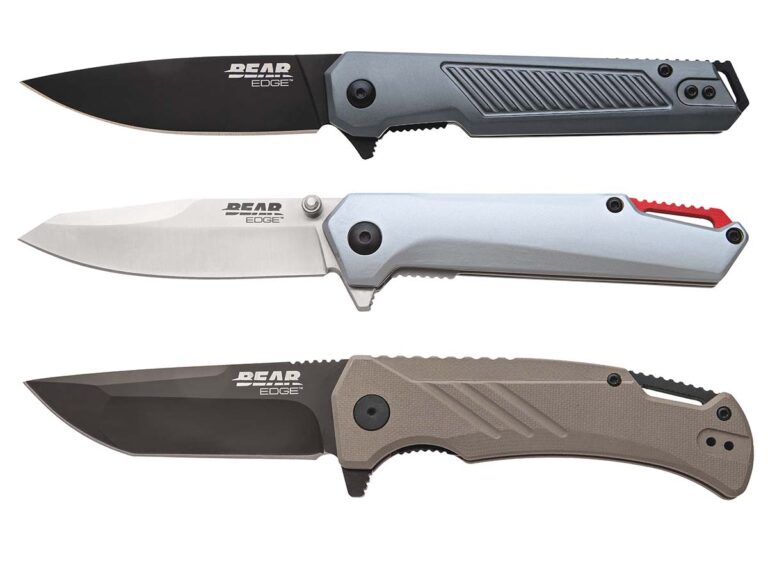
Now that the dust has settled on SHOT Show 2026, we’re taking a closer look at the new releases from Bear Edge. The Alabama-based maker unveiled a trio of everyday carry folders that lean into modern ergonomics and practical materials without breaking the bank. As a brand under the Bear & Son Cutlery umbrella, Bear Edge continues to leverage decades of American manufacturing expertise to produce knives that are as reliable as they are accessible.
The Light Gray Aluminum Folder
If you’re looking for a sleek, no-nonsense worker, Model 71140 is the pick of the litter. Built entirely in their Alabama factory, this 4-inch folder features a modified drop point blade made from 440 stainless steel. What catches the eye is the red spacer with integrated jimping—it adds a nice pop of color and serves as a functional lanyard attachment point. The aluminum handle keeps the weight balanced, and the dual deployment (thumb studs or flipper) makes it a versatile companion for any task.
The Dark Gray Assisted Opener
For those who prefer a more tactical, “stealth” aesthetic, Bear Edge introduced Model 71141. This is a narrow, modern profile featuring a 3 5/8-inch drop point blade with a black finish. The assisted opening is snappy, and the textured grooves on the gray aluminum handle provide a noticeably secure grip. It’s a narrow carry that fits comfortably in the pocket, especially with the reversible tip-up clip.
The Tan G10 Tanto
Demanding jobs usually require a bit more “meat” on the bone, and Model 71139 delivers. This full-sized folder swaps out aluminum for Tan G10 scales, providing a high-strength, lightweight handle that won’t slip. The business end is a modified tanto blade with a black finish, optimized for piercing and heavy-duty slicing. Like its siblings, it features a rapid-deployment flipper and a deep-carry pocket clip that’s sturdy enough for a duty belt.
Final Cut
Bear Edge continues to prove that “American-made” and “affordable” don’t have to be mutually exclusive. These SHOT Show debuts show Bear Edge is cutting into the modern EDC movement, providing users a tool that looks good on the desk but performs even better in the field.
We slash away with three machete options to see which is ready to tame your greenery.
Spring uncovers what winter buries. Duff piles up, vines tighten their grip and brush crowds every trail and fence line. A machete cuts through that mess with reach and rhythm. The long blade sweeps low to clear ground clutter, snaps vines before they climb and trims brush without constant repositioning. One tool handles duff, extra brush and creeping vines in a continuous flow, so a hillside that looked wild at breakfast starts to open by lunch.
A good machete carries authority without dead weight. Thin stock bites deep and releases clean, so each swing clears more space with less effort. The long edge opens lanes. The spine knocks dead twigs free. The tip digs, pries and handles rough chores that punish smaller blades. In much of the world, a machete counts as the only daily tool. That heritage still matters in 2026, whether you reclaim a backyard slope or beat a trail back into shape. These three long blades are our picks to tame your wild hills, homestead and camp.
Getting The Swing Of The Machete
Brush changes the fight, so your swing must change with it. Light grass needs quick wrist cuts that keep your pace steady. Thin vines demand snap cuts that break tension before the blade binds. Thick brush calls for short power strokes that drive the edge through stubborn growth. Deadfall needs controlled chops that protect the edge from hidden knots. Each swing builds from stance, grip and rhythm, not brute force. When you match technique to terrain, the machete feels faster and safer. The right swing turns rough ground into clean, workable space without burning your energy.
Condor Roarlock
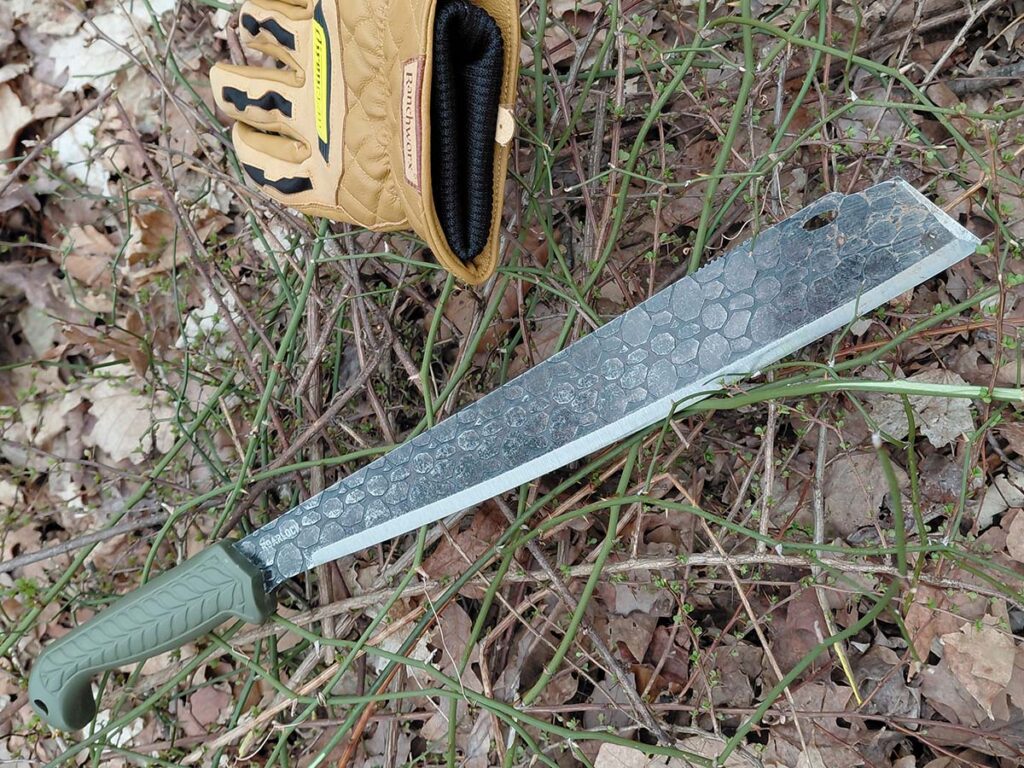
Chopping Japanese barberry, an invasive vine with painful thorns, is a necessary and annoying chore—the Condor Roarlock hacked it!
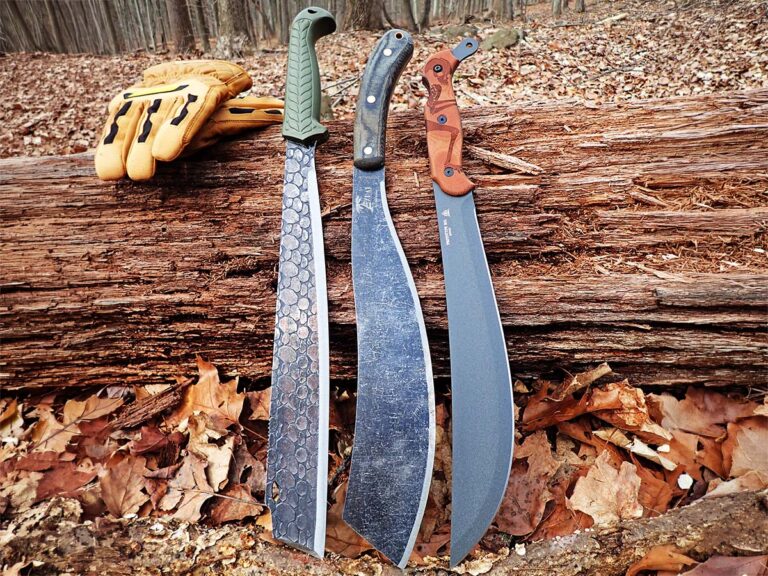
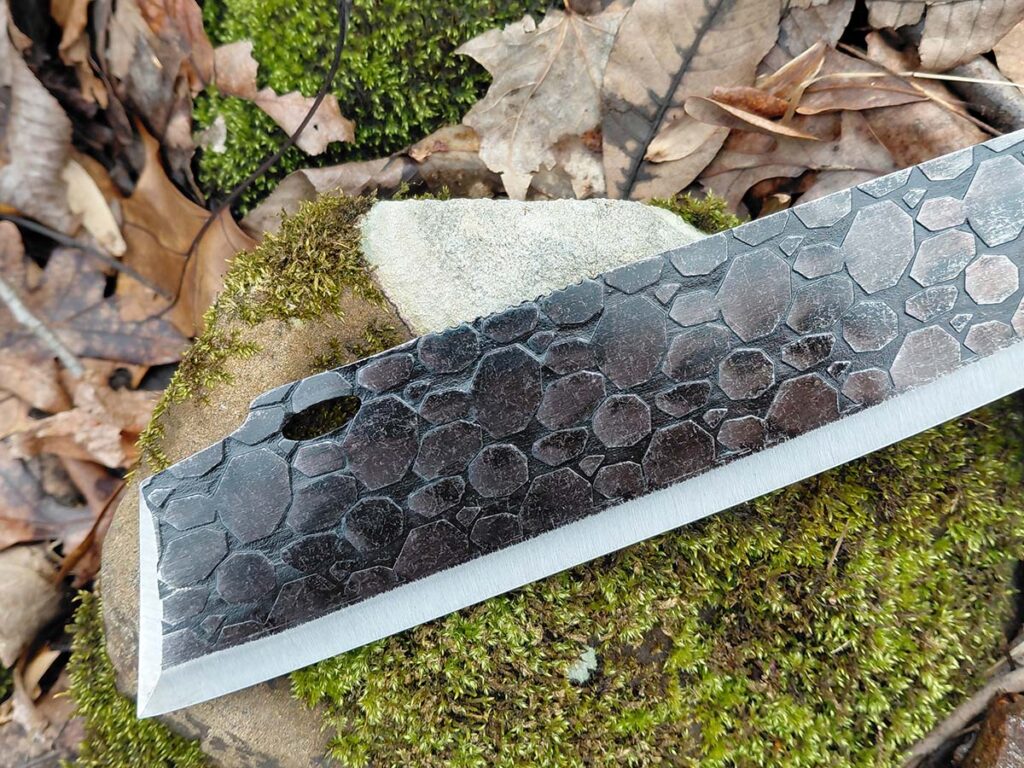
Condor’s Roarlock brings Southeast Asian machete influence into a compact, modern clearing tool. The 14.24‑inch blade has a 20.33‑inch overall length and a 0.12-inch thickness of 1075 high-carbon steel. This design keeps the weight at about 21.5 ounces. The etched damascus‑style finish gives the blade a wild, worked look, while the convex grind drives deep into vines, saplings and stubborn brush without sticking. A high‑impact polypropylene handle locks into the hand and shrugs off weather, sweat and abuse. A full‑tang build runs through the handle, so the Roarlock feels solid when you lean into heavy swings.
The ballistic nylon sheath carries light, rides tough and lets the machete move from truck to trail without fuss. Designed by Joe Flowers for 2026, the Roarlock feels like a fast, compact power tool built for real brush, not just catalog photos.
Beating Barberry Back
The Roarlock has the Godzilla silhouette, with usable features for digging and root-cutting.
I’m a fan of any long blade that has more bend than a straight blade, especially when it has some drop to it. Like a Filipino bolo and kukri, whenever the blade precedes the chopping hand, that’s a good thing. Max impact and leverage are far superior to using an all-straight design. The Roarlock has this!
Chopping the most annoying and painful vines in my forest was a must-do chore. Japanese barberry is an invasive plant with small thorns that are sure to get my knuckles and fingers when removed. They stab directly through hiking pants and most layers of clothing. A machete works best at beating them back, but it’s hard to get to the base without suffering a few thorns. The longer reach of the 14.24‑inch blade on the Roarlock helps. Especially when using a helper stick to push back the thorny shrub of mayhem.
Soon enough, I had a pile of various vines, including blackberry, dry grasses, small creeper vines and the dreaded barberry. Also, soon enough, I hit a rock or two and mashed the tool’s tip. So what? It’s 1075 carbon steel and would be easy to get back in order. However, it’ll happen again, but this is a tool meant for work!
ESEE Expat El Deguello
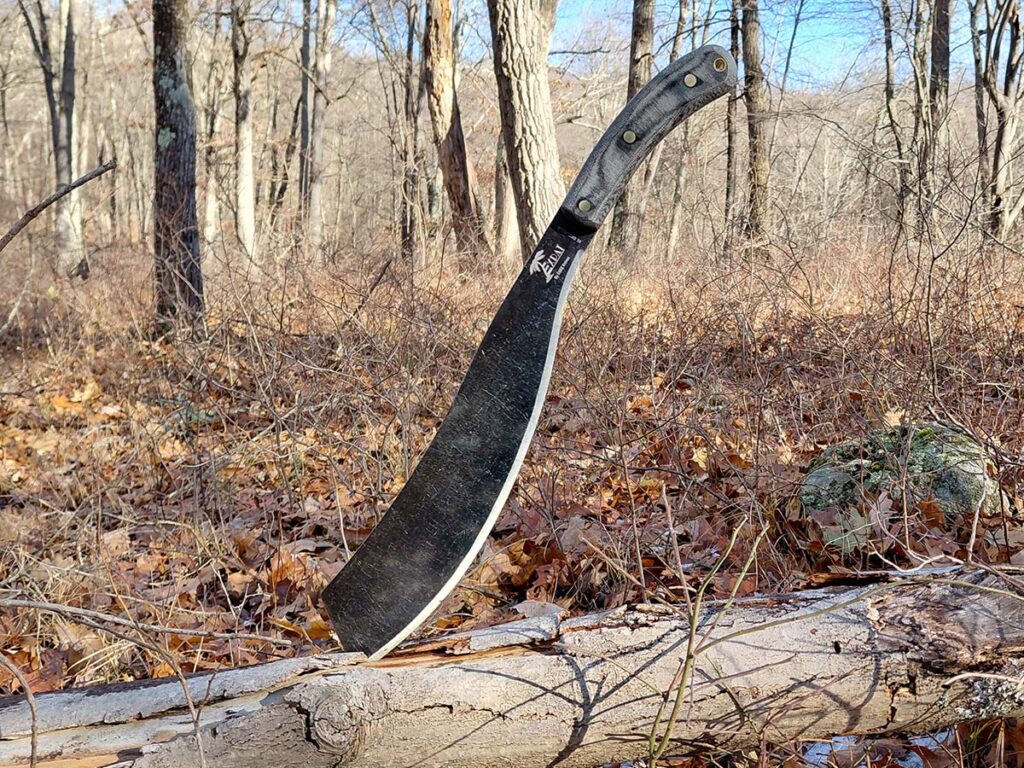
Expat El Deguello, influenced by years of travel and Randall’s Adventure & Training, features a 12.75-inch 1075 carbon steel blade.
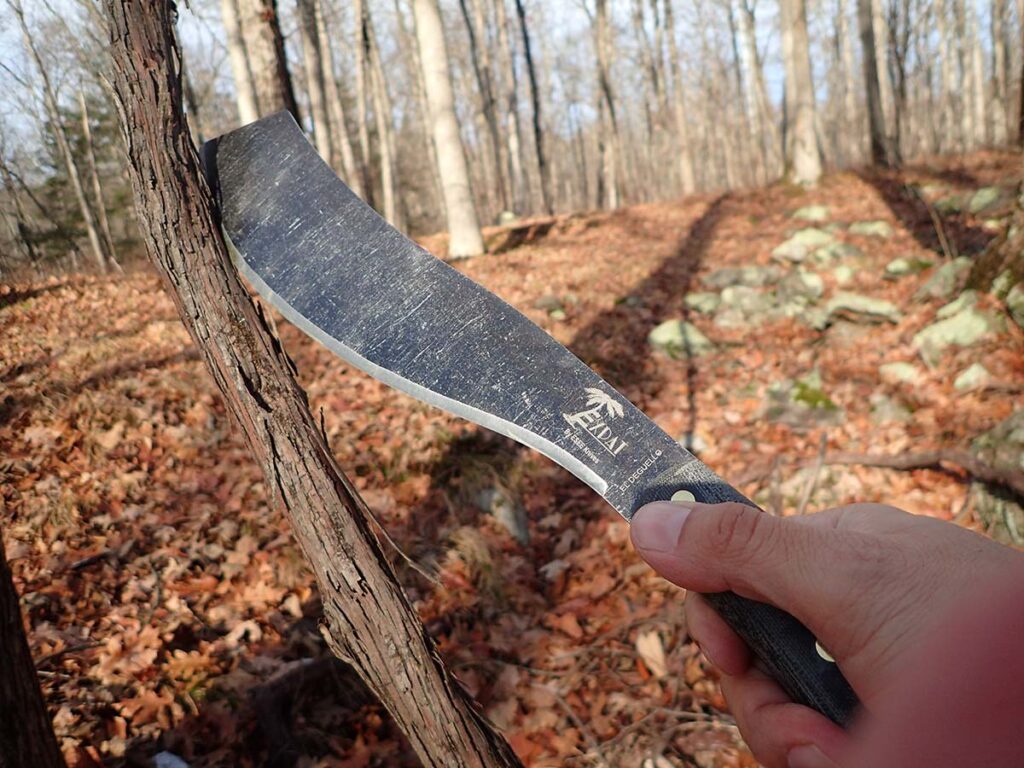
The ESEE Expat El Deguello grew out of years of Expat travel and hanging out with Randall’s Adventure & Training. This was in places where a machete counted as daily life support, not a luxury. The blade is about 12.75 inches of 1075 carbon steel with a dark stonewashed finish, set in an overall length of around 18.75 to 19 inches. The blade’s shape has a parang-ish style, giving the machete a strong, weight‑forward feel without turning it into a boat anchor. A flat grind keeps the edge lively and easy to touch up with a pocket stone in the field. Black linen Micarta scales wrap the full tang and give a secure, textured grip that stays honest in sweat, rain and humidity. A brass‑lined lanyard hole anchors a safety cord for steep slopes or riverbanks.
The tan canvas sheath rides light on the belt and matches the tool’s no‑nonsense attitude. Built in El Salvador as part of the Expat line, the El Deguello blends South American machete DNA with ESEE’s survival mindset. Making it a dependable long‑blade for trail clearing, camp work and hard bushcraft.
Seasonal Slashing
I got my hands on the El Deguello Expat machete in winter. I wasn’t sure how it would do in a snowy environment. However, we needed to travel through uneven terrain with gear weight, so light was right. No axe or thick splitting tool accompanied we three adventurers on this trip. In fact, we had two Expat machetes in camp as my buddy brought his Expat Darien machete.
The El Deguello started earning its keep from the start. Due to many branches and small trees succumbing to the weight of the snow, the El Deguello shone. I cleared woody and leafy debris to make the path easier for campers arriving later in the day. By the time I got to camp, I was already a believer of the utility the El Deguello packs. Chopping frozen wood from previous campfires and new dead branches were on the docket. This was predominantly a hardwood forest, so the El Deguello had to be hatchet-ready. And it was!
TOPS Knives Sneak Reaper
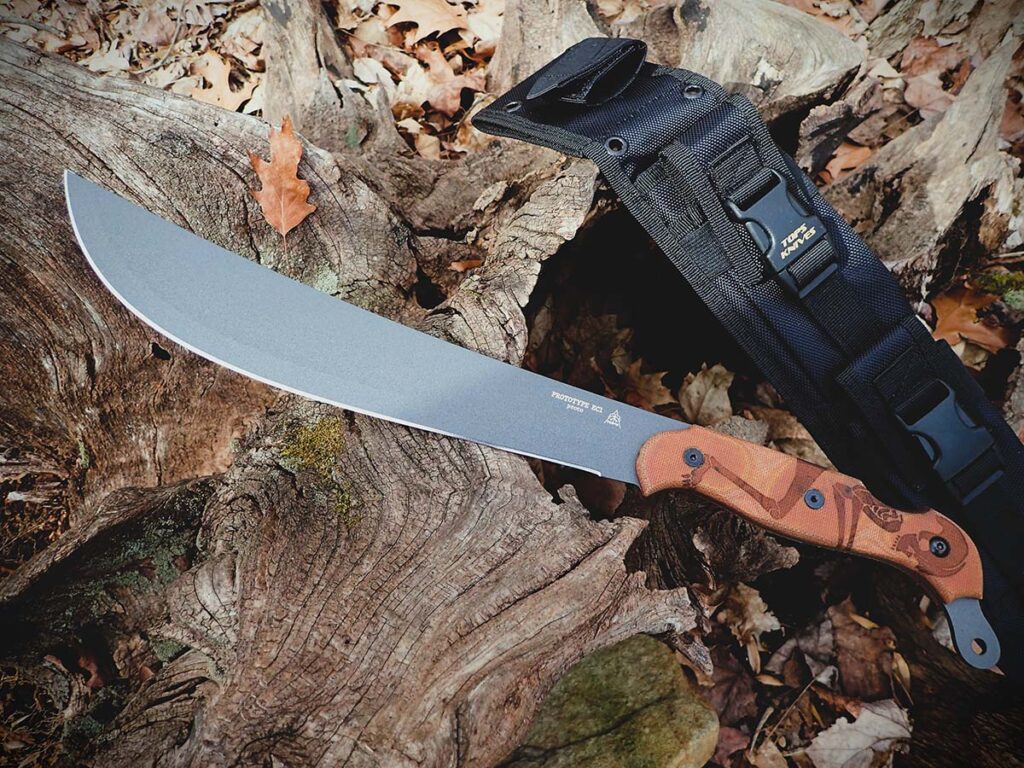
The TOPS Knives Sneak Reaper features an 18.5-inch length and a fast-moving 12-inch blade, designed for tight brush.
The TOPS Knives Sneak Reaper draws on Ed Calderon’s counter‑custody background, shaping a fast, purposeful blade built for tight spaces. It has a lean profile that favors quick cuts through vines and brush. The long edge rewards snap cuts, while the balanced weight keeps the machete quick instead of front‑heavy. The handle geometry follows Calderon’s no‑wasted‑motion mindset and gives a locked grip during hard clearing strokes and tight work around obstacles.
The Sneak Reaper has an overall length of 18.5 inches and a 12-inch blade that moves fast through tight brush. The black powder coating protects the blade and supports Calderon’s stripped‑down, purpose‑driven style. The saber grind gives the edge a strong bite, enabling it to handle vines and stubborn growth without slowing your rhythm. The 0.125‑inch thickness keeps the blade lively and responsive during long clearing sessions.
The sheath system supports fast deployment and secure carry, echoing the tool’s defensive roots and utility. Final production specs have not yet been added to TOPS’ catalog pages.
In The Thickets
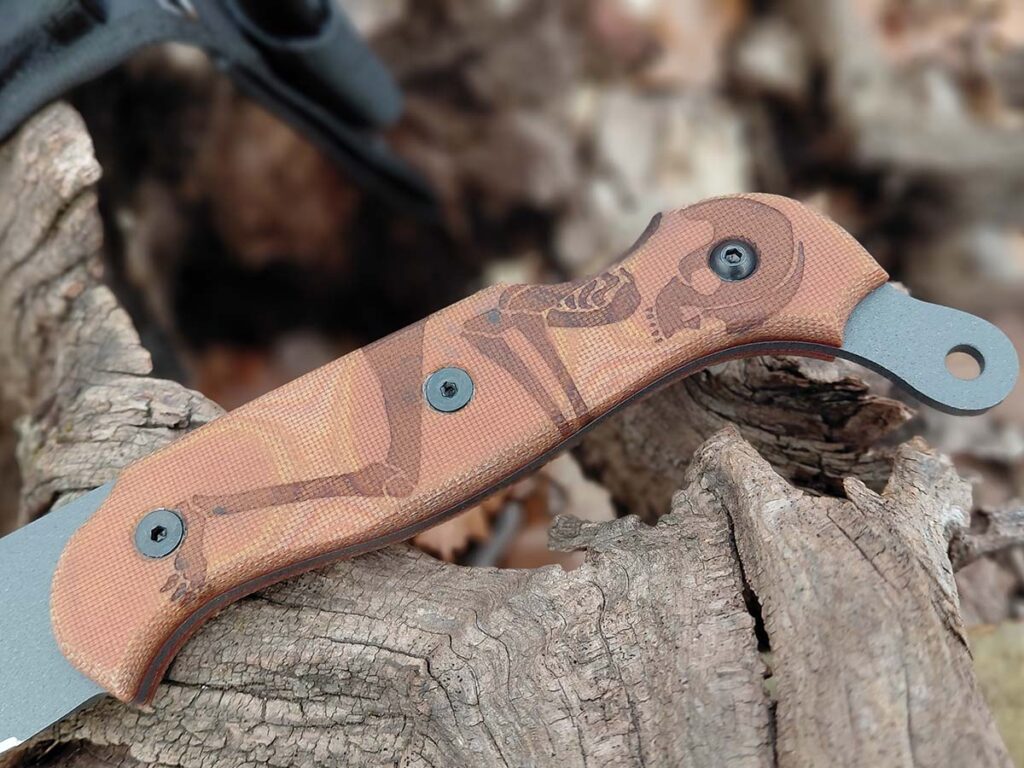
The TOPS Sneak Reaper has a 5-inch tan Micarta handle that offers a confident, secure grip with great traction.
Once I got this cutting machine in the woods, it called to more substantial branches and green wood. It wasn’t the weight as much as the thickness and feel. The sweet spot was several inches from the tip, making it feel like a shorter machete. This aspect got me thinking of what a great camp machete it would make. However, the pronounced upsweep had its benefits while standing or bending slightly. The front curve can easily nip nasty, thorny vines and thin, new growth without needing to get low. It reminded me of a smaller panga-style machete.
Turning the blade over revealed a sharp tip that could drag and pull the brush back after chopping it. This tip was also excellent at impaling scrap wood and relocating it. I love a tool that helps out.
The 5‑inch handle uses contoured tan Micarta that locks into the hand with confident traction. The 15‑ounce blade weight creates a sharp balance between speed and authority during heavy swings. In a standing position, slashing out front, the curve helped continually slice through materials with authority. I can’t wait to use this one on meat and coconuts.
Final Cut
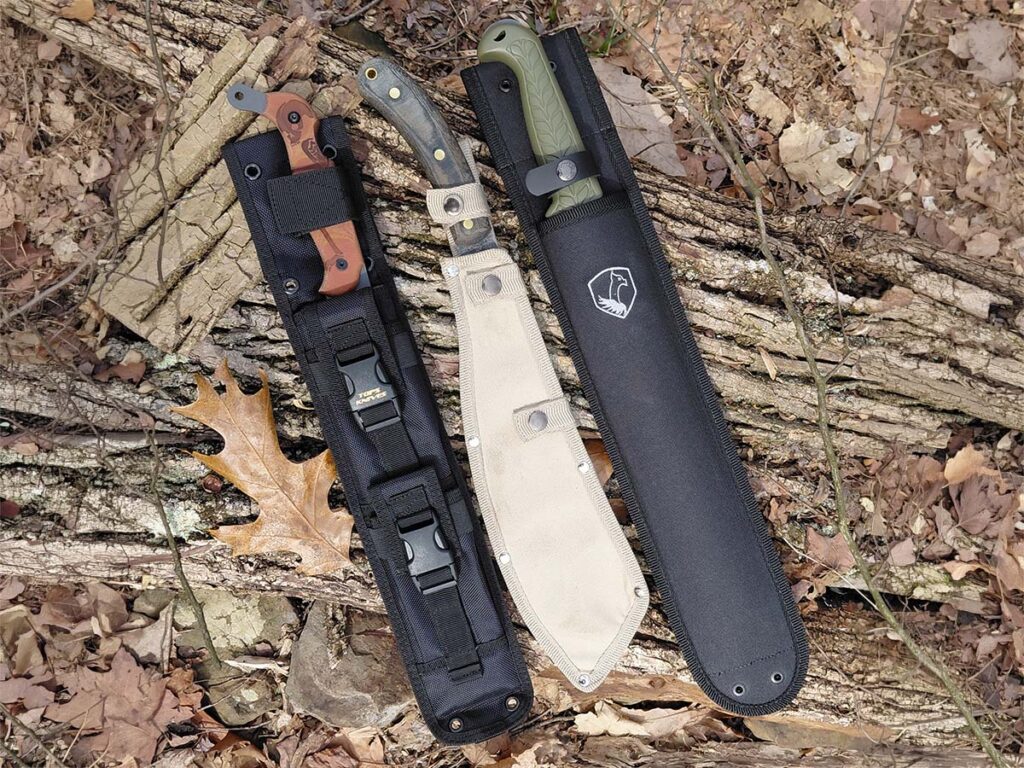
Three styles of machete sheaths for each trail tamer From left, the Sneak Reaper, El Deguello and Roarlock.
The Roarlock was the clear pick for me while beating back the new brush of spring. Had this been a machete camp challenge, the TOPS Sneak Reaper and Expat El Deguello would shine. Maybe that’s better left for another article!
Delve into the art of honing perfect cutting edges with our comprehensive guide on some of the best sharpening stones available today.
Even the most expensive, well-made knife is only as good as its edge. You can have a blade made from an alloy of adamantium, vibranium, and uru (aka, the stuff in Wolverine’s claws, Captain America’s shield, and Thor’s hammer respectively) and it still won’t matter if it isn’t sharp.
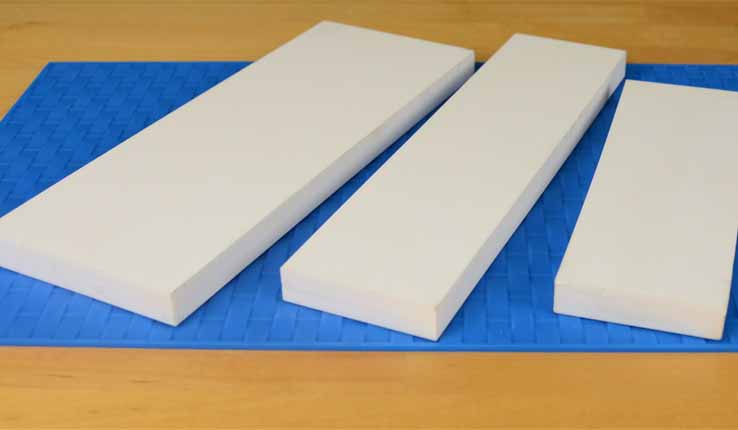
And while a hardware store pull-through sharpener can get the job done in a pinch, especially if you don’t particularly care about the longevity of your knife, the best way to sharpen any blade is with a proper sharpening stone.
Which is what we’re going to talk about today.
We’re going to go over everything you need to know about sharpening stones, including all the different varieties (oil, water, diamond, and ceramic/glass), as well as how to choose based on your sharpening experience, and what type of knife or other sharp things you’re trying to make sharper.
We’ll also discuss things like grit size, and then we’ll dive into some reviews of the best sharpening stones on the market right now. Let’s start with the basics.
Types of Sharpening Stone
Oil Stones
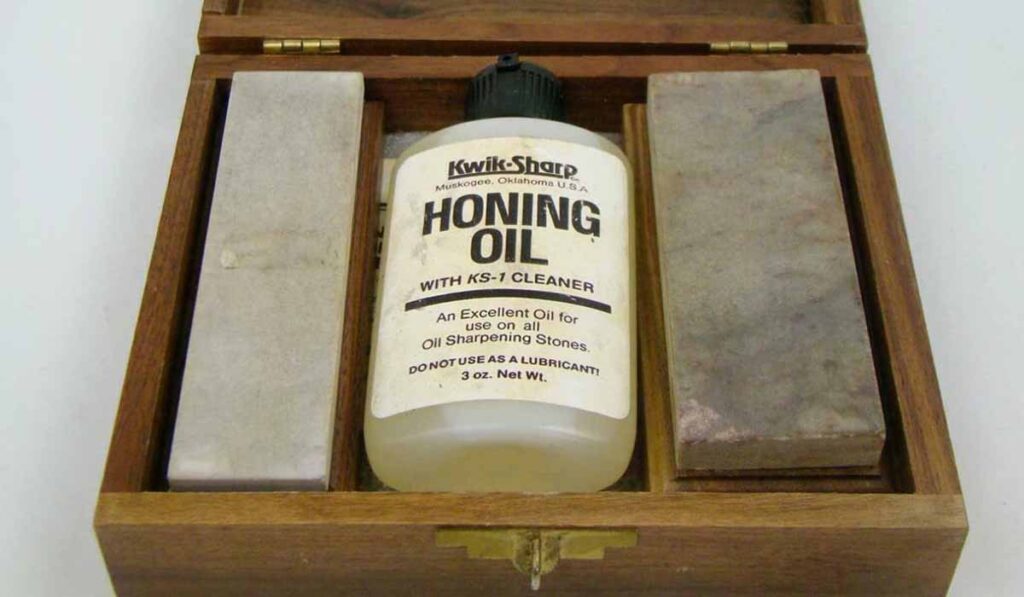
Oil stones are some of the cheapest sharpening stones out there, and they do alright for softer steels, particularly for lower-end EDC knives, multi-tool blades, and other similar blades. They’re called oil stones because, as you probably guessed, you use oil with them.
This keeps the blade from catching on anything as you sharpen and helps keep the removed bits of nearly-microscopic metal from clogging too badly on the stone as you move the blade across it.
Available grits are a little limited with oil stones and tend to be a bit more coarse because the stones are made from aluminum oxide or silicon carbide. This means they aren’t great for knives with a highly polished finish, or for very tough knives made of modern “super steels”.
Water Stones
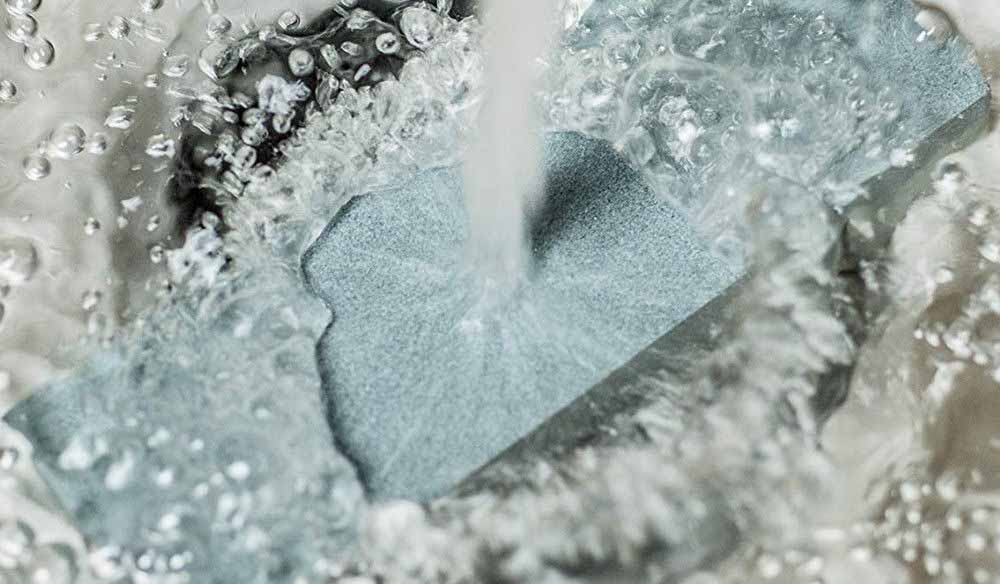
Water stones are another popular option that many people turn to to get a great edge on a blade, particularly kitchen knives, hunting/butcher knives, and other hard-use knives that require a sharp edge.
They’re called water stones because, as you probably guessed, they need to be wet in order to sharpen properly.
There are both natural and synthetic options available, with most natural water stones coming from central Europe or Japan, with the latter commanding a fairly high price due to its scarcity. These natural stones come in a range of grits, so there’s one for basically every need.
Synthetic water stones are more common (and less expensive) than their natural counterparts and are what you’ll find in most budget-friendly sets. Many of these stones will be dual-grit, with a coarse and fine side to make them a little more versatile.
Synthetic stones are generally very quick to use compared to their natural counterparts, but will occasionally need to be flattened with a special lapping plate in order to maintain a level top surface. This isn’t a difficult undertaking by any means, but it is worth keeping in mind.
Diamond Plates
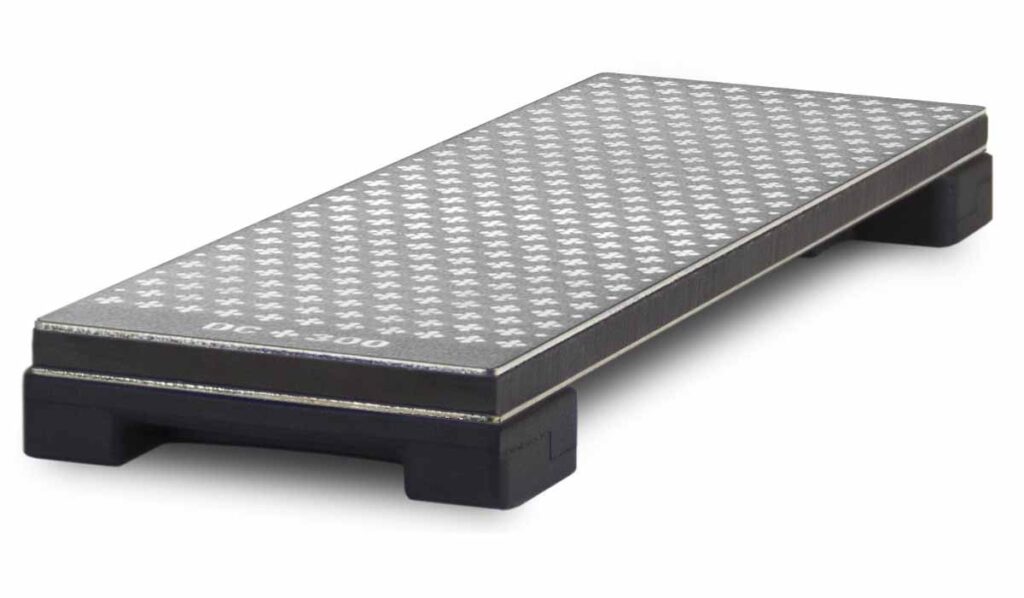
Diamond sharpeners, also known as diamond plates or diamond stones, are fast becoming one of the more popular options for sharpening among blade-wielding professionals and anyone who demands a high-quality edge without a lot of fussing with a sharpening stone.
Diamond plates utilize a conductive nickel base with synthetic diamonds electroplated onto the surface. This leaves us with an incredibly durable sharpening surface that is unlikely to wear out in anything other than daily professional use.
If you’re a butcher, you might wear out a couple of these plates in your lifetime.
This durability is matched by their effectiveness, as most diamond plates work very quickly, can sharpen everything from very tough high-carbon steels to cheap stainless, and will even work well on tungsten and ceramic blades.
They’re relatively affordable given how long they last, with most high-quality options coming in under $75.
Arkansas Stones
Lastly, Arkansas stones are worth mentioning because they’re often listed separately on many websites and they have some specific terms to know if you’re in the market for a sharpening stone.
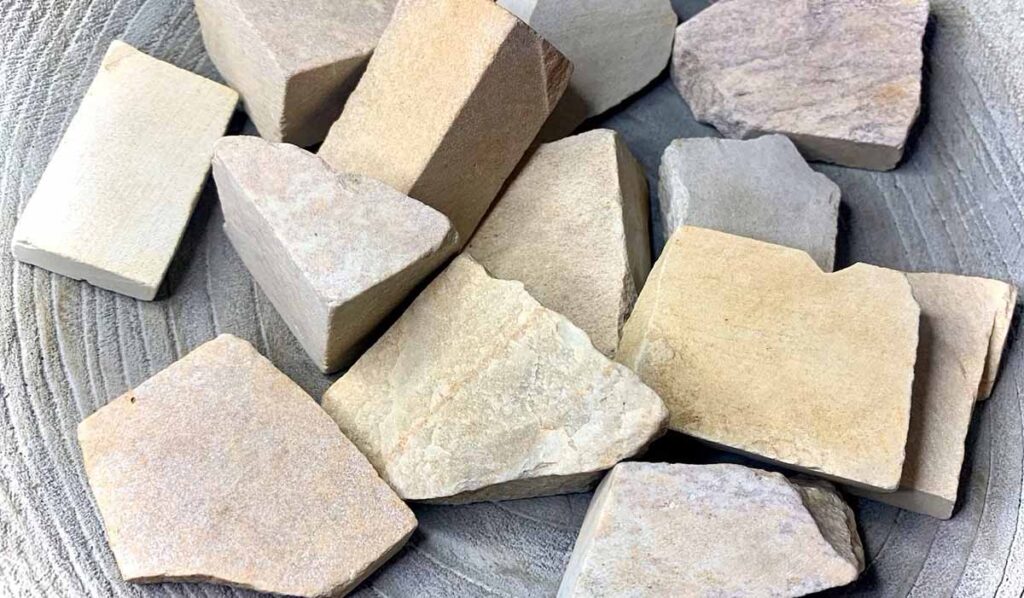
As you might expect, Arkansas stones are a natural whetstone that is quarried in Arkansas (as well as Texas and Oklahoma) in the United States. This natural stone has been used since at least the 1800s as a sharpening stone and is also known as Novaculite, which comes from the Latin word for sharp knife or dagger.
Novaculite has also been quarried in Syria, Lebanon, Israel, and Japan, though these stones have a slightly different makeup and aren’t produced in great quantities anymore.
Many native peoples used the stone for arrowheads and other tools because of its hardness and density, and today it is a popular choice for natural whetstones. It has a long history in the US, and the first usage of the word “whetstone” was actually in reference to an Arkansas stone.
All that having been said, Arkansas stones are a great option but are really just a natural type of stone that can be used with oil or water.
Ceramic Sharpening Stones
Ceramic sharpening stones are synthetic stones made of very accurately-sized grit particles bonded together to create one contiguous block. These stones, being man-made, are incredibly precise and durable, almost on par with diamond stones, but tend to be more expensive than natural stones.
Usually, these stones are made with corundum, which is an aluminum oxide that is commonly used in sandpaper, emery boards, and industrial abrasive applications. This makes the surface very hard indeed (a 9 on the Mohs scale, where a diamond is a 10) and thus great for sharpening.
Many ultra-fine grit stones will be some kind of ceramic-based product.
Grit Size: Bigger Really Isn’t Always Better
The first consideration, after you’ve chosen the type of sharpening stone (and we’re including diamond plates and synthetic ceramics in that) is going to be grit size.
The basic thing to remember is the lower the number associated with grit size the coarser the stone. We’re going to be using the JIS standard as that is what most folks in the US and Asia will be used to (sorry for our European readers, you may have to do some conversions).
The numbering system in the JIS system comes from the number of grit particles that will fit in a certain size square, so the smaller the number, the larger the individual grit particles will be.
These grits are then organized into ranges, typically Coarse, Medium, Fine, and Extra Fine or Finishing/Polishing stones.
Coarse is anything under 1000 grit
Medium is 1000 to 3000 grit
Fine is 3000 to 5000
Extra Fine is anything above 5000
This is just a general way to look at things though, and will vary from manufacturer to manufacturer. Some may call a 4,000-grit stone fine, and some may call it an extra fine, etc.
What you need to keep in mind is that the lower the grit, the more material you remove, so if you have a chip, rolled edge, or broken tip, then a grit of 1000 or below is appropriate. If you really need to restore an edge, pick up a coarse stone. Be careful though, as it’s easy to overdo it with these.
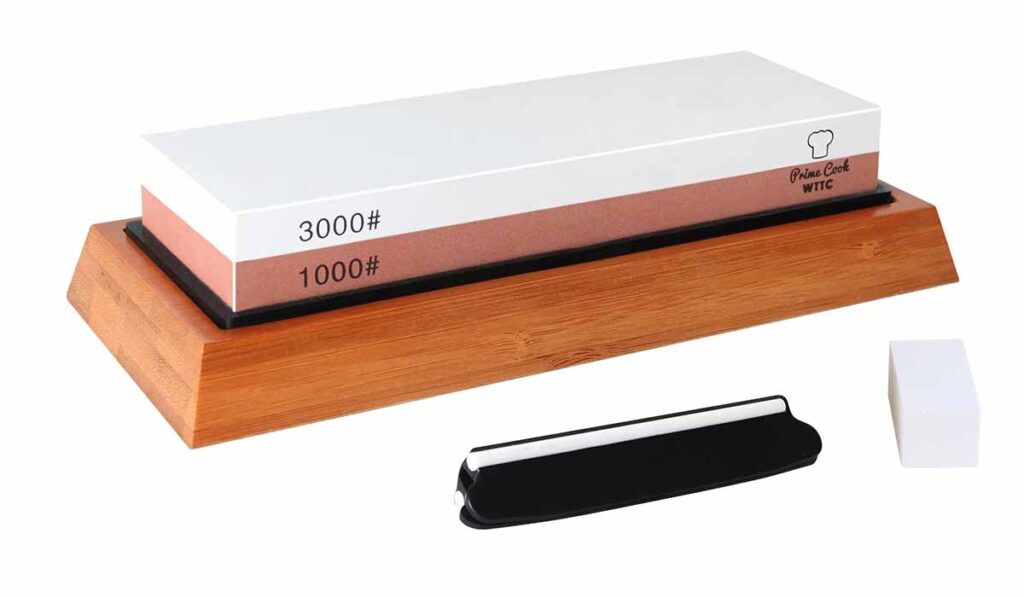
Most people find that a 1000- to 3000-grit stone (or dual-sided 1000 and 3000-grit combo stone) is a perfect option for keeping an edge on a pocket knife or other general sharpening tasks.
For the kitchen, I personally find that a 5000 grit is great for cleavers and butcher knives, and a 6000-8000 is great for knives with duties such as thinly slicing soft vegetables. I have a 1000/6000 grit combo stone that I find very useful for quickly restoring an edge and getting it back to where I want it.
For my woodworking chisels, I typically go from 4000 to 8000, but for finer work, I can definitely see the need to go to 10,000 and beyond for a truly polished edge, especially if you’re a better woodworker than I am (which is a low bar).
Make Sure Your Sharpening Stone is Big Enough
Most sharpening stones are standardized at around 7-inches long, and 3-inches wide which is perfect for most kitchen knives and pocket knives, but make sure you check the face dimensions so you know what you’re getting.
If you’re going to be sharpening something like a carving knife, machete, or sword, a lot of times you’ll want something a bit larger just so you can get more of the edge at once.
Well-Dressed Stones Last Longer
No, we’re not talking about putting your whetstones in a little suit. Dressing a stone refers to flattening the top surface out so that it makes even contact with the edge that you’re sharpening. Sharpening stones wear more towards the middle part of the face, which is known as “dishing”.
To correct this, stones need to be “dressed” or flattened so that they have a nice, even surface for sharpening. This is especially an issue if you use your stones a lot, or use them on lots of fairly short knives.
To fix this, a dressing plate is used to correct the issue and resurface the top of the stone. This can help your stone last much longer, and give you much more even results.
Buyer’s Guide: Best Sharpening Stones on the Market Today
Sharp Pebble Premium Whetstone
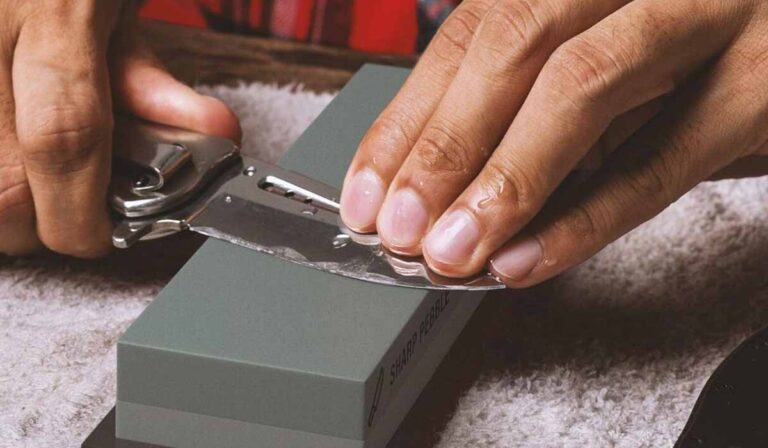
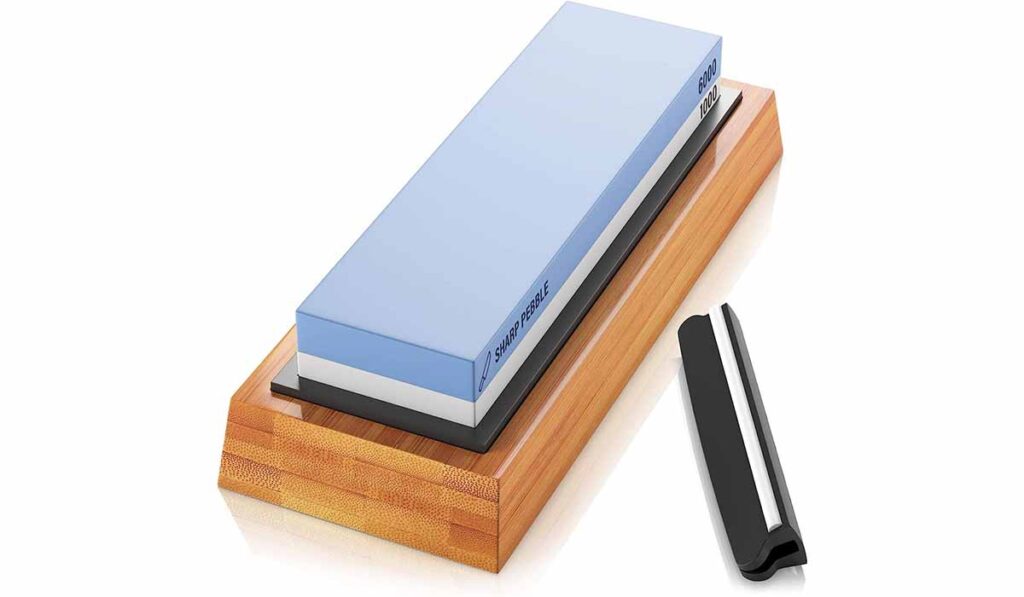
First up, we have one of my go-to sharpening stones, the Sharp Pebble Premium Whetstone, in particular this 1000/6000 combo stone. Sharp Pebble does a great job sourcing all its stones, and if you’re just looking to keep your kitchen knives in the right condition, this is where I’d start.
This is an aluminum oxide-based stone that offers a course and fine edge so you can quickly get a decent edge back, then polish up the edge to get something that can easily handle everything from butchering a deer to shaving depending on how much time you spend with the 6000 grit side.
It comes with a bamboo base with a non-slip bottom and a silicone—gasket? holder? grippy thing?—for the stone that keeps it from sliding around or messing up the nice bamboo base. It also includes a 20-degree angle guide to help you get the angle right.
The fact that you get two very useful grits in one stone, plus the base and angle guide makes this a great option for anyone who is making the jump to sharpening with a whetstone instead of a pull-through sharpener. If you’re looking to learn, this is a great place to start.
This, plus a strop could easily be all you ever really need if you’re just looking to keep a good edge on your EDC or home kitchen knives.
Diamond Machining Technology 8-inch DuoSharp
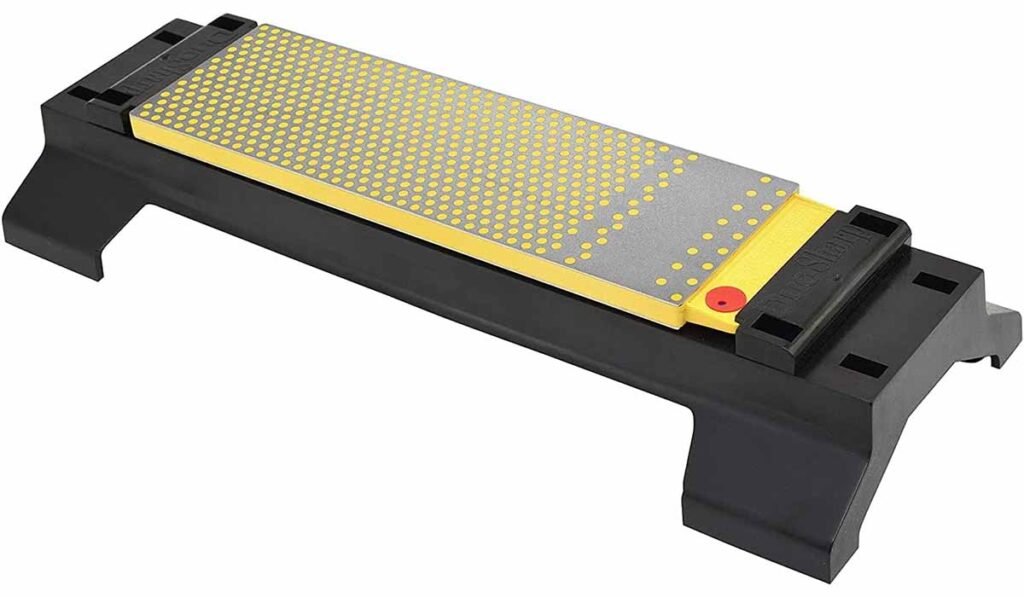
Stepping up a little bit, we have the DMT DuoSharp, which is a large, dual-grit diamond plate that is great for everything from pocket knives to chisels, and will likely last through a decade or more of regular use.
Because this is a diamond surface, it won’t wear away towards the middle or “dish” like an actual stone will, and it will work well without oil, allowing you to sharpen dry or with water if you prefer.
The size makes it a great option for a workshop bench, and I’ve personally used mine on everything from a rusty machete left in the bottom of a sailboat, to my chisels and other woodworking tools that required a touched up.
You can definitely use this for kitchen and pocket knives as well, and the coarse/fine stone will work well for most people. If you’re restoring old tools or putting an edge on a splitting maul or something, the extra coarse/coarse stone might be a better option for removing lots of material quickly.
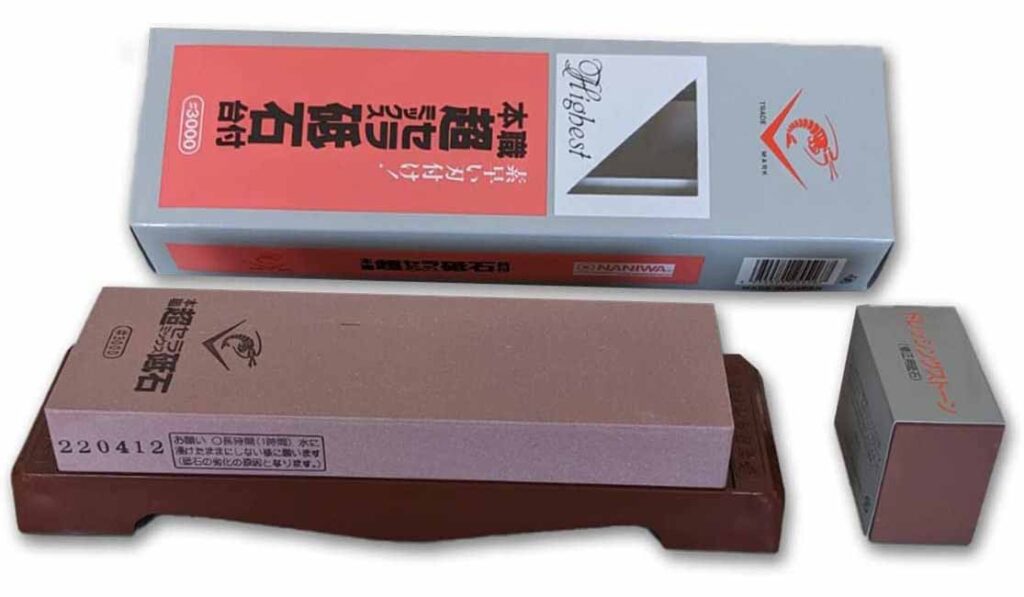
Naniwa Abrasive 3,000 Grit Stone
Now we step into the world of natural sharpening stones with a Japanese stone that is a little on the expensive side, but worth every penny if you want a long-lasting stone that will be easy to use and put a great edge on any blade.
Naniwa Abrasive is a major name in natural sharpening stones, and their standard 3,000 grit stone is a great starting point for anyone looking to upgrade their sharpening game a little bit. I got one of these years ago when I wanted a good medium grit stone for my kitchen knives, and it has been a great performer.
If you’re like me and don’t really let your knives get super dull to the point where you need a 1000-grit stone, and also don’t often spend hours sharpening to a mirror finish, this is a great option for a usable, functional edge on most any knife, especially one that you actually plan to use.
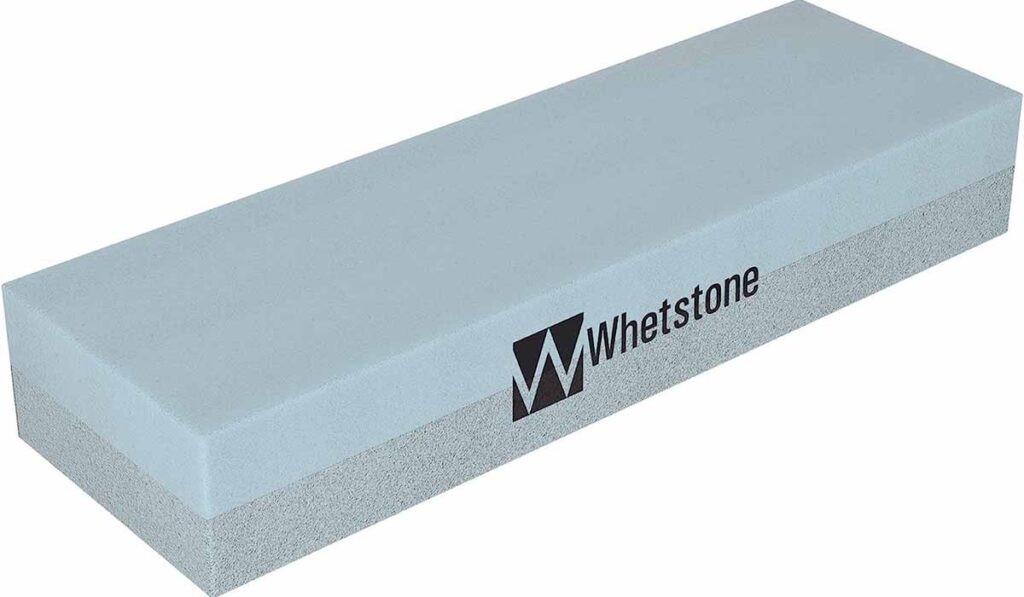
Whetstone Cutlery 400/1000 Wet Block
If the blade you’re sharpening is less “master-forged Nippon steel katana” and more “machete that’s been sitting out in the woods” then you’re probably going to want a very coarse stone to get it back to a decent starting point.
For that, we like this very simple and affordable 400/1000 stone from Whetstone Cutlery. It’s cheap and cheerful, and more than capable of getting an edge back on even the dullest of knives.
The 400-grit side will remove rust and take out nicks and chips in an edge, and then the 1000-grit side will help you bring it back to something resembling a real blade edge before you start working on it with higher grits.
Unless you’re restoring old tools, you might not ever need such an aggressive stone, but having one on hand for getting that rusty plane back in working order isn’t a bad idea. And it’s cheap enough that even if you only break it out a couple of times a year, you’ll get your money’s worth.
I really enjoy restoring old Case and Victorinox knives that have been used and abused for years, and this is the perfect stone for repairing those flea market finds, even if someone has snapped the tip of the blade off while trying to use it as a screwdriver or something.
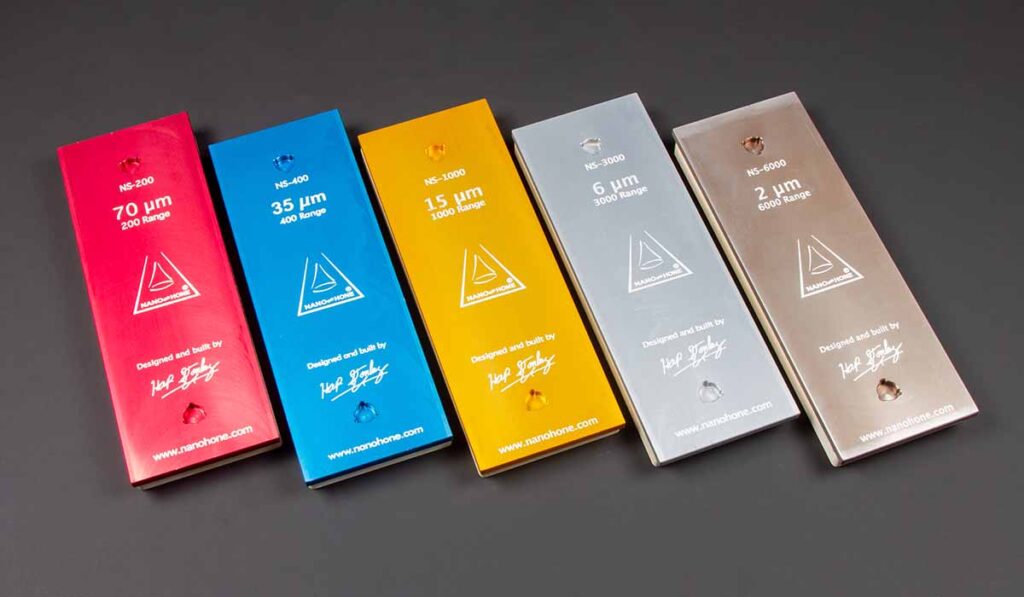
Nanohone Superbite Whetstones
Nanohone’s Superbite “Splash and Go” stones are incredibly high-quality, non-porous ceramic sharpening stones that are simple and quick to use.
They’re also incredibly expensive for a whole set of seven, with individual stones costing around $70.
Still, if you’re looking for a high-end sharpening stone set that will work on everything from your beat-up old pocket knife to your fancy Japanese kitchen knives, this is a great option. The stones themselves come in every grit from 70 microns (200 grit) to 1 micron (10,000 grit) so there’s something for every sharpening and polishing need here.
The stage and sharpening ponds are sold separately, so you can mix and match stones and get exactly what you need without spending too much money. If you enjoy sharpening itself as a hobby and want a kit that can grow as you grow your skills, this is a great option.
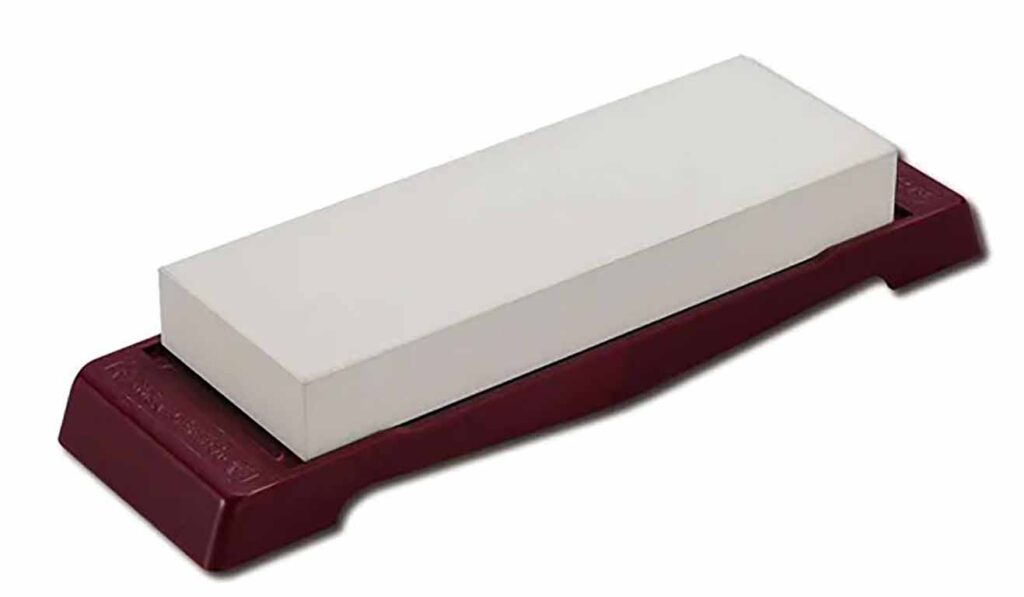
Tojiro Pro Finishing Whetstone
Lastly, we have this high-grit ceramic stone from the Japanese maker Tojiro. These are laser-sintered ceramic, which is great for any ultra-fine applications where you need to get a razor edge.
If you treat sharpening as part of your craft and need professional-grade tools, this is a great option whether you’re a chef, barber, woodworker, or you’re just passionate about having incredibly sharp knives.
Tojiro is primarily a maker of incredibly nice kitchen knives, so you’d probably expect them to know what they’re doing when it comes to sharpening. Their Pro line was originally made for their in-house artisans, and now they’ve made them available to the public as well.
If you want to get a great edge on any knife, particularly high-end, super steel knives, then this is a great option if you have the money to spend.
Final Thoughts on Sharpening Stones
A knife truly is only as good as its ability to cut, which makes a good quality sharpening stone (or stones) a key tool in any blade aficionado’s arsenal. Whether you carry a simple pocket knife, are passionate about cooking, or work with edged tools like chisels, planes, and axes, you need a way to achieve a good edge.
With these sharpening stones, you can get the performance out of your EDC knife you’ve always wanted, get those paper-thin slices of tomato when you’re in the kitchen, and get just the right edge on those tools at work.
Just remember to go slowly, especially at first, choose the right stone with the right grit, and you’ll have razor-sharp edges in no time.
A Good Work Knife Is Worth Its Weight In Gold. These Half-Dozen Blades All Excel At Something Outdoors From Gardening To Felling Trees.
Serious work knives are going to be fixed blades. Strength is something that can’t be sacrificed, and while many folders are incredibly rigid, they have mechanisms and moving parts that can and do become worn or damaged with hard use.
Modern folders are great knives. However, once mud, grit, sand, and the unexpected rock an inch underground comes into play, they tend to fail. Few folders are strong enough long-term for use as a trowel—fewer still can be safely batonned through wood. On the merit of ergonomics alone, the folder is usually slab-sided in profile and isn’t comfortable to hold for long periods, nor does it allow for easy cleaning. As such, the fixed blade is superior when the woodchips or dirt need to fly.
Defining work knives is merited by the individual task at hand. Some of the knives featured herein are not suitable to assume the role of another. Specialization is the name of the game and the knife you need for splitting wood is far different than one for working the ground. The main characteristic, across the board, is that these knives simply must hold up for their intended role and be at least serviceable in others should the need arise.
The test knives were all put to heavy use during an exterior cleanup, pulling up rotten posts, planting vegetables and bulbs, cutting down saplings and small trees, starting fires, making kindling, opening fertilizer and feed bags, and all sorts of things you would use a knife for in routine outdoor chores. They were exposed to rain, soil and, on occasion, cleaning supplies. I evaluated the edges and finishes for how well they cut and the handles for how well they felt in the hand after extended use.
Case Winkler Recurve Utility No. 6
The Case No. 6 was perfect for slicing straps on hay bales, removing small limbs and cutting various hoses and line.
A collaboration between Case and Winkler Knives, the Case Winkler Recurve Utility No. 6 is large, beefy, well-made, and very, very sharp. It arrived with a much finer edge than most Winkler designs, which made it all the more interesting when compared to the other Winkler knife in this article.
One of this issue’s cover knives, the No. 6 is not machete size but is big and heavily built. The deep belly and recurve result in a wide, rounded curve up to the tip, with about an inch-and-a-half of front-facing edge to the point. It is excellent at digging but not great at penetrating materials.
Where the knife really excels is in deep, long cuts. The recurve shape and handle angle make it want to sink right in. It can be batonned through wood around 2.5 inches in diameter with ease, can make tinder and is great at striking. The knife comes with a leather sheath that includes a polymer clip for a Zippo mini lighter. This is probably the only downside to this overall fantastic knife—the polymer clip isn’t strong enough to keep the lighter firmly in place and it can and does fall out.
In terms of general utility, I used the No. 6 hard and heavily for just about every task I could think of in the yard/garden. It chops well for a standard-sized knife and takes down medium branches as well as a small saw. It wants to work and, due to its shape, is simply useful and never got into a place where it was too much or too little. Overall, it is a fantastic work knife that should last you a lifetime.
MSRP: $430.99
Winkler Knives Drop Point Crusher
As a medium chore cutter, the Winkler Drop Point Crusher was great and easy to carry. The glass breaker/striker pommel is wickedly effective.
A classically styled working knife, the Winkler Knives Drop Point Crusher is a rugged gentleman’s knife with an appearance that doesn’t immediately give away its abilities. It was the only test knife with a wood grip but this never became an issue despite it being the most organic in composition. It was, like the others, exposed to rain, sap, dirt and dried wood. In addition, and thanks to the glass breaker/striker pommel, it was also used to bust down rotten posts and break glass out of a damaged windowpane.
It is a lightweight knife and easy to carry all day long. While Winkler makes knives for some of the most tactical dudes in the world, this one doesn’t draw that sort of attention in the slightest. It looks old, like something your granddad may have carried while hunting, and most people just look past it.
As an heirloom-quality knife it is hard to want to use it, but like all the Winkler blades I have looked at over the years, it wears nicely and simply gains character. For basic work the knife is great at everything but is just a bit thin for heavy batonning, though it can be used to split smaller pieces.
As a work tool, it is firmly in the everyday use category but like the Earth Skills knife is best set aside for heavy work. This is the knife I ended up wearing the most and using for the greatest number of tasks as it was so effortless to carry.
MSRP: $375
Condor Tool & Knife Woodbuster
The Woodbuster split firewood easily.
The Condor Tool & Knife Woodbuster is the biggest knife I’ve tested for BLADE®. Because of the knife’s name, I decided it best to use it on as much wood as possible, from taking down branches to dropping small trees. Designed by Joe Flowers, it sailed through things like they were hardly there. It approaches machete size, though it is heavy and the energy you need to get it moving is wasted on small brush.
I chopped firewood and reduced sections of trunk 12 inches wide into firewood with the Woodbuster. It can be batonned with surety and is great in that it has no real tip, so you don’t risk catching your hand or fingers if the blade sticks in the wood. It chops as well or better than a camp axe and with less physical effort in preparing firewood.
In taking down trees care is needed, but it is as good as an axe on anything under a foot across, which isn’t small by any stretch. The Woodbuster is 100 percent a working knife and is easy to become proficient with.
The only downside is the grip, which is rather round in profile. Smaller hands may have a hard time with it. The grip is also a bit smooth, though not all that noticeable if you wear work gloves. It becomes a bit hard to hold when wet and can roll in the hand after repeated strikes. This isn’t a serious problem, just something to be aware of.
MSRP: $171.58
KA-BAR Jarosz Camp Turok
The Camp Turok is a large knife that can handle branches, cutting chores, and light chopping.
The KA-BAR Jarosz Camp Turok is large but not as beefy as the Woodbuster, and much lighter. With the exception of heavy wood cutting and batonning, it performs most outdoor tasks. The blade is thick but draws to a relatively fine point.
Designed by Jesse Jarosz, the Turok is a great general-purpose outdoor tool in that it’s easily maintained and stays sharp when handling chores. It’s a bit too large for EDC and is, like the Woodbuster, something you will want to carry until you don’t; it’s an overt item.
It is, however, the test tool that has the most utility for the price and the broadest range of uses. The only thing I don’t like is the grip—too smooth for my taste and slippery when wet. However, the scales are removable, making the knife easy to clean and maintain.
MSRP: $129.69
Benchmade 162 Bushcrafter
The handy Benchmade 162 Bushcrafter is eminently useful for most outdoor work, and easy to carry and maintain. Designed by Shane Sibert, it arrived with a very sharp edge, though more notable was the grip profile. It’s a relatively small knife and the handle is unusually shaped, almost like a dog bone in geometry, and is very easy to get a firm, solid grip on. It can’t really be used for chopping large materials but is exceptional for fine work. It’s great at making fire and excellent in the garden and for pruning.
While billed as a bushcraft blade, it’s really a fine everyday knife and graciously civilian in appearance. It doesn’t look tactical at all and won’t draw attention anywhere from the farmer’s market to the barnyard. It held up exceptionally well and maintained a sharp edge in use.
It was used like the others to open feed and fertilizer bags and to cut cord and roots. The only downside is the sheath. While aesthetically pleasing, it has a suede feel and once wet tends to stay wet for a long time.
MSRP: $260
TOPS Knives Earth Skills Knife
The Earth Skills knife was at home in the garden and far more effective than a trowel at getting though tough roots.
The Earth Skills Knife from TOPS Knives is large and has a very atypical profile. Matt Graham designed it as a type of survival knife, though not necessarily a heavy-duty one. It is quite thin and has a generous Scandi grind, making it absolutely wonderful for working the earth, cutting through rooted soil to plant new bulbs or vegetables, and light work like cutting branches and digging up old wire netting. It’s great as a close work tool and for preparing food but has little value for hard-use tasks.
The edge geometry and thin spine are not suitable for batonning, though the blade is great scraping tinder and striking on a rod. Because of these special features, the knife is at home in the garden or camp in that it likely won’t be used for initial setup, but rather for cutting food, root vegetables, harvesting forage and as a light machete. The grip is very comfortable but quite large. The blade stayed very sharp through testing and accomplished tasks easily with minimal wear.
There’s something primal about a bone handle knife. We break down this eye-catching natural material, show what to look for and give you some top picks.
Bone has been around as a handle material just about as long as we have. It is safe to say that ancient cultures across the world have used bone as a handle material for as many as 100,000 years. Perhaps longer. Nobody knows for certain because these materials don’t last forever, even if perfectly preserved.
Bone Handle Knives History
Antler and bone have been used across the world and by virtually all peoples. We see, however, a distinct trend around 12,000 to 10,000 BC where they became the choice handle material for stone or volcanic glass blades. These handles were often carved to allow the instillation of replacement blades, given the brittle nature of the material.
These types of blades were state-of-the-art technology for millennia, with their traditional means of construction still in common use with many cultures at the time Europeans began exploring the world. The stone blades were extremely sharp and could last for months or even years if properly maintained.
Ancient people were experts at shaping these stone blades, and they could do so with great precision. Many of them were not small either, some stone spear points rival modern Bowie’s in length. The strength of these knives is largely dependent on the skill of the craftsman, and some of these blades and their handles still exist today.
Fast forward to the early modern era around 500-1000 years ago, we see that bone is purely a decorative choice on most knives. While functional, there is more of a challenge to working with it than there is wood. Wood in most cases is easily shaped while bone is a much more finicky medium. Bone is substantially more brittle, and it is harder to seal and finish. While it may seem like a durable material, it is quite porous and can shatter if struck.
In a way, bone went from being the material of choice to the choice of those who perhaps wanted to show off. Today this is the same story. It is hard to find individuals who carry around knives with ancient mammoth ivory grips, but they do exist. Will that same individual use that knife for camp work like ancient man? Again maybe, but not likely at the cost of that material.
Common Types Of Bone Used In Handles
Bone
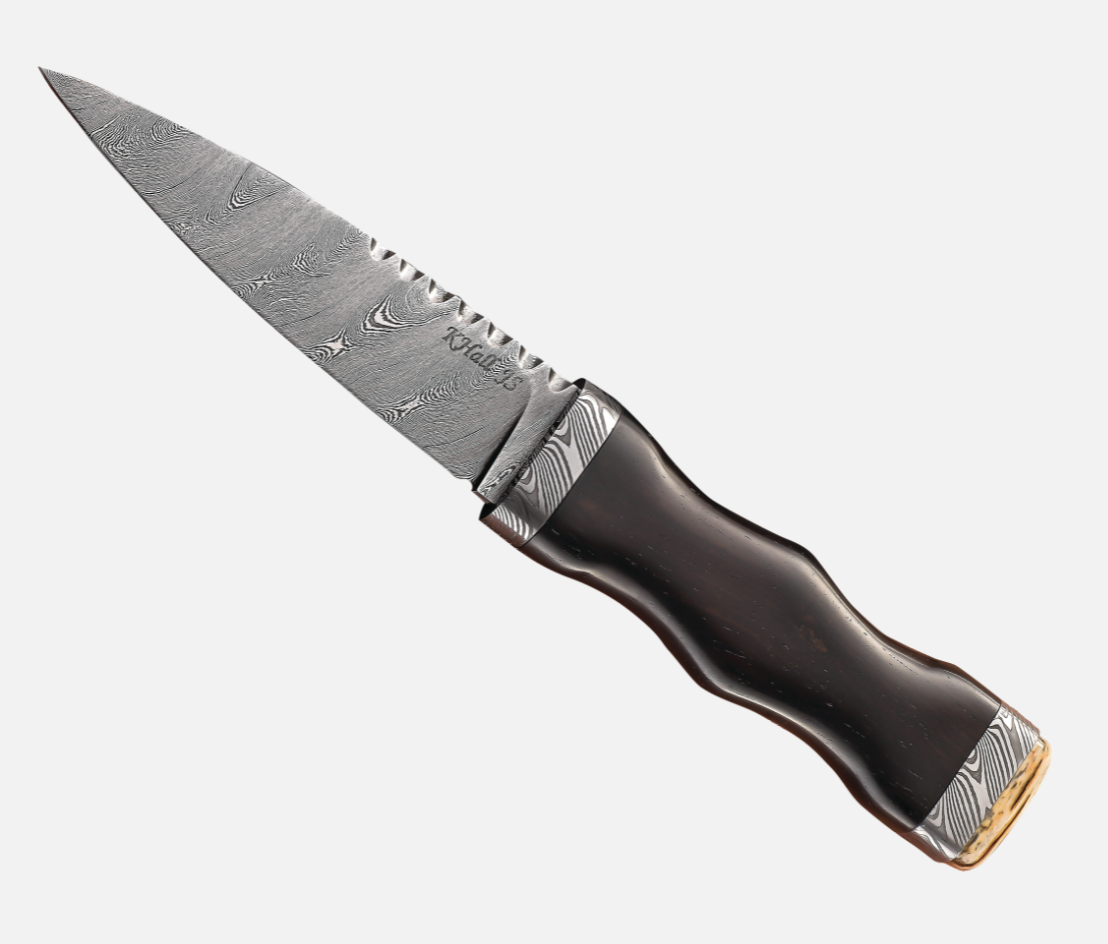
Ken Hall’s sgian dubh features a 4.25-inch blade of twist damascus in a blend of 1075 spring and 15N20 nickel alloy steels. The pommel is formed from stone and giraffe bone. The African blackwood handle not only is ideal for its carvability but also in keeping with the sgian dubh’s name, which is Scottish for black knife.
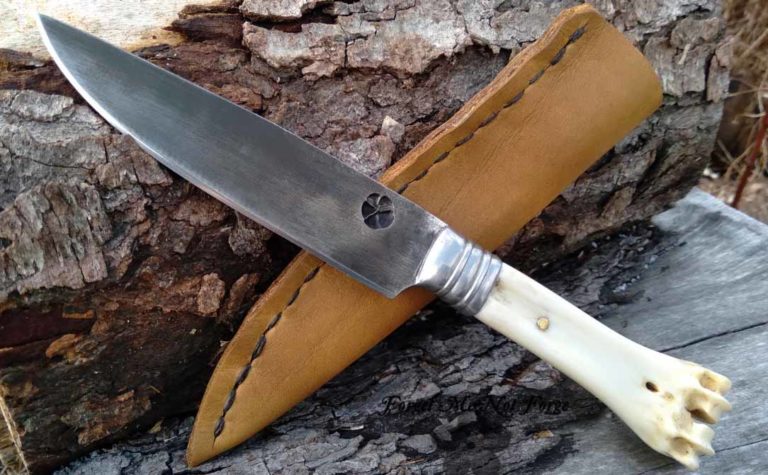
For the most part, bone handles were typically made from whatever animal was available in the region. In ancient times, this could be any type of bone that was easily hollowed out or shaped. The femur bone (thigh bone) was quite common. Equally popular were the bones of the arm, and even the jawbone, depending on the animal.
Antler
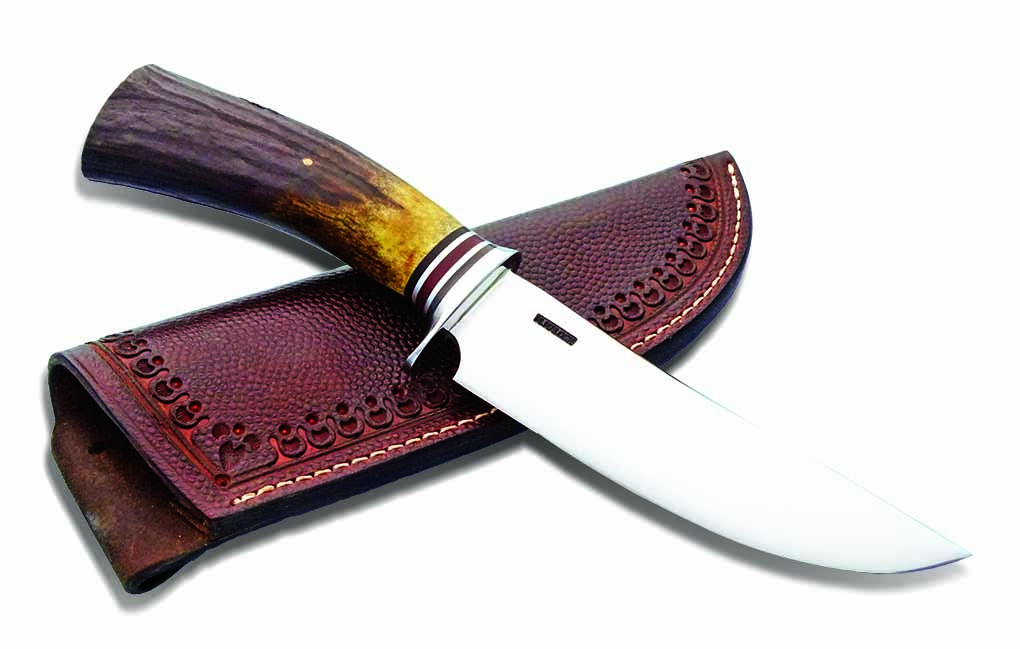
Mike Malosh opts for elk antler with black and maroon Micarta® and stainless steel spacers for the handle of his utility hunter. The 6-inch blade is W2 tool steel and the guard is stainless steel. Overall length: 10.75 inches. The knife comes with a leather sheath by Malosh. The maker’s price: $390. (Impress By Design image)
Antler is and always has been a better alternative than skeletal bone. Antlers grow on members of the deer family only, from the skull and are semi-vascular. This means they have blood flow and skin while they grow. What makes them appealing then and now are they are shed by the animals yearly. This makes them easier to source, not requiring a kill to obtain. Furthermore, antler is extremely strong and dense, much more so than skeletal bone. In turn, it is less prone to shatter and is substantially less porous, meaning it is easier to finish and maintain.
Ivory
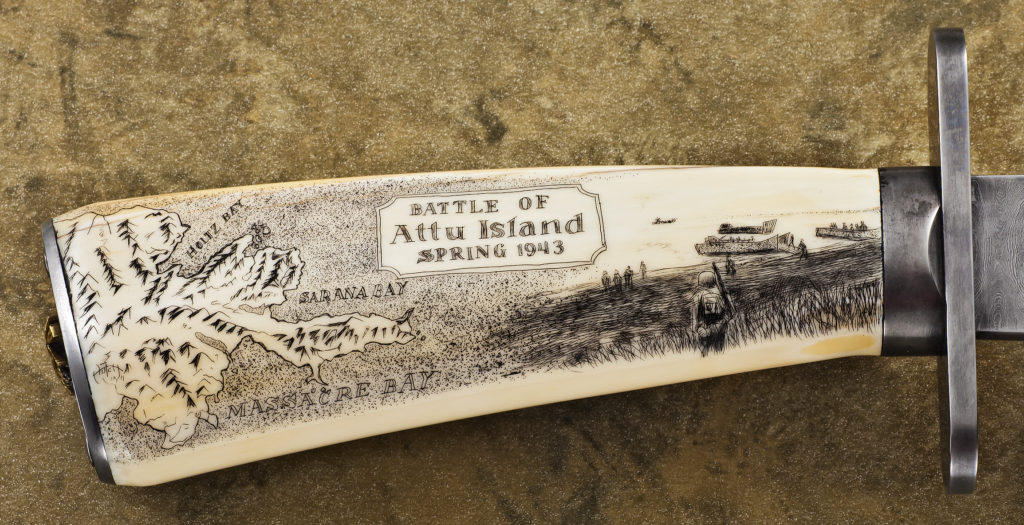
Sharpe used an ancient walrus ivory tusk he already had on hand. Richard (Hutch) Hutchings volunteered to scrimshaw the handle.
Ivory is another material that falls into the bone category. Elephant ivory has been strictly regulated for years. As a result, the material is exceedingly rare and possession of an unaccounted-for sample can land you in trouble. The ivory trade has been bad for the elephant population worldwide, but the animals are largely out of danger now, though this has not lessened ivory restrictions. It is a semi-grainless material that is not only strong but also easily shaped—lending to its popularity.
Mammoth Tusk
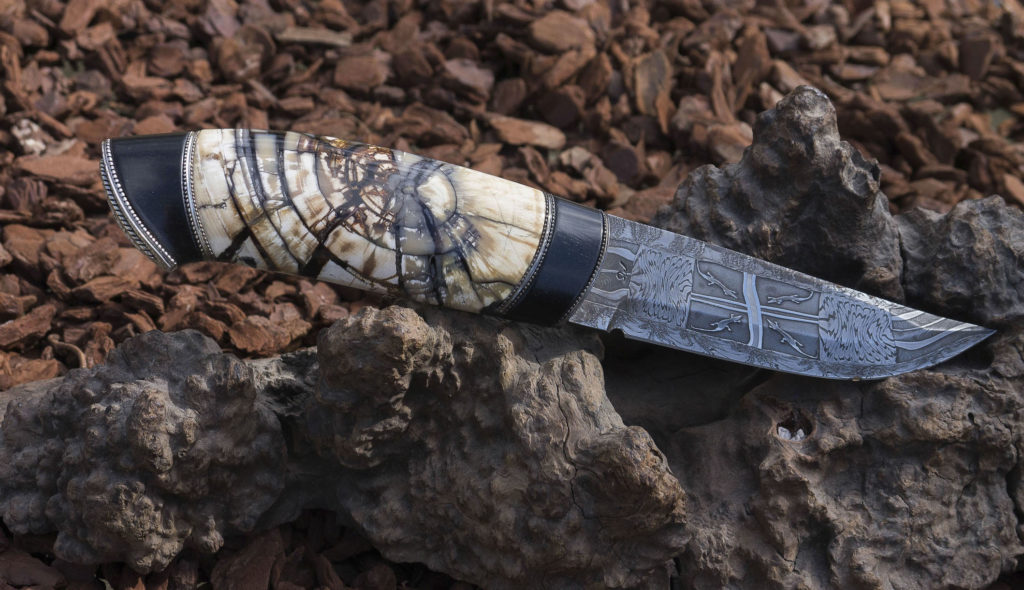
Raffir fossil mammoth ivory comprises the handle of Danish knifemaker Tommy Astrup’s mosaic damascus fixed blade.
While there are regional laws pertaining to mammoth tusk— California, New Jersey, and New York you can’t transfer it—this ancient material is generally legal to sell and possess. (Always check your local laws to make sure this holds true for you.) Given restrictions on ivory, this material has become more common in recent year, sparking a rush to collect it on the Siberian tundra. The permafrost makes it so that these tusks are almost like new. Working with it is no more challenging than working with modern ivory, given the state of preservation is usually excellent. Other ancient materials that are suitable for use on knives include the tusks of walruses and narwhals, but these too are regulated in some states.
Most Desirable Bone Handle Knives
Beauty is truly in the eye of the beholder. While bone handles are certainly attractive, they are not always the best choice for daily use.
The main reason, aside from antlers, most bone material gets very expensive very quickly. Mammoth ivory can run well into the thousands of dollars for enough to make a couple of handles. For this reason, you typically see it as thinner scales as opposed to a full carved grip. If you go that latter route, the finished knife cost can skyrocket into the thousands, perhaps even over $10,000 on a nicely executed custom knife.
Pros And Cons Of Bone Handles
In the world of Micarta and G10 there is little advantage in bone or antler, particularly in durability and longevity. Like any naturally occurring material, there is the presence of unseen flaws that may become liabilities during use. These materials aren’t weatherproof in a true sense and can take on moisture and pull in oils. The mineral structure is different on each bone or antler and as a result, there is no true gauge for strength across the board. The ergonomics are also a challenge as most of these bones and antlers are shaped in a preexisting manner by the animal they came from.
This is not to say that they are useless, rather it is a matter of personal preference. Some people truly prefer how these materials look and feel and that is their right. That does come with accepting that they may be restricted to certain uses as opposed to other handle materials. For instance, hard chopping work and batoning are difficult on handles due to flex and vibration, and bone or antler may simply crack at the pins if a strike is not performed perfectly. The nature of these materials is sentimental, not just to the individual but to mankind as a whole being that they have been with us since the beginning.
Top Bone Handle Knives
Wess Barnhil Gentleman’s Hunter
Wess Barnhil Gentleman’s Hunter (bottom)
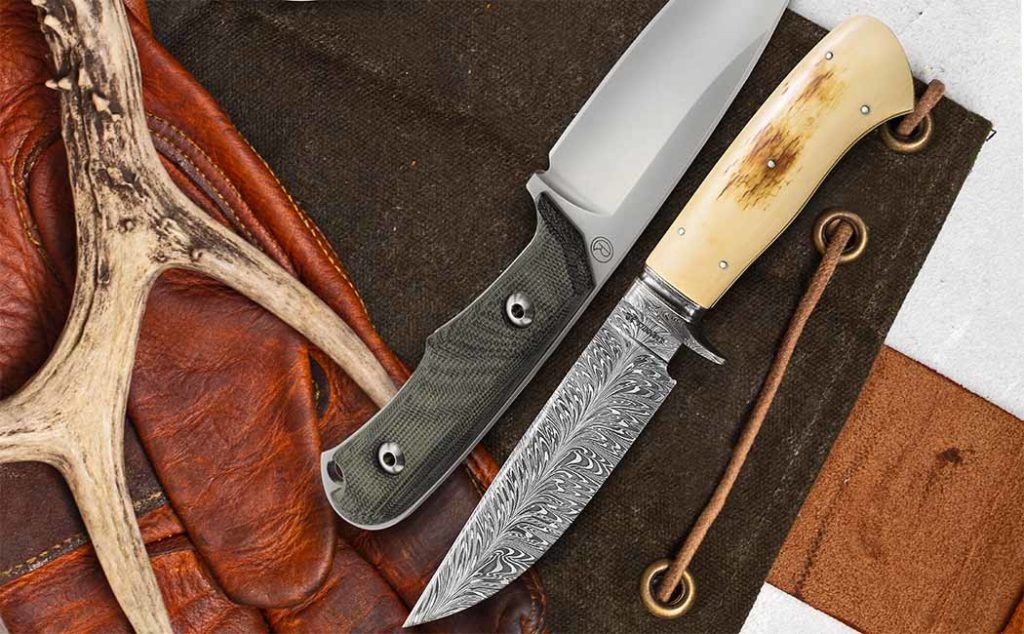
A custom offering by Wess Barnhill, the Gentleman’s Hunter was featured in the November 2022 print issue of Blade alongside some other fantastic bone or antler-handled knives. Modestly priced for a Damascus steel blade, Barnhill’s knife displays an excellent profile and layout for real-world use but is so damn beautiful you’ll probably want to keep it safe from blood and guts! Barnhill’s portfolio features several knives with natural material handles, each a work of art.
MSRP: $1400
Mark Fleming Forged Southwest Trail Bowie
Mark Fleming Forged Southwest Trail Bowie
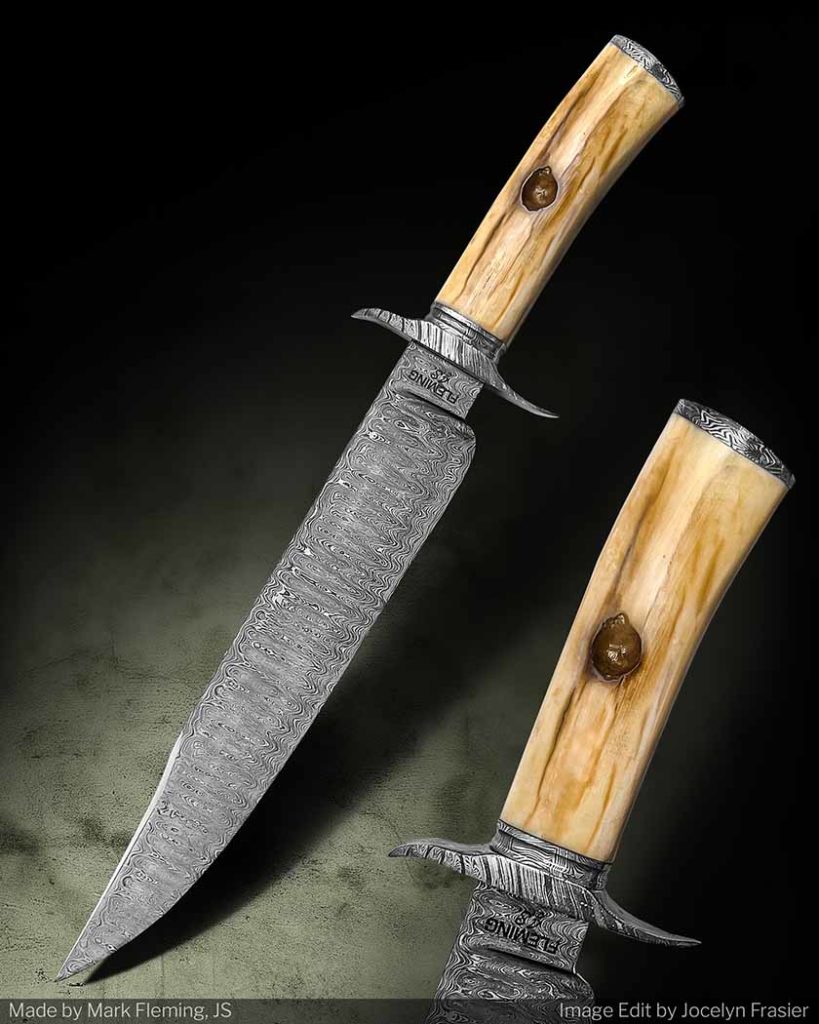
This knife was featured in the December 2022 print edition of Blade Magazine. Mark Fleming is an ABS journeyman smith, but his work looks exceedingly masterful at this point in his career. While this particular knife is custom, a similar piece will run you about $1,900, which is quite reasonable for such a complex execution. The knife as featured included an awesome-looking ancient walrus ivory grip, itself a relic.The grip material was salvaged from a native fire spindle that was used to start friction fires. Interestingly, you probably could still use this in that manner and you wouldn’t be outside the times. Grip indentations for starting friction fires are common on many knives today.
MSRP: $1,900 (for a similar design)
Rapid River Knifeworks Kodiak
Rapid River Knifeworks Kodiak
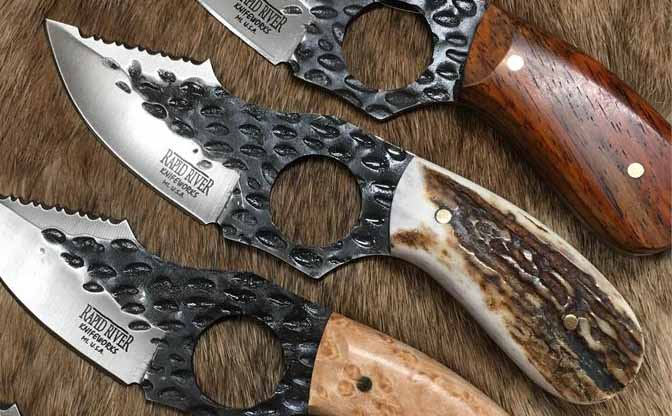
Rapid River Knifeworks offers a tremendous number of custom services and a wide range of knife products. Located in Michigan’s upper peninsula, the company has excelled in adding traditional flair to its lineup and the products stand out from others across the board. The Kodiak is a hammer-forged knife that is offered in a dizzying number of configurations, not even including custom engraving. The variant we’re concerned with here comes with elk antler as a grip material, and it sure does look great! Unlike many knife companies, Rapid River has a showroom you can visit in person.
MSRP: $175
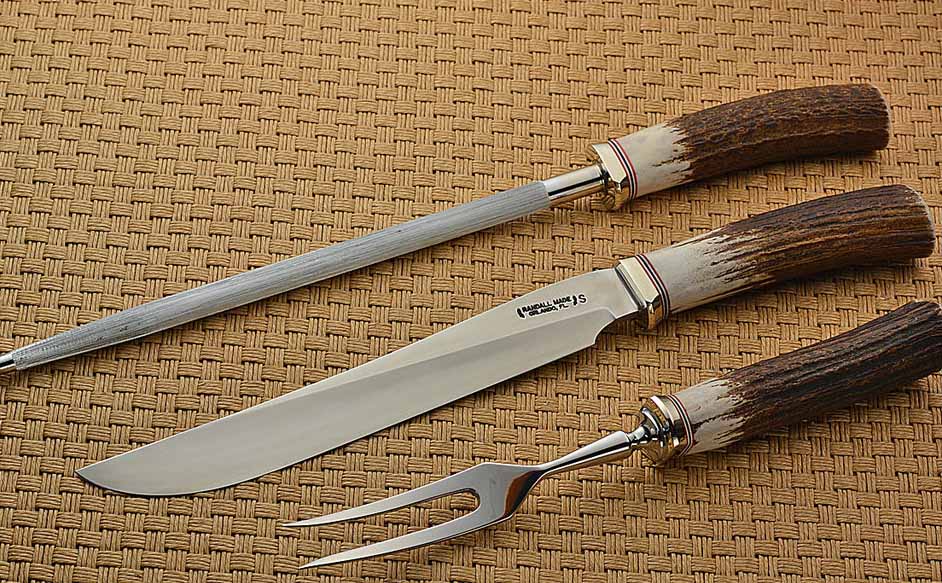
Randall Knives 3-Piece Carving Set
Randall Knives 3-Piece Carving Set
Randall Knives needs no introduction here, however, we are pleased to take a look at a less-prominent product from their standard lineup—its 3-Piece Carving Set. The set comes with a 9-inch carbine knife, serving fork, and sharpening steel, all of which are finished with stag handles. The set includes a storage box and the company notes that you should not put them through the dishwasher. Randall Knives, of course, offers some very well-known classics in natural material handles, many of them available in their standard lineup. If you so desire, you can also take a look at having something custom-built, but you had best get your orders in now. The company website is currently taking orders for delivery in four years!
MSRP: $680
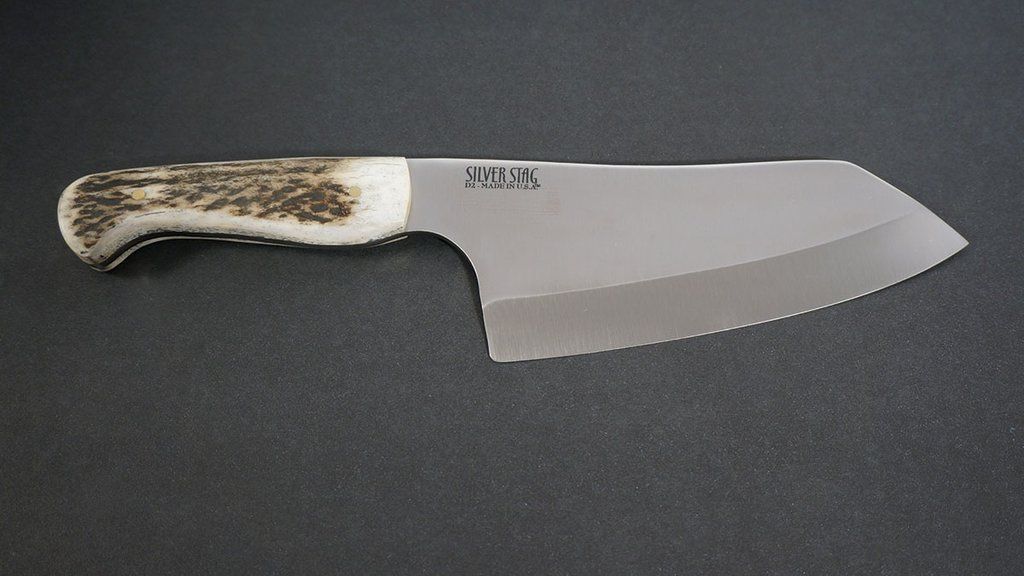
Silver Stag Universal Chef Pro
Silver Stag Universal Chef Pro
Silver Stag makes a great number of products that feature natural handle materials, but a standout example is the antler-handled Universal Chef Pro. This is an all-use kitchen knife that is at home in just about any setting—be it your home or base camp. The knife is ruggedly constructed and has a unique shape with a curved belly and sheep’s foot tip that allows it to be deftly handled for large tasks like carving down to fine dicing. Silver Stag offers a full line of antler-handled kitchen knives, as well as many other outdoor knives from filet knives to custom scrimshawed skinners.