Buyer's Guides

You’re looking for a new knife in a certain style – we’ve got recommendations on the best blades for every price point.

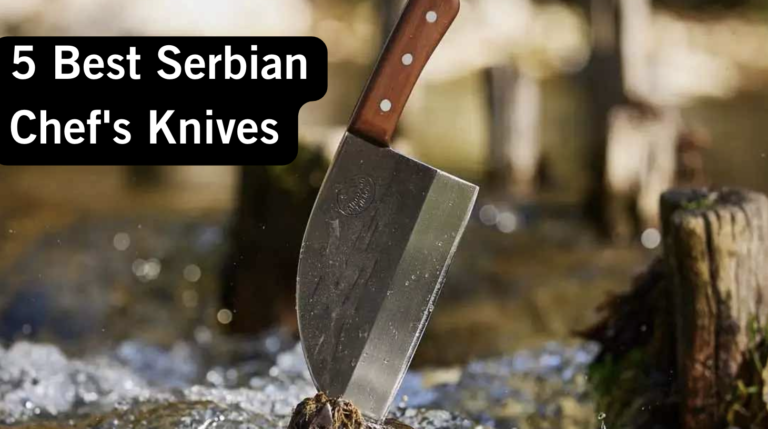
5 Best Serbian Chef’s Knives You Can Buy

Growing In Popularity, The Serbian Chef’s Knife Has Gained A Reputation For Strength And Versatility.

When many think of kitchen knives it falls into two categories: Japanese-style knives and German/Western-style knives. However, there is slowly a third type of knife gaining popularity: the Serbian knife.

Also known as an Almazan knife (or just an Almazan), the Serbian chef’s knife has a unique history when compared to other blade styles. Rather than evolving and adapting over time, the Serbian chef’s knife is tied back specifically to Almazan Kitchen.

Almazan Knife And Kitchen Backstory

The company was founded by two men in Serbia, uncle and nephew Boban and Aleksandar Almazan. Essentially, clever marketing and a unique look have vaulted the knife into the limelight.

Despite Almazan’s and other knives’ bucolic charm, there is little attaching the style to a particular historic Serbian design. Instead, the moniker comes from the Almanzan clan hailing from Serbia. In some corners of the globe, the knife is simply known as an Almanzan knife … makes sense.

Interestingly, the Almanzans seemed able to harness to disparate trends in the knife world with the Serbian chef’s knife. On one side, was the ever-growing interest in cooking, the other the rise of cleaver-like knives for bushcraft. They must have had some passing inkling of this crux, given they marketed their knives to both communities, as well as played up the wilderness and food prep in their marketing.

Serbian Chef Knife Design Points

Unless you’ve lost your glasses, it’s fairly apparent what sets the knife apart from its counterparts–its huge hooking blade. If we’re honest with ourselves it’s a cleaver with a tip–somewhat reminiscent of a large deba bōchō, but overall heftier.

Generally, most Serbian chef’s knife makers tout their wares as handmade–of course at factory scale, with all that entails. Most of the blades have a very thick spine giving them the chops to tackle heavy-duty jobs. Though, most lack a defined belly, lending them better hacking jobs.

By and large, Serbian knives are constructed of carbon steel and have won some kudos for maintaining a good edge. Furthermore, almost all makers favor a wood handle of some sort, most likely because it maintains the rustic, outdoorsy aesthetic Almazan originally pioneered.

Should I Get A Serbian Chef’s Knife?

Honestly, like all things knives, that’s up to you. Maybe the Serbian chef’s knife is the kitchen or backwoods tool you’ve been waiting for or perhaps is all online hoopla. There are many who fall in the latter category and are vocal about it.

Despite this, it does seem the cleaver-style design has a place in the galley, particularly if you happen to process chuck wagons full of meat. The large width of the blade makes it ideal for hacking, particularly joints and bone. Additionally, boasting a tip, it could potentially tackle basic kitchen jobs in a pinch.

That said, as a catch-all chef’s knife, most cooks are likely going to find themself more comfortable behind a traditional design. The large blade is unwieldy for basic cooking jobs, such as chopping and mincing. Furthermore, the lack of a belly on most examples slows the knife down considerably on general tasks.

Bushcraft? Sure, there’s the potential. A Serbian chef’s knife certainly has the ability to work in a hatchet’s stead. Outside of that, well, things get dicey. It’s not exactly the style of blade you’d reach for to skin a buck or whittle fuzz sticks. Not to mention, do you really envision toting one of those beasts in your kit? (Add a pound to your ruck, not mine!)

Of course, this is coming from a more traditional mindset of kitchen and backcountry work and utility. And much like beauty, utility is often times in the eye of the beholder.

5 Top Serbian Chef’s Knives

Almazan Kitchen Original Serbian Chef’s Knife

Almazan Kitchen Original Serbian Chef’s Knife

The blade that started the craze. The Original from Almazan Kitchen set the standard for every Serbian knife that’s come after it. Hand forged in Serbia, and weighing a shade under 1 pound, this blade is a menace in the best possible way. 

The carbon-alloy blade is tempered to a 58-60 HRC. The full-tang construction features a triple-riveted handle for grip and gives the user a sense of confidence. The uncle-and-nephew team that founded the company, Boban and Aleksandar Almazan, wanted to make a knife that would be as comfortable in the forest as it would be in the kitchen, for some they’ve succeeded.

Beyond just the knife itself, Almazan also sells accessories including leather sheaths, cutting boards, and kitchen equipment made from olivewood. 

The knives have also benefitted from the company’s wildly successful marketing, in particular the Almazan YouTube channel. Fueled by more than 3 million subscribers, the company and its knife have blown up in recent years.

MSRP: $152.92 (There is also a stainless version for $30 less)

Damas Knives Bushcraft Serbian Knife

Damas Knives Bushcraft Serbian Knife

This model from Damas Knives is emblematic of the new(ish) design, with its wide blade and rustic handle. The knife is hand-forged from a single sheet of XC75 high-carbon steel with a 59 HRC and ground to a 21-degree angle.

The blade’s strength and the Rosewood handle’s sturdiness allow the user to butcher big cuts of meats, nimbly dice veggies, and even slice right through small bones. Beyond the food uses, this piece can tackle cutting wood and brush on a hike. 

MSRP: $145

Imarku Butcher Knife

Imarku Butcher Knife

From one of the most trusted names in kitchen knives comes a budget Serbian chef’s knife that swings far above its price point. 

This knife from Imarku features a hammered design and is hand forged. The blade is made from high-carbon, high-manganese German X50CrMov15 steel. The hard 56-60 HRC steel holds a razor edge and has good rust resistance as well. You can see the spots from the hammering up and down the blade, which gives it its signature look.

The knife comes with a leather sheath and, like other Serbian knives, has the strength to cut through bones and butcher large meats. 

Imarku stands apart from other Almazans due to the price. The company has found a way to make a top-tier example for under $100. 

MSRP: $59.99

Kopala Original Kitchen Knife

Kopala Original Kitchen Knife

Now for a little something different from Kopala. Its original kitchen knife is made in the Serbian style but in a far different shape from the other knives on this list.

Instead of the rounded cleaver-esque design, Kopala has made a smaller, swooping blade–reminiscent of a scimitar–attached to a triple-riveted Rosewood handle. The high-carbon blade is balanced enough to cut through raw fish and other assorted meats.

The main drawback on the knife, unlike the others on this list, is the company did not design it to cut through bone. That takes away the versatility that makes the traditional Serbian knife so beloved. However, as the most inexpensive knife on our list, if that’s a compromise you’re willing to make then the knife is more than worth it.

MSRP: $29.88

HDMD Serbian Chef Knife

HDMD Serbian Chef Knife

Rounding out our list is a fine all-rounder from HDMD Knives. Handmade from high-carbon steel and pakkawood, this blade from HDMD is an excellent middle ground if you have any interest in a Serbian knife.

It follows the construction of knives like the original Almazan. It’s hand forged, roughly six inches long, and has a 56-58 HRC. It weighs about .75 pounds and can handle whatever you throw at it in the kitchen. 

Where it stands apart is in the price. This blade is under $100, which makes it a perfect entry point for this style of knife.

MSRP: $79

Read More

Trainer Butterfly Knife: Options To Hone Your Tricks

For Anyone Interested In Learning How To Use A Balisong, A Trainer Butterfly Knife Is Extremely Important.

Not all knives are built the same, and no knife embodies that more than the butterfly knife. Also known as a balisong, this blade opens with a flourish, and creating tricks and moves to open and close the knife has become a passion for many.

Take a look at this video below for just a small sample of some of the more basic balisong tricks. Even at this level, the smoothness needed to execute them is remarkable.

Why A Trainer Butterfly Knife

In order to perform tricks, and well, you need to put in hours of practice. Well, practicing slinging a butterfly knife has its pitfalls because you are rapidly moving a razor-sharp knife. 

That blade isn’t for show. If you hesitate, swing the knife the wrong way or simply shake your hand at the wrong time, that could mean the difference between successfully pulling off a new move or slicing your finger wide open. That’s why several states and countries have banned the knife in the name of public safety (at least by they’re telling).

That’s where the trainer butterfly knife comes in. It flows and moves like a traditional balisong, but it has no sharp edge. Some are metal, some are plastic, and all of them allow you to try out moves without the threat of a trip to the ER.

Instead of a traditional blade there is a steel or plastic rod in its place. This helps with the visuals of the knife as it moves and it keeps the user safe. The worst-case scenario with a trainer butterfly knife is that the blade replacement knocks into your knuckle. Sure, that might be sore for a minute, but it’s a lot better than a dozen stitches.

Best Trainer Butterfly Knives

Boker Plus Balisong Trainer

Boker Plus Balisong Trainer

Boker is a fine maker of knives, and also a fine maker of knife trainers. Their balisong trainer is well-balanced and robust thanks to a high-quality construction. The whole trainer, blade and handle, is made from stainless and the G-10 scale feels good in the hand. You can even choose between red and blue scales to customize the look of your trainer. Featuring the same mechanism as one of the company’s actual butterfly knives, this trainer may be as good as it gets when trying to learn the ways of the balisong.

MSRP: $85.95

Good Worker Butterfly Knife Trainer

Good Worker Butterfly Knife Trainer

If you’re the type of person who practices hard and gives their trainers a beating, this model from Good Worker may be your best bet. Made completely from 420 stainless, this tool can take a beating. One of the lowest-priced trainers on our list, you won’t have to feel guilty if it flies out of your hand performing tricks or takes its lumps over time. 

MSRP: $10.99

Squid Industries Squiddy

Squid Industries Squiddy

How about plastic? This trainer from Squid Industries provides everything you want from a butterfly knife trainer but is made from CPVC. In fact, it’s the first-ever CNC-machined plastic balisong trainer. Pretty cool.

Don’t worry, this isn’t a flimsy toy. The high-impact, heat-resistant CPVC (chlorinated PVC which makes it more durable) ensures a robust trainer. And it’s just as balanced as a traditional steel trainer. This would be great for a younger person interested in learning how to manipulate a butterfly knife. And it’s made and assembled in the USA.

MSRP: $44.99

Bear & Son Butterfly Trainer

Bear & Son Butterfly Trainer

This model from Bear & Son is the most knife-like of the trainers on our list. The dulled blade is in the shape of a clip point and is made from 440 stainless. At a glance, it looks like a real, working knife so this may not be the best trainer to buy depending on the laws where you live. However, it works like a charm.

The zinc handle opens easily and the weight of the steel gives it a good balance while it’s rotating. The handle comes in three different colors so there’s a level of customization with this balisong. 

MSRP: $65.99

Bbbarfly Pro V3

We wrap our list with something a bit out there. What if your butterfly trainer was also a bottle opener? That’s what you get with the Pro V3 from Bbbarfly. This model features a high-quality steel construction. The blade/opener is made from a polished 410 stainless steel and aluminum handles. The CNC-machined washers and hardware provide a smooth opening every time. Sure, this is a great tool for party tricks and start conversations, but it’s built to be a high-quality balisong trainer as well.

MSRP: $125

Read More

Shaving Sharp

Thanks To The Internet, Straight Razors Are Back In Style. These Trio Of Blades Can Keep You Looking Sharp And Feeling Smooth.

Mastering shaving with a sho-nuff handheld straight razor is a lost art that has recently become more popular thanks to social media shaving gurus and those who like a good challenge. 

Straight razors never went away, the internet just has a knack for making old things new and cool again. Let’s look at a trio of current offerings and shave them through their paces.

Boker King Cutter

Boker King Cutter

Boker has been producing straight razors since 1869 and the company offers many models today. The King Cutter, the company’s most popular razor, features a carbon steel blade with a deep hollow grind. The handle is a black polymer with a brass Boker Tree Brand logo escutcheon. The King Cutter was the lightest of the three review pieces, tipping the scales at a svelte 1.47 ounces. It features a monkey tail tang for quick blade access.

Being the most expensive of the test lot by a long shot and from a company that has been making straight razors for over 150 years, you’d expect the King Cutter to perform well. Simply put, it did. The blade was, ahem, razor-sharp right out of the box and glided through my two-day stubble clean as a whistle. I never had to back up and go over an area to get it smoother.

 The thinnest of the review blades, it got into tight spots a bit easier. However, a word of warning is in order. An extremely sharp blade like this will cut you faster, too, so take your time! The King Cutter’s high price tag may scare some away, though there are other straight razors out there that cost much more.

MSRP: $189.95

Rough Ryder Cinnamon Bone Stag Razor

Rough Ryder Cinnamon Bone Stag Razor

Rough Ryder’s Cinnamon Bone Stag Razor has all the trappings at a budget price, including the good looks of a traditional straight razor. The cinnamon bone stag handle, replete with an acorn escutcheon, is downright handsome—and Rough Ryder does bone stag well. 

The cutting portion of the blade has a light yet distinctive damascus pattern running across its face, and a barber’s notch at the point aids in safely opening and deploying the blade. A monkey tail tang completes the package.

Right out of the box, the Rough Ryder entry shaved the stubble straight from my face. The blade was plenty sharp and I was able to get into tight spots with good results. When you get down to the nitty-gritty, there are differences between this razor and an expensive one like the Boker.

There is a tad more drag on the blade and I had to back up a few times to get the area I was shaving totally smooth. To be honest, I expect this from a razor at this price point, and you should, too. That said, the Rough Ryder Cinnamon Bone got the job done and was no slouch. I recommend this razor to those who want to get their feet wet before taking the plunge on a high-dollar cutter. And, by golly, it was the most attractive of the bunch!

MSRP: $29.99

TOPS Knives Tac-Raze 2

TOPS Knives Tac-Raze 2

The TOPS Knives Tac-Raze 2 is designed as an EDC and not billed as a straight razor. Nonetheless, we threw it into the fray to see if we could shave with it, letting the chips fall where they may. 

A full 2.625 inches of the blunt-tipped blade has a slightly bowed edge. There’s a rat-tail tang reminiscent of the old friction folders, though not forged. The Tac-Raze 2 has a deep choil below the blade edge that splits time with the handle. TOPS includes a dark brown leather slip and a small bottle of protectant.

Would an EDC with a razor-style blade shave? Given how many YouTube videos there are of guys shaving with everything from bowies to kitchen fare, I figured why the heck not? A cursory check right out of the box with the blade warmed up and a light coat of shaving cream on a cheek gave me surprising results. Not only did the Tac-Raze 2 shave my stubbled skin with ease, it was darn smooth! Next, I cleaned the blade up and stropped it, and the shave was as smooth as I could get with a standard straight razor.

As I worked around my face I found some gremlins with the TOPS EDC. The handle is not nearly as nimble as a standard straight razor, which is to be expected since it’s not a standard straight razor. I found getting into tight areas like the crack between my upper lip and cheek particularly dicey. Bottom line? What you lose in dexterity with the Tac-Raze 2 you gain in versatility since, after all, this is an EDC knife with all the benefits—and it comes with a slick leather slip.

MSRP: $139

Scoring The Straight Razors

All three in our razor trio had their strengths and weaknesses, but all got the job done. The Boker King Cutter is the pro razor of the bunch. The Rough Ryder Cinnamon Bone is a nice entry-level shaver, and the TOPS Tac-Raze 2 is certainly the most versatile.

One final note: don’t be afraid to try a straight razor. As a knife enthusiast, chances are you’ve already developed a healthy respect for sharp blades. Wade in slowly and carefully—once you get a feel for the straight razor, it will feel right at home in your hand.  Happy shaving!

Read More

Smokin’ Cutters

Cigar Cutters Come In Three Distinct Styles. Picking The Best One For You Is A Matter Of Personal Taste.

Few gentlemen’s pastimes are as nuanced as the art of smoking a cigar. The choice of stogie, cutter and method of carry are, for better or worse, an indicator of just how serious an aficionado the person in question is. The little things can say a lot about the owners, and a lack of appropriate accoutrements is all some need to pass judgment on a peer.

I sat down with Alex Gregorian of Georgetown Tobacco & Pipe in Washington, D.C. He was kind enough to provide me with some choice cigars from the shop to use in this review. Gregorian first took up stogies as a hobby a decade ago and has since proceeded to transform his avocation into a job that benefits from his peerless expertise. 

Georgetown Tobacco & Pipe has catered to many in government and a slew of celebrities, including actors Pierce Brosnan and Arnold Schwarzenegger, among others. Being in the nation’s seat of government affords Gregorian the opportunity to rub shoulders with an incredible clientele of cigar smokers, and I take his word as fact when it comes to picking out the right tools for enjoying a proper smoke.

“The first thing you’re looking for is something that will last longer than five cigars. The quality of the blade, like any cutting edge, is important,” he notes. “The cap, the portion where it is folded over on the end, is the most delicate part of a cigar. If you cut too far down the cap you risk losing smoke quality, and the cigar itself may become unwrapped. You want the cut to be small, just a nip off the end. No cigar should be completely flat or square on both ends. You’re not looking to make a cylinder; the cap end should have a taper to the mouth.”

While Gregorian’s store may or may not stock the three test pieces, the general basis for cutters falls into three main styles: scissor, guillotine and knife. One of each category is demonstrated here and I will later give my thoughts on their use and features.

Picking The Right Cigar Cutter

 Each cutter is paired here with the cigar it cut. Note that the 208 (middle), a friction folder, caused some crushing. The author stated it is difficult to maintain a good cutting angle with consistent pressure when cutting a cigar with a friction folder.

“The scissor-style cutter is effective,” Alex opines. “It is basically a double guillotine and is much easier to make a flat, clean cut with. The scissor cutter is better in that it is far less likely to cause crushing or pulling apart of the tobacco at the cap. A single-blade cutter can get dull faster and can very much damage the cigar; two cutting surfaces will stay sharper longer and give a better cut.”

This is not to say that single-edge cutters are of no use, rather they require a steady hand and deliberate pressure on the cut. In my limited experience, at least compared to Gregorian, I have used single-bladed cutters and have generally failed to find one that works well enough to keep it in my rotation when I socialize in the few places that still allow smoking in my area.

“Things to watch out on single-bladed cutters are the angle of the cut and the edge type,” Alex advises. “Many cheap cutters end up just ripping or pushing the cap off, and this is no good for a nice smoke. You really want a good, thin, razor-sharp blade that goes through quickly and cleanly; you don’t want loose tobacco coming out in your mouth when you smoke.”

In closing with Gregorian, I wanted to see what a seasoned tobacco man smoked. Since you’re reading BLADE® I assume you’re cultured and have fine taste, and this advice will no doubt encourage you to pick up some cigars that befit those qualities.

“I recommend Davidoff for cigars. They are the top quality cigar made today. [Davidoff officials] are extremely selective on the tobacco they use, and each cigar is a work of art. It shows on each one you take out of the box,” Alex says. “The standard Davidoff runs about $25—not bad for a great smoke. Padron [cigars are] another I highly recommend. They are made with Nicaraguan tobacco.”

Fox Cutlery’s Acid-Etched Figaro Cigar Cutter

Fox Cutlery’s Acid-Etched Figaro Cigar Cutter

The lightest and most compact piece tested was Fox Cutlery’s Acid-Etched Figaro Cigar Cutter. It is an incredibly stylish and minimalist scissor-style tool, so light that you can easily forget it is in your jacket. It is also the lightest on the wallet of the three test models, though it cuts far above its price point and delivers great results. As a dedicated cigar cutter, it has no additional function.

What I really like about the Figaro is that it doesn’t try to be anything other than great at its job. It has no bells or whistles and slices nice and clean. It also offers a very precise slice as the cutter itself is so thin, there is no guessing where both blades are indexed. The larger test cutters are thick like a pocketknife and it is easy to overestimate angle, or how far the cap has been inserted through them when cutting.

MSRP: $75

TOPS Knives 208 Clipper Cigar Cutter

TOPS Knives 208 Clipper Cigar Cutter

While the 208 Clipper Cigar Cutter from TOPS Knives is advertised as a cigar cutter, I suspect this has more to do with skirting knife rules than it does its true role as an EDC multitool. While the 208 certainly can cut cigars, it does not do it as well as the other two test models. However, the other two cutters cannot be used for self-defense in non-permissive areas like the 208 can, either.

The TOPS entry has the most features of the group, but this comes at the cost of weight and safety. It is a friction folder and, unless carried in a sheath, is somewhat prone to unintentional opening.

The 208 is highly functional and also features a bottle opener on the tang. As a general utility tool that pops bottle tops, clips cigars, slices a seat belt and impresses your buddies, it’s great. As a dedicated cigar cutter it is somewhat wanting. The blade grind is very steep and thick, almost chisel-like in profile. This causes tobacco to tear as you cut with it, though for some, having the extra features and ability to use the 208 as a knife supersedes a rough stogie slice.

MSRP: $230

Benchmade 1500 Cigar Cutter

Benchmade 1500 Cigar Cutter

The Benchmade 1500 Cigar Cutter is a luxury item. It has no ability to function as a knife, but, unlike the Fox Figaro, easily can be mistaken for one—even up close. It features Benchmade’s AXIS lock system, a handy feature that is sure to draw interest.

As a dedicated cutter it functions extremely well. It is easily the sharpest of the review group and effortlessly passes through cigar caps. I experienced no tears or bad cuts, though it was very easy to sever the cap too far up if I didn’t take my time.

There is no doubt the 1500 is a very high-quality tool; for many it could be considered a status symbol. It is marginally more expensive than the TOPS 208, though it has none of the tactical vibe. Benchmade collectors I know drooled over it, so I figure the 1500 is something that at least stokes envy among the initiated.

Beyond the coolness factor, the Benchmade is truly a dedicated cigar tool, and its uses are limited to that arena. You would need to decide if so high end a cutter is worth it considering that a world-class tool like the Figaro can be had for a fraction of the cost and weight, and offer basically equal performance. If you enjoy several cigars a day or week, I can see how you would like the luxury of the 1500.

MSRP: $250

Gent’s Prerogative

The style and features of a man’s personal effects often tell you a great deal about what he prioritizes. Purely for cost and effectiveness, the Fox Figaro is hard to beat. I value this because I’m an amateur tobacco enthusiast. I’m not aiming to impress with my tools; rather, I just want to have something light and easy to keep on hand for that rare evening out with friends around the campfire.

Editor’s note: Don’t smoke tobacco—it can cause cancer. Secondary tobacco smoke also can cause cancer, so if you must partake, do so in a way that best protects the health of those in your immediate area.

Read More

5 Of The Best Chef’s Knife Options Available Today [2022]

If You Can Only Have One Knife In The Kitchen, The Chef’s Knife Is The One To Get.

When it comes to knives in the kitchen the alpha and the omega, without question, is the chef’s knife. A quality chef’s knife can do just about everything from butchering a side of beef and dicing up vegetables to crushing garlic and skinning a salmon filet.

Whether Japanese or German, stainless or high-carbon, forged or stamped, there are an amazing variety of chef’s knives available today, and there will be one at the right price for you.

History Of The Chef’s Knife

Humans, and their ancestors, have been eating hunted meats and foraged fruits for millions of years. The first predecessor of the chef’s knife, in the most liberal sense of the term, dates back 2.5-million years to what is now Ethiopia. Known as Oldowan knives, these sharp stone pieces were made by smashing rocks together to form fragments with razor edges to cut through game. 

The first proto-knife found with protein residue on it dates back 250,000 years and was discovered in the Azraq Oasis in Jordan. It had the residue of horse, cow, and rhinoceros on it.

As time progressed, knives evolved along with humans. The discovery of fire along with different types of metals allowed the creation of the earliest forged pieces. The bronze and iron ages saw more quality metals turned into knives by skilled artisans.

Each new material allowed for better, more durable knives and paved the way for the steel models we have today. Chef’s knives, as we know them now, have been found dating back to before the Roman Empire and were modified versions of swords and other weapons.

Why Should I Buy A Chef’s Knife?

Look, if you want to try and cut through a medium-rare ribeye or slice veggies with a standard butter knife, good luck. 

A quality chef’s knife will make your life in the kitchen much easier than if you tried to force it with a standard dinner knife. Will the chef knife be more money? Absolutely, but, as you’ll see with our list, it’s incredibly easy to find a strong, capable model without breaking the bank.

So you should have a chef’s knife in the same way you should have proper running shoes if you are a marathoner or a good driver if you golf. You could do those things without the right equipment, but it’s much easier and enjoyable when you have the right tools for the job.

5 Best Chef’s Knives

Chef’s knives, Japanese or German, should make you feel comfortable and secure in the kitchen, as well as make work there easier. This list has a little of everything from pro-quality damascus blades, to stamped models strong enough to be an everyday workhorse.

Misen Chef’s Knife

Misen Chef's Knife
Misen Chef’s Knife

Award-winning cookbook author J. Kenji Lopez-Alt called this knife “the holy grail of inexpensive chef’s knives.” The 8-inch blade is made from Aichi AUS-10 high-carbon stainless steel, is ground to a 15-degree edge, and has a 58 HRC.

The sloped bolster and handle design encourages a safe grip while chopping. It’s light in the hand at only 8 ounces in weight and can mince herbs and cut through chicken bones just as easily.

An added bonus is that there are four choices for the handle color (blue, red, gray, and black). For a budget knife, this piece from Misen really is about as good as it gets.

MSRP: $65

Wusthof Classic Ikon 8-Inch Chef’s Knife

Wusthof Classic Ikon 8-Inch Chef’s Knife

An icon of German engineering, Wusthof has been making knives in Solingen, Germany since 1814. The Classic Ikon is a timeless all-around blade that makes an excellent addition to your home, while also having the chops to cut it (pun intended) in a professional kitchen.

The forged blade is triple-riveted to the black synthetic handle and has a 58 HRC. The half bolster cuts down on weight while also making it easier to sharpen. When you buy a Wusthof you can trust in the two centuries of work that has built the company into what it is today, and this model won’t disappoint.

MSRP: $200

Mac Knife Pro Series 8-Inch Chef’s Knife With Dimples

Mac Knife Pro Series 8-Inch Chef’s Knife With Dimples

This professional-level Japanese chef’s knife is a popular choice for chefs and home cooks alike. The 8-inch hollow-edge blade is made from alloy steel and a Pakkawood, triple-riveted handle.

What sets this knife apart from the rest on our list are the dimples on the blade. Known as a Granton edge, these dimples are more common on a Santoku knife than on a chef’s knife. Regardless, they allow for food to more easily slide off while cutting so you don’t have to deal with the frustrating task of peeling bits off the blade when you’re cutting stickier foods like potatoes or apples.

Made in Seki, Japan, the traditional home of Japanese knifemaking, Mac Knife has made something modern built with techniques developed over centuries.

MSRP: $195

Victorinox Fibrox Pro Chef’s Knife

Victorinox Fibrox Pro Chef’s Knife

The lowest-priced knife on our list punches above its weight and is a great addition to your kitchen. The price is kept down because the blade is stamped, but don’t let that fool you. This model has the same quality you would expect from everything else Victorinox offers.

The eight-inch stainless blade is married to an ergonomic, non-slip handle that feels great in the hand. Made in Switzerland along with the brand’s famous Swiss Army knives, the Fibrox Pro is easy and efficient to use. While it is listed as dishwasher safe, we recommend hand-washing and drying it as that will preserve the blade for longer.

An added bonus of the stamped blade is that this is the lightest knife on our list, coming in at just 6 ounces.

MSRP: $42.95

Miyabi Chef’s Knife

Miyabi Chef's Knife
Miyabi Chef’s Knife

This is a professional knife and it looks the part. Made of 100 layers of damascus steel around a Cryodur-hardened SG2 micro-carbide steel core, it is topped off with a Masur birch handle. The damascus blade has a ridiculously hard 63 HRC and is ground to an edge between 9-12 degrees using the traditional Japanese three-stage honbazuke process. That sees the blade polished twice on custom whetstones and polished to a mirror finished on leather wheels.

This is one of the highest-quality kitchen knives on the market today. It’s also a love note to Japanese knifemaking from its tip to the end of the handle. Miyabi’s whole set of chef’s knives is of similar quality and if maintained properly, can last you a lifetime.

MSRP: $342.99

Read More

The Victorinox Swiss Army Knife

Few knives are as immediately recognizable as the Swiss Army knife. The small red multi-tool has been manufactured for over a century and is known around the globe for its versatility and durability. Still made in Switzerland today by Victorinox, the Swiss Army knife has evolved as a tool since the founding of Victorinox in 1884.

History Of The Victorinox Swiss Army Knife

Victorinox was founded in the small town of Ibach in the canton of Schwyz in central Switzerland by Karl Elsener. It was initially just a small cutler’s workshop run by Karl and supported by his mother Victoria.

Just seven years later, Elsener was able to deliver his first major batch of knives to the Swiss military, and six years later patented the original “Swiss Officer’s and Sports Knife. That set the stage for a whole range of knives, each of which would be included under the umbrella name of Swiss Army knife, or SAK for short.

The Victorinox brand name came into existence in 1921. After Victoria’s passing in 1909, Karl chose her name as the brand name, but 13 years later the innovation of stainless steel swept through the knifemaking world. At the time the steel was known as “Inox,” and by combining that with his mother’s name, Karl created the brand name of Victorinox that has endured for more than a century.

After World War II, American GIs stationed in Europe took a liking to the Swiss Army knife and bought many of them, turning them into a popular souvenir to bring back to the states. 

Since then, and the brand has continued to grow. Victorinox now makes other types of cutlery along with outdoor gear and watches. Rival maker Wenger, which also made a claim to the Swiss Army knife, was acquired by Victorinox in 2005, and its knives were absorbed into the Victorinox brand eight years later. The Wenger brand lives on through watches and other licensed products.

In 2017 the company produced its 500 millionth Swiss Army knife, a testament to the quality and popularity of the brand.

What Is The Best Swiss Army Knife?

That question depends on what you want out of your knife. Most all operate the same way, a slip joint with tools coming out of both ends of the knife thanks to a special spring system innovated in 1897 that every Swiss Army knife still uses today.

If you’re looking for a tool that can solve simple, everyday problems, there are many smaller models that will handle your needs. Many of those even fit on a keychain.

If you’re more of an outdoors person or just want something more rugged and diverse, there are many models that have dozens of different tools in them. You’ll see one with 73 tools in it shortly. Regardless of your wants or needs, Victorinox will have a knife for you.

Swiss Army Knife Options

The Victorinox Swiss Army knife is a living, breathing tool. New models come out regularly, and the team in Switzerland continues to find ways to create new tools and designs for the knives. Below are a trio that shows off what the SAK is capable of, from something simple to the opulently extravagant.

Signature Lite

Signature Lite
Signature Lite

This is a prime example of how much can be deftly fit into a space so small. The Signature Lite is 2.3 inches long and weighs just .8 of an ounce. Even in those tiny dimensions, there are seven tools including a ballpoint pen, screwdriver, knife blade, and scissors. This is a quintessential Swiss Army knife. It can fit on a keychain and follow you wherever you go.

MSRP: $39.99

Trekker

Trekker
Trekker

The Trekker shows how robust a Victorinox Swiss Army knife can be. This model features a dozen tools including three different screwdrivers, a can opener, and a wood saw. It’s designed for the outdoorsman, the hiker, the person camping under the stars. The Trekker does have a keychain loop although it’ll probably be better folded up in your pocket. At 4.6 ounces it’s far heavier than the Signature Lite but still far lighter than many other factory knives.

MSRP: $69

Swiss Champ XXL

Swiss Champ XXL

Last on our list is the most expensive model sold by Victorinox not including limited edition pieces. The XXL has so many tools in it that it doesn’t feel real. It’s 3.6 inches long, and in that space there are 73 individual tools. That’s not a typo. 73 tools.

Seven screwdrivers. Six blades. Three wire strippers. Too many wrenches to count. All that’s missing is the partridge in a pear tree.

The XXL also features some of the most unusual Swiss Army knife tools made today. That includes the pharmaceutical spatula, watch opener, fish scaler, and hook disgorger. 

At 12.5 ounces it is a beast, and it even comes in a lined, branded case. While it might not be necessary for you, the Swiss Champ XXL flexes the design and manufacturing capabilities that Victorinox has developed in its decades of existence.

MSRP: $379

Editor’s Note: This post was written by Mike Ableson.

Read More

Best Kitchen Knife Set To Upgrade Your Galley

Whether Three Pieces Or More Than A Dozen, A Great Kitchen Knife Set Can Completely Change How Work With Food.

Kitchen knife sets are extremely popular, and it’s easy to see why. They keep all your knives safe, easily accessible, and add a touch of style to your kitchen counter. It’s important to keep a few things in mind when shopping for a knife set, whether for the home or a professional kitchen.

The Block Is A Piece

When you see that a set is three, six, or 15 pieces, it’s important to remember the knife block itself will count as one of the pieces. So don’t fret if you think there’s a missing knife because there isn’t.

Get A Set That Fits

If you’re a parent looking for a good set of knives that will last and help cook the family’s meals for years to come, don’t feel like you need to spend hundreds or thousands of dollars on a set with dozens of specialty pieces. Sometimes less is more and that six-piece set might be the perfect one for you.

Follow The Maintenance Directions

Just because your butter knives go into the dishwasher doesn’t mean that your kitchen knives will necessarily need to as well. Follow the care instructions of your set carefully so you get the most out of your knives and don’t see rust spots start appearing on your blades.

Best Kitchen Knife Sets

Japanese, German, forged, and stamped. These are descriptors of our five best kitchen knife sets. Large sets, small sets. We made sure to select something for everyone with our list.

Calphalon 321

Calphalon 321

What’s better than an affordably-priced knife set? How about one with a sharpener built into the block itself. That’s what you’ll get with the Calphalon 321. This set includes half a dozen steak knives to go with an eight-inch chef’s knife, serrated utility knife, paring knife, shears, and santoku knife.

Made from forged high-carbon steel, the blades prove tough and are able to maintain an edge. And their full-tang construction adds balance to the knives. 

The wooden block features a built-in ceramic sharpener in the slots for the chef’s knife, santoku, and paring blade. This means that every time you pull one out of the block, it passes through the sharpener to maintain its edge. Another handy feature is the printed label on the end of each knife so you’ll know what you’re grabbing at a glance.

In totality, this is an excellent budget knife block. MSRP: $169.99

Buck 13-Piece Cutlery Set

Buck 13-Piece Cutlery Set w/Rosewood DymaLux Handles

Buck? On a list of kitchen knives? Oh yes, and the set is just as high quality as the company’s famous folders. By far, this is the largest set on the list.

The set features an 8-inch chef’s knife, slicer, two different paring knives, a spreader, serving/grilling fork, and six steak knives. Buck constructs the blades from 420HC stainless, except for the spreader, which is 410HC. Triple-rivited, the handles are durable and attractive.

There are two styles of handles. The Slate PaperStone is dishwasher safe while the Rosewood DymaLux is hand-wash only. And everything safely stores away in the wooden knife block.

This set is lovely and meets the lofty expectations you would expect from any other Buck product. MSRP: $599.99 for the Slate Paperstone, $749.99 for the Rosewood DymaLux.

Henckels Statement 12-Piece Kitchen Knife Set With Block

Henckels Statement 12-Piece Kitchen Knife Set With Block

A leader in kitchen cutlery, Henkels‘ set hits home run. 

The set features single-piece stamped stainless steel blades that are full tang and precision-honed to give them a perfect edge right out of the box. The polymer handle also provides an excellent grip and is easy to clean. The wood block fits all the pieces which include an eight-inch chef’s knife, santoku knife, paring knife, bread knife, sharpening steel, and a set of six steak knives.

This set covers nearly every scenario you’ll encounter in a home kitchen, and it’s also the most affordable set on our list. MSRP: $119.95.

Mercer Culinary Genesis Six-Piece Knife Block Set

Mercer Culinary Genesis Six-Piece Knife Block Set

This kitchen knife set from Mercer Culinary has the most unique appearance of the items on our list, but it is so much more than just looks. 

The glass block allows for a 360-degree display of the knives. The windows are attached on either side of the beechwood block which holds five knives.

This set of forged knives includes an 8-inch chef’s knife, paring knife, bread knife, boning knife, and utility knife. All of them are made from high-carbon German steel ground to a 15-degree edge and outfitted with a Santoprene handle for comfort and grip. 

It’s a conversation piece. It’s a quality knife set. It’s an absolute bargain for the quality of the product. MSRP: $156.

Shun Classic 5-Piece Starter Block Set

Shun Classic 5-Piece Starter Block Set

Shun makes professional-caliber knives, and its Classic Five-Piece set maintains that standard. 

There are only three knives included in the set, but they are of the highest quality. The 8-inch chef’s knife, paring knife, and utility knife are all made from 68 layers of stainless damascus cladding around a VG-Max core. They all tuck away in the Slimline Bamboo Black knife block, along with a honing rod. The trio of Japanese-style knives has ebony-finished Pakkawood handles with a full tang. 

A unique aspect of this set is there are more slots than knives. The block comes with two extra slots, one of which is designed for shears. This gives you to tailor your tools to your needs in the kitchen. 

Even though this is the smallest set on our list, it is the priciest due to the time and craftsmanship that went into every element of it. MSRP: $593.

Read More

Advertisement

Must Read Articles

Read this before you make a knife

Knifemaking 101 – Read This Before You Make a Knife

  by Wayne Goddard My experience has taught me that there's nothing like digging in and getting started. I've often said the hardest part of the...
how to forge damascus steel

How to Forge Damascus

Advertisement
Advertisement