Buyer's Guides

You’re looking for a new knife in a certain style – we’ve got recommendations on the best blades for every price point.

Best Japanese Kitchen Knives Worth A Look [2022]

Whether traditional or just made in the Land of the Rising Sun, Japanese kitchen knives are a sharp addition to any chef’s arsenal.

The Japanese kitchen knife is prized for being one of the most durable culinary tools. Many Japanese knives have a different construction than Western- or German-style knives, which are the norm in most American kitchens.

History Of Japanese Kitchen Knives

The Japanese kitchen knife was born out of Japan’s long sword-making history. When samurai were banned from carrying swords after the Meiji Restoration in the mid-19th century, metalsmiths turned their attention and talents to making knives for home use.

Today, the city of Seki, in central Japan, is the epicenter of Japanese cutlery and features museums, shows, and festivals dedicated to all things knives.

How Are Japanese Kitchen Knives Different From Western Knives

Japanese knives are different from Western varieties in numerous different ways. The most prominent is in the grind of the edge.

Nearly all Western-style knives have a double bevel, that is both sides of the knife are ground to a point meeting at the edge. Conversely, Japanese knives are traditionally single-bevel blades or only ground on one side.

The single-bevel blade in Japan is steeped in culture and history. No one knows how exactly it originated, but the tradition is maintained to this day. The blade is sharpened on only one side, also known as a chisel grind, and is designed specifically for precise slicing.

A Western double-bevel knife will be ground to equal angles on both sides of the blade, meeting in the middle. A single-bevel blade is only ground down on one side, which allows for a sharper edge.

In Japanese the parts of the blade are:

  • Shinogi: The flat cutting surface of the blade that runs to the edge
  • Urasuki: The concave surface on the opposite side of the blade from the edge
  • Uraoshi: The thin flat rim that surrounds the urasuki–essentially on the blade and the spine

This unique design endows Japanese blades with an unusual characteristic–knives specific to right- and left-handed people (most tend to be ground on the right for righties). Though, ambidextrous models exist. These models are similar to western-style knives in their grind but still use Japanese forging techniques and steels.

Great, the Japanese made dominant-hand-specific knives, so what? Well, there are some benefits to this unique design. The most predominant being a finer edge. Logically this means a sharper knife adept at making long thin cuts.

Most folks will recognize the advantage of these assets if they’ve eaten any sashimi, a form of culinary art practically defined by long thin cuts. That and good fish.

Shape also defines Japanese kitchen knives, particularly the blade, which is round at the tip. Additionally, the handle is typically different. Almost across the board, Western knives will have a bolster between the heel of the blade and the handle. Japanese knives are sans this feature.

There are more, but some of the more common types of single-bevel Japanese kitchen knives are:

  • Gyuto: A Japanese Chef’s Knife
  • Santoku: Shorter and wider than the Gyuto, the Santoku is made for slicing, cutting, and chopping
  • Sujihiki: Long and narrow, this is made for slicing fish and meats in long, single motions
  • Kiritsuke: Hybrid of the Sujihiki and Gyuto. This knife is difficult to use and shows off the skill of the chef when used well

Best Japanese Kitchen Knives

Miyabi Chef’s Knife

Miyabi Chef’s Knife, 8-Inch

Miyabi makes wonderful knives, and their chef’s knife is no exception. Eight inches long, and with an SG2 micro-carbide steel core, the blade is ground to an incredibly sharp 9.5-12 degrees. The damascus pattern is made from 101 layers and it has been Cryodur ice-hardened to a 63 HRC. 

The handle is composed of Karelian Birchwood, the only wood ever used in the construction of a Fabrege egg, and has a mosaic pin accent and red spacers. This model is handmade in Seki, Japan.

MSRP: $349.95

Kai PRO 8-Inch Wasabi Chef’s Knife

Kai PRO 8-Inch Wasabi Chef’s Knife

The Pro 8-inch Wasabi Chef’s Knife from Kai is an excellent budget option. The cost-saving is due to the fact it’s a relatively plain Jane, missing the bells and whistles–such as damascus blade–that runs up the price. And also it definitely has Western influences in its design. Yet it’s a well-made workhorse from a well-respected manufacturer (Kai makes excellent scissors, by the way).

The Wasabi’s extra-wide, stainless-steel blade is where it wins points, creating plenty of clearance to chop, dice or whathaveyou at lightning speed. Additionally, its curved belly facilitates an effortless rocking motion, also picking up the pace. Interestingly, the traditional Japanese-style handle is fairly futuristic in its material–bamboo and polypropylene. While not a dead nuts traditional Japanese kitchen knife, Kai’s entry is nonetheless a top cutter from the Land of the Rising Sun.

MSRP: $43.50

Shun Premier Paring 4-Inch

Shun Premier Paring 4-Inch

A paring knife is one of the most important types of kitchen knives, and Shun knocks this one out of the park. The 69-layer damascus blade is wrapped around a VG-MAX core and has a hammered Tsuchime finish. The finish is ideal for the style of knife, helping the food release while you’re cutting.

The handle is walnut-finished, contoured Pakkawood. Also, it enhances the overall use of the Premier, with a slight bulge filling the hand and offering more control. About the only negative is the knife is on the spendy side. But for perhaps the second-most used knife in the kitchen, it’s well worth the investment.

MSRP: $169

Morado Kiritsuke Kuro-uchi

Morado Kiritsuke Kuro-uchi

There is an elegant strength in this special tool. The Morado Kiritsuke Kuro-uchi is a versatile monster that will control whatever you’re chopping or slicing. 

Hand-forged from a core of Hitachi’s Super Blue Steel wrapped in stainless, the blade has been heat-treated to a 63 HRC. The kuro-uchi (black) patina on the upper half of the knife helps protect the material, and the hammer dents give it a traditional look and keep food from sticking. As a bonus, the finish makes it look wickedly beautiful.

The steel is extra tough thanks to .4% vanadium in the alloy, and its high-carbon content makes it easy to sharpen. The Japanese Wa handle is ovular and remains comfortable even in the face of large workloads. Furthermore, the smooth rosewood has a dark stain to bring out its rich hue.

MSRP: $275

Mutsumi Hinoura Shirogami Kurouchi

Mutsumi Hinoura Shirogami Kurouchi

We round out our list with a splash of color and another high-quality damascus blade. The Mutsumi Hinoura Shirogami Kurouchi looks tremendous and cuts even better. 

The knife features a Shirogami #2 steel core wrapped in stainless and treated to a 63-64 HRC. A Gyuto style knife, which literally translates to “cow sword,” reveals its intent–to cut large slabs of meat. Today, it’s a great all-rounder chef’s knife that can handle almost any kitchen task and is a joy to use. 

The handle is what catches the eye and is made from European maple burl, dyed green and blue. It takes two years for the wood to dry out to the point it can be stabilized and dyed. It’s cut into the traditional octagonal shape for superior grip and ease of use. 

This is the priciest knife on our list, but we feel that it lives up to the lofty dollar amount.

MSRP: $570

Read More

5 Best Pocketknife Options For EDC [2022]

Looking for the best pocketknife for your EDC needs? These five are certainly top options to get you well equipped.

The pocketknife stands alone when it comes to edged tools. Whether it’s outdoors, in the shop, in the kitchen or elsewhere, the number of uses for the pocketknife are seemingly endless.


And just as endless is the variety of pocketknives available today. With dozens of blade types made of dozens of steels with dozens of functions, it’s a deluge of knives that can be hard to parse through. 

Types Of Pocketknives

SOG Recondo FX with serrated edge

While there are thousands of different individual pocketknives out there, the vast majority fall into two categories: the single blade and the multi-blade.

The single-blade pocketknife is exactly that: a knife with one blade. We’ll get to the types of blades shortly. While a single-blade piece could be a small fixed blade with a pocket-sized sheath, usually it’s a folding knife. The folding versions are especially good as EDCs.

The multi-blade knife will usually feature two or three blades—some more—across many different styles. A good chunk of these models are slip joints, which use a spring that helps either keep the blade tucked away or open.

There are many different types of slip-joint multi-blades. The Boker Trapper Red Bone is a prime example of a high-quality multi-blade knife.

When it comes to a multi-tool type of multi-blade, think of Swiss Army knives. These are pocket-sized tools that feature an assortment of tools ranging from blades and screwdrivers to toothpicks, pliers, corkscrews and more.

Types Of Pocketknife Blades

The Microtech Scarab II’s drop-point blade accommodates most cutting tasks with gusto.
The Microtech Scarab II’s modified drop-point blade accommodates most cutting tasks with gusto.

The first pocketknives date as far back as 600 BCE in Europe, and folding knives have been found that date from pre-Roman times.

In the millennia since, the pocketknife has morphed and evolved in myriad ways. Today there are dozens of different types of pocketknives. Some are great for EDC use while others are more specialized. 

While the styles of blades are all a bit different, these are three of the most common types.

Drop Point

A common blade style for a pocketknife, the drop point curves up from the edge to the point. Popularized by BLADE Magazine Cutlery Hall-Of-Fame® member Bob Loveless for fixed-blade hunting knives, it is a great style for hunters and for slicing, and ideal for all-around EDC as well. The point is good for piercing and the edge, being good for hunting, is more than capable of doing things throughout your day like opening envelopes, slicing rope, or even cutting vegetables in a pinch. The GiantMouse Ace Corta is an example of a modified drop point.

Clip Point

The clip point swoops down from the spine to the point of blade. Since it looks like the forward part of the blade was “clipped” off, the name clip point stuck. The spine is usually unsharpened, and the clip point has a narrower tip than a drop point. The clip point is seen on many bowie knives.

An example of a clip point on an EDC knife would be the SOG Recondo FX.

Spear Point

The spear point is the style of the main blade of many Swiss Army knives. A great puncture instrument, a blade with a spear point is ideal for penetration. Many daggers and swords are ground to a spear point. 

Five Premier Pocketknives

We scoured the world of knives to pick out five of outstanding pocketknives available today. Across different styles, companies and price points, these five stood out from the pack. 

Swiss Army Knife Huntsman

Swiss Army Knife Huntsman

One could argue that the Swiss Army knife is the gold standard of pocketknives. This classic multi-blade from Victorinox has stood the test of time and now comes in dozens of varieties.

The Huntsman was selected because of its tool set. There are 15 different implements within the knife, including classics like the spear-point blade, reamer and can opener, as well as a wood saw, tweezers, scissors and wire stripper, among others.

All the tools, like with other Swiss Army knives, are made from stainless steel. Having at least one SAK in your tool drawer or travel bag is an absolute must, and you can’t go wrong with the Huntsman.

MSRP: $37.99

Opinel #8 Carbon Steel Folding Knife

Opinel #8 Carbon Steel Folding Knife

By any measure, the Opinel #8 is a classic. First made in 1890, the #8 is still popular today due to its simplicity. It features a 3.28-inch blade of XC90 carbon steel. It’s robust yet delicate. The single blade is fine enough for an artisan or craftsman and tough enough to handle hard use in the kitchen or workshop.

In an era when EDC knives are becoming more complex and packed with features, Opinel sticks to its roots with a piece that is often imitated but rarely replicated.

MSRP: $18.

Benchmade Bugout

Benchmade Bugout
Benchmade Bugout

Coming in numerous different colors and styles, the Benchmade Bugout is one cool-looking pocketknife. Slim and ergonomic, and incredibly light, the Bugout knives were designed for the outdoorsman but are great for EDC too.

The clipped drop-point blade—you can choose between a plain or serrated edge—is made from CPM S30V stainless steel with a Rockwell hardness of 58-60 HRC. It’s 3.24 inches long with a satin finish that looks good when paired with any of the five different types of handles Benchmade offers.

Handle materials—options include Grivory or CF Elite—are lightweight. The entire knife weighs just 1.85 ounces. It’s almost lighter than air.

MSRP: $160.

Boker Damascus Duke

Boker Damascus Duke
Boker Damascus Duke

If you’re looking for a showpiece that’s also a great utility knife AND won’t break the bank, Boker has you covered. The Damascus Duke features a 2.44-inch blade forged from 37 layers of steel. The artistic qualities don’t stop with the blade. Etched bolsters add to the beauty of the knife, and the root wood scales provide a classy grip.

But this knife is more than just a pretty girl at the prom. The lockback mechanism will give you confidence to put this piece through its paces. The short length of the blade makes this knife great for detail work or other finite tasks at home or on the road.

MSRP: $64.95.

Kershaw Blur

Kershaw Blur
Kershaw Blur

Designed by Ken Onion, the youngest-ever inductee into the Cutlery Hall of Fame, the Kershaw Blur may be as good of an all-around edged tool as you’ll find in knife shops today.

The recurve drop-point blade can cut cord and small brush while camping, or slice open an over-taped FedEx package and keep rolling along.

The blade is 14C28N stainless steel in a black Cerakote coat for enhanced corrosion resistance and protection. It’s married to an aluminum handle that features Trac-Tec inserts and a reversible pocket clip.

Made in America and tough as nails, the Blur won’t let you down.

MSRP: $107.99

Read More

10 All-American Knives

On This Independence Day We Here At Blade Want To Celebrate All-American Knives

America is celebrating its 246th birthday today. In all those years the knife has been an integral tool to the growth of the United States, and, as such, we here at Blade want to celebrate it on this beautiful Independence Day.

These are 10 beautiful All-American knives to get you in the holiday spirit.

MTech USA 440 Steel USA Design Pocket Knife

MTech USA 440 Steel USA Design Pocket Knife

The name may be a mouthful, but the knife is a beaut. MTech has made a spring-assisted folder out of 440 stainless with an aluminum handle. The handle is decorated with an American flag design and the opening text of the Constitution. This drop point has an MSRP of $15.95.

Berg American Flag Themed Bowie Knife

Berg American Flag Themed Bowie Knife

Custom-made to order by knifemaker Dan Berg, this Bowie is 11 inches long and can be made out of 1095 carbon steel or AEBL stainless. The metal is etched with a patriotic star pattern and the handle has a flag pattern made out of Micarta or cast resin. This beautiful knife has an MSRP of $300.

Mega Knife American USA Flag Spring-Assisted Folding Open Pocket Knife 

Mega Knife American USA Flag Spring-Assisted Folding Open Pocket Knife 

A bright, bold American flag on the handle shines bright on this piece from Mega Knife. The stainless steel blade features a blackwash finish, and the pocket clip lets you bring this knife everywhere. This folder has an MSRP of $19.95

CobraTec Knives Small  CTK-1 Cerakote American Flag

CobraTec Knives Small  CTK-1 Cerakote American Flag

This CobraTec double-action OTF knife featured a striking American flag handle made of aluminum alloy married to a 2.75-inch D2 steel blade. You can pick between four different blade styles (drop point, tanto, dagger, Wharncliffe), and all but the Wharncliffe have serrated options as well. It features a nylon sheath, pocket clip, and a glass breaker at the end of the handle. This comes with an MSRP of $149.99.

Modern Artisans 3-Inch Pocket Knife With American Flag Stonework

Modern Artisans 3-Inch Pocket Knife With American Flag Stonework

This 3-inch folder from Modern Artisans has a stunning damascus blade made of a core of VG-10 wrapped in 32 layers of stainless. The brilliant American flag handle is made from lapis lazuli, red coral, and mother of pearl. This knife has an MSRP of $132.99.

Victorinox Super Tinker

Victorinox Super Tinker

From the makers of the famous Swiss Army Knife, Victorinox has made an All-American medium pocket knife that has the option of an American flag design and not just the classic red. It features 14 tools including two blades, three screwdrivers, and scissors. It has an MSRP of just $43.99.

Orklo Knife Custom Handmade Damascus Folding Pocket Knife

Orklo Knife Custom Handmade Damascus Folding Pocket Knife

The twist damascus pattern steals the show for this model from Orklo Knife. The three-inch, HRC 55-58 blade is connected to a four-inch red, white, and blue handle made of dollar sheet and inlaid with a star mosaic pin. This piece has an MSRP of $69.99

Cabela’s Flag Tanto Blade Folding Knife Two-Pack

Cabela’s Flag Tanto Blade Folding Knife Two-Pack

Two knives are always better than one, and Cabela’s has an affordable patriotic combo pack. Both knives have blades made of 8Cr13MoV steel. The larger blade is three inches long and partially serrated. The shorter of the two is 2.75-inches long and features a flat edge. The combo has an MSRP of $19.97.

KCCEdge 8-Inch Two-Piece Large American Flag Throwing Knife Set

KCCEdge 8-Inch Two-Piece Large American Flag Throwing Knife Set

For something fun, you can go wrong with these throwing knives. These KCCEdge knives feature a top-to-bottom flag design that was embossed printed on the blades. What could be more fun than watching Old Glory fly through the air? These could be yours for the MSRP of $14.

Red Dot Laser Engineering “The Patriot” Folding Knife

Red Dot Laser Engineering “The Patriot” Folding Knife

Red Dot Laser Engraving, a veteran-owned business, has made a stainless steel folding knife with an American flag engraved on both sides of the blade and an aluminum body. The design won’t wear off so you’ll be able to proudly show it off for decades. The MSRP is $17.76.

ASR Outdoor Patriotic Locking Pocket Knife

ASR Outdoor Patriotic Locking Pocket Knife

Adorned with the head of a bald eagle on the handle and atop the the American flag on the handle, this knife from ASR Outdoor screams American pride. The steel alloy clip point opens with a nail nick, and the whole piece is eight inches in length. It also comes with a collectible display box. The MSRP is $14.99

BLADE 101: Types Of Kitchen Knives

There Are So Many Types Of Kitchen Knives It’s Hard To Know Which Are Necessary. We’ll Set You Straight.

Watch any cooking show or pursue the cutlery section of a kitchen store, it’s easy to wonder why chefs have so many knives. Are they all necessary? Are some there just so they can show off?

Far from it. Each has its place in the kitchen. But before groaning over the cost and space constraints of procuring each and every type of kitchen knife take solace, you don’t need them all.

That’s what this guide is for. We’ll walk you through some of the most important types of kitchen knives and a few of the oddballs. Afterward, you should stand ready to stock your galley with the tools that count.

Types Of Kitchen Knives: The Must-Haves

When it comes to the necessities, these four types of kitchen knives are the ones everyone should own. Whether you buy them individually, or as part of a knife set, these are the ones you absolutely need.

Chef’s Knife

Wusthof Classic 8-Inch Chef’s Knife. MSRP: $170

To use a sports analogy, your chef’s knife is your quarterback/point guard/ace pitcher. If you can only have one knife, this is the knife you need to buy. A good chef’s knife should be able to handle almost every task in the kitchen.

Since chef’s knives are usually 8-10 inches long, they are great for slicing meats and cutting produce. The wide, weighty blade is good for crushing aromatics like garlic and ginger. You can choke up on your grip to do more precise, fine knifework although that puts your hand closer to the cutting edge–not ideal. Some use a pinch grip, “pinching” the blade between the tips of the thumb and index finger near the spine just forward of the handle, for precise cuts.

Made from either stainless or carbon steel, the stainless varieties will be easier to maintain at home. The chef’s knife is the ultimate all-rounder, thus why it is without question the most important knife in the kitchen.

Bread Knife

Dexter Russell SofGrip 8" Scalloped Bread Knife
Dexter Russell SofGrip 8″ Scalloped Bread Knife. MSRP: $29.10

The bread knife, aside from being excellent at cutting bread, is the go-to knife for cutting fragile food items like tomatoes. The serrated blade can get a better bite on thin-skinned produce with a fragile core. Of course, the crunchy exterior of a loaf of bread is no match for it either.

An extremely sharp chef’s can also do these softer tasks, but if it’s dulled it tends to be more destructive than beneficial while cutting. Most bread knives are quite long, but no matter the length, it’s your best option in the kitchen for safely cutting softer foods.

Paring Knife

Misen Paring Knife. MSRP: $35

Rounding out the main trio of types of knives is the paring knife. The nimble little slicer is much shorter than the chef’s knife and is designed for small cuts and precision. Looking to hull a strawberry or thinly slice garlic? Choose the paring knife. Want to devein shrimp or score a steak? Choose the paring knife.

Many paring knives have blades similar in size to pocketknives. This limits its utility. Much as you wouldn’t want to clear brush with a pocketknife, you wouldn’t want to butcher a whole slab of ribs with a paring knife.

A point to consider: a good handle is as important as a quality blade with paring knives. Control is the name of the game, and that comes from the handle.

Steak Knives

Henckels 8-Piece Serrated Steak Knife Set. MSRP: $49.99

While not a kitchen knife in the sense it’s a famous cutter, having a good set of steak knives is incredibly important. Whether you realize it or not, how you slice meat affects its overall taste and enjoyability. A set of blunt-edged knives can reduce the savor of a ribeye to that of a cubesteak.

Steak knives come in both serrated and plain-edge varieties so you won’t necessarily be locked into one style of knife.

Most knife blocks come with steak knives as part of the package, yet there are many quality options available individually. Don’t skimp on these. Six to 10 quality steak knives, made of good high-carbon stainless steel, ensures all your hard work in the kitchen doesn’t go to waste at the table.

Types Of Kitchen Knives: Nice To Haves

Once you have the main four types of kitchen knives, you can start filling out your collection with some specialty pieces. These five are the next group of models to look at buying.

Santoku

MAC Professional Series 6.5-Inch Santoku With Dimples
MAC Professional Series 6.5-Inch Santoku With Dimples. MSRP: $175

The santoku is a Japanese knife designed to handle the tasks of chopping, slicing, and cutting. It’s smaller than a chef’s knife and sometimes features small dimples, or a Granton Edge, on the blade to help shed pieces of food and aid cutting.

The advantage of the knife is its flexibility, moving seamlessly between culinary tasks. Additionally, the generally shorter blade makes it easier to control than the traditional chef’s knife. Also, the santoku’s ample blade safely facilitates a pinch grip for those who use this particular technique.

When it comes to types of kitchen knives, this one resides right on the line of must and nice to have. If you like to learn more, we have a great breakdown of some of the best Santoku knives.

Boning Knife

Victorinox Fibrox Pro 6-inch Boning Knife
Victorinox Fibrox Pro 6-inch Boning Knife. MSRP: $22.40

As its name suggests, a boning knife is meant for one task: deboning meats. Whether it’s butchering a chicken thigh or getting bone out of a pork chop, the boning knife is up for the task. A good boning knife will be thin, sharp, and, most importantly, flexible so it can bend around bones and get into crevices to free the meat.

For most this knife isn’t an everyday necessity. However, if you happen to buy sides of beef or process wild game, you do well to have one at your beck and call.

Meat Cleaver

Zhen VG-10 67-Layer Damascus Large Cleaver, 8-Inch
Zhen VG-10 67-Layer Damascus Large Cleaver, 8-Inch. MSRP: $135

If the chef’s knife is the quarterback, the meat cleaver is the massive, brawny linebacker. The cleaver features a thick, heavy blade so it can chop right through the breastplate of a chicken or break down a whole cow.

Super fun and satisfying to use, the cleaver is great if you’re looking to butcher cuts of meat at home. Furthermore, if you deal with frozen foods–say a tube of breakfast sausage–it really lightens the work.

All that said, not everyone requires a meat cleaver. The exceptions again are folk who buy partially butchered meat or hunters with a freezer full of wild game. On the other hand, you might find if you add one to your collection it could turn out more versatile than expected.

By the way, we have an excellent piece about the best meat cleavers available today.

Carving Knife

Classic 8″ Hollow Edge Carving Knife. MSRP: $150

A classy kitchen tool, the carving knife can be a showpiece brought out to carve the Thanksgiving turkey or the Christmas ham right on the table. Other than that, it’s pretty one-dimensional.

Many times carving knives come in sets complete with a matching carving fork to keep what’s being carved in place. Don’t confuse the carving knife with its close cousin the slicing knife. The former has a point, the latter is blunted and longer. Its whole jam is to slice girthier cuts of meat uniformly.

Unless you serve a slew of prime rib, you want a carver. The tip makes it more useful at the table, particularly on fowl. Try getting a turkey thigh off with a slicer. Even if the knife’s sporadically used, spend the money on a quality blade made of steel that holds an edge. You want to carve during the holidays, not sharpen.

Bench Scraper

Ateco Dough Cutter. MSRP: $7.95

The bench scraper is a great multi-purpose tool, particularly if you bake. It can precisely cut through doughs and it can quickly help clean a messy, dusty workspace. Nothing corrals rogue flour as quickly as a bench scraper. But if you prefer buying your baked goods, you can take a pass.

Types Of Kitchen Knives: The Specialist

These types are knives are great at doing one particular task and not much more. Unless you really love doing these things in the kitchen, you probably won’t need these. But they are all distinctive blades in their own way.

Mezzaluna

Fantes Mezzaluna Rocking Chopper. MSRP: $20.61

You rock this back and forth to chop herbs and other soft, mostly leafy, greens. While it may sound like the name of an opera, this knife only sings one tune.

Tomato Knife

Winco Acero 5-Inch Tomato Knife. MSRP: $9.54

Do you really, really, really like tomatoes? Do you wring your hands over making sure you perfectly cube a tomato for a salad or make precise slices for a BLT? Then this is the knife for you. Otherwise, your bread knife should work just fine. By the way, since everyone is dying to know, the forked tip aids in peeling tomatoes without cutting the pulp.

Salmon Knife

Mercer Culinary 10.3-inch Salmon Slice. MSRP: $26.67

If you’re looking to skin or slice salmon, or most other types of fish, or if you want to make sushi at home, look no further than the salmon knife. Long, thin and flexible, it’s great at cutting through the fragile flesh of fish.

Cimeter

Victorinox 14" Cimeter Knife with Rosewood Handle. MSRP: $138.99
Victorinox 14″ Cimeter Knife with Rosewood Handle. MSRP: $138.99

This massive meat-cutting knife is great if you want to feel like a marauding pirate or just want a big butcher’s knife specifically to cut large pieces of meat. A chef’s knife or carving knife would also work here.

Oyster Shucker

OXO Good Grips Oyster Knife. MSRP: $10.99

This rounded blade is necessary if you want to open and eat oysters and not your thumb. If you’re not a fan of raw shellfish, there isn’t a reason to have this knife.

Mandoline

OXO Good Grips V-Blade Mandoline Slice. MSRP: $45.95

The mandoline is great at two things: cutting produce into thin slices and removing a knuckle from your fingers. If you get one of these always remember to use the guard. Otherwise, take your time with a paring knife to cut your veggies thin.

Cheese Knife

Different types of cheese require different types of cheese knives. The folks at Epicurious have a great video showing the correct way to cut dozens of different cheeses. I’ll stick with slices or just futzing with a butter knife.

Confectioner’s Knife

Wusthof Gourmet 10-Inch Serrated Confectioner’s Knife. MSRP: $94.95

Do you like cake? Of course you do. Do you want a knife specifically for cutting cake? Maybe you do, and if so, this is the type of knife you would want to use.

Read More

5 Best Meat Cleaver Options [2022]

The Meat Cleaver Is The Heavyweight Of Kitchen Tools And Can Cut Things As Hard As Bone. These Five Are Among Some Of Today’s Top Models.

Today we’re talking cleavers, specifically meat cleavers. Industry folks prefer the shorter form when referring to the cutting implement, but we’re going with the longer, common man vernacular for this piece.

Why? Because cleaver abound nowadays, but we’re specifically talking about the type meant to cut meat. And with the way folks find stuff online, going long is likely to get the right person to the right information. Sorry if that bends any noses out of place.

What Is A Cleaver?

The cleaver is a fascinating tool that has existed in some form for millennia. Tools described as cleavers date as far back as the Acheulean period more than 1.5 million years ago, and probably date back even further. It’s a stout, heavy piece that differs from the standard kitchen knife in numerous ways.

The most obvious difference is the shape. A cleaver doesn’t taper to a point but is usually rectangular in shape. It may have a curve along the spine, but the basic shape of any cleaver will be a rectangle. 

Many cleavers, and almost every one on our list, have a large hole in the corner opposite the handle. This is because many butchers prefer to hang their cleavers on a hook rather than leave them on a flat surface to avoid potentially damaging the blade.

Five Top Cleavers Available Today

The best meat cleavers all have one thing in common: toughness. They’re all able to stand up to the abuse of the job. These five are among the top cleavers available today at a variety of price points.

Wusthof Classic 6-Inch Cleaver

Wusthof Classic 6-Inch Cleaver

When it comes to kitchen knives there are few companies with more history than Wusthof, and they have once again made a leader in the field with their Classic 6-inch Cleaver. Forged in Germany, the Classic looks like the archetype of what you expect a cleaver to be.

The blade is 6.3 inches long and 2.8 inches wide, which allows you to do things like crush garlic and ginger or use it like a bench scraper to scoop up ingredients. It comes with a triple-riveted handle that is easy to grip and feels good in your hand.

It’s a bit pricey, with an MSRP of $300, but this is a cleaver that should last you years.

Messermeister Four Seasons Heavy Cleaver

Messermeister Four Seasons Heavy Meat Cleaver, 6-Inch

If you’re looking for a quality cleaver at an affordable price, Messermeister has you covered. The Four Seasons (no connection to the hotel chain) is stamped from a single piece of 1.4116 stainless steel with a 56-57 HRC and features a molded polypropylene handle.

The fact that it is stamped, rather than forged, keeps the costs down tremendously, and it comes in two versions: a 6-inch and a 7-inch. It’s a good tool. It might not have the fanciest steel or hand-carved wood handle, but if you’re looking for a tough cleaver at a fair price, this is the one for you.

The MSRP of the 6-inch is $47.95, and the 7-inch costs $59.95

Zhen VG-10 67-Layer Damascus Large Cleaver, 8-Inch

Zhen VG-10 67-Layer Damascus Large Cleaver, 8-Inch

This one is beautiful. The Damascus Large Cleaver from Zhen Premium Knives is visually stunning and one heck of a cutter. The blade was made with VG-10 stainless steel (60-62 HRC) and features a Pakkawood handle. 

The damascus pattern waves and curls across the blade to give it a dynamic, kinetic energy. That’s not even discussing the caliber of the cleaver, which is professional grade and comes with a lifetime warranty against defects.

Four inches wide, this cleaver is large in terms of overall area and is a phenomenal multi-use tool in the kitchen. At an MSRP of just $135, it’s actually a bargain for a professional-quality model of this caliber.

Dalstrong Obliterator Cleaver 9-Inch With Stand

Dalstrong Obliterator Meat Cleaver 9-Inch

From Dalstrong’s Gladiator series comes the Obliterator, a massive cleaver built to withstand anything you can throw at it in the kitchen. The massive blade is made from heat-treated 7Cr17MoV steel with a 60 HRC. It weighs 2.9 pounds and is .236-inch thick. It truly lives up to its name. 

The handle is made of thick G-10, which is great to withstand the forces of cutting up a rack of ribs or spatchcocking a turkey. 

The Obliterator also comes with an acacia wood stand so you can proudly show off your chopper. With an MSRP of $120, the Obliterator won’t obliterate your wallet.

Henckels Classic 6-Inch Cleaver

Henckels Classic 6-Inch Meat Cleaver

Forged from German stainless steel, the Henckels Classic is a quintessential cleaver. Not as girthy as the Obliterator, the Classic is well constructed and designed to be used every day. The blade isn’t as hard as most of the others on this list, with a 55-58 HRC, but this is still an excellent tool.

The satin-finished blade is sharpened and honed to stay sharper longer, and the full-tang, triple-riveted handle gives the cleaver balance in your hand. You’ll feel confident using this one each and every time

It’s a lightweight piece, at just around 12 ounces, and is about 10.5 inches in overall length. MSRP: $64.99.

Read More

The Viking Seax And Where To Get One

Deeply Rooted In Scandinavian History, The Seax, AKA “Scramasax” Or “Sax,” Was The Blade Shape Of Choice For The Much-Feared And Revered Vikings.

Typically the Norsemen were associated with their famous axes, but, truth be known, they also carried a knife that saw more general use: the seax.

The Scandinavians usually lived in villages, farmed the land and raised animals. In such an agrarian society, they also needed tools to help them work the land and harvest the fruits of their labor. This is also where a knife came into play.

“Their personal knife was called the seax and it never left their side because it was their version of an EDC,” begins Ernest Emerson of Emerson Knives, Inc. “The knife was tasked with a myriad of chores, from skinning a freshly taken deer to cutting up the turnips they grubbed out of the ground with the same knife.”

Seax blade shapes
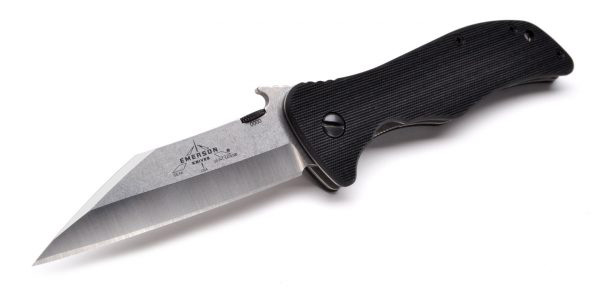
The folding Emerson Knives Seax puts a modern twist on this age-old blade design. (Image via Emerson Knives)

Emerson said the seax also could be employed as a self-defense weapon if needed. It was truly a blade for all seasons: Harvest produce in the morning, fend off the enemy after lunch, and then prepare supper in the evening—all with the same blade.

Seax Designs

All joking aside, the seax was a handy blade.

“It is a bowie-style blade, a spear-point type of blade, a Loveless drop-point hunter-style of blade, and, of course, the well-known ‘broken-back’ style featuring a severe clip close to the front, finishing in a point well below the center line,” Emerson said.

He said the broken-back seax style is the most common and appears in TV shows and movies depicting Vikings.

Broken Back Seax
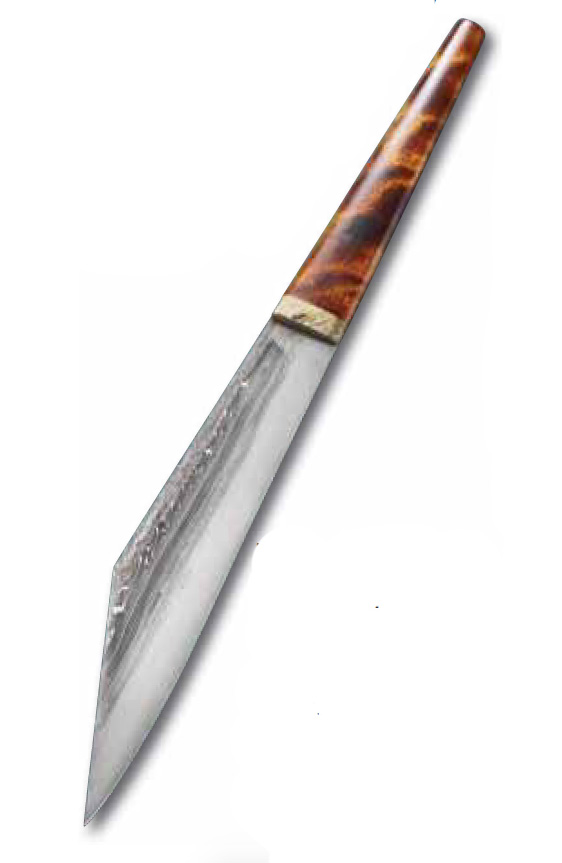
The Broken Back Seax by Aidan Garrity of Iron Lion Blades features a 10-inch damascus blade of 1095 carbon and 15N20 nickel alloy steels, and wrought iron. The handle is maple and the bolster is moose antler. Overall length: 18 inches. (SharpByCoop image)

Blade lengths varied wildly from seven inches on the short end and topping out at 30 inches, the latter Emerson called a short sword, basically.

“The seax needed to be an all-around utility tool that could chop, cut, slice, and sometimes stab, all with equal ease of application,” he said. “A Viking’s livelihood depended on self-sufficiency, resourcefulness, and the quality of his toolkit.”

What is a seax
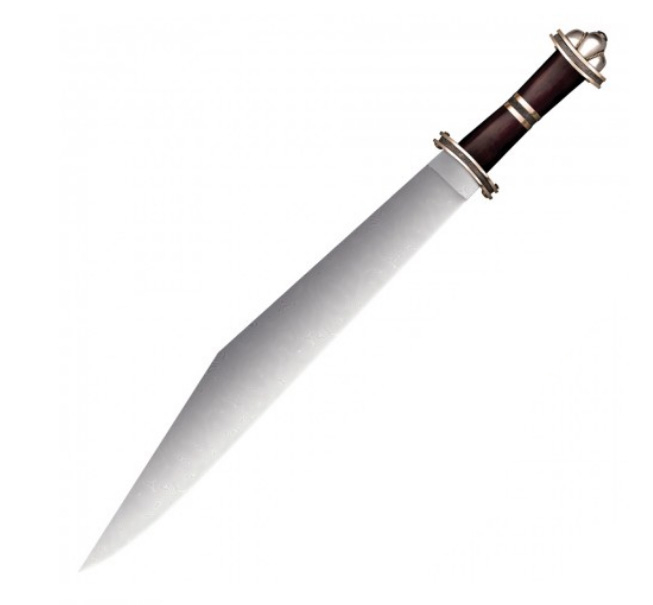
The Cold Steel Damascus Long Sax features a 17.25-inch blade with an edge that curves up toward the tip. MSRP: $635.99. (Cold Steel image)

At first glance, the seax may not seem as exciting as a recurve blade, but looks are not always everything. The beauty of such a blade lies within its ability to tackle cutting chores.

The straight-line cutting edge tackles a variety of tasks easily, and the point of the blade is both precise and powerful, with the ability to score as well as penetrate.

5 Best Seax Knives

The long history of the seax is still going strong today as companies young and old are making new versions of the historic blade.

These five are some of the more unique and exciting seax knives available today.

Terävä Skrama 240

Terävä Skrama 240
Terävä Skrama 240

Direct from the Finnish brand Terävä, the Skrama is a rugged bush knife great for chopping, slicing, and building shelters in the outdoors. The 9.4-inch blade is made from 80CrV2 steel with a 59 HRC. It comes married to a textured rubber handle for easy grip in any weather conditions.

The blade has a full tang and a flat edge but with a twist. It’s sharpened to a 34-degree edge except for the two inches closest to the hilt. That small section is sharpened to a finer 25-degree edge for more meticulous, precise knifework.

The Skrama comes with either a leather sheath or a plastic cover and has an MSRP of $69.99-109.99.

SZCO Supplies Brass-Studded Seax

SZCO Supplies Brass-Studded Seax

SZCO Supplies has made a fun, durable knife with its Brass-Studded Seax. The piece features a 10-inch blade married to a wooden handle. The knife is adorned with brass studs on the handle as well as a brass guard and pommel.

For a budge knife, it does have some weak points. The two main ones are that the leather sheath may need some working in to be at its best, and the knife may need a sharpen out of the box to have a pristine edge. Other than that, this is a good knife for the money.

Strong enough for a log, sharp enough for a piece of chicken, SZCO Supplies has made a  seax that is well priced at an MSRP of just $27.63.

Medieval Collectibles Viking Seax Knife

Medieval Collectibles Viking Seax Knife

This seax from Medieval Collectibles has the look and feel of a knife from the Viking era. It’s made from 5160 tempered carbon steel with a full tang, which is peened over the end of the handle’s metal end cap.

Just over 17 inches in length, and a blade length of 12.1 inches, the Viking Seax comes with a handle that has a wood grain finish and a hand-stitched leather scabbard with a belt hanger.

At just 14.4 ounces in weight this is a utility knife great for everything from chopping through wood and brush to defense and protection. The Viking Seax comes with an MSRP of $169.

Grimfrost Broken Back Seax, Type IV

Grimfrost Broken Back Seax, Type IV with scabbard

From Grimfrost comes a full-tang seax made of 1045 carbon steel. A reproduction of a 1,000-year-old seax found in London, the Broken Back Seax is 16 inches in length with an 11-inch blade.

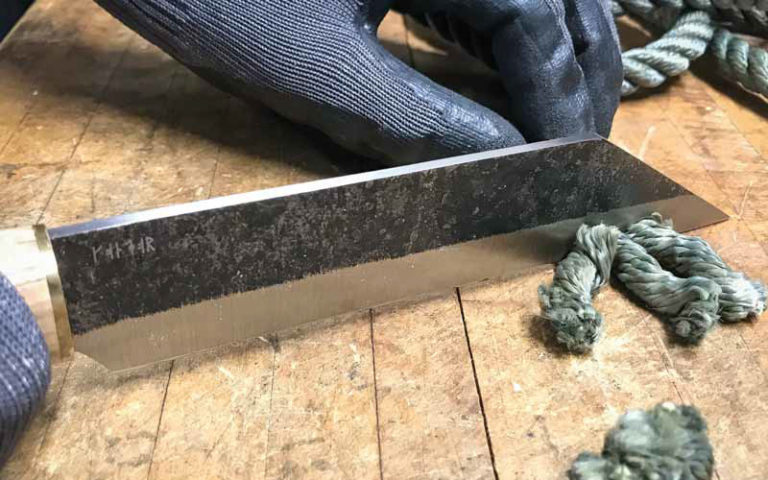
The handle is handmade ash and the included leather scabbard is hand-stitched. It also features “Grimfrost” stamped in runes on the side of the blade.

Lots of time and care went into making this knife as authentic as it could be and it shows. So whether you want to feel like Leif Eriksson exploring new lands or just want a strong knife while chopping, Grimfrost has you covered.

The Broken Back Seax has an MSRP of $132.

Lunar Light Forge Damascus Sanmai Seax

Lunar Light Forge Damascus Sanmai Seax

This amazing seax is from the husband & wife duo of Nathaniel and Megan Everett at Lunar Light Forge in Akron, Ohio.

The damascus blade is made from 42 layers of 1095 and 15n20 steel around a 5160 core. It is paired with a handle made of Buffalo horn and Cocobolo wood, and it comes with a hand-tooled & hand-stitched leather sheath.

It’s just as much an art piece as it is an excellent utility knife. The 7-inch blade can process an animal, hack off tree limbs, and chop in the kitchen. It does have an MSRP of $722.50, but for the amount of craftsmanship and care that went into the piece, you’ll know you’re getting a knife of the highest quality.

Editor’s Note: Mike Abelson contributed to this piece

Read More

7 Of The Best Kukri Knife Options

The Kukri Is A Historic Knife With A Long History Of Military And Outdoor Use. These Are Seven Of The Best Kukri Knives Out There Today.

The way a kukri feels in your hand makes you want to obliterate thick foliage and saplings.  The blade’s forward-weighted feel, the ultra-secure handle, and the reach the knife provides all work together in an ancient cutting and chopping tool that packs more punch than a machete for tackling the tough stuff.

What Is A Kukri?

The kukri is a variant of the machete with a recurve blade that developed in South Asia hundreds of years ago. It may have evolved from the sickle and is today used as the standard utility knife for the Ghurkas in Nepal. The kukri is the national weapon of Nepal and still synonymous with the Nepalese Army. It remains the main weapon for all Ghurka military units around the world including the British Army’s Brigade of Ghurkas.

How To Use A Kukri

The kukri knife is designed for chopping outdoors. Like other machetes, the kukri has a longer blade of 10-15 inches depending on the type. It is a useful military weapon because its center of mass allows the fighter to slice as they chop to penetrate an enemy deeply and even slice through bone.

As an outdoor tool, the kukri machete can do a bit of everything. Nepalese use it to do everything from chopping wood, digging, slaughtering livestock, chopping vegetables, and even opening cans.

Due to its shape, with a more narrow blade by the hilt and a wider blade by the tip, the kukri can function as a nimble utility knife up close and do the work of a small spade or even an axe as well.

The 7 Best Kukri Knives Today

Today, the kukri is made of modern materials and is used around the world for its durability outdoors. These are seven of the best kukri knives on the market today that would make any lover of the outdoors happy.

CAS Iberia APOC Kukri

APOC Kukri
This APOC Kukri is one the author found to be very controllable—so controllable, in fact, it even whittles well in a pinch.

At 16.25 inches overall, the APOC Kukri from CASIberia is a formidable chopper.  The 10.25-inch blade of this knife is .22-inch-thick 9260 spring steel with a low-glare, rust-resistant black coating. Though it doesn’t hold an edge as long as some other steels, expect it to be easy to maintain in the field. It also is a forgiving material, able to withstand heavy use and abuse.

The ultra-ergonomic handle is machined black G-10 fastened by three Torx-head screws.  The multi-faceted grip features a pronounced index finger recess, an integral front guard, and a flared butt to prevent backward sliding of your hand. At 23 ounces, the knife harnesses the devastating cutting power of traditional kukris, and amplifies it using modern materials.  

I found rather crisp edges on the tang and guard where crispness shouldn’t be. The easy fix? Lightly file the harsh edges to soften them a bit.

Once past the aesthetic imperfections, what you see is a forward-weighted chopping tool whose overall blade shape was inspired by traditional kukris as well. The graceful curve of the belly houses the sweet spot.

I found the handle rather interesting with its varied curves and prominent finger groove. When I first held it, I didn’t like it. My initial impression was it didn’t “fill” my hand. However, once I took the kukri into the woods and began swinging it, only then did the handle start to make perfect sense. The dip behind the guard acts as a sort of pivot. The knife will move a bit in your grip because of this, but it doesn’t move so much that it’s distracting or impossible to use. The slight movement actually works with your hand in creating powerful chopping strokes. And, due to the blade’s weight and thickness, I found the knife a really effective chopper.

The APOC Kukri excels at chopping, with the sweet spot in the middle of the blade belly. It was the surprise of the bunch in terms of how well it performed, especially for such a relatively unknown brand.

Out of the box the cutting edge was sharp but rough—rough as in a coarse edge and not looking very refined. Nonetheless, that’s also good because the coarse edge has “teeth’’ and bites in harder. The APOC kukri really turned out to be the surprise of the test bunch. It performed very well. I was able to modify the edge by hand, evening it out a bit—and it does seem to sharpen up fast in the field.

The Kydex sheath is a side-break design, allowing the kukri to tilt itself out of the sheath. However, the sheath needs more tension as it locks onto the handle to secure the knife. A secondary button snap strap extends around the upper part of the handle to secure the kukri into the sheath. Be sure it is securely fastened or it may fall out of the sheath accidentally. The belt loop webbing is fairly flimsy as well, but it will do the job. It does, however, allow the kukri to move around in the sheath in response to your movements, so, in case it snags a branch while you’re walking through the woods, it might free itself as you move.

All in all, I think this would make a great use-and-abuse chopper, one that you won’t be hesitant to go out and beat up. Made in China, it has a manufacturer’s suggested retail price (MSRP) of $175.

SOG Knives SOGfari

The SOGfari kukri is sharp all the way around—both the plain-edge blade and the sawtooth spine. Not as heavy as the other test knives, the author rates it for intermittent use.

The SOGfari Kukri Sawback Machete from SOG Knives combines three tools in one: kukri, machete and saw. The 12-inch blade is .1-inch-thick 3Cr13 stainless steel.

Overall length: 18 inches. The recurve blade adds cutting power and the double-cut sawback spine easily zips through saplings. The handle is molded Kraton rubber and sports dual guards at either end to prevent forward or rearward sliding of your hand. There’s plenty of handle belly to fill your grip and make the knife feel comfortable and secure. The exposed pommel is notched and can be employed as a hammer if needed. A black blade coating enhances rust resistance and cleans easily.

The sheath is heavy-duty, sewn-and-riveted ballistic nylon with plastic liners. It secures via a zipper pull. A fabric fastener flap protects the zipper to prevent accidental unzipping—a very thoughtful design. A large loop of ballistic nylon accommodates all belt sizes and a button snap secures the handle. The sawback makes it more difficult to slide the blade in and out, though the sheath unzips partially to provide more room.

The SOG SOGfari Kukri is the only piece in the test bunch with sawteeth. While not intended to replace a nice, high-quality folding saw, it is better than no saw at all. The only problem is its tendency to bind up due to the blade’s thickness.

I found the SOGfari lacking in the weight-forward design of most kukris. This is good in that there’s less weight on your belt or pack—bad in that you must put more muscle behind chop strokes, which can be tiring. Normally, with a weight-forward blade you’d benefit from gravity on the down stroke. The sawback is more gimmick than anything. It really doesn’t work well and forces you to open the cut more to enable the thicker blade to slide through. If not, the saw binds up every time. Conversely, in a survival situation having the saw is better than no saw, so in that case it’s a plus. I would not rely on the SOGfari as your primary saw, so carry a dedicated folding saw if you’re exploring the woods.

The SOGfari is well made for the price but the lack of a weight-forward blade keeps it in the occasional-use category. Made in China, it has an MSRP of $29.99.

KA-BAR’s BK21

The KA-BAR BK21 Becker/Reinhardt Kukri is an exceptional all-around performer. It can be used as a chopping tool, machete or a utility knife as demonstrated here. It balances very well. Inset is Ethan Becker, one of the knife’s designers, outlining the rules of the chef’s knife cutting competition at the 2019 BLADE Show West. (Becker image by Eric Eggly)

KA-BAR’s BK21 Becker/Reinhardt Kukri was designed in conjunction with Ethan Becker and the Hank Reinhardt Estate. The 13.25-inch blade offers reach and power with plenty to spare. The blade is .195-inch-thick 1095 Cro-Van carbon steel epoxy coated for rust resistance. There is that forward-tilt signature of kukris, and the blade’s profile gently swells toward the center. Along with the flat grind, it enables the BK21 to be used as both a machete and a chopping tool.

Molded from an impact-resistant polymer called Ultramid®, the handle is dense and lightweight. It resists absorbing liquid and moisture, which makes it almost impervious to the elements. The rounded/blocky handle shape may look a bit awkward at first, but don’t knock it until you try it. The contours make for a very comfortable grip that isn’t tiring when evaluating for long-term use. Three rather large hex-head bolts secure the handle onto the full tang design, and the exposed pommel can be used as a hammer.

The BK21 has a high-quality sewn & riveted nylon sheath with a hard-plastic reinforced tip to prevent puncturing. An integral nylon loop promotes easy belt carry. A button snap closure secures the blade.

Due to the weight distribution of the KA-BAR BK21 Becker/Reinhardt Kukri, it excels as a machete in clearing tall grass, weeds, and vines.

The overall shape and weighted feel of the BK21 is reminiscent of traditional kukris. It’s not forward-heavy like some and is balanced well. Due to its length and weight/balance, it excels as both a chopping tool and a machete. It can cut vines and tall weeds as well as fell saplings. It’s really two tools in one. The entire kukri is solid. The designers knew what they were doing.

The BK21 is 18.75 inches overall, retails for $240.74, and is made in the USA. The sheath is imported from China.

Ka-Bar Becker/Reinhardt Kukri Fixed Blade Knife BK21

Ka-Bar Becker/Reinhardt Kukri Fixed Blade Knife BK21

$216.95
Prices accurate at time of publishing. Affiliate disclosure.

TOPS Knives A-Klub


The gunstock war club used by Native Americans inspired Amanda Kaye of Discovery Channel’s Naked and Afraid
TV show in the design of the TOPS Knives A-Klub. The blade’s curvature accentuates cutting and chopping power.

Heavy duty and ruggedly built perfectly describes the A-Klub chopper by TOPS Knives, the company’s first knife designed by a female—Amanda Kaye of Discovery Channel’s Naked and Afraid television series.

She is an avid hunter and outdoor enthusiast, as well as having an interest in Native American primitive skills. Kaye employed the gunstock war club as the design inspiration for the A-Klub.

The gunstock war club was a blunt-strike weapon used primarily in the 18th and 19th centuries by Native Americans of the Eastern Woodland, Central, and Northern Plains tribes. Named for their resemblance to the wooden stocks of muskets and rifles, gunstock war clubs were fashioned from ash, oak or hickory. The swinging force put into the weapon meant it would strike with the points of the design, and it proved very effective and devastating.

The gunstock war club used by Native Americans inspired Amanda Kaye of Discovery Channel’s Naked and Afraid
TV show in the design of the TOPS Knives A-Klub. The blade’s curvature accentuates cutting and chopping power.

Due to the blade’s curve and angular tip somewhat reminiscent of a tanto, the A-Klub is also effective and devastating as a chopper. The blade is just over 12 inches of .19-inch-thick 1095 spring steel in the company’s subdued Acid Rain finish. The overall length is 18 inches.

The 23.8-ounce A-Klub is a beast. It has a forward-weighted tendency, though not as much as some choppers or even a traditional kukri. However, the blade curve accentuates swinging power and presents the edge at an angle in relation to the target, so the knife shears on contact.

Kaye designed the handle to maximize user comfort and control. An index-finger groove assists in locking in your hand, along with a curved main grip area that accommodates your other fingers. The green Micarta® handle is very lightweight and durable, and practically impervious to the elements, fluid absorption, and impact. Three hex-head screws fasten the scales to the full tang, and there’s a hole for a lanyard.

Coming off the index-finger groove, folks with smaller hands can shift their grip rearward on the handle for increased swing leverage. The A-Klub has a pronounced rectangular profile, which helps make it feel more secure in your hand.

Due to its weight-forward design, the TOPS A-Klub harnesses very effective cutting and chopping power. No matter how you swing the blade, the edge is almost always going to catch the target at an angle and, therefore, cleave through it cleanly.

The knife includes an expertly designed side-break Kydex rig. The rig’s leather-dangler attachment permits the heavy knife to swing and pivot freely on your belt in response to your movement, being accidentally snagged on brush, etc. Having the knife swing freely makes it more comfortable to carry.

Performance-wise the A-Klub bites in deep and hard, consistently discharging large chunks of wood with each blow. The blade’s “sweet spot” extends from the bottom of the tanto tip about two inches back toward the curve.

The handle can be gripped in at least two ways. One is with your index finger nestling inside the forward finger groove to provide a degree of control and also leverage. In the second, back your hand out of the forward finger groove and grip the handle further rearward toward the butt end. The latter handhold will enhance the power of each stroke.

Of the test bunch, I rate the A-Klub the best chopper, hands down. Made in the USA, it has an MSRP of $350.

Tops Knives A-Klub Fixed Blade Knife 1095 RC 56-58 Canvas Micarta Handle

Tops Knives A-Klub Fixed Blade Knife 1095 RC 56-58 Canvas Micarta Handle

$265.99
Prices accurate at time of publishing. Affiliate disclosure.

Cold Steel Magnum Kukri Machete

Cold Steel Magnum Kukri Machete

It’s been said that good things come in small packages. Cold Steel has no time for that. Their Magnum Kukri Machete comes in two varieties with the larger having a massive 17-inch blade and an overall length of 22 inches.

At 2.8 mm thick, the blade is made of 1055 Carbon Steel with a black baked-on anti-rust matte finish. It weighs in at 20.1 ounces and is weighed forward to give you better leverage while slicing.

It has a five-inch polypropylene handle and comes with Cor-Ex sheath. It will most likely need some sharpening when you get but with an MSRP of just $35.99, the price can’t be beat.

Cold Steel Kukri Machete Fixed Blade Knife 97MKM

Cold Steel Kukri Machete Fixed Blade Knife 97MKM

$29.97
Prices accurate at time of publishing. Affiliate disclosure.

Condor Heavy Duty Kukri

Condor Heavy Duty Kukri

Condor Tool & Knife of El Salvador have made a kukri that combines the best of machetes and the best of an EDC knife. It’s smaller than traditional kukri machetes, with a blade at just nine inches, but what it lacks in size it more than makes up for in manuverability.

The blade is 6 mm thick and made from 1075 high carbon steel with a blasted satin finish. It has a more pronounced bend in the knife than most other kukris which allows for more precise knife work when needed.

With a sturdy walnut handle, and a sheath of welted leather, Condor’s kukri is made of quality materials from top to bottom. The only knock on it is that it will need sharpening out of the box to get the type of edge you want when cutting through brush. With an MSRP of $117.91, it’s a good knife for its price.

Condor Heavy Duty Kukri Fixed Blade Knife Walnut

Condor Heavy Duty Kukri Fixed Blade Knife Walnut

$100.23
Prices accurate at time of publishing. Affiliate disclosure.

Smith & Wesson Outback Kukri

Smith & Wesson Outback Kukri

Smith & Wesson makes more than just guns, and their Outback Kukri is a great example of the company’s knifemaking prowess. The 11.9-inch blade is made of 7Cr17Mov Stainless Steel and finished with a black powder coat. The rubberized steel handle provides great grip while slicing.

It’s a light knife at just under 20 ounces, and that lightness brings both pros and cons. The pros are that you can a better feel of what the knife is cutting through and can slice with more speed. The cons are that it could get damaged more easily than heavier kukri knives due to overuse.

The balance comes with its price. The MSRP is just $34.15, which is a great price. If you’re not looking to become the next Bear Grylls, this kukri might be all the knife you need.

Smithwesson Smith WessonA SWBH Outback Kukri Fixed Blade

Smithwesson Smith WessonA SWBH Outback Kukri Fixed Blade

$47.99
Prices accurate at time of publishing. Affiliate disclosure.

Editor’s Note: Mike Abelson contributed to this piece

Read More


Advertisement

Must Read Articles

Read this before you make a knife

Knifemaking 101 – Read This Before You Make a Knife

  by Wayne Goddard My experience has taught me that there's nothing like digging in and getting started. I've often said the hardest part of the...
how to forge damascus steel

How to Forge Damascus

Advertisement
Advertisement