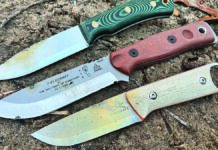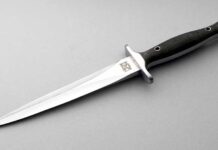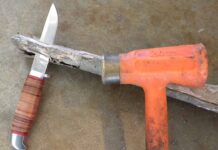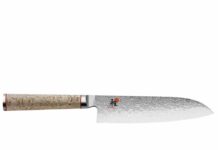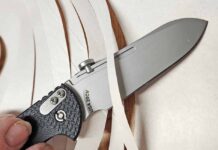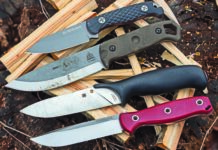
Here are BLADE Magazine’s Featured Knives of the Week. Browse through these articles to find the best knives available from both custom knifemakers and factory knives.
So I was working behind the table at the book booth during the BLADE Show this past weekend in Atlanta, a great show, by the way, best ever. And this gentleman was interested in buying the “First 25 years of BLADE Collection: 1973-1997” DVD. He said he already owned the DVD that came after it, “BLADE 1997-2007.”
He replied, “I can get 25 years worth of the magazine for $42.99, why would I want to pay $21.98 for one year?”
She said, “The subscription is new magazines, not old magazines, that’s why!”
It got me thinking that neither one of them was wrong. I prefer to get my magazine when it comes out, but to each their own. And I’m just glad they enjoy the magazine well enough to have the conversation.
If You Can Only Have One Knife In The Kitchen, The Chef’s Knife Is The One To Get.
When it comes to knives in the kitchen the alpha and the omega, without question, is the chef’s knife. A quality chef’s knife can do just about everything from butchering a side of beef and dicing up vegetables to crushing garlic and skinning a salmon filet.
Whether Japanese or German, stainless or high-carbon, forged or stamped, there are an amazing variety of chef’s knives available today, and there will be one at the right price for you.
History Of The Chef’s Knife
Humans, and their ancestors, have been eating hunted meats and foraged fruits for millions of years. The first predecessor of the chef’s knife, in the most liberal sense of the term, dates back 2.5-million years to what is now Ethiopia. Known as Oldowan knives, these sharp stone pieces were made by smashing rocks together to form fragments with razor edges to cut through game.
The first proto-knife found with protein residue on it dates back 250,000 years and was discovered in the Azraq Oasis in Jordan. It had the residue of horse, cow, and rhinoceros on it.
As time progressed, knives evolved along with humans. The discovery of fire along with different types of metals allowed the creation of the earliest forged pieces. The bronze and iron ages saw more quality metals turned into knives by skilled artisans.
Each new material allowed for better, more durable knives and paved the way for the steel models we have today. Chef’s knives, as we know them now, have been found dating back to before the Roman Empire and were modified versions of swords and other weapons.
Why Should I Buy A Chef’s Knife?
Look, if you want to try and cut through a medium-rare ribeye or slice veggies with a standard butter knife, good luck.
A quality chef’s knife will make your life in the kitchen much easier than if you tried to force it with a standard dinner knife. Will the chef knife be more money? Absolutely, but, as you’ll see with our list, it’s incredibly easy to find a strong, capable model without breaking the bank.
So you should have a chef’s knife in the same way you should have proper running shoes if you are a marathoner or a good driver if you golf. You could do those things without the right equipment, but it’s much easier and enjoyable when you have the right tools for the job.
5 Best Chef’s Knives
Chef’s knives, Japanese or German, should make you feel comfortable and secure in the kitchen, as well as make work there easier. This list has a little of everything from pro-quality damascus blades, to stamped models strong enough to be an everyday workhorse.
Misen Chef’s Knife
Misen Chef’s Knife
Award-winning cookbook author J. Kenji Lopez-Alt called this knife “the holy grail of inexpensive chef’s knives.” The 8-inch blade is made from Aichi AUS-10 high-carbon stainless steel, is ground to a 15-degree edge, and has a 58 HRC.
The sloped bolster and handle design encourages a safe grip while chopping. It’s light in the hand at only 8 ounces in weight and can mince herbs and cut through chicken bones just as easily.
An added bonus is that there are four choices for the handle color (blue, red, gray, and black). For a budget knife, this piece from Misen really is about as good as it gets.
MSRP: $65
Wusthof Classic Ikon 8-Inch Chef’s Knife
An icon of German engineering, Wusthof has been making knives in Solingen, Germany since 1814. The Classic Ikon is a timeless all-around blade that makes an excellent addition to your home, while also having the chops to cut it (pun intended) in a professional kitchen.
The forged blade is triple-riveted to the black synthetic handle and has a 58 HRC. The half bolster cuts down on weight while also making it easier to sharpen. When you buy a Wusthof you can trust in the two centuries of work that has built the company into what it is today, and this model won’t disappoint.
MSRP: $200
Mac Knife Pro Series 8-Inch Chef’s Knife With Dimples
This professional-level Japanese chef’s knife is a popular choice for chefs and home cooks alike. The 8-inch hollow-edge blade is made from alloy steel and a Pakkawood, triple-riveted handle.
What sets this knife apart from the rest on our list are the dimples on the blade. Known as a Granton edge, these dimples are more common on a Santoku knife than on a chef’s knife. Regardless, they allow for food to more easily slide off while cutting so you don’t have to deal with the frustrating task of peeling bits off the blade when you’re cutting stickier foods like potatoes or apples.
Made in Seki, Japan, the traditional home of Japanese knifemaking, Mac Knife has made something modern built with techniques developed over centuries.
MSRP: $195
Victorinox Fibrox Pro Chef’s Knife
The lowest-priced knife on our list punches above its weight and is a great addition to your kitchen. The price is kept down because the blade is stamped, but don’t let that fool you. This model has the same quality you would expect from everything else Victorinox offers.
The eight-inch stainless blade is married to an ergonomic, non-slip handle that feels great in the hand. Made in Switzerland along with the brand’s famous Swiss Army knives, the Fibrox Pro is easy and efficient to use. While it is listed as dishwasher safe, we recommend hand-washing and drying it as that will preserve the blade for longer.
An added bonus of the stamped blade is that this is the lightest knife on our list, coming in at just 6 ounces.
MSRP: $42.95
Miyabi Chef’s Knife
Miyabi Chef’s Knife
This is a professional knife and it looks the part. Made of 100 layers of damascus steel around a Cryodur-hardened SG2 micro-carbide steel core, it is topped off with a Masur birch handle. The damascus blade has a ridiculously hard 63 HRC and is ground to an edge between 9-12 degrees using the traditional Japanese three-stage honbazuke process. That sees the blade polished twice on custom whetstones and polished to a mirror finished on leather wheels.
This is one of the highest-quality kitchen knives on the market today. It’s also a love note to Japanese knifemaking from its tip to the end of the handle. Miyabi’s whole set of chef’s knives is of similar quality and if maintained properly, can last you a lifetime.
The temper line alone on Michael Burch’s flipper folder is enough to catch the old knife enthusiast eye, not to mention a Samurai warrior, that, thanks to Jody Muller color engraving, emerges from the gold, copper and stainless steel bolsters of the 1095 folding tanto.
The Samurai remains partially concealed by a crosshatching of mammoth ivory, as well as that smoky temper line. The handle treatment gives it an exotic, bamboo-like look that fits the engraved subject matter, as well as the blade style, and all taken together propels the knife to the status of an “Editor’s Favorite from the Knives 2013 book.” (SharpByCoop.com is responsible for the photography.
Is the assortment of knives in your house as appropriate as it should be?
At one time I thought I wasn’t a knife collector. I am a knife enthusiast, knife user, knifemaker, knife writer, maybe even a reluctant knife expert, but not a knife collector.
Back when I thought that way, I looked around and noticed I had a dozen knives within arm’s reach, plus the tools in the kitchen, plus the customs of my own and a few from others, plus all the factory knives. Turns out I had nearly 100 knives, which means I’m definitely a knife collector, or at least an accumulator.
In my usual ADHD stream-of-consciousness fashion, my next thought was, “I wonder if I have a knife in every room of the house?” followed immediately by thoughts of which kind of knife would go in each room. Come along on my imaginative journey as we explore the idea of a knife for every room.
Kitchen
Knives in the kitchen are a given but including one by bladesmith Salem Straub is not. In the author’s perfect household cutlery world, one would be. An example: Salem’s Guimard chef’s knife in mosaic damascus. (EatingTools.com image)
The kitchen is intuitive. Most people have knives there, whether the knives are economy store cheapies, a mishmash random drawerful accumulated over years, a matching production set, or even dedicated custom household cutlery. On my imaginary journey, I can afford the good stuff, like a damascus chef’s knife from bladesmith Salem Straub. But that’s too easy. Why not a whole knife-fork-and-spoon-damascus set, like one from Nate “Tuna” Grant?
Garage
For the garage, the author suggests a factory utility knife of the replaceable-blade variety such as the Civivi Elementum.
The garage isn’t too tough either. My first thought was a utility knife of the replaceable-blade variety. In the past few years there’s been innovation in the custom knife world when it comes to replaceable blade knives, but for utilitarian and “I can use this and not be sad if I scratch it,” I think I’ll go with the Civivi Elementum that uses standard box cutter blades.
Living Room
If the living room has a fireplace mantle, it’s a great place to display a custom sword. If you’re feeling medieval, the author recommends something like a hand-and-a-half piece by Ryan Breuer. (Ryan Breuer image)
The living room has the fireplace mantle, which is a great place to display a custom sword. If I were feeling medieval, I’d choose something like a hand-and-a-half piece from Ryan Breuer. Conversely, if I were feeling loud and Japanese, I might choose a fine bright katana like one from David Goldberg with an epic hamon.
Study
Along with studies, game rooms are also great for storing knife collections. Avid bowie collector Chris Nolen keeps his collectibles in a game room display designed by his son-in-law, replete with a statue of Jim Bowie and slide-out drawers that hold around 10 bowies each. (Chris Nolen image)
The gentleman’s study is dark, filled with books and memorabilia—the perfect place to store and display the “real” knife collection. Personally, I’d like a collection of custom bowies. I’d include pieces like a fully forged integral mosaic model from ABS master smith Mike Quesenberry, or an exquisite collaboration like The Knifemakers’ Guild award-winning piece by Nick Orr and Bailey Bradshaw. Or maybe I’d go rustic like ABS master smith Lin Rhea’s Preacher Bowie named after a mountain man. I’d round out the room with an engraved silver cigar-cutter-and-match-box set by Travis Payne engraved by Matt Litz for when the guys and I want to relax with a puff.
An engraved silver cigar-cutter-and-match-box set by Travis Payne engraved by Matt Litz for relaxing with a puff among friends would round out the author’s dream study. (Matt Litz image)
These days most tend not to receive letters, only junk mail and bills, and most of the junk mail goes straight to the trash unopened. But if I had a home office and I received good mail, I’d have to open it with a custom letter opener like one in a set from Deon Nel. He made a matching set of 16, so I bet he could spare one.
Outdoors
The backyard isn’t exactly part of the house, but that doesn’t exempt it from being a part of the author’s imaginary knife journey. If you have a standard grill, consider something like a san-mai brisket slicer from Dan Tompkins. (SharpByCoop image)
The backyard isn’t exactly part of the house, but that doesn’t exempt it from being a part of my imaginary knife journey. For those with a standard grill, you might consider something like a san-mai brisket slicer from Dan Tompkins. Or if you’ve got a fire pit, don’t forget Will Stelter’s damascus and mammoth ivory marshmallow fork. Or if you live in the woods, you might want a forged axe like a laminated wrought iron one from Nick Bachtel.
Bedroom
The author’s dream bedroom pillow dagger would be like Buttercup’s in The Princess Bride. If he were Buttercup’s beau, Dread Pirate Roberts, the author stated he might give his lady something like a poignard by Jamie Bishop. (SharpByCoop image)
Bedroom knives are a bit of a stretch. Personally, I have my hunting knives in my bedroom closet. If I were rich and fancy, though, I’d have to have a pillow dagger—you know, the dagger you keep under your pillow just in case. I’m reminded of the scene in The Princess Bride when Buttercup pulls out a fine stiletto in the bedroom, and the great Dread Pirate Roberts line that goes with it: “There is a shortage of perfect breasts in this world. It would be a pity to damage yours.” If I were Dread Pirate Roberts, I might give my lady friend something like a poignard by Jamie Bishop, or even something dainty and feminine like a fine small piece from ABS master smith Veronique Laurent. For under my personal pillow, I’d go with something extravagant like an art dagger from the Sobral Brothers.
Bathroom
Bathrooms are for hygiene and sometimes that takes a knife. To clean your fingernails or pull a splinter in style, the author recommends something like the fine Dourado collaboration between ABS master smith Dionatam Franco and Evan Nicolaides. (Mitchel Cohen image)
Bathrooms are for hygiene and sometimes that takes a knife. If you want to clean your fingernails or pull a splinter in style, I recommend something like a fine collaboration between ABS master smith Dionatam Franco and Evan Nicolaides. The pearl scales will shimmer in the vanity lights, and there are enough tools included to take care of many different tasks. Or if you want to play “Mack the Knife” in a dark alley then come home and comb your hair, Rick Lala can hook you up with his two-tool blade/comb folder.
How Close Are You?
You may not have a knife for every room, but I suspect that many BLADE® readers come very close. Here’s to improving the quality of your knife collection—even the bedroom knives!
The Hawkbill Is An Excellent Multi-Purpose Blade, Great For Cutting, Carving And More.
Of all the blade styles at the modern aficionado’s disposal, the hawkbill may be one of the most peculiar.
As its name suggests, the blade is reminiscent of a raptor’s appendage, namely it’s beak. The point curves around, in most cases to a nearly 90-degree angle from the back, creating a hook shape. Overall, pretty dang cool. But it raises the question, exactly what the heck is it good for and why does it look this particular way?
In this article, we’ll delve into the origins, usage and modern iteration of this blade and what the heck it’s actually good for. Along the way, we’ll also perhaps help you pick out the best hawkbill blade for your needs.
Origin Of The Hawkbill
Many blade styles are rooted in history or evolved from another type of knife. The hawkbill, however, doesn’t have the clearest provenance.
The blade style is widely believed to have started as a farming and outdoor tool, an evolved version of the pruning hook. Somewhere along the line some industrious maker most likely figured a pocket sickle might prove right handy.
Likely it did for a classy vintner out among the grapes who did not want to slum it by asking for the help’s pruning hook. Heaven forbid. But as the greater part of humanity has broken free from its agrarian roots the utility of the hawksbill has expanded.
Modern Uses Of The Hawkbill Blade
True enough, rose growers and avocado ranchers likely still find the hawksbill handy. But the quirky style of knife has found a place for those not tilling their living from the soil.
Utility
Today, the hawkbill is best known for its utility role, prized by electricians, roofers, floorers and other craftsmen. The hook shape of blade helps it excel at certain tasks a straight blade might struggle. A few of the obvious are cutting carpet or shingles without scoring the unlaying material. Stripping wire is another area it earns an “A”.
Its curved tip also prevents it from being a hazard to its user in precarious positions—say crammed in a crawlspace or dangling on a rafter—where a clip point or the like might prove a bit pokey.
Carving
While not generally the go-to whittling or carving knife, the hawkbill earns its keep in this arena. For those who strictly practice this craft with knives, the style of blade is particularly good a removing large pieces of material at the begining of a project.
Tactical
Well… there are certainly companies out there selling their version of hawkbill knives with this in mind. Though, with healthy supply of DLC anything can be tactical—including a paring knife.
Given the vagaries of the word “tactical,” it’s difficult to claim it doesn’t fill this role. And certainly, there’s probably been more than one farmworker who’s thrown their hawkbill—or pruning hook—in his back pocket as Friday-night-on-the-town insurance. For the average Joe, however, it might not prove a prime choice in this role.
Unless specially trained, the hawkbill—like the karambit—is not the easiest blade to wield as a self-defense option. Funny thing is, many of the tactical “hawkbills” have nearly lost their defining feature—a truly hooked point. Some might argue, they are hawkbills in name only.
On the other hand, in more specialized “tactical” situations this style of blade could have chops. What comes to mind here is perhaps situations involving ropes—maybe nautical or mountaineering. The idea here is cordage could be cut one-handed in a switch, using the hawkbill to both hook and cut. A similar point on this, some law officers have favored a modified hawkbill given it works well to cut a motorist out of their seatbelt in an accident, without causing injury.
Those wed to the idea of a EDC Hawkbill, Spyderco has among the most time-tested renditions. The Byrd’s modified hawkbill blade lends itself to aggressive cutting tasks and its hollow-ground serrated edge makes mincemeat of anything its pulled against. Yet, there is enough of a tip available to puncture or pry, if the situation calls for it.
Like everything that rolls out of the Golden, Colo., concern, the Byrd is ruggedly made—constructed with a chrome-moly steel blade and fiber-reinforced handle. Its tear-drop shaped thumb hole gets the knife into the fray quickly and its four-position clip allows you to keep it at hand.
Of all the hawkbills, the Griffin is among the most EDC-friendly. Vosteed pars back the hook on the blade massively, making something at first blush look like an oversized sheep’s foot. But at closer inspection, the edge has a very slight obliqueness to it, so the tip curves in as you’d expect in a hawkbill. The baby is great at tip cuts, slicing, and stripping—about anything you’d expect out of a curved blade. But, it also can pierce straight on, much like a more conventional blade profile.
The knife is a production version of R.S. Knifeworks’ custom knife. It shows in some of the well-thought-out points of design. Chief among these is the handle that naturally follows the curvature of the palm and features an attractive and durable G10 scale. Another point I like is the compound grind on the blade, with more material at the heel for more rugged cutting tasks. The knife is a liner lock, with a clip (tip-up carry) and multiple deployment options—thumb hole, front flipper and back flipper. The only complaint I have is the clip isn’t reversible, but other than that the knife really hits the mark.
It’s difficult not to love the classic look of this hawkbill—one of the perks of Opinel. While I don’t use the knife mainly for garden chores, the French cutler has aimed the folder at that. The company calls it a pruner, and after testing it on a few wild rose saplings, it more than fills this role. However, with a sharp tip and a good edge, the No. 8 Hawkbill is adept in many other tasks. One of my preferred uses is as a fishing knife and believe it or not it guts your catch in the blink of an eye.
Nice point on this model, Opinel uses stainless steel in the blade (12C27), so if you take it into wet conditions you don’t have to fret about the blade tarnishing. It also keeps a nice edge, albeit one you’ll have to touch up now and again—especially if you use it in its pruning role. The knife’s wooden handle can lose its finish over time and retain moisture. Pro tip, have one this long and use it in wet conditions, you can sand down the handle and oil it to keep it safe. The only real bone I have to pick with the No. 8—away from yard chores—is the handle; it flares back like a traditional pruner, which isn’t always great for other tasks.
Perhaps the perfect handyman’s helper, this little hawkbill is designed to always be at hand. I think that’s the beauty of what Bear & Sons has created here, a right-sized utility knife. Personally, it’s a little small for my tastes as a primary knife and it’s a folder—which doesn’t make it quite as handy, it works great as a secondary cutting tool. I like the idea of this and plenty of folks who make their living with their hands back me up on the concept.You drop your main knife or leave it in your toolbox at another area of the work site, well, the Bear & Sons knife gives you a backup. Using it to help me rewire some outlets, the high-carbon stainless steel blade made quick work stripping. And while wasn’t reflooring, I did have carpet scraps around, of which the blade made mincemeat.
A big asset in both tasks is the hawkbill’s handle-to-blade ratio. The handle is an inch longer than the 2.75-inch blade, which gave me supreme control over the knife and the ability to choke up on the blade when required. To boot, Bear & Sons includes a large bail loop allowing you to tether it to your person or at the very least retrieve it from your pocket quickly. The only nit I had to pick is it’s a slipjoint with a nail nick opener. Most of the time this won’t prove an issue, but there are jobs where one-handed opening is a godsend.
I like this knife for something different in pocket carry. As Victorinox makes apparent, it again pegs this hawkbill as a pruner and it’s just about perfect for the weekend garden warrior. But this slim, light and small slipjoint makes the cut as an EDC option with a twist. A very straightforward design, the knife is elegant in its simplicity and has a very functional blade. The hook is enough for its designed purpose of pruning limbs, yet it’s angled just right to make it a near-perfect box cutter. At just 4 inches folded, with a 2-inch blade, it could be a warehouse worker’s—or anyone who has to break down cardboard on the regular—best friend.
Blue-collar tasks aside, like all Swiss Army Knives, it’s gentlemanly enough to handle more refined tasks—such as removing the foil from a wine bottle. It also has a nice section of straight edge to it, so it can accomplish pull-through cuts adeptly. Again, a nail nick opener cuts some of the knife’s utility, since it requires two hands to get into the fray.
This lockback knife from Klein Tools shows what the hawkbill is capable of as a utility tool. It easily opens one-handed thanks to a thumb stud and the stainless blade holds a mighty edge. It’s capable of being a do-everything tool on the job site or an excellent utility knife around the house. It’s made with longevity in mind, with Klein utilizing AUS8 stainless steel in the blade, and the impact-resistant nylon resin handle can stand up to the beating of being a work tool. The low-carry pocket/belt clip lets you carry the knife with ease and in a way that best suits you.
Schrade offers excellent knives and the company’s hawkbill folder is no exception. With a rustic, rugged look, the 16 UH, which stands for Uncle Henry, is designed to prune shrubs and cut through wood with ease. Its staglon synthetic handle gives the knife a natural look that you wouldn’t get with G-10, aluminum or other handle materials. The stainless steel blade makes quick work of a variety of woods, and the 3-inch blade is big enough for longer cutting strokes and small enough for precise, finite work. At under $40, it’s well-priced. This is a knife that most any woodworker would want to have.
Ka-Bar Knives is set to star in the premier episode of the new History Channel series What People Earn. What better theme than “Beer, Knives & Football” for the initial episode of the show, and at 115 years old and going strong, is there a better fit than Ka-Bar for the show, starring alongside Samuel Adams, the famous brewer? It’s time to kick back, relax, grab a brew, and watch What People Earn while mindlessly, though carefully, opening and closing your Ka-Bar pocketknife.
What People Earn will air at 10 p.m. EST on Sunday, March 10 on History Channel 2. History Channel 2 can be found on DirecTV channel 271. Dish Network subscribers can find the premier of What People Earn on channel 121. For cable subscribers, please check your local listings. For additional information, please visit History.com. To learn more about KA-BAR Knives, please visit KA-BAR.com or call 800-282-0130.
On This Independence Day We Here At Blade Want To Celebrate All-American Knives
America is celebrating its 246th birthday today. In all those years the knife has been an integral tool to the growth of the United States, and, as such, we here at Blade want to celebrate it on this beautiful Independence Day.
These are 10 beautiful All-American knives to get you in the holiday spirit.
MTech USA 440 Steel USA Design Pocket Knife
The name may be a mouthful, but the knife is a beaut. MTech has made a spring-assisted folder out of 440 stainless with an aluminum handle. The handle is decorated with an American flag design and the opening text of the Constitution. This drop point has an MSRP of $15.95.
Berg American Flag Themed Bowie Knife
Custom-made to order by knifemaker Dan Berg, this Bowie is 11 inches long and can be made out of 1095 carbon steel or AEBL stainless. The metal is etched with a patriotic star pattern and the handle has a flag pattern made out of Micarta or cast resin. This beautiful knife has an MSRP of $300.
Mega Knife American USA Flag Spring-Assisted Folding Open Pocket Knife
A bright, bold American flag on the handle shines bright on this piece from Mega Knife. The stainless steel blade features a blackwash finish, and the pocket clip lets you bring this knife everywhere. This folder has an MSRP of $19.95
CobraTec Knives Small CTK-1 Cerakote American Flag
This CobraTec double-action OTF knife featured a striking American flag handle made of aluminum alloy married to a 2.75-inch D2 steel blade. You can pick between four different blade styles (drop point, tanto, dagger, Wharncliffe), and all but the Wharncliffe have serrated options as well. It features a nylon sheath, pocket clip, and a glass breaker at the end of the handle. This comes with an MSRP of $149.99.
Modern Artisans 3-Inch Pocket Knife With American Flag Stonework
This 3-inch folder from Modern Artisans has a stunning damascus blade made of a core of VG-10 wrapped in 32 layers of stainless. The brilliant American flag handle is made from lapis lazuli, red coral, and mother of pearl. This knife has an MSRP of $132.99.
Victorinox Super Tinker
From the makers of the famous Swiss Army Knife, Victorinox has made an All-American medium pocket knife that has the option of an American flag design and not just the classic red. It features 14 tools including two blades, three screwdrivers, and scissors. It has an MSRP of just $43.99.
The twist damascus pattern steals the show for this model from Orklo Knife. The three-inch, HRC 55-58 blade is connected to a four-inch red, white, and blue handle made of dollar sheet and inlaid with a star mosaic pin. This piece has an MSRP of $69.99
Cabela’s Flag Tanto Blade Folding Knife Two-Pack
Two knives are always better than one, and Cabela’s has an affordable patriotic combo pack. Both knives have blades made of 8Cr13MoV steel. The larger blade is three inches long and partially serrated. The shorter of the two is 2.75-inches long and features a flat edge. The combo has an MSRP of $19.97.
KCCEdge 8-Inch Two-Piece Large American Flag Throwing Knife Set
For something fun, you can go wrong with these throwing knives. These KCCEdge knives feature a top-to-bottom flag design that was embossed printed on the blades. What could be more fun than watching Old Glory fly through the air? These could be yours for the MSRP of $14.
Red Dot Laser Engineering “The Patriot” Folding Knife
Red Dot Laser Engraving, a veteran-owned business, has made a stainless steel folding knife with an American flag engraved on both sides of the blade and an aluminum body. The design won’t wear off so you’ll be able to proudly show it off for decades. The MSRP is $17.76.
ASR Outdoor Patriotic Locking Pocket Knife
Adorned with the head of a bald eagle on the handle and atop the the American flag on the handle, this knife from ASR Outdoor screams American pride. The steel alloy clip point opens with a nail nick, and the whole piece is eight inches in length. It also comes with a collectible display box. The MSRP is $14.99