Home Fixed Blade Knives

Fixed Blade Knives

First Look: Bear & Son’s White Smooth Bone Professional Fillet Knife

Bear & Son Cutlery’s new White Smooth Bone Professional Fillet Knife delivers precision, durability and American craftsmanship for serious anglers.

Summer fishing season just got a serious upgrade. Bear & Son Cutlery has introduced the new 11 7/8-inch White Smooth Bone Professional Fillet Knife, a purpose-built tool for anglers who demand precision from dock to dinner table.

Crafted in Alabama by a company known for keeping every step of production in-house, the WSB66 combines classic styling with modern steel performance. Bear & Son Cutlery’s fully self-contained factory handles everything—from blanking dies and heat treating to grinding, assembly, and hand-finishing—ensuring consistent quality and genuine American craftsmanship in every knife.

At the core of the Professional Fillet Knife is a 7-inch Sandvik 14C28N stainless steel blade, engineered for razor-sharp cuts, long-lasting edge retention and resistance to corrosion, even in saltwater environments. Whether trimming trout in the mountains or breaking down snapper on the coast, the blade delivers clean, efficient slices with ease.

Weighing just 4.9 ounces, the knife offers balance and control that make quick work of everything from panfish to redfish. Its White Smooth Bone handle provides a secure, comfortable grip while adding a touch of traditional character. A protective plastic blade guard ensures safe transport and storage, whether stowed in a tackle box or kitchen drawer.

True to Bear & Son’s mission of building affordable, American-made knives, the Professional Fillet Knife is designed for anglers of all levels—weekend fishermen, seasoned guides and anyone who values a dependable blade at camp or on the water.

White Smooth Bone Professional Fillet Knife Specs
Blade Material: Sandvik 14C28N Stainless Steel
Handle Material: White Smooth Bone
Overall Length: 11 7/8″
Blade Length: 7″
Features: Protective Plastic Blade Guard
Weight: 4.9 oz.
Origin: Jacksonville, Alabama
MSRP: $140

More Knife Reviews:

EDC Clip Points: Little Big Clips

Small-in-stature clip points that punch above their weight.

There’s a reason Buck Knives chose a clip-point blade for their iconic, mega-selling Model 110 as the blade style for their folding knife. The profile has a history of being a hard-working blade. The clip point’s most distinguishing characteristic is a noticeable change in the downward angle of the blade in its spine, which makes for a sharper angle of the blade toward the tip. This change can be subtle to severe, but it always results in a thinner blade height. In essence, the break in the blade angle “clips” it to a thinner, sleeker, more pointed shape. In this BLADE® feature, we’ll look at four modern and totable clip points and their attributes to see how they fit your needs.

Civivi Slippy Sendy

The Civivi Slippy Sendy weighs a paltry 1.90 ounces, making it an ideal light pocket carry or unobtrusive desk companion. If you don’t need a rough-and-tumble brawling knife, this is a good, lightweight option.

The Civivi Slippy Sendy is the only gentleman’s folder of our test group, and it carries the banner well. Having no pocket clip, it is made for pure loose pocket carry, and at just 1.90 ounces, its weight is no issue. The Micarta handle is a simple slab-style with an overall length of 3.7 inches with a flat, rounded-cornered top that ends in a 1-inch, semi-circular base. The backside scale has a 1/2-inch cut-out that allows the user to access the blade’s rectangular nail nick to engage the blade.

The 2.8-inch blade has its clip breaking 0.80 inch from the tip, while the cutting edge is 0.60 wide, flat-ground and is rounded toward the tip. The blade is Nitro V stainless, a very respectable proprietary knife steel from New Jersey Steel Baron that allows the Civivi Slippy Sendy to punch above its class.

The author kept the Civivi Slippy Sendy on his office desk for a few days and tested it cutting various and sundry “desk stuff.” The 2.8-inch Nitro V stainless blade was plenty sharp and did a good job of cutting crisp, sharp lines on this card stock.

This is an all-round lightweight pocketknife that is very good for light duty around the home, office or on the go. It is not a tactical knife because it doesn’t lock up or have a fighting blade style of thick blade steel. That said, the Civivi Slippy Sendy is handy for tackling mail duty, light meal prep and other unexacting duties encountered daily. I tested it on heavy card stock, packaging twine and thick packing tapes of all types and found the upgraded steel and comfortable ergonomics both handy for all-around use daily.

Cold Steel Engage 2.5

The Cold Steel Engage’s 2.5 sports a 4116 stainless steel made by Böhler of Germany. Of all the knives tested, this is the one that most resembled a modern-day tactical knife.

The Cold Steel Engage 2.5 may be small, but it’s a lot of knife in a 6-inch package. The blade width is just shy of 1-inch wide (0.90-inch), and it looks like a scaled-down tactical, which, in fact, it is. This knife is a shrunken version of the Engage 3.5 and is part of a whole series of varied models in the same platform. The Engage 2.5 is named for its blade length, leaving 3.5 inches for the handle.

The 2.5-inch clip-point blade is 4116 stainless steel made by Böhler of Germany, which opens via ambidextrous thumb studs on either side of the blade. The handle features Cold Steel’s patented Atlas slide lock located on the upper spine. An ambidextrous 1.5-inch pocket clip is located on the rear base.

Even though its steel didn’t sport an upscale moniker, the Cold Steel Engage 2.5 did a yeoman’s job of cutting sharp, crisp lengths of this tough leather.

I tested the Cold Steel Engage 2.5 on some thick, cured boot leather. Taking off lengths of the tough material in strips using a metal ruler as a guide, the blade of the knife never wavered or tried to change angles as lesser steels are prone to do. The curved front tip of the blade dug in at an angle and stayed on course with each slice and despite the blade not being a glitzy name brand, the 4116 stainless did its job well and the Engage 2.5 proved its worth.

Demko Knives Nano Shark

Demko Knives’ Nano Shark is a lot of knife packed into a short, 5.8-inch package. The Nano Shark's 2.25-inch blade sports a large blade for its size.
Demko Knives’ Nano Shark is a lot of knife packed into a short, 5.8-inch package. The Nano Shark’s 2.25-inch blade sports a large blade for its size.

The Demko Knives Nano Shark is a pint-sized EDC designed for serious slicing. The very slightly curved blade has always been a workhorse, but during the modern tactical knife era, many edged weapons specialists embraced the blade for its ability to grab and not let go until it had done serious damage.

The Nano Shark has a 2.25-inch blade that breaks to its clip 1 inch into its traverse forward, then breaks downward again where it meets the blade’s flat-ground edge. The upper rear portion of the blade features a healthy, rounded cutout for opening the blade once the user has released it via a pull-down thumb lock. The Nano Shark’s 3.5-inch GRN handle is ample enough to house the entire blade with only the thumb cutout protruding. A reversible 1.75-inch pocket clip completes the package.

The Nano Shark may be a short knife, but it acts like a behemoth thanks to its tall profile and blade thickness. The blade is similar to a short bowie, which makes it a serious small work knife. I tested it as such on a stubborn 3/8-inch synthetic rope. I started by just taking off short lengths on a flat surface before tying a large knot into both ends and free-handing the excess off each knot. I ended up with two tidy knots at each end. When in doubt, practice first!

Big Idea Design TI Lookout

The only fixed-blade in the group, the 6.2-inch Big Idea Design TI Lookout sports a full tang underneath its scales.

The 6.2-inch Big Idea Design TI Lookout is a simple fixed-blade knife with very few parts to break so it is better for stronger tasks. The Ti Lookout is basically one large piece of premium CMP MagnaCut stainless steel from tip to base with two lightweight, diagonally textured Grade 5 Titanium handle scales for gripping. Aside from the few pieces of hardware holding the handle together and forming its lanyard fitting at the base, that’s basically the sum of parts.

With so few parts to break, the fixed-blade can handle larger, tougher tasks. The downside is the user doesn’t have the compact convenience of a folding knife, but sometimes it is necessary to get the job done. The Lookout comes with a small 4.5-inch black Kydex sheath with a steel hanger fitted to the rear for added strength.

The Ti Lookout fixed-blade offers the safety of having no moving parts to break under extreme pressure whereas the folding knife can be vulnerable at its blade pivot. When in doubt, call on a fixed blade for the tough chores.

I gave the little fixed Ti Lookout a run for its money on a length of dried redwood 2-by-4. Holding the plank vertically, I dug the blade in at an angle, taking off shavings and holding in consecutively longer and deeper lengths. The Big Idea Design fixed-blade bit in and did its job until its size was simply outweighed by the larger length of wood, but not before the small fixer had proven its worth. I never felt during the process that the Ti Lookout was going to fold or break. That’s why you use a fixed-blade for the tough jobs.

More Reviews:

Custom Hunting Knives: Hunting For The Best Value

Understand how and why custom hunting knives cost what they do.

When I attend shows, one of my main goals is to talk with knifemakers and check the prices of various custom knives. One of the best shows to do that is the BLADE Show. This past June my goal in the Cobb Galleria Centre in Atlanta was to talk with 50 custom makers to get their takes on trends, material prices, overall demand, etc., regarding the knives they make and sell.

Luke Dellmyer custom hunting knife.

The custom knife that dominates the fixed-blade market is the hunter. This is due primarily to the fact that there seems to be an endless variety of hunting knives that can be made, and they usually have a lower price point than many other custom knives. Unlike other customs, hunting knives are often bought for use. Consequently, they are frequently tested by many users, from the casual outdoorsman to the professional hunting guide. The firearm may dispatch the game, but the knife provides the meat and potentially the trophy the taxidermist creates.

Over the years, thousands of articles have been written on and about hunting knives, including a few by this writer. In this article, I want to discuss not types or designs but pricing on knives in the hunter category.

Custom Hunting Knives Cost

Wess Barnhill ladder-pattern damascus hunter.

Several factors go into the cost of building or making anything. Most makers need a place to make the knives, usually a garage or a shop. Next comes the equipment, which varies from maker to maker. Belts for grinding, polishing and putting an edge on the blade can be one of the more costly items a maker utilizes. Electricity, propane or wood provide the energy to work the materials that become the knife. No matter how the knife is built, these are typical costs shared by most makers. The costs vary depending on the prices of the materials to make the knife. Steel, guard/bolster material, handle material and leather if a sheath is required all impact the finished knife’s price, as will the maker’s skill at using these materials.

Custom Hunting Knives Blade Steel

Dan Lewis' dmascus and copper san-mai hunters, both striking outdoor options.
Dan Lewis’ dmascus and copper san-mai hunters, both striking outdoor options.

The majority of makers use either stainless or carbon steel. Each offers advantages and disadvantages. Because of the diversity of steel, hunters can select a knife with the steel that best suits their needs.

Some hunters prefer patterned damascus steel, such as the ladder pattern of the damascus hunter by ABS master smith Russ Andrews (see accompanying image). Some hunters indicate the damascus blade’s distal tapering and differential heat treatment give the knife a better edge-holding capability. Others prefer steel of a san-mai construction as in the knife of ABS journeyman smith Dan Lewis. By forge welding more malleable steel onto either side of a harder steel, san-mai provides the blade with more structural integrity without sacrificing its ability to hold an edge.

As you can imagine, creating these steels takes additional time and is an added expense. The steels can add anywhere from $150 to $400 to the knife’s cost.

Custom Hunting Knives Handle

Russ Andrews amber stag hunter is a looker.

The handle material varies from natural to such synthetic(s) as G-10, carbon fiber and Micarta®. Natural handle materials are even more diverse, including ivory, antler/horn, wood, mother-of-pearl and bone. The advantage of synthetics is they are not subject to the effects of weather and temperature and so do not shrink and/or expand. Also, Micarta and G-10 are less expensive than some natural handle materials.

Natural handle materials can give your knife a unique look, making it stand out from other knives. Ivory, predominantly mammoth or ancient walrus ivory, is among the most distinctive and expensive handle materials used on hunting knives. Mammoth ivory comes in the form of scales and can cost anywhere from $100 to $250. Ancient walrus ivory costs are largely determined by the color(s) and condition. Prices generally range from $200 to $400.

Antlers and horns of all types have been used as knife handles from the onset of knives being built. The most commonly used antler on custom hunting knives is Sambar stag. In addition to its classic look, the natural lands* and grooves of the antler will contour to your hand, giving you a better grip when using the knife. Stag’s demand and lack of supply over the past 15 years have driven the price up considerably. You can expect to add $125 to $175 to the cost of the knife for an excellent piece of stag.

Mike Malosh's hunters are outfitted with either an elk and black Micarta or stacked leather washers.
Mike Malosh’s hunters are outfitted with either an elk and black Micarta or stacked leather washers.

Watching the price of stag increase encouraged me to look at other members of the deer family. One such member is the elk. It has many of the same characteristics as the stag antler, such as the natural lands, grooves and coloring. However, the price is considerably less than stag—around $50. The Elk Hunter (see accompanying image) by Mike Malosh gives you an idea of what an elk antler looks like on a custom hunting knife.

Wood is also a favorite handle material for both makers and collectors. Talk about diversity—wood offers just about any color you could want. Now, with the wood stabilization process commonplace, you eliminate most of the adverse effects of weather on the natural handle material. The price point for wood ranges from $5 to $50 to $75 for scales or a block of desert ironwood or koa. The damascus hunter by ABS journeyman smith Wess Barnhill features a beautiful set of desert ironwood scales. Its range of colors helps ironwood find its way to many knife handles.

Walnut is a hardwood favored by makers such as ABS journeyman smith Luke Dellmyer. It is a very stable, attractive wood that costs $30 a block. Another natural handle material I like, but you don’t see much, is stacked leather washers, as on the Mike Malosh Bear Hunter. One advantage I found with stacked leather is that, over time, the handle material will conform to your hand, providing you with a custom grip. You can expect stacked leather to add about $30 to the knife’s cost.

What Makes A True Value

As a professional custom knife purveyor, I offer prices based on my conversations with suppliers and makers and the materials I have bought over the years. As you know, everything gets more expensive, so prices may vary. The makers’ ability to combine the materials to create functional and aesthetically pleasing knives comes from years of honing their skills in their shops. Once you understand material pricing and can differentiate the skill levels of the different makers, you will realize that this is where the true value lies.

*Like on the inside of the barrel of a firearm, lands are the raised part of the antler and the grooves are the recessed part.

Check Out More Outdoor Knives:

Montana Knife Co.’s Marshall Review: Big Sky Bush Blade

Josh Smith’s new knife company tackles the wild with bushcrafter Marshall Knife.
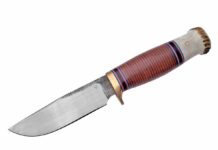
I was surprised at the thickness of the Marshall—.17 inch. Great design makes the blade wider, which adds weight for chopping, yet still keeps the knife lightweight enough to wear all day long without discomfort. The addition of a finger cutout just before the choil is perfect for control during smaller tasks. It is a nice knife on first glance. However, it has to cut and be comfortable to pass muster.

Light-Duty Cutting

To test the edge I sliced 20-pound bond copy paper. Supported by a full flat grind, the edge cut the paper effortlessly. The wide blade made indexing the slices very safe and smooth on each pass. It should be a cutter for sure, I figured.

Knife Cutting Cardboard
The knife zipped quickly through the double-walled cardboard. The slices were straight with no distortion of the cut pieces.

On to double-walled cardboard. I thought the blade would drag some with the deeper cuts but the Marshall zipped through quickly. The slices were straight with no distortion of the cut pieces. I enjoyed slicing the cardboard with the bigger blade.

I grabbed a piece of plastic board to dispatch while choking up via the finger cutout. This really helped in controlling the finer slices. The Marshall passed through the material quickly. I really like the finger cutout. It balances the knife in use.

Marshall Medium-Duty Chores

On to my favorite medium, half-inch sisal rope. As I used a push cut, the Marshall started crunching. After 200 clean crunching cuts, I wanted more out of the larger blade, so I switched to 1-inch manila rope. It took 35 crunching cuts to slow the Marshall down. The handle was comfortable throughout. Excellent work from Montana Knife Co.

Cutting leather with
Crunch, crunch; the Marshall cut nice and aggressive in skiving the 8-ounce leather.

I almost forgot to skive some 8-ounce leather. Crunch, crunch; the Marshall was nice and aggressive cutting the material. The knife provided great control, again using the finger cutout.

Heavy-Duty Cutting

It was time to whittle a firestick. The knife rendered large curly-cues. I tended to push the knife too far and cut the curly-cue off the stick. Don’t you hate it when that happens? The Marshall was controllable during whittling but the blade wanted to take bigger bites. Still, it did a nice job.

Montana Knife Co. Bushcraft knife chopping
The blade bit deep into the 2×8 every swing and soon the author had wood chips scattered over the driveway. The handle was comfortable and transferred no shock up the author’s arm. It was easy to free the blade from the wood for each subsequent chop.

After rearranging the storage area, I found a piece of 2×8 that would work great for chopping. The blade bit deep every swing and soon I had wood chips scattered over the driveway. The slightly blade-forward balance really shines with chopping. The handle was comfortable and didn’t transfer any shock up my arm. It was easy to free the blade from the wood for each subsequent chop.

I split some seasoned hackberry using my trusty dead blow hammer as a baton. I split a 3.5-inch piece four ways for kindling. The Marshall penetrated deep with each blow of the hammer, averaging 3.5 whacks per split. The results were outstanding!

Splitting logs with the Marshall.
The author split some seasoned hackberry with the help of his dead blow hammer. He split a 3.5-inch piece four ways for kindling. The Marshall penetrated deeply with each blow of the hammer, averaging 3.5 whacks per split. The results were outstanding!

It was time for the whitetail antler chop to check for edge toughness. Thirty hard wrist snaps into the antler didn’t damage the edge at all, a sure sign of spot-on heat treatment. Wow!

The last is first—back to the 20-pound bond paper. The Marshall still sliced cleanly. It incurred a snag in the paper but I don’t know if it was because of a mistake on my part or the knife.

Final Cut

The Marshall is an excellent bushcraft knife with a large blade that’s not too heavy. I might make the handle a tad thicker for my personal use.

Marshall Specs
Knife style: Bushcraft
Blade length: 7”
Blade material: 52100 carbon steel
Blade grind: Full flat
Blade thickness: .17”
Blade finish: Parkerized
Handle: G-10
Weight: 9.8 ozs.
Overall length: 125/8”
Sheath: Kydex
MSRP: $350

Read More Knife Reviews:

Spartan Blades Clandestina Review: 2024 Blade Knife of the Year

Find out why the Spartan Blades Clandestina took home Blade Knife of the Year, thanks to its standout tactical design, top-tier materials, and unbeatable performance.

A deadly beauty, Spartan Blades’ Clandestina packages the best of both worlds. Yup, it’s a looker, but dang if it isn’t engineered to inflict damage.

The dueling personalities of the BLADE Knife of the Year aren’t surprising, given who cooked up this wicked fixed blade. Bill Harsey has built his reputation on designing robust outdoor and tactical knives.

Spartan Blades Clandestina blade markings
Photos by Marty Stanfield, Marty Stanfield Photography

A favorite of Army Special Forces and figures such as Col. Rex Applegate, Harsey work also has a certain lethal aesthetic to it as well. But even with operators enamored with his work, Harsey’s Spartan project has an appeal beyond serving in foreign conflicts.

Spartan Clandestina Specs

Knife Type: Fixed
Blade Type: Spear Point
Blade length: 5.5
Blade steel: CPM MagnaCut
Blade grind: Flat ground
Handle material: Canvas Micarta Black and Camo
Blade Hardness: 61-63 HRC
Overall length: 10 3/16”
Sheath type and material: MOLLE and Kydex options
Special features: Available in Black and FDE PVD Coating, Double Deep Cryogenic Treatment
MSRP:

Pros

  • Superior Ergonomics
  • Premium Blade Material
  • Sheath Options

Cons

  • Large For Everyday Carry
  • High Price Point
  • Niche Design

Spartan Clandestina Handle

Oddly enough for a knife review, I’m going to start at the handle. There’s a method in this madness, given this feature is what gives the Clandestina its edge.

The canvas Micarta handle is slim in profile, even understated, yet sports big-league features.

Spartan Blades Clandestina handle
Photos by Marty Stanfield, Marty Stanfield Photography

Boasting two-finger grooves leverage the use of the middle finger to help stabilize the knife in the user’s grip and help lock it in for security.  The double guard is somewhat subtle but does its job very well.  

The entire handle is rounded and therefore, extremely comfortable to hold. No hot spots or harsh angles to get in the way. Overall outstanding ergonomics make the knife one with the hand. In brief, it’s pure Harsey all the way.

Micarta itself was an excellent choice for the tactical fixed blade—it’s lightweight yet strong.  Comprised of fabric saturated in phenolic resin, it is also impact-resistant and fluid-resistant. 

These attributes were engineered in the Clandestina with combat in adverse conditions in mind. Yet, the everyday user benefits, given it’s a robust system that should last a lifetime. Not to mention, the Micarta is available in a multitude of colors, besides my black and camo.

Spartan Clandestina Blade

From the understated to the obvious—the knife’s nefarious.

At 5.5 inches long and sporting a spear-point profile, the Clandestina was designed for more than opening boxes. A testament to this was Spartan opting for premium CPM Magnacut stainless steel.

Spartan Blades Clandestina blade
Photos by Marty Stanfield, Marty Stanfield Photography

Know for its capability of long-term edge retention, the metal makes the ready to slash or perforate with ease. Again, this material also has superior corrosion resistance, adding to the overall hardiness of the knife.

The blade is flat ground and the factory edge right out of the box is outstanding. I found nothing needed to be done to improve the edge, I just took it out of the box and put it right to work! 

While larger than most folks’ carry option, the blade length isn’t over the top. I found it nearly perfect for belt carry, hitting an elusive sweet spot many fixed-blades miss.

Spartan Clandestina Sheath

Sheath-wise, there are two options – form-fitting Kydex or a tried and true ballistic nylon.  The sample knife shipped to me with the latter.

Spartan Blades Clandestina sheath
Photos by Marty Stanfield, Marty Stanfield Photography

I found the sheath is very well made, with double sewn edges and a button snap retention strap to hold the e knife in.  A large belt loop allows the use of various widths of belts to be used.

Should you opt for Kydex, the sheath is of a riveted construction with a belt loop attachment.  The form-fitting sheath locks up around the integral guard of the handle. There are two MOLLE straps that also double as belt loops.

Testing The Spartan Clandestina

Putting the Clandestina to work is nothing short of an excellent experience. 

All of Harsey’s tactical fixed blade design expertise comes into play here, and you quickly realize you have a piece of serious bladeware in your possession. It makes slicing cuts with brash confidence thanks to the excellent factory edge coupled with the flat grind. 

Spartan Clandestina Sheath and pistol side by side
Photos by Marty Stanfield, Marty Stanfield Photography

The blade thickness tapers down progressively to the tip, allowing it to have the ability to do some serious piercing without being too thin where accidental breakage can occur. The overall blade profile is somewhat dagger-like, as you will notice. 

The handle is downright comfortable.  It allows the user to obtain a secure grip at all times, instilling and promoting user confidence. Thanks to the dual finger grooves, these allow the slender handle to have such a great grip quality. Locking your grip on the handle, it feels very stable and unlikely to rotate. 

Furthermore, when you grip the handle and allow your thumb to rest on the blade spine, you can feel how secure this choke grip is and the knife is very controllable in this grip. Whittling and wire stripping are two such tasks that this grip facilitates.  Simply put, the Spartan HARSEY Clandestina is built for use.   

Short Cut

It’s definitely not a toy!  Use it with confidence and use it hard.  Spartan Blades’ craftsmanship skills are highly rated consistently, with each knife they turn out.  You cannot go wrong with choosing the Clandestine.

Spartan Blades$360Check Price
DLT$390Check Price

More On Tactical Knives:

Nessmuk Knife: Options In The All-American Outdoor Knife

History repeats itself in modern renditions of an all-American classic.

Some patterns stand the test of time and become legendary for a reason, be it a story, movie or book. The Nessmuk-style knife stands out because of its shape.

Nessmuk was the pen name of George Washington Sears, a 19th-century American writer, conservationist and outdoorsman. He wrote about his wilderness adventures, particularly his solo canoe trips in the Adirondacks, a picturesque mountain range in northeastern New York state. He promoted a simple and lightweight approach to camping and woodcraft.

A modern “Nessmuk Trinity” with a Helm Forge hatchet, Victorinox camper, and TOPS Knives Camp Creek.
A modern “Nessmuk Trinity” with a Helm Forge hatchet, Victorinox camper, and TOPS Knives Camp Creek. Nessmuk would be proud of this edged-tool setup.

According to the story, the Nessmuk knife was named after a childhood friend of Sears’s from the American Indian community. The knife was not well documented and very little is known about it except for a diagram in Sears’s book Woodcraft and Camping. The book describes the knife as “thin in the blade, and handy for skinning, cutting meat, or eating with.”

What Is A Nessmuk

The Nessmuk-style knife has a unique shape that sets it apart from other models. The 4-to-5-inch blade has a hump on the spine that is closer to the point. The blade also has a deep belly and an upswept point, which makes it ideal for slicing, skinning and similar tasks. The distinct blade shape is the defining feature of a Nessmuk-style knife.

George Washington Sears, aka Nessmuk, preferred thin knives with keen edges. He paired his knife with a double-bit hatchet and a folding knife, forming his “trinity” of cutting tools.

Nuge Camptoku, TOPS Knives Camp Creek, Bear Forest Knives PuuMuk and KA-BAR/Becker BK-19 Nessmuk knives.
The Nessmuk-type knife is a highly regarded design. The test versions are, from top: Knives By Nuge Camptoku, TOPS Knives Camp Creek, Bear Forest Knives PuuMuk and KA-BAR/Becker BK-19.

Usually, a Nessmuk blade is carbon steel ranging from 3/32 to 1/8 inch at the thickest. The handle comes in a variety of materials, including wood, bone or antler depending on availability and user preference. It is important for the handle to be comfortable and ergonomic, fitting the hand well.

What Makes A Good Nessmuk

A Nessmuk knife is a fixed blade Sears designed and used for his expeditions. It has a distinctive curved blade that resembles a skinner or a butcher knife and a handle that fits comfortably in the hand.

A quality Nessmuk knife should be able to perform various tasks in the woods, such as skinning game, slicing meat, carving wood, making feather sticks, cutting cord—even shaving. It should be sharp, sturdy, well balanced and easy to maintain. A Nessmuk knife should also be lightweight and compact so as not to add much bulk or weight.

TOPS Knives Camp Creek

Camp Creek combines all the features of a superior hunting knife with impeccable fit and finish
The Camp Creek combines all the features of a superior hunting knife with impeccable fit and finish. It sliced camp food and passed the tomato test with flying colors.

The TOPS Knives Camp Creek is a hunting/camping knife designed by Leo Espinoza, company president. The blade is CPM S35VN steel, which boasts superior edge retention and stainless properties. The handle is a three-color camo-style G-10.

The Nessmuk-like design is perfect for hunting, skinning, processing wood and food prep around the campsite. The knife has a contemporary tan Kydex sheath and a brown leather dangler on a swivel.

Camp-style kabobs were my focus with the Camp Creek due to its classic butcher knife shape. I knew it would excel slicing meat and veggies and it didn’t disappoint. It aced the tomato-slicing test and will see more dirt time in the future.

Definitely the most Nessmuk shaped of the review knives, the super-sharp, flat-ground blade has all the right curves and excels at food prep and woodcraft.

Camp Creek Specs
Designer: Leo Espinoza
Blade Length: 4.38”
Blade Steel: CPM S35VN stainless
Blade Grind: Flat
Blade @ Thickest: .13”
Blade Finish: Tumble
Handle Material: Camo G-10
Overall Length: 9”
Sheath: Coyote tan Kydex and leather
Country of origin: USA
MSRP: $305

Bear Forest Knives PuuMuk

Eating off the Nessmuk hump
The author ate off the Nessmuk hump of the PuuMuk, perhaps the way Nessmuk himself did a century-and-a-half ago.

Made by Bear Forest Knives (BFK), the PuuMuk combines the design elements of a puukko and a Nessmuk-style knife. It has a straight handle without a guard and a choice of blade grinds: high saber or Scandi. The knife features full-tang construction. The blade was sharp as can be, especially the Scandi version.

The handle is like all the knives I have used from BFK—comfort is not compromised in any way. The red oak scales are secure and comfortable in any grip.

I used the PuuMuk as I would a general camp knife. I improvised carving a fork out of wood and general woodcraft like making feather sticks for a fire. The PuuMuk prepared food outdoors, slicing bacon, tomatoes, avocados and peppers. I used it as an impromptu spoon to eat off the back of the Nessmuk blade hump; perhaps Sears did the same. I used the PuuMuk for one month straight in the kitchen, doing all a kitchen knife would typically do. It didn’t take much time before the steel took on a respectable patina, adding to the look of the old-timey pattern.

The knife’s standout feature is the thin Scandi-ground blade and sharp 90-degree spine, adding a modern improvement to the classic pattern.

PuuMuk Specs
Blade Length: 3.75”
Blade Material: 80CrV2 carbon steel
Blade Grinds: Scandi and high saber options
Blade @ Thickest: 3/32”
Blade Finish: Acid wash
Knife to know: The blade’s 90-degree spine accommodates ferro rod striking and tinder scraping
Handle Material: Red oak
Overall Length: 8.375”
Sheath: JRE Industries brown leather
Country of origin: USA
MSRP: $179.99

KA-BAR Becker BK-19

BD-19 Trap
In survival Nessmuk mode, the author made a figure-four trap with the BK-19 in a jiffy.

The KA-BAR Becker BK-19 is a solid tool battened down with stainless steel Torx hardware and comes with a MOLLE-compatible, bulletproof Celcon sheath. Designed by Ethan Becker of Becker Knife & Tool, the 9.6-ounce edged tool stands out with the beloved Nessmuk blade shape so highly regarded in the bushcraft community.

The blade has more of a drop-point look than the other three test models. It is a survival Nessmuk if ever there was one. I put the knife into the deep end, splitting wood via a stout baton and crafting a figure-four deadfall trap. The robust blade easily split timber and processed wood for a late winter fire.

The handle was comfortable in several grips, and the exposed tang pommel added another degree of usefulness among the bunch, standing out as the hard-use survival Nessmuk the likes of which Mr. Sears would be proud.

The standout feature of this compact powerhouse is the sheath, which can be worn on a belt or in a scout carry orientation. The belt loop webbing is removable, and the retention is so good that the snap closure at the top is unnecessary. However, the closure can come in handy when in transit. KA-BAR has figured it out for you with two drain holes to help keep the sheathed blade dry in wet conditions.

BK-19 Specs
Designer: Ethan Becker
Blade Length: 4.3125”
Blade Material: 1095 Cro-Van carbon steel
Blade Grind: Flat
Blade @ Thickest: .165”
Blade Finish: Burnt bronze
Handle Material: Ultramid synthetic
Overall Length: 9.125”
Sheath: Celcon
Country of origin: USA
MSRP: $165.38

Camptoku Knives By Nuge

Camptoku Nessmuk
The Camptoku has a sharpened 90-degree section at the front of the spine, allowing the author to ignite some tinder with a ferro rod quickly.

The Camptoku from Knives By Nuge is a versatile general-purpose camp knife blending the esteemed Nessmuk blade with a santoku pattern, resulting in a rugged tool for outdoor and meal tasks. The Nitro-V stainless steel blade offers excellent durability and easy maintenance. The Camptoku comes with G-10 or wood scales and a custom-made slip sheath (no belt loop).

It is the longest of the bunch and a bit of a divergence from the traditional Nessy. However, it pays homage to the revered design and moves it into a new era. The thin blade screams kitchen use and allows for a comfortable chef’s pinch grip with a rounded spine for comfort. Meanwhile, the front 1.5-inch section from the Nessmuk hump to the tip has a sharp 90-degree spine for striking a ferro rod or scraping tinder.

The handle is a generous 4.75 inches, making it suitable for kitchen and woodcraft grips. Incredibly comfortable in a fist handhold, the knife is a chameleon when put into service in a chest-lever or pinch grip. The G-10 liners and pins offer that dash of undeniable modern class.

In the field the Camptoku served as the ordained kitchen knife, slicing tomatoes, meat and vegetables for stew while also starting fires to cook what it had been used to prepare.

Camptoku Specs
Blade Length: 5.5”
Blade Steel: Nitro-V stainless
Blade Grind: Saber
Blade @ Thickest: 3/32”
Blade Finish: Satin
Knife to know: The blade has a 90-degree spine in a 1.5” section from the hump to the tip for ferro rod striking and tinder scraping
Handle Material: Choice of G-10 or maple burl
Overall Length: 10.5”
Sheath: Kydex
Country of origin: USA
MSRP: $425

Dime Novel Knives?

George Washington “Nessmuk” Sears spoke ill of the bowie- and hunting-style knives of his era (mid-to-late 19th century), writing of them, “The ‘bowies’ and ‘hunting knives’ usually kept on sale are thick, clumsy affairs, with a sort of ridge along the middle of the blade, murderous-looking, but of little use; rather fitted to adorn a dime novel or the belt of ‘Billy the Kid’ than the outfit of the hunter.”

Here To Stay

The Nessmuk knife is a versatile and practical tool that can easily handle various outdoor tasks. The pattern has become crucial to American cutlery history and shows no signs of going away. Here’s hoping it never does.

Check Out More Outdoor Knives:

Damned Designs Basilisk Review: Wide And Wicked

The Basilisk is a lightweight fixed blade that cuts well above its weight class.

I’m really liking the wider blade of the Basilisk* by Damned Designs. The full flat grind combined with the blade’s ample width makes for almost perfect edge geometry—a thin edge for slicing with enough meat behind it for added strength. The thinner blade stops any binding while slicing thicker material like cardboard.

Basilisk in sheath
The fold-over Kydex sheath is first class.

The G-10 slabs have enough texture for a good grip. The Basilisk is a solid EDC knife. It uses Sandvik 14C28N stainless for blade material, a great using steel.

But how well does it cut?

Basilisk Sharpness Test

A baseline edge check using 20-pound bond copy paper went fast. The blade was very sharp from the factory. I’m glad I have calluses on my fingers as the Basilisk nicked them twice because I was slow getting them out of the way.

Light Cutting Duty

Single-walled cardboard was the second test medium. The blade sliced very smoothly and was aggressive its entire length. The cut strips laid straight due to the flat grind, so no binding on this one. I slowed the slicing down to save my fingers and all went well.

Damned Design Basilisk cutting leather
The thin edge and flat grind produced excellent curlicues for a firestick.

Eight-ounce leather was next. The Basilisk was very aggressive cutting animal skin. I could hear it slice its way through. The handle shape made it easy to control each cut’s width while also being comfortable. I also did some skiving. The Basilisk skived very quickly and evenly. Man, this knife is sharp!

Heavy Duty Cutting

Time for making some firesticks by whittling curlicues. The thin flat grind produced excellent wood curls. The thickness of the curlicues was eminently controllable. However, when I went in for deep cuts the edges of the G-10 handle were a bit hard on my hand.

Damned Design Basilisk vs rope
A total of 225 crunching cuts made mincemeat of the half-inch sisal rope.

Next up: half-inch sisal rope. The Basilisk made 100 crunching cuts before I had to don a glove to cover a hot spot. The knife dished out another 125 crunching cuts before I stopped. The edge showed no signs of slowing down. Total: 225 crunching cuts.

Toughness Tests

I batonned the Basilisk through some aged hackberry, a tough wood when dried. I whacked the rear, middle and tip of the blade spine for four complete splits. It worked excellent, with no damage to the edge or knife overall other than some wood smears on the stonewashed finish.

Basilisk vs wood
The thin edge and flat grind produced excellent curlicues for a firestick.

To really push the edge/heat treatment, I grabbed an old whitetail deer antler. After 30 hard whacks on it I checked the edge for chipping. There was none to be found. Heat treat is on the money for sure. Excellent job.

Edge Retention

Time to check the final edge with the 20-pound bond paper. The Basilisk still sliced smoothly even though the paper was getting damp from it raining all day. There were a few tears in the paper from the dampness.

Suggest Changes To The Basilisk

I would soften the handle edges a bit more.

Basilisk chopping antlers
After 30 hard whacks on the deer antler, the author checked the edge for any chipping. There was none to be found. The heat treat is on the money.

Final Cut

The Basilisk is a very nice knife, excellent for EDC or camp. It’s definitely a top pick on my list.

Damned Designs Basilisk Specs

Knife Type: Fixed blade
Blade Length: 4.25”
Blade Steel: Sandvik 14C28N stainless
Blade Width at Widest: 1.75”
Blade Finish: Stonewashed
Handle: G-10
Handle at Thickest: .5”
Weight: 7.25 ozs.
Overall Length: 8.75”
Sheath: Kydex fold-over
Weight w/Sheath: 11 ozs.
MSRP: $75

*The basilisk is a legendary serpent king that killed those who looked into its eyes.

Read More Knife Reviews:

Advertisement

Must Read Articles

Read this before you make a knife

Knifemaking 101 – Read This Before You Make a Knife

  by Wayne Goddard My experience has taught me that there's nothing like digging in and getting started. I've often said the hardest part of the...

how to forge damascus steel

How to Forge Damascus

Advertisement
Advertisement