A mainstay in the company’s catalog, the Ken Onion-designed, USA-Made Kershaw Blur remains a clear EDC choice.
Kershaw’s Blur has been in the company’s line for several years and it continues to be a good seller for the company. You get it all with the Blur—a handsome look, useful blade shape, and made-in-the-USA toughness.
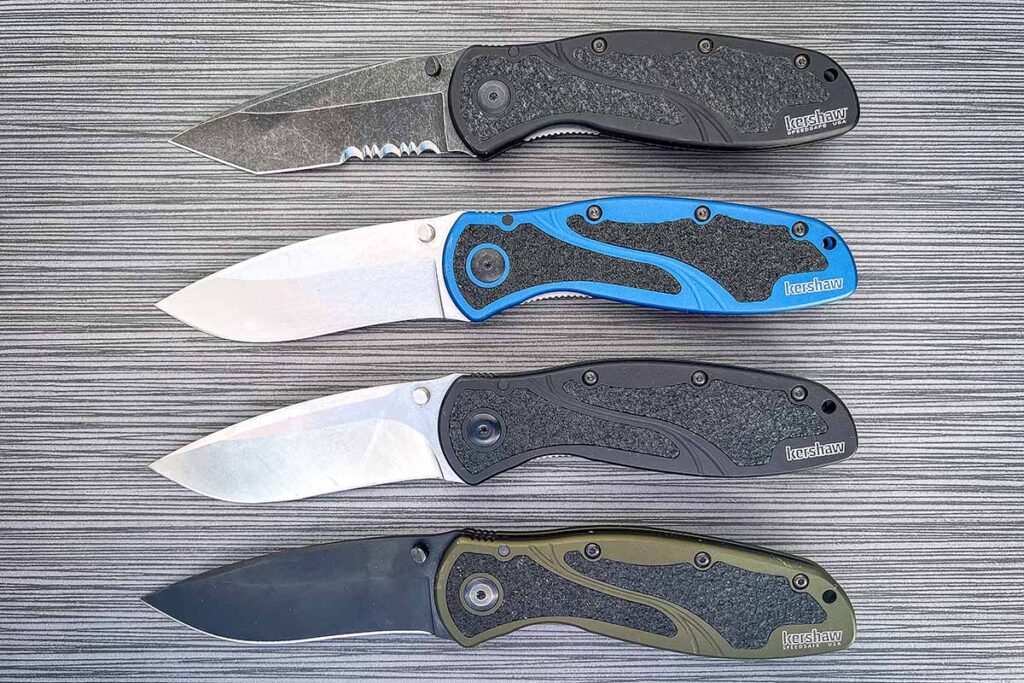
Devised by custom knifemaker Ken Onion, the Blur exhibits the hallmarks of Onion’s design with its recurve drop point blade and optimized handle shape promoting user comfort, as well as safety. Plus, you get a choice of several variations with the Blur. Each differs by blade steel and handle color, adding some style and flair to your daily carry arsenal.
Kershaw Blur Blade
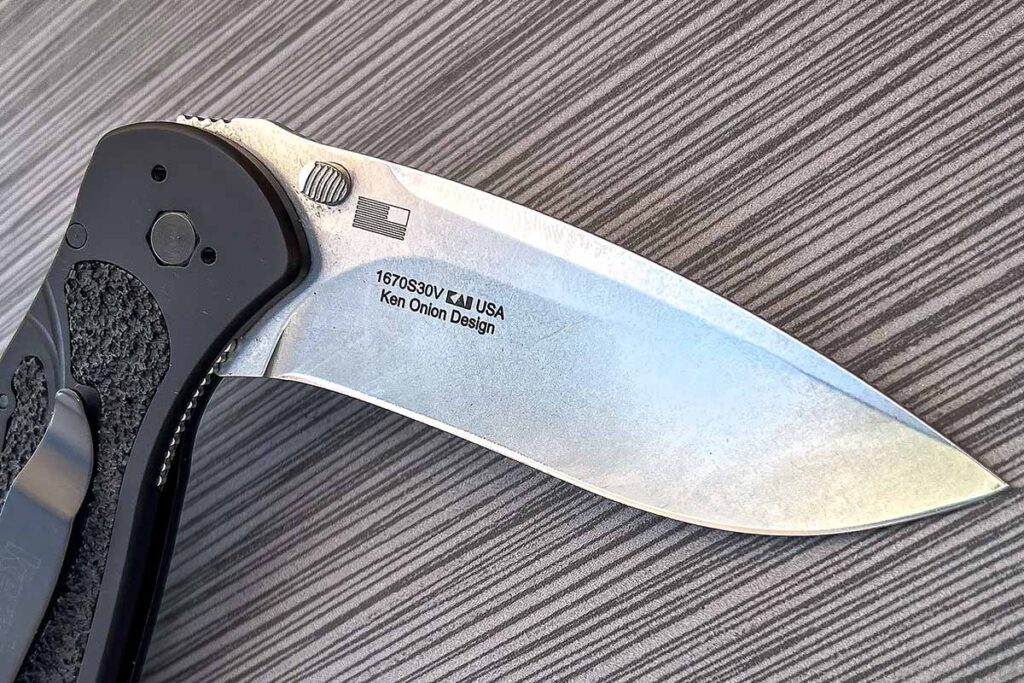
The Blur’s blade measures 3.4-inches long and is made of Sandvik 14C28N stainless steel. For those seeking a higher-performance steel, Kershaw offers an upgraded S30V version. Though the base-model steel is no slouch, as 14C28N holds an edge well, yet resharpens fairly easily. The Blur’s blade has plenty of bite right out of the box, thanks to its hollow grind.
The Blur’s blade has plenty of bite right out of the box, thanks to its hollow grind. Photos Marty Stanfield
For deployment, the Blur uses ambidextrous thumb studs. These are custom-designed studs, with a unique slanted portion. This rake allows you to bump with your thumb and then back off immediately, so they won’t be in the way of opening.
Speed Safe System
Deployment speed doesn’t disappoint, thanks to Kershaw’s Speed Safe assisted opening technology. The Speed Safe system was developed by Ken Onion and serves as a way to quickly and effectively open a folding knife blade quickly with minimal user effort. Essentially, a torsion bar propels the blade open after the user initiates blade movement by pushing out on the thumb stud.
Kershaw Blur Handle
For those who appreciate a solid and comfortable grip (who doesn’t?) the Blur incorporates some interesting design elements.
Starting with the construction, Kershaw has opted for aluminum alloy, making the handle both lightweight and strong. The shape is also well thought out, offering an intriguing and aesthetically pleasing shape, that doesn’t compromise on comfort. It’s a good example of Onion’s profound understanding of knife ergonomics.
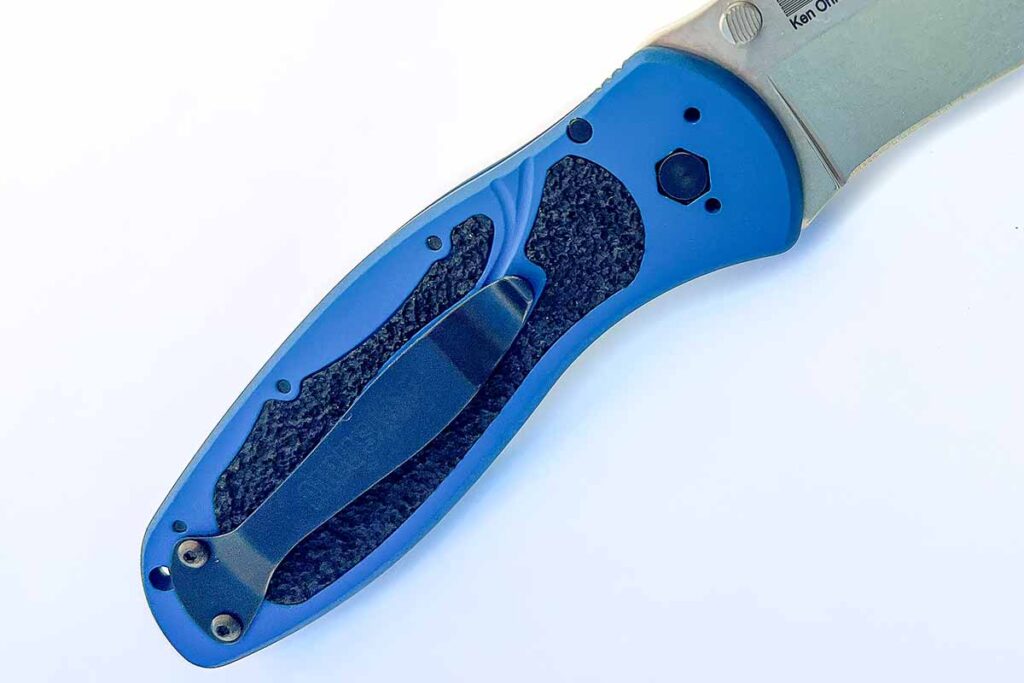
A fluid shape, the Blur looks nice and fits the palm well. Photos Marty Stanfield
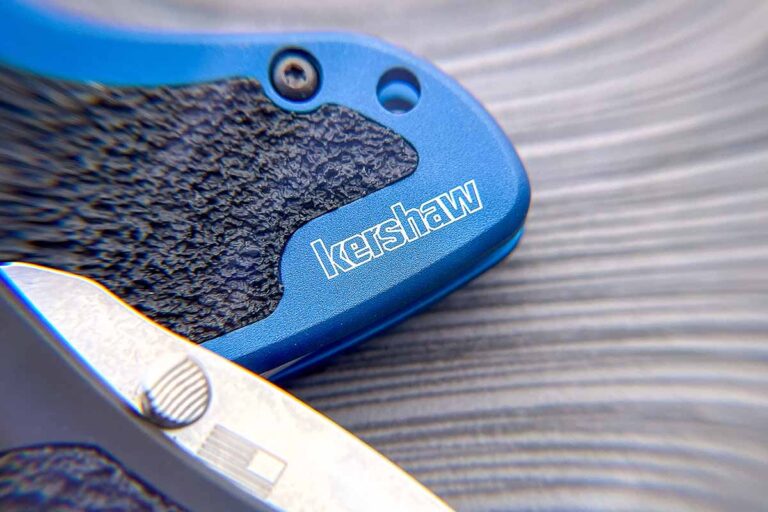
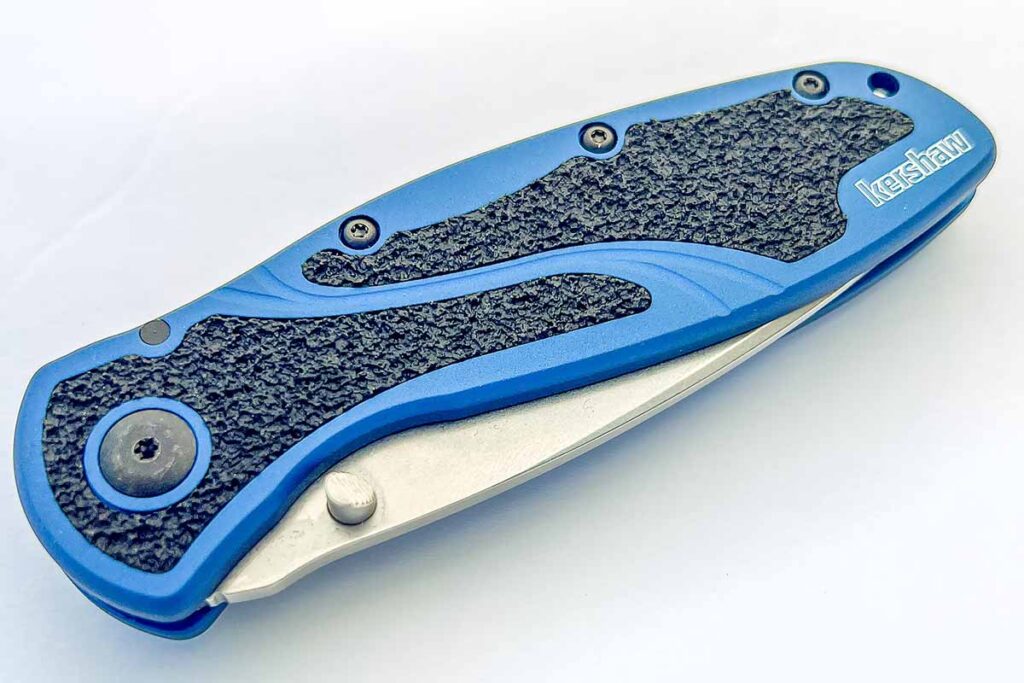
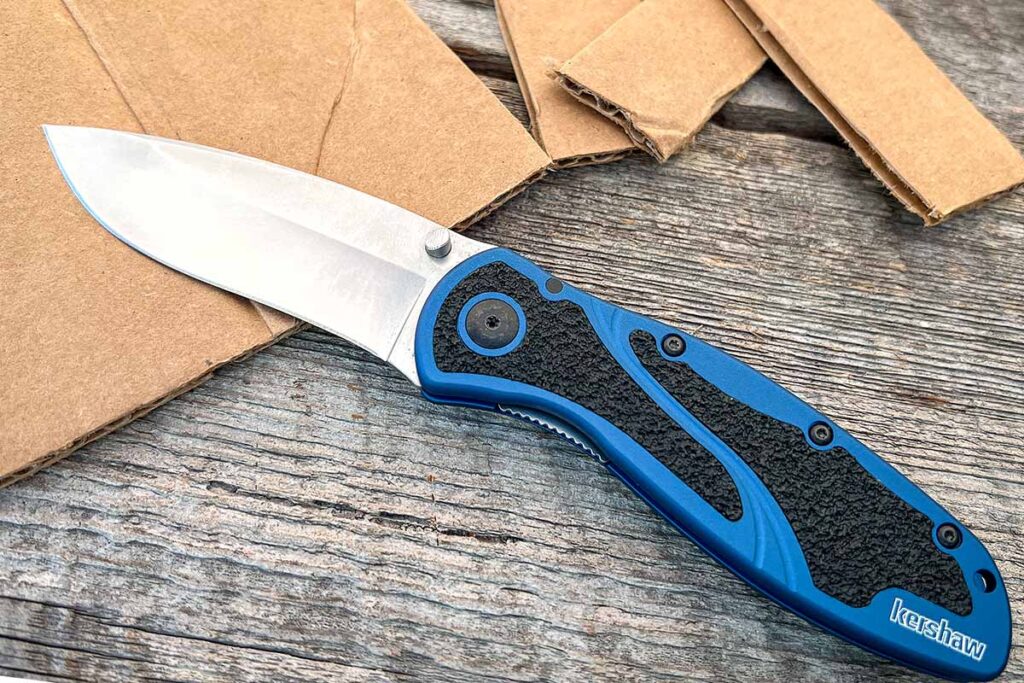
Furthering the usability, the Kershaw chamfers all the edges, ensuring there are no hotspots on the knife and textured rubber inlay inserts are a practical bonus, increasing grip traction tenfold with either wet or dry hands. Kershaw calls this material Trac Tech and it’s very similar to the self-adhesive grip tape you might find indoors in wet locations such as a swimming pool deck.
Interestingly, Trac Tech also helps with holding the knife to the pocket, making it a bit difficult to slide in and out. Depending on who you are and your particular activities, this can be a good thing or an annoyance. It is insurance from the knife falling out of your pocket, but it does slow retrieval time.
I like the use of Trac Tech on the blur simply because it gives the handle a more tactile feel to it.
Looking for more grip, Trac Tech inserts gives the Blur more bite. Photos Marty Stanfield
The general open build of the handle makes cleaning easy, especially when using compressed air or rinsing out under tap water. There is a pocket clip that helps to carry the Blur in the pocket and Kershaw gives you the option of either tip-up or tip-down carry but for right-hand carry only. Sorry lefties!
Final Cut
The Blur is a stylish EDC folding knife that doesn’t back down when there is tough work ahead. The recurve blade cuts very well, and its ample belly makes it an efficient slicer.
The hollow grind really thins the blade out nicely without making it too slender, and therefore it will cut through tougher materials with greater ease. It really excels at cardboard. I like this material for testing as it is a good standard because of its thickness and slight abrasiveness. Both aspects test the edge’s geometry.
Kershaw offers several colors and blade options, helping the Blur fit most folks style. Photos Marty Stanfield
The liner lock of the Blur is dialed in nicely, it hits the tang on the lower third of the width of the blade and allows for some wear as the lock breaks in. Yet, the lockup is very secure. The exposed portion of the lock bar that you contact to release the lock has traction notches on it so you can get a good grip on it. I thought was a nice extra touch on Kershaw’s part.
Overall, the only nit to pick is I wish the clip was designed to carry the Blur deeper in the pocket. Other than this, no real issues to speak of with the knife
When it comes time to purchase a Blue, this might be the hardest decision because of the variety of models. There are a ton of colorways for the handle—black, navy blue, and olive green. Additionally, Kershaw offers several blade options, including plain edge and partly serrated as well as stonewashed, blackwash and Cerakote black finishes. If that weren’t enough, you also have a choice of a tanto blade as well, if that’s more your speed. Heck, there’s even an option with a carbide glass breaker at the end of the handle.
Still a classic after all these years, the Kershaw remains a solid EDC option. Photos Marty Stanfield
The Blur’s MSRP starts at $135 and goes up from there to as much as $185 depending on blade finishes. Overall, the knife presents an overall package—Onion design, high function, nice styling and plenty of options choices. What this adds up to, is an EDC option that should be welcome in anyone’s collection.
Built like a top-shelf Spyderco, but at a fraction of the price the Tenacious more than lives up to its name.
Spyderco’s knives are about as high-performance as you can get in a production knife. They look at things from all angles, from blade grinds to handle ergonomics and how each plays an important role in the other. It’s a symbiosis of sorts. Therefore, most of their knives are on the pricey side but very well worth it.
The use of high-end materials with superior ergonomics and cutting-edge blade steels get everyone drooling, but there is one factor that spoils it for some. The high price.
“No thank you”, some might retort. Then resort to looking at other brands, whose offerings might be a bit cheaper and more within their budget range. Still, they crave Spyderco.
Fear not my penny-pinching friends.
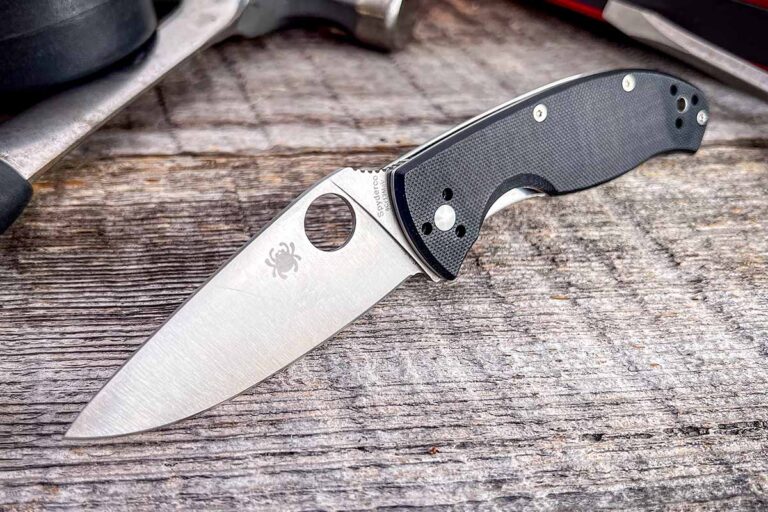
Affordable and capable, the Tenacious proves a capable workingman’s knife. Photo: Marty Stanfield
Spyderco had exactly you in mind when it unleashed the C122GP Tenacious. An excellent value folder from incorporating all the hallmarks of a Spyderco design and execution but without the scary high price tag. Essentially, it’s an everyman’s knife, with the elite performance the company has built its name on.
How’s that for value?
Spyderco Tenacious Blade
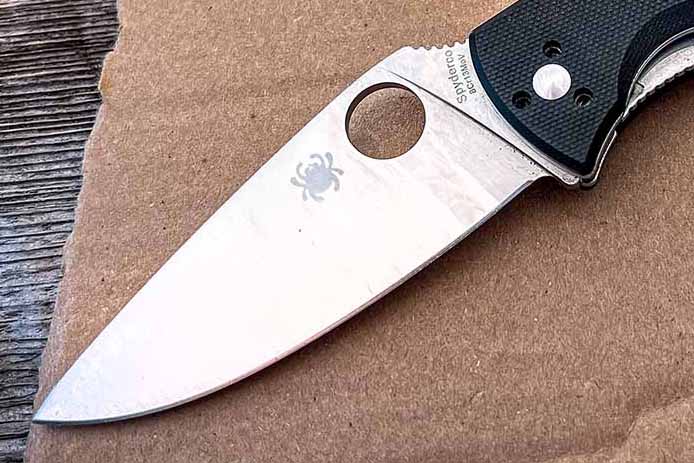
Starting with the modified clip point blade of the Tenacious, 8Cr13MoV stainless steel was chosen because of its great balance between edge retention, ease of sharpening and low cost. For those not familiar, 8Cr13MoV is the Chinese equivalent of the Japanese-made AUS-8. A lot of entry-level to mid-range knives have this steel. It makes a great choice for a working folder as 8Cr13MoV is relatively easy to resharpen and takes a good edge in minimal time.
The blade length is 3 ⅜ inches, long enough to for serious work but short enough to carry easily in the pocket. Jimping on the thumb rest allows you to place your thumb there to apply downward pressure on the blade. The rest sample we were sent has a satin-finished blade, though, Spyderco offer the Tenacious with a black coated blade for low visibility, as well.
A 8Cr13MoV drop-point blade offers respectable steel in a useful profile.Photo: Marty Stanfield
Additionally, partially serrated edge formats are available for enhanced cutting power. This blade design is a workhorse, with its flat grind and distal taper, which allows the blade to become a voraciously efficient slicing tool. Honestly, Tenacious in hand, you’ll be able to slice through your biggest and toughest cutting tasks with ease.
Spyderco Tenacious Handle
Look at some other budget folding knives on the market and you can tell where corners were cut. One evident area is handle design. No so with the Tenacious.
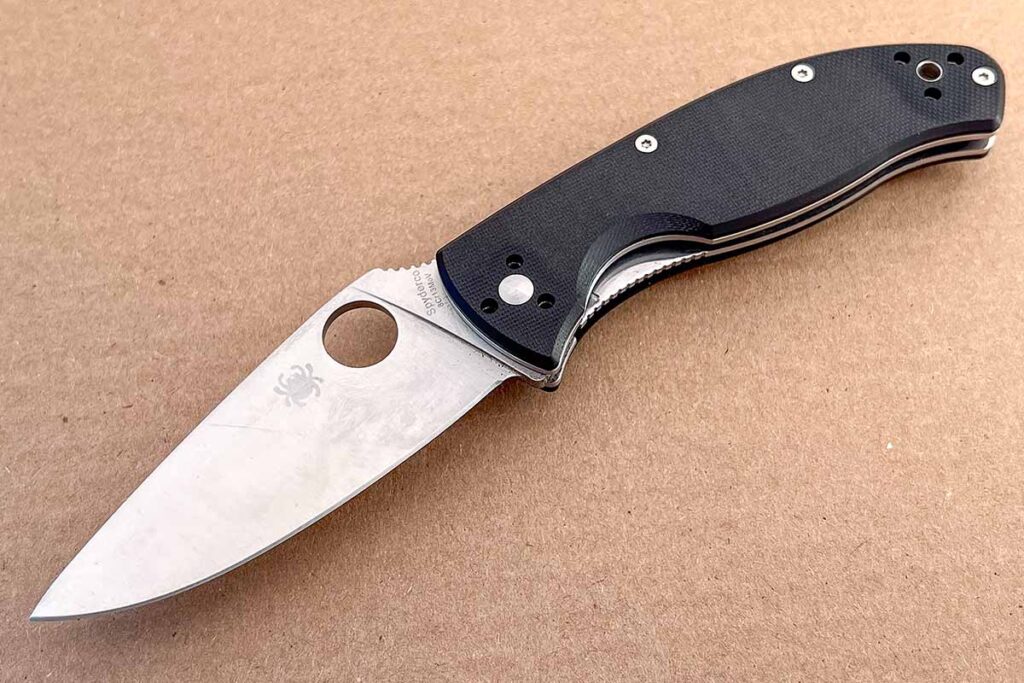
Spyderco has some of the best handle designs on the market, the company has an intimate understanding of how to design a comfortable interface comfortable for extended hard usage. In this case, the knife uses a black textured G-10 phenolic resin handle for both reduced weight and an excellent grip. As a side note, the handle length is 4 7/16-inces long and overall, well thought out. In the hand, it proves comfortable, important with any knife. There are no hot spots to speak of and it seem designed for long periods of use without fatigue.
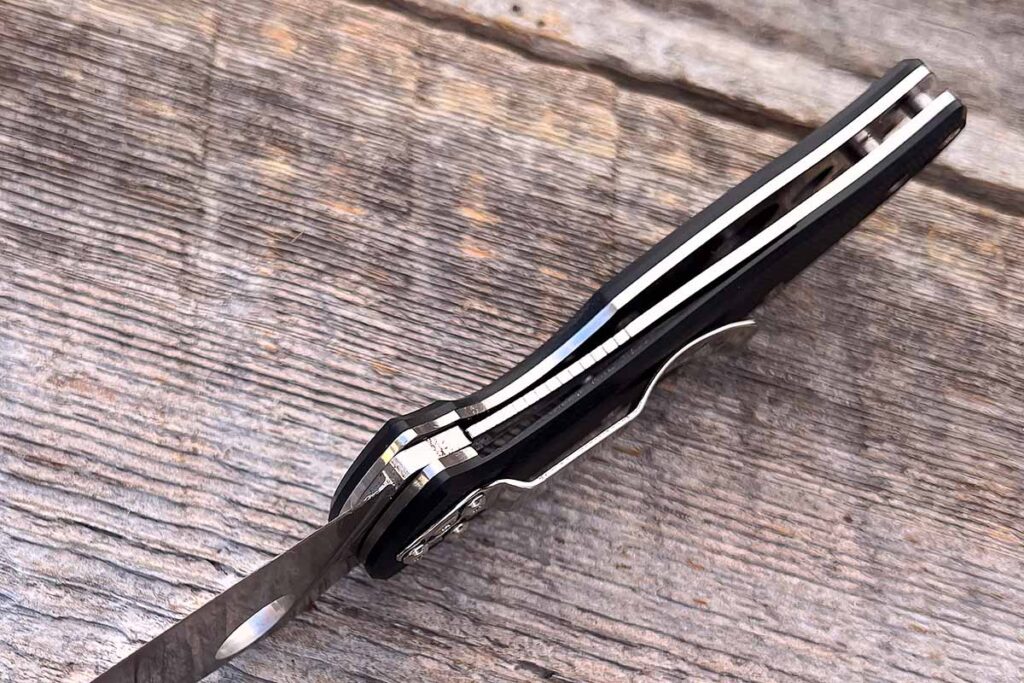
In addition to G10 scale, the Tenacious has a study double stainless-steel liner to provide the handle plenty of backbone. Photo: Marty Stanfield
Double stainless-steel liners provide a solid backbone for the handle, and a sturdy liner lock secures the blade in the open position for ultimate user safety. A radiused gripping area accommodates the fingers well and the perimeter of the G-10 is chamfered to reduce sharp corners for a comfortable grip.
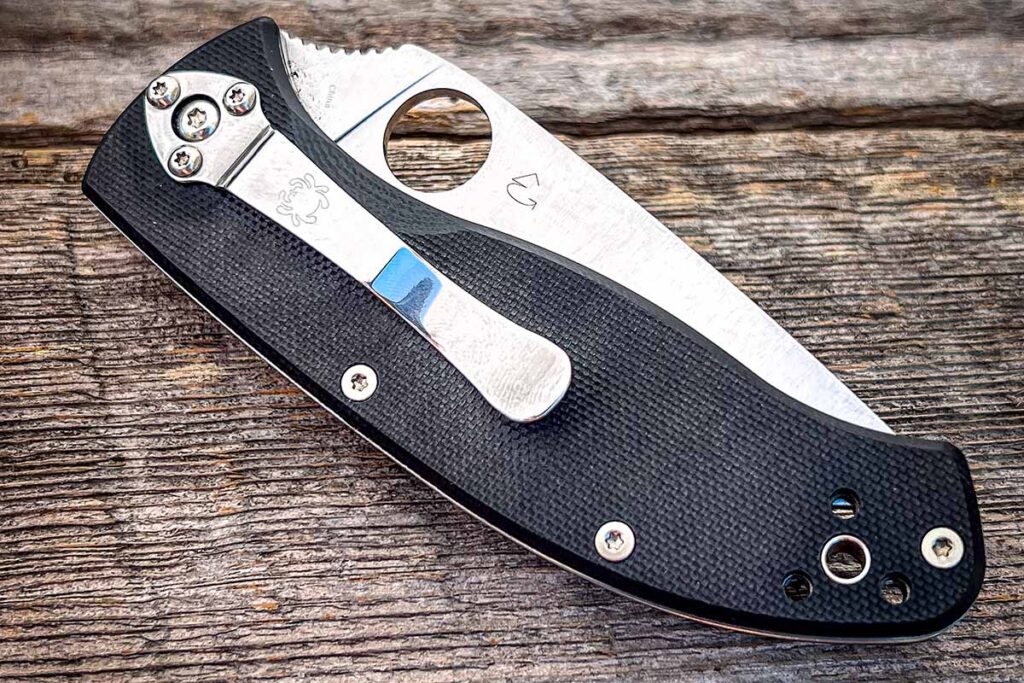
Four sets of clip screw holes are drilled into the handle, offering a have-it-your-way approach to pocket clip mounting. You can mount the clip for left-hand use or right-hand use and within these two, you can have either a tip-up or a tip-down configuration. The clip comes from the factory set up for right-handed, tip-down configuration.
Practicality Of The Spyderco Tenacious
If you are in any of the trades and use tools in your job—a knife being one of them—it’s very important to select your work knife carefully not just from a budget/financial standpoint but feature-wise as well. Just because it is a budget knife doesn’t mean it’s stripped down and basic.
Budget knives can include some creature comforts that make work easier. The Tenacious packs in one hand ambidextrous opening, a secure blade lock, open handle construction with dual steel liners and textured G-10 handles. Furthermore it boasts a pocket clip with user-selectable modes of carry, and a properly designed blade that will cut efficiently. All this, in one knife.
Righty, lefty, doesn’t matter. Spyderco enginereed a clip that caters to either hand and nearly any style of carry. Photo: Marty Stanfield
With this being said, the Tenacious lives up to its name as it is eager to tackle any cutting task that awaits. The MSRP for the Chinese made Tenacious is $86, which means it probably can be purchased online for around $60. This makes it a great bargain for a sturdy, well-designed work knife. And if you lose it, you are not out a lot of money.
If you have more expensive knives in your collection and are hesitant to beat on as a work knife, then the Tenacious fills that role well. What you have here is a midsize folding knife that feels good in the hand and cuts exceptionally well.
Final Cut
As an owner of quite a few high-end Spyderco models such as the Military, Paramilitary 2, Manix 2, Shaman, and a few others, I can honestly say the Tenacious performance-wise is almost identical. Bold statement, I know. But all Spyderco knives just have that feel to them—no matter the price. If you are a fellow Spyderco owner, you know exactly what I am talking about.
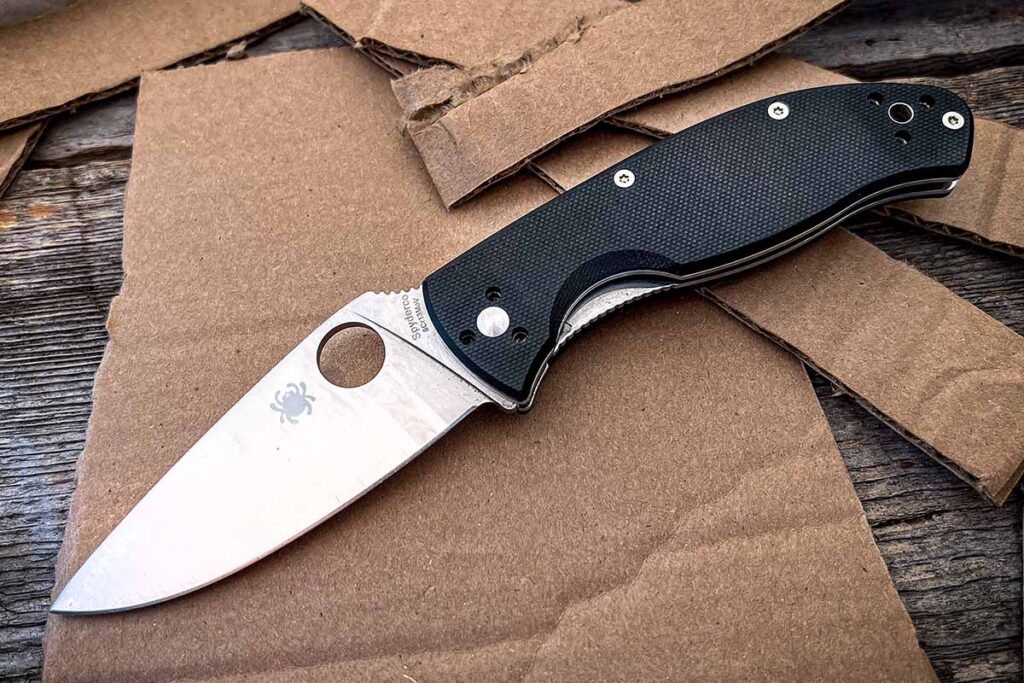
Spyderco created an affordable gem in the Tenacious. Photo: Marty Stanfield
The 8Cr13MoV steel holds an edge well but don’t expect it to be like S30V and hold an edge for a long time. Maintenance in the field is possible with the right sharpener and the steel responds well to routine touch-ups.
Just do yourself a favor and purchase a Tenacious and put it to work. You won’t be disappointed. Spyderco did their homework with this budget-conscious folder that’s packed with features that also are found on their more expensive knives.
Is there a perfect EDC knife? If not, the Benchmade Bugout will do until perfect shows up.
When it comes to EDC folders, without a doubt the Benchmade Bugout is the king of the hill.
Its compact profile and just-right length make this model a popular hit with knife guys. It is all made in the USA with excellent fit, finish, and—perhaps key to EDC—Benchmade has cut its weight to the bone. Furthermore, the blade steel is premium level. In short, the Bugout is geared to go the distance.
So, if you haven’t yet checked out this icon, it’s high time you did. Because, if you take your everyday carry seriously, you owe it to yourself. We’ll lay a foundation for the knife in this article.
Bugout Blade
The Bugout is offered in two sizes—the Model 535, the company’s standard-sized version boasting a 3.2-inch blade, and 533 Mini, which pars the blade down to a very manageable 2.8 inches.
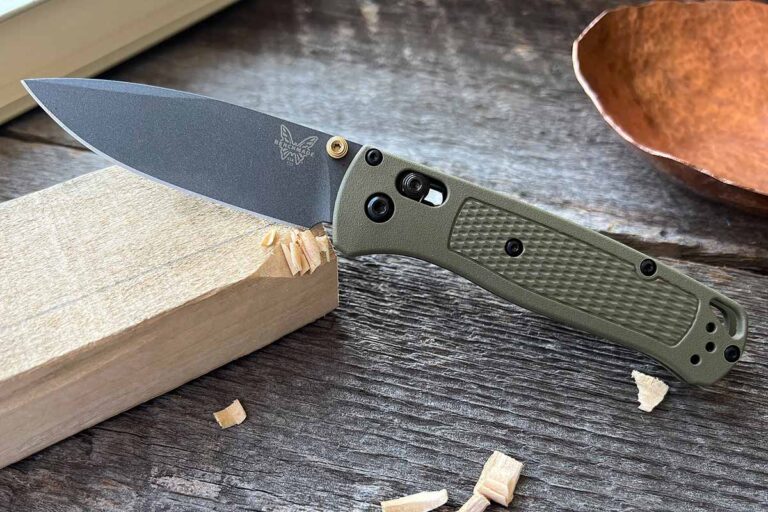
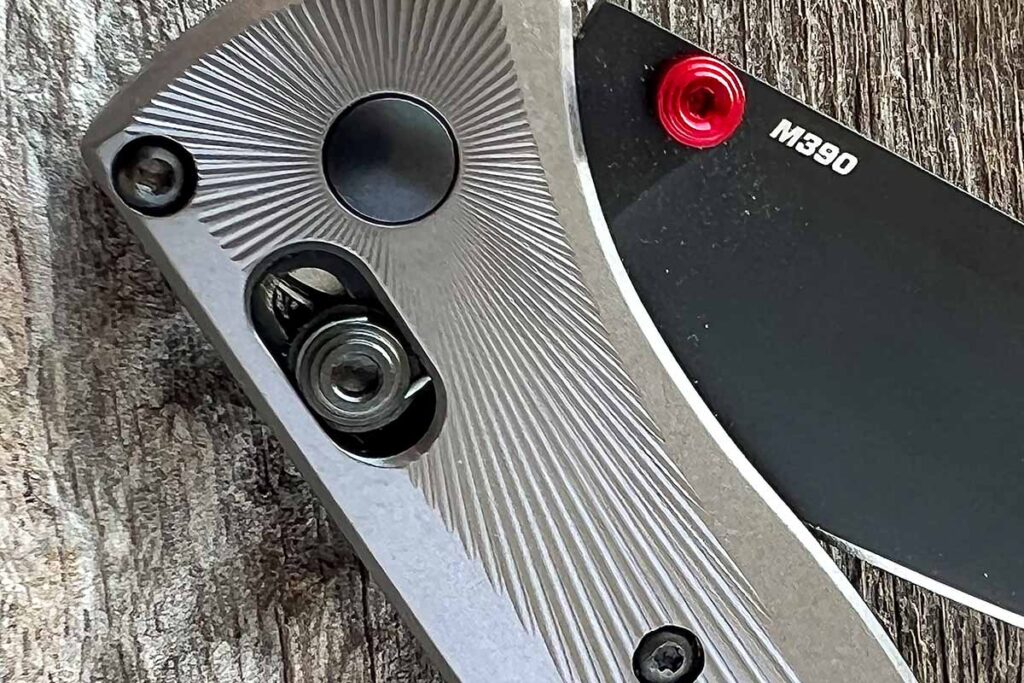
Standard-model Bugouts sport CPM S30V steel blades, however, S90V and M390 are available on higher-grade models. Photo: Marty Stanfield
The base models Bugouts use premium CPM S30V steel, a steel that is used widely for high-end factory knives. This is mainly due to its ability to hold an edge for an extended period, longer than most blade steels. Additionally, it is highly resistant to stains and corrosion.
As for the blade profile, the Bugout is a modified drop point and is highly adaptable to many tasks. Nicely, Benchmade outfits the knives with thumbstuds on either side of the blade, permitting ease of opening with either hand.
Getting A Handle On The Bugout
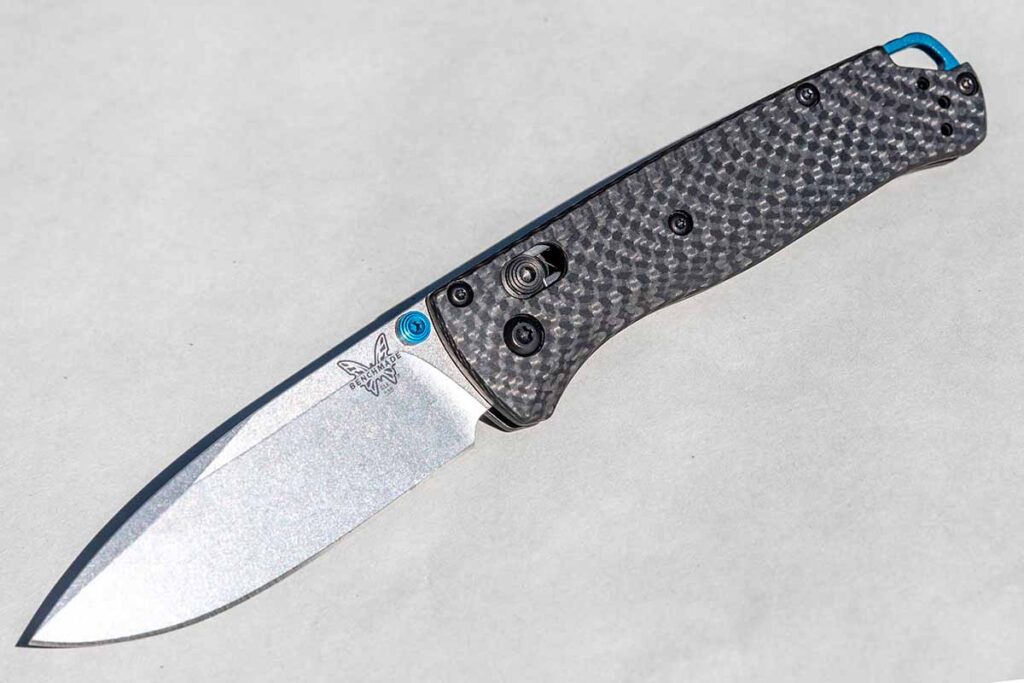
The handle of the base Bugout is made from molded Grivory, making the Bugout a very lightweight folder. The standard size tips the scales at 1.85 ounces and the Mini at 1.5 ounces. Benchmade offers other handle material options, including anodized aluminum, carbon fiber, and CF Elite (a glass-reinforced nylon synthetic material that is lightweight and stiff).
Given there is a thriving aftermarket for Bugout scales, the sky is the limit on the knife’s handle. Photo: Marty Stanfield
And if you have to have custom, there are aftermarket scales for the knife in a host of materials—titanium, copper, brass, bronze, G-10, and Micarta. In turn, you can truly have a one-of-a-kind feel and look to your Bugout.
Bugout Action
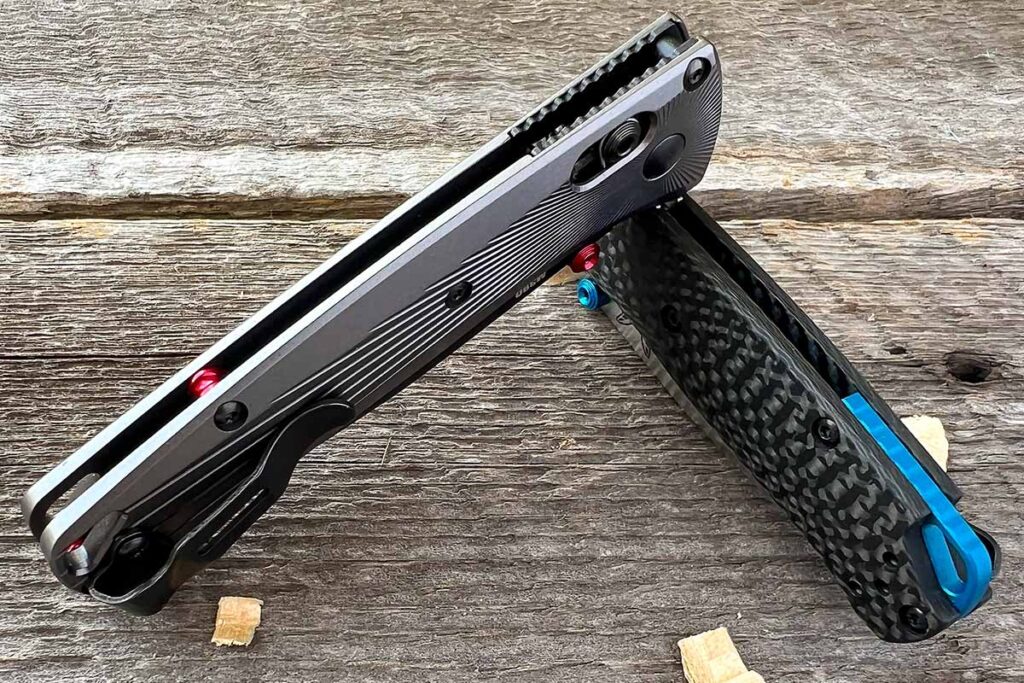
The Bugout uses Benchmade’s critically acclaimed Axis Lock crossbar lock, hailed by many as ultra-strong yet extremely safe because you don’t put any fingers in the path of blade travel. Add on to this, it’s easy to unlock with either hand, and you have a naturally ambidextrous across the board. The lock is simple, just pull back on one of the exposed lock bar ends at the back of the handle and then rotate your blade closed. Internally, two Omega-shaped springs provide constant tension for the lock bar on the blade tang to ensure positive lock engagement.
The Bugout is outfitted with Benchmade’s rock-solid Axis Lock crossbar lock, which has the added benefit of being ambidextrous. Photo: Marty Stanfield
As for other odds and ends, the handle’s checkering does a great job of preventing your hand from slipping. A deep carry, fold-over pocket clip carries the Bugout deep in your pocket and can also be switched to provide easy carry for left-handers. Integrated lanyard hole permits the use of Paracord for a lanyard if you are into that sort of thing.
Using The Bugout
In use, the Bugout hits hard in spite of its ultra-lightweight stature. The flat ground blade bites in and is very effective. Opening mail, opening packages, peeling an apple, cutting up hose, cutting cardboard, or stripping wire—the Bugout won’t break a sweat. Perhaps the best way of thinking about the knife is as a minimalist working folder.
The higher grades of the Bugout have carbon fiber handles and milled aluminum handles, paired with S90V and M390 blades respectively. These upgraded blade steels offer high-performance cutting with excellent edge holding. The higher-grade handle materials give a bit more heft to the Bugout as well as an enhanced, high-tech appearance. It only makes sense to have upgraded blade steel with upgraded handle material.
Overall, the knife is lightweight, rugged and more than capable of tackling most task. In short, it’s dang near the perfect EDC option. Photo: Marty Stanfield
Even with the base model’s S30V, you still pack plenty of muscle for those long-cutting jobs. I like how thin the Bugout’s blade stock is combined with the flat ground blade bevel giving it plenty of bite to it.
Some knife folks favor not a high performance without the bulk. I get it, it all makes for a comfortable everyday carry folder. For those of you who favor these kinds of knives, the Benchmade Bugout is for you. You have a high-end blade steel with a proven and popular blade lock, with a no-frills handle design.
MSRP for the full-size Bugout starts at $180 and varies up from there depending on handle material and blade steel. There is also a Mini Bugout which scales the size down some to an even more pocket-friendly size.
Go here for more information on the Benchmade Bugout.
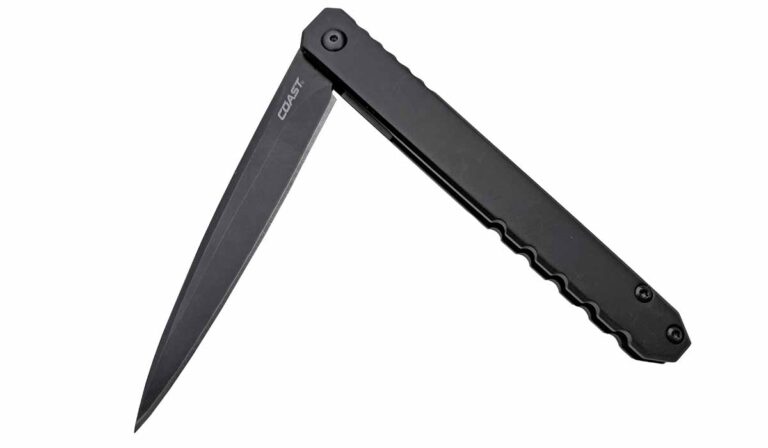
Every now and then I come across a folder that just feels right both in my hand and in my pocket, one that’s not too large nor too small, yet still has that sleek look to it. The Coast LX532 framelock does it all for me. I really love the blade shape. However, it still must be able to slice and dice to get a top place in my book.
Coast LX532 Edge Test
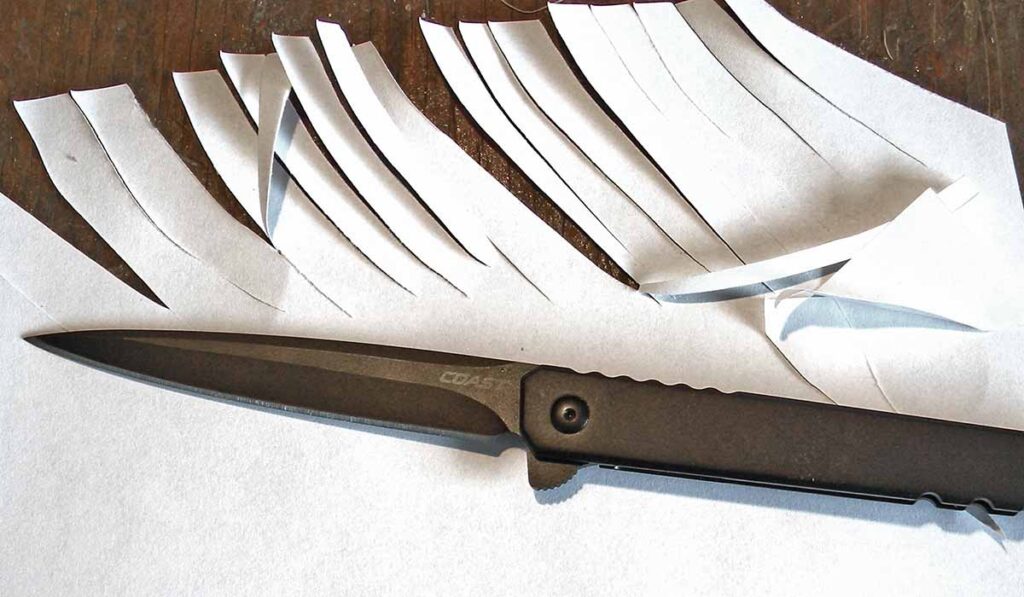
The good ol’ paper slice worked for starters. The LX532 sliced very smooth with no effort. The thin blade made for great control during the cuts. The only challenge was getting my fingers out of the way fast enough.
It was back to 20-pound bond copy paper for the final edge test. The LX532 didn’t miss a lick, slicing very smooth, aggressive cuts.
It was time for the single-walled cardboard. The knife was quite aggressive in cutting it. Again, control was great. The thinner handle takes some getting used to but that’s not a big deal. There was some twisting on the cut pieces but that was me getting accustomed to the handle.
Plastic board was next. The LX532 handled it with ease. The thumb notches on the handle spine really came in handy as more pressure was needed to make the cuts. They notches stopped the thin blade from twisting in my hand while cutting.
LX532 Meduim-Duty Cutting
I had some leftover dense foam from the Kydex press to change out, so I decided to slice it up. The folder went through the foam like butter. The thin blade is extraordinarily sharp to say the least. Control was great yet again and I had to continue slowing my slicing down to keep my fingers intact.
The knife went through the foam like butter. The thin blade is extremely sharp to say the least.
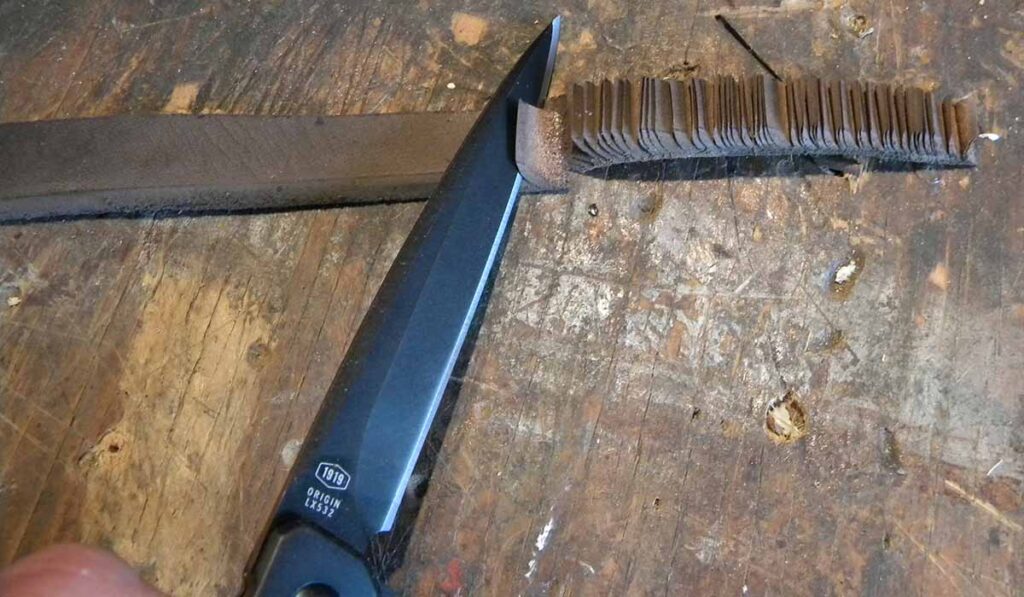
Eight-ounce leather, anyone? I did some normal up-and-down slicing, along with some skiving. The edge was quite forceful slicing leather. I could hear each and every cut. The knife is exceptionally smooth and controllable for straight cutting. I switched positions and laid the leather flat for some skiving. The LX532 was very loud and aggressive slicing the material. I cut through the leather more times than I want to say. (It makes a better picture if the leather is all together rather than a bunch of smaller pieces.)
LX532 Heavy-Duty Cutting
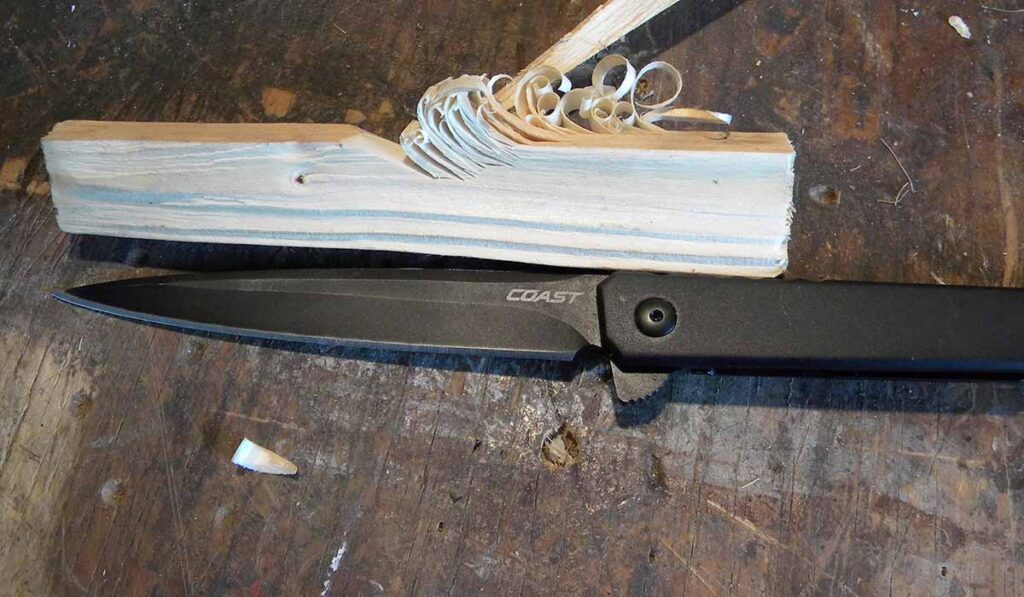
With camping season in full swing, I needed to stock up on firesticks to start the campfire. The LX532 worked perfectly. It made great thin curlicues in the pine. It also took deeper bites if needed. The blade zipped through the wood. Control was great with my thumb on top of the handle. It was a lot of fun to do.
The blade zipped through the pine and made great thin curlicues. It also took deeper bites if needed.
I had my doubts about cutting sisal rope with such a slim knife. However, the folder proved it could go the distance, providing 200 crunching cuts before I stopped. The knife was still going strong. I was impressed. The framelock stayed at 100 percent engagement the whole time and was still smooth upon closing. Hats off to the folks at Coast.
It was back to 20-pound bond copy paper for the final edge test. The LX532 didn’t miss a lick, making extra-smooth, uncompromising cuts.
Overall Take
The LX532 is one sweet framelock. The slim overall shape is right up my alley. Performance is in the top 10 percent. Excellent job, Coast. I wouldn’t change a thing. Maybe some texturing of the handle?
The Karambit Is A Historic Utility and Combat Knife From Asia That Has Grown In Popularity Around The World In Recent Decades.
The karambit looks unlike any other knife. The short, swooping curve of the blade dates back nearly a millennium in Indonesia and throughout Southeast Asia. First used mainly as a tool for farming and planting rice, the karambit evolved over time into a combat knife. The curve became more pronounced and became a main weapon in pencak silat, an indigenous Indonesian martial art, and Filipino martial arts.
Legend goes that as the knife became more combat-oriented, its shape was inspired by a tiger’s claw. The knife’s tight curve and finger ring allow it to stay securely in the hand in close-quarters combat.
Why Should I Use A Karambit?
The karambit today is very much a self-defense tool. Yes, it can still be used for outdoor tasks, but there are more practical blades available for such purposes. The karambit is a strong, durable combat knife used by law enforcement and militaries around the world.
If you’re looking for a high-quality knife to keep on your person as protection, you can’t get much better than the karambit. The finger ring provides a natural, secure traditional grip or reverse grip to generate more power with each swing.
The folks at Emerson Knives, Inc., have made a great video showing how to use a karambit.
Do I Need A Karambit?
Simply put: no. A karambit is a refined self-defense tool. If you live a life where life-and-death close-quarters combat is an extremely minute possibility then you can probably pass on a karambit.
Additionally, the sharp curve of the blade means it can be difficult to handle without experience or training, even with the finger ring. If it’s uncomfortable to use then don’t use it.
Best Karambits
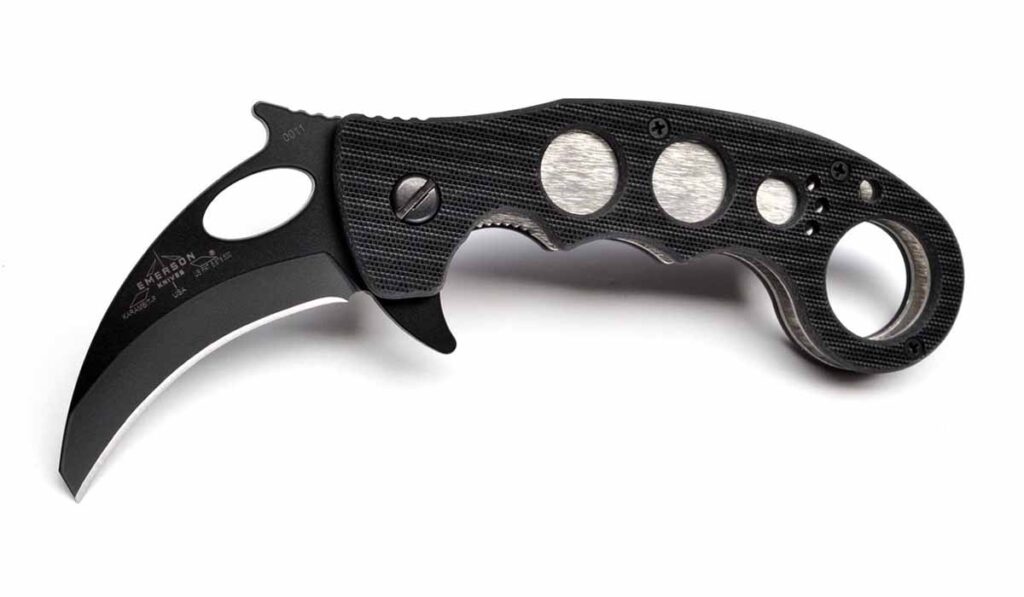
Emerson Combat Karambit
The Combat Karambit folder by Emerson Knives, Inc., was very well received when introduced years ago. It subsequently spawned a larger version called the Super Karambit. It shares the same award-winning features of its forerunner but in a larger, more impressive format. The 3-inch blade is 154CM stainless steel and opens by either the patented Emerson Wave or an oval blade hole. Handle material is G-10 reinforced by dual titanium liners for rigidity. The handle flows seamlessly into the finger ring in the butt. There are a lot of graceful curves on this knife. It’s a feast to behold.
The handle fits my hand extremely well, instilling a high sense of security and user confidence. The Super Karambit carries nicely in a pocket though its presence is a constant reminder of just how big it is. A reverse grip feels exactly as secure as a forward one. Your hand isn’t moving once it’s wrapped around this handle!
To deploy the blade using the Wave remote pocket opener, hook your finger through the finger ring, pull the handle from your pocket and let the Wave hook engage the seam of your pants pocket. Keep pulling and as the handle comes free from the pocket, the hook grabs the seam and deploys the blade open and locked. To my knowledge, this results in faster blade deployment than any other karambit.
One thing I don’t care for is the overly aggressive texturing of the G-10. I like grippy texture but this one is downright abrasive on pants fabric. It might be a good idea to take a small piece of cardboard and rub it over the handle texture to smooth it out somewhat. The knife is offered exclusively in a stonewashed blade finish and a black G-10 handle. Country of origin: USA. Closed length: 5 inches.
MSRP: $325
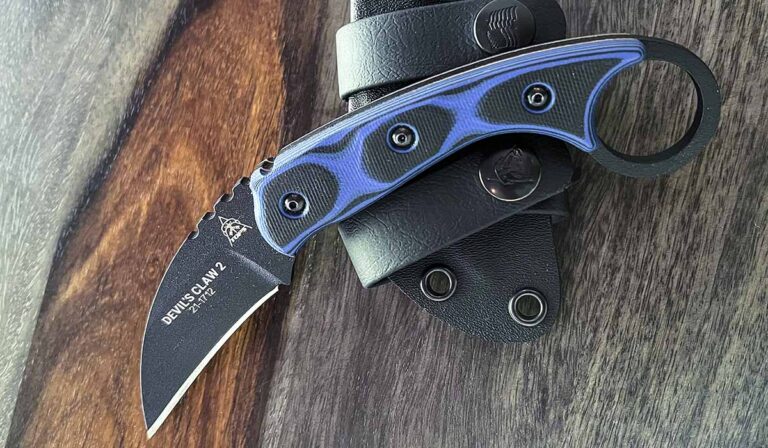
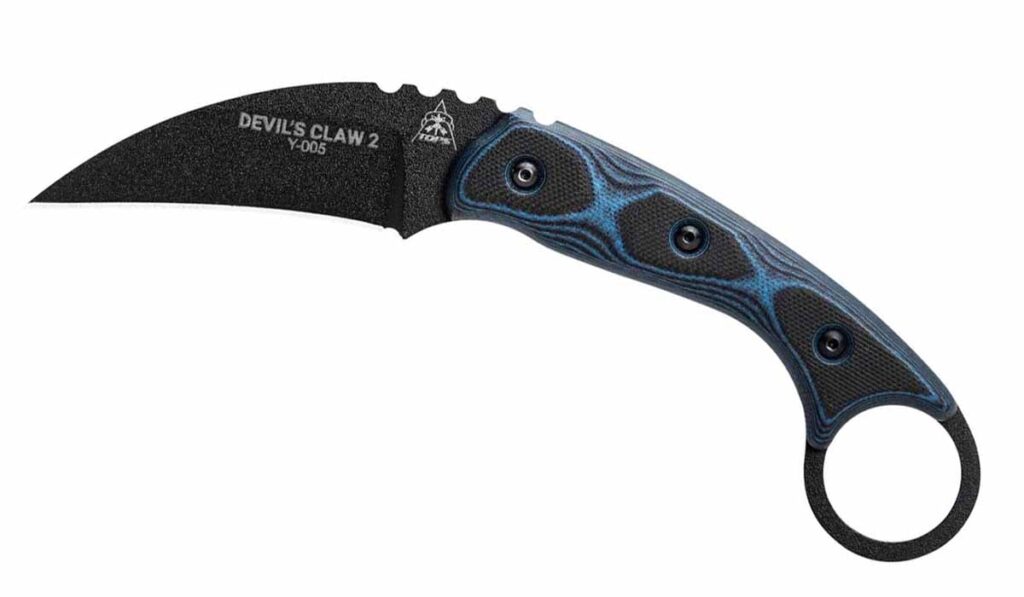
TOPS Devil’s Claw 2
The Devil’s Claw 2 by TOPS Knives is a mid-sized fixed blade designed for personal protection. It’s built on the same platform as the company’s original Devil’s Claw but with an extended handle to accommodate a full grip as well as the traditional ring at the end. The 3-inch hawkbill blade is 1095 carbon steel in the company’s Black Traction Coating to help protect against corrosion, as well as provide a low profile. Overall length: 5.75 inches. Five large traction notches machined into the rest portion of the blade spine provide a non-slip grip for the thumb. The handle is blue and black G-10 with red fiber spacers at the tang—very eye catching! The sheath is molded Kydex with loops to carry horizontally on a belt.
The DC2 is also a well-disguised utility knife. It feels agile and capable in hand. If you have jobs that require long, straight cuts, the DC2 is the answer. The angle of the blade makes it easy to use the tip to cut and score, while hiding the knife in a forward grip. The finger ring helps seat your hand during such tasks. The traction notches on the thumb rest aid with precise tasks such as wire stripping, whittling or any task that requires downward pressure on the blade.
MSRP: $165
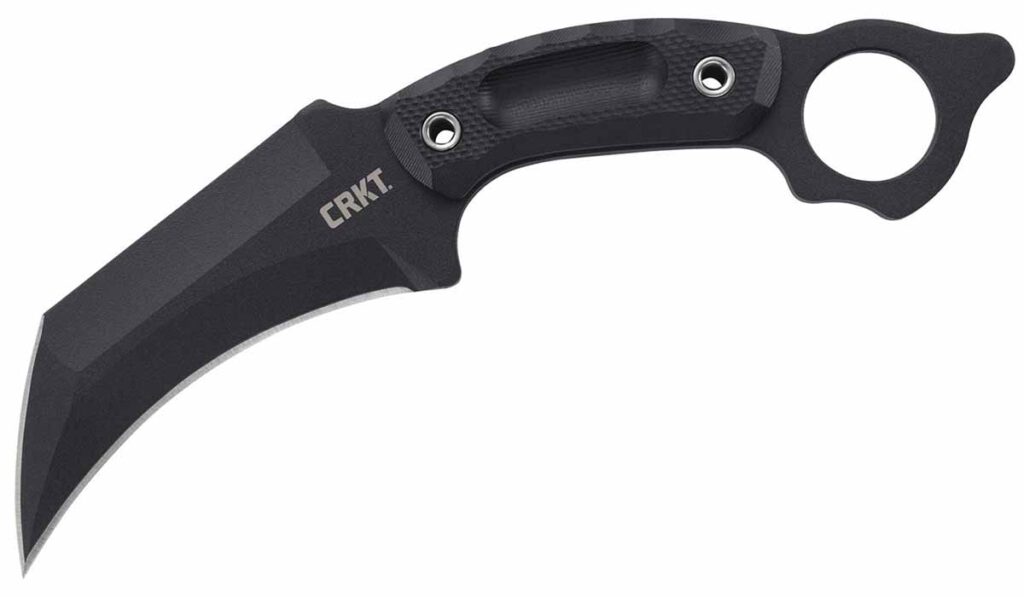
CRKT Du Hoc
Sometimes bigger really is better, and that might be the case with the CRKT Du Hoc. This fixed blade designed by Austin McGlaun is a whopping 9.63 inches in length and 9.3 ounces in weight. McGlaun designed the knife to honor his late uncle who earned a Silver Star at Point Du Hoc.
The 5.1-inch blade is made from powder-coated SK-5 carbon steel. The G-10 handle provides an excellent grip, and the included thermoplastic sheath comes with mounting options and makes for easy transport.
MSRP: $113
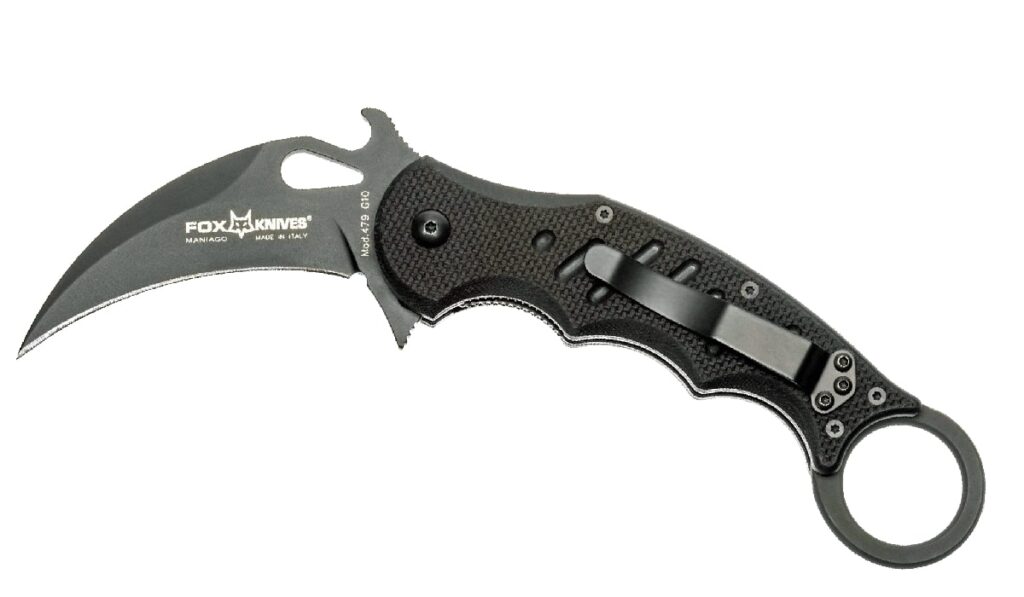
Fox Knives 479
We return to folders with this piece from Fox Knives. The 479 is a large flipper that can handle whatever you throw at it. The 2.95-inch blade is made from N690Co stainless with a black Idroglider coating and a G-10 handle. The blade has been treated to 58-60 HRC, making it the hardest blade on our list.
When opened, the knife is 7.48 inches long, and it weighs 4.58 ounces. The finger ring is made from aircraft aluminum to keep weight down without sacrificing toughness. The reversible pocket clip makes for easy carry no matter where you go.
MSRP: $156
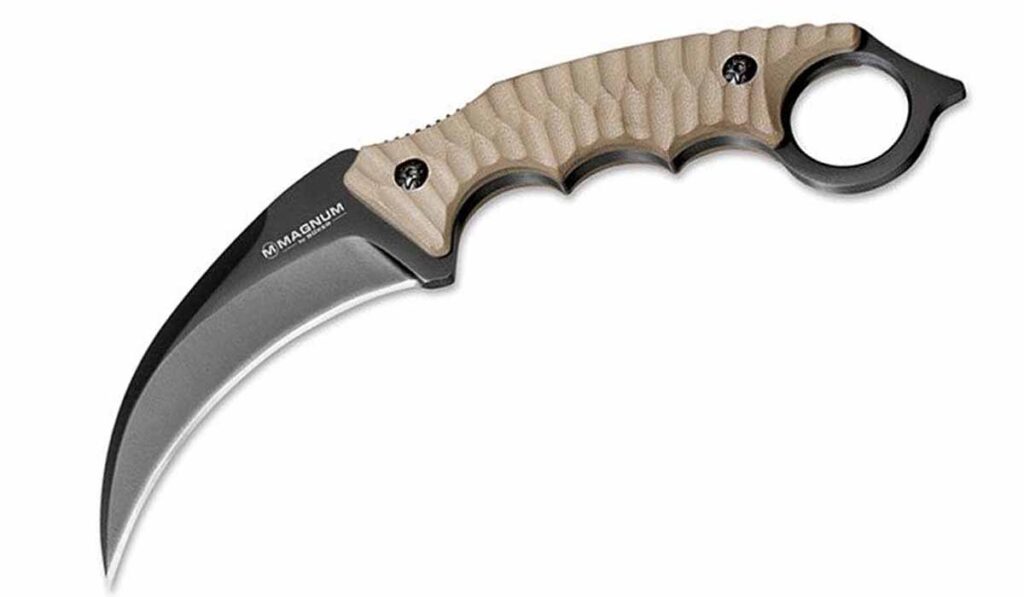
Boker Magnum Spike
At 8.25 inches overall, the Boker Magnum Spike Karambit is a full-size fixed blade. Visually, this one is quite striking! The 4-inch talon-shaped blade is 440A stainless steel coated black for corrosion protection and a low profile. A full-length swedge adds attitude.
The handle is very well executed. Multiple finger grooves aid in seating your hand comfortably. There’s a groove on the handle spine with traction notches to securely seat your thumb and help index your grip. The tan G-10 handle features a 3D texturing pattern for an excellent non-slip grip. The edges of the G-10 are chamfered properly, further enhancing grip comfort. The finger ring has an integral spike at the end for a blunt strike option if needed. When held in the reverse grip, the spike helps form a comfortable thumb rest. A molded Kydex sheath with belt adapter promotes easy carry . Due to its large size, the Spike isn’t as agile in-hand as the smaller test karambits. If you tend to manipulate a karambit, this one isn’t for you. Due to the swedge, the blade is somewhat thin and while sharp and able to penetrate like crazy, it might be prone to bending or breaking if used for rough cutting. A smaller version with a 3-inch blade that is more hawkbill than talon, flat ground and without the spike on the ring could be more agile and more EDC friendly. Still, at an
MSRP: $73
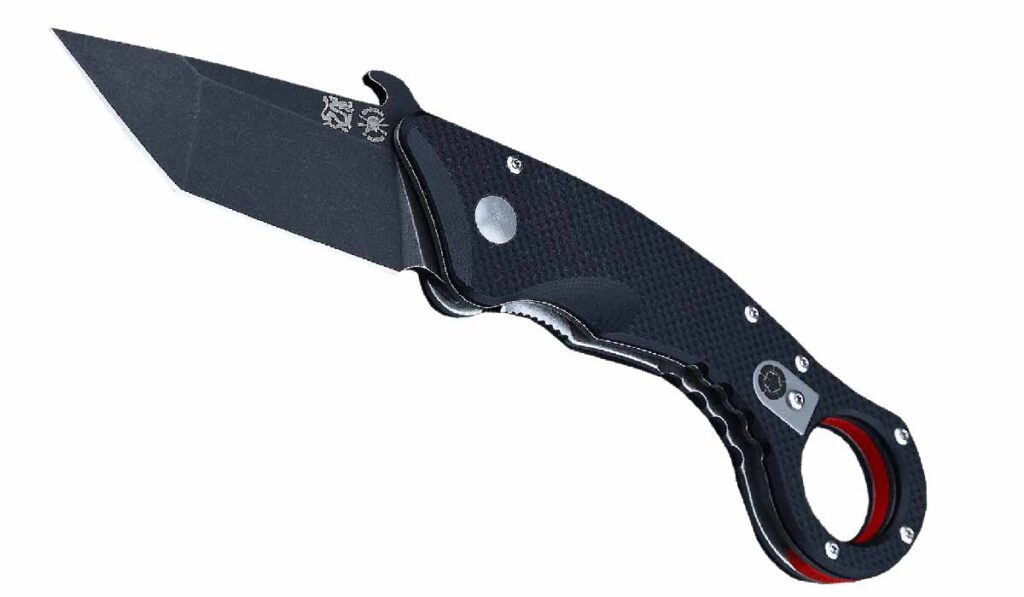
Spartan Blades Ronin Shoto
Spartan Blades teamed up with Tu Lam of Ronin Tactics to design the Ronin Shoto, a folding karambit that is part of the company’s Field Grade line of tactical knives. The Ronin Shoto design leverages the knowledge of Lam along with Spartan Blades co-owners Curtis Iovito and Mark Carey—all three saw action together in the Special Forces—and their experiences serving the USA overseas in Asia. The trio developed a fascination with the karambit during that time and it wasn’t until years later that their fascination manifested itself with the Ronin Shoto.
The knife adopts 2.5 inches of a tanto blade, rarely seen in karambits. For blade steel, CTS XHP premium stainless provides edge longevity and durability. There’s also the Emerson Wave, the only opening method the Ronin Shoto has. The blade rides on Spartan’s OIBBS (oil-infused bronze bushing system). The bronze washers are permanently impregnated with lubricant to ensure glassy smooth blade operation at all times. Textured G-10 slabs conceal dual stainless liners. A linerlock secures the blade in the open position. A deep carry pocket clip carries the knife comfortably. A contrasting red G-10 handle spacer adds a tasteful pop of color.
The Ronin Shoto sports a very impressive, heavy-duty build. Like the Emerson Super Karambit, the pocket presence is something you will notice, though it’s not uncomfortable. Opening the blade is very similar to the Super Karambit—index finger through the finger hole, pull and the blade opens as the knife exits the pocket, all in one continuous motion. If you prefer the reverse grip, re-orient the clip to the left side of the handle and you can still make use of the Wave.
Whereas the curved blades of standard karambits are limited in use, the short tanto of the Ronin Shoto is more utility friendly. It tackles general cutting tasks and the CTS XHP stainless steel ensures edge quality will go the distance. I wish the folder had an alternate way of deploying the blade other than just the Wave, though it is possible to place your thumb on the Wave and push on it to open the blade as you would any one-hand knife. Closed length: 5.2 inches.
MSRP: $155
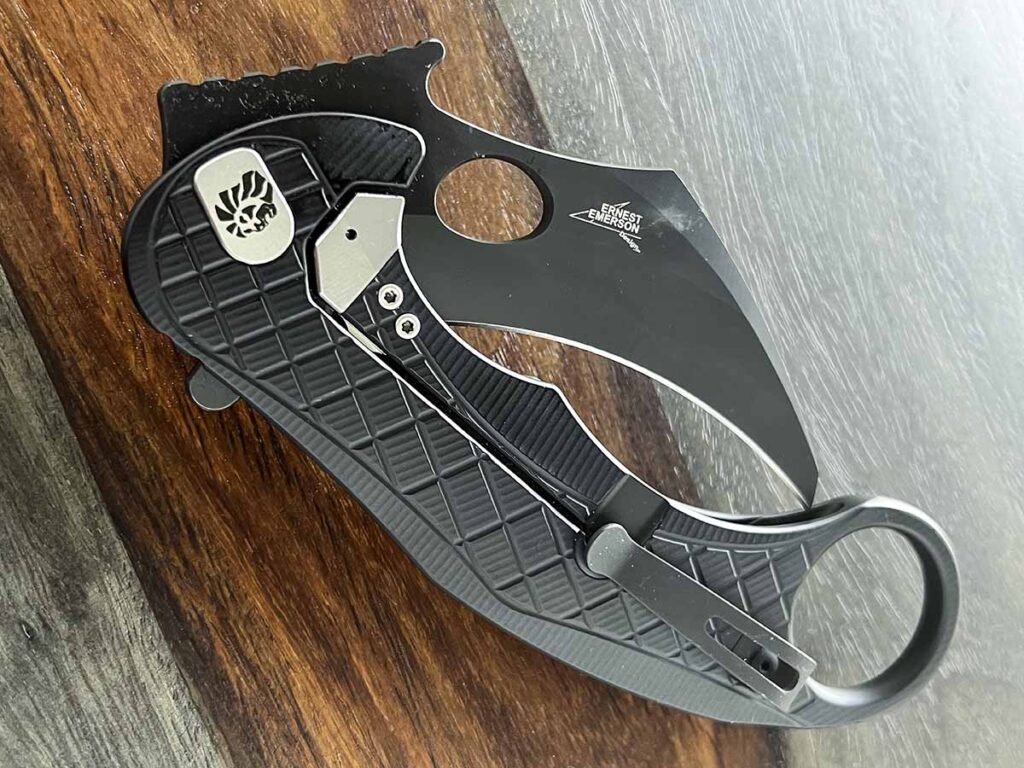
Lionsteel/Emerson LE One
The Lionsteel/Emerson LE One is a collaboration between Ernest Emerson and Lionsteel. It quite possibly is the most advanced folding karambit on today’s market due to several notable features. The 3.23-inch blade is CPM MagnaCut stainless, the latest in high-performance “super steel.” It’s the most advanced steel in terms of edge holding, stain resistance and toughness. The blade opens via one of three methods—blade hole, Emerson Wave and a flipper. If you want to remove the flipper, you can do so using a T6 Torx® wrench. The removable flipper is the REF (removable flipper) system, exclusive to Lionsteel.
The framelock handle showcases another feature seldom seen on factory knives: no assembly screws because it’s machined from one billet of aluminum. The lockbar, semi-open backspacer and finger ring are all one piece of aluminum. The handle boasts a machined crosshatch pattern with milled striations. A stainless steel wear pad screwed to the end of the lockbar results in steel-on-steel lock integrity. A deep-carry pocket clip is reversible for ambidextrous use. Handle color options are black, green, red and brown. Blade finish options are stonewashed and black coated.
A fraction over 5 inches closed, the LE One is one of the larger folding karambits. However, it’s so lightweight and carries so well that its sheer size doesn’t even factor in. I like how your hand is seated comfortably when in the forward grip—it definitely feels secure. All edges and corners are rounded and chamfered properly, making the handle melt in your hand. Even the finger ring is rounded both inside and out. The thumb ramp and blade spine are crowned—I totally dig this. These areas have a rounded appearance, not flat like most other blade spines. Crowning demonstrates that a company is willing to go the extra mile to pay attention to such a minor detail. Lionsteel has detail locked down for sure!
Sharp out of the box, the blade cuts very efficiently and the flat grind pull cuts easily. The framelock engages tight, with zero blade movement in any direction. The blade tip looks different from other karambits. It appears to be dull but is not. Emerson’s design eliminates the very pointy tip, which is prone to break during heavy use, by squaring it off slightly. This creates a strong tip. The Emerson Super Karambit has the same feature as well.
MSRP: $268
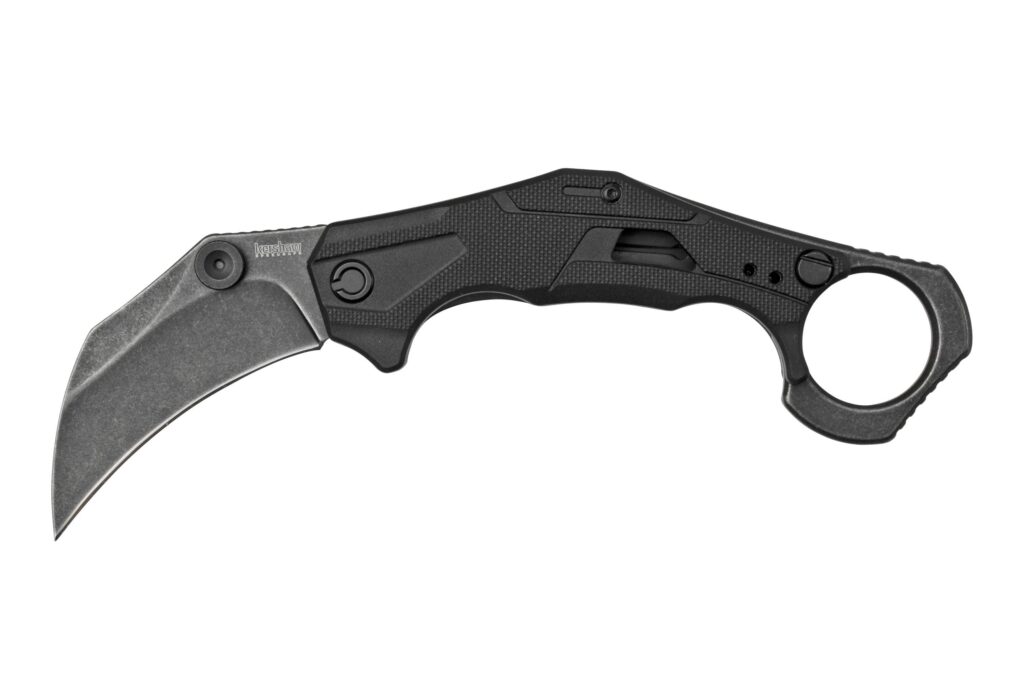
Kershaw Knives Outlier
Anchoring the value end of the spectrum is the Kershaw Knives Outlier. In a somewhat angular handle design, the Outlier’s finger ring is integral with the handle spacer. The only karambit from Kershaw, it features a 2.6-inch blade of 8Cr13MoV stainless steel. The blade opens via Kershaw’s SpeedSafe assisted-opening mechanism designed by BLADE Magazine Cutlery Hall-Of-Fame® member Ken Onion. The opening starts via a choice of an oversized thumb stud and a flipper. The handle is a glass-filled nylon polymer outfitted with a deep-carry pocket clip and a linerlock.
The Outlier feels very secure and comfortable in hand. Your grip is locked in via the large forward finger recess and finger recess at the butt just outside the finger ring. Fit and finish is top notch and an all-black tactical finish presents a subdued appearance. The 8Cr13MoV is a good middle-of-the-road steel, very comparable to AUS-8, which is popular in entry-level-to-mid-range knives. The curved blade is easy to sharpen with a rod-type sharpener and holds a decent edge.
MSRP: $72
Editor’s Note: Dexter Ewing and Mike Ableson contributed to this article.
Nothing cuts as wicked a profile as a tanto knife.
The tanto is one of the most iconic and recognizable knife designs to ever forged, and today you can find it being made all over the world. From pocket folders to heavy fixed blades, there are a lot of Tantos to choose from.
Today, we’re going to go over everything you need to know about the tanto, from its history and modern usage to the best modern examples you can add to your collection.
Let’s dive right in.
Tanto Knives: Rich, Battlefield-Proven History
Japan has gifted the world with some excellent things: sushi, Godzilla, anime, the Honda Civic… list goes on. Perhaps some of the most iconic pieces of Japanese culture to spread around the world though are its blade designs.
The katana is probably the most famous in terms of combat-focused designs, but a close second is the beloved tanto. A very core idea of many sword-based Japanese martial arts is the idea of daishō, which translates to “big-little”.
Daishō essentially just means having one long sword, and one short sword or long knife to accompany it. Traditionally, the larger sword would often be left outside when entering a palace or other government building, or a temple, and the shorter weapon would be carried inside, tucked through a sash.
The Sidearm of Choice Before Pistols
Originally conceived as a sidearm to be paired with a long sword, the tanto was first carried primarily by Samurai alongside a tachi, the precursor to the katana most of us are familiar with from modern popular culture.
Over time, the tanto become more widespread, and a smaller version known as a kaikenbecame popular as a self-defense tool for women. Over several hundred years, the tanto became shorter and thicker, and closer to the blade we know today.
Photo: Wikipedia
Though eventually replaced in serious warfare by the wakizashi (functionally just a shorter katana, though with some design differences) the tanto remained popular for ceremonial usage and became a matter of pride and expression to wear or own in later years.
The tanto then saw a resurgence in the years leading up to WWII, as they were viewed as more traditional by the Imperial Court. Following Japan’s defeat, limits on sword forging caused a decline in all traditional Japanese sword-making.
In the 1960s, American and European obsession with Japanese martial arts (spurred on by excellent films such as 7 Samurai, Yojimbo, and others) lead to a resurgence of the tanto, particularly as a combat-focused knife shape.
Today, the iconic tanto tip is found on traditional full-length fixed blades, as well as more modern folding pocket knives designed for tactical/defensive use. Plenty of manufacturers make tanto-tipped knives, as well as smiths making excellent traditional tantos. (We’re going to cover both in our reviews, don’t worry).
What makes a Tanto, a Tanto?
Today, the definition of a tanto has shifted far beyond the traditional knife of 10th-century Japan, but we’re going to start there and then we’ll talk about the more modern incarnation where we see tanto tips added to a variety of EDC and tactical knives.
Traditional Tanto Blades
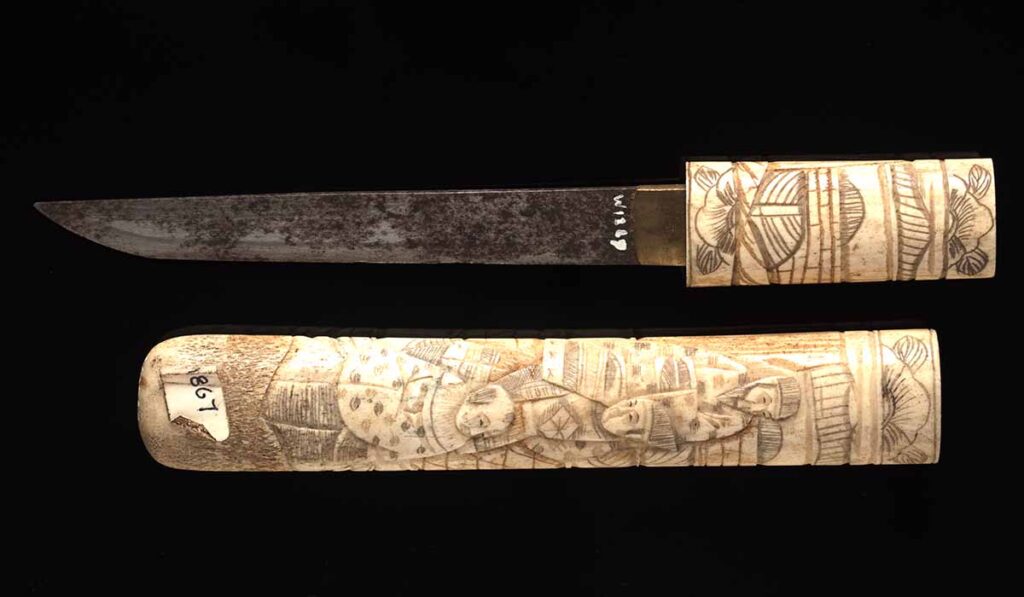
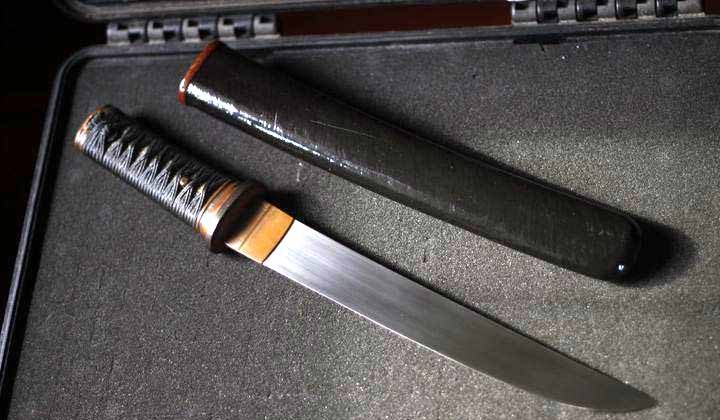
Originally, the tanto was more what we would call a short sword, or perhaps a long dagger, and was worn by samurai. It was very much a weapon to begin with, but become a more ornate and ceremonial piece over the years as weapon designs evolved.
The traditional tanto was a single or double-edged dagger with a length of around 6-12 inches and was designed primarily for stabbing. It was forged with very flat sides, and some were left short with an extra thick cross-section to aid in piercing armor.
Modern Tanto Blades
The more modern interpretation of the tanto is heavily influenced by American tactical knife designs and proves more common outside of Japan. Traditional blades are still made (and beautiful) but less practical for the modern world.
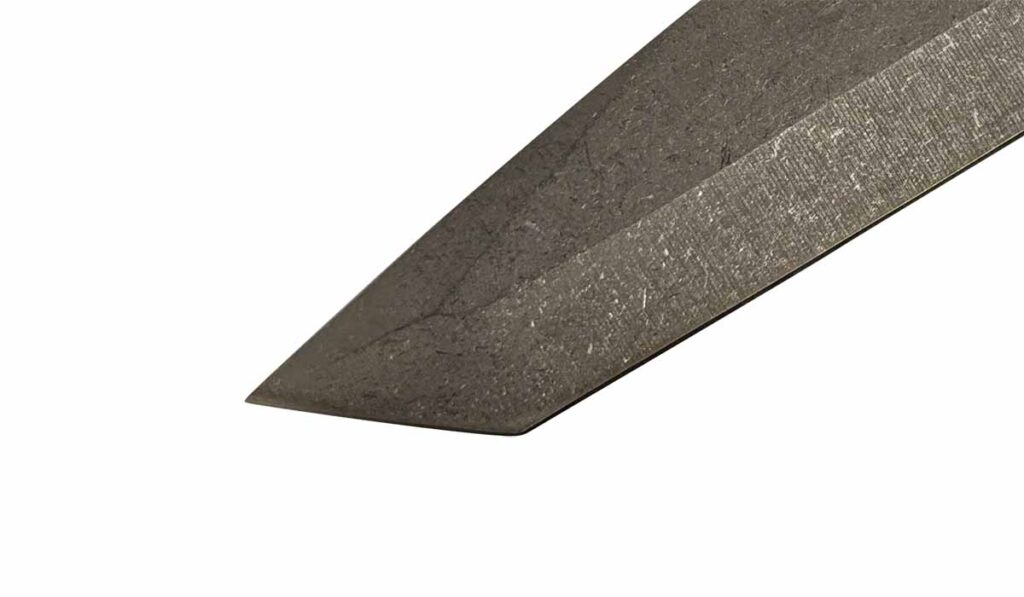
A variety of American and European knife makers now produce tanto-inspired knives with a very angular tip with the iconic sharply-upswept blade tip, essentially leaving you with two cutting planes—one parallel to the spine of the knife, and one at a 45-degree(ish) angle to the spine angling up towards the tip.
Most of these modern “American tanto” designs are folding knives, and while many are for “tactical” or defensive use, the tanto blade shape has become increasingly popular for EDC knives as well.
Pros of the Tanto Design
Piercing: Piercing, piercing, piercing. The shape of the tanto is optimized for stabbing and piercing, and it excels in those contexts.
Whether you’re a pre-Edo period Samurai trying to slip a blade between (or through) segments of your opponent’s armor, or a frustrated office worker attempting to poke your way into some plastic clamshell packaging, the tanto is ideal for putting a hole in something.
We see similar knives used for leather work around the world, and with good reason. The tanto is great for putting a hole in tough material.
Draw Cuts: Modern American tantos are also great for draw cuts and slices, particularly when you’re working with something on a flat surface like a cutting board. The dual edge geometry makes short work of many slicing tasks.
You can also (carefully) use that second point where the two edges meet like a chisel for shaving wood, scraping a sticker, etc. This makes for a very handy EDC.
Defense: Lastly, as a defensive tool, tantos excel because of their narrow, piercing point. This point easily defeats heavy clothing and makes for an effective means of defense in skilled hands.
Many knife-based martial arts focus on stabbing strikes as the most effective fight-enders, and the tanto fits that training paradigm very well, while still being perfectly capable of slashing.
Cons of the Tanto Design
Cutting Edge: The tanto’s main drawback, besides additional time and care needed when sharpening, is the fact that you lose some usable blade edge by having essentially two edges, one parallel to the spine and one swept forward and upwards.
In practical use, this means you have less effective blade length for certain tasks, around 20% less than you’d have with an equivalent-length drop or clip-point blade. To compensate, tanto blades intended for EDC are usually a bit longer than a similar knife with a different point.
All of this can be adjusted for, and as long as you aren’t doing something like spoon carving, you probably won’t notice a difference in real-world use.
At the end of the day, “real-world use” for most of us is opening boxes and packaging, and slicing apart those god-awful packing straps used to hold children’s toys in display boxes. And the tanto excels at all those tasks.
How The Hell Do You Sharpen a Tanto?
Sharpening a tanto may look a bit scary, but once you break the process down, it’s quite simple. All you’re doing is sharpening two edges that meet at a point. The only real pitfall is that it’s easy to round over the point where the forward edge and the edge parallel to the spine meet.
To avoid this, be mindful of that meeting point, and stop your sharpening stroke on or before it. Then, when sharpening the forward edge, rotate the blade and sharpen it in much the same way you would a chisel.
Just be careful not to pull through the point where the two edges meet so you don’t round over that point and you’ll be good to go. Beyond that, it’s just like sharpening any other knife.
10 Ten Knives with Tanto Blades: EDC, Fixed Blades, and Folders
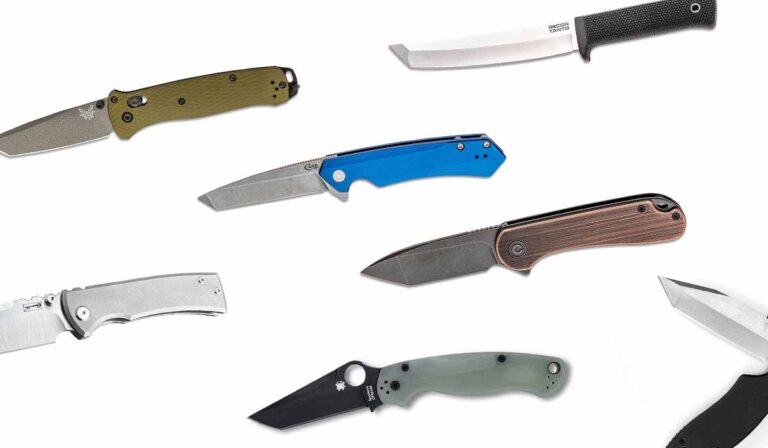
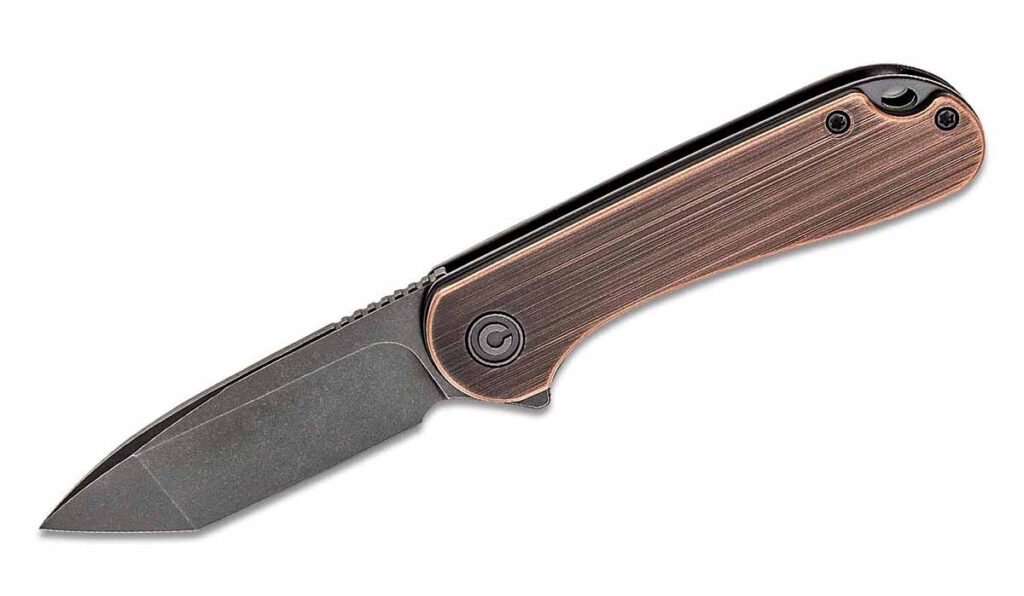
CIVIVI Elementum Tanto
The CIVIVI Elementum has become something of a modern classic in the EDC knife world. Since its release a few years ago has gone on to become one of the most popular pocket knives around.
There is a nearly limitless amount of blade and handle combinations out there now, but we’re going to focus on this excellent tanto blade with a copper handle.
At its core, this is still the same Elementum knife aficionados are already familiar with (a simple, dependable liner-lock flipper folder) but outfitted with a tanto blade that makes piercing tasks a cinch, without compromising on slicing performance.
Basically, it’s everything you need in an EDC knife for regular daily tasks, and it comes with a gussied-up stonewashed tanto blade and a lovely hand-polished copper handle that adds a touch of class and elegance to this very affordable knife.
The Elementum tanto is also available in a button lock version and features a 2.96-inch blade made of D2 steel.
MSRP: $80
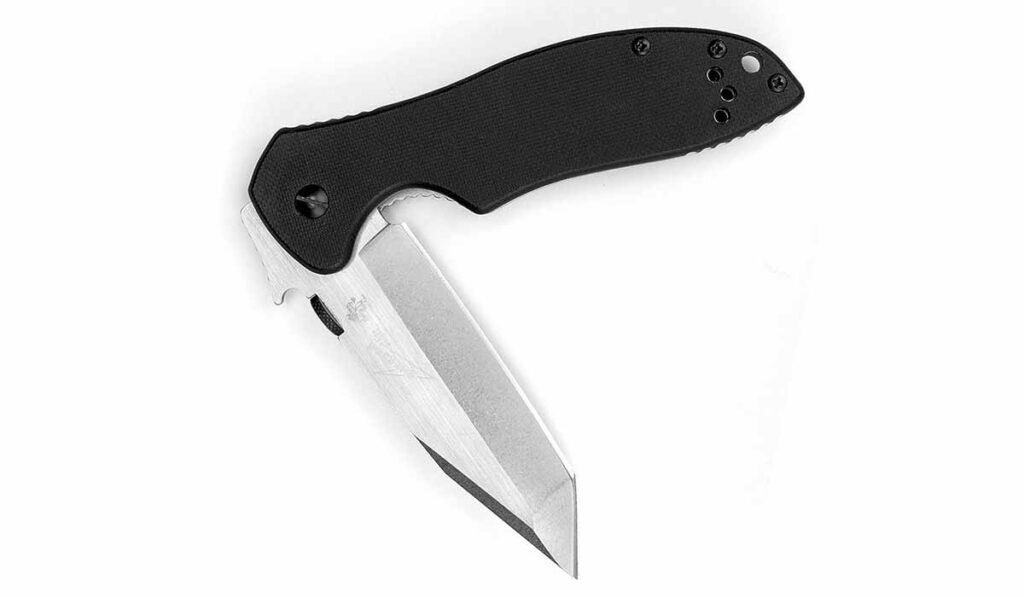
Kershaw Emerson CQC-7K
Ernest Emerson has brought much success to Kershaw with his designs. Back in 2014 he hit it out of the park again with the Emerson CQC-7k, which won that year’s Best Buy award at BLADE Show for sheer value. In the almost ten years since it’s held its own as one of the best EDC options out there.
It features the iconic Emerson Wave that facilitates blade deployment by simply pulling it from the pocket and hooking the “Wave-Shaped Feature” on the pocket on the way out (sort of an inverted kicker).
It also features an ambidextrous thumb disk that doubles as a comfortable place to press your thumb when doing fiddly work. The scales are nicely-textured G10, and the handle features a stainless frame lock that is one of the more secure we’ve tested (read: beat the hell out of).
The one thing to look out for is the blade steel. I would suggest spending an extra few bucks on the D2 stainless version and avoiding the 8cr14Mov version. There’s no reason to spend more than $40 on a knife with bottom-tier blade steel like that in this day and age.
You can get five gas station knives for that price and be better off.
The Emerson CQC-7K has a D2 blade that is 3.25-inches long.
MSRP: Starting at $74
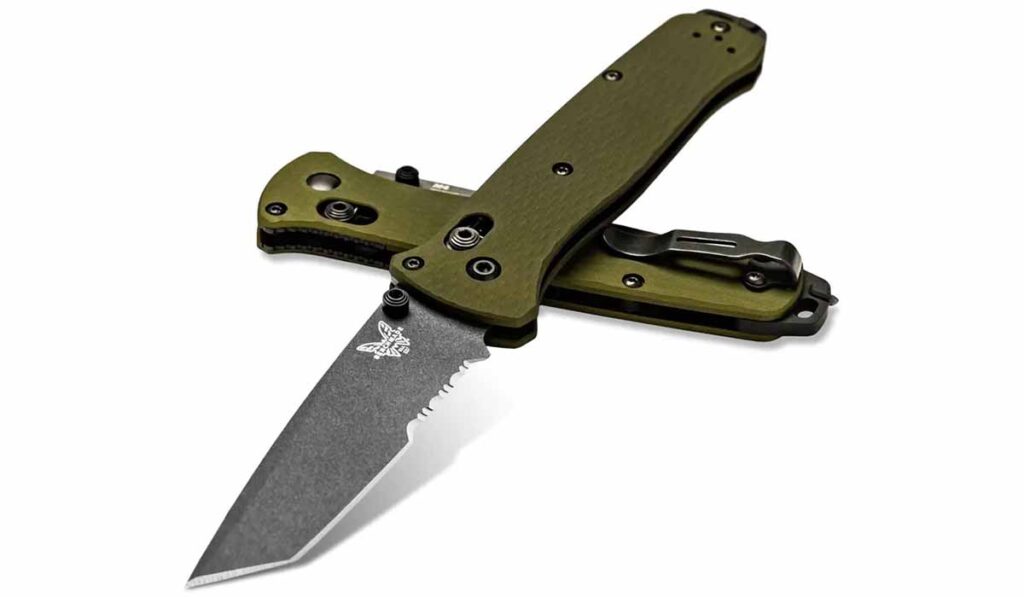
Benchmade Bailout
You’ve heard of the Bugout, surely. Now meet its newer, slightly-tacticooler cousin, the Bailout (one of my favorite knives of the past several years).
As you can surely imagine, the Bailout is a bit of a riff on the Bugout most of us knife fans know and love, but with some notable changes. Our favorite version is the CPM-M4 model which features woodland green anodized aluminum handles.
CPM-M4 is a great steel, which you would expect from Benchmade, and the knife itself is the perfect length to straddle the line between EDC knife and tactical folder. It also features a lanyard loop if you’re one of those people who like lanyard loops, and more interestingly a micro glass breaker.
How often do you need to break a car window in an emergency? Probably not very often, but it is nice to have it if you’re leaning toward a more tactical-style knife. You can also get a version that doesn’t have the glass breaker or the aluminum handles if you want to save a bit.
The Bailout features a 3.4-inches, CPM-M4 blade.
MSRP: $129
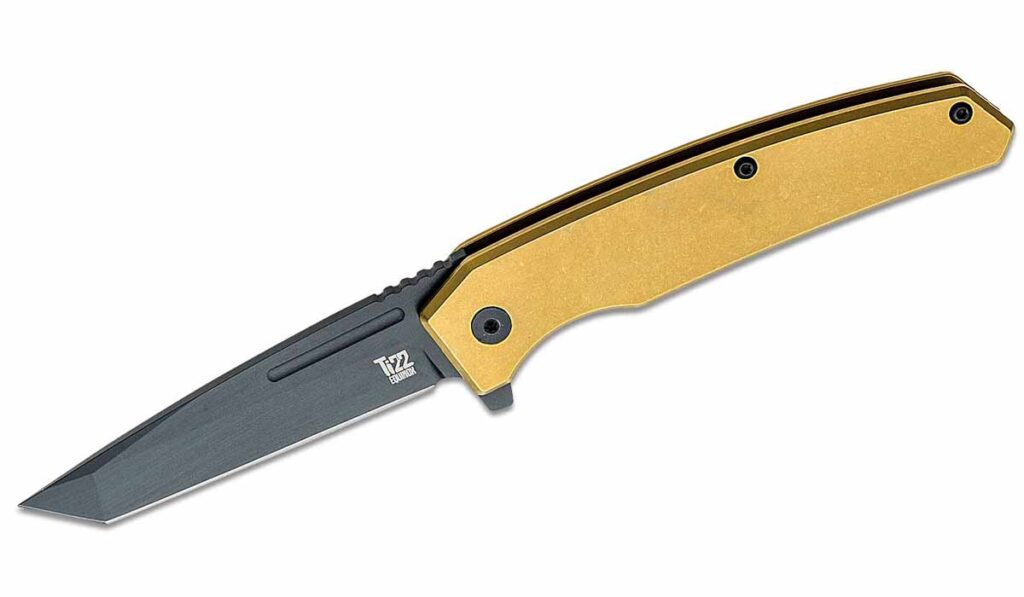
Ontario Ti-22 Equinox
Ontario Knife Co. is one of the most criminally underrated makers out there. Everything in its catalog is smartly designed and intended to excel in real-world conditions. That includes the Ti-22 Equinox.
It features, as the name suggests, a full titanium handle and an S35VN blade coated black to inhibit rust and corrosion in difficult environments. S35VN is a premium steel that holds an edge incredibly well, and the lightweight titanium handle is as robust as you could ever want.
The action is flippy and fidget-friendly, and the handle feels comfortable during extended use. The blade slices paper right out of the box, and comes to a sharp angle where the forward edge meets the primary cutting edge, giving you plenty of piercing power.
Draw cuts, slicing, and even some camp kitchen prep were easy and straightforward, and the knife handled being carried on a sailboat for a week without showing any signs of rust. All in all, a great EDC that again toes the line towards the more tactical/defensive side of things.
The Ti-22 has an S35VN blade that is 3.03-inches long.
MSRP: $138
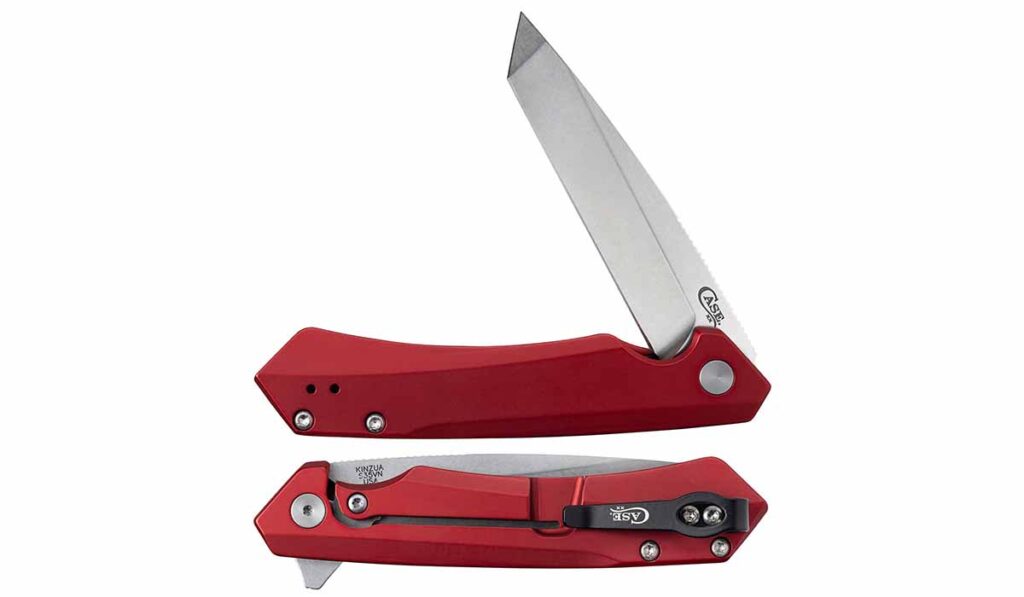
Case Kinzua
Case Knives made a flipper! Several actually, with the Kinzua being part of the first line of Modern Everyday Carry Knives to come from this iconic brand.
This isn’t your grandad’s Case knife, though we love some of those old three-blade traditional babies as much as anyone. These are incredibly modern designs for a modern audience that expects things like one-handed opening, a frame lock, and a deep-carry pocket clip.
In addition to all that, the Kinzua (named for a scenic forestry area in Allegheny County, PA) features an S35VN blade and faceted anodized aluminum handles that are a joy to hold. The flipper tab is nicely contoured, and the knife opens and closes smoothly.
The tip is a now-familiar American tanto and is great for piercing pesky packages, or anything else you might need to poke a hole into during your daily life.
MSRP: $179
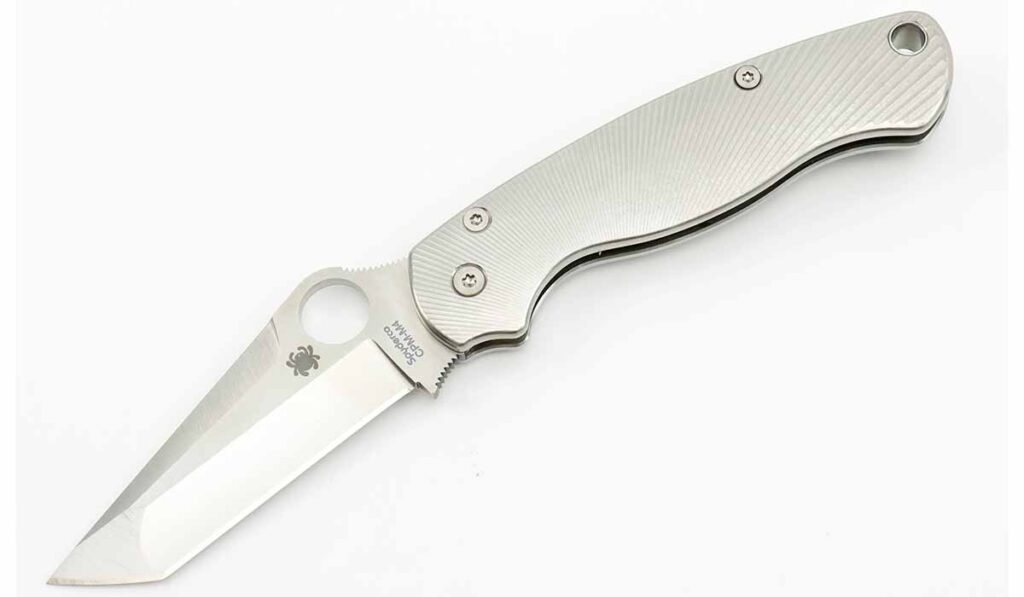
Spyderco Paramilitary 2 Tanto
The Spyderco Paramilitary 2 (or PM2) is beloved in the EDC community, and it’s not hard to figure out why.
It features a polished washer pivot system that is very smooth to open and close, features Spyderco’s iconic compression lock, and now, for the first time, comes with a tanto blade.
That blade is made of CPM-S30V steel, one of the best you can get in a pocket knife at this price range. Sharpening isn’t too difficult, and the edge will last you a very long time, even with aggressive daily use battering away as you slice open Amazon boxes (or whatever).
The PM2 has fine-textured G-10 handle scales out of the box, but you and your trusty screwdriver can pop those off and replace them with any one of roughly ten bazillion aftermarket options. Companies like Flytanium keep PM2 owners well-supplied with choices.
MSRP: $246
The Spyderco PM2 Tanto features a 3.44-inch blade made of CPM-S30V steel.
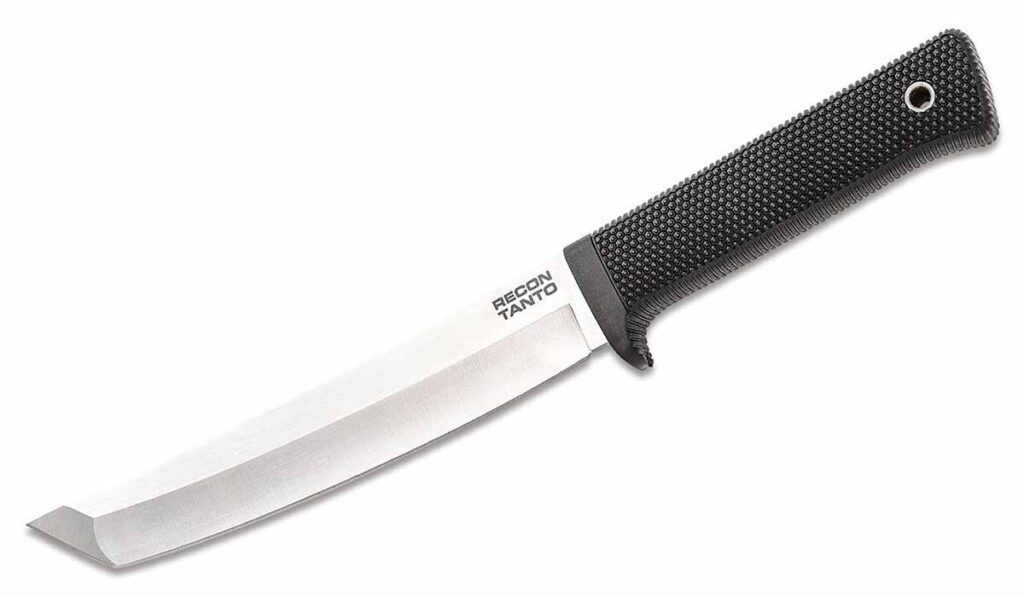
Cold Steel Recon Tanto
Of course, we can’t have a list of modern tanto knives without bringing out something from Cold Steel, the progenitors of the modern “American tanto” that is the most accurate description of most of the knives on this list.
Their Recon Tanto is our first fixed blade on this list and is positioned as a tactical/rescue blade. The incredibly robust SK5 steel used in the blade is a common for hard-use tools like machetes and survival knives, particularly military ones.
The grip is made with Kray-Ex, which is designed to maintain good friction in the hand at all times, even if your hands are wet or you’re wearing gloves. It also doesn’t shred your paws like some rougher materials.
If you’re looking for a more tactical tanto that can handle everything from camp tasks to self-defense, this is a great option that is a bit heavy, but bomb-proof and reliable.
The Recon Tanto has a 7-inch SK5 high-carbon steel blade.
MSRP: Starting at $70
Chaves Redención Street Tanto
Ramon Chaves is a custom knife maker that has made a name for himself as one of the premier designers of tough, hard-wearing, but still stylish blades. His Redención tanto is…very expensive, and worth every penny, exactly the way a custom knife should be.
If you’ve got the cash and you like the look of it, especially if you enjoy the artisan nature of a custom knife, go buy that.
For those of us with slightly less to spend, Reate has put out a production version of the Redención that comes with a slightly more obtainable street price and is considerably easier to find in stock.
Ramon works hard, but it’s always going to take longer to produce a custom knife than a production knife coming from a factory with purpose-built tooling. The Redención Street is a great way to get your hands on the design, without waiting months for the custom version.
The Street Tanto is an incredibly well-built framelock folder with an aggressive piercing tip. Despite a 3.63-inch blade length, the whole thing weighs in at just over 6oz thanks to the titanium handle design (which you can get in about two dozen different colors).
The blade is made from the fabulous Bohler M390 steel, one of the best you’ll find in a pocket knife.
MSRP: $300
Siam Blades Traditional Black Copper Hira Tanto
Lastly, I’m throwing in a little treat for the two or three of you reading this who came here looking for traditional, no-fooling, tantos made the old way. Siam Blades is a traditional blacksmith shop located in Thailand, but they have Japanese-trained smiths that create blades using traditional methods.
For most people, this is going to be a good balance of value and authenticity. A traditional tanto made in Japan will probably run you about three times what this one does. The Black Copper Hira tanto is made to a similar standard, in the same traditional way, and is as beautiful as it is functional.
Best of all, they have stock ready to ship, so you don’t have to wait 18 months for your tanto to be finished and shipped. I’ve chosen the Black Copper version here, but there is a large variety available depending on what aesthetic you’re going after.
The blade itself is made of extremely durable high-carbon SK5 steel (very common in machetes, and battle-ready sword reproductions) and is 9.5-inches long.
MSRP: $820
Final Thoughts on Tanto Knives
The tanto is an iconic design, whether we’re talking about the traditional Japanese original or the modern American remix. This knife shape has stuck around for a thousand years for a reason.
Today, most production tantos are more in the American style at least as far as the tip goes, but this battle-tested design has its roots going back much farther. I hope you’ve enjoyed this brief look into that long history, and you’ve got a better idea of what your options are for picking up a tanto of your very own.
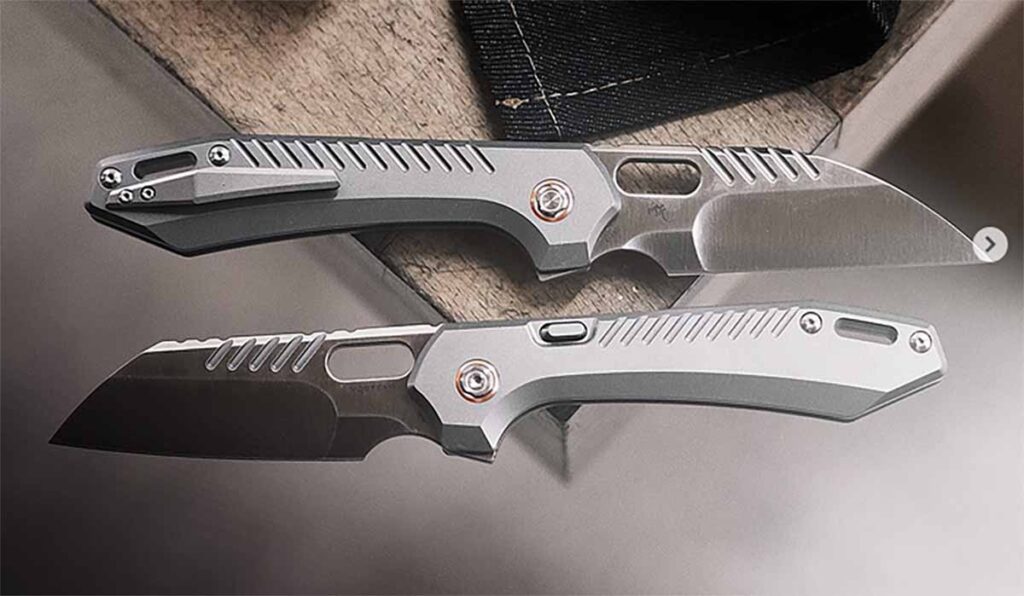
A top-end offering, the Vosteed Mayhem takes a run at proven, yet challenging locking mechanism.
Prolific in its offerings, they must not sleep much over at Vosteed Knives. Yet, the company’s productivity has generally been knife buyer’s gain—at least those attracted to mid-priced fidgety options that by and large have fairly decent lines. Though, one of its latest releases should turn heads if only to see if Vosteed indeed has been able to pull off what few other companies have dared.
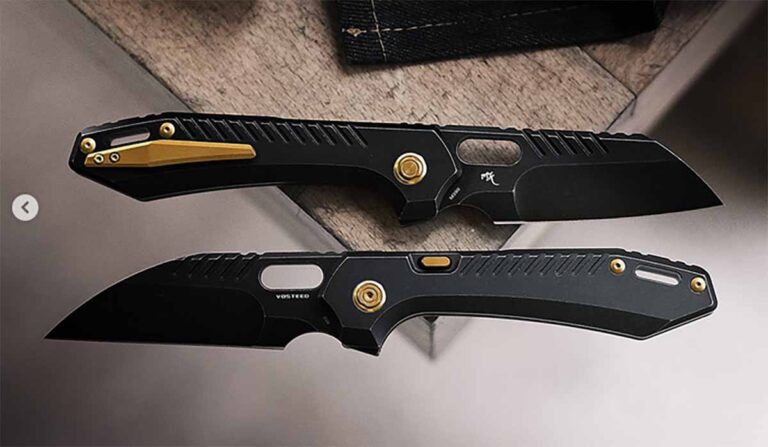
Christened the Mayhem (a prototype was showcased at their table at the 2023 BLADE Show), the collaboration with Rob Saniscalchi of R.S. Knifeworks boasts what the firm defines as a hybrid frame/compression lock. Some might recognize the latter aspect of the system as the same mechanism developed and used to great effect by Spyderco. The Colorado company’s patent on the mechanism ran out a few years ago, making it fair game and clone fodder. But given the tight tolerance required for the lock to operate properly, few companies have given it a run.
The Sypderco system is operated by a leaf spring wedging laterally between a ramp on the tang and a stop pin. The system was smooth and easy to operate, as well as strong as the dickens—given pressure is exerted directly down on the spring’s vertical surface, preventing potential bowing. Vosteed appears to operate almost identically, though a bit of the geometry on the blade’s lock elements differ. At arm’s length, Vosteed’s attempt appears on track, but only time and plenty of fiddling by owners will prove if the company truly got it right.
Photo: Instagram
As to its operation, the lock is actuated by a push button on the spine. The system allows for wrist opening, but as has been Vosteed’s OM for some time, it outfitted the Mayhem with multiple deployment options. In this case, both a thumb hole and a kicker; a pair of caged ceramic ball bearings aid in a smooth and fast deployment.
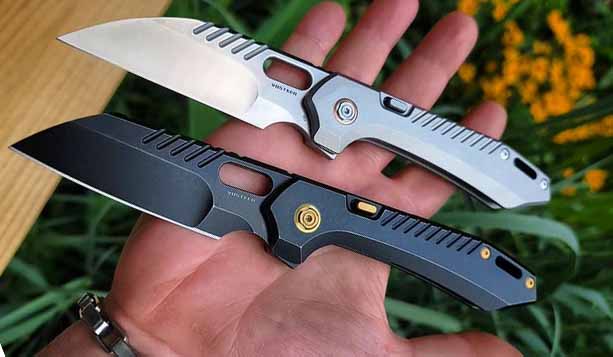
Vosteed offers the Mayhem with a couple of different options. Perhaps the imperative one is the choice between a Wharncliff or sheepsfoot blade, each coming in a 3.3-inch in length and constructed from the highly desirable M390 steel. Each blade has a compound grind, but this appears a play at aesthetics, given the thicker rear grind seems too small for practicality. The blades also feature a choil, so you can choke up, even though the titanium scale is ample enough to land all five fingers of a large hand. The scale itself is clean, with a closed rear and texturing across its back, not to mention a nice taper up to the blade to allow for a firm grip.
The other choice buyers have to make on the Mayhem is finish, with a stonewashed black PVD coating and gray satin options on the menu. The gray version is gray from top to bottom—outside a gold pivot collar—accentuating the knife’s tidy design, while the black iteration is a bit more boisterous boasting gold hardware. Note, the knife offers tip-up carry with a non-reversible titanium clip.
Photo: Instagram
The Vosteed Mayhem is a break from what most have come to expect from the company, which has made its bones at the affordable end of the market. The new knife—no matter options—runs $250. However, if it proves well executed, most likely will find this money well spent.