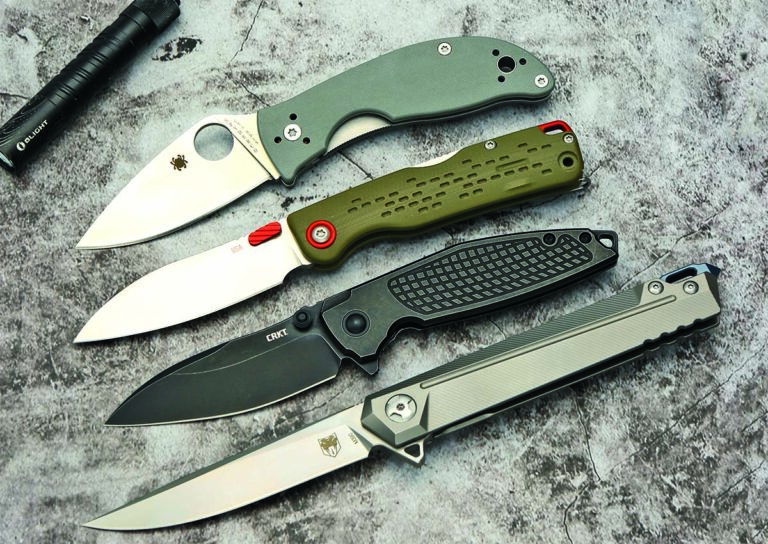

Latest assisteds have all you need in swift, sharp folders.
The assisted opener appeals to many who are mechanism oriented and like to fidget with their knives. There’s something satisfying about tapping a flipper tab or nudging a thumb stud and then having spring force kick in and propel the blade open crisply and quickly. It’s sort of like an automatic but it’s not. In fact, in most areas its legality is no different than a standard one-hand folder* because you initiate the opening by manually pressing the flipper or thumb stud as opposed to releasing the blade under spring tension via a push button as done with an auto.
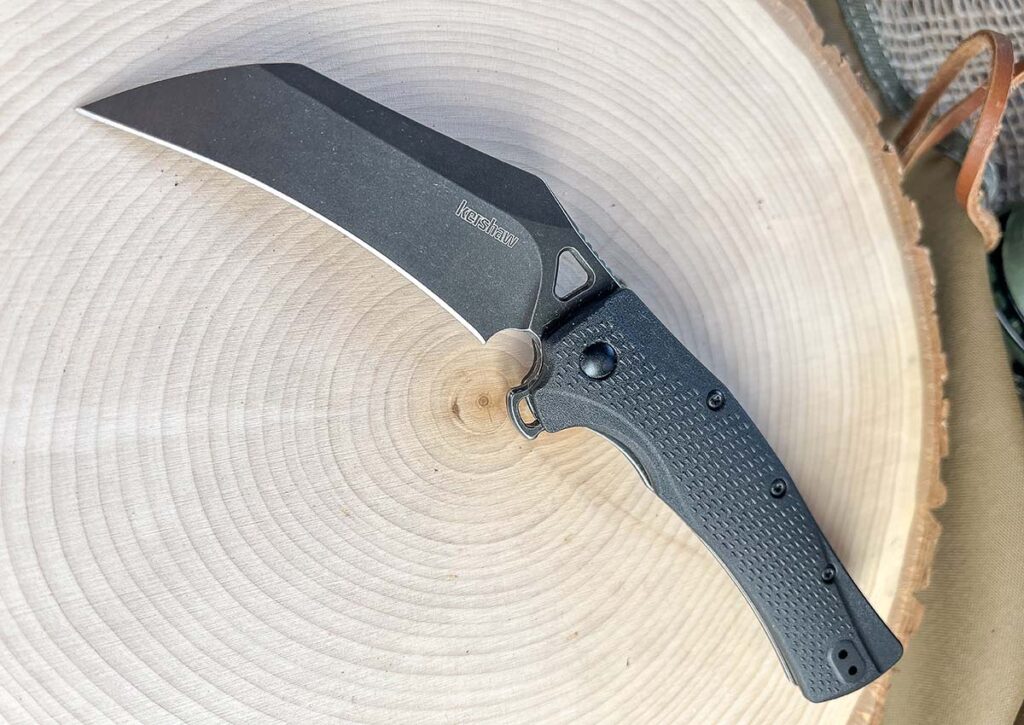
Kershaw Dawnstar
The flipper tab of the Kershaw Dawnstar is highly effective at deploying the blade. The large semi-circular choil is sort of unusual and adds to the knife’s distinct appearance
Kershaw was one of the first manufacturers to go all-in with assisted openers in the mid-to-late 1990s. It teamed with BLADE Magazine Cutlery Hall-of-Fame® member Ken Onion to make a line of collaboration knives that incorporated Onion’s SpeedSafe assisted-opening mechanism. The knives not only were great sellers for the company, but, more importantly, helped start the assisted-opening revolution in the knife industry. Soon after, other manufacturers began producing versions of folders with mechanisms that closely mirrored the SpeedSafe for both tactical and EDC purposes.
The Dawnstar is Kershaw’s latest entry in the genre. Sporting a hawkbill blade paired with a true tactical handle offering deep, tip-up carry, it is one of the company’s more radical configurations. The hawkbill isn’t seen too widely in tactical folders, so it stands out both visually and functionally. The 3.5-inch blade is 8Cr13MoV stainless steel.
The main grind is hollow with a swedge, making the blade look a bit aggressive and also following through in use. A flipper tab deploys the blade quickly and is the only opening method. The handle is molded glass reinforced nylon (GRN) with dual skeletonized steel liners for strength. Strategically placed cutouts reduce weight. The handle is textured for a comfortable, nonslip grip.
The knife cuts best in a pulling motion, allowing the hawkbill to gather the material being cut into the blade’s curvature, not unlike pulling a zipper. The hawkbill is an aggressive pattern and goes through a variety of materials with ease. This is where the hollow grind really makes a difference. Cardboard, foam, even wire stripping—the assisted opener sails through it all. If you cut a lot of cardboard or make long, straight-line cuts in any material, the Dawnstar is for you. The handle is easy to hold onto. The large finger recess helps seat your hand.
Approximate closed length: 4.4 inches. Country of origin: China. MSRP: $54.99.
SOG Twitch III
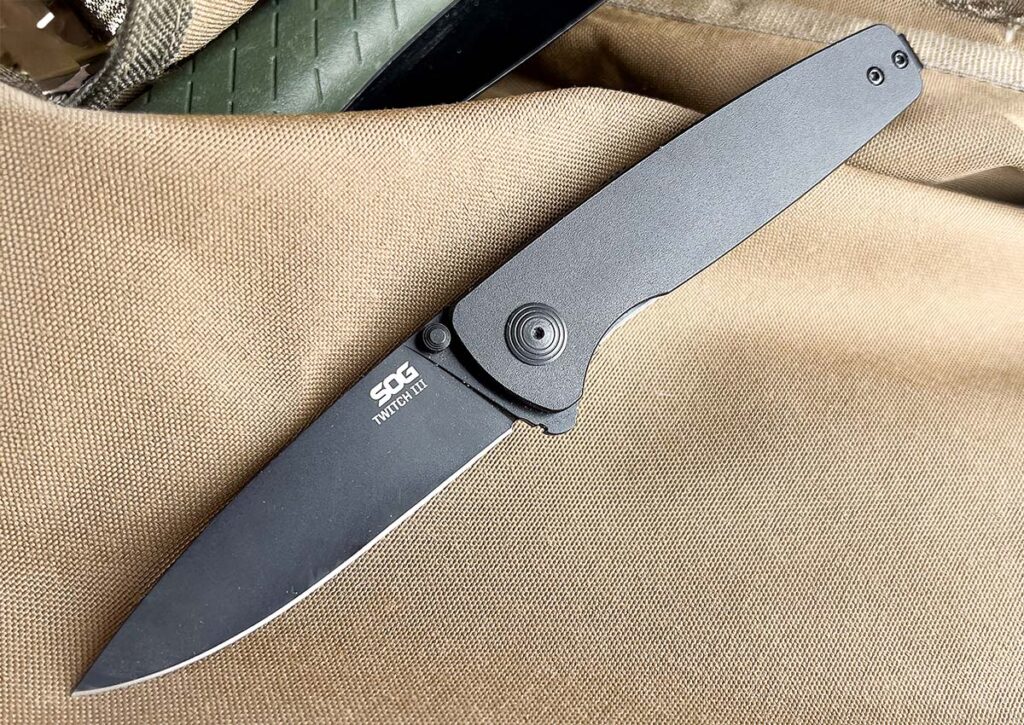
The Twitch III is ultra-light, ultra-slim and elegant in appearance. A simple design with high function, it goes well with dress or casual clothes.
The Twitch III is the third installment in a highly successful series of assisted openers from SOG. It is a slim, stylish EDC capable of tackling a wide variety of cutting chores. It features a 3.1-inch spearpoint blade fully flat ground from 154CM stainless steel with ambidextrous thumb studs and a low-profile flipper tab for an additional opening option. A light press on the flipper and the blade pops out with authority.
The handle is lightweight yet strong aluminum, with dual steel liners providing the backbone. A subtle finger recess forms a bit of an integral guard to prevent your hand from sliding forward. A deep-carry, bayonet-style clip is affixed to the butt and positions the folder as low as possible in the pocket for ultimate concealment. The handle profile is flat and slender, making it extremely comfortable for daily pocket carry. The knife is equally at home in dress or casual clothes.
For a slim knife the Twitch III performs very well. The blade glides through various materials with surprising ease. The 154CM offers more mileage for edge retention than lesser steels such as D2, 8Cr13MoV and AUS-8. It is the type knife you can carry for a range of varied-use scenarios, from slicing steak to more mundane things such as opening mail, packages, etc.
It excels at cutting open blister packs due to its pointy tip and flat- ground blade. Performance is great and the folder carries exceptionally well, so what’s not to like? However, I would caution against prolonged use due to the slender, flat profile and slick aluminum scales. If your hand is wet or sweaty, grip retention might be an issue.
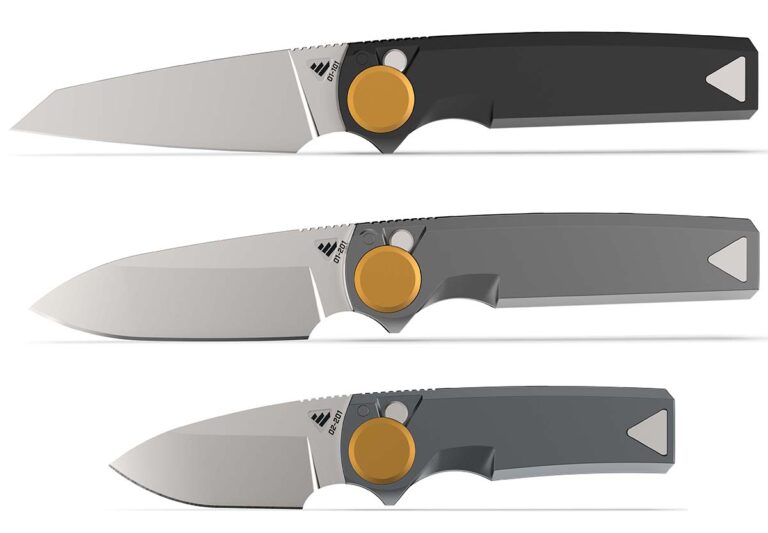
The Twitch III comes in three varieties: all-black blade and handle, natural finished aluminum with satin blade and gold TiN coated hardware, and gray aluminum handle with black blade and hardware anodized a light blue. All are great-looking EDCs and a welcome addition to your collection.
Closed length: 3.9 inches. Country of origin: China. MSRP: $79.95 for any of the three variants.
Benchmade PSK 593BK-01
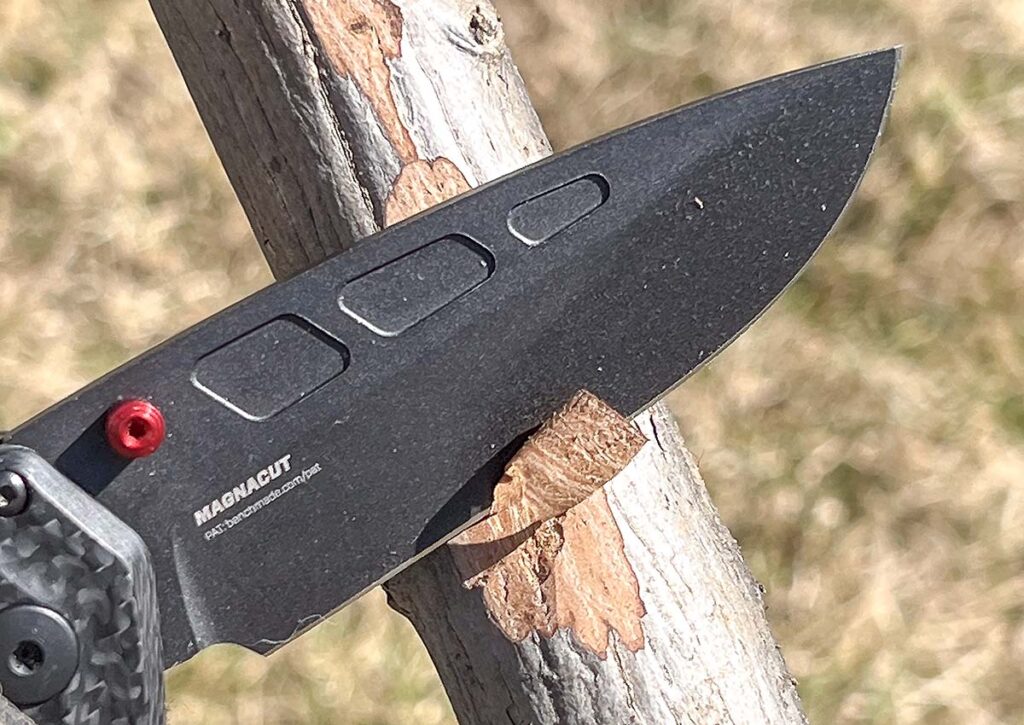
Benchmade’s PSK is a high-end outdoor folder using CPM MagnaCut stainless blade steel. MagnaCut holds an edge extremely well in addition to having excellent corrosion resistance—pretty much the perfect outdoor blade material.
The brawny Benchmade PSK 593BK-01 is a rugged assisted opener engineered for survival use. It exhibits all the hallmarks of what makes applicable Benchmade knives standards in the industry: the AXIS crossbar lock mechanism and advanced materials for the handle and blade, including carbon fiber, G-10 and CPM MagnaCut stainless steel. The 3.4-inch modified drop-point blade has excellent edge retention and superior corrosion resistance—a perfect steel for a knife to carry while hiking, camping, hunting, etc.
An exposed flat area below the thumb stud that resembles a choil serves as a spot to use a ferrocerium rod for fire starting. It’s such a thoughtful touch on the PSK. The ergonomic handle incorporates forward and rear integral guards to prevent slipping and seats your hand well. Black carbon fiber bolsters are mated with black G-10 scales, with the blade DLC coated for additional corrosion resistance and a low-profile appearance—in other words, the knife is “murdered out” in mostly all black.
The ambidextrous thumb studs are anodized red for an interesting splash of color. A deep carry pocket clip positions the PSK tip up and switches to the opposite side to accommodate lefties. The AXIS Lock Assist is rock solid while remaining easy to disengage by pulling back on the studs, then rotating the blade closed. A sliding switch safety in the handle spine locks the blade closed to help prevent the knife from accidentally flying open in your pocket or during inside waistband carry.
The PSK looks great and performs even better. Grip quality is excellent; the 3D machined grooves in the handle and bolster work great at keeping your hand in place without feeling overly aggressive, and they displace water as well. The blade rockets out via the assisted opener very quick and sure, almost like an automatic.
The robust build and ergonomic grip instill user confidence in any climate. The PSK handles anything you throw at it, from slicing meat to whittling. The flat grind leaves enough cross-sectional steel on the blade to give it structural integrity, yet thins the edge down to where it has bite.
Approximate closed length: 4.6 inches. Country of origin: USA. MSRP: $450.
Editor’s note: For that matter, in the many states and jurisdictions where bans against automatics have been lifted, neither is an assisted opener’s legality any different than an auto.
Four new entries help show why locking folders rule the pocketknife world.
Locking folders are the most popular pocketknives—perhaps even the most popular sporting knives of all. Slipjoints have the romance and tradition, vintage style, natural materials and many other things that make knives coveted by so many users and collectors, but locking folders are a lock in terms of being the king of pocketknife sales.
For one thing, while slipjoints can have anywhere from one to multiple blades, they are basically limited to one non-locking mechanism, that being the slipjoint mechanism itself. Locking folders, on the other hand, come in a wealth of locks, including the lockback, linerlock, Integral Lock/framelock, Benchmade AXIS Lock/crosslock, ring lock, button lock, Spyderco Compression Lock and others. Not only that but since they lock they’re much less likely to close accidentally than slipjoints.
Meanwhile, since the explosion in lockbacks after the introduction of the Buck 110 folding hunter in 1964 and the introduction of the linerlock by BLADE Magazine Cutlery Hall-of-Fame® member Michael Walker in 1981—that by the end of the decade was catching on with custom and factory makers far and wide—locking folders have experienced booms in types and runaway sales that continue to this day.
As Matt Salazar, general manager of House of Blades retail knife store in Fort Worth, Texas, noted in “2025 Trends and Takeaways” of the Spring 2025 BLADE Complete Knife Guide, “While slipjoint collectors are diehards, they’re a drop in the bucket compared to those into locking folders.”
All of which brings us to the subject at hand: a sampling of a few of today’s top factory pocketknives that lock.
KA-BAR State & Union F01OD
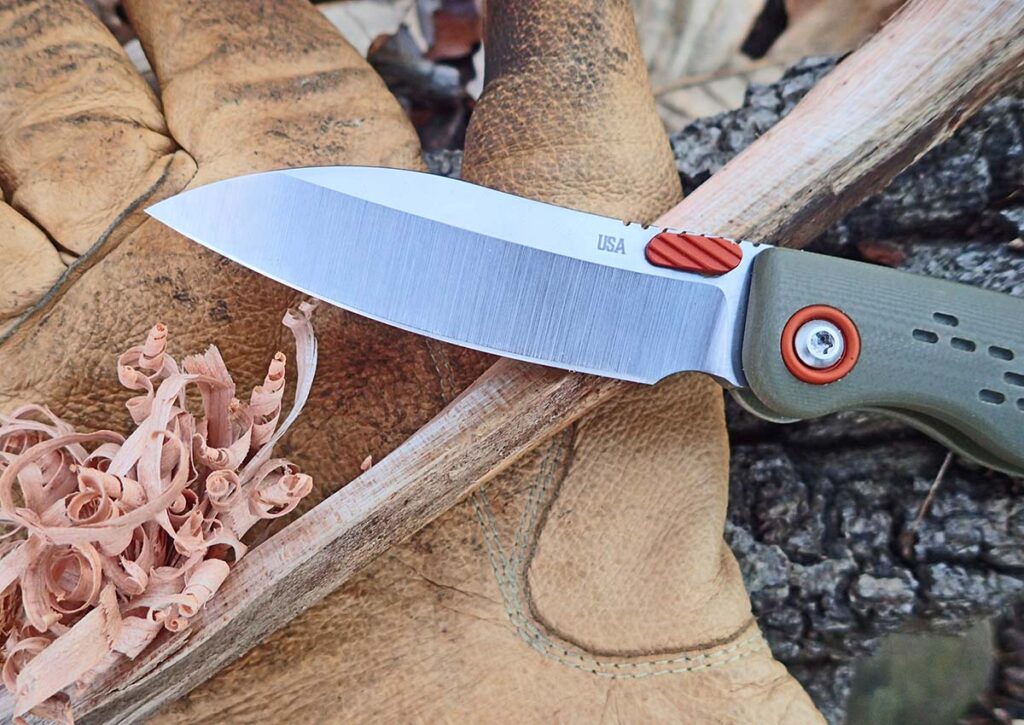
The KA-BAR State & Union F01OD was with the author in the woods and carved a beautiful feather stick able to take a spark.
State & Union F01OD Specs Lock Type: Lockback Blade Length: 3.25” Blade Steel: CPM S35VN stainless Blade Grind: Hollow Blade @Thickest: .16” Blade Finish: Satin Handle Material: Olive drab G-10 Closed Length: 4.1” Country of Origin: USA MSRP: $175
The KA-BAR State & Union F01OD is the first all-USA-made folding knife by KA-BAR in over 50 years. The sleek, reliable edged tool features a sharp drop-point blade. The handle provides a solid grip and is complemented by eye-catching anodized orange hardware.
Designed for everyday carry, the F01OD has a reversible wire clip, ensuring it stays securely in your pocket. Checking in at a lightweight 3.2 ounces, the knife is suited for most any cutting adventure—whether in the field or around the house. Available in several colors, it also looks good while doing it.
Spyderco Alcyone
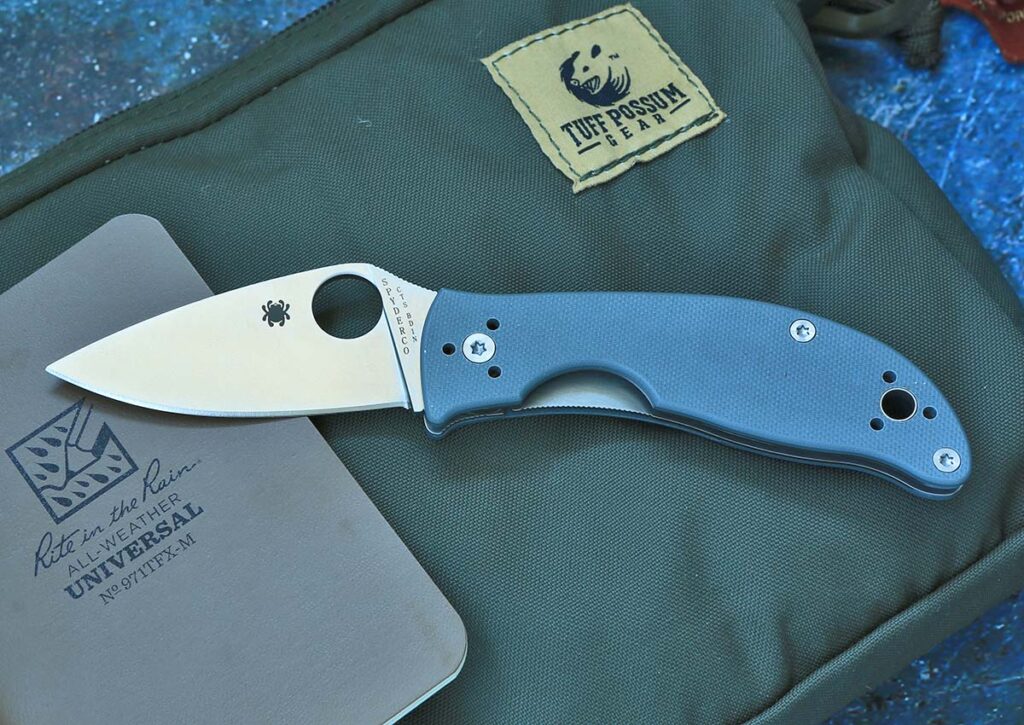
The leaf-shaped blade of the Alcyone has a sharp PlainEdge and the familiar Spyderco hole for ambidextrous opening.
The Spyderco Alcyone is named after a multi-star system in the constellation Taurus. The locking folder combines high performance with classic Spyderco design at an affordable price, featuring premium U.S.-made blade steel. The leaf-shaped blade has a sharp PlainEdge and a Spyderco trademark round hole for ambidextrous opening.
Thanks to its open-backed construction and full skeletonized stainless steel liners, the ergonomic handle is lightweight and easy to clean. The rugged gray scales provide a secure grip with a non-slip peel-ply texture for sure handling. The four-position pocket clip provides left/right side, tip-up/tip-down carry. A generous-sized lined lanyard hole completes the handle package.
CobraTec Olympian
The modified drop-point blade of the Olympian flipper folder is tailored for precision cutting and slicing. The ball-bearing pivot system provides smooth, swift deployment. A robust glass breaker and lanyard loop enhance versatility.
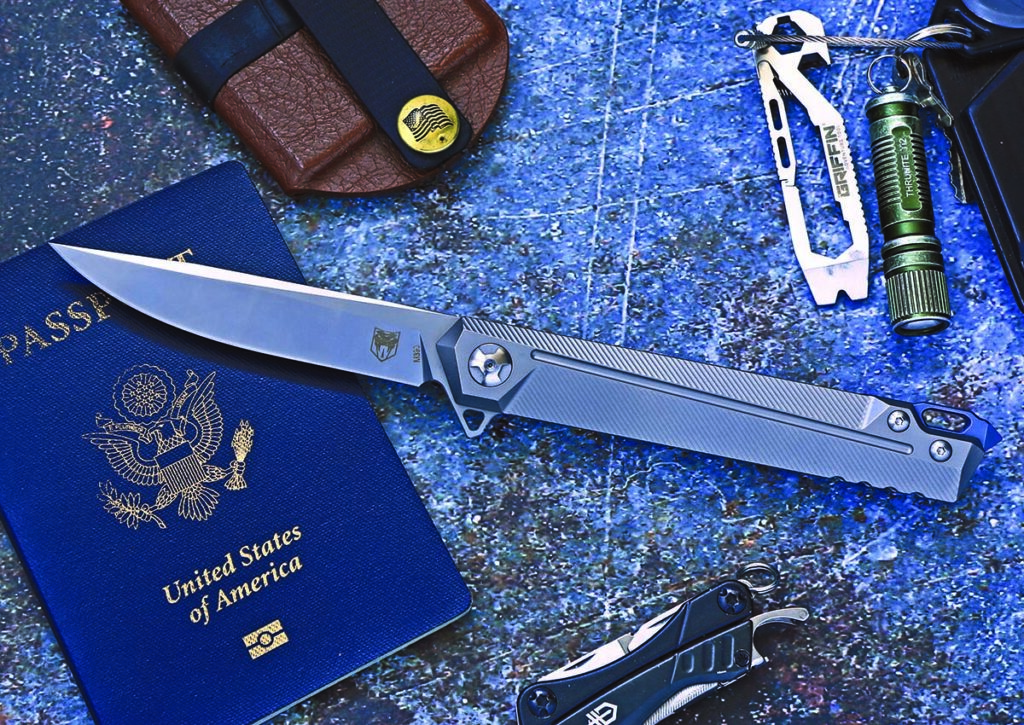
The CobraTec Olympian flipper folder is a marvel of precision engineering, seamlessly blending high-quality materials with an elegant, ergonomic design. A lightweight yet exceptionally durable titanium grip ensures effortless handling and superior strength. The right-hand carry clip provides convenient accessibility.
The modified drop-point blade is tailored for precision cutting and slicing. The ball-bearing pivot system provides smooth, swift deployment. A robust glass breaker and lanyard loop enhance versatility.
CRKT Ibis
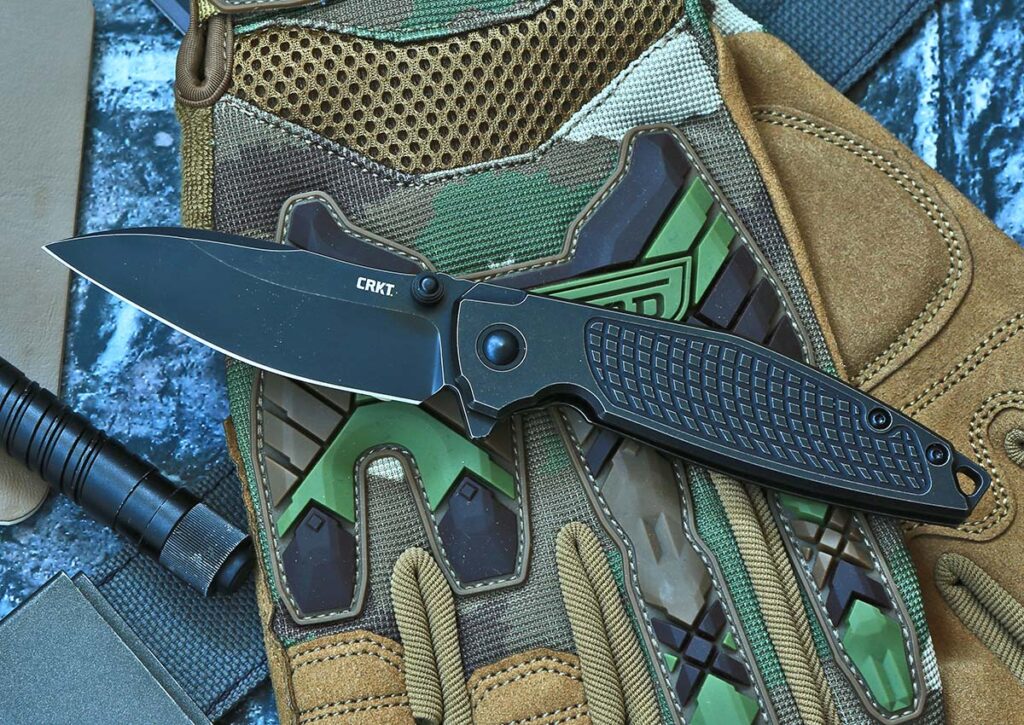
Designed by Lucas Burnley, the CRKT Ibis features a drop-point blade with a prominent belly great for slicing, while the black finish complements the titanium handle.
Designed by Lucas Burnley, the CRKT Ibis is named after a graceful wading bird. For a distinctive look, the blade features a sleek curve along the spine. The drop-point blade boasts a prominent belly great for slicing, while the black finish complements the titanium handle. As Burnley notes, “It just looks good.”
With fast flipper deployment, the Ibis opens smoothly thanks to the Ikoma Korth Bearing System (IKBS)/ball bearing pivot. A low-profile pocket clip keeps the 2.9-ounce knife securely by your side.
Carrying
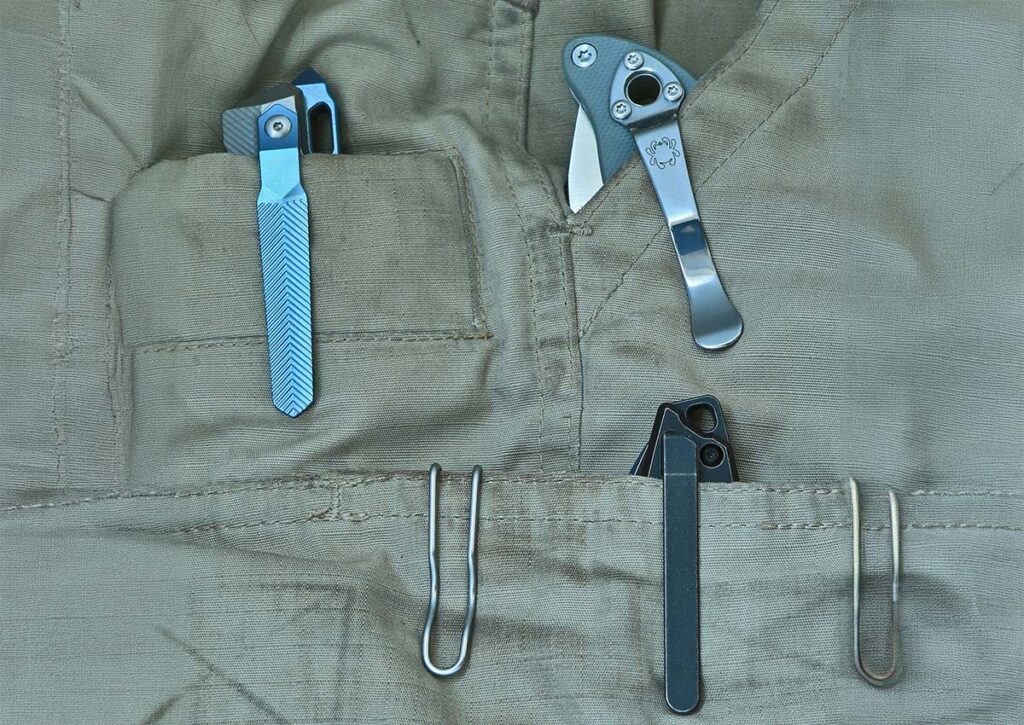
The way a knife is carried is essential. The sleek Olympian (top left) and discreet Ibis (bottom right) are great gentleman’s knives, while the bulkier Alcyone (top right) is more noticeable. The State & Union (bottom left) is the least noticeable of all.
How a knife rides in your pocket is essential. The Olympian carried deep with enough handle to grab onto. The sleek diameter, closed and open, never felt bulky.
The Ibis also carried deep and was easy to retrieve. It came in second to the Olympian for sleekness. The black color also made it the most subdued of the gang, attracting less attention.
The Alcyone carried bulky and a lot more exposed. The protrusion makes it easier to get at but screams, “I have a knife!” If that bugs you, you can always opt for a different folder.
The State & Union carried exactly how I like—deep and almost invisible. It has the right amount of pocket capacity to let me know it was still there. It and the Olympian were my favorite pocket carry folders of the test bunch.
All the knives come with a lanyard hole.
Opening
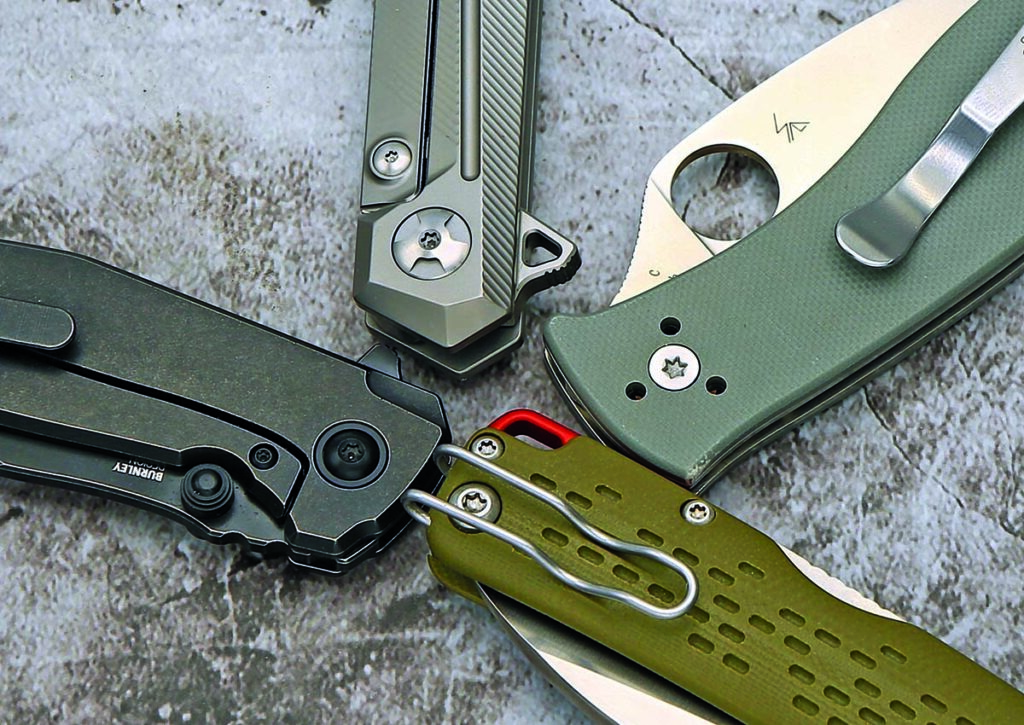
The test knives are studies in differing approaches to colors, locks, blade openers, pocket clips, lanyard holes, bulk, dimensions and more.
The Olympian has a flipper-style opener—and it was smooth and sleek. The Ibis has two ways of opening. Despite how smoothly the flipper operated, the thumb studs were another animal. CRKT should remove the thumb studs altogether. I’ve handled hundreds of one-handed openers. I could not open this one, no matter how hard I tried. All the king’s horses couldn’t open it using the thumb studs.
The Alcyone, on the other hand, has the eternally trusty large opening hole. I could open the blade in an inverted position, using my middle finger to lightly disengage the blade and let a wrist flick do the rest. That’s a Spyderco. It doesn’t vary in quality from any other Spyderco. The State & Union has an undeniable thumb stud for easy access. It opened smoothly, and the sound of the lockback engaging gave a sense of confidence. Solid as can be—it’s a KA-BAR!
Ergonomics
An easy winner in hand comfort was the State & Union. I had it the longest and exposed it to more use than every other test model. Second was the Olympian, though it was close. After all, I spent more time with the S&U. The Alcyone earned a third place yet was very solid. The Ibis wasn’t uncomfortable but would show hot spots as a long-cutting task knife.
Final Cut
Packaging peanuts, leather, light phone cords, 550 paracord, cardboard and nylon webbing are all part of my test gauntlet for folding knives.
The State & Union made feather sticks in the forest for a winter fire with ease. I found some stray nylon rope in the woods and tried slicing it with the S&U. It did not slice through. The task may have dulled the edge. During the gauntlet test, the knife faltered on packaging peanuts, nylon webbing, leather and 550 paracord. It made it through phone cord and cardboard but was a step behind the others.
The Olympian deploys with a fierce snap and displays a ready-to-go attitude—and means it. It slices well and can easily fit the role of a gentleman’s carry knife. The Ibis deployed almost as smoothly as the Olympian. It sliced all materials with authority. It ranked second among the review bunch in knife tasks. However, the Alcyone absolutely smashed it—maybe I should say slashed it. It was the best slicer across the board. Winner, winner, chicken dinner!
The technological advancements that have redefined the pocketknife as we know it.
When I stumbled onto the knife scene in 1985, the only pocketknives I had carried up to that point were slipjoints and lockbacks. Of course, slipjoints weren’t called slipjoints back then but simply pocketknives. Today, as far as BLADE® is concerned—not that it’s any major newsflash or anything—any knife you can carry in your pocket is a pocketknife.
All of which brings me to the subject at hand: my picks of the five most important pocketknife developments of the modern sporting knife era. In rough chronological order they are:
•The pocket clip:BLADE Magazine Cutlery Hall-of-Fame® member Sal Glesser’s introduction in 1981 of the Spyderco pocketknives with the hole in the blade and the pocket clip would turn the genre on its head. While the hole in the blade was a masterstroke in and of itself, it was the pocket clip that forever changed the way people would carry their pocketknives. Rather than rattling around in the bottom of a pocket with change, car keys and what have you, the closed knife was held on the pocket lip by the clip, free from pocket-bottom scratches and poised at the ready to be deployed to cut whatever needed cutting.
•The linerlock: Cutlery Hall-of-Famer Michael Walker invented the linerlock in 1981, but it would take a few more years before custom knifemakers—and shortly thereafter, factory makers—began readily adopting the lock that made one-hand manual opening and closing of the pocketknife an easy reality rather than an exercise in hand contortions. Today, the argument can be made that the linerlock is used on more sporting folders than any other lock.
•The flipper: While exactly who made the first folder with the flipper tab that manually deploys a folding blade with the tap of a finger may be up for debate, there is no debating that the person who popularized it was Cutlery Hall-of-Fame knifemaker Kit Carson. A simple addition to the pocketknife on its face, the flipper tab opens a blade as fast and easy as any other manual method—probably faster.
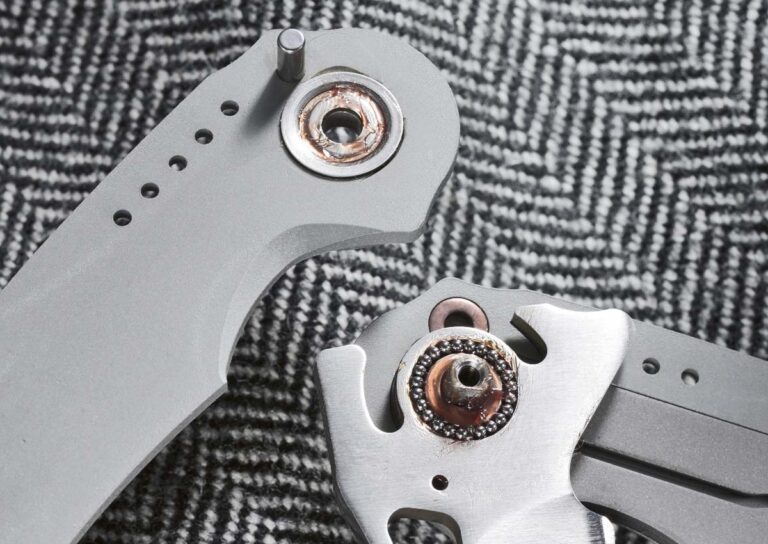
•The Ikoma Korth Bearing System (IKBS): Pivot systems that helped open folding blades quickly and smoothly had been around before, but it was the IKBS conceived in 2002 that took blade opening to a new level of quick and smooth. In conjunction with the flipper especially, the IKBS transformed one-hand pocketknife opening from fast to just this side of automatic. Developed by Brazilian custom knifemakers Flavio Ikoma and Ricardo “Rick” and Paulo Lala (the latter two collectively known as Korth), the IKBS is another masterstroke of design and invention.
•Material upgrades: These cover a number of materials and years, from Walker’s switch to titanium for his linerlock spring in 1983, to a wide array of other hi-tech substances in subsequent years for pocketknife handles, including titanium, thermoplastics, Micarta®, G-10, carbon fiber and other state-of-the-art materials that not only were super strong and tough but also were lightweight, reducing the weight of pocketknives to the point that they were basically unnoticeable in a pocket. Meanwhile, the advances in blade steels over that same stretch are too many to mention.
How about you? What are the most important pocketknife developments? Tell us in the comments.
A somewhat new player, Sharps Bros. makes the cut with the Meanstreak.
Relatively new to the knife arena, Sharps Bros. made its original mark in the gun world. The company team used their machining know-how to produce some well-built fixed blades and folders. The Meanstreak 3-inch Button Lock Folder is one of the latter.
The author said the machining of the Meanstreak’s titanium frame is “superb.”
It’s a button lock—to unlock the blade, simply depress the logo button on the bolster. The blade opens manually via a flipper. The machine work on the titanium frame is superb. Opening and closing the knife is smooth. Question is, does the blade cut?
I used the Meanstreak straight from the box to slice 20-pound bond paper. The knife did so smoothly and aggressively. I could hear every slice. The handle shape aided in positive control. (I had already nicked the meat of my thumb on the blade tip. Ouch.)
The edge withstood 30 antler whacks and then cut the paper smoothly to culminate testing. Spot-on heat treatment!
Single-walled cardboard was next on the test menu and the Meanstreak made short work of slicing it up. The relatively small blade cut straight with no hangups. From there it was time to slice leather scraps. I cut sideways into the 8-ounce leather and the CPM S35VN blade zipped through the medium as fast as I could move my fingers out of the way. The folder made some very nice crunching noises.
I wanted to hear more crunching, so I started skiving the leather. It was easy to control the Meanstreak, so I didn’t cut all the way through the material. This is a sharp little knife!
Heavy-Duty Cutting
Next up: whittling a fire stick. To get it to curl I used dry wood and shallow cuts. With my thumb on the spine notches, the curls started coming. Controlling depth was easy, though the inside of the frame was a little too sharp on my hand for the grip I was using. The Meanstreak made nice curlicues.
The Meanstreak made nice curlicues. However, the inside of the frame was a tad too sharp on the author’s hand for the the grip he used.
On to my favorite test medium: sisal rope. The Meanstreak produced 225 crunching cuts and was ready for more, but my arm was done. It was very forceful cutting. I wore a thin glove to protect my hand against hot spots as I used more pressure with the cuts. A fine emery board would take care of the unwanted sharp areas.
To check the edge for brittleness, I subjected it to several whacks on my trusty whitetail deer horn. After 30 hard whacks there was no edge damage. Heat treatment is spot on—excellent job! To prove it, I sliced up the other half of the 20-pound bond paper from the initial test. I could not tell the difference in blade performance between the first and last paper slices.
Final Cut
As for changes, soften the inside edges of the handle frame. (Editor’s note: The pivot could use better action as well as the blade is a bit sluggish when opened via the flipper.)
For a factory knife especially, fit and finish is impressive.
The Meanstreak is one sharp knife. Since there was no dulling of the blade it seemed like I didn’t cut anything with it at all. Plus, it’s made in the USA!
Check out a few of the new blades that caught our eye in Las Vegas.
It was a busy week at the Sands Expo Center in Las Vegas for the outdoor and shooting extravaganza known as the SHOT Show. Of course, there were plenty of factory makers in attendance with plenty of new releases for the coming year.
Sadly, we were unable to make every cutler in the house for the big dance but we did stop by a good number and caught a glimpse of some of the new blades for 2025.
Kronos Knives Gung Ho! Line By Ken Onion
Kronos is a new kid on the block, one-year-old as of SHOT Show 2025. The upstart knifemaker had a heck of an anniversary surprise at the home of its launch. The South Carolina-based company unveiled four Ken Onion-designed Gung Ho! line of fixed blades. The four knives that make up the line are all outdoor/tactically angled with 1095 steel blades and G10 handles. The models include the Stiffneck (MSRP $220), Maxhunter ($228), Elitesurvival ($256), and Truedefender ($228, pictured above). Kronos will have them for sale at the end of February.
Case Sculped Ridgeback
Case gives a modern and rugged look to its Ridgeback Hunter line with the introduction of the Sculpted Ridgeback. The fixed blade still has the sexy sweeping stainless steel blade true to the line but is dressed out in a durable and attractive new handle. In this case, canvass Micarta with G10 liners. The texturing is aggressive, making a workhorse that’s not afraid of bad weather but just as attractive as its rosewood predecessor which it is pictured with above. Case has a $128 MSRP on the knife.
Vero Engineering/Pro-Tech Custom Synapse
The Custom Synapse Auto is a pretty sweet meeting between two of the knife industry’s heavy hitters. Given the fanbase of both companies, expect these to fly off the shelves with the $525-$700 price points. Jeez, who doesn’t want an auto Synapse? Especially one done up with Pro-Tech’s typical flare—pearl inlay button, an action that snaps like a wet gym towel, etc. Mouths will have to water for a while, the auto Synapse doesn’t go public for another six months or so.
CRKT Provoke X Axe
An axe in your pocket? You bet—thanks to the mad geniuses at CRKT. Unveiled at the show, the Provoke X Axe is the latest in the forward-thinking Provoke line. Designed by Joe Caswell, the axe’s head and spike fold flush against the handle, deploying with a flick of the wrist. Built from D2 steel, it’s too light for felling trees but perfect for its tactical role—and it looks like it means business. With an MSRP of $350, the Provoke X Axe is set to drop to the public later this year.
We put production tactical knives to the test to see which ones come out as best in class.
Originally conceived for law enforcement and military and rescue personnel, tactical knives quickly found their way into the hands of those looking for a heavy-duty edged tool robust enough to withstand extreme use and abuse—and to do so without falling apart.
Modern tactical knives are some of the most refined and precisely manufactured of cutters in terms of ergonomics, edge holding and price points, and the market is saturated with all the big names producing them in almost all price ranges.
No matter the mission, one of these sharp tactical knives can cut it.
Originally conceived for law enforcement and military and rescue personnel, tactical knives quickly found their way into the hands of those looking for a heavy-duty edged tool robust enough to withstand extreme use and abuse—and to do so without falling apart. Modern tactical knives are some of the most refined and precisely manufactured of cutters in terms of ergonomics, edge holding and price points, and the market is saturated with all the big names producing them in most all price ranges.
What Is A Tactical Knife?
Exactly what constitutes a tactical knife has been addressed in BLADE®, other knife magazines—one of which was even called Tactical Knives—KnifeForums and other knife discussion forums, social media, books, the national media and elsewhere. Some originally described it, and still do, as a folding or fixed-blade knife with a non-glare blade and black synthetic handle ideal for any number of utility purposes, including combat. There are other qualifications but these three seem to universally apply to tactical knives.
The Wall Street Journal
even referred to the Buck Metro keychain knife as a tactical knife.
As for who the father of tactical knives is, that is a question guaranteed to spark healthy debates. Some say custom knifemaker Bob Terzuola made the first tactical folding knife, while others say custom knifemaker Ernest Emerson did. Some say any number of other makers made the first one. The argument even can be made that the original popularizer of the term is Greg Walker, editor of the now-defunct Fighting Knives magazine, who wrote extensively about tactical knives during FK’s run in the 1990s. Some say the original tactical knife is the Buck 110 folding hunter, which was introduced in 1964 and used by many American GIs in the Vietnam War. Of course, if Glesser’s definition holds true, then the first knife fashioned by early man from a bone, rock, obsidian or what have you many millennia ago is the original tactical knife.
Whatever the case, tactical knives have been hot for over two decades with no end in sight. Observers have predicted the end of the tactical knife phenomenon any number of times, with the knife and its spinoffs enjoying almost as many popularity spikes as the predictions of its demise. About the only thing that seems certain about tactical knives is that such forecasts will continue until one of them actually comes true.
Then again, who really knows anything for sure when the subject is tactical knives?
Best Tactical Knives Specs Comparison
Knife
Blade Length (inches)
Overall Length (inches)
Weight (ounces)
Blade Steel
Handle Material
MSRP
CRKT Septimo
3.62
8.19
8Cr13MoV
$70
Halfbreed Blades CCK-03 Tuhon Raptor
3.94
7.79
3.53
Bohler K110
G10
3.15
Fallkniven R2 Scout
8.625
5.2
440 Stainless Steel
Zytel
$35
Bear Edge Brisk 1.0
3.82
8.93
6.54
CPM-Cru-Wear
G10
$325
Benchmade Adamas
3.82
8.93
6.54
CPM-Cru-Wear
G10
$325
CobraTec Special Ops
3.75
8.625
5.9
M390
Titanium
$500
Maserin 920/TP Tactical
3.582
8.26
440C Stainless steel
Anodized Aluminum
~$165
Hogue Deka Manual
3.25
7.5
2.3
CPM 20CV Stainless Steel
G10
$195
CRKT Septimo
In a pinch, the Ve serration of the CRKT
Septimo can be used to strip electrical
wire. Doing it this way a ords great cutting
control, thus increasing user safety.
CRKT is among the industry leaders in production tacticals that strike an outstanding balance between affordability and the most modern of designs. What’s more, the company has a great reputation for offering the biggest bang for the buck. Among its many forward-thinking designs is the Septimo tactical folder.
Jeremy Valdez of Olalla, Washington, is an Army veteran who served with the 7th Special Forces. The primary inspiration for the Septimo—the name means seventh in Spanish, an homage to Jeremy’s brothers in the 7th—came from his tour of duty in Afghanistan in 2009. While there, he was aboard a helicopter when it crashed. The knife Valdez had on him at the time proved ineffective at cutting through various materials during the exit from the chopper carcass. Soon after, he set out to design a tactical folder that could fulfill multiple roles as a backup weapon and cutting and rescue tool. The Septimo is the result.
Jeremy’s design for CRKT has a 3.6- inch tanto blade of 8Cr13MoV stainless steel with a black oxide coating to bolster corrosion resistance and reduce glare. While it may seem you can thumb the blade open by the oblong hole, it actually is difficult to do so, which is why the blade has a flipper tab opener. A flick of your index finger is all it takes to deploy the blade quickly. The action is very smooth.
The blade’s most noticeable feature is the single large Ve serration close to the tang. The serration’s large tooth helps gather and hold the material in as it’s being cut, so it provides a lot of control. It severs webbing, cord, string, paracord, small diameter tubing and most anything else that fits inside it.
The Septimo blade’s most noticeable feature is the single large Ve serration. The large tooth helps gather and
hold material in as it’s being cut, so it provides a lot of control. It severs webbing, cord, string, paracord, small
diameter tubing and anything else that fi ts inside it. Country of origin: China. (CRKT image)
The ergonomic handle has T-6 6061 aluminum scales with textured TPR (thermoplastic rubber) inlays for grip enhancement. Two stainless steel liners provide the knife’s backbone. The linerlock engages securely. The clip is mounted to carry the closed knife blade tip up and as deep as possible in the pocket. Multiple grooves provide comfortable placement to wrap your fingers around the handle. A solid steel spacer anchors the rear of the handle and includes a lanyard hole. The Septimo is an ideal tactical folder for those in law enforcement and the military. Thanks to its distinctly angled tip, the tanto blade has a great reputation for penetration power.
Crkt Septimo "Forged By War" Liner Lock Knife 7050
The Halfbreed Blades CCK (Compact Clearance Knife) series was developed as low-profile bladeware for fast-access self-defense situations. Designed for discreet carry, the series shares a common handle design but with varied blade patterns. The handle is very slender and features a ring at the end, which accommodates an index finger to lock in your grip. The top of the ring has an indentation to seat the thumb comfortably, as well as aid in applying downward pressure on the blade. The CCK-03 Tuhon Raptor is one of the most distinctively shaped blades in the series.
Designed by Special Operations CQC instructor Jared Wihongi, the blade is designed to be implemented in multiple ways, including to trap and hook. The talon-shaped tip has a devastatingly eeffective ability to slash as well as thrust, with its slight hook implementing a gathering action. The main and top edges offer options for slashing in either direction. While most of the blade is sharp all the way around, a portion is unsharpened to incorporate a feature called a live edge identifier. It can be seen as a raised protrusion on the handle. You can use it to index the knife, that is, determine by the feel which way the blade is oriented.
The talon-like tip of the Halfbreed Blades Tuhon Raptor acts as your own personal claw. The curved edge grabs and feeds on the material to be cut—as in slicing a section of air hose lengthwise—thus amplifying the force applied.
At 8 inches overall and sporting a 3.94-inch blade, the Tuhon Raptor has plenty of length to get the job done while remaining compact in nature. The D2 blade steel boasts a balance of toughness, edge holding and value pricing.The knife comes in three hues: black, desert tan and OD green. Each color permeates the knife with matching G-10 handle overlays. The injection-molded plastic sheath corresponds in color to match the knife. It is a single-column design molded as one piece, not halves riveted together. The sheath is MOLLE compatible and there’s a Blade-Tech Tek Lok for those who prefer belt carry. The knife locks into the sheath very securely—no worries about it falling out accidentally. It locks with a firm and deliberate push.
Unlike the other two test pieces, the Tuhon Raptor is a single-purpose modern tactical knife. It is meant for self-defense and not as a utility tool. The handle design is not conducive for lengthy cutting in a traditional grip. However, in a pinch it can be used as a scoring tool or even to open packages and mail. Nonetheless, if you want to use the knife for self-defense, you should not subject it to any sort of utility use to preserve the sharpness of the edge.
Fallkniven’s R2 Scout is a smaller knife designed for users with littler hands, or for folks who just prefer a somewhat undersized blade. Meanwhile, it’s a myth that smaller knives cannot function as tactical tools. Smaller knives are just as capable, or maybe even more so, as their larger counterparts for certain tactical tasks. They can be just as strong as well.
At only 3.1 inches long, the R2’s drop point blade is .196-inch thick, which is quite thick for a short blade. The thickness is intentional to give the knife strength to withstand heavy-duty tasks. The blade’s ELMAX Swedish stainless particle steel is known for superb edge holding, and its Scandi grind descends straight down to a sharp edge. This is known as a zero edge because there is an absence of a cutting-edge bevel. What results is a blade that’s very sharp and easy to maintain.
The Fallkniven R2 Scout’s extra-thick blade enables it to tackle tougher tasks such as baton work easily. The extra thickness works as a wedge to split wood quickly. Country of origin: Sweden. The zero-grind edge of the Fallkniven R2 Scout has excellent bite and is great for whittling tasks that require the ultimate in sharpness.
The sheath of the R2 carries well on the belt and has the freedom to move when you sit down or snag it on something. (Fallkniven image)
The handle is Thermorun, a sturdy, grippy plastic with rubber-like properties. It has a coarse textured finish on the sides, which does a great job at preventing the handle from slipping out of your hand in adverse conditions. The sheath is equally well thought out, too. Molded of Zytel, it incorporates a webbing belt loop and an imaginative locking system that holds the knife securely. Activate the lock and the knife is guarded against accidental loss. You also can choose not to activate the lock, as the sheath otherwise holds the knife via an ever-present spring detent.
The sheath carries well on the belt and has freedom to move in case you sit down or snag it on something. The R2 is a workhorse of a compact fixed blade. The zero-grind edge has an incredibly aggressive bite. The blade is well suited for camp chores, food prep and carving/whittling utility jobs. As thick as the blade is, don’t be afraid to use it hard. Dig right in with it without worrying about the blade tip breaking or the blade bending. It withstands batonning well. Full-tang construction lends it a nice balance. Since the tang protrudes a bit through the handle butt, you can use it as a crushing tool. I found the texture of the handle to be just right; it gives a great grip in all conditions.
The Bear Edge Brisk 1.0 tactical fixed blade features a 4⅞-inch modified drop-point blade of 440A stainless steel with a black-epoxy-type coating. The cutting edge is partially serrated to power through tough materials. The ergonomic handle is stainless steel with a soft touch coating for grip comfort. Five oblong holes through the full tang and handle provide additional grip traction, as well as lighten the load. A large forward finger recess aids in indexing your grip, and the dropped-butt design helps seat your fingers and prevent your hand from sliding backward off the handle. The lower integral guard and choil allow you to employ a choke grip for precise cutting tasks. The knife has a folder counterpart in the Brisk 1.0 series, which, along with the slimmed-down handles, explains why the fixed blade sports a folder look.
While the knife has an overall tactical appearance and feel, it seems better suited to outdoor use. Why? The blade grind is hollow. Most tactical fixed blades have a flat grind to leave more steel in the cross-section, therefore increasing lateral strength. And then there’s the slim handle. For a tactical fixed blade, the handle needs to be wider to accommodate a secure grip. The thin handle doesn’t feel that secure in-hand, so I would be hesitant to use it for tactical tasks. While the slim handle minimizes weight and bulk, making the knife carry on a belt very easily, it’s just not geared toward a hard-use environment most tactical fixed blades must tackle.
The partially serrated 440A stainless steel blade of the Bear Edge Brisk 1.0 eats through tough and fibrous materials with ease.
As for the blade, it slices easily. The edge was extremely sharp out of the box and had the right amount of bite that I prefer, though it won’t last long due to its lower-end 440A stainless. It’s just not a steel known for edge holding. Conversely, it’s easy to sharpen in the field because it’s not wear resistant. Hence, if you prefer stainless blades for outdoor leisure activities and don’t want to fool with the extra care of carbon steel blades, consider the Brisk 1.0. The serrations are equally as sharp and eat through fibrous materials with ease. Those who love partially serrated blades will enjoy their versatility with cutting tasks. Plus, it saves you from carrying a separate serrated knife.
The knife includes a ballistic nylon belt sheath with button-snap closure. It’s a basic style sheath, nothing to get excited about. It just does the job.
The Benchmade Adamas is a stout, full-on, all-in tactical folder that oozes brawn and might in appearance and has the muscle to back it up. Knifemaker Shane Sibert designed the Adamas series and is known for heavy-duty tactical folders and fixed blades. The original comes in a larger size with a 3.7-inch blade, but customers started asking for a more pocket friendly, scaled-down version. Enter the Benchmade 273GY-1 Mini Adamas. With a blade of 3.25 inches and at 4.35 inches closed, the Mini Adamas is probably the toughest small folder you’ll ever meet.
The drop-point blade is CPM Cru-Wear tool steel to go the distance in edge holding and toughness—two important factors in tactical knives. The blade has a fuller milled in on both sides and sports dual conical-shaped thumb studs for easy one-hand opening. The tank-like handle comes in a choice of black or OD green G-10. The design incorporates three holes and milled grooves to enhance grip and aesthetics.
The Axis™ Lock provides the ultimate in blade lockup while being easy to disengage and close. Integral forward and rear lower guards prevent your hand from sliding off, and a deep-carry pocket clip positions the knife blade tip up. Additional screw holes permit relocating the clip to accommodate southpaws.
The Mini Adamas is a good chunk and larger and wider than other mini folders. Compared with its bigger brother, the 275 Adamas, it’s scaled down. Still, it carries better in the pocket and is easy to deploy. The Axis Lock has a longstanding reputation as one of the best locks on the market, and Benchmade has it dialed in with being ultra-solid yet easy to operate—even for novices. If you like the Adamas design but say the regular size is too big for EDC, the 273 is for you.
The Benchmade Mini Adamas is easy to control for finer cutting tasks like stripping wires. The edge geometry of the CPM Cru-Wear blade from the factory is spot on.
A common complaint about mini folders is when you reduce the size, it changes the in-hand dynamics from the original. Not so much here. There’s still plenty to hold onto! The same cutting power and durability is present, and the boxy handle shape is still comfortable in-hand, more so than you expect—which is a good thing. It is a good working folder and/or tailored for hiking, camping and other outdoor activities.
Cru-Wear goes the distance and is a perfect choice for such a knife. It isn’t stainless so you will have to take some care of it, even though it has a Cerakote coating. The tungsten gray Cerakote has some sparkle to it, is kind of reminiscent of Teflon-coated cookware, and goes well with the black G-10 handle. Don’t be fooled, this mini is definitely mighty.
Special Ops Specs Blade Length: 3.75″ Overall Length: 8.625″ Weight: 5.9 oz. Blade Steel: M390 Handle Material: Titanium MSRP: $500
Pros
Durable Blade Design
Smooth Flipper Action
Aesthetically Unique
Cons
Handle Could Be Better
I would have to put the CobraTec Special Ops in the large folder category. It’s built like a tank. The blade is stout, with a well-executed grind. It’s thick enough to have plenty of strength for hard use yet fine enough to create a keen cutting edge. It is definitely not a folding pry bar.
The knife has a blade thumb hole and a flipper for opening. The thumb hole is a little too close to the scale for me. Having the hole so close prevented me from opening the blade smoothly; I just couldn’t get a comfortable angle on it. On the other hand, the flipper is so smooth it’s like that first sip of a good coffee in the morning. I just love the fast, crisp action.
CobraTec takes advantage of the titanium handle by using a framelock system. As the blade opens, the locking bar slides over smooth and easy for a bank-vault action. The dimensions and finish are down pat on the framelock. Sometimes on framelocks you find the lock binds a bit. Not on the CobraTec—everything seems to flow on the knife’s action.
The flipper action on the Special Ops is smooth. “One of the reasons CobraTec has such a smooth action is they don’t skimp on the flipper,” the author noted. “You can easily get a purchase on it and it is large enough to follow through on the action.”
Handle fit is spot on. As for the texturing, it is a milled CNC design. I understand the urge to look different and have appealing aesthetics but the most important thing should be ergonomics. I am not saying the knife is painful to hold but it isn’t like a broken-in pair of house slippers, either. At this price range, grabbing the handle should give me shivers. If the handle ergonomics were as sweet as the action, I would be a new fan boy. The pocket clip is too tight. A large blade provides plenty of length for penetration. The knife is a solid build so there is no reason why you can’t expect faithful service from it for a lifetime.
I would call the Maserin 920/TP Tactical a small boot knife or even a modern dagger. It has a dagger blade profile with one side a combination serrated/razor and the other a false edge. Keep in mind dual-edged blades are illegal in some areas, so know your local laws before you decide to sharpen the second side.
The guard is integral to the handle. A mechanical system fastens the aluminum scales to the blade. The 920/TP is not a full-tang knife. Maserin screws the scales to a short tang and then uses spacers at the back, somewhat like a folder. A through-handle construction such as this does not lend the knife to extreme hard use. The 440C stainless blade steel is tolerant of close-to-the-body carry without getting rusty, and the heavy blade coating helps resist rust.
The construction of the 920/TP lacks a full tang and uses a through handle design like some folders. Observed the author, “I would not pick this design for tough use.”
A molded Kydex sheath accommodates MOLLE and horizontal or vertical belt carry. The sheath was so tight that I struggled to pull the knife out. I’m not a strongman competitor and I don’t want to have to work that hard. After repeated drawing, unsheathing the knife did become manageable. I would say the grip is good and serviceable. Overall, the knife is light and nimble but is not built to abuse. I think it would make a good 4:30 or vest carry.
Hogue Deka Manual
Positioned here at 10:30 to the pivot, an Ambidextrous Bar Lock Enhanced (ABLE) mechanism secures the Deka blade open. Simple to use and very convenient, the lock matches up well with the thumb stud blade opener.
According to Hogue, the Deka Manual is one of its more popular folders. It’s easy to see why, since without missing any points on style it maintains a straightforward user design. CNC-milled G-10 scales with a “V” design are basic in nature yet effective in helping gain a solid hold. An Ambidextrous Bar Lock Enhanced (ABLE) mechanism secures the blade open. Simple to use and very convenient, the lock matches up well with the thumb stud blade opener. You can pull back the lock and give the knife a decent flick to open it as well.
I would like to spend some time on the blade. Aesthetically, the wharncliffe pattern the company uses isn’t my cup of tea, though I must say the design has plenty of utility and for that reason alone has appeal. Hogue uses a compound angle grind. At the base, the edge starts out following one angle and then takes a crisp but slight upward angle. Wharncliffe tips give plenty of engagement to manipulate the point during cuts. Add the gimping on the thumb ramp and you can control the force you drive into the cut.
The Deka was razor sharp out of the box. A straight angle on the back of the blade allows you to put some power into a cut without the material trying to run along the blade.
The Deka has a deep carry, ambidextrous pocket clip that carries the knife tip up. I would like to see a sturdier clip but it does its job, and I had not experienced any issues with it as of press time. Sometimes the simple designs stand out most because they are solid users. I think the Hogue is a user-driven knife, unlike many knives that are popular for their Gucci factor. It comes in more colors than black but since there’s a black one it can be tactical.
The Hawkbill Is An Excellent Multi-Purpose Blade, Great For Cutting, Carving And More.
Of all the blade styles at the modern aficionado’s disposal, the hawkbill may be one of the most peculiar.
As its name suggests, the blade is reminiscent of a raptor’s appendage, namely it’s beak. The point curves around, in most cases to a nearly 90-degree angle from the back, creating a hook shape. Overall, pretty dang cool. But it raises the question, exactly what the heck is it good for and why does it look this particular way?
In this article, we’ll delve into the origins, usage and modern iteration of this blade and what the heck it’s actually good for. Along the way, we’ll also perhaps help you pick out the best hawkbill blade for your needs.
Origin Of The Hawkbill
Many blade styles are rooted in history or evolved from another type of knife. The hawkbill, however, doesn’t have the clearest provenance.
The blade style is widely believed to have started as a farming and outdoor tool, an evolved version of the pruning hook. Somewhere along the line some industrious maker most likely figured a pocket sickle might prove right handy.
Likely it did for a classy vintner out among the grapes who did not want to slum it by asking for the help’s pruning hook. Heaven forbid. But as the greater part of humanity has broken free from its agrarian roots the utility of the hawksbill has expanded.
Modern Uses Of The Hawkbill Blade
True enough, rose growers and avocado ranchers likely still find the hawksbill handy. But the quirky style of knife has found a place for those not tilling their living from the soil.
Utility
Today, the hawkbill is best known for its utility role, prized by electricians, roofers, floorers and other craftsmen. The hook shape of blade helps it excel at certain tasks a straight blade might struggle. A few of the obvious are cutting carpet or shingles without scoring the unlaying material. Stripping wire is another area it earns an “A”.
Its curved tip also prevents it from being a hazard to its user in precarious positions—say crammed in a crawlspace or dangling on a rafter—where a clip point or the like might prove a bit pokey.
Carving
While not generally the go-to whittling or carving knife, the hawkbill earns its keep in this arena. For those who strictly practice this craft with knives, the style of blade is particularly good a removing large pieces of material at the begining of a project.
Tactical
Well… there are certainly companies out there selling their version of hawkbill knives with this in mind. Though, with healthy supply of DLC anything can be tactical—including a paring knife.
Given the vagaries of the word “tactical,” it’s difficult to claim it doesn’t fill this role. And certainly, there’s probably been more than one farmworker who’s thrown their hawkbill—or pruning hook—in his back pocket as Friday-night-on-the-town insurance. For the average Joe, however, it might not prove a prime choice in this role.
Unless specially trained, the hawkbill—like the karambit—is not the easiest blade to wield as a self-defense option. Funny thing is, many of the tactical “hawkbills” have nearly lost their defining feature—a truly hooked point. Some might argue, they are hawkbills in name only.
On the other hand, in more specialized “tactical” situations this style of blade could have chops. What comes to mind here is perhaps situations involving ropes—maybe nautical or mountaineering. The idea here is cordage could be cut one-handed in a switch, using the hawkbill to both hook and cut. A similar point on this, some law officers have favored a modified hawkbill given it works well to cut a motorist out of their seatbelt in an accident, without causing injury.
Those wed to the idea of a EDC Hawkbill, Spyderco has among the most time-tested renditions. The Byrd’s modified hawkbill blade lends itself to aggressive cutting tasks and its hollow-ground serrated edge makes mincemeat of anything its pulled against. Yet, there is enough of a tip available to puncture or pry, if the situation calls for it.
Like everything that rolls out of the Golden, Colo., concern, the Byrd is ruggedly made—constructed with a chrome-moly steel blade and fiber-reinforced handle. Its tear-drop shaped thumb hole gets the knife into the fray quickly and its four-position clip allows you to keep it at hand.
Of all the hawkbills, the Griffin is among the most EDC-friendly. Vosteed pars back the hook on the blade massively, making something at first blush look like an oversized sheep’s foot. But at closer inspection, the edge has a very slight obliqueness to it, so the tip curves in as you’d expect in a hawkbill. The baby is great at tip cuts, slicing, and stripping—about anything you’d expect out of a curved blade. But, it also can pierce straight on, much like a more conventional blade profile.
The knife is a production version of R.S. Knifeworks’ custom knife. It shows in some of the well-thought-out points of design. Chief among these is the handle that naturally follows the curvature of the palm and features an attractive and durable G10 scale. Another point I like is the compound grind on the blade, with more material at the heel for more rugged cutting tasks. The knife is a liner lock, with a clip (tip-up carry) and multiple deployment options—thumb hole, front flipper and back flipper. The only complaint I have is the clip isn’t reversible, but other than that the knife really hits the mark.
It’s difficult not to love the classic look of this hawkbill—one of the perks of Opinel. While I don’t use the knife mainly for garden chores, the French cutler has aimed the folder at that. The company calls it a pruner, and after testing it on a few wild rose saplings, it more than fills this role. However, with a sharp tip and a good edge, the No. 8 Hawkbill is adept in many other tasks. One of my preferred uses is as a fishing knife and believe it or not it guts your catch in the blink of an eye.
Nice point on this model, Opinel uses stainless steel in the blade (12C27), so if you take it into wet conditions you don’t have to fret about the blade tarnishing. It also keeps a nice edge, albeit one you’ll have to touch up now and again—especially if you use it in its pruning role. The knife’s wooden handle can lose its finish over time and retain moisture. Pro tip, have one this long and use it in wet conditions, you can sand down the handle and oil it to keep it safe. The only real bone I have to pick with the No. 8—away from yard chores—is the handle; it flares back like a traditional pruner, which isn’t always great for other tasks.
Perhaps the perfect handyman’s helper, this little hawkbill is designed to always be at hand. I think that’s the beauty of what Bear & Sons has created here, a right-sized utility knife. Personally, it’s a little small for my tastes as a primary knife and it’s a folder—which doesn’t make it quite as handy, it works great as a secondary cutting tool. I like the idea of this and plenty of folks who make their living with their hands back me up on the concept.You drop your main knife or leave it in your toolbox at another area of the work site, well, the Bear & Sons knife gives you a backup. Using it to help me rewire some outlets, the high-carbon stainless steel blade made quick work stripping. And while wasn’t reflooring, I did have carpet scraps around, of which the blade made mincemeat.
A big asset in both tasks is the hawkbill’s handle-to-blade ratio. The handle is an inch longer than the 2.75-inch blade, which gave me supreme control over the knife and the ability to choke up on the blade when required. To boot, Bear & Sons includes a large bail loop allowing you to tether it to your person or at the very least retrieve it from your pocket quickly. The only nit I had to pick is it’s a slipjoint with a nail nick opener. Most of the time this won’t prove an issue, but there are jobs where one-handed opening is a godsend.
I like this knife for something different in pocket carry. As Victorinox makes apparent, it again pegs this hawkbill as a pruner and it’s just about perfect for the weekend garden warrior. But this slim, light and small slipjoint makes the cut as an EDC option with a twist. A very straightforward design, the knife is elegant in its simplicity and has a very functional blade. The hook is enough for its designed purpose of pruning limbs, yet it’s angled just right to make it a near-perfect box cutter. At just 4 inches folded, with a 2-inch blade, it could be a warehouse worker’s—or anyone who has to break down cardboard on the regular—best friend.
Blue-collar tasks aside, like all Swiss Army Knives, it’s gentlemanly enough to handle more refined tasks—such as removing the foil from a wine bottle. It also has a nice section of straight edge to it, so it can accomplish pull-through cuts adeptly. Again, a nail nick opener cuts some of the knife’s utility, since it requires two hands to get into the fray.
This lockback knife from Klein Tools shows what the hawkbill is capable of as a utility tool. It easily opens one-handed thanks to a thumb stud and the stainless blade holds a mighty edge. It’s capable of being a do-everything tool on the job site or an excellent utility knife around the house. It’s made with longevity in mind, with Klein utilizing AUS8 stainless steel in the blade, and the impact-resistant nylon resin handle can stand up to the beating of being a work tool. The low-carry pocket/belt clip lets you carry the knife with ease and in a way that best suits you.
Schrade offers excellent knives and the company’s hawkbill folder is no exception. With a rustic, rugged look, the 16 UH, which stands for Uncle Henry, is designed to prune shrubs and cut through wood with ease. Its staglon synthetic handle gives the knife a natural look that you wouldn’t get with G-10, aluminum or other handle materials. The stainless steel blade makes quick work of a variety of woods, and the 3-inch blade is big enough for longer cutting strokes and small enough for precise, finite work. At under $40, it’s well-priced. This is a knife that most any woodworker would want to have.