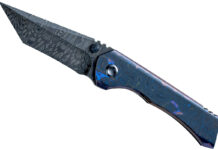
Knife Collecting

Knife collecting is an extremely rewarding experience for knife enthusiasts. There truly is a knife for everyone. Many increase or hold their value throughout the years, making collecting knives something to pass on to the next generation of knife collectors.

Knife Ed 101: From the Periodic Table to the Rockwell Hardness Scale

Jim Bowie scowls as I absorb the minutia of properly conveying knife specs.
Jim Bowie is not amused with my lack of knowledge about steel mixes.

Knowing what you don’t know sometimes means knowing when to stop researching and just play with your knife. In the course of more fully educating myself about knives, I find that everything, and I mean every little thing, involves further study. It can be paralyzing. And sometimes it needs to just get silly so I can stop worrying about it.

I’m in charge of maintaining the style sheet at BLADE, which is an alphabetical list of knife industry-specific terms and instructions—or exceptions to instructions—regarding how we present certain things in BLADE. We want to be consistent.

The other day my boss and BLADE editor, Steve Shackleford, sent me something like, “Just so you know… the V in MoV is always capitalized. For example, 8Cr13MoV: Cr refers to chromium, Mo refers to molybdenum and V refers to vanadium—all elements in the steel mix.”

Cool, I thought.

And then I thought: The periodic table of elements? Seriously?

For an English major with a history minor—even one into guns and knives—this concerned me. Oh sure, there’s science in the acids and bases of a batch of cookies in the oven, but I honestly never imagined printing out that chart after I left high school. But there it lies, adding color to the growing pile, its information so obvious in hindsight. Jim Bowie perpetually scowls with what I imagine can only be his disappointment in my slow pickup.

So, when Steve explained how BLADE presents Rockwell hardness: “the Rockwell hardness is 58-59 HRC,” I figured I should try to fit more about that topic into my rock hard head.

After work I called a friend.

His response: “What is the Rockwell hardness scale and what does it mean to me?”

Exactly, I replied.

And while we’re at it, I thought, aren’t “hard” and “tough” synonyms for the same thing, like soldiers or overcooked steak? (That’s a joke. You can read about the difference between hardness and toughness in Bernard Levine’s article, “Rockwell Hardness, What It Is And What It Means To Your Blades,” BLADE Magazine, Sept. 1997, Pages 74-76.)

And why can’t I close my Twitch II? Am I not pressing hard enough? Am I afraid of the release? (That’s not a joke, and no, the lock is not engaged.)

“I can envision both scenarios,” my friend said.

That’s how he talks.

We joke about cut-resistant gloves, only he’s not joking. I’m a klutz.

He explained something about measuring divots and my ears stopped up and my eyes glazed over. I have a hard time thinking in 3D.

But I had the power all along. In the archives of BLADE itself I found this helpful article: Bernard Levine’s article, “Rockwell Hardness, What It Is And What It Means To Your Blades,” BLADE Magazine, Sept. 1997, Pages 74-76

It all makes perfect sense. I think I can now move on to worrying about whether there’s a good mix of ATS-34, 440C, CPM S30V, CTS steels and 5160, O1, D2, 1095, L6 steels represented in our Knifemaker Showcase pieces.

Your Knifemaking Questions, Answered

Knifemaking bookGet all your knifemaking questions answered in this collection of expert advise from former BLADE columnist Wayne Goddard. The Wonder of Knifemaking makes a thoughtful gift for someone interested in starting or perfecting their knifemaking skills


The American Flag Damascus Knife Made for President George H.W. Bush

0
American Flag Knife
The American Flag blade consists of 13 flags, each of which is underscored with the letters “USA.” The flags are so true to the original that you can make out the details of all 50 stars in each one under a microscope. Meier says he forged the flags to appear as they might look to someone in a crowd as he/she watched a parade of flags go by. (Weyer)

Editor’s note: This article originally ran in the May/June 1991 issue of BLADE magazine. With the death of President George H.W. Bush on Nov. 30, 2018, it seemed appropriate to look back at an impressive custom knife presented to the 41st president in the early ’90s.

by Nathan Burdette

Daryl Meier wasn’t in the best of moods on a gloomy January day. His knife forge/shop had recently been burglarized and his son was about to begin Army boot camp at the outset of Operation Desert Storm.

“Maybe this interview will cheer me up,” one of the standard bearers of pattern-welded (or damascus) steel sighed. “Nothing else has gone well lately.”

He had to be kidding. Barely a month before he’d presented his revolutionary American Flag blade, a blade with American flags on it so true to the original that each will stand up to microscopic inspection, to President George Bush at the White House.

But then Meier is not your typical 9-to-5 working stiff. A case in point: He said the more meaningful part of the White House trip wasn’t so much meeting the president as was the two-hour plane trip sitting next to and conversing with Illinois Gov. Jim Thompson, who had arranged the knife presentation after seeing Meier’s work featured in a local newspaper.

The fact that Meier rejects the American dream of two cars in every garage and a boat in every driveway is not news to those who follow the knife scene. He’ll be the first to tell you that his mother raised him to be independent, and that independence is reflected in a lifestyle lacking in creature comforts. He resides in a log house of his own construction and makes a living selling his pattern-welded steel to knifemakers and manufacturers. He also teaches workshops and gives symposiums on the fine art of pattern welding. “I teach workshops from time to time, but I don’t do it for the money, though even that doesn’t amount to much,” he notes.

Mosaic damascus knives
At the White House are, from left: Illinois Gov. Jim Thompson, President Bush and Daryl Meier. Bush admires the American Flag blade and listens as Meier explains how the flags were forged into the blade. Thompson arranged the knife presentation after reading about Meier and his pattern-welded steel in a local newspaper.
(White House photo)

Instead of acquiring money, Meier is more interested in amassing knowledge, specifically, knowledge of how the ancients made pattern-welded steel and how he can improve on their time-tested methods. He traces the earliest pattern welds to as early as the 4th or 5th centuries B.C., and by the 4th or 5th centuries A.D. he says blacksmiths were able to control the patterns in the steel to a certain degree.

Meier says letters or words first began to appear on pattern welds between the 5th and 8th centuries, though the letters or words were forge welded on the surface of the finished blades. It wasn’t until the 18th century when a French smith named Coluet devised a method to make the word “Liberty” appear on a sword blade that letters or words were forged throughout the steel rather that on it, Meier notes. Between 1875-1925, he continues, gunsmiths refined the technique of words in the steel of pattern comforts. welded gun barrels.

Able to figure out how to forge words into the steel simply by looking at pictures of such works, Meier forged his name in a blade in 1978. But it wasn’t until the American Flag blade that he was sufficiently inspired to make what he calls “to date the most intricate thing done” in the genre.

“The tolerances (in the American Flag blade) are much tighter than in my name blade,” he begins. “The flag (there are actually 13 flags in all on the blade) that appears on the blade has 50 stars in it, each of which has five points, and which are arranged in five rows of six and four rows of five stars like on the standard flag.”

Talking about the work that went into the American Flag blade got Meier started and he wasn’t about to stop.

“I sweated blood to make that blade right. I could’ve made something that looked suggestive of what I made but then it all has to do with the philosophy of how you do a thing. That’s what’s prevalent in our society. We’re too cost conscious and few of us are willing to pay the full price for a good product,” he exclaims. “You’ve either got to say, ‘I’m going to make something I’m proud of or you’ve got to get out of the business.”

With that kind of attitude, let’s hope Daryl Meier stays in the blademaking business for a long time.

Collecting Knives By One Maker

0

In the April 2015 issue of BLADE® is a fascinating feature article about four knife collectors whose collections each consist overwhelmingly of the knives of one knifemaker only. The collectors and the makers they collect? The article, written by Stephen Garger, lists Chris Schluter, who enjoys accumulating the knives of Bob Terzuola; Tony Wang, who began collecting Bob Lum knives in the late 1980s; Tashi Bharucha, whose collection focuses on Tom Mayo knives; and Don Deckert who collects Ernest Emerson knives. attachment-2

Don Deckert’s collection of Ernest Emerson customs includes these seven (left) very early “garage make” pre-tac knives.

The feature starts:

You’ve heard of people collecting dozens, even hundreds of assorted genres of knives, but have you heard of collectors amassing up to 100 or more knives of a single maker? Chris Schluter knows of such collectors and suggested the phenomenon as a topic for a BLADE story.

Chris enjoys accumulating the knives of Bob Terzuola and is one of several who practice the one-maker approach to knife collecting. See the April 2015 issue of BLADE to read the rest of the article, or click here.MayoCollec

Tashi Bharucha’s Tom Mayo collection (left) features at least 55 of the popular maker’s knives, including one of Bharucha’s designs, the “Mayo Chopper,” though Mayo calls it “The Tashinator.”

5 Ways to Sharpen a Knife Without a Knife Sharpener

0

Work Sharp Sharpeners put together this tutorial of five knife sharpening “hacks” when you’re away from your usual setup. Watch the video to learn how to sharpen a knife with:

  • A saw blade
  • The window of a truck
  • The spine of another knife
  • A computer mousepad
  • A ceramic coffee mug

Hopefully you won’t ever need to use these techniques, but now you’ll know what to do if you’re in a pinch.

Badger Knife Club’s Annual Badger Knife Show

0

Badger Knife Club’s Annual Badger Knife Show

5 Things You Didn’t Know About MicartaⓇ

Editor’s note: “Micarta” has become the Kleenex of knife handles. It’s used so generically that it’s easy to lose sight of the fact that the word refers to something specific.

That’s why BLADE is bringing you this quick rundown of Micarta® from Kevin Brainard, a business development manager and 45-year veteran of Norplex, the company that owns Micarta® (the real deal). You may have caught the company at BLADE Show, where it runs the UltreX booth.

The goal of this piece is for knifemakers and knife collectors to become more aware of what is and isn’t actually Micarta®. 

Hint: If it didn’t come from Norplex, it’s not genuine Micarta®!


by Kevin Brainard

1 – Micarta® is a Registered Trademark of Norplex/Micarta

We own several registrations for our Micarta® mark around the world, including U.S. Trademark Registration Nos. 0096374 (issued in 1914), 0320374 (issued in 1934), and 0324365 (issued in 1935), covering our high-quality industrial laminates.

Global Thermoset Composite SolutionsThese laminates have been offered by Norplex-Micarta and our predecessors since at least as early as 1912. As a result of the significant sales, promotion, and widespread use of Micarta® brand laminates, our mark is widely recognized around the world as a designation of the source of our products, which are used in a variety of applications ranging from electrical insulation to gun and knife handles.

In addition to our common law rights in the Micarta® mark, our incontestable federal trademark registrations constitute conclusive evidence of the validity of the mark, the registration thereof, and of our ownership and exclusive right to use Micarta® in connection with these products.

2 – Micarta® is Made in the USA

Available in several different colors, combinations, and surface treatments, UltreX™
paper and cotton phenolic materials use the original production methods of Westinghouse,
updated with today’s process and environmental controls.

And unlike some of the other “micarta” available in the market, UltreX™ Micarta® is produced in the USA in Postville, Iowa.

3 – G-10 is Not Micarta®

Consider the Spyderco Persistence—a small knife that cuts like a bigger one.
The Spyderco Persistence sports G-10 handles.

Micarta® is made with a cloth or paper substrate and coated with phenolic or melamine resin. G-10 is woven fiberglass and coated with epoxy resin.

The processes to make both materials are very similar in the fact that both are consolidated under heat and pressure to make the final laminate. There is a chemical reaction that is called polymerization that bonds the layers together into a high-pressure thermoset laminate.

According to the trademarks, G-10 is not Micarta®.

4 – “Micarta” Refers to a Specific Product

Like so many other trade names, Micarta® name is used like Kleenex is for facial tissue. Instead of calling it a “thermoset laminate” it is easier to call it Micarta®. This is true in the knife scales, handles and gun grip markets. We have similar issues with the Micarta® name in our other markets.

5 – Micarta® Goes Back to 1912

It was originally designed to be used as electrical insulation back in 1912 by George Westinghouse using a phenolic resin developed by Leo Baekeland called Bakelite.

Where To Learn More

Visit the official UltreX website.

JULIA’S TO SELL DR. LUCIE’S COLLECTION OF WILLIAM SCAGEL KNIVES


James D. Julia Auctioneers extraordinary firearms and knife auction will be taking place on Monday and Tuesday, March 12th & 13th 2012. This auction should prove to be one of the most exciting events in knife history!


Dr. Jim Lucie, of Fruitport, Michigan recently decided to sell his lifelong collection of William Scagel knives. Dr. Lucie is today regarded as the reigning authority on Bill Scagel, his life, and the knives he produced. Dr. Lucie is a noted author of a monumental book on Scagel’s works titled, “Scagel Handmade”. He has also been a passionate collector of Scagel made things for most to his life. Dr. Lucie had the great fortune of meeting, doctoring and becoming a friend of Bill Scagel late in his life. His special relationship gave him a unique insight into this extraordinary man. Scagel was an extremely conservative, crusty and independent individual who lived life on his own terms.


Born in 1875, he lived until 1963 and for the majority of his life he used his unique skills and abilities to manufacture and craft about anything he wished. His focus however was on the production of quality knives. Although the product he produces was a simple utilitarian object he incorporated his unique artistic talent into the production of a true art form. His knives were literally a thing of beauty and he eventually began marketing them through the elite sporting goods store Von Lengerke & Antoine of Chicago. Up until 1929, his exquisite knives were featured in their catalogs and sportsmen from all parts of North America acquired his very special knives. Scagel was the first person to give art form to the American knife in the 20th century. Eventually, Bo Randall began to create artistic knives like those of Scagel’s and today the extraordinary fraternity of blade smiths throughout North America can attribute the origin of this art form to Scagel himself; he was unquestionably the genesis of this much revered and collected art form.


Dr. Lucie’s special relationship and appreciation of Scagel’s works eventually resulted in his amassing what is considered the finest collection of Scagel made products to exist today. His special knowledge and interest in Scagel, eventually led to his definitive book on Scagel products, “Scagel Handmade”. Dr. Lucie was so enthralled by Scagel’s art form that after Scagel’s death, he learned to become a blade smith himself and began producing wonderfully artistic knives in a manner similar to those of Scagel. Dr. Lucie’s knives themselves are highly collectible and he currently has a six-year waiting list for one of his masterpieces.


With the exception of a couple of items he retained for his daughters, his entire collection will be offered in this auction. There are so many great rarities, one of them is the Armond Durham camp ax with stag handle, originally made for Armond Durham. Durham had a number of pieces made, all of which he never used so everything from the Durham collection, including this ax, is essentially in near mint condition. The ax carries a conservative presale estimate of $20,000 – $28,000. Another very rare item is the D-guard fighter knife made for a Marine during WWII. On his first leave home, the marine ordered another five for members of his unit. These were the only D-guard knives ever made by Scagel and this is the only one currently known to have survived. It is estimated at $18,000 – $26,000. Another gem is the mint hunter with Heiser tooled sheath in an original V. L. & A box, the knife and Sheath are virtually new. It carries a presale estimate of $21,000 – $30,000. Another great rarity is a near mint crown stag folder knife. This pocket knife with stag handle this most unusual form is highly desirable and in its special condition, should easily generate $17,500 – $25,000. Another very rare and outstanding example of Scagel’s knives the hunter knife with folder in the handle. This very special form was exceedingly difficult to make and later in life, while corresponding with Bo Randall, he specifically stated that they were extremely difficult to make and that he only made 12 of these. This outstanding example is estimated at $20,000 – $30,000. Another exquisite Scagel knife is what Dr. Lucie refers to as the “Iron Mermaid of the Great Lakes” fish knife. This unique knife, specially crafted for the client who ordered it, is fitted with an antler handle in the form of a fish tail and is estimated at $18,000 – $27,000.


Not only were Scagel’s artistic abilities displayed in the product that he made, but sometimes his personal politics were reflected also. Scagel was never one to be beholden to one for a favor and when one was given he almost always immediately repaid it. One freezing night, while walking home, the local Democratic Party chairman stopped and insisted that he give Scagel a ride to his house. Scagel reluctantly accepted the favor and a few days later presented the Democrat with a small, hand-crafted knife and sheath as a gift. Later, a friend asked Scagel why the knife had an ivory slab on one side and a mottled mother of pearl handle on the opposite side. Scagel replied “Oh, you mean that damn Democrat knife I made? All Democrats are two-faced so I made the knife handle accordingly!” Estimate $4,200 – $6,000.


There are between 70 and 80 Scagel lots in this sale and they will be offered in consecutive order on one day. Absolutely no Scagel items from any other source will be mixed with Dr. Lucie’s collection. Julia’s catalog, considered the finest in the industry, will feature exquisite, full color photos of each lot and a detailed description provided by Dr. Lucie himself. The catalog description will also incorporate a conservative presale estimate. One unique feature about the Julia company is that unlike most auction houses who offer their goods “as is, where is”, Julia’s descriptions carry a 45-day guarantee from the date of the auction against any major discrepancy in the catalog description, thus making absentee bid participation not only easy and convenient but also safe.


In an effort to help make these rare items available for anyone interested, the Julia firm and Dr. Lucie have decided to make available special financing terms for qualified parties. If a client is approved, the terms will allow them to make payments for purchases over a period of time. Under no circumstances will terms be provided to anyone who does not apply before the auction. Customers must apply for and be approved before the auction for these special financing terms.


In addition, participation at the auction is most convenient. Some buyers attend the auction live and bid in person. Others after receiving the catalog may submit absentee bids to be bid competitively at the auction. Still others may make advance arrangements to bid over the telephone as it is being sold. And finally, anyone who has a computer will be able to bid live time during the auction by accessing the Julia catalog through “Artfact”.


This very special auction, featuring this unique collection will certainly prove to be a once in a lifetime opportunity. Not only will this be the most significant offering of Scagel knives ever offered, but the condition in general is truly outstanding. Many of the items have never been used.


One of the most difficult parts about preparing the catalog proved to be the estimates. Because of the rarity, the superb condition and in some cases the uniqueness of the items, it is impossible to predict what they might bring. However, the Julia firm and Dr. Lucie have agreed that the estimates should be realistically conservative so that all potential buyers can know that the collection is intended to be completely sold. Julia’s catalog will be available approximately four weeks prior to the auction and should be posted on their website approximately 3 weeks prior to the auction. For more information, contact Julia’s for free, detailed illustrated brochures of the sale (available four weeks prior to the auction) at (207) 453-7125 or visit their website at www.jamesdjulia.com.


To read more stories like this, subscribe to BLADE®. For subscription info click on http://www.shopblade.com/product/blade-magazine-one-year-subscription-us/?r+ssfb231111#BL1SU


Advertisement

Must Read Articles

Read this before you make a knife

Knifemaking 101 – Read This Before You Make a Knife

  by Wayne Goddard My experience has taught me that there's nothing like digging in and getting started. I've often said the hardest part of the...

how to forge damascus steel

How to Forge Damascus

Advertisement
Advertisement