Home Knife Collecting

Knife Collecting

Knife collecting is an extremely rewarding experience for knife enthusiasts. There truly is a knife for everyone. Many increase or hold their value throughout the years, making collecting knives something to pass on to the next generation of knife collectors.

Randall Airman: USMC Prototype Carried By The Father Of Marine Helicopters

The story of a prototype Airman and a Marine pioneer.

Editor’s note: The author contacted BLADE® and asked if we would be interested in his story on a special Marine Corps knife and a special Marine to coincide with the semi-quincentennial of the United States Marine Corps. Needless to say, it was an easy decision on our part. Meanwhile, please join us in wishing a happy 250th birthday to the Corps and Marines everywhere.

The core values of honor, courage and commitment have defined the United States Marine Corps since its inception on Nov. 10, 1775. To remain an elite fighting force, the Marine Corps has adapted as the world has changed over the past 250 years, incorporating new technology and developing new doctrine.

One of the most significant transformations began with the birth of Marine Corps aviation in 1912. During World War II, Marine aviators played a vital role in the Pacific campaign, working closely with ground units to seize heavily defended island strongholds. As Gen. Keith B. McCutcheon, a pioneer of Marine aviation, later emphasized, “The Marine Corps is proud of the fact that it is a force of combined arms, and it jealously guards the integrity of its air-ground team.”
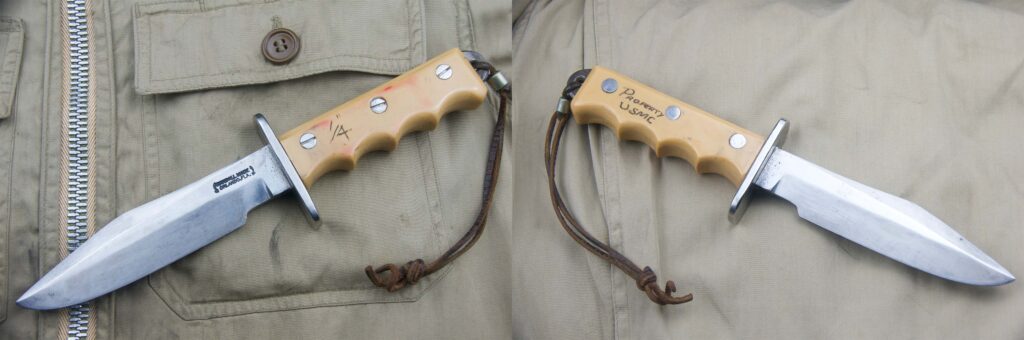
The mark and non-mark sides of a prototype Airman.

The evolution of air combat brought new challenges, challenges that extended even to the knives that aviators carried. One result was a collaboration between Marine aviators and BLADE Magazine Cutlery Hall-of-Fame® member Walter D. “Bo” Randall, who would redefine survival and combat knives with the now-iconic Randall Model 15. This article features one of Randall’s prototypes—a rugged, full-tang Airman’s Knife that was carried for more than 15 years by Gen. McCutcheon himself.

The Challenge

Marine aviators amassed extensive combat experience in World War II and Korea. By 1953, the Marine Corps recognized that the rigors of combat aviation demanded a new type of knife—one that was rugged, compact and versatile.

As documented by Randall historian Robert Gaddis, the Marine Corps Equipment Board assigned Lt. Col. H. Ross Jordan and Maj. Harold N. “Tex” Mehaffey to develop a survival and combat knife for Marine aviators. The knife had to be nearly indestructible—strong enough for an airman to pry, cut or smash his way out of a downed aircraft. At the same time, it had to be short enough to be worn in a cramped cockpit, and the sheath needed to allow the knife to be carried on the upper arm or lower leg.

Wearing his sheathed Randall Model 15 Airman on his left hip, United States Marine Corps Gen. Keith McCutcheon (center) is flanked by South Vietnamese Gen. Hoang Xuan Lam, Commander of I Corps, and USMC Gen. Edwin B. Wheeler (right), commanding general of the 1st Marine Division. (image of McCutcheon, Lam and Wheeler from somewhere near Da Nang, Vietnam, March 16, 1970)

After reading a December 1953 magazine article about Bo and his expertly crafted blades, Mehaffey and Jordan arranged to tour his knife shop in Orlando on Feb. 11-12, 1954. By the end of their fruitful discussion on February 12, Bo had arrived at the basic design of the Randall Airman’s Knife. He also planned a longer-bladed version for ground troops, a design that would become the Randall Attack. Thus, this meeting launched the line of full-tang Randall models that would expand and evolve over the coming years.

Bo moved rapidly to fabricate prototypes that embodied his innovative design. The 5.5-inch blade would be forged from quarter-inch-thick O1 tool steel, a material that had been proven in earlier Randall combat knives. To strengthen the tip, the blade would retain the full quarter-inch thickness nearly to the point. To strengthen the junction between blade and the handle, the tang would be 7/8-inch wide along the entire grip. An extended segment of the tang would have a hole for a wrist thong and provide a surface that could be used for hammering. A heavy double hilt would prevent a gloved hand from slipping forward onto the blade. The handle would be made from a single piece of Tenite plastic, shaped with finger grips and a channel to snugly fit the tang. Stainless steel bolts would secure the handle.

To complete the package, Randall designed a sheath that could be worn on a belt, attached to a harness, or tied to the lower leg or upper arm with leather laces. It featured a diagonal keeper and rivets at stress points. The Randall shop completed the prototypes of the Airman’s Knife and the longer Attack Knife by the end of February 1954—barely more than two weeks after the formative design discussion—and Clarence Moore readied the sheaths soon after.

Three-star Gen. Keith McCutcheon, February 1970

The innovative features of the new knife and sheath designs were memorialized on certified blueprints on March 4, 1954. Randall filed a patent application on Aug. 11, 1954, and the United States Patent Office granted patent 177,590 for the Randall Airman’s Knife on May 1, 1956.

Prototype Testing

With prototypes in hand, Randall travelled to Quantico, Virginia in mid-March 1954 to present the new full-tang knives to Mehaffey, Jordan and other USMC and U.S. Navy officers. The group enthusiastically recommended that the Navy’s Bureau of Aeronautics purchase 10 prototype Airman’s Knives for evaluation: five from quarter-inch stock according to the original design, and five lighter examples from 3/16-inch stock.

The requisition arrived in early April 1954 and the shop shipped the 10 prototypes in early May. The invoice listed the Airman’s Knife as the #14, but later that month Randall adopted the still-current model numbers: the Airman became the Model 15, and the longer version became the Model 14 Attack.

The Marine Corps Equipment Board received two of the prototypes, one of each blade thickness, and the remaining eight were sent to squadrons and other units for real-world testing. In late May, Mehaffey informed Bo that preliminary testing had begun.

One of the original Randall prototypes is featured in the accompanying photographs. Made from quarter-inch steel, as indicated by the inscription on the handle, the prototype closely follows Bo’s patented design, except the blade lacks the fuller shown in the drawing. As in the original design, the prototype’s handle is secured by three bolts; this feature sets the prototype apart from later production examples of the Model 15, in which only two bolts were used.
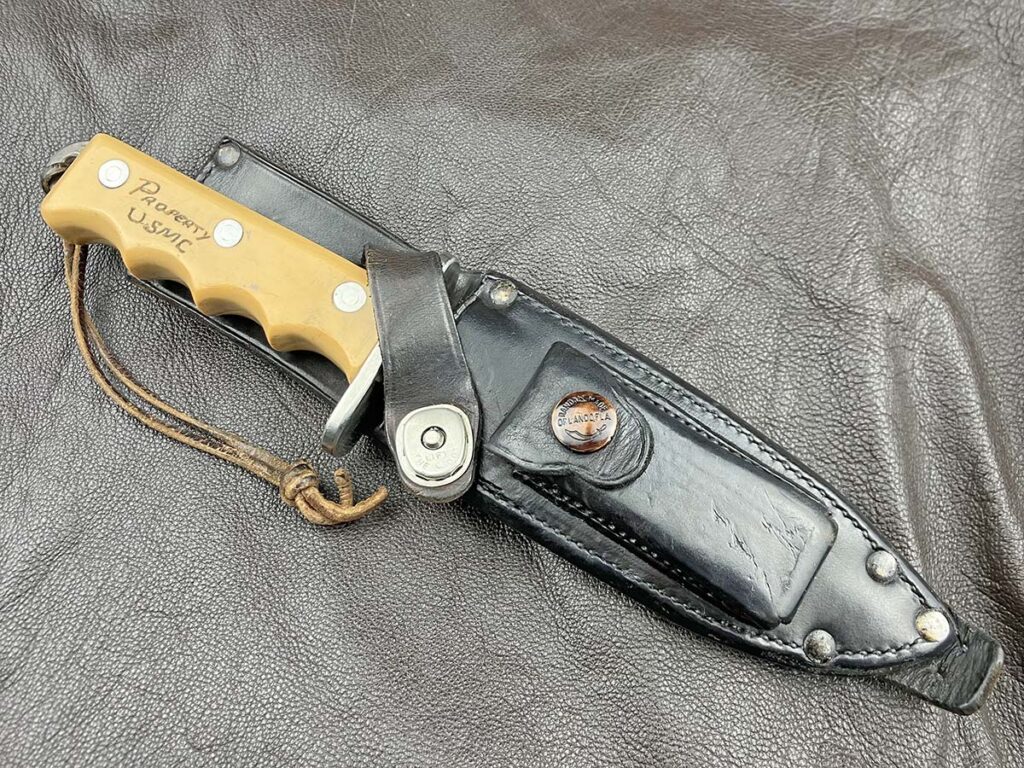
Leatherworker Clarence Moore made the sheath for the prototype Airman according to Bo Randall’s design. Moore made the sheaths for the earliest full-tang knives until Heiser took over production in 1955.

The handle is made from white Tenite, a material used only for a year or so before Randall adopted the more familiar green Tenite that was characteristic of production for nearly 10 years, until Randall Made replaced Tenite with Micarta® in the mid-1960s. The prototype’s hilt is nickel silver in contrast to the brass hilts seen on almost all Model 15s with Tenite handles. The sheath was made according to Bo’s design by master leatherworker Clarence Moore, who made sheaths for the earliest full-tang knives until Heiser took over production in 1955.

After more than 70 years, the knife and sheath are in outstanding condition—a testament to Randall’s craftsmanship and superb design.

Project Setbacks

Despite starting with such promise, the project faltered in the summer of 1954 when Mehaffey was transferred for duty in France and Jordan retired. The departure of the two enthusiastic advocates delayed testing and communications. The next official update was in December 1954, when Bo heard that testing had been underway for two months with positive feedback. In April 1955, the United States Air Force also ordered a group of Model 15s for evaluation. Bo wrote again to the USMC in June 1955 but heard nothing further from the Marines or the Air Force.

Although Randall was never officially informed of the results, author Frank Trzaska uncovered a September 1955 testing report in the USMC archives. The report was authored by USMC Maj. Norman W. Gourley, who had succeeded Mehaffey. Extensive testing of the Randall Airman prototypes showed that the quarter-inch-thick version (i.e., Bo’s original design) was “suitable for aviators’ survival use.”
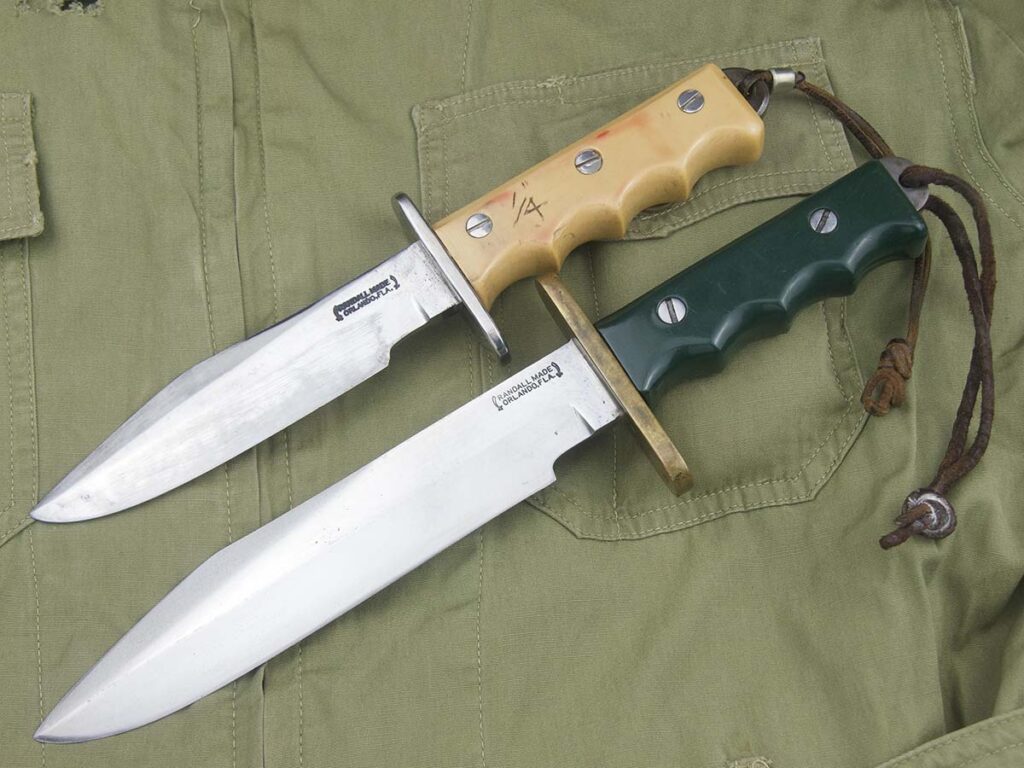
After a fruitful meeting on Feb. 12, 1954 with USMC Maj. Harold N. “Tex” Mehaffey and Lt. Col. H. Ross Jordan, Bo Randall had arrived at the basic design of the Randall Airman’s Knife (top). Bo also planned a longer-bladed version for ground troops, a design that would become the Randall Model 14 Attack (one from 1955 is shown at bottom). The meeting launched the line of full-tang Randall models that would expand and evolve over the coming years.
SONY DSCAfter a fruitful meeting on Feb. 12, 1954 with USMC Maj. Harold N. “Tex” Mehaffey and Lt. Col. H. Ross Jordan, Bo Randall had arrived at the basic design of the Randall Airman’s Knife (top). Bo also planned a longer-bladed version for ground troops, a design that would become the Randall Model 14 Attack (one from 1955 is shown at bottom). The meeting launched the line of full-tang Randall models that would expand and evolve over the coming years.

The report, which pictures this story’s featured prototype, notes the high quality of the design, materials and workmanship of the Randall knife and sheath and concludes that it is acceptable for extreme survival tasks. The report also noted potential changes that would improve the knife further, such as the addition of saw teeth, a flat butt surface for hammering, and different handle configurations. Bo independently incorporated most of these features in various full-tang Randall models by the mid-1960s, and presumably he would have made the changes sooner if the request had ever been made.

While the tests of the Randall Airman were underway, the Navy adopted the Imperial Pilot Survival Knife for its aviators. Because the Marine Corps operates as part of the Department of the Navy, this surely complicated any attempt by the Marines to adopt a different design. The Randall Airman was never issued by the military, but Bo added the Model 14 Attack and the Model 15 Airman to the new Randall catalog printed in 1954, which showed prototypes of both models as “patent pending.” As envisioned by Bo and the Marine aviators who helped to shape the design, Randall’s full-tang combat and survival knives were embraced by many American servicemen who purchased them privately, especially during the Vietnam War.

Pioneer & His Prototype

One Marine who had a high opinion of the Randall Airman was aviation pioneer Keith B. McCutcheon, who as a colonel served as Chief, Air Section, Marine Corps Equipment Board from June 1954 to July 1957. After the Randall Airman tests concluded, McCutcheon carried the quarter-inch prototype for the rest of his career.

An attack helicopter warms up in the background as Gen. McCutcheon surveys the situation six miles southwest of Da Nang, March 17, 1970, his trusty Randall Model 15 Airman sheathed at his side. At left is Gen. Edwin B. Wheeler.

In January 1966, while commanding the 1st Marine Aircraft Wing in Da Nang, Vietnam, then-Brig. Gen. McCutcheon wrote that the Airman was a “wonderful knife” that he had carried for “10 or 11 years.” Photographs from 1970 show McCutcheon wearing the knife when he returned to Da Nang as a lieutenant general and commander of the III Marine Amphibious Force (III MAF).

Commissioned as a Marine 2nd lieutenant in 1937, McCutcheon was a brilliant, courageous leader who transformed Marine aviation over the course of his illustrious 34-year career. Gen. Earl Anderson said McCutcheon “was one of the finest and most dedicated Marine officers [whose career] reads like a history of Marine Aviation. He earned his wings as an aviator in 1940 and served in World War II, Korea and Vietnam.”

McCutcheon was instrumental in integrating helicopters into Marine operations, and has been called “the Father of Marine Helicopters.” But, as historian William Fails observed, that title does not capture McCutcheon’s central contributions to numerous other areas. He also advanced close air support doctrine and techniques, guided missile systems, and the AV-8 Harrier jump jet. McCutcheon was also an effective leader of ground operations, launching successful operations as commander of III MAF.

For his exemplary service over 34 years, McCutcheon received many of the nation’s highest military decorations, including three Distinguished Service Medals, the Silver Star Medal, three Legions of Merit with Combat “V,” the Distinguished Flying Cross, 10 Air Medals and others. He was appointed to become the assistant commandant of the Marine Corps but was unable to assume the post because of failing health. He retired as a four-star general on July 1, 1971, and passed away from an illness soon after.

Enduring Legacy

On the 250th birthday of the United States Marine Corps, it is fitting to honor the legacy of Gen. Keith B. McCutcheon, an extraordinary leader who helped shape the modern Marine Corps. McCutcheon’s prototype Randall Airman remains as a tangible link to his many accomplishments and to the connection between the Marine Corps and Randall Made Knives.

Sources

William R. Fails. 1978. “Marines and Helicopters 1962-1973.” History and Museums Division, Headquarters U.S. Marine Corps.
Robert L. Gaddis. 1993. “Randall Made Knives: The History of the Man and the Blades” Paladin Press.
James Anthony Ginther, Jr. 1999. “Keith Barr McCutcheon: Integrating Aviation into the United States Marine Corps, 1937-1971.” Doctoral Dissertation, Texas Tech University.
Norman W. Gourley. 1955. Marine Corps Equipment Board report A9-E-1039 on Project E-1039.
Frank Trzaska. 2001. “Randall’s Model 15 & the U.S.M.C.” February 2001 Knife World.

More On Military Knives:

Semper Fi Blades: Celebrating the US Marines’ 250th Anniversary

Honor 250 years of Marine Corps history! Discover the legendary KA-BAR/MK2 fighting knife and new anniversary blades from makers like Medford and Defiant 7.

The day before Veterans Day, November 10 is the 250th anniversary of some of the most storied combat fighters in world history—the United States Marines.

The Marines have a special aura that almost transcends their many exploits. And when it comes to American military exploits, the Battle of Iwo Jima is in the top two or three all time. The raising of the flag on Mount Suribachi is America personified, and the United States Marine Corps War Memorial across the Potomac River from Washington, D.C., celebrating the event is about the most awesome monument anywhere.

As for those in the knifemaking community, Marine veterans are well-represented and include two BLADE Magazine Cutlery Hall-of-Fame® members, Don Fogg and Joe Keeslar. Other Marine vets who make knives are Tim Britton; Matt Chase; Allen Elishewitz; Doug Esposito; Les George; Brad Jennings; Tim Kell; Jonathan McNees; Greg Medford; Jeff Moore; ABS Master Smith James Rodebaugh; Kevin Stack; and Connor Toor. There are no doubt many more, both present and past.

Then there’s the iconic Marine knife, variously known as the Mark 2/MK2, USMC fighting/utility, the Model 1219 or simply the generic kabar. Associated by many with having been made by KA-BAR Knives, the knife also was made by a number of other companies during World War II, including Camillus, Case, Colonial, Ontario, Pal, Queen, Robeson, etc., and is made by several of the foregoing that remain active today, as well as others. The 200th KA-BAR commemorative of the knife graced the cover of the November-December 1975 issue of The American Blade 50 years go in what may be the best BLADE® cover ever.

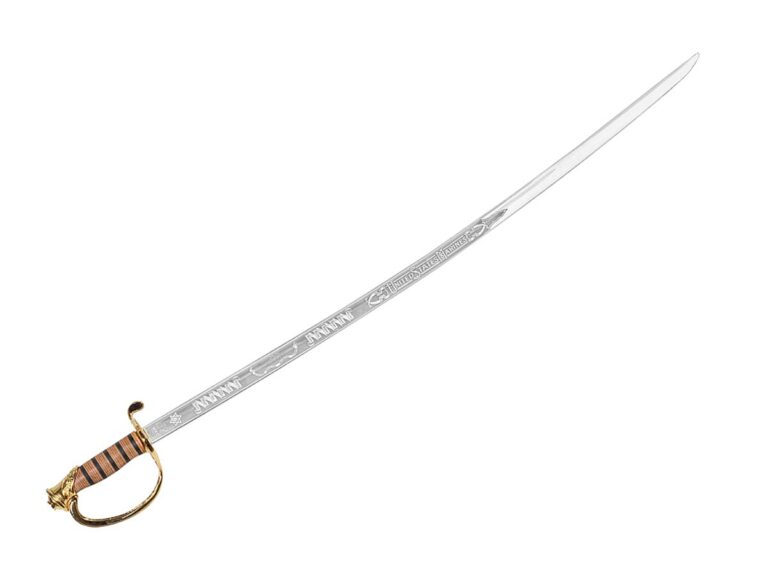
As for blades observing the 2025 anniversary, the 250th USMC Trench Knife by Medford Knife & Tool is available now. KA-BAR is making a dress sword in a limited edition of 250 pieces that at press time was slated to be out in early October. At Defiant 7, Allen Elishewitz and Les George are “reworking” the USMC MK2 in what will be called the M320. Among other features, it will include a 3V carbon steel blade and a stacked handle construction not unlike the original MK2 grip but in a polymer material and a more ergonomic shape. Ontario was reportedly working on a new kabar-inspired piece at press time, too.

Look for these and other anniversary-focused knives in future issues of BLADE. Choose one or more of them if you want a blade inspired by our incomparable Marines.

To America-loving Marines everywhere, Semper Fi! And to all U.S. military vets, Happy Veterans Day!

More On Military Knives:

Shining Blades: Book Shines A Light On The Lorenzis’ Cutting Collection

Cutlery Hall-of-Famer’s book showcases the most unique, historic and outlandish blades to enter their treasury.

Probably the most important international buyers of modern American custom knives ever, BLADE Magazine Cutlery Hall-of-Fame® members Aldo and Edda Lorenzi bought and then sold those knives and many other edged items in their iconic G. Lorenzi retail cutlery store in Milan, Italy.

Located on the Via Montenapoleone in the heart of Milan’s elegant retail sales district, and under Aldo and Edda’s direction, G. Lorenzi sold the finest knives, scissors, razors, table cutlery and assorted other edged wonders from 1959 to 2014, serving customers from every corner of the globe.

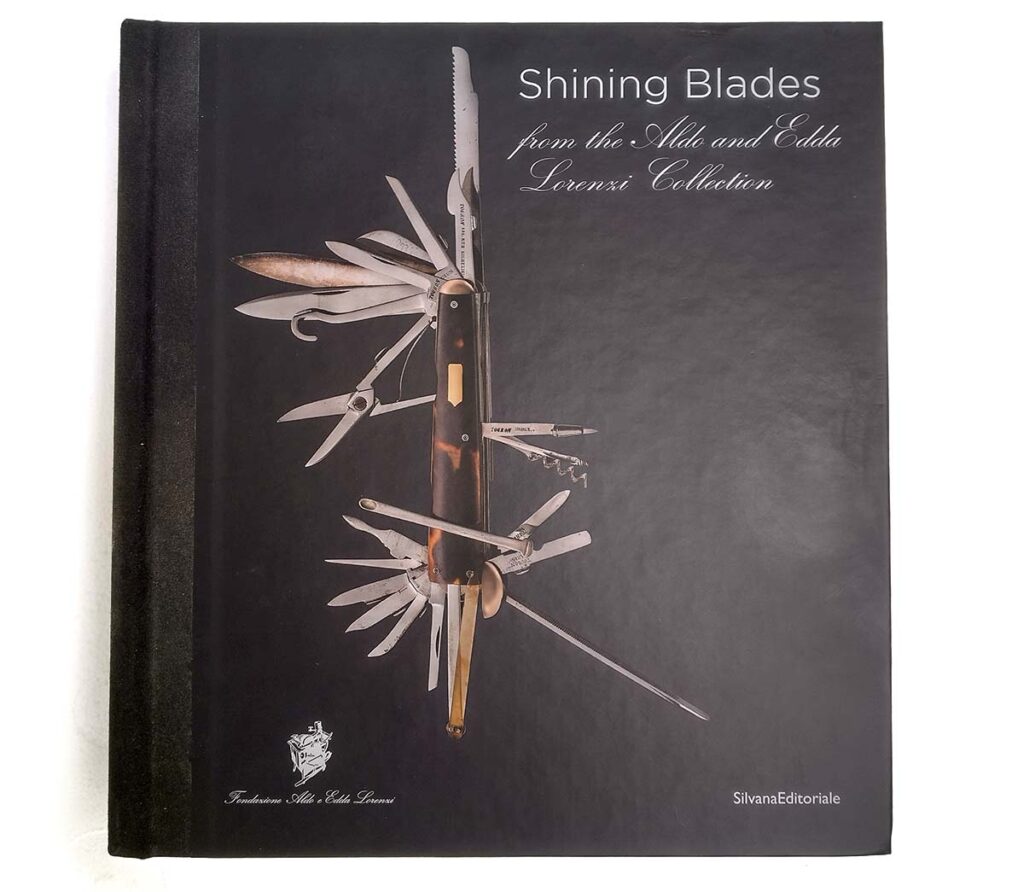
If you read BLADE® regularly, you know of the Lorenzis—but mostly only through the eyes of BLADE. In their new book, Shining Blades from the Aldo and Edda Lorenzi Collection, the Lorenzis recall their journeys far and wide in their lifelong search for the finest blades as only they can tell it, from the age of Elvis and crewcuts to the internet era.

Intrepidly scouring Europe, America and elsewhere for cutting tools of all kinds, the Lorenzis chronicle their travels in Shining Blades. From Aldo doubling Edda on their Guzzi Galletto motorbike through the snow and rain in the Alps on their first working trip to Fance in the early 1960s, to their early visits to the knifemaking shops of John Nelson Cooper, Cutlery Hall-of-Famer Bob Loveless and many other of the most famous American makers and beyond, the Lorenzis share their incredible story.

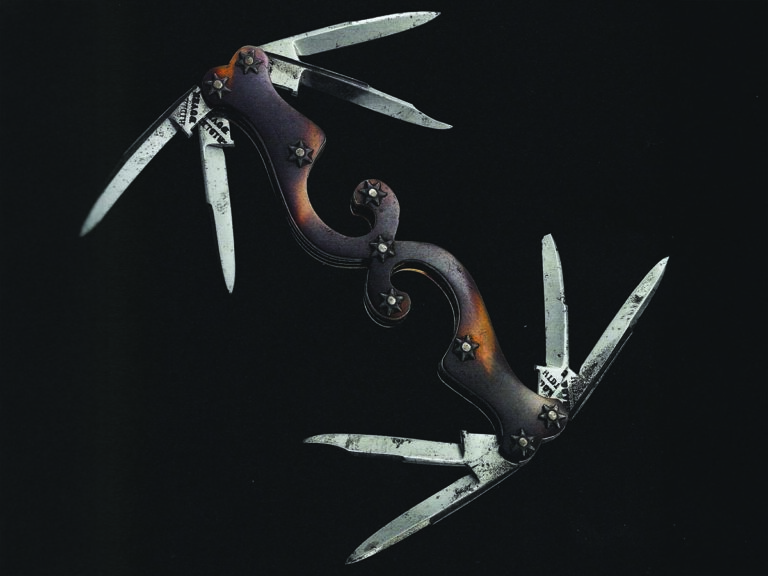
Shining through it all are full-page color images of some of the most spellbinding edged implements you will ever see. In addition to buying them the Lorenzis collected the vintage edged implements along the way. Bronze-Age spoons, folding forks and unbelievable folding knives of the 17th century forward are just some of the visual feasts of the edged art that populate the book’s pages.

For instance, if you think you’ve seen all there is to see in scissors, think again. The images of vintage scissors alone are enough to fill an encyclopedia on the subject. Spectacularly ornate and mystifying in construction, the scissors the Lorenzis amassed over the decades alone will take your breath away.

New shining blades

The preceding simply scratches the surface of what the book is all about. Most of what is illustrated and much more can be seen in the state-of-the-art Aldo and Edda Lorenzi Foundation museum in Milan.

The book also delves into some of the oldest knives known, from the 5,000-year-old knife of Otzi the Iceman discovered in 1991 on the Austrian-Italian border, the finest in European custom knives and knifemakers, ancient books on all things cutlery, notes on damascus steel and much more.

It’s all contained in a top-quality, 9 x 9.75-inch hardbound book with 344 pages that will provide you enjoyment for years to come. It’s a unique history with an MSRP of only $50—a ridiculously low price for such a landmark publication. However, as Edda Lorenzi noted, it’s not about the money so much as the education of worldwide edged tool enthusiasts and the recognition of those who authored some of the most fascinating edged tools extant.

“The book cost us about double its sales price [to produce], more or less,” she began. “Keeping the price low was our choice. It is a choice in line with our Nate Posner Award—to honor the artisans who created the works we loved most and whose names we would like to be known by as many people as possible, and to encourage new generations of artisans who, unlike collectors, certainly do not have large sums of money to invest in expensive books. To achieve this, this choice had to be made!”

If most anyone else had written the preceding paragraph I might be going, “Yeah, right.” But with the Lorenzis, you can rest assured it’s true. If you don’t believe me, ask members of the old guard at knife shows who know of them. If anything, my assessment of Aldo and Edda isn’t laudatory enough.

See Other Hall Of Fame Members:

Collaboration Knives: How Do They Come Together?

Top makers explain how they collaborate with knife companies.

The old cliché of the win-win holds a real grain of truth. Any successful partnership must be mutually beneficial, and in the knife industry the phenomenon of the collaboration has come to exemplify the upside of working together.

Years ago, a veteran custom knifemaker described his relationship with a major manufacturer as serving as the company’s research and development department. Such a description is accurate in that the manufacturer often relies on the custom maker for new design inspiration, from good looks to materials and mechanics. The collaboration has emerged in the last 35 years or so as an outstanding means of bringing innovation to the public and putting first-rate knives in the hands of the mass market.

The ins and outs, nuts and bolts, and give and take of the collaboration process raise questions for makers interested in striking deals of their own. A few comments from makers who have achieved great success on the collaboration frontier offer helpful insights.

“It goes both ways,” observed BLADE Magazine Cutlery Hall-of-Fame® member Bob Terzuola, who indicated he completed his firstfactory collaboration with fellow Cutlery Hall-of-Famer Sal Glesser and the design team at Spyderco in 1989. “You can go to the company or the company can come to you depending on your notoriety. If you are just starting out, you probably have to go to the company.”

On the business side of the ledger, Suzi Terzuola takes the lead and has demonstrated proficiency in making the deal work for everyone involved. Her flair for negotiation and finding the right blend of maker-manufacturer cooperation has been demonstrated through the years as Bob has worked not only with Spyderco but also the old Camillus, Boker, Fox, Pro-Tech, Tactile Knife Co. and others.

BLADE Magazine Cutlery Hall-of-Fame® member Bob Terzuola has done collaborations with many companies, including the Bob Terzuola ATCF Auto Ultimate from Pro-Tech, the BLADE Magazine 2022 Investor/Collector Knife Of The Year®. (Eric Eggly/PointSeven knife image)

“I was raised by parents with their own successful businesses,” Suzi observed, “and I saw Bob receiving passive income from Spyderco and Camillus, and of course passive income is how you survive after having only so many years to make knives. I began looking at the knife designs Bob had and tried to match the design to the company. Bob has patents lining the walls, and when he lends his name to a knife he should receive a signing bonus and a bonus against the royalties.”

In return for his design skill and the use of his name in promotions, Bob has certainly established himself as a leader among successful custom collaborators. His contribution to a company’s success has enhanced his reputation of excellence across the industry, while Suzi has forged a business posture that results in security for the future.

Knife Collaboration Contracts

The contract is the key component of a collaborative deal, and depending on the circumstances everything is negotiable. Although early agreements made among friends were sometimes done on a handshake, it has become a “best practice” to hammer out the terms of the collaboration on paper, invest in an attorney’s review, and formally memorialize the discussions. Standard royalties run roughly 5 percent of the price at which the company sells the knife.

The Terzuolas include a period of time in which the company is allowed to produce the knife; the period may be extended at maturity with the agreement of both parties. Further, there may be a requirement that the company produces a certain number of knives in a given time period, also renewable. Restrictions on wholesale pricing or discounts that affect royalties may also be negotiated.

For those considering a foray into collaborations, Bob and Suzi offer some advice: “If you’re a new maker, you shouldn’t just walk up to [the company’s] booth at a show. Make an appointment to see them because they are at the show to deal with customers. Approach a company with one or more finished designs. They want a package presented to them, a prototype or existing model, something they can hold in their hands, and in the case of a prototype it’s good to have as many innovations and design creations as you can—anything that will set the knife apart from other potential deals out there.”

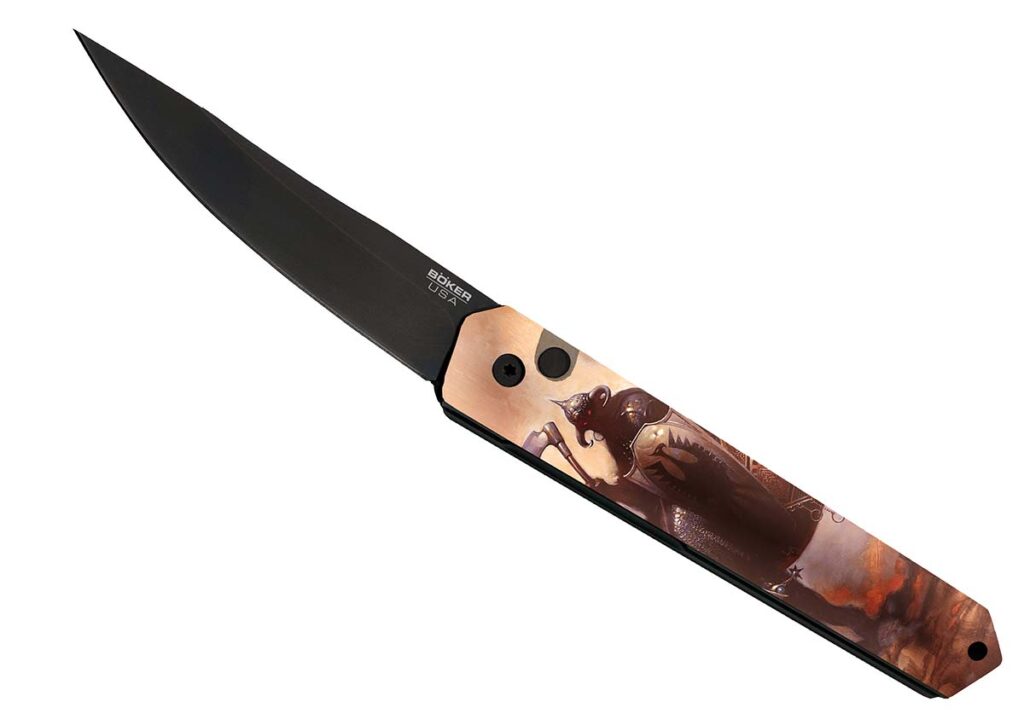
Lucas Burnley has designed several iterations of his Kwaiken for Boker, including the Kwaiken Auto Frazetta.

Suzi added that a higher profile in the industry can drive success.

“We are the R&D for a knife company,” she noted, “and when you approach them for a collaboration your social media resumé is very important.”

Making custom knives since 1994, Darriel Caston has concluded collaborations with numerous companies, including CRKT, Spyderco, Boker, V Nives, Kansept Knives and more.

“I’m prolific when it comes to designs,” he affirmed. “There are probably about 300 that I will never get to making. I’m an engineer by trade and my 3D drawings are almost ready for production, and that helps with the deals. They ask for STEP files [standardized 3D model data files for CAD and 3D printing] that can go right into machining. Sometimes we work with a prototype, and sometimes we work with a knife that I have been doing for quite a while.”

According to Darriel, one significant element of the collaboration is the retention of the rights to the design.

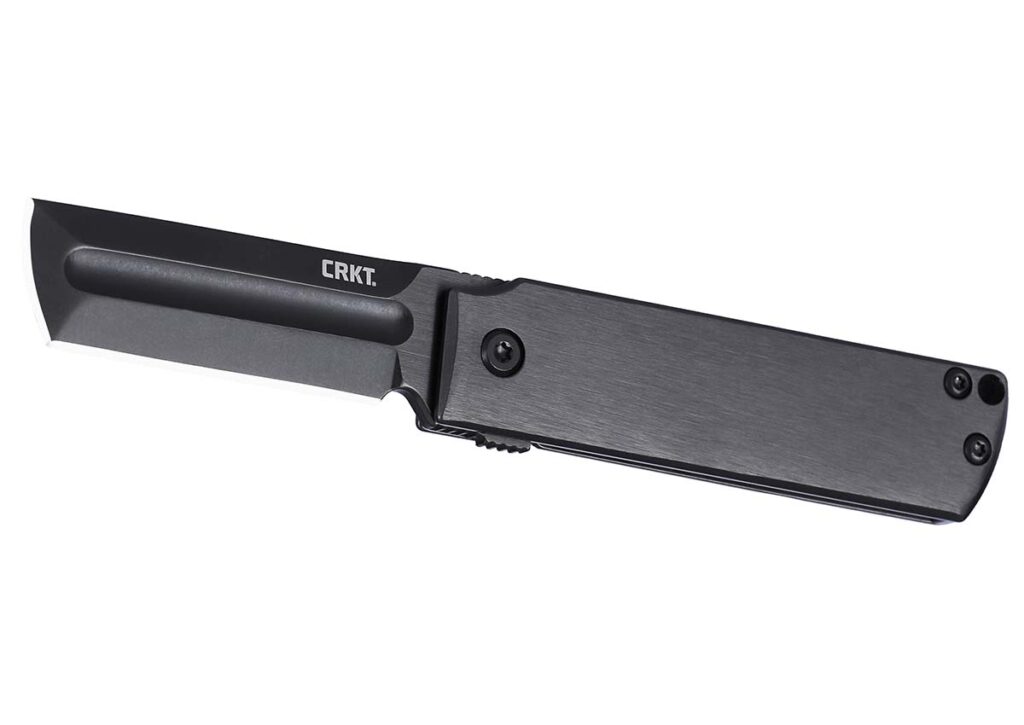
“Anybody who wants to do a collaboration must put footprints in the sand, get their work out there and show a story,” custom knifemaker Darriel Caston observed. One of his latest designs for CRKT is the blacked-out MinimalX framelock folder, an evolution of a knife originally made for SpaceX to commemorate a rocket launch.

“You never want to give up your design,” he warned. “I would license the design to the company usually up to four or five years, and the average is three years. After that, you can discuss if you want to continue if the relationship has been good for both parties. License the design and never sell it. If a company buys the design, then they own it forever. If it became their best seller, I could never make the knife again, and I would have to stay away from anything that looks like it.”

For Caston, every deal starts with a friendly conversation. As progress is made, attorneys draw up the contract. He sees the process as straightforward, whether dealing with an American manufacturer or a company headquartered in a foreign country.

“I find the knife community for the most part to be very honorable,” he commented. “I haven’t run into any bad juju. When you want to do a collaboration, I tell people they need to have a name and a track record of good designs with people following them on social media and stuff.”

Since his first collaboration—with Spyderco in 2015—Darriel can speak with confidence regarding the potential for success.

“It would be rare for someone to take a design to a company without a history or a footprint there. They look for your story,” he noted. “Anybody who wants to do a collaboration must put footprints in the sand, get their work out there and show a story. Then it becomes easier.”

Getting A Collab Off The Ground

Darriel Caston has concluded collaborations with several companies. “I’m prolific when it comes to designs,” he affirmed. “There are probably about 300 that I will never get to making.” Now discontinued, the Squarehead was one of his early collaborations with Spyderco.

Custom maker/U.S. Marine Corps veteran Les George found early collaboration success at the SHOT Show some years back. He approached Pro-Tech a decade ago, and the association has continued since then.

“I had just finished my first batch of VECP [Value Engineering Change Proposal] mid-tech knives,” he remembered, “and I thought it would be cool to see Pro-Tech make the knife in an automatic. So, I did the CAD work to change the knife to an automatic and walked up to their booth at the SHOT Show. I asked to speak to the owner, and Dave Wattenberg came over and shook my hand. I drew a big breath and told him, ‘My name is Les George and I am a knifemaker and I have a design I think would be a great knife for you to make as an auto and I already have the CAD done would you like to see it?’ I said that all as one sentence in one breath!”

Still, a pragmatic view of the collaboration landscape demands preparation and planning. A so-called “cold call” may not meet with success.

“It depends on the company whether a direct approach will work or not,” George conceded. “Don’t walk up to a company at the BLADE Show and tell them you’re a hot maker and they should pay you to make one of your designs. Instead, walk up, introduce yourself, and show them with CAD pictures, a 3D printed model, or a real knife, and tell them why you think it would be awesome to work with them on a production project.”

When it comes to her husband Bob’s collaborations, Suzi Terzuola takes the lead and has demonstrated proficiency in making the deal work for everyone involved. An example of several overseas Terzuola collaborations is the Clap from Italy’s Maniago Knife Makers.

Les sees the components of a particular collaboration deal varying. Of course, some of the structure depends on the negotiating skills of the parties. Commonly, the compensation may revolve around a percentage of dealer or distributor pricing on each unit, and particular deals may extend as long as each party is pleased with the progress.

“Collaborations should run as long as they are profitable,” Les remarked. “Companies don’t generally kill a successful project unless there is a capacity constraint issue or something else outside hindering it. Both parties can end the deal at any time with some allowances for production to finish with the things they have in progress already. Every contract I have ever seen gives one company the rights to exclusively make a particular model. My contracts have a provision that I can make as many customs of my models as I want. In the end, it would be counterproductive to license the same model to multiple companies. The maker would be competing with himself at that point, and it’s not helping the companies.”

Priming The Pump

Award-winning maker Lucas Burnley appreciates the help of friends in establishing a firm footing for collaboration.

“In general, I’m a big fan of pulling on my network,” he said. “If you have someone you can reach out to for an introduction, that’s always a strong move. If you don’t have someone to make an introduction, you might be able to ask around and at least figure out who you need to talk to. Regardless of how you get your foot in the door, I highly recommend going to a knife show and trying to set up a meeting in person.

“A design is only one part of a collaboration,” he continued, “so bring your ‘A’ game and think about what other value you can provide for the company. I was introduced to Boker by Jens Anso and Jesper Voxnaes, and Ken Onion put in a good word for me with Columbia River Knife & Tool. I’ll be forever grateful for those introductions and the relationships behind them. I’ve been able to pay it forward a few times, and hopefully I’ll be able to do it many more times in the years to come.”

Les George’s V14 dagger design for Spartan Blades was the BLADE Magazine 2014 Investor/Collector Knife Of The Year®.

In Burnley’s experience, contracts provide compensation most often in the form of monthly or quarterly royalties based on a percentage of sales. One-time lump sum payments are also seen; however, the income generated depends on the goals of the two parties involved.

“I want my designs to run until my grandkids are old enough to thank me for my good decisions,” he laughed. “If a model is selling, I want it to keep selling. On the flip side, I will routinely ask what models we can kill if they aren’t pulling their weight.

“One caveat here is that if a design is still in production, I want to get paid for it,” he concluded. “Some companies will offer a contract for a set period of time but have the option of continuing to produce the model. I view this as somewhat akin to a one-time payout. If it works for you great; just make sure you are paying attention.”

George specifically limits the number of companies he works with in order to give the relationships the priority he believes they deserve. Consistency, he says, is huge. Real, solid collaborations are not “get-rich-quick schemes.” He remembers getting his first collaboration check in 2014 totaling a whopping $6.

 “A design is only one part of a collaboration,” Lucas Burnley observed, “so bring your ‘A’ game and think about what other value you can provide for the company.” His Tuna Compact framelock design for CRKT is one of his latest collaborations.
“A design is only one part of a collaboration,” Lucas Burnley observed, “so bring your ‘A’ game and think about what other value you can provide for the company.” His Tuna Compact framelock design for CRKT is one of his latest collaborations. “A design is only one part of a collaboration,” Lucas Burnley observed, “so bring your ‘A’ game and think about what other value you can provide for the company.” His Tuna Compact framelock design for CRKT is one of his latest collaborations.

Times change—and checks change with good business practices, commitment, follow through, and most of all a process from contract to design and product that proves profitable for everyone.

More On Knife Collecting:

Buying Custom Knives: Four Lessons To Get A Deal

We give you the tips to avoid mistakes when buying a custom knives.

Of course, every rule or principle has its exceptions and counter-principles. You do get what you pay for, but only when you have an honest and informed assessment. Is that micarta real Westinghouse Micarta? Is the fit and finish and reputation of the maker in line with the price? Did the maker grind the knife themselves, or is this a production knife?

You’ll have to do some homework if you want to get “good deals.” One of the oldest tricks in the book is for the seller to exaggerate demand and conceal supply. “This is the last one, and they’ve been buying them fast all day!” may be true or may be a dishonest sales pitch.

The warning is “buyer beware” more often than “seller beware” after all. Many a “bad deal” comes not from mutual disagreement, but from one side taking advantage or being dishonest.

Economic generalities aside, let’s look specifically at the knife market.

Lesson 1: Don’t Buy The Hype

Some people want the latest and greatest thing. They get great enjoyment out of buying what is the ultimate “grail” knife of a given season, often hyped up on social media, on online forums, by word of mouth, in magazines and at events. For these buyers, the thrill is in the hunt and in the showing of the trophy.

If you want to be that kind of buyer, buy what you want and enjoy the heck out of it! Keep in mind that demand will be lower for last year’s hot thing, and so will the resale price. I won’t go so far as to say don’t buy the hot knife. Many of us spend money on experiences (what do you gain long term from a concert or a trip to the movies?) or on depreciating possessions like cars or boats. In some ways, if you enjoy it, it doesn’t matter if you lose some money on a knife or it’s not a good “investment.”

Many of us “regular” folks have to be a little more careful with our funds. If you chase what’s hot, you’ll end up buying at times of peak demand, which means you’ll pay a higher price. By the time you get tired of that knife or want to sell, everyone else just might be tired of it as well, as the knife world will have moved on to the next hot thing. If you’re one of the folks for whom a sour ending ruins the whole experience, don’t buy hot. If you have an eye toward appreciation of values and want to “make money” on your knife collecting hobby, don’t buy hot.

For some people, the thrill is in finding the next hot one, before it gets hot. Wouldn’t we all have loved to have purchased a bunch of Microsoft stock in 1993? If we were better at predicting the future, we’d make better knife picks for our collection, just like we’d make better choices in our stock portfolio. Still, if you “hit” one once in a while—buy the maker’s work right before he hits the big time and make lots of money—it can be quite a thrill and keep you buying knives on a regular basis.

Another point of caution when it comes to hype has to do with the “flash in the pan” types who grow smoking hot quickly, beyond their market position or ability to produce. It has happened in the knife world before and will happen again. Someone may be better at marketing than knifemaking, or better at Instagram videos than filling knife orders. If the hype of a particular maker turns you off or looks suspicious, trust your gut and hold off on purchasing. Sometimes makers flame out as spectacularly as they rose to fame.

Lesson 2: Don’t Overspend At The Beginning

“Walk before you run” is good advice. Knife collecting is about finding joy in knives, and at the beginning, small mistakes hurt less. If you start with $500 and buy five quality production knives at $100 each, you may enjoy them a long time. If you start with the same $500 and buy a custom at a show from an overhyped maker who quickly fades away, you may sour to collecting altogether. When you gamble more, the losses cost more.

The opposite is somewhat true as well, however. If you spend your $500 on 50 $10 gas station knives, you’ll have a great big pile of crappy knives when you’re done. The trick is finding a good balance between price and quality. Finding that balance takes time to learn.

As you learn more about the market segment you’re interested in, don’t be afraid to invest more as you grow. You may reach a point where you don’t want the Chinese ones, but rather the American ones. Or maybe you don’t want production, you want midtech. Or maybe you won’t want the midtech one with the maker’s name on it, you may want the custom one made by the maker himself.

Hopefully, your budget will grow to accommodate your growing expertise and preferences.

Lesson 3: It’s Not Just The Knife You’re Buying

When you invest in Amazon stock, you are making a rich man richer. You’re buying a piece of paper or an electronic data point that says you “own” a tiny piece of the company, and you expect a mathematically increasing return for your investment.

When you buy a knife, odds are good your money won’t go to that knifemaker’s yacht payment or summer home fund. When you buy a knife from an individual knifemaker, you’re more likely sending his kids to daycare or piano lessons, paying for his electricity and buying his wife new shoes. If you buy at a knife show, you probably bought the maker’s dinner. When you invest in a knife, you support a specific person, not “the man behind the curtain.”

Even if you find joy by investing in a person by buying their product, you still owe it to yourself to invest wisely. Of course, you should buy a knife you like, that you find useful or that may make you a decent return on your money. At the same time, you should be looking for people to help, individual makers whose lives you will improve by your relationship and the purchases you make over time. You may be making friends, not just money, which can add another degree of magnitude to your enjoyment of knife collecting.

Lesson 4: Buy What You Know

The more you know, the fewer expensive mistakes you’re likely to make and the more deals you’re likely to find. The less you know, the more likely it is that you’ll get a bad deal, purchase a knife you’ll be dissatisfied with or a knife you later regret. The more you know, the better. This seems to be a universal principle of life and economics, and it applies to knives as well.

First off, buy knives from brands or people you know have a good market position. Many times, a well-known brand is successful for good reasons. A classic brand like Case or Spyderco may be a great place to start, or a well-known Knifemakers’ Guild member or somebody from the “Slipjoint Cartel.” When you have the chance to know the maker or seller personally, that knowledge makes your purchases more likely to bring you joy or a good return on your investment.

Second, buy knives from reputable dealers or purveyors. While you may get a “great deal” from a pawn shop or somebody’s cousin who is a knife collector, there is some measure of protection in buying from well-known retailers such as Blade HQ, AG Russell, Arizona Custom Knives and others. Until you become familiar enough with the market to know exactly what you’re looking at, it’s wise to stick with the major dealers.

As another example, consider buying from the folks who advertise in the knife magazines, such as BLADE. If their business is legitimate enough to afford the expense of advertising in print, they’re more likely to be honest and stick around.

Third, buy the knives you’re familiar with. You may get joy out of buying a knife the first time you’ve ever seen or heard of it. On the other hand, you’re even likelier to enjoy a knife that you know in your heart is a great one, because you’ve studied it, chased it, pursued it, and finally purchased after careful consideration. Sometimes the journey is as fun as the destination, and the pursuit of the grail is worth as much as the grail itself.

You may get in a rut and feel like you’re buying the same knife over and over. That’s no good either. Balance your knowledge with both width and depth. You may dive deep into one model, one maker or one brand, or you may spread your collection broadly by buying one knife from as many different people and places as possible. Either way, you’ll get familiar with the knives that you like, and you’ll end up going as deep or as broad in your collection as you like.

Check Out More Cool Custom Knives:

Knife Buying Don’ts: How To Avoid Cutting Pitfalls

Knife buying–particularly custom–can prove daunting. We gathered industry pros to give the top mistakes to avoid.

When it comes to acquiring knives, the informed buyer is most often the satisfied buyer when the transaction is complete. So in the spirit of friendly advice, BLADE® has enlisted the help of several knife industry pros to offer a few words on making the most of the knife-buying experience—or to put it another way, 11 mistakes to avoid when buying a knife.

Don’t Deal With Questionable Sellers

“A lot of it revolves around reputation,” said custom knife purveyor and collector Paul Farina of Farina Fine Arts. “Human beings can be different, but 80 to 90 percent of the people you meet out there are great. In the knife world, many of them will give you a refund if you aren’t happy.”

Dave Harvey of Nordic Knives echoed that sentiment. “Honest sellers are not hard to find, thankfully,” he said. “Look for those with years of experience. Generally speaking, dishonest sellers will not be in the business very long.”

Along the same lines, Daniel O’Malley of bladegallery.com cautions folks interested in buying online. “If purchasing online, make sure you are buying from a company that has been around a while,” he offered. “There are a lot of fraudulent websites out there these days—often ones that are trying to appear to be a well-known website. One dead giveaway that you may be on a fake purveyor website is if the prices are too good to be true. Unfortunately, you are unlikely to find a legitimate site selling knives for half the price of other legitimate sites.”

Don’t Buy Knives On Pictures Alone

“In most cases today, knives will be purchased online, and therefore you may have to judge the knife by photographs and listed descriptions,” O’Malley advised. “Since the value of the knife is greatly affected by small scuffs and scratches, it is important that the photos are clear enough that any imperfections will be noticeable.”

Along the same track, Harvey noted, “Pictures are great, but they never fully substitute for being able to see and hold a knife in person. Make sure you buy from someone or a dealer with a 100-percent-return guarantee. If you are not satisfied with your purchase, you should be able to return it in a reasonable period of time.”

Don’t Buy Knives On Steel Only

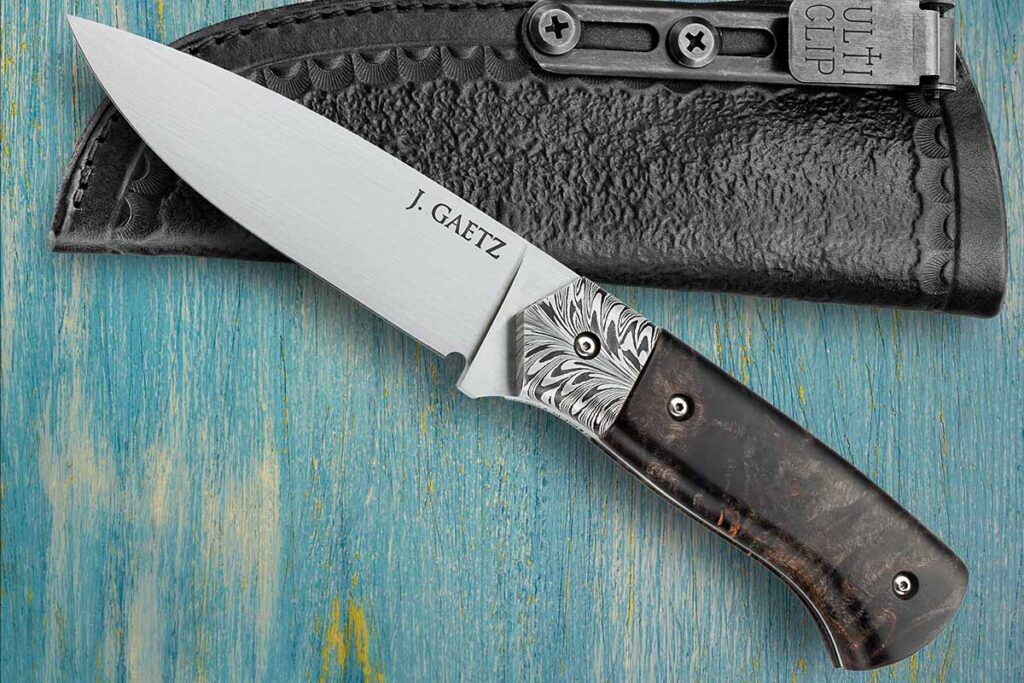
Jacob Gaetz forged the 4-inch blade of his fancy hunter
Daniel O’Malley advised that each year new miracle steels appear but often lose popularity after a year or two because they may not pan out. Conversely, tried and tested steels like CPM S35VN, Takefu SG2, 52100 and more are great benchmarks to test against. Jacob Gaetz forged the 4-inch blade of his fancy hunter from 52100. (Jocelyn Frasier image)

“I never talk to people too much about a particular blade steel,” commented Dave Ellis of Exquisite Knives. “I usually discuss with clients how the complete knife was made, how it was fashioned, and that is more important, I think. Someone may be enamored with a certain type of steel, but that is rare with my clientele and only a consideration in talking about the whole knife.”

Harvey reckons that few knife buyers take the “blade-steel-first” approach. “At least I would hope not,” he asserted. Farina added, “There are a few exotic blade steels out there right now, and these may be sought after just because they’re exotic. Also, some steels have been discontinued and knives with those steels may be selling because of the rarity.”

Taking the entire knife into account is the best way to reinforce a purchasing decision, according to O’Malley. “Knowing the stats on the knife is important,” he reasoned. “We want to know where it was made, who made it, in what country it was made, and what materials they used. That said, judging a knife by just the blade materials used ignores fit and finish as well as heat treatment quality. In some cases the identical steel at the identical Rockwell hardness can still have tremendously different edge holding. In fact, over the years I have found that the quality of heat treatment is perhaps even more important than the steel used.”

Don’t Buy Knives On The Handle Comfort

Lee Lerman, a custom knife judge
Daniel O’Malley said that even if it’s the best knife in the world, if you don’t like the way it feels it isn’t the best knife for you. Lee Lerman, a custom knife judge at BLADE Show 2024, checks the handle of one of the knives entered. In the background are observer Henry Wu (right) of the BLADE Show and judge Rodrigo Sfreddo (center).

“Getting a knife in hand and seeing what it feels like is ideal, though sometimes not possible if you are purchasing from far away,” O’Malley related. “I often advise potential buyers that even if they are holding the best knife in the world, if they don’t like the way it feels it isn’t the best knife for them. That said, some buyers feel a knife is comfortable just because it is familiar—similar to their last knife. They may have gotten used to the last knife and like the way it feels, but a different feel might actually be better, that is, a more ergonomic handle or lighter design. Sometimes it takes using the knife for a while before you know how you really feel about it.”

Don’t Adopt A Herd Mentality

“There are trends out there, but because I’m older and been around the art knife world so long, I’ve thought about the places to put my money,” Farina commented. “If you’re looking at an up-and-comer in knifemaking, check their quality, find out who taught them. That is how I get introduced to them. If they have been taught by an experienced maker, you can tell the quality, and the price may reflect in less money with younger guys.”

From the perspective of “hot styles,” Harvey remarked, “I don’t object to those who want to buy the ‘hot’ knives as long as they are styles and makers that they enjoy and collect. Buyers should always beware of ‘hot’ knife prices and not fall for overpricing.”

“What’s currently ‘hot’ isn’t always best,” O’Malley commented. “The knife industry develops relatively slowly and though each year we see new miracle steels come out, they often lose popularity after a year or two because they may not have panned out. Tried and tested steels like S35VN, Takefu SG2, 52100 and more are great benchmarks to test against.”

Don’t Overlook Makers By Name

Loveless hideout model in stag
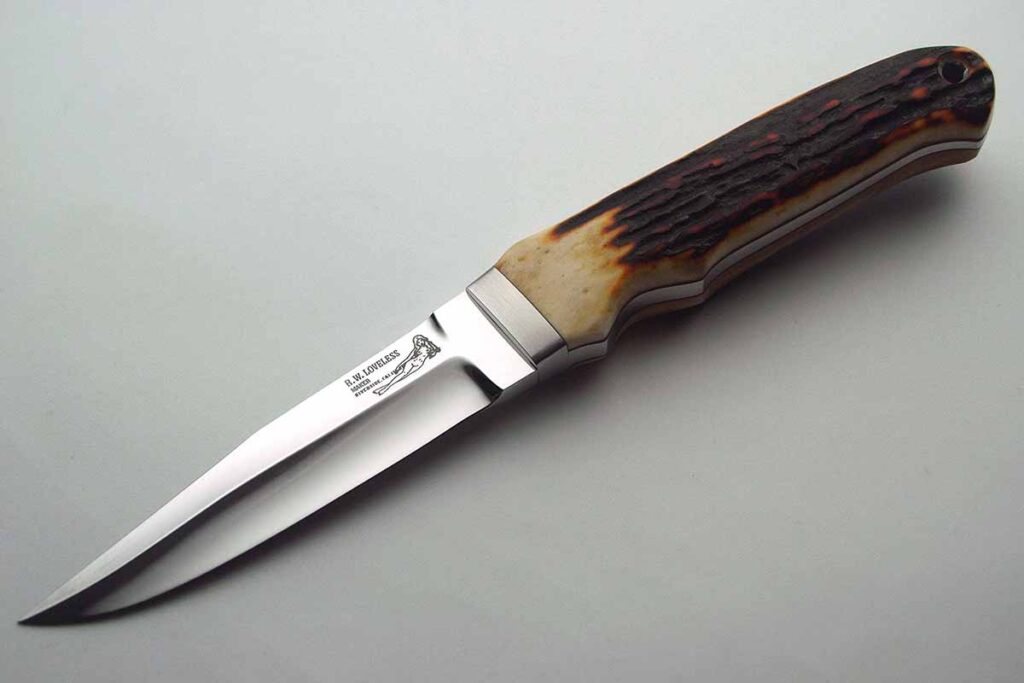
Dave Ellis said that instead of buying 10 knives you can afford, save up and buy one made by Bob Loveless. A Loveless hideout model in stag and with the iconic Naked Lady logo would be a good place to start. (Exquisiteknives.com image)

Ellis looks long-term and sees intrinsic value in the known commodities. “I recommend the blue-chip makers,” he declared. “Instead of buying 10 knives you can afford, save up and buy that one Loveless. This year I’ve sold 14 Lovelesses and the pricing has not gone crazy. So, an entry level $5,000 knife is not so ‘out there’ for someone.”

According to Harvey, most big-name makers have an established collector following, which typically relates to a lasting market for their knives down the road. However, O’Malley points out the benefits of considering numerous makers.

“The knife industry is full of tiny workshops that are doing the best work in the industry,” he noted. “While there are also some great big-name makers, these smaller shops are more likely to provide more bang for your buck. Additionally, in many cases, small workshops may be putting more attention toward quality of heat treatment, which can result in much higher performance.”

Don’t Overrate The Investment Factor

“Buying for investment is something I love because of the fact I can make money on knives,” Farina explained, “but this is not a blue-chip investment stock. So do it for the passion and love of the product. However, if the goal is only for investment, then be very structured. Listen to an adviser. I had a customer come to me after spending a lot of money in four years. He wanted to sell and make 20 percent profit on all the knives [he had bought]. Maybe that would happen on some stuff, but it is a bit unrealistic.”

O’Malley added, “Knives can be a great investment. Over the years, I have seen many knives increase dramatically in price, though certainly there are some that hold their price and even some that go down. Picking the right knives for investment does take a time commitment. You need to research and know the maker and their work. How does the knife fit in the range of knives that maker creates? Will the materials hold up over time? Where is the maker in his or her career? Taking all this into account, it is possible to collect knives as a great investment, though keep in mind that even with the best research not every investment will work out.”

For Harvey, the investment path requires some preparation. “Smart buyers can and do successfully invest in certain knives,” he said. “This does require a lot of knowledge and patience, as you generally won’t see significant increases in value in the short term. For most buyers, I suggest buying what you like and enjoy for your collection, not expecting a large return for it upon sale.”

Don’t Exceed Your Knife Buying Budget

Jurgen Steinau fixed-blade knife
Dave Ellis recommended setting a price limit at auctions and don’t exceed it or you will find yourself paying a lot more than necessary. “I remember a particular Jurgen Steinau fixed-blade knife a few years ago when an overseas bidder and a guy from the Bay Area were in there. The knife went for $110,000,” Dave noted. “People were in there butting heads and then it became an ego thing.” Steinau’s unique style is reflected here in his Folding Knife LBS. (Eric Eggly/PointSeven image)

Ellis provides sound wisdom on auction bidding. “Set a price at the auction and don’t go over the limit and find yourself suddenly paying a lot more than you wanted to pay. I remember a particular Jurgen Steinau fixed-blade knife a few years ago when an overseas bidder and a guy from the Bay Area were in there. The knife went for $110,000,” he noted. “People were in there butting heads and then it became an ego thing. Also, don’t buy with an eye toward flipping the knife. Avoid bid ups like the plague.”

“Auction sites tend to have horrible photos, making it impossible to ascertain what a knife is really like—and what it is worth. Since fit and finish as well as condition are so important to value, figuring out what to bid can be near impossible. Additionally,” O’Malley opined, “auctions can be a way to end up paying much higher than a direct-from-maker price.”

Don’t Discount Second Opinions

“Second opinions are nice and not too hard to get on many knives,” Harvey pointed out. “There are online forums and other social media outlets where collectors share information on many makers and knives.” Take advantage, then, of the availability of information but consider the source always.

“Knives are pretty personal,” O’Malley observed. “What works for you might not work for your buddy. It’s always fun to walk around a show with someone so that you can bounce ideas off each other, but at the end of the day, buying what you like is probably most important.”

Don’t Buy Knives Under Duress

Never feel pressured to make a knife purchase. Don’t always accept the line that the knife you are considering could be gone in the next few minutes. Take a deep breath and make the most informed decision possible in the current environment. If you don’t feel totally positive, walk away.

“Many knives are literally one in the world,” O’Malley said. “This means that if you don’t buy it, there is a chance that it will be gone. Over the years, I’ve found a good way to evaluate is to ask yourself, ‘If this knife sells to someone else, in three to five weeks will I be frustrated and still want to purchase it?’ If the answer is no, you probably didn’t need to purchase the knife. There will always be others. There are, however, a few knives that I didn’t buy that even years later I wish I had purchased. Figuring out if this is one of those knives lets you know to buy it before someone else does. Any big collector has had a few knives they didn’t purchase quickly enough that they still regret not purchasing today.”

Don’t Always Discount Deposits

heat treatment of knives
Over the years of buying and selling knives, Daniel O’Malley said he found that the quality of heat treatment is perhaps even more important than the steel used.

“If a maker requires a deposit, he or she must be a good accountant,” Farina related. “Some are not businessmen. They are artists and machinists. So, it’s about reputation and feeling good about the maker you are working with.”

Trust is a big factor across the board. “Paying for a knife before it is completed can be complicated,” O’Malley maintained. “A well-regarded maker once summed up the problem: ‘It’s very hard to work on a knife that’s already paid for.’ That said, collectors often commit to a purchase, have a knife made, and don’t complete the purchase or just ghost [stop communicating with] the seller. For this reason, I feel it is reasonable to pay a relatively minimal deposit, 10 to 20 percent of the cost of the knife, when purchasing directly from the maker. If working through a purveyor and having a knife made, it isn’t unusual to have to pay the full amount up front since the purveyor is committing to the purchase for you.”

Stay Informed

Advice is free, for sure, but it comes from the voices of experience. When buying a knife, it pays to listen to those already engaging in the process. Of course, every situation is a bit different. There are always additional considerations. The bottom line is to approach a knife purchase on an informed basis. That translates into a confident buy!

More On Custom Knives:

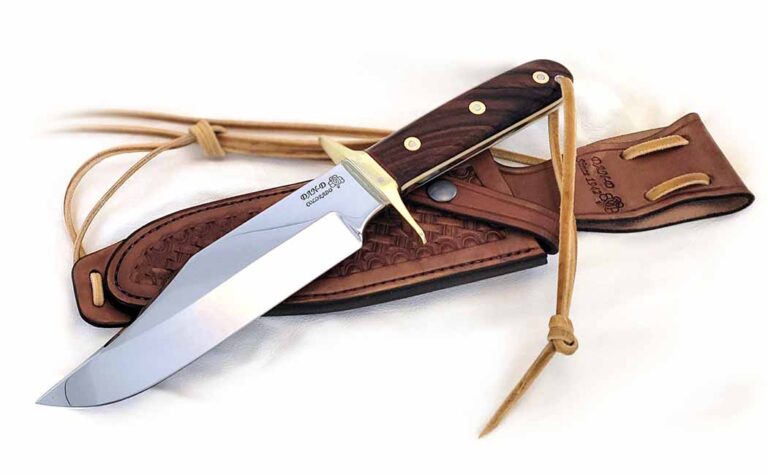
Huber Foxworth Bowie: The Men Behind The Blade

The men behind the Huber Foxworth Bowie are as captivating as the knife itself.

This is the story of a knife named in honor of an incredibly special man. In this highly populated world not many people get their name attached to anything. I do, however, know for a fact that Craig Fox Huber was very proud of the idea that people would be wanting the knife that bore his name for decades to come. He told me so in person. He lived a life that so many would aspire to but very few would have the moxie to follow through on. He was the real deal.

So, how did Craig impact a knifemaker to the point of naming a knife the Huber Foxworth Bowie? Here’s what my father, BLADE Magazine Cutlery Hall-Of-Fame® member Dan Dennehy, wrote about Craig in his 1970 Dan-D Knives Brochure:

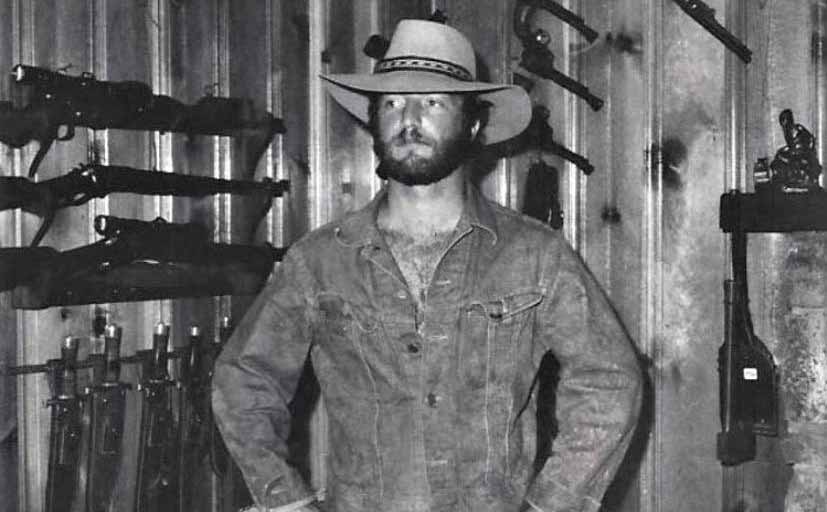
Many self-styled “experts” have stopped by my shop from time to time to suggest to me how I should design the “perfect” knife … Not long ago a trim bearded crewcut type found his way to my shop, and we started talking knives. [Circa the late 1960s] I took an immediate liking to this handsome, rather cocky gent and was pleasantly surprised to learn that he spoke about knives with a rather rare understanding of design and more than just a rudimentary knowledge of metallurgy that I found uncommon even among some men whose names would be familiar to you as supposed “experts.” He not only talked good theory and design, but he spoke with considerable authority on how a fighting knife should be used.

Craig Huber
That’s Craig Fox Huber inset circa 1970 at the Fox Den’s second location in Mountain Home, Arkansas.

During our conversation I learned that he had earned three Purple Hearts while serving with a Marine Recon Unit in Viet Nam, and enough other “breast hardware” that when he spoke, I listened with both ears, and rather attentively.

Those who knew Dan might realize that these comments mean he really respected the “cocky gent.” And Craig respected Dan. Their long friendship stayed the course until the end. I also had a lot of respect for Craig and his vast knowledge of knives and other things.
I met him in the early ’70s at The Fox’s Den, his gun shop located in the small ranch community of Kirkland, Arizona. Dan took me there to meet Craig when I was about 13. I shook hands with a man wearing a drop-loop gun belt with rounds in every loop and a .45 Long Colt pistol in the holster. I was in awe. I also got to see some of the knives he carried and to learn why he carried them.

About a year later my family bought a small ranch in the area. I visited the gun shop at every chance. Dan would take me to Craig’s home occasionally. I was equally impressed at his collections. The next summer I worked for Craig, helping with his horses and other stuff around his place. They were good times and I must say that it was from his influence that I went to see the United States Marine Corps recruiter a few years later.

Craig Huber: Christian Patriot

Craig’s son Hunter can tell you better than anyone about his father. Of Craig he wrote:

Dad was a lot of things. He was a soldier, a gunfighter, inventor, storyteller, adventurer, hunter, fisherman, survivalist, outfitter, collector, gunsmith, writer, and the list goes on. He was a patriot and a Christian. He lived his life to the absolute fullest and would fight for everything he believed in and loved.

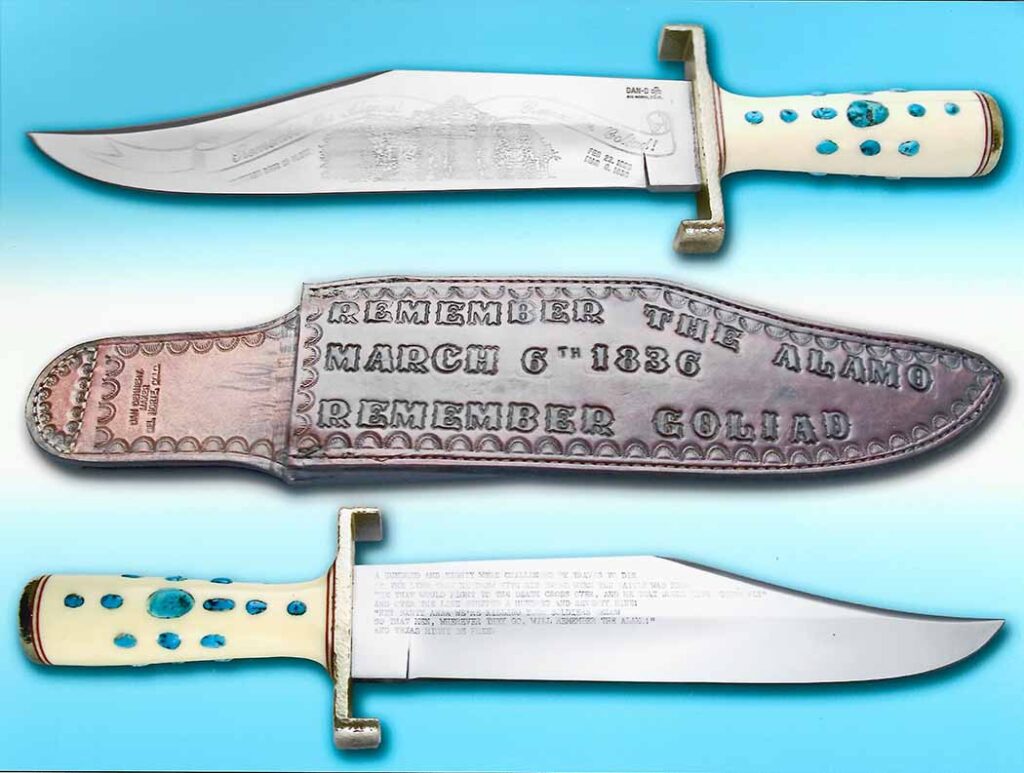
Two sides of bowie knife
In his vast collection of Dan Dennehy knives, Craig’s favorites were the Dan-D Alamo Bowie and the Huber Foxworth Bowie. The Alamo Bowie has a 12-inch hollow-ground blade a quarter-inch thick and 2 inches wide. The blade’s non-mark side is etched with an eight-line poem that commemorates Col. Travis’s call for “defenders to step forward.” The handle is walrus ivory inlaid with 18 turquoise cabs. Overall length: 16.5 inches. The custom sheath is cowhide. (Bob Glassman image)

Despite having the option to go work for his father’s rapidly growing company in York, Pennsylvania, that was obviously of no interest to Dad so he went into the military. Even though he had trouble with authority and rules, he thrived in the Marines.

After the military his life got really interesting. His resume speaks for itself but here is a summary: police officer; sheriff; private investigator; horse wrangler; hunting guide, Ozark Mountains; fishing guide, French River, Canada; gun shop owner, Fox’s Den (Kirkland, Arizona, and Mountain Home, Arkansas); salesman, Camillus Knives and Levis; personal protection, bodyguard for Saudi Royal Family; professional hunter, South Africa; writer, Whitetail Times magazine and several personal protection books; gunsmith; gun dealer; private security, consulting and training; fugitive recovery; and much more. This is a very general overview and it took him to some very interesting places and dangerous spots, and he met some really interesting people along the way.

So here is what Dad loved. He loved his country and God. He loved our mom. He loved me and my sister. He loved adventure. And he loved guns and knives. Dad was an encyclopedia of firearms, handloading and ballistics. He had a real passion for Rugers, Ruger M77s in any and every caliber they make, but especially 7×57 and Ruger single action pistols. He was also a 1911 fanatic. I don’t remember a single occasion in my life where I ever saw Dad without a 1911 on his side or in a shoulder holster.

And he loved knives. Man did he love knives. I don’t know exactly where in his life this interest started, but he was as passionate about knives as guns, and maybe more. And this is coming from a guy whose gun collection is over 500. He loved all knives and always carried at least two at a time. He had a real appreciation for a good blade and considered knives the most valuable tool an outdoorsman or soldier could have.

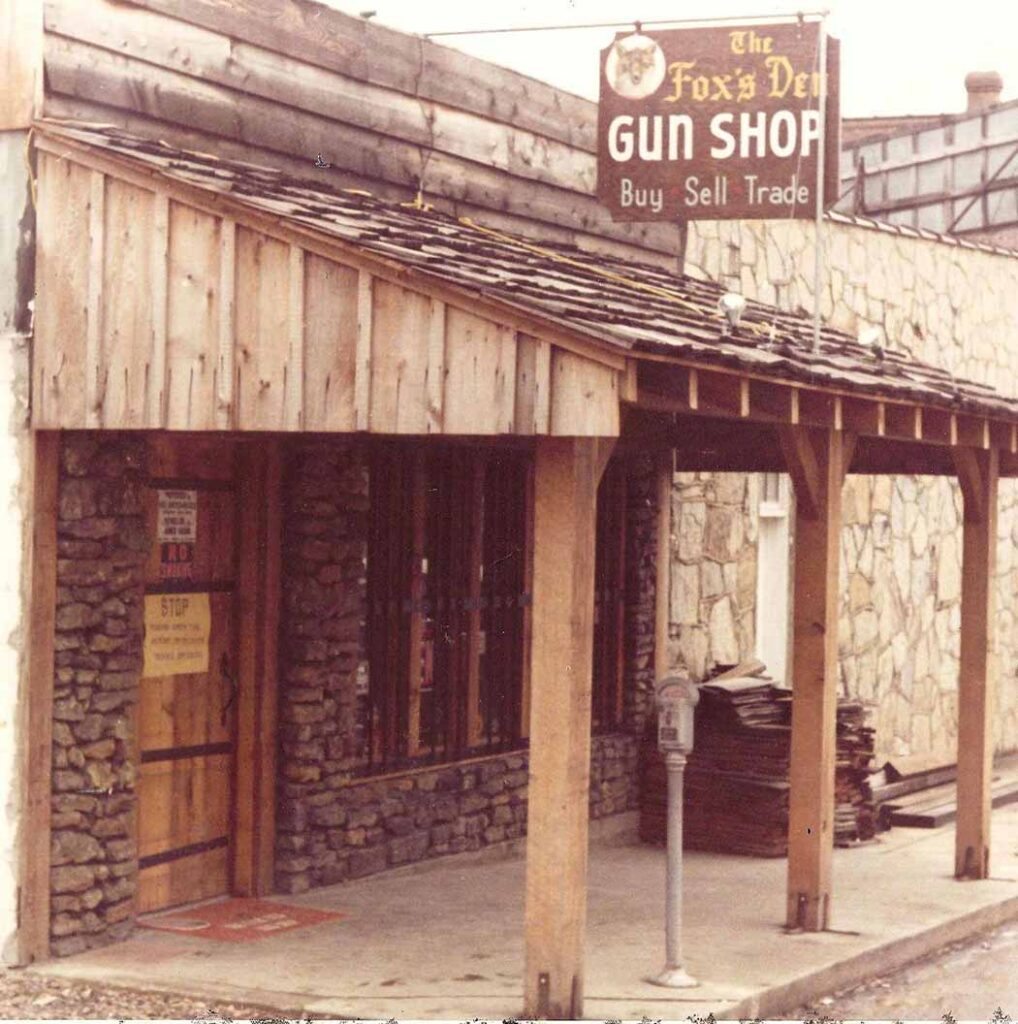
Fox's Den Gun Shop
Here’s the second iteration of The Fox’s Den Gun Shop as it appeared in Mountain Home, Arkansas. Note the sidewalk parking meter.

As you would expect, just like factory rifles with factory ammo were not suitable for Dad’s standards, neither were factory knives. As a result he started reaching out to custom knifemakers and collaborating. He formed relationships with Bo Randall, Jimmy Lile, Art Wiman, Clyde Fischer, Blackie Collins, Harold Corby and George Herron, and most notably Dan D. Dad spoke of Dan D. with a manner of respect and admiration that he did not offer up lightly to many. A shared respect and appreciation for the art and skill behind making the ultimate tool, something that was practical and efficient, beautiful and deadly. Dad’s collection of Dan D. knives is vast but his two most prized are the Alamo Bowie and the Huber Foxworth Bowie.

Dad was the toughest man I’ve ever known. A real fighter, rock solid, set in his ways and unshakeable. No matter, if you had a problem, my Dad would be your first call and the man you wanted in your corner. Dad had a lot of fans and a lot of enemies. He had many acquaintances and peers and only a small handful of good friends. He always said if you get through life and only have a few good friends, real true friends, then consider yourself lucky. Dan D. was a true friend of Dad’s.

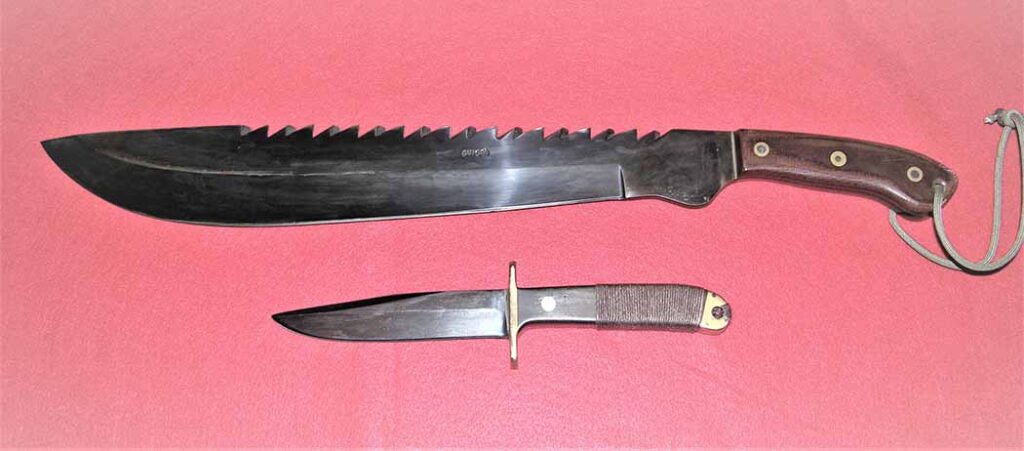
Machete and knife
Two of Craig’s favorite Dan-D users included a survival machete and a Woodsman model. Craig designed both, with Dan-D making the former and helping Craig make the latter in the Dan-D shop. Craig carried the Woodsman more than any other knife for over 40 years.

Craig was one of those rare characters you meet along the road of life and always remember. Later he told me stories of discussions with Cutlery Hall-Of-Famer Bo Randall and knife designs for different purposes. Another story was how he talked to Cutlery Hall-Of-Famer Bob Loveless about the simplicity of balancing a knife using his personal theory of the tapered tang. He visited with his friend Cutlery Hall-Of-Famer Jimmy Lile long before the Rambo knife was created. John Horrigan told me about their hunting trip in Africa. Since Craig was a licensed guide the trip was arranged in exchange for a knife identical to the one John presented to President George W. Bush.

Huber Foxworth Bowie

But back to the Huber Foxworth Bowie. The brochure description continues:

This knife is a pure and simple Bowie style but with the handle dropped slightly which seems to give it a much better “pointing” ability and maneuverability not found in most common Bowie styles. [Craig] had a prototype of this knife made for him by a Philippine Negrito instructor while he was attending the armed forces Jungle Survival School in the Philippines. Pound for pound these little Negritos are about as slick and fierce a knife fighter as will be found anywhere.

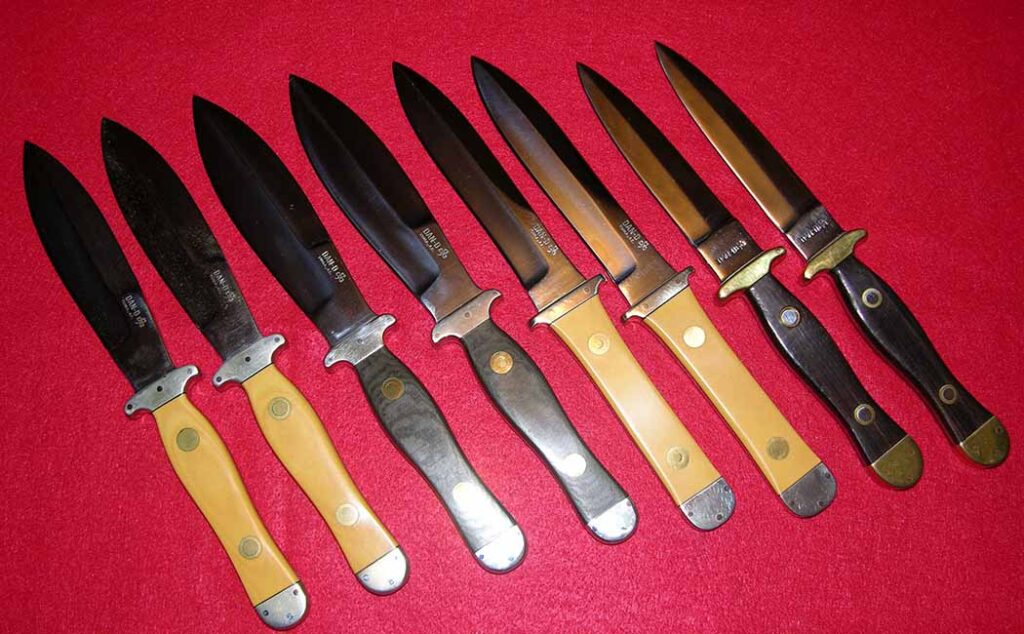
Knives
In a 2011 email to the author Craig wrote, “This [image] shows all four pair of boot knives your Dad did for me, including two pairs of my Model III. All have been carried extensively over the past 40 years, and two of the knives have saved my life.”
The blade is 8 inches long, 1.75 inches wide and in quarter-inch stock of 154 CPM stainless steel heat treated by Cutlery Hall-Of-Famer Paul Bos. It has a double guard and a 4.75-inch handle. According to the brochure, “This is a knife you could bet your life on.”

A couple of years ago, Hunter contacted me and told me of his father’s passing. Craig lived 76 years his way and made his mark in the world. His passion for God, his country and living life to the fullest extent had been accomplished. Hunter went on to explain that out of all the knives they cannot find the one that meant more to Craig than the Huber Foxworth Bowie.

Check Out More Cool Custom Knives:

Advertisement

Must Read Articles

Read this before you make a knife

Knifemaking 101 – Read This Before You Make a Knife

  by Wayne Goddard My experience has taught me that there's nothing like digging in and getting started. I've often said the hardest part of the...
how to forge damascus steel

How to Forge Damascus

Advertisement
Advertisement