Home Knife Collecting

Knife Collecting

Knife collecting is an extremely rewarding experience for knife enthusiasts. There truly is a knife for everyone. Many increase or hold their value throughout the years, making collecting knives something to pass on to the next generation of knife collectors.

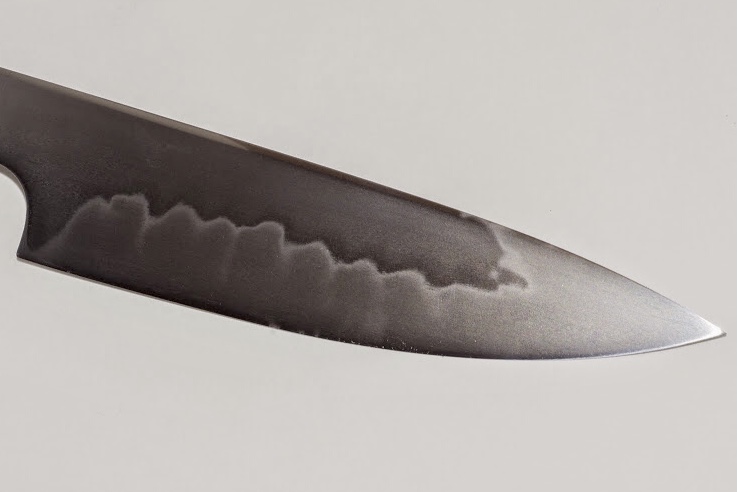
The Hamon: What, Where, Why and How

To those who appreciate the tempered steel of a Japanese sword, the hamon is visual evidence of the maker’s effort to produce the finest blade work. In the West, the hamon appears in much the same fashion on Western knives, a blending of culture and craft. Where East meets West on the steel blade, there is the hamon, the graceful temper line.

“From a practical point of view, the hamon is a visible indication of a differentially heat-treated blade,” explained knifemaker Stuart Branson. “In many cases, it’s advantageous to have a harder edge supported by a softer spine in a knife. In this way, you gain the benefits of the good edge retention afforded by the harder edge with the durability of the softer spine region of the blade. In the long and graceful form of the Japanese sword this might seem obvious, but the same is true for Western blades, particularly those hard-use knives or the very popular larger chopping knives.”

According to veteran maker Gary House, the aesthetic effect of the hamon is behind its surge in demand among Western collectors, clearly defining the transition zone between hard edge and soft back.

“The popularity of the hamon on non-Japanese blades today, I believe, is the visual effect of the temper line,” he commented. “The movement and variations of the hamon are very attractive and visually appealing compared to a straight temper line.”

More and more, discriminating knife customers are looking for the hamon on the blades of some of the best-known, iconic Western-style knives.

“‘You will put a little something in the blade, won’t you?’ is a common request these days,” commented Mike Craddock, who started making knives in the 1970s, took a 40-year hiatus, and has come back strong recently. “It doesn’t necessarily make the knife better, but it does look good. I consider it the spirit of the steel.”

Certainly, the hammered and heat-treated steel is expected to be sturdy. However, the quest for the hamon is a classic case of discovering what lies beneath.

“For me, it is the mystery of the hamon,” related bladesmith Erik Fritz. “What shape is it going to take? How much work is it going to entail to bring it out so it can be seen? I think what makes it so special is that each hamon is so different and unique.”


PRODUCING THE HAMON

The hamon is there, lying within the reach of the knifemaker who is willing to take the time to thoroughly rub the steel to enhance the elusive line. For some makers, that effort is standard procedure. To them, a blade without this unmistakable flair of the Orient just comes up short. A hamon on Western knives bridges cultures and demonstrates a willingness on the maker’s part to invest the time and energy required.

“Like many, I have always been enamored of the Japanese sword,” Branson said. “The hamon is integral to its design and construction, and although it isn’t necessary that it be brought out to that degree, polishing these swords has been elevated to an art.”

Branson says he attempts to achieve several goals in the production of the hamon. First, he wants to emulate the beauty of the Japanese blade. In the attempt, he learns to see the intricacies of the pattern, theory of design, and the dedication of the artists that have gone before him.

“Producing a hamon is not just adding clay to a blade and hoping for the best,” he reasoned. “It is understanding the steel being used, the temperatures and times needed to achieve your aim, and the amount and pattern of the clay to produce the hamon you are after, the delicate process of heating the blade properly before the quench and, in the case of water quenching Japanese-style blades, the terror and elation of a successful water quench—the violent transformation of the steel into two forms above and below the hamon line, and the resulting curvature induced. One can understand how the swordsmiths approached their craft with a religious reverence.”


WATER VS. OIL QUENCH

Producing the hamon involves a process of coating the blade with clay and then quenching it in either oil or water. The water quench is more rapid and therefore potentially more catastrophic should a crack or complete break occur.

“I use clay and white crushed stone,” House noted. “A paste of satanite also works well. The clay insulates the blade from heat and will be a thin layer as it comes down toward the edge of the blade.”

Most makers who frequently produce a hamon opt for such tool steels as W1 and W2, and carbon steels such as 1050, 1075, 1084 and 1095. “Simple carbon steels are conducive to the very fast quenching requirements of a clay-coated quench,” Fritz remarked. “This allows the insulating clay to retard the hardening of the coated areas of the blade. High-alloy steels that allow thorough hardening of the blade are not conducive to the creation of a very active hamon. What you get with the high-alloy steels is more of a straight line.

“With W2 I prefer the water quench,” Erik continued. “With 1084 and 1095 I use Parks 50 quenching oil. Any hamon requires an insulating layer of clay to be applied to the spine. The biggest difference in hamon activity is in the quenching medium, such as water or oil. In my experience and opinion, greater hamon activity is achieved through a water quench. If you are going the safe route and using oil, there is less chance of a catastrophic blade failure.”

Branson said he sees fundamental differences in the hamons produced and the effects of the water or oil quench on the steel itself. On Japanese-style blades, the water quench introduces sori, or curvature to the blade. As the water quenches the steel, the uncoated steel cools quickly while the coated spine retains heat, staying expanded longer and causing the blade to curve downward. As the spine cools, the hardened edge begins to curve upward.  Quenching oils are typically made for industrial use and to prevent deformation of the steel as much as possible. Consequently, the blade tends to curve downward and remain so.

When quenching a blade in water, Stuart added, “The hamon tends to be more cloudlike, more diffuse, and to my mind a little more mysterious and poetic. The oil hamon, however, is more literal, more willing to follow the clay pattern and is more defined on its boundaries. However, the ashi, the wispy lines that come off the main patterns, can be very delicate and defined. Control of this can make for a very exciting hamon.”

The investment of both materials and a significant amount of time impact the cost of a blade complete with a hamon. However, for the maker willing to commit the time and the potential buyer, a genuine value is readily apparent.

“You do have extra work in claying the blade,” Craddock said, “and then there are literally hours of hand rubbing to get the aesthetics right. The steel does what it wants to, but there is a process that you go through. The steel offers it if you are willing to go out and get it. To me, the time involved in the hamon, and about 90 percent of the steel blades I make have them, adds about 10 percent to the cost of the knife—but from the standpoint of hours it should probably be double.”


LANGUAGE OF THE BLADE

The hamon brings beauty and satisfaction to the maker and the buyer. Further, it is taking its place among the desired aesthetic effects of Western knives, proving that the world is indeed much smaller when the same language is spoken—in this case, the language of the blade.—BY MIKE HASKEW

What To Look For in a Hamon


Discriminating knife buyers looking for a quality hamon should bear a few things in mind. A hamon can be wavy, undulating or any number of shapes. Whatever the shape, it must be well formed, clear and unbroken. What’s more, according to Don Fogg, it must be possible to describe in an understandable manner using a traditional vocabulary.

Erik Fritz advises that a professionally done hamon will exhibit a sharp demarcation between the hard and soft areas. Watch out for a hamon line that dips too close to the cutting edge. Stuart Branson agrees that if the hamon comes close to or reaches the edge of the blade, then a section of the edge is not hardened properly. Levels of refinement in the hamon involve subjective preferences as they relate to clarity and detail.—BY MIKE HASKEW


How To Obtain a Hamon


For more on producing a hamon, see “How To Clay Temper and Obtain a Beautiful Hamon” by ABS master smith Don Fogg in the book, Spirit of the Sword. To order a copy call 1-855-278-0406 or visit www.shopblade.com and click on “Books & References.”

CAPTION FOR PICTURE AT TOP

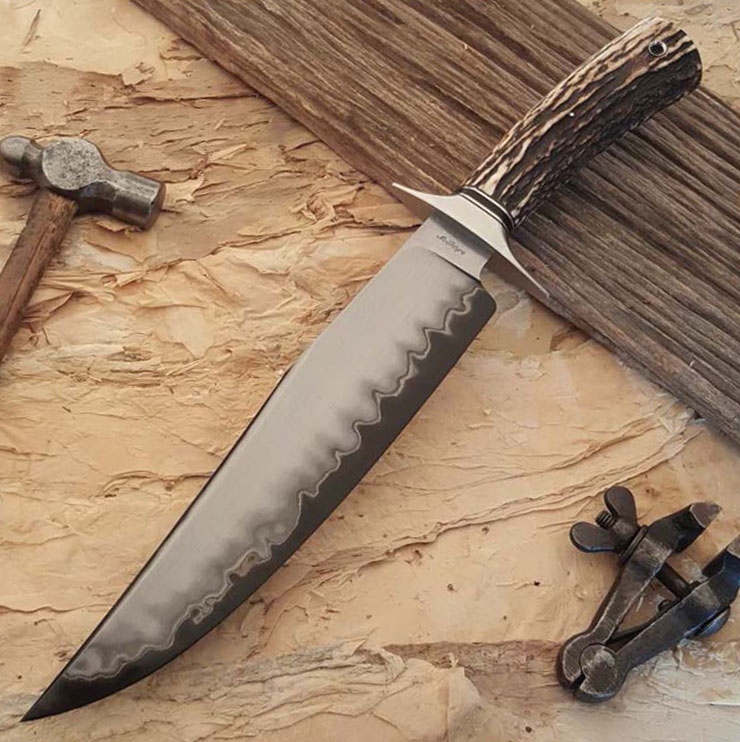
For his stag “Ferncliff” model, Lin Rhea employs a wavy, cloud-like hamon on the 9-inch W2 tool steel blade. Overall length: 14 inches. (Chuck Ward photo)


For the latest knives, knife trends, knifemakers, what knives to buy and where, knife legislation, knifemaking instruction, and much more, subscribe to BLADE® Magazine, the World’s No. 1 Knife Publication.
Is The Scandi The Best Grind For Bushcraft Knives?

Editor’s Note: This article is by both Abe Elias (arguing for the Scandi) and James Morgan Ayres (taking the opposite view). It is excerpted from the April 2019 issue of BLADE.

What Is A Scandi Grind?

Examples of Scandi grind knives
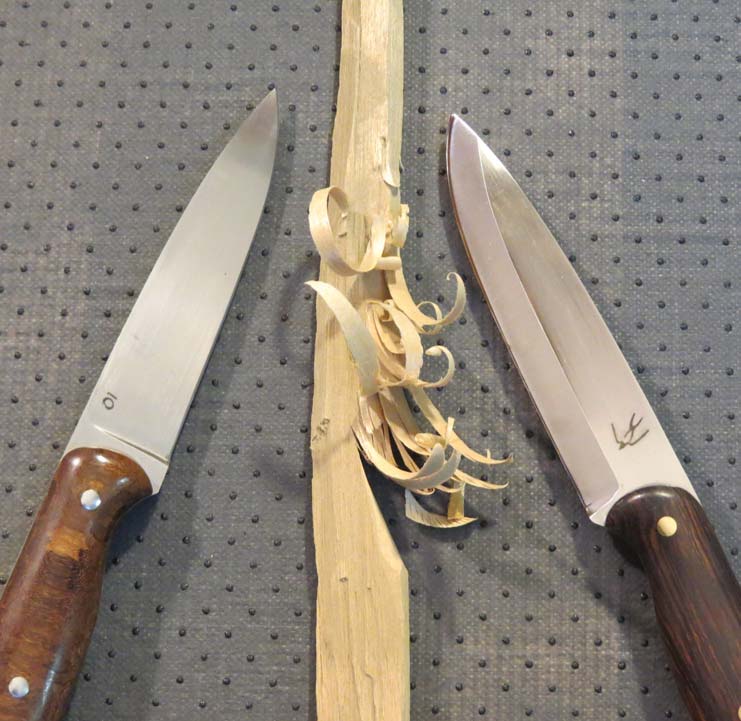
Abe Elias made these two Diving Sparrow Sakers—one with a full flat grind (left) and the other in a high Scandi grind (right). (Abe Elias image)

A Scandi grind carries a single bevel that runs to zero degrees. In other words, it is a single grind only.

Unlike many other grinds, the Scandi runs to the edge with no angle change in what is also known as a zero grind. Scandi grinds have a flat section of the blade that starts at the top of the bevel and runs to the spine.

Anything else is simply not a Scandi. People have tried to create a variety of variations with names like modified Scandi or Scandi vex. In actuality, there are no variations of the Scandi because such “variations” usually are other grinds that already exist.

Why The Scandi Is The Best Grind For Bushcraft Knives

Benefits of Scandi grind knife
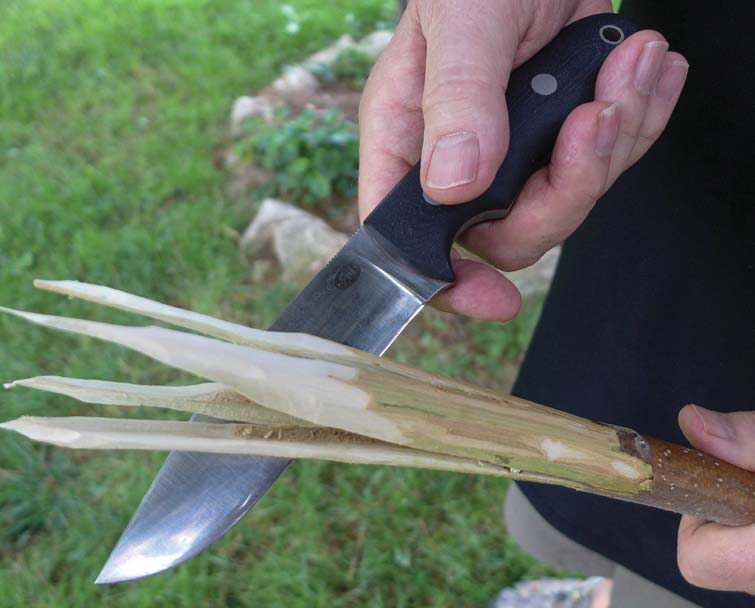
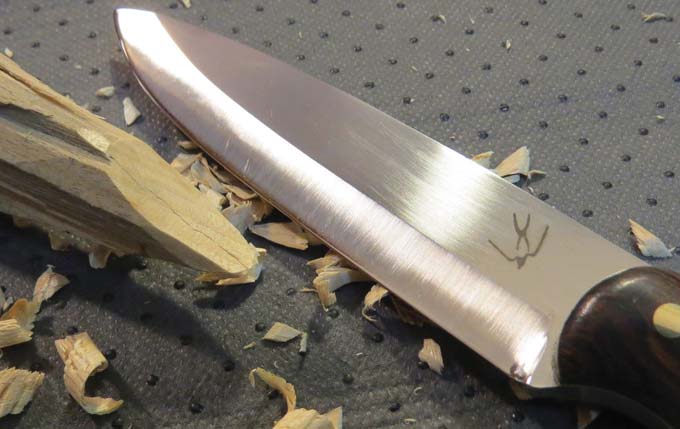
A Scandi grind is a particularly aggressive cutter on soft and hard woods. Look closely at these hardy shavings. The finish on the exposed cut end of the stick looks as if it has been sanded and had a finish applied
to it. (Abe Elias image)

Perfect wood geometry: The Scandi excels at bushcraft chores because its geometry is perfect for working with wood.

Zero grind: The fact the Scandi is ground to zero allows the edge to be as thin as possible with no change in angle. Changes in angle create extra friction. Hence, the Scandi grind meets with the least resistance possible when it enters the cutting medium.
Inertia is your friend: Another benefit of a Scandi grind is that you can achieve a thin edge and, unlike with a full flat grind, you maintain the blade weight of a saber grind. Having that bit of extra spine weight increases your ability to drive the edge forward.

Parting is such sweet sorrow: As the blade enters the cutting medium, it meets the transition point where the bevel changes to the flat. This benefit is one of the reasons why the knife can dive deep into a cut and take off huge potato-chip-like shavings.

Why The Scandi Is NOT The Best Grind For Bushcraft Knives

Best bushcraft knife grinds
James Morgan Ayres uses a Nikov knife with a convex-ground blade to make a fish spear. (ML and AE Ayres image)

Geometry: The intersecting planes of the Scandi grind create a wedge. A wedge is useful for shallow woodcraft on soft woods, such as making fuzz sticks or carving spoons, and for batoning soft woods. However, the wedge creates too much resistance and drags and hangs up in deep cuts, especially in hard woods.

Not ideal for food prep: That wedge also struggles with any dense or tough material, including root vegetables, which crack rather than split, and, importantly, on meat. Try butchering any large game with a Scandi grind and you’ll quickly learn why butchers and hunting guides do not use Scandi-ground blades.

Goodbye, steel: The Scandi grind is also said to be easier to sharpen because the blade provides a guide. But, if the user follows the instructions of the advocates of Scandi, he must remove a great deal of steel, which requires hundreds of strokes on the stone. With a modicum of skill other grinds are faster and easier to sharpen.

There is a better alternative: The smooth, slim, oval profile of the convex grind offers less resistance to materials, is superior to the Scandi on all points and will do everything better.

Verdict

If your bushcraft knife needs are limited to working with wood, you’ll find a Scandi grind will help you work fast and effectively.

For tasks beyond that, you’ll likely find a convex grind is the better match.


What About The Best Knife Books?

The best books about knives are at BLADE‘s official online store, ShopBlade.com.

How to Price Custom Knives

custom knife pricing
The author stated that Australian ABS master smith Shawn McIntyre “has created his following by offering exceptional quality at a value price.” McIntyre’s “San Mai Bowie” features a 10-inch blade in a san-mai construction, a sambar stag handle and a leather sheath. The author’s price: $1,575. (Shawn McIntyre image)

Editor’s note: This article is from the knifemaker’s point of view, but it could also be used by collectors to better understand price.

Make the Equation

what is the cost of a custom knife

Most manufactured products, whether factory or custom made, have similarities. For those of you unfamiliar with cost accounting, one of the similarities is basically what the costs for building a particular item are.

In the case of custom knives, such costs include those for the machines, belts, drill bits, saw blades, propane, tongs, hammers, etc.—in other words, anything in the shop used to produce the knife.

Other items not necessarily taken into account are those such as the cost of electricity, machine wear and tear, etc. Obviously, materials are easy to account for.

Then there is the amount of money you want—want being the operative word—to make selling your knives, followed by the amount of profit you want to make. The resulting equation is:

Shop time + material costs + maker’s pay (labor) + net profit = the actual cost (or price) of the knife

(Editor’s note: for collectors, the wiggle room on negotiation could be found in the net profit part of that equation.)

When the Price is Too High

RJ Martin custom knives
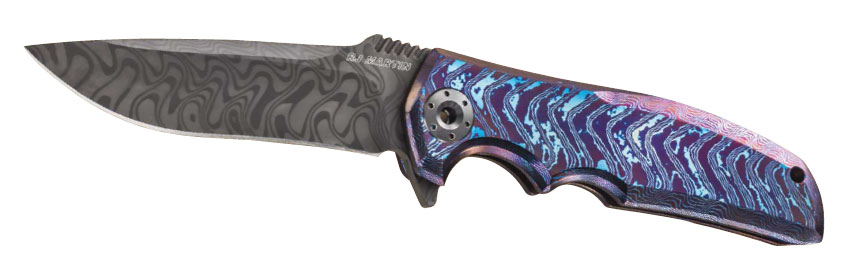
Of RJ Martin the author noted, he “has secured his position as one of the best and most sought after tactical folder makers in the world, due in part to the value pricing he has utilized over the last 30 years.” Martin’s Illudium boasts a 4-inch blade of Chad Nichols Boomerang stainless damascus and a handle of Nichols’ Moku-Ti. The tip-up clip is zirconium. Approximate closed length: 5 inches. The author’s price: $6,000. (Sharp By Coop image)

Again, you’re a knifemaker. Are your knives too expensive? The short answer is “probably.” Over the past 32 years of asking knifemakers the question, the two most prevalent answers I get are:

1) My knives are priced on the advice of another knifemaker;

2) My knives are priced based on what others are asking for similar knives.

While makers who incorporate such pricing strategies can justify them, both approaches incorporate what I call lazy pricing. While you may not realize it, other knifemakers are your competitors.

While they may mean well, their advice for your knives is misplaced. First and foremost they are knifemakers, not knife buyers. What they know are their knives, their market and their clients. This may or may not have any impact on your knives, or, more importantly, the selling of your knives.

In some cases other makers may understand that you are a competitor and suggest you raise your prices, giving their knives more perceived value.

While attending the 1989 Knifemakers’ Guild Show, I was standing at the table of a very well-known knifemaker and checking out his knives. A new maker approached the veteran maker and asked him to critique his knives. The veteran maker asked him how long he had been making knives and for his price for one of them.

The new maker replied, “I have been making knives for two years and this knife is $250.”

The veteran maker said, “You are doing good work. I would raise the price of this knife to $325!”

As you can imagine the new maker thanked the veteran maker, smiled and returned to his table.

In the next few minutes a potential buyer was questioning the veteran maker about the $375 price tag on a particular knife. The veteran maker was quick to point down the aisle, saying, “See that maker right there? He has only been making knives for two years and is asking $325 for one of his knives. Quite frankly, my price is a bargain.”

Whose interest did the veteran maker have in mind while recommending pricing to a fellow maker who sought his advice? To date I have never had a maker using this strategy tell me the veteran maker suggested that the maker lower his or her prices. I found this to be a real eye opener, and it changed the way I looked at custom knife pricing.

When the Price is Too Low

Steve Randall custom knifemaker
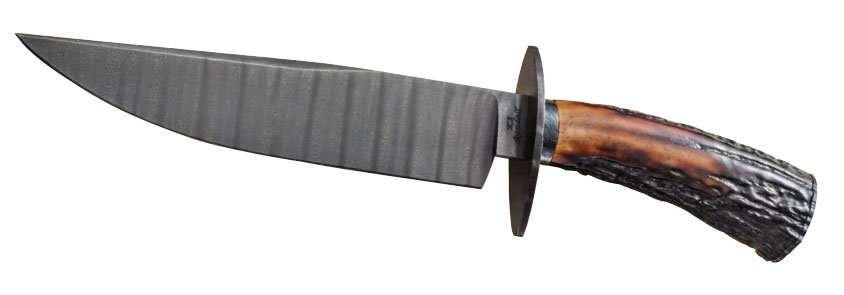
ABS master smith Steve Randall outfits his straight knife in a 7.5-inch blade of ladder-pattern damascus and an amber stag handle. The author’s list price: $1,650. “Steve’s work continues to impress,” the author observed. “Since the inception of his making custom knives, he has always incorporated
value pricing into them.” (Sharp By Coop image)

If you are a knifemaker, remember that, early on, people are paying for you to learn your knifemaking skills—a sort of scholarship program, if you will. The object of the exercise is to get as many of your knives into the hands of buyers as possible. You can do this by utilizing value pricing. Your market position will indicate to you what the price should be.

As your knifemaking skills and following develop, your pricing, because of your rising position in the market, will continue to increase. At this point your pricing will be determined not by a friend or another maker’s similar work, but through your understanding of your position in the market and how you got there.

Ask the Author More About Pricing at BLADE Show 2018

atlanta blade show

BLADE® field editor/custom knife purveyor Les Robertson of Robertson’s Custom Cutlery will instruct two classes on knife collecting during the 5th Annual BLADE University.

Conducted the day before and the Friday and Saturday of the BLADE Show June 1-3 at the Cobb Galleria Centre in Atlanta, BLADE University is the most comprehensive array of classes on the subject of knives and knifemaking of any knife show.

From 9:45 to 10:45 a.m. on Saturday, June 2, Robertson will conduct the class “Knife Collecting for Beginners” and discuss what you need to know before you start buying custom knives.

For more information on these classes and others in BLADE U., visit bladeshow.com.

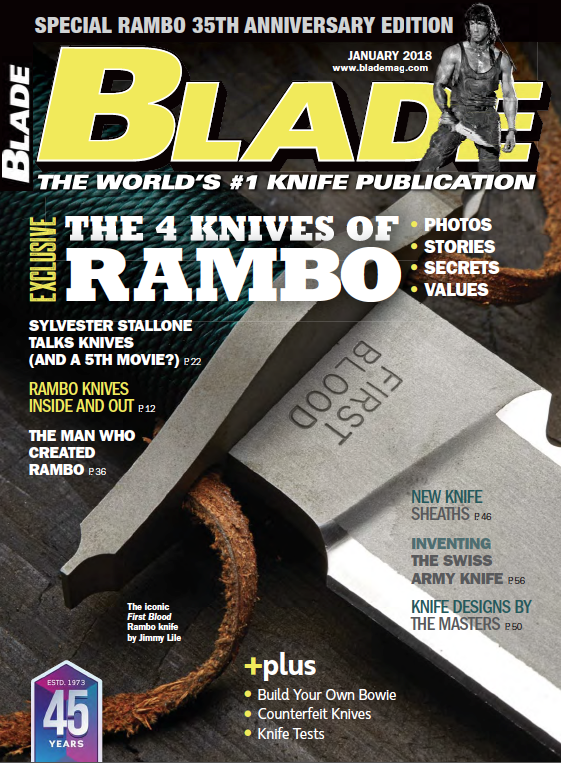
Collecting Rambo Knives: Values, History and Tips

2

Editor’s Note: This article is part of Rambo Week here on blademag.com. Download the Rambo-themed issue of BLADE magazine here.

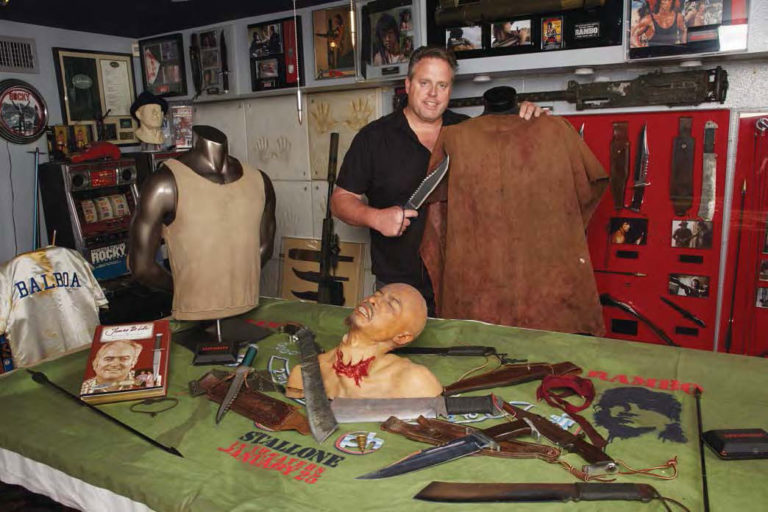
When it comes to collecting Rambo movie knives and movie props, Randy Rousseau takes a back seat to no one. A personal acquaintance of Sylvester Stallone’s, Mr. Rousseau has a collection of all things Rambo unlike any other anywhere.

On the 35th anniversary of First Blood, Rambo and Rambo knives in general, he was gracious enough to grant a special BLADE® interview about his collection, Rambo movie knife values, some little known facts about Rambo knives and much more.

BLADE: What are the values of the original versions of each Rambo knife?

RANDY ROUSSEAU: The original First Blood knives serial numbered one through six are “priceless.” They are screen used and iconic, are owned by Stallone and are in his personal collection.
Numbers seven through 13 are worth anywhere from $50,000 to $75,000 each, and numbers 14 to 100 are worth anywhere from $15,000 to $25,000 each, depending on the number.

Give values for each knife in mint condition.
The first numbers from the Rambo II: The Mission knife sent to Stallone are iconic and from his personal collection. They are also screen used and are “priceless.” Rambo: First Blood, Part 2 was the highest grossing film in the series, which adds to the value from a film-prop collector’s point of view. The rest of the numbers up to 100 sold to collectors for between $25,000 to $50,000 each, depending on the serial number.

How many of each original version of each custom Rambo knife were made?

According to Jack Lucarelli’s book, James B. Lile: The Arkansas Knifesmith, Knifemaker to the World, 13 were made. That’s correct and matches the correct version used by Stallone in the movie, plus the model marked “1 of 1 RAVEN.”

Jimmy Like Rambo movie knife
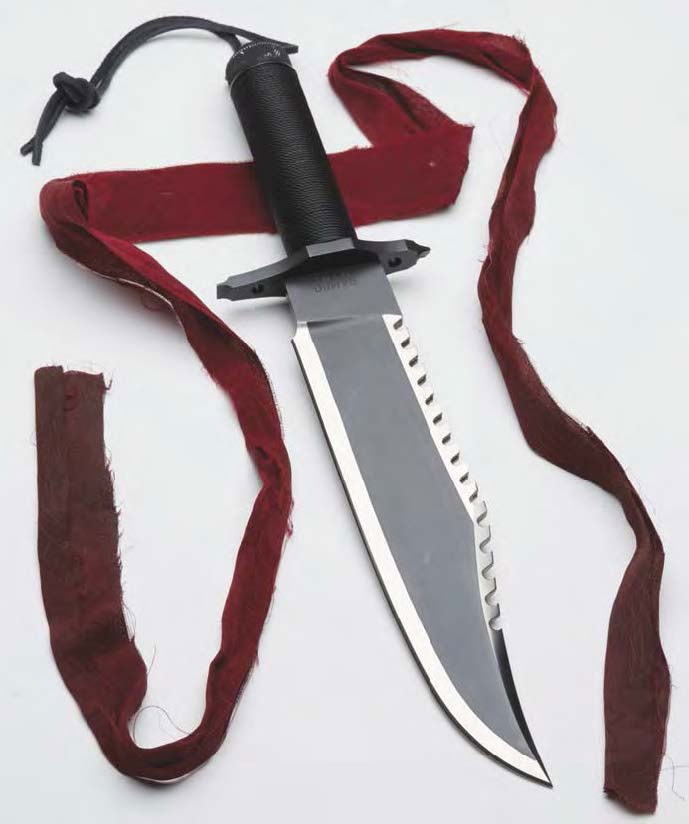
The Jimmy Lile Raven 1 of 1 Mission knife and the headband Stallone wore in the second Rambo movie. In the fi lm, Rambo removes a piece of the dress of the female character of Kos to make the headband. (from the Randy Rousseau collection)

How many of the original First Blood knives were damaged during the making of the movie?

Only one was damaged in filming and the others did survive. For more information see the video below. The knife in that video sold for $90,000.

How much is one of the first seven First Blood knives worth if in mint condition?

$75,000.

Do all of the original First Blood knives still exist or do you know?

Yes. They are in private collections.

Are the First Blood knives with the Jim Buff aloe sheaths more valuable and if so, how much more?

Yes. Five thousand dollars more each.

How much are the unnumbered First Blood custom knives worth in mint condition?

Five thousand to $7,000 each.

What is one of the first 100 Rambo II: The Mission custom knives worth in mint condition?

$25,000 to $50,000, depending on the serial number.

How much is one of the 25 Mission custom knives with black blades worth, in mint condition?

Anywhere from $7,500 to $10,000.

How much are each of the unnumbered Mission custom knives worth in mint condition?

Three thousand to $5,000 each.

How many of the custom Gil Hibben knives actually used in Rambo III were made, and how much is each worth in mint condition?

Six. All are “priceless,” screen used and owned by Stallone, and iconic.

Knife from Rambo III
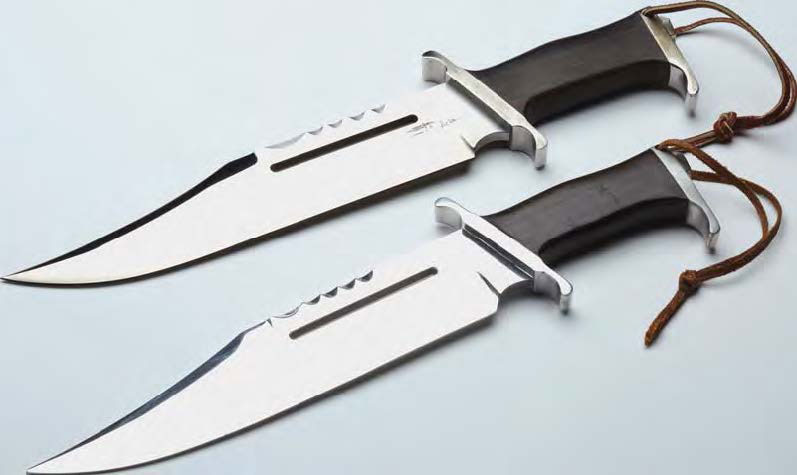
The Gil Hibben Rambo III Raven 1 of 1 (top) with Stallone’s prop custom-made-for-production, screen-used aluminum prop knife (bottom) from Rambo III. (from the Randy Rousseau collection)

You mentioned something about there being two serial number 19 Rambo knives. Were those Liles and if so, please explain why there are two.

Yes, the Mission knife. The original serial number 19 had some issues and was sent back to Jimmy. Rather than repairing it right away, he made another serial number 19 and sent it to the collector. Years later after Jimmy passed away the original 19 had been repaired and sold. The 19 is rare because it’s the only duplicate number in all of the Rambo saga of knives.

Who has them and what are they worth?

I own one of them. The second/replacement number 19 is the rarest of the set of 100 because it’s the only duplicate of the series. It’s worth $50,000. The other number 19 sold on the Internet a few years back for $38,000.

The knife used by Jim Bowie in the Sandbar Fight inspired scores of emulators in both Sheffield, England, and the USA in the 19th century, and the Rambo knife did the same by knifemakers and knife companies worldwide. Is the Rambo knife the modern-day equivalent of Jim Bowie’s knife in terms of popularity?

Yes, 100 percent, due in large part to its being used as a reference in popular culture.

Sylvester Stallone First Blood dog tags
The dog tags worn by Stallone in First Blood next to the Jimmy Lile First Blood 1 of 1 Raven. (from the Randy Rousseau collection)

In your opinion, is the Rambo knife less popular than Bowie’s knife, about the same or more so, and why?

More so. The Rambo knife has worldwide appeal. Nothing will ever come close. It was a moment in time, like lightning in a bottle. It made such an impression on the generation and inspired so many to go into the prop business for films and/or the knife-collecting world. I know folks who have a likeness of the Mission knife tattooed on their body.

It really inspired a generation that put serious interest into the knife industry. Never had we seen a character on film use such an elegant knife in this manner. And after all these years, nothing on film comes close to the Rambo knives seen in the four movies.

What do Jim Bowie’s knife and the Rambo knife have in common?

Their impact on culture. Each is famous for its influence on the knife industry and the public.

How are they different?

They are from different times but defined a generation, like Elvis and Michael Jackson did their generations.

How did the Rambo knife change the custom and factory knife industries?

It brought major interest back to the knife-collector side and created an entire industry of replicas for the common fan. I have been told that the Rambo movies saved the knife business, and with the movies still getting major viewers on cable and downloadable services, the interest is still very strong.

Are there any issues or stories concerning the Rambo knives that you know of that have never been addressed or that are rarely addressed that you think need addressing?

Yes, the Rambo III “Rescue” knife that was used on screen in the minefield. It’s a beautiful version that really doesn’t get a lot of interest but is a very cool Rambo knife. It sort of ties the gap between the first two films to the Rambo III main version from a design point of view.

Also, Jimmy Lile made a 1 of 1 for Stallone with his code name RAVEN on a First Blood version and a Rambo II Mission version. Extremely rare, they are the only 1 of 1 Lile Ravens in existence. In keeping with the Raven theme, Gil Hibben was asked to produce the same for the Rambo III knife. It is marked Raven 1 of 1.

And again for the fourth film, the Rambo IV knife was made and marked Raven 1 of 1, making this the only complete 1-of-1 set in the world from all four films.

Knife used in Rambo IV movie
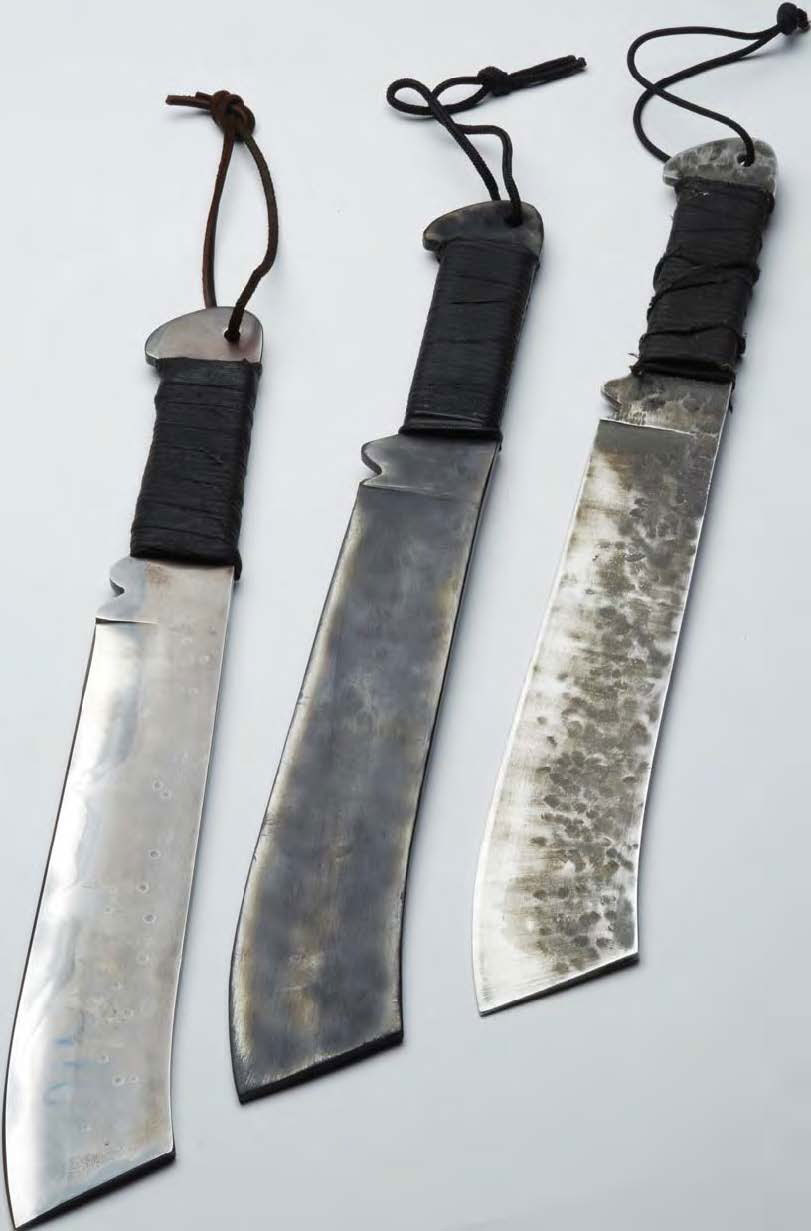
Rambo IV Gil Hibben movie knife (left) with Stallone’s custom-made rubber prop knife (center) and custom-made aluminum prop knife (right)—the latter two both screen used in the fourth movie. (from the Randy Rousseau collection)

Can’t Get Enough Rambo?

knives used in the rambo movies

Download this special issue of BLADE that’s all about these iconic movies. 

Odd Couple: A Wharncliffe Tactical Knife?

What is a Wharncliffe Knife Blade?

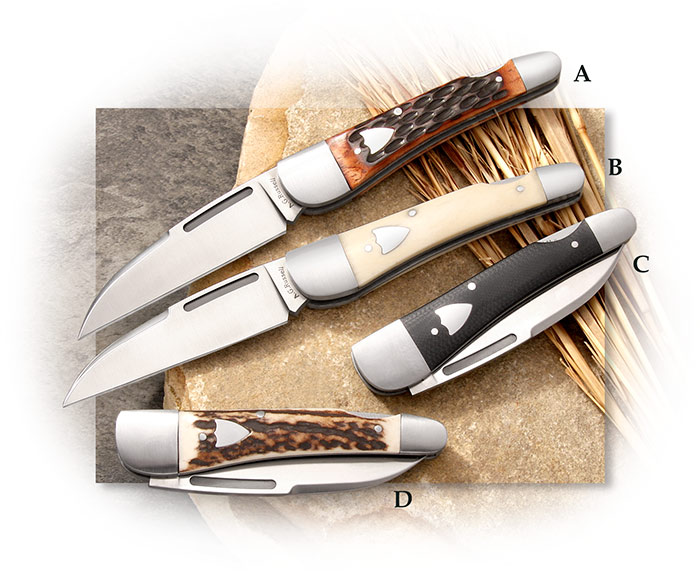
A Wharncliffe is a distinctive style of knife blade characterized by a perfectly straight cutting edge and a spine that tapers to meet that edge at an acute point. Often associated with gentlemen’s folders intended for fine utilitarian cutting, its history can actually be traced back to a specific gentleman of the 19th century—Colonel James Archibald Stuart-Wortley-Mackenzie—the first Lord Wharncliffe of England.

Origins of Wharncliffe Knives

AG Russell Wharncliffe Lockback knife
Examples of Wharncliffe lockbacks, from AG Russell.

According to the book British Manufacturing Industries, around 1820 the first Lord Wharncliffe and his relative Archdeacon Corbett were sipping wine after dinner and lamenting the relative lack of creativity of the British cutlery industry. To address the problem, they put their heads together and designed a new blade pattern that they presented to the Joseph Rodgers & Sons cutlery company in Sheffield. Rodgers adopted the pattern and soon introduced the world to the first “Wharncliffe” blades.

Original Wharncliffe blades sported full flatground edges and had rounded spines that tapered to the points. The pattern has since evolved to include many other variations, but as long as the cutting edge is straight and the spine tapers to meet it at an acute point, it’s a Wharncliffe.

Advantages of Wharncliffe Knives

From a utilitarian perspective, the biggest advantage of a Wharncliffe blade is that it cuts with full power all the way to the point.

No matter where the cutting edge makes contact, it transfers its energy directly into the material being cut and consistently increases that pressure as the cut goes deeper. Even if you’re cutting with the extreme tip of the cutting edge, a Wharncliffe’s straight profile ensures that you’ll do it with maximum power and leverage. That’s why razor knives, box cutters and similar utility cutting tools are typically Wharncliffe patterns.

In contrast, swept edges actually curve away from the material, paralleling the arc of motion of the hand and purposely limiting the depth of the cut. This is best for skinning knives used for chores where cutting too deeply could nick an animal’s intestines or cut through the hide.

The Wharncliffe’s acute point also makes it a great tool for detailed work and, interestingly, enables it to penetrate with less resistance than most other blade styles. Although the tip is admittedly not as strong as some other profiles, it does its job exceptionally well.

Interestingly, all of the things that make the Wharncliffe an outstanding utilitarian blade style also allow it to excel as a personal-defense tool.

Wharncliffe Tactical Knives?

Until recently, however, Wharncliffe tactical knives (at least the pocket-size kind) were relatively uncommon. At the risk of being immodest, I’d like to think I had a hand in changing all that.

I’ve been a knife enthusiast since I was a kid and an avid student of knife combat since my early teens. I also had the great privilege of working closely with the late Col. Rex Applegate during his later years and learning the conventional wisdom of knife fighting and combat knife design directly from one of the topic’s most respected sources.

When I had the opportunity to design my first production knife—the Masters of Defense Tempest—back in 1997, it reflected what I believed worked based on what I’d been taught. It had a classic bowie-style blade, plenty of blade curve, or belly, to slash better and a swedge (false edge along the spine) that created an acute, well-centered point. Essentially, it was a very traditional approach to a fighting blade, scaled down to fit into a folder.

A few years later, Sal Glesser of Spyderco took an interest in my Martial Blade Concepts (then, Martial Blade Craft) curriculum and offered me the opportunity to teach knife tactics under the Spyderco banner. He also asked me to design a signature knife that fit my approach to personal defense.

By that time, I had begun incorporating live-blade cutting demonstrations into all of my courses. With the help of “Pork Man”—a pork roast tied around a wooden dowel and wrapped with multiple layers of plastic—I showed students exactly how to quantify the cutting power of their actual carry knives. In the process, I began to realize that the performance of different blade designs in this simple test varied considerably.

In fact, many highly regarded fighting knife patterns actually cut pretty poorly. Since my system focused on small, legal-to-carry knives and cutting tactics geared toward disabling an attacker, I wanted to make sure that whatever I designed for Spyderco would cut as effectively as possible.

Frank Centofante knife
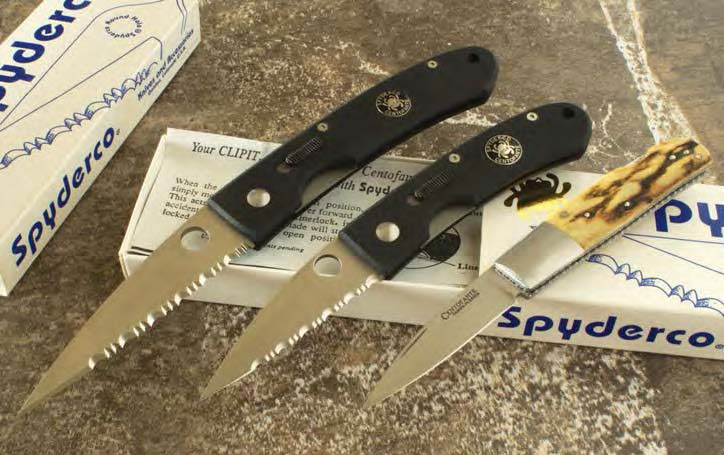
The original inspiration for the author’s focus on Wharncliffe-style tactical blades was the work of the late Frank Centofante, whose gentlemen’s folders cut with extreme authority.

To do that, I invested a small fortune in pork roasts and crafted an army of Pork Men. I then pulled out all the knives in my collection and went to work. The side-by-side cutting experiment was extremely revealing. After several hundred cuts with all conceivable blade styles, grinds and edge configurations, the hands-down winners were a pair of Frank Centofante-designed gentlemen’s folders from Spyderco with classic Wharncliffe-style blades and beautifully executed full, flat grinds.

Their perfectly straight edges invariably cut the meat targets deeper and cleaner than other blade profiles and did not snag on clothing or the target’s wooden “bone.” They also penetrated almost effortlessly during thrusts. Despite their elegant demeanor, they were tactical cutting machines and a clear direction for my knife design efforts.

The Ronin Knife is Born

Around the same time that I was sketching and modeling my folder design for Spyderco, I wrote an article about the work of a then-new custom knifemaker named Mike Snody. Snody was very pleased with my analysis of his knives in the article and even more thrilled when the orders that resulted from that piece launched his career as a full-time knifemaker.

To thank me for my part in making that possible, he invited me to design a knife for him—specifically the “ultimate neck knife.” I was already convinced of the merits of the Wharncliffe, so I took him up on his offer and designed a small fixed blade I named the Ronin. Unfortunately, Snody wasn’t as convinced as I was … at least at first.

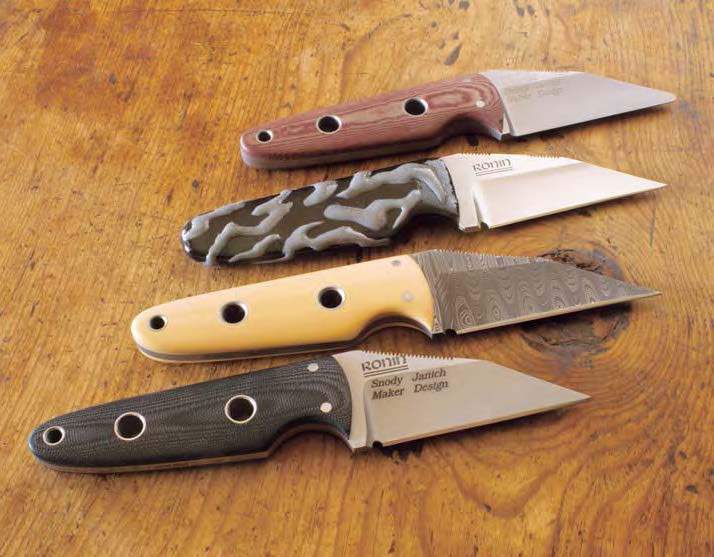
Wharncliffe neck knives
The author’s fi rst tactical Wharncliffe design was the Ronin neck knife, which began as a custom project with knifemaker Mike Snody. Here are several Snody custom Ronins, including an extremely rare (one of two) Ronin trainer (top).

After Snody’s underwhelming initial response, I thanked him for his offer and suggested that he abandon the project to move on with his new career.

He politely agreed, only to call me back several days later. His first words when I answered were, “You evil _______ [expletive deleted]! I’ve never cut with anything like this before!”

It was then I realized that he actually made my design and, more importantly, did some cutting with it. Snody embraced the Ronin design and began turning out a variety of custom expressions of it.

Although I had already submitted a folding knife design to Spyderco, they were still apprehensive about the concept of a tactical Wharncliffe. To test the waters, they decided to do a production version of the Ronin, since product development and production of fixed blades is more economical than folders.

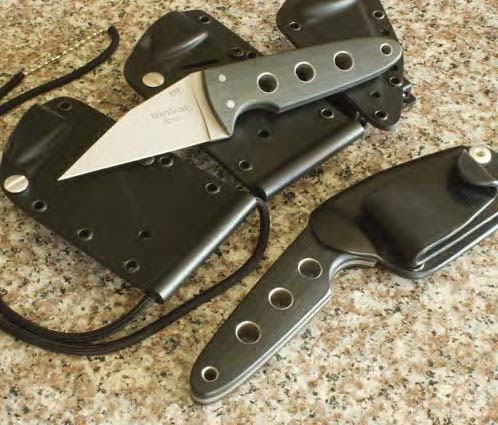
Spyderco Wharncliffe knife
Spyderco put the Janich/Snody Ronin design into production. The knife was sold with three different sheath patterns, all shown here. Also shown is the author’s well-carried Ronin in a Mike Sastre custom Kydex sheath with a J-clip.

The Spyderco Ronin was a reasonably faithful expression of Snody’s custom version produced in Japan. The Kydex sheaths for it, however, were made at Spyderco’s factory in the United States. Unfortunately, the hand-finishing of the G-10 handles done by the Japanese factory created some dimensional variances in the finished knives that made it necessary to have a one-to-one match of sheaths to individual knives. This made mass-production methods challenging and ultimately contributed to the demise of the design, which only lasted one production run.

Despite its limited commercial success, the Ronin did manage to change some minds with regard to tactical knife design. Following the live-blade Pork Man demonstrations I did in my seminars, I had students lined up to buy Ronins. However, I also had a deluge of requests for a folding version of the design. Unfortunately, Spyderco still wasn’t ready to make that investment, so I decided to tip the scales a bit.

I contacted Snody again, who was now firmly established as a full-time maker and had expanded his skills to folder making, and asked him if I could commission a special one-off folding knife. I sent him the drawings of my folder design, which I had dubbed the Yojimbo™ (Japanese for “bodyguard”) and asked him to make one for me, post photos of it on the Internet, and mention that Spyderco might be working on a production version of it. He eagerly agreed and honored all three of my wishes, generating enough interest in the design to get Spyderco to commit to producing it.

Spyderco Yojimbo: A Tactical Wharncliffe Knife

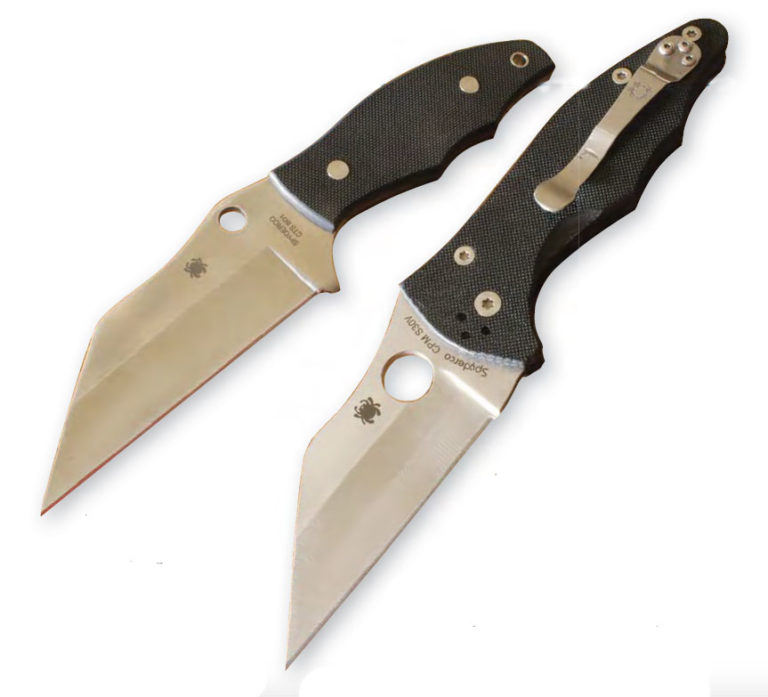
Spyderco’s expression of the Yojimbo was released in 2003. Manufactured in their Golden, Colorado, factory, it featured a fully flat-ground CPM S30V Wharncliffe blade, nested stainless steel liners, blue or black textured G-10 scales and an early version of their patented Compression Lock™ mechanism.

Its 3-inch blade was purposely shorter than its tapered handle because I had designed it before the 9/11 attacks to be legal to carry on airplanes even during heightened security alerts. Although that point was moot after 9/11, it still made the knife a viable choice for carry in jurisdictions with restrictive blade-length limits.

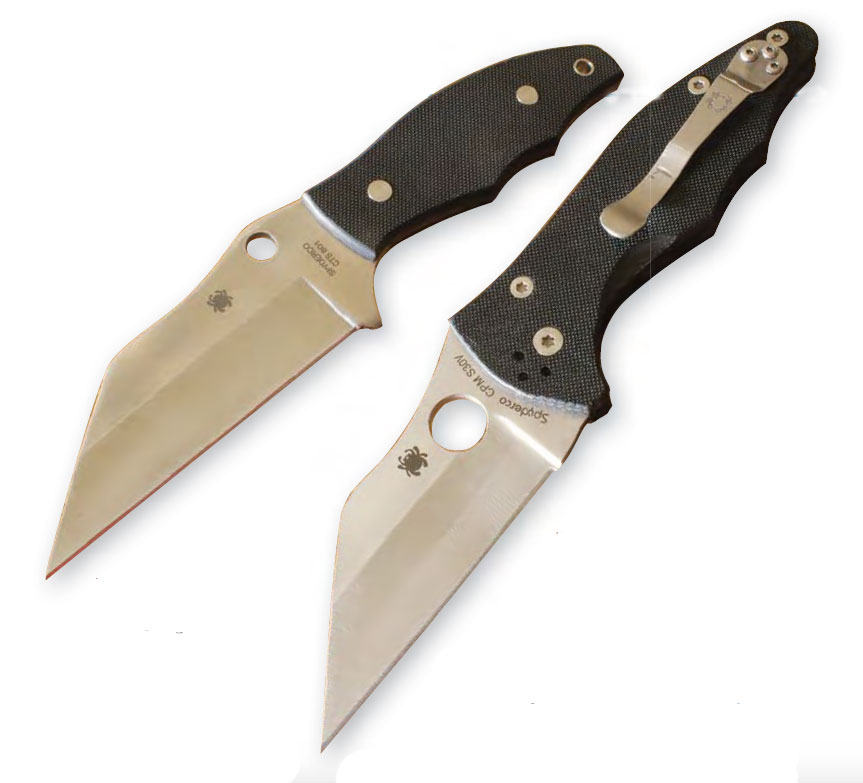
Tactical Wharncliffe Knife
The author’s second-generation Wharncliffe folder design for Spyderco is the Yojimbo 2 (bottom), which also
inspired a second-generation fixed blade called the Ronin 2 (top).

Although it received wider acceptance than the Ronin, the Yojimbo was still greeted with skepticism by most tactical knife fans. Many dismissed it as a “box cutter on steroids” and couldn’t get past the imbalance of its blade-to-handle ratio. The brave few that bought one and cut with it, however, quickly understood its advantages and joined the ranks of the converts.

Interestingly, during this same period, Snody was recruited as a designer for Benchmade Knives. Shortly after receiving the good news, he approached me at the BLADE Show and said he wanted to ask me a favor. He then reached into his pocket and produced a prototype of his Gravitator design—a Wharncliffe folder that he unabashedly admitted was directly inspired by the Yojimbo.

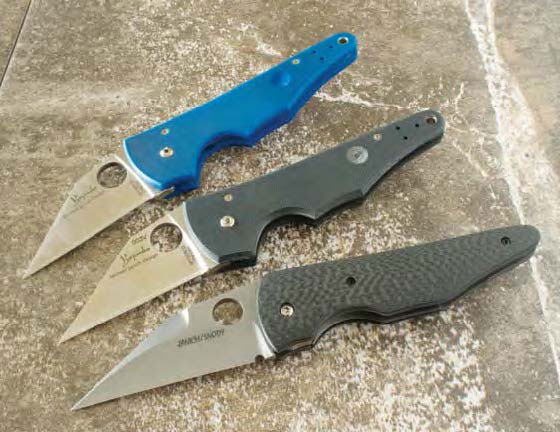
Folding tactical Wharncliffe knife
The fi rst-generation Yojimbo folder from Spyderco was the fi rst dedicated
tactical Wharncliffe. Available in blue or black G-10 handles, it is shown
here with a one-of-a-kind Mike Snody Yojimbo prototype that the author
commissioned to validate the design and tip the scales.

Grateful for his help in creating a tipping point for the Yojimbo, I gave him my blessing to move forward with the design. Deep down, I also took pride in the fact that the tactical Wharncliffe was gaining ground. In 2004, I accepted a position with BlackHawk Products Group to design for the Masters Of Defense brand, which they had just acquired. Since it was inappropriate for me to work for one company while endorsing a design produced by another, I asked Spyderco if we could part ways as friends. They agreed, and shortly thereafter discontinued the Yojimbo design, just as it was beginning to attract a following.

BlackHawk Blades

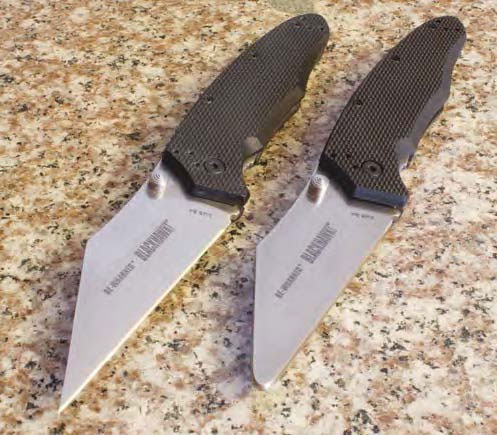
During my tenure at BlackHawk, I ultimately took over management of Masters Of Defense and a second knife brand, BlackHawk Blades. In the process, I designed and brought to market a number of designs, but my hands-down favorite was a folder called the Be-Wharned. Based on lessons learned from the Yojimbo, I designed it so, closed, it was no larger than the ubiquitous Spyderco Delica (my favorite back-pocket knife), yet offered a very capable 3.5-inch Wharncliffe blade.

Blackhawk Wharncliffe Knife
While managing BlackHawk’s knife brands, the author designed the Be-Wharned—an economical tactical Wharncliffe that packed lots of cutting edge into a compact package.

Its handle consisted of coarse-textured G-10 scales that housed a nested LinerLock mechanism and supported a four-position pocket clip. Made in Taiwan by that country’s premier manufacturer, the Be-Wharned retailed for less than $100 and represented another significant step in spreading the word of the tactical Wharncliffe.

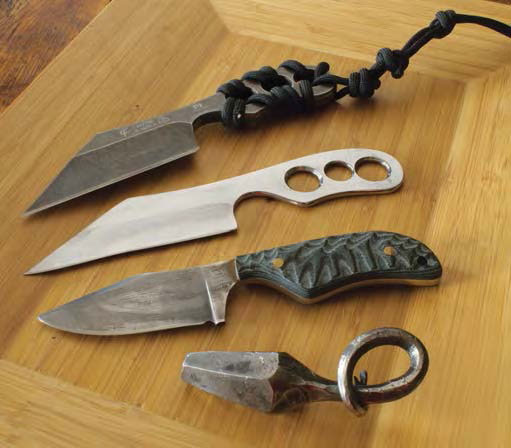
In addition to my full-time job in the knife industry, I also pursued my personal passion for Wharncliffes with a number of other custom knifemakers, most notably Mickey Yurco and Fred Perrin. Their deep understanding of blade design and cutting performance allowed them to share my appreciation for Wharncliffe dynamics and has resulted in a variety of both custom and, more recently, factory designs, including the Perrin/Janich Fusion neck knife made by the French company Max Knives.

Fred Perrin Wharncliffes
French custom knifemaker Fred Perrin is also a big proponent of Wharncliffe blade patterns for personal defense. After the author confessed his love for Perrin’s Neck Bowie (second from bottom), the maker tweaked the design to include a Wharncliffe blade. The result was a Janich-Perrin collaboration called the “Fusion” and produced by Max Knives.

In 2009, BlackHawk abandoned its focus on knife production. Fortunately, Spyderco was still interested in my skills and offered me a full-time position with the company. Although my primary focus is technical writing and product education, they also wanted me to have a signature design in their current product line.

Since the first-generation Yojimbo never achieved its full potential, I set my sights on designing a revised version, taking full advantage of my lessons learned since the first one. The result was the Yojimbo 2, which was released in late 2011.

Like the original, the Yojimbo 2 features a CPM S30V blade, a Compression Lock and textured G-10 handle scales with nested liners. However, its ergonomics are greatly refined and its blade-to-handle ratio provides much greater blade length. Its blade is also hollow ground with a full-thickness spine for increased strength and mass, and it includes a four-position pocket clip that supports all carry positions.

By the time the Yojimbo 2 was released, my proselytizing efforts and the gradual introduction of tactical Wharncliffes by other companies allowed it to be much better received. In a reversal of the sequence of the first-generation models, the Yojimbo 2 inspired a second-generation fixed-blade version—the Ronin 2.

Mickey Yurco tactical Wharncliffe blade knife
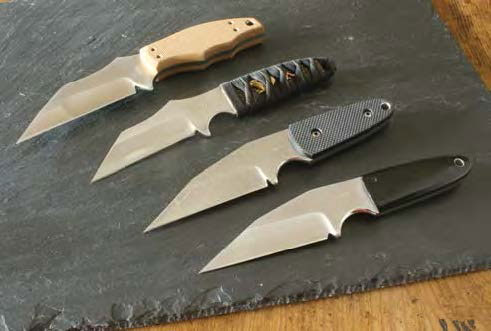
Custom knifemaker and retired law-enforcement officer Mickey Yurco is one of the author’s favorite makers of Wharncliffe blades. Shown here are several examples of
Mickey’s take on the Ronin.

In fact, the very first Ronin 2, a custom blade made by Yurco, was based on his hand-traced outline of a Yojimbo 2. When it was shown in Spyderco’s prototype case at the BLADE Show, customer response was immediate and a Spyderco factory version followed quickly thereafter.

Can You Trust Wharncliffe Tactical Knives? You Bet

As an instructor of knife tactics, I owe it to my students to recommend only the best personal defense knives. That commitment and the extensive cutting tests it inspired led me to not only believe in the tactical Wharncliffe, but to make it a central focus of my efforts as a knife educator. If you’re looking for a knife you can trust your life to, get a Wharncliffe.


See More Innovations in Knives at BLADE Show West 2018

Portland knife show

The Viking Seax And Where To Get One

Deeply Rooted In Scandinavian History, The Seax, AKA “Scramasax” Or “Sax,” Was The Blade Shape Of Choice For The Much-Feared And Revered Vikings.

Typically the Norsemen were associated with their famous axes, but, truth be known, they also carried a knife that saw more general use: the seax.

The Scandinavians usually lived in villages, farmed the land and raised animals. In such an agrarian society, they also needed tools to help them work the land and harvest the fruits of their labor. This is also where a knife came into play.

“Their personal knife was called the seax and it never left their side because it was their version of an EDC,” begins Ernest Emerson of Emerson Knives, Inc. “The knife was tasked with a myriad of chores, from skinning a freshly taken deer to cutting up the turnips they grubbed out of the ground with the same knife.”

Seax blade shapes
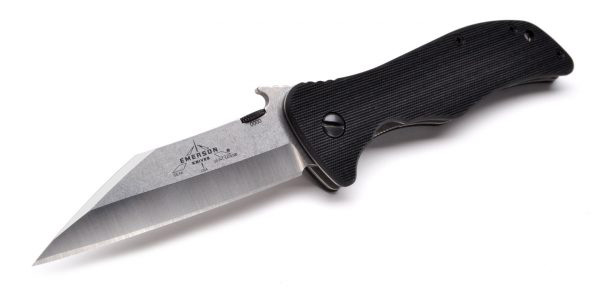
The folding Emerson Knives Seax puts a modern twist on this age-old blade design. (Image via Emerson Knives)

Emerson said the seax also could be employed as a self-defense weapon if needed. It was truly a blade for all seasons: Harvest produce in the morning, fend off the enemy after lunch, and then prepare supper in the evening—all with the same blade.

Seax Designs

All joking aside, the seax was a handy blade.

“It is a bowie-style blade, a spear-point type of blade, a Loveless drop-point hunter-style of blade, and, of course, the well-known ‘broken-back’ style featuring a severe clip close to the front, finishing in a point well below the center line,” Emerson said.

He said the broken-back seax style is the most common and appears in TV shows and movies depicting Vikings.

Broken Back Seax
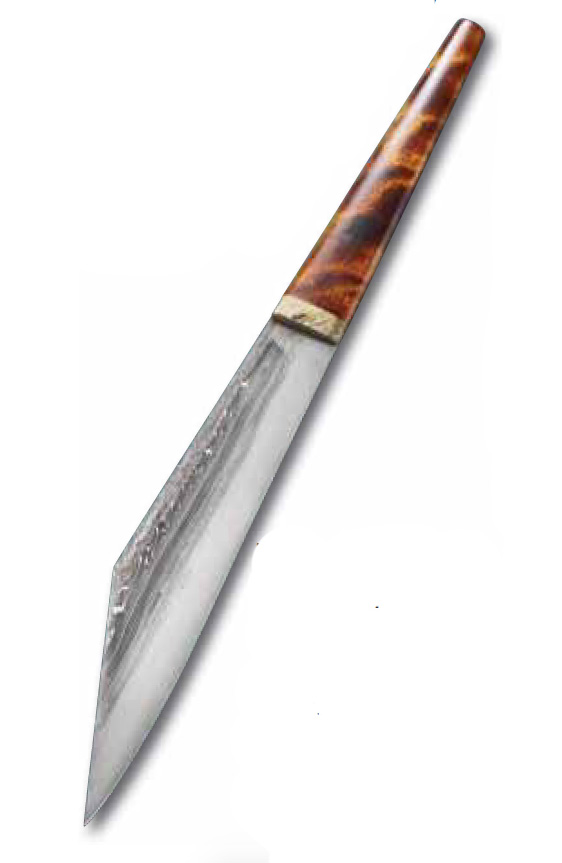
The Broken Back Seax by Aidan Garrity of Iron Lion Blades features a 10-inch damascus blade of 1095 carbon and 15N20 nickel alloy steels, and wrought iron. The handle is maple and the bolster is moose antler. Overall length: 18 inches. (SharpByCoop image)

Blade lengths varied wildly from seven inches on the short end and topping out at 30 inches, the latter Emerson called a short sword, basically.

“The seax needed to be an all-around utility tool that could chop, cut, slice, and sometimes stab, all with equal ease of application,” he said. “A Viking’s livelihood depended on self-sufficiency, resourcefulness, and the quality of his toolkit.”

What is a seax
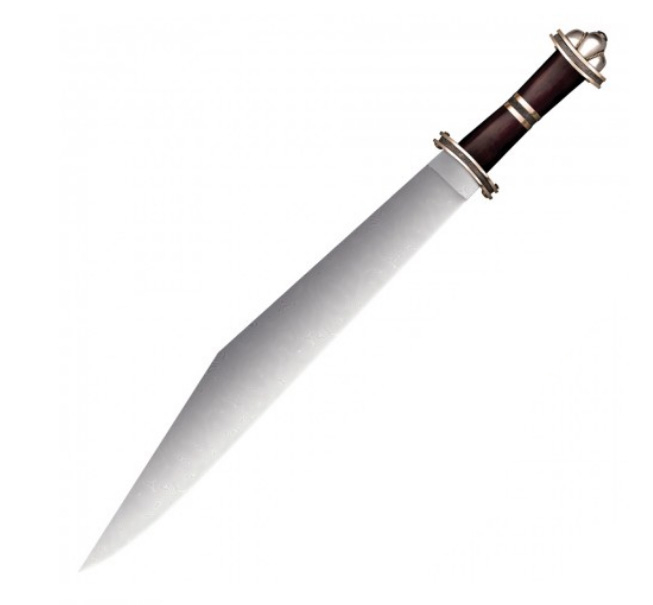
The Cold Steel Damascus Long Sax features a 17.25-inch blade with an edge that curves up toward the tip. MSRP: $635.99. (Cold Steel image)

At first glance, the seax may not seem as exciting as a recurve blade, but looks are not always everything. The beauty of such a blade lies within its ability to tackle cutting chores.

The straight-line cutting edge tackles a variety of tasks easily, and the point of the blade is both precise and powerful, with the ability to score as well as penetrate.

5 Best Seax Knives

The long history of the seax is still going strong today as companies young and old are making new versions of the historic blade.

These five are some of the more unique and exciting seax knives available today.

Terävä Skrama 240

Terävä Skrama 240
Terävä Skrama 240

Direct from the Finnish brand Terävä, the Skrama is a rugged bush knife great for chopping, slicing, and building shelters in the outdoors. The 9.4-inch blade is made from 80CrV2 steel with a 59 HRC. It comes married to a textured rubber handle for easy grip in any weather conditions.

The blade has a full tang and a flat edge but with a twist. It’s sharpened to a 34-degree edge except for the two inches closest to the hilt. That small section is sharpened to a finer 25-degree edge for more meticulous, precise knifework.

The Skrama comes with either a leather sheath or a plastic cover and has an MSRP of $69.99-109.99.

SZCO Supplies Brass-Studded Seax

SZCO Supplies Brass-Studded Seax

SZCO Supplies has made a fun, durable knife with its Brass-Studded Seax. The piece features a 10-inch blade married to a wooden handle. The knife is adorned with brass studs on the handle as well as a brass guard and pommel.

For a budge knife, it does have some weak points. The two main ones are that the leather sheath may need some working in to be at its best, and the knife may need a sharpen out of the box to have a pristine edge. Other than that, this is a good knife for the money.

Strong enough for a log, sharp enough for a piece of chicken, SZCO Supplies has made a  seax that is well priced at an MSRP of just $27.63.

Medieval Collectibles Viking Seax Knife

Medieval Collectibles Viking Seax Knife

This seax from Medieval Collectibles has the look and feel of a knife from the Viking era. It’s made from 5160 tempered carbon steel with a full tang, which is peened over the end of the handle’s metal end cap.

Just over 17 inches in length, and a blade length of 12.1 inches, the Viking Seax comes with a handle that has a wood grain finish and a hand-stitched leather scabbard with a belt hanger.

At just 14.4 ounces in weight this is a utility knife great for everything from chopping through wood and brush to defense and protection. The Viking Seax comes with an MSRP of $169.

Grimfrost Broken Back Seax, Type IV

Grimfrost Broken Back Seax, Type IV with scabbard

From Grimfrost comes a full-tang seax made of 1045 carbon steel. A reproduction of a 1,000-year-old seax found in London, the Broken Back Seax is 16 inches in length with an 11-inch blade.

The handle is handmade ash and the included leather scabbard is hand-stitched. It also features “Grimfrost” stamped in runes on the side of the blade.

Lots of time and care went into making this knife as authentic as it could be and it shows. So whether you want to feel like Leif Eriksson exploring new lands or just want a strong knife while chopping, Grimfrost has you covered.

The Broken Back Seax has an MSRP of $132.

Lunar Light Forge Damascus Sanmai Seax

Lunar Light Forge Damascus Sanmai Seax

This amazing seax is from the husband & wife duo of Nathaniel and Megan Everett at Lunar Light Forge in Akron, Ohio.

The damascus blade is made from 42 layers of 1095 and 15n20 steel around a 5160 core. It is paired with a handle made of Buffalo horn and Cocobolo wood, and it comes with a hand-tooled & hand-stitched leather sheath.

It’s just as much an art piece as it is an excellent utility knife. The 7-inch blade can process an animal, hack off tree limbs, and chop in the kitchen. It does have an MSRP of $722.50, but for the amount of craftsmanship and care that went into the piece, you’ll know you’re getting a knife of the highest quality.

Editor’s Note: Mike Abelson contributed to this piece

Read More

What Exactly is a Tactical Knife?

Tactical knife definition

What is a Tactical Knife?

  • Synthetic, grippy handles (usually)
  • Non-reflective blade coating (usually)
  • Designed for hard and/or quick use
  • Aesthetics invoke military purposes
  • Spyderco founder Sal Glesser once said, a tactical knife is any knife you have with you when you need a knife.
  • Some say custom knifemaker Bob Terzuola made the first tactical folding knife, while others say Ernest Emerson did.
  • Maybe it’s all a marketing gimmick!

A Brief History the Tactical Knife

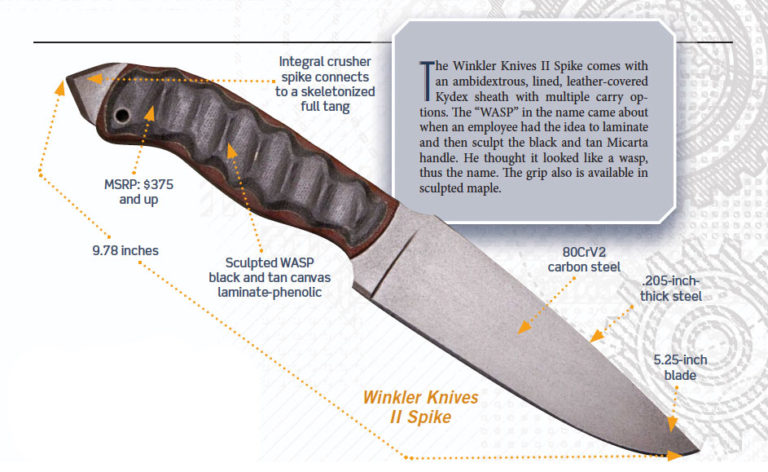
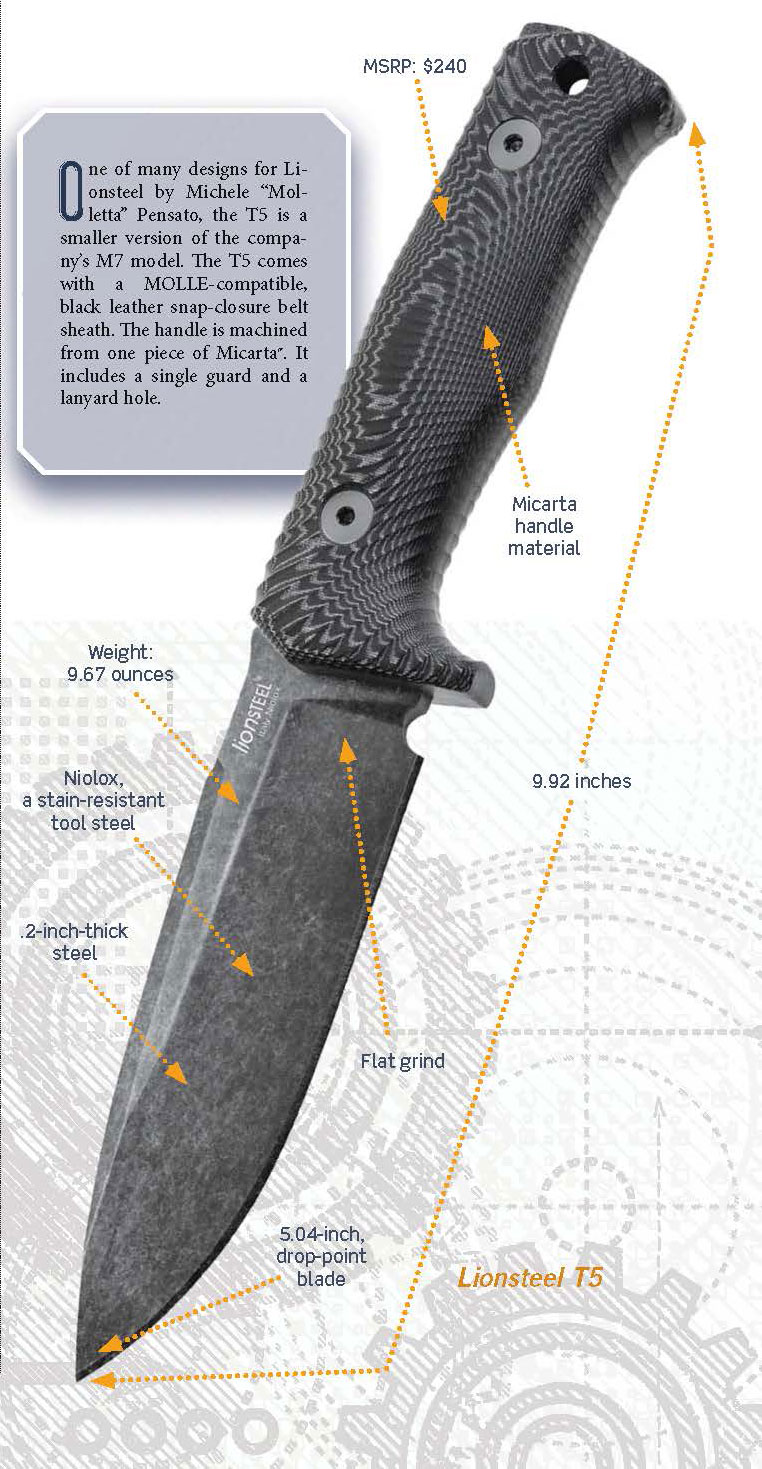
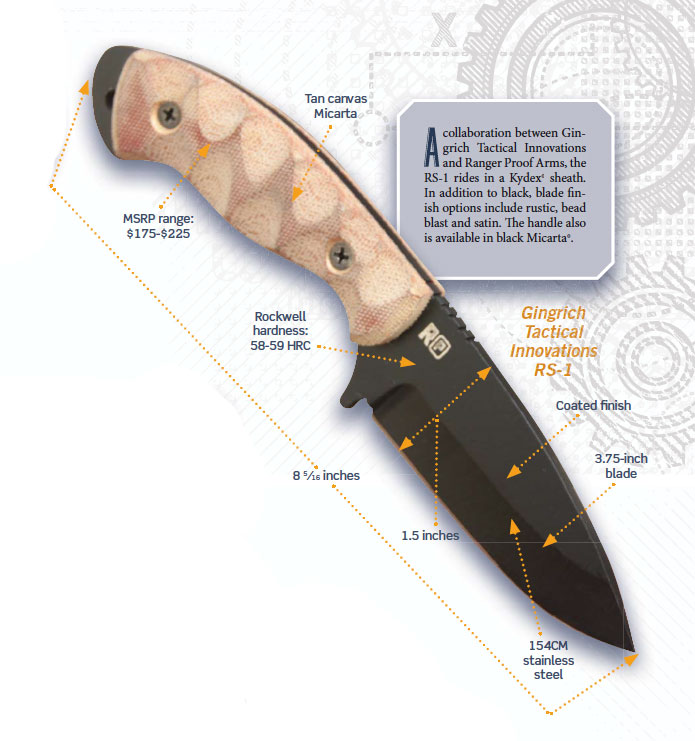
The term “tactical knife” was coined in the mid-1990s to define a look with certain characteristics. Regarding fixed blades, the characteristics included a non-reflective blade coupled with either no guard or one of stainless steel. Some still use brass and others incorporate titanium for guards, while some use black zirconium. Currently, zirconium’s price deters both makers and collectors. If the price comes down you can expect to see more zirconium for guards. Handle materials should be synthetics, including but not limited to Micarta®, G-10 and carbon fiber. However, these three are far and away the most popular handle materials on today’s custom tactical fixed blades.

What is a tactical knife

Over the past century grip materials have evolved from wood, leather washers and even cast brass and aluminum to the current synthetics. In the mid ’90s, primarily Micarta was used. Linen, paper and rag Micarta were the staples of the day. G-10 then came along, offering more colors and configurations. Over the past five years carbon fiber has increasingly become a handle material of choice.

The non-reflective blade was accomplished through several methods, the most common being a belt satin finish. As the name implies the finish was applied simply by using a sanding belt. This gave the blade a good-looking surface that was not reflective.

Tactical knife example

Key Tactical Knife Feature: Non-Reflective Finish

Another method was sand blasting. While providing a non-reflective finish, this technique had a problem. The sand created micro pits in the steel. The pits held moisture, leading to blade rust. That led to replacing the sand with silicon glass beads that did not leave pits and produced a more even, flat-gray, non-reflective finish.

Tactical knife

Walter Brend and BLADE Magazine Cutlery Hall-Of-Fame® member Chris Reeve were early proponents of techniques previously used on firearms to blacken their blades/knives.
Chris utilized a black Gun-Kote® finish early on, and Chris Reeve Knives still does today. Brend was asked to produce blades with a black finish and he used Parkerizing to do it. Both finishes were/are subject to scratches. The scratches were especially noticeable when the knife was combined with a Kydex sheath.

Today finishes such as those from Cerakote® and other specialty outfits can provide choices not only of color but also of surface designs for your blade.

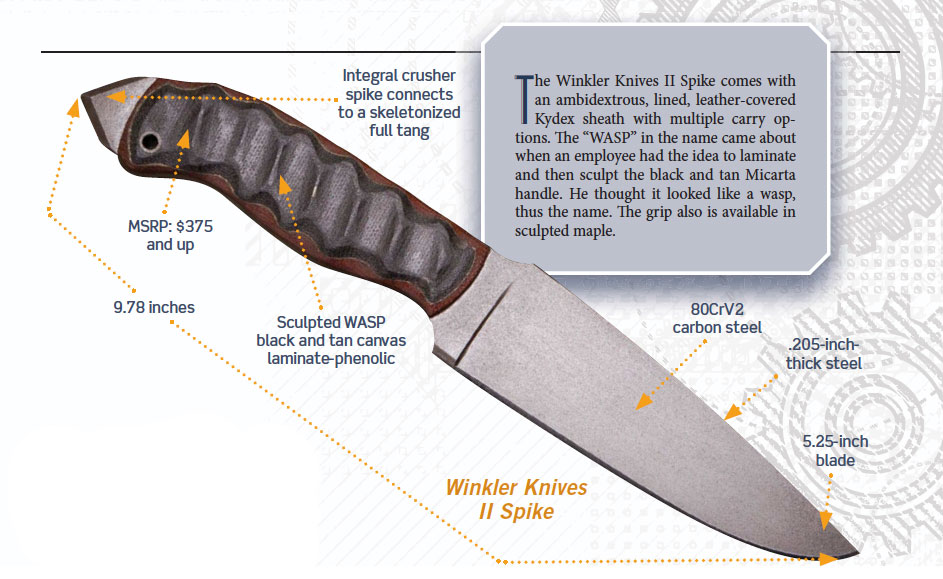
Winkler tactical knife

See More Tactical Knives at BLADE Show West

The world’s biggest and best knife show, BLADE Show, is coming to Portland, Oregon, from Oct. 5 to 7, 2018.

Find show information and buy tickets here >>

Portland knife show

Advertisement

Must Read Articles

Read this before you make a knife

Knifemaking 101 – Read This Before You Make a Knife

  by Wayne Goddard My experience has taught me that there's nothing like digging in and getting started. I've often said the hardest part of the...
how to forge damascus steel

How to Forge Damascus

Advertisement
Advertisement