Knife Collecting

Knife collecting is an extremely rewarding experience for knife enthusiasts. There truly is a knife for everyone. Many increase or hold their value throughout the years, making collecting knives something to pass on to the next generation of knife collectors.

Knife Handle Material: Natural, Synthetic And Hybrid Moments

Natural and synthetic materials are equal parts fashionable and functional.
2024 Knives annual
This article appeared in the 2024 KNIVES annual.

They complement one another in an easy, seamless union—blade and handle. One without the other means the knife is incomplete, or it isn’t a knife at all.

Along with the search for proper blade steel, appropriate handle material is the second critical element in the presentation, form, and function of the knife itself. Natural and synthetic handles play their roles. They bring utility and aesthetics to the package, and the maker’s choice sets the tone. Availability, cost, and maker’s preference fit into the equation when choosing the right handle material. And then, of course, the intended knife use weighs heavily.

In the end, it’s the eye of the artist that drives the visual element, and the job to be done by the user that directs his or her choice. The handle makes the knife complete.

At Masecraft Supply Company, co-owner Chris Hartman sees the supplier’s role as the facilitator. Never interfering with the artist’s concept, he views Masecraft as a provider of the palette. “We don’t advise what to use,” he reasons. “We are not big fans of, ‘You know what you should do …’ or telling a customer what to use, but more in supplying a wide variety of options to choose from. We are always willing to answer questions about our materials a customer may have, but it’s just not a good idea to advise what is right for them. That’s the maker’s choice.”

With that said, where is the market headed today? What does the landscape look like in terms of availability, trends, and timing?

“The majority seem to be sticking with composite laminates like G-10, canvas and linen Micarta, and Richlite,” Hartman says. “Natural materials like bone and horn seem to be in a continuing decline. Exotic woods still do well, but availability and pricing have become issues over the last two years.”

John Cammenga, vice president of operations at White River Knife & Tool, Inc., deals primarily in synthetic knife handle materials. He indicates that knifemakers who build hard-use models often lean toward durable synthetic handles and that the laminate trend holds up there as well, particularly with material available in a variety of colors.
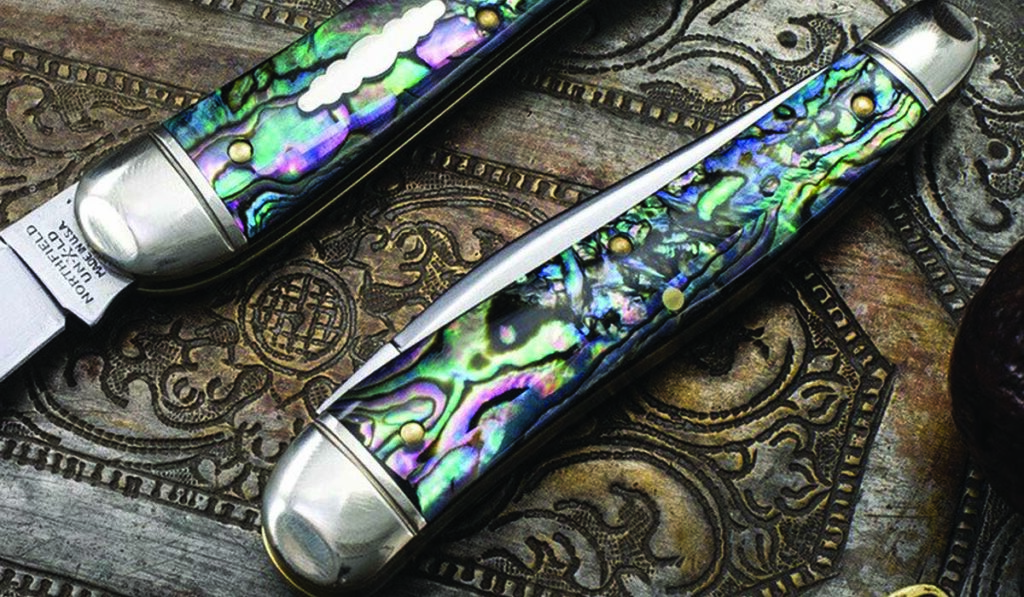
Northfield UN-X-LD knife
This Northfield UN-X-LD knife from Great Eastern Cutlery (GEC), which registered the trademark and uses it on premium GEC pocketknives, features ALVS (acrylic laminated veneer shell) handle scales from Masecraft Supply Company. The dazzling shell veneer consists of real shell and high-impact acrylic laminated together within the sheet.

“The majority of our handle materials are synthetic,” Cammenga says, “and this is primarily due to stability and longevity. But many look great as well. Multi-color layers of fabric bonded with phenolic or polyester resin can have the look of wood, yet last much longer. Additionally, many of these are tackier when wet, giving the user additional hand purchase in tough weather or when processing game. Carbon fiber and G-10 are available in an ever-expanding array of colors and patterns and almost bulletproof when it comes to wear and tear.”

Choosing Knife Handle Material

The choice of materials, Cammenga explains, comes directly down to the proposed use of the knife. For hunting, fishing, camping or bushcraft, White River almost always recommends synthetic handle material. However, John still gives a nod to personal preference. Some users simply must have a natural handle, and the aesthetic factor comes into play there.

“It’s hard to beat the beauty of a highly figured burl!” he comments. “Some, such as desert ironwood burl, are not only beautiful but also extremely tough.”

Tom Krein is an experienced custom knifemaker who worked for the great Bob Dozier and ran the custom shop for A.G. Russell Knives before embarking on his own venture during 30 years in the business. Making small utility and hunting knives primarily, he agrees that handle material choice relates to a few simple concepts.
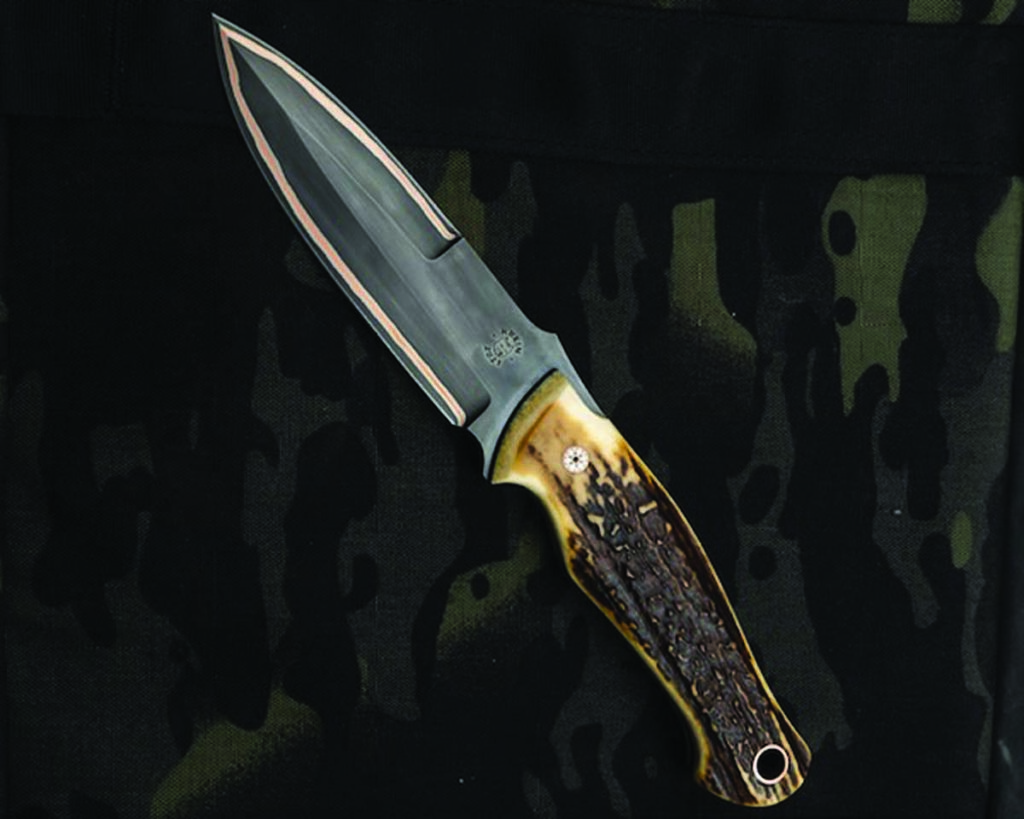
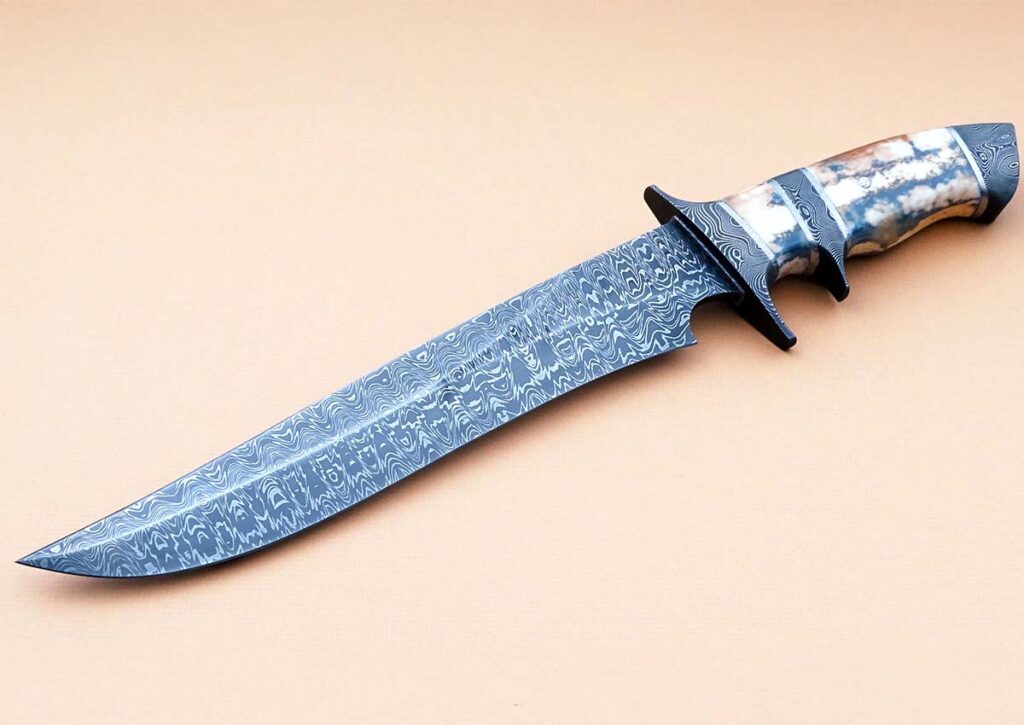
Tom Krein’s “Mako” model features a Dion Damascus san mai steel blade with a copper-color stag handle.

“It comes down to the customer’s needs, willingness to care for the knife, aesthetics, and budget,” Krein relates. “Natural materials should hold up nicely with proper care assuming everything goes according to plan. Sometimes stuff happens—a knife falls into a sink of water, or it starts to rain while hunting, or your knife gets lost in the yard for a week. Synthetics hold up better when stuff goes south. For customers, I recommend getting what you like and learning how to take care of it. For knifemakers, I suggest picking the mind of another maker who uses the material you want so you can learn how to use it. Overall, we are a helpful bunch of people.”

Traditional handle materials and their innovative, eye-popping counterparts coexist at Santa Fe Stoneworks, a provider of materials to the art knife market since 1978. Santa Fe not only affixes those materials to its own knives, but also provides the service for Spyderco and Kershaw while doing private label work as well.

President Bill Wirtel leads the family business, and the company’s roster of natural handle materials includes the best of the best. “We work with factory knives and apply gemstones, exotic woods, shells like gold- and black-lip pearl, and fossils such as woolly mammoth tooth, tusk, bone, and petrified dinosaur bone,” he remarks.

As for Santa Fe’s synthetics, Fordite, a car paint overspray, Surfite surfboard overspray, and a cholla cactus-like material that is made in the shop have found favor with makers and buyers alike.

Material Mash Up

“We are looking for design and color, so we mix natural with manmade stone and epoxies,” Wirtel explains. “Our fossils are all stabilized so they work great for a handle material. We see hybrid materials gaining popularity as they provide the best of both natural and composite materials. Fordite and Surfite have been selling well. Our synthetic cholla cactus line that we make here, stabilizing it with different colored epoxies, is becoming a big seller as well. We also have mammoth tusk fusion. This is stabilized fragments of mammoth ivory that are fused together under immense pressure. The result is a beautiful and hard composite that is densely packed with mammoth ivory.”
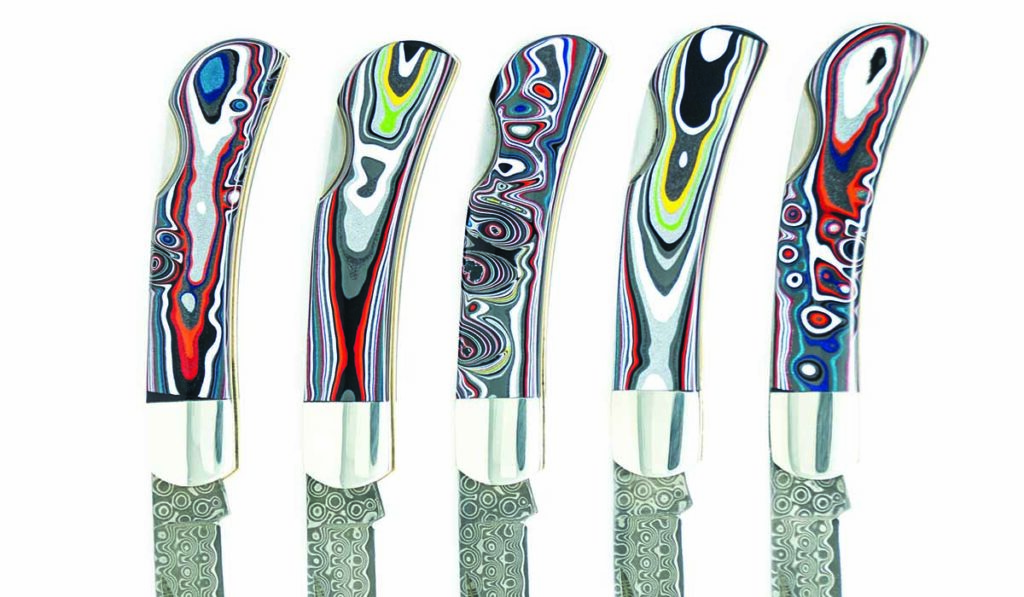
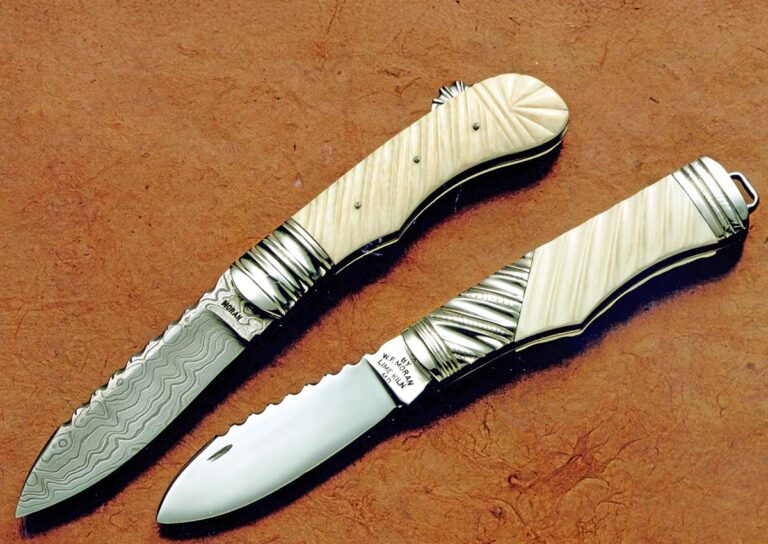
Fordite car paint handle material adds a fun flair to this series of Santa Fe Stoneworks 3-inch lock-back folders
Fordite car paint handle material adds a fun flair to this series of Santa Fe Stoneworks 3-inch lock-back folders with damascus blades.

Fordite is an interesting option that comes from a surprising source. Also known as Detroit agate or motor agate, the material consists of pre-1985 automobile paint that hardened sufficiently to be cut and polished. It formed from enamel paint slag, which built up over the years in layers on the tracks and skids where cars were hand spray-painted. The buildup hardened in ovens intended to cure the paint on car bodies. After so much of that buildup, the brightly colored and layered paint had to be removed. Its allure caught on with some autoworkers who brought pieces home with them. From there, the beautiful Fordite material, which can be cut and polished into a spectacular look, found its way onto knife handles.

The Masecraft perspective is somewhat dictated by availability. “Sambar stag is not coming back,” Hartman stresses. “It has been banned by India for export since sometime around 2005, I believe, so that’s almost 20 years now, and I see no chance of this ever-changing. What’s still available out there now is it. Game over!”

“Black-lip, gold, and white mother-of-pearl all are still available,” he adds, “just not in larger size pieces as they were 20-50 years ago. They are overharvested and not as healthy as before. Demand for shell is down overall. It is not very tactical, and we seem to be in a tactical and bushcraft market for the last two decades. Shell tended to be more of a gentleman’s pocketknife material, so it’s not exactly the big trend right now.”
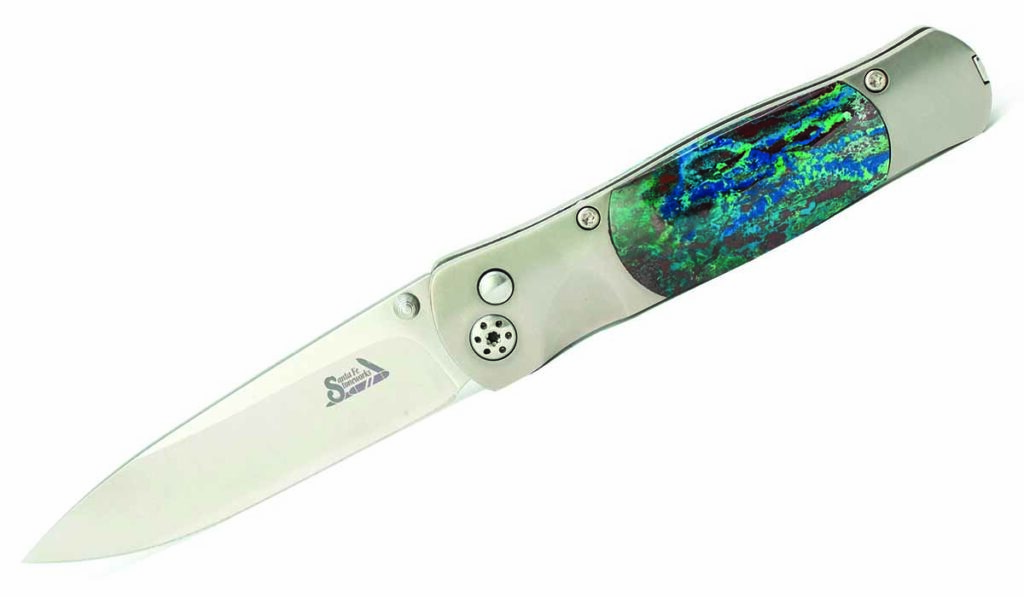
Santa Fe Stoneworks El Rey model is handled in a spectacular turquoise/abalone/bronze hybrid gemstone
This Santa Fe Stoneworks El Rey model is handled in a spectacular turquoise/abalone/bronze hybrid gemstone and includes a mother-of-pearl button inlay.

“Many of the companies that used a lot of shell on knives are gone or simply don’t have the people who know how to work with it anymore,” Hartman adds. “Shell is still one of the most beautiful materials ever, so much so that it seems to be the hardest to reproduce in any type of synthetic alternative that even comes close to its natural beauty. We can come close, but there is still nothing like the real thing.”

Krein sees a swing toward synthetics and higher-end natural materials as well. “Right now, there is a huge push to find and use vintage Micartas,” he relates. “I’ve also seen G-10 usage go up a ton over the years. G-10 holds up to use extremely well, is relatively inexpensive, and machines and grinds easily. I’ve also noticed quite a few new businesses that specialize in exotic stabilized woods. Stag has always been a desired and quality knifemaking material, and with exceptional stag being much harder to find, it is even more desirable, particularly when done [harvested and finished] properly.”

Watching the high-end polymer Ultem begin to trend as a new synthetic handle material has been interesting for Krein, and his affinity for giraffe bone has not waned. It’s something he calls the “latest real pickup in natural materials.”
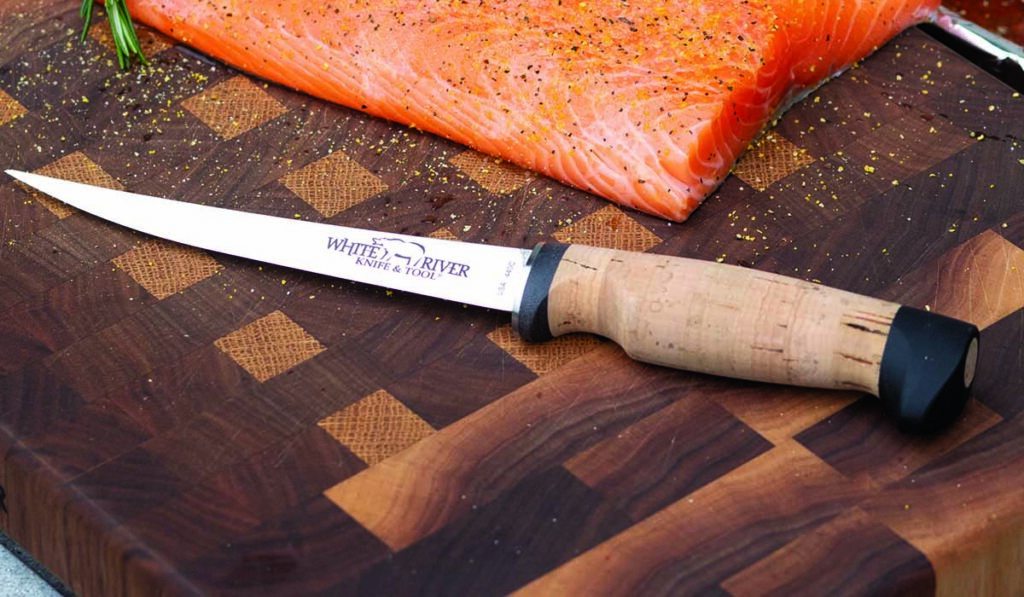
White River Knife & Tool fillet knife with cork handle
White River Knife & Tool purchases synthetic material made in the USA, so supply chain issues have not been a problem. The one material the company imports, cork, has increased in price, but its supply has been uninterrupted. White River’s Traditional Fillet knife incorporates a handle of imported cork for easy cleanup and a tight grip in slippery conditions.

“I often see new makers using very exotic materials,” Krein concludes. “These materials are costly and often not used anywhere close to their potential. I recommend that new makers learn to use simpler materials like Micarta to their full potential. This leaves funds available for other materials and equipment while allowing a new maker to develop their skills. Just because a knife has expensive materials doesn’t make it better or more interesting to me. It’s developing the skills to make simple materials look elegant that I appreciate.”

Those Hybrid Moments

Hybrid handle material is on the rise, and Cammenga is pleased with the growing popularity of marbled synthetics. “Right now, there is strong demand,” he notes. “This is true in both cloth/resin laminates and carbon-fiber/resin laminates. For those who want natural wood, bone or antler, acrylic ‘stabilized’ scales have been popular for quite some time. They provide the user with a natural material, which has been made tougher by introducing acrylic resin into the fibers. Currently the marbled look is in with almost all materials, but we have made several knife models using G-10 and rubber combinations, as well as others from polyester cloth and resins.”

Masecraft is keeping a close eye on the development of new materials, but the course is charted by ingenuity rather than discovery. “As far as new natural materials, that’s going to be extremely rare,” Hartman observes. “The earth is not really producing anything new, so unless we have not discovered it yet, the odds are low. More likely, some natural materials will disappear and become endangered, banned, or extinct. Human history tells us the availability of natural material will decrease while prices increase. You will see more hybrids of natural and synthetic combinations, and all kinds of new synthetics will continue to be introduced.”
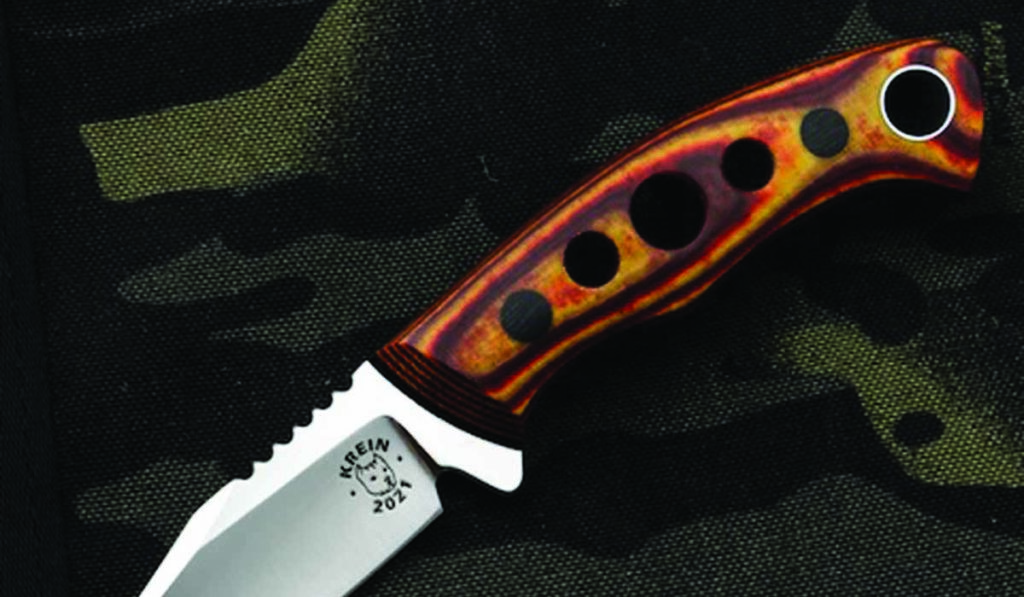
vintage Micarta
Knifemaker Tom Krein says there’s a huge push to find and use vintage Micarta, such as on the handle of his pocket bowie model.

Supply often dictates how well demand is satisfied, and the inherent scarcity of some handle materials has been exacerbated by supply chain concerns in areas. Even as the COVID-19 pandemic has eased, the resilience of the supply chain remains an open question. Some suppliers and makers have faced shortages of stock items, while others have adapted, moved on to other, more readily available options, or simply been patient.

“I have been sourcing materials for over 44 years, and most of our suppliers know us and what we want,” Wirtel relates. “Obviously, we’ve had supply chain issues, but we have been able to work around them. We make our product to order, so we range in delivery time from a few weeks to a few months.”

Krein is positive regarding availability, saying, “There have been slight wait times for some synthetics, particularly Micarta, during the pandemic, but it seems like everything is back on track here. There has and will continue to be more demand for quality stag than availability. I’ve seen a bit less of quality exotic stabilized woods like exhibition-grade ironwood and Koa.”

While the supply chain phenomenon has been universal, Hartman is pragmatic. Going with the flow makes the Masecraft operation run as smoothly as possible. “There are supply chain issues with everything globally,” he observes. “I can’t think of anything on the planet that hasn’t been affected in some way, shape or form and that doesn’t have a price increase or isn’t in short supply, and it’s all things, countries, and markets.”
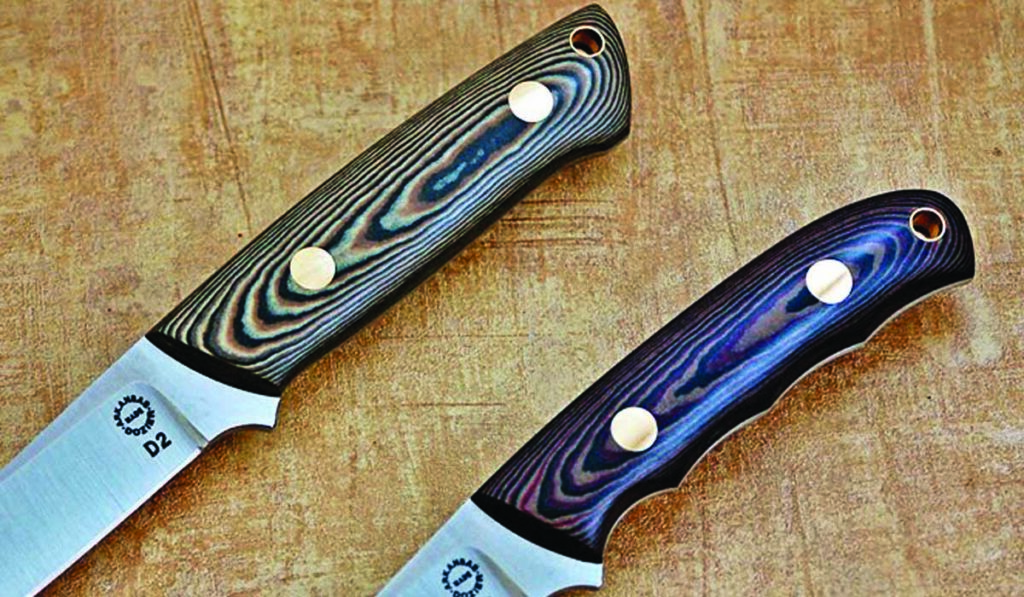
Dozier Knives produced this fixed blade with a Richlite handle from Masecraft Supply Company
Dozier Knives produced this fixed blade with a Richlite handle from Masecraft Supply Company composed of approximately 65% Forest Stewardship Council (FSC)®-certified recycled paper and 35% phenolic resin.

“If you don’t have the chip, you can’t produce the car,” Hartman says. “If you don’t have OD Green dye, you can’t make OD Green G-10. If one key part is missing due to supply chain issues, the product simply cannot be made, and that is affecting all things.”

Staying domestic has been a problem solver for White River Knife & Tool, according to Cammenga. “Because White River purchases synthetic material made within the U.S., our supply chain has not been a problem. The one material we do import, cork, has increased in price, but our supply has been uninterrupted.”

Considering the handle-blade combination that makes the knife come together for the spectrum of customers and users, today’s material options appear more diverse than ever. Although some shortages in natural materials may never be plentiful again, fusions of natural and synthetic options open the door to creativity. And the imagination is always fertile ground for innovation.

More On Knife Handles:

Blade Grinds: A Down And Dirty Guide

Knife edges come in all different styles. We break down the major types in this quick guide to blade grinds.

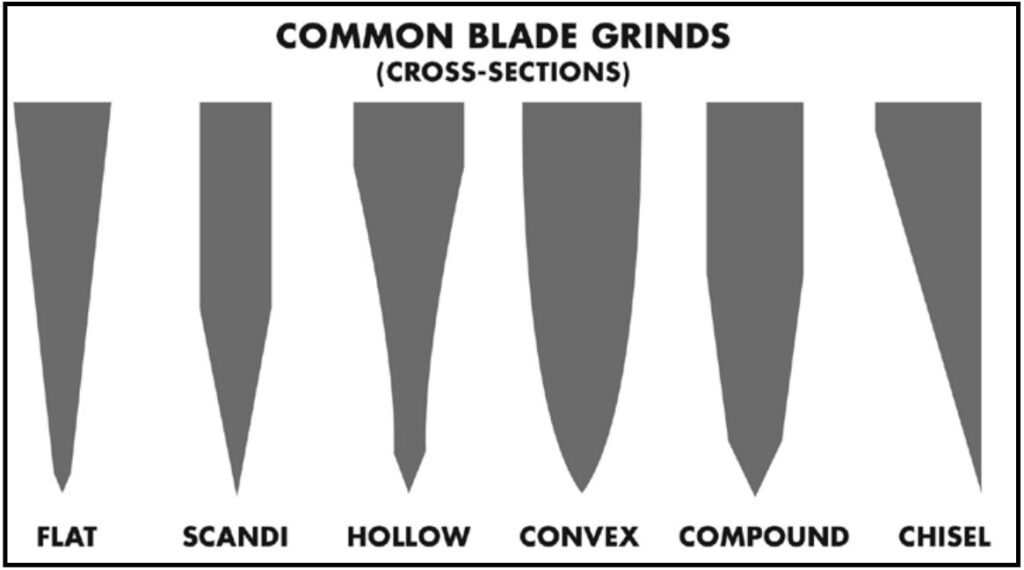
Cutting performance is greatly influenced by the way in which the maker grinds the knife. Each grind will have different cutting characteristics. A good knifemaker will consider whether the grind of the knife is suited to the chosen task. You as a buyer will also need to consider if the grind of a knife will suit the tasks you have in mind.

Blade Grinds
Blade grinds you’ll often come across can be seen here. (Image courtesy of Knafs.com)

Flat Grind

A flat-ground knife is a simple wedge and may be thick or thin. Flat grinds are good for slicing and deep cuts. I personally prefer a flat grind that goes all the way to the spine. A thinner flat grind will cut more smoothly than a thicker flat grind, where a thicker grind may be more durable.

Hollow Grind

A hollow-ground knife has a slightly concave bevel, which makes it thinner behind the cutting edge. This makes for good skinning and shallow cut work, without giving up overall blade heft or durability. Deep cuts or chopping are not well suited to a hollow grind.

Convex Grind

Convex grinds have slightly rounded bevels, which increases their edge stability. While they may not excel at slicing, they’re the way to go for hard use cutting and chopping.

Scandi Grind

Scandi grinds are a short flat grind with no secondary bevel. “Scandi” refers to the Scandinavian countries where that grind style is popular, especially Finland. This grind style cuts very well but can be difficult to sharpen properly.

Compound Grind

A compound grind may combine several of the basic grind shapes. Particularly on tactical and folding knives, many modern grinds are aesthetically interesting, but at the occasional sacrifice of performance. If you’re collecting for aesthetic reasons, however, these grinds could be all you ever wanted out of a knife.

More Knife Basics:

Iconic Spyderco Design Appears On New H.L. Dalis Exclusive

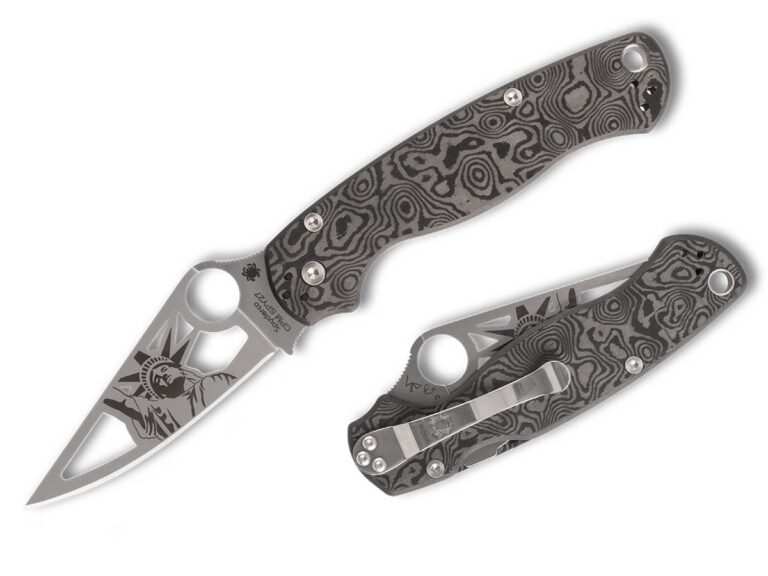
Spyderco unveils a limited-edition Para Military 2 with a cut-through Statue of Liberty blade to honor H.L. Dalis Inc.’s 100th anniversary. Just 1,200 knives available—collectors take note.

Spyderco has made its first “cut-through” blade design since its highly collectible Q, R and S series from roughly a quarter century ago to celebrate the 100th anniversary of H.L. Dalis Inc.

The cut-through graces the blade of a Para Military 2, including perforations both of and flanking an engraving of the Statue of Liberty. “As a New York company, we thought the Statue of Liberty cut through was appropriate,” stated Jon Blumenfeld, president of H.L. Dalis Inc., “as it is the most universal symbol of what the USA stands for.”

There will be 1,200 units in all, with delivery expected in the late third quarter of this year. As an added special feature, Spyderco has agreed to have its design team sign one box for every 50 units, and H.L. Dalis will include one signed boxed unit at standard volume cost with every 51 units—50 plus one signed boxed unit—ordered by its dealers.

Para Military 2 Specs
Blade length: 3.45”
Blade steel: SPY27 stainless
Blade grind: Full flat
Edge configuration: PlainEdge
Lock: Compression Lock
Hardware configuration: Stainless steel pocket clip, standoffs and liners
Weight: 3.8 ozs.
Closed length: 4.82”
Knife to know: Made in a limited edition of 1200
MSRPs: $340

Custom Knives:

U.S. Military Daggers: Blades That Have Taken Point

Daggers have struck home the U.S. military’s point from the trenches of Europe to the jungles of Vietnam.

Through the years, the military dagger has been considered an essential piece of equipment for the soldier on the ground and the pilot in the air. As a second line of defense, the dagger must be accessible and capable of quick deployment, not to mention efficient at its job.
As U.S. military personnel have gone into action, their choice of daggers provides a window into their operational history and a view of their actual aptitude when seconds count. Design and dexterity are hallmarks of dagger use in the heat of a life-and-death situation, and these storied weapons of war have gained their place in the annals of close combat.

“A good friend of mine was a chopper pilot in Vietnam,” recalled BLADE® Magazine field editor Kim Breed. “The pilots carried the Gerber MK II upside down on their flight vests. When he was shot down, he and his crew chief went through their ammo; then they drew their daggers while they waited for pickup. They locked onto the enemy, rammed them through the side [with their daggers] and hung on. Then they took [the enemy’s] AK-47s away from them and got back into the fight. They defended themselves while Cobra gunships laid down suppressing fire and a rescue bird, a Huey, came and got them.”

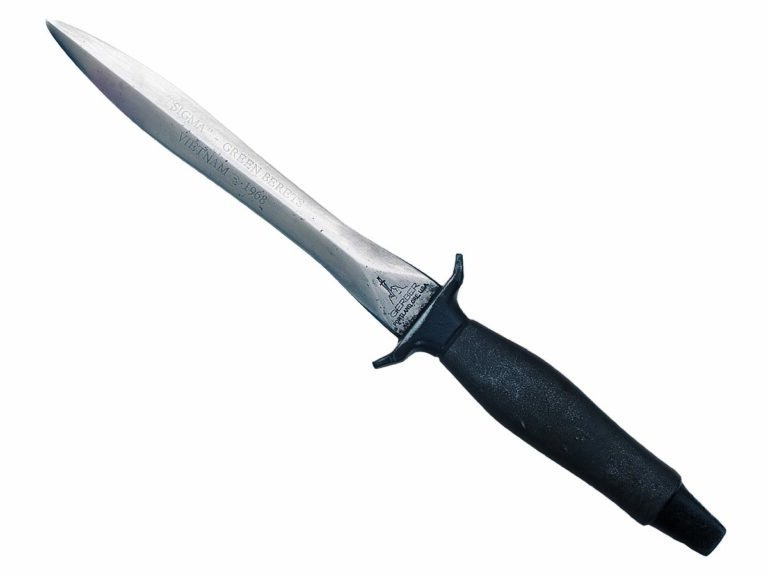
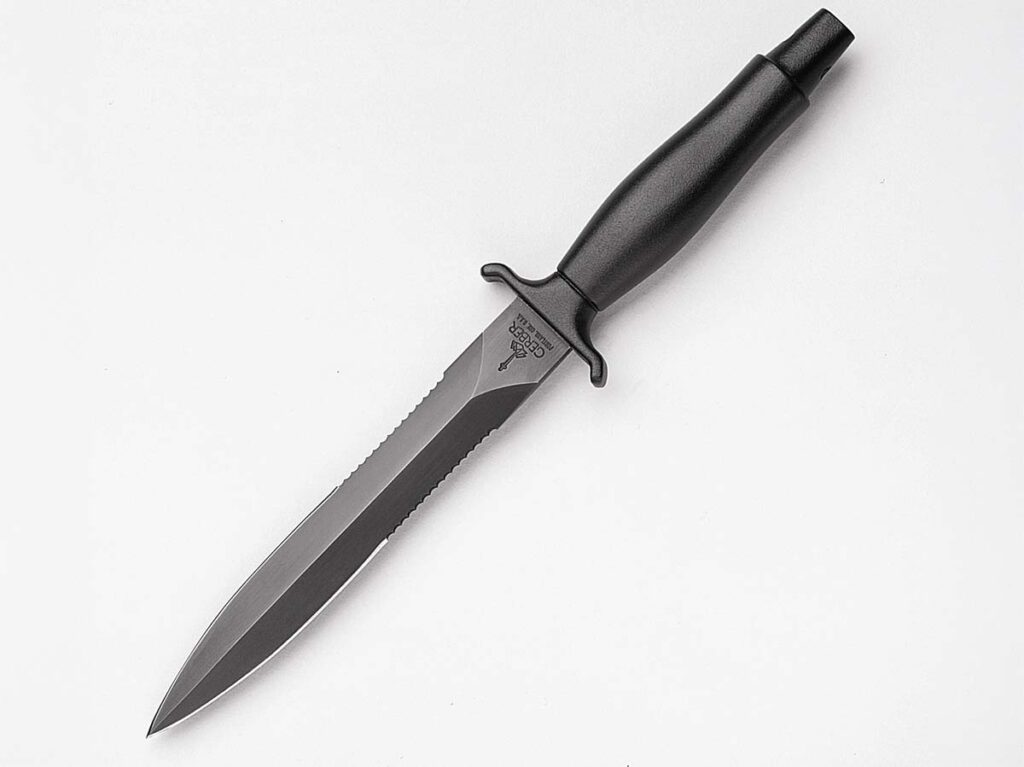
Kim’s comrades might well have been killed in the melee had they not had their Gerber Mk II daggers when needed. Designed by Clarence “Bud” Holzmann, the knife gained legendary status during the Vietnam War, and though it was not standard issue, the Gerber Mk II was popular with U.S. troops—from airmen to special forces and everything in between. The wasp-waisted blade of the original remains a symbol of the close combat sometimes experienced in Southeast Asia, while its intimidation factor led to a redesign for the consumer market.

Later variants of the MK II included saw teeth, a feature added by Al Mar, who worked at Gerber at the time. This allowed the company to market it as a survival knife, not a fighting knife. Sporting goods stores and PXs were more likely to sell the latter. (Les George image)

“It was designed the same as the [original] Mk II except it had serrations on both sides. The serrations might be considered a weak point,” Breed explained. “They had cast aluminum handles and a little thinner blade with that wasp waist. When you actually penetrated something, [the waist] helped along with a bit of extra weight up front.”

While the original Mk II may have been a stronger choice back in the day, the serrated Mk II is also a sought-after collectible. A knifemaker, Kim relates some owners have asked him to grind the serrations completely off this Gerber dagger. He declined to do so.
One more story Kim recounts is of a friend who found himself in hand-to-hand combat during a recon deployment in Vietnam. A Viet Cong patrol was walking past, and the last man in their line spotted the Americans in their cover. “Rather than alerting the whole enemy patrol, my friend took the last man down and used his knife,” said Breed.

Regarding the Mk II, knifemaker Les George added, “Al Mar was a designer at Gerber at the time and he added ‘saw teeth’ to the blade to make it a survival knife. The PX was happy to sell it as such since they didn’t want to sell a ‘fighting knife.’”

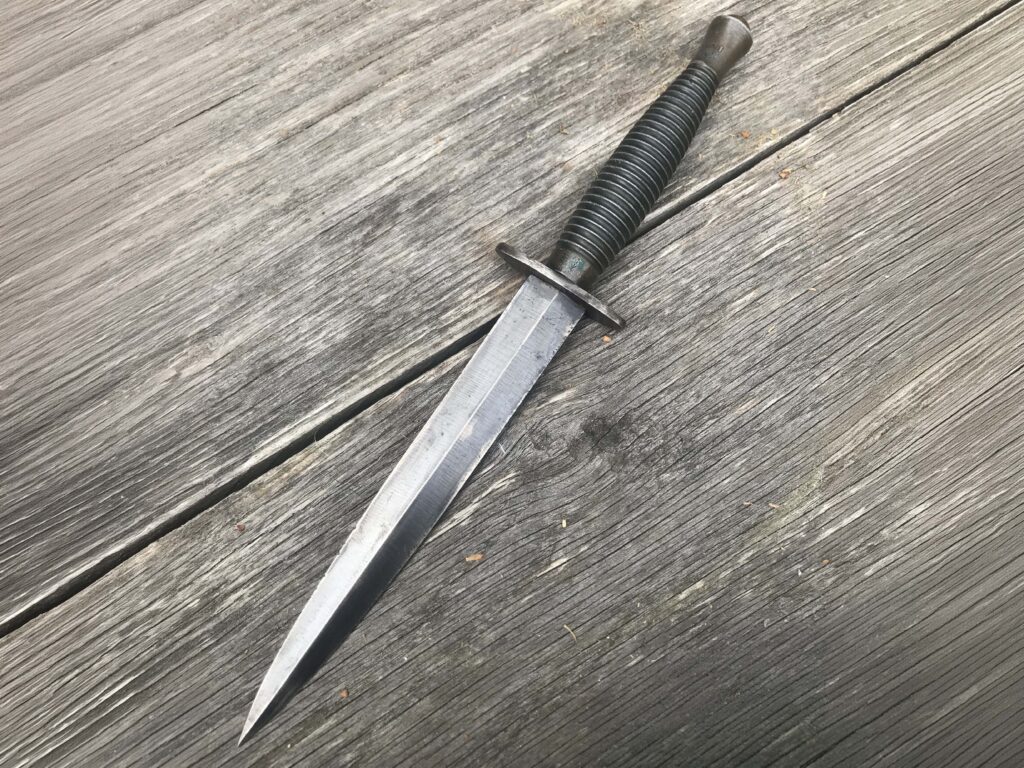
A great many modern military daggers trace their roots back to the legendary English Fairbairn-Sykes dagger. The one pictured is a third-pattern variant with a ring grip. (Les George image)

Industry veteran Bill Harsey also tells a story of combat survival with the Gerber Mk II in Vietnam. “I heard from a Medal of Honor recipient over dinner that his team was overrun by enemy combatants. In close-quarter combat, he drew his knife and stuck it in an enemy soldier. The knife stuck. Even with both hands he couldn’t withdraw it. I have no idea why the knife stuck and he didn’t offer any thoughts. But just to be careful, we have never made a wasp-waisted blade.”

Fairbairn-Sykes And Beyond

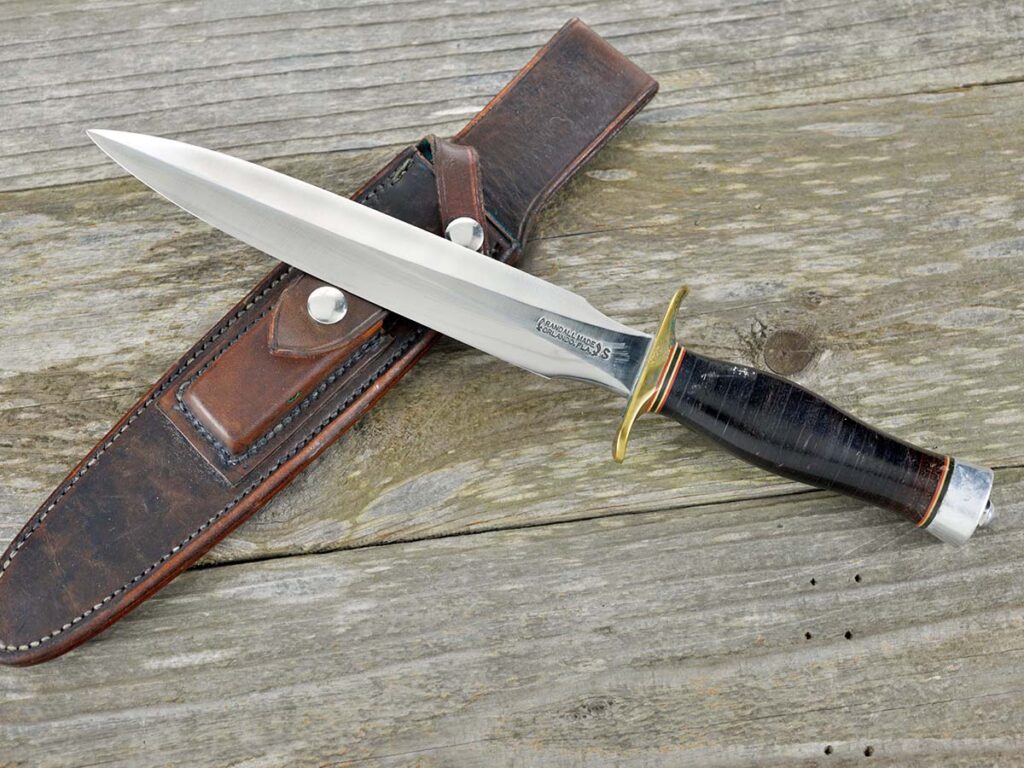
The Randall Knives Model 2 Fighting Stiletto bears the name of one of the most famous knifemakers in history and was developed as a robust alternative to the legendary Fairbairn-Sykes dagger. Randall has gone to war with several memorable designs, and according to Breed, the Model 2 is one of the best remembered.

“The blade is a little wider than the well-known Fairbairn-Sykes dagger,” said Kim. “The Randall was more handle-heavy, with only about a 5-inch blade, as I remember. It feels good in the hand. The guard is not sharp on the fingers, which was a challenge with some of the others. Any Randall daggers are collectible, just like Randalls in general. They didn’t make many of them. The Model 2, to me, is a cross between the Fairbairn-Sykes and the V-42 with a leather stack handle.”

The Randall Knives Model 2 bears the name of one of the most famous knifemakers in history—Bo Randall—and was developed as a robust alternative to the legendary Fairbairn-Sykes dagger. (Les George image)

The Marine Raider Stiletto remains a classic weapon of the World War II era, and it is said to have been the first Marine knife in the Corps’ history designed by a Marine, designed by Lieutenant Colonel Clifford H. Shuey. The story goes that this dagger was developed because the elite Raiders specifically requested a knife for close fighting.

Les offered some observations concerning the Marine Raider stiletto’s proper mission. “When the Marines were issued the Raider Stiletto in World War II, they had been specifically told not to pry with them or throw them,” he said. “So, obviously, they threw them at the first tree they could find and broke the tips off many of those knives.

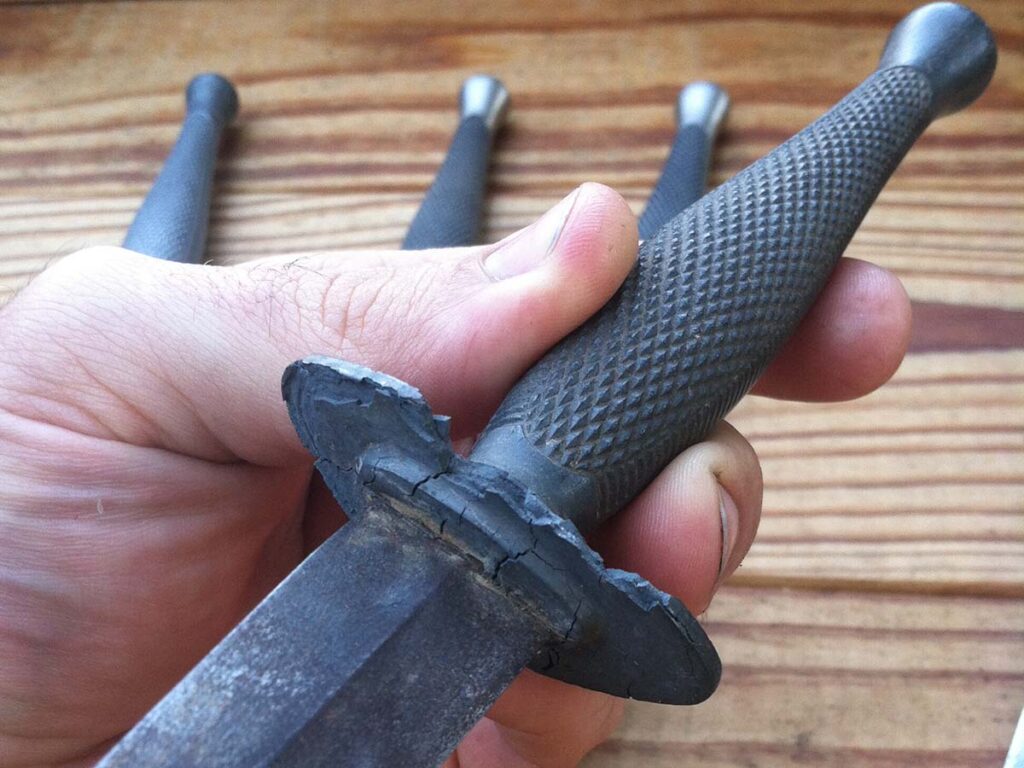
“I think the Marine Raider Stiletto has the best handle design of all the many knives derived from the Fairbairn-Sykes daggers,” George continued. “It’s not just round. It has features and a shape allowing the blade to be indexed by feel. But the blade is very thin, the tip was fragile and the metal that they cast the handles out of reacts with air. They are all disintegrating. Eventually, we will lose them all.”

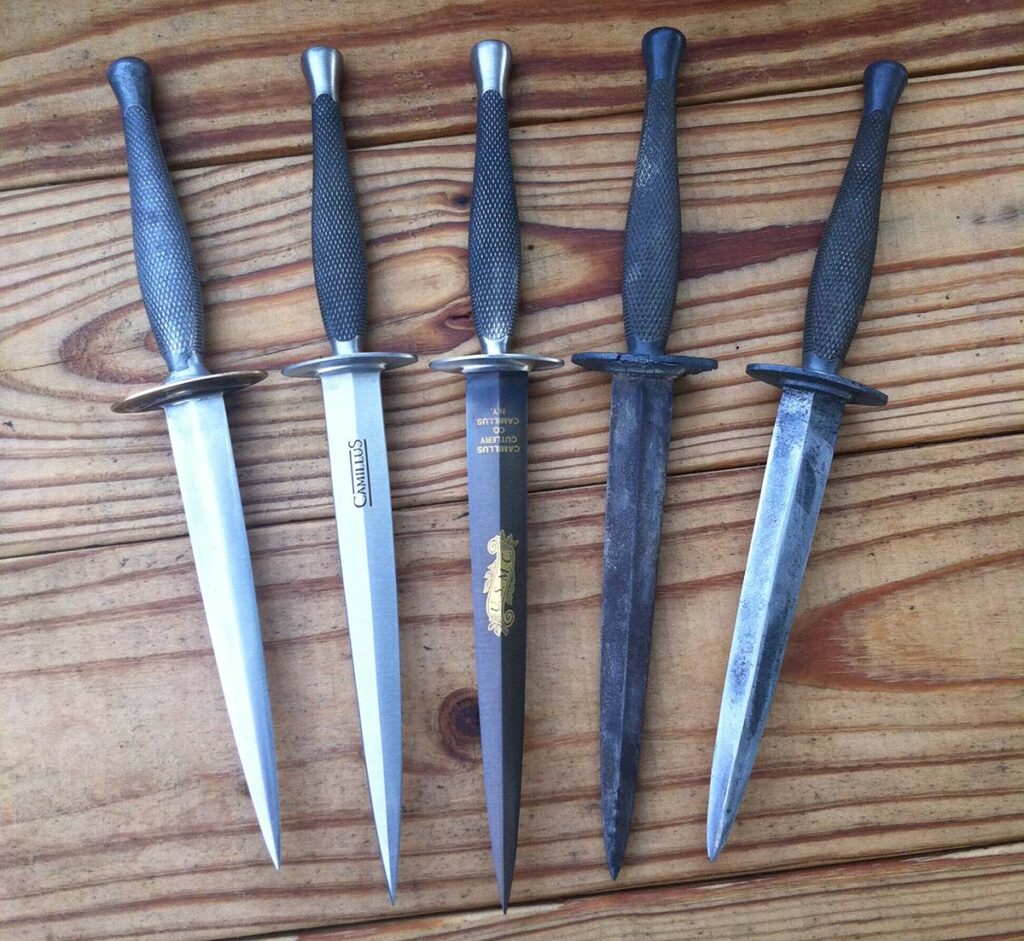
Knifemaker and military dagger aficionado Les George is a fan of the Marine Raider stiletto, seen by his collection of the dagger—new and old. (Les George image)

The handle of the Camillus-made Marine Raider Stiletto was fashioned with a die-cast zinc alloy, while the 7- to 7 ½-inch blade was made of blued or bright steel. The overall feel of the stiletto was hilt-heavy for optimal balance.

“The Marine Raider Stiletto has probably the smallest group of collectors since it primarily appeals to Marines,” commented George. “The rest can be categorized in different ways and have broader appeal. These knives and their more modern counterparts may not find their way to the battlefield as a matter of course, but the history they represent is invaluable.”

Knuckled Under

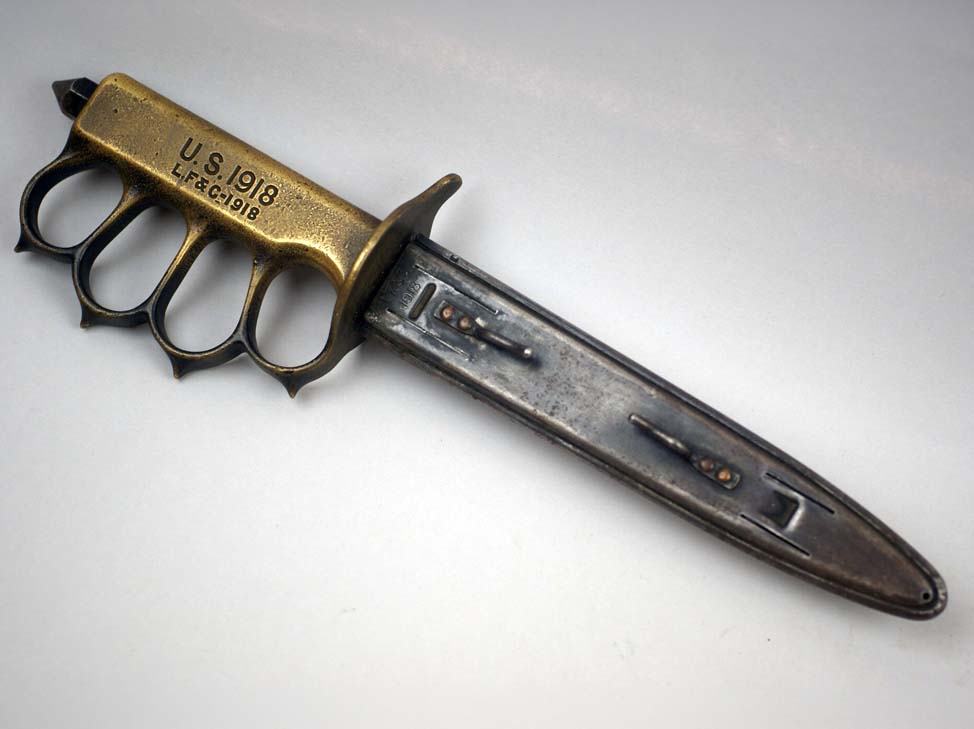
Les includes the iconic M1918 trench knife among those favored few military daggers carried in wartime by American soldiers. Its design was based on the French M1916 Avenger, and the military held field trials after initial 1917 and early 1918 variants were found inadequate. The M1918 was first made by Landers, Frary & Clark, a housewares and hardware company, production was later increased with Oneida, Henry Disston & Sons and the French manufacturer Au Lion.

George considers the knife's handle the best designed of all the Fairbairn-Sykes derivatives. Unfortunately, this is also the dagger’s weak point as the metal used for the handle reacts with the air and disintegrates. (Les George image)
George considers the knife’s handle the best designed of all the Fairbairn-Sykes derivatives. Unfortunately, this is also the dagger’s weak point as the metal used for the handle reacts with the air and disintegrates. (Les George image)

“The LF&C M1918 trench knife did not see action in World War I,” George explains. “It was made for that war, but it ended before the knives made it to Europe. A lot of them were melted down to reuse the handle material. When the Japanese attacked Pearl Harbor, they were the only knives in the system available to be issued to Marines … The M1918 saw use in World War II, Korea and Vietnam. I’m not aware of any combat use of the knife since then, but it is possible.”

The M1918 is distinctive with its integrated cast brass handle and brass knuckle grip designed for close combat, along with small spikes on the finger bows and a skull crusher pommel. The medium carbon steel blade has been criticized at times for being brittle, but nevertheless the knife is recognized as formidable in a hand-to-hand brawl.

“The M1918 was designed to be an effective tool for close fighting,” observed Breed. “With a positive grip and the brass knuckle guard, you didn’t have to stab, or you could hit your opponent with the skull crusher. There were dozens of confirmed kills with this dagger. It was not recommended to dig with them because they were prone to breakage or ‘bendage.’ You could drive that big brass handle into the dirt, but that half shaft that came down from the blade was short on steel and weakened the knife around the tang.”
The eye appeal of the M1918 makes the dagger collectible. “It’s pretty popular and one of the iconic knives of its type,” Kim concluded.

Many think of the M1918 as the quintessential World War I trench knife, though the variant didn't see action in that conflict, adopted too late. Based on the French M1916 Avenger, it was meant to replace the 1917 and early 1918 variants, which were found inadequate. (Les George image)
Many think of the M1918 as the quintessential World War I trench knife, though the variant didn’t see action in that conflict, adopted too late. Based on the French M1916 Avenger, it was meant to replace the 1917 and early 1918 variants, which were found inadequate. (Les George image)

Representative of the fighting men who carried them into harm’s way, these U.S. military daggers of the 20th century continue to fascinate with their double-edge blade, balanced feel and handle characteristics. Their place in history is secure, while collectors and knife industry veterans are doing their best to preserve and retell the stories that surround them.

More On Military Knives:

King Tut Dagger: The Rare Chance To Hold The Legend

1

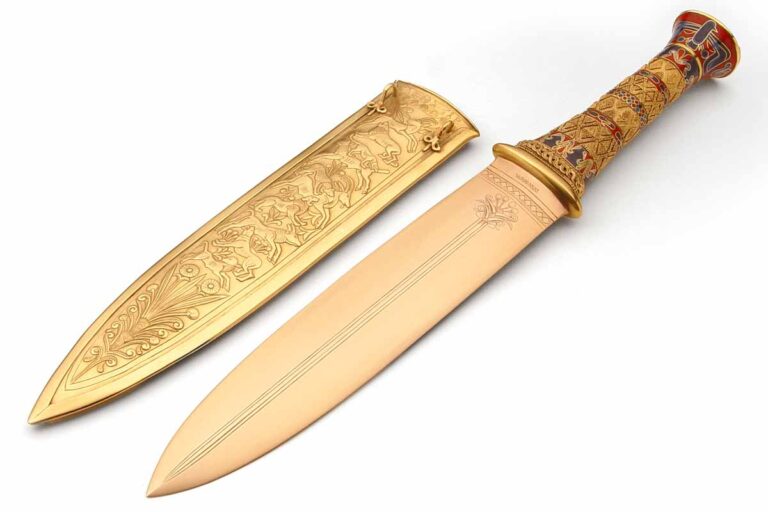
A chance phone call out of the blue leads to the author’s opportunity to see and hold the iconic Warenski King Tut Dagger.

While in San Diego in summer 2015 for a work conference, I saw a flyer advertising a King Tut exhibit at the San Diego Museum of Natural History. The exhibit focused on recreating the experience of Howard Carter, the British archaeologist who found the lost tomb of Egyptian King Tutankhamun in 1922.

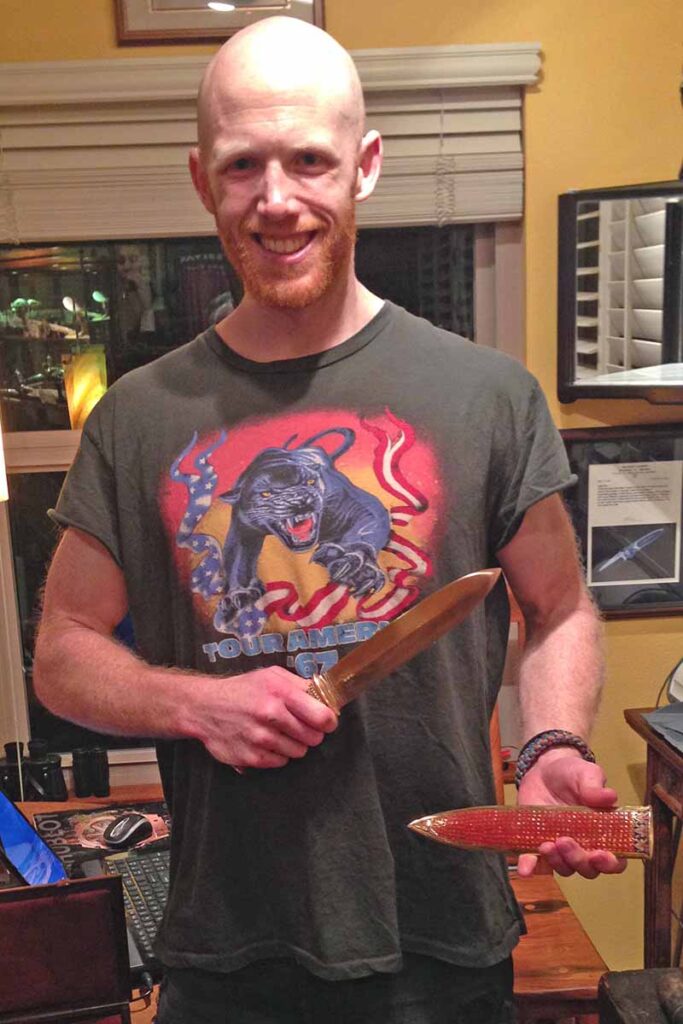
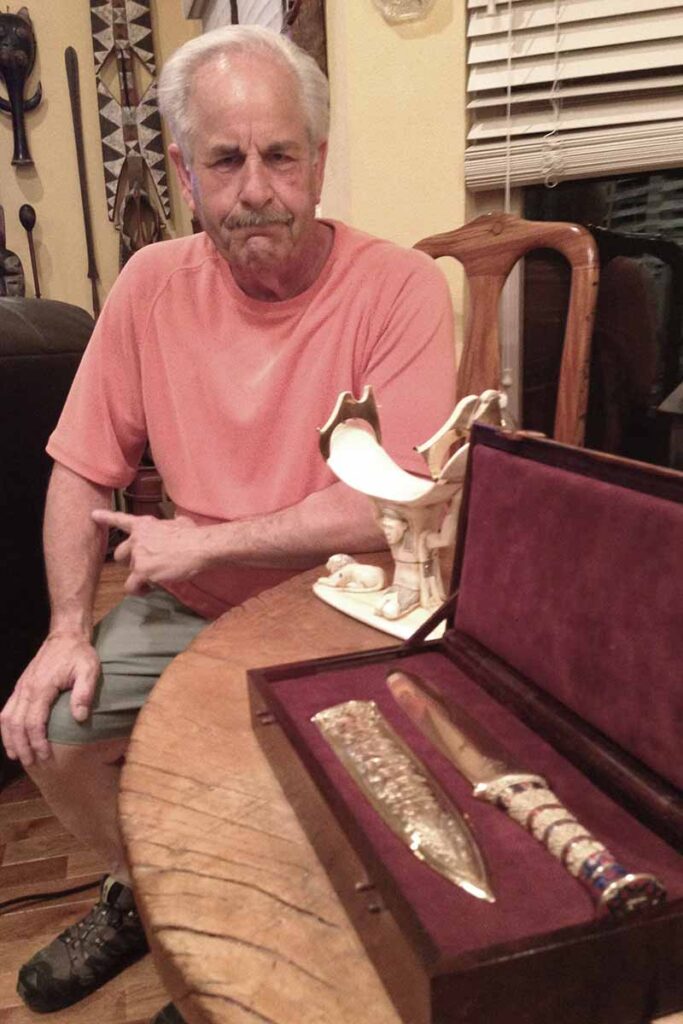
Chad Royer holds Buster Warenski’s reproduction of the King Tut Dagger.
The author holds Buster Warenski’s reproduction of the King Tut Dagger and sheath in the home of Phil and Judy Lobred. (image of Warenski’s Tut Dagger by SharpByCoop; image of the author by Phil Lobred)

The promotional materials advertising the exhibit indicated it would feature recreations of many of the artifacts found in the original tomb. Having been exposed to custom knives all my life through my father, Rick Royster, and being familiar with BLADE Magazine Cutlery Hall-Of-Fame® member Buster Warenski’s work, I wondered if Buster’s famous reproduction of the King Tut Dagger would be part of the exhibit.

I called the museum and asked the young lady who answered if Buster’s reproduction was in the exhibit. She said it was not, but my inquiry grabbed her attention. She didn’t go into much detail but alluded to the fact that the owner of the reproduction lived in the area. We hung up and I went about my trip not thinking anything else of it.

Later that day while visiting the San Diego Zoo I got a call from a strange number, and it was Cutlery Hall-Of-Famer Phil Lobred, owner of the King Tut Dagger reproduction. Apparently, the young lady from the zoo knew Phil and had reached out to him. Phil and I talked on the phone and I told him how my father had worked closely with Buster through the years on several custom pieces, and Phil invited me over to look at the knife. I told my girlfriend we had to hurry up at the zoo because I had somewhere more important to go.

Visiting The King Tut Dagger

I went to Phil’s house that evening. His wife, Judy, let me in and took me to him. We went upstairs to what must have been Phil’s corner of the house. Not only did he have dozens of knives, he also had tons of collectibles. What I remember most were the Eskimo artifacts. He knew what everything he had was and had a story to tell about how he got each one and what it was used for.

Phil Lobred sits by the King Tut Dagger
Phil Lobred sits by the King Tut Dagger reproduction and sheath in the presentation case, as well as the knife’s display cradle. On the wall at left are examples of the African art in his collection.

Then we got to the knives and finally the most extravagant of them all—the Warenski Tut Dagger. I couldn’t believe what I was seeing. It was a marvel to behold, a true masterpiece, something not many people in the world would ever have the opportunity to see up close. I was shocked when Phil asked if I wanted to hold it. He even photographed me holding it, the image of which appears with this story.

I must have been at Phil’s house several hours with him showing me all of his collectibles and talking about them. It was easy to lose track of time. He was a very nice man. It was very gracious of him to invite a total stranger to his house, and let me see and hold a one-of-a-kind piece of art.

It was a once in a lifetime experience.

More On Knife Collecting:

Robertson’s Maker Market Matrix: An Explainer

The author’s system is designed to help you accurately price custom knives.

After I wrote a recent BLADE® article on custom knife pricing, editor Steve Shackleford suggested I write a follow-up on the system I use to price custom knives—Robertson’s Maker Market Matrix or RM3. I wrote it to provide a basic guide for each collector or maker on how to do their own pricing. You can find many examples of weighted score tables with a quick Internet search.

A collection or business is a very individual thing. The research required to create a successful Matrix for either one depends on the individual doing it. Let’s dive in.

Market Position

A maker’s position in a market is not always apparent. While in graduate school, I wrote a paper on the impact of pricing and how it can apply to products. As a custom knife dealer, I was looking for a business advantage. I applied the findings in my paper to my business.

I opened my copy of KNIVES ’92 and, using a weighted score table, started to compare makers I found in the book’s index. Initially, I placed the knives in recognized categories, for example, hunters, fighters, bowies, tactical folders, etc. I wanted to compare similar knives/apples to apples. Each category had several hundred entrants.

My goal was to create a top-third, middle-third and bottom-third strata. This is where the weighted aspect of the table comes in. I developed essential criteria, such as quality of work, demand in the primary market, demand in the aftermarket, materials used, delivery time, awards and other gauges. Once I established the criteria, I gave each criterion an importance weight.   


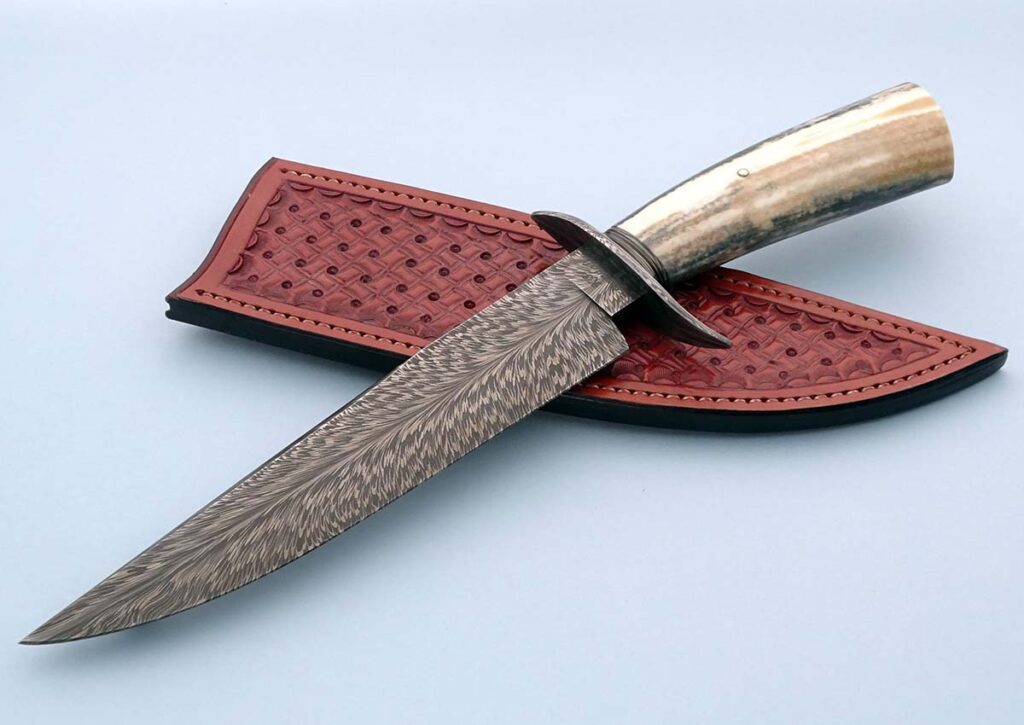
Custom Randall-Orig-Forged-Dam-Fighter-lg

Maker: Steve Randall  
Model: Feather Damascus Fighter  
Blade Length: 8”
Overall Length: 14”
Blade Steel: Feather Pattern Damascus 
Guard Material: Feather Pattern Damascus  
Handle Material: Ancient Walrus Ivory  
Author’s Comments: “Steve is the quintessential ABS master smith. He is versatile, inquisitive, loves a challenge and always strives for perfection in every aspect of his knifemaking.” (Robertson’s Custom Cutlery image)


After the Matrix determined the maker’s position in the strata, the ultimate goal of the RM3 took shape in determining which makers’ prices accurately reflected their position in a particular market sector. My research showed that hundreds of makers’ prices were above their position in the market. In other words, many of these makers who were in the second strata were asking first-strata prices. The same was true for third-strata makers asking second-strata prices. The main reason for this is that the makers asked their knifemaking friends to price their knives.

Knifemakers are not knife buyers and, as such, generally do not have a real sense of what knives should sell for. This is especially true if they don’t know their market position. Additionally, asking your competitors/fellow makers to price your knives is not a recommended business strategy.

Among other things, one aspect of the RM3 I was surprised to find is that it identified makers who offered value pricing. At first glance, many people mistakenly think this means the least expensive price. Instead, given the maker’s position in the market, a value price provides the buyer value regardless of the price tag. The makers who came to my attention were those pricing their knives commensurate with the pricing in lower strata, e.g., a first-strata maker asking for a second-strata price.

Blade Game

When knife shows or knife sales are slow, the blame game begins. The reasons for the slowdowns usually center around the show promoter not doing the job. The economy is a favorite reason, along with the weather, lighting and position in the room. A maker once told me his sales were slow because he was facing a wall. Note that we were in a square room; everyone was facing a wall. What seldom, if ever, is brought up as a reason for slow sales is the maker’s prices.


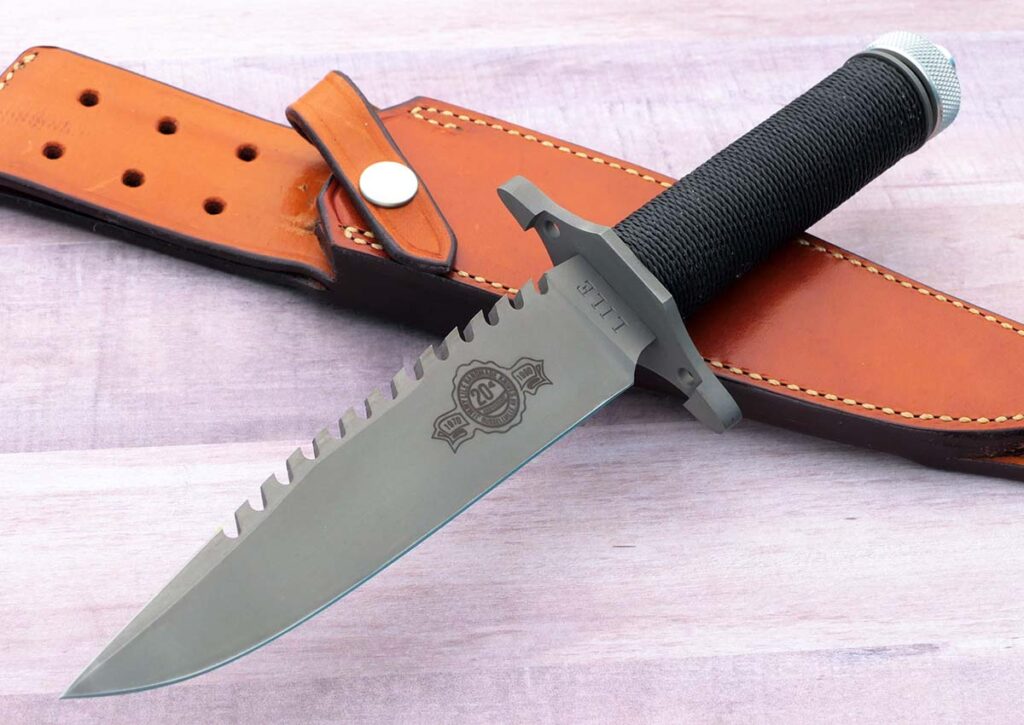
Custom Lile-20-Anniv-Sly-II-Tactical-Fighter-Blade

Maker: Jimmy Lile 
Model: 20th Anniversary SLY II Fighter 
Blade Length: 6”
Overall Length: 10.5”
Blade Steel: 440C stainless
Blade Finish: Bead blast 
Guard Material: Stainless steel 
Handle Material: Aluminum tube w/cord wrapping 
Author’s comments: “A BLADE Magazine Cutlery Hall-of-Fame® member, Jimmy did more to introduce the knife world to the tactical fixed blade than any other custom knifemaker. This young infantry lieutenant saw a Rambo movie and it changed my world.” (Robertson’s Custom Cutlery image)


Very few people will tell makers their prices are too high, as makers can be touchy about their pricing. At the same time, few makers ask collectors or buyers what they think of their knives. This interaction is a prime opportunity for a maker to work on his or her Matrix. Further, this is an opportunity to educate the collector on why the maker’s knives are priced the way they are, and to give the collector a chance to work on his or her Matrix.

I cannot overstate how vital this flow of information is for both the maker and the collector. For the past 30+ years, at every show I have attended I have heard, “Les, come and look at my knives and tell me what you think.” I have the utmost respect for the makers who ask me to do that. It can be daunting for a maker to ask someone to critique the maker’s knives and prices. A quick “good job” may be nice for the maker’s ego, but a critical examination of the work and pricing will ultimately improve the maker’s knives and bottom line. 

Hype Cycle

The Hype Cycle occurs when a custom knife market sector takes center stage. In 1988, interframe folders were all the rage—many sold for over $10,000 each. In 2001, I bought one of the same knives for $600 at an auction. The original sale price was $14,000. What happened? Answer: the Hype Cycle. The hype drove up the prices, and when the hype went away, the prices crashed. The Hype Cycle is a Matrix killer as prices become skewed to the point that they are unsustainable. 

Whether you’re a collector or a maker, the Matrix can benefit you. Identifying the maker’s position in the market aids in an appropriate price, thus increasing sales for the maker. At the same time, it gives the collector a chance to sell or trade a knife at a fair price in the aftermarket, as it is in the aftermarket where collectors pay to go to school. 

Custom knife markets are small cycles inside of larger cycles. New criteria will always enter a Matrix. Consequently, both makers and collectors must be sensitive to the ever-changing markets. Retirements, new materials, awards, bad reviews and other factors can all impact pricing.

R&T

Reading this, some may think the RM3 is a quick and easy solution for pricing knives. I assure you, it is not. The amount of research and time you put into your Matrix will directly affect your ability as a collector or as a maker to identify the maker’s position in his or her market. It also will give valuable insight as to whether the maker is offering value pricing. Makers will gain useful knowledge on how to price their knives correctly for their position in the market, helping them eliminate the blame game.


Custom Broadwell-Damascus-SubHilt-Ivory-Blade-Article

Maker: David Broadwell   
Model: MLR Sub-Hilt Fighter 
Blade Length: 8”
Overall Length: 14”
Blade Steel: Wolf’s Tooth Pattern Damascus Guard, Sub-Hilt and Pommel Material: Wolf’s Tooth Pattern Damascus
Handle Material: Ancient Walrus Ivory  
Author’s Comments: “Dave has been making some of the finest sub-hilt fighters for over 40 years. His knives are the epitome of the 4 F’s; Fit, Finish, Form and Function.” (Robertson’s Custom Cutlery image)


More On the Robertson Matrix

How do you give what you call an “importance weight” to each criterion in a Matrix? What makes specific criteria more important than others?
ROBERTSON: One criterion that has moved up my list and now carries more weight is customer service. We deal in so much poor customer service in our everyday lives. We don’t need this in our hobby. I am still amazed at the number of clients who tell me they have emailed or called a maker, often several times, with no response. Everyone is busy but it takes literally 60 seconds to respond to an email acknowledging receipt and indicating a response will be forthcoming asap. Those makers who don’t respond in a timely manner are telling you it is about them and not you. If they are making it difficult for you to give them your money, don’t. 

What makes the ratings for your criteria change?
ROBERTSON: Actually, it is the ratings of knife organizations that have caused me to change the weight the ratings carry in my criteria. When I first started in custom knives, to be a Knifemakers’ Guild voting member carried a lot of weight in the knifemaking community. Today the Guild is more of a club, though still a good idea that provides insight and help for makers. For me, at least, if a maker tells me he or she is a Guild voting member, that mostly tells me the maker is serious and has shown improvement in his or her knifemaking skills over the years, but it does not carry the weight in my criteria it once did.

How often do you update the ratings, and why?
ROBERTSON: The custom knife market is never static and is always evolving.  This evolution demands that weight associated with each criterion evolve as well. The weight I associate with a particular maker changes with the maker’s ability to incorporate the changes the collectors want, be it materials or design elements.

How often do you change the criteria themselves, and why?
LES ROBERTSON: I’m generally one-to-two years ahead of where a market sector that interests me is going. Given this extended lead time, I often have to account for new information and tweaking of the weight within a particular criterion or the criterion itself. Perhaps the most difficult aspect of this is to not put too much weight into a criterion due to my personal biases. In other words, just because a particular style of knife is my favorite does not mean the majority of other collectors feel the same way. I try to take my feelings out of the equation and I am not always successful. The Matrix is not an exact science.

More On Knife Collecting:

Randall Airman: USMC Prototype Carried By The Father Of Marine Helicopters

The story of a prototype Airman and a Marine pioneer.

Editor’s note: The author contacted BLADE® and asked if we would be interested in his story on a special Marine Corps knife and a special Marine to coincide with the semi-quincentennial of the United States Marine Corps. Needless to say, it was an easy decision on our part. Meanwhile, please join us in wishing a happy 250th birthday to the Corps and Marines everywhere.

The core values of honor, courage and commitment have defined the United States Marine Corps since its inception on Nov. 10, 1775. To remain an elite fighting force, the Marine Corps has adapted as the world has changed over the past 250 years, incorporating new technology and developing new doctrine.

One of the most significant transformations began with the birth of Marine Corps aviation in 1912. During World War II, Marine aviators played a vital role in the Pacific campaign, working closely with ground units to seize heavily defended island strongholds. As Gen. Keith B. McCutcheon, a pioneer of Marine aviation, later emphasized, “The Marine Corps is proud of the fact that it is a force of combined arms, and it jealously guards the integrity of its air-ground team.”

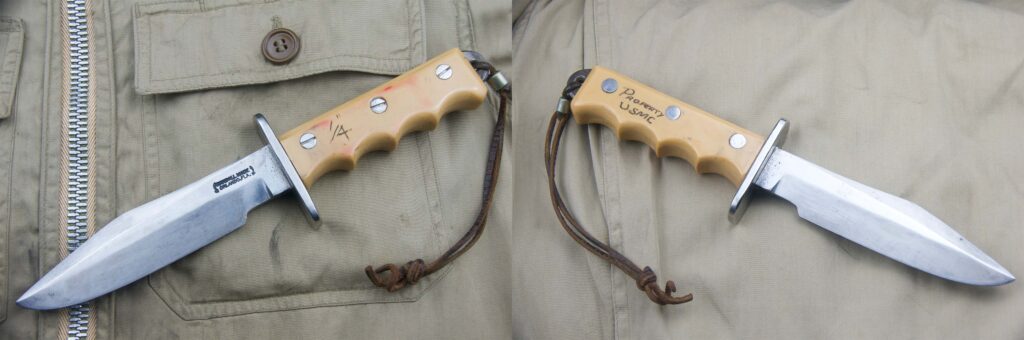
The mark and non-mark sides of a prototype Airman.

The evolution of air combat brought new challenges, challenges that extended even to the knives that aviators carried. One result was a collaboration between Marine aviators and BLADE Magazine Cutlery Hall-of-Fame® member Walter D. “Bo” Randall, who would redefine survival and combat knives with the now-iconic Randall Model 15. This article features one of Randall’s prototypes—a rugged, full-tang Airman’s Knife that was carried for more than 15 years by Gen. McCutcheon himself.

The Challenge

Marine aviators amassed extensive combat experience in World War II and Korea. By 1953, the Marine Corps recognized that the rigors of combat aviation demanded a new type of knife—one that was rugged, compact and versatile.

As documented by Randall historian Robert Gaddis, the Marine Corps Equipment Board assigned Lt. Col. H. Ross Jordan and Maj. Harold N. “Tex” Mehaffey to develop a survival and combat knife for Marine aviators. The knife had to be nearly indestructible—strong enough for an airman to pry, cut or smash his way out of a downed aircraft. At the same time, it had to be short enough to be worn in a cramped cockpit, and the sheath needed to allow the knife to be carried on the upper arm or lower leg.

Wearing his sheathed Randall Model 15 Airman on his left hip, United States Marine Corps Gen. Keith McCutcheon (center) is flanked by South Vietnamese Gen. Hoang Xuan Lam, Commander of I Corps, and USMC Gen. Edwin B. Wheeler (right), commanding general of the 1st Marine Division. (image of McCutcheon, Lam and Wheeler from somewhere near Da Nang, Vietnam, March 16, 1970)

After reading a December 1953 magazine article about Bo and his expertly crafted blades, Mehaffey and Jordan arranged to tour his knife shop in Orlando on Feb. 11-12, 1954. By the end of their fruitful discussion on February 12, Bo had arrived at the basic design of the Randall Airman’s Knife. He also planned a longer-bladed version for ground troops, a design that would become the Randall Attack. Thus, this meeting launched the line of full-tang Randall models that would expand and evolve over the coming years.

Bo moved rapidly to fabricate prototypes that embodied his innovative design. The 5.5-inch blade would be forged from quarter-inch-thick O1 tool steel, a material that had been proven in earlier Randall combat knives. To strengthen the tip, the blade would retain the full quarter-inch thickness nearly to the point. To strengthen the junction between blade and the handle, the tang would be 7/8-inch wide along the entire grip. An extended segment of the tang would have a hole for a wrist thong and provide a surface that could be used for hammering. A heavy double hilt would prevent a gloved hand from slipping forward onto the blade. The handle would be made from a single piece of Tenite plastic, shaped with finger grips and a channel to snugly fit the tang. Stainless steel bolts would secure the handle.

To complete the package, Randall designed a sheath that could be worn on a belt, attached to a harness, or tied to the lower leg or upper arm with leather laces. It featured a diagonal keeper and rivets at stress points. The Randall shop completed the prototypes of the Airman’s Knife and the longer Attack Knife by the end of February 1954—barely more than two weeks after the formative design discussion—and Clarence Moore readied the sheaths soon after.

Three-star Gen. Keith McCutcheon, February 1970

The innovative features of the new knife and sheath designs were memorialized on certified blueprints on March 4, 1954. Randall filed a patent application on Aug. 11, 1954, and the United States Patent Office granted patent 177,590 for the Randall Airman’s Knife on May 1, 1956.

Prototype Testing

With prototypes in hand, Randall travelled to Quantico, Virginia in mid-March 1954 to present the new full-tang knives to Mehaffey, Jordan and other USMC and U.S. Navy officers. The group enthusiastically recommended that the Navy’s Bureau of Aeronautics purchase 10 prototype Airman’s Knives for evaluation: five from quarter-inch stock according to the original design, and five lighter examples from 3/16-inch stock.

The requisition arrived in early April 1954 and the shop shipped the 10 prototypes in early May. The invoice listed the Airman’s Knife as the #14, but later that month Randall adopted the still-current model numbers: the Airman became the Model 15, and the longer version became the Model 14 Attack.

The Marine Corps Equipment Board received two of the prototypes, one of each blade thickness, and the remaining eight were sent to squadrons and other units for real-world testing. In late May, Mehaffey informed Bo that preliminary testing had begun.

One of the original Randall prototypes is featured in the accompanying photographs. Made from quarter-inch steel, as indicated by the inscription on the handle, the prototype closely follows Bo’s patented design, except the blade lacks the fuller shown in the drawing. As in the original design, the prototype’s handle is secured by three bolts; this feature sets the prototype apart from later production examples of the Model 15, in which only two bolts were used.

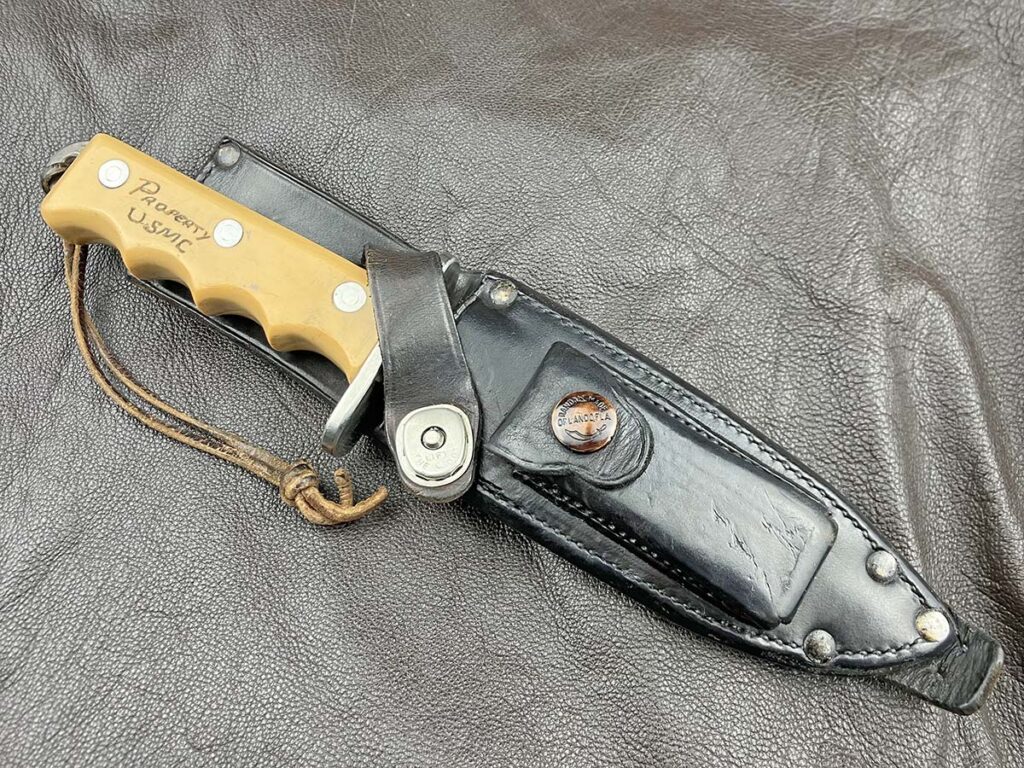
Leatherworker Clarence Moore made the sheath for the prototype Airman according to Bo Randall’s design. Moore made the sheaths for the earliest full-tang knives until Heiser took over production in 1955.

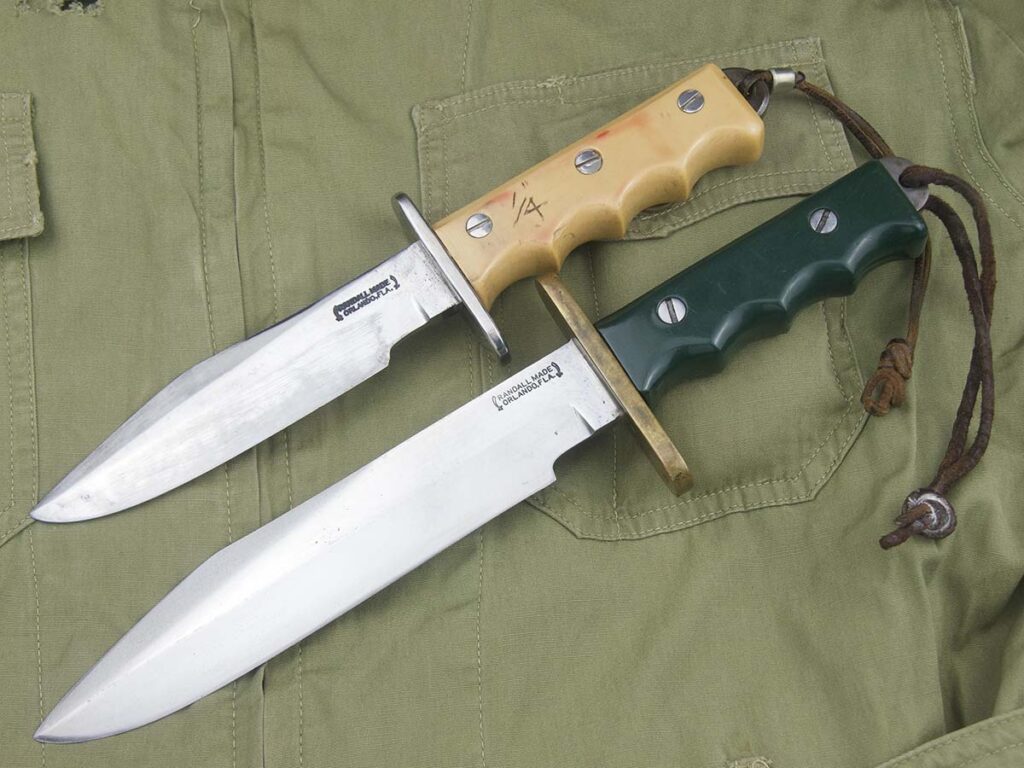
The handle is made from white Tenite, a material used only for a year or so before Randall adopted the more familiar green Tenite that was characteristic of production for nearly 10 years, until Randall Made replaced Tenite with Micarta® in the mid-1960s. The prototype’s hilt is nickel silver in contrast to the brass hilts seen on almost all Model 15s with Tenite handles. The sheath was made according to Bo’s design by master leatherworker Clarence Moore, who made sheaths for the earliest full-tang knives until Heiser took over production in 1955.

After more than 70 years, the knife and sheath are in outstanding condition—a testament to Randall’s craftsmanship and superb design.

Project Setbacks

Despite starting with such promise, the project faltered in the summer of 1954 when Mehaffey was transferred for duty in France and Jordan retired. The departure of the two enthusiastic advocates delayed testing and communications. The next official update was in December 1954, when Bo heard that testing had been underway for two months with positive feedback. In April 1955, the United States Air Force also ordered a group of Model 15s for evaluation. Bo wrote again to the USMC in June 1955 but heard nothing further from the Marines or the Air Force.

Although Randall was never officially informed of the results, author Frank Trzaska uncovered a September 1955 testing report in the USMC archives. The report was authored by USMC Maj. Norman W. Gourley, who had succeeded Mehaffey. Extensive testing of the Randall Airman prototypes showed that the quarter-inch-thick version (i.e., Bo’s original design) was “suitable for aviators’ survival use.”

After a fruitful meeting on Feb. 12, 1954 with USMC Maj. Harold N. “Tex” Mehaffey and Lt. Col. H. Ross Jordan, Bo Randall had arrived at the basic design of the Randall Airman’s Knife (top). Bo also planned a longer-bladed version for ground troops, a design that would become the Randall Model 14 Attack (one from 1955 is shown at bottom). The meeting launched the line of full-tang Randall models that would expand and evolve over the coming years.
SONY DSCAfter a fruitful meeting on Feb. 12, 1954 with USMC Maj. Harold N. “Tex” Mehaffey and Lt. Col. H. Ross Jordan, Bo Randall had arrived at the basic design of the Randall Airman’s Knife (top). Bo also planned a longer-bladed version for ground troops, a design that would become the Randall Model 14 Attack (one from 1955 is shown at bottom). The meeting launched the line of full-tang Randall models that would expand and evolve over the coming years.

The report, which pictures this story’s featured prototype, notes the high quality of the design, materials and workmanship of the Randall knife and sheath and concludes that it is acceptable for extreme survival tasks. The report also noted potential changes that would improve the knife further, such as the addition of saw teeth, a flat butt surface for hammering, and different handle configurations. Bo independently incorporated most of these features in various full-tang Randall models by the mid-1960s, and presumably he would have made the changes sooner if the request had ever been made.

While the tests of the Randall Airman were underway, the Navy adopted the Imperial Pilot Survival Knife for its aviators. Because the Marine Corps operates as part of the Department of the Navy, this surely complicated any attempt by the Marines to adopt a different design. The Randall Airman was never issued by the military, but Bo added the Model 14 Attack and the Model 15 Airman to the new Randall catalog printed in 1954, which showed prototypes of both models as “patent pending.” As envisioned by Bo and the Marine aviators who helped to shape the design, Randall’s full-tang combat and survival knives were embraced by many American servicemen who purchased them privately, especially during the Vietnam War.

Pioneer & His Prototype

One Marine who had a high opinion of the Randall Airman was aviation pioneer Keith B. McCutcheon, who as a colonel served as Chief, Air Section, Marine Corps Equipment Board from June 1954 to July 1957. After the Randall Airman tests concluded, McCutcheon carried the quarter-inch prototype for the rest of his career.

An attack helicopter warms up in the background as Gen. McCutcheon surveys the situation six miles southwest of Da Nang, March 17, 1970, his trusty Randall Model 15 Airman sheathed at his side. At left is Gen. Edwin B. Wheeler.

In January 1966, while commanding the 1st Marine Aircraft Wing in Da Nang, Vietnam, then-Brig. Gen. McCutcheon wrote that the Airman was a “wonderful knife” that he had carried for “10 or 11 years.” Photographs from 1970 show McCutcheon wearing the knife when he returned to Da Nang as a lieutenant general and commander of the III Marine Amphibious Force (III MAF).

Commissioned as a Marine 2nd lieutenant in 1937, McCutcheon was a brilliant, courageous leader who transformed Marine aviation over the course of his illustrious 34-year career. Gen. Earl Anderson said McCutcheon “was one of the finest and most dedicated Marine officers [whose career] reads like a history of Marine Aviation. He earned his wings as an aviator in 1940 and served in World War II, Korea and Vietnam.”

McCutcheon was instrumental in integrating helicopters into Marine operations, and has been called “the Father of Marine Helicopters.” But, as historian William Fails observed, that title does not capture McCutcheon’s central contributions to numerous other areas. He also advanced close air support doctrine and techniques, guided missile systems, and the AV-8 Harrier jump jet. McCutcheon was also an effective leader of ground operations, launching successful operations as commander of III MAF.

For his exemplary service over 34 years, McCutcheon received many of the nation’s highest military decorations, including three Distinguished Service Medals, the Silver Star Medal, three Legions of Merit with Combat “V,” the Distinguished Flying Cross, 10 Air Medals and others. He was appointed to become the assistant commandant of the Marine Corps but was unable to assume the post because of failing health. He retired as a four-star general on July 1, 1971, and passed away from an illness soon after.

Enduring Legacy

On the 250th birthday of the United States Marine Corps, it is fitting to honor the legacy of Gen. Keith B. McCutcheon, an extraordinary leader who helped shape the modern Marine Corps. McCutcheon’s prototype Randall Airman remains as a tangible link to his many accomplishments and to the connection between the Marine Corps and Randall Made Knives.

Sources

William R. Fails. 1978. “Marines and Helicopters 1962-1973.” History and Museums Division, Headquarters U.S. Marine Corps.
Robert L. Gaddis. 1993. “Randall Made Knives: The History of the Man and the Blades” Paladin Press.
James Anthony Ginther, Jr. 1999. “Keith Barr McCutcheon: Integrating Aviation into the United States Marine Corps, 1937-1971.” Doctoral Dissertation, Texas Tech University.
Norman W. Gourley. 1955. Marine Corps Equipment Board report A9-E-1039 on Project E-1039.
Frank Trzaska. 2001. “Randall’s Model 15 & the U.S.M.C.” February 2001 Knife World.

More On Military Knives:

Advertisement

Must Read Articles

Read this before you make a knife

Knifemaking 101 – Read This Before You Make a Knife

  by Wayne Goddard My experience has taught me that there's nothing like digging in and getting started. I've often said the hardest part of the...
how to forge damascus steel

How to Forge Damascus

Advertisement
Advertisement