Knife Collecting

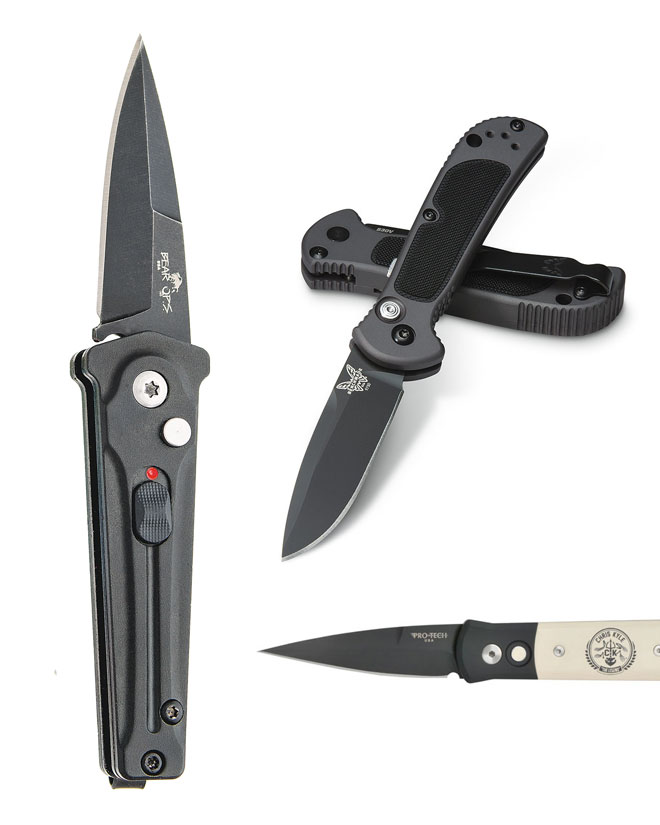
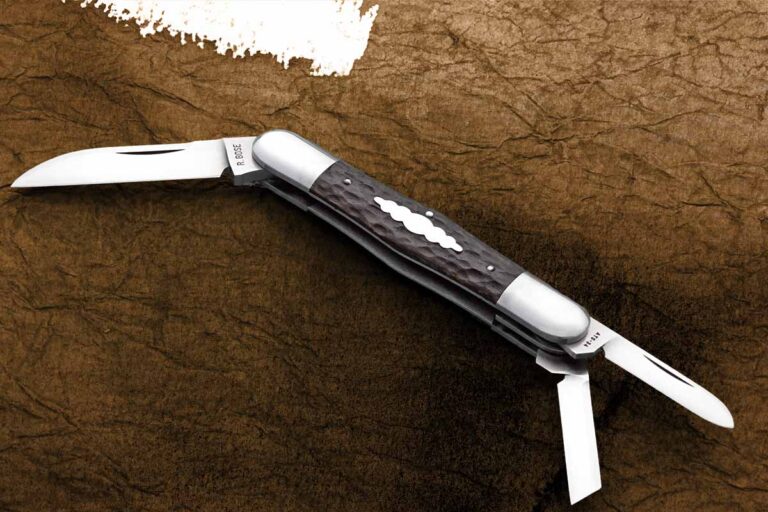
Knife collecting is an extremely rewarding experience for knife enthusiasts. There truly is a knife for everyone. Many increase or hold their value throughout the years, making collecting knives something to pass on to the next generation of knife collectors.

Knife Collecting Tips To Get The Most Out Of Your Buy

Observe all nine and your collecting pursuit can be most satisfying.

I have watched the custom knife market for 40 years with more than idle curiosity. The universal mantra of collectors regarding their collections is I buy what I like.  At the outset, it seems a simple statement. The real question is, what does the collector collect and why?

The best thing about a collection is that it is yours. You decide what knives enter and which ones leave. Often, it is a combination of the design/style, material(s) and maker. Then again, it can be knives with a singular attribute that make up the collection. I have also found that the mantra of the collector is invoked when part of his or her collection is difficult to sell or trade.  

TIP #1

Collecting and investing are not the same. Assembling a collection is done primarily for the pure joy of it. The search and subsequent acquisition of each knife only fuels your desire to increase/improve your collection.

One of the great things about custom knives is getting what you want. Custom knives can be made to your specifications, not knives that are merely one of a hundred thousand. Investing in custom knives is done for the specific reason to re-sell for a profit. Buy what you like because you may have it for a long time, whether that is your intention or not.
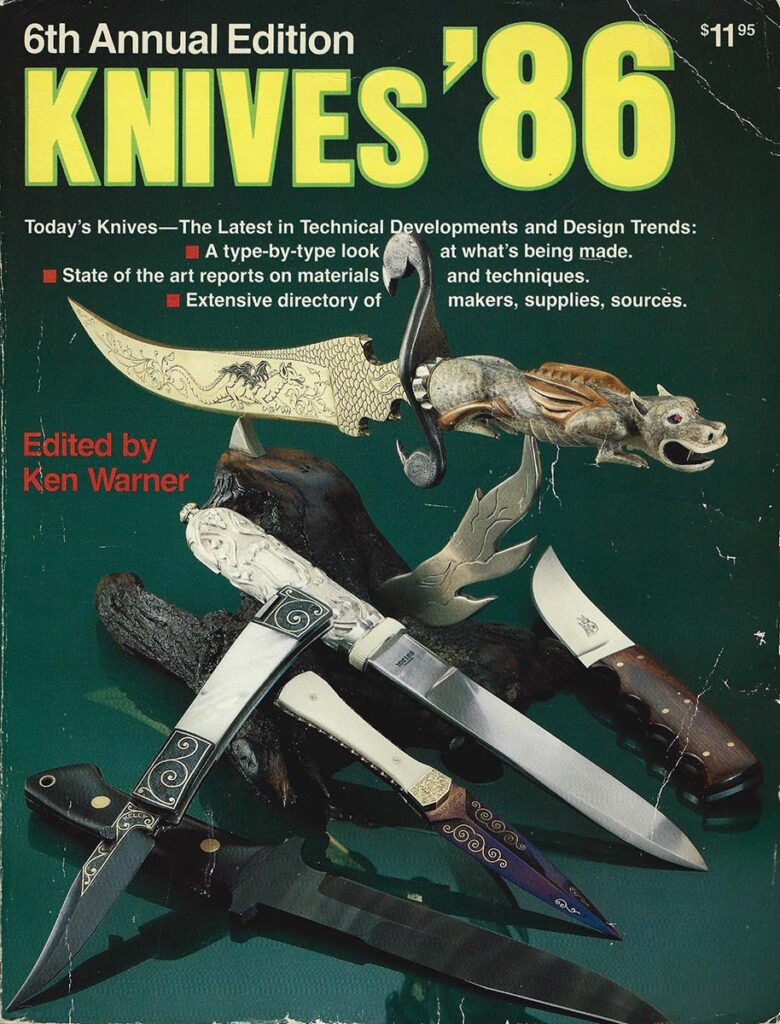
Knives 1986 Annual
The author kept pages of notes in his copy of KNIVES ’86 that he bought in 1985. It became a blueprint for his knife collecting and then later for his business, including which knives he liked, questions to ask the makers and so on.

TIP #2

Do your research before you buy. I started doing research early on as a collector. I still enjoy looking at the KNIVES ’86 I got in the fall of 1985. In my copy of the book are pages of notes that became a blueprint for my collecting and then later for my business as a purveyor of custom knives, including which knives I liked, questions to ask the makers, etc. I then contacted the makers for their catalogs or just called them to get the information on each. Considering several factors or knife-buying skills listed here allowed me to identify and get the five knives I wanted at the 1986 BLADE Show. Today, the Internet saves a lot of time when researching knives.

TIP #3

Decide the direction of your knife collection (at least for this week). Determining a direction for your collection will be easier if you can master Tips 1 and 2. Doing your research before attending a show or placing the order will save you from a custom knife collector’s worst enemy—buyer’s remorse.

TIP #4

Buy the very best knife you can afford. This is an important concept to understand, as this will help you look past what many of us consider the most important factor: price.  Price is not the most important factor, cost is. Price is what you are willing to pay for a custom knife. Cost is the hidden part of the price equation for not knowing if the knife is priced correctly for the maker’s position in the market. Overpaying for a knife will become an issue should you choose to sell or trade the knife.

A critical reason for mastering Tips 1 through 4 is that they will enable you to determine which knife is the best for you for the amount of money in your budget. Sometimes it is more prudent to take the money you would spend on two knives and buy only one. When considering buying a knife, always employ Tip #1 and consider the short- and long-term costs of the purchase.

TIP #5

The truth changes. This applies to many things in life, including the knives in your collection. Enlightenment can be a double-edged sword. You will begin to evaluate your collection as you gain expertise in custom knives. Mistakes that were invisible to you before now catch your eye. This expertise, however, is now helping you select better-made knives.
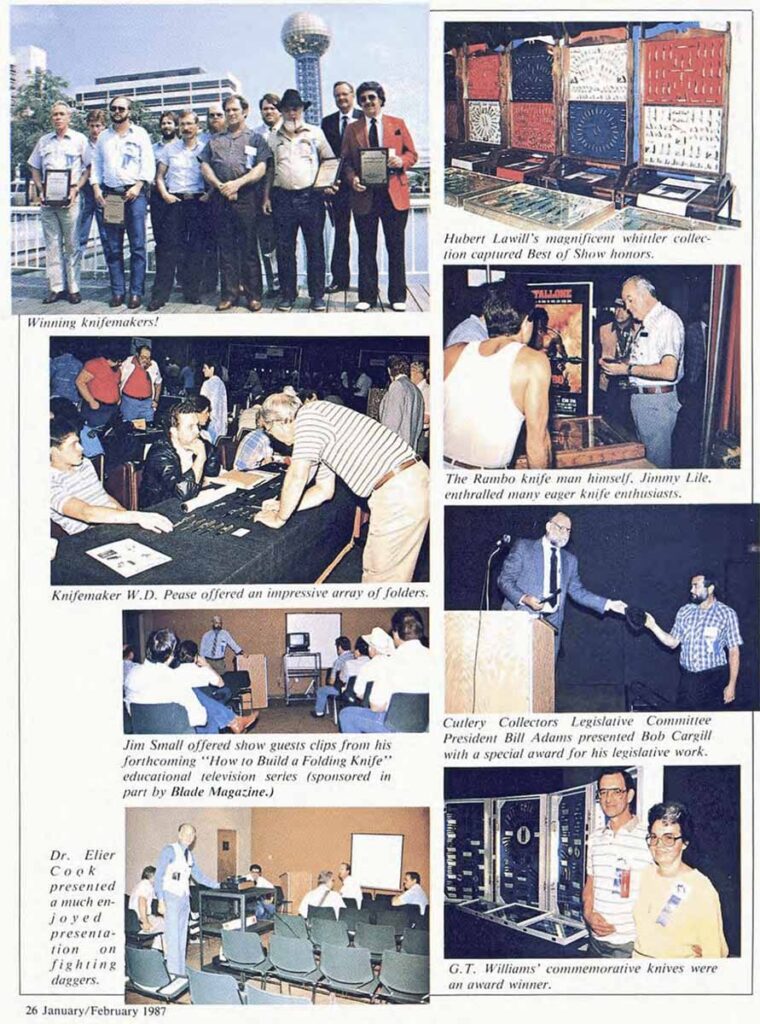
Page from the Blade Knives Annual
The author got the five knives he wanted at the 1986 BLADE Show. Scenes from the show, clockwise from top left: winning makers in the custom knife judging; Hubert Lawell’s collection of 500 pearl-handle whittlers; Jimmy Lile at his table; Bill Adams and Jim Cargill; Mr. and Mrs. G.T. Williams; Dr. Eiler Cook’s seminar; Jim Small’s seminar; and W.D. Pease at his table. Adams, Lawell and Lile are all members of the BLADE Magazine Cutlery Hall Of Fame®.

Knife publications, without a doubt, will influence the custom knife buyer by putting a knife on the cover or doing a big spread on a knife or knives. A feature or cover can create immediate demand for a maker’s work. You need to understand how this publicity will affect that maker’s short- and long-term pricing.  

Because of the ability to disseminate information quickly, the Internet influences trends and fads. Social media creates the buzz with the latest photos of a particular maker’s work or a style of knives. Often the buzz influences buyers to act quicker than usual. This information can create a short-term inflated demand for the maker’s work. At the same time, it can drive up aftermarket prices to stupid levels. Those of you who bought the so-called tactical folders of the last decade know that what I like to call the Hype Cycle can be a double-edged sword. Collectors must pay attention to the buzz as it can have a long-term effect on their collections. My experience has shown me that the buzz is a poor shortcut for actual research. 

KNIFE IQ

Try to determine the direction of your collection as early as possible with the understanding that you are not committed to this direction for an extended time. The reasoning behind this determination will help your focus, saving you both time and money.
Once you have identified the direction you would like your collection to take, start your research. Raising your knife IQ prevents you from passing on a quality knife due to your failure to recognize the knife’s worth. Conversely, you could purchase a knife that you may trade or sell one day only to find that you overpaid for it. 

The FOUR F’s
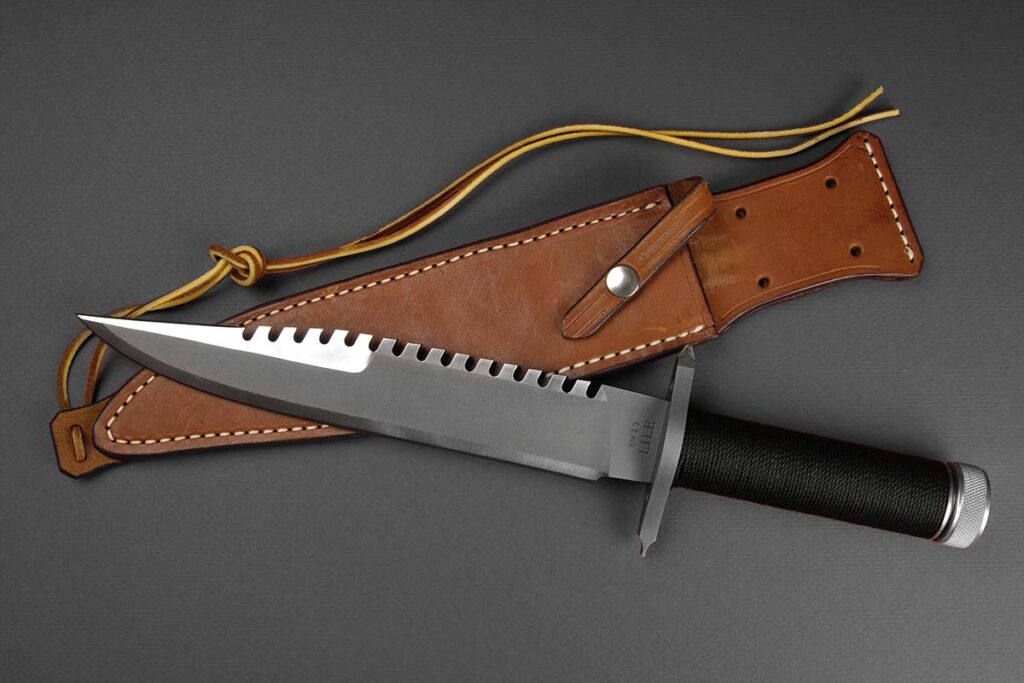
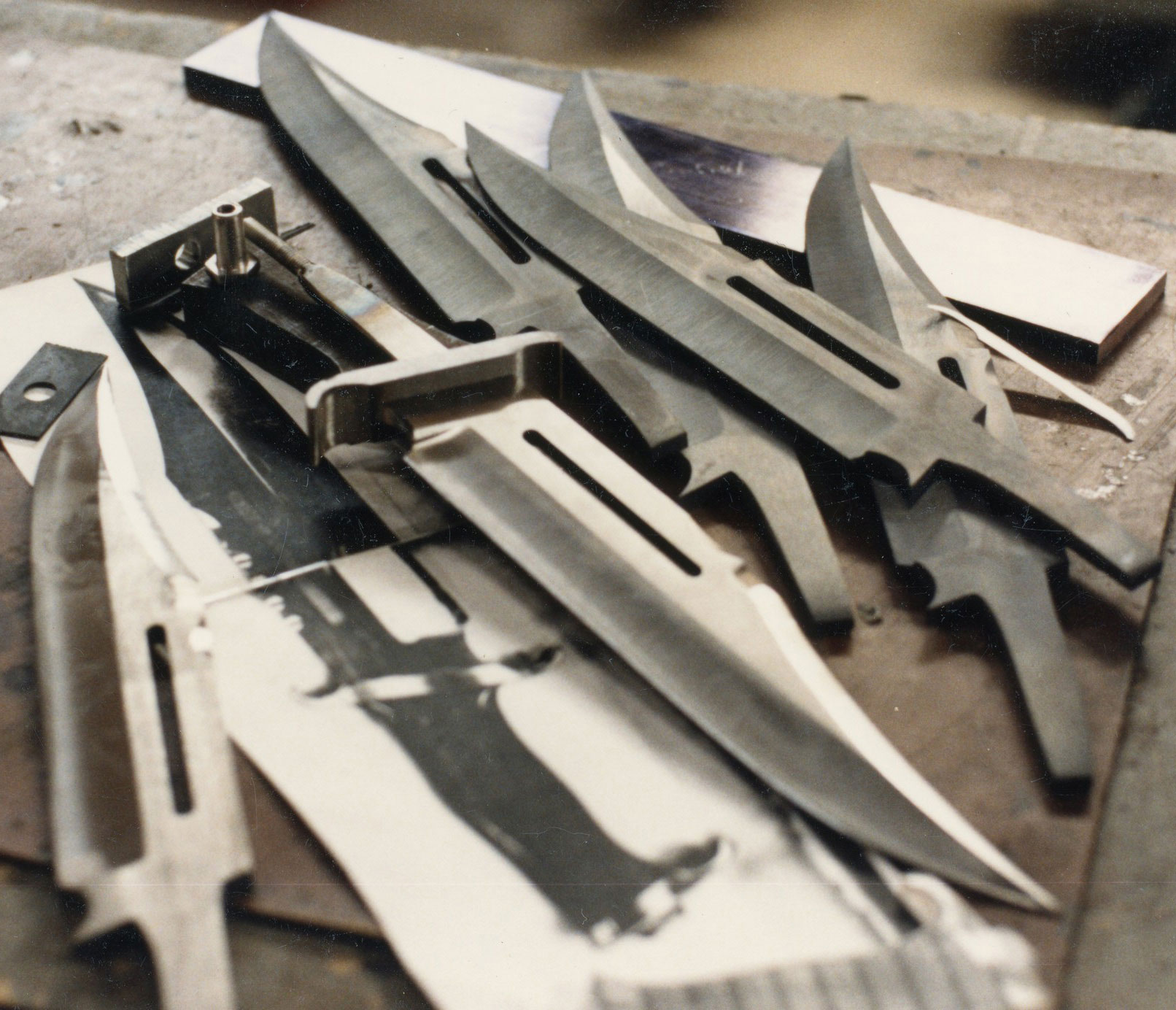
Jimmy Lile's Rambo knife.
“Tactical movie knives have been and remain very collectible,” the author observed. BLADE Magazine Cutlery Hall-Of-Fame® member Jimmy Lile started the category with the Rambo knife. “This knife is responsible for my becoming a custom knife collector,” the author maintained. The 9-inch blade is bead-blasted 440C stainless steel. The cord-wrapped hollow handle has an aluminum buttcap. Guard: stainless steel. Lile passed away in 1991. (image courtesy of Jack Lucarelli)   

Doing your knife research will increase your knife IQ. Increasing your knife IQ will help you get the best value for your money and enable you to confidently add knives to your collection. The building blocks of this research are the Four F’s: Fit, Finish, Flow and Function.

  1. Fit: how does the knife fit together? Are there gaps between the blade and the guard? Are the scales flush with the tang? These are examples of some of the areas to examine.
  2. Finish: I look for consistency and degree of difficulty. No matter what type of finish, is it consistent from the tip to the end of the knife with no spots, scratches or other inconsistencies? The degree of difficulty comes in the form of the type of finish. A mirror finish is much more complex than a tumble or bead blast finish. I give bonus points for two-tone finishes, such as a mirror finish on the hollow of the blade and satin for the flat of the blade.
  3. Flow: Does the knife transition smoothly from one end to the other? Uneven grinds, blocky guards and poor ergonomics detract from the flow of the knife.
  4. Function: Is the knife designed and built to complete the task it is supposed to accomplish? Will the knife do what the design intends it to do? While there is always room for improvement on standard designs, the maker should temper those changes and base them on reality. Often the designs border on or move into the fantasy realm.

Spending time on your favorite social media platform and reading knife magazines like BLADE® can help your knife IQ. However, nothing can replace attending a knife show and putting the knife in your hand, allowing you to apply what you have learned about the Four F’s. You can calibrate your eyes to the sometimes-subtle differences between knives in the same category. 

Conclusion
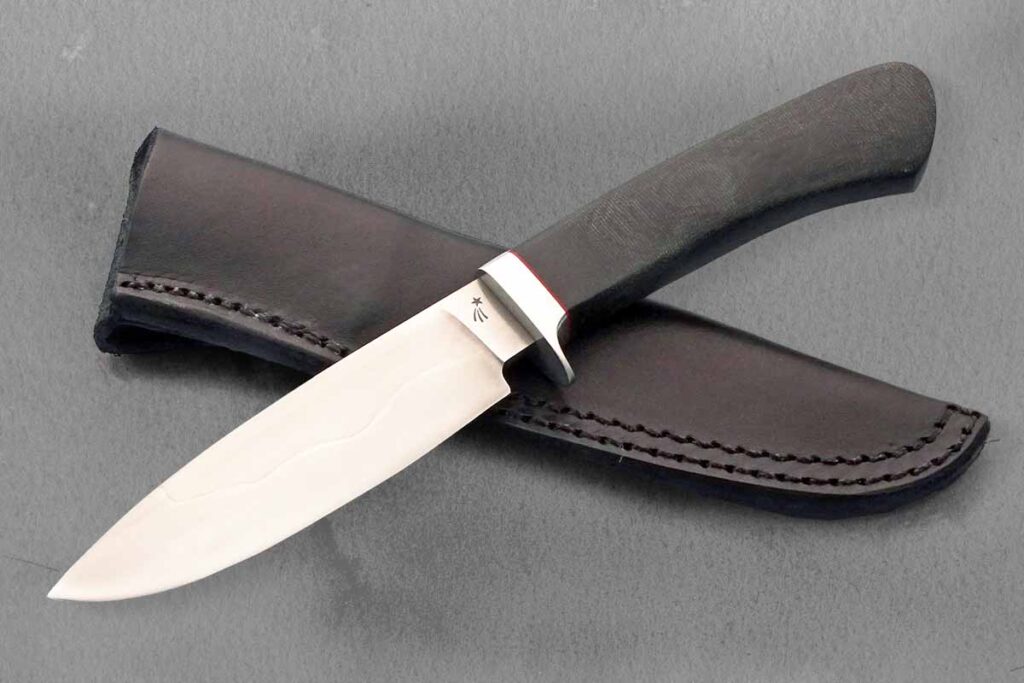
Jim Crowell's forged drop point hunter
“Some collectors look for entry-level ABS master smith knives,” the author stated. “Utility hunters such as this one by ABS master smith Jim Crowell are a perfect example of that collectible category.” Jim’s forged drop point hunter has a 5-inch blade of W2 tool steel with hamon and a black Micarta® handle. Overall length: 9.75 inches. Jim’s custom leather sheath completes the outfit.

Buy what you like, enjoy what you have and welcome to the hunt for the next piece of your collection.

Check Out Our Buyer’s Guides:

50 Years Ago In BLADE: Bo Randall And His Blades

The father of modern sporting knives was busy making them a half century ago.

Editor’s Note: BLADE Magazine is celebrating more than 50 years of bringing the knife community sharp coverage of the knife world at large. Given a more comprehensive picture of where the industry comes from—thus, where it’s going—we’re running a series of vignettes on important articles marking milestones in the knife design, knife making and knifemakers from 50 years ago.

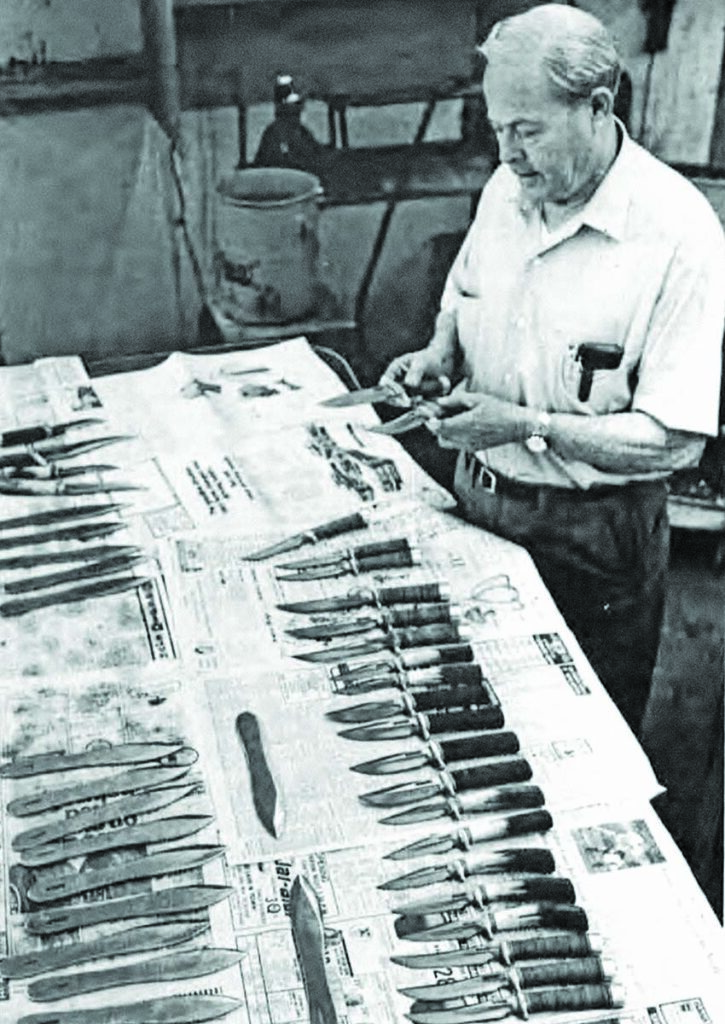
A pioneering writer and photographer, Sid Latham chronicled his visit to the Orlando, Florida, shop of Randall Made Knives in the May-June 1975 issue of The American Blade to detail how Bo Randall and his staff made knives.

As Latham noted, Bo believed in the Cutlery Hall-of-Famer William Scagel theory that every blade shape should have a purpose and be practical—and the Randall utility, hunting, combat and survival patterns reflected the Scagel approach. The most popular Randall knife in ’75 was the Model 3 hunter. It was a Model 3 that pilot Francis Gary Powers was carrying when his U-2 spy plane was famously shot down over Russia in 1960.

Bill Platts was closing out his career as Randall shop foreman.

Latham wrote of what Bo considered his proudest achievement of specially designing knives for the astronauts of the Project Mercury NASA space mission. The final design was worked out by Major Gordon Cooper, who took one along on his 22-orbit flight. The knife was subsequently offered as the Model 17.

Latham also covered most of the Randall staff, including shop foreman Bill Platts, who was in the process of retiring and being replaced by Pete Hamilton, to Bo’s son Gary and more. Bo Randall had already been making knives for 37 years at the time—and Randall Made Knives (randallknives.com) continues turning them out to this day.

Editor’s note: Beginning with this issue, “50 Years Ago in BLADE®” journeys back in time to recall what was happening in the early days of BLADE—formerly The American Blade—and the world of knives. This time: BLADE Magazine Cutlery Hall-of-Fame® member Bo Randall and Randall Made Knives.

Pocketknife Info:

Tactical Fixed Blades: EDC With An Edge

Don’t overlook small tactical fixed blades for everyday carry.

When most blade fans talk everyday carry (EDC) knives, they usually mean folders. The two main EDC advantages of folding knives are they are convenient to carry and, except for that pesky pocket clip, easy to conceal. Of course, while many overlook the clip, others know it indicates you are carrying a knife.  

Folders are designed primarily for smaller everyday chores—opening a box, peeling fruit and so on. This is especially true of slipjoints, which rely on you cutting away from yourself—which you should always do with all knives—and a half-stop as a safety device. Granted, when slipjoints were popularized long ago, lockback, linerlock and framelock folders were unavailable. The problem with both slipjoints and lockbacks is most take two hands to open and close, which, if you are trying to cut something you simultaneously must hold, can be inconvenient at the very least.
The late 20th and early 21st centuries saw a boom in the commercial availability of manual folders that could be opened and closed with one hand. Utilizing the flipper opener and the roller bearing system made the blade deploy quickly and smoothly, often even quicker than an automatic. With the perfection of linerlocks and framelocks, unlocking and closing the manual folder with one hand was no longer a problem.
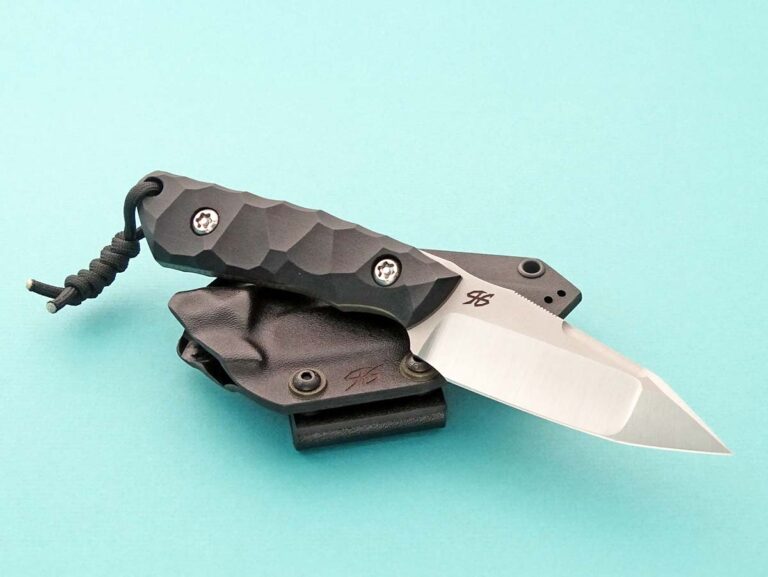
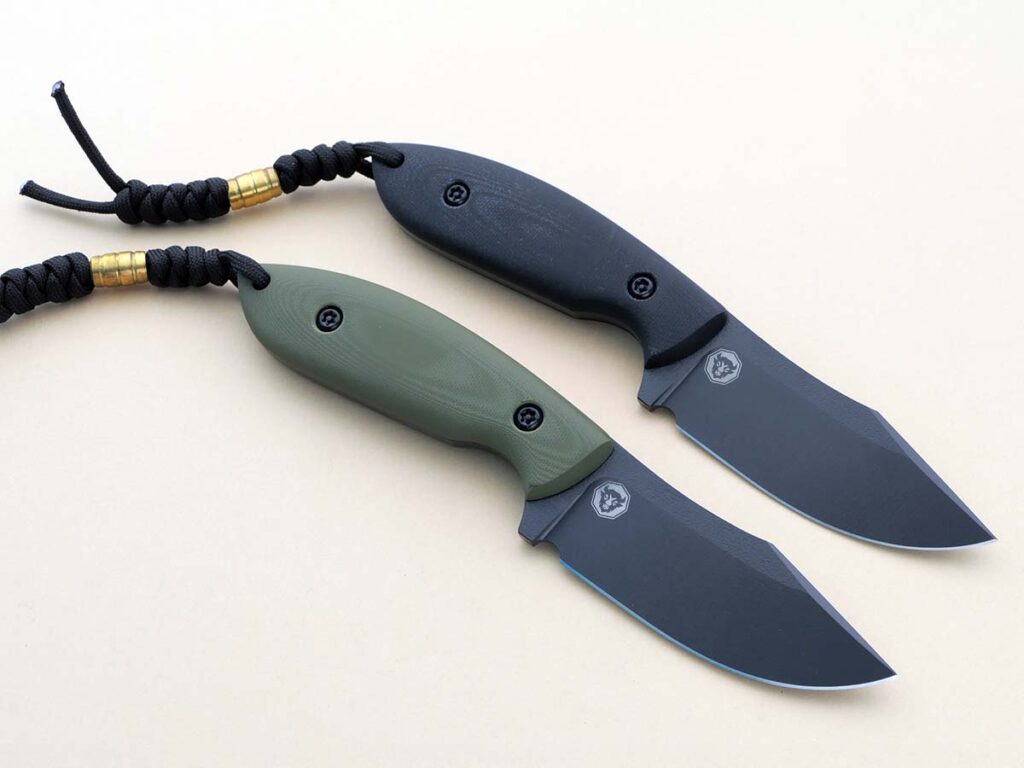
Kydex sheaths can be molded to fit the blade and, over time, will not deform, providing a safer carry option. Rafal Kolakowski uses Kydex® for the sheaths of his Ridgeline set of small tactical EDC fixed blades.

Even with these technical improvements, the folding knife still has its limitations. A small blade can do only so much before it bends or, in some cases, breaks. Some tactical folder makers tried to address this issue by making folders with 5-inch blades of 1/4-inch stock. This was done primarily for cosmetic reasons without addressing the folder’s primary weakness—the pivot. The very nature of the pivot means it must allow some side-to-side movement of the blade, no matter how slight. If the folder is used for an unintended purpose or put under undue force, the blade can be moved off-center.

On top of that, folding knives require more regular maintenance than fixed blades. Locking folders with back straps and slipjoints with backsprings collect dirt, lint, etc., during daily use and must be cleaned. What’s more, using a folding knife beyond its capabilities and failing to perform regular maintenance can affect its opening and closing ability. Lastly, a folder cannot do anything until you first deploy the blade.

Fixed-Blade Pros

Fixed blades, on the other hand, offer several advantages. As already suggested, larger fixed blades can do tasks that smaller blades either can’t perform or do so with difficulty.

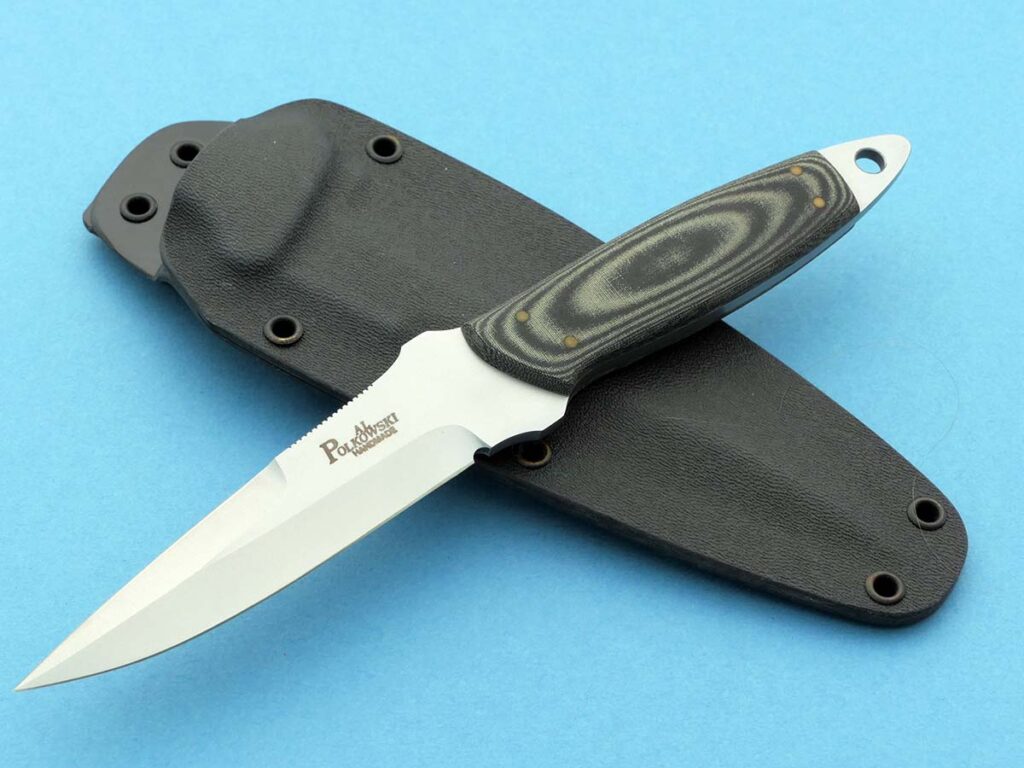
Finger/thumb serrations on the blade spine of Al Polkowski’s Boot Fighter help with controlling the knife in use.

One of the fixed blade’s most significant advantages is full-tang construction, providing added strength and durability. A full-tang fixed blade especially is better suited for heavy cutting and repeated hard use, and safer for use with a heavy load.

A fixed blade also has a superior mechanical advantage. Unlike the folding knife, there is zero chance of mechanical failure under stress. Locks and pivots can fail, especially when using the knife for tasks for which it is not intended.

Another advantage is the style and size of the blade. Fixed blades can feature longer and thicker blades that will perform better under the rigors of hard use.  

Full-tang fixed blades such as the Trailhead set by Tomasz Dziubinski are better suited for heavy cutting and repeated hard use, and safer for use with a heavy load.

A fixed blade typically will have better handle ergonomics. Its handle is usually designed for prolonged use, featuring a more comfortable grip that also aids in balance and is ready for immediate deployment. While many folders can be opened with one hand, not so slipjoints. If your hands are cold, wet, injured or gloved it can present a problem as many, if not all, slipjoints require two hands to deploy the blade or blades. On the other hand, with the correct sheath combination, a fixed blade can be rapidly deployed under almost any circumstance.

Sheath Concerns

Top material options for EDC fixed-blade sheaths are leather and Kydex®. Kydex gained popularity because it provides two main advantages over leather.

First, most makers can build at least a rudimentary kydex sheath. Leather sheaths are more of a challenge. Second, Kydex does not hold moisture and does not require tannic acid, which is used in the processing of leather. This is very important for EDC. Tannic acid in the leather can cause carbon steel to discolor. Leather, once wet, can shrink and/or deform, allowing the blade to accidentally cut or poke through it.

Conversely, Kydex does not hold moisture and does not require tannic acid. Kydex can be molded to fit the blade and, over time, will not deform, providing a safer carry option. Finally, the clip attachment on most Kydex sheaths can be adjusted to wear in either a vertical or horizontal position.

They Have The Edge

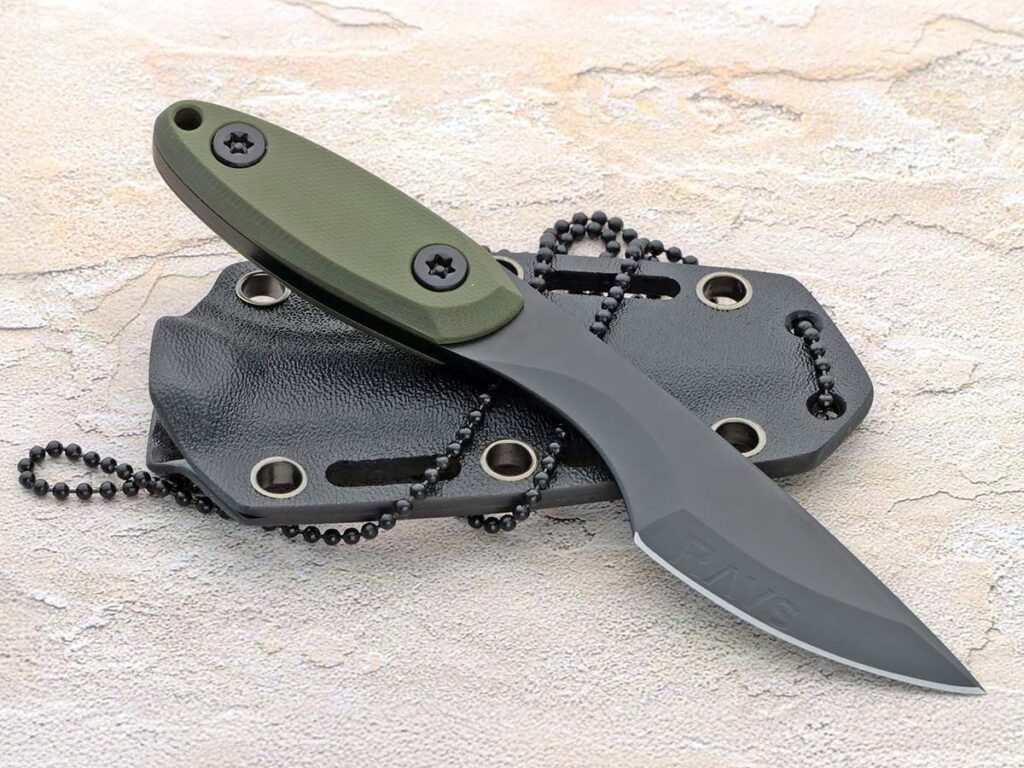
With the right sheath combination, a fixed blade can be rapidly deployed under almost any circumstance. The Street Scalpel by Rafal Kolakowski with Kydex® sheath and breakaway chain is a classic example.

I’m not suggesting that folders do not have advantages as EDC knives; they do. They are usually more comfortable and concealable to carry than fixed blades. They are more socially acceptable and usually have limited legal restrictions. They can provide versatility for light tasks such as opening letters, boxes, cutting cord, etc.

It is in fact the EDC folders’ size that is its biggest disadvantage. The smaller blades and less ergonomic handles limit the number of tasks folding knives can perform. Also, their moving parts provide a mechanical disadvantage when compared to EDC fixed blades.

The majority of this story’s featured tactical fixed EDCs have a 4-inch or shorter blade. Many tactical EDC folders also have 3.75-to-4-inch blades. When open, they are about the same length as the featured fixed blades.

With perhaps the exceptions of concealability and some legal restrictions, fixed blades have the edge. Depending on what you are using it for, you may want to consider a knife that has the mechanical advantage, requires less maintenance, can be easier to deploy in difficult situations or environments, and is more comfortable in the hand: fixed blades, the other EDC!

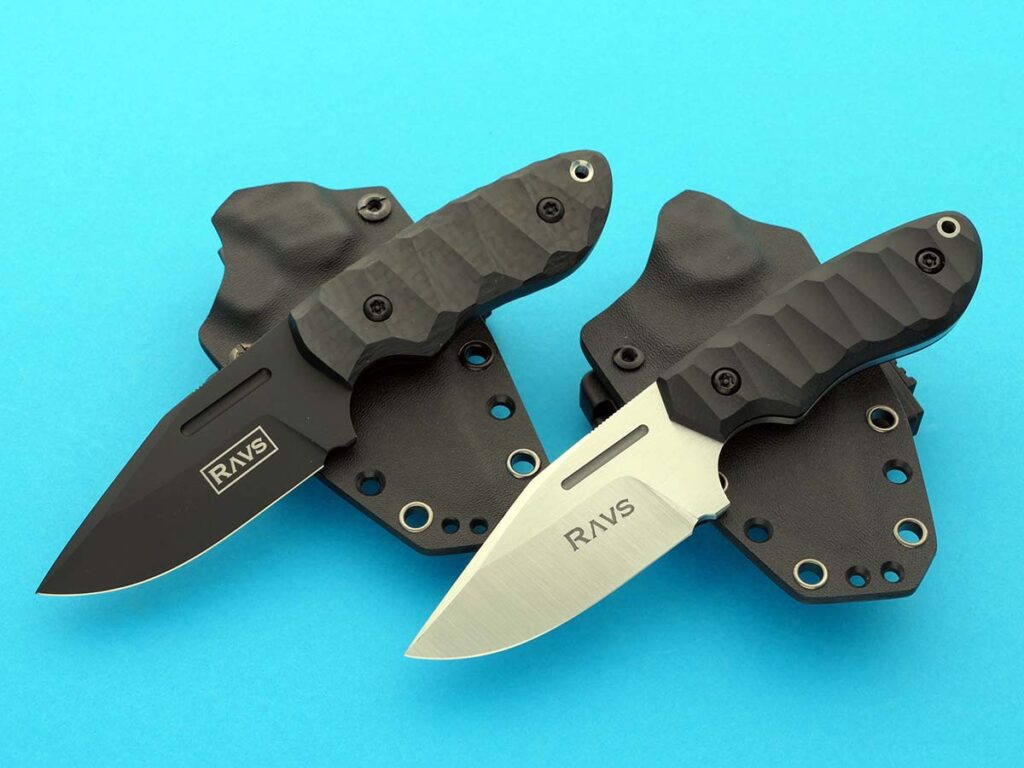
Rebel Specs
Knife type: Small tactical EDC fixed blade
Blade Length: 4.25”
Blade Steel: Elmax stainless
Blade Finish: Two-tone satin and bead blast 
Handle Material: Textured black Micarta® w/OD green Micarta liners 
Overall Length: 9” 
Sheath: Custom-built by the maker; Kydex®
Author’s Comments: “Excellent all-around knife … the tip is ground to give the knife extra penetration … the texture of the black Micarta on the handle gives the user additional traction … primarily designed for belt wear, the clip can be configured for additional carry options … serrations along the top of the blade enhance the knife’s ability to handle small chores … a great knife that provides lots of user options.”
Maker’s price: $430

Ridgeline Specs
Knife type: Small tactical EDC fixed blade
Blade Length: 4” 
Overall Length: 8.75” 
Blade Steel: Becut stainless
Blade Finish: Satin 
Handle Material: Black G-10 
Sheath: Custom-built by the maker; Kydex®
Author’s Comments: “Double-hollow-ground blade with a fuller for added strength … full-tang construction … sculpted handle material for enhanced ergonomics … stainless-steel-tube-lined thong hole.”
Maker’s Price: $350 each


Boot Fighter Specs
Knife type: Small tactical EDC fixed blade
Blade Length: 4” 
Blade Steel: 154CM stainless
Blade Finish: Bead blast 
Handle Material: Black and green G-10 
Overall Length: 8.25”
Sheath: Custom-built by the maker; Kydex®
Author’s Comments: “Great little back-up knife … it features a double-hollow-ground double edge with an extended tang that features a thong hole … quick and light in the hand.” 

Trailhead Specs
Knife type: Small tactical EDC fixed blade
Blade Length: 3.5” 
Blade Steel: Sleipner stainless 
Blade Finish: Black Cerakote® 
Handle Material: OD green G-10 
Overall Length: 8.25”
Sheath: Custom-built by the maker; Kydex®
Author’s Comments: “Flat-ground, upswept utility-style blade … full-tang construction, excellent handle ergonomics … small knife built for hard work … stainless-steel-tube-lined thong hole … perfect knife for camping, a hike and everyday carry.”
Maker’s Price: $280 each


Street Scalpel Specs 
Pattern: Tactical fixed-blade neck knife
Blade Length: 2” 
Blade Material: 80CrV2 carbon steel
Blade Finish: Black Cerakote® 
Handle Material: OD green G-10 
Overall Length: 5.9” 
Sheath: Custom-made, multi-position in Kydex® by the maker w/ball-bearing breakaway chain 
Author’s Comments: “Perfect for utility or self-defense … the attachment holes on the sheath allow the knife to be carried however you like.” 
Maker’s Price: $280 

More Knife Reviews:

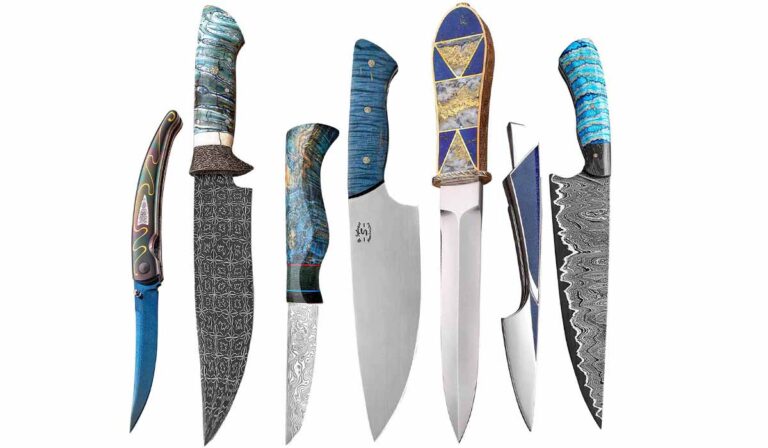
Blue Bloods: Custom Knives With A Twist Of Azul

No doubt, these custom blades have icy good looks.

Many things are associated with the color blue. Depending on your preference or point of view, some of those things may be good, others bad. In the case of knives, blue comes in many hues and materials, and can serve different purposes. Here’s hoping these blue knives don’t give you the blues.


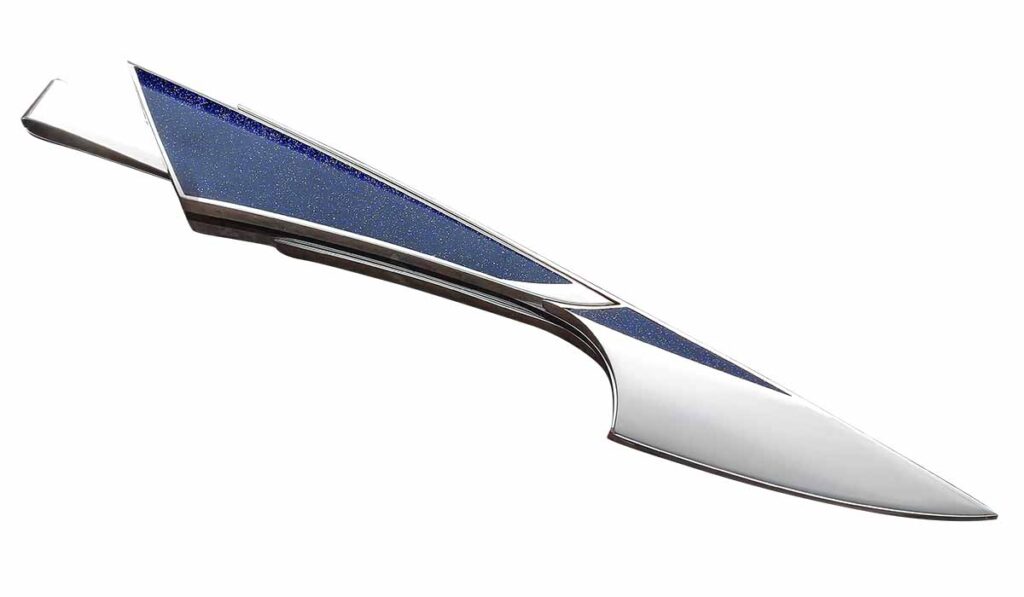
Michael West: Starry Night

Michael West Starry Night

A handle of blue sunstone set in a frame of argentium silver and at 2.83-inch blade of RWL-34 stainless steel headline Starry Night by Michael West. Blade grind: concave. Bolster: Argentium silver. Overall length: 7 inches. Sheath: all silver with blue sunstone inlay. Maker’s price for a similar knife: $3,500. (SharpByCoop image)

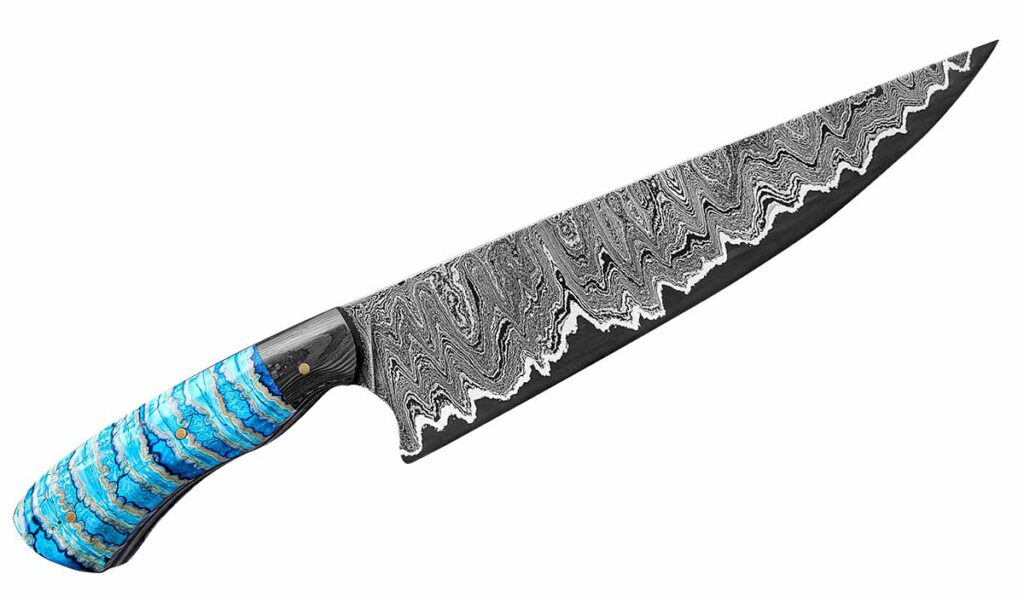
Shane Gagne: Chef’s Knife

Blue Shane Gagne Chefs Knife

The mammoth molar of the handle of Shane Gagne’s chef’s knife is dyed blue. The 8.75-inch blade is 180 layers of random damascus cladding go-mai with nickel shim and a core of 52100 ball bearing carbon steel. Total layers: 360. Bolster: carbon fiber. Overall length: 13.25 inches. (Jocelyn Frasier image edit)


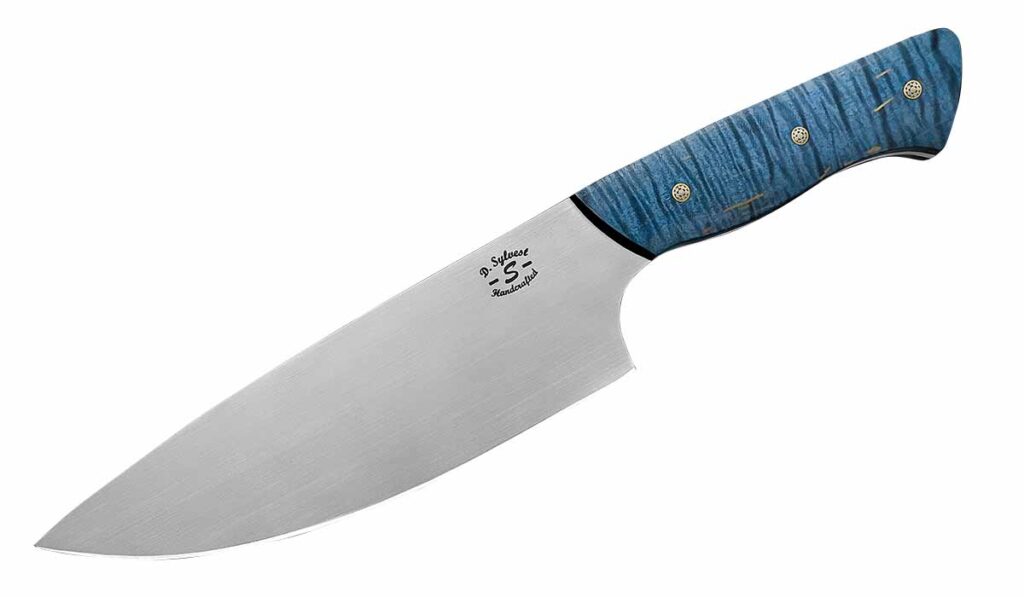
Don Sylvest: Chef’s Knife

Blude Don Sylvest Chefs Knife

Curly maple dyed blue outfits the handle of Don Sylvest’s chef’s knife. The 6-inch blade is CTS-XHP stainless steel. Don offers the knife in tandem with a paring model in the same materials, only smaller with a 3.5-inch blade. (Jocelyn Frasier image edit)


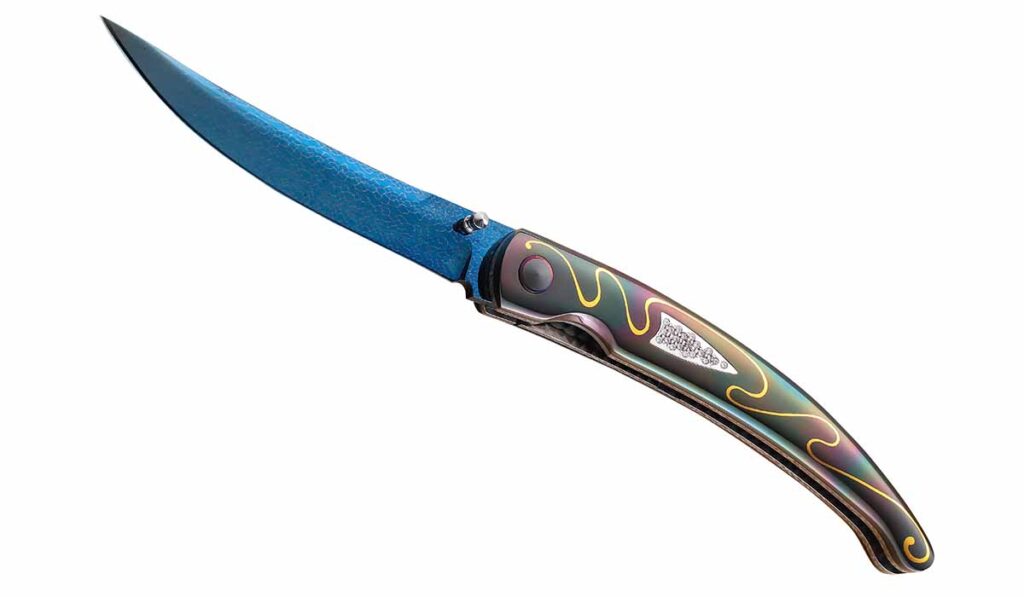
Tyler Turner: Toothpick

Blue Tyler Turner Toothpick

The 4.25-inch blade of Tyler Turner’s toothpick is blued Turkish Lace damascus forged by Doug Ponzio. The frame is zirconium and the liners are titanium. Embellishments include 24k-gold inlay by Jody Muller, an argentium silver shield and diamonds pavé set by Tyler. The pivot adjusts with a custom takedown tool. (SharpByCoop image)


Jim Sornberger: Dress Bowie

Blue Jim Sornberger Dress Bowie

Blue adds contrast to the gold quartz handle of BLADE Magazine Cutlery Hall-Of-Fame® member Jim Sornberger’s mid-19th-century-style dress bowie. Bolster: 14k gold. The 2.25-inch blade is ATS-34 stainless steel. All engraving is by the maker. (SharpByCoop image)


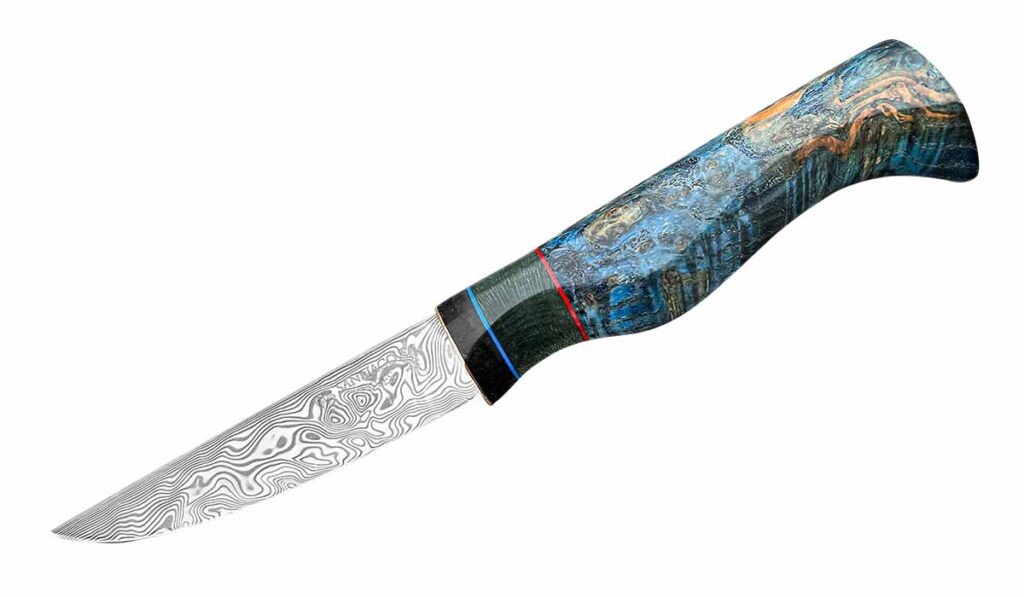
Jose Santiago-Cummings: EDC Fixed Blade

Blue Jose Santiago-Cummings EDC Fixed Blade

The EDC fixed blade by Jose Santiago-Cummings has a bird’s-beak handle of black ebony, chestnut dyed green and contoured birch wood dyed blue. The 3.75-inch blade is Damasteel damascus in a Vinland pattern. The bolster is mokume. Overall length: 8 inches. (Jocelyn Frasier image edit)


Rob Logan: Fighter

Blue Rob Logan Fighter

Rob Logan’s fighter sports a blue mammoth molar handle with a mammoth ivory spacer, white vulcanized handle liners and brass liners. The 4.25-inch blade is mosaic damascus forged by Bill Poor, and the brass frame and guard are textured and patinaed. Overall length: 13 inches. (Jocelyn Frasier image edit)


Check Out More Cool Custom Knives:

Knife Steel Trends: What To Look Forward To In 2025

Knife industry pros give their takes on what the hot knife steels will be in the year ahead.

Every cutlery buyer faces a dizzying array of steel choices when it comes to buying that next knife, an array that represents the proverbial “double-edged sword.” While it’s nice to have choices, it can also be hard to keep up with so many options. Fortunately, industry professionals are available to help sort out which stainless and carbon varieties are either catching fire or cooling off.

Hot Steels for 2025

  • CPM Magnacut: Folders and fixed blades
  • CPM S30V: Hunting knives, tactical folders, custom knives
  • CPM S35VN: Tactical folders, custom knives, factory outdoor knives
  • CPM 154: Hunting knives, EDC knives, custom knives
  • CPM 20CV: EDC knives, custom knives, knives requiring heightened wear and corrosion resistance
  • CPM S90V: Knives requiring heightened wear and corrosion resistance
  • CPM Cruwear: Bushcraft knives and tactical fixed blades
  • CPM 3V: Bushcraft knives, survival knives, hard-use knives, tactical fixed blades
  • CPM 4V: Competition cutters, hard-use knives
  • M390: EDC knives, custom knives
  • 1095: Factory outdoor knives

*The steels are listed in no particular order by the knife patterns/types for which they are favored most by users and makers, according to the story’s sources.

MagnaCut Reigns Supreme

Last year when BLADE took the temperature of steel suppliers, the clear-cut champion of blade materials was Crucible Industries’ CPM MagnaCut stainless. The creation of steel guru Larrin Thomas, MagnaCut remains on top and will stay there for the foreseeable future. Bob Shabala, president of Niagara Specialty Metals, praised the high-performance blade material last year and still does today.

CRKT MagnaCut blade knife
CPM MagnaCut stainless ruled among knife steels in 2024 and will continue to hold sway in 2025. A representative example is the new CRKT Q, a folder in titanium and carbon fiber designed by Richard Rogers. Country of origin: Italy. MSRP: $225.

“We have sold about 320 tons of CPM MagnaCut since its introduction in 2020. It is our biggest selling cutlery grade right now and I don’t expect that to change anytime soon,” Bob said, adding the qualifier, “This is from Niagara Specialty Metals’ limited perspective. I’m sure other mills are working on new grades which I’m not privy to.”

One reason MagnaCut is so popular is it embraces all cutlery genres with ease.

“CPM MagnaCut remains in high demand across various knife patterns,” Bob observed. “Some customers currently using MagnaCut for fixed blades are expanding into folding knives and have expressed plans to continue using the steel for their new designs, reflecting its versatility and ongoing popularity.”

Larrin Thomas
MagnaCut maestro Larrin Thomas

Scott Devanna, vice president of technology and a metallurgist for SB Specialty Metals, tends to concur.

“I’m not sure there will be a new ‘super steel’ introduced in 2025. The introduction of new steels seems to have a three-to-four-year cycle, and with the recent intro of CPM MagnaCut such new introductions may be a few years off. We sell a lot of MagnaCut,” he stated. “I’ve learned over the years that new is very often the primary driver when new grades are introduced. This is what happened with CPM S30V, CPM 20CV and its European equivalent M390, and a few other grades.”

It should be noted that MagnaCut technically is going into its fifth year of existence. As you can see, it takes a while for a steel to work its way into the manufacturing pipeline and be given a thumbs up or thumbs down by the end user.

Specialty Grade Steels

Meanwhile, other specialty grade steels aren’t being ignored. In fact, many knife consumers prefer other steels that suit their needs better, both of the stainless and carbon varieties.

David Fleming Cowboy Knife
CPM 154 stainless will continue to be a steel of choice for custom hunting knives, here on the Cowboy Knife by David Fleming in a handle of sheep horn from a Rocky Mountain bighorn. Overall length: 7 inches.

“CPM S30V, one of the original cutlery-grade steels, continues to be one of our best-selling products,” Shabala noted. “Despite its age*, S30V maintains a strong position in the market, demonstrating its enduring reliability and widespread appeal among knifemakers.

Devanna agrees.

“CPM S30V is still a favorite for hunting knives, as well as CPM 154,” he noted. “For everyday carry folders, M390, CPM 20CV and CPM 154 are still used quite a bit as well.”

Scott said CPM S30V and S35VN remain strong for tactical folders.

Bob Shabala
Bob Shabala, Niagara Specialty Metals

Custom knifemakers aren’t as easily swayed by trends and tend to go with steels they are comfortable using, are time-proven to them personally, or geared to their particular customer base. While many are on the MagnaCut train, they tend to be more diverse in their choices.

“Other steels popular among custom knifemakers are M390, CPM 20CV, CPM 154, and to a lesser extent CPM S30V and CPM S35VN,” Devanna stated. “I have heard that CTS-XHP will be re-introduced, and this grade developed quite a following when it was readily available—especially for kitchen knives and high-end folders.”

Added Shabala, “CPM 154 is always popular with the custom makers.”

Carbon Steel

THE CARBON EQUATION
The outdoor crowd—bushcrafters, survivalists and open-air tactical users—has to be pleased with the attention they’ve been getting from the industry. These users’ requirements are different and they prefer a subset of steels all their own.

TOPS Shadow Hunter
While major outdoor knife manufacturers like TOPS and ESEE still sell the bulk of their knives in 1095, they have been gradually offering their customers more steel diversity, including stainless versions such as S35VN. The TOPS Shadow Hunter has a 4.5-inch blade of 1095 carbon steel in a tungsten Cerakote®. Country of origin: USA. MSRP: $250.

“CPM 3V and 4V are favored for hard-use knives due to the steels’ toughness, while CPM S90V and 20CV are popular among users who prioritize wear and corrosion resistance,” Shabala observed. “CPM 3V and CPM 4V are carbon steels that continue to sell well in specific areas. 3V is in high demand for bushcraft knives and 4V is being used by the current national champion in BladeSports International cutting competitions, Ben Propst. His wife Sue Ann is now using it and in 2024 they both won cutting events in Kokomo and the Smoky Mountain Knife Works fall festival.”

“I think CPM 3V and CPM Cruwear—mostly for bushcraft/survival knives as well as tactical fixed blades—are gaining popularity in the market,” Devanna opined. “CPM 3V has proven itself over the years and continues to be a popular grade. CTS PD#1 was in this category but availability of this grade is a problem.”

While major outdoor knife manufacturers like TOPS and ESEE still sell the bulk of their knives in 1095 carbon steel, they have been slowly offering their customers more diversity in their lines, including such stainless versions as S35VN.

Overall Take

As Shabala and Devanna noted, MagnaCut will be the top dog among steels in 2025, but it’s certainly not the only hound in the kennel.

Scorpion 6 Knives
Shane Magnussen uses the CPM S90V supplied by New Jersey Steel Baron on his model BBV2 folder. Closed length: 4.54 inches. (SharpByCoop image)

The cutlery industry is so diverse in the competition among manufacturers, custom makers, genres of knives and budget categories, there’s room for many different stainless and carbon steels. While what’s in the works remains unknown to most, you can bet there are teams of metallurgists working on the next great knife steel as these words are written.

As a knife enthusiast and cutlery buyer your choices are bountiful in all categories—from EDC to outdoor, fixed blade to folder—and affordable to expensive. Some users buy one knife to last for years while others rotate their carry or require cutting fare for specific purposes.

The good news is your knife and steel options have never been better!

*Editor’s note: The first-ever steel both designed and made specifically for knife blades, CPM S30V has been used for knives since 2001.

More On Knife Steel:

Summer’s Finest: Custom Damascus Knives You Need to See

Explore 11 jaw-dropping custom knives featuring premium damascus steel blades, exotic handle materials, and master craftsmanship.

This summer’s crop of custom knives brings damascus front and center. From twisted and ladder patterns to stainless blends and copper-clad creations, each blade in this collection highlights not just the maker’s skill, but their artistry with steel. Whether forged for daily carry, culinary precision, or collector prestige, these knives turn heads with standout materials—think crystallized titanium, crosscut mammoth, and ringed Western Myall—paired with performance-driven designs. Featured makers range from journeyman smiths to Guild members, each offering a unique take on the timeless beauty and cutting power of damascus steel.

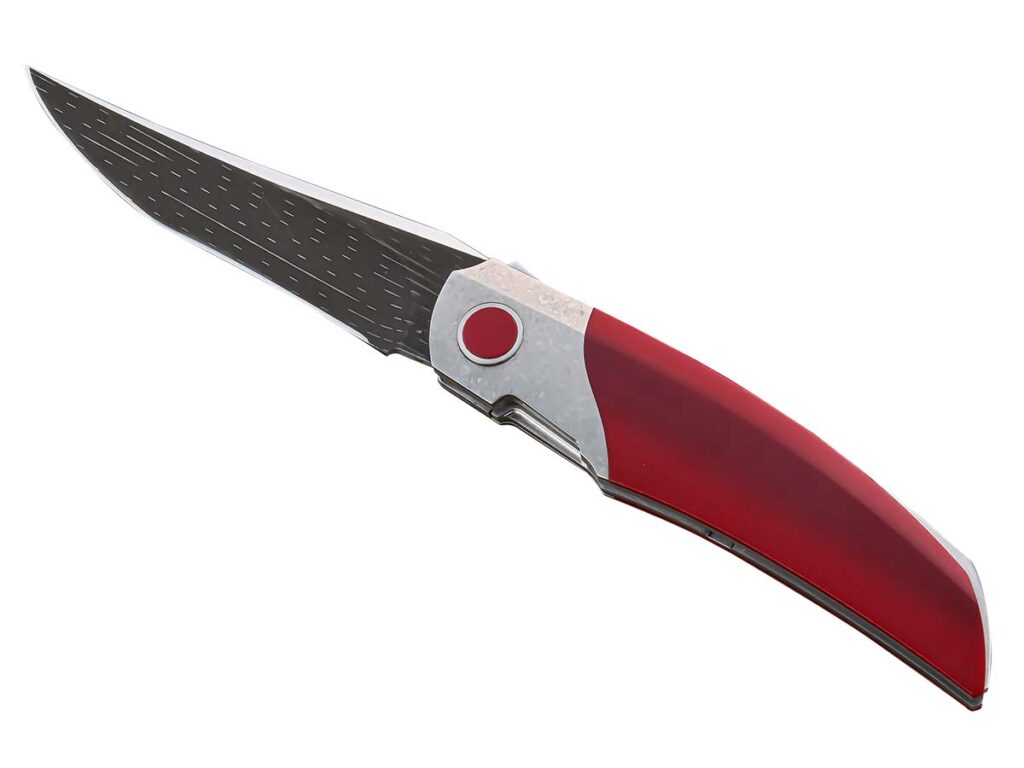
Carlos Queiros Thorn Persian TRS

Carlos Queiros Thorn Persian TRS

Knife type: Folder
Blade length: 3.35”
Blade material: Chad Nichols Starfire stainless damascus
Blade grind: Flat
Scales: Vintage bright red linen Micarta®
Bolsters: Crystalized titanium
Pocket clip: Yes
Closed length: 4.53”
Maker’s price for a similar knife: $4,700-$4,800 at press-time exchange rate
Maker: Carlos Queiros (SharpByCoop image)


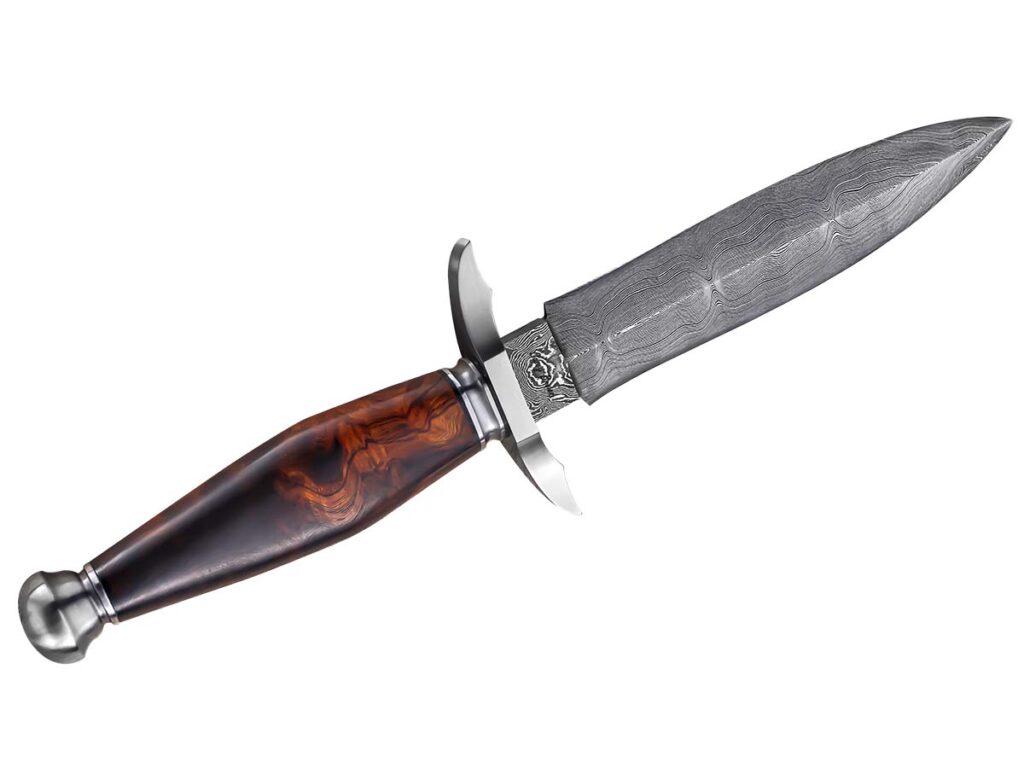
Casey Brown Dagger

Casey Brown Dagger

Blade length: 5.5”
Blade material: Ladder-pattern damascus
Blade grind: Flat
Scales: Desert ironwood
Guard/fittings: 416 stainless steel
Overall length: 10.25”
Maker’s price for a similar knife: $900
Knife to know: The maker is an ABS journeyman smith
Maker: Casey Brown (SharpByCoop image)


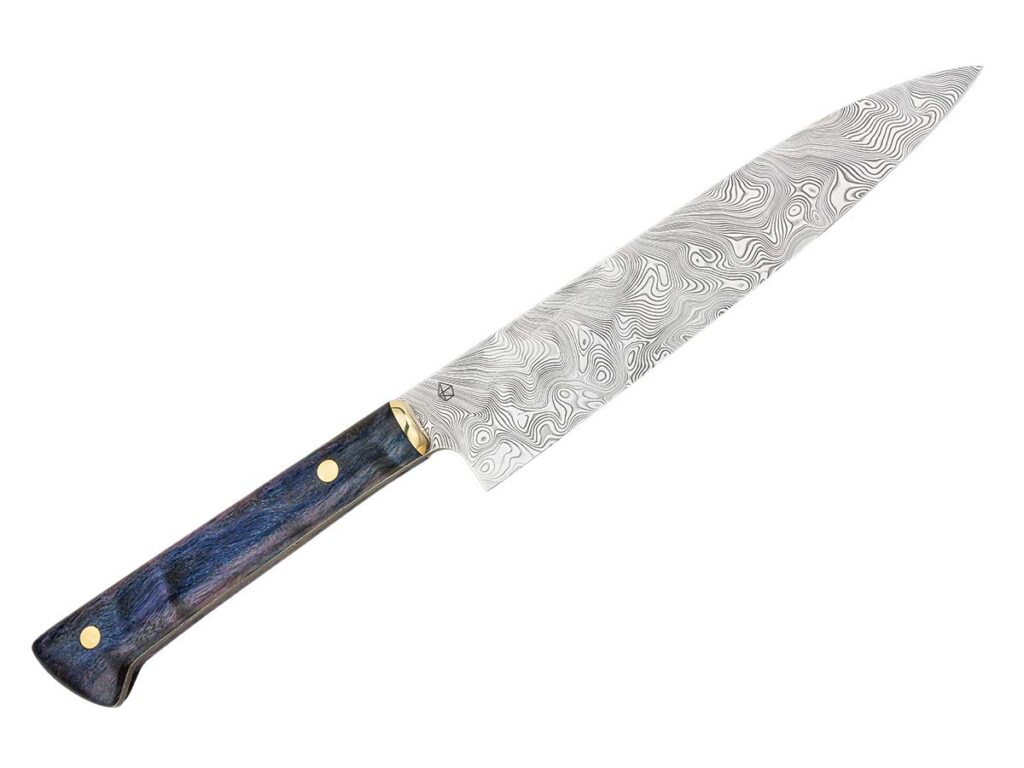
Luka Allen Petty Knife

Luka Allen Petty Knife

Blade length: 5 5/8”
Blade material: Bjorkman’s twist damascus by Damasteel
Blade grind: Flat
Scales: Cottonwood
Fittings: Brass
Overall length: 9.75”
Maker’s price for a similar knife: $450
Maker: Luka Allen, lukaallen.com (Jocelyn Frasier image)


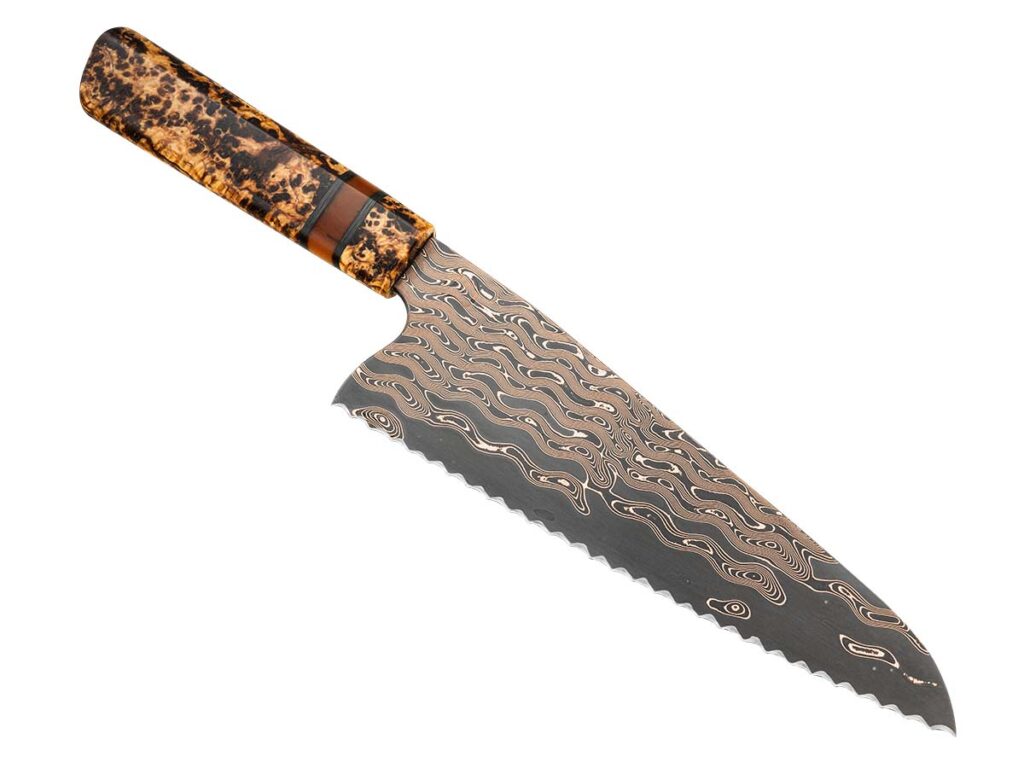
Micah Dunn Chef Bread Knife

Micah Dunn Chef Bread Knife

Blade length:7.5”
Blade material: Baker Forge & Tool copper-mai Surge pattern
Blade grind: Flat
Scales: Spalted chestnut burl and vintage Micarta®
Overall length: 12.25”
Maker’s price for a similar knife: $1,200
Maker: Micah Dunn, mdedgeworks.com (Jocelyn Frasier image)


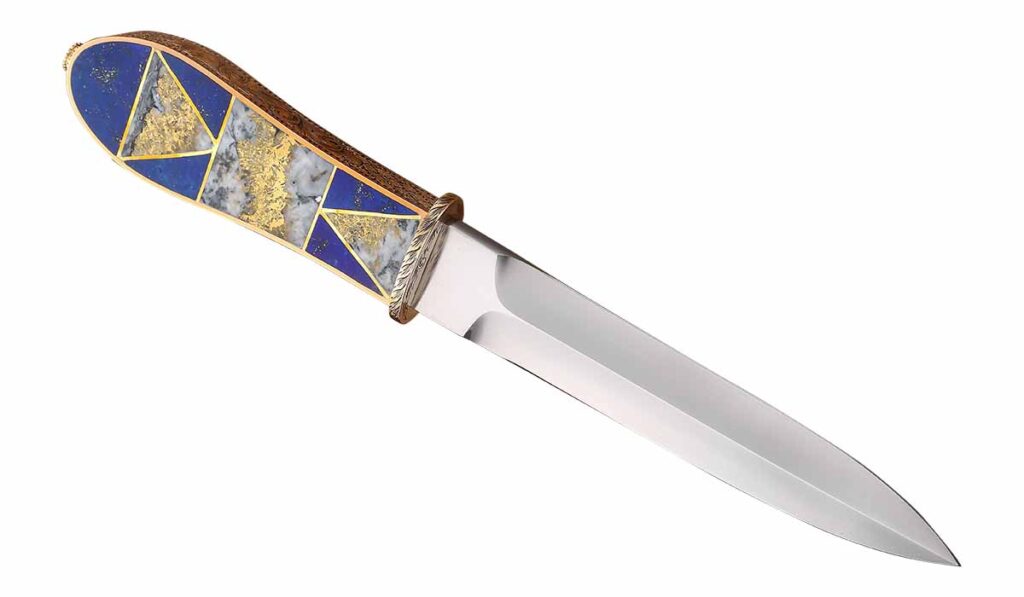
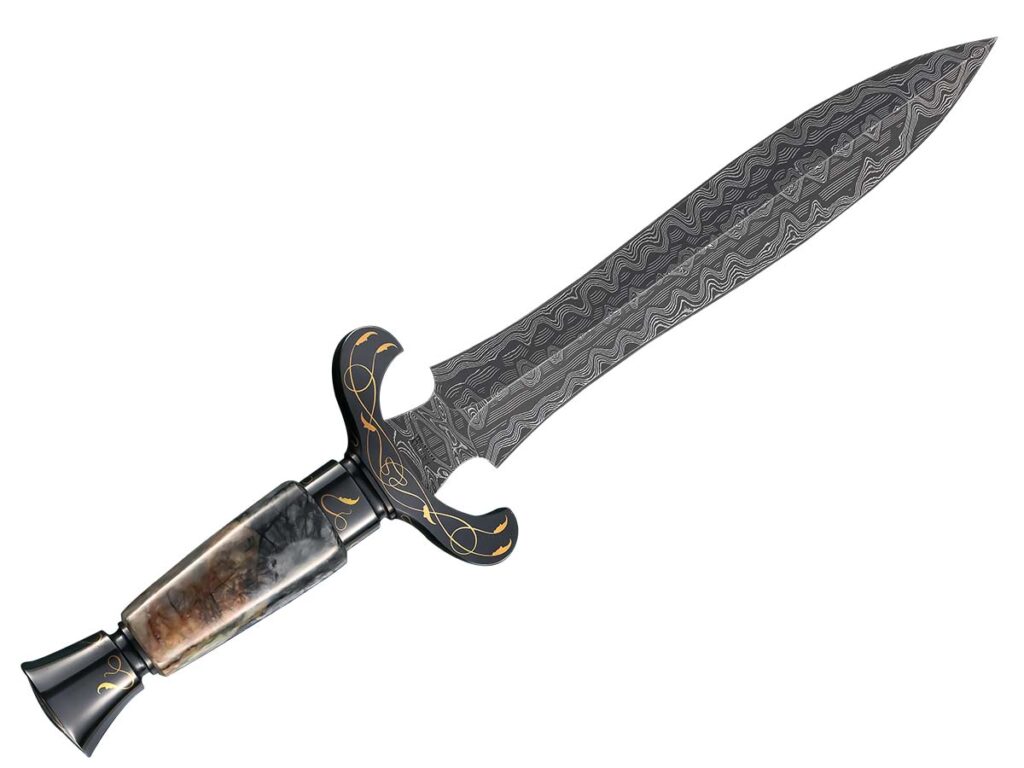
Dennis Friedly Art dagger

Dennis Friedly Art dagger

Blade length: 9”
Blade material: Mike Norris damascus
Blade grind: Hollow
Scales: Picasso marble
Fittings: Blued steel
Embellishment: 24k-gold inlay by Ray Cover Jr.
Maker’s price for a similar knife: $7,200
Knife to know: The maker is a voting member of The Knifemakers’ Guild
Maker: Dennis Friedly, friedlyknives.com (SharpByCoop image)


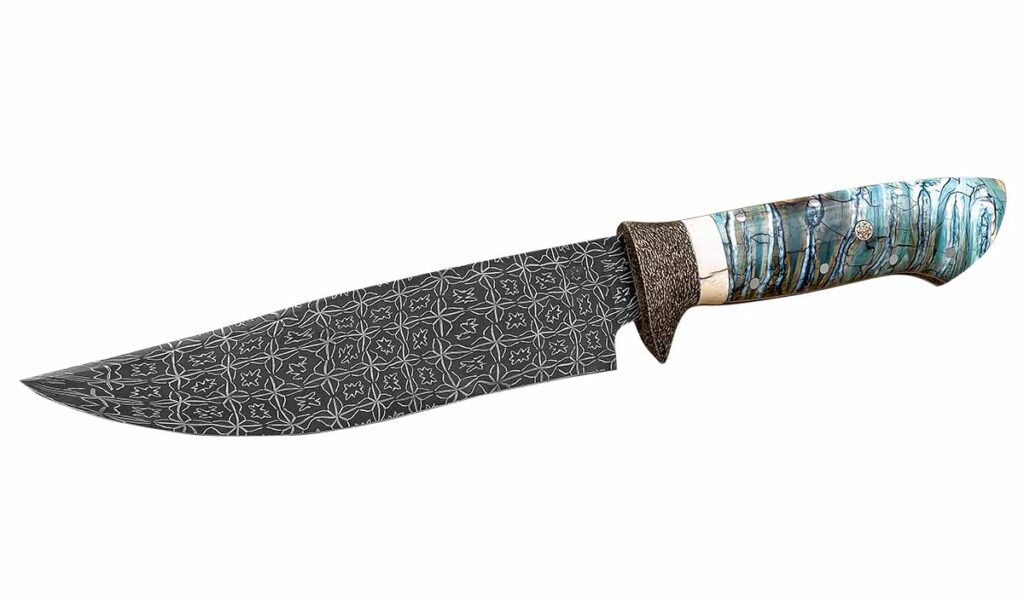
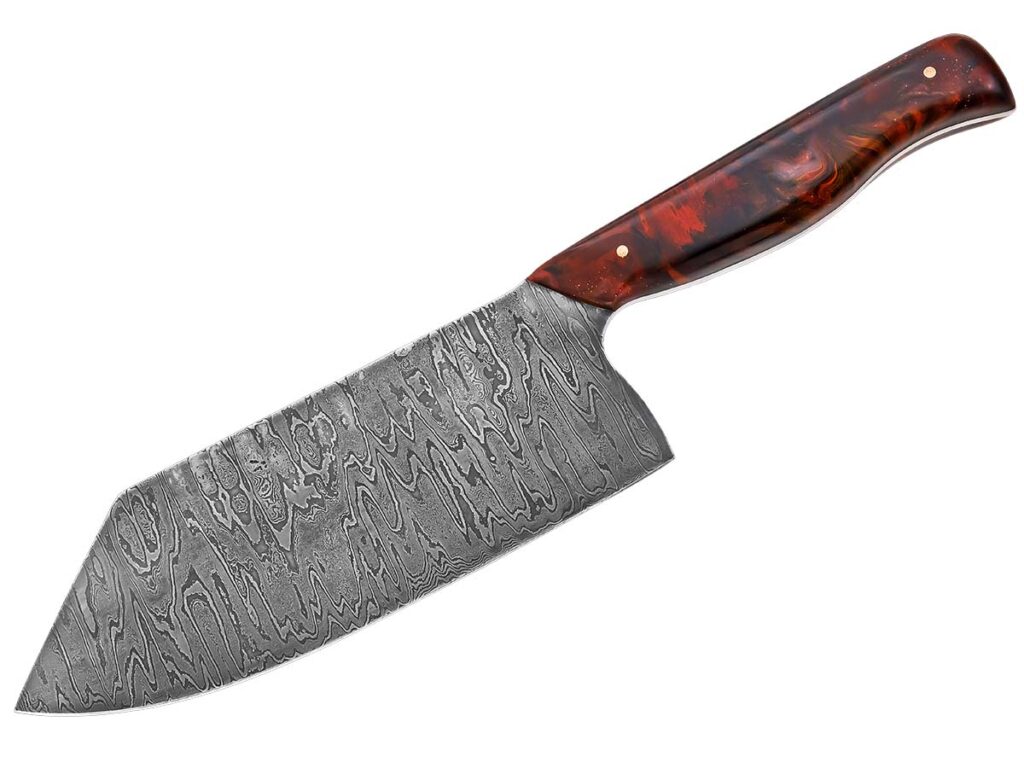
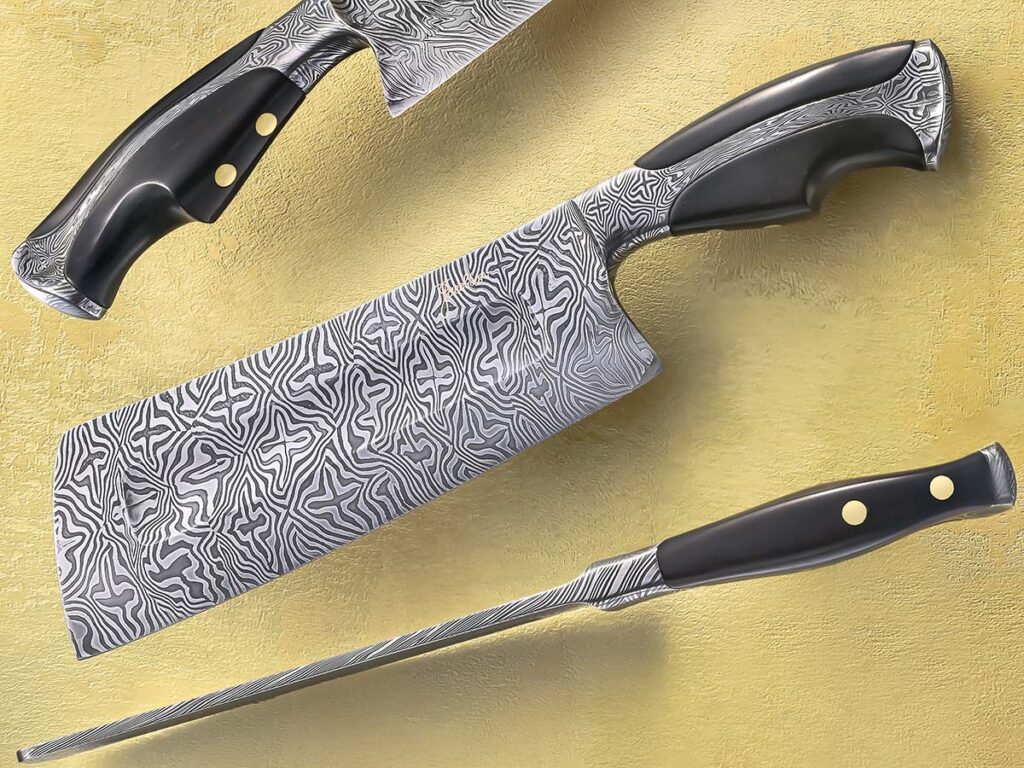
Dane Standen Cleaver

Dane Standen Cleaver

Blade length: 7.3”
Blade material: 243-layer textured damascus of 1084 carbon- and 15N20 nickel-alloy steels
Blade grind: Flat
Scales: Colored resin
Pins: Copper
Overall length: 12.2”
Maker’s price for a similar knife: Contact maker for info
Knife to know: The maker is a probationary member of the Australian Knifemakers Guild
Maker: Dane Standen (Rod Hoare image)


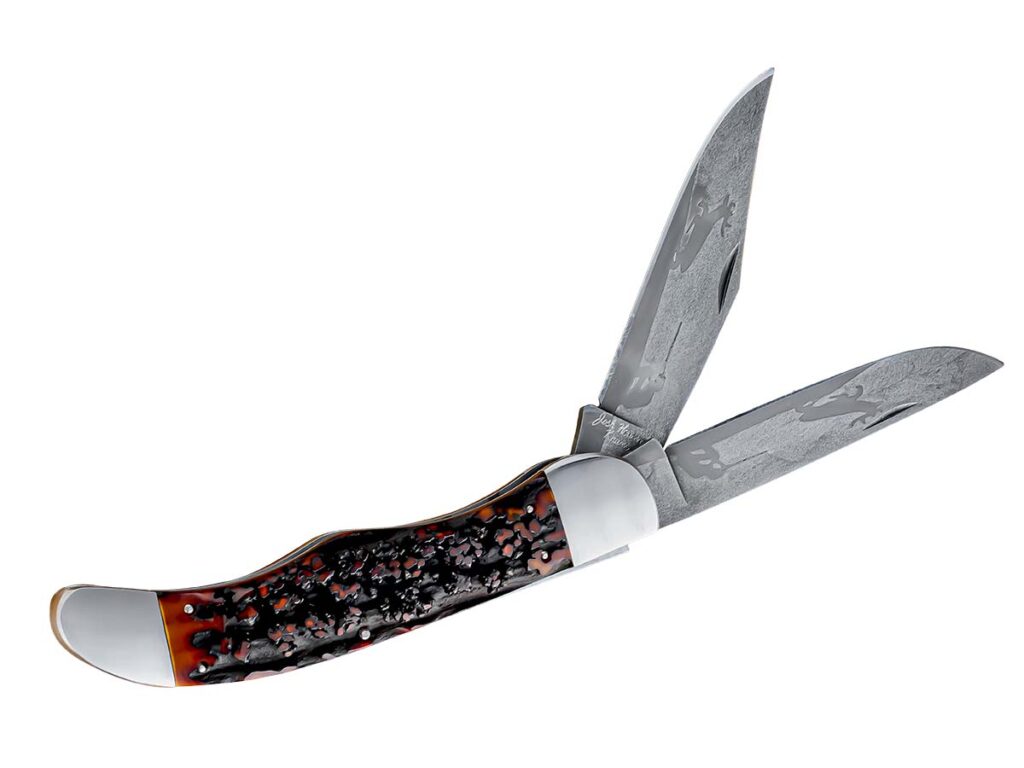
Josh Howard Folding Hunter

Josh Howard Folding Hunter

Action: Slipjoint
Blade length: 3.5”
Blade material: Pattern-welded deer hunting scene
Blade grind: Hollow
Scales: Amber stag
Handle frame & bolsters: Stainless steel
Closed length: 5.25”
Maker’s price for a similar knife: Contact the maker for info
Maker: Josh Howard, deerlickridgeforge.com (SharpByCoop image)


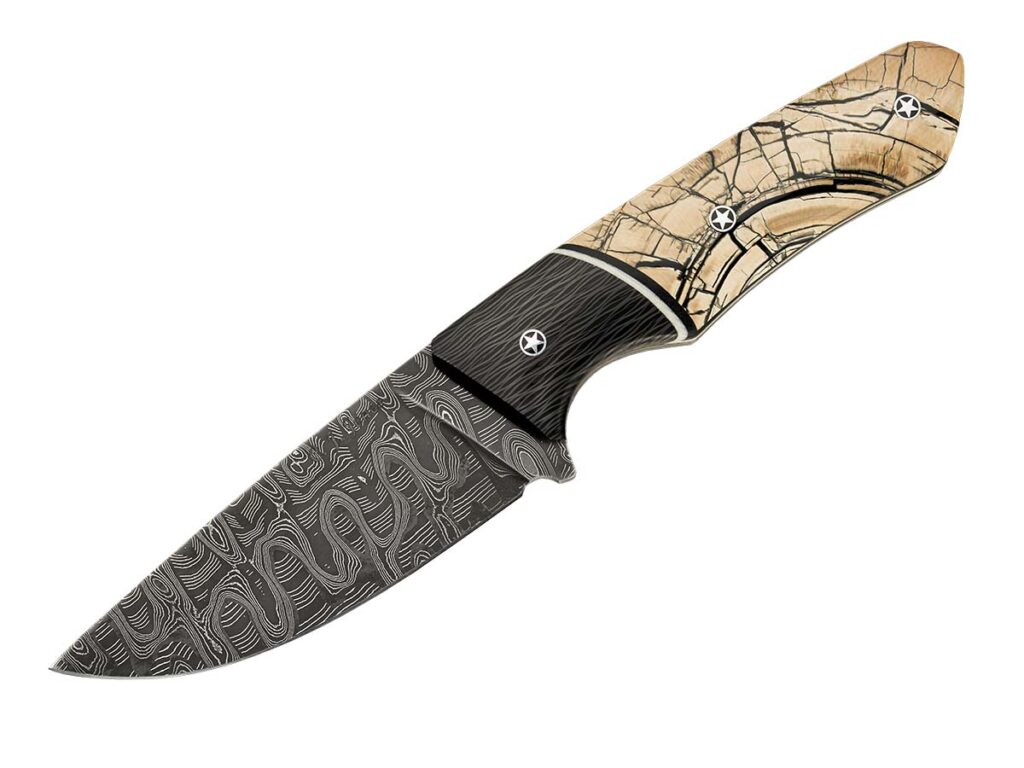
Chad J. Jones Hunter

Chad J. Jones Hunter

Blade length: 3.75”
Blade material: Mike Norris Hornet’s Nest stainless damascus
Blade grind: Flat
Scales: Crosscut mammoth tusk
Liners: Black and white G-10
Bolster: Zebra carbon fiber
Overall length: 8”
Maker’s price for a similar knife: $1,250
Maker: Chad J. Jones (Jocelyn Frasier image)


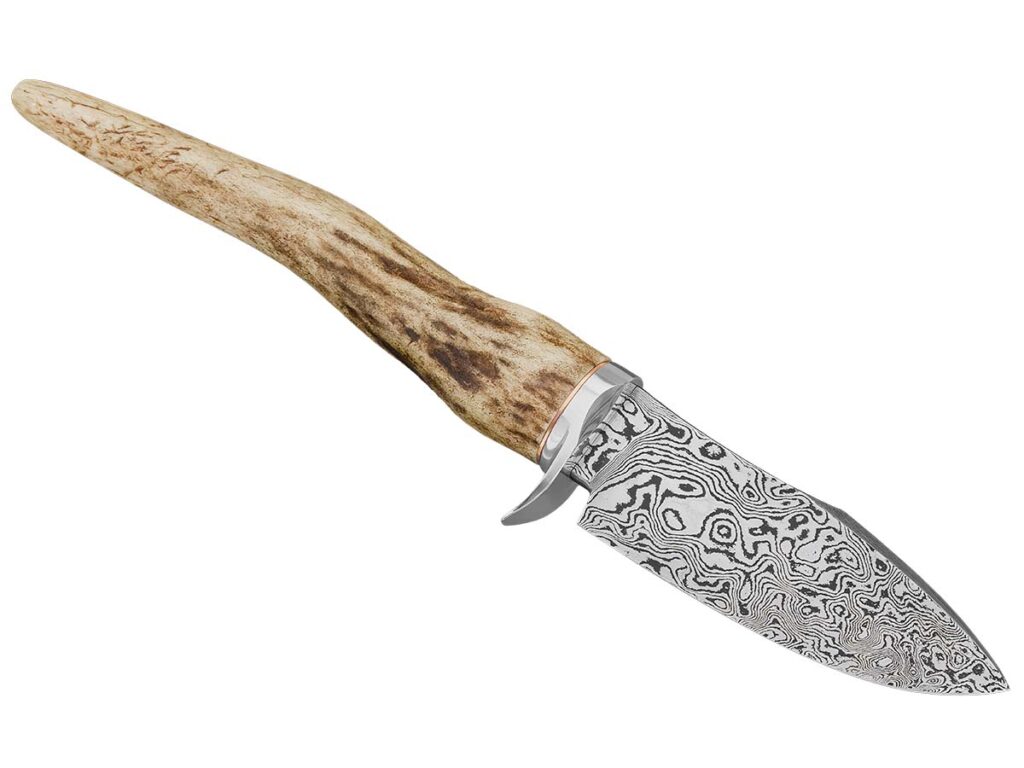
William Manning Hunter

William Manning Hunter

Blade length: 3.35”
Blade material: Random-pattern damascus of 1084 carbon-and 15N20 nickel-alloy steels
Blade grind: Flat
Scales: Antler w/copper spacer
Guard: 416 stainless steel
Overall length: 8.27”
Maker’s price for a similar knife: Contact maker for info
Knife to know: The maker is a probationary member of the Australian Knifemakers Guild
Maker: William Manning, manningblades.com (Rod Hoare image)


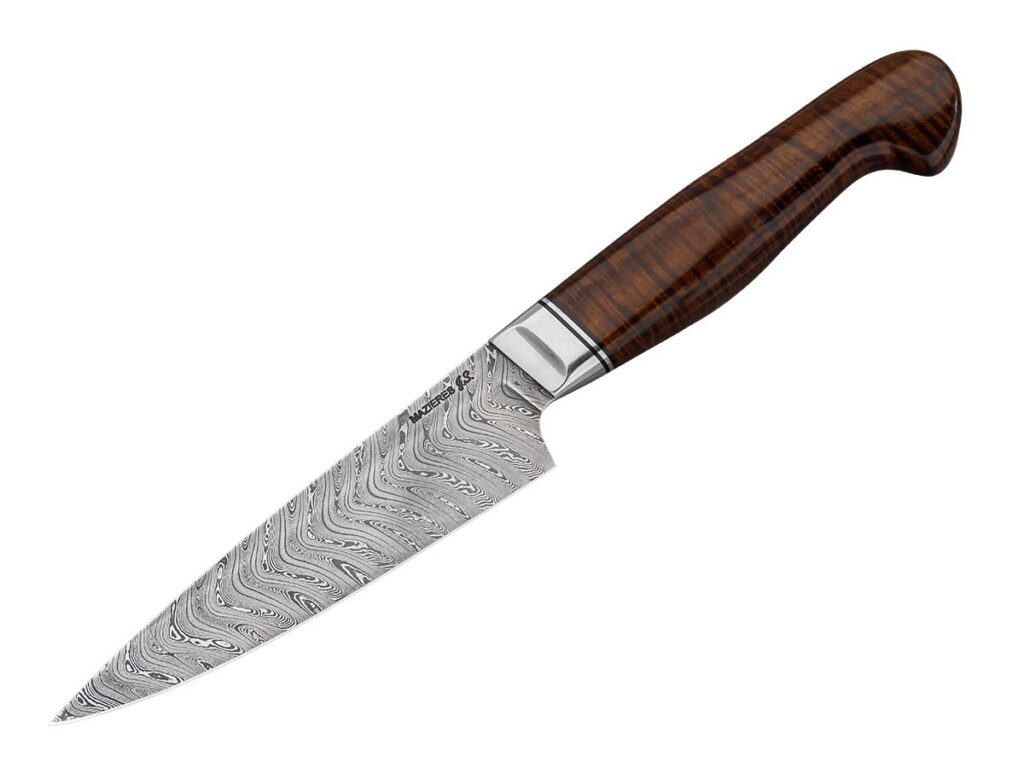
Francois Mazieres Medium Paring Knife

Francois Mazieres Medium Paring Knife

Blade length: 5”
Blade material: Pattern-welded damascus in 150 layers of 1084 and 1075 carbon- and 15N20 nickel-alloy steels embossed using
chevron dies for the final pattern
Blade grind: Flat
Scales: Stabilized South-Australian ringed Western Myall wood shaped in a composite Western/cowboy style
Spacers: G-10 and stainless steel
Bolsters: Scalloped, pinned and soldered 416 stainless steel
Construction: Hidden tang
Overall length: 10”
Maker’s price for a similar knife: $320.62 at press-time exchange rate
Knife to know: The maker is a member of the Australian Knifemakers Guild and a journeyman smith in the American Bladesmith Society
Maker: Francois Mazieres, Yandiwa.com.au (Rod Hoare image)


Nate “Tuna” Grant Utility Fixed Blade

Nate “Tuna” Grant Utility Fixed Blade

Blade length: 4”
Blade material: Rietveld Dragonskin damascus by Bertie Rietveld
Blade grind: Flat
Handle: Titanium, nickel silver, fiber liners, laser engraved
Overall length: 8”
Sheath: Guster leather; inlaid w/exotic animal skin; belt model with snap
Maker’s price for a similar knife: $5,000
Knife to know: The maker’s utility fixed blade won Best Utility at the 2024 Lost Pines Knife Show
Maker: Nate “Tuna” Grant, madebytuna.com (Jocelyn Frasier image)


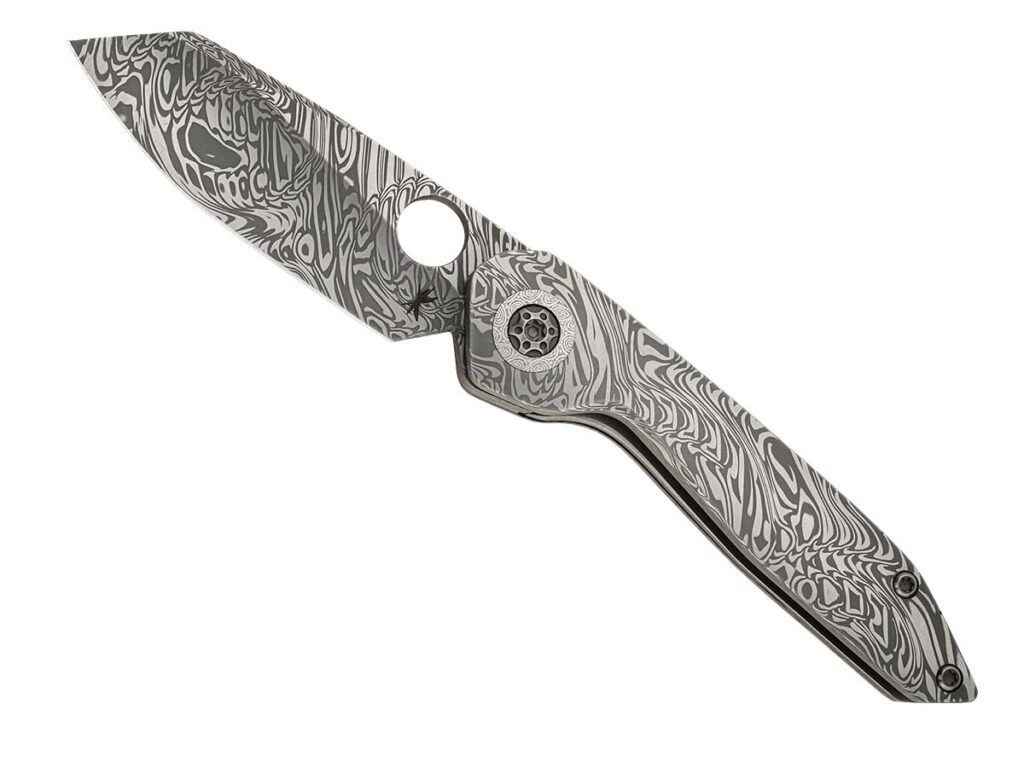
Bryan Montalvo Basset

Bryan Montalvo Basset

Knife type: Folder
Blade length: 3.25”
Blade material: Grabak damascus by Damasteel
Blade grind: Hollow
Blade pivot: Skiff caged ceramic bearings
Handle: Same material as blade
Lock: Linerlock
Pocket clip: Same material as handle
Closed length: 3.5”
Maker’s price for a similar knife: $3,000 at press-time material costs
Maker: Bryan Montalvo, keanisonknives.com (Jocelyn Frasier image)


More Knife Reviews:

Custom Cleavers That Have Culinary Chops

Four custom makers push the boundaries of the tried-and-true cleaver.

An inclination toward the kitchen and a desire to design and deliver cutlery used on a regular basis has spurred a number of custom knifemakers to try their skill with the cleaver. It’s a staple in most kitchens and its uses are as varied as the food prepared there.

Robert Wayman of Middleburgh, New York, sees his cleavers as complementing years of food preparation. “I’ve done a lot of my own food processing, and I spent several years in commercial kitchens when I was younger,” he commented. “So, I’ve always had an affinity for culinary knives and especially cleavers. The cleaver is such an iconic blade. I love to make everything from heavy-duty butcher cleavers to medium-duty kitchen cleavers, Chinese cleavers and lighter-duty veggie cleavers for the kitchen.”

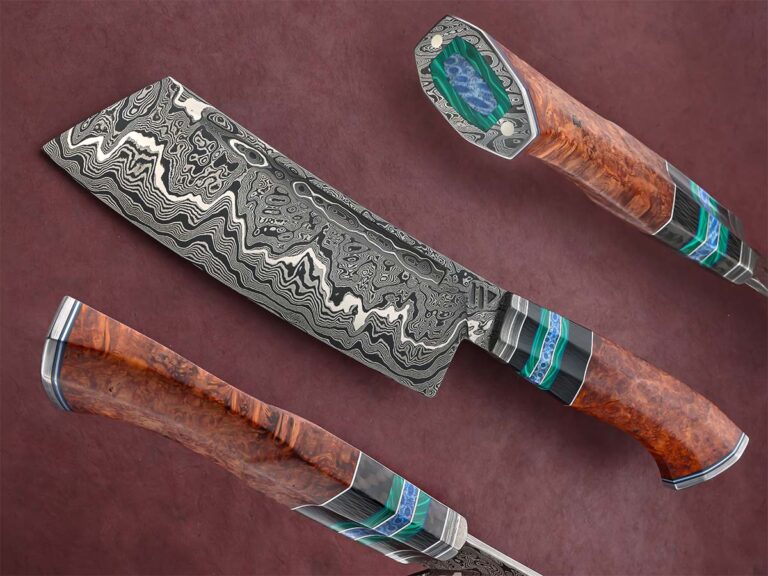
Robert’s featured cleaver is 14 inches in overall length with an 8-inch blade of pattern damascus go-mai five-layer steel. The core is a 100-layer random pattern damascus made of 1084 and 15N20 high-carbon steel and a layer of nickel and matching damascus cladding. The handle includes a damascus collar, stainless steel and G-10 spacers, crosscut carbon fiber, green malachite and blue coral accents, stabilized amboyna burl and a damascus butt cap with stainless mounting pins inset with blue coral framed with green malachite.

“I packed a lot into that one,” Wayman smiled. “As a maker, I’m all about sole authorship. I make all of my own high-carbon damascus steel in-house, and a cleaver provides a great opportunity to showcase that steel. One of my favorite things to forge is a large cleaver with an integral bolster.”

Wayman sees large blades, such as those associated with cleavers, as inherently challenging, while making a task-specific blade, such as a cleaver, adds another layer of complexity. Although they are labor-intensive and involve a lot of time in the shop, performance remains the key.

 “Overall weight needs to be taken into consideration, as well as how that weight is distributed for the style cleaver you are making,” Robert advised. “Ergonomics is an important consideration for any knife or tool, but especially for kitchen cutlery. Whether it’s in a professional or home kitchen, you’re making a handle that a chef or cook could use for hours of food prep on any given day. So, it must be comfortable.”

Edgy Ebony

Having served time in professional food service, practical utility is never far from David Jacobson’s mind. However, he isn’t afraid of adding some flourish to his creations, such as the gold-inlay signature near the spine of his mosaic damascus bladed and ebony scaled cleaver. (SharpByCoop image)

David Jacobson’s integral 13-inch cleaver with ebony handle scales sports an 8¼-inch mosaic damascus blade of 1085 and 15N20 steels and a gold inlay signature—his first such accent. He used brass bolt pins to finish the ebony scale attachment.

“I love cooking and making cool chef’s knives and kitchen tools,” Jacobson related from his Felton, California, shop. “Edge geometry for chopping and balance are challenges, and fullers are nice when slicing vegetables for food release. Cleavers are not only for the kitchen. They are great for large fish processing at the dock, chopping through bone and restaurant back-alley butchering. The wide blade shows off the many designs in the damascus steel, and I chose a traditional profile for this particular cleaver. I’ve always liked a black handle with big brass pins—old school.”

Cutting Mustard

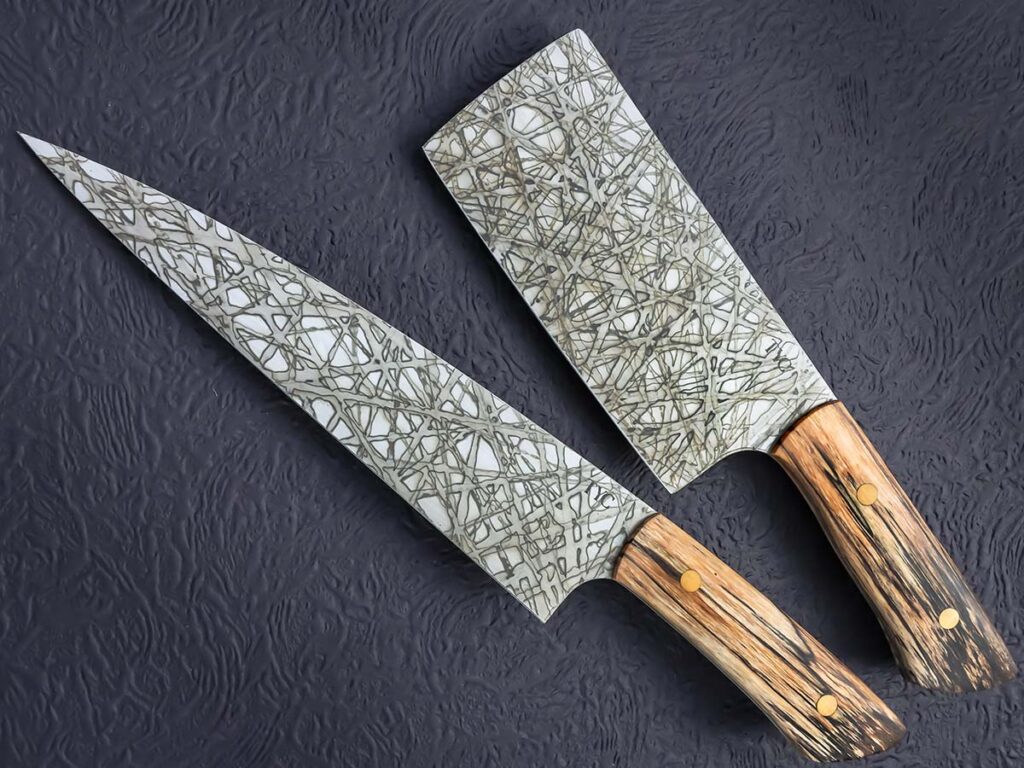
Given the amount of steel and the need to pay attention to minutia is what Bill Tyc figures steers most makers away from cleavers. Tyc achieves an intricate pattern on his cleaver-chef’s knife set through a simple mustard patina, but applied with a straight edge for a pattern he calls “Lines of Insanity.” (SharpByCoop image)

The pairing in Bill Tyc’s featured ensemble is stunning in its presentation. “The cleaver as well as the chef’s knife are made of 52100 high carbon steel from the NJ Steel Baron,” he remarked. “The handles are stabilized spalted tamarind from Wood Dynamics fastened with brass Corby bolts. The pattern on the steel is a mustard patina done with a ruler edge, hence the name “Lines of Insanity” pattern. The cleaver is 11½ inches overall with a 6¼-inch blade. It’s 3 inches tall and ¾ inches at the heel. I felt the spalted lines of the tamarind wood would look perfect with the mustard patina.”

Tyc, who resides in Waterbury, Connecticut, remembers making kitchen knives that did something no other creations had generated. He got immediate feedback from users.

“In fact, the first ‘kitchen’ knife I sold was a cleaver at the Mystic Knife Show in Connecticut,” Bill remembered. “A gentleman circled the floor three times, every time touching a cleaver I had on the table. Last pass, he picks it up and just says, ‘I’ll take it.’ My wife and I look at each other with a thumbs up, and off he goes. Well, the following year, the gentleman comes into the show, right up to my table, and says, ‘Last year I bought a cleaver from you.’ The wife and I again look at each other because we most certainly remembered. He says, ‘I have so much fun using that cleaver every day!’ I reached across the table, shook his hand and said, ‘I’ve been waiting 20 years to hear that! I could pack up and go home, I feel so good.’”

According to Tyc, many custom knifemakers shy away from cleavers because they require a lot of work. At just about any knife show, only a relative few are seen for sale. But he adds cleavers’ utility far exceeds their supposed kitchen niche, pointing out they are handy for camping, survival exercise, yard work and bushcraft as well.

“The most important things are balance and weight,” Bill observed. “A knife used as often as a kitchen knife or cleaver has to feel good in the hand, not just initially, but long term. You may find yourself using your kitchen knives for many hours through the week. You want it to be comfortable, not a labor.”

Veggies Beware

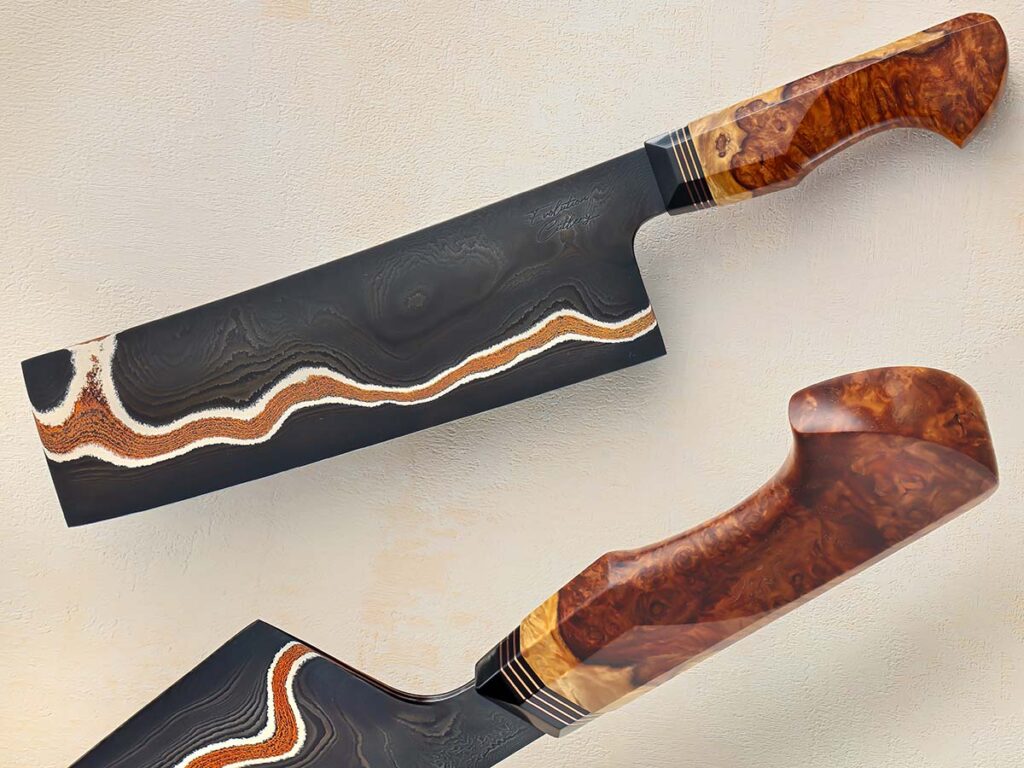
One of the unique advantages of the cleaver, Dan Tomplins points out, is the large canvas it allows for the steel. In the case of his nakiri—vegetable cleaver—its 81/2-inch copper mai blade can’t help but catch the eye, particularly with the steel’s blacked-out finish enhancing the patina'd copper. Note too, the hybrid octagonal/western-style handle made from amboyna burl. (SharpByCoop image)
One of the unique advantages of the cleaver, Dan Tomplins points out, is the large canvas it allows for the steel. In the case of his nakiri—vegetable cleaver—its 81/2-inch copper mai blade can’t help but catch the eye, particularly with the steel’s blacked-out finish enhancing the patina’d copper. Note too, the hybrid octagonal/western-style handle made from amboyna burl. (SharpByCoop image)

In 2016, Dan Tompkins began making knives, and three years later, he started Evolution Cutlery in Highland, New York. His kitchen knife work began simply because he wanted to make cutlery used on a daily basis, and his cleaver immediately attracts attention.

“The big square profile is a great canvas to show forging skills, especially if using mosaic damascus. It allows a lot of room to see the details in the patterning,” said Dan. The subject steel is Baker Forge copper mai with a blacked-out finish and layers of patina’d copper in the nakiri, or veggie cleaver, design. The handle is Tompkins’ hybrid octagonal/western style made from amboyna burl, heirloom fit to a copper and G-10 bolster. The cleaver blade measures 8½ inches, and the overall length is 13 inches.

“One challenge in making cleavers is getting the edge geometry perfect for the intended purpose,” explained Dan. “There are many different types of cleavers, so the proper geometry is an important consideration. Heavy-duty blades require a heavy convex edge, while veggie cleavers are best with a laser-thin edge. When it comes to kitchen knife ergonomics, not only do you have to have a good feel in the handle’s shape and contour, but you also have to have proper balance to make the knife comfortable to use all day. While cleavers will almost always be slightly blade heavy in balance, they should still be balanced not far in front of the handle … Balance can make a light knife feel heavy or a heavy knife feel light. In my opinion, even a heavy knife with proper balance is far more comfortable to use than a light knife with improper balance.”

 Tompkins sees the cleaver in action in varied settings, not just the kitchen. Camp chores like chopping wood or preparing food outdoors can be handled easily with a cleaver made for such adventures, and he makes the cleaver to fit the anticipated tasks.

Versatility is readily apparent in these custom cleavers, and their functionality is in lockstep with good looks driven by their makers’ creativity.

Check Out More Cool Customs:

Advertisement

Must Read Articles

Read this before you make a knife

Knifemaking 101 – Read This Before You Make a Knife

  by Wayne Goddard My experience has taught me that there's nothing like digging in and getting started. I've often said the hardest part of the...
how to forge damascus steel

How to Forge Damascus

Advertisement
Advertisement