Knife Collecting

Knife collecting is an extremely rewarding experience for knife enthusiasts. There truly is a knife for everyone. Many increase or hold their value throughout the years, making collecting knives something to pass on to the next generation of knife collectors.

The Legacy of Bob Loveless’s Dropped Hunter

robert loveless knifemaker

bob loveless knives
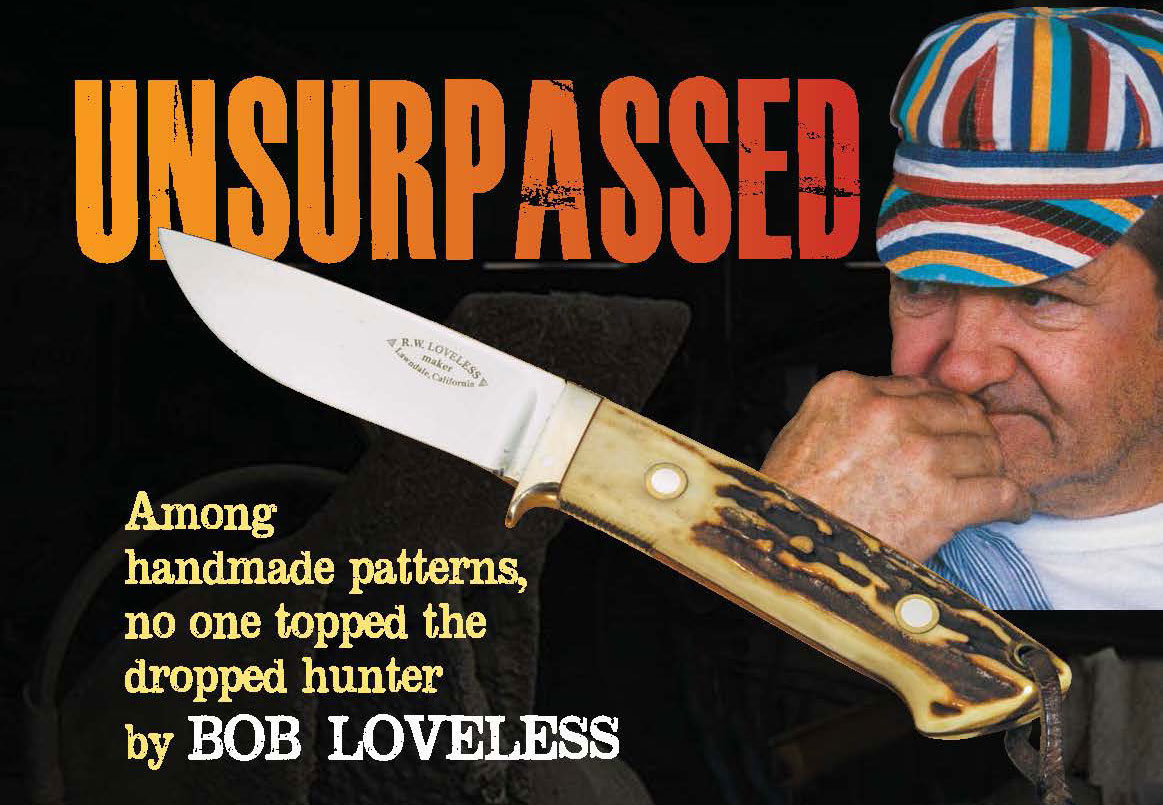
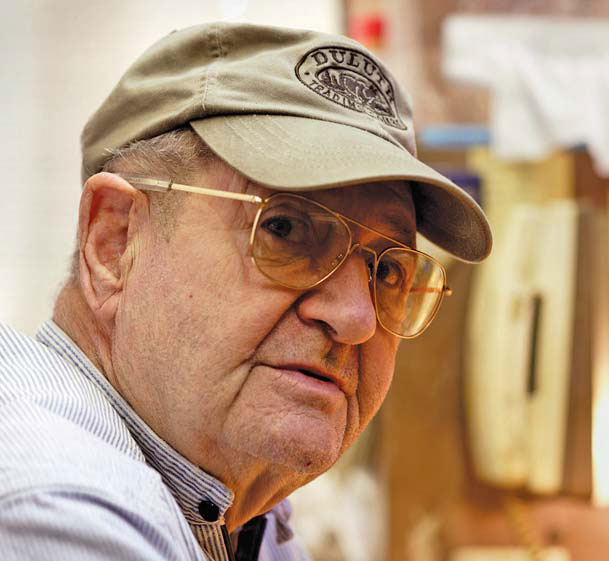
Bob Loveless, pictured here, left a knifemaking legacy that continues to influence generations.
“Bob is most likely the best designer to ever produce a knife, as design after design was just right,” John Denton observed.

Too often, it seems, the mediocre is celebrated. Descriptive terms like “legendary” and “timeless” are handed out with reckless abandon. But few would argue that the terms are fitting when applied to BLADE Magazine Cutlery Hall-Of-Fame© member R.W. “Bob” Loveless and the dropped hunter.

Also known as the drop-point hunter or simply the drop point, the knife grabbed the attention of the world of knives more than half-a-century ago and has remained in the limelight ever since.

“Bob Loveless didn’t invent the drop point but he sure made it popular,” remembered longtime merchant, knife advocate and Cutlery Hall-Of-Famer A.G. Russell. “Loveless was different. Loveless was magic. When his knives sold for $650 and other makers’ knives sold for $200, he said his knife was worth $200 but the mark was worth $450.”

Russell points to an article that appeared in Guns & Ammo magazine in the 1960s. It thrust Loveless and his custom knives, along with those of Harry Morseth and Merle Seguine, to the forefront.

“It made Loveless the most renowned knifemaker in America,” A.G. recalled. “In handmade patterns nobody surpassed Loveless’s drop point. Not just because it was copied, but everybody was copying it—kind of like the Randall Model 1 was copied.

“It wasn’t his best or most useful model. It was simply the most popular. His best was the semi-skinner, with a better point and belly,” Russell opined.

Global Impact of Loveless Knives
bob loveless custom knife sheath
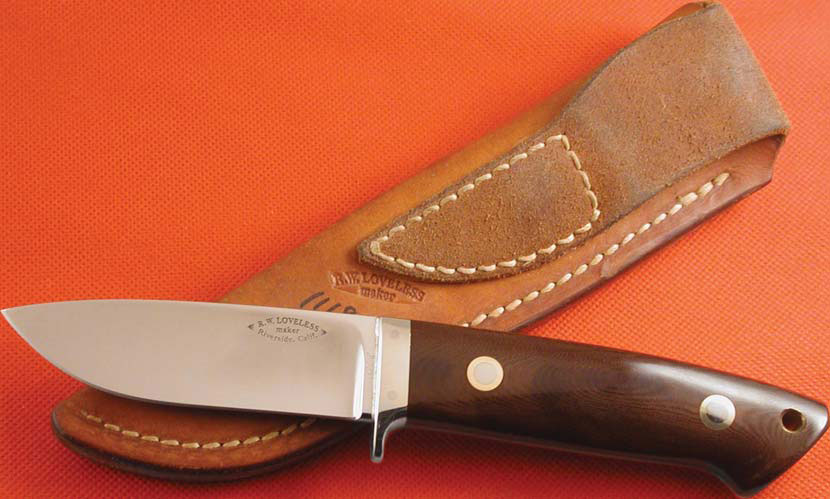
Adding to the desirability of any Loveless dropped hunter—and any Loveless knife, for that matter—is an original Loveless sheath. Loveless prided himself on the quality of his sheaths almost as much as the quality of his knives. (image courtesy of John Denton)

John Denton is one of the world’s foremost authorities on Loveless knives.

He has been an avid collector for decades and a purveyor of Loveless knives for many years, following in the footsteps of his late father and purveying legend J.W. Denton.

“The first time I saw a drop-point hunter was in BLADE® Magazine in the ’80s,” he recalled. “If you didn’t get BLADE Magazine, you did not know about anything in the knife world. Also, it seems that every time I liked a knife I saw in a photo I would read below it, and it would say, ‘made by R.W. Loveless.’ So there must have been something special if a photo catches you over and over in books and magazines.”

bob loveless knife shop
Loveless and his knives were immensely popular in Japan, and John Denton surmises that the drop point was the catalyst for the Loveless explosion in the Asian market. From left: Loveless, Denton and knifemaker/Loveless’s long-time assistant Jim Merritt in the Loveless shop in Riverside, California. (image courtesy of John Denton)

Loveless and his knives were immensely popular in Japan, and Denton surmises that the drop point was the catalyst for the Loveless explosion in the Asian market.

“The fact is that the drop point was meant to be a using tool, just like Hamada Pottery. It was utilitarian and useful. That’s the reason he was so huge in Japan, his simple design, and nothing was wasted, and the fact that it was so well balanced in the hand—never square—so that you did not feel any [unnecessary] sharp surface when working with it. Pure brilliance!”

Cutlery Hall-Of-Famer B.R. Hughes met Loveless through A.G. Russell, who had met Bob a year earlier while on a tour in 1967 that included stops at the shops of several custom knifemakers, including Loveless’s in California.

“I first saw a Loveless drop-point hunter in the dead of winter in 1968,” Hughes smiled, “when my good friend A.G. Russell called and told me that he was hosting a California maker named R.W. Loveless, who was doing some pretty special stuff with his knives, and invited me to come up for a visit.”

The roads between Hughes’ home in Texarkana, Texas, and Russell’s business in Arkansas were covered with snow at the time, but Hughes prevailed on a friend, Bill Murdock, who owned a plane and flew him over to the airport in Fayetteville.

“A.G. and Bob picked us up at the airport, and we drove to a small diner, where we had coffee and ate,” Hughes recalled. “Bob laid out several of his knives on the table and he talked. I was most impressed with the workmanship and the design of the knives, notably the extremely thinly ground blades, the full tangs, the handle design, and the tapered tangs. The overall workmanship was some of the best I had seen up to that point. Indeed, the only knifemaker of that period I would say was comparable in terms of workmanship would have been D.E. Henry.”
bob loveless drop point hunter
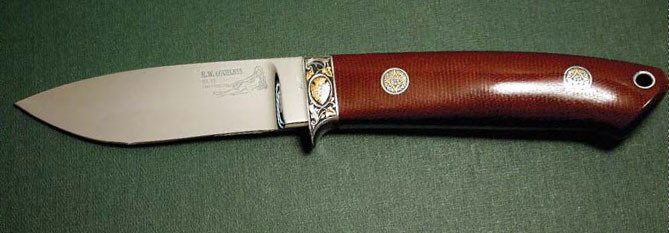
Denton calls this the “essential Loveless drop-point hunter” with a Micarta handle and engraving by Dan Wilkerson, whom Denton indicated engraved more Loveless knives than anyone. The gold in the engraving, including the arrowhead, is 18k. (image courtesy of John Denton)

Loveless evidently struck a chord when he revived an old design and added his personal touch. The result was an utter phenomenon. His authorship was unmistakable and his mark became prized the world over.

“The drop point is not hard to make,” Denton noted. “Loveless told me that he did not like making sub-hilts because by the time he made one sub-hilt he could have made 10 or more drops. But that’s what makes his double grinds so nice. They are rare and took time to make. But Bob said 90-percent plus of his production was some sort of hunter, and of those, [mostly] the drop. He went years sometimes never making a Big Bear [sub-hilt].

“Bob is most likely the best designer to ever produce a knife, as design after design was just right,” Denton continued, “the Big Bear, the boot, New York Special, Hideouts, Chute knives. All amazing. He is much like the Ferrari of the knife world. He did it so well that everyone copies it and wants to make a drop-point hunter when they start out making knives, or they want to certainly own one if they collect knives. I just recently sold a Loveless knife to rock legend Eric Clapton. So, Loveless designs are known all over the globe.”
Schrade Bob Loveless knives
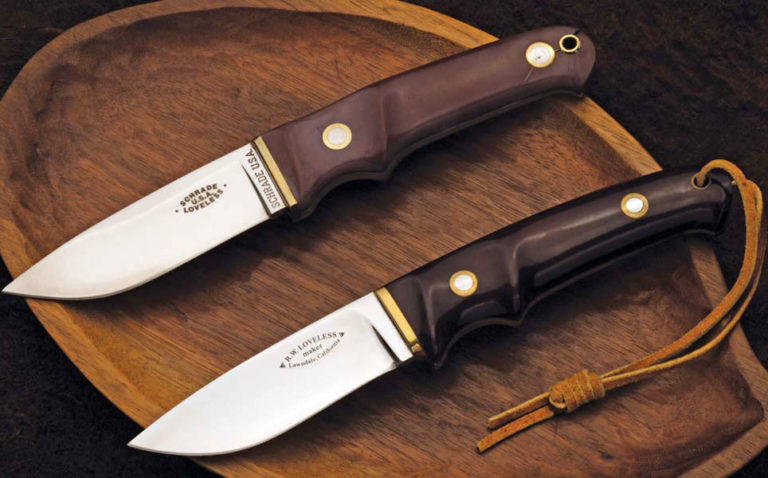
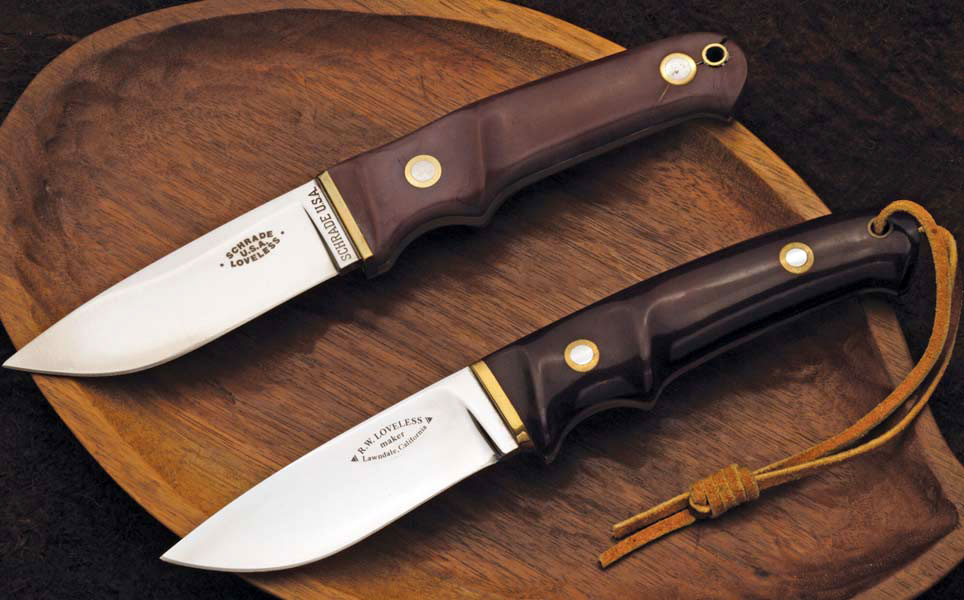
An actual 1970s Schrade reproduction of the Loveless drop point (above) and the original Loveless Lawndale model on which it was based (right) appear here. “A.G. Russell put Loveless in touch with Uncle Henry Baer of Schrade and the rest is history,” John Denton stated. (image courtesy of John Denton)

According to Denton, Loveless started making hunting knives in the 1950s and conceived his additions to the genre.

From there, John says, the rest is history. By the 1970s and ’80s, Schrade, Gerber and Beretta were among the companies offering reproductions of the drop-point hunter, so the knife’s influence captured the mass-production market as well.

Bob Loveless: Larger than Life
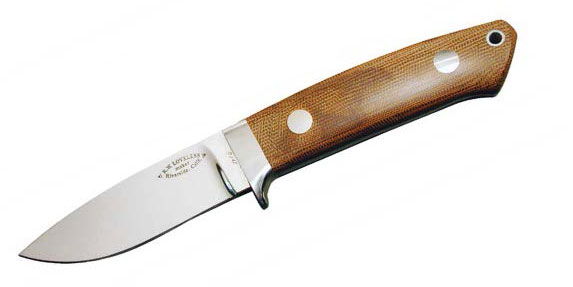
bob loveless hunting knife
Denton said Loveless once told him 90-percent plus of his production was some sort of hunter, and of those most were drop points.

Cutlery Hall-Of-Famer D’ Holder treasures his personal relationship with the late Loveless.

“I had seen Loveless drop points in several magazines in the late ’60s,” Holder said, “but saw my first up close and real in 1973. Dan Dennehy was raising money for his move to Del Norte, Colorado, and had a Loveless drop point on his gun show table for sale. It was at the Yuma, Arizona, gun show and he was asking $125. It had stag handles and a gold escutcheon on top of the blade with [Loveless’s] name engraved in it. On the side of it was engraved, ‘To my good friend Dan, from Bob.’”

D’ bought the knife that day and owned it for 15 years before selling it to Al Williams, a renowned Loveless collector, for $1,800. Holder says he should have kept it and that it would bring at least $10,000 today.

“I would sit in my easy chair and fondle that knife for hours trying to figure out what was so special,” D’ mused. “I never came up with a clear answer other than it was a Loveless.”

For years, D’ stopped by Bob’s Riverside, California, shop while on his way to one of the West Coast knife shows.

They exchanged varying opinions of topics of the day, and even when those opinions diverged they shook hands and looked forward to the next visit.
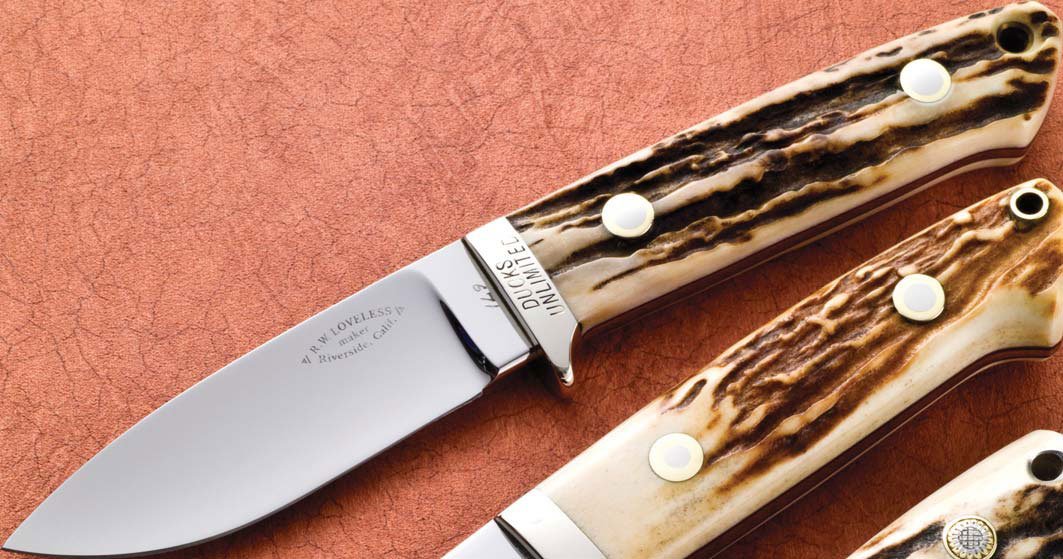
collecting bob loveless knives
According to A.G. Russell, the drop point was not Loveless’s best or most useful model. It was simply the most
popular. “His best was the semi-skinner, with a better point and belly,” Russell opined. (PointSeven image)

“The last time we had our usual discussion and it came time to leave, I extended my hand as always,” Holder said, “and he brushed it aside and gave me a big hug, and told me how much he appreciated the visits. Several years later he came to Phoenix and spent the day with me in my shop. It was one of the highlights of my career. He was a perfect gentleman. I miss the opportunity to visit with him. I miss his personality, his gruff exterior and his friendship.”

Hughes agrees that the drop point was not the most difficult knife to make, but its impact has been enormous. He recalls Loveless taking a moment during that first meeting at the diner in Arkansas, running the edge of one of his knives against pressure. As he moved it, the edge actually rippled, something B.R. had never seen before.
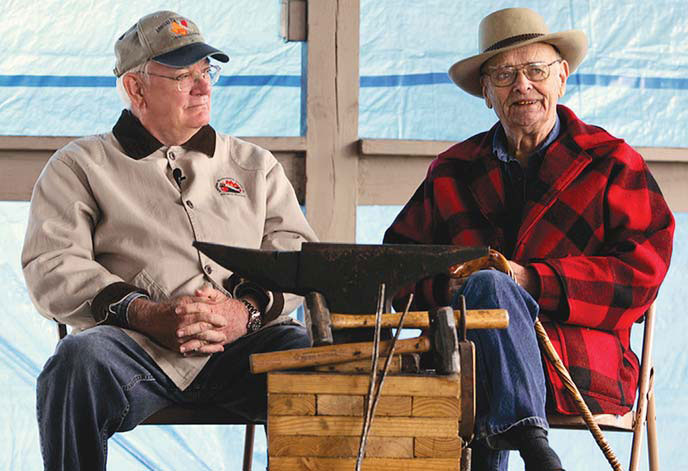
american bladesmith society
B.R. Hughes—at left here with Bill Moran—agrees with John Denton that though the drop point is not the most diffi cult to make, its impact has been vast. (Buddy Thomason image)

“Subsequent events indicated that it was not too difficult to turn out knives of this style and quality,” Hughes remarked, “because in a relatively short span of time at least half the stock-removal knifemakers in America were turning out pretty close copies of Loveless knives. He had an instant impact on knifemaking, almost overnight. My article on Loveless and his knives appeared sometime later in the long defunct GUNsport Magazine, of which I was shotgun editor at the time. Other articles appeared in other gun magazines. Remember, there was no BLADE, no Knives Illustrated in those days.”

In the pantheon of great custom knifemakers, Hughes says the knives of Cutlery Hall-Of-Famer Bo Randall were the most copied until Loveless came along. Then Loveless and Cutlery Hall-Of-Famer Bill Moran became the most influential cutlers in America and perhaps the world.

“Moran virtually singlehandedly saved bladesmithing from extinction, and Loveless transformed stock-removal knifemaking,” he concluded. “Anyway, that is my take.”

The drop-point hunter stands out among the rest because of the times, the look, the feel, the mark, and of course, the source of it all—larger than life—Bob Loveless himself.

Discover the Secrets to Bob Loveless’s Knives
collecting bob loveless knives

How to Sharpen a Serrated Knife

2
How to sharpen a serrated knife
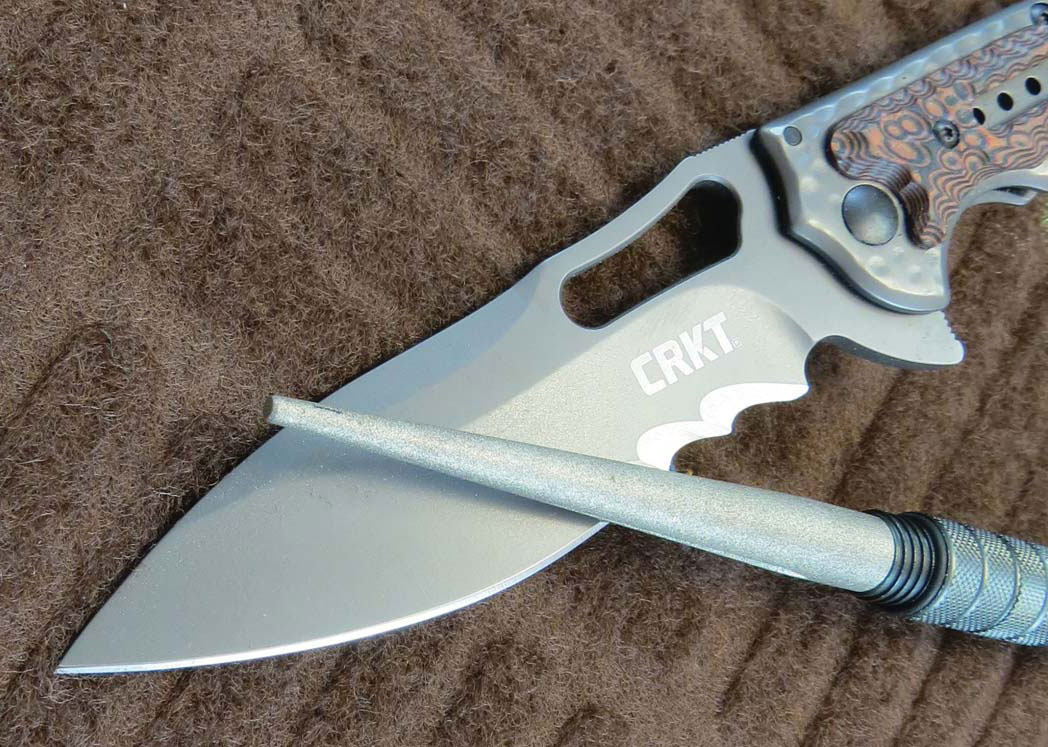
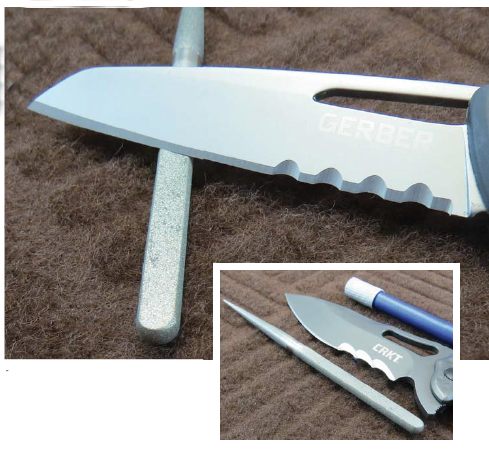
The broad cone of the GATCO Scepter 2.0 comes in handy when working on the wide serrations of the CRKT Fossil.

How to Sharpen a Serrated Knife: Quick Tips

  • Use a small sharpening rod
  • Lock the rod into a “gullet,” the groove of the serration
  • Work the rod with slow, smooth motions away from the knife, applying light pressure
  • Work the rod in one direction; don’t rub it back and forth
  • Don’t sharpen wider than the serration

Sharpening Rods are Musts for Sharpening Serrated Knives

No matter what edge style of knife you carry, it must be sharpened. In the case of serrated blades, you need specialized tools, called sharpening rods.

Some rods, like the ones you’ll typically find in a kitchen, are large. Those won’t be helpful for working with small serrations. You need to find a small rod that will lock into place inside the serration. Don’t worry about sizing, though. Most small sharpening rods are tapered so that you’ll have the right fit no matter what.

Practice Makes Perfect

Learning how to sharpen serrated knives is like any other technique—you need practice to get good at it. I recommend buying some cheap knives and practicing before you move on to your $200 Spyderco. Also, remember that not all diamond sharpeners are created equal. Diamonds are manufactured and certain diamonds are more durable than others—then again, that’s a topic for a different time.

Know Your Geometry

There are a couple of key points about geometry for learning how to sharpen a knife with serrations.

As with a plain edge, you are polishing a surface. In the case of serrated blades, there are two geometries to work.

One is the gullet. The gullet is the internal section that normally has a curved shape between the points of a serrated edge. Since sharp gullets are necessary, many people mistakenly focus too much on the gullets and not enough on the teeth of the pattern. The teeth do the initial entry into the material and begin the cut.

Hence, when sharpening serrated blades you not only polish the gullet of the serration but also re-point the teeth at the same time. Much like sharpening a saw, you reform the teeth and restore the geometry of the teeth along with the geometry of the gullet.

Four Sharpeners for Sharpening Serrated Rods

How to sharpen serrated knives
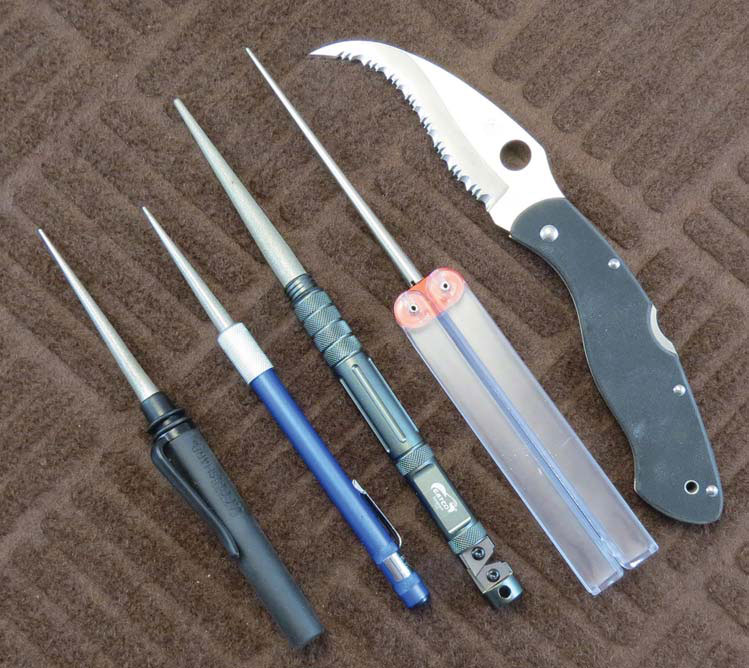
From left, with manufacturer’s suggested retail prices in parentheses: Accusharp Diamond Compact Sharpener ($11.99); Smith’s Diamond Retractable Sharpener ($7.99); GATCO Scepter 2.0 ($25.95); and DMT Diafold Serrated Sharpener ($32.99). The knife is the author’s Spyderco Civilian.
Serrated knife sharpeners
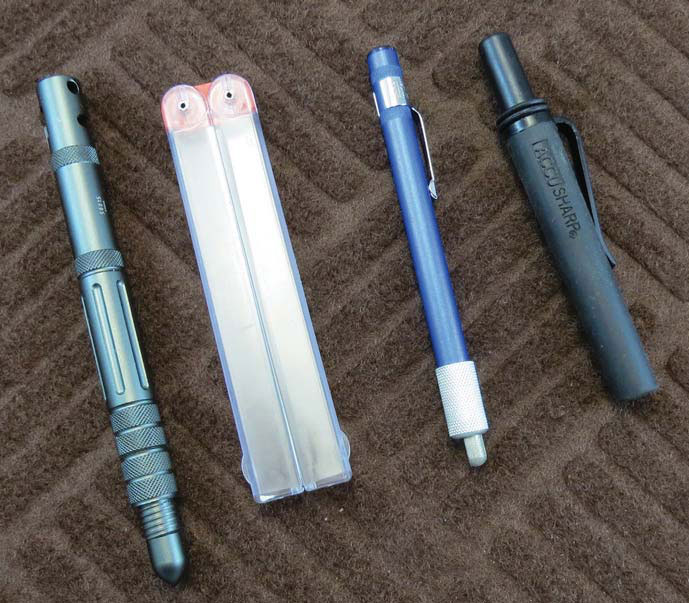
The foursome in the closed position, from left: GATCO Scepter 2.0, DMT Diafold Serrated Sharpener, Smith’s Diamond
Retractable Sharpener and Accusharp Diamond Compact Sharpener.

Here’s a good place to start. Our lineup of four sharpeners consists of the GATCO Scepter 2.0, Smith’s Diamond Retractable Sharpener, DMT Diafold serrated sharpener and Accusharp Diamond Compact Sharpener.

GATCO Scepter 2.0

Serrated knife sharpening tips
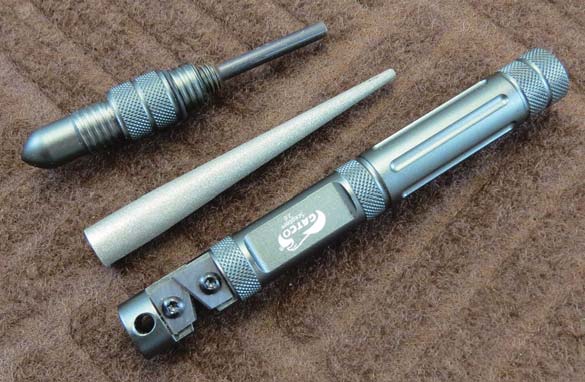
The GATCO is a bit of a multi-tool with, from
right, a carbide sharpener, diamond cone and a ferrocerium rod all in one.

Of the four, the GATCO Scepter 2.0 is more multi-tool than sharpener only.

If you are into gadgets that serve more than one purpose, the Scepter 2.0 is for you. It has two tungsten-carbide blades for sharpening, a ferrocerium rod and a diamond cone sharpener. All are in a compact package that resembles a tactical pen. The diamond rod has a groove for sharpening fishhooks.

The cone has a medium-grade texture and a broad taper. The cone is 3.75 inches long and tapers from .113 to .392 of an inch in diameter. Why does the taper matter? If the taper is steep, during sharpening you will have a shorter cut as the cone will get too wide too quickly for some smaller serrations. Overall length: 6.125 inches.

If you’re looking for a sharpener as an everyday carry tool, the Scepter 2.0 is a good choice. The cone is a bit chunky but works fine for all but the smallest serrations. I am not a big fan of carbide sharpening blades because they hog off a lot of metal, though I don’t mind them on rough cutting tools. I haven’t had the Scepter long enough to testify to the durability of the diamond cone but so far it is holding up well.

Smith’s Diamond Retractable Sharpener

Sharpen a serrated knife
The Smith’s rod has three surfaces—flat, conical and round (inset)—to tackle any number of sharpening jobs. The flat surface in combination with the diamond cone makes it easy to sharpen combo-edge blades.

Smith’s Diamond Retractable Sharpener is the trimmest of the group and looks like a pen when collapsed. It is possible to use the cone shape to sharpen a plain edge, but with the Smith’s model the diamond coated sharpener has two ends.

One end has a flat section and the other is tapered for serrated edges. Of the group the Smith’s hone has the most aggressive grit. The body of the holder is aluminum and has a pen clip. (The GATCO Scepter could use a pen clip to complete it.) Closed length: 5.187 inches.

Again, I could see this tool in someone’s EDC kit, a tackle box or camping gear. At the tip the cone measures .06 inch and at the widest point .256 inch in diameter. With such a fine tip expanding in size over its 2.375-inch length, the Smith’s hone sharpens a wide range of serration styles. At a manufacturer’s suggested retail price of $7.99, it does not have to last a lifetime to pay for itself.

DMT Diafold

Serrated knife sharpening tips
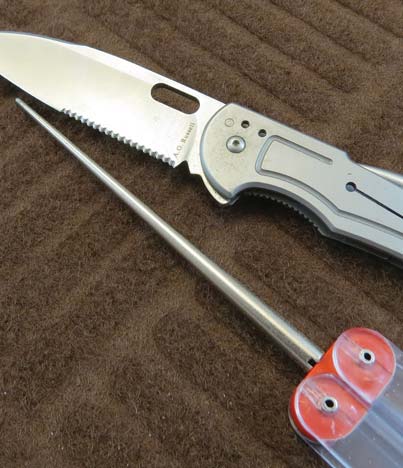
A sharpener with a fine tip like the DMT Diafold is needed to get small serration patterns back to sharp again.

The DMT Diafold serrated sharpener comes in three color-coded grits: coarse (blue) 325 mesh or 45 micron, fine (red) 600 mesh or 25 micron, and X fine (green) 1200 mesh or 9 micron. I used the red.

Of the quartet it was the longest, finest-grit tapered cone. Overall length: 4.5 inches. It tapers in diameter from .62 inch at the tip to .25 inch at the base.

To store the sharpening cone DMT uses a folding handle system similar to a butterfly knife. The handle is a clear polycarbonate. At 5 inches closed and as with the others the Diafold is compact enough to be EDC’d.

I’ve had a number of DMT Diafolds over the years and they are still in working order. You have to use some of the diamond sharpeners a lot before they will wear out. I will say when open, the very appearance of the Diafold can send shivers down your spine as it resembles an icepick. It works well and if you like something with a fuller handle to it, a Diafold might be your shtick.

Accusharp Diamond Compact Sharpener

Accusharp serrated knife sharpener
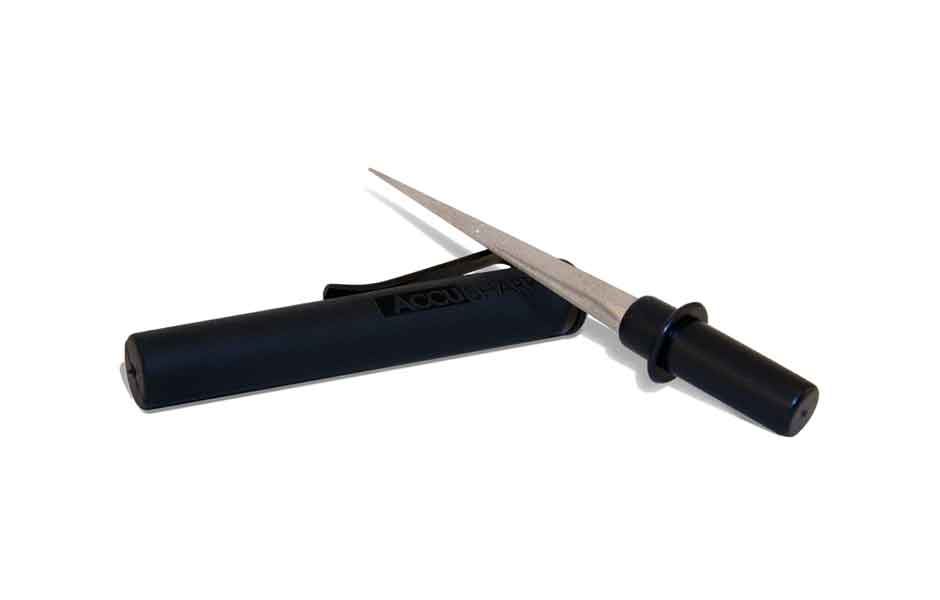
Accusharp uses a friction fit to hold the Diamond Compact Sharpener open and closed.

The Accusharp Diamond Compact Sharpener is 3.125 inches long with inch diameters of .06 at the tip and .305 at the base. A plastic body with a rubberized coating houses the unit—definitely low tech and follows the K.I.S.S. principle. A friction fit holds the sharpener open and closed. The fit is tight and you don’t have to worry about the two sides separating accidentally. An integral pen clip is on the main body’s housing. The clip doesn’t seem robust and I can see it eventually snapping off.

The sharpener has a medium-grit diamond coating and functioned well during testing. Accusharp includes a hook groove I find rather large. Maybe it’s for big fish. The closed length is the shortest of the group: 4.75 inches.

I like the design because as with the Smith’s sharpener it appears to be a standard pen as opposed to the GATCO model’s large-tactical-pen look. If you want to carry a sharpener and not let anyone know you have one so you aren’t constantly loaning it out, the Smith’s might be the ticket. As far as feel, the handle diameter is nice and comfortable.


D2 Tool Steel Just Keeps Cutting

Dr. D2, Bob Dozier
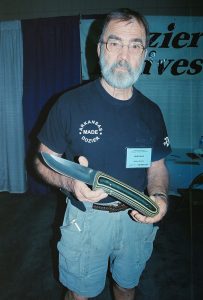
Aka “Dr. D2,” Bob Dozier long has been a proponent of D2 tool steel. Here he holds one of his specially made “over-sized” folders at a past BLADE Show.

D2 tool steel just keeps cutting. It’s been around a long time and enjoys a solid reputation among custom and factory knifemakers and knife users. As with many high-performance steels, it experiences a range of highs and lows in popularity, and at the moment seems to be enjoying a high.

A favorite steel of such long-time knifemakers as BLADE Magazine Cutlery Hall-Of-Fame© member Wayne Goddard and Bob Dozier—the latter has been called “Dr. D2” on more than one occasion—D2 is considered a “borderline stainless steel” because it contains 11.5 percent chromium. To be classified as stainless, a steel must have at least 12 percent chromium. (Note: stainless simply means a steel resists corrosion. It does not mean it is stain proof.) According to Scott Devanna of SB Specialty Metals, D2 also has a very high carbon content—1.5 percent—which lowers corrosion resistance because the carbon “grabs” a lot of D2’s chromium to form chromium carbides. The chromium carbides are good for improving wear resistance—improved wear resistance enhances edge holding—but they tie up chromium so it is not as “free,” and thus reduce corrosion resistance. Free chromium forms a chromium oxide layer at the surface, and the layer makes a steel corrosion resistant. This helps explain why D2 is not stainless.

While D2 may not be stainless, it remains a top performer due in no small part to its high wear resistance/edge-holding ability. “It will hold an edge for a very long time before it will go dull,” says Paul Tsujimoto, director of engineering at Ontario Knife Co.  Combined with its relatively inexpensive price, this makes D2 a favorite of manufacturers and custom makers alike. “For us, it’s the perfect combination of performance and an affordable price,” notes Dietmar Pohl of Pohl Force Knives. Agrees Devanna, “It’s the best bang for the buck because it’s priced reasonably and works well.”

D2 on Hornet
Pohl Force Knives uses D2 blade steel for the Hornet, a Spencer Reiter design.

On the down side, D2’s ample wear resistance also means it is difficult to sharpen. However, a diamond abrasive sharpener should do the trick. Also, the steel’s impact toughness suffers in comparison to some other steels, so D2 is not the best choice for a blade used for chopping and other impact-type cutting chores. And, since it’s not a true stainless, you should wipe it down after use to help keep corrosion to a minimum.

Nonetheless, D2 is an outstanding choice for a hard-use knife and remains popular among custom knifemakers and manufacturers, and knife users as well.

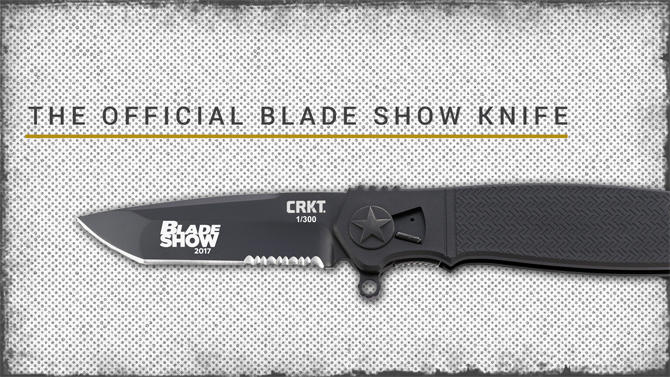
Do You Have Your Official 2017 BLADE Show Knife?

5 Myths About Knife Sharpening

4

Knife sharpening is, on its surface, a simple thing. That hasn’t prevented a few myths from popping up, though. Here are five knife sharpening myths, busted.

Myth: You Need Expensive Knife Sharpening Tools

Fact: Quality knife sharpening stones, sticks, oils, and other gizmos can help quite a bit. However, you can’t buy your way to sharpening success. Technique is 90 percent of it. Humans have been sharpening knives without manufactured products for centuries. How did they do it? They knew how to work an edge.

Here are knife sharpening tips for the uninitiated. All you need are some junky practice knives, a sharpening stone, a Sharpie and some patience to get started.


Myth: Diamond-Infused Knife Sharpening Stones Last Forever

DMT knife sharpener
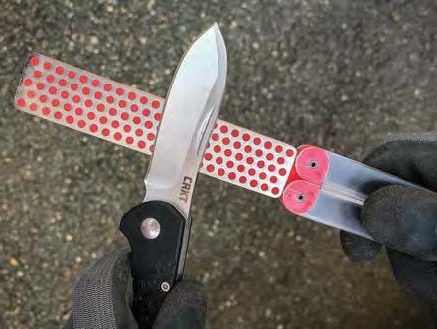
A DMT Diafold in action. 

Fact: Diamonds might be forever, but knife sharpeners are a different story. Here’s DMT with the answer:

For those that use stones on a daily basis and maintain them properly, the diamond will likely last for a few years. For those that use them less frequently, it’s likely the stone will last from ten to twenty years.

Still, you can’t beat the value of a $40 knife sharpener that gets the job done over several years.


Myth: Using a Sharpening Stone Dry Works Faster Than Using It Wet Because It Removes More Metal

Fact: Don’t confuse friction with progress. Adding a little water or oil to maximizes your effort with every stroke on a knife sharpening stone. Remember, knife sharpening isn’t necessarily about scraping metal away; it’s about refining or creating an edge. 

SharpeningSupplies.com ran a test exploring this exact knife sharpening myth. The results?

The results were clear. Use your stones wet. The stones used wet worked far better than the ones used dry.

That isn’t to say that every knife sharpening stone needs to be used wet. It’s more that this is not an either-or proposition. Some can be used dry, too, as Cutlery-Hall-of-Fame Member Dan Delavan demonstrates in this video. 

On that note, if you use water on a stone, always use water. If you use oil, always use oil. Oil and water don’t mix, and that goes for knife sharpening, too.


Myth: Electric Knife Sharpeners Can Sharpen Almost Any Knife

Portable electric knife sharpener
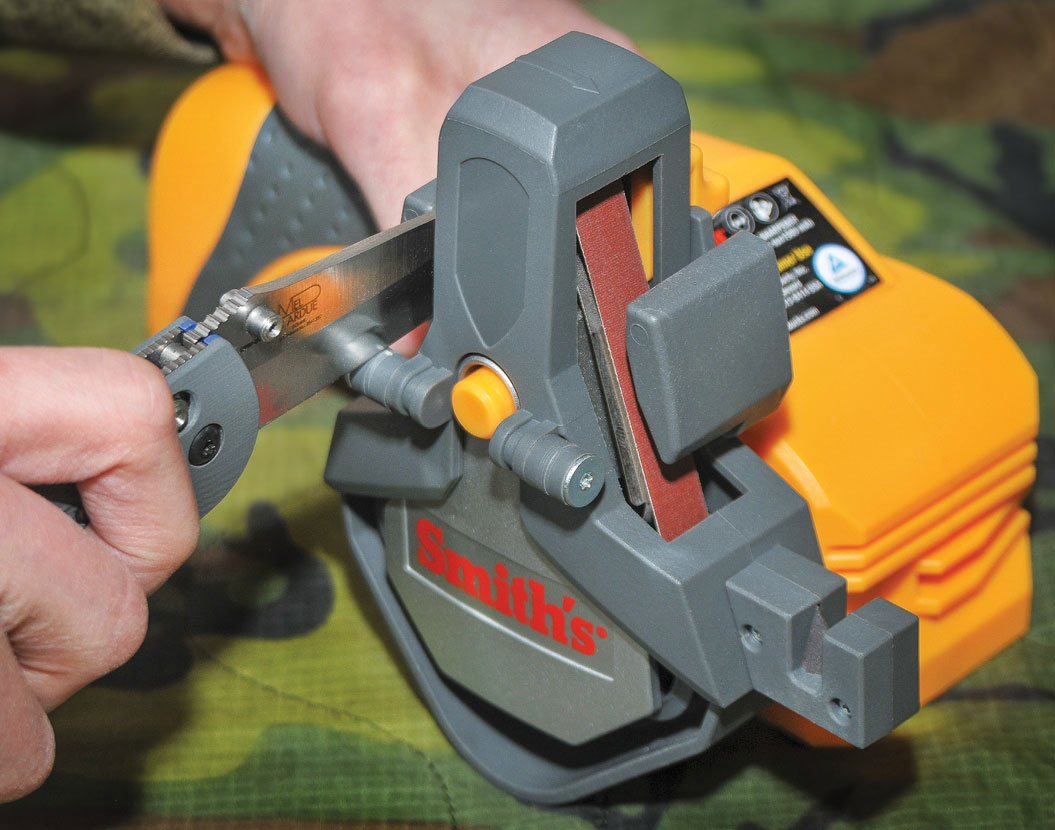
The Cordless Knife & Tool Sharpener from Smith’s Products features easily adjustable angle guides that hold the knife at the proper set angle for a consistent edge. (DMS Captures image)

Fact: Electric knife sharpeners can sharpen most knives, but that doesn’t mean that they should

Electric knife sharpeners have fixed angle positions. If your favorite knife’s edge is set at 20 degrees, and the electric knife sharpener is set at 15 or 30 degrees, you might need a new favorite knife. 

The type of grind is also left unconsidered with electric knife sharpeners. For example, a blade’s convex edge will be reset by a sharpener tuned to a flat grind.

Edges aren’t set by accident. They are tied to the purpose and performance of a knife.

Matching the knives you intend to sharpen to the features of an electric knife sharpener is important. So is learning how to use manual knife sharpeners!


Myth: Diamond Knife Sharpeners Aren’t Really Made Out Of Diamonds — That’s Just Marketing

Diamond knife sharpener tips

Fact: Diamond knife sharpeners use real diamonds.

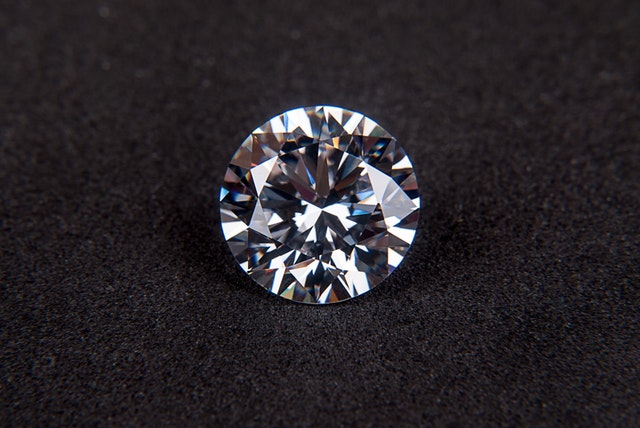
On first glance, this knife sharpening myth seems to make sense. Walk into a jewelry store and you’ll see diamonds with four-figure price tags. A sporting goods store, on the other hand, offers diamond knife sharpeners for less than 100 bucks. Maybe you should’ve reconsidered financing that engagement ring.

Knife sharpening companies often use monocrystalline diamonds, which are not the same as jewelry-grade diamonds. Here’s DMT again with the explanation:

Monocrystalline diamonds are diamonds of high quality that are not fractured. These diamonds are uniformly sized. DMT® bonds these to a nickel backing to provide a long lasting very flat surface. The alternative is to use polycrystalline diamonds. These diamonds are fractured and will not wear as long as the higher quality monocrystalline.


Half Myth: When Sharpening, Use an Equal Number of Strokes on Each Side 

Fact: This one could cut either way. It’s right on the line of myth versus reality.

It’s generally accepted that an equal number of strokes on each side of the blade will result in an even edge. However, hands don’t work exactly the same way in both directions. As Delavan states in the video above, most people’s backhand stroke isn’t as sturdy, and that could result in an uneven edge.

The trick is to compensate with a few more strokes on that backhand. 


Knifemaking 101: What Is SM-100 (Nitinol)?

The History of Nitinol

Nitinol, also referred to as “Ni-Ti-Nol,” was first discovered back in 1959 by scientists William Buehler and Frederic Wang at the Naval Ordnance Laboratory. The Ni-Ti-Nol acronym stands for “Nickel-Titanium-Naval Ordnance Laboratory.”

Beuhler and Wang were searching for a super-elastic alloy for missile nose cones that would be pliable at extreme heat, yet return to its original shape after cooling. Their efforts were a success, but because the incredibly tough alloy was so difficult to process and machine, it wasn’t used until much later.

Knifemaking Discovers Nitinol a Half-Century Later

Nitinol custom knives
Duane Dwyer of Strider Knives was the main force behind SM-100 (HIPTiNite), and his signed custom Strider MT2 showcases a brilliantly heat-treated SM-100 blade mated to machined carbon fiber handle scales. (Brady Miller image)

Custom knifemaker Duane Dwyer of Strider Knives became interested in Nitinol back in 2005 while searching for a super hard metal alloy that would not rust. He approached metallurgist and friend Scott Devanna, vice president of technology at SB Specialty Metals, and inquired about the possibility of producing Nitinol using the particle metallurgy process, which had never been done.

Shortly afterwards Devanna introduced Dwyer to Eric Bono, a metallurgist and knifemaker who also had an interest in the alloy, and the three men began to explore the possibilities of incorporating the alloy into knives.

Nitinol Becomes SM-100 (HIPTiNite)

Hiptinite custom knives
Duane Dwyer of Strider Knives was the main force behind SM-100 (HIPTiNite), and his signed custom Strider MT2 showcases a brilliantly heat-treated SM-100 blade mated to machined carbon fiber handle scales. (Brady Miller image)

With his metallurgical knowledge and experience, Bono developed a working, powdered metal version of the alloy in 2006, which the partners dubbed “SM-100.” It took several more years to refine the alloy and processes, and in 2009, Bono and business partner Fred Yolton formed a company, Summit Metals LLC, to produce SM-100.

Since that time, SM-100 (60 percent nickel and 40 percent titanium), which the company markets under the name “HIPTiNite,” has garnered interest not only in the knife industry, but also by NASA and the Formula 1 racing industry.

Properties of SM-100

The SM-100 brand of Nitinol, like its forerunner, is extremely tough. While a typical sanding belt can be used to grind several typical, mono-steel knife blades, it requires several belts, in many cases six or more, for the same process using the SM-100 alloy.

Made and sold in small quantities, the cost of SM-100 isn’t cheap. Add to that the cost of belts and additional time to shape and grind the material, and the cost per knife skyrockets.

On the positive side, SM-100 is noncorrosive, and while stainless steel will rust, Devanna says you can throw an SM-100 knife into saltwater for 50 years without the material corroding.

An Explosion of Coloring

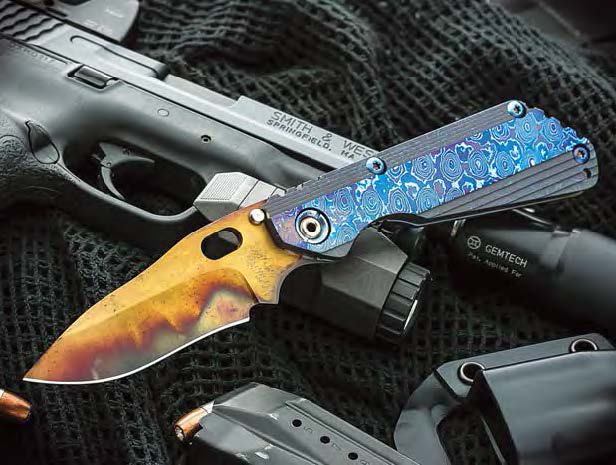
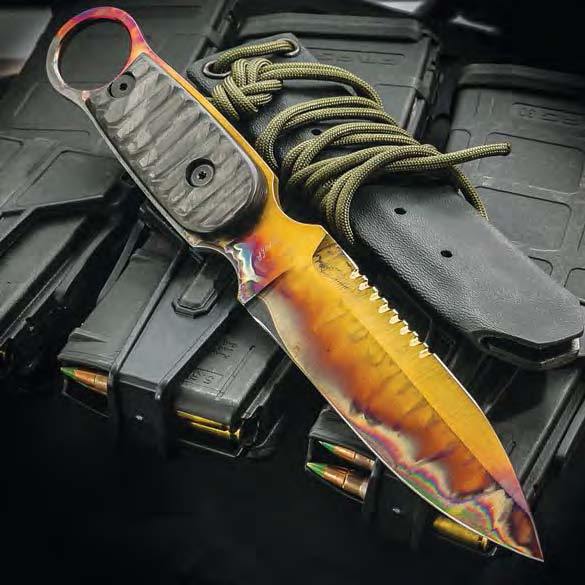
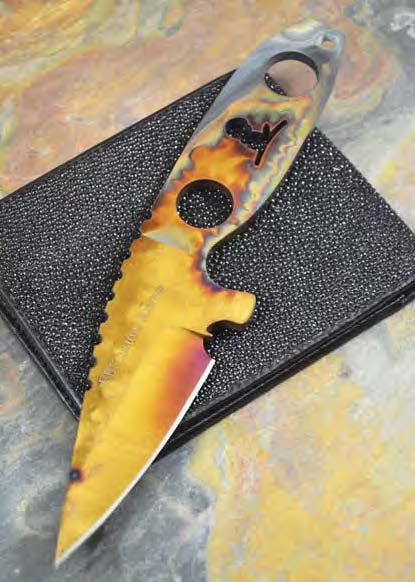
Bono discovered during his development of SM-100 that it can be heat colored into an exquisite rainbow of colors. Due to the titanium content, SM-100 oxidizes into a blaze of bright hues just like other alloys incorporating titanium, but the process of achieving the color effects is quite different.

Bono confides that the magic happens during the heat-treating process, in which he allows small pockets of air to leak onto the surface of the knife. Prior to heat treating, the blades are wrapped in foil and small holes are punched into the wrapping.

When heat treated, different colors occur depending on the oxygen content of certain areas of the blade material as the surface oxidizes. The end result is the explosion of color on the SM-100 blades.

The price for bright, eye-popping colors doesn’t come cheap, but then new innovations rarely do.


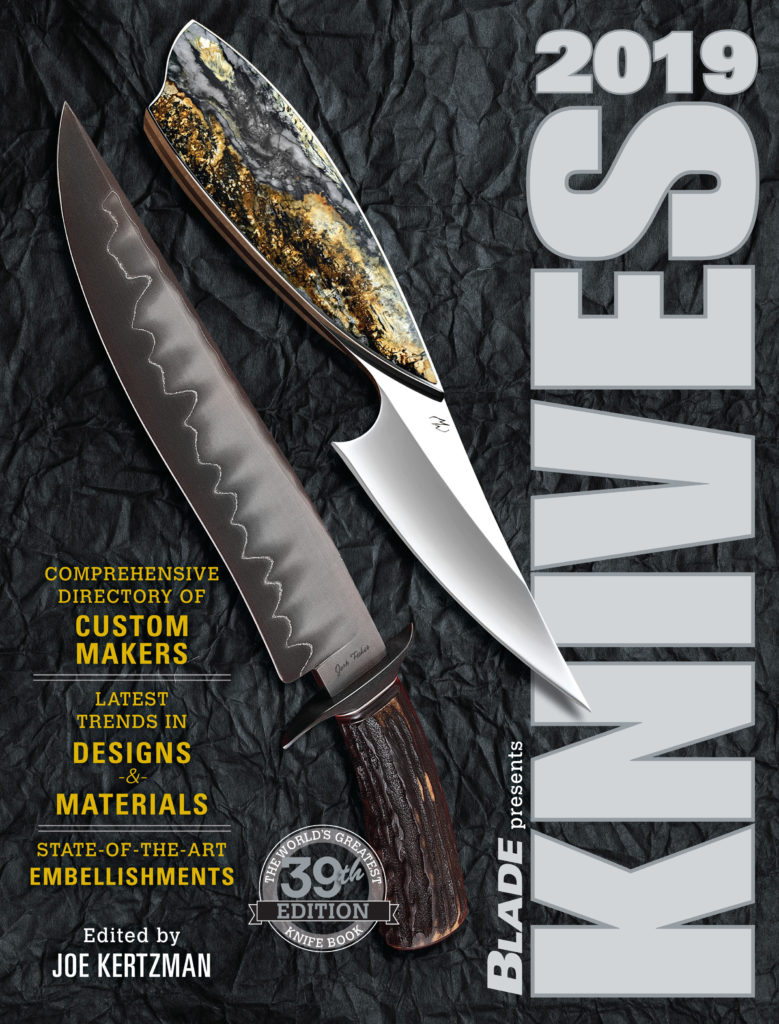
See More Trends in Knives in This Book

Best books about knives

The Best Way to Hand Someone a Knife

how to give someone a knife
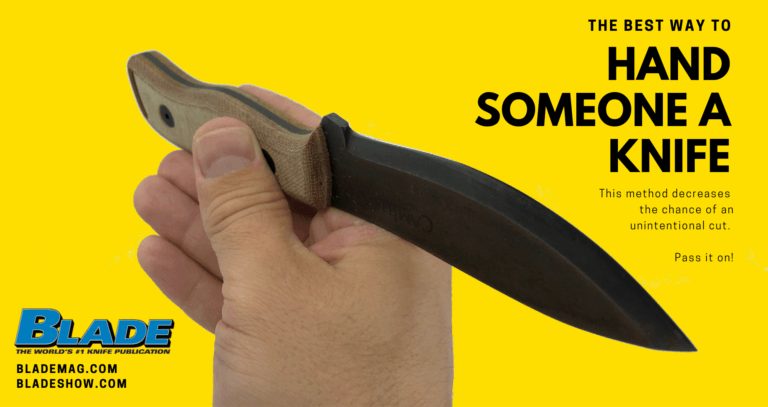
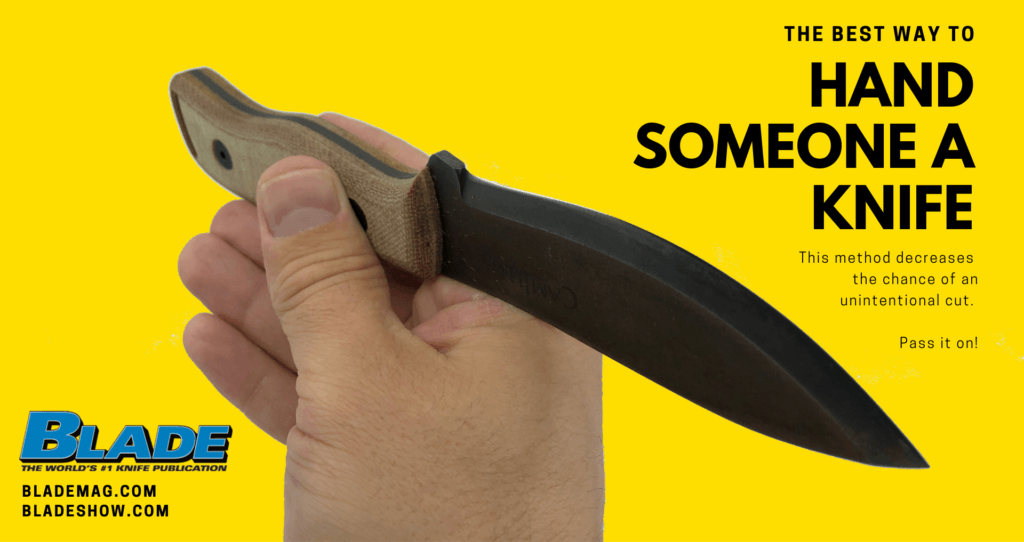
Feel free to to download and share this image. It could prevent an unintended cut. (Please keep the BLADE logo and URLs, though, OK?)

Knife etiquette often overlaps with knife safety, and this is a prime example. The best way to hand someone a knife is also the politest, as nothing is quite as rude as unintentionally cutting open a person’s skin.

The Technique: Make It Muscle Memory

It’s simple: while holding the handle with your fingers, cradle the spine of the blade in the web of your hand between the thumb and index finger.

This allows the recipient to safely grasp the handle. If the blade slides across the giver’s hand, the skin will come in contact with the spine, not the edge. It also forces the recipient into choosing the safest method to release the knife from the giver’s hand, avoiding any meandering edges.

None other than Ray Mears demonstrates what a successful hand off looks like using this technique here:

The dance of two people using any other technique is as awkward as it is unsafe. Committing this technique to muscle memory so it’s second nature will save time and stitches. Plus, you’ll look like a pro.

The Second Best Technique: Setting the Knife Down

The only other technique that’s as safe is setting the knife down for the recipient to then pick up. That’s not always possible, but it’s still better than someone unintentionally shaking hands with an edge.

Placing fingers on the blade to pass or grab a knife is not only not recommended, it’s not how the knife was designed in the first place. The handle is there for a reason.

The Only Exception: Securing the Blade Inside the Handle

If the knife design allows for the blade to be secured inside the handle (folders, autos, etc.), it’s obviously acceptable to secure the blade first before handing the knife off.

In the quick back-and-forths at knife shows, like the BLADE Show, that’s not always convenient. That’s why it’s worth committing the technique in the above picture to muscle memory.

Pass It On!

Don’t keep this information to yourself. Share the image at the top of the page on your social media, blog, website and with anyone who might need it. Feel free to link to this article, too. 

BLADE wants you to be safe! Enjoy your knives. Treat them right, and they’ll treat you right, too.


Visit BLADE Show Each June in Atlanta

BLADE Show tickets online

It’s the world’s largest knife show for a reason. Click here to join us each year in Atlanta

What is a Marlinspike Knife? 4 Examples

Marlinespike Knife: A Definition

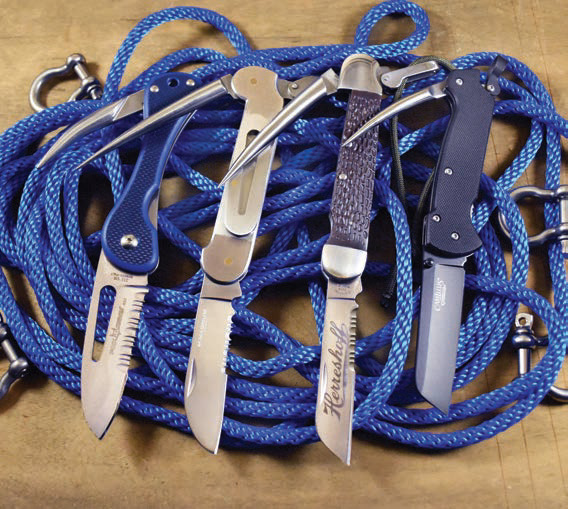
One of the more unusual patterns in the long history of folding knives is the marlinespike. It is a blend of the early rope knife—not the sunfish, but the wharncliffe version—and the singular, knitting-needle-like marlinespike.

These were combined into a single folder and have served many a sailor and diver well. The blade is a sure-handed rope cutter, and the spike is made for working with knots and splicing rope. In fact, there is a knot dubbed the marlinespike hitch that serves as a temporary knot for various needs.

Also known as rigging knives, marlinespike knives live today in the form of reproductions of the original folders and thoroughly modern send-ups. Climbers, who use a lot of different knots in their endeavors, also find marlinespike knives useful.

Example 1: Colonial Knife’s Marlin Spike

Knife for knots
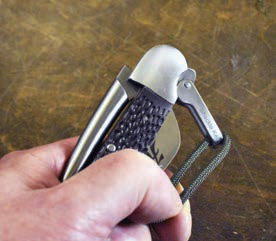
The press-lock is a common blade release for marlinespike folders that dates back to the knife’s early days. However, there’s more here than meets the eye: The Colonial Marlin Spike’s lock also serves as a bail and a shackle opener.

Colonial Knife’s Marlin Spike is a reproduction of the original marlinespike knife issued by the U.S. Navy in World War I—with some modern touches.

The locking, 440C stainless steel spike and partially serrated—a plain-edge version is also available—sheepsfoot slip-joint blade are both 3 inches long. The scales are a simulated brown jigged-bone Zytel and the bolsters are stainless. The spike locks via a press-lock on the base, which also serves as a shackle opener and bail for a lanyard.

Example 2: Boker Magnum Catamaran

Use knife to make knots
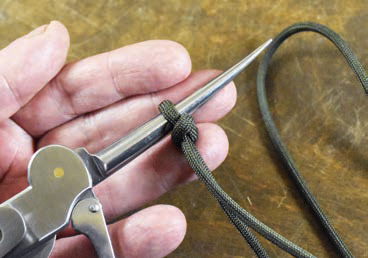
The marlinespike hitch is a simple, temporary knot that can be easily removed once it has served its purpose. The knot is attached to the Boker Magnum Catamaran’s spike in a scenario for which it can serve as a handle.

The Boker Magnum Catamaran has the traditional profile of the old marlinespike folders, replete with a press-lock bail/shackle opener for the spike tool and a 4.375-inch stainless steel frame.

The 3.3-inch spike and 2.75-inch partially serrated sheepsfoot slip-joint blade are 440A stainless steel. You’ll find a nifty shackle opener on the handle, also stainless steel, pinned to the frame.

Example 3: Camillus Marlin Spike

Sailor knives
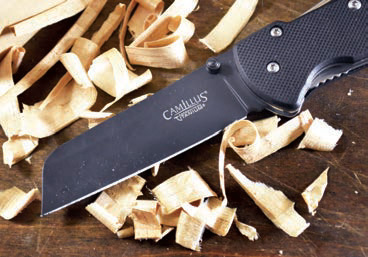
While the plain edge of the Camillus Marlin Spike’s sheepsfoot blade might not quite match the speed of a serrated edge, when it comes to wood it vastly out-carves the rest of the pack. This is a big consideration if you need a knife that will step outside The Rope Zone.

The Camillus Marlin Spike is a modern take on the original. The stylized, 4-inch frame is black G-10 with stainless steel liners. The 2.75-inch sheepsfoot blade—the only one of the test group without serrations—is VG-10 stainless steel with a black, carbonitride titanium coating.

It secures via a linerlock. The folder’s 2.25-inch spike locks via the press-lock/bail and is black coated as well. It is the lightest (3.2 ounces) of the test knives.

Example 4: Fox Sailing Knife

Knives for sailors
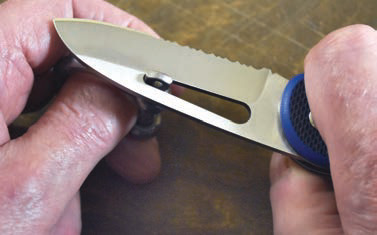
The Fox Sailing Knife has a cutout in the blade that serves as a shackle release. A shackle’s screw tab is caught in the jaws of the blade’s open maw.

The Fox Sailing Knife delivers with a cool, 4-inch handle of textured blue G-10. Stainless liners house linerlock mechanisms for both the 3-inch modified wharncliffe blade of 420 stainless steel and 2.25-inch spike.

The partially serrated blade has a cutout that serves as a shackle opener, along with a hole in the base of the frame that can accept a lanyard.

Advertisement

Must Read Articles

Read this before you make a knife

Knifemaking 101 – Read This Before You Make a Knife

  by Wayne Goddard My experience has taught me that there's nothing like digging in and getting started. I've often said the hardest part of the...
how to forge damascus steel

How to Forge Damascus

Advertisement
Advertisement