Knife History

The history of knives and other edged instruments is tied to the history of people in general. As humankind’s oldest tool, unraveling knife history can lead to even more surprising and enriching information to better understand the world.

How George Washington’s Penknife Saved the United States of America

2

Editor’s note: This article originally appeared in the July/August 1994 issue of BLADE magazine.

Knife History: George Washington’s Penknife

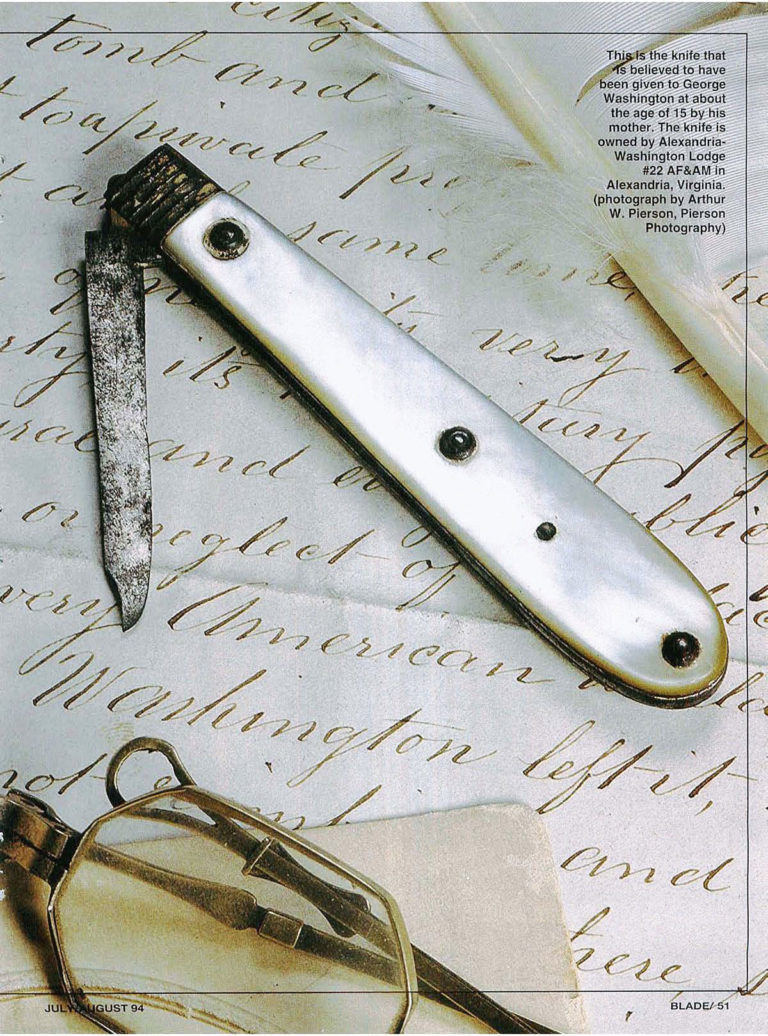
On display at the Alexandria Masonic Lodge in Alexandria, Virginia, is a simple penknife. Its closed length is 3 inches; its handle appears to be mother-of-pearl. the single blade is 1 3/4 inches long.

The claim to fame of this otherwise nondescript cutlery antique is that it was in the possession of George Washington for 56 years. More significant than the knife itself, however, is the story it inspired, a fascinating tale of devotion to duty and strength of character.

George Washington knives history
Gilbert Stuart Williamstown Portrait of George Washington.

Following the death of his father in 1743, a young George Washington, then only 11, went to live with his half-brother, Lawrence. While repairs were being done to the family estate at Mount Vernon, George stayed for a time at Belvoir, the home of William Fairfax, a close friend of the Washington family and also Lawrence’s father-in-law.

“William Fairfax became very fond of George and gave the young man access to his elaborate library,” explained Dr. Claude Harris, archivist of the Alexandria Washington Masonic Lodge, which is located in the George Washington Masonic National Memorial. “Through the influence of his brother and the Fairfax family. George obtained a commission as a midshipman in the [British navy].”

According to Jack Rudell, curator of the replica room of the George Washington Masonic National Memorial, Martha Ball Washington, George’s mother, corresponded with her brother, John Ball, who lived in England.

“John Ball said that the British navy was a floating hell,” commented Rudell. “So [Washington’s mother] was convinced not to let George go.”

Though the details had been worked out and all preparations made, young George respected his mother’s wishes, surrendered his commission and returned to the study of mathematics and surveying.

George’s mother ordered supplies from England annually, and in her next order was a request for one good penknife, which she intended to give to her son as a token of appreciation.

“This she presented to young George as a reward for his submission to her will with the injunction, ‘always obey your superiors,’” remarked Harris. “He carried the token with him through life as a reminder of his mother’s command.”

The Penknife Steps into History
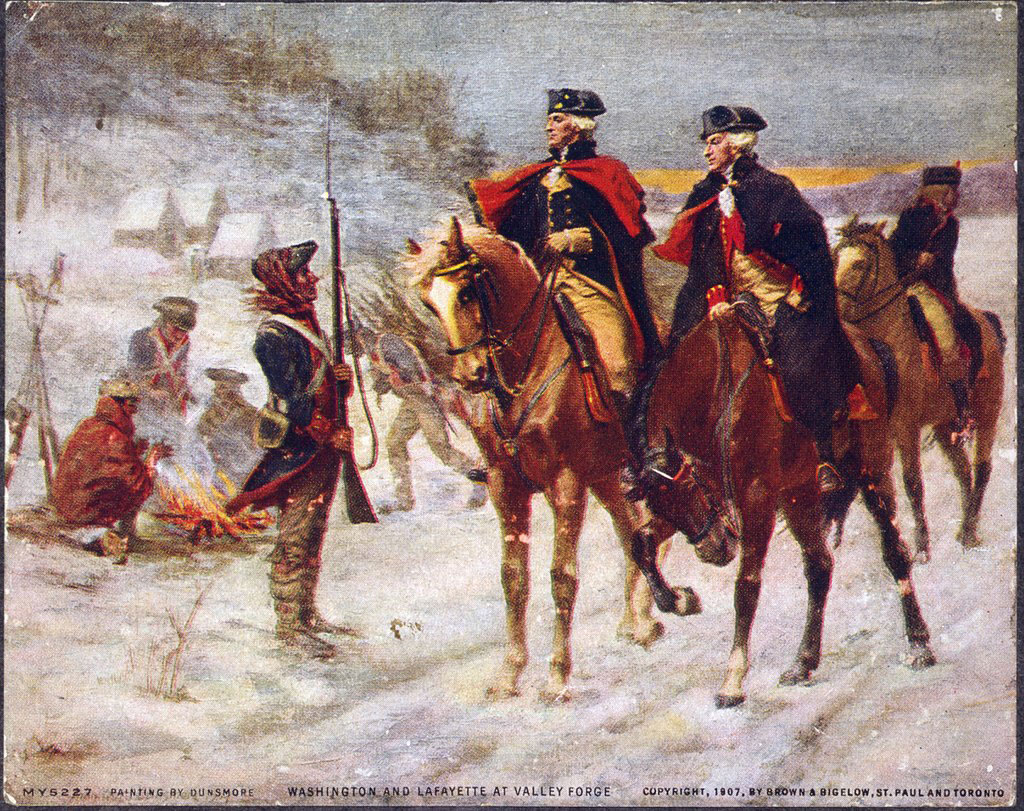
George Washington Valley Forge
A painting of Gen. George Washington and Lafayette at Valley Forge. (John Ward Dunsmore)

Later, during the Revolutionary War, Washington supposedly recounted the knife’s history in a conversation with one of his most trusted subordinates, Gen. Henry Knox. It was Knox who would later play a key role in Washington’s military future.

As the commander-in-chief quietly deliberated over the situation that bleak winter at Valley Forge, it could scarcely have been more critical. His soldiers were fighting for their very lives against the mightiest military power in the world. If they failed, then along with them would perish an ideal.

“When a timid Congress failed to provide food for his starving and ragged army, in desperation yielding temporarily to his feelings, and in sympathy for his men and disgust with Congress, Washington wrote his resignation as commander-in-chief of the Continental Army and summoned his staff to notify them of his actions,” remarked Harris. “Among the officers present and sitting in the council was Knox, who reminded him of the knife and his mother’s injunction ‘always obey your superiors. You were commanded to lead this army and no one has ordered you to cease leading it.’”

Washington paused and said, “There is something to that. I will think it over.”

Half and hour later he had torn up his resignation, determined to fight to the end. Thus, a penknife may have meant the different between life and death for the USA.

As True as the Cherry Tree Story?
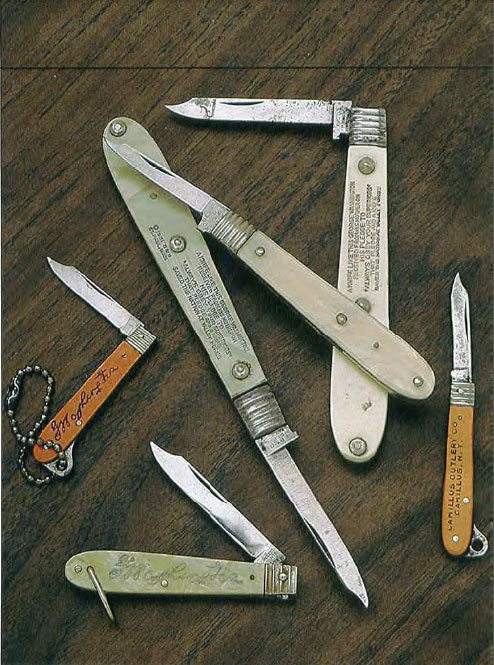
Penknife george washington reproductions
According to “The ABCA Price Guide to Antique Knives,” by J. Bruce Voyles, several reproductions of Washington’s penknife were made in 1932. On the handle of the larger size is the injunction given Washington by his mother; on the scales of the smaller size is Washington’s signature. Clockwise from bottom left are repros by Camillus; unknown; B&B of St. Paul, Minnesota; Robeson; Remington; and Camillus.

Whether events actually transpired as recorded is as much a matter of opinion as appraisal of fact, but indeed the story of the knife should rank in American folklore with that of the cherry tree and the famous phrase, “I cannot tell a lie.”

Love History and Knives?

Load up on more stories like this one with BLADE‘s collection of back issues. One download gets you 25 years of magazines, all conveniently presented in PDF format.
Knife History: Abraham Lincoln’s Fruit Knife

0


president abraham lincoln knives
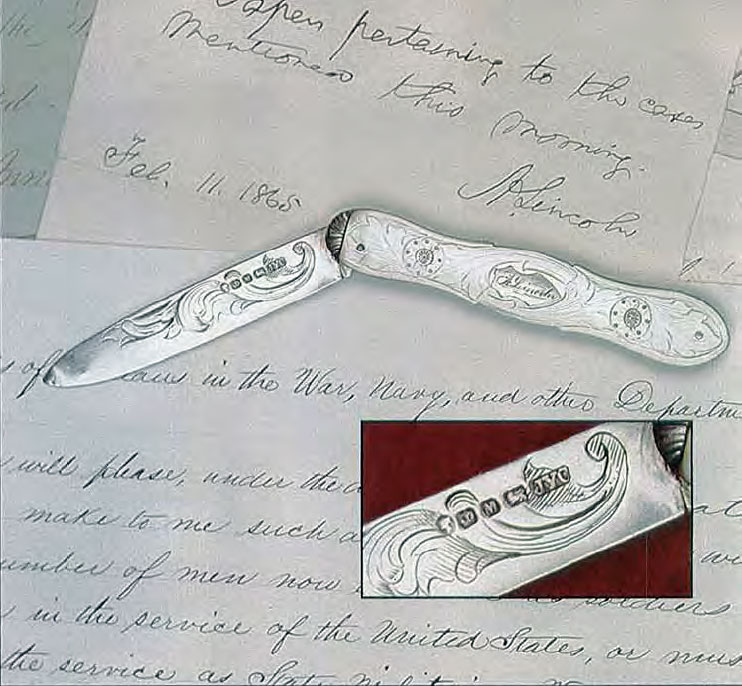
From all indications, this folding fruit knife belonged to Abraham Lincoln. The legal papers in the background are from Lincoln’s presidential years. Note the similarity in his signature and the name engraved on the shield. (Inset) The hallmarks on the blade of folding fruit knives contain a language all their own. These particular hallmarks stand for the following, from left: Queen Victoria’s profile-duty stamp; the crown-made in Sheffield; the capital letter “MJ’-in this case, made sometime between 1855-56; the lionsilver blade; and JYC-made by John Yeomans Cowlishaw. (The Lincoln Museum, Fort Wayne, Indiana-a part of Lincoln National Corp., photograph by Scott Simpson)

Editor’s note: This article originally appeared in the December 1992 issue of BLADE magazine. Learn more about timeless knife history with this collection of back issues.

Is This an Honest-to-Goodness Knife for Honest Abe?

A silver folding fruit knife owned by U.S. President Abraham Lincoln? It seems too good to be true. But there it is, bigger than life on display at the Lincoln Museum in Fort Wayne, Indiana.

It all started with a letter to BLADE magazine from William Graves, Sr. He wrote that he’d seen a picture of the knife in Lincoln Lore, the official publication of the Lincoln Museum, a part of the Lincoln National Corp. All the signs seemed right; the hallmarks on the blade, the carved pearl handle, even Lincoln’s name engraved on the shield. But the question remained: Was the knife really Lincoln’s?

Abraham Lincoln’s Knives Can Fetch $100,000

Acting museum director Ruth Cook said the knife was bought by television executive producer Harry Ackerman at the auction of Oliver R. Barrett’s Lincoln collection in 1952. Ackerman’s discovery of the knife is a story in itself. He bought Lincoln’s legal wallet, inside of which, unknown to the seller or buyer, was the knife. A collector’s dream come true!

Cook said the Lincoln National Corp., subsidiary of Lincoln National Life Insurance Co., bought the wallet and knife from a dealer. She could not divulge how much was paid for both items, though she said the price was in the five-figure range. She said neither item is for sale. Another knife-a multi- blade pocketknife-that belonged to Lincoln sold alone at auction for $99,825 at Sotheby’s in New York in 1989, as reported in the August 1989 BLADE magazine.

Even though Cook said there is no documentation of when Lincoln received the folding fruit knife or who gave it to him, it reportedly has been authenticated. There are photographs of it in famed poet and biographer Carl Sandburg‘s Lincoln volumes and elsewhere.

History of Fruit Knives

history of fruit knives
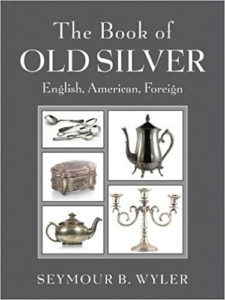
One of the only books about fruit knife history offered a few clues. (image via Amazon)

But were the principals involved familiar enough with the special “hallmark language” of fruit knives to know if this particular fruit knife could have been made for Lincoln?

We decided to check with Bill Karsten, author of the only known book on the subject, Silver Folding Fruit Knives, to flush out the facts.

According to Karsten’s book, folding fruit knives first appeared in France in the 17th century. They often had blades made of silver or gold for corrosion resistance as stainless steel was not yet available. Men often gave them as presents to their wives or girlfriends.

In England, silver fruit knives flourished after the silver assay offices opened at Sheffield and Birmingham in 1773. The blades were hallmarked following assay (a procedure analyzing the blade’s silver content) in accordance with the system conceived in London during the early 14th century.

A series of five small stamped marks disclosed the city of origin, the maker’s initials, the year of assay, the sterling silver (92.5 percent) content and the duty stamp (Karsten said the latter was no longer carried after the duty was abolished in 1890).

How Lincoln’s Knife Measures Up

The hallmarks on the Lincoln knife blade are of a profile of Queen Victoria, a crown, the capital letter “M,” a lion and the initials “JYC.” Karsten said the “JYC” stands for the maker, John Yeomans Cowlishaw, who was so well thought of that a street in Sheffield, Cowlishaw Lane, is named after him.

Karsten said the queen’s profile means the duty on the knife had been paid indicating the knife was made pre-1896 the crown indicates the knife was made in Sheffield, and the lion means the blades are made of silver.

The Mysterious M Holds Key to Lincoln’s Fruit Knife

silversmithing books
When you’re on the hunt for knife history, don’t discount books that aren’t explicitly about knives. A book about silversmithing contained another clue about Lincoln’s fruit knife.

But it was the “M” hallmark for the year of make that intrigues Karsten. He said the capital letter or uppercase “M” meant the-knife was made-either from 1855-56 or from 1879-1880. If it were made between 1879 and 1880, then the knife could not have been Lincoln’s since he was assassinated in 1865.

Moreover, Karsten said, Cowlishaw made his last knife around 1920, which indicates if he made a knife in the mid-1850s, his knifemaking career spanned six-and-a-half decades. If that’s true, it’s a remarkable record for working longevity at that point in history.

Some checking by Karsten in The Book of Old Silver: English, American, Foreign by Seymour B. Wyler revealed that Cowlishaw was admitted as a maker of silver folding fruit knives to the Sheffield Assay Office in 1854. So he could have made the knife in 1855-56.

However, Karsten said the “M markings on the knives made in 1855-56 are thinner than those made in 1879-80.”

“If I had to make a choice I would say the shape of the ‘M’ indicates the knife was made in 1879-80,” he said, but he could not be positive and would not discount that the knife could have been Lincoln’s on that basis.

Mistakes Don’t Necessarily Discredit Lincoln’s Fruit Knife

download knife magazines
Learn more about knife history in this collection of BLADE back issues, dating back to 1973.

Next came a question about the order the hallmarks appear in on the blade.

Quoting from Wyler’s book, Karsten said on almost all fruit knives made from 1844-1921 the crown is the first hallmark to appear at the left. On the Lincoln blade the queen’s profile appears first at the left. However, Karsten said there is a picture of a Cowlishaw knife made in 1855 with the hallmarks in the same order in Karsten’s book.

Moreover, he said mistakes in the application of hallmarks were made and the Lincoln knife may be an example.

“They did make boo-boos,” he noted. “I’ve found several of them. They’re not normal but the mistakes don’t discount the knife’s authenticity, either.”

Simon Moore, a leading English authority on fruit knives, agreed with Karsten’s assessment.

“We do often get mistakes like that. There might be a whole batch of blades with marks jumbled up higgledy-piggledy,” he said. “They might go stamping away before they’d realized their mistake but by then they might’ve run off quite a few blades that way.”

As for the shield style and the engraved blade, Karsten said he had seen examples of neither on other Cowlishaw knives. Concerning the “A. Lincoln” engraved on the shield, Karsten said it was probably done some time after the knife was made. He said if the knife were made especially for Lincoln by Cowlishaw, Cowlishaw may have engraved the name on the shield later.

The Verdict for Lincoln’s Fruit Knife

Dr. William Rosenthal, a leading fruit knife authority who donated a huge collection of fruit knives to the National Knife Museum, said the shield was probably engraved after the knife came to America.
“The fancy shape of the handle, the engraved bolster, these sort of things say to me Cowlishaw well could have made the knife,” Karsten noted. “And the knife very well could have been Lincoln’s.”

Knife History: Is This Abraham Lincoln’s Pocketknife?

0
Abraham Lincoln knives
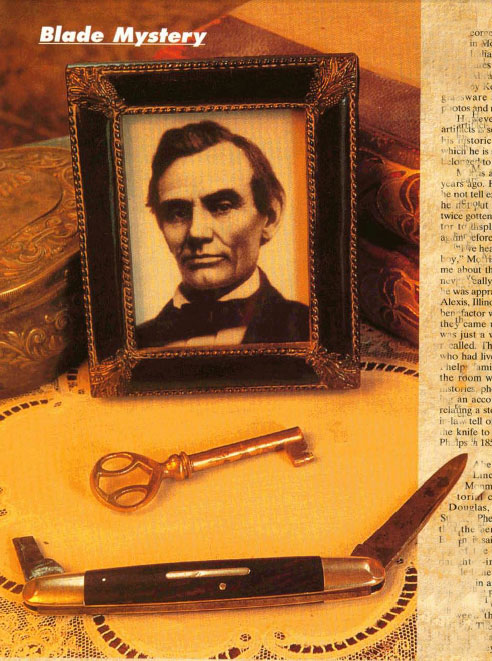
If you believe the story, this is Abraham Lincoln’s pocketknife.

Editor’s note: This article originally appeared in the December 1996 issue of BLADE. Read more from BLADE‘s archives with this collection.

Abraham Lincoln’s Knife

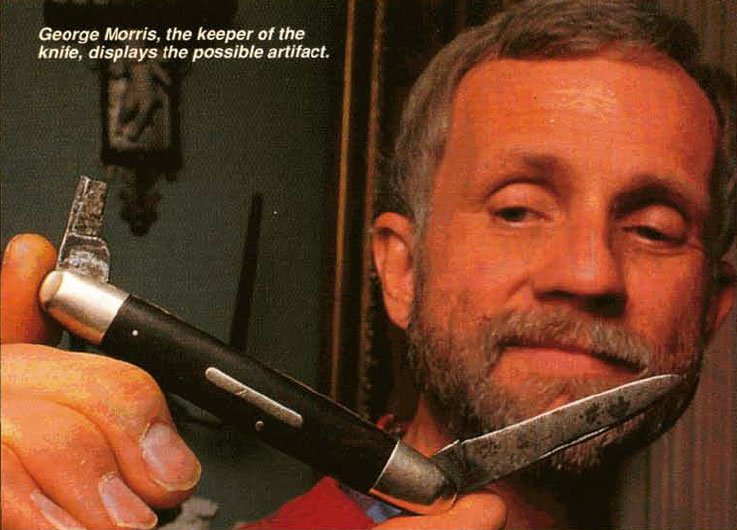
George Morris is an antique collector in Monmouth, Illinois. His home is filled with treasures from ages past, but one of his most precious artifacts is seldom seen within the walls of his historic home. The little knife with which he is so careful is said to have once belonged to Abraham Lincoln.

Morris acquired the knife about four years ago. His benefactor stipulated that he not tell exactly where he got it and that he not put it on public display. He has twice gotten permission from the benefactor to display the knife and had to ask again before telling the tale.

Origin’s of Lincoln’s Knife

Lincoln doppleganger
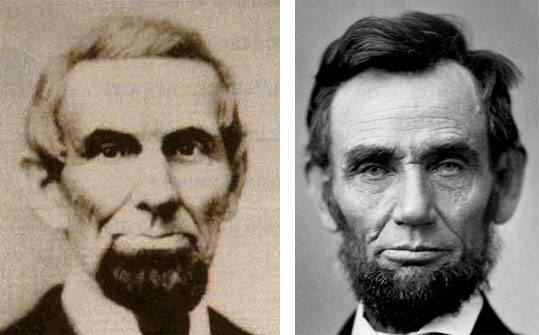
Sumner Phelps, left, was a dead ringer for Abraham Lincoln.

Lincoln, after a stop in Monmouth, Illinois, during his senatorial campaign against Stephen Douglas, visited his longtime friend Sumner Phelps in Oquawka. It was there that the benefactor’s grandfather, Bill Boden, is said to have witnessed the passing of the knife to Phelps. Boden’s daughter-in-law, Agnes Boden, later recalled the story her father-in-law had told her in an essay titled, A Little Town Where Old Friends Met:

“There was a striking resemblance between the two men (Lincoln and Phelps). They could easily have passed as brothers. Many had noticed and spoke of it when they sat together in the Phelps carriage. Lincoln must have noted it too for he played a cute joke on his friend day,” Bill Boden said.

“After telling how he had won a knife, to the merriment of all present, especially S.S. (Sumner) Phelps, who was boisterously laughing, Lincoln, with a twinkle in his eye, took the knife out of pocket and said, “Sumner, this knife was given to me to keep until I found a homelier man than myself, so I present it to you.”

The knife was passed down through the Phelps family and eventually was given to Frank Boden, Bill Boden’s son and the husband of Agnes Boden. In 1941, Will Phelps, the grandson of Sumner, signed an affidavit in Rock Island County, Illinois, attesting to the authenticity of the knife Morris now has.

“It’s Not Insurable”

Abraham Lincoln knives

Though he casually slips the knife in and out of his pocket when showing is to visitors, Morris regularly keeps the knife and affidavit secured in a safety deposit box in a bank. He takes such precautions because the knife is a one-of-a-kind.

“It’s not insurable,” he said. “There’s no way you can appraise it. It’s worth whatever somebody will give you. Something like that can’t be replaced.”

Morris said he plans to keep the knife as long as he lives. What will become of it then, he hasn’t decided.

“The state has heard about it and they say they’re not interested,” he said. however, for some strange reason, state officials keep calling him about it, he added.

Skepticism

read knife magazine
Read more articles from BLADE’s archives with this collection of 25 years of back issues.

Morris said he wouldn’t consider giving it to the state unless it were accepted as 100-percent authentic.

And there’s the rub.

Kim Bauer, historical research specialist for the Henry Homer Lincoln Collection at the Illinois Historical Library, said more concrete evidence is needed to verify the story.

The joke of giving a knife to someone with instructions to pass it on to a homelier person was a common one in the mid-1800s, and Lincoln’s humble appearance may have won him many a jackknife.

“I’d like to believe (Boden’s story),” Bauer said. “It’d be great if you could (verify it), but too much time has passed.”

Medieval Diners Sang Grace From Notation Knives

The V&A Museum in London is in possession of a rare notation knife.
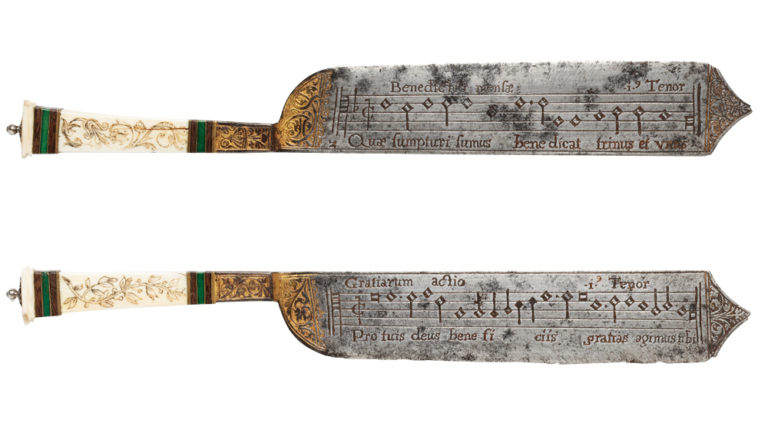
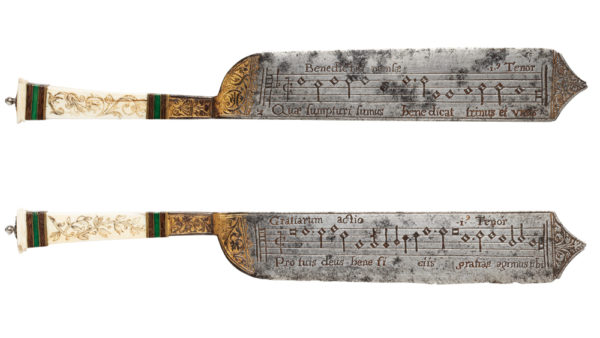
Notation knives dating from the mid-16th century were used to sing a pre-meal blessing and a post-meal grace. This example is on display at the Medieval and Renaissance Galleries at the Victoria & Albert Museum in London.

They’re called notation knives, and they’re engraved with what amounts to sheet music for multi-voiced song. They’re indicative of the formal role music played in medieval dining, according to Flora Dennis, an art historian and author of the book “Re-thinking Renaissance Objects: Design, Function and Meaning.” Holding the knife in the left hand, edge up, diners could see the notes and lyrics for the benediction, or blessing, sung before a meal. After the meal, again held in the left hand, edge down, the knife showed the music for the grace, thanking God for his generosity. Since cutting was done with the right hand, the knives may have been ritualistically transferred to the left hand, or they may have been solely used for singing purposes. Dating from the mid-1500s, one notation knife is on display at the Medieval and Renaissance Galleries at the V&A (Victoria & Albert) Museum in London, where Ms. Dennis works. There are others—seven in Paris, three in Philadelphia, two in The Hague, one in Austria, some in private collections—but as much as is known, much more remains unanswered about these rare items.

In addition to the 16 surviving notation knives, there are also written references to at least four others, according to Ms. Dennis. Essentially, though, the knives have been overlooked by historians because they don’t fit neatly into either “knives” or “music” and have been relegated to curiosity status. All the notation knives share a similar look. The steel blades are broad with straight spines and triangular points on center. According to V&A curator Kristen Kalber they may have been used to proffer a slice of meat to a diner, the point skewering the serving. Then again, squires normally carved meat and that was a highly skilled, status-imbued position. Carving rose to the level of entertainment with offerings carved from cooked fowls and beasts held aloft on forks. So, while some knives seem not to have been used other than to sing from, others show wear on the point and were definitely used.

Museum Curator And Historian Bring Notation Knife To Life

In this 2009 video V&A Museum curator Kristen Kalber shows the notation knife in the museum’s collection and demonstrates its use. Flora Dennis, an art historian at the museum, discusses the project that allowed the music on the knife to be recorded. Ms. Dennis holds a PhD in musicology, specializing in early music, and through an Arts and Humanities Research Council grant she was able to convert the music into modern notation, and then work with the Royal College of Music to bring it to life.

The points and the bolsters are engraved with leaf scrolls and strapwork, often gilded. The handles are made of ivory and green-dyed horn or bone with copper or brass spacers. The ivory is decorated with foliage, empty tablets of scrolls, Arabic or Moorish designs or winged cherub heads inlaid in black. The pommels are adorned with silver spherical knobs. The engravings are usually in Latin, though some are in the vernacular. The one from the V&A reads Benedictio mensae (The blessing of the table) on one side and Gratiarum actio (The saying of grace) on the other. The musical stave runs the length of the blade. In the upper right is the voice part, in this case “Tenor.” What this means is that there were different knives for different voices, in some cases as few as five or six or substantially more than 20.

Royal College Of Music Singers Record Two Versions Of The Meal Benediction


Knifemakers across Europe at the time would have been members of guilds and were specialized. Handles would have been made separately and assembled by the cutler who sold them. Ms. Dennis’ writings detail how challenging it can be to pinpoint where the notation knives were made or by whom. Knives were being made in Solingen and Nuremberg, Germany, and in Milan and Brescia, Italy. Possible guild marks show up in the form of arrows, fluers-de-lis or clovers, and etched Ns can be found on many of the blades, but those are more likely an engraver’s mark. One of Ms. Dennis’ knife consultants intimated that a Nuremberg mark would be on the tang, not the blade. The best guess is that they were made in France, with Italianate influence or for an Italian patron.

Were the knives collected after the gathering or did each singer keep his or her knife? In Ms. Dennis’ summation, judging by the scattering of surviving pieces, the latter might be more likely. It could also be that the knives were made for a group, such a monastery. In some instances, the strict, mass-like approach to such a shared meal could result in latecomers being fined for missing the benediction. What is clear is that the knives are not all from the same musical piece; there are two separate pieces of music represented by the known notation knives.

Royal College Of Music Singers Record Two Versions Of The Meal Grace


Interestingly, the notation knives are representative of both coming together and separating. It is the very nature of a knife to cut apart, but in this instance it is for the purpose of sharing, both repast and praise.

As Ms. Dennis writes:

“Benediction and Grace texts are inherently collective, expressing notions of conviviality and sharing. The knives reiterate this idea, needing to be brought together in a social context in order for their music to function. Simultaneously, however, they represent a contradictory action of dismembering and dividing. By slicing meat, the knives permit it to be shared between the gathered company in the same way that dismembering and scattering the musical text across the knives enabled a group to perform it collectively. The acts of uniting to say the Benediction and Grace, uniting to eat, and uniting to sing become inextricably intertwined with those of separating, dividing and sharing both meat and music.”

Bladecrafting Collection Includes 6 Classics

The 6-volume bladecrafting collection is available at less than half its normal cost.
The Bladecrafing Ultimate Collection includes two paperbacks and four ebooks for $34.99

Makers can’t go wrong with this collection. You’ll get two paperbacks: the third edition of “Blade’s Guide To Making Knives” and “How To Make Knives; and four e-books: “Greatest Loveless Knife Designs,” “Knife Grinding Secrets,” “Making Everyday Carry Knives” and “Fashioning A High-Tech Folding Knife.” Normally, this collection would cost over $70, but you can get it for half that.


Advertisement

Must Read Articles

Read this before you make a knife

Knifemaking 101 – Read This Before You Make a Knife

  by Wayne Goddard My experience has taught me that there's nothing like digging in and getting started. I've often said the hardest part of the...
how to forge damascus steel

How to Forge Damascus

Advertisement
Advertisement