The history of knives and other edged instruments is tied to the history of people in general. As humankind’s oldest tool, unraveling knife history can lead to even more surprising and enriching information to better understand the world.
The May-June 1975 American Blade covered the CIA-forerunner’s knives.
Editor’s Note: BLADE Magazine is celebrating more than 50 years of bringing the knife community sharp coverage of the knife world at large. Given a more comprehensive picture of where the industry comes from—thus, where it’s going—we’re running a series of vignettes on important articles marking milestones in the knife design, knife making and knifemakers from 50 years ago.
Adrian Van Dyk was the military knife guru for The American Blade at the dawn of the magazine’s era, and OSS knives were one of his specialties.
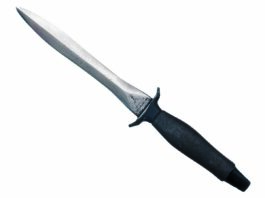
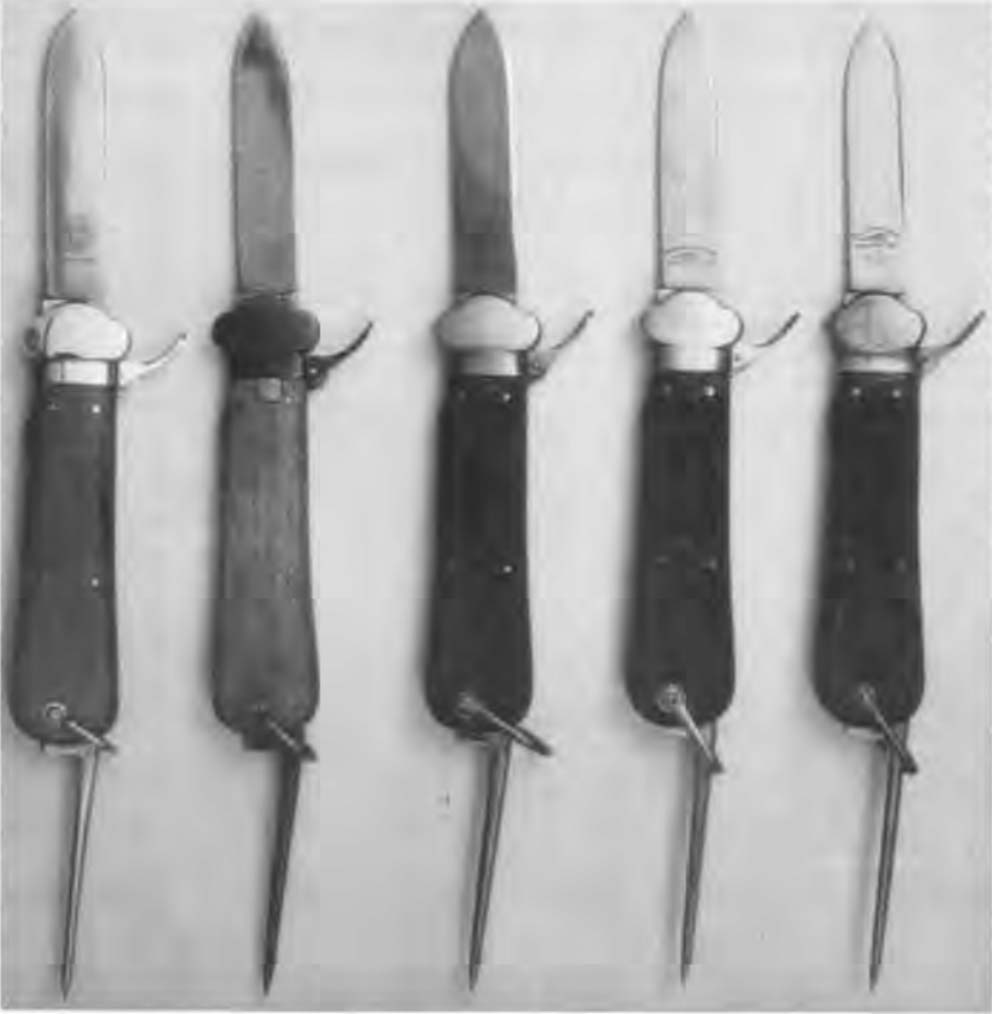
Five World War II-era OSS gravity knives, from left: a trial piece with George Ibberson blade markings; one with a variation of an Ibberson marking; unmarked issue specimen; German-issue take-down model; and a German-issue non-take-down model.
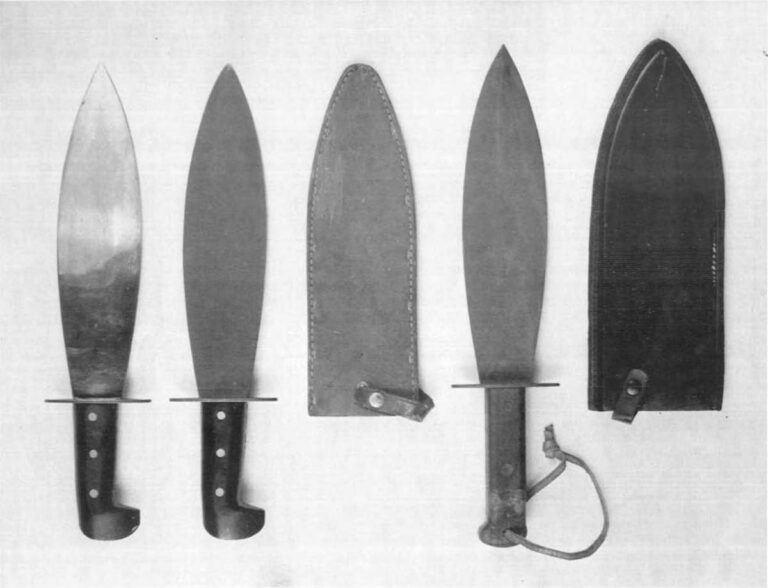
In “Knives of the OSS” in the May-June 1975 issue, he wrote a comprehensive story on a number of OSS knives, including, among others, the smatchet, stiletto, escape knife and gravity knives. The smatchet is of particular interest here because APOC/Cas Iberia offers a new iteration that it will debut at the BLADE Show (see our 2025 BLADE Show Knife Debuts post).
According to Van Dyk, the smatchet was designed for heavy chopping and brush clearing.
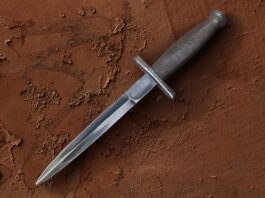
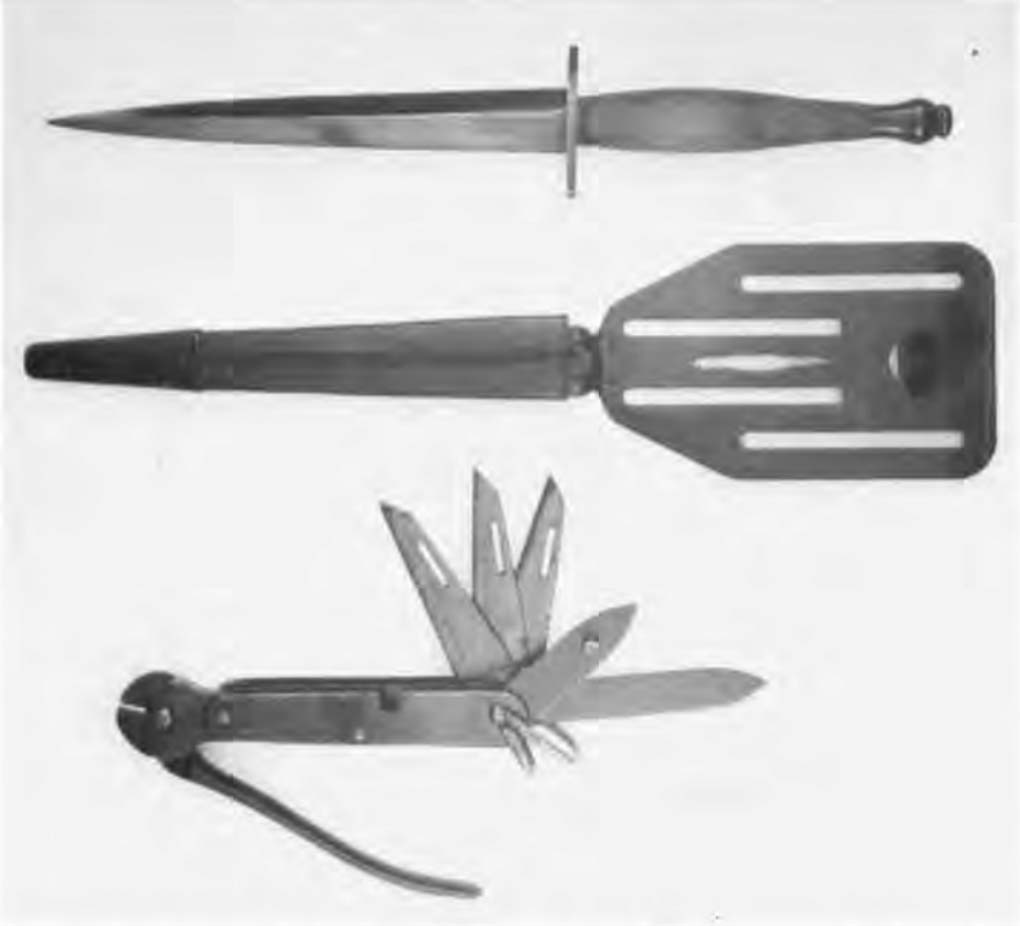
World War II OSS knives, from top: an OSS stiletto with a pancake-flapper sheath and a standard-issue OSS escape knife, completely blued and unmarked.
“The name apparently derived from its intended use since it could serve both as a machete and a hatchet,” he wrote. “The knife was probably a design derivation of the Welsh machine gunner’s sidebar,” illustrated in A Primer of Military Knives by Gordon Hughes and Barry Jenkins. “It was also designed as a fighting weapon and techniques for using it in combat are described in the book Get Tough by William Fairbairn,” one of the designers of the famed Fairbairn-Sykes commando knife.
Van Dyke added that OSS-issued versions of the smatchet were manufactured by Case and were completely unmarked. Some variations have British military proof marks and are thought to have been issued to British commandos.
England has had an uptick in knife crime in recent years, including the horrible incident costing three young girls their lives in Southport. Certainly, crime of any kind deserves scrutiny and solutions so that society can conduct its daily affairs in a safe and secure environment. Unfortunately, it’s never the calmer heads that prevail when dark winds blow.
Case in point, the utterly asinine suggestions emanating from the host of a BBC documentary on UK knife crime.
“Actor Idris Elba announced amid his forthcoming knife crime documentary that the United Kingdom must consider “innovative” prevention methods such as blunting or banning knives.”
Let that sink in… blunting or banning knives. And he’s not talking about neutering simply what might be considered “scary” knives—tactical fixed blades, karambits and the like. No, it’s the whole megillah.
He said in the Post article:
“The truth is that kitchen knives are perhaps 25% of the knives used in most terrible crimes. That’s one of the stats in the film. And those kitchen knives are usually a domestic situation,” Elba warned. “So kitchen knives… of course, it’s very difficult. They’re a domestic knife.”
This walks hand in hand with other extreme actions that have taken place in England regarding knife sales. One of the more atrocious, ID requirements and live video sales to purchase knives online. Why, the next thing you know there’ll be a proposal for licensing knives.
Well, you don’t have to wait long for that either.
Elba thinks this might be the panacea for his country’s woes, banning nearly everything, and licensing those scant few deemed worthies to own their family’s cherished sword or knife.
“So let’s ban them all, and if you have one of those knives, get a license for it,” he suggested of people wanting to keep family heirloom swords. “Simple as that.””
And if you think this sentiment is contained to one crackpot actor, well you’d be wrong.
“A ban on the sale of pointed kitchen knives has been backed by the Church of England, judges, top trauma doctors and psychiatrists, the police and victims as they argue that it would make life-threatening injuries far less likely.”
It’s unfortunate England has endured an uptick in knife crime, yet this isn’t the license for it or certain segments of it to go off the deep end. I know it might sound crazy, but perhaps the English should address the root of the problem—the perpetrators.
The harsh truth is this: no amount of blunted blades, banned kitchen knives, or bureaucratic licensing schemes will stop individuals hell-bent on violence. You can’t legislate evil out of existence by targeting inanimate objects. England doesn’t have a knife problem—it has a people problem. A system problem. A failure-to-act-when-it-matters problem.
Axel Rudakubana—the perpetrator of the Southport killings—wasn’t some shadowy figure hiding in the margins; he was a neon warning sign flashing in plain sight. Reported repeatedly, known to authorities, radiating red flags—and yet, nothing substantial was done. But instead of holding systems accountable for their glaring incompetence, the knee-jerk reaction is to demonize cutlery.
Blaming knives for violent crime is as absurd as blaming spoons for obesity. The issue isn’t the tool; it’s the hands that wield it—and the institutions that refuse to act until it’s too late. England doesn’t need another ban. It needs accountability, courage, and the will to confront the real problem: violent individuals, not the utensils in their kitchens.
Born as a side hustle, the legendary throwing knife company continues to hit the mark.
Small businesses that have operated continuously for 75 years are a testament to the quality of their products and the dedication of their founders and owners. Such businesses have stood the test of time and have been able to adapt to changing market conditions and consumer preferences. Knifemaking is no different.
In 1949, Harry K. McEvoy, who would soon be considered the father of modern-day knife throwing and one day be inducted into the BLADE Magazine Cutlery Hall of Fame®, was a long-time resident of Grand Rapids, Michigan. He worked for the Meyercord Co. as a traveling district salesman selling decals to wallpaper and decorating stores. In his spare time, Harry spent hours in his shop designing and crafting knives. His passion for knifemaking was fueled by his ongoing search for the perfect throwing knife.
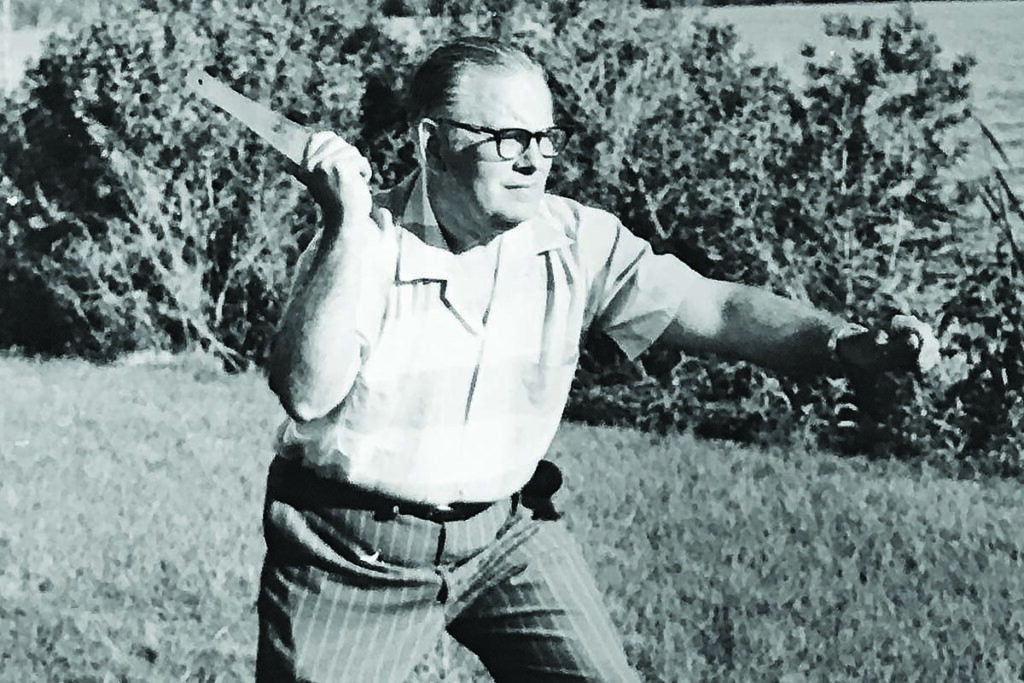
BLADE Magazine Cutlery Hall-of-Fame® member Harry McEvoy shows the form and throws one of the Tru Balance knives that helped revolutionize knife throwing.
Knife throwing as a modern sport began shortly after World War II and centered around a few individuals who threw knives at stumps or targets in their backyards. The knives they used consisted of very primitive homemade throwers that were often much smaller than the ones you see today. Harry began making his own knives around this time because he was unable to find any commercial knives suitable for throwing.
While he practiced throwing knives in his backyard, neighbors would gather to watch. Intrigued by how well his throwers performed, the onlookers were compelled to discover the source of his knives. When he responded that he, in fact, had made them himself, they asked him to make knives for them and others who were interested, and thus was born the Tru Balance Knife Co.
Randall & Scagel’s Influence
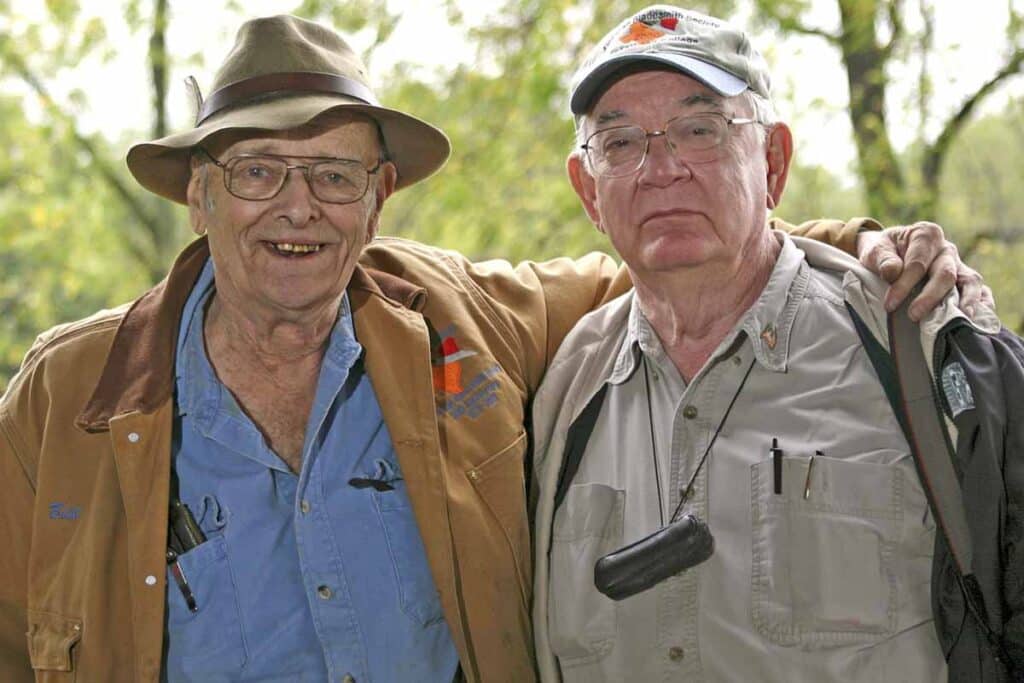
The author (left) bought Tru Balance Knife Co. from Stephen McEvoy (right) in 2017. The business continued to grow but the author had to sell in 2021 due to physical issues.
Around 1951, Harry learned of a knifemaker from Orlando, Florida, and another future Cutlery Hall-of-Famer by the name of W. D. “Bo” Randall. As a fledgling hobby knifemaker, Harry decided to write to Bo about his knives and the two became fast friends, exchanging letters regularly.
McEvoy soon found out that Bo had an interest in throwing knives and was surprised to learn that a throwing knife could even be found in Bo’s catalog. As a father with young children, money was scarce for Harry, so he convinced Bo to trade a Randall thrower for a couple of McEvoy throwers. Generous and willing to help a fellow knifemaker, Bo was happy to oblige.
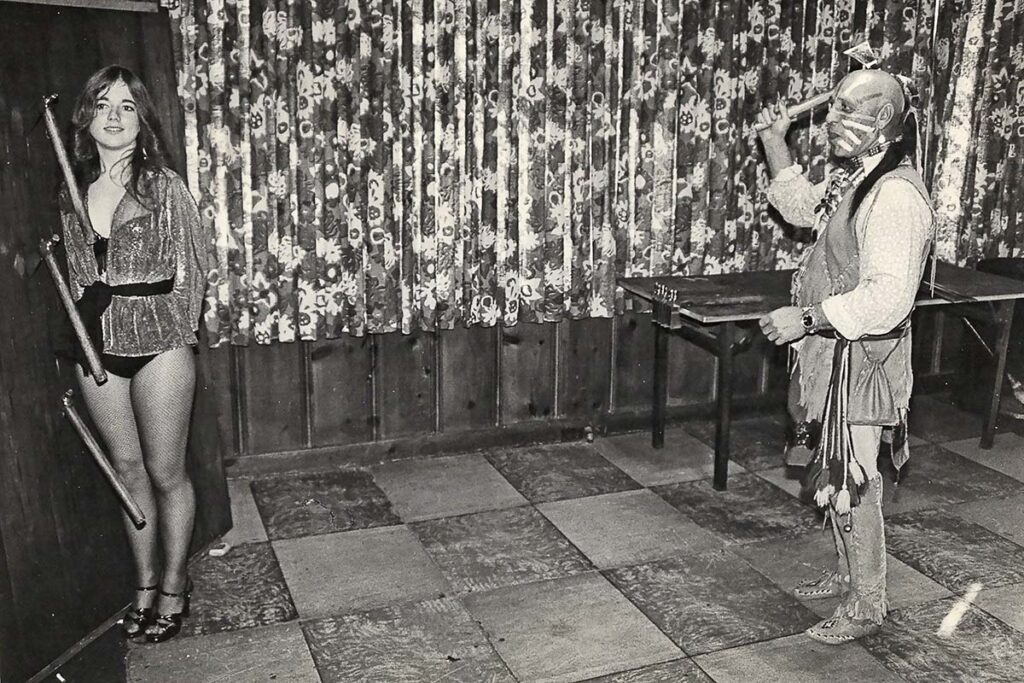
George E. “Skeeter” Vaughan made the most fantastic knife throw in recorded history, taking out a German sentry with a modified bayonet from 87 feet during World War II. Skeeter was also an outstanding tomahawk thrower, showing his skills here with the help of a “target girl.”
Around 1952, Bo asked Harry if he would visit yet another future Cutlery Hall-of-Famer, William Scagel, who lived very close to McEvoy in Fruitport, Michigan, and buy some of Scagel’s knives for his collection. McEvoy was more than happy to do his friend a favor. Harry would eventually befriend the reclusive Scagel, too, and on his visits watched him make knives and bought knives for himself and Bo.
As their friendship grew, Harry would visit Bo at the Randall summer home in Michigan and would even travel to the Randall home in Orlando, Florida. The two became quite close and eventually, Bo decided to feature two Tru Balance Models in the Randall catalog. The Model #1 Professional Thrower and the now world-famous Bowie-Axe Throwing Knife made their catalog debut in early 1960, which resulted in a spike in sales for Harry.
In his spare time, Harry McEvoy spent hours in his shop designing and crafting knives.
Bo thought so much of Harry’s work that he gifted one of Harry’s Tru Balance Bowie Axe throwers to astronaut Gordon Cooper. He also took Harry’s popular Bowie Axe design and modified it into a large machete-style knife and submitted it to NASA in the 1960s when NASA was looking for a machete for astronauts to carry on the Gemini missions. Unfortunately for Harry, NASA required a much thinner design and eventually chose another manufacturer, Case Knives, to make the machete.
AKTA
Meanwhile, Tru Balance soon became the go-to company for anyone who wanted a high-quality professional throwing knife. Tru Balance throwing knives became highly sought after by soldiers heading to Vietnam, professional knife throwers and knife collectors around the world.
In 1971, Harry started the American Knife Throwers Alliance (AKTA) to aid and offer guidelines to individuals and groups who wished to organize competitively in their local areas. Harry became very close friends with professional knife throwers like Kenneth Pierce, aka Che Che Whitecloud, Paul LaCross and George E. “Skeeter” Vaughan, who holds the distinction of making the most fantastic knife throw in recorded history. Considering the circumstances surrounding his legendary feat of taking out a German sentry during World War II with a modified bayonet from 87 feet, he most likely will maintain his grasp on that honor for a long time to come. “The Saga of Skeeter Vaughan” is told by McEvoy in the April 1982 BLADE®.
Harry went on to author such books as Scagel: The Man and His Knives; Archery Today; Crusader in the Wilderness; Knife Throwing: A Practical Guide; Knife and Tomahawk Throwing: The Art Of The Experts; For Knives Lovers Only; and co-authored Knife Throwing a Modern Sport, with Charles Gruzanski. McEvoy also held two design patents and trademarks for his knife designs. He also authored other articles for BLADE, as well as for Knife World (today’s KNIFE), Muzzleloading Magazine, Fighting Knives Magazine and many more.
McEvoy Legacy
In 1991, McEvoy was inducted into the Cutlery Hall of Fame for his exceptional contributions to the world of knives. It was around this time McEvoy’s son Stephen had taken an interest in his father’s knives and had begun learning more about the business. Stephen eventually took over the company in 1993 following Harry’s passing from an illness.
When McEvoy—here mugging during a lighter moment—practiced throwing knives in his yard, neighbors would gather to watch. The onlookers showed interest in the knives, and Tru Balance Knife Co. was born.
This writer, a friend of Harry’s and a fellow knifemaker, reached out to Stephen via telephone to offer condolences and advice. We chatted regularly and, over time, as we shared stories, we developed a friendship. Our phone conversations led to Stephen’s yearly visits to my home. During one of those visits, I asked him if I could take over the defunct American Knife Throwers Alliance (AKTA) and Stephen agreed.
Stephen would continue to run Tru Balance Knife Co. the same way his father ran it for many years. In 2015, after retiring from his job as an executive at a major insurance company, Stephen began speaking to me about slowing down and retiring from making knives. Already a full-time knifemaker with my own line of throwing knives, I envisioned bringing Tru Balance Knife Co. into the 21st century by selling Tru Balance knives on its own website and promoting the business via social media.
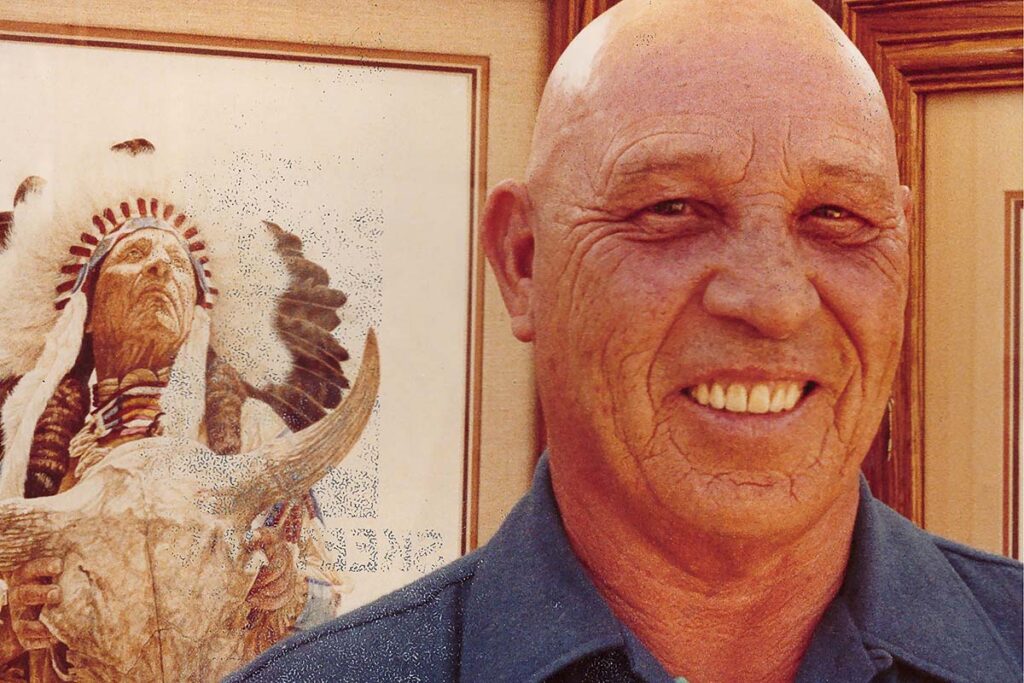
Skeeter Vaughan’s Cherokee Indian name is Grey Otter. He served as a chief of the Federated Indian Tribes for a number of years.
With the newfound success spearheaded by the new business plan, Stephen finally decided to fully retire from the business. A deal was brokered and I bought Tru Balance Knife Company in 2017, moving it to my hometown of Awendaw, South Carolina. The business would continue to grow but, not long thereafter, I developed some knee issues and struggled to keep up with the company’s new customer demands. Unable to find a qualified apprentice to help me fill orders, I decided to sell the business in 2021.
Tru Balance Heads Home
Though several companies made offers to buy the company, I decided I wanted to hand-pick my successor to ensure the legacy of the Tru Balance Knife Co. and that the knives would continue to be made in the USA. As the search for the right successor was underway, a mutual friend brokered a connection between me and two brothers from Michigan who had an interest in the business and the revitalization of the AKTA. The brothers made knives as a hobby and also happened to be skilled knife throwers.
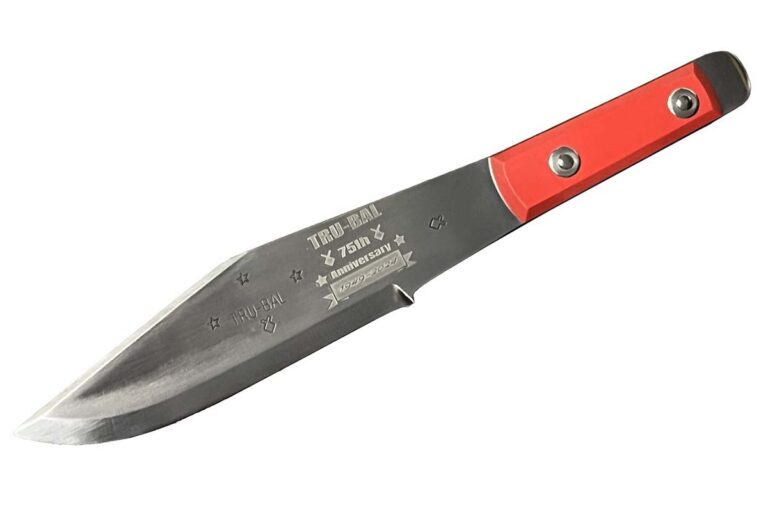
Bill and James Bednarick turned out to be the perfect choice to preserve the company’s legacy and bring it back to its original home in Michigan. With their keen eye for detail, quality and passion for knife throwing, their dedication has ensured that the Tru Balance Knife Co. has lived on to see its 75th anniversary in 2024.
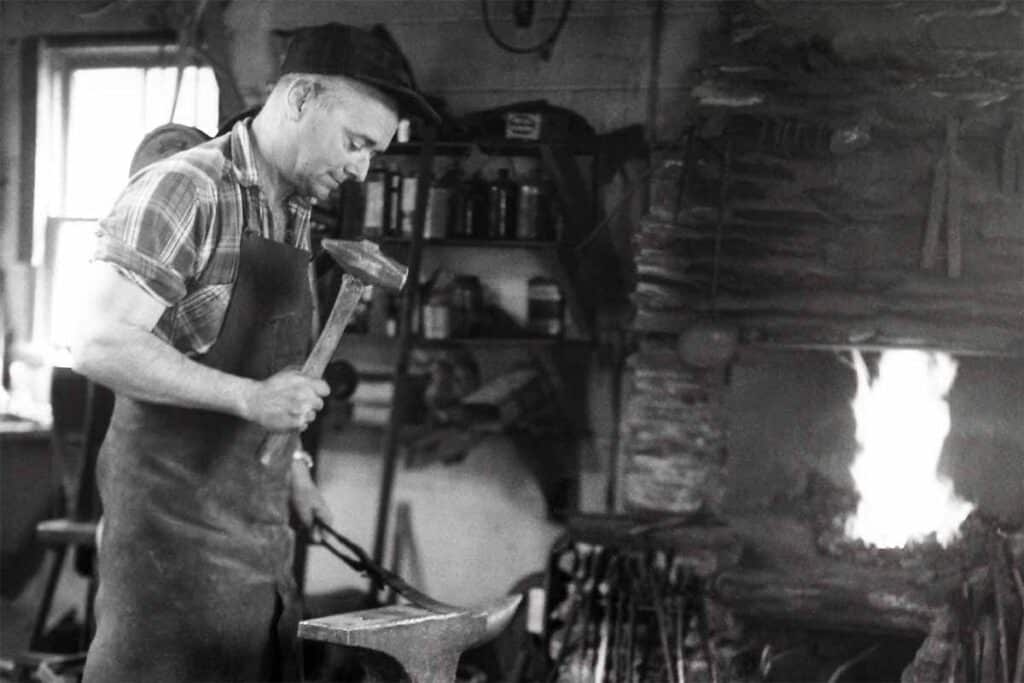
In on the ground floor of the damascus knife movement, Daryl Meier has left an indelible mark forging and teaching.
I haven’t seen Daryl Meier for a number of years but there was a time when he was a regular at the BLADE, Guild and other knife shows. Sporting a cross between a goatee and a van dyke, glasses and his ever-present octagonal cap covering longish hair, Daryl stood out in a crowd. He looked equal parts World War II French Resistance fighter, 1950s beatnik and Vincent van Gogh (minus the red hair). In fact, it almost would have been more fitting if his name were Daryl van Meier. I can see him looking at me now, shaking his head in mild disgust at such a notion.
Daryl has a soft, laid-back way of talking that has kind of a hypnotic effect. Then, just when you think you’re going into a trance, he makes an observation that snaps you back to reality, elicits a laugh or otherwise makes you think. He has a great sense of humor and never takes himself too seriously. There is no ego in Daryl. He’s just Daryl.
BLADE Magazine Cutlery Hall-of-Fame® member Steve Schwarzer has known Daryl much longer and much better than me. When I asked Steve to write a story about Daryl, he jumped at the chance, and the result is very enlightening as to Daryl’s impact on damascus and the teaching of bladesmithing in general.
Steve writing the story was more appropriate than I thought at the time. In researching Steve and Daryl, I rediscovered that they each have entries in the top 13 custom knives from the years 1989-2000: Schwarzer’s groundbreaking Hunter’s Dream in mosaic damascus at No. 3 and Meier’s American Spirit Bowie at No. 9. The knives were selected in a poll of industry authorities and appeared in the June 2013 BLADE® story, “A Decade of Excellence.” Daryl presented the American Spirit Bowie in person to President George H.W. Bush in the White House in 1990.
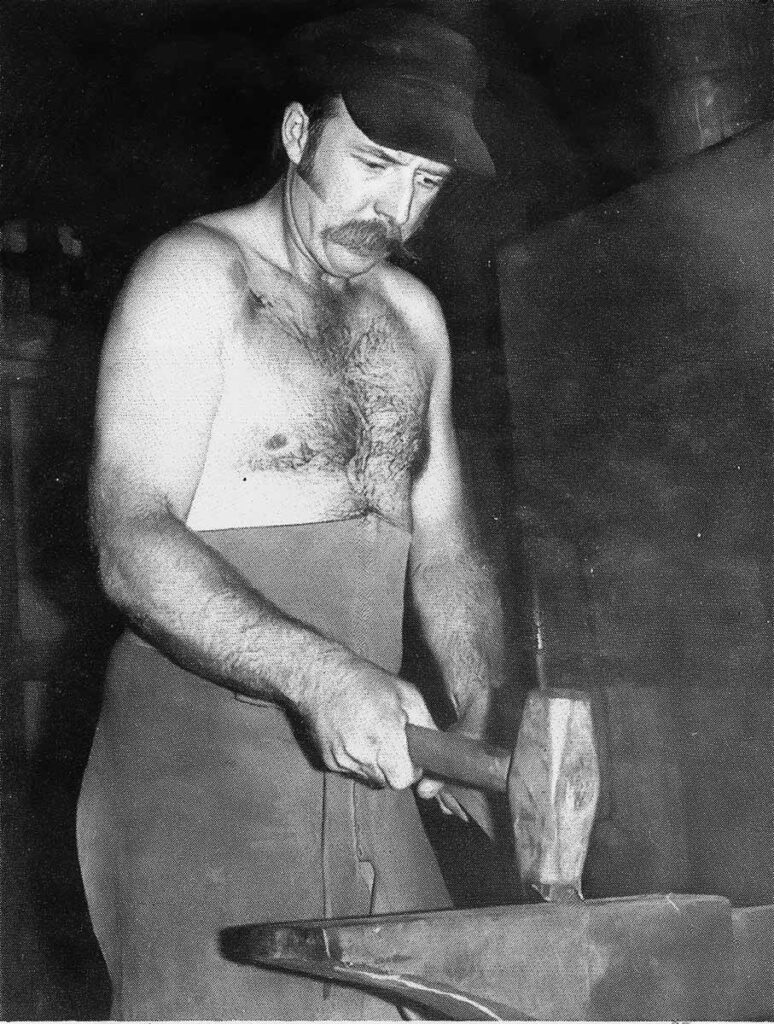
Daryl Meier forging steel in 1976.
Daryl’s contributions to damascus are legend.
As early as 1976 he was teaching a four-week course on forging damascus steel, no doubt one of the first such courses in the modern custom knife era. He was one of the first if not the first to write a regular column on damascus steel called—surprise!—“Damascus Steel” for BLADE in the early 1980s. One of the columns was titled “Wootz Revisited” and featured an image of a misspelled “Stephen Swertzer”—aka Steve Schwarzer—doing the ancient silk scarf-cutting test.
As important as Daryl’s contributions to the forging of damascus have been his dissemination of his damascus in general he probably has had more impact on the knife industry. Call him the Sensei of Steel. He was among the first if not the first to make damascus for use by other knifemakers, and helped inspire others to do the same, including Cutlery Hall-of-Famer Devin Thomas, Mike Norris, Bob Eggerling, Chris Marks, Gary House and others.
Today, making damascus for use by other knifemakers has long been a sub-industry unto itself—and Daryl was there at the beginning of it all. For these and other contributions, he was awarded the BLADE Magazine Industry Achievement Award in 2008.
The last time I talked to Daryl was about a year ago by phone. He sounded chipper and upbeat as ever. In fact, even in his early 80s he remains physically active and was all excited about a new pursuit—dancing—and how he was attending local dances on a weekly basis. Always ready to try new things, even in the fourth quarter of life—that’s Daryl. And I bet he can beat a mean rug, too!
We talk with those who know Bill Moran best to determine how many damascus blades the godfather of the craft forged.
BLADE Magazine Cutlery Hall-of-Fame® member Bill Moran is and will forever be remembered as the father of modern damascus steel. He and a few early devotees popularized damascus during an era when the art of bladesmithing was an endangered species in the realm of the artisan.
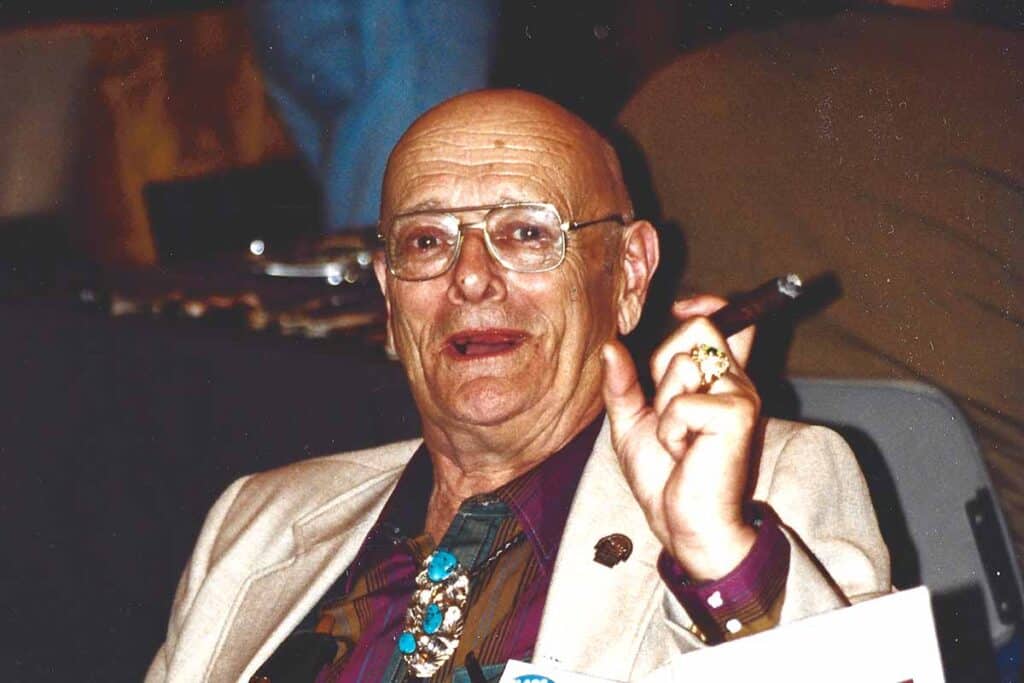
Though Moran was partial to smoking a pipe, he liked an occasional stogie as well. (Pete Cohan knife image)
It was Moran who shocked the custom knife world in 1973 when he brought eight knives to The Knifemakers’ Guild Show in Kansas City, Missouri. Those historic eight sported blades of Moran’s damascus steel and they created a sensation. Cutlery Hall-of-Famer, longtime journalist and friend of Moran’s, and a respected member of the knife community, B. R. Hughes remembered how the event electrified those who attended.
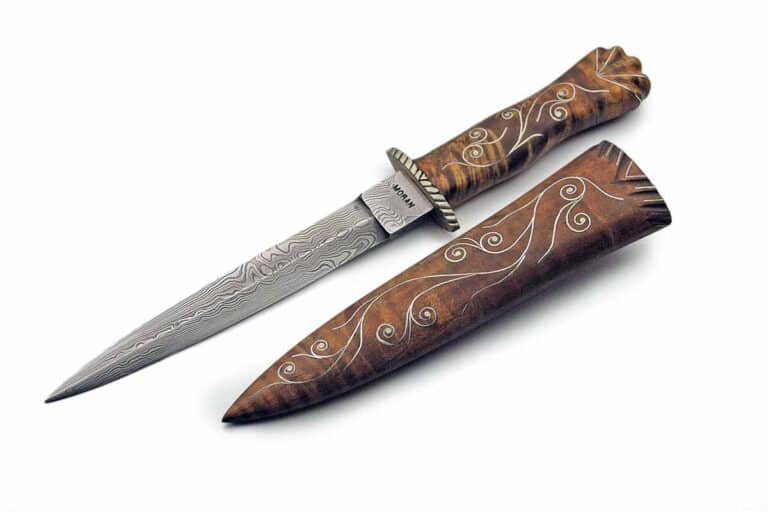
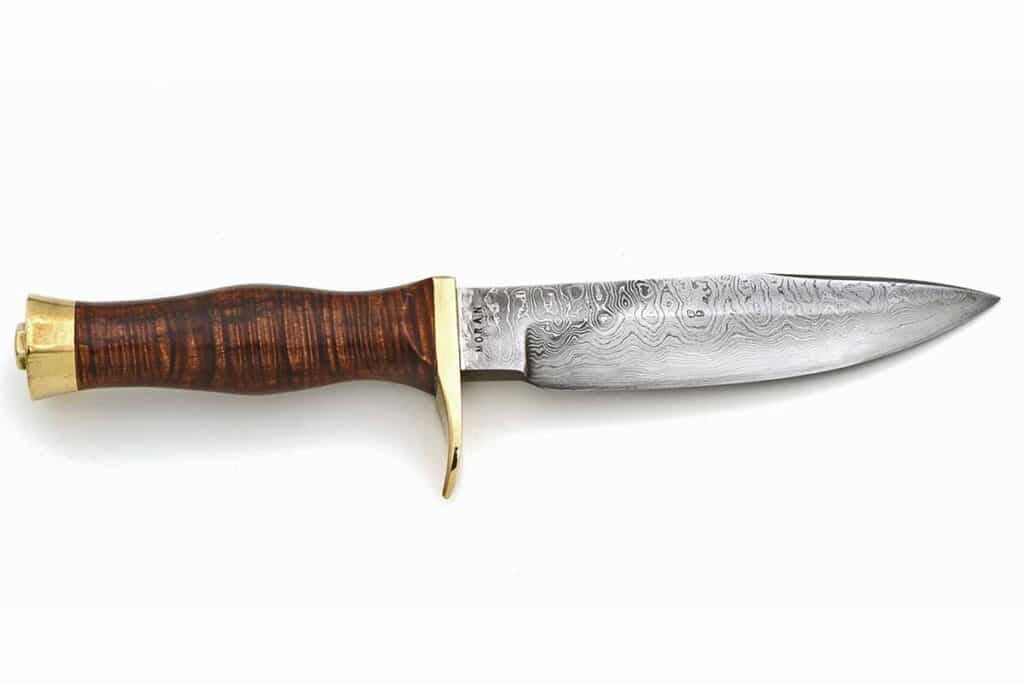
This is the first damascus knife Moran ever made. He forged “No. 1” circa 1972. It was misplaced for 30 years until Nancy Hendrickson found it in Moran’s house. (Pete Cohan knife image)
“When my wife [Carolyn] and I drove up to the Muehlebach Hotel in Kansas City, a friend of mine came out and said, ‘You gotta get in there and see the damascus knives Moran has on his table.’ Those knives were the talk of the show. Bill also had mimeographed sheets that explained what damascus steel was and how it was made. He gave those sheets away to anyone who desired one.”
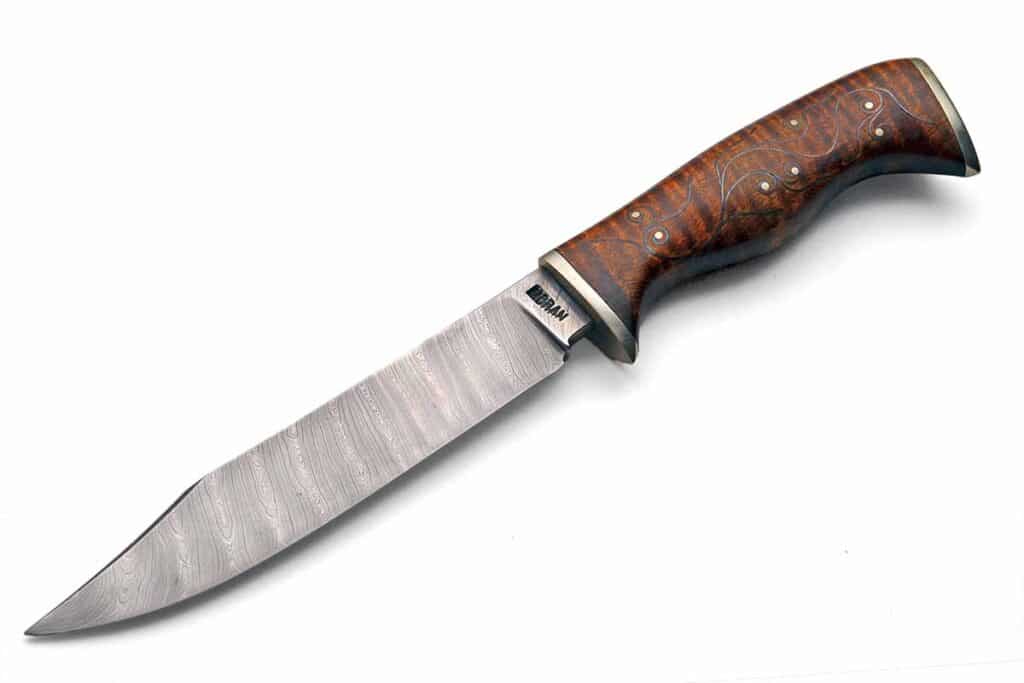
Moran made basic damascus knives. “They weren’t elaborate and this, that and the other thing, but most of them were for use,” B. R. Hughes noted. (Exquisiteknives.com image)
Three years later, Hughes joined Moran and bladesmiths Bill Bagwell and Don Hastings as the quartet that founded the American Bladesmith Society (ABS). When the ABS was founded in 1976, bladesmithing was on life support, and probably fewer than a dozen smiths were forging knives. Today, the Society includes more than 2,000 members and the future of the craft has been secured. Meanwhile, Moran deserves the credit as the catalyst for modern bladesmithing.
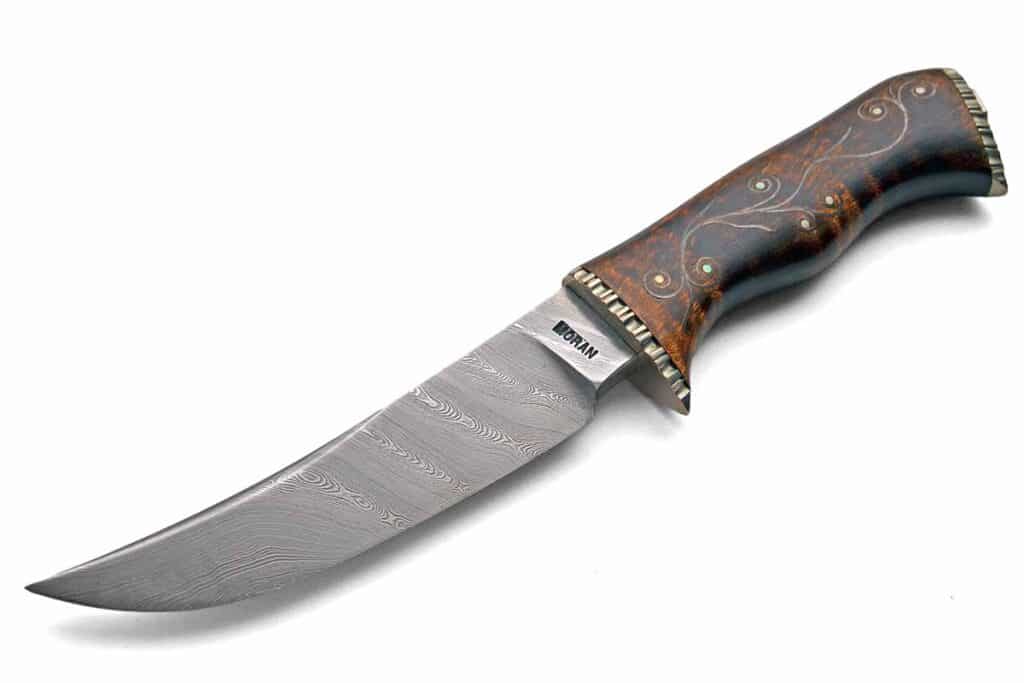
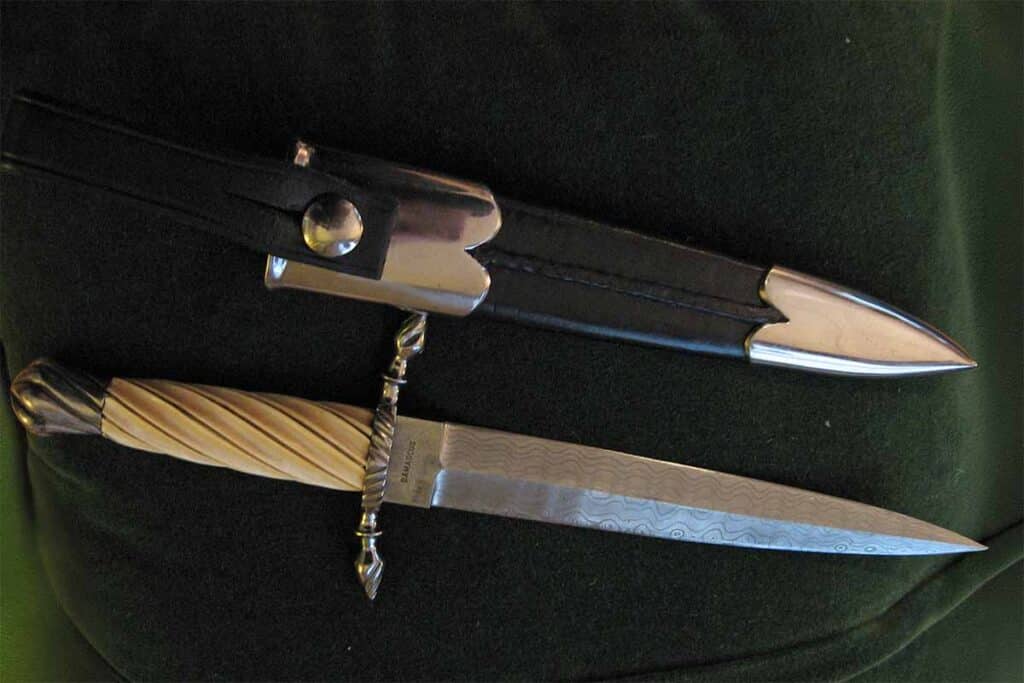
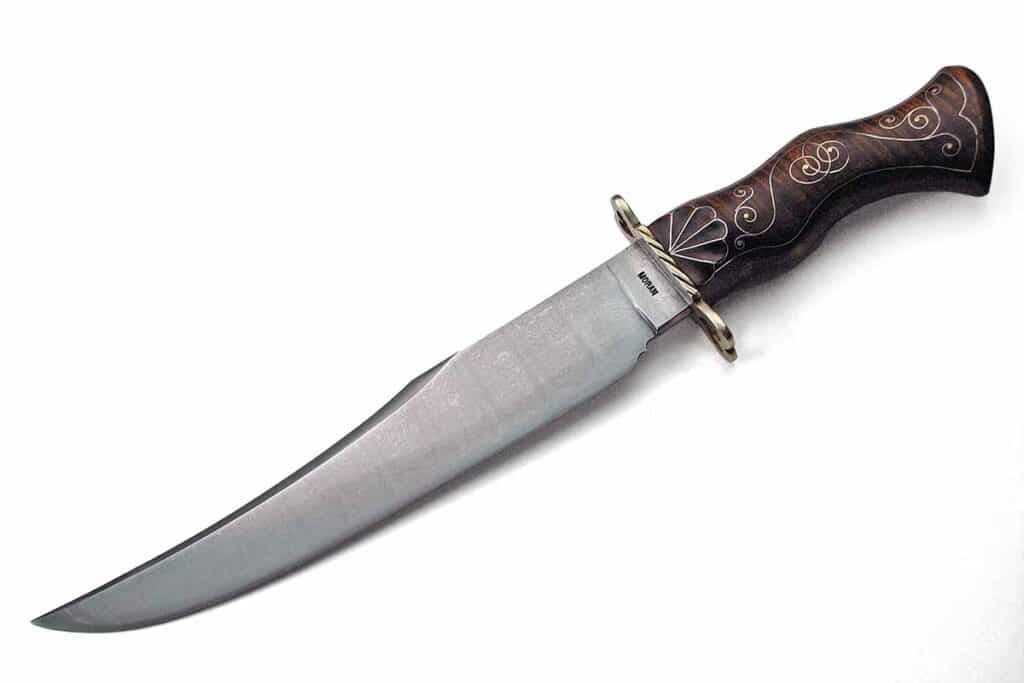
B. R. Hughes said Moran made some art daggers that “were a bit elaborate for the day.” An example is this large quillon dagger. (Exquisiteknives.com image)
How Many Damascus Knives Did Moran Make?
While there is no question that Moran and other dedicated disciples of the forged blade brought damascus and the ring of the hammer back to life in the early-to-mid-1970s, there is some conjecture as to just how many such knives the great Moran forged and completed himself. The thought of how many Moran damascus knives were made and exist today is tantalizing, and, of course, what’s a great legend without a bit of mystery and conjecture? Exploring Moran’s body of work and the damascus element within provides some insight into the man, the legend who padded about on the creaky floor of his Maryland shop, sometimes chewing tobacco, but rarely alone when his doors were open as crowds came to see the wizard work.
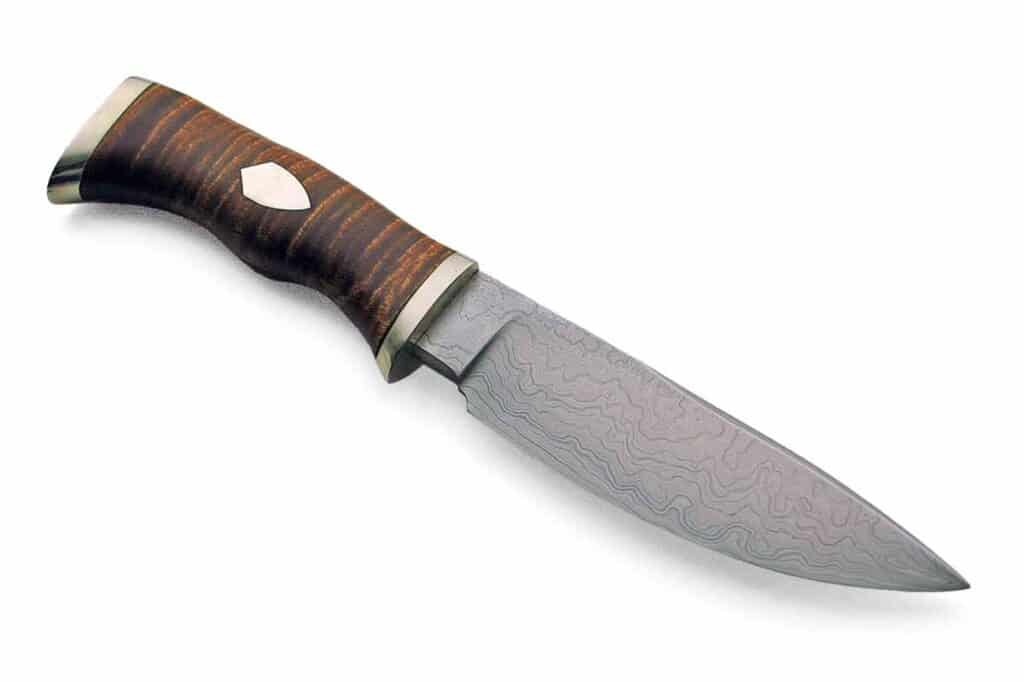
Back in the day, a Moran damascus knife was a challenge to own, considering the time Moran spent in his shop with the material actually able to work without the distraction of visitors, the many hours of labor required to produce a damascus billet, and the higher price for such a piece that naturally followed. (Exquisiteknives.com image)
Collectors such as Cutlery Hall-of-Famer Butch and Rita Winter bought the first of Moran’s damascus knives during that historic Guild Show more than a half-century ago, and, as Hughes relates, “Moran made basic damascus knives. Most of his were what folks would call ‘using’ knives. They weren’t elaborate and this, that, and the other thing, but most of them were for use. He did make some art daggers that I thought were a bit elaborate for the day.”
Dave Harvey, Nordic Knives
Hughes remembers that Moran himself was rather vague on the number of damascus knives he actually made. However, probably the best estimate is that fewer than 100 Moran damascus knives were made during a career that spanned more than 50 years.
“He liked the random pattern and the ladder pattern,” B. R. remembered, “and he could do some pretty good patterns, but it took a lot of time. He was very happy just making ladder pattern and stuff like that, and he continued making non-damascus knives and about 40 folders. When he was in his shop, there were always five or six locals in there talking to him and watching him work.” Agreed Cutlery Hall-of-Famer and ABS master smith Jay Hendrickson, a close friend of Moran for 30 years, “Bill had so many visitors to his shop on a daily basis that it is a wonder he ever got anything accomplished.”
According to Jay Hendrickson, Moran made all of his damascus in a coal fire. “All of Bill’s experiments were with coal, as gas forges were not popular at the time,” Jay explained. “In today’s world, gas forges are almost always used for damascus making because of adjustable temperature and the cleanliness of propane gas.” (vintage photo of Moran in his shop circa the 1960s)
Hendrickson served as the executor of Moran’s estate and founded the Moran Foundation to preserve the great bladesmith’s legacy, serving as its president for 10 years. Jay observed that Moran made a workingman’s knife with quality that was spot-on, though there may have been an occasional flaw in the solder on his early pieces. Nonetheless, Jay says, Bill’s knives always cut.
As for Moran’s damascus knife productivity, Hendrickson offered, “This is strictly a judgment call on my part, but I would say Bill made less than 100 damascus knives. I counted 36 in our Forever A Legend book. I only know a few people that own Bill’s damascus knives, but I think they are sold and traded often between collectors. You also see Bill’s damascus knives occasionally sold at auctions.”
Butch and Rita Winter bought this damascus quillon dagger from Bill Moran at the 1973 Knifemakers’ Guild Show where Moran introduced modern damascus knives. It was one of eight damascus knives Moran brought to the show. The tang is marked DAMASCUS in all uppercase letters. (image courtesy of Rita Winter)
Jay verifies the original sale of a Moran damascus quillon dagger and sheath to Butch and Rita Winter and adds a bit more information. “Rita Winter recently sold Bill’s first damascus dagger to Mr. Doug Hook, a Tennessee collector,” he commented. “Two years ago, I repaired one of the twisted wires on the handle for Mr. Hook. Because of that contact I was able to confirm the original purchase as Doug has written verification of the original sales transaction and the invoice.”
So where are the majority of Moran’s damascus treasures today? Longtime purveyor Dave Harvey of nordicknives.com is straightforward—“in collections around the world. Values vary and depend largely on the particular knife. But they are generally worth at least double that of [one of Moran’s straight carbon steel blades], sometimes even more.”
Dave Ellis said the first of the Moran damascus knives are quite valuable and guessed they would start at least at $10,000 and go up from there. Dave holds an early 1970s Moran damascus hunter at BLADE Show 2023.
Back in the day, a Moran damascus knife was a challenge to own, considering the time Moran spent in his shop with the material actually able to work without the distraction of visitors, the many hours of labor required to produce a damascus billet, and the higher price for such a piece that naturally followed. Dave Ellis of Exquisiteknives.com reasoned, “I could not say how many damascus knives Moran made in his lifetime, but certainly not a large number. Many of Moran’s damascus pieces reside in private collections, as well as the Moran Museum. I personally have owned and still own some and have sold a number of the finer pieces to overseas clients.
“I believe he made four or five patterns. Damascus steel was and still is a laborious process. Bill’s prices for his damascus knives were quite high for the time, so he made and sold mostly carbon steel pieces. Damascus was reserved for higher-end clientele and foreign dignitaries. A good number of the damascus knives were fighters and bowies. Damascus hunters were also made, many with Bill’s twist pattern steel, maidenhair. I do not know of any mosaic steel knives that Moran made. The first of the Moran damascus knives are quite valuable, and I would guess that they would start at least at $10,000 and go up from there.”
Along with Bill Bagwell and Don Hastings, Bill Moran (left) and B. R. Hughes (right) founded the American Bladesmith Society in 1976. Hughes is the only surviving founding member. (Buddy Thomason image)
HOW HE MADE THEM Hendrickson is familiar with Moran’s most common damascus patterns, the maidenhair twist, ladder pattern and others. “He knew how to fuse metal, as he learned that technique working on equipment on the family farm,” Jay remarked. “On the farm he made knives from whatever he could get his hands on, old springs, files, and rasps, for example. He could also buy steel from a local hardware store in town. Bill also knew the difference between plain iron and high carbon steel. His first damascus experience began by using one piece of steel and one piece of iron. He welded the two together, drew it out and folded it many times.”
The process yielded insight for Moran, and he learned from experience. At times during the process of hammering and folding, he realized that the steel was absorbing heat quicker than the iron because it was on the outside of the billet. Therefore, he moved to one piece of iron with steel in the center, and then a second piece of iron, using O1 tool steel and a carbon mix of 33 percent. According to Jay, this combination gave the billet the right hardness without the need for tempering. Moran’s test of the finished knife was to carve wood for two hours with no loss to the cutting edge, and he was satisfied with the results using this mixture.
Moran’s test of the finished damascus knife was to carve wood for two hours with no loss to the cutting edge. An example is this clip-point model, again in a ladder pattern. (Exquisiteknives.com image)
“Bill made all of his damascus in a coal fire,” Hendrickson recalled. “A hot coal fire can melt steel as temperatures can reach over 2,700 degrees Fahrenheit, which is the melting point of steel. That is why Bill added iron to the outside of the billet, as iron is less apt to burn as quickly as steel. All of Bill’s experiments were with coal, as gas forges were not popular at the time. In today’s world, gas forges are almost always used for damascus making because of adjustable temperature and the cleanliness of propane gas. Therefore, the burning of steel to a great deal has been eliminated with the use of gas forges.”
Hendrickson attributes the relative scarcity of Moran damascus knives to the maker’s affinity for producing using knives, constraints on time and other factors. “Bill was truly a supporter of the art knife,” he noted, “and along with others they created that industry. Collectors were willing to pay big time for exceptionally well-made knives, and Bill, like other top-notch makers, profited as this industry took hold. However, Bill’s true passion was in using knives, such as camp knives, hunters and small utility knives, of which he made many. The vast majority of his knives came from customers wanting working knives.
A good number of Moran’s damascus knives were fighters and bowies, according to Dave Ellis. This classic ST-24 in ladder-pattern damascus and curly maple handle with fancy wire inlay is a favorite of Moran collectors. (Exquisiteknives.com image)
“Bill liked to experiment with damascus. For example, he would slip in an added piece of iron after many folds to gain toughness in the end product. Another example was where he completed a damascus billet to the desired number of welds. He then cut it in two and added a piece of high carbon steel to form the middle and welded the two damascus pieces on both sides of the high carbon steel. Once that was completed, Bill forged the billet into a knife. One might call the finished product a damascus san-mai. Bill liked the various patterns that were being developed beyond the more basic patterns that he originally developed. To Bill, mosaic knives were art knives, not to be used but just admired. He didn’t like the process of welding pieces together to make a knife. Remember, he was more into using knives where the grain within the steel followed the entire edge of the blade.”
Through the years, Moran became a legend, leaving a legacy of learning, teaching, giving information freely, and welcoming many to his shop. He paid tribute in steel to the wonder of damascus, the art knife and the using knife. Today’s body of bladesmiths still looks to him as the guiding light that led them to the glow of the forge and the spark of the hammer on hot steel. Those who own or admire the few damascus knives that Moran completed continue to do so for their beauty, their imagination, their rarity, and simply because they bear the touch of the master’s hand.
A week after BLADE Magazine Cutlery Hall-Of-Fame® member Bob Loveless died at age 81 on Sept. 2, 2010, Los Angeles Times reporter Valerie J. Nelson wrote a lengthy story on the man who sold his first knife to the Abercrombie & Fitch sporting outfitter for $14 more than 55 years earlier.
Nelson wrote that Loveless “made some of the world’s most coveted sporting cutlery by refining knife design to high art.” These succinct words convey a glimpse of the influence this giant in the cutlery industry wielded during his lifetime. In this 50th anniversary year for BLADE®, his legacy stands tall among those who have dedicated their lives in building the knife industry to what it is today.
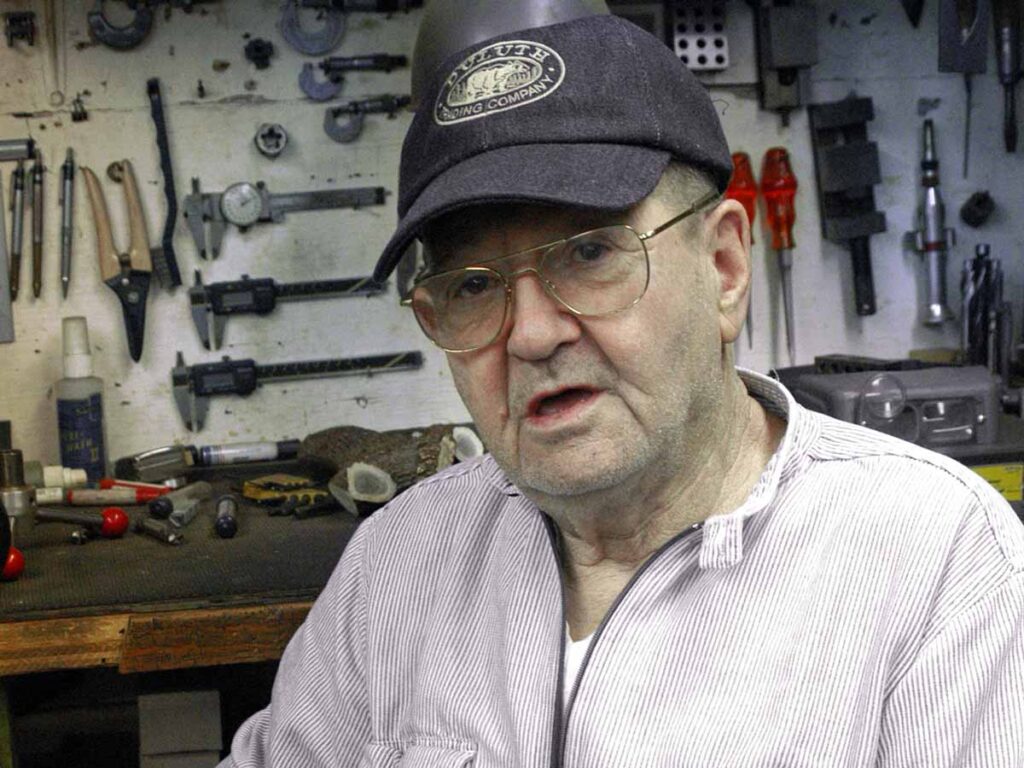
Bob Loveless in his shop in October 2006. (image courtesy of Aaron Merritt, grandson of Jim Merritt)
Truth is, there’s scarcely an aspect, nook or cranny of the knife business that Robert Waldorf Loveless did not touch during his lifetime. He was forthright, sometimes gruff and always prone to speak his mind. During an interview for BLADE, he once asked this writer what the tapping noise was that he heard in the background. When I responded that it was the keys clicking as I was taking notes while we talked, he bluntly asked, “Can’t you remember anything? Why can’t you just listen?”
Loveless’ Defining Designs
No matter. Loveless was articulate, extremely intelligent and deep down passionate about art in knives. Cutlery Hall-Of-Famer Bruce Voyles knew Loveless and respected him for what he was.
“The thing about Loveless is he made a knife with eye appeal,” Bruce observed. “It was different, and a lot of people don’t understand why, but it was [his use of the] natural French curve. It was the design appeal.”
True enough, Loveless was a master of design. He had actually studied briefly at the Institute of Design in Chicago in the 1950s, and was a student of the Bauhaus Movement, a cultural and artistic design wave that peaked in the mid-1930s, something of a North Star, a muse if you will. Its dictum: Form Follows Function.
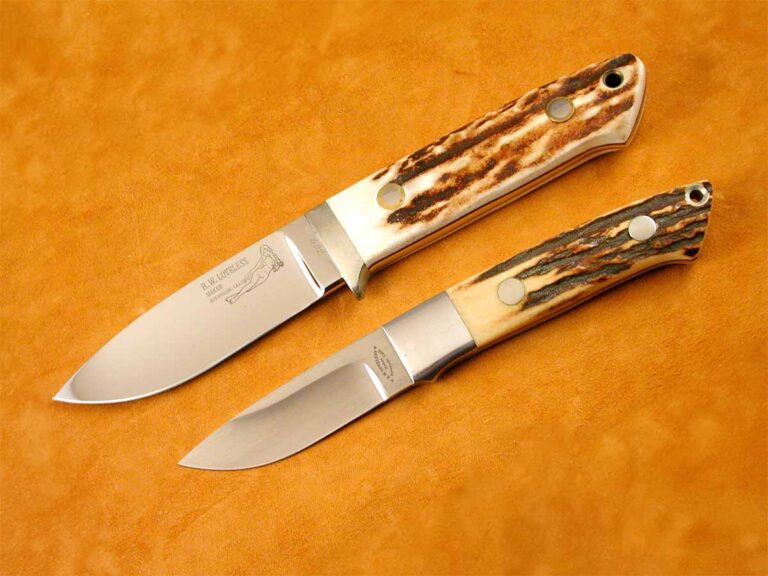
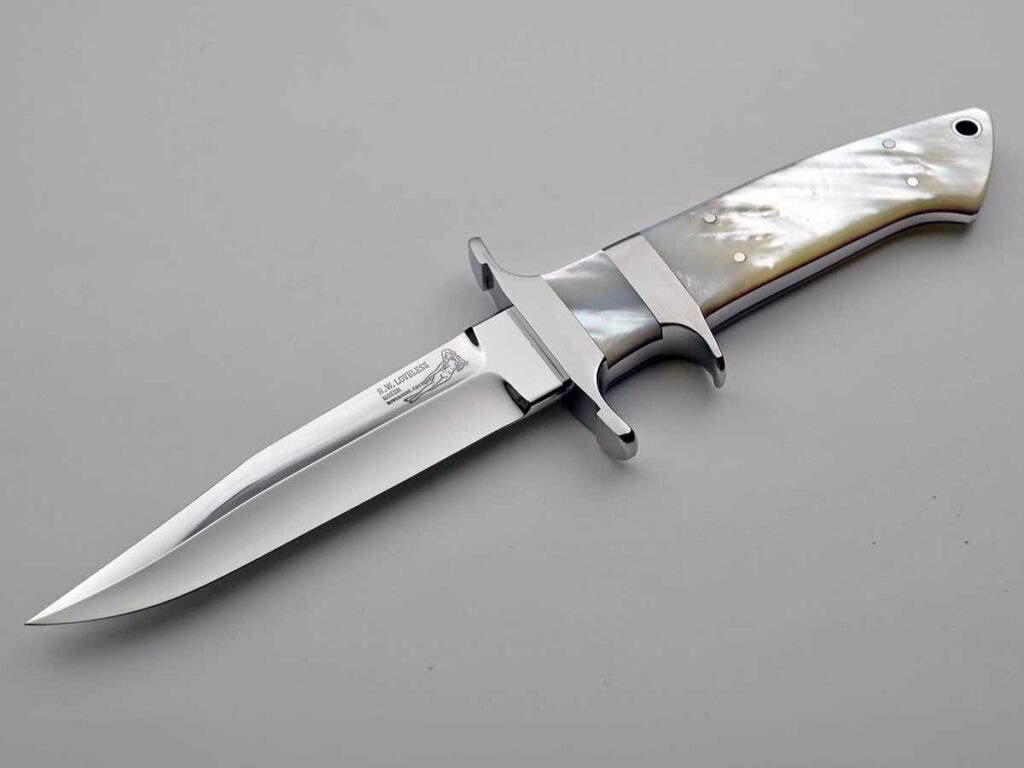
Another of Loveless’s favorite designs is the sub-hilt, radiant in one of Bob’s Baby Bear fighters with mother-of-pearl scales, Naked Lady logo and Riverside, California, stamp. (Exquisiteknives.com image)
Longtime Loveless authority John Denton told reporter Nelson, “He is pretty much the Picasso of the knife world and the father of 20th century knifemaking. His design is what made him famous.”
Dave Ellis, proprietor of Exquisiteknives.com, agrees.
“Going back to the 1950s, Loveless has been instrumental in perfecting some of the more common traits found in contemporary knives,” he related. “The dropped hunter is probably Bob’s most emulated design, although the Archer chute, sub-hilt fighter and more show that Bob did not rest on his laurels. When a smaller, carry-sized fighter was called for, Loveless came up with the New York Special.”
Denton recalled the Loveless willingness to revive and reintroduce design and construction concepts that caught hold in modern times and energized new frontiers of imagination and artistry.
“He was not the first to use the tapered tang,” John explained, “but he found out about it from an old knife made in the 1850s that was given to him by Billy DuPont of the DuPont family. Loveless brought it back into the modern world with the tapered tang taking the weight out of the knife. Bob said, ‘It has to look so good you want to pick it up and feel so good you don’t want to put it down.’”
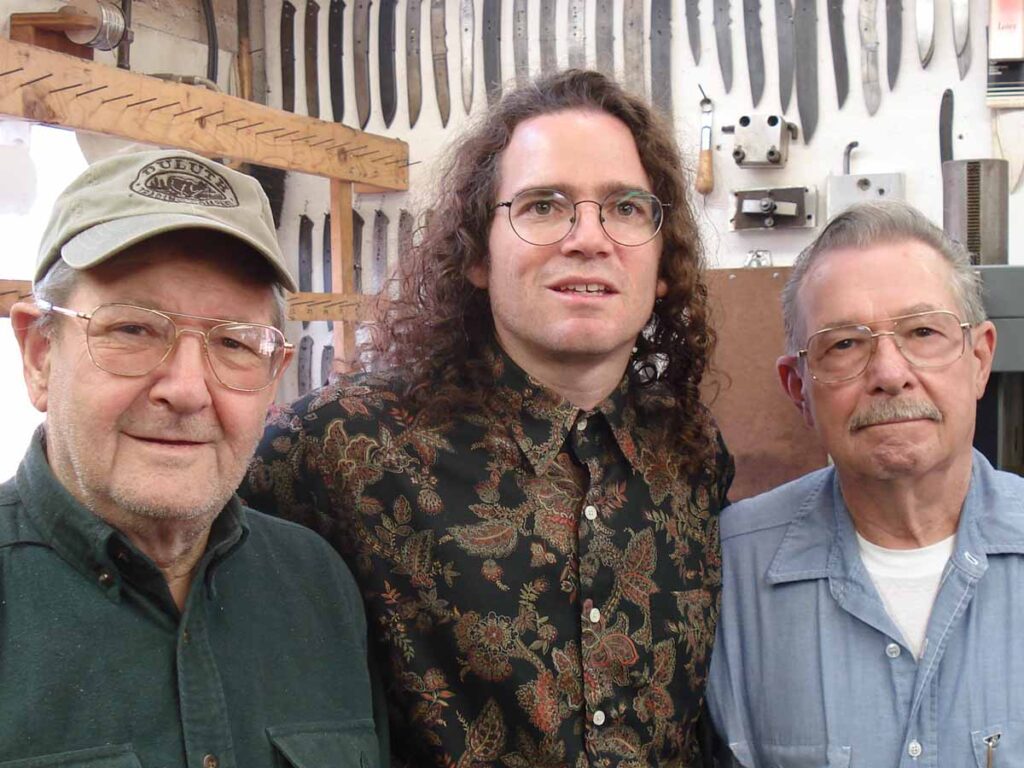
From left, Bob Loveless, John Denton and Jim Merritt in the Loveless shop in Riverside, California.
According to Denton, Loveless also brought the brass wrap handle, hidden pin, two-tone pins and half tang into play.
Design achievement crowns Bob’s career, but there was so much more to him—so much that attempting to compile a summary of his contributions would require more space than this publication might allot in another half-century.
Voyles commented, “I always liked him because he could sum up a complex subject in a sentence. He and I visited one time and I would throw out topic after topic, and he would snap back a quick response. When you left him you knew you left somebody that was phenomenally intelligent on a variety of topics, but that doesn’t mean he had social graces.”
One of Bruce’s favorite Loveless memories was Bob’s rationale during the controversy that raged within the Knifemakers’ Guild as to what truly defined a handmade knife. Loveless liked Jack Daniel’s, so Voyles and Cutlery Hall-Of-Famer Dan Delavan bought a 1.75-liter bottle of Gentleman Jack whiskey (Single Barrel wasn’t available at the time) and presented it to Loveless at his home in Riverside, California.
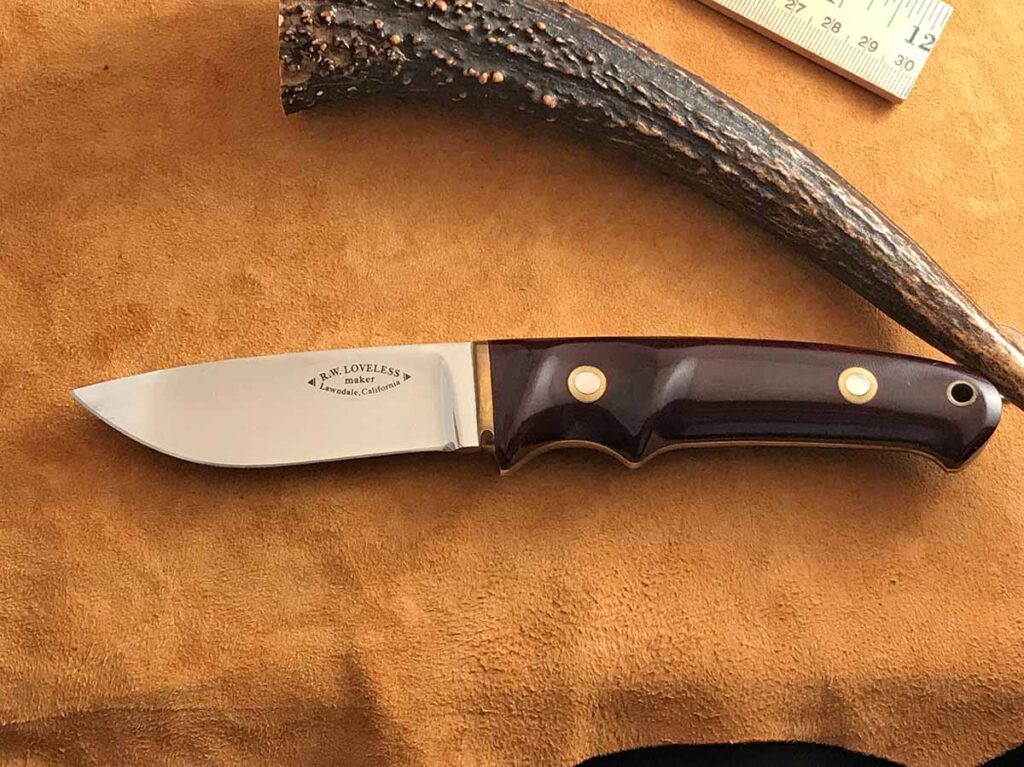
In an arrangement between Loveless and Schrade’s Uncle Henry Baer facilitated by A.G. Russell, Loveless sent this actual prototype to Schrade to copy and make the Schrade Loveless collaboration in the early 1970s. It has no guard, an “improved handle,” and a more pronounced belly than most of the Loveless dropped hunters of later years. The handle is burgundy Micarta®. As John Denton observed, the knife “has a magical feel from the ol’ man.” (Denton image)
“I said to him, ‘I hope you will accept this gift in the spirit in which it is intended,’” Bruce smiled. “He laughed and put the bottle on his shelf. Then we sat down and asked him what he believed to be the definition of a handmade knife. We videotaped his answer. He said, ‘I wish I had a machine that I could dump handle material, steel and pins into, and then a knife would come out the other end, boxed and ready to send to somebody. So, make your knives any way you want to. The marketplace will sort you out soon enough.’”
Simple, straightforward and wise.
Bob’s Impact On The Industry
Loveless played a pivotal role in the genesis of knifemakers’ organizations. He was a founding member of the Knifemakers’ Guild and a pioneer with the California Knifemaker’s Association. He was a staunch supporter of knife shows, bringing people to the events just with his mere presence. According to Ellis, Bob regularly attended the Guild Show, BLADE Show, Solvang Show, California Custom Knife Show and Phil Lobred’s Art Knife Invitational
Loveless also brought along younger knifemakers, working with them and offering advice. A few include Jim Merritt, D.F. Kressler, Yoshihito Aida, Cutlery Hall-Of-Famer D’ Holder and Steve Johnson. Bob’s style and artistic interpretation live on in part with the work of these incredible craftsmen.
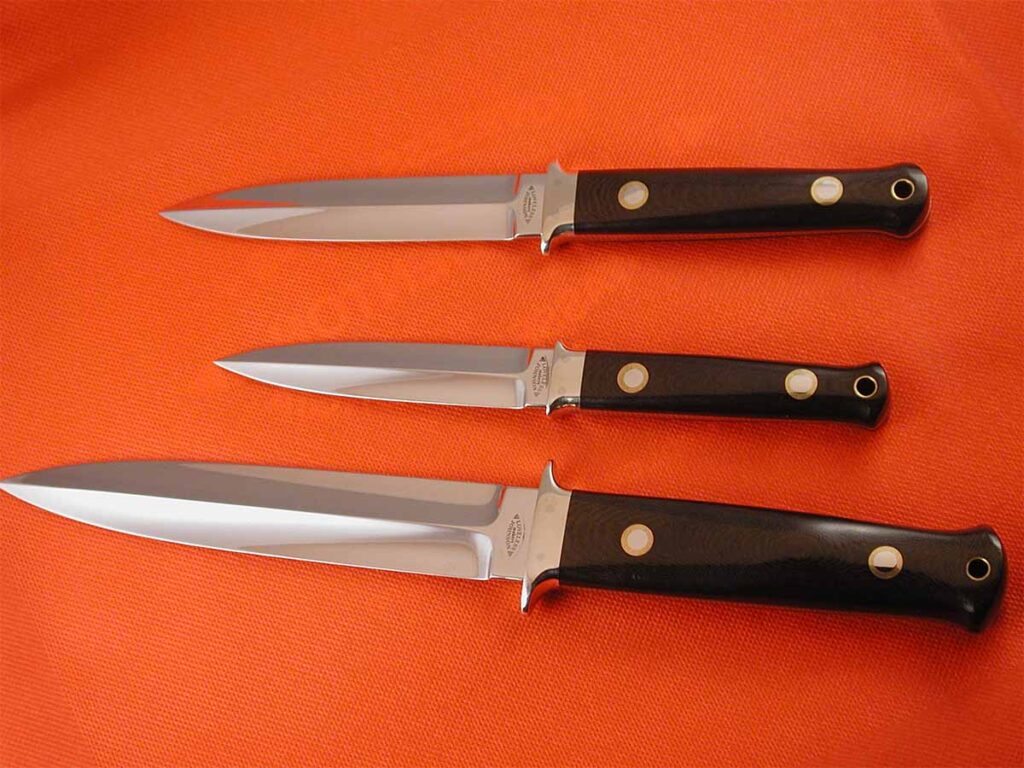
Steve Johnson worked in the Loveless shop in the early ’70s and remembers Bob fondly. “He was a true friend to those who were genuine and sincere with him,” Steve noted. Of this rare set of Loveless-Johnson daggers John Denton wrote simply, “Three really great knives.” (Denton image)
“Many a maker is in debt to Bob Loveless for the support, counsel, corrections and guidance that he gave,” Johnson said. “He was a true friend to those who were genuine and sincere with him, and the relationship that they had with him. Bob, as we know, was outspoken and quick to correct what he felt was not right or smart, which led to some loving him and others not, a bit like Ed Henry—love or hate—but both were so very good to me personally!”
Materials Maven
Loveless was an innovator in the aspect of materials as well, including 154CM stainless steel and the introduction of ATS-34 from Japan, while also popularizing Micarta® as a handle material.
Ellis commented, “Loveless pioneered the use of many of the common steels used today, especially 154CM. The shop was able to purchase such quantities that Bob could pretty much order what he wanted. The favorite handle material of the Loveless shop was green Micarta.”
Johnson remembered, “There was a stack of 154CM steel lying in the driveway at 4319 W 187th Street [the address of the Loveless shop] the day I first walked in. Bob mentioned that he was excited to get some blades done and heat treated right off. Green canvas Micarta was set in stone as the best handle material in Bob’s view. It’s still right up there on top and is used by many a maker. It’s because of Bob’s legacy that this happens.”
Global Influence
A lasting dimension of the Loveless legacy was his bridge to Japan, as well as his overtures in the European markets.
“Bob was deified to the extent that every Japanese knifemaker included his designs among their offerings,” Ellis explained. “Bob was an icon in Japan, and to this day many of the top makers in Asia have Loveless designs in their repertoires.”
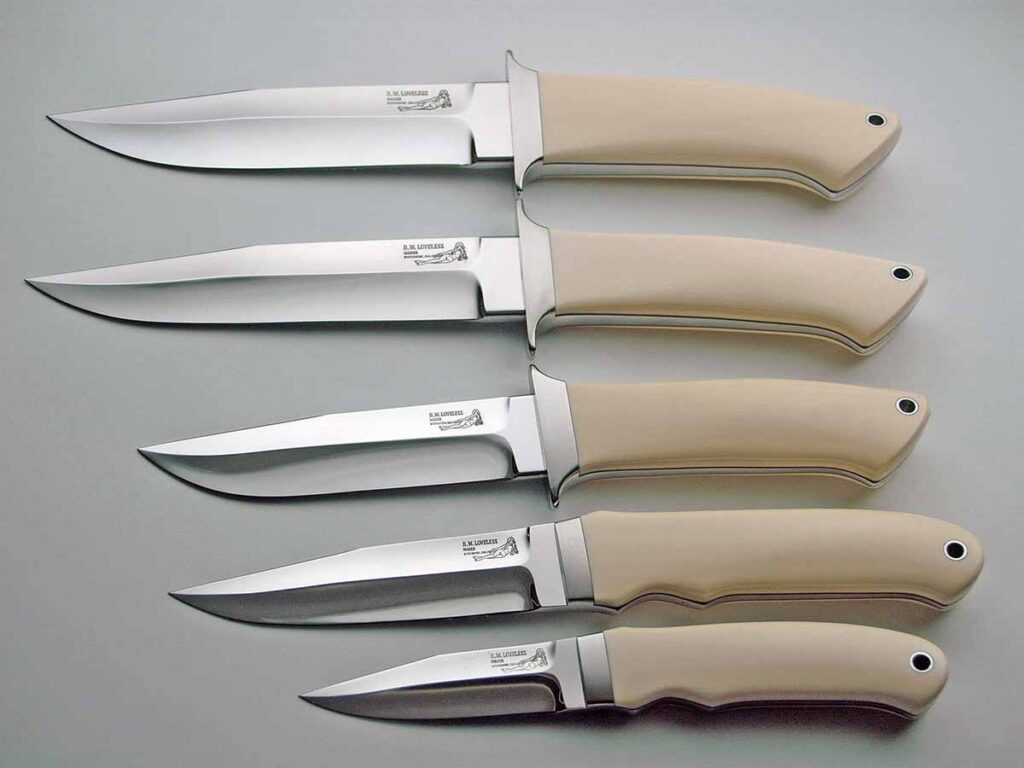
Five Loveless fixed blades sport the no bolt/no pin look in ivory handles. (Exquisiteknives.com image)
Voyles commented, “Bob went over there and showed the Japanese how to make good knives. I went to Japan in 1981 or ’82, and in every factory I went to there was a picture of Bob Loveless and the factory owner. The thing was that Bob’s wife, Yoshiko, was Japanese, so he didn’t have a problem with the language barrier, and he went to Japan to show them how to make knives that appeal to Americans.”
Loveless used his connections to make things happen, and Voyles credits him with the evolution of the folding knife among Japanese manufacturers, as well as a surge in the Japanese collector market.
“Bob didn’t make folders and the Japanese wanted folders,” Bruce recalled. “He had worked on a design with Jess Horn, and Bob put Jess and Japanese collectors in touch with each other. Horn also had a series of folders that he patterned after the old Remington Bullets. When Japanese collectors discovered that, their market for vintage Remingtons went straight through the roof. Loveless sowed the seeds in the 1990s for the collectibility of vintage knives in Japan.”
Collecting Loveless
Today, a Loveless knife is a collectible phenomenon in its own right. Name the year, name the mark on the blade, name the style and the materials, it will sell for astonishing dollars. Denton has noted some models made in the 1970s that sold for $400 then and have reached the rarefied air of $100,000 or more in recent years. The power of Loveless pricing simply takes your breath away.
Bruce is quick to add that Loveless was professionally unselfish. “If you wanted to make a style of his knife in your factory, that was OK,” Bruce noted. “Just ask him.”
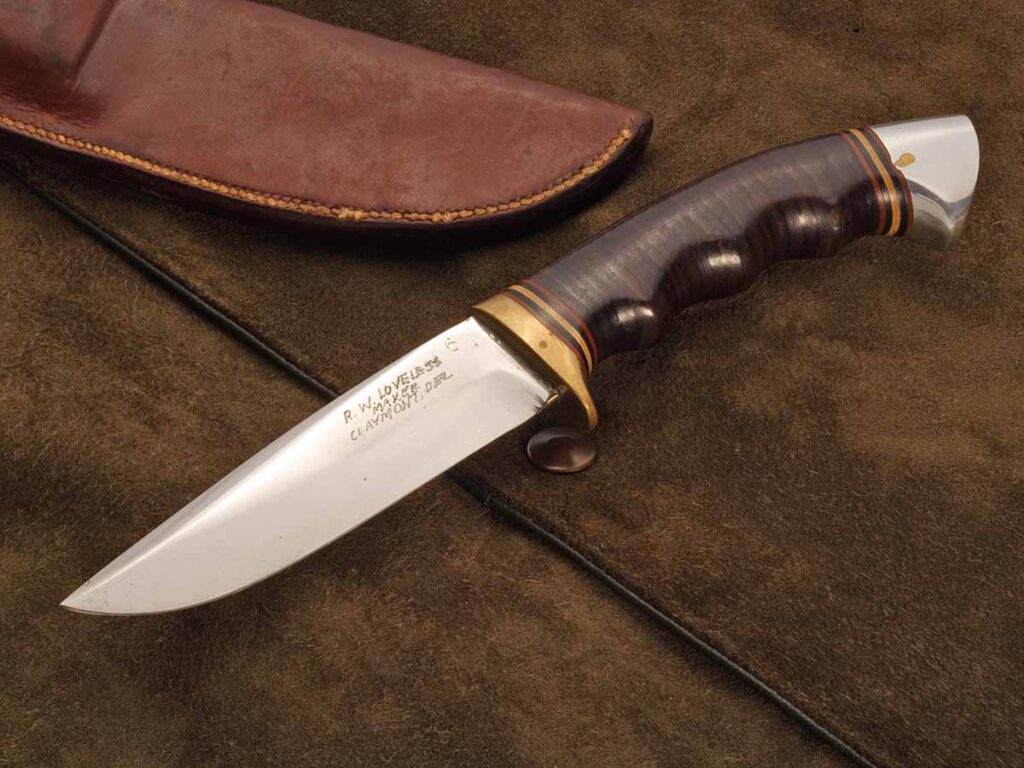
Circa 1955, Loveless sold his first knife to Abercrombie & Fitch for $14 (adjusted for inflation, almost $160 in today’s money). Loveless made this early model for A&F in his shop in Claymont, Delaware.
The pervasive Loveless influence stretched far and wide, from the custom knife shop to the factory.
“His designs for and collaborations with Schrade, Gerber, Lone Wolf and others, and the factory knife market in general, were significant,” Ellis recalled. “Early on the astute factories were taken by Loveless designs and made limited editions in dropped hunters and others. These days factory collaborations are quite common, and you can thank Bob Loveless if you want to give credit where it is due.”
When Sports Illustrated called Loveless for an interview in 1980 and the magazine published his words in the same edition that featured tennis superstar Bjorn Borg on the cover, the impact on the entire knife universe was transcendent. When asked why so many people considered his knives “better” than those of others, he mused, “A knife is an extension of your experience. And I’ve had more experiences than most people. There’s more character running in my veins.”
For those who knew Bob, just the knowing was an unforgettable experience. His contributions to his present and to the futures of others in the knife industry remains incalculable. And so, the longevity of a man does not reside in his years on Earth, but in the perpetual remembrance of his ideas, his workmanship and his innovative perspective on the world.
Therefore, it can be said that when Loveless left us he did not go gentle into that good night. He did not fade away. He didn’t drop the mic. He handed it to those with the foresight and the intestinal fortitude for the days to come. Now, what do we say and do? Loveless might grouse. He might gripe. But he just might also manage a grin.
The Tomahawk Is One Of The Most Popular Survival Tools Today. This Dozen Stands Out From The Pack.
The tomahawk has been used for centuries as a hand weapon in battle and a tool for everything from chopping wood to processing animals. In modern times, it has evolved into an all-around survival tool used by military and civilians alike.
The parallels between the use of the tomahawk in the 18th century and that of the modern battlefield are numerous and worth consideration. It turns out the reasons behind the tomahawk’s popularity in the woods of Colonial America are often the same reasons they are popular with U.S. troops and backwoodsmen today.
Tomahawk History
The word tomahawk is a variation of the Algonquian word tomahac (also spelled in English multiple ways), which means “to strike.” It was a term that was used originally for any striking weapon, from wooden clubs to axes made of stone.
In 1608, Capt. John Smith of Jamestown, Virginiawas the first person to record the word in English, mentioning it was used to describe the hatchets carried by his men. Axes and clubs were symbols of power and status for native cultures going back centuries.
This, combined with the numerous advantages held by the metal tomahawk over its stone predecessors, made the European-fashioned metal tomahawks popular trade items with the local tribes. As trade increased, new forms evolved to meet the demands of the market, and tomahawks with pipes, spikes and hammers were traded by the thousands.
Carl Russell, author of Firearms, Traps & Tools of the Mountain Men, speculates that, as the classic trade ‘hawk’ became the norm with Native tribes, newer, less pragmatic forms evolved to fill the warrior status niche.
Tomahawk Uses
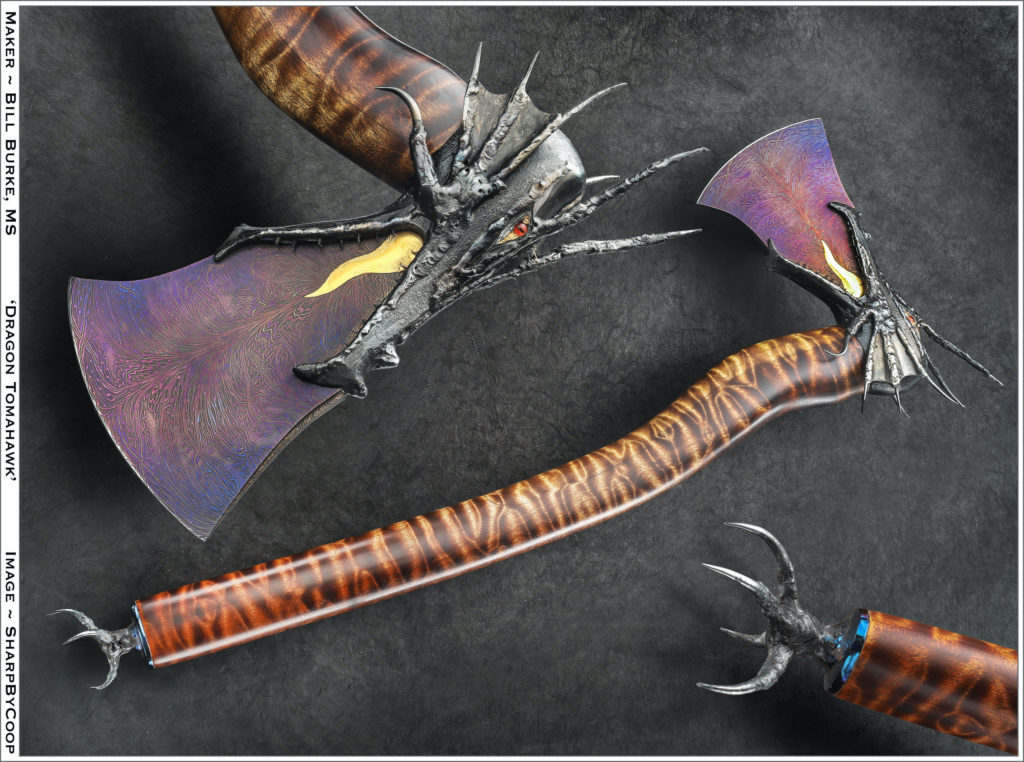
The Dragon Tomahawk is 20.5 inches overall, with a 4-inch cutting surface of damascus and a curly maple handle. The head is wrought iron and 1018 mild steel forged into a “W’s” pattern, and the blade steel is 1080, 15N20 and 201 series nickel forged together to create Bill’s Dragon’s Breath pattern. (SharpByCoop image)
The tomahawk is a true multi-purpose tool. With it one can dress game, chop wood, and clear brush. Choking up on the handle, the user can use it much like a knife. The length of the handle gives the blade tremendous velocity and force as well, making it a formidable weapon. These attributes were not lost on the Western frontiersmen who often adopted the tools and lifestyles of the Native tribes.
This adoption became even more apparent as the frontiersmen went to war. They employed the same guerrilla warfare tactics used by the Native tribes, and they carried the tomahawks so prized by them. One equipment list for volunteers into the American militias mentions “a sword or tomahawk” as a required item right along with a rifle, powder, and lead.
Tomahawk In The 21st Century
This rich history would be enough to secure the tomahawk’s place among the iconic tools and weapons of American history, but the story does not stop there.
Peter LaGana, founder of the American Tomahawk Company, was famous for his tomahawk made popular during the Vietnam War. Also privately purchased by soldiers, it proved a valuable tool and weapon in the jungles of Southeast Asia.
The true rebirth of the tomahawk, however, would be brought about by the Global War on Terrorism after the attacks on 9/11. Some members of the Special Operations community began carrying tomahawks as part of Col. John Mulholland’s Joint Special Operations Task Force, also known as Task Force Dagger, when only 300 Americans were in Afghanistan on the hunt for Osama Bin Laden.
The number of soldiers carrying tomahawks increased throughout the next decade of war, but why? The wars in Afghanistan and Iraq were asymmetric wars that had more in common with the guerrilla fighting of frontier America. The tomahawk once again served as a valuable tool and weapon in this environment.
Our 12 Best Tomahawks For 2023
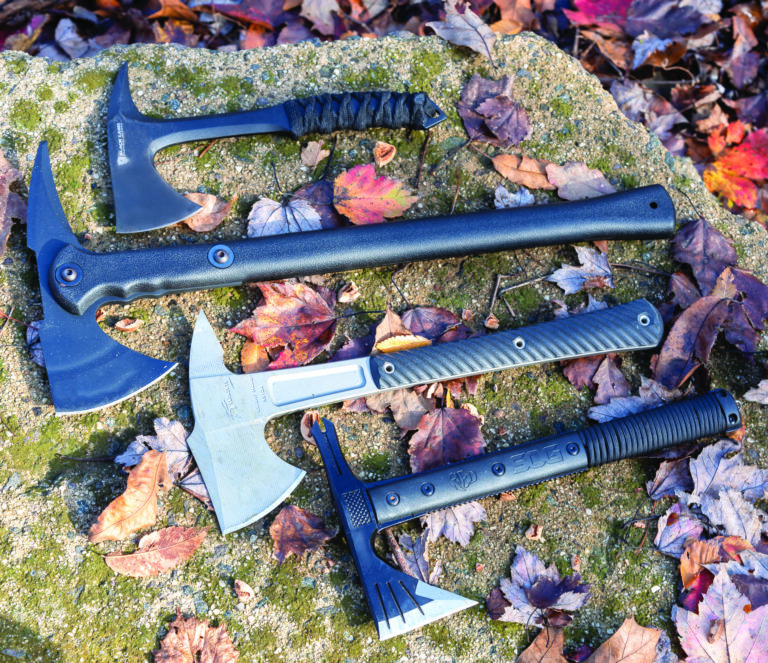
The modern tomahawk comes in all shapes and sizes with all sorts of uses and included features. These are a dozen across a variety of price points that show what the modern hawk is designed to do and how companies are getting creative with them.
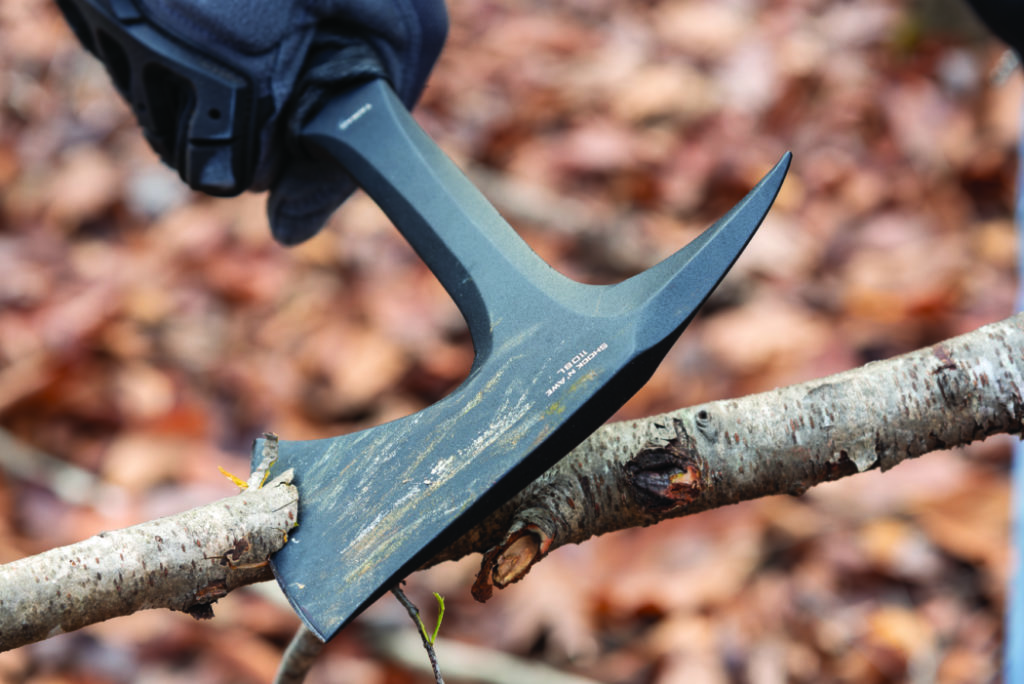
Browning Shock’ N Awe
The Browning Shock ‘N Awe is a compact tomahawk that packs a big punch. Despite its small size, it still has the heft to be a very effective chopper.
The Shock ‘N Awe is 10.5 inches overall. The head is 2.75 inches and offers a curved penetration spike for light breaching. The head, spike, and handle are forged from one piece of 1055 high carbon steel and covered in a black epoxy coating for corrosion resistance and low glare.
The handle is in a traditional Japanese style with a hand-wrapped overlapping cord. It looks great and it seems a perfect match for this size of hawk. The 3D nature of the wrap segments creates alternating ridges that help provide an ultra-secure grip in all conditions. The exposed pommel terminates in a skull-crusher shape.
The Shock ’N Awe comes with a molded polymer sheath with MOLLE-compatible attachment provisions. The sheath encases the entire head and spike which pivots into and out of the sheath. A locking tab that pivots down over the spike end of the sheath prevents the sheath halves from separating, effectively locking the hawk into the sheath.
The hawk gets into tight places easier and is more maneuverable than larger models. It’s easier to carry as well. It easily takes down small saplings and de-limbs them as well. The Shock ’N Awe would be great for splitting kindling, including via a baton.
The spike is pointy but not so much that it can break off. It penetrates wood and other materials effectively, and can be used for digging as well. It opened up a good-sized hole in plywood when used in a rocking motion after penetration.
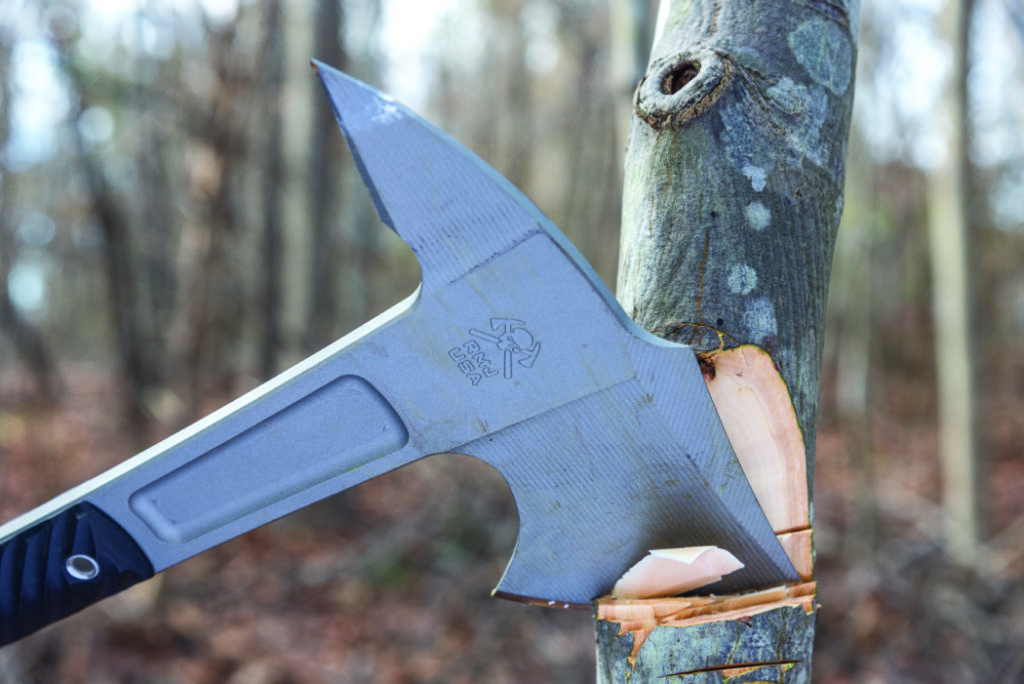
The RMJ Tactical Knight Hawk is an excellent chopper.
ABS master smith Jason Knight and RMJ Tactical co-designed the Tactical Knight Hawk to handle a variety of jobs, not just chopping. It’s 14.5 inches long and feels agile in the hand with a weight of 23 ounces. The cutting edge is 2.875 inches, and the blade is made from 80CRV2. Blade thickness: .275 inch. The handle is 3D-machined black G-10 riveted/permanently attached to the tang.
There is a slight downward turn to the cutting edge that accentuates power, which is in contrast to most hawks where the edge is parallel to the handle. As a result, the cutting edge engages and shears more effectively after impact. This is one reason why the Knight Hawk isn’t head heavy like many hawks, yet can outchop many of them.
This translates to extended use without wearing you out. By the same token, being agile in hand suits it for tasks few hawks are adept at, such as whittling and making fuzz sticks.
The spike is the shortest one of all the hawks tested, though that does not mean it is the least effective. Resembling a fat knife blade rather than a true spike, it sports a semi-sharpened edge at the bottom. The spine tapers down slightly but leaves more than enough material for tip strength and to withstand heavy penetration strikes.
The Knight Hawk is practically bulletproof, devastatingly effective, and a pleasure to use. It comes in a choice of three Cerakote® color options: Savage Steel , OD Green, and Desert Tan.
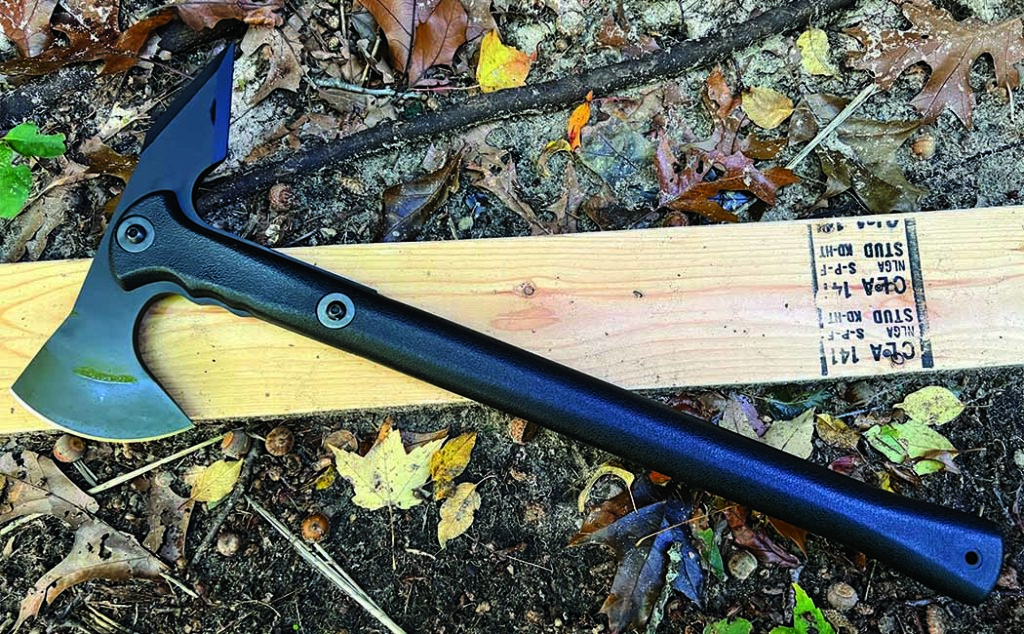
Measuring 19 inches overall, the Cold Steel War Hawk features a head of drop-forged 1055 carbon steel for toughness and a textured polypropylene handle. The partial tang is inset into the handle and secured by two large bolts, and you can replace it easily should it break.
The wide, bearded axe head excels at chopping and cutting. The tang area just behind the head has a few finger grooves for choking up for whittling or more precise cuts. The double-ground spike has a distinctive tanto-ish shape for maximum penetration and power. The spike is ground on top and bottom to remove material for enhanced penetration.
The handle is comfortable, and the texturing promotes good grip traction in various conditions. The sheath is a clever double-articulated design that encases most of the head. The sheath has two pivots—one at the spike end, the other at the beard end. The sheath is secure and doesn’t fall off. The only negative is there is no belt-attachment provision. Consequently, the War Hawk is ideal for storing in your truck for camping expeditions.
With the tanto-tip-beveled spike, the War Hawk had great penetration through plywood. In order for it to be an effective chopping/breaching tool, there must be zero flex in the handle. If Cold Steel went to a hickory wood handle it would improve the War Hawk’s performance. As is, it might make a great throwing tomahawk.
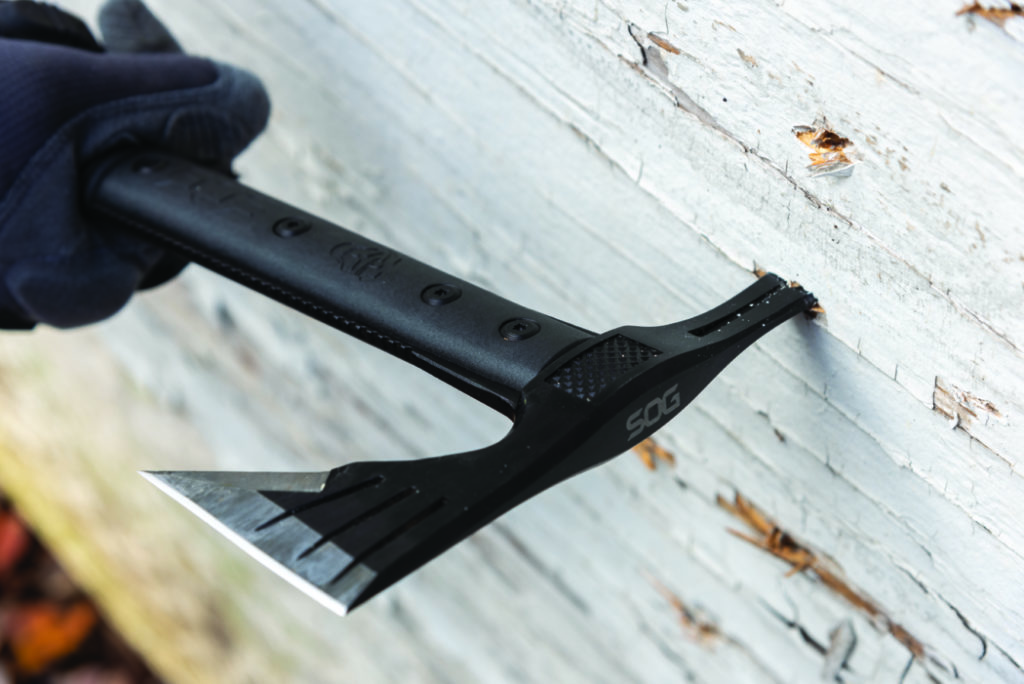
The spike of the SOG Survival Hawk works well and achieved good penetration into plywood.
A little over a foot long, the Survival Hawk is compact enough to tote around while camping. The head is cast from 2Cr carbon steel with a cutting edge of 3 inches and a distinctive spike on the opposite end. The spike is not only designed for penetration, but the slot can be used to pull nails or bend wire. When held in the icepick grip with the head pointed toward the ground, the Survival Hawk can be employed as a hammer.
For added versatility, a fire-starting ferrocerium rod screws into the handle butt. The glass-reinforced-nylon-handle material is lightweight while the full-tang design promotes strength and superb balance. The gripping area of the handle is wrapped with paracord for comfort. The exposed portion of the tang in between the paracord handle and the head has a series of traction notches. Grip the area tightly up against the head to carve or whittle with extra control.
The head is all black but the grind bevels are satin finished, creating a striking visual contrast. At 19.5 ounces the Survival Hawk has the weight it needs to deal effective chopping blows. Given its light weight and compact length, don’t expect it to tackle heavy/extended chopping tasks, as you’ll end up having to use more arm power. It actually works pretty well and bit hard into saplings. If you need a hawk for chopping on an as-needed basis, then this is an ideal one to consider.
The Survival Hawk comes with a sturdy ballistic nylon sheath with a stiff inner liner and sports sewn and riveted construction. A button-snap flap closure secures the sheath around the head. A large nylon webbing loop provides easy belt attachment.
The spike works well, and the notch in the center serves as a nail puller. However, the spike might penetrate better without it. Nonetheless, it achieved decent penetration into plywood. However, just like with the head, the spike would also be more effective if the handle were longer for extra leverage for a more powerful swing. Conversely, the Survival Hawk is still loaded with useful features.
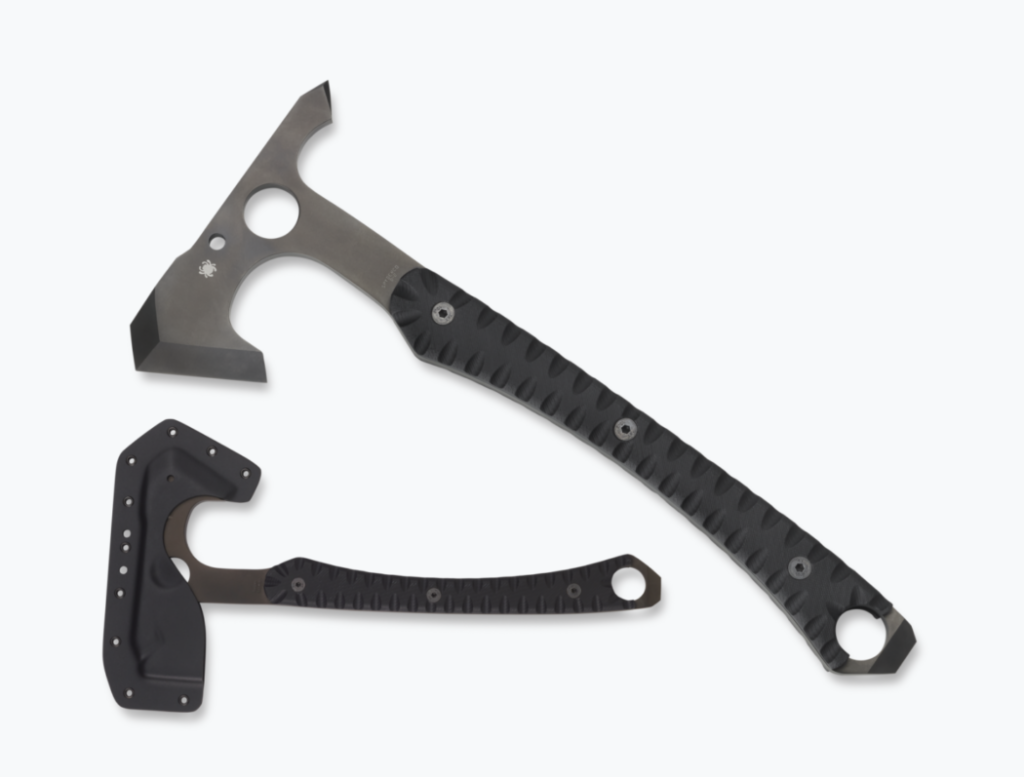
The holes are not just for aesthetics on the Spyderco Warrior Hawk. Designer Laci Szabo indicated the top hole can be used to create a leash similar to that used on ice axes, and a chain can be attached to the hole at the end of the handle so the hawk can double as a hook.
Laci Szabo, United States Marine Corps veteran and New Mexico police officer who served as a breacher on SWAT teams, designed an urban multi-tool to fill the bill. The result is the Spyderco Warrior Hawk, a striking modern design with an angular blade and Spyderco’s signature cutout holes.
The Warrior Hawk is designed to punch out tires, break vehicle windows, cut cables, and handle prying tasks. The apex of the angle ground into the cutting edge of the head concentrates the power of the swing while preventing the material from binding up on the edge.
The holes are not just for aesthetics. Szabo indicated that the top hole can be used to create a leash similar to that used on ice axes, and a chain can be attached to the bottom hole so the hawk can double as a hook.
Szabo wanted a handle different from existing tomahawk designs, so he configured the G-10 handle to resemble that of a conventional hammer. He said the overbuilt design consists of D2 tool steel that’s .3 inches thick, a material that can be heat treated to a high Rockwell hardness yet still has “wear resistance and pry ability,” according to Spyderco.
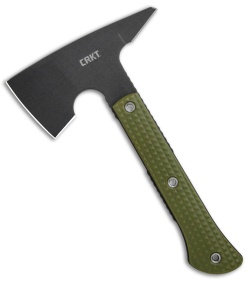
The challenge for Ryan Johnson in designing the Jenny Wren for CRKT was to make a pint-sized version of a tomahawk. The original version made by Johnson’s RMJ Tactical saw use by special operations forces starting in 2010. Meanwhile, the design also makes for a great outdoor tool.
When CRKT began offering its version of the Jenny Wren, the idea was to fill a need for people heading outdoors that were looking for durable and innovative axe designs.
One of the most notable features is the sharpened edge running across the top of the head. While it was originally designed to maximize slicing cuts, the edge also reduces drag. “It’s the material that is not in the way that makes a difference with this design,” Johnson said.
The ambidextrous sheath allows multiple modes of carry, including a belt, sling or attachment to a MOLLE system. “Everyone tends to forget the importance of the scabbard,” Johnson observed. “If you can’t carry it, you can’t use it. In the case of a tomahawk it’s important to have a safe way to carry it multiple ways.”
Designed by Jared Wihongi, this hawk features a Maori-inspired tribal motif on the head. The tomahawk-like patiti was a weapon of choice for Maori warriors in New Zealand shortly after they first began arming themselves with metal tools long ago, and the head design harkens back to that time.
The satin-finished 420 stainless head showcases the design well. At .25 inches thick, and coming it at 26.4 ounces, the hawk has the heft and size to make quick work chopping through most material. A semi-sharpened edge on the spike end allows for a moderately precise puncturing tool as well.
At 13 inches in length, it’s long enough to get a good whack without exerting your arm too much. The hawk features a paracord-wrapped polymer/composite handle, and where the head meets the handle is reinforced for sturdiness.
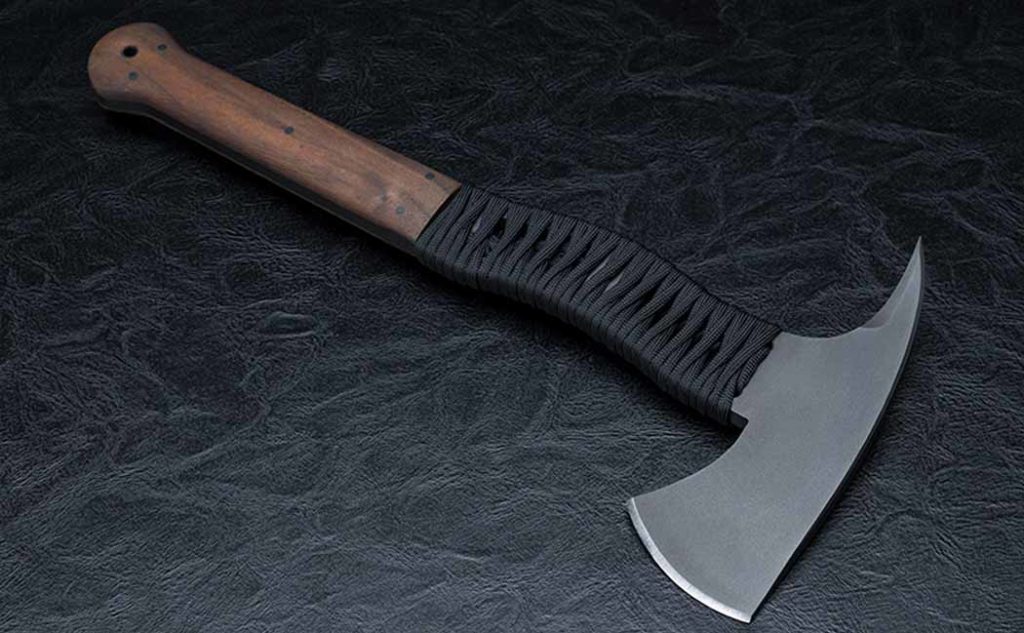
Daniel Winkler is tight-lipped when it comes to the teams and units he works with. His Winkler Knives Wild Bill tomahawk was designed with the help of Kevin Holland, Navy SEAL and U.S. Army Special Operations veteran
The axe was named after William “Wild Bill” Donovan, who was head of the precursor to the CIA, the Office of Strategic Services, during World War II.
The hawk is both a tool and art considering the craftsmanship that went into it. It starts with the flat-ground 80CrV2 blade with a black Caswell finish for improved corrosion resistance. The tapered-tang design ends at the integral spike at the butt of the axe, which works well to crush and pry. It’s not the best puncturing tool as it is unsharpened.
The 13.25-inch maple wood handle is wrapped in black cord for most of the top half of the handle for better grip, especially when choking up on the axe for precise slicing. The 22.2 ounces are distributed well, making for a great swing every time.
Wild Bill AxeSpecs Blade Material: 80CrV2 with black Caswell finish Overall Length: 13.25 inches Edge Length: 2.25 inches Weight: 22.2 ounces Handle Material: Maple Wood with Black Cord MSRP: $600
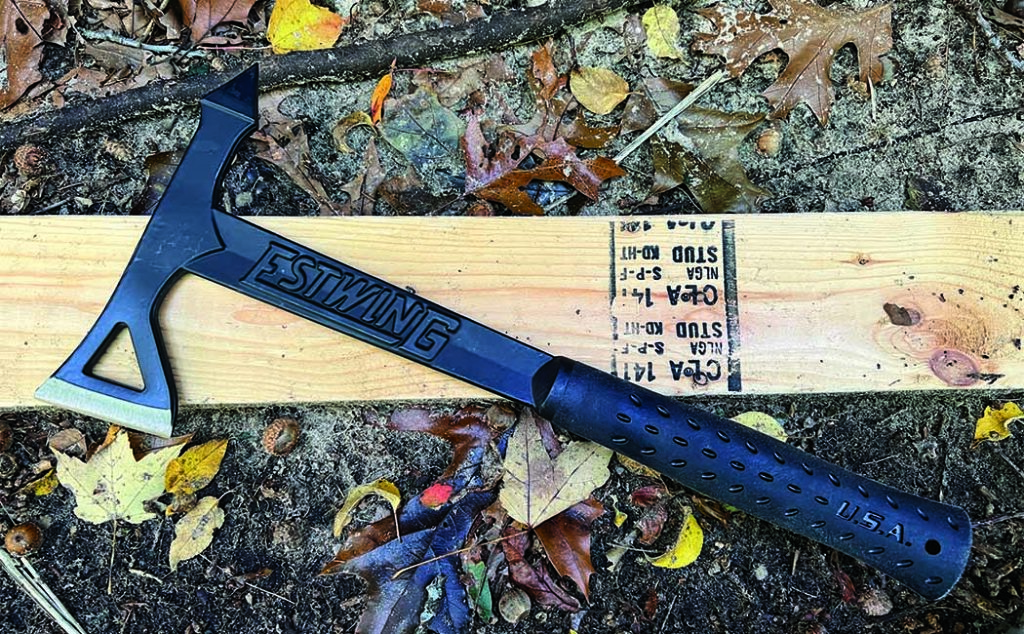
Estwing Black Eagle Tomahawk
The Estwing Black Eagle Tomahawk feels much more like a tool than a hawk. The rubberized grip absorbs shock and is very comfortable. You can’t choke up on the head like you can some other hawks, though you could add some paracord for the purpose.
The Black Eagle is the epitome of durability. It’s not flashy and has the company’s logo deeply embossed on the tang. The balance is incorrect for throwing but that’s not really the Black Eagle’s role. It is a demolition tool, plain and simple. The head is dimensioned correctly for the same feel as swinging a hammer.
It has a raised equator from its high points, can be used to punch into various materials, and is very easy to withdraw. It can go through just about anything despite the fact it is not sharp on the corners and the tip is more or less rounded off.
In wet, grimy conditions it performed extremely well and goes through wood easily, both in destroying wood structures and splitting firewood. The hawk punches through sheet metal with ease. If you’re looking for a hawk that is less showpiece and more hard-working tool, this is your best bet.
At $600 the Winkler Combat Axe is not just a big chunk of change, it’s also an incredibly strong, rugged chunk of 80CrV2 carbon steel. Not only is it functional, it’s also forged at the company started by the individual largely responsible for the popularity of the modern tomahawk, Daniel Winkler.
The Combat Axe is easy to draw from the belt. The sheath is extremely functional and allows you to remove the Combat Axe one-handed with little effort. The handle runs all the way up to the head and provides an excellent grip at any point along its length.
Of note is the shape of the spike. It is reminiscent of a flat-end bayonet point commonly seen on Russian rifles like the SKS and Mosin-Nagant. Its shape allows it to be used as both a prybar and lever, and it can be swung into material with great force and then used to pull it apart.
The Combat Axe’s edge profile did just fine splitting light amounts of firewood. It also removes branches quite easily in one swing. Because the handle extends right up to the head, there is a risk of damage should you try to split large pieces of wood. The sheath is a major selling point.
The Combat Axe is definitely worth the price, though for the same amount you can buy numerous other hawks multiple times over.
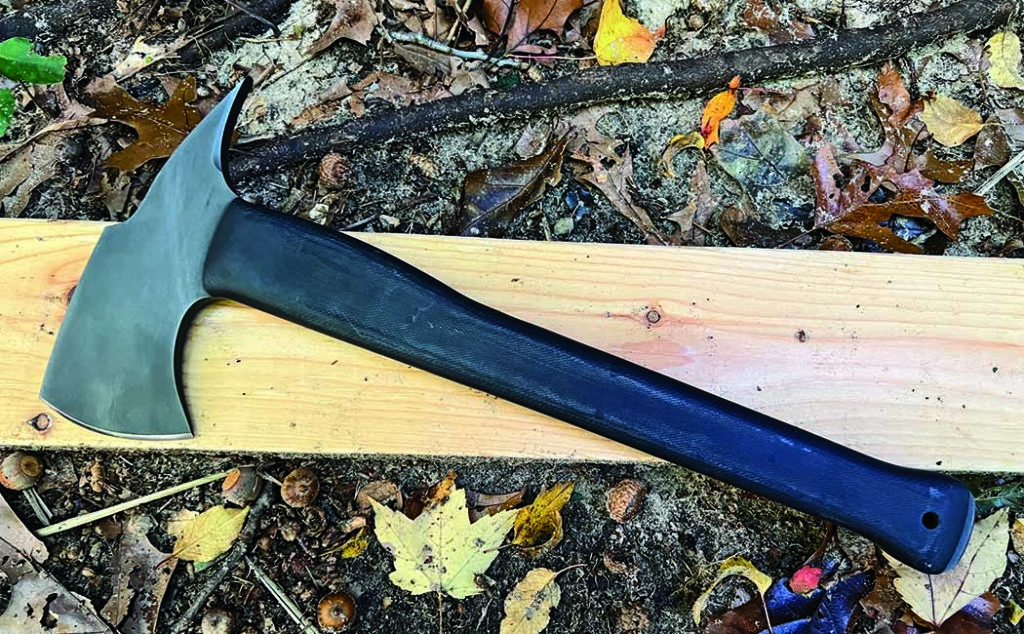
When it comes to durability, the Cold Steel Trench Hawk is quite similar to many of the company’s edged tools. While none of Cold Steel’s functional cutters would win a beauty contest, they certainly have it where it counts when being used. The blade arrived razor sharp, almost too sharp for its own good. Likewise, the spike is substantially longer and much sharper than those of the other test models.
The Trench Hawk is a favorite for throwing.. The company sells replacement handles for around $7 should you break one. It severs branches with extreme ease, though such a task is more of a problem than you might think. The polypropylene handle doesn’t just go up to the head, it terminates right in the middle of it. If you strike too hard, it inevitably will drive the blade in up to the handle, which can cause damage.
The longest of the test hawks, it gains excellent velocity when swung. The handle shape, while correct for a tomahawk, is a bit too smooth and slippery when wet. Another issue is the spike’s length and profile. It’s simply so large that it borders on being unusable for standard chores. It punches through just about anything, from metal to wood, but tends to get stuck easily. Getting it dislodged can be somewhat dangerous
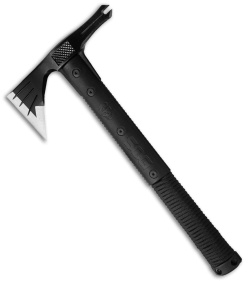
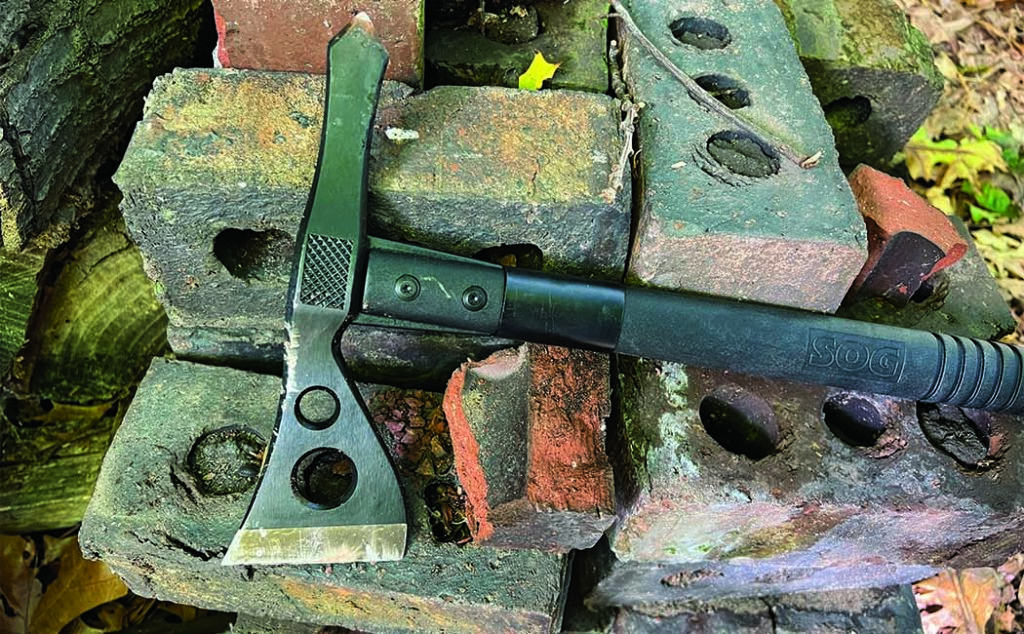
The SOG Pro Tactical Tomahawk is about as barebones as you can get while still being functional. Upon arrival it had a very sharp edge with a blunted, angular spike. The edge was covered in a transparent coating that flaked off during use. The balance of the hawk is excellent and, like the Estwing, has a modern, swept head with an upturned edge. It cuts deep, easily chops firewood, and is excellent for taking down branches. The overall shape and profile are quite minimal, a big plus across the board.
A major downside is the handle. While very strong, it’s rounded and the textured finger grooves don’t provide much extra grip. Because conditions were wet during most of the testing, it was difficult holding onto the handle if the swing wasn’t spot perfect. It wants to rotate in the hand and, while wearing a glove does fix some of that, it’s not an all-around solution.
The spike was functional but had a similar issue to the Cold Steel Trench Hawk in that once it punched through a material, it was hard to remove. For the price, it is an excellent working hawk. It could stand some improvement but should hold up quite well.
Pro Tactical TomahawkSpecs Blade Material: 420 HC Stainless Overall Length: 15.75 inches Edge Length: 2.75 inches Weight: 24 ounces Handle Material: Black Glass-Reinforced Nylon MSRP: $47.99
Editor’s Note: Dexter Ewing, Daniel Jackson, Josh Wayner, and Ryan M. Johnson contributed to this piece.