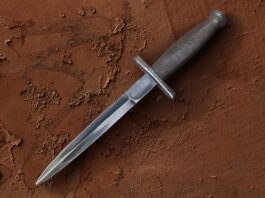
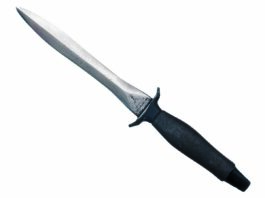
Knife History

The history of knives and other edged instruments is tied to the history of people in general. As humankind’s oldest tool, unraveling knife history can lead to even more surprising and enriching information to better understand the world.

Bayonets: An Iconic, Historic Blade

Few Blades Are As Historic As The Bayonet. The Knife Has Evolved Into An All-Rounder Still Issued By The Marines. 

Oddly enough, the history of the bayonet likely began in the hunting field, not the battlefield. By at least one account, the edged weapon was a tool of the French boar hunter in the 1500s. Tusks and a bad attitude, it’s understandable why these gents strapped their hunting knives to the muzzles of their muskets.

Soon after some enterprising soldier figured the invention–in original French baïonnette–might prove useful in warfare, and the iconic edged weapon was off to the races for the next four centuries. Presently, bayonets have essentially become military relics, if employed generally only as a training tool to acclimate soldiers to close-quarters combat.

Despite this, these fairly antiquated edged weapons still stir the imagination of military heroics of yore. Not to mention, in nearly all their versions, bayonets remain one of the coolest and most accessible historic edged weapons to collect.

In the article, we’ll look at some of the major styles of these modified edged tools, how the implement has evolved and who actually continues to make them. So gird your loins, we’re charging forward on bayonets.  

Major Bayonet Styles

A bayonet is so much more than just that. There were, and still are, several different designs of the implement, most mirroring the technology and ethos of war fighting of its particular era. 

Plug Bayonet

The plug bayonet is the earliest known bayonet and dates back to the 1500s or 1600s. The idea is rather simple. if you couldn’t use your gun to shoot or simply don’t have time to reload you turned to the knife. In this case, typically a double-edged dagger with a rounded handle that affixed the implatment directly in the muzzle of a musket barrel.

These earliest bayonets were really fully-fledged daggers in their own right. They lacked a proper pommel as can be imagined, but they could be used exactly like any other dagger. Most in this era were used in a manner of last resort. If a soldier found himself out of ammunition or facing a fast-moving enemy, he would likely want to put in his bayonet and hope for the best. 

The bayonet at this time was the product of changing warfare. While firearms were becoming more prevalent on the battlefield, they were slow to load. Additionally, the close-quarters combat of the medieval era still reigned supreme. In turn, soldiers required an option to hold off infantry and cavalry charges once their one shot was spent. 

Offset (Socket) Bayonet

While it may surprise some, the classic socket bayonet most think of during the flintlock era of warfare was not in full use by 1700. Attempts had been made prior to developing an offset bayonet allowing the soldier to load and fire with it attached. But it wasn’t until several critical battles in the late 1600s that evolution took hold. In particular, the battle of Killiecrankie in 1689. HereScottish Protestant forces were thoroughly defeated by Jacobite Scottish Highlanders, who charged and destroyed their enemy with broadswords and targes. 

This defeat came in part due to the plug bayonets the Protestants utilized. In what would be a rather ironic turn, the Scottish Jacobites would eventually meet their end and the end of their cause at the tip of the bayonet. Outfitted with socket bayonets at the Battle of Culloden in 1746, the British were able to let loose a point-blank volley on the charging Highlanders, then finish the rest with their bayonets. The British had even devised tactical doctrine for the use of the weapon, training to a charging man to their side, instead of in front to strike beneath his raised sword arm.

History Of The American Bayonet

M7 Bayonet
The M7 is a legendary American bayonet that is still manufactured today.

Americans were somewhat slow to adopt the bayonet in warfare, giving the British somewhat an edge in the early days of the Revolutionary War. Of course deadly in charges, attached to the British Pattern 1769 Short Land musket–or Brown Bess–the implement also was somewhat a psychological weapon. Said to be the most feared weapon of the British arsenal, the Red Coats mass assaults with a long, gleaming triangular knife at the end of their muskets made all but the most disciplined break.

The Continental Army proved a quick study once trained with the bayonet  by Maj. Gen. Baron von Steuben at Valley Forge in 1773. By the end of the war, there were even strokes of genius with the American use of the bayonet, such as when American Lt. Col. Alexander Hamilton (also the first Secretary of the Treasury) led a bayonet-only assault on redoubt 10 during the last days of the Battle of Yorktown. 

Early on, the Continental Army utilized a triangular socket bayonet similar to the British, however on the French Charleville Musket. But its use spread and the wicked device was eventually found on the Brown Bess–the most used arm of the Continental Army.

The bayonets in American service were standard European-style socket-mounted with triangular blades. This remains so through several iterations, including the Harper’s Ferry 1801 pattern, 1807 and 1810 Springfield patterns, M1816, and M1855.   

The M1855 served through the Civil War, where it saw extensive use on the Springfield rifle muskets. The .58 caliber rifle muskets loaded the same way as old muskets and could fire quickly and were very accurate and had substantial range. The bullets used in these guns had a hollow base that expanded into the rifling when it was fired, thus imparting spin. The war was devastating, and there were many bayonet charges, most with mixed results and high casualties. 

More accurate firearms and the introduction of repeating arms mitigated the effectiveness of the bayonet during the Civil War. It is estimated, only around 1 percent of all casualties were a result of bayonet wounds.

Sword Bayonet

sword bayonet
Pattern 1907 Bayonet. (Source: CC by 4.0)

Despite the effectiveness of “cold steel” assaults waning in the face of technological advancement, the bayonet persisted, though evolved to remain relevant.   

A more interesting detour around the time of the American Civil War, was the multi-purpose sword bayonet used by the British. The British Infantry Rifle of 1800–1840–later known as the Baker Rifle–utilized this style. The idea, essentially, was to give soldiers the ability to stave off cavalry charges when used as a bayonet, but also outfit them with a side arm–a short sword–for close-quarters combat. These sword bayonets had knife handles mated to exceedingly long blades, sometimes over 20 inches. 

Surprisingly, this style of bayonet was used all the way into World War I, despite little evidence the elongated blade provided any advantage. Perhaps the most famous final rendition was the Pattern 1907 Sword Bayonet, found on the British Short Magazine Lee Enfield rifle in the Great War. 

The American bayonets of the pre-WW1 era were a bit more well-designed. The bayonet designed for the American Krag rifle (the M1892), for example, had an 11.7-inch blade and could serve as a camp tool as well for daily chores. The Americans ended up following the Europeans’ lead in World War I a bit with the M1905 bayonet, which sported a 16-inch blade. Additionally, there were 17-inch versions used on the trench shotguns and backup rifles like the M1917 Enfield. 

Knife Bayonet

M9 Bayonet
The M9 bayonet works as a traditional bayonet but is more commonly used as a fighting/camp knife.

After WWI, most militaries of the world focused on making the bayonet in the form of a camp knife, something that was worth it to carry for general use that had more than one regular use. The time leading to WW2 produced the highly functional and realistically-sized M1 bayonet for the M1 rifle. The M1 carbine was also set up to use one, and it had its own small setup in the M4 bayonet knife. These knife-style bayonets eventually ran through several iterations leading up to the M7 bayonet for the M16 rifle in the late 1950s. 

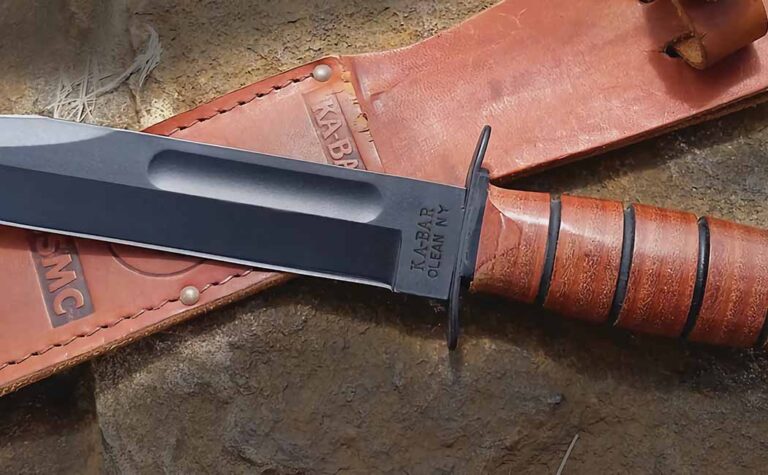
As a regular tool, the knife bayonet is great and doesn’t remove any of the function in either role. It can be used for all sorts of tasks and also be mounted on the gun. The later M9 became a full-on utility and fighting knife for the M16 series. It is a large, Bowie-style knife that closely resembles the Ka-Bar. It added some additional utility features like serrations for cutting straps and rope and a wire cutter. Later on, the OKC-3S knife bayonet was adopted by the USMC. These remain standard today. 

Bayonet Realities

The reality of the bayonet is that it is not a principle fighting weapon. Today we are seeing most rifles fitted with a mountain of accessories, from variable power optics, lasers, suppressors, and bipods. 

 The bayonet has, for most of its history, been a weapon of intimidation. Very few times did any two armies charge each other with bayonets, usually one side fled first. Even in our modern era there have been bayonet charges, but again to no effect other than to scatter the enemy. 

Edged weapons do have a role in modern warfare; everyone needs a good knife at minimum. If your rifle has no provision to attach one or you’re using a suppressor, there is no real need to carry a bayonet specifically as opposed to a dedicated knife that serves your purposes. 

Bayonets will always be a curiosity not because of how they were used, but rather why they were used well beyond their abilities. While it is certainly a dangerous thing and absolutely lethal, getting that close to your enemies means you’re having an exceedingly bad day. But, as history has shown, a man with a sharp stick and nothing to lose can sometimes win the day.

Read More

  • The M7 Bayonet: From Combat To Campsite
  • Best M9 Bayonet Options For The Civilian Enthusiast
  • Best Ka-Bar: Modern Options Of The Historic Knife
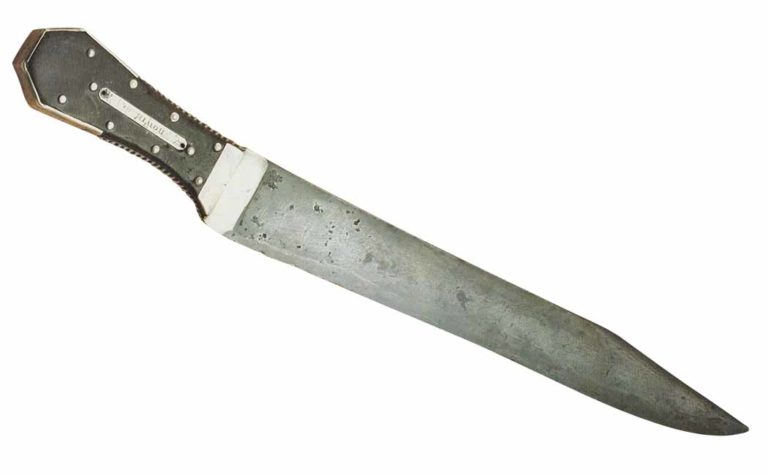
American Knives: Legendary Designs From The Land Of The Free

0

Are these the best American knives? Maybe, maybe not. One thing is for sure, these are some of the blades folk most associated most closely with the good ol’ USA.

If the knife isn’t man’s oldest tool, it’s probably a close second. It has been around in some form since time began. Styles, looks, form and function have steadily evolved, and even though the basics of a particular type may have originated somewhere else, there are those that are associated most closely with the good ol’ USA.

These are knife styles that the buying public, the collector, the factory, and the custom maker would probably associate with the United States more closely than any other country.

“You have to start with the time period when knives actually became ‘American,’” explained BLADE Magazine Cutlery Hall of Fame® member Bruce Voyles. “From the first settlers, the Spanish in Florida or the Vikings, every knife they brought to this country was made and came from somewhere else.”

American Designs Come Into Their Own

Voyles points to the truly American knife and says that the history of the country allows for a nod to the J. Russell Green River Works in the 1830s—the mountain man period when skinning knives were pretty much an enhanced version of the butcher knife—the epic sandbar fight that brought the bowie knife to the forefront, George Schrade and the introduction of the switchblade, and other examples of knives that are associated with America.

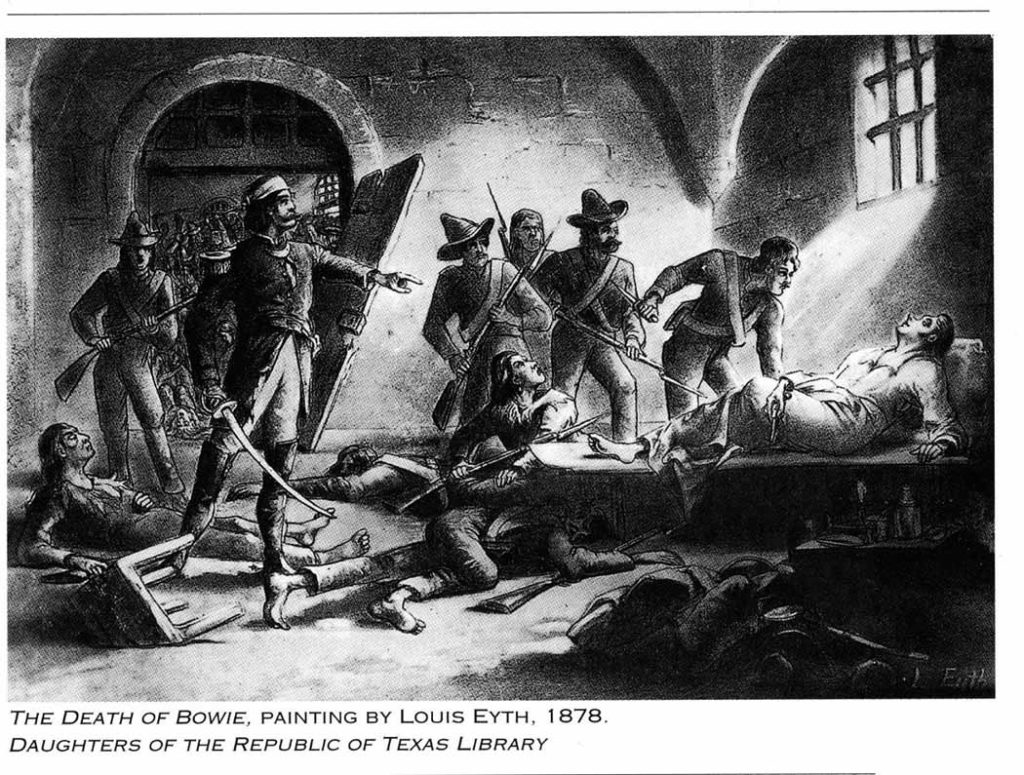
“Everything changed, and the cutlery world was turned on its ear when Jim Bowie got into a duel and that turned into a melee in 1827,” Voyles commented. “This happened across the river from Natchez, Mississippi, and you didn’t have good roads in those days. The rivers were the highways and when this happens, soon the story is heard in other river cities—New Orleans, Memphis, St. Louis and Cincinnati. Everybody hears this amazing story. Everybody wants a knife like Jim Bowie used, Bowie’s knife and then the bowie knife.”

Voyles related the story of George Schrade and the New York City patent office. “A guy comes in with something that looks like an automatic,” Bruce smiled. “George Schrade tinkers with it and invents the switchblade knife. He is the one that made it a production knife that people could afford. There were others around, but he got the patent on that style knife. Schrade kept tinkering with it, and he brought his brothers in and started Schrade Cutlery Company to produce George Schrade’s switchblades. So, now the modern American switchblade is truly an American knife, though the government banned it in 1958.”

In addition to his participating in the famous Sandbar Fight after which his knife became a sensation on both sides of the Atlantic, Jim Bowie also fought and died in the Battle of the Alamo.

There is, of course, with every innovation in cutlery or other endeavors, a ripple effect. And Schrade Cutlery is a great example as its knife production expanded and the brand became one of the most recognized in the world.

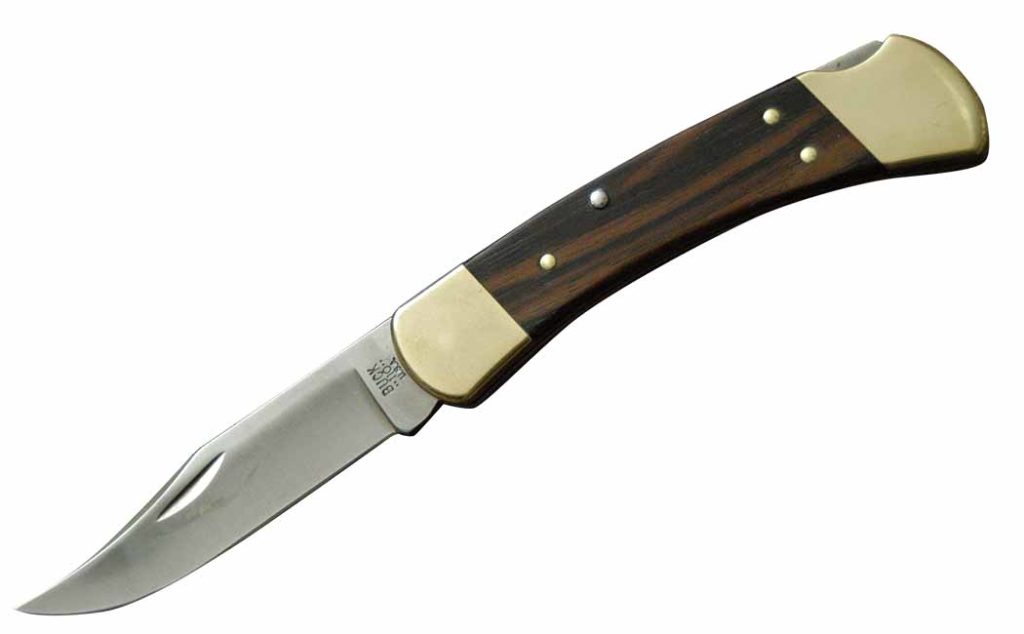
While folding hunters have been out there seemingly forever, Voyles categorically asserts that the Buck 110, which took the knife world by storm almost 60 years ago, is an American knife that deserves to be categorized all by itself.

“Nothing else looked like that knife when Al Buck made it,” Voyles reasoned. “The other lockback folding hunters looked like pocketknives, but I defy you to show me a look like the Buck 110 that existed any earlier. It’s an American style of its own because everybody copied it. The Buck 110 had different construction and sturdiness, and it was so distinctly different that everybody else copied it. The design was so different, and that is attested to by the number of people who copied it.”

According to Bruce Voyles, when Al Buck made the Buck 110 in the mid-1960s, nothing else looked quite like it.

Cutlery Hall-Of-Famer Dan Delavan of plazacutlery.com adds, “Americans have introduced a lot of different blades in the past, including the bowie, KA-BAR combat knife, the hollow-handle survival knife, as well as the basic Boy Scout knife. Each knife served a very basic function, from war to camp and basic scouting activities.

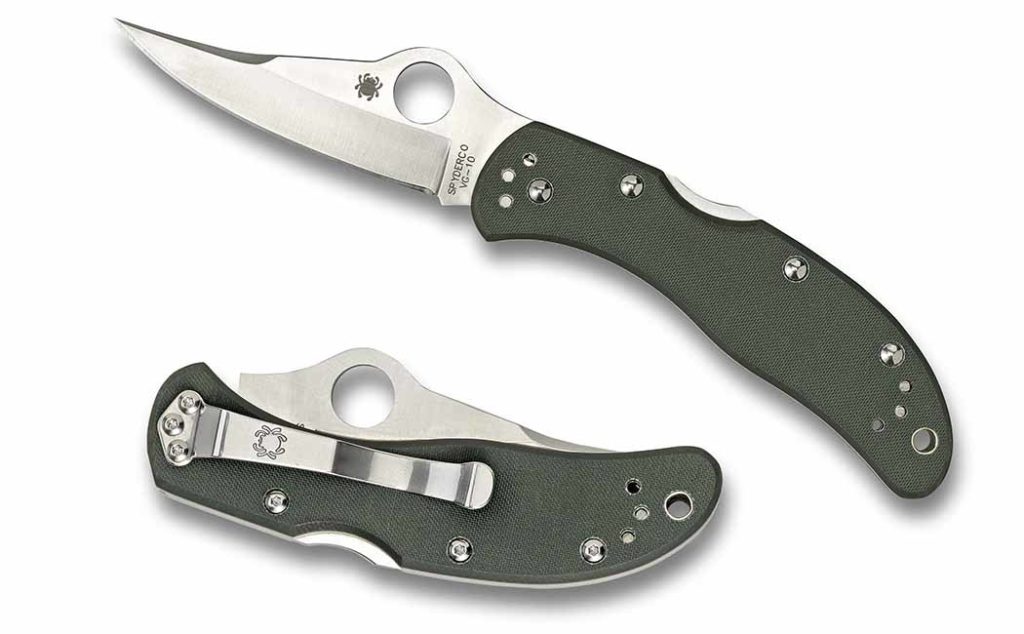
“I think the Spyderco hole is all American,” Delavan opined. “Sal and Gail Glesser came into my shop [the old Plaza Cutlery retail knife store in Costa Mesa, California] back at the very beginning with their folder with the pocket clip and the hole in the blade. They were doing county fairs at that time with their sharpener and introducing their knives. We bought on the spot and have been a lifelong dealer ever since. That has led to a lot of different openings for folders and remains a mainstay in the industry.”

While many may think serrations when they think Spyderco—and they would be correct—the most significant Spyderco innovations are the hole in the blade and the pocket clip. The Worker was the first Spyderco knife with those features, and it was reproduced in 2017 as seen here in one of the company’s sprint production runs.

Quintessential American Knives

Bowie

Historical or modern, vintage or recent, knives with that American flair are identifiable and recognized at home and abroad. Cutlery Hall-Of-Famer Goldie Russell of A.G. Russell Knives sees the bowie as iconic.

“The bowie knife is the quintessential American knife,” she noted. “It is believed that the first was made for Jim Bowie in the blacksmith shop of James Black* in south Arkansas. [Bowie knives] became so popular that they were manufactured by Sheffield cutlery factories for the American market.”

Fixed Blade Hunting Knives

Russell goes on to raise the work of Cutlery Hall-Of-Famer Bob Loveless and his fixed-blade hunting knives to the top as well. “Bob Loveless forever changed the style of the hunting knife with his drop-point, semi-skinner and utility blade shapes, with the drop-point hunter being the most popular,” she continued. “The influence these knives have had on the world knife market includes not just the blade shapes, but also the shaping of the handles to better fit the hand. These models have clearly influenced the shapes, look and feel of knives made by generations of knifemakers, and will continue to do so for decades to come.”

Bill Moran’s Mark

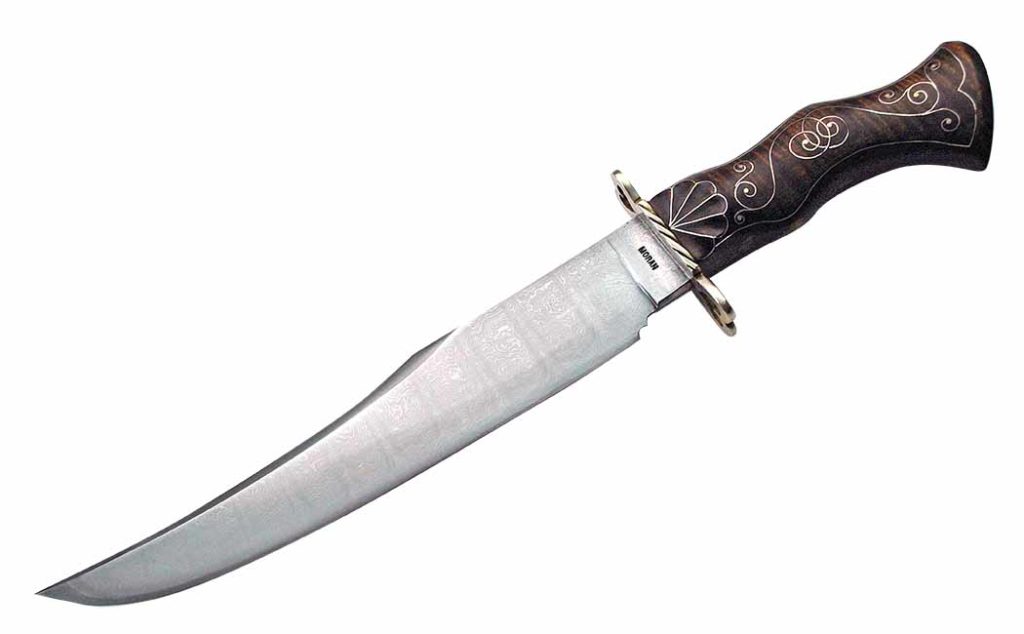
Bill Moran’s statuesque ST-24 not only paved the way for knives of carbon damascus in the 1970s and beyond, but subsequent models in mosaic and stainless damascus as well. (Dave Ellis image)

Also influencing generations of knifemakers were the many camp knives, bowies, fighters and other fixed blades forged from the damascus steel reintroduced by Cutlery Hall-Of-Famer Bill Moran in the early 1970s. Moran’s damascus knives set the stage not only for a plethora of standard carbon damascus knives but also later for stainless damascus and mosaic damascus knives.

Multi-Tool

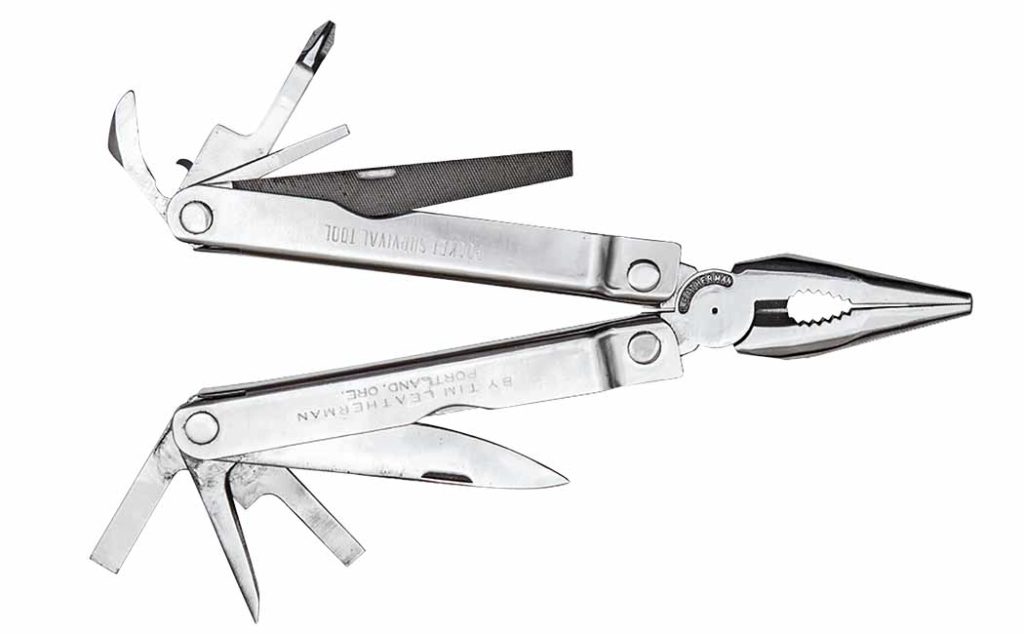
Tim Leatherman holds the multi-tool (also inset) that started it all: the original Leatherman tool, the PST (Pocket Survival Tool).
Tim Leatherman holds the multi-tool that started it all: the original Leatherman tool, the PST (Pocket Survival Tool).

Then, there are the variations on a theme. The multi-tool, for some a knife and for others something totally separate, has nonetheless influenced the cutlery market and is among those chiefly American styles.

“Tim Leatherman’s inspiration in the design of the first Leatherman tool created an entire category in the world of knives,” Goldie Russell explained, “but also in the tool industry. Most construction workers, farmers, carpenters, forestry workers and many other segments of our society carry a multi-tool every day. Those who are not carrying one will usually have one in their toolbox.”

American Knife Innovation

Linerlock

Inventiveness, in itself, is not uniquely American. However, at times the original has the potential for improvement, and just as Schrade improved the switchblade, Cutlery Hall-Of-Famer Michael Walker revolutionized what would become the linerlock.

Cattaraugus made a pocketknife with a brass spring/lever that helped prop the blade in the open position. “Walker changed the design so that when the lever locked it kept the long, clean lines of the knife,” Voyles observed. “The bottom side of the blade is blocked, and the big bump there has got something to hold onto. Walker’s lock does not block the bottom of the blade. It blocks the butt end of the tang. Michael didn’t patent it†, and every major manufacturer in the world has knocked it off. Nobody thought it would have such an impact. However, any knife with a locking liner is an American knife because it was an American innovation that did it.”

Russell echoes the sentiment that Walker’s linerlock was revolutionary and an American innovation. “Michael Walker’s genius of replacing the slip-joint spring with the ball detent spawned the entire generation of modern EDC knives,” she added. “His innovation allowed a portion of the liner to be utilized as a locking device. The idea caught on quickly with handmade knifemakers and has now become an integral part of the manufacturing process for almost every manufacturer of knives. This method of creating a locking folder has made knifemaking much simpler, with much less skill necessary to make an excellent functioning knife.”

Tactical Folder

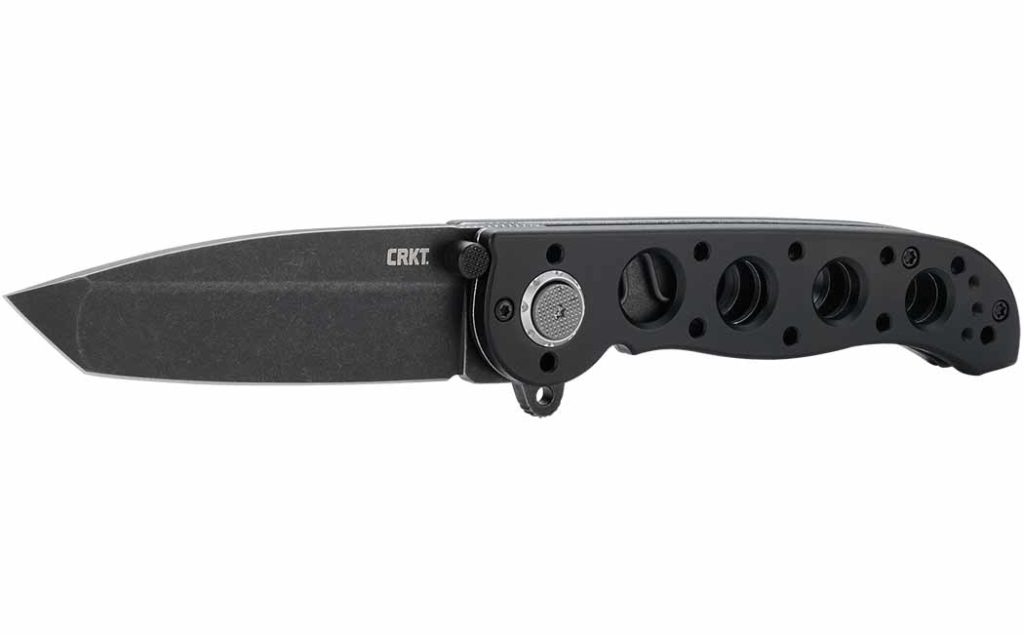
One result of Kit Carson’s popularization of the flipper folder is his long-running series of M16 flipper folders for CRKT. Among the latest iterations is the M16-02DB. In addition to being a flipper folder, the original M16 also was among the earlier top factory tactical folders.

The tactical folder took the world of knives by storm in the mid-to-late 1990s, offering a one-hand folder—usually black—with a non-glare stainless steel blade, a synthetic handle, a linerlock and a pocket clip. While some called it more a marketing approach than a knife, the fact that the folder dominated the market for at least a decade if not longer cannot be denied.

Flipper Folder

Searching her memory and experience, Goldie Russell also identifies the flipper folder popularized by Cutlery Hall-Of-Famer Kit Carson and the SpeedSafe assisted opener by Cutlery Hall-Of-Famer Ken Onion as innovative, influential styles that the world associates with the United States. “When combined with the Walker linerlock, the Carson flipper adds the ability to open the knife as fast, or faster, than a switchblade knife,” she remarked. “It’s a clear improvement over the stud or hole in the blade for the purpose of one-hand opening. The use of the flipper as an opening device has become prevalent throughout knifemaking across the world.

“Then, Ken Onion’s addition of a spring to launch the blade open** is another American innovation that has changed the landscape of the knife industry,” she concluded. “Nearly every American brand utilizes some variation of Ken’s way of using a spring to open a blade quickly. The genius was the bias toward closure that kept a folder from being deemed an automatic.”

Rambo’s Influence

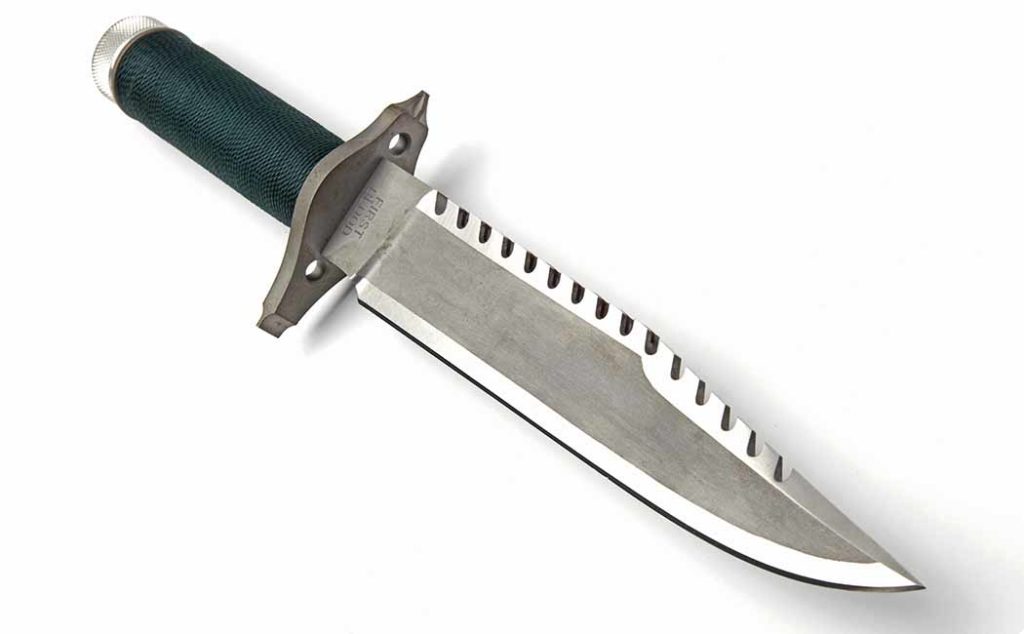
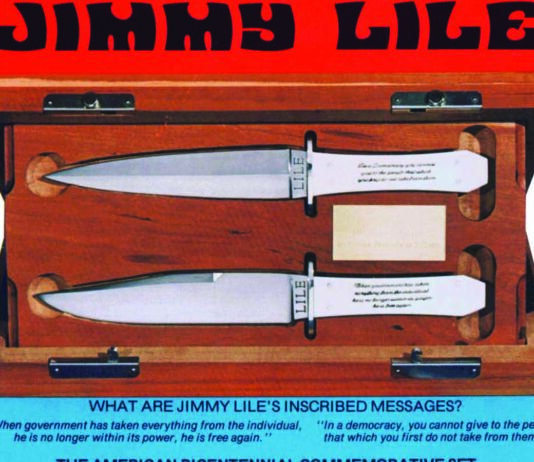
Jimmy Lile’s Rambo knives started the hollow-handle-survival-knife craze that dominated the 1980s and beyond. (from the Randy Rousseau collection)

As the Rambo film franchise grew in popularity during the 1980s, the work of Cutlery Hall-Of-Famers Jimmy Lile and later Gil Hibben made the knives in those motion pictures stars in themselves, rivaling Sylvester Stallone for worldwide acclaim. Voyles insists that the Rambo knife is an American phenomenon that still impacts the knife market today.

“The Rambo knife is uniquely American for two reasons,” Bruce said. “Jimmy Lile designed it and made the knives for the first two movies, and it ignited a boom in survival knives that exists today. Then, the other historical tie-in is that in the 1980s every boy who could walk had a survival knife with a big, round compass on the end and a hollow handle. Even today, those boys are adults and they love the nostalgia of that handmade Rambo knife. Indirectly, Jimmy Lile created all this, and the Rambo knife is uniquely American in that regard.”

Final Cut

Considering the knives closely associated with the United States, their impact is obvious. Those styles associated with the good ol’ USA still resonate across the market and in the inventive minds of those who brought them into being.

*Editor’s note: While many do indeed believe that James Black made a knife for Jim Bowie in Black’s shop, such a knife has never been definitively proved to be as such because Black did not mark his knives.
†Though unable to obtain a patent on the linerlock, Walker was able to obtain a trademark on the name linerlock, a trademark that has since elapsed.
**Cutlery Hall-Of-Famer Blackie Collins also made one of the first versions of an assisted opener.

More Knife History:

Antique Switchblades: World War II And Beyond

Harking back to American military glory and post-war prosperity, antique switchblades from the 1940s and 1950 have enduring appeal.

From its first patent in 1884, the switchblade was an important addition to most early U.S. cutlery companies.

According to Mark Erickson, author of Antique American Switchblades, between 35-to-40 companies made and/or sold switchblades, including almost all of whose names long-time collectors recognize: Aerial, Camillus, Case, Challenge, Colonial, George Schrade, KA-BAR, L.L. Bean, Novel Shapleigh Hardware, Queen, Remington, Schrade Cutlery Co., Utica, Wade and Butcher, and Shapleigh Hardware, to list a few.

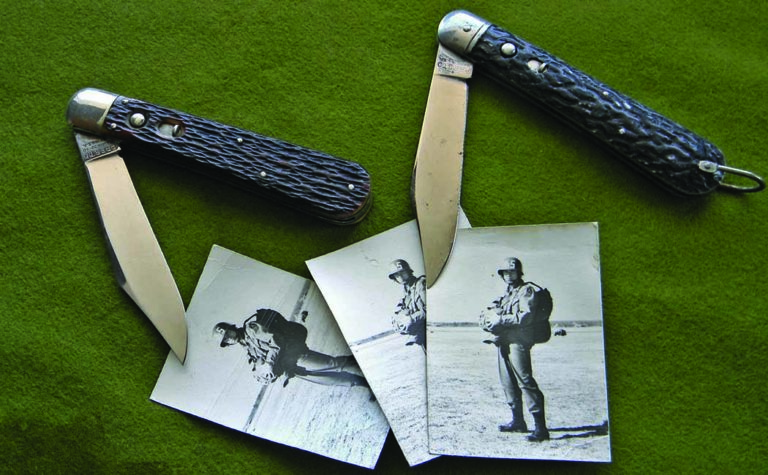
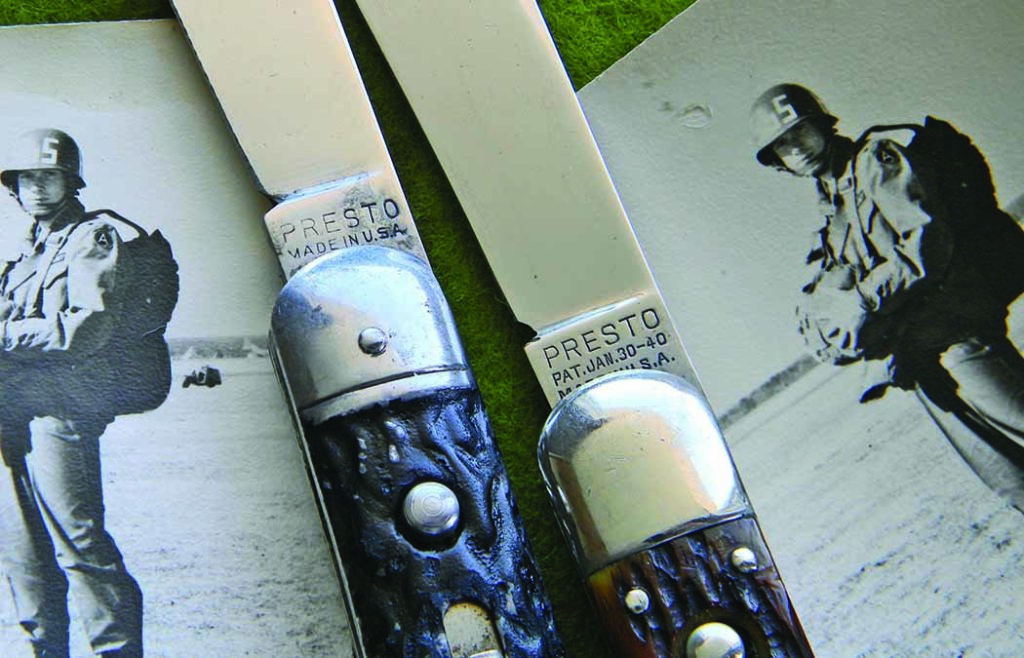
 These two switchblades with the Presto stamping by George Schrade Knife Co., are among those that played an important part in the success of American paratroopers during World War II. On the facing page, the one at left has “jigged iron” scales and the one at right has jigged bone.
These two switchblades with the Presto stamping by George Schrade Knife Co., are among those that played an important part in the success of American paratroopers during World War II.

Because of the collectibility of the named companies and the significant variety of styles, sizes and handle materials associated with them, switchblades have become a serious endeavor for many collectors of antique knives.

Invention Of The Switchblade

As a serious cutlery collector, my downfall has been fingernails that bend backward with even the smoothest opening blades. The switchblade innovators had fingernails in mind when they produced a knife that could be opened without using a nail. In fact, some of the best switchblades are found in women’s old sewing baskets.

In fact, early switchblade ads tout the folder’s ability to be used by people with weak fingernails. “These knives will be a wonder for those who have difficulty opening a traditional knife” stated one such ad.

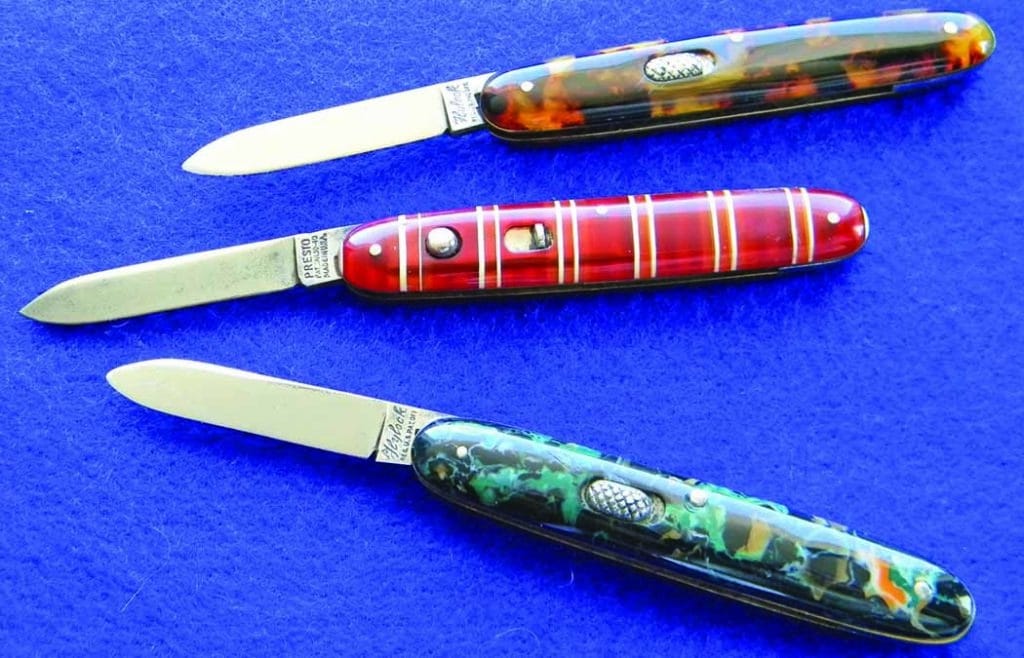
Celluloid was a very popular handle material on antique switchblades. Celluloid types, from top: a George Schrade in imitation tortoise, another George Schrade model in candy stripe, and one from Flylock Knife Co., in blue, pink and black swirl.

For many other occupations, the switchblade and its ability to be opened with one hand has proven immensely important. Mechanics, fishermen, ranchers, soldiers, veterinarians and even Boy Scouts were frequent users of the pocketknives. With a wiggling fish in one hand, it is easy to see how a switchblade could be a valuable asset to most fishermen when cutting a line.

Moreover, most switchblades have a lock/safety that keeps the blade from opening accidentally and the open blade from closing on the hand. An early Flylock Knife Co. ad touted, “The ideal knife for all outdoors and sports use. One hand only required to open or close, leaving the other hand free to grip a rod or gun.”

World War II Switchblades

World War II brought with it the necessity of supporting soldiers who parachuted behind enemy lines. Switchblades procured for the U.S. military were designed to cut the parachute suspension lines that became entangled during landing. The knives were carried in what has been described as “neck pockets’ in jump uniforms.

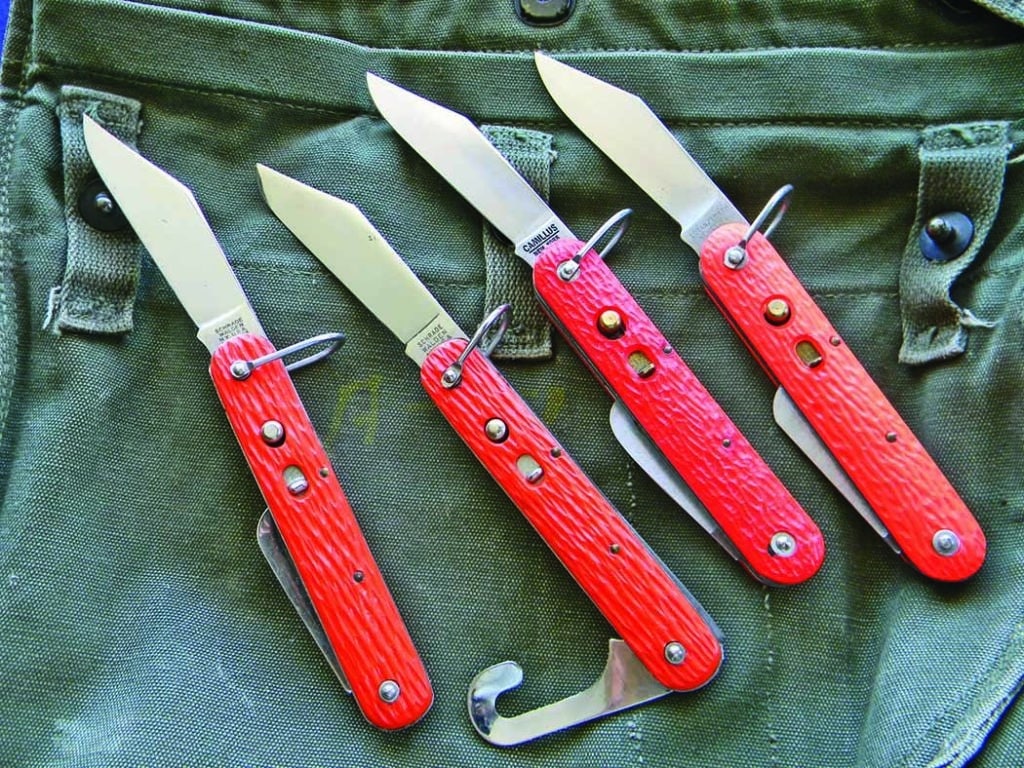
Military switchblades designated “MC1” included models in orange handles for heightened visibility. They were made by Schrade until 1960, when Camillus took over the contract. The knives have a master blade opened by a push button and a manual shroud cutter.

There are continuing discussions about the knives specifically made for and used by the U.S. military during the war. The discussions center around whether switchblades issued to troops all had jigged bone handles or jigged metal sides. Another discussion is whether all switchblades used by paratroopers had a bail—known in the military as a “lanyard staple”—or whether knives without bails also were used.

Units that used the knives included paratroopers in the 82nd Airborne and 101st Airborne Divisions, which included the 505th, 507th and 508th parachute infantry regiments. The 505th Infantry Regiment website shows switchblades made by Schrade Cutlery Co. stamped “Presto” with jigged bone handles and metal handles made to look like jigged bone painted black. Knives both with and without bails are included in the photographs. Switchblades made for World War II paratroopers also include those stamped Schrade-Walden and Schrade Cut. Co.

The book, 4 Stars of Valor: The History of the 505th Parachute Infantry, describes the equipment carried by paratroopers. In addition to main and reserve chutes, full uniform and helmet, the paratroopers carried over 70 pounds of equipment, including an M-1 carbine with ammo, Mae West life jacket, switchblade, water-filled canteen, trench knife, fragmentation and smoke grenades, mess kits, three days of K rations, escape map and compass, gas masks, toiletry items, 30 feet of rope, blanket, half a shelter and first-aid kit.

Post-War Military Switchblades

After World War II, several companies made switchblades for military personnel. According to one website, the first such knife was produced for the armed forces by Schrade Cutlery Co., designated as MC-1, an airman’s paratrooper knife, in 1957. Sometimes the knives are referred to as aircrew survival knives.

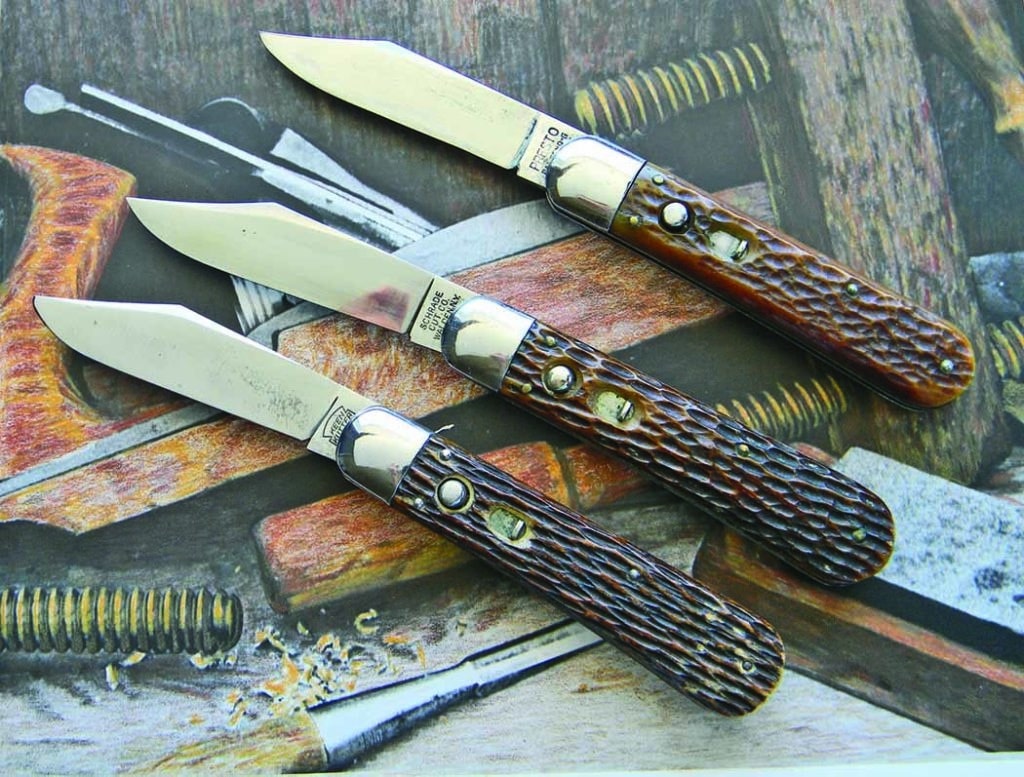
Three jigged bone switchblades, from top: Schrade Cutlery Co., George Schrade Knife Co. and one of the rarest of antique models, one stamped “Keen Kutter,” a trademark of Shapleigh Hardware. Schrade made the knife.

The first contract was awarded to Schrade Cutlery followed by a second contract to Camillus, and a third to Logan-Smyth. The orange-handle switchblades had two blades: one a master spear pattern opened by depressing the button, and a second blade shaped like a hook to cut parachute suspension lines. In my estimation, the hooked blade is not sharp enough to easily cut parachute lines and must be resharpened.

Civilian Switchblades

The early 1950s brought a renewed interest in cheap, colorful switchblades, with thousands of knives made by Imperial in its Jack-O-Matic Texas toothpick model, and Colonial, which used the Shur-Sharp stamp on its colorful models. The fishtail jackknives and the Texas toothpick styles were by far the favorite examples produced by the two companies.

The George Schrade Knife Co. continued to produce popular switchblades with celluloid handles stamped Presto. The knives were made with a single blade, double blades (the latter with a push button for each blade) and even a letter opener with a push button in one end.

Celluloid Handles On Antique Switchblades: Why?

The handle material for most of the inexpensive switchblades was celluloid. Thin sheets of the versatile plastic-like substance were molded around the knife’s metal sides. The most popular celluloid style was candy stripe. The knives also can be found in a wide variety of swirled celluloid handles in a myriad of different color combos, some with such recognizable celluloids as cracked ice and imitation tortoise.

Because the knives were inexpensively priced, they were extremely popular with boys in the 1950s. Because of the knives’ widespread use, some advertisers saw an opportunity to emboss various ads on them, giving them away as a novel company promotion gimmick.

Allure Of Antique Switchblades

Because of their connection with the heroic actions of airborne troops during World War II, antique switchblades have continued to be a popular cutlery collecting niche. Moreover, since almost three dozen companies, each producing a vast array of sizes and handle materials, made the knives, the collecting field is wide open.

Even in the 1950s cheap construction, made more evident by the continuous opening and closing of the blades, the knives remain popular collectibles. No doubt one reason for the popularity is that antique switchblades remind many of the Golden Age of the 1950s and ’60s when kids played outside all day, shot their BB guns, and hit the corner gas station for a cold soda and a candy bar.

Ah, those were the days!

More On Switchblades:

4 Best Dirks: Modern Versions Of The Historic Knife

The Dirk Has A Long, Exciting History And Has Been Used For Everything From Farming To War All Around The World.

The general definition of a dirk is that of a one-handed thrusting knife. Depending on region and style, it may be single-edged or double-edged. It also may or may not have a defined cross guard and pommel. 

Dirk as a term is loosely associated with several Scottish and English regions. It is most commonly credited to the former, though no one really knows for sure, and it also has a long history of use across medieval Europe. It was a very important object to people in the Highlands of Scotland at an individual level and had significant ceremonial and practical uses.

Weapons Before The Dirk

As is common in the era of gunpowder in Europe, many types of knives and daggers owed their roots to the bollocks dagger and other stabbing weapons that originated hundreds of years prior when soldiers wore heavy armor. Contrary to popular belief, most swords are not like how you see in the movies. These stabbing and thrusting weapons seldom had what we’d expect as edges, rather they were made to parry and bludgeon. Maces, picks, and hammers were very common in this time, prized for their ability to bash and smash, where swords, while deadly, were not always the first choice. 

These long, thin daggers were sometimes the choice when things got up close and personal, though even then the textile layers of armor were hard to penetrate. All that changed with gunpowder weapons causing a wide decline in armor use, and the dirk as we know it today was the product of that evolution. The dirk became something quite different than other edged weapons of the time and developed in its own way, largely apart from other European designs. 

The Scottish were some of the first to begin independent development of swords and daggers alongside guns in the post-armor age along with strategies to fight against firearm-equipped soldiers. The heavily tribal Scottish Highlands were not especially invested in standardized firearm technology. 

Guns did figure heavily into the culture, but the Scottish never developed a well-oiled machine akin to what the British developed when it came to battles. The Scottish had two primary tools for the battlefield, the broadsword and the targe (buckler), itself a small shield held in the weak hand. The combination of buckler and broadsword allowed the Highlander to easily kill British soldiers, usually armed with nothing more than a musket and bayonet. 

They specialized in fast ambushes, often called a ‘Highland Charge’ where they wore virtually no protection of any kind and ran headlong at their enemy. If the enemy didn’t flee on sight, they would only have one shot at most before they had to fight hand-to-hand. 

How The Dirk Developed

windlass dirk
The dirk traces its lineage to the Scottish Highlands.

The dirks developed in the post-armor era became focused on all-purpose use, not just stabbing or bludgeoning. As a result, sharp, light-bladed swords and short-sword like knives and daggers became the norm. 

Slashing through clothing wasn’t difficult and the Highlanders found themselves at a distinct advantage using these tactics. That is, until the Battle of Culloden in 1746. 

Here the entirety of the Highlander army was soundly defeated by the British in a battle that lasted an hour. The British faced them on an open field and modified their tactics to anticipate the Highland Charge, resulting in a complete defeat of the Scottish Jacobite movement that had made an invasion into England a year earlier.

Dirks were common even after Culloden. The carrying of knives wasn’t necessarily seen as carrying arms in most cases, and dirks were something of a common, everyday tool for most people. They would be not only used for self-defense but also for regular tasks like eating, splitting kindling, and standard daily chores.

Dirks vs Daggers

Is the dirk a dagger? The short answer is yes and no, and that is because there is a great degree of ambiguity in the definition. A dirk is classically a large, single-bladed knife with a blade anywhere from 12 inches all the way up to 20 inches.

Naval dirks were commonly used for ship-to-ship fighting as they were short enough to be used in tight confines yet large enough to still be effective. Daggers at this time would have been primarily understood to be stabbing weapons, whereas the dirk was large enough and stout enough to be used in a primary slashing role. 

Daggers are, by type, geared mostly for stabbing. Rarely do companies refer to any large, single-edged knives as ‘daggers’, but the dirk is often classified right alongside them by name in many laws.

The American dirk which evolved in the early 1700s, was almost always single-edged and was primarily used as a support knife alongside the tomahawk and rifle. It could be said that a significant and wide-ranging number of knife styles, including the Bowie, evolved directly from the Scottish dirk on the American frontier.

Daggers as stabbing knives were somewhat uncommon in America because they lacked general utility in the field at a time when larger camp knives and multi-purpose tools saved weight. 

Is It Legal To Own A Dirk?

Unfortunately, Dirks have a wide legal definition across the board that often describes them as daggers or stabbing weapons. In many municipalities, this type of weapon is not legal to carry. There is a blurred line in this definition, as many places considered double-edge, stabbing weapons as the verboten item. As many historical dirks are single-edged, there could be room in these laws that skirts one definition or another.

4 Best Dirks Available Today

COLD STEEL SCOTTISH DIRK- $119.99

cold steel dirk

Cold Steel is well known for making some very durable and interesting products. They pay great attention to detail and their Scottish Dirk is no different. While it is not the most costly, it is a step above the rest, and it is affordable and backed by Cold Steel’s legendary standard of excellence. The Cold Steel Scottish Dirk is a working tool that does everything the historical versions did and then some. If you’re looking for a hard-use dirk, look no further.

Knife Specs

Overall Length: 18.38 inches

Blade Length: 13 inches

Weight: 1 pound

Blade Steel: 1055 Carbon

Handle Material: Rosewood

WINDLASS BONNIE SCOTTISH DIRK- $149.00

windlass scottish dirk

If you’re looking for a prettier dirk than the rest, Windlass makes some excellent historical replicas that reflect various periods of Scottish history. The Bonnie Scottish Dirk is reminiscent of the late stage of refinement on these weapons. It is ornate yet functional and is sure to be a conversation starter. While other companies tend to take some liberties, this is a very accurate replica of what may have been on the belts of Highland Warriors at the Battle of Culloden.

Knife Specs

Overall Length: 17.5 inches

Blade Length: 11.75 inches

Weight: 18 ounces

Blade Steel: 1055 Carbon Steel

Handle Material: Wood

WINDLASS EARLY SCOTTISH DIRK- $139.95

early dirk

This product is a replica of some early dirks as they would have looked descending from the bullock dagger. A functional reproduction, this early replica features a more basic feature set as would’ve been seen a few hundred years prior to the Battle of Culloden. Although it has unrefined features, it is still not out of place for costuming or period reenacting.

Knife Specs

Overall Length: 21.25 inches

Blade Length: 15 inches

Weight: 16.2 ounces

Blade Steel: 1055 Carbon Steel

Handle Material: Hardwood

CAS IBERIA (LEGACY ARMS) SCOTTISH DIRK- $159.00

CAS Iberia dirk

This dirk has some classic lines, but is all about function. It will not look odd at a cultural event, although it is made with a slight skew to the modern. The handle design is reminiscent not of the bullock dagger, but the earlier Rondel form characteristic of the late medieval era prior to the renaissance. While it is the most expensive so far on the list, it is right in the same price range as most common dirks. If you prefer this look over the more classic Scottish design, this is the one for you.

Knife Specs

Overall Length: 18.25 inches

Blade Length: 12 inches

Weight: 1 pound, 8.5 ounces

Blade Steel: 5160

Handle Material: Synthetic Material

Read More

Samurai Chef’s Knives

Few Knives Have Been As Heavily Influenced By Japanese Methods As The Chef’s Knife. These Four Quality Blades Show Off The Modern Meeting The Historic.

The Japanese influence on custom knives is everpresent in the marketplace, and, aside from the tanto, nowhere is its flair and focus felt more than with chef’s knives. 

These tools of the culinary trade are functional as much as they are eye-catching, especially in examples of some of the top makers in the genre today.

Honyaki Byuto Hybrid By Dmitriy Popov

Popov Gyuto hybrid
Dmitriy Popov aligned the tip with the spine on his wide-bevel Honyaki Gyuto Hybrid for enhanced control during jobs requiring precise use of the tip. (SharpByCoop knife image)

Dmitriy Popov has conjured up a masterpiece he calls the wide-bevel Honyaki Gyuto Hybrid, a new take on a recognized Japanese style. 

“It isn’t a traditional gyuto, as it has an upswept tip and the height of a nakiri,” he commented. “Having the tip aligned with the spine of the knife gives the user a feeling of control for precise tasks requiring use of the tip. Having the extra height in the heel allows me to create a knife that is super thin behind the edge while also having a significant amount of mass above it.”

Popov’s creation includes a near 9.5-inch blade of differentially heat treated W2 tool steel and a handle combination of desert ironwood and osage orange complemented by a carbon fiber liner. His prices for similar knives range from $900 to $2,500 based on size and materials.

“The hamon and ashi* I am able to get out of the W2 is mesmerizing,” Dimitriy added, “and I spend a large part of my life going deep down the hamon rabbit hole. Honyakis are part art and part science, and the failure rate is a lot higher than I would like it to be. I really like the minimalist wa handle style [see page 14], and rounding off the bottom facet does not alter the traditional design much, while making the handle more comfortable in the hand.”

Having made knives since 2011, Dmitriy looks back at the beginning in everyday carry, tactical and camp models. After three years, he gravitated toward chef’s knives, and since 2016 they have been his sole focus.

“Everyone cooks, and at some point most cooks or chefs will come to appreciate the benefits of a good quality knife,” he observed of a chef’s knife field that has become quite crowded. “There are way more prospective customers than there are makers, so to succeed as a maker all you need is a very small slither of the pie and a drive to evolve your craft each day.”

Santoku-Style Knife By Eric Hemker

Hemker santoku
The long, nearly flat cutting edge of the damascus santoku by Eric Hemker enables it to slice, dice, and mince vegetables much easier than a blade with a sweeping belly. (SharpByCoop knife image)

While Eric Hemker admits he is still learning some subtleties of making chef’s knives, he has found that the santoku style is excellent for use in final food preparation. 

His custom-ordered version sports an 8-inch blade of random-pattern damascus forged from 1084 carbon and 15N20 nickel-alloy steels. The overall length is 14 inches, and the handle is exotic blue-dyed curly mango. His price for a similar knife is $960.

“The lack of a pointed tip on the blade means it is not well suited for delicate carving work such as breaking down bony proteins,” Eric explained. “However, its long and nearly flat cutting edge allows it to slice, dice and mince vegetables and proteins much easier than a knife with a sweeping belly on the cutting edge.”

Translating literally from the Japanese, santoku means “three virtues, or three uses,” and so the slicing, dicing, and mincing description is spot on. 

“This blade is 144-layer random-pattern damascus, and it features a full flat grind with a convex edge. The flat grind is my usual go-to grind for most general-purpose cutting needs that are common in the kitchen or in hunting-type knives. I also add a slight convex grind that leads into the cutting edge to aid in food release.”

Eric chose a modified wa handle configuration and attributes the decision to keeping step with traditional Japanese appeal. 

“The top of the handle has the traditional wa-style octagonal facets,” he said. “But I wanted to spruce this handle up a little to challenge myself, so the bottom is curved to give it a shield-shaped cross-section. The handle has a 304 stainless steel bolster and an heirloom-fit black G-10 spacer. One of the only things the customer specified was a colorful handle, so this piece of wood was a perfect fit.”

For Eric, the entire package comes together nicely, blending the good looks and function that are inherent in Japanese-inspired chef’s knives. 

“All these materials will hold up well in kitchens,” he remarked. “G-10 is a synthetic material that also holds up very well in any harsh environment, and since the wood is stabilized it should also hold up well in water and getting dirty in general. Since the handle is wood, it would still need to be oiled occasionally, and it should go without saying that a custom piece like this with a carbon steel blade and a wood handle should never go in the dishwasher.”

Eric began making knives six years ago and still considers himself at the beginning of a promising journey. 

“Kitchen knives have been some of my favorite knives to make from the beginning because everyone uses one,” he noted, “so they are some of the easiest pieces to sell and get feedback on.”

Meanwhile, he welcomes the expanding number of makers and buyers in the chef’s knife arena. 

“I don’t believe the custom chef’s knife market is overly saturated by any means,” he commented. “I think the demand really drives the market for these custom pieces, and I believe there will almost always be customers at every price point. In the last decade or so, there really has been a resurgence of demand for well-crafted handmade goods in almost every category of consumer goods, and I don’t believe that trend is going to be dying out anytime soon. This may be especially true for culinary knives when food is such a big part of many people’s lives.”

Straight-Edge Kiritsuke By Dre Laborde

kiritsuke by Laborde
The straight-edge damascus kiritsuke by Dre Laborde is specifically made to slice fish and some softer meats. The handle is curly maple from Realeyezwoodz. The sheath is stabilized maple and a joint project between Dre and Realeyezwoods. (SharpByCoop knife image)

The straight-edge kiritsuke from Dre Laborde is specifically made to slice fish and some softer meats, he says, and doesn’t necessarily lend itself to chopping vegetables. 

“I’m no expert on Japanese knives as a whole,” he noted, “but from what I can find the kiritsuke seems to be a cross between the longer yanagiba and the stockier gyuto. The steel is X-pattern-ladder damascus that I purchased from MVH Damast based in the Netherlands. These steels have given me nothing but positive results and I can’t recommend them enough.”

The blade is 9.5 inches and the overall length is 14.5 inches. The handle is curly maple from

Realeyezwoodz, and the price of a similar knife would probably exceed the featured piece. 

“It sold for $760,” explained Dre, “but it was a semi-experimental project for me, so a future project of this scale would cost more. The design, like all my knives, was drawn on paper to scale first and then made with the freedom to change the design as I see fit.”

The choice of handle material and design contributed to the overall appeal of the knife and its performance in the kitchen. 

“The wood is stabilized, which means it was put under vacuum in a resin and hardened,” said Laborde. “This makes it resistant to water and to staining. The handle design is a slight variation on the common shape I do, made slightly longer to fit the length of the knife.”

Dre has been making knives for about three years and in that time hasn’t seen the chef’s knife market becoming overcrowded, though he has heard such comments. “Those willing to pay for a custom chef’s knife often have many and recognize the price tag that comes with them,” he added.

Haetori Honesuki By Tony Cetani

Haetori Honesuki by Tony Cetani
The Haetori Honesuki by Tony Cetani is an all-around kitchen utility knife design based on the santoku and honesuki, the latter a Japanese boning knife. Whereas a traditional honesuki’s main task is for deboning poultry, Tony made the Haetori Honesuki to handle multiple kitchen jobs.

When Tony Cetani built his Haetori Honesuki with a 5.5-inch blade of Chevron copper-mai steel and an 80CrV2 core from Baker Forge and Tool, he added a handle of spalted box elder to complete the package and priced it at $1,000.

“Haetori means ‘jumping spider’ in Japanese,” he related, “and following my love for spiders this knife is named for the Haetori Gumo, a very common spider in Japan. It’s an all-around kitchen utility knife, and I based the design on the santoku and honesuki. Whereas a traditional honesuki’s main task is for deboning poultry, I made this to handle multiple tasks around the kitchen.”

Tony has been making knives since 2017 and tried chef’s knives for the first time three years later. 

“Once I got a few kitchen knives under my belt, I fell in love,” he smiled. “I wanted to put kitchen cutlery on the market that was different and not your traditional kitchen-style knives.”

He succeeded with this effort and chose a slightly innovative handle style. 

“This is a newer style that I designed specifically for this knife,” he said. “Adding a clip at the butt of the tang gives the palm a comfortable spot to rest when working the knife. I chose natural spalted box elder because it went well with the copper in the steel, and you can’t ever go wrong with box elder!”

As for today’s chef’s knife market, Tony sees strong demand and the capacity to supply it. 

“There are a lot of makers out there putting out phenomenal chef’s knives. I think every maker has their style, and the style is what grabs the attention of a potential customer.”

*Ashi are various notches or details in hamons. To produce ashi, the maker applies thin strips of clay from the spine of the blade to the edge during the clay tempering process, which contributes to interesting variations in the resulting hamons.

Read More

The Navaja: A Spanish Gem

The Navaja Is A Sleek, Svelte Folder Originating From Spain Hundreds Of Years Ago. Today It Remains Popular In Both The Real And Digital Worlds.

The Navaja is one of the most interesting knives in the world. Its history can be pinpointed to the Andalusia region of southern Spain, and its growth and evolution since its creation more than 400 years ago has been well-documented. 

The History Of The Navaja

The first Navajas that resembled the modern version came to be in the 1600s. The name is derived from the Latin word “novacula” which means razor, and you can see the resemblance to a straight razor in its construction with the long, thin blade that folds away neatly into the handle.

The knife became popular during a period when, unless you were a nobleman, there were many restrictions on swords and other blades. This meant that the Navaja developed as a peasant’s knife and was used for all sorts of utility tasks. One thing that made using it a bit difficult was the fact that it didn’t lock when opened. Later Navajas would have locking mechanisms, but the first versions didn’t. Most notably the Navaja made a distinctive cracking/popping sound as the blade was opened, differentiating it from other knives.

Thanks to the steel innovations that allowed the knife to lock, the Navaja spread its wings and made its way out of Spain and to nearby countries like France. As the knife continued to evolve it was banned by rulers, then became a popular tool for rich and poor alike, and was used as a versatile combat knife. In fact, it became the knife of choice among muggers who would rob people in alleyways and other dark urban areas. Victims knew they were about to be robbed when they heard the unmistakable popping sound the Navaja made when a mugger opened it.

Roughly a century ago, the Navaja began to fall out of favor with knife lovers. However, it continues to endure thanks to a handful of makers crafting their versions, and, in an extremely modern twist, it has become a popular knife to use for players of the video game Counter-Strike: Global Offensive.

Kings County Tools Navaja-Style Knife

Navaja

A great modern representation of the Navaja is seen in this folder from Kings County Tools.

The blade is not just razor sharp but also razor thin. At three inches in length and just .25 inch wide, the stainless steel knife is excellent at precise, detailed tasks. The brass and steel handle is both handsome and provides an excellent grip while cutting.

Not quite a razor and not quite a penknife, this Navaja shows what the knife can be and how different it is from other folders on the market.

MSRP: $34.75

Castillo Knives Navaja

Castillo Navaja
Castillo Knives Navaja – Olive Wood Handle

A different interpretation of the Navaja comes from Spain-based Castillo Knives. Their Navaja is similar to contemporary lockback knives in many ways and is an all-rounder in every sense of the term. 

The blade is made from Sandvik 14C28N stainless steel and the handle comes in a variety of materials, from two types of Micarta® to four types of wood. Every version looks great, and the 3-inch straight-back blade has a small bit of deep jimping on the spine to aid in grip and force when cutting. Every knife comes with a leather pocket sheath and a 240-grit bonded ceramic sharpening stone.

All told, this 6.5-inch piece is a well-made gem.

MSRP: $109 (Micarta versions), $119 (wood versions)

Read More

Best Ka-Bar: Modern Options Of The Historic Knife
Ka-Bar Makes One Of The Most Legendary American Combat/Utility Knives. First Issued In 1942, The Knife Continues To Impress And Inspire Today.

Few knives are as beloved and inspire more contemporary blades, than the Ka-Bar USMC fighting/utility knife. Ka-Bar Knives’ designation for it is the 1219C2, aka “the Ka-Bar,” and the knife was, and still is, a high-quality combat/utility tool. Ka-Bar Knives makes the contemporary version in its factory in upstate New York. 

The History Of The Ka-Bar

As America entered World War 2, the Army and Marines took issue with the old World War 1-era trench knives that were being issued to them. The handles were too bulky, the blades were too brittle, and they were expensive to make. 

After trying a few stopgaps, the Army asked arms suppliers to design a new combat/utility knife. Marine officers John Davis and Howard E. America worked with the Union Cutlery Company (now Ka-Bar Knives) to design a model that took elements from an old Navy knife and civilian hunting knives to create the 1219C2. In addition to Ka-Bar, Camillus, PAL, Robeson Shuredge, Case and Ontario were among those who made a USMC fighting/utility knife or a reasonable facsimile.

The knife was first issued to elite Marine units in November, 1942 and became standard issue for all Marines by 1944. Today, the knife is manufactured for military use and marketed to civilians as a utility/hunting knife.

Modern Ka-Bar Knives

Along with the original USMC fighting/utility knife, Ka-Bar makes many different combat/utility knives. This trio is a prime example of what the company produces today.

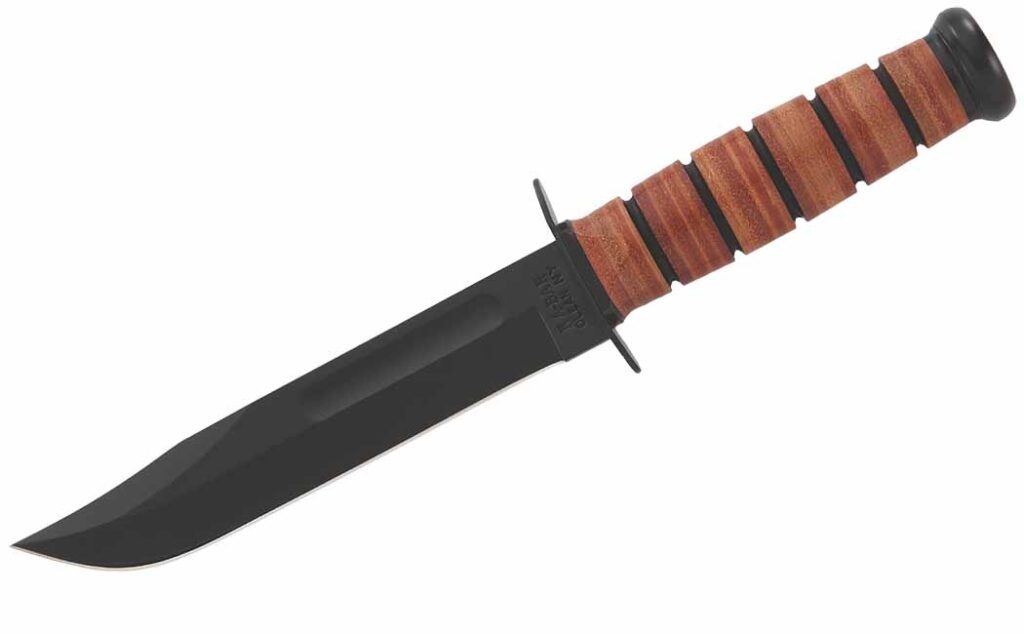
USMC Ka-Bar Plain Edge

Ka Bar Straight
The knife that made the Ka-Bar name famous is as popular as ever. There’s also a serrated version, but the plain edge is the original and is a hefty, economical knife.

The 7-inch clip point blade is made from 1095 Cro-Van steel with a 20-degree flat grind and a Rockwell hardness of 56-58 HRC. At just 11.2 ounces, it’s lighter than you might expect from a knife that size, which lets it flow smoothly when slicing, and the leather handle provides a secure grip. The rigid plastic sheath is MOLLE-compatible and can be carried vertically or horizontally.

Classics are classic for a reason, and the USMC fighting/utility knife is everything you could ask from a combat/using piece.

MSRP: $128.53

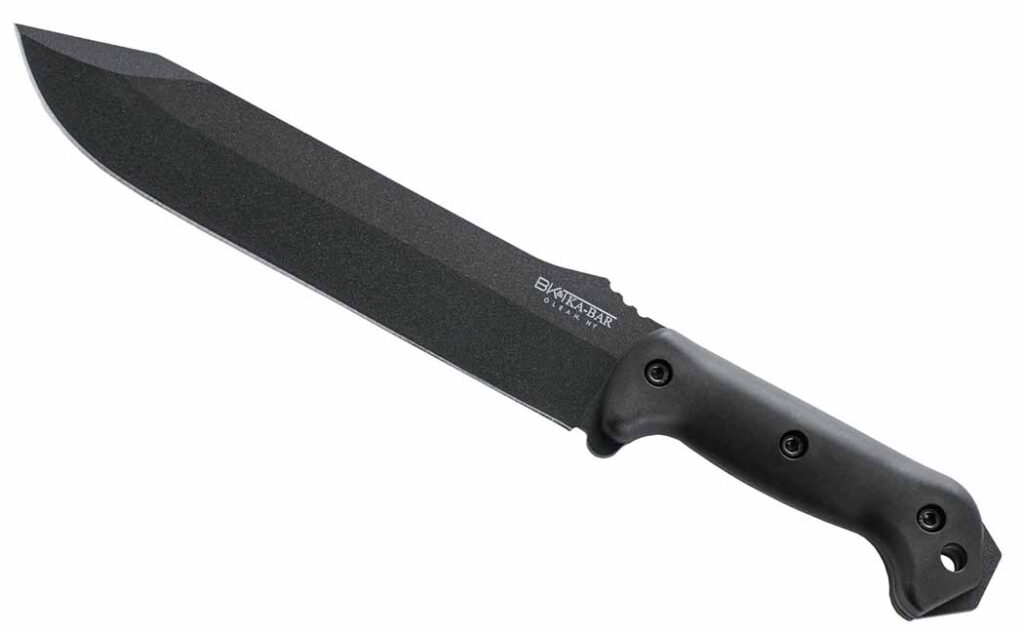
Becker Combat Bowie

Ka Bar Bowie
Melding an American bowie-style blade with Becker’s trademark ergonomic handle design and you get this sleek, all-black combat knife. It is designed for bushcraft or camping too.


The 9.25-inch blade is married to an Ultramid handle that provides a strong grip. At 17.12 ounces, it’s a bit heftier than the USMC fighting/utility, making it excellent for more heavy-duty work like trimming thicker branches and vines or cutting through medium brush. Similar to the USMC fighting/utility, the Combat Bowie is made from 1095 Cro-Van and has a Rockwell hardness of 56-58 HRC.

A heavy-duty polyester sheath is included and is MOLLE-compatible as well.

MSRP: $178.61

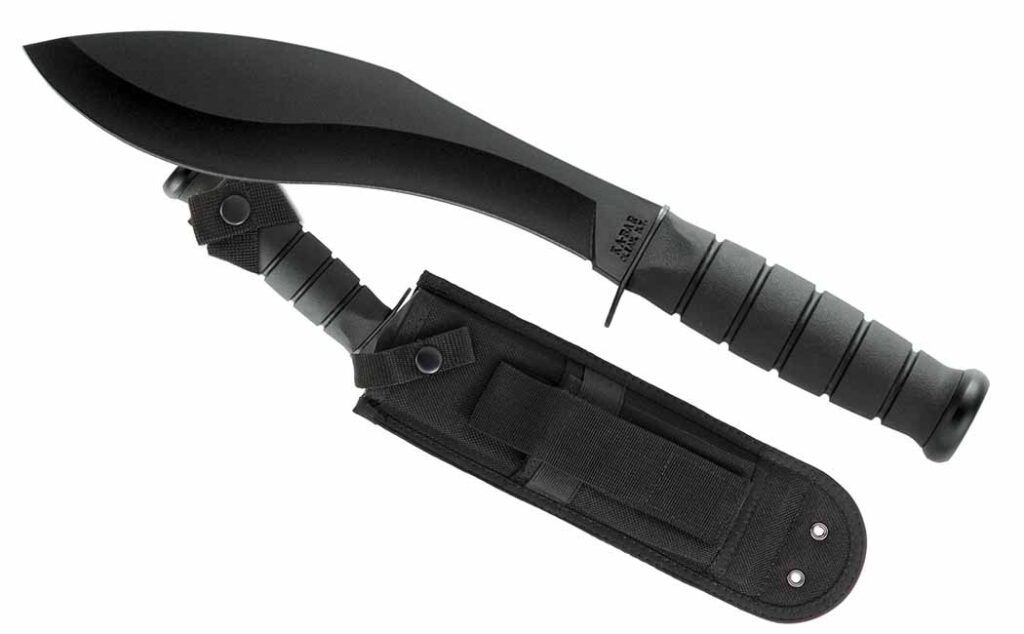
Combat Kukri

Ka Bar Kukri
This knife may have “combat” in the name, but its bread and butter is decimating small trees and vines. The kukri is smaller than a standard machete and is more finite in its cutting. That doesn’t mean that this blade can’t flex its muscle and chew through almost any brush you put in front of it.

This knife may have “combat” in the name, but its bread and butter is decimating small trees and vines. The kukri is smaller than a standard machete and is more finite in its cutting. That doesn’t mean that this blade can’t flex its muscle and chew through almost any brush you put in front of it.

At just under 16 ounces, it’s relatively lightweight yet robust.

If you’re buying it you’re most likely looking for a high-quality outdoors knife, and this kukri is it. The 1095 Cro-Van will need to be maintained to get the best out of it over time, but that comes with the territory of owning good knives. This knife will make a great companion working through the bush while camping or while cutting through bushes in the backyard.

MSRP: $122.68

Read More

Advertisement

Must Read Articles

Read this before you make a knife

Knifemaking 101 – Read This Before You Make a Knife

  by Wayne Goddard My experience has taught me that there's nothing like digging in and getting started. I've often said the hardest part of the...
how to forge damascus steel

How to Forge Damascus

Advertisement
Advertisement