The history of knives and other edged instruments is tied to the history of people in general. As humankind’s oldest tool, unraveling knife history can lead to even more surprising and enriching information to better understand the world.
The Gerber Mark II Is One Of The Most Famous Combat Knives Ever Issued To The American Military. First Introduced In 1966, It Still Endures Today.
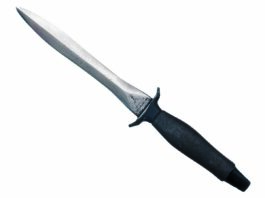
When it comes to military knives, few are as universally beloved as the Gerber Mark II. First issued for use by U.S. service personnel in the Vietnam War in 1966, the knife has stayed in production since with the exception of 2000-2008.
The Mark II was successful due largely to its well-designed blade and lightweight. The blade is 6.5 inches long, and contemporary versions of it are made from 420 HC stainless steel. The handle is made from die-cast aluminum which helps keep the weight to just eight ounces.
What Makes The Gerber Mark II Special?
The Mark II stands out thanks to its blade design. There are many combat knives and bayonets, such as the M7 and M9, that are modeled after the classic dagger or spear point. The Mark II also has a double-edged spear point blade but with one massive exception: the wasp waist.
The wasp-waisted blade has a narrower section of steel, akin to how a wasp’s body narrows at its waist. On the Mark II, this narrower section comes toward the guard, and the edge on both sides has small serrations. Not the deepest you’ll find on a knife, the serrations are still there to cut.
Very few modern combat knives have the wasp waist (other famous American models like the M7, USMC fighting utility knife, and M9 don’t have it), and it is the visual signature of the Mark II.
Can I Buy A Gerber Mark II Today?
Yes, you can, but it’s not so straightforward. Gerber is, of course, still in business and thriving, but go to its website and you won’t find a Mark II for sale. There are other serrated tactical knives but no Mark II.
To purchase a Mark II today you’ll have to either go to sites like ebay or retailers such as Knifecenter, Smoky Mountain Knife Works, etc. Other makers offer knives similar to the Mark II, but if you want the real deal you’ll have to dig a little bit to purchase one yourself.
However, the ones of recent make that are available are reasonably priced at right around $100-$115.
The Wharncliffe Is An Interesting Blade Design With A Captivating History. Over The Years It’s Grown Into A Desirable EDC Blade. These Five Wharncliffes Stand Out From The Pack.
There aren’t many blade styles like the wharncliffe. The wharncliffe stands out from many other blade designs thanks to its long, straight cutting edge and spine that tapers to the point. This allows for a variety of shapes of wharncliffe blades, with some being more squared off with a sharp taper and others being more rounded with a more gentle taper.
Regardless of the taper or size of the blade, the wharncliffe has grown into a beloved blade that has evolved to meet the needs of knife lovers over the last 200 years.
Where Does The Name Wharncliffe Come From?
If you guessed that it was named for a person you’d be correct, or at least almost correct. The name for the blade dates back to the 1820s and British Colonel James Archibald Stuart-Wortley-Mackenzie, the first Lord of Wharncliffe.
One night, while having dinner with his cousin, Archdeacon Corbett, Wharncliffe was lamenting how staid and tired the cutlery industry in Britain had become. The two then worked on a new type of knife to present to the Joseph Rodgers & Sons cutlery company in Sheffield, the epicenter of the cutlery trade in the UK.
Rodgers liked the blade so much that the company put it into production and named it the wharncliffe in the Lord’s honor.
What Is The Wharncliffe Used For?
The wharncliffe initially was used mainly as a whittling knife. The long, straight edge made it perfect for long strokes on a piece of wood. Over time, the blade has evolved with the rest of the knife industry and is now a quality all-rounder EDC. The straight edge is excellent at transferring energy from the hand into the material being cut. Not great at puncturing, it’s very good at most other cutting tasks.
5 Wharncliffes You Should Look Into Buying
Today, the wharncliffe has become a standard blade design by makers around the world. These are five that you should take a look at.
Spyderco Salt 2
Few companies have dived deeper into wharncliffes than Spyderco. The Salt 2 is a prime example of how the company has smartly developed the blade style, although there are many knives on the company’s roster that utilize it as well.
The ergonomic green FRN handle makes this knife easy to use, especially considering how it was designed to be used near water. The H-1 steel is highly corrosion resistant, which makes this knife the perfect choice to use near water. You can choose between a plain edge and a serrated edge, and the lockback keeps everything secure even when drenched.
Spyderco is beloved because of the quality of its knives, and the Salt 2 shows many things the company can do.
MSRP: $124.25
CRKT Inara
A simple, elegant design from Richard Rogers, the CRKT Inara is a perfect example of a quality, affordable wharncliffe EDC.
The framelock is strong. The deployment is smooth. The G-10 stands firm even in extreme conditions. This little flipper really does it all and looks good while doing it. The stonewashed 8Cr14MoV stainless blade is 2.78 inches long and the whole construction weighs just 1.8 ounces.
A small, nimble knife, the Inara showcases why the wharncliffe has become a regular EDC blade.
MSRP: $56
Emerson Knives P-Sark
If the last knife was for day-to-day use, the Emerson Knives P-Sark is for the most extreme situations. This is the standard issue knife for U.S. Navy Rescue Teams, according to Emerson Knives. It’s a thick, beefy blade designed to extract people in severe situations.
The 3.5-inch blade is made from 154CM stainless steel with a chisel grind. The G-10 handle is waterproof and perfect for the type of intense moments this knife was built for. The blade comes in both black and stonewashed varieties.
Sure, this could be used as an EDC, but this knife is designed for much more than just opening boxes and stripping wires, and is priced accordingly. If you want a strong, physical knife, then this is the one for you, but you’ll be able to find good EDC wharncliffes at more affordable prices.
MSRP: $226.95
Kershaw Leek
Kershaw has them all, and it’s no surprise that it offers a solid EDC wharncliffe. The Leek line of knives runs 16 deep, but we are concentrating on the original.
The whole construction is stainless steel with a 3-inch blade made from 14C28N stainless steel. The Ken Onion-designed knife is a sleek, sturdy flipper held in place with a framelock. At 3 ounces it’s a bit heavier than some of the other knives on this list, which is good because it helps the piece feel better in the hand and more secure in use.
The assisted-opening flipper, the tip lock to keep it secure when closed, and the reversible pocket clip are all features on the knife that elevate it from just a good knife to a high-quality EDC.
MSRP: $79.99
Cold Steel Tuff Lite
Small. Tough. Durable. Three ways to describe the Tuff Lite from Cold Steel. This little wharncliffe is a rugged little beast. Made from Japanese AUS-8A stainless steel, the Tuff Lite’s blade is just 2.5 inches long with a relatively squared-off tip that makes it perfect for deep cutting tasks.
The handle is made from Griv-Ex which, when paired with Cold Steel’s Tri-Ad lock, provides a rock-hard construction when deployed. This is the most affordable knife on our list, but it may be the highest value thanks to how the knife was put together.
MSRP: $40.99
Read More
Bowie Beauties: Three Quality Factory Bowie Knives
With More Than A Century Of History, The Trench Knife Soldiers On As A Historical Collectible And A Modern Outdoor Knife.
The trench knife may be the ultimate weapon for close-quarters combat. With a sharp blade designed for stabbing, and a finger guard that doubles as a knuckle duster, the blade is excellent for messy, claustrophobic situations, which you would expect as it was named for the intimate and brutal trench warfare of World War I.
By the time World War II began, trench warfare was nowhere near as common as it had been previously. In turn, the trench knife evolved.
The United States issued the Mark I in 1942 and 1943 to certain special military groups like the Army Rangers and Marine Raiders. The Mark I was a newer version of WWI trench knives, including a finger guard, a stiletto blade, and a skull crusher cap built into the pommel.
However, over the course of WWII, the trench knife gave way to the combat knife. Most notable of these, the US M3 fighting knife, which was adopted in 1943. The M3 became the framework upon which more contemporary bayonets and fighting knives like the M4 and M7 were built.
Can I Own A Trench Knife Today?
That’s a complicated question to answer.
The trench knife is classified as a dangerous weapon in many states and countries for a variety of reasons. Some places prohibit them because they have double-sided blades while others focus on the knuckle dusters or the length of the blade as reasons to ban them.
Owning or carrying a trench knife is banned in numerous countries including the United Kingdom, Australia, Ireland, Canada, China, and Singapore, among others.
In America, the knife is outlawed in some form in 23 states, and even among the states where it’s legal to own and/or carry, 18 of those states either only allow you to keep the knife in your home or require a permit to carry it on your person.
The only states with no permit rules for owning a trench knife are Texas, South Dakota, Indiana, South Carolina, Idaho, Hawai’i, Georgia, Arizona, and Alabama.
Modern Trench Knives
There aren’t many companies left making trench knives similar to those blades from a century ago. However, the two below are modern takes on the combat classic.
M48 Liberator Trench Knife
This is the souped-up version of the original trench knife. Everything about the Liberator is big and bold and in your face.
It starts with the 7.5-inch 2Cr13 cast stainless blade that is ground sharp on both sides. The blade has a satin finish and black oxide coating to add to its intimidating aura. The handle scales are made from a light, rugged fiberglass-reinforced nylon that provides a strong grip without adding too much weight.
And then there’s the knuckle duster tang. It both acts as a knuckle guard and an intense defense weapon. The added spikes on the handle allow you to use more force in case you are defending yourself. The knife fits into an injection-molded Vortec and nylon belt sheath that snaps shut and easily fits on your person.
It’s bad. It’s unapologetic. It’s the ultimate modern version of the trench knife.
MSRP: $79.99
Cold Steel Chaos Double Edge
A more muted version of the trench knife, the Chaos Double Edge from Cold Steel gives a modern, tactical spin on the old classic.
The blade itself is made from SK-5 high-carbon steel and is 7.5 inches long. The full-tang construction allows for a well-weighted knife that can be used to defend or to slice through dense brush. Both sides are ground sharp and meet at a spear point so the knife can puncture as you would expect.
The handle is made from 6061 aluminum and features a pair of D ring guards, which are a newer version of the old-school knuckle duster guards that is used for the same purpose. The pommel of the knife is tapered to allow for more force when using the cap to strike.
The included sheath is made from Secure-Ex and is both Molle-Lok and Tek-Lok compatible so transporting the Double Edge will be a breeze.
Deeply Rooted In Scandinavian History, The Seax, AKA “Scramasax” Or “Sax,” Was The Blade Shape Of Choice For The Much-Feared And Revered Vikings.
Typically the Norsemen were associated with their famous axes, but, truth be known, they also carried a knife that saw more general use: the seax.
The Scandinavians usually lived in villages, farmed the land and raised animals. In such an agrarian society, they also needed tools to help them work the land and harvest the fruits of their labor. This is also where a knife came into play.
“Their personal knife was called the seax and it never left their side because it was their version of an EDC,” begins Ernest Emerson of Emerson Knives, Inc. “The knife was tasked with a myriad of chores, from skinning a freshly taken deer to cutting up the turnips they grubbed out of the ground with the same knife.”
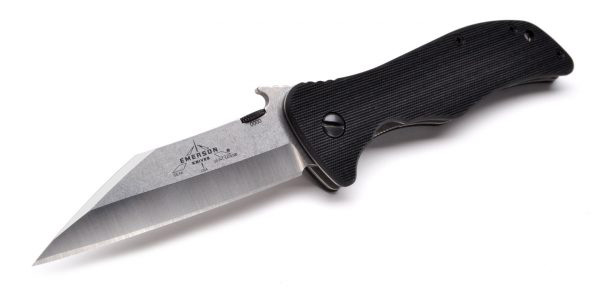
The folding Emerson Knives Seax puts a modern twist on this age-old blade design. (Image via Emerson Knives)
Emerson said the seax also could be employed as a self-defense weapon if needed. It was truly a blade for all seasons: Harvest produce in the morning, fend off the enemy after lunch, and then prepare supper in the evening—all with the same blade.
Seax Designs
All joking aside, the seax was a handy blade.
“It is a bowie-style blade, a spear-point type of blade, a Loveless drop-point hunter-style of blade, and, of course, the well-known ‘broken-back’ style featuring a severe clip close to the front, finishing in a point well below the center line,” Emerson said.
He said the broken-back seax style is the most common and appears in TV shows and movies depicting Vikings.
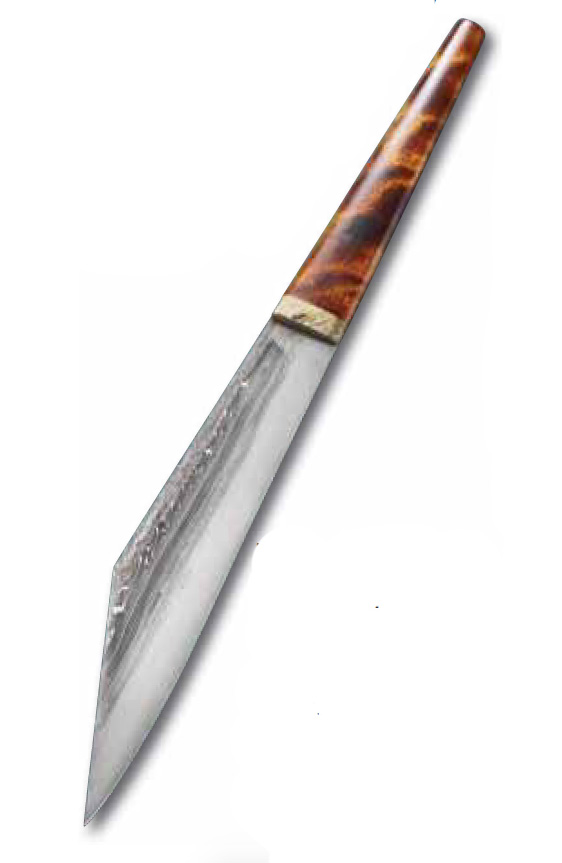
The Broken Back Seax by Aidan Garrity of Iron Lion Blades features a 10-inch damascus blade of 1095 carbon and 15N20 nickel alloy steels, and wrought iron. The handle is maple and the bolster is moose antler. Overall length: 18 inches. (SharpByCoop image)
Blade lengths varied wildly from seven inches on the short end and topping out at 30 inches, the latter Emerson called a short sword, basically.
“The seax needed to be an all-around utility tool that could chop, cut, slice, and sometimes stab, all with equal ease of application,” he said. “A Viking’s livelihood depended on self-sufficiency, resourcefulness, and the quality of his toolkit.”
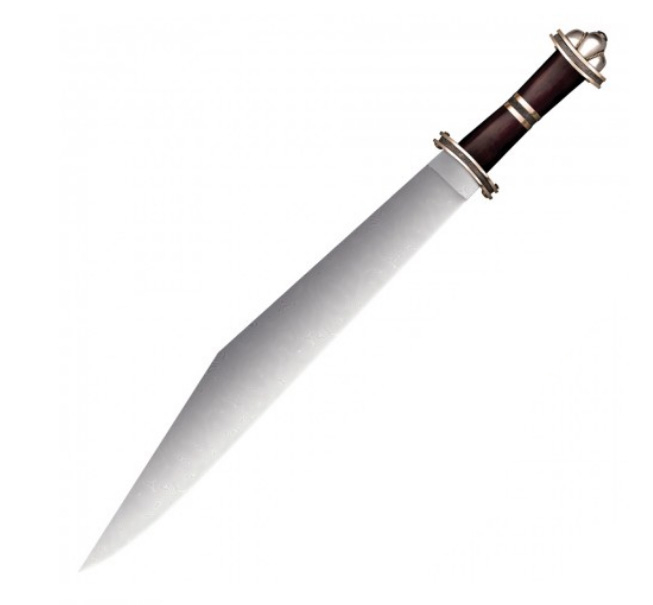
The Cold Steel Damascus Long Sax features a 17.25-inch blade with an edge that curves up toward the tip. MSRP: $635.99. (Cold Steel image)
At first glance, the seax may not seem as exciting as a recurve blade, but looks are not always everything. The beauty of such a blade lies within its ability to tackle cutting chores.
The straight-line cutting edge tackles a variety of tasks easily, and the point of the blade is both precise and powerful, with the ability to score as well as penetrate.
5 Best Seax Knives
The long history of the seax is still going strong today as companies young and old are making new versions of the historic blade.
These five are some of the more unique and exciting seax knives available today.
Terävä Skrama 240
Terävä Skrama 240
Direct from the Finnish brand Terävä, the Skrama is a rugged bush knife great for chopping, slicing, and building shelters in the outdoors. The 9.4-inch blade is made from 80CrV2 steel with a 59 HRC. It comes married to a textured rubber handle for easy grip in any weather conditions.
The blade has a full tang and a flat edge but with a twist. It’s sharpened to a 34-degree edge except for the two inches closest to the hilt. That small section is sharpened to a finer 25-degree edge for more meticulous, precise knifework.
The Skrama comes with either a leather sheath or a plastic cover and has an MSRP of $69.99-109.99.
SZCO Supplies Brass-Studded Seax
SZCO Supplies Brass-Studded Seax
SZCO Supplies has made a fun, durable knife with its Brass-Studded Seax. The piece features a 10-inch blade married to a wooden handle. The knife is adorned with brass studs on the handle as well as a brass guard and pommel.
For a budge knife, it does have some weak points. The two main ones are that the leather sheath may need some working in to be at its best, and the knife may need a sharpen out of the box to have a pristine edge. Other than that, this is a good knife for the money.
Strong enough for a log, sharp enough for a piece of chicken, SZCO Supplies has made a seax that is well priced at an MSRP of just $27.63.
Medieval Collectibles Viking Seax Knife
Medieval Collectibles Viking Seax Knife
This seax from Medieval Collectibles has the look and feel of a knife from the Viking era. It’s made from 5160 tempered carbon steel with a full tang, which is peened over the end of the handle’s metal end cap.
Just over 17 inches in length, and a blade length of 12.1 inches, the Viking Seax comes with a handle that has a wood grain finish and a hand-stitched leather scabbard with a belt hanger.
At just 14.4 ounces in weight this is a utility knife great for everything from chopping through wood and brush to defense and protection. The Viking Seax comes with an MSRP of $169.
Grimfrost Broken Back Seax, Type IV
Grimfrost Broken Back Seax, Type IV with scabbard
From Grimfrost comes a full-tang seax made of 1045 carbon steel. A reproduction of a 1,000-year-old seax found in London, the Broken Back Seax is 16 inches in length with an 11-inch blade.
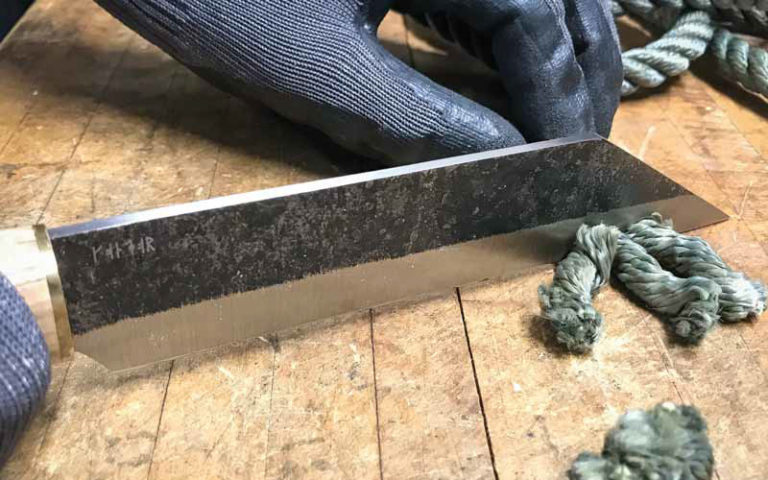
The handle is handmade ash and the included leather scabbard is hand-stitched. It also features “Grimfrost” stamped in runes on the side of the blade.
Lots of time and care went into making this knife as authentic as it could be and it shows. So whether you want to feel like Leif Eriksson exploring new lands or just want a strong knife while chopping, Grimfrost has you covered.
The Broken Back Seax has an MSRP of $132.
Lunar Light Forge Damascus Sanmai Seax
Lunar Light Forge Damascus Sanmai Seax
This amazing seax is from the husband & wife duo of Nathaniel and Megan Everett at Lunar Light Forge in Akron, Ohio.
The damascus blade is made from 42 layers of 1095 and 15n20 steel around a 5160 core. It is paired with a handle made of Buffalo horn and Cocobolo wood, and it comes with a hand-tooled & hand-stitched leather sheath.
It’s just as much an art piece as it is an excellent utility knife. The 7-inch blade can process an animal, hack off tree limbs, and chop in the kitchen. It does have an MSRP of $722.50, but for the amount of craftsmanship and care that went into the piece, you’ll know you’re getting a knife of the highest quality.
Editor’s Note: Mike Abelson contributed to this piece
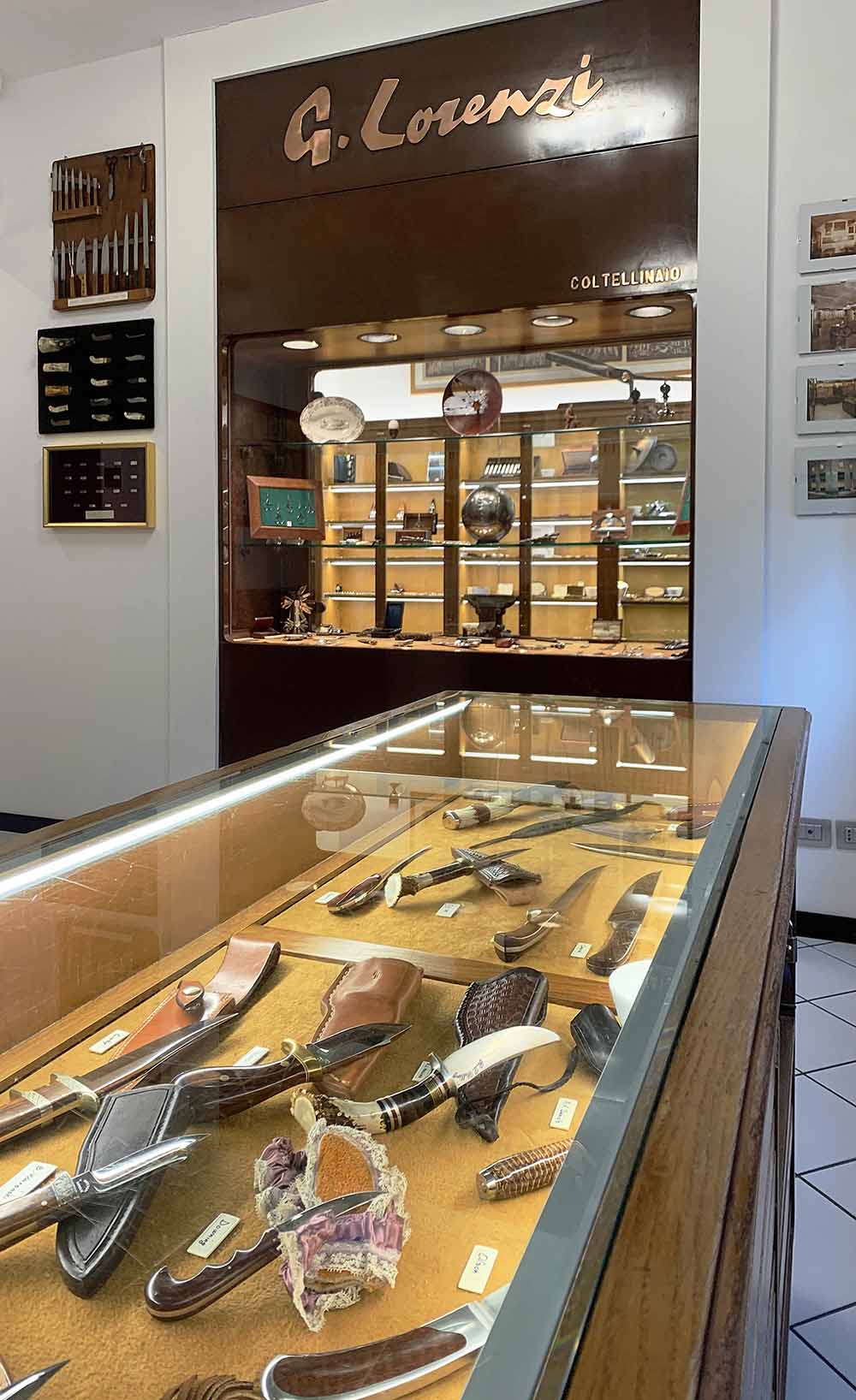
The Lorenzi Foundation and Museum showcases one of the finest collections of rare and historical knives in the world.
One of the most extensive collections of ultra-rare modern custom and historical knives, cutting implements and many other items connected with the cutler’s art is displayed magnificently in a new museum in Milan, Italy.
A labor of love by Aldo and Edda Lorenzi, the museum is under the auspices of the aptly named Aldo and Edda Lorenzi Foundation (established July, 2020). The museum showcases the Lorenzi Collection consisting of about 2,000 pieces in all, catalogued and accompanied by specific information: era, origin, artisan (if known), function, material, construction and more.
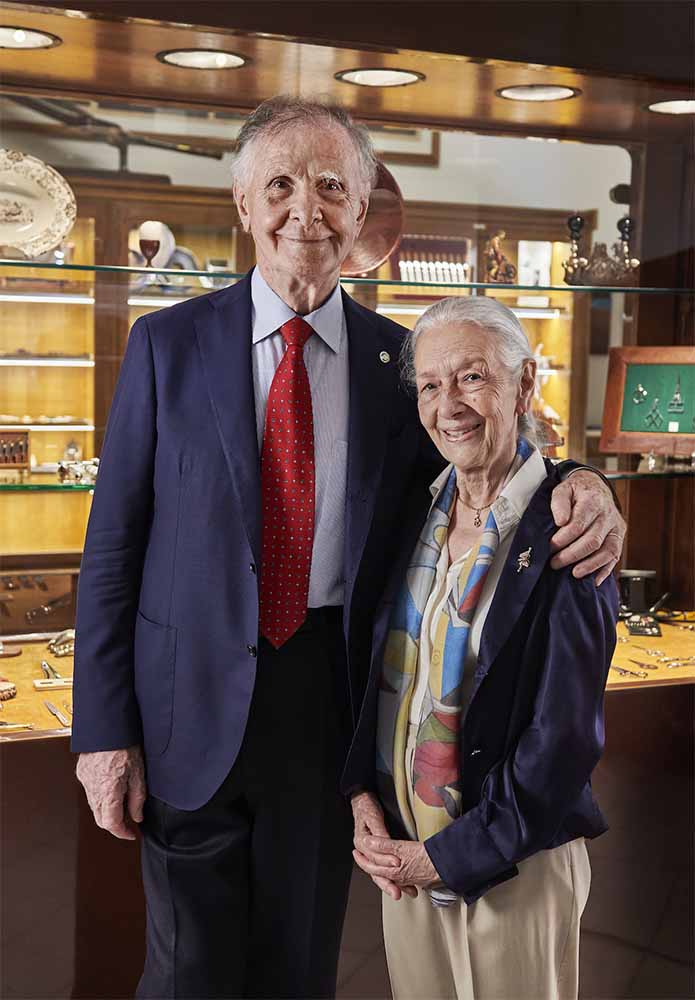
Aldo & Edda Lorenzi
It gathers cutting utensils and related items dating from the Etruscan period (approximately 900-27 B.C.) to today. It is complemented by a series of specialized publications, testimony to the incessant research that was necessary to bring the operation of the Lorenzis’ internationally recognized G. Lorenzi retail knife store in Milan to exceptional levels, and to which Mr. and Mrs. Lorenzi devoted their efforts and creativity for many years. It is all housed in a state-of-the-art edifice containing many of the displays and other historical examples of the cutler’s art from the original G. Lorenzi shop and elsewhere.
The Foundation’s premises include a library where visitors and specialists may view the bibliographic materials. A special fit-out of the space enables visitors to relive the shop’s atmosphere. Thanks to an attentive recovery, a number of the original furnishings have been reinstalled on site. This includes an exterior window from G. Lorenzi, one of six “eyes” that communicated with window shoppers in one of Milan’s most exclusive retail store districts, and the display counters on which, over the years, over 18,000 types of sales items were placed. The space also features oak display cases in which the items were shown, as well as the copper-paneled room that featured the small entrance door opening onto the larger shop.
Historic Excellence
The collected items demonstrate, by starting from an artisanal craft as ancient and humble as that of the knife grinder, how it is possible to evolve and then achieve historic excellence. As further informational support, there are over 700 books, about 1,000 magazines and 150 prints, which for the most part depict traveling knife grinders. In fact, Aldo’s father, Giovanni Lorenzi, started his career as a professional knife grinder. Giovanni
Edda Lorenzi examines and arranges some of the many cutlery items from the Lorenzi Collection. (Lorenzi image)
founded Coltelleria G. Lorenzi—a small shop at the time—at the address of via Montenapoleone 9, Milan, a shop later operated by his sons Aldo, the sole administrator, and Franco. (Regrettably, Franco passed away a few years ago.)
In the course of over 60 years, the Lorenzis collected and kept the pieces which best represented their profession until the closure of G. Lorenzi in 2014. Their selection of the most recent items from their collection was made possible thanks to the close, precious relationship with the artisans—many Europeans, a number of Americans and Japanese—whom Aldo and Edda visited periodically at their shops. It was in such shops that the artisans created their unique pieces, full-fledged artworks that stand the test of time and which enabled G. Lorenzi to become renowned and appreciated at the international level.
Custom Gems
Included in the collection are 150 custom knives by American makers, knives that are particularly near and dear to Mr. and Mrs. Lorenzi. Having collected such knives since the mid-1970s, the Lorenzis traveled the USA, not only visiting the makers in their shops but also attending most every major knife show, meeting just about every maker worth his or her steel along the way.
Among the Lorenzis’ honors are The Knifemakers’ Guild’s Nate Posner Award (1995); the BLADE Magazine Industry Achievement Award (2014); the American Bladesmith Society Special Achievement Award (2014); and the Gold Star Award of Recognition from the William Moran Jr. Museum and Foundation (2014). Three of the Lorenzis’ favorites among their favorite custom knives in their collection are:
The number one of an art piece by W.W. “Bud” Cronk, the maker some consider the father of the modern art knife. Aldo ordered a copy of the knife for one of the Lorenzis’ best customers, but Cronk passed away before he could finish it. It would’ve been a coup for the Lorenzis if they could have gotten the copy too, as Cronk never made duplicates of his work. The copy was used later as the model for the logo of the W.W. Cronk Award, a private honor Don Henderson sponsored for 25 years for the Guild Show’s best art knife
A Bob Loveless/Barry Wood folder Loveless gave to Aldo when the Lorenzis visited the Loveless shop in 1977. Unaware at the time that U.S. knifemakers’ shops were not retail knife stores, the Lorenzis knocked on the Loveless shop door unannounced. Loveless answered the door and, unsure at first what to make of the couple from Italy, soon hit it
Loveless/Wood Folder
off with Aldo—so much so that he gave the Lorenzis the Loveless/Wood folder. Before the Lorenzis left, they asked Loveless why he had trusted them so much at first sight that he gave them a knife (at the time, Aldo and Edda had no idea what Loveless knives were worth). “He replied that we ‘had our history written on our foreheads,’ a phrase that we have never forgotten!” Edda wrote. “These are the kinds of bonds that have made us love American knives and knifemakers even more!”
A Multilock folder by Ray Appleton. Edda recounted a memorable trip the Lorenzis shared with Appleton from Georgia to Chicago, including visits to an Atlanta racing museum and Kentucky’s Mammoth Cave in the process, the latter where the 6-foot-8-inch Appleton bumped his noggin on a cave overhead. Recounted Edda: “Since Aldo wanted to stop at every cutler shop he knew along the way, Ray generously offered to make the phone calls for him to warn the shops of our arrival. ‘I’m Aldo Lorenzi’s secretary, Hot Pants,’ he announced himself on the telephone, making us laugh a lot!”
These are but three of the many American custom knives and their stories among the scads of other custom and assorted knives and cutting implements in the museum. Meanwhile, a 300-to-400 page catalog of museum items is due for completion by early 2022 at the latest.
If you ever get Milan way, a visit to the Aldo and Edda Lorenzi Foundation and Museum is a bucket-list must.
The BLADE Magazine Cutlery Hall Of Fame® is proud to announce three most-deserving inductees for 2022: the husband-and-wife team of Mr. and Mrs. Aldo and Edda Lorenzi and Bill Ruple.
All will be formally inducted in a special Cutlery Hall-Of-Fame ceremony and breakfast during BLADE Show 2022 June 3-5 at the Cobb Galleria Centre in Atlanta.
One of the most prolific, long-running supporters of custom knives in modern cutlery history, the Lorenzis forged a name known in knife circles far and wide while operating their G. Lorenzi retail knife store in Milan, Italy, where they sold knives of some of the greatest knifemakers of all time, including Cutlery Hall-Of-Fame members Buster Warenski, Bob Loveless, Michael Walker, Jimmy Lile, Gil Hibben, Ron Lake, Frank Centofante and many more.
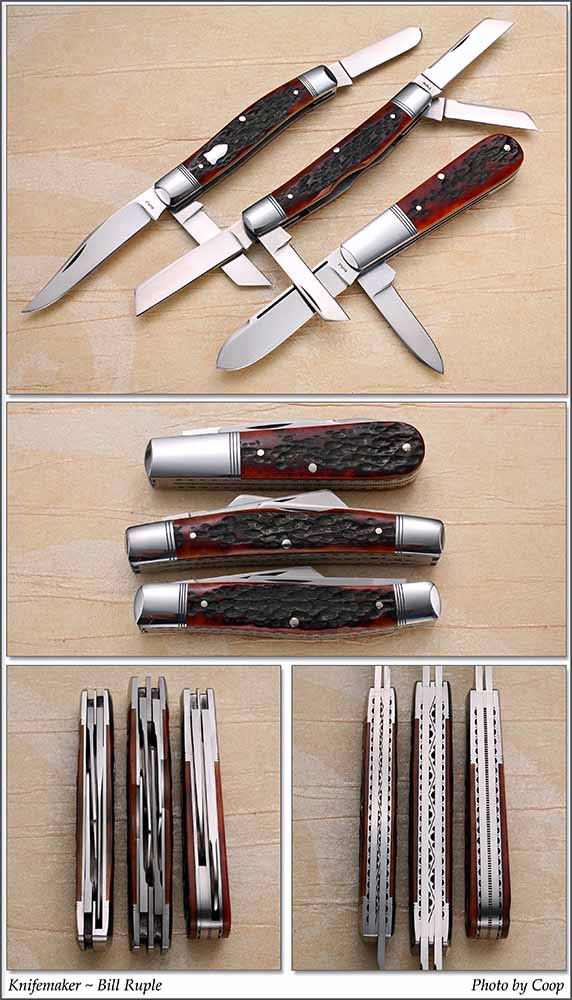
Meanwhile, hailing from Pleasonton, Texas, Ruple is one of the most successful slip-joint makers of the 21st century, winning many awards for his traditional pocketknives, and also serving as a teacher and mentor to an entire generation of award-winning slip-joint makers from Texas and elsewhere.
Aldo and Edda Lorenzi (Francesco Pachi image)
Aldo And Edda Lorenzi
Aldo and Edda Lorenzi operated G. Lorenzi retail cutlery store in Milan from 1959 until its close in February 2014. The Lorenzis regularly attended the world’s most important knife shows, buying scores of knives for sale in their shop. They bought so many knives at shows, in fact, that the Lorenzis’ presence often determined a show’s success or failure. The support and exposure they gave to American makers in particular by selling their knives in their store in one of the most exclusive shopping areas in Milan was pivotal in introducing American custom knives to Europe.
In 1995 they won The Knifemakers’ Guild’s prestigious Nate Posner Award “in recognition for outstanding service in the promotion of handcrafted cutlery.” They also won the BLADE Magazine 2014 Industry Achievement Award for their decades of supporting the custom knife industry. For five years ending in 2019, they sponsored the Aldo and Edda Lorenzi Award for the Guild Show and the BLADE Show, with each event’s award-winning maker receiving $1,000 cash and a plaque—10 awards and $10,000 in all. The Lorenzis also are most supportive of the William F. Moran Foundation and are one of the Foundation’s first chartered member couples.
An exterior display window (shown here in the background) from the original G. Lorenzi shop is a centerpiece of the Lorenzis’ new museum. It was one of the store’s six “eyes” that communicated with window shoppers in one of Milan’s most exclusive retail districts, the counters of which, over the years, displayed more than 18,000 types of items. In the foreground is a display case of some of the Lorenzis’ favorite custom knives. (Francesco Pachi image)
“More loyal ambassadors of the art cannot be found,” one sitting Cutlery Hall-Of-Fame member noted of the Lorenzis. “Their store was like a museum, always welcoming visitors and ready to educate them on fine cutlery and custom knives. Several prominent collectors got their start by buying a custom knife at the Lorenzis’ store.”
In fact, the Lorenzis have assembled their massive collection of over 2,000 knives (including 150 custom knives by the world’s best makers spanning the past half century), 700 books, 1,000 magazines and prints, and related items in a new state-of-the-art museum in Milan (December BLADE®, page 60). The museum contains the knives in elegant oak display cases, a recreation of the copper-paneled room that featured the small entrance door to the G. Lorenzi store in Milan, a wooden portable knife grinder used by Aldo’s father and the store’s namesake, Giovanni Lorenzi, almost a century ago, and much more.
Bill Ruple
Bill Ruple
In the eyes of one sitting member of the Cutlery Hall-Of-Fame, Bill Ruple, an award-winning custom knifemaker specializing in traditional pocketknives/slip joints and multi-blades, has done as much as anyone to promote the knife business. Bill served on the board of the Texas Knifemakers Association, taught many how to make traditional knives and is very free with his knowledge. In recognition of this fact, he was presented with the BLADE Show 2019 Aldo and Edda Lorenzi Award. The award went to a knifemaker who excels in terms of teaching and mentoring his or her fellow makers in the art of knifemaking.
Having built knives for 34 years, Ruple is a premier maker of slip joints and possesses a selfless willingness to teach others how to do it, usually in his shop in Pleasanton, Texas, and also at BLADE University, the BLADE Show, BLADE Show West and other venues. He has helped many get started with the slip joint, one of the oldest yet most challenging folders to make. His kindness and patience validates something other makers know all too well—that he is most willing to share knowledge with and encourage, critique and mentor makers everywhere.
A selection of Bill Ruple’s slip joints in an array of open, closed and spine images show Bill’s awesome talent and versatility as a knifemaker. (SharpByCoop image)
Bill has taught quite a few who have become award-winning makers in their own right, including Rusty Preston, Luke Swenson, Tom Ploppert, Phil Jacob, Bubba Crouch, Toby Hill, Enrique Pena and others. A number have gone on to teach also, spreading Ruple’s knowledge to others who no doubt do the same as well. Bill does not limit his shared knowledge to just stock removal makers, receiving the American Bladesmith Society’s President’s Award for teaching ABS members how to make slip joints. Finally, Bill has donated some of his knives to knife shows and other cutlery organizations to raise funds for their various needs.
Hall Of Fame Criteria
Selected by a vote of sitting Cutlery Hall-Of-Fame members, the inductees are selected based on the following criteria: demonstrated extraordinary service to the knife industry; displayed honesty, character and integrity; advanced the industry by the creativity and originality of their works or contributions; as ambassadors or outstanding contributors, have furthered the positive impact of the knife industry on the world at large, and, in summary, have demonstrated a worthiness to be a member of this prestigious group.
The latest inductees exhibit all these qualities and more and represent a most worthy Cutlery Hall-Of-Fame induction class of 2022.
A fine example of a tool and weapon of war, the chute knife more than rose to fulfill the roles for which it was intended.
Harry Archer was a somewhat shadowy figure. At the height of the Vietnam War, he was engaged in nasty business—fighting a stealthy enemy in a steaming jungle, sometimes up close and all too personal.
Those who knew Archer acknowledged that some of his exploits were “larger than life.” They considered him an early non-movie version of author David Morrell’s fictional character of John Rambo*. Still, Archer was real, flesh and blood. And it seems altogether fitting that responding to his need for knives that “deliver” in a tight spot—survival, seconds along the fine line between life and death—he would come to know and rely on another legend.
According to John Denton, perhaps the world’s foremost authority on the knives of BLADE Magazine Cutlery Hall-Of-Fame® member Bob Loveless, Loveless and the man he came to describe as the “head of CIA operations in Vietnam” were introduced to one another by knife writer/Cutlery Hall-Of-Famer Ken Warner. It followed that Loveless made several knives for Archer’s use in the field, among them a fine sub-hilt and stag-handle example of his well-known Big Bear, along with several other Big Bears. Loveless’s close friend and fellow maker Steve Johnson was working in Bob’s shop at the time and participated in crafting these. A fighter in a tulip wood handle is another cold beauty.
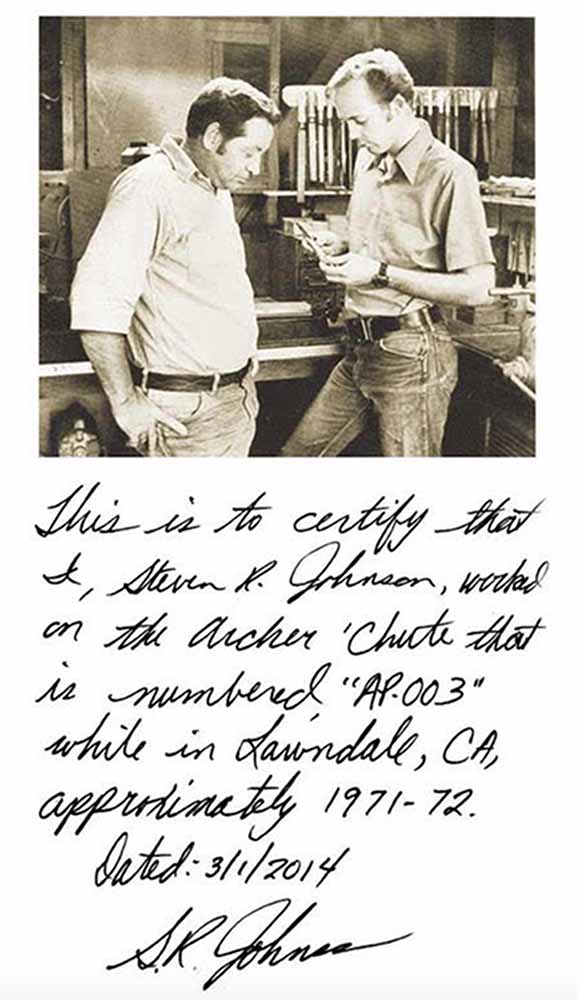
Johnson worked with Loveless from June 1971-October 1974 in the Lawndale and Riverside, California, shops. Steve had a hand in the production of the prototype chute knife in the earliest days, and 23 years later signed a photograph for John Denton attesting to his work on that piece of history. Steve’s inscription reads in part: “This is to certify that I, Steven R. Johnson, worked on the Archer ’chute that is numbered ‘AP-003’ while in Lawndale, CA, approximately 1971-72.” (images courtesy of John Denton)
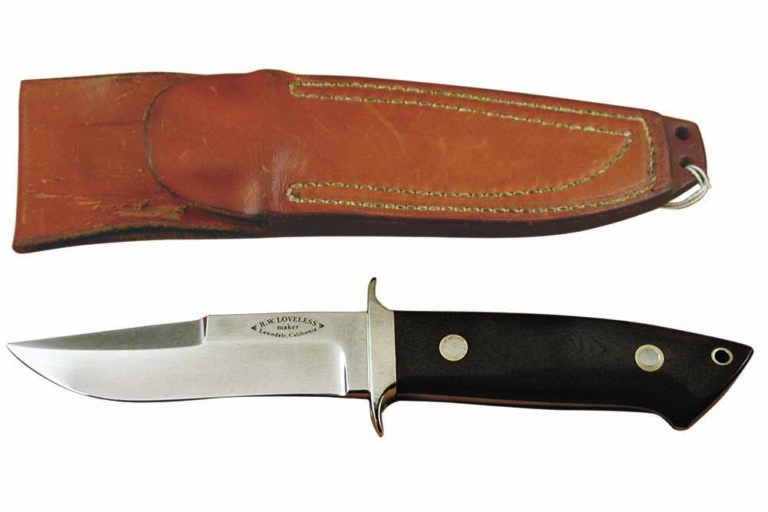
Then there is the well-known Harry Archer chute knife, a versatile fixed blade with good looks and the ability to travel light but cut paracord for a quick exit from a tangled parachute shroud, and with a stout spine for prying loose from the wreckage of a helicopter. The chute knife was made for the jungle. It was made for Harry Archer.
“It seems that Loveless had been left out of a book by Warner, and Loveless sent Ken some knives to review,” Denton recalled. “It just so happened that Archer was there with Warner. Harry saw the knives and bought them all.”
Johnson worked with Loveless from June 1971 to October 1974 in both the Lawndale and Riverside, California, shops. He had a hand in the production of the prototype chute knife in the earliest days and 23 years later signed a photograph for Denton attesting to his work on that piece of history. Steve’s inscription reads in part: “This is to certify that I, Steven R. Johnson, worked on the Archer ’chute that is numbered ‘AP-003’ while in Lawndale, CA, approximately 1971-72.”
Johnson explains that the chute knife is a fairly small, compact fighter and survival knife, short, light, double-edged and strong, but not made in stock thicker than 3/16 inch. Holes for thongs are placed in the rear of the handle and the guard for lashing the knife to a pole or limb to make an improvised spear. It rides into action atop a chest pack or secondary parachute for quick, easy access. Claims that Warner had a hand in the design are unconfirmed, but “the chute” simply looks the part of the warrior’s dependable asset.
“You’re able to cut both ways with the knife via the swipe of an arm or hand,” Johnson related. “Specifically, it’s for cutting parachute cord should it be tangled or caught in a tree. It’s a knife that a pilot, paratrooper or soldier should carry, and it would not be a burden but useful and available in every situation.”
HARRY ARCHER LORE
Stories of Archer’s combat prowess have been told and retold, but to raise awareness of the immediacy of a close-in fight, nothing is better than the harrowing tale that Denton remembers Loveless repeating. John points to a photo of a vintage Big Bear, identifies it as a knife that Archer took into combat, and says, “Harry and his men got into a hand-to-hand fight, and the tip of the blade was broken off inside the enemy. Harry took the knife back to Bob to fix, and Loveless said, ‘Where’s the tip?’ Harry replied, ‘It’s still in the rib cage of the Viet Cong soldier.’ So, Loveless fixed the blade.’”
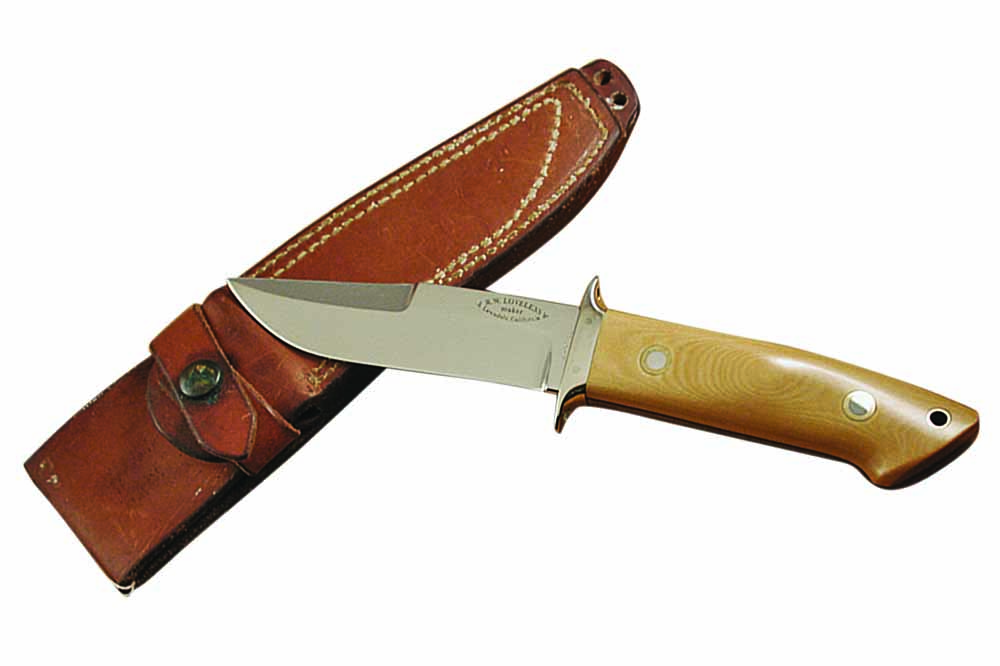
Made in Bob Loveless’s Lawndale, California, shop about 1973-74, this chute knife in ivory Micarta® is stamped BR-003. It was made for the Brass Rail, a famous gun shop in Hollywood, California, where all the celebrity types hung out to see guns and knives. Note the holes in the guard for lashing the knife to a pole to make a spear. (images courtesy of John Denton)
Like the Big Bear and other Loveless creations, the chute knife has its place in the lore of Harry Archer. After he collaborated to produce the prototype, Johnson continued to work with Loveless on more of the chute knives. He remembers meeting Archer in the California shops.
“Loveless really admired Archer and his adventures in the Vietnam War era, working with USAID**, the CIA and different assignments in various parts of the world,” Steve commented. “[Harry and I] discussed life in camp in Vietnam, interactions with Vietnamese soldiers and personnel with whom he was serving. That was quite interesting.”
Steve calls the chute “one great knife” and remembers conversations in Lawndale when the veteran operative praised it as light and small enough to carry so that it could always come along on a mission. Johnson also made a chute knife for Archer and continues to produce his own model today.
“We worked together on Archer’s order for a ‘Johnson’ version of a chute knife on a bench in the rear of Bob Loveless’s shop, in his garage in the back of his house in Lawndale,” Steve smiled. “Archer asked me to make my version, which we—mostly he—designed in the early 1970s. He did a drawing for me. The 154CM blade was about 4.5 inches long, the handle slim and a bit longer than normal, and it had a large thong tube, three handle screws, a stag handle, and checkering on the top and bottom of the tang just behind the guard.”
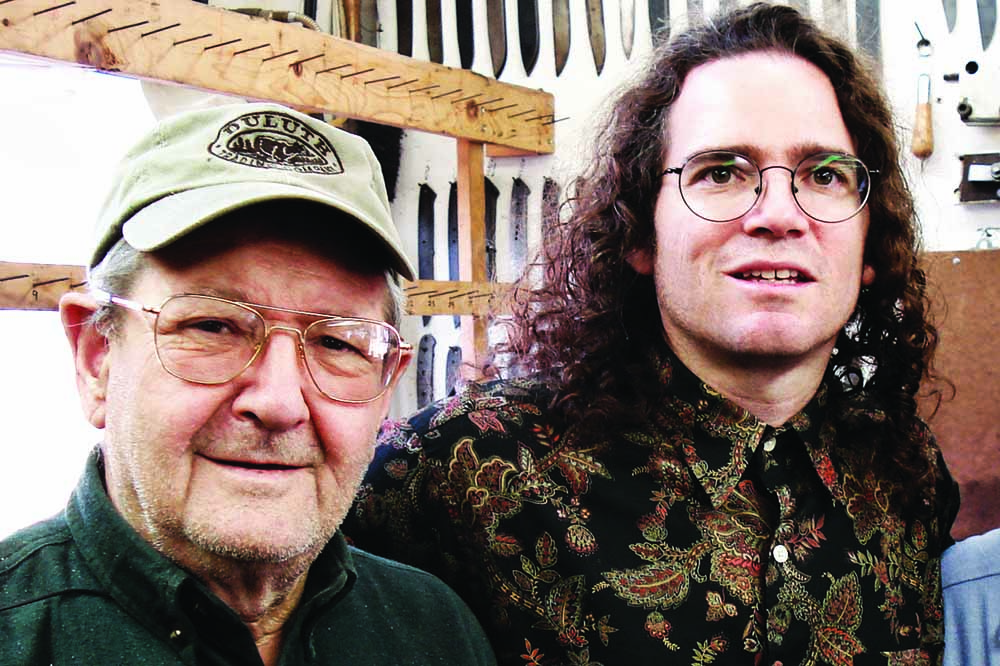
Bob Loveless (left) and John Denton (right)
For Johnson, working with Archer was a pleasure and a defining moment in his illustrious knifemaking career, which, after recovery from a serious accident, took him from Loveless’s shop to his own space in Manti, Utah, more than 40 years ago. “Harry Archer was a great guy who appreciated my work, as well as Bob’s,” Steve added, “and I made him a few knives after California. He was very easy to talk to, respected others, and he really was a man of intrigue and adventure. And Bob Loveless treated me like a son.
“I’m making a chute knife for Atlanta [Steve was interviewed prior to BLADE Show 2021] as we speak, with the blade polished so far, instead of the top grind being just the length of the clip,” Johnson concluded. “I use the pattern that Loveless gave me when I left his shop in Riverside in 1974 or 1975. This particular knife is going to have a stag handle and stainless steel fittings. I’ll make more when asked, and I still have a few on order in my books.”
Long-time maker and designer Bob Dozier was a friend of Loveless and went on to design a chute knife for Cutlery Hall-Of-Famer A.G. Russell. Though his only acquaintance with Harry Archer is through the recollections of A.G., who knew him, Bob says his version of the chute knife remains in demand for one simple reason: “It sells.”
Dozier turns out his chute knife with a 4.75-inch D2 tool steel blade and overall length of 9.75 inches. The handle is green canvas Micarta® “because Goldie [Russell] won’t let me put anything else on them. I’ve got some blades hanging right now, getting ready.”
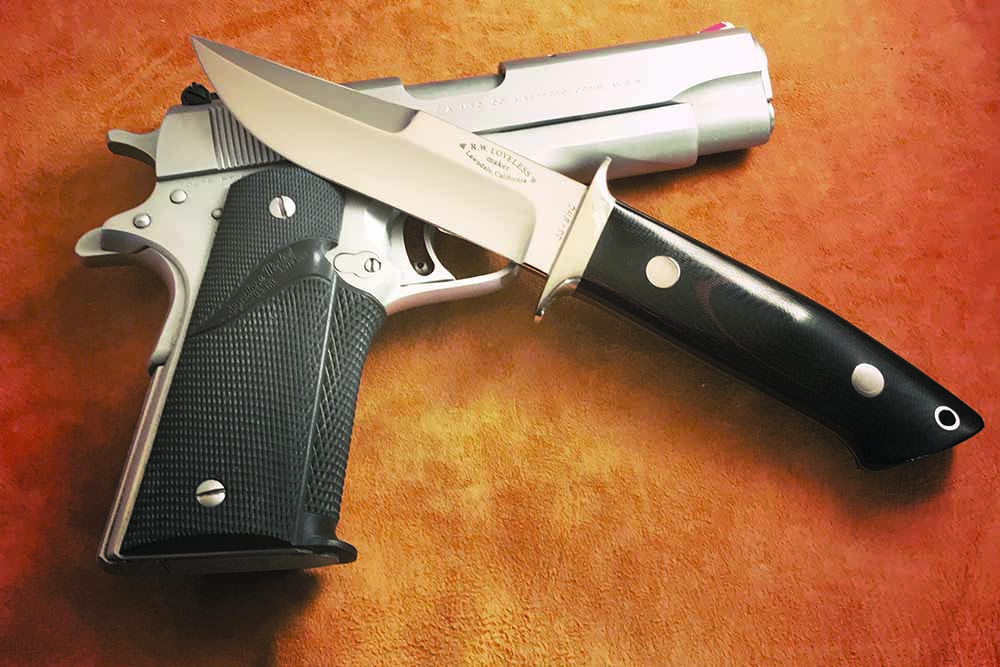
The “RR” on the guard of this Loveless chute indicates it was for the Ram Rod gun store in New Castle, Indiana. Early on Ram Rod sold knives by Loveless, Bill Moran, Ron Lake, W.W. Cronk and others. It appears here with a Smith & Wesson Model 41 modified by Loveless.
Dozier is familiar with the Loveless chute knife configuration but never had the Loveless pattern. He looked at the earlier chute knife profile and made some tweaks. “My handles are like the Loveless, but I don’t cut the butt off as square as he did. I leave more of a point on it than he did. Mine is still mostly like Bob’s, and he was one of the first to make a really good slab-handled knife. That’s one reason why most of us have copied him.” Dozier’s chute knife, designed and built for A.G. Russell Knives, has a manufacturer’s suggested retail price of $895.
SAGA of The CHUTE
The saga of the chute knife certainly has a human side. While Denton estimates that early Lawndale chute knives might fetch as much as $14,000 if found for sale today, and chute knives made in Riverside command up to $12,000 each, they are desirable on the collector market. Nonetheless, the greatest value of the chute knife lies in its lifesaving and protective capability in the hands of a dedicated professional such as Harry Archer.
Through those years of association, Loveless and Archer became friends, sharing a common bond of respect and admiration for the best in fighting and utilitarian knives.
“Loveless said that Harry would come by his shop after periods of being in the jungle for months at a time,” Denton remembered. “He used Bob’s place to unwind and try to become civilized again before heading home to Virginia. But Loveless also said, ‘Harry was like a wild animal when he came to the shop, trying to keep his head straight before he saw his family.’”
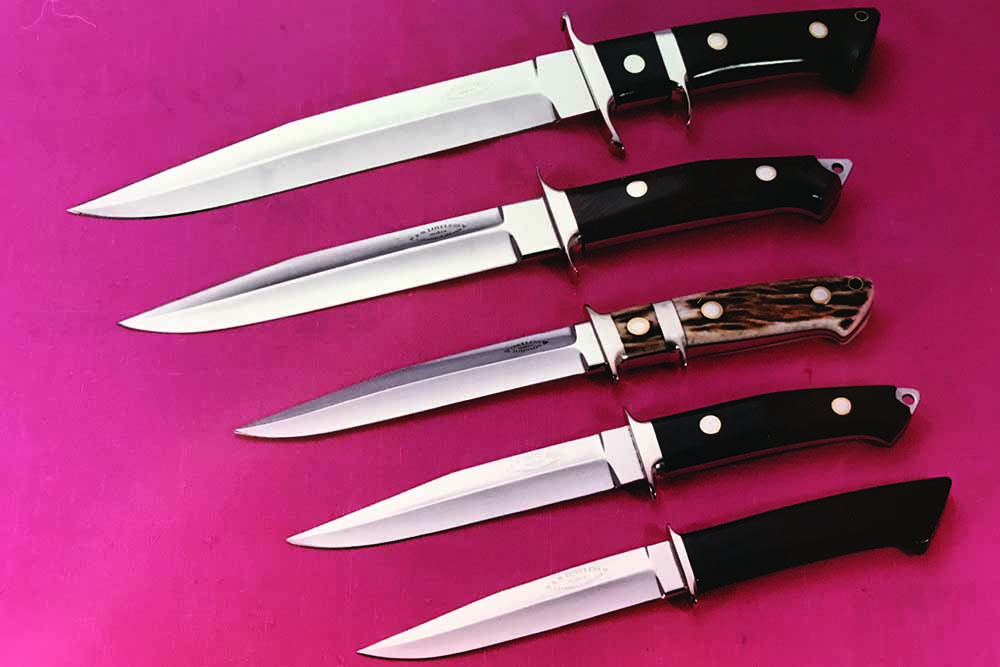
Whenever Harry Archer ordered several Big Bear fighters from Bob Loveless, Loveless said Archer told him to “send the bill to the Pentagon.” From top: the Big Bear Harry broke the tip off inside a Viet Cong soldier during the Vietnam War; tulipwood fighter with skull cracker; Loveless/Johnson sub-hilt with the initials HJA for Harry J. Archer; boot knife with skull cracker; and one Loveless called the Pig Sticker. (image courtesy of John Denton)
The chute knife is indeed a fine example of a tool and weapon of war rising to fulfill the roles for which it was intended. It remains a popular pattern because of its looks, quality and versatility. And for one other reason in particular: It helped men like Harry Archer survive the most desperate of situations and make it home.
*In actuality, Morrell based the Rambo character on Medal-Of-Honor recipient Audie Murphy.
**USAID is the acronym for United States Agency for International Development, with the inference here being that in this instance it functioned as a cover for the CIA.