Knife History

The history of knives and other edged instruments is tied to the history of people in general. As humankind’s oldest tool, unraveling knife history can lead to even more surprising and enriching information to better understand the world.

“He Made ’em Famous” – A Tribute to Ken Warner

Editor’s note: Ken Warner, the visionary behind and original editor of the acclaimed KNIVES annual book series, recently passed away. In tribute, BLADE is featuring this article from the August 2009 magazine issue about this titan of knives.


The turn of a phrase, the flow of the narrative, and simply getting the story straight are hallmarks of the writing craft. BLADE Magazine Cutlery Hall-Of-Famer® Ken Warner brought the ability to perform each of these, along with an unmatched eloquence, to the knife industry.

Universally, knife authorities acknowledge him as the individual who lifted custom knives out of the shadows. He helped to accomplish this with a straightforward, crisp, and clean writing style that captured the imagination of readers for nearly half a century.

A “True Poet” of the Knife Community
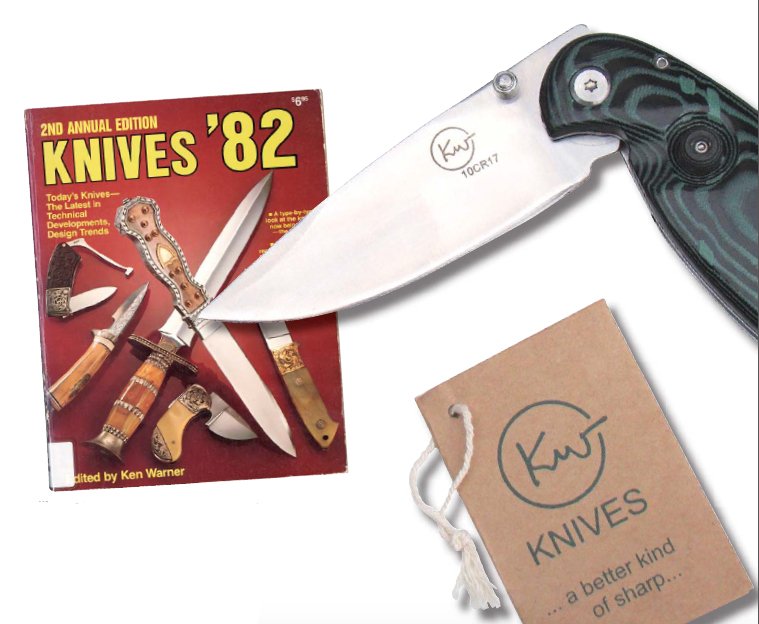
Ken Warner knife books
Warner edited and wrote much of the first Knives annual in 1981. The series went on to transform the knife industry. He continued editing the annuals until 2000. BLADE managing editor Joe Kertzman assumed the reins beginning with the 2001 edition.

“Ken Warner is the true poet of the knife community,” related BLADE field editor Ed Fowler. “While he did not write the most knife articles, what he did write was worth reading and serves as an eloquent inspiration for all who have thoughts to share. He had no axe to grind other than to share knowledge. As a fledgling knifemaker, I used to read his comments and soon learned that he knew well his subject matter.”

Though he is not currently writing—he instead stays busy offering a wide range of fixed blades and folders through his Ken Warner Knives knife company—there is always the possibility that Warner will return to print. Meanwhile, he says he is becoming computer savvy enough to run a knife forum on the internet and to continue his online blog (kenwarnerknives.blogspot.com). He also stays busy designing knives.

“I’m 80 years old,” he reflected, “and I have some things I want to say and there are some stories I can do that nobody else can do because I was there. I will get to that when I get to it.”

Forging a Path
Bill Moran Ken Warner photo
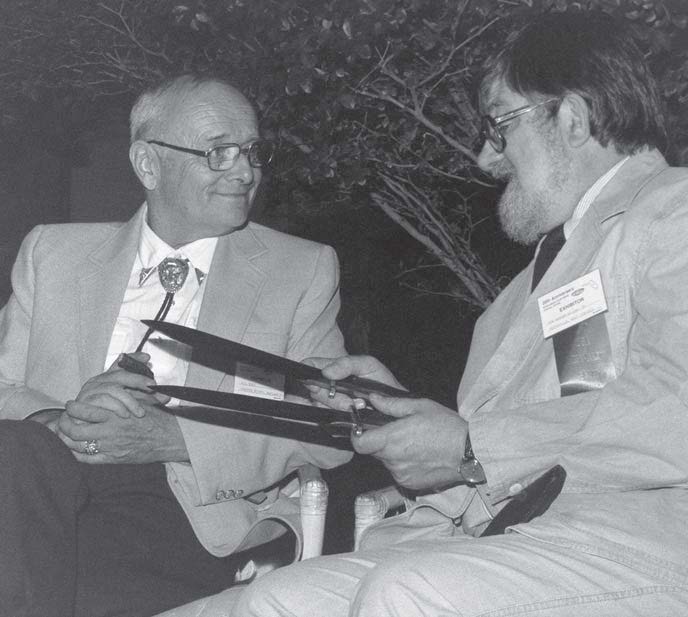
Blade Magazine Cutlery Hall-Of-Famers Bill Moran (left) and Ken Warner were good friends. According to Cutlery Hall-Of-Famer B.R. Hughes, Warner was the first to write about Moran and his knives in a national magazine. Here Moran and Warner visit and talk knives at an early 1980s Knifemakers’ Guild Show. (photo courtesy of B.R. Hughes)

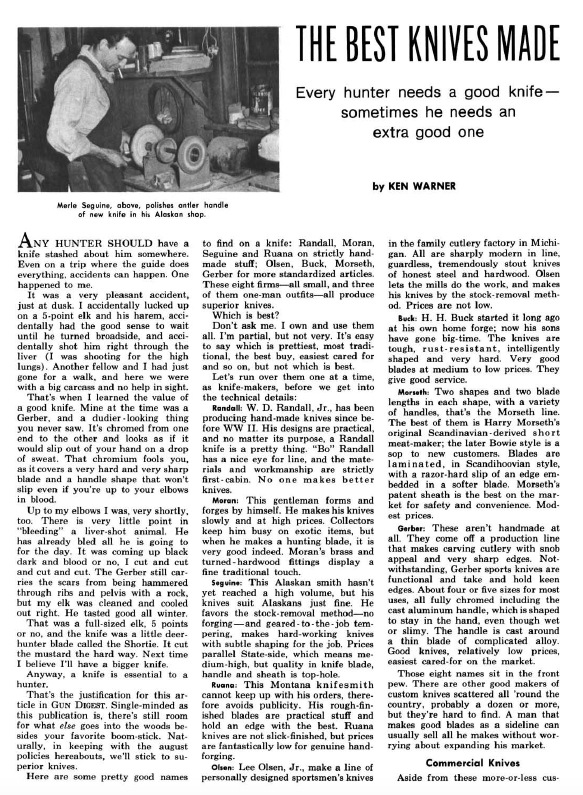
Literally, when custom knives began to gain national and international attention, Warner was there. In fact, he was the prime mover in publicizing the work of the knifemakers. As a writer for the popular annual Gun Digest, he started writing about knives in 1964. That first article, titled The Best Knives Made, has been reprinted numerous times.

Back then, though, it was a challenge just to get enough material to put a story together.

“I could hardly find any knifemakers,” Warner commented. “I found [Bill] Moran and [Bo] Randall, and Buck was small then and I wrote about them. However, a number of knifemakers and collectors have told me that the article got them started. Bob Loveless, for example, has told me that he was about to give up making knives because it wasn’t going any place. Then, he read the article and decided that somebody would understand. There was a time that I was actually giving away Loveless knives just to see what people thought of them. Butch and Rita Winter were pre-eminent collectors of handmade knives, and they told me I got them started.”

A Calling

Educating the general public about knives evolved into something of a mission for Warner. In 1976, he wrote The Practical Book Of Knives, a primer of information on the mechanics, components, function and terminology associated with knives. Through editorial contributions to a number of publications, he has managed to spread the word.

Along the way, he has gained a multitude of friends and admirers. One of the closest was with the legendary Cutlery Hall-Of-Famer, Bill Moran. BLADE field editor and Cutlery Hall-Of-Famer B.R. Hughes, co-author of the Moran biography, Master Of The Forge, credits Warner with his introduction to the great bladesmith.

A Man of Many Firsts
Ken Warner article in Gun Digest
Ken Warner’s The Best Knives Made article in the Gun Digest 1966 book was a game-changing moment for what is now the modern knife industry.

“Ken was one of the first to write knowledgeably about handmade knives, and he’s important to me personally because he’s how I heard about Bill Moran,” Hughes remarked. “Ken used to live close to Moran’s shop and visited there often. He was the first to write about Moran in a national magazine. He mentioned Moran in the Gun Digest article in 1964, and that article did more to publicize handmade knives than everything written about them up to that time.”

Of course, Moran, Hughes, Don Hastings and Bill Bagwell went on to found the American Bladesmith Society in 1976 and the rest, as they say, is history.

Hughes said he remembers working at a magazine called Gunsport in the mid-1960s and Warner was the editor. Even then, Hughes knew Warner was something special.

“Ken’s writing was a cut above what I was used to seeing in a gun magazine,” Hughes continued. “I soon became shotgun editor of Gunsport, and no gun magazine of that day was going to publish a lot of knife articles, but Ken got a knife article in there from time to time.”

When Warner left Gunsport to publish his own magazine, Gunfacts, the idea of writing about knives had caught on.

Hughes said he recalls a memo circulating to ask if anyone else at Gunsport had an interest in or knowledge of handmade knives. Hughes raised his hand, contacted Cutlery Hall-Of-Famer A.G. Russell for a crash course in handmades, and took up writing about knives himself.

The Knives (KNIVES) Books
First Annual Knives Book cover
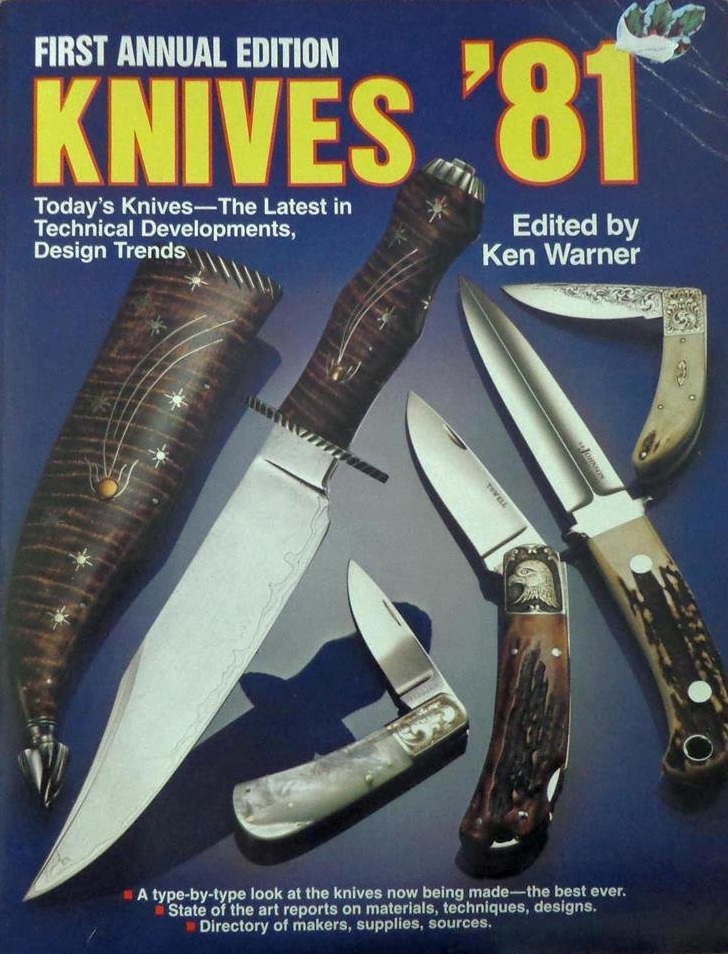
The cover of the knife book that started it all.

For many, Warner’s greatest single contribution to the knife industry was not that first article in Gun Digest, nor his continuing effort to publish knife stories in popular magazines. Rather, it was the publishing of the first Knives annual in 1981 that sparked what became an explosion of interest in handmade knives.

“The big thing with Ken is that he mainstreamed knife interest, and everybody credits him with that,” assessed Cutlery Hall-Of-Famer Bruce Voyles, with whom Warner co-authored the book Knives Digest in 1999. “That, in my opinion, was not his greatest contribution. That came when he got the Knives series started. For the first time you had a listing of not just a particular organization’s members but all knife people. You also had pictures. It was a snapshot of the state of the knife industry at the time, particularly handmades—and the industry was pretty disorganized at the time unless you were a member of the Knifemakers’ Guild.

“I think he gave tremendous publicity to people that had not gotten publicity,” Voyles continued. “Plus, there’s something that most people will not notice about him unless he has edited something they’ve written. He’s one of the most gifted editors I have ever known in any genre. He takes average stuff and makes it sound good, and makes good stuff sound fabulous while making it flow easily. The different thing about Ken’s writing and editing is that Ken made it readable. Most of the stuff before Ken was clumsy, and he made it interesting. He could make the phone book interesting. One of my favorite quotes was when his former wife said some years ago, ‘Ken has the most annoying habit of being right most of the time.’”

Recognition
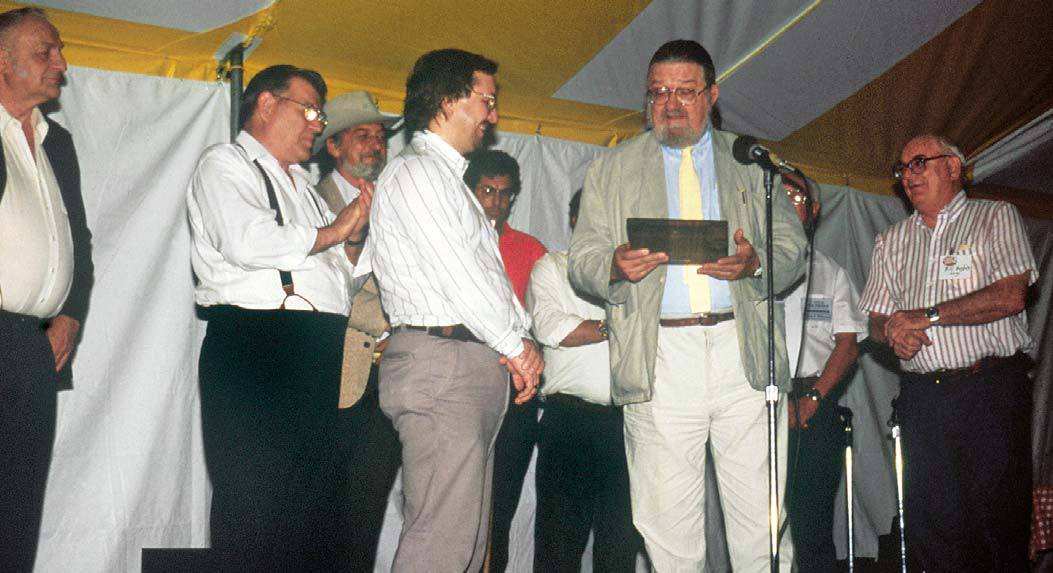
BLADE Show Ken Warner
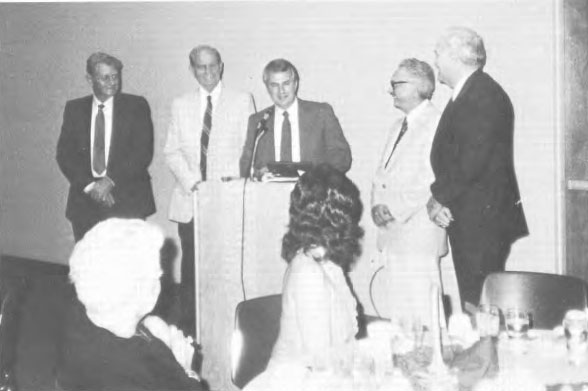
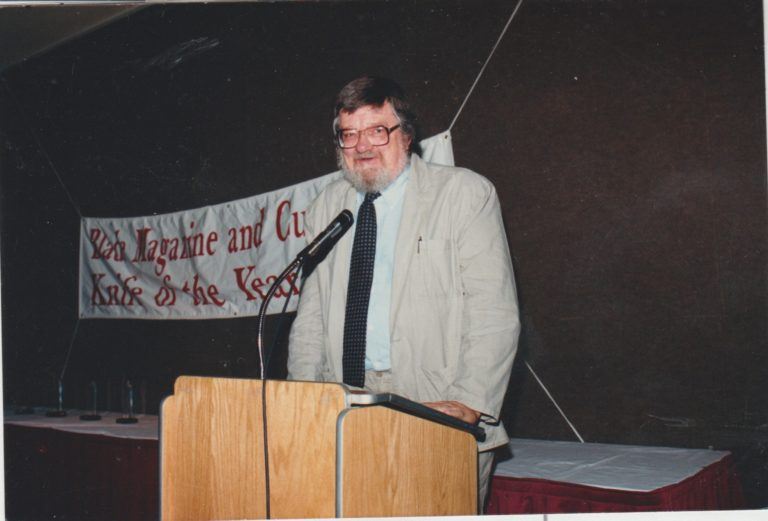
Ken Warner inducts Bruce Voyles into the BLADE Magazine Cutlery Hall Of Fame at the 1993 BLADE Show Awards Banquet in Stone Mountain, Georgia. From left: George Herron, A.G. Russell, Buster Warenski, the inductee, Paul Tausig, Joe Mangiaracina, Warner, Houston Price and B.R. Hughes. All but Tausig and Mangiaracina are in the Cutlery Hall Of Fame. Along with Col. Rex Applegate, Hughes joined Voyles as an inductee that year.

Among the many happenings during his association with Warner, Voyles will never forget that it was Warner who organized Voyles’ induction into the Cutlery Hall of Fame at the awards banquet of the 1993 BLADE Show. It was Voyles’ 40th birthday, and Warner took the stage to announce—to Voyles’ surprise—that he was being inducted by acclamation of all living members of the hall at the time.

When Warner and A.G. Russell were inducted into the hall at the 1988 BLADE Show, each was invited to the banquet to provide the introduction speech for the other’s induction. Neither Russell nor Warner knew they were being honored themselves.

“Ken said at the time that as long as there was a BLADE Show, he would eat the BLADE Show’s rubber chicken,” Voyles grinned. “Then, the next year we presented Ken with a rubber chicken and taped a knife that he liked inside the chicken’s mouth.”

Warner is also a member of the ABS Hall Of Fame and counts the society’s prestigious Don Hastings Award among his many honors.

A Lasting Legacy
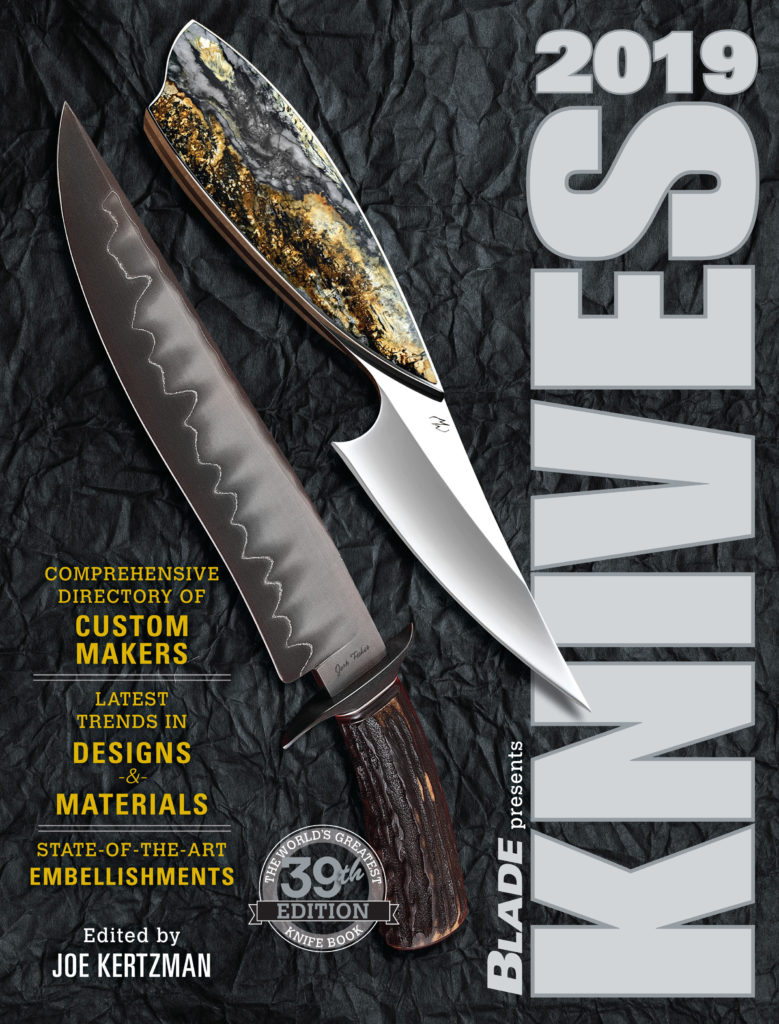
Best books about knives
The most recent KNIVES annual book on shelves is KNIVES 2019.

As for the Knives annual series, it is still going strong under the capable hands of former BLADE managing editor, Joe Kertzman.

Fowler said Warner was the right man for the successful development and promotion of what has become a virtually indispensable part of the knife industry, a book which will celebrate its 40th anniversary in 2020.

“Thanks to his knowledge, editorial ability, choice of writers and relevant topics, Ken started a legacy to the knife community that continues to this day,” Fowler noted. “Ken knew the difference between a hunter and an art knife, as well as the pretenders, and described each knife eloquently. Many of his one-sentence comments were worth hundreds of words. He inspired many makers through his comments on design, steels, handle materials, leatherwork and scrimshaw. Reading back through my collection of his books, I find many of his comments that I once glanced over were far from simple but offered great understanding and predictions of the future and well being of our community.”

A Renaissance Man
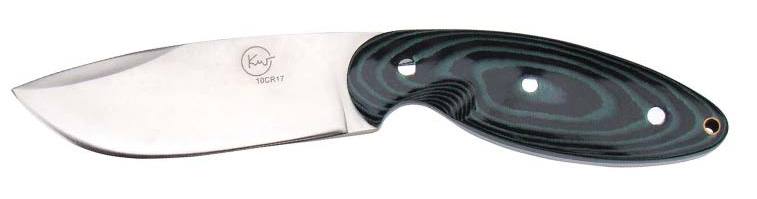
Ken Warner custom knives
The Warner SGG is a knife of all work, with lots of belly and a good bit of sharp. The blade is 5 inches of 10CR17 and, of course, is convex ground all the way. The drop of the grip puts the edge where it is needed. (Warner photo and caption)

Warner, it turns out, is something of a renaissance man as well. Fowler related sharing a huge bowl of crab legs following the BLADE Show a few years back.

“We debated the styles of Steinbeck and Hemingway, as well as other great authors, what makes poetry great, and the responsibilities of authors,” Fowler recalled. “I learned that everything we write is an echo of our total experience. The more we read and the greater our personal experience, then the better we will be able to express our thoughts. There is no question in my mind that Ken Warner has been, is and continues to be one of the great, if not the finest, of icons of the community of knives.”

Perhaps the greatest test of a true “living legend” is that he has contributed to his lifelong interest, building something where little or nothing existed before, and assuring that his influence will last long after he and his contemporaries are gone.

In the case of Ken Warner and the knife industry, there is no better definition.
(April Fools’ Day) Bowie Knife From 1827 Sandbar Fight Found

1
jim bowie knife history
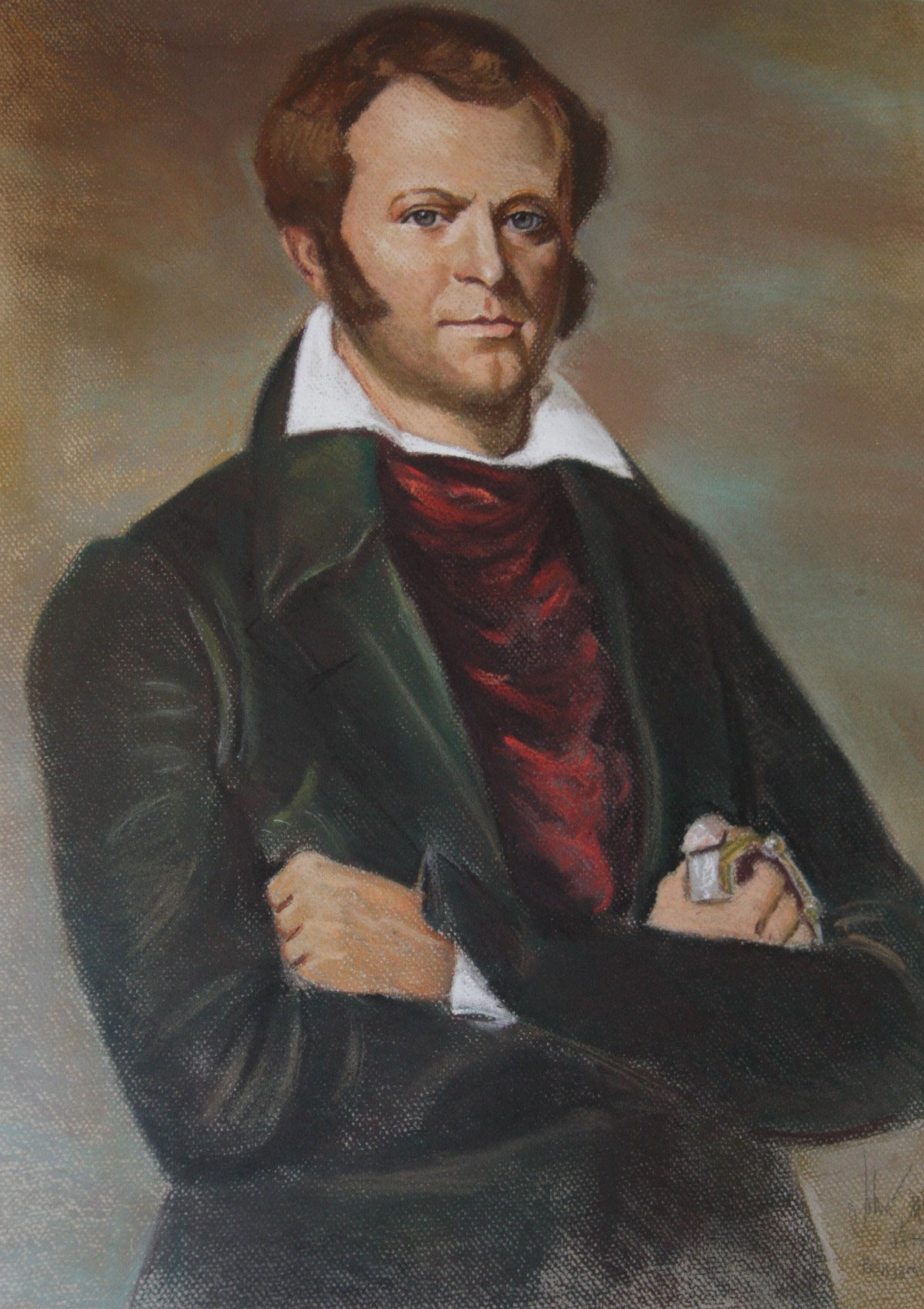
The Bowie knife is named after James Bowie, although the design was likely around well before the infamous Sandbar Fight of 1827.

NEW ORLEANS – Today, archeologists with the University of Louisiana announced they’ve recovered the knife wielded by James Bowie during the infamous 1827 Sandbar Fight. The bloody encounter, which took place on the banks of the Mississippi River near Vidalia, cemented said knife’s design into what is now known as the Bowie knife. Researchers have attempted to locate the knife Bowie used ever since.

As surprising as this discovery is, it’s nothing to compared to the shocking truth hidden beneath nearly 200 years of history.

“We came across this discovery during a dig for a separate project to study Mississippi flooding patterns as expressed in pre-colonial pottery dispersal, in concert with our partners at [National Oceanic and Atmospheric Administration],” said Dr. Edward D. Wood, Jr. “I don’t often use the word ‘excited,’ but that accurately reflects the dig team’s feelings.”

“The World Of Knives Will Never Be The Same”

bowie knife
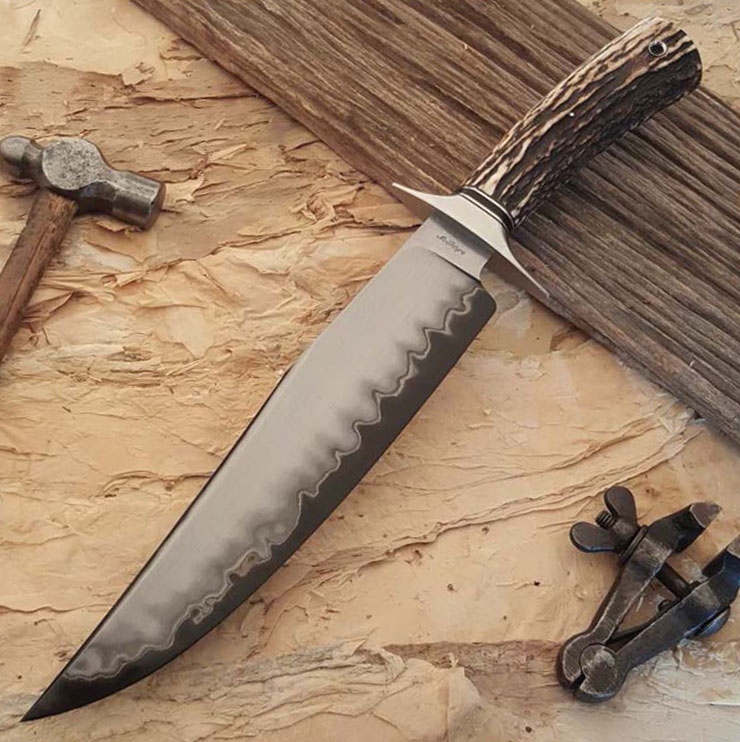
This example of a modern interpretation of a Bowie knife is by ABS master smith Shawn McIntyre. (Shawn McIntyre image)

Wood immediately contacted BLADE for confirmation following the discovery before going public with the find.

“The lore around the Sandbar Fight is so deep, it’s hard to separate fact from fiction. However, I feel confident that what Wood’s team discovered is, in fact, the exact weapon brandished by James Bowie at the Sandbar Fight,” said Steve Shackleford, BLADE editor-in-chief. “As such, it redefines our understanding of knife history and of James Bowie completely. Earth-shattering is an understatement.”

Other BLADE staffers echoed Shackleford’s sentiments. 

“This is, hands down, the most important piece of knife history to come around in generations. There’s no going back after this. The world of knives will never be the same,” said Ben Sobieck, BLADE online editor.

The Bowie Knife: Not What Most People Picture

Bowie knife design
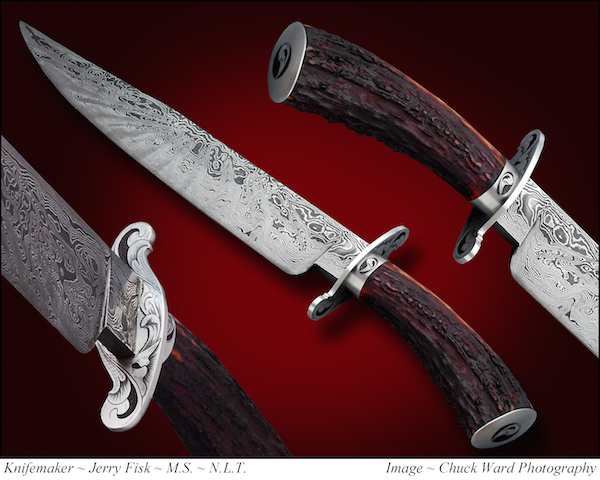
Jerry Fisk’s take on the Bowie knife features a damascus blade and stag handle. (Chuck Ward image)

As it turns out, the knife James Bowie used during the brawl isn’t actually the Bowie knife people know today (example above). Because the original knife was never photographed, it could only be described in written reports. This may have led to some confusion as word spread.

“It’s like a game of telephone, 19th century style,” Wood said. “Now that we know the truth, it’s easy to see how the original description morphed into something completely different throughout the decades.”

Only BLADE Has The Photo Of The Original Bowie Knife

BLADE is the first and only outlet authorized to share the photo of the original Bowie knife. Wood snapped the picture before recovering the artifact.

“Only now can we share this image with our audience,” Shackleford said. “It’s going to burst a lot of bubbles, but we feel it’s important.”

“This calls into question the entire Sandbar Fight. What really happened on the banks of the Mississippi River all those years ago?” Sobieck said. “Was there really a brawl? Or did the aggrieved parties resolve their disputes through non-violent means?

“Perhaps there was, dare I say it, a pie-making contest?”

The evidence certainly points that way.

“I can’t come to any other conclusion,” Wood said.

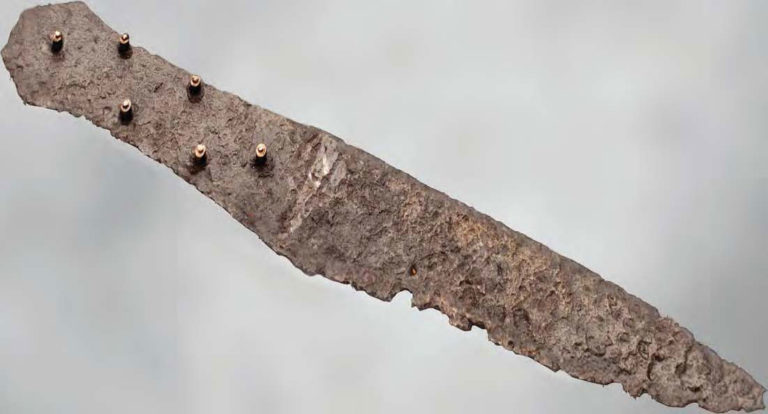
EXCLUSIVE PHOTO: The Original Bowie Knife Wasn’t A Knife At All

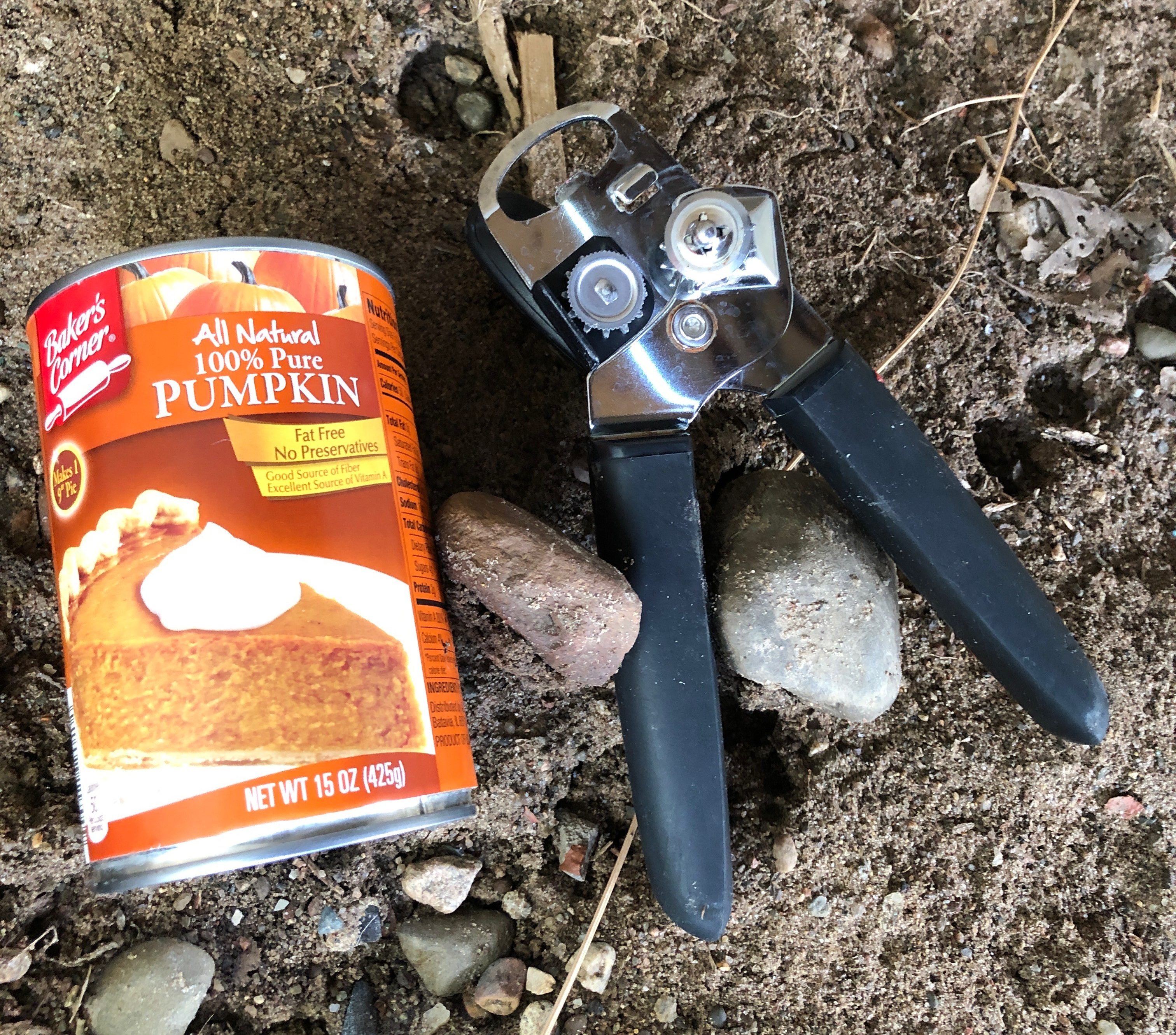
James Bowie’s “knife” was, in fact, a can opener. 

Bowie
Happy April Fools’ Day

“The can opener’s proximity to the canned pumpkin points to a pie-making contest, in which James Bowie was clearly the victor. How this simple fact distorted into a bloody brawl is beyond me,” Wood said. “We carbon dated the dirt and everything checks out.”

“One more note I’d like to add is that it’s April 1, which is April Fools’ Day, and that I feel that the BLADE staff did a great job with this year’s prank,” Shackleford said.

“Definitely. And now I’m hungry for some pie. Pumpkin, apple, strawberry, it doesn’t really matter. I’ll put a pot on, too,” Sobieck said.

Happy April Fools’ Day

A Look Back At BLADE Magazine Cutlery Hall of Fame® History

As these words are written, sitting members of the BLADE Magazine Cutlery Hall Of Fame® are making their nominations for who will be inducted into the Cutlery Hall Of Fame during BLADE Show 2019 on June 7-9 at the Cobb Galleria Centre in Atlanta. When you read these words those nominations will have been completed and the final balloting will be under way.

The entire process rekindles fond memories for this writer, most of which involve the Hall Of Fame ceremony itself that annually occurs during the BLADE Magazine Awards Reception the Saturday night of the BLADE Show.

Cutlery Hall of Fame
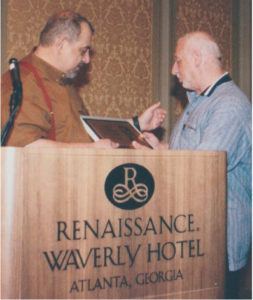
Bob Terzuola (left) presents Sal Glesser (right) with his BLADE Magazine Cutlery Hall-Of-Fame® plaque during the Hall-Of-Fame ceremonies 20 years ago at the 1999 BLADE Show.

The first such ceremony that stood out for me was in 1988 when A.G. Russell and Ken Warner inducted each other—with neither knowing at the time the other would be inducted as well! When each inducted the other the expression on the new inductee’s face was priceless, and that ceremony remains like no other before or since.

Hubert Lawell’s induction in 1989 was memorable for his bringing a copy of the old and now defunct EDGES pocketknife newspaper we used to publish up on the stage, holding it high in the air, and praising it and everything it/we did as the greatest thing for the knife industry since sliced bread. Never mind that many in the audience appeared unsure of what Hubert was saying in his low Tennessee drawl, at the end of his speech he had everyone on their feet cheering—though I’m not sure all of them were cheering because of what he said so much as he was finished saying it.

The 1993 inductions of Col. Rex Applegate, B.R. Hughes and Bruce Voyles were unique. They were the only inductions ever held outside the BLADE Show venue, specifically under a big canvas tent at Stone Mountain Park near Atlanta. Bruce became the first-ever member inducted by acclimation of the membership, which was a pleasant surprise to him. Not to be outdone, upon his induction B.R. uttered perhaps the best acceptance line ever.

“I don’t know that I deserve this Hall-Of-Fame plaque,” he deadpanned, “but I’m not giving it back!”

Following it all everyone retired to a giant fireworks presentation courtesy of the park.
Spyderco CEO Sal Glesser’s induction in 1999 was particularly memorable. Not only were we able to keep Sal from knowing until the last minute that he would be inducted, but Mrs. Gail Glesser was able to keep secret from him that she would be there, too.

best knifemakers in the world
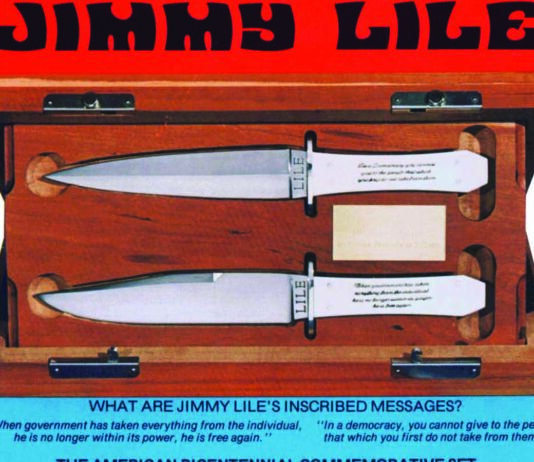
Al Buck, M.H. Cole, Bill Williamson and Jimmy Lile receive their Hall of Fame awards from James F. Parker at the BLADE Show banquet.

Gail was supposed to miss the BLADE Show entirely that year due to a scheduling conflict. However, when we told her Sal was going to be inducted, unbeknownst to him she begged off on her other engagement and arranged to arrive at the show just before the ceremony began. So not only was Sal surprised to be inducted, he was equally tickled to have his wife there to share in the honor with him.

In recent years we’ve had to forego all the cloak-and-dagger stuff involving keeping the inductions secret because we have been announcing the inductions on our website well before the show, which we will do again for this year’s inductions sometime next month. Stay tuned to blademag.com for that announcement.

Meanwhile, visit the list and mini-bios of all our illustrious Cutlery Hall-Of-Fame members. While all of their induction ceremonies are not recounted here, each was special in its own way just the same.

BLADE Show tickets online

Why Are Switchblades Illegal?

10


Switchblades: A “Barbaric and Sadistic” Knife?

“Vicious fantasies of omnipotence, idolatry… barbaric and sadistic atrocities, and monstrous violations of the accepted values spring from the cult of the weapon, and the switchblade knife is included in this. Minus switchblade knives and distorted feeling of power they beget – power that is swaggering, reckless, and itching to express itself in violence – our delinquent adolescents would be shorn of one of their most potent means of incitement to crime.” Representative Sidney R. Yates of Illinois, 1958

The quote above is not from a Hollywood movie or dime novel. A politician in support of the 1958 Federal Switchblade Act said those words more than 50 years ago. To understand why, we need to look at history, society in the 1950’s and a popular magazine from that time period.

History of Switchblades in the United States

examples of switchblades
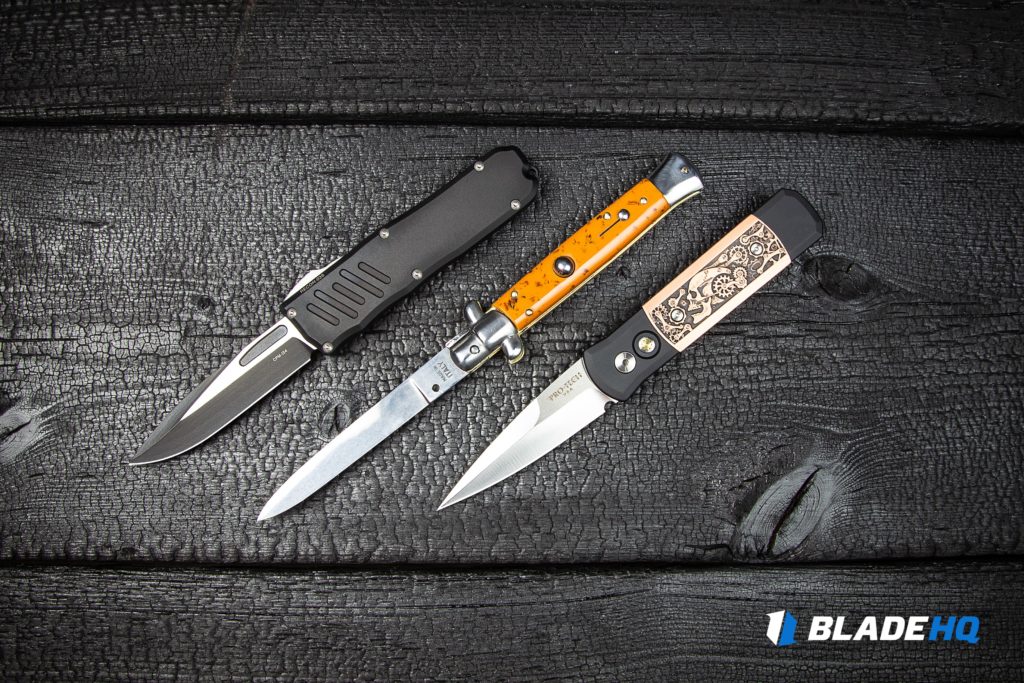
The Italian stiletto (middle) is the most iconic subset of switchblades, but the other styles on the left and right are also switchblades. They’re commonly called “automatic knives” as well. (Blade HQ image)

While the word “switchblade” might conjure up imagery of tough guys in the 1950s with leather jackets and stiletto knives, it’s just another term for “automatic knife.” Automatic knives range from the iconic Italian stiletto to the modern OTF (out the front). The defining features are always the same: the blade, biased to open and kept under tension in the handle, deploys at the press of a button or lever on the handle.

The United States led production and distribution of automatic knives for most of the early 20th century, boosted by George Schrade and the onset of mass production. Schrade set up shops all over the country as well as abroad. Schrade produced and advertised automatic knives mostly to and for ranchers, outdoorsman, hunters, and farmers as quick, one-handed utility tools. Business was good, and people liked their snappy, modern Presto pocketknives. Then World War II happened.

Modern switchblades
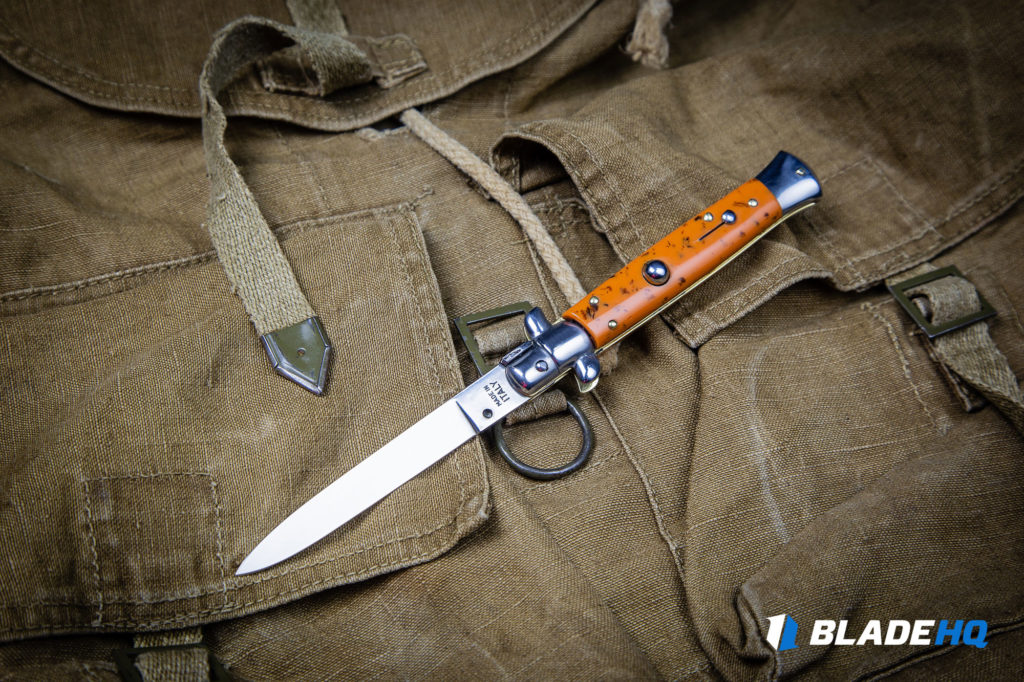
This SKM is an example of a modern, Italian-made switchblade knife. (Blade HQ image)

During the war, many U.S. soldiers carried and used Schrade’s automatic knife, but they found something even more attractive while deployed in Europe: the Italian stiletto.

Demand stateside grew as American GIs returned home with these exotic knives, and that led to large imports from Italy. It may have been the sabre-ground bayonet blade, the highspeed look, the undeniably foreign influence or a combination of all three, but it did not take long for the stiletto and, by association, all automatic knives to get noticed by up and coming politicians trying to make a name for themselves as peacemakers and protectors.

Why Switchblades are Illegal: The Toy that Kills

Why are switchblades illegal
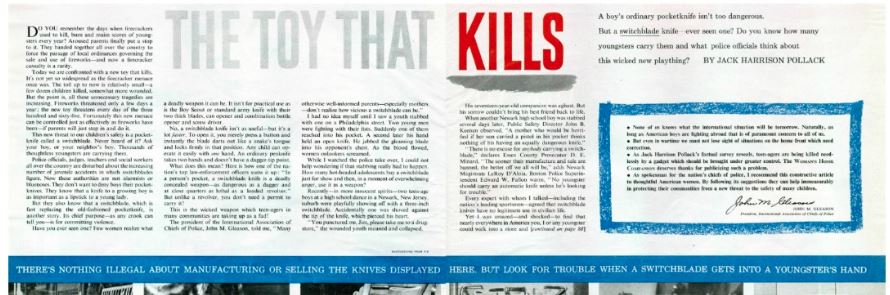
This is the hyperbolic article that started it all.

Fast-forward to November, 1950. Subscribers all over the U.S. received their new copy of Woman’s Home Companion. It contained one of the most lurid examples of anti-knife muckraking to ever be written, an article titled, The Toy That Kills. Jack Harrison Pollack, a freelance writer and ghostwriter for then-Senator Harry S. Truman, wrote the article. He filled it with a number of quotes and statistics without ever referencing a single citation. Even in today’s digital world, we have a hard time finding many facts to back up Pollack’s claims.

What exactly was he claiming, you ask? In short, Pollack alerted the mothers of America that the switchblade and the switchblade alone was the sole cause for juvenile delinquency, gang violence and ruined lives. In his own words, “Designed for violence, deadly as a revolver – that’s the switchblade, the ‘toy’ youngsters all over the country are taking up as a fad. Press the button on this new version of the pocketknife and the blade darts out like a snake’s tongue. Action against this killer should be taken now.” The article asserts a handful of shaky anecdotal experiences and dubious statistics.

Pollack offered five tips for the concerned mother, condensed into the following:

  1. Make sure your kid is not carrying a switchblade.
  2. Make sure to “de-glamorize knife-carrying” in general.
  3. Use all your power as a mom and wife to get knives out of stores. (He even included verbiage for signs to hang up in stores.)
  4. Help police round up “dangerous knives,” even though there were no significant bans or laws in place at the time.
  5. Work on a state and national level for switchblade bans that are to be “strictly enforced.”

The end of Mr. Pollack’s article also marked the end for easy automatic knife use and possession in the United States.

Pop Culture Origins of Switchblade Ban


The Toy That Kills was the match that started a switchblade wildfire throughout the country. Newspapers ran embellished stories about gang violence and switchblade use. State legislatures started looking into the “issue,” and New York became the first state to ban automatic knives in 1954.

Even Hollywood jumped in on the frenzy. Movie studios released no less than six major titles in just as many years that included Rebel Without A Cause, 12 Angry Men and West Side Story. Every one of these blockbusters placed the switchblade front and center as a tool for violence and delinquency.

The 1958 Federal Switchblade Act Arrives

What is an OTF knife
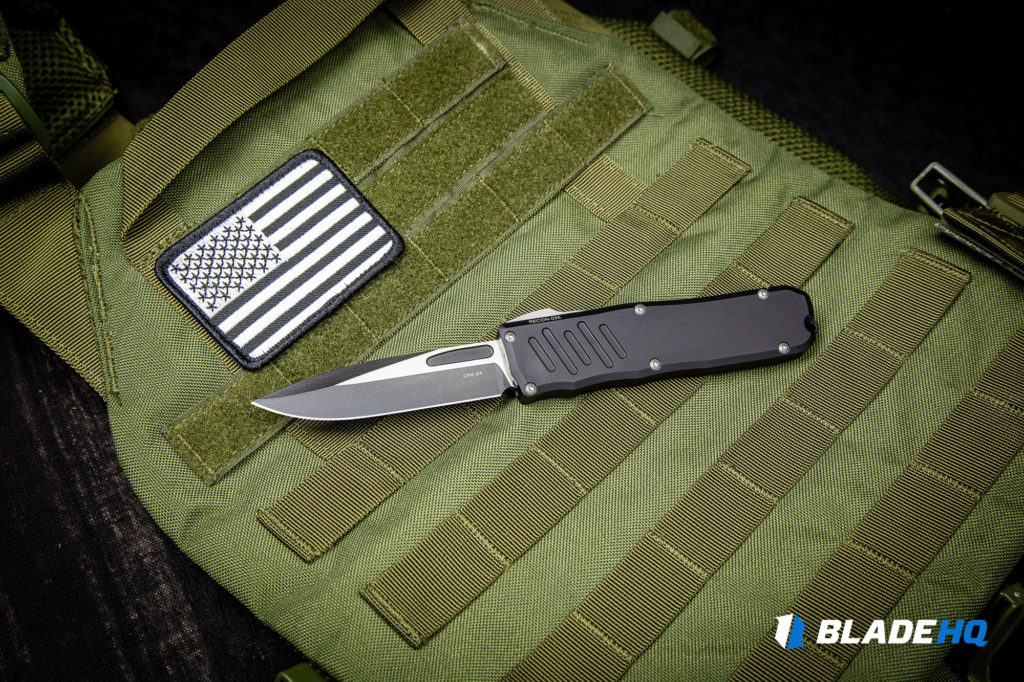
Out the front (OTF) knives are a subset of automatic knives. The blade moves vertically in and out of the handle. This is a Guardian Tactical RECON. (Blade HQ image)

It only took eight short years from the publishing of The Toy That Kills for the issue to make its way to Washington, D.C., in what would become known as the 1958 Federal Switchblade Act. Hearings fielded reports from law enforcement and concerned citizens. However, a lack of hard data pervaded the inquiries.

One well-sourced report came from the police chief of Kansas City, Missouri, which had a population of more than 400,000 people at the time. In the calendar year of 1956, this city reported around three dozen switchblade-related misdemeanors, crimes and juvenile goofing off.

Testimonies also came from the two federal entities that would ultimately oversee enforcing the Act if it passed: the Department of Commerce and the Department of Justice. From William P. Rogers, the deputy attorney general:

“The Department of Justice is unable to recommend enactment of this legislation. The Committee may wish to consider whether the problem to which this legislation is addressed is one properly within the police posers of the various States…Switchblade knives in the hands of criminals are, of course, potentially dangerous weapons. However, since they serve useful and even essential purposes in the hands of persons such as sportsmen, shipping clerks, and others engaged in lawful pursuits, the committee may deem it preferable that they be regulated at the State rather than the Federal level.”

From Secretary of Commerce Sinclair Weeks:

“The intent of these legislative proposals appears to be to improve crime prevention by control of the use of the switchblade knife as a weapon of assault. This approach gives rise to certain objections. One is that, at best, it is an indirect approach which addresses itself to only one of the many implements useable by an assailant. This casts doubt upon the resulting effectiveness in the reduction of crime in relation to its enforcement problems. To us, this ignores the needs of those who derive and augment their livelihood from the ‘outdoor’ pursuits of hunting, fishing, trapping, and of the country’s sportsmen, and many others. In our opinion there are sufficient of these that their needs must be considered.”

At the time (and in retrospect), many of the lawmakers agreed with the quotes above but said they were acting symbolically against crime. In other words, they made themselves look good to their constituents while doing little concerning the issues they claimed to care so much about. And so, on August 12, 1958, congress enacted Public Law 85-623, more commonly known as the Federal Switchblade Act.

Automatic knife examples
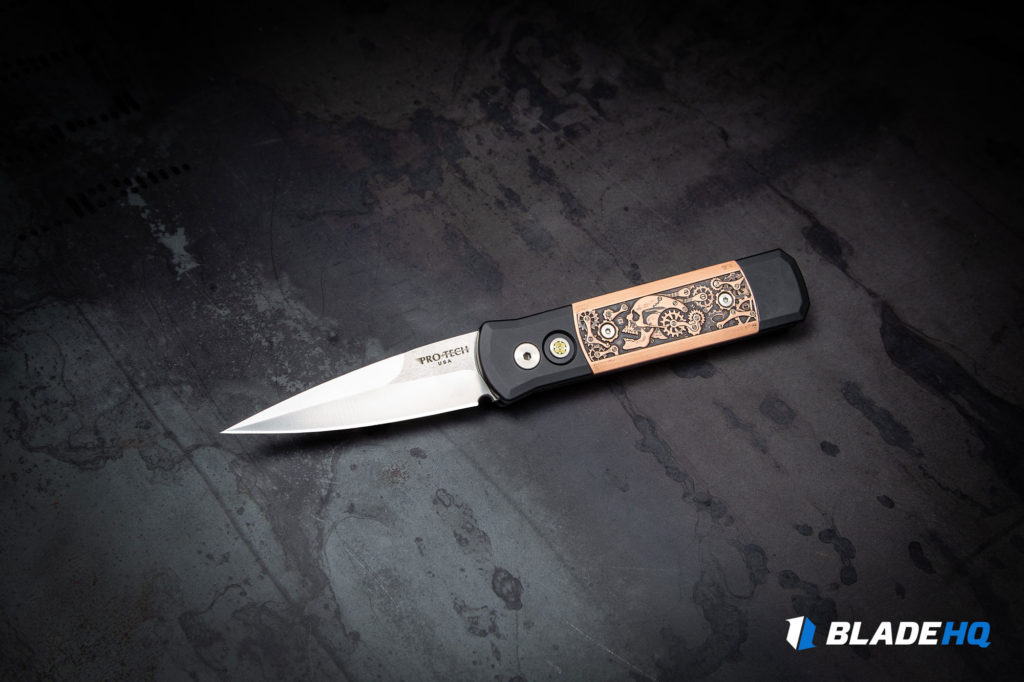
This Protech Godson represents a modern, side-opening automatic knife. (Blade HQ)

The Act itself dealt with banning certain transportation and sales of automatic knives, as well as outright banning automatic knives in certain areas and places nationally. It also defined by law what a switchblade was:

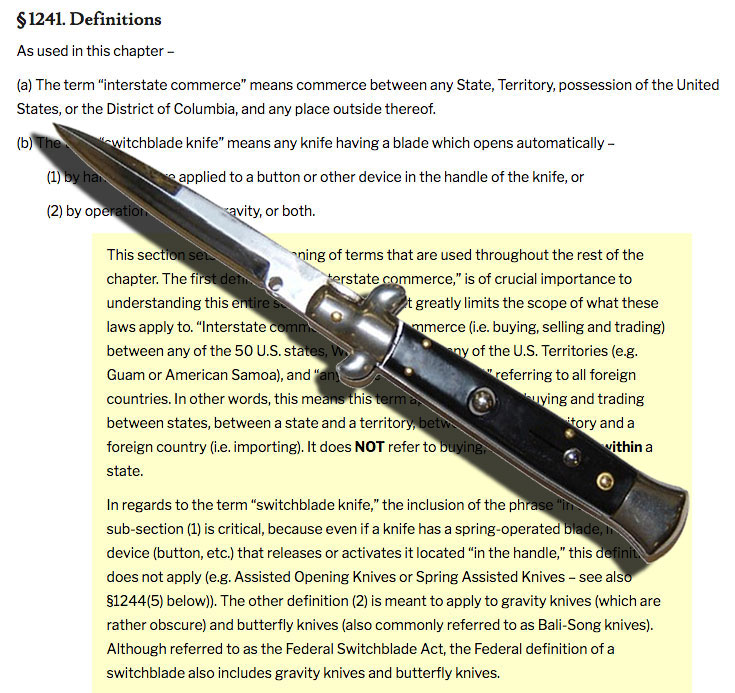
“The term ‘switchblade knife’ means any knife having a blade which opens automatically-by hand pressure applied to a button or other device in the handle of the knife, or (2) by operation of inertia, gravity, or both.”

All in all, the Federal Switchblade Act is a hard read with more than a handful of seeming contradictions. If you want to dive deeper into what exactly the Act says and how it’s parts work together, we recommend you check out Knife Rights page on the document (https://kniferights.org/resources/federal-switchblade-act/).

Just as the United States had led the way in automatic knife production at the beginning of the 20th century, it led the way for knife legislation in the mid-20th century. As soon as the Federal Switchblade Act was passed, many other countries around the world followed suit and banned switchblade knives. This led to a domino effect in many countries, where owning anything short slip joint with a blade under 2 inches is now illegal.

The Rise of Knife Advocacy Groups

Repeal knife bans
Knife Rights is one organization pushing for repeal of the 1958 Federal Switchblade Act. Successes at the state level continue to build momentum for a federal repeal. (Knife Rights image)

Knife Rights and AKTI are both organizations doing a lot to amend and repeal a law that seems to have been put in place without proper foresight and consideration. With their efforts, they successfully rolled back automatic knife restrictions in 40 states and counting.

One of the biggest wins for the knife world came in 2009 when the U.S. Customs and Border Protection (CBP) tried to reverse prior ruling on assisted opening/spring-assisted knives. Essentially, the CBP tried to define any one-handed opening knife as a switchblade. The revision would have dealt primarily with the importation of these assisted knives. The real concern came from the confusing nature of the Act. If CBP got their way, it would have been easy to extend the restriction broadly on both a national and state level. Luckily, many groups, including Knife Rights and AKTI, stepped up and prevented this from happening.

For knife enthusiasts, supporting Knife Rights and AKTI are the best ways to help revise and repeal the national and state restrictions on what, at the end of the day, is just another knife. Until that day, know your local laws and stay sharp!

Learn More About Knife Laws

What knives are illegalContinue exploring the laws that govern knives in attorney Evan Nappen’s book, Knife Laws of the U.S.: Loopholes, Pitfalls & Secrets.

Abraham Lincoln’s $100,000 Pocketknife

0

Editor’s note: A long-time vintage knife enthusiast originally from England, Jim Taylor wrote a number of stories on antique knives for BLADE®, including this one on a knife that belonged to Abraham Lincoln and fetched almost $100,000 at auction in 1989. Help us celebrate BLADE’s 45th anniversary with his story from the July/August 1989 issue.

by Jim Taylor

The hammer fell. The auctioneer at Sotheby’s January 1989 auction in New York couldn’t get another cent. The buyer, an anonymous American collector, had bought a 4.25-inch pearl-handled pocketknife.

The facts reported above are true. The sums of money mentioned are certifiable. Add the 10 percent buyer’s premium and the knife’s new owner got back $175 change out of 100 grand! Yep, the net price was $99,825.

The knife in question was not one you’re likely to find on a dealer’s table. This one was special!

An “Historic” Knife for President Lincoln

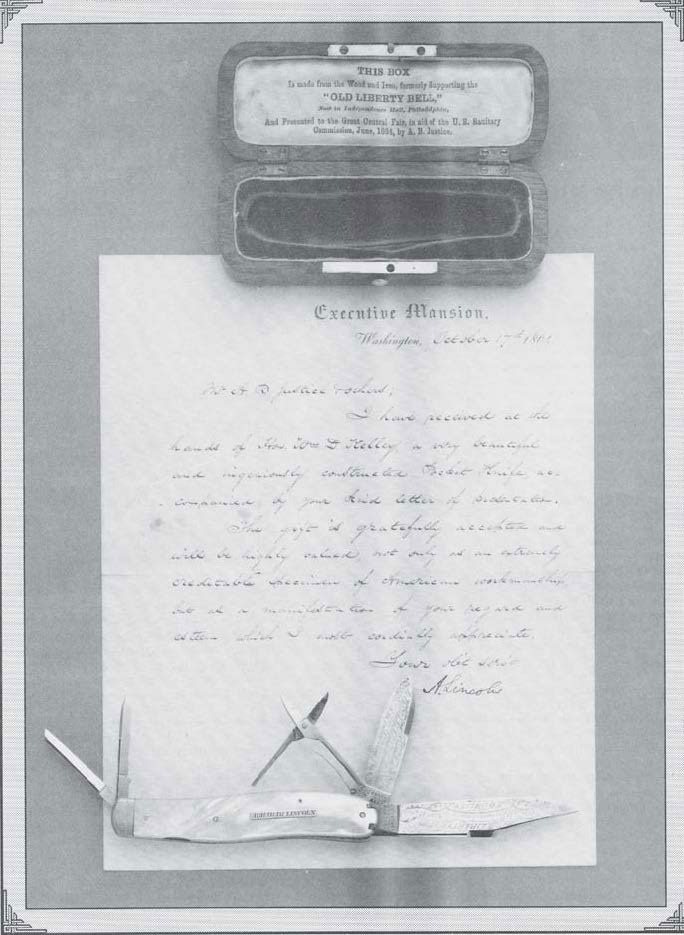
On June 16, 1864, President Abraham Lincoln spoke at the Great Central Fair in Philadelphia. To mark the occasion, prominent Philadelphians presented him with what Sotheby’s catalog described as an “historic mother of pearl presentation ‘American Army’ multi-bladed pocketknife of slightly serpentine outline. Paneled with mother of pearl and inlaid with a gold plaque engraved ‘Abraham Lincoln,’ the pocketknife is fitted with polished steel scissors, nail file and five various blades, two of which are damascened (decorated with inlaid patterns of gold or silver) with foliated inscriptions.”

Accompanying the historic knife is the original presentation box, made of fitted oak and lined with velvet and satin. The inscription inside the lid states that the wood and iron used in the box’s construction came from the “Old Liberty Bell.” The lid is inlaid on the outside with a spread-winged eagle surrounded by 13 stars. The sale also included a handwritten letter of thanks from Lincoln. The letter, dated Oct. 17, 1864, states:

“I have received at the hands of the Hon. Wm. D. Kelley a very beautiful and ingeniously constructed pocketknife accompanied by your kind letter of presentation. The gift is gratefully accepted and will be highly valued, not only as an extremely creditable specimen of American workmanship, but as a manifestation of your regard and esteem which I most cordially appreciate.

Your ob’t serv,t
A. Lincoln

President Abraham Lincoln auction knife
Abraham Lincoln lived at a time when knives were carried by most everyone on a daily basis—not only as a convenient tool but because, quite simply, knives were indispensable for a wide variety of tasks and personal needs. And, back then at least, Lincoln apparently was no different than anyone else.

The inscription on the clip blade reads, “LIBERTY, July 4th, 1776. Abraham Lincoln, Jan. 1st, 1863 EQUALITY.” The blades all carry the tang stamps “J. Ward & Co., Bronxville, New York.” It also is apparent from the photograph—kindly supplied by Sotheby’s—that various implements are fitted behind the pearl handle, such as a tweezers, pick and more.

Ward originally made the knife to the order of Albert B. Justice, a Philadelphia hardware merchant. Justice presented the knife to the fair’s board of directors, of which he was a member. He then solicited some 130 wealthy Philadelphians to endorse its subsequent presentation to the president. When presented, the knife was accompanied by a document containing the 130 Philadelphians’ signatures.

The document is currently in the Library of Congress in Washington, D.C. Other items sold with the knife include a bronze medal commemorating the fair, as well as photographs of the presentation document, photocopies of a publication called Our Daily Fair that described the fair, and the text of Lincoln’s address.

The Bronxville factory in New York was originally a grist and saw mill prior to the Revolutionary War, and the four-story building housing the factory came into the hands of James Swain circa 1849. Swain utilized the building for the manufacture of axles, among other things.

In 1880, James Ward bought the property solely for the manufacture of cutlery.
Ward, like so many of his countrymen of the day, sought the aid of qualified and experienced Sheffield cutlers, and he even advertised for them. One tiny fragment of a prospectus survives. It reads:

“Dear Sir,

The undersigned, Manufacturers of PEN AND POCKET CUTLERY, are now prepared to sell to the trade, a first class article, manufactured on the English system…”

Knives made by Ward in Bronxville are certainly not plentiful, nor are the records clear about how long the company lasted. The factory later became the police headquarters for the Bronx River Parkway before its eventual demolition circa 1959.

Editor’s note: The current location of the Lincoln pocketknife was unknown at press time.

More Articles About Abraham Lincoln’s Knives

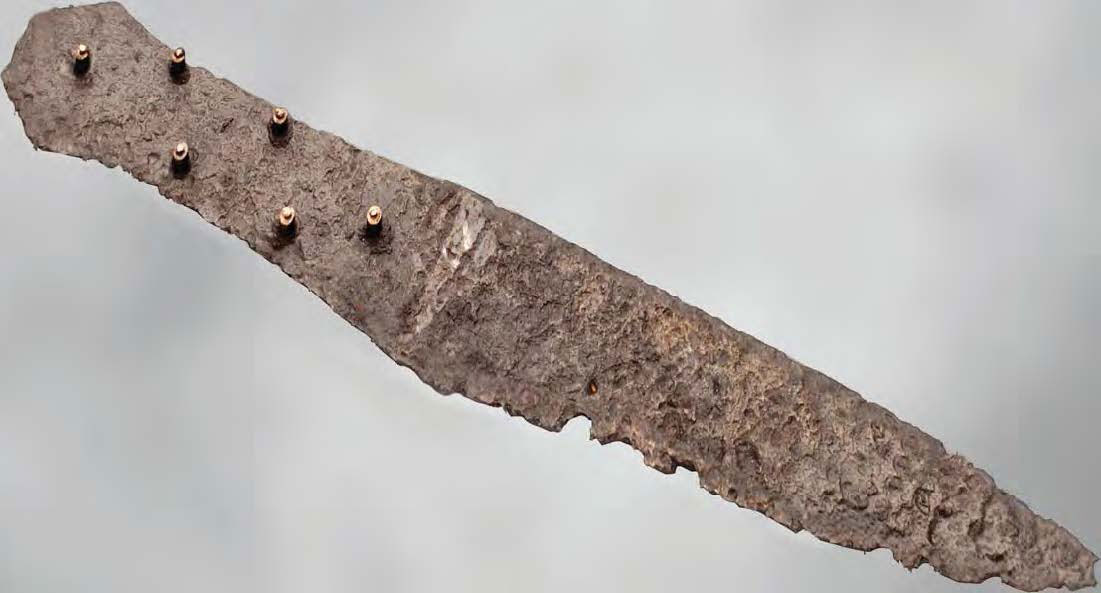
The Sea of Mud Knife: James Bowie’s Knife Found? Pt. 3

James Bowie knife
(relic image courtesy of the Cushing Memorial Library and Archives, Texas A&M University Libraries)

Editor’s note: Read part one and two of this series first.

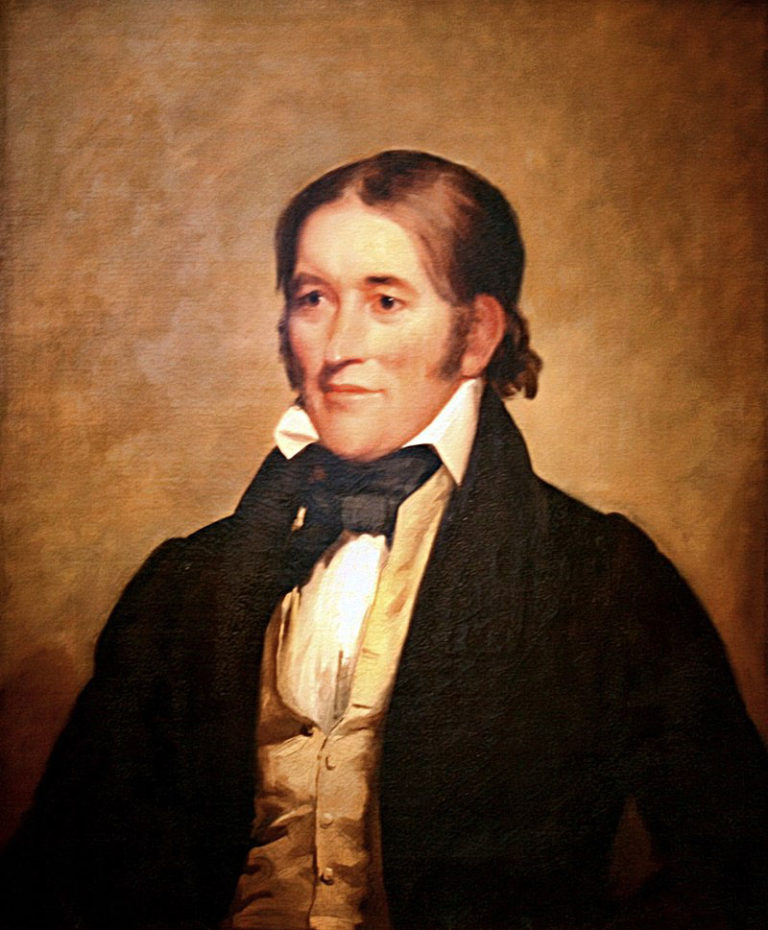
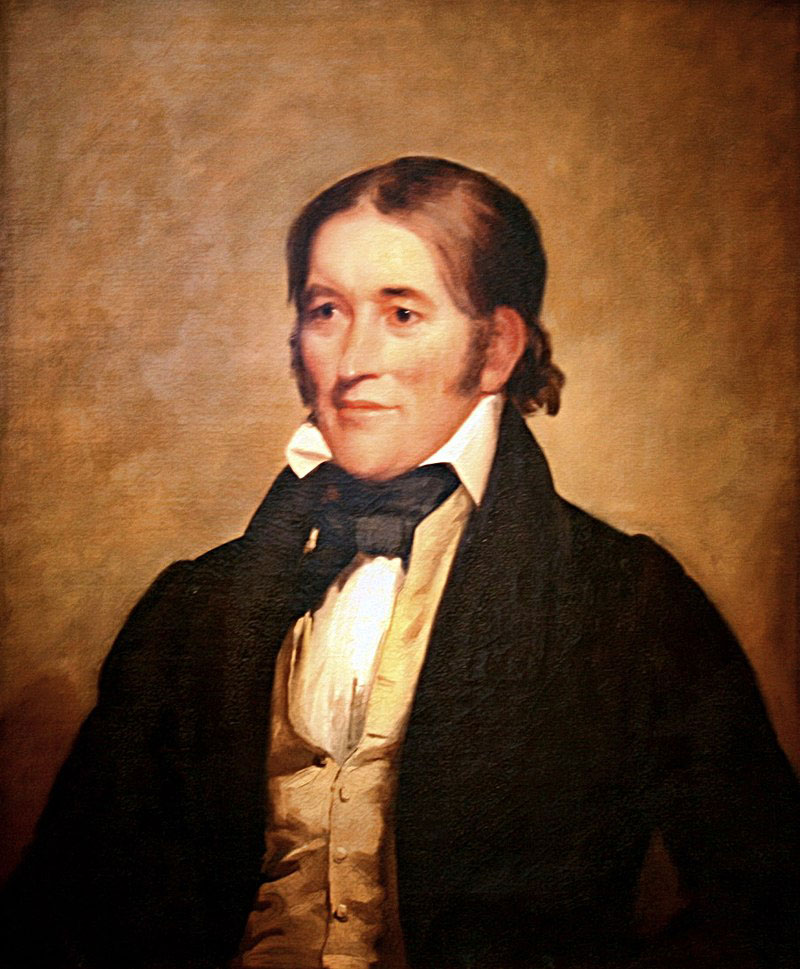
Did the Sea of Mud Knife Belong to Davy Crockett?

Davy Crockett picture
Davy Crockett passed by James Black’s Shop in 1835 on his way to the Alamo. Could he have bought the Sea of Mud knife (above) from Black or received it as a gift?

On about Nov. 18, 1835, the most famous fallen hero of the Alamo and his entourage crossed Town Creek on the Southwest Trail that led up the hill past James Black’s Shop to the Elijah Stuart’s tavern in Washington, Arkansas. Did former Tennessee congressman, Col. David “Davy” Crockett, or one of his companions buy the Sea of Mud knife from Black? Did Black give the knife to the famous folk hero?

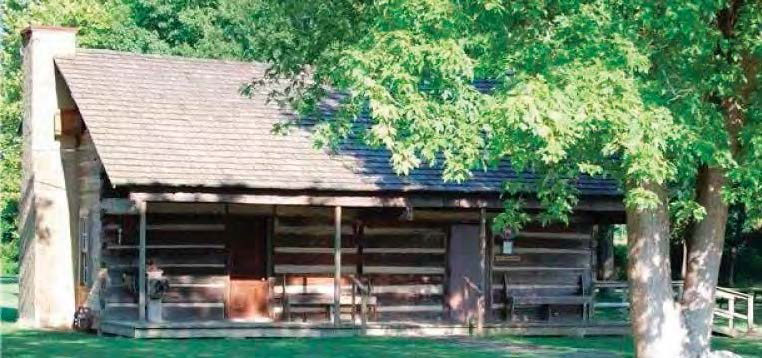
On Nov. 1, 1835, Crockett, along with three others—William Patton, Abner Burgin and Lindsey K. Tinkle—left Crockett’s log cabin home near Rutherford, Tennessee, on a journey of adventure, exploration and fortune hunting.

Having recently lost his U.S. House of Representatives seat to Adam Huntsman, “a one-legged Jacksonian,” Crockett told his constituents, “Since you have chosen to elect a man with a timber toe to succeed me, you may all go to the devil and I will go to Texas.” Most certainly he told this tale over and over, all the way to Texas, always to the delight of his audience. He traveled to Jackson, Tennessee, arriving there with 30 well-armed men, where he gave a speech from the steps of the Madison County courthouse.

Davy Crockett history
Crockett left his log cabin home in Rutherford, Tennessee, on Nov. 1, 1835, on a journey of “adventure, exploration and fortune hunting.”

From there he rode southwest to Bolivar, where he spent the night at the residence of Dr. Calvin Jones, once again drawing crowds—including one that sent Crockett off the next morning.
He arrived in Memphis with a much-diminished company on Nov. 10. There that night much time was spent enjoying horns of drink with citizens and comrades at the Union Hotel, Hart’s Saloon and Neil McCool’s establishment.

At 7:30 a.m. on Nov. 11, Crockett and his entourage of six to eight men left Memphis on a packet steamboat. He obviously was recovering from a night of carousing. The steamboat traveled 311 miles down the Mississippi River and up the Arkansas River, arriving at Little Rock at 4:30 p.m. on Nov. 12. The local newspapers reported that hundreds of people swarmed into town to get a look at Crockett, and a group of leading citizens put on a dinner in his honor that night at the Jeffries Hotel. He spoke “mainly to the subject of Texan independence,” as well as federal politics.

Washington, Arkansas

Crockett had traveled 150 miles in nine days on his large chestnut horse with the star on its forehead. He had at least three more traveling companions with him when he left Little Rock that morning. It was only 125 miles down the Southwest Trail to Washington, Arkansas, and just a few more miles to Texas. It is not known how long he stayed in Washington, maybe just overnight, because he was so close to that wonderful land called Texas.

Hugh Armstead Blevins history
On the way to Washington, Arkansas, Crockett stayed at the home (above) of Hugh Armstead Blevins in present-day Blevins, Arkansas.

He had stayed with an old and dear friend from Rutherford County Tennessee, Hugh Armstead Blevins, in present-day Blevins, Arkansas, before riding into Washington. Blevins family tradition maintains that Crockett went on a weeklong deer-hunting trip with Hugh. Crockett stayed at Elijah Stuart’s tavern next to James Black’s shop in Washington. The people came in from all around to hear Crockett speak from the courthouse steps. After some celebrating, Davy and a half-dozen mounted companions could have ridden to the Red River and crossed into Texas at Dooley’s ferry.
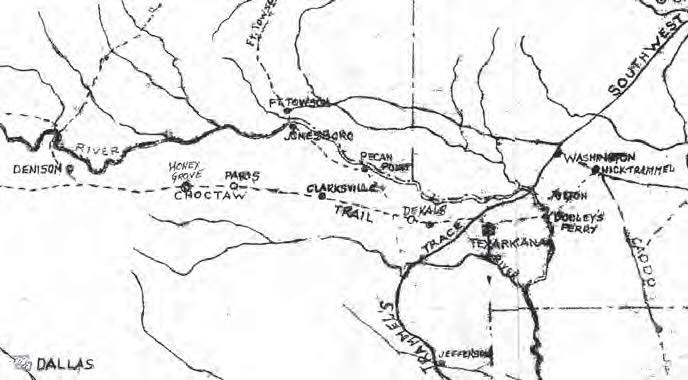
Some historians say he went down the Fort Towson road 115 miles and crossed the Red River into Texas at Jonesboro, just north of present-day Davenport, Texas. He may have crossed the Red River at Dooley’s Ferry just as W.G. Featherstonhaugh did.

Davy Crockett travels
Crockett stayed at Elijah Stuart’s tavern next to James Black’s shop in Washington. He may have crossed the Red River at Dooley’s Ferry as did W.G. Featherstonhaugh. Some say Crockett went down the Fort Towson road 115 miles and crossed the Red River into Texas.

Several weeks after the fall of the Alamo Crockett’s widow, Elizabeth, received a small package from Isaac Newton Jones. The package contained a watch with Crockett’s name engraved inside. In an accompanying letter, Jones wrote:

“Last winter, Colonel Crockett … passed through Lost Prairie, on the Red River, where I live … the Colonel visited me the next day, and spent the day with me. He observed, whilst here, that his funds were getting short, and proposed to me to exchange watches. He priced his at thirty dollars more than mine, which sum I paid to him, and we accordingly exchanged … I was gratified at the exchange, as it gave me a keepsake which would remind me of an honest man, a good citizen, and a pioneer in the cause of liberty … the object of this letter is to beg that you will accept the watch which accompanies it … please accept, dear madam, for yourself and your family …”

Crockett’s Letter

Davy Crockett De Kalb
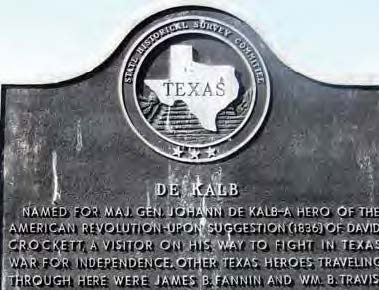
Crockett reportedly suggested the name for De Kalb, Texas and traveled through the area on his way to the Alamo.

The distance from Lost Prairie to Nacogdoches down Trammel’s Trace was 165 to 170 miles. At the rate of 25 miles per day Crockett should have arrived at Nacogdoches, Texas before the end of November. Crockett and his entourage were welcomed in Nacogdoches on Jan. 5, 1836.

Here is what Crockett stated in a letter written to his son and daughter from St. Augustine, Texas, dated Jan. 9, 1836:

“This is the first time I have had the opportunity to write to you with convenience. I am now blessed with excellent health and am in high spirits. Although I have had many difficulties to encounter, I have got through safe, and have been received by everybody with the open arm of friendship. I am hailed with a hardy welcome to this country. A dinner and a party of Ladys have honored me with an invitation to participate with them, both in Nacogdoches and this place. The cannon was fired here on my arrival, and I must say, as to what I have seen of Texas, it is the garden spot of the world. The best land and the best prospect for health I ever saw is here, and I do believe it is a fortune to any man to come here. There is a world of country to settle. It is not required here to pay down for your League of Land; every man is entitled to his head right of 4,000 & 428 acres. They may make the money to pay for it off the Land.

“I expect in all probability to settle on the Bodark or Choctaw Bayou of Red River. That, I have no doubt, is the richest country in the world. Good Land and plenty of timber, and the best springs and good mill streams. Good range, clear water and every appearance of good health, and game plenty. It is in the pass where the Buffalo passes from the north to south and back twice a year, and bees and honey plenty.

“I have a great hope of getting the agency to settle that country, and I would be glad to see every friend I have settle there. It would be a fortune to them all.

“I have taken the oath of the Government, and have enrolled my name as a volunteer for six months, and will set out for the Rio Grand in a few days with the volunteers from the United States. All volunteers is entitled to a vote for a member of the convention, or to be voted for, and I have but little doubt of being elected a member to form a constitution for this Province.

“I am rejoiced at my fate. I had rather be in my present situation than to be elected to a seat in Congress for life. I am in hopes of making a fortune for myself and family, bad as has been my prospects.

“I have not wrote to William, but have requested John to direct him what to do. I hope you show him this letter, and also your brother John, as it is not convenient at this time for me to write to them.

“I hope you will do the best you can, and I will do the same. Do not be uneasy about me, for I am with my friends.

“I must close, with great respects, your affectionate Father, Farewell David Crockett”

Crockett spent December roaming the north Texas countryside along the Red River visiting friends and looking for a prosperous place to settle down where there was good bear and buffalo hunting. He was also dodging Comanche Indians. He headed west along Ridge Trail or Choctaw Trail 175 miles along the Red River as far as Choctaw Bayou. Choctaw Bayou runs from Grayson County northeast into the Red River at the northwest corner of Fannin County above Sherman and Denison, Texas.

Davy Crockett Texas
Crockett stayed at Elijah Stuart’s tavern next to James Black’s shop in Washington. He may have crossed the Red River at Dooley’s Ferry as did W.G. Featherstonhaugh. Some say Crockett went down the Fort Towson road 115 miles and crossed the Red River into Texas.

It is said that the morale of the defenders of the Alamo in San Antonio enjoyed a boost on Feb. 8, 1836, when the former U.S. congressman from Tennessee, bear hunter and Indian fighter rode in with a contingent of Tennessee Mounted Volunteers.

Next time: The fortifications by the defenders and the probing of them by the Mexican Army during the Alamo siege.


Read part three of this series here.

Keep Learning About Knife History

BLADE magazine back issues

That Time that BLADE Magazine was Traded for a Horse

Yep, that’s right—a thoroughbred racehorse.

Known as The American Blade at the time, the magazine was traded by then-publisher Jack Marvich to Wally Beinfeld for a racehorse—or at least that’s what Beinfeld reportedly told one of his successors, former BLADE publisher and editor and BLADE Magazine Cutlery Hall-Of-Fame® member Bruce Voyles.

Marvich was a dentist living in New Orleans. He acquired the magazine and served as publisher beginning with the January-February 1974 issue and ending with the November-December issue of the same year. That’s when Beinfeld assumed the, ahem, reins. But first let’s, ahem, backtrack a bit.

knife magazines of the 1970s
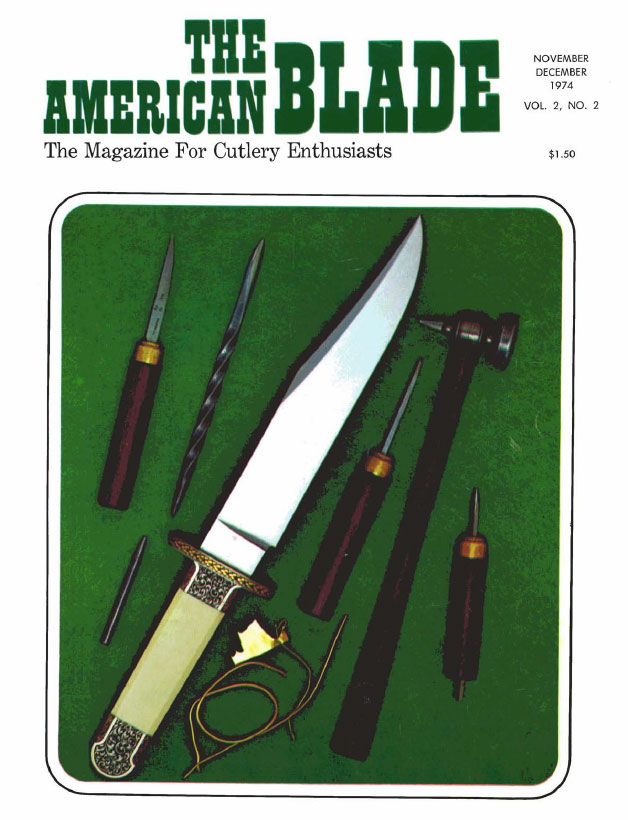
The cover of the November-December 1974 issue of The American Blade.

Beinfeld ran what was probably the country’s premier antique arms show and, in part to help promote it, published a gun magazine called the Arms Gazette. The Gazette had a large editorial, graphics and production staff that was more than big enough to produce a second magazine. Hence, Beinfeld decided to add a knife publication—The American Blade—to his, ahem, stable.

However, there was one problem. Marvich and Beinfeld could not make a deal, even if, apparently, the racehorse was at least part of the payment.

“They were sitting there talking about it one day and the more they talked, the worse it got,” Voyles recalled Beinfeld’s version of what happened.

Beinfeld and Marvich were making no headway at all. Finally, Beinfeld stood to call the whole thing off and leave when in walked Marvich’s wife.

“Marvich looked at her and said, ‘Honey, the deal’s not going to go through, we just can’t come to terms.’ And she looked at him and said, ‘What about my racehorse?’ And in Wally’s words, ‘So I sat back down.’ From what I understand,” Bruce recalled, “I don’t know if the racehorse was just part of the deal or what, but I believe it was the entire deal. That was the way it was told to me.”

And, thus, Beinfeld bought The American Blade. Bruce said he can’t recall the horse’s name, which is understandable considering how long ago it was. Meanwhile, Mr. Beinfeld passed away a few years back, and we don’t know the whereabouts of Mr. and Mrs. Marvich.

As for the horse, here’s hoping he was put out to stud and lived happily ever after. (Insert your impression of a horse whinnying here.)

Subscribe to BLADE Magazine

Sign up for a subscription to the world’s foremost knife magazine here, no horse required.

Advertisement

Must Read Articles

Read this before you make a knife

Knifemaking 101 – Read This Before You Make a Knife

  by Wayne Goddard My experience has taught me that there's nothing like digging in and getting started. I've often said the hardest part of the...
how to forge damascus steel

How to Forge Damascus

Advertisement
Advertisement