

Home Knife News Wire

Knife News Wire

B. R. Hughes, Pioneering Writer And Bladesmithing Teacher, Passes Away

Hughes’ unbound energy touched outdoor writing, knifemaking, sports and higher education.

Billy Ray “B. R.” Hughes, one of four founders of the American Bladesmith Society, pioneering knife and also a gun and outdoor writer, bladesmithing teacher, member of the BLADE Magazine Cutlery and ABS halls of fame and dear friend of the knife community, passed away September 17. He was 92.

B. R. began his writing career in 1951 as a reporter for the El Dorado Daily News in El Dorado, Arkansas, and later wrote for the Arkansas Gazette and Monroe Morning World. He attended Henderson State University in Arkadelphia, Arkansas, where his flair for writing blossomed. He was editor of the college newspaper, assistant editor of the school yearbook and was active in school drama productions. He lettered in baseball and went on to play professionally for a short time in the minor leagues, topping out in the Class “C” league. He graduated from Henderson State in 1954 with majors in history and literature and a minor in speech and drama.

He began his teaching career in Huttig, Arkansas, where he met and later married Carolyn, current editor of The ABS Journal. Over the next decade, B. R. taught and coached at several Arkansas high schools. He covered the undefeated/untied University of Arkansas football team when the Razorbacks were recognized by several organizations as the 1964 NCAA national champions, a team coached by Frank Broyles and that included future Dallas Cowboys head coach Jimmy Johnson and Dallas Cowboys owner Jerry Jones. In 1965, B. R. joined the Texarkana College staff as director of public relations.

In 1961, he began his outdoor writing career with material published in Guns, Gun World, The American Rifleman and other magazines. His first knife-related stories were printed in Gunsport in 1966 and later in Gun World. His first knife book, American Handmade Knives of Today, was published in 1972. Along with Jack Lewis, B. R. co-authored The Gun Digest Book of Knives in 1973. It was the first knife publication of its kind in book form and foreshadowed the KNIVES annual introduced by Cutlery Hall-of-Famer Ken Warner in 1981, the latter of which continues to this day under the Caribou Media umbrella.

Other of B. R.’s books include the iconic Master of the Forge on the life and knives of his good friend, Cutlery Hall-of-Famer Bill Moran; Modern Handmade Knives; The Gun Digest Book of Folding Knives (co-authored again with Lewis); and others. In all, B. R. authored over 500 magazine articles on knives, including many in BLADE®, Knife World/KNIFE and others, in the process serving as a BLADE field editor for many years.

In 1976, along with Moran, Don Hastings and Bill Bagwell, B. R. was one of the four founding members of the ABS. Since 1984 he had served as the society’s secretary. Among his knife honors are the Knifemakers’ Guild Nate Posner Award and the Don Hastings Award, the latter the top honor of the ABS.

B. R. retired from Texarkana College in 1995 after having served over 25 years as dean of students. During that time he also served as commissioner of the Northeast Texas Junior College Baseball Conference, president of the Texas Junior College Dean’s Association, on the National Health Council, and on the Advisory Council of the American Red Cross.

For at least the past decade the B. R. Hughes Award named in his honor has been presented to the best knife of a successful applicant for ABS master smith at the BLADE Show. B. R. and Carolyn attended ABS hammer-ins for decades right up to the last year or two, helping coordinate the events and covering them over that time. B. R. also taught assorted subjects at the hammer-ins, at BLADE University and the Bill Moran School of Bladesmithing, first in Washington, Arkansas, and later when the school moved to the campus of Texarkana College in 2019. He also served as a judge for the testing of applicants for bladesmith ratings at the hammer-ins, the BLADE Show and elsewhere.
B. R. and Carolyn’s children include Barry and Lee Ann, and two grandchildren, Cody and Cale.

More About Custom Knives:

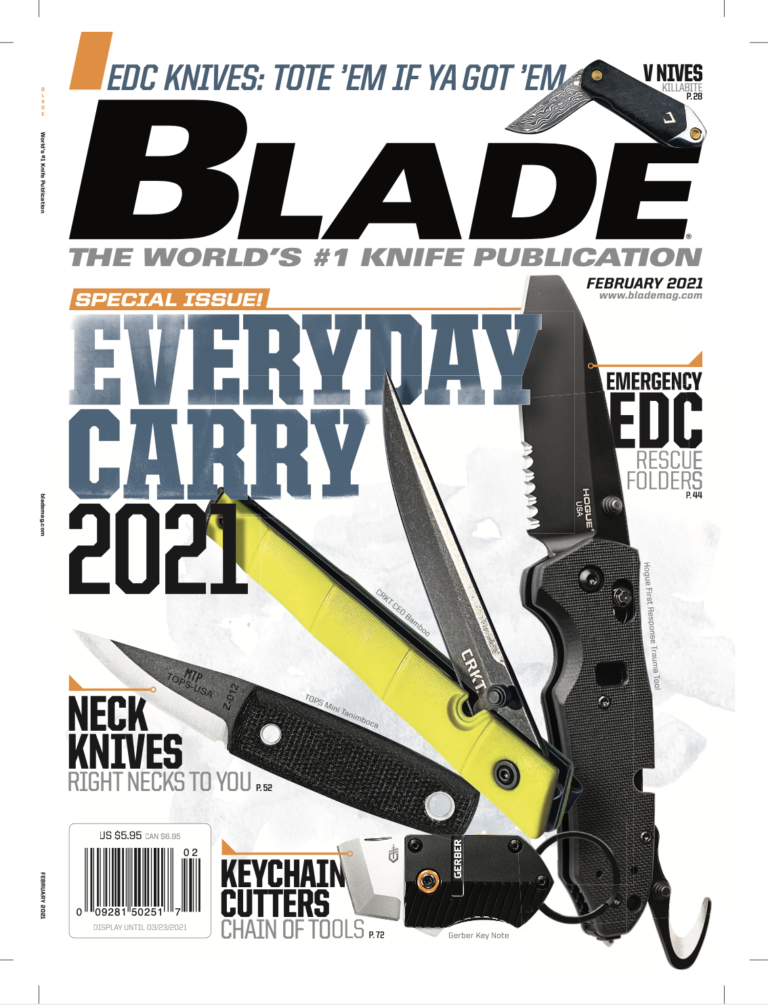
BLADE’S SPECIAL EDC ISSUE

A bevy of EDC knives graces the cover of our special EDC issue: the CRKT CEO, V Nives Killabite, Hogue Knives First Response Trauma Tool, TOPS Knives Mini Tanimboca Puukko and Gerber Knife Key Note.

CRKT’s CEO is a slender Richard Rogers design with the go-to lock of many EDC folders: a linerlock. For a small EDC in damascus blade steel with a miniature tactical feel, the V Nives Killabite fills the bill. The Mini Tanimboca Puukko is a neck knife that doubles as a small bushcraft model thanks in part to its flat-back Scandi-ground blade. The Hogue Knives First Response Trauma Tool is perhaps the most utilitarian in terms of EDC: a rescue knife. And finally, the Outdoor Edge MiniBlaze is a keychain knife—the type of EDC you don’t usually need to worry about remembering to take along with you because it’s with your keys.

The images of all of the cover knives are courtesy of the participating companies. To subscribe to BLADE Magazine for just $19.99 a year, click here. 

SOG Knives Refreshes in 2020

THE AWARD-WINNING FACTORY KNIFE COMPANY UNDERGOES A BRAND REFRESH IN 2020

The year was 1986. The Soviet Union hosted its first Goodwill Games. Halley’s Comet was visible from Earth for the first time in 76 years. Up to 6.5 million people participated in a charity event called Hands Across America. Phantom of the Opera premiered in London’s West End. And SOG Specialty Knives—aka SOG—made its debut.

The first SOG-brand knife was a reproduction of the original SOG Bowie in tribute to the Studies and Observations Group* of Vietnam War fame. Eventually, the SOG Specialty Knives line grew to include knives mass produced with attention to detail and quality. Today, the company has grown into an innovative, major player whose products are among the leading choices of Navy SEALs and other military, law enforcement, fire and rescue, tradesmen and everyday knife users the world over. Folders, fixed blades, flashlights, multi-tools and gear— SOG has you covered.

Over the years, it’s only natural that a knife company keeps growing in size and product offerings, constantly evolving itself and its knives. SOG has kept moving forward, and 2020 marks a significant milestone in the company’s evolution: a prominent revamp of sales and marketing strategies, a refresh of existing models and an engineering of new ones to further meet the demands of those who serve and keep us safe, as well as the needs of everyday knife consumers.

With its slender form factor, XR lock, carbon fiber handle and CTS XHP stainless blade, the Ultra XR defines classy high tech. The super-slim folder carries well and also doubles as a money clip. The gold-titanium-nitride coating adds a bit of bling. The blade also is available in a more subdued black-titanium-nitride coat.

The architect for the brand refresh is Jonathan Wegner, company brand vice president. “We’ve taken the best things from the last three decades, and doubled down on the things that we feel are most relevant to our end users today and into the future,” he explains, “and are focused on delivering solutions that are authentic to the brand.”

Why the transformation? According to Wegner, consumers reported that the company’s more recent focus and quality were not there. Many stated their idea of SOG was from an era that is now past, when the company brought some innovative ideas to market and was driven to produce the best knives and tools for tactical and other consumers. “So, by first studying and observing ourselves, we were able to determine that a significant change was needed,” Wegner notes. “Most of this led to our reposition and future focus.”

The Flash AT is designed for daily carry with a drop-point blade of D2 tool steel and a handle of molded glass-reinforced nylon in multiple color options.

SOG founder and president Spencer Frazer was the primary driving force behind the company and many of its product designs, from its inception until a couple of years ago when Joe McSwiney was hired to lead the outfit.

“Spencer was involved throughout the brand refresh process, and a lot of what we have done with the brand hearkens back to his original vision,” Wegner states. “Therefore, it was vital that he was involved throughout every aspect of it.” Even back then, Frazer was seriously considering stepping down from overseeing daily operations and returning to his passion of developing innovative products. “So, once the brand refresh and new products strategy were in place,” Wegner says, “he felt comfortable stepping back.”

SOG has been Spencer’s baby since day one, so stepping back at any time or putting just anyone in charge isn’t what he wanted. “SOG’s future is pushing into an even greater extension of the original intent when it was founded,” Spencer notes. “I cannot be prouder of what the company has grown into.”

RELENTLESS by DESIGN

The new company slogan is “Relentless by Design.” This encompasses SOG’s past while embracing the future. Being a major player in the tactical market for many years has pushed the company to continuously innovate and bring new models to market. Starting this fall, SOG will double down on the pushing and debut some intriguing models.

With Frazer retired and the right people in place, the company is poised to embark on a fresh, new and exciting chapter where its knives and other products will be more focused and specifically aimed at three target groups: Professional, Outdoor and Daily. More on them later. Meanwhile, by the time the new vision was in place, many of SOG’s lower-end knives and other products already had been discontinued. “We felt those items didn’t truly represent the types of items we want to be [offering],” Wegner says.

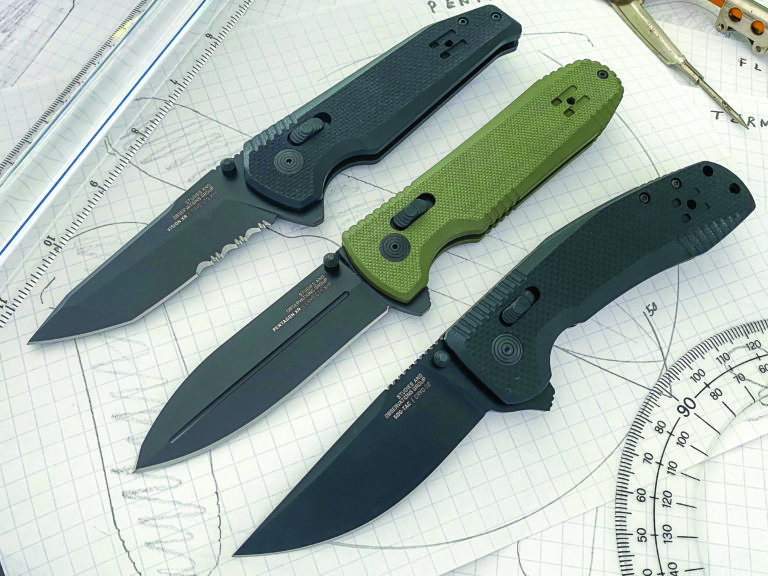
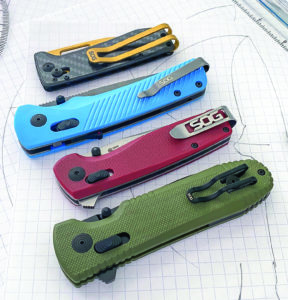
SOG has gone to some stylish pocket clips this year, model examples from top: the Ultra XR and its extra-wide/long clip (it doubles as a money clip), Flash AT, Terminus XR and Pentagon XR.

Along with this, Walmart, which previously sold some of the now- discontinued, lower-end SOG items, was removed as a retailer. Most everyone else who had sold SOG knives will remain, including many knife-specific retailers on the Internet and elsewhere.

Beginning in the fall, the first phase of the brand refresh will officially go live, and, as of press time, some of the new knives already had been released. All of the new product classes are designed to function at peak levels, engineered with intent and built with the best materials for each specific price point.

As part of the new SOG’s knives fall into the three aforementioned categories: Professional (law enforcement, EMT, fire and military); Outdoor (hunters, hikers, campers, fishermen, etc.); and Daily (trades, office workers, warehouse workers and such). All three incorporate what the SOG brain trust calls a visual brand language. This means each category incorporates a specific geometric shape that is a motif for the designs that populate it.

For example, the knives in the Professional category have trapezoidal design elements. Outdoor employs a circular design motif. Finally, Daily employs triangular design elements. The purpose of the visual brand language is so you can readily identify each knife’s purpose.

In addition to the visual brand language, SOG is using new “naming conventions” as well. The standardized approach allows you to easily identify the primary technologies the knives use. For example, XR denotes the knife uses SOG’s XR lock (SEAL XR), AT denotes Assisted Technology (Flash AT), and FX indicates the knife is a fixed blade (SEAL FX). There are a few other designations but these are the most commonly used.

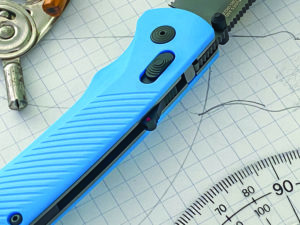
With the assisted- opening AT-XR lock, the Flash AT combines rapid deployment with lock security. Pulling back on the ambidextrous release disengages the lock. Note the lock safety on the handle spine. The red dot indicates the blade is ready to open.

Also new is a color-coded accent stripe on the packaging. Yellow is for Daily, light blue for Professional and gray for Outdoor. Topping it off is new packaging in which you can actually see the product inside and read about its key highlights on the partial flap of the box. The packaging is bold, forward looking and helps usher in the new SOG era.

The blade mark also has changed. The previous SOG logo is now STUDIES AND OBSERVATIONS GROUP—a nod to the past while looking to the future.

FALL KNIFE DEBUTS


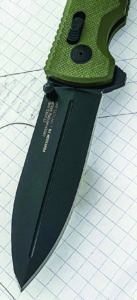
First up for the new fall line is the SOG- TAC XR, a Professional class tactical folder using the XR lock, a 3.5-inch drop-point blade of D2 tool steel, flipper opening and a textured G-10 handle. The ergonomic handle integrates a guard, dual nested steel liners, and a deep-carry pocket clip. Handle colors come in black or OD green. Another Professional class piece is the Pentagon XR. Building on the legacy of the Pentagon series of folders and fixed blades, it takes the dagger-ish styling and adds the XR lock, textured G-10 handle, dual nested steel liners, flipper opening and a 3.5-inch spearpoint blade of CTS XHP stainless steel. Handle colors are black, FDE and OD green. The Vision XR flipper folder brings some aggressiveness to the Professional series, with bold styling and a 3.5-inch double- ground tanto blade of CTS XHP, and a textured black G-10 handle with dual nested liners.

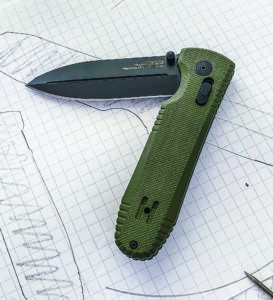
The revamped Pentagon XR tactical folder has multiple choices of G-10 handle colors, and a fullered spear- point blade of CTS XHP stainless steel. The knife features flipper-tab and ambidextrous thumb-stud opening options.

In the Daily category is the Ultra XR, an ultra-thin, ultra-lightweight gentleman’s folder with a linerless carbon fiber handle and a 3-inch clip-point blade of CPM S35VN stainless. An extra-large, fold-over pocket clip doubles as a money clip. The blade is available in gold titanium nitride or black coating options. Another Daily category entry, the Flash AT features a 3.5- inch drop-point blade in D2 powered by SOG’s Assisted Opening Technology. The molded Zytel handle is available in a choice of red, cyan, yellow and black. The new folders use pivot bearings for ultra- smooth blade action.

SOG long has been a viable player in the production knife market and the new refresh elevates the company even further. Expect more good things to come.

BLADE Field Editor, DoubleStar Collaborate on New Line of Knives

Msg. Kim Breed (retired), a long-time field editor for BLADE best known for his knife reviews, will partner with DoubleStar Corp. to produce knives for that company’s Edged Weapon line.

There’s no doubt that Breed’s 18 years of experience in the United States 5th Special Forces Group will inform the designs that come out of the collaboration, as well as his time as the owner of Breed Custom Knives. Although DoubleStar has not announced specific models, a release from the company suggests that Breed’s custom work will be adapted for affordable price points. 

“Kim is a legend within the custom knife community and we are very excited to have the opportunity to collaborate with him, turning his custom design into something that is accessible to a wider audience. Adding Kim to our already impressive roster of collaborators only strengthens our commitment to the edged weapon market, and we look forward to unveiling his designs soon,” stated Rob Cabrera, director of Edged Weapon, in a DoubleStar release.

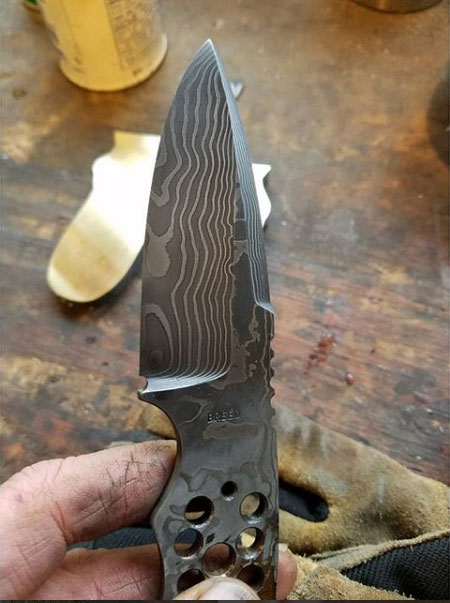
The following are examples of Breed’s custom knives:

Here’s Breed working in his shop:

BLADE congratulates Kim on this new adventure and wishes him the best of success. Follow him on Instagram for the latest.

The Late R. Lee Ermey: “I Was Basically a Stand-Up Comic”

the gunny interview knives
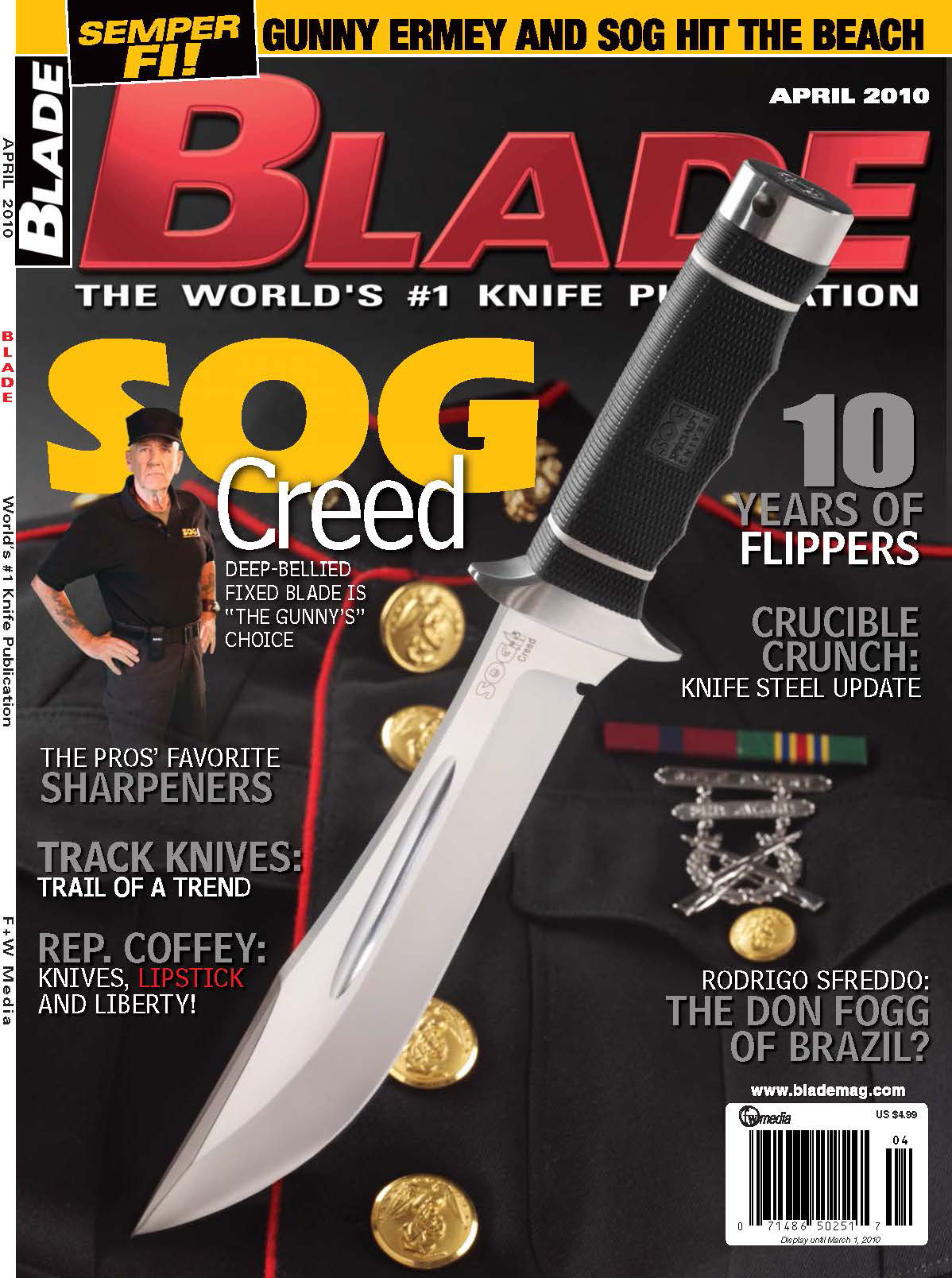
R. Lee “The Gunny” Ermey appeared on the cover of the April 2010 issue of BLADE.

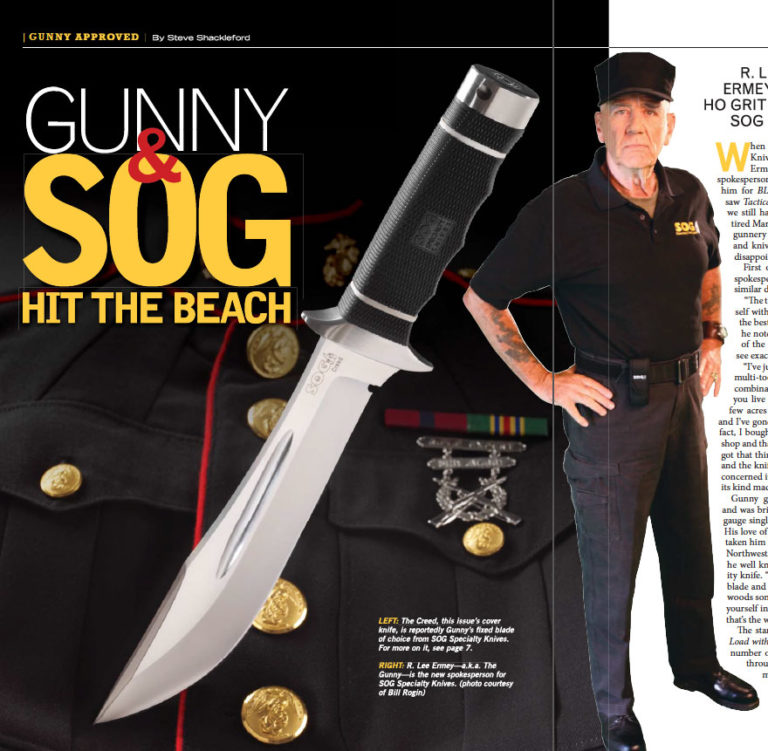
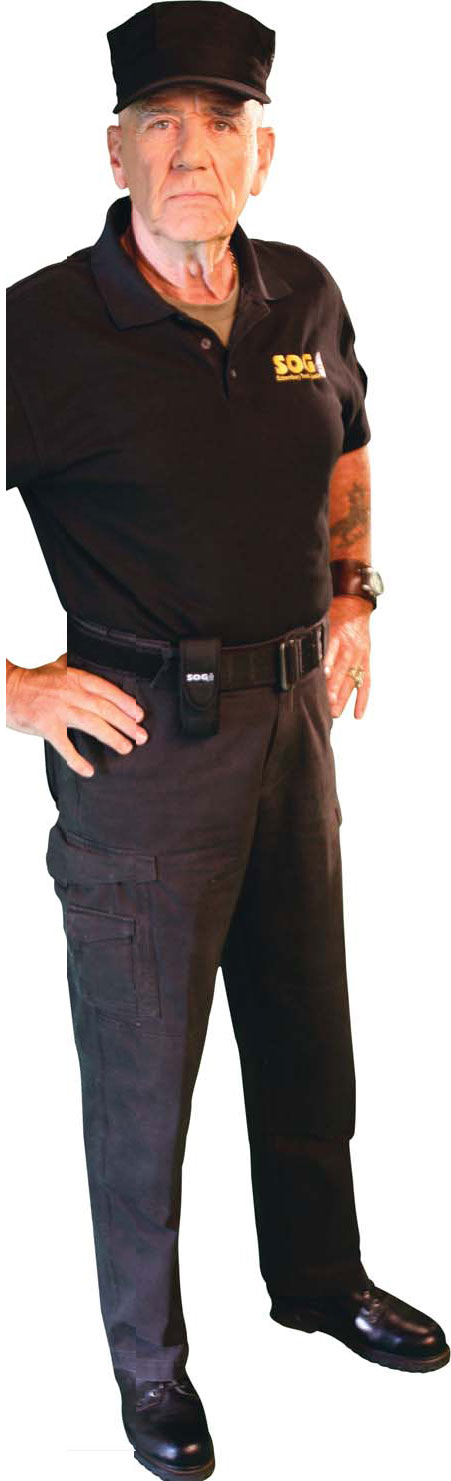
Editor’s note: The following article is from the April 2010 issue of BLADE. At the time, R. Lee “The Gunny” Ermey had signed on as a spokesperson for SOG Specialty Knives & Tools. Here he talks with Steve Shackleford about knives and his career in films.

Ermey, best known for his portrayal as Gunnery Sgt. Hartman in Full Metal Jacket, died April 15, 2018, at age 74. 


The Gunny, the Knife Enthusiast

the gunny knife shows
R. Lee “The Gunny” Ermey made frequent appearances at BLADE Show on behalf of knife companies.

Gunny comes by his love of knives honestly. He has over 100 custom and factory pieces in his collection, including his great grandfather’s pocketknife. First and foremost, though, he uses his knives.

“I’m a firm believer that the only thing a dull knife is good for is cutting yourself, because that’s exactly what you do with a dull knife,” he said. “I believe a man ought to be able to shave with that knife and after he shaves with it, he ought to be able to fold it up and then go chop a tree down.”

He also keeps up with the news and is outraged at the way knives are portrayed by the media.

“What really upsets me, I’ve seen this young Eagle Scout [Matthew Whalen],” Gunny began. “Because he had a knife, a little pocketknife in a survival kit in the trunk, they put him out of school. What the hell kind of a survival kit have you got without a knife? You’d be a dead man.

“When I grew up, I was probably 6 years old, I started carrying a pocketknife and I’ve carried one ever since. It’s a tool, you know. I grew up on a farm and I went to school and I can’t ever recall any kid pulling his pocketknife out at school and wanting to do harm to another kid. Times have changed. We need to start taking responsibility for our actions, we need to teach our children a bit of discipline.”

Gunny was just getting warmed up.

“My Swiss Army knife, what, they’re 2 inches long these little guys. I travel constantly, and I’ve had about 20 of those little knives taken away from me at the airport. I finally took one and just broke the knife blade off it and there’s still a big debate if I can go on board because there’s a scissors on it.

There’s a toothpick and a tweezers and I use those tools constantly. After a meal I have to use that toothpick. Society’s gone to the dogs as far as I’m concerned. They need to pull their heads out of their butts and realize that a Boy Scout carrying a pocketknife that’s got a spoon and a fork on it is just a tool, it’s not a weapon.”

A Standup Guy

The Gunny SOG Knives
Spencer Frazer (right), SOG founder and president, and Gunny go over the company catalog. (photo courtesy of Bill Rogin)

Gunny enlisted in the Marines in 1961 and was medically retired as a staff sergeant in 1971 for injuries incurred during his tours, which included 14 months active duty in the Vietnam War, and, as you might guess, as a drill instructor (at the Marine Corps Recruit Depot in San Diego and Parris Island, South Carolina). In ’Nam he carried his issued Ka-Bar USMC fighting/utility knife, using it for everything from cutting threads off his uniform to opening “C” rations. He also carried a pocketknife and, of course, his trusty machete.

He said many of his fellow Marines bought their own fixed blades and folders in addition to the issue Ka-Bar.

Did he ever use a knife as a weapon over there?

“No. And I hope I never have to. I would just leave the area,” he laughed. “I would go get my gun. I don’t care for the up-close-and-personal stuff.”

Like most fresh out of the military, Gunny was unsure of what to do after his discharge, so it came as no surprise when he fell back on his Marine background.

“I didn’t have any formal training that would improve my lifestyle and I looked around and thought, what can I do, and I found out,” he recalled. “I was basically pretty much a standup comic when I was in the Marine Corps. I was an instructor, and in order to be a good instructor you have to be able to keep the troops awake. It’s almost like being a standup comic.

R Lee Ermey Marines
Gunny made a number of visits to the troops in Iraq and Afghanistan for the U.S. Navy Department of Morale and Welfare. Here he is with a group of Marines in front of Saddam Hussein’s palace in December 2008. (Rob Scott photo)

“So, when I retired, I wrote a couple of scripts and I went off to Hollywood. I did some of the comedy clubs and was pretty successful at it, and then I found out they were going to start shooting a Vietnam war movie in the Philippine Islands.”

Gunny boarded a military transport, flew to the Philippines where The Boys in Company “C” was being filmed in 1978, landed the part of a Marine drill instructor and his acting career had begun.

However, it was 1987’s Full Metal Jacket that, as Gunny put it, “kicked all the doors open.”

In it he established his onscreen persona as the gung-ho drill instructor, Gunnery Sgt. Hartman.

Not only did the role earn Gunny a nomination for a Golden Globe Award as Best Supporting Actor, it played a key part in his receiving an honorary promotion to gunnery sergeant from the Commandant of the Marine Corps. According to Wikipedia, it made Gunny the first retired military member in the history of the Corps to be promoted. Wikipedia, it seems, needs to check its sources.

SOG Powerlock
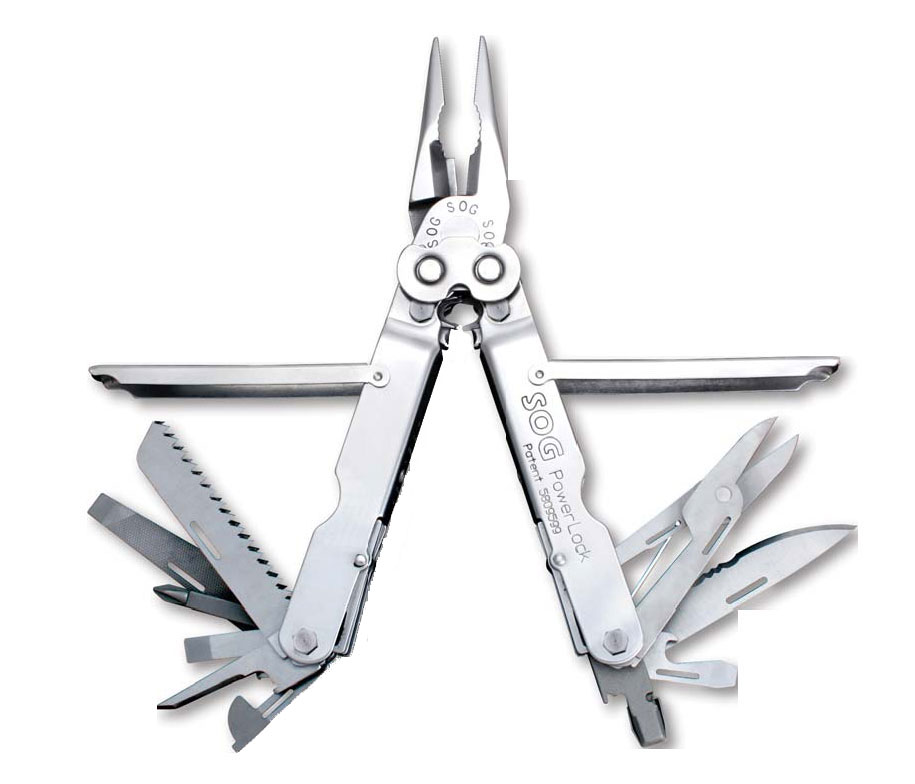
Gunny carries a SOG PowerLock multitool. It includes a pliers/gripper, hard wire cutter, crimper, double-toothed wood saw, a partially serrated blade, three-sided file and more.

“I’m not just the first but the only,” retired member in Corps history to be promoted, Gunny noted with pride.

He continues to be active in supporting young Marines, making morale-building visits to Iraq and Afghanistan when he can, as well as Guantanamo Bay and Okinawa, Japan. In between comes his acting and promotional work.

“I spend 90 percent of my time working with the military,” he said. “The other 10 percent I have to do shows and movies and whatever it takes because I have to support the 90 percent.”

The new SOG spokesman would seem to have his priorities in order. And, luckily for his new employer, SOG is one of them.

Canadian Knife Retailer on Import Ban: Who Are We Protecting?

canada knife ban
The author is the owner of a store that sells knives, often to first responders. Restrictions on the importation of the folding knives those customers often use hurts not only her business, but also the ability of first responders to do their important work. (Image via LethbridgeTacticalSupply.com)

Editor’s note: Sarah Jorgensen is the owner of Lethbridge Tactical Supply, a knife retailer in Lethbridge, Alberta, Canada. Read BLADE‘s previous articles about prohibitions on the import of folding knives into Canada here.

More Questions Than Answers

lethbridge tactical supply
Sarah Jorgensen

A recent decision by the International Trade Tribunal (ITT) has only added more questions than answers when it comes to the tools Canadians can and cannot use for self-defense, emergencies and everyday tasks. After a seizure by the Canadian Border Services Agency (CBSA), the ITT announced in January 2018 that it is restricting the import of knives that “have a blade that opens by centrifugal force,” and that “includes knives that require some preliminary or simultaneous minimal manipulation of either a flipper or other non-edged parts of the blade.”

So what are our rights? What are we allowed to use to protect ourselves? Will we get in trouble if we hurt someone with a particular kind of knife while acting in self-defense? And most importantly, are we risking our safety by asking these questions in an emergency instead of acting?

Section 84(1) of the Criminal Code of Canada states that a prohibited knife “has a blade that opens automatically by gravity or centrifugal force or by hand pressure applied to a button, spring or other device in or attached to the handle of the knife.”

Wait a minute. How did we go from a device on the handle, to a device on the blade? The Criminal Code has not changed, but the CBSA’s interpretation has. This means that Federal, Provincial and local law enforcement agencies do not consider flippers on the blade of a knife as prohibited, but the CBSA does.

It Doesn’t Add Up

canada knife import ban

As a retailer, I can still purchase and sell these knives with no restrictions. However, if I can’t import them, how can I sell them? There are very, very few knives made in Canada, certainly not enough to keep up with the demand of our customers. Some knife manufacturers are now refusing to ship any folding knives at all into Canada because they are not sure which knives the CBSA is going to consider prohibited and seize.

So, why would the CBSA and International Trade Tribunal come to this decision? Are they keeping Canadians safer? Has there been an increase in attacks with knives that have assisted openings? The answer to both of those questions is no. I can still import fixed-blade knives, machetes, axes and batons. Are those items any more or less dangerous than an assisted-opening knife?

And who uses these assisted-opening knives that are so dangerous that the CBSA must override the Criminal Code to protect Canadians? Well, the majority of my customers are first responders (including CBSA agents) and they use these knives. They use them to gain access to vehicles and cut seat belts from people involved in car accidents. They use them as a last line of defense. They use them while on camping trips with their families. Most commonly, they use them to open packages and boxes. I sell these knives to knife enthusiasts and collectors, avid outdoorspeople and, yes, I sell them to people looking for a way to protect themselves in an emergency.

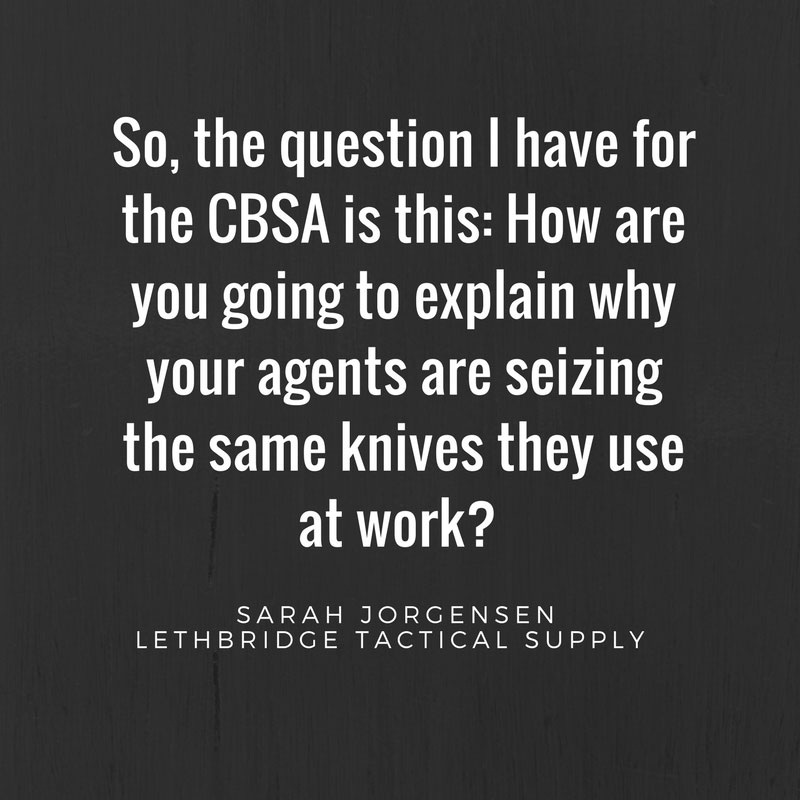
So, the question I have for the CBSA is this: How are you going to explain why your agents are seizing the same knives they use at work?

Analysis: London Murder Count Overtakes NYC for First Time

knife crime in uk vs nyc

It’s one for the record books, but it’s nothing to celebrate.

The murder totals in London for February and March tallied at 37. That’s two more than New York City’s 35 for the same time period. This marks the “first time in modern history” that London surpassed New York City for murders, according to the The Times.

This new precedent should resonate with the knife community. Both cities have similar population sizes, both have economies that rival that of entire developed countries and both take hard lines on possession of firearms and knives. However, London takes an even more restrictive approach to knives, conducting amnesty drives and prohibiting public possession without “good reason.”

Despite that, stabbings accounted for 31 of London’s murders, and knife crime in general is the driving factor for the increase. This would seem to indicate the ineffectiveness of London’s knife restrictions overall, as indicated by this tacit admission from MP Sarah Jones.

From the BBC, quoting Jones:

“We need a proper strategy that looks at all of the issues.

“Knife crime and violent crime acts like an epidemic, so you need to go in at the source to cut it off and then you need to inoculate the future young people against it.

“Going in at source means major intervention work with youth workers, inoculating means going into schools, changing the social norms, educating kids, teaching them what it is to be a man, teaching them how they don’t need to carry knives.”

This quote, also from the BBC, from the former superintendent of London’s Metropolitan Police, Leroy Logan, echoed those sentiments.

“Police can’t just arrest or stop and search their way out of this problem; it has to be done in partnership with the communities.”

This is in line what many in the knife community have argued for years. Knives aren’t why someone commits a violent act. There are other factors at play that influence behavior, and those should be identified and addressed.

Granted, banning certain items, such as knives (or firearms, a parallel discussion in the United States), may well prevent someone from committing a violent act with that item, but left unaddressed are the would-be aggressors’ motivations and circumstances. Until and unless that happens, the sliding scale of destructive tools will simply move on to the next item. Case in point: UK acid attacks are on the rise. That follows extensive prohibitions on firearms and knives.

Even The Guardian called into question the term “knife crime” as being misleading or overly simplified.

“Knife crime” is a construct. It does not simply mean, as one might reasonably expect, crimes committed with knives. It denotes a certain type of crime committed by a certain type of criminal in a certain kind of context.

Those “certain types” often single out particular groups of people, which makes “knife crime” as a concept even more insidious. From The Guardian again (emphasis is mine):

In 2007, then prime minister Tony Blair told an audience in Cardiff: “The black community – the vast majority of whom in these communities are decent, law-abiding people horrified at what is happening – need to be mobilised in denunciation of this gang culture that is killing innocent young black kids. But we won’t stop this by pretending it isn’t young black kids doing it.”

When politicians frame the issue in this way, the results can disproportionately impact communities of color via increased law enforcement scrutiny. It’s as if white majority populations are somehow exempt from the factors that lead to “knife crime.” Or, worse, that there is something inherent about people of color that predispose them to violent acts.

When white kids are killed, people opine about the state of youth today, the demise of the town in which they died, or the world in general. When black kids are killed, usually the assumption is that their race had something to do with it.

It comes full circle when comments come in following a murder involving a knife and a person of color.

And yet a few days after his death, a Conservative councillor in Dover, Bob Frost, posted a news story about Djodjo’s murder on Twitter with the message “#BlackKnivesMatter. The carnage continues into 2017. Any protest from the ‘community’? Thought not.”

This phenomenon is well-known to the knife community at large. For example, New York’s restrictions on “gravity knives,” enforced with enthusiasm in New York City, levy an oversized impact on minority groups

That this toxic stew of tunnel vision, racial bias and misleading terminology should finally express itself in a historic first for murders in London shouldn’t come as a surprise. It should come as a warning. If the root of “knife crime” isn’t dug out, London may, unfortunately, find itself positioned at the floor of a rising trend, not the ceiling.


Have a News Tip? Submit it Here

Have big news? Tell BLADE with this form.

    Check this box to prove you're not a bot

    Advertisement

    Must Read Articles

    Read this before you make a knife

    Knifemaking 101 – Read This Before You Make a Knife

      by Wayne Goddard My experience has taught me that there's nothing like digging in and getting started. I've often said the hardest part of the...
    how to forge damascus steel

    How to Forge Damascus

    Advertisement
    Advertisement