Knifemaking is the building of a knife, which includes the blade, handle and other accouterments. Blades are made by either removing metal from a steel blank via a grinder – known as stock removal – and the forging to shape of hot steel into a blade in the process known as bladesmithing. Other parts, including bolsters, guards, pommels, etc., are needed to complete the finished knife.
In this video from BLADE partner RECOIL TV, you’ll get a front row seat with Murray Carter of Carter Cutlery to learn his journey from a young apprentice of a Japanese bladesmith to one of the most respected knifemakers in the industry.
If you could apply a motto to VMX Knives it would be: Let’s have some fun. At least that’s the impression you get after talking with co-owners James Robert Buckley of Maverick Customs and Kyle Vallotton of three-generation-strong Vallotton Custom Knives. Rob and Kyle became friends online. For BLADE Show 2017, Kyle—sporting a new do—invited Rob, whom he calls Buckley, to share space at the Vallotton table. But due to a confluence of issues, Kyle, who is known for his butterfly art knives, had no balisongs at the table this year. Rob, a machinist and welder before getting into knifemaking, asked Kyle if he’d look at a design he’d come up with for a balisong. Kyle liked it. The men agreed to make the knife together, Kyle bringing his expertise in the art-balisong industry to the newcomer and Rob offering to show Kyle what he knew about machining steel. It wasn’t long before a work flow was ironed out and the VMX-1 was brought from paper to reality, a baby born of blue mohawks, butterfly knives and buddies.
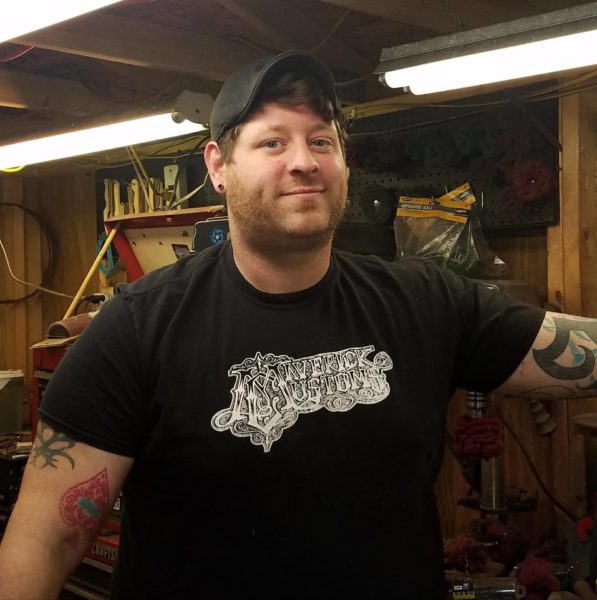
James Robert Buckley is the owner of Maverick Customs out of Horse Cave, Kentucky. He is also the co-owner with Kyle Vallotton of VMX Knives.
Rob Buckley grew up in Glasgow, Kentucky, about 45 minutes northeast of Bowling Green. While in high school and working at a family-owned cabinetry shop, he came to a realization: “I hated wood,” he said, laughing. But he took college-level courses in welding and machining. “It got me,” he said of metalwork. At 17 he entered the Army, wanting combat medic, but settling for infantry. He sustained injuries that would require surgery before continuing his training, so he accepted the proffered medical discharge. Returning home, he landed a machining job in Dickson, Tennessee, where his parents were living at the time. After those few months as a manual machinist and welder, he moved back to Glasgow to work as a certified welder. Six months later he took a position at a magazine printing plant, staying for 10 years. He left for a computer numeric controlled (CNC) machinist position, but he found operating the computer-programmed mills and lathes not as satisfying as hands-on metalworking. Three years ago he began making tools, then later knives, full time.
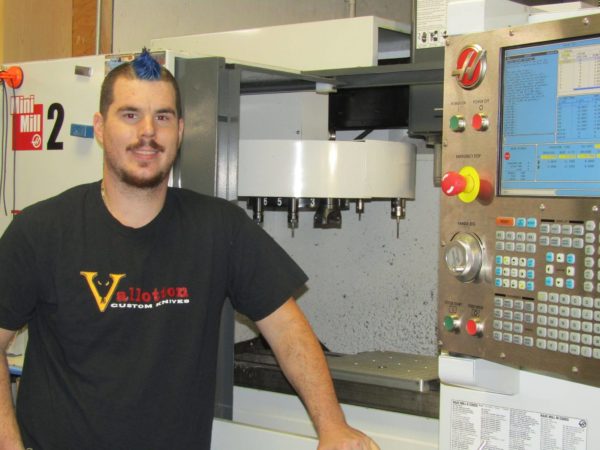
Kyle Vallotton hit BLADE Show 2017 with a blue mohawk. He is a third-generation knifemaker and the fifth person in his family to be making knives under Vallotton Custom Knives. He is also co-owner of VMX Knives with James Robert Buckley of Maverick Customs.
Kyle Valloton marks the third generation and fifth family member to be making knives under Vallotton Custom Knives. He began in the shop when he was 10 years old. He took some time off to test jobs away from the family business, such as telephone sales representative, but by the time he was 23, he knew he wanted to make knives for a living. He grew up in Umpqua, about an hour and a half south of Eugene. His grandfather Butch was an innovator in the tactical folder and automatic knifemaking world. The Vallottons hold 15 patentable developments with seven still-running royalty contracts. Vallotton innovations appear in numerous production knives, from Gerber to Spyderco.
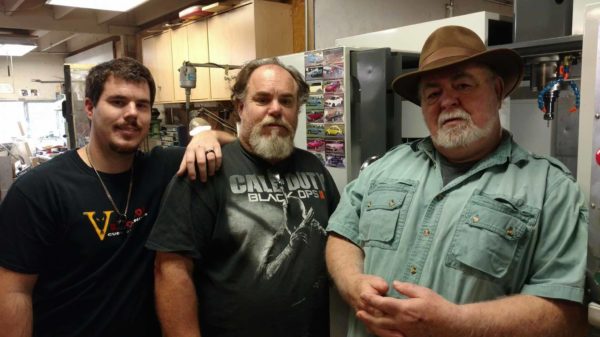
Kyle Vallotton, left, specializes in high-end balisongs, tapping into both the artistry of his dad, Rainy, and the innovations of his grandpa, Butch, right.
Kyle’s dad, Rainy, made his mark in the high-end art-knife market, and Kyle’s specialty is the butterfly knife. He taps into both his grandfather’s exactitude in specifications and his father’s artistic flare. Kyle’s demeanor exudes good-natured enthusiasm and a sense of fun without being reckless. He contemplated attending BLADE Show 2017 sporting a blue mohawk, but wasn’t sure how it would go over. Finally, he decided to do it. “Let’s have some fun,” he said. “Everyone loved it.”
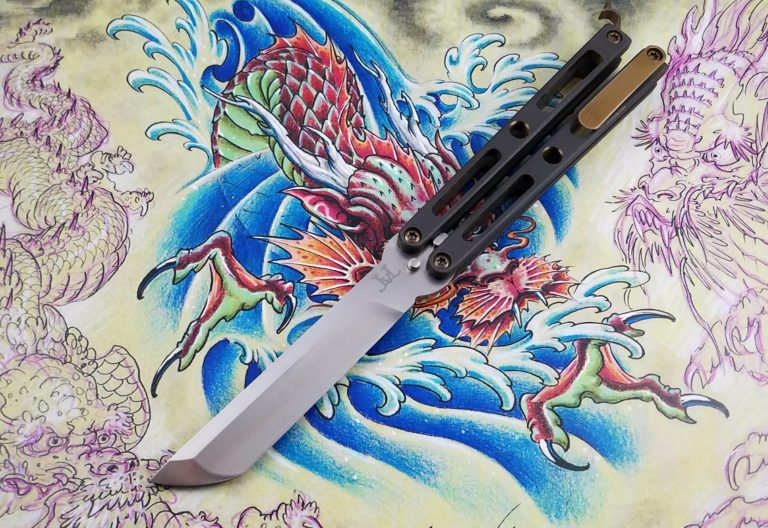
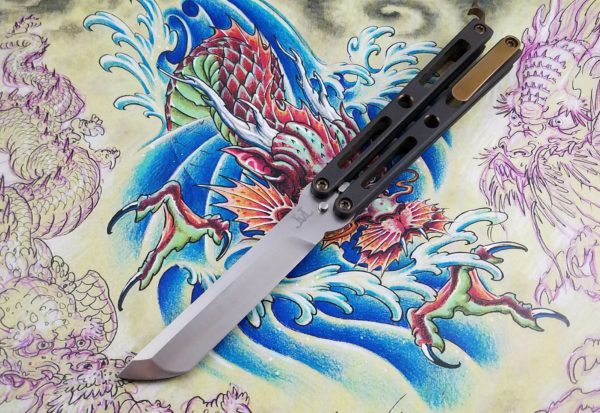
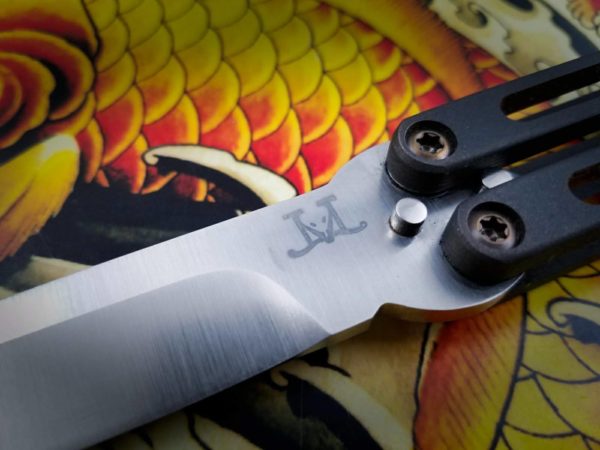
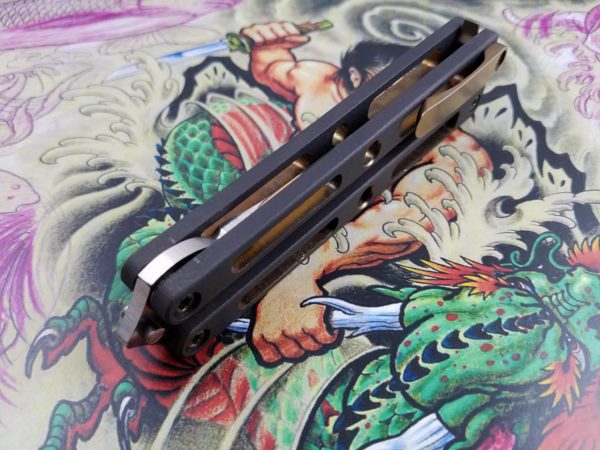
The VMX-1 prototype was made of BG42, but the production model has a 4-inch blade of CPM 154 steel. The prototype handle is black titanium, but custom-colored anodized titanium handles are available. Artwork by Zach Burcham of West Main St. Tattoos in Glasgow, Kentucky.
The balisong segment of the knife community is a microcosm of the knife industry itself. There are those who use the knives in the practice of Filipino-style martial arts; those who use the knives in a mesmerizing display of twirling and tricks, resplendent with the individual’s unique style; and those who collect the knives created as works of art. In addition, because many states have laws preventing the sale of balisongs—only trainers can be used by residents of those states. Kyle mentioned that he follows Knife Rights‘ work to overhaul outdated knife regulations in numerous states.
Rob jokes that he knows just enough about flipping balisongs to cut himself. In fact, VMX Knives will sell you its butterfly knife without an edge if you prefer. At any time, you are welcome to send it back if you decide you want to go with a live blade.
Zach Burcham, owner of West Main St. Tattoos in Glasgow, Kentucky, designed the logo for Maverick Customs and was brought in again to combine the M from Maverick Custom’s logo as well as a V for Vallotton Custom Knives to create the VMX Knives logo. Like the VMX-1 balisong itself, the logo uses old-school lettering with a modern twist.
Rob got his tattoo artist, Zach Burcham of West Main St Tattoos, who designed the M logo for Maverick Customs—named after Rob’s son—to come up with a logo that incorporated a V for Vallotton with the M for Maverick, and the VMX Knives logo was born. It is representative of the gold-leafing in signs of yore in the style of David Smith, for example, but with a modern twist, which is exactly how this team approaches their design.
The VMX-1 has phosphor bronze washers, titanium screws and standoffs, and a floating latch system designed by Kyle Vallotton. It measure 5.25 inches closed, 9.25 open. Artwork by Zach Burcham, West Main St. Tattoos in Glasgow, Kentucky.
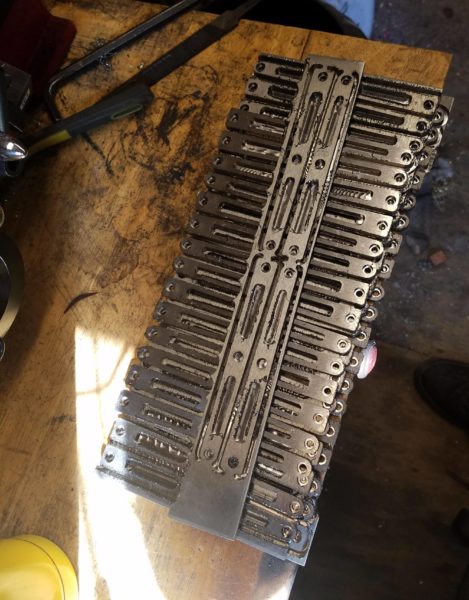
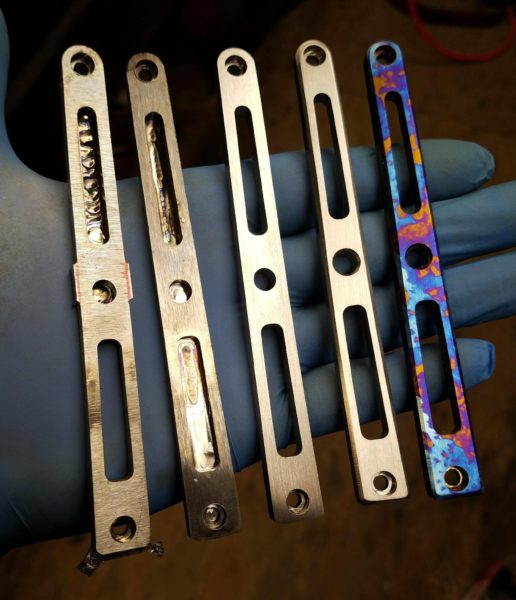
Right now, whichever of the two are ordering supplies in the course of their personal knifemaking businesses purchases whatever VMX needs. They split those expenses 50-50, watching the price of titanium as it fluctuates. At present, Kyle machines the profiles and handles then sends them to Rob, who likens what he receives to model car parts connected to their frames by plastic tabs. “From the sheet I surface everything flat, chamfer holes and shape the tops by hand,” he explained. He also applies any final finish, such as anodizing, and machines some internal parts. Currently, the blades go back to Kyle for hand-grinding, hollow on the belly and convex on the point. Soon unused equipment at the Vallottons’ will be heading Rob’s way so he can also do the grinding. Once all the components reach Rob’s shop, they’re ready for clean-up, assembly, packaging and shipping.
VMX Knives has built a high-end balisong that Kyle Vallotton hopes will change the way flippers think of flippers. You will find some offered for sale at Blade HQ or you can custom order yours by contacting Rob Buckley at Maverick Customs via methods listed at the bottom of this article. Tattoo art by Zach Burcham at West Main St. Tattoos in Glasgow, Kentucky.
“They are the strongest folding knives,” Rob said of balisongs. “There’s no locking failure; the pin stops it from closing.” No matter how tight tolerances are, owners will often loosen up butterfly knives for better flipping. “So it’s like a chain-link fence,” Rob said. He and Kyle are striving for a knife that is as tight as a bushings-and-washers construction can be while still allowing for smooth flipping action. In the future, they hope to offer a bearings model, as well as a limited-run high-end model.
Even though Rob Buckley is in Kentucky and Kyle Vallotton is in Oregon, the men have worked out a division of labor that maximizes the strengths of each. Rob receives the parts on sheets. From there, they undergo numerous processes before they are ready to be finished, assembled and shipped.
The balisong community is an entity all to itself within the knife industry. Both Rob and Kyle acknowledge the achievements of others who started where they are now, while simultaneously carving out their own space in the market. Bladerunners Systems, which goes by BRS, started out as “flippers making flippers for flippers,” Kyle explained.
“I met the BRS boys before they became BRS,” he noted. “They are a bunch of balisong enthusiasts and great guys doing a great job.” In Kyle’s opinion BRS excels at using overlay materials that look cool and grab the attention of the crowd. “They are a big production company making a decent knife.”
“They make a great product,” Rob agreed, adding that butterfly knives made by Bali-Song Inc. (1979-1983), which became Pacific Cutlery Corp. (1983-1987), which became Benchmade (1988 to present) are well made as well. In fact, he owns a Benchmade Balisong 53 Mangus and a Spyderco Spyderfly.
VMX Knives is set to release its first round of VMX-1 balisongs in mid-November, 2017. They received 15 preorders, enough to get the project off the ground.
Kyle explained the partnership’s goals with the VMX-1. “What I have been doing and am now doing with VMX is simplifying and changing the norm,” he commented. “We are a small company making a very high-quality knife for the same price, and it’s custom-to-order.” Kyle wants to change the way flippers think about flippers. “I want to push boundaries and change things for the better. It’s what I wanted to do when I started making balis.”
It is obvious from their banter, that Rob and Kyle enjoy ribbing each other and genuinely respect what each brings to the project. The online acquaintances who developed a friendship and started a business together have also seemingly adopted each other’s families. Only Rob does not flip balisongs in front of his impressionable son, he admitted with a laugh.
Contact James Robert (Rob) Buckley, VMX Knives, 111 Corner Ave., Horse Cave, KY 42749; 270-576-4392. You can view the work of Rob on Facebook at Maverick Customs and Kyle’s work along with the work of other Vallottons at Vallotton Custom Knives.
A Digital Subscription To BLADE Is The Answer
You can read your digital issues of BLADE Magazine anywhere you have your phone, tablet or computer, and there’s no need to find storage for all your old issues.
If piling-up issues of magazines seems like a waste to you… If you feel like you don’t have time to read a magazine… If you like the stories we offer in BLADE, but want a more economical option, then a digital subscription is the answer. An annual subscription to BLADE is $17.98, $4 off the print price.
Constantly on the lookout for something that will make their knives better and stand out at the same time, many of today’s custom makers don’t hesitate to jazz up the guard.
And why not? A handsome, well-made guard adds to a knife’s looks, and, more importantly, serves as a sure safety feature in helping keep your hand where it needs to be—on the handle.
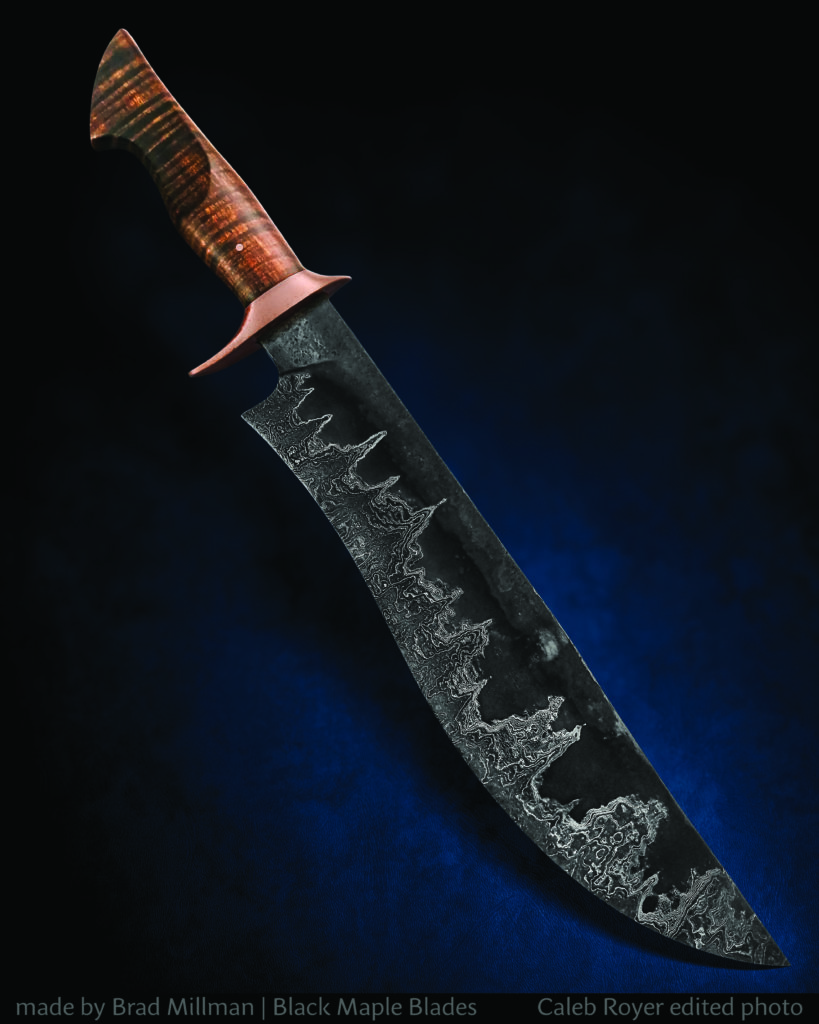
Above: Brad Millman forged the hammer-finished copper guard of his Wolftooth bowie. The 12-inch recurve blade is a san-mai construction of 360 layers of 1095 carbon and 15N20 nickel-alloy steels for the core sandwiched in a jacket of 1084 carbon steel. The bird’s-beak handle is curly Tasmanian blackwood. Overall length: 18 inches. (Caleb Royer edited image)
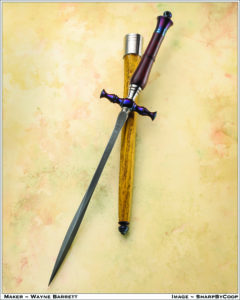
Above: Wayne Barrett heat-colored the shapely mild-steel crossguard of his 14.56-inch stiletto. The 10.6-inch blade is vintage butcher’s steel by F. Dick of Germany and features a classic triangular grind. The handle is Merino ram’s horn. (SharpByCoop image)
.
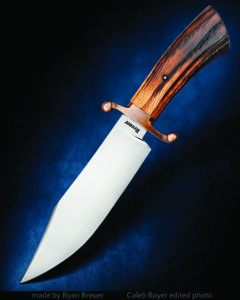
Above: It’s easy to see how Ryan Breur’s Ball-Guard Bowie got its name. The guard is cast bronze and the handle is flamed white oak with a domed inconel pin. The blade has a sharpened clip and is forged from 80CrV2 carbon steel. (Caleb Royer edited image)
Above: A stylish guard of wrought iron helps put the finish- ing touches on an ancient-walrus-ivory bowie by ABS master smith Tad Lynch. The 11.25-inch clip-point blade is W2 tool steel—a material some leading smiths consider ideal for producing a handsome hamon—and the knife is 16.375 inches overall. (SharpByCoop image)
Above: An upturned guard with a finger ring—each of hot- blued 4340HT steel—and a ladder-pattern damascus blade of 1095 carbon and 15N20 nickel-alloy steels help complete a quillon dagger by ABS journeyman smith Paul Savage. The handle is buffalo horn. (SharpByCoop image)
Above: Black mirror accent balls cap the stainless steel quillons on ABS master smith Kyle Royer’s Maiden Voyage Stiletto. The 11.75-inch damascus blade features an extra-deep hollow grind, a fuller and a reinforced piercing tip. The sculpted, fluted handle is wrapped in 24k-gold twisted wire. Overall length: 17.5 inches. (Caleb Royer image)
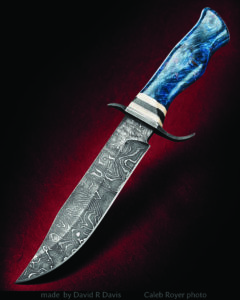
Above: The handforged nickel-silver finger guard “with curls” gives a damascus bowie by David Davis a curvaceous look. The 7.25-inch blade is pattern-welded steel forged by Alabama Damascus. Blade finish: acid etched. The handle is stabilized buckeye burl and the spacers/ liners are ebony and bone. Construction: hidden tang. Overall length: 12.25 inches. (Caleb Royer image)
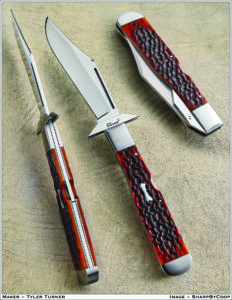
Above: Tyler Turner outfits his coke-bottle-pattern pocketknife with a folding swing guard of 416 stainless steel. The 4-inch blade is CPM 154 stainless steel in a hollow sabre grind and the scales are jigged bone. Closed length: 5 3/8 inches. (SharpByCoop image)
David McConnell is a stamping press repairman who hopes to convert to full-time bladesmithing soon. His first knife, was a cheap Wal-Mart special. Over the years he got frustrated with the lack of quality in such knives and began thinking about making his own. He knew he could make a better knife for himself, and he did. Only his buddy loved it so much that he bought it from him, David said, laughing.
David McConnell of North Woods Forge in Michigan. He forges, preferring a primitive style, using natural materials..
The self-taught bladesmith has been making knives for 11 now, including tomahawks and axes. “I like to make hunting knives and more traditional stuff,” David noted.
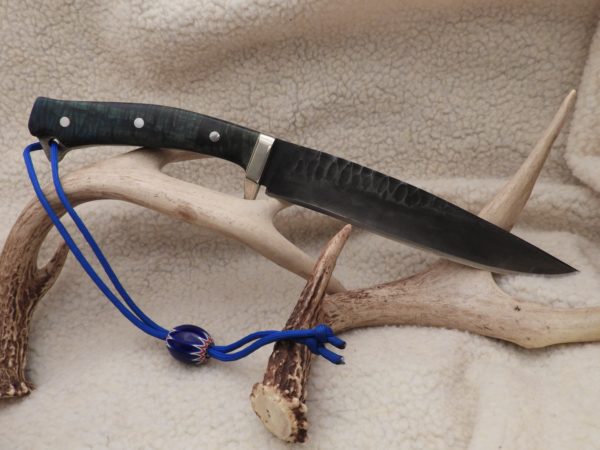
David McConnell made this bowie with an 8-inch blade of 1075 steel. The handle is blue-dyed and stabilized curly maple. Blue curly maple bowie. Guard is nickel silver. Overall length is 14 1/4 inches. Contacts listed at the bottom of this article.
He is an avid grouse and deer hunter, as well as and ice and fly fisherman. He lives in Kalkaska, Michigan, with his wife and 15-year-old son.
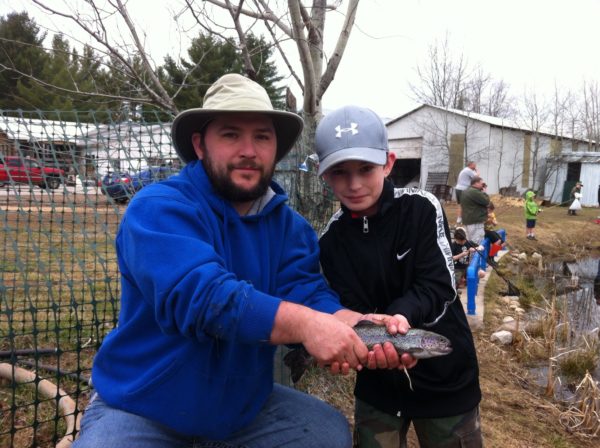
David McConnell started teaching his son Parker McConnell to fish early in life. The National Trout Festival, now in its 81st year, is held in April in Kalkaska, Michigan. Parker got this trout in the kid’s pond.
Best-selling knife patterns: 3 ½- to 4-inch-bladed bird-and-trout, 4- to 7-inch-bladed straight-back hunter, classic bowie
Favorite blade steels: W2 for hamon, toughness, ease of forging and grinding; 1075 for ease of forging and heat-treating
Blade grinds: flat ground, sometimes with appleseed edge
How he tests his knives: “If it can cut a nail and have no deformation or chipping and still stay shaving-sharp, I would have to say that’s a pretty good blade,” David commented.
Favorite handle materials: bone, wood, antler. “I just like the feel and warmth you get from natural materials.”
Price range: $85-$600
Knife shows he attends: local gun-and-knife shows and blacksmithing events
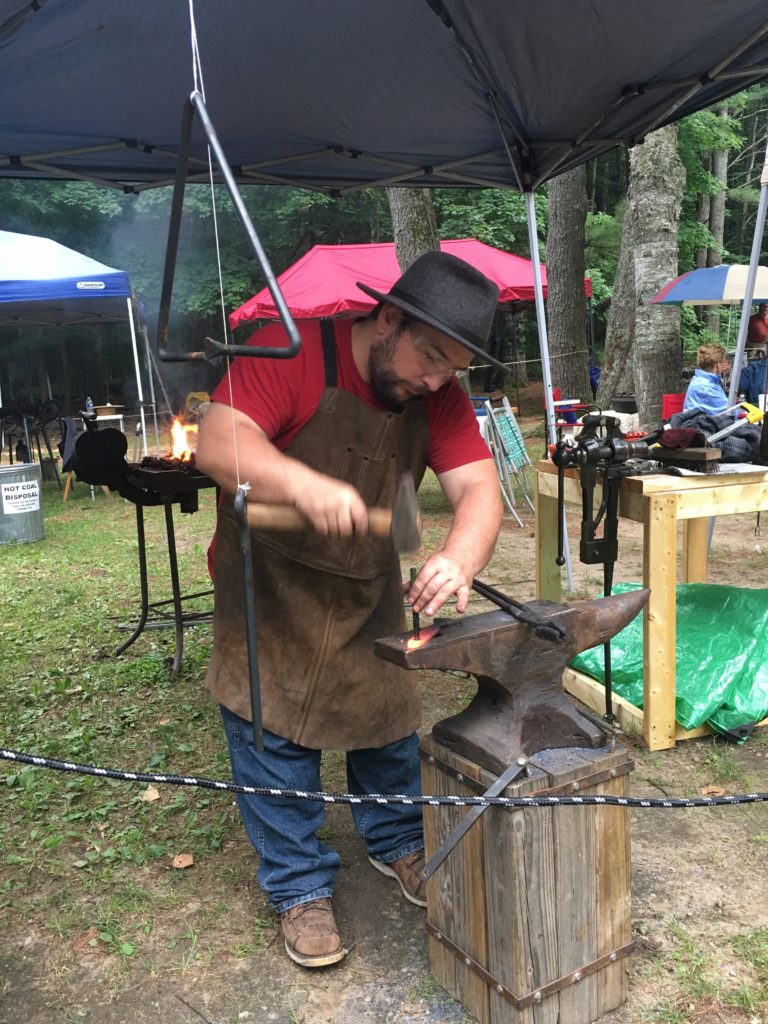
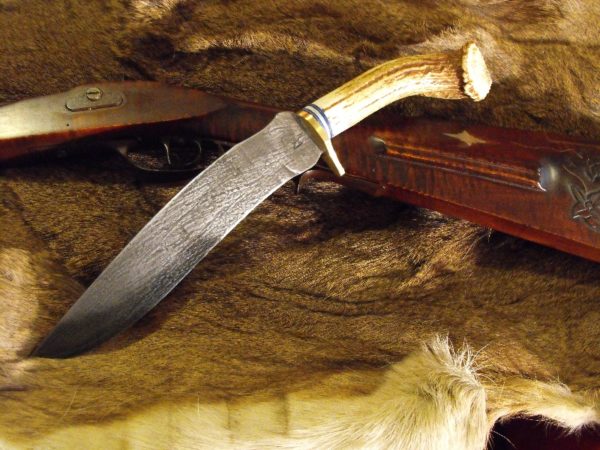
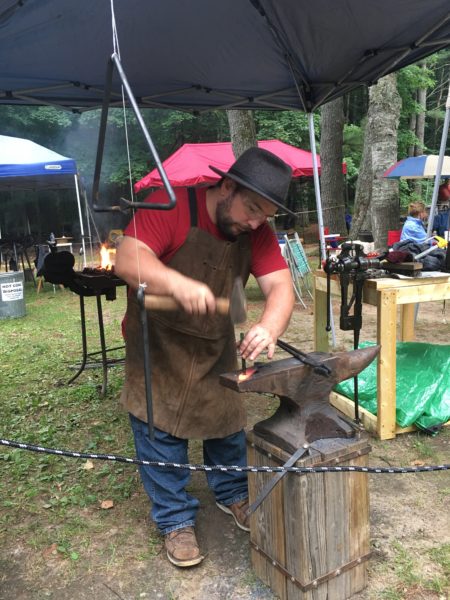
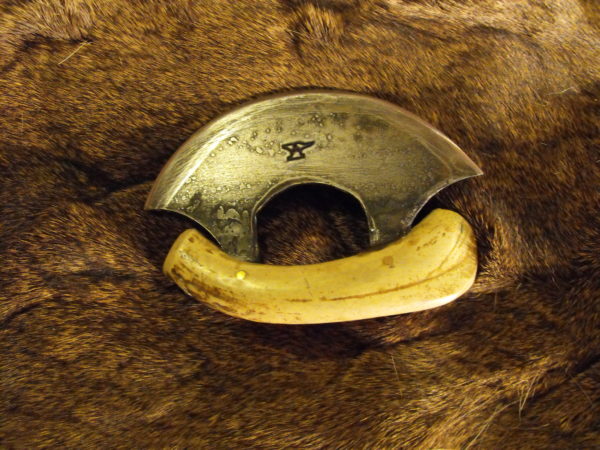
This 15-inch bowie has a 8 7/8-inch blade, flat-ground, appleseed-edged and forged from 1084 cable-patterned steel. The handle is made from axis deer crown antler with a brass guard and blue and white fiber spacers. Maker’s list price: $375.Bladesmith David McConnell puts on a forging demonstration at Black Iron Days at Hartwick Pines State Park in Grayling, Michigan. Every August blacksmiths from all over Michigan and a few from Ohio host demonstrations for the public for the whole weekend.North Woods Forge’s ulu has a 4 1/2-inch blade forged from 1095 steel. The handle is made from whitetail antler. David McConnell loves making primitive pieces and being an avid deer hunter, he often opts for antler material.
You can read your digital issues of BLADE Magazine anywhere you have your phone, tablet or computer, and there’s no need to find storage for all your old issues.
If piling-up issues of magazines seems like a waste to you… If you feel like you don’t have time to read a magazine… If you like the stories we offer in BLADE, but want a more economical option, then a digital subscription is the answer. An annual subscription to BLADE is $17.98, $4 off the print price.
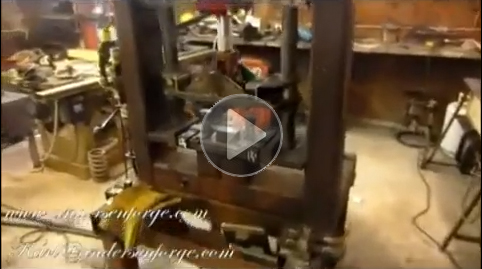
In this video from the American Bladesmith Society (ABS), journeyman smith Karl B. Andersen reviews his homemade hydraulic press. Andersen uses the innovative device to make damascus steel for his blades.
Andersen said he receives questions about what went into his homemade hydraulic press. It’s no wonder. This is one cool piece of knifemaking machinery. While Andersen has made his own modifications, the core design is from the mind of Michael Kanter from Wisconsin. From the video:
“It just doesn’t look like the other presses going…It’s very unique in its structure. Everything is contained within a picture frame. The tubular frame is made up of real high tensile steel.”
Despite being built like tank, Andersen points out that the pressure is all contained inside the homemade hydraulic press. Note the part where the arrow on a postage scale underneath the press doesn’t budge while the machine is running.
What about you? Ever consider building your own homemade hydraulic press? Leave a comment below.
Speaking of damascus, you don’t necessary need a homemade hydraulic press to make those eye-catching blades. Check out this download from BLADE on how to make damascus knives.
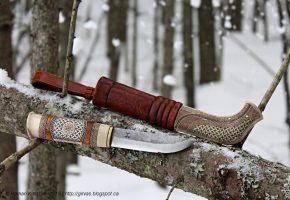
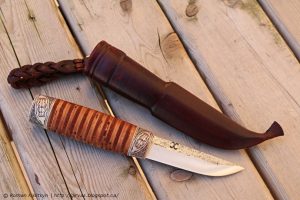
This Roman Kislitsyn sheath is made in North Sami style with a pronounced hook, which interferes less when sitting. The 4-inch blade is made by Pasi Hurttila in 80CrV2 steel. The handle is reindeer antler and birch root burl.
Roman Kislitsyn grew up in Apatity in the Murmansk region of northwestern Russia. Close to Norway, parts of the area also include the lands of the Sami people (in the past referred to as Lapps or Laplanders) which traverse the Kola Peninsula of Russia, and the northern and coastal regions of Finland, Sweden and Norway. Roman and others in his family are geologists so he spent much of his childhood with outdoorsmen, hunters, fishermen and those expert at surviving in the Russian wilderness. Always an admirer of Finnish and Swedish knives, Roman was most drawn to the beauty of the knives made by the Sami, the native reindeer herders of Scandinavia.
Roman Kislitsyn makes Sami-style knives.
Roman’s exposure to knives and survival equipment, combined with a love of crafting things with his hands, led to his first attempt at knifemaking when he was 15 or 16. “It had a blade made of high-speed steel from a piece of mechanical saw, wooden handle made of birch burl, and simple leather sheath, but I was very proud of myself,” Roman related. He made a few more knives, left to attend university and life intervened. A few years ago, he returned to knifemaking and cannot stop.
The traditional Sami lifestyle depends on reindeer herding, hunting and fishing. Roman explained that the design of their knives developed over the course of hundreds of years. They also mastered their own style of decorating things made of reindeer antler. “I like to use Sami-style decoration on my knives too. Even though I’m not Sami, but this makes me feel my connection to the land where I grew up,” Roman stated.
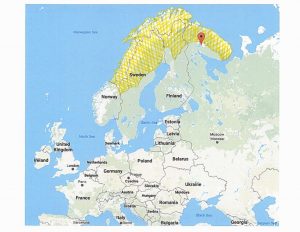
Sami lands, in yellow, historically reached farther south, encompassing Roman’s home region, marked in orange.
Roman makes two types of knives, either Sami style or Finnish puukkos with Sami-style carvings. He does not make his own blades. Some Sami blacksmiths existed, but using blades made by other makers was, and still is, a common practice.
Roman works with high-carbon steel blades made by his friend Alessio Salsi in Belgium. Lately, he’s also being trying laminated and pattern-welded steels. Since Roman makes Scandinavian knives, the grinds are all Scandi. He used to employ blades made by Pasi Hurttila from Finland before Pasi stopped making knives. Roman also used blades made by Randal Graham in Nova Scotia. Randal took a hiatus from knifemaking but has now returned, and Roman hopes to resume collaborating with him.
Roman Kislitsyn put a stacked birch bark handle on this 3.2-inch Pasi-Hurttila-made 80CrV2 blade. Carvings on the antler are in Sami-style. Bark handles are popular for Finnish puukkos; they never get slippery or cold, even below freezing.
Roman is self-taught, learning everything about knifemaking and carving through the Internet, forums and social media. With the exception of light use of a hand-drill and a Dremel, Roman uses only hand tools. “No grinders, sanders, band saws, nothing. Only files and rasps, only hardcore!” he explains. Roman’s goal is to make “functional art,” as one of his customers put it, and not a knife that just sits on a shelf. His favorite handle materials are reindeer antler in combination with birch burl and-or bark, which are all traditional materials in Sami-style knives. Maker’s list price starts at $450 US.
Roman left Russia in 2002 and now lives in Nova Scotia, but you can converse with him through forums like British Blades, Canadianknifemaker.ca and the Russian forum zadi.ru. His website and blog are at Girvas. “Girvas is a name of a lake in same region where I’m from,” Roman added. It is the Russian pronounciation of the Sami word hirvas, meaning “reindeer stag.” You can visit Roman on Facebook at Roman Kislitsyn or on Instagram @roman.kislitsyn. You can e-mail him at [email protected].
The CRKT Homefront is the 2017 BLADE Show knife, and won last year’s Most Innovated Imported Design.
The CRKT Homefront is a Ken Onion-designed knife that won Most Innovative Imported Design at last year’s BLADE Show. The field-strip technology allows for easy cleaning anywhere, without tools. Get yours now for $70 and you’ll save 30% off this true collector’s item.
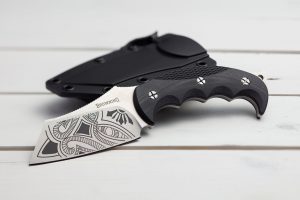
Browning’s line of Jared Wihongi Signature knives is as fierce as its SWAT operator namesake.
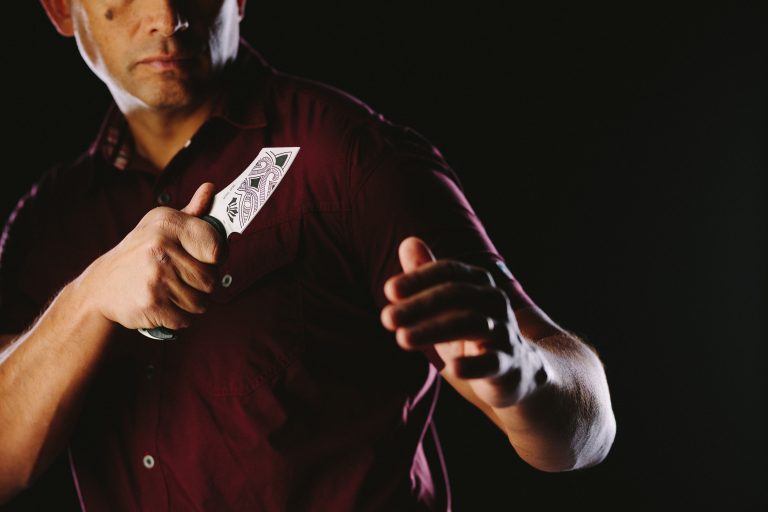
Jared Wihongi is a native New Zealander who began training in martial arts at an early age. As a young man he had the chance to live in the Philippines and study an edged-weapon style of fighting called Pekiti Tirsia Kali. Jared has spent 14 years as a law-enforcement special weapons and tactics operator. He also instructs other SWAT team members as well as elite military operatives in edge-weapon skills. He has advised Browning on its Black Label tactical family of knives and now has his own signature line, strikingly designed with Maori-inspired blade etchings. Be sure to subscribe to BLADE magazine to read about the Jared Wihongi Signature line of combat knives in the August issue, on sale May 16, 2017. To learn more about Jared Wihongi’s upbringing and training, read “Browning Launches Wihongi Line of Maori-Inspired Knives.”
The Jared Wihongi Signature Fixed has a canoe-shaped handle that is ergonomically correct in both a forward and overhand grip. The etchings are borrowed from Maori tattoo patterns.
To meet Jared Wihongi and hear him discuss his style and philosophy of knife fighting, here are some well-done videos by Funker Tactical. In the first, Jared discusses how the foot movements used in Filipino knife fighting can aid in an empty-hand or firearm scenario. In the second, Jared addresses how the skills developed through the practice of Pekiti Tirsia Kali are relevant to the reality on today’s street or battlefield. And in the last video, Jared talks about why you should train wearing what you wear in your work or your everyday life. Law enforcement and military especially need to practice wearing their equipment so they understand how their range of motion, breathing and other functions are affected by the added weight.
In “Fighting Folders” Michael D. Janich instructs viewers on the myths surrounding folding knives and how to employ them in a self-defense situation.
Micheal D. Janich covers how to use empty-hand skills, quick one-hand deployment techniques and knife-fighting tactics so you can lean on your folder as part of your self-defense kit. This DVD is well worth the $39.95 when you consider you can watch it repeatedly in the comfort of your home, practicing its demonstrated skills until you’re ready to take your training to the next level.





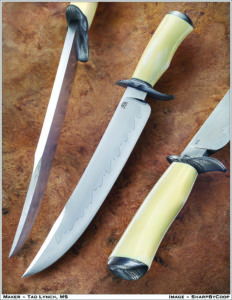 Above: A stylish guard of wrought iron helps put the finish- ing touches on an ancient-walrus-ivory bowie by ABS master smith Tad Lynch. The 11.25-inch clip-point blade is W2 tool steel—a material some leading smiths consider ideal for producing a handsome hamon—and the knife is 16.375 inches overall. (SharpByCoop image)
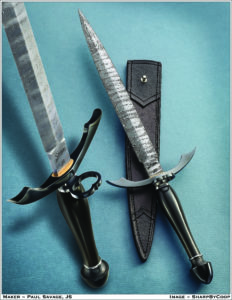 Above: An upturned guard with a finger ring—each of hot- blued 4340HT steel—and a ladder-pattern damascus blade of 1095 carbon and 15N20 nickel-alloy steels help complete a quillon dagger by ABS journeyman smith Paul Savage. The handle is buffalo horn. (SharpByCoop image)
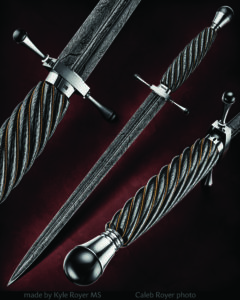 Above: Black mirror accent balls cap the stainless steel quillons on ABS master smith Kyle Royer’s Maiden Voyage Stiletto. The 11.75-inch damascus blade features an extra-deep hollow grind, a fuller and a reinforced piercing tip. The sculpted, fluted handle is wrapped in 24k-gold twisted wire. Overall length: 17.5 inches. (Caleb Royer image)