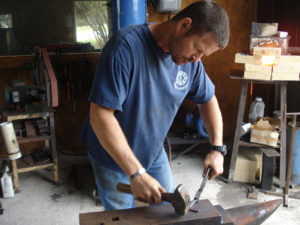
Knifemaking is the building of a knife, which includes the blade, handle and other accouterments. Blades are made by either removing metal from a steel blank via a grinder – known as stock removal – and the forging to shape of hot steel into a blade in the process known as bladesmithing. Other parts, including bolsters, guards, pommels, etc., are needed to complete the finished knife.
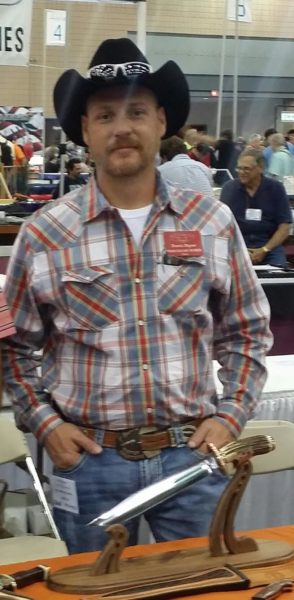
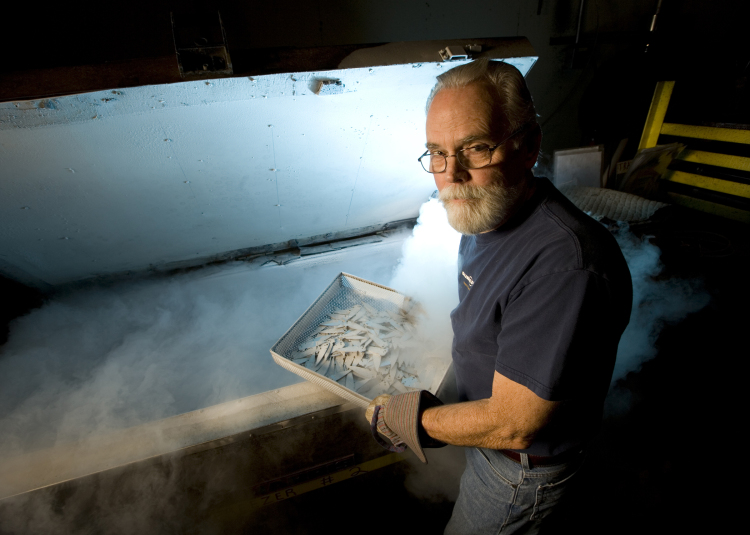
Although formally retired from his full-time role as head of heat treat for Buck Knives, Paul Bos continues to pursue the passion that captivated him as a 9th grader, many years ago.
“After all these years of friendship and working relationships, it’s satisfying to know that we can continue to provide the same specialized heat-treat service custom knifemakers have come to expect,” Bos said. “I’ve heard that my ‘retirement’ misled some, but Paul Bos Heat Treating is very much alive and well.”
For a brochure and price list, call or e-mail Paul Farner: (208) 262-0500, ext. 21; [email protected].
# # #
Photo Attached: Paul Bos
Paul Bos Heat Treating–Paul Farner, e-mail[email protected]Phone 208-262-0500 Ext.21
Here’s how one knifemaker forged a knife from 9/11 wreckage to fundraise for families affected by the attacks.
Do you remember where you were on Sept. 11, 2001, at 8:45 a.m. EDT when an American Airlines Boeing 767 loaded with 20,000 gallons of jet fuel crashed into the north tower of the World Trade Center in New York City? That day was forever etched in many of our minds as a reminder of how paramount it is to safeguard our freedoms.
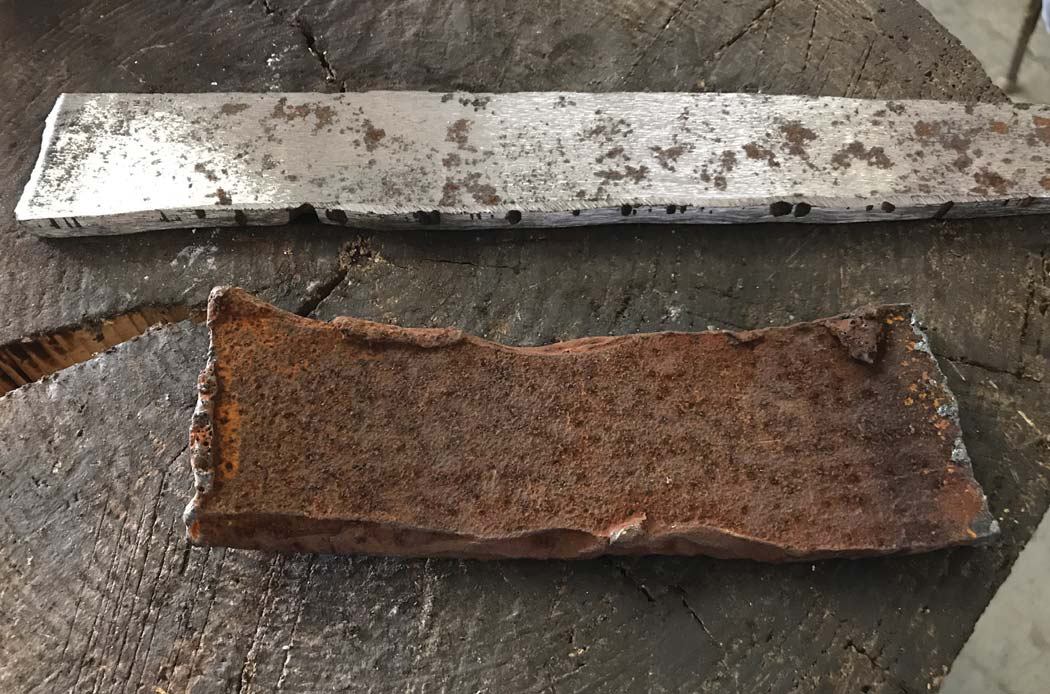
Pieces of iron from the World Trade Center appear as they looked before (bottom) and after (top) light surface grinding to facilitate forge welding.
Building Homes for Heroes is a national non-profit, non-partisan 501(c)(3) organization founded in 2006. It has been at the forefront of making a significant difference in the lives of wounded American service members and their families, including those affected by the 9/11 attacks.
The knife Murray made went to auction, with all proceeds from the auction to be distributed to first responders who were directly affected by the 9/11 attacks.
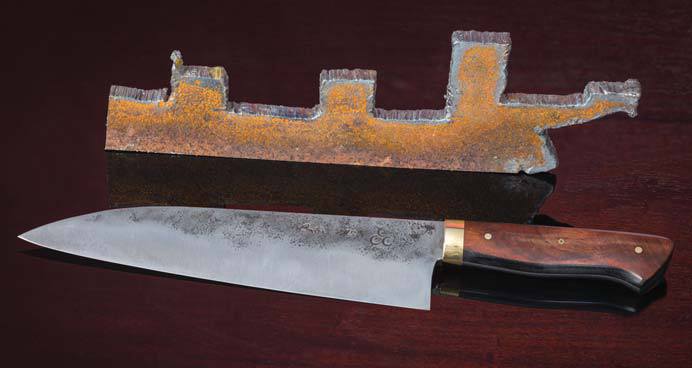
The three-layer blade of a Carter Cutlery chef’s knife is forged with WTC steel and a 1084 carbon steel core. The ironwood handle has a brass bolster. Judging from how much use Carter’s kitchen knives get, Murray opined this is probably the most valuable use of the precious WTC steel. Above the knife is a portion of the raw material from which the blade was forged.Here are the beginning (bottom level), middle (mid-level bar of steel) and end products (top level) of forge welding World Trade Center iron into a usable blade with a 1084 core. The blade is water-quenched for maximum sharpness and edge retention, and the blade surface still retains the soul-infused character of the WTC steel.
As he noted, “Being entrusted to recreate useful cutting tools from remnants of the WTC was an honor and one of the most humbling tasks of my 29-year career.”
This past November, FDNY 343 RIDE flew Murray to New York to give a presentation and explain what he did with the WTC steel and how it was used in a three-layer laminate to create high-performance knives. It was an experience Murray said he will never forget.
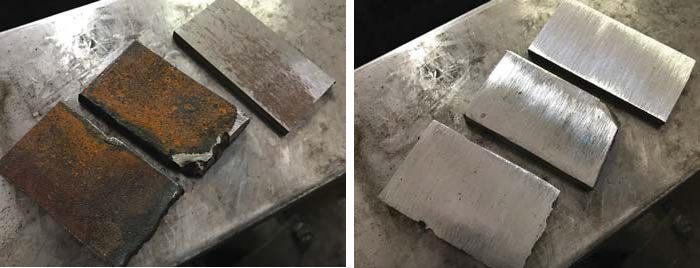
The three pieces to be forge welded into a blade are, from left, two pieces of WTC iron and 1084 core shown both before grinding and polishing and after.
“It went incredibly well,” he noted. “Best of all was that I got to meet many of the New York Fire Department members, as well as many American military heroes—they are all heroes, all first responders—and there was such a huge sentiment of being proud to be American. It was a very refreshing spirit to witness.”
The knife went for $10,500, with all proceeds going to Homes for Heroes.
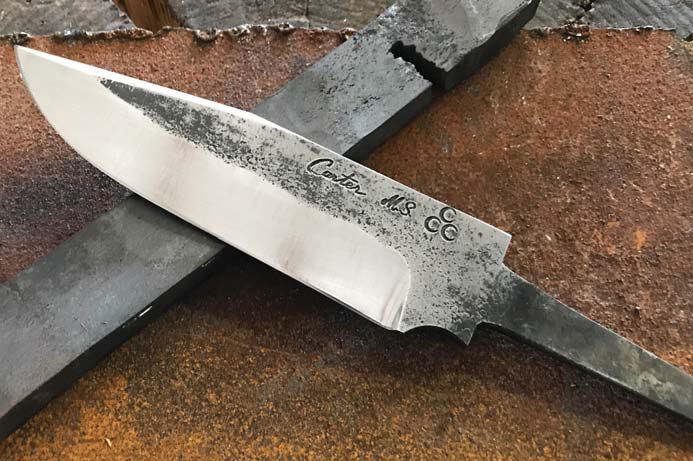
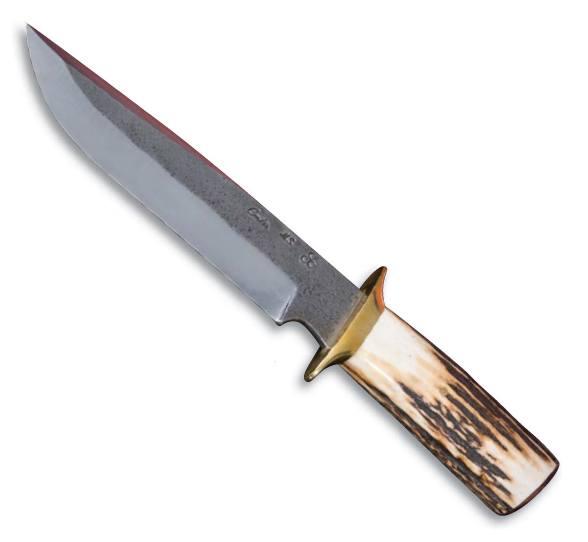
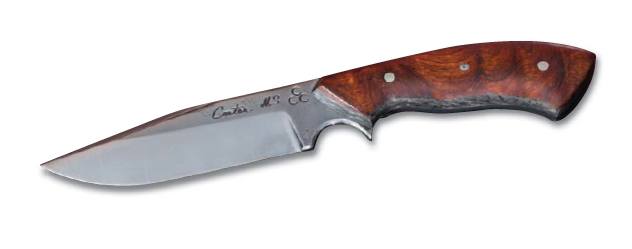
A Carter Cutlery bowie sports a three-layer blade of WTC steel with a 1084 steel core, a brass guard and Sambar stag handle.A Carter Cutlery neck knife gets the three-layer WTC/1084 carbon steel blade treatment and an ironwood handle.
Every day is Memorial Day for the family of Master Sergeant Robert Mark Horrigan. The weeks leading up to the holiday and through June 17, though, mark an intensified period of mourning for Robert’s identical twin brother and American Bladesmith Society master smith John Horrigan of Elite Knives. Robert was a member of C Squadron, 1st Special Forces Operational Detachment, Delta Force, JSOC and June 17, 2005, was the date he was killed in action in Al Qa’im, Iraq. Gentlemanly, soft-spoken, John says, “Excuse my language, but I’m an asshole for about two weeks” leading up to Memorial Day. And with that, you know that no matter how courteous, no matter how elite the warrior pedigree of either man, John knows exactly how hard it is for Gold Star* families and fellow veterans, and he’s willing to get in the dirt and help.
John Horrigan owns Elite Knives and works out of his home shop in Burnet, Texas. His knifemaking began in earnest after returning from his service as a U.S. Army Ranger in 3rd Battalion, 75th Regiment.
The Horrigan twins learned to hunt and fish growing up on a farm in Limestone, Maine, which is in Aroostook County, so far north it might as well be in New Brunswick, Canada. When the boys were 10, knowing jobs would be scarce, the family moved to Florida. The humidity exacerbated their father’s emphysema and tuberculosis, however, so two years later thy moved to Austin, Texas. John and Robert enlisted together and advanced to become U.S. Army Rangers, serving in 3rd Battalion, 75 Ranger Regiment. After three years, John left the military—for love. He had met Donna when he was 17 and she was almost 15. He has now been married to his high school sweetheart for 29 years. They have a daughter and a son, with one grandchild and another on the way. “I just knew the military life was not for her,” John said.
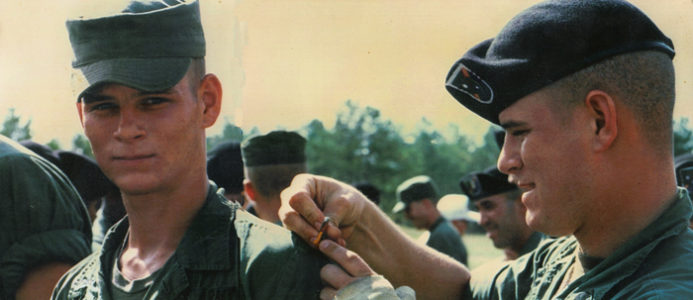
Then-U.S. Army Ranger Robert Horrigan pins the Ranger Tab on his twin brother John Horrigan’s shoulder at a graduation ceremony on Fort Benning, Georgia.
John performed security for the U.S. Department of the Treasury for a short while and then became a deputy with the Travis County Sheriffs Office as well as a fireman. In 1983 John made his first knife. After his brother’s death, he made a commemorative knife for Bob’s unit and another for President George W. Bush. He makes everything from swords, daggers and the occasional tomahawk to camp knives, hunters and bowies. John also continues to make his brother’s design, the Bob Horrigan Military Fighter. You can read more about the brothers and their knives in an article by Kevin Jones that ran in the December 2010 issue of BLADE Magazine entitled, “Twin Brothers, Makers and Heroes.”
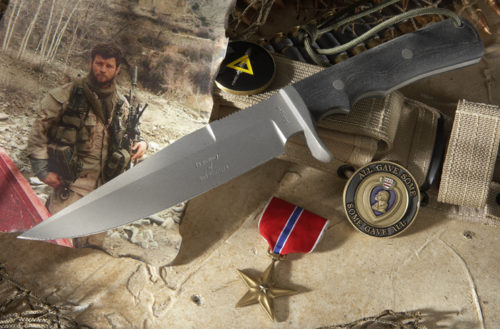
The Bob Horrigan Military Fighter has a 6 1/2-inch blade made out of 440C stainless. The guard and handle bolts are made of 303 stainless. The handle is fashioned with Black Linen Micarta. Overall length: 11 1/4 inches. Maker’s list price: $550. This design is also available with a double guard at 13 inches overall at the same price, or in pattern-welded steel with ironwood handles at a maker’s list price of $720.
While love and love of knives determined the course of one brother’s life, the warrior spirit could not be quenched in the other. Over the course of his 19 ½-year career, which culminated in Special Forces, Robert, who his brothers-in arms called Bob, deployed five times to Iraq and three times to Afghanistan. “Badass” and “real deal” can be overused, but not with Bob Horrigan. Delta operator George E. Hand IV wrote two eulogies of Bob for SOFREP News that get to the heart of the quintennial gentleman warrior: “Delta’s Robert Horrigan: A Better Man Than I” and “Delta Forces’ Own Robert Horrigan: Dwarfed By The Presence of Giants.”
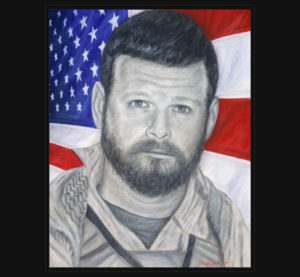
Robert M. Horrigan left the service when his twin brother, John, did but reenlisted, moving into Special Forces after his time in Ranger Regiment. He was killed in action in Iraq, June 17, 2005, in Al Qa’im, Iraq.This portrait of MSG Robert M. Horrigan was done by Phil Taylor for the non-profit The American Fallen Soldiers Project. It was present to the Horrigan family in accordance with the 501(c)(3)’s mission of bringing comfort and healing to Gold Star* families. You can watch the video about this particular portrait at the bottom of this post.
Bob did not have to go on his last mission. He was closing in on retirement. He had plans. He was going home to his wife and daughter and he was going to make knives with his brother. Five years before, John had introduced Bob to knifemaking, and he liked it. While living in base housing on Fort Bragg Bob would run an extension cord outside to work on his creations. “I’m not sure they would have been happy about if they knew,” John says, a warmth in his voice. Like John, Bob loved the artistry of knifemaking, but he only had time for making combat knives.
In addition to medals depicted here by ribbons, Robert Horrigan was posthumously promoted to Master Sergeant and awarded the Legion of Merit Medal, the Bronze Star Medal with Valor Device and the Purple Heart. In addition to his mother, Mary; twin brother, John; and sister Lisa Shine, he is survived by his wife, Denise; his daughter, Courtney; and another brother, Daniel. He is buried in Section 60, Site 9131 at Arlington National Cemetery.
John continues to live out this dichotomy. “I could make a lot more money making fighters,” he said. After banging out 40 of them, though, he longs to delve into the art of the craft. Then, when he’s deep into a showpiece and it seems like it will never be finished, he begins to long for the refreshing simplicity of hammering away on combat knives. “I flip flop,” he says. “I used to have six or seven pieces, 80 percent done” for BLADE Show. He laughs about what he refers to as his attention deficit hyperactivity disorder. Now he works on two at a time and finishes them before he moves on to the next one. After the show he enjoys being able to relax and resume his own pace.
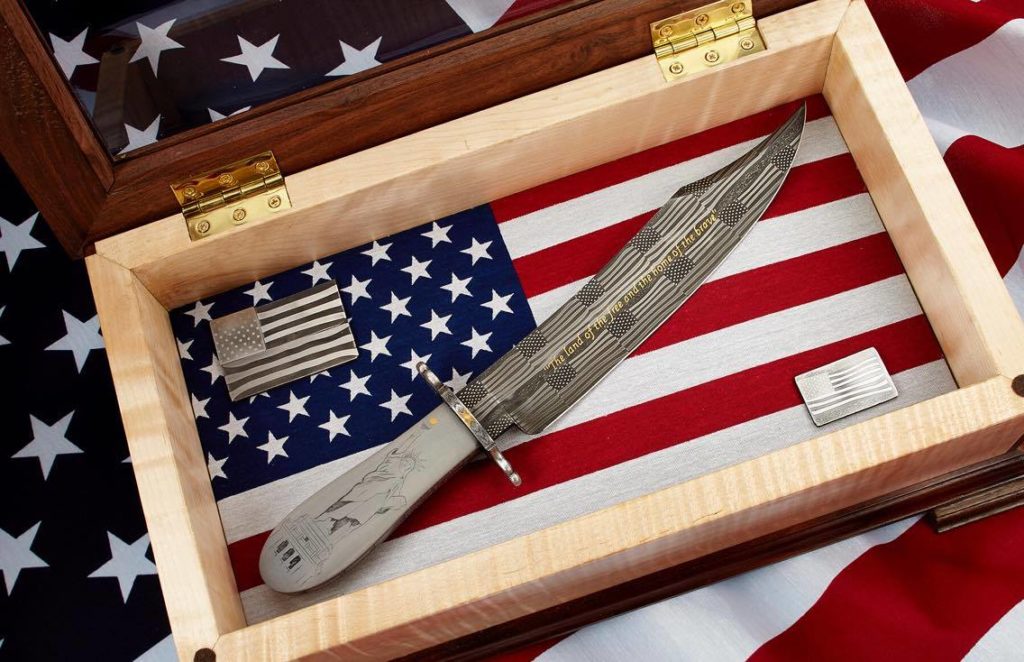
When he needs a break from combat knives, maker John Horrigan switches to crafting high-end pieces of art. This bowie is made in American flag mosaic-pattern steel. Although you can’t see it, “In God We Trust” is engraved along the spine. The handle scales are 416 stainless steel engraves with the Statue of Liberty. The quote on the blade is done in 24-carat gold. Contact: Elite Knives
So although Robert didn’t have to go on that last mission, he wanted to be with his unit. And with that decision, the dream the twins shared of living out their days together with their families and making knifes ended—hard, on the other side of a breached door. The objective was to sneak in, target Abu al-Zarqawi, the al-Qaida leader in Iraq, and get out. The problem was that by the time the mission was underway, the enemy knew the Americans were coming. Bob Horrigan was the number-one man. He got inside the room and was immediately engaged in an intense firefight. The number-two man, Master Sergeant Michael L. McNulty—also a twin—was shot down on the threshold. While teammates extracted Mike from the doorway, Bob took hits to his femoral artery and head. Both men held on while their brethren simultaneously continued the battle, plugged their wounds and extracted them to a secondary airfield approximately 1000 meters away because a closer one was under attack. Both men were alive when they were put on the aircraft and when they landed at the medical facility. Heart massage was performed on Bob. But, as John explained, when you’ve been hit that many times, when you’ve lost that much blood, no matter how much they hold on, it’s only a matter of time before they succumb.
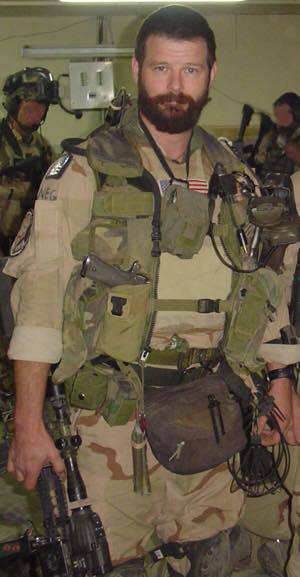
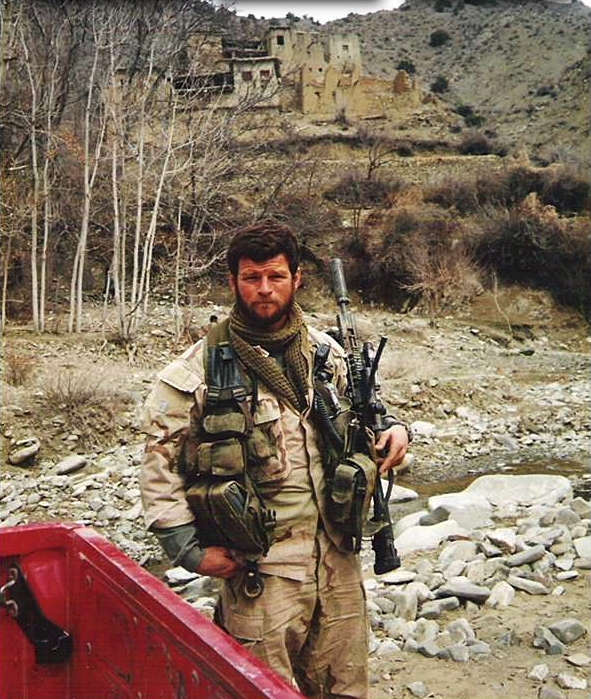
John 15:13 reads this way in the New King James version of the Bible: “Greater love has no one than this, than to lay down one’s life for his friends.” John Horrigan will tell you that his twin brother, Robert, did just that for his brothers-in-arms. Jesus did the same for us. This photo of Robert was taken taken March 19, 2002, east of the Shahi-Kot Valley on the route to Khost during the post-Operation Anaconda chase.
The part about both men being twins, was only the first of endless seeming coincidences. Robert’s wife kept his remains in an urn at home for a few years before he was interred, but John also wanted to visit the grave of the man who had died with his brother. He made the trip to Arlington National Cemetery, and when asked who he was looking for, gave McNulty’s name. There were three men also standing at the information desk. “Who did you say you were looking for?” one of them asked John. John repeated the name. He tried to introduce himself. Being an identical twin, the men already knew who John was. They were from his brother’s unit, and they too had come to visit McNulty’s grave.
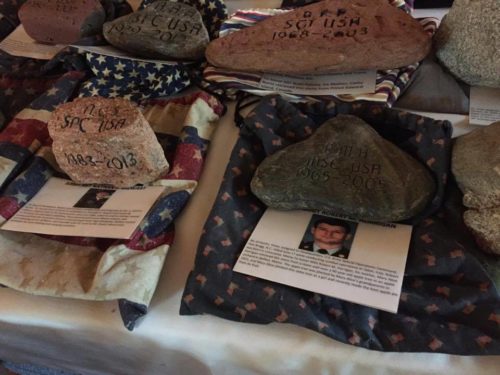
Another time the Horrigans had planned a family trip back to Maine. Many people were involved and Donna was looking at a particular house to rent. It was expensive so John suggested checking Craigslist. She found the same house listed for less. As the process continued, the twin’s sister, Lisa, began to suspect a scam. John wasn’t sure at first, especially since he was so used to dealing with wire transfers through the course of selling his knives internationally. He was busy in Boston and directed his sister to handle it. On the way to Maine, John thought, ‘Maybe it is a scam,’ and called the Ellsworth Police Department. A detective, Dotty Small, confirmed that it was indeed a scam. John called Lisa who was standing on the porch of the house, which already had tenants living in it. John told her what he had learned. In an event to commemorate Maine’s heroes called The Summit Project, Detective Dotty Small had hiked Baxter Mountain carrying a stone with the initials of a fallen warrior on it: M.R.H.
“Maine is good to its veterans,” John Horrigan said. According to The Summit Project nearly 1 in 7 Mainers are veterans or approximately 15 percent of the state’s population, one of the highest rates of any state in the nation. The Summit Project honors fallen heroes and brings awareness to the challenges of grieving families. The Bangor Daily News covered the event in 2014. The article was entitled “Feeling the weight: Hikers carry tribute stones for Maine heroes to Baxter mountaintop.”
One night at the firehouse, John had a dream. In it, Robert came to him and told him to look up Al Qa’im. “I’m thinking, ‘I’ll never remember that,’” John said. Al Qa’im was a center for insurgency near the Syrian border, and the town in which Bob was killed. It means ‘I have risen.’” John pauses. “Another translation is ‘I have ascended.’”
It is like this all the time, Bob seemingly orchestrating serendipitous exchanges for his family and especially his twin. “I lost half of me,” John said. It took me a year and a half to get beyond wanting to blow my head off,” he admitted. “God really had to hit me with a sledge hammer…It’s not about you anymore. It’s about Me.”
John and Robert’s mother was a novice nun. After five years in the convent, she knew she wanted to have children so she left. The Horrigan children were given a Catholic upbringing. “In the Army, you drift away,” John said. About two years before he died, Robert told John that he was coming back to God. John accepted the news in his easygoing manner, but perhaps didn’t think as much of it as he does now in hindsight.
“All this macho ‘I can handle it.’ Well, obviously, you can’t. You have to talk to someone,” John said. “There has to be a support network, and having God can help.” John is quiet for a moment. “Bob was a sniper,” he reveals. Bob told John that he’d killed 50 to 60 enemy combatants. “He did not have PTSD, that I know of,” he emphasized. Bob told John that he was OK, because he was “alright with God.” The Old Testament is filled with killing, John said. “Evil exists in this world and you have to exterminate it. It’s like when you have an infestation of bugs. You have to kill every one or they’ll come back. When you’re fighting an ideology where (the enemy is) hiding behind women and children, it’s like a cancer of the highest magnitude” that must be eradicated.
“Memorial Day is not a happy time,” John said. He acknowledges the day by telling people about his brother and the tragedy of leaving a hurting wife, 12-year-old daughter, mother, siblings and especially a twin with whom he did everything. But perhaps because of the leadership ingrained in him as a Ranger, John understands that he cannot be consumed by the grief of his own loss. God channels his pain in a way that reaches people just like him, veterans and family members who are wracked with unbearable grief. John recently lost a firefighting co-worker to suicide. It left him shocked because the man was always so cheerful “Everyone has demons. Call me. We’ll fight them together.”
Knifemaker John Horrigan Remembers Fallen Twin Brother Robert Horrigan
*Gold Star families are those that have lost a service member in combat. You will see the vertical red-rimmed banners most commonly on vehicles. Each blue star represents a family member serving in the military, while a gold star represents a fallen service member.
In addition to a review of Robert Horrigan’s Military Fighter from Elite Knives, you’ll also get a rundown on Old West-style push daggers in the October 2011 issue of BLADE.
So what does fellow Special Forces member Kim Breed think of Elite Knives’ Bob Horrigan’s Military Fighter? Read his review right away in this downloadable version of the October 2011 issue of BLADE for $5.95.
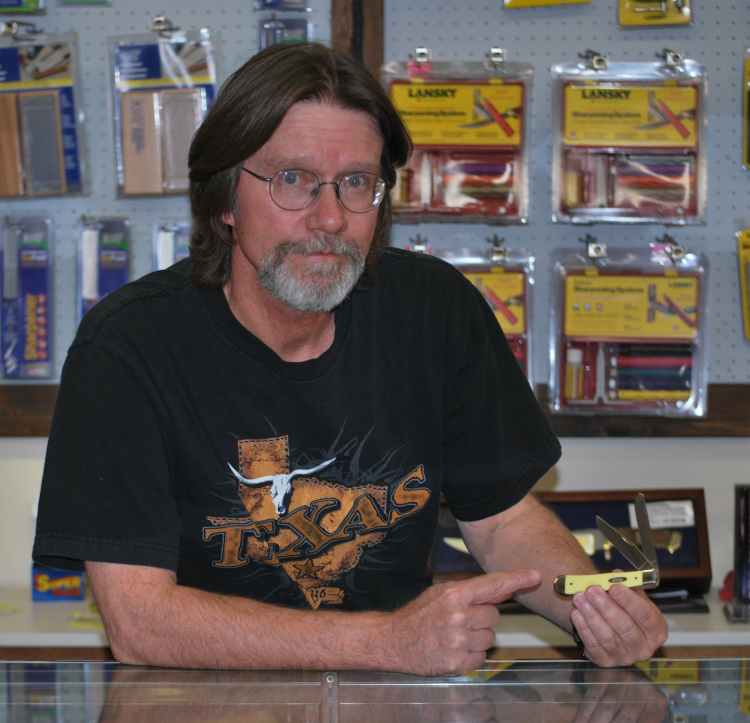
Troney Toler of Knives Plus in Amarillo, Texas, says his biggest seller by far is the Case model 161 yellow-handle trapper with blades of Case’s “chrome vanadium carbon steel”—which, according to a Case official, is 1095 carbon steel with added chromium and vanadium. (photo courtesy of Troney Toler)
There is snow on the roof but fire in the furnace of the most popular factory carbon steel knives
By James Morgan Ayres
With all the new, exotic alloys populating the knife industry in recent years, what about the sales of factory knives with blades of the “old faithful” carbon steels? To find out, I spoke with a selection of cutlery retailers from Texas to Canada and asked if carbon steel blades are still selling in the face of competition from the new alloys, and, if so, which of the non-stainless knives are hottest in terms of sales.
North of the border, Pauline Favreau of the Canadian Knife Zone says she sells carloads of carbon-steel knives. In the springtime her customers load up on Cold Steel kukris and machetes to clear weeds, vines and saplings from around their summer cabins. Given the riotous early season growth in the north, this is a big job and a tough one. According to Favreau, her experienced customers rely on Cold Steel blades of 1055 carbon steel for their ability to take a keen edge and be easy to sharpen. She sells them for around a modest 30 Canadian dollars ($29.50 American) each and says customers prefer them to expensive alloy blades and their reputation for being hard to sharpen. Moreover, when the blades get the inevitable nick or two, it is easy enough to repair the edge with a stone.
Favreau says 45 percent of her clientele generally are female, some of whom are members of the Royal Canadian Mounted Police, military and other professions. She adds that KA-BAR’s Becker Knife & Tool line in 1095 carbon steel is far and away the most popular with the Mounties, who buy models from the Becker Necker at 56 Canadian dollars ($55) to the Campanion at 106 Canadian dollars ($104.20).
The owner of Canadian Knife Zone indicates many northern outdoor enthusiasts favor the traditional Grohmann hunter and the venerable D.H. Russell Canadian belt knife, at about 75 Canadian dollars ($73.73) each, both in C-70 carbon steel. The classic Opinel with its XC70 carbon steel blade and beechwood handle priced at 11 Canadian dollars ($10.80) is a perennial favorite of backpackers and others looking for a lightweight folder, Favreau adds.
Though the carbon-steel knives mentioned are affordable, she says price is a minor factor in the choices of Knife Zone’s customers. They are looking for proven performance and usually opt for non-coated blades.
Fans of 1095
Tom Melago of Chestnut Ridge Knives in Latrobe, Pennsylvania, says he sells many Ontario kukris and machetes in 1095 coated carbon steel, with the basic Model C 1-18 being the most popular machete. According to Melago, “Ontario’s Spec-Plus 2502 kukri is one of the most popular knives of any kind in my store. It’s favored 10-to-1 by my customers over other brands of kukri.” He adds this is due to the Ontario kukris’ reputation for quality and because they are made in America, which is a strong selling point. At his list prices of $29.99 for the machete and $53.99 for the kukri, these big boys appear to be a bargain.
Melago says though the choppers see considerable use as utility tools, most of his customers who buy big blades do so for survival packs and bug-out bags (BOBs). With Chestnut’s list prices in parentheses, Ontario’s RTAK II ($94.99) and RAT 7 ($87.99) in 1095 carbon steel also are finding their way into many Pennsylvania BOBs, as is ESEE’s entire line in 1095. From the Junglas ($155.99) to the ESEE 3 ($89.99) and ESEE 6 at ($116.99) to the tiny Izula ($49.95), Melago says all sell as fast as they can be ordered, and all have proven to be tough and easy to sharpen. (Again, all parenthetical list prices are Chestnut’s).
Like Favreau, Melago states price is not a factor in his customers’ choices. He says all of them express a willingness to pay more for models made in America, and most opt for non-coated blades.
Tougher Steel
At J.T. Knives in Port Jervis, New York, Joe Tarbell says the entire Ontario Spec Plus line of 1095 carbon steel knives continues to sell as well as always, which is very well indeed. Like his retail counterparts, Tarbell indicates even though the Spec Plus line is priced affordably from about $45 to $100, price has little to do with his customers’ knife-buying decisions. He says customers who request carbon-steel knives seem convinced carbon steel is tougher than any stainless. Some are older customers who have used carbon steel for years and are not interested in changing. Ease of sharpening and toughness are the deciding factors.
Tarbell says many of his customers are outdoorsmen and into survival skills. They prefer carbon steel for its traditional qualities and because “they get a better spark with a flint fire starter” on it. While they are concerned with rust, they also understand the simple steps they can take to avoid it (keeping the steel clean, a little oil, storing the knife in a dry place, etc.).
The J.T. headman states he has seen an increased demand for the Dustar Israeli combat knives, which use D2 tool steel. At a list price of $225, it is a relatively expensive factory knife, but he says buyers seem to appreciate the qualities of D2 and its solid construction. Tarbell adds his store also does well with anything from the Benchmade Bone Collector series, all in D2 blade steel as well.
Have Blades, Will Rust
The story on carbon-steel knives is very different at Troney Toler’s Knives Plus in Amarillo, Texas. Toler says he sells many traditional carbon-steel pocketknives and few fixed blades. His biggest seller by far is the Case model 161 yellow-handle trapper with blades of Case’s “chrome vanadium carbon steel”—which, according to a Case official, is 1095 carbon steel with added chromium and vanadium. According to Toler, he orders the knives 50 at a time and, at a list price of about $50 each, he often runs out of them.
In general, Knives Plus has two classes of customers. “The first,” Toler said, “is the grizzled old farmer or rancher who won’t have anything but a blade that ‘will rust.’” Such a customer has been using the knives for a half century and figures “if the blade won’t rust, the steel is no good.” Of course, the customer knows how to care for carbon steel, so maintenance is not an issue.
The other kind of customer will return a knife if a spot of rust shows up. “Those folks are better off with a Spyderco,” Toler notes. “Occasionally, I’ll see one of the old guys come in and buy a Spyderco, but that’s unusual.”
Boker, Queen and Eye Brand pocketknives in carbon steel are also good sellers for Toler, with such Queen models as the mini trapper with D2 blade steel a special favorite. He says D2 is “almost stainless” but not quite. About the only fixed blades Knives Plus does much business with is the ESEE 3-P in “well-tempered 1095.”
Even in today’s world of hi-tech alloys, the age-old carbon steel still earns its keep. Maybe it will continue to do so for another thousand years or so. Who’s to say it won’t?
For more on the latest knives, knife legislation, knifemaking instruction, knife trends, knifemakers, what knives to buy and where and much more, subscribe to BLADE® Magazine, the World’s No. 1 Knife Publication. For subscription information click on http://www.shopblade.com/product/blade-magazine-one-year-subscripti…?r+ssfb020412#BL1SU
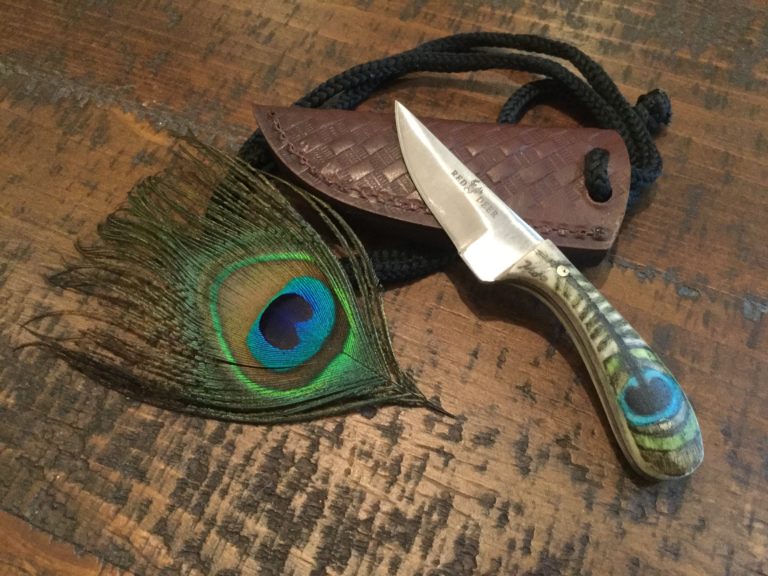
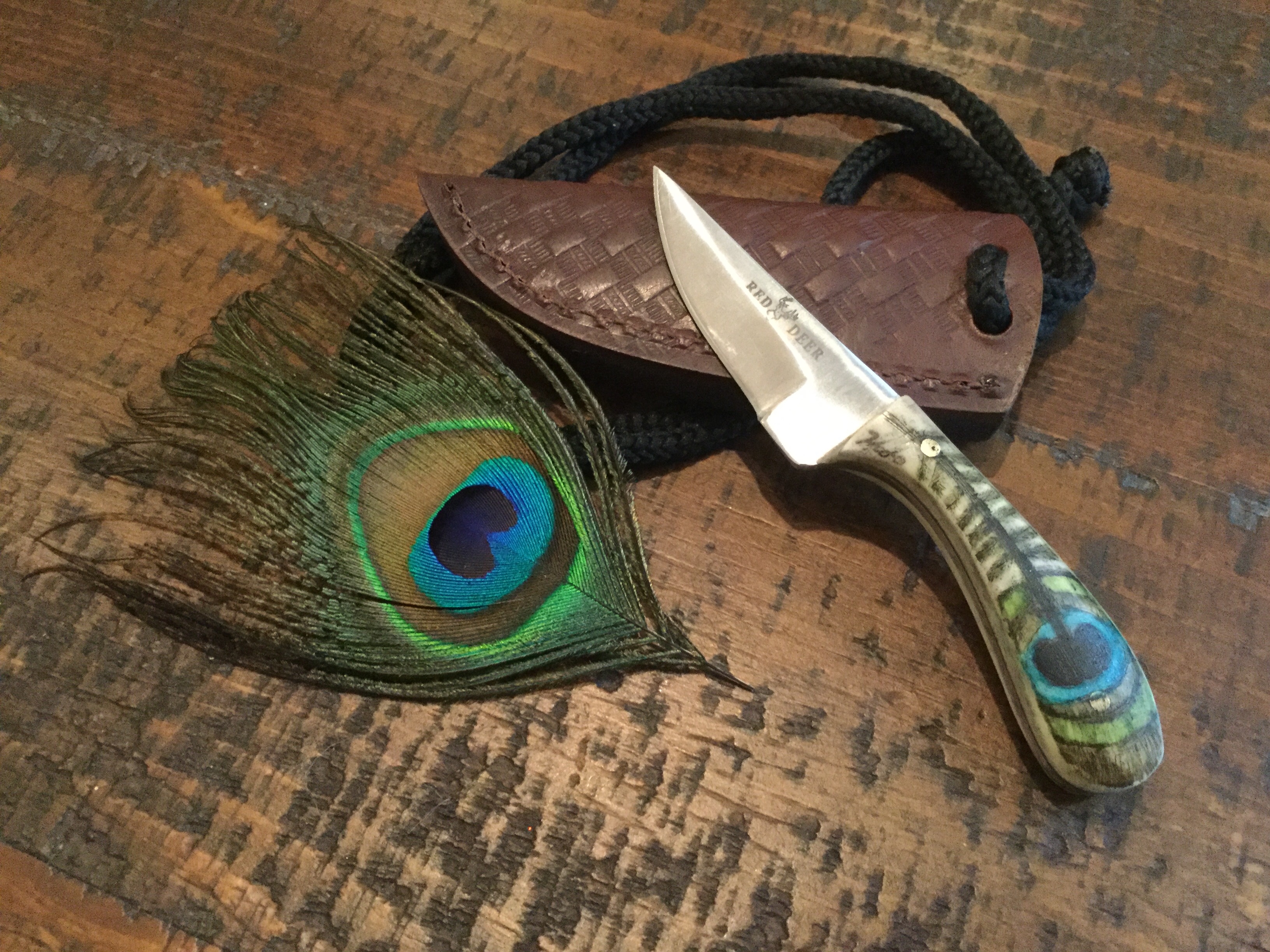
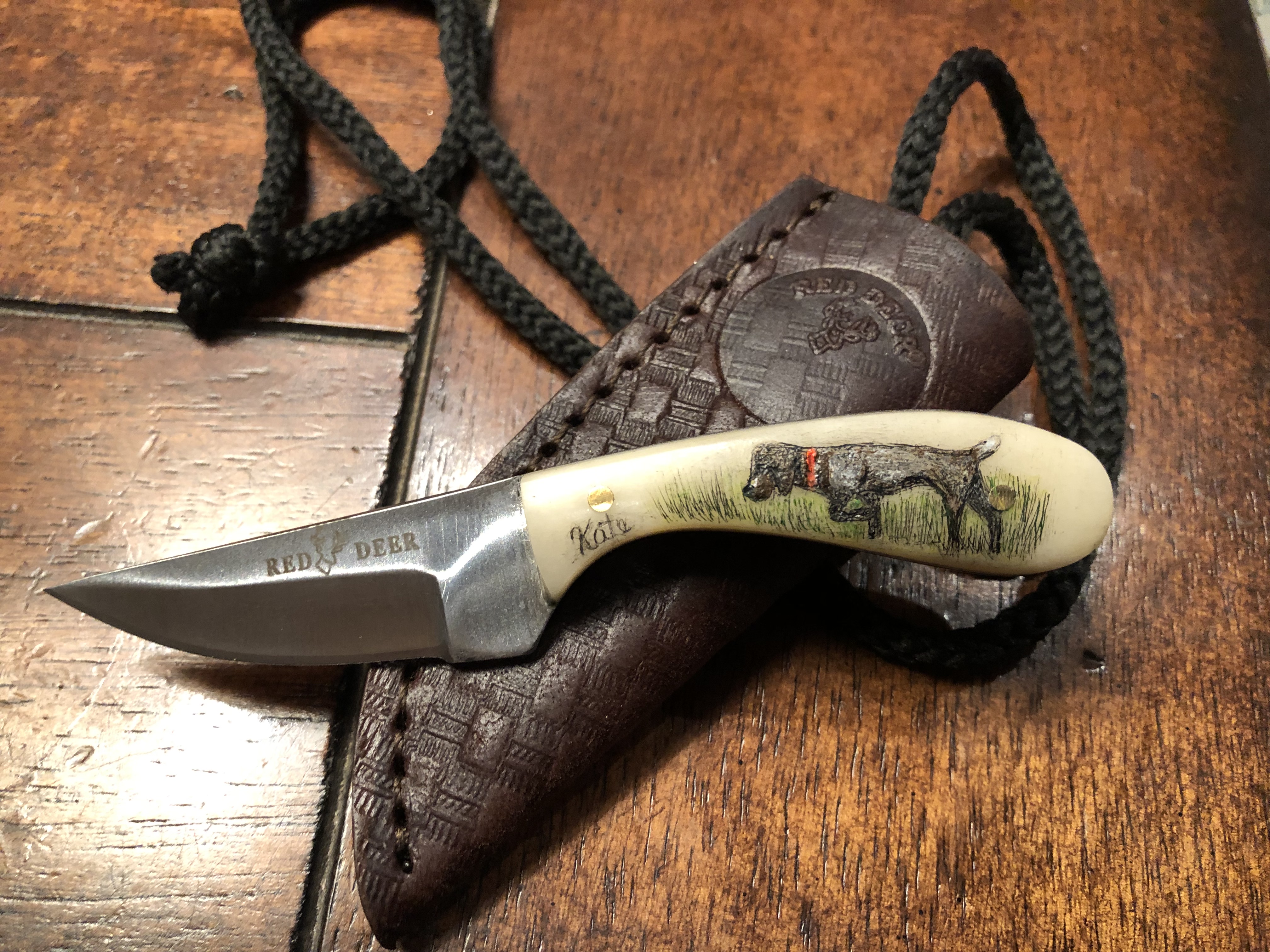
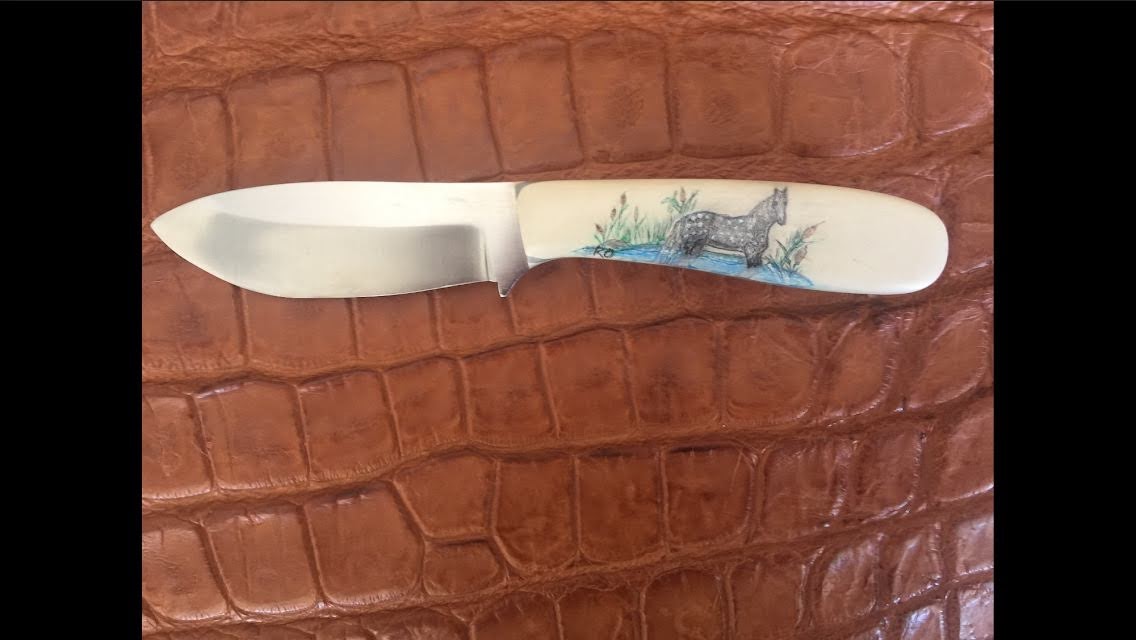
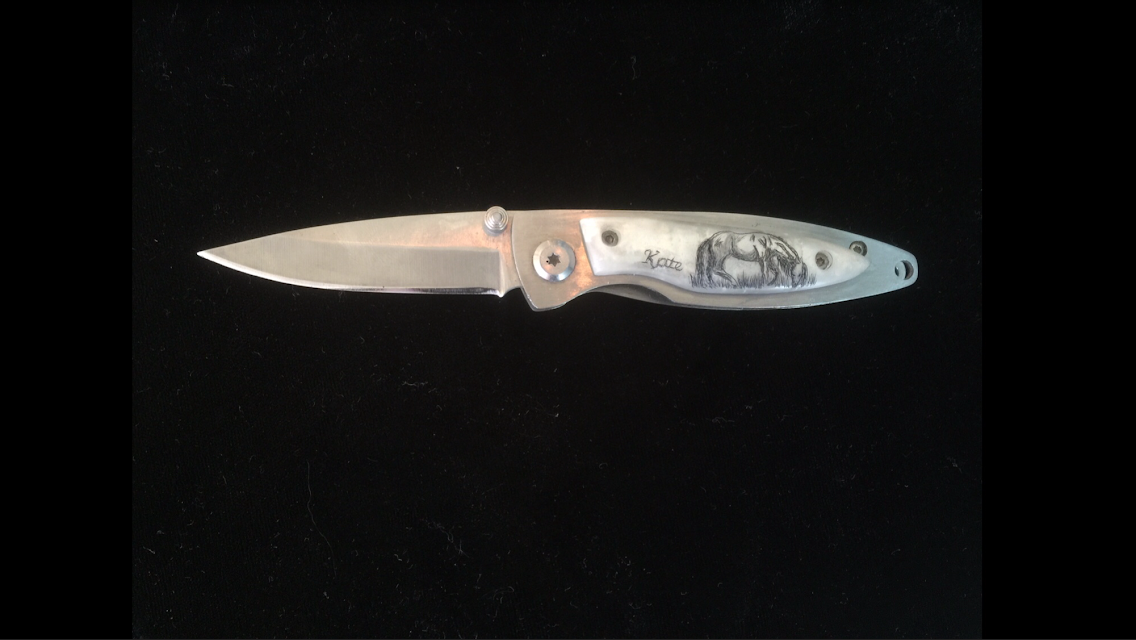
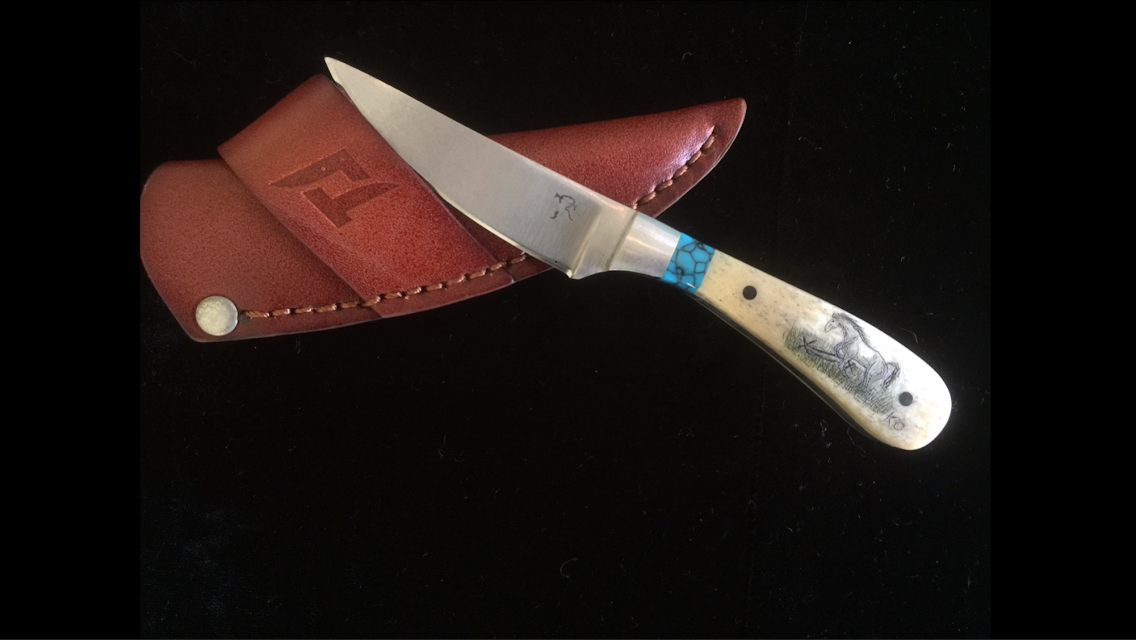
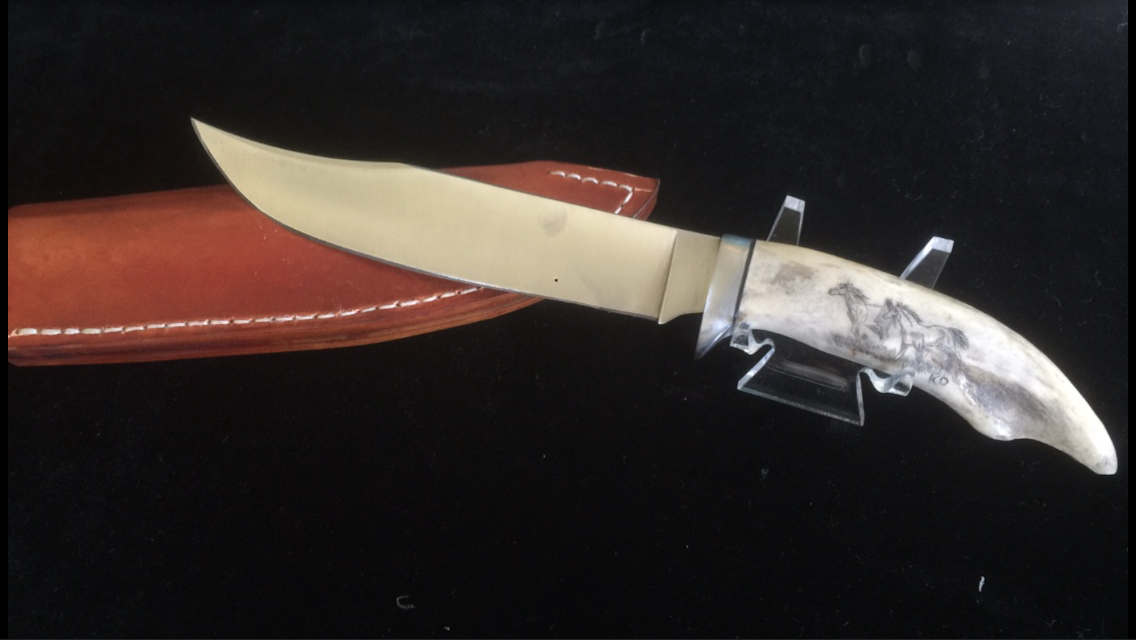
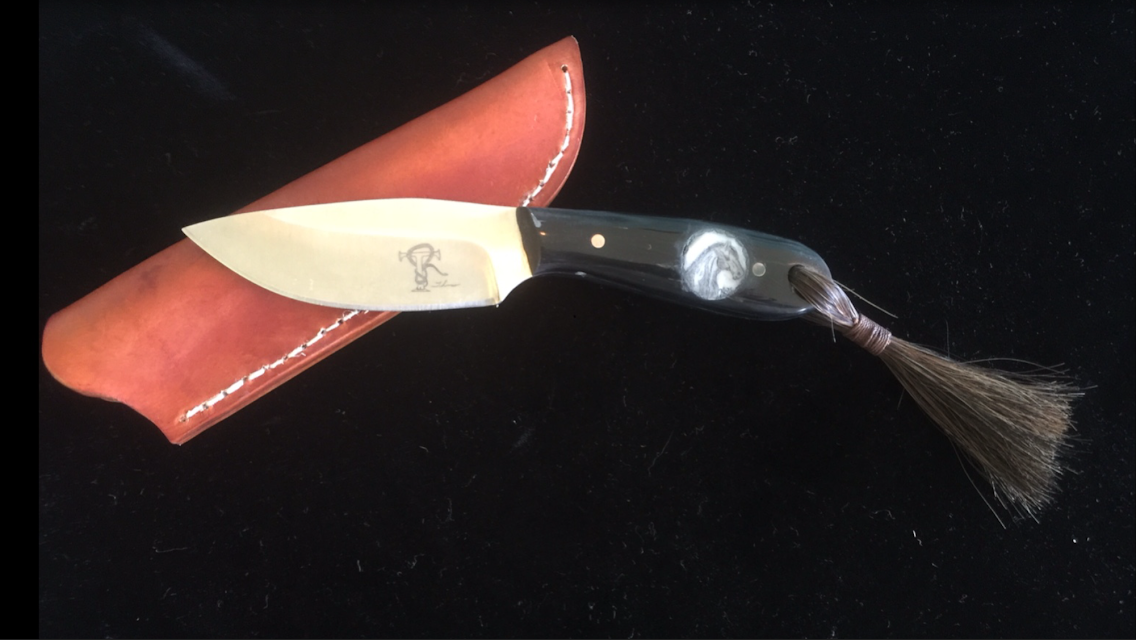
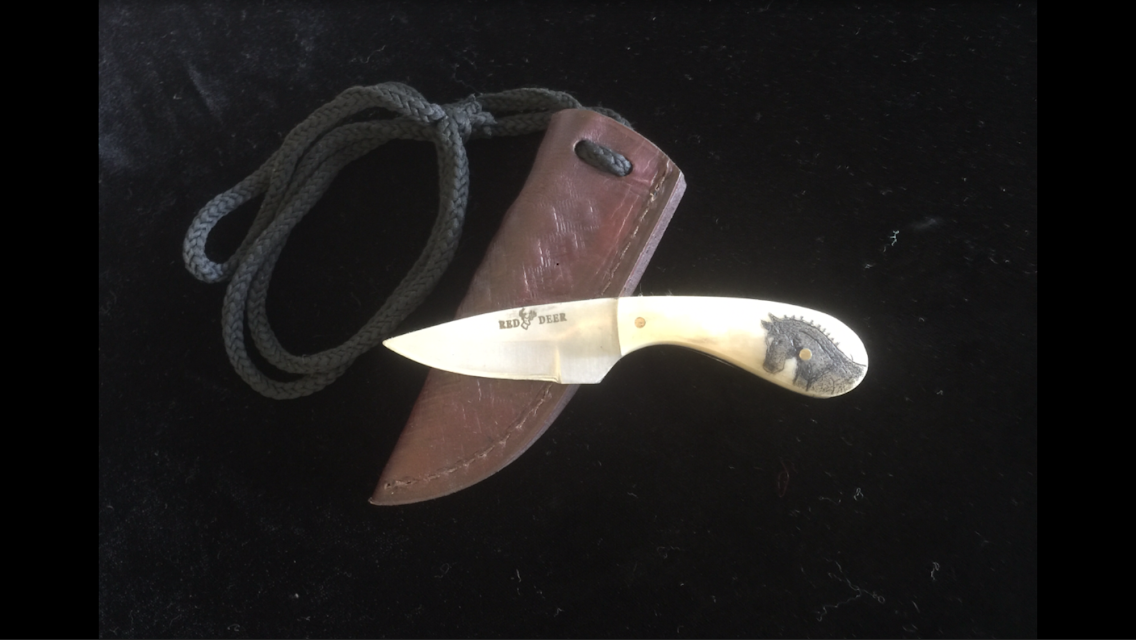
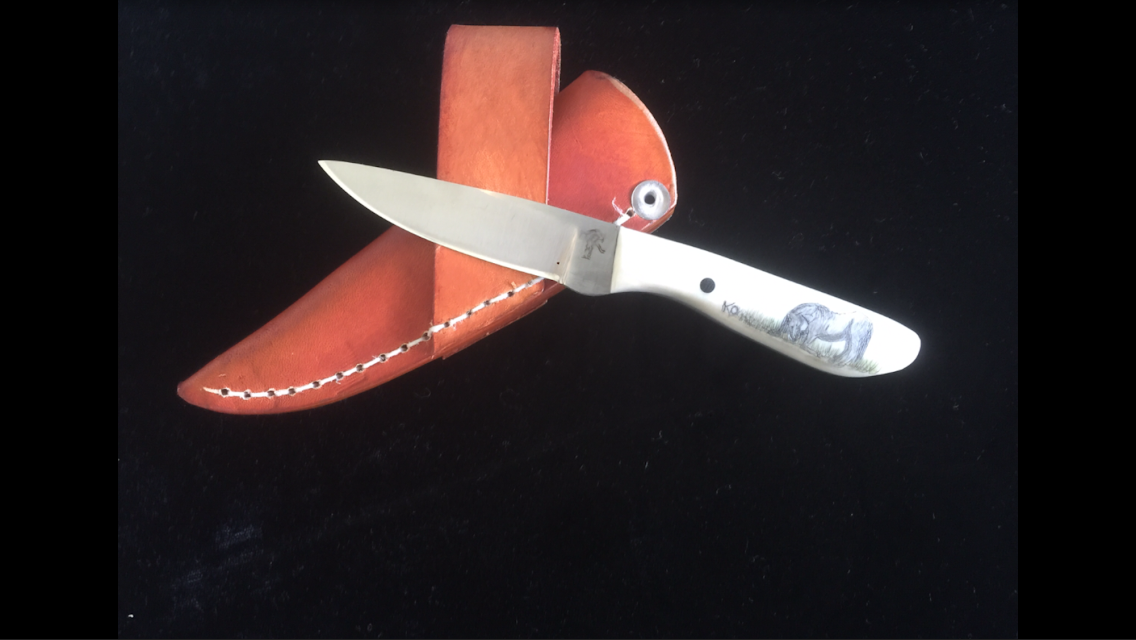
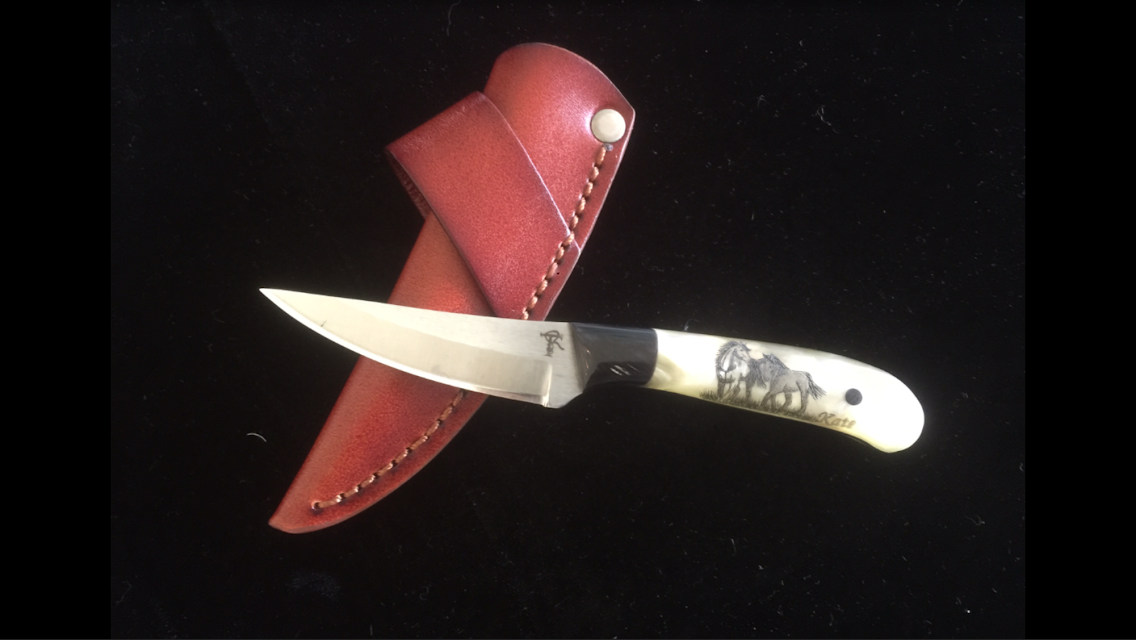
Kate Opre, of Montana, is still in high school, but she’s taking up scrimshaw in a way that’s catching the attention of many in the knife world. Who says the kids aren’t all right?
Opre wrote to BLADE about why she’s interested in this rich tradition, and she sent in some of her work. Who are we to keep such feats to ourselves? With her parents’ permission, we’re running her submission here.
How a High Schooler Came Into Scrimshaw
For Opre, the permanence of scrimshaw is part of the appeal.
“I love all forms of art, but scrimshaw is really special,” she wrote in an e-mail. “It’s a challenge because you can’t really erase; if you mess up you have to sand off the whole thing and restart.”
That requires focus, something it seems is in short supply in today’s technology-drenched world.
“It takes a lot of patience to scrimshaw. Some pieces take days, but others could take months to complete,” Opre wrote. “Not very many people know about scrimshaw anymore. Hopefully, I can have the opportunity to show people what scrimshaw is.”
She trained under Thomas and Debi Rucker (Knives By Thomas), and she makes knives in addition to handling the scrimshaw. Horses are a favorite design, and she displays her work at horse shows.
By the looks of things, BLADE expects a rewarding career to come. Keep going!
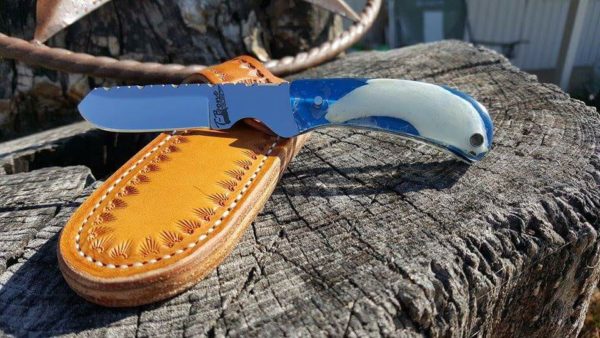
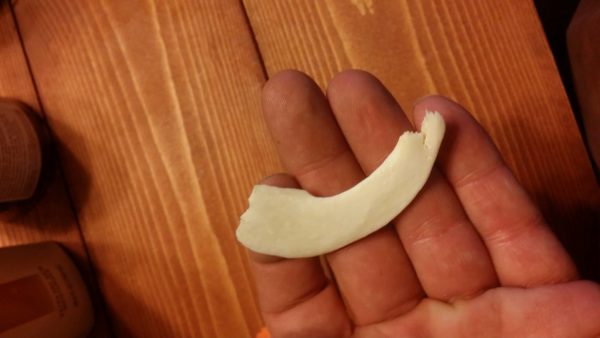
Travis Payne of T-Bone’s Custom Creations was hesitant at first, but when Kelly Pilcher asked, he made a knife with her rib. The overall length on this spey knife is 6.75 with a 2.5-inch cutting edge.
Kelly Pilcher of Collinsville, Texas, was 20 years old when doctors told her that hope of regaining feeling in her right side lay in having her first rib removed. She put the surgery off for as long as she could, but at 22 opted to go under the knife to alleviate her thoracic outlet syndrome. During surgery preparations Kelly asked, “‘What happens to body parts that come out of people?’” She was told that they were disposed of properly, but that if she wanted to take her rib home with her, she could. It was hers. She was adamant that she wanted to keep it. When she awoke from surgery, her dad was there and he had an idea of what to do with the bone. Shane Pilcher works at the New Gainesville Livestock Auction barn and when someone had mentioned making a knife with the rib, they knew just who to ask. Travis Payne, of T-Bones Custom Creations in Telephone, Texas, makes castration knives so all the cattlemen knew he could fashion a knife made from her rib. “Let’s do it!” Kelly remembers saying.
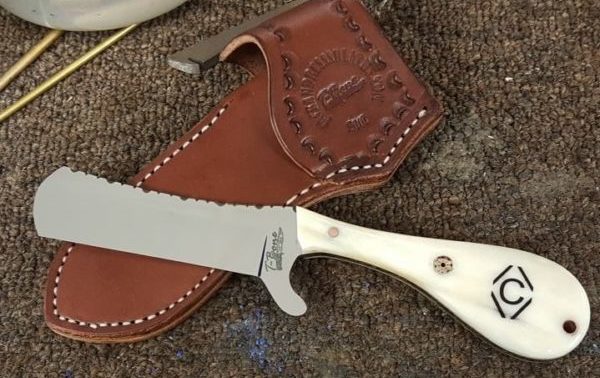
Travis Payne is renowned for his castration knife design. It is often copied by manufacturers using low-grade steel. Look for the T-Bone’s makers mark to ensure you’re getting the real thing.
TOS is a condition in which the surrounding soft tissue constricts nerves and blood vessels between the collar bone and first rib. Normally it is something diagnosed in people in their 40s to 60s, more commonly women, or perhaps mail carriers who consistently carry a heavy bag on their shoulder. Kelly was diagnosed when she was 14. It is believed in her case that years of catching slow-pitch softball as well as playing volleyball may have constituted the kind of overuse usually only seen in older patients.
By 17 Kelly had undergone a year of physical therapy. Although the therapy improved the symptoms of her TOS, it did not eliminate them. She went for an additional course of physical therapy a couple of years later, but the results were not as good. Her condition continued to worsen. “It’s different in each person,” she explained. She endured numbness that started in her arm, but then advanced to her whole side. Although she learned how to teach her body to move when numb, she was left with few options if she wanted to become fully functioning again. She decided to have her rib removed.
Shane Pilcher wasn’t sure about his daughter Kelly’s plan to keep her rib, but the cattlemen at the livestock sale barn convinced him that a knife might be the perfect solution. “I don’t leave home without it,” Kelly said of the knife Travis Payne fashioned from her first rib.
Shane had been at the livestock sale barn and was expressing some hesitation about Kelly’s decision to keep her rib. Someone pointed out that knives are made with animal bone and antler all the time, why not a human bone? “‘And doesn’t T-Bone make a knife?’” Travis said, recreating how the conversation may have gone at the barn. Since 1993 when Travis was still in high school he’d been making knives. His father and brother work the ranch where he lives in Telephone, Texas, but he makes knives full time. He is renowned for a style of castration knife that is frequently copied, most annoyingly by manufacturers using cheap steel. Since Travis’ father-in-law frequents the same sale barn where Shane works and the barn owner had purchased several of Travis’ knives and many of the cattlemen owned his knives, he was the first knifemaker that came to mind. Shane warmed to this idea and presented it to Kelly in the recovery room.
Travis Payne was nervous about slicing Kelly McGuire’s removed rib. What if it broke?
Like everyone involved in the project—except Kelly—Travis was hesitant, but he agreed to make the knife. He decided on his 3100T everyday carry model, a spey in cowboy parlance, usually the second blade on an old-school slipjoint trapper. Only this would be a fixed version. “It came to me in a hospital specimen jar,” Travis said, taking a drag on his cigarette and waiting for the laughter. “With the meat still on it.”
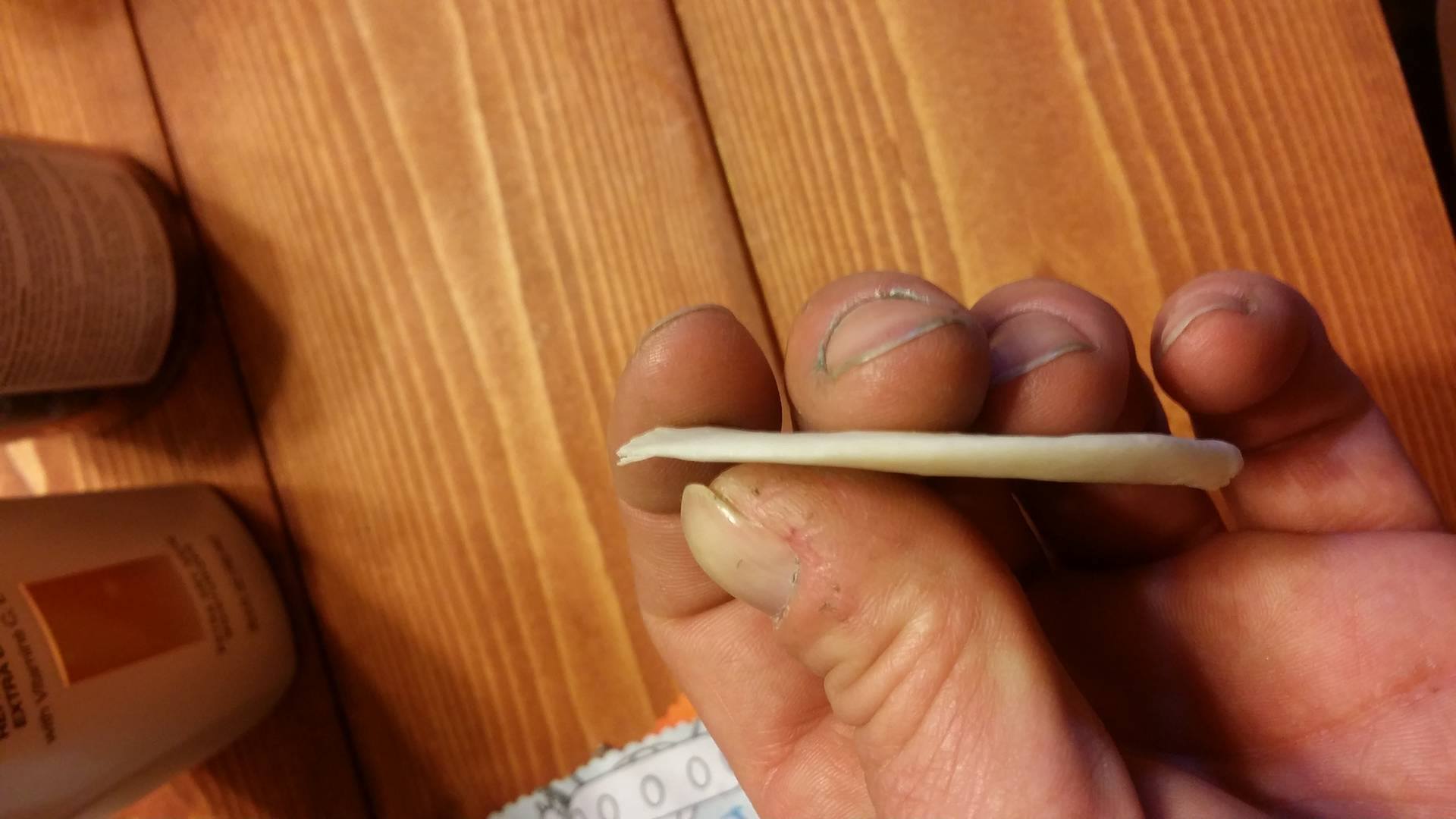
He approached the project like he would any deer skull. “Only I knew I wasn’t going to be using my wife’s cook pot,” Travis said, laughing. He bought a throw-away pot and boiled the bone to get off any connective tissue. Although bleaching a bone works, it also can break the bone down. Travis soaked the 3-inch bone in hydrogen peroxide for a week. The same whitening was achieved without compromising the strength of the bone. Then he let it dry for several months, providing a convenient delaying excuse. The bone was very thin, only an 1/8-inch at its widest point. Travis feared breaking it.
Once the rib was clean and dry, knifemaker Travis Payne was able to see its true size. It would need to be cast in resin if it was going to be used as a knife handle.
“I had to regroup and talk to Kelly,” he said. She remembers the call. He explained to her that the bone was too small and thin to make a handle out of, but that he could arrange for it to be cast in resin. Only he would need to slice it down the middle to have bone on each side of the handle. He could break it in the process. “I told him to go for it,” Kelly said.
“Anyone who knows me, will tell you that I procrastinate,” Travis said. He continued to analyze the problem. Meanwhile, he needed to find someone who would cast a human rib. Travis figured if anyone would do it, it would be Robert Belcher of Mental Co. Robert eschews phones and social contact, but his resins like Plantstone are innovative. “‘No, but hell no. I can’t be touching that,’” Travis recalled him saying. Travis moved on and got similar responses, but at least there was no point cutting the rib if he didn’t have someone lined up. Finally, he took the rib to a show and unwrapped it for Pat Ankrom, of Ankrom Exotics in Centerville, Iowa, specializing in natural and cast scale materials. “Pat was like, ‘I’m leery, but I also think it’s kind of cool,’” Travis said. The men discussed the casting, and Pat agreed to do the job. Pat did not want something to happen to the bone in the process of packing up from the show, so Travis said he would mail the rib to him.
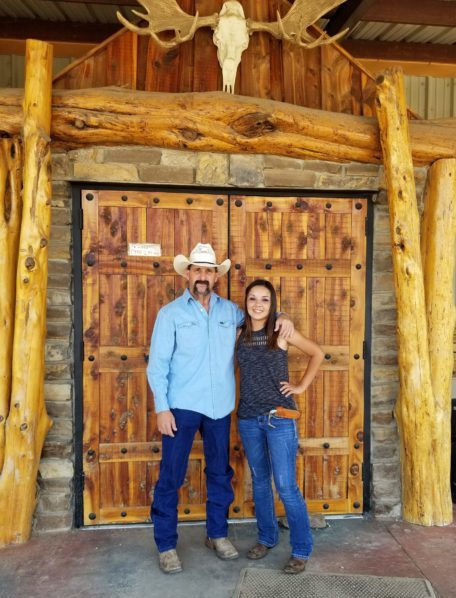
Travis Payne, 41, started making knives in high school before everyone had access to the Internet. He’s been a knifemaker for 20 years.
Now Travis had no choice but to cut the bone, but it was a nerve-wracking proposition. Travis wasn’t about to charge a young woman who didn’t have a lot of money and who had a debilitating condition more than the $200 he normally charged for such a knife, but in hindsight the cost to attempt something like this again would be closer to $500, Travis said. Kelly, of course, was excited to both see the knife and to have her rib back in her possession, so periodically she’d call for a status update. Finally, Travis got his courage up and sat down with a jeweler’s saw. “Even with a jeweler’s saw it was a tedious process,” he said. The whole project was “intense,” he said, laughing.
The two halves were packaged up and shipped to Pat, an exercise in trust in itself. Meanwhile, the blade awaited. It was made out of PSF27, a powered version of D2 that allowed for a true mirror finish. The lack of a point on a spey design means it’s ideal for active cattlemen, ensuring nobody stabs themselves or punctures a sheath. It has a hollow grind, and a finger groove for more controlled cutting. The file work on the spine increases a sure grip in what can be wet or messy work.
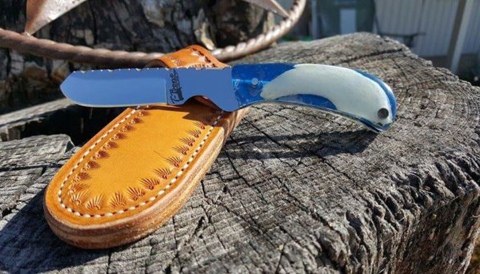
The bone was cast in clear resin so you could see it, but so that you couldn’t see the full tang Travis consulted with Kelly about colors. She was open to a turquoise or blue. Travis added a blue liner, which casts the clear with a blue tone. The knife was then sent to Jack Andress, who made a sheath in a yellow leather, complimenting the blue perfectly.
How’d it come out? “I love it,” Kelly declared. Shane and Kelly came together to pick up the knife from Travis. Kelly said that she’d had that rib her whole life and she saw no reason why she shouldn’t have it with her for the rest of her life. She carries it everywhere, either on her person or in her vehicle. Although she does use it, she tries not to. Her surgery was a success, and feeling has mostly returned. There is no cure for the many variations of TOS and symptoms can return, however, Kelly’s pluck and resolve are ever-present. “I can’t complain,” she said.
Which Knife Designs Work?
Do you want some fresh inspiration for your knife designs? The best inspiration is to look at the designs that have lasted and learn why.
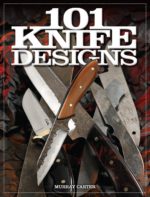
“101 Knife Designs” gives you 101 scaled patterns that you can use to design your own knives. Learn how to compare patterns and understand how some designs survive the test of time. If you’ve enjoyed Murray Carter’s other writings, you will be sure to enjoy this one. On sale now for $19.53.
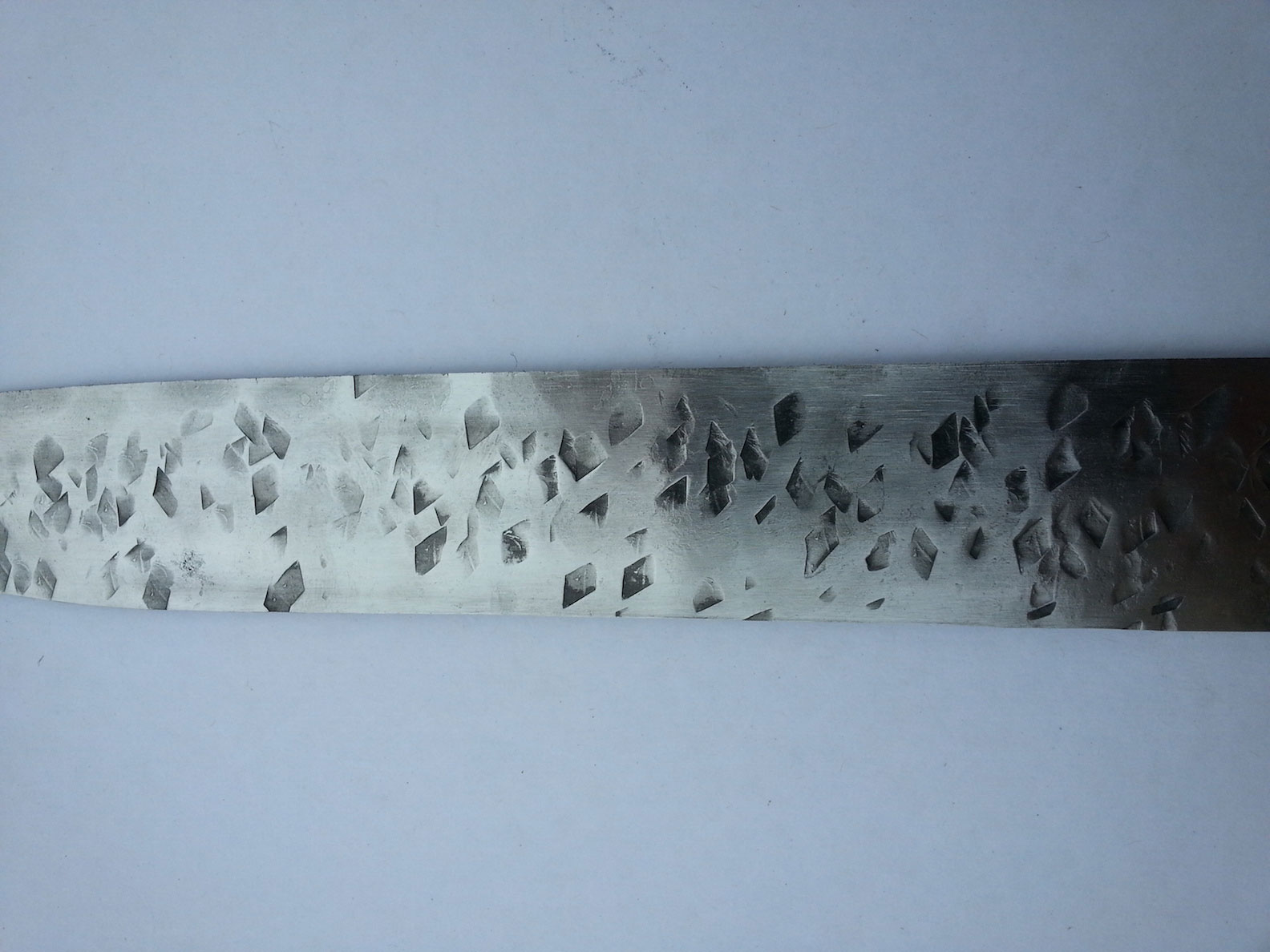
The dents create air pockets so food does not stick to the blade.
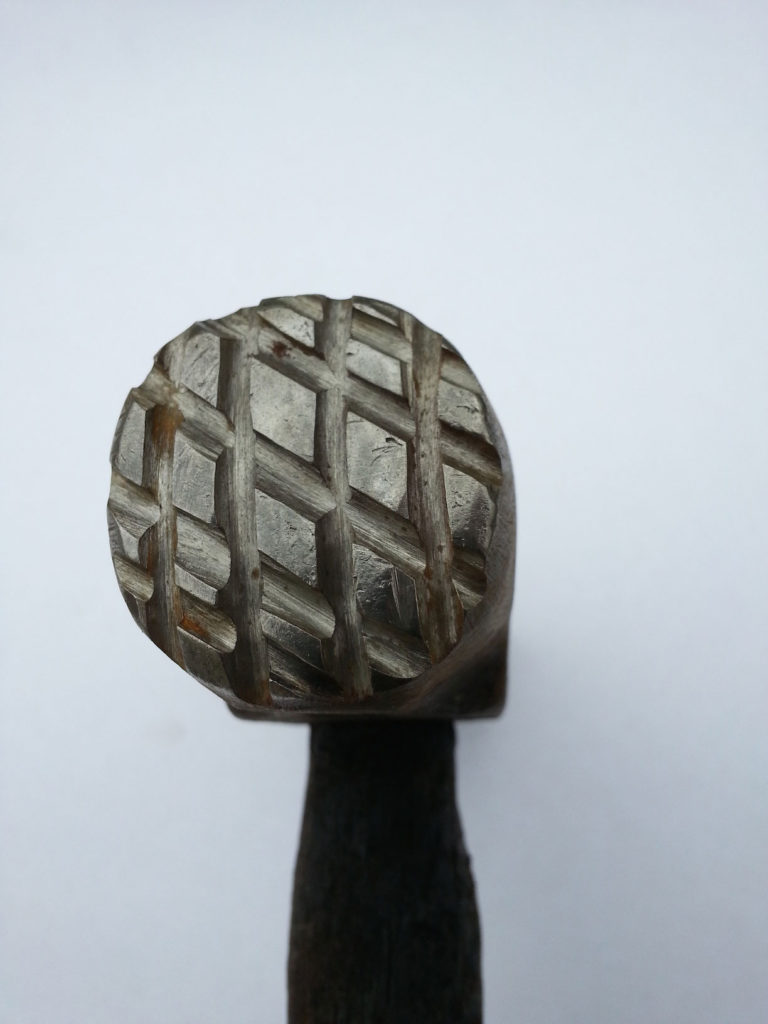
In his story, How To Make a Sushi Knife, in the August 2015 BLADE®, ABS master smith Wally Hayes explained how he achieved the texturing on the blade’s surface. The reason for the texturing is to create air pockets so food does not stick to the steel.
For blade material, he used 90-thousandths-inch-thick 15N20 carbon steel from New Jersey Steel Baron.
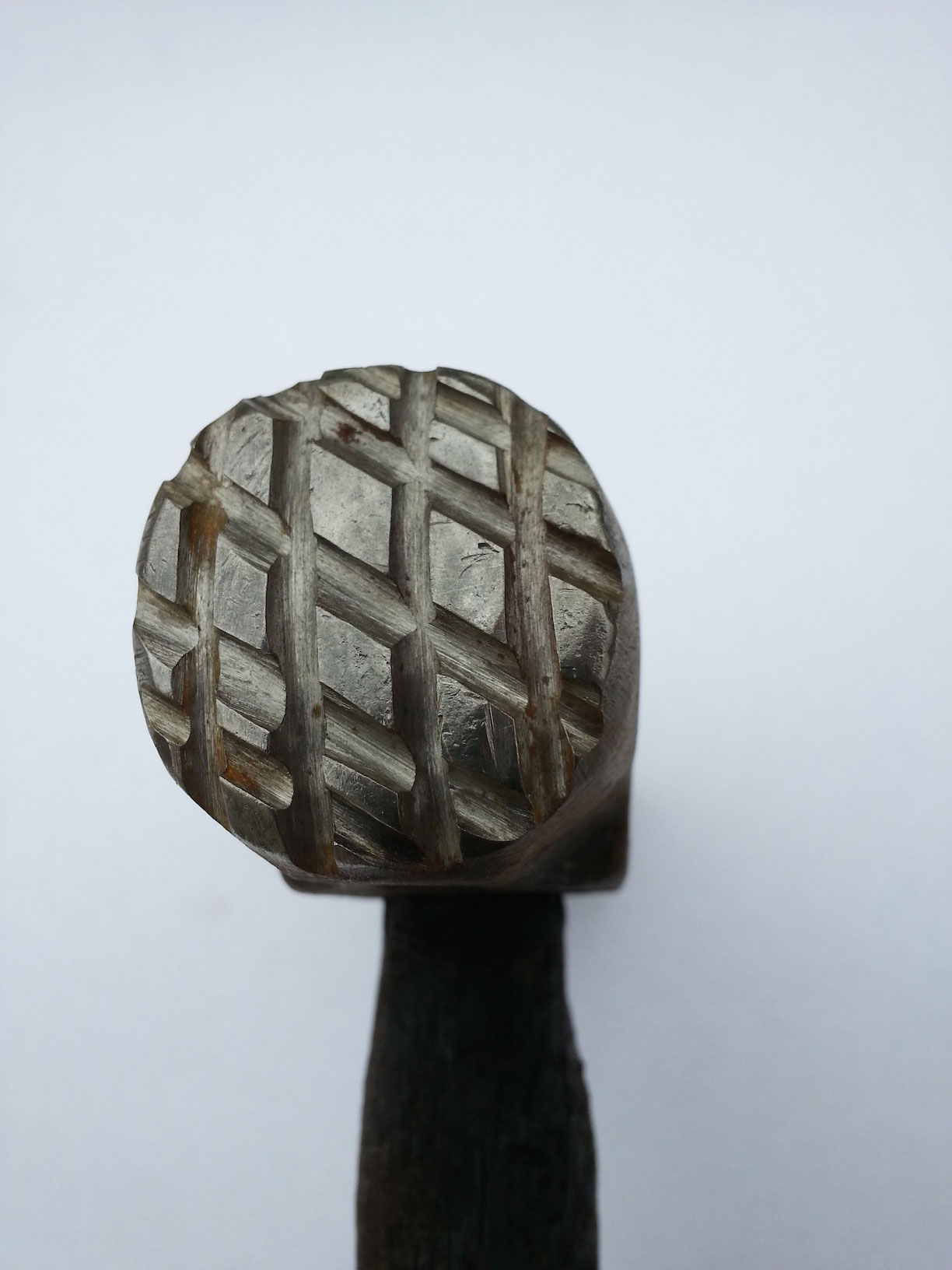
After cutting the blade to shape and heating it in his forge, the author used the hammer with a cross-hatched face to give each side of the blade a textured finish.
“First, I cut the blade to shape, around 7 inches long,” he wrote. “The tang is about 4 inches. I take one of my old hammers and cut a cross hatch into the face using a side grinder with a cut-off wheel. Then I heat up the blade in my forge and hammer a textured finish into the steel. This takes about five heats and is lots of fun! I put dents into both sides of the blade and then make sure it is straight.”
The sushi knife the author completed for the story in the August 2015 BLADE® features a blade with the hand-hammered finish and a handle of ebony and walnut.





 treat service custom knifemakers have come to expect,” Bos said. “I’ve heard that my ‘retirement’ misled some, but Paul Bos Heat Treating is very much alive and well.”