
Home Knifemaking

Knifemaking

Knifemaking is the building of a knife, which includes the blade, handle and other accouterments. Blades are made by either removing metal from a steel blank via a grinder – known as stock removal – and the forging to shape of hot steel into a blade in the process known as bladesmithing. Other parts, including bolsters, guards, pommels, etc., are needed to complete the finished knife.

Featured Knives – – Knife Collecting – – Tactical Knives – – Survival Knives

On The Edge Of War: Knife Pros And The Ukraine Conflict

0

A knifemaker and other knife pros take different approaches to the Ukraine-Russia conflict.

The ravages of war often have global impact—even when the fighting is half a world away and the devastation is seen through pictures and words rather than bullets and bombs. War, anywhere, tends to touch the lives and livelihoods of many.

The knife industry, both factory and custom, is no different. The war in Ukraine has brought devastation to the country, and its end was nowhere in sight as BLADE® was going to press. Ukrainian resistance is robust, probably in sharp contrast to the results anticipated when Russian President Vladimir Putin decided to invade his sovereign neighbor. While the resilient Ukrainians defend against such aggression, where and how does the knife industry feel the long reach of war?

Oleksii Nesterenko is a custom knifemaker. He is also Ukrainian.

“On February 24,” he commented, “Russia, with the support of Belarus, launched an open military attack on Ukraine. My city, Kyiv, was one of the main goals. After systematic rocket attacks on the city, my wife and children were forced to evacuate to Germany.”
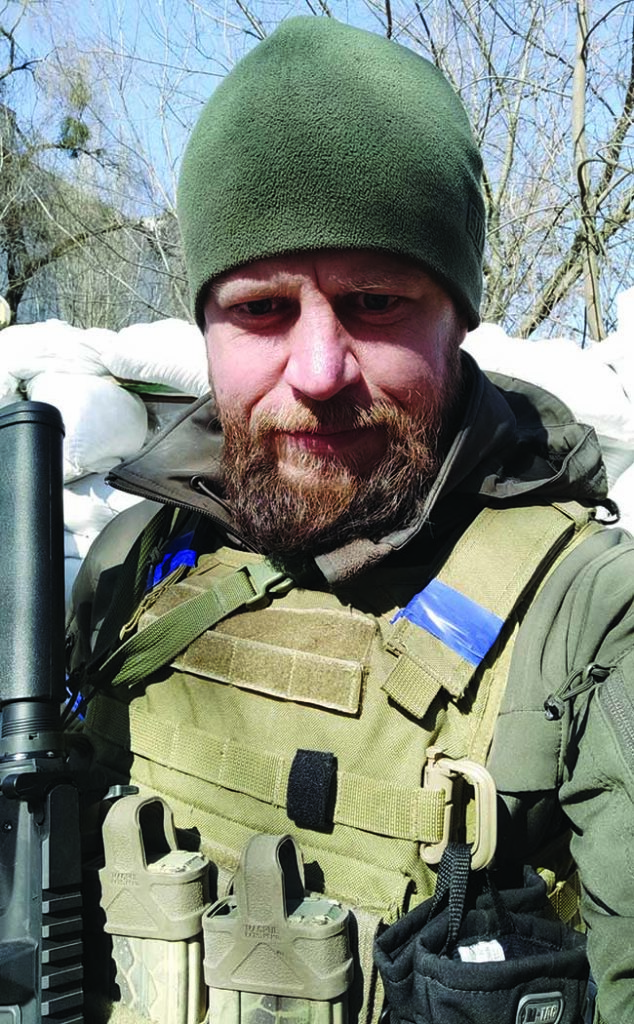
At press time, Ukrainian knifemaker Oleksii Nesterenko had signed a contract as a territorial defense volunteer for Ukraine and had stopped making knives.

The war came home to Oleksii, and his life may very likely never be the same. He has responded to the call to defend his country. “I signed a contract for a territorial defense volunteer and stopped making knives,” he said. “As far as I know, the work of some knifemakers who work in the cities where there are no active hostilities has changed too. Many have abandoned the making of collectible knives and make simple, utilitarian knives and other devices for the military.”

Purveyor Dave Stark of Steel Addiction Custom Knives sells Oleksii’s work, and despite the fact there is a temporary suspension of custom pieces from the Ukrainian maker, Dave praises the quality of his knives.

“Oleksii’s fit and finish and his attention to detail are what set him apart from his peers,” Stark noted. “His choice of materials and the manner in which they are finished really make his work stand out. His hand-rubbed satin finish on his blades is some of the best I’ve seen. The knives feel great in the hand and mechanically are spot on. I would say his style is ‘dress tactical.’ He uses Damasteel’s pattern-welded steel, damascus, mother-of-pearl, mokuti, zircuti and zirconium.”

Perhaps current events will make Nesterenko’s knives even more highly sought after in the future. Meanwhile, he is consumed with the dirty business at hand.

“Now in the Kyiv region where I live, Russian troops are defeated and active hostilities have ceased,” Oleksii reported. “But I am still on duty at checkpoints and volunteer. We help the civilian population in the villages near the front. I think that in a few weeks I will have time to partially return to knifemaking.”
While he is hopeful and actively involved in the defense of his country, Nesterenko has kept an eye on the conditions of the knife industry in Ukraine and anticipates some adaptations.

“Currently, there are no problems with the supply of materials for the production and shipment of knives abroad,” he advised, “so I look forward to returning to work. I am sure that a knifemaker can make a quality knife only if he uses it for its intended purpose. That’s why I used to make only EDC knives. Thanks to the war, I understand what requirements a tactical folding knife must meet. I have already drawn several designs and am waiting for the opportunity to get started.”

Changes in demand are not noticeable at this time, according to Oleksii, and orders are in the queue for delivery around the world into 2023. Still, he warned, “I think that the consequences of the war in Ukraine will affect the economies of many countries. And over time, that will affect collectors.”

Little Change

In much of the domestic knife industry, little in the way of change has occurred due to the war thus far. Custom knife purveyor Les Robertson said that by mid-April FedEx service to Ukraine had been suspended. Therefore, the volume of knives conventionally being sent to Ukraine has probably been curtailed, at least somewhat. Neighboring European Union countries are still moving mail into Ukraine.

Les Robertson
Les Robertson

“No one is sending knives directly to anyone in Ukraine,” Les noted. He went on to comment that factory sales to “armchair warriors” may in fact tick upward as the war persists.

Purveyor Neil Ostroff of True North Knives agrees that the current custom knife market is maintaining its status quo. “In my opinion, as a dealer,” he commented, “we have no change from the customers concerning knives from either Ukraine—now on hold—or Russia. Several Ukrainian knifemakers have set up in Poland, and they do not want to be named.”

Still, Ostroff is somewhat insulated businesswise from the turmoil in Eastern Europe. “Going forward, I see no issues coming through, as there have been none so far,” he observed. “And most if not all of my clientele prefer to buy only USA-made items, which is what I prefer to supply as well.”

From the factory perspective, Joe Bradley, director of sales and marketing for KA-BAR, has noticed virtually no changes in activity. “The war in Ukraine hasn’t had any impact on us at all,” he remarked. “As far as production, and even consumption, the impact has been zero.”

Bradley added that supply and demand are in line. “We have not seen an increase. Currently, we are seeing the market being more impacted by inflation than anything else. I think most of the people, at least Westerners, in the Ukraine already had their supplies and as a result didn’t have a need to buy anything new. Production and logistics have been a problem since the start of COVID,” he observed, “and are just now starting to get back on track and return to a semblance of normalcy.”

KA-BAR has experienced no changes in product offerings or knife styles as a result of the war in Ukraine. However, Bradley offers one interesting point of view. “If anything, this war has shown the merits of what some might consider antiquated weaponry like the AK-47,” he pointed out. The AK-47 is perhaps the world’s most famous assault rifle, arising in the Soviet Union during the Cold War, experiencing authentic production models and knockoffs made in the millions, and arming military organizations around the world for well over half a century.

“Free The Oppressed”

Spartan Blades is located in Fayetteville, North Carolina, near the gates of Fort Bragg, home of the U.S. Army’s XVIII Airborne Corps and Special Operations Command. Spartan owners Curtis Iovito and Mark Carey, both Special Forces veterans, have seen a groundswell of support for Ukraine. Knife sales bear the unmistakable mark of the conflict.
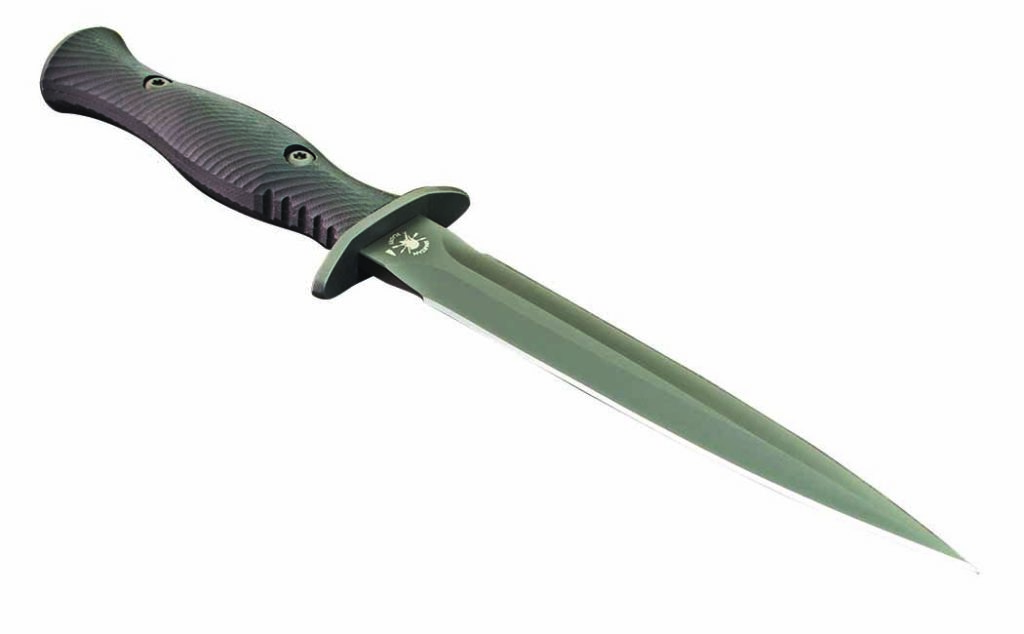
According to Curtis Iovito of Spartan Blades, more military professionals and contractors buy the company’s Gold Line knives. An example is the Spartan-Harsey Dagger in a 6-inch blade of CPM S35VN stainless steel with a hollow grind. MSRP starts at $390. Bill Harsey is the designer.

“Most of the sales are to people here in the U.S. with notes that they are purchasing for folks in the Ukraine,” explained Curtis in acknowledging the market uptick. “Several orders have had short tags like ‘Free the Oppressed in the Ukraine’ or ‘Support the War against Russian Aggression.’ Because we are at Fort Bragg, we have several Special Mission units from friendly foreign countries drop by the shop to pick up knives for their use. While that isn’t uncommon, it’s happening more than usual. We’ve noticed during our discussions with them that things have a more serious tone.”

Others buying more knives from Spartan Blades include people from all walks of life and military involvement. Curtis said, “Our Gold Line knives are going to more of the military professionals and contractors, and our Silver- and Bronze-grade knives are selling to folks across the spectrum. Many of the knives bought are by civilians that later donate the knives to NGOs [non-governmental organizations] that ship in bulk to Ukraine.”

As far as production, it’s business as usual at Spartan Blades, a longtime producer of knives that go to war. There are a few new items on the horizon, and the owners expect business to be brisk in the days ahead.
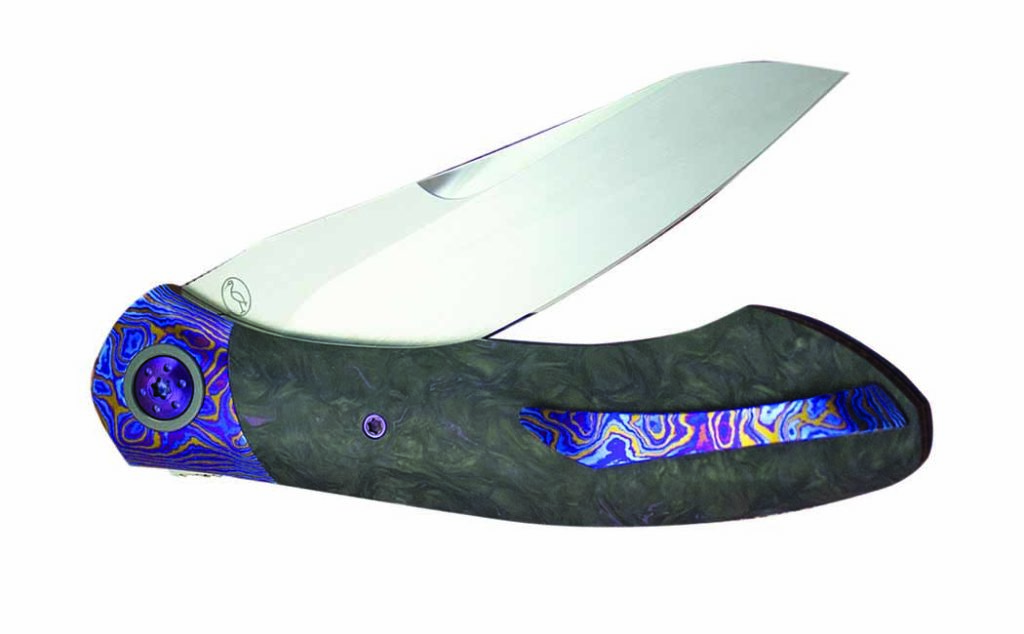
Oleksii employs M390 stainless steel for the 3.75-inch blade and a handle of black and purple Fat carbon fiber for his Morph flipper folder. The bolster is Timascus™ and the pivot rings and back spacer are zirconium. Closed length: 8 5/8 inches. Retail price: $2,800. (Steel Addiction Custom Knives image)

“Honestly, the war in Ukraine hasn’t affected how we do things here at Spartan Blades,” Iovito asserted. “We’ve made knives through the last two decades for troops in both Afghanistan and Iraq, so things are kind of par for the course.
“We have several new knives coming out around the end of this year,” he continued. “We had planned on releasing these later but have sped up because the price point and style match some of the requirements we have seen lately. They are being designed by William W. Harsey, Jr.—a fighter, a Nessmuk and a kukri blade. They will be in 1095 Cro-Van blade steel and made in conjunction with KA-BAR Knives. Pricing has not been determined yet, but we are shooting for a sub-$200 retail price. The first one produced will be a fighter later this year.”

Surveying the knife landscape today begs a few questions as Iovito and Carey plan for the future, uncertain as it may be.

“We have seen a slight increase in steel prices, but we haven’t raised our prices in over a decade,” Curtis stated. “We assume we will continue to see price increases soon in commercial, off-the–shelf parts but are keeping our fingers crossed. We believe we will see an increase in knife demand as it appears the conflict in Ukraine [will not end as soon as many thought it would].”

The war has had other effects, including dampening attendance at European trade shows.

“We were very surprised that most of the U.S. knife companies did not attend the IWA show* in Nuremberg, Germany, this year,” Curtis noted. “We even had people thanking us for attending, as you could tell they are counting on U.S. support even if it is just showing up to support them in spirit. There was definitely a new and urgent concern about military spending. The German government approached two companies that I know of and bought their whole inventory—cutting checks the same day!”
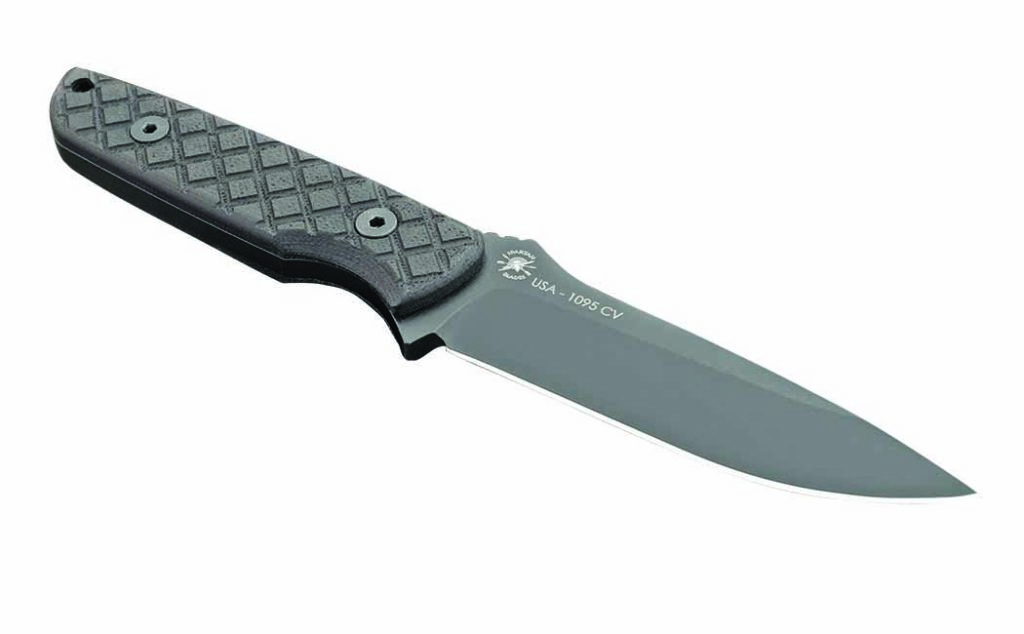
Curtis Iovito indicated Spartan’s affordable Silver- and Bronze-grade knives are selling well to people across the spectrum. One of the latest examples of a Silver-grade knife is the Alala in a 3.75-inch blade of Cro-Van carbon steel with a saber grind. MSRP: $159.

In wartime, uncertainty often reigns. However, awareness, preparation, and the desire to return to the shop are evidence that the ongoing conflict in Ukraine will influence the future of the entire knife industry for the foreseeable future.

*Held each spring, the IWA OutdoorClassics (iwa.info) is the European equivalent of the Shooting, Hunting, Outdoor, Trade (SHOT) Show stateside, and is a place where many new factory knives are debuted.

More On Custom Knifemaking:

Remembering Hawaiian Knifemaker Keith Derrick Ouye

Remembering a dedicated craftsman of the Fujisaka lineage known for his tactical precision and collaborative artistry.

Keith Derrick Ouye, award-winning knifemaker of Honolulu, Hawaii, passed away on October 5. He was 80.

A stocky, happy guy well-liked by both knife enthusiasts and his knifemaking peers, Keith primarily made tactical knives, though he also built hunting knives to sell at local gun shows. In addition, he made fancy folders, often with fine engraving by Bruce Shaw, C.J. Cai or Lisa Tomlin. Keith exhibited his work at the BLADE Show and other top knife events over the years. Like many Hawaiian knifemakers, he was a student of BLADE Magazine Cutlery Hall-of-Fame® member Stanley Fujisaka.

Born in South Hilo, Hawaii, Keith lived in Hawaii Kai on the island of Oahu. “I spend most of my day working on my knives,” he wrote in his mini-bio on the Arizona Custom Knives website. “With assistance and guidance from Stan Fujisaka, I started to make fixed blades in early 2004. By the end of 2004, I also started making folders. I began making knives full-time in 2005.”

Keith was a big believer in sole authorship, noting “except for the screws, dowels, standoffs and pivots, I fabricate the rest of the knife myself.”

Remembering Others The Knife Industry Has Lost:

Dropout Knifemaker Is A Master Of Marketing

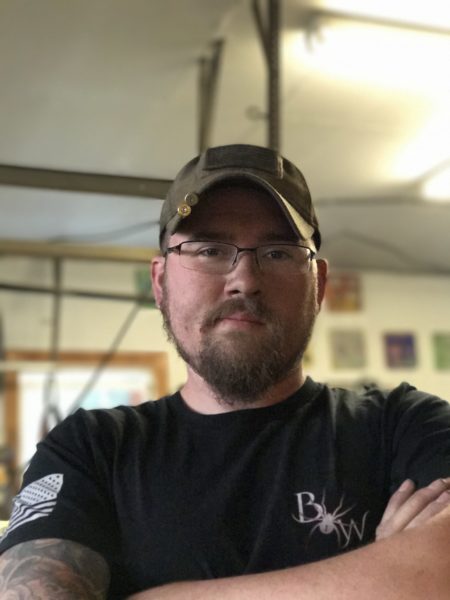
Brent Vaccaro owns Black Widow Knifeworks & Tactical Gear
Brent Vaccaro of Black Widow Knifeworks & Tactical Gear left high school in his junior year. He already knew carpentry inside and out. But it was when he turned to knifemaking that he found a way to identify himself that had eluded him during his other business attempts. This dropout knifemaker is a master at marketing.

Brent Vaccaro of Black Widow Knifeworks & Tactical Gear attended high school in New Jersey where he was born and raised. He excelled in woodworking, banging out projects that those two years ahead of him struggled through. His teacher helped him, Brent said, but perhaps most by giving him the freedom to do his own thing. Brent grew up building houses. His family lived in the middle of an open subdivision field and every day after school Brent would work on the other eight houses that needed to be constructed. In his junior year, bullying got too much. He left school and became a carpenter. Over the course of 15 years he worked in construction, running his own business and working for others. He also started a tactical gear company, and he dabbled in beard accessories during the height of facial hair resurgence. He never could quite establish an identity for himself in any of his three businesses, he admitted, but when he started making knives, everything came together. Now, no matter how different Brent’s knives are from each other, when you see a Black Widow knife, you recognize it immediately. The dropout knifemaker is a master of marketing.

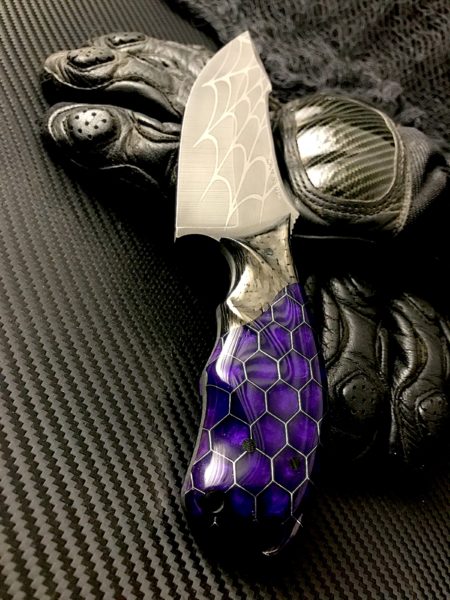
The H.E.R.L. is a knife designed by Brent Vaccaro of Black Widow Knifeworks & Tactical Gear.
Model: H.E.R.L
Blade Length: 4.25 inches
Blade Steel: CPM-S30V
Blade Finish: acid wash with spider web etch
Scales: Voodoo Resin’s Purple Haze with KS Carbon bolster
Overall Length: 8″ inches
Maker’s list price: $250-$350 shipped with Kydex sheath and Tec-Lok
Contact: Message Brent Vaccaro on Facebook at Black Widow Knifeworks & Tactical Gear. (Additional contacts at end of article.)

Around the time that Brent was struggling with being in school, when he was 16, his father gave him a pocketknife. It was a now-discontinued Kershaw model. “I still have it. I loved that knife,” Brent said. But he never had the money to collect knives, and some days he gets a mock scolding from his wife, Megan for forgetting to carry a blade on him. He was getting disillusioned with the diminishing level of artistry within carpentry, the lack of appreciation from the customers and the sense that the industry was solely focused on money. Although the skill sets are similar in woodworking and metalworking, it took some time to transition. Now Brent loves metalworking. It’s not months or years to finish a project with barely a handshake and never a thank you. It’s the instant gratification of seeing a knife come to completion over a course of days, sending it out and having the customer write him that they have no words for how impressed they are with his knife.

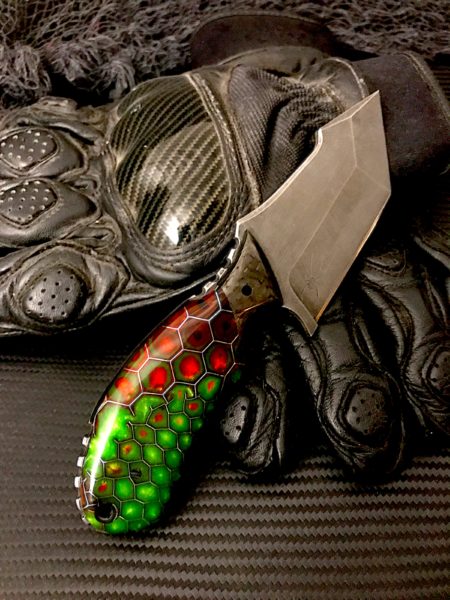
The BW Tac Tanto has a 3.5-inch blade of CPM S30V steel.
Model: BW Tac Tanto
Blade Steel: CPM S30V
Blade length: 3.5 inches
Blade Finish: dark acid wash and stonewash finish with aggressive gimping
Scales: Voodoo Resins’ Bloody Hulk with KS Carbon Fiber bolsters.
Overall length: 7 inches
Maker’s list price: $230-$330 shipped with Kydex sheath and Tec-Lok
Contact: Message Brent Vaccaro on Facebook at Black Widow Knifeworks & Tactical Gear. (Additional contacts at end of article.)

And therein lies his mastery. Brent is fulfilled by that appreciation for his craft, and he knows exactly how to represent his knives to the world in the best possible light—literally—without ever crossing into exaggeration. It means a lot to him that he has created an identity for himself that is true to him, celebratory of his knifemaking and honoring to the client. “It’s an extension of self,” Brent said, adding that he wants his knives to be passed on as a part of his and his client’s heritage. You only have to look at a photo of a Black Widow knife to get the “feel” for the candied richness of the colors, the smoothness of the handle and the badassery of the blade itself.

“I don’t keep them,” Brent said. So each night he takes the time to shoot exceptional photos of each piece, a running catalog of his work, for him to remember by and for the client to share. He takes 10 to 15 photos of every knife and picks the best ones. And that’s because he’s found a system that works for him. At first, you’ll need to shoot far more to find the right lighting and angles. “You have to take the time to do it. It’s part of marketing,” he said.

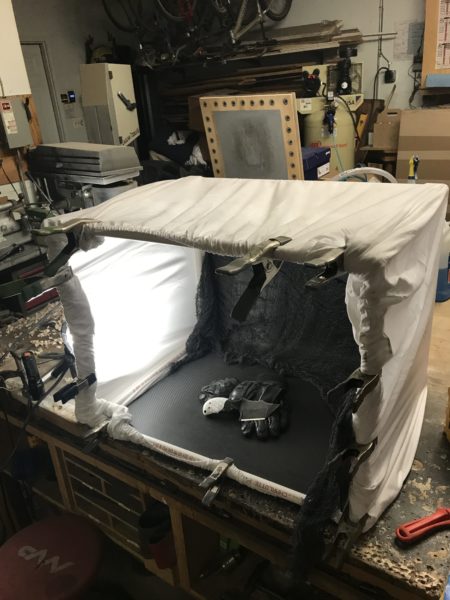
A lightbox is essential to taking great images of your knives.
If you want to take great photos of your knives, upgrade your cell phone, make yourself a lightbox, buy some handheld lights and take the time to learn how to make your knives look, not OK, but fantastic.

Building A Lightbox That Works

Brent invested $50 in his lightbox. At The Home Depot he bought 1-inch PVC and eight 90-degree T connections. With those he made his two squares for the box ends. He also got alligator clips. At Walmart he bought a king-sized white sheet and clipped it taught to the PVC frame. The whole thing is collapsible so that he can move it out of the way when he’s working. And, of course, the white sheet is no longer white.

The Backdrop

Normally, light boxes are made with white construction paper on the floor that bends up the back. Not Brent’s. He does a lot of Kydex. He was heating up a 2-by-4-foot sheet of carbon fiber one day and as it bent, it occurred to him to use it in the lightbox. He had to buy more Kydex, but he likes the look of it. That was probably anther $50, but wouldn’t be necessary for everyone since every knifemaker’s style is different. Brent strives to build tough knives that military and law enforcement can respect, while still appealing to the civilian population with his Candy-Crush-like handles. He mostly uses Matt Peterson’s Voodoo Resins scales, but he’s also using some of J Hue Customs’.

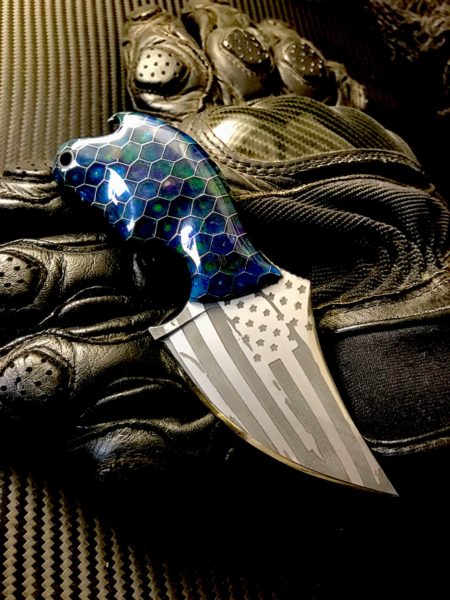
This Black Widow neck knife comes with American flag etching on both sides.
Model: Recluse Neck Knife
Blade Steel: CPM-D2
Blade Length: 3.25 inches
Blade Finish: acid wash with American flag etch on both sides
Scales: Voodoo Resins’ Chameleon
Overall length: 5.5 inches.
Maker’s list price: Price range: $165-$200 with Kydex neck sheath
Contact: Message Brent Vaccaro at Black Widow Knifeworks & Tactical Gear

Lights! Camera! Action—No Really, Move Around!

For lights he purchased round Utilitech LEDs that he can hold while he shoots. “The light is never stationary,” he explained. He waits until complete darkness because he has two windows in his shop and he wants total control of the lighting. Because the LEDs are very white lights, bluish even, he adds a 60-watt lightbulb to add a yellow hue to balance out the lighting. He moves around with his iPhone 7 Plus (“There is a difference with the Plus,” he notes.) and his light and gets exactly the angle and lighting he wants. Not only are the knives well lit, especially for mood-inducing vignettes, for which the majority of a knifemaker’s photos will be used, especially online, but they are in crystal clear focus. Brent does not use the focus feature on the phone. That will only cause the camera to focus on one point on the knife, when the objective is to show the entire knife in full focus, even if you have the point or butt stylistically in the background. He also does not use the flash, which only washes out colors and overexposes the image.


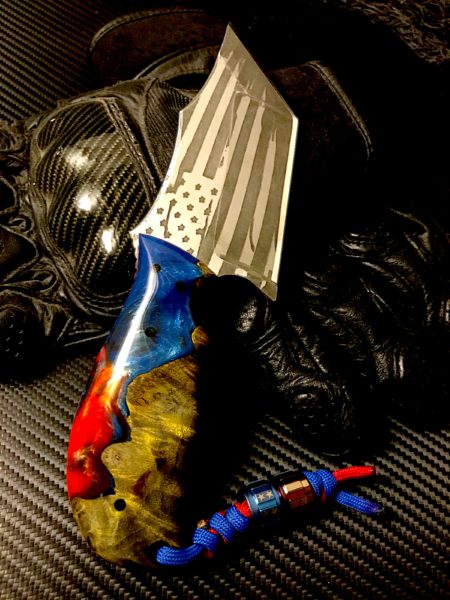
The Carnage by Black Widow Knifeworks & Tactical Gear sports patriotic resin with maple burl hybrid scales.
Model: The Carnage
Blade length: 4 inches
Blade Steel: CPM S30V
Blade Finish: acid/stonewashed with American flag etch on both sides
Scales: J Hue Customs’ hybrid red, white and blue resin with maple burl
Overall length: 8 inches
Maker’s list price: $320-$500 shipped with Kydex sheath and Tec-Lok
Contact: Message Brent Vaccaro on Facebook at Black Widow Knifeworks & Tactical Gear (Additional contacts at end of article.)

Props Never Steal The Scene

Brent uses all kinds of props in his still-lifes. Because he also produces tactical gear, like custom Kydex sheaths, you will often see pistols, ammunition and other gear as accessories in his pictures. Chain, motorcycle gloves, even Halloween webbing have been used in Black Widow images. His artistic eye is always at work, not only in the making of the knives, but in his ability to let the knives do the talking. They are always center stage. They are the first things you see in the picture and the props are there only to compliment the knives, never upstage them.

Editing

Brent uses two apps to edit his images: PicLab and Aviary. He bumps up the saturation until the image represents what you see in person. It’s important not to overdue saturation because then your customers will be disappointed that your knife doesn’t live up to how it was displayed online, all back-lit by the computer screen. It’s equally important, though, that the knife not appear duller than it is in real life.

Creating An Image

Brent is one of those men who is smart, learns quickly and follows directions. He is also a good man, turning away from an industry that couldn’t fulfill his creativity and abraded his integrity. He has been rewarded with great success. “I’m outgrowing my shop,” he said. Brent knows he’ll have to return to carpentry to build himself more space. He can’t believe it sometimes when he thinks how far he’s come in his year of knifemaking. Metal work comes easier to him. “I don’t get nearly as angry as I used to get doing carpentry,” he said. He’d be thinking artistically and make a little strip of wood for something and it would break. Sometimes he’ll find a scratch in a knife handle and he’ll have to go back and grind it out and re-sand—normally, he goes all the way from 150 to 2000 grit—but it’s not nearly as frustrating as woodworking had been.

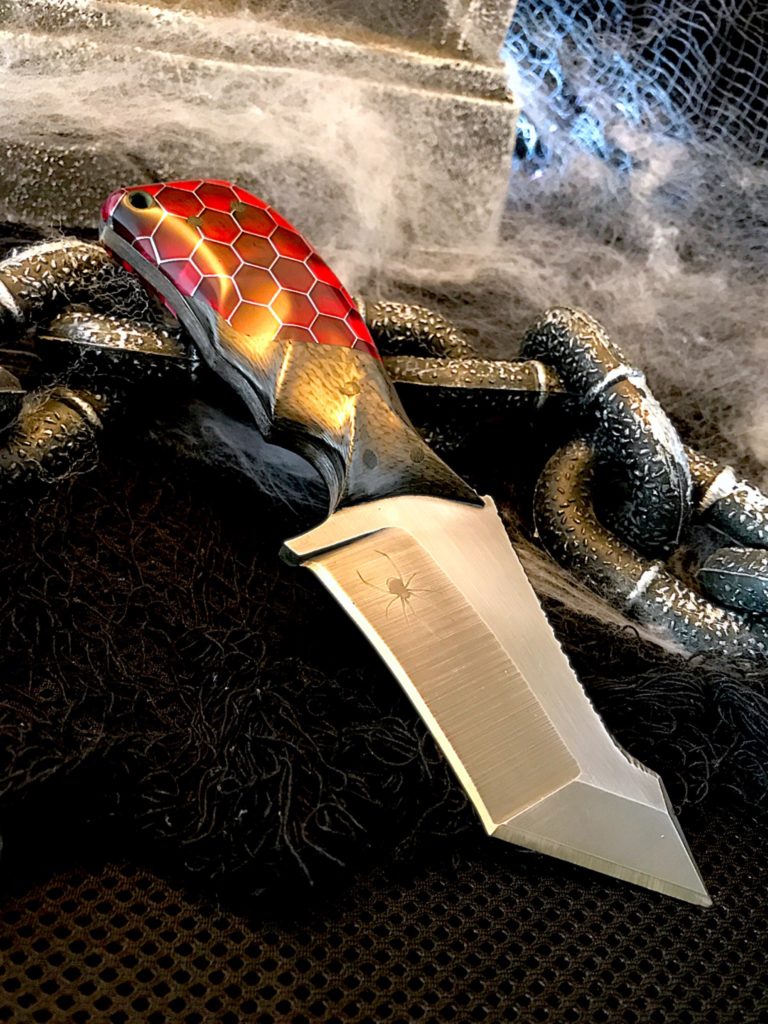
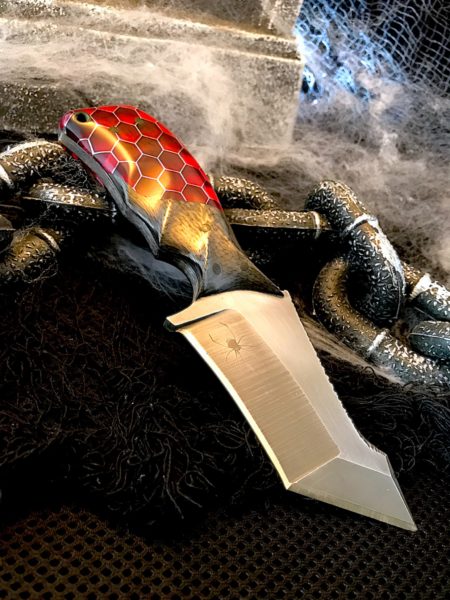
The Recurve Patella uses Voodoo Resin scales in Honeycomb Red.
Model: The Patella Recurve
Blade length: 4 inches
Blade Steel: CPM S30V
Blade Finish: acid wash
Scales: Voodoo Resins’ Red Honeycomb with KS Carbon bolsters
Overall length: 7.75 inches
Maker’s list price: $380-$500 with Kydex sheath and Tec-Lok
Contact: Message Brent Vaccaro on Facebook at Black Widow Knifeworks & Tactical Gear. (Additional contacts at bottom of article.)

Brent takes great pride when someone in the industry tells him they recognize his work right off. He has been an apt student of life. The years of entrepreneurship that didn’t work, prepared him for the one that would work. But no matter how much marketing you apply to your knifemaking, the knife must still cut. It must still hold up to wear and perform as expected upon arrival and for generations to come. Time will tell, but sometimes dues get paid behind the scenes and a meteoric rise is well-earned.

Meanwhile, Brent will have to break away for the birth of his first child, a son, Blake—due any day—and at some point, he’ll need to expand his shop, but he never closes his books for long. He doesn’t think it reflects well to just drop a knife. He refuses to do it. He respects reliability in the people he does business with, so he holds himself to that standard for his customers. Just get in touch, but be aware if you do, you’ll get caught up in the Black Widow web.

Contact: Brent E. Vaccaro by email at [email protected] or Message him on Facebook at Black Widow Knifeworks & Tactical Gear. He also has a website at www.blackwidowtac.com. If you need to call, Message first, otherwise he might not hear you over the machines, 908-328-2049.

It’s All In The Grind

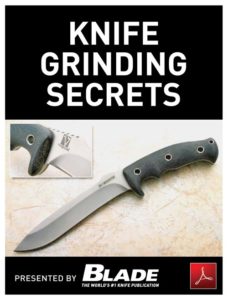
"Knife Grinding Secrets" is by maker and instructor R.J. Martin.
Mastering this one skill will improve your craft immensely. For less than $5, you can add an essential to your knifemaking library.

Author R.J. Martin instructs on flat and double hollow grinds. He discusses chisel grinds, tip shaping, the two-hand pass and lots more in “Knife Grinding Secrets.” Most importantly the finesse of grinding will be covered so that you can master the skill. Downloadable version availabe for $4.99.


What Are The Best Blade Steels?

Follow the maker's steel recommendations.
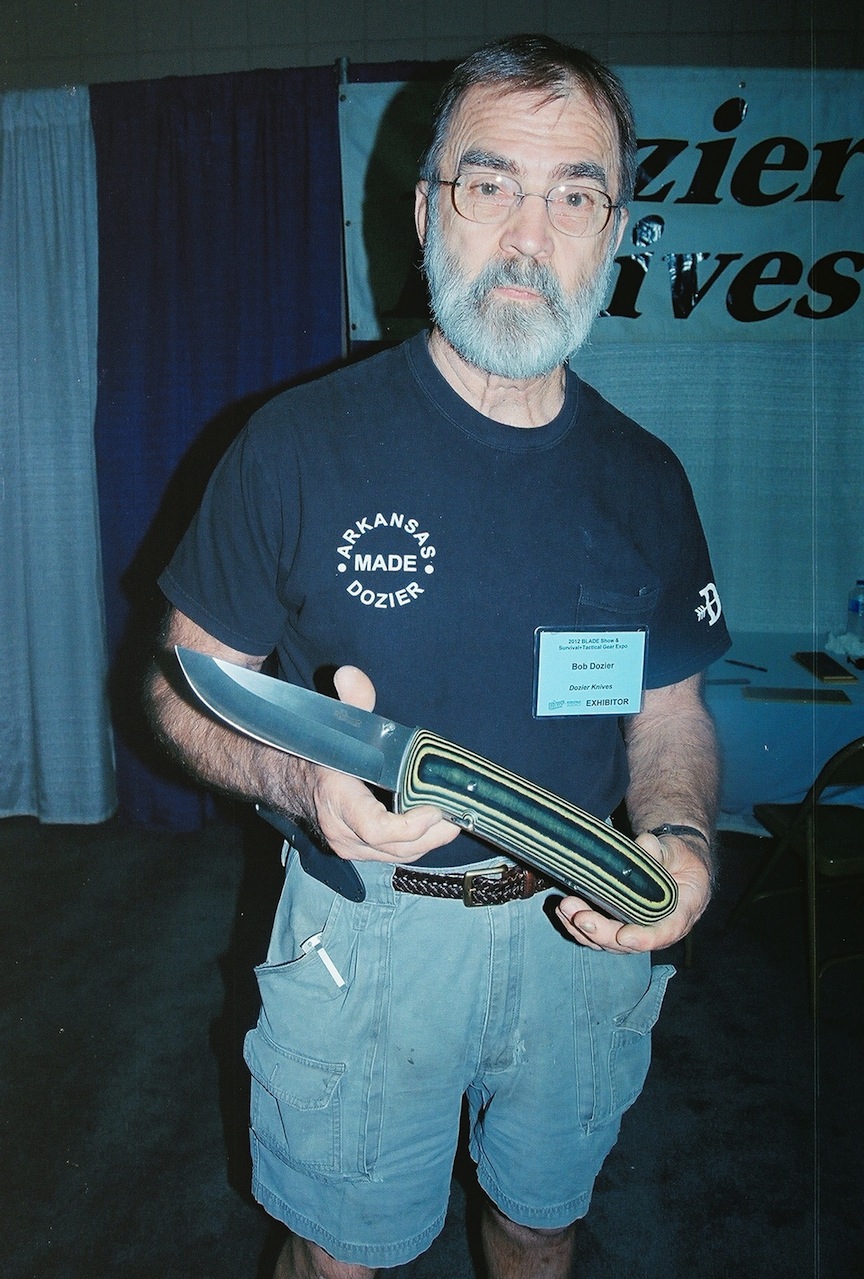
Ask the maker what blade steel he recommends. Bob Dozier holds one of his giant trappers.

A question we often hear is What are the best blade steels? A better way to approach the question is to determine what jobs the knife will be asked to perform.

Do you need a hunting knife or an everyday carry knife? A kitchen knife or a camp knife/chopper? There are others. The type of knife and how it will be used often will dictate the type of steel.

Say you need a hunting knife. Rather than ask what kind of blade steel will be best for it, research the websites of companies or makers who specialize in hunting knives. Such companies and makers will offer hunting knives not only with the steels that they find best for hunting knife purposes, but also with the edge geometries that the companies and makers feel they are most accomplished at making/offering.

Edge geometry refers to the blade’s grind and edge. If the grind and/or edge is too thick or otherwise not formed properly, it doesn’t matter how good the steel is—the knife will not cut well. As for the grind itself, there are many—hollow, flat, convex, chisel, etc., and combinations thereof. Usually the companies or makers employ the grinds they are best at. In cases where you have the option of picking the grind from a custom knifemaker, ask him which grind he’s best at and go with it.

Another important factor is the heat treatment of the steel. In fact, a low-grade steel heat treated properly often will outperform a high-grade steel with a substandard heat treatment.

In addition to the type of steel, ask how it is heat treated. While many makers are adept at heat treating their blades, many simply ship their blades off to professional heat treaters who specialize in the process. Blades heat treated by the pros usually will be heat treated properly and according to industry standards.

High-grade steels such as CPM S35VN, ZDP-189 and others are cutting tigers but can be difficult to sharpen and are more expensive. Lower-grade steels such as 440A, 5160 and others, all things being equal (including proper heat treatment and edge geometry), may not perform as well or hold an edge as long, but are usually easier to sharpen and will do most everyday cutting jobs that most people require. And, knives with such steels should be less expensive. In the case of 5160, while it is not a stainless steel, if you clean it and dry it off after each use, you should not have a problem with corrosion. The same is true with most non-stainless steel knives. Meanwhile, it’s not a bad idea to clean and dry off stainless steel knives after use as well. They can corrode, too—it’s just that they corrode less, as their name indicates.

Bottom line: Tell the company and maker what you plan to do with the knife. They make knives for a living and usually will be able to fit you with the proper knife and suitable blade steel for your needs.


The latest issue of BLADE is on newsstands now!Recommended:

Stay abreast of the latest developments on this and many more knife rights issues with a subscription to BLADE.

Young Knifemakers: The Future Is Now

0

As The New Generation Of Knifemakers Begin To Hone Their Craft, The Masters Of Today Help Guide Their Path Forward. 

A new wave of interest has brought the younger generation closer to the forge and to the welcoming classrooms of bladesmiths that are quite willing to share their time, talent and tips to help the youngsters develop their own skills. That interest comes not only from a growing awareness of the beauty of the finished forged blade, but also an appreciation of the time and dedication necessary.

American Bladesmith Society (ABS) Master Smith Ray Kirk has been teaching kids bladesmithing for some time, and he sees the investment in the future as time well spent.

“Most of the young students usually have a parent that will either make a blade with them or watch the total process,” he commented. “Besides understanding the phrase ‘Strike while the iron is hot,’ they learn to control the steel by where they hammer. The experience of sharing the class with a parent or sibling is the best kind of memory to make. Knowing they will make something that will probably outlast them is something they probably never did before.”

Ray began teaching his grandchildren when they spent time at his home, and he has taught both boys and girls. Depending on the age, both genders are proficient and can use the hammer. His youngest student began learning at 11, and his grandchildren have been around the forge since they were 6.

“At that age, it was just showing them how to change the shape of steel by heating and hammering,” Ray said. “If they can drive a 16-penny nail into a 2-by-4 they could do the class, and I never really considered the sex of the student to have a bearing on taking the class.”

Some of the more satisfying moments for Ray have been watching his students as young adults competing on History TV’s Forged in Fire. Several have won in competition and all have enjoyed the experience, making friends and expanding their knife knowledge. The smile that shines when a photo is taken of young bladesmiths and their knives is something special.

Ray’s class consists of work to complete two knives of hidden-tang integral design from a 12-inch round bar of three-quarter-inch 52100 steel. 

“What they can’t do I will do for them,” he explained. “Learning how is the important part. I don’t expect the students to be an expert at any part of the procedure, and as long as they are watching and learning, I can finish it for them. If I only have one student, it can be a one-day affair. Two students usually require two days, and out-of-town students can use our guest house to stay in. The cost of the class is $350 per student.”

Pride In Teaching Younger Smiths

With the blade secured in the vise in Rick Dunkerley’s shop, 7-year-old Jacob Dove sands the handle.

ABS Master Smith Rick Dunkerley began teaching privately in his shop in 1992, and his first student was Josh Smith, who went on to become the youngest ABS journeyman smith at 15, the youngest ABS master smith at 19, and twice a competitor on Forged in Fire.

“I started teaching Josh when he was 11,” Rick remembered. “That was 30 years ago. He was on the Little League team I coached and showed interest in the knives I made. He was very motivated and not deterred by the work involved.”

Dunkerley says that he doesn’t have a specific program for kids but has invited those who show interest to his shop or hammer-ins.

“If they continue to show interest, I help them out,” he remarked. “I think making things by hand gives kids and adults great self-confidence and pride. So much of the modern world is fast paced and disposable. The process of making a knife forces a slowing down and focus that is lacking in a lot of kids’ lives. It also gives them something to care for and preserve as opposed to the normal disposable crap of everyday life. I don’t encourage or discourage anyone, kids or adults, to pursue knifemaking as a career. I give them my experience on the subject and let them decide on their own if they can make the sacrifices involved.”

Rick usually starts a student out with stock-removal knives. He says he believes learning to grind a blade is more difficult than forging one. Then, should the student decide to learn bladesmithing, the learning process continues.

“My proudest moments as a teacher have always been seeing the pride and satisfaction in the students’ eyes when the knife is finished,” he added. “I believe the pride and satisfaction of making things with our hands makes better human beings. That’s enough motivation for me to help when I can.”

Absorbing lessons from Dunkerley and listening to his advice has paid huge dividends for Josh Smith, and his memories of those days filled with learning the bladesmithing art remain fresh in his mind.

“Rick’s mentorship launched me into a career that I would never have had without his help,” Josh recalled. “Thirty years ago this year, I started making knives under him. Those times under the tutelage of Rick provided me with an opportunity to tap into my craftsman and artistic side.”

Josh has taught his own kids the fundamentals of bladesmithing. “Time spent in the shop can absolutely help open up the world of possibilities in regard to craftsmanship,” he assessed. “Whether it’s making knives, blacksmithing, gunsmithing, wood carving or woodworking, the shop can provide amazing experiences for kids.”

ABS Program

Young students man their anvils in the Bill Moran School of Bladesmithing at Texarkana College.

Don McIntosh runs the youth bladesmithing program at the Bill Moran School of Bladesmithing at Texarkana College, and he sees a future with the endeavor. 

“We rekindled it this year and it was very successful, so we’re looking to make it something we’ll be proud of on an annual basis,” he commented. “It caters to 14- to 17-year-olds and it’s a 16-hour program over three days.”

The Junior Bladesmithing course was held in June and included six participants who took part in a program that was packed with hands-on activities. The fee is a modest $175, and there may be a tie-in with the college to introduce bladesmithing to a wider audience of youngsters. McIntosh also volunteers with a local Boy Scout troop to demonstrate bladesmithing and generate interest among younger kids.

“Our program at the Bill Moran School this year included a half day on Thursday, a full day on Friday and a half day on Saturday,” Don explained. “At the end of the program, if they have forged a knife, they grind it and heat treat it and then put a cord wrap handle on it.”

The program is open to boys and girls, and Don says any young ladies who are interested in learning about bladesmithing are welcome. 

“Absolutely! We want to keep the spark going, and I’ve been adamant that this is an avenue of approach that’s better than sitting in front of a video game. Most kids are enthusiastic about hunting and bowie knives at that age, and you can come to the program and do something hands-on. The idea of forging your own knife is a pretty cool concept, and interest has been amplified by Forged in Fire. The kids watch it and so do their parents.”

McIntosh says the ABS is currently looking at the format and date for the next Junior Bladesmithing event, and the commitment to the future of the program is firm.

Bladesmith Kit #1

As Ray Kirk observed, “The experience of sharing the class with a parent or sibling is the best kind of memory to make.” Jason Proctor and his son Jaxon hold the knives (top) they made in Ray’s shop. (Lou Ann Kirk images)

The Blacksmiths Depot’s Bladesmith Kit #1 may have applications with young bladesmiths, depending on their level of interest and experience. 

It comes complete with an 800-gram Swedish hammer; .75- and 1.25-inch blade tongs; White Mountain flux; Cherry Red hardening compound; PBC anti-scaling compound; regular tomahawk mandrel; regular tomahawk handle; men’s Jersey gloves; jumbo block brush; sodium flare safety glasses; ear plugs; and two publications: The Complete Bladesmith by Jim Hrisoulas and Handles and Guards by BLADE Magazine Cutlery Hall-Of-Fame® member Joe Keeslar. Priced at $395, the kit does not include blade steel.

“Most who want to do blades should experiment with mild steel or scrap before spending money on the more expensive metallurgy,” related David Kayne of Blacksmiths Depot. “Youth should not be doing any form of blacksmithing, bladesmithing or stock removal without good safety habits and adult supervision. Anything that has to do with weapons needs training and oversight, including the making of blades.

“Otherwise, we do not see any reason why this kit wouldn’t work out for youth,” he concluded. “Even the hammer in the kit is light enough weight for a youth. We do recommend that both youth and adults read through the books first before attempting to make a knife. A little background knowledge of forging could mean the difference between frustration and success.”

Stimulate And Create

The efforts to introduce bladesmithing to young people and the opportunities it affords them can bring on fantastic results, stimulate natural curiosity and offer an outlet for creative energy. More and more, such programs and events will influence the bladesmiths of tomorrow and contribute to raising them right.

Read More

Damascus Steels: What To Use And When

2

Bladesmiths outline which carbon steel combos they use and why.

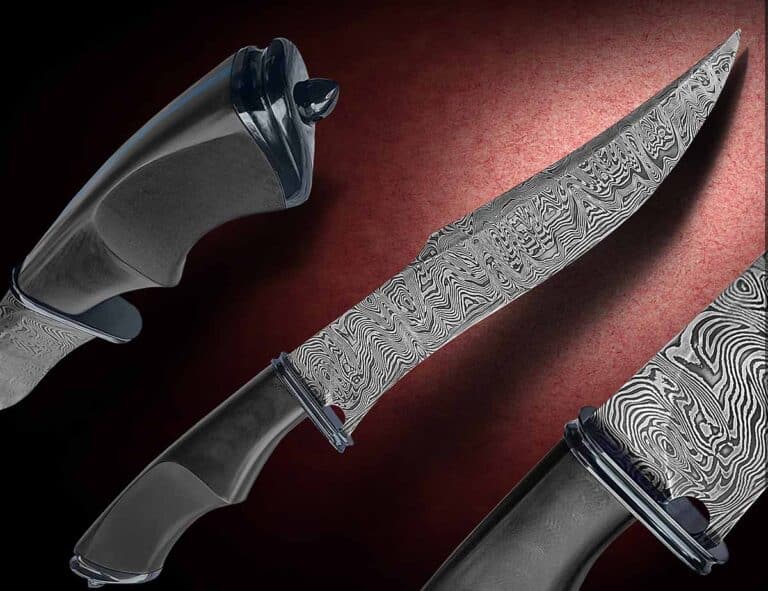
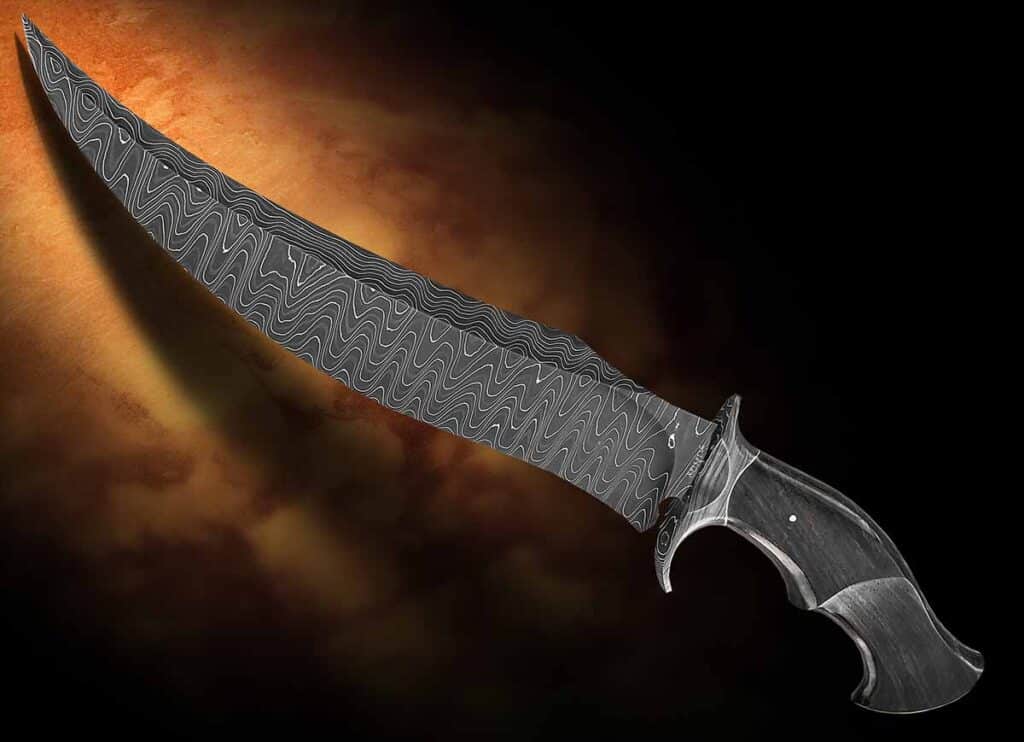
Damascus steel is a broad category with nearly infinite variations. It includes everything from low-layer random patterns to powdered canister creations and complex mosaic patterns.

The basics of damascus include forge-welded combinations of steels. Changes in the steel choices, in the welding or forging processes, and even in the etching method result in a wide variety of patterns and looks. Let’s dive into the many levels of damascus through the work of a few excellent smiths.

Smiths Takes On Damascus Steels

ABS apprentice smith Chris McPherson began making knives only four years ago, but he had a strong start attending classes taught by ABS master smiths Jason Knight and Josh Fisher. Now he forges his own damascus. One of his fighters (IMAGE 1) features a blade of 1075 carbon and 15N20 nickel-alloy steels.

ABS journeyman smith Brian Sellers used three steels instead of the standard two to help provide a darker look for his blade of ladder pattern damascus. As he observed, “Adding a third steel to damascus gives a unique depth to the finished blade, kind of like adding shades of gray to a tattoo.” (Jocelyn Frasier image)
Image 2 ABS journeyman smith Brian Sellers used three steels instead of the standard two to help provide a darker look for his blade of ladder pattern damascus. As he observed, “Adding a third steel to damascus gives a unique depth to the finished blade, kind of like adding shades of gray to a tattoo.” (Jocelyn Frasier image)

“I made the knife for a local state trooper benefit, for the teenage son of an officer who lost his life in the line of duty in March 2023,” Chris explained.  When asked about why he chose 1075 for his fighter, he said he “just wanted to try it out” after making other billets with 1095, 1084 and 1080 carbon steels. Though he’d heard that the 1075 may have a bit less contrast due to its lower manganese levels, it came out with beautiful contrast after a deeper etch.

Knifemaker Brian Sellers likes to mix things up a bit. In addition to the standard carbon steels of 1095 or 1084, Sellers occasionally includes 1080, 5160 or 52100.  “Adding a third steel to damascus gives a unique depth to the finished blade, kind of like adding shades of gray to a tattoo,” he says. For example, in a recent Persian fighter (IMAGE 2), Sellers included 1080 and 5160 along with 15N20 in a ladder pattern blade. Brian indicated all the steels work well with his equipment. He uses a 50-ton Riverside hydraulic press and a 50-pound Little Giant power hammer.  

Damascus is time and labor intensive, and the maker loses a good bit of the steel in the forging process. Bladesmith Blake Nichols knows this and is from the “waste not, want not” school of thought. 

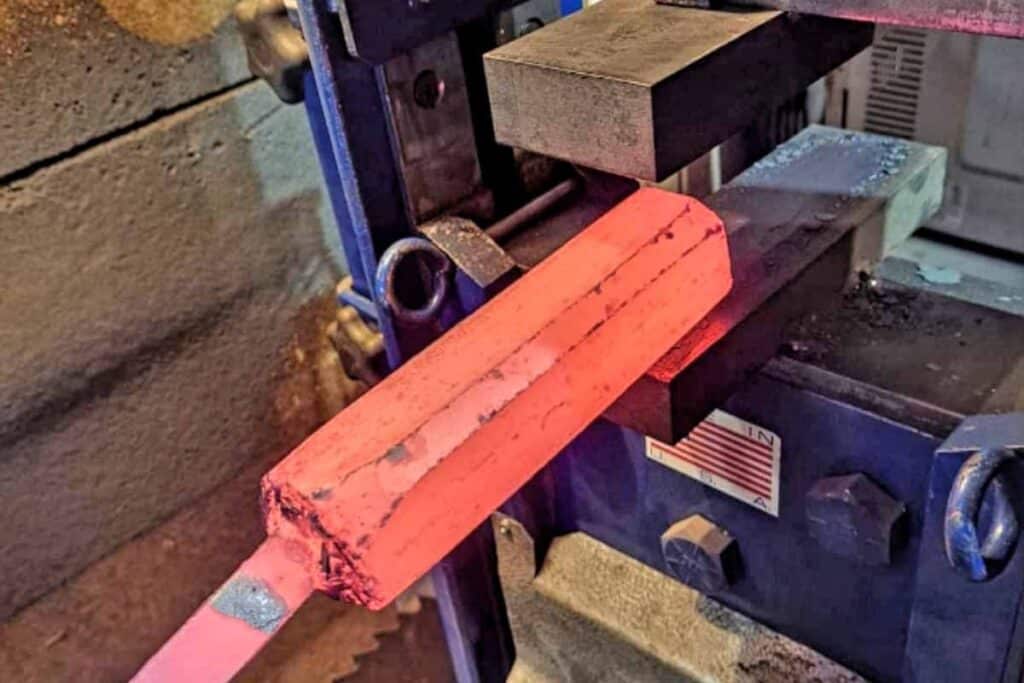
Robert Wayman uses a hydraulic press to weld and draw out his damascus billet.

“My mentor Greg Shahan gave me the end cut of a feather damascus billet a few years ago,” Nichols said. “It sat on my shelf for a long time before I incorporated it into [one of my] hunters.” 

Regarding his damascus, he added, “I wish I had a profound scientific answer as to why I use 15N20 and 1095 but I do not. The simple answer is it’s what I learned on. I’m comfortable with the heat-treating process. I also feel like I get the performance out of that combination that I desire.” I agree with Nichols when he said, “No matter what it’s made of, it has to function like a knife.  Even the fancy ones need to hold up to the performance standards.”

Why 15N20 In Damascus?

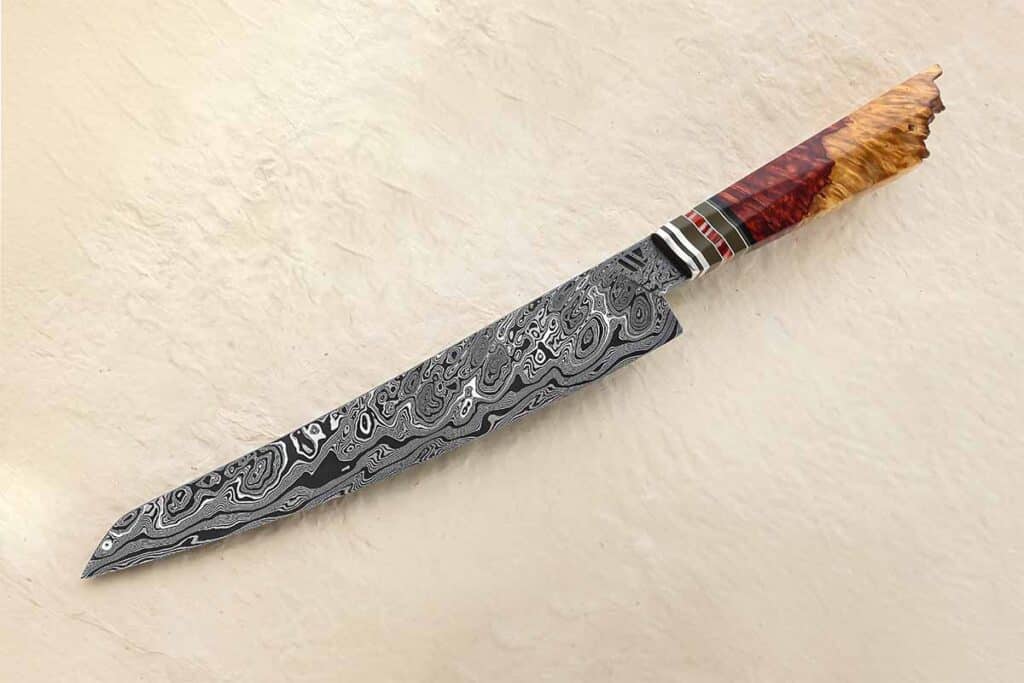
For a great example of a go-mai (five layer) damascus blade with the visual “pop” of nickel, Robert Wayman provides the fireworks via his sujihiki.  Damascus outer layers and a damascus core work together with the handle of live edge amboyna burl to make a stunning knife. Overall length: 16 inches. (SharpByCoop image)
Image 3 For a great example of a go-mai (five layer) damascus blade with the visual “pop” of nickel, Robert Wayman provides the fireworks via his sujihiki.  Damascus outer layers and a damascus core work together with the handle of live edge amboyna burl to make a stunning knife. Overall length: 16 inches. (SharpByCoop image)

You may have noticed one thing the featured bladesmiths all have in common: they include 15N20 in their damascus billets. The 15N20 is a simple carbon steel, basically 1075, but has a relatively large amount of a special ingredient: nickel. The nickel content makes 15N20 etch more slowly and show more brightly when polished. Because of the similar composition to the 10-series steels (1080, 1084, etc.), it welds well and hardens in similar temperatures, making it the perfect steel for high contrast in the damascus pattern.

Some smiths use pure nickel foil or sheet in their damascus for the same effect. The challenge is that the pure nickel won’t harden, so it must be kept away from the edge in the forging process. The contrast is great but the nickel itself won’t hold an edge. I like a nickel layer in between layers of san-mai or go-mai damascus. It really pops!

Bladesmith Robert Wayman illustrates the go-mai technique well on one of his kitchen knives (IMAGE 3). The blade was made from a patterned go-mai billet. There’s a core layer running down the center of the blade with two layers of material on each side. The core is 100-layer random pattern damascus forged from 1084 and 15N20. On each side of the core steel is a layer of nickel and on the outside of the billet is a layer of matching random pattern damascus. 

Key Element Comparisons by Steel

Steel10841075109515N201080516052100
C.865.7501.000.750.75-.88.60.98-1.10
Mn.750.550.450.375.06-.09.80.24-.45
N.2001.950
*C-carbon, Mn-manganese, N-nickel; the double hyphens indicate trace amounts. Note the relatively high amounts of nickel of the 15N20 and of manganese of the 1084, two elements beneficial for high contrast damascus. This chart is for the elements pertinent to the subject at hand only and does not list all the elements of each steel.

Once the final billet is forge welded, some of the cladding material is removed with a grinder to create a visual effect in the pattern, and then the billet is drawn out to length. Keeping the core material centered during the process is very important. “You want to take your time when laying out your billet,” Wayman advised. “I typically use a thicker core material and a thinner cladding material, but it’s definitely taken some time and practice to dial it in.”

Other Damascus Steels

Before 15N20 and 10-series combos became prevalent for damascus, one of the standard high-contrast combinations was O1 and L6 tool steels. While the latter combo makes great damascus, the two steels are harder to find in today’s market. Simply put, properly sized and affordable 15N20 and 10-series steels are much more available than all the other combos on the market. 

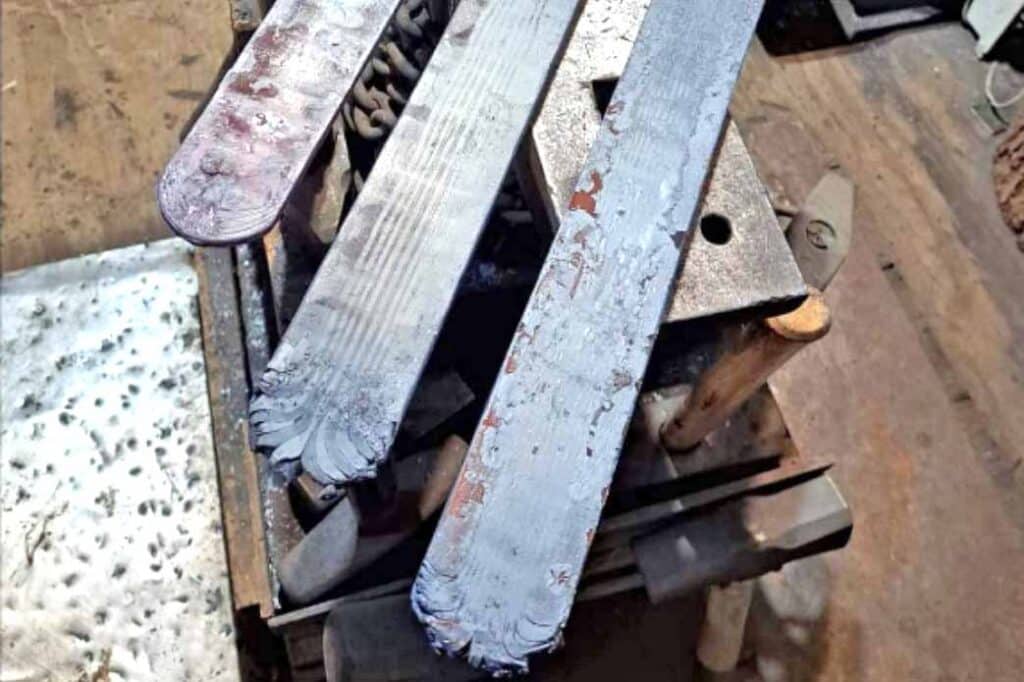
Damascus can be made of many things, including other damascus. These component bars became part of Robert Wayman’s chef’s knife.

Copper is another material that has caught on in the forging of copper-mai and other forms of copper damascus. Outfits like Baker Forge specialize in the process in which the copper is often clad over a standard carbon steel damascus core, as the copper itself won’t harden. 

Titanium alloys have been pattern welded, often called Timascus™, and can be anodized in an array of wild colors. Unfortunately, it’s difficult to produce and doesn’t harden, so Timascus blades are probably not in your future. Instead, Timascus makes a great folder frame, bolsters and other non-blade knife parts.

What Metals To Avoid

Are there any materials that don’t make a great contrasting damascus? Sellers reports that the “S” series high silicon steels like S5 and S7 don’t work. He speculated that it was either the steel composition or improper heat control, but welds of S5 and S7 don’t stick during forging.

Robert Wayman welded these five pieces of steel together to make the go-mai damascus blade of his chef’s knife.

I can attest that meteorite is a tempting addition to damascus because various samples are often high in nickel and mostly made of iron. Unfortunately, every meteorite varies widely in terms of content, so that individual pieces of the same meteorite each may have a very different chemical composition. As another confounding factor, many meteorites contain high silicon or other elements besides iron, carbon and nickel. Each new element adds its own problems to the process.

I was able to produce a satisfactory pair of billets containing some meteorite by putting small chunks in a canister with 1084 powder, and then welding and re-stacking the billet with more 1084 bar stock until the final layer count was over 1,000. By adding only 1084, I was assured that any bright spots in the final pattern were from the nickel in the meteorite. Even with this process, there were a few inclusions/flaws in the final product. Could I have continued to push the layer count and minimized the flaws further? We’ll never know.
  
Some may think AEBL stainless steel is nice and shiny. Can it or another stainless steel be put in the mix with carbon steel? If you think that “shiny” makes sense for high contrast, that part is true. Unfortunately, the high chromium in stainless steels causes problems for damascus makers in two ways. First, chromium steels don’t like to weld together. The chromium oxidizes quickly and prevents the welds from sticking. Second, the chromium changes the hardening properties. In a hypothetical AEBL and 1084 billet, the AEBL hardens from 1,900°F while the 1084 hardens from 1,500°F. If you quench the hypothetical billet from 1,900°F, the 1084 will have huge, brittle grain. If you quench the same billet from 1,500°F, the AEBL won’t harden.  

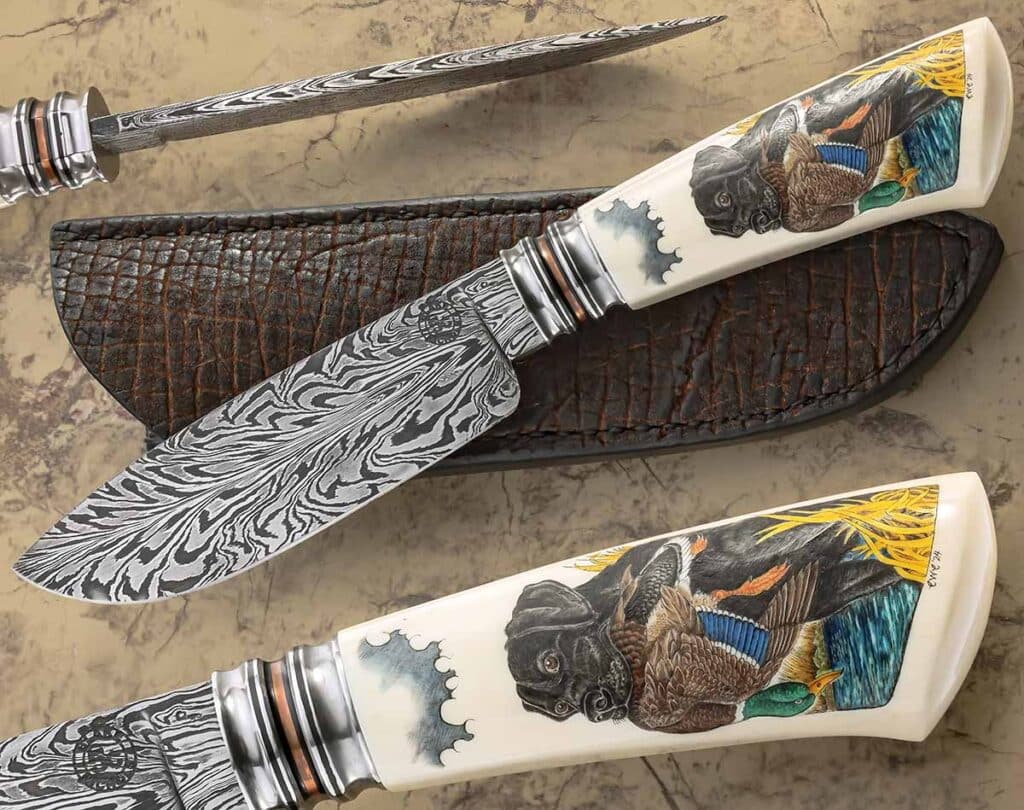
For the blade of his fancy hunter, Blake Nichols employs a damascus of 1095 carbon and 15N20 nickel alloy steels forged by Greg Shahan. Blake said he is comfortable with the heat-treating process and also feels like he gets the performance he wants from the combination of the two component steels. Overall length: 10 inches. The scrimshaw is by Charles W. Conner III. (SharpByCoop image)

While there are smiths who have figured out how to weld multiple types of stainless steel together in contrasting patterns, the process requires careful and precise heating and mitigation of oxygen, both procedures which are often beyond the scope of the backyard smith. Because of the complex process required to make it, stainless damascus commands premium prices.

Final Cut

Modern damascus retains strong demand in the knife market. By combining a choice of several standard carbon steels and 15N20, smiths can create damascus patterns that will make any knife stand out. Whether the pattern is random or ladder, raindrop or mosaic and more, a high-quality damascus knife is sure to be a winner. 

More On Damascus:

2024 ABS Award Winners And New Master & Journeyman Smiths

Fabulous forged knives, new smiths, new chairman top ABS annual meeting.

Some of the finest forged knives of the year, the newest American Bladesmith Society master and journeyman smiths and a brand new chairman helped highlight the annual meeting of the ABS held during BLADE Show 2024 at the Cobb Galleria Centre in Atlanta.

ABS master smith Kevin Cashen officially began his first term as ABS chairman at the annual meeting, succeeding ABS master smith Steve Dunn who passed away unexpectedly earlier this year. It was a bittersweet transfer of the office for all concerned, though a sparkling array of award knives and an impressive group of new master and journeyman smiths that includes those from Brazil, Europe, China, New Zealand and the USA were an appropriate way to greet the new chairman and pay tribute to the former one.

ABS Annual Awards

Award Winners

  • W. W. Scagel Award: Butch Sheely 
  • Paul Burke Award: Robert A. Wilson
  • Distinguished Service Awards: Karen Cashen, Joel Worley 
  • W. F. Moran Award: Matthew Parkinson
  • Antique Bowie Award, JS: Mace Vitale
  • Antique Bowie Award, MS: Karis Fisher
  • Joe Keeslar Award: Jason Chen
  • B. R. Hughes Award: Fabio Barros 
  • Chairman’s Awards: Kevin Cashen, James Rodebaugh

Fabio Barros

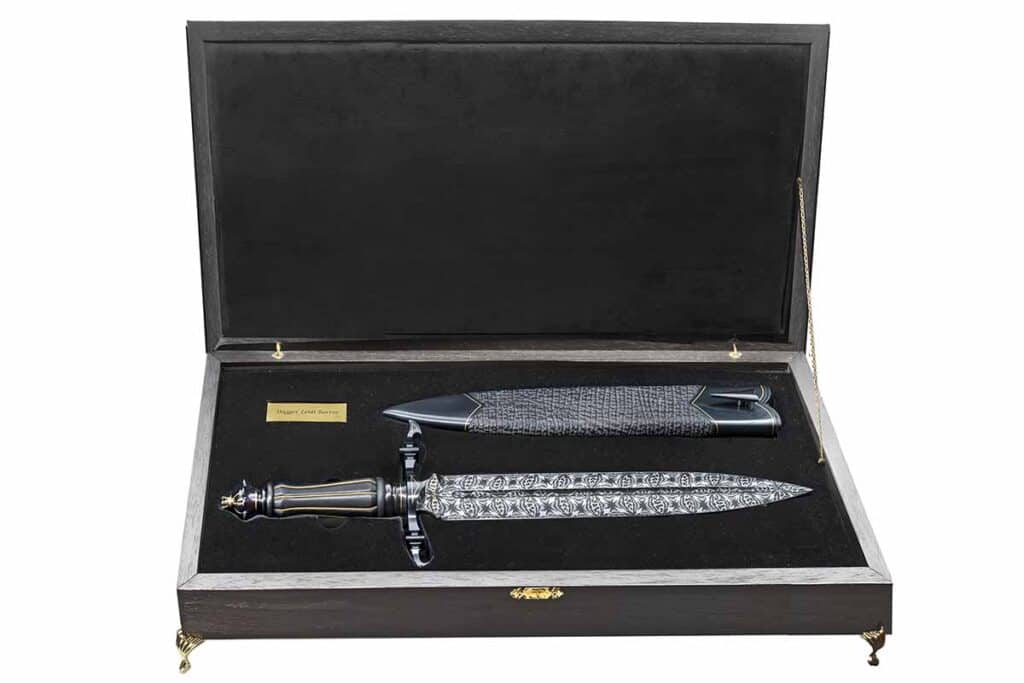
It was a weekend Brazil’s Fabio Barros probably will never forget. Not only was he the sole applicant to gain the coveted rating of ABS master smith, he also won the B. R. Hughes Award for the best knife submitted by such an applicant. In the eyes of some, that he was the only successful MS applicant might have detracted from his Hughes Award—if not for the fact that the same knife also won Best Art Knife at the concurrent BLADE Show.

B. R. Hughes Award Winner

B. R. Hughes Award
Winner: Fabio Barros
Knife name: Leidi Barros Dagger
Maker/designer: Fabio Barros
Blade material: Apricot pattern mosaic damascus w/four-sided roughing
Construction: Take down
Handle: Fluted ebony with gold-braid wire wrap Guard, shim and pommel: Black oxidation with gold appliqué
Pommel stone: Onyx
Sheath: Shark leather w/gold inlay
Display: Ebony case w/exquisite finish
Knife to know: The knife is named in honor of Leidiana Barros, wife of Fabio Barros; the handle design is inspired by the queen in a chess set

Karis Fisher

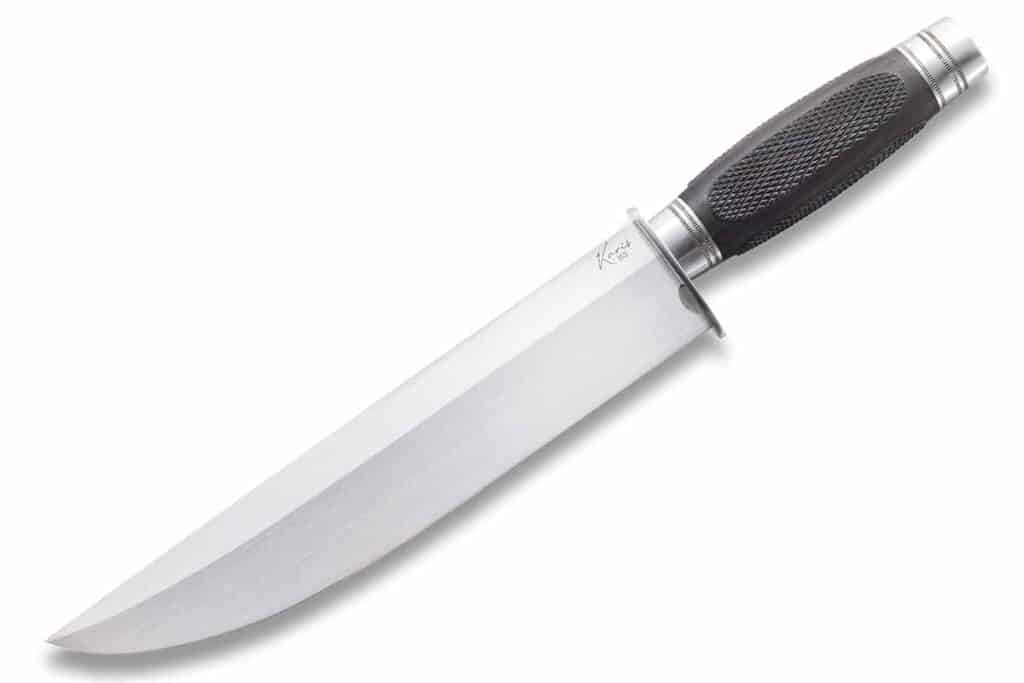
Karis Fisher added to her trophy case by winning the Antique Bowie Award for the best bowie in a 19th-century style by an ABS master smith. It was another feather in the cap of the young smith, who won for a reproduction of the Searles/Fowler bowie—with it being her first attempt at a repro to boot. Added Karis, “I’ve always wanted to try and make a reproduction, and I was drawn to the Searles bowie due to the mix of complexity and clean and timeless design.”

Antique Bowie Award, MS Winner

Antique Bowie Award, MS
Winner: Karis Fisher
Knife: Searles Reproduction
Blade length: 9.25”
Blade material: 52100 carbon steel
Blade width: 2”
Blade @ thickest: .25”
Blade grind: Double ground
Guard material: Stainless steel
Handle material: African blackwood
Ferrule and butt material: Stainless steel
Ferrule and butt embellishment: Coined liners
Overall length: 14.5”
Special features: Half-moon cutout in blade and raised checkered panels on handle
Knife to know: The knife is based on the Searles-Fowler bowie made by Daniel Searles in Baton Rouge, Louisiana, in 1828
Maker’s price for a similar knife: $2,500

The Challenge: “The most challenging part of this build was definitely the planning of the knife and trying to stay true to the original while building it solely off pictures.” 

Matthew Parkinson

ABS journeyman smith Matthew Parkinson won the W. F. Moran Award for the best knife in the Moran style for his interpretation of a Moran fixed blade. “It wasn’t based on any one knife of his but more a general sort of impression of his body of work,” Matthew wrote. “That is to say, it is my design trying to work within his style—an interesting challenge!”

W. F. Moran Award Winner

W. F. Moran Award
Winner: Matthew Parkinson
Blade length: 7.25” 
Overall length: 12”
Blade material: 1084 carbon steel 
Blade @ thickest: 3/16”
Blade width: 1.125” 
Guard and pins: Bronze 
Handle: Maple 
Inlay: Sterling silver 
Maker’s price for a similar knife: $1,100

Maker’s remarks: “The Spanish Notch is just a detail to the choil rather than a plain rounded choil. I saw several similar examples on a knife that Mr. Moran had made and thought it might be a nice touch. The groove at the base of the handle is a carved molding. This is a detail I use frequently in knives that don’t have stabilized wood handles, as inlaid handles normally are. It helps keep a clean, even fit but still allows the wood to move, at the same time adding a nice visual feature that adds to the overall design.” 

The Challenge: “I think the most challenging part of doing these is working within another maker’s aesthetic, especially one like Mr. Moran who has a huge and varied body of work. That’s the part that teaches you the most, I think. I find building one of these can give you insight into why another maker chooses one feature over another, or why a line or form is there. Those design ideas become incorporated into your own style and help you grow as a maker.” 

Mace Vitale

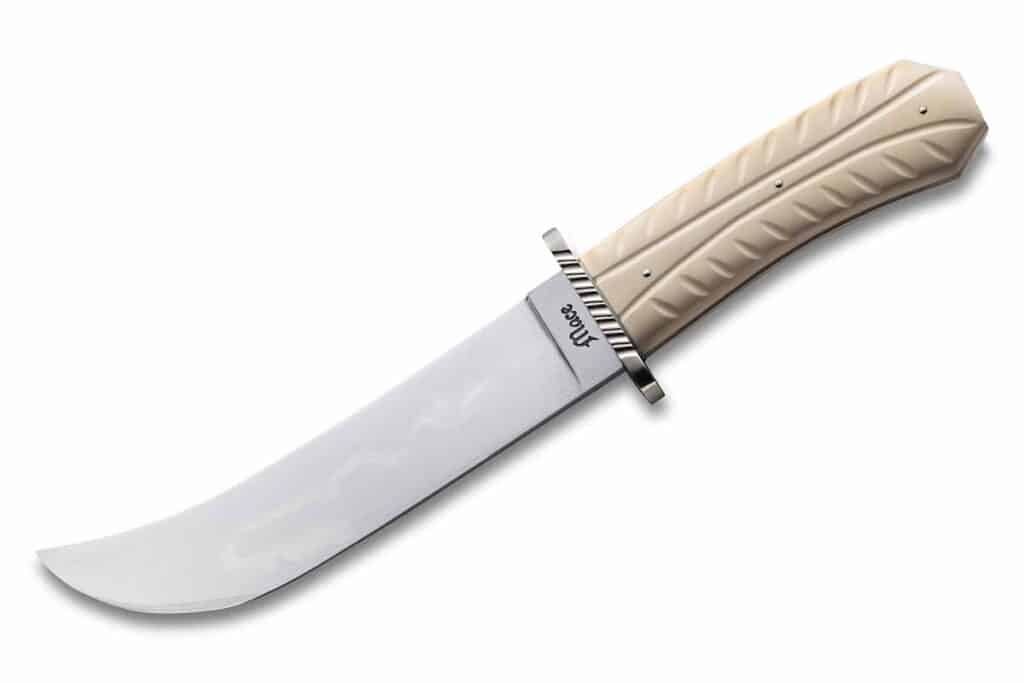
Mace Vitale captured the Antique Bowie Award for the best bowie in a 19th-century style by an ABS journeyman smith for a knife inspired by an antique piece made by Otto & Koehler of New York around 1850. The unusual knife features a markedly upturned blade tip and an ever-so-slightly downturned handle with a modified coffin-style butt featuring two carved lines and two rows of individually carved oblique divots that run its length. “The carving on the handles I’m positive were for extra grip. The knife has an excellent feel in the hand,” Mace observed. “There has been a bit of discussion as to the purpose of the original. As a knifemaker it was pretty clear to me when I picked up the original that it was very purposefully built to be a fighting knife.”

Antique Bowie Award, JS Winner

Antique Bowie Award, JS
Winner: Mace Vitale
Knife: Inspired by an antique fixed blade from New York makers Otto & Koehler from around 1850
Blade length: 6.5”
Blade material: W2 tool steel
Blade width: 1.25”
Blade @ thickest: 3/16”
Blade grind: Flat
Fittings and pins: Nickel silver
Handle: Mammoth ivory
Overall length: 11”

The Challenge: “The most difficult part of building this knife was trying to keep all the parts going the way I wanted. When making a knife like this, it is put together and taken apart many, many times, and I found myself constantly putting the handle or guard on upside down. I was glad once it was done.”

Jason Chen

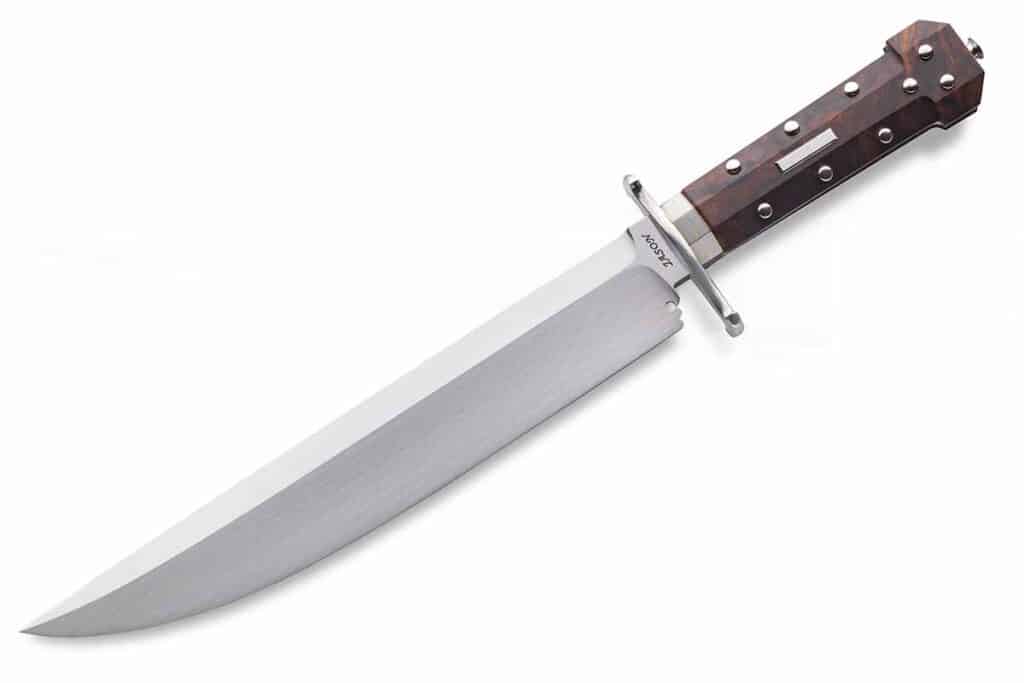
Newly minted ABS journeyman smith Jason Chen of YunNan, China, won the Joe Keeslar Award for the best knife submitted by a successful JS applicant for a spotless reproduction of a bowie not unlike the antique L. Kimball knife. The fact Jason prevailed over the best knives of 13 other successful JS applicants adds to the difficulty of his winning this year’s Keeslar Award. He is to be congratulated—as are all of those receiving top honors at the annual ABS meeting.

Newly minted ABS journeyman smith Jason Chen won the Joe Keeslar Award for the best knife submitted by a successful JS applicant for a bowie not unlike the antique L. Kimball knife.

New ABS Masters & Journeymen

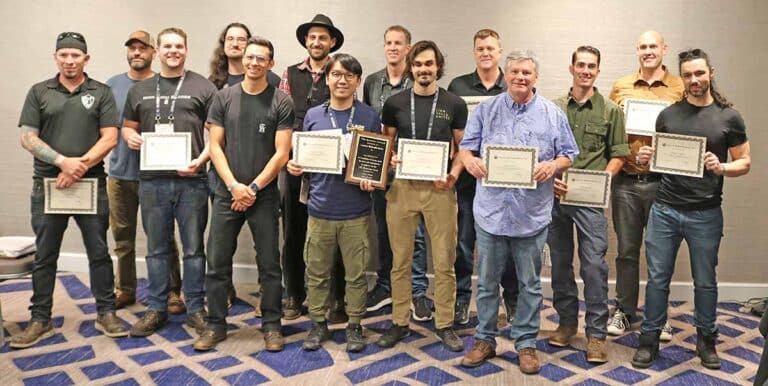
Five applicants presented for ABS master smith and one passed. Twenty-four applied for ABS journeyman smith and 14 were approved. The panels of judges were chosen by the ABS. The smiths who made the grade were:
ABS master smith: Fabio Barros, Brazil;
ABS journeyman smiths: Cameron Alarcio, California; Jason Chen, China; Pieter-Paul Derks, Netherlands; Zane Dvorak, Ohio; Robin Gagchian, France; Chris Gardner, Nevada; Aidan Garrity, Connecticut; Erik Greiner, Texas; Tony Lewis, Arizona; Dan Lewis, New Mexico; Tony Severio, Louisiana; Warren Thacker, Tennessee; Thiago Vidotto, Washington; and Liam

More On ABS:

Advertisement

Must Read Articles

Read this before you make a knife

Knifemaking 101 – Read This Before You Make a Knife

  by Wayne Goddard My experience has taught me that there's nothing like digging in and getting started. I've often said the hardest part of the...
how to forge damascus steel

How to Forge Damascus

Advertisement
Advertisement