Knifemaking is the building of a knife, which includes the blade, handle and other accouterments. Blades are made by either removing metal from a steel blank via a grinder – known as stock removal – and the forging to shape of hot steel into a blade in the process known as bladesmithing. Other parts, including bolsters, guards, pommels, etc., are needed to complete the finished knife.
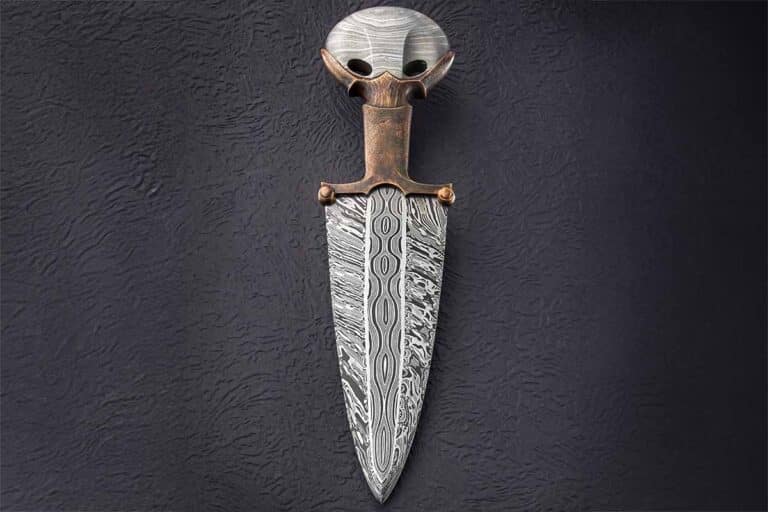
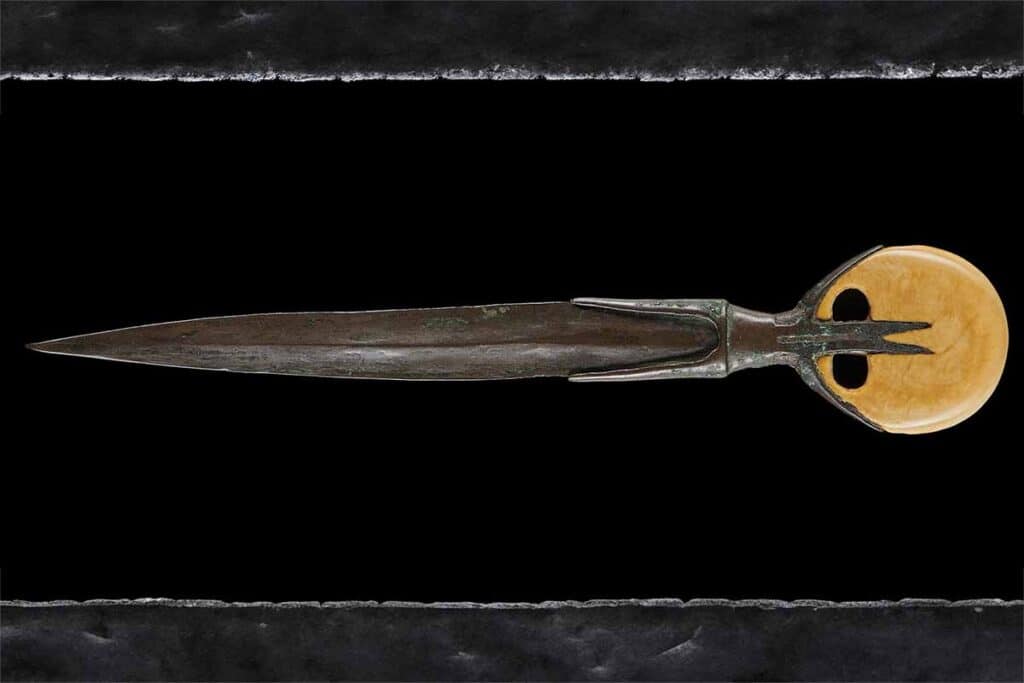
While it may appear to be an alien looking back at you, the Relic Dagger by ABS journeyman smith Ryan Breuer is inspired by Egyptian daggers from the Bronze Age that were made over 6,000 years ago.
The pommel on the originals are believed to have been made of hippo ivory.
“There’s such a striking shape to it,” Ryan said. “It very clearly looks like a human form in the handle holding up either a head or maybe the sun. It’s as if those who made the daggers thousands of years ago are looking back at me. It’s almost spooky.”
The damascus blade is a collaboration between Ryan and bladesmith Jason Morrissey, though Ryan gives Jason most of the credit for the steel. The blade is a composite mosaic damascus, with twisted mosaic edge bars of Jason’s steel and Ryan’s “eyes” mosaic in the core.
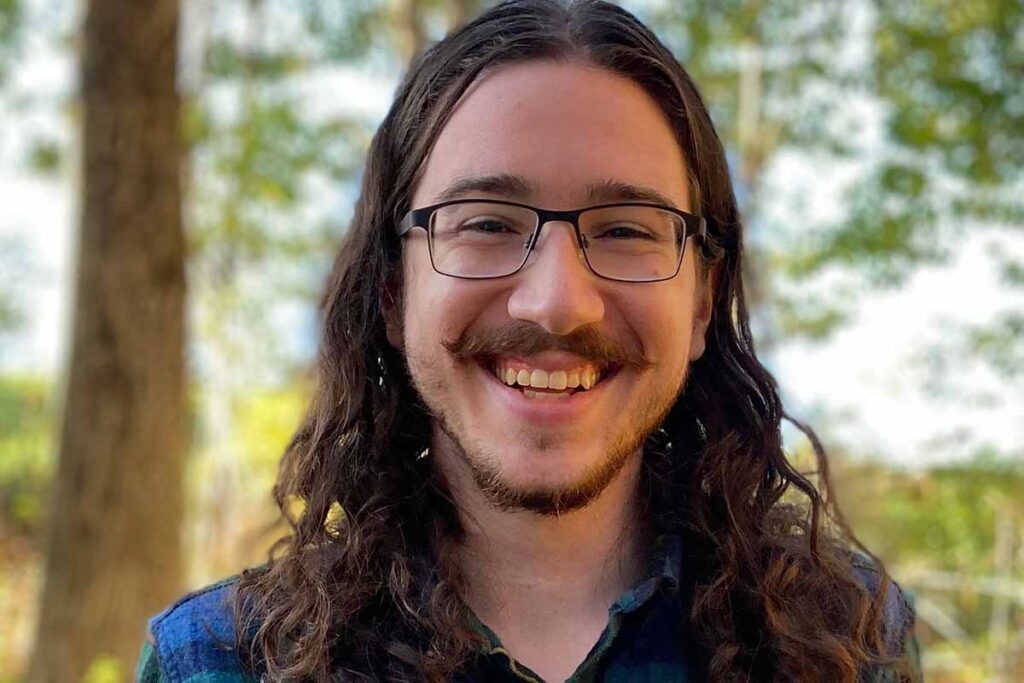
Ryan Breuer
Ryan ground, heat treated and finished the blade. The hilt is cast bronze made with the lost-wax process. The pommel is pattern-welded wrought iron and pure nickel, manipulated to imitate layers of organic ivory. Ryan drilled the two holes for the “eyes.”
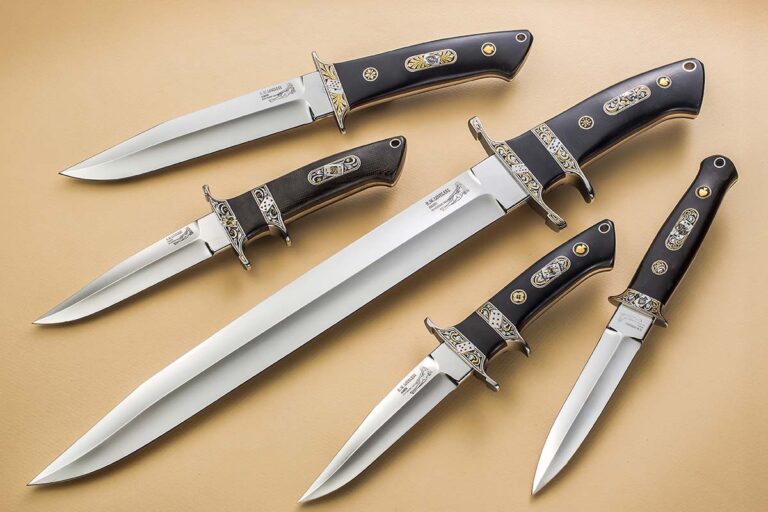
The sub-hilt is at once belligerent and beautiful, adding a strange allure to the knives that sport it.
There is no consensus as to the origin of the sub-hilt knife, though most agree the sub-hilt fighter was popularized by BLADE Magazine Cutlery Hall-of-Fame® member Bob Loveless in the 1970s, if not earlier. Some believe the sub-hilt design was for hunting, and that the main purpose for the added hilt was for greater leverage when a surer grip was needed. A few have even postulated the additional hilt was for use as a brace in pulling the knife out after being stabbed into bone or another hard material, a use that it would no doubt accommodate most effectively.
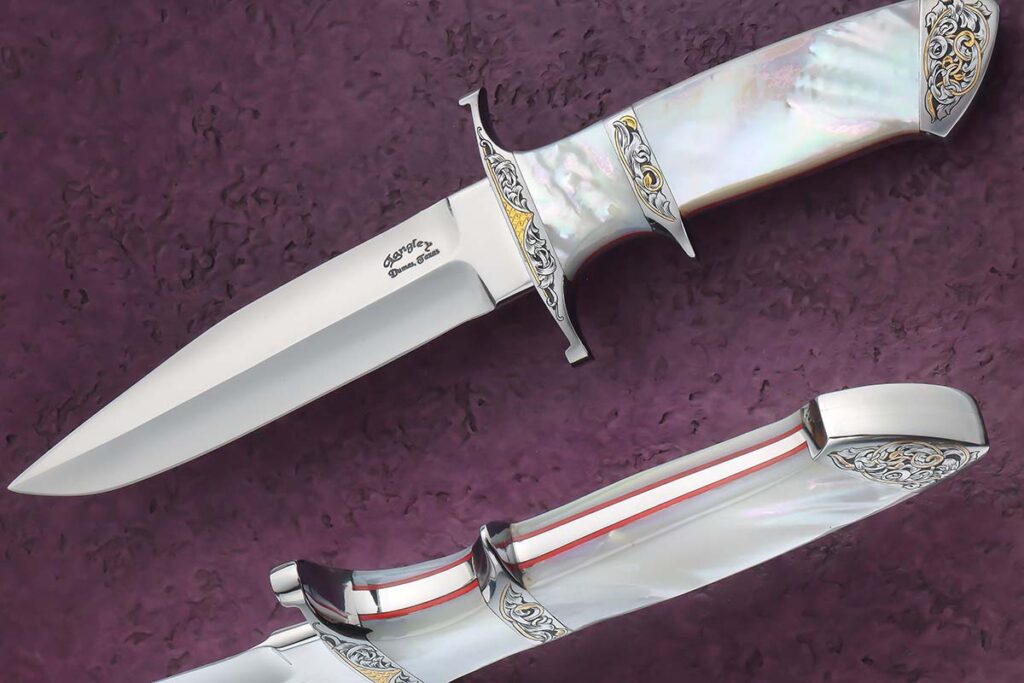
Gary Langley: Gentleman’s Fixed Blade
Custom maker Gary Langley’s sub-hilt fighter may be small at 9 inches overall but makes up for its size in sleek blade grinds, exquisite mother-of-pearl scales and gold inlay. Blade and overall lengths: 4.5 and 9 inches. Alice Carter did the engraving. (SharpByCoop knife image)
Many knife enthusiasts think of a sub-hilt fighter as being a heavier-edged companion—and in many cases it is—but custom knifemaker Gary Langley’s iteration is a little gem of a knife.
“The small Loveless-style sub-hilt fighter is 3/16-inch CPM 154 steel with a double hollow grind on a 3-inch wheel,” the Dumas, Texas, maker notes. “The heat treatment is by [Cutlery Hall-of-Famer] Paul Bos. I originally designed the knife without the rear bolster. I added it when I couldn’t source the mother-of-pearl scales long enough—and I believe it turned out even better.”
It has what might be called a 19th-century Michael Price San Francisco knife look that makes it a prime candidate for a true gentleman’s fixed blade.
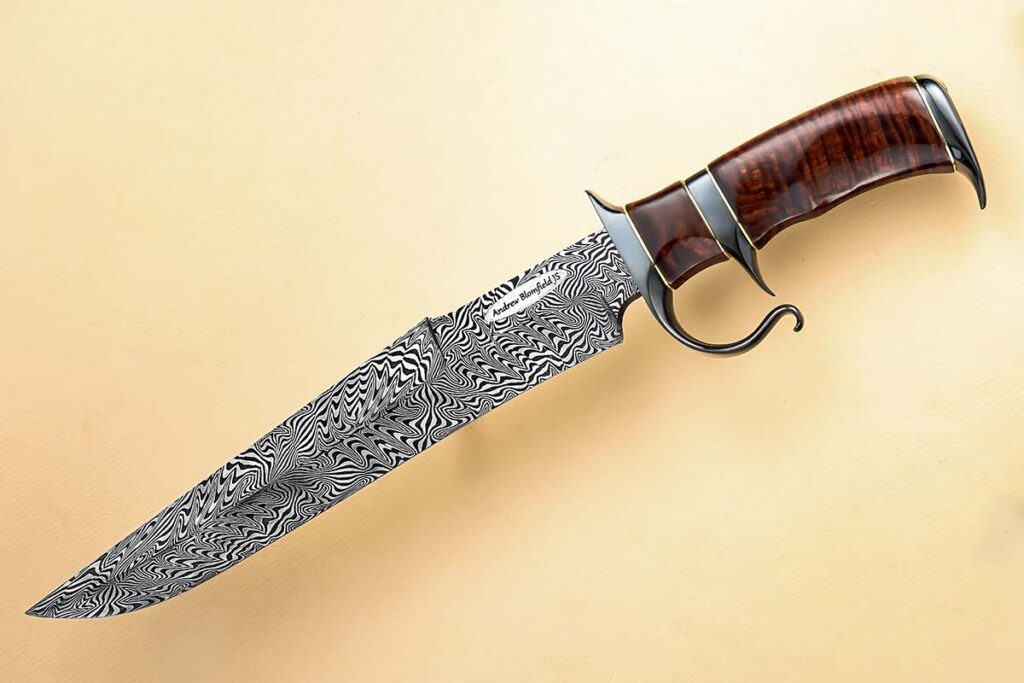
Andrew Blomfield: Sub-Hilt Bowie
ABS master smith Andrew Blomfield’s sub-hilt bowie is a tour de force of explosive mosaic damascus, salt-blackened steel, brass spacers, and exquisite Australian ringed gidgee wood. Blade and overall lengths: 11 and 16 inches. (SharpByCoop knife image)
An ABS master smith from New South Wales, Australia, Andrew Blomfield enjoys building large knives such as bowies and daggers. “The bigger the knife the better,” he states. An example is his sub-hilt bowie.
“I feel that this knife has great flow and balance,” he begins. “The blade is an explosion mosaic pattern damascus hardened to 59 HRC. The guards and pommel are salt-blackened steel with brass spacers and the handle is a beautiful piece of Australian ringed gidgee.”
The guard’s bottom quillon curves back toward the sub-hilt to partially enclose the user’s hand a la a D-guard, but also has hints of both a C- and an S-guard to it. Very unusual!
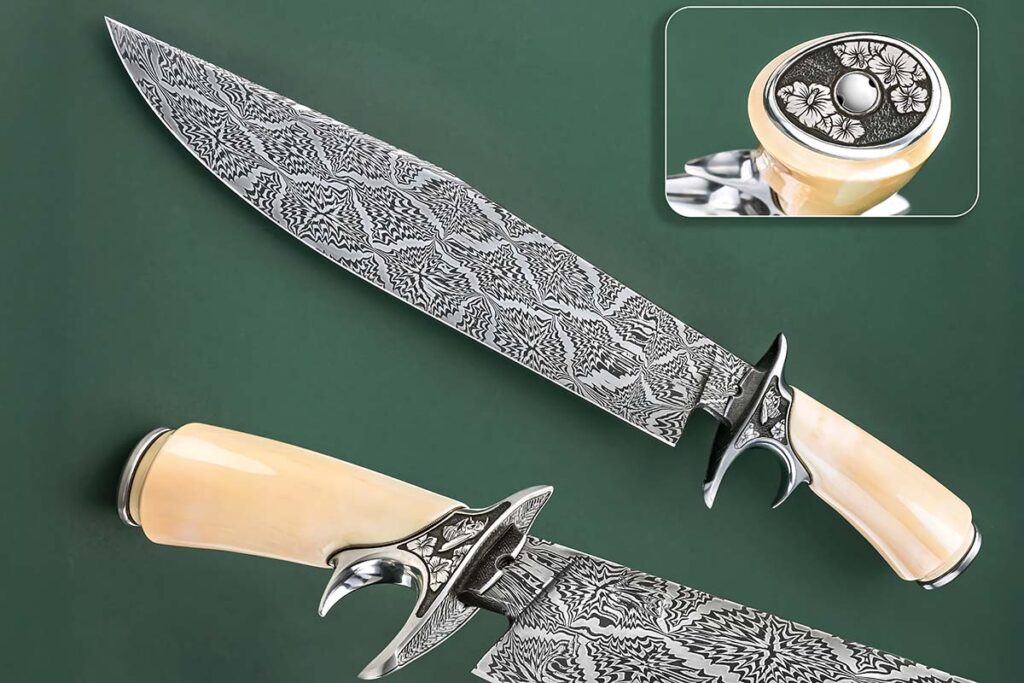
Andrew Meers: Rose of Sharon
ABS master smith Andrew Meers calls his 16.5-inch sub-hilt fighter Bees and Flowers, due in no small part to the Rose of Sharon and bees engraving. The 12-inch blade is a damascus of 1084 carbon and 15N20 nickel-alloy steels in a mosaic pattern. Guard and furniture are 416 stainless steel. Overall length: 16.5 inches. (SharpByCoop knife image)
ABS master smith Andrew Meers of Raleigh, North Carolina, says, “I started with the sub-hilt in mind, which is a departure for me.” To say his deviation from the norm worked out well is an understatement.
“I like to incorporate Japanese influences wherever I can, and I wound up adding an integral habaki into the guard design as well,” he explains. “I wanted a blade that was able to feature a mosaic pattern, so I chose a broader shape that expands towards the point rather than tapers. The handle is a simple design to contrast the visual complexity of the guard.”
The engraving theme is of the Rose of Sharon and bees.
“The client had requested a floral theme, and we worked on the rest of the design and layout from there,” Andrew says. “The engraving was meant to complement the layout of the guard and furniture.”
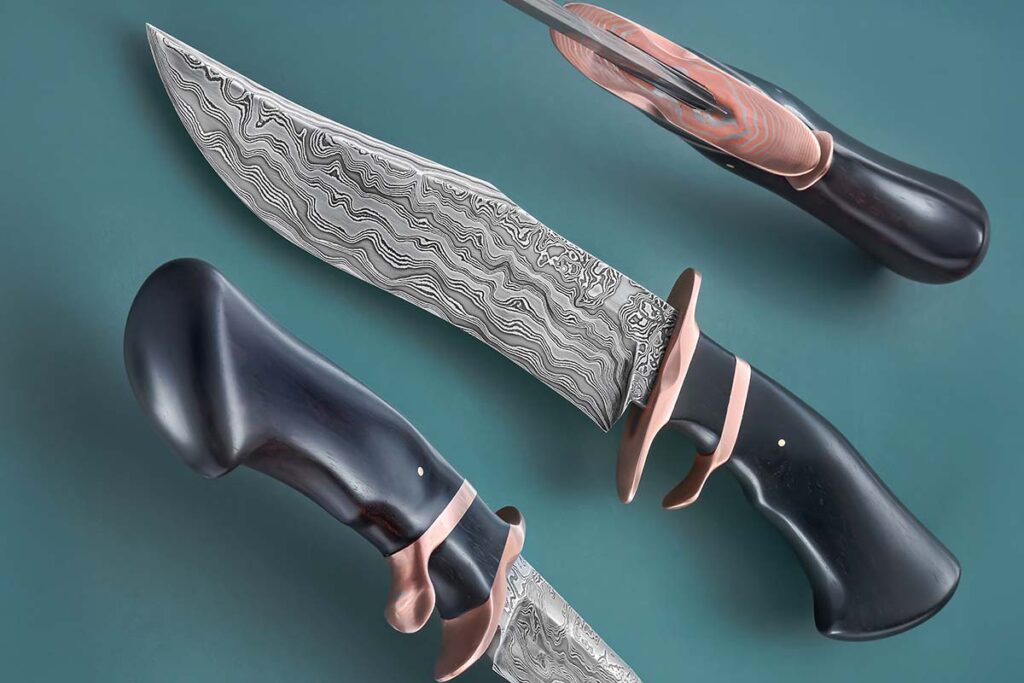
Justin Harrington: A-Team
Built for an Army buddy, Justin Harrington’s superb sub-hilt fighter incorporates a masterful balance of random pattern damascus, mokumé gané and African blackwood. Blade and overall lengths: 8.5 and 13.5 inches. (SharpByCoop knife image)
Justin Harrington of Clemmons, North Carolina, began smithing 18 years ago and is the owner of Cyclops Forge. Of the sub-hilt he says, “It’s the racecar of fighting knives—weight, balance, curvature, tip control and placement all are important variables to be employed to reach a harmony which is felt right away when correctly done.
“This knife started its life as a phone call from an Army A-team member who wanted a special combat retirement gift for his buddy. The three of us got together and forged a damascus billet for the knife over three days in my shop. The 8-inch recurve blade is a random-pattern damascus of 1084 and 15N20 carbon steels. The guard and sub-hilt are made from a copper-and-nickel mokumé gané I make in my shop. The handle is around 5 inches of sculpted African blackwood with a bronze pin.”
The sub-hilt has a forward lean and spoon-cupped quillon that slants toward the guard to capture the user’s index finger. The result is a handle that seems to want to grab your hand.
Cool & Sexy
Whether fighter, bowie or what have you, the sub-hilt-knife genre may be more recognizably custom than any other. From the classic Loveless Big Bear fighter to the wide array of today’s renditions, top sub-hilts are cool, sexy and in harmony with the best custom knives extant.
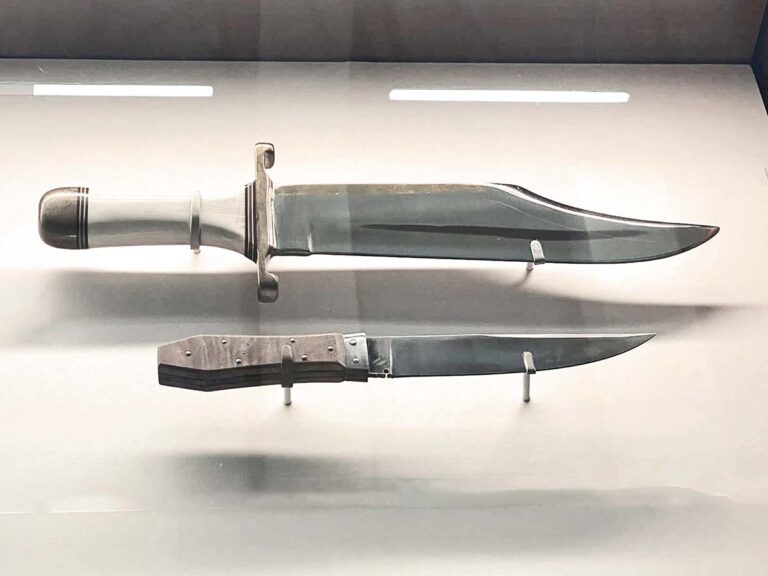
John Dennehy’s replica of his father’s Dan D Alamo Bowie, was accepted by the site on the 190th Anniversary of the historic battle.
We should always remember the Alamo, but 2026 is a particularly good year to keep the battle top of mind. It’s the 190th anniversary of the defining fight for Texas independence, and a fitting backdrop to a father-son knifemaking tale.
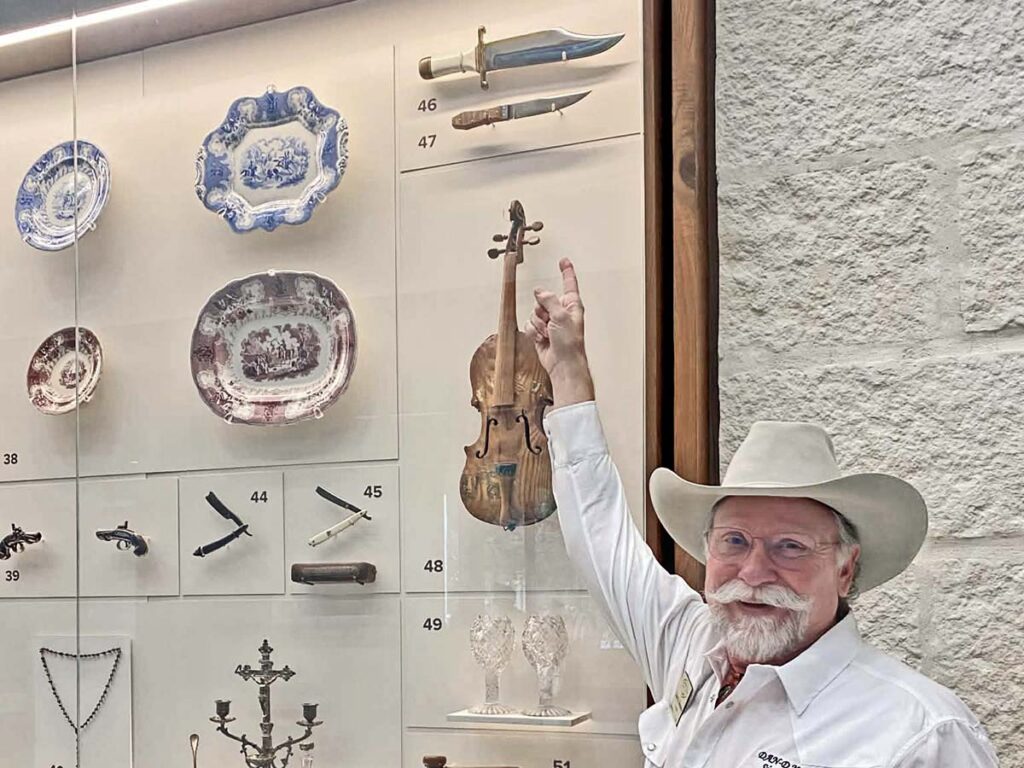
When Dan Dennehy donated his custom Dan D Alamo Bowie to the Daughters of the Republic of Texas in 1968, little did he know that a reproduction of the very same knife would be presented almost 60 years later to representatives of Alamo Trust just a few months before the historic anniversary of the Battle of the Alamo.
Made by Dan’s son John, the presentation reproduction is based on the original donated by Dan to the DRT in 1968. Save the engraving on the accompanying brass plaque. John did the entire repro project, which included 5/16-inch O1 tool steel like the blade material on his father’s original Dan D Alamo Bowie, and an embellished oak presentation frame.
Engraved number 5 of 10 by Pearce Richardson, the brass plaque reads: “Commemorative Dan D Alamo Bowie” over “In Honor of Those who Lost their Lives defending the Alamo in March 1836 and to the late Daniel J. Dennehy, Knifemaker, whose Alamo Bowie has proudly been on display at the Alamo since 1968.”
“It’s an honor that we can say we have knives from a father and son in our collection,” Alamo Senior Researcher and Historian Kolby Lanham said. “We are grateful to both Dan and John, two generations of knifemakers who chose to create works of art honoring James Bowie and the Alamo.”
John’s project started soon after his father’s death in 2011.
“The Alamo let me take pictures of Dan’s original knife in the spring right after his death,” he said. “I used those pictures and his knife pattern to make the reproductions. I wanted to jazz up the handle a bit since they are special editions with ivory Micarta and imitation ivory Micarta, along with some brass spacers for bling.”
From his own retelling of the story, Dan was inspired to make the donation during a visit to the Alamo, when he realized the historic site then didn’t have a single bowie knife. The namesake of the blade—Jim Bowie—was among the heroic men who fought and lost their lives at the battle.
The original Dan D Alamo Bowie is displayed inside the lobby of the Alamo Exhibit at the Ralston Family Collections Center, according to Lanham. John’s knife resides in the Alamo’s artifact vault.
There are other storied knifemakers whose works are displayed at the iconic Texas site, including a reproduction of the Joe Musso bowie by BLADE Magazine Cutlery Hall-of-Fame® member Gil Hibben.
A founding member of The Knifemakers’ Guild, Dan Dennehy was also a member of the Cutlery Hall of Fame and the International Knife Throwers Hall of Fame, and for many years conducted knife-and-tomahawk-throwing demonstrations at the BLADE Show. John makes knives and sheaths and has conducted seminars on how to make sheaths at both the BLADE Show and BLADE University.
New York-born, Dan was always a Westerner at heart, John pointed out, known as “Tex” in the Navy and wearing cowboy boots and a hat most of his adult life. He also loved and revered the history of the Alamo, finding it as sacred a location as native Texans.
“Having one of his knives on display [there] was one of his most cherished accomplishments,” John said.
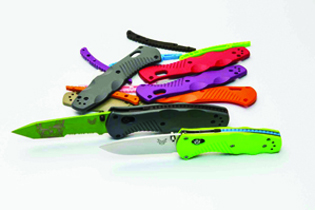
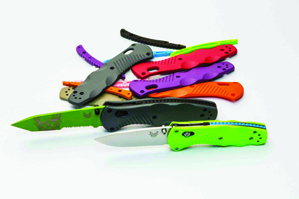
When it comes to production knives, says Dexter Ewing, BLADE® field editor, as a consumer you are not afforded much say-so in terms of aesthetics or blade and handle materials. The knives are offered as-is. But what if you played an active role in helping create your own distinctive production knife? Well, you can. There are a few manufacturers offering build-your-own-knife programs online. They enable you to play a pivotal role in selecting the handle color and material, blade material and shape, and even the coating choices. Be aware that these options and their number vary by manufacturer.
Nonetheless, the end product is a factory knife influenced by and for you. You can custom tailor it most any way you want based on the options provided.
Benchmade offers such a service on its website in the Custom Knife Builder section. Four models are available: large and small Griptilian AXIS™ Lock, and large and small Barrage AXIS assist folders.
“The entire experience is very intuitive and walks the customer through the process of customizing the knife selected,” explains Derrick Lau, Benchmade public relations and communications manager. “Starting with the blade for the Griptilian or the Barrage, customers can select from drop-point or tanto styles …. See the June 2016 issue of BLADE to read the rest of the fascinating feature article. Enjoy!
Great friends to the knife community, Hughes, Klotzli and Rexroat leave a hole publishing, sales and knifemaking.
The knife community lost three great friends with the recent passing of Carolyn Ann Hughes, H.P. Klotzli and Kirk Rexroat, all three of whom were extremely well liked and well respected within the knife fraternity.
Widow of BLADE Magazine Cutlery Hall-of-Fame® member B. R. Hughes, Carolyn served as editor of The ABS Journal, the official publication of the American Bladesmith Society, for many years. She won several ABS honors, including the Margaret Moran Silver Slipper Award. Inseparable at various ABS and other knife events, Carolyn and B. R. helped lead the Society for almost 60 years, as B. R. was one of the four original ABS founding members. He passed away September 17 and Carolyn joined him on February 22. She was 86.
For many years H.P. Klotzli was the headman of Klotzli Messerschmiede of Switzerland, a wholesaler/distributor of Spyderco, CRKT, M-Tech and Fallkniven knives, as well as hi-tech knives made in Switzerland, scissors and more. He took over the business from his parents in 1972 and ran it until 2019. He was among the first to use carbon fiber for factory knife handles, including on a linerlock folder based on a design by Cutlery Hall-of-Famer Michael Walker. H.P. worked on several other custom and factory collaborations as well.
An ABS master smith, Kirk E. Rexroat forged fixed blades and folders part time out of his shop in Banner, Wyoming. He made his first knife in 1981 and did his own engraving. His stag-handle/damascus Rendezvous Bowie was the cover knife for the May 1999 BLADE®. He also designed and built knife prototypes for Al Mar Knives, one of which, the Havana Clipper, was the BLADE Magazine 1998 Most Innovative Imported Design. He passed away February 27 at the age of 67.
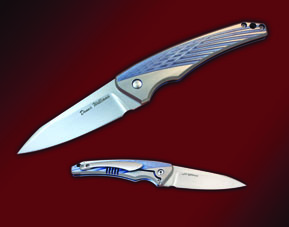
When established knifemaker Lee Williams met Donna, little did he know that he had a future knifemaker on his hands!
As husband and wife, Lee and Donna Williams collaborate on the usual things, like what’s for dinner or where to go on vacation. So why not team up on making knives?
When Lee, already an established knifemaker with a large collector base, met Donna, little did he know that he had a future knifemaker on his hands, or a beautiful and devoted wife!
In a feature article titled “Mr. and Mrs. Sharp” in the June 2015 issue of BLADE®, writer Pat Covert tells Lee and Donna’s story and shows some of the knives Lee has fashioned recently on his own, and collaborative pieces the couple has made together before and after marrying in July of 2014.
As Lee notes, “I started making knives in 2001. I had set up a small machine shop in my garage around 1996,” he recalls. “In November of 2001 I decided to make knives for my siblings as Christmas presents. Twenty-something knives later I had managed to finish knives for all of them, plus their spouses, before Christmas that year. I wasn’t completely satisfied with those first few knives and started doing a lot of research on the Internet.”
The Cherub (above right) is a result of the first collaboration between Donna and Lee Williams as a married couple. (Steel Addiction Custom Knives image)
Learn both basic and advanced knife making techniques with expert instruction from Allen Alishewitz in Tactical Fixed Blades. Allen demonstrates how to craft a double-edged tactical fixed blade knife from start to finish, and creates two knives in order to fully illustrate the knife building process. You’ll learn:
– Profiling and Drilling the Knife
– Tang Tapering on a Grinder
– Tang Tapering on a Mill
– And more!
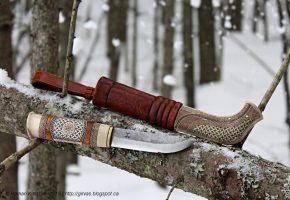
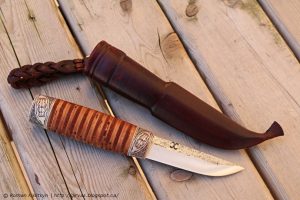
This Roman Kislitsyn sheath is made in North Sami style with a pronounced hook, which interferes less when sitting. The 4-inch blade is made by Pasi Hurttila in 80CrV2 steel. The handle is reindeer antler and birch root burl.
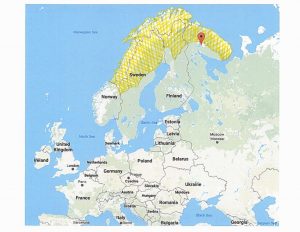
Roman Kislitsyn grew up in Apatity in the Murmansk region of northwestern Russia. Close to Norway, parts of the area also include the lands of the Sami people (in the past referred to as Lapps or Laplanders) which traverse the Kola Peninsula of Russia, and the northern and coastal regions of Finland, Sweden and Norway. Roman and others in his family are geologists so he spent much of his childhood with outdoorsmen, hunters, fishermen and those expert at surviving in the Russian wilderness. Always an admirer of Finnish and Swedish knives, Roman was most drawn to the beauty of the knives made by the Sami, the native reindeer herders of Scandinavia.
Roman Kislitsyn makes Sami-style knives.
Roman’s exposure to knives and survival equipment, combined with a love of crafting things with his hands, led to his first attempt at knifemaking when he was 15 or 16. “It had a blade made of high-speed steel from a piece of mechanical saw, wooden handle made of birch burl, and simple leather sheath, but I was very proud of myself,” Roman related. He made a few more knives, left to attend university and life intervened. A few years ago, he returned to knifemaking and cannot stop.
The traditional Sami lifestyle depends on reindeer herding, hunting and fishing. Roman explained that the design of their knives developed over the course of hundreds of years. They also mastered their own style of decorating things made of reindeer antler. “I like to use Sami-style decoration on my knives too. Even though I’m not Sami, but this makes me feel my connection to the land where I grew up,” Roman stated.
Sami lands, in yellow, historically reached farther south, encompassing Roman’s home region, marked in orange.
Roman makes two types of knives, either Sami style or Finnish puukkos with Sami-style carvings. He does not make his own blades. Some Sami blacksmiths existed, but using blades made by other makers was, and still is, a common practice.
Roman works with high-carbon steel blades made by his friend Alessio Salsi in Belgium. Lately, he’s also being trying laminated and pattern-welded steels. Since Roman makes Scandinavian knives, the grinds are all Scandi. He used to employ blades made by Pasi Hurttila from Finland before Pasi stopped making knives. Roman also used blades made by Randal Graham in Nova Scotia. Randal took a hiatus from knifemaking but has now returned, and Roman hopes to resume collaborating with him.
Roman Kislitsyn put a stacked birch bark handle on this 3.2-inch Pasi-Hurttila-made 80CrV2 blade. Carvings on the antler are in Sami-style. Bark handles are popular for Finnish puukkos; they never get slippery or cold, even below freezing.
Roman is self-taught, learning everything about knifemaking and carving through the Internet, forums and social media. With the exception of light use of a hand-drill and a Dremel, Roman uses only hand tools. “No grinders, sanders, band saws, nothing. Only files and rasps, only hardcore!” he explains. Roman’s goal is to make “functional art,” as one of his customers put it, and not a knife that just sits on a shelf. His favorite handle materials are reindeer antler in combination with birch burl and-or bark, which are all traditional materials in Sami-style knives. Maker’s list price starts at $450 US.
Roman left Russia in 2002 and now lives in Nova Scotia, but you can converse with him through forums like British Blades, Canadianknifemaker.ca and the Russian forum zadi.ru. His website and blog are at Girvas. “Girvas is a name of a lake in same region where I’m from,” Roman added. It is the Russian pronounciation of the Sami word hirvas, meaning “reindeer stag.” You can visit Roman on Facebook at Roman Kislitsyn or on Instagram @roman.kislitsyn. You can e-mail him at [email protected].
The CRKT Homefront is the 2017 BLADE Show knife, and won last year’s Most Innovated Imported Design.
The CRKT Homefront is a Ken Onion-designed knife that won Most Innovative Imported Design at last year’s BLADE Show. The field-strip technology allows for easy cleaning anywhere, without tools. Get yours now for $70 and you’ll save 30% off this true collector’s item.