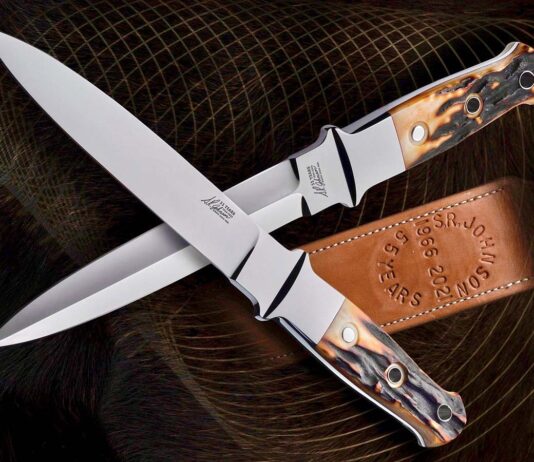
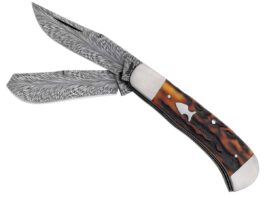
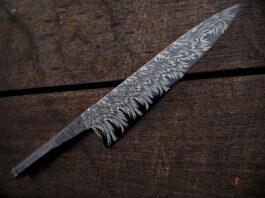
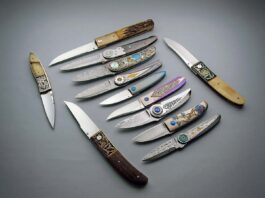
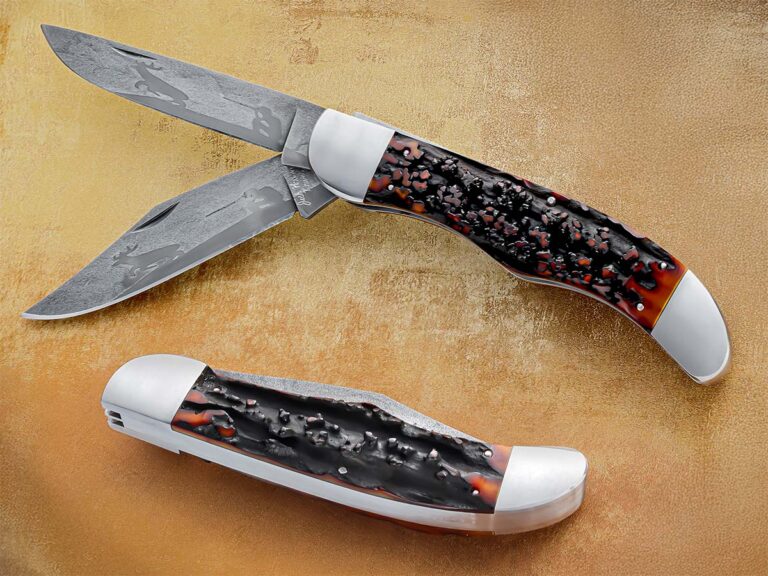
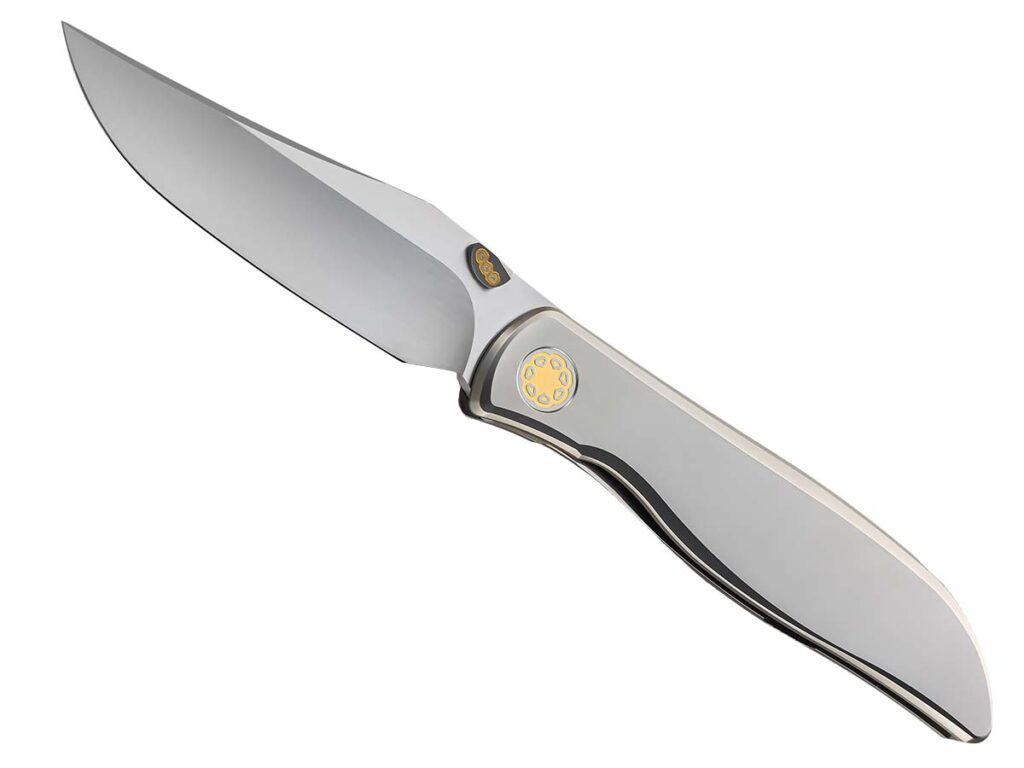
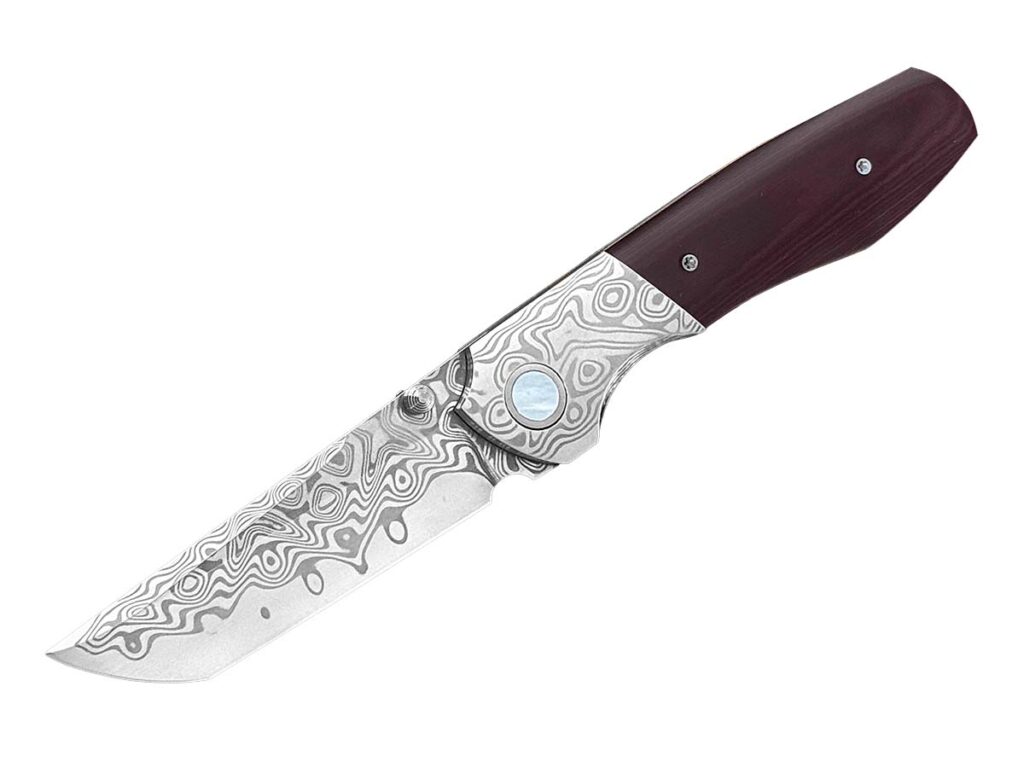
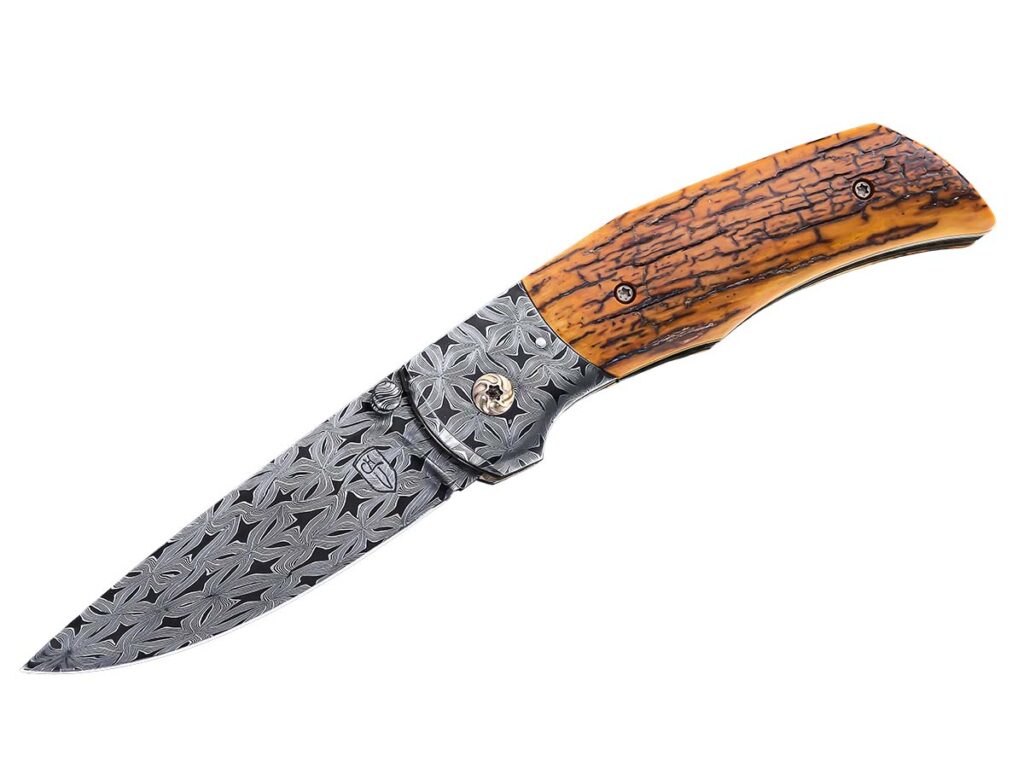
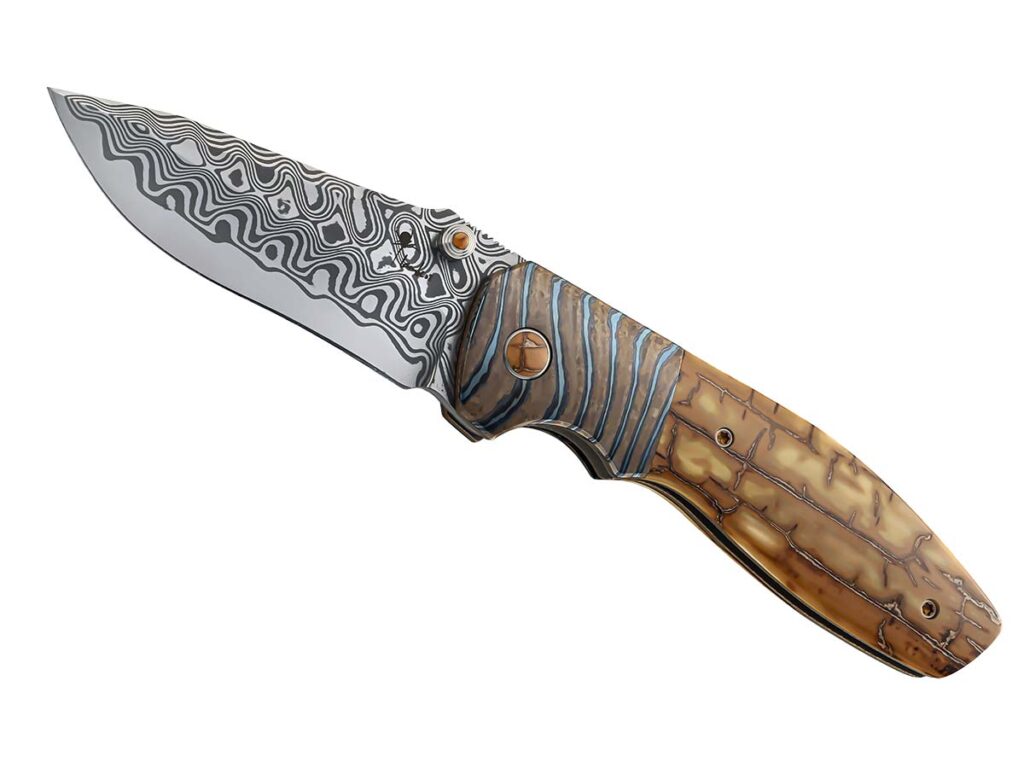
Knifemaking is the building of a knife, which includes the blade, handle and other accouterments. Blades are made by either removing metal from a steel blank via a grinder – known as stock removal – and the forging to shape of hot steel into a blade in the process known as bladesmithing. Other parts, including bolsters, guards, pommels, etc., are needed to complete the finished knife.
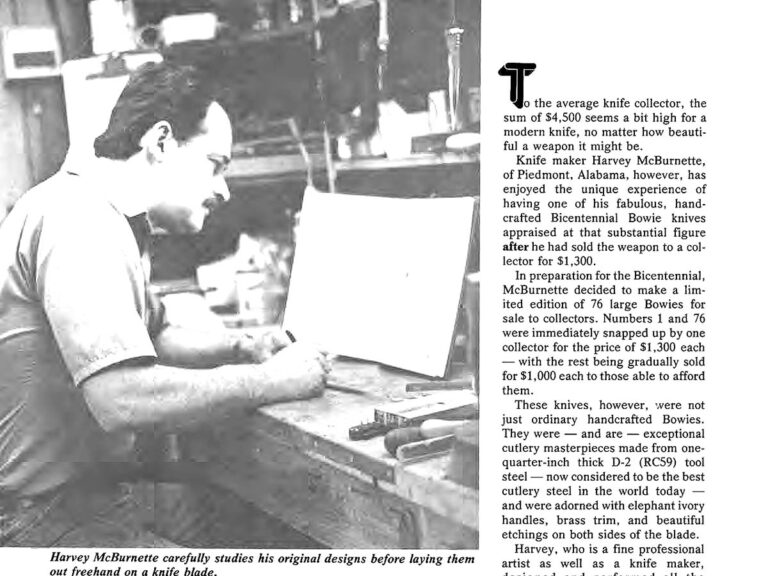
Harvey McBurnette etched his name in high-dollar knife sales.
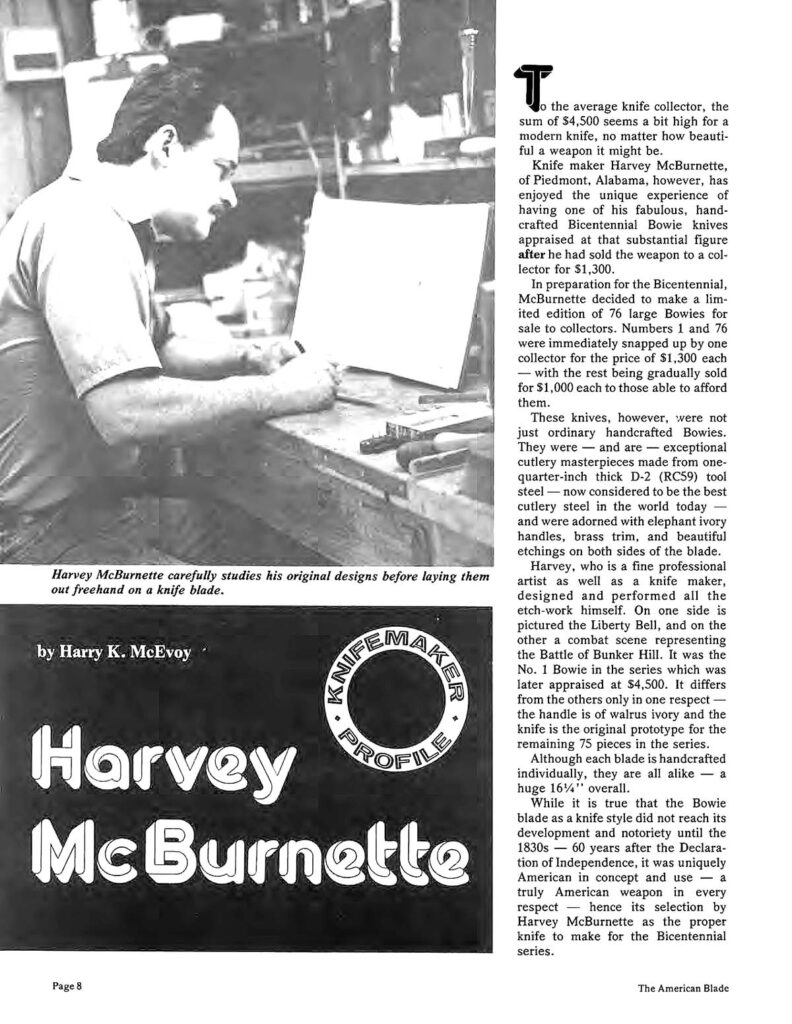
Harvey McBurnette of Piedmont, Alabama, landed in the July-August issue of the 1976 American Blade for somewhat patriotic reasons. Somewhat, because the lead of Harry K. McEvoy’s exposé on the maker was McBurnette’s celebrated Bicentennial Bowies. But there’s more to the matter than a simple commemoration of the nation’s birthday in steel.
McEvoy hooks readers by showing what the artistically talented knifemaker’s work commanded back when your dollar went a long way. In 1976, the exact sum was $4,500. As McEvoy wrote, “[O]ne of his fabulous, hand-crafted Bicentennial Bowie knives appraised at that substantial figure after he had sold the weapon to a collector for $1,300.”
The lead image of the profile on Harvey McBurnette shows him studying his original knife design and free handing it to the steel. The maker had a strong artistic streak and was known, in part, for the embellishments he etched onto his knives.
For context, that’s roughly $26,000 in today’s dollars. What likely made the run of 76 bowies desirable was McBurnette’s unique system of adorning the knives—etching. This system, seen on many of his knives, was a very conscious choice on the maker’s part, as the story reports, serving to differentiate his work from other custom craftsmen of the day.
“I wanted to do something unique, or at least different, with my knives,” McBurnette was quoted as saying in the article. “And since I was an artist I thought if I engraved or etched my blade, I would add a touch I felt was needed to make them stand out. I chose the art of etching because there were a few other knife makers who engraved their knives. Besides, even a master engraver cannot do what an etcher can do.”
McBurnette’s Bicentennial Bowies had quite a motif etched on either side of their D2 tool steel blades. On one side of the 16.25-inch knife is an image of the Liberty Bell, and on the other a battle scene depicting Bunker Hill. The images are the same on all 76 knives, and 75 of them had elephant ivory handles. The knife appraised for the then astronomical sum did differ; the No. 1 of the series was a prototype with a walrus ivory handle.
Master smiths explore the symmetry, skill and survivalist roots of a classic.
It’s part adventure with a bit of notoriety and a dash of creativity. For the modern custom knifemaker, several styles are brought to life with history in mind. And the push dagger is one of them.
Maybe seldom seen, but always intriguing, push daggers trace their lineage to a bygone era when self-defense at the card table or on the street meant quick deployment from a vest pocket. For sure, that perspective spurs some custom makers to insert the push dagger into their repertoire while the stylized and subtle blend of blade and handle combine for a unique test of shop skill.
“They’re a backup tool,” explained ABS master smith and BLADE Magazine Cutlery Hall-of-Fame® member Steve Schwarzer. “They were typically carried in the 1700s and 1800s along with a one-shot pistol. After that shot, the push dagger was the next position. It’s been around for a long time as an extension of your arm with a blade, and it is hard to take away from somebody that is skilled in its use.”
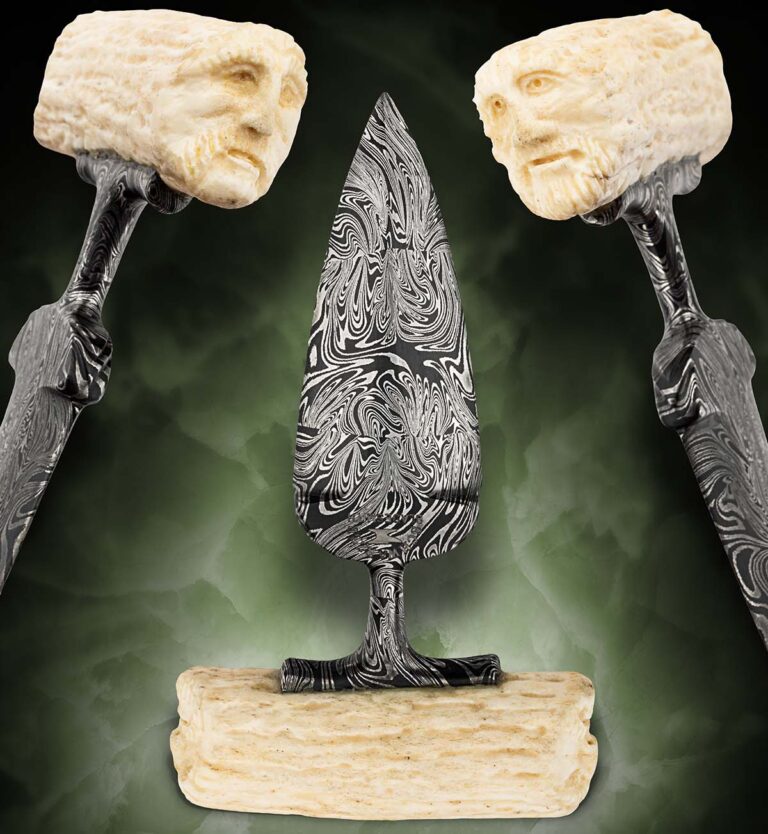
Schwarzer’s featured push dagger with stag handle and evocative faces carved on both ends is 5¾ inches long with a 3¾-inch blade of mosaic damascus steel. He has actually made two push daggers in this style and designed another for Benchmade about 20 years ago. “For me, they’re fun, and that’s why I like to make them,” he commented. “I’ve always had a fascination about them and adapted my martial arts background to training with them. The design traditionally is with a very short blade, and in martial arts, it has to do with the alignment of the hand and arm bones, along with the shape of the blade, which is double-edged traditionally. Everything in nature is curved for an effective cutting surface.”
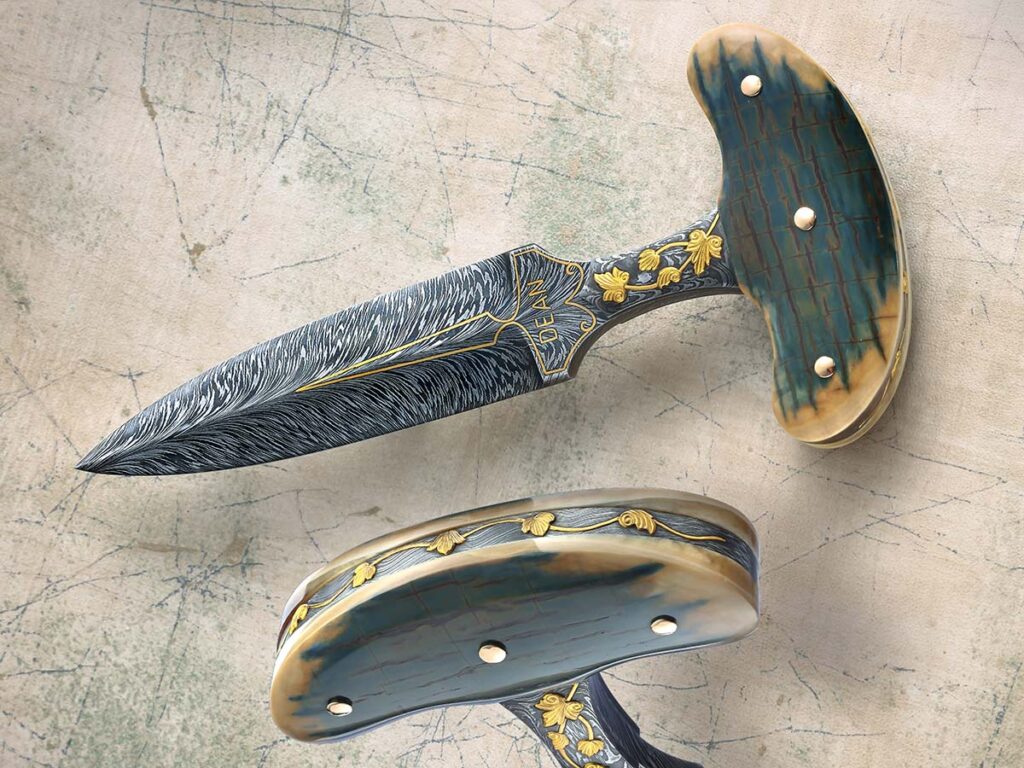
Harvey Dean Tejas
Why a push dagger? Harvy Dean (inset) puts it succinctly, “They’re just cool.” That certainly holds true for his Tajas push dagger, with an elegant feather damascus blade, 24k gold raised vine work and a fossilized walrus tusk handle. At 16 1/2 inchces in length, Dean gave himself plenty of knife to decorate. (SharpByCoop image)
Legendary master smith and Hall of Famer Harvey Dean enjoys the historical aspect as well. “They’re just cool,” he offered. “A lot of people made them back years ago, and there was the idea of concealing them in the vest. Some were made with nickel-silver scabbards and called lapel knives because they were pinned under the vest or coat lapel.”
Dean’s pictured Tejas push dagger is a departure from standard sizing, with an overall length of 16¼ inches, with an 11-inch ladder pattern damascus blade and handle of fossilized walrus ivory. But then, everything is bigger in Texas.
“I’ve always liked [master smith] Larry Fuegen’s push daggers, and his work has had a lot of influence on mine,” Harvey said. “You really make them like any other knife, and I usually do around two or three a year. I like to use ivory and damascus and a stag handle is next up. I don’t do many plain ones, and most of mine are with two-piece handles. As far as marketing is concerned, you’ve got to have that special person who likes them–but they do usually sell quick.”
Hawks Nest Custom Push Talon
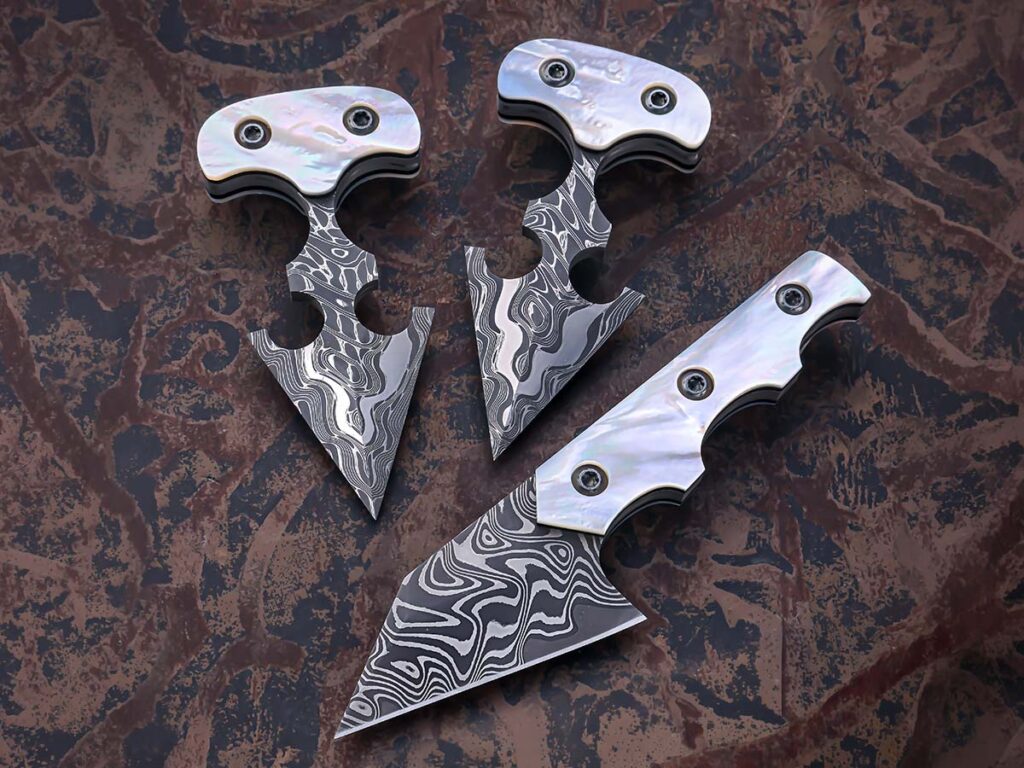
Matt Hunter (inset) has always had a thing for concealed carry knives, but admits his mother-of-pearl handled push daggers were his first crack at the style of knife. Angular and wickedly attractive, the Nichols Slither Armor Core stainless damascus daggers were designed as a matching set with his HawkWing knife, also pictured. (SharpByCoop image)
Damascus blade, mother-of-pearl handle and variations on the push dagger theme highlight Matt Hunter’s work at Hawks Nest Customs. He is a huge fan of concealed carry knives and started down the road with a boot dagger, neck knife and then his Push Talon.
“I think any dagger is challenging due to the symmetrical grinds that are required,” he noted. “You’ve really got to nail each and every one of them or the entire build needs to be scrapped. These push daggers are made with Nichols Slither Armor Core stainless damascus and mother-of-pearl on Westinghouse black canvas Micarta liners. “Believe it or not, these were my first push daggers,” Matt added. “These were originally made for a customer to match the HawkWing, which is also in this photo. I told him I was planning on doing a pair of matching push daggers, and he asked if we could do the mother of pearl to match his knife. So, I obliged.”
Zack Jonas Totem
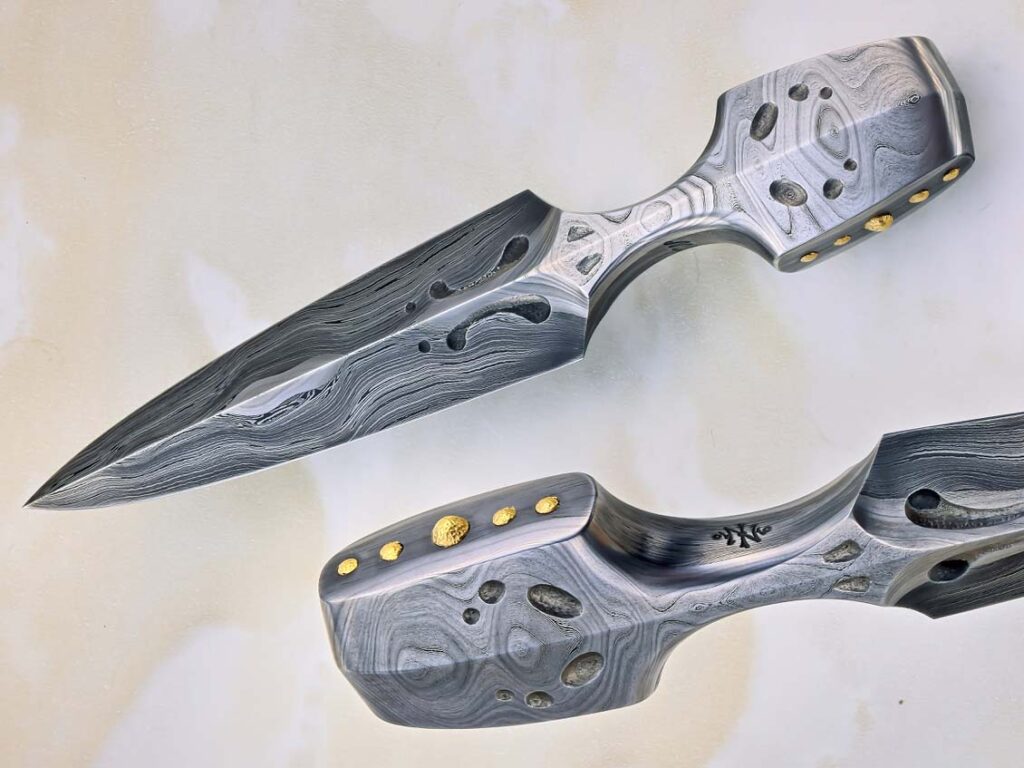
A study in starkness, Zack Jonas’ Totem push dagger grabs the eye with its clean lines and depth of damascus. That’s a san mai steel with laddered W’s and faces in a 1,000-layer laminate with pure nickel. Adding to its Spartan charm are its gold handle accents. (SharpByCoop image)
The Zack Jonas push dagger featured is his Totem model with a blade length of 4 inches and an overall length of 6½ inches. Its gold handle accents complement a san mai steel with laddered W’s and faces in a 1,000-layer laminate with pure nickel.
“The push dagger is one of the few knives that is actually designed to be folded into a tightly closed fist,” the master smith explained. “That means you have to make sure the handle comfortably conforms to the shape of the human hand in that unusual position. A push dagger is not a particularly functional tool outside the very limited frame of hand-to-hand combat; if you don’t have a secure grip when you need it, you’ve got a real problem.
“There are few makers that come to mind as design influences,” Jonas concluded. “[Master smith] J.D. Smith’s early influence on my career is never far from my hand or eye. I also think of Peter Johnsson’s work as I’m designing. He has never done a push dagger that I’m aware of, but I like to try and channel the way he conducts tension through his lines. Peter and [master smith] Kevin Cashen both come to mind when I think of the functionality in any dagger.”
Andrew Meers Rose Of Sharon
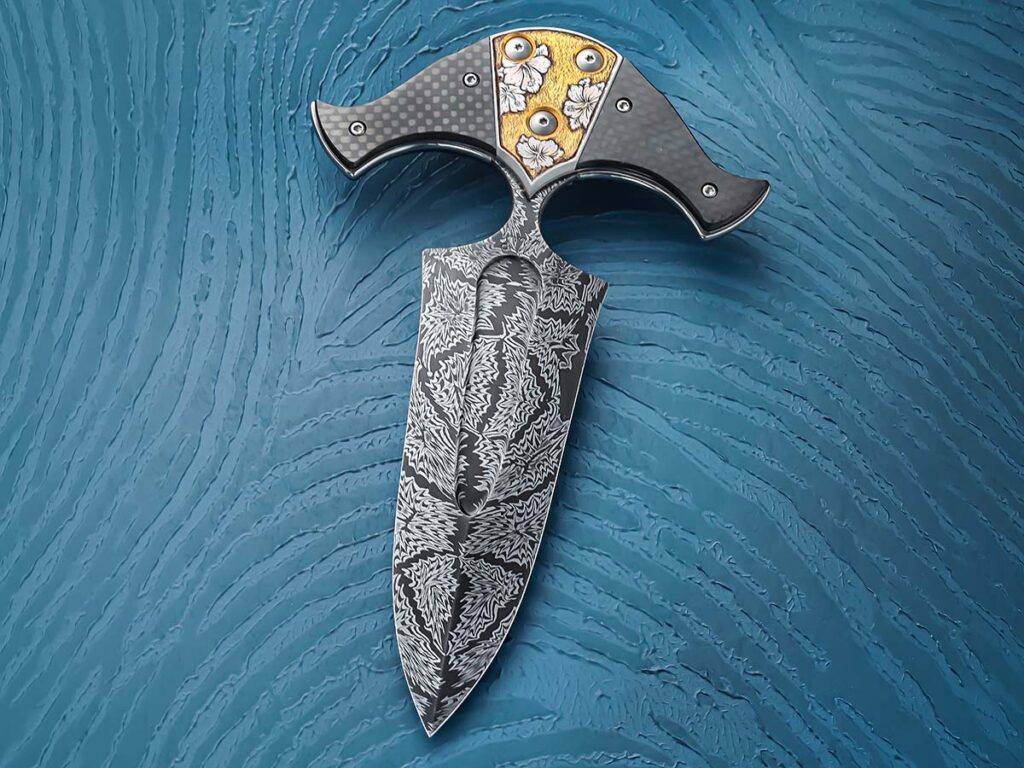
A bold mix of materials, Andrew Meers utilizes carbon fiber, stainless steel, gold and a splintered mosaic damascus to bring-together this 9-inch push dagger. The centerpiece of the knife is its elegant Rose of Sharron engraving with the gold backing. (SharpByCoop image)
Andrew Meers included a push dagger in his ABS master smith set, which was complete with forged trout iron texture engraved with pangolins. “Push daggers have a place in my childhood memory,” he related. “I remember seeing one at a museum and being fascinated. In retrospect, I think having mostly seen conventionally handled pieces in media and collections, the manner in which the hand engages the handle is what is attractive to me.”
Meers’ featured push dagger is his first with a carbon fiber handle and a groove in the blade. Its 7-inch damascus blade is framed in stainless steel, and the engraving depicts the Rose of Sharon with a gold-plated relief background. The entire push dagger is 9 inches long. Andrew produced his first push dagger in 2014 and has made several since. His longest measured between 23 and 24 inches.
Jean Potvin Romanesque
Since push daggers are illegal in Jean Pierre Potvin’s homeland of Canada, he had to come up with a clever trick to get his his Romanesque push dagger past airport security and to a buyer at a show in Las Vegas. His solution, remove the illicit handle and replace it with a toilet plunger handle. (SharpbyCoop image)
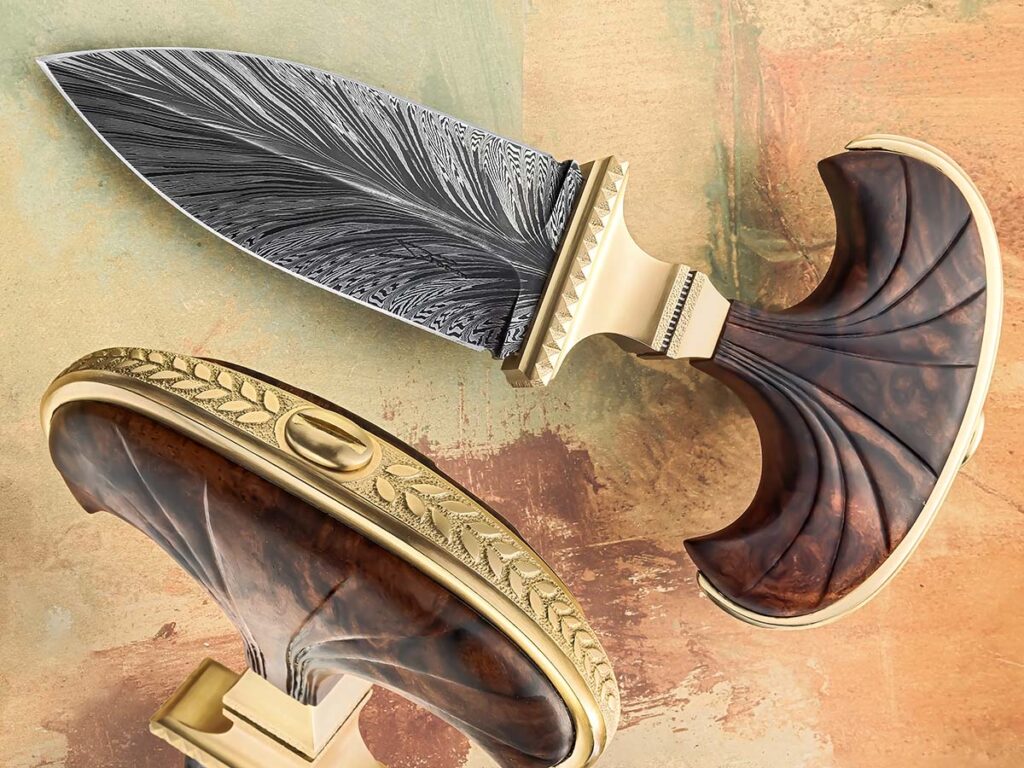
“This push dagger is Roman in style,” remarked Jean Pierre Potvin. “It came about quite by chance. I rarely design in advance when I create. I prefer to let my imagination run free and follow new ideas that present themselves during the making process. During the making, I saw that it had a somewhat Roman style, and I continued in that direction with this result.”
Potvin’s push dagger measures 8 inches overall with a 4½-inch blade of damascus in 15N20 and 1084 carbon steel. The handle is fashioned from stabilized walnut burl and brass furniture. He had previously made only one push dagger. That was in 2022, and it was much smaller. “I had a buyer at the Nashville knife show,” he remembered, “and I had packed it in my luggage to take there. But when I got to the Montreal airport, it was confiscated by airport security.”
Since push daggers are illegal in Canada, that experience inspired Jean Pierre to remove the actual handle and replace it with a toilet plunger handle the next time he traveled with a push dagger. He made it to Las Vegas that second time and reattached the original handle after arrival. “It’s really funny because it’s the same dagger, but having a cross handle makes it illegal,” he smiled. “Sometimes you have to use tricks to get what you want.”
Somehow, the push dagger and its adventurous history seem to fit right in with Potvin’s novel experience.
Check Out More Cool Customs:
Cool Custom: Tony Lewis’ Tribute Knife To Steve Dunn
Cool Customs: Rocco Nawrocki’s Knife For Sergeant Bunker
Remembering a dedicated craftsman of the Fujisaka lineage known for his tactical precision and collaborative artistry.
Keith Derrick Ouye, award-winning knifemaker of Honolulu, Hawaii, passed away on October 5. He was 80.
A stocky, happy guy well-liked by both knife enthusiasts and his knifemaking peers, Keith primarily made tactical knives, though he also built hunting knives to sell at local gun shows. In addition, he made fancy folders, often with fine engraving by Bruce Shaw, C.J. Cai or Lisa Tomlin. Keith exhibited his work at the BLADE Show and other top knife events over the years. Like many Hawaiian knifemakers, he was a student of BLADE Magazine Cutlery Hall-of-Fame® member Stanley Fujisaka.
Born in South Hilo, Hawaii, Keith lived in Hawaii Kai on the island of Oahu. “I spend most of my day working on my knives,” he wrote in his mini-bio on the Arizona Custom Knives website. “With assistance and guidance from Stan Fujisaka, I started to make fixed blades in early 2004. By the end of 2004, I also started making folders. I began making knives full-time in 2005.”
Keith was a big believer in sole authorship, noting “except for the screws, dowels, standoffs and pivots, I fabricate the rest of the knife myself.”
Remembering Others The Knife Industry Has Lost:
Betty Dowell, Driving Force Behind Knifemaker Ted Dowell, Passes
B. R. Hughes, Pioneering Writer And Bladesmithing Teacher, Passes Away
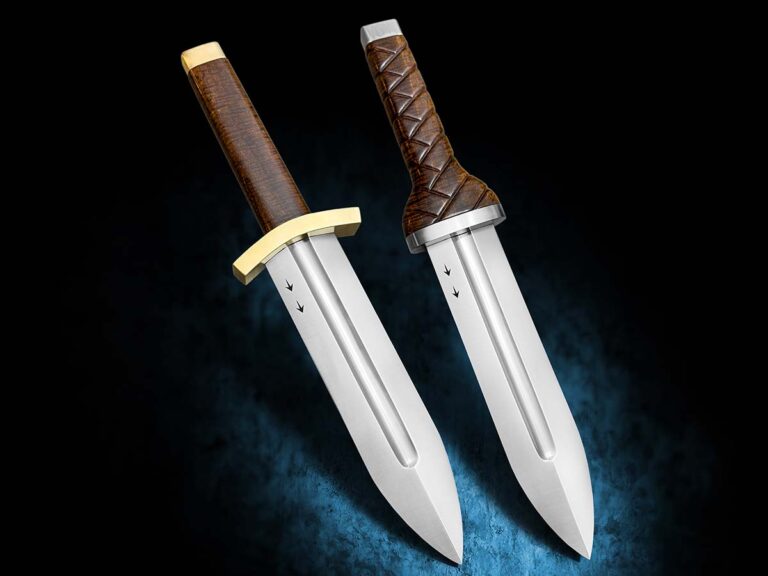
Hu takes the Vinland Saga’s famous daggers from screen to steel.
Anime and knifemaking are seldom mentioned in the same sentence. However, with a pair of striking daggers, an online knifemaking sensation has skillfully forged together that creative gap in cold, hard steel.
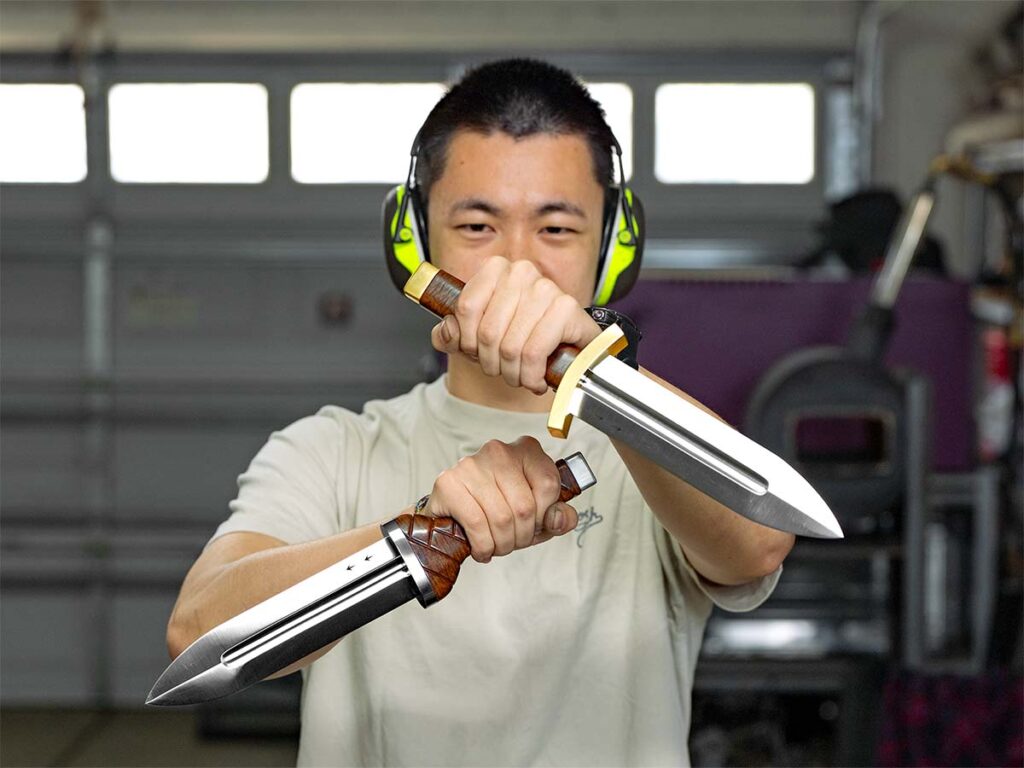
Jesse Hu is a multiple Forged in Fire champion and a prolific YouTube creator. When his online fans demanded a rendition of Thorfinn’s daggers from the popular animated Vinland Saga series, the adventuresome smith didn’t back down from the challenge. However, he set stringent goals for how he wanted the fictional blades to materialize.
“I have seen a lot of people make their own versions, but I haven’t seen any that truly captured their energy from the anime,” Hu said. “I felt it was possible for me to make a pair of daggers that fans would feel I directly pulled from the screen.”
The results are a spot-on set of daggers boasting 81/2-inch blades of 80CrV2 steel with carved Ringed Gidgee handles and one with a 1/2-inch-thick brass guard. Hu’s carving emulates the animation’s leather-wrapped look. While there is little actual Viking in the daggers’ overall design, the maker’s choice of wood for the handles did inadvertently bring a touch of the historic accuracy to the fantasy knives.
“One thing I discovered from a friend was that there were a bunch of carved wooden handles on Viking-era blades,” Hu related. “But I only heard about this after I had finished the daggers.”
Hu estimates he put two weeks of work into his rendition of Thorfinn’s daggers. In the end, the project was a labor of love, with Hu compensating himself by keeping the daggers. (Jesse Hu image)
The greatest challenge in bringing the two-dimensional blades into the physical world came from the inconsistency of the source material. In the anime series, Thorfinn’s daggers can change from scene to scene, forcing Hu to hit a moving target.
“Some pictures made the handle look rectangular in cross section as opposed to ovular; some made the central fuller look really thin and others quite thick,” he said. “I had to pick and choose from all these images to create something that felt accurate to all of them.”
Studying frames from the series and interpreting how the ink daggers’ ratios translate to steel was a painstaking process. Hu estimates he invested two weeks bringing the anime knives to life. Given the dedicated following of Vinland Saga, he figured the time invested would have paid off—had he not decided to keep them for himself.
“A cool piece doesn’t always mean a smart business decision,” he quipped.
Check Out More Cool Customs:
Cool Custom: Tony Lewis’ Tribute Knife To Steve Dunn
Cool Customs: Rocco Nawrocki’s Knife For Sergeant Bunker
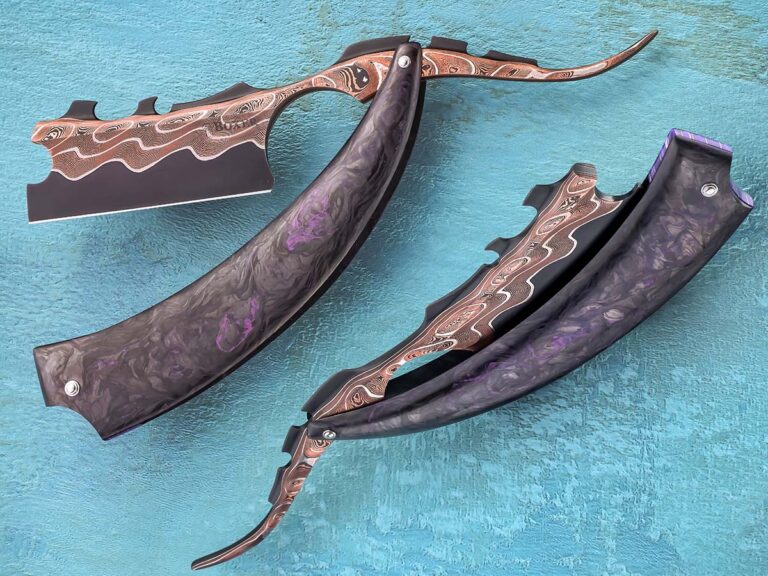
Stuart Kerr just can’t help meddling in the affairs of dragons with his custom straight razors.
Priced out of the custom straight razor market, Stuart Kerr figured he’d make his own. A lucky plunge for anyone who appreciates quirky and unique takes on the ol’ cut throat.
The Australian Knifemakers Guild member’s Cu Mai Dragon is a grand example of his deft and distinctive style. Kerr crafted a 2.56-inch blade from Baker Forge & Tool Tsunami Chevron Copper San Mai and offset it with a FatCarbon Dark Matter Purple Marble carbon-fiber handle. Striking enough as it is, but memorable thanks to the dragon scale on the spine and tang.
However, the proprietor of Boxer Custom Razors is darkly playful in much of his work.
“The concept of the dragon motif evolved from a couple of non-folding razors I made years back that were based on human bones. I was asked to design a razor with a handle that looked like a human spine,” the Queensland, Australia, resident said. “This inspired me to push the artistic envelope further and eventually evolved into the Dragon Tail and Dragon Spine razors.”
Kerr got his start restoring vintage straights, and when he made the jump to crafting them in 2011—aside from know-how—he started somewhat from scratch.
“I had a background in metal fabrication prior to studying to be a mechanical engineer, so I had the tools required to make my first belt grinder out of some plywood and an old pump motor,” he said.
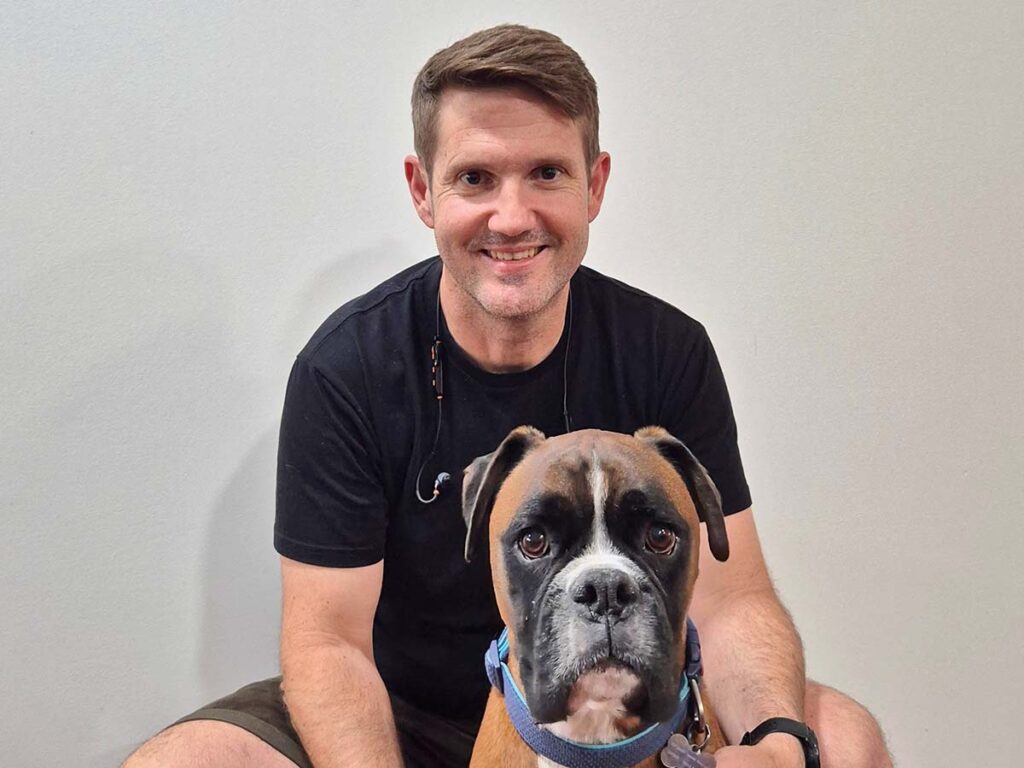
Stuart Kerr and Zeus the boxer.
Requiring an edge meant to split hairs, Kerr’s honing process on his razors is meticulous, to say the least. After the grinding is done, he works his way through whetstones with grits from 1,000 to 16,000. Then it’s a few laps on balsa loaded with chromium oxide.
“Final step is stropping on a kangaroo hide strop,” he said.
A very Australian finish, indeed.
Check Out More Cool Customs:
Cool Custom: Tony Lewis’ Tribute Knife To Steve Dunn
Cool Customs: Rocco Nawrocki’s Knife For Sergeant Bunker
These slip joint knives overcome the mechanical challenges of the style to qualify as works of art.
The slip joint is the most recognized of any folding knife design. Variations on the theme continue to guide the custom knifemaker and the consumer through a journey of creativity and craftsmanship that is indeed endless.
The latest slip joints are true to this standard and don’t disappoint in looks or legs—easy on the eyes while walking and talking at the same time. They complement their makers’ personalities and demonstrate their skill sets in fit and finish, as well as mechanics. They provide pure inspiration for collectors and buyers alike, setting their own standard of excellence.
Standley Caldwell Five-Blade Cattle Knife
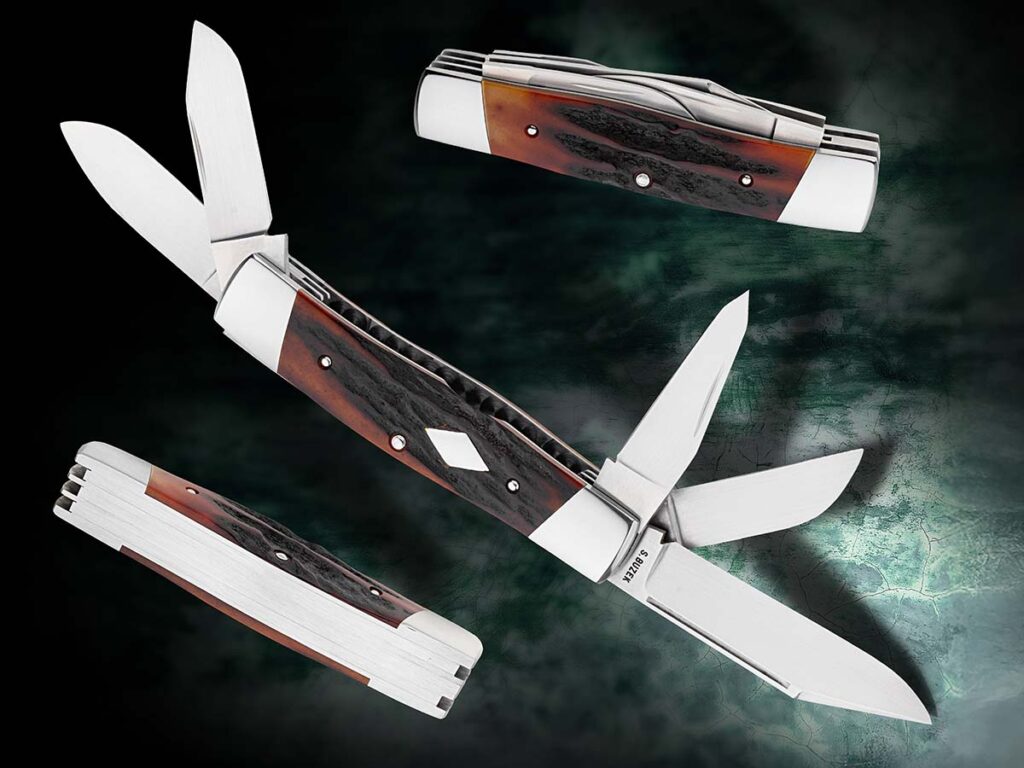
“The five-blade cattle knife is a very difficult build,” Stanley Burzek confesses. Not only are aesthetics at play, but mechanical aspects, such as the blades clearing frame and timed right, not to mention executing multiple grinds. Tackling more complex slip joints has been a natural progression for Stanley. The Texas maker began with single- up to three-blade stockmen but saw the more difficult projects as pushing his craftmanship to the next level. (Jocelyn Frasier image)
A slip joint maker for 18 years, Stanley Buzek of Caldwell, Texas, brought a beautiful five-blade cattle knife to life recently. Featuring a CPM 154 hollow ground blade with 416 stainless integral bolsters and liner, along with stag handle scales, the knife was a particular challenge.
“The five-blade cattle knife is a very difficult build, getting all the blades timed and working properly with everything flush in all positions,” Stanley explained, “and getting the blades to clear inside the frame in such a small area. The multiple offset grinds and the dagger grind of the awl blade make it especially challenging.”
Tackling the cattleman works right into the increasingly difficult projects Stanley has pitted himself against—even if it was a daunting proposition. “The five-blade was just a natural progression from the single-blade trapper, two-blade, three-bladed Stockman, and so on, to push myself to the next level of knifemaking,” he confided. “Actually, the hardest part was just getting over my fear of screwing it up and getting started on the build. It is an intimidating knife to build, having to pack so much into such a small area that you can paralyze yourself with the fear of getting started.”
Buzek got the pattern for the five-blade from Tim Robertson. He drew inspiration from the work of Tony Bose, whom he credits with bringing the pattern back. He has also seen photos of Reese Bose’s take on the pattern.
“I have received help from many great makers through the years,” Stanley reflected. “Bill Ruple and Rusty Preston were a huge help, and the South Texas Slip Joint School that I went to back in 2011 really increased my knowledge in how slip joints actually work. Right now, a lot of credit goes to Tim Robertson for pushing me and helping me with problems and us bouncing ideas off each other.”
Buzek makes all his slip joints with integral liners and bolsters accompanied by jeweling on the interior. He prefers slanted bolsters while gravitating toward natural handle materials such as jigged bone, mammoth and stag. “I think the single-blade slip joint will be the most popular for a long time for ease of carry and ease of build in the custom world,” he predicted. “Multi-blades, though not as popular, will push makers to step outside their comfort zone and show collectors and the general public alike the technicality and perfection and precision at which some of these pieces are made and will help makers improve their overall methods.”
Ted Friesenhahn Two-Blade Trapper
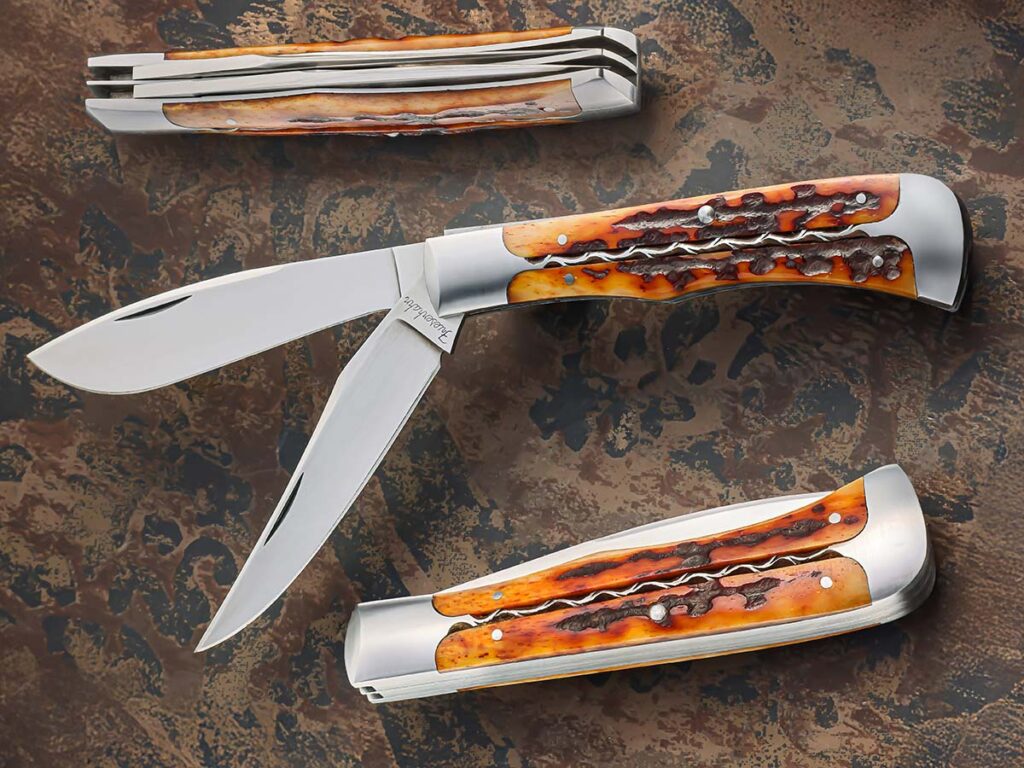
Like most custom makers, the most challenging aspect of the slip joint for Friesenhahn is getting the rise and fall of the blade correct. Add in embellishments, like the delicate vine filework down the center of his trapper’s handle, and the project becomes a taxing undertaking. (SharpByCoop image)
When Ted Friesenhahn took up the task of making his two-bladed trapper, he chose to make the second blade a “simmy” skinner. “This is the most popular slip joint, especially in Texas,” said the resident of Seguin, who has been a toolmaker since the age of 18. “I’ve worked in several different tool shops and have had the pleasure of teaching mill classes at hammer-ins.”
For his trapper, Ted chose a hollow ground blade of CPM 154 with a 416 stainless steel frame and bolster and a jigged bone handle. He added, “All of my knives have integral liners, and in this knife, the center is left standing. I have had this idea in my head for a while before I finally did it. I wanted something different and to be able to embellish it, so I chose to do vine filework.”
The most difficult aspect of the slip joint for Friesenhahn is common to most custom knifemakers—getting the rise and fall of the blade correct and flushed at closed, half stop, and open positions. “Of course, the walk and talk are key after all that fit and finish,” he said. “My first knife was an Old Timer Stockman that I had when I was growing up in the country. I have always carried a pocketknife, so like most makers and knife enthusiasts in this area, I had heard of Bill Ruple.
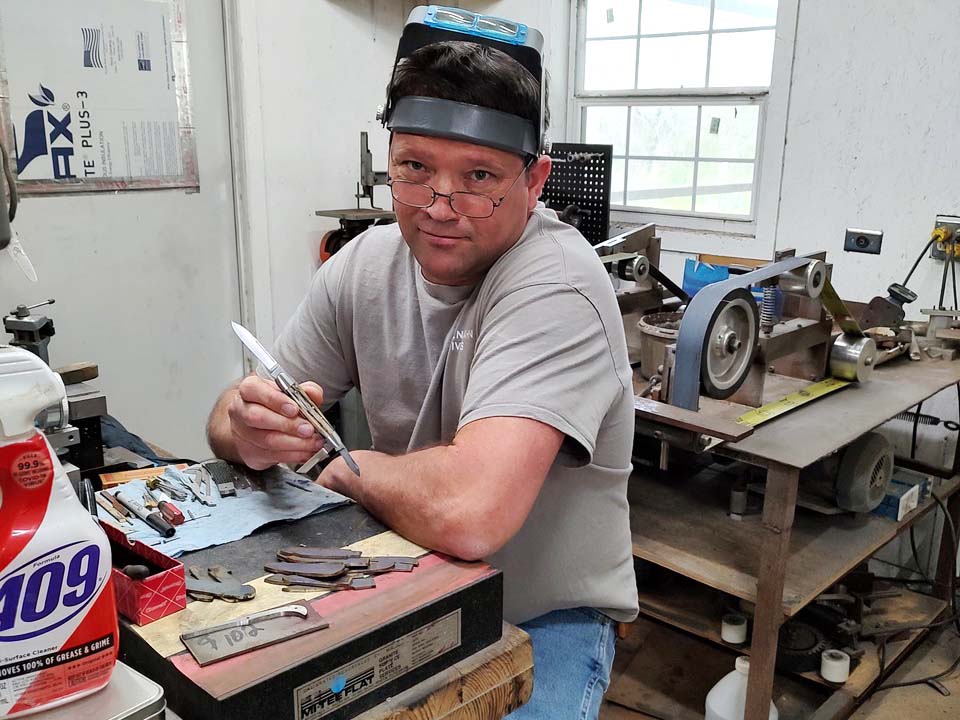
Ted Friesenhahn in his shop.
“Many years ago now, Johnny Stout and [ABS master smith and BLADE Magazine Cutlery Hall of Fame® member] Harvey Dean put on a hammer-in at Johnny’s shop in New Braunfels, Texas, where I first met Bill Ruple,” Ted continued. “He was teaching the slip joint classes, and he had a jig he came up with to measure the rise and fall of the blade and spring. It came to be called the Ruple jig … I still use this jig on every knife I build.”
Interestingly, Friesenhahn sees variations on patterns as emerging in popularity. “The current direction is in patterns being turned into different patterns,” he said, “in multi-blades like the stockman lockback whittler and sowbelly whittler. There seems to be a craze with the whittler, and of course, I have one of these variations in the works.”
Bill Burke Single-Blade Trapper
“This knife came about as a class demo for slip joint folders that I taught at Jim Poor’s Flatland Forge in Tuscola, Texas,” said Bill Burke of his single blade trapper, with a 3-inch stainless damascus blade and blacklip mother-of-pearl handle scale. (SharpByCoop image)
Master smith Bill Burke of Boise, Idaho, recently produced a handsome single-blade trapper with a hollow ground 3-inch blade of stainless damascus steel, blacklip mother-of-pearl handle scales, and 416 stainless integral bolster and liner.
“This knife came about as a class demo for slip joint folders that I taught at Jim Poor’s Flatland Forge in Tuscola, Texas,” said Bill. “The pattern for the class was the ever-popular large single-blade trapper. I added my personal preferences of filework and bolster fluting to this knife, as well as incorporating a piece of Jim Poor’s waterfall pattern damascus into the blade. The only guide I had was a pattern drawn on a piece of paper and e-mailed to me by Luke Swenson.”
Burke has found the most challenging aspect of the slip joint to be mechanical, sharing that observation with other makers. “The most difficult part of any slip joint, at least for me, is getting the timing right so that the spring is level with the frame/liners in all three positions, closed, half stop and open, while also keeping the end of the spring even with the end of the tang in the closed position,” he commented.
“I made my first slip joint folder in about 2001,” Burke continued. “It was a large trapper like this knife. I traced a friend’s knife on a piece of paper and used calipers to measure the dimensions of the tang. This knife was made because I had carried a slip joint pocketknife with me since I was about 5 years old. I can remember sharpening a pencil for a first grade teacher with my pocketknife.
“Over the years, I continued to make slip joints, and they did get better,” he observed. “But I always struggled with the spring timing. Fast-forward 16 years, and a friend of mine from Australia, [journeyman smith] Bruce Barnett, and I went to visit the maestro of the South Texas Slip Joint Cartel, Bill Ruple. We were at Bill’s shop for four days making slip joints. While there, Bill taught me the proper use of the Ruple jig, that little contraption he had put together to make timing of a slip joint something of a science instead of a swag. This little bit of knowledge changed my slip joints from being functional to well-working tools that I am proud of. Bill Ruple and Luke Swenson continue to motivate me to make better slip joint knives.”
As a master smith and forger of knives, Burke sometimes takes on that dimension completing the slip joint. “The only challenge is forging the steel, whether damascus, carbon or stainless, which is not commonly forged,” he advised. “Most people who do forge do not actually forge folder blades but instead forge the steel and then stock remove the blade from the forged steel. There are some who will forge damascus folder blades to get a specific pattern of damascus to follow the curve of the blade shape. This can be seen in the knives made by Owen Wood, Tim Foster, [master smith] Mike Quesenberry and a few others.
“I have forged san mai and damascus folder blades to shape when circumstances made it necessary but do not commonly do so,” Burke concluded. “The challenge making a slip joint knife from forged materials in my opinion is no different than doing stock removal with the possible exception of san mai blades and springs where careful attention has to be paid to ensure the hard core of blade and spring line up precisely so the components stay in alignment, keeping the spring from wandering off to one side of the blade. If this happens and is not corrected, eventually the bolsters will be forced apart and the spring will continue to wear on one side of the blade making the knife useless.”
Bubba Crouch Single-Blade Trapper
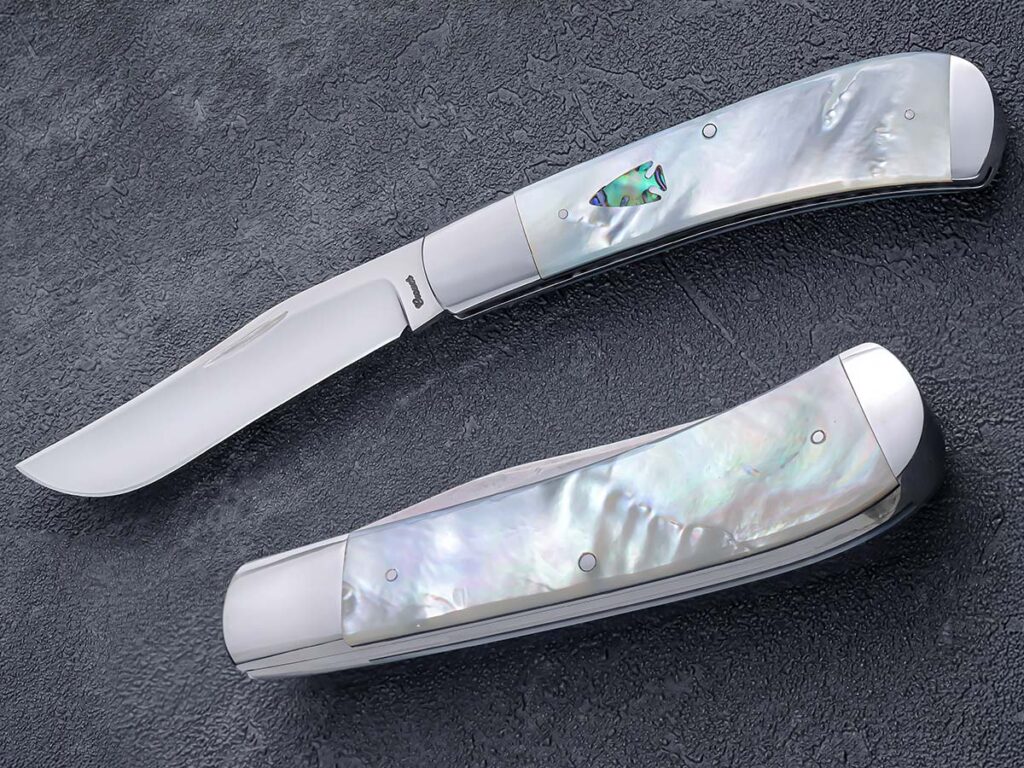
Bubba Crouch points to the influence of Slip Joint Cartel icon Bill Ruple in his career. More than anything, Ruple taught him to “make the next knife better than the last one.” Crouch’s pearl-handled trapper demonstrates that the knifemaker has taken this lesson to heart. The natural scale presented concerns in chipping, shattering, and even burning. (SharpByCoop image)
Bubba Crouch has been making knives in Pleasanton, Texas, since 2001 and lives just down the road from his friend and mentor Bill Ruple. While Ruple is the leader of the South Texas Slip Joint Cartel, Crouch is a founding member and revels in the lively exchange of ideas and the friendly banter that it provides.
Ruple’s influence is pervasive among slip joint makers, and Crouch is no different. “Bill taught me everything I know about knives,” commented Bubba. “I guess the most important thing he has taught me is to make the next knife better than the last one. That is hard to do!”
Recently, Crouch completed and sold the featured single-blade trapper to a resident of Philadelphia. His available knives sold out in two days during the last 10-day Las Vegas show, and the demand for his work is on the rise. This particular trapper features a 3¾-inch hollow-ground blade of CPM 154 stainless steel, an integral 416 stainless steel frame, and handle scales of pearl with an abalone arrowhead inlay.
“I do all 416 integrals,” Bubba noted. “So, I mill my liners instead of spot welding or soldering, and I have had a lot more luck keeping them flat and even. That makes a better knife, I think, and the integral frame prevents issues with warping and that type of thing.”
The biggest challenge in creating this trapper came with working in pearl, a natural material that presents concerns in chipping, shattering, and even burning. When working with the pearl, Bubba uses a thin liner material glued to the surface to stabilize it, and with the final grind, he removes the liner material while shaping the pearl to fit the handle space.
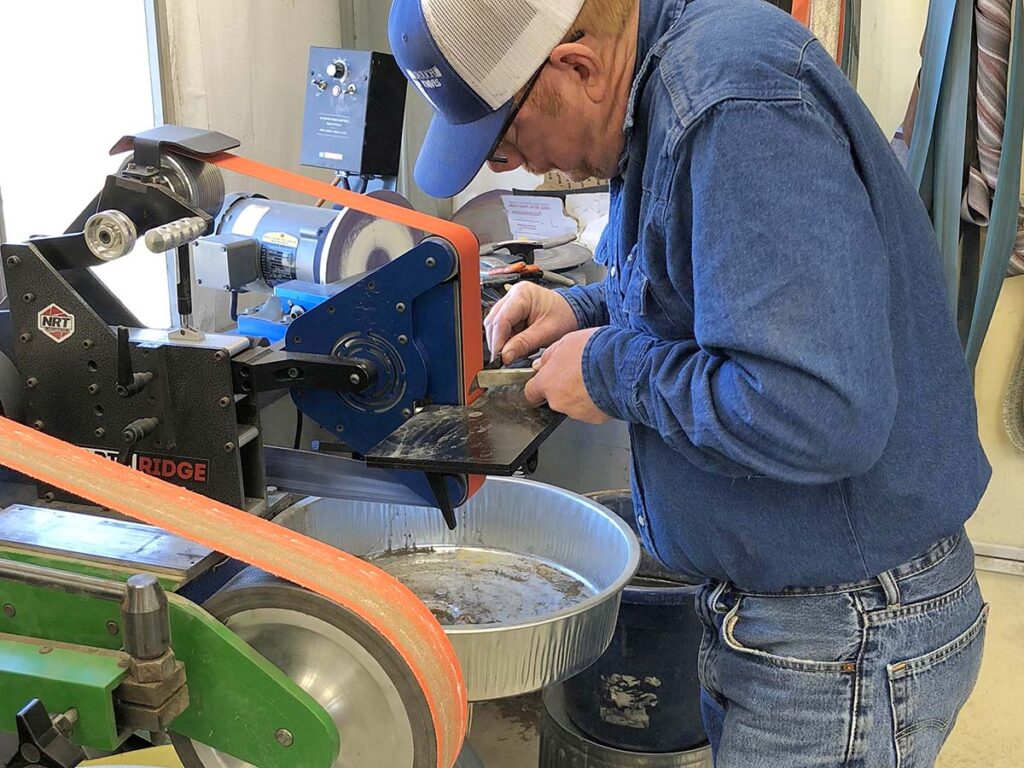
Bubba Crouch at his grinds a blade.
“If you look at the pearl on some knives, you can see a yellow edge from the heat sometimes,” he said. “I fit the pearl in the handle and then remove it, shaping it to the bolster to avoid the heat before putting it back in. When I’m sanding the pearl, I wet sand, and when I drill, I squirt water on it after starting the hole.”
The abalone inlay gives Bubba’s trapper a distinctive flair, and the process of inserting it is relatively simple. “I have a pantograph machine and use templates to cut the abalone and cut the pocket for it in the pearl,” he said. “You’ve got to be careful and don’t want to pop it in and out too many times. I drill a hole through the pocket that is pretty small and comes out the liner to test fit.”
Crouch enjoys building what he likes, and for now, that is the single- and two-blade slip joint. Multi-blades don’t have great appeal. “My clientele is the everyday carry guy,” he concluded. “So, I build those knives. I don’t see the slip joint market getting soft. It’s traditional and will stay stable. It’s what your grandpa and your dad carried, and as long as there are memories like that, there will always be a market for the slip joint.”
Demand doesn’t seem to waver with the slip joint, and today’s makers are eager to oblige the marketplace.
The thumb stud is reliable, time-tested and add dynamic dash to these customer folders.
Aside from the good ol’ nail nick, thumb studs are among the most enduring opening systems for folding knives. Why not? Typically ambidextrous, easy to manipulate and lightning fast, the reliable deployment feature has a lot going for it. Not to mention, on these custom knives, they add equal parts dash and traditional appeal.
Michael Raymond: Ziura folder
Forty-nine 24k gold inlays set into a 6-4 titanium frame elevate Michael Raymond’s Ziura folder. The swedge-ground Bohler M390 blade measures 3.53 inches with an 8.08-inch overall length. (SharpByCoop image)
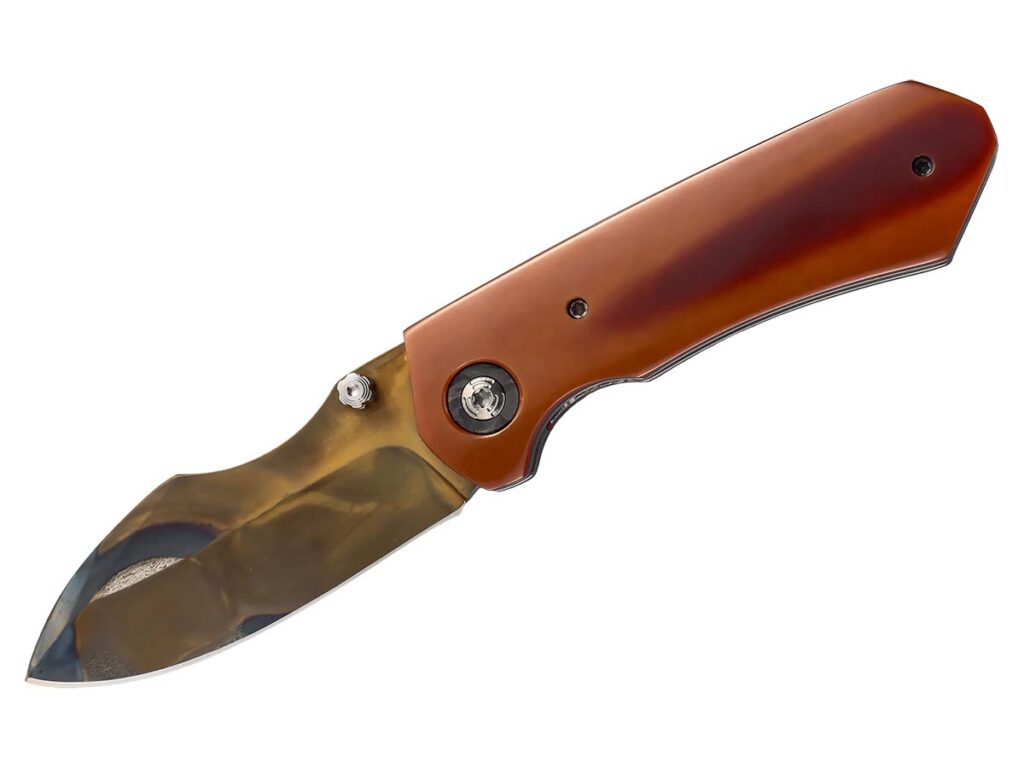
David Beaver: Shogun Horizon Folder
Vintage red linen Micarta scales and a hollow-ground Damasteel Baldur on Damacore blade highlight David Beaver’s Shogun Horizon folder. Blade and overall lengths: 3.75 and 8.5 inches. The maker’s price for similar knife is $1,800. (Jocelyn Frasier image)
Cody Hofsommer: Mammoth Ivory Folder
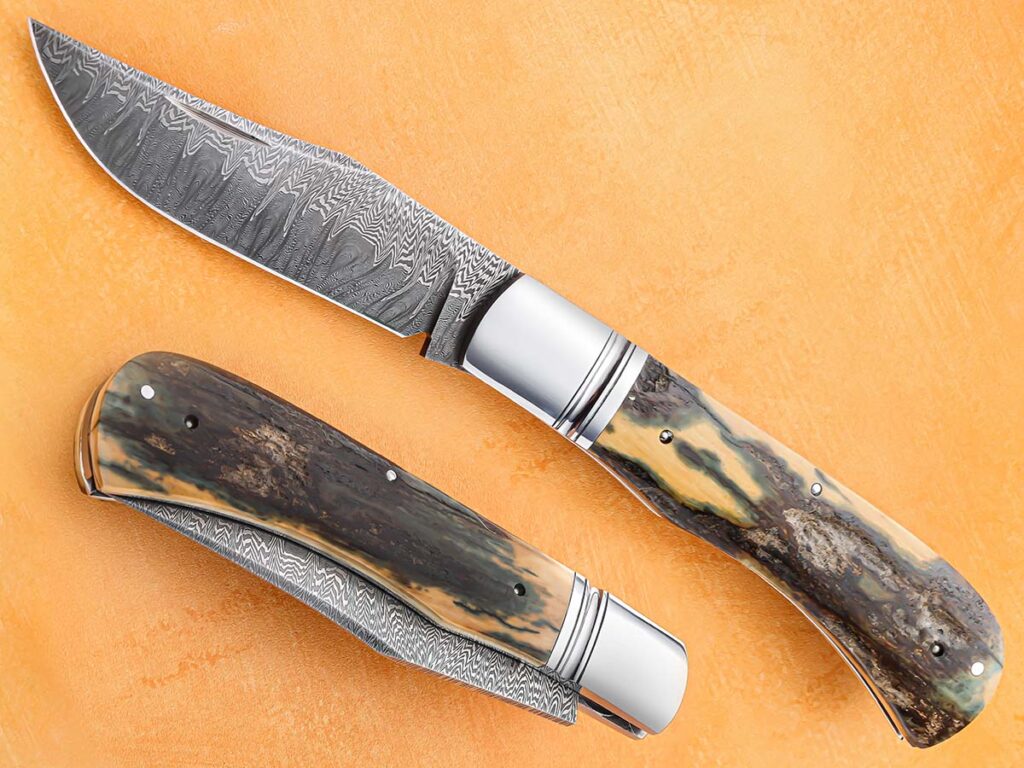
Mammoth ivory scales and mosaic damascus bolsters define a sole-authorship flat-ground folder by Cody Hofsommer. The 1080/15n20 mosaic Damascus blade measures 3.375 inches with an 8-inch overall length. (SharpByCoop image)
Kirby Lambert: Augustus Mini Folder
A hollow-ground Damacore blade and mammoth ivory scales distinguish the Augustus Mini folder by Kirby Lambert. Bolsters are titanium and 2IRC damascus. Blade and overall lengths: 3.25 and 8 inches. (SharpByCoop image)
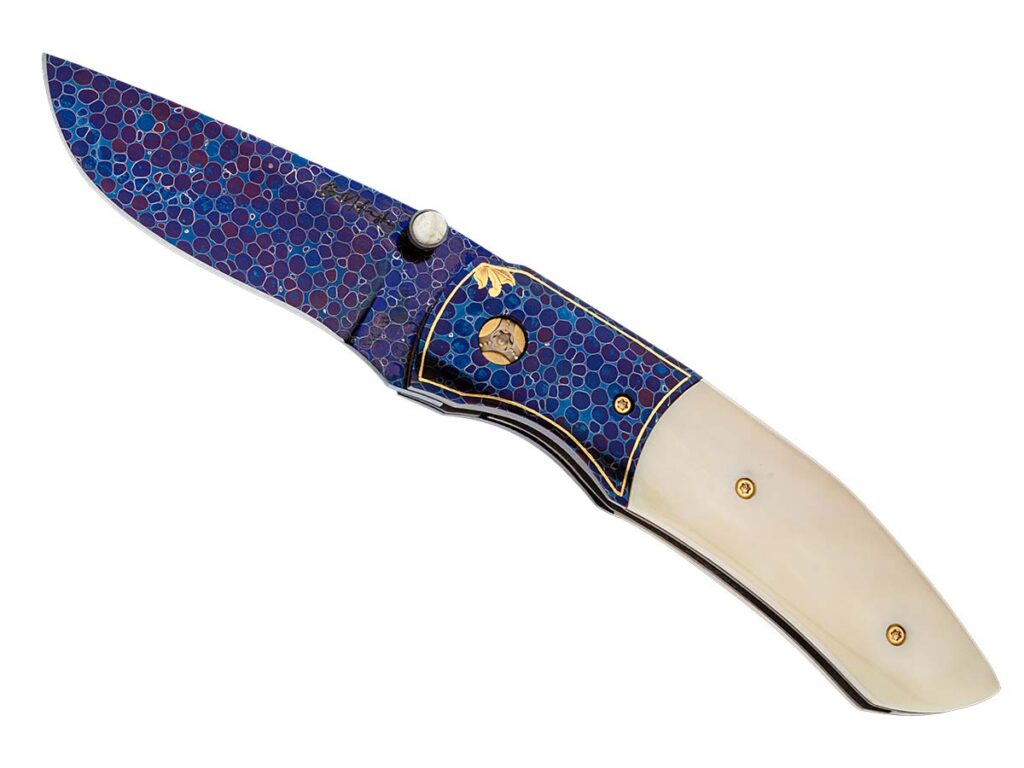
Brian Milinski: Paratrooper Elegante Linerlock
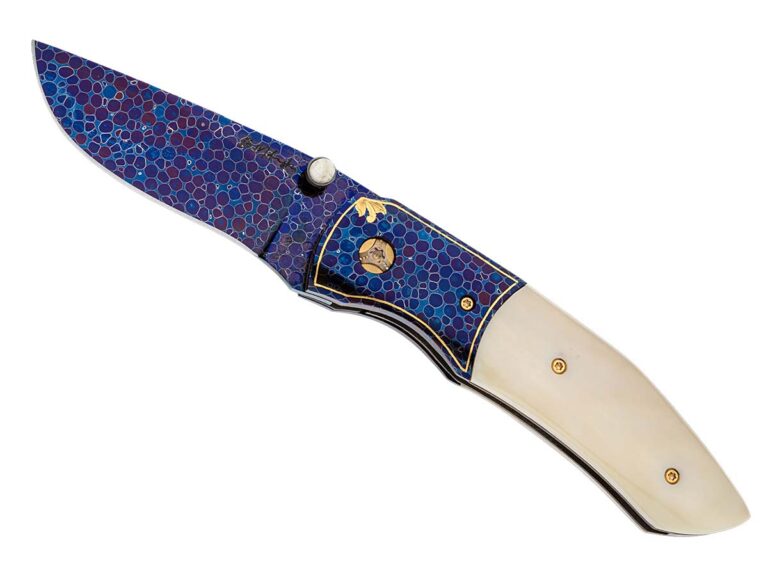
Nitre blued Rietveld damascus and fossilized walrus tusk scales characterize Brian Milinski’s Paratrooper Elegante linerlock. Joe Mason engraved and inlaid the matching bolsters. Blade and overall lengths: 3.25 and 7.75 inches. The maker’s price for a similar knife is $3,400. (Jocelyn Frasier image)
KC Gray: Titanium Folder
A 3.5-inch SM100 blade paired with vintage Micarta scales defines this 8-inch dress locking folder by Tucson maker KC Gray. The titanium frame includes marble carbon-fiber pivot collars and a black anodized clip. (SharpByCoop image)
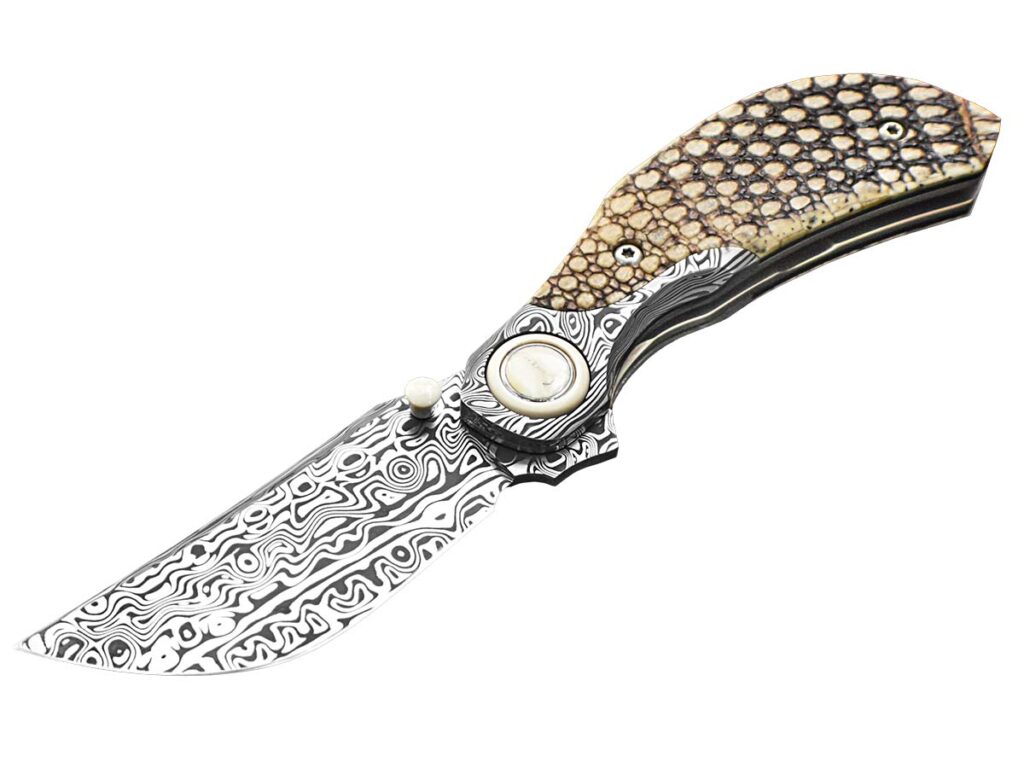
Sean Alonzo: Ani
Sean Alonzo’s Ani 3.2 linerlock features armadillo carapace, warthog ivory, and a hollow-ground Yggdrasil Damasteel blade. Blade and overall lengths: 3.2 and 7.8 inches. Maker’s price for a similar knife $5,500. (Jocelyn Frasier image)