CRKT’s Newest Knife Is Inspired By Dia De Los Muertos And Is A Sexy, Exciting Folder Designed By Michael Rodriguez.
In honor of Dia de Los Muertos, knife designer, and former Green Beret, Michael Rodriguez has created a knife to honor the holiday, his heritage, and his military service.
The new Xolotl Black from CRKT is named for the Aztec god of fire and lightning who ferries the deceased on their journey to the afterlife. It features all-black features from the coffin-shaped G10 handle to the liners and EDP-coated blade to give the blade a sleek, dark look.
The blade is made from 1.4116 steel and is 3.64 inches in length. Overall, the piece is 8.64 inches long.
The flipper not only deploys the blade quickly but also acts as a cross guard to help provide a secure grip on the knife. The coffin-shaped handle features 21 ribs, which symbolize Rodriguez’s 21 years of military service.
The knife is also a part of CRKT’s Forged By War program which donates of a portion of the money from every Xolotl Black sold and donates it to the Global War on Terrorism Memorial Foundation, of which Rodriguez is the president and CEO.
Mosaic Damascus Can Be Made Numerous Ways, And These Master Smiths Are All Putting Their Own Spin On The Craft.
The many moods of mosaic damascus provide the bladesmith and custom knifemaker with an ever-changing form of artistic expression. The possibilities of a new pattern, a different look, and yet another lasting impression are endless.
For several makers, mosaic has become a signature steel in their presentations, and these imaginative artists are pushing the envelope in an already dazzling array of motifs for blades and knife fittings.
Kelly Vermeer-Vella
Kelly Vermeer-Vella said she initially called the mosaic damascus of her fighter Riptide because it looks like “calm waters, but also because the forging process is pretty brutal. So, now I call that process ‘ripping it!’” Blade and overall lengths: 7.5 and 12.5 inches. At press time the knife was available through Arizona Custom Knives for $3,800. (SharpByCoop knife image)
In her Riptide pattern, American Bladesmith Society Journeyman Smith and past Forged in Fire champion Kelly Vermeer-Vella provides a great example of the new frontiers being explored with mosaic damascus.
“It’s initially called that because it looks like calm waters,” she commented, “but also because the forging process is pretty brutal. So, now I call that process ‘ripping it!’ Sometimes I win and sometimes I make hunters!”
Kelly showcases the Riptide pattern on her 12.5-inch fighter with a 7.5-inch blade and mammoth ivory handle sporting a long, modified “S” guard.
“I really enjoy swooping forged guards that complement the curves of the blade and handle. And I love mammoth ivory, so I make a lot of frame handles,” she added. “I think the best-looking frame is in a low-layer twist, 25 layers or so.”
The Vermeer-Vella mosaic involves a commitment to hard work to produce the desired results.
“The pattern is not san-mai,” she revealed, “rather, different layer counts of stacked W’s with heavy 1075 steel on the edge. The wing effect comes from forging. I push and pull the pattern with a hand hammer and forge to shape so that the pattern flows with the edge.”
The blade material is the 1075 carbon steel, which appears as the dark areas, and 15N20 nickel alloy, which shows as the grey, shiny areas. “I etch in 3-to-1 ferric chloride and also do a coffee etch,” she added. Her power hammer is an Anyang 88 and she uses a Riverside 24-ton press.
Jack Rellstab
Jack Rellstab said he wanted the blade of his Western Chef’s Knife to “look alive.” As he noted, “My idea was with the taper in layers to give it an organic look that appears as if the elements are actually growing.” Thus, the pattern’s name of Frogs and Flowers seems most apropos. His price for a similar knife: $2,600. (SharpByCoop image)
Like Vermeer-Vella, Jack Rellstab is an ABS journeyman smith who enjoys the creative process of forging mosaic damascus. His Western Chef’s Knife brings a robust profile to life in a mosaic pattern called Flowers and Frogs.
“The pattern is one of my styles of W’s explosion,” he noted. “I started the original billet with the layers of both 1080 and 15N20 getting progressively thinner from one side of the billet to the other. After using square dies to resquare the billet for W’s, I drew it out with a taper so the W’s would get tighter towards the end. Then I did a restack and a four-way to finish it. So, the steel is 1080 for the dark portion and 15N20 for the bright.”
The handle is amboyna burl, bronze and G-10. He says the grip is designed around most Western-style kitchen knives on today’s market, though the belly/underside might be a bit shallower.
“With this mosaic pattern, I wanted the knife to look alive,” he offered. “My idea was with the taper in layers to give it an organic look that appears as if the elements are actually growing. I used a 165-pound hammer belonging to New West Knifeworks, and I also used their Anyang hydraulic press for resquaring.”
Jack began his bladesmithing journey with mosaic damascus by watching a YouTube video, and then let his imagination kick in to develop the exciting pattern that is sure to generate conversation in any kitchen.
Will Stelter
The Serpentine Multi-bar Santoku by Will Stelter sports a mosaic damascus pattern of the same name. He used 1080 and 15N20 steels for the pattern-welded twisted bars and Cruforge V for the edge. The Cruforge V etches darkly, and its wear resistance and high working hardness make it ideal for culinary knives. Blade and overall lengths: 5 7/8 and 10.75 inches. His price for a similar knife: $3,500. (SharpByCoop knife image)
The Serpentine Multi-bar Santoku by ABS Journeyman Smith Will Stelter sports a mosaic damascus pattern of the same name. The handle is ivory paper Micarta®. He used 1080 carbon and 15N20 nickel-alloy steels for the pattern-welded twisted bars and Cruforge V for the edge. The Cruforge V etches darkly, and its wear resistance and high working hardness make it ideal for culinary knives.
“I started by forging up 28 layers of W’s,” he recalled, “and then worked that billet down to a half-square twisting stock. I twisted three bars right hand and two bars left hand, lining up my twists as best I could before forge-welding them together. After they were stuck, I forge welded on a solid Cruforge V edge bar that was around 40 percent as wide as the multi-bar billet, but the same thickness. With my final stock stuck together, I then laid out and cut away several three-quarter-inch-deep grooves or divots from the profile of the rectangular 2-inch wide bar, which still left Cruforge V on the edge, and two full twisted bars at the thinnest parts of the patterned area on the spine.
“I then flattened down the billet, which took the previously straight layers and gave them the bold ‘serpentining’ that came out in the blade. I then forged my blade to shape and forge welded on some of the base W’s stock that I twisted from as bolster material. This is a very similar technique to how the classic ‘River of Fire’ pattern is done, but with a different base pattern other than the usual feather pattern.”
Will used his 1924 400-pound ram Beaudry hammer to do the majority of the forge welding and a twisting machine to twist the five bars. He learned his pattern-welding technique and the ability to visualize the way the steel moves from bladesmith Salem Straub, crediting Straub with teaching him how to design patterns “with intentionality behind them.” The pattern itself is sole authored by Stelter, who has done some serpentine multi-bar patterns prior to the subject piece. However, this was his first attempt with a monosteel-edged bar.
“The serpentining is purely aesthetic,” Will said. “It’s meant to give a bold line for the eye to dance down rather than the straight, more classic intersection of the edge bar that is normal for a composite construction. This also means that from far away you see an interesting pattern, and then when inspected up close the explosions of the twisted W’s really pop out, which gives the overall piece an interesting level of depth.”
Will considers this particular mosaic “an intermediate-level pattern, easy to try, though somewhat difficult as well. The most challenging part is building a high-quality multi-bar pattern with adequate layer density and well-matched twists. The rest of the pattern is fairly simple.”
Brent Stubblefield
Brent Stubblefield’s integral chef’s knife has an 8-inch blade of his shimmering Crossroads mosaic damascus, and a stabilized Hawaiian koa wood handle with mammoth tooth spacer. Overall length: 13 inches. His price for a similar knife: $1,500. (SharpByCoop image)
At the Join or Die Knives Forge in Richmond, Virginia, Brent Stubblefield hammered a beautiful blade in his Crossroads mosaic pattern—and did so with multiple techniques.
According to Brent, “There is the initial damascus forging, crushed W’s, twisting, four-bar-squaring welds, ferry flip tilting, edge bars, and a ‘fish mouth’ tip to make the edge bars meet. There are multiple elements that are forged on the edge or corners to manipulate the pattern, and finally the knife shape and integral bolster are forged to shape.”
The mosaic is comprised of 1084 and 15N20 steels, with the 15N20 appearing as a silver white on the blade while the 1084 blackens with a ferric chloride etch.
“The shapes in this pattern reflect a desire to incorporate all the different techniques of mosaic damascus making I have learned over the years,” he explained. “I’m always trying to find a way to create never-before-seen patterns in order to add something totally new to the American bladesmithing tradition.”
Stubblefield used an Anyang 88 power hammer and homemade 30-ton press to create the Crossroads mosaic. A Bridgeport mill was helpful in the squaring-up process and flattening pieces for rewelding. A Miller welder assisted in tacking materials up before they went into the forge, while an Evenheat kiln and Broadbeck Ironworks grinder were key tools in the process as well.
“Although I did not have any single mentor,” Brent mused, “many knifemakers have gone out of their way to share tips and tricks with me. While they didn’t teach me directly, [bladesmiths] Mareko Maumasi and Salem Straub have been very generous with sharing their processes through social media. I certainly have referenced them among others.”
Stubblefield continues to challenge himself as his career advances, and he sees no slowdown in the creative process. “This knife is very difficult to do simply because the higher number of forge welds create more opportunities for failure,” he reasoned. “Any complex damascus blade is actually just many simple techniques combined together. The hardest part for me is understanding how manipulating the pattern early in the process will affect the outcome, and visualizing the end pattern.”
CRKT Has Reimagined The Squid II With Their New Carbon Fiber Version Of The Beloved EDC Folder.
The Squid line of folding knives is one of the most beloved in the cutlery world. CRKT has given the classic a new look with the Squid II Carbon Fiber.
The Italian-made knife features a 2.68-inch blade made from Bohler M390 steel, designed for edge retention and to resist wear, and treated to a 59-61 HRC. The satin finish gives the knife a clean, elegant look. The steel is connected to the carbon fiber handle and stays securely in place via a liner lock, which is the first liner lock on a knife in the Squid line.
Even with the carbon fiber handle, the knife has a nice bit of heft at 4.9 ounces. As you would expect from the Squid line, nothing was forgotten. The new Carbon Fiber is an excellent addition to the Squid line.
GiantMouse Has Taken A Big Step With Their New Fixed Blade. The GMF4 Is The Company’s Biggest Blade Ever And First Camp-Style Knife.
It’s a new era for GiantMouse. The company has stepped into the world of camp knives with the new GMF4. The knife is the company’s largest blade ever and comes in multiple finishes.
The star of the show is the blade. The N690 blade is 5.65 inches long, and the overall length is 10.45 inches. The steel has a flat grind and comes in two finishes: a traditional stonewash and a PVD stonewash. The PVD version is married to a Double Black Canvas Micarta handle, and the traditional blade is meted to a Double Red Canvas Micarta handle.
The handle is sturdy. The high flat saber grind is razor sharp, and the jimping helps stabilize it when cutting. There’s been a lot of thought put into the construction of this knife. A prime example of that is the lanyard hole.
Designed for outdoorsmen and campers, the lanyard hole is placed on the front of the knife so if a branch sneaks in there and pulls at the knife, it will be pulled forward and out of your hand rather than potentially snapping back and slicing you open.
No stone has been left unturned with this knife, and it will serve any and all campers well for a very long time.
Ka-Bar Makes One Of The Most Legendary American Combat/Utility Knives. First Issued In 1942, The Knife Continues To Impress And Inspire Today.
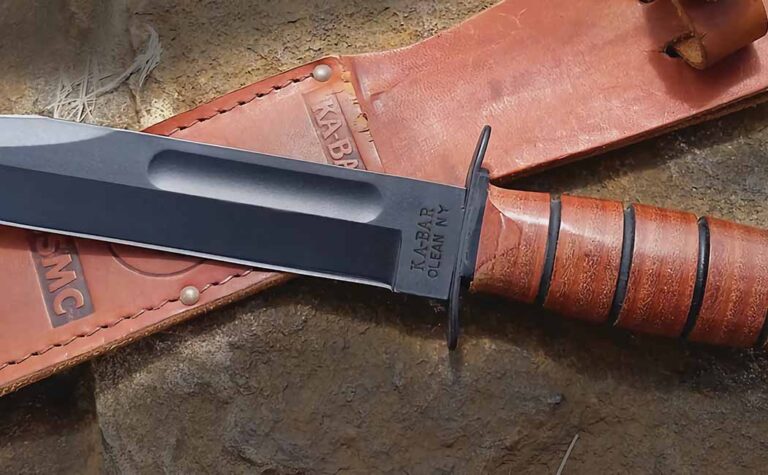
Few knives are as beloved and inspire more contemporary blades, than the Ka-Bar USMC fighting/utility knife. Ka-Bar Knives’ designation for it is the 1219C2, aka “the Ka-Bar,” and the knife was, and still is, a high-quality combat/utility tool. Ka-Bar Knives makes the contemporary version in its factory in upstate New York.
The History Of The Ka-Bar
As America entered World War 2, the Army and Marines took issue with the old World War 1-era trench knives that were being issued to them. The handles were too bulky, the blades were too brittle, and they were expensive to make.
After trying a few stopgaps, the Army asked arms suppliers to design a new combat/utility knife. Marine officers John Davis and Howard E. America worked with the Union Cutlery Company (now Ka-Bar Knives) to design a model that took elements from an old Navy knife and civilian hunting knives to create the 1219C2. In addition to Ka-Bar, Camillus, PAL, Robeson Shuredge, Case and Ontario were among those who made a USMC fighting/utility knife or a reasonable facsimile.
The knife was first issued to elite Marine units in November, 1942 and became standard issue for all Marines by 1944. Today, the knife is manufactured for military use and marketed to civilians as a utility/hunting knife.
Modern Ka-Bar Knives
Along with the original USMC fighting/utility knife, Ka-Bar makes many different combat/utility knives. This trio is a prime example of what the company produces today.
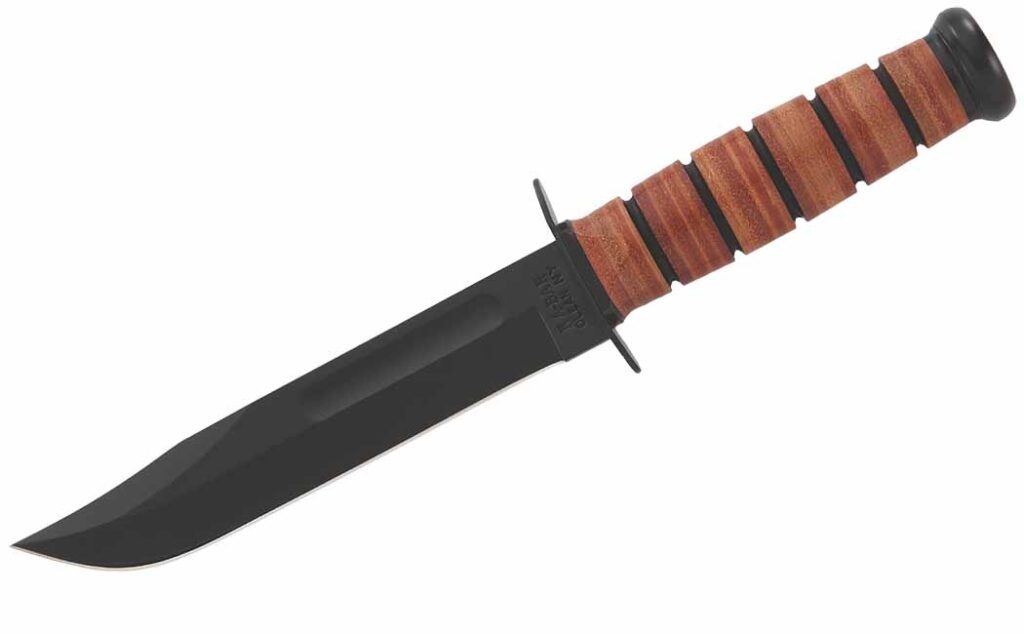
USMC Ka-Bar Plain Edge
The knife that made the Ka-Bar name famous is as popular as ever. There’s also a serrated version, but the plain edge is the original and is a hefty, economical knife.
The 7-inch clip point blade is made from 1095 Cro-Van steel with a 20-degree flat grind and a Rockwell hardness of 56-58 HRC. At just 11.2 ounces, it’s lighter than you might expect from a knife that size, which lets it flow smoothly when slicing, and the leather handle provides a secure grip. The rigid plastic sheath is MOLLE-compatible and can be carried vertically or horizontally.
Classics are classic for a reason, and the USMC fighting/utility knife is everything you could ask from a combat/using piece.
MSRP: $128.53
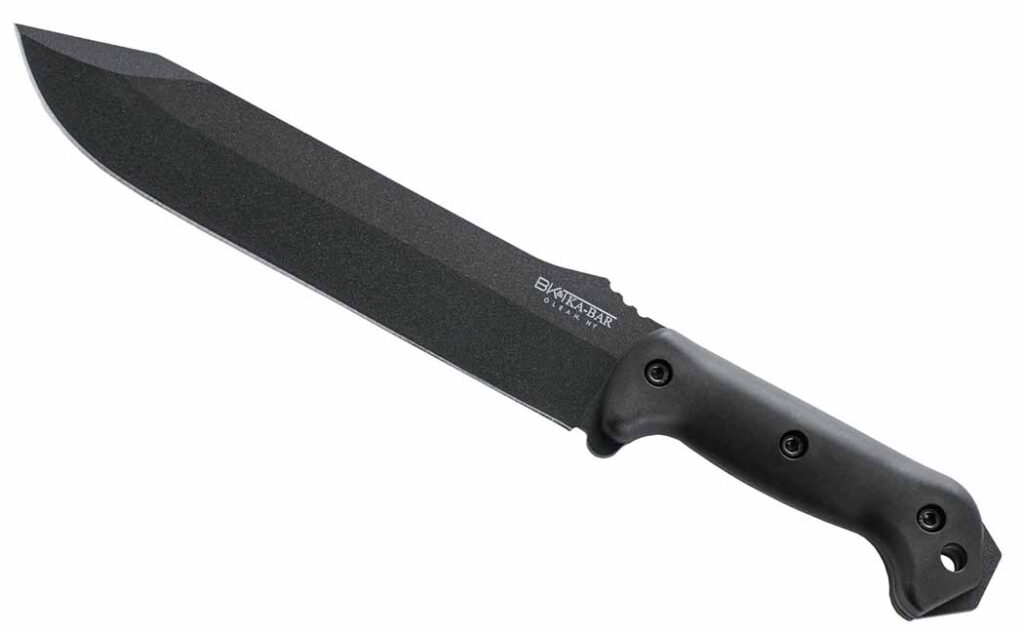
Becker Combat Bowie
Melding an American bowie-style blade with Becker’s trademark ergonomic handle design and you get this sleek, all-black combat knife. It is designed for bushcraft or camping too.
The 9.25-inch blade is married to an Ultramid handle that provides a strong grip. At 17.12 ounces, it’s a bit heftier than the USMC fighting/utility, making it excellent for more heavy-duty work like trimming thicker branches and vines or cutting through medium brush. Similar to the USMC fighting/utility, the Combat Bowie is made from 1095 Cro-Van and has a Rockwell hardness of 56-58 HRC.
A heavy-duty polyester sheath is included and is MOLLE-compatible as well.
MSRP: $178.61
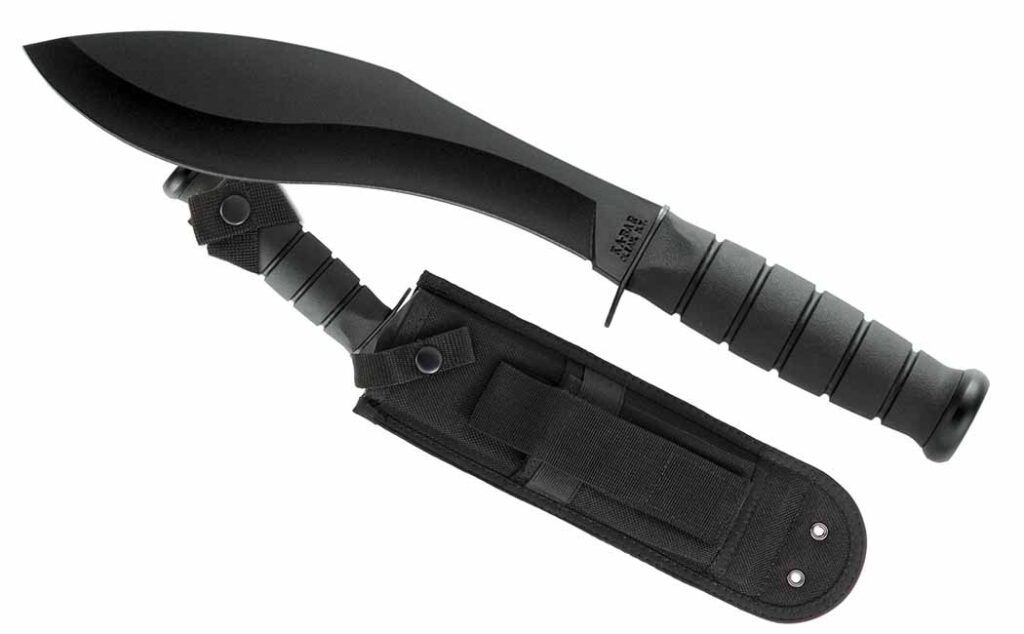
Combat Kukri
This knife may have “combat” in the name, but its bread and butter is decimating small trees and vines. The kukri is smaller than a standard machete and is more finite in its cutting. That doesn’t mean that this blade can’t flex its muscle and chew through almost any brush you put in front of it.
This knife may have “combat” in the name, but its bread and butter is decimating small trees and vines. The kukri is smaller than a standard machete and is more finite in its cutting. That doesn’t mean that this blade can’t flex its muscle and chew through almost any brush you put in front of it.
At just under 16 ounces, it’s relatively lightweight yet robust.
If you’re buying it you’re most likely looking for a high-quality outdoors knife, and this kukri is it. The 1095 Cro-Van will need to be maintained to get the best out of it over time, but that comes with the territory of owning good knives. This knife will make a great companion working through the bush while camping or while cutting through bushes in the backyard.
The Stake Out Is Yet Another Fun And Exciting Multi-Tool From Gerber. Designed For Camping, The Stake Out Checks All The Boxes
When you’re out camping there is no worse feeling than reaching into your pack and realizing you forgot to bring the one tool you really needed. The new Stake Out form Gerber will have you covered from pitching the tent to the time you pack up and head home.
There are 11 tools packed into a 4.5-ounce, compact 3.32-inch little tool that will shave countless pounds off your pack. There are four types of cutting tools to go along with six all-rounder tools that can be used multiple ways.
The most notable cutting tool is the 2.2-inch Scandi grind blade. Secured via a framelock, this blade is what you want while out camping: a small blade that can handle quick, precise cuts. The blade is unique when it comes to the Stake Out in that all the other tools are secured via a linerlock.
Along with the blade, there’s a wood saw, an awl, and a pair of scissors to round out the roster of cutters.
Where the Stake Out gets really funky is in its other tools and their placement. There is a ruler right on the frame of the knife. The tweezers are easy to find thanks to an orange handle. You have a ferro rod striker, a bottle opener, and a file all within the confines of the Stake Out. And the most exciting element: the tent stake puller.
Pulling stakes out can be a drag. The tent stake puller gives you that extra leverage to make packing up and heading home a breeze.
Overall, this is a lovely multi-tool. It easily clicks onto your pack thanks to a carabiner, and the assortment of tools helps it stand out in a crowded field. Some type of plier would have made this a 10/10, but even without them this is still a quality bit of utilitarian cut at a great price.
As The New Generation Of Knifemakers Begin To Hone Their Craft, The Masters Of Today Help Guide Their Path Forward.
A new wave of interest has brought the younger generation closer to the forge and to the welcoming classrooms of bladesmiths that are quite willing to share their time, talent and tips to help the youngsters develop their own skills. That interest comes not only from a growing awareness of the beauty of the finished forged blade, but also an appreciation of the time and dedication necessary.
American Bladesmith Society (ABS) Master Smith Ray Kirk has been teaching kids bladesmithing for some time, and he sees the investment in the future as time well spent.
“Most of the young students usually have a parent that will either make a blade with them or watch the total process,” he commented. “Besides understanding the phrase ‘Strike while the iron is hot,’ they learn to control the steel by where they hammer. The experience of sharing the class with a parent or sibling is the best kind of memory to make. Knowing they will make something that will probably outlast them is something they probably never did before.”
Ray began teaching his grandchildren when they spent time at his home, and he has taught both boys and girls. Depending on the age, both genders are proficient and can use the hammer. His youngest student began learning at 11, and his grandchildren have been around the forge since they were 6.
“At that age, it was just showing them how to change the shape of steel by heating and hammering,” Ray said. “If they can drive a 16-penny nail into a 2-by-4 they could do the class, and I never really considered the sex of the student to have a bearing on taking the class.”
Some of the more satisfying moments for Ray have been watching his students as young adults competing on History TV’s Forged in Fire. Several have won in competition and all have enjoyed the experience, making friends and expanding their knife knowledge. The smile that shines when a photo is taken of young bladesmiths and their knives is something special.
Ray’s class consists of work to complete two knives of hidden-tang integral design from a 12-inch round bar of three-quarter-inch 52100 steel.
“What they can’t do I will do for them,” he explained. “Learning how is the important part. I don’t expect the students to be an expert at any part of the procedure, and as long as they are watching and learning, I can finish it for them. If I only have one student, it can be a one-day affair. Two students usually require two days, and out-of-town students can use our guest house to stay in. The cost of the class is $350 per student.”
Pride In Teaching Younger Smiths
With the blade secured in the vise in Rick Dunkerley’s shop, 7-year-old Jacob Dove sands the handle.
ABS Master Smith Rick Dunkerley began teaching privately in his shop in 1992, and his first student was Josh Smith, who went on to become the youngest ABS journeyman smith at 15, the youngest ABS master smith at 19, and twice a competitor on Forged in Fire.
“I started teaching Josh when he was 11,” Rick remembered. “That was 30 years ago. He was on the Little League team I coached and showed interest in the knives I made. He was very motivated and not deterred by the work involved.”
Dunkerley says that he doesn’t have a specific program for kids but has invited those who show interest to his shop or hammer-ins.
“If they continue to show interest, I help them out,” he remarked. “I think making things by hand gives kids and adults great self-confidence and pride. So much of the modern world is fast paced and disposable. The process of making a knife forces a slowing down and focus that is lacking in a lot of kids’ lives. It also gives them something to care for and preserve as opposed to the normal disposable crap of everyday life. I don’t encourage or discourage anyone, kids or adults, to pursue knifemaking as a career. I give them my experience on the subject and let them decide on their own if they can make the sacrifices involved.”
Rick usually starts a student out with stock-removal knives. He says he believes learning to grind a blade is more difficult than forging one. Then, should the student decide to learn bladesmithing, the learning process continues.
“My proudest moments as a teacher have always been seeing the pride and satisfaction in the students’ eyes when the knife is finished,” he added. “I believe the pride and satisfaction of making things with our hands makes better human beings. That’s enough motivation for me to help when I can.”
Absorbing lessons from Dunkerley and listening to his advice has paid huge dividends for Josh Smith, and his memories of those days filled with learning the bladesmithing art remain fresh in his mind.
“Rick’s mentorship launched me into a career that I would never have had without his help,” Josh recalled. “Thirty years ago this year, I started making knives under him. Those times under the tutelage of Rick provided me with an opportunity to tap into my craftsman and artistic side.”
Josh has taught his own kids the fundamentals of bladesmithing. “Time spent in the shop can absolutely help open up the world of possibilities in regard to craftsmanship,” he assessed. “Whether it’s making knives, blacksmithing, gunsmithing, wood carving or woodworking, the shop can provide amazing experiences for kids.”
ABS Program
Young students man their anvils in the Bill Moran School of Bladesmithing at Texarkana College.
Don McIntosh runs the youth bladesmithing program at the Bill Moran School of Bladesmithing at Texarkana College, and he sees a future with the endeavor.
“We rekindled it this year and it was very successful, so we’re looking to make it something we’ll be proud of on an annual basis,” he commented. “It caters to 14- to 17-year-olds and it’s a 16-hour program over three days.”
The Junior Bladesmithing course was held in June and included six participants who took part in a program that was packed with hands-on activities. The fee is a modest $175, and there may be a tie-in with the college to introduce bladesmithing to a wider audience of youngsters. McIntosh also volunteers with a local Boy Scout troop to demonstrate bladesmithing and generate interest among younger kids.
“Our program at the Bill Moran School this year included a half day on Thursday, a full day on Friday and a half day on Saturday,” Don explained. “At the end of the program, if they have forged a knife, they grind it and heat treat it and then put a cord wrap handle on it.”
The program is open to boys and girls, and Don says any young ladies who are interested in learning about bladesmithing are welcome.
“Absolutely! We want to keep the spark going, and I’ve been adamant that this is an avenue of approach that’s better than sitting in front of a video game. Most kids are enthusiastic about hunting and bowie knives at that age, and you can come to the program and do something hands-on. The idea of forging your own knife is a pretty cool concept, and interest has been amplified by Forged in Fire. The kids watch it and so do their parents.”
McIntosh says the ABS is currently looking at the format and date for the next Junior Bladesmithing event, and the commitment to the future of the program is firm.
Bladesmith Kit #1
As Ray Kirk observed, “The experience of sharing the class with a parent or sibling is the best kind of memory to make.” Jason Proctor and his son Jaxon hold the knives (top) they made in Ray’s shop. (Lou Ann Kirk images)
The Blacksmiths Depot’s Bladesmith Kit #1 may have applications with young bladesmiths, depending on their level of interest and experience.
It comes complete with an 800-gram Swedish hammer; .75- and 1.25-inch blade tongs; White Mountain flux; Cherry Red hardening compound; PBC anti-scaling compound; regular tomahawk mandrel; regular tomahawk handle; men’s Jersey gloves; jumbo block brush; sodium flare safety glasses; ear plugs; and two publications: The Complete Bladesmith by Jim Hrisoulas and Handles and Guards by BLADE Magazine Cutlery Hall-Of-Fame® member Joe Keeslar. Priced at $395, the kit does not include blade steel.
“Most who want to do blades should experiment with mild steel or scrap before spending money on the more expensive metallurgy,” related David Kayne of Blacksmiths Depot. “Youth should not be doing any form of blacksmithing, bladesmithing or stock removal without good safety habits and adult supervision. Anything that has to do with weapons needs training and oversight, including the making of blades.
“Otherwise, we do not see any reason why this kit wouldn’t work out for youth,” he concluded. “Even the hammer in the kit is light enough weight for a youth. We do recommend that both youth and adults read through the books first before attempting to make a knife. A little background knowledge of forging could mean the difference between frustration and success.”
Stimulate And Create
The efforts to introduce bladesmithing to young people and the opportunities it affords them can bring on fantastic results, stimulate natural curiosity and offer an outlet for creative energy. More and more, such programs and events will influence the bladesmiths of tomorrow and contribute to raising them right.