This Tiny New Multi-Tool From Kershaw May Not Have The Array Of Tools Like Others On The Market But Makes Up For It With A Fun, New Design.
When you think of a multi-tool it’s usually a beefy type of tool with pliers and blades and maybe wrenches and wire strippers on it. However, the new Recap from Kershaw breaks the mold by taking the multi-tool to its minimalist extreme.
The Recap is roughly the size of a housekey. Made of stainless steel, there are no folding elements to the tool, just the main body. At just .3 ounces it’s as light as you’d expect but features three tools.
The first, and most noticeable, is the bottle opener. The other tools come as a combination pry bar/flathead screwdriver. The minimalist steel construction means all of the tools are strong and robust with nothing superfluous in the way.
Yes, there is no blade, a staple of most multi-tools, but this would be excellent on a keychain. If you want some type of tool with you wherever you go, especially if you frequent places like sporting events or museums where you can have an EDC or traditional multi tool on your person.
New Gut Hook From Templar Knife Is Built To Be Used In The Field And Commercial Settings.
The new Reagan gut hook from Templar Knife is a new, exciting edition to the hunting knife market. From a maker known for auto and OTF knives comes this fixed blade that uses a unique construction to create the best possible knife.
The blade thickness decreases as it goes from heel to tip. This allows the knife to segment a sternum as well as skin a kill. Add in the gut hook and the Reagan allows for a smooth full-cavity evisceration.
The handle’s ergonomic design and finger grooves, combined with guards on the top and bottom give you a better, more comfortable grip. You’ll have more leverage with each cut thanks to the better thumb and hand placement on the handle.
The Reagan is 8.3 ounces with a 4.6-inch blade and will be launched to the general public in September.
After Decades In And Around The Knife Industry, The Author Reflects On His Five Favorite Knifemakers And What Makes Them So Memorable.
Over the past 38 years, I’ve met thousands of knifemakers with work ranging from newbie to legend. Being a newbie myself at first, I found myself gravitating to the newer makers, primarily because I could afford their knives and could get one without waiting years or decades.
Today I approach things differently and look for outstanding makers who share the following traits:
•Each is charismatic in his own way;
•Each gives of both his time and talent(s) to educate others, and;
•Each has a great sense of humor and is serious about his knives.
Here are my five favorite American makers who share the traits I look for most.
Walter Brend
The SF Dagger by Walter Brend features an 8-inch blade of D2 tool steel with a satin finish and Walter’s impeccable grind lines. Handle: black Micarta®. Guard: stainless steel. Special features: Full-tang construction, double edge, thong hole and a skullcrusher pommel. Overall length: 12.75 inches. (SharpByCoop knife image)
During my military service in the U.S. Army 101st Airborne, my unit went through processing for an overseas deployment. At the time I was carrying a Robert Parrish hollow-handle fighter with a serrated blade. It was suggested to me that I find a new knife that didn’t have serrations. That was the bad news. The good news is I had to buy a new knife, and the search began.
Scanning a magazine I saw a photo of three knives, all different lengths of the same model. I was immediately drawn to one of the knives, found the maker’s contact information and called him. On the other end of the line was Walter Brend and I ordered the knife: an 8-inch Model 2. In October 1985 I bought my first of hundreds of knives from Walter. In my opinion, his Model 2 is the finest tactical fixed blade in the world.
What draws my eye to the knife are the impeccable grinds. Perfect symmetry runs the length of the blade, including both the top and bottom grinds. The radiused guard and contoured handle are also trademarks of Walter’s work. These features may not be more evident anywhere than in his daggers. Clean, precise, sleek and lethal are words that all come to mind.
David Broadwell
According to the author, David Broadwell makes the world’s best sub-hilt fighters. An example is his Fuller Sub-Hilt Fighter in a 9-inch blade of Delbert Ely damascus. Handle: ancient ivory. Guard, sub-hilt and pommel: damascus. Overall length: 14 inches. (Image courtesy of Photography By NB Designs)
I was visiting family and friends near Chicago in 1988 and attended a small knife show. I had recently started buying guardless fighters, as the knives’ clean lines appealed to me. On the show table before me was a beautiful guardless fighter with an engraved bolster. The knife felt great in my hand and the price was more than reasonable. I bought the fixed blade from David Broadwell.
My favorite knife has always been and still is the sub-hilt fighter, and David excels at making one. Having written about him for several publications, I have always pointed out I think he makes the best sub-hilt fighter(s) in the world.
David is an artist in the true sense of the word. His eye for detail and beauty in steel is exceptional. He and I have collaborated on several designs over the years. He takes my basic two-dimensional linear drawing and brings it to three-dimensional life.
Diversification is one of David’s hallmarks. In the early 2000s I asked him to build knives that featured stone handles. Most were sub-hilt fighters and today remain some of my favorites.
When Bob Neal and I did our LDC Custom Knife series, David was the only maker to contribute both a folder and a fixed blade to it. Today he creates masterworks of art that would be at home in any museum in the world. While my design ideas were not always his favorites, David delivers knives that were everything I had hoped for—and more.
RJ Martin
RJ Martin has won awards for both best tactical folder multiple times and also best tactical fixed blade at past BLADE Shows. His Ghost Pepper Q36 cover knife sports a 4-inch blade of Chad Nichols damascus, a titanium frame and hand-rubbed zirconium bolsters. Scales and spacer material: black carbo quartz w/orange G-10 back-side inlays. (SharpByCoop knife image)
I was at The Knifemakers’ Guild Show in 1996 and, like everyone else, walked up and down the aisles looking for that one special knife or 12. I passed a maker who had Japanese-style tacticals on his table. I took two steps, did an about-face and walked back to the table. I was greeted by the big friendly smile many now know belongs to RJ Martin.
The guards, handles, sheaths and particularly the blades were the cleanest I had ever seen on a Japanese-style tactical. Trends change and I suggested to RJ that he should consider making a tactical folder. Within a month he sent me his first one, the Q30. I couldn’t believe it was his first folder. It easily rivaled most of the well-known tactical folder makers of the day. Then again, I should have expected this from a lead airframe engineer for Sikorsky helicopters such as RJ. He lives in the world of thousandths of an inch and milligrams.
From 2000 to 2010, RJ made 12 different limited designs for my Robertson’s Custom Cutlery Vanguard series. They featured hollow-handle fighters, a sub-hilt fighter, Japanese-style tacticals and, of course, folders. He is one of the few knifemakers in the world skilled enough to do it all with equal excellence. Quite notably, he has won the award for both best tactical folder a number of times and also best tactical fixed blade at past BLADE Shows.
Today his folders are among the most sought after in the world. Unlike so many of the tactical folders built over the past decade, his increased in price in the aftermarket. For those in pursuit of a level of perfection most of us cannot appreciate, RJ is that perfectionist.
George Herron
The author stated the knives George Herron made are design-driven, exactly what you would expect from a lifelong hunter and fisherman. The Herron Model #12 boasts a 6.5-inch blade of ATS-34 stainless steel with a mirror finish. (Impress By Design knife image)
I was attending the 1987 BLADE Show when a friend introduced me to BLADE Magazine Cutlery Hall-Of-Fame® member George Herron. With his pipe hanging from his lip, George said, “Lad, what is it you do for a living?” I said, “Mr. Herron, I’m in the Army.” He smiled and said, “I was in the Army, too. You see anything on the table you like?”
Had I known then what I know now, I would have bought every knife on the table. His knives were clean, lightweight, possessed exceptional handle ergonomics and were design-driven—all traits you would expect from a lifelong hunter and fisherman.
Years after meeting George and his wife, Miss Barbara, I attended the Southern Wildlife Expo in Charleston, South Carolina. This was long before the drawings and bid-up knives that have become common today. It wasn’t long before I noticed over 90 people waiting in line. I asked the person at the end of the queue if this was the line for admission to the show. He said, “No, this is the line to get a knife from Mr. Herron.” With that, I bought my show ticket and went to the table where Miss Barbara was standing.
There I was treated to an experience akin to watching children waiting to visit Santa Claus. They all had ordered their Herron knives long in advance of the Wildlife Expo. They approached the table, paid Miss Barbara and she handed their knife to George. It was then you would see young and old alike light up as if it were Christmas morning as they received the “toy” they had longed for—a Herron knife from George himself. I saw three generations of knife buyers—first-time knife buyers, hardcore Herron collectors, they were all there. It was truly a sight to behold.
Steve Randall
As the author noted, there is never any backward movement with the work of ABS master smith Steve Randall—his knives always continue to improve. Steve’s 7-Bar-Twist Sub-Hilt has a 10-inch blade of a seven-bar-twist damascus in 1080 carbon and 15N20 nickel-alloy steels, and an ancient walrus ivory handle. Maker’s price at press time: $3,300. (Alison Randall knife image)
Before the 2015 BLADE Show, I was checking out custom knifemakers’ work on various social media platforms. I kept returning to one maker in particular, ABS journeyman smith Steve Randall.
While photos can be deceiving, I have a pretty good eye for knives. Looking at images of his knives, I could tell he too had a good eye and understood making knives well beyond the short time he had been making them. He combined all the dimensions and aspects of the knife to make it flow.
I bought my first knife from Steve at that 2015 BLADE Show. In 2016 he earned his ABS master smith stamp. In 2022 his knives continue to impress me. There is no backward movement with his work and his knives continue to improve.
One of Steve’s best attributes is that he is willing to learn and try new things. In my opinion, many ABS master smiths are reluctant to work outside their comfort zone. I have asked Steve to build knives for me and my clients that may have some aspects he had never done before. Steve and his work never disappoint.
I was fortunate to have worked with or still work with my five favorite American makers. They have taught me so much about the art of knifemaking, and those who are with us still do. (Mr. Herron passed away in 2007). Perhaps more importantly I consider each of them a friend.
The Gut Hook Is One Of The Most Important Hunting Knives. Finding One That Works For You Can Save Hours On A Hunt
What Is a Gut Hook?
A gut hook on a knife blade is a highly specialized feature designed to open the belly of a downed deer, elk, or other critters; the notion being the gut hook will make the single purpose easier. After opening the belly the hunter would then use the primary edge to dress out the animal.
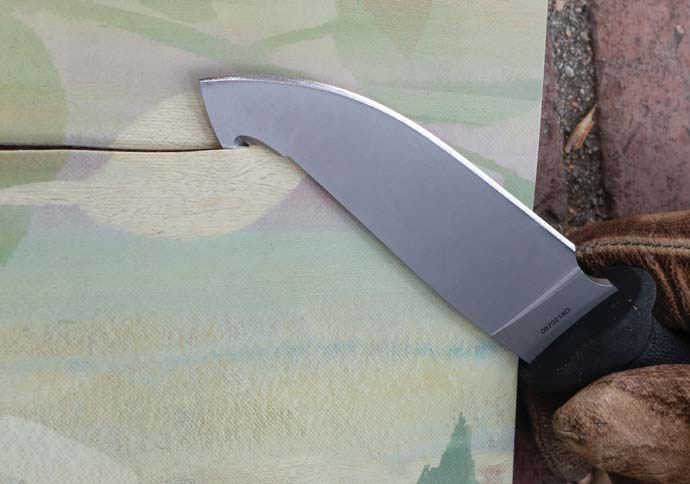
The Gerber Myth’s 3.75-inch flat-ground blade of 7Cr17MoV stainless zips through a plastic sheet.
During more than a half-century of hunting on three continents, I have taken more deer, elk, and other large game than I can count—often with a bow or other primitive weapon. I have dressed my game with whatever knife I had at the time, folder or fixed blade, and sometimes with flint or obsidian blades. I have never used a gut hook. When I was assigned to review four knives with gut hooks I thought of it as a learning experience.
4 Best Gut Hook Knives
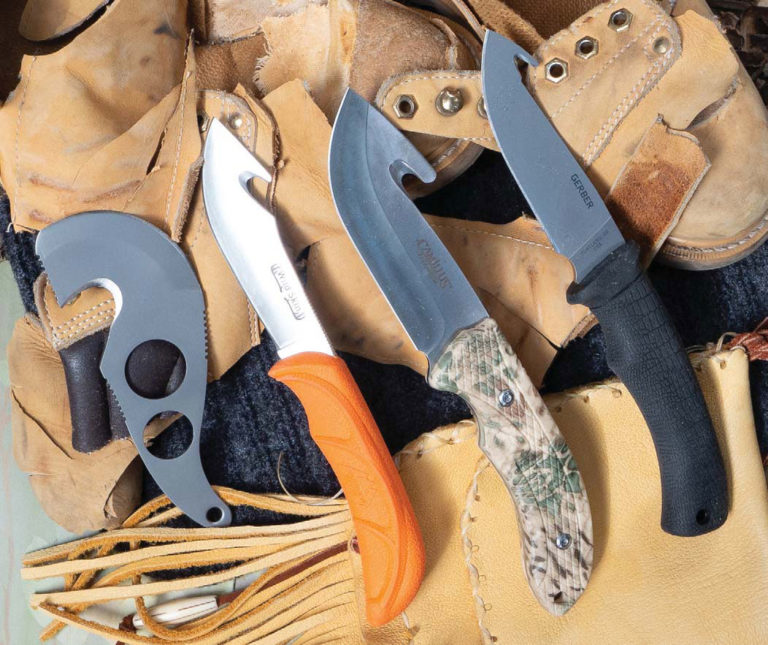
The four knives are the Camillus Prym1 Veil, Gerber Myth Fixed Blade Pro Gut Hook, the Fremont Knives Hide Glider, and the Outdoor Edge Wild Skin.
The Camillus, Gerber and Outdoor Edge are familiar hunting knives with the gut hook on the spine. The Fremont is a wild card, the blade having no point and a semicircular edge similar to the ulu, an all-purpose knife traditionally used by Inuit and Aleut women to skin and clean animals, cut food, and trim blocks of snow and ice to build an igloo.
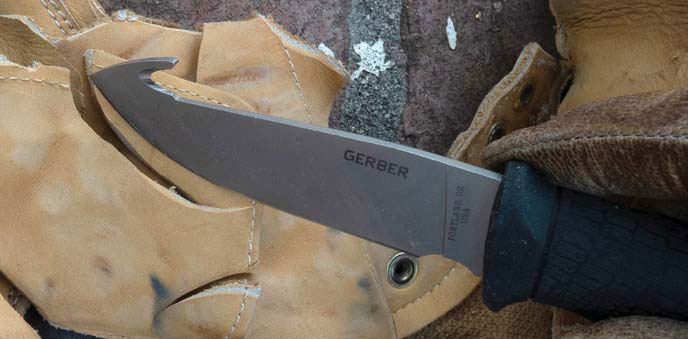
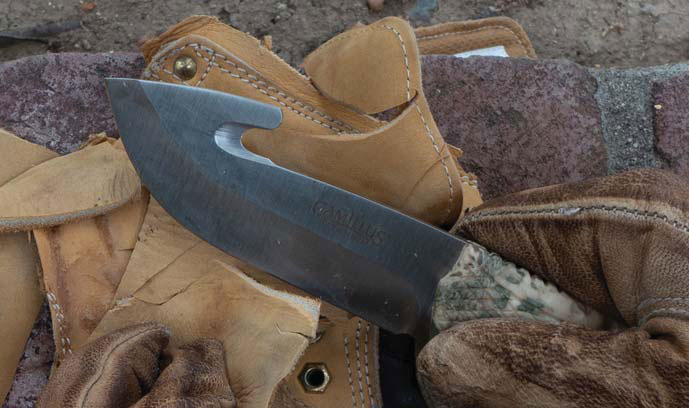
The primary edge of the Gerber Myth slices boot leather with aplomb. Handle: textured rubber. Overall length: 8.5 inches.
Nothing was in season at the time of the assignment. Taking suggestions from my editor and others I assembled a group of materials that would more or less replicate the hide of a freshly killed deer: an old pair of boots with leather about as thick as elk hide, floor mats, plastic sheeting (a bit of a stretch), and scraps of tanned deerskin I obtained from my brother-in-law who uses two or three deerskins a month to make bags and pouches in the Native American style. As an aside, one of his pouches can be seen in the accompanying photos.
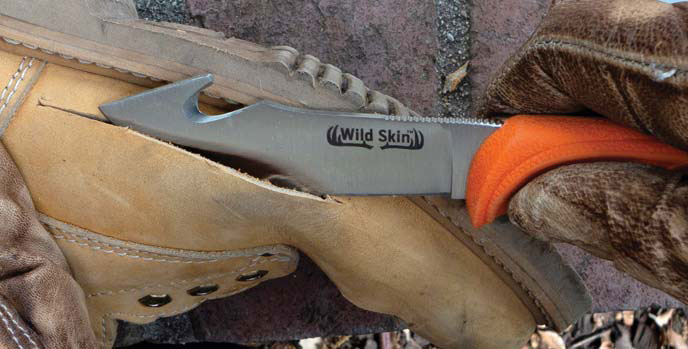
None of the gut hooks made the slightest cut into the boot leather. All of the primary edges easily cut into the boot. After having a slit to start with, I inserted each of the gut hooks in turn and attempted to cut the leather—without much success.
Only by exerting considerable effort was I able to get any of the gut hooks to cut the boot leather. I reverted to the primary edges of the four knives to do most of the cutting and found that they sliced boot leather like it was sushi.
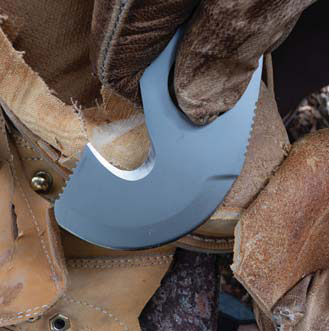
The Fremont Knives Hide Glider primary edge slices boot leather. Blade length and steel: 3.375 inches and 4Cr15 stainless.
Next, I tried cutting the floor mats with each gut hook in turn. None would cut the floor mat. All the primary edges cut the floor mats with ease. Then I went at the plastic sheeting, which I had included because it was quite thin but resistant. All four gut hooks sliced the plastic with little effort.
Thinking about the geometry of the gut hooks and wondering if they would perform better on actual deerskin, which is thinner than elk hide or boot leather, I attempted to cut the deerskin scraps my brother-in-law had given me. With much difficulty, I was able to cut deerskin with each of the gut hooks. Again, the primary edges easily cut the material.
History of Gut Hooks
The boot leather succumbs to the primary edge of the Camillus Prym1 Veil. Blade length and steel: 4 inches and 420 stainless. Blade finish: Titanium Bonded.
Many hunters use gut hooks. They must be efficient at their designated job or no one would buy them. What was I doing wrong?
Merle Seguine, a custom knifemaker who popularized the gut hook back in the 1960s, reportedly designed it to pick up a coffee pot or small pot by the ladle from the cook fire, and in fact designed some blades for that exact purpose. He later refined the hook and sharpened it for removing animal hides.
I didn’t have a campfire handy or a pot with a bail, but it’s easy to see the Outdoor Edge, Gerber, or Camillus would serve that function. As for the Fremont Knives Hide Glider, being all one piece of steel with no handle, not so much.
And here’s the MSRP for all the blades that were reviewed from least expensive to most:
Outdoor Edge Wild Skin – $18.95
Camillus Prym1 Veil – $30.64
Fremont Knives Hide Glider – $34.99
Gerber Myth Fixed Blade Pro Gut Hook – $54
Hunting Knife Review: The Gut Hook Results, Ranked
The flat-ground Gerber was the best all-around cutter, the flat-ground Outdoor Edge a close second and the hollow-ground Camillus third. The edge of the Fremont was quite sharp and though it placed last in all-around cutting, I suspect that with more experience on my part it would make a good slicer. The Fremont is also an intriguing design and being flat should easily fit into any kit bag.
Sharpening the gut hook would be an exercise in patience. A small, round sharpening tool should serve to get into the tight space.
Are Gut Hooks Necessary?
The Outdoor Edge Wild Skin deconstructs leather boot with the primary edge. Handle material: Rubber TPR. Overall length: 8.5 inches.
I have never found opening the belly of a critter to be especially difficult, though there is some technique required.
The hardest part of opening an elk’s belly is getting the huge critter—elk often weigh 500 to 600 pounds—on its back. Deer, of course, even “mulies,” which can reach 300 pounds, are much easier to manage.
I’m very much old school, as my sons remind me, and have a great deal of experience, so I’ll continue to dress game with whatever knife I have at hand. But if you’re new to dressing game the gut hook can likely do a better job for you.
If you dress out a great deal of game, say as a hunting guide, the gut hook will make your job easier and faster.
Three More Gut Hook Knives Worth A Look
This trio of gut hooks may not have gotten a hands-on review, but they are more than capable of serving you well when dressing a deer.
SharpWorld Beautiful Damascus Gut Hook
SharpWorld Beautiful Damascus Gut Hook
This knife lives up to the name and then some. The full-tang blade is made from a spectacular damascus alloy that looks even better with the ram horn handle. At eight inches in length it’s long enough to get under the hide without being too big to become cumbersome.
MSRP: $49.99
Buck Zipper
Buck Zipper
When it comes to outdoors knives there are few companies better than Buck. And their gut hook, the Zipper, is named based on what it’s designed to do: open animals like a zipper. The drop point is made from 420HC stainless with a Heritage Walnut DymaLux handle and comes with an included leather sheath.
The current CEO and President, CJ Buck, personally helped design the knife after seeing a glut of subpar gut hooks on the market in the early 1990s.
MSRP: $122.99
Case Lightweight Hunter Gut Hook
Case Lightweight Hunter Gut Hook
Case has made an incredibly light and strong gut hook that’s just over four ounces in weight as part of the brand’s Lightweight Hunter line of knives.
The gut hook has a sabre concave grind on the Tru-Sharp surgical stainless steel blade. The steel itself is a high-carbon variety designed to hold an edge longer than more conventional steels. The handle is a ballistic nylon material that increases strength without adding unnecessary weight.
MSRP: $78.99
Editor’s Note: Michael Abelson contributed to this piece.
When Brown Is Down You Need A Trustworthy Blade. These Skinning Knives Have The Chops To Make Quick Work Of A Dirty Job.
You can have the fanciest camo and the best rifle money can buy, but if your skinning knife is dull and beat up it’s not going to amount to much after the moment of truth.
A good skinning knife is a key component of any hunter’s kit and unlike its name suggests, most are used for more than simply caping your kill. Generally speaking, the best skinners are typically do-all hunters–as quick through a deer’s pelvic bone as it is removing hide.
True enough, there are some specialty blades out there (we hit a few of those) and if they fit into your system then they’re the perfect addition. But no matter what style knife you choose, all skinners will share the same basic asset–the ability to maintain an edge, for obvious reasons.
Why Sharpness Matters
Picture this, you put an elk down right as the sun dips below the horizon. Your breath is visible as you set to dress it and already thick flakes are falling from the sky. Do you want a knife you’ll sharpen every third cut?
In these circumstances, expediency demands a sharp blade. But so does safety. As most likely know–but always bears repeating–there’s a greater chance of cutting yourself with a dull knife than with a sharp one. Given you’ll make awkward cuts a challenging angles when dressing game, main times under the dim glow of a headlamp, it’s a good idea to have a tool that won’t endanger you. Unless you like the trill of working on your tourniquet skills miles from a medical facility.
Styles Of Skinning Knives
Given it has its own moniker, there are dedicated skinning knives in this world. Generally speaking, most makers outfit them with an accentuated belly and a fine edge, allowing the blade to work naturally with the user’s cutting motion. Additionally, the tip is positioned out of the way or is less prominent, ensuring you don’t end up with a nasty mistake, such as a gut puncture.
All that said, any knife is potentially a skinner if it’s sharp and you know how to use it. However, in most cases, hunters will find a few general aspects most good skinning knives share in common:
Highly Controllable: Cleaning and skinning require controlled cuts, lest you butcher the meat or perforate the cape. Controllable can mean different things to different people, but in many cases, it equates to a smaller blade with a skinner.
Fine Blade: Yeah, a serrate blade might aid in getting through bone, but it will make a mess of meat and connective tissue.
Easy Maintenance: Cleaning and skinning is a dirty, wet and sticky job–it’s not for a knife that must be handled with kid gloves.
Stays Sharp: As pointed out previously this is a safety and time aspect because you want to get back to camp ASAP with all your digits and all your blood.
Bear & Son Cutlery 7.25-Inch Stag Delrin Upswept Skinner
Bear & Son Cutlery 7.25-Inch Stag Delrin Upswept Skinner
Our list starts with an offset fixed blade from Bear & Son Cutlery. The Stag Delrin is a tough, sweeping steel that is wider near the bolster before tapering toward the tip. This allows for the bulk of the skinning to happen by the ample belly, and the offset Stag Delrin handle provides an easy way to nimbly move the knife.
The 3.13-inch blade is made from 440 stainless with a hollow grind. The leather sheath keeps the knife protected. And the whole outfit is just 3.3 ounces, making it a lightweight option. The only downside for some, it’s a bit longer than many might require.
MSRP: $50.99
Gerber Gator Clip Point
Gerber Gator Clip Point
The Gerber Gator looks mean, feels tough, and is strong enough to help you process your hunt with ease. The 420 HC stainless steel blade features a deep clip point that is excellent for doing fine knifework to get the last bit of skin off of the carcass.
The blade is connected to a glass-filled nylon handle with a Gator Grip overmold that provides excellent grip even when bloody or wet. The lockback mechanism will keep the blade secure when in use, and the ballistic nylon sheath is just as tough and rugged as the knife itself.
When it comes to skinning knives the Gator is among the best and will serve you well for years.
MSRP: $62
Havalon Piranta-Z
Havalon Piranta-Z
The Piranta-Z from Havalon stands out from the rest of our list because of its changeable blades. It comes with a dozen 60A steel blades that easily clip into the sleek black polymer handle. The knife opens thanks to ambidextrous thumb stubs, handy for those times you only have one free hand.
All of the additional blades are a huge advantage compared to some other knives. Accidentally clip a blade? Replace it with a new one in seconds. A blade goes dull midway through dressing? Remove it and change it in a snap.
Maintenance is a breeze too. The back of the knife opens for easy cleaning, and the removable holster clip allows you to keep the knife secure while on a hunt. The one issue here is that if you have to cut any bone you’ll need another tool.
MSRP: $54.99
Argali Serac
Argali Serac
Argali thought of almost everything with the Serac. At just 2.1 ounces it is insanely light, and the skeletonized handle allows for easy movement and adjustments when butchering a kill. The blade is made from S35VN stainless steel that holds an excellent edge and is durable enough to get into the guts and bones of a carcass.
This American-made blade is an excellent skinner but is just as good as an all-around hunting knife that can process an entire animal. The G10 scales provide an excellent grip that’s easy to maintain even when wet. The included Kydex sheath is just as robust as the knife itself.
MSRP: $209.99
Ka-Bar Becker Companion
Ka-Bar Becker Companion
Our list rounds out with a knife designed by legendary maker Ethan Becker. The Ka-Bar Becker Companion is a heavyweight in the world of skinning knives. It’s so tough it can handle splitting kindling for the fire as well as skinning a 10-point.
The fixed blade is made from 1095 Cro-Van steel married to an Ultramid handle. Unlike many of the other knives on our list that come in weighing just a few ounces, the Becker Companion is 10.5 inches long and weighs one pound. The trade-off is that it’s beefier than the other knives and is able to cut through sturdier material, but it may not be the best for finite skinning and knife work.
Regardless, this all-around hunting knife is more than capable of skinning your next kill and even butchering it so you can sear it over the campfire before the sun goes down.
This New Release From CRKT Is Timed In Conjunction With National Knife Day. The Newest Entrant In the Squid Line Has New Features And High-Quality Steel
It’s National Knife Day, and CRKT has released a limited-edition knife to celebrate the day. The all new Squid II OD Green, which was made in Italy, debuts today and combines everything knife fans love about CRKT with the craftsmanship of a custom knife. Only 500 units of this model are being sold.
The blade is made from stonewashed Böhler M390 steel which merges excellent edge retention and wear resistance. Ground to a plain edge, the blade is 2.68 inches in length and has a 58-61 HRC.
In a first for the Squid line, the knife features a liner lock to secure the blade in place, and the IKBS ball bearing pivot system allows for fast, smooth deployment. The handle is made from green Micarta for a rugged look, and a lanyard hole allows you to take the knife anywhere you are.
“The Squid™ II is far and away one of the finest knives we’ve ever produced,” said Doug Flagg, VP of Marketing & Innovation for CRKT. “This knife combines decades of design experience with the aspirations of what we’re trying to achieve as a brand and we’re confident it’s a knife that will stand the test of time.”
The knife goes on sale today and has an MSRP of $185
This New EDC Folder From Buck Is Quality On A Budget. It Takes Everything You Love About Buck Knives And Gets It In Your Hand For Under $50.
Not all cleavers need to be monsters that can cut through full racks of ribs. Some are perfect for your pocket.
The new 263 HiLine from Buck is just that. It’s an economical folder featuring a D2 steel cleaver blade. Ball bearings make opening a breeze, and everything is held securely with a frame lock. The handle is anodized aluminum with G10 scales and bronze-finished, titanium-coasted fasteners.
This knife excels at being a great EDC and a great camping knife. The cleaver blade does wonders preparing food on an unusual surface while you’re on a hike or getting ready to turn in while camping. The strong D2 blade can handle the day-to-day tasks needed of a good EDC with ease.
At less than four ounces in weight, the 263 HiLine is as light as it is strong, and the pocket clip allows you to easily keep the knife with you morning, noon, or night. For the asking price, you won’t find many better EDC folding cleavers.