This New Folder From Kizer Is Described As A Folding Santoku Knife. It’s A Bold Claim For A Bold Knife From The Chinese Maker.
The new Kizer Towser X blurs the line between kitchen knife and robust EDC folder. When open it really does look like a Santoku minus the Granton edge. The cleaver-like blade is 3.39 inches long and made from a stain-finished 154CM steel. While it is described as a sheepsfoot, the blade is more akin to a smaller version of the kitchen knife.
This makes for an exciting piece that is as comfortable slicing rope in the garage as it is butterflying a chicken breast in the kitchen. The dual thumb stud openers and liner lock make the knife easy to open and secure to use. The red micarta scales provide excellent grip and a classic look.
The frame and liner are both made from stainless, and the tip-up pocket clip make this blade easy to carry. If there is to be a future for folding kitchen knives, this might be the blueprint for many to come.
The Author Learned What It Took To Make A Knife From The Legend Les George In Mississippi.
When I finally met him in person, Les George had been making knives for 30 years. I had never made a knife in my life.
I had spent most of the years preceding our meeting in the Marine Corps. Les spent a decade as a Marine himself and, though we just missed overlapping in Iraq, we came to know one another through mutual connections in the Corps.
After a few years of exchanging texts featuring the kind of sarcastic insults and self-deprecating jokes in which we both seem to specialize, we found ourselves driving south from Memphis and discussing designs for the blade I intended to make in his shop.
His approach is to “try and reimagine what the guys who designed the classics were trying to do, and then do it with the advantage of 100 years of technology.”
That seemed perfect for the knife I wanted to make, one my potential grandkids might remember me carrying but that used modern design and technology to its fullest advantage. I envisioned a classic utilitarian field knife I could use to dress a deer, cut a rope or hack some limbs for a duck blind, yet one with sufficient aesthetic value to pass on someday.
As we drove down US 78 in Mississippi, I chose one of several full-tang designs Les had drawn on wood and then cut with his computer numerical control (CNC) machine. Given my experience level and general facility with machinery, the potential for catastrophic injury seemed high.
A sign on one of the shop machines confirmed that impression on arrival at George Knives: “DANGER: NOT ONLY WILL THIS KILL YOU, IT WILL HURT THE ENTIRE TIME YOU’RE DYING.” Still, given that Les started making knives at 12 with a SKIL® saw blade, a hack saw and step-by-step book, I figured I was in good hands.
Learning The Machinery
We started work as night fell on the Mississippi woods where George Knives are made. With the door of his shop open, the sound of tree frogs joined the smell of machine coolant as I chose a piece of Chad Nichols damascus steel because I liked the look of it, and because Les considers it the best in the nation.
Safety is Job 1 in the knife shop and while the sign in Les’s shop may seem flippant to some, the point it stresses is—pardon the pun—dead serious.
Nichols can pattern his steel with almost anything a customer desires. I chose the undulating lines of classic damascus because they hearken back to the old damascus shotguns my great-grandfather carried hunting quail. I laid the wooden blank out on the steel and used a scribe to trace the knife’s outline.
For me, making a knife was an introduction into a world of machines designed to strip away parts of a purposefully hard material; a jungle filled with new things specifically designed to maim me. As we prepared to rough cut the knife’s profile with a bandsaw, Les smiled and pointed at the saw blade. “This is the part you don’t touch under any circumstances,” he warned. I had visions of my suddenly amputated fingers spinning onto the cement floor of the shop.
My fears proved unfounded but I still approached both the grinder we used to bring out the knife from inside the steel, and the drill press we used to create holes in the tang for bolts, lanyard and to lighten it with the same trepidation as the bandsaw.
Asked whether I needed protective equipment, Les replied, “No, you don’t need protective equipment, you need a better plan. Remember, all the machines in the shop hate you. They think you’re a big bag of grease they can use to lube their parts.”
Despite my new-guy fears, when you are open to learning something new and are guided through a process by a craftsman, it becomes easier. Simply put, Les is a great knifemaking teacher as well as a great knifemaker, and, as a cascade of metal shavings fell to the floor and my idea took the general shape of a knife, I began to have a kind of focused fun.
Heat Treating Steel
With the steel still red hot, the boys placed it between aluminum plates for plate quenching to reduce the temperature quickly, making the steel hard.
Heat treating steel is not the most exciting step in making a knife but it may be the most critical. Les explicitly says it is not art but a science of repeatable numbers—just simple math. Did I mention I write because I am atrocious with numbers?
Undaunted by my incompetence, we hardened the steel. Les explained the purpose: “Heat treating determines how long the knife cuts. Knifemaking is always a balance between toughness, which means it resists breaking, and hardness, which means it resists dulling.”
To avoid scale, in which the steel flakes and is decarburized, we sealed the blade inside a pouch made of stainless-steel foil, placing a piece of paper inside the pouch with the blade. The paper ignites at what is known as critical temperature and consumes all the oxygen in the pouch.
On emerging, the steel was brittle and sounded different than before when lightly struck. With the steel still red hot, we placed it between aluminum plates for plate quenching to reduce the temperature quickly, making it hard. That hardness was drawn back to a usable level by again sending it for a longer, lower temperature ride in the heat treat oven while we headed off for a well-earned night’s sleep.
Creating A Badass Knife
The next morning, Les said, “You’ve got all day to do once what I can do thirty times in a short day.” So, supervised by Les, I scribed a centerline on the thickest part of the blade to guide the bevel grinding process.
This was what I had envisioned knifemaking to be and it turned out I was not wrong. As Les relayed to me, “Bevel grinding is knifemaking. The grind establishes the cutting geometry, which determines how the knife cuts.” I watched Les for just a moment before he took off the training wheels and I began grinding the transition from tang to cutting edge, a design feature called the plunge.
It’s a cosmetic factor and Les cautioned me against chasing a refined plunge. “If you’re chasing perfection,” he said, “you’re setting yourself up for failure. We don’t set goals we can’t meet. There has to be technical correction, but after that I’m chasing badass.” I wanted badass, but the lesson was to let it come to me.
The author’s finished fixed blade features a blade of Chad Nichols damascus and a Micarta® handle in a brown finish. The blade etch reads “RW Parker Rio 2021.”
With Les watching me grind while calling our mutual friends to make fun of me and narrate my progress, I began to produce something worthy of being called a knife. Les offered corrections from time to time but allowed me to get the feel of both the belt and the emerging blade. He also eased my concerns by telling me, “The cool thing with fixed blade knives is we never make a mistake, we just make a smaller knife.” Once the blade was ground to the point that it really began to look like what we had envisioned, it was time to choose handle material.
For the handle, Les had a pile of Micarta® samples from which I chose a brown finish as a nod to wood or oiled leather. We cut and fitted roughly shaped Micarta to the tang, then disassembled it all again to submerge the blade in ferric chloride to bring out the pattern of the damascus.
The soak time of the steel gave us a window to grind the Micarta to shape the grip. There is no detail left unconsidered in a Les George knife design. We talked through how I wanted the handle to feel, how I envisioned using it, and how to make sure that the aesthetic I had in my mind’s eye materialized. Then we ground the two pieces of the handle and wiped them down with oil to create a bit of the wood or leather-like patina I wanted.
Finally, we arrived at the last major step—sharpening the blade on the grinder. We walked outside the shop for a moment and Les asked whether I wanted to sharpen the blade. “It’s pretty much the last chance you’ll have to really screw it up,” he said. I was unsure and said so. In a rare moment of genuine seriousness, Les looked at me and said, “When I made my first folder, Stan [Fujisaka, master knifemaker and his mentor] sharpened it. The last stroke Michelangelo took on David was the only thing he could do. It’s a funnel of decisions. We started with a huge sheet of steel. The closer to the end we get, the fewer decisions we have.”
Though I had proudly done every previous step—with a lot of adult supervision—I decided to let Les handle it. Seeking to salve my pride, I asked him, “How long did it take you until you were confident at this stage of the game?” Looking down at the blade as he addressed the spinning grinding belt, he smiled and said, “I’m still not.” Then he put a razor edge on the blade before telling me we’d reached the point at which we would stop chasing perfect and accept damn fine.
Finding Meaning In My Knife
A Les George knife is a hybrid born of technical mastery, space age technology, and a timeless artistry that is sometimes simply the application of physicality to metal. Mine was no different. While Les acknowledges his biggest strength as a knifemaker is the ability to “work at any level of tech, from hand tools to computers,” the essence of his designs is that he takes his craft seriously without taking himself so.
He knows that the core of his business is in innovating blades in the pursuit of “a badass design that speaks to your inner 13-year-old” and, as such, he spends little time navel gazing. He is an artist who doesn’t so much reject the title as the contemplation thereof, saying, “I don’t think about it. I don’t know what art is. I rebel against the idea that men have to define themselves by what they do.”
That may be difficult when you’re a man who makes knives that sell before they’re even made. And whether he defines himself as a knifemaker, a craftsman, an artist or just a guy in a shop, there is no question that he is still answering a call he heard when he was 12 years old.
Nonetheless, he says, “I try not to base my life on what happens in this shop. Sometimes I want to quit this. But what else do I want to do more? I do this because I have to. I know I’m going to make knives. I want to not have to make knives after a day of doing something else.”
As I looked at the knife I had wanted and now held, one I created with my own hands, I understood the compulsion.
Hogue’s Newest Fixed Blade Is Visually Spectacular And Ridiculously Light. Part Of The Company’s New Line Of Hunters, The Extrak Does Far More Than Asked Of It.
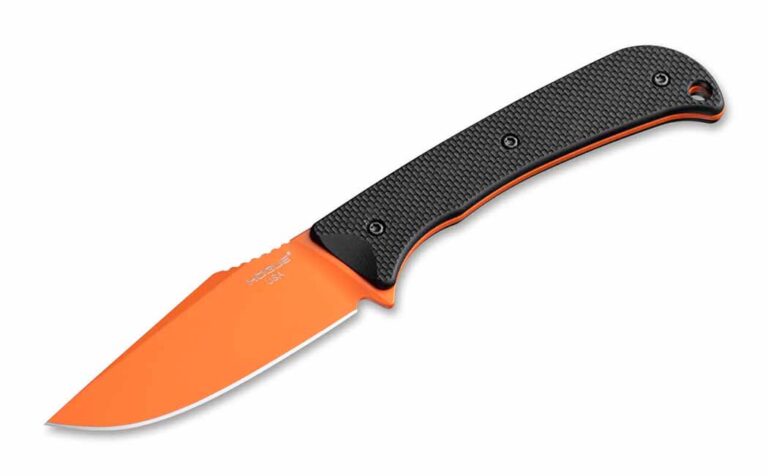
Every hunter knows that a good knife is worth its weight in gold. Hogue’s newest line of hunting field knives includes the Extrak. This fixed-blade wonder is amazing for what it can do at just 1.9 total ounces. The fixed blade is made from CPM M4 Tool Steel and has a vibrant Hunter Orange Cerakote finish. The clip point has a flat grind on its cutting edge and is hardened to a 62-64 HRC.
To learn more about this new line from Hogue, take a look at the video below.
The G10 handle scales provide excellent grip but are also removable to make the knife even lighter. The included nylon blade guard does its job admirably in keeping the blade secure in transport.
Overall this knife really is remarkable. The combination of hardness and weight alone makes it excellent for skinning hides and processing kills. It’s so light, so strong, and so versatile that it is absolutely worth the price and would make life easier for hunters of all types and skill levels.
MSRP: $189.95
Editor’s Note: This article was written by Mike Ableson.
A Good Multi-Tool Can Help You In A Pinch In Numerous Ways. This Quartet Of Tools Are Up To The Task Of Getting You Out Of A Bind.
Right off the bat, anyone who needs a multi-tool on a daily basis will face one huge question when making a purchase: How much multi-tool do I need? Options abound on the multi-faceted workhorses. Blades, pliers, shears, screwdrivers, wrenches, wire strippers/snips, files, cap lifters, can openers and the like are great to have when you need them.
The dilemma is weeding out what you do and don’t need, plus what size multi-tool you’re willing to carry. Alternatively, if you just need a multi-tool for the tool or glove box, the world is your oyster. Let’s test four diverse multi-tools that offer a wide variety of talents to help make your choice easier.
Boker Plus Specialist II
Boker Plus Specialist II
The Boker Plus Specialist II is a full-blown multi-tool with a load of tools. Like many of its type, it centers the workload around a beefy set of pliers. At the pliers’ base are a wire stripper and cutter. Tucked in the butterfly handles are a host of other tools including a knife, hex wrenches, bit driver with storage, glass breaker, file, ruler, wood saw, can opener, and bottle opener. At 10.13 ounces it’s the heaviest of the review multis, but then it also has the most extensive tool kit.
The Specialist II has a full-size pair of spring-loaded pliers with special cutting blades built into the base of the jaws—a sign that it’s serious about cutting wire and cord. I honed in on this feature by giving the cutters a go on some multi-strand computer cable, snipping off half-inch lengths.
The blades handled cutting the cable with ease as if it were an afterthought. The assortment of tools is admirable, especially the knife and saw blades that are large enough to do some serious work, a trait not always found on multis. The nylon belt sheath is a must-have on a multi-tool of the Specialist II’s weight. Kudos to Boker for including it.
MSRP: $89.95
Paul Chen Professional Multi-Tool
Paul Chen Professional Multi-Tool
The Paul Chen Professional Multi-Tool from CAS Iberia is a large multi that, unlike many, centers around a stout pair of spring-loaded carbon steel shears that slide out on rails by pressing locking buttons on each side of the handle.
Once the shears are out the handles separate, giving easy access to the Professional’s other tools: knife and saw blades, fold-out pliers, small flat-head screwdriver/can opener combo, Phillips head screwdriver, and removable sharpening file. There’s a pocket clip on the back side.
The Professional surprised me with how stout it is considering its low price tag. The main feature is shears that have 1.5-inch blades of carbon steel. I gave these a run through various materials such as canvas and cardboard and they cut like a walk in the park, so I upped the ante with some quarter-inch lasso rope.
This is a very stiff, wax-impregnated rope that some blades aren’t particularly fond of. The hungry shears took off nice, clean lengths with little effort. This multi-tool is limited in scope with its tool selection—not surprising at its cost—but there are enough implements to get you by. The knife blade opens via a thumb stud and a linerlock secures it open. At 15 bucks you could buy several of these and sprinkle them in such places as the glovebox, tool drawer, and/or backpack.
MSRP: $15
CRKT Septimo
CRKT Septimo
CRKT has never followed the pack with its multi-tool designs and the Septimo is no different. Based on a flat, compact 4.84 x 1.25 x .4-inch somewhat rectangular platform and at 4.4 ounces, the black-oxide-coated Septimo is roughly half the load of the larger test multis.
Notable is an adjustable wrench for tightening and loosening nuts and bolts. The tanto blade has a deep Veff serration at the base and secures open via a linerlock. Other tools include Phillips and flat-head screwdrivers, a glass breaker, and a bottle opener. It has a pocket clip for easy carry.
The Septimo is a very pocketable multi-tool with an inch of its total length dedicated to the adjustable wrench/glass breaker on one end. Though the Septimo’s handle is not as comfortable as that of a typical knife, the multi’s blade did the trick slicing two-layer corrugated cardboard, paracord, and even 3/8-inch rappelling rope.
I would have chosen a more utilitarian blade pattern like a sheepsfoot or drop point, but that’s me, and the tanto did more than enough to impress. The adjustable wrench can accept up to a half-inch bolt head. I gave it a twirl tightening and loosening a 3/8-inch bolt on a rock clamp I use doing lapidary work. The wrench did an excellent job. All in all, you’ll like the unorthodox yet effective Septimo.
MSRP: $56
SOG Flash MT
SOG Flash MT
The SOG Flash MT multi-tool is a great companion to your SOG Flash AT folder, but don’t let that stop you should you prefer a different knife.
The Flash MT is a barebones seven-tool multi with an assisted-opening clip-point blade, full-size pliers, a wire cutter and stripper, a large combo flat-head screwdriver/bottle opener, and a small double-ended Phillips/flat-head screwdriver with a bit drive in the base. It is the only test multi-tool in which the main body is designed specifically as a conventional knife handle.
The Flash MT has an asymmetrical handle design in that one half of the butterfly grip is slim, holding only the small bits in a foldout cyan holder, while the other grip is packed with tools. The blade did a good job cutting paracord and rappelling rope.
The wire cutter/stripper handled its chores well—not a surprise as SOG is well known for making some serious multi-tools. Using the main body of the handle with just the blade for cutting was very comfortable, with only the pocket clip feeling a tad out of place if you’re right-handed like me.
That said, the back-side clip is right at home; in fact, it’s no different from carrying a mid-sized EDC folder. This is a well-designed multi that deserves your consideration.
MSRP: $69.95
The review multi-tools provide many choices in size and tool selection. You can go big with the Boker Plus and Paul Chen multis or lighten the load with the CRKT and SOG models. Pick prudently and you’ll have a workmate worthy of your daily workload.
SOG Has Made A Hatchet That’s Compact, Lightweight, And A Joy To Use For Smaller Tasks In The Backyard Or Out Camping.
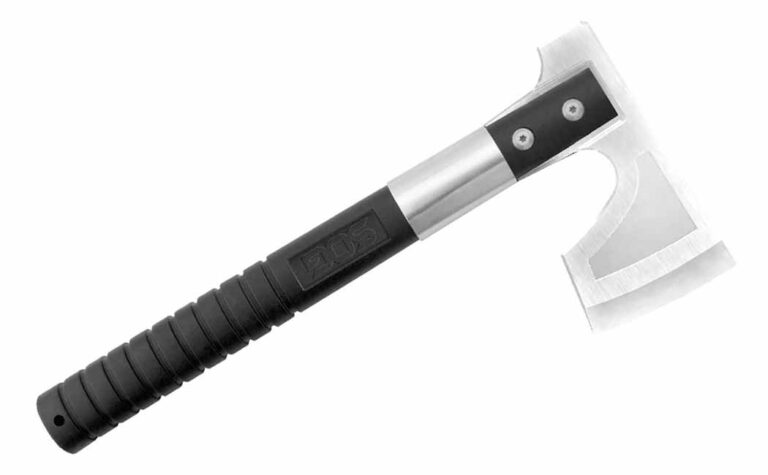
The new Camp Axe from SOG is exactly as advertised. No, this axe won’t fell a 40-foot-tall tree, but if you’re looking to cut through some small brush, chop up kindling for the fire, or hammer in some tent posts, the Camp Axe can do it all with ease.
It’s small at just a shade over a pound in weight and a shade under a foot in length. This means it’s great for chopping in close quarters. The stainless blade has a black stonewashed finish and will stay sharp in the elements.
The glass-reinforced handle is strong and can hold its own if you need a makeshift hammer to drive in a spike or a post. The included GRN safe quickly wraps around the blade and stays snugly in place so you won’t have to worry about stepping on a rogue axe late at night.
At an MSRP of $59.95, the Camp Axe feels fairly priced. This axe might not be for Paul Bunyan, but it’ll be perfect for you the next time you want to sleep under the stars.
Editor’s Note: This article was written by Mike Ableson.
The White Whale For Many A Knife Owner Is A High-Quality EDC At An Affordable Price. This Quartet Of Knives Are Great Pieces At Great Prices.
An everyday carry knife means convenience. The knife is ready when you are, effortlessly moving from pocket to hand and easily deployed. Innovation is a prime mover in the EDC world, and the latest in the more affordable factory offerings of the workingman’s edged tool provide the necessary toughness, accessibility, and good looks—all for around $50 or less.
KA-BAR Becker BK40
At .138 inch at its thickest, the AUS 8A stainless steel blade of the BK40 is middle-of-the-road thickness for a KA-BAR knife, and the intent is to allow for flexibility to perform a variety of routine tasks. The handle is based on the Becker fixed-blade designs, and the handy pocket clip provides a combination of strength and limited weight.
At KA-BAR, the Becker BK40—the first-ever folder in the KA-BAR/Becker Knife & Tool line—was put through its paces before reaching the shelves of the nearest hardware or cutlery store. Thoroughly once-overed by designer Ethan Becker, the linerlock folder stands up to the challenges of EDC in spades.
“The BK40 was tested by Ethan Becker in Montana* during every step of its creation,” related Joe Bradley, KA-BAR sales and marketing manager. “We also tested the knife here [at KA-BAR], with several staff members carrying and using it during hunting season, as well as day-to-day use in our warehouse.”
The knife is intended to complement other popular models designed by the prolific Becker and brought to market through KA-BAR.
“We look at the BK40 as a portable and compact extension of the Becker fixed blades,” Bradley explained. “You can’t always carry a BK2 Campanion but you can have the BK40 with you to do tasks around the campsite, job site or any other miscellaneous cutting task you may encounter. The BK40 captures many of the things that make Ethan’s fixed blades so popular. Its tough and straightforward design won’t break the bank. It’s comfortable to carry and backed up by our lifetime warranty.”
At .138 inch at its thickest, the AUS 8A stainless steel blade is middle-of-the-road thickness for a KA-BAR knife, and the intent is to allow for flexibility to perform a variety of routine tasks. The Becker line has a reputation for standing up to hard use and the BK40 walks a fine line between being compact and fast while simultaneously strong and robust. The handle is based on those of the hearty Becker fixed-blade designs, and the handy pocket clip provides the best combination of strength and limited weight.
MSRP: $59.19
Cold Steel Kiridashi
The Cold Steel Kiridashi employs the Andrew Demko Triad lock system for super strength, and the 4034 stainless steel blade is tough yet easy to resharpen.
The Cold Steel Kiridashi is an example of a “great EDC knife, sharp, light, tough, compact and easy to maneuver,” said Keith Beam, Cold Steel director of product innovation. “A great EDC knife has to fit your hand perfectly. It should clip in your pocket and be easy to deploy.”
According to Beam, the original kiridashi, an ancient fixed blade designed long ago in Japan, was configured to be nimble enough to teach children the art of whittling and making fine cuts. With an ambidextrous nylon pocket clip that helps deploy the knife without tearing garments and a resilient nylon Griv Ex grip built to never rot, warp or crack, the folding Cold Steel Kiridashi not only is nimble but meant to take plenty of punishment as well.
It stands up to challenges that include the locked knife supporting the weight of a hanging engine block to test the lock’s strength, and also stabbing, whittling and other cutting chores. “My knife is used for everything from cutting boxes open to trimming axe handles to fit the heads,” Keith commented. “Wire, tape, wood, cardboard, no problem. I’ve even it used to crease-cut drywall.”
The Kiridashi utilizes the Andrew Demko Triad lock system for super strength, and the 4034 stainless steel blade, .118 inch thick at the thickest, is tough yet easy to resharpen.
MSRP: $42.99
Spyderco Flight
The PlainEdge blade of the Byrd Flight in 8Cr13MoV stainless steel opens via the “Comet Hole” in the blade. Also available in a CombinationEdge, the Byrd Flight blade secures in the open position via a frontlock.
Joyce Laituri, head of marketing, communications, and public relations at Spyderco, said the Flight in the company’s Byrd line of knives is “a mid-sized, all-stainless steel folder with an ergonomic handle and twin finger grooves that fill the palm. Its hollow-ground blade converges with an unsharpened swedge, creating an acute-pointed fine tip that is well-suited to detailed cutting chores.” The Flight comes in a choice of a PlainEdge or CombinationEdge (plain and serrated) blade.
For Joyce, the definition of a great EDC knife means getting up every morning and “putting on” what you know will be comfortable, reliable, and necessary for chores during the day ahead. “It’s something you feel at ease using in any situation, except maybe lending it to a friend for a minute,” she laughed.
The Flight is intended for the budget-conscious knife user. The Byrd line was directly inspired by some of the most popular Spyderco models, offering the same function and versatility but at an affordable price.
Byrd knives feature the trademarked “Comet Hole” blade design for immediate one-hand opening, phosphor bronze washers, screw-together construction, 8Cr13MoV stainless blade steel, a multi-position pocket clip, and a mid-range blade thickness of .118 inch.
“These features combine to make the Flight an easy, functional, ready-to-carry folder,” Laituri said. “Spyderco also performs rigorous testing on all of our knives, including the Byrd line. We have an in-house testing facility and a specialized crew running the shop. I wish I could tell you what we use for testing, but much of that is proprietary and has been developed specifically by and for our testing needs.”
The Flight pocket clip is right-handed and adjusted for blade-tip-up or tip-down carry by manipulating three screws. The handle’s sequence of ergonomic curves fit the palm for comfort and fatigue-free control while cutting. For additional safety, a portion of the lock release is ground away. Called the Boye Dent, this is an add-on conceived by custom knifemaker David Boye designed to eliminate gripping the knife so tightly as to unintentionally release the lock.
MSRP: $57
Camillus Bolt
The Camillus Bolt blade is hollow ground from 440 stainless steel bonded with a Carbonitride Titanium finish to provide solid edge retention. The deep-carry pocket clip is a malleable steel to withstand abuse while allowing the knife to ride low rather than protruding from the pocket.
“It’s said that beauty is in the eye of the beholder,” commented Sam Dodge, senior brand manager of Camillus Knives, “and I think the same goes for an EDC knife. The knife needs to suit the everyday needs of the user. If you have a lot of one-handed tasks, easy open and close is a must. If you need something that gets significant rugged use, either being able to retain an edge or quickly sharpen it is key.”
For Dodge, the Camillus Bolt fills the bill as an outstanding and affordable EDC knife. “We opted to use a modified sheepsfoot blade on this knife,” he explained. “As a result, it doesn’t have the sharp fine point you find with most drop-point blades. It’s made for slicing, cutting and chopping.”
The Bolt blade is fashioned from 440 stainless steel bonded with a Carbonitride Titanium finish to provide solid edge retention, and, according to Dodge, after substantial use will take a renewed edge easily. At its thickest the blade spine measures .118 inch and tapers down to the hollow-ground edge. The grind was chosen for razor sharpness and to provide a nice platform to restore the edge during sharpening.
“We run our knives through their paces and torture test them,” Dodge added. “Drop them, open them thousands of times, and make sure that the locking mechanism is rock solid. I carry each one of our new knives in my pocket for at least a month and make sure they are used day in and day out for just about everything we can throw at them.”
The Bolt employs the Camillus CUDA lock, a sliding lock technology that has been a company mainstay for years. The handle is glass-filled nylon with a crosshatch diamond pattern to provide solid grip assurance. The deep-carry pocket clip is a malleable steel to stand up to abuse while allowing the knife to ride low rather than protruding from the pocket.
MSRP: $38.38
*Ethan lives in a most beautiful area of northwest Montana, where he tests knives in the Becker Knife & Tool line, including the BK40.
A Portable Hunting Field Kit That’s Small Enough To Fit Into Your Pack And Strong Enough To Process The Spoils Of Your Hunt.
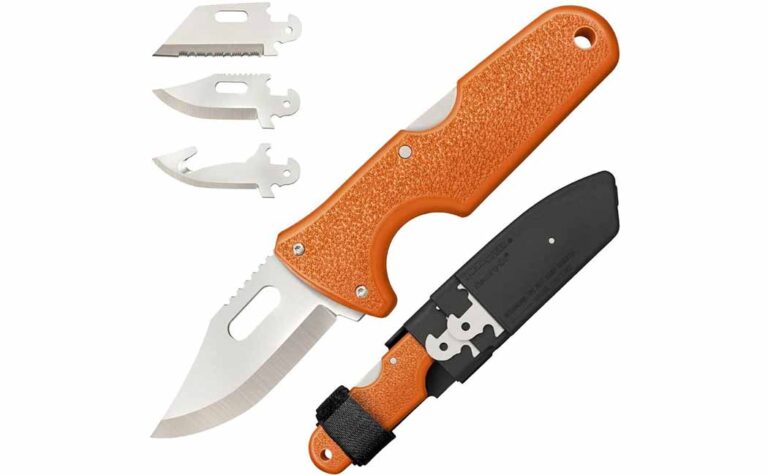
Hunting is hard. Anything that can help make the work of processing an animal easier is worth its weight in gold, and the new Click N Cut Hunting Kit from Cold Steel is 24 karat.
The kit comes with a textured handle and five interchangeable blades. It starts with a relatively standard four-inch general purpose blade which turns it into a fixed-blade knife. Additionally, there is a thing five-inch boning blade.
Where the kit really earns its stripes is with the additional attachments. A six-inch bone saw allows you to keep your hunt in manageable pieces for transport home. The four-inch skinning blade and gut hook is long enough to let you quickly skin an animal while still being strong enough to stand up to the rigors of use.
The last piece is a 3.5-inch caper blade perfect for skinning the heads of animals and acting as a perfect last tool to round out the set. The Click N Cut is the type of hunting kit that you’ll be grateful to have in your pack because it’s small, it’s tough, and it’s priced fairly.
MSRP: $99.99
Editor’s Note: This article was written by Mike Ableson.