Home Blog Page 10

Tactical Fixed Blades: EDC With An Edge

Don’t overlook small tactical fixed blades for everyday carry.

When most blade fans talk everyday carry (EDC) knives, they usually mean folders. The two main EDC advantages of folding knives are they are convenient to carry and, except for that pesky pocket clip, easy to conceal. Of course, while many overlook the clip, others know it indicates you are carrying a knife.  

Folders are designed primarily for smaller everyday chores—opening a box, peeling fruit and so on. This is especially true of slipjoints, which rely on you cutting away from yourself—which you should always do with all knives—and a half-stop as a safety device. Granted, when slipjoints were popularized long ago, lockback, linerlock and framelock folders were unavailable. The problem with both slipjoints and lockbacks is most take two hands to open and close, which, if you are trying to cut something you simultaneously must hold, can be inconvenient at the very least.

The late 20th and early 21st centuries saw a boom in the commercial availability of manual folders that could be opened and closed with one hand. Utilizing the flipper opener and the roller bearing system made the blade deploy quickly and smoothly, often even quicker than an automatic. With the perfection of linerlocks and framelocks, unlocking and closing the manual folder with one hand was no longer a problem.

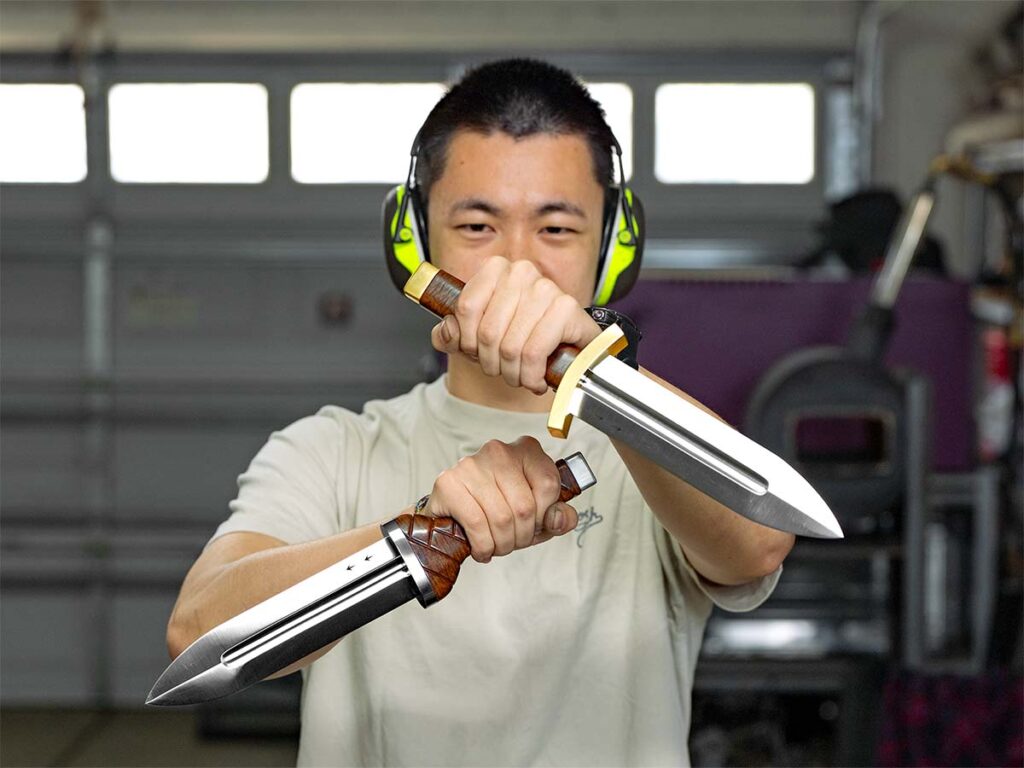
Kydex sheaths can be molded to fit the blade and, over time, will not deform, providing a safer carry option. Rafal Kolakowski uses Kydex® for the sheaths of his Ridgeline set of small tactical EDC fixed blades.

Even with these technical improvements, the folding knife still has its limitations. A small blade can do only so much before it bends or, in some cases, breaks. Some tactical folder makers tried to address this issue by making folders with 5-inch blades of 1/4-inch stock. This was done primarily for cosmetic reasons without addressing the folder’s primary weakness—the pivot. The very nature of the pivot means it must allow some side-to-side movement of the blade, no matter how slight. If the folder is used for an unintended purpose or put under undue force, the blade can be moved off-center.

On top of that, folding knives require more regular maintenance than fixed blades. Locking folders with back straps and slipjoints with backsprings collect dirt, lint, etc., during daily use and must be cleaned. What’s more, using a folding knife beyond its capabilities and failing to perform regular maintenance can affect its opening and closing ability. Lastly, a folder cannot do anything until you first deploy the blade.

Fixed-Blade Pros

Fixed blades, on the other hand, offer several advantages. As already suggested, larger fixed blades can do tasks that smaller blades either can’t perform or do so with difficulty.

Finger/thumb serrations on the blade spine of Al Polkowski’s Boot Fighter help with controlling the knife in use.

One of the fixed blade’s most significant advantages is full-tang construction, providing added strength and durability. A full-tang fixed blade especially is better suited for heavy cutting and repeated hard use, and safer for use with a heavy load.

A fixed blade also has a superior mechanical advantage. Unlike the folding knife, there is zero chance of mechanical failure under stress. Locks and pivots can fail, especially when using the knife for tasks for which it is not intended.

Another advantage is the style and size of the blade. Fixed blades can feature longer and thicker blades that will perform better under the rigors of hard use.  

Full-tang fixed blades such as the Trailhead set by Tomasz Dziubinski are better suited for heavy cutting and repeated hard use, and safer for use with a heavy load.

A fixed blade typically will have better handle ergonomics. Its handle is usually designed for prolonged use, featuring a more comfortable grip that also aids in balance and is ready for immediate deployment. While many folders can be opened with one hand, not so slipjoints. If your hands are cold, wet, injured or gloved it can present a problem as many, if not all, slipjoints require two hands to deploy the blade or blades. On the other hand, with the correct sheath combination, a fixed blade can be rapidly deployed under almost any circumstance.

Sheath Concerns

Top material options for EDC fixed-blade sheaths are leather and Kydex®. Kydex gained popularity because it provides two main advantages over leather.

First, most makers can build at least a rudimentary kydex sheath. Leather sheaths are more of a challenge. Second, Kydex does not hold moisture and does not require tannic acid, which is used in the processing of leather. This is very important for EDC. Tannic acid in the leather can cause carbon steel to discolor. Leather, once wet, can shrink and/or deform, allowing the blade to accidentally cut or poke through it.

Conversely, Kydex does not hold moisture and does not require tannic acid. Kydex can be molded to fit the blade and, over time, will not deform, providing a safer carry option. Finally, the clip attachment on most Kydex sheaths can be adjusted to wear in either a vertical or horizontal position.

They Have The Edge

With the right sheath combination, a fixed blade can be rapidly deployed under almost any circumstance. The Street Scalpel by Rafal Kolakowski with Kydex® sheath and breakaway chain is a classic example.

I’m not suggesting that folders do not have advantages as EDC knives; they do. They are usually more comfortable and concealable to carry than fixed blades. They are more socially acceptable and usually have limited legal restrictions. They can provide versatility for light tasks such as opening letters, boxes, cutting cord, etc.

It is in fact the EDC folders’ size that is its biggest disadvantage. The smaller blades and less ergonomic handles limit the number of tasks folding knives can perform. Also, their moving parts provide a mechanical disadvantage when compared to EDC fixed blades.

The majority of this story’s featured tactical fixed EDCs have a 4-inch or shorter blade. Many tactical EDC folders also have 3.75-to-4-inch blades. When open, they are about the same length as the featured fixed blades.

With perhaps the exceptions of concealability and some legal restrictions, fixed blades have the edge. Depending on what you are using it for, you may want to consider a knife that has the mechanical advantage, requires less maintenance, can be easier to deploy in difficult situations or environments, and is more comfortable in the hand: fixed blades, the other EDC!

Rebel Specs
Knife type: Small tactical EDC fixed blade
Blade Length: 4.25”
Blade Steel: Elmax stainless
Blade Finish: Two-tone satin and bead blast 
Handle Material: Textured black Micarta® w/OD green Micarta liners 
Overall Length: 9” 
Sheath: Custom-built by the maker; Kydex®
Author’s Comments: “Excellent all-around knife … the tip is ground to give the knife extra penetration … the texture of the black Micarta on the handle gives the user additional traction … primarily designed for belt wear, the clip can be configured for additional carry options … serrations along the top of the blade enhance the knife’s ability to handle small chores … a great knife that provides lots of user options.”
Maker’s price: $430

Ridgeline Specs
Knife type: Small tactical EDC fixed blade
Blade Length: 4” 
Overall Length: 8.75” 
Blade Steel: Becut stainless
Blade Finish: Satin 
Handle Material: Black G-10 
Sheath: Custom-built by the maker; Kydex®
Author’s Comments: “Double-hollow-ground blade with a fuller for added strength … full-tang construction … sculpted handle material for enhanced ergonomics … stainless-steel-tube-lined thong hole.”
Maker’s Price: $350 each


Boot Fighter Specs
Knife type: Small tactical EDC fixed blade
Blade Length: 4” 
Blade Steel: 154CM stainless
Blade Finish: Bead blast 
Handle Material: Black and green G-10 
Overall Length: 8.25”
Sheath: Custom-built by the maker; Kydex®
Author’s Comments: “Great little back-up knife … it features a double-hollow-ground double edge with an extended tang that features a thong hole … quick and light in the hand.” 

Trailhead Specs
Knife type: Small tactical EDC fixed blade
Blade Length: 3.5” 
Blade Steel: Sleipner stainless 
Blade Finish: Black Cerakote® 
Handle Material: OD green G-10 
Overall Length: 8.25”
Sheath: Custom-built by the maker; Kydex®
Author’s Comments: “Flat-ground, upswept utility-style blade … full-tang construction, excellent handle ergonomics … small knife built for hard work … stainless-steel-tube-lined thong hole … perfect knife for camping, a hike and everyday carry.”
Maker’s Price: $280 each


Street Scalpel Specs 
Pattern: Tactical fixed-blade neck knife
Blade Length: 2” 
Blade Material: 80CrV2 carbon steel
Blade Finish: Black Cerakote® 
Handle Material: OD green G-10 
Overall Length: 5.9” 
Sheath: Custom-made, multi-position in Kydex® by the maker w/ball-bearing breakaway chain 
Author’s Comments: “Perfect for utility or self-defense … the attachment holes on the sheath allow the knife to be carried however you like.” 
Maker’s Price: $280 

More Knife Reviews:

Japanese Swords: Can Tradition Outperform Modern Tech?

There is plenty of lore surrounding traditional Japanese Swords, but do the master makers’ time-tested methods equal modern steel advancements?

Editor’s note: Long-time BLADE® subscriber and knife collector Rick Royster wrote us, wondering how the swords of the ancient Japanese samurai warriors would compare to today’s modern swords. Did all the steps the ancient Asian swordsmiths used really make a difference? “Employing special quenchants, some clay, some of this and that—is it science or mystical?” Rick asked. While we couldn’t test an ancient sword vs. one of today’s, we did go to the sources themselves for answers—some of today’s top swordsmiths.

The traditional Japanese sword blade is revered for its performance, perhaps even more than its beauty and ties to an uber-rich heritage in the world of cutlery. Combined, these elements make the classic Japanese sword something unforgettable, a work of art and poetry in motion—yet capable of delivering the decisive blow in combat.

Modern custom sword blades may not possess the allure of the centuries. They may not have a hamon—though many do—or the other attributes that make their vintage counterparts so revered. Nonetheless, they can claim respect and admiration when it comes to strength. If the comparison of relative strength is relevant and worthwhile, which is stronger—the ancient Japanese or the modern custom sword blade?

World-renowned Japanese swordsmith Yoshindo Yoshihara does yakire, the fast quenching of a sword, during one of his swordmaking demonstrations. (Aram Compeau image)

BLADE Magazine Cutlery Hall-of-Fame® member/ABS master smith Steve Schwarzer answers the question this way: “Modern steels are highly superior in almost every way except for visual structure. Traditional Japanese bladesmiths were all about taking inferior material, which was the best stuff on the planet at the time, and making it better. Modern steel is superior because it is a lot cleaner with alloys for specific jobs. Setting the structure up is what today’s American Bladesmith Society is all about: making steel better. It’s hard to compare the two, but modern steels are superior in edge holding and sharpness. Modern steel won’t bend like the old stuff because it is not designed to bend.

“Once you get the aesthetics out, the fancy hamons and stuff like that, ancient bladesmiths had a way to control the process in the old days from one portion of the blade to another. If you take a Japanese blade and quench and polish it, you have a big spring supporting the cutting edge, and that is why it would excel in battle.”

ABS master smith Zack Jonas sees the purpose as the primary differentiator in either case.

According to Steve Schwarzer, traditional Japanese bladesmiths took inferior material—the best stuff available at the time—and made it better. “Modern steel is superior because it is a lot cleaner with alloys for specific jobs,” he stated. He used modern steel and all the trimmings on his Japanese sword. (Eric Eggly/PointSeven sword image; image of Schwarzer by Chris Wellhausen)

“The strength of the traditional Japanese sword would have been measured in its ability to withstand the test of battle without breaking,” he began. “By this measure, they were marvels of engineering. Today’s technology is capable of producing swords with performance characteristics that vastly exceed the finest traditional blades. We have steel mills producing bespoke blade alloys from ultra-precise ratios of refined base elements.

“We have modern heat-treating methods capable of holding plus-or-minus a fraction of a degree indefinitely within a perfectly controlled atmosphere. We have modern quenching oils and molten salt pots and ovens for tempering, and we have analytical tools that allow us to refine how we approach our materials. Traditional swords were purpose-built for war, and they lived up to those demands for a thousand years and more. But modern science gives us greater capabilities on a purely quantitative level.”

The cutting of the tatami mat—done here by James Williams during one of his Japanese sword demos at a past BLADE Show—is said to be a good analogue for testing cuts against a human target.

Schwarzer agrees that modern steel is produced in quantity, while the traditional Japanese sword blade was produced singularly.

“It truly takes a master to get the most out of any steel,” he remarked, “but modern steels are more forgiving because they are designed around production, not one-offs.”

Traditional Sword Construction

Dave Goldberg has made traditional Japanese swords since the 1990s and learned from masters in their construction, as well as in the forging of damascus. He sees the functionality of the traditional Japanese blade and says, “The edge of the sword blade is about 60-70 on the Rockwell scale and you want that to be about one-third of the blade area. The middle is somewhat hard, and the back is not hard but flexible.”

According to Zack Jonas, modern smiths have access to modern materials and technology, but in many or even most cases, modern swords are not made with careful consideration for the practicalities of combat. Zack’s wakizashi features a 22-inch damascus blade with a shinogi zukuri grind. Overall length: 28 inches. (SharpByCoop sword image; image of Zack by B. R. Hughes)

According to Jonas, the hardening process was essential during ancient times. The warrior absolutely depended on it. Traditional swordsmithing techniques have been refined over the course of centuries through the familiar process of trial and error.

“Since ‘error’ would have been a matter of life and death,” Zack observed, “we can say with a degree of confidence that traditional methods worked extremely well. For example, it was essential to employ differential hardening—which traditional smiths did by applying an insulative clay to the spine—because given the properties of the steel they were working with, a fully hardened blade would have created a number of problems both for the smith and for the warrior. It can be tricky to retrospectively disentangle the mystical from the scientific. Mystical practices that offered no benefit would have been winnowed out in favor of those that did, and those that did offer benefit can be scientifically explained today.”

Years ago, Goldberg traveled to Japan to study traditional sword blades under the legendary Yoshindo Yoshihara, whose family has practiced the art for no fewer than 10 generations.

Zack Jonas said modern steels can get harder, tougher and sharper than traditional Japanese tamagahane steel, but it remains important to remember that tamagahane was strong enough for a thousand years of battles. This traditional tamahagane was made in a smelter, or tatara. (Yoshihara Yoshikazu image)

“He taught me a lot of things about sword making,” Dave remembered, “and in his smithy, he had on the wall behind where he forges a Japanese shrine with lightning bolts hanging and incense burners, and there was a little teapot in the smithy, too. He said it was just decoration, but with the Japanese guys even if you are friends, there are still secrets. So, I put paper lightning bolts in my shop too—to protect my spirit and so the blades will come out well and get through the quench.”

Bound up in tradition, the mysticism makes the Japanese way an art form that can never be completely separated from its origins. Even in a straight-up test of strength, whether one steel prevailed over the other, there would be no loser. Each would continue to hold its relative place in time and space and fact and imagination.

“In absolute quantitative terms, traditional materials mostly do not offer performance advantages over their modern counterparts,” Jonas said, echoing Schwarzer’s observation. “For example, modern steels can get harder, tougher and sharper than traditional Japanese tamagahane steel, but it is still important to remember that tamagahane was strong enough for a thousand years of battles. Likewise, performance isn’t everything. One of the signature features of tamahagane is its appearance. It has aesthetic characteristics that modern steels lack entirely.”

Japanese Sword Features

Eighty-two-year-old Yoshindo Yoshihara, author of this classic Japanese sword and saya (scabbard), is generally recognized as the greatest maker of Japanese-style swords of his generation. (Francesco Pachi images)

Among the most noteworthy features found in traditional Japanese sword blades is the hamon, which Zack describes as the literal demarcation point between the hardened edge of the blade and its softer spine. The hamon, he says, is a visible representation of the technique that must be used due to the material constraints and demands of tamahagane steel.

It is visible due to light diffusing off the mixture of hard and non-hardened crystalline structures, where the hardened edge transitions to the softer spine. He adds that over time, the production of the hamon stretched beyond the practical necessities of the steel and into the realm of aesthetics. Whether the shape of the hamon has any bearing on the blade’s performance is an open question.

“Any steel hardened and tempered to its best molecular composition is good steel,” Goldberg commented. “Modern 80CrV2 steel is harder than any Japanese steel. Japanese steel can take it in battle, and from sword to sword, it can be amazingly hard. It becomes its own shield when the warrior holds it above his head and can then come around and cut the other guy. Japanese steel is really hard, but modern technology is something else. I have never seen anything harder than the CrV stuff. Everything is purpose-driven.”

Matt Venier made what he calls Mattyhagane to recreate tamahagane for the blade of his katana. The tsuka (handle) consists of a wood core with full rayskin and braided wrap. The tsuba (guard) and habaki (collar) are copper. (SharpByCoop images)

Other attributes of the traditional Japanese sword, including the handle ornaments known as menuki, may contribute to performance as well. While some observers may see menuki as a sort of grip enhancement in functioning as a palm swell, allowing the user to index the sword better, others stress that they are primarily evidence of the maker’s desire to express his or her own identity and creativity. Menuki quite possibly can function on both levels.

Japanese Sword Folklore

Through the centuries, there have been claims that Japanese steel can perform certain tasks that modern sword steel cannot. Jonas says that many such contentions are simply folklore or myth and have been easily debunked.

“One popular example is the cutting of the tatami mat,” he related. “These straw mats, soaked in water and then rolled tightly together, are said to be a good analogue for testing cuts against a human target. It has been said that only the katana can do this well, but these days, videos can be found online showing a skilled swordsman cutting through a tatami with a blunted medieval-style longsword.

“The Japanese sword has been mythologized along with the warriors who made it famous. The samurai were incredible fighters who earned their reputation for fierce courage through feats in battle and cultural refinement. Their signature sword is a highly developed object with exceptional performance abilities, but traditional examples will not outperform their modern counterparts.”

Old & New Symbiosis

In the final analysis, the old and new steels co-exist, achieving a symbiosis, a sort of mutual respect. As Zack so aptly pointed out, the context of their comparison weighs in on the discourse.

“It is important to consider how this matter is discussed,” he noted. “Most of these topics bear on the question of superiority—what makes this sword better than that sword or vice versa—and while it is possible to give some answers in the absolute sense, there is a risk that these answers ignore important contextual factors.

“The traditional Japanese sword was designed for a particular form of combat and was designed with the constraints of the tools and materials available at the time,” he concluded. “Modern smiths have access to modern materials and technology, but in many or even most cases, modern swords are not made with careful consideration for the practicalities of combat. Modern smiths are unlikely to even be familiar with how a sword would need to behave in a fight.”

Times change, materials change, techniques and methods change. But through the ages, traditional icons endure, while new and emerging genres come to life and begin to build legacies of their own.

More On Swords:

Tomahawks: Wicked Hacking Options That Have An Edge

0

We put a bevvy of today’s tomahawks through the wringer to see which of these choppers has bite.

Tomahawks are interesting tools. They’re not knives but can cut like them. Though not full-blown axes, they can chop like them. Similar to knives, hawks are both tools and weapons. Like knives, they come in all price points, materials and features, as well as sheath styles/materials. Finally, they find wide acceptance in both the tactical and outdoor/hunting communities. Let’s take a deep dive into a quad of top factory examples of the genre.

Winkler Knives Ridge Line

The Ridge Line’s shortened scales leave half of the tang exposed to prevent handle material damage in the event of a missed strike.

The Ridge Line from Winkler Knives is a hatchet that embodies elements from years of hatchet and hawk making, incorporating some of the more notable improvements made along the way into one piece. The head is 80CrV2 carbon steel for toughness and edge-holding ability. Stock thickness is ⅜ inch, giving the Ridge Line good balance while remaining somewhat lightweight and more agile in-hand. Cutting edge: 3 inches. Overall length: 13 ⅞ inches.

The shortened scales leave half of the tang exposed to prevent handle damage in the event of a missed strike. The scales come in several choices of Micarta® and maple. The material is attached to the tang using Micarta pins. The maple of the review sample is contoured well, has no hot spots and is quite comfortable.

The sheath is Boltaron® done in a way few do it. Winkler goes the extra step by lining the inside with felt so the hawks don’t get scratched up on insertion/removal. The biggest advantage of the felt lining is it’s not noisy during sheathing/unsheathing like standard Boltaron. A pair of nylon webbing belt loops with Pull-the-DOT® button snaps attach to a belt. A strand of 3/16-inch shock cord wraps around the head to secure it to the sheath. The sheath complements the high-quality construction of the hatchet itself.

The curve of the head of the Winkler Ridge Line attacks wood at a slight radius, amplifying chopping power.

The Ridge Line is an absolute beast for chopping. The curve of the head attacks wood at a slight radius, amplifying chopping power. The forward weight means you can easily deliver powerful blows with minimal effort by letting gravity do its thing. The 80CrV2 takes an edge easily, so sharpening is not an issue. It also holds an edge respectably well, so performance wise it’s very reliable. I like how the handle flares toward the butt, acting as a stop to prevent the hawk from flying out of your grip during use.

Unlike a couple of the test hawks, the Ridge Line is strictly a chopping tool. Hence, using it for other tasks can be a bit awkward given the handle configuration and the exposed tang. If you’re looking for a pure chopping tool well designed and executed, this is it. Simply put, Winkler’s hawks are among the best in the business.

Multiple handle material options include camo G-10, black and tan laminate, black canvas laminate, brown canvas laminate, green canvas laminate, maple and walnut. The laminate material is similar to Micarta. There are also sculpting options on the camo G-10 and black/tan laminate handles. No matter the material, the Ridge Line has an MSRP of $635 and is made in the USA. At press time there was about a two-to-four-month lead time for delivery. 

RMJ Tactical Dvalinn

The specially designed cutting head of the RMJ Tactical Dvalinn is sharpened on each side, increasing both utility and effectiveness as a CQB tool. A spike at the opposite end punctures effectively.

The RMJ Tactical Dvalinn is a collaboration with Andrew Bawidamann of Bawidamann Knives. It is equal parts defense/CQB (close-quarters battle/close-quarters combat) and cutting/chopping tool, all in a compact size for trouble-free portability. At 10.25 inches overall, the Dvalinn is easily carried on the belt or stashed in a backpack and can substitute for a fixed blade in some scenarios.

Starting with 0.270-inch-thick Nitro-V stainless steel, the Dvalinn is built equally tough as RMJ’s larger hawks. The specially designed cutting head is sharpened on both sides, increasing both utility and effectiveness as a CQB tool. A spike at the opposite end punctures effectively.

A single-beveled, exposed tang on the handle butt acts as a pry tool. The black G-10 grip sports a spiral-type machining pattern that enhances purchase with or without gloves. There are three Cerakote® finishes and handle colors: OD green coating with Dirty Olive G-10, tan coating with Hyena Brown G-10 and Savage Stainless with solid black G-10.

Each Dvalinn rides in a molded Kydex sheath with belt loops. Remove the retention strap and the hawk can be accessed and deployed quickly and effortlessly with one swift tug on the handle without having to worry about unbuttoning the strap first. The strap is a bit redundant as the sheath is very well designed and has more than enough tension to retain the hawk. However, the strap also is easily removable, which alleviates one step in freeing the tool.

If you choke up against the Dvalinn’s head—though be mindful of the inside edge and the spike—you have plenty of control for whittling. According to the author, the hawk is surprisingly agile in such a grip.

Though the Dvalinn is not designed for field use and is more for self-defense/CQB purposes, it still can be used for outdoor and general cutting tasks. Chopping is very limited due to the tool’s short length. It can handle common knife chores like cutting cardboard or plastic and any other applicable task. If you choke up against the head—though be mindful of the inside edge and the spike—you have plenty of control for whittling. It is surprisingly agile in such a grip.

The flat-ground head and excellent factory edge enable the Dvalinn to excel at general cutting. The top edge corner penetrates similarly to the tip of a knife blade. The spike is deadly, plain and simple. It’s ground and sharpened just right so it penetrates with surprisingly good results for such a compact hawk. The steel seems to hold an edge well. RMJ has built a solid reputation designing and building some of the industry’s best production hawks, and the Dvalinn is a great example. Country of origin: USA. MSRP in your choice of handle materials: $495.

SOG War Fighter

The handle of the SOG War Fighter is solid steel encased in black G-10 featuring multi-faceted machining for a superior grip. A raised diamond-type texturing accommodates your thumb and fingers.

The SOG Knives War Fighter is even shorter than the Dvalinn yet still packs a punch. At 8.75 inches overall, it is about as long as some larger field-grade fixed blades. The 4-inch head and spike are 3Cr13MoV stainless steel in a black stonewash finish. Like the Dvalinn, the head’s underside is sharpened for more cutting versatility. A beveled spike is on the opposite end.

The handle is solid steel encased in black G-10 featuring multi-faceted machining for a superior grip. A raised diamond-type texturing accommodates your thumb and fingers. A bolted-on steel buttcap serves as an improvised hammer if needed. The hammer function is something the other test hawks don’t have. If you need a hammer get one, but that’s not possible in some scenarios and having a tool that can provide such a function is valuable.

The War Fighter has a molded plastic sheath that fully encases the head and spike. A single webbing retention strap holds the hawk securely. A molded plastic belt loop attaches to your belt and is reversible for ambidextrous use. The sheath snaps on securely. Insert the spike end first then push in the rest of the head until you hear an audible snap. The sheath is on a par with most molded knife sheaths—nothing fancy but it does the job well.

The War Fighter’s 4-inch head and spike are 3Cr13MoV stainless steel in a black stonewash finish. The head’s underside is sharpened for more cutting versatility. The spike is beveled.

Out of the box the War Fighter seemed an OK chopper. It’s short like the Dvalinn but has more head weight. I found the edge a tad thick so I used my belt grinder to reprofile it thinner, doing the final resharpening at 22 degrees convex. The bite and chopping noticeably improved as a result.  

Another issue is the spike. It needs to be pointier and more aggressive. Out of the box it was blunt. To be a viable self-defense/CQB tool, the spike needs to have a sharp point to maximize penetration. As is it penetrates wood only so far. Additionally, the four notches cut into the spike are useless. Each one is very sharp and catches kind of like a fishhook. My recommendation is to remove those. I’d rather see the spike pointier than have the notches.

The handle with its various surface features does a great job at keeping your hand in place. I wore leather work gloves during testing and never felt the War Fighter was going to get away from me. G-10 is an excellent choice for handle material, given its dimensional stability and being impervious to most fluids. Country of origin: China. MSRP: $94.99.  

Hogue EX-T01

The Hogue sheath is intriguing. It integrates into the EX-T01’s head via a specially designed cutout that both reduces weight and provides an interface to secure the hawk to the sheath itself. 

Designed by custom knifemaker Allen Elishewitz, the Hogue EX-T01 is designed to be an easily carried chopping tool and sports a distinctive carry system. The 3-inch head is S7 tool steel. The full-tang construction yields to a machined G-10 handle for superior grip with or without gloves in all weather conditions.

A smart design feature is a partially exposed tang about 2 inches below the head—from there the G-10 transitions to a fully encased design. The partially exposed tang would appear to protect the handle material against overstrikes. And the orange Cerakote finish appeals to hunters, being easier to spot if you drop the hawk in the field.
S7 is easy to resharpen, a plus for field carry. The downside is it is not stainless, which partially explains the rust-resistant Cerakote finish. S7 is an excellent candidate for chopping due to its resistance to deformation or dulling from hard-use applications. It is the type of steel you want for a chopper.  

The G-10 is chamfered nicely to eliminate hot spots, and the texturing helps provide a nonslip grip in all weather conditions. I like the bird’s-beak pommel forming a hook to capture the user’s hand. Five sets of bolts along the handle’s entire length hold the G-10 onto the full tang. 

A smart design feature of the Hogue EX-T01 is a partially exposed tang about 2 inches below the head—from there the G-10 transitions to a fully encased grip.

The sheath system is rather intriguing. It integrates into the cutting head via a specially designed cutout that both reduces weight and provides an interface to secure the hawk to it. The main part is machined black G-10. The centerpiece is of the same shape as the head cutout, as well as a ridge section that protects the edge from inadvertent contact when sheathed. 

Three rare earth magnets inlaid into the sheath plate in three different locations grab and hold the EX-T01 securely. Moreover, an integrated latch that turns and detents into place prevents the hawk from detaching. A flexible, contoured plastic-belt-loop attachment affixed to the sheath plate slides over and affixes to a belt. You need not loosen your belt to attach or remove it, so it’s quick, too. It’s a really neat way of carrying a tomahawk, very secure, safe and easy to use, and different from standard sheath systems.

Last but certainly not least, the EX-T01 is a blast to use. This is one dynamic setup, providing a lot for the money. Overall length: 14 1/8 inches. Country of origin: USA. MSRP: $329.95. 

Check Out Outdoor Knife Reviews:

50 Years Ago In BLADE: Buster Warenski

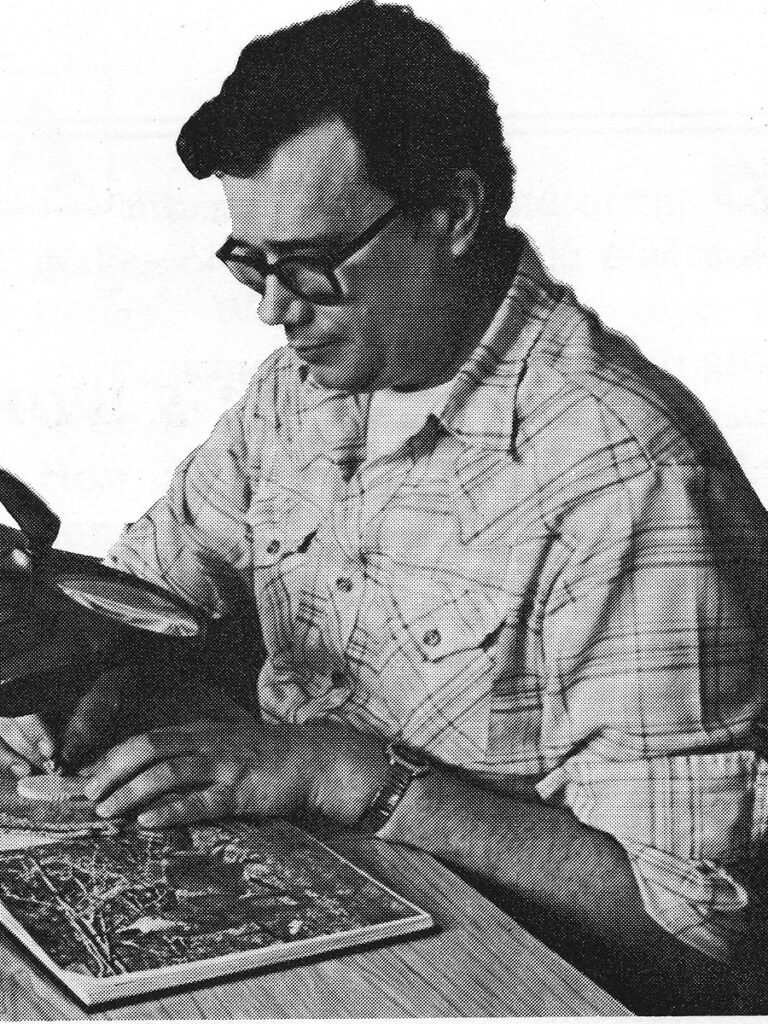
BLADE Magazine Cutlery Hall-of-Fame® member Buster Warenski was the subject of an extensive six-page profile a half century ago in the January/February 1976 issue of The American Blade. He was larger than life then and would get even larger in the years to come.

Unmistakable in the low-crowned Stetson and mutton-chop sideburns he wore back then, Buster was interviewed in his new Richfield, Utah, knife shop by then editor L.V. Baker. Richard Barney, co-author with Cutlery Hall-of-Famer Bob Loveless of the landmark How To Make Knives book, was along to take photos. The lead image of Buster holding one of his latest knives at the time is about as iconic as it gets.

Done about half a decade before Buster would go on to make his reproduction of the King Tut Dagger, the story and spread reflect how consequential Buster was to the handmade knife movement of the 1970s. It covers from his early influences, including Harvey Draper and Cutlery Hall-of-Famers Gil Hibben and Bo Randall, the first two knives Warenski ever sold, some invaluable magazine publicity from Cutlery Hall-of-Famer B. R. Hughes, Buster’s first Guild Show in 1973 and his position on the Guild Board of Directors at the time of the interview.

One of Buster’s best quotes: “I think the industry is going to get bigger and better, just as our customers and collectors are going to become better educated about the knives they buy and are going to demand a better product.”

Buster was right, of course—and would be among the vanguard of makers to supply the knives for which he predicted there would one day be such great demand.

More Knife History:

First Look: Kizer Pokiman Line Of Gentlemanly EDC Knives

Class meets capability: Exploring Kizer’s ambidextrous Clutch Lock folders featuring AEB-L stainless steel and premium handle scales.

‘Tis the season for sharp gifts to place under the tree for your favorite knife enthusiast. Kizer Cutlery has a little something to stuff stockings with once the Yuletide season closes.

Set to officially launch in January 2026, the company’s Pokiman series is described as a collection of gentleman knives. The set of six knives—three models, each with two variations—may look suitable for a church picnic or the office, but they are not small and delicate.

All knives in the Kizer collection are essentially full-sized EDC options. Each one boasts a 3.16-inch blade. Overall length is just under 8 inches. This size provides enough tool for prying at a stuck locker lid or making mincemeat of sisal rope.

Yet, boasting everything from sheepsfoot to clip point blades and Micarta to aluminum and PEI scale, the knives have the look and lines for more suave tasks.

Common across the models are AEB-L steel blades, a very old and respected stainless steel, known for its fine carbide structure and a good balance between hardness and toughness. Plus, it’s known to take and hold an edge.

Kizer outfits the Pokiman line with its Clutch Lock, the company’s take on the ever-popular Axis Lock, presently sweeping the knife world. And why wouldn’t it, given its design makes a knife ambidextrous and offers a fast and quick, one-handed opening/closing option.

Interestingly, and seeming to walk hand-in-hand with the Axis Lock trend, Kaiser turns to thumb studs alone for the opening method on all the knives.

Depending on the model, the Pokiman line has MSRPs from $60-$70. While not available presently, several online retailers already have them on pre-order.

Pokiman CS Specs

Kizer Pokiman CS

Blade Length: 3.16″
Closed Length: 4.21″
Overall Length: 7.36″
Blade Material: AEB-L Stainless Steel
Thickness: 0.110″
Blade Hardness: 58-60HRC
Blade Style: Sheepsfoot
Blade Grind: Flat
Blade Finish: Black PVD or Gray Stonewashed
Handle Material: Tan Aluminum or PEI
Locking Mechanism: Clutch Lock
Pivot Assembly: Bearings
Pocket Clip: Deep Carry, Tip-Up, Right/Left Carry
Weight: 3.08 oz.
Origin: Made in China
MSRP: Micarta & Stonwashed $60; Aluminum & Satin $70

Pokiman CC

Kizer Pokiman CC

Blade Length: 3.16″
Closed Length: 4.21″
Overall Length: 7.36″
Blade Material: AEB-L Stainless Steel
Thickness: 0.110″
Blade Hardness: 58-60HRC
Blade Style: Clip Point
Blade Grind: Flat
Blade Finish: Gray Stonewash or Satin
Handle Material: PEI or Blue Aluminum
Locking Mechanism: Clutch Lock
Pivot Assembly: Bearings
Pocket Clip: Deep Carry (Tip-Up, Right/Left Carry)
Weight: 2.49 oz.
Origin: Made in China
MSRP: PEI & Stonewashed $60; Aluminum & Satin $70

Pokiman CD

Kizer Pokiman CD

Blade Length: 3.16″
Closed Length: 4.21″
Overall Length: 7.36″
Blade Material: AEB-L Stainless Steel
Thickness: 0.110″
Blade Hardness: 58-60HRC
Blade Style: Drop Point
Blade Grind: Flat
Blade Finish: Satin or Stonewashed
Handle Material: Gray Aluminum or Black Micarta
Locking Mechanism: Clutch Lock
Pivot Assembly: Bearings
Pocket Clip: Deep Carry (Tip-Up, Right/Left Carry)
Weight: 3.07 oz.
Origin: Made in China
MSRP: Micarta & Stonwashed $60; Aluminum & Satin $70

Knife Reviews:

A Knife for Every Room: Curating the Ultimate Home Collection

Is the assortment of knives in your house as appropriate as it should be?

At one time I thought I wasn’t a knife collector. I am a knife enthusiast, knife user, knifemaker, knife writer, maybe even a reluctant knife expert, but not a knife collector.

Back when I thought that way, I looked around and noticed I had a dozen knives within arm’s reach, plus the tools in the kitchen, plus the customs of my own and a few from others, plus all the factory knives. Turns out I had nearly 100 knives, which means I’m definitely a knife collector, or at least an accumulator.

In my usual ADHD stream-of-consciousness fashion, my next thought was, “I wonder if I have a knife in every room of the house?” followed immediately by thoughts of which kind of knife would go in each room. Come along on my imaginative journey as we explore the idea of a knife for every room.

Kitchen

Knives in the kitchen are a given but including one by bladesmith Salem Straub is not. In the author’s perfect household cutlery world, one would be. An example: Salem’s Guimard chef’s knife in mosaic damascus. (EatingTools.com image)

The kitchen is intuitive. Most people have knives there, whether the knives are economy store cheapies, a mishmash random drawerful accumulated over years, a matching production set, or even dedicated custom household cutlery. On my imaginary journey, I can afford the good stuff, like a damascus chef’s knife from bladesmith Salem Straub. But that’s too easy. Why not a whole knife-fork-and-spoon-damascus set, like one from Nate “Tuna” Grant?

Garage

For the garage, the author suggests a factory utility knife of the replaceable-blade variety such as the Civivi Elementum.

The garage isn’t too tough either. My first thought was a utility knife of the replaceable-blade variety. In the past few years there’s been innovation in the custom knife world when it comes to replaceable blade knives, but for utilitarian and “I can use this and not be sad if I scratch it,” I think I’ll go with the Civivi Elementum that uses standard box cutter blades.

Living Room

If the living room has a fireplace mantle, it’s a great place to display a custom sword. If you’re feeling medieval, the author recommends something like a hand-and-a-half piece by Ryan Breuer. (Ryan Breuer image)

The living room has the fireplace mantle, which is a great place to display a custom sword. If I were feeling medieval, I’d choose something like a hand-and-a-half piece from Ryan Breuer. Conversely, if I were feeling loud and Japanese, I might choose a fine bright katana like one from David Goldberg with an epic hamon.

Study

Along with studies, game rooms are also great for storing knife collections. Avid bowie collector Chris Nolen keeps his collectibles in a game room display designed by his son-in-law, replete with a statue of Jim Bowie and slide-out drawers that hold around 10 bowies each. (Chris Nolen image)

The gentleman’s study is dark, filled with books and memorabilia—the perfect place to store and display the “real” knife collection. Personally, I’d like a collection of custom bowies. I’d include pieces like a fully forged integral mosaic model from ABS master smith Mike Quesenberry, or an exquisite collaboration like The Knifemakers’ Guild award-winning piece by Nick Orr and Bailey Bradshaw. Or maybe I’d go rustic like ABS master smith Lin Rhea’s Preacher Bowie named after a mountain man. I’d round out the room with an engraved silver cigar-cutter-and-match-box set by Travis Payne engraved by Matt Litz for when the guys and I want to relax with a puff.

 An engraved silver cigar-cutter-and-match-box set by Travis Payne engraved by Matt Litz for relaxing with a puff among friends would round out the author’s dream study. (Matt Litz image)
An engraved silver cigar-cutter-and-match-box set by Travis Payne engraved by Matt Litz for relaxing with a puff among friends would round out the author’s dream study. (Matt Litz image)

These days most tend not to receive letters, only junk mail and bills, and most of the junk mail goes straight to the trash unopened. But if I had a home office and I received good mail, I’d have to open it with a custom letter opener like one in a set from Deon Nel. He made a matching set of 16, so I bet he could spare one.

Outdoors

 The backyard isn’t exactly part of the house, but that doesn’t exempt it from being a part of the author’s imaginary knife journey. If you have a standard grill, consider something like a san-mai brisket slicer from Dan Tompkins. (SharpByCoop image)
The backyard isn’t exactly part of the house, but that doesn’t exempt it from being a part of the author’s imaginary knife journey. If you have a standard grill, consider something like a san-mai brisket slicer from Dan Tompkins. (SharpByCoop image)

The backyard isn’t exactly part of the house, but that doesn’t exempt it from being a part of my imaginary knife journey. For those with a standard grill, you might consider something like a san-mai brisket slicer from Dan Tompkins. Or if you’ve got a fire pit, don’t forget Will Stelter’s damascus and mammoth ivory marshmallow fork. Or if you live in the woods, you might want a forged axe like a laminated wrought iron one from Nick Bachtel.

Bedroom

The author’s dream bedroom pillow dagger would be like Buttercup’s in The Princess Bride. If he were Buttercup’s beau, Dread Pirate Roberts, the author stated he might give his lady something like a poignard by Jamie Bishop. (SharpByCoop image)

Bedroom knives are a bit of a stretch. Personally, I have my hunting knives in my bedroom closet. If I were rich and fancy, though, I’d have to have a pillow dagger—you know, the dagger you keep under your pillow just in case. I’m reminded of the scene in The Princess Bride when Buttercup pulls out a fine stiletto in the bedroom, and the great Dread Pirate Roberts line that goes with it: “There is a shortage of perfect breasts in this world. It would be a pity to damage yours.” If I were Dread Pirate Roberts, I might give my lady friend something like a poignard by Jamie Bishop, or even something dainty and feminine like a fine small piece from ABS master smith Veronique Laurent. For under my personal pillow, I’d go with something extravagant like an art dagger from the Sobral Brothers.

Bathroom

Bathrooms are for hygiene and sometimes that takes a knife. To clean your fingernails or pull a splinter in style, the author recommends something like the fine Dourado collaboration between ABS master smith Dionatam Franco and Evan Nicolaides. (Mitchel Cohen image)

Bathrooms are for hygiene and sometimes that takes a knife. If you want to clean your fingernails or pull a splinter in style, I recommend something like a fine collaboration between ABS master smith Dionatam Franco and Evan Nicolaides. The pearl scales will shimmer in the vanity lights, and there are enough tools included to take care of many different tasks. Or if you want to play “Mack the Knife” in a dark alley then come home and comb your hair, Rick Lala can hook you up with his two-tool blade/comb folder.

How Close Are You?

You may not have a knife for every room, but I suspect that many BLADE® readers come very close. Here’s to improving the quality of your knife collection—even the bedroom knives!

Read More:

Utility Of The Knife Hole: Poking Into This Modern Design

0

From tactical rings to signature openers: analyzing the practical advantages of negative space in blade engineering.
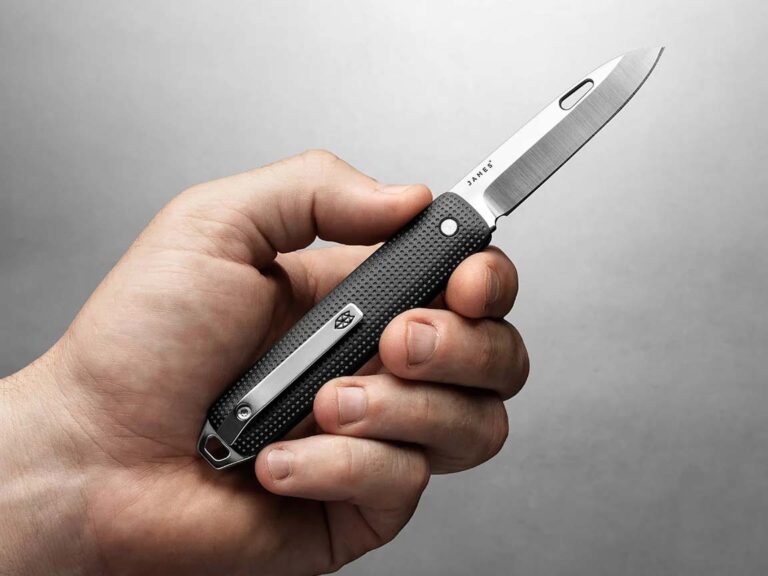
The hole in the handle or blade, or anywhere in knife construction, has something to tell the user. But what is it trying to say or do?

It is eye-catching but the hole and/or ring and the science that goes along with it complement the visual and the practical in knife use. Aesthetics, mechanics and utility are factors. After all, the essence of the knife is in its use as a tool, and who wouldn’t mind a prettier profile at the same time?

Original Hole

The story of the hole in the blade cannot be told without including Spyderco and its legendary leader, BLADE Magazine Cutlery Hall-of-Fame® member Sal Glesser. In the decades since Spyderco introduced its iconic hole in the blade, the company has produced countless folders that characterize the ease of opening inherent in the hole itself.

The story of the hole in the blade cannot be told without Spyderco and its legendary leader, Sal Glesser. The BLADE Magazine 1990 Overall Knife of the Year®, the blade-hole-opening Endura is one of the company’s longest-running models.

Sal said he well remembers the inspiration to step out with his company’s blades.

“The Buck 110 and Gerber Folding Hunter were the watershed change to locking knives, in my opinion,” he recalled. “I purchased a Buck 110 when they first came out. As a young man I learned to open the Buck and Gerber lockers with one hand using my thumb, pushing on the side of the blade. I was working late in the shop one night, payables, payroll, etc., and I thought to try to figure out a way to modify a folding knife so that anyone could learn to open [it] with one hand more easily and more safely than the way I was doing it.”

From that single thought, Glesser went to work. He experimented with adding to the blade for leverage—studs, discs, hoods and other things—but found they got in the way when cutting or sharpening and could “wave” the knife open unintentionally when deploying.

“So I started taking things away from the blade to create purchase for the thumb,” Sal continued. “I first roughed up the side of the blade, which worked, but not very well. Then I drilled a dent into the blade. A dent on both sides became a hole.”

Eureka!

Sal plowed ahead, making a rough prototype using a Japanese folder and welding a piece of drilling rod to the spine of the blade to add height. He ground it down to the thickness of the blade and then drilled the hole to test his ease-of-opening theory.

“We applied for a patent claiming a ‘ledge’ created by the edge of the hole that could be used by the fleshy part of the thumb to urge the blade open with one hand,” Sal recalled. “I chose to use a round hole because it was easier to make and was easily identifiable.”

The rest, as they say, is history.

From the first blade-hole model in 1981, the Spyderco Worker, the distance from the center of the pivot to the hole was analyzed while the optimal size of the hole for the average thumb was measured. Enhanced trademark work was successful in securing the round shape since copies were notable with different shapes to get around the word “hole” in the original Spyderco patent language. Hence, the company introduced the hole into its fixed blades as an identifier “large enough to be cleaned and small enough to be noticed.”

Perfecting the hole for its primary purpose of easy opening meant leaving a certain amount of steel above the hole to compensate for the space. “Some steels that are more brittle could be broken through the hole if pried with hard enough,” Sal concluded. “But the truth be told, there are millions of Spyderco knives in the marketplace over the past almost 50 years and there have been very few that were broken.”

Where & Why Of Holes

Toor Knives CEO Connor Toor says the hole/ring of the Cortano is between the handle and blade for several reasons, including deployment and retention, a tactile index for consistent hand placement, a lanyard attachment point, and an unmistakable visual signature. Another is the ability to choke up for precise cuts without losing control.

In overall perspective, the hole has its place in the fixed blade as well. The Toor Corporation Cortano sports the hole/ring for a simple reason according to CEO Connor Toor.

“A hole allows fast, ambidextrous one-handed deployment without extra hardware,” he explained, “and it keeps the blade profile clean and snag resistant. It also slightly reduces weight and manufacturing complexity compared with an added stud or thumb disc.”

The hole in the Cortano is located between handle and blade for several reasons, including deployment and retention, a tactile index for consistent hand placement, a lanyard attachment point, and an unmistakable visual signature that differentiates the knife. An added bonus, says Connor, is the ability of the user to choke up for precise cuts without losing positive control.

“We typically call it an ‘index/retention ring’ or simply the ‘deployment hole,’” Toor commented. “The concept is rooted in historic ring knife forms and modern karambit/utility designs more broadly, so while makers like Steve Likarich are part of that lineage, our design pulls from both traditional ring knives and contemporary tactical needs rather than a single source.

“Any aperture introduces stress concentration,” Connor continued, “but proper blade geometry, material selection and heat treatment mitigate that risk. We designed the Cortano so overall material thickness preserves strength around the hole. Real world testing and appropriate use show no practical durability issues when those engineering details are respected.”

Holes For Balance

The Formido fixed blade from Spartan Blades comes with a series of grip holes, that, explains company president Curtis Iovito (inset), “primarily tune balance by reducing handle weight.”

The Formido fixed blade from Spartan Blades comes with a series of holes in the handle, and company president Curtis Iovito readily points to the advantages of the design.

“It’s primarily to tune balance by reducing handle weight,” he advised, “often to place the balance over the index finger. We’ll enlarge or shrink hidden holes under the scales to shift weight where it best serves the knife’s purpose. Looks can be a secondary benefit. Along with weight reduction, there are options for lashing or paracord wraps, and added indexing/traction without introducing weak corners. In some cases, they also enable spear mounting or other field attachments.”

Curtis adds that the parameters for the introduction of holes in the blade or body of the knife vary as to the designer’s objectives.

“There is no universal formula,” he related. Holes, however, must measure up to certain standards to “maintain strong ‘webs’ of material around fasteners and stress points, and scales must be clamped well to prevent lifting and contamination. Round holes are favored because they machine easily and avoid sharp internal corners that become stress risers during heat treat. Arched/rounded cutouts can add torsional strength as seen on our Enyo and Formido.”

Holes In Karambit

Designed by Joshua Swanagon, the TOPS Knives C.U.T. 4.0 is a hybrid karambit that combines the practicality of a utility knife with the defensive and combat features of a standard karambit. Its ringed handle is common to the pattern’s lineage while the utility drop-point blade is more of a traditional design element.

At TOPS Knives, the C.U.T. 4.0 is a hybrid karambit that combines the practicality of the utility knife with the defensive and combat features of the karambit. Its ringed handle is common to the karambit lineage while the utility drop-point blade is more of a traditional design element. The karambit hole itself is probably a derivative of agricultural use.

“It does seem to be the case that many karambits used in Asia were used as a tool first, cutting cane or other crops” said Craig Powell, TOPS general manager. “As a tool, the pinky is usually in the hole so that the knife can hang down from the hand while the user is picking up the harvest, and then it is swung back into the hand to use the cutting edge.

“I wouldn’t say there is a set rule on the size of the hole,” he added, “but too small makes it easy for fingers to get stuck, which can equal broken fingers or de-gloved fingers in situations where the knife can’t be dropped when needed. Too large makes the knife clunky to use and manipulate properly and too easy to drop. Definitely, there is a balance to be struck. The hole size we use for our karambits does vary somewhat with the overall size of the knife. Typically, the smaller the overall size, the less likely someone is going to use the knife while wearing gloves, so you can use a smaller hole to keep the overall profile of the knife smaller.”

The characteristic ring in the butt of the karambit adds versatility, and Iovito sees advantages in several areas.

“The ring allows rapid grip changes, secure retention of a short blade under stress, and manipulation without dropping the tool. On our CQB Tool, for example, the ring lets a user transition to a pistol grip in a pinch without discarding the blade. We use PEO Soldier [U.S. Army Program Executive Office] data on the average-gloved-finger size for reliable use with gloves. Our research points to about a 1 1/8-inch internal diameter as optimal—big enough for manipulation and glove use without binding, yet not so large that control gets sloppy or the blade flops on the finger. Too small risks pinching, circulation issues, and snagging; too large compromises indexing and retention.”

Michael Janich, special projects coordinator at Spyderco, agrees that the karambit has an agricultural lineage but adds that the island archipelagos of the Pacific, where the design developed, will often provide different cultural backgrounds to its story.

“After harvesting a bundle of vegetables, the handle was released, allowing the knife to hang from the pinky, freeing both hands to tie the bundle,” Janich reasoned. “In contrast, sheathing the knife every time was inefficient and would require the blade to be cleaned to prevent soiling the inside of the sheath. Logically and practically, this makes sense. Some stories of the origin of the karambit, though, suggest that it was developed primarily as a weapon.”

Arched/rounded handle cutouts can add torsional strength as seen on the Enyo by Spartan Blades.

As for the dimensions of the karambit and its characteristic hole, Janich points out that some tools defined as karambits of Southeast Asian origin do not even sport the hole. Nonetheless, the hole defines the karambit today.

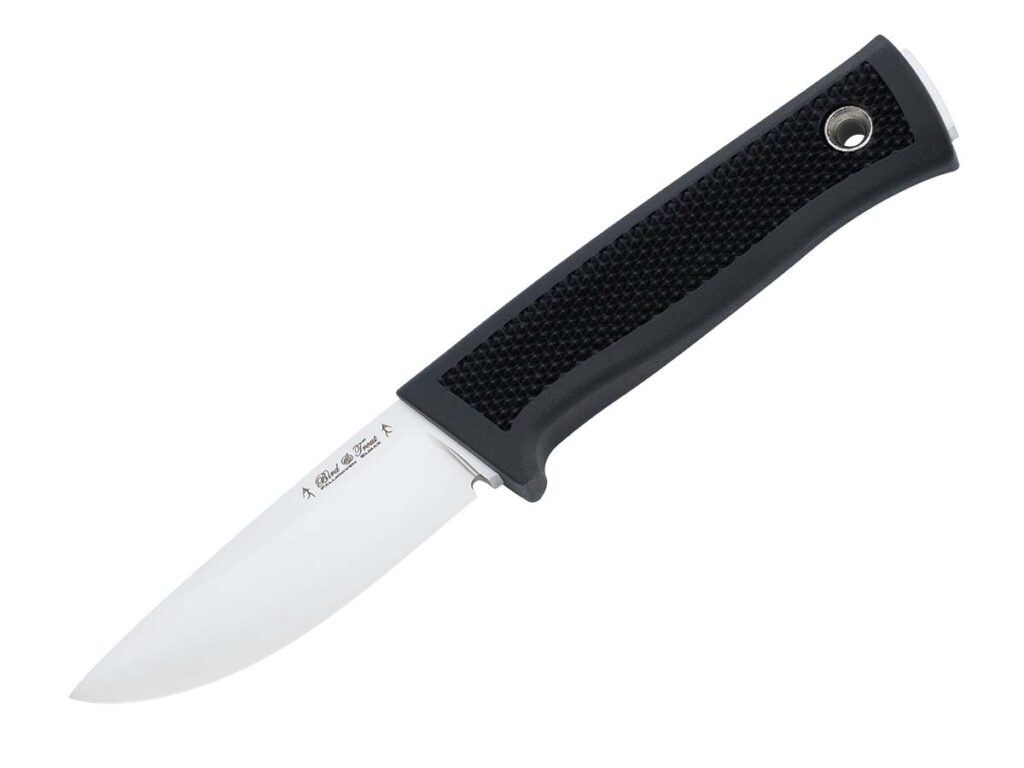
“The karambit is not the only historical knife to have a ring,” Michael added. “The Japanese kunai was a trowel-like tool that had a ring at the end of the handle. The ring could be used to enhance grip retention. It also allowed the tool to be hung from a cord for easy transport or for the attachment of a lanyard. The Chinese martial arts also had daggers with butt-mounted rings. In some systems of kung fu, the rings had no specific purpose and only served as pommels. The bird and trout knife, first introduced by Marble’s, also had a pommel ring. Of integral construction, the handle portion of the knife was very narrow, so the ring provided both retention and grip stability.”

Attraction Of The Design

Universally in the world of knives, the hole or ring has its place, its moment, its degree of usefulness. Ultimately, the user chooses the tool that suits the task at hand, and the presence of the hole, for easy opening, control or enhanced utility, is always a candidate for deployment.

More Knife Reviews:
Advertisement

Must Read Articles

Read this before you make a knife

Knifemaking 101 – Read This Before You Make a Knife

  by Wayne Goddard My experience has taught me that there's nothing like digging in and getting started. I've often said the hardest part of the...
how to forge damascus steel

How to Forge Damascus

Advertisement
Advertisement