Home Blog Page 133

How to Sharpen a Serrated Knife

2
How to sharpen a serrated knife
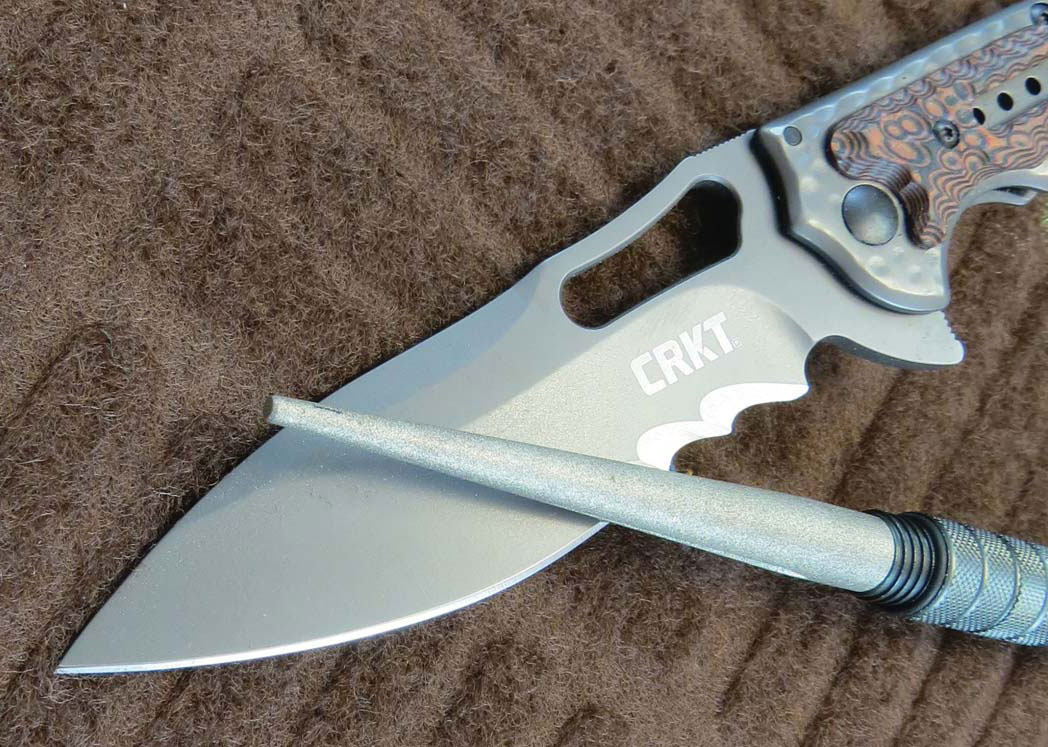
The broad cone of the GATCO Scepter 2.0 comes in handy when working on the wide serrations of the CRKT Fossil.

How to Sharpen a Serrated Knife: Quick Tips

  • Use a small sharpening rod
  • Lock the rod into a “gullet,” the groove of the serration
  • Work the rod with slow, smooth motions away from the knife, applying light pressure
  • Work the rod in one direction; don’t rub it back and forth
  • Don’t sharpen wider than the serration

Sharpening Rods are Musts for Sharpening Serrated Knives

No matter what edge style of knife you carry, it must be sharpened. In the case of serrated blades, you need specialized tools, called sharpening rods.

Some rods, like the ones you’ll typically find in a kitchen, are large. Those won’t be helpful for working with small serrations. You need to find a small rod that will lock into place inside the serration. Don’t worry about sizing, though. Most small sharpening rods are tapered so that you’ll have the right fit no matter what.

Practice Makes Perfect

Learning how to sharpen serrated knives is like any other technique—you need practice to get good at it. I recommend buying some cheap knives and practicing before you move on to your $200 Spyderco. Also, remember that not all diamond sharpeners are created equal. Diamonds are manufactured and certain diamonds are more durable than others—then again, that’s a topic for a different time.

Know Your Geometry

There are a couple of key points about geometry for learning how to sharpen a knife with serrations.

As with a plain edge, you are polishing a surface. In the case of serrated blades, there are two geometries to work.

One is the gullet. The gullet is the internal section that normally has a curved shape between the points of a serrated edge. Since sharp gullets are necessary, many people mistakenly focus too much on the gullets and not enough on the teeth of the pattern. The teeth do the initial entry into the material and begin the cut.

Hence, when sharpening serrated blades you not only polish the gullet of the serration but also re-point the teeth at the same time. Much like sharpening a saw, you reform the teeth and restore the geometry of the teeth along with the geometry of the gullet.

Four Sharpeners for Sharpening Serrated Rods
How to sharpen serrated knives
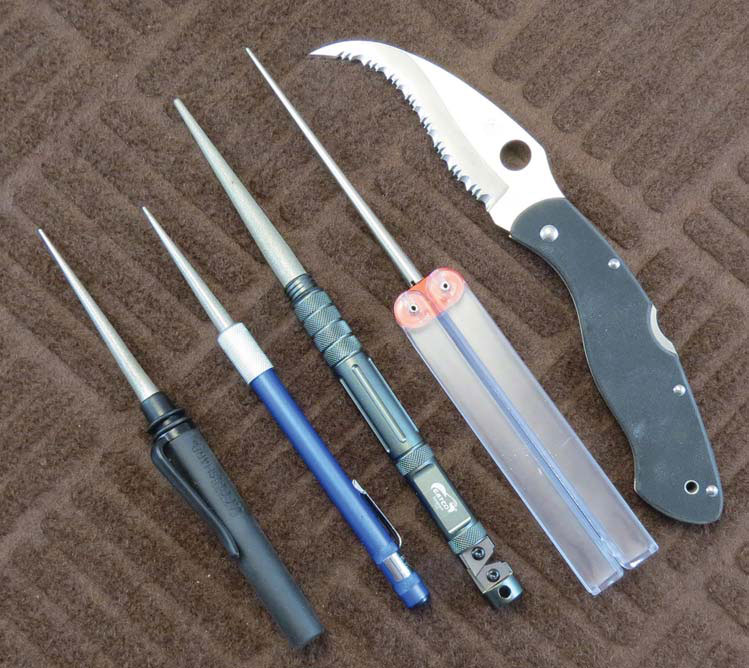
From left, with manufacturer’s suggested retail prices in parentheses: Accusharp Diamond Compact Sharpener ($11.99); Smith’s Diamond Retractable Sharpener ($7.99); GATCO Scepter 2.0 ($25.95); and DMT Diafold Serrated Sharpener ($32.99). The knife is the author’s Spyderco Civilian.
Serrated knife sharpeners
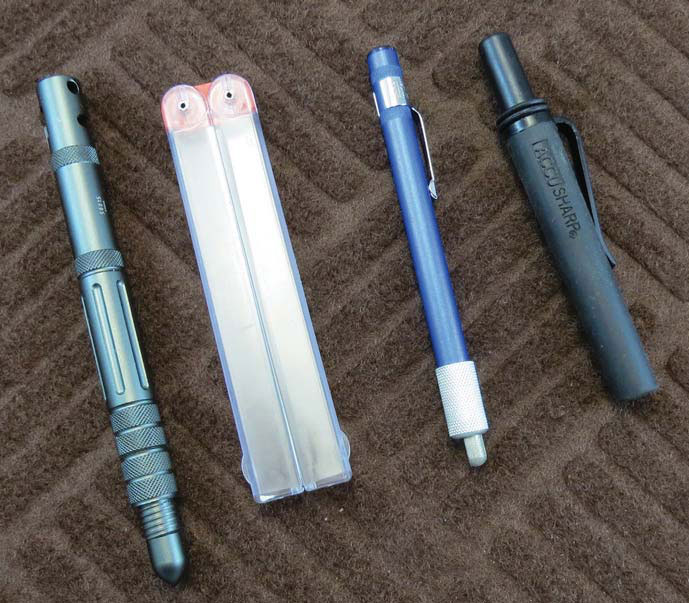
The foursome in the closed position, from left: GATCO Scepter 2.0, DMT Diafold Serrated Sharpener, Smith’s Diamond
Retractable Sharpener and Accusharp Diamond Compact Sharpener.

Here’s a good place to start. Our lineup of four sharpeners consists of the GATCO Scepter 2.0, Smith’s Diamond Retractable Sharpener, DMT Diafold serrated sharpener and Accusharp Diamond Compact Sharpener.

GATCO Scepter 2.0
Serrated knife sharpening tips
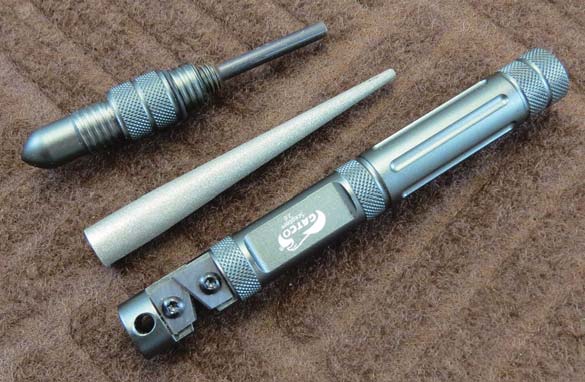
The GATCO is a bit of a multi-tool with, from
right, a carbide sharpener, diamond cone and a ferrocerium rod all in one.

Of the four, the GATCO Scepter 2.0 is more multi-tool than sharpener only.

If you are into gadgets that serve more than one purpose, the Scepter 2.0 is for you. It has two tungsten-carbide blades for sharpening, a ferrocerium rod and a diamond cone sharpener. All are in a compact package that resembles a tactical pen. The diamond rod has a groove for sharpening fishhooks.

The cone has a medium-grade texture and a broad taper. The cone is 3.75 inches long and tapers from .113 to .392 of an inch in diameter. Why does the taper matter? If the taper is steep, during sharpening you will have a shorter cut as the cone will get too wide too quickly for some smaller serrations. Overall length: 6.125 inches.

If you’re looking for a sharpener as an everyday carry tool, the Scepter 2.0 is a good choice. The cone is a bit chunky but works fine for all but the smallest serrations. I am not a big fan of carbide sharpening blades because they hog off a lot of metal, though I don’t mind them on rough cutting tools. I haven’t had the Scepter long enough to testify to the durability of the diamond cone but so far it is holding up well.

Smith’s Diamond Retractable Sharpener
Sharpen a serrated knife
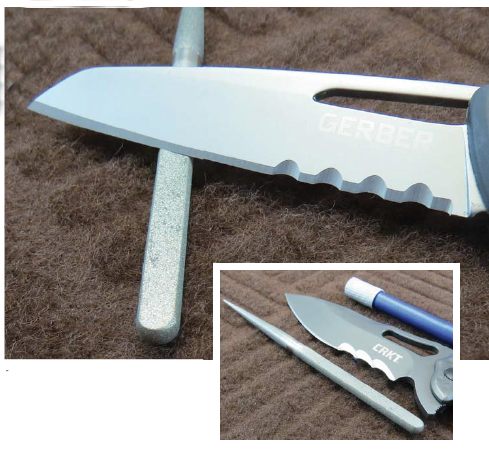
The Smith’s rod has three surfaces—flat, conical and round (inset)—to tackle any number of sharpening jobs. The flat surface in combination with the diamond cone makes it easy to sharpen combo-edge blades.

Smith’s Diamond Retractable Sharpener is the trimmest of the group and looks like a pen when collapsed. It is possible to use the cone shape to sharpen a plain edge, but with the Smith’s model the diamond coated sharpener has two ends.

One end has a flat section and the other is tapered for serrated edges. Of the group the Smith’s hone has the most aggressive grit. The body of the holder is aluminum and has a pen clip. (The GATCO Scepter could use a pen clip to complete it.) Closed length: 5.187 inches.

Again, I could see this tool in someone’s EDC kit, a tackle box or camping gear. At the tip the cone measures .06 inch and at the widest point .256 inch in diameter. With such a fine tip expanding in size over its 2.375-inch length, the Smith’s hone sharpens a wide range of serration styles. At a manufacturer’s suggested retail price of $7.99, it does not have to last a lifetime to pay for itself.

DMT Diafold
Serrated knife sharpening tips
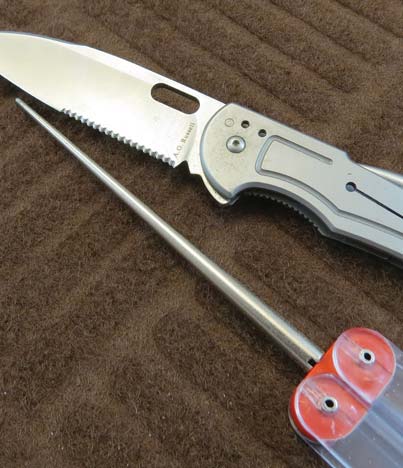
A sharpener with a fine tip like the DMT Diafold is needed to get small serration patterns back to sharp again.

The DMT Diafold serrated sharpener comes in three color-coded grits: coarse (blue) 325 mesh or 45 micron, fine (red) 600 mesh or 25 micron, and X fine (green) 1200 mesh or 9 micron. I used the red.

Of the quartet it was the longest, finest-grit tapered cone. Overall length: 4.5 inches. It tapers in diameter from .62 inch at the tip to .25 inch at the base.

To store the sharpening cone DMT uses a folding handle system similar to a butterfly knife. The handle is a clear polycarbonate. At 5 inches closed and as with the others the Diafold is compact enough to be EDC’d.

I’ve had a number of DMT Diafolds over the years and they are still in working order. You have to use some of the diamond sharpeners a lot before they will wear out. I will say when open, the very appearance of the Diafold can send shivers down your spine as it resembles an icepick. It works well and if you like something with a fuller handle to it, a Diafold might be your shtick.

Accusharp Diamond Compact Sharpener
Accusharp serrated knife sharpener
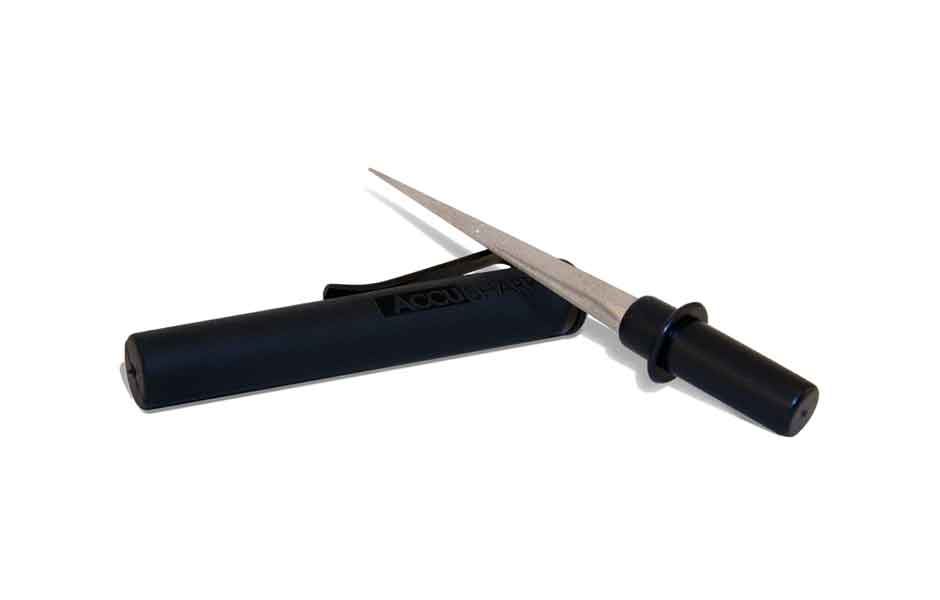
Accusharp uses a friction fit to hold the Diamond Compact Sharpener open and closed.

The Accusharp Diamond Compact Sharpener is 3.125 inches long with inch diameters of .06 at the tip and .305 at the base. A plastic body with a rubberized coating houses the unit—definitely low tech and follows the K.I.S.S. principle. A friction fit holds the sharpener open and closed. The fit is tight and you don’t have to worry about the two sides separating accidentally. An integral pen clip is on the main body’s housing. The clip doesn’t seem robust and I can see it eventually snapping off.

The sharpener has a medium-grit diamond coating and functioned well during testing. Accusharp includes a hook groove I find rather large. Maybe it’s for big fish. The closed length is the shortest of the group: 4.75 inches.

I like the design because as with the Smith’s sharpener it appears to be a standard pen as opposed to the GATCO model’s large-tactical-pen look. If you want to carry a sharpener and not let anyone know you have one so you aren’t constantly loaning it out, the Smith’s might be the ticket. As far as feel, the handle diameter is nice and comfortable.

 

The First Big Knife Show of 2021, ICCE is Returning to Texas

GRAB YOUR COWBOY BOOTS AND HATS!

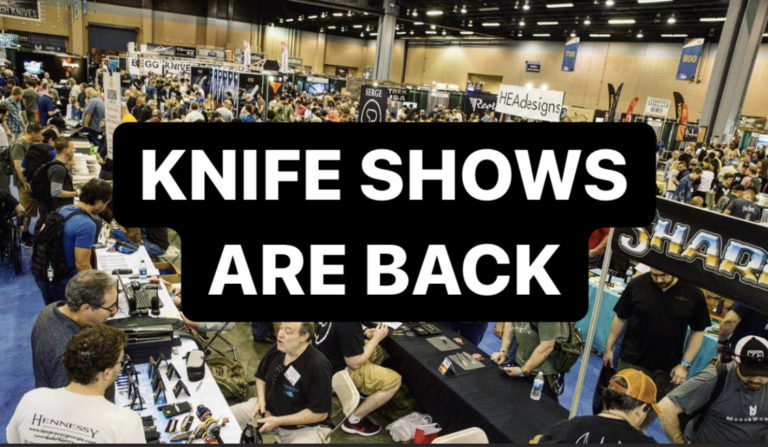
Its been a long sabbatical between major knife shows but that wait will come to a welcome halt March 26-27 with the International Custom Cutlery Exposition (ICCE) at the FortWorth Stockyards in Fort Worth, Texas.

Presented by BLADE, the ICCE will pair some of the worlds best custom knifemakers with a select group of cowboy artisans. The best in sharpened steel will be joined by some of the top work in spurs, conchos, leatherwork and more in what promises to be a unique kind of event combining the world of knives with the world of the wild, wild west, 21stcentury style.

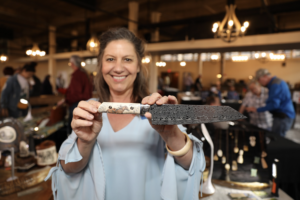
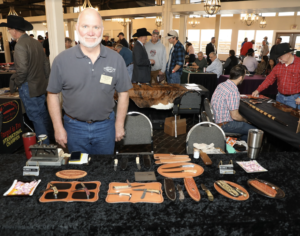
Above: Photos from the 2019 ICCE Show (taken by Scott Schuster)

We  have a high concentration of makers and subscribers in the Texas area, BLADE Show/ICCE director Alicia Newton noted, and a significant number of those makers are expected to attend. Some of the industrys top slipjoint makers and ABS master, journeyman and apprentice smiths hail from the Longhorn State, and they as well as specialists in other top genres of custom knives, knifemaking suppliers, embellishers and more will be on hand to exhibit their wares in all their whetted wonder.

As for the cowboy gear element, it promises to give the event a flair rarely seen in the realm of custom knife shows.

In addition to the outstanding craftsmanship attendees can expect to find from our knife community, we will also be introducing products by high-end cowboy artisans,Newton commented. We believe these products will add a new element to the knife show and help distinguish it from other events in the knife community.


2021 REBOOT

The successor to the old Knifemakers Guild Show, the inaugural ICCE was held in September 2015 in Kansas City and featured members of both the Guild and the American Bladesmith Society (ABS) exclusively all-under-one-roof in the first-ever show of its kind. It was moved to the Fort Worth Stockyards in March 2019, where it met with solid reviews. However, last years rendition, as was the case with many knife shows and other events, was canceled due to Covid-19. In an effort to reboot the ICCE in 2021 better than ever  before, show coordinator Jerry Moen and other officials of both the Guild and ABS turned to the BLADE Show brain trust for guidance.

Our company is always looking for new opportunities to expand the BLADE brand name, Newton noted. Therefore, taking over the show in Texas was a natural fit.

Part of that fit is the cowboy gear of the exhibiting cowboy artisans.

As noted, we will have about 20-to25 cowboy artisans that will be displaying and selling their products at the event, Newton stated. In addition, as the show continues to grow, we will introduce experiences specific to the Texas show that wont take place at our other BLADE Show events.

Above: Photos from the 2019 ICCE Show (taken by Scott Schuster)

Other than the addition of the select group of cowboy artisans, the show itself will remain largely unchanged this year. According to BLADE Show officials, their goal early on for the new arrangement is to keep the ICCE close to what it has been before slowly transitioning in the ensuing years to more of a BLADE Show type of event.

In keeping with that focus, the ABS will not present awards or do any testing for ABS master or journeyman smith stamps at ICCE—the ABS does most of that at the BLADE Show. However, the Guild will present its awards, including honors for knives in the following categories: Best Art; Best Bowie; Best Fighter; Best Dressed Fighter; Best Folder; Best Multi-Blade Folder; Best Collaboration; Best Hunter; Judges Choice; and Best Tactical Folder. The Guild also will present its annual Red Watson Award, Nate Posner Award and Hank Rummel Award, the latter for best first-year probationary Guild member, and determine both its new voting and probationary members. The ICCE,meanwhile, will present awards for knives in the following categories: Best Forged Blade; Best Bowie; Best Art; Best of Show; Best Combat Knife; Best Folder; Best Hunter; Best Damascus; and Best Collaboration.


FULL IMMERSION

In addition to great knives, makers, cowboy gear and more, the ICCE will feature the sights and sounds of the Fort Worth Stockyards. Everything you might expect from a Western/cowboy experience—bull riding, the Texas Cowboy Hall Of Fame, outstanding country music, Legends of Texas Gunfight Shows, the best in local eateries and drinking establishments, shopping, events for the entire family, a petting zoo, even the Fort Worth Herd cattle drive (not once but twice daily)—the Fort Worth Stockyards has it.

This event wont be just another typical knife show but will have unique elements specific to Texas that will help set it apart, Newton observed. At the end of each show day, attendees can take in all the sights and sounds of the Fort Worth area without having to drive anywhere.

In other words, the ICCE is not only a knife show but a two-day celebration of Texas culture, history and entertainment as well.

Come for the weekend. You dont need a car. Shopping, restaurants, bars—including the worlds largest honky tonk bar—all within walking distance makes for a fully immersive experience, Newton noted. It will be one of the first opportunities for the knifemaking community to all get back together again.

The Hyatt Place Fort Worth Historic Stockyards (800-833-1516) provides outstanding accommodations in the heart of the Stockyards. For information on it and other places to stay, including the exhibitor list, tickets, attractions and more, visit icceshow.com.

91-Year-Old Knifemaker Murray Sterling is Still Going Strong

1

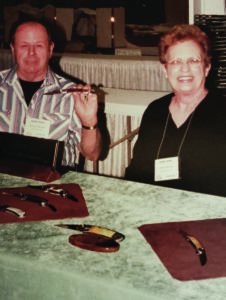
Murray Sterling has seen a lot and done a lot in his 91 years on this earth. For the past 30, he’s made a name for himself as a custom knifemaker. When approached about doing a story for BLADE® that focuses in part on his age, he agreed without hesitation. 

“I’m proud that I’m still here to talk about it!” he grinned. “I love to go out to the shop and do this stuff. I don’t have any real physical ailments and I’m steady enough. I can do just about anything—and I just love doing it. It’s therapy!”

In terms of making knives, Murray seems to be at his best these days. He attributes it all to experience, saying every time he makes a knife, he refines his knowledge base. “I can make 10 knives in a row, and I’ll learn something from one to the other,” he related. “A little different, and a little easier, a little better.” 

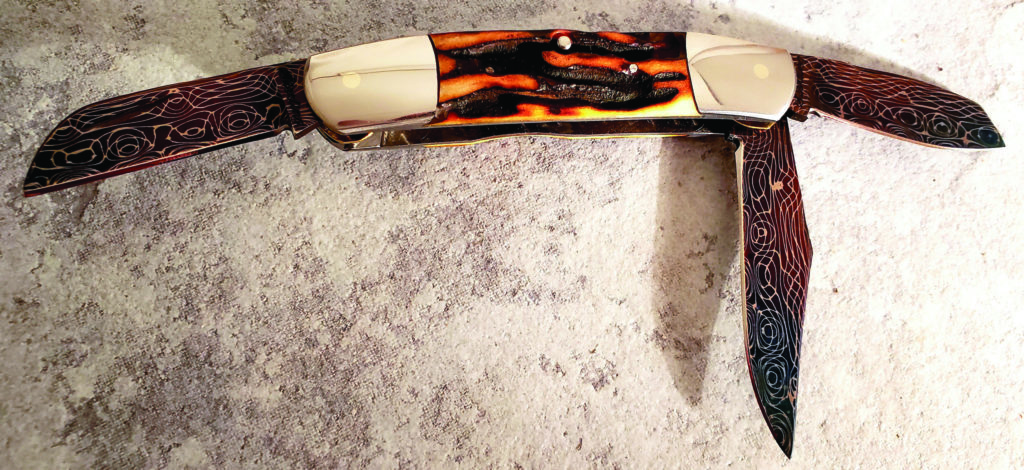
Murray made this stag stockman earlier this year.

One of the most interesting things about Murray’s career is that he didn’t even start making knives until after he retired, likening it to “a good retirement hobby.” Machining was his original career choice. He recalled that back in 1947, when he was a “late teenager,” he and his cousin decided they didn’t want to go to school anymore. Murray said, “Let’s go get a job,” and they drove to a nearby tool-and-die shop. “They hired both of us,” he remembered. “My cousin didn’t stay too long but I was there for about four years.”

Flash forward about a decade and Murray had gotten married and started his own machine shop. Being in southern California in the wake of World War II, he found himself doing jobs for big companies like Hughes Aircraft and Northrop Aviation. A typical job was machining hydraulics parts for aircraft such as the DC-7 and, later, the B1 Bomber. His work product spread out across the world.

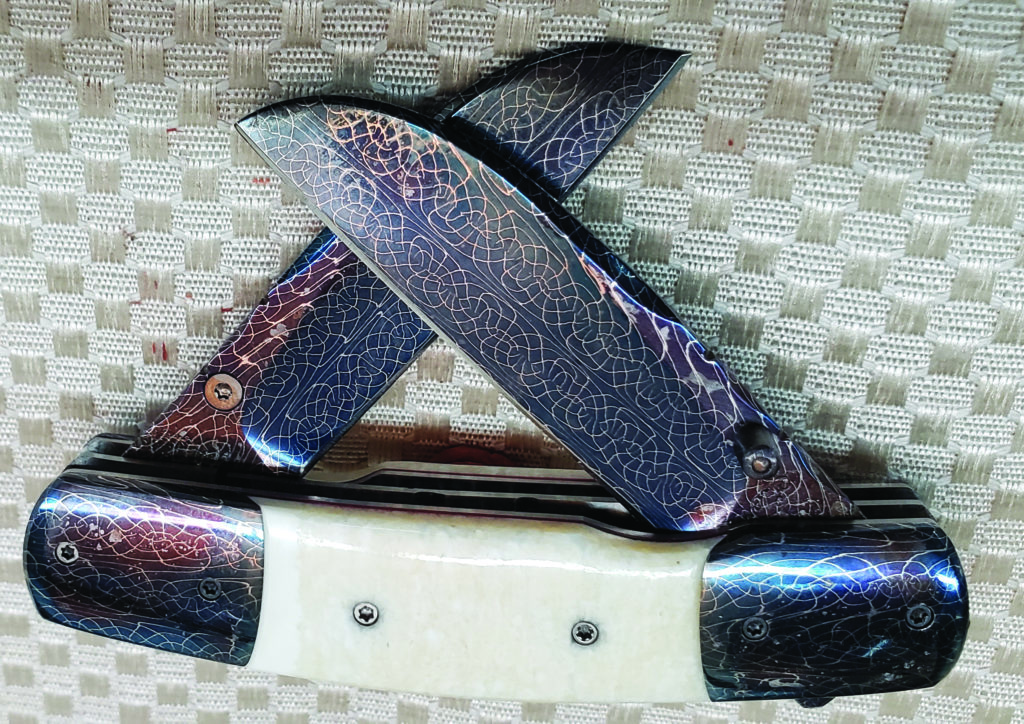
Pictured: Murray’s dual linerlock folder sports 2 3/8-inch blades of Doug Ponzio damascus, ancient walrus ivory scales and filework. Closed length: 3.5 inches.

“It was all about high quality and reliability,” he recalled of his formative days, and he carried that ethic forward over the following three decades of his successful business. In 1986, he decided to retire, but kept his shop in the family for a few more years. This was about when computer numerically controlled machines were becoming prevalent, so, Murray recalled, he figured it was time to get out of the business. Consequently, he closed up shop and brought some machines home to start making knives.

“I’m an old-school machinist. I started on old overhead belt-drive machines,” he recalled. “When I went out of business, we had some pretty modern machines, but not CNC.”

Murray doesn’t keep it a secret that he’s not a big fan of using CNCs or water-jet equipment, though he understands why makers use them and that the machines certainly make things easier. He explained that in his day all the machines had handles, but the trend continued toward “machines with buttons that can be programmed from 50 feet away.”

Murray’s dual mid-release auto features ATS-34 stainless blades, a 416 stainless steel frame and stag scales. Closed length: 4 1/8 inches.

“When I started working in that tool-and-die shop, there were about six tool-and-die makers in there,” he remembered. “When they came in in the morning, they’d bring out their files, a cup of coffee and a cigarette. It’s hard to imagine how much hand work they did in those days. They had an old lathe and an old mill, but most of the work was done on the bench filing and sanding.” 

As he reflected, he added that he admires some of the “out-of-this-world” knife designs that have resulted with the benefit of computerized, automated machines. “They do fantastic work, no question about it,” he allowed. “The machinery these days makes it much easier. If I was 20 years younger, I’d probably have one!”

FIRST KNIFE SHOW

His journey into the knife world began in 1977, when he ventured into the MGM Grand in Las Vegas for a knife and antique gun show. It was there he experienced his first custom knife show and bought his first custom knife—a coffin-handle folder from BLADE Magazine Cutlery Hall-Of-Fame® member Wayne Goddard. “That was when I got impressed with the work that these guys were doing with the equipment they had in those days,” he recalled.

Murray set out to learn knifemaking in 1989. Along the way, he had guidance and education from a lot of makers, as well as reading iconic books on how to make knives. However, he draws a distinction between that and actually learning the craft. He characterizes himself as mostly self-taught through a lot of trial and error and the determination to put in shop time.  

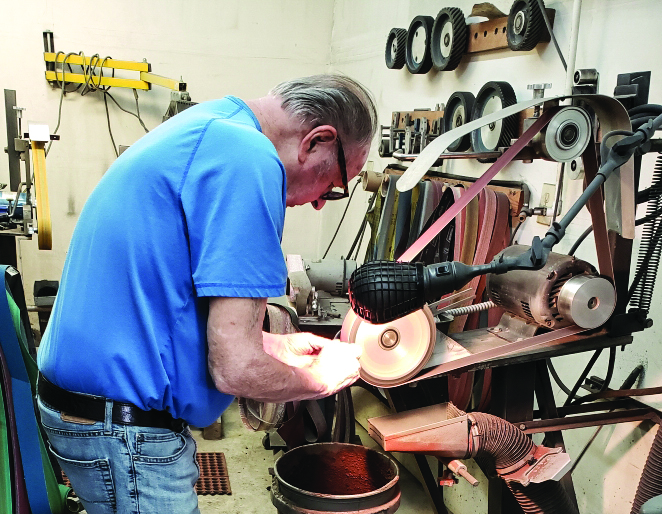
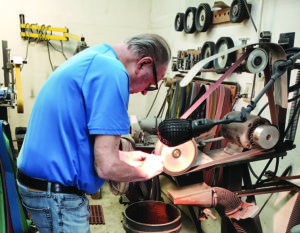
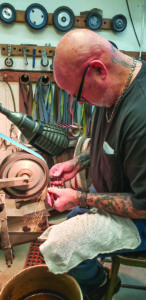
Murray profiles bolsters on his belt grinder.

“Hollow grinding is not something you can teach somebody,” he explained. “They can tell you how to do it and show you how to do it, but you have to put in the time and learn to get the feel for yourself. You can’t give the feel to somebody.” So, he burned up a lot of gloves, as well as his fingers sometimes, until he finally learned how to do it.

He made fixed blades until about 1991, when he talked to slip-joint master Jess Horn a lot about transitioning to making folders. Murray said that’s when he learned he needed to add a surface grinder to his shop. “I didn’t make really good folders until I got a surface grinder,” he allowed. “I learned a lot from Jess.”

That year, Murray also sold his first knife. By 1995 he had won his initial award—for best folder—at the Oregon Knife Collectors Association Show. He was on the map.

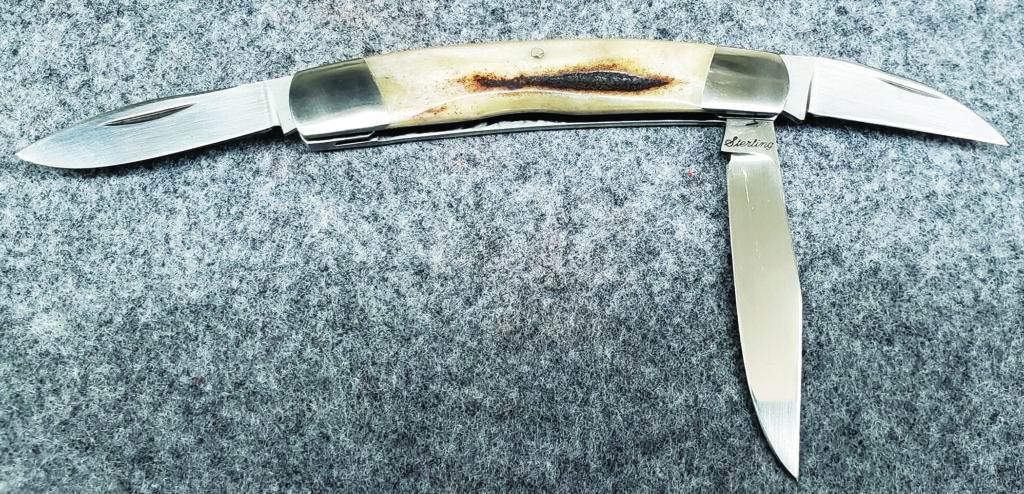
Murray made this stag stockman in 1999. Note the blade mark of his surname in cursive.

Over the course of the ensuing 25 years, he would go on to make and sell a wide variety of folders that runs the gamut of styles and mechanism applications, from traditional multi-blade slip joints to modern automatics and seemingly everything in between. His choice of blade steel is ATS-34 stainless, and a wide array of beautiful damascus forged by Mike Norris, Devin Thomas, Alabama Damascus or Doug Ponzio.

“I’ve never had a lot of luck selling wood handles, so I like a lot of stag, ivory and pearl,” he explained. He also uses acrylic to great effect. When he wanted to start doing inlay, Murray said, he turned to award-winning maker Tim Herman. “I wanted to do inlay and I called him—this must have been 15 or 20 years ago,” he recalled. “I’m still doing inlay the way he taught me, which is the hard way.”

As for mechanisms, he enjoys making several variations of locks including button, front, mid, rear and even dual locking liners. He also makes autos that feature bolster release, button release, mid-release, top release, frame release and most any release imaginable. 

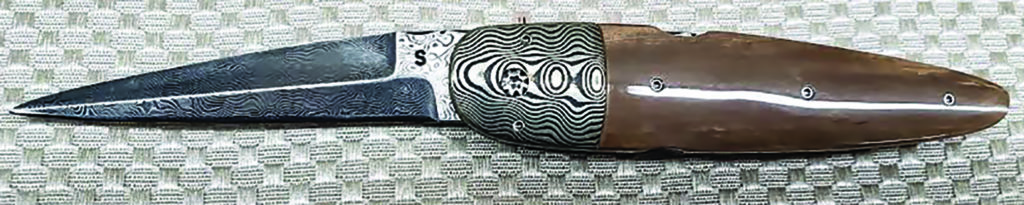
A double-ground damascus blade, a bolster of mokume gane and an ancient ivory handle highlight Murray’s folder. Note his “S” mark on the ricasso.

“They’re hot and cold,” he surmised of making autos. “Two years ago, I sold 10 right off the bat in Atlanta. Then the next year, they cooled off, so I went to something else. Every year you have to come up with something new and stay aware of the trends.”

In fact, the true problem Murray admitted to is, after making knives for 30 years or so, he must continuously come up with something new. Trends tend to go round and round, he explained, so what was hot 10 years ago will go away and then return.

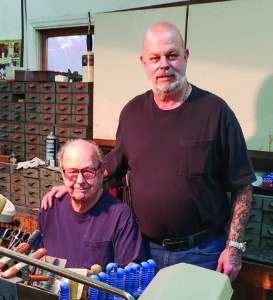
Nowadays, Murray goes to only a couple of shows each year, including the BLADE Show, with his 63-year-old son, Steve, who has started making knives the past couple of years. Murray admits that the shows are getting too long for him and he gets worn out pretty quickly.

“My son goes with me all the time or otherwise I probably wouldn’t go,” he noted. “I don’t go to the ICCE Show”—he’s been a voting member of the Knifemakers’ Guild since 2000—”because it’s a two-day drive and I just don’t think I could handle it.

CHANGING TIMES

When asked about what he’s taken note of as any drastic changes in the industry over all these years, he mentioned few things in particular. One, as mentioned, is the evolution of equipment across the board. “The quality of the knives back in the day was great, but the quality of the equipment today is 100 percent better,” he pointed out. “The gravers, the machines, even the belts you can get today—2,000-to-3,000-grit belts. You couldn’t get that 25 or 35 years ago.”

The other drastic change he’s noticed is the Internet, which he believes changed the industry in terms of selling knives. While the real knife collectors still want to see and know the maker, he’s noticed a lot of impulse buyers on the Web.

Also, he added, “Instead of hundreds of custom knifemakers, today there’s probably thousands of them. They’re using water jets to cut out the blanks and using CNC machines—there’s a lot of production, it seems like. They’re still custom made,” he qualified, “but handmade is kind of going out the window.”

However, as usual throughout our conversation, Murray hesitated to grind for too long on makers who use state-of-the-art equipment, concluding, “There’s a market for everything. High-dollar, low-dollar, mid-dollar—two-dollar knives and two-thousand-dollar knives. There always seems like there’s a buyer today.”

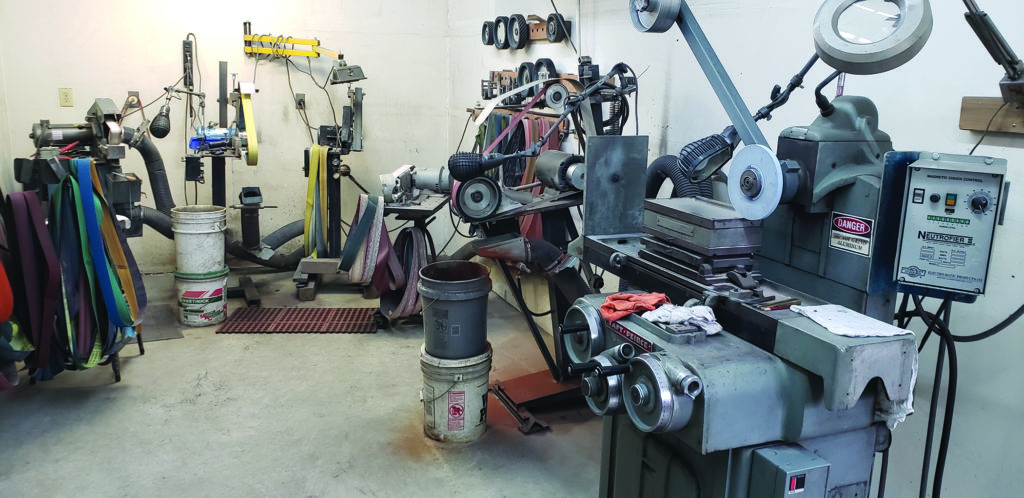
“Hollow grinding is not something you can teach somebody,” Murray explained. “They can tell you how to do it and show you how to do it, but you have to put in the time and learn to get the feel for yourself.” He continues to get that feel on a regular basis in his grinding room.

For more information on Murray Sterling and his knives, contact him at Dept. BL10, 693 Round Peak Church Rd., Mount Airy, NC 27030 336-352-5110 fax 336-352-5105 [email protected], sterlingcustomknives.com.

8 Well-Made Knife Guards

Constantly on the lookout for something that will make their knives better and stand out at the same time, many of today’s custom makers don’t hesitate to jazz up the guard.

And why not? A handsome, well-made guard adds to a knife’s looks, and, more importantly, serves as a sure safety feature in helping keep your hand where it needs to be—on the handle.

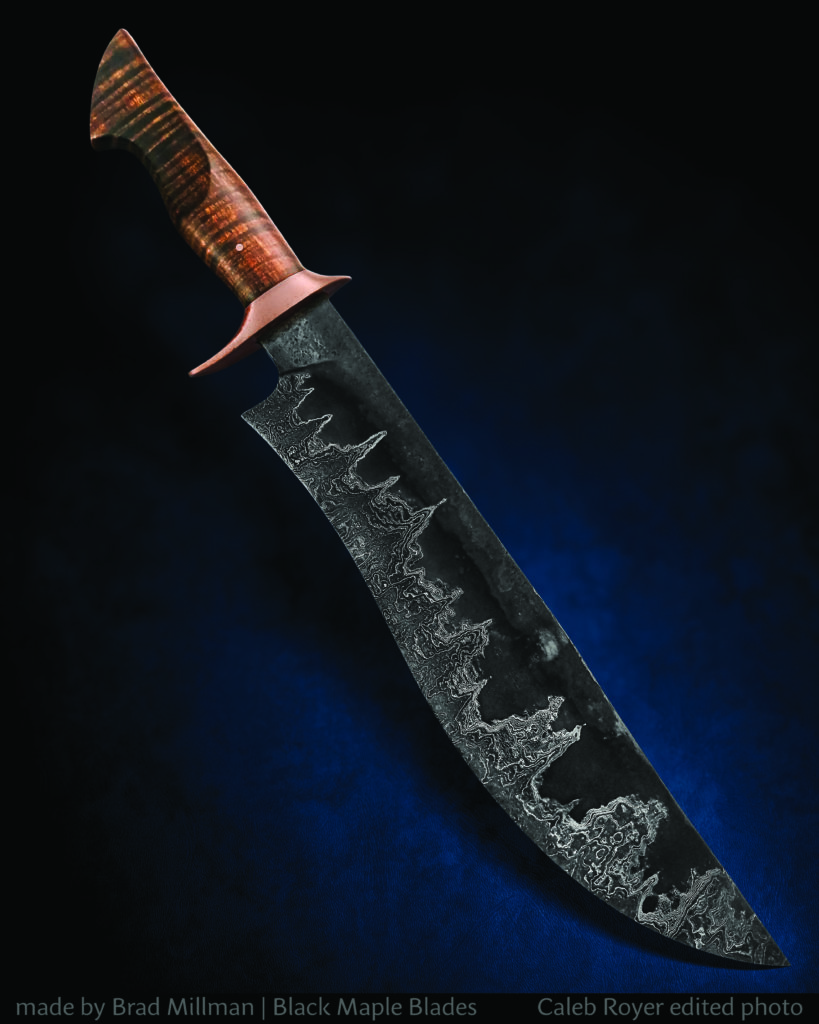
Above: Brad Millman forged the hammer-finished copper guard of his Wolftooth bowie. The 12-inch recurve blade is a san-mai construction of 360 layers of 1095 carbon and 15N20 nickel-alloy steels for the core sandwiched in a jacket of 1084 carbon steel. The bird’s-beak handle is curly Tasmanian blackwood. Overall length: 18 inches. (Caleb Royer edited image)


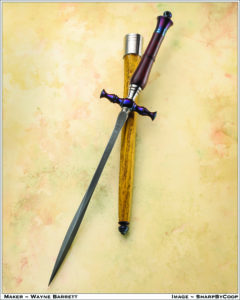
Above: Wayne Barrett heat-colored the shapely mild-steel crossguard of his 14.56-inch stiletto. The 10.6-inch blade is vintage butcher’s steel by F. Dick of Germany and features a classic triangular grind. The handle is Merino ram’s horn. (SharpByCoop image)

.

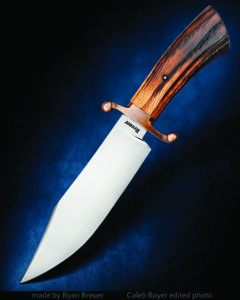
Above: It’s easy to see how Ryan Breur’s Ball-Guard Bowie got its name. The guard is cast bronze and the handle is flamed white oak with a domed inconel pin. The blade has a sharpened clip and is forged from 80CrV2 carbon steel. (Caleb Royer edited image)

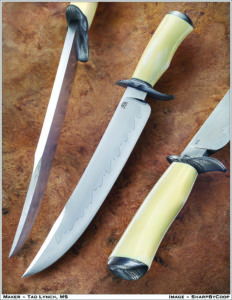
Above: A stylish guard of wrought iron helps put the finish- ing touches on an ancient-walrus-ivory bowie by ABS master smith Tad Lynch. The 11.25-inch clip-point blade is W2 tool steel—a material some leading smiths consider ideal for producing a handsome hamon—and the knife is 16.375 inches overall. (SharpByCoop image)
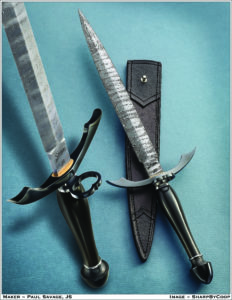
Above: An upturned guard with a finger ring—each of hot- blued 4340HT steel—and a ladder-pattern damascus blade of 1095 carbon and 15N20 nickel-alloy steels help complete a quillon dagger by ABS journeyman smith Paul Savage. The handle is buffalo horn. (SharpByCoop image)
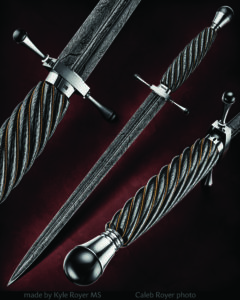
Above: Black mirror accent balls cap the stainless steel quillons on ABS master smith Kyle Royer’s Maiden Voyage Stiletto. The 11.75-inch damascus blade features an extra-deep hollow grind, a fuller and a reinforced piercing tip. The sculpted, fluted handle is wrapped in 24k-gold twisted wire. Overall length: 17.5 inches. (Caleb Royer image)
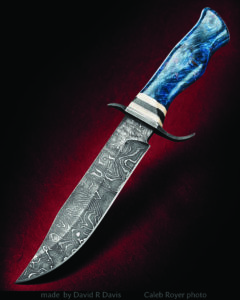
Above: The handforged nickel-silver finger guard “with curls” gives a damascus bowie by David Davis a curvaceous look. The 7.25-inch blade is pattern-welded steel forged by Alabama Damascus. Blade finish: acid etched. The handle is stabilized buckeye burl and the spacers/ liners are ebony and bone. Construction: hidden tang. Overall length: 12.25 inches. (Caleb Royer image)
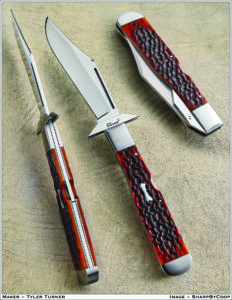
Above: Tyler Turner outfits his coke-bottle-pattern pocketknife with a folding swing guard of 416 stainless steel. The 4-inch blade is CPM 154 stainless steel in a hollow sabre grind and the scales are jigged bone. Closed length: 5 3/8 inches. (SharpByCoop image)

This article is from a previous Issue of BLADE Magazine. Subscribe to a year of Blade Magazine for just $19.99 by clicking here.

4 New Colorful EDC Knives

0

A wise man never said knives should be in color but he never said they shouldn’t be, either. Colorful knives are nothing revolutionary in the cutlery world, but it does seem manufacturers are broadening the spectrum by introducing new models with color and rejuvenating older ones. And why not? Unless you’re a dark-ops type or desire to keep a low profile in life, a little spice in the knife can add personality to your carry.

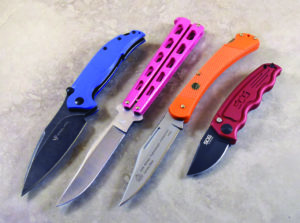
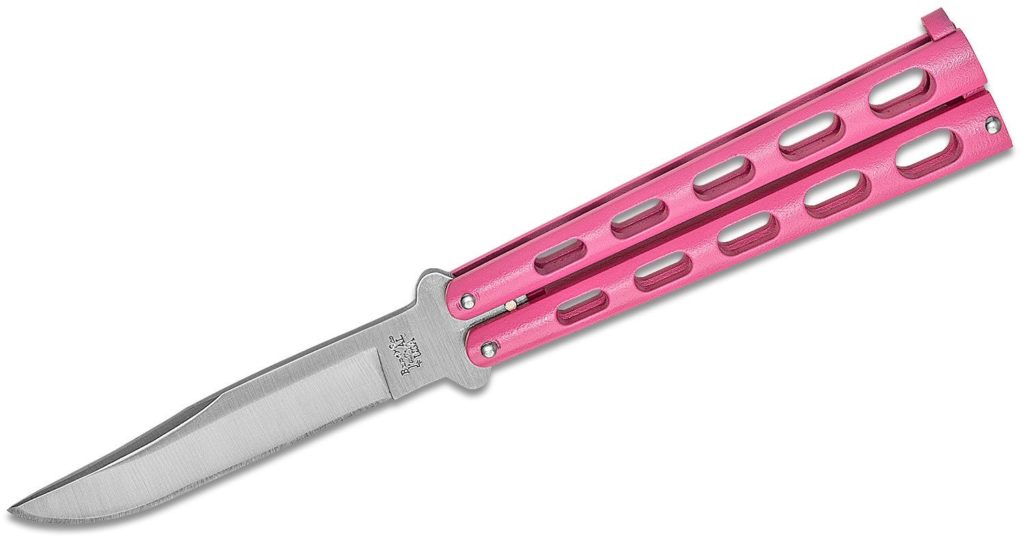
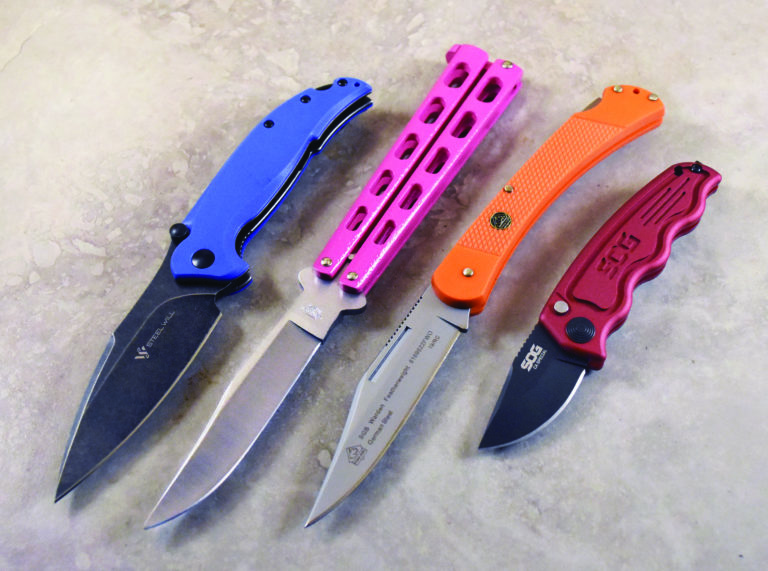
A lot of color to be had in the cutlery world includes, from left: Steel Will Scylla Blue, Bear & Son 5-inch Pink Butterfly, Puma SGB Orange Featherweight Hunter and SOG-TAC CA Auto.


Bear & Son 5-Inch Pink Butterfly

Bear & Son 5-Inch Pink Butterfly

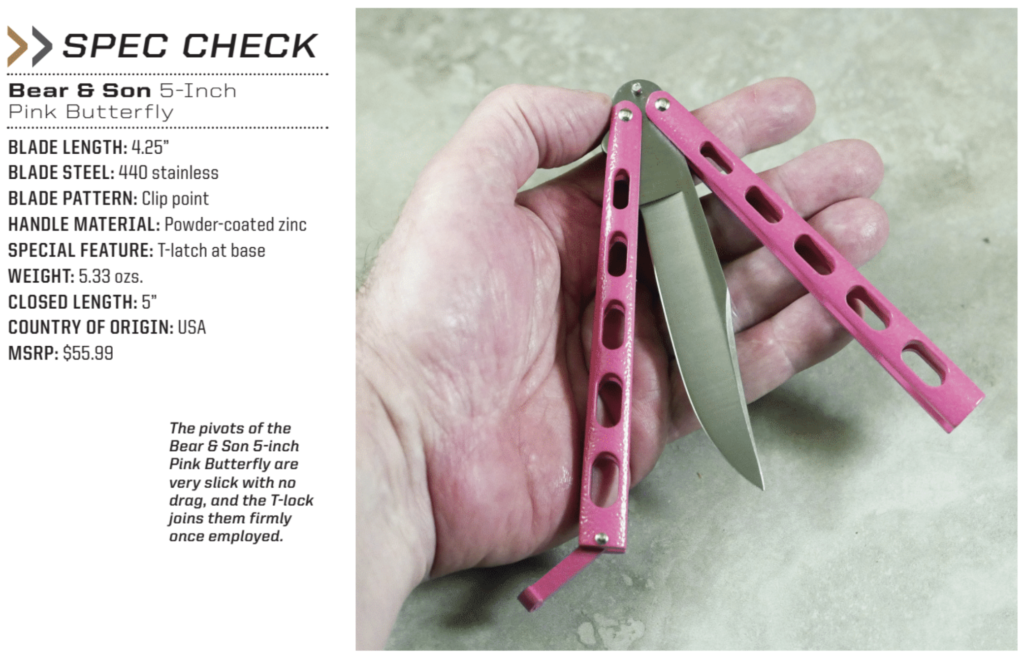
Bear & Son has been making butterfly knives since 1991, and the 5-inch Pink Butterfly is a bright send-up of one of the company’s most popular models. The 5-inch skeletonized handles are zinc with a bright pink powder coat, and a pivoting T-shaped gate lock at the bottom joins them when fully employed. The handle halves rotate off two pivots on the short tang clip-point blade, with a stop pin at the base. The Pink Butterfly’s pivots are very slick with no drag and the T-lock joins them firmly once employed.

Butterfly knives are simple in their mechanisms but require dedicated practice to employ safely and effectively. The basic idea is to grasp the handle, flip the blade out, and then quickly orient your hand to grip the two halves. Expert users employ the blade and launch into a plethora of flipping techniques in the blink of an eye.

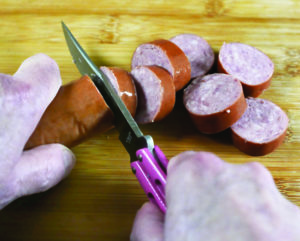
The Bear & Son Pink Butterfly made quick work slicing up link sausage for a pot of jambalaya

Heck, butterfly knife users have to eat just like everybody else, so I locked the blade down and took to the kitchen, using the knife to slice link sausage for a pot of jambalaya. The Pink Butterfly performed quite admirably and the color kept this chef, dare I say, in the pink.

Bear & Son 5-Inch Pink Butterfly
BLADE LENGTH:4.25”
BLADE STEEL:440 stainless
BLADE PATTERN:Clip point
HANDLE MATERIAL:Powder-coated zinc
SPECIAL FEATURE:T-latch at base
WEIGHT:5.33 ozs.
CLOSED LENGTH:5”
COUNTRY OF ORIGIN:USA
MSRP:$55.99

SAFETY ORANGE SLICER: The Puma SGB Orange Featherweight

The Puma SGB Orange Featherweight

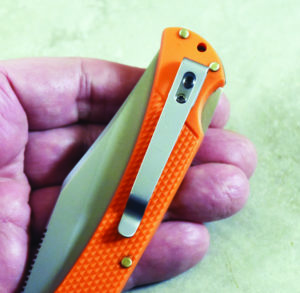
The Puma SGB Orange Featherweight Hunter is the newest rendition in the company’s Warden line of lockback folding hunters. It lightens the load to a svelte 2.8 ounces thanks to its 5-inch G-10 composite slabs, shaving two ounces off the standard Warden model. An added feature not seen on many folding hunters is a blade-tip-up pocket clip, 2.25 inches long, on the base of the back slab. The G-10 has a checkered texture which does a nice job of enhancing the grip.

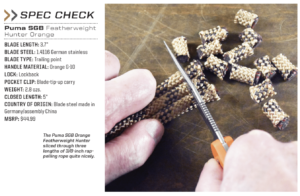
The blade offers up a long-pull nail nick with fine gimping on the lower spine to enhance grip. I tested the edge on 3/8-inch synthetic rope and it easily sliced off short lengths in one slice, so I jacked it up to two. No problem. I tried three lengths side by side with firm pressure and lopped them off as well. Like so many folding hunters before it, the lightweight Puma would serve up light field chores and skinning in spades. While the bright handles make the Puma Orange Featherweight Hunter stand out, an OD green model is available if you’d like a more subdued color.

The Puma SGB Featherweight carries blade tip up via its handy pocket clip.


CRIMSON CUTTER: The SOG-TAC CA Crimson

The SOG-TAC CA Crimson

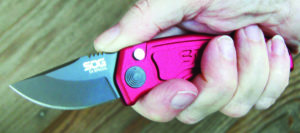
The SOG-TAC CA Crimson is especially designed to be street legal in California, where blades on automatics must be 2 inches long or less. The knife uses the SOG-TAC Mini handle in an aluminum anodized an attractive crimson color, with a push-button blade release on the front. SOG adds a slide safety to keep everything in check when not in use, and there’s also a blade-tip-up pocket clip.

Handle size is, indeed, a subjective thing. While the author had around 3/4 of an inch left in his mitt, the SOG-TAC Auto CA handle fit his girlfriend’s hand perfectly. “I still wouldn’t hesitate to carry this little powerhouse,” the author noted.

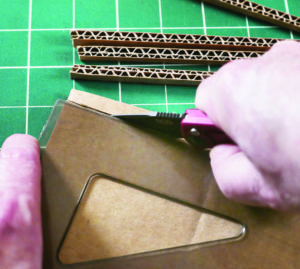
I was somewhat familiar with this folder because I’ve carried the larger 4.5-inch version in my rotation. Push the SOG-TAC CA’s button release and the blade opens clean and crisp at the blink of an eye. While its blade length is limited, it’s also a nice little EDC. I tested the edge on some tough quarter-inch-thick two-ply corrugated cardboard, and the AUS-8 stainless steel cut it across the grain in clean, easy strokes.

The SOG-TAC CA Auto did its due diligence as a competent everyday carry. It did an excellent job of taking off against-the-grain slices of thick corrugated cardboard.

I have medium-size mitts and the SOG-TAC CA handle left about a 3/4-inch deficit in padding on my lower palm. I let my girlfriend try it and it fits her hand just as the larger-size SOG-TAC fits mine. In fact, she said she wants one!

SOG-TACCA Auto Crimson
BLADE LENGTH:1.9”
BLADE STEEL:AUS-8 stainless
BLADE PATTERN:Trailing point
HANDLE MATERIAL:Anodized aluminum
SPECIAL FEATURE:Push-button release/safety
POCKET CLIP:Blade-tip-up carry
WEIGHT:2.5 ozs.
CLOSED LENGTH:3.75”
COUNTRY OF ORIGIN:China parts/U.S.assembly
MSRP:$129.95


BIG and BLUE: The Steel Will Scylla Blue

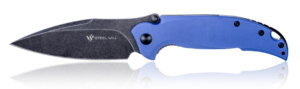
The Steel Will Scylla Blue is a full-size linerlock folder with an interesting twist: it has a top flipper as opposed to the typical side-winder on most folders with thumb studs. The knife features a vibrant, curvaceous handle with a fine fabric texture to enhance grip. A kidney-shaped lanyard hole is designed into the curved base and on the back slab is a blade-tip-up pocket clip.

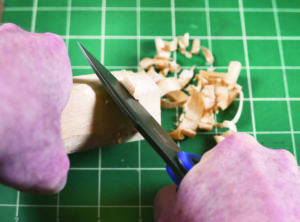
Steel Will’s Scylla Blue has a deeply ground blade ready made for carving wood. Starting with fine slivers the author moved up the ladder to take off large curls, ending with a nice pile of fire starter.

Top flippers take some getting used to, but like anything else practice makes perfect. Rather than pushing the thumb stud out,  the thumb pad or side of the thumb rotates the stud up and over the top of the handle until the blade locks.

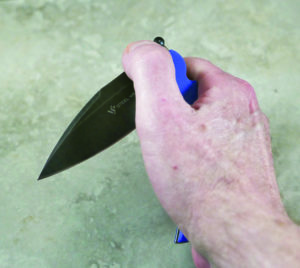
The Steel Will Scylla Blue has a top flipper that, once mastered, opens in just a flick by rolling the thumb stud over the upper handle. Here the author uses the right side of his thumb to do the opening chores, though the thumb pad will work just as well.

I tested the Scylla Blue’s deeply ground blade on boxwood. Starting with short slivers of tinder and moving up to long curls, I had a nice pile of fire starter before long. The edge did its job well aided by a comfortable handle grip that fit my palm nicely. If you can master the top flipper, you’ll like the Steel Will Scylla Blue.

Steel Will Scylla Blue
BLADE LENGTH:3.25”
BLADE MATERIAL:D2 tool steel
BLADE FINISH:Stonewashed black
BLADE PATTERN:Drop point
HANDLE MATERIAL:Blue G-10
ACTION & LOCK:Top flipper and linerlock
LINERS:Stainless steel
POCKET CLIP:Blade-tip-up carry
WEIGHT:4.42 ozs.
CLOSED LENGTH:4.5”
COUNTRY OF ORIGIN:China
MSRP:$69.99

This article is from the January 2021 Issue BLADE Magazine. Subscribe to a year of Blade Magazine for just $19.99 by clicking here.

The Art Knife Invitational (AKI) Changes Ownership

The Art Knife Invitational—the biennial knife event that made biennial knife events cool—is now under the direction of Barry Lee Hands, and will be Oct. 30, 2021 at the M Hotel Casino Resort and Spa in Las Vegas.

Consisting of some of the world’s top custom knifemakers, each of whom votes on any additions to the group’s membership, the show had been held for many years in San Diego. Spearheaded by BLADE Magazine Cutlery Hall-Of-Fame® member Phil Lobred when it started in 1983 in Reno, Nevada, the AKI was held again in 1984 before undergoing a hiatus until 1993, when it was moved to San Diego. It had been there every other year since.

When Phil passed away in 2016, his daughter Sandee took over the reins and coordinated the show in 2017 and 2019. In a meeting in July, Barry and Sandee discussed moving the show, for one reason because the member makers wanted to try something new. Meanwhile, one thing led to another and the show was in new hands—Barry’s. “I knew my dad admired Barry’s work [Hands is a leading knife and gun engraver], Barry’s experience with running shows, [and his] being the president of the Firearms Engravers Guild of America,” Sandee wrote. “So, we made a deal.

“I will admit it was heartbreaking at first, but when I see the good job Barry is doing on social media, managing things, the new hotel location in Las Vegas—wow!—and with the members voting in really good people, I know that we made the right choice.”

Barry is equally complimentary of Sandee. “I would like to say on behalf of our members that Sandee has been very helpful in the transition,” he observed, “and at AKI she will be an honored and respected show guest.”

Barry indicated the biggest change about AKI is the Vegas move.

“The members voted for a location change before I took over,” he noted, “and when I came in they let me know they still wished to move. With that in mind, and on the suggestion of one of our collectors, which happened to coincide with my own opinion, we chose the M Hotel Casino Resort and Spa. The M is a beautiful hotel and is the closest major property in Las Vegas to Los Angeles.”

Barry takes an aggressive approach to marketing, including a “beefed up” online presence with a “dramatic yet functional” new website. “We also have linked our Instagram @artknifeinvitational page to our Facebook page and are creating new graphics about our members and their work, which we post most every day,” he wrote.

Voting for AKI membership also has been updated. “Some members of the AKI advisory panel told me that since they are busy at the bench and the knife world is so large compared to the past, it is hard for them to know who may be the best to vote in,” he stated. Hence, after many communications they formulated a standard procedure for nominating and voting in new members. The panel approved the proposed rules, put them to a vote and a majority of the members approved them.

If you are a member of AKI, an invited guest or a maker who would like to be considered, submit your nomination at [email protected]. After a review of the nominations, Barry vets and selects a group of six or more. Biographical sheets are written on each maker and sent to the membership and panel for review. After 48 hours, if there are no objections, the group becomes nominees and is voted on by the membership. “The process has occurred four times since July,” Barry wrote. “It has been working very well and our membership seems highly pleased with the results.”

During the changeover, a few members resigned. “Some requested privacy, so respecting that, we will not list their names,” Barry noted. “Their reasons were varied. Some cited age, some preferred other opportunities, and others were not in full agreement with the rules voted in by fellow members.”

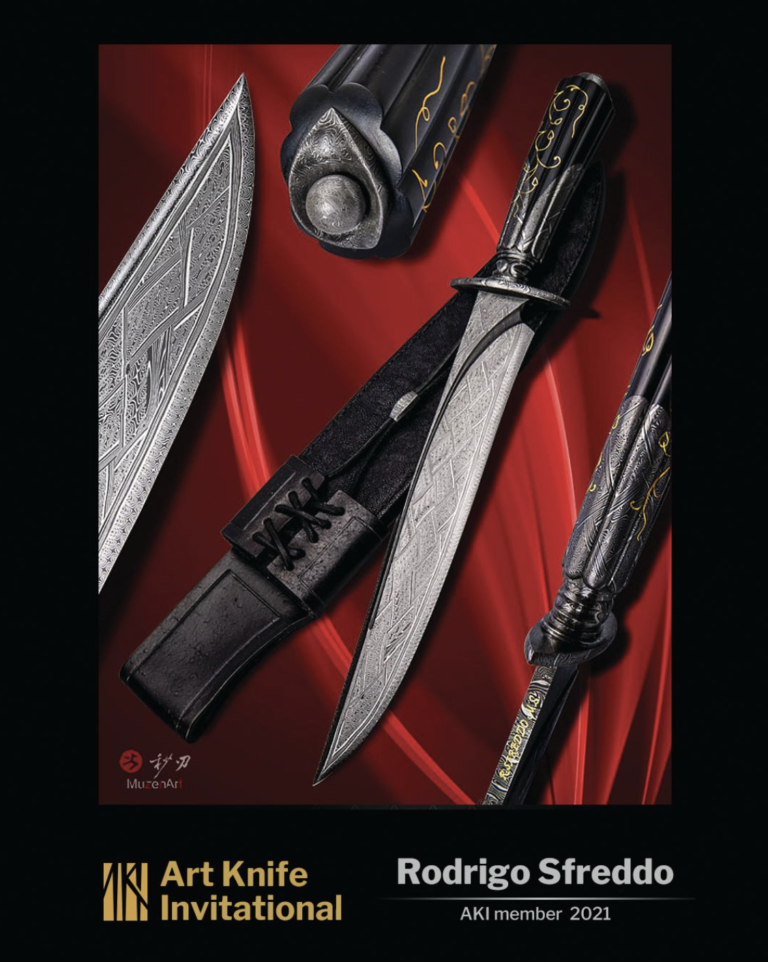
The present members are: Ron Appleton; Edmund Davidson; Harvey Dean; Jerry Fisk; Alex Gev; Shaun and Sharla Hansen; Anders Hedlund; Steve Hoel; Dietmar Kressler; Elizabeth Loerchner; Andrew Meers; Tom Overeynder; Bertie Rietveld; Rodrigo Sfreddo; Fabrizio Silvestrelli; Jürgen Steinau; Vasiliy Vorobiev; Owen Wood; and John Young. Guest makers for the 2021 AKI will include Corrado Moro, Veronique Laurent and others.

For more  information visit https://aki.show/.

This article is from the January 2021 Issue BLADE Magazine. Subscribe to a year of Blade Magazine for just $19.99 by clicking here.

5 Leading Sharpening Rods

0

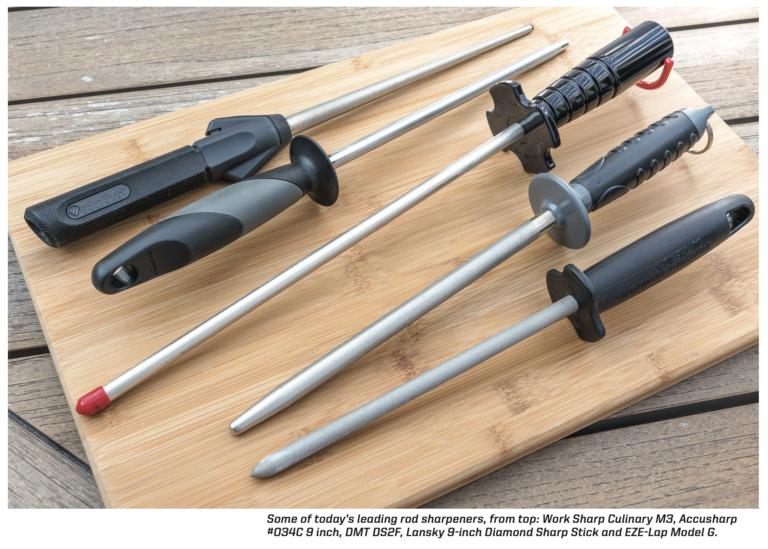
5 LEADING SHARPENING RODS TAKE THE AUTHOR’S SHARP TEST

The sharpening rod is perhaps the No. 1 kitchen knife accessory in many households. Why? Usually 8 to 12 inches long, it is a hardened steel rod with a coating of industrial diamonds that helps abrade steel and lightly sharpens a  cutting edge. Most models are basic and there’s not much to them. They are more effective than standard butcher-type steels that align the edge and don’t remove material, and are good for regular maintenance of kitchen knives in between professional sharpening.

Accusharp 9-inch

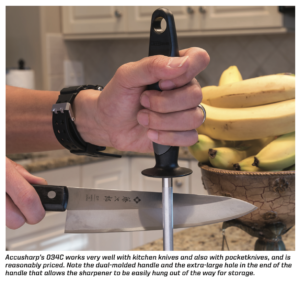
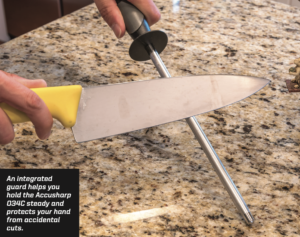
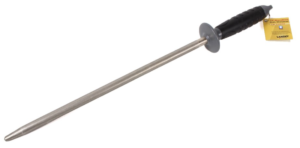
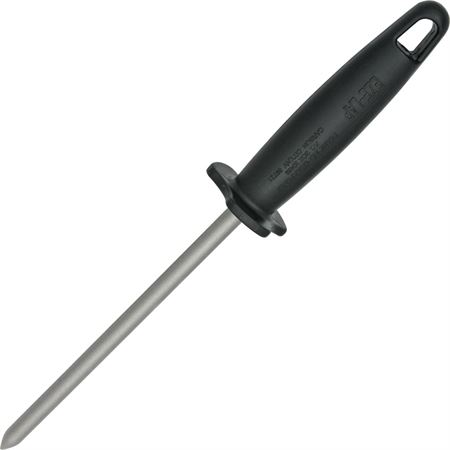
Accusharp offers a 9-inch sharpening steel, model #034C. The ergonomic, rubber overmold handle makes it easy to hold thanks to the non-slip grip. It stores easily in a drawer or hangs from an extra-large handle hole. The guard is round, so the sharpener will roll when you set it down, which can be annoying. It does not come with a container for protection while not in use.

The steel and its fine abrasive in a 1500 grit maintains a blade well. My only complaint is with the soft rubber part of the co-molded handle. The rubber is in a diagonal shape and on one end closest to the guard of the test model, it is visibly raised and you can peel it back a bit. However, if it comes undone, you can easily fix it with a strong adhesive. Country of origin: China. MSRP: $34.99.

TOOTHIER EDGES: Lansky’s Diamond Sharp Stick

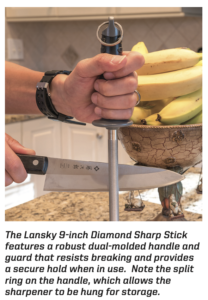
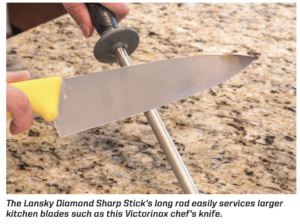
The handle of Lansky’s 9-inch Diamond Sharp Stick is a dual-material, rubber overmold for both comfort and durability. Like most sharpening-steel handles, a full integral guard protects your hand from accidental cuts. A split ring affixed to the handle’s end provides for hanging the rod on a hook or nail.

The Sharp Stick has a hard plastic tube that fits over it and secures in place by an O-ring that slides down the rod close to the guard. You can remove the O-ring but you must leave it on to take advantage of the hard plastic tube to protect the sharpening rod surface when stored. The O-ring is positioned far down on the handle to not interfere with operation.

I discovered something interesting with the Sharp Stick. As with all the test models, the grit is fine but the Lansky seemed most aggressive in the cut and produces a toothier edge than the rest. In my opinion this is very good, as I prefer a toothier edge on my kitchen knives, though some do not.

The rubber gripping portion of the handle is textured well, and offers a great purchase with wet or dry hands. The guard is also robust in appearance, as some equate robustness with better quality. That’s not always the case but with this one it definitely is. Country of origin: China. MSRP: $33.99.

Diamond Machining Technology (DMT) DS2F

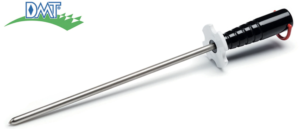
In my opinion, the Diamond Machining Technology (DMT) DS2F diamond sharpening steel is superior in several ways to the balance of the test rods. The fine-grit diamond-coated model has a red plastic/rubber tip. DMT uses a color-coded system to denote various grits, including red for fine. The tip also helps stabilize the rod on a flat surface. The DS2F ships in a nice, clear vinyl pouch that locks around the guard. The pouch is great for storage.

While the other test models have dual-molded handles that incorporate hard plastic and firm rubber for comfort, the DMT has a hard plastic one. However, don’t turn your nose up just yet. The handle tapers gradually toward the guard, which makes the entire grip fill your hand nicely. There are also five grooves on the tapered part that enhance a secure hold. The guard has four semi-circular cutouts to provide anti-roll qualities, which I really like. The DMT doesn’t roll at all when you put it down. A plastic shackle attached to the handle end for hanging also is color-coded to grit. The shackle can be removed if you desire. It’s creature comforts like these that make the difference between a good product and a great one.

The DMT is definitely a top performer. The 12-inch rod captures pretty much all sizes of kitchen knives. Of all the test models, I felt the DMT produced the finest edge, that is, the edge isn’t toothy or grabby, it’s just plain sharp. The D2SF leaves a nice, refined finish on the cutting edge.

One thing about the handle shape: Since it tapers toward the guard, it forces you to nestle your hand up against the guard when holding it. This stabilizes the sharpener in your hand. When you grip it farther away from the guard, the sharpener isn’t as stable—something to consider. If you prefer holding your sharpening rod, you might want to get the DMT for this very feature. This is just a top-notch, high-end sharpener. Country of origin: USA. MSRP: $53.59.

EZE-Lap Model G

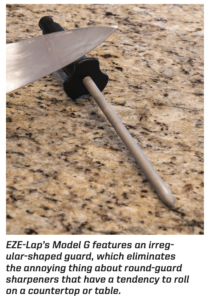
The 8-inch EZE-Lap Model G is the shortest of the test models. The shorter rod allows for easy use as well as com pact storage inside a drawer. It comes in a fine grit to produce a nice working edge in a minimal amount of time. The large-diameter plastic handle has enough girth for a comfortable hold. The integral guard is very much like the DMT D2SF’s, with a non-round shape that helps curb rolling on a flat surface. Well done! An extra-large handle hole promotes hanging for storage.

EZE-Lap’s Model G round-profile diamond sharpening rod is only 8 inches long, which makes it the shortest rod evalu- ated, though that doesn’t mean it is any less effective. The shorter overall length stores in a drawer easily or in cramped quarters such as in an RV.

The thing about a shorter rod like the Model G is you must be quick on the draw when working on longer kitchen knives, such as 8-inch chef’s knives and up. Compared to 10- and 12-inch rods, you’re losing real estate to work from and must pull the blade across the length of the Model G quicker. For shorter blades, this should not be an issue. On the other hand, the smaller size is ideal for camping, traveling in an RV, etc.

The Model G ships in a stiff paper sleeve, which can be reused to protect the rod as well as other items stored near/by it. The sharpener felt very coarse to the touch out of the packaging. All diamond sharpeners do. As you use them they will smooth out, though this has no bearing on performance, and performance-wise the EZE-Lap does very well. Country of origin: USA. MSRP: $31.95.

Work Sharp Culinary M3 Sharpener

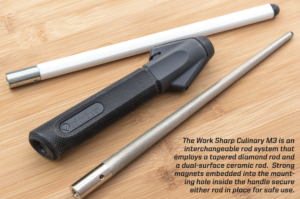
The Work Sharp Culinary M3 sharpener takes the basic diamond-coated steel rod sharpener and improves on its function by offering choices. The M3 comes with not one but two rods—coarse-grit steel with a diamond coating and a fine-grit ceramic rod. Both rods interchange with the included ergonomic handle and are secured in place by strong magnets.

The 8.25-inch steel rod tapers gradually from handle to tip. At the end of the rod is a rubber button, which helps stabilize the sharpener when the end is placed on a table or countertop and the handle is held with one hand. It sounds like a typical steel rod until you get to the handle.

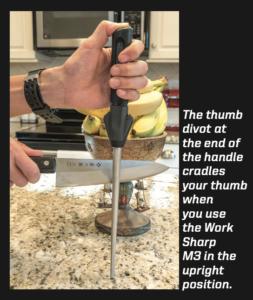
Instead of the standard integral, flared guard is a pair of ramped surfaces that serve as angle guides. When you hold the sharpener upright, place the side of the blade on the rod and rest it against the ramped surface. Then, with the standard motion using a rod sharpener, travel down the rod, holding the blade at the preset angle. Bring the opposite side of the blade to the other side of the rod and repeat. The gripping part of the handle is firm-textured rubber, and a thumb divot on the end helps stabilize the sharpener in use.

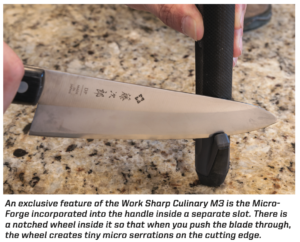
A little “MicroForge” slot in one of the guides contains a small yet wide serrated wheel. After you get a sharp edge, remove the rod from the handle and place the end of the handle on the table, in similar fashion to how you were sharpening. Place the blade in the slot at the tip. With light pressure, push the blade through until the handle gets to the tang, then stop. The serrated wheel will crimp the edge slightly, forming tiny and evenly spaced micro serrations. The serrations act like bigger serrations found on other kitchen knives. Using the MicroForge feature is not mandatory, but it is designed as an additional function to help provide the longest-lasting edge possible.

The steel rod cuts fast to restore dull edges. It provides a working edge in a minimal amount of time. Follow up with the fine ceramic rod after the edge has been established to refine it further. The ceramic rod’s smooth and fluted sides give a choice of edge finishes: a bit more bite with the latter and a more polished edge with the former.

The M3 ships in a sturdy cardboard box, the sharpener parts store inside a tray, and the tray slides into the box. The steel rod has a protective plastic sleeve, too. It is the most comprehensive of the test lot. Country of origin: Parts sourced globally, U.S. assembled/calibrated. MSRP: $69.99.

HOW TO USE A ROD

No matter the brand or model, sharpening steels are used the same way. Most manufacturers recommend using one while standing at the kitchen counter or seated at a table.

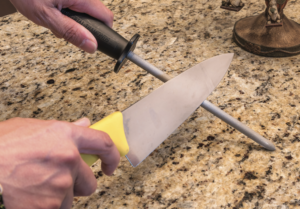
Take the sharpening steel and place the tip on the table, held upright with the handle at the top. With one hand, grasp the handle firmly, keeping it perpendicular with the flat surface at all times. With the other hand, grasp the knife handle and place the blade at a 20-to-30 degree angle in relation to the sharpening steel. Place the blade as close to the guard as possible, set to start at the part of the blade closest to the tang. In one motion, move the blade down the length of the rod while at the same time draw the blade fully across the steel. When you near the flat surface you are working from, though without touching the surface, you should be at the blade tip.

Raise the blade to where you started from, switching the blade to the opposite side, then repeat the same stroke. Then, return to the side you started from, and repeat once again. Do an equal amount of strokes for both sides of the blade.

As you become more comfortable using the sharpening steel, you can forego the flat surface and hold the steel with one hand similar to how you would a large kitchen knife. With the other hand, place the blade on the rod at the recommended 20-to-30 degree angle and lightly push the blade across the rod, ending at the blade tip. I highly recommend you not proceed to this step until you are confident enough, because with this alternate method chances for not holding the angle correctly is greater.

Whatever method you use, remember to always use light strokes. There is no need to bear down on the blade with pressure. Let the rod do the work.

Advertisement

Must Read Articles

Read this before you make a knife

Knifemaking 101 – Read This Before You Make a Knife

  by Wayne Goddard My experience has taught me that there's nothing like digging in and getting started. I've often said the hardest part of the...
how to forge damascus steel

How to Forge Damascus

Advertisement
Advertisement