In the knife world, titanium has been at the forefront of space-age metals for well over two decades, due in great part to the boom in the tactical knife genre borne out of the first Gulf War in the early 1990s. Titanium was originally used in the U.S. space program for its weight savings and toughness, and from there bled into military programs for the very same characteristics.
Titanium is also nonmagnetic, proving useful in certain applications. While tough, titanium is softer than steel, and although some knifemakers have used it as blade material, it never quite caught fire like the new exotic stainless steels that dominate the upper end of the market today.
Aluminum is also nonmagnetic and anodizes quite well, but it gets little respect in the knife industry because as an extremely soft metal it’s considered an inexpensive alternative to titanium.
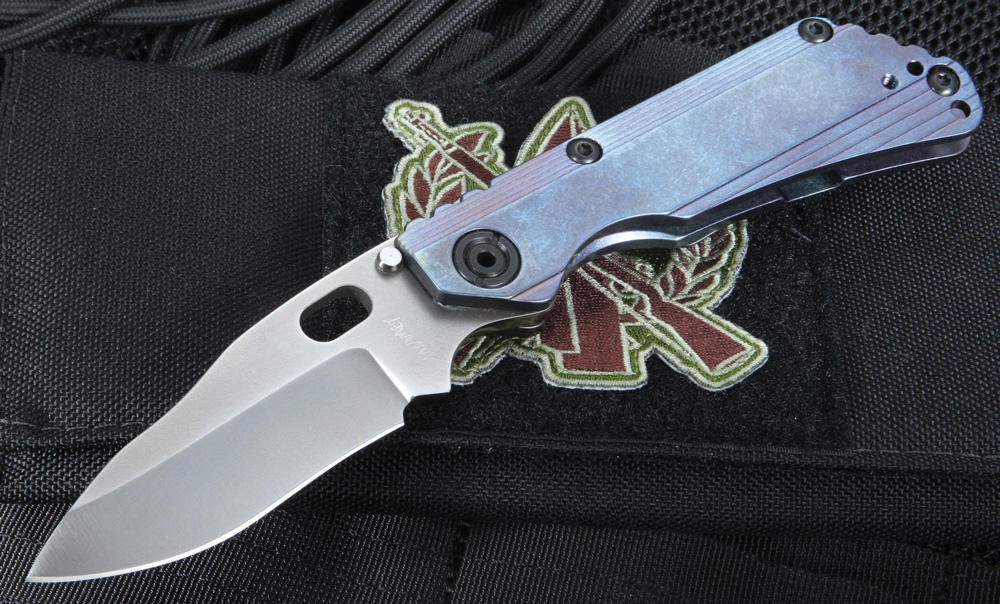
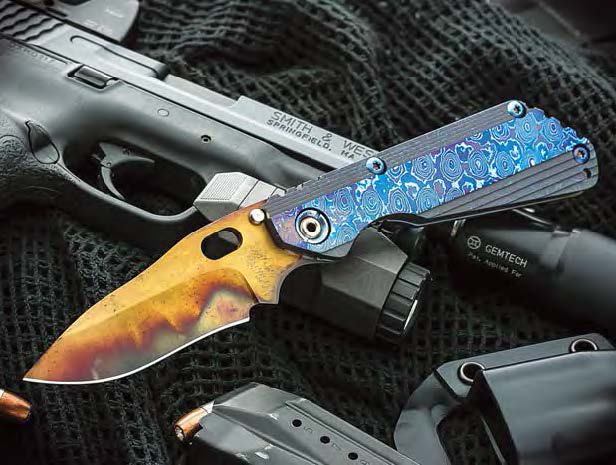
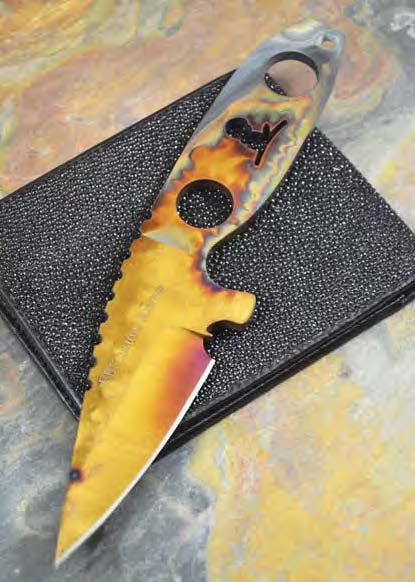
Titanium is a reactive metal—its characteristics can be changed by outside influences. Heat-treating knife handles or dipping them into an electrolyte solution that has been both positively and negatively charged color enhances the metallic surface. The amount of heat or electric charging can be varied by the amount of direct heat or voltage applied, and this determines the color hue that the metal takes.
Learn More About Knifemaking in the World’s Greatest Knife Book
Nitinol, also referred to as “Ni-Ti-Nol,” was first discovered back in 1959 by scientists William Buehler and Frederic Wang at the Naval Ordnance Laboratory. The Ni-Ti-Nol acronym stands for “Nickel-Titanium-Naval Ordnance Laboratory.”
Beuhler and Wang were searching for a super-elastic alloy for missile nose cones that would be pliable at extreme heat, yet return to its original shape after cooling. Their efforts were a success, but because the incredibly tough alloy was so difficult to process and machine, it wasn’t used until much later.
Knifemaking Discovers Nitinol a Half-Century Later
Duane Dwyer of Strider Knives was the main force behind SM-100 (HIPTiNite), and his signed custom Strider MT2 showcases a brilliantly heat-treated SM-100 blade mated to machined carbon fiber handle scales. (Brady Miller image)
Custom knifemaker Duane Dwyer of Strider Knives became interested in Nitinol back in 2005 while searching for a super hard metal alloy that would not rust. He approached metallurgist and friend Scott Devanna, vice president of technology at SB Specialty Metals, and inquired about the possibility of producing Nitinol using the particle metallurgy process, which had never been done.
Shortly afterwards Devanna introduced Dwyer to Eric Bono, a metallurgist and knifemaker who also had an interest in the alloy, and the three men began to explore the possibilities of incorporating the alloy into knives.
Nitinol Becomes SM-100 (HIPTiNite)
Duane Dwyer of Strider Knives was the main force behind SM-100 (HIPTiNite), and his signed custom Strider MT2 showcases a brilliantly heat-treated SM-100 blade mated to machined carbon fiber handle scales. (Brady Miller image)
With his metallurgical knowledge and experience, Bono developed a working, powdered metal version of the alloy in 2006, which the partners dubbed “SM-100.” It took several more years to refine the alloy and processes, and in 2009, Bono and business partner Fred Yolton formed a company, Summit Metals LLC, to produce SM-100.
Since that time, SM-100 (60 percent nickel and 40 percent titanium), which the company markets under the name “HIPTiNite,” has garnered interest not only in the knife industry, but also by NASA and the Formula 1 racing industry.
Properties of SM-100
The SM-100 brand of Nitinol, like its forerunner, is extremely tough. While a typical sanding belt can be used to grind several typical, mono-steel knife blades, it requires several belts, in many cases six or more, for the same process using the SM-100 alloy.
Made and sold in small quantities, the cost of SM-100 isn’t cheap. Add to that the cost of belts and additional time to shape and grind the material, and the cost per knife skyrockets.
On the positive side, SM-100 is noncorrosive, and while stainless steel will rust, Devanna says you can throw an SM-100 knife into saltwater for 50 years without the material corroding.
An Explosion of Coloring
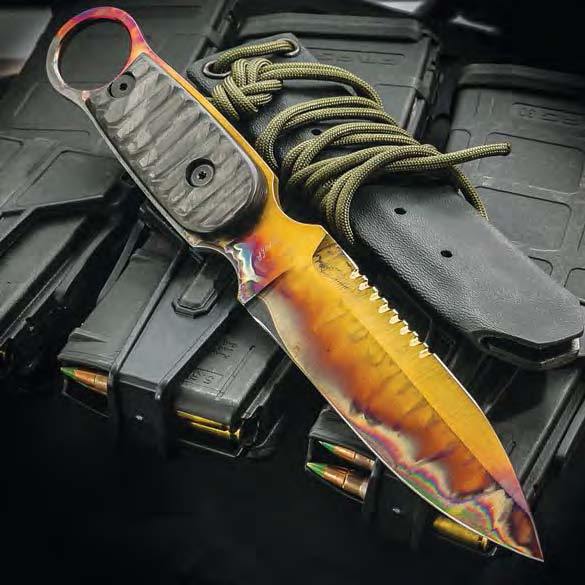
Bono discovered during his development of SM-100 that it can be heat colored into an exquisite rainbow of colors. Due to the titanium content, SM-100 oxidizes into a blaze of bright hues just like other alloys incorporating titanium, but the process of achieving the color effects is quite different.
Bono confides that the magic happens during the heat-treating process, in which he allows small pockets of air to leak onto the surface of the knife. Prior to heat treating, the blades are wrapped in foil and small holes are punched into the wrapping.
When heat treated, different colors occur depending on the oxygen content of certain areas of the blade material as the surface oxidizes. The end result is the explosion of color on the SM-100 blades.
The price for bright, eye-popping colors doesn’t come cheap, but then new innovations rarely do.
Editor’s note: The below is an excerpt from an article originally published in the KNIVES 2018 book, but it still rings true today. Hardly anyone is talking about dive knives, but they come with the kind of history and innovation that is ripe for collectors. They truly are the sleepers of knife collecting.
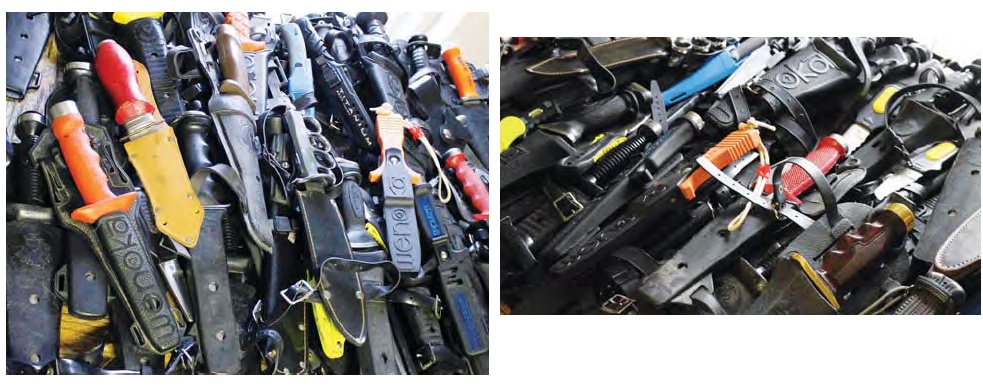
Shown here are the author’s piles of dive knives purchased for bargain prices at gun shows and flea markets.
Dive knives present an opportunity for collectors to get in on the “ocean floor” of an industry segment. Other than modern, imported low-end knives, vintage dive knives are often the lowest priced blades at a gun show or flea market. The overwhelming majority of dive knives are easily acquired for between $5 and $40 apiece, similar to how U.S. military knives and theater-made knives were priced years ago, before folks woke up and recognized their true value.
They say the sea, not space, is the last true final frontier. Dive knives have been the personal tools of undersea explorers for as long as there have been divers. What the bowie knife was to the West, the dive knife is to the sea.
Before You Buy, Know the Pricing Ceiling
Dive knives are currently the “sleepers” of the knife world, and investment opportunities abound for the collector who has an interest in such pieces. Before we look at inexpensive dive knives, one should be aware of the pricey ones available today.
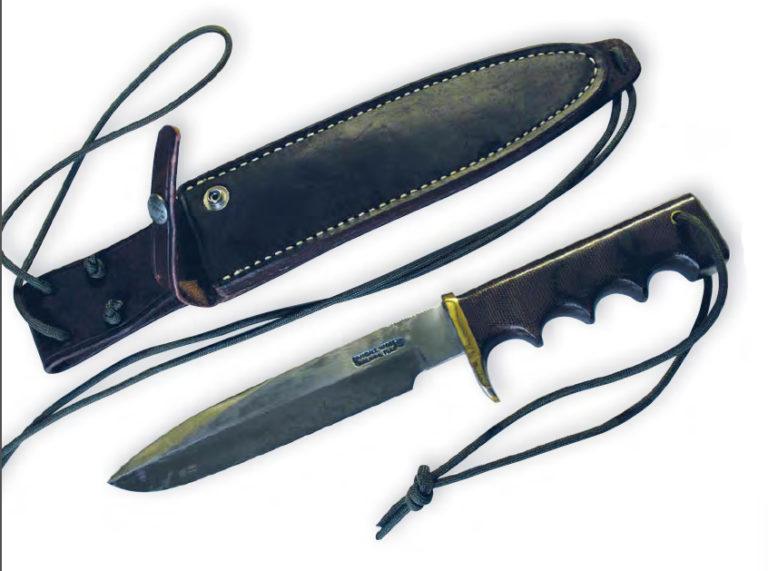
There are some expensive, desirable dive knives out there now, many coming from high-end makers. The expensive pieces are often associated with military and sporting uses, and include, but aren’t limited to, Randall, Gerber, Puma, Benchmade and Mission Knives & Tools, or those made specifically for the military.
Becoming familiar with expensive dive knives may help one find a bargain and to recognize certain qualities that make a dive knife valuable. Additionally, the expensive dive knives lay the foundation for price appreciation of the vintage sleepers waiting out there for savvy collectors to scoop them up.
Bargain Buys
When it comes to bargain dive knives, one sees names such as U.S. Divers, Healthways, Wenoka, AMF Swim Master, AMF Voit, Sportways, Dacor, Scubapro, Scubaskin, P.I.C., Eternal, etc.
The general pattern of the knife is a stainless steel blade with a plastic or rubber handle and sheath. There are models that can be picked up for incredibly low prices, and for what one is paying, “it’s worth it just as a knife.” It’s those kinds of investments that seem to be can’t-lose propositions, although nothing is ever guaranteed in life.
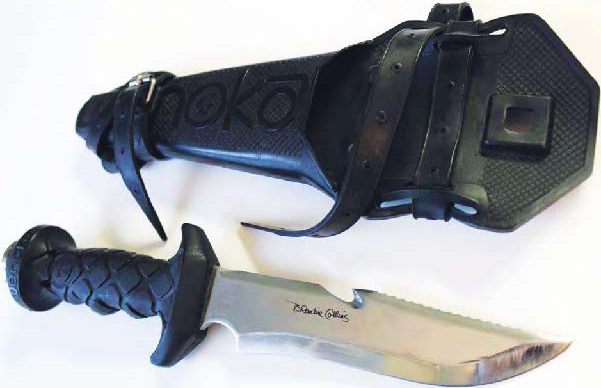
The sturdy Wenoka dive knife was designed by Blackie Collins.
Wenoka knives are some of my favorites. They were very well made in Japan. There is a wide variety of models. The larger Wenoka dive knives have a great, sturdy feel and are nicely designed for the task at hand.
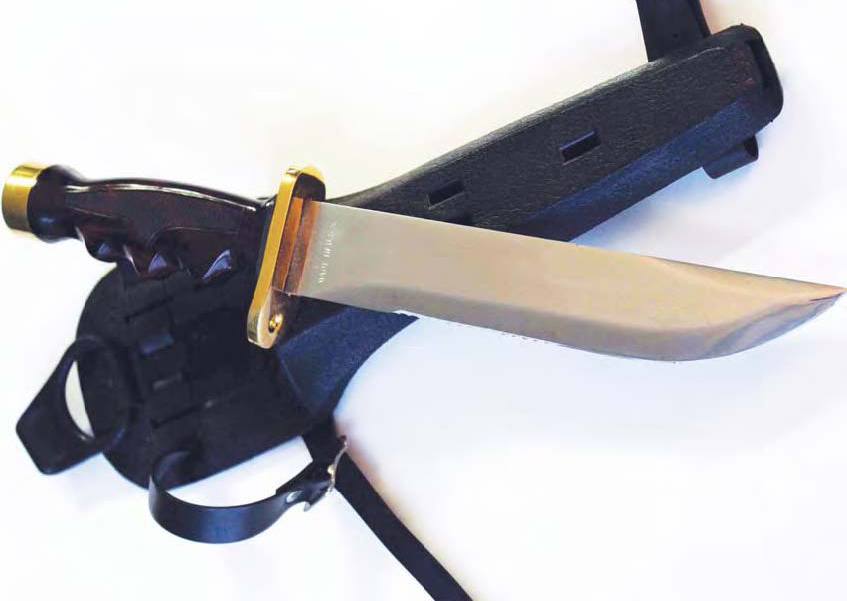
Note the heavy brass guard and butt of the high-quality, U.S.-made AMF Swimaster dive knife.
The AMF Swimaster is a beautiful, well-made knife, very high quality, serial numbered, with a heavy brass butt and guard, and made in the U.S.A.
Healthways offered the “Skin Diver,” a double-edged blade made in Solingen, Germany, with a large, red cork handle.
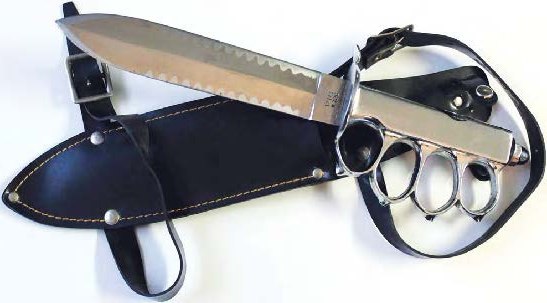
The nickel-plated P.I.C. dive knife boasts a 1918 trench knife-style handle that protects the user’s knuckles underwater.
The P.I.C. Model 728 “Sea Hunter,” made in Japan, is also of high quality. It is easily recognized by its handle, which is a nickel-plated replica of the 1918 World War I trench knuckle knife. Many such dive knives were made in Japan, and even a dive hatchet, which was a hatchet, pry bar and hammer combination set that came in a vinyl sheath was available.
Buy Low Now, Sell High Later
There are so many variations of dive knives, and they appear to be limited only by the imaginations of various makers. The collector now has a chance to reasonably acquire these fascinating knives that were once strapped to divers exploring the underworld of the earth.
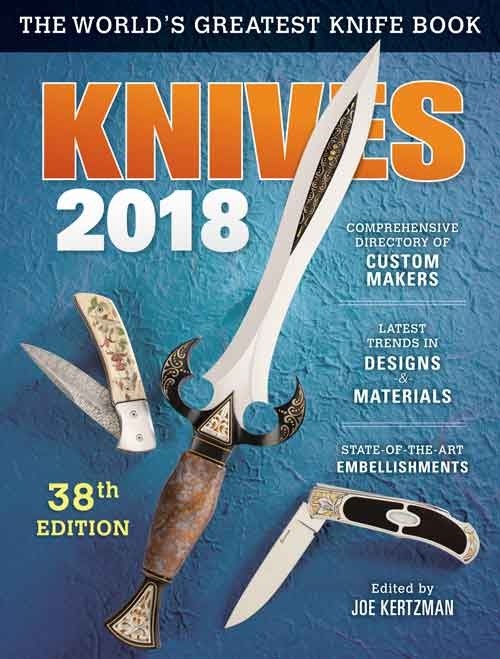
This article was excerpted from KNIVES 2018. Click the cover to order the book directly from the publisher at a great price.
Editor’s note: Ken Warner, the visionary behind and original editor of the acclaimed KNIVES annual book series, recently passed away. In tribute, BLADE is featuring this article from the August 2009 magazine issue about this titan of knives.
The turn of a phrase, the flow of the narrative, and simply getting the story straight are hallmarks of the writing craft. BLADE Magazine Cutlery Hall-Of-Famer® Ken Warner brought the ability to perform each of these, along with an unmatched eloquence, to the knife industry.
Universally, knife authorities acknowledge him as the individual who lifted custom knives out of the shadows. He helped to accomplish this with a straightforward, crisp, and clean writing style that captured the imagination of readers for nearly half a century.
A “True Poet” of the Knife Community
Warner edited and wrote much of the first Knives annual in 1981. The series went on to transform the knife industry. He continued editing the annuals until 2000. BLADE managing editor Joe Kertzman assumed the reins beginning with the 2001 edition.
“Ken Warner is the true poet of the knife community,” related BLADE field editor Ed Fowler. “While he did not write the most knife articles, what he did write was worth reading and serves as an eloquent inspiration for all who have thoughts to share. He had no axe to grind other than to share knowledge. As a fledgling knifemaker, I used to read his comments and soon learned that he knew well his subject matter.”
Though he is not currently writing—he instead stays busy offering a wide range of fixed blades and folders through his Ken Warner Knives knife company—there is always the possibility that Warner will return to print. Meanwhile, he says he is becoming computer savvy enough to run a knife forum on the internet and to continue his online blog (kenwarnerknives.blogspot.com). He also stays busy designing knives.
“I’m 80 years old,” he reflected, “and I have some things I want to say and there are some stories I can do that nobody else can do because I was there. I will get to that when I get to it.”
Forging a Path
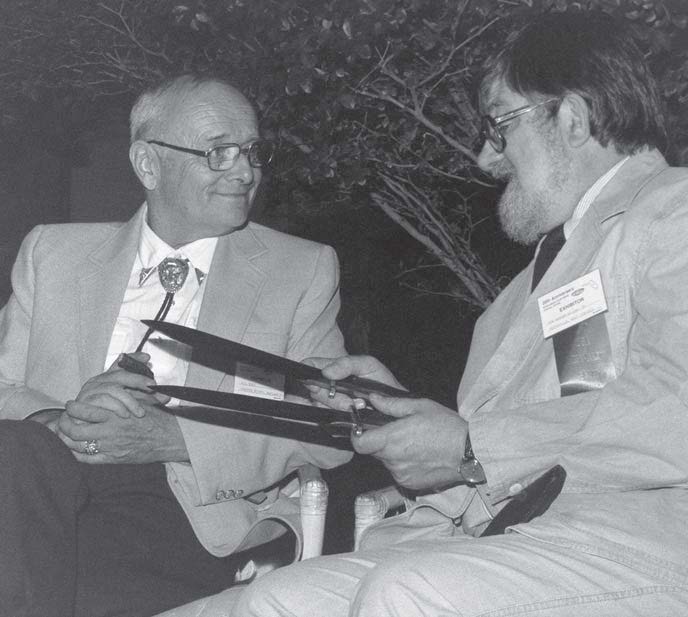
Blade Magazine Cutlery Hall-Of-Famers Bill Moran (left) and Ken Warner were good friends. According to Cutlery Hall-Of-Famer B.R. Hughes, Warner was the first to write about Moran and his knives in a national magazine. Here Moran and Warner visit and talk knives at an early 1980s Knifemakers’ Guild Show. (photo courtesy of B.R. Hughes)
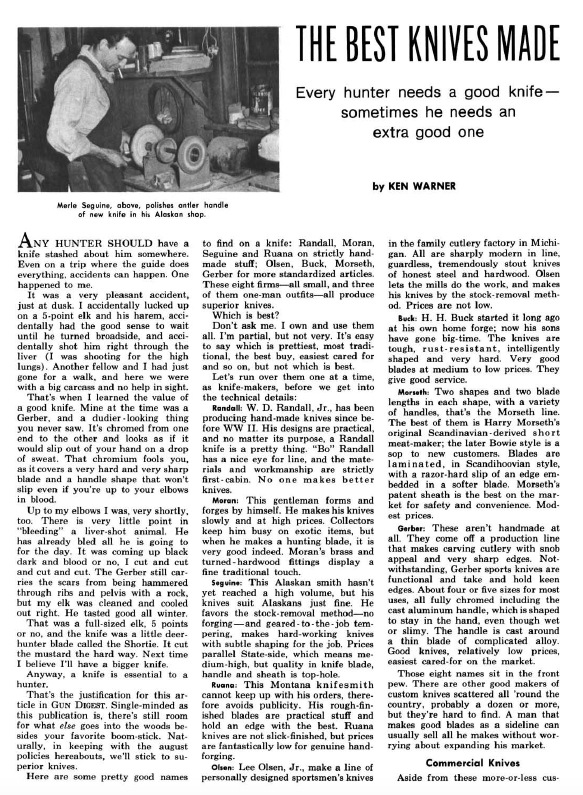
Literally, when custom knives began to gain national and international attention, Warner was there. In fact, he was the prime mover in publicizing the work of the knifemakers. As a writer for the popular annual Gun Digest, he started writing about knives in 1964. That first article, titled The Best Knives Made, has been reprinted numerous times.
Back then, though, it was a challenge just to get enough material to put a story together.
“I could hardly find any knifemakers,” Warner commented. “I found [Bill] Moran and [Bo] Randall, and Buck was small then and I wrote about them. However, a number of knifemakers and collectors have told me that the article got them started. Bob Loveless, for example, has told me that he was about to give up making knives because it wasn’t going any place. Then, he read the article and decided that somebody would understand. There was a time that I was actually giving away Loveless knives just to see what people thought of them. Butch and Rita Winter were pre-eminent collectors of handmade knives, and they told me I got them started.”
A Calling
Educating the general public about knives evolved into something of a mission for Warner. In 1976, he wrote The Practical Book Of Knives, a primer of information on the mechanics, components, function and terminology associated with knives. Through editorial contributions to a number of publications, he has managed to spread the word.
Along the way, he has gained a multitude of friends and admirers. One of the closest was with the legendary Cutlery Hall-Of-Famer, Bill Moran. BLADE field editor and Cutlery Hall-Of-Famer B.R. Hughes, co-author of the Moran biography, Master Of The Forge, credits Warner with his introduction to the great bladesmith.
A Man of Many Firsts
Ken Warner’s The Best Knives Made article in the Gun Digest 1966 book was a game-changing moment for what is now the modern knife industry.
“Ken was one of the first to write knowledgeably about handmade knives, and he’s important to me personally because he’s how I heard about Bill Moran,” Hughes remarked. “Ken used to live close to Moran’s shop and visited there often. He was the first to write about Moran in a national magazine. He mentioned Moran in the Gun Digest article in 1964, and that article did more to publicize handmade knives than everything written about them up to that time.”
Of course, Moran, Hughes, Don Hastings and Bill Bagwell went on to found the American Bladesmith Society in 1976 and the rest, as they say, is history.
Hughes said he remembers working at a magazine called Gunsport in the mid-1960s and Warner was the editor. Even then, Hughes knew Warner was something special.
“Ken’s writing was a cut above what I was used to seeing in a gun magazine,” Hughes continued. “I soon became shotgun editor of Gunsport, and no gun magazine of that day was going to publish a lot of knife articles, but Ken got a knife article in there from time to time.”
When Warner left Gunsport to publish his own magazine, Gunfacts, the idea of writing about knives had caught on.
Hughes said he recalls a memo circulating to ask if anyone else at Gunsport had an interest in or knowledge of handmade knives. Hughes raised his hand, contacted Cutlery Hall-Of-Famer A.G. Russell for a crash course in handmades, and took up writing about knives himself.
The Knives (KNIVES) Books
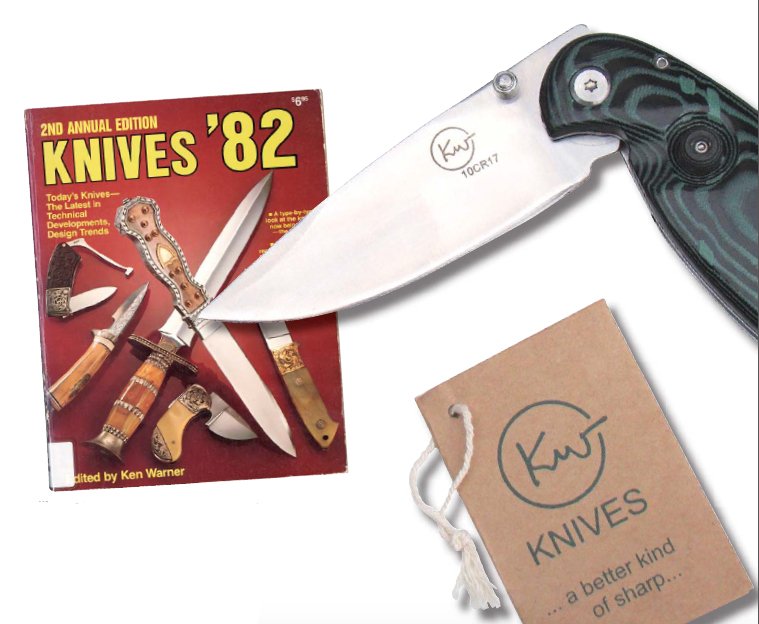
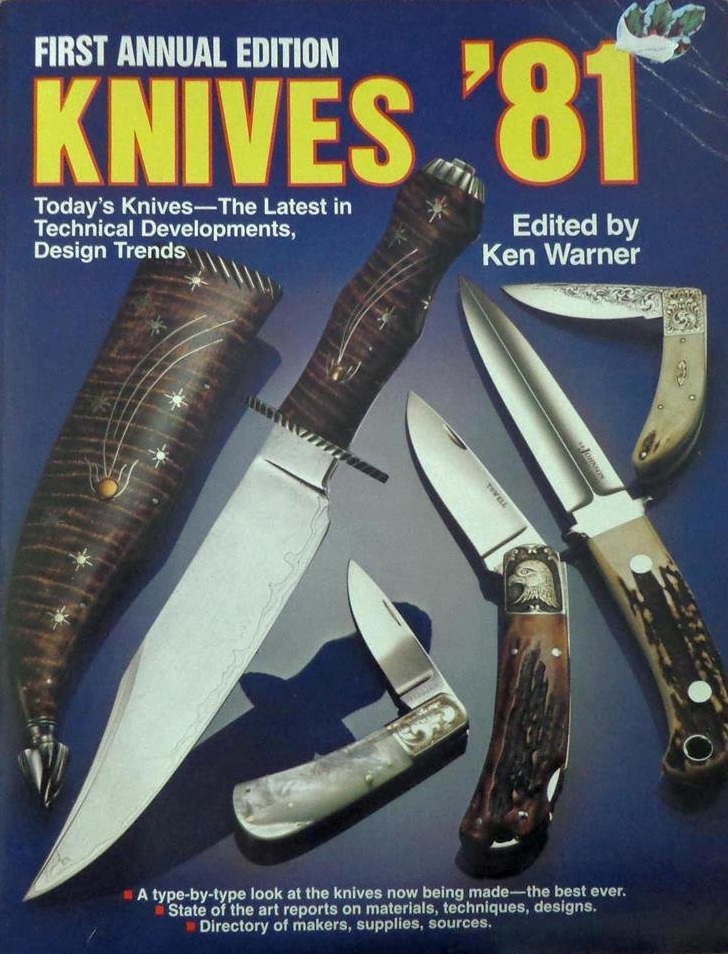
The cover of the knife book that started it all.
For many, Warner’s greatest single contribution to the knife industry was not that first article in Gun Digest, nor his continuing effort to publish knife stories in popular magazines. Rather, it was the publishing of the first Knives annual in 1981 that sparked what became an explosion of interest in handmade knives.
“The big thing with Ken is that he mainstreamed knife interest, and everybody credits him with that,” assessed Cutlery Hall-Of-Famer Bruce Voyles, with whom Warner co-authored the book Knives Digest in 1999. “That, in my opinion, was not his greatest contribution. That came when he got the Knives series started. For the first time you had a listing of not just a particular organization’s members but all knife people. You also had pictures. It was a snapshot of the state of the knife industry at the time, particularly handmades—and the industry was pretty disorganized at the time unless you were a member of the Knifemakers’ Guild.
“I think he gave tremendous publicity to people that had not gotten publicity,” Voyles continued. “Plus, there’s something that most people will not notice about him unless he has edited something they’ve written. He’s one of the most gifted editors I have ever known in any genre. He takes average stuff and makes it sound good, and makes good stuff sound fabulous while making it flow easily. The different thing about Ken’s writing and editing is that Ken made it readable. Most of the stuff before Ken was clumsy, and he made it interesting. He could make the phone book interesting. One of my favorite quotes was when his former wife said some years ago, ‘Ken has the most annoying habit of being right most of the time.’”
Recognition
Ken Warner inducts Bruce Voyles into the BLADE Magazine Cutlery Hall Of Fame at the 1993 BLADE Show Awards Banquet in Stone Mountain, Georgia. From left: George Herron, A.G. Russell, Buster Warenski, the inductee, Paul Tausig, Joe Mangiaracina, Warner, Houston Price and B.R. Hughes. All but Tausig and Mangiaracina are in the Cutlery Hall Of Fame. Along with Col. Rex Applegate, Hughes joined Voyles as an inductee that year.
Among the many happenings during his association with Warner, Voyles will never forget that it was Warner who organized Voyles’ induction into the Cutlery Hall of Fame at the awards banquet of the 1993 BLADE Show. It was Voyles’ 40th birthday, and Warner took the stage to announce—to Voyles’ surprise—that he was being inducted by acclamation of all living members of the hall at the time.
When Warner and A.G. Russell were inducted into the hall at the 1988 BLADE Show, each was invited to the banquet to provide the introduction speech for the other’s induction. Neither Russell nor Warner knew they were being honored themselves.
“Ken said at the time that as long as there was a BLADE Show, he would eat the BLADE Show’s rubber chicken,” Voyles grinned. “Then, the next year we presented Ken with a rubber chicken and taped a knife that he liked inside the chicken’s mouth.”
Warner is also a member of the ABS Hall Of Fame and counts the society’s prestigious Don Hastings Award among his many honors.
A Lasting Legacy
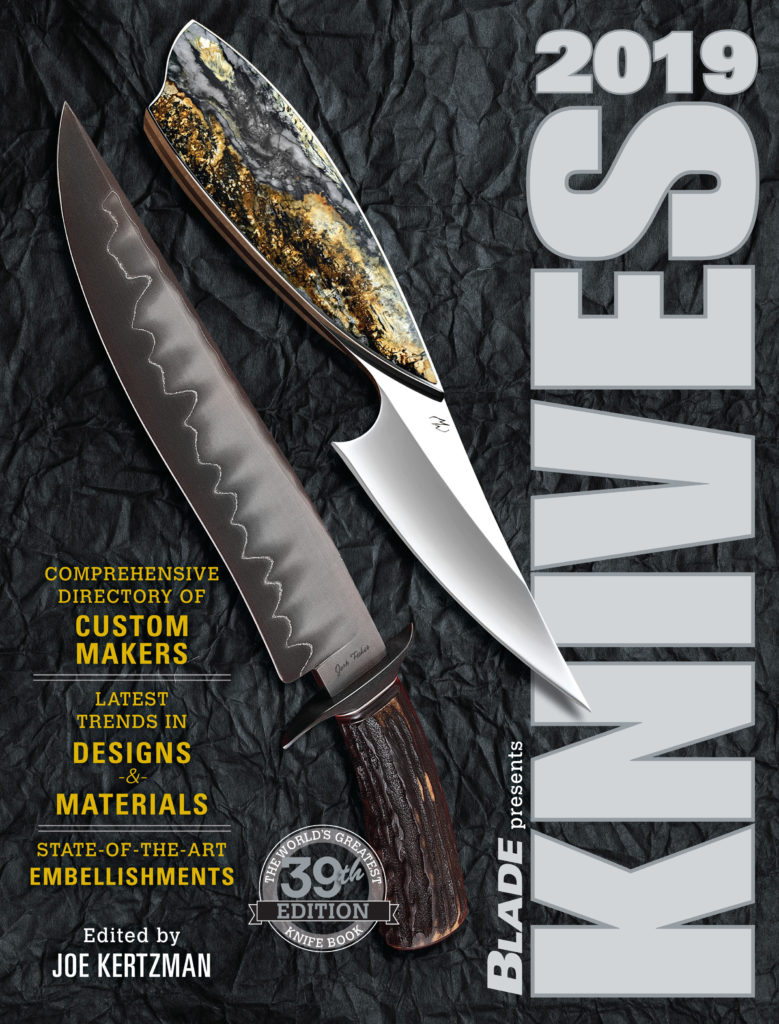
The most recent KNIVES annual book on shelves is KNIVES 2019.
Fowler said Warner was the right man for the successful development and promotion of what has become a virtually indispensable part of the knife industry, a book which will celebrate its 40th anniversary in 2020.
“Thanks to his knowledge, editorial ability, choice of writers and relevant topics, Ken started a legacy to the knife community that continues to this day,” Fowler noted. “Ken knew the difference between a hunter and an art knife, as well as the pretenders, and described each knife eloquently. Many of his one-sentence comments were worth hundreds of words. He inspired many makers through his comments on design, steels, handle materials, leatherwork and scrimshaw. Reading back through my collection of his books, I find many of his comments that I once glanced over were far from simple but offered great understanding and predictions of the future and well being of our community.”
A Renaissance Man
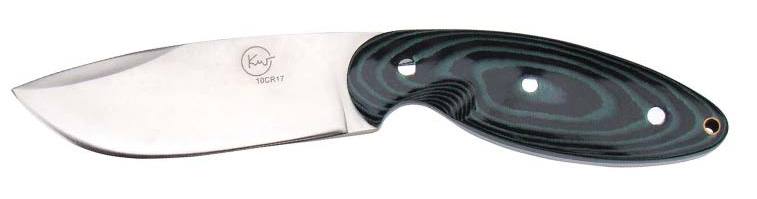
The Warner SGG is a knife of all work, with lots of belly and a good bit of sharp. The blade is 5 inches of 10CR17 and, of course, is convex ground all the way. The drop of the grip puts the edge where it is needed. (Warner photo and caption)
Warner, it turns out, is something of a renaissance man as well. Fowler related sharing a huge bowl of crab legs following the BLADE Show a few years back.
“We debated the styles of Steinbeck and Hemingway, as well as other great authors, what makes poetry great, and the responsibilities of authors,” Fowler recalled. “I learned that everything we write is an echo of our total experience. The more we read and the greater our personal experience, then the better we will be able to express our thoughts. There is no question in my mind that Ken Warner has been, is and continues to be one of the great, if not the finest, of icons of the community of knives.”
Perhaps the greatest test of a true “living legend” is that he has contributed to his lifelong interest, building something where little or nothing existed before, and assuring that his influence will last long after he and his contemporaries are gone.
In the case of Ken Warner and the knife industry, there is no better definition.
A blade’s profile geometry has a considerable effect on how well the knife works for an intended use. A blade with a substantial curve facilitates slicing cuts along the length of the edge, as on skinners and some butcher knives, such as steak scimitars. Straighter blades work well for tip control and power cutting.
A recurve combines features of a couple of blade styles. Depending on the size of the knife and its intended use, the recurve provides certain benefits. The edge line is “S”-like in shape. The overall form leaves the front part of the blade with a sweeping curve. Such a curve provides the edge with belly for slicing and plow/furrow-like cuts, along with the ability to do detailed cuts using a reverse pinch grip.
Are Recurve Blades Better?
You can see how material being cut can get locked in the pocket of a recurve blade, here with the Ronin Shinto.
As to which cuts work best with which knife, it depends on the other characteristics mentioned in the story. On large knives such as choppers, the use of a recurve gives the blade a weight-forward advantage.
Simply adding length to a blade does make it heavier by default, but, to actually have a weight-forward design, the front half of the blade needs to have more weight than the back. The idea is to look at the weight of the blade and not the whole knife to classify it as “weight-forward.”
Near the handle the recurve forms a pocket, which tends to lock material in. The subsequent curve formed by the pocket provides a leading edge to a cut, depending on the curve’s circumference. A leading edge is an edge angle that leads into the work, as opposed to approaching the cut at 90 degrees to the material. You can also generate a leading edge by angling a straight blade while cutting. On a recurve, the arch formed by the pocket provides a leading edge.
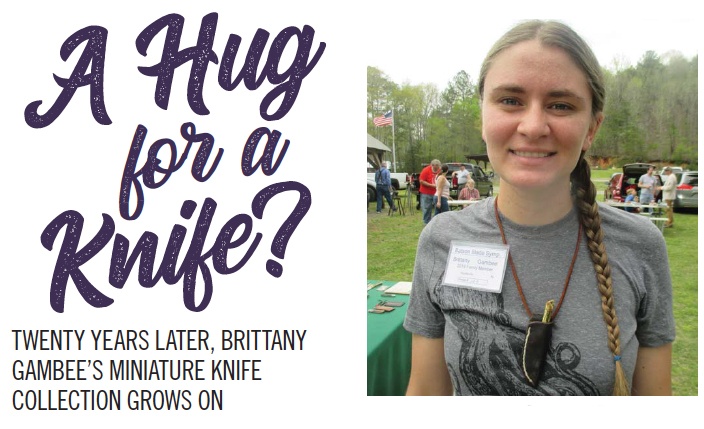
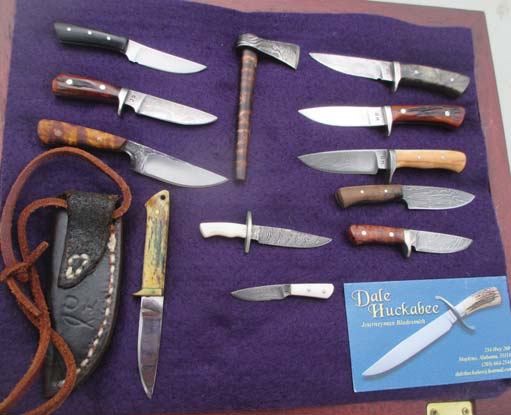
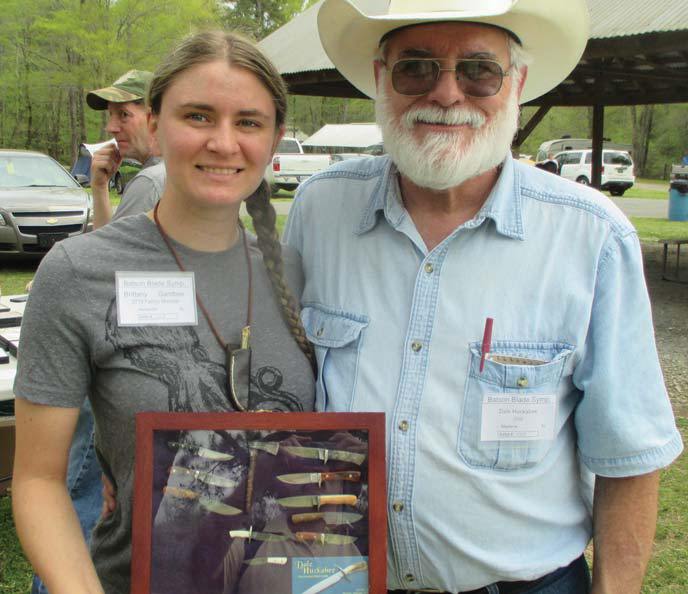
Knives come in all types and sizes. The knives in Brittany Gambee’s collection, for instance, are miniatures, all of which, with the exception of one, are made by ABS journeyman smith Dale Huckabee. And the genesis for them all started with a hug—or the lack thereof.
“Give Me A Hug For A Knife”
It started almost two decades ago when Brittany was 6. She and her mom, Dianna, were visiting their first Batson’s Bladesmithing Symposium, a three-day celebration of bladesmithing seminars and knives at the Tannehill Ironworks and park in McCalla, Alabama. Then a fledgling bladesmith, Huckabee was displaying his knives at his second or third Batson event, when up walked Brittany.
“This little girl about 2 or 3 feet high came up and said she’d give me a hug for a knife,” Dale recalled. Huckabee was feeling pretty chipper back then because he had just won a scholarship to the Bill Moran School of Bladesmithing.
Brittany holds the knife at 6 (left) and wears it at 16 (right). In the background of the latter image is Brittany’s mom, Dianna.
“I had this miniature knife and sheath and reached over and hung it around her neck and said, ‘Where’s my hug?’—and she ran,” he grinned.
Dianna remembers the incident almost like it was yesterday.
“Dale told me when he gave the knife to her that it was sharp and to be careful, but he wanted her to have it,” she said, adding that Brittany wore the knife and neck sheath for many years. “Well, in our silliness we didn’t get his name, we just took the knife and sheath and figured ‘no big deal.’”
The DH Mystery
Fast-forward 10 years to when Brittany was 16. “The dog chewed the edge of the sheath and Brittany was very upset and wanted to replace it,” Dianna remembered. “Well, the knife had a ‘DH’ on it, but we didn’t know who DH was.”
Enter “Uncle Bill.”
“We’d been coming to Batson’s every year and there was this wonderful man who used to come here, ‘Uncle Bill’ Richardson—he’s passed away now—and he told us, ‘You bring the knife to the symposium and have Brittany wear it and somebody will recognize you.’”
Richardson—who Dale said didn’t make knives but was “a heck of a blacksmith”—was at least half right. Dale recognized Dianna but he didn’t recognize Brittany because at 16 she was 10 years older than the young lady he originally had met.
“This lady and this girl walk up and the lady said you don’t recognize her [Brittany], do you?’” Dale recalled. “I said no but I recognize the knife.”
Collecting Miniature Knives
Gambee’s collection includes 12 miniatures. The neck knife and sheath are at lower left.
The Gambees have been coming to Batson’s Symposium—including this year’s rendition April 7-9—ever since and each year Brittany, now 25, buys a Huckabee miniature knife. This year’s addition: a miniature chef’s knife. The only piece in her collection that Dale did not make is one miniature damascus tomahawk by ABS master smith Ken Durham.
“Ken made the hawk for me because Dale always makes knives,” Brittany noted. “He saw Dale’s knives and said he could make a small hawk for me, and then Dale saw Ken’s hawk and said he could make a small one of those and made one for me, too.”
A Lasting Friendship
Dale Huckabee, Brittany and her collection at the 2019 Batson’s Bladesmithing Symposium.
The lasting relationship between Dale and the Gambees is something all concerned seem to relish.
“It’s been a good journey. She’s grown up with me now,” Huckabee reflected. “When I get to the BLADE Show I see her over there some and she’s like family. I try to make something different for her every year. Last year I made the miniature damascus tomahawk, but I have to keep my head working to try to make something new and different each year. I don’t know what it will be next year. I’ll have to try and come up with something new.”
Oh, and in case you’re wondering, Dale replaced the sheath for Brittany’s knife, too.
With more and more states decriminalizing automatic knives (aka “switchblades”), knife enthusiasts are more interested than ever before in purchasing one of these knives. They often turn to online retailers, but that presents a sticky situation: federal law prohibits interstate commerce of autos (see a full explainer here).
This leaves many scratching their heads. For instance, if a buyer in Montana places an online order with a seller in New Hampshire, does federal law prohibit the otherwise-legal transaction?
BLADE addressed the issue with an expert team of panelists who have dealt extensively with knife laws. They include Jan Billeb of the American Knife & Tool Institute (AKTI), Doug Ritter of Knife Rights and Evan Nappen, an attorney and author who specializes in knife and gun rights cases.
Question: Doesn’t the Federal Switchblade Act ban the transport of an automatic knife across state lines?
BILLEB: The Federal Switchblade Act is widely misunderstood, as it only applies to interstate commerce—commercially selling automatic knives across state lines. It does not prohibit crossing state lines with an automatic knife. It also does not prohibit traveling by air with an automatic knife in your checked baggage. State law applies to those traveling by surface or air based on your location, which state you depart from, where you might pass through, and you need to be concerned that your knife is legal in any of those locations.
Question: Is legal to ship automatic knives through the mail?
RITTER: Shipping autos, balisongs, gravity knives and ballistic knives via the U.S. Post Office is generally illegal, with some very narrow exceptions—which an individual is unlikely able to take advantage of. You would be subject to fines and up to a year in jail, or both, for breaking this law. Any criminal intent involved ratchets up the penalties. We strongly suggest that individuals use only FedEx or UPS to ship these types of knives.
BILLEB: Never ship an automatic knife using the U.S. Postal Service. Federal law prohibits the shipment of ‘injurious articles’—which includes automatic knives. The penalty for breaking this law is a fine or imprisonment for not more than one year. However, there is no federal restriction on shipment of automatic knives by common/contract carriers, such as FedEx and UPS. When shipping an automatic knife, always use a private carrier such as FedEx and UPS. In fact, the American Knife & Tool Institute recommends that you do not ship knives by the U.S. Postal Service to avoid a possible issue over confusion of whether it is an automatic knife.
NAPPEN: If the law-abiding collector does not give up his or her constitutional rights and has taken the above measures, that person and their knives will have significant added protection from an unjust prosecution and property confiscation. The best way to avoid becoming a victim of anti-knife laws is to avoid being arrested in the first place and being prepared if you are arrested.
Question: Can a city, county or other municipality ban automatic knives even if they are legal at the state level?
BILLEB: There are states where automatics are legal, but city or political sub-division ordinances may provide otherwise and ban or limit autos or other types of knives. That situation can be possible unless the state’s constitution provides otherwise or there is a statewide preemption law. Accordingly, knife owners/users should [know] the laws where they live, work or travel.
RITTER: The better question—with a much shorter list—is: Which states preempt local jurisdictions from regulating knives? If there is no state preemption, then jurisdictions are free to make up their own restrictions. Preemption prevents enforcement of existing local knife ordinances and prohibits new ordinances more restrictive than state laws, which only serve to confuse or entrap law-abiding citizens traveling within or through the state. Preemption ensures residents and travelers can expect consistent enforcement of state knife laws everywhere in a state. In total, 10 states have now enacted preemption bills: Alaska, Arizona, Georgia, Kansas, New Hampshire, Oklahoma, Tennessee, Texas, Utah and Wisconsin. Existing constitutional weapons preemption law covers knives in New Mexico and Wyoming. Elsewhere, there is no preemption covering knives, and owners should be wary of local regulations more restrictive than state law.
For answers to more questions about automatic knives, visit Knife Rights or AKTI.