Home Blog Page 149

In Review: BLADE Show 2018 Changes

There were two changes of note at BLADE Show 2018:

  1. the expansion to the new John A. Williams Ballroom
  2. the reduction in additional exhibitor badges sold to exhibitors

Let’s examine both.

Expansion

BLADE Show expansion
A record number of exhibitors—950+—required an expansion of the show to the adjoining John A. Williams Ballroom, which was abuzz with activity much of show weekend.

With the number of exhibitors growing to a record 950+ this year, the show hall simply ran out of space. Expansion was the most viable option, thus the move to add exhibitors in the adjoining John A. Williams Ballroom. While a number of exhibitors complained about the move due to it separating them from the show hall and how it required more walking for patrons to get to the exhibitors’ tables and booths, the ballroom was extremely busy most of the weekend. Whether it was a real success or not will have to wait between now and next year’s show to see if the ballroom fills up with exhibitors again. The bet here is it will.

Exhibitor Badges

Exhibitors buy additional exhibitor badges to get their helpers that assist them in assembling their booth and table displays, etc., into the exhibitor areas early on Thursday and early Friday morning and early afternoon before the show opens to the general public. Such helpers are crucial to the exhibitors to get their displays ready for the show.

Of course, the exhibitors setting up in the exhibitor areas have their display knives with them. Meanwhile, there is a large number of knife enthusiasts that are not helpers who, one way or another, obtain some of the additional exhibitor badges, get into the exhibitor areas early, and try and buy the best knives before the show opens to the public.

BLADE Show
Combined with historically long patron lines, an excess of exhibitor badge holders almost
resulted in a delayed opening of BLADE Show 2017.

When the BLADE Show first started selling additional exhibitor badges to exhibitors years ago, not that many exhibitors and others tried to obtain so many of them—particularly not in the numbers in recent years. It was only a matter of time before the buying of the additional exhibitor badges became a problem, and that threshold was reached at BLADE Show 2017.

It was then that so many holders of additional exhibitor badges were in the show hall immediately prior to the show opening to the public that we—by “we” I mean BLADE Show officials—were notified we would have to delay the show opening. Why? Because the hall was so full of people already that the Cobb Galleria Centre fire marshal said to admit the historically long lines of patrons that were waiting to get in would create a fire hazard. In other words, if there were to be some kind of emergency requiring the show hall to be emptied promptly, too many people in the aisles trying to get out could result in injury to them—or worse.

To delay the show opening would cost exhibitors many thousands of dollars in sales and cause a major inconvenience to show patrons that had traveled from all over the world to attend. Luckily, show officials were able to alleviate the situation to where the fire marshal granted permission to open the show on time.

As a result of the near fiasco, show officials had no choice but to reduce the number of people in the show hall—many of whom were holders of the additional exhibitor badges—before the show opens. And the best way to do that was to reduce the number of additional exhibitor badges available for sale for BLADE Show 2018, which we did. The result was the number of people in the show hall was reduced enough so that opening the show on time this year was not an issue.

Does the reduction impair some exhibitors’ ability to set up their displays? Undoubtedly. However, the alternative of having the show opening delayed or the show possibly cancelled altogether would be much worse.

Looking Ahead

blade show westThough the changes may seem questionable initially, we believe they will be best for the future growth of the BLADE Show. With the continued growth of the show come new challenges. However, we will continue to strive to make this the best show ever for exhibitors, patrons and knife enthusiasts everywhere.

And please make plans now to attend BLADE Show West Oct. 5-7 at the Oregon Convention Center in Portland.

Ridiculous, Racist Knife Bans Reinforce Inequality

Knife bans
Pictured: a deadly weapon (if you’re a potato).

On May 3 in Scotland, a man was arrested for carrying a potato peeler. That’s right, a potato peeler. He was charged for carrying “an article which had a blade or which was sharply pointed, namely a potato peeler.” Maximum penalty: four years imprisonment.

Knife Bans Are About Control

Knife bans, like gun control, are not about saving lives but controlling them—including controlling the economically disadvantaged, people of color or others the state wants to keep “in their place.” (The potato peeler violator, by the way, was said to suffer “from significant learning difficulties.”) More to the point, knife bans are designed to keep the people down.

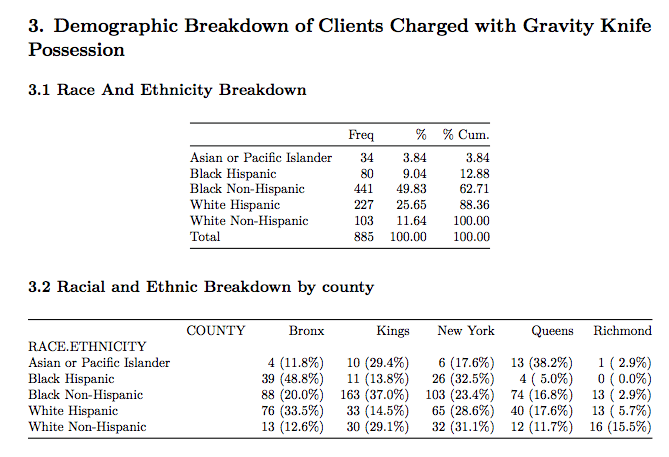
For proof, consider the New York Police Department’s biased enforcement of New York State’s gravity knife statute involving the poor, black and Hispanic. According to The Legal Aid Society of New York City, from July 1 through Dec. 31, 2015, 84 percent of its clients prosecuted for alleged gravity knife possession were black and/or Hispanic. Intent to use a gravity knife unlawfully against another was charged in fewer than 5 percent of gravity knife prosecutions, so it appears the vast majority of the 84 percent did not use the knives as “deadly weapons.”

Knife Bans and Inequality in the Justice System

The inequality of policing and prosecuting for possession of gravity knives by black and Hispanic men is most striking in NYC’s Union Square. There, according to Legal Aid, such men consist of only 11.5 percent of the population but account for a whopping 52 percent of those arrested and prosecuted for gravity knife possession. Moreover, the New York County District Attorney’s Office (DANY) exacerbates things by often classifying gravity knife possession as a felony, a charge that carries up to seven years in prison. From July 1-Dec. 31, 2015, DANY charged 65 Legal Aid clients with felony gravity knife possession—four times more often than all other NYC prosecutors combined!

Magnifying the inequality of the situation is the fact that NYC chain retailers sell folding knives designed and marketed as work tools, yet when Legal Aid clients are found with those knives in their pockets, the knives are suddenly “illegal” and the clients are arrested as criminals. Such inconsistent application of the law ensures a regular money flow to the local big box stores via sales revenues and to government through sales taxes and fines, while simultaneously keeping the victims “in their place.” As Doug Ritter of Knife Rights noted, knife bans help ensure that the circle of inequality remains unbroken.

“Repealing knife bans removes another excuse to engage in such biased arrests and prosecutions for the innocent carry of some otherwise arbitrarily illegal or allegedly illegal knife,” he observed.

Great Britain, Canada Lead the Way on Knife Bans

Racist knife bans
When knife bans disproportionately impact minority populations, something is wrong.

While Knife Rights continues to fight NYC’s inequality of knife law enforcement, knife control has raised its ugly head among the rank-and-file citizenry of London, England, and Canada. In January, the Canadian International Trade Tribunal upheld a Canadian Border Services Agency decision that classified most folding knives as prohibited weapons to import, even though the knives are legal to sell and possess in Canada.

Meanwhile, despite—or perhaps because of—its long-time ban on guns, for the first time in over 200 years London recently overtook NYC in terms of the murder rate. Though it is currently illegal in Britain to carry a knife longer than 3 inches in public “without good reason,” in early April London Mayor Sadiq Khan infamously said, “No excuses: there is never a reason to carry a knife. Anyone who does will be caught, and they will feel the full force of the law.”

The vast majority of those who will feel the full force of Khan’s edict as well as that of knife bans in general are the economically and other of the disadvantaged, or the simply not quite so advantaged. What better way to keep them all down than to arrest, fine and jail them for carrying knives?

3 Top Knife Sharpening Rods for Recurve Blades

knife sharpening rods for recurve blade knives

All images by David M. Standfield, DMS Captures

Knife Sharpening Tips for Recurve Knives

Recurve blades throw some folks off when it comes to edge maintenance because the lines of the curving edges do not fit those of more common blade patterns. Truth is, with the proper sharpener, re-sharpening recurve blades is just as easy as any more common blade pattern—and here are some sharpening rods well suited for the job.

Lansky LCD02 Diamond Carbide Sharpening Rod

Lanskey knife sharpening rod
The diamond rod of the Lansky LDC02 easily handles recurve blades.
  • At a manufacturer’s suggested retail price (MSRP) of $19.99, the sharpener represents a good value in the genre.

The LCD02 Diamond Carbide Sharpening Rod from Lansky marries the effectiveness of a diamond abrasive with the convenience of a retractable sharpening rod and the expediency of a pull-through carbide sharpener all in one package.

“The Lansky tactical sharpening rod is a must-have tool for any trip into the field,” says Barbara Worden, Lansky national sales manager. “It makes short work of dressing and honing knives, machetes, hatchets and axes.”

The LCD02 is designed to quickly and easily handle any type of knife—large or small, fixed blade or folder—and most common steels found on today’s production knives. The coarse-grit diamond rod also can be used with recurve blades, as the rounded profile—and this is a key to handling any sort of recurve edge—allows you to effectively sharpen the recurve’s flowing curves. When not in use, simply retract the rod into the handle to protect it from damage during transport. The whole package is compact and stows easily in a tacklebox, toolbox, glove box, or any sort of backpack or storage container.

Knife Sharpening Rod

With recurve blades the carbide portion of the sharpener is pretty much impossible to use, so you will need to use the retractable diamond rod only. Employ light pressure as you work the blade down the rod. A nice feature is the carbide draw-through sharpener’s flat base. It stabilizes the unit, preventing it from rolling during use. Handle knurling adds a nice, non-slip grip.

According to Worden, the pull-through/diamond rod combo unit can serve as a kubaton/striking instrument, too. The LCD02 is the longest of the three sharpeners tested, which translates well as an impromptu kubaton, but the added length makes it less compact. If the carbide portion would be omitted, that would shorten the length to where the LCD02 would be more compact and travel friendly.

AccuSharp Diamond Sharpening Rod

Diamond knife sharpening rod
The AccuSharp Diamond Sharpening Rod can easily sharpen plain edge recurve blades as well as serrations, the latter by using the tapered end. The anodized aluminum handle has a pocket clip for ease of carry.

  • The sharpener’s compact size makes it easy to carry.

The AccuSharp Diamond Sharpening Rod has an anodized aluminum body and a diamond-coated steel sharpening rod.

“The retractable rod is engineered with a cone-shaped end for use on serrations and tight spaces,” says Kelly Clark, sales manager of Fortune Products, Accusharp’s parent company.
In the fully retracted position, the rod extends by unscrewing the knurled nut and pulling the rod out of the handle some, then re-tightening the nut to secure the rod in the extended position.

Knife Sharpening Rod Reviews

The rounded profile allows it to follow the edge of a recurve blade. The overall diameter is similar to that of a pen, and it includes a steel pocket clip. The rod also has sharpening grooves for hooks, darts and other pointed objects.

It is a pretty simple model construction wise but works well. The only thing I saw that could be improved is the overall diameter of the handle/body. Adding a bit of thickness would make it much easier to hold but also would increase weight and bulk. As is, it carries very well in multiple ways.

EZE-Lap Retractable Diamond Sharpening Rod

EZE knife sharpening rod
The EZE-Lap Diamond Sharpener has a knurled brass handle and screws onto the rod to form a non-slip handle design.
  • The EZE-Lap exhibits very good quality manufacturing.

Similar in nature to the AccuSharp, the EZE-Lap Retractable Diamond Sharpening Rod is another compact, rod-based sharpener that stores easily. Unlike the AccuSharp, the EZE-Lap has a brass handle, which looks nice compared to the anodized aluminum of the other review models.

Measuring 3.25 inches long, the sharpening rod does not retract into the handle.

Instead, it unscrews from and inserts into the handle, and then screws back down. In other words, it stows similarly to a capped fountain pen. A nice touch not found on many sharpeners of this type is the full knurled handle. The knurling aids in achieving a non-slip grip and works well wet or dry. The knurling adds confidence by not allowing the handle to rotate inadvertently in your hand.

how to sharpen a knife with a rod

Unlike other knife sharpeners of the type, the diamond coated steel rod does not have a tapered end for serrations. However, the EZE-Lap will handle any size of plain edge blade, including recurves, and does so quite well. The quarter-inch-diameter rod is coated with a diamond substrate that allows the sharpener to easily remove metal and restore dull edges quickly. It comes with a belt sheath for an alternative carry option. It is the only sharpener herein that comes with a belt sheath—a nice touch and added value.

The EZE-Lap exhibits very good quality manufacturing. Part of this is from the brass handle, so its appearance alone makes it stand out. The only thing I would change, like with the AccuSharp, is the handle diameter. I would make it slightly bigger for ease of holding onto in use.


See You At BLADE Show West

Portland knife show

The biggest and best knife show in the world, BLADE Show, is coming to Portland, Oregon, Oct. 5 to 7, 2018. Expect factory knives, custom knives, accessories and everyday carry gear.

FIND SHOW INFORMATION HERE >>

Instagram Knife Pictures Disrupt Knifemaking, Knife Collecting

Knife pictures
BLADE posts knife pictures on its Instagram account to highlight knifemakers’ work.

Editor’s note: Follow BLADE on Instagram here. Also, anyone buying or selling knives online should take caution when doing so on a social media platform. Recent events have singled out “weapons” content, and Instagram (owned by Facebook) is likely to be no exception. Diversification is key. Remember: In-person knife shows are still the best bet for buying/selling safely and securely. 

Instagram Knife Pictures Help Knifemakers Sell and Knife Collectors Buy

A wave of Instagram commerce is building in the knife industry, and there is no indication of a slowdown at this point. Those who have leveraged the platform have seen increased activity that otherwise might have required hours and expenses associated with travel, marketing and promotion.

“The impact on the knife community is significant,” Curtis Iovito of Spartan Blades commented. “I can say that this year we have reached more prospective customers and knife lovers than we have on Facebook based on customer responses. It truly is a mix of social responses, providing information and assisting prospective buyers. Instagram has started allowing businesses to sell via the platform, and we plan to do this soon. Sixty-four percent of sales for us are from mobile platforms, so we see this as a plus.”

“I had to come out of the stone age to get with the program, and it has doubled or tripled my business,” asserted knifemaker and BLADE® field editor Kim Breed. “You can put your wares out there for sale, and people comment or order and everything else on one simple site. You can go straight to your cell phone and post pictures and get immediate feedback.”

Spartan Blades Instagram knife pictures
Curtis Iovito of Spartan Blades said Instagram is a great way to share knife pictures and information, and
to do so “in a flash.” (Spartan Blades photo)

Purveyor Neil Ostroff of True North Knives started an Instagram account as a social tool to connect with friends, family and customers, but it soon became apparent that an additional sales tool was at his disposal. He changed his account from his personal name into the True North Knives (TNK) brand. He monitors how posts are received by the public, using the “View Insights” option for real-time metrics.

“As Instagram and other social media platforms are constantly evolving and getting better, I’m finding that Instagram is the easiest to use and provides the most results,” Neil explained. “An example of a result is getting a direct message, e-mail or phone call asking for more information about the product. Although we only post knives that are immediately available for online purchase, it’s always nice to have some practical contact with the buyer. We take pride in our knife images, whether they’re taken by a professional like Jim Cooper or our excellent in-house team. If the picture is not top rate, then it reflects badly on the product.”

Instagram knife pictures
Bertie Rietveld put this image of his Omega dagger on Instagram and received a number of interesting comments, including one that read, “More like OhMyGod Dagger.” The guard is stainless steel with 24k gold. The blade is Rietveld’s dragonskin damascus with Stanhope lens at the base of the fuller. (SharpByCoop image)

More Than Just Knife Pictures

Breed points out that advertising in most any format is expensive. Knife pictures posted on Instagram allow immediate access to potential buyers at virtually no cost.

“Putting yourself out there to hundreds of thousands of people is powerful,” he noted. “If they’re looking for a knife, as soon as they search for custom knife or damascus, all sorts of stuff pops up to choose from.”

Kim refuses to hard sell on the platform. “Buyers just ask ‘how much?’ and it is a process of direct messaging between you and that person,” he said. “Some people post prices out there and everything has a different price to it. [Costs of knife- making supplies] have gone up 20 to 25 percent this year. If you’ve got old stock maybe you can keep prices lower, but if it’s newer stock you’ve got to pass the cost on. People will message me if they’re interested in something and then we talk price.”

After seven or eight months on Instagram, Kim sees an unlimited future for the platform.

“All the stuff you’ve posted from when you first started [on Instagram] is out there,” he observed. “So, you don’t have to continually post the same kind of knife. Just as you make them you can throw them up on Instagram.”

Instagram Cautionary Tales

Though social media is asserting itself in the TNK sales process, Ostroff is warily watching developments. His website is still king with his business at this point.

“In spite of Instagram’s popularity and audience, for True North Knives our website still takes in 90 percent of our sales,” he added. “As with any other shopping-cart-based website, the purchase is triggered by the photos, but then we offer a smooth and easy way to select, pay and order the knife. Instagram does not do that. It merely brings the product to the subscribers but then the hunt begins, and many potential buyers must go through many steps trying to contact the knifemaker, who may or may not be available to take an order.”

Another caution from Ostroff is that Instagram provides any seller with an “escape hatch” to sell a knife to anyone and not necessarily the first customer who steps up to buy. When a traditional e-commerce website operates, the item for sale is listed and directly connected to actual inventory; once it is sold it is gone and marked as out of stock. “Fair game for all!” he said.

“Many knifemakers on Instagram are only offering their knives for sale by lottery or raffle. As I don’t buy knives from Instagram I feel sorry for the people who aren’t always ‘attached to’ their phones, and also don’t have the money to, in many cases, overpay for knives due to the hype,” Neil related. “Many knives are sold at grossly inflated prices by knifemakers who are merely looking for the quick buck with no regard for a potential secondary market”—a secondary market that will never come about when the initial/primary purchase price is way too high.

Still, the luster of Instagram has drawn custom makers, purveyors and purchasers to the platform like moths to a flame.

“Initially, the knifemakers get a large audience, not only from active buyers but also from fans who may not be able to afford these knives but who really enjoy seeing the blade—like eye candy,” Ostroff said. “Knifemakers should assign or hire others to manage their account after knives are posted. Potential clients have questions, most of which never get answered by the knifemaker.”

According to Breed, payment is sometimes a sticky proposition. “When people talk with the knifemaker they should use common sense,” he remarked. “Like the internet, Instagram is a great thing, but it can be ugly at the same time. I let a guy place his order, and when I get close to sticking the handle on [the knife], then he needs to pop a check in the mail. Others pay with Paypal as soon as they order a knife, but some want to see what the finished product looks like.”

Mixed Signals?

No, simply an assessment of the pros and cons of a growing medium in the knife industry, one that cannot be ignored and likely will never go away.

“You almost have to get on Instagram,” Breed offered. “The younger generation that was raised on it will be jumping on other sites, too. I get on the computer once or twice a week because I’m spending most of my time making knives. Instagram is nice because it’s on your phone. If you’re grabbing lunch out or in your shop, you can have a brand new knife posted in less than two minutes and can follow up on what is happening with it.”

However, the traditional opportunity to hold the real knife in your hand is diminished. Buying from knife pictures has its own risks. The situation is always improved when buyer and seller really know one another. Time will tell how Instagram truly changes the buying/selling process.

Follow on Instagram

Hop onto Instagram and follow these accounts:

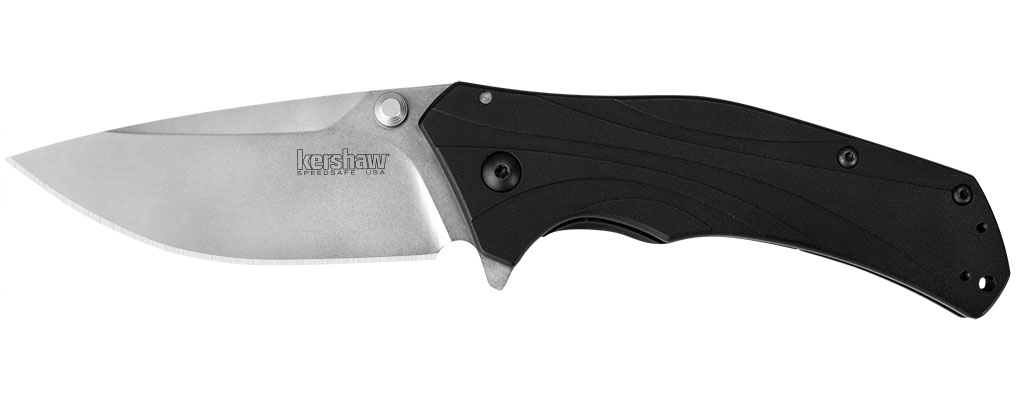
EDC Knife Review: Kershaw Knockout

EDC knife review
The Kershaw Knockout offers a bigger design than most EDC, but it’s still lightweight enough to stick in a pocket. (Kershaw photo)

An Eye-Catching EDC Knife

EDC knife reviewTo my eye the Kershaw Knockout is in fact a knockout. The design is sleek, flowing and graceful, with all details blending into the whole—clearly a 21st century EDC folder.

The deep-bellied drop point blade emerges from the smoothly contoured handle easily and strongly but doesn’t threaten to jump from your hand.

The thin handle makes for a comfortable waistband carry. Though thin, the chamfered edges of the aluminum handle made for a surprisingly comfortable grip, even after extended cutting of rope and rubber tubing. It also balances right where it should at the index finger.

The deep belly sliced everything well. The frame lock was as solid as the proverbial bank vault door. The thumb stud is machined and polished and has no rough edges. In fact there are no rough edges anyplace on this little gem.

The clip is strong but not long enough or strong enough to prevent the knife from moving in the waistband of athletic pants, which I happen to wear a lot. Like most tip-down models, the positioning of the knife when carried requires a grip shift to get to a proper cutting position.

Kershaw Knockout EDC knife review
The deep belly of the Kershaw Knockout sliced everything well, including quarter-inch hemp.

The Verdict

This is such a handsome piece of work I’m almost tempted to put aside my preference and EDC this one.

EDC Knife Review: Browning Black Label Decoded

EDC knife review
The Browning Black Label Decoded assisted opening knife sits somewhere between an EDC and a tactical. (Browning photo)

A Workhorse EDC Knife

EDC knife reviewGenerally speaking I am not a fan of tanto blades. In the case of the Browning Black Label Decoded Assisted Open, however, I like the blade design quite well.

Its squared-off tip made for a perfect cutting edge on rope and rubber tubing, and made my work easier. If I had to cut rope or tubing all day, this would be my knife of choice. The modified tanto blade worked equally well on other materials.

The handle is contoured and reasonably comfortable, though the edges could do with some rounding. The grip is a tad heavy but nothing most folks would notice. The clip was very strong and positioned the tip-down blade for an easy, natural grip.

EDC knife review
Testing the Browning Black Label Decoded.

The Verdict

It’s a handy-sized assisted opening knife that does pretty much everything I would need it to do.

EDC Knife Review: Boker Plus Gemini NGA Coyote

EDC Knife Review
The Boker Plus Gemini NGA Coyote offers extra heft as an EDC knife. (Boker image)

Tough Like a Gorilla

EDC knife reviewThe Boker Plus Gemini NGA Coyote carries tip down, which I prefer because it places your thumb on the blade opener without requiring a shift of grip. The clip was strong and secure, even in athletic pants, and positioned just enough of the handle to protrude above the belt line to allow a secure grip with no fumbling or shifting required. The handle has a slightly tacky feel with checkering on the sides of the scales.

The assisted opener flings the blade strongly from the handle with a slight touch on the opening stud. Make sure you have a firm grasp on this one before pushing the stud. The linerlock was solid.

The knife balances perfectly right at the index finger, which makes it seem light in hand and makes for ease of use.

EDC knife review
If you like your EDC knives to pack bite, the Boker Plus Gemini NGA Coyote is a great choice. (Mary Lou Ayres photo)

The Verdict

The Gemini is a well-made knife and the one I would choose if I had to cut up a garage full of cardboard.

Advertisement

Must Read Articles

Read this before you make a knife

Knifemaking 101 – Read This Before You Make a Knife

  by Wayne Goddard My experience has taught me that there's nothing like digging in and getting started. I've often said the hardest part of the...
how to forge damascus steel

How to Forge Damascus

Advertisement
Advertisement