Home Blog Page 178

BLADE Show 2018: Plan Now!

2018 BLADE Show
Reserve your hotel room for BLADE Show 2018 now! (PointSeven image)

The world’s largest and most important knife event, BLADE Show 2018 will return next year at the Cobb Galleria Centre in Atlanta—and there’s no time like now to make plans to attend the annual edge-stravaganza that true knife enthusiasts can’t afford to miss.

Slated for June 1-3, BLADE Show 2018 will assemble thousands of knife exhibitors and knife enthusiasts from around the globe, and with international attendance increasing every year, it’s wise to make your hotel plans now.

To book your hotel reservations online, click on https://aws.passkey.com/go/Blade2018. To call the housing bureau, dial 1-855-547-8429.

The BLADE Show is the be-all, do-all knife event. Among the industry honors determined there are the BLADE Magazine Knife Of The Year® Awards, the BLADE Show Custom Knife Winners and the BLADE Magazine Cutlery Hall-Of-Fame© inductions. The BLADE Show also hosts BLADE University, three days of the best and most comprehensive knife instruction you can receive at a knife show. Members of the world’s leading knifemaking and bladesmithing organizations, including the American Bladesmith Society and the Knifemakers’ Guild, knife enthusiasts from the Usual Suspect Network, BladeForums and more, they all come to the BLADE Show. The world’s finest knife collections, every knifemaking supplier, knife accessory and related edged item you can think of—from tomahawks, to swords, to axes, multi-tools and everything that cuts—if it has an edge or enhances it, it will be in Atlanta.

If you have attended the BLADE Show before, you know how fast hotel rooms disappear–not only at the Renaissance Waverly, the host hotel, but at lodging anywhere near the Cobb Galleria. If you’ve never been to a BLADE Show, then you cannot know the mad rush that is BLADE Show planning time. Don’t learn the hard way and get left out–plan and make your hotel reservations now!

Dropout Knifemaker Is A Master Of Marketing

Brent Vaccaro owns Black Widow Knifeworks & Tactical Gear
Brent Vaccaro of Black Widow Knifeworks & Tactical Gear left high school in his junior year. He already knew carpentry inside and out. But it was when he turned to knifemaking that he found a way to identify himself that had eluded him during his other business attempts. This dropout knifemaker is a master at marketing.

Brent Vaccaro of Black Widow Knifeworks & Tactical Gear attended high school in New Jersey where he was born and raised. He excelled in woodworking, banging out projects that those two years ahead of him struggled through. His teacher helped him, Brent said, but perhaps most by giving him the freedom to do his own thing. Brent grew up building houses. His family lived in the middle of an open subdivision field and every day after school Brent would work on the other eight houses that needed to be constructed. In his junior year, bullying got too much. He left school and became a carpenter. Over the course of 15 years he worked in construction, running his own business and working for others. He also started a tactical gear company, and he dabbled in beard accessories during the height of facial hair resurgence. He never could quite establish an identity for himself in any of his three businesses, he admitted, but when he started making knives, everything came together. Now, no matter how different Brent’s knives are from each other, when you see a Black Widow knife, you recognize it immediately. The dropout knifemaker is a master of marketing.

The H.E.R.L. is a knife designed by Brent Vaccaro of Black Widow Knifeworks & Tactical Gear.
Model: H.E.R.L
Blade Length: 4.25 inches
Blade Steel: CPM-S30V
Blade Finish: acid wash with spider web etch
Scales: Voodoo Resin’s Purple Haze with KS Carbon bolster
Overall Length: 8″ inches
Maker’s list price: $250-$350 shipped with Kydex sheath and Tec-Lok
Contact: Message Brent Vaccaro on Facebook at Black Widow Knifeworks & Tactical Gear. (Additional contacts at end of article.)

Around the time that Brent was struggling with being in school, when he was 16, his father gave him a pocketknife. It was a now-discontinued Kershaw model. “I still have it. I loved that knife,” Brent said. But he never had the money to collect knives, and some days he gets a mock scolding from his wife, Megan for forgetting to carry a blade on him. He was getting disillusioned with the diminishing level of artistry within carpentry, the lack of appreciation from the customers and the sense that the industry was solely focused on money. Although the skill sets are similar in woodworking and metalworking, it took some time to transition. Now Brent loves metalworking. It’s not months or years to finish a project with barely a handshake and never a thank you. It’s the instant gratification of seeing a knife come to completion over a course of days, sending it out and having the customer write him that they have no words for how impressed they are with his knife.

The BW Tac Tanto has a 3.5-inch blade of CPM S30V steel.
Model: BW Tac Tanto
Blade Steel: CPM S30V
Blade length: 3.5 inches
Blade Finish: dark acid wash and stonewash finish with aggressive gimping
Scales: Voodoo Resins’ Bloody Hulk with KS Carbon Fiber bolsters.
Overall length: 7 inches
Maker’s list price: $230-$330 shipped with Kydex sheath and Tec-Lok
Contact: Message Brent Vaccaro on Facebook at Black Widow Knifeworks & Tactical Gear. (Additional contacts at end of article.)

And therein lies his mastery. Brent is fulfilled by that appreciation for his craft, and he knows exactly how to represent his knives to the world in the best possible light—literally—without ever crossing into exaggeration. It means a lot to him that he has created an identity for himself that is true to him, celebratory of his knifemaking and honoring to the client. “It’s an extension of self,” Brent said, adding that he wants his knives to be passed on as a part of his and his client’s heritage. You only have to look at a photo of a Black Widow knife to get the “feel” for the candied richness of the colors, the smoothness of the handle and the badassery of the blade itself.

“I don’t keep them,” Brent said. So each night he takes the time to shoot exceptional photos of each piece, a running catalog of his work, for him to remember by and for the client to share. He takes 10 to 15 photos of every knife and picks the best ones. And that’s because he’s found a system that works for him. At first, you’ll need to shoot far more to find the right lighting and angles. “You have to take the time to do it. It’s part of marketing,” he said.

A lightbox is essential to taking great images of your knives.
If you want to take great photos of your knives, upgrade your cell phone, make yourself a lightbox, buy some handheld lights and take the time to learn how to make your knives look, not OK, but fantastic.

Building A Lightbox That Works

Brent invested $50 in his lightbox. At The Home Depot he bought 1-inch PVC and eight 90-degree T connections. With those he made his two squares for the box ends. He also got alligator clips. At Walmart he bought a king-sized white sheet and clipped it taught to the PVC frame. The whole thing is collapsible so that he can move it out of the way when he’s working. And, of course, the white sheet is no longer white.

The Backdrop

Normally, light boxes are made with white construction paper on the floor that bends up the back. Not Brent’s. He does a lot of Kydex. He was heating up a 2-by-4-foot sheet of carbon fiber one day and as it bent, it occurred to him to use it in the lightbox. He had to buy more Kydex, but he likes the look of it. That was probably anther $50, but wouldn’t be necessary for everyone since every knifemaker’s style is different. Brent strives to build tough knives that military and law enforcement can respect, while still appealing to the civilian population with his Candy-Crush-like handles. He mostly uses Matt Peterson’s Voodoo Resins scales, but he’s also using some of J Hue Customs’.

This Black Widow neck knife comes with American flag etching on both sides.
Model: Recluse Neck Knife
Blade Steel: CPM-D2
Blade Length: 3.25 inches
Blade Finish: acid wash with American flag etch on both sides
Scales: Voodoo Resins’ Chameleon
Overall length: 5.5 inches.
Maker’s list price: Price range: $165-$200 with Kydex neck sheath
Contact: Message Brent Vaccaro at Black Widow Knifeworks & Tactical Gear

Lights! Camera! Action—No Really, Move Around!

For lights he purchased round Utilitech LEDs that he can hold while he shoots. “The light is never stationary,” he explained. He waits until complete darkness because he has two windows in his shop and he wants total control of the lighting. Because the LEDs are very white lights, bluish even, he adds a 60-watt lightbulb to add a yellow hue to balance out the lighting. He moves around with his iPhone 7 Plus (“There is a difference with the Plus,” he notes.) and his light and gets exactly the angle and lighting he wants. Not only are the knives well lit, especially for mood-inducing vignettes, for which the majority of a knifemaker’s photos will be used, especially online, but they are in crystal clear focus. Brent does not use the focus feature on the phone. That will only cause the camera to focus on one point on the knife, when the objective is to show the entire knife in full focus, even if you have the point or butt stylistically in the background. He also does not use the flash, which only washes out colors and overexposes the image.


The Carnage by Black Widow Knifeworks & Tactical Gear sports patriotic resin with maple burl hybrid scales.
Model: The Carnage
Blade length: 4 inches
Blade Steel: CPM S30V
Blade Finish: acid/stonewashed with American flag etch on both sides
Scales: J Hue Customs’ hybrid red, white and blue resin with maple burl
Overall length: 8 inches
Maker’s list price: $320-$500 shipped with Kydex sheath and Tec-Lok
Contact: Message Brent Vaccaro on Facebook at Black Widow Knifeworks & Tactical Gear (Additional contacts at end of article.)

Props Never Steal The Scene

Brent uses all kinds of props in his still-lifes. Because he also produces tactical gear, like custom Kydex sheaths, you will often see pistols, ammunition and other gear as accessories in his pictures. Chain, motorcycle gloves, even Halloween webbing have been used in Black Widow images. His artistic eye is always at work, not only in the making of the knives, but in his ability to let the knives do the talking. They are always center stage. They are the first things you see in the picture and the props are there only to compliment the knives, never upstage them.

Editing

Brent uses two apps to edit his images: PicLab and Aviary. He bumps up the saturation until the image represents what you see in person. It’s important not to overdue saturation because then your customers will be disappointed that your knife doesn’t live up to how it was displayed online, all back-lit by the computer screen. It’s equally important, though, that the knife not appear duller than it is in real life.

Creating An Image

Brent is one of those men who is smart, learns quickly and follows directions. He is also a good man, turning away from an industry that couldn’t fulfill his creativity and abraded his integrity. He has been rewarded with great success. “I’m outgrowing my shop,” he said. Brent knows he’ll have to return to carpentry to build himself more space. He can’t believe it sometimes when he thinks how far he’s come in his year of knifemaking. Metal work comes easier to him. “I don’t get nearly as angry as I used to get doing carpentry,” he said. He’d be thinking artistically and make a little strip of wood for something and it would break. Sometimes he’ll find a scratch in a knife handle and he’ll have to go back and grind it out and re-sand—normally, he goes all the way from 150 to 2000 grit—but it’s not nearly as frustrating as woodworking had been.

The Recurve Patella uses Voodoo Resin scales in Honeycomb Red.
Model: The Patella Recurve
Blade length: 4 inches
Blade Steel: CPM S30V
Blade Finish: acid wash
Scales: Voodoo Resins’ Red Honeycomb with KS Carbon bolsters
Overall length: 7.75 inches
Maker’s list price: $380-$500 with Kydex sheath and Tec-Lok
Contact: Message Brent Vaccaro on Facebook at Black Widow Knifeworks & Tactical Gear. (Additional contacts at bottom of article.)

Brent takes great pride when someone in the industry tells him they recognize his work right off. He has been an apt student of life. The years of entrepreneurship that didn’t work, prepared him for the one that would work. But no matter how much marketing you apply to your knifemaking, the knife must still cut. It must still hold up to wear and perform as expected upon arrival and for generations to come. Time will tell, but sometimes dues get paid behind the scenes and a meteoric rise is well-earned.

Meanwhile, Brent will have to break away for the birth of his first child, a son, Blake—due any day—and at some point, he’ll need to expand his shop, but he never closes his books for long. He doesn’t think it reflects well to just drop a knife. He refuses to do it. He respects reliability in the people he does business with, so he holds himself to that standard for his customers. Just get in touch, but be aware if you do, you’ll get caught up in the Black Widow web.

Contact: Brent E. Vaccaro by email at [email protected] or Message him on Facebook at Black Widow Knifeworks & Tactical Gear. He also has a website at www.blackwidowtac.com. If you need to call, Message first, otherwise he might not hear you over the machines, 908-328-2049.

It’s All In The Grind

"Knife Grinding Secrets" is by maker and instructor R.J. Martin.
Mastering this one skill will improve your craft immensely. For less than $5, you can add an essential to your knifemaking library.

Author R.J. Martin instructs on flat and double hollow grinds. He discusses chisel grinds, tip shaping, the two-hand pass and lots more in “Knife Grinding Secrets.” Most importantly the finesse of grinding will be covered so that you can master the skill. Downloadable version availabe for $4.99.


Knifemakers Offer 20 Examples of 5 Types Of Skinners

Depending on where you live and by what method you hunt, deer season is underway. There are any number of blade patterns you could select for a skinning knife, but why are they shaped the way they are? What is the maker considering when he crafts a knife he calls a skinner? Let’s look at 20 examples of 5 types of skinners, plus an extra.

1. Bull-Nose Skinners

“The blunt tip in conjunction with the trailing point helps from punching through the hide,” noted Travis Fleming of Fleming Fabrications in North Texas about bull-nose skinners.

Travis Fleming made this set of bull-nose skinners for a father and sun.
This set of bull-nose skinners were made for a father and son by Travis Fleming. The 4 1/2-inch blade is made out of CPM 154 stainless steel. The bolster is brass, and the antler handles were supplied by the son from the first buck he got with his dad. Overall length: 9 inches. Maker’s list price: $500/set. Contact Travis Flemming at [email protected] or on Facebook at Fleming’s Fabrications.

Josh Bryant of JB Custom Knives put it this way: “The bump and large drop at the tip are intended to go over guts without popping them.”

Josh Bryant's skinner has a point that allows the skinner to go over intestines and organs without popping them.
Josh Bryant’s Mini Green River Skinner is made with a 2 3/4-inch blade out of CPM 154 steel. The handle is made of dyed stabilized maple burl. Overall length is 6 inches. Maker’s list price: $180 with leather sheath made by the maker. Contact Josh Bryant at [email protected], on Facebook at JB Custom Knives and on Instagram @jb_custom_knives.

“I like a skinner made with a CPM steel,” Mike Cleveland of Half Life Knives commented. “(It) keeps its edge longer and that means more game prepared before sharpening.” Mike added: “I prefer the fuller belly for its ability to cape around tight areas. I value that over the ability to stab in a skinner. With this style of blade you’ll finish ahead of those with a sharper point.”

Michael J. Cleveland makes a bull-nose style of skinning knife.
Michael J. Cleveland of Half Life Knives uses CPM S90V to make the 3.85-inch blade on this skinner. The overall length is 8.5 inches. The handle is made of mammoth bone with Voodoo Resin bolsters. Maker’s list price: $650 with leather sheath. Contact Mike Cleveland at Half Life Knives on Facebook or at 405-627-6097.

2. Drop-Point Skinners

The drop-point skinner is one of the most, if not the most, popular skinning knife blade design. Within the drop-point category, however, there is plenty of individual styling.

When Raymon Hunt of 3H’s Knives LLC makes a skinner, he strives for “enough belly for caping, but with enough point to make opening the cavity easy without piercing the organs.” A skinner should be balanced and lightweight, he notes. “It is amazing how carrying a heavy knife along with a rifle on a six-hour stalk through the bush can wear you out.” Raymon added that comfort is important. There should be no areas on the handle that could produce hot spots.

Raymond uses a Nessmuk-style drop-point design when making a skinner.
Raymon Earl Hunt’s Nessmuk-style drop-point hunter has a forged 4-inch flat-ground blade made out of 1075 steel. The convex cutting edge is 3 1/2 inches, and the knife is 8 1/2 inches overall. The mortised handle is made with exhibition-grade desert ironwood with sterling silver pins and 416 stainless steel guard. Maker’s list price: $600 (includes sheath). Contact Info: Ramon Hunt at www.3hsknives.com, raymon.hunt@3hsknives and on Facebook at 3H’s Knives, LLC.

“I feel the most important parts of a good skinner are on edge-holding and the ability to be sharpened easily in the field,” Lane Ferrell of Farrell Custom Knives commented. He pointed out that comfort, not being too heavy and being balanced well, is essential “since some skinning jobs can take a while to finish.” He noted that a skinner “should also be small enough to be carried on a belt or in a pack, but large enough to get the job done effectively.”

Lane Ferrell agrees that lack of potential hot spots is important for a skinning knife.
Lane Ferrell’s Razorback model skinner has a 4.25-inch blade made with 1084 steel. The handle is Russian bog oak with red G10 liners and mosaic pins. Overall length is 8.75 inches. Price $275 with vegetable-tanned leather sheath with red stitching. Contact Lane Ferrell at [email protected] or Facebook at Ferrell Custom Knives.

“I do such a wide variety of skinners that it all depends on what the customer wants,” Spencer Aplin of STA Custom Knives noted. “Most people want a 3- to 4-inch drop-point. Then the second most requested is a trailing-point 4- to 5-inch blade.” And in Spencer’s experience, a whopping 99 percent want finger grooves.

Spencer Alpin of STA Custom Knives says his skinners all depend on what the customer wants.
This Spencer Aplin skinner has a 4-inch blade made of ELMAX Steel. The handle is made with stabilized myrtle burl. Maker’s list price $550 with padded zippered pouch. Hand-tooled and carved sheathes are available upon request at an additional cost. Contact Spencer Aplin at [email protected],
www.stacustomknives.com or on Facebook at STA Custom Knives.
Chris Rowley opted for Voodoo Resins for this duplex-ground drop-point skinning knife.
Chris Rowley made this 3.25-inch blade from pattern-welded 1084 and 15N20 steels. The overall length is 7.5 inches. Scales are by Voodoo Resins. Maker’s list price: $350 with Kydex sheath. Contact Chris Rowley at [email protected] and at Nomad Custom Knives and Tools group on Facebook.

Mike Jeffries of 2 Birds Metalworks made the smaller skinner in this set as a companion to the camp knife. “The slight fighter profile and small size make it excellent for thumb, as well as index, purchase for those internal and fine skinning tasks,” Mike noted.

Mike Jeffries made this set as a companion camp piece.
This drop-point set was made with pattern-welded steel from Alabama Damascus Steel. The scales are made from dyed box-elder burl. The blade on the bottom knife is 3 inches, contributing to an overall length of just over 7 inches. Maker’s list price: $320 with leather sheath. Contact Mike Jefferies at [email protected], on Facebook at
2Birds Metalworks and on Instagram @2birdsmetalworks.

The carbon content in the steel James McClendon used to make this skinner is approximately 1.27 percent. “Makes a most excellent knife,” James declared. “Those old files are getting harder to find.” James likes the “second-to-none on edge-holding–at least as simple-carbon steels go.” He added that the addition of a soft backdraw gives the blade toughness. “I just prefer a guard on a blade so sharp it could take a finger off with one slip. LOL. I also leave just a hint of the file teeth but not enough to hold contaminants.”

James McClendon used a Black Diamond file to make this skinner.
James McClendon made this 4-inch drop-point hunter/skinner out of a Black Diamond file. The bolt-through handle is made of stabilized stag. Overall length is 8 1/2 inches. Maker’s list price: $180 with sheath. Contact James McClendon at [email protected].
Johnny Stout's drop-point skinner comes with a custom leather sheath with ostrich inlay.
Johnny Stout’s Rio Grande Skinner has a 3 3/4-inch blade made out of 154 CPM steel. Overall length is 8 inches. Handle is made from amber stag antler. Fluted bolsters are 416 stainless steel. Maker’s list price: $925 with custom Paul Long sheath with red full-quill ostrich inlay. Contact Johnny Stout at 830-606-4067 or [email protected].

Will Thompson put it this way: “The 3 1/4-inch blade is perfect to get around those places that you just can’t get to with a bigger blade. It’s ready to help you get those hams and backstraps to the ice.”

Will Thompson added a Plantstone handle to his traditionally patterned drop-point skinner.
Will Thompson made this 3 1/4-inch drop-point blade out of 1095 carbon steel. The Plantstone handles are by Robert Belcher. Overall length is 6 7/8 inches. Maker’s list price: $120 with leather sheath. Contact Will Thompson at [email protected] or 910-385-6021.
Phill Bilkey is an Australian knifemaker.
Phill Bilkey’s Sambar Skinner has a 3.5-inch blade made of 1085 carbon steel. The handle material is Australian sambar antler with red G10 liners. $200 AUD with leather sheath. Contact: Southern Cross Custom Knives on Facebook.
Eric Pearson makes a drop-point skinner with 1095 steel with hamon.
Eric Pearson of Lake Effect Knifeworks made this 4.25-inch hollow-ground drop-point blade out of 1095 steel with hamon. Overall length 9 3/4 inches. The scales are big-leaf maple burl. Maker’s list price: $200-plus. Contact Eric Pearson at Lake Effect Knifeworks on Facebook.

3. Nessmuk-Style Skinners

Joe Elinburg in northeast Florida likes the Nessmuk pattern for a skinner.  “The rounded point makes skinning easier with less chance of putting a hole in the hide if you’re going to save it for tanning,” he commented. “Also the swoop in the back of the blade makes a great finger rest for more control of the blade.”

Joe Elinburg makes this bull-nose skinner.
This Mini Nessmuk Skinner is made by Joe Elinburg in northeast Florida out of 1095 high carbon steel. The 3-inch blade is convex ground. Overall length is 6 inches. Handle material is camaru. Maker’s list price: $90 with Kydex sheath with mounted metal belt clip. Contact Joe Elinburg at [email protected], @jecustomknives on Instagram or call 904-962-0341.

4. Spear-Point Skinners

“I have always been a fan of spear-point skinners,” Jon Waltz commented. His son designed this model, and Jon made a few changes by adding the thumb ramp and expanding the belly. The deep finger guard and thumb ramp allow for full control of the blade. “The hollow grind makes for a extremely sharp cutting edge, and the large belly is great for slicing through flesh with precision,” Jon added.

Jon Waltz makes a spear-point skinner that doubles as an everyday carry.
Jon Waltz of Edge7 Custom Knives calls this model the 24/7 Skinner. The Hex resin scales are custom-made. Overall length is 7 inches. The 3-inch hollow-ground blade on this particular one is made of CPM D2 steel, but they are now made in PSF27 steel. Available finishes include acid etched, sandblasted and stonewashed. Makers list price: $275 and up with leather or Kydex sheath with combat loop. Contact Jon Waltz through www.edge7customknives.com.
Denny Fury's Sukina is Japanese for skinner.
Denny Furey of Furey’s Urban Combat Knives Unlimited uses NJ Steel Baron 1095 steel to make his Sukina, which is Japanese for skinner. Overall length is 7.75 inches with a 3.25-inch blade with a dark blued polished finish. The handle scales are
Rob Carper Innovations (RCI) stabilized, dyed spalted maple. Maker’s list price: $175 with Kydex sheath with belt attachments. Contact Denny Furey at Furey’s Urban Combat Knives Unlimited on Facebook.


5. Trailing-Point Skinners

Trailing-point skinners excel for skinning small game, and are probably the second most popular skinning knife blade design behind drop-points.

“I believe that the finger groove and the thinned spot between it and the spine allows for easier indexing when trying to be precise while skinning raccoons or fox,” commented Tyler Freund of Freund’s Custom Knives. “One can simply pinch the knife between their thumb and finger. Much like you would a scalpel.” In addition, “the thin tip and thin steel lets the user make less intrusive cuts and more precise cuts around the wrists and ankles of the coon,” Tyler explained. He feels this would be more challenging with a bigger-bellied or thicker-bladed knife. “The knife has just enough belly in it that you can draw the knife and skin efficiently once you’ve gotten around the ribs,” he concluded.

Tyler Freund made this trailing-point skinner for a local trapper.
Tyler Freund made this small-game skinner for a local trapper. The 3-inch trailing-point blade is made out of Vegas Forge’s raindrop-patterned steel, and the maker added file work along the spine. The handle is bone Micarta paired with Mike Sakmar mokume-gane. The knife is 7 1/4 inches overall. Maker’s list price: $350. Contact Tyler Freund at Freund’s Custom Knives on Facebook or on Instagram @tylerfreund08.
Bryce Love makes a trailing-point skinner with a curled cherry handle.
Bryce Love’s trailing-point skinner has a 5-inch acid-etched stonewashed blade made out of 1095 steel. Overall length is 9 inches. The handle is made from curled cherry. Maker’s list price: $140. Contact Bryce Love on Facebook at 50Cal Forge or [email protected].

“This skinner has a short blade with pointed tip to reach into tight areas when skinning and caping,” Scooter Davis of Rough Run Forge explained about his Shrade-Sharpfinger-like knife. “The recess on the spine serves as a finger rest, allowing you to choke up forward on the knife for more control.”

Scooter Davis prefers a sharpfinger-style knife when skinning for getting into hard-to-reach places.
Scooter Davis made this Shrade-Sharpfinger-style skinner with a 2 1/2-inch hollow-ground blade forged from 52100 steel. The scales are prickly pear cactus fastened with stainless steel corby pins. Maker’s list price: $175 with leather sheath. Contact Scooter Davis at Rough Run Forge on Facebook or call 540-560-1672.

Although not a traditional trailing-point blade shape, an upswept point is still evident. Richard Darby’s customer said you can make long sweeping cuts with this big-bellied blade design, as well as flesh with it. “Plus it gives a longer cutting edge for the length of the blade,” Richard noted.

Richard Darby made this big-bellied skinner with a hamon in the 1095 blade.
Richard Darby’s big belly skinner has a 4.5-inch blade of 1095 steel with hamon. Overall length is 9 inches. The handle is made with flame masur birch from JHue Custom Sales. Maker’s list price: $150. Contact Richard Darby at [email protected].

Miscellaneous Skinners

When you skin, the idea is to pull the skin back and make sweeping slices like you would when using an ulu, but it’s not an ulu, Matthew Nolan from Angry Beaver Knives explained. “The whole handle fits in your hand while grasping the blade with thumb and pointer finger…more blade…angles…equals more slicing…and it fits nice in the hand for sweeping strokes.”

Matthew Nolan enjoys making puns with his knife names.
Matthew Nolan’s Dear Beaver deer skinner is made out of 15N20 or 1095 steels. The overall length is 5 to 6 inches, depending on the hand size of the customer. The scales are Dustin Smith lace maple burl at Simply Scales. Maker’s list price: $225 with Kydex only sheath. Contact Matthew Nolan at Angry Beaver Knives at [email protected] or at 518-791-2551.

Learn Which Knife Designs Stand The Test Of Time

"101 Knife Designs" is on sale now for $19.53.
“101 Knife Designs” provides actual scaled patterns that you can use to spark your own designs. At $19.53, you’ll be saving 35 percent on a classic.

Compare and contrast different skinner designs as well as knife patterns of all types. Hiro Soga’s images will satisfy your knife eye-candy jones, you’ll be able to delve into the theory of blade design and you’ll get 101 scaled patterns that you can use to initiate you’re own design. “101 Knife Designs” by Murray Carter is a must-have in hard copy so you can work with the designs, mark with notes and refer to again and again.


What REALLY Happened at BLADE Show 2017

BLADE Show 2017 Recap issue
Get the inside scoop on BLADE Show 2017 in the latest issue of BLADE®.

You’ve heard all about BLADE Show 2017 but you can get the inside scoop on the show’s hottest knives and knifemakers and what and who will be hot in the future as a result in BLADE®’s special 2017 BLADE Show Recap issue, on newsstands now! Or, if you prefer a digital copy, click here.

The world’s largest and most important knife event enjoyed its longest lines ever of patrons queuing up to get in, and the patrons packing aisles for much of the three-day event enjoyed the best knives and knifemakers the international cutlery industry has to offer.

Why was the show among the best if not the best ever? What were the demographics of the patrons who attended? What nationalities were represented most in

Japanese handle wrap during BLADE U. class at BLADE Show 2017.
Wally Hostetter showed students how to do the Japanese handle wrap in his BLADE U. class during BLADE Show 2017.
BLADE Show's first balisong competition
BLADE Show 2017 hosted its first-ever balisong competition coordinated by Blade HQ.

what has become a show teeming with knife enthusiasts from all corners of the globe? Did more women attend than ever before, marking a new, unprecedented wave of knife enthusiasts from the female side? How many patrons actually bought knives instead of kicked tires, and how much did they spend?

Speaking of knives, which patterns sold most? What sub-categories of exhibitors—knifemaking suppliers, acc-

BLADE Show 2017's BLADE U.
BLADE Show 2017‘s BLADE University featured instruction for young and old, including Zander Nichols, 13, of Clovis, California.

essory makers and others—emerged in terms of high numbers of sales? And what does it portend for the future of the BLADE Show and the knife industry in general? These questions and others are addressed in “BLADE Show Stands Tall & Delivers” on page 12.

BLADE Show 2017 Overall Knife Of The Year®.
Lionsteel’s SR11 was named the BLADE Magazine Overall Knife Of The Year® at BLADE Show 2017.

Of course, the BLADE Show is much more, including the BLADE Magazine Knife-Of-The-Year® Awards, the BLADE Show Custom Knife Judging Competition and the BLADE Magazine Cutlery Hall-Of-Fame inductions. Get all the specs and fantastic images of the knives by new Official BLADE Show photographer Chuck Ward in the respective stories “Best Blades of Both Hemispheres” and “BLADE Show Custom Kingpins,” the latter including this issue’s cover knife, the CAS/Sam Lurquin Sub-Hilt that won the Hugh Bartrug Best In Show Award.

The announcement that Benchmade CEO Les de Asis and American Bladesmith Society master smith Jim Batson had been elected to the Cutlery Hall Of Fame was made earlier in the year, but why they were elected was revealed in detail during their official inductions during the BLADE Magazine Awards reception the Saturday night of the BLADE Show. Get the lowdown on their career accomplishments, their induction speeches during the reception and more in the special story on page 42.

The BLADE Show is also the place where factory knife companies introduce their latest knives, though this year’s show may have seen more new knife debuts than ever. Check out the fantastic array of production pieces in “All Blades Pointed to Atlanta.”

There’s more this issue, including a salute to Alfred Pendray, tests of locking folders and drop-point hunters, the new Case/Daniel Winkler collaboration, a retrospective of Cutlery Hall-Of-Famer Michael Walker’s landmark linerlock that changed knife history forever and much more, all in the latest issue of BLADE.

What is Freeze Edging?

“Freeze edging” takes place during grinding, and it involves controlling the temperature on the edge of the blade. This helps retain the hardness following the heat treating, assuring sharpness and durability of the blade.

To check out the results of freeze edging, put the K-1 or K-3 from Reate Knives into your hands. The company uses it in concert with RWL34 steel, an alloy similar to 154CM made by Damasteel. Chromium, molybdenum and vanadium offer greater corrosion resistance, hardness and strength.

Learn more at the Reate website, and check out these models:


K-1 knife from Reate Knives
K-1

Ceramic ball bearing system
Blade Length : 3.8”
Blade Thickness:0.157″
Overall Length:8.8’’
Blade Material: RWL34 (Made by Damasteel company)
Hardness: 60-61HRC
Handle Material:6AL4V Titanium
Inlay Material : Marble Carbon Fiber/ Carbon Fiber
Weight:4.93 oz
Locking: Frame Lock

More information about the K-1 from Reate Knives.

K-3 knife from Reate Knives
K-3

Multi-row ball bearing system
3-D machined Titanium handle Blade Length : 4.6″
Blade Thickness: 0.157″
Overall Length: 8.7″
Hardness: 60-61HRC
Handle Material: 6AL4V Titanium
Weight: CF ilay: 5.3oz/Mokuti inlay:6.0oz
Locking: Frame Lock

Visit the Reate Knives website.

Medieval Diners Sang Grace From Notation Knives

The V&A Museum in London is in possession of a rare notation knife.
Notation knives dating from the mid-16th century were used to sing a pre-meal blessing and a post-meal grace. This example is on display at the Medieval and Renaissance Galleries at the Victoria & Albert Museum in London.

They’re called notation knives, and they’re engraved with what amounts to sheet music for multi-voiced song. They’re indicative of the formal role music played in medieval dining, according to Flora Dennis, an art historian and author of the book “Re-thinking Renaissance Objects: Design, Function and Meaning.” Holding the knife in the left hand, edge up, diners could see the notes and lyrics for the benediction, or blessing, sung before a meal. After the meal, again held in the left hand, edge down, the knife showed the music for the grace, thanking God for his generosity. Since cutting was done with the right hand, the knives may have been ritualistically transferred to the left hand, or they may have been solely used for singing purposes. Dating from the mid-1500s, one notation knife is on display at the Medieval and Renaissance Galleries at the V&A (Victoria & Albert) Museum in London, where Ms. Dennis works. There are others—seven in Paris, three in Philadelphia, two in The Hague, one in Austria, some in private collections—but as much as is known, much more remains unanswered about these rare items.

In addition to the 16 surviving notation knives, there are also written references to at least four others, according to Ms. Dennis. Essentially, though, the knives have been overlooked by historians because they don’t fit neatly into either “knives” or “music” and have been relegated to curiosity status. All the notation knives share a similar look. The steel blades are broad with straight spines and triangular points on center. According to V&A curator Kristen Kalber they may have been used to proffer a slice of meat to a diner, the point skewering the serving. Then again, squires normally carved meat and that was a highly skilled, status-imbued position. Carving rose to the level of entertainment with offerings carved from cooked fowls and beasts held aloft on forks. So, while some knives seem not to have been used other than to sing from, others show wear on the point and were definitely used.

Museum Curator And Historian Bring Notation Knife To Life

In this 2009 video V&A Museum curator Kristen Kalber shows the notation knife in the museum’s collection and demonstrates its use. Flora Dennis, an art historian at the museum, discusses the project that allowed the music on the knife to be recorded. Ms. Dennis holds a PhD in musicology, specializing in early music, and through an Arts and Humanities Research Council grant she was able to convert the music into modern notation, and then work with the Royal College of Music to bring it to life.

The points and the bolsters are engraved with leaf scrolls and strapwork, often gilded. The handles are made of ivory and green-dyed horn or bone with copper or brass spacers. The ivory is decorated with foliage, empty tablets of scrolls, Arabic or Moorish designs or winged cherub heads inlaid in black. The pommels are adorned with silver spherical knobs. The engravings are usually in Latin, though some are in the vernacular. The one from the V&A reads Benedictio mensae (The blessing of the table) on one side and Gratiarum actio (The saying of grace) on the other. The musical stave runs the length of the blade. In the upper right is the voice part, in this case “Tenor.” What this means is that there were different knives for different voices, in some cases as few as five or six or substantially more than 20.

Royal College Of Music Singers Record Two Versions Of The Meal Benediction


Knifemakers across Europe at the time would have been members of guilds and were specialized. Handles would have been made separately and assembled by the cutler who sold them. Ms. Dennis’ writings detail how challenging it can be to pinpoint where the notation knives were made or by whom. Knives were being made in Solingen and Nuremberg, Germany, and in Milan and Brescia, Italy. Possible guild marks show up in the form of arrows, fluers-de-lis or clovers, and etched Ns can be found on many of the blades, but those are more likely an engraver’s mark. One of Ms. Dennis’ knife consultants intimated that a Nuremberg mark would be on the tang, not the blade. The best guess is that they were made in France, with Italianate influence or for an Italian patron.

Were the knives collected after the gathering or did each singer keep his or her knife? In Ms. Dennis’ summation, judging by the scattering of surviving pieces, the latter might be more likely. It could also be that the knives were made for a group, such a monastery. In some instances, the strict, mass-like approach to such a shared meal could result in latecomers being fined for missing the benediction. What is clear is that the knives are not all from the same musical piece; there are two separate pieces of music represented by the known notation knives.

Royal College Of Music Singers Record Two Versions Of The Meal Grace


Interestingly, the notation knives are representative of both coming together and separating. It is the very nature of a knife to cut apart, but in this instance it is for the purpose of sharing, both repast and praise.

As Ms. Dennis writes:

“Benediction and Grace texts are inherently collective, expressing notions of conviviality and sharing. The knives reiterate this idea, needing to be brought together in a social context in order for their music to function. Simultaneously, however, they represent a contradictory action of dismembering and dividing. By slicing meat, the knives permit it to be shared between the gathered company in the same way that dismembering and scattering the musical text across the knives enabled a group to perform it collectively. The acts of uniting to say the Benediction and Grace, uniting to eat, and uniting to sing become inextricably intertwined with those of separating, dividing and sharing both meat and music.”

Bladecrafting Collection Includes 6 Classics

The 6-volume bladecrafting collection is available at less than half its normal cost.
The Bladecrafing Ultimate Collection includes two paperbacks and four ebooks for $34.99

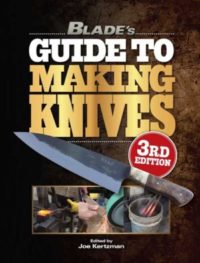
Makers can’t go wrong with this collection. You’ll get two paperbacks: the third edition of “Blade’s Guide To Making Knives” and “How To Make Knives; and four e-books: “Greatest Loveless Knife Designs,” “Knife Grinding Secrets,” “Making Everyday Carry Knives” and “Fashioning A High-Tech Folding Knife.” Normally, this collection would cost over $70, but you can get it for half that.


Distal Taper Means Quick, Lightweight Knives

Distal taper Zieba
Michael Zieba applies distal taper to the blade of his Brooklyn Made folder. (SharpByCoop image)
Distal taper on Swarz-Burt
Note the gradual distal taper of the blade from just above the bolster to the blade tip on Peter Swarz-Burt’s chef’s knife. (SharpByCoop image)

Distal taper makes knives feel more lightweight, quicker in the hand and easier to use. However, the concept affects more than just weight. It also distributes balance so the knife feels neither top nor bottom heavy. In other words, the knife is well-balanced so that it goes where you want it to and cuts how you want it to when you want it to. It looks cool, too.

How does distal taper work? It’s pretty simple, really. The maker removes steel, usually by grinding, from each side of the blade beginning at the ricasso, that is, from just forward of where the blade and handle meet, and ending at the blade’s tip. The effect is of the cross-section of the blade gradually thinning, or tapering, toward the tip. Less steel means less weight and, if removed properly, better balance for the knife. Some makers apply taper to the tang as well, beginning the tapering just below where the blade and handle meet and gradually thinning the tang toward the handle butt. However, in general, the concept is identified more with the tapering of the blade than the tang.

Distal taper is not a new concept. “From ancient times it was used to lighten and balance swords,” noted award-winning swordsmith Vince Evans. “If a sword was not distal tapered, all you would have was a crowbar with an edge.” BLADE Magazine Cutlery Hall-Of-Fame© member William Scagel, who forged knives during the first six decades of the 20th century, applied the concept to his knives, as did such premier makers as Cutlery Hall-Of-Famers Bob Loveless, Bill Moran and others. Moran was instrumental in making the teaching of bladesmithing the main mission of the American Bladesmith Society, and he made distal taper a focal point in his classes and recommended it to all of his students.

KNIFE TYPES

Distal taper drawings
At bottom is the distal taper flat grind and at top is the parallel flat grind. Each image includes both side and overhead views. As you can see, the angle is “blunter” with the parallel spine. The point will be thinner and not as strong with the distal-taper spine. However, unless you simply want to punch holes with your blade, the knife with the distal-taper spine will be more efficient at cutting and chopping (Jim Crowell drawings)

ABS master smith Tim Hancock said tapering is most important on larger, thick blades such as those in the 3/8-inch range that often are heavier and benefit from the weight reduction for quickness and ease of use. “The thinner the blade, the less important distal taper is,” Hancock said. “In fact, full-length distal taper on a bowie blade of a 3/16-inch thickness and an 8-inch length would leave the tip area so thin and weak that, in my opinion, it would be an inferior knife. To me, it’s a process of speed and strength. Some balance between the two must be considered to make a superior knife.” Conversely, ABS master smith Jim Crowell said, if done properly, even a blade with a thin spine can benefit from tapering. “The degree of taper won’t be as much as on a thicker spine—in fact, it will be very subtle—but even then it provides the most efficient cut,” he noted.

Distal taper Buckner
Tom Buckner takes what is already a thin blade and makes it even leaner toward the tip via distal taper. (SharpByCoop image)

Larger hunting knives, camp knives, some bowies, fighters and knives used in cutting competitions where quickness and cutting ability are keys will benefit from being tapered. On the other hand, ABS master smith Mike Williams said he did not think distal taper was important for the rope cutting of the cutting competitions except for the balance of the knife itself. “It’s like using a fillet knife versus a butcher knife,” he continued. “When cutting rope you want the weight forward.” Since tapering removes steel toward the end of the blade, the process does not result in a knife with the weight forward such as a khukuri, for instance. Knives designed for cutting meat and paper will benefit from distal taper because it promotes a thinner edge that produces less drag, he observed.

According to ABS master smith Jarrell Lambert, reduced weight, quickness and balance are not the only benefits of tapering. He adds another: flexibility. He indicated distal taper gives the blade more of it and spreads the stress more evenly throughout the blade than one made of the same material but without distal taper.

Crowell added another benefit of tapering: greater edge penetration. “Distal taper allows the cutting edge to have a smaller degree of angle progressing down the blade, resulting in less drag and producing greater penetration into the medium with a said amount of energy,” he explained. “As a result, a blade with distal taper will always cut more efficiently than the same blade with a parallel spine.

“If you want weight in your blade, maybe for chopping, increase the width of the blade, but have a distal taper. This will provide the weight needed but also a lesser degree of angle on the edge. Consequently, you will have the best of both worlds.”

Advertisement

Must Read Articles

Read this before you make a knife

Knifemaking 101 – Read This Before You Make a Knife

  by Wayne Goddard My experience has taught me that there's nothing like digging in and getting started. I've often said the hardest part of the...
how to forge damascus steel

How to Forge Damascus

Advertisement
Advertisement