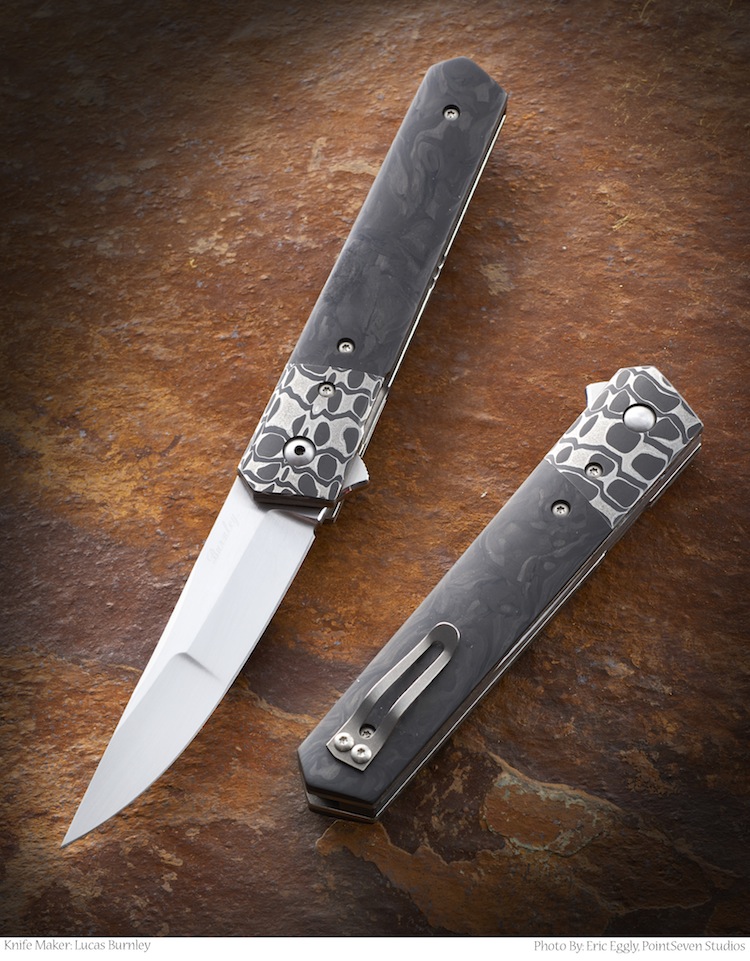
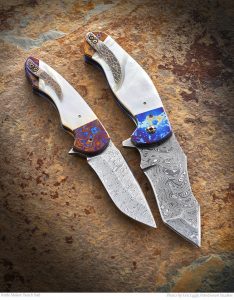
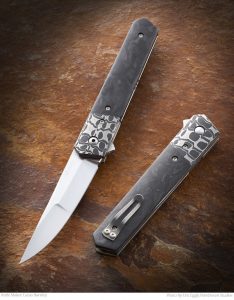
The Adventure Flipper by Lee Williams features a “pivot-less” build. Closed length: 5 inches. (Dave Stark image)The L46 flipper in Bohler N690 stainless steel and an earth-brown G-10 handle is hot from Andre Thorburn. (BladeGallery image)
If you’re looking for what the knife trends are in custom blades or what the knife trends are going to be later on in the factory cutlery industry, some of today’s hottest custom folders is a great place to start.
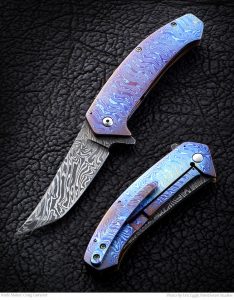
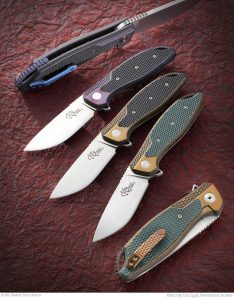
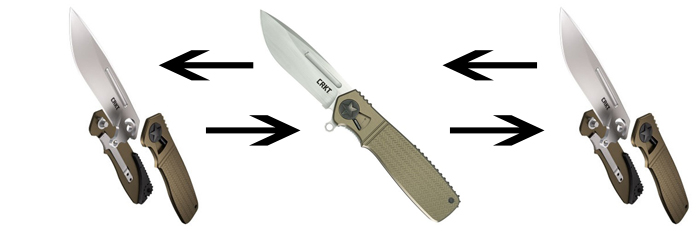
Michael Walker is still going strong after all these years and his folders remain hotter than ever. (Dave Ellis image)Kirby Lambert named his flipper folder after his son, Augustus. (SharpByCoop image)Brian Nadeau’s “Cyclone” appears here in three different versions. (SharpByCoop image)Tashi Bharucha’s “Machine” features a 3 5/8-inch blade of CPM 154 stainless. (Dave Stark image)Johnathan McNees makes the Copper Baby Bolt Flipper. Closed length: 4 inches. (Andrew Delavan image)If you’re looking for what the knife trends are in custom blades or what the knife trends are going to be later on in the factory cutlery industry, some of today’s hottest custom folders is a great place to start.
These are but two examples. There are many more. There are also some really cool custom folders on today’s market, some of which no doubt will inspire other custom and, later, factory makers to emulate them in some form or fashion. A few of those sharp studies in standout steel would include:
The Tactical Front Flipper by John Arnold. Closed length: 5 inches. (BladeGallery image)
•John Arnold’s Tactical Front Flipper. “He creates some of the most elegant daily carry folders, yet with collector-grade quality, that I have come across,” noted Daniel O’Malley of BladeGallery;
•The Copper Baby Bolt Flipper in CPM 154 stainless by Johnathan McNees;
•The Adventure Flipper by Lee Williams with Lee’s “Kick Stop” flipper mechanism;
•Kirby Lambert’s “Augustus” flipper, named after the Lamberts’ newborn son;
•Brian Nadeau’s “Cyclone,” termed by custom knife purveyor Les Robertson as “a great EDC, compact and lightweight”;
•The aforementioned Michael Walker and his large folder in Damasteel damascus;
•Andre Thorburn’s L46 flipper. “Of all the knives that I open and close each day,” O’Malley noted, “Andre Thorburn’s have the most consistent, smooth action of any”;
•Tashi Bharucha’s “Machine” with frames of blasted titanium and a blade-tip-up pocket clip.
Also Check Out:
Knives 2016, 36th Edition
The trusted guide for knife collectors, enthusiasts, knifemakers, and dealers around the world, this knife book covers the latest and greatest from front to back. A collection of feature articles explores the latest developments, history, and transformation of knives, swords, and edges of various kinds. Get your copy
Now we all know that knifemakers are innovative, and we’ve seen incredible creativity in design, blade grinding, handle materials, damascus forging, one-hand-opening folder mechanisms, locks and gadgets. Trends don’t just happen without innovation. But using a radioactive isotope of hydrogen on a knife? One called tritium that contains one proton and two neutrons, an isotope that is rare on earth where trace amounts are formed by the interaction of the atmosphere with cosmic rays? Does it sound like science fiction? No, it’s non-fiction, real life, and true that some knifemakers inlay tritium into knife handles because it glows, looks incredibly cool and might actually help a guy stumbling around in the dark find his knife.
That last part might be a stretch, but it’s not the first time knifemakers have looked to the stars to find knife handle and blade material. They’ve been forging meteorite into knife blades and using it in handles for millennia. There’s mystique and legend surrounding ancient Egypt, and Tutankhamun, who had meteorite forged into a blade before the use of iron, of gold/meteorite knives among the Mongols or James Black using meteorite in Col. James Bowie’s blades.
More commonly, knifemakers shape and often anodize titanium, using it for bolsters, liners and handles, or laminate two or more titanium alloys into patterns resembling damascus and resulting in what is known as Timascus. Various alloys color differently by heating or anodizing them, so the color combinations are endless, like the stars in the sky, the cosmos and the galaxies beyond.
This article was excerpted from the Trends section of the KNIVES 2016 annual book. For more incredible knife images and information like it, click here to get your copy of KNIVES 2016, and enjoy!
According to Joe Culpepper, cattle bone constitutes 98 percent of the total bone sales at Culpepper & Co., with camel and giraffe bone being the remainder. H.L. Holbrook employs stabilized giraffe bone on his hunter in CPM 154 stainless. Overall length: 8.25 inches. (PointSeven image)
Bone handle knives are good to the bone, including some of the latest blades made today.
Smooth redbone completes the handle of the Boker Trapperliner. The 3.25-inch blade is 440A stainless steel. Closed length: 4 3/8 inches. MSRP: $107.95. (Boker image)
Bone is one of the earliest materials used on knife handles, becoming a high art during the early and mid-1800s when the factories in Solingen, Germany, and Sheffield, England, were peddling their wares to eager American consumers. When tariffs on the old-world manufacturers were imposed in the waning years of the 19th century, U.S. manufacturers gained a toehold on the domestic pocketknife market, and by the early 1900s were in high gear. Bone was the most prominent and popular handle material in those days—and remains among the most prevalent, if not the most prevalent, to this day.
Many offerings by pocketknife manufacturers are graced with bone scales, and custom knifemakers use it frequently on both fixed blades and folders. BLADE® went inside the knife industry to find out why bone remains such a dominant handle material on today’s knives.
Where’s the Bone?
Most bone used on knives is bovine—that is, from cattle. When you think about how much beef is consumed annually in this country, you have to believe there’s a whole lot of cow bone available. There is. We asked proprietor Joe Culpepper of Culpepper & Co.—a large wholesale supplier and processer of all types of handle materials to both factories and custom artisans—about the importance of bone on his bottom line.
Joe Culpepper of Culpepper & Co.—shown inset with his wife and business partner, Kristi—said both factory and custom makers, though more custom than factory, lean heavily toward bone in browns, ambers, reds, oranges, blacks and other more conservative colors. Levi Miller opts for brown jigged bone on his trapper in 52100 carbon blade steel. Approximate closed length: 3 5/8 inches. (PointSeven knife image)
“Cattle bone constitutes 98 percent of our total bone sales, with camel and giraffe being the remainder,” Joe says. “The overwhelming majority of the cattle bone that we use is from South America, although it is available in nearly every country that has a beef industry.
“We find that cutlers, both factory and custom alike, lean heavily toward browns, ambers, reds, oranges, blacks and other colors that are more conservative. This is probably a bit truer for the custom makers than manufacturers. As for surface texture, we sell a lot of the more traditional jigging patterns that resemble patterns used before World War II. Approximately 60 percent of our sales are to factories, custom knifemakers the other 40 percent.”
Joe indicates he has seen an increase in demand for bone in recent years and, along with it, an jump in prices.
“As with anything, costs are always rising. The cost of jigging, polishing and cutting bone is nearly always a product of labor costs, which is somewhat predictable. Coloring is a different story,” he notes. “All of the dye components have risen exponentially in recent years.
“As far as overhead goes, we have to buy the raw material, have it shipped to our processing plant, treat it, cut it into scales, bleach the scales, sort for characteristics, identify outliers, texture and jig the bone, stack it into vats, color with dye, and test and document a sample before we make the final product available to the industry. There are also hundreds of other smaller processes involved, but these are the major things.”
While jigged bone is the most popular, Joe has seen an uptick in stag or carved bone patterns made to simulate deer antler.
“Most of our varieties of our carved stag bone have seen a rapid increase in popularity in recent years,” he says. “This is primarily because of the ban and scarcity of genuine stag. To my knowledge, we made the first variety of carved stag bone in the 1980s. It was made based on a Delrin [a type of thermoplastic] sample. Carved stag bone is popular in a variety of colors including amber, green, and various shades of brown and orange.” While smooth bone is still popular, it lags behind the jigged and carved varieties—but it does have the advantage of being laser etched and scrimshawed.
A Case Study
ABS journeyman smith Steven Koster combed through the entire box of bone scales at a Tru-Grit knife show booth to arrive at the nice matched pair of black jigged ones for his English bowie. The blade is Koster’s feather-pattern damascus in 1084 and 15n20 carbon steels. Overall length: 11.5 inches. (PointSeven image)
“Bone handles have always given Case knives their distinctive look and feel,” begins Fred Feightner, Case marketing coordinator. “While all of our handle materials cycle from time to time in terms of consumer favoritism, bone remains our most popular. Right now we are using our traditional cattle bone, the same we’ve been using for generations. Beyond that, some of our synthetics, woods and shells, like mother-of-pearl and abalone, continue to be very popular.”
According to Fred, Case handles its own jigging and color-dying processes. “We receive the bone in smooth slab form, then do all of the work needed to turn it into beautiful Case knife handles—including jigging, dying, drying and cutting to size. There are costs implicit in our manufacturing plans as the bone is sometimes stored before it goes to the production floor. The slabs also need enough time to take just the right color shade before being moved to assembly operations.”
Feightner sees no let-up in the popularity of bone handles in the near future.
“Bone is such a traditional knife handle material. It remains among our top sellers at Case, which is probably true of most makers of traditional folding knives today. Even with all the new handle materials that continually enter the marketplace, there’s still something special about the way a bone handle completes the look of a Case knife. We see demand for traditional folders to continue to grow, especially for Case knives, as our distribution and reach continue to expand into new markets.”
Puma USA opted for smooth white bone on the appropriately named Deadwood Canyon White Bone hunter. The 3.8-inch blade is 440A German stainless. Weight: 4.6 ounces. Overall length: 8 inches. It comes with a leather sheath.
Tried and True
The giraffe bone grip of Calvin Robinson’s “Little Bill” slip joint exhibits a two-tone color effect. The 2 5/8-inch blade is Damasteel damascus. Approximate closed length: 3.5 inches. (PointSeven image)
Steve Koster is an American Bladesmith Society journeyman smith who specializes in traditional fixed blades, most featuring his exquisite handforged damascus as seen in the English-style bowie on page 37. It sports a forged 1084/15n20 feather-pattern damascus blade and a boxed-frame handle topped with thick jigged bone scales.
“I do not jig or dye any of my scales. I get most of them from various manufacturers and suppliers at knife shows,” he states. “The cheekbone scales on my English bowie came from Tru-Grit. I picked through the whole box to find a nice matched pair with a fine jigged pattern. Some of the jigged-bone patterns are not uniform so I have to spend time selecting a matched pair of scales to fit the tang or frame.”
Though Steve uses a wide variety of handle materials on his knives, bone finds its way onto a healthy percentage. “I do about two out of 10 knives with bone scales,” he says. “I like using natural handle materials, and bone has been used for knife handles for hundreds of years. It is very durable and I really like the look of anything natural or antique looking on handles. Natural cow bone, camel bone or any of the ancient bones can be used as they are, or can be stabilized.”
Koster opts for bone with a traditional look. “The imitation stag I don’t care for,” he notes. “I prefer bone that has been picked or jigged, and also bone sanded smooth with a natural finish.”
Rest Assured
Green bone is a traditional favorite and the Remington Bullet 200th anniversary R11035 jackknife employs it along with blades of 440A stainless. Weight: 3.2 ounces. Closed length: 3.5 inches. Made in a limited edition of 5,000, it has an MSRP of $115.99. (Bear & Son image)
The tactical end of the cutlery industry (page 12) has ruled the roost for many years—and with it synthetic handle materials such as Micarta®, G-10 and carbon fiber—but traditional knives (page 12) still garner a sizable segment of the market. If you’re one of those who appreciate old-school pocketknives and fixed blades, rest assured—the factories and custom knifemakers have your back!one is one of the earliest materials used on knife handles, becoming a high art during the early and mid-1800s when the factories in Solingen, Germany, and Sheffield, England, were peddling their wares to eager American consumers. When tariffs on the old-world manufacturers were imposed in the waning years of the 19th century, U.S. manufacturers gained a toehold on the domestic pocketknife market, and by the early 1900s were in high gear. Bone was the most prominent and popular handle material in those days—and remains among the most prevalent, if not the most prevalent, to this day.
Many offerings by pocketknife manufacturers are graced with bone scales, and custom knifemakers use it frequently on both fixed blades and folders. BLADE® went inside the knife industry to find out why bone remains such a dominant handle material on today’s knives.
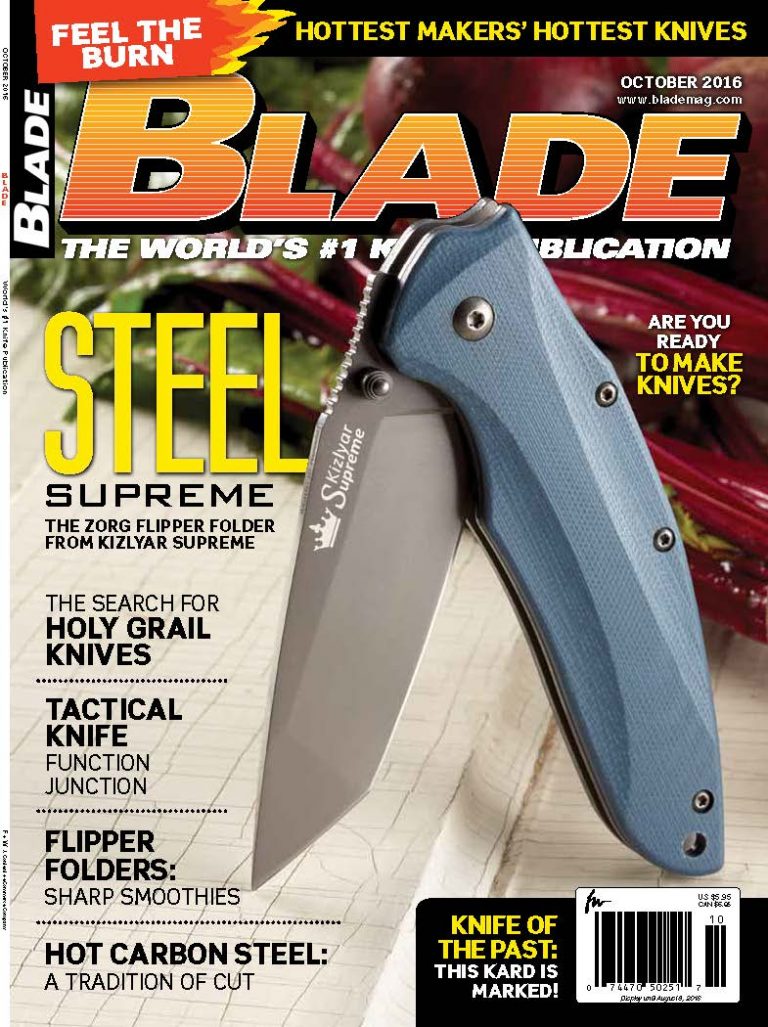
See what makes a knife sexy and much more in the latest BLADE®, on newsstands now! The cover knife is the Chris Reeve Knives TNK Flag Sebenza 21.
Learn what makes a knife sexy, why select makers of custom folders are crossing over to making different styles, whether James Bowie was an orator, rowdy or some of each—and more—in the latest BLADE®, on newsstands now!
You hear it all the time: “Man, what a sexy knife!” or “That knife has sex appeal!” So what makes a knife “sexy”? Part of it is what our special story identifies as the “feminine factor”—which includes knives that look and feel good and perform well. But there’s more to it than just that. Get the details in the story on page 74.
While tactical folders have been king in the knife industry for many years, some top custom makers have resisted making them—until now. Some award-winning makers of custom slip joints are trying their hand at tacticals or even hybrid tacticals, as are some makers of high-end custom folders. Les Robertson takes you on a tour of those who are doing it and why, and what it means for the present and future of custom knives in “4 Unintended Consequences of Tactical Folders.”
Also: Learn how you can enroll in J. Neilson’s special class at BLADE University on how to qualify for the hit TV show, Forged In Fire (BLADE University will be held in conjunction with the 35th Annual BLADE Show); see how four new Asian-style blades perform, as well as two of the latest skinning knives; immerse yourself in the latest of quick blades in “Golden Age of Autos?”; discover how bone remains at or near the top of handle materials in terms of popularity in “Bone in the USA!”; join in BLADE‘s salute to the late Warren Osborne in “‘Good Enough’ Wasn’t Good Enough For Him”; and much more in the latest BLADE.
As noted by Pat Covert in the April 2016 issue of BLADE®, there was a time in this great country when all men used straight razors to shave because, well, they had no other choice! Today, though, shaving with a straight razor has been experiencing a revival in an age when five-blade handhelds and multi-head electric shavers are the norm.
Two of the latest straight razors include Boker’s “The Celebrated Ebony” (left) and knifemaker Tom Krein’s model in orange-and-black-layered G-10.
According to Wikipedia, narrow-bladed folding straight razors were listed by a Sheffield, England, manufacturer in 1680. By 1740, Benjamin Huntsman was making straight razors complete with decorated handles and hollow-ground blades made from cast steel, using a process he himself invented. Think about that. Straight razors have been in use, uninterrupted, for nearly 350 years—and no doubt much longer in terms of those who made them earlier.
Larry “The Hammer” Harley forged the wootz damascus blade and handle of his straight razor. A special heat-bluing technique provides the color. A mammoth bone spacer adds the final touch. (SharpByCoop image)
Shaving with a straight razor takes both skill and time when most people get their news lightning-fast off a handheld device—and the rat race shows no sign of waning. So, why would you want to take the time to meticulously shave your face or trim your beard?
ABS master smith Bill Burke won the ICCE Award for Best Fixed Blade at the inaugural ICCE Show this past September.
Due to unforeseen circumstances, the 2nd Annual International Custom Cutlery Exposition (ICCE) has had to change the dates for its 2016 knife show from early to late September, show officials announced.
Originally slated for Sept. 9-11, the new dates are Sept. 23-25.
The show will be held in the same venue—the Downtown Marriott in Kansas City, Missouri.
According to ICCE officials, the event-hosting hotel, the Downtown Marriott, notified the ICCE’s organizers, the Knifemakers’ Guild and the American Bladesmith Society (ABS), that there would be several events scheduled for the original show dates. Due to the events scheduled in downtown Kansas City, some streets will be blocked, parking will be a hassle, and the downtown will be overcrowded the weekend of Sept. 9-11. The hotel management had other available dates that would make the show far more enjoyable for those who will attend, thus the change to Sept. 23-25.
“I heard that I’m only allowed to carry knives with 3 1/2-inch blades or shorter in my state, is that true?”
“I carry a 4-inch drop-point fixed blade when hunting, but I’m traveling to Minnesota this season, can I carry it there?”
“Someone told me I can carry an auto in Michigan now, can that be right?”
Good questions, all of them, and as silly as it might be that we have to ask such questions when it comes to carrying tools as utilitarian and downright useful as knives, that’s the world we live in. There are very few “firsts” in the knife industry, but one of them is the first and most comprehensive book ever published on federal and state knife laws. Knife Laws Of The U.S. By Evan F. Nappen answers questions about what knives are legal to own and carry in each state, and which aren’t. It delves into switchblades, ballistic and gravity knives and others, and even explains what to do and what not to do if you are arrested with a knife.
A nationally-known knife and gun rights attorney, Nappen has dedicated his life to fighting for gun and knife rights. Having practiced law since 1988, he was one of the first attorneys to ever get a federal injunction against a state gun law. He has written and produced DVDs, and authored a number of gun rights books, as well as numerous articles that have appeared in national magazines. Now he’s written THE book on knife rights. Knife Laws Of The U.S. is a good one to have, and with you, at all times, no mater where you go while carrying a knife!