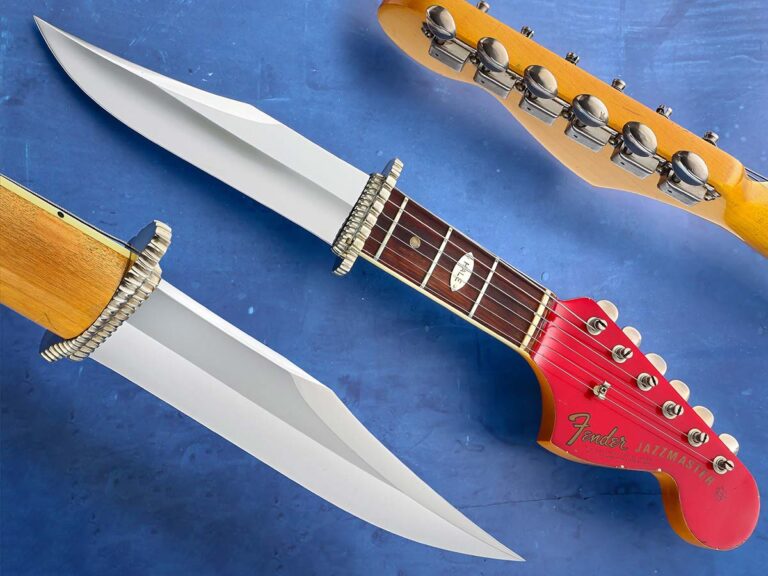
Lloyd Hale made the singular knife circa 2000 from the neck of a 1960s Fender Jazzmaster.
A self-described child of the ’60s, Larry Hirsch jumped at the chance to buy the DeFender when a collector offered it for sale.
Made by Lloyd Hale a quarter century ago from the neck of a 1960s-era Fender Jazzmaster guitar, the knife did not have a sheath originally, so Hirsch got with Hale earlier this year and brainstormed one in the shape of the main body of the guitar, complete with strap and volume and tone control knobs.
Larry Hirsch rocks his world with the DeFender. (Hirsch image)
“I told Lloyd the knobs had to turn because everyone that sees it, the first thing they will do is turn the knobs,” Hirsch said. Sure enough, when Larry displayed the knife at the 2025 Solvang Show, the first person that saw it turned the knobs.
Oh, left whole a 1960s-era Fender Jazzmaster—just the neck alone—would be worth obscene amounts today, but we won’t go there.
There are times gloves make all the sense in the world to use when using a knife and times they don’t.
The old saying goes that two things might “fit like a glove” or “go hand in glove.” But just maybe another question involves exactly when the “glove fits.”
Since mankind began working with tools, stone, bronze, steel and even in conditions that might be less than ideal, such as clearing trees and brush, dressing an animal, building a structure, or handling heat and cold temperatures, the idea of protection has been second nature. At first glance, the glove has its place and always will. But there are, in fact, other considerations in using hand protection, especially when it involves using a knife.
The time and place for gloved hands is the choice of the user, and thoughts on the topic vary.
“As you might expect, the answer ‘yes or no’ to gloves is ‘it depends,’” declared Craig Powell, general manager of TOPS Knives. “There are a lot of different reasons to wear gloves or not, depending on the use case. In cold weather, the gloves are more to keep your hands warm than they are necessarily for safety or grip. I wear gloves if I have them on me whenever I’m doing heavy-duty cutting like chopping firewood or other tasks that have a lot of impact involved.
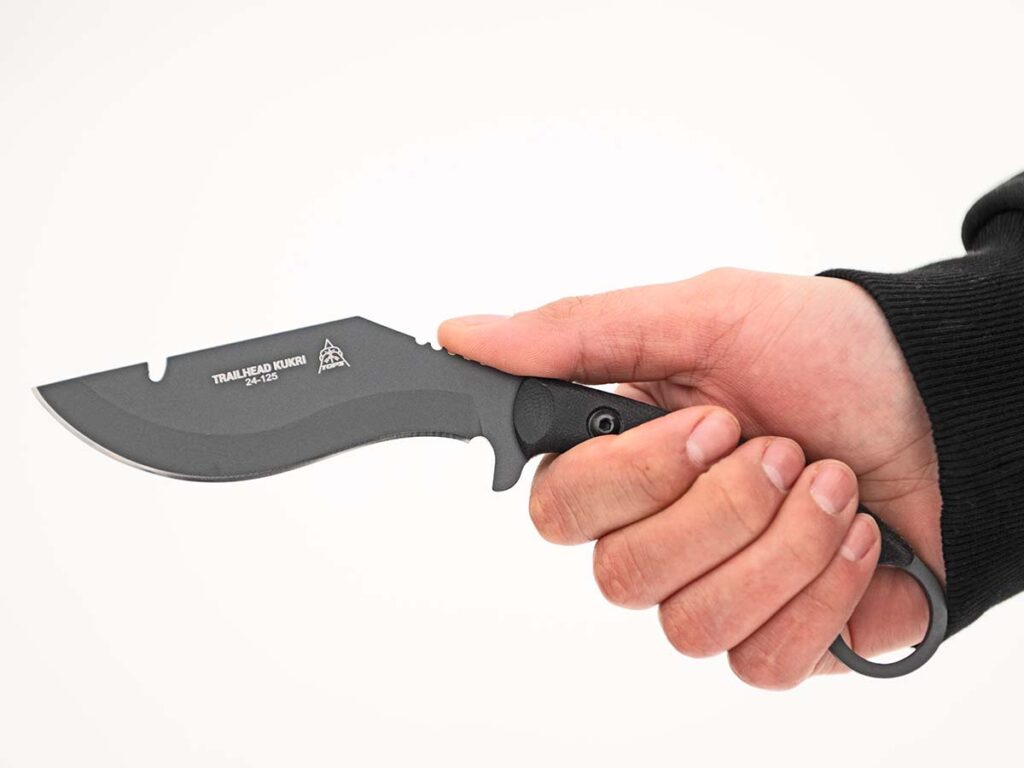
Craig Powell said one of the specific reasons for Micarta® or G-10 handles on TOPS knives is to provide a good grip when you need it. “Micarta is one of the best for grip even when wet and whether you have gloves or not,” he observed. The TOPS Trailhead Kukri has black canvas Micarta scales. (TOPS image)
“I also usually have a few pairs of latex or nitrile gloves handy when hunting just to keep things a little cleaner when gutting or skinning an animal,” Craig added. “If I’m doing tasks that require fine control of cutting, I don’t usually wear gloves. One of the reasons I use Micarta® or G-10 on TOPS knives is specifically to provide a good grip for when you need it. Micarta is one of the best for grip even when wet and whether you have gloves or not.”
Situational awareness, then, drives most decisions to use gloves or go barehanded when using a knife. There are times when working with steel in the shop or making camp in the field that gloves are indispensable, and then there are other tasks that require the most intricate feel and finesse that can only be achieved with the bare hand.
Reuben Bolieu, BLADE® correspondent, outdoor adventurer and designer for ESEE Knives, recognizes when and where the glove provides that necessary advantage.
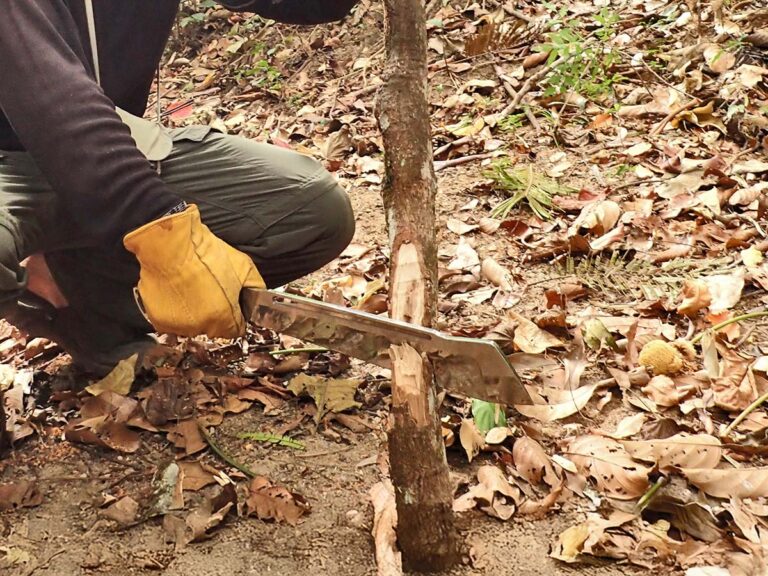
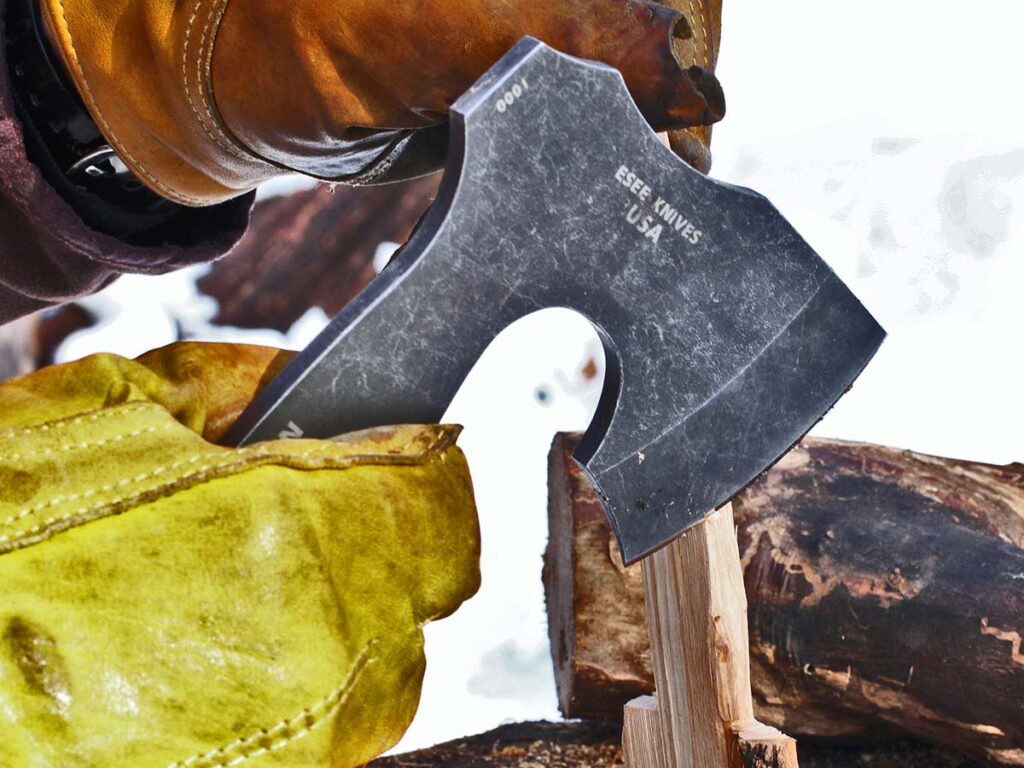
Reuben Bolieu wears cowhide gloves—nothing fancy—while chopping with his ESEE Gibson Carving Axe. As he noted, “These gloves are excellent general-purpose gloves when handling wood, bamboo, hot cookware and dirty work.” (Bolieu image)
“Gloves are the unsung hero of my camping trips,” he remarked. “They provide a momentary boost of superpower when handling hot pots or skillets taken directly from the campfire. Gloves also give you a second chance if you accidentally nick yourself while retrieving a big blade or axe from its sheath.”
Joe Flowers, designer for TOPS Knives and Condor Knife & Tool, answers emphatically regarding whether he uses gloves.
“Most of the time I do not, unless I am doing a highly repetitive motion or am working a particularly scaly or dangerous animal or material. This is general, as I can feel the blade and manipulate the tool more for the tasks at hand. The pro of wearing gloves, especially if you are not used to working tools, is the absence of concentrated friction that can lead to blisters. Even if you work a farm all day, you can get blisters doing a repetitive motion.
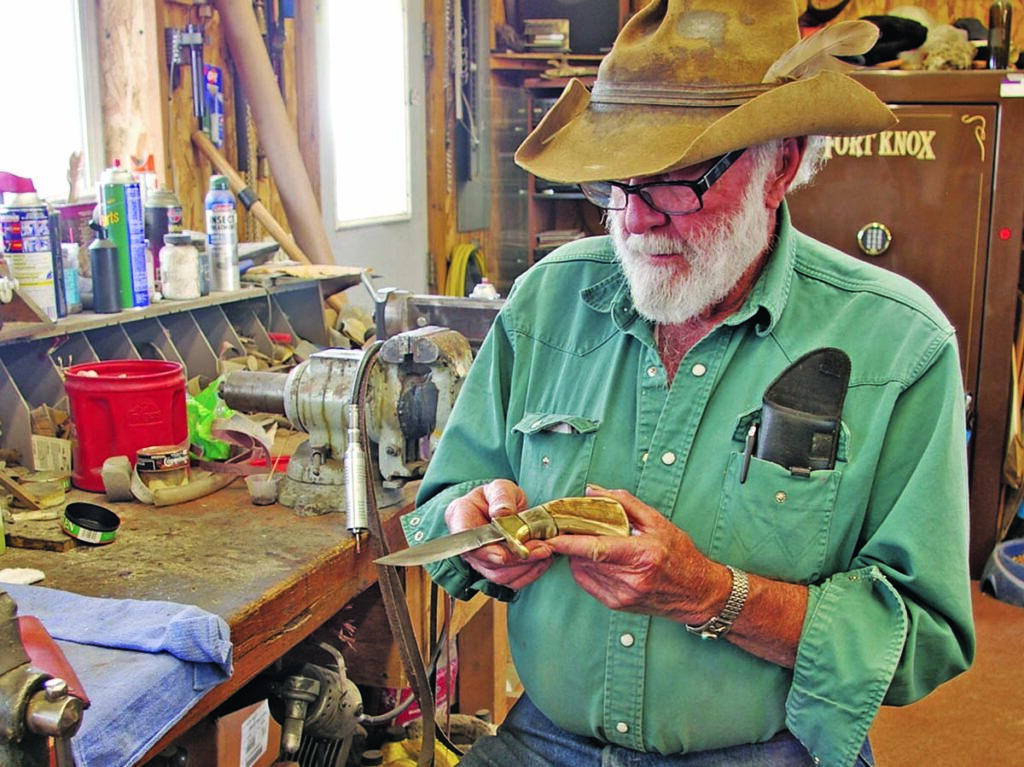
Feeling the handle of a knife against bare skin in the user or maker’s hand is considered the acid test for utility. Ed Fowler cradles one of his trademark sheep-horn handle knives at his shop bench.
“After hanging out with Anders Haglund, formerly of Helle Knives, I appreciated the idea of a larger handle for mitten manipulation,” Joe added. “The legacy of Sami reindeer herders who use large gloves helped him convince me. I don’t always design large handles, but if it is a design that could work with a Nordic culture I pay attention and put a larger handle on the blade. Sami culture sometimes calls their survival kit ‘a big knife, a small knife, and a reindeer.’ That’s all they need to survive.”
Gloves, Knives And Safety
Safety is always a factor in wearing gloves to use knives. Removing a knife from a sheath or deploying a folder blade always has a bit of hazardous duty involved. The same is true in the shop or the field, though the gloves themselves can sometimes present a hazard.
“Gloves get wet. This is wasteful,” explained longtime BLADE field editor and High Endurance Performance Knife master smith Ed Fowler. “They may be too loose and can get you caught up in machinery. The skin on our hands is very sensitive, and this sensitivity can help improve the quality of our knives, as well as our health. When buffing or grinding a hardened blade, our hand can communicate the temperature, where your heat treat might not remain just as you planned it to be. Friction is the enemy of our heat treats.”
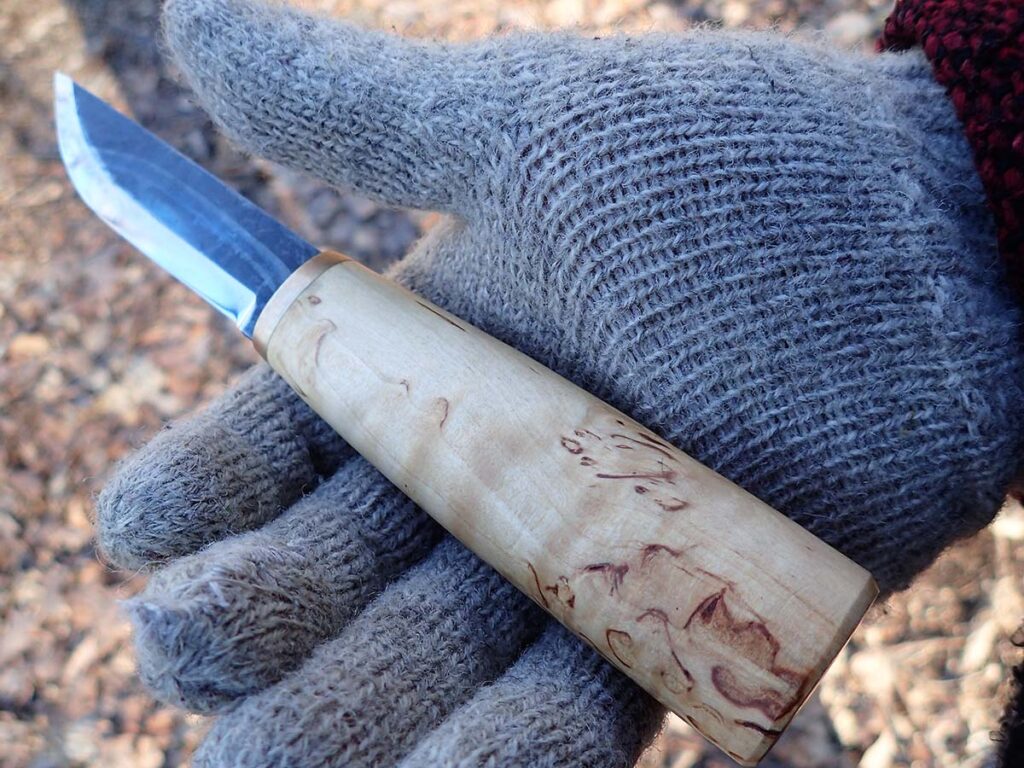
“After hanging out with Anders Haglund, formerly of Helle Knives, I appreciated the idea of a larger handle for mitten manipulation,” Joe Flowers stated. “The legacy of Sami reindeer herders who use large gloves helped him convince me.” The Nordic-style fixed blade is a Marttiini Arctic Carving Knife. (Bolieu image)
At the risk of stating something readily apparent, the positive aspects of wearing gloves when using knives include minimizing a cut or slice that could require stitches or worse, managing heat and cold, reducing the build-up of friction that can create painful blisters, and possibly even improving grip and purchase in the hand.
“The obvious pros of gloves are safety from materials and the tools you use,” Bolieu related. “However, gloves are fumbly! This brings us to the cons: clumsy dexterity. Fiddling in the dark or cold is the worst when working with sharp tools or lacking time. Gloves can slow you down big time! Sometimes you need to take a stand and say, ‘The gloves are coming off!’”
When Powell is at work, he takes stock of the task at hand, and gloves may or may not be part of the equation.
“Fiddling in the dark or cold is the worst when working with sharp tools or lacking time. Gloves can slow you down big time,” Reuben Bolieu opined. “Sometimes you need to take a stand and say, ‘The gloves are coming off!’” (Bolieu image)
“Gloves can keep your hands from getting torn up when you’re doing a lot of heavy-duty cutting. They can also keep your hands clean when they need to be. Then, of course, there are gloves that will help prevent or at least lessen the cut you might receive if there is an accident. The cons are mainly the loss of dexterity and fine control. Depending on the type of glove, your ‘feel’ of the knife just won’t be as good as with a bare hand.”
Feeling the handle of a knife against bare skin in the user or maker’s hand is considered the acid test for utility. The glove is sometimes a barrier to truly getting the feel of the knife and developing an intuitive awareness of its capabilities.
“A good way to see if a handle is going to be comfortable for you to use is to give it a good, hard squeeze and hold it for a few seconds,” Powell commented. “Once you release it, if you feel some uncomfortable spots on your hand, that is a good sign that it will have some hot spots. Everyone’s hand is different, so while some knives might feel great for some, that same handle might feel terrible to others. A knife that looks great aesthetically doesn’t always do the job when it comes time to start cutting. So, a bare hand on the handle is a must whenever you can.”
Habit And Repetition
For those who wear gloves regularly when using knives, personal preference weighs in. The influence of habit and repetition contributes, too.
“Here’s a good analogy for this,” said Craig. “Most people wear shoes every day to keep their feet from getting cut or injured in some way. People that spend lots of time barefoot, especially outside, tend to have tougher feet. Basically, the same rocks that would cause some people a lot of pain don’t do anything to those who walk barefoot often. The same will be true for gloves. If you wear gloves every time you use knives or other hand tools, your hands don’t build up some of the toughness to be able to handle using knives often. A good handle will absolutely make a difference, but so will using tools often in general.”
As Ed Fowler noted, when buffing or grinding a hardened blade, the hand can communicate the temperature. Chris Amos buffs a blade in Ed’s shop in this file photo. (Fowler image)
Choosing whether to wear gloves or not shouldn’t be a difficult decision. The best advice available involves balancing risk versus return, hazards in relation to control and manageability.
“If gloves are the remedy, crack on!” Reuben offered. “Gear is terrain and weather-specific. I use leather gloves made of cowhide, the type you would see a ranch hand or cowboy use—nothing fancy. These gloves are excellent general-purpose gloves when handling wood, bamboo, hot cookware and dirty work.
“In winter, I add a thin fleece glove under them,” he noted. “This adds warmth but makes things extra fumbly. If I need more dexterity for making feather sticks or carving, I remove the leather glove and work the best I can with the fleece glove. It’s always a tradeoff. Safety first! More than anything, try with and without, see what works for you and have a blast!”
Flowers is strong in his opinion on the gloves themselves, but acknowledges there is a time and place for them when working with knives.
Pulling a knife from a sheath or deploying a folder blade always has a bit of hazardous duty involved. (TOPS image)
“Gloves do not determine how hardcore you are,” he advised. “I hate gloves but I wear them sometimes when the environment dictates it. I like to work beehives without gloves and I applaud anyone who does. Dexterity is very important when you manipulate and use a tool with a fine edge. Find gloves that you can move in … Gloves can help, but ultimately it is your time with a knife that is important, and, honestly, part of our human story.”
Experience is a great teacher, and familiarity with knives, their utility and hazards should drive the decision whether to use gloves.
“To each his own,” Powell concluded. “If you prefer to wear gloves when using knives, do it. If you don’t like wearing gloves don’t unless you’re doing something where there is a really good reason to have gloves on. For just regular daily use, I feel gloves are totally unnecessary, but I’ve also been in the knife world for over 25 years now.”
The use of gloves while working with knives does, then, involve the nature of the task, its brawn and repetition versus its intricacy and detail, control versus power. Having a pair of gloves handy is probably a best practice. Using them when and where appropriate enhances the knife experience.
Craftsmanship Crowned: Winners of the 2025 Custom Knife Awards at BLADE Show
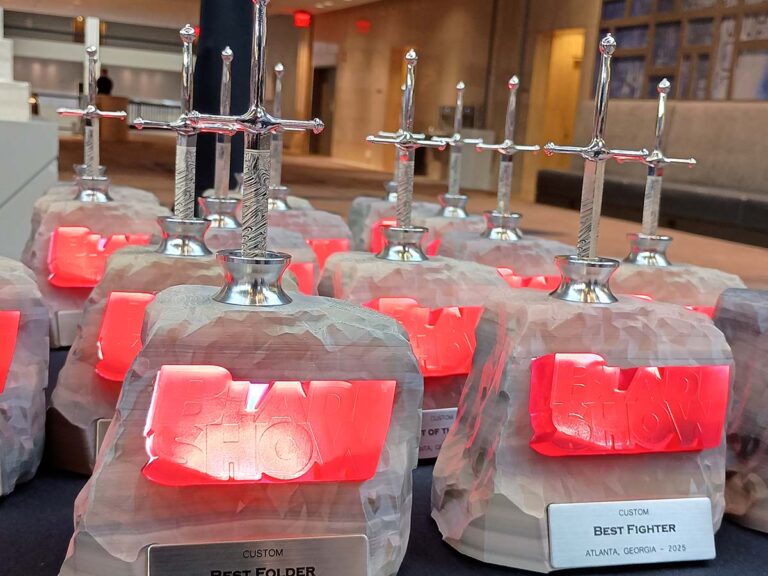
The 2025 Custom Knife Of The Year® Awards once again took center stage at BLADE Show, held June 7–9 at the Cobb Galleria Centre in Atlanta. As always, the event drew some of the finest custom makers in the world—and this year’s field was especially fierce.
A panel of expert judges had the unenviable task of selecting standouts across a range of categories, recognizing the blades that best embodied design, innovation, and craftsmanship. From elegant folders to bold fighters, here are this year’s winners—including the coveted Hugh Bartrug Best in Show.
The 2025 BLADE Magazine Knife of the Year® Awards proved tougher—and tighter—than ever before.
As the years go on the BLADE Magazine Knife Of The Year® Awards only get sharper. The 2025 chapter, held during the June 7-9 BLADE Show at the Cobb County Galleria, is a case in point.
Hosting among the largest fields to date in the factory knife competition, the contents had roughly 350-400 entries vying for the title of “Best” in their respective categories. Add-in production knives are reaching an unimaginable height in both design and manufacturing quality, the event was as tight as ever. Speaking to the stiffness of the competition, two categories produced contender finishers—an honor meant to recognize a creation that is nearly on par with the category winner.
The winners were selected by a panel of four judges, experts drawn from different backgrounds in the knife industry. Below are their selections of knives that are more than worthy of calling themselves Knife Of The Year®.
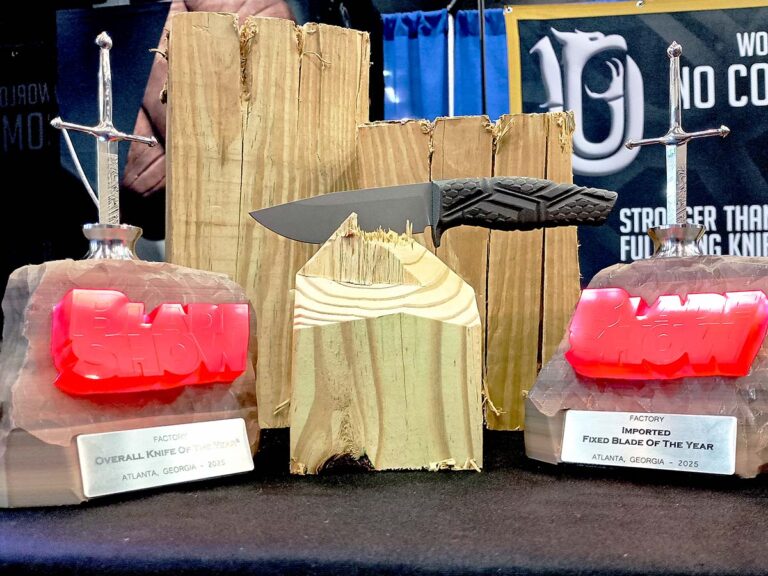
BLADE Magazine Overall Knife Of The Year® & Imported Fixed Blade Of The Year®
John Horrigan will auction Serial No. 1 on Veteran’s Day.
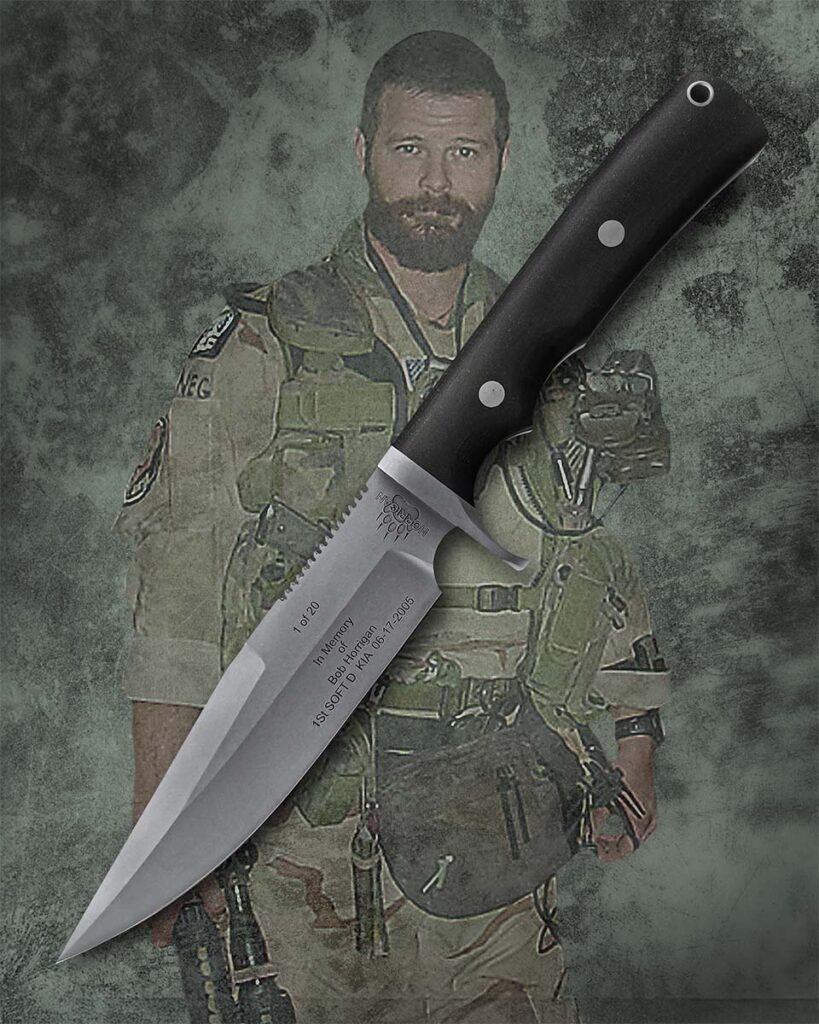
On June 17, 2005, while conducting military operations against known terrorists, United States Army Master Sergeant Robert M. “Bob” Horrigan was killed in action in Al Qaim, Iraq. In recognition of the 20th anniversary of Bob’s supreme sacrifice for his country, ABS master smith John Horrigan has made a series of 20 special knives in his twin brother’s honor.
Robert started his military career in 1984 with the 3rd 75th Ranger Battalion under the command of Captain Stanley McCrystal, going on to serve as a Ranger instructor in Mountain Phase in Dahlonega, Georgia. Robert was a light weapons sergeant with the 7th Special Forces Group ODA. His last assignment was with 1st Special Forces Group, detachment Delta. MSG Horrigan served 9½ years with the Counter Terrorist Unit. He had three tours to Afghanistan and was killed on his fifth tour in Iraq.
To say Robert was special would be an understatement. He excelled in everything he did. Pete Blaber, a former Delta commander, wrote about Bob in his book, The Mission, The Men and Me. George Hand wrote about Robert in SOFREP, chronicling his exploits in A Better Man Than I and Walking Among Giants. Robert was the fictional character of Bob Harrington in Brad Thor’s books Blow Back and Take Down. Sean Naylor also wrote about Bob in his book, Not a Good Day to Die.
John Horrigan will auction off Serial No. 1 of a special series of 20 knives this coming Veteran’s Day in memory of the 20th anniversary of his twin brother Bob’s death in action in Al Qaim, Iraq. (Jocelyn Frasier image)
Bob was nicknamed the “pack mule.” He would carry the gear of others when they became fatigued. He had a never-quit motto and was there to help his fellow service members through.
President Theodore Roosevelt once said, “… credit in life belongs to the man in the arena whose face is marred with sweat and dust and blood. It belongs to the man who strives valiantly, who knows great enthusiasms, great devotions, and spends himself daring greatly in a worthy cause so that he will know the triumph of high achievement; and whose place shall never be with those cold and timid souls who know neither victory nor defeat.”
Master Sergeant Robert Horrigan was exactly such a man.
Legacy Design
ABS master smith John Horrigan introduced his brother to knifemaking about five years before Robert was killed in action. The original Bob Horrigan Military Fighter is a model Robert designed, built and made famous.. The legacy design rightly named in his honor is 11.25 inches long with a 6.375-inch blade and a linen Micarta® handle.
Robert competed in the Best Ranger Competition in 1987 and finished in second place. John also was a Ranger in the 3rd 75th. He continues to stay connected by awarding the warriors who place second in the Best Ranger Competition with a Bob Horrigan knife in honor of his brother.
In recognition of the 20th anniversary of Robert’s death, John has made 20 commemorative knives with Robert’s touch mark—a bear paw with Horrigan through it. The knives are numbered 1 through 20. Robert designed the knife for the military elite who continue to carry it with service, pride and a brother’s love.
Robert loved where he worked and when someone asked him which unit he was in, he’d tell them “1st SOFT D.” He was all about secrecy of the unit. He’d let them try to figure it out. (Robert had a dry sense of humor). His nickname in the unit was “Puddy,” Elaine’s boyfriend in Seinfeld.
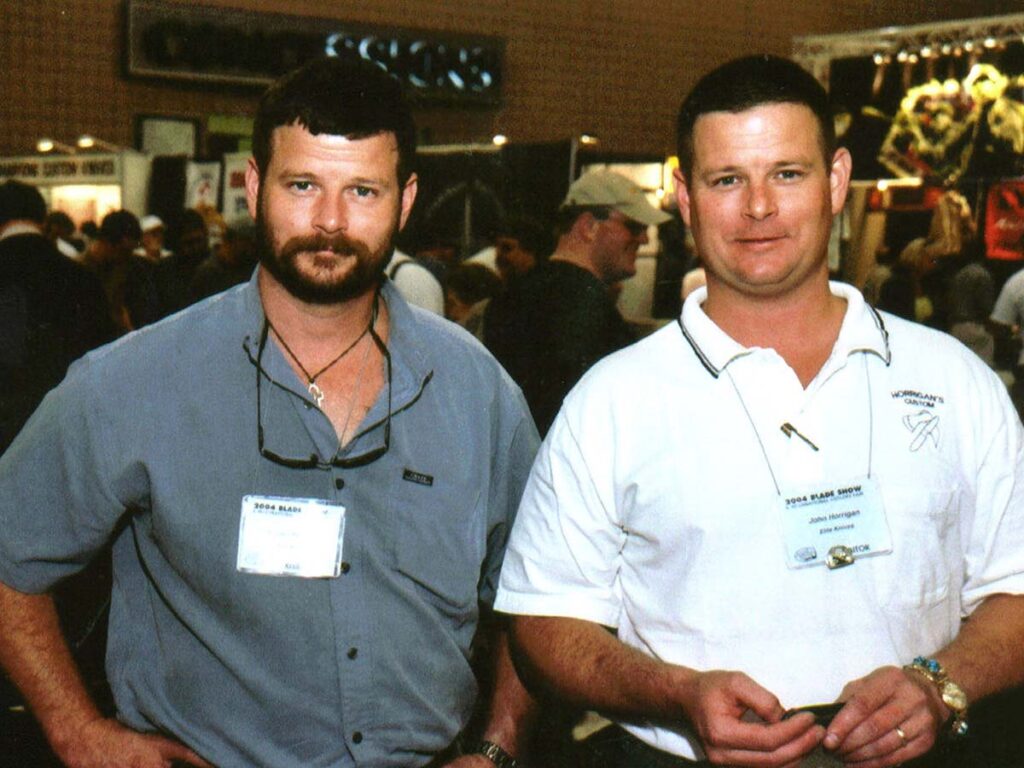
Robert (left) and John Horrigan enjoy the 2004 BLADE Show.
Serial No. 1 of the Bob Horrigan knife will be auctioned off this coming Veteran’s Day, November 11, with the proceeds going toward a great cause.
For more information on the auction and the entire series of 20th anniversary Bob Horrigan knives, visit John Horrigan Instagram page or visit eliteknives.com.
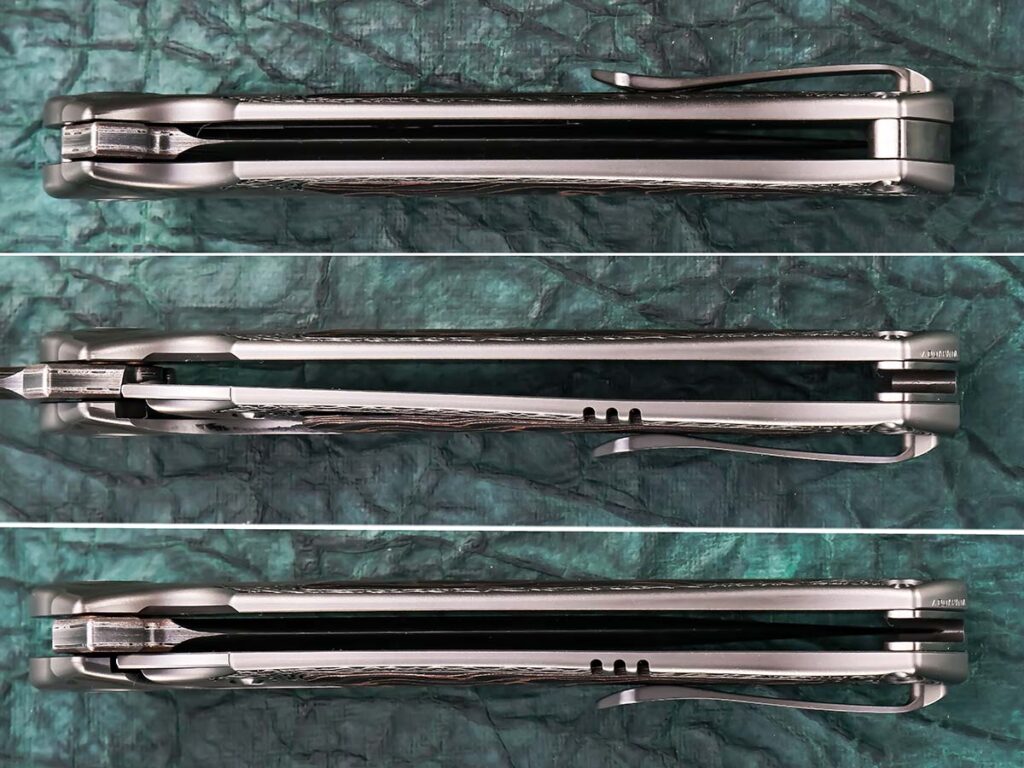
Go inside linerlocks to judge its operation and workmanship.
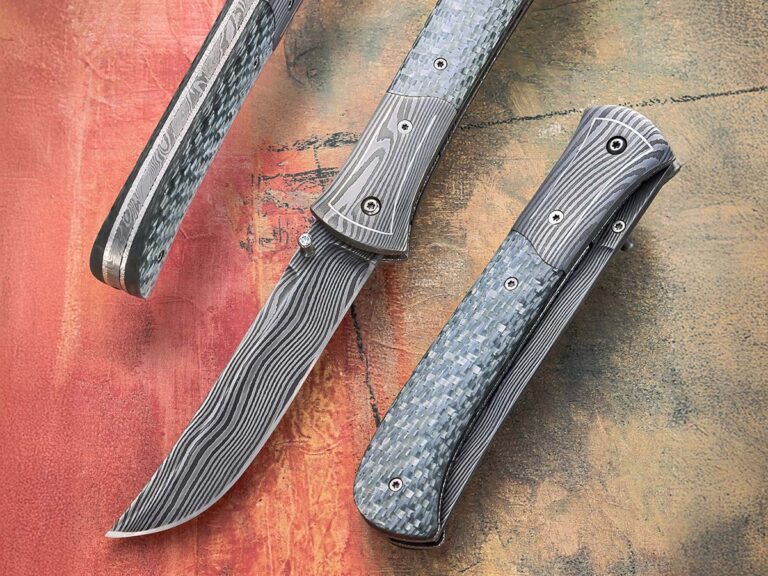
For those who truly appreciate the custom knife, particularly the variety of folders, there is beauty in the function as well as the aesthetic qualities of the piece. Nowhere is that functional beauty more evident than in the intricacies, tolerances and precision of a well-made linerlock.
Inspecting the inner workings of the linerlock presents an opportunity to evaluate its operation and determine the degree of expertise that has gone into the finished product. In assessing what goes into the best of linerlock construction, top makers agree that the critical connection between spring and blade is the most obvious indicator of a particular lock’s capabilities. To be sure, there are other aspects to consider in the evaluation of the well-constructed linerlock, and these should never be discounted. But first things first.
Blade-Spring Relationship
“There is more to proper linerlock construction than just the blade-spring relationship,” agreed Ethan Kolar, a custom maker since 2020 with about 65 percent of his work devoted to the linerlock. “There’s a lot of small things that work together to make the knife function as it should, but the blade-spring-lock relationship is the most crucial part of the knife’s functionality as it is critical to a safe and user-friendly knife.”
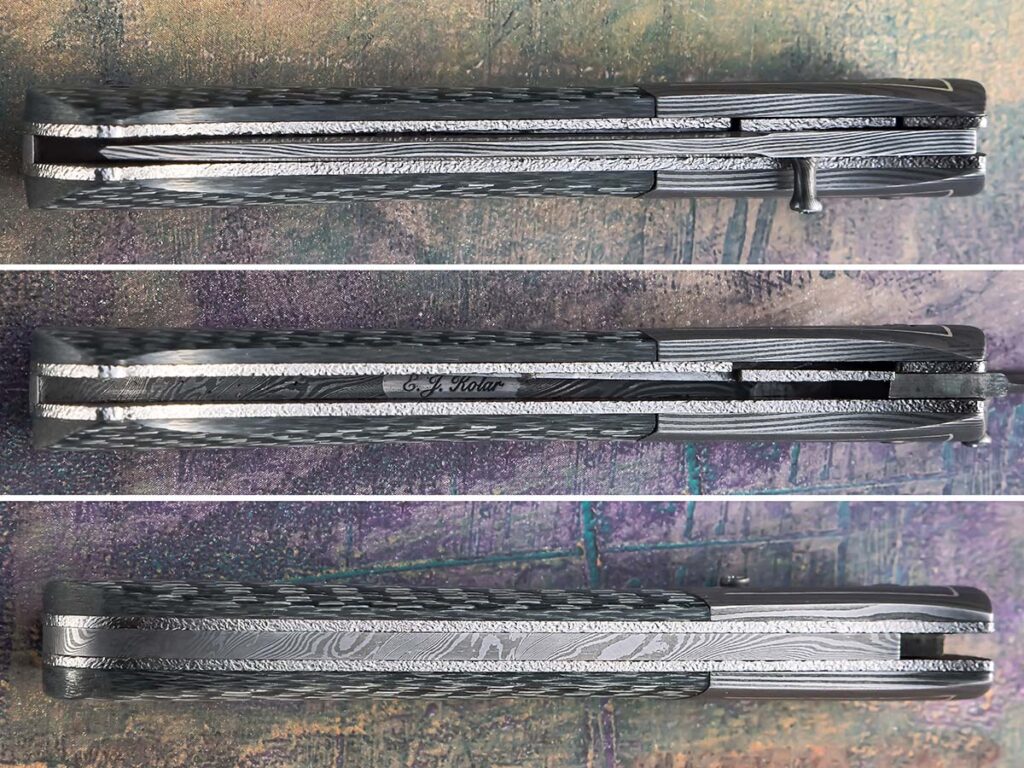
Ethan Kolar uses an unusual material for the liners of his Persian Style Linerlock—15N20 nickel-alloy steel—and stipples it to boot. “It’s a good, springy material and has good wear resistance allowing the lock to have a longer life before maintenance needs to be done or the lock needs to be extended,” he wrote. Ethan opts for a smaller spring (middle panel, top) on his Persian model. (SharpByCoop image)
When Maverik Murdock watches his linerlock work, blade and spring functionality is his primary concern as well.
“The lock fit is probably the first noticeable portion of a well-made linerlock folder, but it is a small part of what makes an overall good knife,” he explained. “The lock fit, or timing, is a good thing to look for as a sign of attention to detail from a folder maker, though there is some personal preference on how the lock fits.”
Murdock has been making custom knives for 15 years and folders for the last five with about 60 percent of his current output in linerlocks.
“Other good signs of a well-made linerlock are good fit and finish with the materials used,” he observed. “The blade should be centered between the liners when closed. This is a sign of proper pivot construction, good bearings or bushings and good alignment of the liner, back spacer and blade. Smooth travel when opening and closing the blade is also good.”
Repercussions Of A Bad Relationship
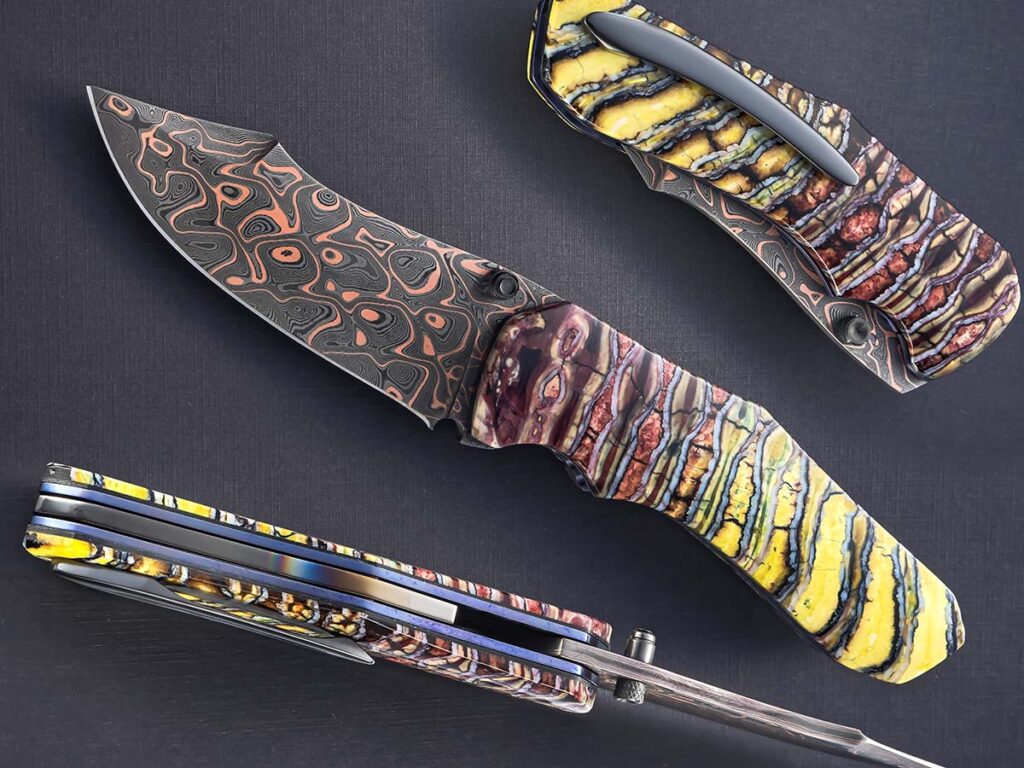
The Boomslang linerlock folder by K.C. Gray boasts a 4-inch blade of CuMai copper damascus by Baker Forge & Tool, mammoth molar scales, zirconium furniture and hidden hardware. Closed length: 5 inches. Gray’s price for a similar knife: $2,500. (SharpByCoop knife image)
In the event the linerlock fails the first critical test and the function is flawed, there are consequences.
“If the lockup engagement isn’t correct, it will do one of two things in my experience,” Maverik began. “If there isn’t enough engagement, it could create an unsafe and unstable lock as there isn’t enough lock contacting the blade, which will run the risk of the blade coming back on the user’s hand. On the other end of the spectrum, too much lock engagement can crowd the user’s thumb or thumbnail, making it difficult to release the lock and decrease its service life as the lock has less area to wear into before it has sloppy lock engagement. The most common types of incorrect lock interfaces, I would say, are the two I’ve listed. However, in my opinion, over-engagement is more common than under-engagement as it is easy to both grind more material than is needed for proper lock engagement and the blade taper angle can be easily canted less than is necessary.”
If the spring extends beyond the optimal position, the condition is commonly described as “overtravel,” and the knife’s function is significantly impaired as time and use progress.
“If the lock bar has overtravel or over engagement, it generally isn’t dangerous to begin with because the angle change on the lock bar isn’t high enough to compromise the compression strength of the lock under normal working conditions,” Murdock explained. “But that does depend on the construction of the knife and materials used. Overtravel generally just means a shortened working life of the lock mechanism where it would need to be replaced sooner than a properly timed lock. The problems with overtravel begin to show up with the reach to the far side of the lock. If the lock bar fully reaches the other side of the lock, there comes a point where it no longer has contact with the blade when open, or has minimal pressure where it can bind.”
Other Linerlock Concerns
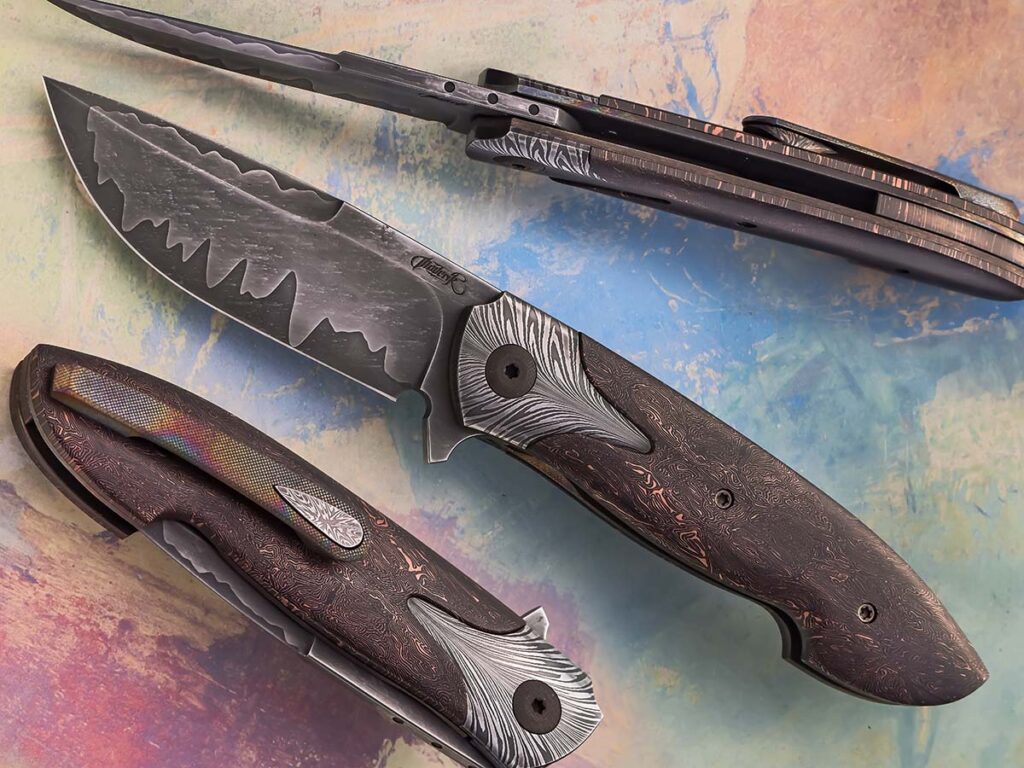
Marverik Murdock’s Steadfast has a 3.5-inch blade in a san-mai construction of CPM 154 stainless steel and CPM 3V carbon steel. The scales are Fatcarbon® space coral and the bolsters are feather damascus. Closed length: 4.25 inches. His price for a similar knife: $3,200.
K.C. Gray has been making custom knives for a decade and collecting them for 30 years. He produces about 100 knives per year and roughly half are linerlocks. His perspective on quality workmanship includes the vital connection between spring and blade as well as other factors.
Interface
“That interface is the prime concern,” Gray observed, “and people usually talk about it in terms of ‘percent of lockup.’ Basically, that is how much the lockbar travels across the lock face toward the opposite liner. Everybody has their own idea of the ideal number. Some like as little as 10 percent lockup. I think most makers would say 40 to 50 percent would be the correct range. Too little lockup and the blade can slip off the lockbar and close. Too much and the lock will stick or even light wear will cause the blade to wiggle. So getting the lockup in the sweet spot in the middle is a sure sign the knife was well constructed.”
Detent
According to K.C., other critical elements should be considered in the overall quality of a particular linerlock.
“Other things to look for would be the strength of the detent holding the blade in the closed position,” he advised. “It should be firm enough that the blade doesn’t fall open when lightly shaken. But it can also be a problem if the detent is too strong. If it’s very strong it can make opening awkward and dangerous. Thumbs can slip onto the cutting edge or the knife can be dropped more easily. Another thing to look for is the centering of the blade between the liners. It should be bang down the middle except in chisel-ground blades.
Clearance
“Something else,” Gray continued, “is whether there is enough clearance between the liners for the thumb to get purchase on the lock to disengage it. If the blade is thick, often no relief is needed. But a thinner blade will usually need some relief cut into the opposite liner. It’s usually a sign that the maker thought the design through thoroughly.”
Other Aspects To Look For In Linerlocks
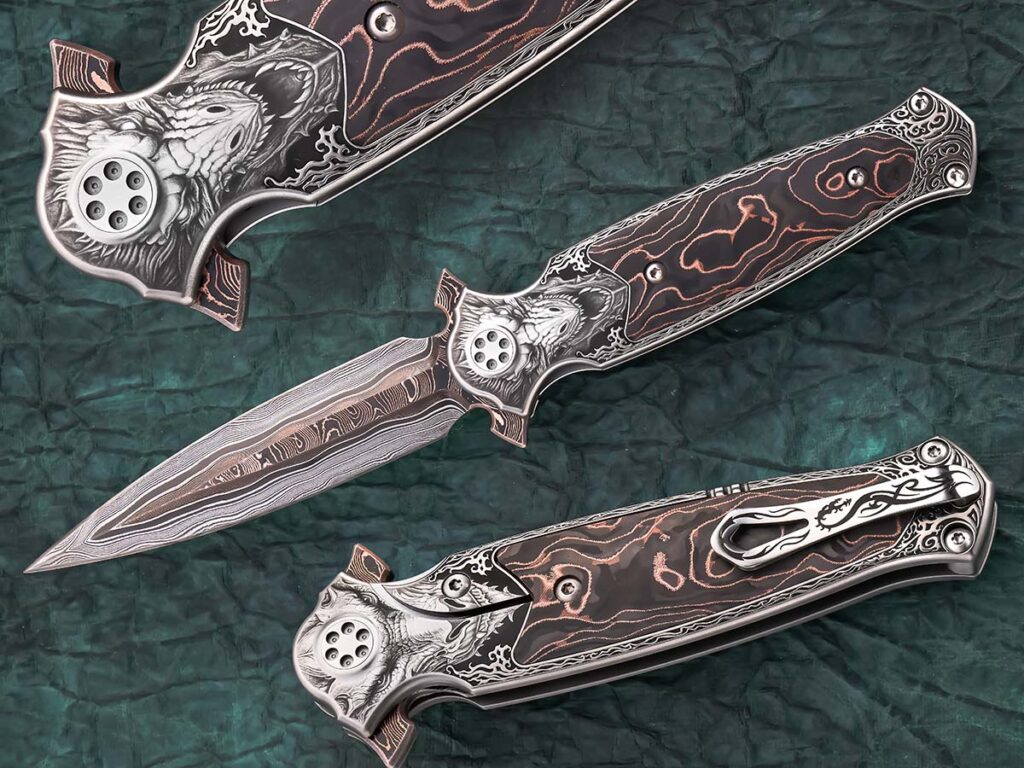
Viewed straight on two-dimensionally, some folders scream linerlock while others do not. The linerlock folding dagger by Brian Nadeau with dragon engraving by Vitalij Quaranta fits the latter category. (SharpByCoop image)
Of course, there are attributes to the well-made linerlock that are not necessarily visible. The feel in the hand and the ease of simple repetition in opening and closing contribute to the best linerlock experience.
“The blade motion when opening and closing should be smooth and consistent through the whole opening/closing cycle,” Murdock related. “Some makers like more or less drag on the blade, but it should be consistent. If the drag is excessive, it can be a sign of improper pivot sizing or too much lock bar pressure. The blade should have little or no side play when open. If it does the pivot may not be tight enough or the working surfaces may not be in alignment. The blade should be centered when closed and should be tight against the stop pin with a firm enough detent to prevent accidental deployment.”
Kolar also acknowledges the telltale signs of poor construction that are not necessarily readily apparent on sight and warns prospective buyers to consider these red flags.
“There are a few limited signs of improper construction that can’t be seen by the eye,” he commented. “Sloppy blade lockup oftentimes is very difficult to see as it doesn’t take very much for the blade to rock against the lock. How tight the blade pivots is another, as well as whether it has side play in the blade, and this is something that you can usually only feel. A good simple rule for cases such as these from both the maker and the buyer standpoint is to go with your gut on what you feel. A lock should lock up tight with no horizontal side play and no vertical lock play relative to spring size. Smaller springs can compress easier than larger.”
Questions To Ask When Buying A Linerlock
As K.C. Gray observed, the “percent of lockup” refers to how much the spring/lockbar travels across the lock face toward the opposite liner. “I think most makers would say 40 to 50 percent would be the correct range,” he opined. Brian Nadeau appears to achieve that range (far right, middle panel, top) with his dragon-themed linerlock. (SharpByCoop image)
When buyer and seller meet, the evaluation of a prospective linerlock should include more than just a consideration of the knife itself. Buyers should engage the maker in conversation and ask a few questions. A healthy dialogue always enhances the experience and gives the customer confidence in the decision to plunk down hard-earned money.
“Ask about the liner material,” Gray offered. “It’s almost always titanium in custom knives. Ask what angle the lock face has been ground to. Most often seven to nine degrees is used. Ask if the blade runs on bearings or washers. And just ask if the maker can explain the materials used and why he or she likes those materials.”
Murdock agrees. “If you are talking to a maker about his work, he should know the process and materials used and should be confident in what he does. It’s good to ask about the materials and why they’re used. If you can see the work in person and look at these points and the fit and finish, that’s a great place to start.”
The making of a quality linerlock requires attention to detail and presents challenges that go well beyond a simple aesthetic. While eye appeal is always a factor, the proof of the linerlock’s worth is in its operation. Informed buyers can help themselves in taking the time to understand the attributes of linerlock mechanics and the skill that is present in the finished product. Then, the unbeatable combination of beauty and optimal use can be attained.
Contemporary armed forces styles are chips off the old block.
While U.S. troops have long had a choice of carrying alternative knives as opposed to military issued ones, nothing prepared them for the explosion of choices that came with the modern tactical boom of the early-to-mid 1990s.
While the newly minted cutters were mostly of the folding knife variety, fixed blades also benefitted from the vast improvements in tactical designs and materials that shook the cutlery industry. That boom continues almost 35 years later as the tactical segment and its many spinoffs are still the largest chunk of the sporting knife market.
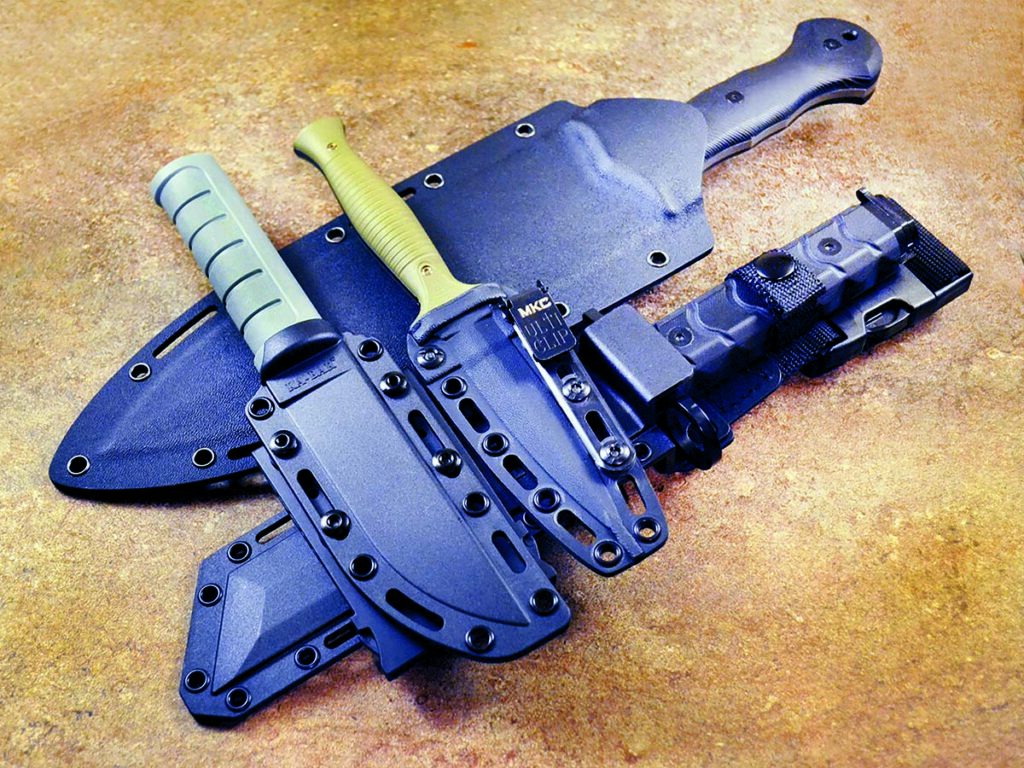
Many military knives have been issued over the years as the various branches, both main and special, selected their own. Large fixed blades and bayonets were common and outsourced to manufacturers along the way. Even though they may differ in size and modifications, the four review knives all have roots in military history.
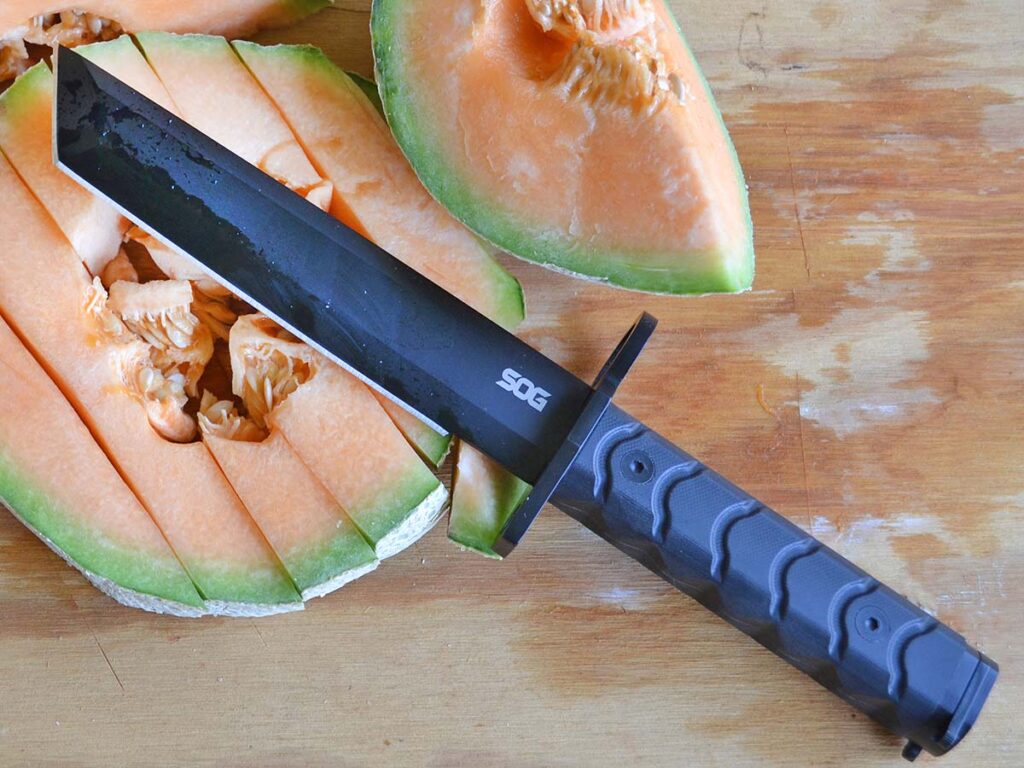
SOG BAR15T Tanto Bayonet
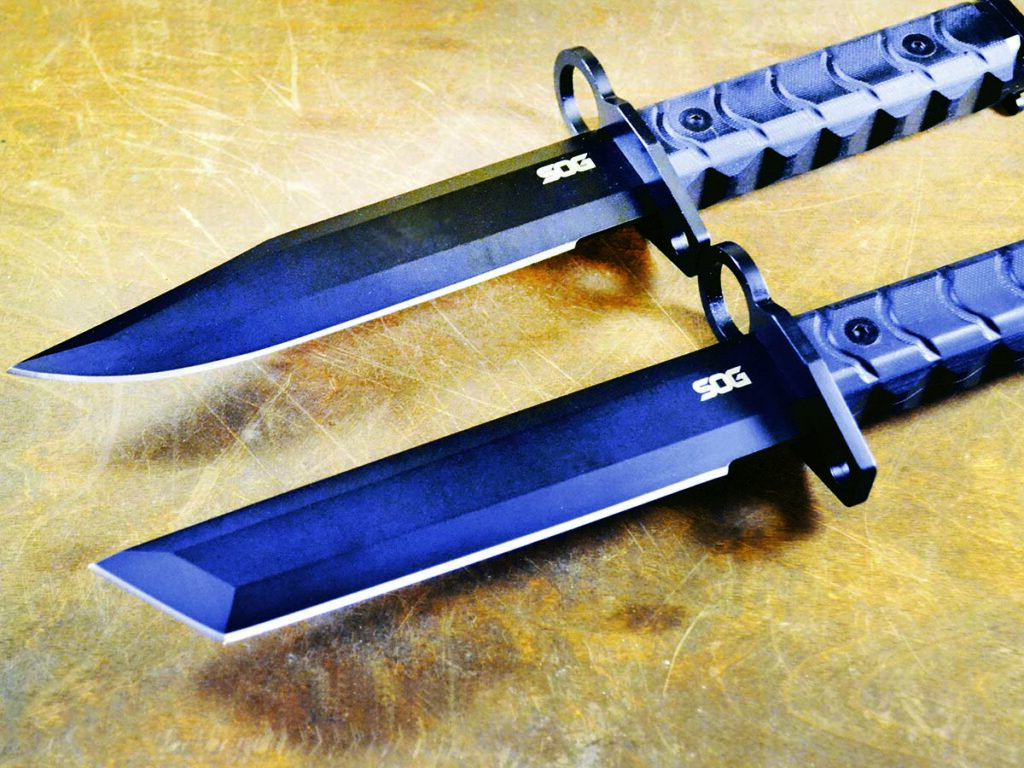
Two SOG bayonet offerings: the BAR15T Tanto and BAR15C Clip Point. The test tanto has a more than serviceable 5 inches of cutting edge.
Pros
Powerful Chopper
Strong Tip Design
Ergonomic Handle
Cons
Heavy And Bulky
Not Ideal For Finesse Tasks
BAR15T Tanto Bayonet Specs Blade Length: 7.1” Blade Steel: AUS-8 stainless Handle Length: 5.1” Handle Material: Black G-10 Overall Length: 12.2” Sheath: Black Kydex Country of origin: China MSRP: $79.95
The SOG BAR15T is a big boy. True to modern tanto form, the blade is clipped from the frontal blade grind to the upper tip. The black-traction-coated blade’s main edge is flat ground and 5.2 inches long, with a quarter-inch grind to enhance penetration along the spine. The 4.8-inch handle includes a straight guard and pommel with hardware for mounting as a bayonet, with a hidden-tang main grip of black G-10 done up in a series of curved grooves on its top surface and angled pyramids along the sides. The BAR15T checks in at 19.2 ounces and is delivered with a MOLLE adaptable drop sheath, which includes black nylon and leather belt fittings.
CAS Iberia/APOC Smatchet
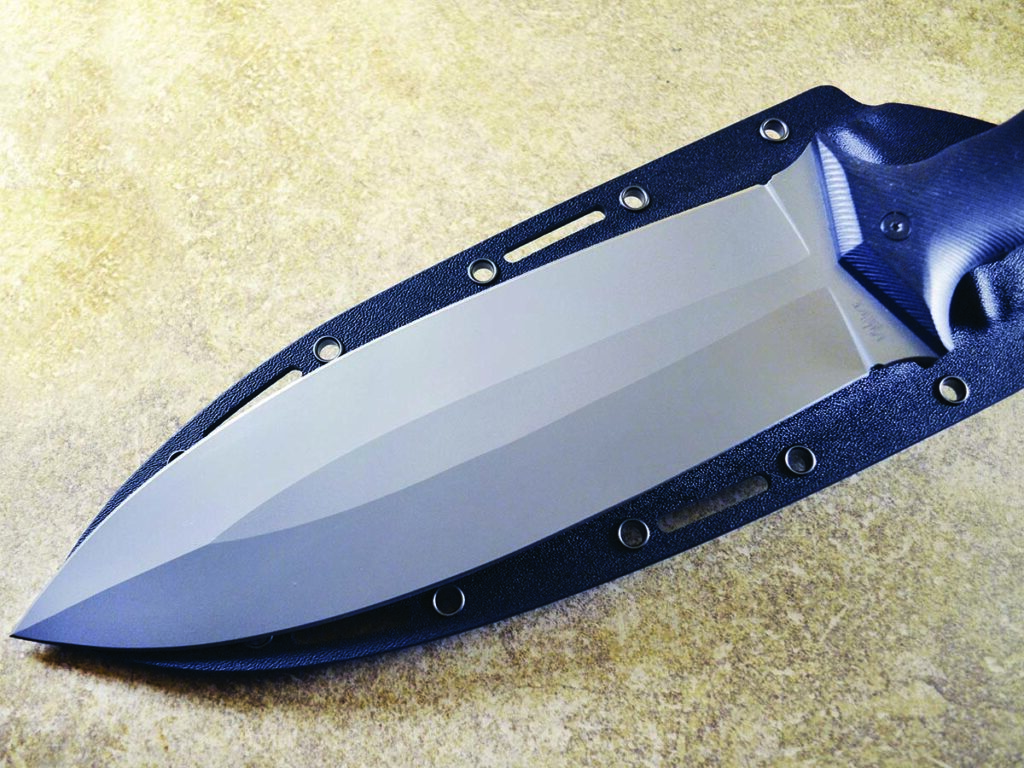
With its wicked 9.7-inch blade, the CAS Iberia/APOC Wallace Smatchet is loaded for bear. British and American forces used the original version of the knife to maximum effect during World War II.
Pros
Exceptional Chopping Power
Comfortable Handle
Battle-Ready Design
Cons
Overkill For Light Tasks
Difficult To Carry
Smatchet Specs Blade Length: 9.7” Blade Material: D2 tool steel Blade Finish: Titanium coated Handle Length: 6” Handle Material: Black G-10 Overall Length: 15.5” Sheath: Black Kydex belt mount Country of origin: China MSRP: $175
Designed by Mike Wallace, the CAS Iberia/APOC Smatchet is by far the largest, and most ususual, of the review bunch. The smatchet is not new and is best known for seeing action in World War II as a close combat fixed blade for British and American special forces. The Wallace Smatchet’s abbreviated, double-ground blade has a matte titanium coating. An ample finger-grooved handle can easily accommodate large and/or gloved mitts and is flared at the base for excellent purchase. Weight is a hefty 1 pound, 10 ounces. The knife is delivered with a MOLLE compatible drop sheath with steel and black nylon fittings.
The KA-BAR Dust II
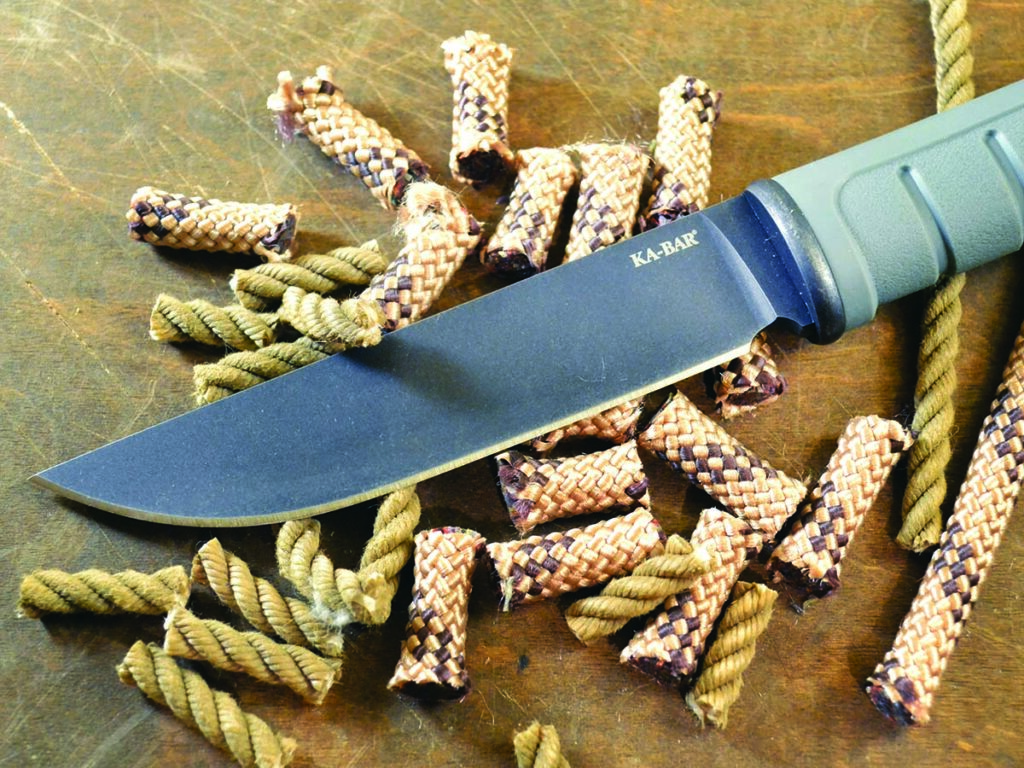
The KA-BAR Dust II tackled synthetic rappelling rope and stiff waxed cotton lariat rope. The full-ground D2 tool steel blade was no worse for wear and ready for more.
Pros
Compact And Lightweight
Good Edge Retention
Versatile Utility
Cons
Light-Duty Only
Basic Construction
Dust II Specs Blade Length: 5.2” Blade Material: D2 tool steel Handle Length: 4.79” Handle Material: Green glass-filled nylon Overall Length: 9.58” Sheath: Black, molded hard plastic Country of origin: Taiwan MSRP: $138.49
The KA-BAR Dust II, a down-sized version of its larger brother the Dust I, is better configured for light utility. It has a very staid, flat-ground, gently clipped, black-coated blade. The hidden-tang handle hasn’t a sumptous curve to its name and is arrow straight with wraparound grooving on three quarters of its surface. The handle has a hint of a guard top and bottom, the epitomy of understated good taste. It comes with a black, MOLLE-adaptable, hard-plastic belt sheath.
Montana Knife Co. Model V24
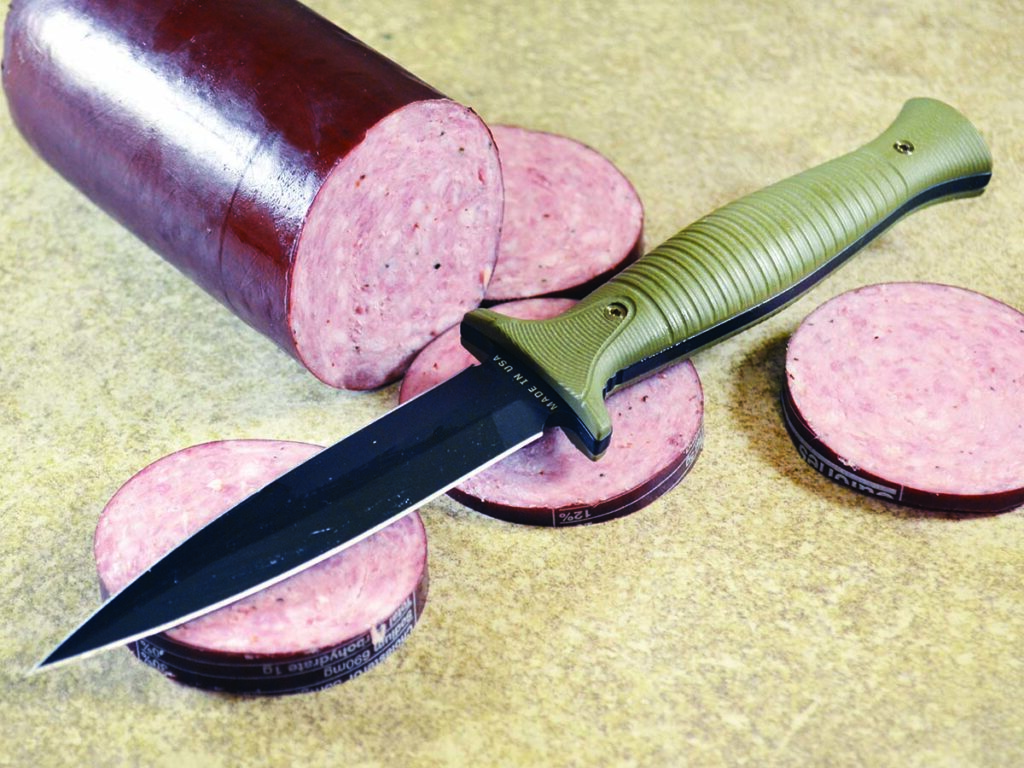
The Montana Knife Co. V24 stiletto turned out to be a little carnivore during testing. After doing stab tests on a chub of summer sausage proved a walk in the park, the author turned the slim 4-inch CPM MagnaCut blade to taking off slices of the meat. Note the clean edge work on the sausage casings.
Pros
Exceptional Penetration
Smooth Slicing
Near-Custom Quality
Cons
Purpose-Built Design
Less Robust For Batoning Or Chopping
V24 Specs Blade Length: 4.25” Blade Steel: CPM MagnaCut stainless Blade Finish: Black Cerakote® Handle Length: 5” Handle Material: OD green G-10 Overall Length: 9.25” Sheath: Black Kydex w/UltiClip Country of origin: USA MSRP: $475
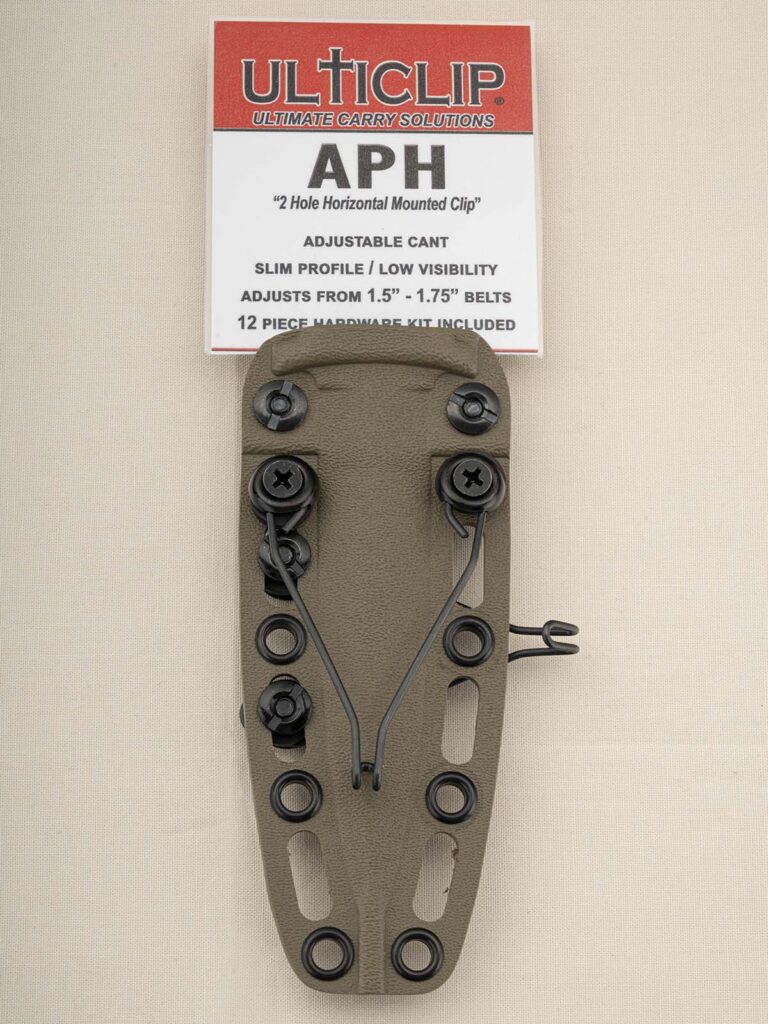
Complete with thumbprint ricasso, the Montana Knife Co. Model V24 is a tribute to the V-42 stiletto used during World War II by the First Special Service Force, father of today’s U.S. Special Forces. This exqusite send-up was designed by MKC President/CEO Josh Smith, who, when he was all of 11 years old, began studying bladesmithing under ABS master smith Rick Dunkerley. The dagger-style blade is double ground and the hourglass handle boasts horizontal machined striations and guard art. The steel is gimped along the sides of the guard and curved base. The knife weighs 4.47 ounces and carries in a black belt sheath with an UltiClip 3.3 mounted on the front.
Testing Modern Military Knives
The review knives are very diverse and the two largest, the Smatchet and BAR15T, are definitely in the same playing field. I took their blades to task with a large, mature cantaloupe. The heavy Smatchet—all 26 ounces—had no probem hacking and slicing, and the fat handle made it easy to guide the big blade with no twisting or wobbling. On the battlefield this would be a formidable knife—as if its appearance alone weren’t enough to send the enemy heading for the hills.
The BAR15T is a load at just over a foot long with well over a pound of heft, and while not an easy tote it overshadows the EDC factor with sheer power. The beauty of the knife lies in its almost half-foot-long cutting edge and all that weight behind it. Tantos as a rule give up cutting edge to accommodate the wicked, pointy tip, and the shorter the blade the less edge there is for work.
It’s a black synthetic sheath party with the review knives. All are Kydex except the hard molded plastic of the KA-BAR.
I tested the knife by cleaving the cantaloupe in large chunks and taking off 1-inch strips in push cuts, pull cuts and vertical slices. The blade length proved a real benefit when making cuts evenly and the weight added to making strokes effortless, not to mention plenty of handle for gripping and guiding the knife. If you want a tad smoother cutting edge, I suggest checking out the SOG BAR15C Clip Point without the tanto’s notched tip.
The KA-BAR Dust II is sized for light duty around the camp or trail where a large fixed blade would tend to drag you down. Not to demean it, but this would be an ideal first fixed blade for a youngster to learn the ropes with—it’s a serious knife without being too bulky and is comfortable in the hand.
The BAR15T is well suited for heavier chores as well as lighter cantaloupe assignments. The ample handle helps as well.
I used it to cut two types of rope that can be tougher on a blade than standard fare—3/8-inch synthetic rappelling rope and 1/4-inch stiff, twisted and waxed lariat cable—both of which can dull an edge pronto. I started with the rappelling rope, quickly taking off approximate inch lengths and then switching to the tough lariat cable. After slicing a couple of feet of each rope, the cuts were clean and the blade steel was ready for more.
The MKC V24 is about as tactical as a knife gets and about as close to being a custom as a factory model can be. In fact, I’ve owned customs that weren’t as well made. I started by stabbing the blade into a fat, 2-inch chub of summer sausage to check for penetration. The exercise was way too easy. Since stilettos primarily do two things—stab and slice—I did a slicing exercise on the sausage. Taking off roughly quarter-inch slices, the blade performed effortlessly, needing only a modicum of pressure to cleave off several clean lengths. The handle offered plenty of length and a level of comfort even a surgeon would love.




![Combat Legacy: Modern Military Knives [Field-Tested]](https://blademag.com/wp-content/uploads/Mil-Knives-9-768x576.jpg "Combat Legacy: Modern Military Knives [Field-Tested]")