No need to go big to make a large impact, as these small fixed blades more than prove.
Few knives capture the spirit of cut as well as small fixed blades. The ideal size for makers of all skill levels to recreate, they never cease to amaze in their various blade and handle shapes, materials and other differences in design features so slight as to be almost imperceptible to all but the most discerning eye.
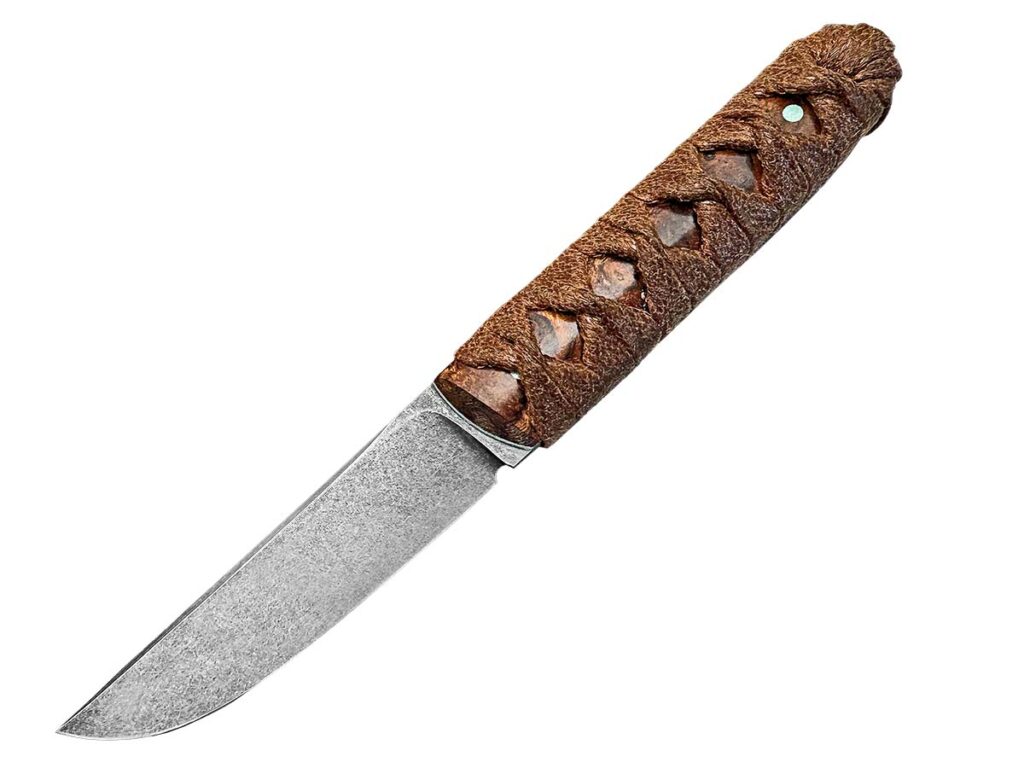
Neal Green and Christopher Adelhardt: Kwaiken
The Kwaiken by Neal Green and Christopher Adelhardt comes in a 3.5-inch blade of CPM 154 stainless, and an ironwood handle with G-10 liners and a brown tsukamaki (handle wrap). Overall length: 7.25 inches. It comes with a leather sheath (not shown) by Adelhardt. (Jocelyn Frasier image)
Peter Cocks: Hunter
Australian Knifemakers Guild member Peter Cocks won Best Hunter at the 2025 Perth Knife Show for Slug Life in a 3.55-inch blade of a flat-ground mosaic damascus of 1084 carbon and 15N20 nickel alloy steels. Scales: ringed gidgee. (Rod Hoare image)
Tracy Jones: Cowgirl
Cowgirl by Tracy Jones earned the maker the Best General Member award at the 2025 Texas Select Custom Cutlery Event. The 4-inch blade is flat-ground damascus and the scales are by Sara. Overall length: 8 inches. (SharpByCoop image)
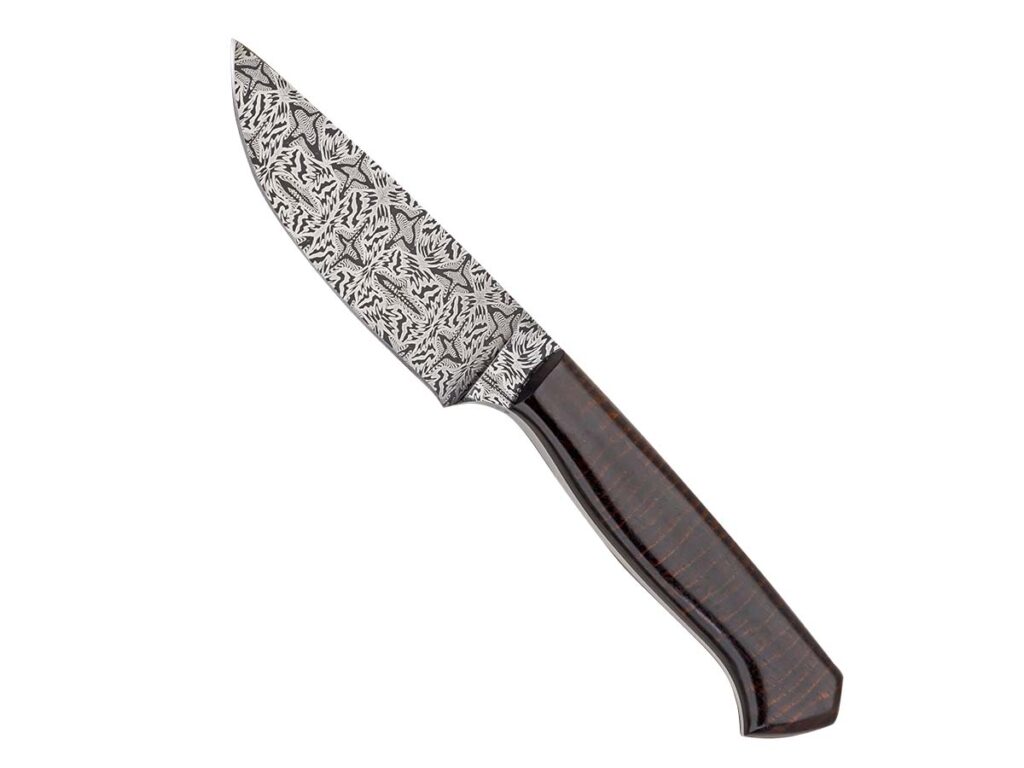
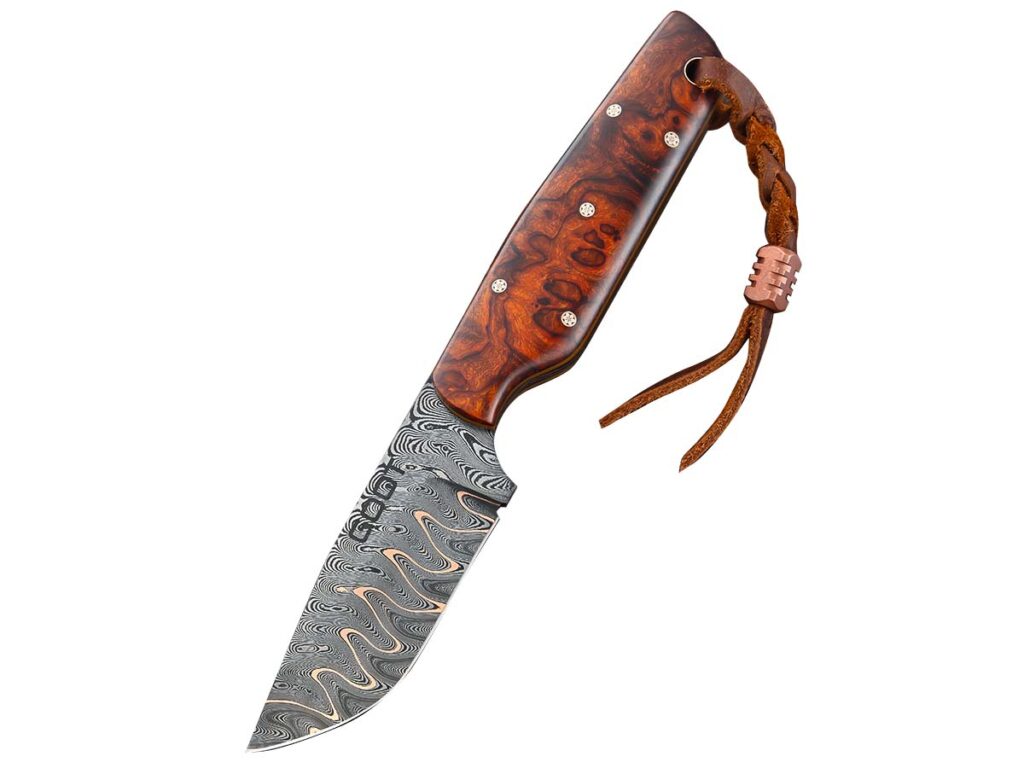
Daniel M. Gutierrez: Utility Fixed Blade
Daniel M. Gutierrez: Utility Fixed Blade
A 3-inch blade of a damascus of 1084 carbon and 15N20 nickel alloy steels and copper shim forged by Baker Forge & Tool, and a handle of ironwood burl help complete a utility fixed blade by Daniel M. Gutierrez. Blade grind: flat. Overall length: 7 inches. (SharpByCoop image)
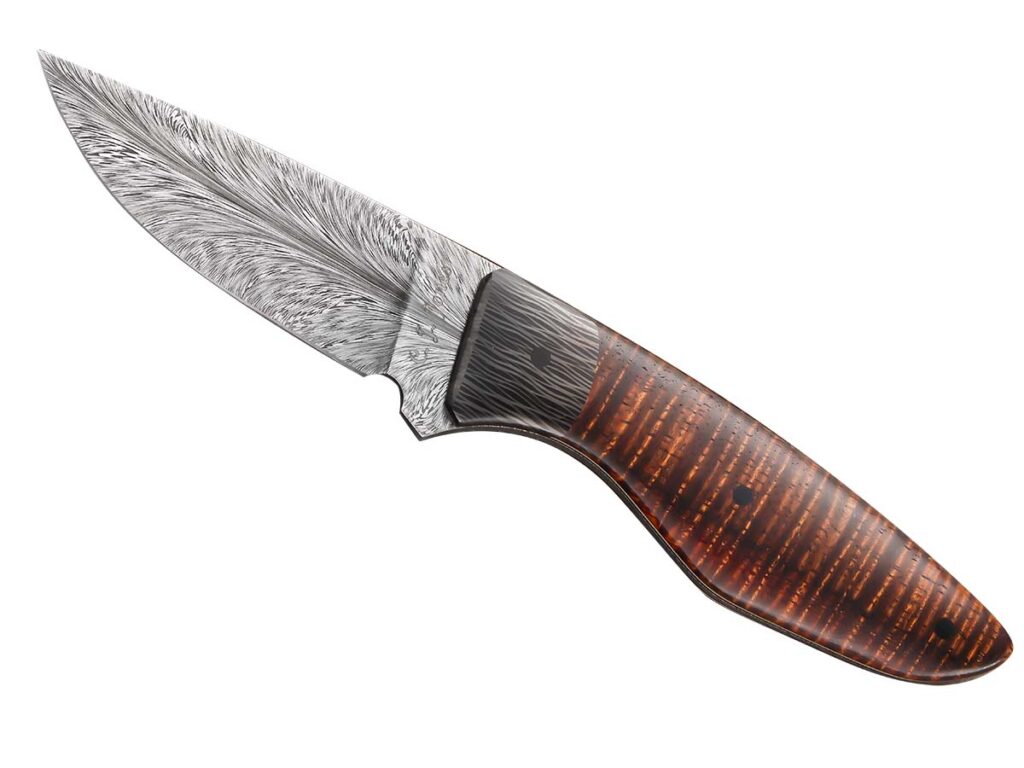
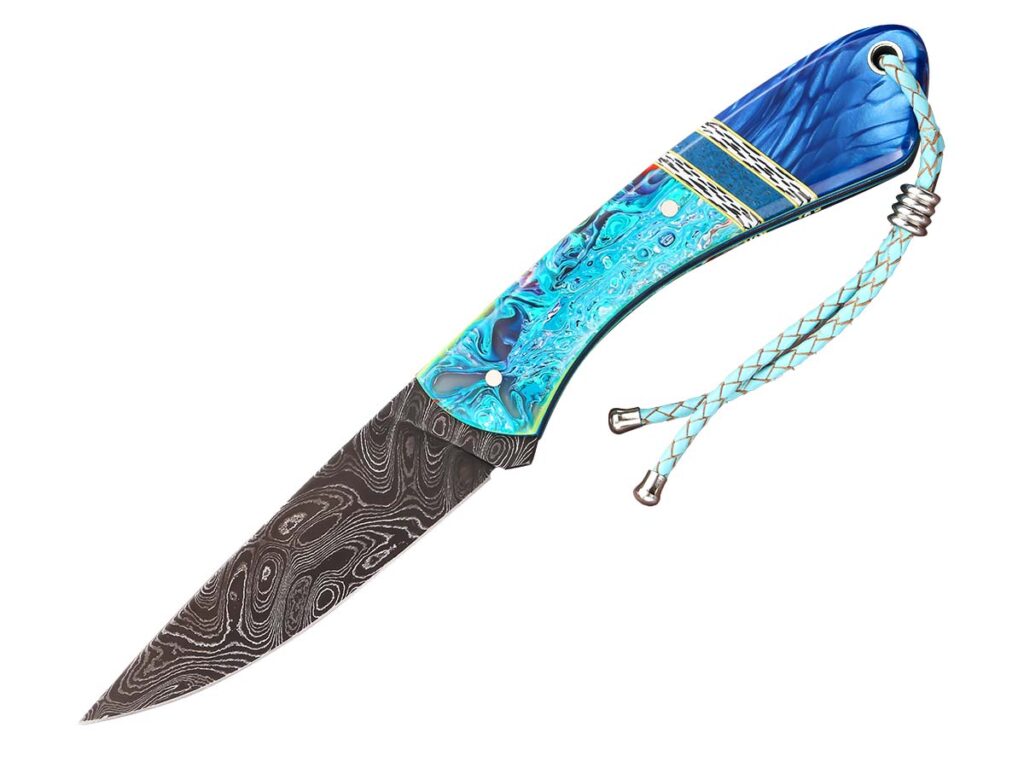
Chad Jones: Panther Fixed Blade
Chad Jones captured the title of Best Ranger Member at the 2025 Texas Select Custom Cutlery Event for his Panther fixed blade. The 3.25-inch blade is feather damascus and the scales are zebra carbon fiber and curly koa. Overall length: 7.25 inches. (SharpByCoop image)
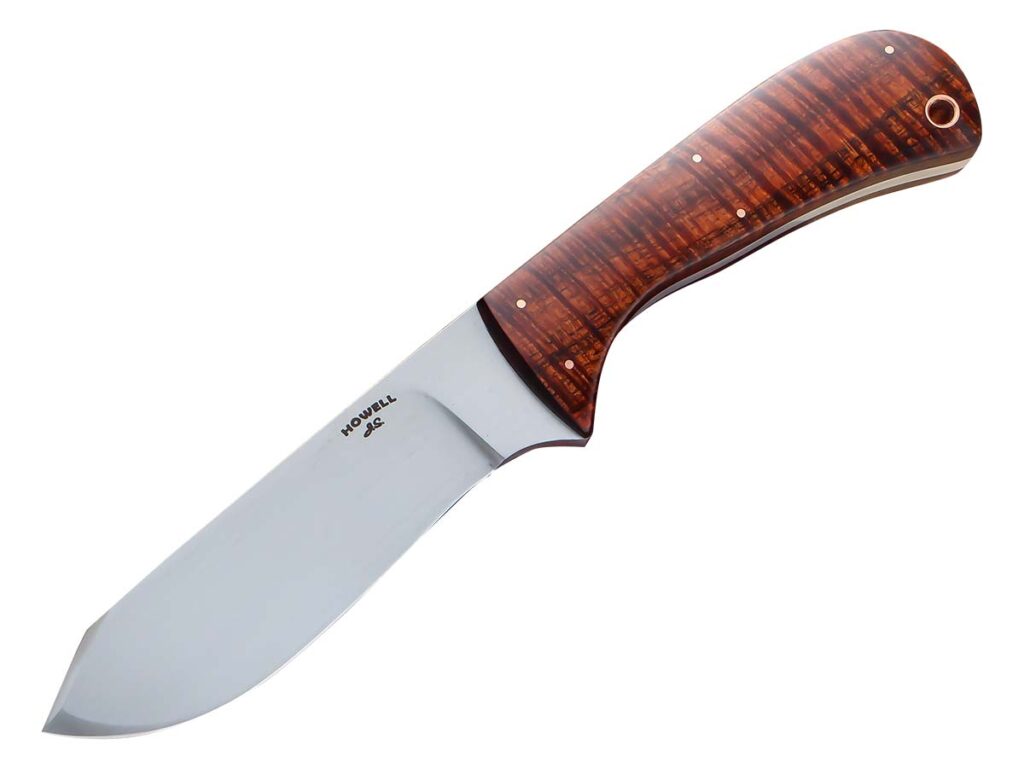
Jason Howell: EDC Fixed Blade
Jason Howell won the award for Troop 36 Scout Favorite at the 2025 Texas Select Custom Cutlery Event for his EDC fixed blade. The 3.75-inch spey blade is flat-ground 52100 carbon steel and the scales are French walnut. Overall length: 8.75 inches. The pouch sheath (not shown) is by Richard Epting. (SharpByCoop image)
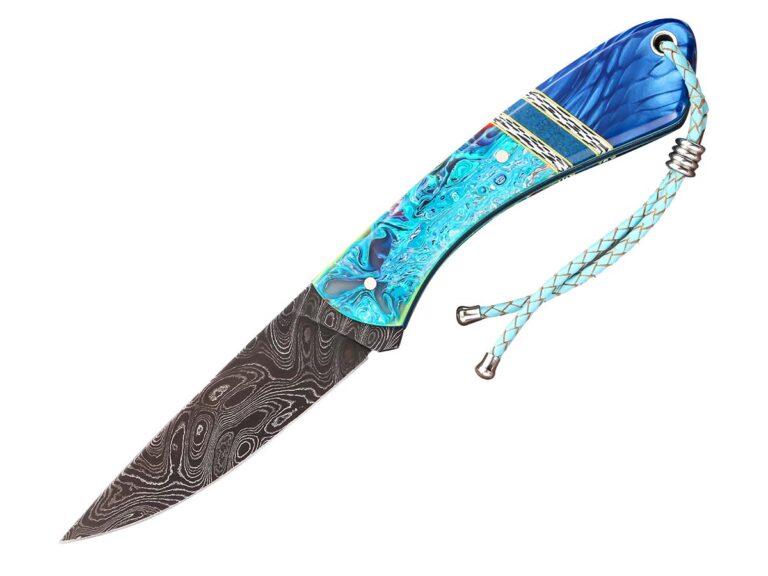
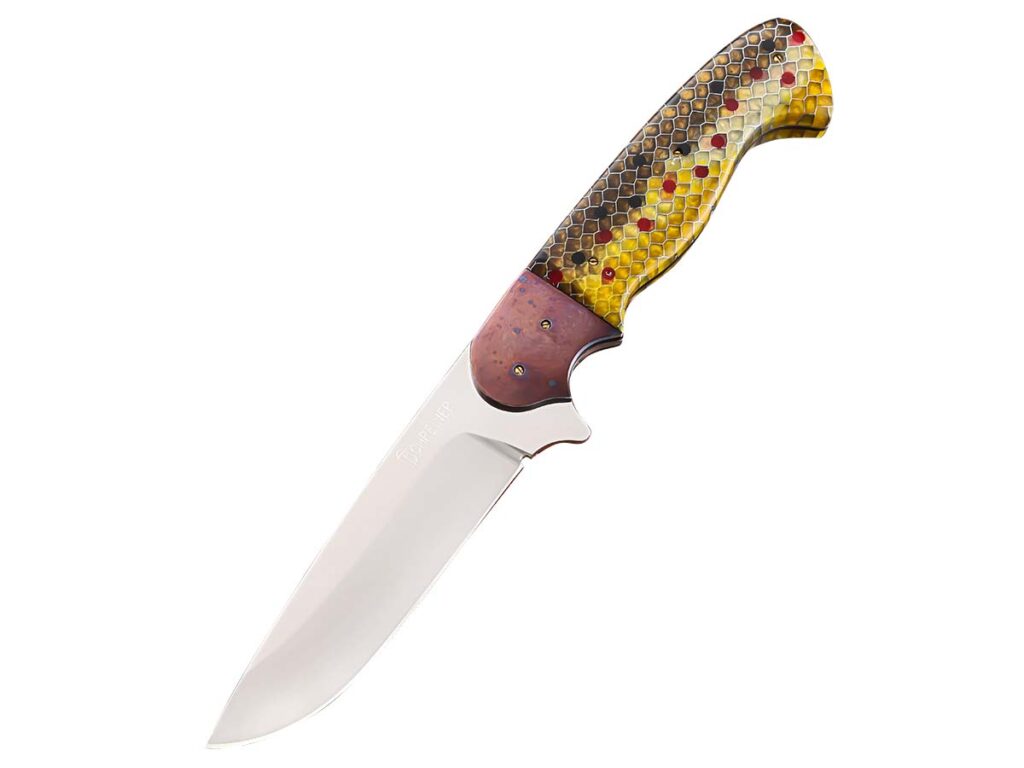
Dr. Terry Schreiner: Brown Trout Bird & Trout Knife
The brown trout/bird & trout knife by Dr. Terry Schreiner has a 4 1/16-inch blade of flat-ground CPM 154 stainless. The scales are a brown trout acrylic and the bolster is O1 tool steel. Overall length: 8 7/8 inches. (SharpByCoop image)
Cutlery Hall-of-Famer’s book showcases the most unique, historic and outlandish blades to enter their treasury.
Probably the most important international buyers of modern American custom knives ever, BLADE Magazine Cutlery Hall-of-Fame® members Aldo and Edda Lorenzi bought and then sold those knives and many other edged items in their iconic G. Lorenzi retail cutlery store in Milan, Italy.
Located on the Via Montenapoleone in the heart of Milan’s elegant retail sales district, and under Aldo and Edda’s direction, G. Lorenzi sold the finest knives, scissors, razors, table cutlery and assorted other edged wonders from 1959 to 2014, serving customers from every corner of the globe.
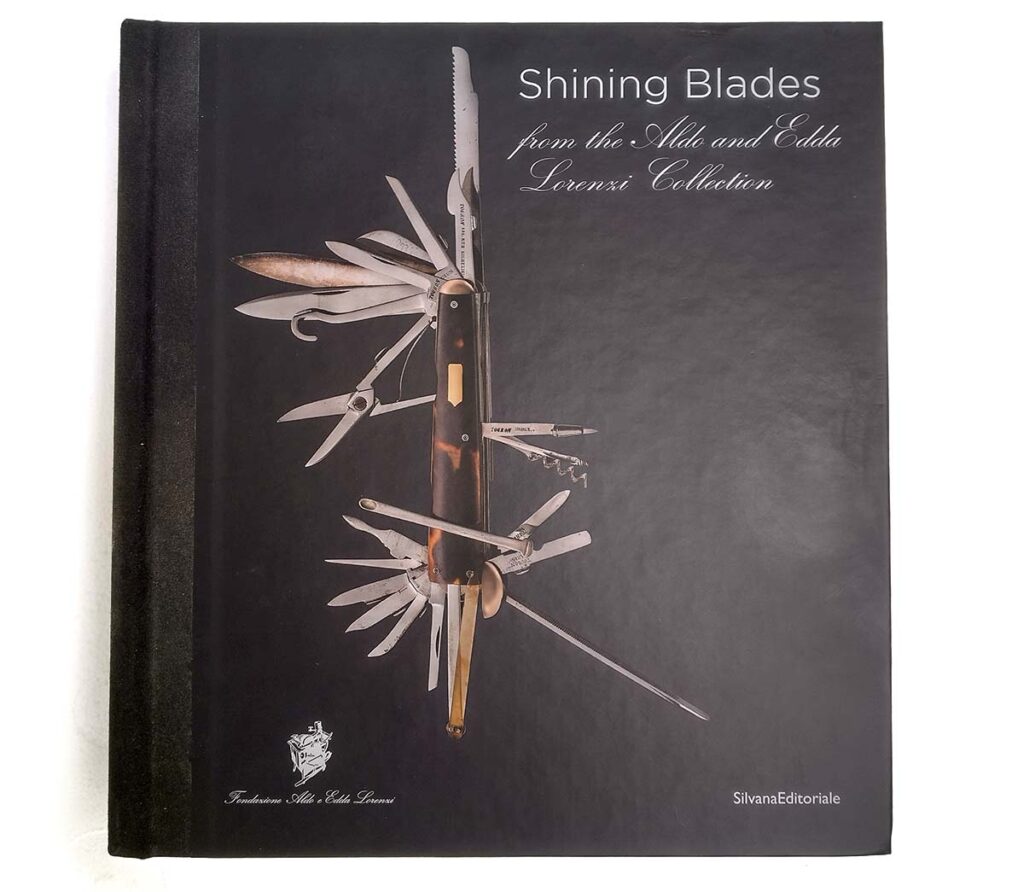
If you read BLADE® regularly, you know of the Lorenzis—but mostly only through the eyes of BLADE. In their new book, Shining Blades from the Aldo and Edda Lorenzi Collection, the Lorenzis recall their journeys far and wide in their lifelong search for the finest blades as only they can tell it, from the age of Elvis and crewcuts to the internet era.
Intrepidly scouring Europe, America and elsewhere for cutting tools of all kinds, the Lorenzis chronicle their travels in Shining Blades. From Aldo doubling Edda on their Guzzi Galletto motorbike through the snow and rain in the Alps on their first working trip to Fance in the early 1960s, to their early visits to the knifemaking shops of John Nelson Cooper, Cutlery Hall-of-Famer Bob Loveless and many other of the most famous American makers and beyond, the Lorenzis share their incredible story.
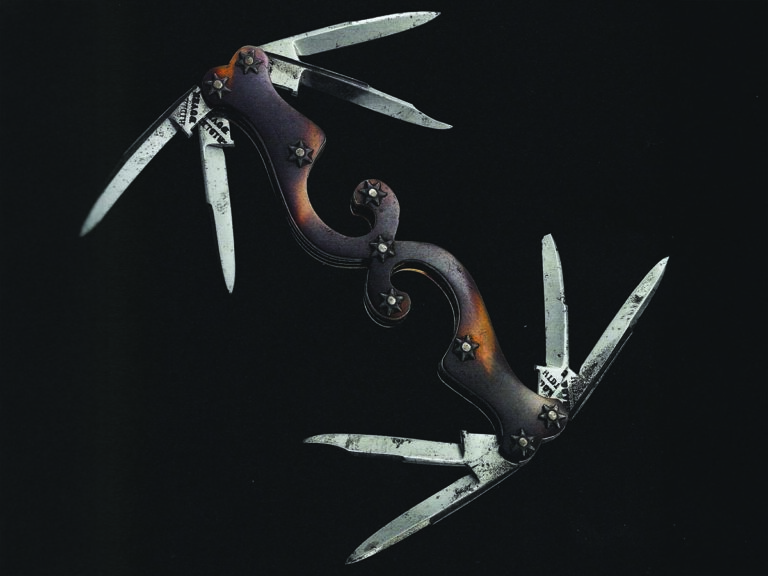
Shining through it all are full-page color images of some of the most spellbinding edged implements you will ever see. In addition to buying them the Lorenzis collected the vintage edged implements along the way. Bronze-Age spoons, folding forks and unbelievable folding knives of the 17th century forward are just some of the visual feasts of the edged art that populate the book’s pages.
For instance, if you think you’ve seen all there is to see in scissors, think again. The images of vintage scissors alone are enough to fill an encyclopedia on the subject. Spectacularly ornate and mystifying in construction, the scissors the Lorenzis amassed over the decades alone will take your breath away.
The preceding simply scratches the surface of what the book is all about. Most of what is illustrated and much more can be seen in the state-of-the-art Aldo and Edda Lorenzi Foundation museum in Milan.
The book also delves into some of the oldest knives known, from the 5,000-year-old knife of Otzi the Iceman discovered in 1991 on the Austrian-Italian border, the finest in European custom knives and knifemakers, ancient books on all things cutlery, notes on damascus steel and much more.
It’s all contained in a top-quality, 9 x 9.75-inch hardbound book with 344 pages that will provide you enjoyment for years to come. It’s a unique history with an MSRP of only $50—a ridiculously low price for such a landmark publication. However, as Edda Lorenzi noted, it’s not about the money so much as the education of worldwide edged tool enthusiasts and the recognition of those who authored some of the most fascinating edged tools extant.
“The book cost us about double its sales price [to produce], more or less,” she began. “Keeping the price low was our choice. It is a choice in line with our Nate Posner Award—to honor the artisans who created the works we loved most and whose names we would like to be known by as many people as possible, and to encourage new generations of artisans who, unlike collectors, certainly do not have large sums of money to invest in expensive books. To achieve this, this choice had to be made!”
If most anyone else had written the preceding paragraph I might be going, “Yeah, right.” But with the Lorenzis, you can rest assured it’s true. If you don’t believe me, ask members of the old guard at knife shows who know of them. If anything, my assessment of Aldo and Edda isn’t laudatory enough.
Niagara will help fill the shoes of an industry icon.
The recent demise of Crucible Industries LLC not only marked the end of a celebrated name in the manufacture of blade steels, it denoted the dawn of a new age—not only for the steels famously known by their CPM prefix, but other premium blade materials as well.
Used by Crucible and short for Crucible Particle Metallurgy*, CPM prefixed such Crucible steels as CPM S30V, CPM S35VN, CPM MagnaCut—today’s hottest CPM variant—and others among some of the most-used blade materials since Chris Reeve Knives popularized S30V on Reeve knives beginning in 2004-2005. S30V, in fact, was the first modern steel manufactured specifically for knife use. All other manufactured steels used in blades were originally made for purposes other than knives.
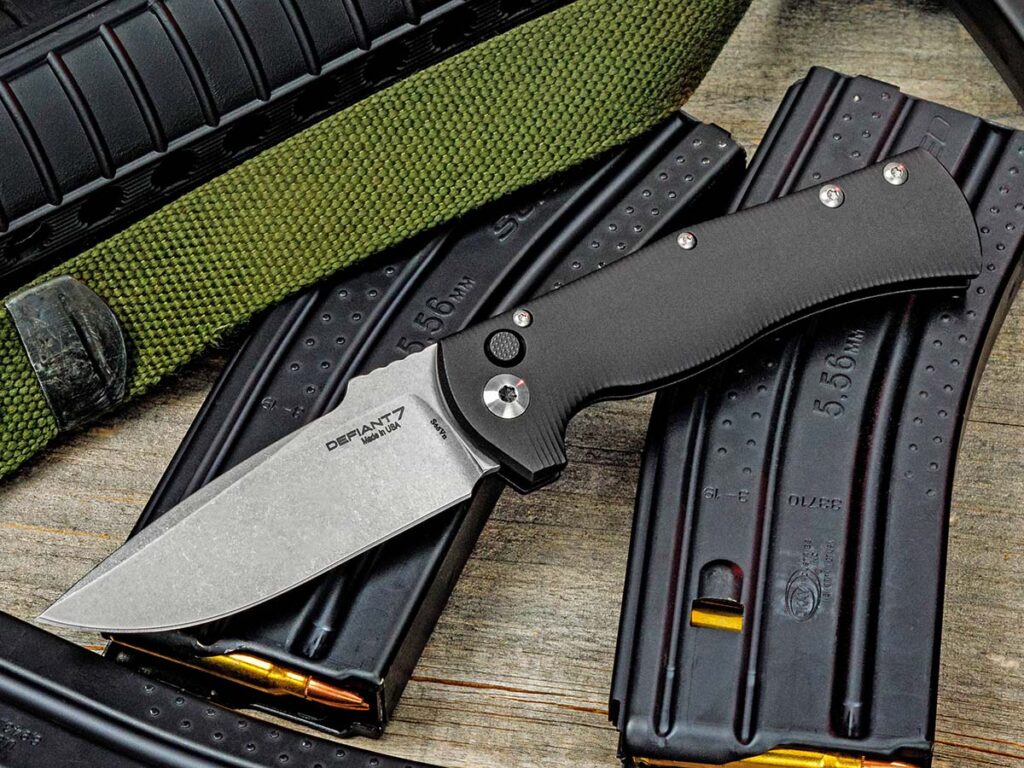
CPM S45VN is one of several of the old Crucible steels Niagara offers. The Defiant7 Auto Eagle has a stonewashed blade of the stainless steel and a black aluminum handle. Blade grind: flat. Weight: 4.4 ounces. Designed by Les George, it’s 4.75 inches closed. Country of origin: USA. MSRP: $285.
Crucible closed its doors earlier this year and sold most, if not all, of its assets at auction in February. So what happens to all those wonderful steels that both the factory and custom knife industries use in mass quantities?
According to Bob Shabala of Niagara Specialty Metals (NSM), NSM will do its part to have/supply most, if not all, of them, as well as other up-and-coming steels, to the custom and factory knife industries.
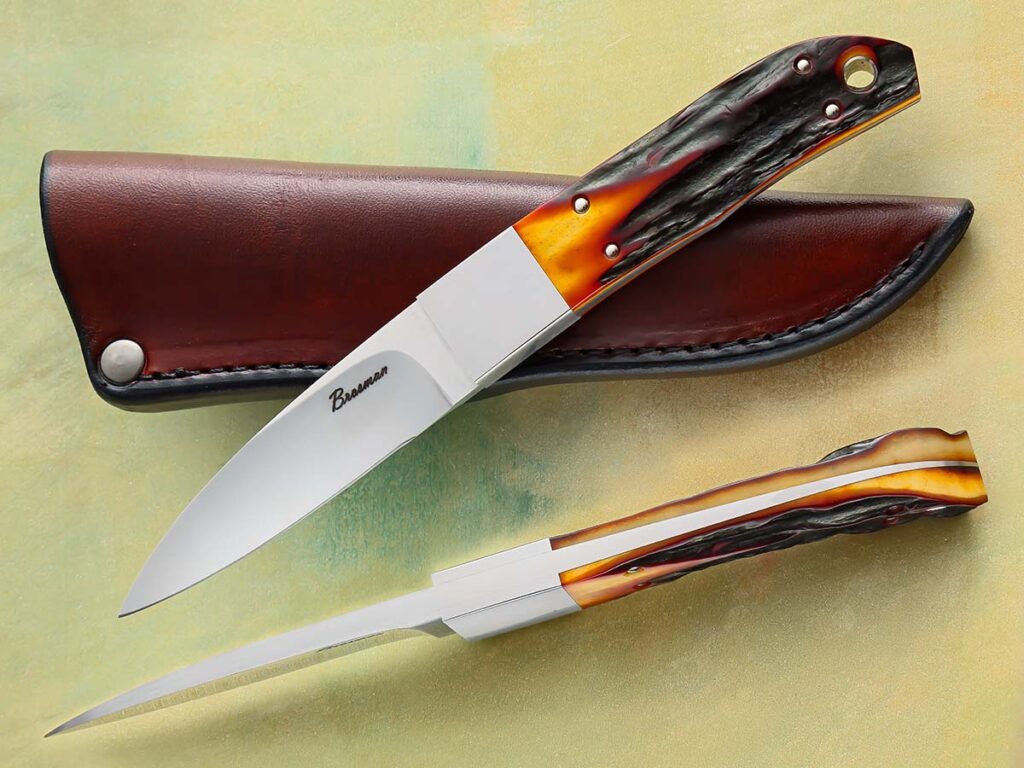
Among custom knifemakers especially, CPM 154 stainless is extremely popular. Craig Brosman employs it in a hollow grind and amber-dyed European red stag on his utility fixed blade. Overall length: 7.5 inches. (SharpByCoop image)
Opined Scott Devanna of steel service center SB Specialty Metals, “The majority of steel sheet in the U.S. comes out of Niagara. They’re the only [domestic mill] that can make it right now. It’s been that way for the last 25 years. They’re the only game in town.”
Erasteel And The Name Game
Erasteel, with state-of-the-art steel mills in France and Sweden, is owned by Syntagma Capital, a private equity group based in Brussels, Belgium. Erasteel acquired a part of the assets of the old Crucible Industries during the February auction, including working capital, steelmaking equipment and, perhaps most importantly, the trademarks for all the CPM steel names. A manufacturer and supplier of steels not only to the knife community but also the aerospace and other hi-tech industries, NSM had worked with Erasteel before the auction, processing millions of pounds of the Swedish mill’s steel for industrial applications.
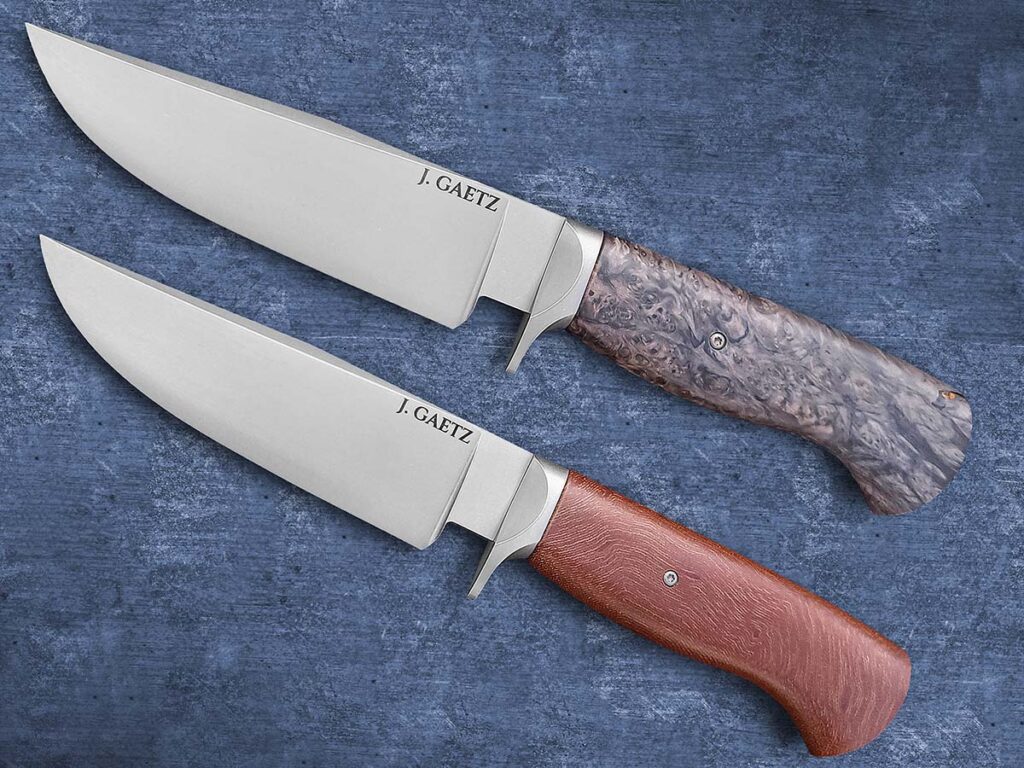
The 4.75-inch blade of Jacob Gaetz’s Large Field Hunter is CPM 3V carbon steel cryo-treated to a Rockwell hardness of 60-61 HRC. Handles are Apocalyptic box elder burl (left) and vintage Micarta® (right). Overall lengths: 9.875 inches. (Jocelyn Frasier image)
“We’d been doing that for several years,” Shabala noted, “so we know the quality of their steel is good.”
Together with Crucible, Erasteel is the pioneer in gas-atomized metal powders and started with the process in 1969. Today, it has the largest installed capacity in the world to produce metal powders, with two large atomizers built and designed by Erasteel.
Shabala said NSM officials understood their knife customers wanted the assorted CPM steels to keep the old names to avoid confusion among knife-buying consumers.
“They didn’t want to change the names and have to educate consumers on what the new names would be and how they related to the legacy Crucible names,” he explained.
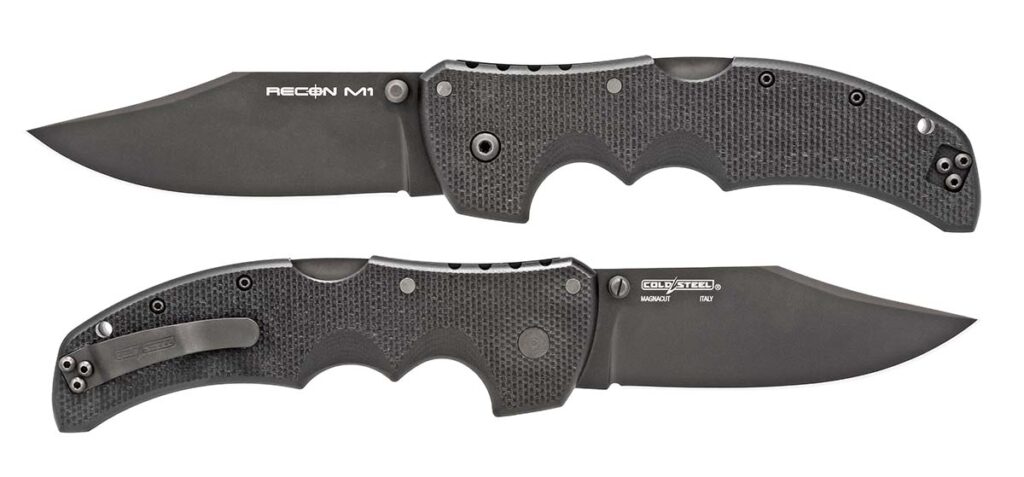
The Cold Steel Recon M1 sports a black-coated blade of MagnaCut stainless, which remains the hottest of the CPM steels used by both factory and custom segments of the sporting knife industry. Handle G-10. Lock: Atlas Lock. Weight: 5.2 ounces. Blade and closed lengths: 4 and 5.5 inches. Country of origin: Italy. MSRP: $309.99.
Meanwhile, the two companies reached an agreement where if NSM buys the steels exclusively from Erasteel, NSM can use the original names too, including S30V, S35VN, S45VN, MagnaCut, S110V, 3V and CPM 154. NSM and its customers can still use the full designation of CPM S30V, CPM S35VN and so on, though the customers can omit the CPM if they so choose.
“The reason we’re keeping the CPM 154 name is because everybody knows that it’s the powder metallurgy version of 154CM, so we want to keep that designation alive so people will know what’s going on there,” Shabala noted.
There will be a couple of exceptions. The steels formerly known as CPM Cruwear and CPM S90V will be renamed NSMwear and NSM 90PM, respectively.
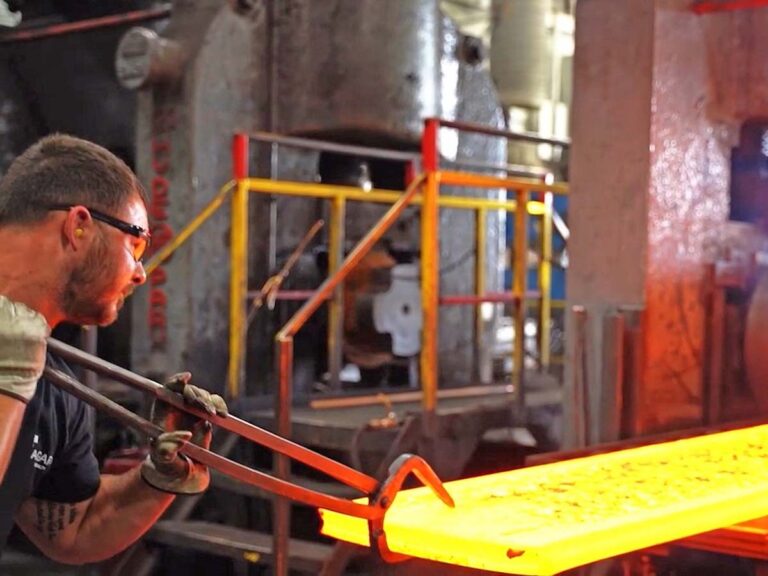
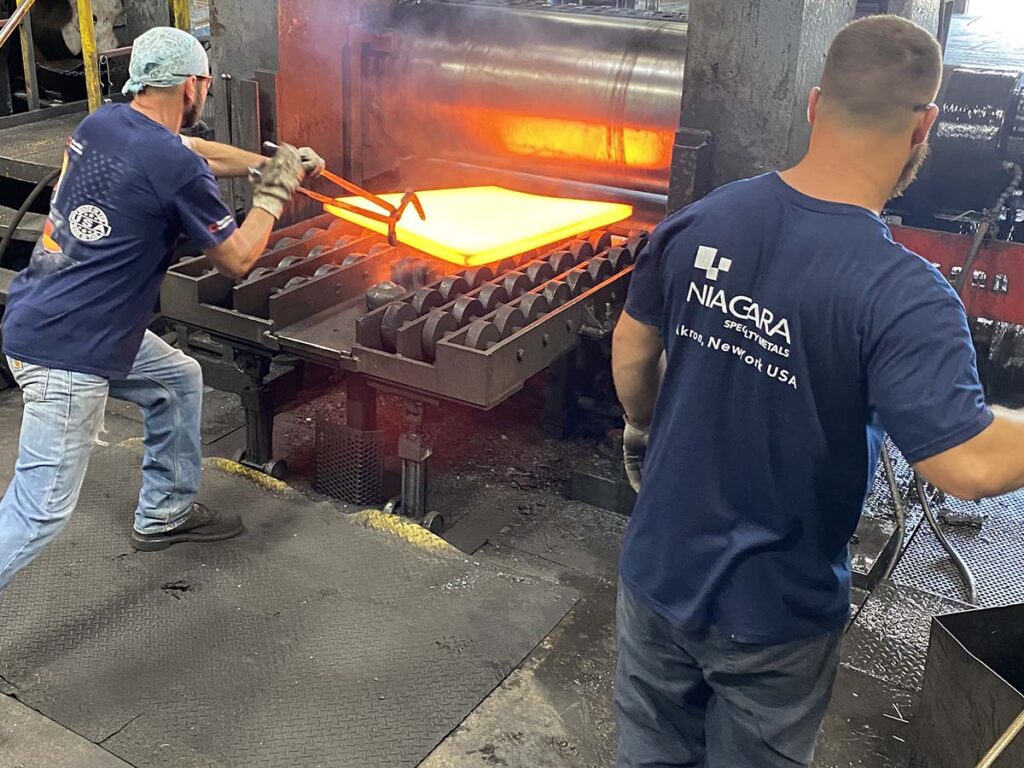
Niagara is both a manufacturer and distributor, not only of knife steel but also steel for the aerospace and other industries. It is employee owned and employs 41. (NSM image)
“Erasteel already had an agreement with another distributor to buy Cruwear exclusively, so we worked out a deal with them where we can buy the steel, we just can’t use the name,” Shabala explained. “It’s on us to educate people and let them know they can still get CPM Cruwear, it’s just a different name.”
As for CPM S90V, NSM already had Carpenter Technology’s version of it in stock and wanted to rebrand it so that it’s not sole-sourced to one mill. By renaming it NSM 90PM, “hopefully people will understand that it’s coming from us,” Bob said.
Steel Tariffs
Concerning steel supplies in stock, Shabala indicated NSM officials had been aware of Crucible’s coming demise, and in January 2024 began ramping up purchases to build inventory for any future supply disruptions.
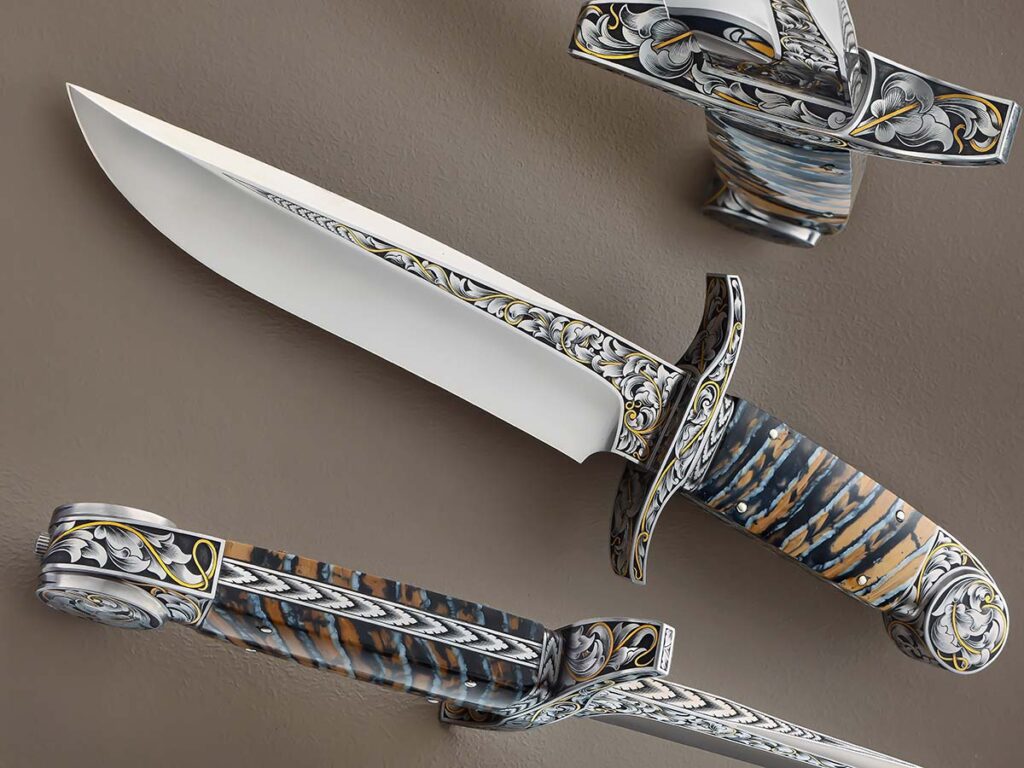
Dennis Friedly opts for CPM 154 stainless blade steel and a mammoth tooth handle for his Art Knife Invitational fighter. The copious engraving is by Ray Cover Jr. Overall length: 13 inches. (SharpByCoop image)
“We started placing orders with Carpenter and Erasteel in September 2024, though not knowing Erasteel would be the eventual owner of the CPM trademarks,” Shabala noted. “The steel we bought in September is starting to arrive. There will be some disruptions in MagnaCut and CPM 154, but everything else we still have a decent amount of and there should be no disruptions.”
In case you hadn’t heard, President Trump has instituted tariffs on most countries, including France and Sweden. At press time, the European tariff was 25 percent.
“Everything we buy from Erasteel as it stands right now is subject to a 25 percent tariff,” Shabala said. “Even the steel we buy from Carpenter, the powder for it is atomized in Sweden, so that’s subject to at least a 10 percent tariff.”
Dennis Friedly opts for CPM 154 stainless blade steel and a mammoth tooth handle for his Art Knife Invitational fighter. The copious engraving is by Ray Cover Jr. Overall length: 13 inches. (SharpByCoop image)
Another concern is whether knife companies can continue to mark their knives built with NSM steel “Made in the U.S.A.” Bob said he is up front with his customers, telling them that Erasteel will be supplying a “good chunk of our CPM alloys,” though it’s all hot rolled at NSM.
The question becomes if the raw materials are imported but don’t officially become a steel until they’re hot isostatic pressed, does that make the steel American made or imported? He indicated it will be up to his customers’ lawyers to hash out what the customers can and can’t do concerning U.S.A. markings on their knives.
NSM Innovaions
What’s on the horizon at NSM? One thing is a new grade developed by steel guru Larrin Thomas. Called Magnamax, it won’t be widely available until the end of the year. Since NSM has both patented and trademarked Magnamax, it can have it made by any mill it wants, and had it on order with both Erasteel and Carpenter at press time.
Bob Shabala of Niagara Specialty Metals
Meanwhile, along with Erasteel, Bob had high praise for the steel being made by Carpenter.
“We’re getting powder now that is atomized in a vacuum furnace. It’s a step forward in quality. We hardly ever had an issue with any CPM product from Crucible,” he qualified, “but I think Erasteel’s and Carpenter’s steel has a finer grain size. It’s a little microscopically cleaner than what we were getting before, so it really is an opportunity to provide a better product.”
As Shabala noted, Carpenter has made lots of cutlery steel, and NSM has processed a huge amount of it, hot rolling it into sheets and sending it back to Carpenter’s warehouse for sale to various customers. One of Carpenter’s best-known steels is CTS XHP stainless.
“It’s a grade that customers really like,” Shabala said, adding that NSM had over 20 tons of it and was in the process of preparing to make a big marketing push on it at press time.
Having steel manufactured in the USA remains a big selling point with many of NSM’s customers, so the company remains on the lookout for new melt sources, one of which is Prime Metals & Alloys (PMA) of Homer City, Pennsylvania. A manufacturer and supplier of a wide range of steels for assorted hi-tech and other uses, PMA was in the process of making steel for NSM at press time, which Shabala seemed to think holds great promise.
Larrin Thomas, metallurgist and knife writer
“We should receive it in a couple of months, but if it works out it’s going to be an ESR version of stainless steel that we’ve always supplied, so it should be a noticeably better product than what our customers were used to before,” he said. “It’s really a good find for us to be able to get a higher-quality steel with a shorter lead time, so we’re really excited about that.”
ESR stands for Electro-Slag Remelting, a process that results in a very clean steel devoid of contaminants.
“In a traditional melting process, you heat the steel up, get it in a molten state, pour it in an ingot and that’s it,” and later forge and finish it out, he explained. “With ESR you take that ingot and you remelt it again and all the slag and contaminants float to the top, and they’re skimmed off. What remains in the new ingot is a cleaner version of the original.”
Shabala added that two different grades of NSM stainless steels that had always been air melted will now be ESR melted.
NSM’s Role
People often misunderstand a company’s role in any endeavor, and Shabala said that seems to be the case with NSM.
“Larrin Thomas was concerned that people had the misconception that NSM is just a distributor, that we just got sheets from Crucible and resold them,” he observed. “He said we should emphasize the fact that we’re a lot more than a distributor, we’re a manufacturer, we buy slabs of steel, we process it into the final dimensions and ship it. Cutlery is a big part of what we do. We do a lot with the aerospace industry, so we know a lot about quality standards.”
NSM is 100 percent employee-owned, so all 41 employees in its mill in Akron, New York, just outside Buffalo, own a piece of the company.
“Everyone here has a vested interest in ensuring that we’re successful and doing everything we can to put out a good product,” Shabala said.
A last point of emphasis Bob made was that just because Crucible went out of business doesn’t mean NSM is going out of business—in fact, far from it.
“We’re very financially sound. We just put out a $7 million upgrade in our sheet mill, we’re rolling out finished product, it’s the biggest expansion we’ve ever done and we’re getting ready to expand our grinding and laser-cutting capability,” he noted. “We’re really, really in good shape.”
*Editor’s Note: For more on the particle metallurgy process, visit Knife Steel Nerd’s post on powder metallurgy.
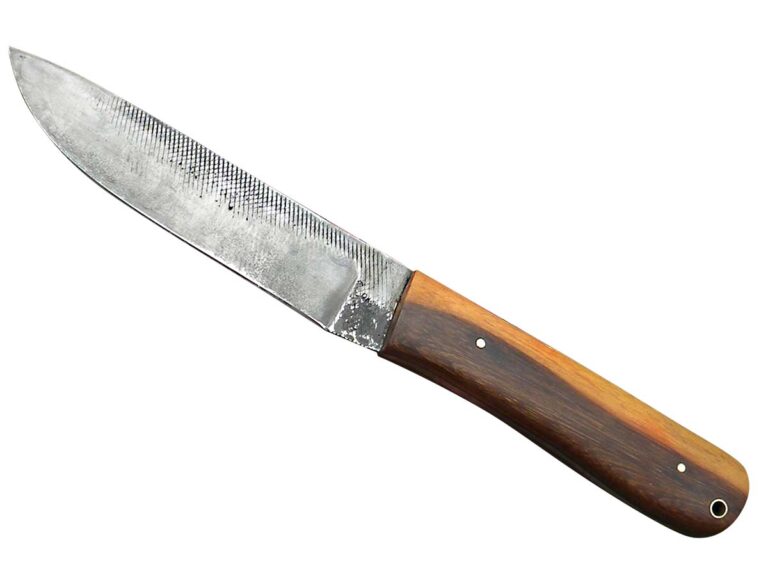
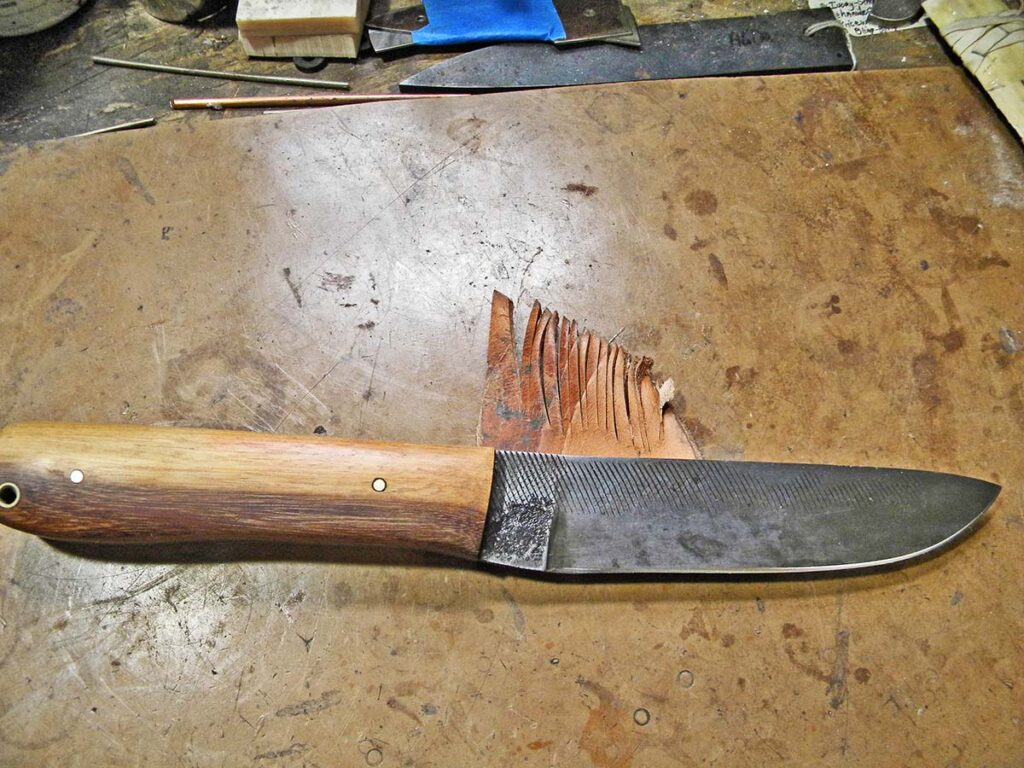
The Bushcrafter by Kris Waddington of KSW Custom Knives is a great example of what bladesmiths can do with recycled carbon steel. Got a worn-out file? No problem. They can convert it into another useful tool—a knife.
With a hot-enough fire, a smith can manipulate the steel into a wide variety of shapes and sizes. High carbon steels are made into cutting instruments, mild steels into ornamental fittings. It’s a great skill to possess and practice. Kris has the skill.
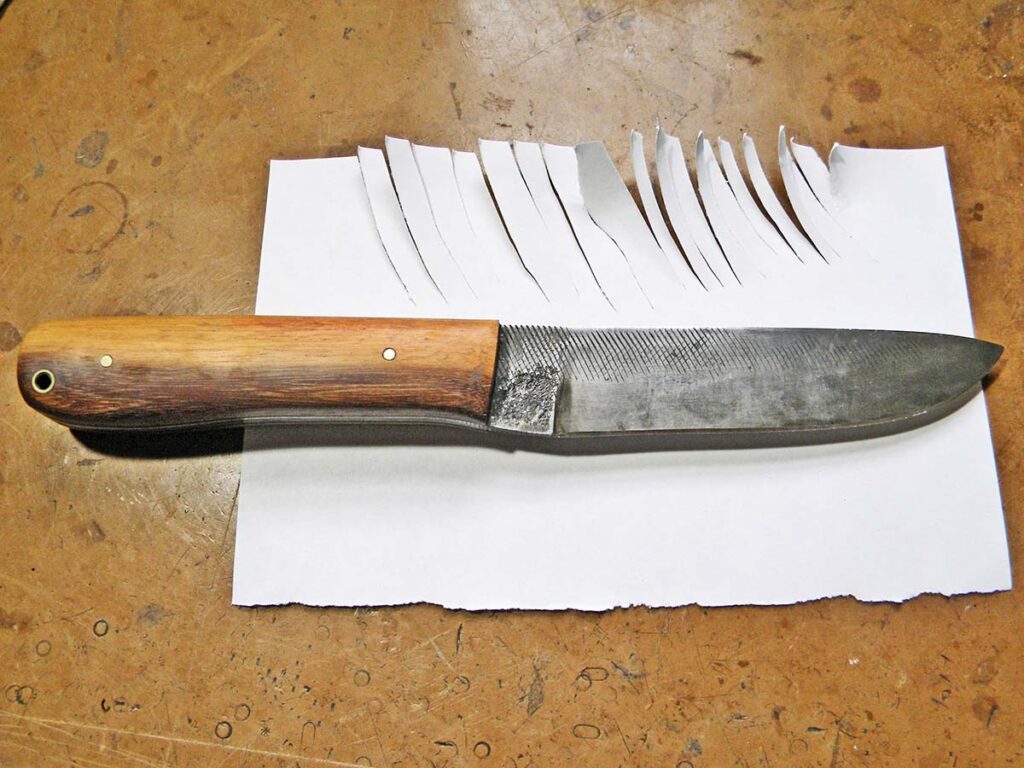
At the end of testing, the author returned to slicing the copy paper to check for edge snags or chips. The Bushcrafter sliced for the win. There was no edge damage. Heat treatment: spot on.
Enough talk about the cool stuff he can make. Let’s get into how well he performed the conversion.
Light-Duty Cutting
I always slice 20-pound bond copy paper at the start to see how fine the knife’s edge is. The Bushcrafter did not disappoint. The upcycled Nicholson file slid through the paper with ease. It made clean, crisp slices again and again. The knife is very sharp indeed.
The Bushcrafter cruised through the 8-ounce leather very quickly with straight cuts.
From there it was on to severing single-walled cardboard. The Bushcrafter sliced through the medium quickly and aggressively. I could hear every slice. It was easy to control the spacing of the cuts with the larger handle.
Cutting 8-ounce leather to represent the skin of a harvested big game animal was next. The Bushcrafter crunched through it very quickly with straight cuts. Skiving the material was even louder as the knife aggressively sliced it into thin layers. The leather was no challenge whatsoever.
Heavy-Duty Cutting
Cutting sisal rope always tells if the edge will hold up. The Bushcrafter crunched through 200 cuts very quickly and wanted more. There was a small hot spot where the handle meets the blade. A quick hit with 220-grit sandpaper removed the spot. The blade held an edge while slicing and cutting. It was time for a tougher medium.
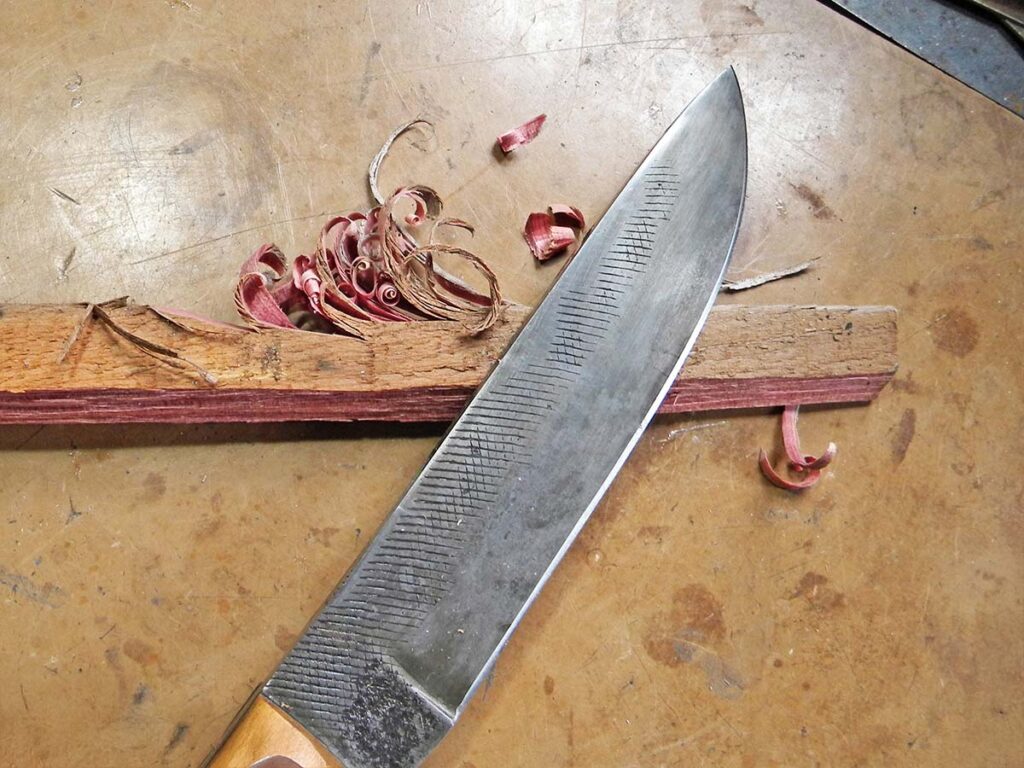
The Bushcrafter turned out some excellent red-cedar curlicues ready for the fire.
For bushcrafting, I chopped a slab of red cedar. The blade buried deeper than expected and cracked the slab. It was comfortable using the knife.
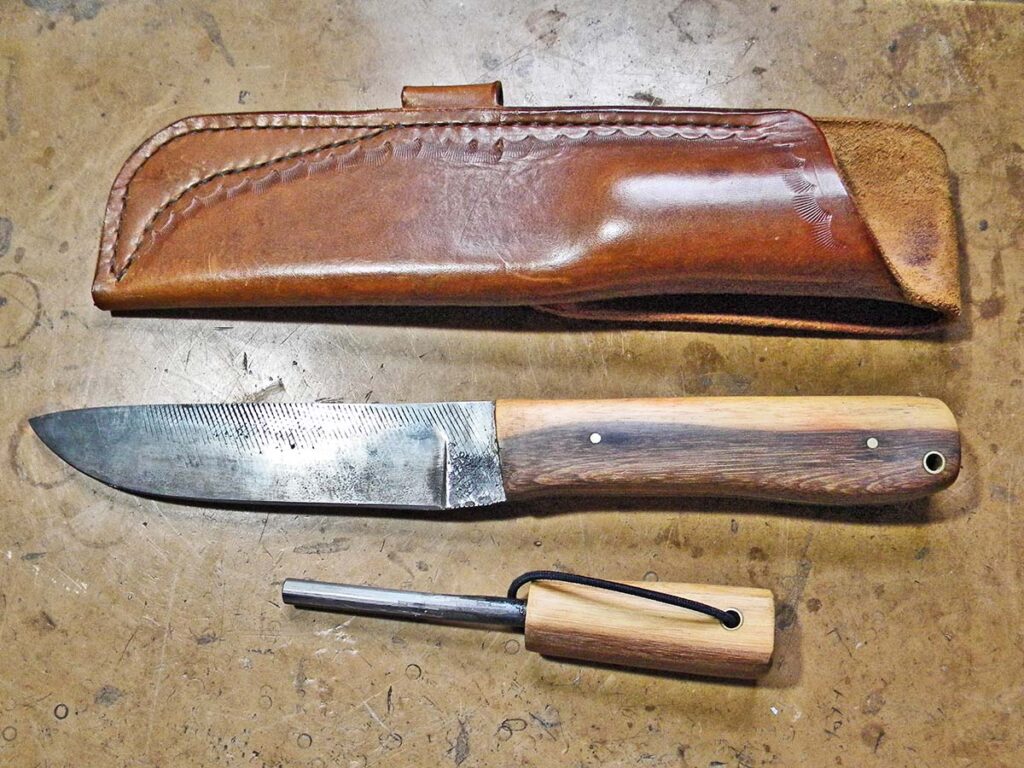
I worked the cedar to make a fire stick. The Bushcrafter turned out some excellent curlicues ready for the fire. Batonning was next in line. The knife averaged 3 1/2 baton hits to split the slab into small kindling. That was some short slab work! To raise the bar, Kris added a ferrocerium rod with a matching handle. The result is a complete outdoor package.
A leather sheath and a ferrocerium rod with a matching handle complete the outdoor package.
I returned to slicing the copy paper to test for edge snags or chips. The Bushcrafter sliced for the win. There was no edge damage. Heat treatment is spot on. Great job, Kris.
Final Cut
I would prefer more of a finger notch and maybe some thumb notches for added control. The Bushcrafter lives up to its name. Made to perform in the woods, it is the total package for your backpack outing.
The author tries out the Lansky Folding Tapered Diamond Rod Sharpener.
Over the years I’ve written a number of articles on sharpening. I have also taught countless sharpening classes covering everything from knives, saws to Forstner bits. Sometimes you need a special tool to get the job done. In the case of serrated edges, you need a dedicated sharpening tool. This time it’s the Folding Tapered Diamond Rod by Lansky. I will cover the basics of sharpening a serrated blade as well.
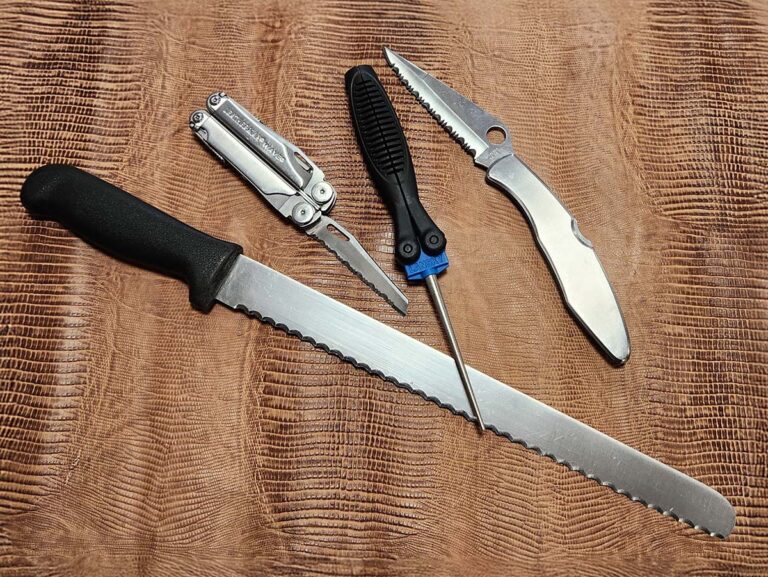
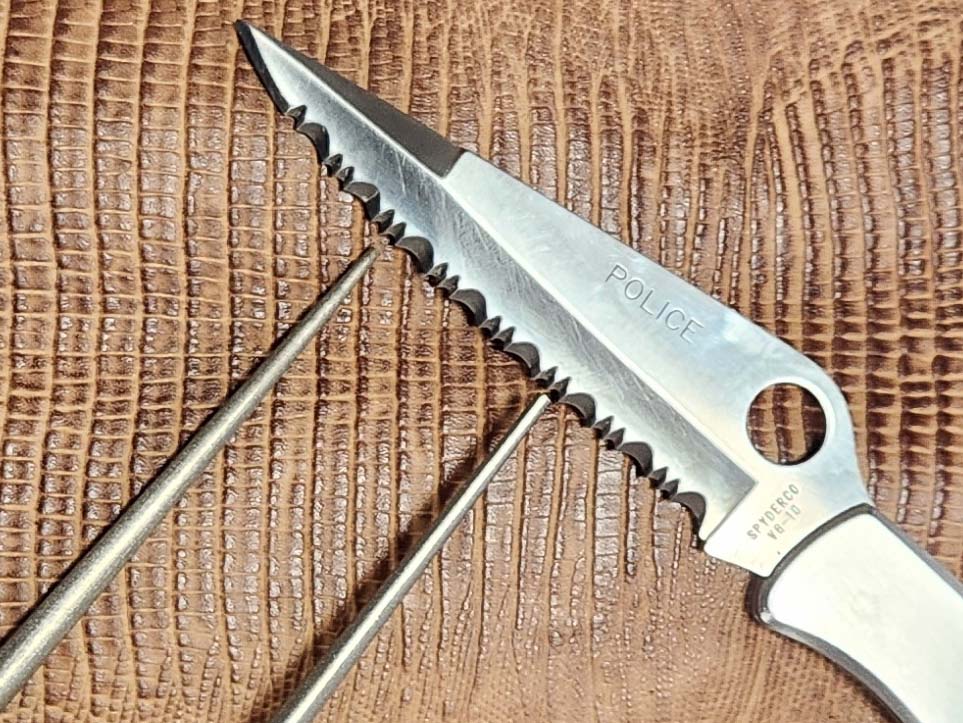
The two serrated blades I carry most is the one on my Leatherman Wave and my Spyderco Police. I am a property maintenance man and the Wave is like my right arm. The Police sends chills down the spines of people when I open it. Let’s get to sharpening them.
Keep It Simple
First off, there are those who would like to complicate sharpening by making it seem more than it is. At its core, sharpening is simply polishing two surfaces that meet at an edge. In the case of a serrated blade, the edge has a series of gullets (channels) and teeth. The different contours on a serrated edge require a sharpening tool that can accommodate such a surface.
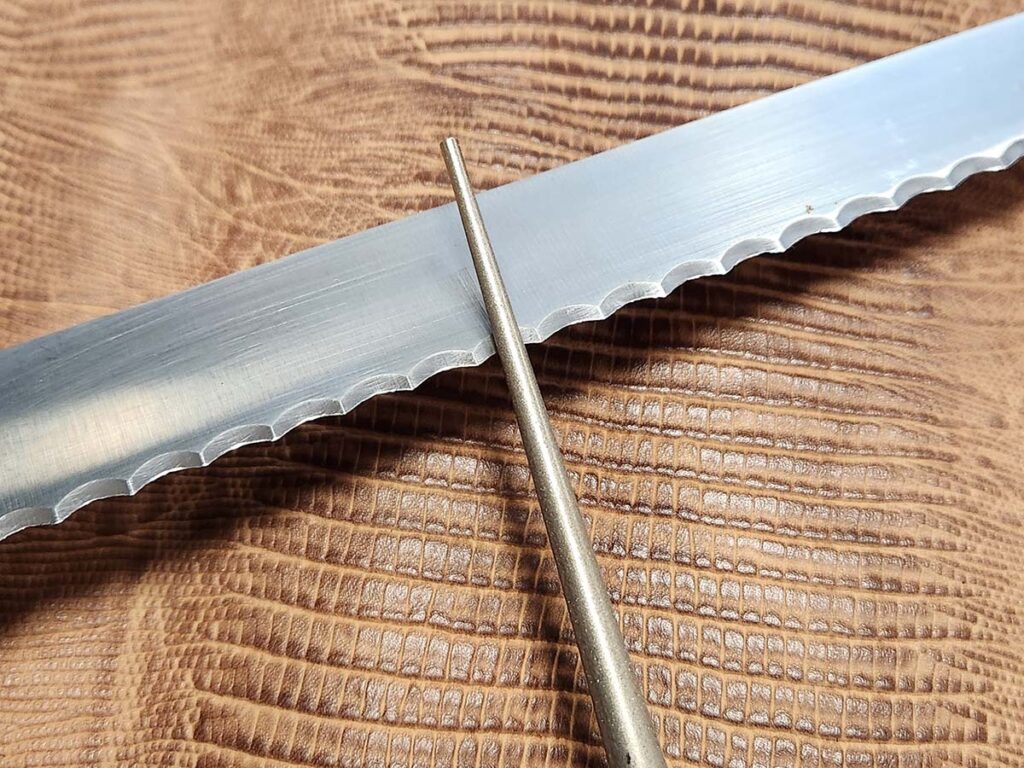
Sometimes when sharpening a serration with a broad diameter, the author follows the secondary bevel across the edge instead of pushing the sharpener into the blade.
Another feature of serrated edges is that a number of them are formed with a chisel-style grind. By chisel-style grind, I mean the secondary bevel to the edge is on one side only. Since serration patterns vary, you need a sharpener that will accommodate different sizes of teeth and gullets. A common form is the use of a cone. A cone-shaped sharpener should match the size of a serration somewhere along the cone.
Sharp Specs
Lansky has taken a tapered diamond impregnated rod and created a foldable handle that acts like a case for the rod. The style is not uncommon except Lansky takes the ergonomics a step further by making the injection-molded handle contoured for a more solid grip.
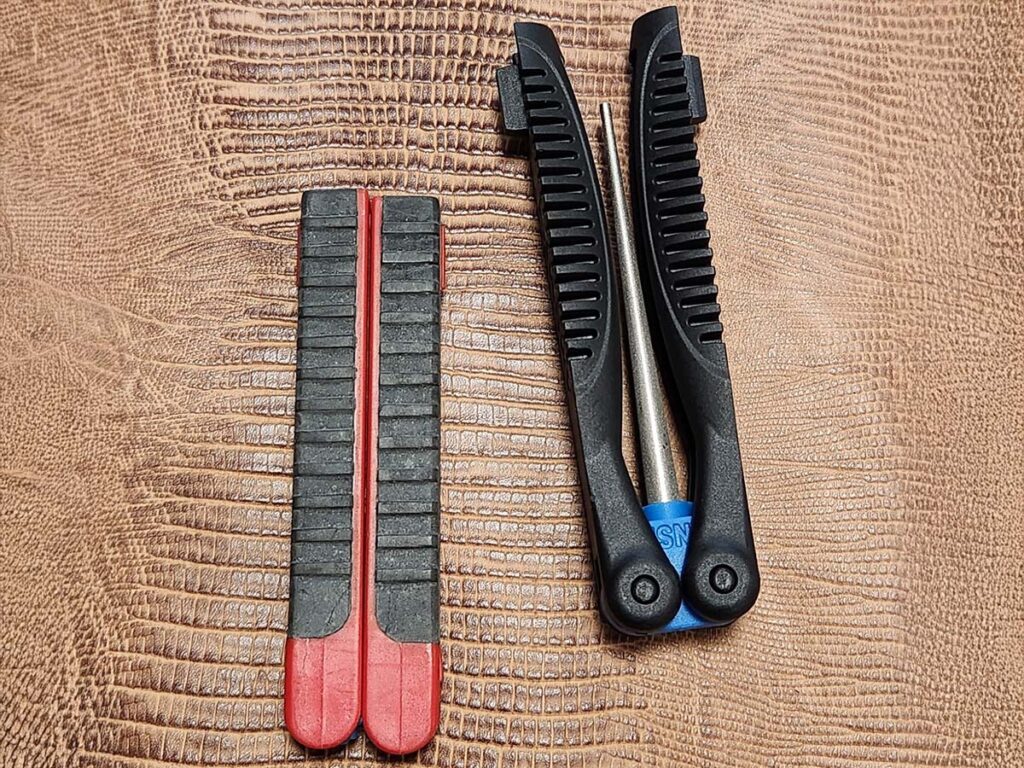
The author’s older Lansky folding sharpener (left) does not have a large enough diameter for some bigger serrations. Meanwhile, the new Lansky model (right) has a larger tip diameter than the older one, making it impossible to use on smaller serrations.
The diamond coating is electrostatic-plated to the rod, which is better than using an epoxy as some others do. Lansky uses a 600-grit coating. It is not an aggressive grit, though on the other hand you don’t want a grit that is too aggressive for serrations. If you get too aggressive of a grit, then a mistake can ruin the blade. The one issue I find with the Lansky is the tip of the cone is a bit large for some serrations. Other than that, I plan to get a lot of work out of this sharpener for years to come.
The Method
First, brace the blade you are sharpening against a stable surface. Position the blade’s secondary bevels up. I tend to prefer the dynamic style of sharpening in these cases, so I move the sharpener, not the blade. Match the angle of the secondary bevel when placing the rod in the serration.
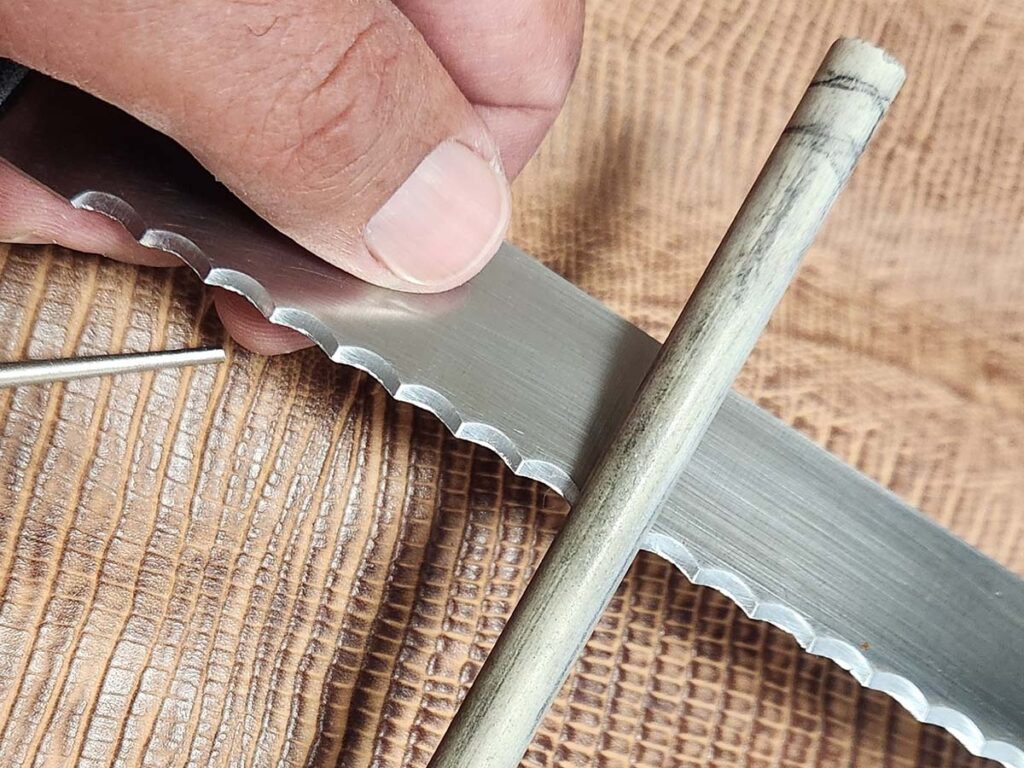
There is often more than one way to do something. Here the author uses a ceramic sharpening rod whose diameter closely matches the serration.
Position the rod a bit before the diameter of the cone that matches the serration being worked on. You don’t want to start your sharpening stroke at the beginning of the cone as that will change the shape of the gullet. The intent is to remove as little material as necessary. If you start sharpening close to the beginning of the cone, you will cut into the gullet. Keep close to the diameter of the gullet and take short passes.
When finished, I check all the teeth to make sure they are still pointed. Then I briefly strop the opposite side of the blade with a compound-loaded leather strop. Just a couple of passes will remove the burr. Lansky lays out the static method in the directions, which means you move the blade along the rod. Try both methods and see which one works best for you. Everyone has their own preference. In the end it is more important to get good results.
Parting Cuts
Serrations shine when it comes to cutting fibrous materials such as cord, rope and nylon straps. At my shooting range, when I score a bunch of cardboard for backers, I usually use my serrated knife to cut the cardboard down to size.
A downside to the new Lansky folding sharpener is that it isn’t as compact as the older Lansky design (right).
It is best to maintain serrated edges. With a plain edge you can let it go then sit down with it and bring it back to life easy enough. Serrated edges I find it best to stay on top of and regularly give them some upkeep. Wearing down the tips off the teeth and blowing out the gullets just makes more work and creates more chance you will mess up the serrations.
If you don’t own a good quality serrated knife because you are concerned about sharpening it, then buy a cheap one and practice your technique. Lastly, if you own just one serrated knife outside your kitchen bread knife, make it the rescue knife in your car.
Lansky Folding Tapered Diamond Rod Sharpener Abrasive: Diamond-coated rod Rod length: 3.5” Rod thickness: 1/16” at tip, ¼” at base Grit: 600 Handle: Nylon Sharp stuff: Sharpens serrated blades, fishhooks, gut hooks and more; the rod folds into the handle for protection and ease of carry Weight: .2 oz. Closed length: 5” Open Length: 9” Country of origin: USA MSRP: $19.95
Consider three cool tools to keep your scissors shearing sharp.
I sharpen knives frequently but must admit I’m a loathsome scissors sharpener. It’s not like I’ve never sharpened scissors but only when I had to and never in an organized way.
However, when my editor gave me an assignment on scissors sharpeners, I took it as a personal challenge to mend my ways—and off I went. What follows is a primer on scissors sharpening using three different systems.
Before starting, there are a few obvious things to point out.
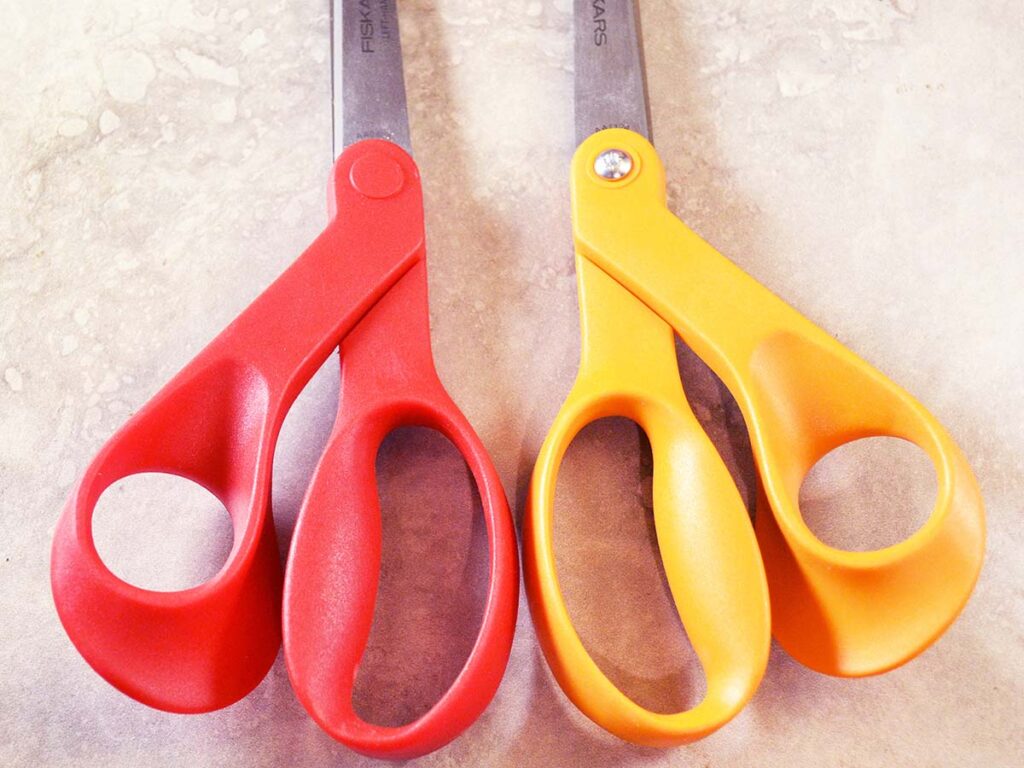
The most obvious is the fact that there are two blades to sharpen instead of one. Second, the two blade edges are sharpened to oppose each other. Third, most scissors are made for righthanders and can give lefthanders fits, especially models with asymmetrical handles. Some southpaws have more trouble than others, and if you are among them you might seek out companies that either offer lefthanded models, such as Fiskars, or those that specialize in such products, like Lefty’s Left Hand Store. My brother’s lefthanded and he’s never bought any lefty scissors. Instead, he simply buys and uses symmetrical right-hand-only models.
Simple handheld or desktop scissors sharpeners are the way to go if you want to keep a decent edge with very little hassle and time consumption.
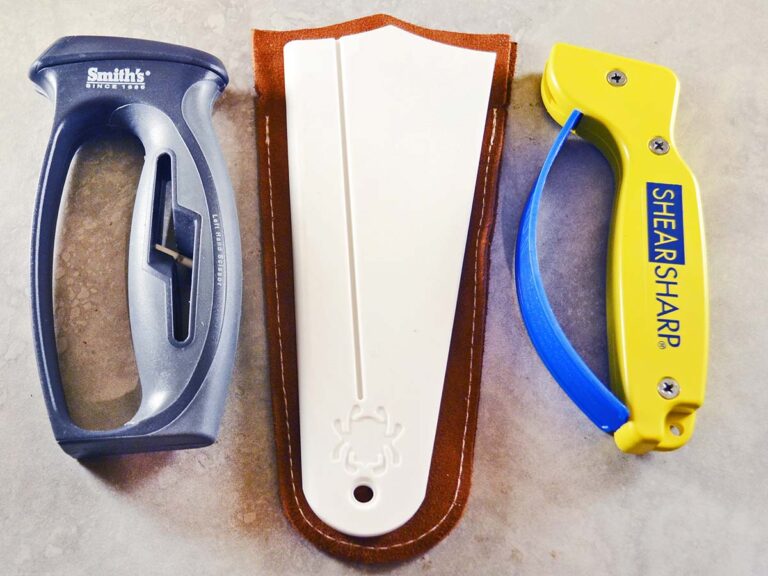
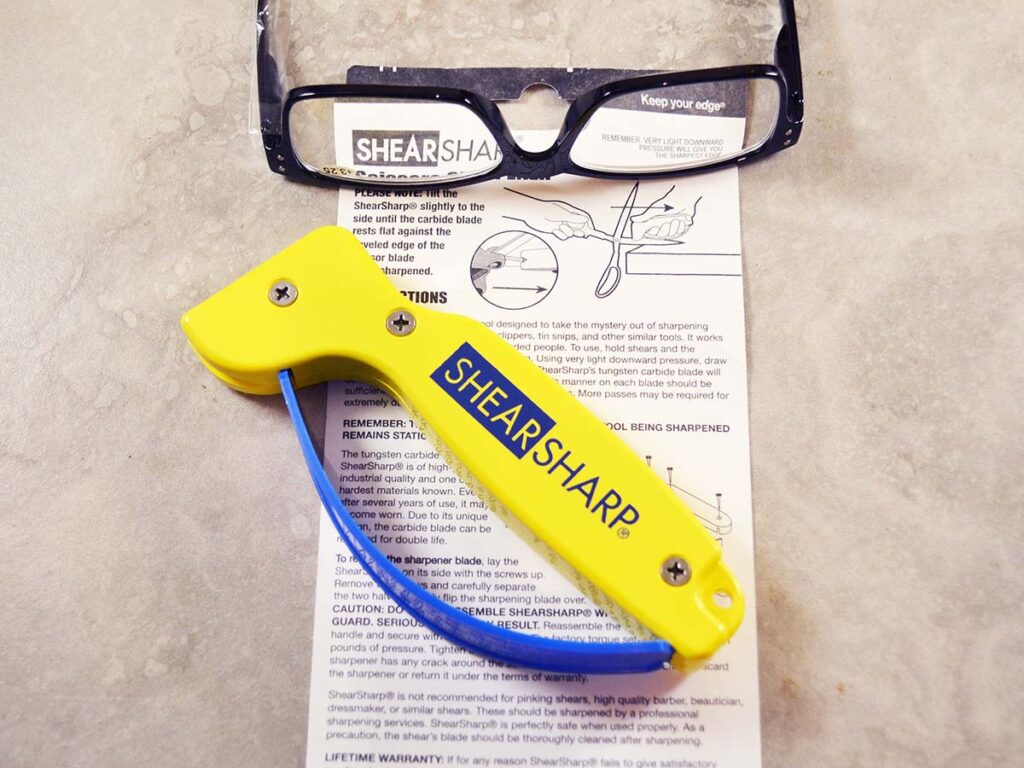
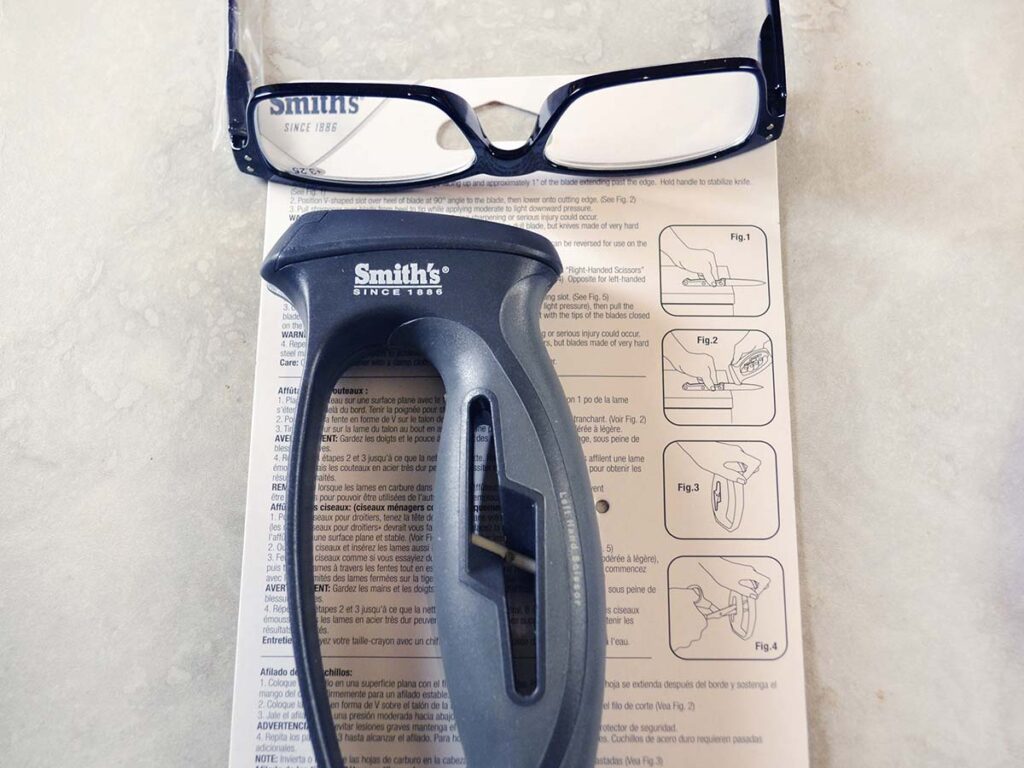
I tested two affordable versions: the AccuSharp ShearSharp Scissors Sharpener and the Smith’s V-Slot Knife & Scissors Sharpener. The pistol-grip-looking units appear similar at first but are actually quite different. The text and graphics on the back side of the cards the sharpeners are mounted on is very helpful, though if you’re like me you will need reading glasses to decipher them.
AccuSharp ShearSharp Scissors Sharpener
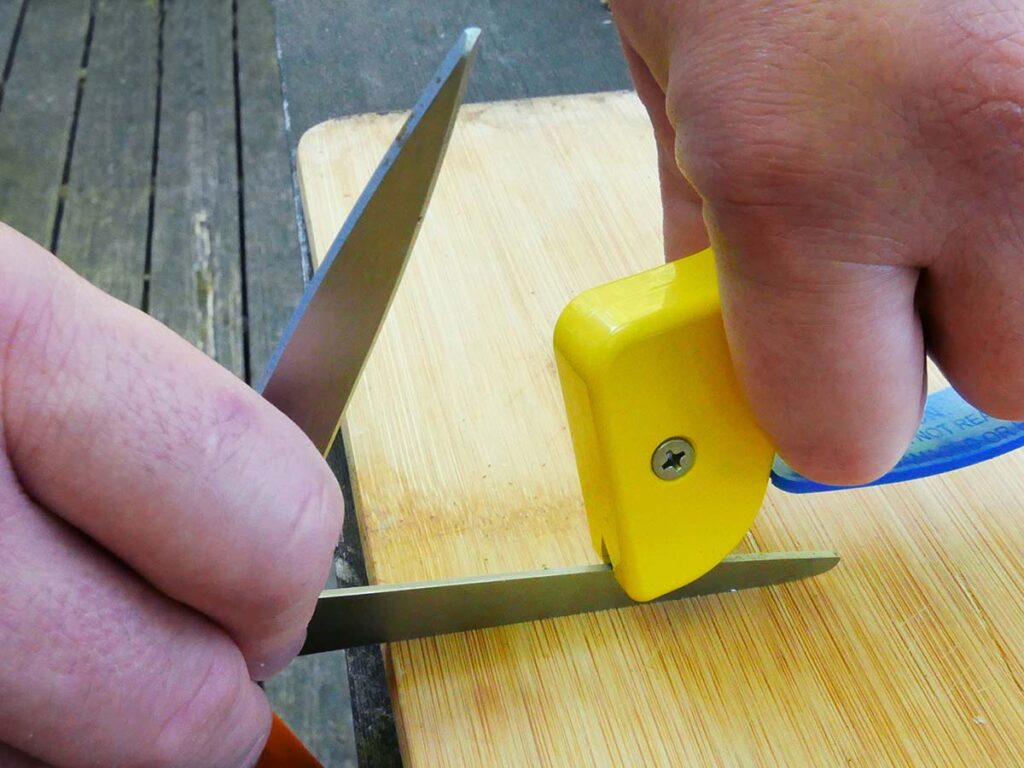
The AccuSharp ShearSharp Scissors Sharpener puts an edge on the blade bevels one side at a time. Here the blades are opened with one side resting on the flat work surface having the blade bevel sharpened. Note the other blade is off the surface. Once the first blade is done, the scissors are flipped and the second blade is sharpened in the same manner. (Covert image)
AccuSharp ShearSharp Scissors Sharpener Size: 5.5 x 2.4 inches Type: Hand-held, single sharpening blade Abrasive: Tungsten carbide Handle length: 5.6 inches Handle material: Plastic Country of origin: USA MSRP: $9.59
The AccuSharp ShearSharp has a grip with a guard for knuckle protection and there’s a slot on the fore-end with a tungsten-carbide-metal sharpener for running down the blade bevel, sharpening it in the process. Open the scissors and lay the blades, one at a time, face-up to the sharpening medium. The rear blade—the one not being sharpened—hangs off the table or you can put it on a raised platform such as a wood block or book.
A hand-held design, the AccuSharp ShearSharp Scissors Sharpener addresses the blade bevels one at a time. You’ll need your reading glasses for these instructions, too!
The ShearSharp metal sharpener is canted to the angle of the bevel and runs down the blade from base to tip, rear to front. Accusharp recommends two to three passes of the sharpener, then flip the scissors over and do the same to the second blade. As with all three test units, keep an eye on your progress as scissors come in all phases of disrepair.
Smith’s V-Slot Knife & Scissors Sharpener
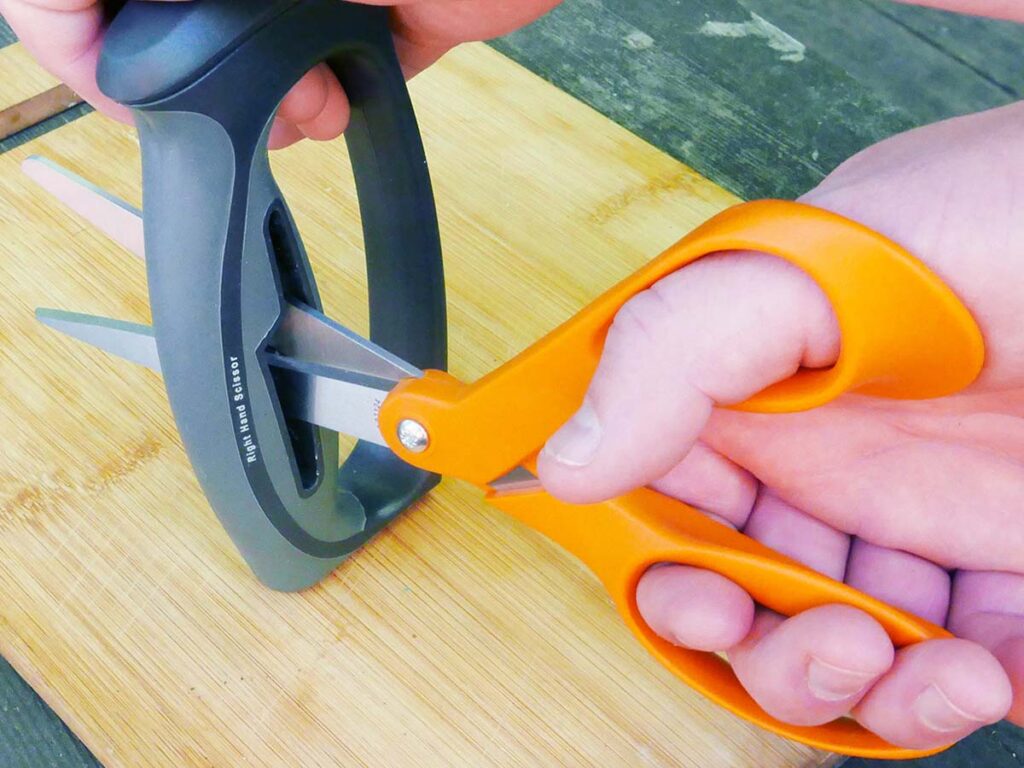
The bevels are sharpened when pushing the scissors blade tips simultaneously into the respective V-slots of the Smith’s unit. The diagonally mounted ceramic rod sharpens both blades at the same time. (Covert image)
Smith’s V-Slot Knife & Scissors Sharpener Size: 6.75 x 2.74 inches Type: Hand-held, two sharpening blades Abrasive: Ceramic Handle length: 6.75 inches Handle material: Plastic Country of origin: USA MSRP: $9.99
Smith’s V-Slot Knife & Scissors Sharpener is a bit more sophisticated with great finger protection, and is easier to use. Inside the handle is a slot that holds a 1,000-grit ceramic rod angled to sharpen the two scissors bevels at the same time. The bevels are sharpened when pushing the scissors blade tips into the respective V-slots simultaneously. (Smith’s recommends not sharpening by pulling the blades out.)
You may need your reading glasses to decipher the instructions for the Smith’s V-Slot Knife & Scissors Sharpener.
Two to three passes is usually enough for blades of average dullness, more if needed. Once again, stopping to gauge your progress is your friend. An added benefit with the Smith’s sharpener is you can sharpen both right- and left-handed scissors depending on which side of the handle slot you use, and it’s conveniently noted on the sides of the unit itself.
Spyderco Golden Stone
Starting at the top, slide the blade’s beveled edge down the length of the Golden Stone, gradually working the edge toward the tip. Once the edge is sharp, give the opposite blade the same treatment.
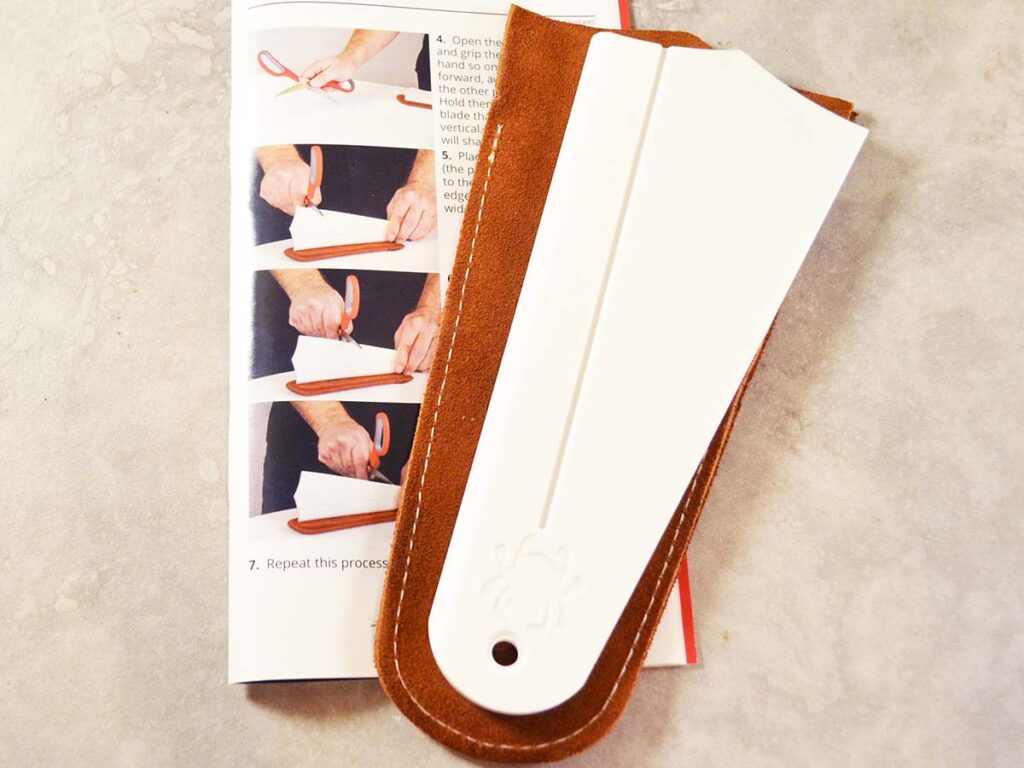
Spyderco Golden Stone Sharpener Size: 7.2 x 3 inches Type: Desktop sharpener Abrasive: Alumina Handle: None Carry: Suede leather pouch Country of origin: USA MSRP: $210
I have become very familiar with the Spyderco Golden Stone sharpener over the years and have included it in several articles, though not for sharpening scissors. Spyderco knives are well known for their premier out-of-the-box sharpness, and company founder and BLADE Magazine Cutlery Hall-of-Fame® member Sal Glesser is a long-time guru on the topic, including today on YouTube.
The Golden Stone is a Glesser design that enables you to sharpen knives in many ways and at different angles, and even serrated blades. Spyderco uses alumina (aluminum oxide) for the Golden Stone’s material and other of its sharpeners, and claims the resulting models do not require oil or water for surface sharpening. Check out Spyderco’s YouTube sharpening videos for a myriad of ways to sharpen the company’s knives.
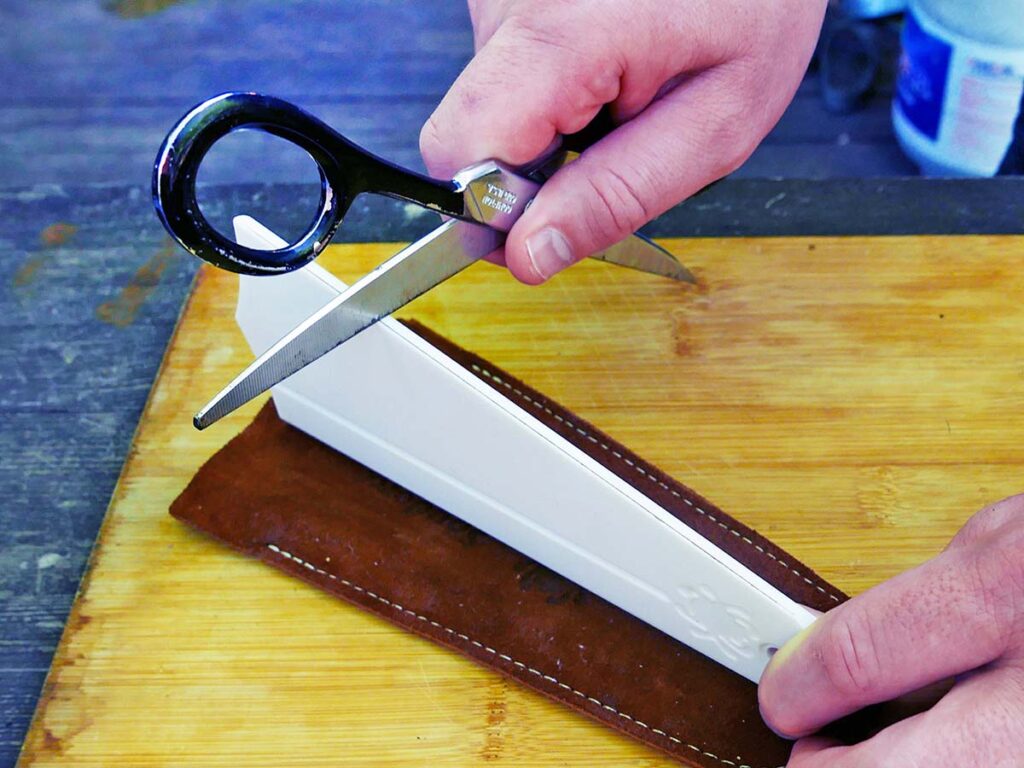
Designed by Spyderco founder Sal Glesser, the Spyderco Golden Stone is an odd triangular ceramic sharpener fit for many uses—one of which is sharpening scissors. For sharpening, position the suede pouch that carries the Golden Stone on a flat base to provide a non-slip surface. (Covert image)
To start with the Golden Stone, use the accompanying suede pouch as a non-slip surface on a flat base. Employ the stone’s rough triangular shape with the long side sideways and vertically. Grip the short side of the triangle with the long vertical side to your right, forming the sharpening platform. Now you’re ready to sharpen the first blade bevel.
Open the scissors wide and position the top of the base of the bevel grind over the high point of the sharpener, and slide it toward the low end as you slowly pull toward you.
It’s like sharpening a knife where you start at one end and slowly slide the tip toward the opposite end as you go—you’re just putting an edge on the bevel instead. Spyderco recommends eight to 10 passes but, once again, use your judgment depending on the condition of the scissors. Once you’re pleased with the bevel on the first blade, flip the scissors over and repeat the process on the second blade. When done you can remove any burr on the edges of the two blades by opening and closing the scissors a few times.
Conclusion
Both handheld units did a good job of sharpening the bevels, and though I prefer a ceramic sharpening rod just because you can better “feel” it rubbing against the bevel, there was no noticeable difference in the results. These two sharpeners are capable of putting a very decent edge on your scissors.
Fiskars is one of the few major companies that manufactures scissors specifically for lefthanders, and is known for such radically asymmetrical designs as these two. The red pair is for lefties.
The end result of my efforts with the Golden Stone paid off with two razor-sharp beveled edges on the scissors blades. Spyderco doesn’t assign numbers to the grits on its sharpening media, but the best I can tell the white alumina like that used on the Golden Stone is in the fine, 2,000-grit range.
Where To Find Your Edge
Is all the cost, time and increased degree of skill required by the Spyderco Golden Stone worth it? That’s up to you and what your expectations of your scissors are. There are folks whose livelihoods depend on scissors, others that just want to get the mail out the door and scads of people in-between. Choose your sharpener!
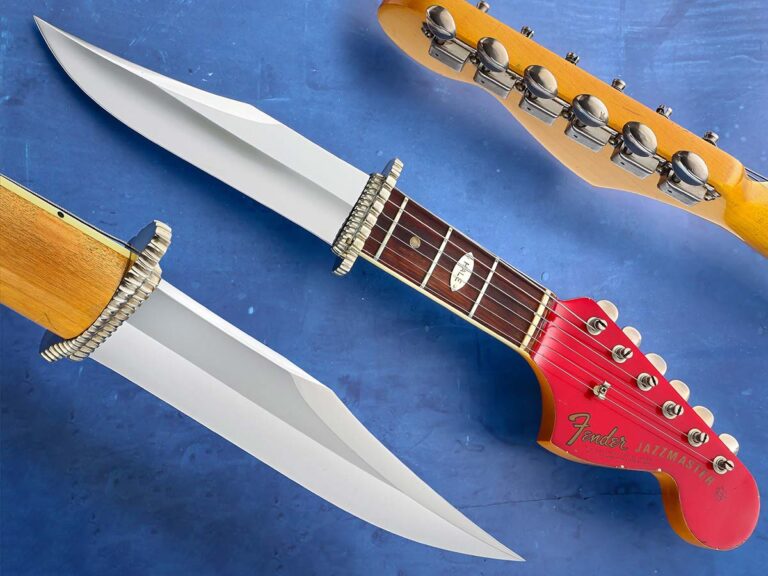
Lloyd Hale made the singular knife circa 2000 from the neck of a 1960s Fender Jazzmaster.
A self-described child of the ’60s, Larry Hirsch jumped at the chance to buy the DeFender when a collector offered it for sale.
Made by Lloyd Hale a quarter century ago from the neck of a 1960s-era Fender Jazzmaster guitar, the knife did not have a sheath originally, so Hirsch got with Hale earlier this year and brainstormed one in the shape of the main body of the guitar, complete with strap and volume and tone control knobs.
Larry Hirsch rocks his world with the DeFender. (Hirsch image)
“I told Lloyd the knobs had to turn because everyone that sees it, the first thing they will do is turn the knobs,” Hirsch said. Sure enough, when Larry displayed the knife at the 2025 Solvang Show, the first person that saw it turned the knobs.
Oh, left whole a 1960s-era Fender Jazzmaster—just the neck alone—would be worth obscene amounts today, but we won’t go there.