Home Blog Page 28

Coffee With An Edge: Well-Known Knifemakers Forging Coffee Brands

Knife companies offer their own brands of hot Joe and perk up consumers in the process.

For Ernest Emerson, it’s as strong as… well, a cup of dark roast. He’s a firm believer in the expansion of his marquis knife manufacturing company into other lines of business. The idea behind that expansion is the diversity of different sources of revenue while complementing the Emerson core business.

“We’ve owned our own coffee company since 2019,” Ernest related. “I’m friends with Evan Hafer, the founder of Black Rifle Coffee, and our conversations probably go back to 2016 when we were first to co-brand with Black Rifle. Evan carried our CQC-7 on his military deployments, and he knew who we were. We worked it out with him to package coffee and do labeling. That worked for a while, and then my wife [Mary] and I talked it over and decided we wanted to have our own brand of coffee.”

For Emerson, taking the coffee plunge complemented the other activities that go hand in hand with offering top quality knives. Barriers to entry were few.

“I talked to Evan, and he said there was plenty of room,” Ernest explained. “We started Emerson Coffee Roasters Company, and I know we were first and started that trend, just like the trend in knife company whiskeys that is going on now.

“We get coffee from a source in South America and have it roasted and package everything under our own ownership,” he added. “Some other companies do collaborations and have their coffee packaged up, but we do everything from start to finish. The way I look at it, everything is a backup for a backup for a backup. What if somebody in Washington can make knives illegal with the stroke of a pen? All our other companies are there as a family-run group of businesses from coffee to apparel, whiskey, fighting systems and others. We’ve built those companies so the family will have support, and then we are at the helm and decide what roasts we want and everything.”
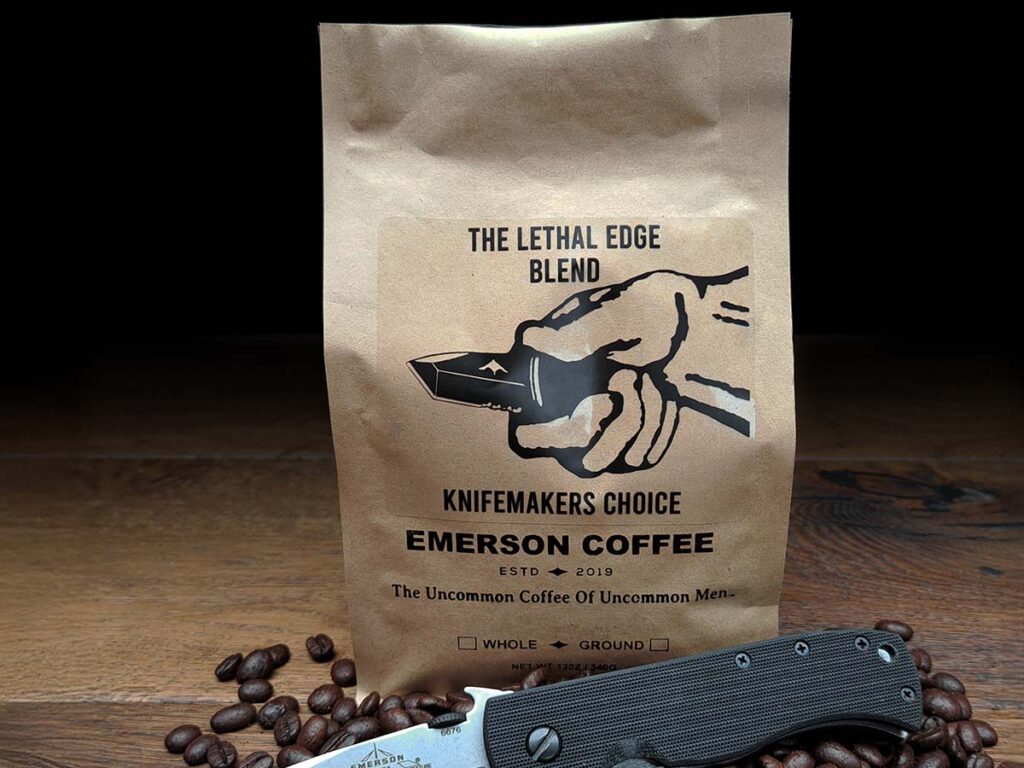
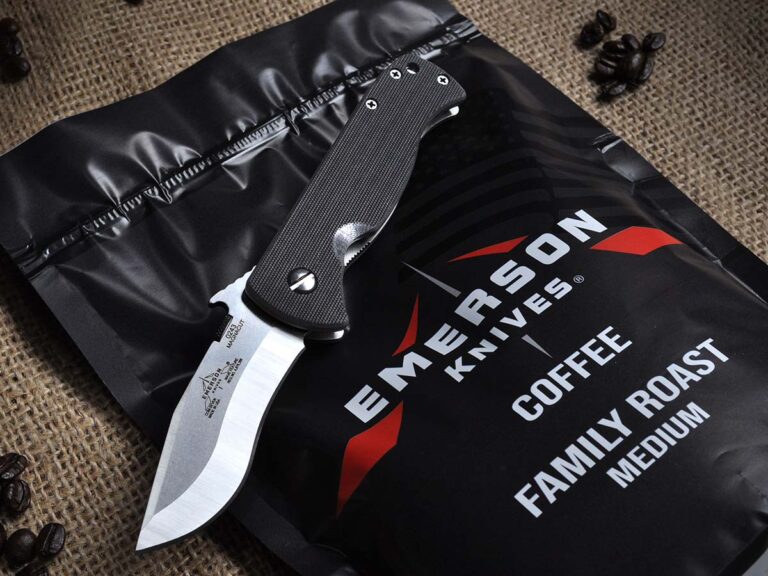
Emerson Coffee has three blends: Renegade Roast, which is the Emerson family’s favorite. Family Roast is the medium blend and Lethal Edge is the dark offering. The knife is the Emerson CQC-7BL-SF.

The future for Emerson and coffee may include some bundles of brew and whiskey or special flavorings for the coffee itself. Ernest sees flexibility and responsiveness always in the mix—a bourbon-flavored coffee when the time is right or a Christmas blend for the holiday season. Right now, the idea is simplicity with three blends: Renegade Roast is the Emerson family’s choice, Farmer’s Roast is the medium and Lethal Edge is the dark offering.

“It’s been a great thing to expand into coffee,” Ernest observed. “Our coffee is delicious, and people say they can’t drink any other coffee after trying it. Besides, we are a lifestyle brand and other than water more coffee is consumed around the world than any other beverage. I would bet that everybody who has ever bought a knife from us drinks coffee. So, if you buy or use knives, chances are you would drink our coffee and whiskey and wear our clothing.”

So, Ernest Emerson, the savvy businessman, finds another niche with coffee, one that complements the tried-and-true knife business and broadens the appeal of his entire spectrum of products. Seeing the big picture is expected to pay big dividends. Ernest points to recent history to back up his market perspective.

“No other knife entity on earth had a show in Las Vegas that revolved 100 percent around its brand like Emerson Knives,” Ernest concluded. “And the Usual Suspects Network was started for Emerson Knives. People tattoo our name on their body, and we say, ‘Show us your ink!’

Forbes Magazine said that there is only one other brand that loyal people tattoo on their bodies, and that is Harley-Davidson. The Forbes people actually told me that. We don’t know all the reasons for it, but again it is partly because people identify with who we are—American made by American workers with American grit and self-reliance. If people buy a $300 or $400 knife from us, then they buy other stuff that the company represents. Emerson truly is a lifestyle brand.”

And what says lifestyle better than a fine cup of brew?

Spartan Blades Tactical Beans
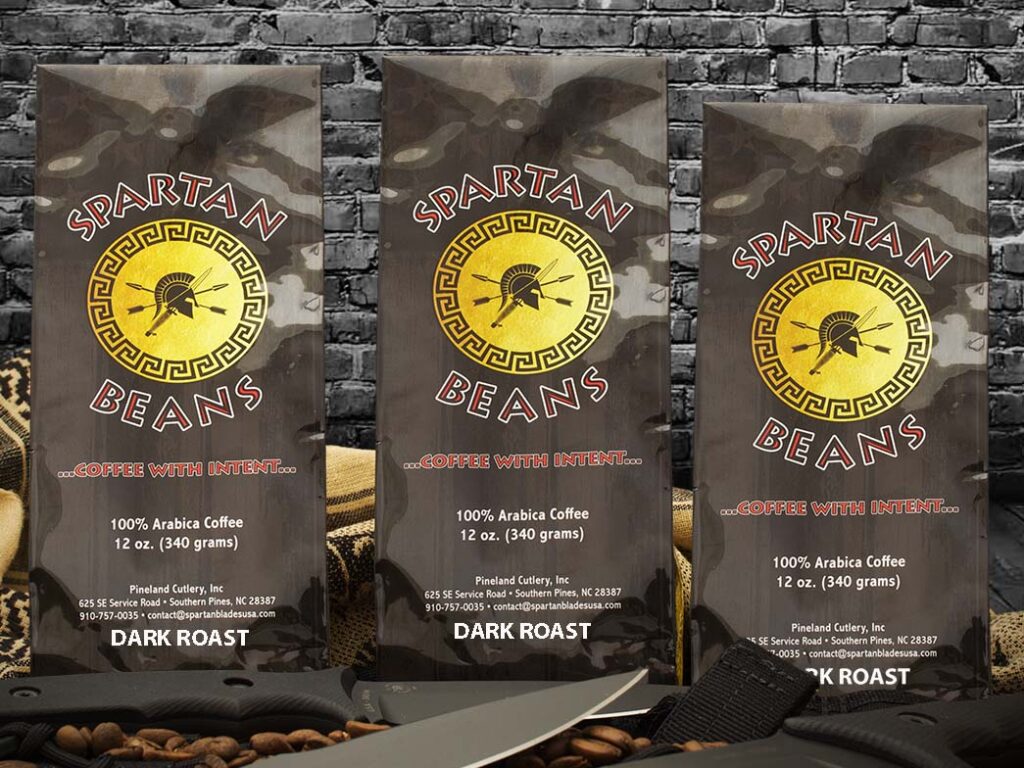
Spartan Beans is sold in 100 percent Arabica regular roast and dark roast, single or three pack. There is also a sturdy mug available to top off the experience.

At Spartan Blades, company co-founder Curtis Iovito says offering a special coffee collaboration with Black Rifle is just fun. Fresh-roasted Spartan Beans fuels the consumption of a couple of gallons of brew per day around the office. The concept started when Curtis was chatting with a good friend who owns a roaster and has evolved into offerings consisting of 100 percent Arabica beans.

“Spartan Beans has been around for about three years now,” Curtis remarked, “and it has gone surprisingly well. Sometimes we will throw in some of our coffee when we ship a knife order to a dealer. The roaster is right up the street, so the coffee is about as fresh as you can get. We may look at doing an auto-ship program as demand increases, too!”

Spartan Beans is offered in 100 percent Arabica regular roast and dark roast, single or three pack, and there is also a sturdy mug available to top off the entire experience.
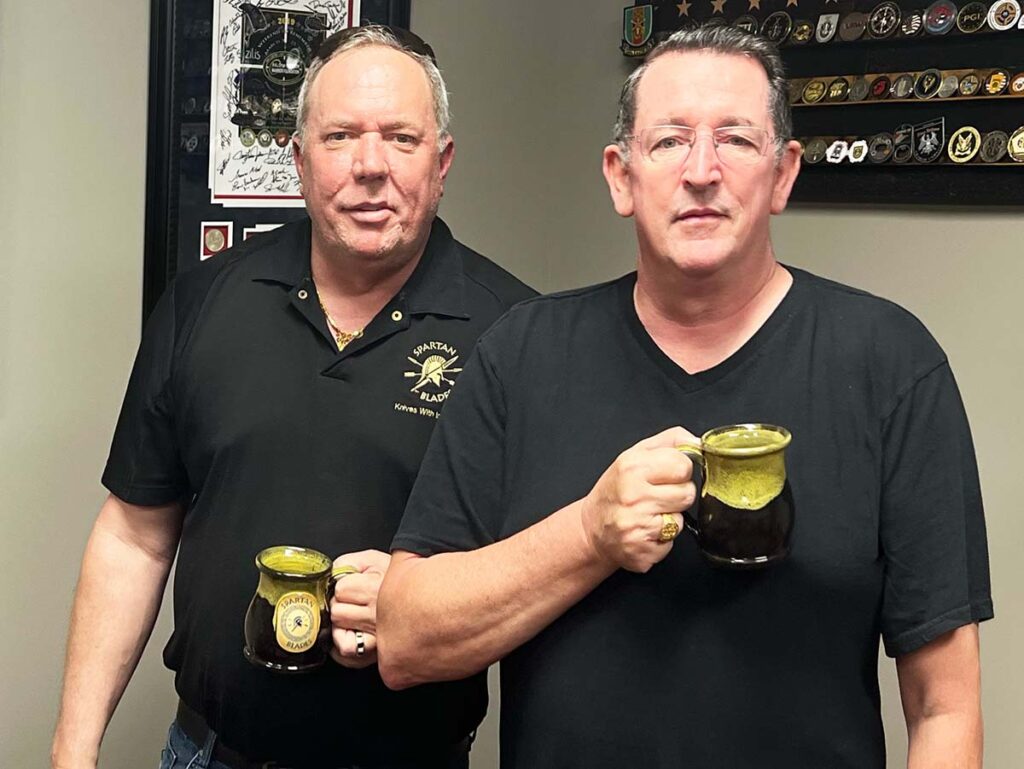
Spartan Blades co-founders Mark Carey (left) and Curtis Iovito (right) have traveled the globe for years, teaching counterterrorism and assisting with operations related to the use of knives in the field. When time permits, they search for the finest coffee from exotic locations for their Spartan Beans blends.

Through the years Curtis and fellow company co-founder Mark Carey have spent years traveling around the globe, teaching counter-terrorism and assisting with operations related to the use of knives in the field. And when time has permitted, they have searched for the finest cup of java available, whether in Malaysia or some other exotic location. The Spartan Beans blend includes the best from Colombia, Costa Rica, Africa and Sumatra.

“It’s like the United Nations of coffee, just more fun,” laughed Curtis.

Montana Knife Co. Backcountry Brew
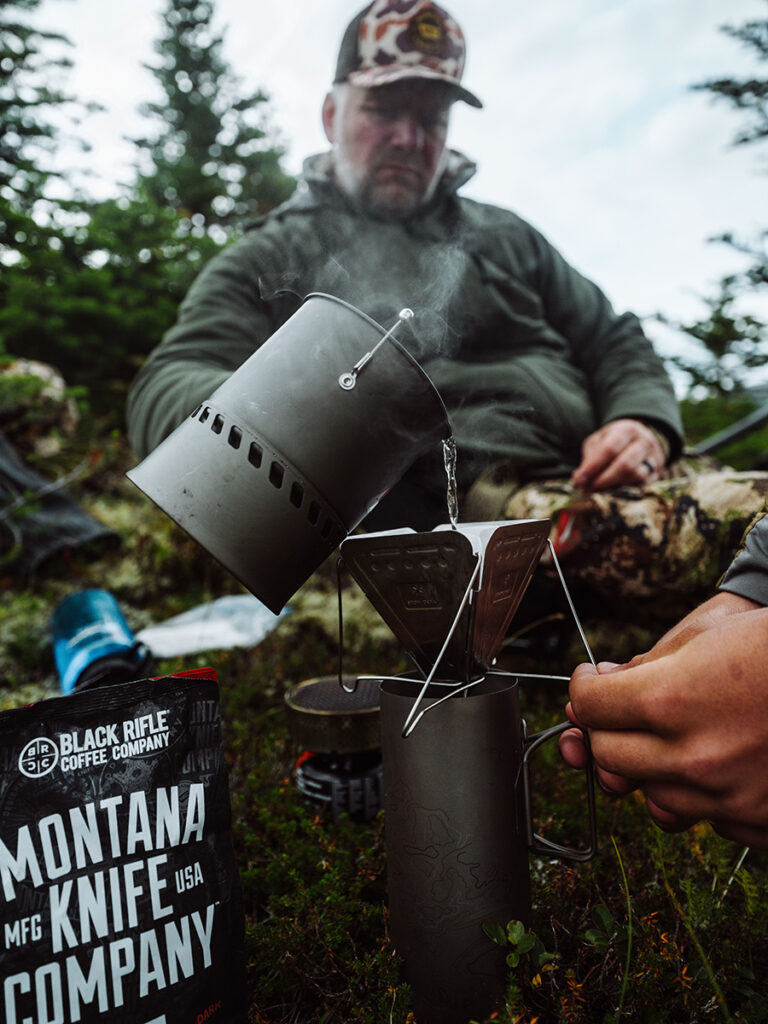
Noted Josh Smith of Montana Knife Co., “Hot, steaming coffee while freezing on a hunt tastes so good!” Montana offers its MKC X Black Rifle Coffee Signature Dark Roast in whole bean and ground 12-ounce bags.

A more recent entry into the coffee arena, Montana Knife Co. (MKC) entered into a partnership with Black Rifle in the fall of 2024. The packaging tells customers, “Fresh from the forge, this dark roast offers notes of dark chocolate with an aroma of spice topped off with a smoky finish. American brewed and crafted to perfection.”

Josh Smith, founder, president and ABS master smith at MKC, has found the kinship between knives and coffee to be compelling.

“Over the years, I became friendly with the owners of Black Rifle Coffee Co.,” he said. “We share many of the same beliefs around love of our country and support of our active-duty soldiers and veterans. For the past few years, we have worked with them on some marketing-related promotions, but this was our first launch of coffee with Black Rifle.

“Personally, I love coffee,” Josh emphasized. “For me, coffee and knives seem to be loved by so many blue-collar workers. Clearly, white-collar people drink coffee too. But I think back to my grandpa or my dad, and they always started the day with a cup of coffee before going off to work the ranch or in a backhoe. That same guy always had a knife in his pocket. The best place I’ve had Montana Knife Co. coffee is in northern British Columbia on a horseback moose hunt with my son [Hank]. For 10 days, it was rainy and cold. But each time we sat down to rest we made coffee with our jet boil. Hot, steaming coffee while freezing on a hunt tastes so good!”
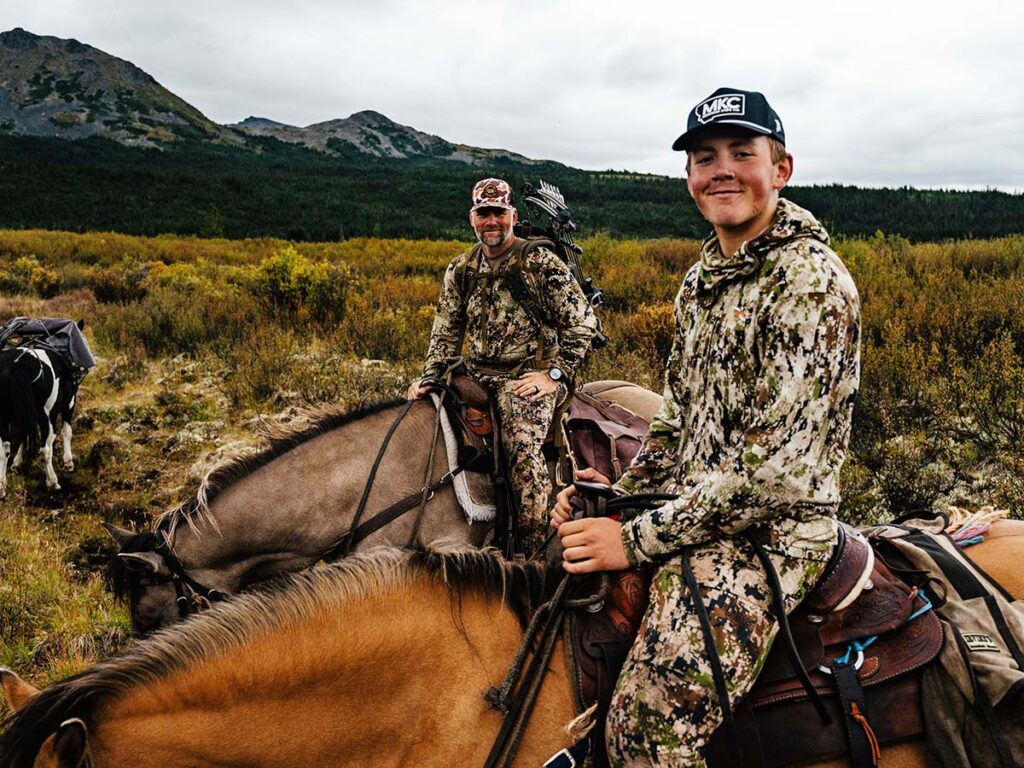
Josh Smith (left) said the best place he’s had MKC coffee is in northern British Columbia on a horseback moose hunt with his son Hank (right). “For 10 days, it was rainy and cold,” he recalled. “But each time we sat down to rest we made coffee with our jet boil.”

Montana Knife Company offers its MKC X Black Rifle Coffee Signature Dark Roast in whole bean and ground 12-ounce bags.

For many consumers, the blend of the knife and the good cup of coffee just comes natural. Now, it’s easier than ever. Exploring the best in cutlery and coffee simply enriches the experience with both.
More On Knife Business:

BLADE Magazine Cutlery Hall of Fame®: Largest Class Ever Full Of Iconic Names

Living and past greats highlight huge roster of inductees.

The BLADE Magazine Cutlery Hall of Fame® enjoyed its most prolific induction ceremony ever when it welcomed eight new members during BLADE Show 2025.

The total includes four living inductees—Harvey Dean, Rick Dunkerley and Daniel Winkler and Karen Shook—and four deceased ones: Stanley Fujisaka, Dr. James R. Lucie, Alfred Pendray and Jim Schmidt.

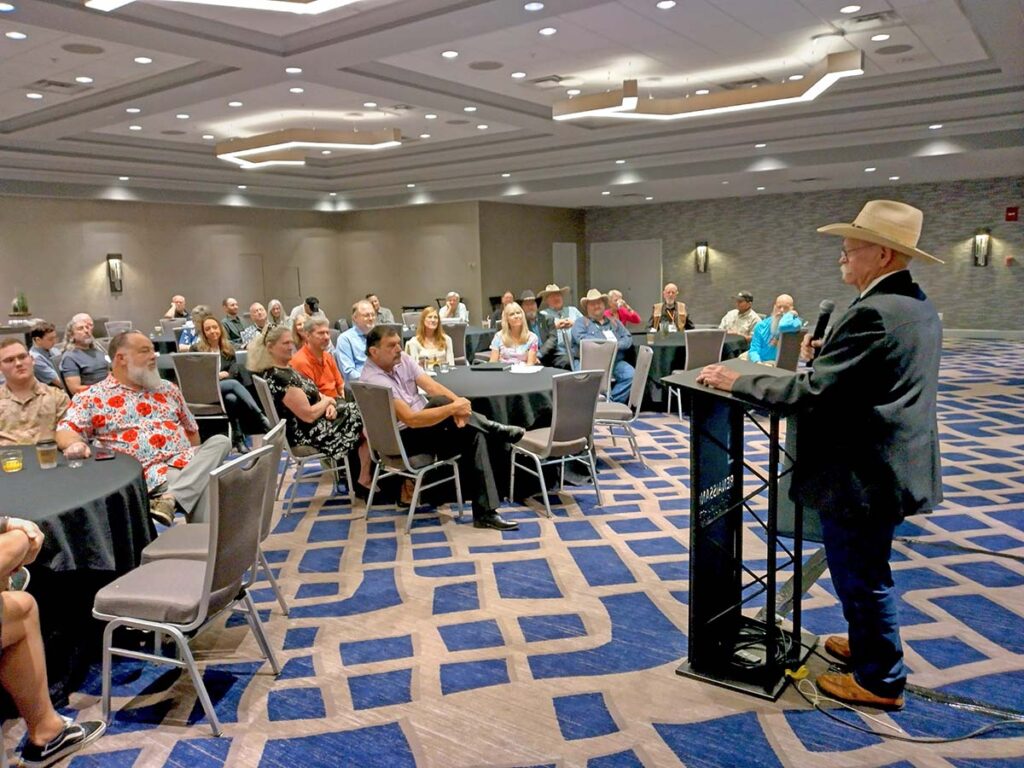
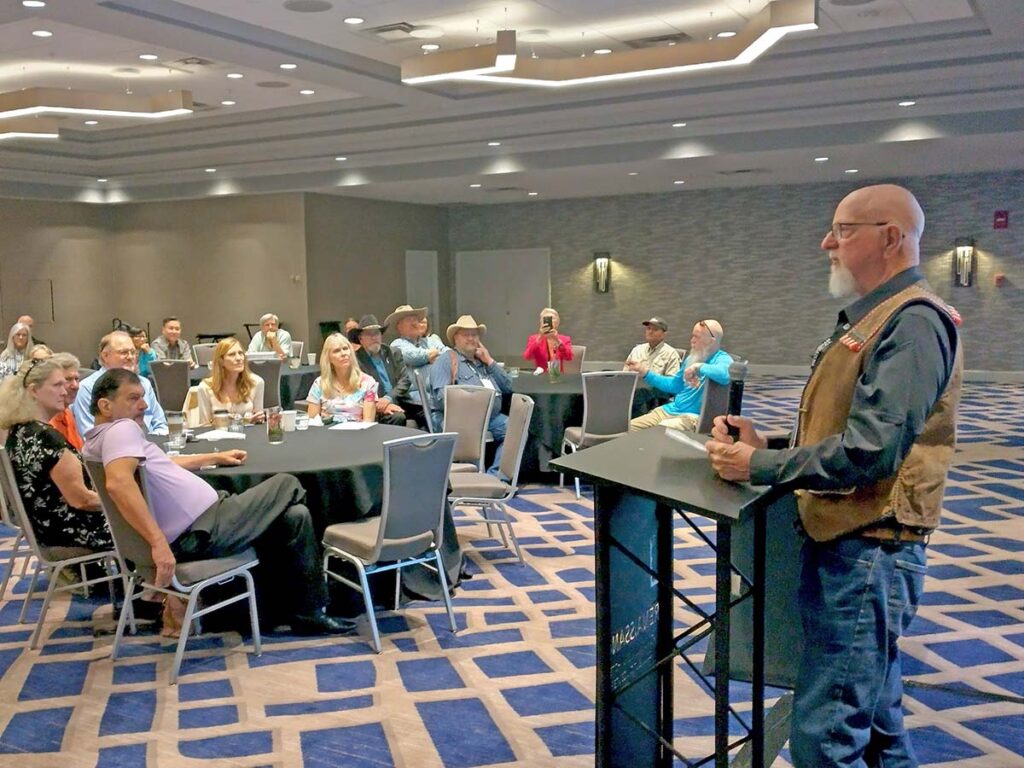
Induction speeches were provided by an array of Cutlery Hall of Famers—newly minted inductee Rick Dunkerley, Ken Onion and Steve Schwarzer; friends of three of the inductees, military veteran Kevin Holland and Josh Smith, founder of Montana Knife Co.; and Stephanie Lucie, daughter of inductee Jim Lucie.

Emotions understandably ran high, as did more than a few tears. It was a ceremony to remember.

Jim Schmidt

Cutlery Hall-of-Famer Steve Schwarzer enjoyed the honor of inducting two of his mentors: Jim Schmidt and Alfred Pendray.

As wrote Dellana, one of Jim Schmidt’s stellar students that also included Barry Davis, Cutlery Hall-of-Famer Steve Schwarzer, Larry Fuegen and more, Jim was “larger than life, truly a giant among men.” Added Schwarzer, Schmidt’s inductor, “Jim was like the father of filework. All of that filework in the business came out of him.” Schmidt made the first goblin folders, a unique style his students such as Dellana, Schwarzer, Fuegen and others emulated. “He was always willing to teach,” Schwarzer said. “His generosity with his time and knowledge was legendary … He was there at the rise of modern custom knifemaking and is one of the reasons the movement has risen to the heights that it has … He brought tool-and-die work to knifemaking and was an incredible artist.”

In the 1970s, along with Jimmy Fikes and Cutlery Hall-of-Famer Don Fogg, Jim was instrumental in forming the New England Bladesmith Society and organizing the Ashokan Bladesmithing Seminar. He was one of the earliest ABS members and ABS master smiths, a member of the ABS Hall of Fame, a constant member of the Art Knife Invitational (AKI), winner of the Knifemakers’ Guild’s Red Watson Award and the Beretta Award for Outstanding Achievement, and more. He was the ultimate teacher, his profession for most of his life. An outstanding book on Schmidt is James Schmidt: The Great Master, by Mike Haskew. As the book noted, Jim “welcomed those who were earnestly interested in improving their bladesmithing and knifemaking skills into his shop … and shared with them the light of precious knowledge that he realized should be readily and freely given rather than hidden.”

Alfred Pendray

“Alfred Pendray was a legend in the forging business,” Schwarzer began. “He was the pioneer in wootz research. I worked alongside him and 99 percent of the rediscovery of that material was by Alfred Pendray. Once he got his mind set on something he wouldn’t quit; he did it scientifically and that legacy will live on for a long time. He was just good to people—he was really good to people.”

Pendray taught and influenced many bladesmiths. “I learned so much from him,” noted Charley Ochs, “not only about knives and metallurgy, but also about life and social interaction as a person.” Alfred is co-author—along with Dr. John Verhoeven, former metallurgical engineering professor at Iowa State University—of articles in eight scientific journals, four bladesmith publications and BLADE® on the nature of “genuine damascus,” or wootz steel. Pendray holds patent number 5,185,044 on a “method of making damascus blades.”

He joined the Guild in 1982 and became an ABS master smith in 1983. He spoke at the Symposium on Damascus Steel at New York University in 1984, the International Conference on Damascus Steel in Germany in 1985, and at the same conference and the Imperial College in London, England, in 1992. He won the ABS Bill Moran Knife of The Year in 1991 and was elected to the Guild board of directors in 1992. He received the ABS W.W. Scagel Award in 1998 and is a past recipient of the Guild’s Red Watson Award. He served as Guild president from 1998-2004 and is a member of the ABS Hall of Fame.

Rick Dunkerley

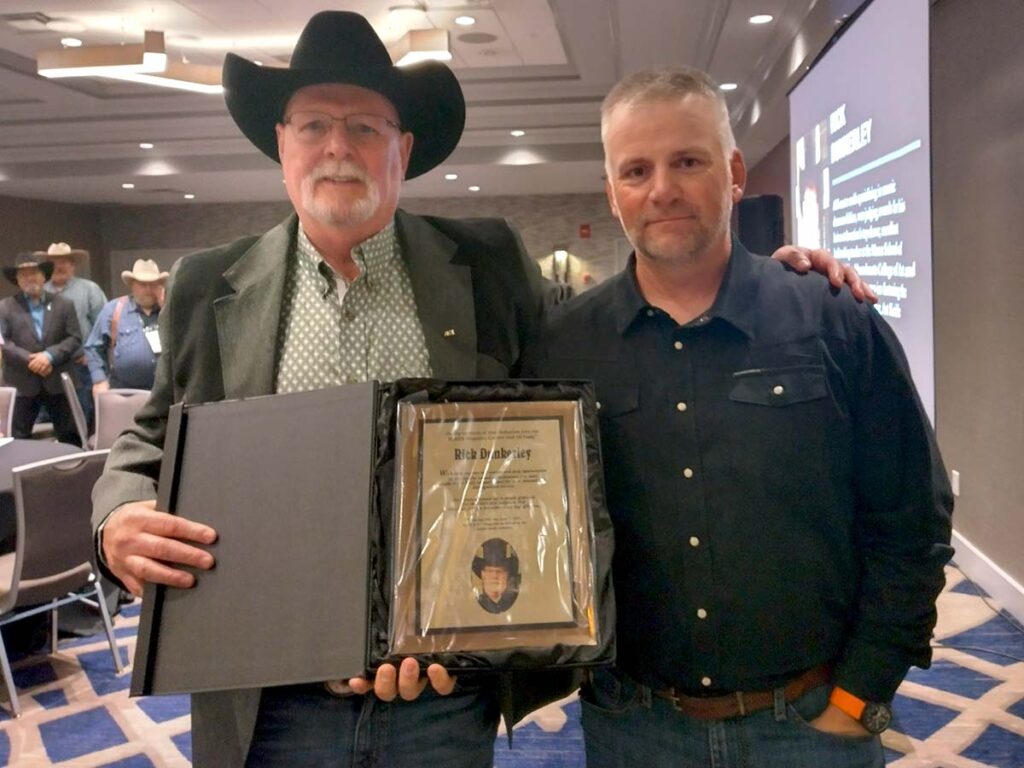
Teacher Rick Dunkerley (left) was inducted by one of his prize pupils, Josh Smith (right).

Rick Dunkerley made his first knife in 1983 and started forging in 1992. He founded the Montana Knifemakers Association in 1993, organizing the state’s first modern custom knife show. He became an ABS journeyman smith and hosted his first hammer-in in 1995 and became an ABS master smith in 1997. He’s taught bladesmithing internationally, in the process earning the Maestro Rating by the Italian Knifemakers Guild in 2006. In 2015 he was inducted into the AKI and later served on the AKI advisory panel. He’s served on the ABS board of directors for nine years and was just re-elected for another term.

According to Rick’s inductor/former student, Josh Smith, founder of Montana Knife Co., “What makes Rick special is his relentless desire to give back and teach … He hosted hammer-ins featuring instructors like Al Dippold, Hank Knickmeier, Rob Hudson, [Cutlery Hall-of-Famers] Wayne Goddard and Don Fogg and other greats. It was through these hammer-ins that the Montana Mafia was born. With Rick as the ringleader, this group went on to shape the landscape in bladesmithing and damascus to this day. It’s because of Rick and others in this era [including Shane Taylor, Wade Colter and more] that pattern-welded steel and the patterns to create it took giant leaps into the future … There’s no doubt the incredible makers we have today are standing on the shoulders of these giants.” Added an emotional Josh, who started learning how to forge under Rick’s tutelage at 11, “That was 33 years ago and I’ve been able to be in this community and build what I’ve built all because he let a kid into his shop. I love him for that.”

Stanley Fujisaka

Stanley Fujisaka made beautiful linerlock folders and fixed blades and was a beloved mentor to Hawaiian and other makers, including Scott Matsuoka, Les George, Cutlery Hall-Of-Famer Ken Onion and many more. Fujisaka played a key role in encouraging Onion to patent his SpeedSafe assisted-opening mechanism, a mechanism that resurrected Kershaw and revolutionized folding knives. However, in his speech inducting Stanley, Onion said it was the “little” things that set the new inductee apart.

“Stan didn’t invent a new category of knives, he didn’t have some crazy invention. What he had was admiration and respect and love for every one of you guys in this room,” Ken noted. “Every time I went to a show I’d come back to his shop and he’d tell me these stories of Schwarzer, of Ruple, of everybody, and they were legends to me, and he was a really great orator about that, a really great story teller, which is really why I got enough courage to come to a [knife] show. You guys were all magical to him.

Stan was one of those guys if you bought a knife from him he would write down your name, your wife’s name, your kid’s name, where you lived, your address, everything, and he would send you coffee, Hawaiian candies, a handwritten card thanking you. He would struggle to look through his book if he saw you walking toward his table so he wouldn’t forget your name. He was the truest form of gentleman, and I think that’s more of what I learned from him. It was not just knifemaking, it was how to … respect everybody, how to conduct myself in an honorable way, and nobody did that better than Stan.”

Dr. James R. Lucie

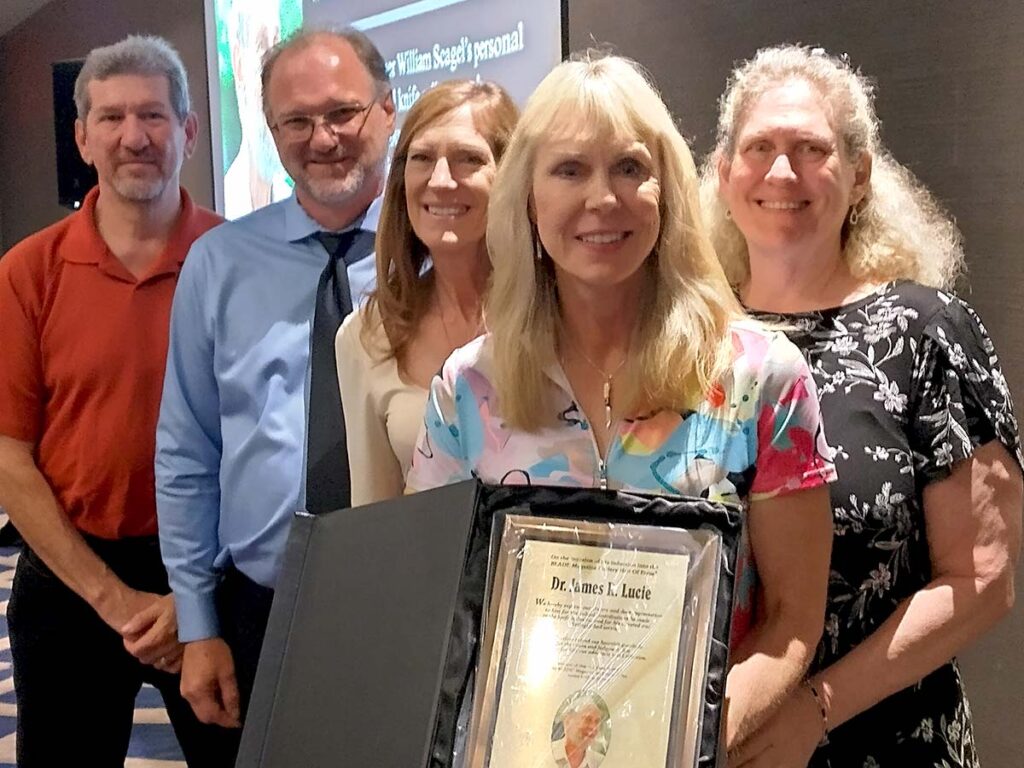
Stephanie Lucie inducted her father, Dr. Jim Lucie, with family and friends as special guests. From left: the inductee’s nephew, Chris Lucie; ABS master smith Kevin Cashen; and the inductee’s daughters, Robin Lucie, Stephanie Lucie and Pam Lafrance.

Dr. James R. “Jim” Lucie was the personal physician of Cutlery Hall-of-Famer William Scagel and signed Scagel’s death certificate in 1963. In her speech inducting her father, Stephanie Lucie said Jim researched Scagel’s life and collected his work for over 30 years, culminating in Dr. Lucie’s seminal book, Scagel Handmade. After retiring from medicine at 65, Jim dedicated his life to making Scagel reproductions. “He recreated Bill’s designs as closely as possible—unless he saw a way to improve them,” Stephanie said. “Ever the physician, he even X-rayed Bill’s knives so he could ‘see what the old boy was up to,’ as he liked to say … His goal was to become an ABS journeyman smith, which he achieved at the age of 71.”

A highlight of his career was making a knife for Willie Nelson and presenting it to him after a concert. It was featured on the cover of BLADE®. In 2001, the ABS created the Dr. Jim Lucie Award, making Jim its first recipient. He hosted a hammer-in at his house that over 500 people attended, and he freely shared Scagel’s techniques at many bladesmithing events. “He helped many beginning knifemakers, just as others had helped him,” Stephanie said. “When it came time to move from Michigan to Texas, instead of selling his knifemaking equipment, he donated much of it to the ABS—enough for each U.S. ABS school.”

In a speech Jim said, “Nowhere does there exist a finer or more helpful cadre of people than the knifemakers and bladesmiths of today. I have not yet found anyone [among them] who was not ready and willing to help impart knowledge or answer questions. I have always believed that we must give something to the society from which we took, and these people are doing it in grand style.”

Daniel Winkler And Karen Shook

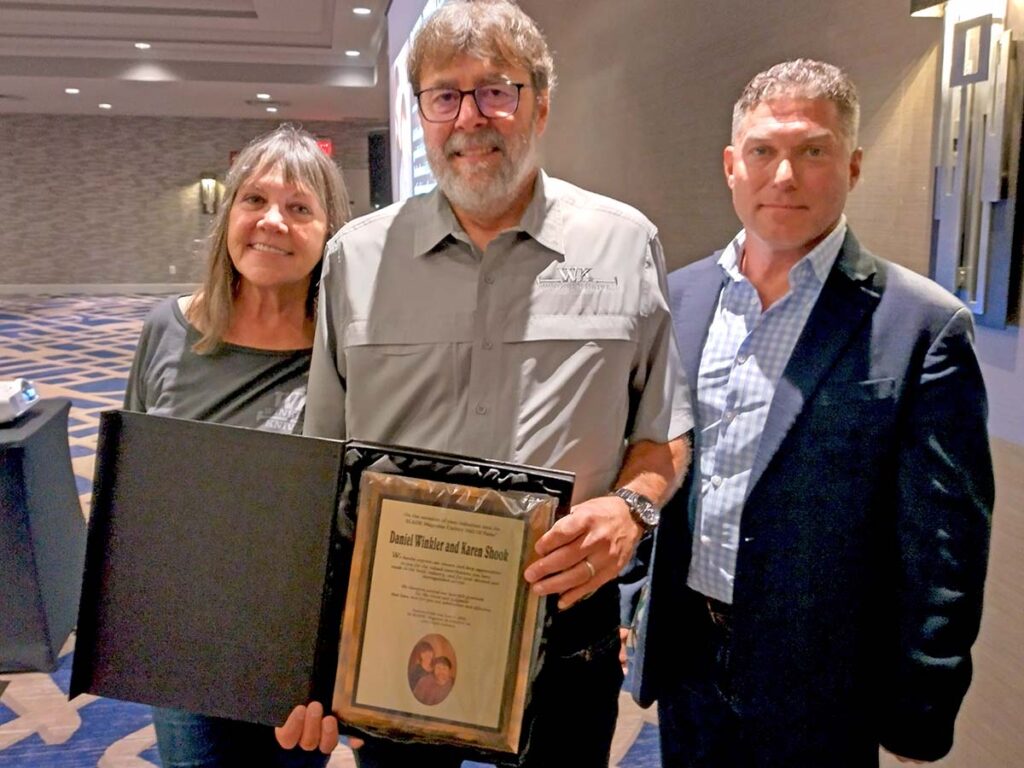
From left, Karen Shook and Daniel Winkler accept their plaque after Kevin Holland (right) delivered their induction speech.

In the late 1980s, Daniel Winkler started handforging period-correct frontier knives and Karen Shook made period-correct sheaths to match. In 1992 the showcasing of Daniel’s period pieces in the hit movie Last of the Mohicans made the pair custom knife stars. The film captured the attention of Kevin Holland, who would go on to serve in both the Naval Special Warfare Development Group/aka SEALs and Army Special Missions Unit. He asked Winkler to make a hatchet for him in 1993, and Daniel complied with a model Kevin carried for the balance of his Navy hitch.

After his discharge and still with hatchet, Kevin was working as a North Carolina game warden when 9/11 happened. He joined the National Guard and worked his way into the Army Special Missions Unit. One day his team leader espied the Winkler hatchet on Kevin’s belt and asked if he could get more. Kevin contacted Daniel, who subsequently filled an order for 15 or so. Then Kevin’s old SEAL unit saw the hatchets and Daniel made them some, too. It wasn’t long before Daniel and Karen had reached a crossroads—make period pieces for collectors, or hatchets and knives for special ops warriors. They eventually agreed that making tools for our nation’s warriors was far more important than anything else they could do.

As Kevin noted in his speech inducting the new Hall-of-Famers, “… they had a higher call … making tools that meant life or death to men in combat. They saw how important that was. They put these tools in the hands of our military and law enforcement, who carry them all over the world now.” Added Daniel, “We’ve been very fortunate to be a part of it, and I couldn’t have done it without Karen.”

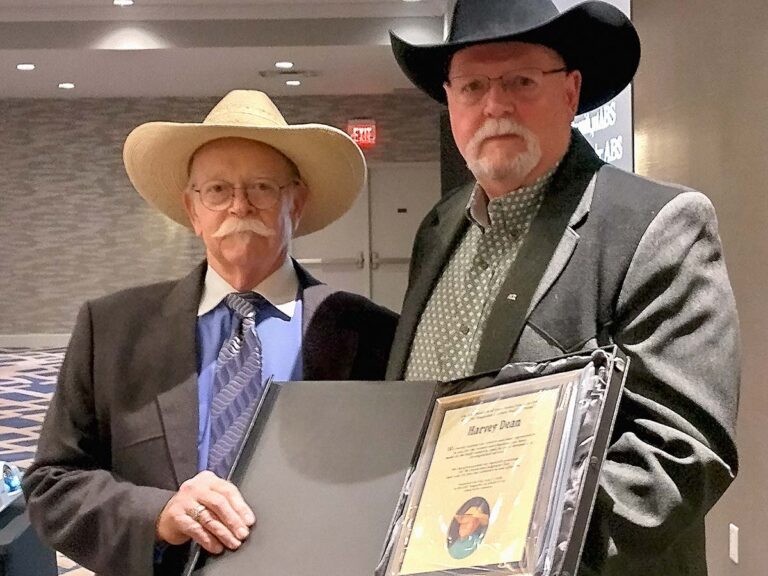
Harvey Dean

Harvey Dean enjoys the moment.

As inductor Rick Dunkerley outlined, Harvey Dean made his first knife in 1979—the same year Harvey and Deborah were married. “Harvey said this is the kind of wife I have. She let me sand that first knife on the kitchen table. Harvey has a good backup system there,” Rick smiled. Harvey started making knives full time in 1992 and became the 42nd ABS master smith the same year. He joined the ABS board of directors in 2004, was voted into the AKI in 2007 and served as chairman of the ABS from 2015 to 2019, and continues to serve on the board today. He was inducted into the ABS Hall of Fame in 2016.

Harvey’s taught an impressive number of students all over the USA, including conducting two hammer-ins a year with Johnny Stout for 25 years. “The amount of teaching going on there was pretty incredible,” Rick observed. “Harvey’s won countless awards. If it has to do with a bowie knife, Harvey won it … Harvey does it all. He brings bowie knives to the AKI, he brings slip joints, he’s the consummate knifemaker. He can make whatever he wants and makes it at the highest level. There just aren’t a lot of makers who can do that. And as much as he’s given back, he’s a better man, a better family man, a better father, a better husband than he is a knifemaker.”

In accepting, Harvey said, “In the Bible, Book of Romans, the Apostle Paul says a man should not think more highly of himself than he should, and I’ve tried to live my life and career like that, so it’s hard for me to get it in my head that I deserve this—but I’ll take it.”

See More Award Winners:

How To: Custom Knife Sales And Marketing

1

Get the ins and out of custom knife marketing and learn how to improve profits from a maker with years of experience slinging blades.

The most difficult part for crafters is turning themselves into efficient sales and marketing people when they’d rather be throwing pots, building furniture, making knives, blowing glass, sewing moccasins and parkas and the myriads of other craft items people make. Marketing and sales present two different issues; both are necessary for the business to succeed.

Yes, it is a business.

The minute you start working for yourself, full or part time, you no longer have the umbrella of the company you’ve worked for. Now all the financial decisions are on you. Steel or groceries? Both require you to show a profit to draw money from to maintain your materials supply, pay the electric and gas bills, and get your kid’s braces. Paying these expenses is up to your fledgling business. If you have other money coming in from your spouse working, etc., stay out of it. The business needs to support itself. Don’t cut back on the family dog’s food because you need some paint brushes. So, it’s up to you to make it work.

Custom Knife Marketing

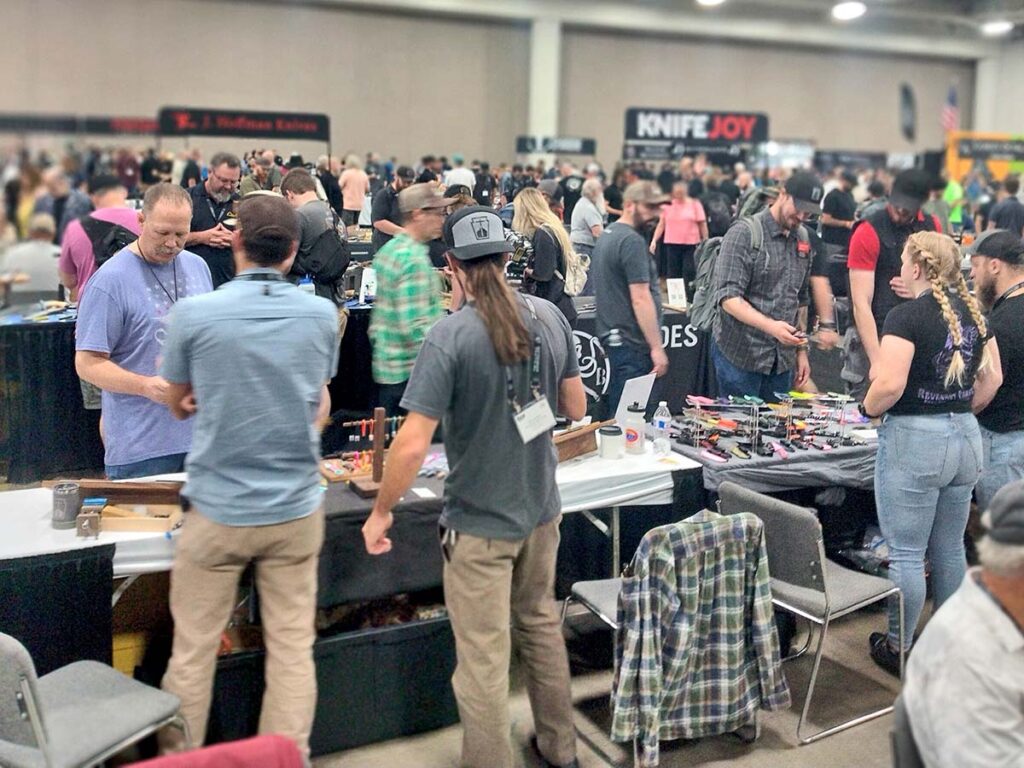
Shows are crucial to a knifemaker’s success but involve an investment of money. Table fees can easily be over a thousand dollars each. Add another table as the author often does for his huge pieces and things get expensive quick. Add a plane ticket to that, the cost of the hotel and food, and you’re close to $5,000 per show.

Marketing is about getting your name and your work out there for people to see. This is not an overnight happening. It is something you will need to pay attention to throughout your whole career if you want to maintain a public image that helps you sell.

The best venue for your work is shows, books and magazines specific to your genre.

Show promoters take out large ads in magazines. These usually list the names of the crafters participating. Name recognition is important, especially if you wish to draw collectors.

Advertising

For a show I did at the Hyatt Regency in Beverly Hills, the gallery that was representing four of us took out a full-page ad in the magazine that was putting on the show. Those magazines are kept and float around doctor and dental office waiting rooms for years. I had a small ad in Alaska Magazine that I was still getting inquiries from 10 years after the ad was pulled. I worked out the ad wasn’t bringing in enough money to pay for itself, even after 10 years.

Be aware of how much advertising costs you against how much real return you get from it. Maybe it’s better to save those monthly charges and put them toward doing actual shows where people have a face to put with a name.

Photos

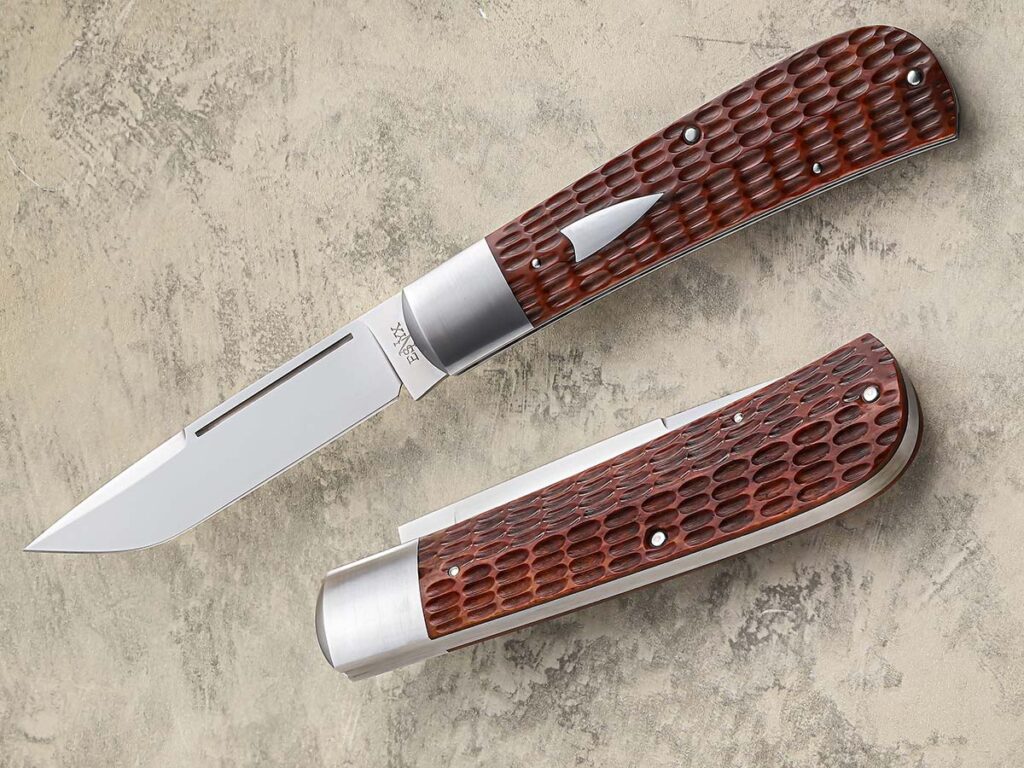
The rules for good photos are simple: it’s about your work, not the killer props it’s set up with. A top example of an uncluttered image is this one by Mitchell Cohen of an Evan Nicolaides slipjoint. (Cohen image)
Magazines don’t usually send out letters asking you to send them photos of your knives. You need to send them on your own. Don’t inundate them with dozens of photos. Make your choices very carefully. Check with the publication to see what form or format photos need to be in. These need to be high quality and/or high resolution for the magazines to print them or put them on electronic media.

If you’re not a photographer find someone who is, because these photos are the only way the public can see your work, other than shows. So be sure to have them taken or take them yourself. I have taken my own photos for the past 35 years. The rules for good photos are simple. Remember, it’s about your work, not the killer props it’s set up with.

Beware the dangers of Photoshop. The item has to look as good in real time as it does in the photo the magazine prints. If there are flaws, don’t let the customer be the one to point them out. (There is nothing wrong with selling something that isn’t up to your usual standard as long as you’re up front with the customer, and the selling price reflects these issues.)

Knife Shows

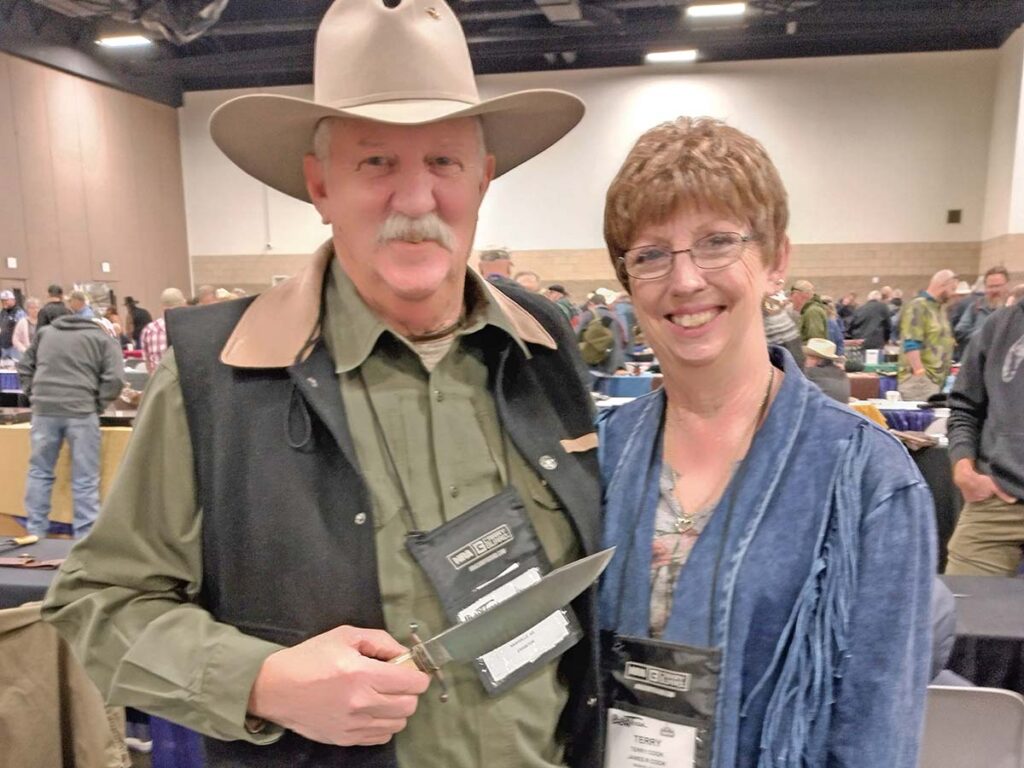
Your spouse is good to have with you at shows for both physical and emotional support. ABS master smith James Cook enjoyed the support of his wife Terry at a past BLADE Show Texas.

Shows can be good, just pick them wisely. If you can sell everything you need to sell by doing only local venues, that’s good. In Alaska I’d be fortunate to sell one piece a year after my prices went up to cover my costs in the late 1980s. I had to do shows to meet the people who would form my future collector base.

On average a well-known show is expensive for most people. Table fees can easily be over a thousand dollars each. Due to the sizes of some of my pieces, I always must have at least two tables because some of the bigger ones are too long to fit on one table. Add a plane ticket to that, the cost of the hotel and food, and you’re close to $5,000. If you’re doing a show in Manhattan, more if you plan on marketing in Europe or Asia.

I have done a lot of shows. I have never done one I could drive to. There’s always a plane ticket involved, the shortest flight being Anchorage, Alaska to Seattle. After that, things can get expensive. Overweight, oversize, extra, etc., those all have costs attached to them. I have traveled with as many as five large aluminum boxes (with snap-off wheels). It does no good if I reach my destination but don’t have anything to sell, so keeping my work safe in transit is very important.

This is a partial list of where I have attended shows, some annually for many years: Manhattan; Meadowlands; Atlanta; Las Vegas; Jersey City; Miami; Orlando; Dallas; St. Louis; Dallas; Denver; Nashville; Scottsdale; San Diego; Anaheim; Santa Barbara; Solvang; San Francisco; Seattle; Tokyo; Milan; Paris; Munich; Solingen; Helsinki; Belgium; and Memphis.

Every year I have attended four or five shows globally traveling from Anchorage. Now I need $20,000 just to cover basic show costs. Multiply that by three and that is where your profit starts. From the beginning I know I have to do at least $60,000 to cover the basic costs of being in business. It is closer to $7,500 in months when my materials are drawing a lot of money from my account.

The one common denominator in all shows is how tired you are when you arrive, and how tired you are when you finally get back home. There is a lot of stress in doing this. A mistake you shouldn’t make is thinking it can be used as a family holiday. This usually ends up with the kids up in your room with a movie menu for the TV, and your spouse right next to you waiting for the sales to show up. It’s better to leave the children at home.

Rolling With The Market

Ron Lake once said, “Some people keep making the same weak design every year, they just make it better. In the end it will always be a weak design.” Avoid this pitfall by looking at your work realistically. Just because it is bright and shiny doesn’t make it craft or art.

Your spouse is good to have with you for both physical and emotional support. When things aren’t selling because someone just plugged the Suez Canal for the umpteenth time, and that’s 10,000 miles away from you, there is no snappy comeback. When 9/11 took place it killed the New York Show, which was the most profitable show I attended annually. You could roll bowling balls down the aisles the following year. You have just been had by chance and circumstance, two things you have no control over as a speculation-oriented crafter. (A speculation crafter—that’s me—is one who builds something hoping to find a customer when it is finished.)

Moving Forward

If it isn’t selling, make it better next time. The customer is out there, you just need to get this little beauty in front of them. Long-time knife artisan and BLADE Magazine Cutlery Hall-of-Fame® member Ron Lake once said, “Some people keep making the same weak design every year, they just make it better. In the end it will always be a weak design.” Avoid this pitfall by looking at your work realistically. Just because it is bright and shiny doesn’t make it craft or art. The quality of the work and the attendant aesthetics are what customers look to before digging in their pockets.

More On Knife Marketing:

Cool Customs: Edmund Davidson’s Fighter 116th Regiment

Davidson’s integral salutes a unit that lost over 800 men on D-Day.

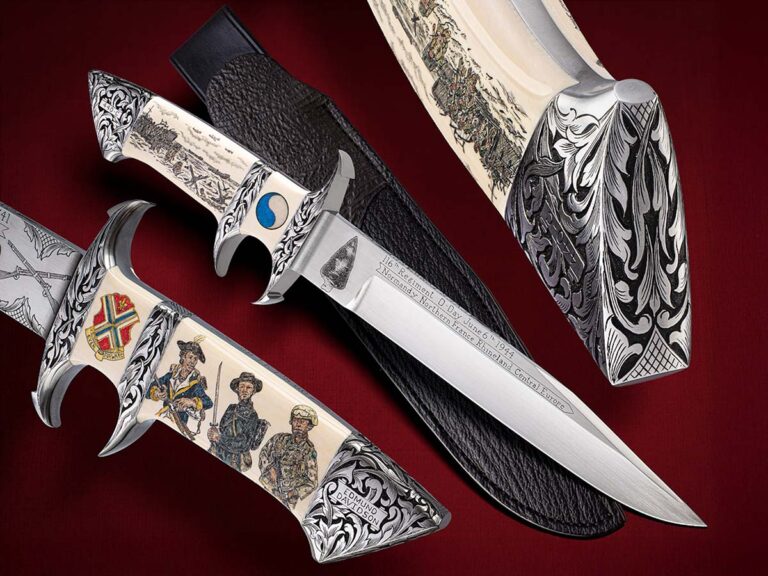
Made to support The 29th Division Museum in Verona, Virginia, Edmund Davidson’s integral subhilt fighter celebrates an American combat unit that’s served valiantly for almost 284 years.

The Augusta County Regiment formed on Nov. 3, 1741, in Staunton, Virginia, and fought in most every American war, including the American Revolution and the battle of Manassas in the Civil War. It became part of the U.S. Army’s 29th Division in World War I and adopted the theme of “Ever Forward.”

As the 116th Regiment it was in the first wave on Omaha Beach on D-Day, where it lost over 800 officers and men and was later cited by the War Department for extraordinary heroism and outstanding performance of duty. The regiment also saw action in the Iraq and Afghanistan Wars. Today, the 116th remains active as a National Guard Unit.

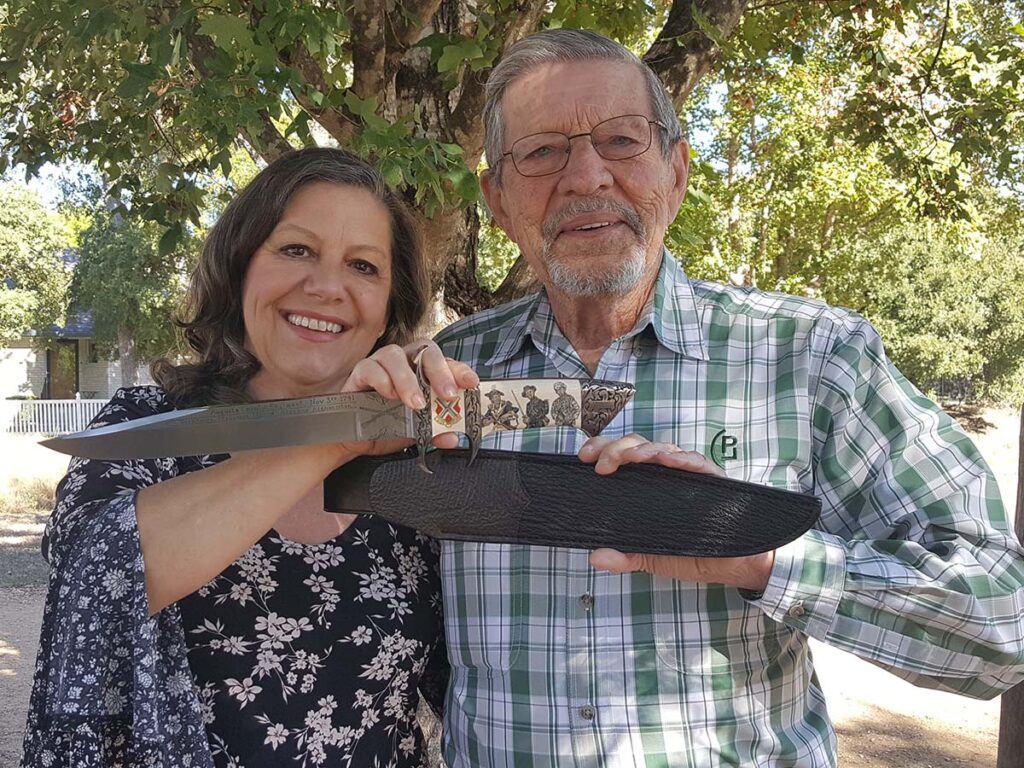
Scrimshander Linda Karst Stone (left) and sheath maker Paul Long (right) hold the completed project. (knife image by Whetstone Studio)

Linda Karst Stone scrimmed the Omaha Beach battle scene on one side of the handle and unit members from the American Revolution, Civil War and today’s 116th on the flip side. The copious scroll engraving on the butt and guard is by Jere Davidson. Paul Long made the shark-skin sheath.

More Custom Knives:

Top Knife Sharpeners: Five Options To Keep Your Edge

Keep your knife cutting ready with today’s top sharpeners.

It’s not much of a knife if it’s dull. Getting a blade sharp and keeping it that way is what the top sharpeners are all about. Pull throughs, V sharpeners, adjustable angle models and more, contemporary sharpeners not only will keep your knives keen, some are multi-tools with Torx tools and bits, screwdrivers, fire starters and window breakers. From those for use in the kitchen, camp or workshop to portable use and more, make way for today’s sharp makers.

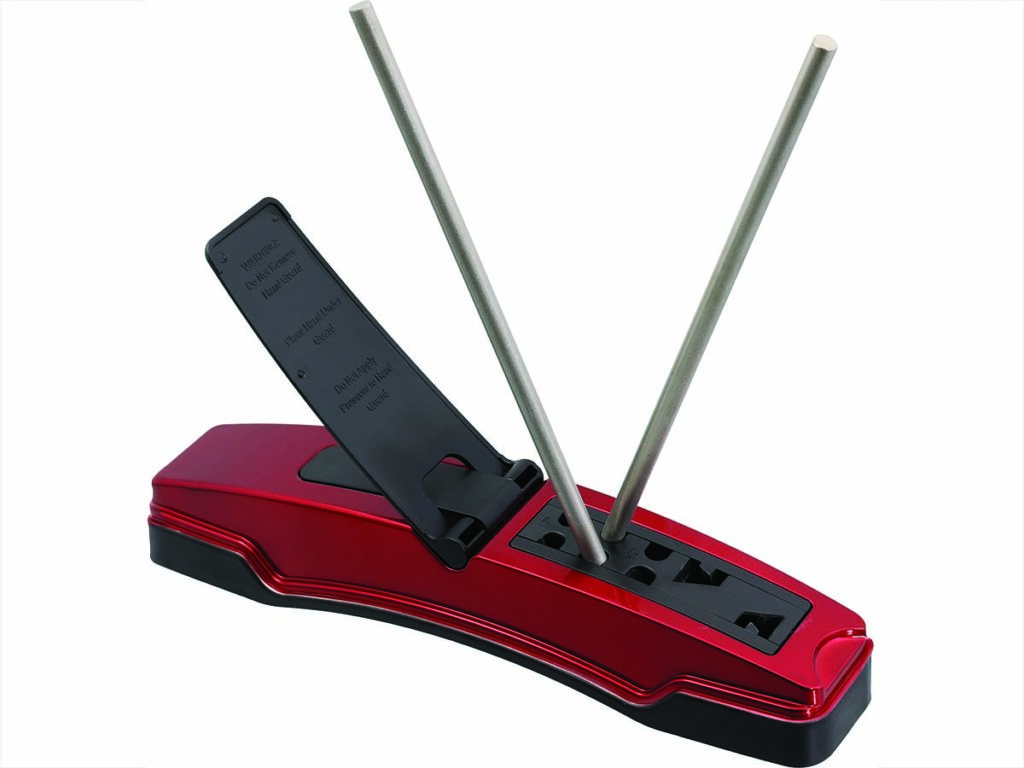
Lansky Master’s Edge Sharpener

The Lansky Master’s Edge All Diamond Sharpener has a rubberized non-slip base with integrated hand guard for safe use.

Master’s Edge All Diamond Sharpener
Model type: V sharpener
Type of abrasive: Diamond coated
Grit: 400 & 600 grit round rods; triangular rod for serrations
Types of knives sharpened: Fillet/slicing, butcher, paring, skinning/kitchen/hunting, camping, utility and chef’s
Types of edges sharpened: Plain and serrated
Weight: 1.4 lbs.
Country of origin: China
MSRP: $139.95

Inspired by the design of Lansky’s top-selling Master’s Edge Sharpener, the Master’s Edge All Diamond Sharpener and its diamond-coated abrasives put a factory edge on hunting, utility, kitchen and other knives with just a few strokes. The unit includes a pair of medium (400 grit) and fine (600 grit) diamond-coated-abrasive rods for sharpening and polishing at your choice of preset angles: 17, 20 and 25 degrees. The 17-degree setting is for fillet and fine slicing knives, while the 20-degree angle is for slicing, butcher, paring and skinning knives. The 25-degree setting sharpens hunting, camping, utility and chef’s knives. A diamond-coated triangular rod sharpens serrated blades and also awls and fishhooks. A rubberized non-slip base with integrated hand guard ensures safe use and features easy snap-in storage in its underside. The unit can be kept on a counter or stores easily in a drawer.

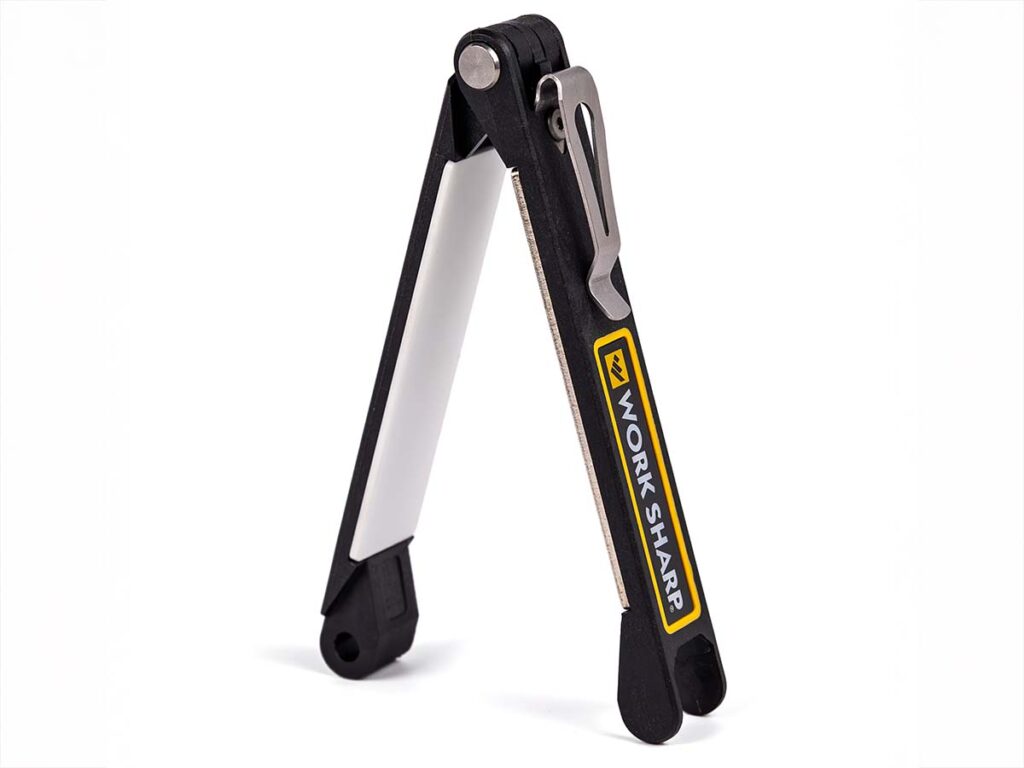
Work Sharp Folding Field Sharpener

Especially effective on EDC knives, the new Work Sharp Folding Field Sharpener is one whiz-bang of a portable unit.

Folding Field Sharpener
Model type: Compact field sharpener
Type of abrasive: Diamond grit plate and fine grit ceramic plate
Grit: Coarse 400-grit for each plate
Unit dimensions:  4.75 x .75 x .5”
Unit materials: Sharpening plates, plastic, aluminum
Types of knives sharpened: Pocketknives, hunting knives, EDC
Types of edges sharpened: Plain 
Special features: Folding design; edge angle guides (20 & 25 degrees) help maintain a consistent angle when sharpening and honing; pocket clip
Weight: 4.6 ozs.
Country of origin: Designed, calibrated and quality checked in Ashland, Oregon, using foreign components
MSRP: $29.95

The Work Sharp Folding Field Sharpener is a compact, lightweight model designed for on-the-go sharpening. It features a 400-grit diamond plate with 20-degree sharpening guides and a fine-grit ceramic plate with 25-degree honing guides, ensuring consistent, reliable edges wherever you are. The folding design and integrated pocket clip make it easy to carry almost everywhere. A big package in a small platform, it’s designed to bring back an edge after a hard day’s use or simply for touchups. Especially effective on EDC knives, it is one whiz bang of a portable-type sharpener.

CRKT Knife Maintenance Tool

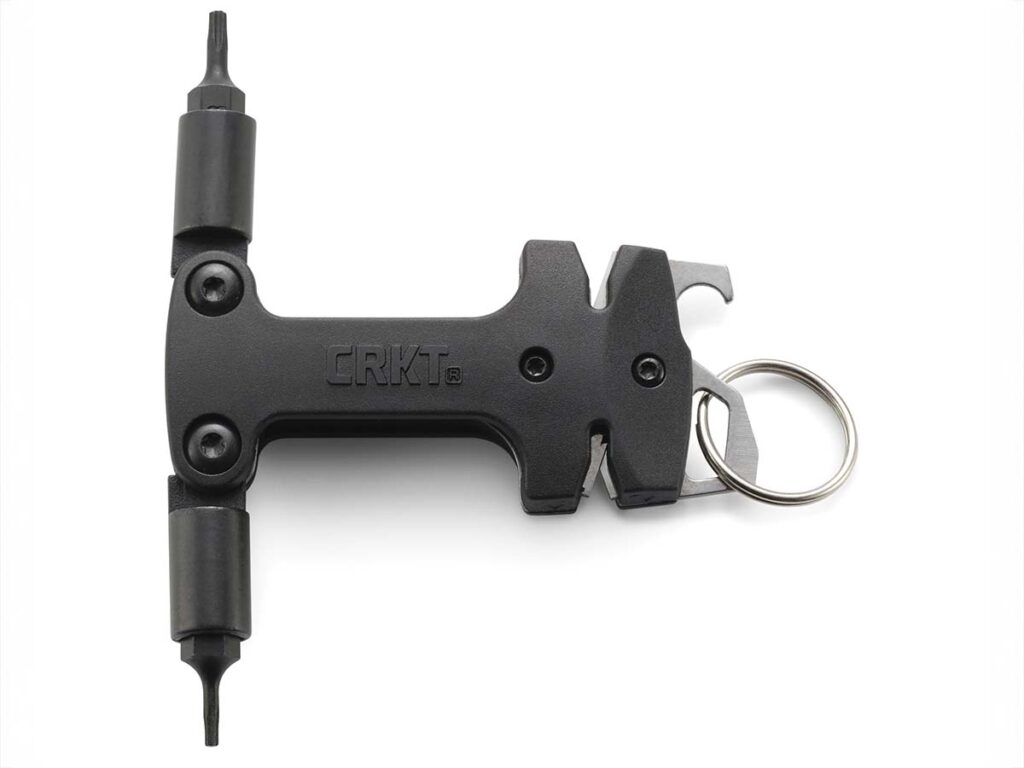
Designed by Tom Stokes, the CRKT Knife Maintenance Tool is two sharpeners and a multi-tool all rolled into one.

Knife Maintenance Tool
Model type: Keychain/pocket field sharpener and multi-tool
Type of abrasive: Tungsten carbide sharpener with ceramic honing edge
Unit dimensions: 2.7 x 1.18 x .47”
Handle: Glass-reinforced nylon
Types of knives sharpened: Pocketknives, EDC
Types of edges sharpened: Plain
Special features: T6 and T8 Torx tools/bits, flathead screwdriver, bottle opener, keychain compatible
Weight: 2.2 ozs.
Country of origin: China
MSRP: $30

Designed by mechanical engineer Tom Stokes, the CRKT Knife Maintenance Tool is a multi-tool sharpener that reflects Tom’s more than 25 years of experience in the aerospace industry, including his work with CAD software and rapid prototyping technology. He designed the Knife Maintenance Tool to prepare you for life’s various exigencies, everything from emergency repairs, popping a top on your favorite beverage—and, yes, sharpening your knives.

The Tool includes two pull-through sharpeners—one a tungsten carbide abrasive to establish a sharp edge, the other a ceramic abrasive to fine tune it—and two sizes of Torx tools/bits: T6 and T8. The sharpeners are on either side of the front of the handle, which is topped off with a bottle opener and flat-head screwdriver/lanyard hole for a keychain loop. The Torx tools are also on either side of the handle and fold out independently of one another for torquing screws pistol-grip style.

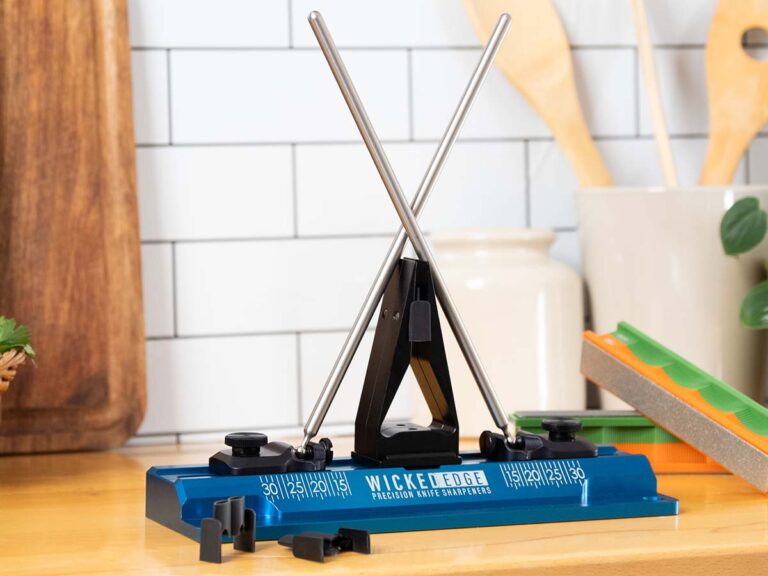
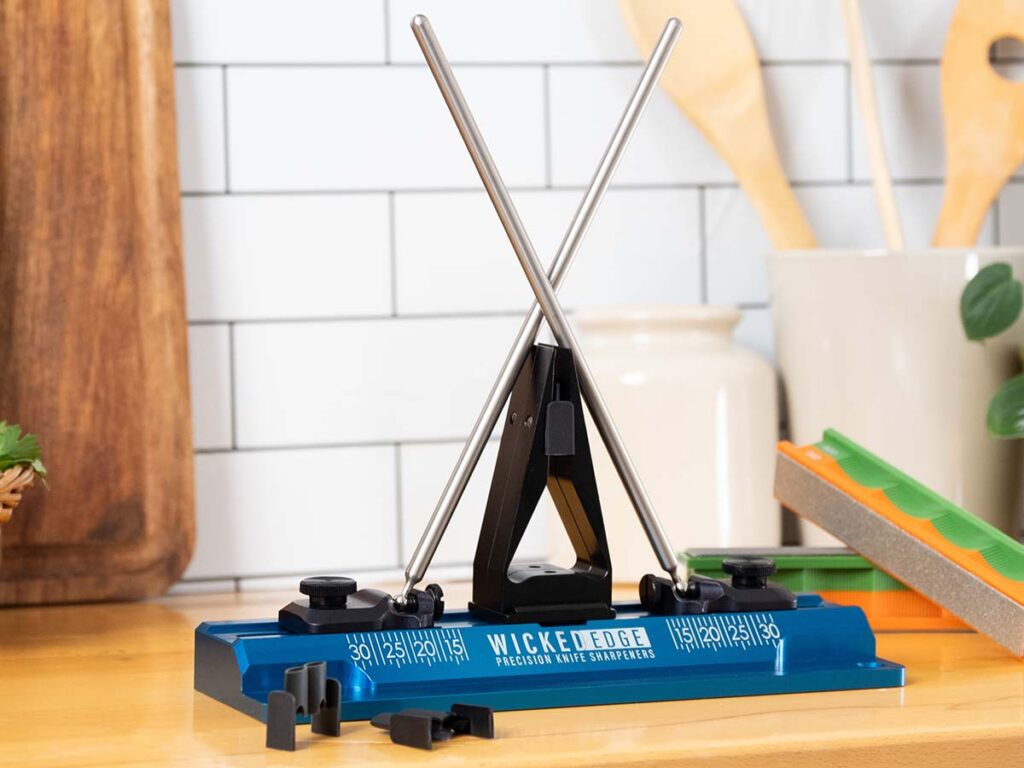
Wicked Edge GO-WE60 Precision Knife Sharpener

Premium abrasives on the Wicked Edge GO-WE60 are 200/600 grit monocrystalline diamond-coated stones.

GO-WE60 Precision Knife Sharpener
Blade Length Capacity: Up to 15”
Blade Thickness Capacity: Up to .25” (longer screws available for thicker blades)
Angle Markings: Calibrated for the blade’s edge to sit at 5/8” above the top of the vise
Guide Rod Length: 8.75”
Unit Weight: 3.6 lbs.
Country of origin: USA
MSRP: $299

The Wicked Edge GO-WE60 Precision Knife Sharpener is designed for novices and seasoned old pros alike, whether at home, in the field or on the road. A redesigned standard vise clamps fully flat-ground and distally tapered blades such as on pocketknives and household cutlery. Sharpening angles are adjustable from 13 to 31 degrees per side (26-62 degrees inclusive) in 1-degree increments for precise edge maintenance. Premium abrasives are 200/600 grit monocrystalline diamond-coated stones. Mounting options include securing to any flat surface with the included C-clamp or attaching directly using predrilled holes.

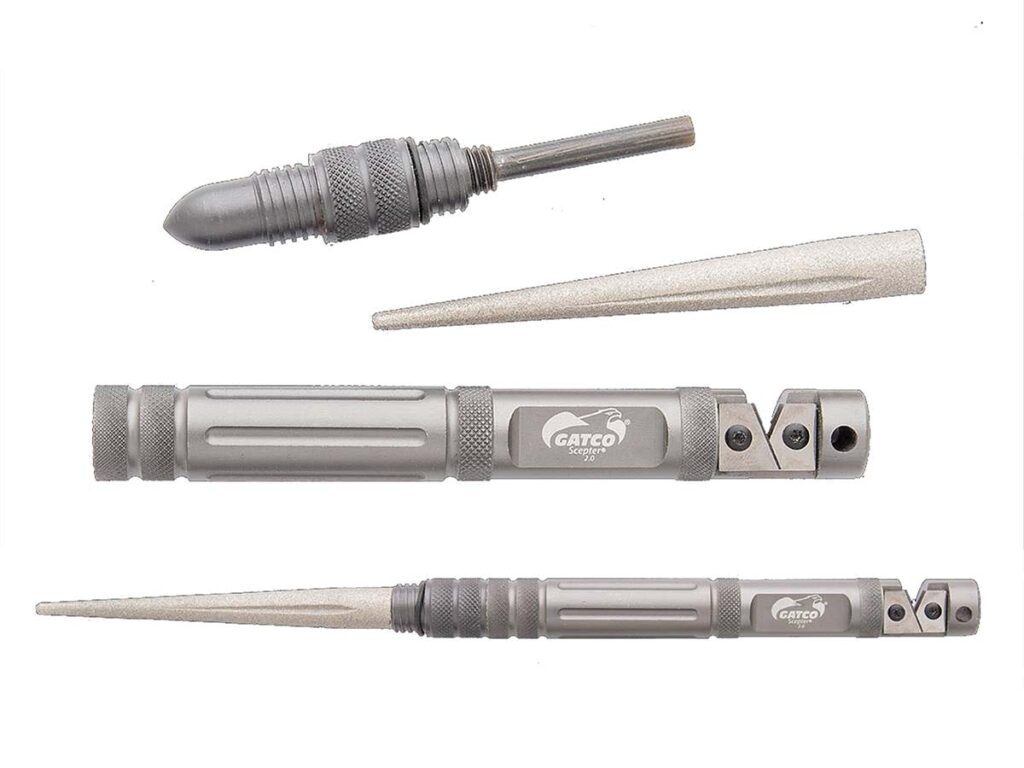
Bear & Son GATCO Scepter 2.0 Diamond

The multi-purpose GATCO Scepter 2.0 sharpens plain and serrated edges and has a magnesium rod for starting fires.

GATCO Scepter 2.0
Model type: Pull through and tapered diamond rod
Type of abrasive: Diamond coated and tungsten carbide
Unit dimensions: 6.125″
Unit material: 6061-T6 aluminum housing
Types of knives sharpened: Hunting, EDC, kitchen
Types of edges sharpened: Plain and serrated
Special features: Tapered diamond rod, magnesium fire starter rod, window breaker
Weight: 3.2 ozs.
Country of origin: China
MSRP: $49.99

The compact GATCO Scepter 2.0 Diamond Take Down Sharpener & Fire Survival Tool from Bear & Son is a multi-purpose implement for everyday pocket carry, the toolbox, to take camping and/or makes an ideal necessity for your bug-out bag. A magnesium rod for fire starting stows inside the tapered diamond sharpener, the latter which includes a groove for sharpening fishhooks. The rod and tapered sharpener are contained inside the CNC-machined, 6061-T6 aluminum carbide body, which has a pull-through tungsten carbide sharpener on the end. Each component features precision-machined threads and an outer “O” ring.

More Sharpening Articles:

New Knives June 2025

Summer Steel: June’s Hottest Custom and Production Knives You Need to Know.

From mosaic fighters to modern flippers, this month’s standout blades bring a mix of artistic craftsmanship and everyday utility. Whether you’re in the market for a hand-forged Damascus showpiece or a no-nonsense EDC, June’s lineup has something sharp for every collector and user. Here’s a closer look at what’s turning heads in the knife world this month.


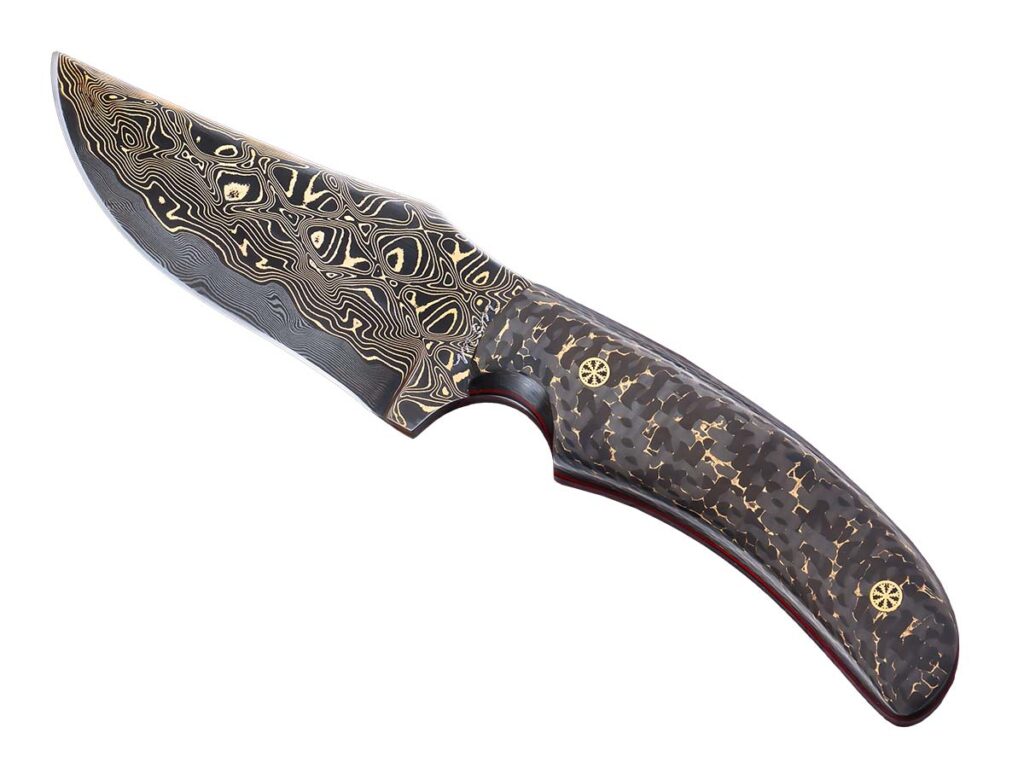
Miguel Navarro Fixed Blade

Miguel Navarro Fixed Blade

Blade length: 4.25”
Blade material: Diamond Damascus by Baker Forge & Tool
Blade grind: Hollow
Scales: Fat Carbon Gold Snake w/black and red G-10 liners
Weight: 7.4 ozs.
Overall length: 9”
Maker’s price for a similar knife (includes custom sheath): $550-$600
Maker: Miguel Navarro (SharpByCoop image)


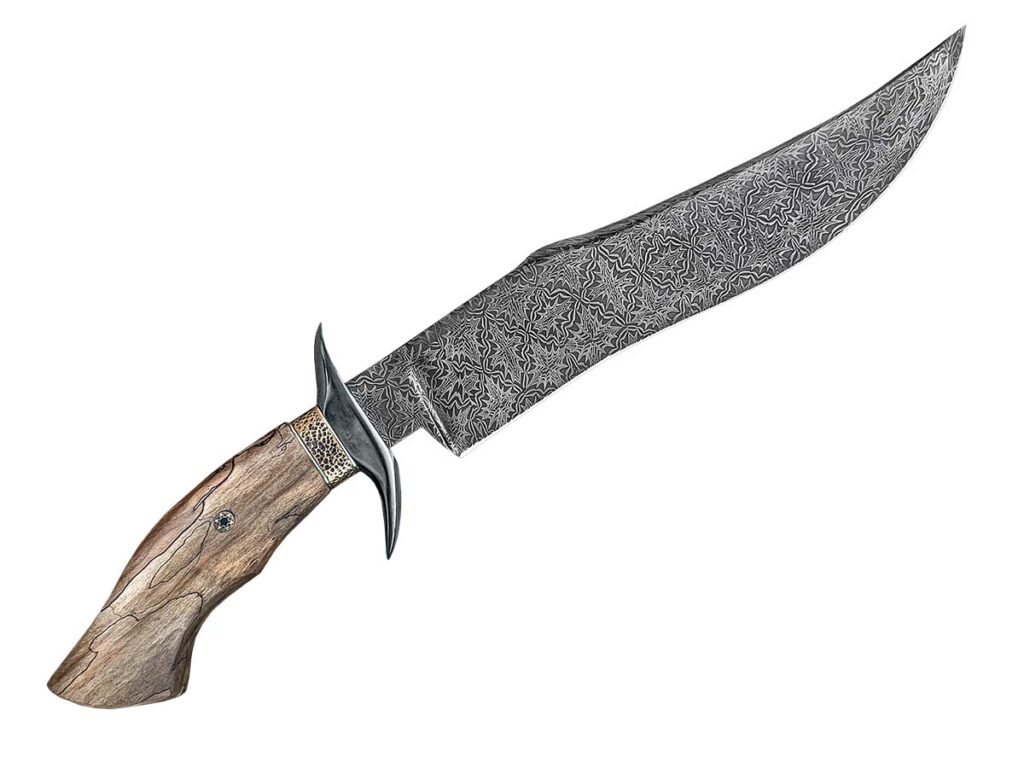
Dale Holt Mosaic Fighter

Dale Holt Mosaic Fighter

Blade length: 10”
Blade materials: 1084 carbon and 15N20 nickel alloy steels
Blade grind: Flat
Blade pattern: Clip-point recurve
Handle material: Spalted sassafrass
Spacers: Textured brass and nickel silver
Guard: Blued mild steel
Knife to know: Design features include an S-guard and dropped handle; Dale Holt is an ABS journeyman smith
Overall length: 15”
Maker’s price for a similar model: Contact maker for details
Maker: Dale Holt (Jocelyn Frasier image)


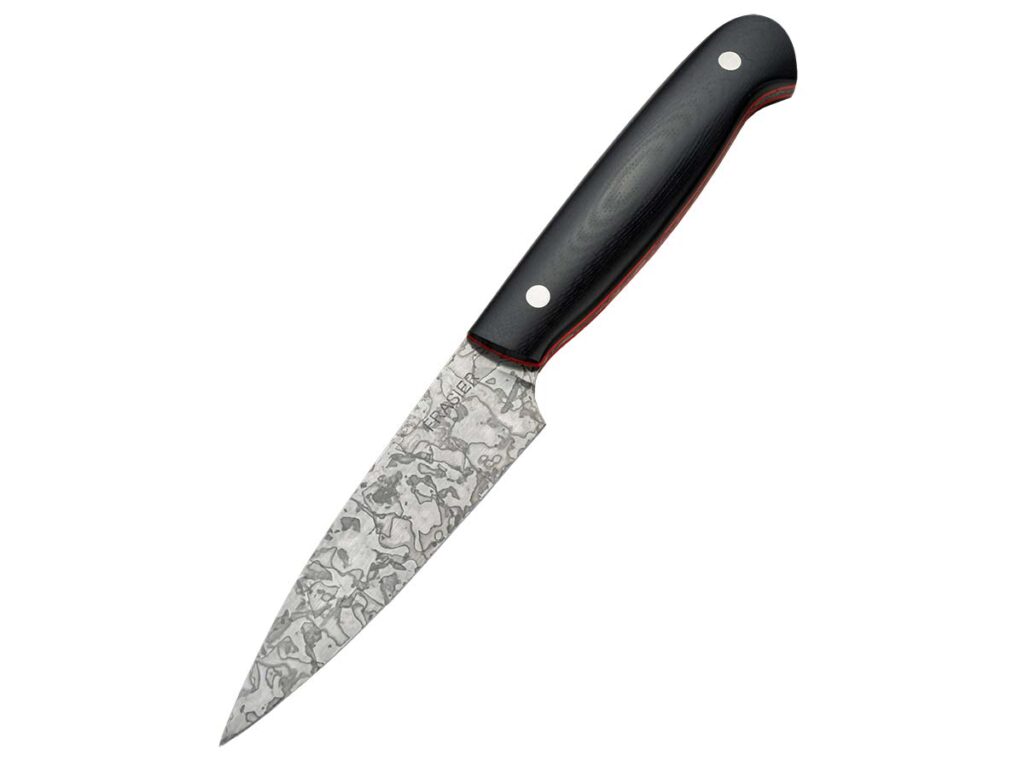
Kelly Frasier Paring Knife

Kelly Frasier Paring Knife

Kelly Frasier Paring Knife
Blade length: 3.5”
Blade material: 26C3 carbon steel
Blade grind: Flat
Blade finish: Mustard patina
Scales: G-10 w/red liners
Overall length: 7.5”
Maker’s price for a similar model: Contact maker for details
Maker: Kelly Frasier (Jocelyn Frasier image)


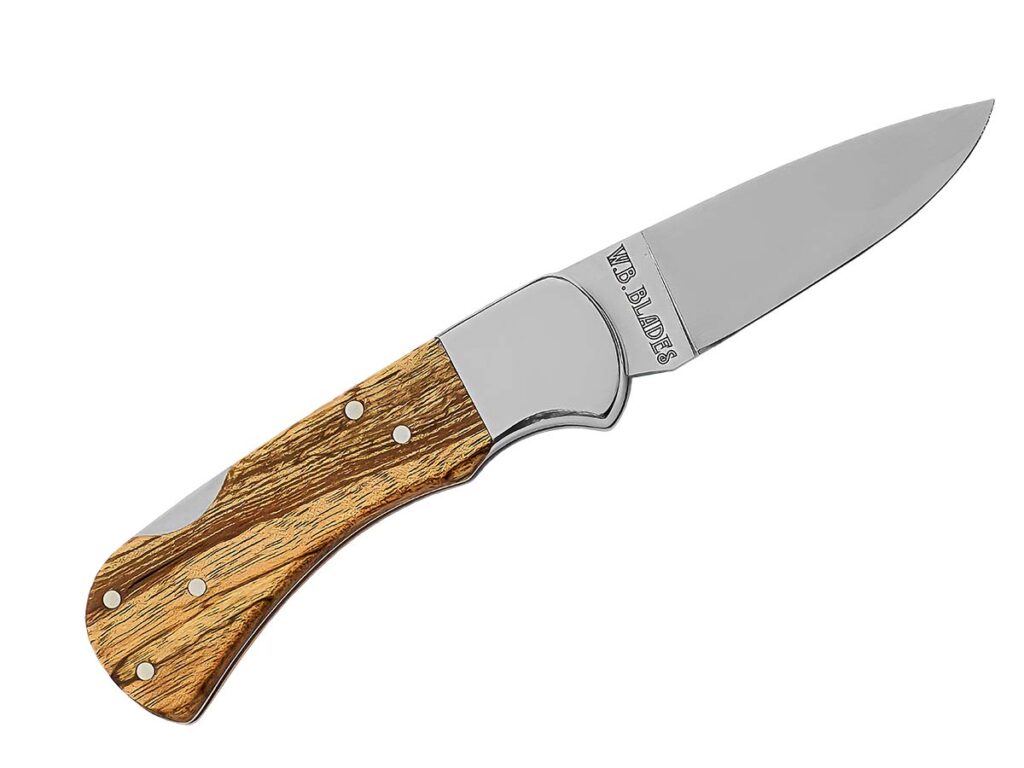
Sam Renwick Farmer’s Lockback

Sam Renwick Farmer’s Lockback

Knife type: Folder
Blade length: 2.78”
Blade steel: Nitro-V stainless
Blade grind: Flat
Blade @thickest: .98”
Scales: Spalted maple
Frame & bolsters: 416 stainless
Knife to know: The bolsters are dovetailed
Weight: 5.3 ozs.
Closed length: 3.38”
Maker’s price for a similar knife: $291 at press-time rate of exchange
Maker: Sam Renwick (Rod Hoare image)


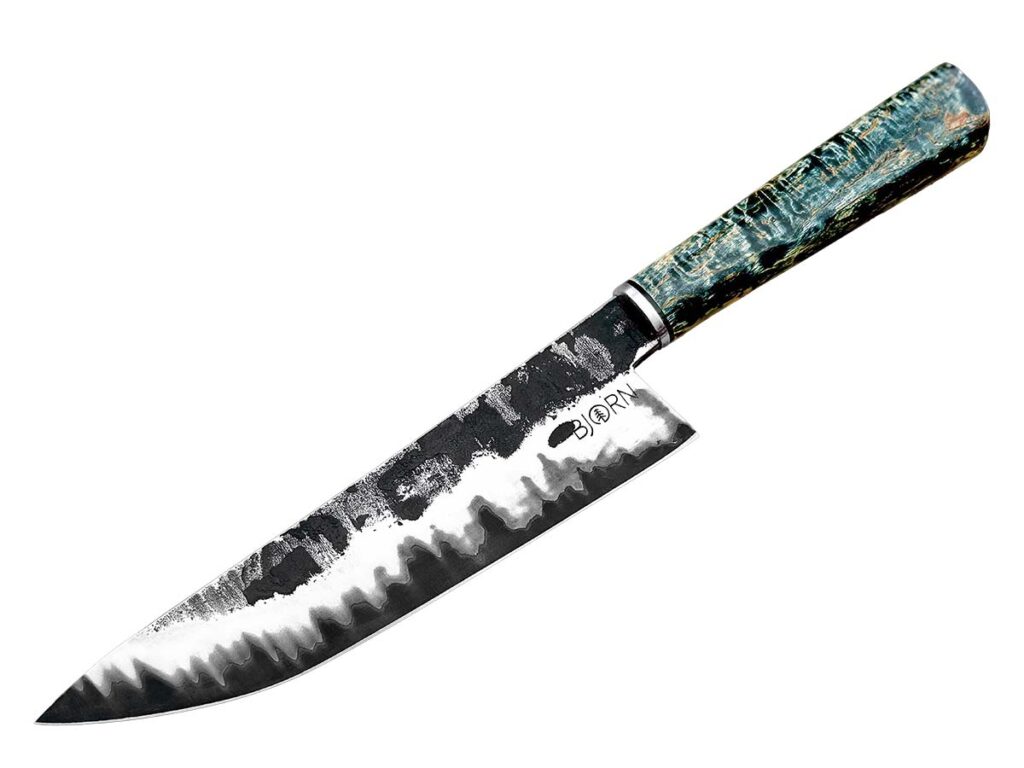
Bjorn Jacobsen Ghost Recon Chef

Bjorn Jacobsen Ghost Recon Chef

Blade length: 7.87”
Blade material: 1084 (the black core) laminated w/stainless steel etched
Blade grind: Flat w/forged texture on top half
Blade @thickest: .118”
Blade @widest: 1.97”
Handle: Curly birch dyed w/black leather dye and sanded w/600 grit paper, then sanded mostly off again at 1500 grit, blue leather dyed and sanded w/1500 grit yet again; finished w/Uncle Bjorn’s Handle Finish
Fittings: Stainless
Weight: 6 ozs.
Overall length: 12.6”
Knife to know: Blade etched in ferric chloride to make the carbon migration “pop,” then left in instant coffee overnight to make the 1084 core black
Maker’s price for a similar knife: $320 at press-time exchange rate
Maker: Bjorn Jacobsen (Rod Hoare image)


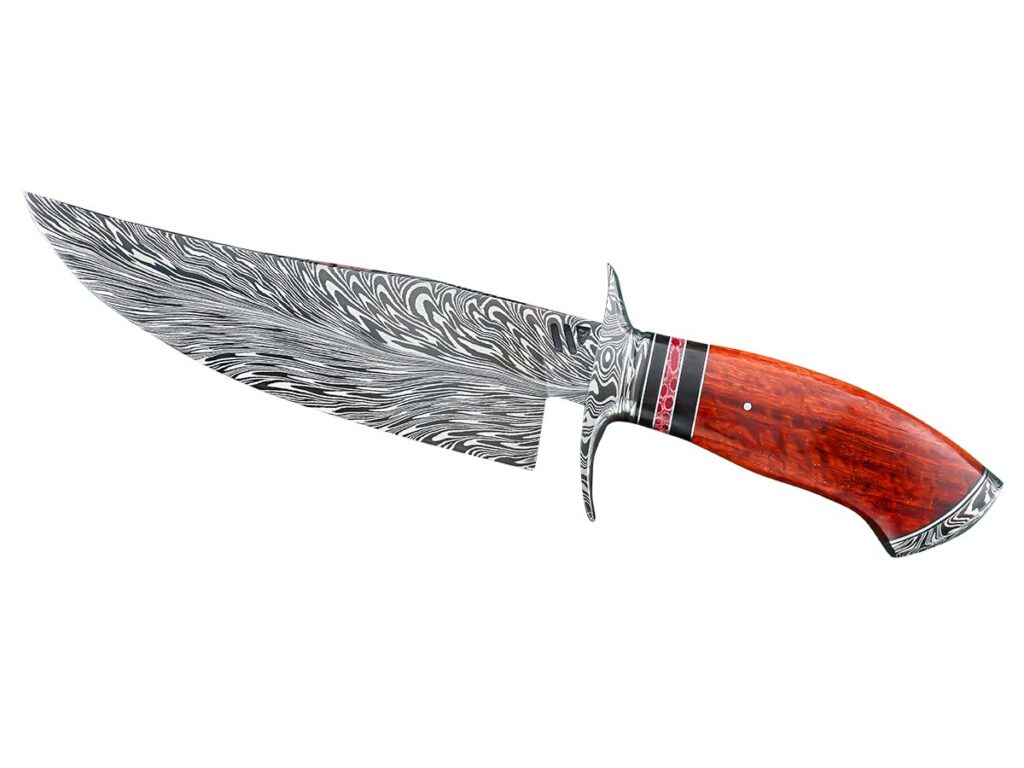
Rob Wayman Knives Feather Damascus Fighter

Rob Wayman Knives Feather Damascus Fighter

Blade length: 8”
Blade material: Feather damascus of 1084 carbon and 15N20 nickel-alloy steels
Blade grind: Full flat
Handle materials: Stabilized bog oak, black G-10 and stainless steel spacers, dyed/stabilized fossilized brain coral, and stabilized curly narra
Guard & pommel: Feather damascus
Overall length: 13.75”
Sheath: By Rob Wayman; belt model of vegetable-tanned leather w/stingray inlay
Maker’s price for a similar knife and sheath: $2,400
Maker’s remark: “I’m all about sole authorship, so I make all my own steel and keep everything in house.”
Maker: Rob Wayman Knives (SharpByCoop image)


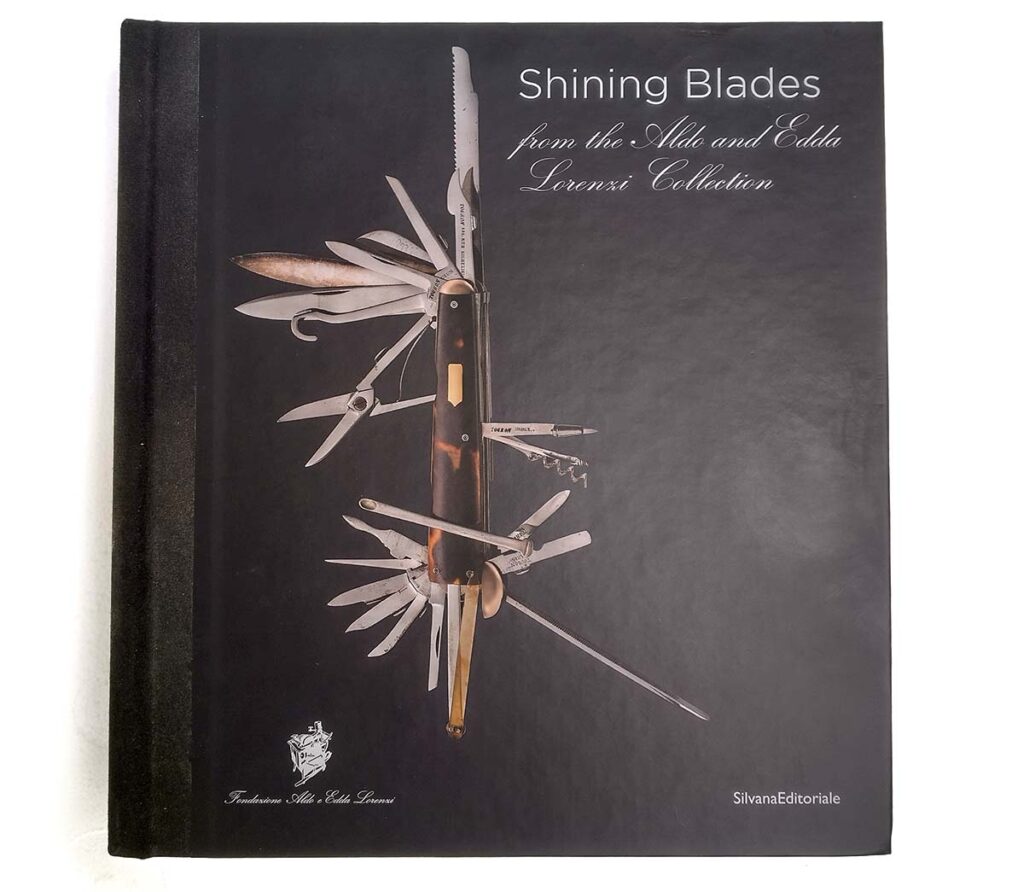
Shining Blades: From the Aldo and Edda Lorenzi Collection

Shining Blades: From the Aldo and Edda Lorenzi Collection

Authors: Aldo and Edda Lorenzi
Format: Hardcover, 9 x 9.75 inches
Pages: 344, including 280 in color
Publication date: May 27, 2025
Publisher: Silvana Editoriale
Content: BLADE Magazine Cutlery Hall-of-Fame® members, the authors operated the G. Lorenzi retail knife shop in Milan, Italy, from 1959 to 2014. To stock their store and to add to their collection, they traveled far and wide in search of all manner of knives, scissors, razors, corkscrews and other edged tools. They acquired over 2,000 pieces from the Etruscan period to the present, many incredible specimens of which are illustrated in their book—including those by some of the most famous custom knifemakers of all time—along with the stories of how the Lorenzis obtained the pieces, met the makers and much more. A must read for true knife and edged tool aficionados, both present and future alike.
List price: $50
Order: artbooks.com


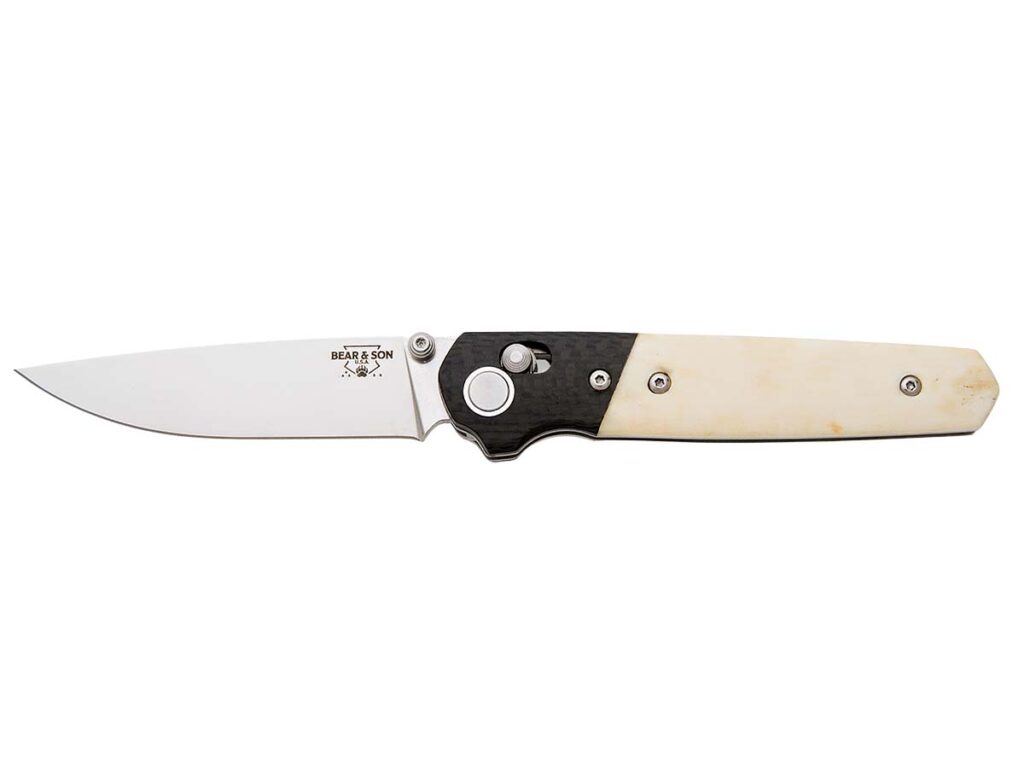
Bear & Son Cutlery Lawman

Bear & Son Cutlery Lawman

Bear & Son Cutlery Lawman
Knife type: EDC folder
Blade length: 3.25”
Blade material: D2 tool steel
Rockwell hardness: 59-61 HRC
Blade grind: Taper
Blade finish: Polished
Blade opener: Thumb stud
Pivot: Ball-bearing washers
Scales: White smooth bone
Bolsters: Carbon fiber
Lock: Slidelock
Pocket clip: Blade tip up
Weight: 3.5 ozs.
Closed length: 4 3/8”
City & state of origin: Jacksonville, Alabama
MSRP: $119.99
Company: Bear & Son Cutlery


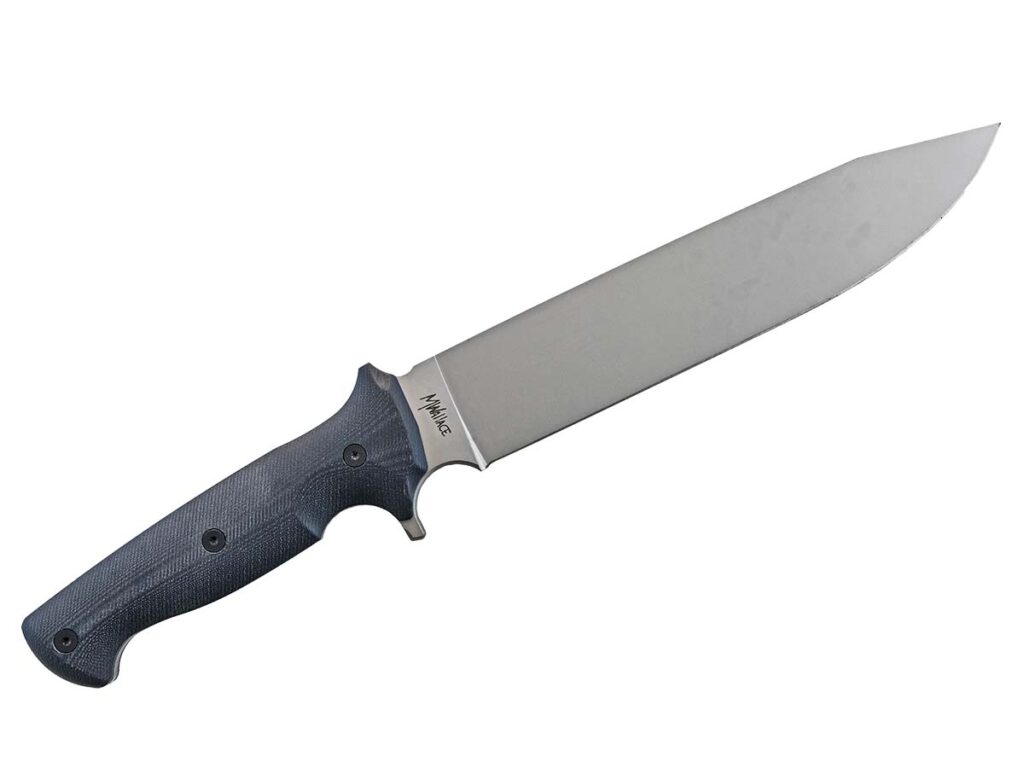
APOC Wallace Bowie

APOC Wallace Bowie

Designer: Mike Wallace
Blade length: 9 5/8”
Blade material: D2 tool steel
Blade thickness @guard & tip: .256” & .039”
Blade finish: Titanium coat
Slabs: G-10
Knife to know: Handle screws accept a size T9 Torx or star bit; any other bit used may strip the screws
Weight: 1 lb., 5 ozs.
Overall length: 15 1/8”
Sheath: Kydex, vertical or horizontal carry, MOLLE compatible
Country of origin: China
MSRP: $117
Company: APOC


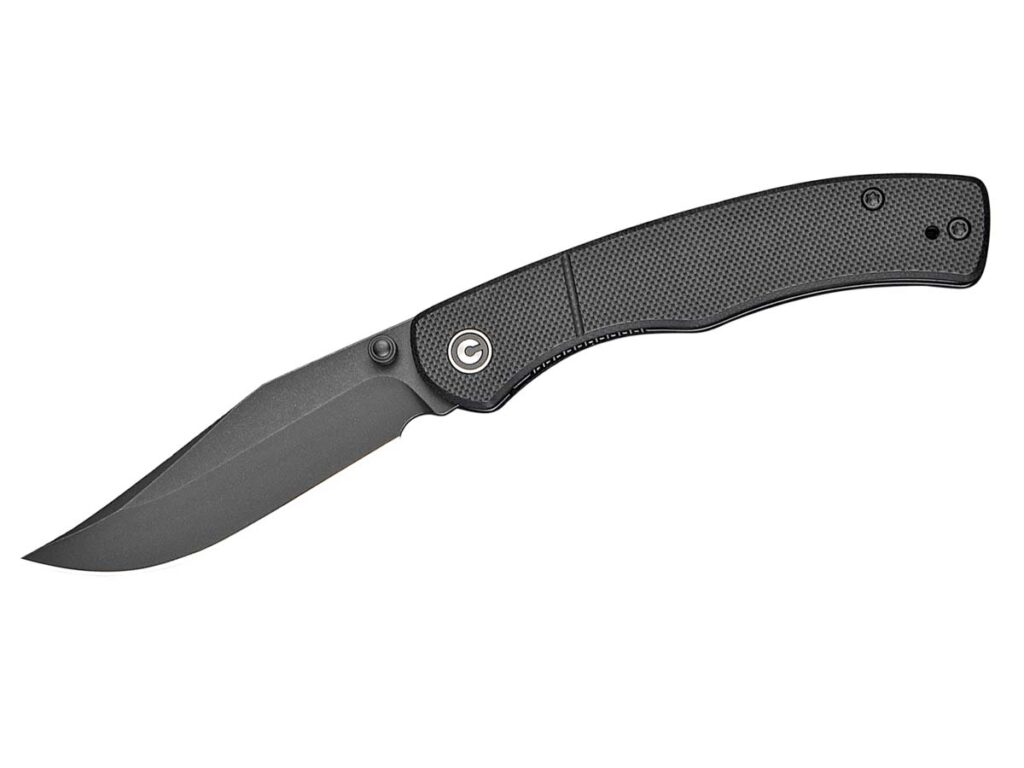
CIVIVI Clingman

CIVIVI Clingman

Designer: Taylor Martin
Knife type: Flipper folder
Blade length: 2.99”
Blade steel: Nitro-V stainless
Rockwell hardness: 58-60 HRC
Blade grind: Hollow
Blade @thickest: .12”
Blade finish: Black stonewashed
Pivot: Caged ceramic ball bearings
Lock: Linerlock
Scales: Black G-10
Handle @thickest: .47”
Liners: Stainless steel
Pocket clip: 6Al4V titanium; ambidextrous, tip up
Weight: 2.8 ozs.
Country of origin: China
MSRP: $71.70
Company: CIVIVI


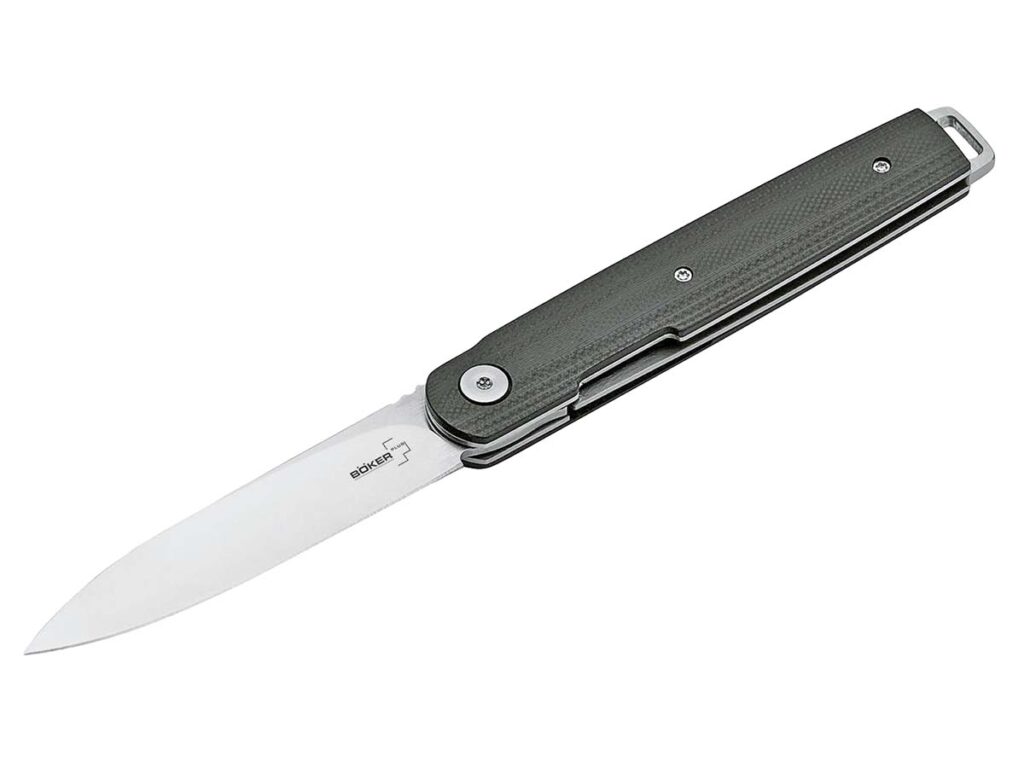
Boker Plus LRF G10

Boker Plus LRF G10

Knife type: Flipper folder
Designer: Japanese knifemaker Kansei Matsuno
Blade length: 3.07”
Blade steel: VG-10 stainless
Blade @thickest: .075”
Pivot: Ball bearings
Scales: G-10
Lock: Linerlock
Weight: 1.94 ozs.
Closed length: 4”
Continent of origin: Asia
MSRP: $108.69 at press-time exchange rate
Company: Boker Plus


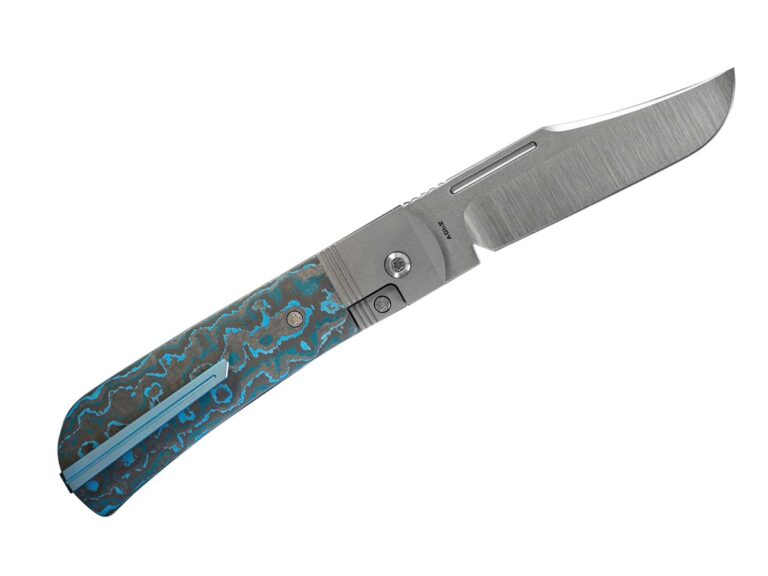
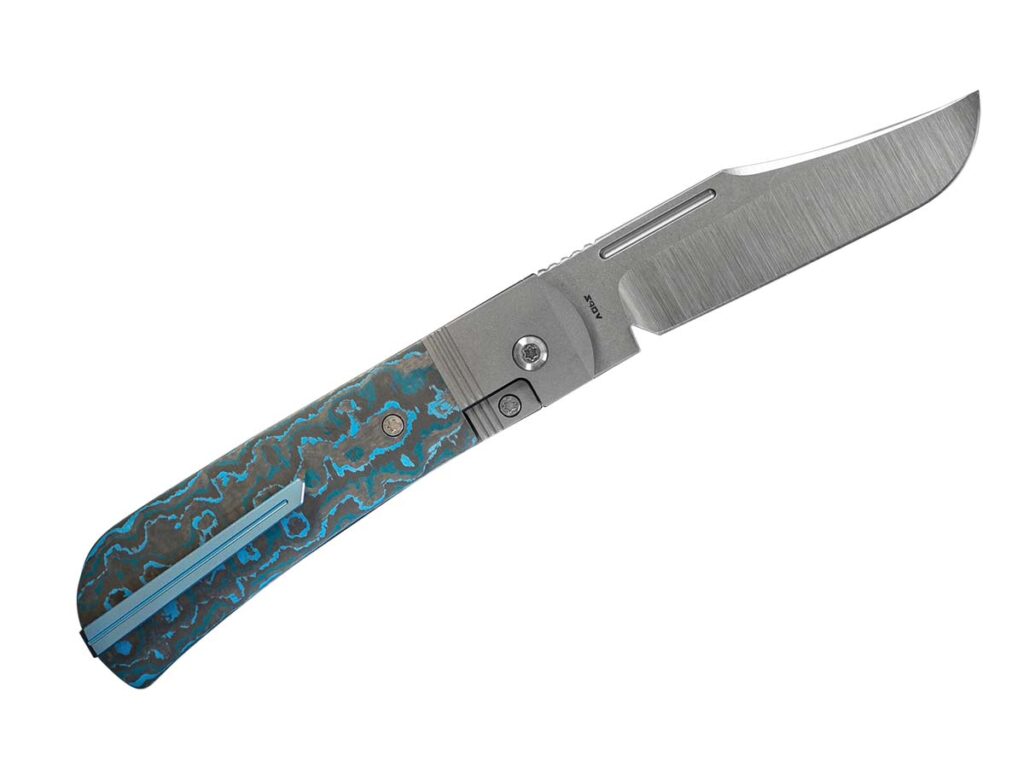
Jack Wolf Knives The Benny Fat Carbon Arctic Storm

Jack Wolf Knives The Benny Fat Carbon Arctic Storm

Knife type: Slipjoint
Pattern: Lanny’s Clip
Blade length: 3.25”
Blade steel: CPM S90V stainless
Rockwell hardness: 60-61 HRC
Blade grind: Hollow
Blade finish: Belt satin
Blade @thickest: .12”
Lock: Framelock/bolster lock
Pivot: Ceramic bearings
Scales: Fat Carbon Arctic Storm
Bolsters: 6Al/4V dark-blasted titanium
Pocket clip: Titanium anodized a light blue
Knife to know: A pocket-clip recess plug provides clipless carry option
Weight: 3.5 ozs.
Country of origin: China
MSRP: $279.99
Company: Jack Wolf Knives


Check Out Other Months:

Knife Sharpeners: To The Nth Degree

0

Three top sharpeners help you determine the proper sharpening angle.

Understanding sharpening angles is crucial for maximizing your knife’s performance. It doesn’t matter if you’re slicing a ripe tomato or carving a roast, the right angle makes all the difference. Let’s dive into the world of knife sharpening, where tradition meets innovation, and discover the top-tier systems that will keep your blades razor sharp.

I had three sharpening systems to use over one month. Luckily, I had a variety of knives that needed sharpening. I delegated what I felt were the appropriate knives for the sharpening system at hand.

One thing that was essential with each sharpener was safety first. Before you do anything, read the instructions and watch the video supplied by the manufacturer (if the latter is applicable). Move slowly—wearing light work gloves that offer dexterity wouldn’t hurt.

A.G. Russell Knives V Sharpener

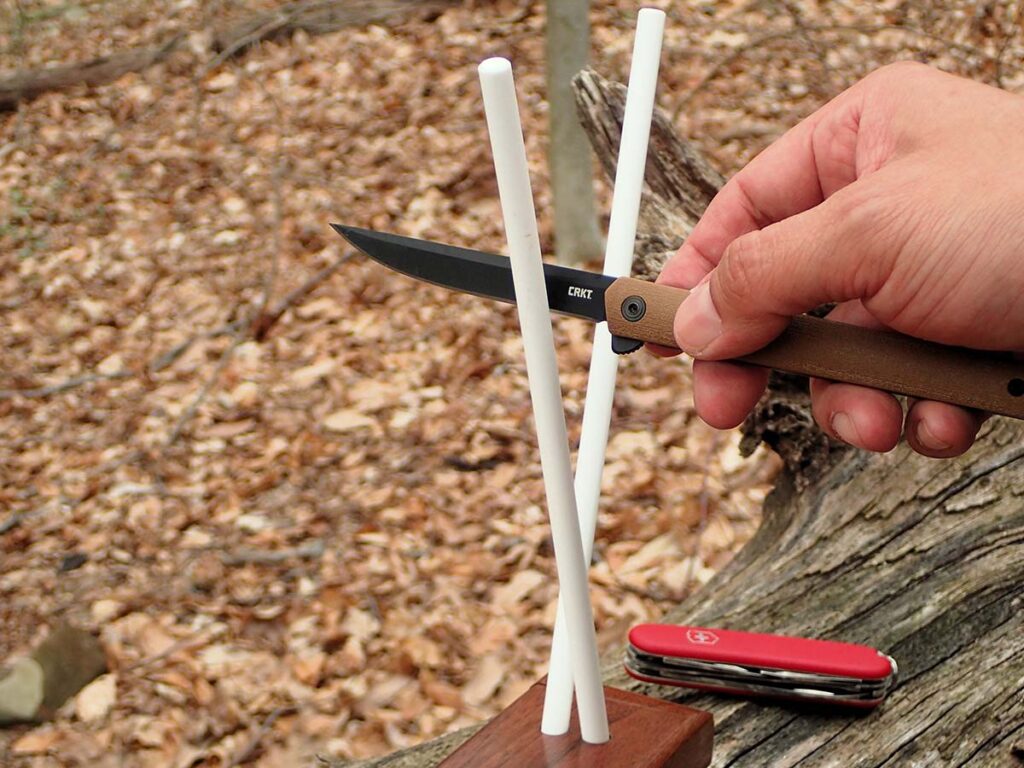
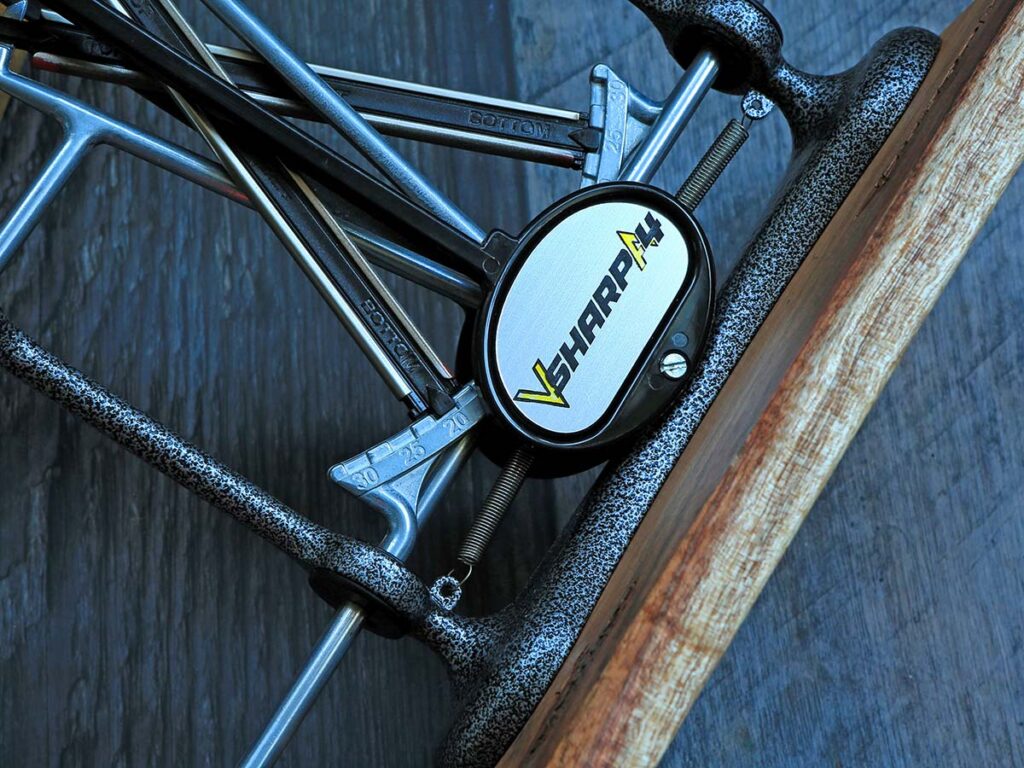
To preset the 15-degree angle with the A.G. Russell V Sharpener, start at the knife hilt and draw down steadily with moderate pressure.
  • 5° per side, creating a compound 30° angle on the blade edge
  • 90 percent+ Alumina Ceramic sharpening rods
  • Diamond Rods (optional)
  • Rod Storage
  • Walnut base is 10.25 inches long
  • Weight: 16 ounces
  • Made in USA
  • MSRP: $71.95

Pros

  • Consistent Edge Every Time
  • Durable Materials
  • Simple & Portable

Cons

  • Single Angle Only
  • No Intermediate Grit

The A.G. Russell Knives V Sharpener is a simple yet highly effective tool for keeping your knives razor sharp. Designed with a sturdy walnut base, it holds two ceramic or diamond rods in a precise V-shape, making it easy to maintain a consistent edge. The ceramic rods, made from 90 percent+ alumina, are built to last for years—unless you drop and break them, of course. On the other hand, the diamond rods are more aggressive and perfect for restoring dull blades before you hone them to perfection with the ceramic rods.

Using the V Sharpener is a breeze. Hold your knife straight up and down, like you’re slicing cheese, and draw it down one side of the V and then the other. In no time, you’ll have a razor-sharp edge ready for action. The walnut base is 10.25 inches long and keeps everything neatly in place. If the ceramic rods start looking dark from metal buildup, a quick rub with an A.G. Russell Rust Eraser will return them to peak performance.

Why 15 Degrees

I caught up with Jake Broce from A.G. Russell Knives to ask why the company went with one sharpening angle, settling on 15 degrees.

“A.G. Russell preferred a 15-degree-per-side [compound 30-degree] bevel for his slicing knives because it created a sharper, more efficient cutting edge,” Jake explained. “His knives were ground thinner than most, which made them slice exceptionally well. Since his sharpener was made for most general-use and kitchen knives, he chose a 15-degree angle per side.

“He once worked with a German knifemaker, a Mrs. Dahmann, who hesitated to grind A.G.’s blades so thin out of concern they’d be too fragile. A.G. told her his customers wouldn’t break them because he’d teach them how to use them properly. For tasks like chopping, however, he used thicker blades and more obtuse bevels—he tailored each edge to its specific function.”

Setup & Use

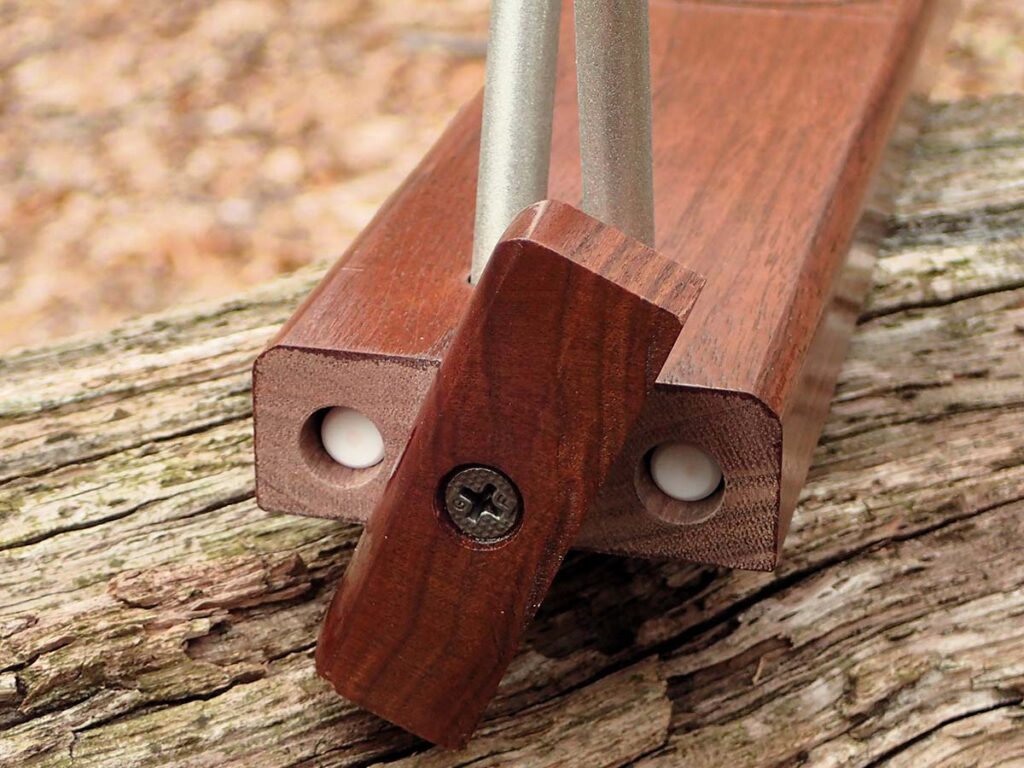
The A.G. Russell’s ceramic rods store in a walnut base with a wooden gate, while a plastic slip and cap protect the diamond rods against weather and damage from other gear.

Setting the V Sharpener up is a breeze. It was the second easiest to assemble of the test sharpeners. The ceramic rods are housed in the walnut base with a simple wooden gate. The diamond rods come in a plastic slip securely fastened with a plastic cap for protection against weather and from your other gear.

Once the sharpener is set up, start at the knife hilt on the diamond or ceramic and draw down. Keep it as steady as you can. Keep your hand behind the line depicted on the walnut base. Use moderate pressure, nothing too intense. Listen to the sound and feel the abrasives do their work.

This unit works easily at home or in the shop. It also fits easily into a pack for camping or a multiday cabin stay.

Report Card

The V Sharpener is a medium-weight unit. The only change I might make would be to add grit between the diamond and ceramic rods.

Whether you’re a seasoned chef or simply someone who appreciates a sharp blade, the V Sharpener is a solid investment that outperforms fancy gadgets and expensive machines. It’s simple, effective and built to last.

Warthog Elite A4 Sharpener

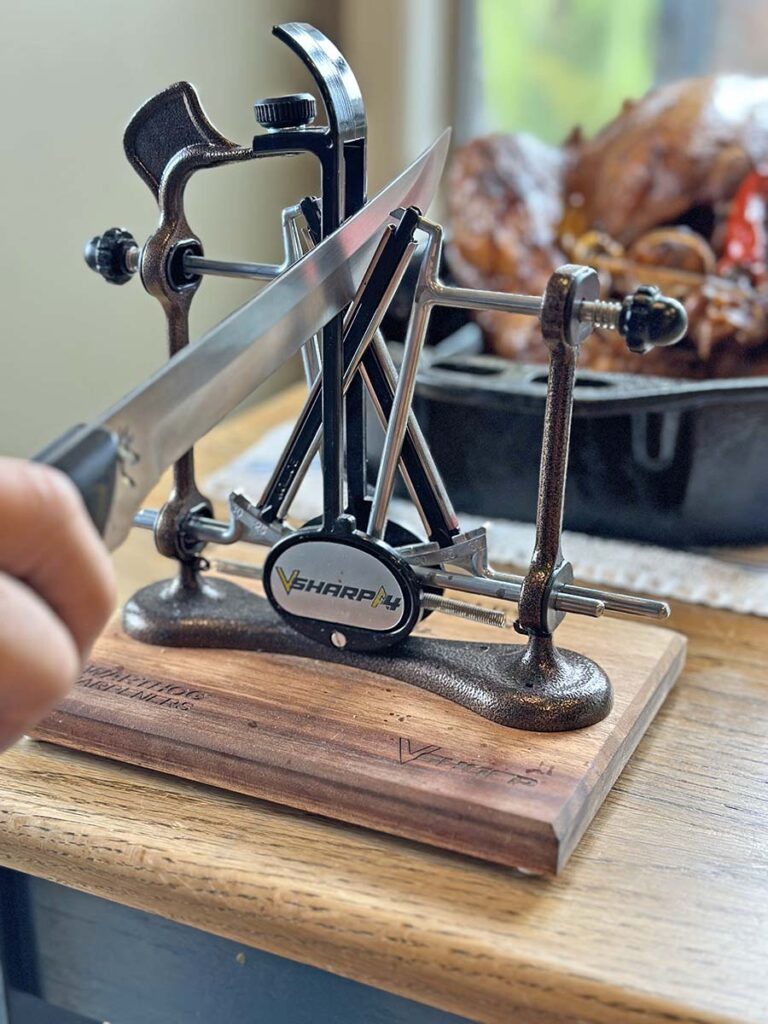
The Warthog A4 Elite uses a patented V-Sharp system with two spring-loaded diamond hones that sharpen both sides of the blade simultaneously—no more struggling to hold the perfect angle. (Warthog image)
  • 15° angle for high-end specialty knives
  • Patented V-Sharp system for precision angle adjustments
  • 4 Adjustable Angles of 15, 20, 25 and 30°
  • 325-Grit Natural Diamond Hones w/finishing steels included
  • Metal Frame Construction
  • Durable Powder Coat Finish
  • Additional 270, 325, 600 and 1,000 grit and ceramic hones available
  • Base of deluxe African wood
  • Weight: 1 pound 13 ounces
  • Made in South Africa
  • MSRP: $144.99

Pros

  • Dual-Side Sharpening
  • Adjustable Angles
  • User-Friendly

Cons

  • Not Travel-Friendly

The Warthog Elite A4 Sharpener is a game-changer that keeps your knives razor sharp with minimal effort. It uses a patented V-Sharp system with two spring-loaded diamond hones that sharpen both sides of the blade simultaneously—no more struggling to hold the perfect angle.

The A4 has a sturdy wooden base that keeps everything stable while you work, and the metal frame construction ensures durability. You can adjust the sharpening angle to 15, 20, 25 or 30 degrees, making it versatile enough for everything from delicate sushi knives to rugged outdoor blades. The included 325-grit diamond honing stones do the heavy lifting, while built-in finishing steels refine the edge. For even more control, you can swap in aftermarket hones with grits ranging from 270 to 1,000, or ceramic for serrated blades.

Setup & Use

You’re ready to rock and roll once you open the package and assemble the unit. The A4 setup stands out as the easiest among the three test sharpening systems.

“If you can slice a tomato, you can sharpen a knife,” asserts the Warthog video. Hold the knife securely and slice down along the ready-set angles. It’s as easy as that. The A4 is the user-friendliest of the test sharpeners.

This one is made for use at home or in the shop. It can be awkward to pack and take along with you. Let it stay ready for action in a semi-permanent location and carry a smaller field-worthy sharpener to the outdoors, on the go, etc.

Report Card

You can adjust the sharpening angle on the Warthog to 15, 20, 25 or 30 degrees, making it versatile enough for everything from delicate sushi knives to rugged hunting blades.

The A4 is a lightweight sharpener. I wouldn’t change much to the already simplistic method of sharpening. Despite its complex nature, I like the multi-angle positions and the hand protector.

Using it is simple. Slide your knife through the vertical guide and the sharpener does the rest. Whether you’re a home cook, professional chef or an outdoor enthusiast, the A4 makes sharpening fast, easy and precise. It comes in multiple colors, so pick one that matches your style.

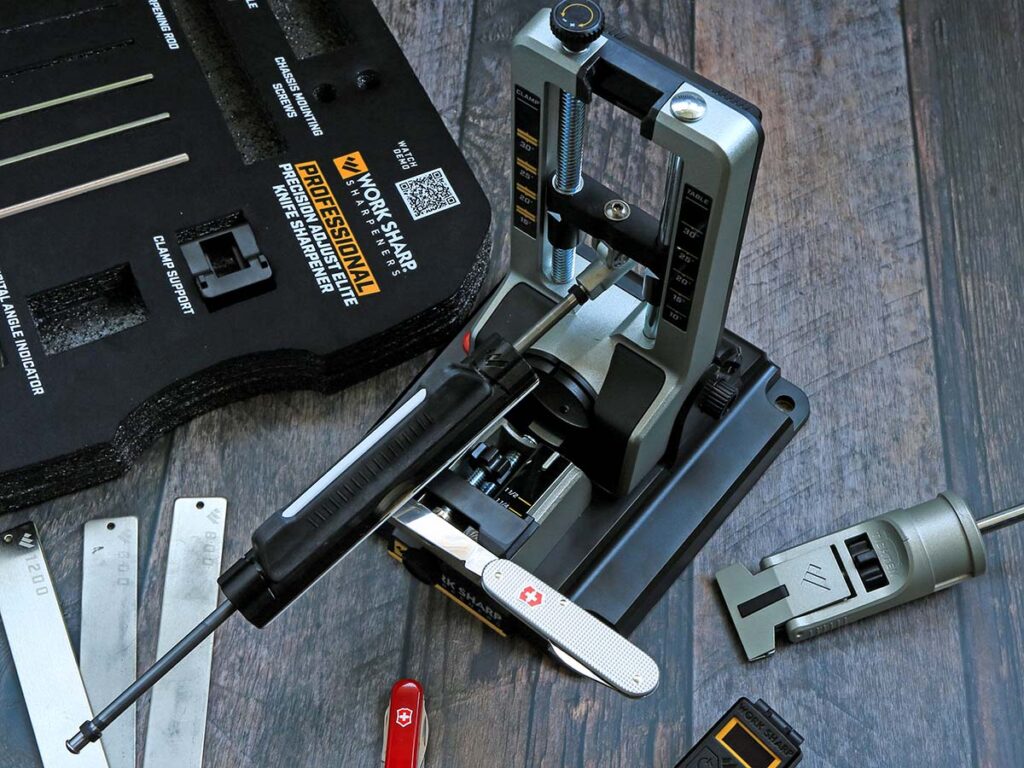
Work Sharp Professional Precision Adjust Elite Sharpener

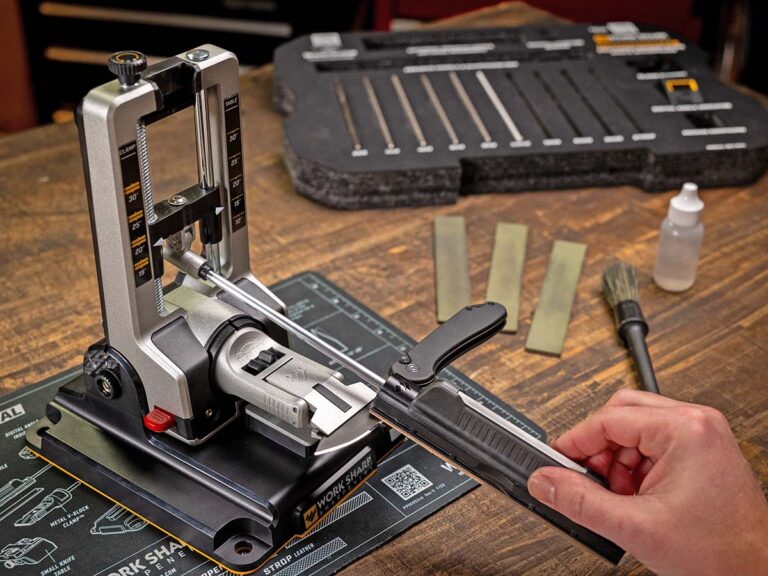
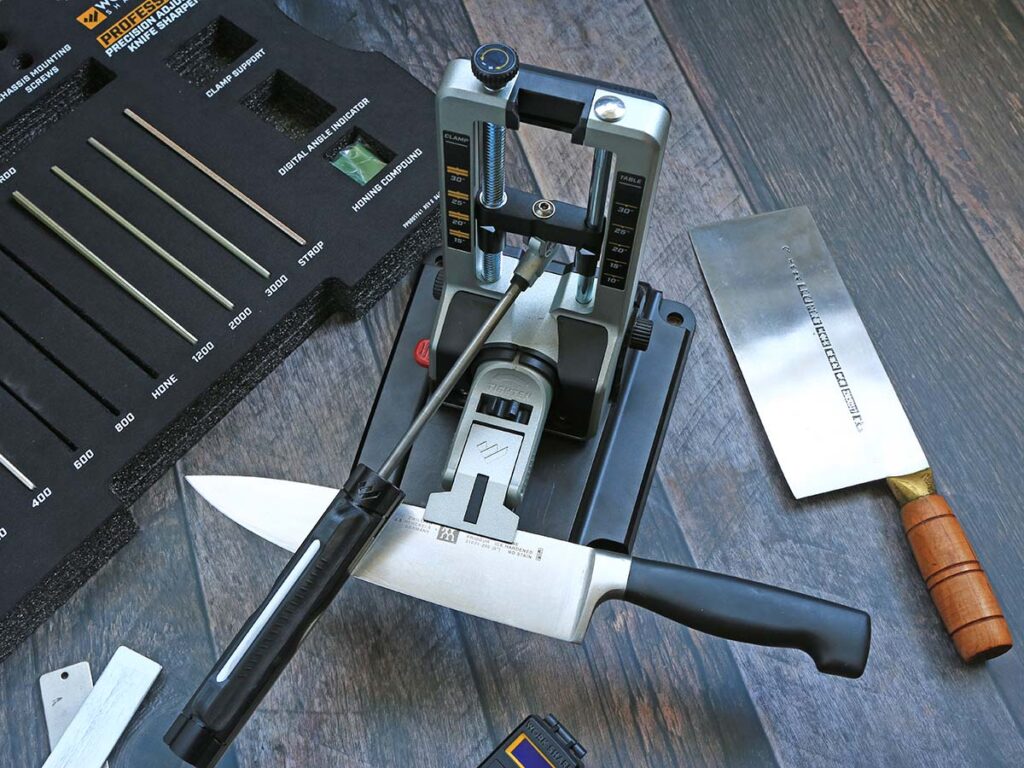
The supplied clamp support works on larger knives and eliminates any play, leaving a solid workspace with the Work Sharp unit.
  • Digital Angle Indicator
  • Comprehensive 10-Abrasive System
  • Coarse diamond plates (220, 320, 400 grit)
  • Fine diamond plates and ceramic plate (600, 800 grit, fine ceramic)
  • Premium resin-bonded diamond plates (1200, 2,000, 3,000 grit)
  • Leather Strop with .5 micron Chromium Oxide
  • Metal V-Block Clamp
  • Clamp Stabilizer Platform
  • Small Knife Table Attachment
  • Dedicated Serration Sharpener
  • Precision Metal Sharpening Frame
  • Heavy-duty carry case
  • Weight: 21 pounds
  • Designed, engineered and calibrated at Work Sharp’s facility in Ashland, Oregon. Work Sharp sources materials from various manufacturers, so some components may come from different locations.
  • MSRP: $449.95

Pros

  • Pro-Level Precision
  • Versatile & Comprehensive
  • Secure & Stable

Cons

  • Complex Setup

The Work Sharp Professional Precision Adjust Elite Sharpener is a powerhouse for anyone serious about keeping knives razor sharp. Built with solid metal construction and rugged hard plastic, the sharpener holds your blade steady while you work, ensuring accuracy every time. It features a fully adjustable angle system ranging from 15 to 30 degrees so you can fine tune your edge to match your needs.

The unit’s 10-abrasive system (1 x 6 inches) sets it apart. You get everything from coarse diamond plates (220, 320, 400, 600 and 800 grit) and ceramic hones to ultra-fine resin-bonded diamonds (1200, 2,000, 3,000 grit) and a leather strop for the final polished finish. Whether restoring a dull edge or refining an already sharp one, the Work Sharp covers you.

A V-block clamp securely holds your knife in place, making sharpening effortless, and the included knife table attachment ensures that even smaller blades get the same precision treatment. A rugged carry case keeps everything organized and portable when needed.

Setup & Use

While not challenging, setting this bad boy up takes time. The instructions are excellent, as all of them are for the reviewed sharpening units. Nonetheless, this required me to view a few videos. Read and watch to make yourself proficient in the use and setup. Though the Work Sharp is the hardest unit to assemble, it’s worth the trouble. Don’t let this factor deter you before giving it a chance. Take the time to familiarize yourself with the sharpener’s working parts and then you’ll be a believer. Once you master the process, you will pat yourself on the back!

The Work Sharp comes with a carrying case. However, where would you go besides a buddy’s house to show it off? It’s heavy and bulky for toting around. As a result, the sharpener is an ordained home and shop unit.

Report Card

The magnet system of the Work Sharp’s knife attachment helps keep smaller blades in place while a support hand helps steady them.

I like the 10 sharpening abrasives and leather attachment with honing compound. That’s a nice personal touch. I love how effortlessly I can tuck the abrasive sharpening rod away when I’m done. Whenever I need to flip the blade or make adjustments, the handle slides right into its designated slot in a flash. Plus, checking the blade burr before flipping is a breeze. Bravo, Work Sharp!

I wish there were an easier way to tell the difference between the unit’s clamp and table numbers and how they relate to the digital reader. Of course, this aspect can easily be chalked up to user confusion.

If you’re a knife enthusiast, chef or collector, the Pro Precision Adjust Elite delivers professional-level results efficiently. It’s not just a sharpener—it’s an investment in keeping your blades performing at their best.

More Sharpening Articles:
Advertisement

Must Read Articles

Read this before you make a knife

Knifemaking 101 – Read This Before You Make a Knife

  by Wayne Goddard My experience has taught me that there's nothing like digging in and getting started. I've often said the hardest part of the...
how to forge damascus steel

How to Forge Damascus

Advertisement
Advertisement