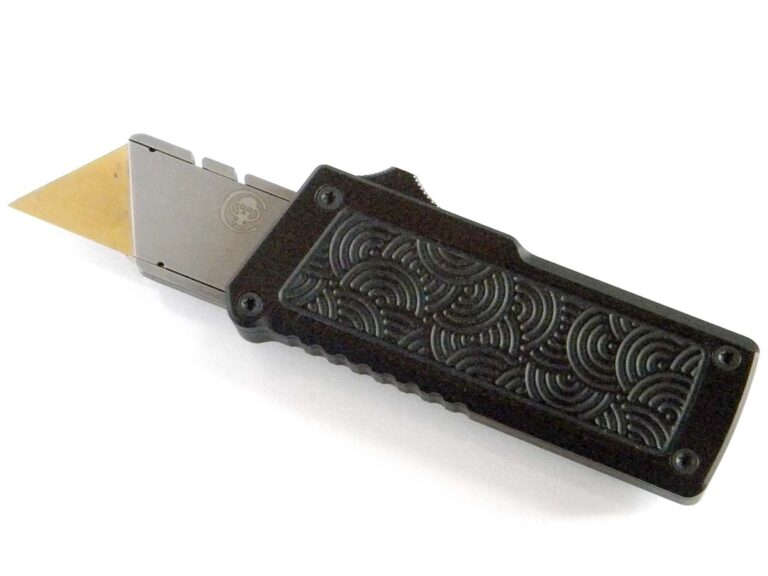
Whether you need a pristine edge for skinning game or a razor-sharp utility blade for daily EDC chores, it is easy to see why replaceable-blade knives have exploded in popularity. Chaves Knives takes this a step further.
The Pleasant Grove, Utah, manufacturer is known for thinking outside the box with its designs and this holds true for its CHUB. A very fast out-the-front (OTF) double-action small pocket utility knife ensures you never have a dull blade, can get it into action no matter what the circumstances,and is fun. Even so, the knife must perform, so let’s see if the CHUB cuts it.
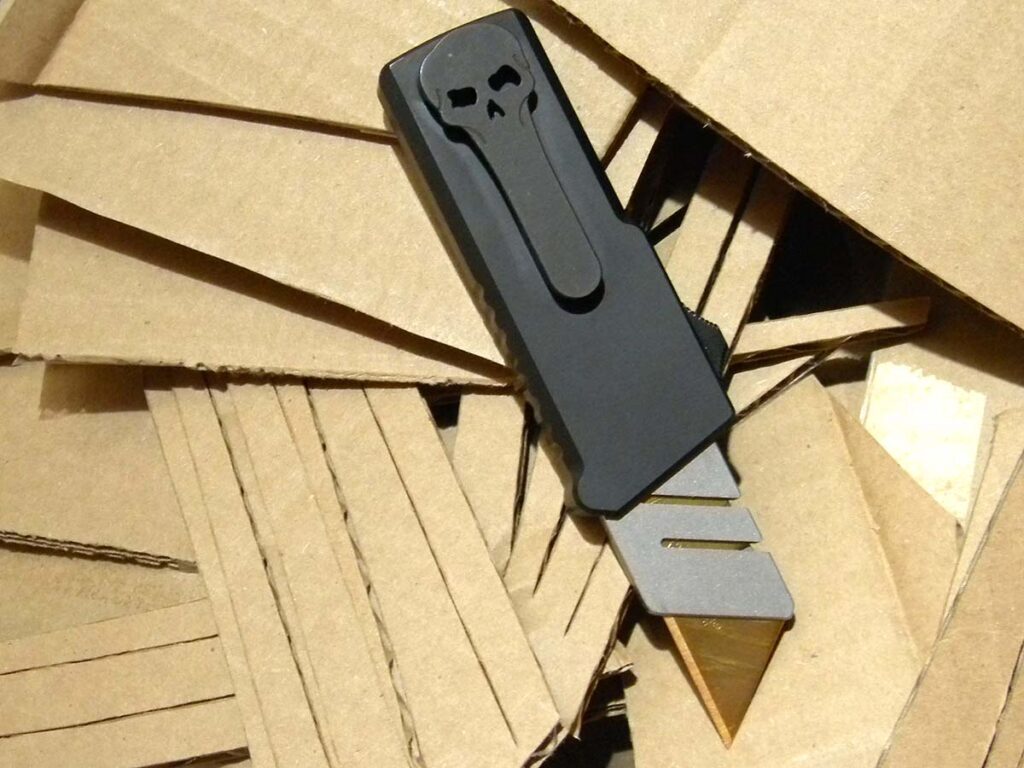
Expected from most utility knives, the Chaves model ate up cardboard in the course of testing. It was quick work, but for the author, somewhat challenging given the CHUB’s smaller handle.
I started with a standard paper slice to test the factory edge on the replaceable blade. I used graph paper and, as expected, the CHUB’s edge zipped through it quickly, producing clean slices and smooth cuts. The knife’s handle was comfortable, even though it was a tad short for my hand.
Onto single-walled cardboard, the CHUB burned through the medium. I could get used to this performance, as I break down cardboard daily. No folding or sliding, just an aggressive in and out through the material. The handle provided a positive grip, a plus on the more challenging cardboard. As a note, the knife rides very nicely in any pocket.
Slapping Leather
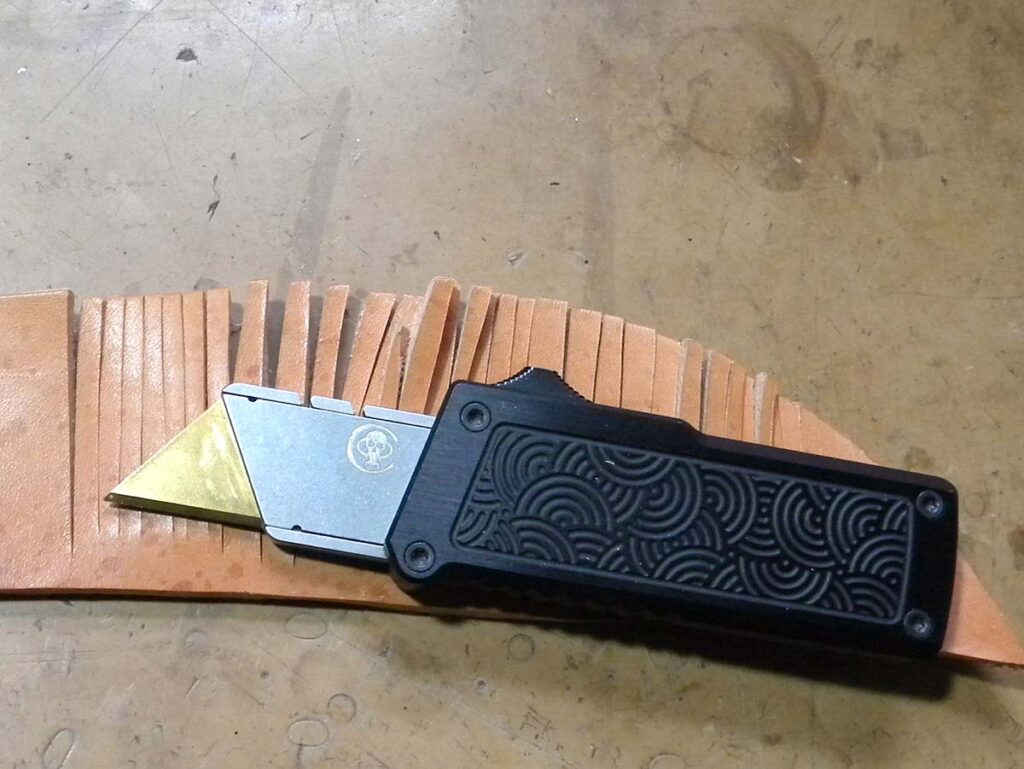
The author figures leatherworkers might find the knife very handy as it proved aggressive against leather. Given its fast deployment, it’d be very suitable in this role.
I grabbed a leftover piece of 8-ounce leather to shred. The CHUB was very aggressive on the hide. Vertical slices were fast and easy to control, and with the leather flat on the bench, it sliced through smoothly. If you happen to work with leather, it would be a great job for the CHUB.
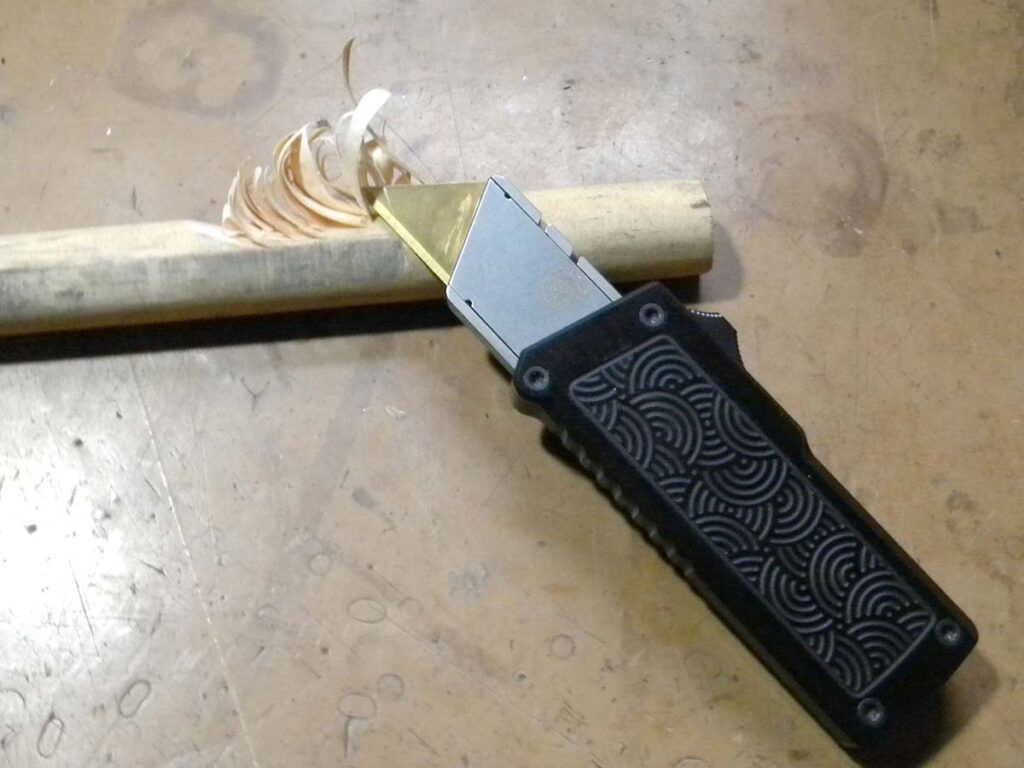
Pitting a blade against wood is always a must, so I moved on to some whittling. A ¾-inch dowel proved no problem for the CHUB. The replaceable blade shaved smooth curly cues, but deeper bites were harder on the hand because of the smaller handle. Still, it got the work done.
Pitted against a ¾-inch dowel proved no problem for the utility blade, wich shaved smooth curly cues and made deep bites into the wood.
Just to push the knife a little farther, I cut up some ½-inch sisal rope. The CHUB did 125 crunching cuts, which was impressive, given it was the same blade I started the test with. The action stayed tight and crisp, no play at all. Again, the handle size was challenging in a task that required stronger pressure. But overall, it was a fun challenge.
Lastly, I was back to the graph paper slices. I had a few snags at the bottom of the blade but the front half sliced smoothly. Not bad at all. Job well done by the Chaves Knife crew. I also still had a fresh edge, since all I had to do was push a tab over, flip the blade and close the tab. Pretty simple and fast.
Overall Take
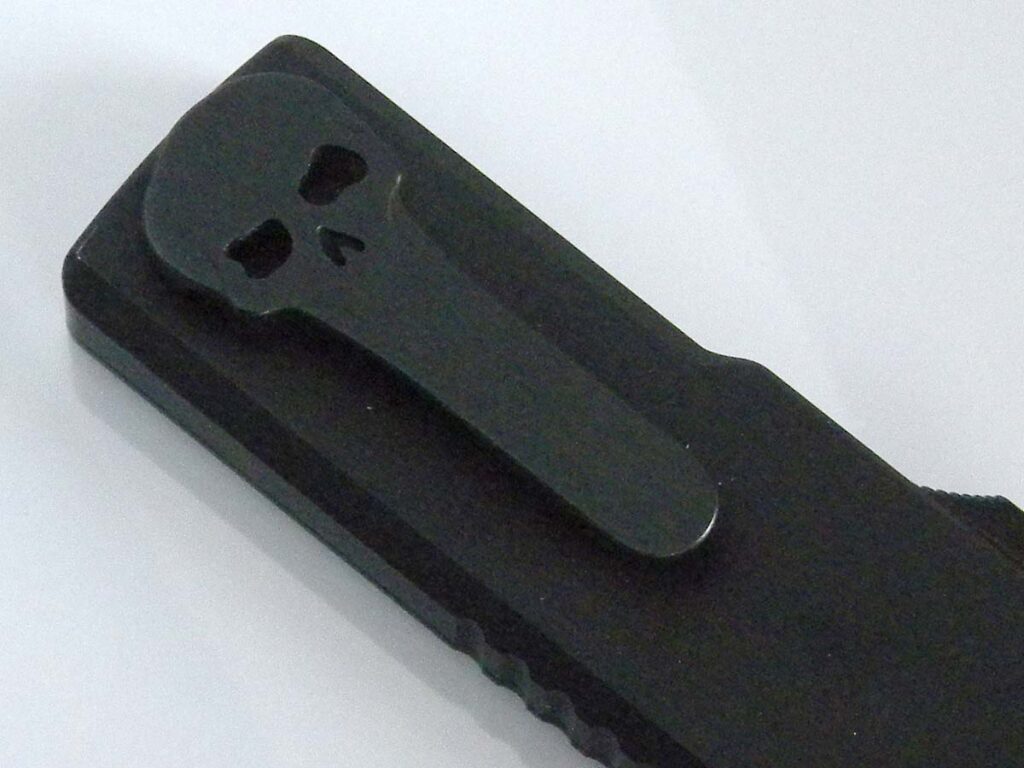
The CHUB rides comfortably in any pocket, according to the author. Helping with it in this task is a clip with Chaves’ trademark skull.
Some people might call it a fad, but the CHUB will cut. Now add in the cool factor of it being an OTF pocket utility knife, and you have a handy knife to use daily. The CHUB is designed to take standard Stanley and Lenox-style blades—2 7/16-inch long, ¾-inch wide—but off brands might not prove compatible.
It’s easy to toss around the word epic and difficult to describe Jon Christensen’s recent work any other way. Of course, the subject material for his two-handed sword made it challenging for the results of the project to be anything other than mythical.
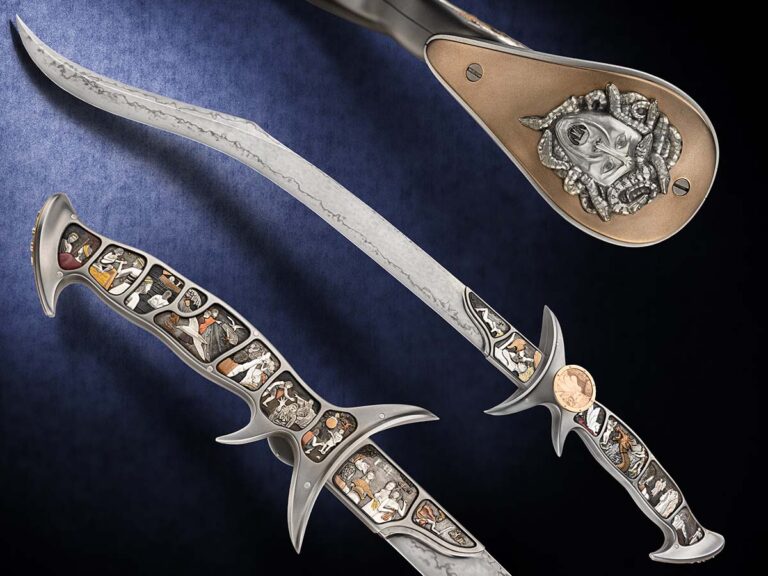
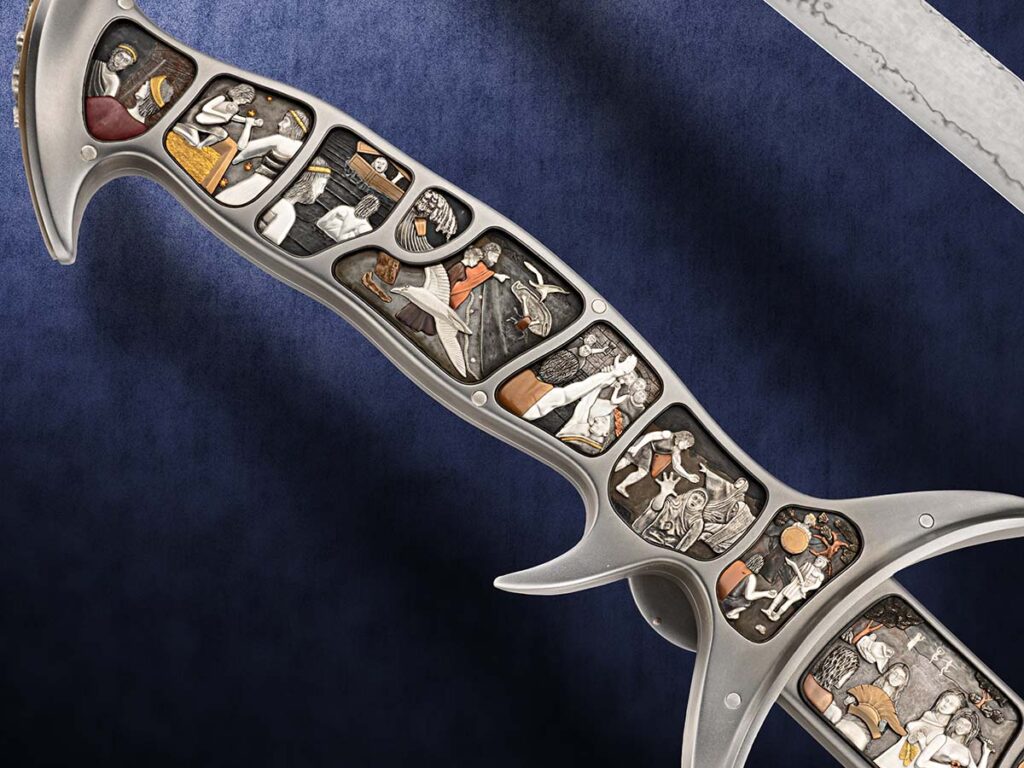
The Montana-based ABS master smith captures the ancient Greek myth of Perseus and Medusa in 16 hand-engraved iron panels inset into the 410SS handle and a bulino-engraved bronze shield on the guard of his Guardian Sword. Among other things, the handle features gold, bronze, copper, silver, custom alloy and mother-of-pearl inlay and is punctuated with Medusa’s head on the butt.
Jon Christensen
“The bulino engraving was very challenging as it was my first,” Christensen confessed. “There was a ‘paying my dues’ stage of time spent, which I just had to accept.”
It might be said that the entire project was an exercise in dues-paying. In addition to challenging himself with a new engraving technique, he was also delving into an unfamiliar subject. Christensen gave himself a crash course in the story of Medusa before conceptualizing the panels. But the client who commissioned the sword raised the bar on his retelling of the myth.
“Before starting on the project, the collector requested my interpretation of the story be approved by Tufts University, which is known for a strong program in classical mythology,” he said. “I compiled and submitted a document of the concept showing drawings and descriptions for each scene, as well as the overall sword. They replied saying, ‘It was a masterful interpretation.’”
The Guardian Sword handle, with the panels depicting the Greek myth of Perseus and Medusa.
The sword is reminiscent of the one featured in Benvenuto Cellini’s sculpture of Perseus, showcasing the same unique shape in its 37.5-inch W2 blade, with a hamon. While this aspect of the sword presented challenges, Christensen admits it was the easy part of the Guardian. Much of the 4,000 or so hours he dedicated to the work were focused on the handle, engravings and accurately retelling the ancient myth.
“The time on completing the blade would be measured in weeks, the handle scenes in years working under a microscope,” he said. Epic, indeed.
“Yes, the scope of the project was very intimidating at times. I had to constantly manage my thoughts to the task at hand,” Christensen said. “As the saying goes, ‘How do you eat an elephant? One bite at a time.’”
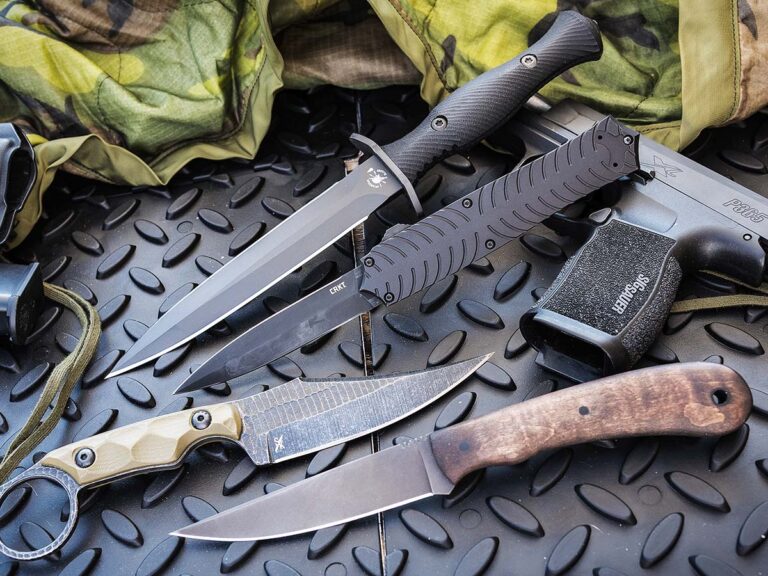
These veteran-designed or manufactured knives are ready to serve.
A rare combination, military knives aren’t simply utilitarian tools; they stir something deep inside of us. Whether an inborn call of duty or a profound respect for those who served, edged implements meant for battle call to knife aficionados with a patriotic streak. Which, simply put, makes them wildly hot in the eyes of manufacturers and collectors alike.
Not all military knives are issued. Some of the most storied were picked up as “just in case” purchases at post PXs or sporting goods stores throughout the years. This doesn’t make them any less ready to serve. And, today, there are a slew of options engineered or built by veterans, meant for action—in the field of battle and for everyday protection and chores—and more than able to cut muster.
Winkler Knives Operator
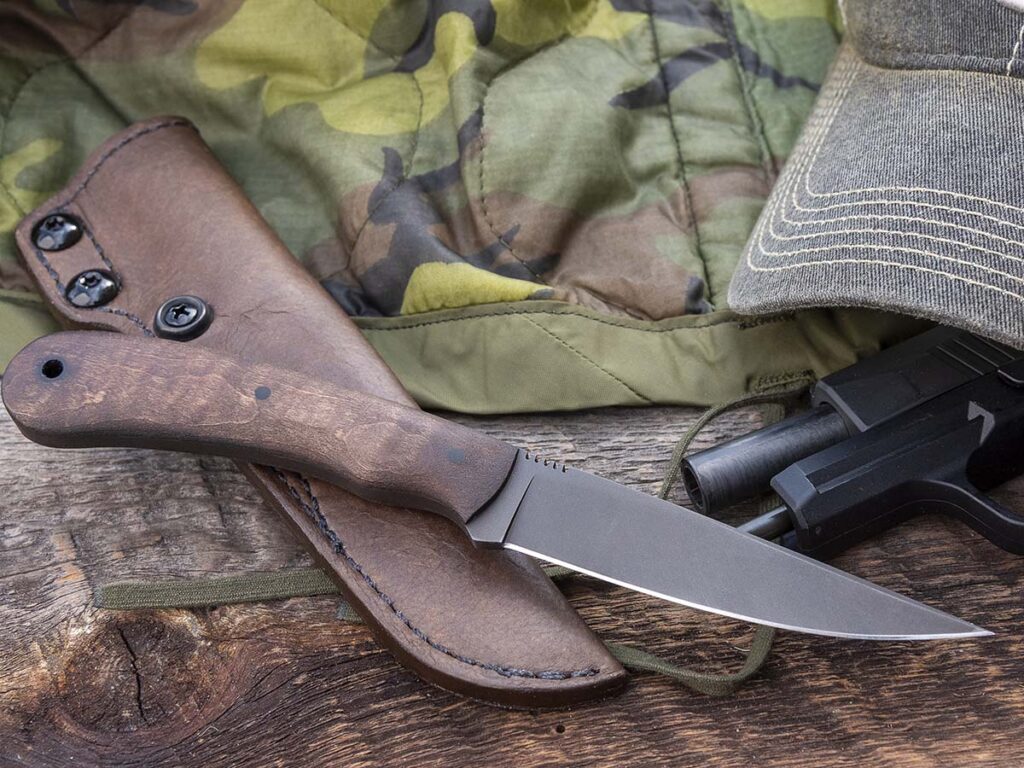
At first glance, the Winkler Knives Operator seems like the average utility fixed blade or a larger bird and trout knife. Looks can be deceiving as the Operator functions both as a utility tool and weapon—important in the theater of battle.
Originally founded to produce specialized breaching tools at the request of the SOF community, Winkler Knives of Blowing Rock, North Carolina, is certainly no stranger to tactical knives. Their Operator series offers a unique design that is a crossover of sorts. Yes, it was designed as a tactical knife, yet has proven popular as both a camp, general outdoor and hunting knife.
Designed by former Navy SEAL Kevin Holland, the Operator features a 4⅛-inch-long clip-point blade made of 80CrV2 tool steel and given a black oxide coating for rust protection. This steel is an excellent choice for a multi-use knife as it is resistant to impact and holds an edge reasonably well. When it’s time to resharpen, most are pleasantly surprised by how quickly the edge comes back with basic manual sharpening equipment. Given that the blade tapers to a sharp point, it excels as both a weapon and a tool. It has excellent penetration qualities and the thick stock, combined with a flat grind, allows the blade to slice with little resistance.
The Operator’s handle is very well designed, facilitating an excellent grip—a rarity on many compact fixed blades. A subtle finger groove helps index your grip and a flare at the butt and slight downward turn secures the hand from sliding backwards. All the edges on the grip are rounded for maximum comfort and the Operator certainly feels good in hand. I evaluated the antique maple-finished handle for this review. Other materials are available, including Micarta. As to the wood version, it feels warm in the hand, secure and the grain gives a nod to being like a fine furniture.
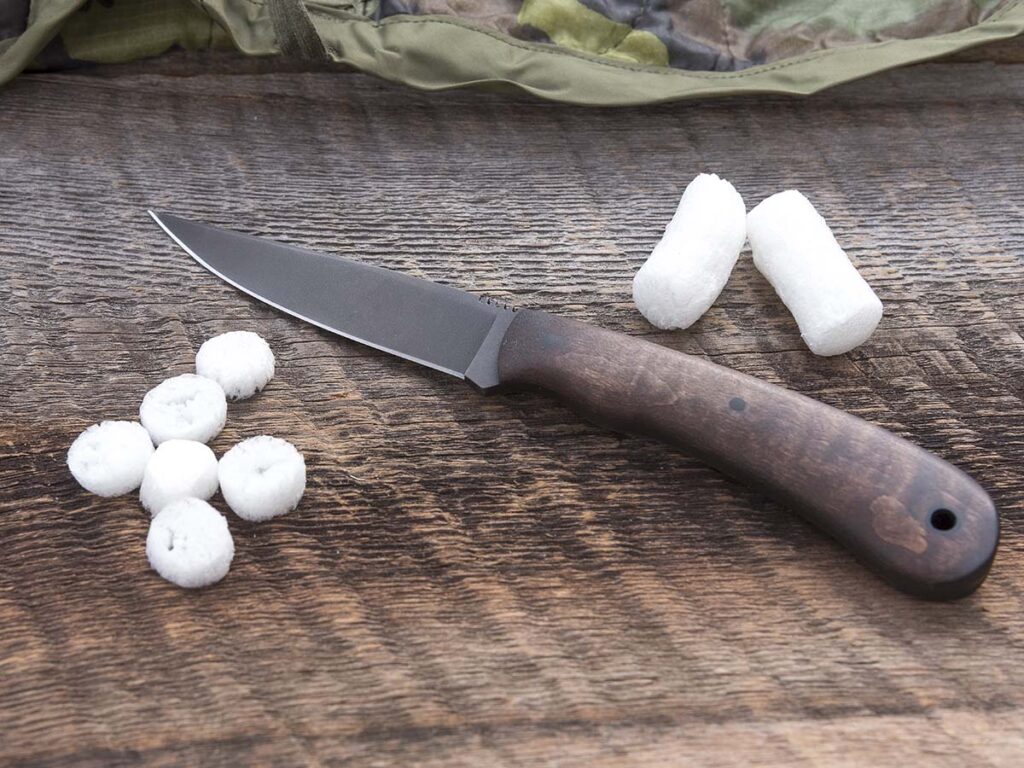
The Winkler Knives Operator isn’t afraid to tackle delicate cutting tasks. It easily sliced Styrofoam packing peanuts, a testament to how well the blade is engineered with its distal taper spine, full height flat grind and razor-sharp factory edge.
Standard with the Operator is a formed leather sheath, designed and made by DeSantis Gunhide, specially for Winkler Knives. It has a set screw to control the tension on the knife so you can customize the retention—a nice touch, not often offered. As for carry, there is a fold-over metal belt loop affixed with two screws, facilitating traditional outside-the-waistband and pocket carry. The latter leaves the handle sticking out for quick access.
Overall, I love how the handle feels in-hand with the contouring of the facets making it lie in your grip as if it were made for it. I found the Operator’s slender yet robust build allows it to tackle heavy cutting chores without the unnecessary bulk. It also carries well in the pocket or on the belt.
Operator Specs Blade Length: 4.125″ Overall Length: 9″ Blade Steel: 80CrV2 Blade Profile: Drop Point Handle: Maple Sheath: Leather-Covered Kydex MSRP: $350 Country of Origin: U.S.A.
Stroup Knives HM1
The HM1 from Stroup Knives showcases a prominent clip point blade and a sweeping cutting edge. Both help it excel in either defensive or conventional chores. As a bonus, the tip of the blade is so acute it tackles precise cutting chores with ease.
Based in Fayetteville, North Carolina, Stroup Knives specializes in tactical and utility fixed blades. Company founder Chris Stroup is an Army veteran with 11 years of service to our country. His final assignment was with a special missions unit based out of Fort Bragg. Medically discharged in 2020, Stroup Knives was born, and in 2022, Stroup made the decision to go full-time into knifemaking.
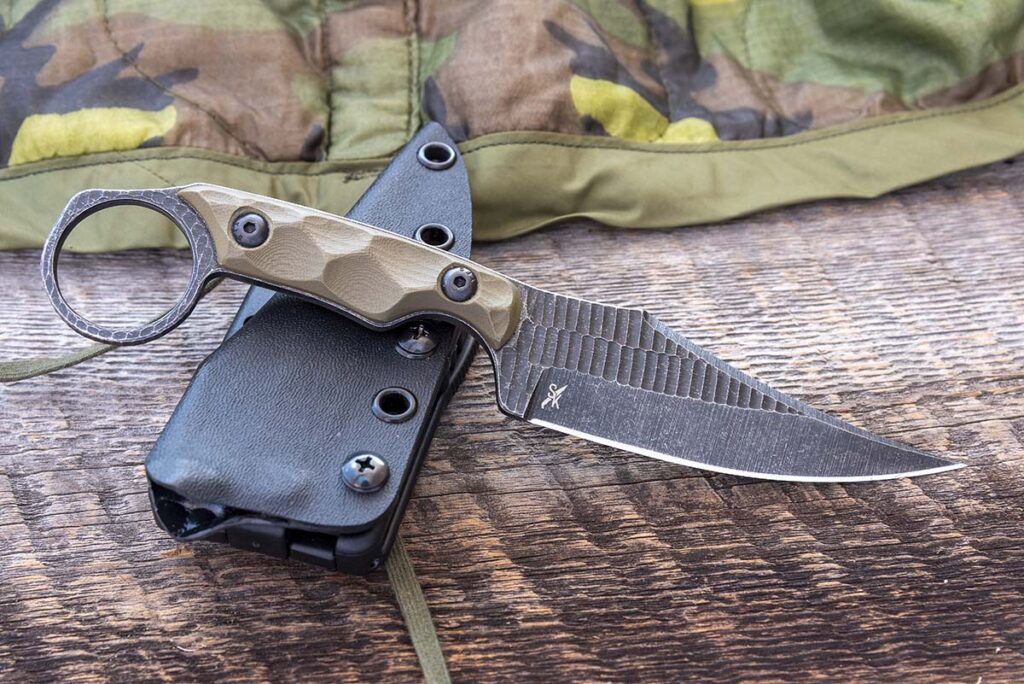
Stroup Knives’ latest knife, the HM1, represents a multi-use fixed blade for utility, tactical and outdoor use. The design’s focus is on retention, control and high utility. The blade of the HM1 is 4 inches in length and made of 1095 carbon steel with a black stonewashed finish. The clip-point shape gives the blade its distinct bowie-like profile. Honestly, the tip on this one is flat-out wicked! It’s pointy and will penetrate softer materials easily.
The knife sports a distinct machined texturing, making it easily recognizable as a Stroup; a lot of the company’s knives have this distinguishing pattern. Proportional to the blade, the handle also measures 4 inches and has several features making the HM1 noteworthy. Most prominent is the finger ring. The ring provides a measure of security and retention by allowing you to lock your grip in place through it with your pinky finger. Further, the feature makes dropping the knife, even by accident, difficult.
Stroup uses G-10 for the handle, and it sports a 3D-sculpted pattern to aid hand traction. Each HM1 comes with a fold-over Kydex sheath with Teklok attachment. The setup is Spartan, but hey, this style of sheath is widely used in the industry and it always works well. It locks the knife in place and there isn’t any rattling. The belt attachment is solid and is easy to put on and take off without removing your belt.
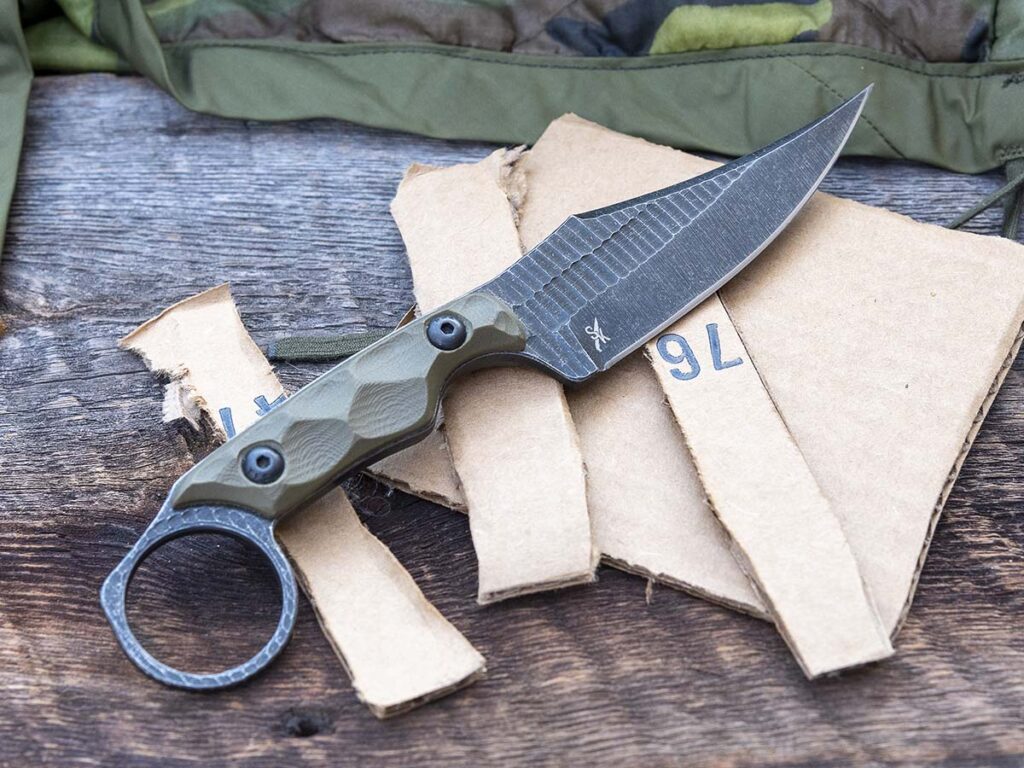
Made from 1095 carbon steel, the HM1’s blade is simple to maintain and take a wicked edge. Double-walled cardboard melted like butter under the knife’s edge.
The HM1 can function as both a backup weapon and a utility tool. The blade profile is not only excellent at puncturing, but also is fine enough at the tip for precise cutting or scoring tasks. The knife’s 1095 carbon steel is widely praised—it sharpens quickly and it is less expensive than all of the high-performance CPM stainless steels.
I appreciate the dual role the HM1 plays. The knife seems well thought out as an edged weapon and an EDC tool. The HM1 is available in two black acid wash blade finishes (one with black G-10 handles, the other with OD green G-10 handles) and two Cerakote blades (FDE and OD green G-10 and black with black G-10 handles).
HM1 Specs Blade Length: 3.75″ Overall Length: 8″ Blade Steel: 1095 Blade Profile: Clip Point Handle: G10 Sheath: Kydex MSRP: $270 Country of Origin: U.S.A.
Spartan Blades Spartan Harsey Dagger
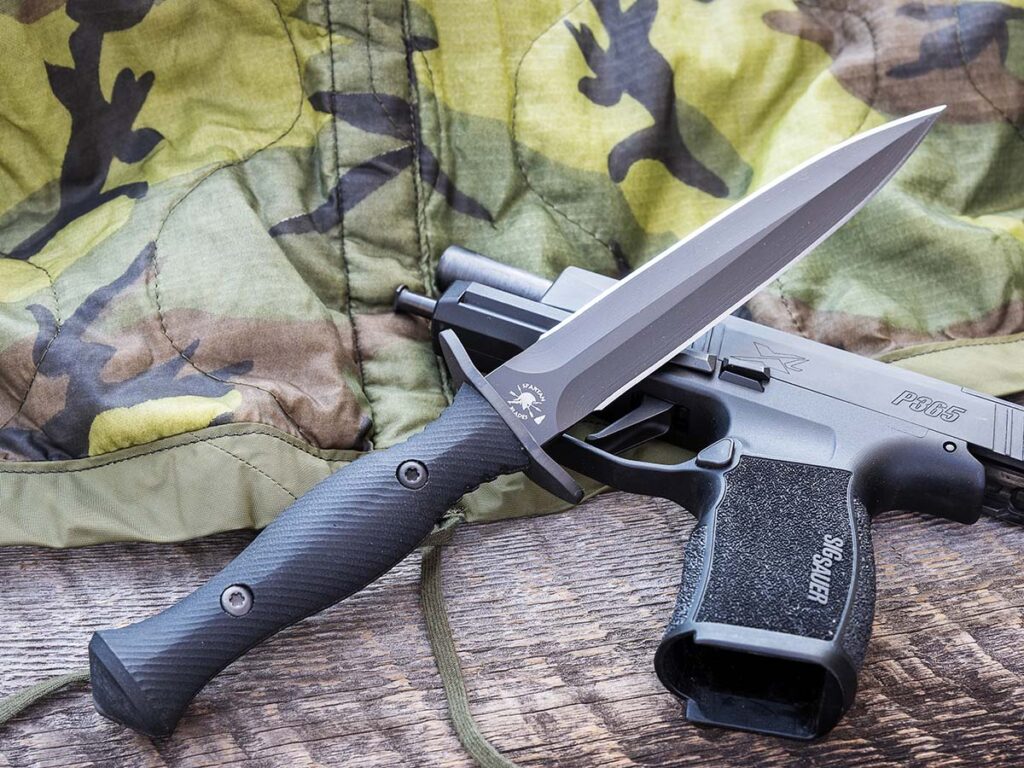
The Spartan Harsey Dagger’s handle has a lot going on with a distinctive oval profile that lies in the palm naturally and makes the edge easy to index—even in low-light environments.
Spartan Blades, founded by retired Green Berets Curtis Iovito and Mark Carey, has earned a strong reputation for high-end factory-made tactical fixed blades. Several of those knives were designed in collaboration with Bill Harsey, a well-known knifemaker who specializes in custom tactical fixed blades that are on the next level. Harsey’s impressive background includes knife work for the late legendary Col. Rex Applegate, prototyping the Applegate-Fairbairn fighting knife.
The Spartan Harsey Dagger takes what Harsey learned from working with Col. Applegate and applies it to modern-day production tactical fixed blades. It is a modernized version of the Fairbairn-Sykes, if you will. It has an upgraded handle design, upgraded materials and a beefier build overall, yet still retains the design hallmarks of the legendary F-S.
The dagger has a 6-inch-long double-edge blade, hollow ground from premium CPM MagnaCut steel. A black DLC coating is applied for low reflectivity, as well as boosting the corrosion-resistant properties of MagnaCut. The knife also has some notable features like a long, tapered flat section in the middle of the blade for lateral strength and the hollow ground bevels, thinning the edge for a sharper blade.
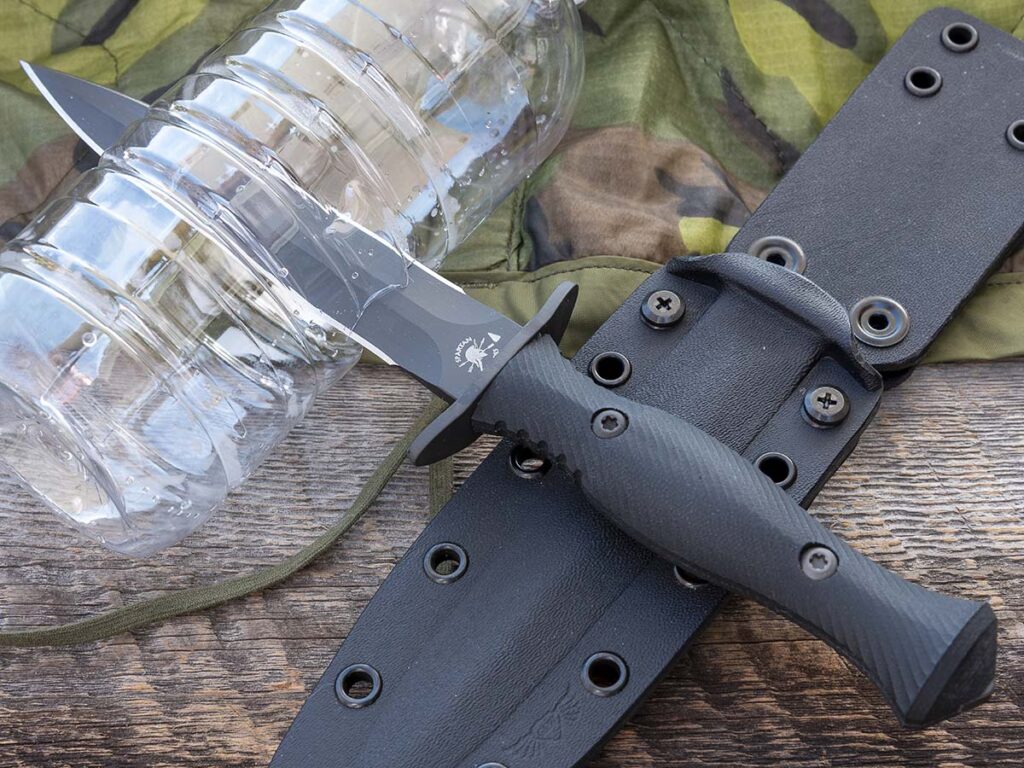
The handle is where the magic begins and what sets the Spartan Harsey Dagger apart from the rest. The finger recesses behind the guard help to index your grip and lock it in your hand. The recesses have traction notches in them, not only for a non-slip grip but also for tactile cutting edge orientation. The way the handle flares out toward the butt of the handle catches your pinky to prevent rearward sliding and aids in references a clean grip to clear the blade from its sheath. The Spartan Harsey Dagger has a hidden tang design with the Micarta scales fully encapsulating it. There is a bit exposed at the very end of the handle for use as a non-lethal striker. The double hand guard is angled away from the user a bit to provide a comfortable thumb rest.
The Spartan dagger is made from thicker stock, even so, the hollow-ground bevels and a needle point, the knife punches cleanly and quickly.
Each Spartan Harsey Dagger comes with a Kydex carry sheath with MOLLE-compatible straps. The sheath locks on the double guard and provides a very secure fit with zero rattle or any other movement.
Keep in mind a knife like the Harsey Dagger is not a box cutter or a utility knife. If you need a working knife, look elsewhere. It is likely best served, away from the military, as a backup weapon to a firearm. The blade is engineered to penetrate and it’s frightening how adept it is at its job.
One thing most folks agree upon, the Harsey oozes sexiness, with its curvaceous handle and no-nonsense blade. It is a looker for sure, but it can also perform when called upon. The Spartan Harsey Dagger comes in two colors—the black blade and black Micarta handle, as evaluated here, along with an FDE blade and black Micarta handle.
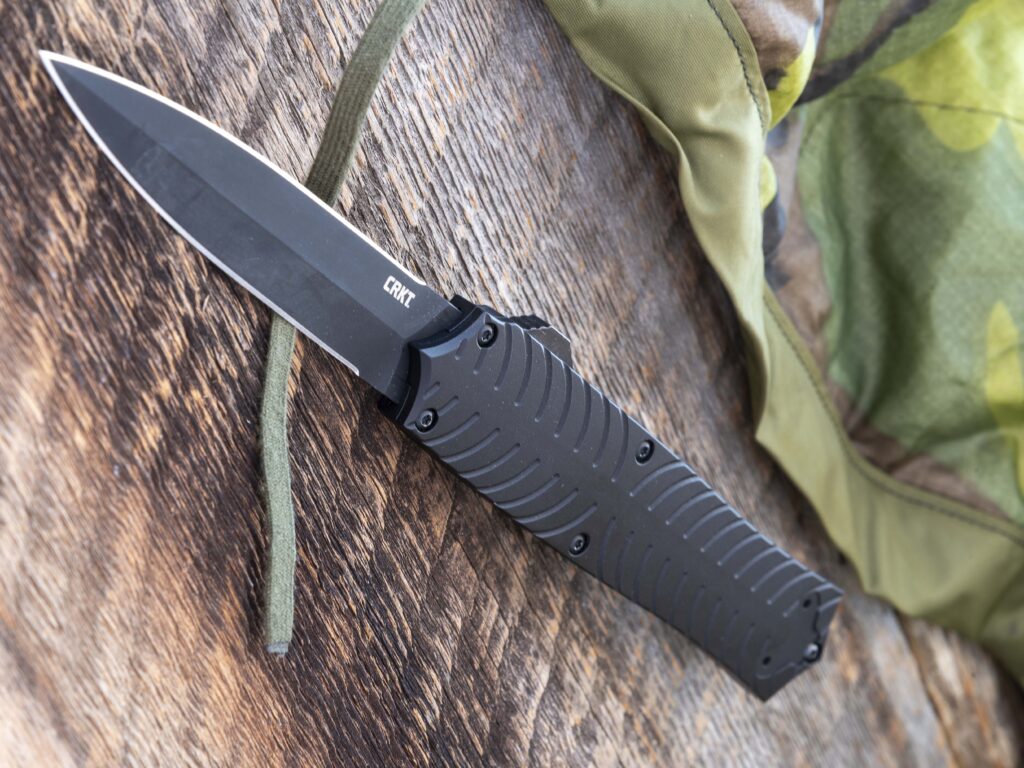
The points at the ends of the CRKT Xolotl OTF handle not only add visual style but also allow the knife to be used as a non-lethal defense striking tool when the blade is retracted into the handle.
The Xolotl (Show-low-tol) Automatic is CRKT’s second OTF auto in the company’s lineup. The double-action was designed by Michael Rodriguez, a former Green Beret and veteran. It is named for the Aztec god of lightning and fire.
The overall look of the Xolotl Automatic is symmetrical in both handle and blade shape. In turn, it is very pleasing to the eye. The blade is 3.5 inches and is a true dagger, sharpened on both sides. CRKT’s steel of choice is CPM MagnaCut—pretty much the perfect high-end blade material, if there ever was one.
The handle is machined from T6 6061 aluminum alloy, and its thickness is kept to a minimum so that the Xolotl carries well in the pocket. It also features circular machined grooves for enhanced grip retention. Interestingly, there are 21 grooves, one for each year of Rodriguez’s service. The handle ends up tapering to stylized points of sorts, adding intrigue to the overall look by possibly providing a non-lethal method of striking defense. A deep carry pocket clip rounds out the entire package, allowing the Xolotl to ride undercover. A sliding switch on the handle spine controls the blade’s movement, which is very swift and secure.
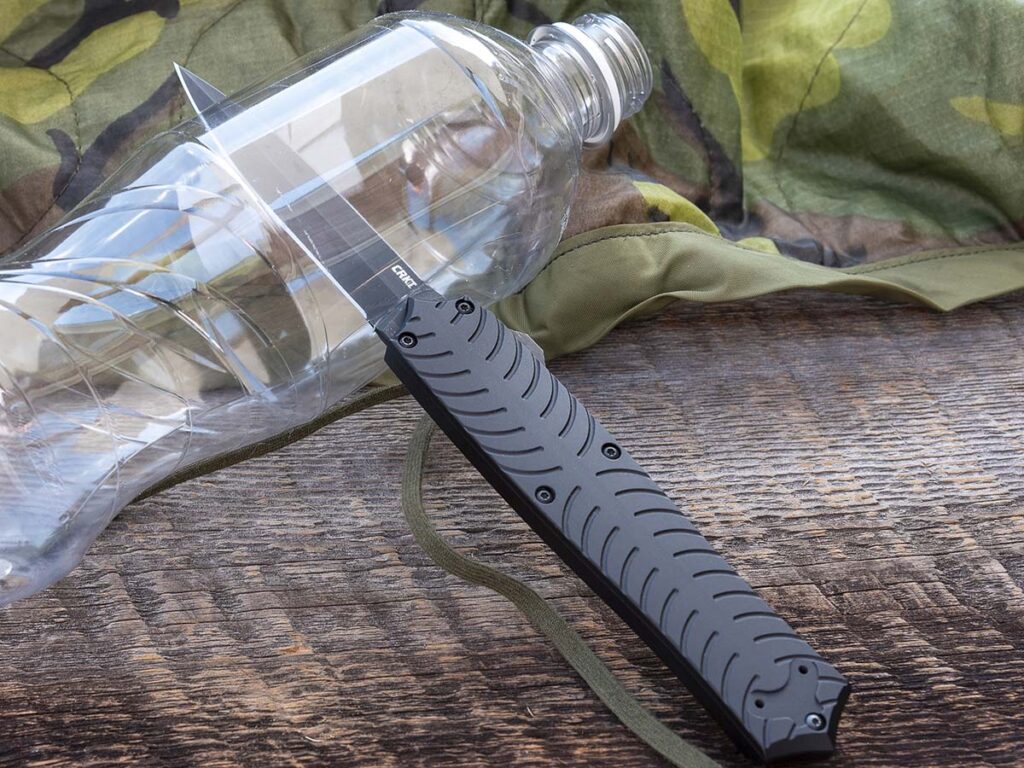
The thinner blade stock on the CRKT Xolotl OTF allows for great penetration. Additionally, its MagnaCut steel holds an edge like nobody’s business and is highly corrosion resistant.
Dagger blade OTF’s are very cool-looking, and they are fun to own. But they are limited in providing a full functional cutting tool. By this, I mean that given the material removed to form a dagger profile, it is more susceptible to damage by torque. Further, dual edges mean you can’t use a digit to exert more latitudinal force in a cut or more control. Yet, the dagger does have the advantage of two cutting edges, so if you damage one, you have the other.
All this being said, the Xolotl is a capable cutter, opening mail, packages, cutting up cardboard boxes and anything else that you need to slice. I would not subject the knife to hard use of any kind, given its thinner blade.
Böker teams up with popular German bushcrafters to deliver a pocket-friendly, G10-scaled multi-tool packed with essential field implements.
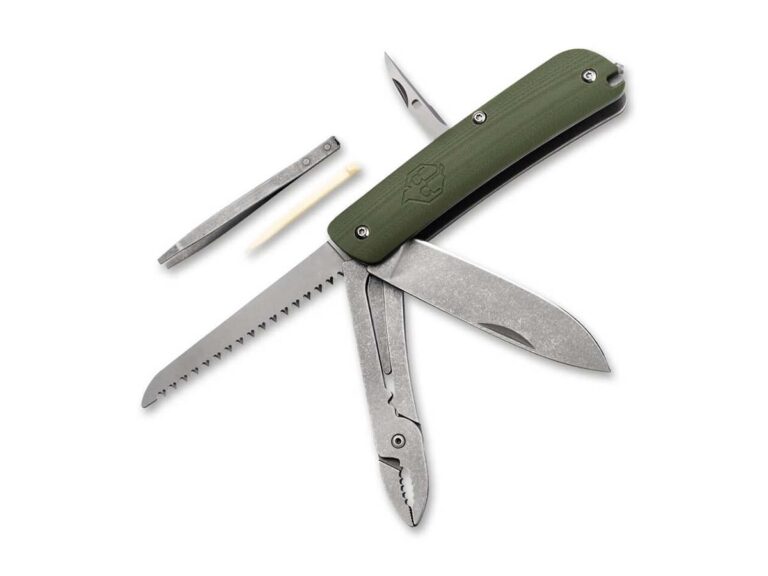
The multi-tool market has long been divided between heavy-duty plier platforms and traditional red-scaled pocketknives. Böker bridges that gap with the Naturensöhne MK II NXT, a fresh take on the classic multi-functional folder built specifically for outdoor utility.
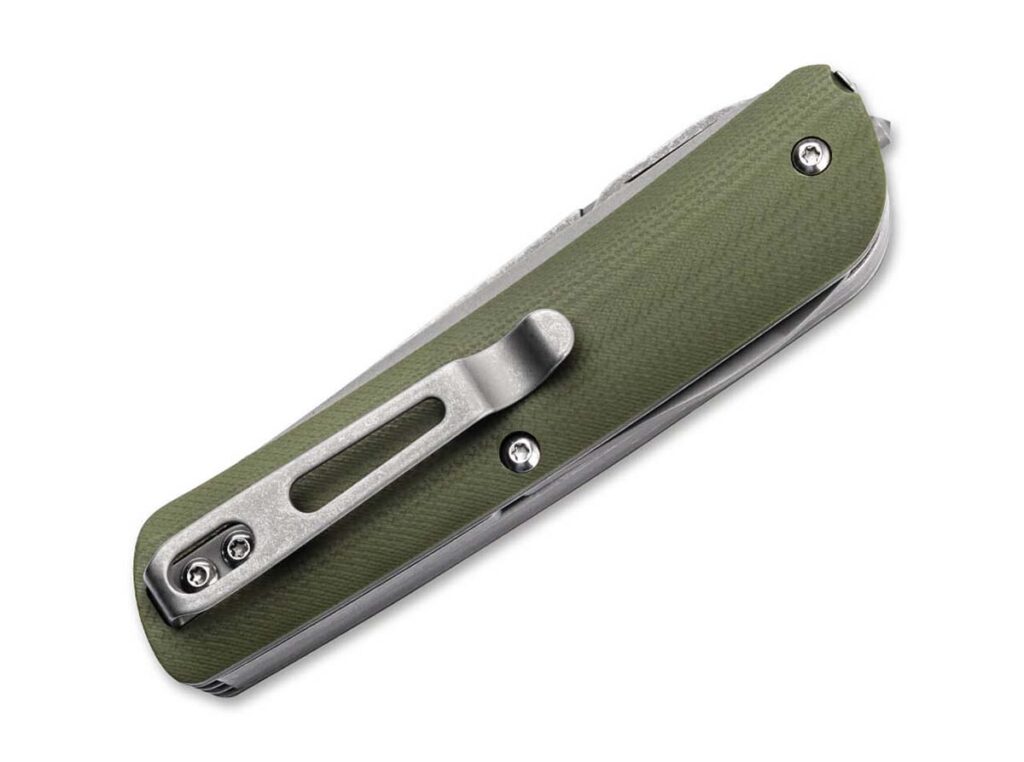
Created in collaboration with Die Naturensöhne, the popular German YouTube duo known for their bushcraft challenges, this tool ditches shiny plastic for field-ready ergonomics. The handles feature textured forest-green G10 scales that offer a solid, slip-resistant grip when working in wet conditions.
At the core of the tool is a 2.8-inch drop-point blade made from Sandvik 12C27 stainless steel. Finished in a muted grey stonewash, the blade relies on a traditional nail nick and non-locking slipjoint mechanism. That two-handed opening makes it a legal-friendly option in regions with strict lock-knife regulations.
Instead of clogging the frame with rarely used gimmicks, Böker packed in targeted outdoor implements:
A wood saw for clearing branches or notch-cutting
Mini combination pliers for light bending tasks and quick repairs
A reamer and awl for punching leather, wood, or gear
Fine tweezers and a scale-mounted toothpick
A dedicated glass breaker located at the pommel
Weighing in at 4.23 ounces and measuring 6.57 inches overall, the MK II NXT carries like a standard pocketknife thanks to an integrated tip-down pocket clip. For campers, bushcrafters, and daily carry enthusiasts looking for multi-tool versatility without the bulk of a full plier chassis, Böker’s latest collaboration delivers a slick, highly functional compromise.
Naturensöhne MK II NXT Specs Overall Length: 6.57″ Blade Length: 2.80″ Blade Thickness: .09″ Weight: 4.23 oz Blade Material: 12C27 Handle Material: G10 Opener: Nail Nick Opening: Manual Country Of Origin: Asia Color: Green Blade Color: Gray MSRP: $129
Summer brings a focused shift toward portability and pocket-ready performance, highlighting a diverse lineup of high-tech folders and streamlined carry options. This month’s selection focuses on the incredible versatility of the modern knives, showcasing the work of veteran masters with decades of experience alongside award-winning new makers. Whether you are looking for an ultra-premium custom bowie to round out a collection or a hard-use automatic for daily carry, our July 2026 roundup proves that the industry’s drive for innovation remains as sharp as ever.
Pro-Tech Knives Avalon
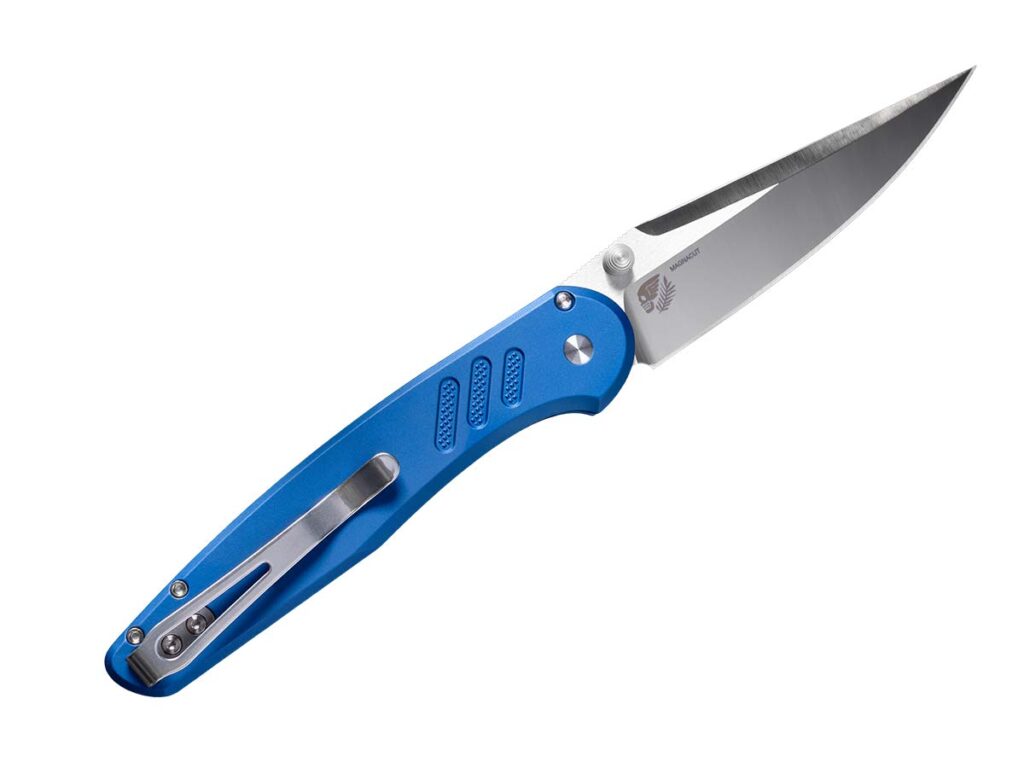
Lock: Button Lock Deployment: Thumb Studs Blade Length: 4.25” Blade Material: MagnaCut Blade Pattern: Drop Point Scales: 6061 Aluminum Overall Length: 9.25” Weight: 3.69 oz. MSRP: $310 Country Of Origin: U.S.A. protechknives.com
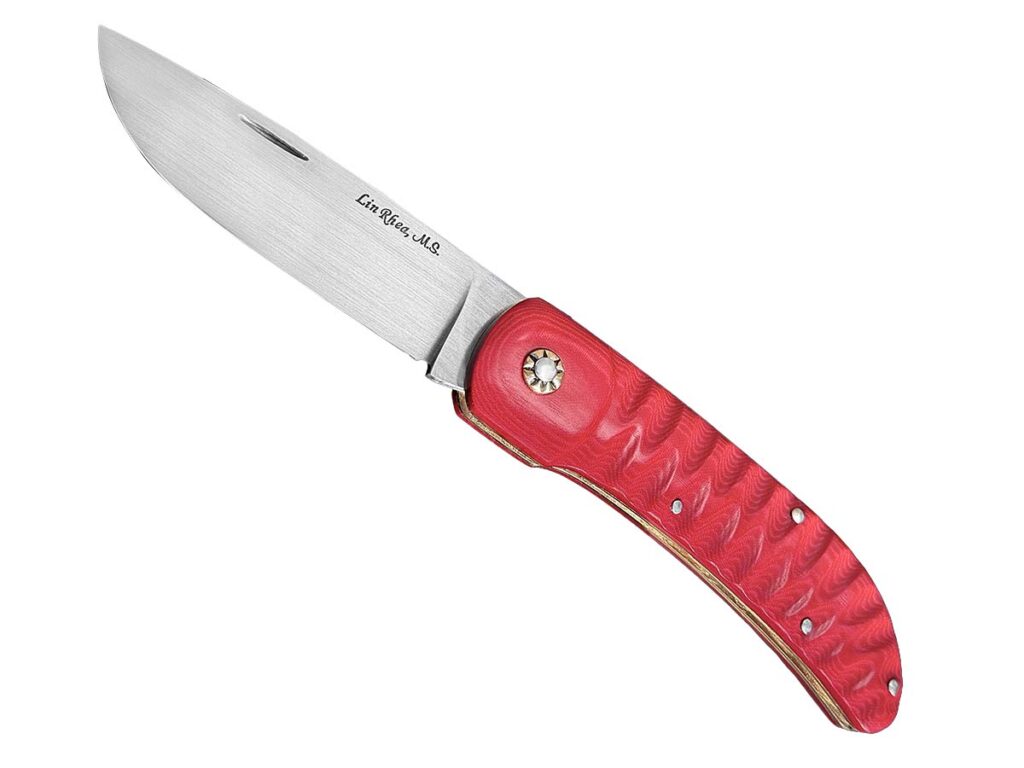
Lin Rhea Slip Joint Folder
Jocelyn Frasier image
Blade Length: 4” Blade Material: 80CrV2 Blade Pattern: Drop Point Scales: Micarta Overall Length: 9” Knife To Know: Includes sheath made by Kay Rhea Maker’s Price: $1,300 Country Of Origin: U.S.A. Maker’s price for a similar knife: $1,300
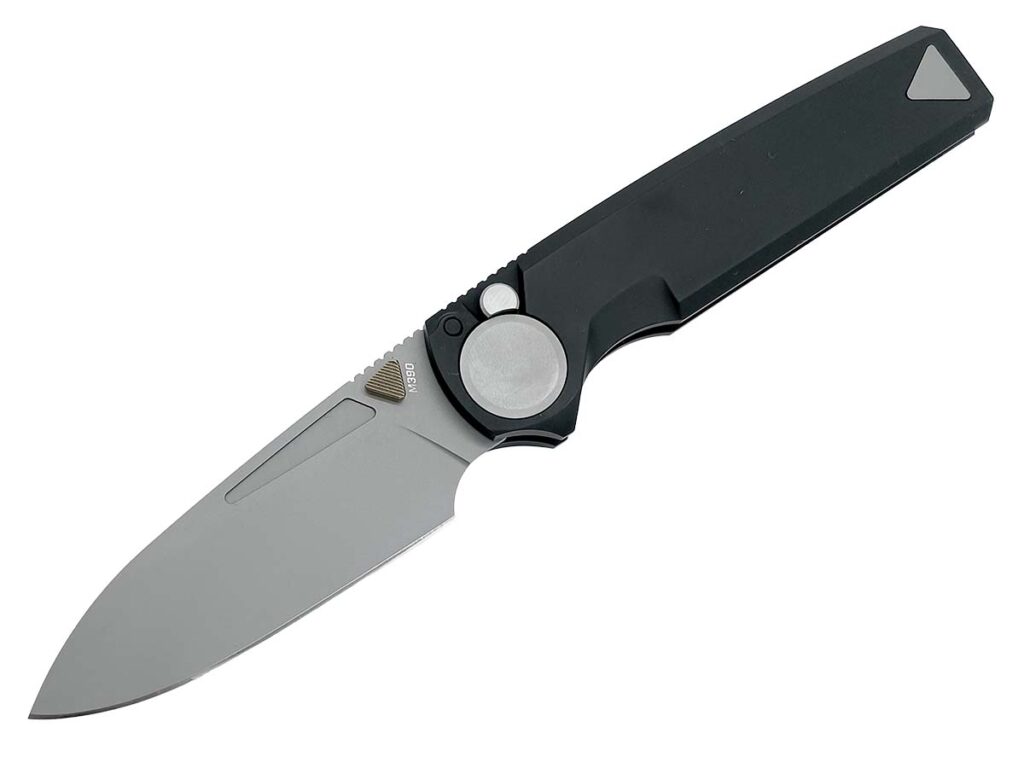
Work Sharp RMX Thumbstud
Blade Length: 3.2” Lock: Button Lock Blade Material: M390 Blade Pattern: Drop Point Handle: Magnesium Overall Length: 7.5” Weight: 2.6 oz. Knife To Know: Handle is integral, reversable clip MSRP: $140 Country Of Origin: Assembled in U.S.A. from foreign components worksharptools.com
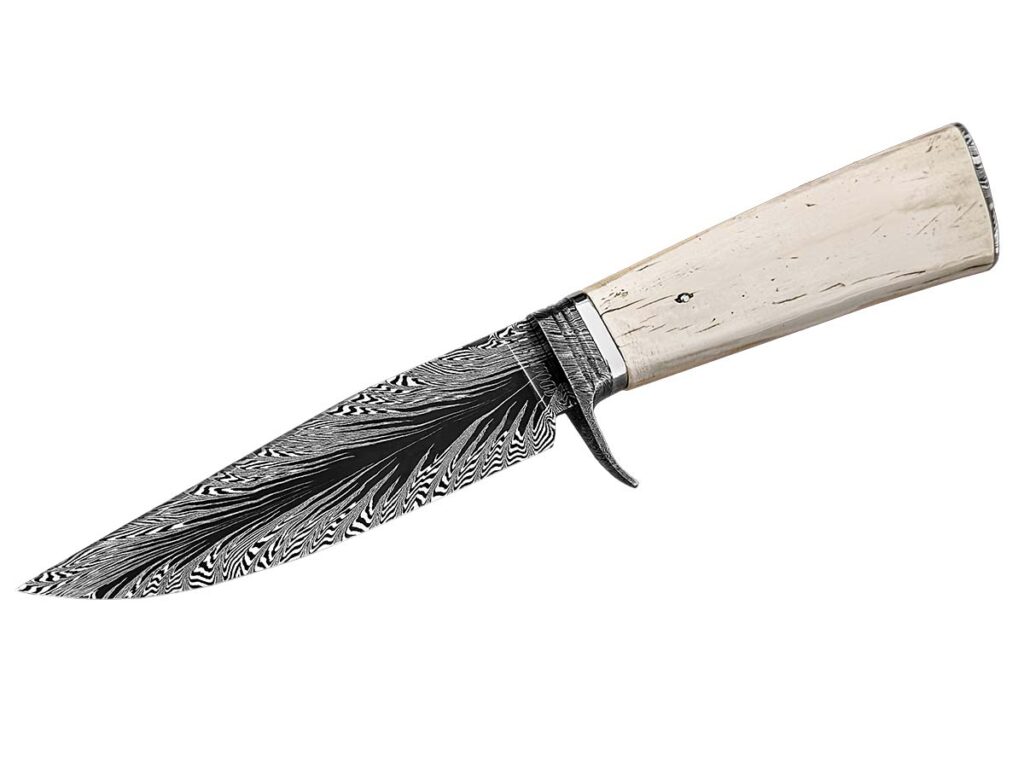
Cody Adolphson Vest Bowie
Jocelyn Frasier image
Knife Type: Vest Bowie Blade Material: 1084/15N20 Damascus Pattern: Dark Core Feathered Damascus Blade Pattern: Drop Point Blade Grind: Flat Handle Material: Ancient Walrus Ivory, Nickel Silber Accents, Damascus Pommel Guard: Twist Damascus Overall Length: 10” Maker’s Price For A Similar Knife: $1,400 Country Of Origin: U.S.A.
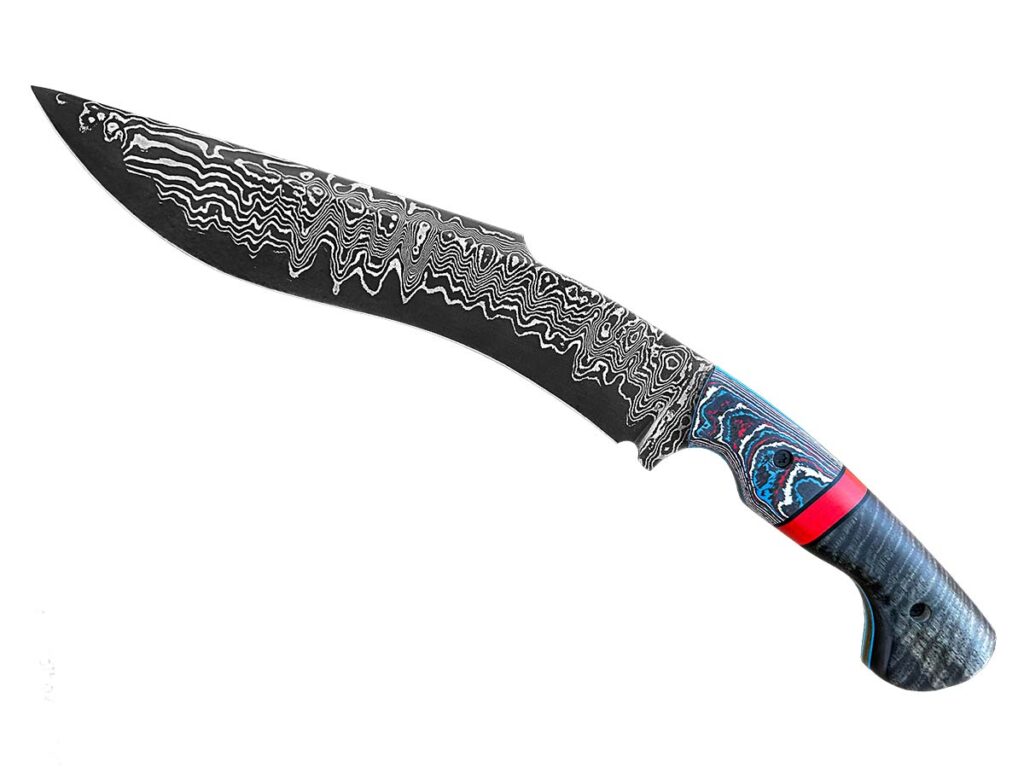
Justin Burton Kukri
Jocelyn Frasier image
Blade Length: 10.5” Blade Material: 80CrV2/15N20 Blade Pattern: Twisted Damascus San Mai Blade Grind: Flat Handle: Black dyed curly mango with red G-10 spacers Guard: Nebular Fat Carbon Knife To Know: Custom bead made with Elforyn Supertusk and Damasteel Maker’s Price For A Similar Knife: $1,500 Country Of Origin: U.S.A.
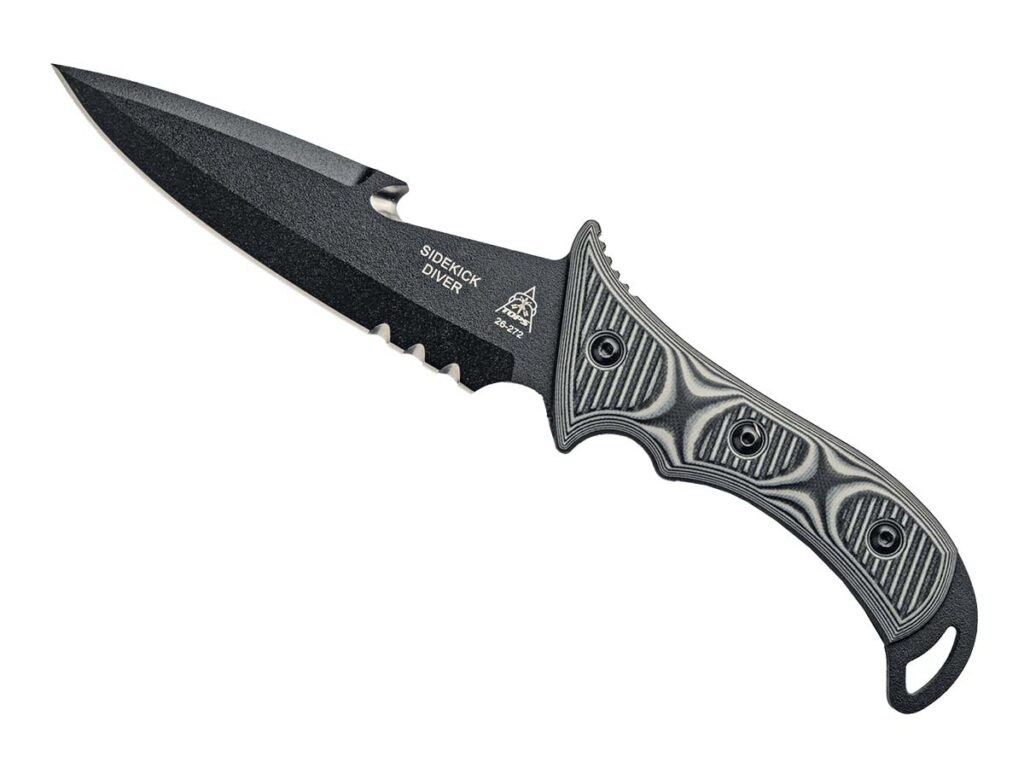
TOPS Knives Sidekick Diver
Designer: Ana Espinoza Blade Length: 5.75” Blade Material: N690 Blade Pattern: Spear Blade Finish: Black Traction Coating Scales: G10 Overall Length: 11.25” Weight: 12.8 oz. Sheath: Black Kydex Knife To Know: Integral line cutter on the spine. Also available with a double edge. MSRP: $395 Country Of Origin: U.S.A. topsknives.com
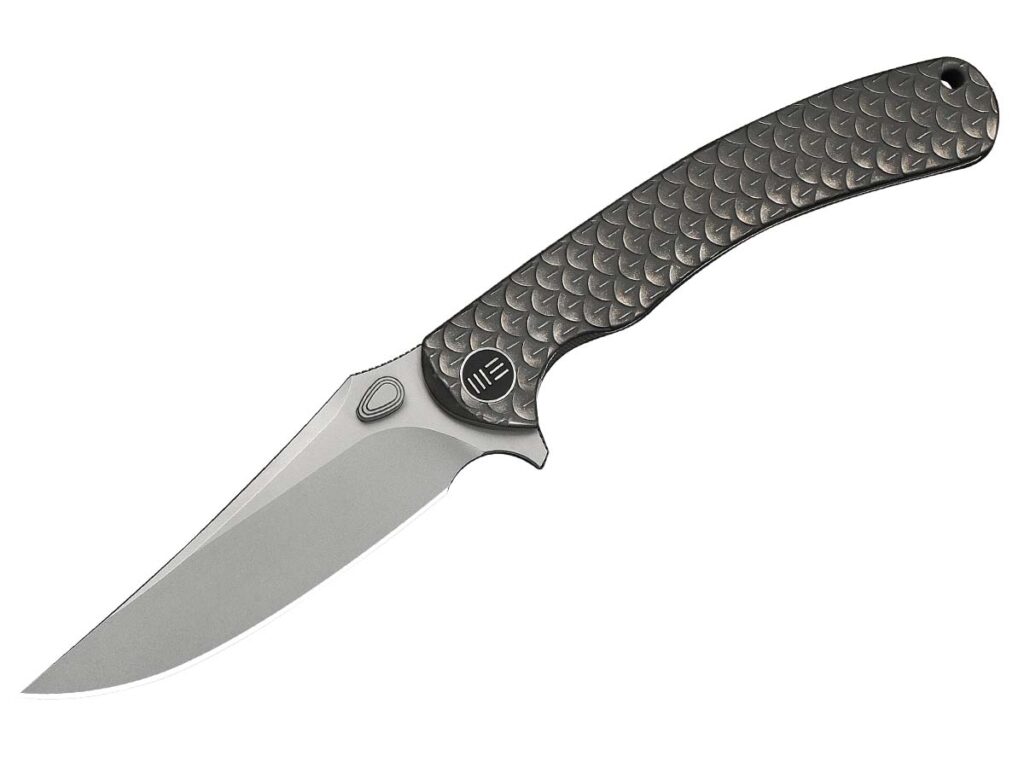
WE Knife Dracarys
Lock: Frame Lock Blade Length: 3.58” Blade Material: Böhler M390 Blade Pattern: Clip Point Blade Grind: Flat Handle Material: 6AL4V Titanium Overall Length: 8.13” Closed Length: 4.55” Weight: 3.66 oz. Knife To Know: Limited to 199 pieces, 6AL4V titanium pocketclip, caged ceramic ball MSRP: $370 Country Of Origin: China weknife.com
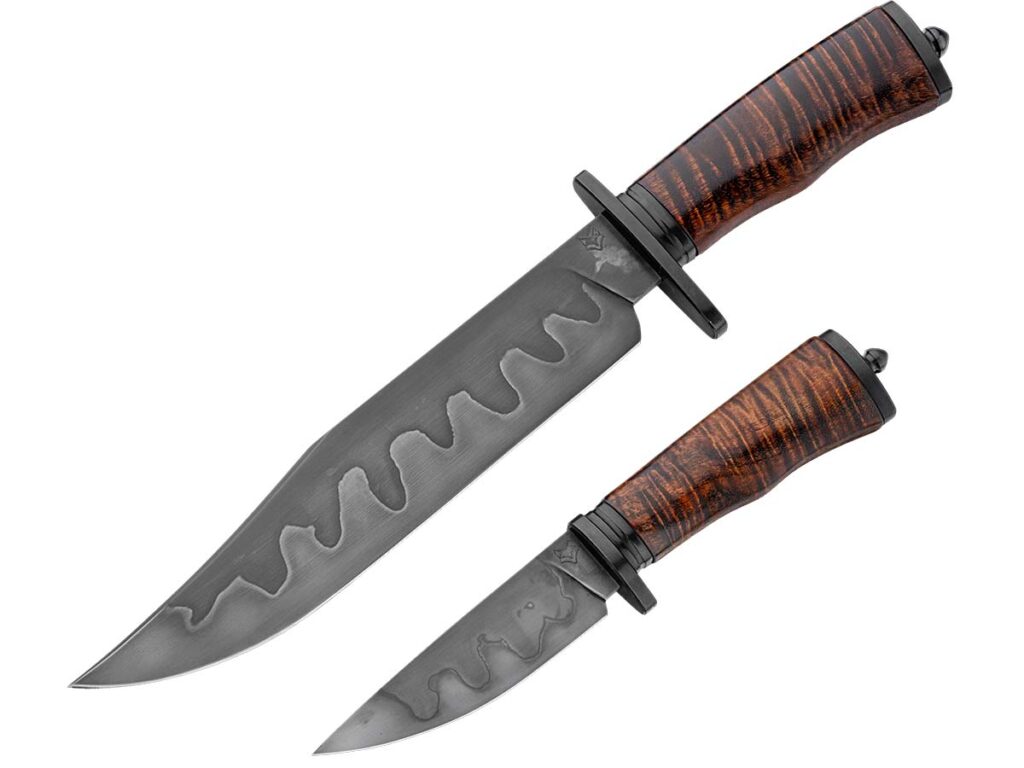
Chad Fox Bowie
Jocelyn Frasier image
Blade Length: 9.25” Blade Material: W2 Blade Pattern: Clip Point Handle: Koa Overall Length: 14.5” Knife To Know: Salt blackened mild steel Maker’s Price For A Similar Knife: $950 Country Of Origin: U.S.A.
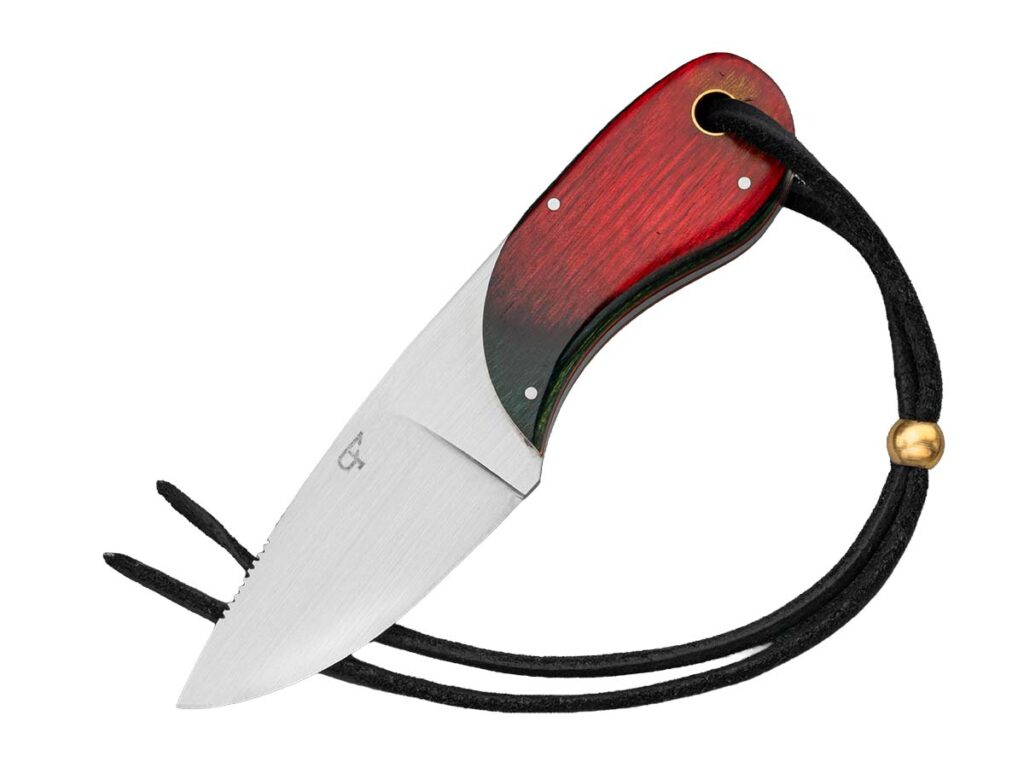
Colten Tippetts Neck Knife
Jocelyn Frasier image
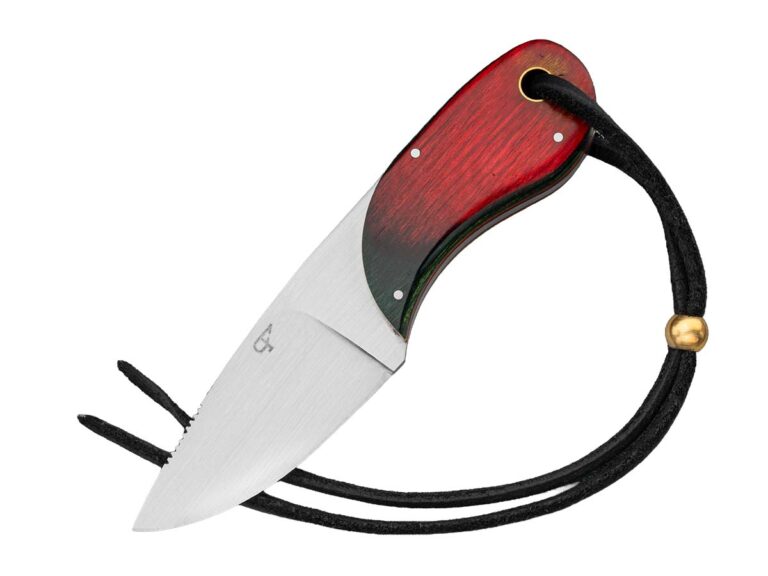
Name: Dinker Blade Length: 2” Blade Material: Ladder Damascus Blade Pattern: Drop Point Handle: Desert Ironwood Overall Length: 3.5” Knife To Know: Also made in 01 Tool Steel with Dymondwood handles. Maker’s Price: $150 Country Of Origin: U.S.A.
Craig Camerer Slim Pickers Fighter
Jocelyn Frasier image
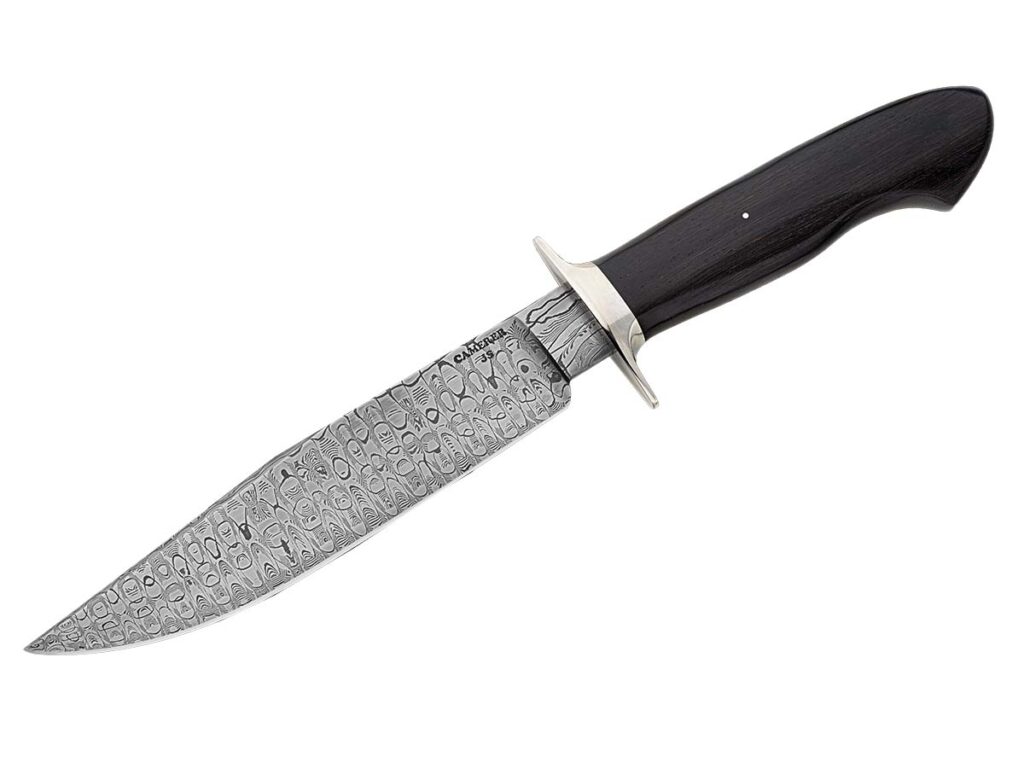
Knife Type: Fighter Blade Length: 7” Blade Material: 1080/15N20 Blade Pattern: Dancing Martian Damascus Blade Grind: Flat Handle: African Blackwood Guard: Nickel Silver Overall Length: 12.5” Maker’s Price For A Similar Knife: $750 Country Of Origin: U.S.A.
Bear & Son Cutlery Auto Bold Action XIV
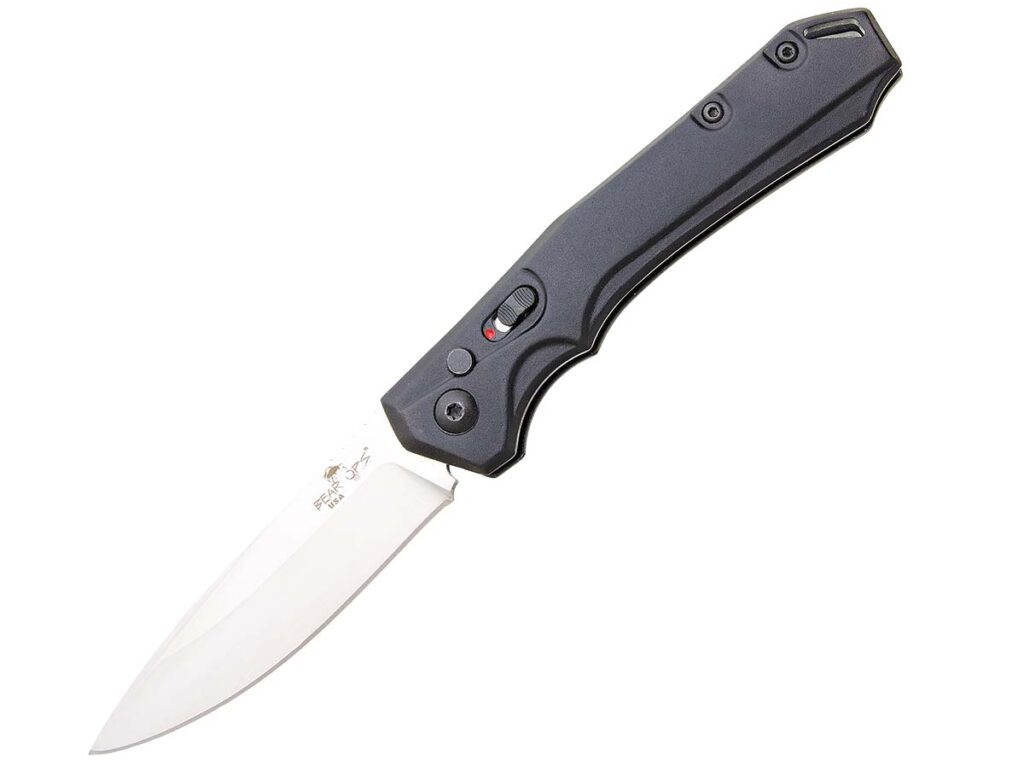
Blade Length: 4.5” Blade Material: S35VN Blade Pattern: Drop Point Blade Grind: Hollow Handle: Aluminum Overall Length: 8.75 Weight: 1.5 oz. Knife To Know: OTS Automatic, tip-up carry. MSRP: $230 Country Of Origin: U.S.A. bearandsoncutlery.com
Few knives have served America more than those of the U.S. military.
Editor’s Note: This is the first of a two-part series on the most influential knives to serve the U.S. Military and explores some of the early influences on military knife design.
As what many call the greatest country in the history of countries approaches its 250th birthday, now’s a good time to salute some of the top knives that played pivotal military roles in the forging of the world beacon that is the United States of America.
It is, of course, impossible to recognize in one magazine story every single knife that played a crucial role in the many battles of the wars fought by the USA. However, with the help of some of the knife industry’s leading military authorities—including several of whom have seen the elephant in service to our nation—BLADE® will endeavor to touch on some of the more consequential knives of U.S. military history.
Before embarking on such a quest, the first task is to identify a basic group of the most indispensable knife types over two-and-a-half centuries of American land warfare. At the risk of omitting one or more, five stand out: bayonet, all-purpose utility fixed blade and/or bowie, dagger, machete/chopper and utility folder.
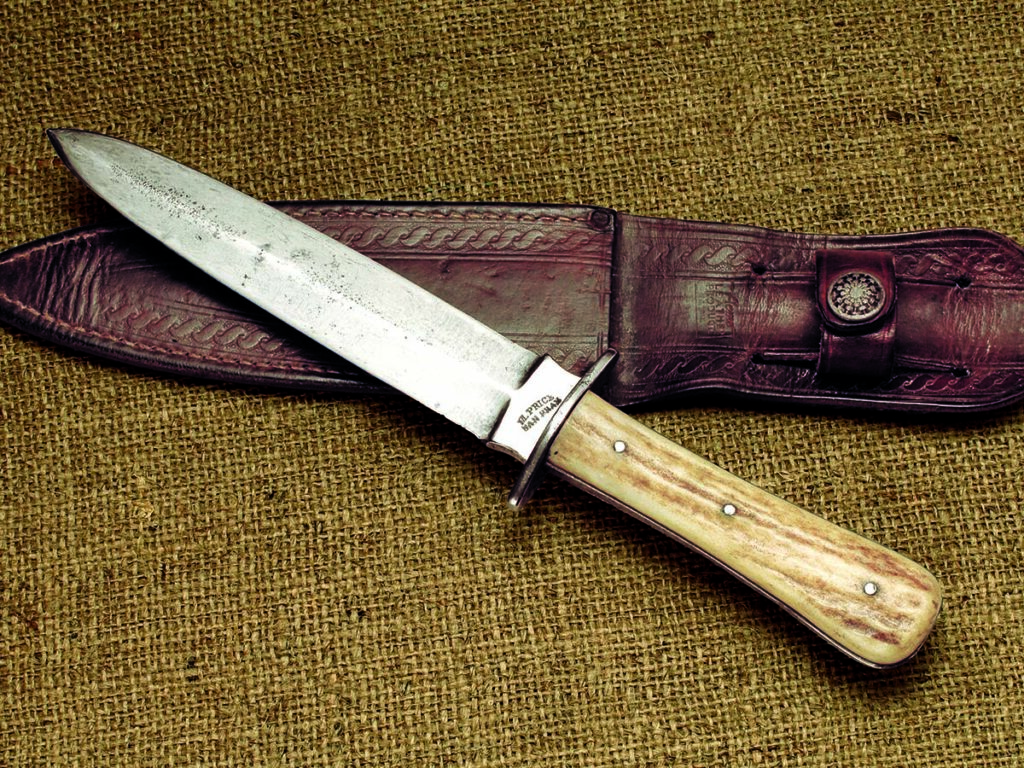
Michael Price recognized that to create a viable knife for self-defense and combat, form must follow function. His solution was to use the full-tang construction method, here on one of his classic mid-19th-century daggers. (Image courtesy of Louis Chow)
“These encapsulate everything that an infantryman used during the 250-year history of our country,” noted Louis Chow, a 24-year U.S. Army veteran who retired with the rank of major and is one of the leading collectors of the knives of BLADE Magazine Cutlery Hall-of-Fame® member Bob Loveless. “The bayonet, of course, from the get-go, from the Revolution to today.”
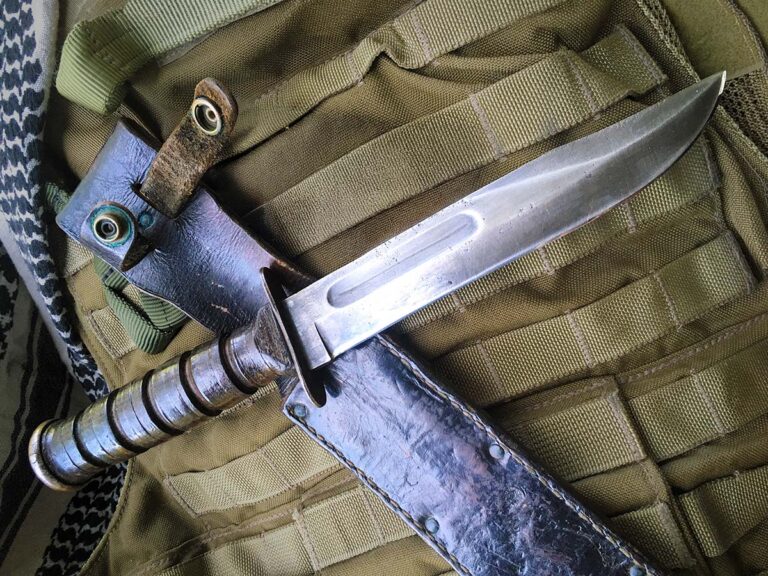
Louis indicated the all-purpose utility fixed blade/bowie could include privately purchased knives such as the Randall Model 1 and, of course, double-guard bowie types like the USMC fighting utility knife, aka the Ka-Bar. He pointed to the mid-19th-century designs of Michael Price as highly influential on daggers through to today, and machetes such as those made by Collins used in the Spanish-American War and before to Vietnam as vital to U.S. war efforts. Though pocketknives were indeed carried by American patriots during the Revolutionary War, the utility folders to which Louis referred are more of the modern Leatherman/Gerber multi-tool type, not to mention the Buck 110, Al Mar SERE, CRKT M-16 and others. As Louis noted, almost every soldier, male or female, in the modern military carries a multi-tool folder.
Many knife enthusiasts know that bayonets are rarely, if ever, used in combat today, nor have they been for well over a century. “It’s hard to actually find someone who used one in combat,” Louis said. Probably the most legendary American bayonet charge was the eminently successful one by Union forces led by Col. Joshua Chamberlain against Confederate troops down a hill called Little Round Top, a major turning point in the Battle of Gettysburg and, of course, the entire Civil War. Ironically, as Louis noted, “the most famous bayonet charge of all was the last one.”
While bayonets have rarely been used in American combat for many decades, that does not mean they do not remain significant teaching tools in today’s U.S. military. “When I was a company commander in 1990, we trained with the bayonet,” Louis recalled. “There are established bayonet courses on every installation, such as Fort Hood in Texas and Fort Benning in Georgia, and we would go there and train with the bayonet.” The rifles and bayonets have changed over the years but the bayonet training techniques remain the same. Throughout U.S. and nearly all other nations’ histories, governments have been responsible for the issuance of combat knives in the form of bayonets for their infantry fighting forces. During World War II, the USA issued all-purpose fighters and utility knives to many soldiers, sailors and airmen. However, as Louis noted, privately purchased edged tools and weapons have always been the mainstay of our servicemen. During the earliest American conflicts, including the Revolutionary through the Civil Wars, kitchen, utility, farrier-forged and European-imported cutlery were the sidearms of the multitude of militiamen and patriotic volunteers.
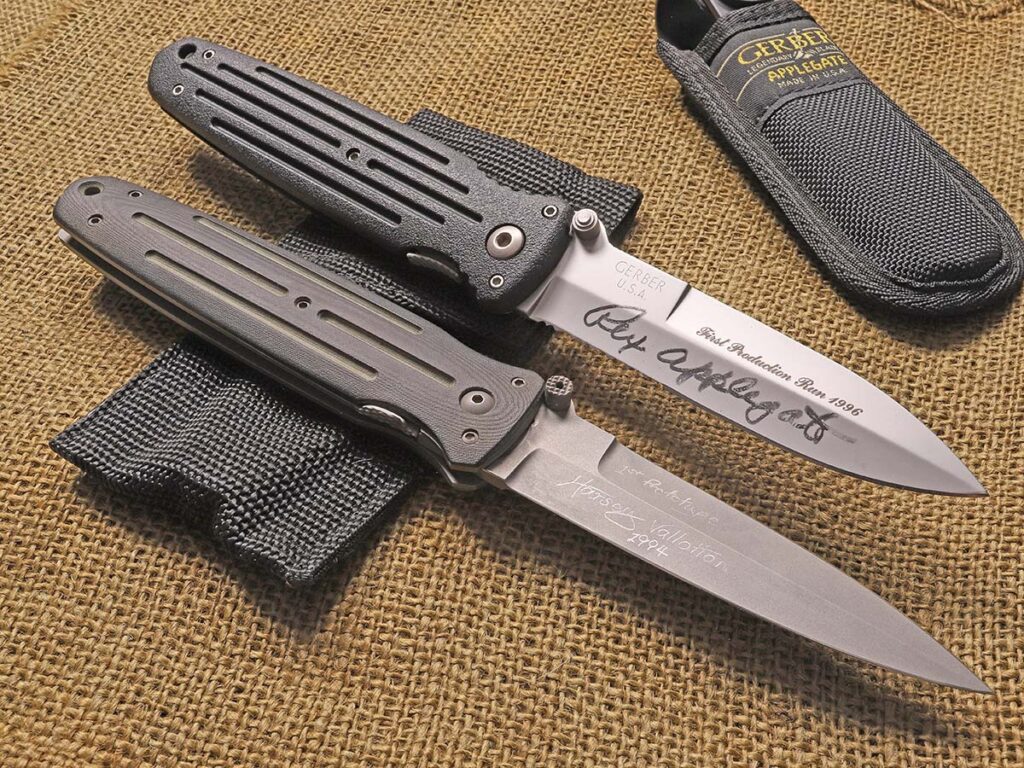
The original Applegate-Fairbairn Folder was a collaboration between Col. Rex Applegate and knifemakers Bill Harsey and Butch Vallotton. Harsey stated that a Gerber official said the Army ordered 50,000 of the knife at one time for the troops. At bottom is the original prototype and at top is a first-production Gerber version autographed by Applegate. (From the collection of Michael Janich)
The knife carried and made famous by Cutlery Hall-of-Famer James Bowie in the 1820s and 1830s was copied in various forms by makers worldwide and served as inspiration to any number of fixed blades carried in the U.S. military. Another large fixed blade that met with success in military circles was the Rifleman’s Knife made by the Ames Mfg. Co. circa 1860. Ames also made the Dahlgren Bowie Bayonet around the same time. Collins & Co. made a variety of bowies/machetes, the most famous probably being the No. 18, also incorrectly called the V-44 by many (according to D.E. Henry in his book Collins Machetes and Bowies 1845-1865, V-44 was the real name of a 1944 Case Survival Knife, not the No. 18).
Generational Blades
Circa the mid-19th century, Michael Price was considered one of the premier cutlers in the western United States. He was best known for exquisite presentation knives that incorporated marine ivory and a variety of beautiful shells. However, as Louis wrote, to create a viable knife for self-defense and combat, Price recognized that form must follow function. His solution was to use the full-tang construction method. And for a century and a half, some of the most notable American cutlers adopted the full-tang method that significantly improved a knife’s dependability and durability.
Early in 20th-century Michigan, Cutlery Hall-of-Famer William Scagel began forging axes and knives of various sizes and styles. He made most of his utility, hunting and bowie knives via the hidden-tang method. Though some of his combat knives were also hidden tang, many others employed the full-tang method.
“It was purported that the Scagel hidden-tang fighters with stacked leather washers were made for the European theater, while the full-tang fighters with wood-slab handles were made for the Pacific theater,” Louis wrote. “It was believed that stacked leather washers would be too susceptible to the humidity, high temperatures and salty air” of the applicable Pacific region. As a testament to Scagel’s outstanding craftsmanship and exceptional design, many of his fighters survived the war in good condition.
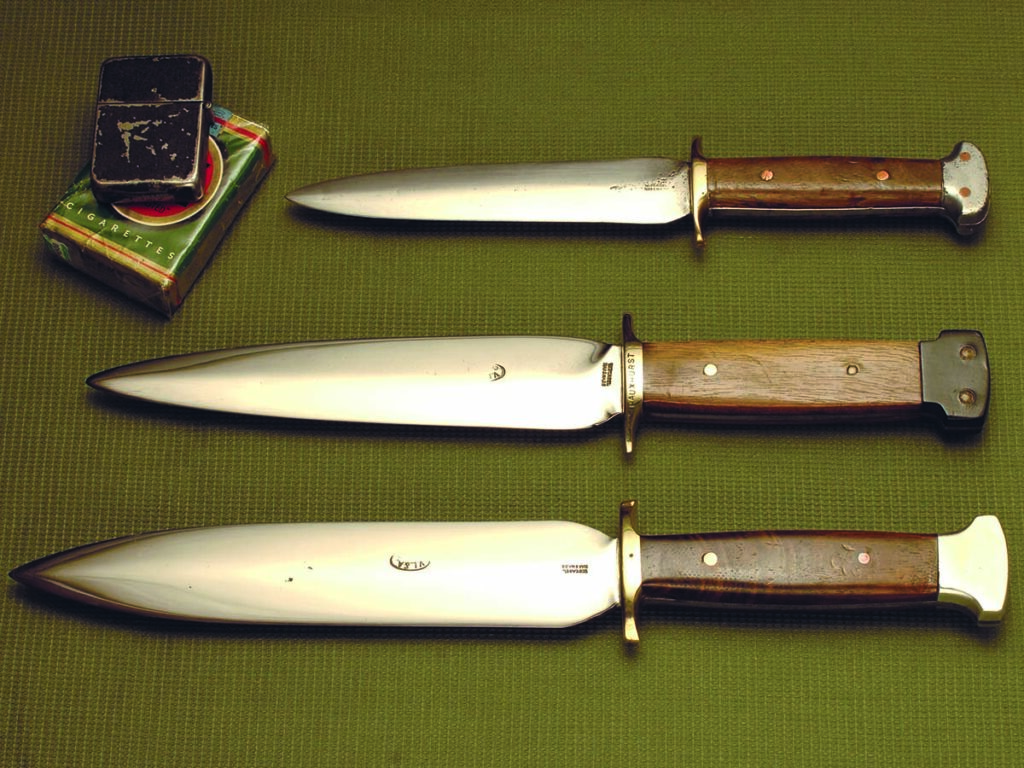
William Scagel’s hidden-tang fighters with stacked leather washers reportedly were made for the European theater during World War II, while the full-tang wood-slab fighters were made for the Pacific. The stacked leather washers were thought to be too susceptible to the humidity, high temperatures and salty air of the applicable Pacific region. (Image courtesy of Louis Chow)
In 1937, Cutlery Hall-of-Famer W.D. “Bo” Randall observed an older man scraping the bottom of a boat with a knife that appeared undamaged by the abuse. Intrigued by the improvised tool, Bo purchased it from the owner and contacted its maker, who just so happened to be Scagel. Randall eventually became Scagel’s student and soon opened his own shop, making Scagel-style knives.
“At the onset of World War II, Randall designed and produced some of the most recognizable combat knives ever made,” Louis stated. “Nonetheless, all were made with the hidden-tang method. It was not until the early 1960s that Randall introduced the full-tang Model 14-Attack and the Model 15-Airman combat knives.” Continuing the generational theme, Cutlery Hall-of-Famer Bob Loveless read a magazine article about Randall knives in 1953. He corresponded with Bo and made his interpretations of Randall knives before experimenting with and then making his own full-tang models.
From the mid-1960s through the early ’70s, Loveless accepted many orders from service members awaiting assignment to Vietnam. He also received bulk orders from units stationed there. One bulk order in early March 1967 from a unit commander in the 1st Cavalry Division was for 37 fighting knives.
“The unit commander and his troopers were stationed in Saigon and were supporting Operation Junction City, one of the largest airmobile operations in the war,” Louis wrote. “As a patriot and former veteran himself, Loveless would temporarily halt all other orders and place top priority on knives destined for combat. As for those 37 fighters, he worked day and night and completed the order in less than a month. For the next four decades, the Loveless full-tang designs were copied and reinterpreted by countless knifemakers and knife companies in the United States and abroad.”
In addition to the foregoing cutlery legends, the full-tang method was also preferred by many other U.S. World War II knifemakers. Among them: Alfred Bimson, John Ek, Taylor Huff, A.R. Kephart, Kennedy Arms, Bob Riggs, Ernest Warther and Cutlery Hall-of-Famer M.H. Cole. Cole also authored the comprehensive U.S. Military Knives, Bayonets & Machetes series of books and has been dubbed the “Sage of Military Knives” by Cutlery Hall-of-Famer Bruce Voyles. Continuing Cole’s legacy is knifemaker/author Michael Silvey through his reproductions of Cole’s designs and his lavishly illustrated books on the knives of the United States military in World War II and Vietnam, and other works.
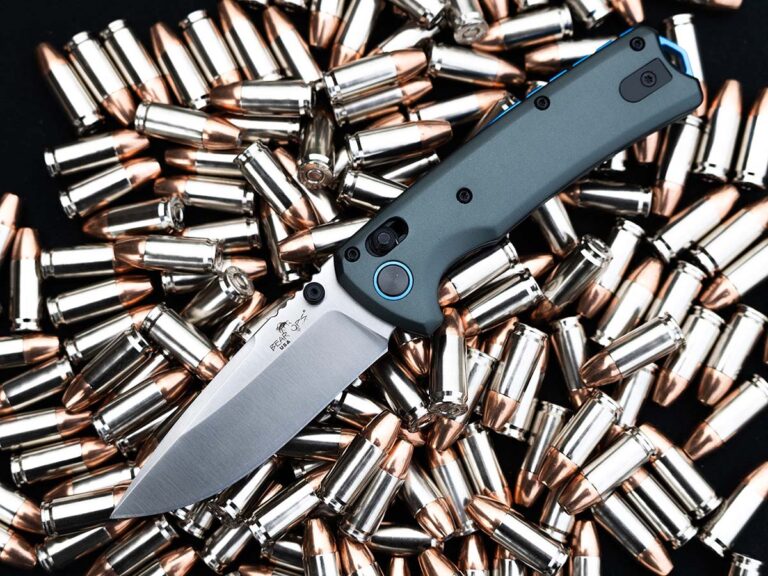
An American-made tactical EDC folder featuring a Sandvik 14C28N blade and lightweight aluminum handle.
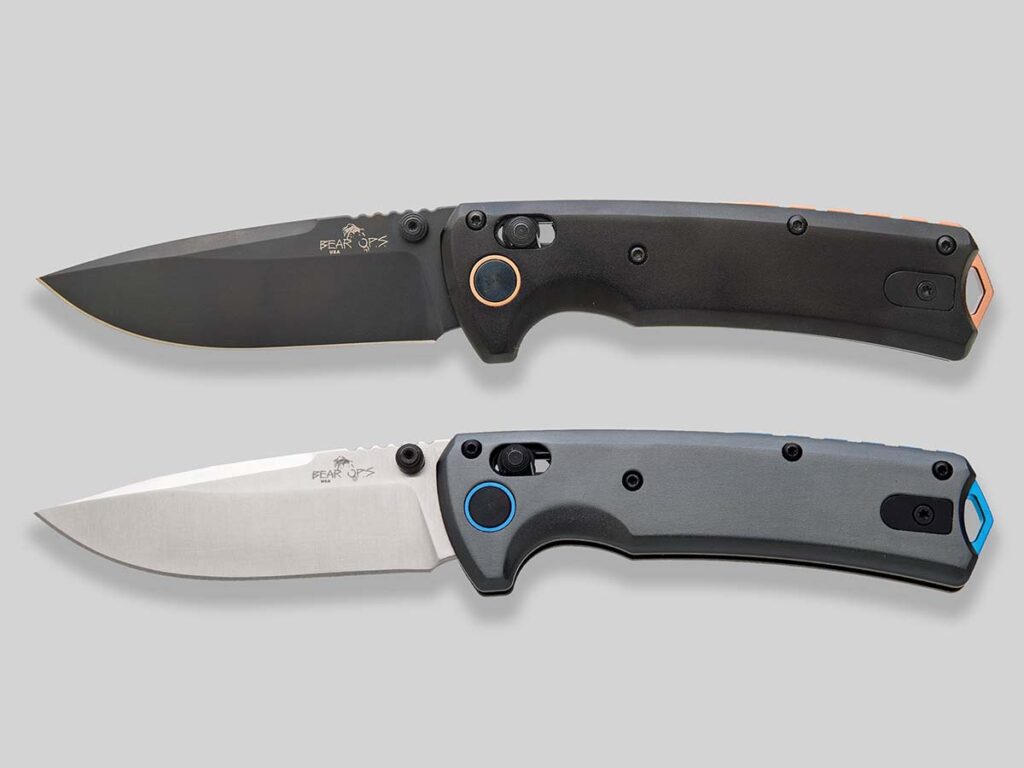
Bear OPS, the tactical division of Alabama-based Bear & Son Cutlery, is expanding its everyday carry lineup with the release of the Nekema II. Manufactured entirely at the company’s facility in Jacksonville, Alabama, this new folder is designed as a streamlined, budget-conscious option for tactical use, concealed carry, and general daily wear.
At the center of the design is a 3.5-inch modified drop-point blade made from Sandvik 14C28N stainless steel. This Swedish steel has become a staple for modern EDC knives due to its balanced performance, offering high corrosion resistance, user-friendly sharpening, and respectable edge retention. For users seeking extra protection and a non-reflective finish, Bear OPS is offering the blade with a black DLC (Diamond-Like Carbon) coating.
To keep the knife pocket-friendly, the Nekema II utilizes a lightweight aluminum handle, keeping the overall weight to a nimble 3.5 ounces. For deployment and lockup, the folder is equipped with dual thumb studs, ball-bearing washers for a smooth pivot action, and a secure slide-lock mechanism. A reversible pocket clip and Torx screw construction finish off the assembly.
The Nekema II is available in either Black & Copper or Gray & Blue colorways, with retail pricing set between $92.49 and $97.49 depending on the specific finish. For more details, visit local retailers or head over to the Bear & Son Cutlery website.