Home Blog Page 4

Ed’s Quest For Excalibur

0

Remembering Ed Fowler’s 80 Years of Knifemaking.

Editor’s Note: Chris Amos is a kifemaker, writer and close compatriot with the late Ed Fowler. He perhaps knew the knifemaker better than anyone in his golden years and has an interesting perspective in the life of the memorable craftsman.

On January 17, 2026, Ed Fowler left the world of mortal men to take his place with the legends of bladesmithing. The High Endurance Performance Knife master smith’s passion for true working men’s knives of history was insatiable. It was the one true love of his life, second only to a good Labrador.

The flyer for his school when I met him 30 years ago, and to this very day, still reads, “Ed Fowler, Author, Cowboy, Friend to All.” This is how Ed approached the world of knives. If we are being honest, it wasn’t necessarily everyone’s experience with him; but it was his intention. No matter what your personal Ed Fowler experience was, I think we can all agree his love of lady knife, his undeniable passion for performance and total commitment to his craft were both impressive and contagious.

A portrait of Ed by his good friend and knife collector Joe Campiese. The knifemaker built a dedicated following among many collectors.

The quest for his own personal Excalibur—the High Endurance Performance Knife—was a lifelong adventure that led him to cross paths with many on a similar journey. That’s how I came to know him so many years ago. I didn’t see his vision at first; I only knew knives as things, not an ideal. But he saw lady knife as so much more.

From his first meeting with ABS founder Bill Moran and BLADE® Magazine legend Wayne Goddard—who would become his lifelong friend and co-conspirator—his path to a 52100 ball bearing steel obsession was sealed. He and Wayne collaborated on the first 52100 knife, and the rest is history. Another longtime friend and BLADE writer, the legendary smith Joe Sizlaski, led him down the road to true skill with a hammer. They collaborated for decades through countless letters and phone calls. Most are still in the filing cabinet waiting to become a book. Over the years in his column Knife Talk, BLADE readers across the world waited patiently for the next nugget of wisdom or anecdote from these great representatives of the world of knives.

As fate would have it, he soon crossed paths with some men who would bring his dreams to life.

Testing His Metal

When Ed first shared his ideas with the conventional world of knives, they met with less than thunderous applause. This changed when metallurgist Rex Walther stumbled on one of Ed’s articles about his multiple-quench method. Intrigued, he contacted Ed, asked a few questions, proposed a few experiments and offered true scientific analysis. As Ed said of this collaboration, “We went from 0 to 100 overnight.” Rex’s feedback became the foundation for all of Ed’s advancements and achievements to come.

At the time, the industry considered a steel grain size as fine as 10* to be possible. Ed reported achieving 15 and finer through his methods, the limit of measurement possible with Rex’s equipment. Later, Kevin Grey, a student at the South Dakota School of Mines, would again not only test Ed’s methods but also write his graduate paper on them, getting them both invited to speak at the Artist-Blacksmith’s Association of North America conference in South Dakota.

One of his happiest moments in recent years was finding out, to his surprise, that he was mentioned in Dr. Larrin Thomas’ book The Story of Knife Steel: Innovators Behind Modern Damascus and Super Steels. Another was his amazement at receiving the 2022 BLADE Magazine Publisher’s Award at BLADE Show.

Ed’s Classroom

I met Ed in the mid 1990s at a knife show in California. I took his class on his ranch near Riverton, Wyoming, around 2007. After that, I traveled several times a year to help him teach, only missing three since that first one. About 15 years ago, I moved to the ranch to apprentice full-time, and the rest is history.

I hope to be here teaching and sharing his legacy and dream of 52100 steel and Excalibur for another 15 years.

Of the countless students who came to learn Ed’s mysterious ways with metal, a few stand out in my mind. The first is a very early student, Jeff Davidson. Jeff is currently an ABS journeyman smith and a passionate forging instructor.

The second is a knife collector and great future maker, whom we will just call “Stan.” He made his way to Wyoming from Taiwan after years of reading Ed’s articles. He is a great ambassador for Ed’s vision of the HEPK around the world.

Ringing The Anvil

I have written many articles for BLADE over the years. As I sit here in Ed’s silent shop, with his last good dog and write the final Knife Talk article from his computer, it’s important you know this isn’t the end.

Ed made his first knife, a small wooden knife, at about six years old. He still had that knife. His last completed knife, a light camp in what has become his iconic and signature style, was finished this fall at the age of 86. He didn’t even bother to take a picture of it, just sent it on its way to have its own adventures, never thinking it would be his last. As Willie Nelson said, “The road goes on forever, and the party never ends …”  I think that’s the way he saw it.

For the moment, out of respect and because it could use a little rest, his hammer sits in silence. But soon enough, his forge will be lit again, his anvil will ring and the knife talk will go on. Ed would have wanted it this way—as it should be.

*ASTM grain size quantifies the average grain size of metallic materials using a number, where higher values indicate finer, smaller grains.

Remembering Others The Knife Industry Has Lost:

Beating The Bush: Top Bushcrafting Knives

Four Blades, One Purpose: Bushcraft Mastery

A bushcraft knife is more than a cutting tool—it’s a partner in the woods. Unlike kitchen cutlery or tactical blades, bushcraft knives balance durability with precision. They carve, split and shape wood, strike sparks and handle camp chores with ease. Key traits of a good bushcraft knife include a full tang for strength, a comfortable handle for extended use and a grind suited to carving and slicing. Blade steel must retain an edge while resisting chipping and the sheath should securely hold the knife in rugged conditions. In short, bushcraft knives are built for living outdoors, not just surviving it.

Survival Knives vs. Bushcraft Knives

Survival knives feature a robust design for emergencies, allowing users to chop, pry and withstand heavy abuse. They may feature serrations, hollow handles or multi-purpose functions aimed at crisis situations. Bushcraft knives, by contrast, emphasize control and precision. They carve wood, prepare food and perform camp tasks with efficiency. Where survival knives lean on brute strength, bushcraft knives rely on finesse. The distinction lies in intent: survival knives help you endure unexpected hardship, while bushcraft knives help you thrive in the wilderness through daily, deliberate use.

Böker Bronco Mini

In the utility realm, the Böker Bronco Mini sliced all types of materials with Scandi precision.

The Böker Bronco Mini Fixed Blade measures 8.23 inches overall with a 3.375-inch CPM 3V blade in a drop point profile. Finished in satin and stonewash, the blade combines toughness with clean cutting ability. A Scandi grind makes it ideal for carving wood and bushcraft tasks, giving precise control in camp chores. To ensure stability, the tang is continuous and extends slightly beyond the handle end, allowing it to withstand strong impacts, such as striking a log. Additionally, a brief segment at the back of the blade features sharp 90-degree edges on both sides. The exposed tang can be used to generate sparks with an optional fire starter. The green TPE handle is textured for grip and measures 4.625 inches, providing comfort and security during extended use. At 4.8 ounces, it balances portability with durability.

A Kydex sheath provides ambidextrous carry and locks the knife securely with a solid click. Compact yet rugged, Böker built the Bronco Mini to baton kindling, process game, and thrive as a daily outdoor companion.

Unbroken Bronco

The exposed pommel/ferro rod striker is an outstanding feature of the Böker Bronco Mini for added utility.

Although the Böker Bronco Mini did all the bushcraft chores as well as any, it really shone in a utility role. I created a solid, realistic gauntlet of slicing tasks for the Böker Bronco Mini. I started with cutting heavy-duty scrap leather on a cutting board, holding it in one hand while slicing with the other. Next, I did the same with high-strength tow strapping. This task was difficult and would dull most new blade edges. This then set the stage for the lighter jobs. Old phone cord and zip ties fell victim to the Scandi blade, as did the jute twine. I cut up a lot of strong plastic package strapping, as we were close to the box-breaking-down season. Still, no issues.

With the amount of traveling I do, my life is full of luggage tags and boarding passes. If the edge wouldn’t slice these, I’d know the more robust materials dimmed it down. The Böker Bronco Mini passed the utility test like a champ. These were very realistic everyday chores that extend past the duration of this review.

Knives By Nuge Cub‑Muk

The Cub-Muk is a newish installment of the Knives By Nuge Cub series. The author used it as his companion blade in the Adirondacks with Nuge.

Inspired by the classic Nessmuk pattern, the Cub-Muk offers a compact yet full-featured design. Measuring 7 inches overall and featuring a 2.75-inch blade, with AEB-L stainless steel and a blackened, tumbled finish for durability. The Scandi grind, also available in Saber, excels at carving wood and shaping camp tools. Canvas Micarta scales provide a secure, weather-resistant grip, while the leather sheath adds traditional appeal and reliable retention. With its stout blade and full-sized handle, the Cub-Muk delivers agility and precision, making it a favorite for fine bushcraft work where control and efficiency matter most.

Floatplane-Camp Test

In the Adirondacks (upper right), the author prepared food for the camp using the KBK Cub-Muk. Proving the Scandi blade can slice tomatoes and process food.
In the Adirondacks, the author prepared food for the camp using the KBK Cub-Muk. Proving the Scandi blade can slice tomatoes and process food.

During my time in camp, the Knives By Nuge Cub‑Muk proved itself as a true workhorse. I carried it five days straight in the Adirondacks, relying on it for every small task that came up. Food prep, cordage cutting, and campcrafts were routine. The AEB‑L steel held a keen edge, and the hump‑backed spine added utility, scraping fish clean and even scooping meals when needed. Safely, of course.

Projects around camp highlighted the Nessmuk’s strengths. I carved pot hangers, stakes, and tool handles from both green and seasoned wood. Instead of chasing perfect points for stakes, I favored wedge ends that drove easily into the soil. Light taps with a stick set stop cuts for notches, giving me clean results without heavy batoning. The Scandi grind excelled at feather sticks, producing fine curls that caught quickly. Paired with a ferro rod, the squared spine showered sparks, igniting tinder in seconds.

The Cub‑Muk blends Nessmuk’s classic lines with modern materials, creating a compact knife that sees constant use. Its sharp edge, comfortable handle, and versatile design made it indispensable. From carving camp gear to starting fires, it delivered precision and reliability, proving that small knives often carry the biggest load in the woods.

Winkler Woodsman

The Winkler Woodsman has an 8.75-inch overall length with a 4.25-inch blade forged from 80CrV2 steel and finished in Caswell black oxide.

The Winkler Woodsman measures 8.75 inches overall with a 4.25-inch blade forged from 80CrV2 steel and finished in Caswell black oxide for corrosion resistance. Its flat grind and drop-point profile provide versatility for carving, slicing and light chopping. The sculpted maple or canvas laminate handle offers a secure grip, while the skeletonized tang reduces weight without sacrificing strength.

A lined Boltaron sheath with a leather overlay and a spring-steel belt clip ensures reliable carry. Built for balance and control, the Woodsman blends rugged durability with refined handling, making it a standout choice for serious bushcraft tasks.

Table To Woods

A bushcraft stew wizard, the Winkler Woodsman performed well on a rustic chicken stew.

It was a cold-weather stew week when I got the Winkler Woodsman, so I put it to work right away in the kitchen. Carrots are always a more challenging task for a bushcraft knife. Typically, bushcraft knives’ thickness and Scandi grind messily wedge and split root veggies. Luckily, the Winkler Woodsman has a high saber grind, which some would call flat. It easily cut the stubborn carrots using a longer stroke. Celery and onions were just as simple with the longish bush blade, thanks to its sharpness out of the box and its grind. I used a chef’s grip (pinch grip) with comfort. The potatoes were russet, which aren’t too hard and cook rather quickly. Still, they can be difficult like carrots. No worries with the Winkler Woodsman, however.

Lastly, there was a delicate chicken breast, which I butterflied and boiled for easier, faster cooking. The blade shape was perfect for this task. I don’t think any other blade for this review could have done the same stellar job for a winter chicken stew as the Winkler Woodsman.

Bear Forest Simple 2

The author uses the Bear Forest Knives Simple 2 in a chest-lever grip for making camp tools.

Sized down from the original Simple series (4-inch blade), the Bear Forest Simple 2 measures about 6 inches overall. It features a 3.5-inch AEB-L stainless steel blade. Its zero Scandi grind bites cleanly into wood, excelling at carving and slicing tasks. Butterscotch and Mocha paper Micarta with red burlap “bearcarta” scales give the handle a warm, secure feel.

The ambidextrous JRE leather sheath (black) allows for belt or neck carry. Lightweight yet tough, the Simple 2 blends corrosion resistance with practical design. It’s streamlined for everyday bushcraft chores, offering a reliable companion for carving, camp setup and field use without excess bulk.

Simply Qualified

The author made a try stick with the Bear Forest knife, quickly and efficiently.

I gave each knife a project suited to its strengths. For the Bear Forest Knives Simple 2, I chose the classic try stick—a green branch about arm’s length and thumb to broomstick thick. It’s a perfect way to practice knife control and notch work. Over several months, I used the Simple 2 for fire prep, food tasks, and camp projects, including tarp stakes and a bowsaw, but the try stick demonstrated its precision. I carved 11 practical notches, from root strippers and V-notches to square reductions, latch notches, and lashing crosscuts. In the middle, I shaped double flats and pierced a square hole with the pointed tip, cradling the handle in my palm for control. I added a saddle notch, a round reduction, a pot hook and a rounded end for digging sticks or stakes.

The thin edge bit deeply, shaving clean curls for tinder. The belly of the blade handled reductions, while the sharp spine proved useful for peeling bark. The oval handle stayed comfortable, with a rounded butt that anchored the grip. Compact yet capable, the Simple 2 excelled at fine carving and practical camp work, proving itself a reliable bushcraft companion.

Bushcraft Breakdown

You can’t go wrong with any of the bushcraft blades here. They have their strengths without many drawbacks!

More Reviews:

Head-To-Head Of Two Fillet Knives

Comparing Smith’s Flex Fillet and Bear & Son Smooth White Bone Pro Fillet in fish-skinning dominance.

I was just about to type “fishing season is nearly upon us.” Living in Canada, it has never stopped. Up here, thousands of fishermen are manning their shanties, huddled over a hole, heaters blazing their favorite brand of barley pop nearby. Up north, fishing is a sport that runs year-round.

Why do men go ice fishing? Maybe they go for the love of it? Maybe the solitude and peace on the ice? Either way, they are out there. And certainly, a part of their kit is a good fillet knife. If you intend on eating some of what you catch, you need one. Which brings us to our topic.

We’ll head-to-head two fillet knives at opposite ends of the price spectrum. At the budget end is the Smith’s Flex Fillet Knife, and in the premium tier, the Bear & Son Smooth White Bone Professional Fillet Knife. Both knives have 7-inch-long blades, and both will be tested on some fresh catch from Lake Erie. Crossing my fingers, we get fillets for a meal.

A buddy of mine who is braver than I for facing the cold brought in a variety of pickerel (walleye for my American readers) and my favorite, yellow perch. Anyway, let’s talk knives. Some would figure that putting a $145 dollar knife up against a $20 isn’t a fair comparison. I would suggest that price sometimes doesn’t matter as much as value.

Tale Of The Tape

With a 7-inch blade, the Smith’s Flex has a mid-range flex to it. Beyond filleting fish, the author could see this stiffness making it a solid boning knife.
Given its thicker stock, the author found the White Smooth Bone’s blade on the stiff side. Out of the two blades, he could see this knife pulling duty cleaning game.

Handle ergonomics is important in a knife used for long periods of time. It is one thing to chop an onion and a completely different thing when you need to manipulate a blade to make detailed cuts repeatedly. Ergonomics on the Bear & Son are pretty good. The overall profile of the handle has the right contours. Out of the two, there is no doubt that the White Bone Professional has better looks with its split 25 percent black and 75 percent white handle scales. Part of the presentation of the handle is black liners that run into the black bolsters. Bear & Son use screws to fasten the scales to the full tang design. They also include a lanyard hole.

Smith’s, on the other hand, goes with a light injection-molded plastic handle. Unfortunately, they do not detail what material the handle is made from, and since do not play guessing games I will not hazard a misinformed guess. The molded handle on the Smith’s is lightweight. On the weight (without sheaths), the Bear & Son weighed in at 5.46 ounces, and the Smith’s weighed in at 2.98 ounces, according to my kitchen scale. Therefore, the Smith’s came in at almost half the heft. If you prefer a knife with a little heft to it, the Bear & Son is your model.

The author liked the Smith’s handle and found the design made the tip controllable for detailing jobs.

Sheaths for these knives are not a main area of concern, as a fillet knife isn’t generally meant for belt carry. You do want the blade protected. Naturally, you want to avoid holes in whatever you choose to tote your fishing gear in. Smith’s comes in a very minimal sheath, no belt loop and plenty of drainage holes, allowing the blade to dry. All those slots make sure the sheath is easy to wash out. The Professional comes with a sturdy molded sheath with various lashing points so you can attach it to your gear. Furthermore, it has a great friction lock-up. The only drawback to the Bear & Son sheath is a tiny drainage hole. This, however, is easily fixed with a large drill bit.

Fillet Fray

A good, sharp knife like the Smith’s Flex made it easy for the author to get clean fillets off the fish.

The Professional is made from 14C28N stainless steel, popular in fishing and fillet knives. The Smith’s is listed as a 400 series stainless steel, found in more budget-conscious blades—particularly kitchen cutlery. Despite the differences in materials, the Smith’s knife was sharp out of the box. The blade cleaned the fish with ease. We cut around the ribs to start, and, for the test, we cut through the ribs. Then, we deboned the fillets.

Next came the White Smooth Bone Professional. Right off, it needed work on its edge. Luckily, my friend had a draw-through type sharpener, and he touched up the edge. This improved the knife’s performance a bit, but it was still not optimal for the job at hand. Cutting through the ribs was more like breaking through them. Out-of-the-box sharpness, hands down, goes to the Smith’s Flex. In fact, we finished the rest of the haul with the knife, and it is still sharp enough to clean fish.

The author liked the Smooth White Bone Professional Fillet’s ergonomics and aesthetics. Once he upgraded the edge, it handled well and made easy work of its filleting tasks.

I will note that I worked on the Professional later after the test and did get the edge up to snuff, but it wasn’t there fresh from the box.

Final Cut

My final thoughts on the two are, for the money, the Smith’s probably gives a fisherman as much knife as most he’ll need. And it does so from the get-go. How will it perform long-term? I will have to do the hard work of going fishing to find out.

As for the Bear & Son? If you like the knife, you likely have to do some work to get its performance up. Please keep in mind that these are samples of one of each knife and may not hold true as a rule for either blade across the board. In the knifemaking process, the final step of putting an edge on the blade is mostly still done by hand. Whoever put the edge on the White Smooth Bone didn’t form it properly. Human error isn’t uncommon.

Either choice, good luck out there, and catch a bunch.

More Reviews:

First Look: WE Knife Co. Dracarys Anniversary Special

The anniversary folder features intricate dragon-scale titanium milling, a premium Bohler M390 clip-point blade.

To mark its 12th anniversary, WE Knife Co. is looking back at the design language that first helped the brand carve out its place in the premium market. The new Dracarys serves as a refined homage to legacy models like the 604 and the Drakon 819, bringing back the intricate dragon-scale milling that became a hallmark of the company’s early manufacturing prowess. However, this isn’t just a trip down memory lane; the Dracarys streamlines those classic cues into a more carry-friendly profile that reflects over a decade of evolution.

The most immediate draw is the 6AL4V titanium handle. The 3D-textured scale pattern provides a complex visual depth reminiscent of traditional motifs found in Asian art, but the execution remains functional. These milled contours offer a secure, tactile grip without the abrasive quality often found in more aggressive knurling. By utilizing a slab-sided gray titanium frame lock, the design manages to feel substantial while keeping the weight at a lean 3.66 ounces.

We Knife Dracrays Closed

Unlike the oversized 4-inch blades of its predecessors, the Dracarys features a more versatile 3.58-inch clip point. Ground from Bohler M390 stainless steel with a stonewashed finish, the blade offers a wicked silhouette that is balanced by a practical flat grind. Deployment is snappy and predictable, thanks to a caged ceramic ball-bearing pivot that can be engaged via the flipper tab or the ramped, teardrop-shaped thumb studs.

As a special anniversary release, the Dracarys is strictly limited to 199 pieces per version. Each knife is individually serial-numbered and accompanied by a signed Certificate of Authenticity, marking it as a true collector’s piece for those who have followed the brand’s rise since 2014.

Dracarys Specs
Blade Steel: Bohler M390 (59-61 HRC)
Blade Length: 3.58 inches
Blade Grind: Flat Clip Point
Handle Material: 6AL4V Titanium
Overall Length: 8.13 inches
Weight: 3.66 ounces
Lock Type: Frame Lock
MSRP: $350
Availability: Limited to 199 pieces

Knife Reviews:

Spycraft Knives SK-4 Sentinel Review: Covert Ringer

Spycraft Knives’ wharncliffe gives you an undercover edge.

Spycraft Knives is a new player in the game and offers some cloak-and-dagger in its design. As the company’s name suggests, its SK-4 Sentinel is designed with input from ex-SpecOps personnel and is designed for carry on your person or gear.

It’s a ringed knife with a handle shape that feels good in the hand and feels heavy in the hand. Its wharncliffe-shaped blade is a great all-around style, and the angled false edge slims the tip a little. It’s definitely a stout knife, but above all, it must cut. So, let’s run it through the basics.

Light-Duty Testing

Cardboard did curl, but the author didn’t chalk that up to issues with the knife’s hollow grind. Instead, it was more a factor of the knife’s thickness binding on cuts through the stiffer material.

Up first I tested the edge out of the box with paper slices. The SK-4 sliced fairly quickly with its factory edge and produced a clean cut on all but one attempt. I had a tear, but I put that on operator error as I caught the sharpening notch. Overall, the edge seems to have a medium grit finish designed for heavier work.

I moved on to single-walled cardboard with the Sentinel producing nice, clean cuts with plenty of curling. This was thanks to the knife’s hollow grind in its thick blade steel. It’s possible to get a bit of binding in certain materials with the blade, but it’s possible to push through it. Here, the edge was aggressive, and I had to make sure to keep my fingers clear and had a few close calls with shaving skin.

Through leather, the Sentinel was particularly aggressive, the author reports. Both cutting and skiving the hide were audible. Skiving was especially impressive, with the knife producing thin, uniform slices.

On to 8-ounce leather, the SK-4 was really aggressive. Slicing, I got a crunching sound with every cut and found the thumb notch helped keep the cuts evenly spaced. When I switched to skiving, the knife was still talking to me with every cut. Honestly, I didn’t feel any resistance when I was attacking the leather.

Heavy-Duty Testing

The knife had some nice attributes when challenging tougher materials, such as this pine. The author was able to exert more force when creating curly cues thanks to a smartly placed thumb notch on the spine.

Pinewood was the SK-4’s next task and some whittling. I had to use a steeper angle because of the grind, but the knife produced very uniform curly cues for a fire stick. The contoured handles gave me plenty of control while making the longest cuts and thickest curly cues.

 I batoned the SK-4 into seasoned Hackberry wood. The first hit buried the blade, then I banged on the tip till the wood split. I tried holding the knife by the ring to give my hand room once the tip was buried. It worked, but I felt a lot of shock in my hand. Once the larger chunk of Hackberry was split, the SK-4 quickly split the thinner pieces. I found no noticeable damage to the edge, though it had a few wood smears to oil out.

The SK-4 was up to the tasks of splitting seasoned hackberry, however, it did leave the author with a sore hand when he tried to hold on to the ring while batoning.

Time for my favorite medium, sisal rope. The SK-4 crunched its way to 146 cuts before the edge started to slide. Nicely done. What was especially nice was that I found no hot spots on my hand from the handle. Overall, the wharncliffe blade aggressively zipped through the rope.

Overall Take

The SK-4 is a lot of knife in a smaller package. It has good edge retention with a comfortable handle. I am not a big fan of ringed knives, and I would like thinner steel used to keep weight down.

SK-4 Sentinel Specs
Maker: Spycraft Knives
Steel: K340 tool
Grind: Hollow
Overall Length: 9”
Blade Length: 4.09”
Weight: 7.26 ounces
Finish: PVD
Blade style: Wharncliffe
Handles: Textured G10
MSRP: $399

More Reviews:

Cool Custom: Stuart Kerr’s Cu Mai Dragon Is Built To Slay Beards

Stuart Kerr just can’t help meddling in the affairs of dragons with his custom straight razors.

Priced out of the custom straight razor market, Stuart Kerr figured he’d make his own. A lucky plunge for anyone who appreciates quirky and unique takes on the ol’ cut throat.

The Australian Knifemakers Guild member’s Cu Mai Dragon is a grand example of his deft and distinctive style. Kerr crafted a 2.56-inch blade from Baker Forge & Tool Tsunami Chevron Copper San Mai and offset it with a FatCarbon Dark Matter Purple Marble carbon-fiber handle. Striking enough as it is, but memorable thanks to the dragon scale on the spine and tang.

However, the proprietor of Boxer Custom Razors is darkly playful in much of his work.

“The concept of the dragon motif evolved from a couple of non-folding razors I made years back that were based on human bones. I was asked to design a razor with a handle that looked like a human spine,” the Queensland, Australia, resident said. “This inspired me to push the artistic envelope further and eventually evolved into the Dragon Tail and Dragon Spine razors.”

Kerr got his start restoring vintage straights, and when he made the jump to crafting them in 2011—aside from know-how—he started somewhat from scratch.

“I had a background in metal fabrication prior to studying to be a mechanical engineer, so I had the tools required to make my first belt grinder out of some plywood and an old pump motor,” he said.

Stuart Kerr and Zeus the boxer.

Requiring an edge meant to split hairs, Kerr’s honing process on his razors is meticulous, to say the least. After the grinding is done, he works his way through whetstones with grits from 1,000 to 16,000. Then it’s a few laps on balsa loaded with chromium oxide.

“Final step is stropping on a kangaroo hide strop,” he said.

A very Australian finish, indeed.

Check Out More Cool Customs:

New Knives: April 2026

0

Lightweight Innovation and Pocket-Friendly Precision.

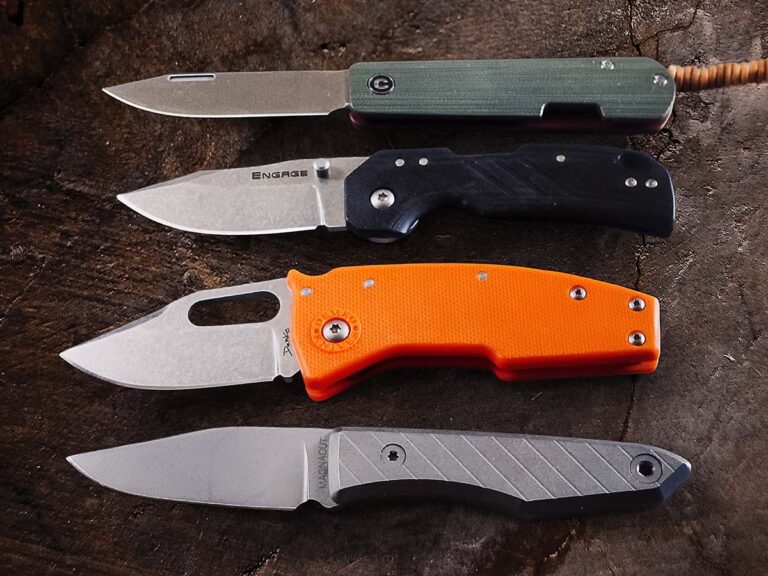
The spring season brings a focused shift toward portability and pocket-ready performance, highlighting a diverse lineup of high-tech folders and streamlined carry options. This month’s selection focuses on the incredible versatility of the modern pocketknife, showcasing the work of veteran masters with nearly four decades of experience alongside award-winning new makers. Whether you are looking for an ultra-premium custom slipjoint to round out a collection or a hard-use MagnaCut automatic for daily carry, our April 2026 roundup proves that the industry’s drive for innovation remains as sharp as ever.


T.R. Overeynder M-30 Dagger

T.R. Overeynder M-30 Dagger

Knife Type: Folding Dagger
Blade Length: 3.625”
Blade Material: PFS-27
Blade Grind: Flat
Blade Finish: Hand-Rubbed Satin
Handle: Edwards Black Jade
Frame Material: 416 Stainless
Overall Length: 8.255”
Knife To Know: Engraving By Richard Quecke
Maker’s Price For A Similar Knife: $6,525
overeynderknives.com (SharpByCoop Image)


Vincenzo Fiore Florence Folder

Vincenzo Fiore Florence Folder

Blade Length: 4”
Blade Material: Damasteel Damascus
Blade Style: Stilo
Blade Finish: Mirror
Handle: Integral RWL-34
Overall Length: 9.5”
Knife To Know: Custom 17-4 ph Axial Button Lock, SS Micro Ball Bearing System With A Single Race Housing And SSL Washers
Maker’s Price For A Similar Knife: $8,500
fioreknives.com (SharpByCoop Image)


Javi Garcia Phantom Sultan

Javi Garcia Phantom Sultan

Knife Type: Lockback
Blade Length: 2.75”
Blade Material: AEB-L
Handle: Elephant ivory, MOP shield
Liner: G10
Overall Length: 7”
Knife To Know: Knife Features 24k Gold Inlay Screws
Maker’s Price For A Similar Knife: $4,000 (Jocelyn Fraiser image)


Spycraft Knives Sentinel

Spycraft Knives Sentinel

Blade Length: 4.09”
Blade Material: K340
Blade Finish: PVD
Handle: Multi-Cam G10
Overall Length: 9.01”
Sheath Type: Molded Kydex
Weight: 7.26 oz.
MSRP: $399
spybriefinggear.com


Toor Knives Draper

Toor Knives Draper

Blade Length: 3.5”
Blade Material: CPM Magnacut
Overall Length: 8.3”
Weight: 3.9 oz
Handle Material: G10
Action: Crossbar
Clip: Titanium
Hardware: Stainless Steel
Spacers: G10
MSRP: $325
toorknives.com


Maserin Frontier

Maserin Frontier

Blade Length: 3.23”
Blade Style: Clip point
Blade Material: Nitro X7
Blade Finish: Stonewashed
Grind: Flat
Handle: Off White Micarta
Clip: Reversible
Lock: Axis
Overall length: 7.87”
Weight: 3.88 oz
MSRP: $165
maserin.com/en/


Reate Knives Horizon X

Reate Knives Horizon X

Blade length: 3.2”
Blade steel: 14C28N
Blade finish: Stonewashed
Handle: Fatcarbon Glass
Locking Mechanism: Crossbar Lock
Overall length: 7.3”
Weight: 2.78 oz
MSRP: $97
reateknives.com


Heretic Knives Jinn

Heretic Knives Jinn

Knife Type: Automatic
Blade Length: 2.9”
Blade Style: Sheepsfoot
Blade Steel: Magnacut
Blade Finish: DLC
Blade Grind: Flat grind
Handle: 6061 Aluminum
Overall Length: 6.8”
Weight: 2.3 oz
MSRP: $269
hereticknives.com


Steve Vanderkolff Hawk’s Eye Slipjoint

Steve Vanderkolff Hawk’s Eye Slipjoint

Knife Type: Slipjoint
Blade Length: 2.375”
Blade Material: CPM154
Blade Grind: Hollow
Handle: 416SS Body With Hawks Eye (blue tigers eye) Inlay
Overall Length: 5.25”
Maker’s Price For A Similar Knife: $500
vanderkolffknives.com (Jocelyn Fraiser image)


Charlie Bridges Hunter Scalpel

Charlie Bridges Hunter Scalpel

Knife Type: Fixed
Blade Length: 2.25”
Blade Material: WWII Pocket Chang, 1084 Core
Blade Grind: Hollow
Handle: G10
Overall Length: 6.5”
Maker’s Price For A Similar Knife: $450
brokenanvilknifeworks.com (Jocelyn Fraiser Image)


Jack Wolf Knives Equal End

Jack Wolf Knives Equal End

Knife Type: Slip Joint
Blade Length: 3.73”
Blade Style: Drop Point
Blade Material: Sandvik 14C28N
Blade Finish: Satin
Grind: Flat
Overall Length: 6.48”
Bolsters: Stainless Steel
Hardware: Nickel Silver Pins
Weight: 2.7 oz
MSRP: $70
jackwolfknives.com


Case Knives Cheetah Cub

Case Knives Cheetah Cub

Knife Type: Lockback Clip Point
Blade Length: 2.58”
Blade Steel: Case Tru-Sharpe Surgical Steel
Blade Style: Locking Clip Blade
Blade Finish: High Polish
Blade Grind: Flat Taper
Handle: Smooth Antique Bone
Overall Length: 6.08”
Weight: 1.9 oz
MSRP: $119
wrcase.com


Check Out Other Months:

Advertisement

Must Read Articles

Read this before you make a knife

Knifemaking 101 – Read This Before You Make a Knife

  by Wayne Goddard My experience has taught me that there's nothing like digging in and getting started. I've often said the hardest part of the...
how to forge damascus steel

How to Forge Damascus

Advertisement
Advertisement