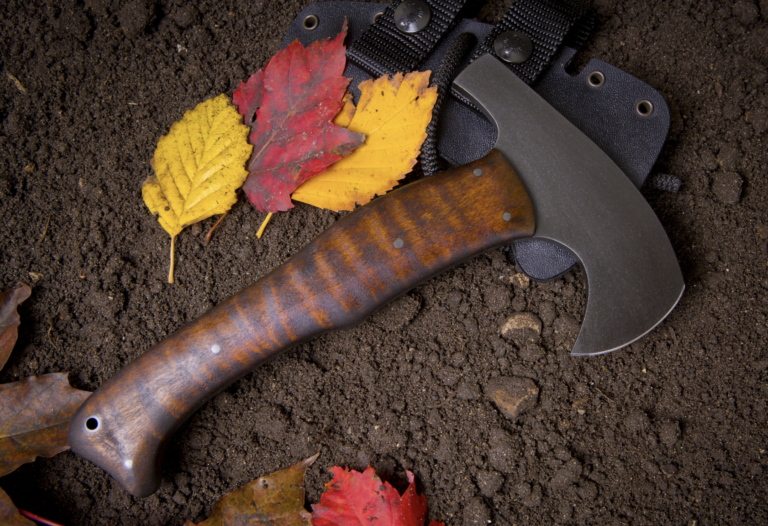
The company’s shop was extensively damaged in the natural disaster.
Hurricane Helene affected a vast swath of the country and the knife community was not immune. Several knifemakers call North Carolina home, the state that took the brunt of the devastating hurricane that tore across Appalachia in September. One of the harder hit was Winkler Knives, based out of Boone.
The tactical- and outdoor-focused maker thankfully did not lose any of its employees in what turned out to be among the worst natural disasters in recent history. The company’s shop, however, incurred substantial damage from the torrential downpours flooding much of North Carolina’s countryside. In a brief estimate on a YouTube video, Winkler’s founder and owner Daniel Winkler when he returned to his shop there was 15 inches of standing water throughout. Even more troublesome, the workspace was swamped with hundreds, if not thousands of pounds of mud.
Needless to say, this halted the company’s production and put many orders on hold, with much of its machinery reportedly damaged or destroyed. In finished products, Winkler estimates it lost two weeks of work.
Living up to the rugged persona of its knives and axes, Winkler is attempting to make the best out of a rough situation. The company is staging a special sales day on Nov. 30, to raise funds to—as the company puts it—build back. The company will stage a meet-and-greet before the actual sale, then offer those who register, early-bird entry before its store opens proper to the public. And Winkler has quite a selection of special knives up for sale at the event.
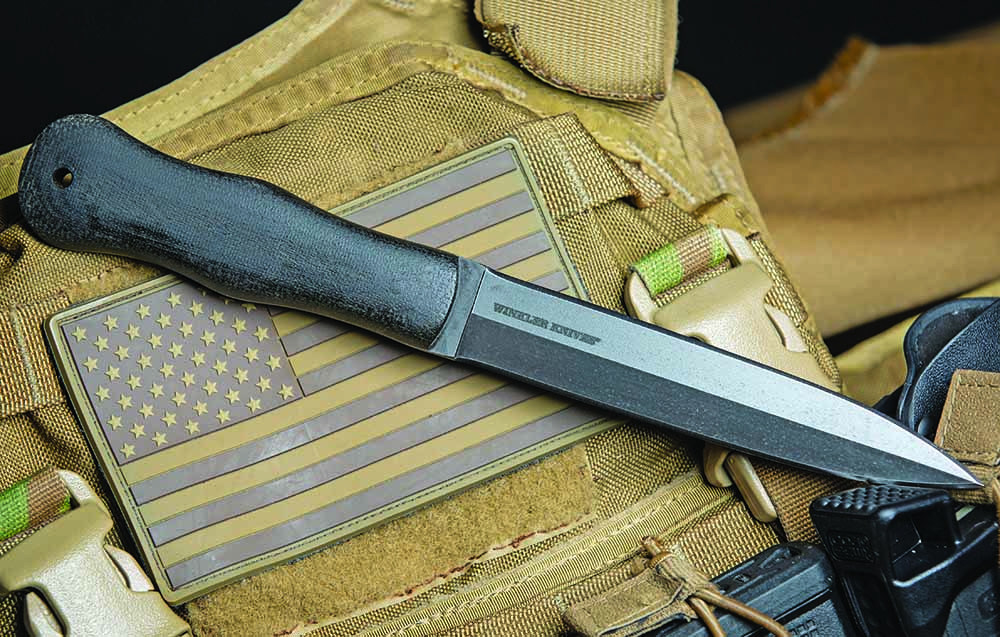
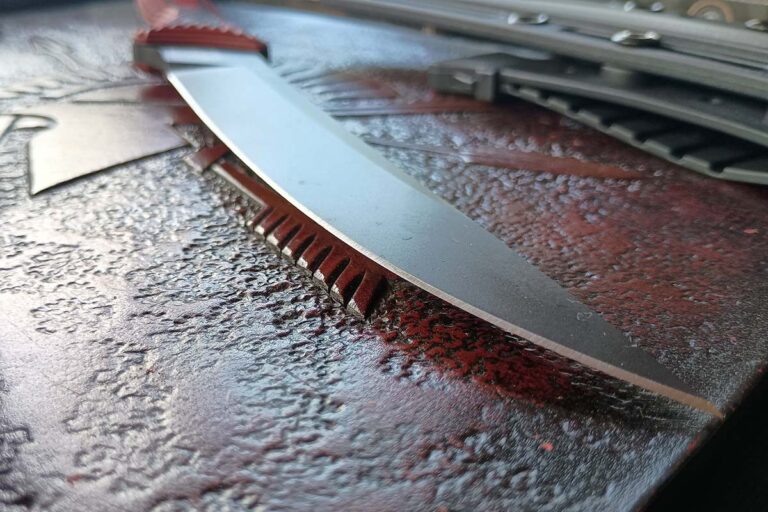
Made in Boone, North Carolina, the Winkler Knives Tactical Dagger in a black Micarta® handle has the same specs as the WASP-pattern model.
Among the many special offerings will be Winkler Knives standard models made by Daniel Winkler (DW Made), Winkler Knives Traditions by Daniel Winkler and Karen Shook, and even a couple of one-of-a-kind hand Forged knives by Master Bladesmith Daniel Winkler, accompanied by the leather craft of Karen Shook. There will also be special editions produced by Winkler Knives Artisans.
This is a special affair and only registered customers will be allowed in during the early-bird portion of the event. The company will not conduct phone sales for the event, only in-person sales. However, Winkler will set aside special editions from the sales event for those unable to travel to Boone. Those products will become available on Winkler Knives’ website on December 2, under the “Currently Available” tab.
If you are interested in attending the Winkler sales event, time is of the essence. The deadline to register is Nov. 18. To register, email [email protected] with the subject Register. The company will email an invitation or a notification the event is full in response.
Winkler Knives Sales Event
Nov. 30, 2024 520 Church Road Boone, NC 28607
Sales Event Schedule
8 am Meet-And-Greet The Winkler Team 9 am Product Preview 9:30 Early-Bird Sales
Knife edges come in all different styles. We break down the major types in this quick guide to blade grinds.
Cutting performance is greatly influenced by the way in which the maker grinds the knife. Each grind will have different cutting characteristics. A good knifemaker will consider whether the grind of the knife is suited to the chosen task. You as a buyer will also need to consider if the grind of a knife will suit the tasks you have in mind.
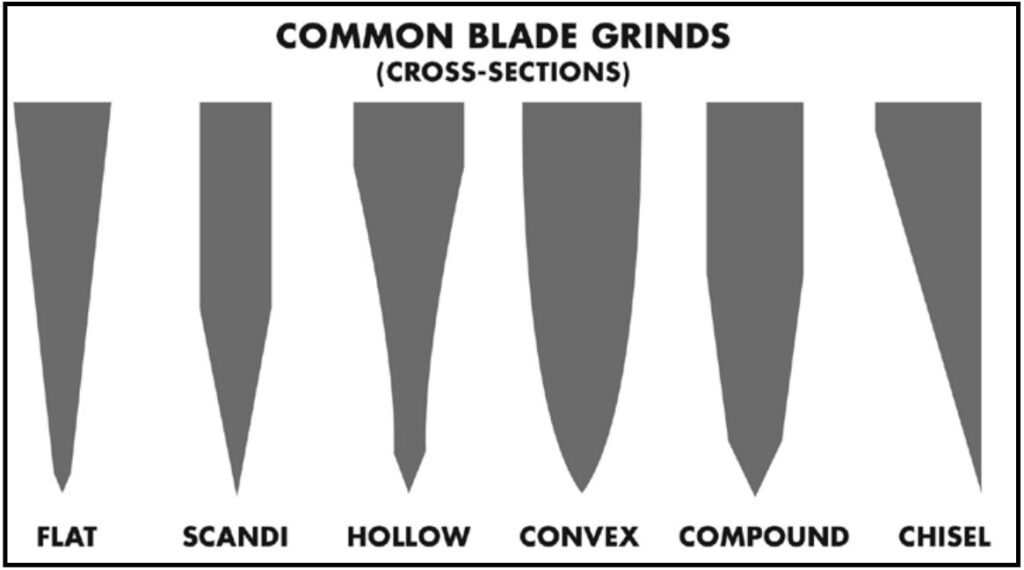
Blade grinds you’ll often come across can be seen here. (Image courtesy of Knafs.com)
Flat Grind
A flat-ground knife is a simple wedge and may be thick or thin. Flat grinds are good for slicing and deep cuts. I personally prefer a flat grind that goes all the way to the spine. A thinner flat grind will cut more smoothly than a thicker flat grind, where a thicker grind may be more durable.
Hollow Grind
A hollow-ground knife has a slightly concave bevel, which makes it thinner behind the cutting edge. This makes for good skinning and shallow cut work, without giving up overall blade heft or durability. Deep cuts or chopping are not well suited to a hollow grind.
Convex Grind
Convex grinds have slightly rounded bevels, which increases their edge stability. While they may not excel at slicing, they’re the way to go for hard use cutting and chopping.
Scandi Grind
Scandi grinds are a short flat grind with no secondary bevel. “Scandi” refers to the Scandinavian countries where that grind style is popular, especially Finland. This grind style cuts very well but can be difficult to sharpen properly.
Compound Grind
A compound grind may combine several of the basic grind shapes. Particularly on tactical and folding knives, many modern grinds are aesthetically interesting, but at the occasional sacrifice of performance. If you’re collecting for aesthetic reasons, however, these grinds could be all you ever wanted out of a knife.
Folks chase blades for all sorts of reasons. As a knife collector, what motivates you?
Have you ever taken one of those personality tests online or at work, like a Myers-Briggs, StrengthsFinder or Enneagram? You end up with a description of your personality tendencies, and invariably some of them are exactly how you see yourself.
While I have the nerd skills to put together a knife collector personality test like that, I don’t think it would be that useful. Instead, I’ll skip straight to the results and describe a few varieties of the “knife collector personality.” Maybe something in one of these descriptions will resonate with you.
Accidental Knife Collector
Collectors in this category are buying and accumulating knives because those knives do certain tasks well. They’re not afraid to buy a knife for one specific purpose and may find themselves in possession of more knives than they realized they had.
I got my first knife at around age 7; a small Case folder. This knife, like many others I’ve owned, was used and then lost. Fast forward 34 years, and I still use a knife. I started making knives because I didn’t have enough sharp knives to accommodate the tasks I was engaged in at the time. I hunt and use a knife to process my deer and other game animals. I use knives in the kitchen. I skin fish, slice vegetables and open packages. I carry a small Swiss army knife with me on my keychain. Am I a knife collector?
Just for kicks while pondering this question, I took a quick inventory. I have three custom and two quality production knives in my kitchen. I have five customs in my hunting pack, not counting the ones my sons have. I’ve got three or four spare keychain knives. I started a minor collection on purpose once and acquired 10 or 12 trapper pattern slipjoints and a few vintage folding knives in other patterns before I decided I wasn’t a collector, but I still have the knives.
In addition, I’ve got various junk knives stashed around in cars, trucks, shops and drawers, including the usual assortment of junk kitchen knives from big box marts, plus all the decent ones that I forgot where I put them. By quick count, I’ve got about a dozen customs and another 75 production knives.
Am I a knife collector? In my mind I am not a “knife collector,” but I figure I might be after all. You might be an Accidental Collector, too, and not even know it.
Investor
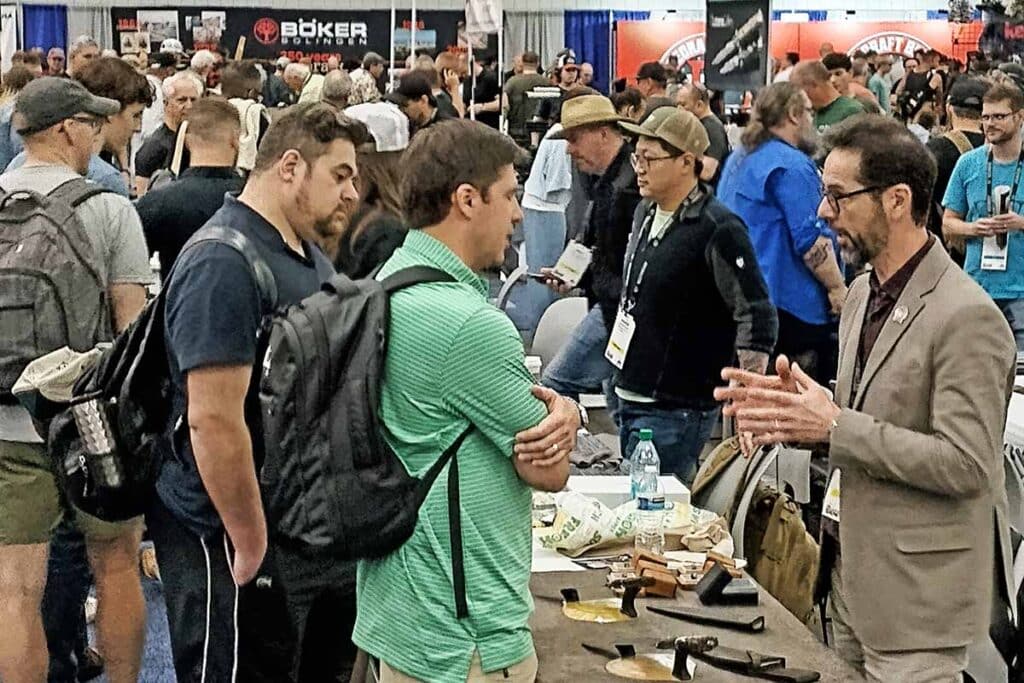
What motivates you to brave the crows at knife shows to collect?
Collectors of this type always have an eye on the bottom line. They’re familiar with the primary and secondary markets, and can instantly spot a good deal. They are always looking for the “next big thing,” the knife that is not hot yet but will be soon. They know the value of “buy low, sell high,” but they also watch which makers and knives appreciate over time.
Some folks invest in stocks or real estate, while others apply their knife knowledge as part of an investment strategy.
I think of my friend Jimmy McMahon as an example of this category. I remember back in 2010 when he invited me to my very first knife show. At the time, he was proud of a knife he had just purchased from Kyle Royer, then a 19-year-old journeyman smith. Given Kyle’s continued improvement and his current status in the industry, I’d say Jimmy made a good investment. If Jimmy were to sell that knife today, he’d make a handsome profit.
Philanthropist/Helper
Have you ever met a person who was a real people-person and just wanted to help everyone? When a person like this collects knives, they continue with that approach.
Some collectors buy from makers they know and have a relationship with. Some buy from makers whose story they know, makers for whom the buyer knows that every single sale makes a difference. These collectors may be biased toward purchasing from makers who are newer, younger or less well-established.
One fairly well-known example is knifemaker Lloyd Hale. Lloyd disappeared from the knifemaking scene in the early 1980s, only to reappear 20 years later. Lloyd tucked away for all that time in his shop working for his patron, Owsley Brown Frazier. Lloyd created over 300 knives, daggers and swords for Owsley, who just happened to be one of the country’s premier gun and arms collectors. Many of these knives along with a great number of historical pieces are on display in the Frazier Museum in Louisville, Kentucky.
Another good example is my friend, David Smith. He loves to talk, to share what he has and a good knife. Over the years as I developed in the craft, he has purchased 6 or 8 pieces from me. He’s given some as gifts, but all have been put to use.
One story stands out as a great illustration of David’s character and the Philanthropist/Helper.
One of my first forged knives was made from the tooth of a drag harrow that came from my grandfather’s farm. I’d held onto the tooth for many years until my forging skills were up to the task. The knife also included wrought iron and some figured red oak milled in 1955 that was recovered during a remodel from the floor of my house at the time.
Even though this knife was tied to me in many ways, with two small kids at home I found myself in an economic pinch, so I had to put the knife out for sale. I priced it at what was for me a high price at the time, and David snatched it right up. He also promised to give me the knife back when he passed away.
About four years later, I was able to travel across country and again visit David at his hunting camp where we used to hang out 15 years prior. True to his word, David gave me back the knife, saying that he didn’t want his wife to have to figure out where to send all the stuff he’d promised folks after he died. He’s almost died four or five times in the last 20 years, but as of this writing is still alive and well. I’ve since adopted that knife as one of my primary using knives, and it’s a treasure I’ll never part with.
Art Appreciator
Sure the canvas is different, but there’s no denying Andy Isaacks’ knife and Alice Carter’s engraving are works of art in their own right.
These people love art for art’s sake, who take the time to stop and admire the roses, who simply enjoy having beautiful things around them. That there would be people like this who gravitate toward knives-as-art is no real surprise. Just like those who collect paintings, sculptures or any other kind of art, these people buy knives simply to appreciate their beauty and the skillful craftsmanship that went into their creation.
I never met David Darom, but with some familiarity with his books, I assume he was an Art Appreciator. His books feature the best knives in the world from a variety of genres, from top makers both stateside and international. If you’re not familiar with his work, The Great Collections is a good place to start.
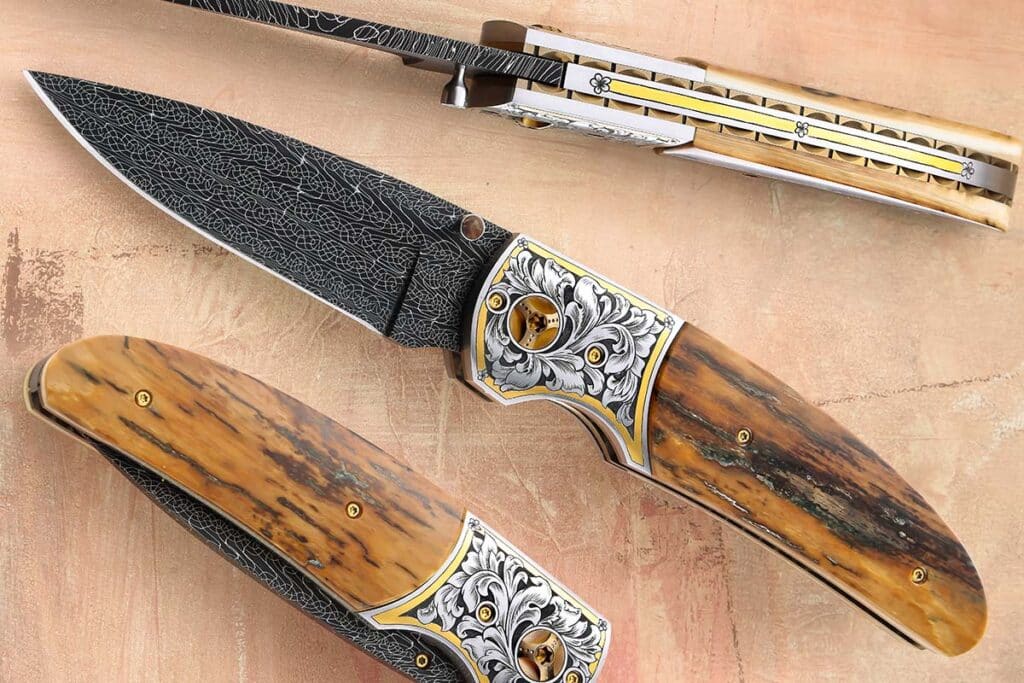
I remember as an incoming probationary member at the Guild Show in 2013 hearing a buzz in the room when a $30,000 knife was sold by Warren Osborne. As a young guy in the back row, I had no idea what kind of knife would bring that kind of price, nor what kind of customer would buy one. I later saw the knife, with gold and fine engraving on a damascus interframe folder. My guess is that it was purchased by an Art Appreciator.
There are a few fine examples of this kind of knife in the center photo section.
“Squirrel!” Collector
Some readers will recognize the “Squirrel!” reference from the Disney movie Up. It’s a great illustration of the ADHD/impulsivity that goes along with some personality types, mine included. This type of collector simply buys knives that they like at the moment. Rather than a systematic approach, it’s more like “here a knife, there a knife, everywhere a knife knife!”
While some might argue that this isn’t a “real” collecting strategy, I believe that if it’s enjoyable to the collector, then it’s a legitimate pursuit. Even so, these stories don’t always turn out well.
My fishing buddy, Cliff, is a good example. He asked me once to sharpen his knives prior to an elk hunting trip. What he brought me was an imported Buck folder, a decent Benchmade fixed blade and two no-name folding knives from Bass Pro. Each one sharpened differently, and each was designed for a different purpose. None of them were well suited to skinning an elk. Cliff was happy to share them with me and glad for me to sharpen them, but no elk were harmed on his hunting adventure.
Historical/Sentimental Knife Collector
Some collectors specialize in history of one kind or another. Maybe they collect only Case “tested” knives like their grandpa or father carried. Maybe they have a collection of knives directly from their ancestors, or connected to a specific historical event (e.g. Civil War), a specific era (e.g. the American West) or an international genre that connects with their heritage. For these collectors, part of the value of the knife is the connection that it makes with something both personal and historical.
Master smith Jerry Fisk targets this kind of collector with his high-end bowies that include historical materials. He’s made knives from World Trade Center steel. He’s used wood from trees planted by George Washington. He’s made damascus with one layer for every person in the United States.Elements from Thomas Jefferson, Dr. Mudd, the Liberty Bell, the Alamo and Pearl Harbor have been worked into Fisk knives over the years. When a collector buys these knives, they’re buying a connection to a story, not just a knife.
My friend, David Patterson, of League City, Texas, fits this category. He’s been collecting knives for many years and has a great collection of the work of knifemakers from the 60s and 70s like Merle Seguine, Clyde Fischer, Gordon and Ruffin Johnson, Randall and Moreseth. He also has a long-standing collection of a knife from every single master smith in Arkansas.
Grail Seeker
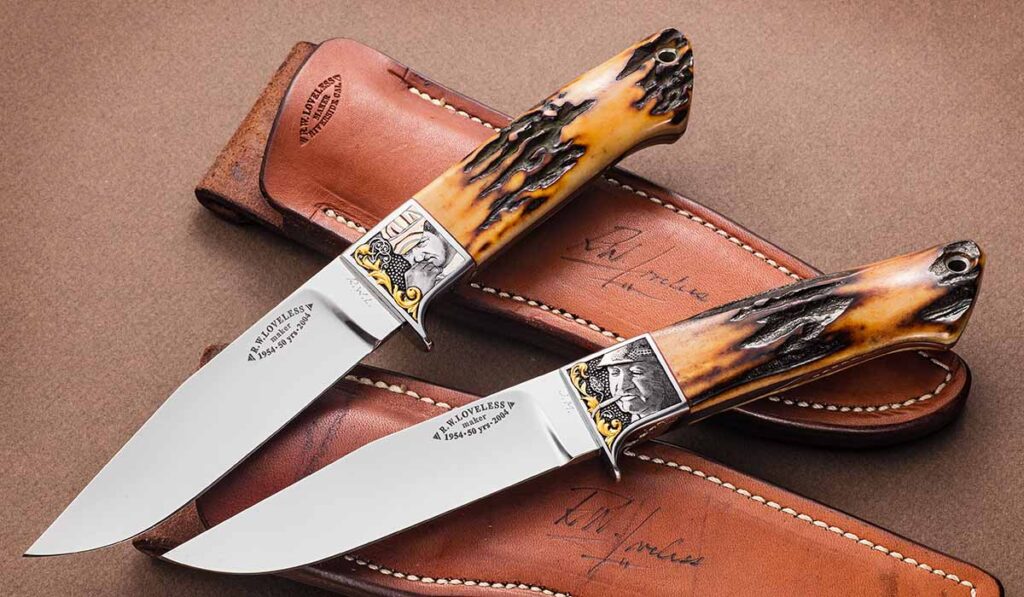
Engraved by C.J. Cai, it’s safe to say this Bob Loveless hunting knife set would qualify as a Holy Grail to many knife collectors. (SharpByCoop image)
There’s a personality type that loves the thrill of the hunt, for whom the journey is as important as the destination. These folks love to get the hottest new thing, or pursue the rarest or most sought-after knives. If you follow the trends and buy at the peak, you may be this kind of collector.
The market depends somewhat on people willing to play this role. The thrill of the acquisition can be as important as the knife itself. These folks developed the term “grail” knife, that knife for which you’d forsake all others, the knife at the top of the pinnacle.
All About The Knives
Whatever your personal reasons for collecting, and whatever personality traits encourage you down the path you’ve chosen, we all share one thing in common: the love of the knife.
We take a gander at some of the knives that showed up at the first BLADE Tactical at CANCON Carolina.
Sun, guns and a whole bunch of knives—BLADE Tactical was a whole new twist on BLADE Show. And a heck of a marriage between it and one of our sister events, CANCON Carolina.
Held Nov. 7-8 at South Carolina’s Clinton House Plantation range, the inaugural BLADE Tactical brought together some 25 knifemakers to show and sell their wares, all of the blades with a definite tactical bent. The knife show ran the first day, on the periphery of the shooting events. It had a different feel than any of our legacy shows, given it was outdoors and had the constant report of suppressed gunfire as background noise. But it wasn’t too far off our big three with some knife enthusiasts spending the night in the parking lot so they could be the first to the BLADE Tactical pavilion.
With that sort of enthusiasm, we’ll chalk the event down as a success.
For those who were unable to make the BLADE Tactical show or have their interest piqued, we’ve put together a recap of some of the knives that made their way to central South Carolina. Take a gander at what was up for sale and start planning now for next year’s B-Tact extravaganza. For anyone looking to pick up a hot new knife and burn some powder at the range—consider the gathering your Valhalla!
Krein Knives
Tactical doesn’t preclude good looks, which is certainly the case with this Krein Knives Alpha. The blue thumb studs add a nice flare to this top-end framelock.
Carver Knives
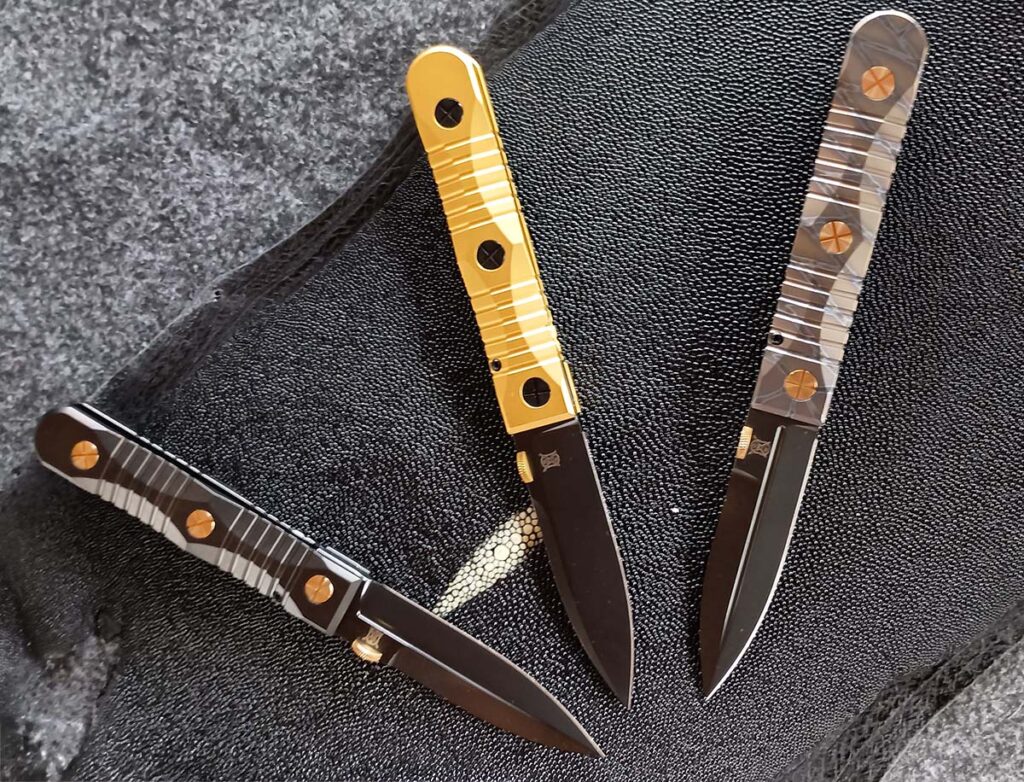
Carver Knives‘ Waif has it going on. Up front is a titanium handled-model, in the back a dark Ti handle. Both are thin as a minute, particularly when measured up the knucks in the middle.
Pro Tech Knives
Pro-Tech came to BLADE Tactical with an offer you couldn’t refuse, like a number of these thin and wicked Godfather autos.
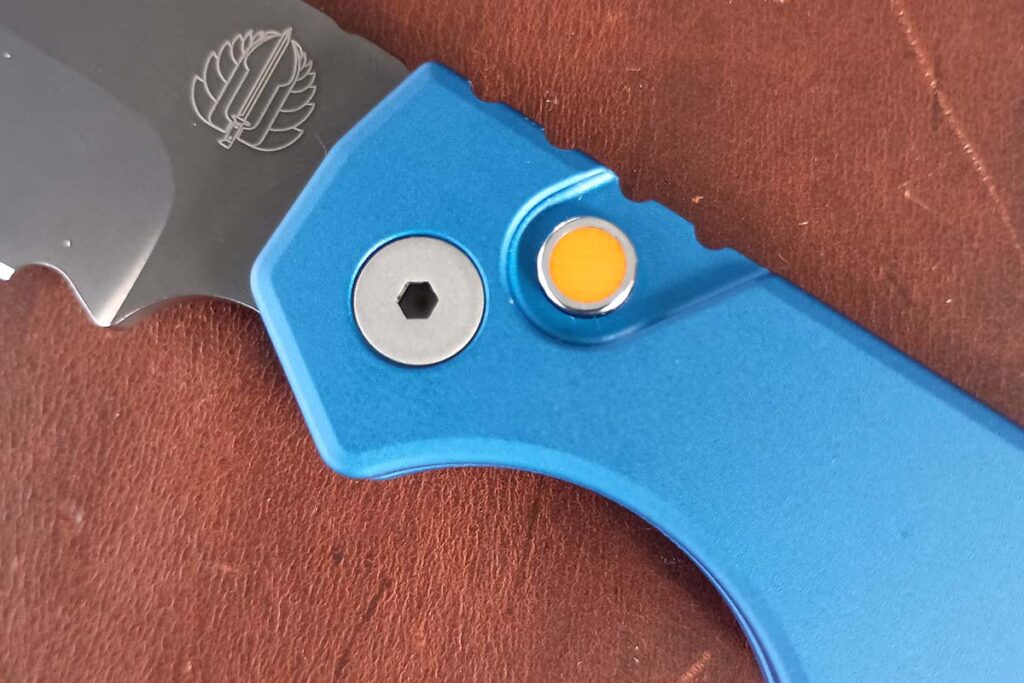
The company also offered a nice bit of custom bling for the show, a CANCON blaze orange G-10 insert on several of it’s knives buttons.
Elishewitz Custom Creations
With the Ek Integral, Elishewitz Custom Creations combined class and performance in a light and functional package. A nice dagger-style blade deploys in the wink of an eye via a thumb stud.
McNees Knives
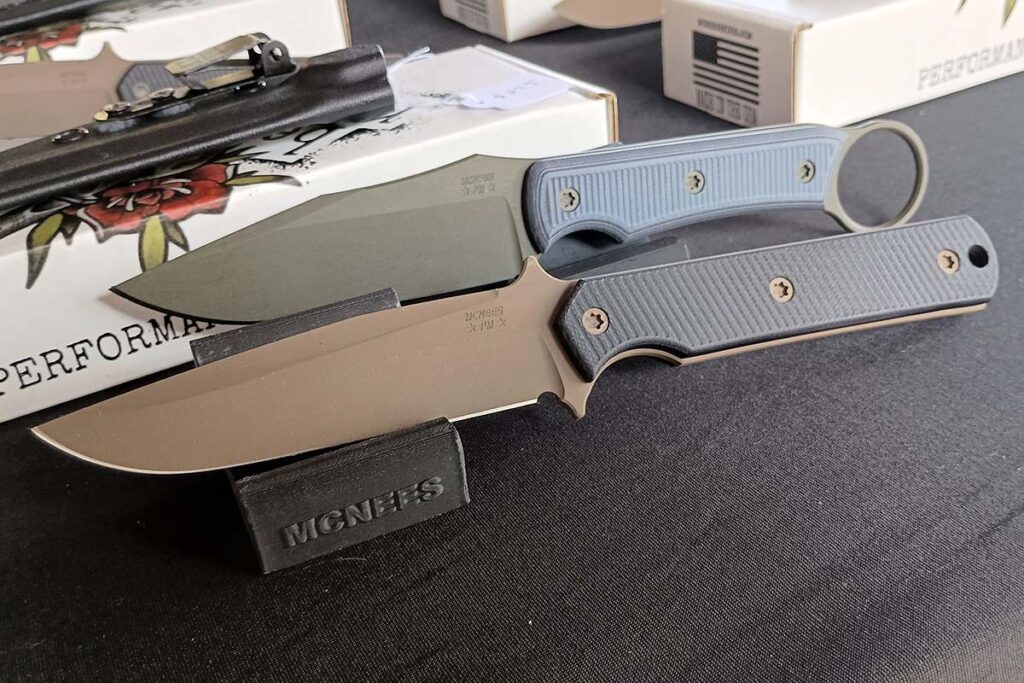
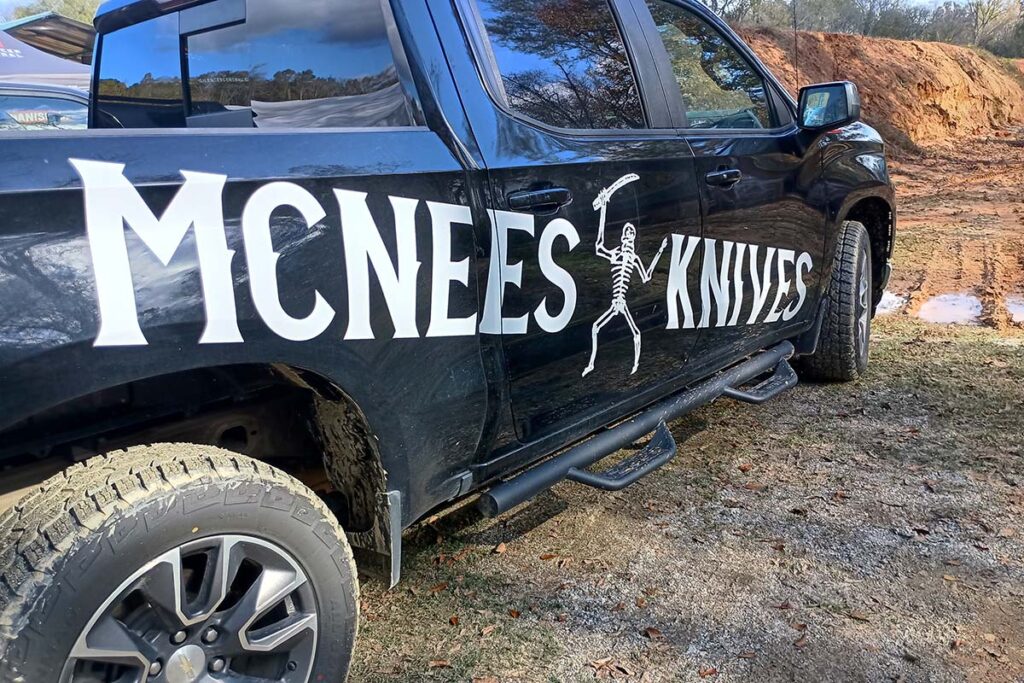
Some hefty debuts from McNees Knives at BLADE Tactical. In the rear, is the Ringed Agent and up front the Stalker. Par usual for McNees, both feel like their built to beat the world.
Somewhat from the neighborhood (Alabama), the McNees crew drove to BLADE Tactical. Needless to say, they did so in style… nice wheels.
Nicholas Nichols Knives
Certainly, the Guppy is no small fry. Nichols Knives drop point has plenty of size to get nearly any job done, but stays light in the pocket thanks to a titanium handle.
Spartan Blades
Spartan Blades was right at home at BLADE Tactical—no surprise there. But the belle of the ball was the company’s Ronin-Torii, a traditional tanto, which few would want to find themselves on the wrong end of.
Nottingham Tactical
Believe it or not, you’re looking at six-years of development. Nottingham Tactical was game for a carbon-fiber model, but it took a ton of work to get it to come together, from finding the carbon-fiber up to the abuse to getting the right adhesives to get the metal parts to stay.
Vero Engineering
It wasn’t all fixed blades and folders for the knife side of the show. After BLADE Tactical closed, the knifemakers hit the range at CANCON for some therapeutic trigger time. Here’s Joseph Vero of Vero Engineering getting on one of Maxim Defense’s shorties.
Knife industry pros give their takes on what the hot knife steels will be in the year ahead.
Every cutlery buyer faces a dizzying array of steel choices when it comes to buying that next knife, an array that represents the proverbial “double-edged sword.” While it’s nice to have choices, it can also be hard to keep up with so many options. Fortunately, industry professionals are available to help sort out which stainless and carbon varieties are either catching fire or cooling off.
*The steels are listed in no particular order by the knife patterns/types for which they are favored most by users and makers, according to the story’s sources.
MagnaCut Reigns Supreme
Last year when BLADE took the temperature of steel suppliers, the clear-cut champion of blade materials was Crucible Industries’ CPM MagnaCut stainless. The creation of steel guru Larrin Thomas, MagnaCut remains on top and will stay there for the foreseeable future. Bob Shabala, president of Niagara Specialty Metals, praised the high-performance blade material last year and still does today.
CPM MagnaCut stainless ruled among knife steels in 2024 and will continue to hold sway in 2025. A representative example is the new CRKT Q, a folder in titanium and carbon fiber designed by Richard Rogers. Country of origin: Italy. MSRP: $225.
“We have sold about 320 tons of CPM MagnaCut since its introduction in 2020. It is our biggest selling cutlery grade right now and I don’t expect that to change anytime soon,” Bob said, adding the qualifier, “This is from Niagara Specialty Metals’ limited perspective. I’m sure other mills are working on new grades which I’m not privy to.”
One reason MagnaCut is so popular is it embraces all cutlery genres with ease.
“CPM MagnaCut remains in high demand across various knife patterns,” Bob observed. “Some customers currently using MagnaCut for fixed blades are expanding into folding knives and have expressed plans to continue using the steel for their new designs, reflecting its versatility and ongoing popularity.”
MagnaCut maestro Larrin Thomas
Scott Devanna, vice president of technology and a metallurgist for SB Specialty Metals, tends to concur.
“I’m not sure there will be a new ‘super steel’ introduced in 2025. The introduction of new steels seems to have a three-to-four-year cycle, and with the recent intro of CPM MagnaCut such new introductions may be a few years off. We sell a lot of MagnaCut,” he stated. “I’ve learned over the years that new is very often the primary driver when new grades are introduced. This is what happened with CPM S30V, CPM 20CV and its European equivalent M390, and a few other grades.”
It should be noted that MagnaCut technically is going into its fifth year of existence. As you can see, it takes a while for a steel to work its way into the manufacturing pipeline and be given a thumbs up or thumbs down by the end user.
Specialty Grade Steels
Meanwhile, other specialty grade steels aren’t being ignored. In fact, many knife consumers prefer other steels that suit their needs better, both of the stainless and carbon varieties.
CPM 154 stainless will continue to be a steel of choice for custom hunting knives, here on the Cowboy Knife by David Fleming in a handle of sheep horn from a Rocky Mountain bighorn. Overall length: 7 inches.
“CPM S30V, one of the original cutlery-grade steels, continues to be one of our best-selling products,” Shabala noted. “Despite its age*, S30V maintains a strong position in the market, demonstrating its enduring reliability and widespread appeal among knifemakers.
Devanna agrees.
“CPM S30V is still a favorite for hunting knives, as well as CPM 154,” he noted. “For everyday carry folders, M390, CPM 20CV and CPM 154 are still used quite a bit as well.”
Scott said CPM S30V and S35VN remain strong for tactical folders.
Bob Shabala, Niagara Specialty Metals
Custom knifemakers aren’t as easily swayed by trends and tend to go with steels they are comfortable using, are time-proven to them personally, or geared to their particular customer base. While many are on the MagnaCut train, they tend to be more diverse in their choices.
“Other steels popular among custom knifemakers are M390, CPM 20CV, CPM 154, and to a lesser extent CPM S30V and CPM S35VN,” Devanna stated. “I have heard that CTS-XHP will be re-introduced, and this grade developed quite a following when it was readily available—especially for kitchen knives and high-end folders.”
Added Shabala, “CPM 154 is always popular with the custom makers.”
Carbon Steel
THE CARBON EQUATION The outdoor crowd—bushcrafters, survivalists and open-air tactical users—has to be pleased with the attention they’ve been getting from the industry. These users’ requirements are different and they prefer a subset of steels all their own.
While major outdoor knife manufacturers like TOPS and ESEE still sell the bulk of their knives in 1095, they have been gradually offering their customers more steel diversity, including stainless versions such as S35VN. The TOPS Shadow Hunter has a 4.5-inch blade of 1095 carbon steel in a tungsten Cerakote®. Country of origin: USA. MSRP: $250.
“CPM 3V and 4V are favored for hard-use knives due to the steels’ toughness, while CPM S90V and 20CV are popular among users who prioritize wear and corrosion resistance,” Shabala observed. “CPM 3V and CPM 4V are carbon steels that continue to sell well in specific areas. 3V is in high demand for bushcraft knives and 4V is being used by the current national champion in BladeSports International cutting competitions, Ben Propst. His wife Sue Ann is now using it and in 2024 they both won cutting events in Kokomo and the Smoky Mountain Knife Works fall festival.”
“I think CPM 3V and CPM Cruwear—mostly for bushcraft/survival knives as well as tactical fixed blades—are gaining popularity in the market,” Devanna opined. “CPM 3V has proven itself over the years and continues to be a popular grade. CTS PD#1 was in this category but availability of this grade is a problem.”
While major outdoor knife manufacturers like TOPS and ESEE still sell the bulk of their knives in 1095 carbon steel, they have been slowly offering their customers more diversity in their lines, including such stainless versions as S35VN.
Overall Take
As Shabala and Devanna noted, MagnaCut will be the top dog among steels in 2025, but it’s certainly not the only hound in the kennel.
Shane Magnussen uses the CPM S90V supplied by New Jersey Steel Baron on his model BBV2 folder. Closed length: 4.54 inches. (SharpByCoop image)
The cutlery industry is so diverse in the competition among manufacturers, custom makers, genres of knives and budget categories, there’s room for many different stainless and carbon steels. While what’s in the works remains unknown to most, you can bet there are teams of metallurgists working on the next great knife steel as these words are written.
As a knife enthusiast and cutlery buyer your choices are bountiful in all categories—from EDC to outdoor, fixed blade to folder—and affordable to expensive. Some users buy one knife to last for years while others rotate their carry or require cutting fare for specific purposes.
The good news is your knife and steel options have never been better!
*Editor’s note: The first-ever steel both designed and made specifically for knife blades, CPM S30V has been used for knives since 2001.
Bowie knives are as legendary as the man their named after.
When it comes to iconic blades, few can match the legendary status of the Bowie knife. This distinctive and formidable knife has a storied history that spans centuries, and its enduring popularity is a testament to its imperishable design and utility.
In this comprehensive guide to the Bowie knife, we’ll take a deep dive into the world of the iconic knife. We’ll look at its history, design, modern uses, and legality. Then we’ll finish up with an extensive selection of the best Bowie knives currently on the market.
History of the Bowie
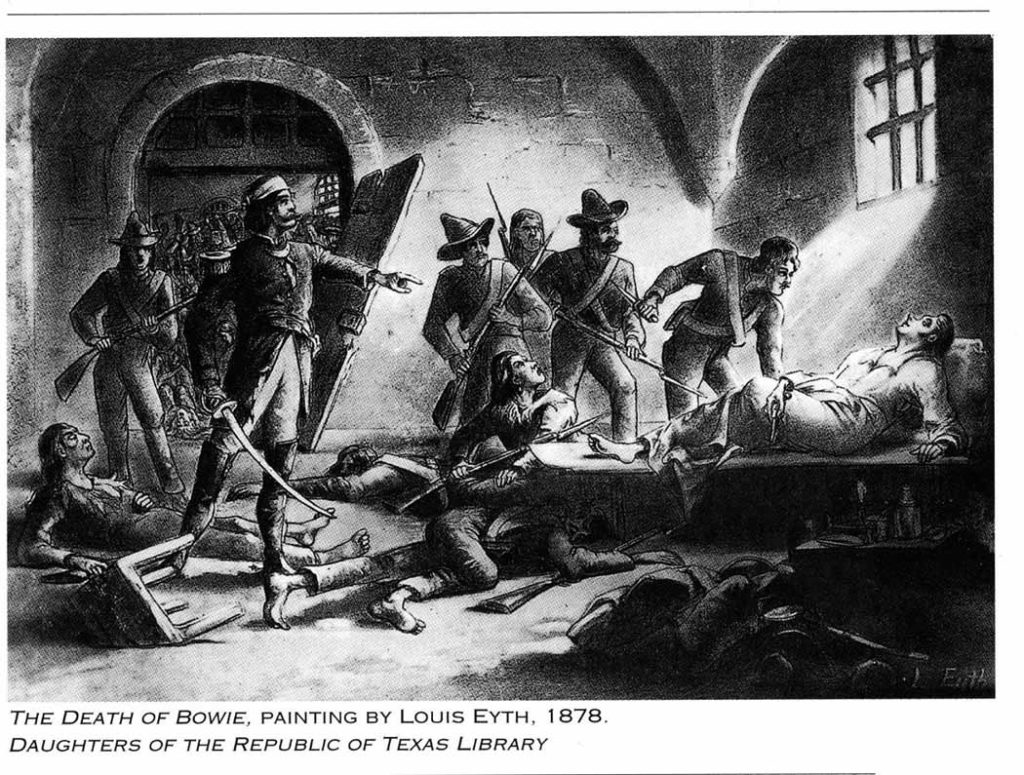
The debate about who made the first Bowie knife rages on to this day, adding to the mystique of this legendary blade. Some credit the knife’s creation to Jim Bowie himself, while others argue that it was the work of various blacksmiths and bladesmiths in the early 19th century. What is certain is that Jim Bowie’s association with the knife’s name and his prominent role in a violent sandbar fight in 1827 contributed significantly to its fame.
In addition to his participating in the famous Sandbar Fight after which his knife became a sensation on both sides of the Atlantic, Jim Bowie also fought and died in the Battle of the Alamo.
One of the most pivotal moments in the knife’s history was the infamous sandbar fight that took place in Mississippi in 1827. During this brutal encounter, Jim Bowie and a group of men defended themselves against an opposing faction. Jim Bowie’s remarkable fighting skills and his knife’s performance in the fight led to the weapon being forever associated with his name. This event catapulted the Bowie knife into the realm of legend, ensuring its enduring fame.
Bowie Knife Design: Choosing a Good Knife
The Bowie knife is known and loved for its distinctive design. While variations exist, several key features define this iconic blade:
Blade Style: The knives typically have a clip point blade, which is characterized by a concave curve on the top edge and a fine, sharp point. This design allows for both slicing and piercing, making it a versatile tool for a wide range of tasks.
Blade Length: Bowie knives come in various blade lengths, with the most common falling between 6 and 12 inches. The length of the blade influences its utility, with longer blades being suitable for chopping and combat, while shorter ones excel at precise cutting.
Crossguard: Most Bowie knives feature a crossguard, a metal piece positioned between the blade and the handle. This crossguard serves to protect the user’s hand during combat and can also be used for utility purposes.
Full-Tang Construction: Bowie knives are typically constructed with a full tang, meaning the blade extends through the handle, providing stability and strength. This design ensures the knife can withstand heavy use and remain a reliable companion in various situations.
Handle Material: Bowie knife handles come in a range of materials, from classic hardwoods to modern synthetics like Kraton. The choice of handle material impacts the knife’s aesthetics and grip comfort, catering to the user’s preferences.
Modern Uses for Bowie Knives
While the Bowie knife was originally designed for self-defense and survival in the wilderness, its uses have evolved over the years. Today, Bowie knives are valued for their versatility and can serve a variety of purposes:
Camping and Outdoor Activities: Bowie knives are popular among outdoor enthusiasts for tasks such as chopping wood, preparing food, and building shelters. Their sturdy design makes them reliable tools in the wilderness, where dependability is crucial.
Hunting: Many hunters rely on Bowie knives for field dressing and skinning game. The sharp blade and clip point make these knives well-suited for precision work, ensuring a clean and efficient process.
Collection and Display: Bowie knives have transcended their practical utility to become sought-after collectibles. Enthusiasts appreciate their historical significance and craftsmanship, often displaying them as works of art in custom cases or on stands.
Self-Defense: While not as commonly carried for self-defense as smaller knives or firearms, Bowie knives can still serve as formidable weapons in a close-quarters encounter. Their imposing presence and sharp blade can deter potential threats.
Survival: Bowie knives remain a popular choice for survivalists due to their robust construction and multi-purpose design. Whether it’s building a shelter, cutting through rope, or processing wood for fire, a Bowie knife is up to the challenge.
Cooking: In the kitchen, Bowie knives with shorter blades can be used as versatile chef’s knives. Their sharp edges and comfortable handles make them suitable for slicing, dicing, and other food preparation tasks.
Legality of Bowie Knives
The legality of owning and carrying Bowie knives varies from place to place and can be subject to specific regulations. It’s crucial to understand your local laws and regulations regarding these knives. In some areas, Bowie knives may be considered illegal if carried in public, while in others, they are legal for both open and concealed carry.
It’s important to note that while Bowie knives have a rich history and practical uses, they can be seen as intimidating weapons by law enforcement and the public. Therefore, it’s essential to use them responsibly and within the bounds of the law.
Best Bowie Knife Specs
Model
Type
Blade Lenght (inches)
Overall Length (inches)
Weight (ounces)
Blade Material
Handle Material
Other Features
MSRP
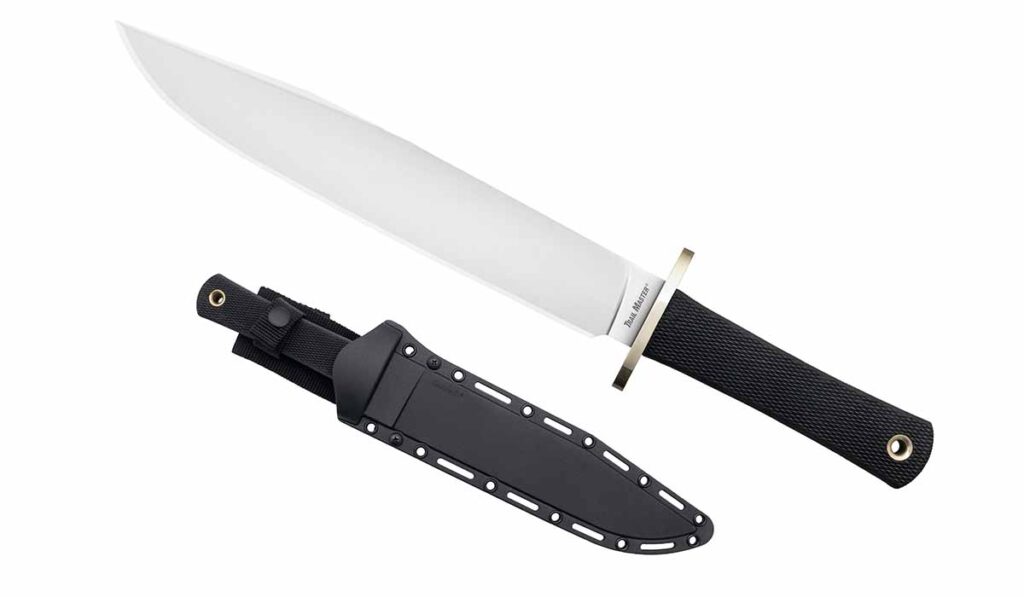
Cold Steel Trail Master
Fixed
9.5
14.63
18
VG1 San Mai III®
Kray-Ex™
Secure-Ex® Sheath
$500
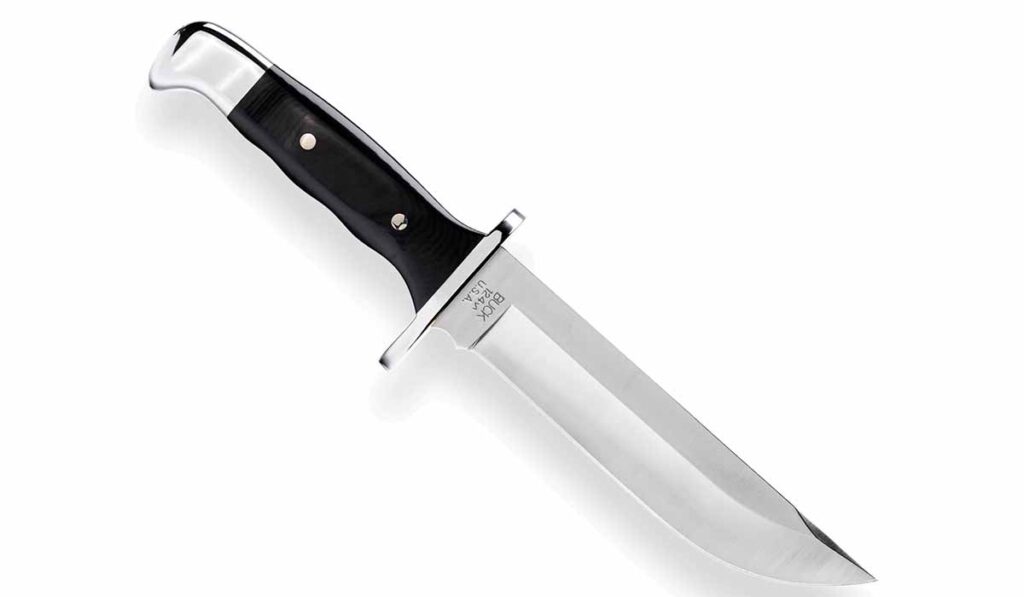
Buck Knives 124 Frontiersman
Fixed
6.25
11.75
13.3
420HC
Micarta
Leather Sheath
$200
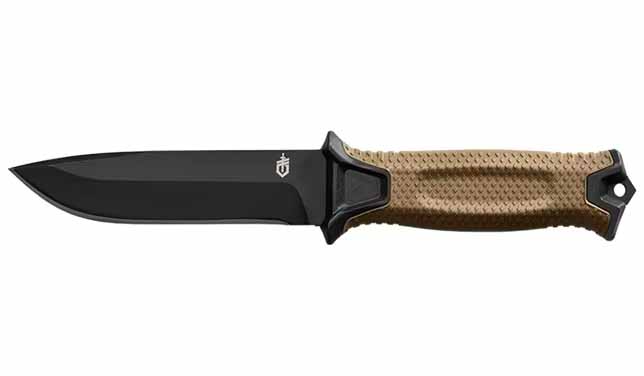
Gerber StrongArm
Fixed
4.8
9.8
7.2
420HC
Rubber
MOLLE-compatible multi-mount sheath
$90
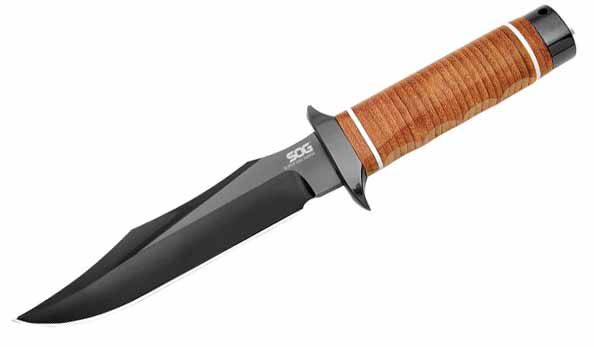
SOG Super Bowie
Fixed
7.5
12.88
17.4
AUS-8
Leather Washers
Leather Sheath
$250
Ontario Knife Company OKC 498
Fixed
7
12
16
1095
Kraton
Nylon Sheath
$98
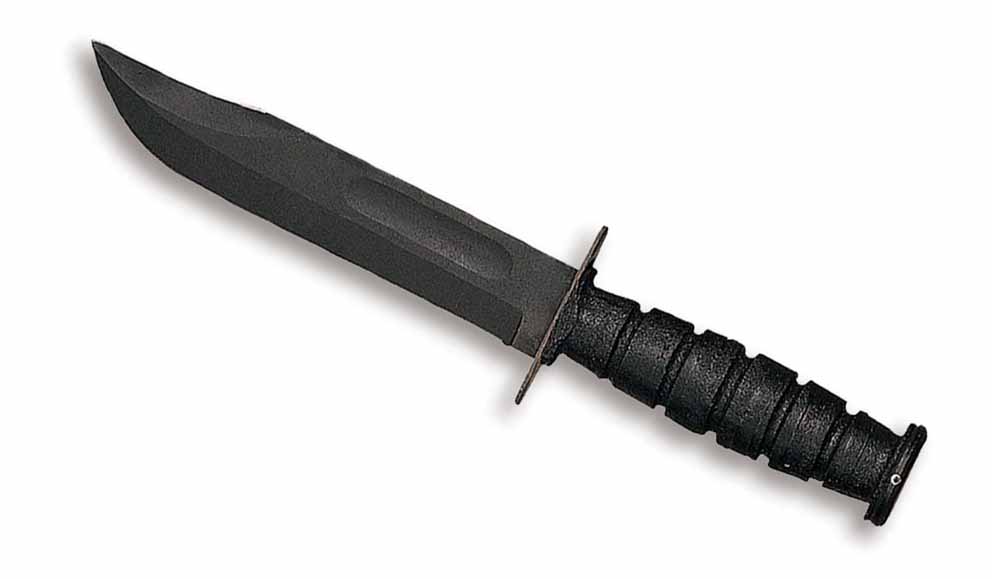
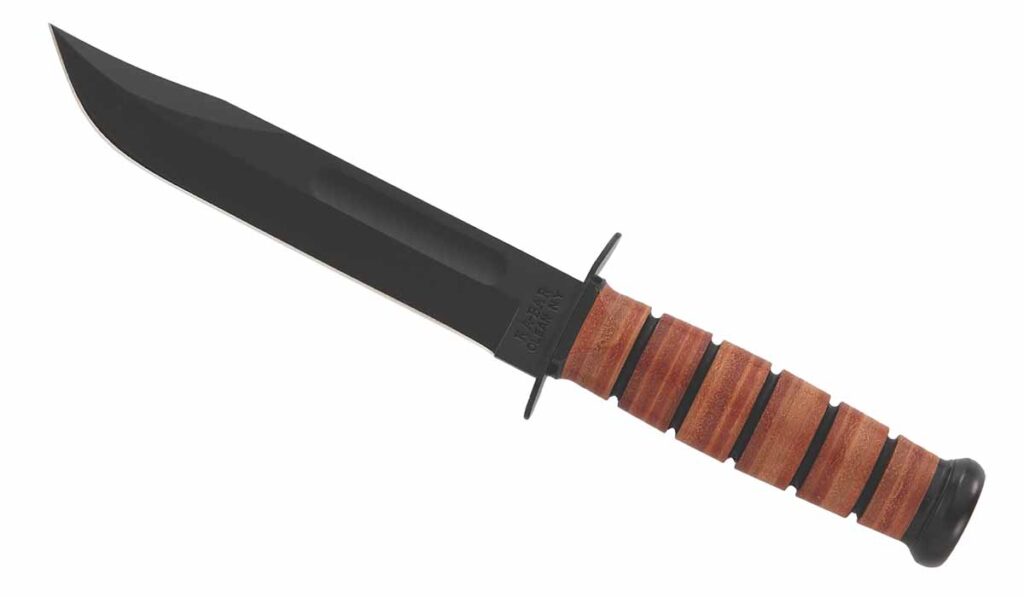
KA-BAR USMC Fighting Knife
Fixed
7
11.875
11.2
1095 Cro-Van
Leather
Leather Sheath
$140
Emerson CQC-7BW
Folder
3.3
9
6.3
154CM
G-10
Wave Opener Blade
$275
TOPS Knives Tom Brown Tracker
Fixed
6.38
11.88
21
1095
Micarta
Kydex Sheath
$365
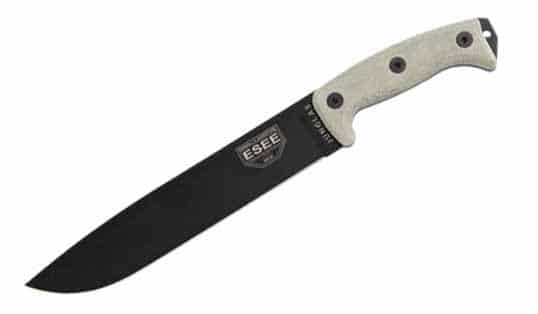
ESEE Junglas
Fixed
10.38
16.5
23
1095
Micarta
N/A
$310
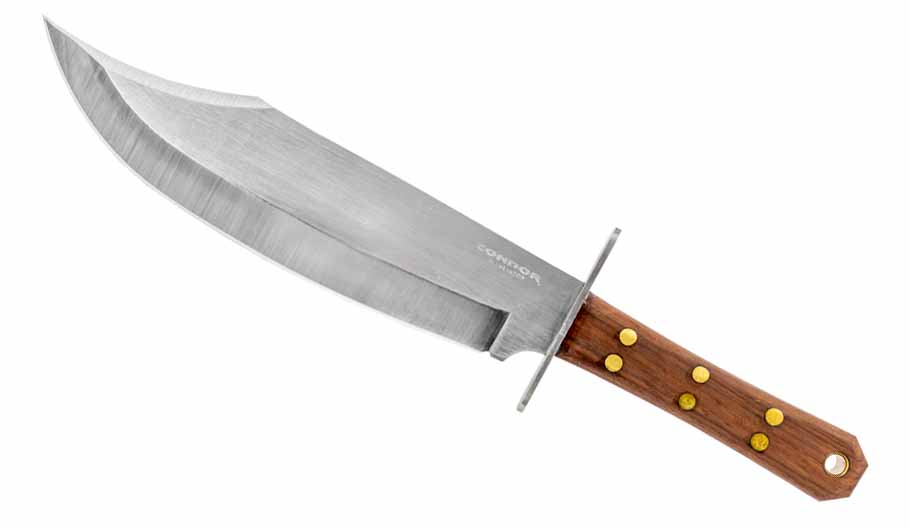
Condor Tool & Knife Undertaker Bowie
Fixed
10.2
15.6
24
1075
Walnut
Welted Leather Sheath
$118
Best Bowie Knives And Bowie-Inspired Knives For Any Budget
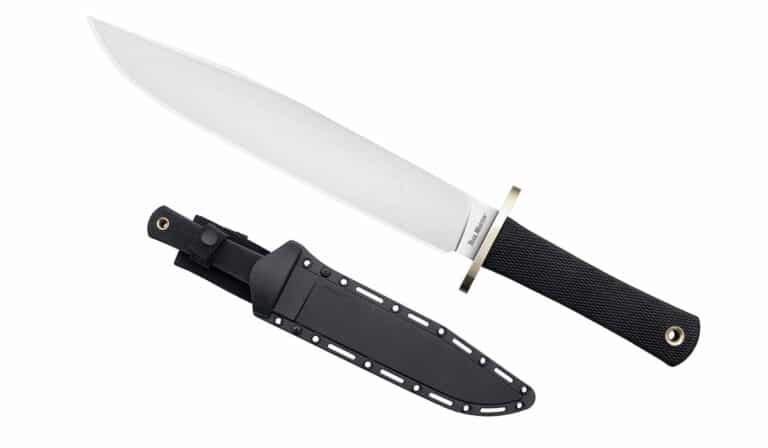
The Cold Steel Trail Master is a rugged Bowie knife designed for heavy-duty tasks. Its 9.5-inch blade is made from VG-1 stainless steel, known for its exceptional sharpness and resistance to corrosion. This knife’s clip-point blade design, with a concave curve on the top edge, allows for precise slicing and piercing.
The Kraton handle provides a comfortable and secure grip even in wet conditions, making it an excellent choice for outdoor enthusiasts. The full tang construction ensures durability and stability, making it capable of withstanding substantial abuse. The Trail Master is the go-to option when you need a reliable, high-performance Bowie knife for demanding tasks in the field.
Buck Knives’ 124 Frontiersman is a classic Bowie knife that pays homage to the heritage of American bladesmithing. Its 6.25-inch 420HC stainless steel blade is known for its edge retention and ease of maintenance. This Bowie knife boasts a timeless design with a sweeping clip-point blade and a polished brass guard.
The handle is made of rich and dark micarta, which not only adds to the knife’s aesthetics but also provides an excellent grip. This knife’s combination of traditional craftsmanship and modern materials makes it an excellent choice for those who appreciate the artistry of a well-made Bowie knife.
The Gerber StrongArm offers a modern take on the classic Bowie design. Its 4.8-inch stainless steel blade is versatile, featuring a fine edge and serrations on the spine for additional cutting options. The blade’s black ceramic coating enhances durability and corrosion resistance.
What sets the StrongArm apart is its diamond-textured rubber handle. This design ensures a secure grip in various weather conditions, making it an ideal choice for those who value a reliable grip during outdoor activities. The knife also features a striking pommel at the base of the handle, which can be used for various tasks, including glass breaking.
For those seeking a premium Bowie knife, the SOG Super Bowie delivers both style and substance. Its 7.5-inch AUS-8 stainless steel blade offers excellent edge retention and corrosion resistance. The stacked leather handle adds a touch of elegance while providing a comfortable grip.
This Bowie knife combines the best of classic design with modern materials and craftsmanship. It features a brass handguard and pommel, enhancing its overall aesthetics. The Super Bowie is an excellent choice for collectors and enthusiasts who appreciate the fusion of tradition and innovation in a high-quality knife.
The OKC 498 is a straightforward and dependable Bowie knife designed for practicality. Its 8-inch carbon steel blade is rugged and easy to sharpen, making it an excellent choice for outdoor enthusiasts who value simplicity and reliability.
The Kraton handle offers a secure and comfortable grip, even in wet conditions. This knife’s utilitarian design makes it a versatile tool for a wide range of tasks, from campsite chores to survival situations. If you’re looking for a no-nonsense Bowie knife that gets the job done, the OKC 498 is an excellent choice.
While not a traditional Bowie knife, the KA-BAR USMC Fighting Knife has earned its place among classic American blades. With a 7-inch 1095 Cro-Van steel blade, it’s renowned for its durability and edge retention. This knife has a rich military history, having served the U.S. Marine Corps during World War II.
The leather handle provides a comfortable and secure grip, while the double guard protects the hand during combat or utility tasks. The USMC Fighting Knife is a versatile and iconic choice for those who appreciate a knife with a storied history, and one that is of course tied to the Bowie that inspired it.
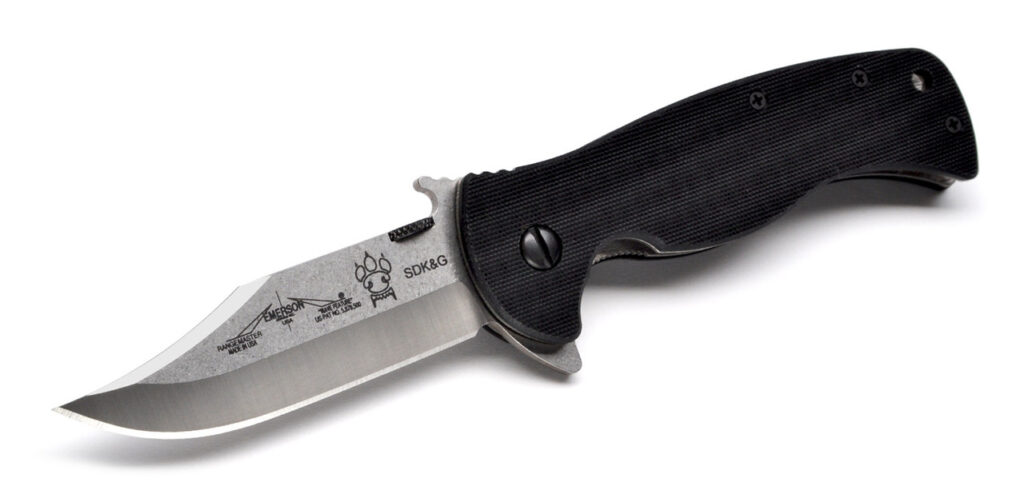
The Emerson CQC-7BW is a modern take on the Bowie design, featuring a folding blade for everyday carry (EDC) convenience. With a 3.3-inch stainless steel blade, this knife is compact and versatile, making it suitable for a wide range of daily tasks. The clip-point blade design provides excellent piercing capability, and the thumb disk allows for easy one-handed opening.
The G-10 handle scales offer durability and a secure grip. Emerson Knives are known for their tactical functionality, and the CQC-7BW lives up to this reputation. If you’re looking for a compact and reliable EDC option inspired by the Bowie style, this knife is an excellent choice.
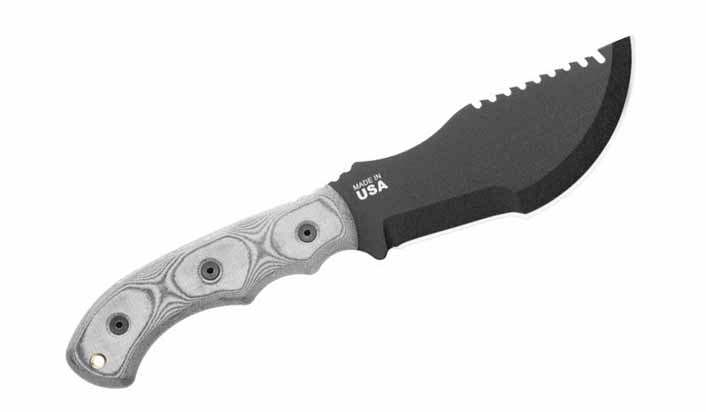
The TOPS Knives Tom Brown Tracker is a unique Bowie-inspired knife with a distinctive multi-purpose design. Its 6.38-inch 1095 high carbon steel blade features a variety of edges and angles, making it suitable for a wide range of tasks, from chopping to carving. This versatility has made it a favorite among survivalists and outdoor enthusiasts.
The handle is made of Micarta, providing a comfortable and secure grip. The Tracker is designed to handle tough wilderness challenges, making it an excellent choice for those who want a dependable tool for camping, bushcraft, and survival scenarios.
The ESEE Junglas is a heavy-duty Bowie knife built to withstand the most demanding survival situations. With a massive 10.38-inch 1095 carbon steel blade and full tang construction, it’s a powerhouse of a knife. The blade’s black powder coating enhances durability and corrosion resistance.
The Micarta handle scales offer a comfortable and secure grip, even during extended use. The Junglas is designed for heavy chopping, batoning, and other rugged tasks that might arise in the wilderness. If you need a Bowie knife that can handle the toughest challenges, this is a top choice.
Condor’s Undertaker Bowie combines traditional craftsmanship with affordability. Its 10-inch 1075 high carbon steel blade is known for its toughness and ease of sharpening. This knife is designed for practicality, making it an ideal choice for outdoor enthusiasts and those who appreciate a robust tool.
The hardwood handle not only adds to the knife’s aesthetics but also provides a comfortable and secure grip. The Undertaker Bowie excels in tasks such as wood processing and campsite chores, making it a dependable companion in the great outdoors.
Hinderer’s XM-18 out the side autos each pack a punch.
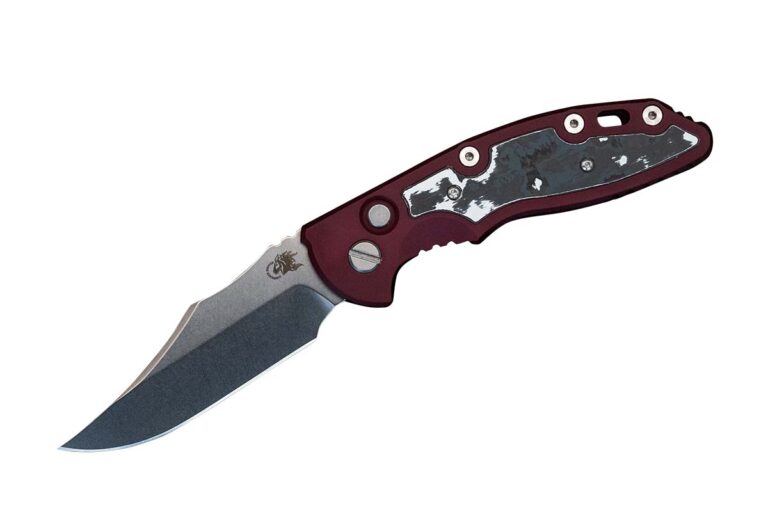
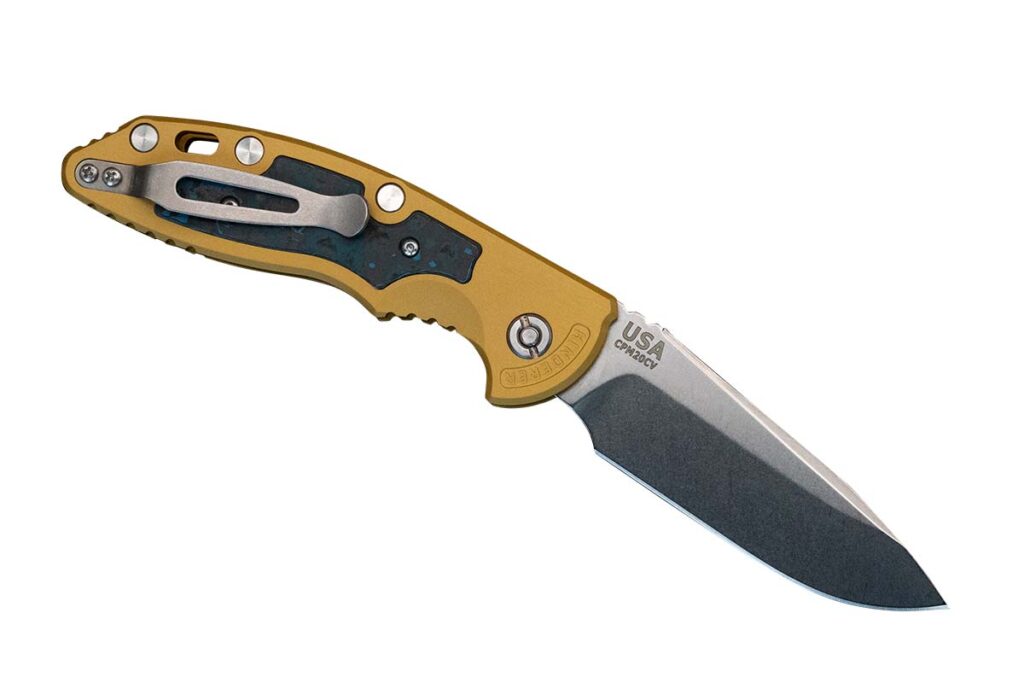
Rick Hinderer Knives offers two of its latest iterations of what industry observers say will continue to be a hot knife style for the foreseeable future—the automatic—in the XM-18 3.5 Bowie Auto and XM-18 3.5 Spearpoint Auto.
The knives come in different handle colors and inlays and are basically the same design with the same dependable out-the-side automatic opening mechanism, but each offers its own different blade pattern and material.
XM-18 3.5 Spearpoint Auto
The 3.5 Bowie has a clip-point bowie blade of CPM S45VN stainless steel, while the 3.5 Spearpoint sports a spear-point blade of CPM 20CV stainless. In addition to each knife being a style to continue to watch in 2025, the steels bear serious eyeballing in the coming year as well as each makes the list of steels that will thrive in 2025 (see page 74).
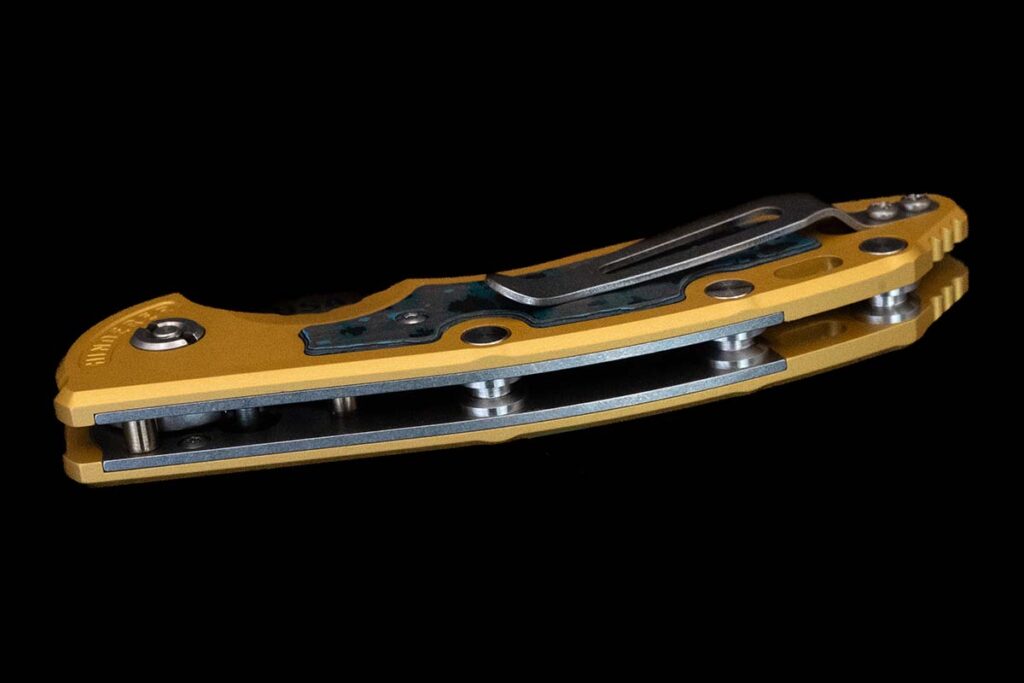
Each knife features Hinderer’s patent-pending titanium half liners, with the XM-18 3.5 Spearpoint Auto doing the honors here.
Each knife features traction ridges on the base of the blade spine and handles with single, traction-ridged finger grooves, ridges on the bottom of the handle toward the butt, an integral guard and a hole for a lanyard. Each also has Hinderer’s patent-pending titanium half liners reinforcing the aluminum handles.