From passion to icon: celebrating 30 years of Dietmar Pohl’s knife mastery.
Dietmar Pohl is a name well-known in knife circles. More so than his groundbreaking designs, the founder of Pohl Force knives might also be known for his professionalism. On Nov. 18, the designer celebrated 30 years in the industry.
With over 100 knife designs, three books translated into multiple languages, and a reputation for innovation, Pohl has established himself as a leading figure in the world of blades.
While Pohl might be best known for his knives, such as the Magnum Colection Knife and the Böker Speedlock switchblade, he has held many roles in the industry.
Pohl started his career as marketing director, design and production manager in Solingen, Germany. Combining contemporary design with cutting-edge materials, he quickly made his mark by creating knives that balanced performance and aesthetics.
However, his interest in edged tools started well before then. His imagination was captured at 11 years old when his older brother—10 years his senior—returned from the Bundeswehr paratroopers and showed him his paratrooper knife.
While Pohl has no military or law enforcement background, he’s built his expertise through hands-on training and close collaboration with professionals in elite units like Germany’s GSG9, SEK, and U.S. Marine Force Recon.
Practical experiences, such as SWAT training in Virginia and knife combat sessions with Marine Force Recon at Camp Pendleton, have deepened his understanding of tactical requirements.
Pohl’s influence extends beyond design. His books are respected resources for enthusiasts, and his work is frequently featured in trade publications. Among his standout achievements is the MK9 Heartstopper, created for Sylvester Stallone’s final Rambo movie, Last Blood. Dubbed The Knife Guy by the film crew, this project solidified his global reputation.
What better knife to carry daily than one explicitly designed to save lives?
Why rescue knives as EDC? It’s more like “why not?” Life presents situations you don’t expect—an accident happens and there you are, right in the middle of it. It is therefore very important to be and stay prepared. Having a rescue knife within close reach can help when you need it most.
But who really carries a rescue knife daily? If you are a fireman, EMT or in law enforcement, it’s an easy answer. Remember the be and stay prepared motto. Even if not in a save-and-serve profession, you can have a rescue knife with you for times you need it most.
Victorinox Rescue Tool
It probably is no surprise that Victorinox makes a rescue knife. The company is well known for fashioning super handy pocketknives with all sorts of onboard tools that make work, play and life easier and more convenient—and in this case, safer, too.
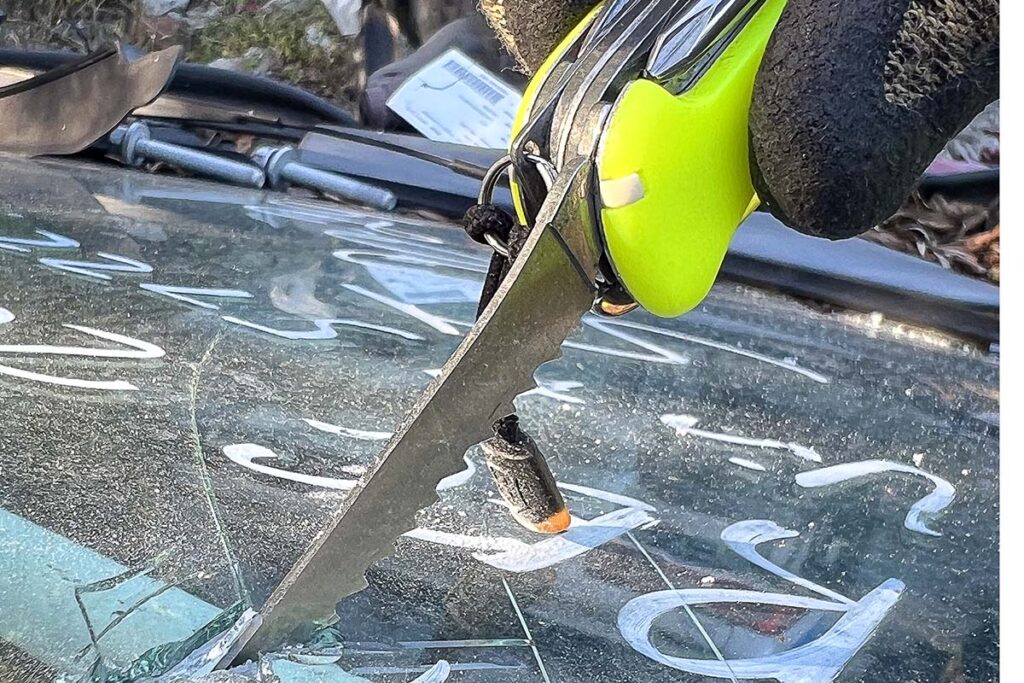
The Victorinox Rescue Tool comes with a special saw that will cut through laminated vehicle glass such as the kind used for windshields. The author said the saw grabbed on the pull stroke. “The saw possibly would have better results if the windshield were shattered first,” he noted, “but I couldn’t locate any shattered windshields on any of the test vehicles.”
At about 4.4 inches closed, the Victorinox Rescue Tool has a frame based on the largest knife the company makes. This is definitely not a pocketknife! It comes with a high quality sewn and riveted nylon sheath (more on it later).
As with most Swiss Army knives, the Rescue Tool sports a variety of on-board tools: a partially serrated 3⅛-inch main blade with hole opener; bottle opener; flathead and Phillips screwdrivers; a combination can opener and small flathead screwdriver; a 3.25-inch semi-curved, fully serrated blade for cutting seatbelts; a specially designed 3.25-inch pull saw for cutting shatterproof glass; and a glass breaker. The latter two are removable. The polyamide scales come in high-visibility yellow for easy location in low light conditions, and the scales glow in the dark after being charged up by sunlight or artificial light. Fit and finish on the Rescue Tool is standard for Victorinox—perfect out of the box. The blades and tools are finished nicely in a full polish except for the saw blade, which is satin finished. Opening and closing action is smooth. The main partially serrated blade locks open via a linerlock as well.
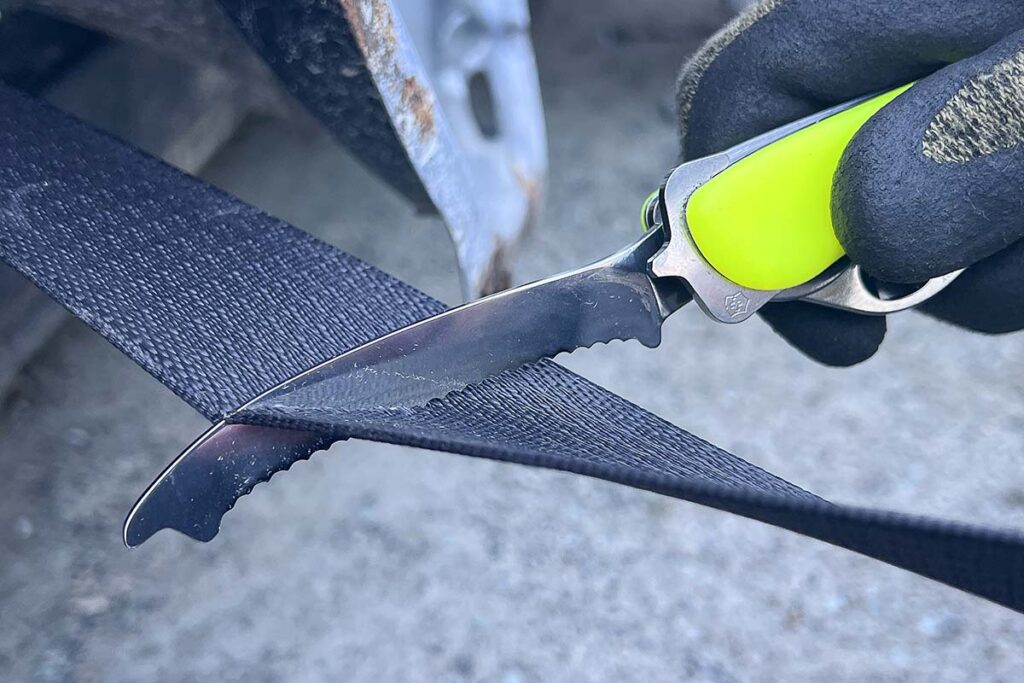
The seatbelt cutter is extremely effective. The rounded, dull blade tip extends slightly beyond the handle butt so you can deploy the blade with or without gloves. Work the blade under the seatbelt and, with one swift motion, pull and the blade slices clean through. The serration pattern is similar to one you might see on a steak knife, with evenly spaced teeth—simple yet very effective and extremely sharp out of the box.
The fully serrated blunt tipped seatbelt cutter blade of the Victorinox works exceptionally well. It has plenty of aggressive bite to cleave through seatbelts in a hurry.
The partially serrated main blade is easy to deploy via the hole opener. The blade is unlike most if not all other partially serrated non-Victorinox patterns. The front 70 percent of the edge is serrated and the balance closest to the tang is plain for finer cutting. The serrations are more rounded at the tips than on the seatbelt cutter, presumably to allow the blade to cut evenly like a plain edge. I tested it on food, cardboard and manila rope, and it cut smoothly and aggressively.
Now for the disappointing part—the glass breaker. It was not effective at all. I could not get a side car window to shatter no matter how hard I hit it. I presume the failure is due to the breaker point being too big. In my experience, the most effective glass breakers are the ones that come to a point and are made of carbide, as with the balance of the review knives. The glass saw is effective, though it grabs a bit too much on the pull stroke. However, when I adjusted the pressure it worked. Country of origin: Switzerland. MSRP: $115.
The SOG Escape 2.0 ATK is the updated version of the original SOG Escape, a multipurpose rescue folder targeted at the serve and save pros. It features a 3.4-inch blade of AUS-8 stainless steel PVD coated black, a partially serrated edge, anodized aluminum handle, integrated/replaceable seatbelt/line cutter, and glass breaker. The blade sports ambidextrous thumb studs and a flipper for one-hand opening. The edge is serrated to tackle a plethora of cutting chores. The clip point shape is adaptable to a wide range of tasks and the defined point is great for scoring. The serrations provide extra slicing power when the going gets tough.
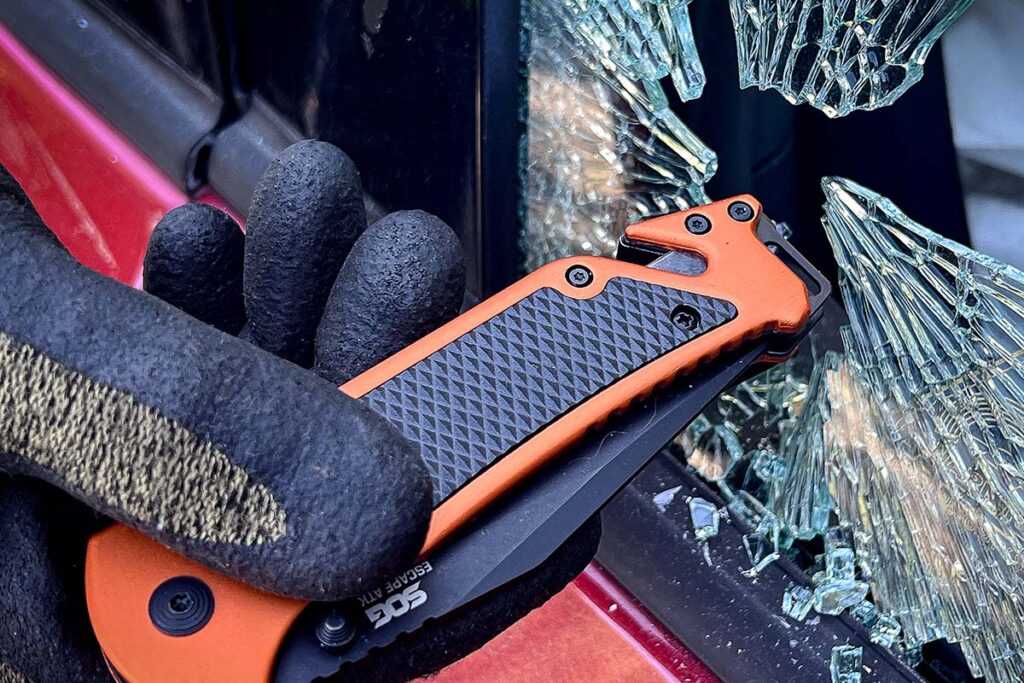
The author uses the SOG Escape 2.0 ATK to shatter a car window, both prior to (inset) and after the fact. Inset into the handle spacer, the glass breaker quickly shattered the side glass with a concentrated pop to the window’s lower corner.
The handle is cast aluminum with stainless steel liners. It comes in two colors: high visibility orange and OD green. The integrated slot at the butt houses a blade for cutting seatbelts, line and string without opening the knife. A glass breaker in the handle spacer quickly shatters side car windows. The breaker works very well. It quickly shattered the side glass with a concentrated pop to the lower corner of the window. The pocket clip is a fold-over, deep carry model. A spare seatbelt/line cutter blade stows safely beneath the textured panel handle inlay. Back out the two small Phillips screws securing the cover and you will see the blade underneath—it is simple to swap out. Country of origin: China. MSRP: $54.95.
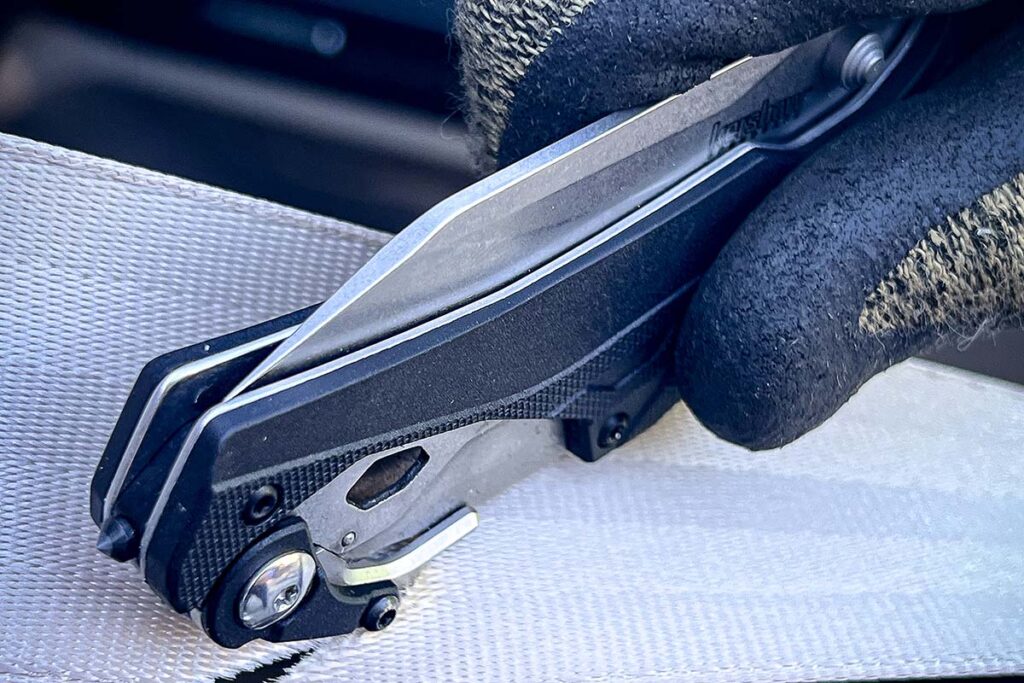
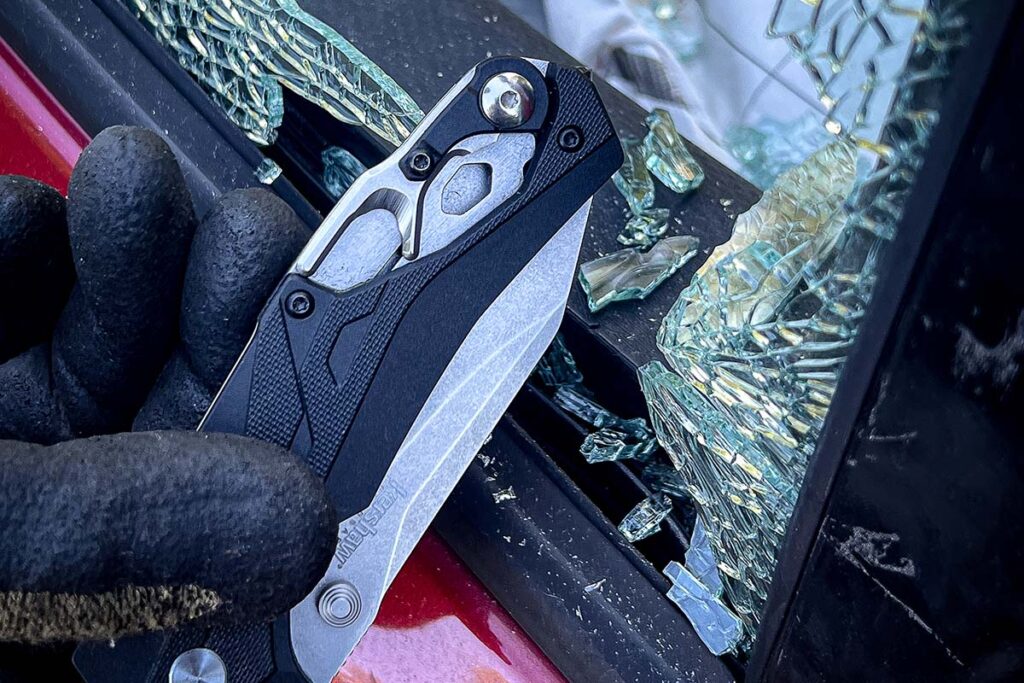
Kershaw’s Drivetrain rescue knife looks like any standard EDC linerlock folder. It has a stylish handle coupled with a very utility friendly blade—but that’s where the similarity ends. The presentation side of the handle butt boasts an integrated seatbelt cutter that folds out. A glass breaker is inserted into the end of the handle spacer. The 3.2-inch clip point blade has ambidextrous thumb studs and a flipper for one-hand opening enhanced by the company’s SpeedSafe assist mechanism. The blade is D2 tool steel for augmented edge holding and wear resistance, especially for the price point. The stonewash finish is attractive and hides scratches.
The author indicated the fold-out locking seatbelt cutter of the Kershaw Drivetrain is the best of the test bunch. It’s a wide hook with a blunt tip leading edge for safety. Rest the handle spine on the seatbelt and pull. The handle guides the cutter to the belt and it cleaves very easily.
The handle is molded glass reinforced nylon with double stainless steel liners. The scales are textured and contoured for a nonslip, comfortable grip with no hot spots. The seatbelt cutter easily deploys with one hand and a separate linerlock holds it in place. When closed, the cutter is concealed within the lines of the handle profile and doesn’t get in the way. A steel pocket clip carries the closed knife blade tip up.
The blade is very utility friendly, from opening boxes and mail to cutting cardboard and plastic sheeting. Once locked open, it is extremely secure with no play.
The Kershaw glass breaker works very well. Situated at the end of the handle, a quick strike with it to the lower corner of the vehicle side window did the job.
The seatbelt cutter works well. The hook tip is dull and rounded so you can work it under the seatbelt without inadvertently cutting yourself or the accident victim. The blade is ground on both sides to enhance sharpness. For best results, make your pull cut at an angle in relation to the seatbelt. Also, resting the handle spine on the seatbelt is a great way to “aim” the cutter. It bites in better that way and, when you feel it engage, give the handle a quick tug and it cleaves through effortlessly. It is a surprisingly effective seatbelt cutter! The glass breaker works very well, too. Country of origin: U.S. design, prototype and quality control, Chinese manufacture. MSRP: $69.59.
Utica’s Honor Rescue Knife
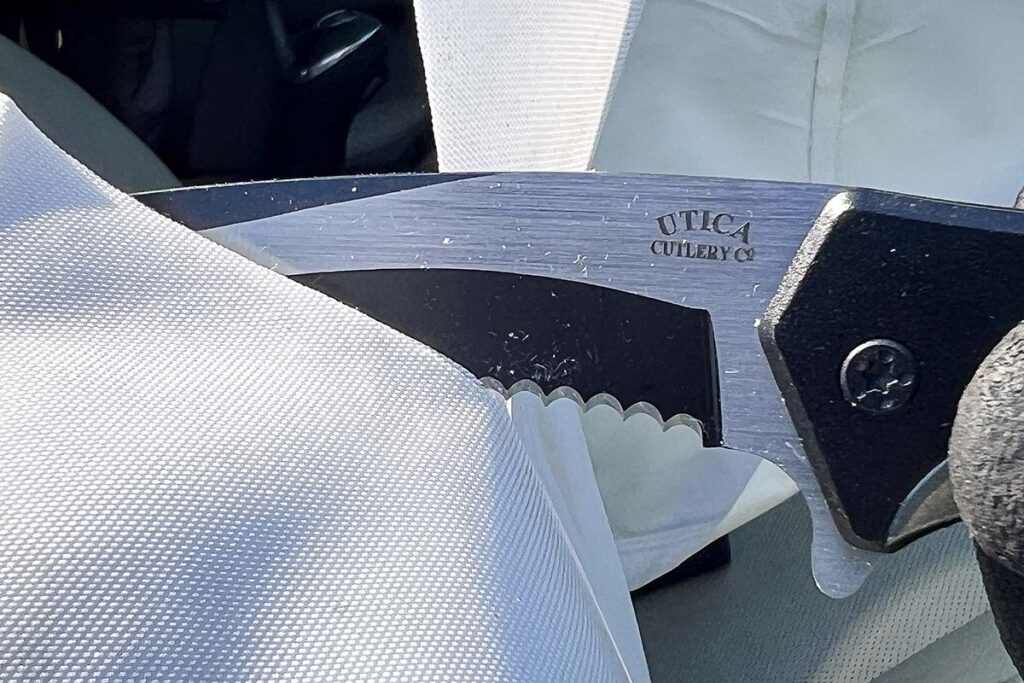
Utica’s Honor Rescue Knife is the least expensive of the test group. It packs a few features normally found on rescue knives, such as the integrated seatbelt cutter, glass breaker and a partially serrated, modified tanto blade. The 3-inch stainless steel blade’s partial serrations help rip through thicker materials. A two-tone finish adds character, with the bevels and spine black oxide coated and the flats satin finished. A flipper tab provides ambidextrous opening, and the blade rides effortlessly on bearings for ultra smooth action. The handle is aluminum with double stainless steel liners providing the backbone. A linerlock holds the blade open securely. A seatbelt cutter slot in the handle butt has two sharpened blades held in the scissor position to cleave seatbelts with a firm pull. The steel back spacer has an extended portion that tapers to a point, which serves as the glass breaker.
The Utica tanto blade’s partial serrations help rip through thicker materials.
Like with the Victorinox Rescue Tool, the glass breaker on the Utica test model was ineffective. The point rounded off due to multiple hits to a side window and did not shatter it. The breaker needs a carbide point. A deep carry clip positions the closed knife blade tip down. Cost and feature wise, the Honor Rescue Knife is a great option without breaking the bank. Country of origin: China. MSRP: $32.97.
Final Cut
A final thought: Some prefer having a rescue knife for emergencies only as opposed to having one for both work and emergencies. You can get away with a relatively inexpensive rescue knife if you preserve it for emergency use exclusively. (Some high-end rescue knives cost as much as regular tactical folders, that is, several hundred dollars.) There’s nothing wrong with an inexpensive rescue knife as long as the manufacturing quality is there, the blade lock holds and the blade is sharp. If you are adept at doing so, sharpen the blade first before stowing it away; this way you know the blade is very sharp. And since you won’t be using it as an EDC, the sharp edge will be preserved. This works well if you have multiple vehicles in your family that you wish to outfit with rescue knives.
Where To Keep Your Rescue Knife
Keeping a rescue knife in your vehicle is a great idea as it can help free you and others should you have an accident or happen upon one. However, give careful thought to where you stow the knife.
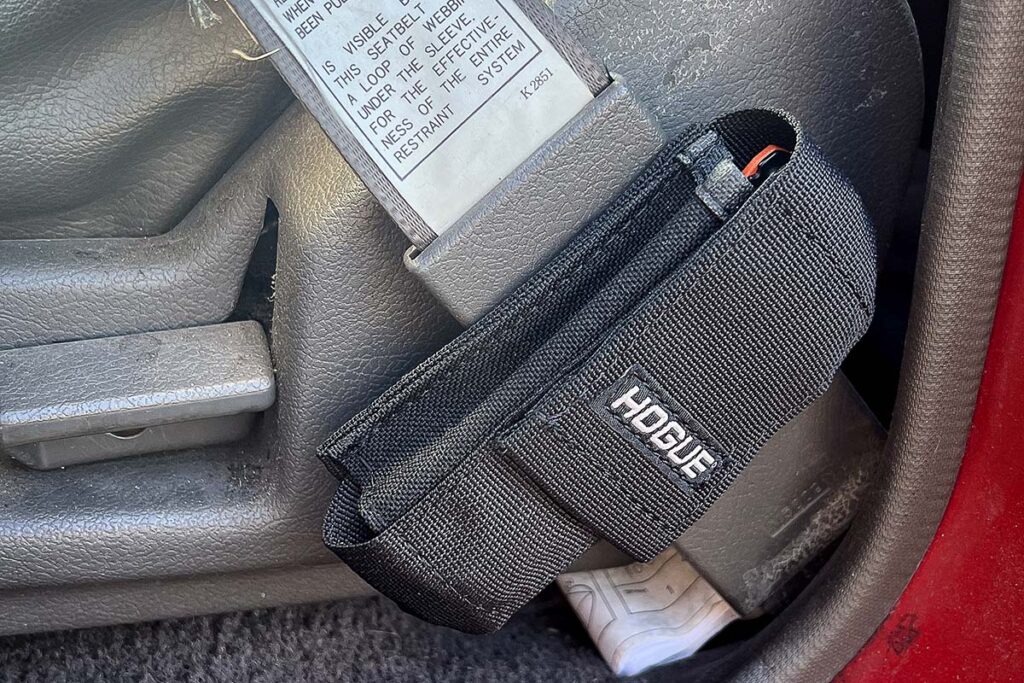
The author keeps his Hogue Trauma rescue folder in the sheath wrapped around the lower portion of the seatbelt anchor in between the seat and door of his truck.
Most assume a glovebox is a safe place and while not a wrong choice, it is a poor one. Why? For one, in an accident your seatbelt may not release because of the tension; in essence, you’re strapped to the driver’s seat and cannot lean over to access the glovebox. Worse, the vehicle could be upside down or on its side. In other words, have the knife placed securely within arm’s length.
I keep a Benchmade Auto Triage inside the sunglass holder in the roof of my car, just above the inside rearview mirror. It is secured shut with a latch so it won’t pop open on impact. I can easily reach it and remove it from the holder with my right hand. In my truck I keep a Hogue Trauma rescue folder in the sheath wrapped around the lower portion of the seatbelt anchor in between the seat and the door. It’s just enough room for me to access the knife with the door shut, and the knife is secured in that position and won’t move.
The worst place to keep the knife is in the center console cupholder. While it’s convenient to access, if you get rear ended or t-boned, the knife will go airborne and land way out of reach. Some vehicles may have a center console storage/armrest in the middle. Yeah, mine in each vehicle is a clutter catchall for receipts and other junk, but it’s another ideal location because the armrest lid latches shut and is within arm’s reach.
There’s no knife job too small for a compact cutter.
Folders come in all sizes and shapes.
Over the years, I have carried every size from compact and handy to needing to visit my chiropractor at the end of the day. I carry a Spyderco Para Military most often and other times I carry a Benchmade Griptilian. I can tell you that when I take out the Spyderco I get more comments on the size of the knife than the Griptilian.
I used to be a compact knife carrier and one of my favorites was the SOG Twitch II. I also favored two Kershaw Chives. To be fair, outside of some exceptions a compact carry did pretty much the majority of work I needed in an average day. I moved to the Spyderco only for the unexpected chores.
This time the focus is on smaller carries, the kind of carry a person in my age range would choose because his work is selling life insurance and he doesn’t need a blade that opens a person’s eyes as wide as a harvest moon. I put aside my regular carries for a number of weeks and downsized to bring you my thoughts on four factory compact carries.
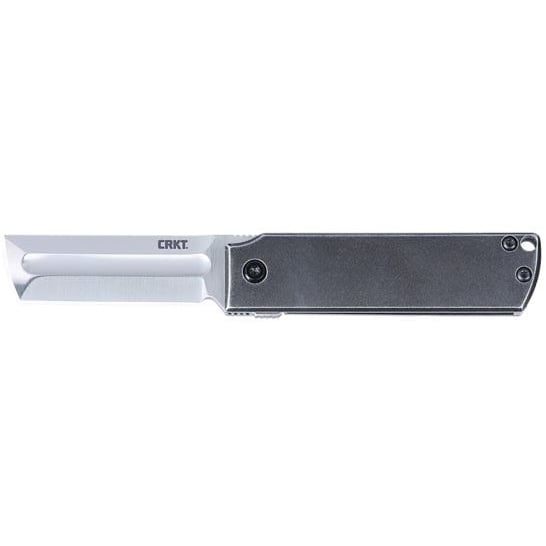
CRKT MinimalX
The fuller on the CRKT blade gives your index finger a nice purchase point for a controlled push cut while using a pinch grip.
CRKT MinimalX Frame Lock Overall length: 5.3″ Blade length: 2.19″ Closed length: 3.2″ Stainless blade steel: 12C27 Scale material: Stainless steel Locking system: Framelock Pocket clip: Right side, low profile Opening system: Flipper Country of origin: China MSRP: $60
Pros
Compact
Blade Utility
Aesthetic and Functional Features
Cons
Slick Handle Finish
Flipper Design Challenges
The first thing that strikes you about the CRKT MinimalX is how streamlined and compact it is. As probably will be the case with all four test knives, people with big hands might find them a bit difficult to use, a price you pay for the knives being compact and lighter.
To start, I have an issue with the handle finish. The stainless steel scales are a bit too slick. I find my thumb lacks purchase while opening the blade. To deploy the blade you use a flipper that sits even with the spine of the scales. CRKT provides a trim pocket clip mounted on a standoff platform. When closed, the knife is about the size of a pack of chewing gum.
The CRKT’s flipper is not proud of the back of the scales. According to the author, the tumble finish is a bit slick, though the finish color and smoothness accent the knife’s trim, compact proportions.
CRKT uses a pseudo chisel shape for the blade profile. It has a straight primary edge with a rounded chisel style tip. The blade works great for an urban EDC. As a handyman I used it several weeks for some fine trimming on door lock cuts in door frames, along with using it to scrape. Having a fuller on such a small blade adds character. It also provides a purchase point for a pinch hold.
The Darriel Caston design was hair popping sharp right out of the box. Lock up is solid as a vault. For a small carry, this is a well-built and excellent compact design. A knife like this could serve someone the better part of a lifetime.
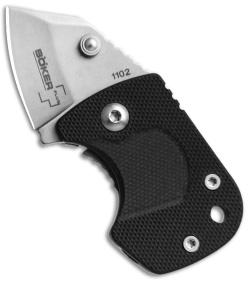
Boker provides a great little storage case with the DW-1. “Good EDC cases are hard to find, and expensive,” the author wrote. “I was excited about the case as much as the knife.”
Boker Plus DW-1 Specs Overall length: 2.8″ Blade length: 1.06″ Closed length: 1.6″ Stainless blade steel: AUS-8 Scale material: Zytel/stainless steel Locking system: Framelock Pocket clip: Right hand, tip up Opening system: Thumb stud Country of origin: China MSRP: $39.99
Pros
Ultra-Compact
Specialized Utility
Durable Construction
Cons
Awkward Ergonomics
Limited Functionality
I would have to drop the term compact and switch it to micro for the Boker Plus DW-1. Designed by Chad Los Banos, the smallest of the review knives comes with a solid pocket clip and framelock. One scale is stainless steel and the other is Zytel. The knife has Chad’s trademark design written all over it.
This is a minimalist carry. It is a great little blade for opening Amazon packages, cutting loose threads and string—basically all the little chores. Bigger jobs are not in the DW-1 domain. If you tried spreading peanut butter with it to make a sandwich for lunch, you would not be able to eat the same day.
The DW-1 is great for those small jobs that you don’t want to risk a visit to the dentist on. Face it, everyday life doesn’t normally have you felling a mighty oak with your pocketknife.
Don’t get me wrong, the knife is made well and would be great for someone who worked retail stocking shelves and the like. As for fighting off a zombie horde, you could sharpen a small stick with it.
It would fit someone who needs an available edge but wants a subtle carry. If I worked retail, I would use it as a companion edge to my full-size model so I would not accidently shred the contents of the box—not that I ever did (hint, hint).
Boker Plus DW-1 Lock Money Clip Knife Zytel 01BO573
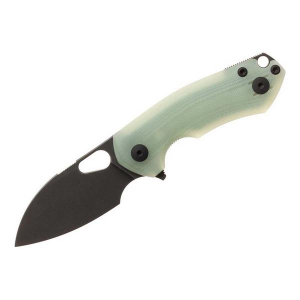
The GiantMouse just barely falls into a compact size for the author. It offers two opening options: blade hole and flipper.
GiantMouse Ace Riv LL Specs Overall length: 5.75″ Blade length: 2.44″ Closed length: 3.375″ Stainless blade steel: CPM MagnaCut Scale material: Double black canvas Micarta® Locking system: Linerlock Pocket clip: Ambidextrous, tip up Opening system: Thumb hole Country of origin: Italy MSRP: $276
Pros
Smooth Deployment
Stylish
Reversible Pocket Clip
Cons
Premium Pricing
There is nary a hot spot on the Ace Riv LL from GiantMouse. The bearings make the blade simply pop open via a flipper or thumb hole. Housing a linerlock, the textured Micarta® handle provides a good surface for a secure grip. The blade has a tip down profile, making it good for utility cuts.
“I like Spyderco’s Compression lock,” the author noted. “The system certainly screams innovation. However, it is not as agile operating one handed as other systems.”
GiantMouse provides a wire-style reversible pocket clip. I dislike wire pocket clips. Over the years, I have found them to be the least sturdy and they often get bent. The knife is a great compact carry with some style and not so small as to be heavily limited.
The MicroJimbo blade has a very aggressive yet highly controllable tip. Only the slightest bit of pressure can puncture several materials.
Spyderco MicroJimbo Specs Overall length: 6.22″ Blade length: 2.45″ Closed length: 3.8″ Stainless blade steel: CPM S30V Scale material: G-10 Locking system: Compression Lock Pocket clip: Ambidextrous, tip up Opening system: Thumb hole Country of origin: United States MSRP: $245
Pros
Ergonomic Handle
Utility Blade Design
Compression Lock System
Cons
Borderline Midsize
Expensive
The Spyderco MicroJimbo is based on the original Yojimbo design named after a Japanese Samurai movie character. First off, the MicroJimbo borders on midsize. The handle size has always been a bit larger in proportion on the Spyderco Yojimbo line. Even on a compact carry, I favor having a handle that fits my hand. Control is key to enjoying any knife.
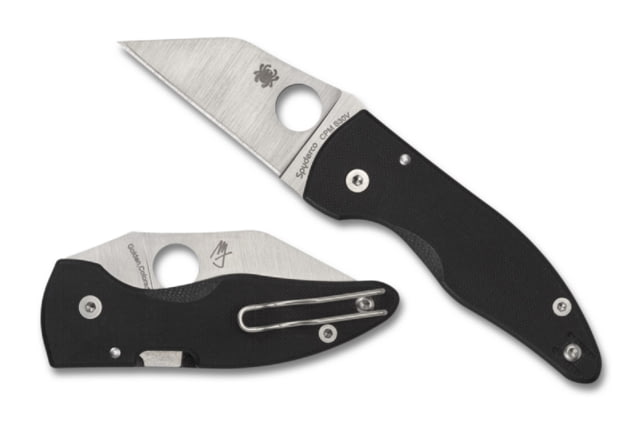
The MicroJimbo uses a utility style blade with a straight edge and aggressive tip. A stylized spine profile really sets the blade off. Spyderco uses the Compression blade-lock system. The textured scales are black G-10 with a wire pocket clip.
Consider two different styles of wire pocket clips. The lip on the clip of the GiantMouse (left) is tighter to the scale, with a slight lift. The Spyderco (right) lifts the lip a bit to aid in trapping the pocket rim.
The shapes of Spyderco’s clips are more effective for attaching to a variety of pocket styles than most, though the fact that it’s in the wire style gives it the same issues as mentioned with the GiantMouse. Due to its distinctive look, the MicroJimbo might not be everyone’s cup of tea. It is a solid carry with an unusual style and loads of function.
Spyderco Microjimbo Sprint Run Pocket Knife 2.45" Wharncliffe CPM S30V Black DLC Blade G-10 Handle Pink
Compact cutters will do the majority of most common daily knife tasks. Add a little creativity and you can stretch their function sometimes.
My EDC kit consists of my wallet, keys, pen, butane lighter, flashlight, bandana and my knife. That sounds like a lot, and it is. There are times when I add to the kit depending on what I’m doing. No doubt, it obviously increases weight and bulk.
Carrying a large kit means that I buy cargo pants only for daily wear. If there is anything I can do to save space and weight, I start by carry more compact versions of my gear. Obviously, my knife would be a start.
A very simple and practical design, Cold Steel’s Laplander-inspired knife cuts through chores.
It’s nice to see a lightweight knife that can fill a multiple range of uses. While attending Norway’s ski school, I was introduced to the Laplander style of knife.
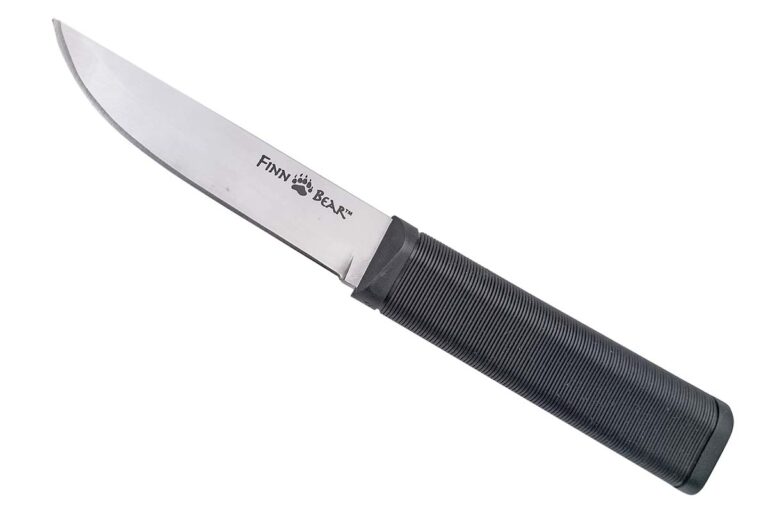
Very light and super sharp, it is used for most every cutting chore. The Cold Steel Finn Bear reminds me of such knives. And don’t let the thin blade fool you, it’s a sturdy cutting instrument.
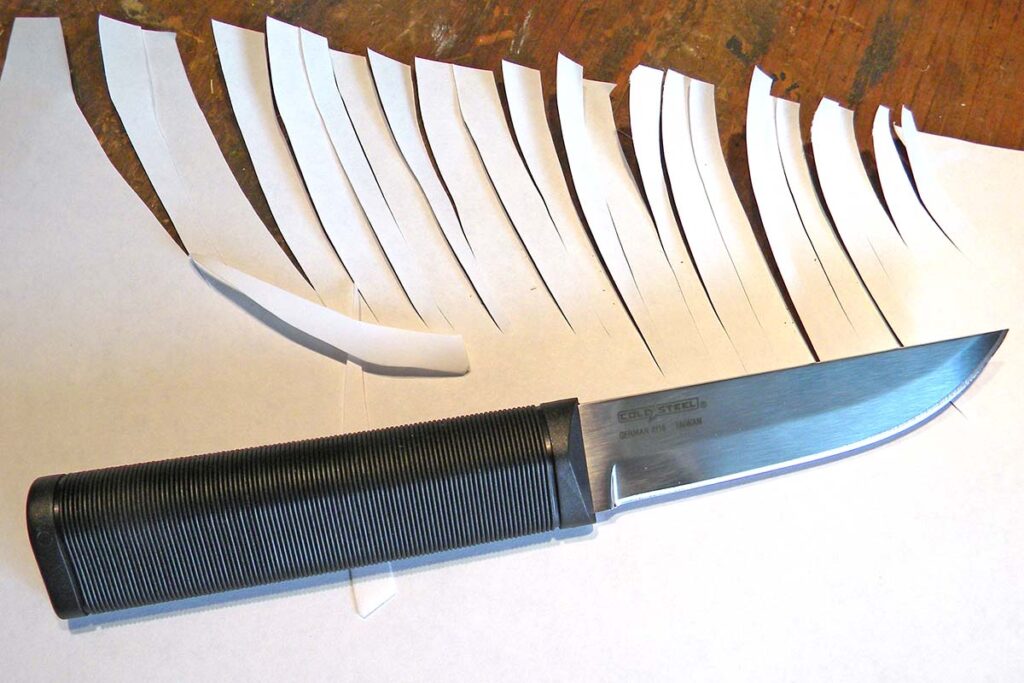
The author checked the new edge for sharpness on the copy paper and the blade sliced quickly and smoothly.
Slicing 20-pound bond paper checked the new edge for sharpness. It sliced quickly and smoothly. I had to move my fingers quickly so I didn’t nick myself. It was a great factory edge to start off with.
Finn Bear Light-Duty Cutting
Double-walled cardboard was next on the docket. Again, the Finn Bear was very smooth in its slices. It worked faster with a push cut rather than a pull cut. The knife made full-blade-length slices. The edge was very aggressive. The tear-drop handle shape designed by Tapio Wirkkala provided great control.
I fetched a piece of scrap 8-ounce leather to slice next. The material offered no resistance to the super-sharp blade. I could hear the edge biting into the leather. It was hard to control the depth of cutting as the blade zipped straight to the bottom of the medium.
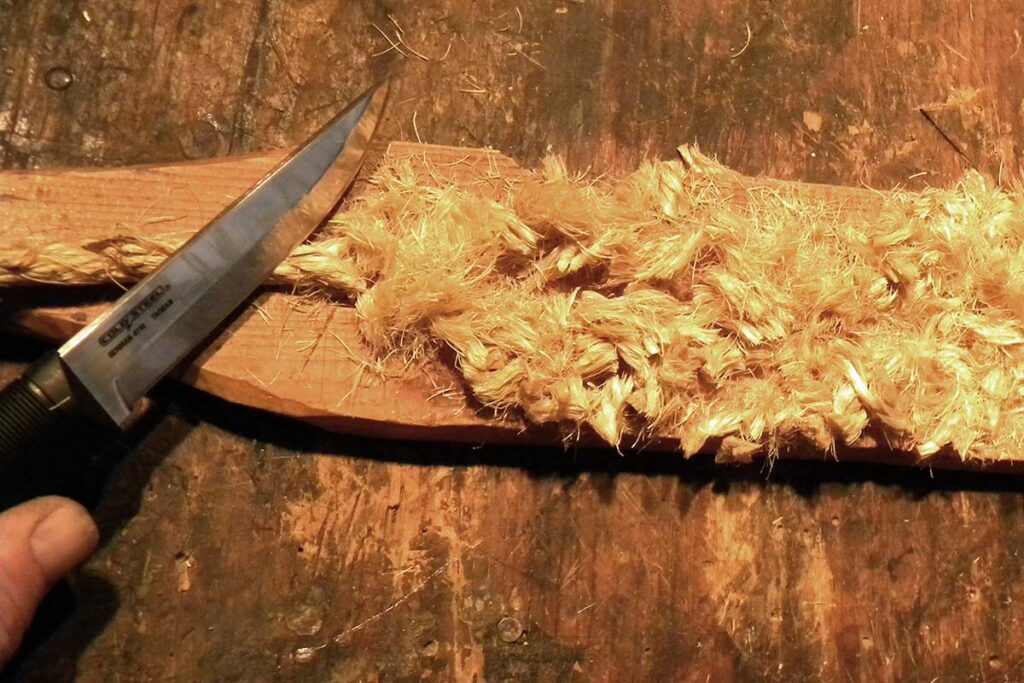
The Finn Bear quickly made 200 cuts in the half-inch sisal rope and was ready for more.
Using the other side of the leather strip, I did some skiving. The blade was very aggressive and cut as fast as I could move my fingers out of the way. It rendered smooth slices in the animal skin with hardly any pressure. I could hear the leather crunching sound with each pass. The tear-drop handle was very controllable.
Finn Bear Heavy-Duty Cutting
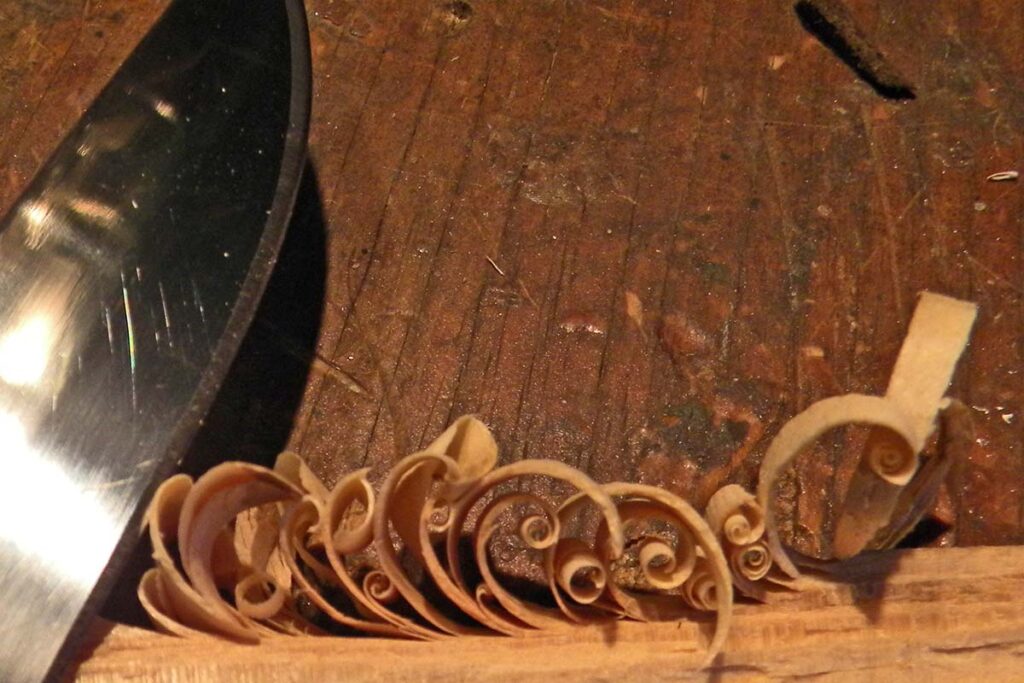
It was time to whittle a firestick from pine/fir wood. The Finn Bear produced the best curlicues I’ve seen in a long time—smooth wood cuts with multiple curls on each whittle. Performance at the task was excellent.
Next up: baton the knife into a 2×3. The thin blade split the wood in no time with no edge damage. Gripping the handle tighter to control the knife made the bottom of the tear drop seem too pointy for the shape of my hand—not uncomfortable, just harder to grip.
The Finn Bear produced the best curlicues the author’s seen in a long time—smooth wood cuts with multiple curls on each whittle.
It was on to the half-inch sisal rope. The Finn Bear quickly crunched to 200 cuts and was ready for more. I had to change my grip to more of a sidewinder style. I couldn’t place my thumb on the spine because of the blade’s thinness. No matter how I held the knife, it cut the rope. The knife is very sharp indeed.
Finn Bear Edge Retention Test
For the final test, it was back to the 20-pound bond paper. The Finn Bear sliced the medium just as quickly as the first time. I did have two tears in the paper but that was due to it being soggy. It rained the whole time I was testing.
Final Cut
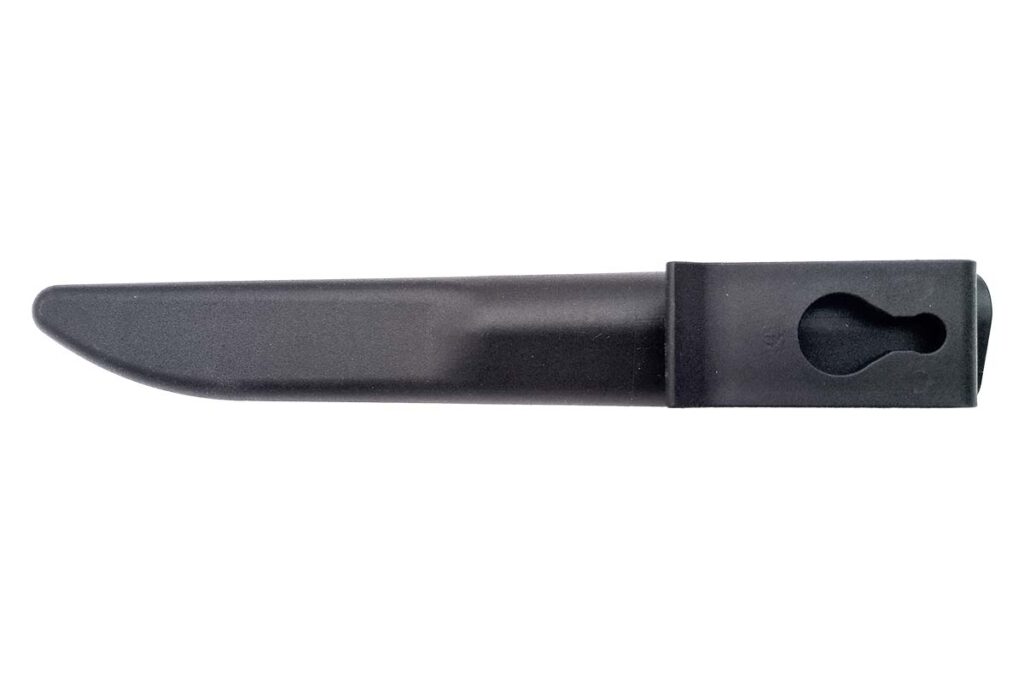
A sturdy integral clip attaches the synthetic pouch sheath to a vest, pack, etc.
I would make the bottom of the handle a tad wider for a better grip. The Finn Bear is a “should have” knife. It’s lightweight and cuts like the wind. It’s perfect for everything from camp chores up to chopping.
Jordon Berthelot marries two electric materials in one knife.
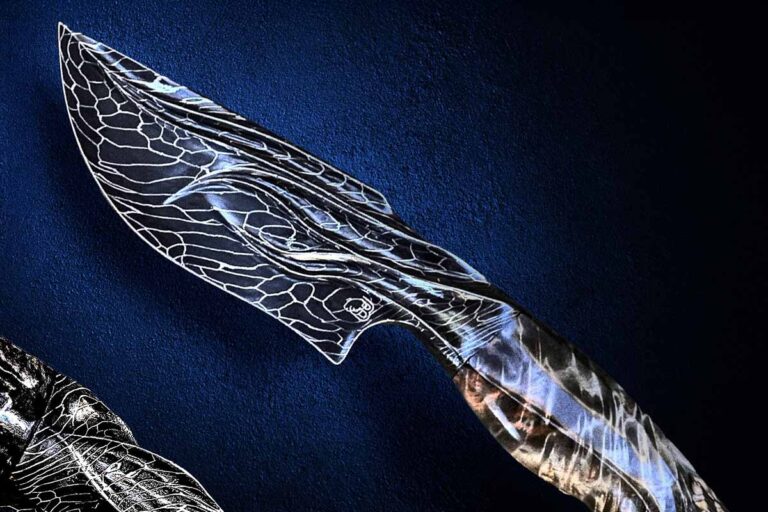
Jordon Berthelot achieves a hypnotic union of blade and handle materials in his integral hunter.
The blade is his HHH lightning damascus and the handle is cottonwood from Robswildwood.
“I used a wide variety of different bits and burrs with Foredom and Dremel tools to freehand carve the blade and handle,” he wrote.
“As my teacher Spencer Aplin always says, the most difficult part is deciding what to carve and how to give it the flow I want, which is so true,” Berthelot said. “I decided to incorporate the blade carving into the handle so it gave the whole piece a complete look, and also added some great purchase of the handle in multiple different grips.”
Berthelot Integral Hunter Specs Blade length: 4.5” Blade material: HHH lightning damascus forged from W1 tool steel/nickel rods w/4800 powder Handle material: Cottonwood from Robswildwood Overall length: 9” Maker’s price for a similar knife: $3,500
We give you the tips to avoid mistakes when buying a custom knives.
Of course, every rule or principle has its exceptions and counter-principles. You do get what you pay for, but only when you have an honest and informed assessment. Is that micarta real Westinghouse Micarta? Is the fit and finish and reputation of the maker in line with the price? Did the maker grind the knife themselves, or is this a production knife?
You’ll have to do some homework if you want to get “good deals.” One of the oldest tricks in the book is for the seller to exaggerate demand and conceal supply. “This is the last one, and they’ve been buying them fast all day!” may be true or may be a dishonest sales pitch.
The warning is “buyer beware” more often than “seller beware” after all. Many a “bad deal” comes not from mutual disagreement, but from one side taking advantage or being dishonest.
Economic generalities aside, let’s look specifically at the knife market.
Lesson 1: Don’t Buy The Hype
Some people want the latest and greatest thing. They get great enjoyment out of buying what is the ultimate “grail” knife of a given season, often hyped up on social media, on online forums, by word of mouth, in magazines and at events. For these buyers, the thrill is in the hunt and in the showing of the trophy.
If you want to be that kind of buyer, buy what you want and enjoy the heck out of it! Keep in mind that demand will be lower for last year’s hot thing, and so will the resale price. I won’t go so far as to say don’t buy the hot knife. Many of us spend money on experiences (what do you gain long term from a concert or a trip to the movies?) or on depreciating possessions like cars or boats. In some ways, if you enjoy it, it doesn’t matter if you lose some money on a knife or it’s not a good “investment.”
Many of us “regular” folks have to be a little more careful with our funds. If you chase what’s hot, you’ll end up buying at times of peak demand, which means you’ll pay a higher price. By the time you get tired of that knife or want to sell, everyone else just might be tired of it as well, as the knife world will have moved on to the next hot thing. If you’re one of the folks for whom a sour ending ruins the whole experience, don’t buy hot. If you have an eye toward appreciation of values and want to “make money” on your knife collecting hobby, don’t buy hot.
For some people, the thrill is in finding the next hot one, before it gets hot. Wouldn’t we all have loved to have purchased a bunch of Microsoft stock in 1993? If we were better at predicting the future, we’d make better knife picks for our collection, just like we’d make better choices in our stock portfolio. Still, if you “hit” one once in a while—buy the maker’s work right before he hits the big time and make lots of money—it can be quite a thrill and keep you buying knives on a regular basis.
Another point of caution when it comes to hype has to do with the “flash in the pan” types who grow smoking hot quickly, beyond their market position or ability to produce. It has happened in the knife world before and will happen again. Someone may be better at marketing than knifemaking, or better at Instagram videos than filling knife orders. If the hype of a particular maker turns you off or looks suspicious, trust your gut and hold off on purchasing. Sometimes makers flame out as spectacularly as they rose to fame.
Lesson 2: Don’t Overspend At The Beginning
“Walk before you run” is good advice. Knife collecting is about finding joy in knives, and at the beginning, small mistakes hurt less. If you start with $500 and buy five quality production knives at $100 each, you may enjoy them a long time. If you start with the same $500 and buy a custom at a show from an overhyped maker who quickly fades away, you may sour to collecting altogether. When you gamble more, the losses cost more.
The opposite is somewhat true as well, however. If you spend your $500 on 50 $10 gas station knives, you’ll have a great big pile of crappy knives when you’re done. The trick is finding a good balance between price and quality. Finding that balance takes time to learn.
As you learn more about the market segment you’re interested in, don’t be afraid to invest more as you grow. You may reach a point where you don’t want the Chinese ones, but rather the American ones. Or maybe you don’t want production, you want midtech. Or maybe you won’t want the midtech one with the maker’s name on it, you may want the custom one made by the maker himself.
Hopefully, your budget will grow to accommodate your growing expertise and preferences.
Lesson 3: It’s Not Just The Knife You’re Buying
When you invest in Amazon stock, you are making a rich man richer. You’re buying a piece of paper or an electronic data point that says you “own” a tiny piece of the company, and you expect a mathematically increasing return for your investment.
When you buy a knife, odds are good your money won’t go to that knifemaker’s yacht payment or summer home fund. When you buy a knife from an individual knifemaker, you’re more likely sending his kids to daycare or piano lessons, paying for his electricity and buying his wife new shoes. If you buy at a knife show, you probably bought the maker’s dinner. When you invest in a knife, you support a specific person, not “the man behind the curtain.”
Even if you find joy by investing in a person by buying their product, you still owe it to yourself to invest wisely. Of course, you should buy a knife you like, that you find useful or that may make you a decent return on your money. At the same time, you should be looking for people to help, individual makers whose lives you will improve by your relationship and the purchases you make over time. You may be making friends, not just money, which can add another degree of magnitude to your enjoyment of knife collecting.
Lesson 4: Buy What You Know
The more you know, the fewer expensive mistakes you’re likely to make and the more deals you’re likely to find. The less you know, the more likely it is that you’ll get a bad deal, purchase a knife you’ll be dissatisfied with or a knife you later regret. The more you know, the better. This seems to be a universal principle of life and economics, and it applies to knives as well.
First off, buy knives from brands or people you know have a good market position. Many times, a well-known brand is successful for good reasons. A classic brand like Case or Spyderco may be a great place to start, or a well-known Knifemakers’ Guild member or somebody from the “Slipjoint Cartel.” When you have the chance to know the maker or seller personally, that knowledge makes your purchases more likely to bring you joy or a good return on your investment.
Second, buy knives from reputable dealers or purveyors. While you may get a “great deal” from a pawn shop or somebody’s cousin who is a knife collector, there is some measure of protection in buying from well-known retailers such as Blade HQ, AG Russell, Arizona Custom Knives and others. Until you become familiar enough with the market to know exactly what you’re looking at, it’s wise to stick with the major dealers.
As another example, consider buying from the folks who advertise in the knife magazines, such as BLADE. If their business is legitimate enough to afford the expense of advertising in print, they’re more likely to be honest and stick around.
Third, buy the knives you’re familiar with. You may get joy out of buying a knife the first time you’ve ever seen or heard of it. On the other hand, you’re even likelier to enjoy a knife that you know in your heart is a great one, because you’ve studied it, chased it, pursued it, and finally purchased after careful consideration. Sometimes the journey is as fun as the destination, and the pursuit of the grail is worth as much as the grail itself.
You may get in a rut and feel like you’re buying the same knife over and over. That’s no good either. Balance your knowledge with both width and depth. You may dive deep into one model, one maker or one brand, or you may spread your collection broadly by buying one knife from as many different people and places as possible. Either way, you’ll get familiar with the knives that you like, and you’ll end up going as deep or as broad in your collection as you like.
Editor’s note: The author (Josh Wayner) spent the better part of five years working in a high-end specialty butcher shop in coastal west Michigan. That shop is no longer in business, though what he learned there has stayed with him and, as he noted, is very dear to his heart. We thought him to be the ideal writer to do a story on five of today’s factory boning knives. We think you will agree.
A former butcher’s mate gives boning knives the full test treatment to find the best boning knife.
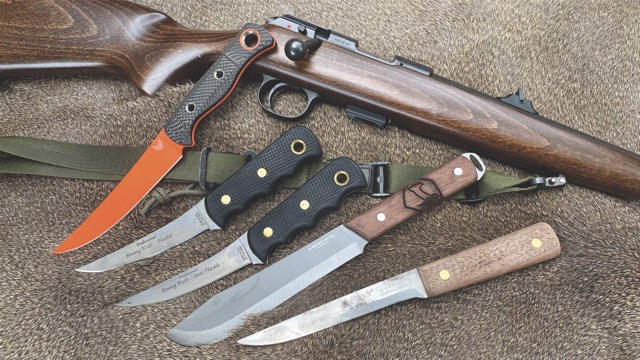
I hunt deer and other large game regularly and own all my own professional processing equipment. Among these items is the most basic and essential tool: the boning knife. As a butcher’s mate and now as a full-time outdoor writer, I have some opinions on these blades and how to best use them.
A boning knife is a rather specialized tool, and getting the right shape for removing meat from bone is the name of the game. In my span hunting I’ve either shot or helped process hundreds of deer. I hunt the most game-rich areas in Michigan, and it’s common for my party to land a dozen deer in a night. The best knife for working on a deer is a 5-to-7-inch saber-ground blade of a steel about 3/16 inch thick that features an ample, comfortable handle.
The knife you absolutely do not want is a boning knife for this type of work. In my experience, a boning knife is for kitchen work, though I favor it as a primary knife for game under 50 pounds live weight.
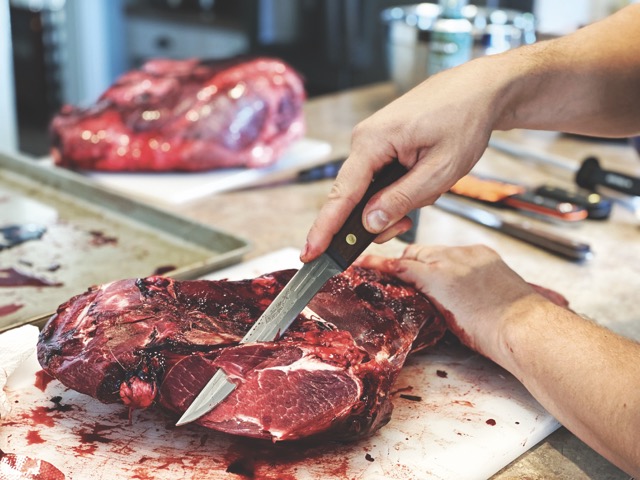
The reason I offer here is that I’ve never seen an injury with a proper large-format field knife. Where I have seen horrible injuries is with thin-bladed knives like those in this article. They have the sickening tendency to snap off when going through sternums and joints; the flexibility has a limit and I’ve personally witnessed a dozen snapped blades, with half of the snaps resulting in a serious hand injury. Extreme care must be taken with ultra-thin, razor-sharp blades. In the process of creating this article, my friend who helped me process the deer meat in the photos was cut to the bone himself with an errant flick of the blade.
Best Boning Knives
Best Dedicated Boning Knife: The Knives of Alaska (KoA) Professional Boning Knives
Kitchen Functional Boning Knife: Ontario 72-6
General Use Boning Knife: Condor Tool & Knife Butcher Knife
Scalpel Sharp Boning Knife: Benchmade Meatcrafter
Best Boning Knives Specs Comparison
Knife
Blade Length (inches)
Blade Material
Handle Material
Weight (ounces)
Overall Length (inches)
Sheath
Country of Origin
MSRP
Ontario 72-6
6.25
1095 spring
Hardwood
4.8
10.75
N/A
USA
$15
Condor Tool & Knife Butcher Knife
7
1075 carbon steel
Walnut
5.3
12
N/A
El Salvador
$38
Benchmade Meatcrafter
6.08
CPM S45VN stainless
Carbon fiber
4.52
11.06
Black and orange polymer
USA
$400
Knives of Alaska (KoA) Professional Boning Knives
5
D2 tool steel
Hard rubber
4.2
9.625
Black Kydex
USA
$50
Best Dedicated Boning Knife: Knives of Alaska Professional Boning Knife
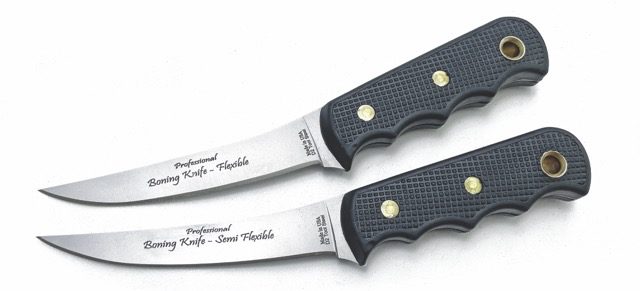
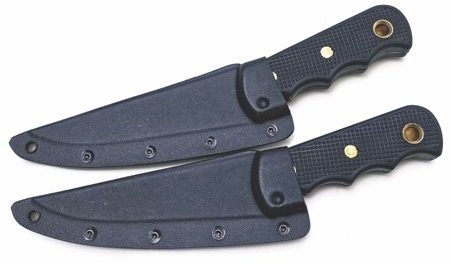
The two versions flexible and semi-flexible-of the Knives of Alaska boning knife come in what the author calls a choice size and profile for medium-duty processing.
Pros
Designed For The Job
Ergonomic Handle
Great Value for Performance
Cons
Limited Versatility
KNIVES OF ALASKA PROFESSIONAL BONING KNIFE BLADE LENGTH: 5″ BLADE MATERIAL: D2 tool steel HANDLE MATERIAL: Hard rubber SPECIAL FEATURES: Available in two different flexes: flexible and semi-flexible WEIGHT: 4.2 ozs. OVERALL LENGTH: 9.625″ SHEATH: Black Kydex COUNTRY OF ORIGIN: USA MSRP: $49.99
The KoA knives ship with polymer sheaths.
The Knives of Alaska (KoA) Professional Boning Knives—I tested both flexibility models—are exactly as their name implies. They are a bit more of an investment at about $50 each. They are however, inexpensive enough that they can be easily replaced if broken or lost in the field. These are truer dedicated boning knives and display a curved, upward-swept profile that forces the whole edge into use. The handle angle promotes a full grip while working on both meat on the bone and on a flat prep surface such as a cutting board.
These knives are superior to the first two reviewed in this story. They have an extremely fine point that gets into the bone and allows you to clean off nearly every meat bit. For the price, they are eminently functional and require minimal maintenance. They are my choice out of the bunch. They are an exact fit for their role, while not pretending to be something else. I like that the KoAs felt the closest to what I had in the butcher shop all those years ago.
“The KoA knives performed the best for the dollar in boning tasks,” the author assessed. “They are shaped properly for butchering tasks and don’t fatigue the hand thanks to the blade angle.”
KoA
$69
DLT
$70
Kitchen Functional Boning Knife: Ontario 72-6
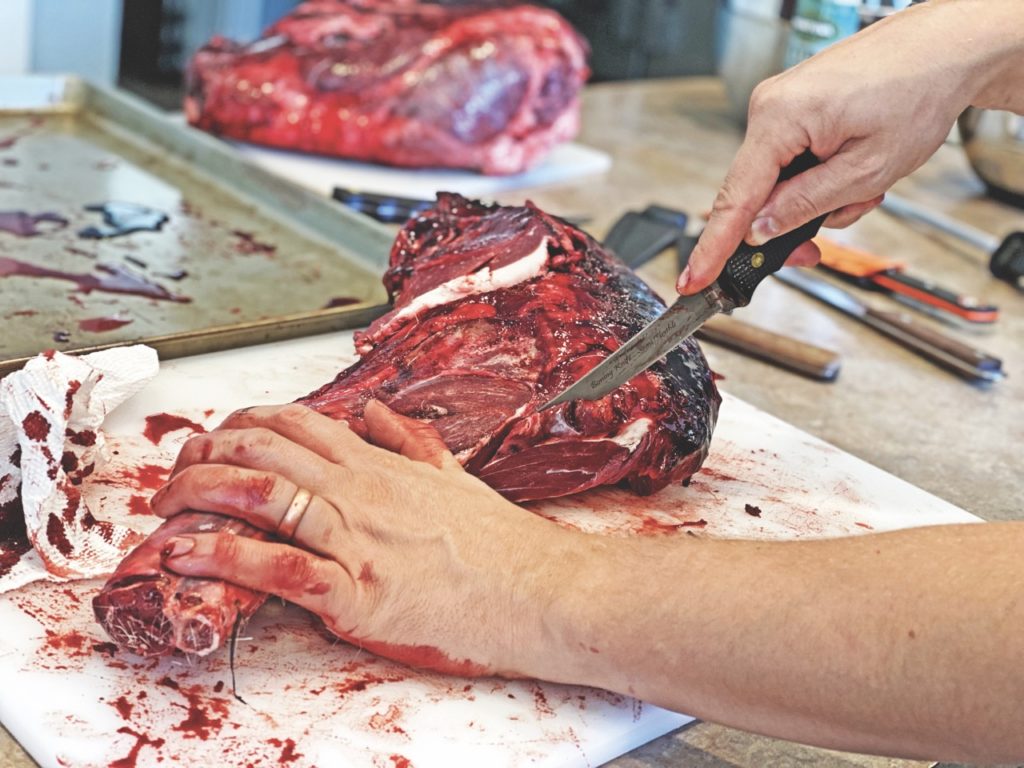
Above: The Ontario 72-6 appears as it arrived at the author’s. “It is a good cutter and excellent for breaking down large sections of meat.”
Pros
Affordable
Durable Edge
Effective Breaking Down Large Cuts
Cons
Corrosion-Prone Steel
Unsealed Handle
ONTARIO OLD HICKORY 72-6 BONING KNIFE BLADE LENGTH: 6.25″ BLADE MATERIAL: 1095 spring HANDLE MATERIAL: Hardwood SPECIAL FEATURES: Inexpensive and available in bulk quantities for rants and kitchens WEIGHT: 4.8 ozs. OVERALL LENGTH: 10.75″ COUNTRY OF ORIGIN: USA MSRP: $14.99
Boning knives are a relatively distinctive category in that they span the range from essentially disposable to extremely high-end, yet are intended for the same purpose. Looking at the four in this article, the least expensive is the Ontario 72-6, which is available in bulk quantities and can be had for as little as $8. It is a good cutter, and excellent for breaking down large meat sections. The straight edge is less ideal for getting into ridges in the shoulder bone, but it is serviceable. In the case of this knife, the steel is very prone to corrosion and the handle is likewise unsealed or treated. To fight the corrosion, wash and dry the knife thoroughly after each use. Apply a light coat of oil on the blade on occasion as well.
“The Ontario has a mostly straight edge and handle, making it hard to work with in organic curves or between bones,” the author stated. “It is a good slicer, but beware of your grip as there is nothing to stop your hand from sliding onto the blade.”
The ‘Old Hickory’ lettering on the handle came off after I washed the knife, and the steel began to spot immediately. This knife has a somewhat textured blade and is not smooth and even. Fat and blood can easily build up on the blade flats. That said, the edge out of the package was sharp, if not a little obtuse in terms of geometry. Despite my best efforts to dull it in use, it stayed sharp and functional. It has no guard or projection and is similar to a puukko in terms of the care that must be taken to not allow the hand to slip up and onto the blade. My impression of this blade is that it is a functional but essentially disposable kitchen tool.
OKC
$18
Optics Planet
$22
General Use Boning Knife: Condor Tool & Knife Butcher Knife
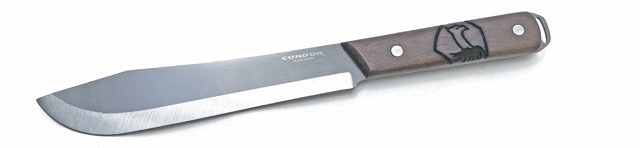
The curved belly of the Condor Butcher Knife’s bowie blade pattern does most of the cutting work.
Pros
Sharp And Durable Edge
Effective For Large Cuts
Durable Construction
Cons
Handle Logo Fouls
Uneven Edge Usage
CONDOR TOOL G KNIFE BUTCHER KNIFE BLADE LENGTH: 7″ BLADEMATERIAL: 1075 carbon steel HANDLE MATERIAL: Walnut SPECIAL FEATURES: Thin, light and practical for kitchen tasks WEIGHT: 5.3 ozs. OVERALL LENGTH: 12″ COUNTRY OF ORIGIN: El Salvador MSRP: $37.78
The Condor Tool & Knife Butcher Knife has a similar handle to the 72-6, but the blade is longer and wider. The edge out of the box was sharp and held up. An immediate point of concern for sanitary purposes is the deeply cut logo in the grip. The logo is somewhat uneven and large and is a collection point for fat and blood. It also digs into the fingers a bit when cutting, something that is not a major comfort issue, just a moderate annoyance.
As the author noted, the Condor Butcher Knife struggles from the same straight-edge problems as the 72-6—it is a better general-purpose kitchen knife than a boning knife, but can be a jack-of-all-trades.
The blade is oddly shaped for use as a boning tool. The bowie-style point is hard to use in tight spaces and doesn’t allow for the “scoop motion” when getting meat out of valleys in the bones. Where it does well is in breaking down large sections of meat on the table. The blade shape puts virtually all the pressure on the belly near the tip; the rear edge nearest the handle is seldom used due to the blade’s inability to get close to the cutting board for slicing strips. Once the belly of the blade gets dulled, its ability to cut and slice dramatically decreases and it needs to be sharpened. I’d rate this as a functional general-use knife for the kitchen, but its utility as a boning knife is questionable.
Condor
$40
Amazon
$34
Scalpel Sharp Boning Knife: Benchmade Meatcrafter
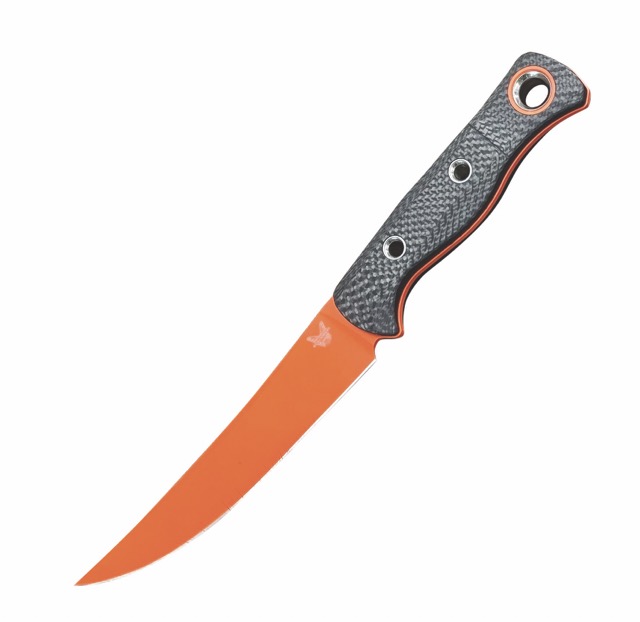
The Benchmade Meatcrafter is scalpel sharp and razor thin. The orange coating allows for visibility in the field.
Pros
Exceptional Sharpness
Premium Craftsmanship
High-Visibility Design
Cons
High Price
BENCHMADE MEATCRAFTER BLADE LENGTH: 6.08″ STEEL: CPM S45VN stainless FINISH: Cerakote™ coating HANDLE MATERIAL: Carbon fiber SPECIAL FEATURES: Ergonomic and extremely sharp WEIGHT: 4.52 ozs. OVERALL LENGTH: 11.06″ SHEATH: Black and orange polymer COUNTRY OF ORIGIN: USA MSRP: $400
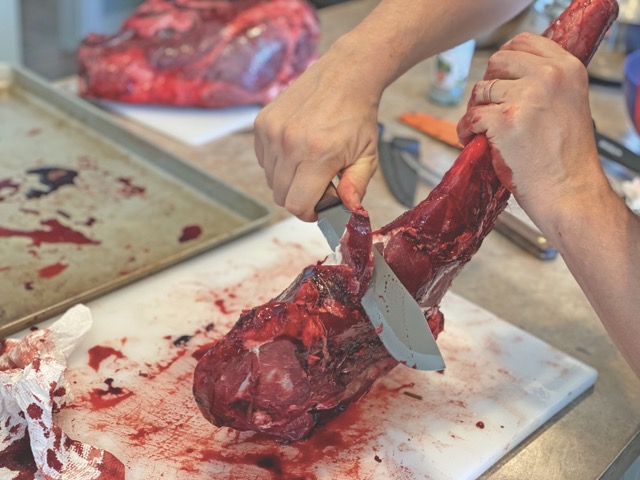
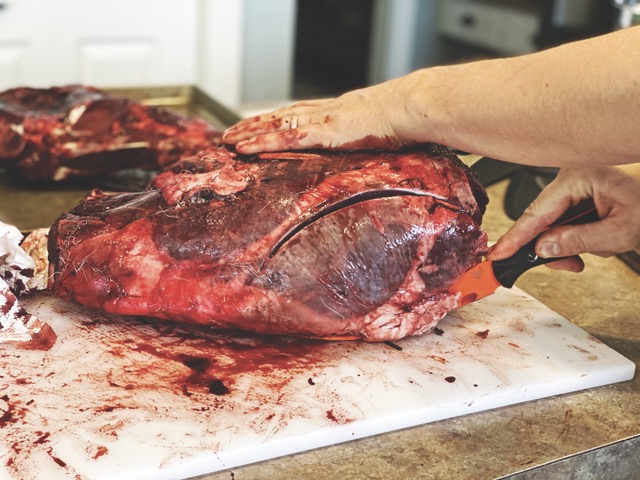
The Benchmade Meatcrafter* in this story is the first production version of this particular model from the company, literally the first of its kind off the line. It is a high-end knife eight times the price of each of the Knives of Alaska models tested. Benchmade’s quality is evident and this status symbol is not a “safe queen.” It is one of the sharpest—if not the sharpest—knives I have ever seen from the factory. I was actually taken aback when it went through a huge deer ham with no effort. It is scalpel sharp and held that level of sharpness the entire test. I for one was not used to a knife this sharp. I had to retrain my hand to use less force in cuts because it was risky.
This is a knife I would proudly use and display, but even with its orange blade (for higher visibility). I would be very cautious in its use for fear of breaking it. This is one that I know I’d fear losing at the cost alone. Things happen in the field, and I’ve lost a lot of gear. The reality is I’d rather break or lose a $50 knife than something like this.




![Best Rescue Knives [Field Tested]](https://blademag.com/wp-content/uploads/Rescue-Knife-9-768x512.jpg "Best Rescue Knives [Field Tested]")