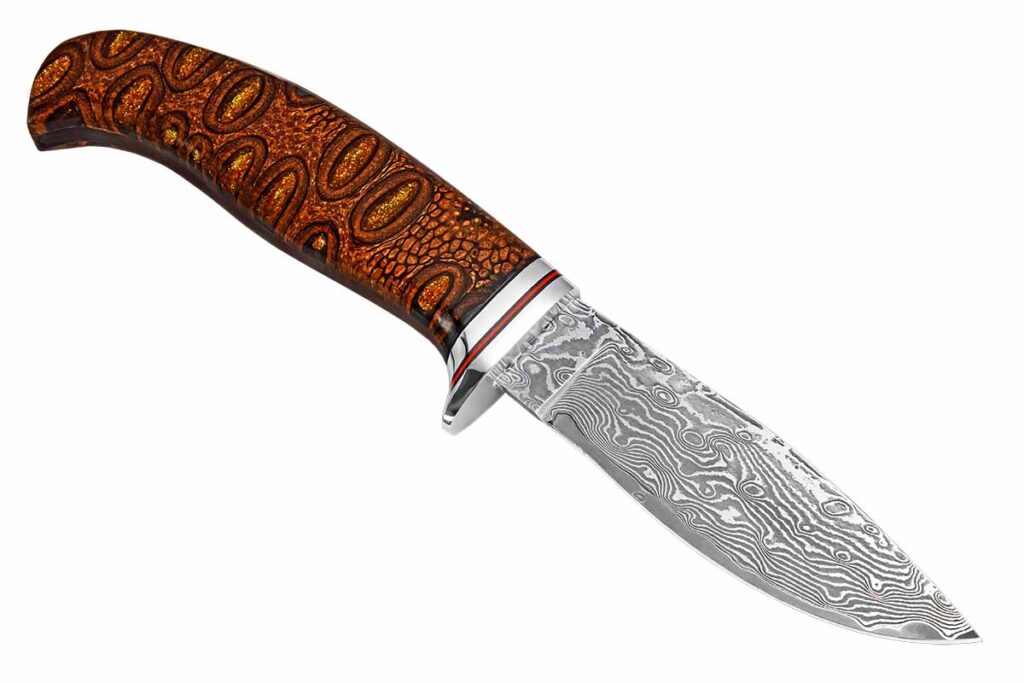
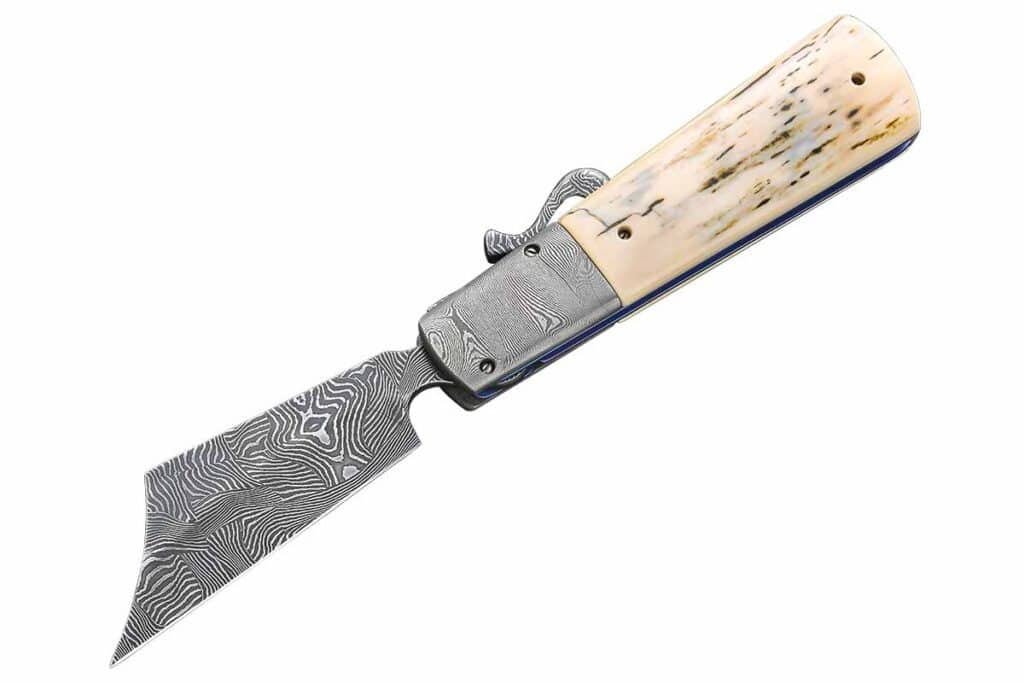
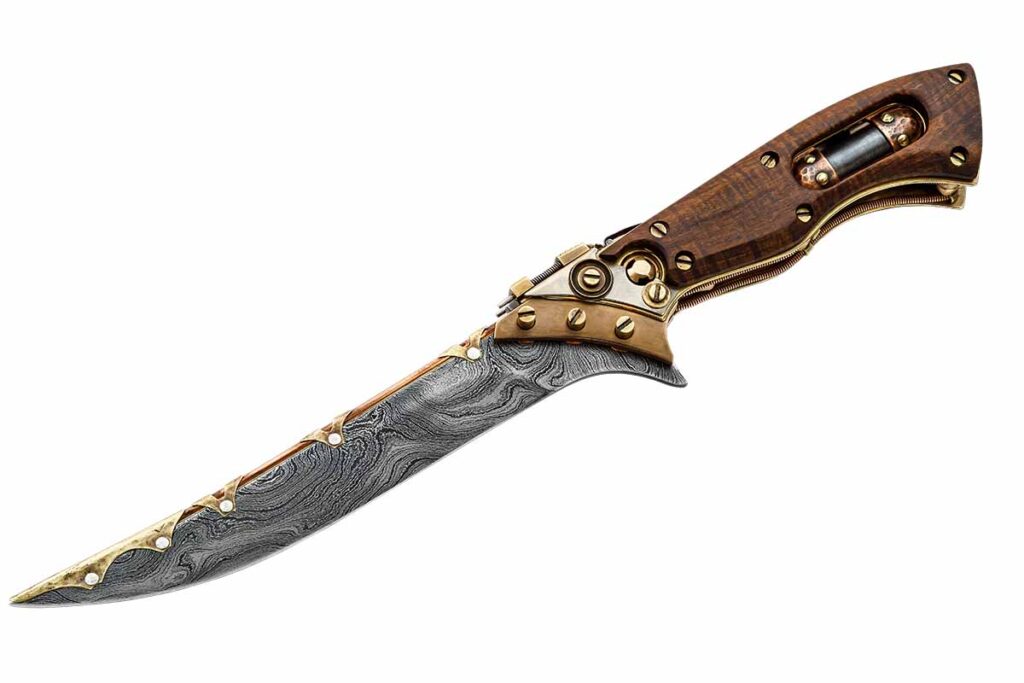
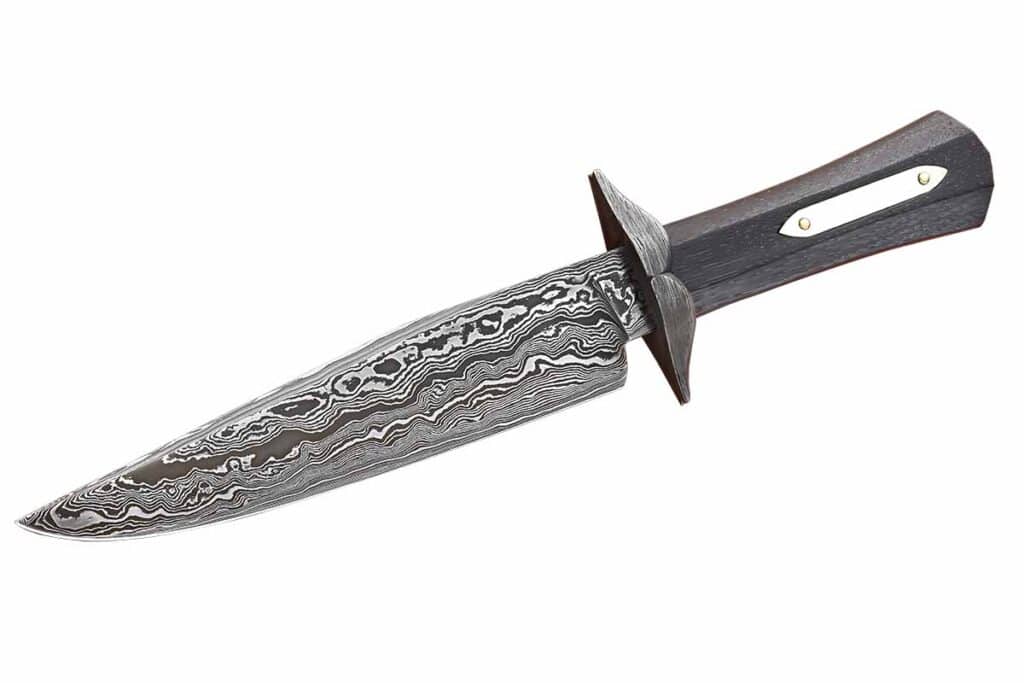
With BLADE Show 2024 just around the corner, many new knives are hitting the custom and factory markets. We scoured the former end—hitting all points of the compass along the way—to bring you some of the latest and greatest handmade gems. If you’re heading to Atlanta, be on the lookout for these and other great custom creations.
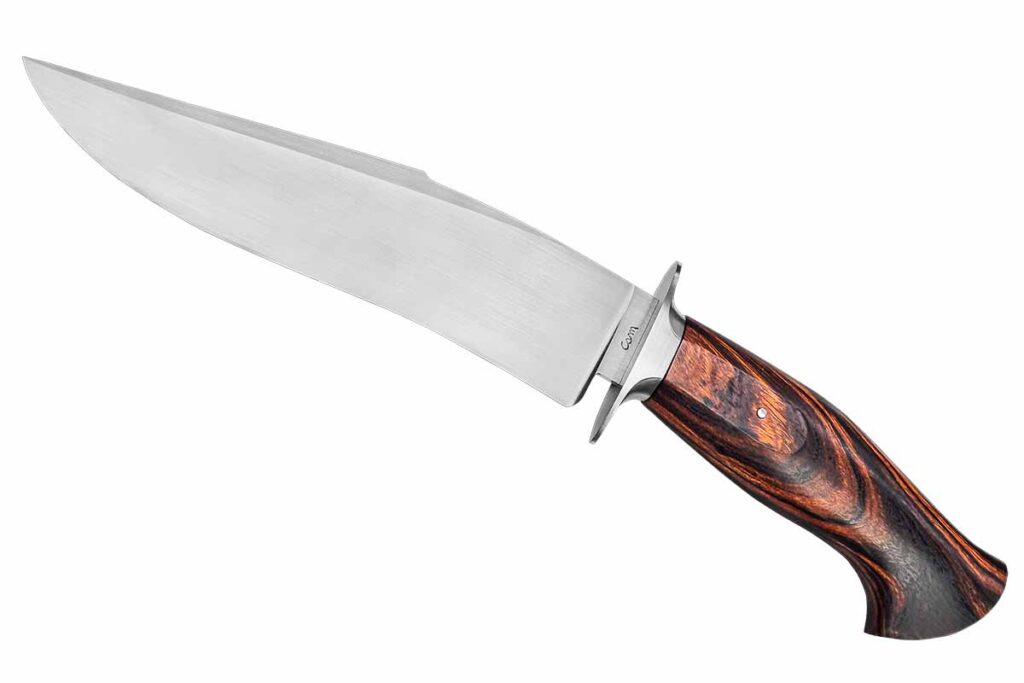
Camille Sennegon Fighter
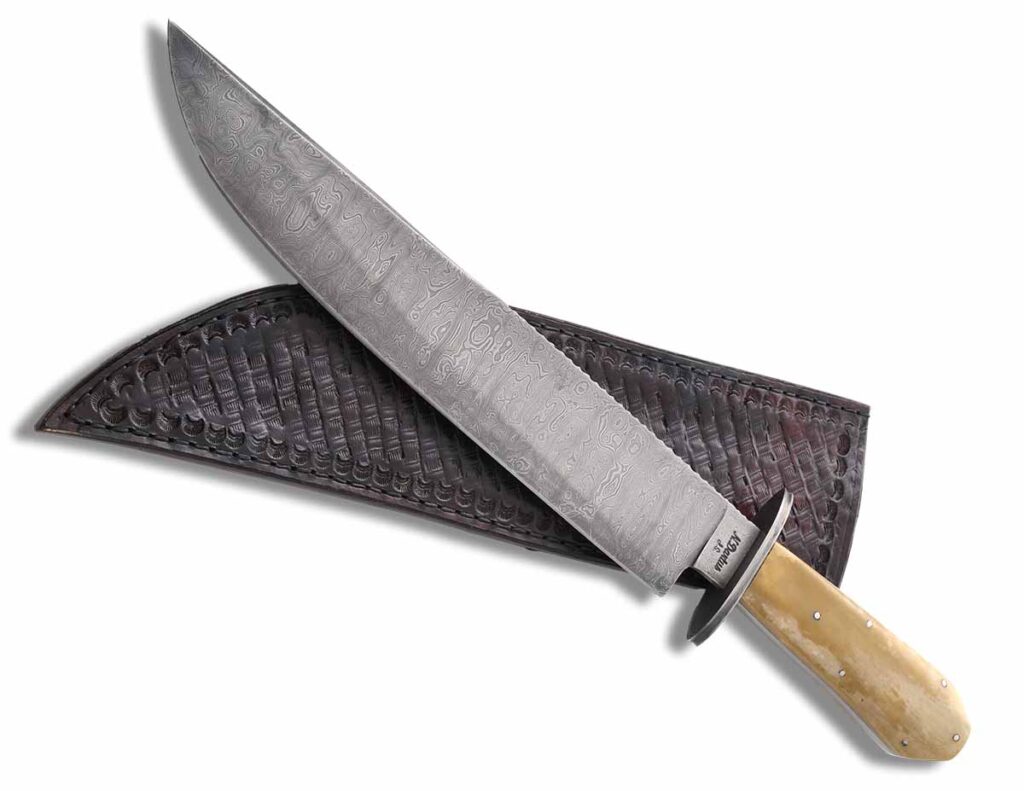
Blade length: 8” Blade material: 80CrV2 carbon steel Blade grind: Flat, w/a small convex grind on the edge Blade finish: 800-grit satin Blade pattern: Harpoon w/recurve edge Handle: Ironwood Bolster: 304 stainless steel Overall length: 13” Maker’s price for a similar knife: $800 at press time rate of exchange Maker’s remark: “I made this knife based on a design drawn and given to me by my friend, ABS master smith Samuel Lurquin.” (Jocelyn Frasier image)
Francesco Piccinin Northern Style Utility
Blade length: 4” Blade steel: 14C28N stainless Blade grind: Flat Handle: White G-10 w/black G-10 frame and spacers w/hole for a lanyard Bolster: Ash burl Overall length: 9” Sheath: Leather w/belt loop and leather tiedown w/bead Maker’s price for a similar knife and sheath: $600 at press time rate of exchange (Jocelyn Frasier image)
Steven Ramos Pisces
Knife pattern: Hunting/utility Blade length: 7” Blade steel: CPM 154 stainless Blade grind: Hollow Blade finish: Bead blast Handle: Micarta® w/G-10 liners Overall length: 10.625” Sheath: Kydex over aluminum frame; made by Steven Ramos Maker’s price for a similar knife and sheath: $825 (Jocelyn Frasier image)
David Lisch Singing Crusader
Knife type: Fixed blade Blade length: 5.25” Blade material: Damascus of 1080 carbon and 15N20 nickel alloy steels Blade grind: Convex Construction: Damascus integral Handle: Forged pipe handle holds ball bearings that make the knife “sing” when shaken Knife to know: The bear head pommel is hand forged; the maker is an ABS master smith Overall length: 10.5” Maker’s price for a similar knife: $1,500, though this one being a one-of-a-kind, the pipe handle and carved pommel would be somewhat different, as would the damascus pattern davidlisch.com (Jocelyn Frasier image)
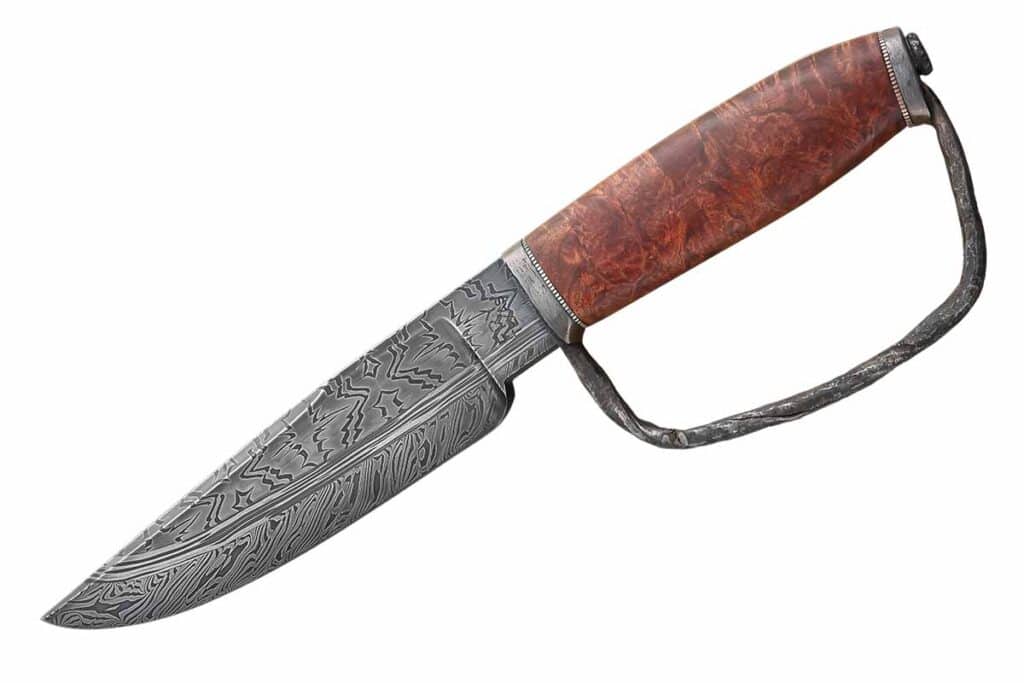
Jason Fry Border Bowie
Blade length: 8” Blade material: Explosion/twist/border-wall damascus D-guard/bolster: 1880s wrought iron artifacts Handle material: Mesquite Frame: 1848 and 2023 half dollars Overall length: 13” Knife to know: Border-wall stand included Maker’s price for a similar knife: $4,200 frycustomknives.com (SharpByCoop image)
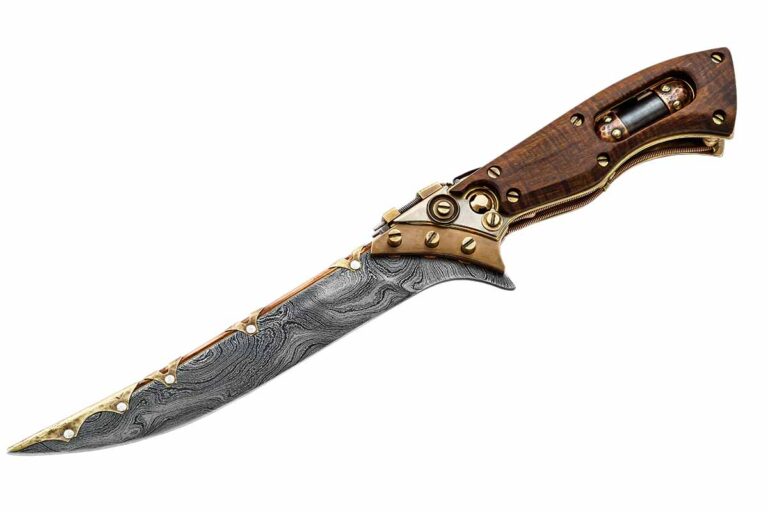
Blade length: 5.9” Blade material: Damascus of 1075 carbon and 15N20 nickel-alloy steels Blade grind: Flat Handle: Tasmanian blackwood Frame: Brass, copper, steel, clock parts, nickel silver Guard: Bronze Knife to know: The knife includes parts from clocks, a piano, cordless drill, gas valves, cigarette lighter and a gas bottle; the maker is a member of the Australian Knifemakers Guild and is an ABS apprentice smith Overall length: 12.2” Maker’s price for a similar knife: $4,700 at press time rate of exchange (Rod Hoare image)
Gabriel Turner Fixed Blade
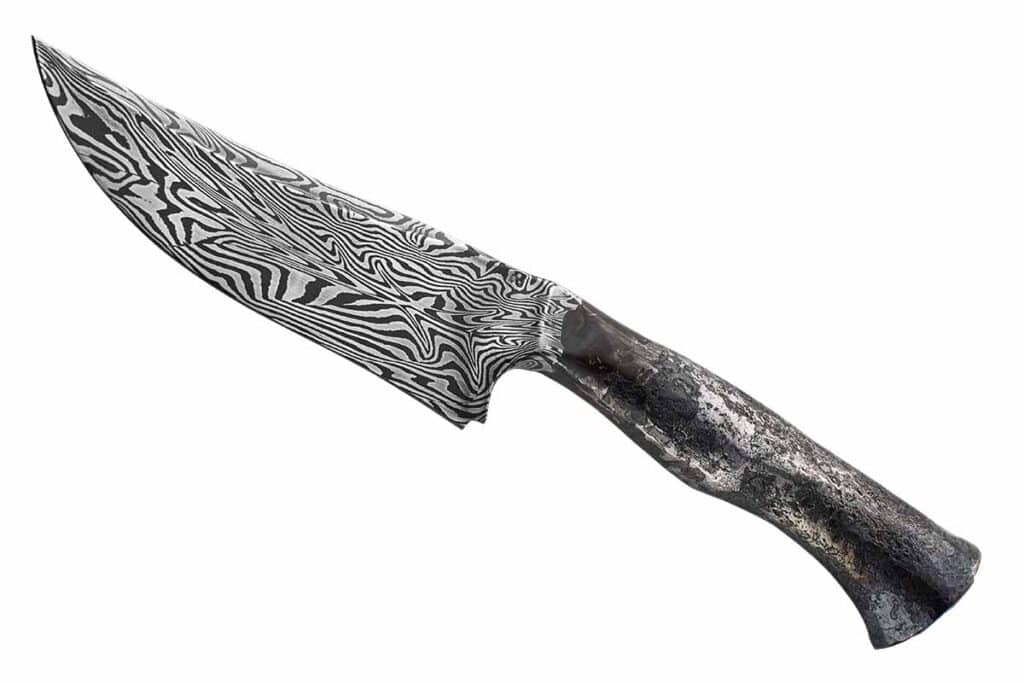
Blade length: 6.25” Blade material: Damascus of 1084 carbon and 15N20 nickel-alloy steels Blade grind: Full flat Guard: Cable damascus Handle material: Bog oak Overall length: 11.25” Maker’s price for a similar knife: $1,050 (SharpByCoop image)
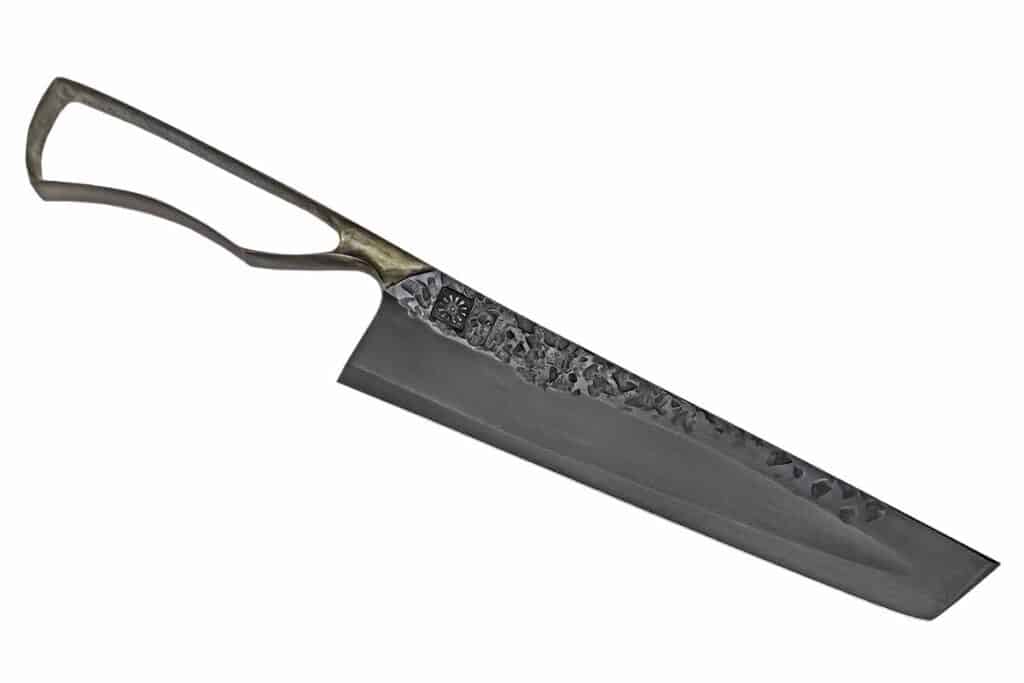
Julian Roche Nakiri Chef’s Knife
Blade length: 8.27” Blade material: 1084 carbon steel Blade grind: “S” grind Blade thickness @ ricasso: .196” Blade at widest: 1.77” Knife to know: Forged from one piece of 1084; rust-blue finish and brassed Overall length: 12.6” Maker’s price for a similar knife: $450-$475 at press time rate of exchange (Rod Hoare image)
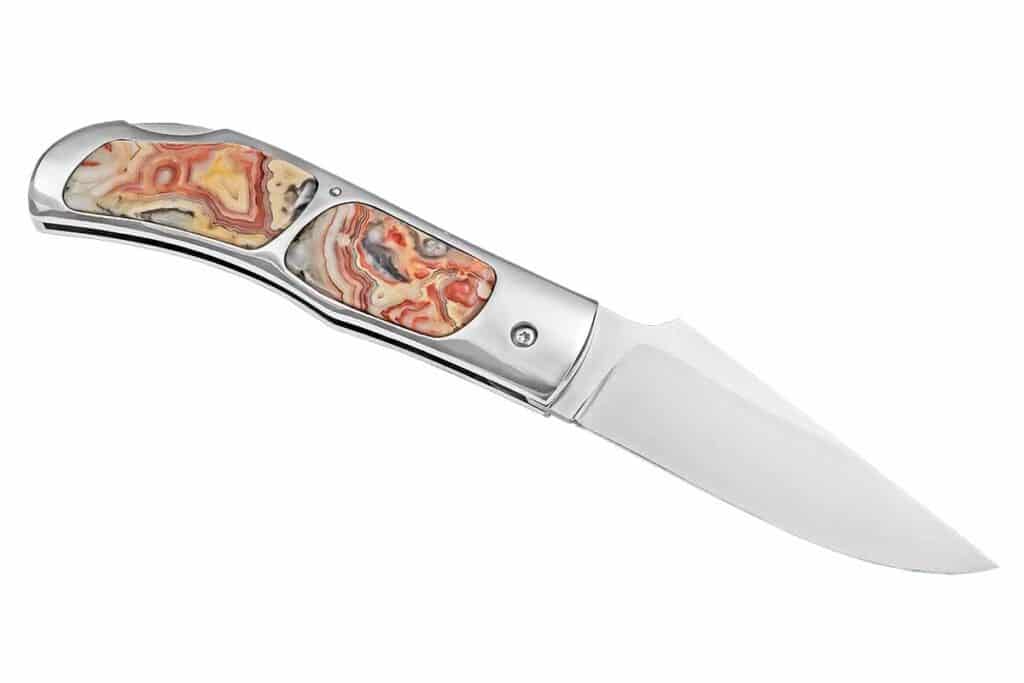
Jeremy Wheaton Leon
Knife type: Lockback folder Blade length: 3.19” Blade steel: CPM 154 stainless Blade thickness @ ricasso: .12” Blade @widest: 1.2” Blade grind: Flat Handle: Crazy lace agate seed inlays; a local miner sourced the agate Frame: 410 stainless steel Closed length: 5.27” Maker’s price for a similar knife: $445 at press time rate of exchange Maker’s remark: “The photo is a testament to Rod Hoare, who has worked very hard to bring his work up to an international standard. All of us Australian knifemakers are very grateful that we now have an artist of his caliber servicing our industry.” wheatonartsandcrafts.com (Rod Hoare image)
Mike Tyre Beavertail
Knife type: Double-action automatic/manual folder Blade length: 3.5” Blade material: Damascus of O1 and L6 tool steels Blade grind: Flat Blade pattern: Wharncliffe Blade opener: Thumb stud Handle: Gold-lip mother-of-pearl Frame: Titanium Lock: Linerlock Closed length: 4.5” Knife to know: Engraving w/gold inlay by Joe Mason; heat-colored filework Maker’s price for a similar knife: $4,200 miketyrecustomknives.com (SharpByCoop image)
Companies from every corner of the globe will unveil their new knives at the BLADE Show.
Knife companies know how their bread is buttered—by blue-collar and other like-minded knife enthusiasts who buy factory knives by the wagonload. And there’s no better place to tap that wealth of grassroots knife enthusiasts than the BLADE Show.
More companies from more countries than ever before will introduce their latest cutters in Atlanta’s Cobb Galleria Centre June 7-9. Scrutinize this and the following pages for just one knife each applicable company will debut. There will be many more, including those of exhibiting companies that were unable to participate in the story for one reason or another.
All the featured knives are either available for sale now or will be in June.
W.R. Case & Sons Ruple Axe Handle
Designer: BLADE Magazine Cutlery Hall-Of-Fame® member Bill Ruple Knife type: Folder Blade length: 3.5” Blade steel: 154CM stainless Blade grind: Flat taper Handle material: Natural birdseye maple Lock: Lockback Special features: Axe-handle-shaped handle Weight: 4.2 ozs. Closed length: 4.4” Carry: Taco-shaped suede leather pouch a la the ones that came with past Case/Tony Bose collaborations Knife to know: The knife marks the first of what promises to a series of collaborations between Case and Ruple as Bill officially succeeds the late Cutlery Hall-Of-Famer Tony Bose as Case’s go-to custom knifemaker designer Country of origin: USA MSRP: To be determined
Halfbreed Blades CQC-02S
Designers: Halfbreed in collaboration w/Jared Wihongi Description: Karambit Knife type: Fixed blade Blade length: 3.54” Blade material: K340 carbon steel Rockwell hardness: 59-60 HRC Edge: Polished, partially serrated Blade finish: PVD coated black Blade pattern: Talon point Blade @ thickest: .23” Handle material: G-10 Knife weight: 7.65 ozs. Overall length: 7.48” Sheath: Molded Kydex Mounting: IWB and belt (DOTS design) Color options: Black, dark earth, Ranger green Country of origin: Comprises Australian and Taiwanese make MSRP: $220
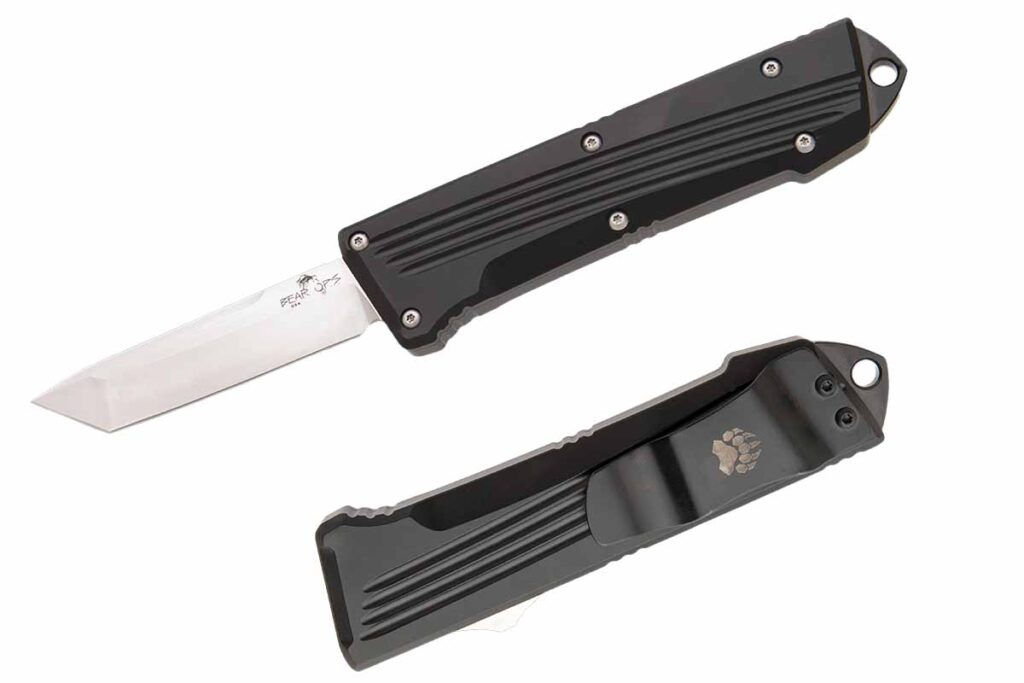
Bear OPS 4.5” Double Clutch IV
Knife type: EDC Blade length: 2.5” Blade material: D2 tool steel Blade grind: Taper Handle material: Aircraft aluminum w/grip ridges, hole for a lanyard Opening mechanism: Automatic Pocket clip: Robust steel model Weight: 3.3 ozs. Closed length: 4.5” Country of origin: USA MSRP: $289.99
Kansept Link
Knife type: EDC Blade length: 3.55” Blade steel: CPM 20CV stainless Blade grind: Flat Handle material: Titanium+Gecko camo carbon fiber Lock: Framelock Pocket clip: Milled titanium Weight: 3.85 ozs. Closed length: 3.61” Country of origin: China MSRP: $284
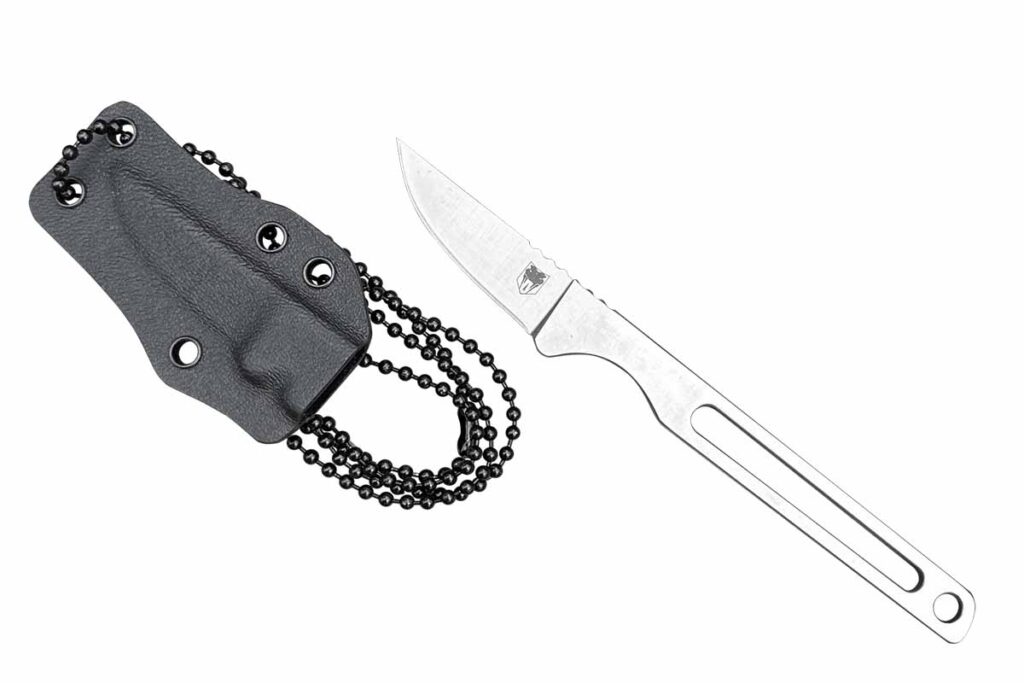
CobraTec Surgeon
Knife type: Necker Blade length: 1.75” Blade steel: M390 stainless Blade grind: Flat Handle material: M390 stainless Construction: Full tang Weight: 1.2 ozs. Sheath: Kydex w/necklace bead chain Country of origin: China MSRP: $99.99
A.G. Russell Knives
Knife type: EDC Designer: BLADE Magazine Cutlery Hall-of-Fame® member A.G. Russell Blade length: 3.25” Blade Material: D2 tool steel Rockwell Hardness: 60-61 HRC Blade grind: Flat saber Handle material: Green G-10 (also available in blue) Blade opener: Thumb stud Blade finish: Hand rubbed Lock: Cutlery Hall-of-Famer Blackie Collins-inspired design Pocket clip: Deep pocket, ambidextrous, blade tip up Weight: 3.7 ozs. Closed length: 4.25” Country of origin: China MSRP: $135
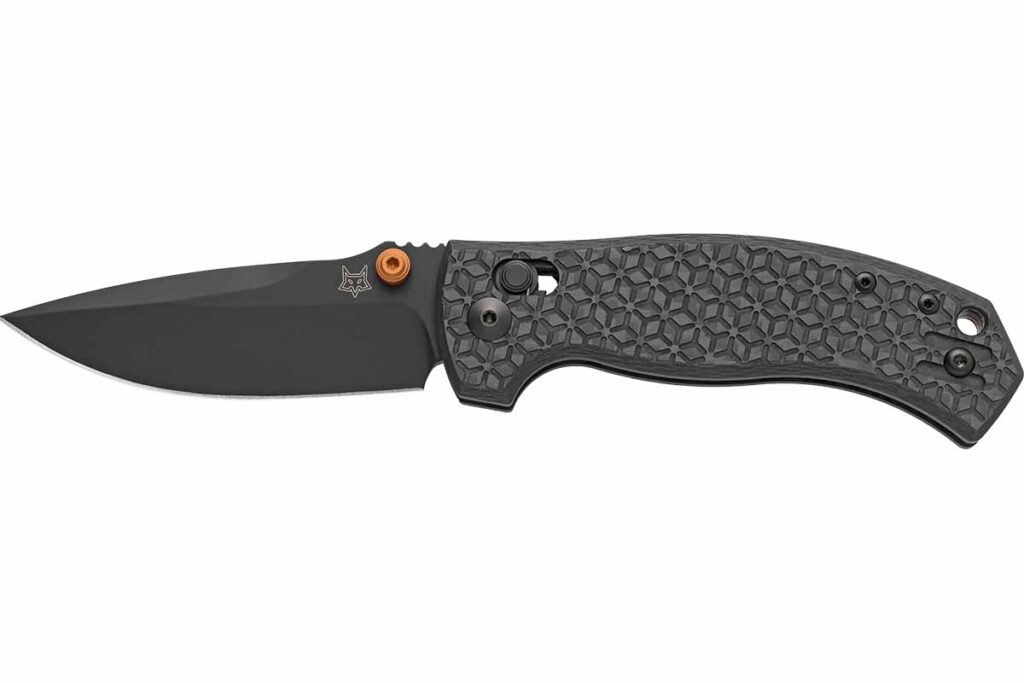
Fox Cutlery Anzu
Designer: Les George Knife type: EDC Blade length: 3.15” Blade steel: CPM MagnaCut stainless Blade finish: Black PVD Blade grind: Flat Handle material: 3K carbon fiber Lock: Verso Lock Pocket clip: Black PVD-coated 420 stainless steel, reversible Weight: 3.7 ozs. Closed length: 4.13” Country of origin: Italy MSRP: $225 at press-time exchange rate
Ocaso Duo Desk Knife
Model type: Desk knife Blade length: 2.75” Blade steel: 420J2 stainless Blade grind: Chisel Handle material: 420J2 Special features: Dual knives w/neodymium magnets Weight: 3 ozs. Overall length: 5.5” Knife to know: Includes walnut and stainless steel stand Country of origin: Taiwan MSRP: $149.99
Condor Tool & Knife Narrowsaur
Knife type: Survival Blade length: 4.2” Blade material: 1095 carbon steel Blade grind: Scandi Handle: Walnut Weight: 4.9 ozs. Overall length: 8.66” Sheath: Handcrafted leather Country of origin: El Salvador MSRP: $89.98
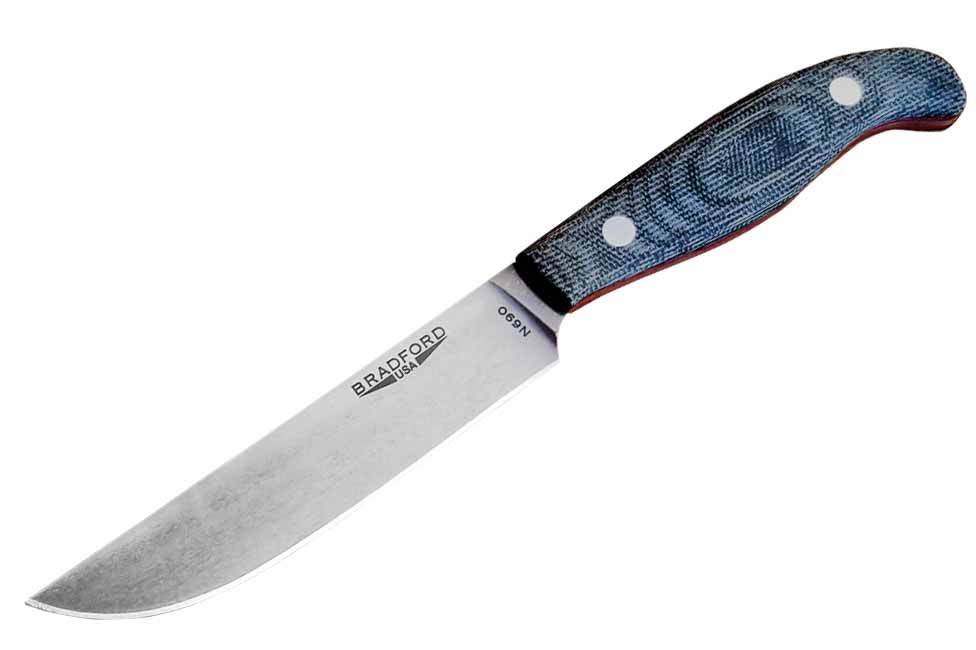
Bradford USA Gatsby Steak Knife
Knife type: Culinary Blade length: 4.5” Blade steel: N690 stainless Blade grind: Full-height flat Handle options: Maroon, wheat or ivory canvas Micarta®, and carbon fiber MAKER’S REMARK: As Nicole Bradford noted, “It makes your steak taste better!” Weight: 2.7 ozs. Overall length: 8.5” Sheath: 4-pack leather roll and/or individual Kydex Country of origin: USA Proud MSRP: $199 each
QSP Knife Turtle Punk
Designer: Keanu Alfaro Model type: Pocketknife Blade length: 3.5” Blade steel: Sandvik 14C28N stainless Blade grind: Flat Handle material: Black-and-white-pattern G-10 Lock: Linerlock Pivot: Ceramic ball bearings Pocket clip: Blade tip up, stainless steel, deep carry, ambidextrous Weight: 4.6 ozs. Closed length: 4.5” Overall length: 8” Country of origin: China MSRP: To be determined
Reate GTR
Knife type: EDC Blade length: 3.6” Blade steel: M390 stainless Blade finish: Hand satin Blade openers: Flipper tab, blade hole and thumb stud Blade pattern: Harpoon Handle: Titanium in a selection of finishes, color anodizations, Zircuti inlays and more Weight: 5.5 ozs. Closed length: 5” Country of origin: China MSRPs: $687 (w/Zircuti inlays) and $450 (titanium version)
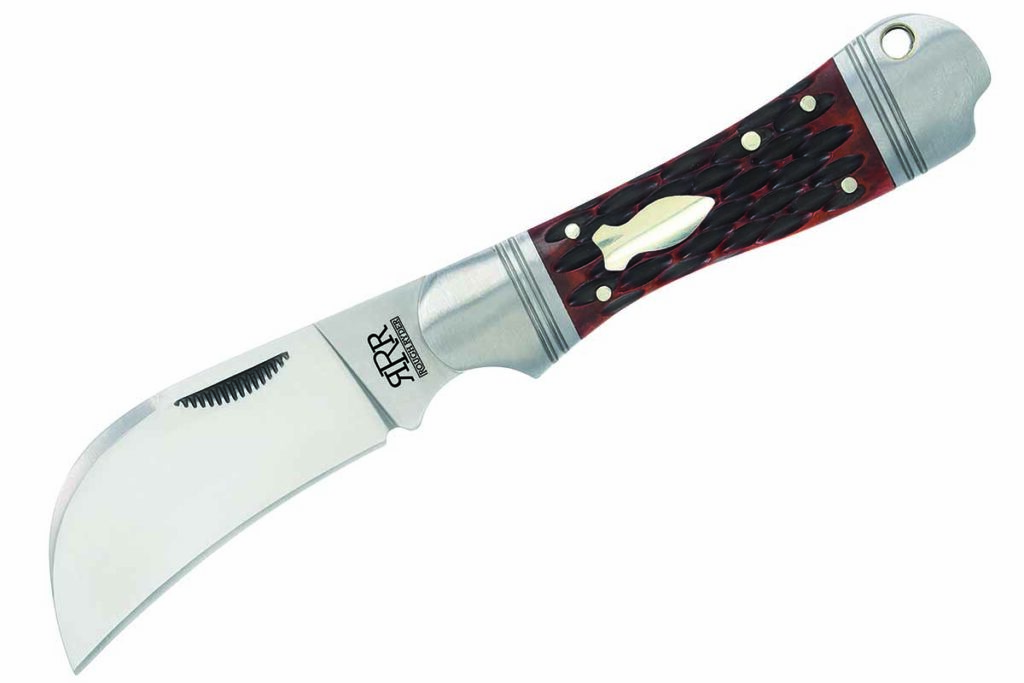
Smoky Mountain Knife Works Rough Ryder Reserve Hawkeye
Knife pattern: Gentleman’s hawkbill Designer: Brian Wilhoite Blade length: 25/8” Blade material: D2 tool steel Handle material: Brown jigged bone Action: Slipjoint w/half stop Weight: 3.2 ozs. Closed length: 3.5” Special features: Brass liners and lanyard tube, nickel silver bomb shield and pins Country of origin: China MSRP: $44.95
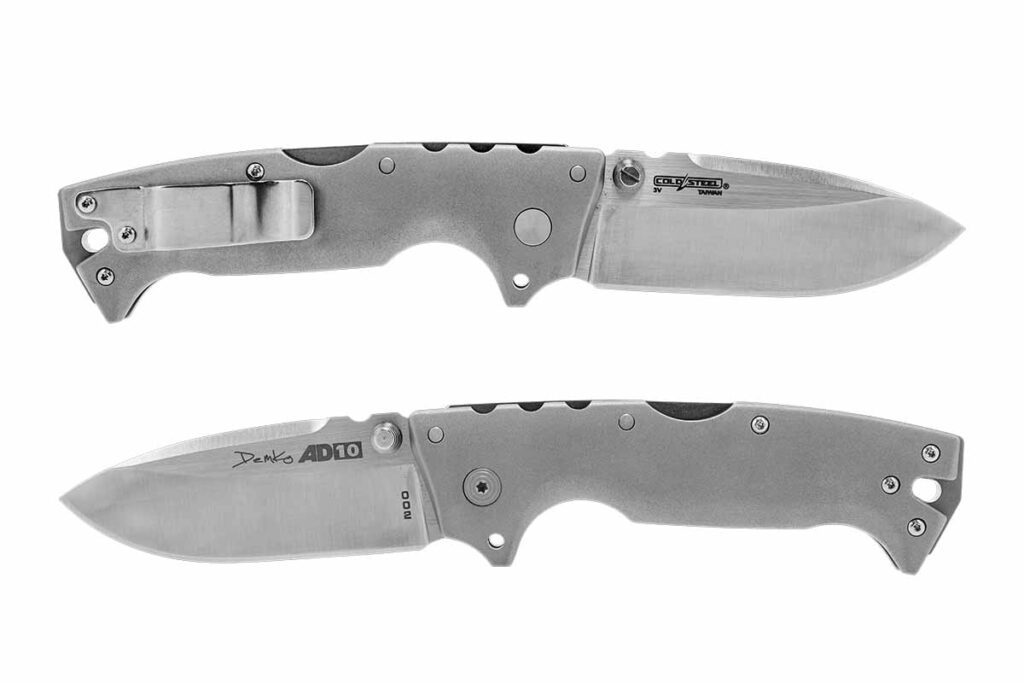
Designer: Andrew Demko Knife type: EDC Blade length: 3.5” Blade material: CPM 3V carbon steel Blade pattern: Drop point Handle material: Titanium Lock: Tri-Ad Pocket clip: Blade tip up Special features: Full titanium; limited run of 1,000; presentation box Weight: 9 ozs. Closed length: 5.25” Country of origin: Taiwan MSRP: $279.99
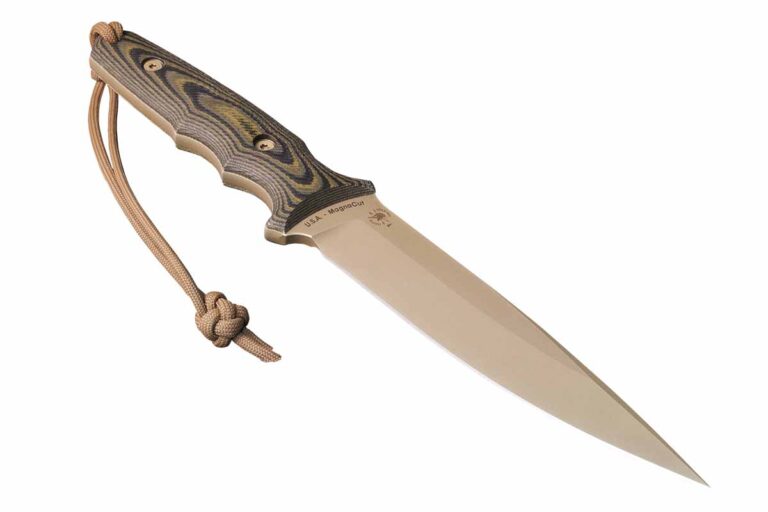
Spartan Blades Spartan-Harsey Clandestina
Designer: William W. “Bill” Harsey Jr. Knife type: Fixed blade, combat/utility Blade length: 5.5” Blade steel: CPM MagnaCut stainless Rockwell hardness: 61-63 HRC Blade grind: Flat/saber Blade @ thickest: 3/16” Handle material: CE canvas Micarta®, black or camo (shown) Weight: 7.6 ozs. Overall length: 10 3/16” Knife to know: Flat ground main bevel with tapered top edge Sheath: MOLLE and Kydex options Country of origin: USA MSRP: $360
Benchmade 99 Necron
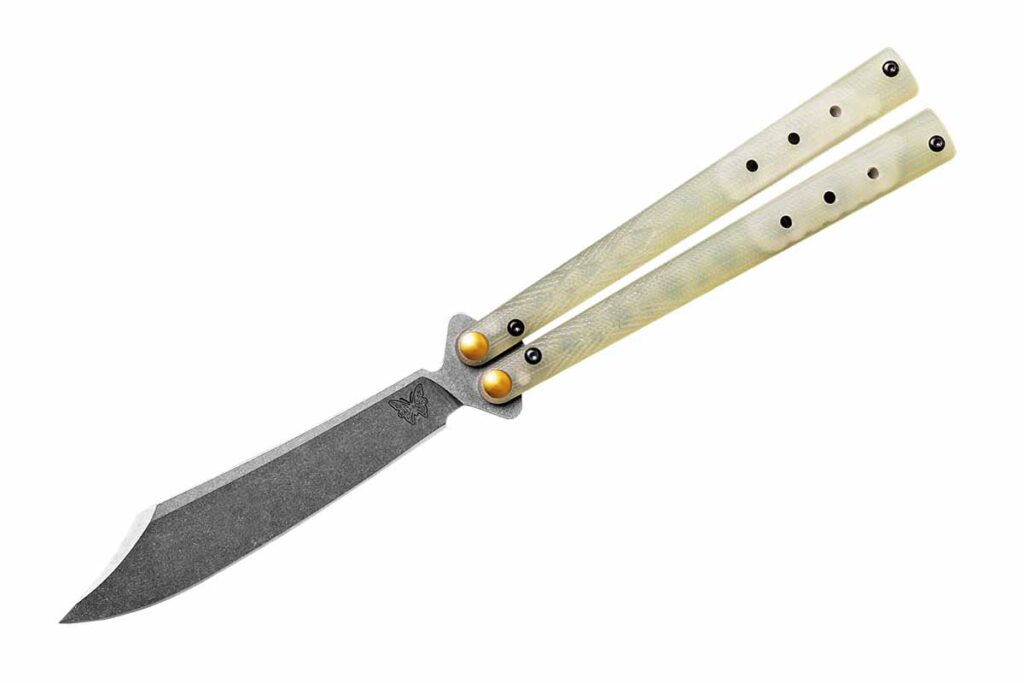
Knife type: Balisong Blade length: 4.59” Blade steel: CPM S30V stainless Blade grind: Scimitar Handle material: G-10 Lock: Latchless balisong Special features: Interchangeable backspacers and an interchangeable tungsten weight system beneath the G-10 scales tune the flipping dynamics; comes in ivory and ruby red (99BK-1) versions Weight: 4.21 ozs. Closed length: 5.08”; 5.92” w/extensions Carry: Nylon sleeve Country of origin: USA MSRPs: $500 ivory version, $550 ruby red version
WHAT: BLADE Show WHERE: Cobb Galleria Centre, Atlanta WHEN: June 7-9 DAYS and TIMES: Friday, 11 a.m.-6 p.m. (early bird ticket holders can enter at 10 a.m.) Saturday, 9 a.m.-6 p.m. Sunday, 9 a.m.-2 p.m.
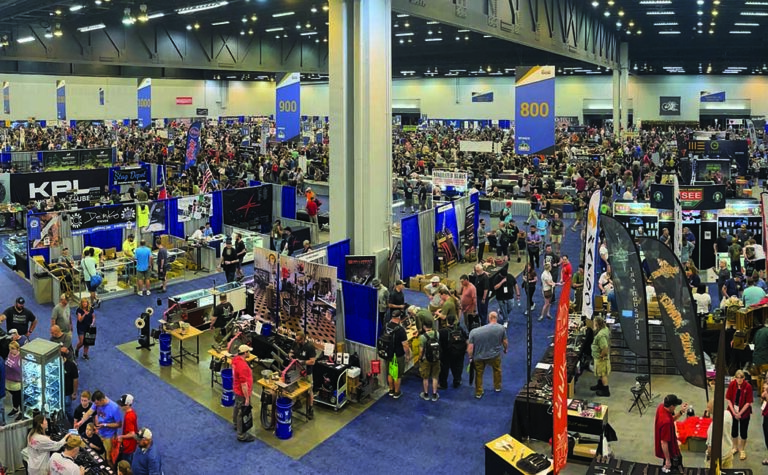
Thirty-five countries—including an increase in international exhibitors from 118 to 152—will be among the almost 950 exhibitors total for the 43rd Annual BLADE Show June 7-9 at the Cobb Galleria Centre in Atlanta.
Sponsored by Smoky Mountain Knife Works, the BLADE Show is where more knives—custom, factory, antique, classic collectibles, etc.—are exhibited, bought and sold than at any other knife event. Exhibitors will bring their latest and greatest knives and examples of most every edged tool extant, accessories, knifemaking supplies and more. Sharpeners, knife collections, knife purveyors and other cutlery entities too numerous to mention will showcase their wares as the world knife community makes the yearly pilgrimage to Georgia.
Knives debuted by factory companies for the first time anywhere, the educational knife instruction of BLADE University (see sidebar), and a selection of informative, entertaining and action-packed free demos (see sidebar) are among the sharp goodies awaiting show patrons. The BLADE Magazine 2024 Knife-Of-The-Year® Awards, the custom knife judging competition and the knife collection display judging competition are others. The American Bladesmith Society (ABS) Knife Auction, formal inductions of the latest members of the BLADE Magazine Cutlery Hall Of Fame®, and some of the best knives the ABS and the Knifemakers’ Guild and unaffiliated makers in general have to offer are still others.
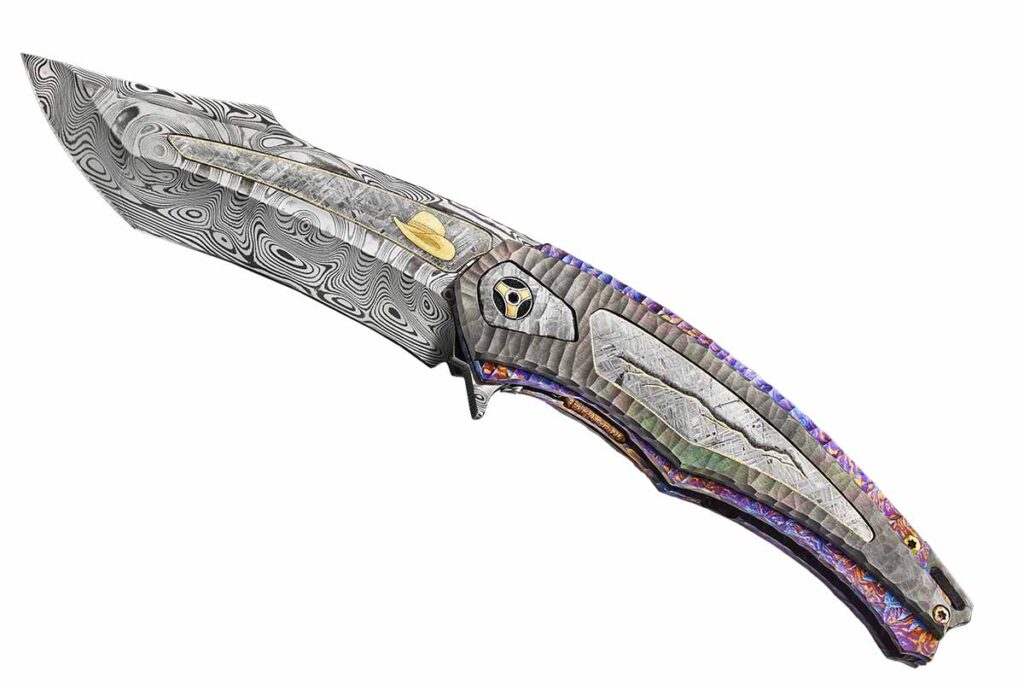
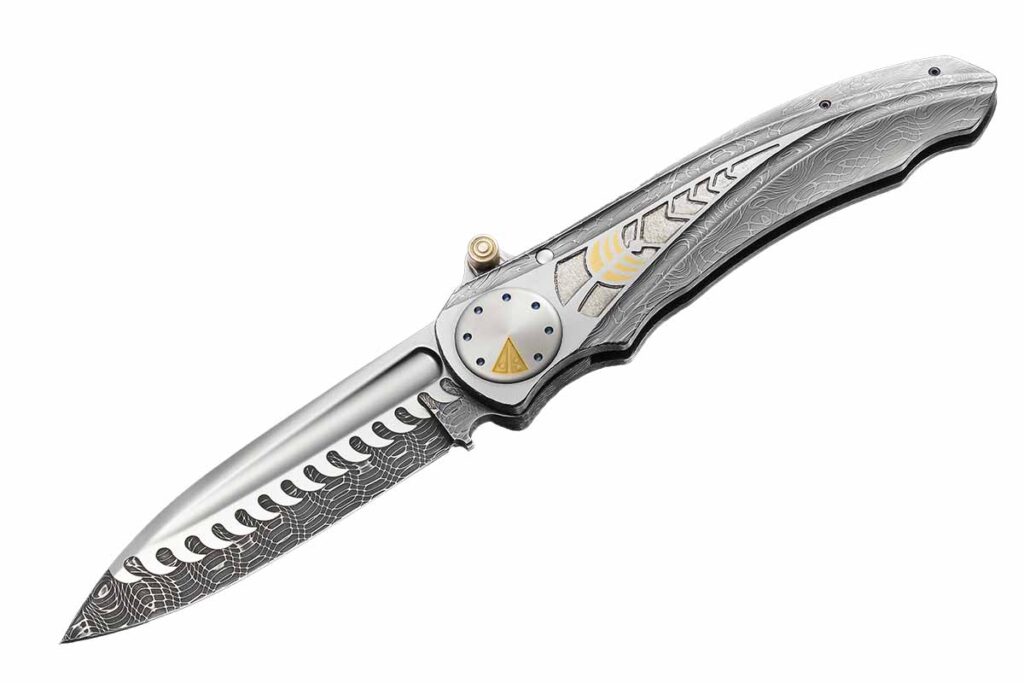
Italy’s Manuele Messori will be among the record-setting number of international exhibitors at BLADE Show ’24. An example of his edged wizardry is his folder in a blade of Damasteel Grossrosen damascus, an interframe handle of zirconium with Gibeon meteorite inlay, and 24k-gold engraving. (Francesco Pachi image)
And don’t forget The Pit, the after-hours meeting place in and around the sunken bar of the host hotel, the Renaissance Atlanta Waverly, where show patrons and exhibitors will party into the wee hours beginning the night before the show through the end of the weekend to compare knives, swap lies and otherwise celebrate the year’s most momentous cutlery weekend.
International Boom
As the world continues to recover from the travel, business and other bans spawned by the pandemic, the BLADE Show reflects that recovery in the boom in international exhibitors. In fact, that boom might even provide proof that the recovery is complete—at least as far as the BLADE Show is concerned. France leads the way among exhibitors from other countries with 21. South Africa is second with 18, Italy is third with 15 and Brazil is fourth with 13.
Some of the top names by country among the internationals are Bertie Rietveld, Theuns Prinsloo, Henning Wilkinson and Neels van den Berg (South Africa); Franco de Souza, Rodrigo Sfreddo, Fabio Barros and Gus Cecchini (Brazil); CAS Knives and Mauricio Daletzky (Argentina); Halfbreed Blades (Australia); WE Knife, Reate and Ketuo (China); Kiku Matsuda and Koji Hara (Japan); Lionsteel, Manuele Messori, Fox Cutlery and Maniago Knife Makers (Italy); Anders Hogstrom (Sweden); Helle Knives (Norway); Jean Louis Regel, Veronique Laurent and Samuel Lurquin (Belgium); and Grace Horne (United Kingdom).
BLADE Magazine Cutlery Hall-Of-Fame® member Michael Walker will exhibit his world-renowned knives at a BLADE Show for the first time in quite a spell. His Platinum Zipper features Michael’s fourth-generation BLADElock system. (Francesco Pachi knife image)
Among some of the more recognizable American makers will be BLADE Magazine Cutlery Hall-Of-Fame® member Michael Walker, who will be exhibiting knives at a BLADE Show for the first time in recent memory. Others include Cutlery Hall-Of-Famers Bill Ruple and Steve Schwarzer; ABS master smiths Harvey Dean, Mike Quesenberry, Shane Taylor, David Lisch, Jordan LaMothe and Andrew Meers; slipjoint makers Tom Ploppert, Luke Swenson and Tim Robertson; Vladimir Kolenko; and Owen Wood (a native of South Africa, Owen now calls Texas home).
Blade University: Added Day
Avail yourself of the latest knifemaking techniques and other trending sharp subjects during the 11th Annual BLADE University on Thursday, Friday and Saturday. New for this year is a special Thursday class taught by award-winning knifemakers Tom Krein and Lucas Burnley the day before the show begins. See the sidebar for more on it.
Sponsored by Work Sharp Sharpeners, BLADE University has the most extensive schedule of knife, knifemaking and other instruction held at any knife show. For the full list of classes, see sidebar.
THURSDAY, JUNE 6 4 to 5 p.m. The Art of Selling at a BLADE Show, Room 104. Knifemakers Tom Krein and Lucas Burnley outline what makers who are serious about selling knives should do and how they should behave behind an exhibitor table during the BLADE Show.
FRIDAY, JUNE 7 8 to 9:30 a.m. Fundamentals of Grinding, The Courtyard. AmeriBrade and guest makers cover grinds, technique and different equipment. 10 to 11:30 a.m. How To Run a Small Successful Knifemaking Business, Room 103. ABS master smith Bob Kramer shares his 30 years of experience running a productive knifemaking operation. 10:30 to 11:30 a.m. Thermal Cycle Steel for High Performance, Room 104. Larrin Thomas examines how to heat treat steel after forging, normalizing and grain-refining cycles, thermal cycling stainless steels after forging and more. 1 to 2 p.m. Symmetrical Quillon Dagger 101, Room 107. ABS master smith Neels van den Berg discusses making a symmetrical quillon dagger, covering design, proportions, aesthetics, materials, fluting and finally the entire manufacturing process. 1:30 to 2:30 p.m. Intro to Power Forging, Room 103. Bring your forging questions to our group of expert panelists including Logan Gillihan, Will Stelter, Salem Straub and Charlie Ellis. 2 to 3 p.m. Metal and Wood Fitting Techniques for Keyhole Handles, Room 113. ABS journeyman smith Henning Wilkinson outlines the correct techniques for fitting metal and wood in the construction of the keyhole integral knife handle. 3:30 to 4:30 p.m. Hands on Sharpening, Room 113. Bring your knife or a borrowed one and learn the progression of shaping a bevel, sharpening and edge maintenance from the team at Work Sharp Sharpeners. 4:30 to 5:30 p.m. Originality: Experimentation, Innovation and Ingenuity, Room 107. Can creativity be learned? Lucas Cao, founder of Squid Industries, explores tools and techniques that anyone can apply to become more original.
SATURDAY, JUNE 8 8:30 to 9:30 a.m. Elevating Your Handle Appearance: Spine Filework, Handle Shapes and Pin Placement, Room 113. Knifemaker Kyle Daily shares how to enhance your knife with distinctive features that go far beyond standard production models. 9:30 to 11 a.m. Insert Welding, Room 104. ABS master smith Bob Kramer covers how to forge weld inserts with high precision and control to create realistic depictions of animals and patterns. 9:45 to 10:45 a.m. How to Make the Most Difficult Pocketknife, Room 107. Knifemaker Tim Robertson delineates what makes lockback whittlers so hard to make, with a major focus on backspring design and function. 11 a.m. to 12 p.m. The Process Is the Product, Room 113. Knifemaker/designer TJ Schwarz shares his insights on how to create a successful knife business, including the key point of understanding actually what it is that you’re selling. 2:15 to 3:15 p.m. Let the Pros Critique Your Knife, Room 114. ABS master smiths Bob Kramer and James Rodebaugh and leading makers David Carver, Enrique Pena and Luke Swenson examine your knife and tell you what’s good about it, what’s not and how to make it better. 2:15 to 3:15 p.m. Hands on Sharpening, Room 113. Bring your knife or a borrowed one and learn the progression of shaping a bevel, sharpening and edge maintenance from the team at Work Sharp Sharpeners. 2:30 to 3:30 p.m. Making Scissors in a Knife Workshop, Room 107. Grace Horne examines the early history of scissors, methods of producing the blanks, inside information on the twist and the curve, and her method of scissors making that requires no specialist tools or equipment. 4 to 5 p.m. Pattern Welding Panel, Room 104. Salem Straub, Mareko Maumasi, Charlie Ellis, Josh Prince and Will Stelter explain the steps that went into creating their wild mosaic damascus billet collaboration, Consortium.
Knives Of The Year
The BLADE Magazine 2024 Knife-Of-The-Year® Awards will be announced and presented during the BLADE Magazine Awards ceremony Saturday at 8 p.m. by The Pit of the Atlanta Renaissance Waverly Hotel lobby.
The entries are limited to BLADE Show factory booth exhibitors, and will be on display show Friday and Saturday under glass in a special locked cabinet in the lobby. The winners will be announced on BLADE’s blademag.com website after the awards presentation, and a list will be posted outside the show entrance Sunday morning.
Custom Knife Awards
Leading industry authorities will pick the best custom knives by BLADE Show exhibitors in the annual knife judging competition, with the winners announced during the BLADE Magazine Awards ceremony Saturday at 8 p.m. in The Pit.
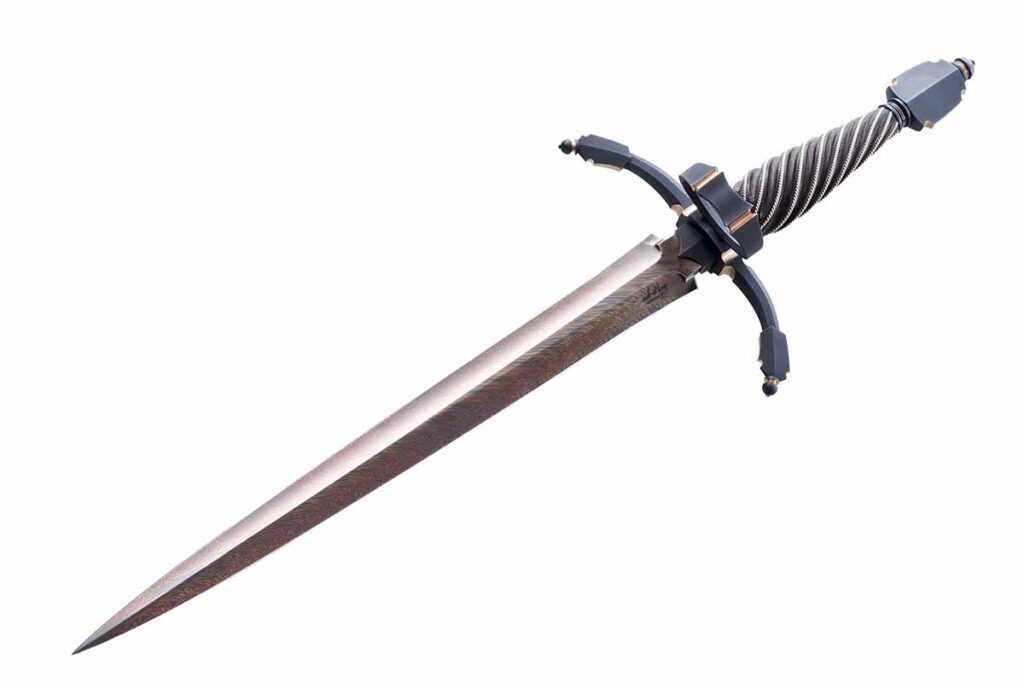
Neels van den Berg won the 2022 B. R. Hughes Award for the best knife submitted by a master smith applicant for his European quillon dagger. Join him for his BLADE University class, Symmetrical Quillon Dagger 101. (Eric Eggly/PointSeven image)
The categories are: Hugh Bartrug Best Of Show; Best Fixed Blade; Best Damascus; Best Kitchen Knife; Yvon Vachon Best Miniature; Best Art Knife; Best Fighter; Best Bowie; Best Handle Design; Best Tactical Folder; Best M.A.C.K. (Machine Assisted Custom Knife); Best Utility Hunter; Best Folder; Most Innovative Design; Best Knife Collaboration; Best Sword; Best New Maker; and Best Of The Rest.
The competition is open to the show’s custom knife exhibitors only. The winners will be announced on BLADE’s blademag.com website after the awards ceremony, and a list will be posted outside the show entrance Sunday morning.
World Cutting Titles
The BLADE Show World Championship Cutting Competitions will be conducted by BladeSports International (BSI) and held in The Courtyard, the parking lot of the host hotel, the Renaissance Atlanta Waverly, Saturday at 4:30 p.m.
At press time, contestants in both men’s and women’s divisions were scheduled to compete. Last year, Ben Propst won the men’s division and Michael Clifton the women’s. Second through fourth place in the latter went to Sara Maly, Sue Ann Propst and Jo Carothers, respectively. The same respective place finishers in the men’s division were Gary Bond, Dan Keffeler and Donavon Phillips.
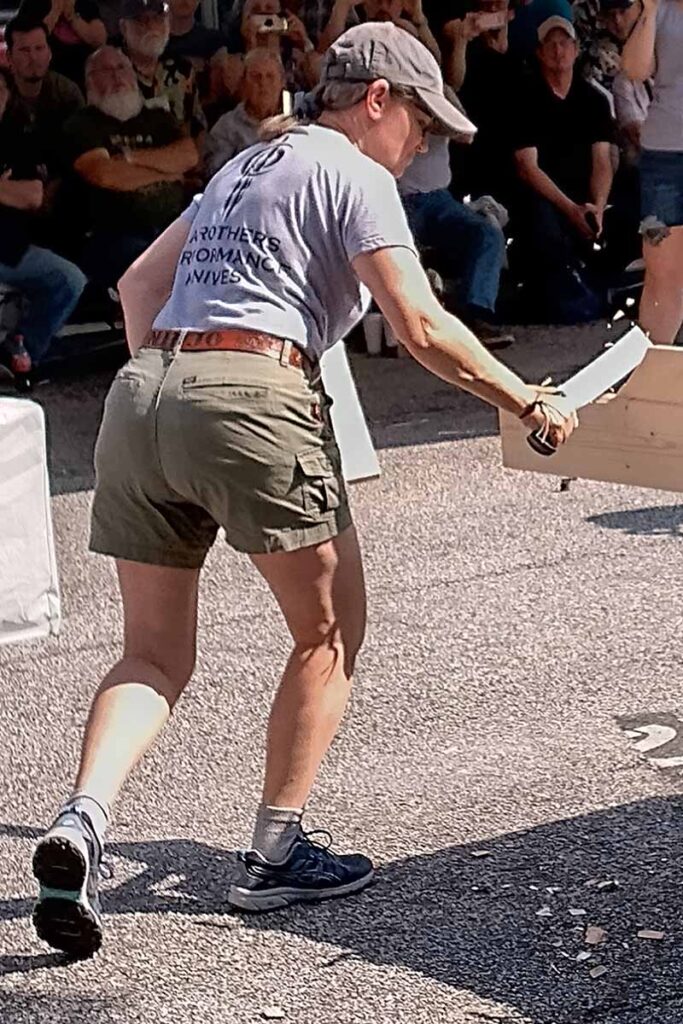
Jo Carothers finishes off the 2×8 in the women’s division of last year’s BLADE Show World Championship Cutting Competition.
Seminars & Events
Seminars and demonstrations are held in classrooms inside the Cobb Galleria or under the BLADE University tent in The Courtyard—the latter in the parking lot of the host Renaissance Atlanta Waverly Hotel. Admission is free to BLADE Show ticketholders. Two of the highlights include:
In what he termed will be the most important seminar he has ever given, Ernest Emerson of Emerson Knives, Inc., will deliver a no-holds-barred analysis of what it takes to be “made in America.” He will present a true insider’s, behind-the-scenes look at how difficult and yet how important it is to recognize the vital importance of American-made knife companies for the future of the knife industry.
High-Endurance Performance Knife master smith/BLADE® field editor Ed Fowler will ask just how confident you are that your EDC can handle everything from light office duty to saving a life. Key questions will include what is the knife made for? The design is what you see but the quality is up to the maker. The title of Ed’s seminar says it all: Can Your EDC Cut It?
SATURDAY 8 a.m.: BLADE Magazine Cutlery-Hall-Of-Fame Inductions, Kennesaw Room, Renaissance Atlanta Waverly Hotel 10-to-11:45 a.m.: ABS Knife Auction (page 30), Room 103 Noon-to-1 p.m.: Can Your EDC Cut It? High-Performance Endurance Knife master smith/BLADE® field editor Ed Fowler, Room 107 Noon-to-2 p.m.: NEW LOCATION 8th Annual Battle for Bali-Champion, conducted by Blade HQ, Garden Court area inside the Renaissance Atlanta Waverly Hotel (flipping starts at 12:30) 1-to-2 p.m.: What It Means to be Made in America, Ernest Emerson, Emerson Knives, Inc., Room 104 12-to-3 p.m.: Buck Collectors Club, Room 103 4:30 p.m.: BLADE Show World Championship Cutting Competitions, conducted by BladeSports International in The Courtyard
Cutlery Hall of Fame
The BLADE Magazine Cutlery Hall Of Fame® will formally induct three new members at 8 a.m. show Saturday in the Kennesaw Room of the Renaissance Atlanta Waverly Hotel. (At press time, the new members had not been determined.) Tickets are required ahead of time for the ceremony, which includes a breakfast. Seating is limited.
Knife Collections
Outstanding knife collections will be on display, with the best recognized via a judging competition. Last year’s winners included Gene Merritt, who took Best In Show for his Buck Yellowhorse display. Judges Awards went to Tim Lindsey for his display entitled “Vern Taylor Buck Collectors Club Founder” and Ed Cooper for “Yellowhorse Knives.” Sarah Lindsey won the Youth Award for her display, “One of a Kind Buck Custom Character Knives Incredible!”
Bali Title: New Location
Top balisong flippers will vie for the title of “Grand Master” in the 8th Annual Battle for Bali Champion sponsored and conducted by Blade HQ.
Balisong Competition placers
BLADE Show ticket holders are invited to watch the competition in the Garden Court area located inside the Renaissance Atlanta Waverly Hotel on show Saturday from noon to 2 p.m. This is a venue change from last year’s Courtyard location, so please make a note. Competitors will start flipping knives at 12:30 p.m.
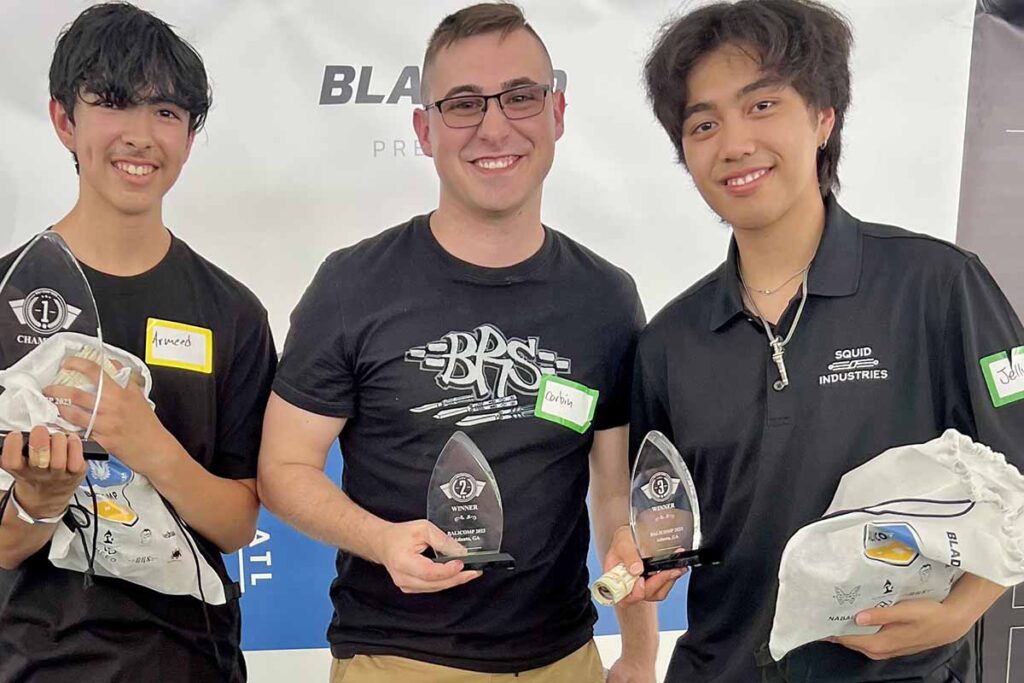
The top three finishers will receive prizes and all participants will get swag bags. The competition will be limited to 48 contestants. Landon C. Morrison was crowned Bali-Champion last year, with Corbin Lovins finishing second and Gene Keli Castillejo third.
More To Come
The final BLADE Show-sponsored event for 2024 will be BLADE Show West, Oct. 4-5 at the Salt Palace Convention Center in Salt Lake City, Utah. For details, visit bladeshowwest.com. BLADE Show Texas 2025 will be March 7-8 at the Fort Worth Convention Center. Visit bladeshowtexas.com for more on it. And, of course, it’s never too late to start thinking BLADE Show 2025 June 6-8 at the Cobb Galleria Centre in Atlanta. For details, visit bladeshow.com.
Dowell, Harsey and Fogg join the ranks of other greats.
Custom knifemakers T.M. “Ted” Dowell and William “Bill” Harsey Jr. and ABS master smith Don Fogg have been voted the 2024 inductees into the BLADE Magazine Cutlery Hall of Fame®.
The three were elected by a vote of sitting members of the Cutlery Hall of Fame and a panel of industry authorities, the latter assembled by BLADE® Magazine. The vote was finalized April 25.
The trio will be inducted formally in a special ceremony during the 43rd Annual BLADE Show June 7-9 at the Cobb Galleria Centre in Atlanta. The ceremony will be held Saturday, June 8, at 8 a.m. in the Kennesaw Room of the Renaissance Atlanta Waverly Hotel, the host hotel of the BLADE Show. For ceremony ticket information, visit [email protected].
Dowell was one of the founding members who established The Knifemakers’ Guild, the grandaddy of all modern knifemaker organizations, in 1970. Along with fellow Cutlery Hall-Of-Famer Bob Loveless, Dowell wrote the Guild’s original bylaws. Ted was Guild president in 1975 and coordinated the organization’s first custom-knives-only-no-guns show. He helped Cutlery Hall-Of-Famer Phil Lobred establish the Art Knife Invitational in the early 1980s. Lobred credited Dowell with making the first modern integral knife, a design Ted introduced in 1972 in his basic hunting knives and which eventually evolved into some of the most ornate of integral art knives. Integral knives in general turned into a category of their own and remain popular to this day. Ted passed away in 2012.
Fogg and Murad Sayen formed a partnership called ‘Kemal’ in 1980. Kemal created some of the best art knives ever, including one pictured in Esquire Magazine. The accompanying article helped bring the beauty of art knives to the world. In 1981, Bill Moran and Fogg received the first ABS master smith ratings. In 2006 Don was inducted into the ABS Hall of Fame. He long has shared his vast knowledge. He revealed the art of Samurai and Viking sword making and developed the W’s damascus pattern. He shared the drawings of his best gas forge and his gas heat treat oven for swords. He built one of the first 20-ton hydraulic forging presses for making damascus. Today the press is as popular as a power hammer. He also was instrumental in starting the ABS bladesmithing school in Auburn, Maine.
Harsey has made and designed knives for 38 years, during which time he has been one of the most prolific and recognizable names in the industry, working behind the scenes and designing for Al Mar Knives, Beretta, Chris Reeve Knives, CRKT, Gerber, Ruger and Spartan Blades. He worked and consulted with and designed for Cutlery Hall-Of-Famer Col. Rex Applegate, including the British SAS Collaboration Knife. Bill designed the U.S. Army Special Forces Green Beret Knife, aka The Yarborough, for Chris Reeve Knives, a serialized version of which was presented to each graduate of the Special Forces Qualification Course. He also designed the official knife of the Canadian Special Forces and the U.S. Navy SEAL Silver Trident knife, and worked on the Neil Roberts knife project.
The elections bring to 74 the number of members in the Cutlery Hall of Fame, the world’s only shrine to the giants of the entire knife industry.
Follow these simple rules and you’re sure to have a great show.
If you’re among the throng of thousands going to the BLADE Show June 7-9 at the Cobb Galleria Centre in Atlanta, here are a few tips on how to make the world’s largest, most important knife event work for you:
What To Wear
If in doubt “go dark”—any one or more of black shirt, blue jeans or black hat. While tactical doesn’t rule the way it once did, black remains the color of choice among many knife fans. Whatever color you choose, wear loose-fitting, comfortable clothes. If you want to overdo it, clip a knife to every pocket.
Comfortable shoes that provide full support against walking on concrete all weekend are an absolute must. Some bring two pair of such shoes. Bring a small backpack for snacks, a small plastic water bottle, etc. If you go outside for the BLADE University classes or free seminars, a ballcap helps protect against a June Georgia sun that has fried thousands of BLADE Show patron scalps over the years.
Party Proof Yourself
If you join the revelry and revel too much in The Pit (page 24), the lobby bar of the host Renaissance Atlanta Waverly Hotel, take some kind of headache relief before bedtime to reduce the dreaded post-Pit hangover. And, if you stay in the Waverly, bring some earplugs. The Pit can get raucous even into the wee hours and the noise can carry up to the hotel rooms, including the top floor.
Show Etiquette
Try to avoid walking fast and making sudden stops and U-turns in the exhibitor halls. Thousands of knife fans like you are moving, too, often closer to each other than they should. Any abrupt moves can result in collisions, so take it slow and easy. You’ll see more knives that way, too.
Never ask a maker how long it took him/her to make a specific knife. It’s natural to be amazed at some of the fabulous works of art and to be curious about how long it took to make one, but many makers bristle at the question. It’s not as important to know why they resent the query so much as the fact that they do, so don’t ask.
Don’t interrupt a maker/customer conversation. Patiently wait your turn or come back later when the maker is free to talk.
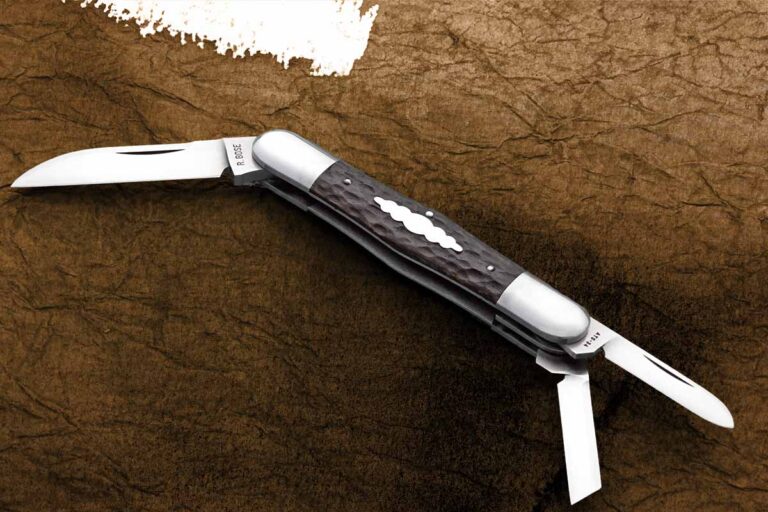
Ask the maker before you pick up a knife. If it’s a folder, it doesn’t hurt to ask permission to open it. The maker may want to open it for you. If a multi-blade folder, don’t open it so two or more blades are open at once. This puts undue pressure on one or more of the backsprings. It’s also a good way to cut yourself if you’re not careful. If you’re wanting to see what kind of clearance there is between opening/closing blades, ask the maker to demonstrate it for you. And when you finish examining the knife, return it the way it was handed to you—carefully, whether open or closed.
While it may seem courteous to wipe the blades off before returning knives to the makers, don’t. Let the makers do it instead. They are fully equipped to do so and are going to check the knife for any spots you may miss anyhow. That doesn’t mean you shouldn’t bring a chamois for your own purposes. However, if there’s any wiping down of their knives to be done, let the makers do it.
Don’t use a loupe/magnifying glass to examine a custom knife. It’s a good way to make the maker mad. There are going to be imperfections on custom knives—if not, they’re probably not custom—so some minute imperfections are to be expected.
After you finish talking to the maker and are ready to leave, even if you intend to return to his/her table, don’t say, “I’ll be back.” Chances are you won’t. It also implies you’ll be back to buy a knife when you may have no intention whatsoever of doing so. Don’t be an “I’ll Be Backer!”
One thing to be sure to do: have fun. If you’re going, see you there!
Four outstanding smiths will have gems coming across the block.
The annual auction of American Bladesmith Society knives to support the continuing programs of the ABS is a highlight of the BLADE Show, and 2024 will be another memorable year when the hammer comes down at the Cobb Galleria Centre in Atlanta.
Once again, ABS master smith Brion Tomberlin is handling the logistics of the pre-auction process. He has brought together a roster of four outstanding ABS bladesmiths for this year’s event, and his appreciation of the ABS and what it means is reflected in his recent years of dedication to the auction.
“The ABS means so much to everyone involved and to the legacy and future of bladesmithing,” Brion commented. “It has developed so many bladesmiths through the years and helped to carry on the traditions and methods that have been used for generations. At the same time, it has brought along a younger group that will help keep interest in the forge alive and prospering.”
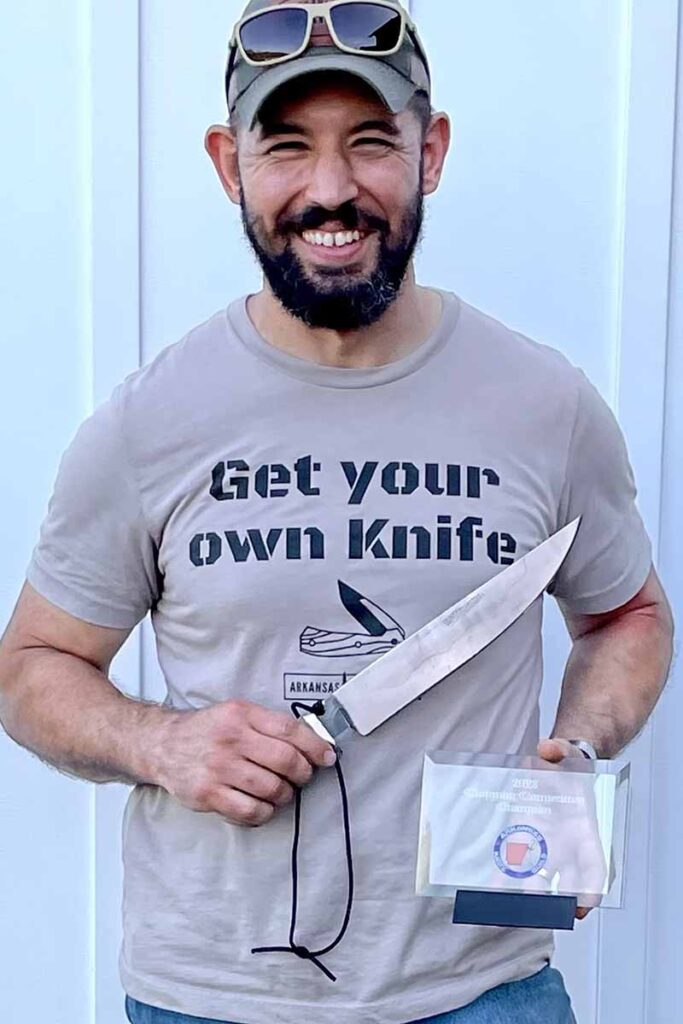
Jonathan Caruso holds the trophy and the knife he used to win the Arkansas Knife Guild Chopping Competition in Pickles Gap, Arkansas, in 2023.
Long Clip-Point
Jonathan Caruso of Conway, Arkansas, has been an ABS member for nine years now and earned his ABS journeyman smith rating at BLADE Show ’22. He will provide a long clip-point hunter with a single guard for the auction and to showcase his talent. “I chose this style of knife for the purpose of use,” he commented. “Although the knife was designed to be eye-catching, all my knives are created to be used for the tasks they were created for, which in this case is a functional hunting knife.”
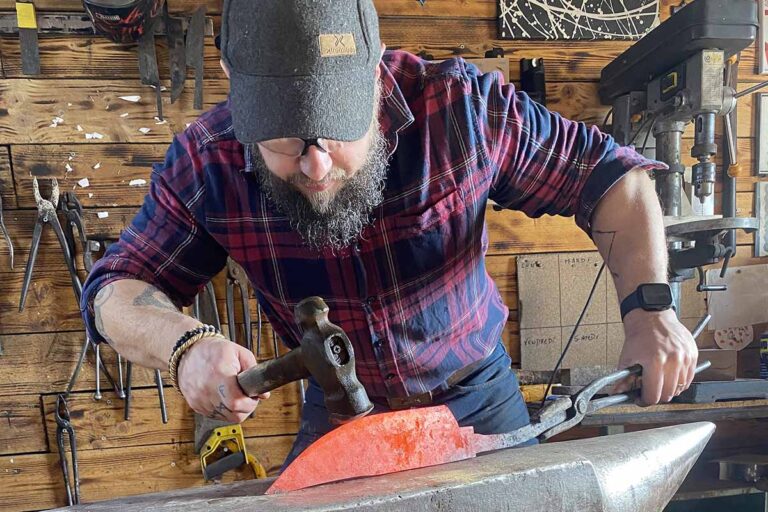
Caruso adds that his goal with his ABS contribution knife is to deliver form and function with “a nice appeal, much like an evening gown or a cocktail dress.” He has added the flair and visual appeal of a hamon—essentially the line of demarcation where the hardened cutting edge and the softer spine converge on the blade—using a technique he learned from ABS master smith Jim Crowell. “It’s a process dubbed a ‘flame-painted hamon,’” Jonathan explained. “Instead of using the traditional clay method to create the hamon, I use an oxyacetylene torch to heat the cutting edge before hardening. I chose this method because I wanted to incorporate what I’ve learned from a very well-known master smith who has taught me a wealth of knowledge about bladesmithing and the history of the ABS.”
Caruso’s clip-point hunter features a 6-inch blade of W2 tool steel, sculpted guard of 416 stainless steel with vulcanized red and black spacers, and a handle of stabilized black walnut from Knife & Gun Finishing Supplies. Overall length: 11 inches.
“I chose the W2 to get a more definitive differentially heat-treated appeal,” Jonathan noted, “and the black walnut handle because it draws the eyes in to look at its stunning details. I feel like the handle material was waiting for such a knife and such an occasion as the ABS auction to be used. The black walnut handle material was purchased from Iron Dungeon Forge at BLADE Show Texas in 2023. I finally made it over to their table late on the afternoon of the first day and couldn’t believe that this beautiful piece hadn’t been bought yet.”
ABS master smith Steve Dunn
Chairman’s Trapper
Current ABS chairman Steve Dunn has been a member of the Society since 1990, two years after he began making knives as a hobby. He became an ABS master smith in 1994 and has taught at the ABS schools regularly. He joined the organization’s board of directors in 2003 and has been a committed servant of the ABS for 34 years.
“Each year the ABS has an auction at the BLADE Show to raise money for our schools for education of the forged blade,” he remarked. “I was asked to make the master smith folder this year, and I chose to make a traditional slipjoint. The reason I chose the slipjoint is that most everyone carries some kind of pocketknife—mostly slipjoints, I would think.”
Dunn’s contribution to this year’s ABS auction is a single-blade trapper with a 3-inch blade of twisted W’s pattern damascus. The damascus is a combination of 1075 carbon and 15N20 nickel-alloy steels. The bolster sports American-style scrollwork with 24k-gold inlay. The scales are sambar stag. Closed length: 3.75 inches. “The reason I chose this blade steel is that the two components contrast well together and for the edge-holding ability they offer,” Steve said.
Dagger Hamon
For James Rodebaugh, who joined the ABS in 1999 and received the Society’s master smith designation in 2004, the ABS is a worthy recipient of the contributions from its members to the auction each year. “Number one, the ABS is largely responsible for the high level of bladesmithing in the world today and the award winners that are recognized at the BLADE Shows in Texas and Atlanta. The ABS is always well represented when the winners are named in these shows, overwhelmingly so.”
Rodebaugh became a member of the ABS board of directors in 2014, and he sees the organization as continuing to build a future for the art of bladesmithing. Meanwhile, he is pleased to help out with the auction. “The ABS has given a lot to the knifemaking world,” he observed, “and this is my way of giving back in general.”
For the auction, James has chosen a dagger with an 8-inch blade of W2 tool steel that’s about an inch across at its widest point. The frame handle construction will feature domed silver pins and Tasmanian blackwood. James expects the overall length to be between 12 and 13 inches. An added feature is the clayed hamon.
“I don’t see many people doing a dagger with a hamon,” Rodebaugh opined, “and that used to be one of my signature things until I got away from it. I was originally going to go with damascus, but we see a lot of that, and with the finishing aspect of the work it is harder to do a properly finished carbon steel blade with a hamon than it is to etch a piece of damascus. Plus, I just like the look of the hamon. Also, the W2 steel shows a lot of action on the hamon, and it has a fairly short time and temperature curve so that the edge will harden and the thicker portion will stay soft, which gives you definition and activity on the hamon.”
Coffin Bowie
As French ABS journeyman smith Nicolas Dartus noted, “For me, the coffin bowie is a typical American knife, and I love it.” His rendition for the ABS Auction offers 320-layers of damascus, a giraffe bone handle and a leather sheath. (Eric Eggly/PointSeven knife image)
ABS journeyman smith Nicolas Dartus began forging in his shop in eastern France in 2014, joined the ABS in 2016, and received the Society’s journeyman designation at BLADE Show ’19. He is working toward his master smith goal today, and he says that it is an honor to have one of his knives included in the prestigious ABS auction.
“For the auction, I’m making a coffin bowie,” Nicolas said. “For me, the coffin bowie is a typical American knife and I love it. Of course, my eye is a French eye, and I don’t have an American interpretation for this creation, but it is my vision! I think individuals have their own styles of knives. Of course, the ABS is an American society, but its members come from all over the world with different cultures and design ideas.”
Nicolas plans to make the knife with a blade of 320-layer damascus forged from 1075 carbon and 15N20 nickel-alloy steels. The handle will be giraffe bone and the piece will be accompanied by a leather sheath. “I’ll make the knife the traditional way,” he offered. “For me, working with the ABS is a great adventure.”
When these wonderful examples of modern bladesmithing come up for sale, the bidding is liable to be as heated as any forge. Those who go home with one of these beauties will not only have the satisfaction of ownership, but also in knowing they have directly assisted the ABS, providing support for the society’s ongoing mission of excellence.
Observe all nine and your collecting pursuit can be most satisfying.
I have watched the custom knife market for 40 years with more than idle curiosity. The universal mantra of collectors regarding their collections is I buy what I like. At the outset, it seems a simple statement. The real question is, what does the collector collect and why?
The best thing about a collection is that it is yours. You decide what knives enter and which ones leave. Often, it is a combination of the design/style, material(s) and maker. Then again, it can be knives with a singular attribute that make up the collection. I have also found that the mantra of the collector is invoked when part of his or her collection is difficult to sell or trade.
TIP #1
Collecting and investing are not the same. Assembling a collection is done primarily for the pure joy of it. The search and subsequent acquisition of each knife only fuels your desire to increase/improve your collection.
One of the great things about custom knives is getting what you want. Custom knives can be made to your specifications, not knives that are merely one of a hundred thousand. Investing in custom knives is done for the specific reason to re-sell for a profit. Buy what you like because you may have it for a long time, whether that is your intention or not.
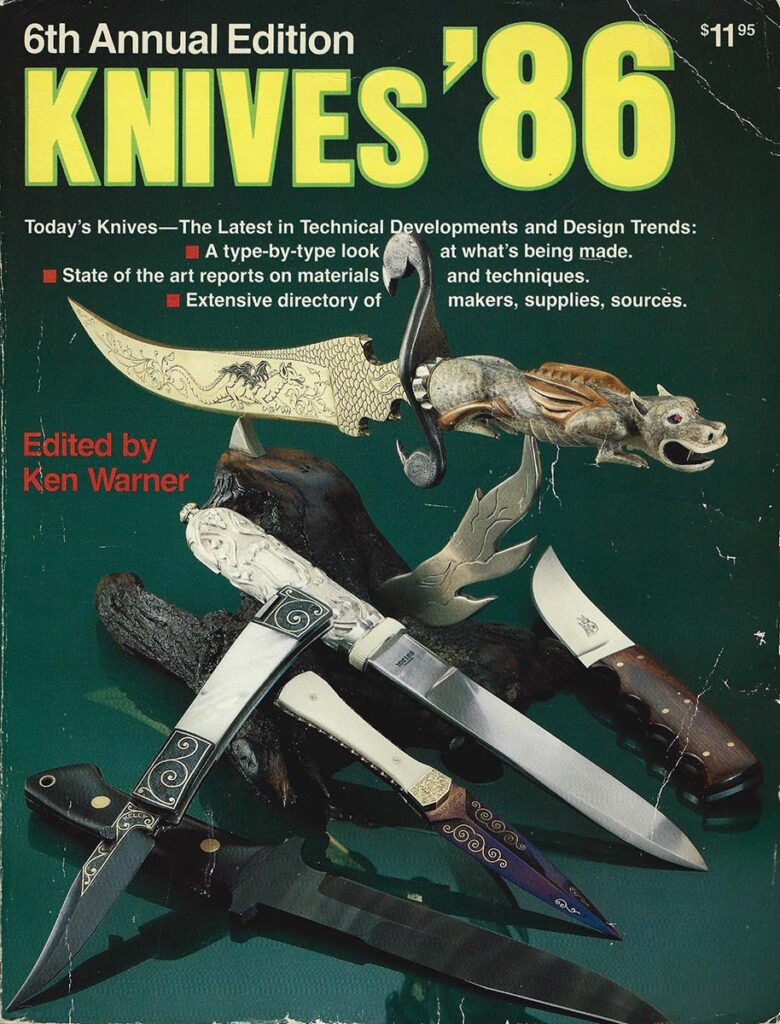
The author kept pages of notes in his copy of KNIVES ’86 that he bought in 1985. It became a blueprint for his knife collecting and then later for his business, including which knives he liked, questions to ask the makers and so on.
TIP #2
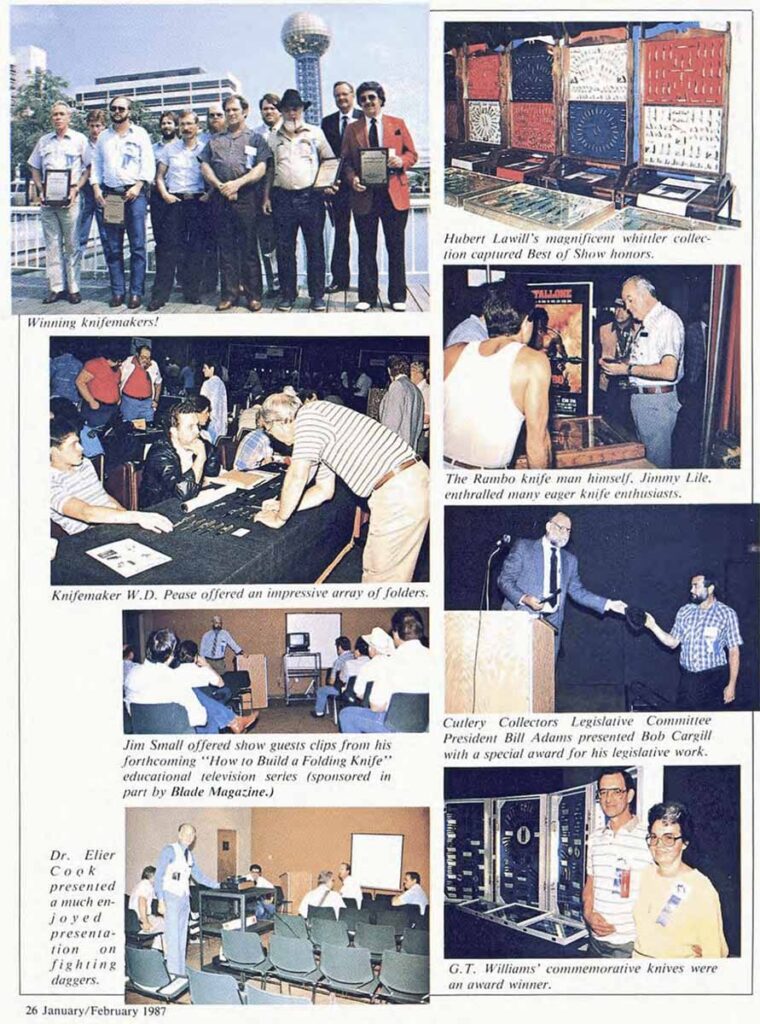
Do your research before you buy. I started doing research early on as a collector. I still enjoy looking at the KNIVES ’86 I got in the fall of 1985. In my copy of the book are pages of notes that became a blueprint for my collecting and then later for my business as a purveyor of custom knives, including which knives I liked, questions to ask the makers, etc. I then contacted the makers for their catalogs or just called them to get the information on each. Considering several factors or knife-buying skills listed here allowed me to identify and get the five knives I wanted at the 1986 BLADE Show. Today, the Internet saves a lot of time when researching knives.
TIP #3
Decide the direction of your knife collection (at least for this week). Determining a direction for your collection will be easier if you can master Tips 1 and 2. Doing your research before attending a show or placing the order will save you from a custom knife collector’s worst enemy—buyer’s remorse.
TIP #4
Buy the very best knife you can afford. This is an important concept to understand, as this will help you look past what many of us consider the most important factor: price. Price is not the most important factor, cost is. Price is what you are willing to pay for a custom knife. Cost is the hidden part of the price equation for not knowing if the knife is priced correctly for the maker’s position in the market. Overpaying for a knife will become an issue should you choose to sell or trade the knife.
A critical reason for mastering Tips 1 through 4 is that they will enable you to determine which knife is the best for you for the amount of money in your budget. Sometimes it is more prudent to take the money you would spend on two knives and buy only one. When considering buying a knife, always employ Tip #1 and consider the short- and long-term costs of the purchase.
TIP #5
The truth changes. This applies to many things in life, including the knives in your collection. Enlightenment can be a double-edged sword. You will begin to evaluate your collection as you gain expertise in custom knives. Mistakes that were invisible to you before now catch your eye. This expertise, however, is now helping you select better-made knives.
The author got the five knives he wanted at the 1986 BLADE Show. Scenes from the show, clockwise from top left: winning makers in the custom knife judging; Hubert Lawell’s collection of 500 pearl-handle whittlers; Jimmy Lile at his table; Bill Adams and Jim Cargill; Mr. and Mrs. G.T. Williams; Dr. Eiler Cook’s seminar; Jim Small’s seminar; and W.D. Pease at his table. Adams, Lawell and Lile are all members of the BLADE Magazine Cutlery Hall Of Fame®.
Knife publications, without a doubt, will influence the custom knife buyer by putting a knife on the cover or doing a big spread on a knife or knives. A feature or cover can create immediate demand for a maker’s work. You need to understand how this publicity will affect that maker’s short- and long-term pricing.
Because of the ability to disseminate information quickly, the Internet influences trends and fads. Social media creates the buzz with the latest photos of a particular maker’s work or a style of knives. Often the buzz influences buyers to act quicker than usual. This information can create a short-term inflated demand for the maker’s work. At the same time, it can drive up aftermarket prices to stupid levels. Those of you who bought the so-called tactical folders of the last decade know that what I like to call the Hype Cycle can be a double-edged sword. Collectors must pay attention to the buzz as it can have a long-term effect on their collections. My experience has shown me that the buzz is a poor shortcut for actual research.
KNIFE IQ
Try to determine the direction of your collection as early as possible with the understanding that you are not committed to this direction for an extended time. The reasoning behind this determination will help your focus, saving you both time and money. Once you have identified the direction you would like your collection to take, start your research. Raising your knife IQ prevents you from passing on a quality knife due to your failure to recognize the knife’s worth. Conversely, you could purchase a knife that you may trade or sell one day only to find that you overpaid for it.
The FOUR F’s
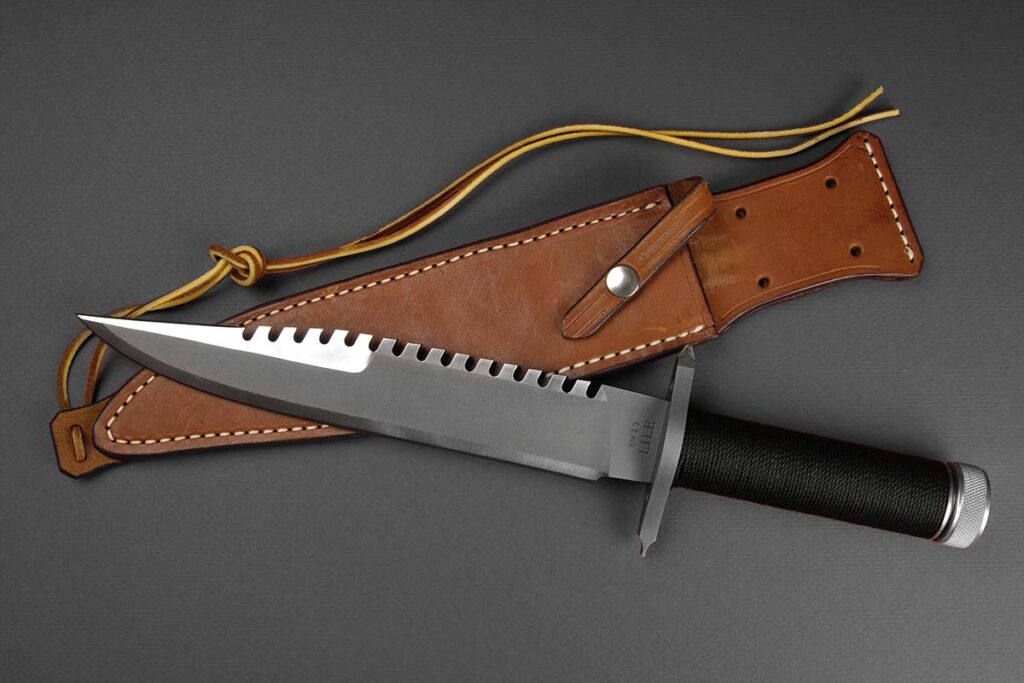
“Tactical movie knives have been and remain very collectible,” the author observed. BLADE Magazine Cutlery Hall-Of-Fame® member Jimmy Lile started the category with the Rambo knife. “This knife is responsible for my becoming a custom knife collector,” the author maintained. The 9-inch blade is bead-blasted 440C stainless steel. The cord-wrapped hollow handle has an aluminum buttcap. Guard: stainless steel. Lile passed away in 1991. (image courtesy of Jack Lucarelli)
Doing your knife research will increase your knife IQ. Increasing your knife IQ will help you get the best value for your money and enable you to confidently add knives to your collection. The building blocks of this research are the Four F’s: Fit, Finish, Flow and Function.
Fit: how does the knife fit together? Are there gaps between the blade and the guard? Are the scales flush with the tang? These are examples of some of the areas to examine.
Finish: I look for consistency and degree of difficulty. No matter what type of finish, is it consistent from the tip to the end of the knife with no spots, scratches or other inconsistencies? The degree of difficulty comes in the form of the type of finish. A mirror finish is much more complex than a tumble or bead blast finish. I give bonus points for two-tone finishes, such as a mirror finish on the hollow of the blade and satin for the flat of the blade.
Flow: Does the knife transition smoothly from one end to the other? Uneven grinds, blocky guards and poor ergonomics detract from the flow of the knife.
Function: Is the knife designed and built to complete the task it is supposed to accomplish? Will the knife do what the design intends it to do? While there is always room for improvement on standard designs, the maker should temper those changes and base them on reality. Often the designs border on or move into the fantasy realm.
Spending time on your favorite social media platform and reading knife magazines like BLADE® can help your knife IQ. However, nothing can replace attending a knife show and putting the knife in your hand, allowing you to apply what you have learned about the Four F’s. You can calibrate your eyes to the sometimes-subtle differences between knives in the same category.
Conclusion
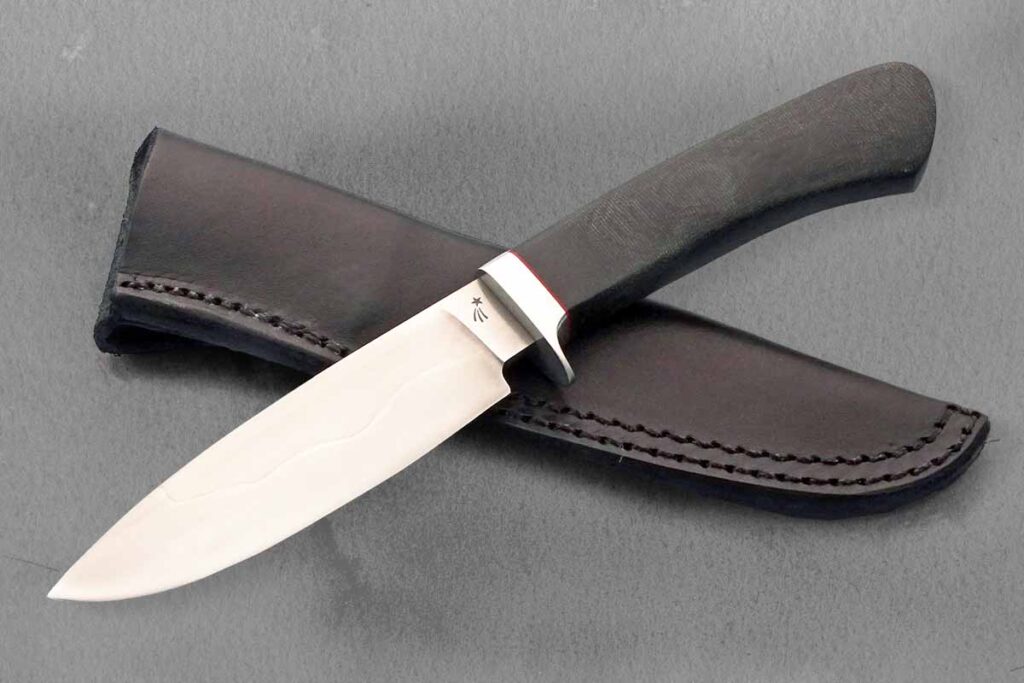
“Some collectors look for entry-level ABS master smith knives,” the author stated. “Utility hunters such as this one by ABS master smith Jim Crowell are a perfect example of that collectible category.” Jim’s forged drop point hunter has a 5-inch blade of W2 tool steel with hamon and a black Micarta® handle. Overall length: 9.75 inches. Jim’s custom leather sheath completes the outfit.
Buy what you like, enjoy what you have and welcome to the hunt for the next piece of your collection.