Home Blog Page 70

What’s New: Top Knives—Damascus, Stainless Steel And More

0

Damascus, high-performance stainless and straight carbon steel standouts.

Always on the lookout for the new and exciting when it comes to edged gems, Blademag.com has collected a bevy of beautiful new knives hitting the market. This includes both custom and factory knives with a particular eye towards damascus, high-performance stainless and straight carbon steel standouts in this round.

Bertie Rietveld: Flirt
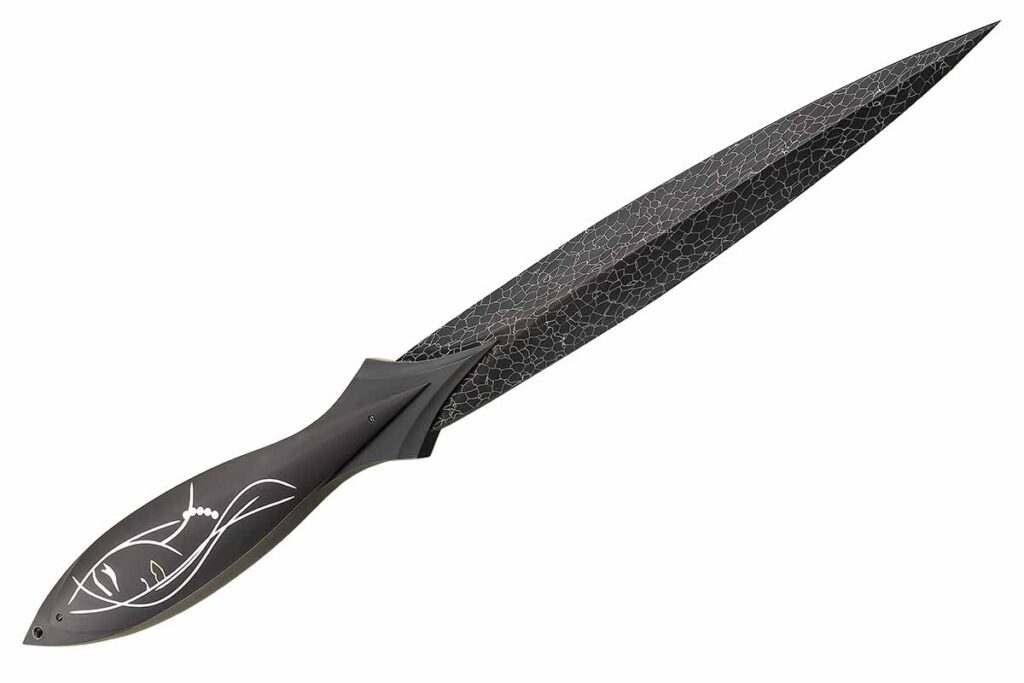
Rietveld Knives Flirt

BLADE LENGTH: 7”
BLADE MATERIAL: Nebula damascus
BLADE GRIND: Hollow
FRAME MATERIAL: Zirconium
BOLSTER: Zirconium
ENGRAVING: Of fine silver by Bertie Rietveld
KNIFE TO KNOW: Stanhope lens in butt of handle
OVERALL LENGTH: 12”
MAKER’S PRICE FOR A SIMILAR KNIFE: $6,000
MAKER: Bertie Rietveld, rietveldknives.com (SharpByCoop image)


Keith Barthelmes: Serpent Chef’s Knife
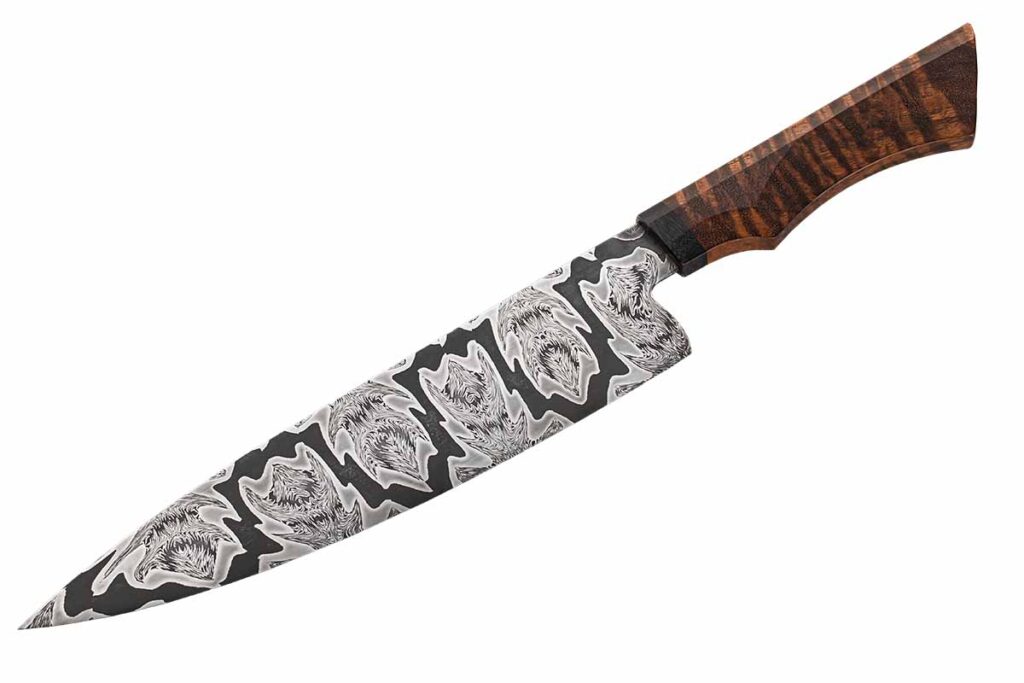
Keith Barthelmes Serpent Chef

BLADE LENGTH: 9.5”
BLADE GRIND: Flat that tapers to a convex edge
BLADE MATERIAL: Serpent damascus of 1084 carbon and 15N20 nickel steels
HANDLE MATERIAL: Curly koa
BOLSTER: Black canvas Micarta®
OVERALL LENGTH: 15”
MAKER’S PRICE FOR A SIMILAR KNIFE: $1,600
KNIFE TO KNOW: Keith is an ABS apprentice smith and hopes to take his ABS journeyman smith test in two years
MAKER: Keith Barthelmes (Jocelyn Frasier image)


Matt Humphreys: Lockback Folder
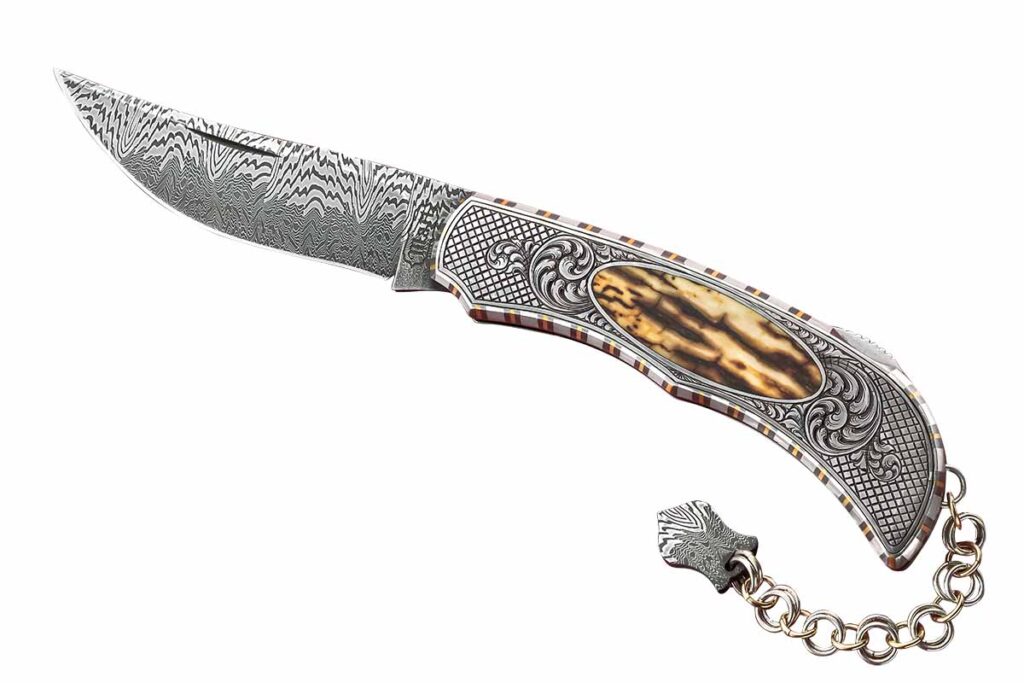
Matt Humphreys Lockback Folder

BLADE LENGTH: 3.5”
BLADE MATERIAL: Damascus forged by Jim Poor
BLADE GRIND: Hollow
HANDLE MATERIAL: Ancient ivory inlay, 24k-gold and fine silver inlay, 14k-gold and sterling silver chain
FRAME MATERIAL: 4130 carbon steel
ENGRAVING: By Matt Humphreys
CLOSED LENGTH: 4.5”
MAKER’S PRICE FOR A SIMILAR KNIFE: $5,500
MAKER: Matt Humphreys, outlawwaterjetdesign.com (SharpByCoop image)


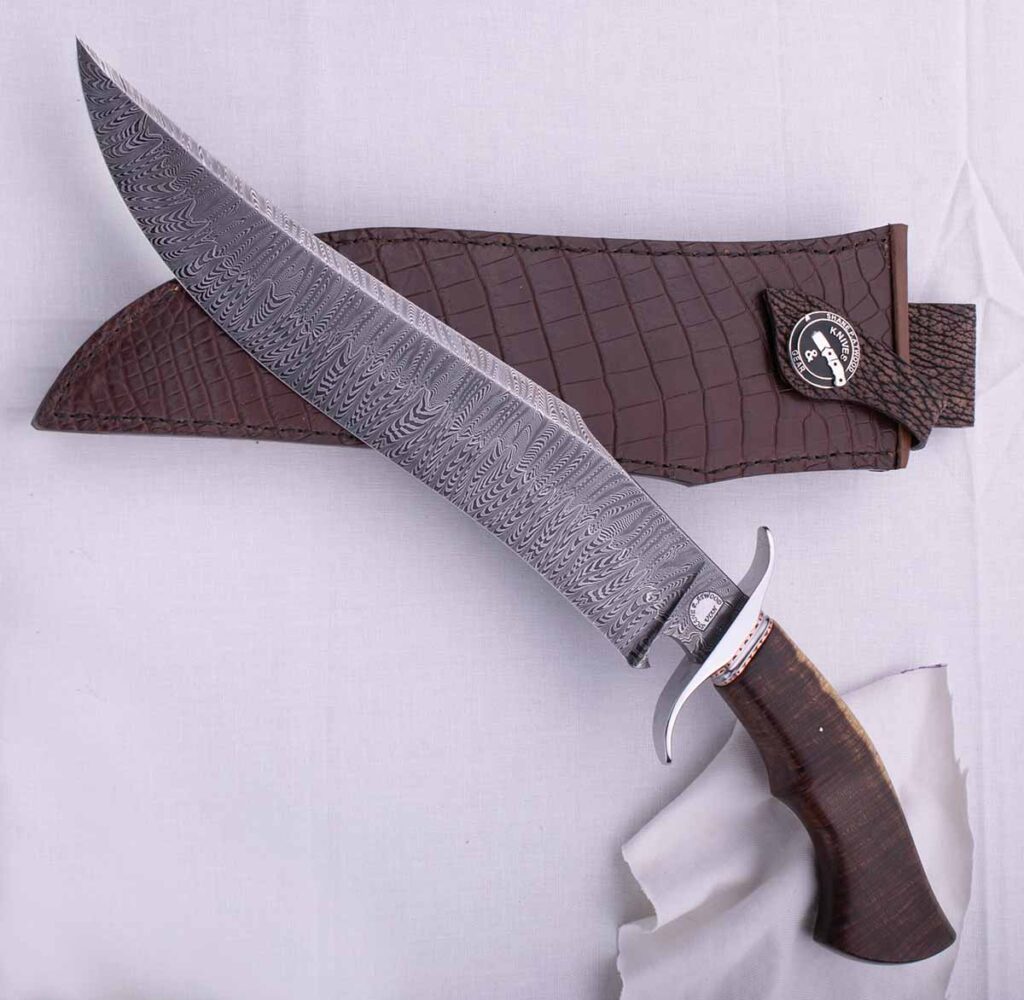
Shayne Carter: Coffin-handle Bowie
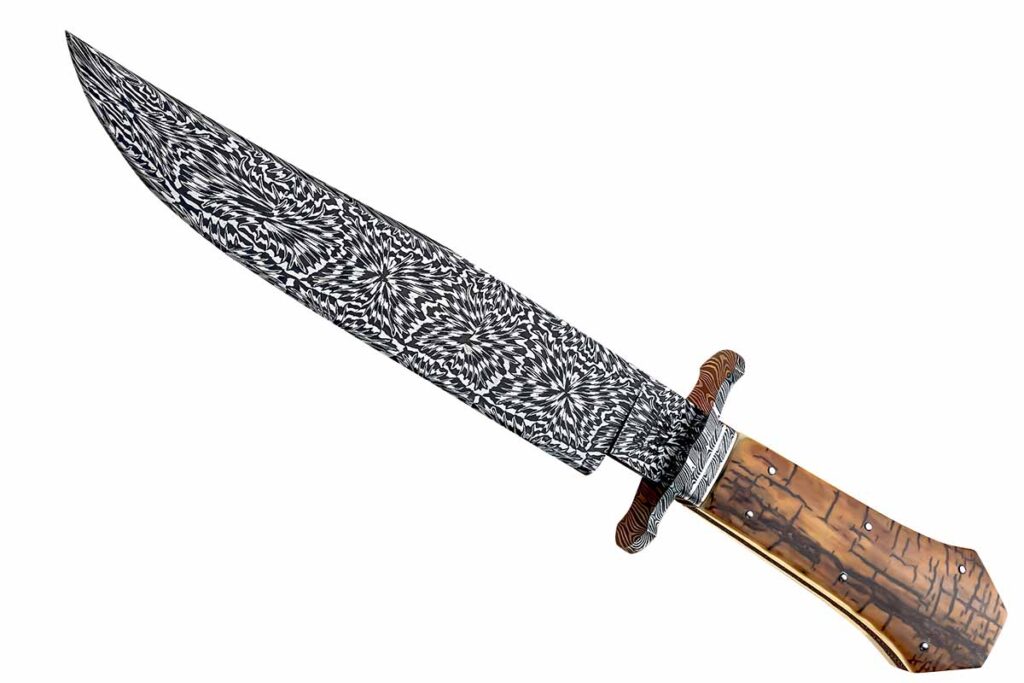
Shayne Carter Coffin-handle Bowie

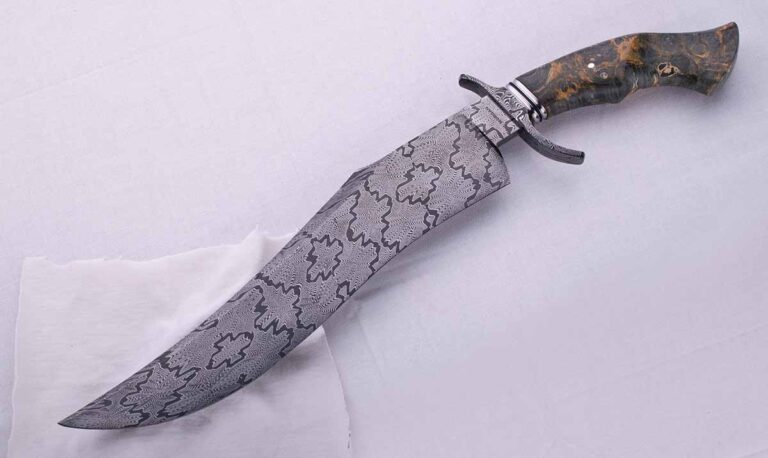
BLADE LENGTH: 8.25”
BLADE MATERIAL: A mosaic explosion damascus pattern of 1084 carbon and 15N20 nickel-alloy steels
BLADE GRIND: Flat
HANDLE MATERIAL: Mammoth ivory
FRAME MATERIAL: Damascus
OVERALL LENGTH: 13.25”
MAKER’S PRICE FOR A SIMILAR KNIFE: $3,200
KNIFE TO KNOW: Shayne Carter is a master smith in the American Bladesmith Society (ABS)
MAKER: Shayne Carter, (SharpByCoop image)


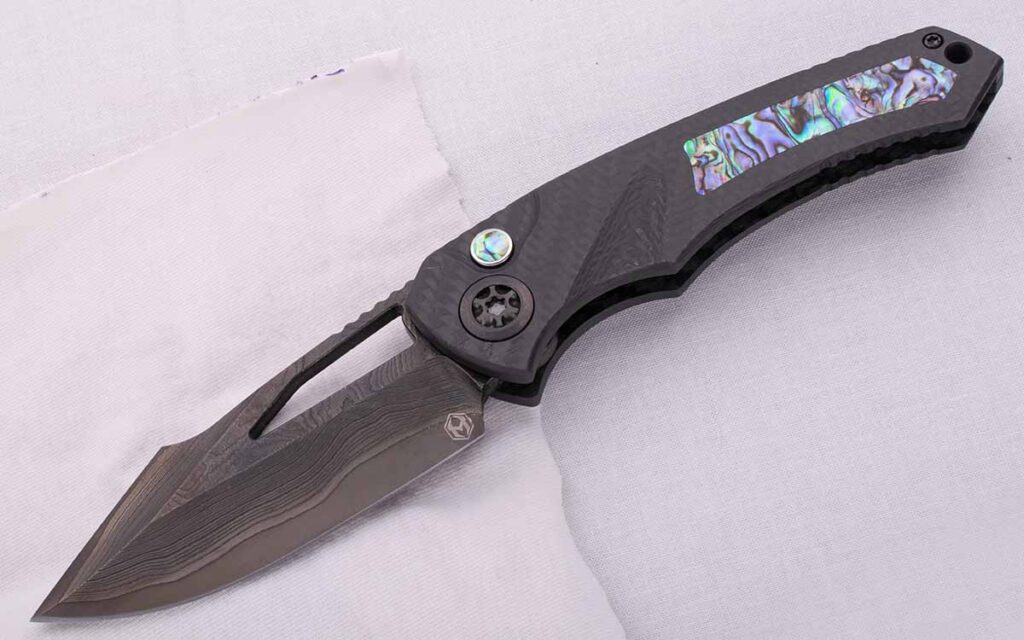
CRKT: Monument 4001
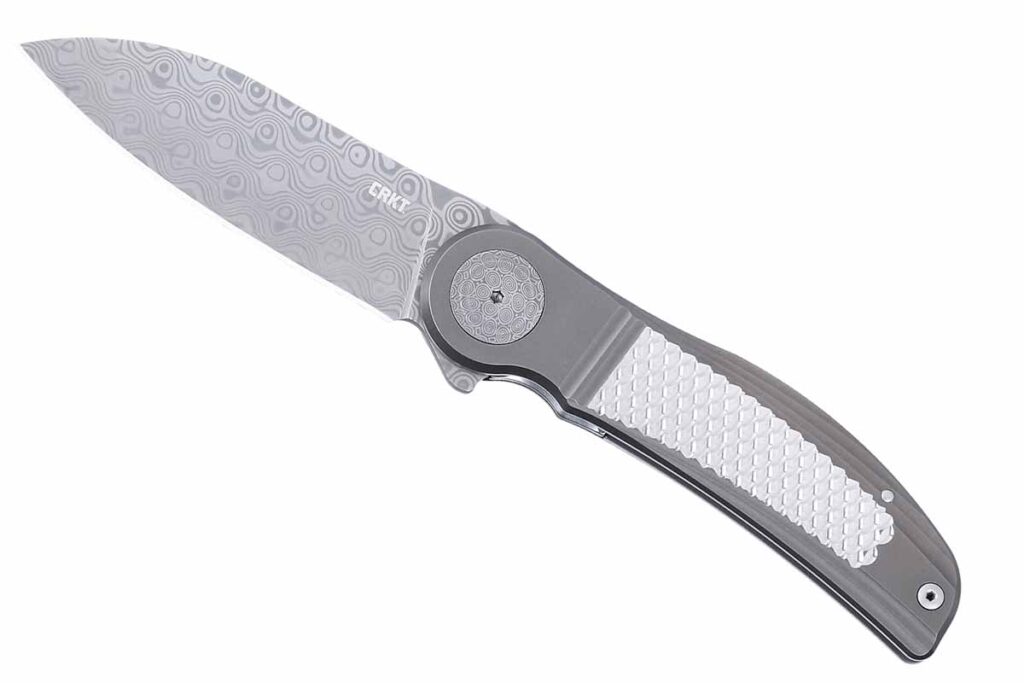
CRKT Monument 4001

DESIGNER: BLADE Magazine Cutlery Hall-Of-Fame® member Michael Walker
BLADE LENGTH: 3.07”
BLADE MATERIAL: Rose damascus by Damasteel
BLADE GRIND: Flat
BLADE PATTERN: Modified sheepsfoot
HANDLE: Titanium w/white dragon scale inlay
PIVOT: Damascus in a Bluetongue pattern by Damasteel
ACTION: IKBS ball bearings
LOCK: Linerlock
POCKET CLIP: Deep-carry design
WEIGHT: 3.9 ozs.
CLOSED LENGTH: 4.17”
COUNTRY OF ORIGIN: Italy
MSRP: $500
COMPANY: CRKT, crkt.com


TOPS Knives: Steel Eagle 105C
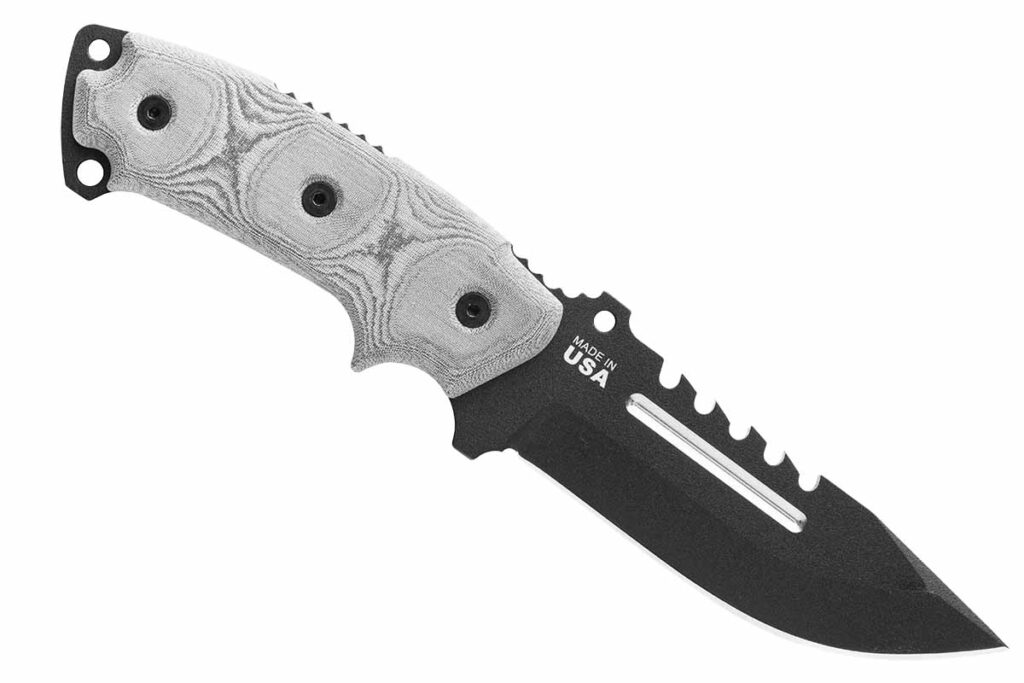
TOPS Steel Eagle 105C

BLADE LENGTH: 5.13”
BLADE MATERIAL: 1095 carbon steel
BLADE THICKNESS: .25”
BLADE FINISH: Black Traction Coating
HANDLE MATERIAL: Black linen Micarta®
WEIGHT: 15.3 ozs.
OVERALL LENGTH: 10.5”
SHEATH: Black Kydex w/rotating spring clip
WEIGHT W/SHEATH: 18.6 ozs.
MSRP: $240
KNIFE TO KNOW: Sawteeth, full-tang construction
COUNTRY OF ORIGIN: U.S.A.
COMPANY: TOPS Knives, topsknives.com


Spartan Blades: Poros
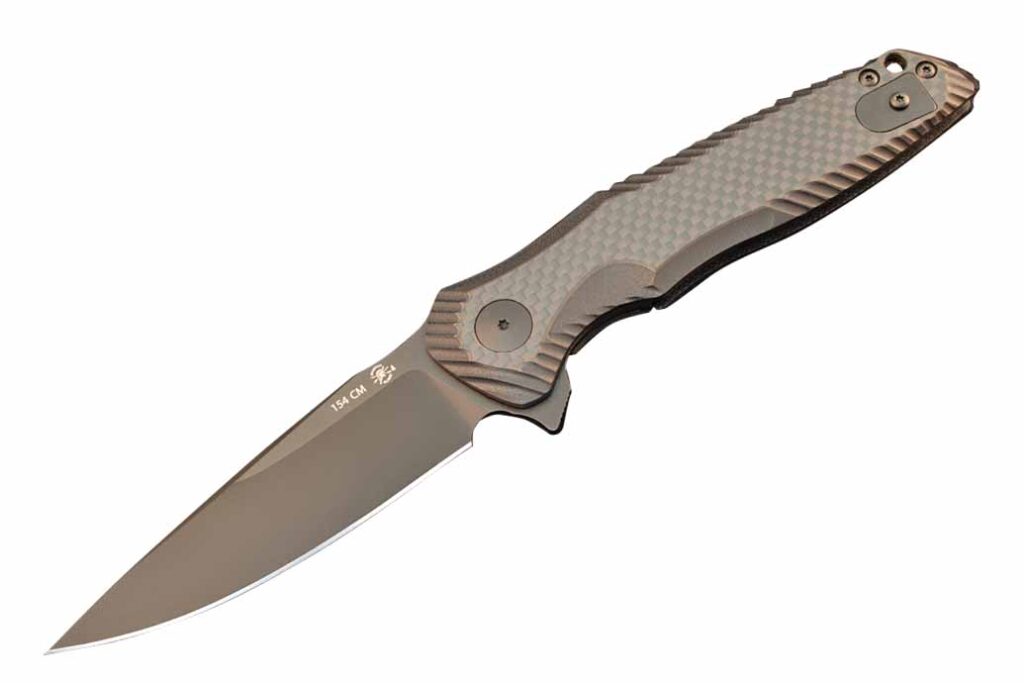
Spartan Blades Poros

DESIGNER: Curtis Iovito
KNIFE PATTERN: Flipper folder
BLADE LENGTH: 3.75”
BLADE Steel: 154CM stainless
BLADE GRIND: Flat
BLADE FINISH: Black titanium nitride coating
BLADE PATTERN: Drop point
PIVOT: Ikoma Korth Bearing System (IKBS)
HANDLE MATERIAL: Scalloped black G-10
LOCK: Linerlock
HARDWARE & LINER: Stainless steel w/electro-deposit powder coating
POCKET CLIP: Deep carry
WEIGHT: 5.28 ozs.
CLOSED LENGTH: 5.25”
MSRP: $180
COUNTRY OF ORIGIN: U.S.A.
MAKER: Spartan Blades, spartanbladesusa.com


Hardcore Hardware: MILF-02PS
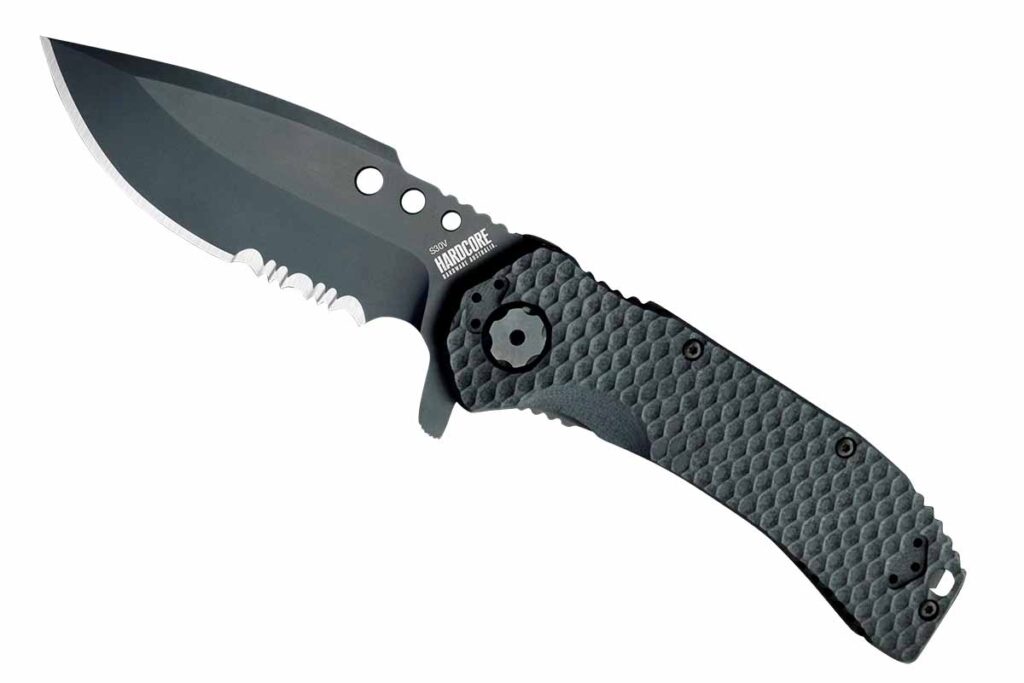
Hardcore Hardware MILF-02PS

KNIFE TYPE: Tactical flipper folder
BLADE LENGTH: 3.54”
BLADE STEEL: CPM S30V stainless
BLADE @ WIDEST: 1.18”
BLADE GRIND: Hollow
BLADE FINISH: PVD coated
WASHERS: Phosphor bronze
HANDLE MATERIAL: G-10
FRAME & LINER: 420J2 stainless
LOCK: Framelock
POCKET CLIP: Reversible tip up or down, ambidextrous
WEIGHT: 7.34 ozs.
CLOSED LENGTH: 5.51”
MSRP: $280
COUNTRY OF ORIGIN: Australia and Taiwan
COMPANY: Hardcore Hardware Australia, hardcorehardware.com.au


Civivi: Vaquita II
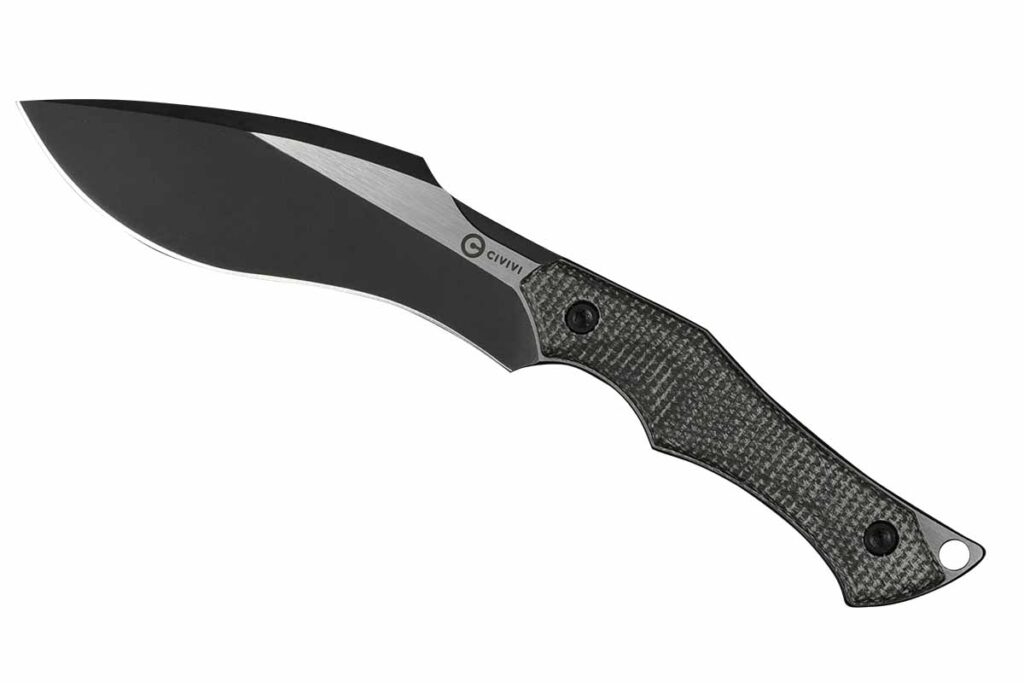
Civivi Vaquita II

DESIGNER: Nate Matlack
KNIFE TYPE: Fixed blade
BLADE LENGTH: 3.2”
BLADE Steel: Nitro-V stainless
BLADE GRIND: Flat
BLADE PATTERN: Kukri
BLADE FINISH: Black stonewash
HANDLE MATERIAL: Dark green canvas Micarta®
WEIGHT: 1.28 ozs.
OVERALL LENGTH: 6.23”
SHEATH: Black Kydex
COUNTRY OF ORIGIN: China
MSRP: $69.40
COMPANY: Civivi, civivi.com


Morakniv: Bushcraft Knife
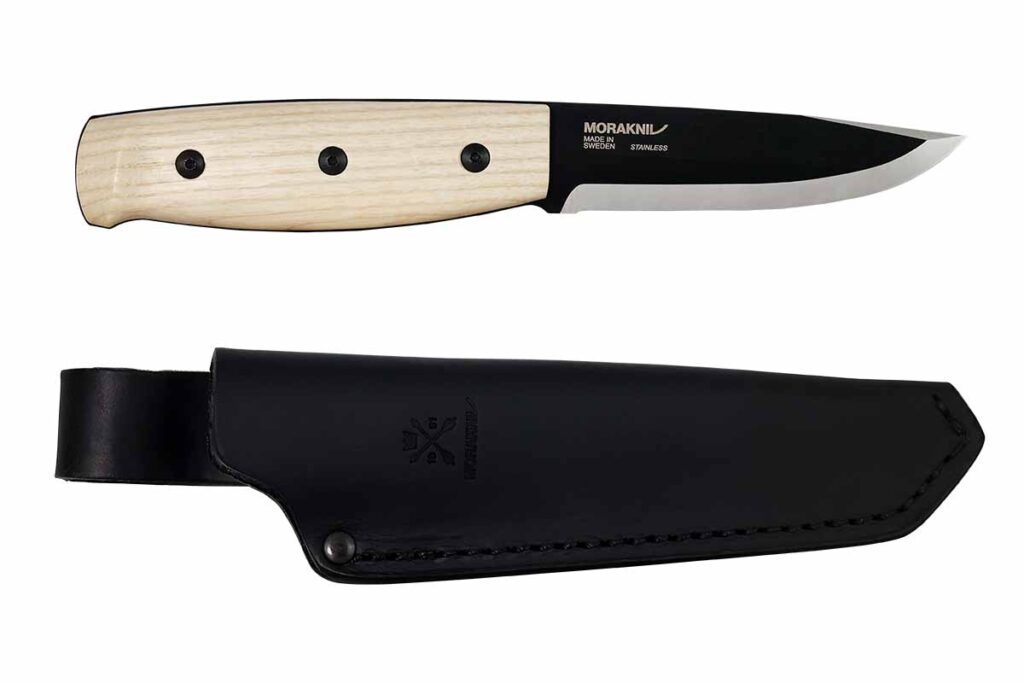
Morakniv Bushcraft

BLADE LENGTH: 4.05”
BLADE STEEL: Recycled Swedish stainless
BLADE THICKNESS: .098”
BLADE PATTERN: Drop point
HANDLE MATERIAL: Bright ash wood
CONSTRUCTION: Full tang
WEIGHT: 6.8 ozs.
OVERALL LENGTH: 8.38”
SHEATH: Vegetable-tanned leather w/belt loop; compatible with the Morakniv Dangler 10 w/button
KNIFE TO KNOW: Blade spine compatible w/a fire starter
MSRP: $240.07 (at press time rate of exchange)
COUNTRY OF ORIGIN: Sweden
COMPANY: Morakniv, industrialrev.com


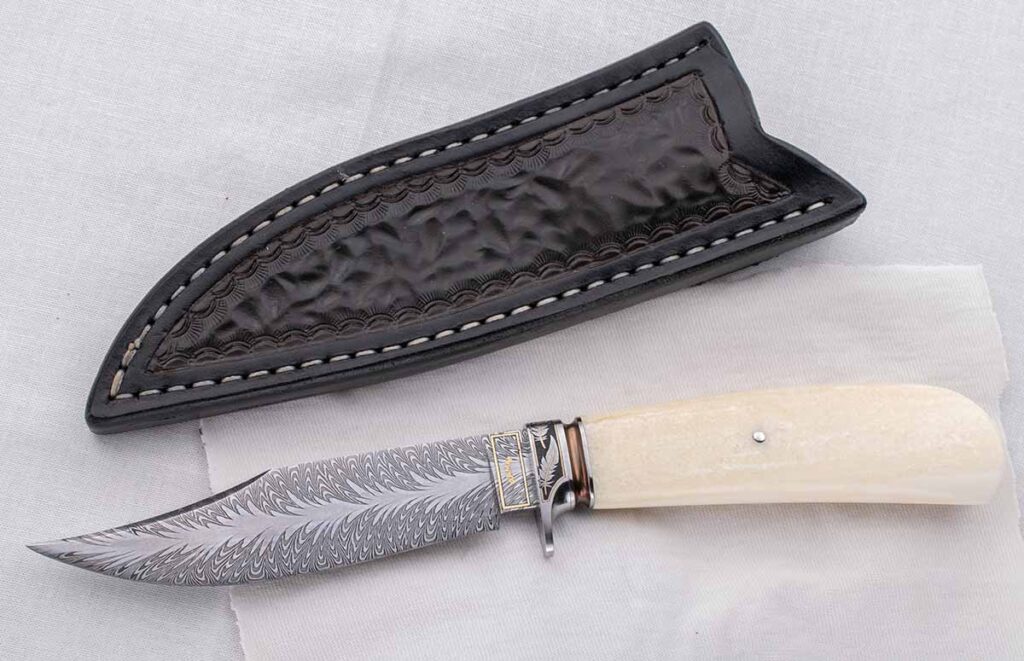
DP Custom Creations & Zero Down Forge: Fighter
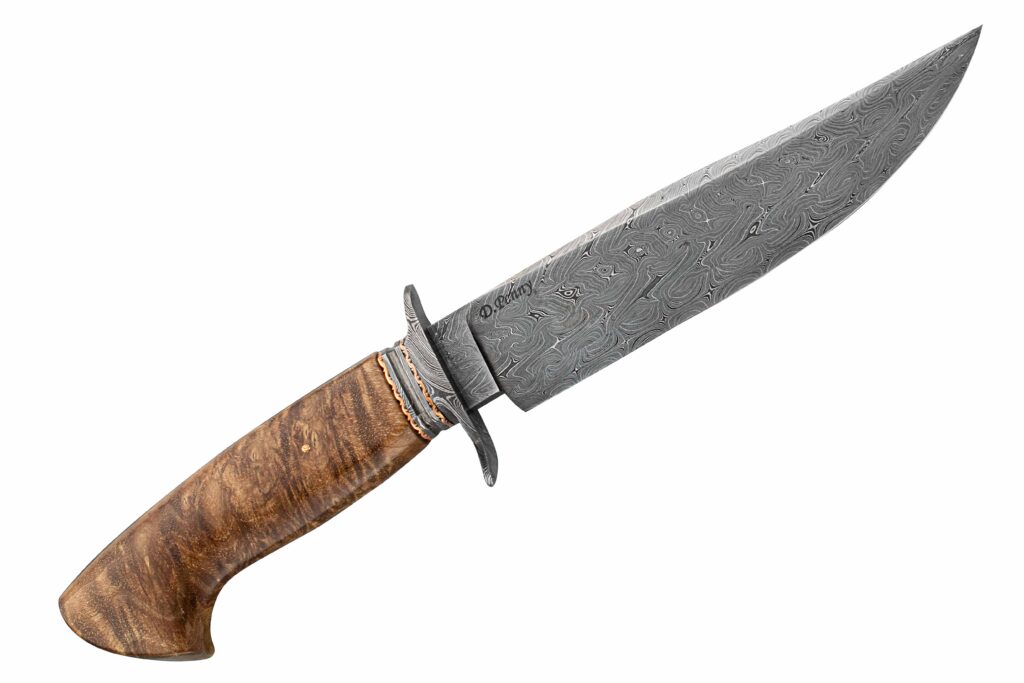
DP Custom Fighter

BLADE LENGTH: 7.5”
BLADE STEEL: 300-layer, 4-bar, alternating twist damascu
BLADE GRIND: Flat
HANDLE: Blond claro walnut, thorn and vine accent copper spacers, and copper pin
FITTINGS: Twisted damascus guard and center spacer
OVERALL LENGTH: 12.5”
MAKER’S PRICE FOR A SIMILAR KNIFE: $1,100
KNIFE TO KNOW: Don Penny is an ABS apprentice smith
MAKER: DP Custom Creations & Zero Down Forge, (Jocelyn Frasier image)


Tony Cetani: Chef’s Knife
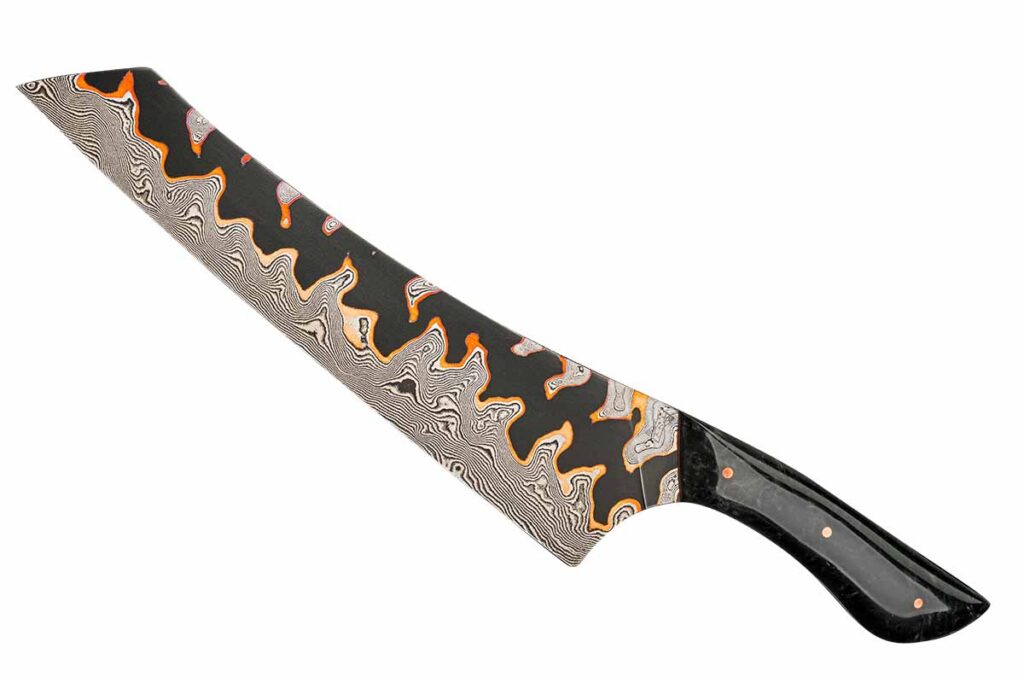
Tony Cetani Chef's Knife

BLADE LENGTH: 9”
BLADE STEEL: RipTide damascus by Baker Forge & Tool
BLADE GRIND: Flat
HANDLE MATERIAL: Amboyna burl w/copper pins and liners
OVERALL LENGTH: 14.25”
MAKER: Tony Cetani, HourGlass Knives, [email protected] (Baker Forge Studios image)


Check Out More Knife Drops:

Petty Knife: The Mama Bear Of Food-Prep Tools

0

Larger than a paring knife, smaller than a chef’s knife, the petty knife is right-sized for heavy-duty precision work.

Sometimes food preparation calls for something especially suited for close, even intricate, work. The petty knife was made for such employment.

While it may be a bit smaller in stature than other knives chefs regularly use, the petty knife makes short work of otherwise laborious functions.

Its name is derived from the French petit or small, but it’s big on getting the job done.

“Ask a dozen makers what the petty knife is and you’ll get a dozen different answers,” offered custom maker Ian Ronald of Elderslie, New South Wales, Australia. “But for me, I would define a petty knife as a culinary knife that is shorter than a chef’s knife but with a broader blade than a paring knife. I find a petty knife to be incredibly handy for household food preparation tasks, with a blade that is big enough to cut most food items but not so large as a full-sized chef’s knife, making it a little more versatile for ‘in hand’ food prep tasks such as cutting avocados and similar things. I have a few in my kitchen and they are the most commonly used knives in the knife block by far.”

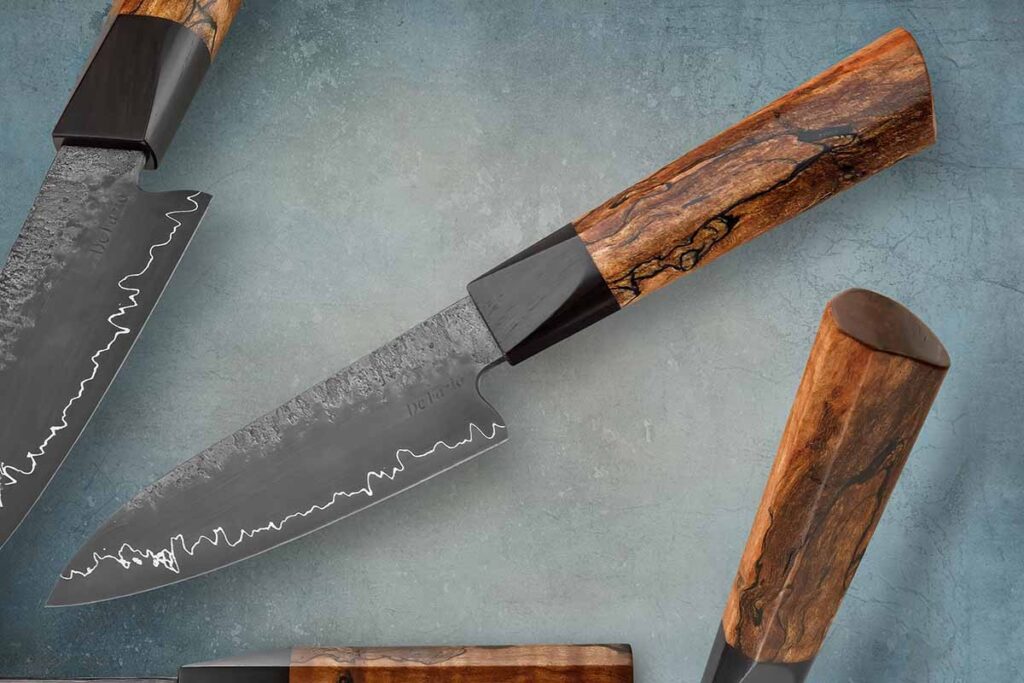
The full-flat-ground blade of 18-year-old Aidan De Fazio’s petty knife.
The full-flat-ground blade of 18-year-old Aidan De Fazio’s petty knife is also slightly convex to preserve edge longevity and provide better food release. (Rod Hoare knife image)

Representative of Ronald’s petty knife work is a piece the price of which varies depending on materials chosen. With a 4.92-inch blade of Takefu Special stainless clad in san-mai fashion over V-Toku2 carbon steel, a desert ironwood handle and 9.25-inch overall length, the petty remains with the maker—and he uses it frequently.

“I designed this knife with quite clean lines and simple shapes, as it was intended to be a workhorse from the beginning,” Ian commented. “I used some premium materials but I didn’t add any embellishments or unnecessary details. I follow that aesthetic with most of the knives I make, preferring to let the form follow the function for the most part. This particular knife has a relatively deep blade with a reasonably high tip profile, which allows it to be used for [rocking/chopping] and push cuts despite its unassuming size.”

The steel combination on Ronald’s knife includes a carbon core with stainless cladding from the Takefu steel company of Japan. According to Ian, it is quite corrosion resistant and maintains a bright appearance, as the carbon steel core etches dark and develops character and patina with use. The blade grind is nearly flat with a slight convex slant near the edge, which is intended to create a fine cutting edge while maintaining toughness.

Precision Worker Petties

Sixty-year-old Australian Zohar Oshinsky has been making knives since he was 12 but became more serious about his work just a few years ago, becoming a full-time maker in the past five years. His petty knife features a 5.12-inch blade of M390 stainless damascus steel from Sanwa Special Steel of Japan, handle scales of stabilized red mallee burl timber—a hardwood from the York peninsula of South Australia—and an overall length of 10.04 inches.

Ian Ronald said a petty knife has a blade big enough to cut most food items.
Ian Ronald said a petty knife has a blade big enough to cut most food items but not so large as a full-sized chef’s knife, making it a little more versatile for avocados and similar things. Overall length of his Kitchen Petty: 9.25 inches. (Rod Hoare knife image)

“This petty knife is a smaller Japanese utility knife,” Zohar said, “generally used for precision knife work and fine slicing. My knives are often made to order, so the material is to the customer’s liking. The san-mai is an excellent steel for kitchen knives in this construction with a very high rust resistance and excellent edge retention. The damascus cladding is made from 67 layers of 410 and high nickel stainless.”

Oshinsky says his blade grind is shallow, convex, very thin and incredibly sharp. The blade’s soft cladding protects the core from shock and provides a small amount of flexibility.

Semi-Dark Theme Petty Knives
Aidan De Fazio is all of 18. He began his knifemaking journey at 11 and his progress has been steady. His petty knife includes a 4.5-inch, full-flat-ground blade of san-mai in 1084 clad carbon steel with nickel. The handle is stabilized spalted maple and ebony. The blade is slightly convex ground to preserve edge longevity and provide better food release. Overall length: 9 inches.

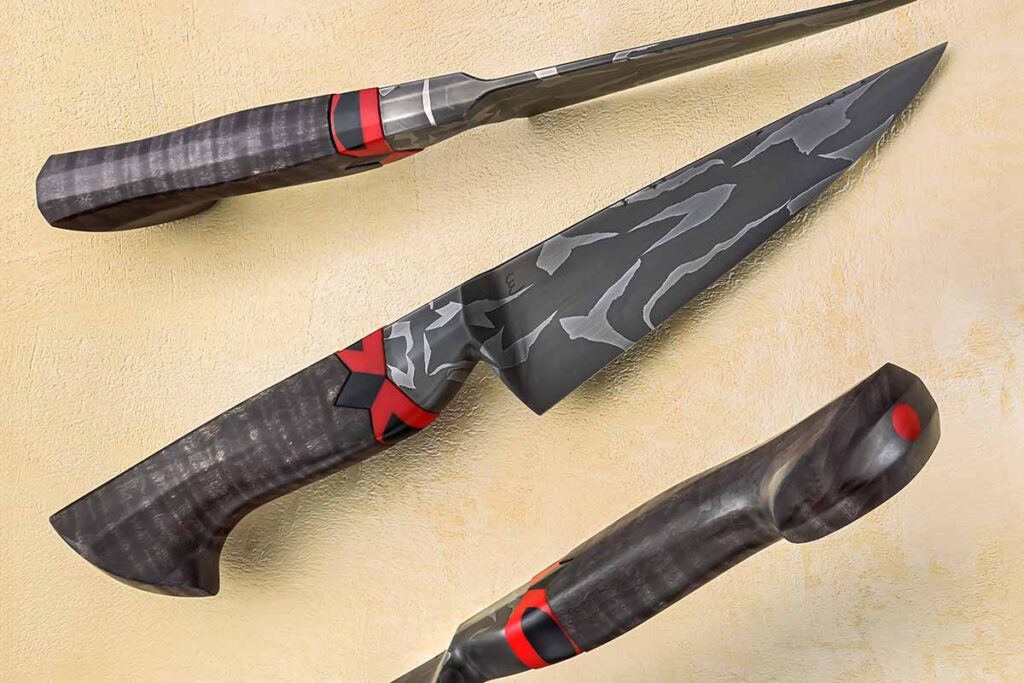
Charlie Ellis and BLADE Magazine Cutlery Hall-Of-Fame® member Steve Schwarzer collaborated on the Penrose Petite Chef.
Charlie Ellis and BLADE Magazine Cutlery Hall-Of-Fame® member Steve Schwarzer collaborated on the Penrose Petite Chef. The 6-inch blade is Penrose tiling billet of 15N20 nickel-alloy steel in a pattern based on never-repeating Penrose tiling. Overall length: 11.75 inches. (SharpByCoop image)

“The petty knife is a small general-purpose knife,” Aidan explained. “It’s used for peeling, shaping, and slicing fruits and vegetables, chopping herbs, and making garnishes. I design everything by eye and chose this design because everything flowed nicely, and it just looked right. I was going for a semi-dark-themed knife, so to complement the dark san-mai I chose a piece of ebony with some heavily spalted maple for the handle.

“As this is a carbon steel knife, it will change color with use,” Aidan continued. “It’s a patina and it’s a good thing. It develops on carbon steel when exposed to air for extended periods of time or to acids for short periods of time. It is a type of oxidation that helps ward off the rust that eats away at steel and destroys your knife.”
De Fazio recommends regular care for his petty knife, washing lightly with soap and water, avoiding abrasives that could scratch the patina, and then wiping dry for storage.

Light, Thin, Comfy Kitchen Tools

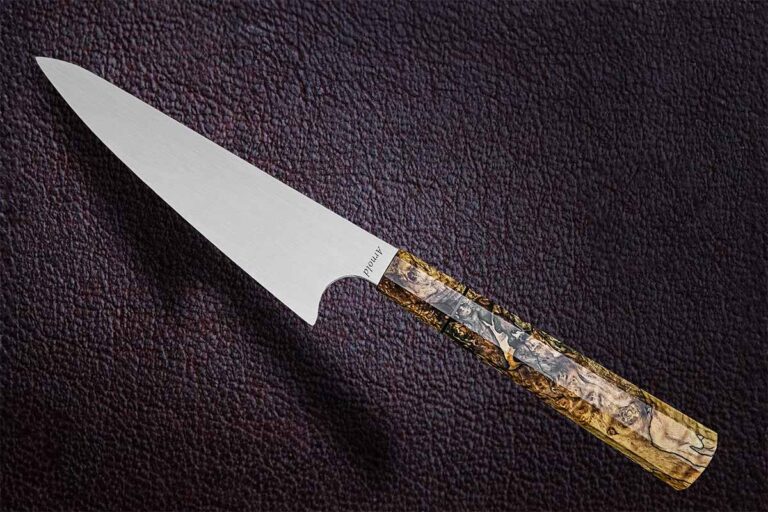
When Ross Arnold makes a petty knife—or any other style knife for kitchen use—he is leveraging experience to produce the most utilitarian design he can. “To me, a petty knife is an all-around food preparation knife for use when a larger knife is not necessary or possible,” he said. “In my earlier years, I worked in kitchens every night. I had a good idea of what worked and what was comfortable for me. This design was focused on being light, thin and comfortable. This resulted in a knife that weighs only 3.8 ounces, and the rounded choil and spine make it a pleasure to use all day every day.”

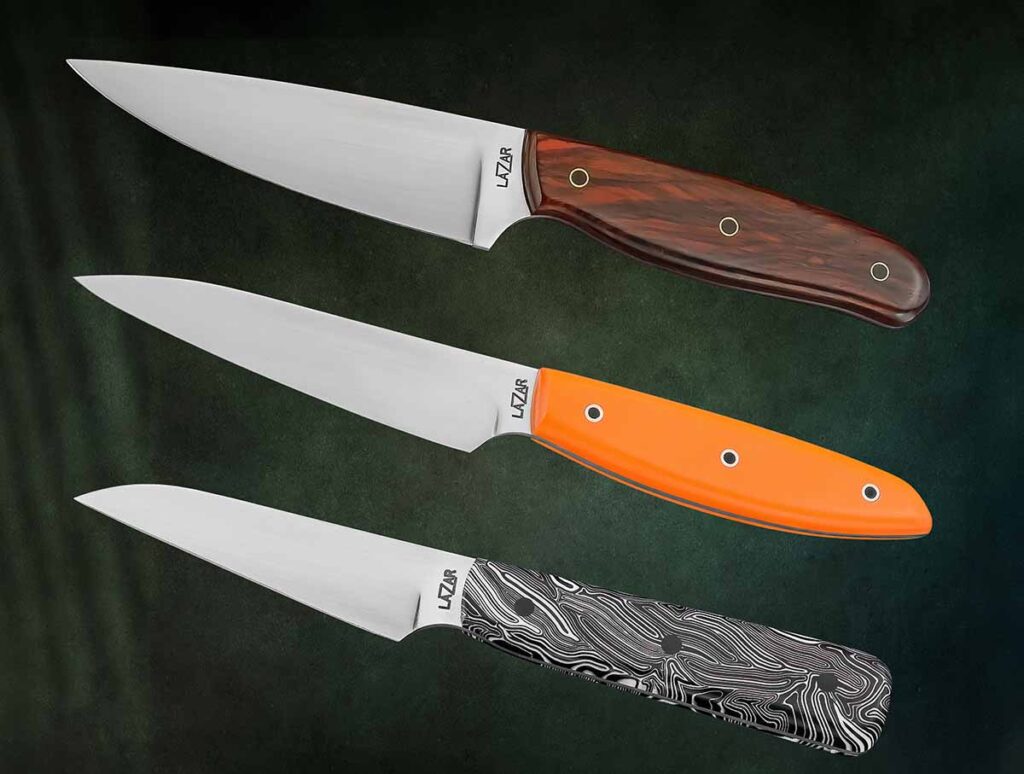
Andrew Lazarevic offers his petty knives in a selection of handle materials.
Andrew Lazarevic offers his petty knives in a selection of handle materials affixed with brass and carbon fiber pins. The blades are flat ground of AEB-L stainless steel. Overall lengths: approximately 9 inches each. (Rod Hoare image)

A resident of Glenalta, Australia, Arnold learned a great deal from custom maker Peter Bald early in his career. Ross finished his petty knife with a 5.91-inch blade of RWL-34 stainless steel and a handle of spalted sassafras wood. Overall length: 11.02 inches. His price for a similar knife: $390.

“I went with a traditional Japanese hexagonal handle purely for aesthetics,” he related. “As I use this knife primarily with a pinch grip, the handle shape does not have a massive impact on usability. That being said, it is still very comfortable to hold normally. I ground the blade with a plunge-less distal taper design. I came up with the grind design myself, but I’m sure it’s probably been done before. In my opinion, it is a solid performing grind as it gives the knife a light and flexible blade that isn’t super thick toward the tip.”

The petty knife is up to the challenge when a more intricate or tight kitchen job is at hand. The latest custom examples are affordable, provide good looks and perform with style. Dig in.

Editor’s note: All prices are in U.S. dollars and are according to the press time rate of exchange. Due to fluid market conditions, all are subject to change. Please check with the applicable maker for the latest in pricing.

Read More

Kershaw Launch 13 Review: This Auto Makes Its Own Luck

0

An intriguing take on the wharncliffe design matted to a rock-solid action, the Launch 13 proves a cut above the rest.

Kershaw Knives’ Launch series of USA-made automatic knives has been a great seller for the company. Offering USA-made automatics in premium materials at a fraction of the price of what you can buy others in this class.

The Launch series is a collection of automatics of all sizes and all blade shapes, each is stirring. Their designs are modern and artistic in nature, adding a bit of excitement to your everyday carry rotation. One of the more intriguing designs is the Launch 13, which we will examine in closer detail here.

Launch 13 Blade

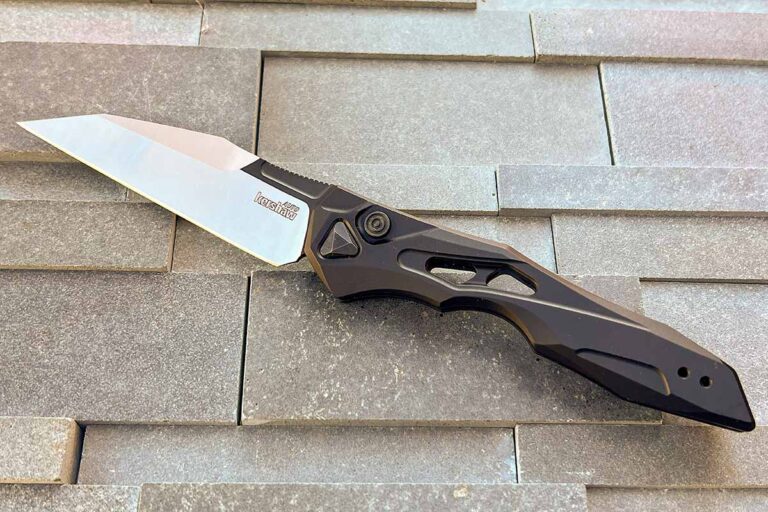
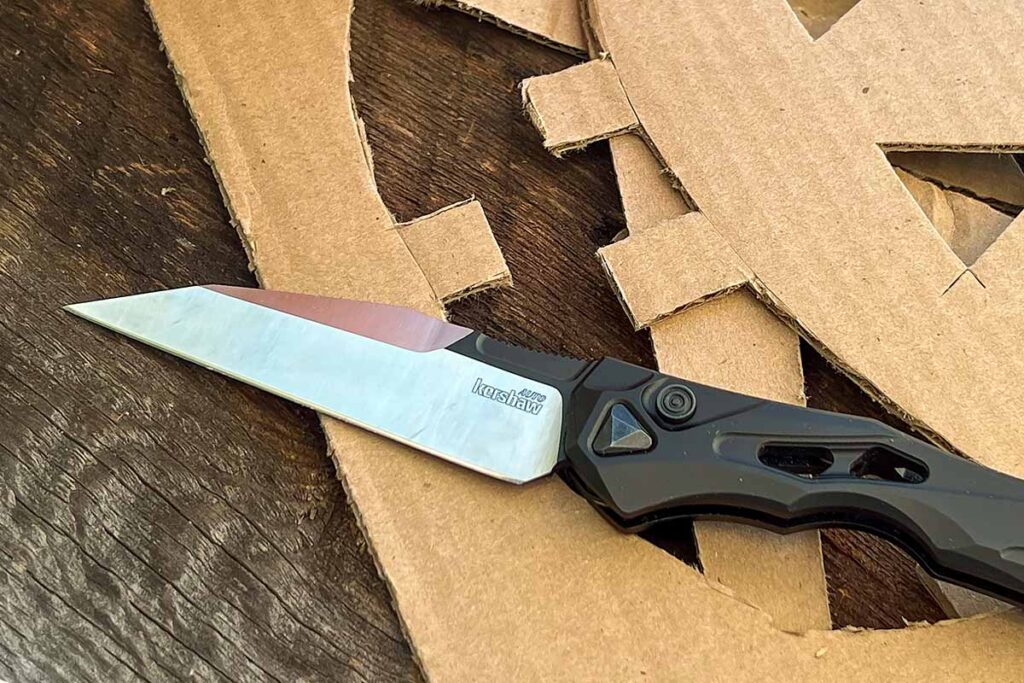
The Launch 13 is a slender design, with an angled wharncliffe blade. Most wharncliffes are straight, but the Launch 13’s blade is canted a bit to allow the easier use of the entire cutting edge while holding the handle at a natural angle.

Kershaw Launch Clip
Photo: Marty Stanfield

The blade itself measures 3.5-inches long and is ground from CPM154 stainless steel. This steel is a particle metallurgy version of 154CM, an alloy used widely in the knife industry and a long-time standard when it comes to high-end blade steels. 

The blade is flat ground and has a prominent swedge for a more aggressive appearance. The blade exhibits a two-tone finish, with the bevels and swedge having a satin finish look and the flats and spine black coated. 

The thumb rest portion of the blade spine has machined-in traction notches, which accommodate your thumb perfectly and provide a solid base in which to apply downward pressure on the blade to facilitate additional cutting power when needed.  

Launch 13 Handle

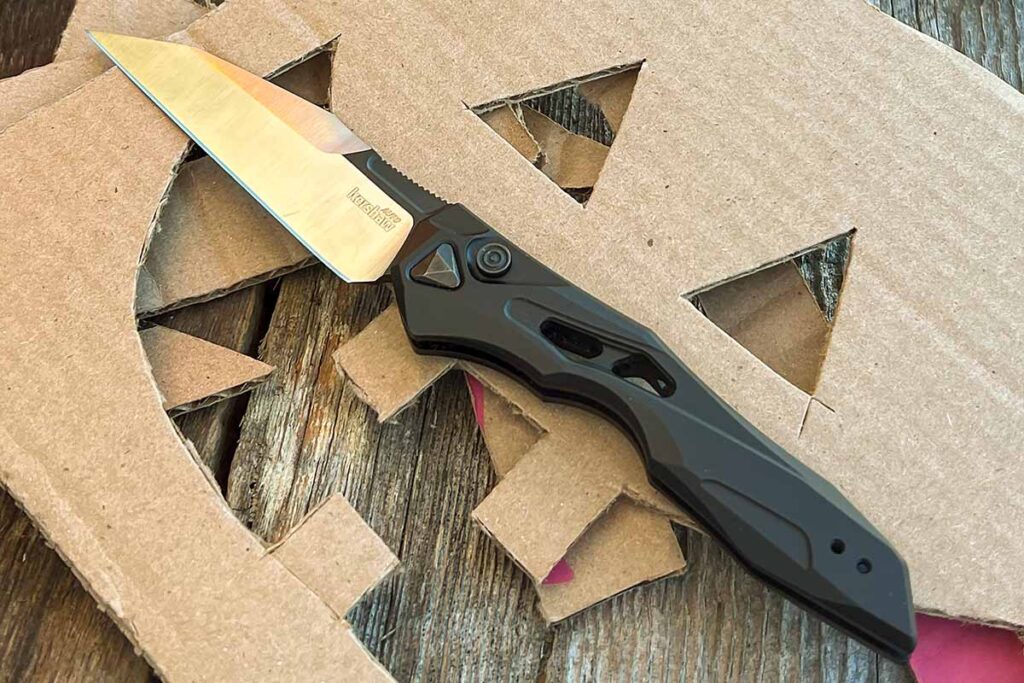
The futuristic-looking handle is machined from T6 6061 aircraft-grade aluminum that is both lightweight and strong. Perfect for knife handles. Kershaw gives the handle a black hard-coat anodized finish which provides the handle’s color, as well as boosts its scratch resistance. 

Launch 13 closed front
Photo: Marty Stanfield

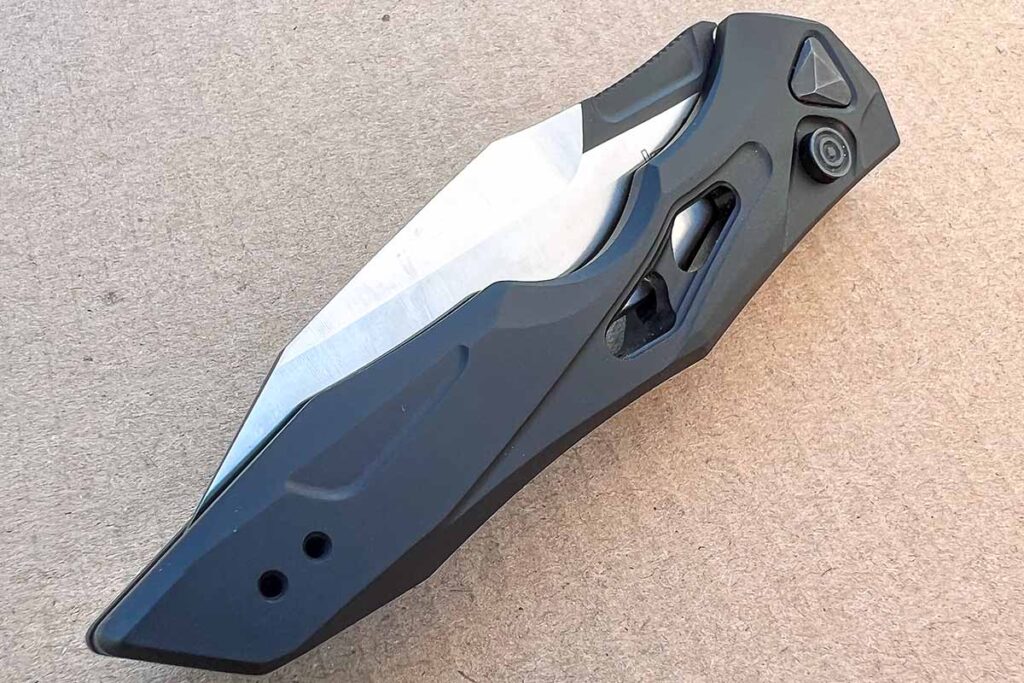
The handle measures 4.5 inches long. It has a tapered construction from the pivot to the butt end. This not only makes the Launch 13 carry very well in the pocket but helps it fit the hand comfortably. 

The large finger recess situated in the middle of the gripping area on the handle is where your middle finger locks in, and the rest of the fingers fall into place naturally. In hand, the feel is awesome. It’s very secure and confidence-inspiring, tackling all your cutting chores.

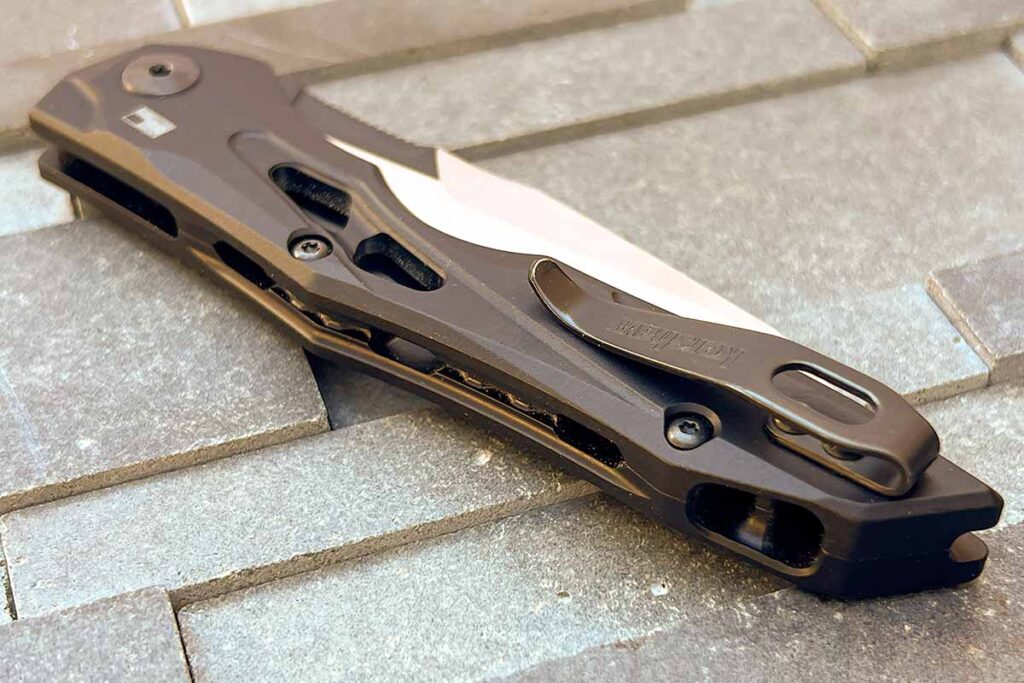
The handle sports a couple of cutouts that helps to further lighten the weight. Additionally, the handle’s spine also has a few holes in it. This not only contributes to the minimal weight of the handle but makes it easier to clean the inside of the handle with forced air or rinsing with tap water. 

The edges of the handle are chamfered nicely to soften the edges and eliminate hot spots. Finally, a steel deep carry-style pocket clip is affixed to the very end of the handle to carry the Launch 13 deep in the pocket.  A custom machined triangular pivot bolt and large lock button round out this overall stellar package. 

Cutting Profile

In use, the Launch 13 is a powerfully efficient cutting tool. The straight-line edge and defined point easily score material or efficiently cut through using a pull stroke. Furthermore, the straight-line cutting edge does well whittling and carving.

Kershaw Launch 1 cutting cardboard
Photo: Marty Stanfield

Thanks to the Launch 13’s grip ergonomics, the knife feels rock solid in your hand during use. It doesn’t feel like this one’s going to get away from you the longer you use it.

Another great characteristic of the design is the canted blade. It might look a bit weird but get the knife in your hand and use it, then you quickly see the design makes a lot of sense. It allows for a more natural wrist angle during use, something not a lot of other wharncliffe blade folders offer.

CPM154 holds an edge well, but not as long as CPM S30V. Still, it’s a great choice for this type of knife. The blade steel and the straight-line cutting edge both make resharpening easy when the time comes, given there’s no belly or recurve to negotiate with the sharpener.

As for tasks, the Launch 13 is a great work knife for those of you who make use of a knife regularly while on the job or while doing handyman chores around the house or homestead.

Launch 13 Action

When it comes time to put the blade into play, a simple press of the firing button releases the blade and the coil spring propels the blade to the fully open position. The action is fast and smooth, and concludes with a satisfying audible Click when fully open. The knife’s plunge lock is very strong at holding the blade open and there is zero play.

Launch carving carboard
Photo: Marty Stanfield

For a midsize folder, it’s very lightweight. Coming in at 2.4 ounces, the Launch 13 can be carried with you all day without weighing you down. You really do not feel the knife clipped to your pocket as you move around. It just disappears! This is a very nice gesture as most knife users do not like to carry all that bulk around. 

Final Cut

In conclusion, the Launch 13 from Kershaw Knives is an exciting-looking automatic folder, made in the USA with premium materials. What is the MSRP you ask? The answer: $225. 
Kershaw isn’t the first manufacturer you think of when it comes to high-quality USA-made automatic folders. But, with its Launch series in general and Launch 13 in particular, maybe it should be.

If you love automatic knives, check out the Launch 13. It’s a worthy addition to any collection. And it’s not afraid of work either! 

Launch 13 Specs:
Use: Everyday, Work, Tactical
Type: Automatic
Style: Pocketknife
Designer: Kershaw Originals
Blade Steel: CPM 154
Blade Style: Wharncliffe
Blade Edge: Plain
Opening Action: Automatic, Opens With Push button
Lock Type: Push-button lock
Pocketclip: Reversible deep-carry (right/left, tip-up)
Handle Color: Black
Country of Origin: Made in USA
MSRP: $225

Check Out Kershaw Knives For More Information.

More Knife Reviews:

Cool Customs: Darriel Caston’s Impish Split Handle

0

Barry Wood’s split-handle folder inspires Darriel Caston’s clever keychain knife.

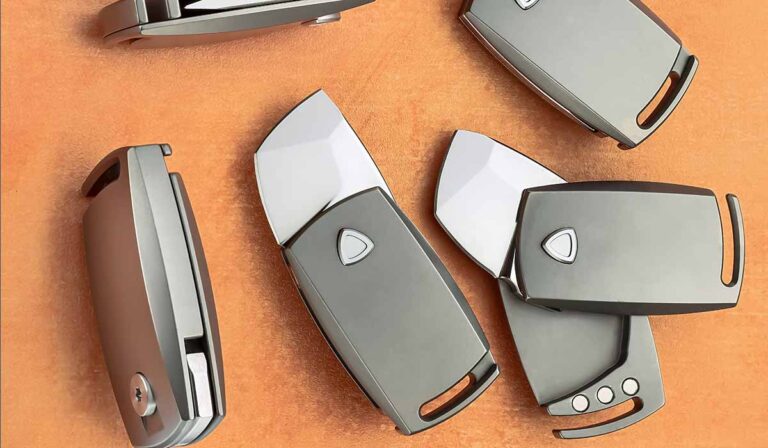
Inspired by the split-handle folding knife made famous by the late, great custom knifemaker Barry Wood, the Imp by Darriel Caston is a clever keychain knife ideal for EDC.

Like the Wood folder, the blade opens by pivoting one of the scales clockwise and closes by pivoting the same scale counterclockwise. At the same time, slots at the ends of the Imp’s scales accept a keychain when they’re open and form an enclosed elliptical oval to hold the keychain when they’re closed.

Darriel Caston

Instead of a ball detent affixed to the blade to help hold the knife open and closed, Darriel uses magnets affixed to the handle. Darriel and his daughter, Bella, were trying to come up with names for the knife when she observed that it was “a little booger,” and he said, “Yeah, like a little imp.”
And another knife name was born.

The Imp Specs
Blade length: .82”
Blade steel: M390 stainless
Blade grind: Modified compound tanto
Handle material: Titanium
Closed length: 1.75”
Maker’s price for a similar knife: In the $185-$200 range

Check Out More Cool Custom Knives:

2023 BLADE Show West Custom Knife Award Winners

See Who Took Top Honors In Salt Lake City For The 2023 BLADE Show West Custom Knife Awards.

BLADE Show West took place Oct.13-14, 2023, at the Salt Palace Convention Center in Salt Lake City, Utah. It was the show’s second year in Utah and drew custom makers, manufacturers and collectors from around the county and world.

It also drew an impressive cadre of entrants for the BLADE Show West Factory and Custom Knife Awards. For Factory Knives, awards were given in six categories, while the Custom Knives awarded nine categories.

The Custom section was evaluated by a panel of undisclosed industry experts who judged the blades on a number of factors, including utility, design, creativity, materials and other traits.

BLADE Show West Custom Knife Awards

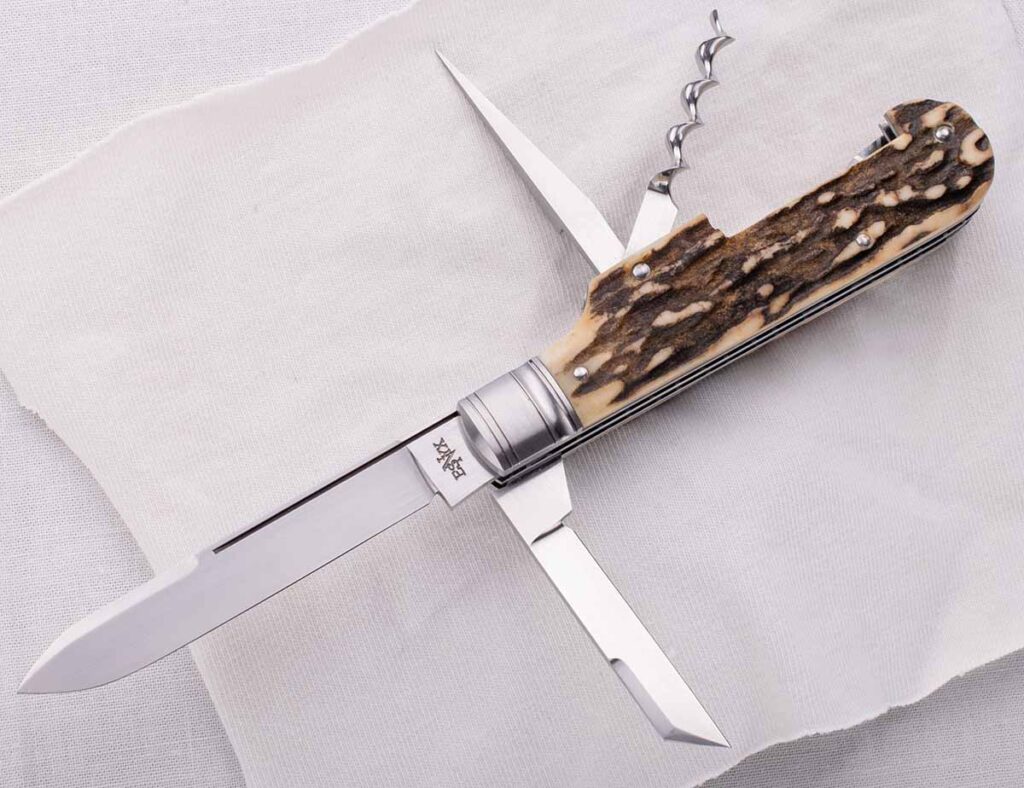
Best In Show & Best Slip Joint: ESNYX Knives

Best Slip Joint: ESNYX Knives

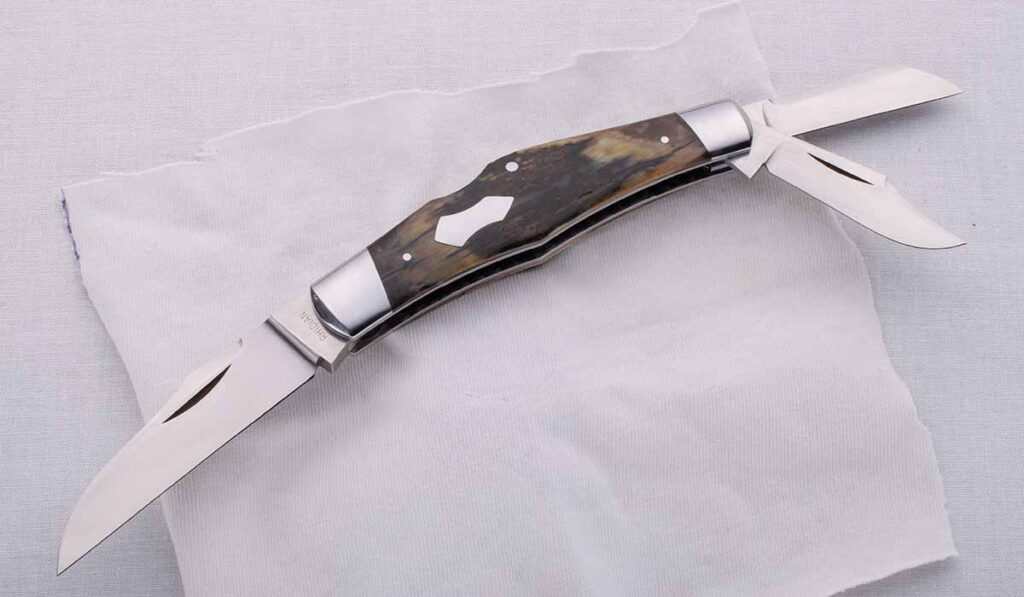
Best Folder: Rhidian Knives

Best Folder: Rhidian Knives

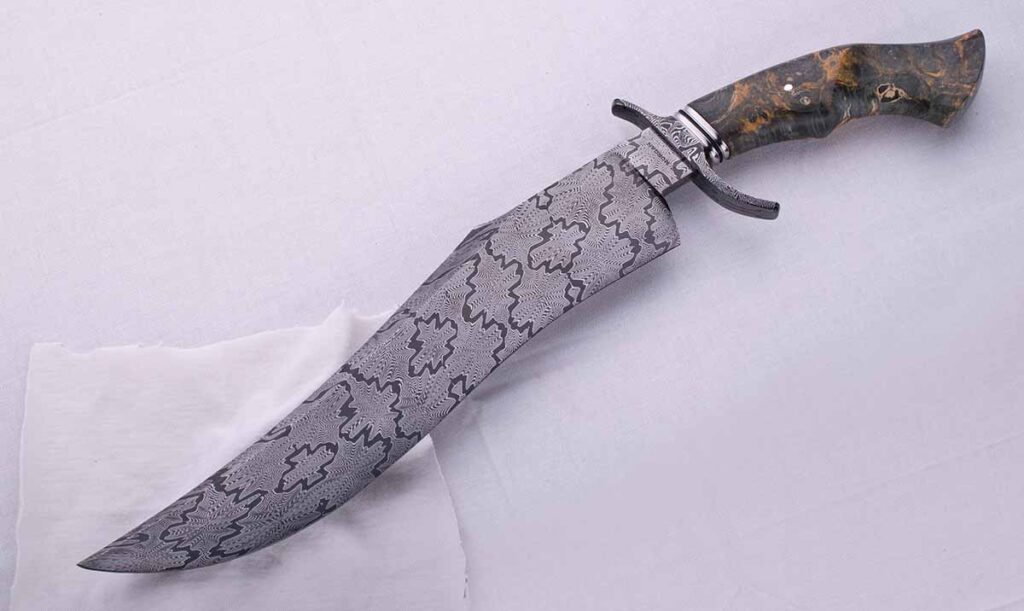
Best Damascus: Apple Valley Forge

Best Damascus: Apple Valley Forge

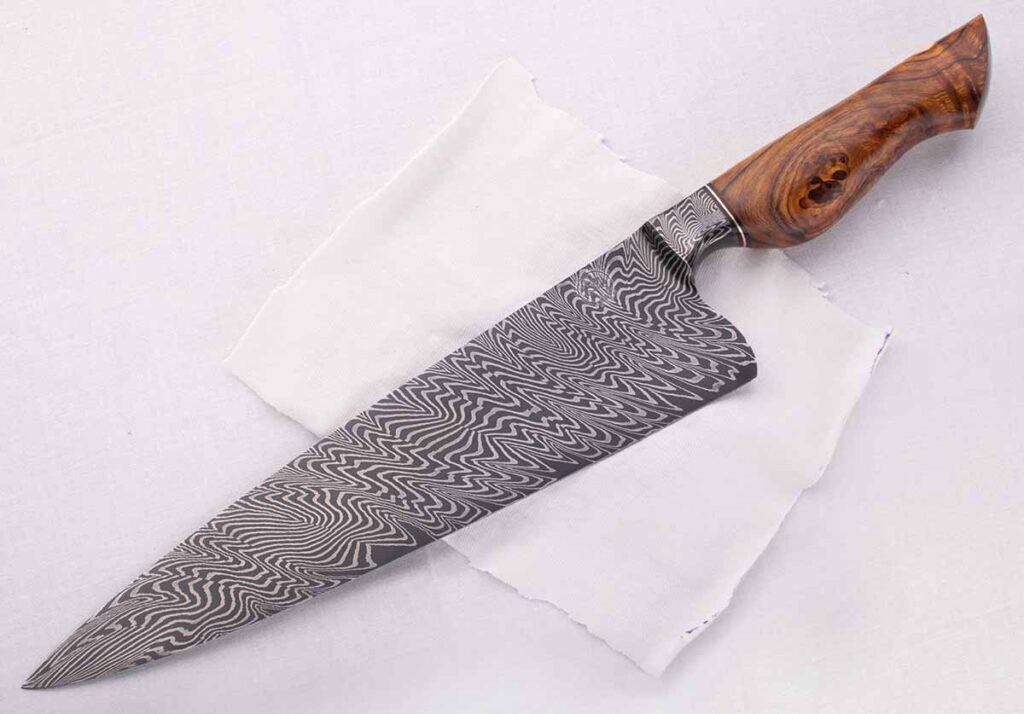
Best Kitchen Knife: Apple Valley Forge

Best Kitchen Knife: Apple Valley Forge

Best Fixed Blade: Shane Atwood

Best Fixed Blade: Shane Atwood

Best Hunter: Ramm Bladesmithing

Best Hunter: Ramm Bladesmithing

Best M.A.C.K.: Heretic Pariah

Best M.A.C.K.: Heretic Pariah

Best Of The Rest: Jared Williams

Best Of The Rest: Jared Williams

See Past Knife Of The Year® Awards Winners:

  • 2022 Factory Knife Of The Year Award Winners
  • 2021 BLADE Show Knife-Of-The-Year® Award Winners & Custom Knife Award Winners
  • 2019 Knife of the Year® Award Winners & Custom Knife Award Winners
  • 2018 Knife of the Year® Award Winners & Custom Knife Award Winners

2023 BLADE Show West Factory Knife Award Winners

0

See Who Took Top Honors In Salt Lake City For The 2023 BLADE Show West Factory Knife Awards.

BLADE Show West took place Oct.13-14, 2023, at the Salt Palace Convention Center in Salt Lake City, Utah. It was the show’s second year in Utah and drew custom makers, manufacturers and collectors from around the county and world.

It also drew an impressive cadre of entrants for the BLADE Show West Factory and Custom Knife Awards. For Factory Knives, awards were given in six categories, while the Custom Knives awarded nine categories.

The Factory section was evaluated by a panel of undisclosed industry experts who judged the blades on a number of factors, including utility, design, creativity, materials and other traits.

BLADE Show West Factory Award Winners

Best In Show &Best Factory Import: WE Equivik

Best In Show &Best Factory Import: WE Equivik

Best Factory Folder: QSP Rhino

Best Factory Folder: QSP Rhino

Best Factory EDC: Mr. Mr. Designs D-Cipher Folder

Best Factory EDC: Mr. Mr. Designer D-Cipher Folder

Best American Made: Microtech Knives MS1

Best American Made: Microtech Knives MS1

Best Factory Fixed Blade: Giant Mouse GMF4

Best Factory Fixed Blade: Giant Mouse GMF4

See Past 2023 Factory Knife Of The Year® Awards Winners:

  • 2022 Factory Knife Of The Year Award Winners
  • 2021 BLADE Show Knife-Of-The-Year® Award Winners & Custom Knife Award Winners
  • 2019 Knife of the Year® Award Winners & Custom Knife Award Winners
  • 2018 Knife of the Year® Award Winners & Custom Knife Award Winners

Spectacles In Steel: A Look At Definitive Damascus Patterns

Modern makers’ takes on this age-old steel art.

When BLADE Magazine Cutlery Hall-Of-Fame® member Bill Moran reintroduced knives with damascus blades at the 1973 Knifemakers’ Guild Show, little did he know how much damascus would evolve, redefine itself, expand into new media, and no telling what other recreations and rebirthings it has experienced in the half-century since that fateful weekend in the Muehlebach Hotel in downtown Kansas City.

On this page are some of today’s reincarnations of the material in its various forms, methods, materials and more. What’s staggering to consider is there are so many more variations—not only now but also to come. It is a phenomenon that is truly unique to the custom knife industry and should be celebrated and promoted whenever possible.

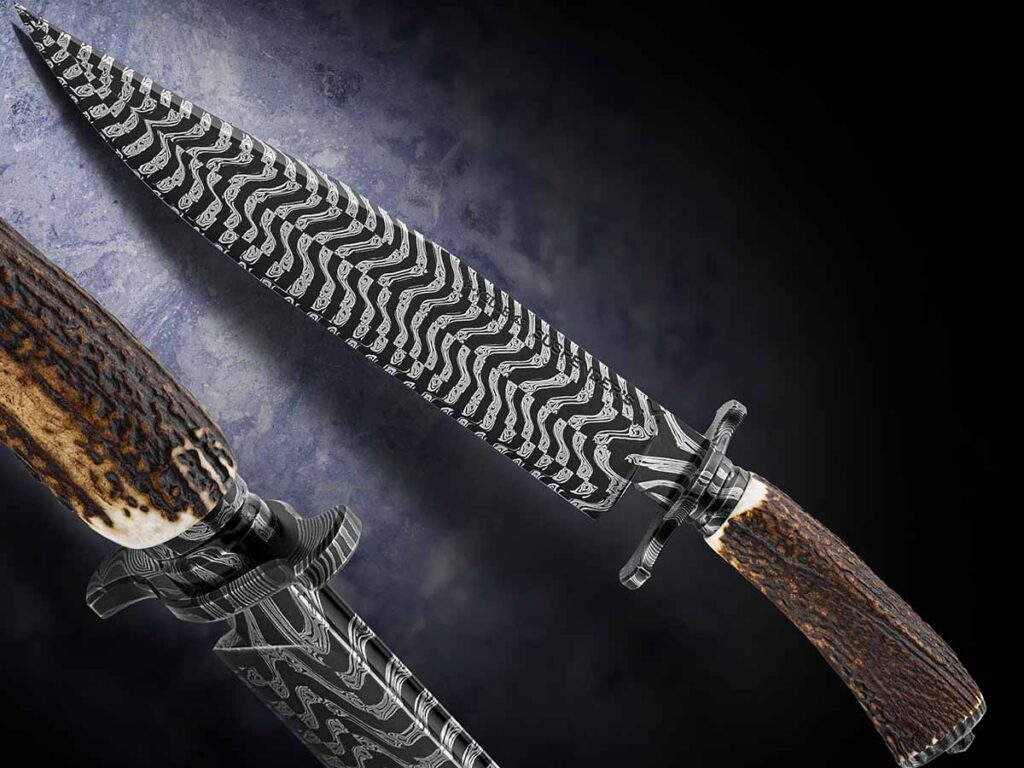
David Lisch Templars Mosaic

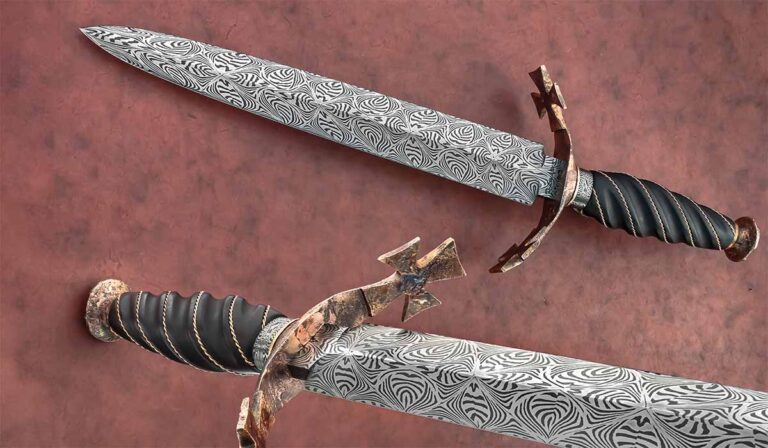
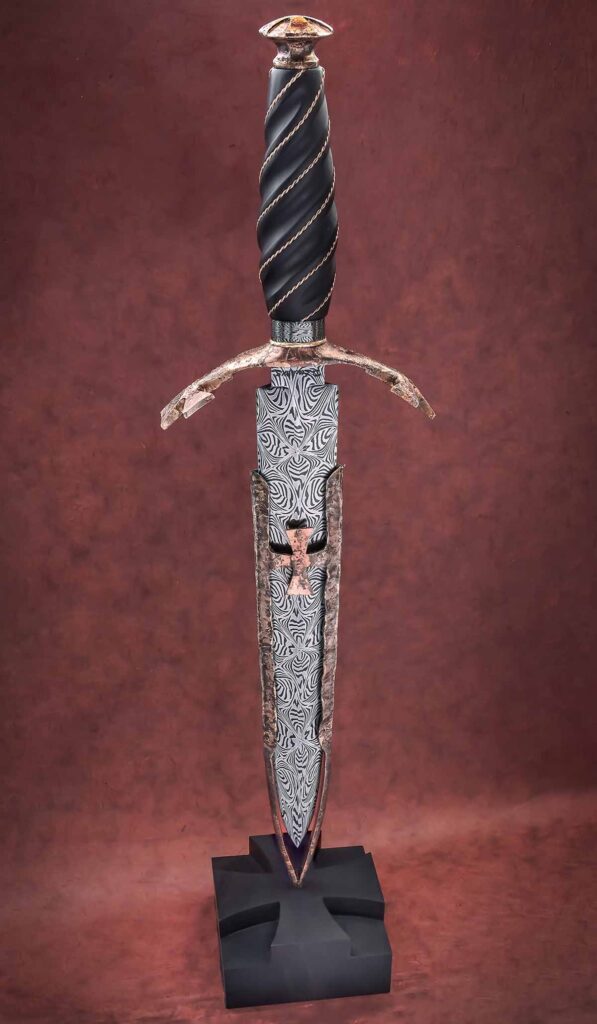
David Lisch’s dagger
David Lisch’s spectacular art dagger features a 12-inch blade of his Templars Mosaic Damascus, a blackwood handle with gold wire wrap and a guard of pure iron covered in melted gold. Overall length: 17.75 inches. The knife comes with a stand that includes an embellished templars’ cross and one carved in the base as well. (SharpByCoop knife images)

Sporting a pattern ABS master smith David Lisch christened Templars Mosaic, the blade for his dagger is one he forged from 15N20 nickel-alloy and 1080 carbon steels and etched in ferric chloride.

“I was aiming for a bold, bright pattern that had a cross-like shape but wanted it to be a bit organic,” he wrote. The Templars’ cross also is represented on the guard and the finial, and there is one on the stand that holds the knife as well. “All these parts are pure iron covered in melted gold,” he noted. The dagger also has a domed gold spacer between the guard and Dragon Thunder damascus spacer that the fluted-blackwood-with-gold-wire-inlay handle butts up against.

“I made this dagger out of the love I have for creating art with no concern about how long it took or how much money I would make from it,” David stressed. “I did the handle twice and I did the big finial twice. I sold the piece for $10,000 and will not be making another one like this. You can be sure that the love I have for creating will take me to a new dagger, sword or bowie knife that tries to fill the void in me that can only be filled by creating art.”

Jeremy Yelle Jellyroll Mosaic Turkish Twist

jellyroll mosaic Turkish twist pattern damascus
The steels for the jellyroll mosaic Turkish twist pattern damascus of the collaborative bowie by Jeremy Yelle (right) and Alex Houle (left) is forged from 1080 carbon and 15N20 nickel-alloy steels. Blade and overall lengths: 10.25 and 15.5 inches. Their list price for a similar knife: $2,600. (Jocelyn Frasier knife image edit)

The blade damascus of ABS journeyman smith Jeremy Yelle’s and SBK Cutlery’s stag bowie is a positively electric jellyroll mosaic Turkish twist pattern Jeremy forged in a collaboration with his friend Alex Houle of SBK. Alex forged the collaborative damascus into a blade and Jeremy made the handle.

“We began by welding a billet of alternate layers,” Jeremy wrote of the forging process. The pair drew the billet into a bar and jelly rolled it. “Then we squared it up and welded a four-way incorporating some 1-inch-square 1080,” he continued. They welded the billet, drew it out to ¾-inch square, cut and twisted it, and made a Turkish-twist stack that Alex forged into a blade. “You can also see the ‘fish mouth*’ weld Alex did so the edge bar and the spine meet properly,” Jeremy wrote. “He did a wonderful job making the blade.” Jeremy showed Alex how to work with stag and they finished the parts. Alex revealed the beautiful pattern via a two-step etching process using a solution of ferric chloride and finishing the etch with a coffee-darkening soak and hot wax finish.

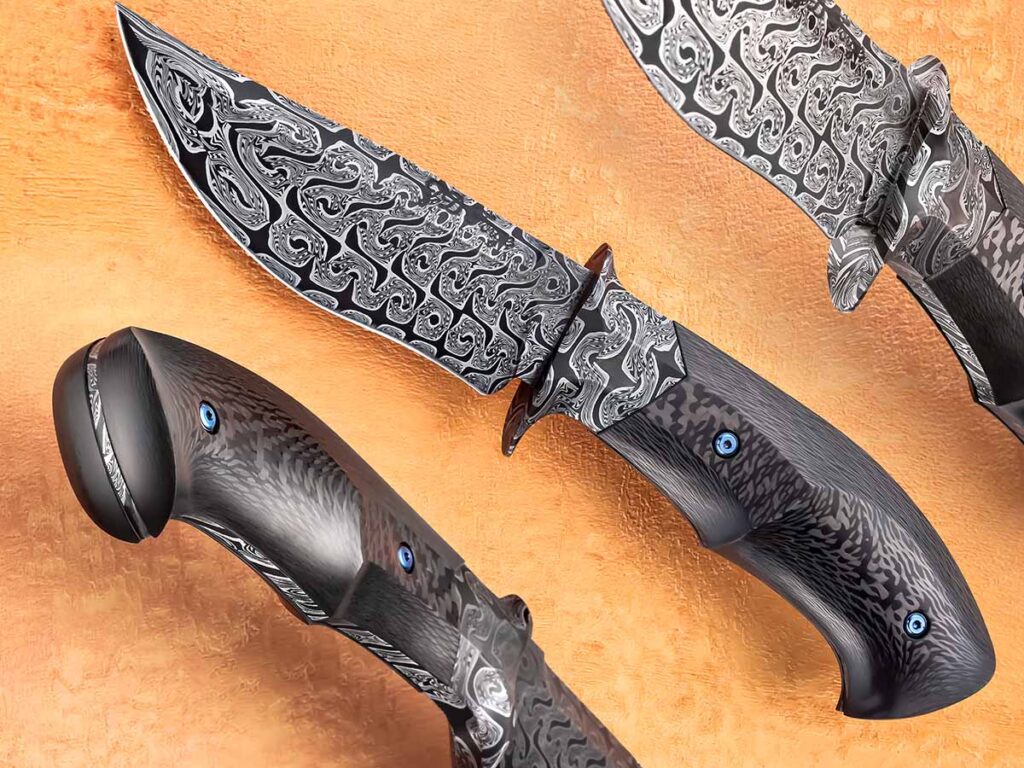
Zane Dvorak Multi-Bar

multi-bar damascus
The 4.25-inch blade of Zane Dvorak’s hunter is a multi-bar damascus of 1084 carbon and 15N20 nickel-alloy steels. Overall length: 9.25 inches. His price for a similar knife: $2,400. (SharpByCoop image)

The blade of Zane Dvorak’s hunter is a multi-bar damascus of 1084 carbon and 15N20 nickel-alloy steels. Zane forged the blade/tang of four twisted bars of a twisted-bar pattern, and forged welded the guards and bolsters on with the same pattern. He bird’s mouthed the blade tip and rewelded it back together to create flowing outer bars. For etchant he used Gator Piss Acid from Baker Forge & Tool.

Bird’s mouthing is a process done on multi-bar, mosaic or other types of damascus patterns. According to Zane, it involves cutting a triangle out of the end of the rectangular parent bar—the shape of which somewhat resembles a bird’s mouth—then bringing the steel of the edge and spine back together to form the point of the blade. By doing so the blade exhibits a better consistency and overall flow of the pattern.

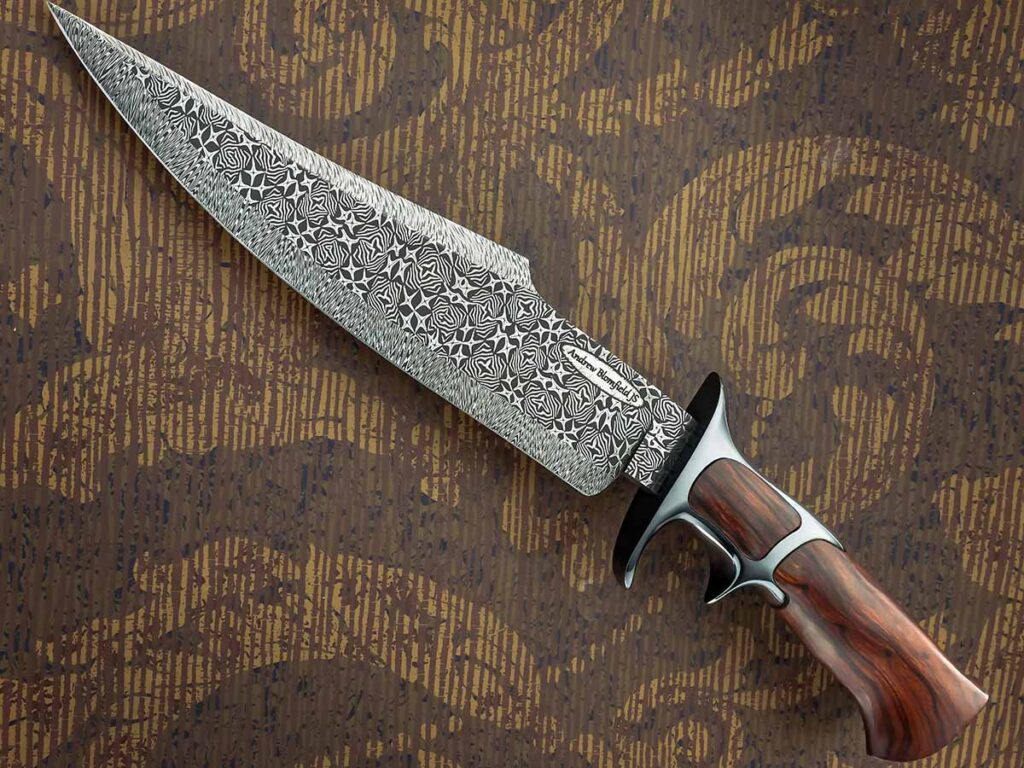
Andrew Blomfield Alternate Pattern

mosaic damascus Andrew Blomfield’s sub-hilt fighter
The mosaic damascus for Andrew Blomfield’s sub-hilt fighter is a combo of two separate billets welded in an alternate pattern. Blade and overall lengths: 9.5 and 14.5 inches. Blade grind: flat. Andrew’s price for a similar knife: $3,000. (SharpByCoop image)

The material mid-blade of Andrew Blomfield’s sub-hilt fighter is a combination of two separate billets of mosaic damascus welded in an alternate pattern. The edge is a straight feather pattern forge welded around the edge. The blade is a combination of pieces from three separate billets. The steels are 1084 carbon and 15N20 nickel alloy etched with ferric chloride.

The integral sub-hilt is 1020 low-carbon steel hot salt blued to a deep black finish. The handle is desert ironwood. The knife is of a full takedown construction.

Frank Edwards Palm Leaf Mosaic Pattern

 Palm Leaf mosaic damascus by Frank Edwards i
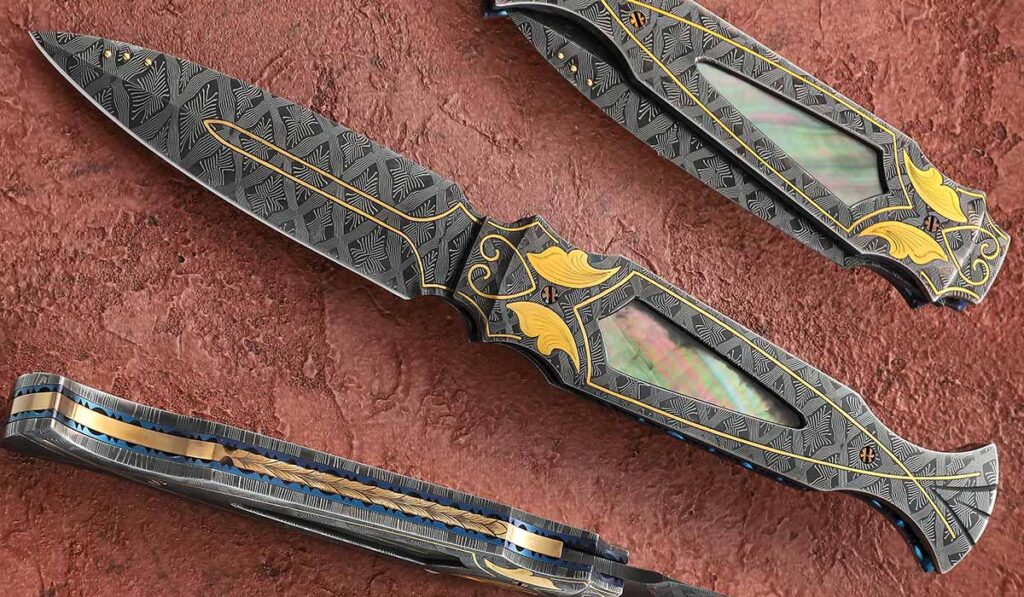
The Palm Leaf mosaic damascus by Frank Edwards is an interweaving river system of straight lines. The handle inlay is black-lip mother-of-pearl. Blade and closed lengths: 3 and 4.25 inches. His price for a similar knife: $1,900. (SharpByCoop knife image)

The multi-bar damascus of Frank Edwards’s folding dagger blade is in a Palm Leaf mosaic pattern. Starting with a billet of straight lines, he reduced it all into a square and then biased the squares, four-waying the billet into a 1.5-inch square.

As Frank explained his recipe, “Forge weld another billet of straight lines, keeping them straight as possible to .5 inch by 1.5 inches. Add that to the previous billet and forge weld and reduce to a 1×1-inch square. Then four-way it again. This will give you the frame around the palm leaves. Keep repeating that until you achieve the size of pattern for the knife you’re building.

“The key to getting good mosaics is a slower reduction [of the steel]. We have presses and power hammers that help but they can move too much metal too fast, which will destroy a mosaic in a hurry. The slower reduction allows the billet to stay uniform throughout the length of the bar.” 
To expose the pattern he etched the blade with a four-to-one mixture of water/ferric chloride in 10-minute cycles, using 2,000-grit sandpaper between cycles.

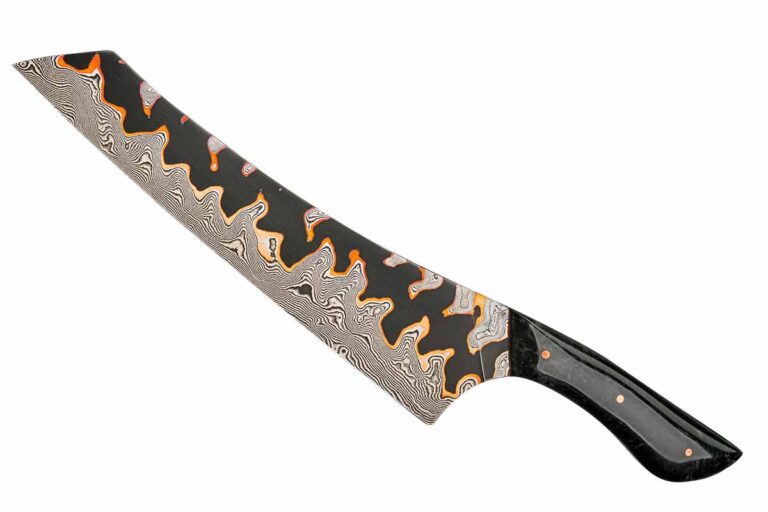
Jackson Rumble Stunning Pattern

unnamed damascus pattern
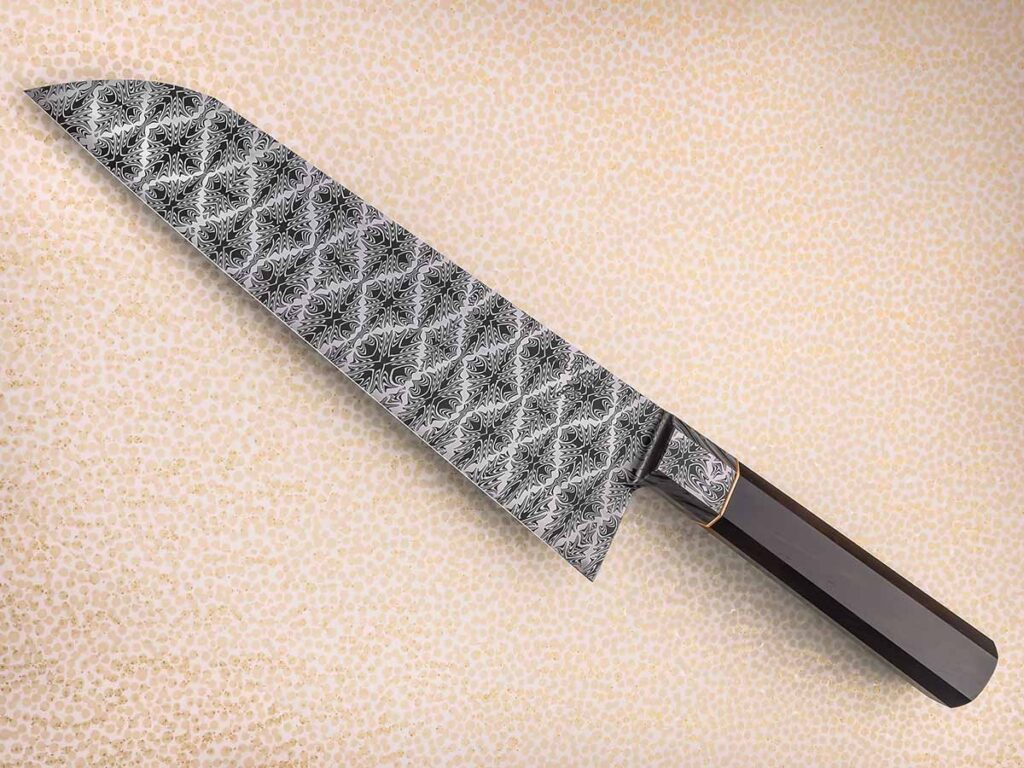
The 8-inch blade of an integral chef’s knife by Jackson Rumble boasts a mesmerizing and at press time unnamed damascus pattern forged from 1084 carbon and 15N20 nickel-alloy steels. The handle is African blackwood. Overall length: 13 inches. The maker’s price for a similar knife would start at $2,500. (SharpByCoop knife image)

The technique for the stunning pattern on newly named ABS master smith Jackson Rumble’s chef’s knife is what he calls a “pretty standard process” of four-way welding and re-square cycles. Not bad for “pretty standard,” eh (page 28, top left)? The initial stack has large sections of both light and dark steels interspersed through the alternating layers, and Jackson added extra-light steel to the billet in the later stages of the forging process.

“Finally, I used the Filicietti Flip method to transfer the pattern to the face of the billet,” he wrote. “For the etching process I used ferric chloride followed by coffee.”
OK, Jackson, so what’s the “Filicietti Flip method”?

“I’ve heard the Filicietti Flip called other names like the Ferry Flip, or just tile welding,” he explained. “Basically, after you’ve finished building the pattern in the end grain of the billet, you take it to a bandsaw and cut slices off the end at a 35-degree angle. This makes a bunch of pieces in the shape of parallelograms or tiles. The tiles can then be rotated and forge welded back together to form a new billet. Instead of having the pattern showing on the end of the billet, the pattern will repeat itself along the face of the billet.”

We’re glad we asked.

*Also called fish lips, fish mouth is when the tip of the billet begins to curl up on either side during rough forging to resemble a fish’s mouth or lips, thus the name. It is an easy fix for knowledgeable bladesmiths such as Alex Houle.

Check Out More Cool Custom Knives:

Advertisement

Must Read Articles

Read this before you make a knife

Knifemaking 101 – Read This Before You Make a Knife

  by Wayne Goddard My experience has taught me that there's nothing like digging in and getting started. I've often said the hardest part of the...
how to forge damascus steel

How to Forge Damascus

Advertisement
Advertisement