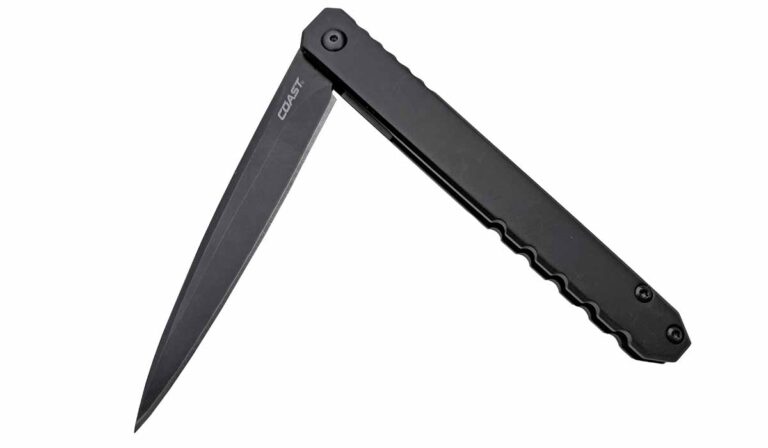
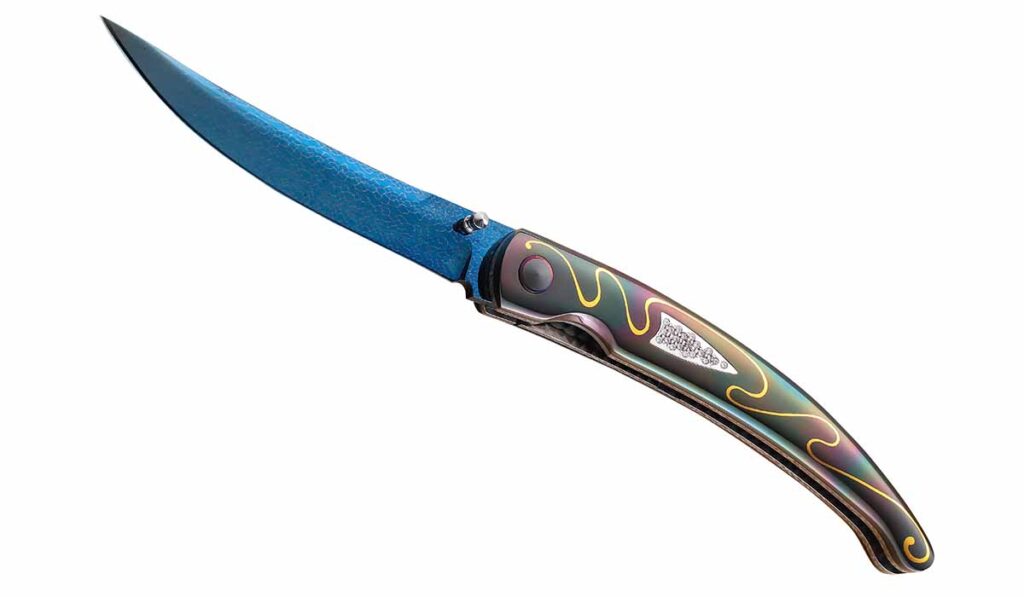
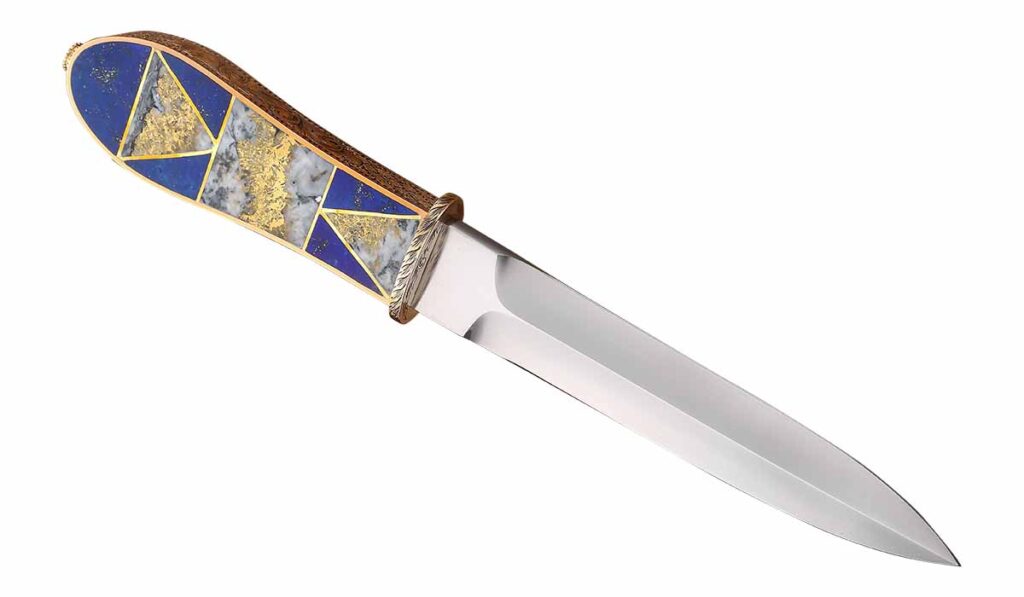
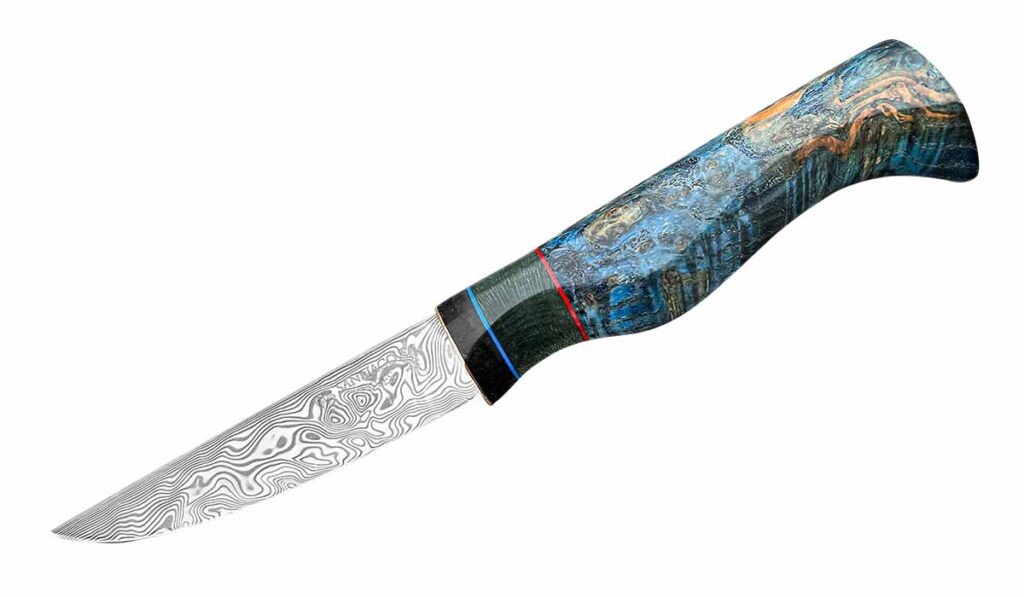
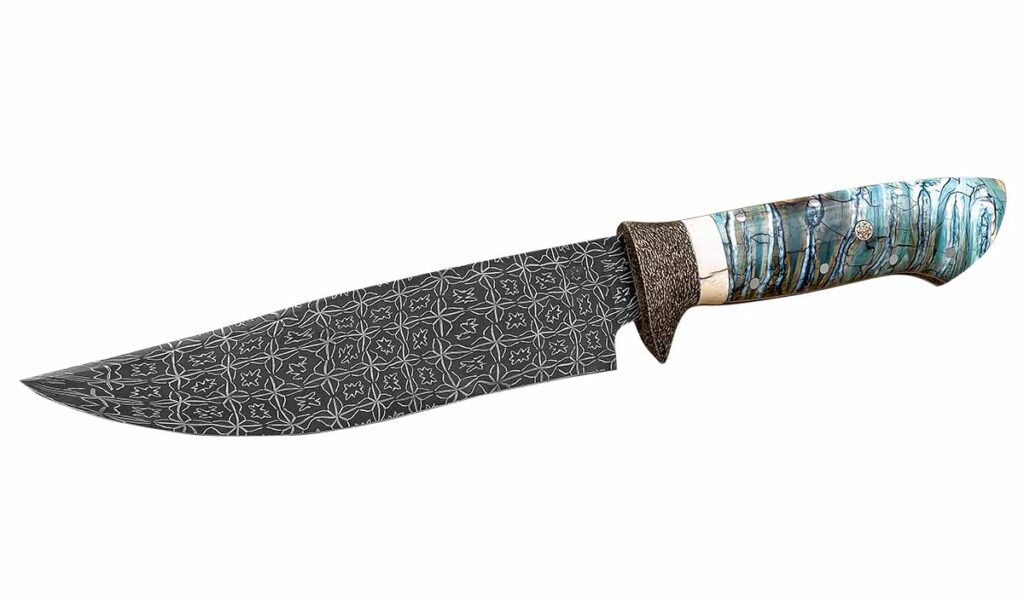
Every now and then I come across a folder that just feels right both in my hand and in my pocket, one that’s not too large nor too small, yet still has that sleek look to it. The Coast LX532 framelock does it all for me. I really love the blade shape. However, it still must be able to slice and dice to get a top place in my book.
Coast LX532 Edge Test
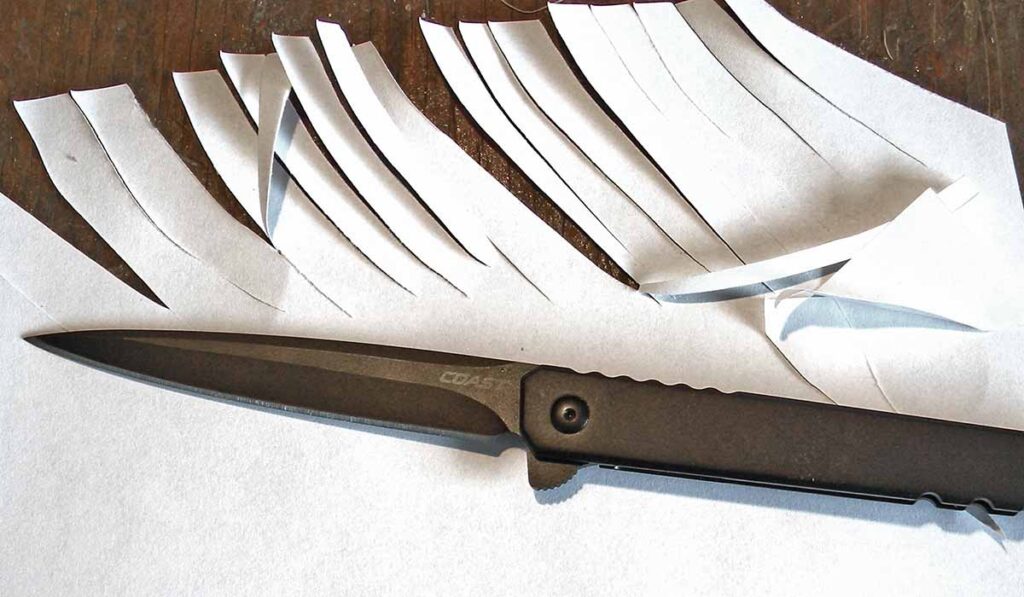
The good ol’ paper slice worked for starters. The LX532 sliced very smooth with no effort. The thin blade made for great control during the cuts. The only challenge was getting my fingers out of the way fast enough.
It was back to 20-pound bond copy paper for the final edge test. The LX532 didn’t miss a lick, slicing very smooth, aggressive cuts.
It was time for the single-walled cardboard. The knife was quite aggressive in cutting it. Again, control was great. The thinner handle takes some getting used to but that’s not a big deal. There was some twisting on the cut pieces but that was me getting accustomed to the handle.
Plastic board was next. The LX532 handled it with ease. The thumb notches on the handle spine really came in handy as more pressure was needed to make the cuts. They notches stopped the thin blade from twisting in my hand while cutting.
LX532 Meduim-Duty Cutting
I had some leftover dense foam from the Kydex press to change out, so I decided to slice it up. The folder went through the foam like butter. The thin blade is extraordinarily sharp to say the least. Control was great yet again and I had to continue slowing my slicing down to keep my fingers intact.
The knife went through the foam like butter. The thin blade is extremely sharp to say the least.
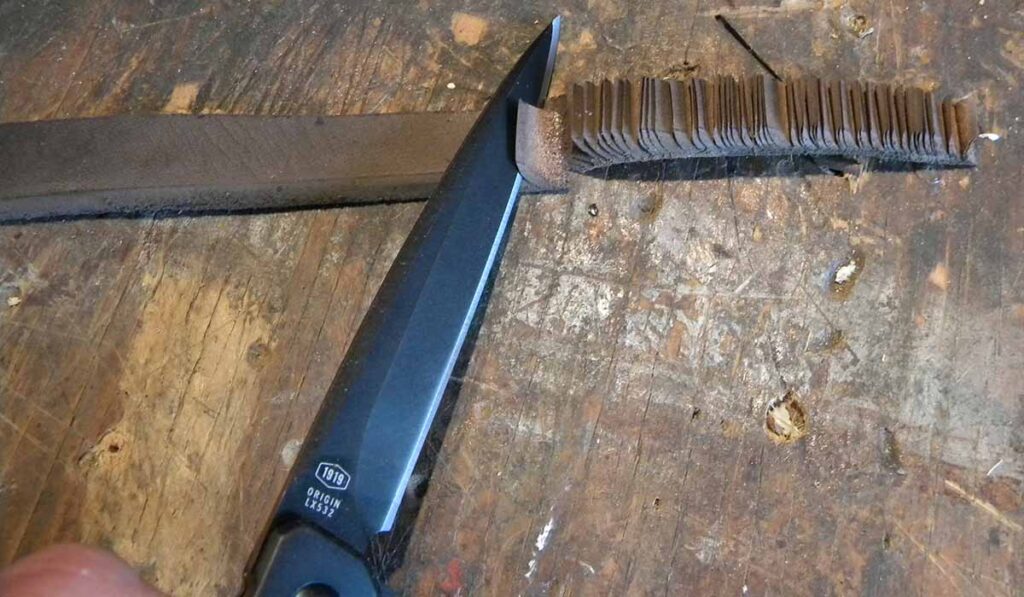
Eight-ounce leather, anyone? I did some normal up-and-down slicing, along with some skiving. The edge was quite forceful slicing leather. I could hear each and every cut. The knife is exceptionally smooth and controllable for straight cutting. I switched positions and laid the leather flat for some skiving. The LX532 was very loud and aggressive slicing the material. I cut through the leather more times than I want to say. (It makes a better picture if the leather is all together rather than a bunch of smaller pieces.)
LX532 Heavy-Duty Cutting
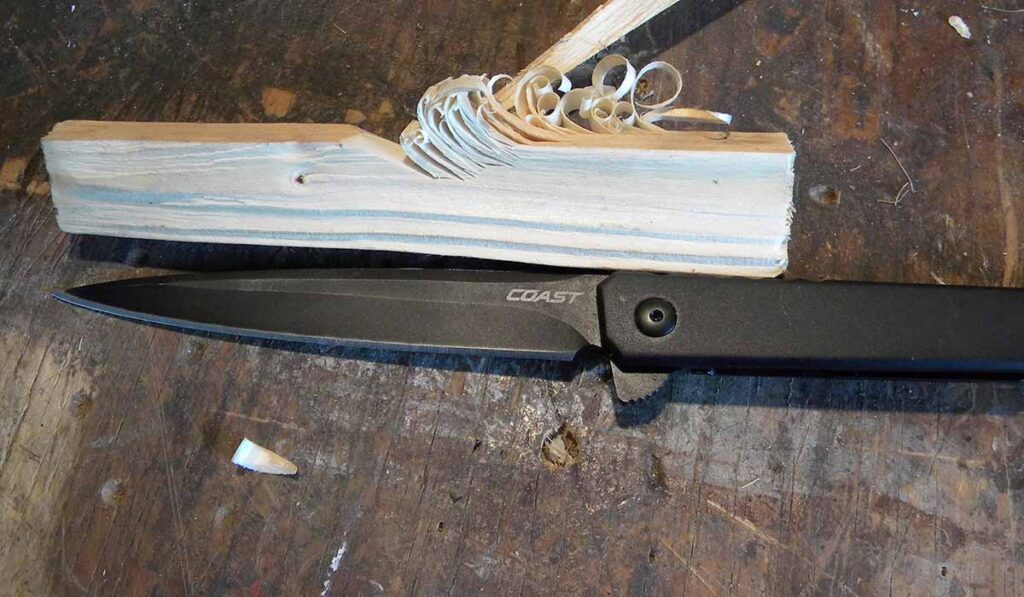
With camping season in full swing, I needed to stock up on firesticks to start the campfire. The LX532 worked perfectly. It made great thin curlicues in the pine. It also took deeper bites if needed. The blade zipped through the wood. Control was great with my thumb on top of the handle. It was a lot of fun to do.
The blade zipped through the pine and made great thin curlicues. It also took deeper bites if needed.
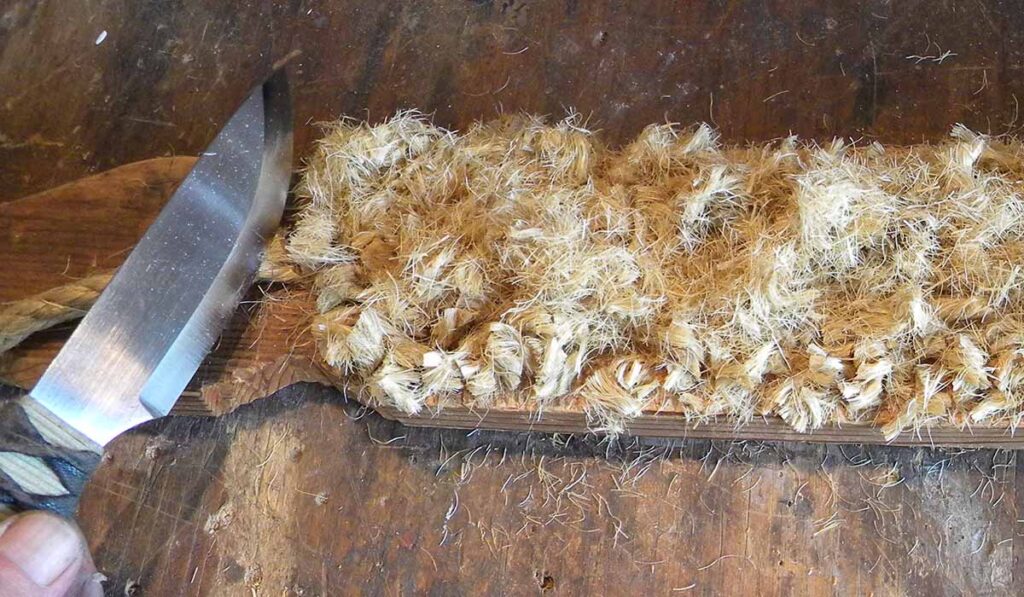
I had my doubts about cutting sisal rope with such a slim knife. However, the folder proved it could go the distance, providing 200 crunching cuts before I stopped. The knife was still going strong. I was impressed. The framelock stayed at 100 percent engagement the whole time and was still smooth upon closing. Hats off to the folks at Coast.
It was back to 20-pound bond copy paper for the final edge test. The LX532 didn’t miss a lick, making extra-smooth, uncompromising cuts.
Overall Take
The LX532 is one sweet framelock. The slim overall shape is right up my alley. Performance is in the top 10 percent. Excellent job, Coast. I wouldn’t change a thing. Maybe some texturing of the handle?
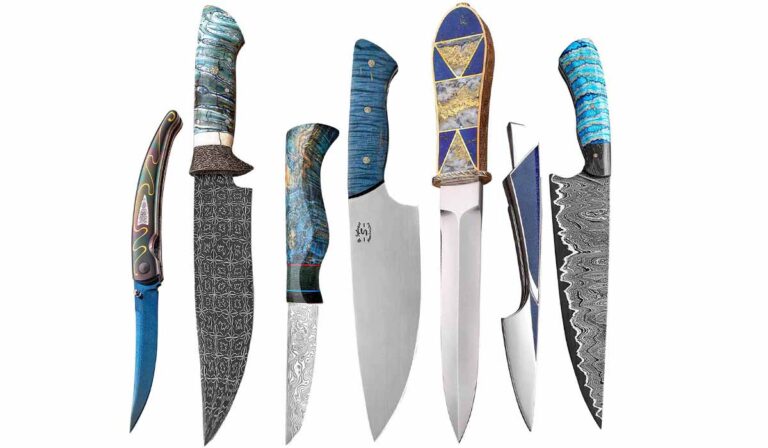
No doubt, these custom blades have icy good looks.
Many things are associated with the color blue. Depending on your preference or point of view, some of those things may be good, others bad. In the case of knives, blue comes in many hues and materials, and can serve different purposes. Here’s hoping these blue knives don’t give you the blues.
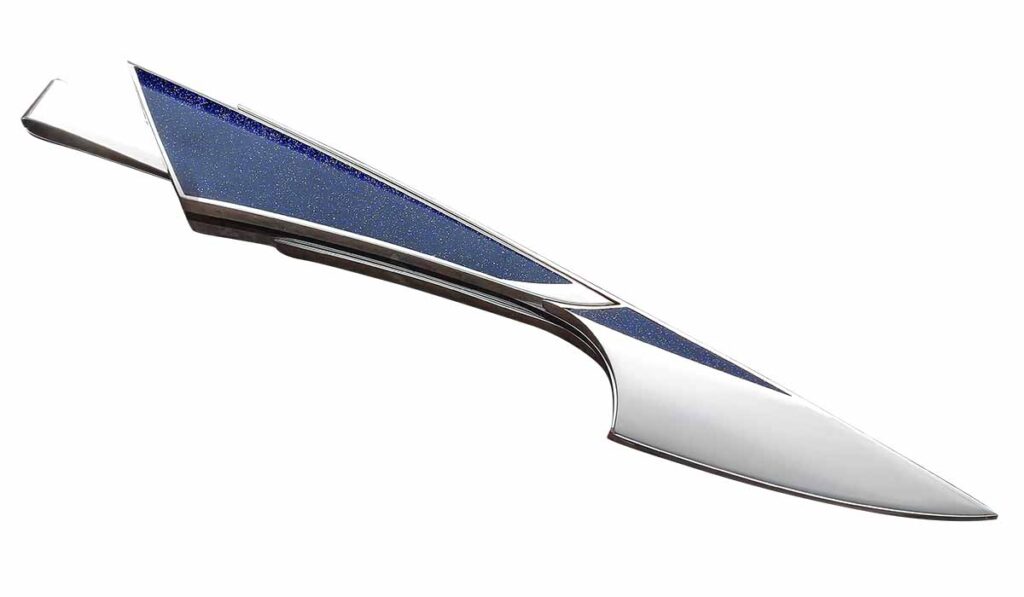
Michael West: Starry Night
A handle of blue sunstone set in a frame of argentium silver and at 2.83-inch blade of RWL-34 stainless steel headline Starry Night by Michael West. Blade grind: concave. Bolster: Argentium silver. Overall length: 7 inches. Sheath: all silver with blue sunstone inlay. Maker’s price for a similar knife: $3,500. (SharpByCoop image)
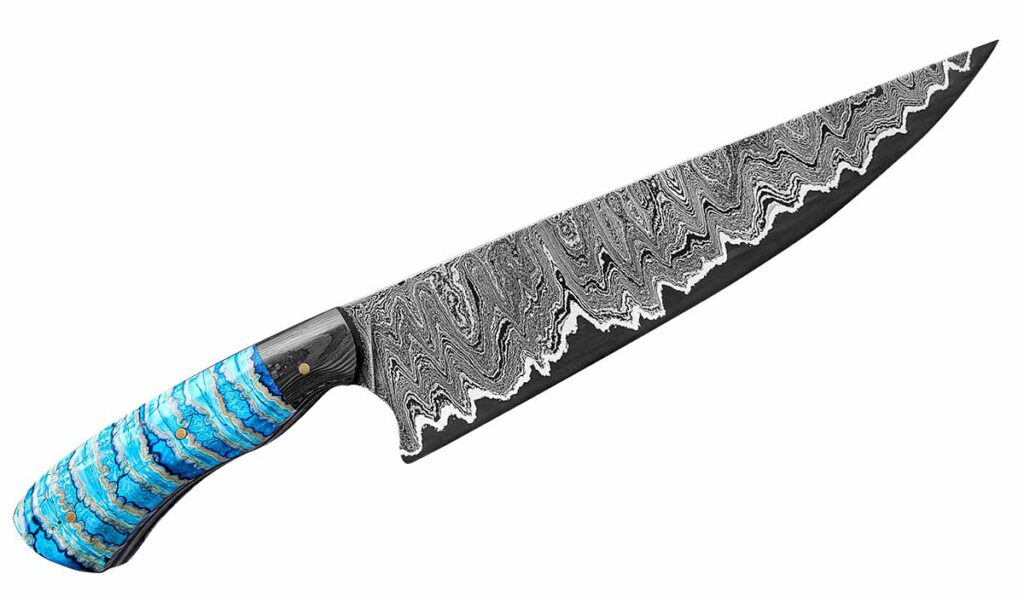
Shane Gagne: Chef’s Knife
The mammoth molar of the handle of Shane Gagne’s chef’s knife is dyed blue. The 8.75-inch blade is 180 layers of random damascus cladding go-mai with nickel shim and a core of 52100 ball bearing carbon steel. Total layers: 360. Bolster: carbon fiber. Overall length: 13.25 inches. (Jocelyn Frasier image edit)
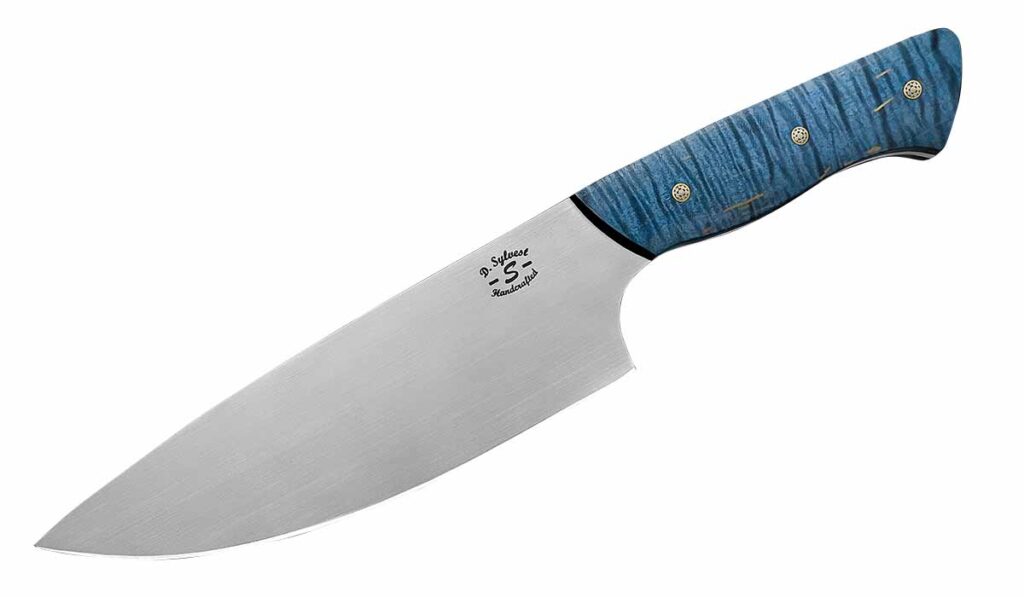
Don Sylvest: Chef’s Knife
Curly maple dyed blue outfits the handle of Don Sylvest’s chef’s knife. The 6-inch blade is CTS-XHP stainless steel. Don offers the knife in tandem with a paring model in the same materials, only smaller with a 3.5-inch blade. (Jocelyn Frasier image edit)
Tyler Turner: Toothpick
The 4.25-inch blade of Tyler Turner’s toothpick is blued Turkish Lace damascus forged by Doug Ponzio. The frame is zirconium and the liners are titanium. Embellishments include 24k-gold inlay by Jody Muller, an argentium silver shield and diamonds pavé set by Tyler. The pivot adjusts with a custom takedown tool. (SharpByCoop image)
Jim Sornberger: Dress Bowie
Blue adds contrast to the gold quartz handle of BLADE Magazine Cutlery Hall-Of-Fame® member Jim Sornberger’s mid-19th-century-style dress bowie. Bolster: 14k gold. The 2.25-inch blade is ATS-34 stainless steel. All engraving is by the maker. (SharpByCoop image)
Jose Santiago-Cummings: EDC Fixed Blade
The EDC fixed blade by Jose Santiago-Cummings has a bird’s-beak handle of black ebony, chestnut dyed green and contoured birch wood dyed blue. The 3.75-inch blade is Damasteel damascus in a Vinland pattern. The bolster is mokume. Overall length: 8 inches. (Jocelyn Frasier image edit)
Rob Logan: Fighter
Rob Logan’s fighter sports a blue mammoth molar handle with a mammoth ivory spacer, white vulcanized handle liners and brass liners. The 4.25-inch blade is mosaic damascus forged by Bill Poor, and the brass frame and guard are textured and patinaed. Overall length: 13 inches. (Jocelyn Frasier image edit)
Cutlery Hall Of Fame ushers in a Hall Of Fame class at the 2023 BLADE Show.
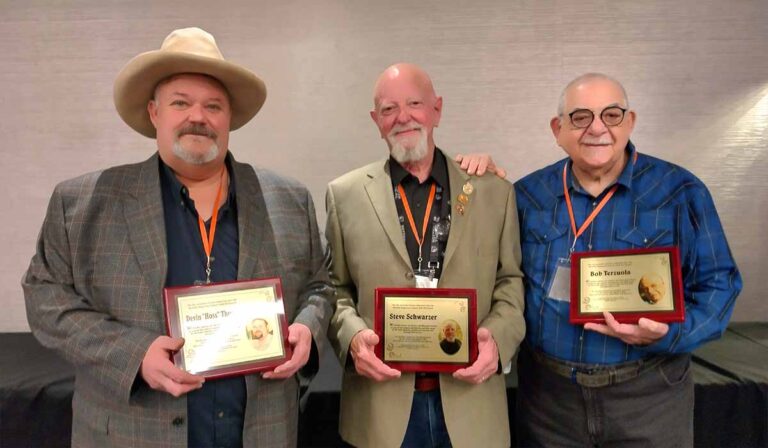
There was much joy tempered by a tear or three as Devin Thomas, Bob Terzuola and Steve Schwarzer took monumental steps in their monumental knife careers with their formal inductions into the BLADE Magazine Cutlery Hall Of Fame® during BLADE Show ’23.
Celebrated with a combination breakfast/induction ceremony, the new inductees were saluted by an appreciative crowd of just over 100 that included family, friends, sitting Hall-Of-Famers, world-renowned knifemakers, knife collectors and various combinations thereof in the Kennesaw Room of the show’s host hotel, the Renaissance Waverly.
Providing induction speeches were those handpicked by the new inductees: Cutlery Hall-Of-Famers Bill Ruple and Ken Onion for Thomas and Terzuola, respectively, and award-winning bladesmith Neil Kamimura for Schwarzer. All, including the acceptance speeches, were genuine, entertaining and memorable.
Devin Thomas
While best known for his damascus steel, Devin’s first love was making knives. “The best kept secret about Devin is how good a knifemaker he is,” Bill Ruple said. “He’s known for his wonderful damascus steel, some of the best in the world, but he’s a heckuva knifemaker.”
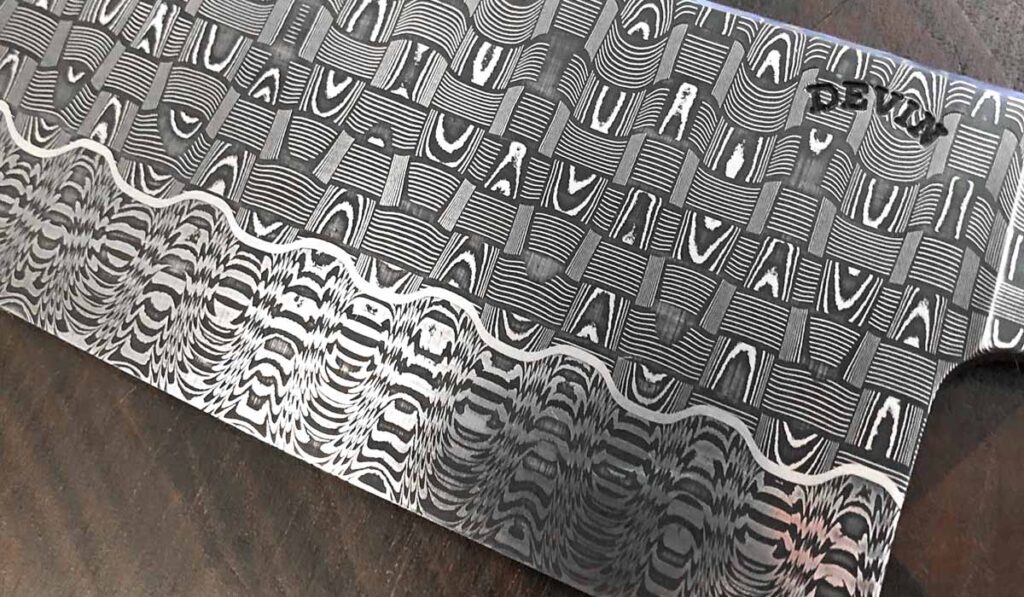
A Devin Thomas blade of Devin’s stainless damascus. (image courtesy of Devin Thomas)
Using a set of instructions his uncle gave him, Devin made his first knife at 13. At 16 he worked the whole summer making knives with long-time maker Bob Lofgren in Arizona. Devin did so without pay but didn’t care because of his affinity for knives. At 18 he won most impressive knife by a new maker at the California Custom Knife Show. At 21 he married Jackie. “She knew me in high school and knew I made knives, so when we got married she knew about the knife thing, so I didn’t surprise her or anything,” he recalled. “And I told her at the time I’m going to be a world famous knifemaker one day.” Devin and Jackie recently celebrated their 37th anniversary.
One of Devin’s inspirations was Cutlery Hall-Of-Famer Wayne Goddard. Devin read Wayne’s story on cable damascus in KNIVES ’86 and a career was born. “I thought I could forge-weld cable damascus, so I bought me some cable. I didn’t have any idea what I was doing, and I heated up the forge and got [the cable] to stick together,” Devin said. “That started my damascus career.”
His next great inspiration was Cutlery Hall-Of-Famer Buster Warenski. “I kept trying to get him to try some of my steel,” Devin related. “Buster said, ‘I’m not trying any of your steel unless you try to make stainless damascus.’ I started making stainless damascus and Buster used a piece in one of his art pieces and I thought, ‘I can quit today!’”
On the contrary, Devin was on his way.
“At one time I think I was making more steel than the entire ABS put together, not certain, but I could really pump it out,” he said. “I was doing 50 bars of steel a day on a regular basis. That hammer was wide open all the time.”
Family, friends and customers—that’s what it’s all about for Devin. “My oldest son [Larrin] is developing new steel so fast the industry can’t keep up,” he noted. “He developed MagnaCut— which some like but a few don’t—but the industry can’t absorb his new developments fast enough.”
Better designs, better manufacturing, an upcoming generation of makers that has him very optimistic—Devin sees a rosy future for the industry.
“We have more talent than we’ve ever had before, and younger talent, and more excitement,” he opined. “We’ve got a lot of bad designs and bad knifemaking too, but we’ve got to tolerate the good and the bad. We need more domestic manufacturing and we need better abrasives—they’re not keeping up with the steel we’re producing. My only regret? I don’t know, maybe I shoulda bought a truckload of stag scales when they were only two or three dollars a pair.”
Devin Thomas at the helm. (image courtesy of Devin Thomas)
Ruple said he and Devin have a mutual respect based both on friendship and a shared desire to make the best the knife industry has to offer.
“Devin was always my go-to guy when it came to knowing anything about steel,” Bill said. “Anything I needed to know I’d call Devin. I learned a lot from the guy.”
Devin is nicknamed “Hoss” for his resemblance to the most endearing member of the Cartwright family on the long-running 1960s-’70s TV show, Bonanza. And, not unlike the TV Hoss, the new Hall-Of-Famer Hoss has never been beyond pulling a rabbit out of his 10-gallon hat. Bill recalled such a time at a long past BLADE Show.
“We were sitting at my table and this guy from Japan comes up and he’s trying to buy a knife from me and communication is not going well, and all of a sudden Devin’s talking Japanese to this guy and I’m thinking, ‘Hoss Cartwright speaks Japanese?’” Bill laughed at the memory.
Of course, the fact Devin is multilingual simply adds to his Hall-Of-Fame pedigree.
“Devin’s the guy who brought damascus steel to the masses,” Bill observed. “There were guys who made damascus steel but Devin aimed his steel at folder makers. He got it out there in dimensions that guys like me could use. There’s probably more of his steel in high-end collections around the world than anybody else’s. He’s been doing this a long time and he’s one of the best ever.”
Bob Terzuola
Bob Terzuola made his first knife in 1979, joined the Knifemakers’ Guild in 1981 and along the way served on the Guild’s board of directors for nine years. His relentless search for ways to improve his knives in terms of design, materials, mechanisms and more helped establish his place as one of the greatest knifemakers of his or any era, with his tactical folding knives at the summit.
BLADE Magazine Cutlery Hall-Of-Fame® members Michael Walker and Bob Terzuola enjoy the 2019 Art Knife Invitational. (image courtesy of Bob Terzuola)
“In 1984 Bob moved to Santa Fe, New Mexico, and started making folding knives,” Ken Onion said. “Searching for a hard-use folder that could be used discreetly, Bob developed a model featuring Micarta® scales and bead-blasted titanium bolsters for which he coined the term tactical folding knife, which later evolved into his most popular model, the ATCF … which opened the market for the new category of folding knife, which arguably remains the largest and most popular category of knives in the industry.”
As Ken noted, Bob wanted to design a “robust knife as tough as he could,” so he set out to use G-10, carbon fiber, titanium and other advanced materials at a time when few if any were using them. He was a pioneer of the circular thumb disc for ambidextrous one-hand blade opening, multiple double grinds on folder blades, knives with laser-cut CNC parts and fine-tuned other areas that have molded the modern folding knife.
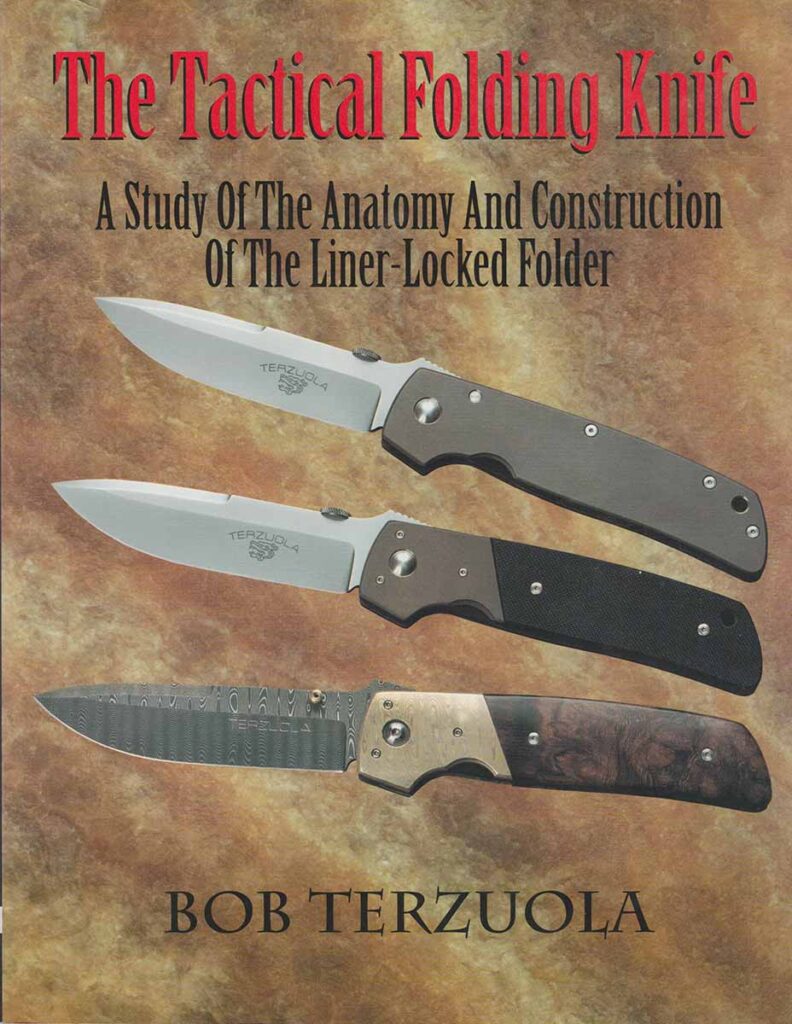
“Bob also focused a lot on the linerlock and did a lot of engineering advancements through a lot of trial and error, and then what does he do? He writes a book about it—The Tactical Folding Knife: A Study of the Anatomy and Construction of the Liner-Locked Folder—to teach the rest of us how to compete with him. How many of us have a copy of that book in their shop?” Ken asked the attentive audience. “How many have a dog-eared, highlighted copy, how many of us reference it regularly, and how many of us have read it more than once? It’s kind of like an important thing for all of us to have. All these contributions and advancements have earned him the affection of us all and title of the Godfather of the Tactical Knife.”
The Tactical Folding Knife is Bob Terzuola’s landmark book of which Ken Onion said to an audience of over 100, “How many have a dog-eared, highlighted copy, how many of us reference it regularly, and how many of us have read it more than once?”
Bob reiterated Devin Thomas’s comment about the importance of the human element. “I’ve seen a lot of changes and met a lot of people and made a lot of really good friends, and had to say goodbye to some of them,” he said. “There were friends who meant a lot to me over the years, people like Bob Loveless, Carolyn Tinker, Howard Viele, Frank Centofante, Wayne Goddard, Bob Lum, Alex Collins. A lot of these names don’t mean anything to a lot of younger makers, but they all helped build the structure that we all rely on to take care of our families.”
He also addressed some in the audience in particular, including Cutlery Hall-Of-Famer Michael Walker. “He introduced me to the alchemy of the linerlock and working with titanium, which back in the mid-1980s was virtually unknown to knifemakers and now is so important not only to tactical folders but all sorts of pocketknives,” Bob noted of Michael. “And Ken Onion, who’s been a long-time friend and a guiding light … and I want to thank my children … but most of all I want to thank my wife, Susan, who has taken care of me over many years and … has been a powerhouse of the artistic critiquing of my knives, additions to design and so forth. And thanks to all of you for this honor and gathering here at the greatest knife show there is. Keep up the good work and let’s see where this winding, crazy, twisting road of surprises takes us in the craft of knifemaking.”
Steve Schwarzer
An ABS master smith, Steve Schwarzer and the ABS were meant for each other. The ABS is all about teaching and promoting the art of the forged blade, and so is Steve. “I want to say thank you to Billy Ray Hughes and the ABS that really helped me build a foundation,” he said. “They have a set of standards to follow and it really helped drive my business,” a business that includes a pioneering career in canister damascus, award-winning knives and teaching as many bladesmiths as he can how to forge blades
Steve Schwarzer speaks of “knife-shaped objects,” his teachers, students and other sharp things.
Like Devin Thomas, Steve got a taste of what would become his life’s work in junior high school when he forged his first hot steel. Not long after high school in the late 1960s, he went to work in the aircraft industry and started making “knife-shaped objects.” He called them knife-shaped objects “because we took a piece of stainless steel we found on the job somewhere with no idea how to heat treat it or what kind of steel it was, and we’d grind it to what looked like a knife and put a handle on it.”
In 1972, he moved to Florida and bought a book by Alex Bealer that had a page-and-a-half on forging knives. “When I turned that page and read it, it lit a fire that never went out,” Steve said. He made knives as a hobby and sold them to his fellow shop workers for $15 and $20 apiece. “They told me I was wonderful and I believed them,” Steve said to a chuckling audience. It was then he learned of Bobby Tyson. “He was my original teacher,” Steve said. “I loved the guy. He could make two beautiful pocketknives in a day that walked and talked. Tony Bose would’ve been proud of them.”
Tyson actually had books on making knives, a novel concept at the time. Steve visited Tyson and learned all he could. “He put me ahead five years in one weekend and that’s what I try to do with Neil Kamimura and these guys here,” Steve said, pointing to some of his students in the audience. “I surround myself with people doing great things.” It is an approach that inspires Neil.
“Steve says surround your yourself with people that know your value,” he observed. “He has helped a tremendous amount of people and everybody wants to know his tricks because he’s the wizard of steel. But for me it wasn’t his tricks of welding steel but it was the lessons I wanted to learn, such as how does he keep his passion for that many years? How did he keep his willingness to want to keep on wanting to learn?” To absorb those things from Steve, Neil noted, “is to listen to his struggles, his hardships and the balance he took to maintain such longevity in this industry.”
Meanwhile, Steve the teacher remains, and always has remained, Steve the student.
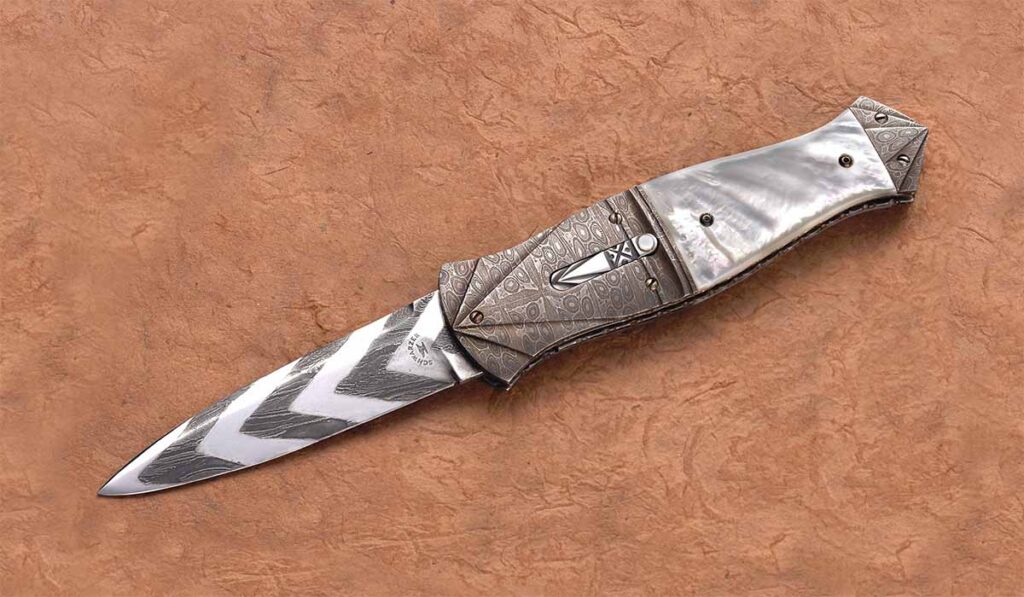
A Steve Schwarzer folding dagger sports a chevron damascus blade, canister damascus furniture and mother-of-pearl scales. (PointSeven image)
“At 75 I’m hurrying, I promise you,” he stressed. “I wake up in the morning and it’s, ‘Man, I’ve got another day. Let’s go do something!’ And that’s what I do and then [my students] explore and come back with information. So everyone you teach in this business doubles your life in the business is the way I look at it. And that’s why I love what I do.”
Neil brought it all into full focus.
“How many careers were started because of him and how many lives he’s touched, many in this room,” he mused.
“Steve Schwarzer has truly changed bladesmithing forever and I believe that … A lot of these young makers and a lot of these Instagram people, we’re nothing without people like Steve and people that have been inducted [today]. So if you don’t know Steve, you should get to know him, and if you do know Steve, you should treasure him like I do.”
Jason Ritchie’s knives and the way he sells them have a special appeal.
It’s not all the way here yet but a significant portion of the future of knives may be personified in the person of Jason Ritchie and his handsome slip joints.
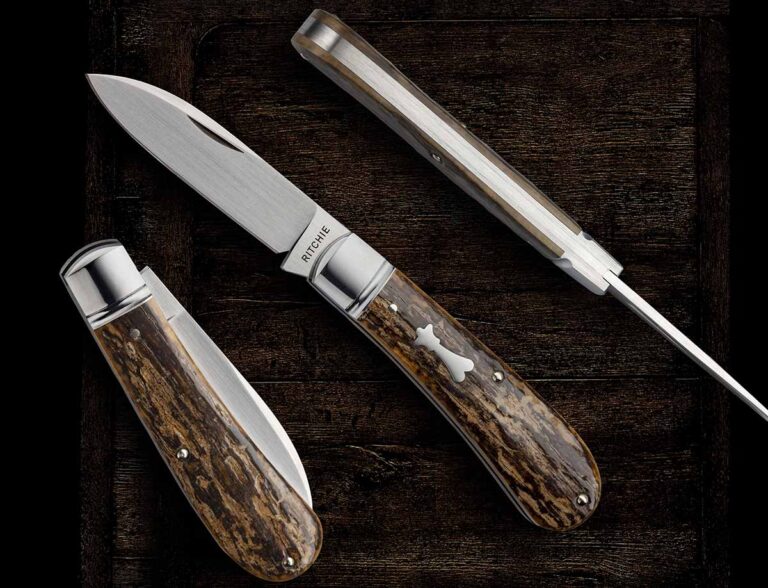
An example of his work is his repro of BLADE Magazine Cutlery Hall-Of-Fame® member Tony Bose’s Zulu Spear in mammoth ivory and AEB-L stainless steel. Jason’s been making knives less than three years but his workmanship is that of a much more experienced cutler.
Nonetheless, it’s the way the 46-year-old approaches the making and selling of his knives that’s as notable as the knives themselves. The Marine Corps infantry veteran describes himself as a hobbyist—he builds 25 to 28 slippies a year at most—and does not take orders. Other than a few sold by Windy City, he sells all his knives on Instagram via lottery or first-come, first-served buyers.
The resident of Hanover, Illinois, says all the knives he puts on his Instagram page sell in seconds. He does not exhibit at knife shows because between making knives, his full-time job as a signal maintainer for the railroad and the campground he operates during the summer months, he simply doesn’t have the time. Rather than exhibit, he prefers meeting people and hanging out at the shows.
As he noted, “I’m just a knife enthusiast at heart.”
Zulu Spear Repro Specs Maker: Jason Ritchie Blade Steel: AEB-L stainless Blade Finish: Hand-rubbed satin Rockwell Hardness: 61 HRC Handle Material: Mammoth ivory from Fine Turnage Productions Liners, Shield, Pins & Fluted Bolster: 410 stainless; the liners are jeweled Closed Length: 3 7/8” Maker’s Price For A Similar Knife: $1,200
We hack away at meaty machetes that cut to the quick and take no mercy on brush.
In many parts of the U.S.A., greenery is busting out all over with the year’s early warmth and rain. People are trimming shrubs, cutting grass, whacking vines and other yard tasks. If you are a camper or own land, chances are you have a need for a good machete to help clear brush and take down saplings.
Schrade Delta Class Decimate Bolo
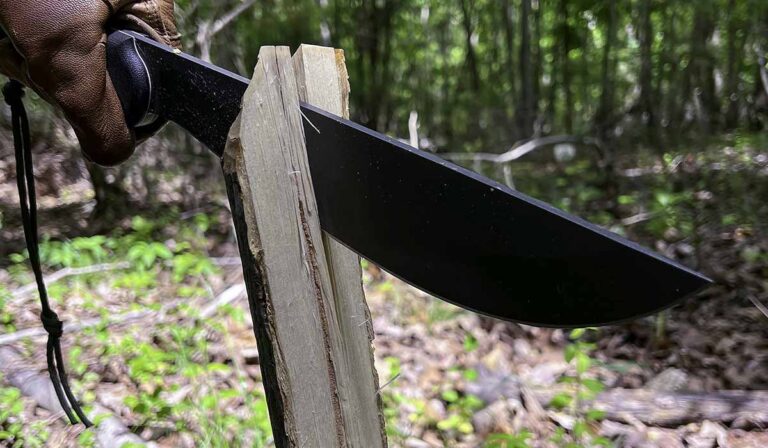
The shallow blade grind enables the Schrade Decimate Bolo to bite deep into green wood.
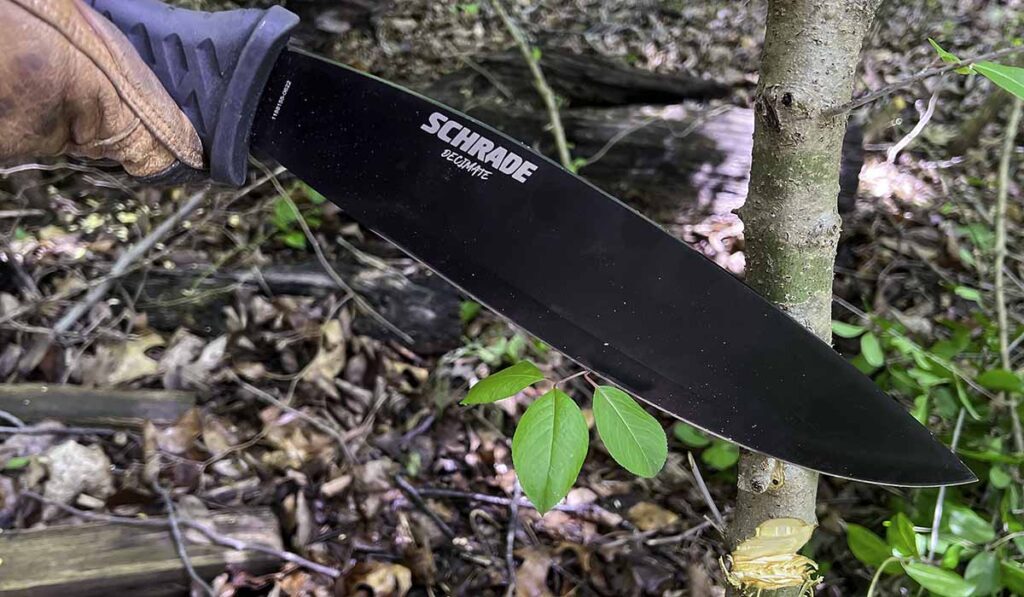
The Decimate Bolo machete is part of Schrade’s Delta Class line of knives, and offers a good balance of performance and value pricing. The 12-inch blade and 8-inch handle make it a formidable slashing/chopping tool. The 3Cr13 stainless steel blade has the power and durability to hack through the toughest jobs without “decimating” your wallet. The steel seems to hold a decent edge and is easy to resharpen. I would compare it to 440A stainless. The blade shape is a fat spearpoint, offering easy forward-heavy balance that works well for extended use. A black coating enhances corrosion protection as well as low-profile visibility.
The handle seems well thought out with several key features. The integral guard prevents forward hand movement, while the bird’s-beak butt prevents rearward sliding of same. A generous swelling mid-handle fills your grip nicely. A heavy molded-in texture aids a nonslip grip and the black rubber overmold has a slightly tacky grab-you-back quality that works well with gloves or without. Wrap your hand around the grip and it feels secure and instills user confidence.
The accompanying sheath, a ballistic nylon/covered flexible plastic with a riveted construction, is basic but works. Two button snaps near the handle allow the sheath to open wider for easy insertion and removal. A button snap strap affixes the handle to the sheath. The most interesting feature is it carries via a strap and not traditionally on a belt. The back and bottom have two eyelets for strap attachment. Adjustable in length, the strap can fit around your torso to carry sling style for easy portability.
The Schrade Decimate Bolo is an effective chopper due to the weight of the blade and the gentle curve of the cutting edge.
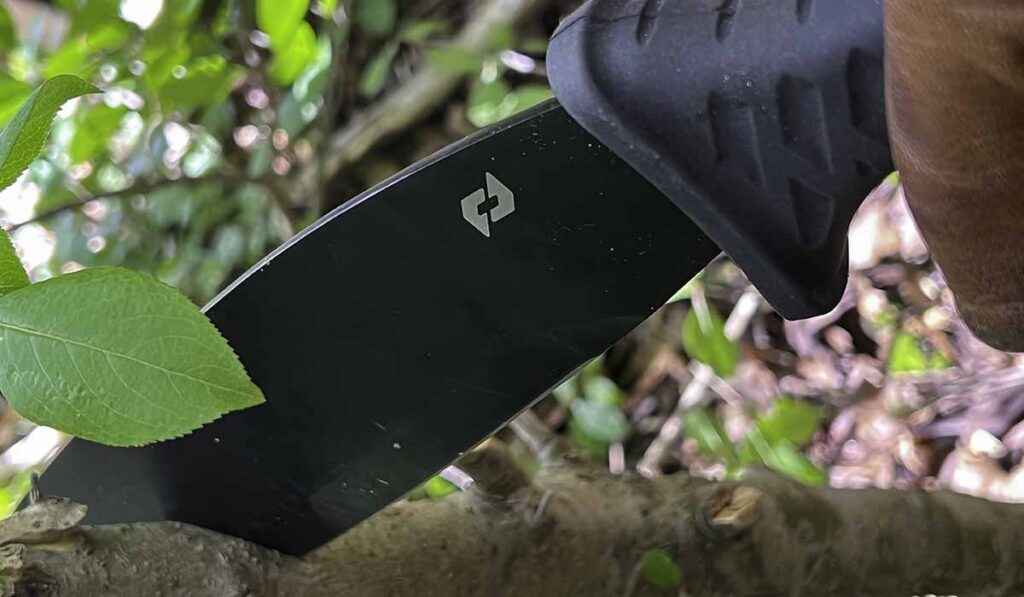
A broad profile lends the blade forward balance for delivering effective chopping blows that can take down saplings easily. The shallow grind enables the blade to bite deep into green wood. The slight-downward-angle-kukri-style-blade-to-handle design helps accentuate cutting power. One thing: At first it felt like the handle was oversized and too big for my hand. When I put the machete to use, it became apparent the oversized nature is on purpose. I could employ two grip styles to maximize effectiveness.
If you grip it close to the forward guard, it allows you to execute detailed chopping maneuvers. The blade feels more controllable. But, when you slide your hand rearward to where your pinky catches on the bird’s-beak butt, it locks your grip in and promotes maximum leverage and power for strong chopping strokes. You never feel like the knife will get away from you. The rubber handle also assists in mitigating impact shock, which translates into a more comfortable user experience.
At an MSRP of $49.99, the Decimate Bolo is a fairly decent machete if you want to step up from something of lesser quality in a hardware store. Country of origin: China.
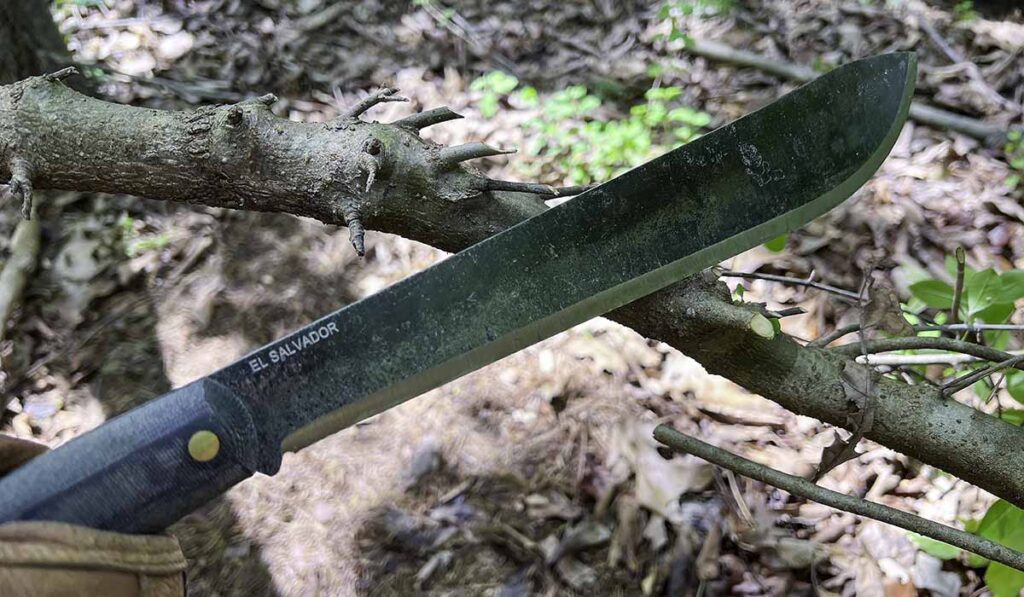
ESEE Knives Expat Darien Machete
The ESEE Expat Darien is not only a great chopper but also good for more delicate work such as quickly removing smaller limbs in one motion.
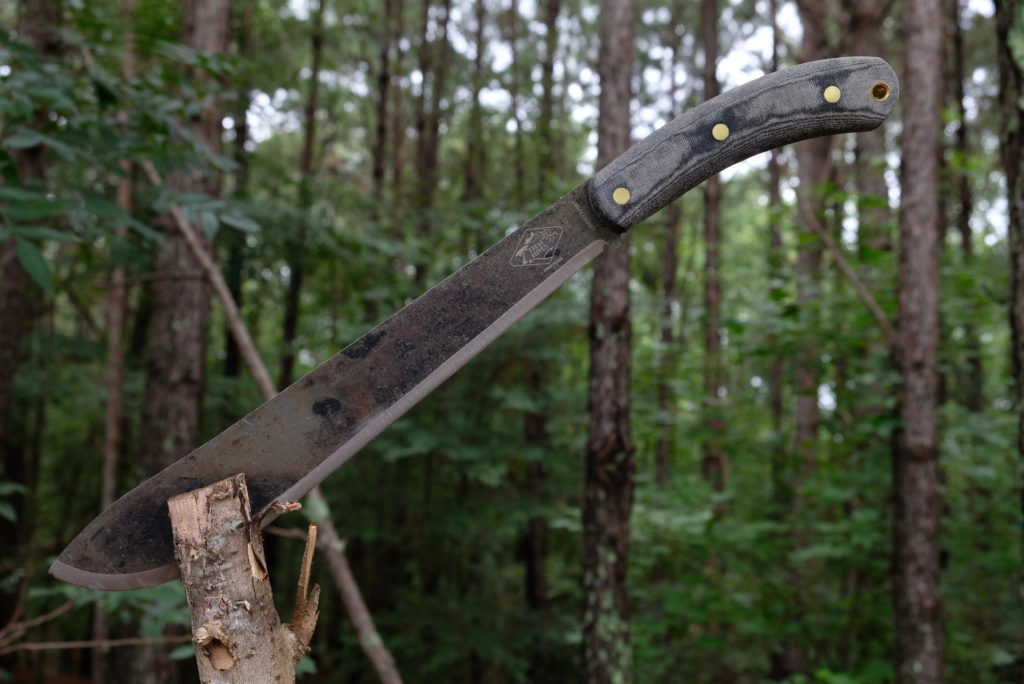
The ESEE Knives Expat Darien Machete is ruggedly made with a 12.4-inch blade of 1075 carbon steel. The blade has a notable two-tone appearance from the heat-treat scale left on the flats and the satin finish of the main grind bevels. It gradually tapers from belly to tang, evening out balance somewhat while having enough blade-forward weight to facilitate easy swinging.
The 6-inch Micarta® handle has some girth and fills your hand well. The downward curve profile helps lock in your grip and prevents rearward slippage. Three large brass rivets hold the Micarta slabs securely to the full tang. I like how the grip is a bit oversized, allowing you to wrap your hand around it while still feeling comfortable and secure. At 18 inches overall, the machete is an ideal size for serious work yet compact enough for comfortable carry and storing in a truck, SUV or side-by-side.
The reinforced ballistic nylon sheath is of a sewn, riveted construction, offering the toughness needed for housing the Darien. The desert tan nylon fabric offers a great alternative to the standard, ubiquitous black sheath. A single-button snap strap secures the knife. A large loop accommodates the thickest belts and is sewn securely to the sheath. It’s definitely well-made. MSRP: $120 Country of origin: El Salvador.
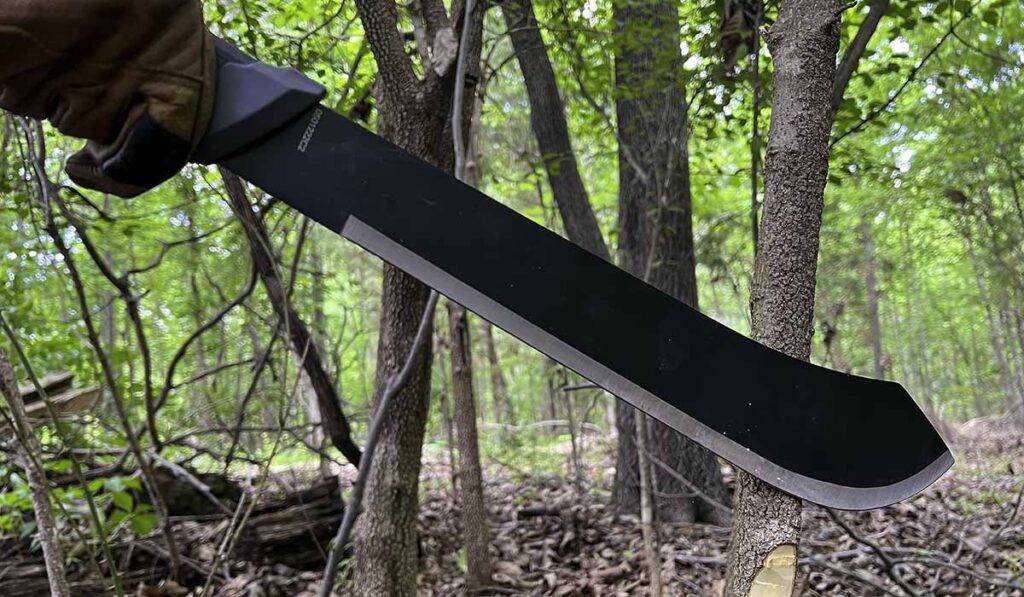
Gerber Gator Bolo
Chopping power is aplenty with the Gerber Gator Bolo and its longer blade. It has enough punch to make chopping saplings an easy task.
The Gerber Gator Bolo’s bolo-style blade flares at the tip to add a pronounced forward balance point that delivers powerful chops. The 15.4-inch blade is 1055 carbon steel in a black coating to resist corrosion. Overall length: 22.4 inches. The handle is a molded FRN with a textured rubber overmold for comfort in wet or dry conditions. The texturing is the same for all Gator series handles, with a simulated alligator hide pattern. Full-tang construction provides strength and improves balance.
The sheath is ballistic nylon lined with plastic to prevent blade puncture. A series of rivets holds the sheath together and a zippered portion opens it wide for easy removal/insertion. Two D-ring attachment points on the back anchor a shoulder strap. What’s weird is the strap is not included. You must supply your own. Neither is there a belt loop, which is somewhat surprising.
The lengthy blade is ideal for taking out vines, tall weeds, etc. It can fell saplings, though delivering the necessary chopping blows can get tiring. It nonetheless remains an effective machete if weeds and assorted vegetation are your primary target. Out-of-the-box edge quality was sharp enough to do the job.
The handle is comfortable. A large finger recess at the guard is well-suited for wrapping your hand around the grip. The simulated gator-hide texturing excels at holding your hand in place, gloved or no. The lanyard works well in the event you lose your grip. Some users say lanyards are a danger as letting go of the handle may cause the dangling machete to swing around on you as opposed to letting it drop to the ground safely. If you don’t want the lanyard, cut it off.
I found the Gator Bolo an effective chopper despite its dramatic blade-heavy balance. Just remember to let the weight and gravity do their thing on the downstroke. The blade bit hard into green wood and the shallow grind thins out the cutting edge nicely. The blade held an edge fairly well and is easy to resharpen. I improved edge quality using a coarse-grit diamond sharpening rod followed by a fine-grit ceramic honing rod—not even five minutes and I had a good edge on it. MSRP: $60. Country of origin: China. If you need a machete with reach, this one’s for you.
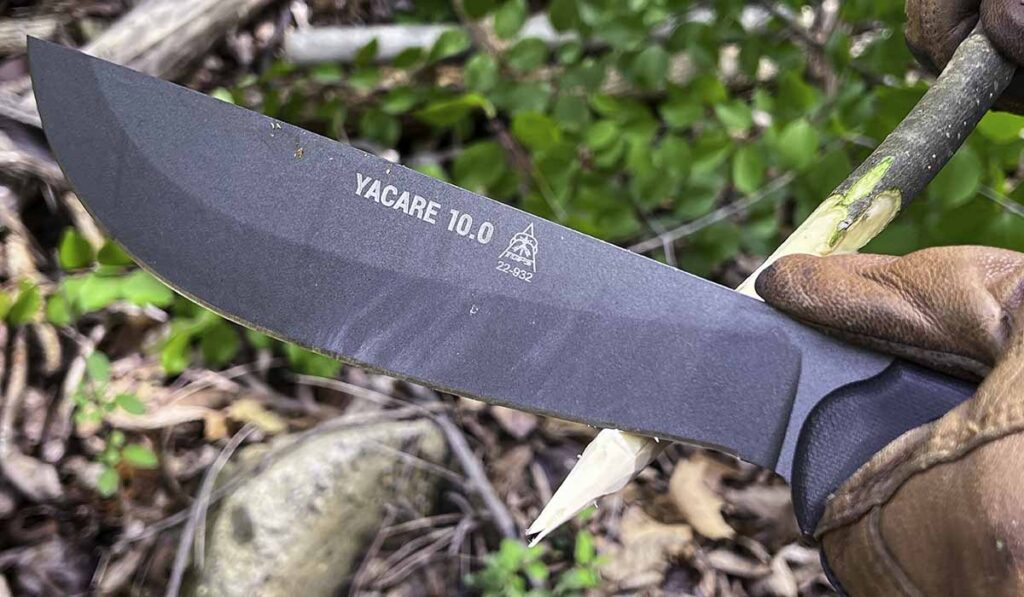
TOPS Knives Yacare
Whittling is possible with the TOPS Yacare and its great balance and gently curving cutting edge. It’s got an excellent edge with plenty of bite right out of the box.
Designed by company general manager Craig Powell, the TOPS Knives Yacare 10.0 is a barong-style machete 15.5 inches overall. The blade is 1095 carbon steel, a good performing material that’s easy to sharpen, and 10.25 inches—easily long enough for serious work. The blade’s forward balance works well as both a machete and a wood-chopping tool for dispatching saplings, vines and brush. The knife feels very controllable too, which is great for finer cutting tasks, something larger machetes normally don’t do well. The blade bites hard with every swing. The continuously curving cutting edge almost constantly presents itself at an angle to whatever is being cut, which enhances efficiency at powering through tall grass, weeds and saplings.
The black Micarta handle features integral front and rear guards to capture your hand and is definitely a user. The grip edges are contoured and rounded for comfortable purchase, and white fiber spacers add a nice visual pop. Micarta has long been a favorite handle material of mine and I prefer it on fixed blades such as this one. It’s a very durable, lightweight material that is dimensionally stable and impervious to fluid absorption. It can be textured to add grip traction without being overly aggressive. Hence, TOPS uses Micarta in a lot of its knives, both big and small.
The sheath is heavy-duty and well-made. It’s a ballistic nylon material that is quite rigid. A wide fabric-fastening strap secures the handle. As a nice added touch, there’s an exterior accessory pouch with a Fastex buckle closure. It stores things like a medium folder, sharpener or even a multi-tool. The belt loop is the same width as the sheath and heavy duty as well. MSRP: $270. Country of origin: U.S.A.
More Machetes
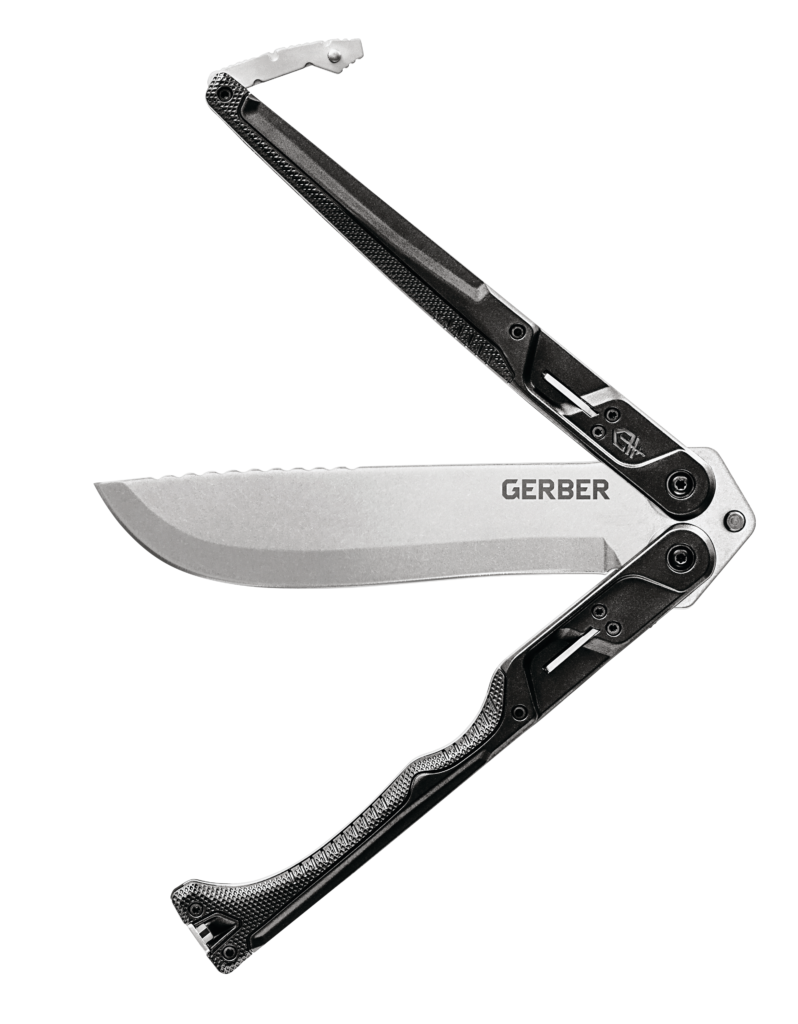
GERBER DUBLEDOWN FOLDING MACHETE
Blade length: 6.75” Blade steel: 420HC stainless Blade pattern: Recurve drop point Blade Finish: Stonewashed Weight: 18 ozs. Overall length: 15.1” Knife to know: Available in a green or black handle and a choice of blade finishes Sheath: MOLLE/belt carry Country of origin: USA MSRP: $129-$139
ESEE Darien
The ESEE Darien features an ergonomic Micarta® handle for comfort and comes with a rugged canvas sheath. According to ESEE, the knife is a chopping machine whether in the Amazon, the jungle or your own backyard. It carries the same “no questions asked” warranty as the knives in the standard ESEE line.
ESEE DARIEN Blade Length: 12.38” Blade Material: 1075 carbon steel Rockwell hardness: 54-56 HRC Blade’s Maximum Thickness: .094” Handle: Micarta® Knife weight: 15.5 ozs. Overall Length: 18.18” Sheath: Canvas Sheath weight: 4.5 ozs. Country of origin: El Salvador MSRP: $100 and up
Kershaw Camp 10
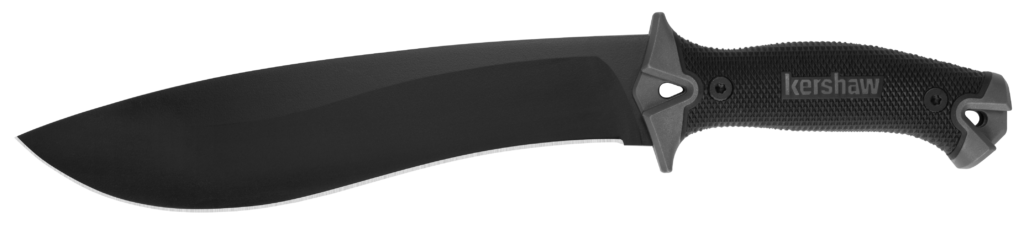
Though a camp knife in design, the Kershaw Camp 10 doubles as a machete, too. Clearing brush, making kindling and more, it does the trick. The integral crossguard is a nice safety feature and the handle has holes for either a forward or rear lanyard.
KERSHAW CAMP 10 Blade length: 10” Blade material: 65Mn spring steel Blade finish: Black powdercoat Blade pattern: Recurve drop point Handle: Full tang, glass-filled nylon with Sure-Grip overmold Knife weight: 1 lb. 2.3 ozs. Overall length: 16” Sheath: Glass-filled nylon w/gear straps and belt loop Sheath weight: 5.7 ozs. Country of origin: Design, prototype and quality control in USA; manufactured in China MSRP: $80.84
Utica Stealth I
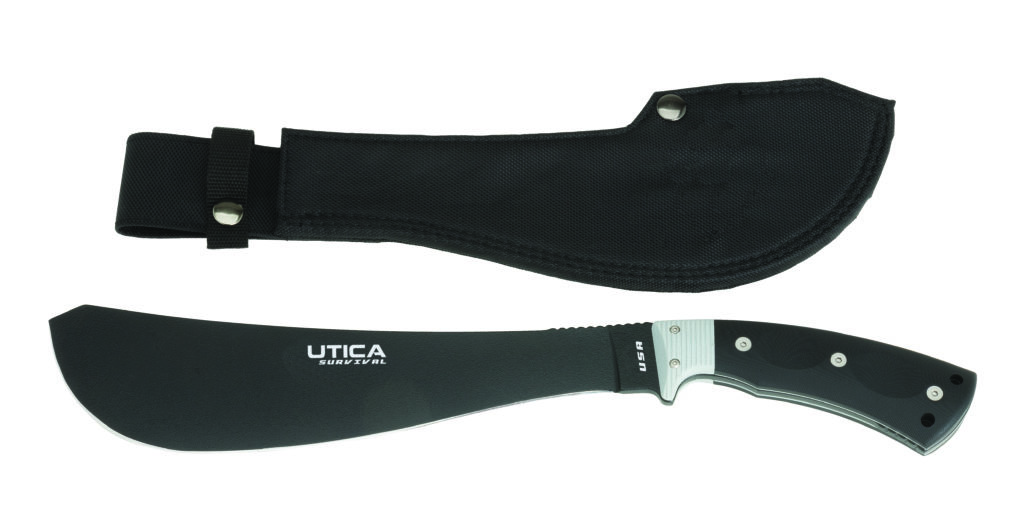
The combination of a deep blade belly and dropped handle is designed to maximize the Utica Stealth I’s chopping and brush clearing performance. A single integral guard enhances user safety. The nylon belt sheath has a button strap to help secure the knife when sheathed.
UTICA STEALTH I Blade length: 11.25” Blade material: 1095 carbon steel Blade finish: Black oxide Handle material: Micarta® Weight: 21.87 ozs. Overall length: 17.5” Sheath: Nylon Country of origin: USA MSRP: $129.60
Coast F1400 Machete
A D-guard and full-tang construction help highlight the Coast F1400 machete. The sheath has a metal clasp for a secure hold.
COAST F1400 Blade length: 14” Blade steel: 3Cr13 stainless Blade finish: Black oxide over glass bead Handle material: Fiberglass-filled Nylon 6 Lanyard: Paracord Weight: 1 pound, 1.2 ozs. Overall length: 19.2” Special feature: Sawback blade Sheath: Nylon with hard plastic liner and riveted/sewn edge; includes belt loop Country of origin: China MSRP: $29.99
Kizlyar Supreme Bushmate
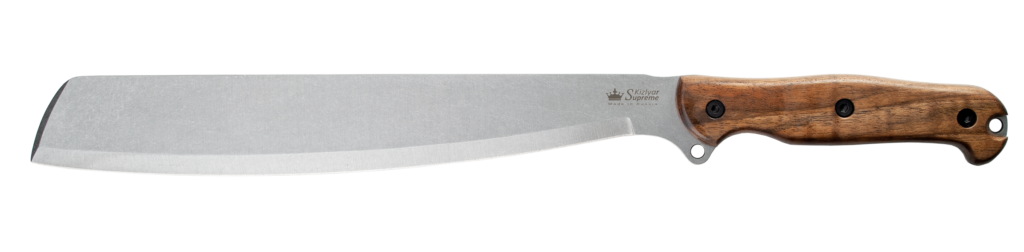
The Kizlyar Supreme Bushmate looks as much like a competition cutter as a machete, but the thin blade and Scandi grind makes it perform much better in the bush. The handle has two lanyard holes for rear or forward attachment, the latter doubling as an integral single guard.
KIZLYAR SUPREME BUSHMATE Blade length: 10 7/8” Blade steel: 420HC stainless Blade grind: Scandi Blade’s maximum thickness: .039” Blade finish: Satin Handle material: Caucasus walnut Weight: 13 ozs. Overall length: 17 3/8” Knife to Know: The Bushmate is also available in a convex AUS-8 stainless steel version with a maximum blade thickness of .1889” and a 19-oz. weight Sheath: Embossed leather Country of origin: Russia MSRP: $185
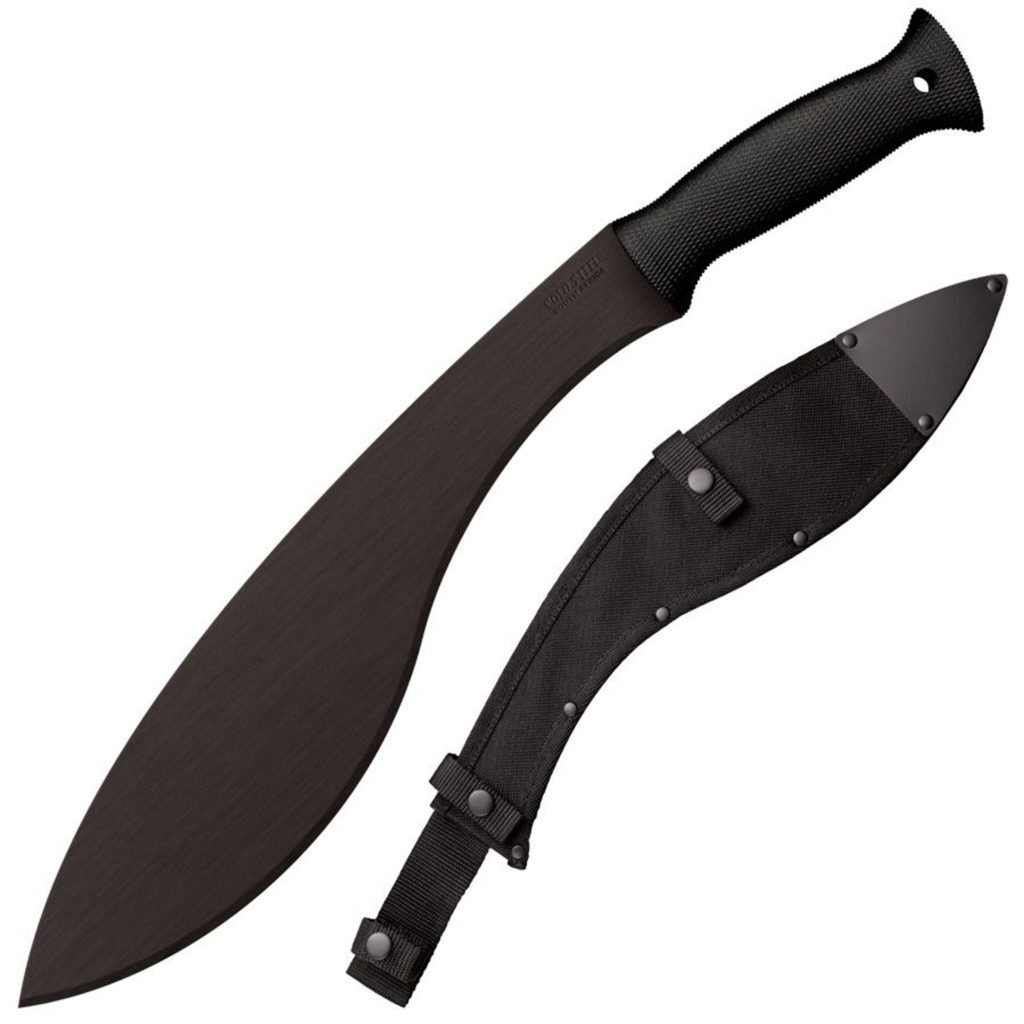
Cold Steel Kukri Machete
The Cold Steel Kukri Machete comes in two deep-bellied blade lengths: 13 (shown here) and 17 inches. Either is designed as a lightweight cutter for belt carry or lashed to a pack. The sheath comes with a reinforced tip and multiple snap downs.
COLD STEEL KUKRI MACHETE Blade length: 13” Blade material: 1055 carbon steel Blade finish: Black baked-on anti-rust matte Handle material: Polypropylene thermoplastic w/hole for a lanyard Handle length: 5” Weight: 16 ozs. Overall length: 18” Sheath: Cor-Ex® Country of origin: Import MSRP: $29.99
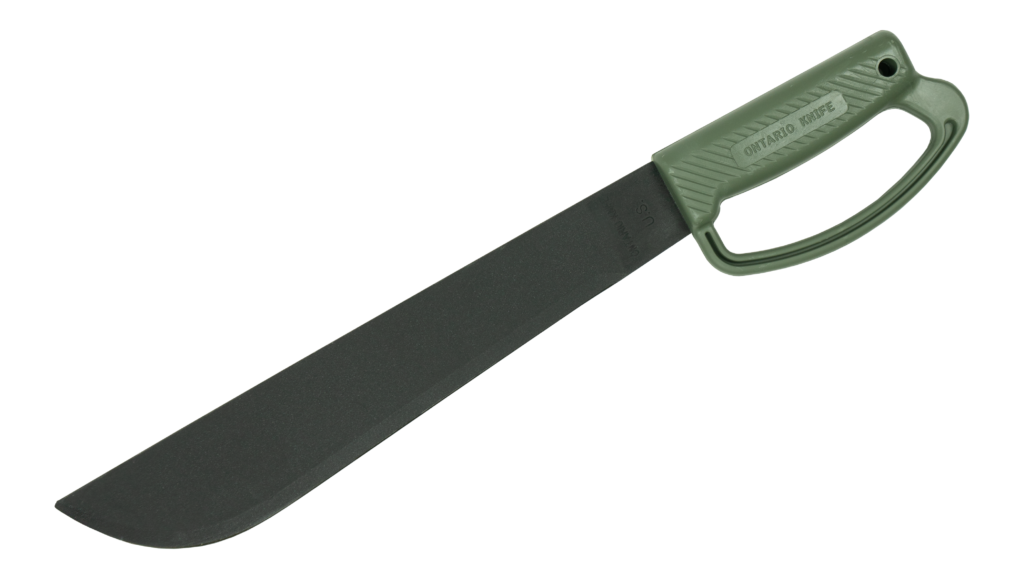
Ontario Camp Plus Machete
The Ontario Camp Plus Machete includes an ample D-guard handle for user safety. The carbon steel’s Rockwell hardness of 52-55 HRC renders the blade malleable enough to better endure high impacts.
ONTARIO CAMP PLUS MACHETE Blade length: 12.5” Blade material: 1075 carbon steel Blade finish: Phosphate coated Handle material: OD green molded plastic Weight: 1.65 lbs. Overall length: 17.7” Sheath: Black denier nylon packcloth w/heavy liner and belt loop Country of origin: USA MSRP: $29.07 (sheath sells separately for $11.95)
Smith & Wesson Cleaver Machete
The Smith & Wesson Cleaver Machete boasts blade cutouts to lighten the load, full-tang construction, an integral guard, and an ergonomic dropped handle with finger groove and a hole for a lanyard.
SMITH & WESSON CLEAVER MACHETE Blade length: 10” Blade steel: 420 stainless Handle: Overmolded rubber Special features: Sawback blade and textured hammer pommel Weight: 1.12 lbs. Overall length: 16.54” Sheath: Synthetic w/zipper and snap strap MSRP: $51.99
Editor’s Note: Dexter Ewing contributed to this post.
Large Work Knife takes the author’s favorite media to task.
With camping season in full swing, it’s always a good idea to have a sharp knife at your side to build a lean-to or traps and make firesticks, to name a few. The Large Work Knife by KG Handcrafted Bladeware can fill the bill. Ground from 5/32-inch A2, a tool steel known for providing a keen edge, it begged for a good testing.
Large Work Knife Edge Test
I like to start off by slicing 20-pound bond copy paper because it gives a good idea of edge profile and keenness of the edge. The knife sliced the paper smoothly with no resistance. It’s nasty sharp for sure. Though I’m not a big fan of the chisel grind and Scandi profile edge, each has its place.
The Large Work Knife excelled cutting the 8-ounce leather, providing very fine slices at the same thickness and angle.
I grabbed a piece of double-walled cardboard and commenced cutting. The edge was very aggressive and only a slight rolling of the cut pieces occurred from the Scandi profile edge. The handle made for great control. I really like it. It worked best by using a push cut.
Medium-Duty Cutting
Leather was next. The A2 blade zipped through it very fast. The edge created a nice crunching sound as it went and was very aggressive. The wrapped handle was great at controlling the width of each cut. It was fun to do but be sure to keep your fingers out of the way. Next, I skived 8-ounce leather. The blade made short work of it, providing very fine slices at the same thickness and angle.
The knife powered through 200 clean, crunching cuts of sisal rope very quickly. The handle was comfortable and provided a non-slip grip with no hot spots.
It was time to make firesticks. The knife made great curlicues. Cut depth was very manageable. It was a perfect use for the chisel grind on the correct side for a right hander. Nicely done, KG Handcrafted Bladeware! Woods seems to be the perfect medium for this blade style.
Now for my favorite, cutting sisal rope. The knife powered through 200 clean, crunching cuts very quickly. With no stopping in sight, I ended the cuts before I used up all my rope, another great medium for the chisel grind. The handle is comfortable and provided a non-slip grip with no hot spots.
Heavy-Duty Cutting
I batonned the Large Work Knife through a 1.5-inch-diameter branch. It split the first 2 inches quickly then started to drift to one side the farther down I got. The drifting could have been due to the fact it was old wood or a chisel grind. Either way, it worked with no damage to the knife whatsoever.
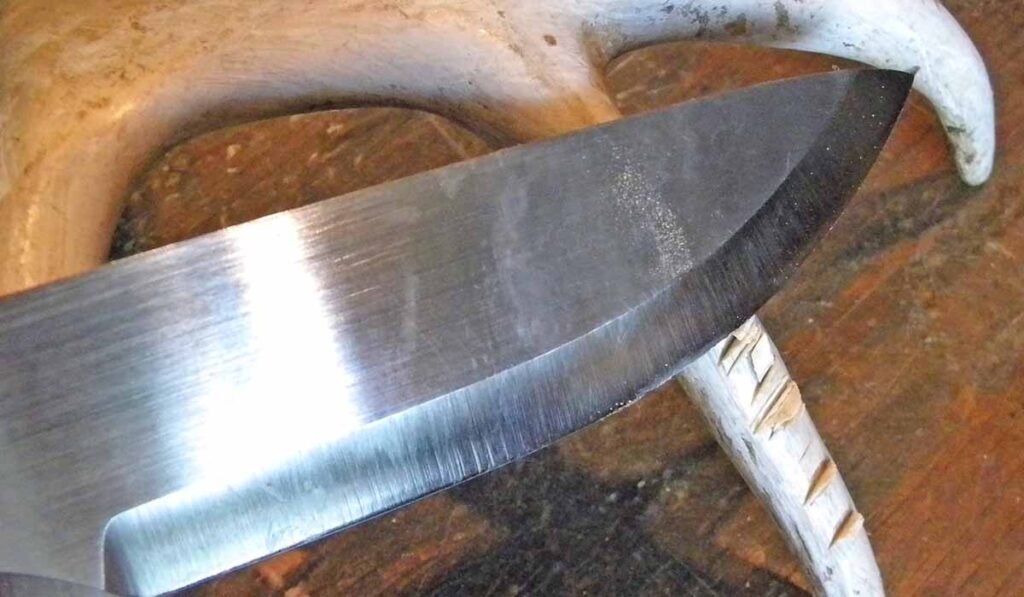
Thirty hard whacks into the antler put some very small chips in the fine edge an inch or so before the tip, as the author expected. When he returned to the copy paper, slicing was smooth with minimal tearing by the chip area. The knife was still nasty sharp.
Chopping deer antler to test how well a blade has been heat treated is not recommended and might void the warranty. I did it anyway. Thirty hard whacks into the antler managed to put some very small chips in the edge, as I expected it would. The fine edge will do exactly that.
Finally, I returned to the copy paper. Slicing was smooth with minimal tearing by the chip area. The knife was still nasty sharp. Job well done!
Overall Take On The Large Work Knife
This knife is well-made for EDC chores. I love the A2 steel. The handle is very comfortable.
Changes
The knife performs well for its designed purpose. I would just run the grind higher.
Large Work Knife Specs Maker: KG Handcrafted Bladeware Blade Length: 4” Blade Material: A2 tool steel Blade Grind: Chisel Blade at Thickest: 5/32” Blade Pattern: Semi drop point Handle Material: Waxed cotton string and resin cord wrap Weight: 6 ozs. Overall Length: 8.5” Sheath: Oil-tanned cowhide over aluminum and Kevlar® Weight w/Sheath: 9 ozs. Maker’s Price: $320
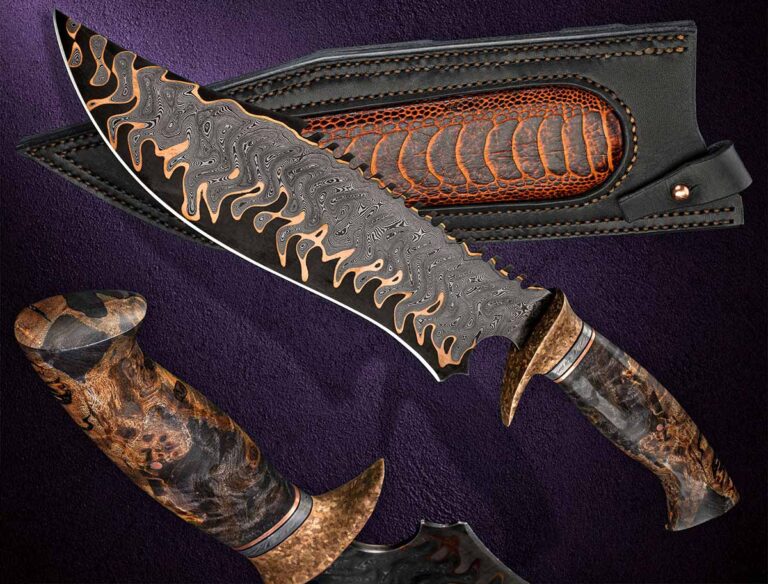
Inspired by Rambo’s knife, Corey Reynolds’ sawback bowie channels the genre in a copper-mai chevron pattern.
Like many boys his age, Corey Reynolds grew up watching Rambo movies. Now 43, he’s been making knives about three years and decided he wanted to make a knife with a Rambo look—and what better way to do that than with a sawback bowie?
For blade material he used copper-mai steel in a chevron pattern from Baker Forge and Tool, and for the piece de resistance configured the sawback so the copper would be exposed at the base of each tooth.
Though the way he did the teeth is mostly for looks, he said each tooth has a fairly good edge. The handle is spalted maple from Steelhead Forged Scales with spacers of copper, raindrop-clad feather damascus forged by Adam DeVille, and G-10. The guard is of a striking multi-etched material called gem bronze from Mike’s Metalworking.
Sawback Bowie Specs Maker: Corey Reynolds Blade Length: 9” Blade Material: Copper-mai in a chevron pattern Handle Material: Spalted maple w/copper, raindrop-clad feather damascus and G-10 spacers Guard: Gem bronze Overall Length: 15” Sheath: By the maker of leather w/ostrich leg inlay from Ray’s Ostrich Leathers Maker’s Price For A Similar Knife: $1,400