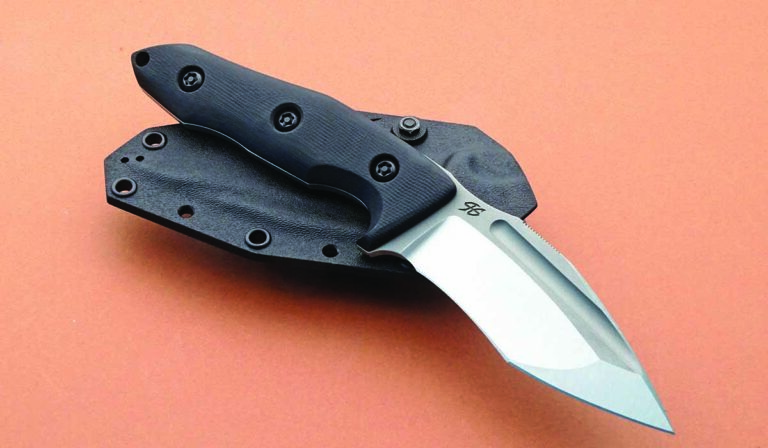
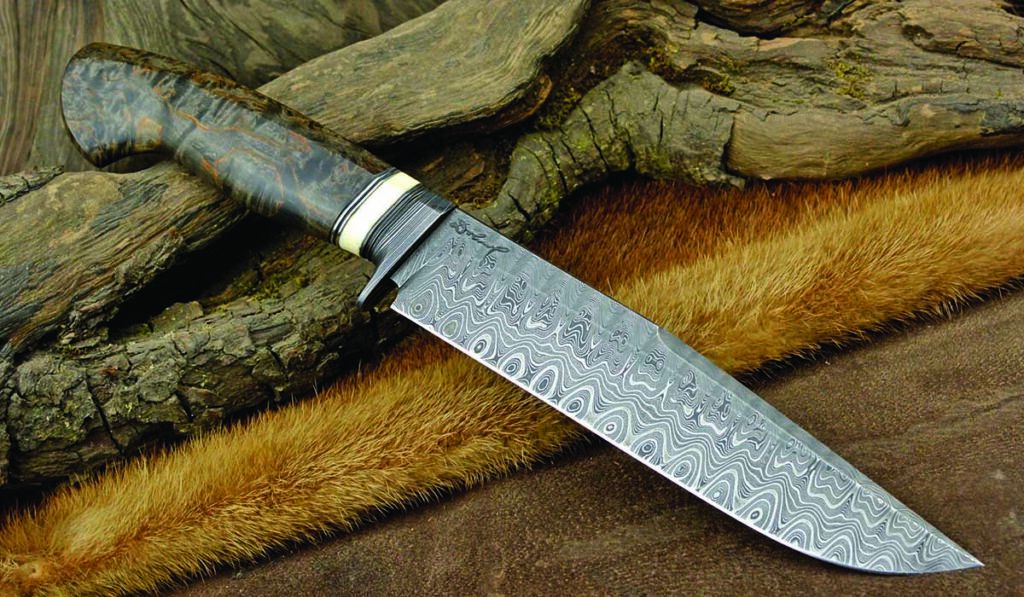
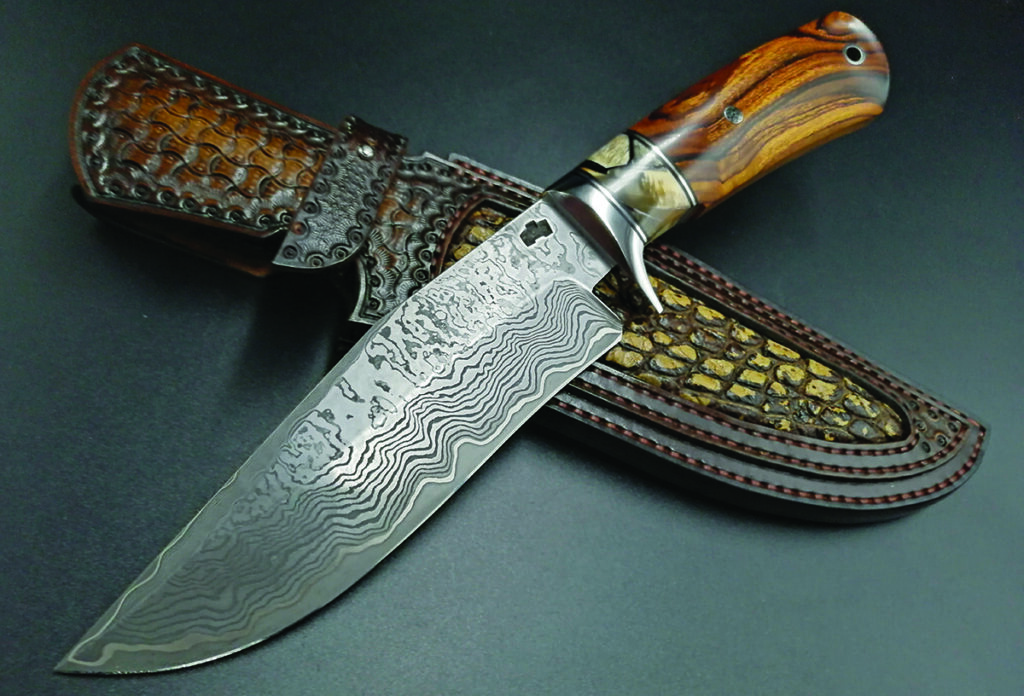
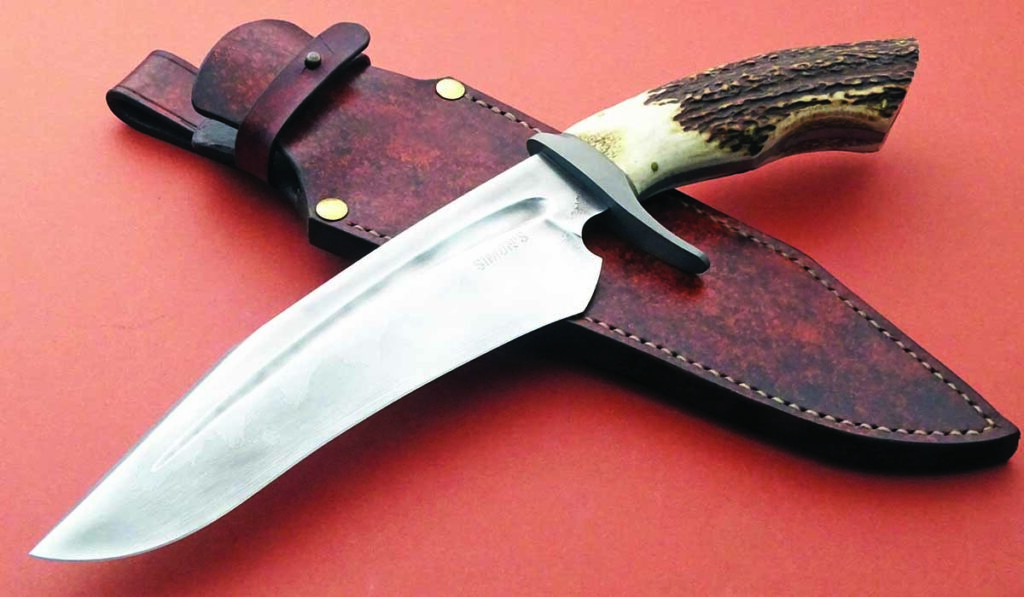
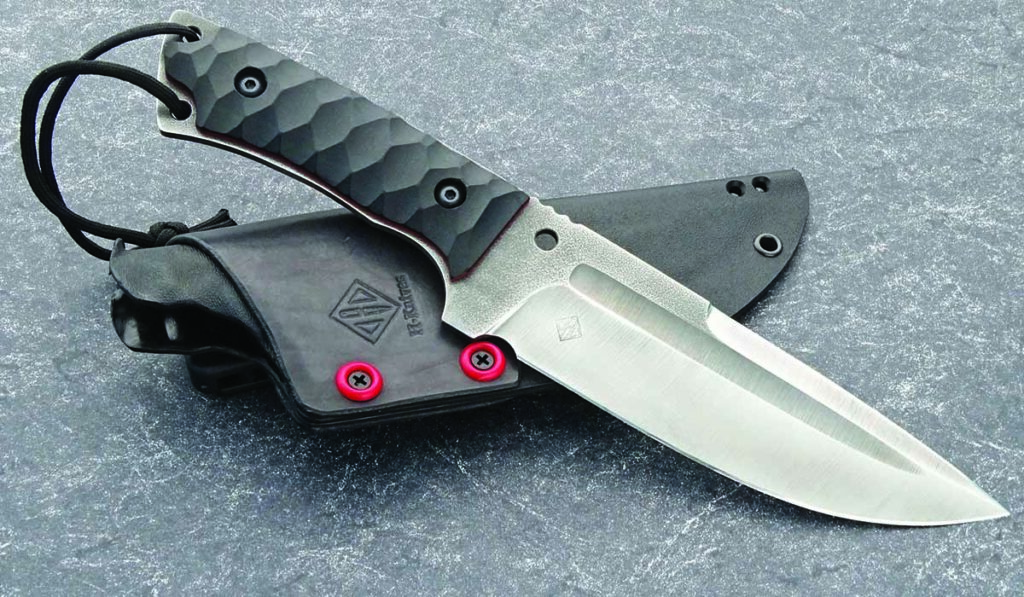
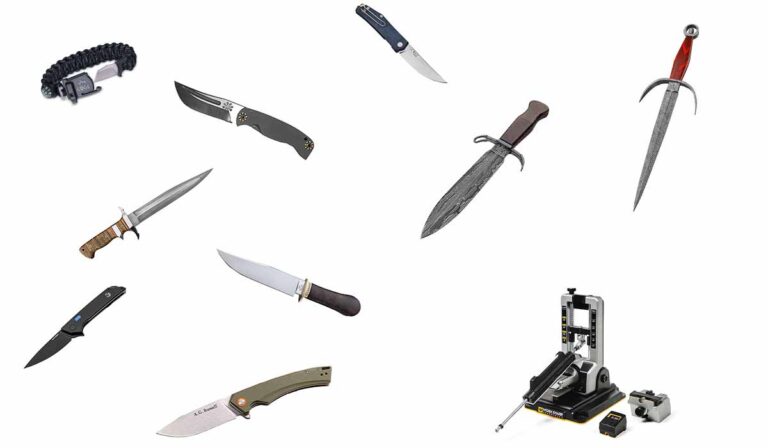
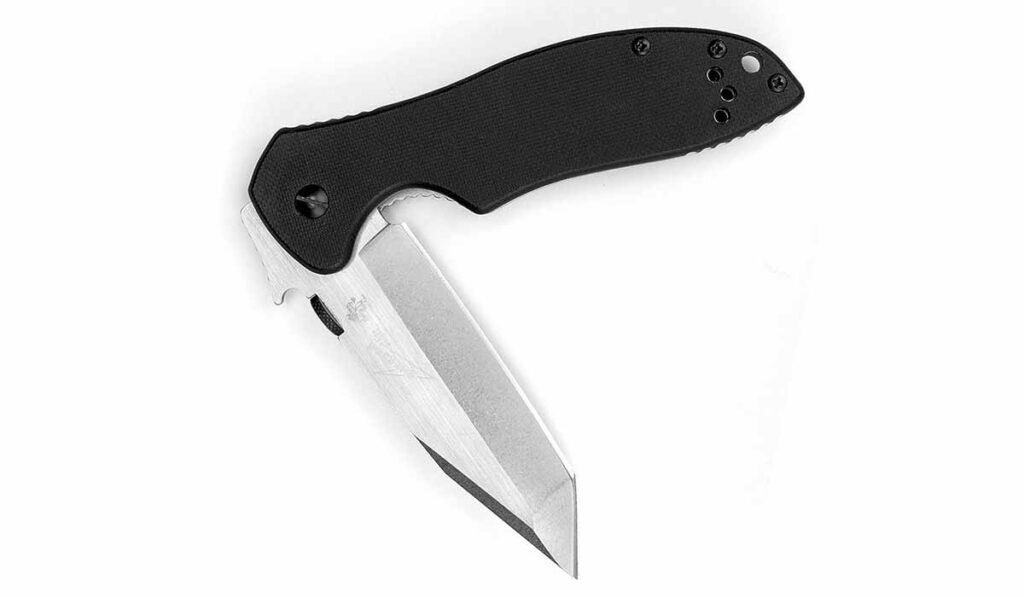
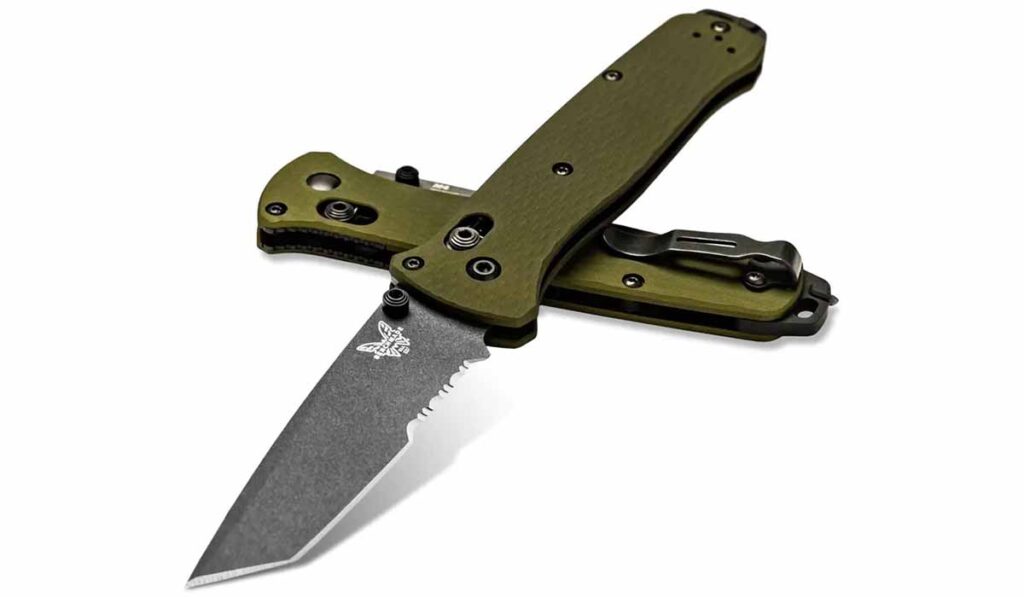
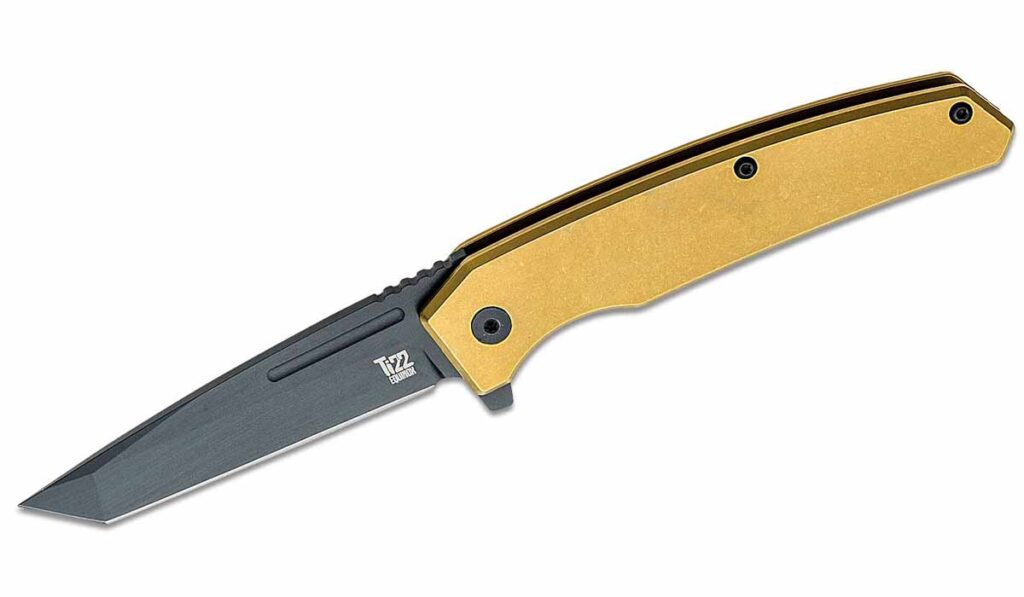
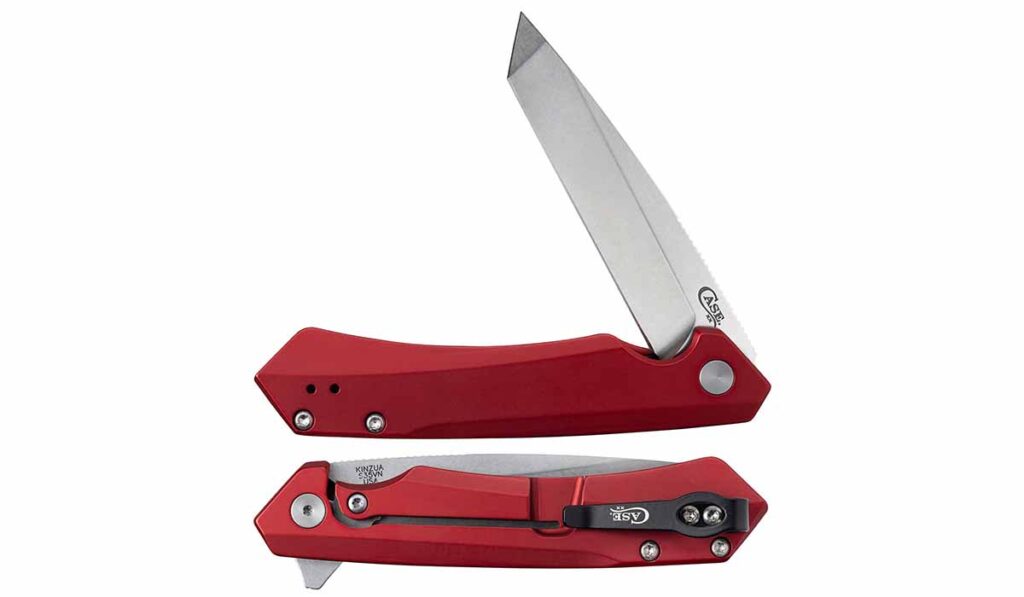
An overinflated market for forged blades at home caused the author to look elsewhere. Oftentimes this has been to Eastern European Knife Makers.
This article originally appeared in the 2024 KNIVES Annual.
Since 2017, forged blades have taken the lead. Niche markets like chef’s knives, slip-joint folders, and tactical fixed blades retain enough interest to be powerful sub-markets. Price points and availability in primary and secondary markets lead to the demise of the front-runners. Popular market sectors inspire experienced and new makers to build that type of knife.
Two problems arise from this:
Makers will rapidly join a market sector, but collectors are slower to follow.
Pricing is primarily based on what other makers are getting for their work and not, for example, the quality of a maker’s knives, name recognition, status among the competition, etc.
Higher prices from less qualified knifemakers encourage the well-known makers to raise their prices, and the cycle continues until the knives become unaffordable. Currently, this is what is happening today in the forged blade market. I saw this trend emerging in 2020, and I started emphasizing makers who offer value for the money with their work.
Overpriced knives led me to increase my research for custom knives with good value in the United States and worldwide. Social media was a great help in this area. As I researched, I found myself saving photos of knives I was interested in. When I returned to re-look at the pictures I had saved, I found many of these makers were from Eastern Europe.
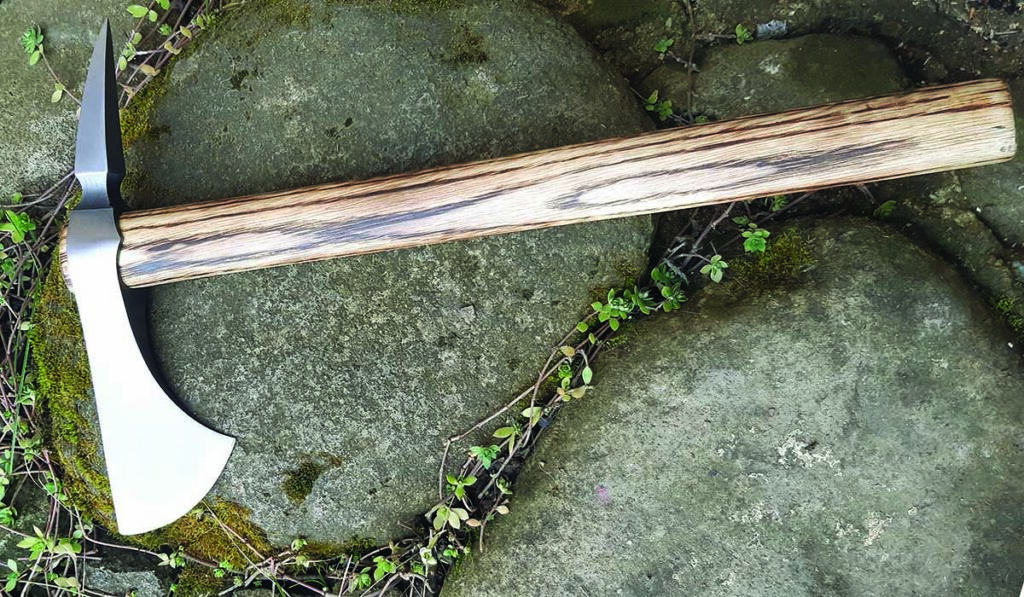
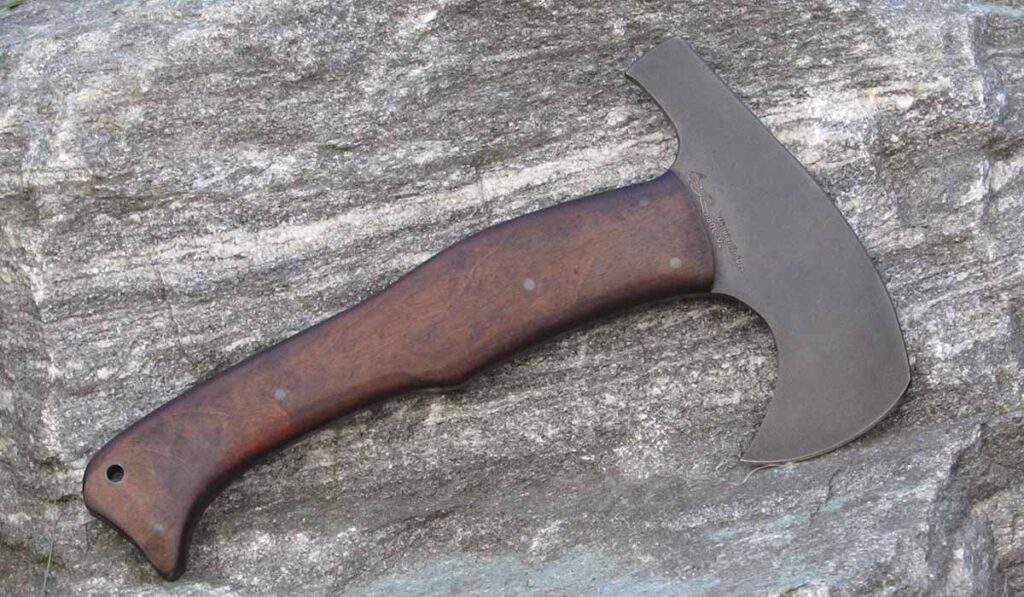
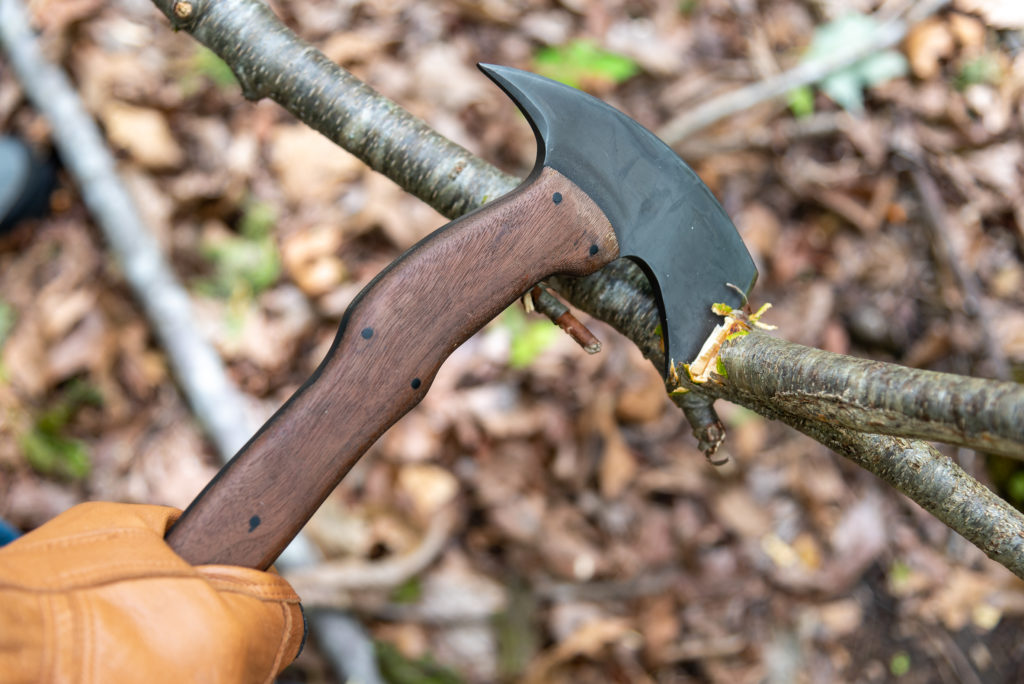
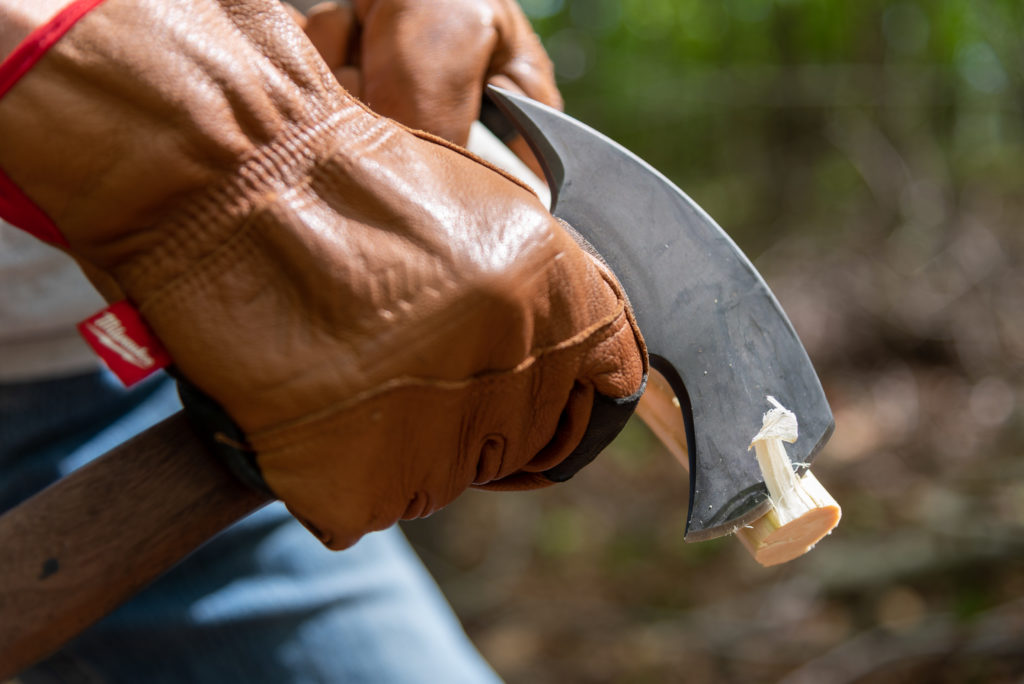
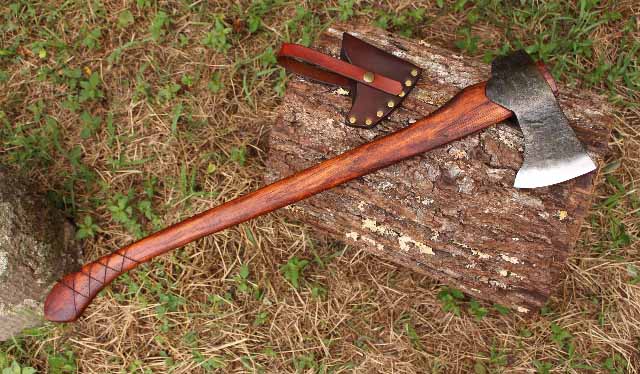
In the spike tomahawk realm is this Csizmar Szilard model with a forged 5160 high-carbon steel head, a hickory haft, and a custom leather sheath. Szilard is a well-known maker in Romania. (Csizmar Szilard photo)
Much like in the United States, prices ranged from reasonable to what seemed extreme. I contacted well over a hundred makers asking questions about materials, construction techniques, pricing, and sheaths, and requested several additional photos. While there are other makers I plan to contact soon, the following are the seven makers I have already started working with.
Meet The Eastern European Makers
Maksim Tjulpin
Maksim Tjulpin has been making knives for 11 years in his home country of Latvia. His interest comes from the diversity of knives that can be made as well as the array of materials. Maksim builds knives utilizing both the stock-removal and forging methods of blade making. He favors forged blades as each has its own unique character.
He primarily uses stabilized wood for his handles, often combined with mammoth ivory spacers. I have found his craftsmanship to be impeccable. The knives feature excellent fit and finish as well as ideal balance and handle ergonomics.
Petr And Peter Dohnal
Petr Dohnal and his son, Peter, have been making knives for 21 years in their native country of the Czech Republic. Working as a computer graphic designer, Petr realized he wanted to build something with his hands. So, he chose to make custom knives. As with many makers, his favorite part is forging the blades, usually damascus. In addition to making his own steel, he uses Elmax, Vanadis 8, and M390, as well as other alloys. He understands that the knife’s intended purpose will often determine the most suitable steel. His handle materials of choice are stabilized wood and antler. I find Petr’s knives a joy to hold in my hand, being sleek, well-made, and exhibiting superior balance and handle ergonomics.
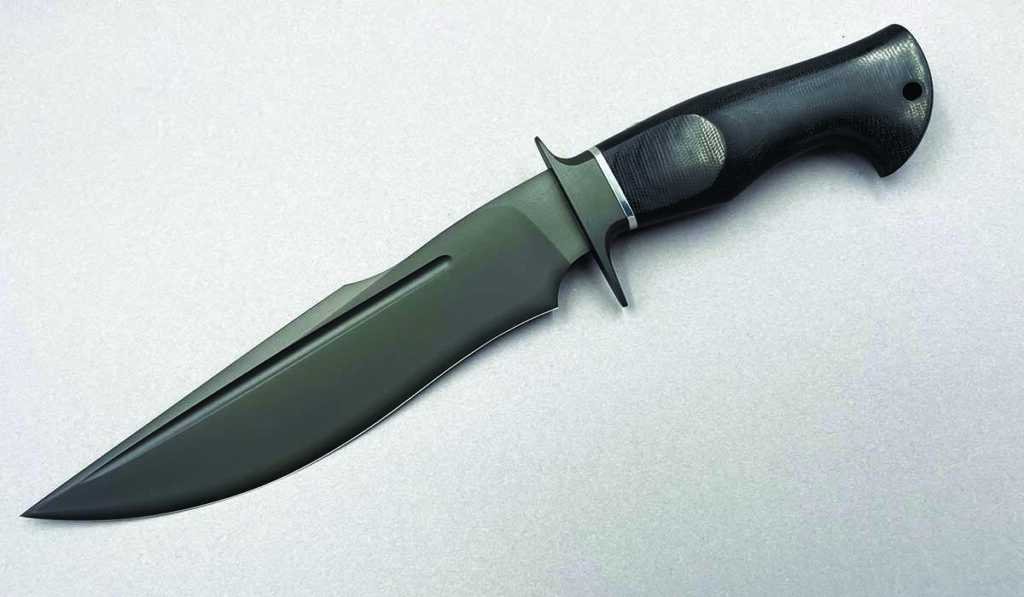
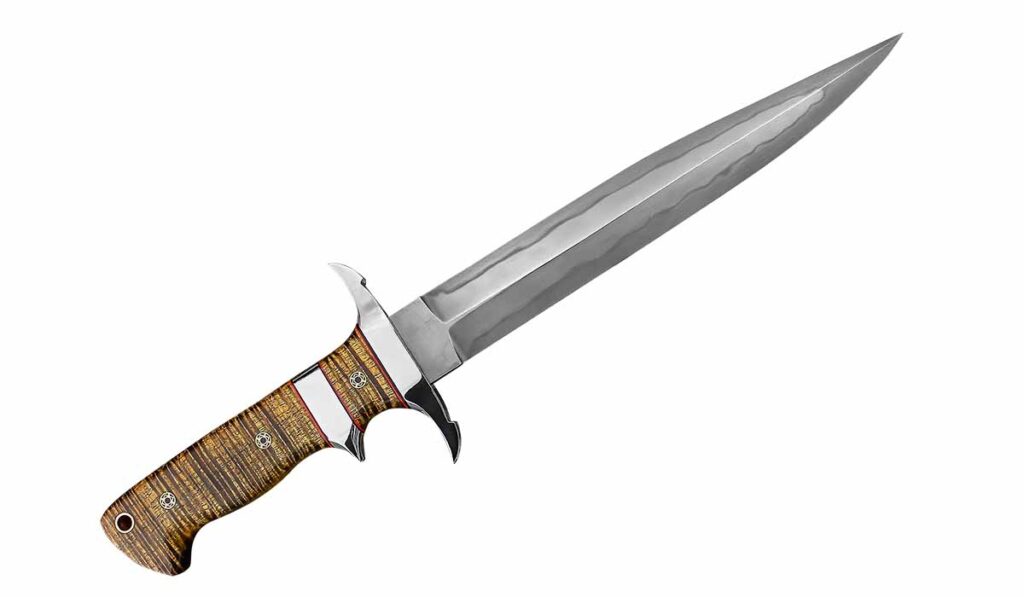
The sleek, stealthy, and sexy fighter by Eastern European knife maker Michal Komorovsky exhibits a 7.75-inch, black DLC-coated Elmax blade, a black canvas Micarta handle, and a leather sheath. The balance of the knife makes it deceptively quick, and a fuller reduces the weight while increasing blade strength. (Michal Komorovsky photo)
Michal Komorovsky
Michal Komorovsky started making knives, in 2011, in his home country, Slovakia, or officially, the Slovak Republic—doing so primarily because he wanted to try something different, and he never looked back. He favors Sleipner steel, which is a new-generation alloy like D-2, as well as M390. When time allows, he forges damascus for his knives, including a wide variety of fixed blades. Michal builds an array of knives, from hunting and tactical models to bowies and even an occasional art dagger.
Many of his tactical knives feature black DLC-coated blades, but he also offers sandblasted and bead-blasted steel, as well as satin- and mirror-polished finishes. Michal uses various handle materials, with desert ironwood being his favorite. I’ve taken a liking to his fighters that exhibit excellent fit and finish, have an outstanding balance, and feel great in the hand.
The Tactical Realm
Piotr Gosciniak
Piotr Gosciniak has been fashioning custom knives in his home country of Poland since 2017. Having a keen interest in the military, Piotr decided to focus his talent on making tactical knives. He occasionally uses high-carbon steel such as 80CrV, but most of his knives are built using quality stainless steels such as Elmax or Sleipner.
Piotr prefers synthetic handle materials like Micarta, G-10, and carbon fiber. He also offers Cerakote coating for his knives. As a former infantry officer, I appreciate the crisp, clean lines of Piotr’s knives. His designs are purpose-driven; these are tools meant to be used. The blade fullers, textured handle material, and thumb serrations add to each knife’s capability.
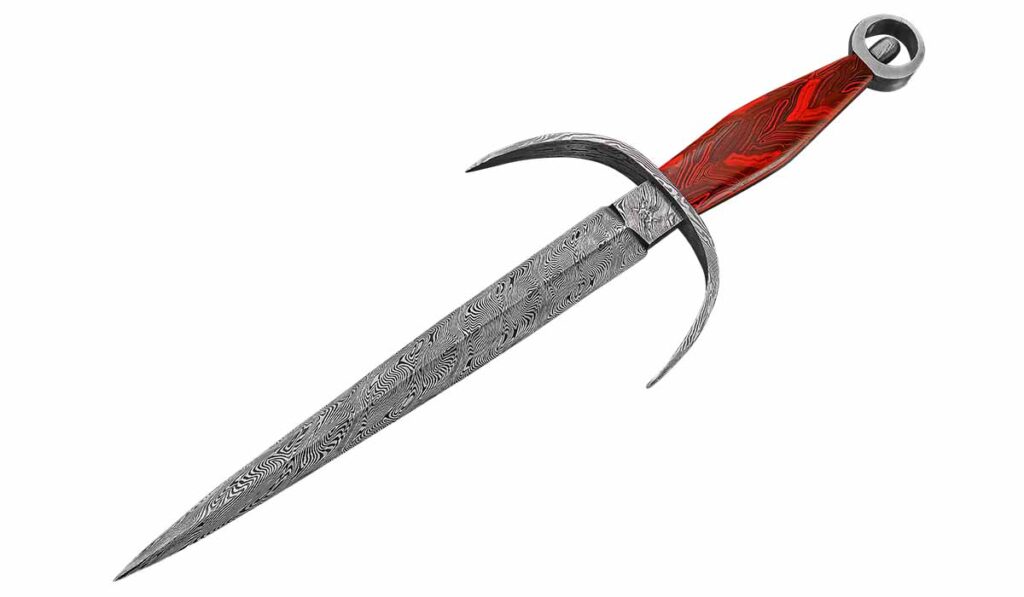
Petr Dohnal forged a damascus camp knife, including the guard, adding a stabilized Karelian birch handle and fossil walrus ivory spacer. It comes with a custom leather sheath. (Petr Dohnal photo)
Jacek Hnatow
Also from Poland, Jacek Hnatow has been building knives for eight years. He started as a collector, then decided he didn’t want to buy knives anymore; he wanted to make them. As an avid outdoorsman, it should come as no surprise that Jacek’s specialties are survival and bushcraft blades. He prefers working with Bohler N690 and Elmax, as well as high-carbon alloys and san mai steel. Jacek’s handle material offerings include synthetics such as G-10 and Micarta, as well as stabilized wood at the customer’s request. His knives, many of which can be huge, are well-balanced with great handle ergonomics. His bushcraft blades are a perfect size to carry in the field, and all of Jacek’s knives are well thought out for the tasks at hand.
Csizmar Szilard
Romanian Csizmar Szilard has been a full-time knifemaker since 2007. When he was younger, he enjoyed video games and one of them allowed players to forge their weapons virtually. So, Csizmar decided to make that a reality. Forging is his favorite part of fashioning knives, hatchets, and axes. He prefers 5160 high-carbon steel for its simplicity and ease of forging. Handle materials are all-natural, with wood and antler being his favorites. Csizmar’s work is clean and balanced, precisely what you would expect from a maker who builds tools that are meant to be used.
Szymek Szlagor
A native of Poland, Szymek Szlagor has been making knives since 2017. Building a knife for himself led to making them for friends and eventually becoming a full-time knifemaker. He enjoys forging and machining carbon steel and damascus. He gravitates toward 5160 high-carbon steel and combines K720 and 15N20 to make damascus. His handle material preferences are natural materials such as stabilized wood and antlers. For his everyday carry (EDC) knives, he prefers to use Micarta. Szymek feels making knives is a beautiful job that involves taking a piece of steel, giving it shape, and improving on it until the blade becomes a tool that will be used and passed down from generation to generation. Having handled his work, he has accomplished his goal.
Working With Eastern European Makers
Language: There are several languages throughout Europe. While it is true that many Europeans speak English, it is equally noteworthy that they do not read and write the universal language well. This is important to know as, more than likely, collectors will be contacting the makers via email or social media. When writing, I often rely on an online translator for help. Understand that such online translating programs could be better. I always let the maker know upfront I am using a translator.
Eastern European knife maker Maksim Tjulpin’s camp knife features a 7.1-inch san mai damascus blade, a stainless guard, a black G-10 spacer, and a mammoth tooth and desert ironwood handle. It comes with a custom leather sheath. (Maksim Tjulpin photo)
When emailing or writing to makers, try not to use slang or acronyms, as these usually translate into something that might not have the intended meaning. Remember to be patient with this process, as both collector and maker must understand exactly what each is expecting.
Payments: The preferred method for knife transactions is PayPal. As with most makers worldwide, many are not set up to take credit cards. Those who have traveled to Europe know there are additional fees for using U.S. bank credit cards. Although wire transfers can be made, it is best to check with your bank to find out what the fee for an international wire transfer will be.
Lastly, Western Union is an option that usually comes with an $8 fee. Some buyers might find the process of paying upfront and then having to wait up to a month difficult. However, I have been buying knives regularly from Eastern Europe for the last three years and have never had a package go missing.
Shipping: The maker will generally ship the knife through his or her country’s postal service. Most countries work with the U.S. Postal Service, and once a package is accepted, you can track it coming from Europe. The delivery time frame will average between two and four weeks. While FedEx can be an option, the cost associated will generally eliminate this service from the ideal options.
The 13-inch camp knife from Szymek Szlagor showcases a forged Bohler K720 blade with hamon (temper line), a stainless guard and sambar stag handle scales. (Robertson’s Custom Cutlery photo)
Measurements: Europe uses the metric system. As foreign as the metric system is to you, the same is true for the imperial system the United States uses to makers in Europe. Fortunately, there are conversion programs on the internet. In conversing with European makers, please pay attention and differentiate between when they use centimeters (cm) or millimeters (mm), as 1 centimeter equals 10 millimeters, and when it comes to a knife, that could be a huge difference.
Forged In Fire Influence
Most of the makers in this article offer forged blades as part of the repertoire. However, Piotr Gosciniak is the exception, as he specializes in stainless and some high-carbon steel tactical knives. The U.S. market will see a resurgence of this category of knives in 2023-’24. For now, forged blades are the most significant market sector in the United States, partly due to increased interest in forging knives due to the TV show “Forged in Fire.” The interest created by this show was partly responsible for 38 makers earning their American Bladesmith Society (ABS) journeyman smith ratings at the 2022 BLADE Show.
Talking with several ABS master smiths, I was told they saw an increase in the number of makers taking their journeyman smith performance test before the 2023 BLADE Show as well. As a result, I anticipate the final numbers to show a record number of candidates testing for their journeyman smith stamps in 2023. With an increase in knife shows across the United States, hammer-ins, and the accessibility of in-person training and videos on social media, the number of forged blade makers will continue to increase over the next several years.
As these new makers enter the custom knife market, their pricing will be based more on what their peers charge for knives as opposed to a position in the market that their work has earned. In the short term, collectors will be the ones subsidizing too many who are bound to have short careers as custom knifemakers. Long term, the aftermarket will sort out the winners and losers. Therefore, it is incumbent on buyers to understand value pricing and that they should not buy a custom knife that will lose value.
Eastern European knife maker Jacek Hnatow offers the “Wicher” tactical fixed blade in Bohler N690 stainless steel, a black G-10 handle and a custom Kydex sheath. Of full-tang construction, the contoured handle provides excellent grip even when hands are wet. (Robertson’s Custom Cutlery photo)
Over the last 37 years, I have bought and sold knives on every continent except Antarctica. Today, it is easy to find exceptional makers in Eastern Europe and worldwide. I understand that ordering from makers outside the United States can be a leap of faith.
My hints regarding purchasing knives from Eastern Europe should help you with your concerns. The styles, materials, and craftsmanship of makers worldwide have never been better. This is why I suggest you give the makers in this article and others around the world consideration to become part of your collection.
A reliable camping hatchet or axe can be the difference between mere survival and a truly memorable camping experience
Do any sort of camping and you’re more than aware there truly are the right tools for the job. While implements such as a bushcraft knife are an absolute must to get you out of a backwoods switch, they are, at best, only adequate for certain tasks. Chief among these is processing any amount of wood.
This, when your kit requirements allow, is where the good old camp hatchet or axe comes into play. Antiquated for large tree-felling projects nowadays, these lightweight and heavy-duty tools bring your woodcraft abilities to a new level. From facilitating more elaborate shelter-building attempts and arming you with the ability to collect a magnitude more firewood, hatches and small axes prove a godsend in the harshest environments.
Let’s hack away at what goes into the best of these sometimes overlooked camping and survival tools and what presently are some of the top choices in the wilderness tools.
Camp Axes vs Hatchets
While there is no bright line from when you crossover from an axe to a hatchet, there is a generally safe rule of thumb. Axes sport enough handle to facilitate a two-handed grip, while hatchets are generally wielded with one hand—hence their moniker “hand axe”. Most times too, axes boast a slightly larger and heavier head with a slighter taper. Hatchets, you’ll find, have a much more pronounced taper to their heads in addition to some having other functions incorporated—such as a hammer.
Given this, axes provide more striking power, thus a bit more versatility since they’re capable of heavier work than hatchets, in addition to all the tasks the smaller tool is proficient at. Bushcraters have understood this for some time, with some favoring relatively small axes that make shelter building and wood splitting much less labor intensive. There is a tradeoff in going the axe route, however—no matter what, the great majority of axe options will weigh more than a hatchet.
A hatchet, aside from convenience, has some underlying benefits. Splitting wood in camp is much easier and safer with the hand axe given it’s more controllable and can function in smaller spaces. Many—as mentioned—are tailored to the tasks of camping with multiple functions engineered into them—a tent stake puller is always nice. And even in the realm of bushcrafting, the hatchet proves nimbler than the axe on many tasks—such as using it to whittle wood.
Which is Right For The Wilderness?
Overall, the winner of axe vs hatchet debate when it comes to the outdoors is only something you can determine by analyzing exactly what your needs are when out in the wild.
If your outdoor plans require a deep push into the backcountry, where woodfires are a secondary source of heating and cooking, a hatchet seems more logical. The same goes for excursions where you plan to collect fuel wood immediately around your campsite, as opposed to cutting down a tree.
Conversely, if wood fires are your main source of heat and cooking, even in deeper parts of the forest, and you’re on extended trips an axe might prove more useful. Furthermore, if you are going straight up Grizzly Adams and virtually living off the land, building your own shelters, well an axe provides an advantage. Hunters too, in blind building from fallen trees, could also benefit from the extra leverage allotted by an axe.
Again, these are not hard and fast rules, simply examples of where a hatchet might trump an axe and vice versa. Using each as well as understanding your needs and capabilities in the wilderness will likely point you to making the right choice.
Best Hatchets And Camp Axes
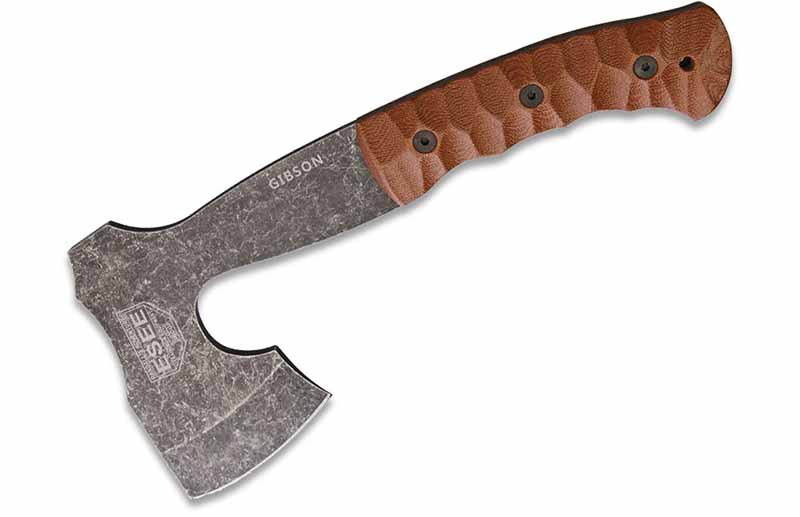
ESEE Gibson Axe
After the ESEE Gibson Axe was made, James Gibson learned a hidden feature of his design: it has enough finesse to carve small objects. He says he sharpens pencils with it and once cleaned a trout with it as well.
The hatchet is a James Gibson design which is now offered by ESEE. A knifemaker, flintknapper, and bushcraft instructor, James originally designed the Gibson Axe for himself, something to throw into a backpack as he tramped the hills and hollers of East Tennessee. As he tweaked his design, eventually cutting out a prototype made from thin plywood, he focused on its balance and “rocker.”
“An axe with perfect rocker is one of the best handling axes you can handle,” James said. “And I got the rocker perfect on this axe.”
And just what is rocker?
Gibson explains it’s when you take the hatchet and stand it up edge down on a straight surface. As he puts it, the bit’s edge should meet the surface in the “middle of the blade, the cutting edge and its dead center, and the handle [butt] should touch at the same time.”
When he showed a couple of prototypes of the axe to the folks at ESEE at a BLADE Show one year, they decided to add it to their lineup. At the time, ESEE was hearing from its customers that they wanted the company to offer an axe—and Gibson’s hatchet fit the bill.
James designed the handle to have finger grooves and a knob to secure the hand while swinging it. After the axe was made, he learned a hidden feature of his design: it has enough finesse to carve smaller objects. He says he sharpens pencils with it and once cleaned a trout with it. The result “is capable of doing some real work as well. It also has exceptional balance and you can choke up on it and use it like a knife for many applications,” explains Shane Adams, ESEE’s marketing director.
Of course, it being ESEE, the hatchet comes in the company’s oft-used blade material: 1095 carbon steel. “It’s us,” Adams said. “We know 1095 well.” It’s a steel that handles all the variables of the outdoors. “You can sharpen it with a rock if need be,” the marketing director advises. “Stones or systems, it doesn’t matter. I always like to finish on a loaded leather strop when possible.”
Gibson Axe Specs Company: ESEE Cutting Edge: 4.5″ Head Material: 1095 carbon steel Head At Its Thickest: .25″ Handle: Micarta Weight: 1.3 lbs. Overall Length: 10.5″ Sheath: Leather MSRP: $269
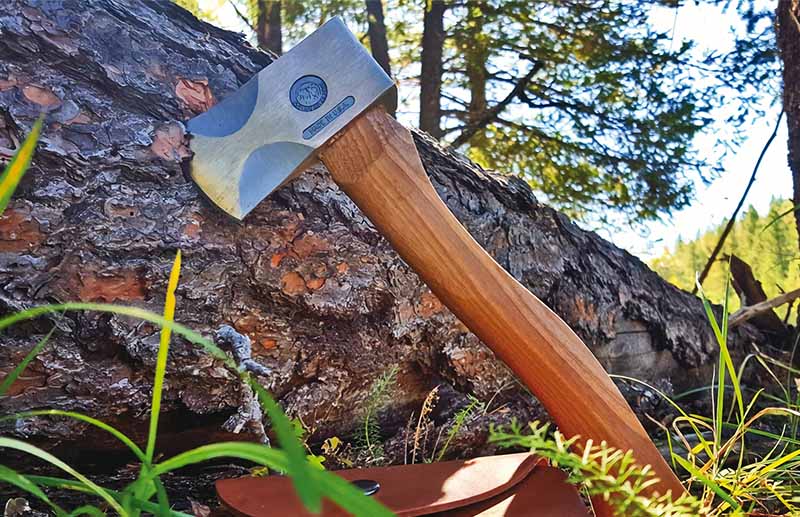
Knives Of Alaska Hunter’s Hatchet
“Hatchets are still one of the most useful tools a real outdoorsman can have in the fi eld,” says Charles Allen of Knives of Alaska, “and they can save your life by enabling you to quickly make a warming fire or emergency shelter.” The KOA Hunter’s Hatchet is designed to fi ll that bill in all regards.
Charles Allen, president and owner of Knives of Alaska (KOA), knows the importance of being prepared. The Alaskan master big-game guide who has flown in the Alaskan skies professionally for almost three decades always keeps a hatchet stashed in his bush plane—and for good reason.
“When you look back at the old photos of the early trappers and hunters, you will see three things: a rifle, a knife, and a hatchet or tomahawk on their belts,” he said. “Hatchets are still one of the most useful tools a real outdoorsman can have in the field, and they can save your life by enabling you to quickly make a warming fire or emergency shelter.” When consumers demanded a multi-purpose hatchet, Allen studied the designs carried by the folks who make preparedness their motto: the Boy Scouts. “I looked at the historic Boy Scout’s hatchet I grew up with and know that it is a proven design that is hard to improve on,” he says.
But improve on the Boy Scout model he did with the KOA Hunter’s Hatchet. The hickory handle remains tough yet easy on the hands. Heat-treated properly, the S7 tool steel is designed to absorb the shocks of hard blows. With a Rockwell hardness of 50-54 HRC, the edge of the Hunter’s Hatchet is intended to dent if it collides with something hard, Allen says, such as bone while butchering game. And the head can be returned to a razor-sharp bite with Allen’s recommended sharpening tool: a flat, fine-toothed file.
When designing the Hunter’s Hatchet, Allen was sure to include a wide-enough poll so that users could pound stakes, nails and the like with it, too.
Hunter’s Hatchet Specs Company: Knives of Alaska Cutting Edge: 4.25″ Head Material: S7 tool steel Handle: American red hickory Weight: 1 lbs. Overall Length: 11″ Sheath: Leather MSRP: $169
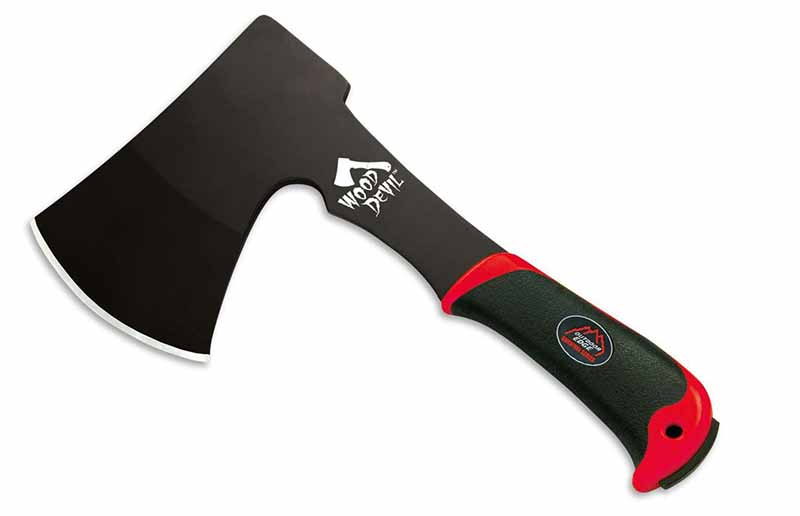
Outdoor Edge Wooddevil
David Bloch, president and founder of Outdoor Edge, wanted a hatchet that could out-cut its class: Something small enough to carry easily but with enough heft to take down a medium-sized tree. And thus the WoodDevil was born.
David Bloch, president and founder of Outdoor Edge, wanted a hatchet that could out-cut its class: Something small enough to carry easily but with enough heft to take down a medium-sized tree.
“I looked at and tested a number of compact hatchets on the market and came to the conclusion that most full-size hatchets were too large and heavy to take on outings where weight and volume were limiting factors,” Bloch said. “I also found that most every compact hatchet I tested, while cute in appearance, was not an effective chopping tool.”
During outdoor treks when the quality of your tools will make or break the trip, the Outdoor Edge WoodDevil may be a guardian angel, made possible by the marriage of a combination of the right balance, a good handle and a wide cutting head.
“The WoodDevil stands up to its name,” David said. “With a 4-inch cutting surface, it has the ability to cut through large diameter material with the respect of its compact size.” Plus, its compact size makes it unobtrusive in the camping bin or pickup truck until needed for whatever task—from hammering tent stakes to “slicing tinder shavings,” he adds.
The 3Cr13 stainless steel in a Rockwell hardness of 52-54 HRC is malleable and resharpens easily, and the black oxide finish allows it to better resist corrosion. The TPR rubber handle provides a non-slip grip that soaks up the shock and vibration during use. It’s packaged in a nylon sheath retained with a fabric fastener that can hang from a belt.
Wooddevil Specs Company: Outdoor Edge Cutting Edge: 4″ Head Steel: 3Cr13 stainless Handle: Red ABS plastic with black rubberized TPR Weight: 1.2 lbs. Overall Length: 10″ Sheath: Nylon MSRP: $40
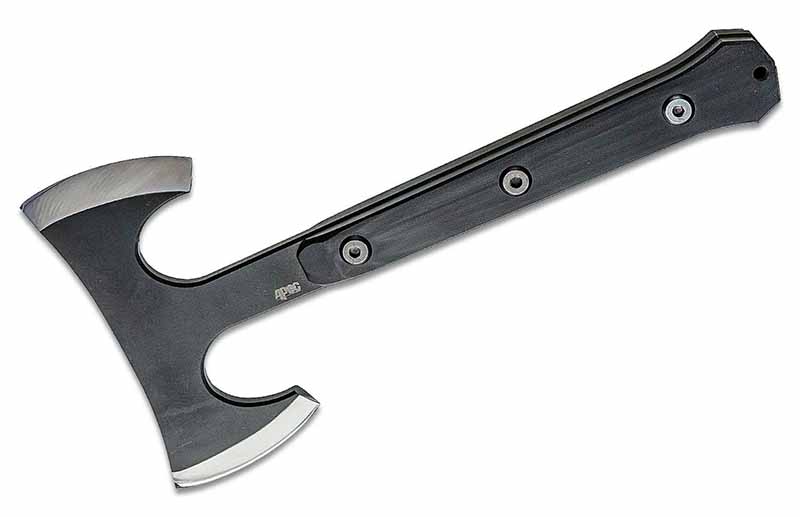
APOC Double Mukk
As Blake Pogue, product manager of CAS Iberia, tells it, the creation of the Double Mukk started with some pencil, plenty of erasing, and an idea.
“We wanted to bring a full-tang hatchet to market with some unique features at a good price point,” he said. Double-bit axes don’t seem as common as they used to be, but the Double Mukk’s design is grounded in some very real field experience. In fact, it is a design championed by George Sears, the famed outdoor writer with the nom de plume of Nessmuk.
“George Sears was an avid outdoorsman, canoe enthusiast, writer, and conservationist in the late 1800s,” Blake said. “He famously employed a trio of tools for woodcraft —a small folding knife, a thin-bladed belt knife and a short, double-bit hatchet.”
Pogue said after some field testing of their own, the makers learned they didn’t need to tweak much from Nessmuk’s favorite design. APOC Survival Tools makes the hatchet at a forge in Dalian, China, and it’s distributed by CAS Iberia. The blade is 9260 carbon steel, the same material used for swords, among others.
The double edge grants the hatchet additional versatility, as one side is flat ground for delicate carving tasks. The other side is convex ground to better slam through tough cutting jobs. Pogue recommends sharpening a hatchet with a hockey-puck-style sharpener designed for axes because it can easily follow the tool’s convex edges.
“I wanted one tool that could readily build a shelter, prep a fire for a meal, and do the intricate work required to make traps like the figure four,” he said. “If we can accomplish those three requirements, there isn’t much else you’d need but a small knife for food prep, and even then the carving side of the Double Mukk is no slouch!”
Double Mukk Specs Company: APOC Survival Tools Cutting Edge: 2.75″ Head Material: 9260 carbon steel Head At Its Thickest: .236″ Handle: G-10 Weight: 1.5 lbs. Overall Length: 11.75″ Sheath: MOLLE compatible MSRP: $99
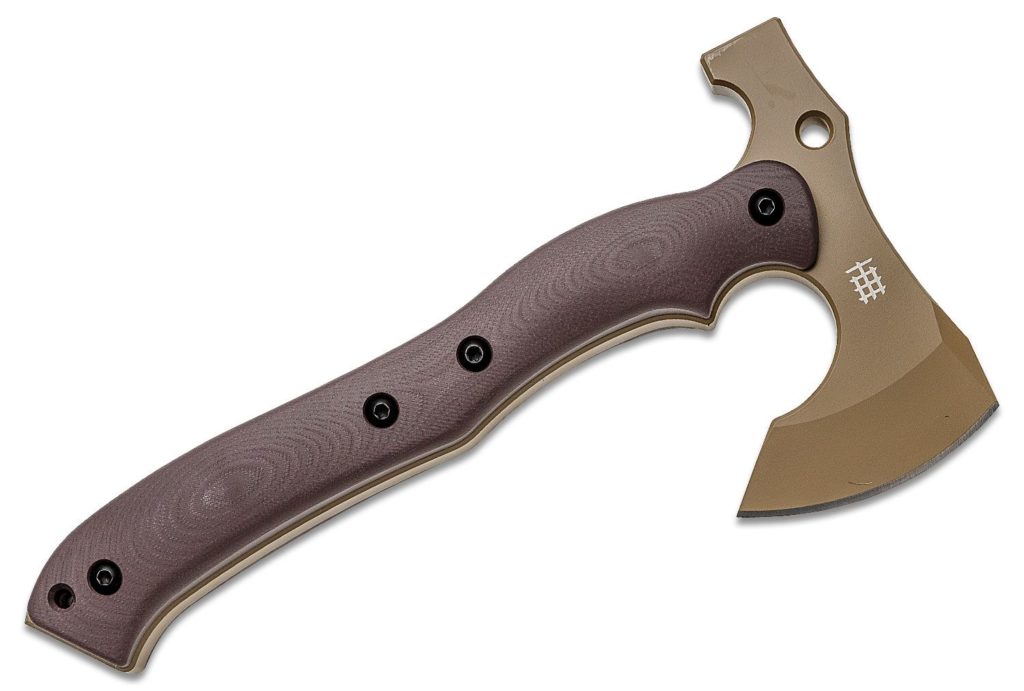
Halfbreed Blades CRA-01
The Halfbreed Blades CRA-01 Hatchet: Made ready for extreme hard use, this multi-purpose tool is ideally suited for MOE, CQB, Rescue, and Survival roles and tasks. Photo Source: knifecenter.com
The Halfbreed is a very heavy-duty piece. It is thick and hefty, and capable of taking a serious beating and dishing one out. This variant is finished in a dark earth color and comes with a substantial sheath that allows for secure carry adaptable to a variety of belts and packs.
Notable is how heavy the little hatchet is. It feels very nice in the hand and allows for either a low or high grip depending on the task. The grip is round in profile and consists of somewhat smooth scales. The edge out of the box was shaving sharp and easily removed hair from the arm.
The high, comfortable grip allowed for great control when scraping tinder. It also was a beast breaking bricks to make a windbreak for small fires. That said, it is not great for splitting tasks and, due to the thickness of the edge, does not bite deep for chopping. The grip is very comfy for general chores, though because the hatchet has equal weight dispersion along its length, it can fatigue your hand in use. It can be swung quite hard but there is a great deal of wasted energy in each strike because the head doesn’t carry the bulk of the forward momentum.
The dark earth finish was also the fastest to come off in heavy use. This is to be expected; however, be aware that if used heavily, the hatchet head likely will show wear far more than the other review subjects.
In terms of fire-starting ability, the CRA-01 proved mediocre as a striking tool, though it was very easy to control the direction of the sparks. Overall, it is fine for small fire-starting work and if it was what I had, I could easily make it work.
HALFBREED BLADES CRA-01 SPECS: Style: Tomahawk Head Style: Curved edge w/hammer poll Blade Material: K110 D2 tool steel Head Thickness: .31” Blade Finish: Dark earth (available in Ranger green and black) Handle Material: G-10 Weight: 1.7 lbs. Sheath: Kydex w/safety strap, belt and PALS/MOLLE mounting options Overall Length: 9.52” MSRP: $400+
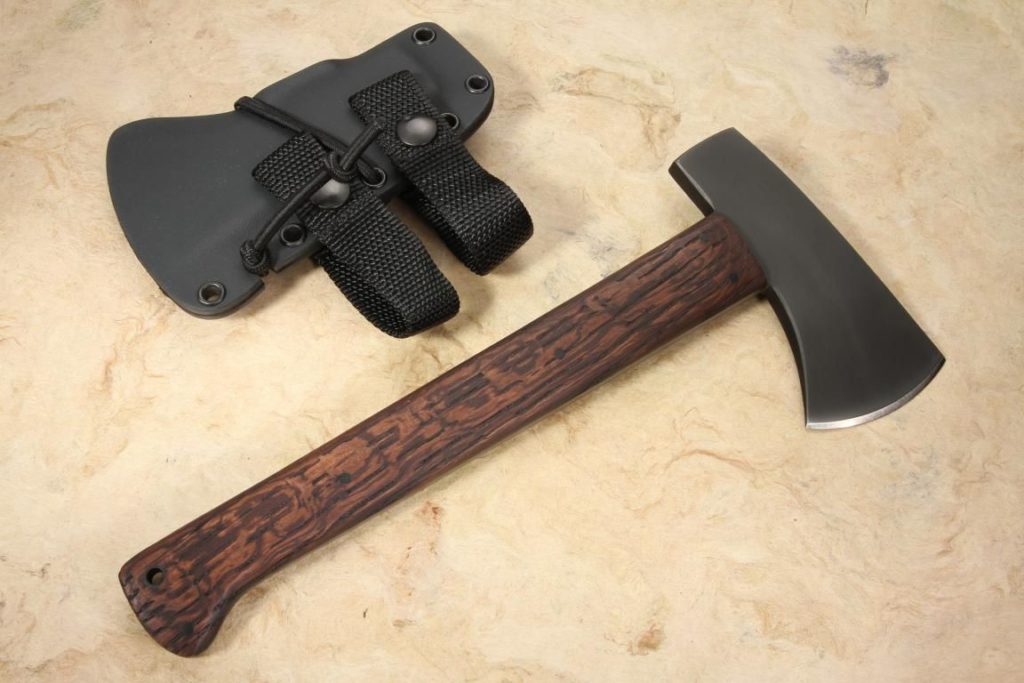
Winkler Knives Highland Hatchet
The Winkler has a full tang with scales attached. Worrisome for fear of the handle cracking in hard testing but it held up nicely. The finish is matte and held up well. It has a durable sheath that is simple and intuitive to use.
Despite the edge angles, it bit right into most wood, easily de-limbed trees and handled very light splitting. It stood no chance of taking a large log apart, though anything under 3 inches in diameter was taken to task.
For hammering and strength testing the Winkler held up extremely well. It broke bricks in a single strike and took very little finish damage in the process. Tent stakes were easy to drive in and were barely worth a mention, as a nice part of this little hatchet is it handles just like a 4-ounce tack hammer.
The Highland is a reliable fire maker, generating a showers of sparks and getting a flame going given equal materials. The edge showed no handicap in making kindling.
SPECS: WINKLER KNIVES HIGHLAND HATCHET Style: Camp hatchet Designer: Daniel Winkler Head Profile: Hammer poll Blade Material: 80CrV2 carbon steel Blade Finish: Black oxide Head Thickness: .336” Handle Material: Maple (laminate and walnut available) Weight: 20 ozs. Overall Length: 10 7/8” Sheath: Lined Kydex MSRP: $550
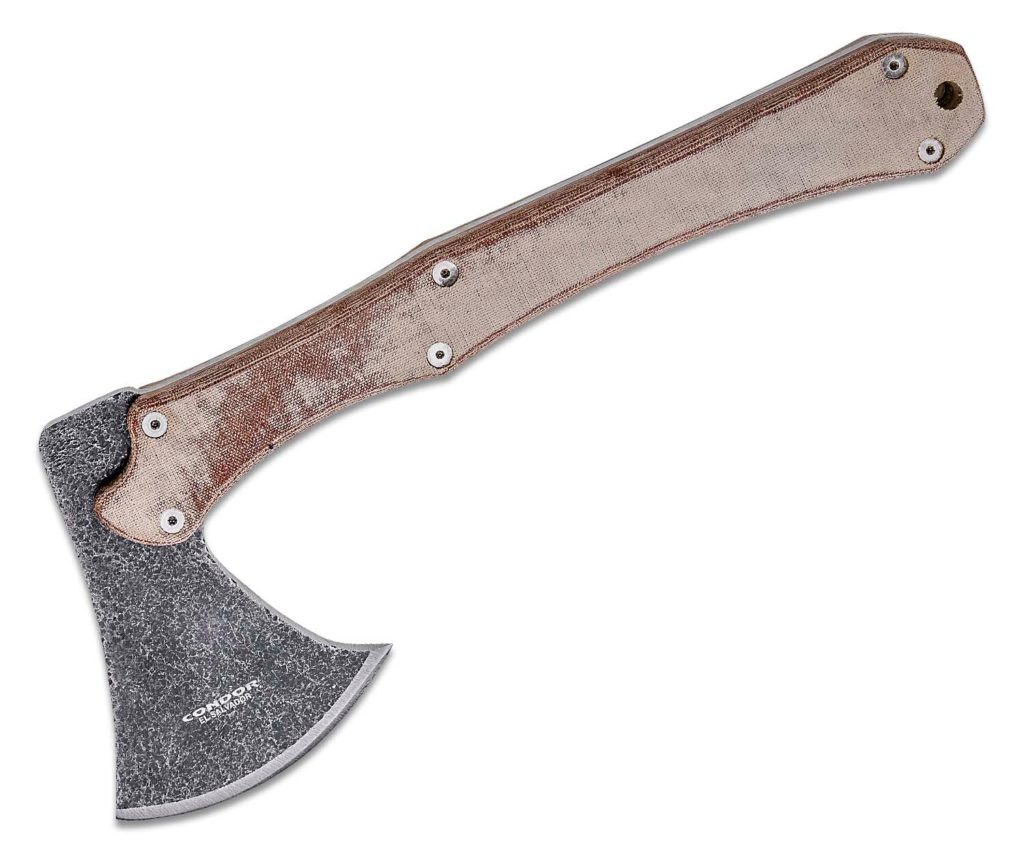
Condor Tool & Knife Mountain Pass AXE
knifecenter.com
The Condor Tool & Knife Mountain Pass might be classified as a jungle hatchet. It has a low beard and narrow thickness that is arguably much better at cutting wet wood, vines and bamboo in fast, repeated swings. For all intents and purposes, it is a foliage tool. As such it isn’t something for heavy splitting and camp chores. It ships with a very nice sheath of brown leather.
Swinging the Mountain Pass allowed for fast, accurate strikes. It bit in deep with each blow and was easy to withdraw. The edge was perfect for a camp axe when it arrived—not too sharp, not too obtuse. It handled limbs like a pro but was not up to heavy splitting. It sank in but lacked the mass to deliver sufficient splitting energy on the strikes.
A downside to hitting hard wood and other materials is Condor’s profile of the grip. It is visually appealing and very functional but narrow in cross section and wide front-to-back, thus making the impact of each hit apparent in a smaller area of the hand. If the grip was even 1/16 inch wider on each side it would have been an easy favorite in this test.
As far as hard camp work it broke brick easily with one hit, took little damage and easily drove tent stakes. It is not intended for either of these roles, but it did just fine considering it lacks a hammer poll.
The Mountain Pass was not particularly good at splitting fine kindling, but it did well and was easy to strike on, if not a bit large. Putting it in this role immediately made me realize it was really not meant for the work; it’s far better for clearing brush and gathering medium branches to process with a smaller tool.
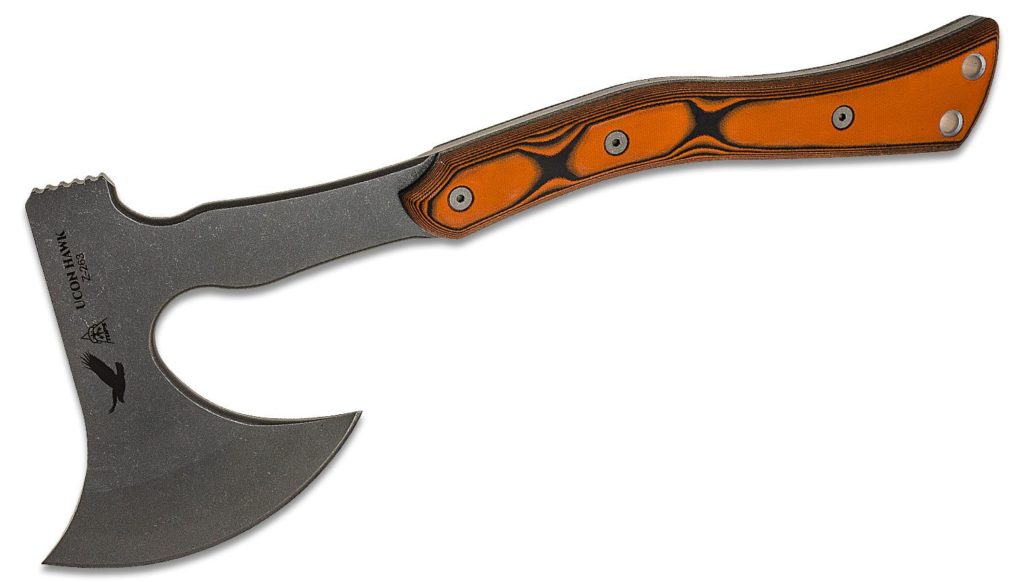
The Ucon Hawk from TOPS Knives is probably the most visually striking hatchet in the evaluation, as well as the sharpest. It’s large with a wide cutting edge and deep belly. It has a long, very pointy and sharp beard and a substantial grip. It’s questionable the edge needs to be as sharp as it is; a dull knife is clearly a danger but an extremely sharp, full-size hatchet can be a hazard.
The Ucon’s size makes it adept for general camp tasks. However, when it came to splitting, the deep belly and sharp tips made pulling it out of a stubborn log relatively dangerous as the blade rarely penetrated all the way, thus leaving the tips exposed. If you were to put your foot on the log to apply pressure to withdraw the head, a possibility exists that you could injure your foot in the process.
That said, performance was fantastic as a camp tool and it could simply lop off branches in a single swing. The finish held up nicely and the edge stayed sharp even after hard use. It should be noted that only the TOPS and the Winkler had edges unaffected by use. The Ucon ships with a two-part sheath—one part goes over the blade and the other is a belt loop the hatchet can slip through.
For heavy-duty tasks it did well, easily passing through limbs. Splitting was possible, though the hatchet was a bit thin and grip-heavy to dive deep enough to separate a full-size piece of firewood. Breaking brick with the hammer poll was easy; it left virtually no damage to the tool. Driving tent stakes also was easy.
Making fire was a challenge in that you had to be extremely aware of where the tips of the edge were at all times. If you get in the mode where you’re striking rapidly, say if you’re cold and frustrated, you need to calm down and take your time (as you should always do when using any sharp edge). The Ucon produced the finest kindling of the bunch by scraping with its sharp edge. The hatchet needs to lose the super-pointy beards—otherwise it is a great performer.
SPECS: TOPS KNIVES UCON HAWK Style: Camp axe Designer: Leo Espinoza Blade Material: 1095 carbon steel Blade Finish: Tumble Head Profile: Curved blade, hammer poll Head Thickness: .25” Handle Material: Orange and Black SureTouch G-10 Weight: 1.94 lbs. Overall Length: 15” Sheath: Black leather MSRP: $330
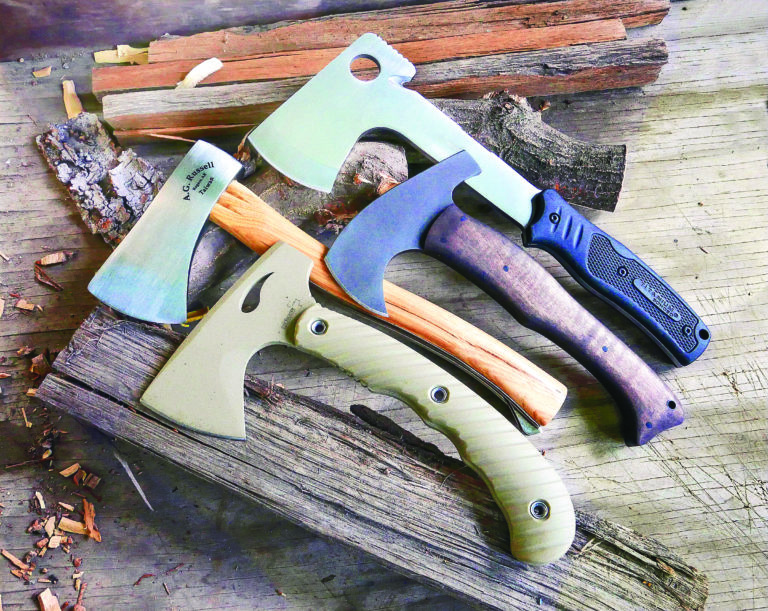
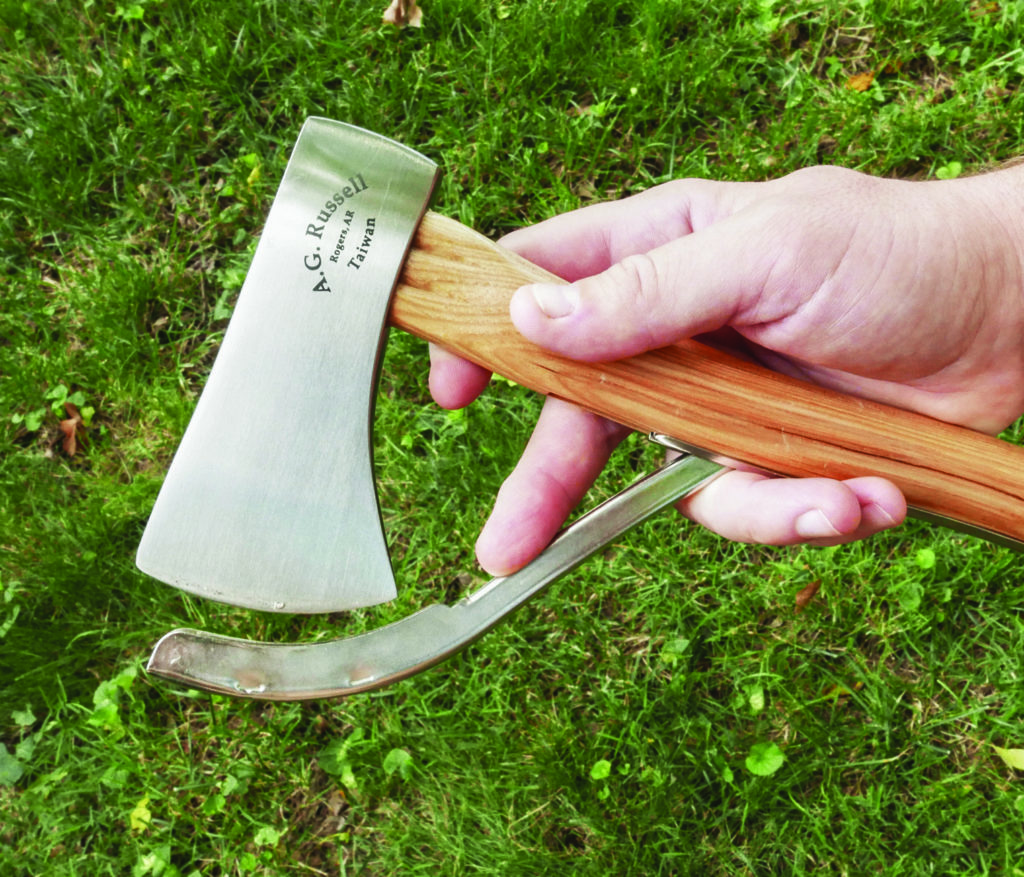
A.G. Russell Pocket Safety Axe
The fold-out blade shield of the Russell Pocket Safety Axe is pure wizardry, especially considering the design is well over 100 years old. You won’t be caught saying “Where did I put the sheath?” with this one.
The A.G. Russell Pocket Safety Axe is a Marble’s design from circa the early 20th century. Marble took a small hatchet, 10.6 inches overall, and designed a fold-out metal shield in the handle to cover the bit in lieu of a sheath. Simply ingenious. The A.G. Russell version has a 4.5-inch 1070 spring steel head with a 2.4- inch cutting edge, and a typical old-school hammering base at the rear. The head has a distinctive three-slot mounting system Marble deemed superior to the standard oval style. The 8.8 inch handle is hickory and the whole kit and caboodle weighs 1 pound. Manufacturer’s suggested retail price: $79.95.
With much of its overall weight in the head, this is a very top-heavy hatchet—which can work to its advantage. In the bite test on the privet log, the Pocket Safety Axe finished first simply because the business end has a lot more weight (see the side-by-side comparison image on head thicknesses). Consequently, it chopped each test material well.
The fold-out bit shield has pluses and minuses. On the upside, it’s very convenient and there’s no sheath to keep up with. On the other hand, you have to pack it since there’s no belt-sheath option. Also, you’ll want to wear gloves for extended use, as the hinge mechanism in the handle can dig into the inner fingers. All in all, though, the Pocket Safety Axe is a stellar performer.
SPEC CHECK: A.G. RUSSELL POCKET SAFETY AXE Cutting Edge: 2.4” Blade Material: 1070 spring steel Head Width: 4.5” Head Thickness: .7” at the thickest Blade Coating: None Handle Material: Hickory Special Features: Metal blade cover in handle Carry: Pocket or pack Weight: 1 lbs. Overall Length: 10.6” MSRP: $80
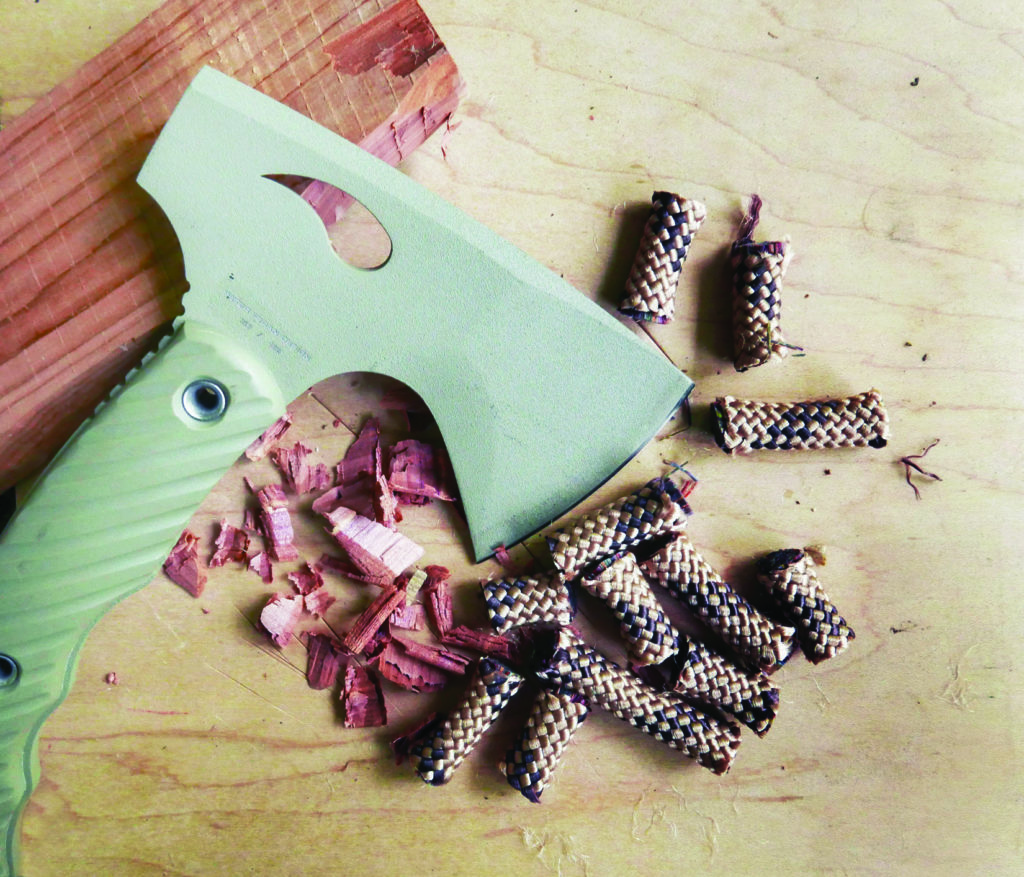
Boker Plus Escape Hawk
Designed by Australian knifemaker/ designer Peter Fegan, the Boker Plus Escape Hawk is tactical in design. Hawks are primarily used for breaching and combat but can full other chores as well. Only 9 inches overall, the Escape Hawk has a 4.75-inch head of quarter inch-thick SK5 tool steel and a 2.56- inch cutting edge. The head has enough beard to be used for carving, and the curved 7-inch handle is adorned with nicely sculpted, diagonally grooved FRN ( berglass-reinforced nylon) scales. The butt can be used for hammering. The steel is protected throughout with a powder coat. A dual-strap Kydex sheath covers the head. MSRP: $189.95.
The Boker Plus Escape Hawk is a hatchet in disguise. The small hack-it’s 2.56-inch SK5 tool steel bit chopped rope in nice, clean lops, and hacked off nice-sized cedar tinder chips with ease.
Due to its small size, you won’t be doing much breaching with the Boker Escape Hawk, but the pint-sized hack proved its worth. The SK5 steel had plenty of hack, chopping rope in nice, clean cuts, and knocking out chunks of seasoned cedar for tinder. Though the bearded bit can be used for carving, the inward slant of the handle mounting to the head impedes its effectiveness for the purpose a tad. The handle has full-length scales—a bonus for freedom of grip—and the diagonal grooves afforded it the best purchase of the bunch. The Boker Escape Hawk is a hawk that thinks it’s a hatchet.
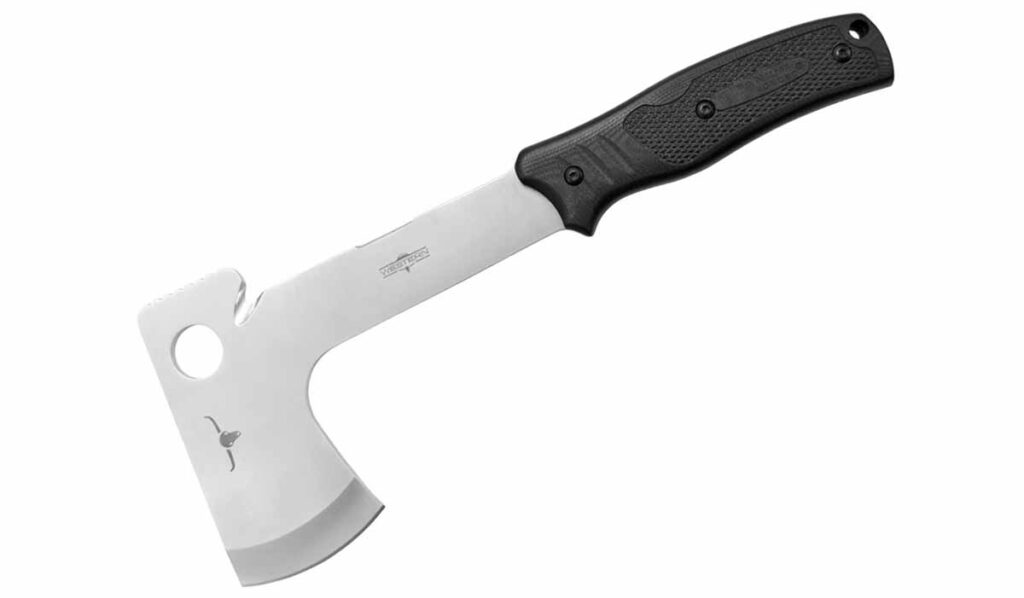
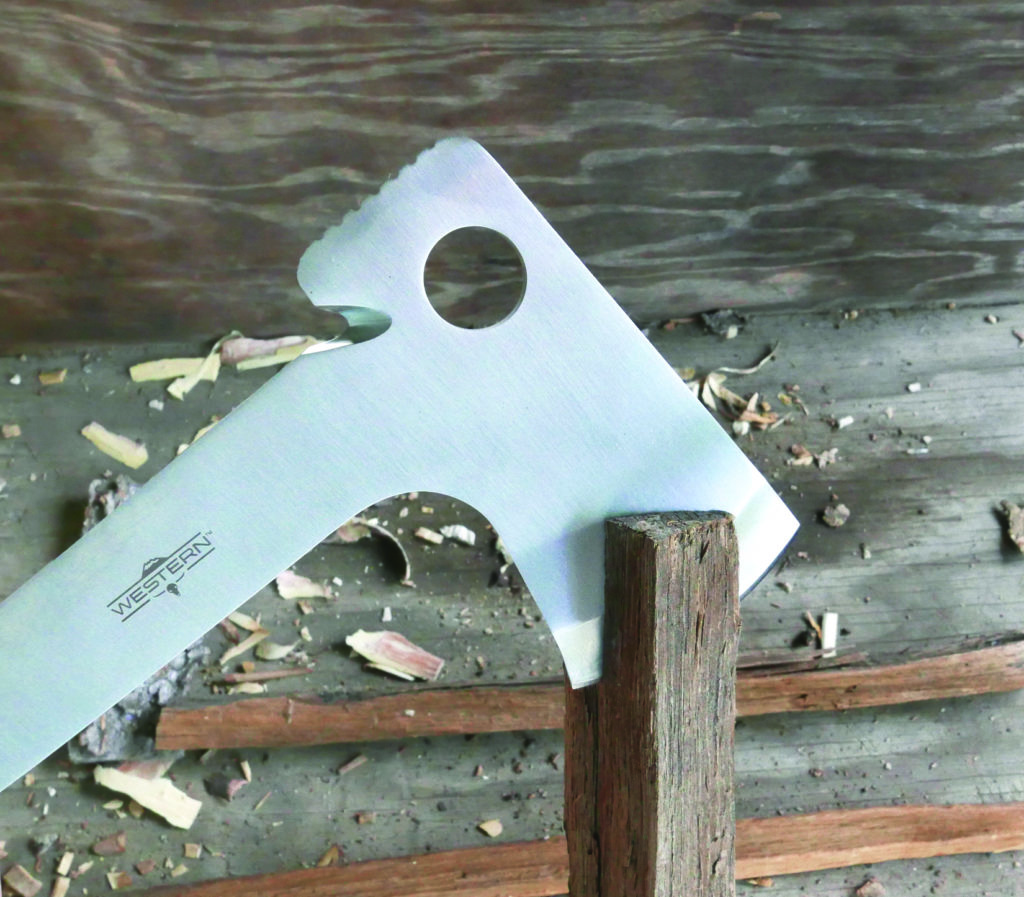
At 11.5 inches, the Western Blackriver Long Hatchet from Camillus is, indeed, the longest of the test hack-its. It sports a 4.5-inch-wide head with a 2.5-inch chopping edge. On the back side of the head is a gimped flat edge for hammering and a sharpened diagonal slot for cutting cord. The 9.5-inch handle has 5.25-inch black checkered rubber scales, and there is a shaving slot midway between the handle and the head. A ballistic nylon sheath with a firesteel pouch—with firesteel—is included. MSRP: $31.98.
The Western Blackriver Long Hatchet from Camillus is the batonner of the bunch. The thin bit cleaved into the tight hardwood grain like a thief in the night. Once the head was in, the final splitting was done by batonning the upper handle.
The Blackriver has the lightest head of the test group so it didn’t win the chopping wars, but its length and handle design give it a leg up on the others in some functions. The thin head is ideal for batonning, enhanced by the 4 inches of exposed steel below the bit, which can be used as a striking surface. The grip is very comfortable, the rubber scales aiding in impact absorption. The Blackriver will handle many chores around the camp, and the bonus firesteel and pouch on the sheath add value. It’s also by far the most affordable of the group.
Camillus/Wester Blackriver Long Hatchet Specs Cutting Edge: 2.5” Blade Steel: 420 stainless Head Width: 4.5” Head Thickness: .2” Blade Coating: Titanium bonded Handle Material: Rubber Special Features: Firesteel included Carry: Ballistic nylon belt sheath Weight: 1 lbs. Overall Length: 11.5” MSRP: $32
Winkler Hunter Axe LT
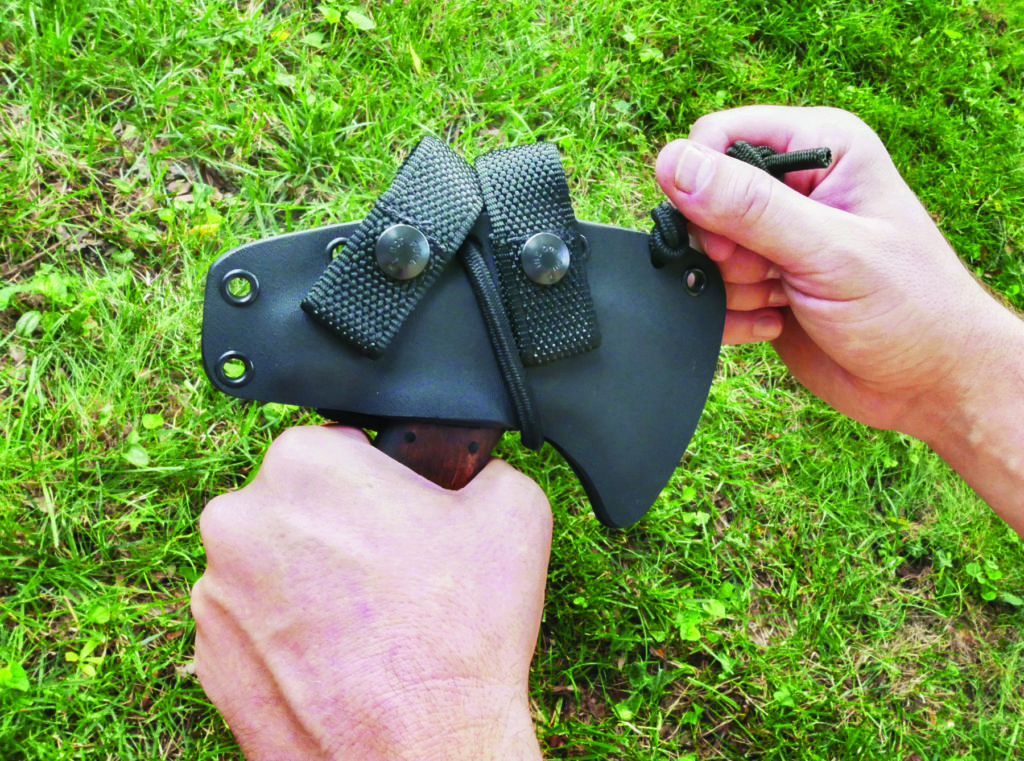
At only 9 inches long, the Winkler Hunter Axe LT is a small hack-it, but packs a full 19 ounces of weight—and that’s with a skeletonized handle tang. The Hunter Axe LT has a 3.5-inch-wide, bearded 80CrV2 carbon steel head with 2 inches of cutting edge, and there’s a hammering base out back. The steel thickness is a healthy .25 inch and is coated head to toe in Caswell black oxide. The scales are full-length, highly attractive curly maple. A padded Kydex sheath with nylon belt loops covers the head, and employs a shock-cord retention system for a quick draw. MSRP: $450.
The Winkler Hunter Axe LT’s Kydex sheath has a bungee-style tension cord for quickly releasing the axe from its housing. The sheath as a whole is very well made—a Daniel Winkler trademark.
The Hunter Axe LT may be short but at 19 ounces is the heaviest of the test hack-its—a full 2 ounces more than its nearest rival. The LT almost won the bite contest but didn’t due in part to its weight being more equally distributed than the top-heavy Russell Pocket Safety Axe. The 80CrV2 steel chops extremely well and the Caswell finish is very tough. Though not a carving axe per se, the LT was our best candidate for the chore and would have performed even better with a lower grind angle on the lead edge. The price is high but the Winkler is as close to a custom as you’ll get—plus, the sheath is a marvel in itself.
WINKLER HUNTER AXE LTSpecs Cutting Edge: 2” Blade Material: 80CrV2 carbon steel Head Width: 3.5” Head Thickness: .28” Blade Coating: Caswell black oxide Handle Material: Curly maple Special Features: Skeletonized handle Carry: Kydex belt sheath w/tension release Weight: 1.9 lbs. Overall Length: 9” MSRP: $450
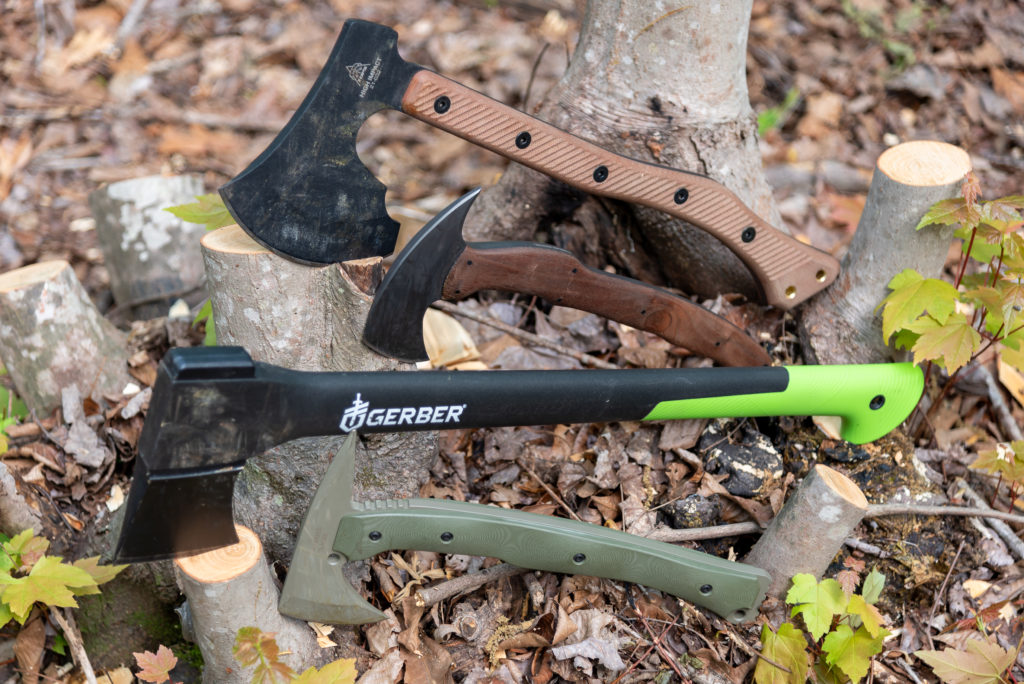
Gerber Freescale Axe
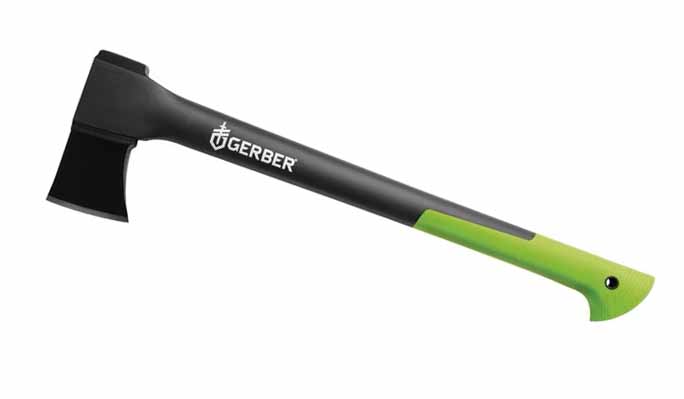
Gerber has had a successful series of axes and hatchets made in Finland that feature one-piece, hollow, molded handles for lightweight, optimum strength. An example is the 23.5-inch model in its Freescale series. The forged steel head is mated permanently to a lightweight composite handle, so there is little worry the handle will come loose during use. The oblong profile handle is hollow, which shifts the balance of the axe to being head-heavy. It is very forward weighted and that is a good thing. Use gravity to your advantage as you employ the axe, allowing it to fall naturally as you guide it. A tactile gripping surface in a contrasting green graces the handle. The handle flares at the butt, allowing your bottom hand to hook into it, trapping the handle in your hand so it doesn’t go flying. The handle style reportedly is virtually indestructible during heavy use.
The forged head exhibits a nice, steep “V” profile to help bite hard and deep into wood. A primary edge bevel thins the edge some and makes resharpening easier. A black PTFE coating provides additional corrosion resistance as well as a nonstick surface. A poll is designed as a hammer.
The Freescape is among the least expensive of the review axes, though don’t discount its performance based solely on price. Truth is, this axe is devastatingly effective. With each swing you can feel the forward-weighted balance power the Freescape through wood. The thickness and shape of the handle are just right, allowing a secure grip with both hands. Gerber includes a plastic caddy that seals the cutting edge and protects you and your belongings from being cut. The caddy has a large handle to carry the axe safely, as well for hanging on a pegboard in your garage or utility shed. For how it performs versus what you pay, it is an excellent value. If you’re a frequent axe user or just an occasional one, the Freescape will serve you very well.
Gerber Freescape Axe Specs Cutting Edge: 3.5″ Head Material: Stainless Steel Head At Its Thickest: N/A Handle: GFN Weight: 3.6 lbs. Overall Length: 23.5″ Sheath: Plastic, carry handle MSRP: $70
Winkler KnivesRnD Compact Axe
The tang sports a distal taper toward the handle butt of the Winkler RnD Compact to improve balance and shift weight distribution toward the head. Note the humpback in the handle.
A spike model, the RnD Compact Axe is the smallest in the Winkler Knives (WK) axe line, though that doesn’t mean it’s the least capable. The hatchet-like head is only 5.5 inches long. The 80CrV2 carbon steel head is ⅜ inch wide. The tang sports a distal taper toward the handle butt to improve balance and shift weight distribution toward the head. The spike is commonly found on tomahawks and does everything from prying to puncturing. WK also offers a front spike option integrated into the head’s main cutting edge. A black oxide finish helps resist corrosion.
The 80CrV2 offers extreme toughness and edge retention. It withstands an impressive amount of abuse yet remains easy to resharpen, even in the field. Daniel Winkler is a fan of 80CrV2 and uses it a lot for both his knives and axes.
The handle features two prominent grip positions. One is the traditional axe grip held close to the butt. A series of subtle finger grooves seats your fingers, and the butt has a bird’s-beak design that hooks the handle into your hand to prevent it from sliding from your grip. A secondary close-quarters grip is below the axe head at the handle’s humpbacked portion. This facilitates choking up for control in carving, whittling and using the cutting edge like a knife. The RnD feels very balanced and agile in the latter grip, one the other review axes don’t offer. The Winkler would be great at processing kindling and bushcraft chores that require more control with close-in cutting or whittling. Due to its length and weight, it would not be a primary use axe but maybe a complement to a larger model that does heavy splitting or felling chores.
A secondary close-quarters grip is just below the head of the RnD Compact at the handle’s humpbacked portion. This facilitates choking up to provide control for carving, whittling and using the cutting edge like a knife.
The walnut handle looks luxurious but pay heed to where you lay it down in the woods. The walnut’s color blends in well with leaf ground cover and you might lose it easily. Thread a loop of brightly colored pink, red or yellow paracord through the lanyard hole to make the handle stand out. The RnD comes in three handle materials: black Micarta®, maple and walnut.
A molded form-fitting sheath of Boltaron encloses the head. A thick shock-cord-quick-release-retention device secures the sheath in place, yet releases easily and quickly. An interior felt lining facilitates the easy slipping on/off of the sheath, as well as muffling the sound. Two nylon webbing belt loops enable the RnD to ride comfortably at your side. MSRP is $815, the most expensive of the test group. WK is very well known for manufacturing excellence and attention to detail, and the RnD Compact is no exception. For a bigger axe in the same design, check out the full-size model.
Winkler KnivesRnD Compact Axe Specs Cutting Edge: 2.25″ Head Material: 80CrV2 carbon steel Head At Its Thickest: 3/8″ Handle: Walnut Weight: 1.3 lbs. Overall Length: 11″ Sheath: Boltaron MSRP: $815
TOPS Knives High Impact
The High Impact’s curved cutting surface allows it to be devastatingly effective as a chopper, including sectioning the trunk of a sapling for easier handling.
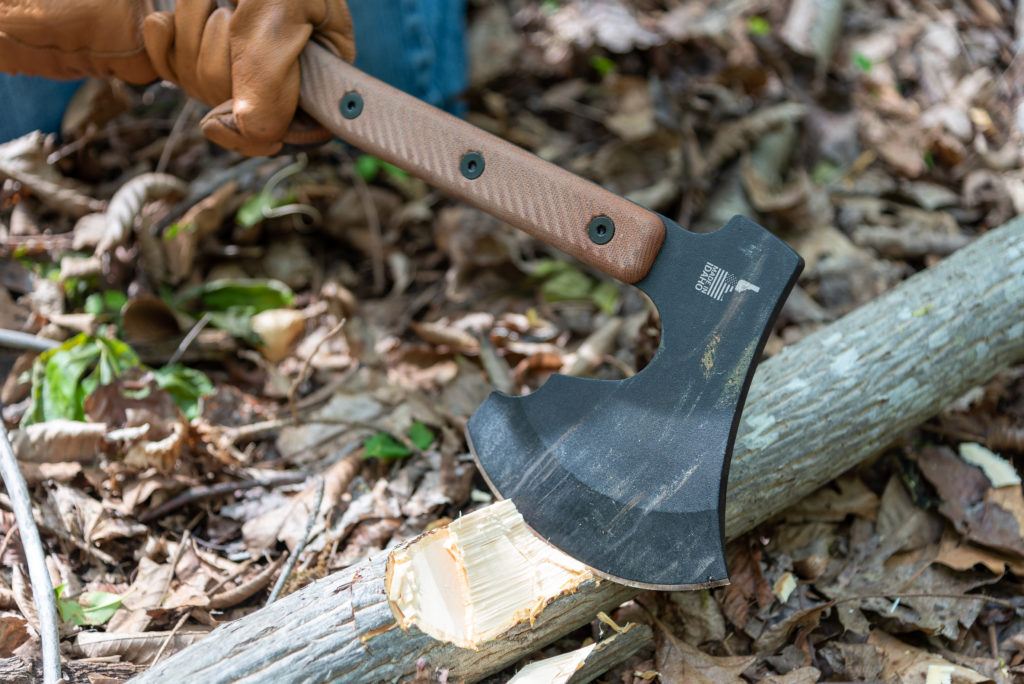
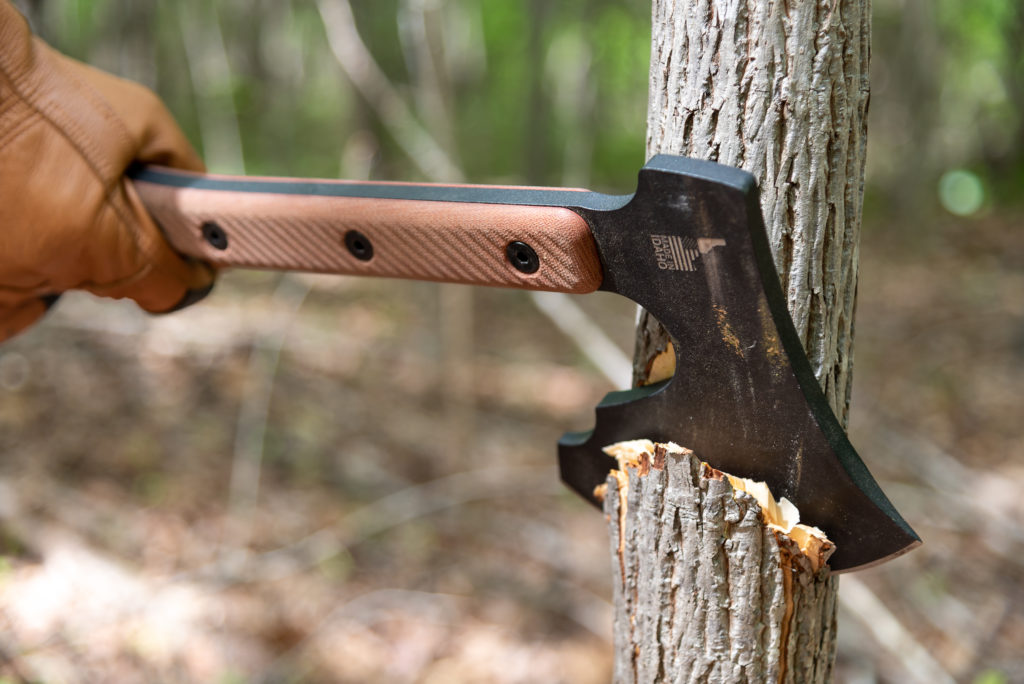
The TOPS Knives High Impact is a full-sized hatchet/small axe hybrid that packs a punch. At 20 inches overall and around 3.5 pounds, it is a formidable chopping tool that can be used with two hands as a traditional axe or one handed a la a hatchet.
Starting with a backbone of .38-inch-thick 1075 carbon steel, the High Impact’s main cutting edge is a little over 5 inches—plenty of cutting surface for large and small chopping jobs alike. The Black Traction Coating creates a layer of protection against corrosion and wear. The ergonomic handle is tan Micarta®, with a diagonal machined groove pattern for hand traction. Five pairs of large hex head screws fasten the Micarta scales, and there are two large brass-lined lanyard holes. The handle has a distinctive bulge that helps seat your grip, especially for one-hand use. The handle flares at the butt, creating a comfortable seat for your bottom hand when using two hands.
The first thing you notice is the High Impact’s weight. It’s impressive but will take some getting used to. Once acclimated with the heft, you will discover it is also an advantage for getting momentum in your swing. And when it hits, it lives up to its name. The High Impact takes out chunks of wood with each blow. TOPS has the heat treat on the carbon steel dialed in perfectly. The 1075 retains an edge really well but sharpens easily and quickly.
The TOPS Knives High Impact is a beast. It has heft and momentum to bite deep and hard with each swing. The ergonomic handle makes it possible to use the axe with one or both hands.
I tried both grip styles. With one hand, this is where the weight takes some getting used to. Due to the axe’s weight, one-handed use might be limited to short spells. Conversely, using two hands is where the power of this beast is unleashed. You can put power behind the swing and each blow is devastating. You can feel the axe head bite in with each blow. It’s a sure bite as well. The performance with one or both hands is equally impressive. Due to its weight, it’s a great candidate to store in your truck or ATV.
A nicely made leather holster fastens over the head, sealing the edge. Two button-snap straps secure it, though only the one at the end needs to be undone to slide the sheath off. Note the absence of a belt loop attachment to carry the axe. It’s just too heavy. Despite the weight being a factor, the High Impact packs a serious punch and is the heavyweight champ of the test bunch. MSRP: $360. TOPS makes the axe in its factory in Idaho Falls, Idaho.
TOPS Knives High Impact Specs Cutting Edge: 5.75″ Head Material: 1075 RC 56-58 Head At Its Thickest: .38″ Handle: Tan Canvas Micarta Weight: 3.7 lbs. Overall Length: 20″ Sheath: Leather MSRP: $420
Wolf Valley Forge Camp Axe
The Wolf Valley Forge axe ate bundle after bundle of firewood like there was nothing to it.
The Wolf Valley Forge Camp Axe is in a class of its own. It came not with just a functional sling and cover, but also a small whetstone and a jar of wax by Axe Wax to help preserve it. Carrying the Camp Axe is comfortable and allows for a free hand while trekking. The handle is perfectly shaped and came with a leather strike guard.
Ike Bullington is the maker and the quality is immediately noticeable the second you unpack it. It is all properly shaped, textured and balanced for real work and has a very pleasing appearance. However, it is not a wall-hanger. The head is of a traditional profile and designed for a lifetime of work.
The edge arrived razor sharp, easily sharper than most knives. Not only that, but the edge is extremely durable and completely dispels the notion that you need a wedge-shaped splitter.
A sharp axe truly cuts the work in half and this one almost effortlessly passed through wood regardless of grain angle. In taking down bigger trunks it drove in the deepest and was the easiest to free. Chips flew with each chop and it made very short work of even the toughest test materials.
In addition to cutting wood, it was tested driving tent stakes and making kindling, which it did easily. As a camp axe it is very nice in the batoning role, and yes, you can baton an axe the same as you would a knife—so long as you grip it high up to the head and perform the task in a safe standing position as to not deflect the blade into your knee.
Wolf Valley Forge Camp Axe Specs Cutting Edge: 4″ Head Material: 4142 Head At Its Thickest: N/A Handle: Hickory Weight: 2.5 lbs. Overall Length: 23.62″ Sheath: Leather MSRP: $375
Fox Sekira
Considering what you get, the Fox Sekira is a great axe and relatively inexpensive. It handles like a traditional axe in the swing but has a crescent-profile edge that is shaped much the same as a carpentry axe, though with a longer handle. The head is wide at the cheeks and quite narrow in the blade. It splits very nicely though isn’t particularly deep-biting on each swing.
The head, while substantial, isn’t overly massive and there is a large concentration of weight in the handle. The weight is distributed across the axe, which could lend to some of the increased effort in getting it to send splinters flying.
As far as general performance, the Sekira is about as good as a traditionally constructed axe gets, and lacks nothing in utility. It stayed sharp and experienced no edge chipping, even after quite a bit of heavy use. The only noticeable downside is that the handle, while comfortable and very nicely finished, is somewhat on the large side and rounded from front-to-back.
When hands get wet or cold the axe has the tendency to want to rotate, which can be dangerous if you’re not holding on tight. Other than that minor issue, the Sekira is a fantastic axe that should offer years of hard-use service.
Fox Sekira Cutting Edge: 4.33″ Head Material: Carbon Steel C45 Head At Its Thickest: N/A Handle: Hickory Weight: 3.35 lbs. Overall Length: 23.62″ Sheath: Leather MSRP: $150
Editor’s note: Dexter Ewing, Josh Wayner and Daniel Jackson contributed to this post.
The Karambit Is A Historic Utility and Combat Knife From Asia That Has Grown In Popularity Around The World In Recent Decades.
The karambit looks unlike any other knife. The short, swooping curve of the blade dates back nearly a millennium in Indonesia and throughout Southeast Asia. First used mainly as a tool for farming and planting rice, the karambit evolved over time into a combat knife. The curve became more pronounced and became a main weapon in pencak silat, an indigenous Indonesian martial art, and Filipino martial arts.
Legend goes that as the knife became more combat-oriented, its shape was inspired by a tiger’s claw. The knife’s tight curve and finger ring allow it to stay securely in the hand in close-quarters combat.
Why Should I Use A Karambit?
The karambit today is very much a self-defense tool. Yes, it can still be used for outdoor tasks, but there are more practical blades available for such purposes. The karambit is a strong, durable combat knife used by law enforcement and militaries around the world.
If you’re looking for a high-quality knife to keep on your person as protection, you can’t get much better than the karambit. The finger ring provides a natural, secure traditional grip or reverse grip to generate more power with each swing.
The folks at Emerson Knives, Inc., have made a great video showing how to use a karambit.
Do I Need A Karambit?
Simply put: no. A karambit is a refined self-defense tool. If you live a life where life-and-death close-quarters combat is an extremely minute possibility then you can probably pass on a karambit.
Additionally, the sharp curve of the blade means it can be difficult to handle without experience or training, even with the finger ring. If it’s uncomfortable to use then don’t use it.
Best Karambits
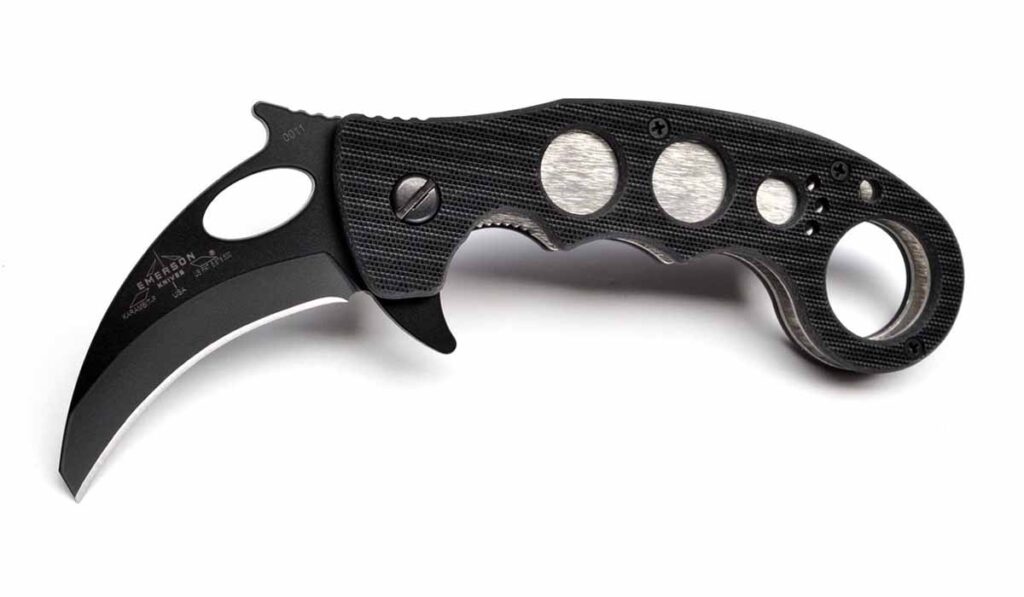
Emerson Combat Karambit
The Combat Karambit folder by Emerson Knives, Inc., was very well received when introduced years ago. It subsequently spawned a larger version called the Super Karambit. It shares the same award-winning features of its forerunner but in a larger, more impressive format. The 3-inch blade is 154CM stainless steel and opens by either the patented Emerson Wave or an oval blade hole. Handle material is G-10 reinforced by dual titanium liners for rigidity. The handle flows seamlessly into the finger ring in the butt. There are a lot of graceful curves on this knife. It’s a feast to behold.
The handle fits my hand extremely well, instilling a high sense of security and user confidence. The Super Karambit carries nicely in a pocket though its presence is a constant reminder of just how big it is. A reverse grip feels exactly as secure as a forward one. Your hand isn’t moving once it’s wrapped around this handle!
To deploy the blade using the Wave remote pocket opener, hook your finger through the finger ring, pull the handle from your pocket and let the Wave hook engage the seam of your pants pocket. Keep pulling and as the handle comes free from the pocket, the hook grabs the seam and deploys the blade open and locked. To my knowledge, this results in faster blade deployment than any other karambit.
One thing I don’t care for is the overly aggressive texturing of the G-10. I like grippy texture but this one is downright abrasive on pants fabric. It might be a good idea to take a small piece of cardboard and rub it over the handle texture to smooth it out somewhat. The knife is offered exclusively in a stonewashed blade finish and a black G-10 handle. Country of origin: USA. Closed length: 5 inches.
MSRP: $325
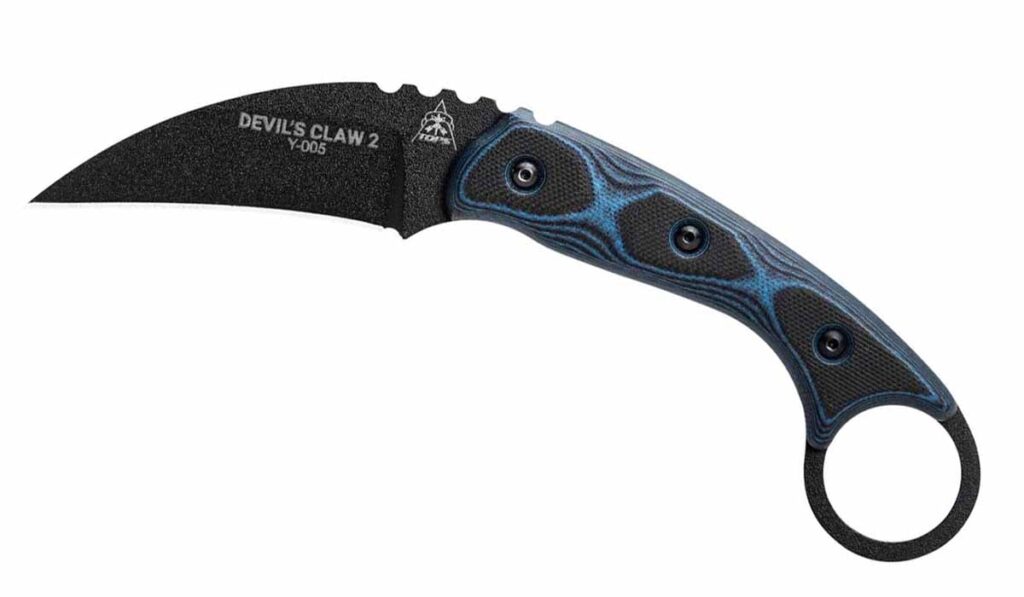
TOPS Devil’s Claw 2
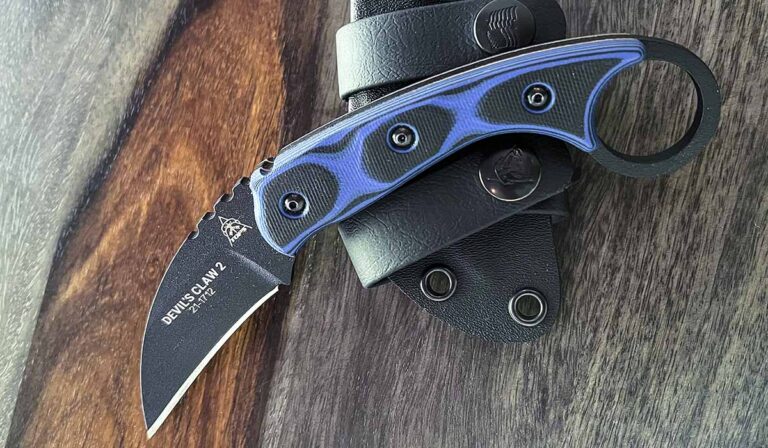
The Devil’s Claw 2 by TOPS Knives is a mid-sized fixed blade designed for personal protection. It’s built on the same platform as the company’s original Devil’s Claw but with an extended handle to accommodate a full grip as well as the traditional ring at the end. The 3-inch hawkbill blade is 1095 carbon steel in the company’s Black Traction Coating to help protect against corrosion, as well as provide a low profile. Overall length: 5.75 inches. Five large traction notches machined into the rest portion of the blade spine provide a non-slip grip for the thumb. The handle is blue and black G-10 with red fiber spacers at the tang—very eye catching! The sheath is molded Kydex with loops to carry horizontally on a belt.
The DC2 is also a well-disguised utility knife. It feels agile and capable in hand. If you have jobs that require long, straight cuts, the DC2 is the answer. The angle of the blade makes it easy to use the tip to cut and score, while hiding the knife in a forward grip. The finger ring helps seat your hand during such tasks. The traction notches on the thumb rest aid with precise tasks such as wire stripping, whittling or any task that requires downward pressure on the blade.
MSRP: $165
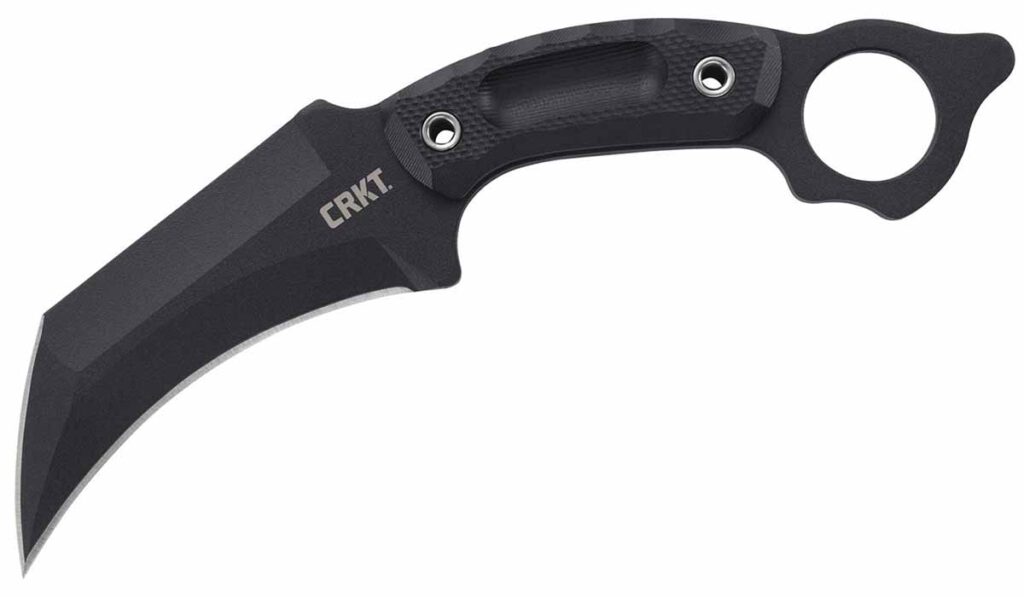
CRKT Du Hoc
Sometimes bigger really is better, and that might be the case with the CRKT Du Hoc. This fixed blade designed by Austin McGlaun is a whopping 9.63 inches in length and 9.3 ounces in weight. McGlaun designed the knife to honor his late uncle who earned a Silver Star at Point Du Hoc.
The 5.1-inch blade is made from powder-coated SK-5 carbon steel. The G-10 handle provides an excellent grip, and the included thermoplastic sheath comes with mounting options and makes for easy transport.
MSRP: $113
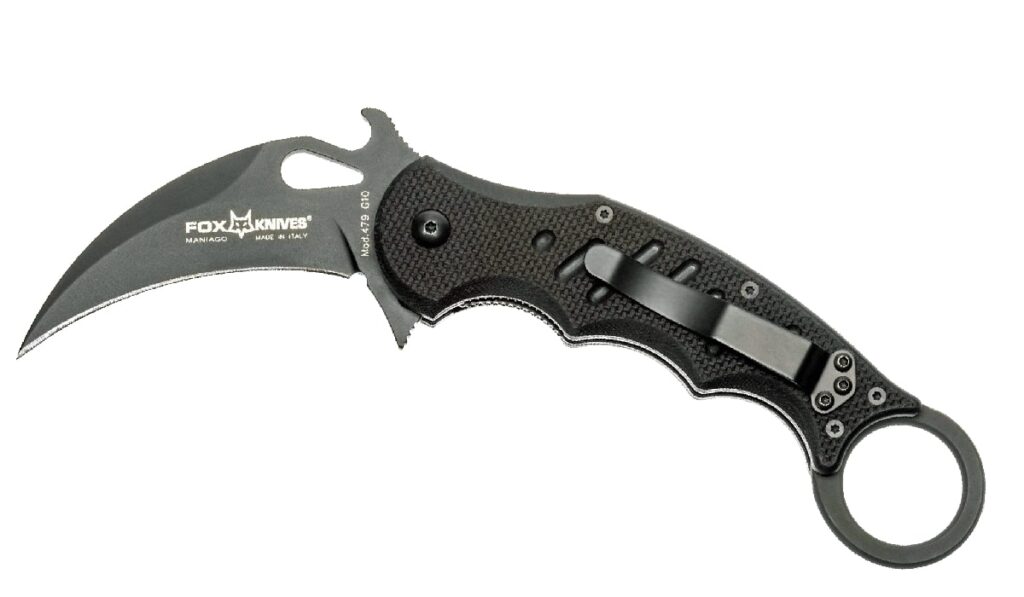
Fox Knives 479
We return to folders with this piece from Fox Knives. The 479 is a large flipper that can handle whatever you throw at it. The 2.95-inch blade is made from N690Co stainless with a black Idroglider coating and a G-10 handle. The blade has been treated to 58-60 HRC, making it the hardest blade on our list.
When opened, the knife is 7.48 inches long, and it weighs 4.58 ounces. The finger ring is made from aircraft aluminum to keep weight down without sacrificing toughness. The reversible pocket clip makes for easy carry no matter where you go.
MSRP: $156
Boker Magnum Spike
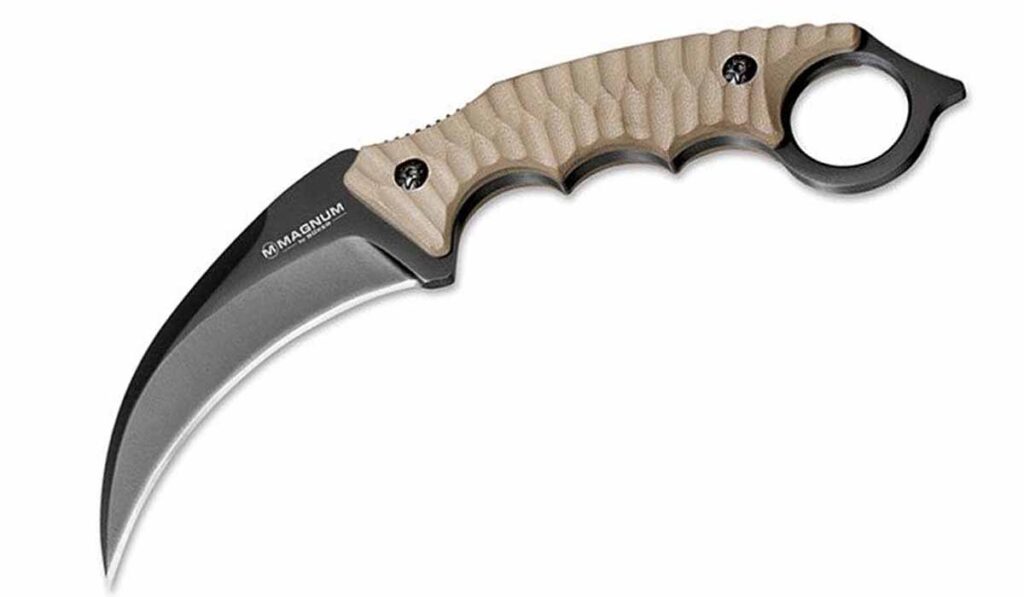
At 8.25 inches overall, the Boker Magnum Spike Karambit is a full-size fixed blade. Visually, this one is quite striking! The 4-inch talon-shaped blade is 440A stainless steel coated black for corrosion protection and a low profile. A full-length swedge adds attitude.
The handle is very well executed. Multiple finger grooves aid in seating your hand comfortably. There’s a groove on the handle spine with traction notches to securely seat your thumb and help index your grip. The tan G-10 handle features a 3D texturing pattern for an excellent non-slip grip. The edges of the G-10 are chamfered properly, further enhancing grip comfort. The finger ring has an integral spike at the end for a blunt strike option if needed. When held in the reverse grip, the spike helps form a comfortable thumb rest. A molded Kydex sheath with belt adapter promotes easy carry . Due to its large size, the Spike isn’t as agile in-hand as the smaller test karambits. If you tend to manipulate a karambit, this one isn’t for you. Due to the swedge, the blade is somewhat thin and while sharp and able to penetrate like crazy, it might be prone to bending or breaking if used for rough cutting. A smaller version with a 3-inch blade that is more hawkbill than talon, flat ground and without the spike on the ring could be more agile and more EDC friendly. Still, at an
MSRP: $73
Spartan Blades Ronin Shoto
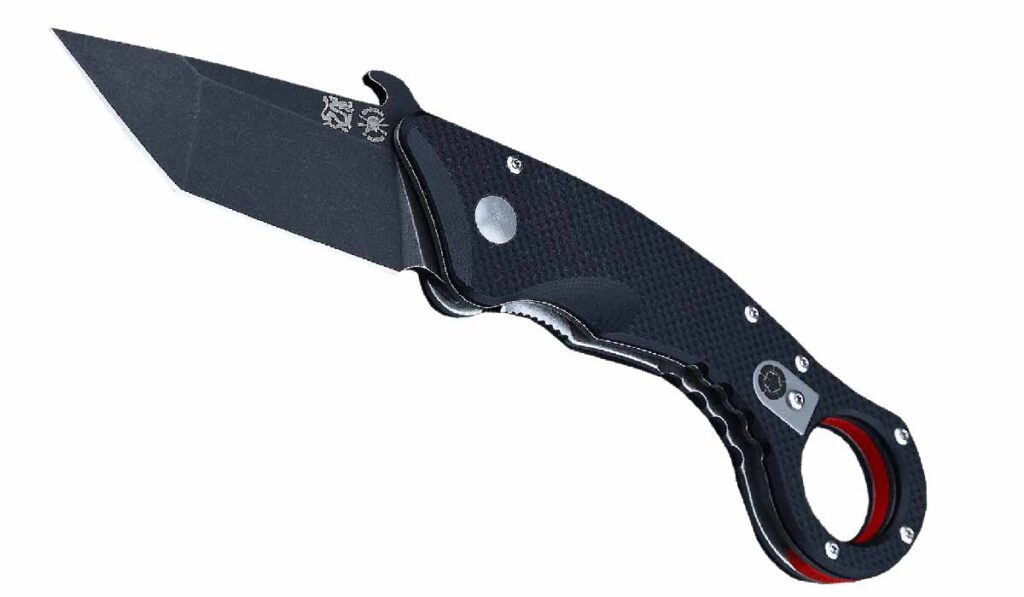
Spartan Blades teamed up with Tu Lam of Ronin Tactics to design the Ronin Shoto, a folding karambit that is part of the company’s Field Grade line of tactical knives. The Ronin Shoto design leverages the knowledge of Lam along with Spartan Blades co-owners Curtis Iovito and Mark Carey—all three saw action together in the Special Forces—and their experiences serving the USA overseas in Asia. The trio developed a fascination with the karambit during that time and it wasn’t until years later that their fascination manifested itself with the Ronin Shoto.
The knife adopts 2.5 inches of a tanto blade, rarely seen in karambits. For blade steel, CTS XHP premium stainless provides edge longevity and durability. There’s also the Emerson Wave, the only opening method the Ronin Shoto has. The blade rides on Spartan’s OIBBS (oil-infused bronze bushing system). The bronze washers are permanently impregnated with lubricant to ensure glassy smooth blade operation at all times. Textured G-10 slabs conceal dual stainless liners. A linerlock secures the blade in the open position. A deep carry pocket clip carries the knife comfortably. A contrasting red G-10 handle spacer adds a tasteful pop of color.
The Ronin Shoto sports a very impressive, heavy-duty build. Like the Emerson Super Karambit, the pocket presence is something you will notice, though it’s not uncomfortable. Opening the blade is very similar to the Super Karambit—index finger through the finger hole, pull and the blade opens as the knife exits the pocket, all in one continuous motion. If you prefer the reverse grip, re-orient the clip to the left side of the handle and you can still make use of the Wave.
Whereas the curved blades of standard karambits are limited in use, the short tanto of the Ronin Shoto is more utility friendly. It tackles general cutting tasks and the CTS XHP stainless steel ensures edge quality will go the distance. I wish the folder had an alternate way of deploying the blade other than just the Wave, though it is possible to place your thumb on the Wave and push on it to open the blade as you would any one-hand knife. Closed length: 5.2 inches.
MSRP: $155
Lionsteel/Emerson LE One
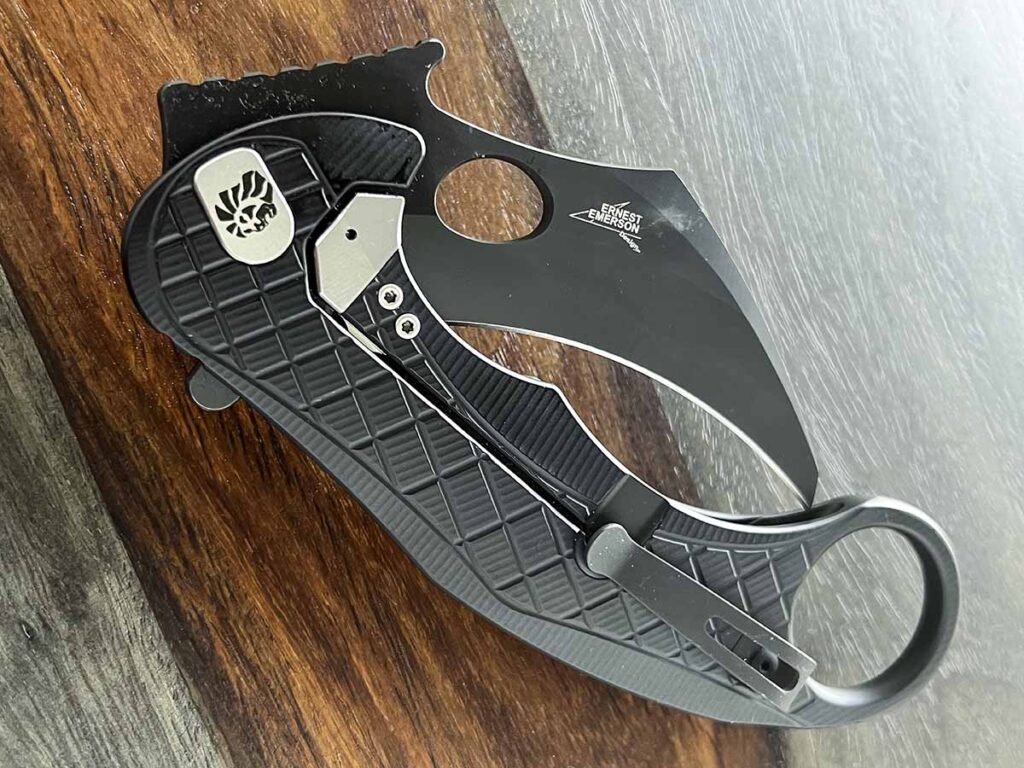
The Lionsteel/Emerson LE One is a collaboration between Ernest Emerson and Lionsteel. It quite possibly is the most advanced folding karambit on today’s market due to several notable features. The 3.23-inch blade is CPM MagnaCut stainless, the latest in high-performance “super steel.” It’s the most advanced steel in terms of edge holding, stain resistance and toughness. The blade opens via one of three methods—blade hole, Emerson Wave and a flipper. If you want to remove the flipper, you can do so using a T6 Torx® wrench. The removable flipper is the REF (removable flipper) system, exclusive to Lionsteel.
The framelock handle showcases another feature seldom seen on factory knives: no assembly screws because it’s machined from one billet of aluminum. The lockbar, semi-open backspacer and finger ring are all one piece of aluminum. The handle boasts a machined crosshatch pattern with milled striations. A stainless steel wear pad screwed to the end of the lockbar results in steel-on-steel lock integrity. A deep-carry pocket clip is reversible for ambidextrous use. Handle color options are black, green, red and brown. Blade finish options are stonewashed and black coated.
A fraction over 5 inches closed, the LE One is one of the larger folding karambits. However, it’s so lightweight and carries so well that its sheer size doesn’t even factor in. I like how your hand is seated comfortably when in the forward grip—it definitely feels secure. All edges and corners are rounded and chamfered properly, making the handle melt in your hand. Even the finger ring is rounded both inside and out. The thumb ramp and blade spine are crowned—I totally dig this. These areas have a rounded appearance, not flat like most other blade spines. Crowning demonstrates that a company is willing to go the extra mile to pay attention to such a minor detail. Lionsteel has detail locked down for sure!
Sharp out of the box, the blade cuts very efficiently and the flat grind pull cuts easily. The framelock engages tight, with zero blade movement in any direction. The blade tip looks different from other karambits. It appears to be dull but is not. Emerson’s design eliminates the very pointy tip, which is prone to break during heavy use, by squaring it off slightly. This creates a strong tip. The Emerson Super Karambit has the same feature as well.
MSRP: $268
Kershaw Knives Outlier
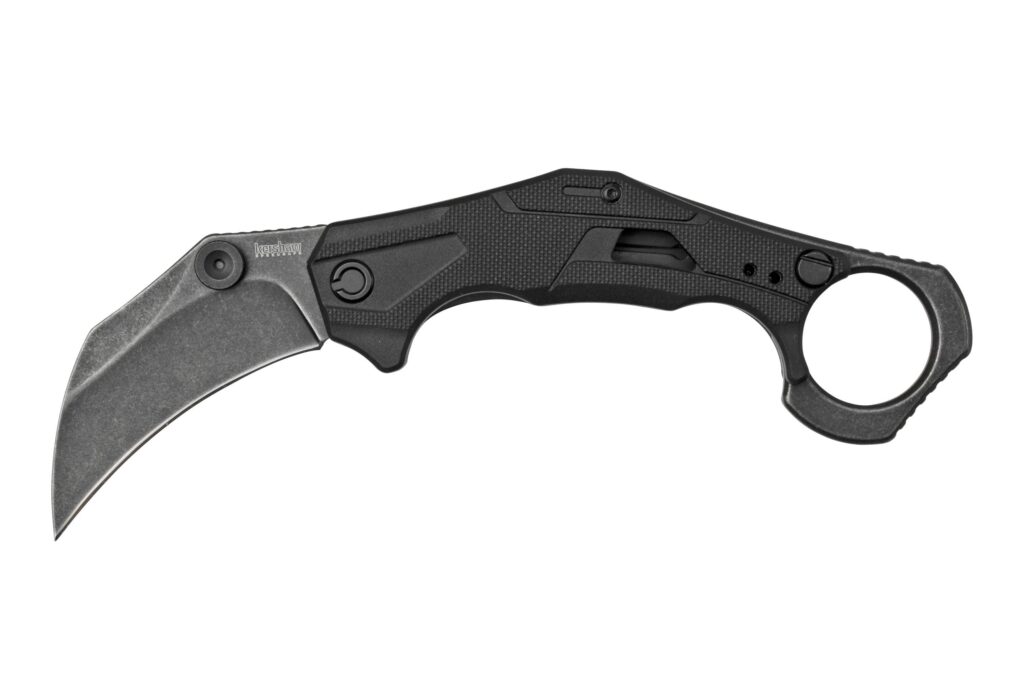
Anchoring the value end of the spectrum is the Kershaw Knives Outlier. In a somewhat angular handle design, the Outlier’s finger ring is integral with the handle spacer. The only karambit from Kershaw, it features a 2.6-inch blade of 8Cr13MoV stainless steel. The blade opens via Kershaw’s SpeedSafe assisted-opening mechanism designed by BLADE Magazine Cutlery Hall-Of-Fame® member Ken Onion. The opening starts via a choice of an oversized thumb stud and a flipper. The handle is a glass-filled nylon polymer outfitted with a deep-carry pocket clip and a linerlock.
The Outlier feels very secure and comfortable in hand. Your grip is locked in via the large forward finger recess and finger recess at the butt just outside the finger ring. Fit and finish is top notch and an all-black tactical finish presents a subdued appearance. The 8Cr13MoV is a good middle-of-the-road steel, very comparable to AUS-8, which is popular in entry-level-to-mid-range knives. The curved blade is easy to sharpen with a rod-type sharpener and holds a decent edge.
MSRP: $72
Editor’s Note: Dexter Ewing and Mike Ableson contributed to this article.
Is your knife wish list itching to grow? Do you need the latest knife sharpener to keep your edge? We gathered up a mess of the latest and greatest knives and knife gear—both custom and production—to get your mouth watering and your wallet cramping.
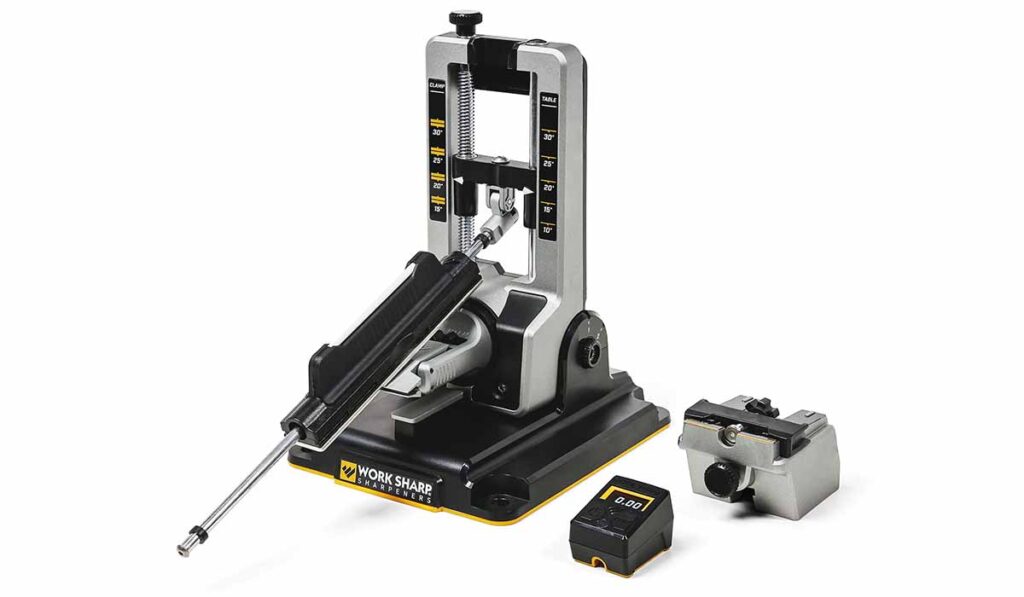
Work Sharp Professional Precision Adjust Knife Sharpening System
SHARPENER TYPE: Angle adjustable model FEATURES: Metal construction, a digital angle indicator and seven abrasive grits for rigid, repeatable, precise sharpening SHARPENING ANGLES: 15° to 30° ABRASIVES: Assorted and easily interchangeable 1”x6” abrasives: 220-, 320-, 400-, 600- and 800-grit diamond coated, a ceramic honing plate and a leather strop, and a ceramic rod for serrations HARDWARE: Non-marring V-Block Clamp™ repeatably secures the knife; weighted base provides safe, stable platform that allows rotating the knife without removing the knife or clamp; small table attachment sharpens small penknives down to a 15° angle COUNTRY OF ORIGIN: Parts made by a variety of offshore companies, primarily in Vietnam, and assembled, calibrated and quality checked in Ashland, Oregon MSRP: $299.95
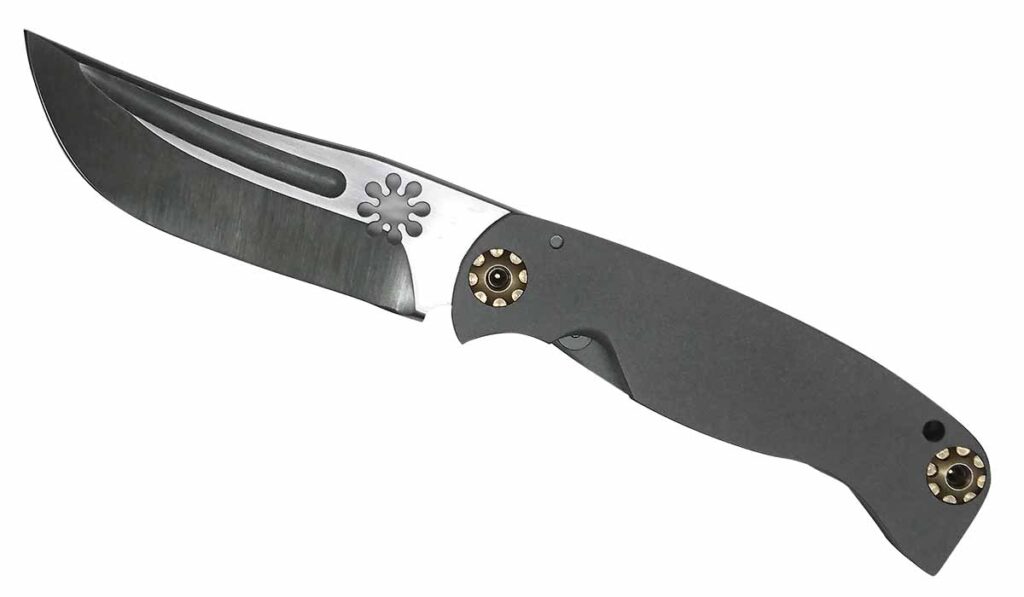
Farid Mehr Mini K2
KNIFE TYPE: EDC folder BLADE LENGTH: 3.9” BLADE MATERIAL: CPM 3V carbon steel BLADE GRIND: Flat KNIFE TO KNOW: Farid Mehr indicated the blade has a trademarked opening system; special “titanium cage,” lockbar over-travel stop HANDLE, CLIP & SPACER: Titanium PIVOT WASHERS: Phosphor bronze LOCK: Framelock LOCKBAR INSERT: D6 tool steel CLOSED LENGTH: 45/8” MAKER’S PRICE FOR A SIMILAR KNIFE: $750
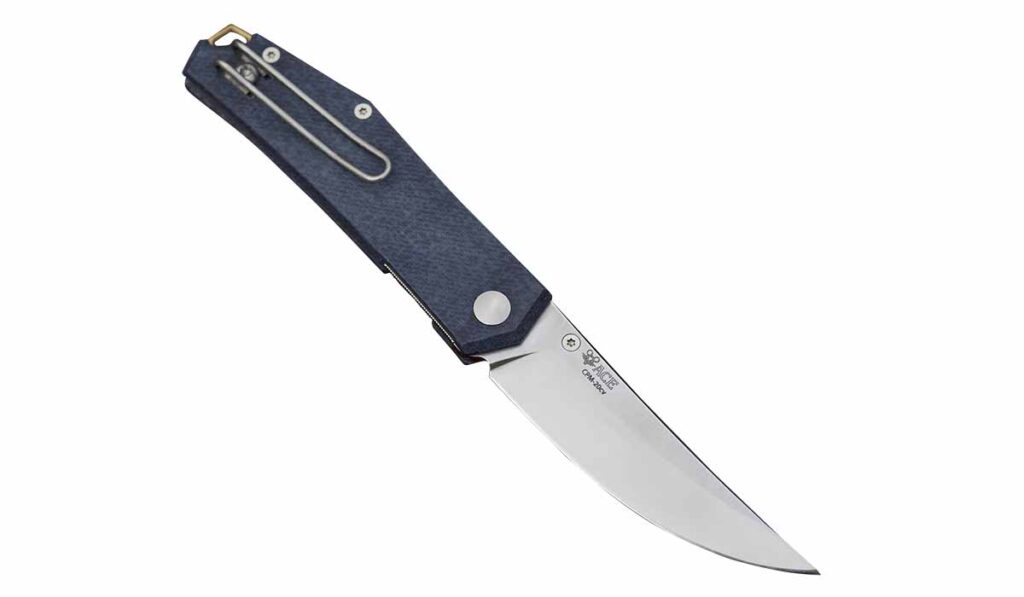
GiantMouse ACE Clyde in denim canvas Micarta
BLADE LENGTH: 3” BLADE STEEL: CPM 20CV stainless BLADE GRIND: High flat saber BLADE AT THE THICKEST: .118” BLADE FINISH: Satin HANDLE MATERIAL: Denim canvas Micarta BACKSPACER & THUMB STUD: Brass WEIGHT: 2.7 ozs. CLOSED LENGTH: 3.94” COUNTRY OF ORIGIN: Italy MSRP: $175
Glow Rhino The Reactor
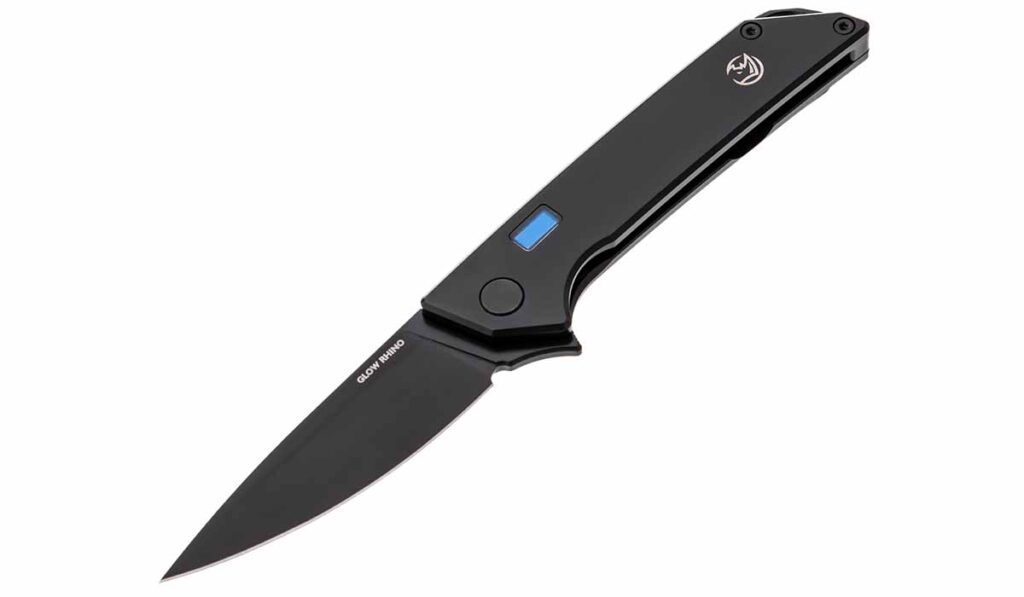
BLADE LENGTH: 2.9” BLADE STEEL: CPM S35VN stainless BLADE PATTERN: Drop point BLADE FINISH: Black PVD (shown) or satin HANDLE: Titanium CLIP: Deep carry LOCK: Framelock CLOSED LENGTH: 2.9” KNIFE TO KNOW: Glow-in-the-dark XL green tritium insert in each handle side; offered in two colors—matte titanium and matte titanium black PVD (shown); dual prybar lanyard attachment COUNTRY OF ORIGIN: China MSRP: $199.99
A.G. Russell Power Ball C2
KNIFE TYPE: EDC folder BLADE LENGTH: 33/8” BLADE MATERIAL: D2 tool steel ROCKWELL HARDNESS: 59-60 HRC BLADE GRIND: Flat BLADE FINISH: Stonewash BLADE PATTERN: Drop point OPENER: Flipper HANDLE MATERIAL: Green G-10 w/orange pivot ring POCKET CLIP: Deep carry design; reversible for ambidextrous blade-tip-up carry LOCK: Linerlock LINERS: Weight-reducing skeletonized steel KNIFE TO KNOW: Ball-bearing pivot; handle also available in black G-10 w/blue pivot ring; handle has hole for a lanyard WEIGHT: 3.7 ozs. CLOSED LENGTH: 4.75” COUNTRY OF ORIGIN: China MSRP: $67.95
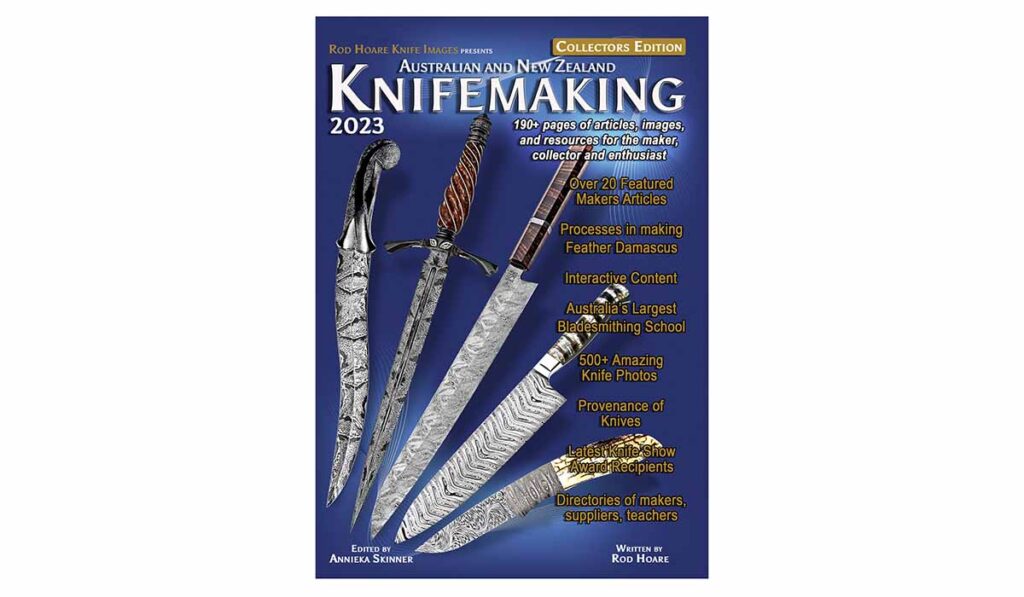
Australian and New Zealand Knifemaking 2023
CONTENTS: The 195 art-quality pages include 22 stories on some of Australia’s and New Zealand’s best makers with bios, Q&As and images of their work; hundreds of knife and related images in all DIRECTORY: Comprehensive listings of makers, teachers, suppliers and service providers INSTRUCTION: Detailed six-page how-to on forging feather damascus, stories on Australia’s largest bladesmithing school, knife provenance and more AWARD WINNERS: List of Australian knife show award recipients from 2019 forward KNIFE TO KNOW: Includes an interactive feature with exclusive scannable codes for workshop tours, how-to’s and more MSRP: Approximately $60 (includes shipping and handling at press time rate of exchange)
Patrick Brennan Celtic Fighter
BLADE LENGTH: 6.1” BLADE STEEL: RWL-34 stainless BLADE GRIND: Flat HANDLE FRAME: 10k-gold w/Celtic knot filework HANDLE MATERIAL: 6,000-year-old bog yew GUARD & FINIAL: 10k gold w/2c VVS1 diamonds inlaid in collar OVERALL LENGTH: 10.4” KNIFE TO KNOW: Winner of the 2023 Royal Dublin Society Craft Award
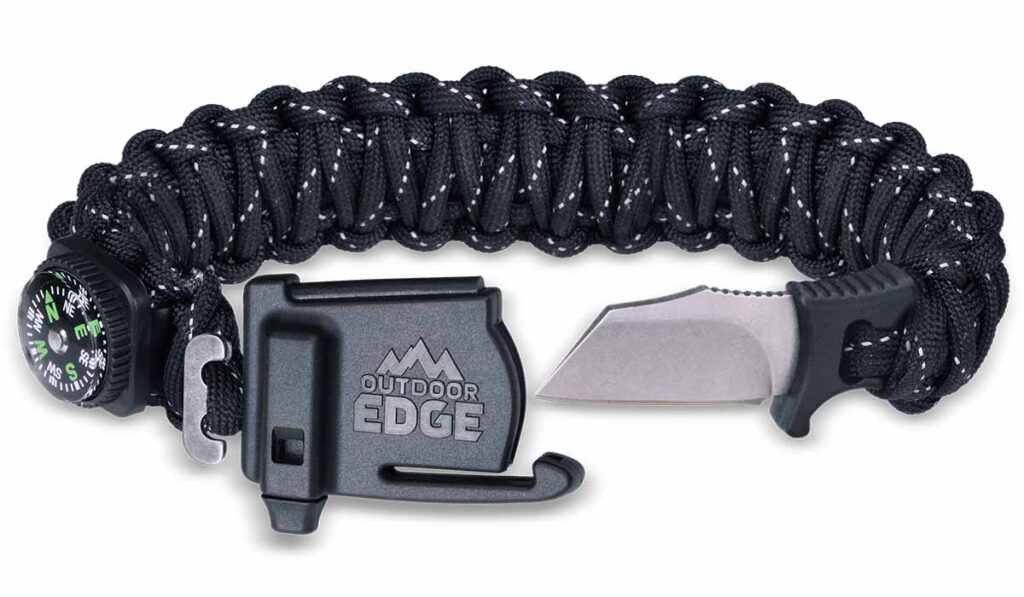
BLADE LENGTH: 1.3” BLADE STEEL: 8Cr13MoV stainless BLADE PATTERN: Sheepsfoot HANDLE/BRACELET: Hand tied from 14.4 feet (medium) to 17 feet (large) of special reflective black nylon paracord w/a seven-strand nylon core, plus wax-coated firecord and 10-lb. monofilament fishing line SPECIAL FEATURES: Glass nylon polymer buckle w/110-decibel whistle and ferro rod; liquid-filled compass on bracelet WEIGHT: 1.8 ozs. SIZES: Medium (6.25 to 7”) and large (7” and larger) MSRP: $24.95
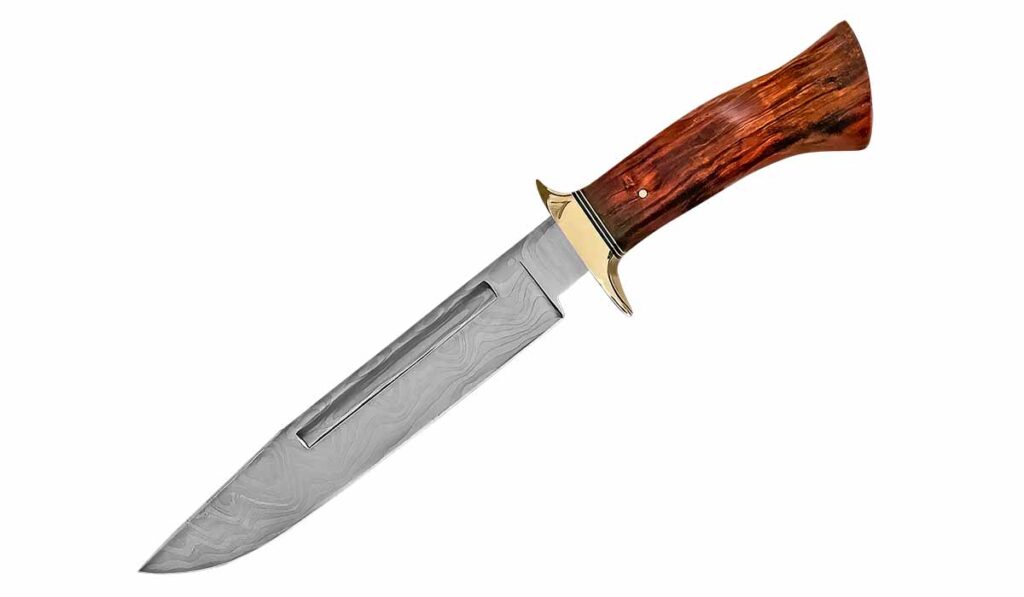
Tony Earwaker Big Ass Bowie
BLADE LENGTH: 11” BLADE MATERIAL: 30-layer damascus of 1084 carbon and 15N20 nickel-alloy steels forged by Oblivion Blades BLADE GRIND: Full flat BLADE THICKNESS AT RICASSO: .216” BLADE AT THE WIDEST: 1.77” HANDLE MATERIAL: Arizona desert ironwood GUARD & HANDLE PIN: Brass OVERALL LENGTH: 16.1” SHEATH: Belt model made by Tony Earwaker of tooled leather; includes snap strap KNIFE TO KNOW: Tony Earwaker is full member #181 of the Australian Knifemakers Guild MAKER’S PRICE FOR A SIMILAR KNIFE: $465 at press time rate of exchange
Sausageman Forge Death Watch Dagger
BLADE LENGTH: 11.5” BLADE MATERIAL: Twist damascus BLADE GRIND: Flat BLADE THICKNESS AT RICASSO: .035” BLADE WIDTH AT WIDEST: 1.4” BOLSTER/GUARD: Twist damascus HANDLE: G-10 POMMEL: Mosaic damascus OVERALL LENGTH: 19.2” MAKER’S REMARKS: “The knife was made as my entry in the Neels van den Berg 48-hour dagger challenge, and is what I believe the Death Watch dagger from Star Wars should look like.” MAKER’S PRICE FOR A SIMILAR KNIFE: $1,350 at press time rate of exchange
SLH Blades Sub-Hilt Fighter
BLADE LENGTH: 9” BLADE MATERIAL: W2 tool steel ROCKWELL HARDNESS: 59-60 HRC BLADE GEOMETRY: Full flat grind; distal taper BLADE FINISH: 1500-grit by hand; includes hamon BLADE THICKNESS AT RICASSO: .275” BLADE AT WIDEST: 1.18” HANDLE MATERIAL: Stabilized curly blackwood GUARD MATERIAL: 416 stainless steel OVERALL LENGTH: 14.56” SHEATH: Belt model made by Stacy Hall of tooled leather; includes snap strap MAKER’S PRICE FOR A SIMILAR KNIFE: $600 at press time rate of exchange
Gene Kimmi Dagger
BLADE LENGTH: 7.5” BLADE MATERIAL: Canister scrap damascus and 1084 carbon powdered steel BLADE GEOMETRY: A diamond grind, that is, four flat grinds HANDLE MATERIAL: Dark desert ironwood w/black G-10 pin GUARD: Slotted C-type made of same material as the blade OVERALL LENGTH: 12.75” KNIFE TO KNOW: Gene Kimmi is an ABS apprentice smith MAKER’S PRICE FOR A SIMILAR KNIFE: $1,250 MAKER: Gene Kimmi, Everest, Kansas, [email protected] (Jocelyn Frasier image)
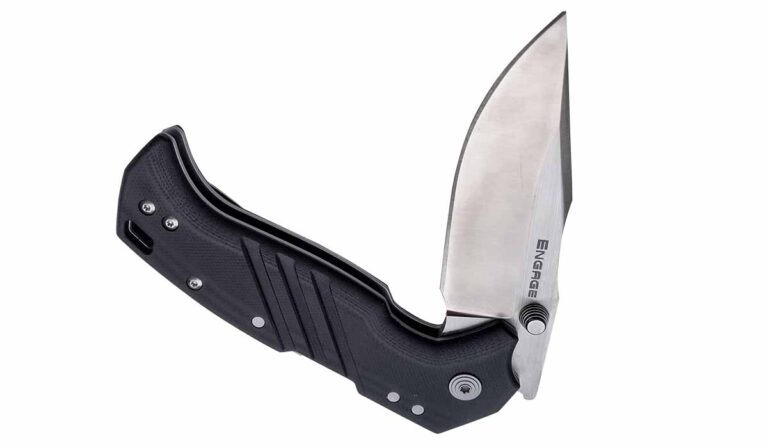
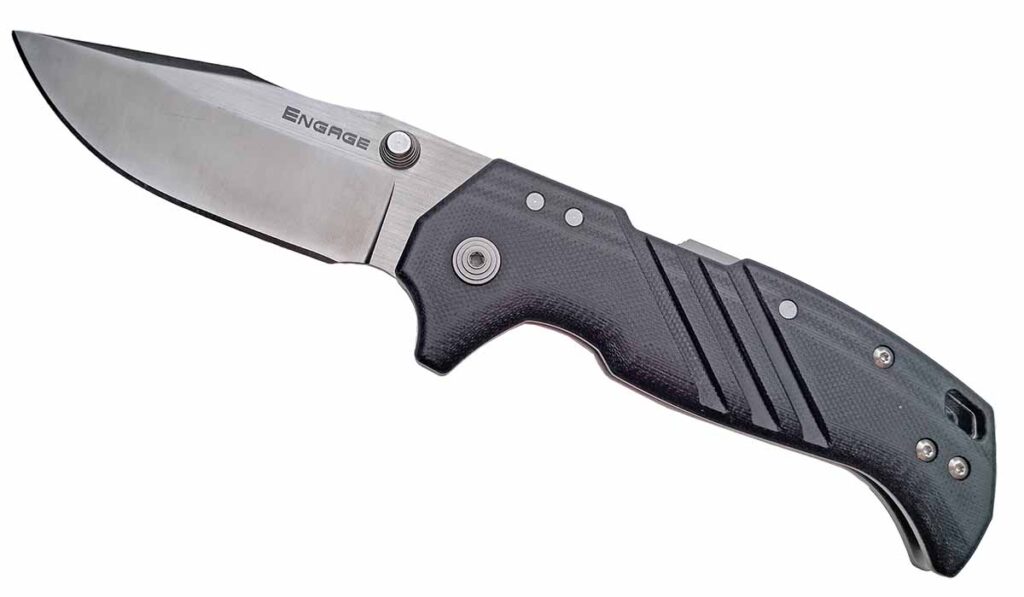
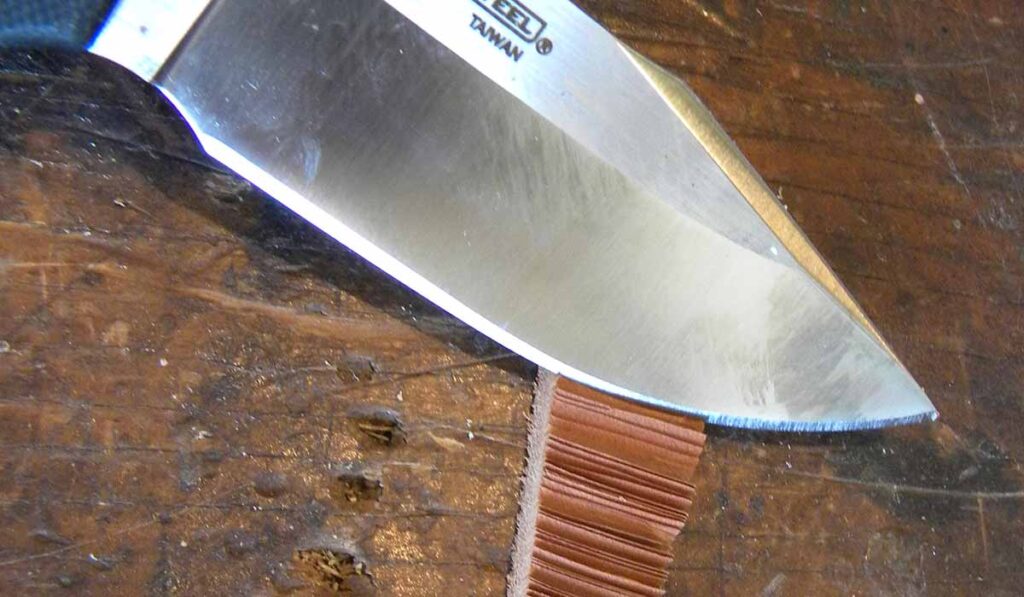
If you need a heavy-duty folder, the Cold Steel Engage can accommodate.
I have always liked Cold Steel knives. They’re made tough and I’ve never had a problem with edge retention on one. The Cold Steel Engage keeps this tradition going. The overall feel of the locking folder is on the larger size but this comes in handy when using pressure on cuts.
Cold Steel Engage Light Cutting
I went with single-walled cardboard for the first slicing test. The Engage quickly shredded the material into nice strips. It was smooth slicing and very controllable. The large frame provides a positive grip.
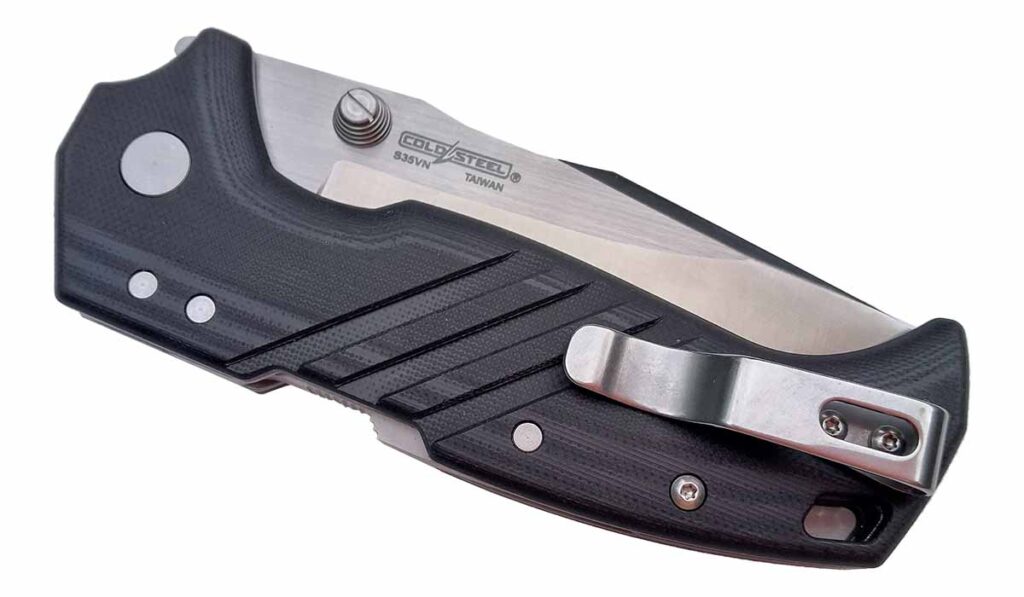
The handle’s integral single guard, single finger groove and bird’s-beak butt combine for a sound, secure grip.
Second on the list was plastic board. Again, the knife sliced very quickly and easily. The hollow-ground blade curled the plastic board a bit but that is to be expected. The handle made it easy to control each cut.
The locking folder made the skiving of 8-ounce leather fast and easy to control the cuts.
For finer work I picked out a strip of 8-ounce leather to skive. The Engage made the skiving fast and easy to control the cuts. I was just slower than the knife could skive. A nice crunching sound resonated with each cut. The Engage is very aggressive cutting leather.
Cold Steel Engage Heavy-Duty Tasks
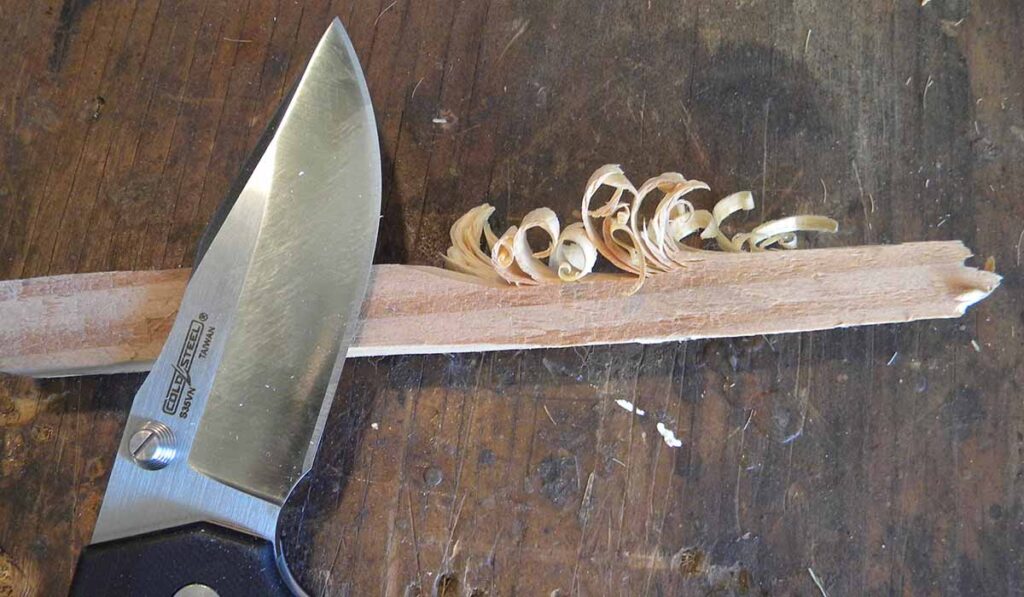
It was time to whittle. The Engage made impressive curlicues in the pine. Making firesticks was a breeze. Whether deep or shallow cuts, the curlicues kept curling along. (It’s a lot of fun to make firesticks.)
Making firesticks was a breeze.
Taking a seasoned branch, I whacked the Engage into it with a dead-blow hammer. Since the branch was all twisted and knotted, I had to whack the blade’s spine hard repeatedly. Finally, I got the wood split into quarters. The folder’s Atlas Lock was still 100 percent secure—tough stuff!
Edge Toughness
It was time for my favorite cutting medium: half-inch sisal rope. I’m getting sluggish at getting my fingers out of the way and had two nicks on my fingernail within the first 20 cuts. I had to slow down! The Engage, on the other hand, crunched 225 times and showed no signs of slowing down. This is one sharp blade for sure.
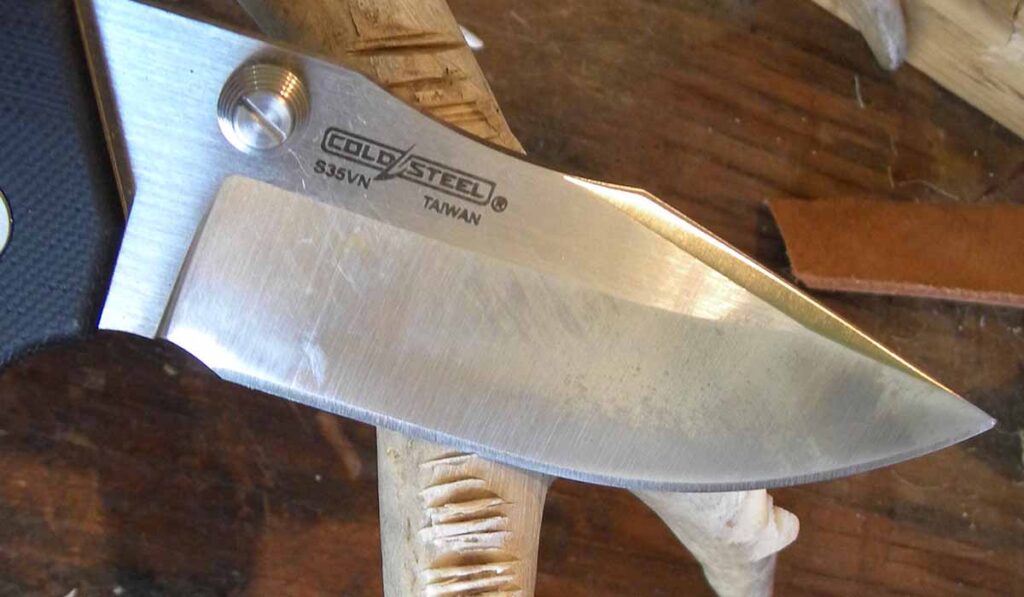
After whacking the whitetail deer antler 30 times, the author found no edge damage. The heat treatment is spot on.
To take the Engage one step further, I pulled out an old whitetail deer antler. After whacking the horn 30 times, I looked for any edge damage. There was none to be found. The heat treatment is spot on. Excellent job!
Edge Retention
For a final test I turned to the paper slice. The 20-pound bond copier paper parted quickly with no snagging. Man, this knife holds an edge! It zipped through the paper like it was nothing.
The knife has a short stainless steel pocket clip. Note the ridges on the slide of the Atlas Lock for enhanced purchase.
Overall Take
This is one very sharp folder. If you like them full-sized, the Engage is a match.
Possible Improvements
Some thumb notches on the blade spine would aid in finer cutting tasks.
Cold Steel Engage Specs: Knife Type: Utility locking folder Blade Length: 3.5” Blade Steel: CPM S30VN stainless Blade Grind: Hollow Blade Pattern: Clip point Blade Openers: Dual thumb studs Lock: Atlas Lock Handle: G-10 Handle Design: Integral single guard w/single finger groove and bird’s-beak butt Lanyard Hole: Yes Pocket Clip: Short stainless steel design Liners: Stainless steel Closed Length: 45/6” Weight: 7 ozs. Country of Origin: Taiwan MSRP: $169.95
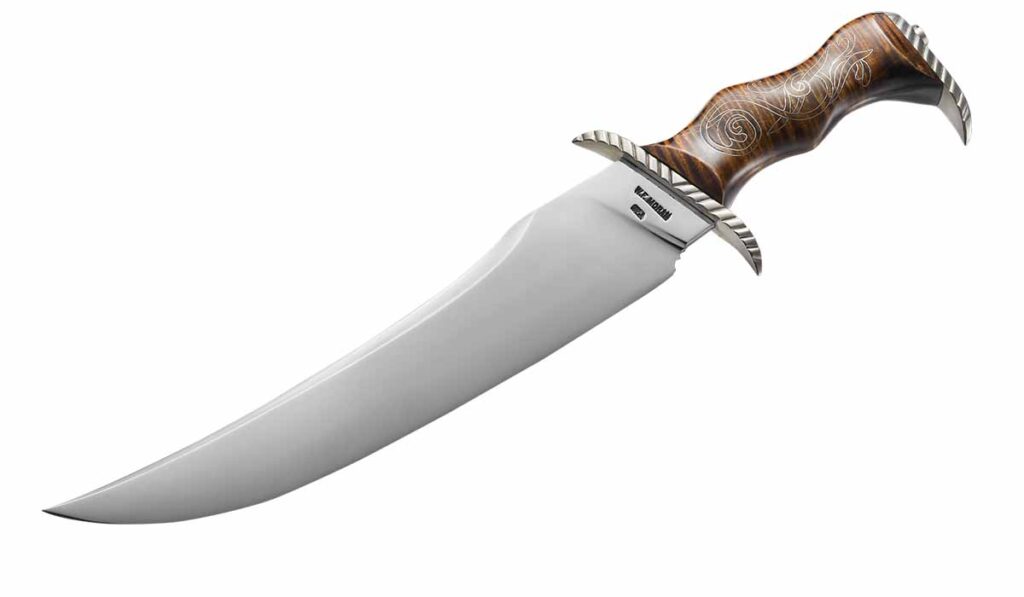
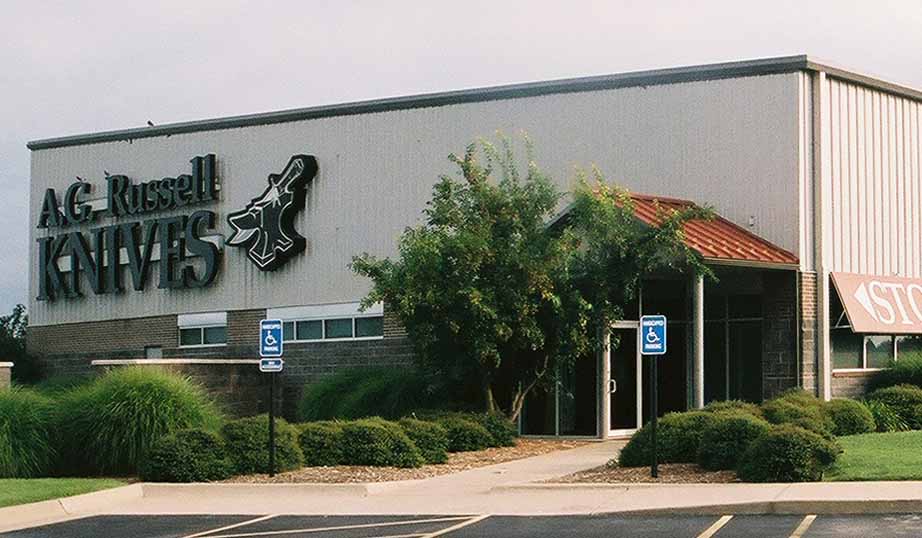
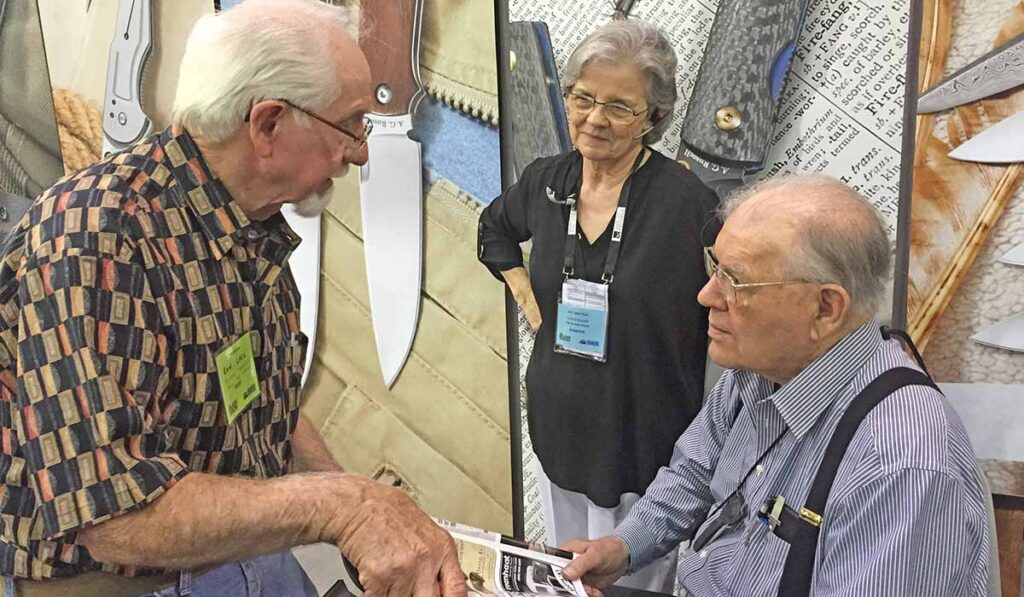
There are many names elevating custom knifemaking to the heights it enjoys today, but none loom larger than A.G. Russell, Bill Moran and Bob Loveless.
Nobody would question the straight-up fact that A.G. Russell, Bill Moran, and Bob Loveless contributed mightily to making the knife industry in the United States, and indeed worldwide, what it is today.
Their contributions to the growth and prosperity of knife manufacturers and their partners in the custom knifemaking world are well known to many, but during BLADE®’s 50th year a moment to recognize their achievements and their contributions is appropriate.
Of course, there are others whose involvement and support have had a positive impact through the decades, but Russell, Moran and Loveless—all long-time members of the BLADE Magazine Cutlery Hall Of Fame®—are the core triumvirate that ushered the modern knife industry into its golden age.
Bill Moran
Bill Moran
“Moran gets credit at the top of the list because of the founding of the ABS [American Bladesmith Society],” related Cutlery Hall-Of-Famer Bruce Voyles, past publisher of BLADE and, along with Cutlery Hall-Of-Famer Jim Parker, co-founder of the BLADE Show. “That was followed by the development of the hammer-ins and the [Bill Moran School of Bladesmithing].” As he noted, the ABS was a team effort that included Cutlery Hall-Of-Famer B.R. Hughes, who was an educator.
“Bill was a renaissance man if there ever was one,” Voyles continued, “but he had the best publicist in the knife business in the form of B.R. Hughes. So, as a team they absolutely rank at the top. B.R. had the good sense to know that Bill Moran was the person to represent the ABS, and Bill was a leader in his own right, but without B.R. there may not have been a bladesmithing school.”
The ST-23 is one of if not the most coveted of Bill Moran knives. (Francesco Pachi image)
Hughes, now 91 and the elder statesman of knife writers, remembers his work with Moran and gives credit to Moran’s foresight at the forge as well. “Bill Moran saved bladesmithing with his reintroduction of damascus in Kansas City in 1973,” Hughes observed. “And when we formed the ABS in 1976, the only goal was to preserve the art of the forged blade. There were three people making damascus [in America] then: Moran, Bill Bagwell and Don Hastings. They met in Bagwell’s backyard and shop after the Guild met in Dallas. That’s how the ABS got started. There were four active members, including me named as a director. So, it started with four, and now there are 3,000 members. I’m still on the board, and now the main thing for me is not to go to sleep during the meetings!”
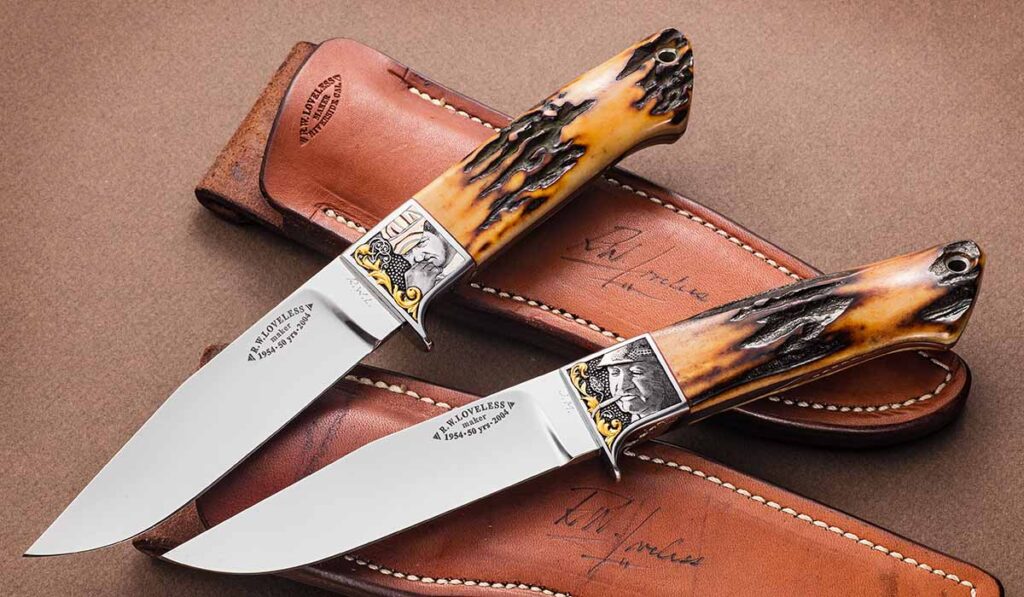
Bob Loveless:
Bob Loveless
Loveless stands out as a custom knifemaker and designer, as well as a pioneer in the organization of custom knifemakers into a cohesive group, setting standards, discussing issues, and assisting the growth and prosperity of many in later years. Loveless stands apart in his work, organizational input and one-of-a-kind personality.
Hughes recalls his introduction to Loveless courtesy of knife industry titan A.G. Russell. The men sat down at a diner, ate a meal together and Loveless spread some knives on the table. From there, Hughes authored an article about the California custom maker that appeared in GUNsport Magazine.
“Bob and I stayed in contact,” Hughes remembered, “and around that time Bo Randall was probably the most copied [of] knifemakers. Then, when Loveless [redesigned and repopularized] the tapered tang, he became the most copied knifemaker in America. He made that a standard and was very popular.” B.R. added that Loveless was also a good salesman and promoter, and his knives were selling for what were high prices even then.
Voyles said he appreciates the pure genius of Loveless to this day. “He was a phenomenally intelligent person,” he opined. “With Bob, they used to say that you loved him or you hated him. The thing about Bob was that what brought him into prominence was that he was the first person with an art background to make knives. He had gone to design school and made a handsome knife that was aesthetically pleasing, and noted that the knife’s top line should always fit a French curve.
Bob Loveless helped celebrate 50 years of knifemaking in 2004 with this hunter set complete with engraving by C.J. Cai and a couple of autographed Loveless sheaths. (SharpByCoop image)
“Loveless made a good knife and a distinctive knife. Everybody started copying that, and the whole design of knives changed. Bob was also able to sum up a complex subject in one sentence. He was infinitely quotable, which meant outdoor writers loved him.”
According to Cutlery Hall-Of-Famer Dan Delavan, Loveless was a unique character in the knife world. “Loveless was a genius in the whole industry,” Dan related, “and underrated. Because of his antics, some people didn’t think that much of him at times, but Bob was super smart. He knew things would happen before they happened. His drop point was modernized and refined, and he helped a lot of people get started. A lot of them emulated his style.”
A.G. Russell
A.G. Russell
Universally, the contribution that A.G. Russell made to the knife industry is acknowledged as tremendous. He brought people together, tried to build consensus, established the liaison between custom makers and factories that produced magnificent collaborations, developed a robust catalog mail order business that remains the envy of any businessperson, and is recalled as a true gentleman—whew!
Hughes remembers Russell not only for his introduction to Loveless, but also for another moment that proved to be a highlight. “A.G. told me there was a bladesmith in Maryland named Bill Moran and said I needed to get in touch with him,” B.R. smiled. “I kept in touch with Bill. He was always laid back and reserved and shunned a lot of publicity. I wrote a book about him in 1995 called Master of the Forge. We spent several days with Bill and Margaret that fall, Bill and I in the back seat of the car talking and Margaret and Carolyn in the front seat talking. Carolyn has been with me through all these years. I married her in 1957, and she has been the editor of American Bladesmith Magazine now for 20 years.”
Voyles remembers Russell as “the one that lit the fuse and promoted the Knifemakers’ Guild for many years and almost singlehandedly created an aftermarket for handmade knives.” Imagine the foresight, power of persuasion and business acumen that could exert such influence in the knife industry as a whole. It’s safe to say that A.G. was the catalyst for so much of the positive interaction that has taken place in the knife world over the past 50-plus years. He bought tables at gun shows for knifemakers to display their wares back when there were no knife shows to attend. He supported knifemakers with his heart, head and pocketbook.
“Knives were his passion,” Cutlery Hall-Of-Famer Goldie Russell said in remembering her husband’s dedication. “He was determined to know everything there was to know about knives.”
A.G. Russell Knives not only is a landmark in the knife industry, it is in its hometown of Rogers, Arkansas, as well.
Goldie recalls her husband’s hard work that made things happen. “By June 1970, A.G. had reserved a block of tables at the Wanenmacher Gun Show in Tulsa and invited the makers he knew to exhibit and sell their knives,” she commented. “I believe it was at this show that he introduced the idea of the Knifemakers’ Guild. A.G. told me that two knifemakers that were on board from the beginning were [Cutlery Hall Of Famer] Dan Dennehy and Bob Loveless. At that show they decided to form the Guild, and there were 11 founding members.”
A.G. secured more tables at the Houston gun show in 1971, and more knifemakers joined the Guild. The following year, the first annual Guild Show and meeting were held in Kansas City, and the membership grew steadily.
In addition to his leadership in the formation of the Guild, A.G. was a visionary business owner. He created the first mail-order company that focused strictly on knives. Until that time, consumers could leaf through the pages of the Sears & Roebuck or Montgomery Ward catalogs and hope they found something. But Russell changed the game in 1964 when he started A.G. Russell Knives with the sale of Arkansas whetstones.
Goldie remembers another seismic achievement that her late husband was directly involved in—the establishment of the first high-profile knife collaboration. “He arranged for Bob Loveless to meet with Schrade Cutlery to produce a modern fixed-blade knife,” she commented, “and the result was the Schrade Loveless Hunter. I recently read something that said [Cutlery Hall-Of-Famer] Uncle Henry Baer facilitated that collaboration. I’m not sure how involved Henry Baer was, but if you look at what was happening, it was obvious that it was A.G. Russell who had direct involvement with Schrade and Bob Loveless.”
A.G. is also known for his innovative work with Schrade to incorporate the Knife Collectors Club, the first organization of its kind. “This was A.G.’s concept,” Goldie observed. “His idea was to create serial-numbered commemorative folders, which would be offered to club members. A.G. would select the knife, develop the project and sell the knives. Schrade would make the knives.”
Goldie personally witnessed her husband’s investment of time and treasure to promote knives from every angle. He supplied Cutlery Hall-Of-Famer Blackie Collins with his mailing list in the early 1970s so that the earliest issues of American Blade, which would eventually become BLADE, had somewhere to go. He supported new manufacturing brands during the 1980s. And he was willing to provide a frank and honest assessment of a knifemaker’s work when asked to do so.
A.G.’s wisdom came shining through when he discussed with Arkansas knifemaker/Cutlery Hall-Of-Famer Jimmy Lile why the two had not become closer friends. Goldie noted that Lile said, “A.G., when I could not do better, you told someone that my knives were not very good.” She added, “A.G. said that as soon as Jimmy expressed that, he realized what he had said. After that Jimmy and A.G. were friends.”
A.G. offered his advice when asked. Goldie remembers a meeting with Stuart Leatherman and his brother, Cutlery Hall-Of-Famer Tim Leatherman, regarding the direction of the composition of the Leatherman multi-tool. “I was in that meeting,” she related. “A.G.’s advice was to upgrade the blade steel and make handles of titanium. His other advice was to find a way to make the handles easier on the hand when using the pliers. The Leatherman Charge and Charge Ti quickly followed that meeting.”
BLADE Magazine Cutlery Hall-Of-Fame® members (from left) Ron Lake, Goldie Russell and A.G. Russell share thoughts at the A.G. Russell Knives booth during a past BLADE Show. (A.G. Russell Knives image)
Among other contributions that Goldie and also Phil Gibbs, knife designer at A.G. Russell Knives, remember regarding A.G. are his design innovations, particularly as the first to create folders with handle materials other than metal that did not include metal liners, and in the human element, his willingness to take time with everyone. For example, one day a couple stopped by the A.G. Russell Knives retail store in Rogers, Arkansas. Goldie was asked to step over to meet them. They were unaware of A.G.’s passing until they had seen his portrait in the entryway, and they wanted to express their sympathy.
“They said they had often come into the store and spent time with A.G. talking about knives and knife history,” Goldie noted. “With tears in his eyes, the gentleman said, ‘Mrs. Russell, we are nobody, but he treated us like we were somebody.’”
Delavan, co-owner of the old Plaza Cutlery retail knife store in Costa Mesa, California, and now of plazacutlery.com, put A.G.’s impact into perspective from a professional standpoint. “We both had businesses and a lot in common,” he reflected. “A.G. was a wealth of knowledge. He seemed to know everyone and everything, and I looked up to him.”
No doubt, there are many other individuals whose contributions to the growth, expansion, and thriving entity that the knife industry is today are worthy of praise and recognition. These three—Russell, Moran and Loveless—are, however, more than just a good start. They are giants among other giants, and their accomplishments will continue to resonate across the decades.
Nothing cuts as wicked a profile as a tanto knife.
The tanto is one of the most iconic and recognizable knife designs to ever forged, and today you can find it being made all over the world. From pocket folders to heavy fixed blades, there are a lot of Tantos to choose from.
Today, we’re going to go over everything you need to know about the tanto, from its history and modern usage to the best modern examples you can add to your collection.
Let’s dive right in.
Tanto Knives: Rich, Battlefield-Proven History
Japan has gifted the world with some excellent things: sushi, Godzilla, anime, the Honda Civic… list goes on. Perhaps some of the most iconic pieces of Japanese culture to spread around the world though are its blade designs.
The katana is probably the most famous in terms of combat-focused designs, but a close second is the beloved tanto. A very core idea of many sword-based Japanese martial arts is the idea of daishō, which translates to “big-little”.
Daishō essentially just means having one long sword, and one short sword or long knife to accompany it. Traditionally, the larger sword would often be left outside when entering a palace or other government building, or a temple, and the shorter weapon would be carried inside, tucked through a sash.
The Sidearm of Choice Before Pistols
Originally conceived as a sidearm to be paired with a long sword, the tanto was first carried primarily by Samurai alongside a tachi, the precursor to the katana most of us are familiar with from modern popular culture.
Over time, the tanto become more widespread, and a smaller version known as a kaikenbecame popular as a self-defense tool for women. Over several hundred years, the tanto became shorter and thicker, and closer to the blade we know today.
Photo: Wikipedia
Though eventually replaced in serious warfare by the wakizashi (functionally just a shorter katana, though with some design differences) the tanto remained popular for ceremonial usage and became a matter of pride and expression to wear or own in later years.
The tanto then saw a resurgence in the years leading up to WWII, as they were viewed as more traditional by the Imperial Court. Following Japan’s defeat, limits on sword forging caused a decline in all traditional Japanese sword-making.
In the 1960s, American and European obsession with Japanese martial arts (spurred on by excellent films such as 7 Samurai, Yojimbo, and others) lead to a resurgence of the tanto, particularly as a combat-focused knife shape.
Today, the iconic tanto tip is found on traditional full-length fixed blades, as well as more modern folding pocket knives designed for tactical/defensive use. Plenty of manufacturers make tanto-tipped knives, as well as smiths making excellent traditional tantos. (We’re going to cover both in our reviews, don’t worry).
What makes a Tanto, a Tanto?
Today, the definition of a tanto has shifted far beyond the traditional knife of 10th-century Japan, but we’re going to start there and then we’ll talk about the more modern incarnation where we see tanto tips added to a variety of EDC and tactical knives.
Traditional Tanto Blades
Originally, the tanto was more what we would call a short sword, or perhaps a long dagger, and was worn by samurai. It was very much a weapon to begin with, but become a more ornate and ceremonial piece over the years as weapon designs evolved.
The traditional tanto was a single or double-edged dagger with a length of around 6-12 inches and was designed primarily for stabbing. It was forged with very flat sides, and some were left short with an extra thick cross-section to aid in piercing armor.
Modern Tanto Blades
The more modern interpretation of the tanto is heavily influenced by American tactical knife designs and proves more common outside of Japan. Traditional blades are still made (and beautiful) but less practical for the modern world.
A variety of American and European knife makers now produce tanto-inspired knives with a very angular tip with the iconic sharply-upswept blade tip, essentially leaving you with two cutting planes—one parallel to the spine of the knife, and one at a 45-degree(ish) angle to the spine angling up towards the tip.
Most of these modern “American tanto” designs are folding knives, and while many are for “tactical” or defensive use, the tanto blade shape has become increasingly popular for EDC knives as well.
Pros of the Tanto Design
Piercing: Piercing, piercing, piercing. The shape of the tanto is optimized for stabbing and piercing, and it excels in those contexts.
Whether you’re a pre-Edo period Samurai trying to slip a blade between (or through) segments of your opponent’s armor, or a frustrated office worker attempting to poke your way into some plastic clamshell packaging, the tanto is ideal for putting a hole in something.
We see similar knives used for leather work around the world, and with good reason. The tanto is great for putting a hole in tough material.
Draw Cuts: Modern American tantos are also great for draw cuts and slices, particularly when you’re working with something on a flat surface like a cutting board. The dual edge geometry makes short work of many slicing tasks.
You can also (carefully) use that second point where the two edges meet like a chisel for shaving wood, scraping a sticker, etc. This makes for a very handy EDC.
Defense: Lastly, as a defensive tool, tantos excel because of their narrow, piercing point. This point easily defeats heavy clothing and makes for an effective means of defense in skilled hands.
Many knife-based martial arts focus on stabbing strikes as the most effective fight-enders, and the tanto fits that training paradigm very well, while still being perfectly capable of slashing.
Cons of the Tanto Design
Cutting Edge: The tanto’s main drawback, besides additional time and care needed when sharpening, is the fact that you lose some usable blade edge by having essentially two edges, one parallel to the spine and one swept forward and upwards.
In practical use, this means you have less effective blade length for certain tasks, around 20% less than you’d have with an equivalent-length drop or clip-point blade. To compensate, tanto blades intended for EDC are usually a bit longer than a similar knife with a different point.
All of this can be adjusted for, and as long as you aren’t doing something like spoon carving, you probably won’t notice a difference in real-world use.
At the end of the day, “real-world use” for most of us is opening boxes and packaging, and slicing apart those god-awful packing straps used to hold children’s toys in display boxes. And the tanto excels at all those tasks.
How The Hell Do You Sharpen a Tanto?
Sharpening a tanto may look a bit scary, but once you break the process down, it’s quite simple. All you’re doing is sharpening two edges that meet at a point. The only real pitfall is that it’s easy to round over the point where the forward edge and the edge parallel to the spine meet.
To avoid this, be mindful of that meeting point, and stop your sharpening stroke on or before it. Then, when sharpening the forward edge, rotate the blade and sharpen it in much the same way you would a chisel.
Just be careful not to pull through the point where the two edges meet so you don’t round over that point and you’ll be good to go. Beyond that, it’s just like sharpening any other knife.
10 Ten Knives with Tanto Blades: EDC, Fixed Blades, and Folders
CIVIVI Elementum Tanto
The CIVIVI Elementum has become something of a modern classic in the EDC knife world. Since its release a few years ago has gone on to become one of the most popular pocket knives around.
There is a nearly limitless amount of blade and handle combinations out there now, but we’re going to focus on this excellent tanto blade with a copper handle.
At its core, this is still the same Elementum knife aficionados are already familiar with (a simple, dependable liner-lock flipper folder) but outfitted with a tanto blade that makes piercing tasks a cinch, without compromising on slicing performance.
Basically, it’s everything you need in an EDC knife for regular daily tasks, and it comes with a gussied-up stonewashed tanto blade and a lovely hand-polished copper handle that adds a touch of class and elegance to this very affordable knife.
The Elementum tanto is also available in a button lock version and features a 2.96-inch blade made of D2 steel.
MSRP: $80
Kershaw Emerson CQC-7K
Ernest Emerson has brought much success to Kershaw with his designs. Back in 2014 he hit it out of the park again with the Emerson CQC-7k, which won that year’s Best Buy award at BLADE Show for sheer value. In the almost ten years since it’s held its own as one of the best EDC options out there.
It features the iconic Emerson Wave that facilitates blade deployment by simply pulling it from the pocket and hooking the “Wave-Shaped Feature” on the pocket on the way out (sort of an inverted kicker).
It also features an ambidextrous thumb disk that doubles as a comfortable place to press your thumb when doing fiddly work. The scales are nicely-textured G10, and the handle features a stainless frame lock that is one of the more secure we’ve tested (read: beat the hell out of).
The one thing to look out for is the blade steel. I would suggest spending an extra few bucks on the D2 stainless version and avoiding the 8cr14Mov version. There’s no reason to spend more than $40 on a knife with bottom-tier blade steel like that in this day and age.
You can get five gas station knives for that price and be better off.
The Emerson CQC-7K has a D2 blade that is 3.25-inches long.
MSRP: Starting at $74
Benchmade Bailout
You’ve heard of the Bugout, surely. Now meet its newer, slightly-tacticooler cousin, the Bailout (one of my favorite knives of the past several years).
As you can surely imagine, the Bailout is a bit of a riff on the Bugout most of us knife fans know and love, but with some notable changes. Our favorite version is the CPM-M4 model which features woodland green anodized aluminum handles.
CPM-M4 is a great steel, which you would expect from Benchmade, and the knife itself is the perfect length to straddle the line between EDC knife and tactical folder. It also features a lanyard loop if you’re one of those people who like lanyard loops, and more interestingly a micro glass breaker.
How often do you need to break a car window in an emergency? Probably not very often, but it is nice to have it if you’re leaning toward a more tactical-style knife. You can also get a version that doesn’t have the glass breaker or the aluminum handles if you want to save a bit.
The Bailout features a 3.4-inches, CPM-M4 blade.
MSRP: $129
Ontario Ti-22 Equinox
Ontario Knife Co. is one of the most criminally underrated makers out there. Everything in its catalog is smartly designed and intended to excel in real-world conditions. That includes the Ti-22 Equinox.
It features, as the name suggests, a full titanium handle and an S35VN blade coated black to inhibit rust and corrosion in difficult environments. S35VN is a premium steel that holds an edge incredibly well, and the lightweight titanium handle is as robust as you could ever want.
The action is flippy and fidget-friendly, and the handle feels comfortable during extended use. The blade slices paper right out of the box, and comes to a sharp angle where the forward edge meets the primary cutting edge, giving you plenty of piercing power.
Draw cuts, slicing, and even some camp kitchen prep were easy and straightforward, and the knife handled being carried on a sailboat for a week without showing any signs of rust. All in all, a great EDC that again toes the line towards the more tactical/defensive side of things.
The Ti-22 has an S35VN blade that is 3.03-inches long.
MSRP: $138
Case Kinzua
Case Knives made a flipper! Several actually, with the Kinzua being part of the first line of Modern Everyday Carry Knives to come from this iconic brand.
This isn’t your grandad’s Case knife, though we love some of those old three-blade traditional babies as much as anyone. These are incredibly modern designs for a modern audience that expects things like one-handed opening, a frame lock, and a deep-carry pocket clip.
In addition to all that, the Kinzua (named for a scenic forestry area in Allegheny County, PA) features an S35VN blade and faceted anodized aluminum handles that are a joy to hold. The flipper tab is nicely contoured, and the knife opens and closes smoothly.
The tip is a now-familiar American tanto and is great for piercing pesky packages, or anything else you might need to poke a hole into during your daily life.
MSRP: $179
Spyderco Paramilitary 2 Tanto
The Spyderco Paramilitary 2 (or PM2) is beloved in the EDC community, and it’s not hard to figure out why.
It features a polished washer pivot system that is very smooth to open and close, features Spyderco’s iconic compression lock, and now, for the first time, comes with a tanto blade.
That blade is made of CPM-S30V steel, one of the best you can get in a pocket knife at this price range. Sharpening isn’t too difficult, and the edge will last you a very long time, even with aggressive daily use battering away as you slice open Amazon boxes (or whatever).
The PM2 has fine-textured G-10 handle scales out of the box, but you and your trusty screwdriver can pop those off and replace them with any one of roughly ten bazillion aftermarket options. Companies like Flytanium keep PM2 owners well-supplied with choices.
MSRP: $246
The Spyderco PM2 Tanto features a 3.44-inch blade made of CPM-S30V steel.
Cold Steel Recon Tanto
Of course, we can’t have a list of modern tanto knives without bringing out something from Cold Steel, the progenitors of the modern “American tanto” that is the most accurate description of most of the knives on this list.
Their Recon Tanto is our first fixed blade on this list and is positioned as a tactical/rescue blade. The incredibly robust SK5 steel used in the blade is a common for hard-use tools like machetes and survival knives, particularly military ones.
The grip is made with Kray-Ex, which is designed to maintain good friction in the hand at all times, even if your hands are wet or you’re wearing gloves. It also doesn’t shred your paws like some rougher materials.
If you’re looking for a more tactical tanto that can handle everything from camp tasks to self-defense, this is a great option that is a bit heavy, but bomb-proof and reliable.
The Recon Tanto has a 7-inch SK5 high-carbon steel blade.
MSRP: Starting at $70
Chaves Redención Street Tanto
Ramon Chaves is a custom knife maker that has made a name for himself as one of the premier designers of tough, hard-wearing, but still stylish blades. His Redención tanto is…very expensive, and worth every penny, exactly the way a custom knife should be.
If you’ve got the cash and you like the look of it, especially if you enjoy the artisan nature of a custom knife, go buy that.
For those of us with slightly less to spend, Reate has put out a production version of the Redención that comes with a slightly more obtainable street price and is considerably easier to find in stock.
Ramon works hard, but it’s always going to take longer to produce a custom knife than a production knife coming from a factory with purpose-built tooling. The Redención Street is a great way to get your hands on the design, without waiting months for the custom version.
The Street Tanto is an incredibly well-built framelock folder with an aggressive piercing tip. Despite a 3.63-inch blade length, the whole thing weighs in at just over 6oz thanks to the titanium handle design (which you can get in about two dozen different colors).
The blade is made from the fabulous Bohler M390 steel, one of the best you’ll find in a pocket knife.
MSRP: $300
Siam Blades Traditional Black Copper Hira Tanto
Lastly, I’m throwing in a little treat for the two or three of you reading this who came here looking for traditional, no-fooling, tantos made the old way. Siam Blades is a traditional blacksmith shop located in Thailand, but they have Japanese-trained smiths that create blades using traditional methods.
For most people, this is going to be a good balance of value and authenticity. A traditional tanto made in Japan will probably run you about three times what this one does. The Black Copper Hira tanto is made to a similar standard, in the same traditional way, and is as beautiful as it is functional.
Best of all, they have stock ready to ship, so you don’t have to wait 18 months for your tanto to be finished and shipped. I’ve chosen the Black Copper version here, but there is a large variety available depending on what aesthetic you’re going after.
The blade itself is made of extremely durable high-carbon SK5 steel (very common in machetes, and battle-ready sword reproductions) and is 9.5-inches long.
MSRP: $820
Final Thoughts on Tanto Knives
The tanto is an iconic design, whether we’re talking about the traditional Japanese original or the modern American remix. This knife shape has stuck around for a thousand years for a reason.
Today, most production tantos are more in the American style at least as far as the tip goes, but this battle-tested design has its roots going back much farther. I hope you’ve enjoyed this brief look into that long history, and you’ve got a better idea of what your options are for picking up a tanto of your very own.